Home Blog Page 739

American Correa Testing In Spain Ahead Of British Talent Cup

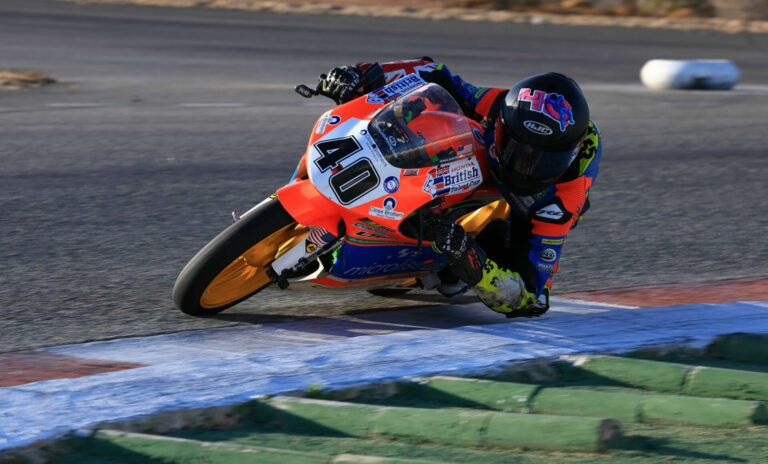
Julian Correa, a 14-year-old from Jupiter, Florida, is currently in Spain testing his Microlise Cresswell Racing Honda NSF250R at Circuito de Cartegena.

Correa is preparing for his second full season in the British Talent Cup, which is an official Road to MotoGP program that runs with the British Superbike Championship.

Correa placed 12th in the 2022 British Talent Cup Championship with one podium appearance and eight top-10 finishes.

MotoAmerica: R&G Protects Vision Wheel M4 ECSTAR Suzuki For 2023

R&G PROTECTS VISION WHEEL M4 ECSTAR SUZUKI FOR 2023!

UK-based R&G is pleased to announce that it is partnering with the Vision Wheel M4 ECSTAR Suzuki team again for the 2023 MotoAmerica Championship. This season looks set to be the biggest yet for the four-rider squad as they compete across the Superbike and Supersport classes.

This season will be the third consecutive year that R&G and Vision Wheel M4 ECSTAR Suzuki have worked together, further enforcing the company’s commitment to MotoAmerica. This season looks set to be an enthralling year for the team, with former World and MotoAmerica Champion Toni Elias and 2020 MotoAmerica Supersport Champion Richie Escalante set to race the GSX-R1000R Superbikes, while Teagg Hobbs and Tyler Scott will compete in the Supersport class.

R&G will be protecting all four machines, supplying its essential range of race-proven products such as Engine Case Covers, Radiator Guards, Shark’s Fins and Lever Guards.

Alongside supporting the team, R&G will also be an official Supporting Partner to the MotoAmerica series for a fourth consecutive season. The partnership ensures that the R&G brand is prominently promoted to Stateside fans through the series’ messaging, trackside branding and social media.

Further information can be found at https://www.rg-racing.com, while you can also stay up-to-date with the latest news by following R&G on Facebook, Twitter, Instagram and TikTok.

For product and dealer opportunities, please contact 01420 89007 / [email protected] or an R&G Sales Agent.

MotoAmerica: Gloddy Recovering From Surgery Following Twins Cup Crash

Rodio Racing – Powered by Robem Engineering Aprilia rider Ben Gloddy is recovering from surgery in Halifax Health Medical Center in Daytona Beach, Florida, following his crash in MotoAmerica REV’IT! Twins Cup Race One on Friday at Daytona International Speedway.

Gloddy, age 17, was racing in the five-rider lead group on lap three when Dominic Doyle crashed in the West Horseshoe while riding his Team Iso Yamaha in the middle of the pack. Gloddy took evasive action but was hit by Doyle’s bike, crashed, and almost immediately sought help from the corner marshals.

Gloddy was transported to the hospital where he was admitted and underwent surgery to close a laceration, according to a post he made on social media.

Gloddy wrote:

“First, a big congratulations to @gus_rodio on his win today! Repeat that again tomorrow!

“I also want to send a huge that you to everyone who called, texted and messaged to check on me. I was transported to Halifax Hospital where they have taken great care of me! I had to have a surgery to repair a good sized laceration, but am expected to make a full recovery pretty quickly. Unfortunately, I will not be cleared to race tomorrow, but should be good to go by Atlanta.

“I can’t thank everyone enough for everything today. I should be discharged in the morning and look forward to seeing everyone at the track tomorrow.

“Thank you @sarachappellphotos and @k1600mark for being with me at the hospital and for staying in contact with my family back home. And of course thank you to Dr. Carl [Price] and the @motoamerica medical staff and corner workers!”


American Flat Track: Rain Forces Postponement Of Daytona Short Track II

Today’s DAYTONA Short Track presented by Daytona Dodge Rescheduled for Saturday, March 11

DAYTONA BEACH, Fla. (March 10, 2023) – Due to inclement weather, the DAYTONA Short Track presented by Daytona Dodge scheduled for today, Friday, March 10, will be postponed until tomorrow, Saturday, March 11.

Gates will open for fans at 5:00 p.m., with Opening Ceremonies scheduled for 6:00 p.m. followed by a complete evening program.

Tickets purchased for today’s DAYTONA Short Track are redeemable for the rescheduled event tomorrow, Saturday, March 11.

Full updated schedule to follow.

American Flat Track: Running Results From Daytona Short Track II

KurveyGirl.com brings you the results of this weekend’s events.

 

At our online motorcycle parts store, you’ll find a specialized selection of quarter turn “Dzus” fasteners, titanium hardware, premium tire valve stems, Vesrah racing brake pads, Brembo parts and accessories, and other unique hardware specifically designed for race and trackday motorcycles.


Progressive American Flat Track (AFT) Championship Series

Daytona Short Track II

Daytona International Speedway

Daytona Beach, Florida

March 10, 2023

Mission AFT SuperTwins Provisional Free Practice 1 Results (all on Dunlop tires):

1. Dallas Daniels (Yam), 18.258 seconds

2. Brandon Robinson (Ind), 18.342

3. Davis Fisher (Ind), 18.460

4. Jarod Vanderkooi (Ind), 18.471

5. JD Beach (Yam), 18.478

6. Jared Mees (Ind), 18.607

7. Briar Bauman (KTM), 18.608

8. Kayl Kolkman (Yam), 18.616

9. Sammy Halbert (Yam), 18.621

10. Ben Lowe (Ind), 18.687

11. Kolby Carlile (Yam), 18.743

12. Michael Rush (Har), 18.854

13. Johnny Lewis (Roy), 19.095

14. Cameron Smith (Kaw), 19.096

15. Bronson Bauman (KTM), 19.152

16. Dan Bromley (Yam), 19.165

17. Billy Ross (Ind), 19.230

18. Jeffery Lowery (Yam), 19.253

19. Jordan Harris (KTM), 19.258

20. Ryan Wells (Roy), 19.362

21. Kasey Sciscoe (Har), 19.381

22. Mitch Harvat (Kaw), 19.420

23. Michael Hill (Kaw), 19.677

24. Brandon Newman (Har), 19.843

25. Jimmy McAllister (Hus), 20.461


Pasts Unlimited AFT Single Provisional Free Practice 1 Results (all on Dunlop tires):

1. Kody Kopp (KTM), 18.205 seconds

2. Trevor Brunner (Yam), 18.383

3. Andrew Luker (Yam), 18.397

4. Chase Saathoff (Hon), 18.434

5. Tom Drane (Yam), 18.485

6. Max Whale (KTM), 18.533

7. Chad Cose (Hus), 18.534

8. Travis Petton (KTM), 18.710

9. Hunter Bauer (KTM), 18.728

10. James Ott (Hus), 18.739

11. Justin Jones (KTM), 18.751

12. Logan Eisenhard (KTM), 18.822

13. Aidan RoosEvans (Hon), 18.826

14. Clarke Morian (KTM), 18.832

15. Dalton Gauthier (KTM), 18.844

16. Jordan Jean (Hon), 18.848

17. Trent Lowe (Hon), 18.852

18. Tanner Dean (KTM), 18.913

19. Cole Zabala (Hon), 18.924

20. Morgen Mischler (Hon), 18.956

21. Jared Lowe (Hon), 19.156

22. Shayna Texter-Bauman (KTM), 19.211

23. Tarren Santero (Hon), 19.240

24. Gerard Bailo (Hon), 19.244

25. Gary Birtwistle (Hus), 19.263

26. Dan Bromley (Yam), 19.266

27. Ashton Yates (Hon), 19.337

28. Jess Reynolds (KTM), 19.347

29. Kevin Stollings (Hon), 19.357

30. Tyler Raggio (Yam), 19.358

31. Logan McGrane (KTM), 19.371

32. Wyatt Vaughan (Hon), 19.411

33. Jacob Cascio (Hon), 19.420

34. Landen Smith (KTM), 19.438

35. Treygan Birdsong (Hon), 19.495

36. Clayton Williams (Yam), 19.496

37. Ervin Krajcovic (Hon), 19.512

38. Ian Wolfe (Hon), 19.535

39. Damon Ream (KTM), 19.579

40. Declan Bender (KTM), 19.614

41. Olin Kissler (KTM), 19.690

42. Aidan Brown (Hon), 19.709


Astro Invitational Provisional Free Practice 1 Results (all on Dunlop tires):

1. Garth Brow (Bul), 20.023 seconds

2. Dominic Beaulac (Bul), 20.402

3. Charles Roberts (Bul), 20.556

4. Wyatt Campbell (Bul), 20.809

5. Ronnie Jones (Bul), 20.909

6. Chris Boone (Bul), 21.028

7. Rick Reed (Bul), 21.299

8. Jackie Mitchell (Bul), 21.388

9. Greg Scalf (Bul), 21.713

10. Jeffrey Hiers (Bul), 22.481

11. Charles Williams (Bul), 22.802

12. Jerry Lacy (Bul), 24.965

13. Lucien Marioneaux (Bul), no time recorded


Mission SuperTwins Provisional Free Practice 2 Results (all on Dunlop tires):

1. Briar Bauman (KTM), 18.653 seconds

2. Dallas Daniels (Yam), 18.663

3. Brandon Robinson (Ind), 18.686

4. Jarod Vanderkooi (Ind), 18.754

5. Johnny Lewis (Roy), 18.764

6. Davis Fisher (Ind), 18.791

7. JD Beach (Yam), 18.822

8. Jared Mees (Ind), 18.866

9. Ben Lowe (Ind), 18.927

10. Dan Bromley (Yam), 18.956

11. Kayl Kolkman (Yam), 19.000

12. Sammy Halbert (Yam), 19.061

13. Michael Rush (Har), 19.154

14. Kolby Carlile (Yam), 19.175

15. Bronson Bauman (KTM), 19.176

16. Cameron Smith (Kaw), 19.222

17. Billy Ross (Ind), 19.223

18. Kasey Sciscoe (Har), 19.371

19. Jeffery Lowery (Yam), 19.440

20. Ryan Wells (Roy), 19.470

21. Jordan Harris (KTM), 19.493

22. Mitch Harvat (Kaw), 19.631

23. Michael Hill (Kaw), 19.686

24. Brandon Newman (Har), 19.899

25. Jimmy McAllister (Hus), 20.396


Parts Unlimited AFT Singles Provisional Qualifying 1 Results (all on Dunlop tires):

1. Kody Kopp (KTM), 18.666 seconds

2. Chase Saathoff (Hon), 18.674

3. Travis Petton (KTM), 18.750

4. Trevor Brunner (Yam), 18.756

5. Chad Cose (Hus), 18.916

6. Andrew Luker (Yam), 18.969

7. Max Whale (KTM), 19.015

8. James Ott (Hus), 19.047

9. Justin Jones (KTM), 19.050

10. Tom Drane (Yam), 19.065

11. Cole Zabala (Hon), 19.116

12. Dan Bromley (Yam), 19.132

13. Jared Lowe (Hon), 19.138

14. Clarke Morian (KTM), 19.144

15. Jordan Jean (Hon), 19.145

16. Trent Lowe (Hon), 19.146

17. Kevin Stollings (Hon), 19.205

18. Hunter Bauer (KTM), 19.222

19. Logan Eisenhard (KTM), 19.258

20. Tarren Santero (Hon), 19.261

21. Aidan RoosEvans (Hon), 19.280

22. Gerard Bailo (Hon), 19.289

23. Gary Birtwistle (Hus), 19.316

24. Tyler Raggio (Yam), 19.322

25. Logan McGrane (KTM), 19.332

26. Ashton Yates (Hon), 19.345

27. Landen Smith (KTM), 19.370

28. Ervin Krajcovic (Hon), 19.425

29. Treygan Birdsong (Hon), 19.453

30. Tanner Dean (KTM), 19.470

31. Wyatt Vaughan (Hon), 19.491

32. Jess Reynolds (KTM), 19.497

33. Declan Bender (KTM), 19.516

34. Jacob Cascio (Hon), 19.527

35. Aidan Brown (Hon), 19.528

36. Shayna Texter-Bauman (KTM), 19.529

37. Clayton Williams (Yam), 19.581

38. Morgen Mischler (Hon), 19.617

39. Ian Wolfe (Hon), 19.666

40. Damon Ream (KTM), 19.691

41. Dalton Gauthier (KTM), 19.761

42. Olin Kissler (KTM), 19.969


Astro Invitational Provisional Qualifying 1 Results (all on Dunlop tires):

1. Garth Brow (Bul), 19.804 seconds

2. Ronnie Jones (Bul), 19.980

3. Dominic Beaulac (Bul), 20.395

4. Wyatt Campbell (Bul), 20.829

5. Jackie Mitchell (Bul), 21.085

6. Charles Roberts (Bul), 21.090

7. Chris Boone (Bul), 21.751

8. Rick Reed (Bul), 21.796

9. Kris Weiss (Bul), 21.816

10. Greg Scalf (Bul), 22.002

11. Charles Williams (Bul), 22.503

12. Jeffrey Hiers (Bul), 22.895

13. Lucien Marioneaux (Bul), 23.376

14. Jerry Lacy (Bul), 24.142


Mission AFT SuperTwins Provisional Qualifying 1 Results (all on Dunlop tires):

1. Briar Bauman (KTM), 18.821 seconds

2. Dallas Daniels (Yam), 18.897

3. Michael Rush (Har), 18.902

4. Brandon Robinson (Ind), 18.919

5. Davis Fisher (Ind), 18.931

6. Jarod Vanderkooi (Ind), 18.934

7. Ben Lowe (Ind), 19.053

8. Johnny Lewis (Roy), 19.083

9. JD Beach (Yam), 19.088

10. Dan Bromley (Yam), 19.133

11. Jared Mees (Ind), 19.141

12. Kolby Carlile (Yam), 19.193

13. Kayl Kolkman (Yam), 19.195

14. Sammy Halbert (Yam), 19.294

15. Billy Ross (Ind), 19.432

16. Mitch Harvat (Kaw), 19.440

17. Bronson Bauman (KTM), 19.502

18. Jeffery Lowery (Yam), 19.548

19. Cameron Smith (Kaw), 19.613

20. Kasey Sciscoe (Har), 19.620

21. Ryan Wells (Roy), 19.700

22. Michael Hill (Kaw), 19.719

23. Jordan Harris (KTM), 19.832

24. Brandon Newman (Har), 19.935

25. Jimmy McAllister (Hus), 20.040


Parts Unlimited AFT Singles Provisional Qualifying 2 Results (all on Dunlop tires):

1. Kody Kopp (KTM), 18.428 seconds

2. Trevor Brunner (Yam), 18.720

3. Travis Petton (KTM), 18.742

4. Dalton Gauthier (KTM), 18.762

5. Max Whale (KTM), 18.789

6. Andrew Luker (Yam), 18.825

7. Chase Saathoff (Hon), 18.838

8. Trent Lowe (Hon), 18.845

9. Tom Drane (Yam), 18.858

10. Justin Jones (KTM), 18.883

11. Chad Cose (Hus), 18.932

12. James Ott (Hus), 18.961

13. Logan Eisenhard (KTM), 18.993

14. Jordan Jean (Hon), 19.050

15. Cole Zabala (Hon), 19.085

16. Tarren Santero (Hon), 19.097

17. Jared Lowe (Hon), 19.106

18. Clarke Morian (KTM), 19.143

19. Morgen Mischler (Hon), 19.148

20. Aidan RoosEvans (Hon), 19.164

21. Shayna Texter-Bauman (KTM), 19.228

22. Tanner Dean (KTM), 19.239

23. Landen Smith (KTM), 19.243

24. Hunter Bauer (KTM), 19.265

25. Gary Birtwistle (Hus), 19.276

26. Gerard Bailo (Hon), 19.302

27. Ashton Yates (Hon), 19.312

28. Kevin Stollings (Hon), 19.342

29. Dan Bromley (Yam), 19.343

30. Jess Reynolds (KTM), 19.354

31. Tyler Raggio (Yam), 19.365

32. Logan McGrane (KTM), 19.385

33. Jacob Cascio (Hon), 19.428

34. Treygan Birdsong (Hon), 19.431

35. Declan Bender (KTM), 19.462

36. Aidan Brown (Hon), 19.463

37. Ervin Krajcovic (Hon), 19.493

38. Damon Ream (KTM), 19.512

39. Clayton Williams (Yam), 19.584

40. Wyatt Vaughan (Hon), 19.590

41. Ian Wolfe (Hon), 19.591

42. Olin Kissler (KTM), 19.734


Astro Invitational Provisional Qualifying 2 Results (all on Dunlop tires):

1. Garth Brow (Bul), 19.601 seconds

2. Ronnie Jones (Bul), 19.670

3. Dominic Beaulac (Bul), 19.930

4. Robby-Bobby McLendon (Bul), 20.057

5. Charles Roberts (Bul), 20.495

6. Jackie Mitchell (Bul), 20.574

7. Wyatt Campbell (Bul), 20.582

8. Kris Weiss (Bul), 20.722

9. Greg Scalf (Bul), 21.415

10. Charles Williams (Bul), 21.604

11. Rick Reed (Bul), 21.622

12. Jerry Lacy (Bul), 23.382


Mission AFT SuperTwins Provisional Qualifying 2 Results (all on Dunlop tires):

1. Dallas Daniels (Yam), 18.755

2. Jarod Vanderkooi (Ind), 18.851

3. Brandon Robinson (Ind), 18.865

4. Johnny Lewis (Roy), 18.975

5. Jared Mees (Ind), 19.009

6. Briar Bauman (KTM), 19.010

7. Davis Fisher (Ind), 19.040

8. Michael Rush (Har), 19.043

9. Kolby Carlile (Yam), 19.053

10. JD Beach (Yam), 19.059

11. Kayl Kolkman (Yam), 19.078

12. Ben Lowe (Ind), 19.119

13. Dan Bromley (Yam), 19.139

14. Billy Ross (Ind), 19.176

15. Sammy Halbert (Yam), 19.205

16. Bronson Bauman (KTM), 19.271

17. Ryan Wells (Roy), 19.285

18. Mitch Harvat (Kaw), 19.296

19. Cameron Smith (Kaw), 19.377

20. Kasey Sciscoe (Har), 19.462

21. Jeffery Lowery (Yam), 19.574

22. Jordan Harris (KTM), 19.645

23. Michael Hill (Kaw), 19.712

24. Brandon Newman (Har), 20.355

25. Jimmy McAllister (Hus), no time recorded

MotoAmerica: Riding Indian’s Challenger King Of The Baggers Racebike

Editorial Note: This article is the cover story in the March 2023 issue of Roadracing World & Motorcycle Technology magazine, which is on newsstands and available in its digital format now.

MOTOAMERICA RACEBIKE TEST

TYLER O’HARA’S INDIAN CHALLENGER BAGGER

HEAVY INTENSITY!

By Chris Ulrich

It took less than two seasons for Bagger racing to go from an exhibition to full-factory-­racing insanity. That madness is being fueled by a fierce rivalry between Harley-Davidson and Indian that started generations ago, lay dormant for decades, and has been reborn, first in dirt track and now spilling onto the paved road courses of the MotoAmerica Superbike Series in a big way. In this case, “fierce rivalry” isn’t really strong enough to describe what has turned into an all-out battle for dominance in the Mission Foods King Of The Baggers and the RSD Super Hooligan National Championships, and things are only going to get more intense now that the Harley-Davidson Pan America model has been allowed in the Super Hooligan Series.

The war has powered development leading to a seven-second lap time improvement from the first Bagger exhibition race at Laguna Seca in 2020 to Laguna Seca in 2022. Some of the improvement came from switching to Dunlop slick tires, but most of it came from technical development. The fastest lap from the 2021 KOTB race at Laguna was a 1:31.9 set by Kyle Wyman on a Harley-Davidson. Wyman improved another 2.5 seconds in 2022, turning a 1:29.4 during the 2022 race. Imagine turning a sub-1:30 lap time around Laguna Seca on a Bagger! These bikes are legitimate weapons and the guys are riding them hard. It’s great to watch. And it’s only going to get better with both factories fully involved.

Rivalry aside, Indian is using racing to reinforce its high-performance credentials in the marketplace. In 2017, Indian launched the FTR, a dirt-track-inspired 1,200cc streetbike, and used AFT Flat Track racing to promote the new motorcycle. Indian also launched various promotions, including hiring Travis Pastrana to recreate Evil Knievel’s big jumps. And the inception of Roland Sands’ Super Hooligan Racing Series was spawned from Indian’s effort to be relevant in a space that was historically dominated by Harley-Davidson. Since all this started Indian and racing contractor S&S have won six AFT Championships, essentially making the factory Harley-Davidson effort non-competitive. More recently, in 2023, Indian won the AFT SuperTwins Championship with Jared Mees along with the MotoAmerica KOTB and SHNC Championships with Tyler O’Hara. All that success on the racetrack has turned a once-defunct brand Polaris, purchased and revived in 2011, to the marketplace powerhouse in 12 years. And just like that, owning an Indian is cool again.

I’ve written it before, but it’s worth repeating:  Win on Sunday, Sell on Monday is still alive and well. Otherwise, these two big American companies would not be spending money on racing and working hard to use racing success to market motor­cycles.


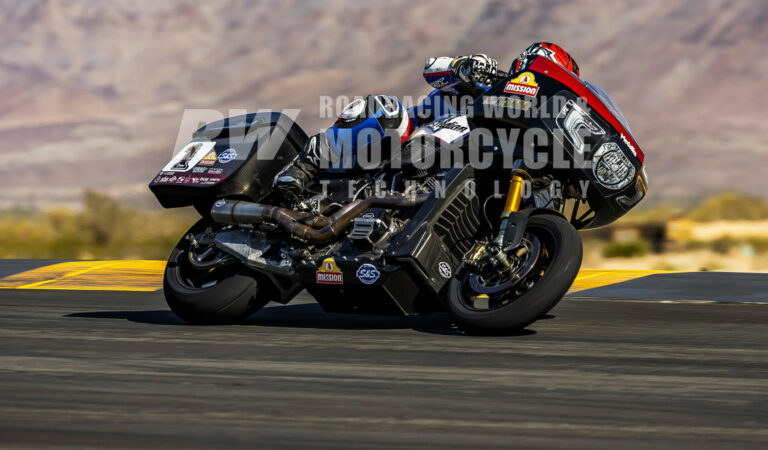
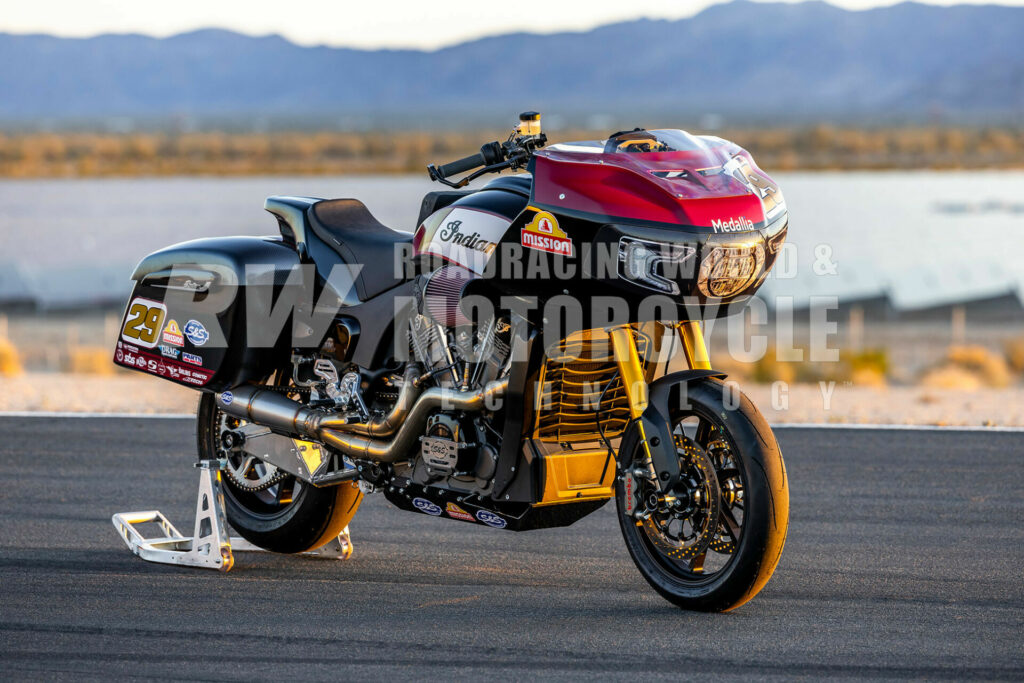
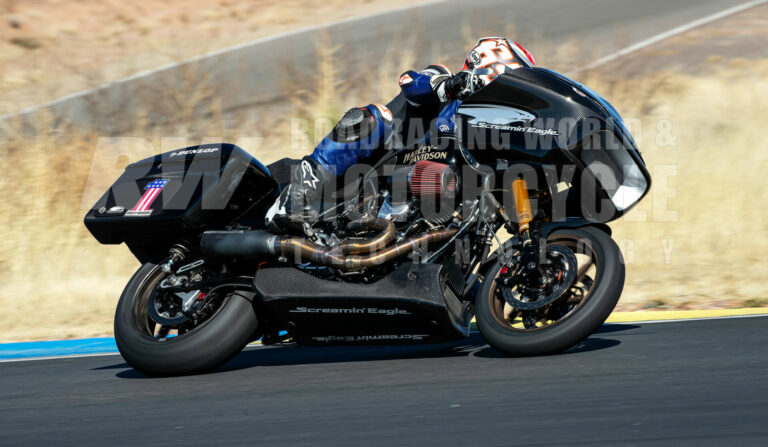
Left side of Tyler O'Hara's 2023 Indian Challenger Bagger at Chuckwalla Valley Raceway. Note the short aluminum swingarm and how far the front wheel is out ahead of the motorcycle. Photo by John Ulrich.
Left side of Tyler O’Hara’s 2023 Indian Challenger Bagger at Chuckwalla Valley Raceway. Note the short aluminum swingarm and how far the front wheel is out ahead of the motorcycle. Photo by John Ulrich.


Direct factory involvement from Indian and Harley in the KOTB series has created additional well-paid jobs in the paddock, with some rider salaries matching the per-race amount paid by Superbike teams. Factory bonus programs for KOTB are also well above even the factory Yamaha bonuses, while posted contingency matches what is available from most sportbike manufacturers in other classes. The global effect the KOTB series has had on the paddock is also positive; the class has brought in a new demographic of fans, who spend their money on tickets and merchandise and, in a lot of cases, have become fans of Superbike and Supersport classes after being exposed to the racing. They come for the Baggers, and stay for the Superbikes. Love them or hate them, the economics of Bagger racing are good for professional motorcycle racing in the United States. And it’s damn entertaining to watch.

Indian representatives tout their racing activities as being a David vs. Goliath situation with H-D shipping six-times more motorcycles than Indian per year. But the racing programs are more similar than they think, at least in 2022. Most of the Indian and S&S crew members also must perform their regular day job duties on top of at-track racing activities, and the situation is the same for the H-D staffers on the Screamin’ Eagle program. And like Harley-Davidson’s team, the Indian team is passionate about racing, winning, and mainly beating the other guys!

The path to the 2022 King Of The Baggers Championship for Tyler O’Hara was not easy, but of the front-runners, he was the most consistent during the seven-round series. The season started well for O’Hara with a win in the opening race at Daytona, followed up with a second-place finish in Race 2. He stayed consistent for the remaining rounds, never finishing worse than fourth, and finally clinching the Championship in the rain-soaked finale at New Jersey Motorsports Park. In total, Indian riders O’Hara, Jeremy McWilliams, and Bobby Fong won three points-paying races during the 2022 season. The Indian crew also limited costly mistakes like those made by the Harley-Davidson team, the worst example being oiling the racetrack twice due to mechanical problems and getting Kyle Wyman disqualified at Brainerd.

Baggers are extreme bikes with extreme dimensions and the Indian is no exception. From the outside, the S&S Indian Challenger build looks to be more practical than the Harley-Davidson package. It could also be that the base design needs less modification to bring it up to race spec.

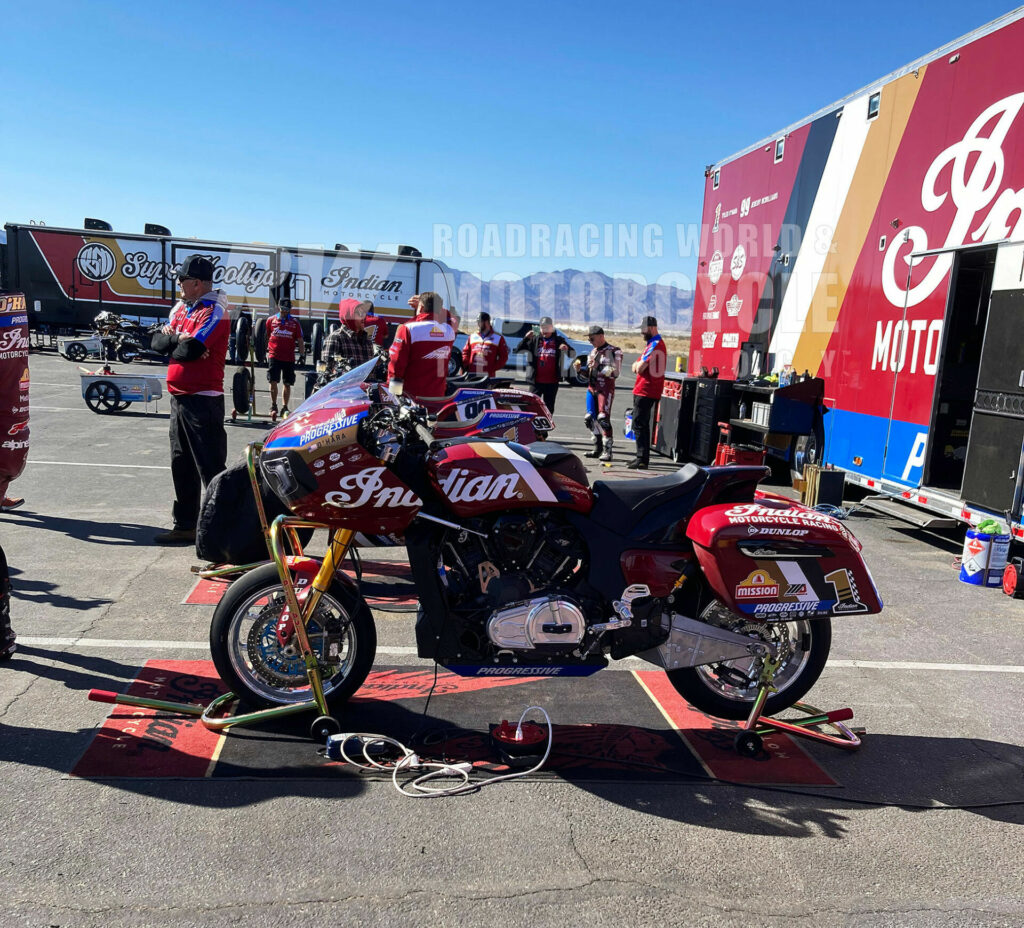
Indian relies on S&S to build its factory Indian Challenger racebike, which weighs roughly 630 pounds before adding fuel. It has a 65.5-inch (1,663mm) wheelbase, 23.5 degrees of rake, and 114mm (4.5 inches) of trail, making the Challenger’s chassis dimensions close to the Harley-Davidson Road Glide’s numbers. Per Moto­America KOTB rules, the main frame, the OEM front fairing shape, and the core engine must be retained. No external bracing can be added to the aluminum-alloy, backbone-design frame, but the rest of the chassis components can be replaced or modified.

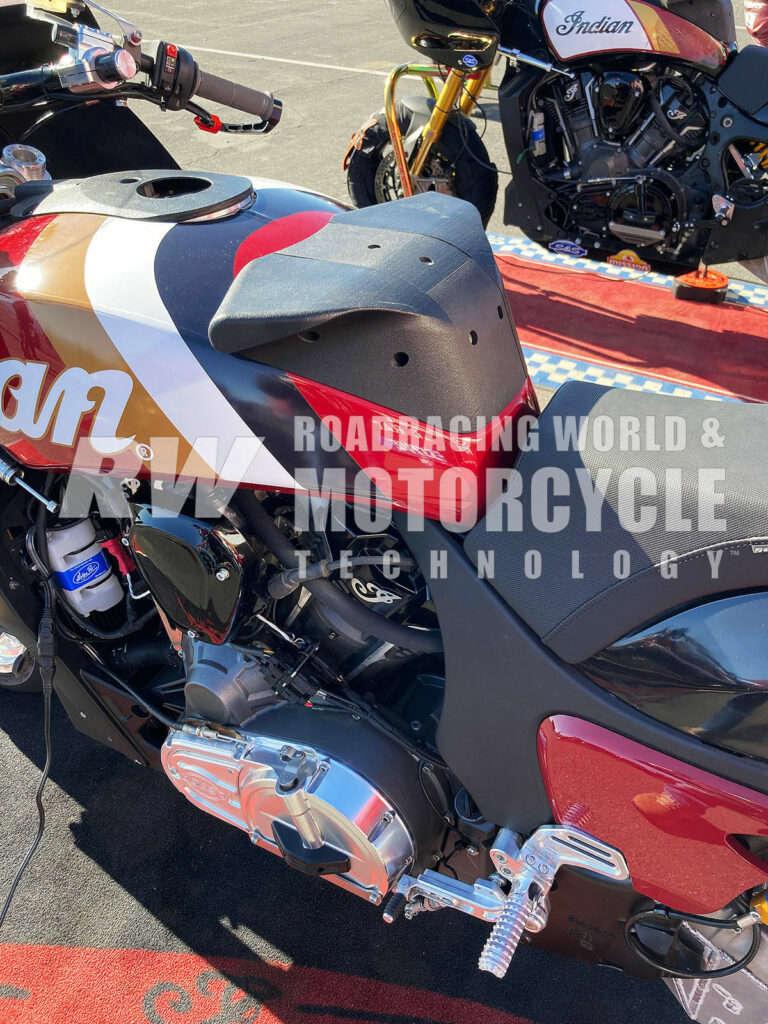
As is the case with all Baggers, gaining cornering ground clearance is one the biggest challenges builders face. On the Indian, S&S modified the left-side engine cover, moving the clutch actuation arm from the bottom to the top of the case cover and adding a taper. A host of other S&S parts were used to bring the Challenger up to race spec. The stock triple clamps are replaced with adjustable aluminum triple clamps, with revised offset.

To get the front ride height needed to gain cornering clearance, the standard front forks were replaced by long-travel Öhlins FG8603 model forks that are original fitment on a Ducati Multistrada. Rear suspension is handled by an Öhlins TTX36 single shock. S&S also designed and built the rear-set controls, clip-on handlebars, front fairing bracket, axles, and rear brake hanger, which carries a thumb-operated dual-piston Hayes brake caliper. Dual 320mm (12.6-inch) rotors combined with four-piston Brembo calipers with 100mm spacing and a combination of 32mm/36mm pistons handle the braking duties at the front.

The final drive system for the Indian PowerPlus engine is located on the right side. For racing, S&S converted the OEM belt drive to chain drive, which required the addition of a chain tensioner due to the location of the countershaft sprocket relative to the swingarm pivot position. Bracing has been welded to the underside of the standard cast-aluminum swingarm. As ridden, the rear axle was pushed forward, putting the effective swingarm length at around 20-inches (508mm), which is very short compared to most modern sportbikes. Overall wheelbase is 65.5 inches (1,663mm), which is long compared to current sportbikes. The 2022-spec racebike used OZ aluminum wheels at the end of the season. For 2023 the team is going with specially-built PVM wheels to help eliminate wheel flex caused by the massive weight of the Bagger.

O’Hara’s Challenger is powered by Indian’s liquid-cooled 60-degree V-Twin PowerPlus engine. S&S Cycle had to push the limit of the 112 cubic-inch (1,833.3cc) PowerPlus engine to match the power output of the H-D Milwaukee-Eight’s 131 cubic-inch (2,152cc) engine. In doing so, the lifespan of the engine dropped to one race weekend: The S&S and Indian team had to swap engines mid-weekend at every event to avoid issues. Do the math, and that’s 14 engines for two riders over a seven-race series, not including testing. (The new 7,700 rpm rev limit imposed by MotoAmerica for 2023 should help durability. S&S reps say the rev limit was higher in 2022, but the bike we tested had the new limit implemented.)


S&S rearset controls and custom clutch cover.
S&S rearset controls and custom clutch cover. Photo by John Ulrich.


There is no replacement for displacement, which is why the PowerPlus engine’s bore was increased 2mm from 108mm to 110mm, bringing the displacement up to that 112 cubic inches. Stock pistons were replaced with 2mm oversize CP units. Additional performance increases came from custom-ground S&S camshafts and CNC-ported heads. The stock rockers were replaced with billet units manufactured by S&S. The main bearings were also pinned in place for improved durability.

The standard dual, 52mm ride-by-wire throttle bodies were located where a frame rail restricted air flow to the engine, so they were replaced with a relocated, 78mm single throttle body made for a car, and it came from a V6 Dodge Charger. S&S designed and 3D-printed a new intake manifold and runner to fit the throttle body. Spent gasses flow out from the exhaust ports into an S&S-built stainless steel exhaust system.

Electronics are limited, but Indian gained an allowance from Moto­America to run a MaxxECU Sport unit. The Maxx brand is better known for car applications than motorcycle use, but is fine in this case given the fact that no rider aids are allowed in the KOTB class. The racing-spec Indian Challenger comes with a quick-shifter and auto-blip function. An AIM DL2 data logging display replaces the stock dash.


The 1,833cc Indian Challenger Bagger is fast, helped by a 78mm car throttle body! Chris Ulrich was surprised that the Challenger behaved differently exiting right-handers, stepping out and sliding, depending on throttle position and lean angle.
The 1,833cc Indian Challenger Bagger is fast, helped by a 78mm car throttle body! Chris Ulrich was surprised that the Challenger behaved differently exiting right-handers, stepping out and sliding, depending on throttle position and lean angle. Photo by Garth Milan.


Riding Tyler O’Hara’s Indian Challenger

I was standing in the pits buzzing from an adrenaline spike after my five laps around Chuckwalla Valley Raceway on Tyler O’Hara’s Bagger. My opening lap was awkward, but my second lap was better. I was getting comfortable on the bike by lap three, lap four was faster, and I improved three more seconds on lap five, then ignored the checkered flag to finish the lap I was on. The lap timer went 2:08, 2:05, 2:05 (in traffic), 2:03, and at the end I turned a 2:00.9. Which frankly isn’t impressive at all, but considering my lack of experience and time available on what is a very unique motorcycle I was fine with it.

What surprised me was the level of concentration it took to get to that point—and how wound up I was getting off the bike! The Challenger was exciting and I wanted another go at it. I haven’t felt that way about a motor­cycle since I stopped racing Superbikes in 2016!

The ergonomics on the Challenger felt more natural to me than they did on Kyle Wyman’s Harley-Davidson when I rode it at Inde Motorsports Park for the March 2022 cover story. The reach and angle of the bars feel more like a sportbike’s. The seat -to-peg distance is relaxed and the overall height is shorter, so it was easier to get my feet on the ground. And it felt more natural to ride since it wasn’t so high.

The intensity comes partially from the unknown and learning how to ride a bike that is unique to the category. But the rest comes from the massive amount of chassis-generated movement on both ends of the motorcycle. The Challenger starts to move during braking while still straight up and down. The forks compress quickly, which causes the bike to wallow before turning in. And the relatively steep steering angle made it feel like I was over the top of the front end. However, the long wheelbase helped mitigate the forces. It doesn’t take an excessive amount of effort to roll the Indian into the corner, likely because it has a high center of gravity. But the movement really never stops.

At the apex, the front wheel feels like it’s under the bike and the tire is trying to fold (tuck) but again, a relatively high trail number and long wheelbase saves the day. I definitely tried to get off the brakes and back on the gas as early as possible. Usually, a bike would lack feel in this situation, but Challenger gave plenty of feedback at full lean.

The Challenger’s handling on corner exit is unique. The first thing I noticed was a lack of rigidity at the center of the motorcycle. This is no doubt caused by turning a bike that started life as a huge streetbike into a racebike. The main frame definitely isn’t designed for racing. That’s a fact of life, but the movement is not all bad as it provides plenty of feedback. Flex is part of the game with Baggers.

However, the Challenger does behave differently at corner exit depending on the direction you’re turning. When I was in a right turn, the rear would move, then the chain tensioner would take out slack and cause the rear to slide. The step-out-and-slide reaction would change depending on the throttle position and amount of lean angle. But it was consistent: Add throttle, change chain slack, step out, slide, repeat. Once stood up, the bike would start to behave normally.


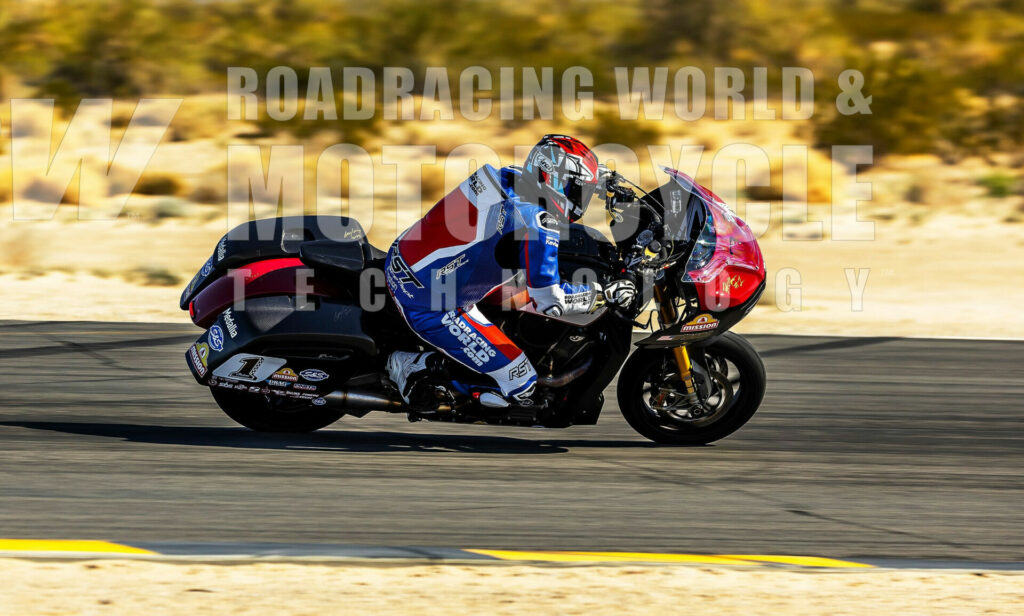
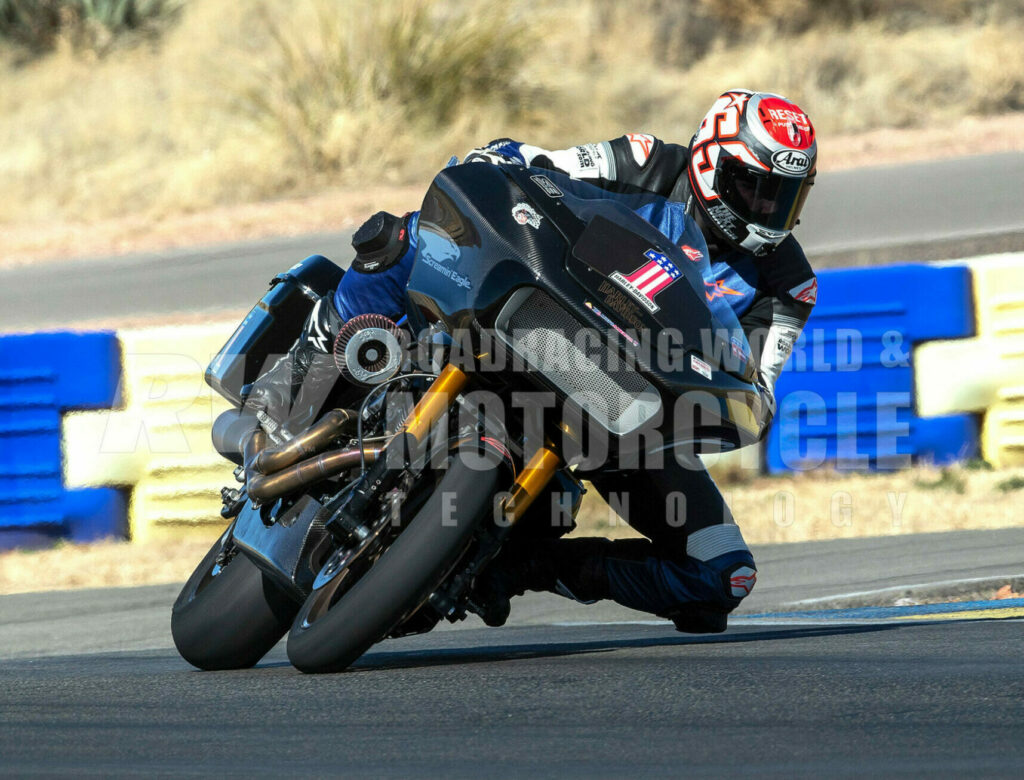
Tyler O'Hara's 2022 MotoAmerica Mission King Of The Baggers Championship-winning Indian Challenger racebike, fitted with Dunlop Q5 trackday tires for this test. Photo by Garth Milan.
Tyler O’Hara’s 2022 MotoAmerica Mission King Of The Baggers Championship-winning Indian Challenger racebike, fitted with Dunlop Q5 trackday tires for this test. Photo by Garth Milan.


Going left, the bike was easier to turn in and get to the apex and behaved more normally on corner exit. I could crack the throttle, set it, then roll it on and the rear would dig in and then drive forward normally. The bike did have a tendency to stand up too early on the lefts. This behavior was so strange! I think it comes down to the manual chain tensioner on the right-side drive needed more development. Probably a spring change to make the action more consistent.

While the chassis is different, the engine is great. It produces smooth, tractable power from 3,000 rpm to 7,700 rpm. The rev limiter comes on pretty quickly in some situations, so I suspect the team has to compromise on gearing at some tracks. The transmission performance is very good on the Indian. The throw between gears is short, so I didn’t have to worry about being deliberate with my downshifts. And having a quick-shifter was really nice. I tried the auto-blip on an early lap but wasn’t impressed, so I ended up going old-school and manually down-shifting.

How does it compare to the Harley-Davidson? I’ve only ridden one other Bagger on the racetrack, that being Kyle Wyman’s 2021 King Of The Bagger Championship-winning Harley-Davidson Road Glide. So, my frame of reference is small, but there are very distinct differences in the fundamental chassis design of the bikes that make the Indian more natural and enjoyable to ride. For example, the overall height on the Harley-­Davidson makes it unwieldy, but it doesn’t pitch so it remains stable. The Harley-­Davidson’s stepped triple-clamp design puts the front wheel pretty far out from the rider, so while it sticks, it lacks connection and feel. And the Harley-Davidson Milwaukee-Eight 131 transmission is pretty bad. The mental energy required for those guys to not miss shifts is probably worth half-a-second a lap. A quick-shifter would be nice, too. But in the end the Harley-­Davidson and the Indian turn similar lap times, so it’s obvious there is more than one way to do things.

Having ridden both bikes, if I was pressed to choose between them I’d pick the Indian as it just feels more natural to me.

I was still buzzing for hours after my five laps around Chuckwalla on the Indian Challenger. The Baggers are impressive on the engineering side, especially seeing how much they have improved in a couple of race seasons. But while the bike is interesting, I’m more impressed with the guys riding the bike. My experience got more and more intense as I picked up the pace, mirroring what O’Hara’s teammate Jeremy McWilliams told me afterwards. It allowed me to understand how much concentration and intensity it takes to ride and race these bikes at the speeds these guys are going. They’re racing heroes.

And that’s what a race series needs: Rivals and heroes. All racing is entertainment, and Baggers are very entertaining to ride and watch!


0323_BAGGER INSANITY_INDIAN RACE BAGGER

MotoAmerica: King Of The Baggers Race One Results From Daytona (Updated)

KurveyGirl.com brings you the results of this weekend’s events.


At our online motorcycle parts store, you’ll find a specialized selection of quarter turn “Dzus” fasteners, titanium hardware, premium tire valve stems, Vesrah racing brake pads, Brembo parts and accessories, and other unique hardware specifically designed for race and trackday motorcycles.


23_1_DAY_KTB_R2_res


More, from a press release issued by MotoAmerica:

Rispoli Wins Mission King Of The Baggers Opener At Daytona

Gus Rodio Takes First REV’IT! Twins Cup Win, O’Hara Wins Mission Super Hooligan National Championship Race


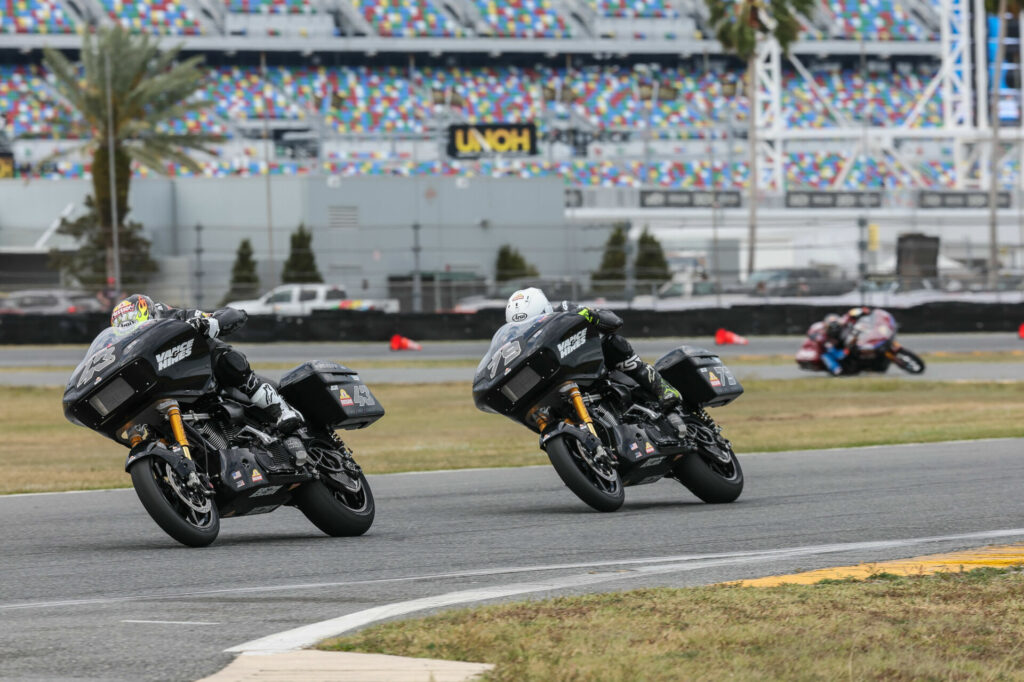
Vance & Hines Harley-Davidson's James Rispoli (43) leads teammate Hayden Gillim (79) with Tyler O'Hara (1) giving chase in the Mission King Of The Baggers race at Daytona International Speedway on Friday. Photo By Brian J. Nelson, courtesy MotoAmerica.
Vance & Hines Harley-Davidson’s James Rispoli (43) leads teammate Hayden Gillim (79) with Tyler O’Hara (1) giving chase in the Mission King Of The Baggers race at Daytona International Speedway on Friday. Photo By Brian J. Nelson, courtesy MotoAmerica.


DAYTONA BEACH, FL (March 10, 2023) – Seemingly everyone had some sort of issue to deal with in the opening round of the Mission King Of The Baggers series at Daytona International Speedway, but Vance & Hines Harley-Davidson’s James Rispoli dealt with his better than the rest to take his first career victory in the class.

Rispoli was running second and giving chase to early leader Kyle Wyman when he made the save of his life and somehow stayed on board his Road Glide despite a seemingly endless and viscous tank slapper on the high banks. Once he got that under control, he was keeping the pressure on Wyman when the H-D Screamin’ Eagle Road Glide expired with five laps to go. From there it was a battle to the finish with Rispoli and his teammate Hayden Gillim joined by the second factory Harley of Travis Wyman. The two Vance & Hines riders then got a scare when Travis Wyman’s Road Glide suffered a mechanical failure on the banking. The fear of oil on the banking brought out the red flag and Rispoli had his first win in the bag with Gillim second.

Defending Mission King Of The Baggers Champion Tyler O’Hara finished third on his Indian Motorcycle/Progressive/Mission Foods Indian Challenger despite having to start from the back row when the team failed to get him and his teammate Jeremy McWilliams out of pit lane in time for the sighting lap.


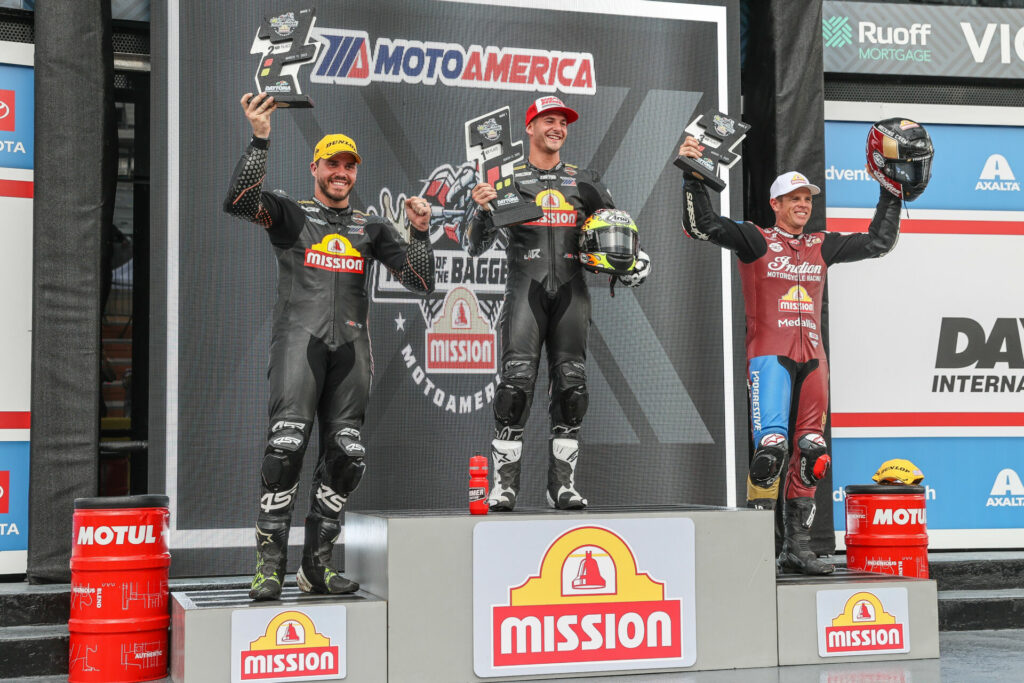
Mission King Of The Baggers winner James Rispoli (center) is flanked in Victory Lane by teammate Hayden Gillim (left) and Tyler O'Hara (right). Photo By Brian J. Nelson, courtesy MotoAmerica.
Mission King Of The Baggers winner James Rispoli (center) is flanked in Victory Lane by teammate Hayden Gillim (left) and Tyler O’Hara (right). Photo By Brian J. Nelson, courtesy MotoAmerica.


The first of the Team Saddlemen Harley was ridden to fourth place by Cory West, who finished 13.1 seconds off the lead and well clear of McWilliams, who was just 1.4 seconds ahead of Baggers rookie and former Superbike racer Jake Lewis.

In addition to the two factory Harleys, Bobby Fong was another knocked out of the race with mechanical problems on his Sac Mile/SDI Racing/Roland Sands/Indian Challenger.

REV’IT! Twins Cup – All Rodio


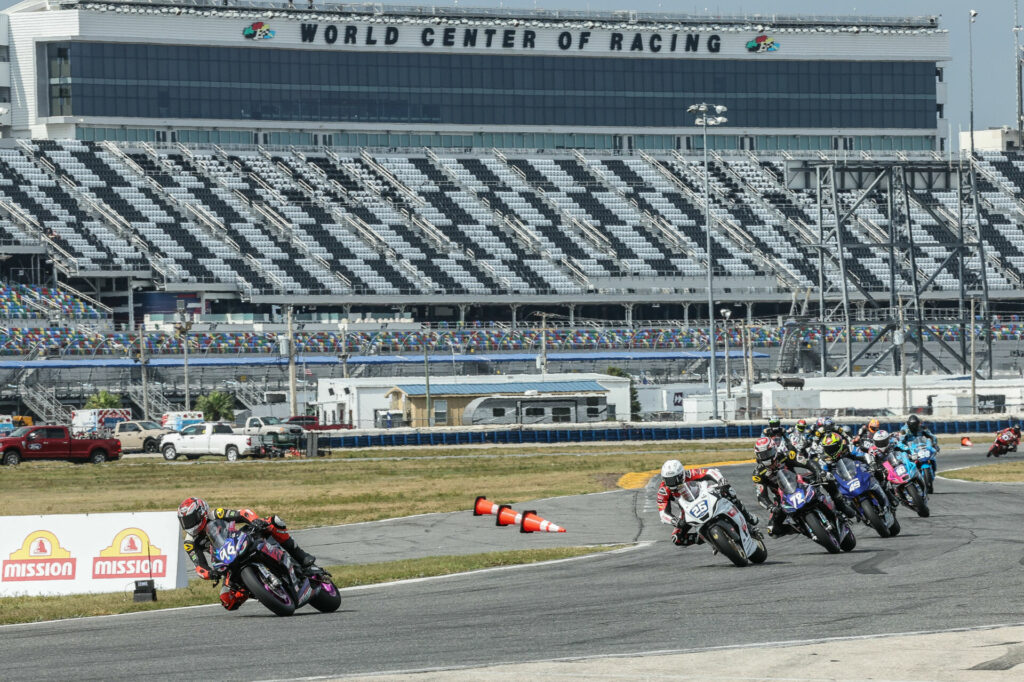
Gus Rodio (96) ran away and hid in REV'IT! Twins Cup Race One at Daytona. Photo By Brian J. Nelson, courtesy MotoAmerica.
Gus Rodio (96) ran away and hid in REV’IT! Twins Cup Race One at Daytona. Photo By Brian J. Nelson, courtesy MotoAmerica.


MotoAmerica races at Daytona International Speedway are normally decided by less than a second. Rodio Racing – Powered By Robem Racing’s Gus Rodio decided to flip that as he rode to his first career victory in the REV’IT! Twins Cup class by an unheard of 8.538 seconds.

Rodio was initially embroiled in a battle at the front with four others, though that was broken up when Dominic Doyle crashed and took Ben Gloddy with him. It also hindered Jackson Blackmon’s progress as he had to take evasive action to avoid the carnage. That left Rodio to battle with defending REV’IT! Twins Cup Champion Blake Davis.

Trackday Winner/Blackmon Racing’s Blackmon, in his first race back after a long rehabilitation of a badly broken ankle, didn’t give up and he was rewarded with an eventual second place after he caught and passed the reeling Davis, who would end up fourth. Blackmon was hounded to the finish line by Cycle Tech’s Hayden Schultz, but he barely beat Schultz to the line by just .060 of a second.

Fifth place went to Ed Sullivan, the Giaccmoto Yamaha Racing rider whose real job is crew chief for Mathew Scholtz’s Westby Racing Yamaha YZF-R1 Superbike.

Mission Super Hooligan National Championship

If getting Daytona’d isn’t a verb, it ought to be. The definition would be: Daytona’d (verb) to lead the entire race only to be beaten by a fraction of a second on the draft run from the final chicane to the finish line on the tri-oval of Daytona International Speedway.

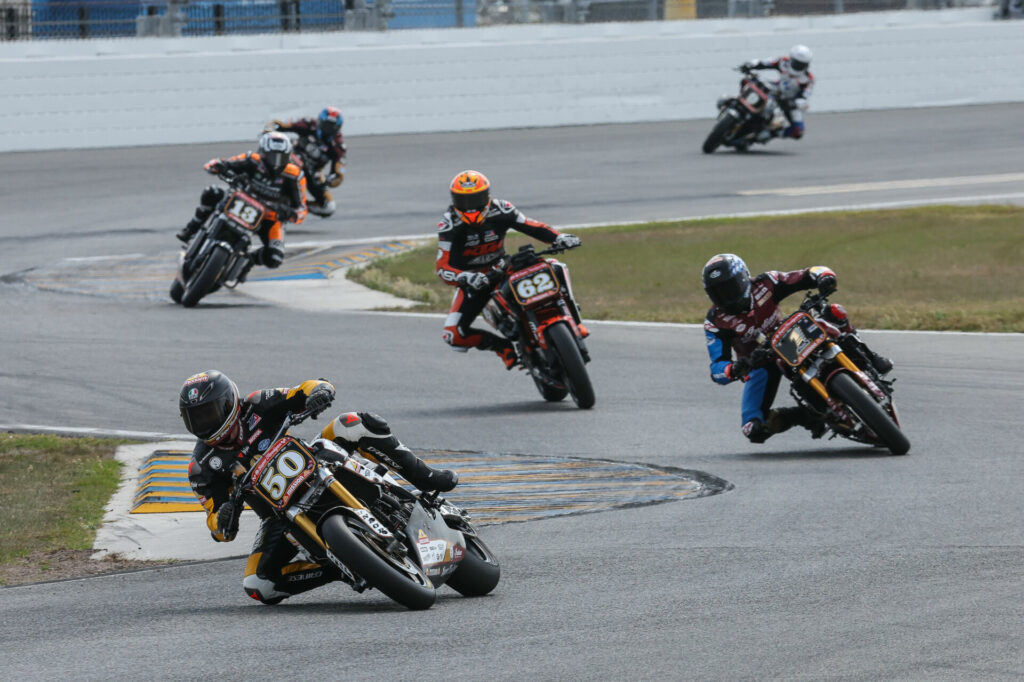
Many have suffered the fate of being Daytona’d and on Friday it was Bobby Fong’s turn. Fong and his Roland Sands Design/Indian Motorcycle-backed FTR1200 led 99.9 percent of the six-lap Mission Super Hooligan National Championship race at the Speedway, but it was the .1 percent that hurt as Tyler O’Hara beat him to the line by .064 of a second on his Indian Motorcycle/Progressive/Mission Foods-sponsored FTR1200.

O’Hara’s teammate Jeremy McWilliams completed the podium in third, the Northern Irelander 1.2 seconds behind O’Hara and .144 of a second ahead of Cory West and the Team Saddlemen Harley-Davidson Pan America.

Fong’s teammate Kyle Ohnsorg finished a lonely fifth.


Bobby Fong (50) leads eventual winner Tyler O'Hara (1) in Super Hooligan National Championship Race One on Friday. Photo By Brian J. Nelson, courtesy MotoAmerica.
Bobby Fong (50) leads eventual winner Tyler O’Hara (1) in Super Hooligan National Championship Race One on Friday. Photo By Brian J. Nelson, courtesy MotoAmerica.


Notes…

Warhorse HSBK Racing Ducati NYC’s Josh Herrin will start Saturday’s Daytona 200, sponsored in part by Pirelli and Bridgestone, from pole position after leading the 15-minute Time Attack final qualifying session with his 1:48.741. He will be joined on the front row by Celtic/Tytlers Cycle/TSE Racing’s PJ Jacobsen and Vision Wheel M4 ECSTAR Suzuki’s Tyler Scott.

In addition to a solid effort that led to a front-row starting position, Scott and his Vision Wheel M4 ECSTAR Suzuki were victors in the second annual MotoAmerica Pit Stop Challenge that was held at the end of on-track action on Friday.

Quotes
 
Tyler O’Hara – Super Hooligan National Championship, Winner

“It was a good race. Bobby (Fong) had really good pace all weekend. That was the first time we got to ride together, and he had a really clean, open track. I was in the back learning and made a few mistakes myself and he gapped me. I was able to reel him back in, and then the lapper there through the chicane definitely played a big role. I don’t know if I was going to be able to draft pass him on the finish. He basically broke the draft. It was a good race. Just to sweep the podium, Indian Motorcycle, that’s huge for any motorcycle… all of our sponsors, Progressive have come on board this year, and Mission Foods. Everybody. Parts Unlimited. To win at Daytona is special. Just coming here it’s an amazing feeling. Just really enjoying it. Having fun and really just continuing to develop these motorcycles. It’s a lot of fun.”

Gus Rodio – REV’IT! Twins Cup, Winner

“I didn’t really know what to expect coming here. There as a lot of unknowns, of course. It’s the first race of the year, my first race in the class since last year at Daytona. I’ve been training with Brandon (Paasch). He’s like my big brother. It’s really cool to have somebody like that that I can just go out and stay at the house, spin laps, and really learn something from him. I’m always chasing him. So, I’m really happy. I can’t ask for anything more. My Rodio racing Aprilia feels incredible. I’ve never really felt a bike that I just clicked with, and I just feel like I’m one with this motorcycle right now. Obviously, that makes me happy so I’m having fun while I’m riding. I can put together clean laps and just stay consistent by myself and just stay focused throughout the race.”

Mission King Of The Baggers – James Rispoli, Winner

“I saw my life flash twice and then it just kept going. I was like, ‘maybe I’ll get out of it.’ It just kept going all the way up the banking. I don’t know, man. I summoned all the energy from my ancestors to keep that one going straight. But at the end of the day, to be honest, it was a really fun race. Once we saw Tyler (O’Hara) and Jeremy (McWilliams) not on there (the grid), the game plan is always to race hard but a little different because the Harleys react the same way. So, me and Hayden (Gillim) were just clicking off laps, passing each other in good spots. I think we figured out where he was strong, where I was strong, and we just made it work. To be honest, it’s a shame to see both factory Harleys go out, but I kind of feel like we were tracking them down a little bit in some areas. Maybe he was just blowing up. I don’t know. I feel like me and Hayden did a phenomenal job of just working together. You got to do that here at Daytona. Then me and Hayden started making quite a bit of mistakes out there, running wide and stuff. I was just hoping nobody else would catch up. I saw some people coming. Travis (Wyman) got in there with us, and he had a little bit of a moment. Thankfully, he’s super solid and got right off the line. But I’m just stoked. Vance & Hines have worked their butts off this off-season. We go out in FP1 and if we’re slow a mile an hour, it’s all forgotten, and it can’t be. These guys work so hard. We’re in the fight. Yeah, we might not have the mile an hour, but we lasted, and we got one and two. It’s the first King Of The Baggers (round). I’m super proud of my team and my teammate. We’ll just keep going. Terry (Vance) – just get the red numbers out because we’re looking at the red plate, baby.”


MotoAmerica: Riding Harley-Davidson’s Road Glide 131R Bagger Racebike

Editorial Note: This article originally appeared in the March 2022 issue of Roadracing World & Motorcycle Technology magazine.

Kyle Wyman’s Harley-Davidson Road Glide 131R Bagger

When Hogs Fly

By Chris Ulrich


Racing Is Entertainment

A bagger and a racetrack are not two things that really seem to go together with a positive outcome. Or at least not until 2020, when MotoAmerica hosted the King Of The Baggers invitational exhibition race at WeatherTech Raceway Laguna Seca. Purists scoffed at the concept and MotoAmerica took a lot of heat, but they pulled it off, gaining a massive amount of exposure and more importantly, attracting a new audience to the sport of road racing. Even Superbike mechanics came out to the pit wall to watch the race, and none of the bikes oiled the track.

That wildly successful first event led to King Of The Baggers (KOTB) races being included in three rounds during the 2021 MotoAmerica season, and all three of those races were aired on FOX Sports TV. The rival Bagger Racing League held two events, and Baggers are starting to gain traction at the club level, too, with forward thinking club racing organizations, like the California Racing Association (CRA), adding a class for baggers, giving riders an opportunity to test and race outside of the major sanctioned events.

My first on-track experience with a bagger wasn’t riding, but following, when I was asked by MotoAmerica to shoot some onboard footage at Laguna Seca (from my Suzuki GSX-R1000R 2-Seat Superbike) following Ben Bostrom on a Feuling Parts Harley-Davidson Road Glide. Bostrom was on the gas from pit out, despite the Big Twin bucking and wobbling all over the racetrack. He was faster than I expected and it was impressive to watch. Big movement while pushing the limits at speed on the racetrack is part of the game when you take a bike that was originally designed to cruise down the highway or meander through the canyons. That’s right, meander.


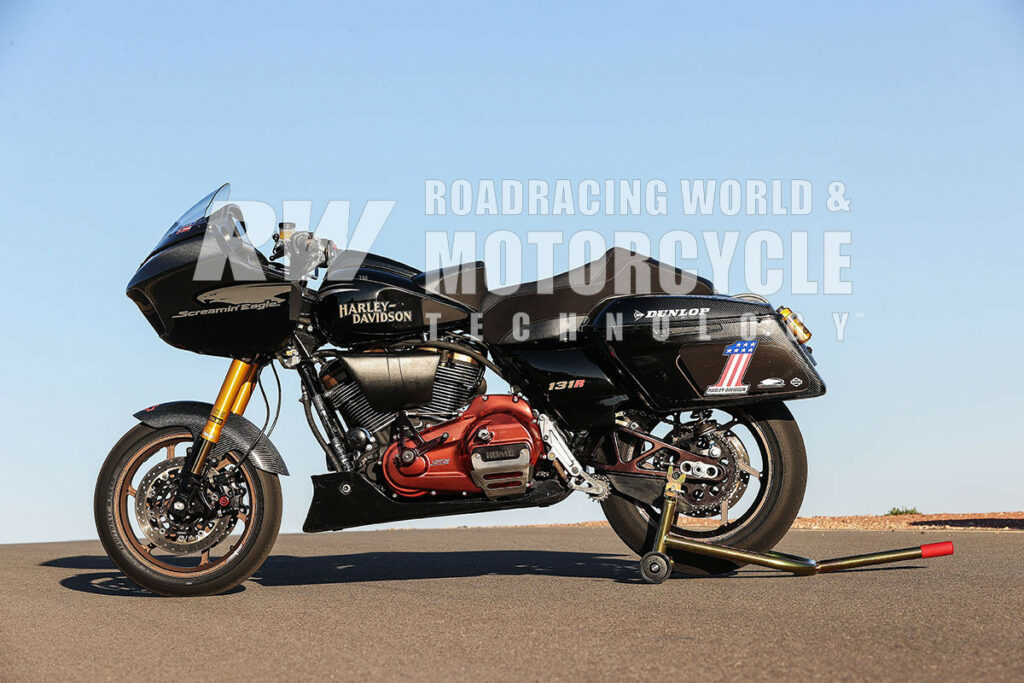
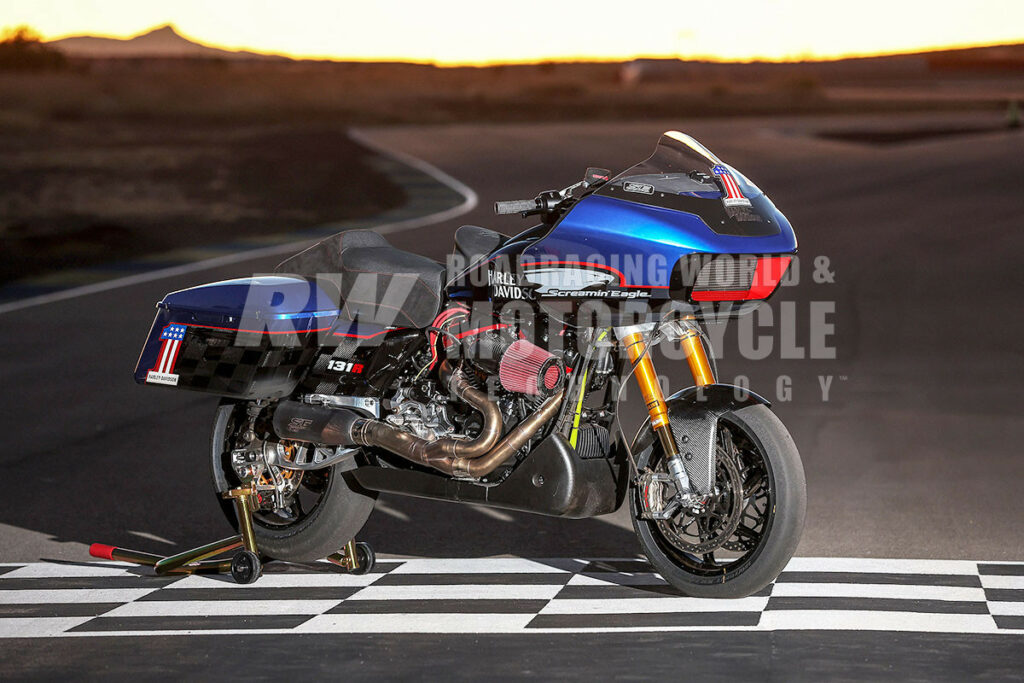
Based on a production Road Glide Special, the bagger racebike weighs 631 pounds in race trim and is set up very high to get cornering clearance out of a very wide motorcycle. Seat Height is a tall 36.6-inches.


While Harley-Davidson didn’t have an official team in the exhibition races, the brand obviously saw value in going racing and established a link between new model development, the Screamin’ Eagle Performance department, and racing in the KOTB series, which allowed the group to justify going racing. But there was a caveat for 2021: All members of the racing team had to continue to do their day jobs at Harley-Davidson, meaning anyone participating the KOTB program would be volunteering on their own time. Like most racing projects, it was part marketing, part engineering, and all fueled by passion.

Helping justify the racing program was the fact that there has been a shift in the market, with more riders wanting a more functional street motorcycle combining higher performance with the traditional bagger look and feel. Going racing allows Harley-Davidson’s Screamin’ Eagle Performance parts and accessory department to develop parts in racing and use the on-track success to reinforce the motor company’s high-performance credentials in the bagger arena. To Harley-Davidson’s credit, new 2022 models carry styling cues and upgrades from the 2021 KOTB racebikes. Win on Sunday, sell on Monday still works when applied correctly.


The Harley-Davidson 131R (which stands for 131 cubic inches engine displacement) racebike. The left-side footpeg and shift lever are mounted to the CNC-machined billet cover of the primary drive case, which houses a chain running from the crankshaft to the separate transmission's input shaft.
The Harley-Davidson 131R (which stands for 131 cubic inches engine displacement) racebike. The left-side footpeg and shift lever are mounted to the CNC-machined billet cover of the primary drive case, which houses a chain running from the crankshaft to the separate transmission’s input shaft.


Zero To Racing In Four Months

Harley-Davidson’s new official KOTB program kicked off in January 2021, with the first race scheduled at Road Atlanta in April. A ton of work had to be done to get the bikes on track in such a short amount of time. The group chose Superbike race team owner/rider Kyle Wyman as the lead rider for the project with his brother, Travis, filling a second spot on the team starting at the second round.

In 2021, Kyle won the KOTB Championship, taking wins at Road America and Laguna Seca. Travis finished fifth overall with a best finish of third. It’s clear Harley-Davidson showed up to win.


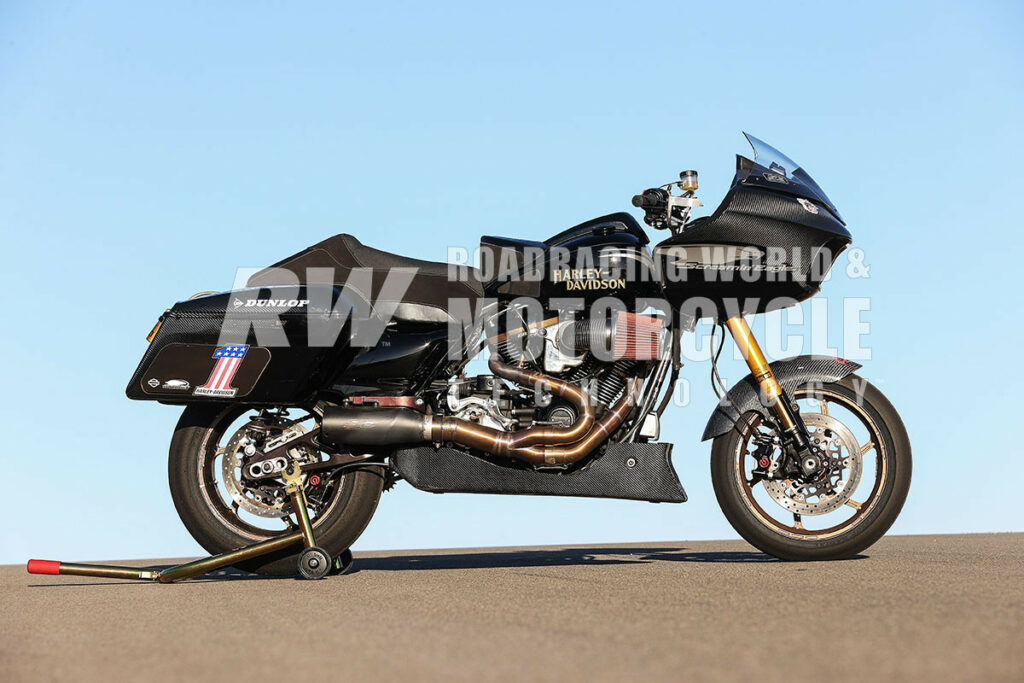
The Harley-Davidson 131R (which stands for 131 cubic inches engine displacement) racebike. The right-side footpeg and brake lever mount on the CNC-machined billet transmission cover. Note trellis-style swingarm machined out of a 400-pound block of billet aluminum.


Top Secret Tech Details

Wyman’s 2021 Championship-winning Harley-Davidson Road Glide 131R is heavily modified for KOTB racing. Given the rivalry between Indian and Harley-Davidson, engineers were reluctant to give away very many details of their winning weapon.

Everything is big on this bagger racebike from the massive air-cooled engine to the 65-inch wheelbase and 631-pound race weight. The dimensions of the motorcycle are extreme.

Electronics are limited, so the baggers must run the stock ECU and are not allowed to use data acquisition during race events. For testing, Harley-Davidson engineers run data through an AIM MXS 1.2 data logger dash. That means most of the performance modifications are old school, i.e. mechanical. But just looking at the parts used and engineering time required, I’d estimate the build cost for a top-line bagger to be between $150,000 and $200,000 without including the cost of the stock bike.


With a 65-inch wheelbase, the Harley-Davidson Bagger needs a lot of lean angle to turn, which requires cornering clearance gained by raising the bike a bunch. Footpegs are 18.8 inches off the pavement and 17.7 inches below the seat. Few riders at Inde could touch down both feet at once, and dragging knees took an effort.


At the heart of the Road Glide is an air-cooled 45-degree V-Twin Milwaukee-Eight 131R engine. HD engineers used an upgraded version of the Screamin’ Eagle 131 cubic inch (2,151cc) crate engine offered as an aftermarket replacement engine for the road. Upgraded camshafts are used and the shape of the piston dome has been changed to increase compression, and higher flow injectors are added to improve performance. The end result is an engine that Harley-Davidson claims puts out around 150 bhp and over 150 lbs.-ft. of torque at the rear wheel. Heat dissipation is the limiting factor for the Milwaukee-Eight engine, so engineers added larger fins to the cylinder heads and put the horn housing back onto the bike to push more air to the rear cylinder. A large oil cooler is fitted in the opening in the carbon-fiber front fairing; engineers pay close attention to the oil temperature to balance heat dissipation without having to increase oil viscosity, which reduces power output. On the racetrack the engine averages 6,000 rpm with redline set between 6,600 and 6,800 rpm, well above the stock rev limit.

On the chassis side, the big challenge is to create enough cornering clearance and still get the bike to go around the racetrack. There are some challenges to converting a bagger that comes with floor boards into a racetrack-capable machine with footpegs. There is no way to mount rearsets on the frame, so the billet primary drive and transmission covers are machined with peg mounts. The peg to ground height is 18.8 inches (480 mm) and the seat height is 36.6 inches (930mm), which is roughly four inches higher than an average sportbike. The peg-to-seat distance is 17.7 inches (450mm), which is a bit cramped for me. For better race ergonomics, the set-back stock handlebars have been replaced by a one-piece motocross/flatrack style bar. A large pommel was also added to the rear of the fuel tank so the riders can actually hang off, and the unit used on the bike I rode was version 4.0.


With a 65-inch wheelbase, the Harley-Davidson Bagger needs a lot of lean angle to turn, which requires cornering clearance gained by raising the bike a bunch. Footpegs are 18.8 inches off the pavement and 17.7 inches below the seat. Few riders at Inde could touch down both feet at once, and dragging knees took an effort.
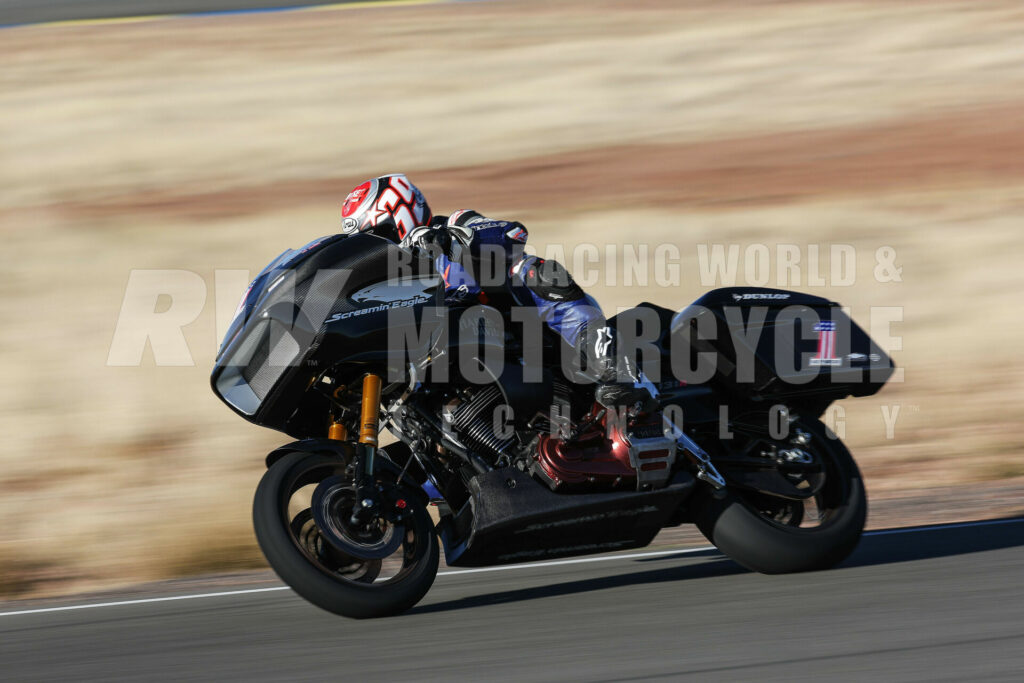
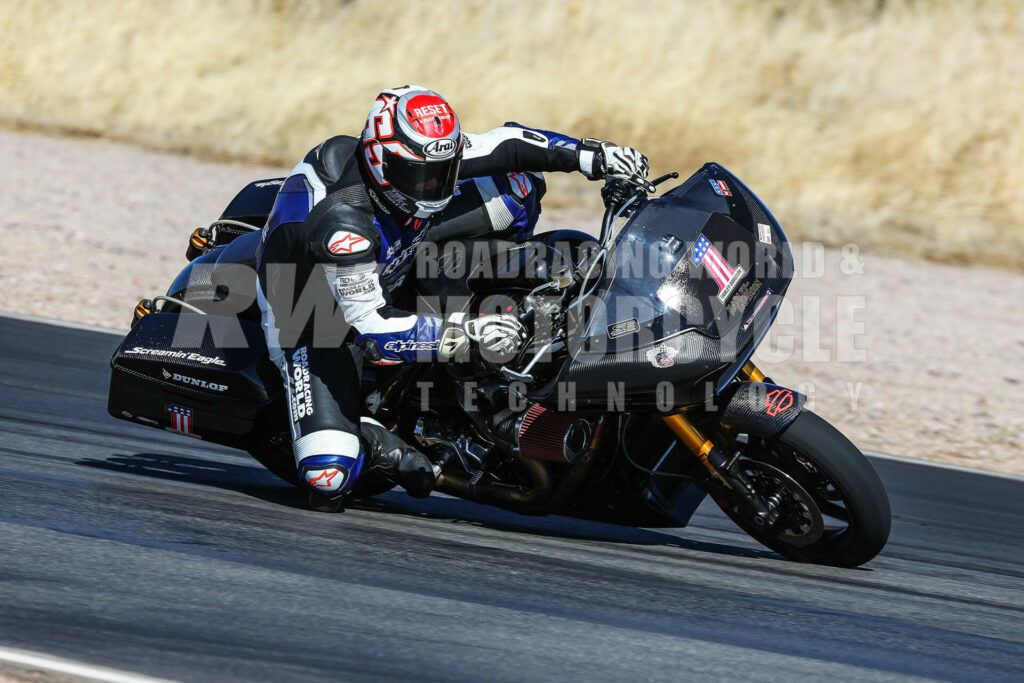
Portrait of a championship-winning road racing bike at speed. The MotoAmerica King Of The Baggers Series has drawn new fans and teams, and opened new, paying gigs for riders, but also has polarized traditional fans. At the end of the day, it’s a modified streetbike being raced, as was normal in the beginning of U.S. racing.


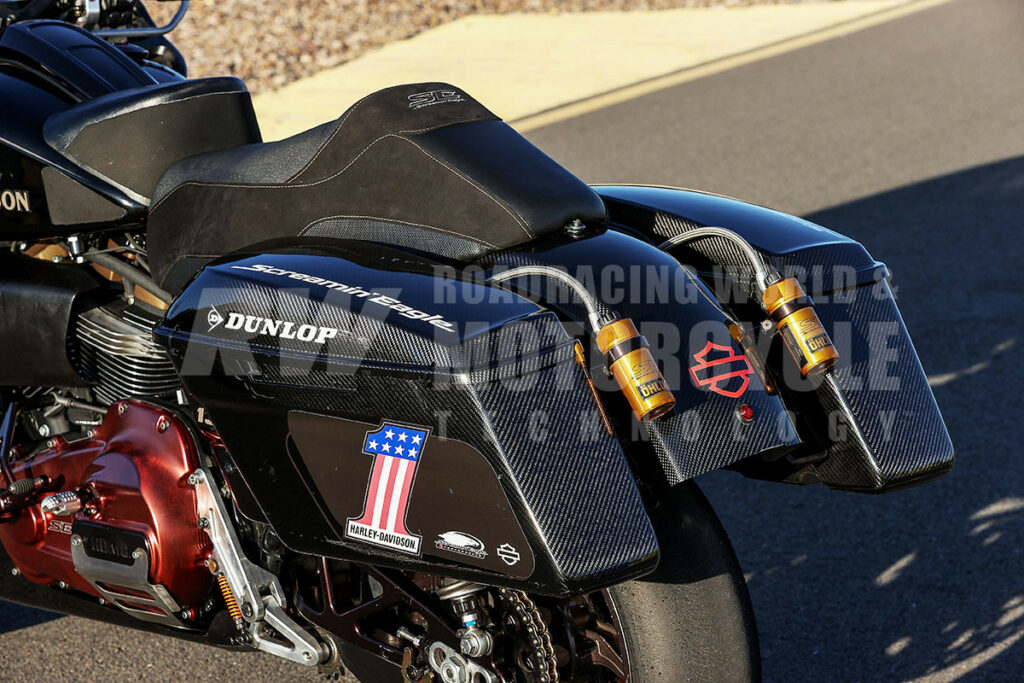
The KOTB race spec Road Glide must use the stock mild-steel, backbone-style frame, but the rest of the chassis is wide open. The rake is stock, sitting around 25.5 degrees, but the trail is around 160mm, which is close to the stock trail on the stock Road Glide, but very extreme compared to a sportbike. The stock triple clamps were replaced with custom made, fully adjustable units. Like the stock bike, the fork mounts on the triple clamps are also offset (pushed out forward) from the steering stem, which increases the wheelbase and trail numbers. The conventional forks have been replaced by inverted 43mm Öhlins FGR 250 racing front forks. At the rear there is a set of Öhlins-built Screamin’ Eagle Shocks. The custom swingarm is machined from a 400-pound piece of billet aluminum down to the 18-pound unit used on the racebike. The swingarm mounts directly to the engine using rubber bushings, so there is a bit of movement when leaned over. Wheelbase on the bike tested was 65-inches (1651mm).

Stopping the Bagger is a set of radial-mount Accossato racing mono-bloc calipers with 34mm titanium pistons combined with a Brembo RCS master cylinder. The big bagger uses a set of 300mm front brake rotors, which is on the small side for such a heavy bike. Harley-Davison plans to upgrade the brake system to use Brembo mono-bloc calipers combined with a set of 330mm front rotors.

At the rear, Harley-Davidson engineers used another 34mm piston radial-mount front caliper with a 300mm single disc. Wyman, a former dirt tracker, relies on the rear brake to get the Bagger to rotate around the middle of the corner. The Road Glide rolls around on 17-inch Core Moto Apex 6 forged aluminum wheels.


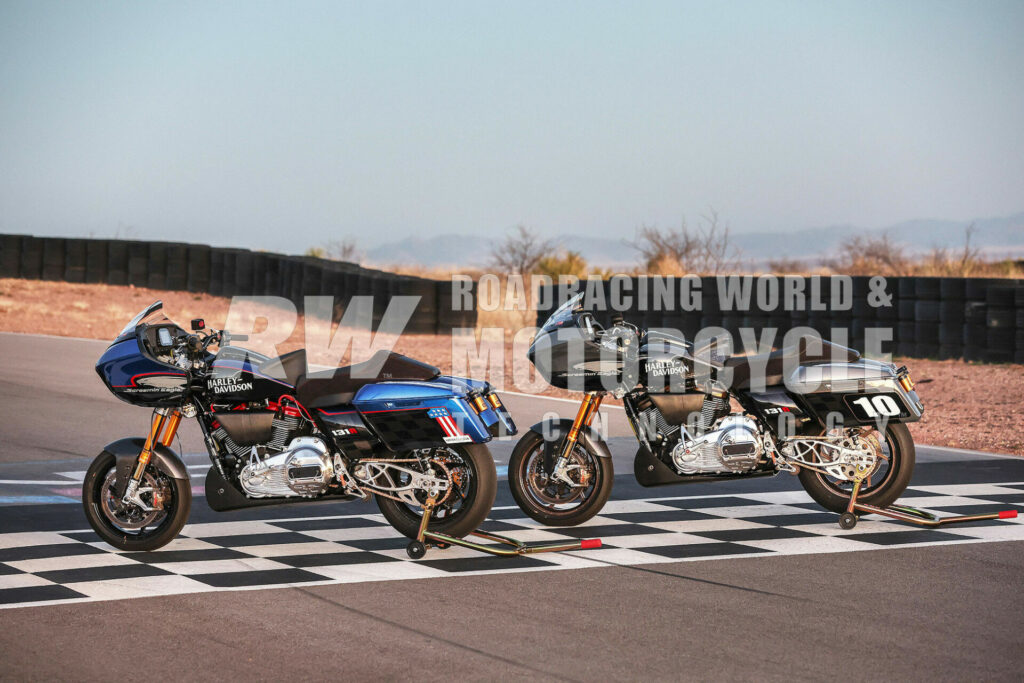
Kyle (#1) and Travis (#10) Wyman's 2022 Harley-Davidson 131R Road Glide Special racebikes pose at Inde Motorsport Ranch. 
Kyle (#1) and Travis (#10) Wyman’s 2022 Harley-Davidson 131R Road Glide Special racebikes pose at Inde Motorsport Ranch.


A Bagger On Track

I hate to admit it, but for the first time in a long time, I was nervous and maybe a little intimidated to ride a motorcycle. I think the last time I’d had anxiety (besides normal pre-race jitters) about riding a motorcycle on a racetrack was at Brno Circuit in 2004, but that was on a MotoGP bike on course with all the MotoGP riders.

I was at Inde Motorsports Ranch in the Arizona’s high desert about to throw a leg over a 631-pound bagger. I don’t know why, but the bike just looks intimidating. Maybe it was fear of the unknown. It may have also been because due to scheduling conflicts, I hadn’t been on a bike in a few months.


Another view of Kyle's upgraded 2022 bike in new graphics.
Another view of Kyle’s upgraded 2022 bike in new graphics.


But my nerves calmed as I got suited up and threw my leg over the top of the Road Glide KOTB special. I could feel the weight of the bike as the crew let it down off the stand, stabilizing it with both feet. The 36-inch seat height combined with the big cylinders mounted high in the frame makes the bike a little unwieldly until you get used to it. Wobbling slightly, I clicked it into gear, opened the throttle while slipping the clutch and rolled out for my first laps behind 2021 KOTB Champion Kyle Wyman.

That unwieldy feeling carried onto the track, but corner-by-corner, I started to understand what I needed to do to ride the Road Glide. With a 65-inch wheel base, there isn’t much pitch on the brakes so you don’t get the same sensations from the front tire on corner entry. The most difficult part comes at turn-in, as the extreme height of the bike and high center of gravity make it difficult to initiate turn-in, but then the bike falls into the corner quicker than expected with a ton of momentum heading to full lean. I struggled to get my knee on the ground so it was difficult to judge lean angle. At the apex the Road Glide was really stable and gave great feedback. I pushed the front over one of the sealer patches, but it has so much trail that front came back immediately. And, surprisingly, it still finished the corner well. There was traction on corner exit; I think the weight of the bike helps drive the rear tire into the pavement. The lack of pitch to the rear didn’t cause any problems.

The Milwaukee-Eight engine was torquey, but also delivered smooth, linear power through the rev range. I was a little surprised how soft the power was in the lower part of the rev range, from first touch to about 1/3rd throttle. Power picked up as the revs climbed into the rev limiter which looked like it was set around 6,500. The engine makes a ton of power and torque on paper, but the sensation of power and acceleration is diminished by the weight of the bike.


Remote Reservoir Screamin' Eagle by Öhlins 36mm dual shocks were developed by the Swedish suspension manufacturer with extensive testing and input from Kyle Wyman and his crew. Photo by Brian J. Nelson.
Remote Reservoir Screamin’ Eagle by Öhlins 36mm dual shocks were developed by the Swedish suspension manufacturer with extensive testing and input from Kyle Wyman and his crew. Photo by Brian J. Nelson.


The transmission ratios are spread out, so the throw between gears can be problematic. I had to be very deliberate during upshifts and downshifts on the bike. I didn’t time a downshift right on the first lap and caught a neutral off the back straight. I made sure I gave the bike a proper two-stroke blip every time I downshifted after that moment.

By the end of the four-lap sessions, I started to gain some confidence on the bike and pick up the pace. By this time, I figured out the timing on turn-in; my inputs just had to be very smooth and deliberate. I definitely needed to roll the bike into the corner. I could get my knee down in most corners, which was reassuring. And, once I figured it out, the Road Glide generally felt like a normal motorcycle; it stopped, turned, and accelerated, but with a character unique to a custom bike doing something it wasn’t designed to do. Harley-Davidson’s Road Glide Bagger actually gets around the racetrack pretty quickly, which is impressive.


Specifications: 2020 Harley-Davidson Road Glide Special Racebike

Engine Configuration:             45-degree V-Twin

Engine Displacement:            131 cubic inches (2,152cc)

Engine Cooling:          Air

Combustion Chamber Design:           Screamin’ Eagle Stage IV Heads

Valves Per Cylinder:   4

Intake Valves Per Cylinder (Material):           2 (Stainless Steel)

Exhaust Valves Per Cylinder (Material):        2 (Inconel)

Bore x Stroke:             4.31-inches x 4.5-inches (109.474mm x 114.3mm)

Connecting Rod Length (center-to-center):   8.015 inches (203.6mm)

Connecting Rod Material:       Steel

Claimed Peak Rear-Wheel Horsepower:       150 bhp

Claimed Peak Rear-Wheel Torque:   150 lbs.-ft.

Engine Redline:          6,800 rpm

Valvetrain Type:          Pushrod

Valve Adjustment Interval:     Self-adjusting Hydraulic Lifters

Intake Valve Diameter:           41mm

Exhaust Valve Diameter:        34mm

Fuel Delivery System:            Digital Fuel Injection

Throttle Body Venturi Size:    64mm

Air Filter Type:            K&N Oiled Pleated Fabric Element

Exhaust System Type (Material):       2-1 (Stainless Steel)

Ignition System:          Digital (Stock)

Lubrication System:    Dry Sump, Screamin’ Eagle Pro High-Volume Oil Pump

Oil Capacity:   4-quarts Engine, 1-quart Transmission, 1-quart Primary

Engine Oil:      Screamin’ Eagle SYN3 Full Synthetic 20w50 Motorcycle Oil

Fuel Capacity:             20 liters (5.3 gallons)

Transmission Type:    6-speed, Constant Mesh

Clutch Type:   Multi-plate, Wet, Screamin’ Eagle High Capacity

Clutch Actuation System:       Cable

Clutch Spring Type:    Coil

Number Of Clutch Springs:    3

Number Of Clutch Plates:      10

Drive Plates:   10

Driven Plates: 10

Primary Drive:             Link-Plate Chain

Primary Drive Gear Teeth:     24-26

Final Drive Sprocket Teeth:    47-53

Frame Design (Material):        Stock FL Backbone (Steel)

Rake/Trail:      25.5 degrees/160mm

Measured Wheelbase:           65 inches (1,651mm)

Swingarm Type:          Asymmetric Billet Aluminum Alloy

Seat Height:    36.6 inches (930mm)

Footpeg Height:          18.8 inches (480mm)

Footpeg to Seat:         17.7 inches (450mm)

Front Forks:    Inverted Öhlins FGR250 Racing

Fork Tube Diameter: 43mm

Fork Adjustments:

Rebound Damping:    30-Click Range

Compression Damping:          30-Click Range

Spring Preload:           18-Turn Range

Front Wheel Travel:    130mm

Rear Wheel Travel:    81.5mm

Rear Suspension Type:          Remote Reservoir Screamin’ Eagle by Öhlins 36mm Dual Shocks

Rear Shock Adjustments:

Rebound Damping:     36-Click Range

Compression Damping:          22-Click Range

Spring Preload:           25mm Range

Front Brakes: 300mm (11.8-inch) Dual Discs, Radial-mount 4-piston Accossato PZ001 Calipers

Rear Brake:    300mm (11.8-inch) Disc, 4-piston Brembo Caliper

Front Wheel:   Core Moto Apex-6 17-inch x 3.50-inch Forged Aluminum Alloy

Rear Wheel:    Core Moto Apex-6 17-inch x 6.00-inch Forged Aluminum Alloy

Front Tire:       120/70-R17 Dunlop KR448

Rear Tire:        200/60-R17 Dunlop KR451

Claimed Racing Weight:         631 pounds

Weight Distribution, Percent: (46F/54R)

Estimated Build Cost:             $150,000 – $200,000


0322_RW_MARCH_AB_V18_WHEN HOGS FLY_H-D RACE BAGGER_WEB

American Correa Testing In Spain Ahead Of British Talent Cup

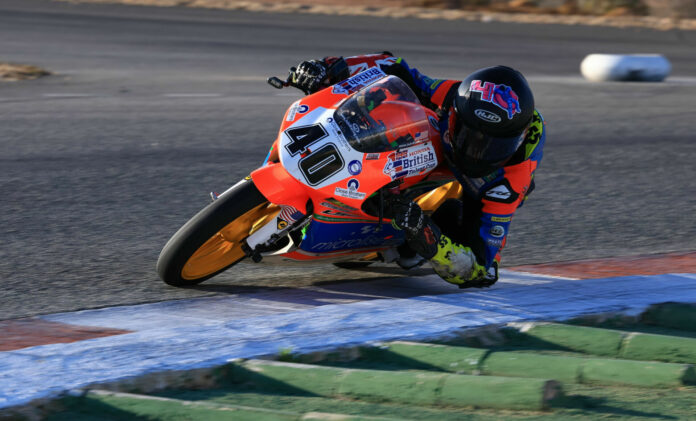
Julian Correa (40) testing in Spain. Photo by Bonnie Lane Photography, courtesy Michael Correa.

Julian Correa, a 14-year-old from Jupiter, Florida, is currently in Spain testing his Microlise Cresswell Racing Honda NSF250R at Circuito de Cartegena.

Correa is preparing for his second full season in the British Talent Cup, which is an official Road to MotoGP program that runs with the British Superbike Championship.

Correa placed 12th in the 2022 British Talent Cup Championship with one podium appearance and eight top-10 finishes.

MotoAmerica: R&G Protects Vision Wheel M4 ECSTAR Suzuki For 2023

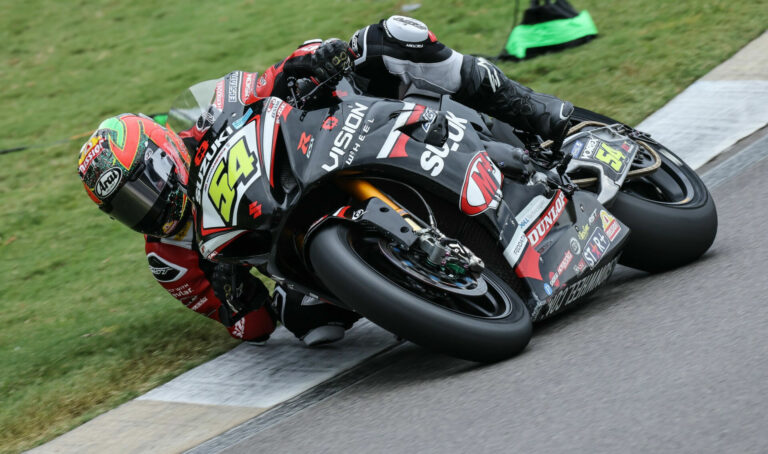
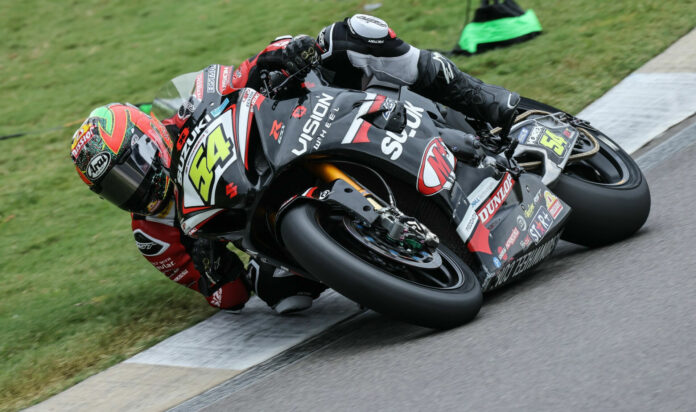
Vision Wheel M4 ECSTAR Suzuki's Richie Escalante (54) in action. Photo by Brian J. Nelson.

R&G PROTECTS VISION WHEEL M4 ECSTAR SUZUKI FOR 2023!

UK-based R&G is pleased to announce that it is partnering with the Vision Wheel M4 ECSTAR Suzuki team again for the 2023 MotoAmerica Championship. This season looks set to be the biggest yet for the four-rider squad as they compete across the Superbike and Supersport classes.

This season will be the third consecutive year that R&G and Vision Wheel M4 ECSTAR Suzuki have worked together, further enforcing the company’s commitment to MotoAmerica. This season looks set to be an enthralling year for the team, with former World and MotoAmerica Champion Toni Elias and 2020 MotoAmerica Supersport Champion Richie Escalante set to race the GSX-R1000R Superbikes, while Teagg Hobbs and Tyler Scott will compete in the Supersport class.

R&G will be protecting all four machines, supplying its essential range of race-proven products such as Engine Case Covers, Radiator Guards, Shark’s Fins and Lever Guards.

Alongside supporting the team, R&G will also be an official Supporting Partner to the MotoAmerica series for a fourth consecutive season. The partnership ensures that the R&G brand is prominently promoted to Stateside fans through the series’ messaging, trackside branding and social media.

Further information can be found at https://www.rg-racing.com, while you can also stay up-to-date with the latest news by following R&G on Facebook, Twitter, Instagram and TikTok.

For product and dealer opportunities, please contact 01420 89007 / [email protected] or an R&G Sales Agent.

MotoAmerica: Gloddy Recovering From Surgery Following Twins Cup Crash

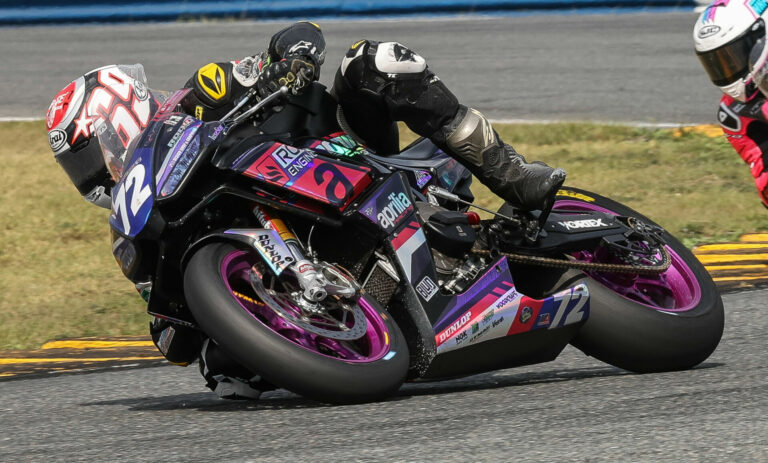
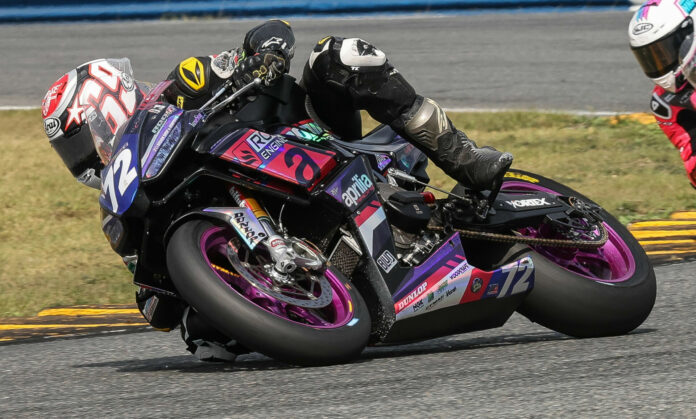
Ben Gloddy (72), before things went bad in Twins Cup Race One at Daytona. Photo by Brian J. Nelson.

Rodio Racing – Powered by Robem Engineering Aprilia rider Ben Gloddy is recovering from surgery in Halifax Health Medical Center in Daytona Beach, Florida, following his crash in MotoAmerica REV’IT! Twins Cup Race One on Friday at Daytona International Speedway.

Gloddy, age 17, was racing in the five-rider lead group on lap three when Dominic Doyle crashed in the West Horseshoe while riding his Team Iso Yamaha in the middle of the pack. Gloddy took evasive action but was hit by Doyle’s bike, crashed, and almost immediately sought help from the corner marshals.

Gloddy was transported to the hospital where he was admitted and underwent surgery to close a laceration, according to a post he made on social media.

Gloddy wrote:

“First, a big congratulations to @gus_rodio on his win today! Repeat that again tomorrow!

“I also want to send a huge that you to everyone who called, texted and messaged to check on me. I was transported to Halifax Hospital where they have taken great care of me! I had to have a surgery to repair a good sized laceration, but am expected to make a full recovery pretty quickly. Unfortunately, I will not be cleared to race tomorrow, but should be good to go by Atlanta.

“I can’t thank everyone enough for everything today. I should be discharged in the morning and look forward to seeing everyone at the track tomorrow.

“Thank you @sarachappellphotos and @k1600mark for being with me at the hospital and for staying in contact with my family back home. And of course thank you to Dr. Carl [Price] and the @motoamerica medical staff and corner workers!”


American Flat Track: Rain Forces Postponement Of Daytona Short Track II

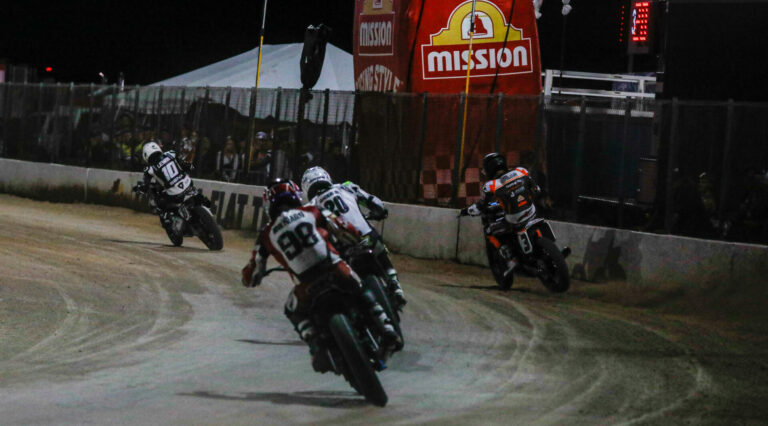
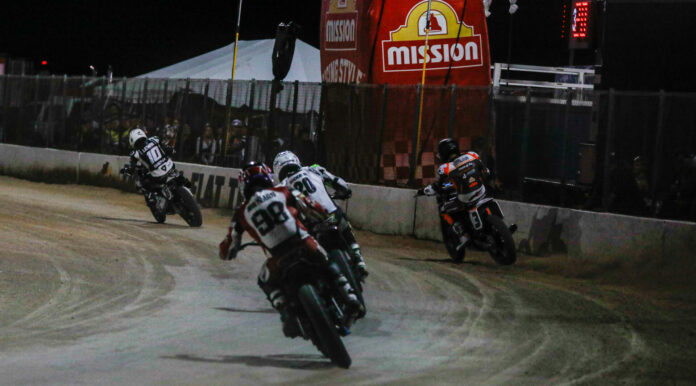
Action from the Daytona Short Track. Photo by Scott Hunter, courtesy AFT.
Action from the 2023 Daytona Short Track. Photo by Scott Hunter, courtesy AFT.

Today’s DAYTONA Short Track presented by Daytona Dodge Rescheduled for Saturday, March 11

DAYTONA BEACH, Fla. (March 10, 2023) – Due to inclement weather, the DAYTONA Short Track presented by Daytona Dodge scheduled for today, Friday, March 10, will be postponed until tomorrow, Saturday, March 11.

Gates will open for fans at 5:00 p.m., with Opening Ceremonies scheduled for 6:00 p.m. followed by a complete evening program.

Tickets purchased for today’s DAYTONA Short Track are redeemable for the rescheduled event tomorrow, Saturday, March 11.

Full updated schedule to follow.

American Flat Track: Running Results From Daytona Short Track II

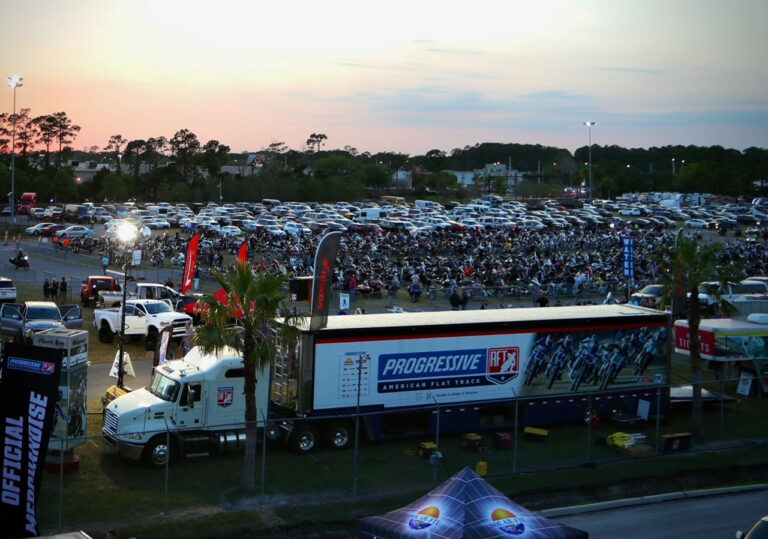
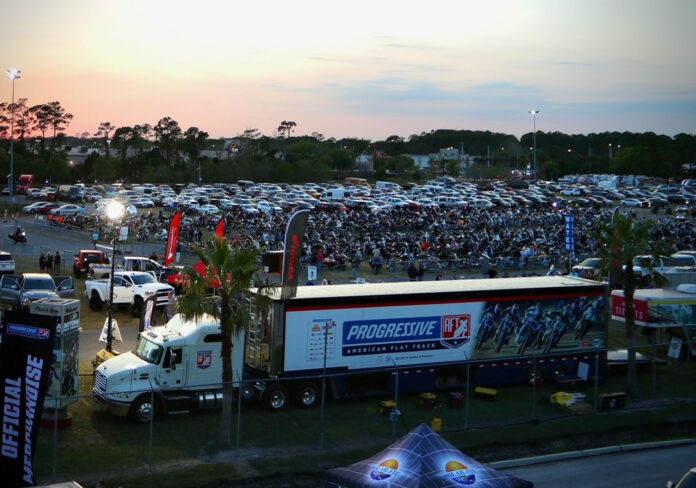
Another view of the motorcycle parking area Thursday night at the American Flat Track (AFT) Daytona Short Track I at Daytona International Speedway.
The motorcycle parking area Thursday night at the American Flat Track (AFT) Daytona Short Track I at Daytona International Speedway. Photo courtesy AFT.

KurveyGirl.com brings you the results of this weekend’s events.


At our online motorcycle parts store, you’ll find a specialized selection of quarter turn “Dzus” fasteners, titanium hardware, premium tire valve stems, Vesrah racing brake pads, Brembo parts and accessories, and other unique hardware specifically designed for race and trackday motorcycles.


Progressive American Flat Track (AFT) Championship Series

Daytona Short Track II

Daytona International Speedway

Daytona Beach, Florida

March 10, 2023

Mission AFT SuperTwins Provisional Free Practice 1 Results (all on Dunlop tires):

1. Dallas Daniels (Yam), 18.258 seconds

2. Brandon Robinson (Ind), 18.342

3. Davis Fisher (Ind), 18.460

4. Jarod Vanderkooi (Ind), 18.471

5. JD Beach (Yam), 18.478

6. Jared Mees (Ind), 18.607

7. Briar Bauman (KTM), 18.608

8. Kayl Kolkman (Yam), 18.616

9. Sammy Halbert (Yam), 18.621

10. Ben Lowe (Ind), 18.687

11. Kolby Carlile (Yam), 18.743

12. Michael Rush (Har), 18.854

13. Johnny Lewis (Roy), 19.095

14. Cameron Smith (Kaw), 19.096

15. Bronson Bauman (KTM), 19.152

16. Dan Bromley (Yam), 19.165

17. Billy Ross (Ind), 19.230

18. Jeffery Lowery (Yam), 19.253

19. Jordan Harris (KTM), 19.258

20. Ryan Wells (Roy), 19.362

21. Kasey Sciscoe (Har), 19.381

22. Mitch Harvat (Kaw), 19.420

23. Michael Hill (Kaw), 19.677

24. Brandon Newman (Har), 19.843

25. Jimmy McAllister (Hus), 20.461


Pasts Unlimited AFT Single Provisional Free Practice 1 Results (all on Dunlop tires):

1. Kody Kopp (KTM), 18.205 seconds

2. Trevor Brunner (Yam), 18.383

3. Andrew Luker (Yam), 18.397

4. Chase Saathoff (Hon), 18.434

5. Tom Drane (Yam), 18.485

6. Max Whale (KTM), 18.533

7. Chad Cose (Hus), 18.534

8. Travis Petton (KTM), 18.710

9. Hunter Bauer (KTM), 18.728

10. James Ott (Hus), 18.739

11. Justin Jones (KTM), 18.751

12. Logan Eisenhard (KTM), 18.822

13. Aidan RoosEvans (Hon), 18.826

14. Clarke Morian (KTM), 18.832

15. Dalton Gauthier (KTM), 18.844

16. Jordan Jean (Hon), 18.848

17. Trent Lowe (Hon), 18.852

18. Tanner Dean (KTM), 18.913

19. Cole Zabala (Hon), 18.924

20. Morgen Mischler (Hon), 18.956

21. Jared Lowe (Hon), 19.156

22. Shayna Texter-Bauman (KTM), 19.211

23. Tarren Santero (Hon), 19.240

24. Gerard Bailo (Hon), 19.244

25. Gary Birtwistle (Hus), 19.263

26. Dan Bromley (Yam), 19.266

27. Ashton Yates (Hon), 19.337

28. Jess Reynolds (KTM), 19.347

29. Kevin Stollings (Hon), 19.357

30. Tyler Raggio (Yam), 19.358

31. Logan McGrane (KTM), 19.371

32. Wyatt Vaughan (Hon), 19.411

33. Jacob Cascio (Hon), 19.420

34. Landen Smith (KTM), 19.438

35. Treygan Birdsong (Hon), 19.495

36. Clayton Williams (Yam), 19.496

37. Ervin Krajcovic (Hon), 19.512

38. Ian Wolfe (Hon), 19.535

39. Damon Ream (KTM), 19.579

40. Declan Bender (KTM), 19.614

41. Olin Kissler (KTM), 19.690

42. Aidan Brown (Hon), 19.709


Astro Invitational Provisional Free Practice 1 Results (all on Dunlop tires):

1. Garth Brow (Bul), 20.023 seconds

2. Dominic Beaulac (Bul), 20.402

3. Charles Roberts (Bul), 20.556

4. Wyatt Campbell (Bul), 20.809

5. Ronnie Jones (Bul), 20.909

6. Chris Boone (Bul), 21.028

7. Rick Reed (Bul), 21.299

8. Jackie Mitchell (Bul), 21.388

9. Greg Scalf (Bul), 21.713

10. Jeffrey Hiers (Bul), 22.481

11. Charles Williams (Bul), 22.802

12. Jerry Lacy (Bul), 24.965

13. Lucien Marioneaux (Bul), no time recorded


Mission SuperTwins Provisional Free Practice 2 Results (all on Dunlop tires):

1. Briar Bauman (KTM), 18.653 seconds

2. Dallas Daniels (Yam), 18.663

3. Brandon Robinson (Ind), 18.686

4. Jarod Vanderkooi (Ind), 18.754

5. Johnny Lewis (Roy), 18.764

6. Davis Fisher (Ind), 18.791

7. JD Beach (Yam), 18.822

8. Jared Mees (Ind), 18.866

9. Ben Lowe (Ind), 18.927

10. Dan Bromley (Yam), 18.956

11. Kayl Kolkman (Yam), 19.000

12. Sammy Halbert (Yam), 19.061

13. Michael Rush (Har), 19.154

14. Kolby Carlile (Yam), 19.175

15. Bronson Bauman (KTM), 19.176

16. Cameron Smith (Kaw), 19.222

17. Billy Ross (Ind), 19.223

18. Kasey Sciscoe (Har), 19.371

19. Jeffery Lowery (Yam), 19.440

20. Ryan Wells (Roy), 19.470

21. Jordan Harris (KTM), 19.493

22. Mitch Harvat (Kaw), 19.631

23. Michael Hill (Kaw), 19.686

24. Brandon Newman (Har), 19.899

25. Jimmy McAllister (Hus), 20.396


Parts Unlimited AFT Singles Provisional Qualifying 1 Results (all on Dunlop tires):

1. Kody Kopp (KTM), 18.666 seconds

2. Chase Saathoff (Hon), 18.674

3. Travis Petton (KTM), 18.750

4. Trevor Brunner (Yam), 18.756

5. Chad Cose (Hus), 18.916

6. Andrew Luker (Yam), 18.969

7. Max Whale (KTM), 19.015

8. James Ott (Hus), 19.047

9. Justin Jones (KTM), 19.050

10. Tom Drane (Yam), 19.065

11. Cole Zabala (Hon), 19.116

12. Dan Bromley (Yam), 19.132

13. Jared Lowe (Hon), 19.138

14. Clarke Morian (KTM), 19.144

15. Jordan Jean (Hon), 19.145

16. Trent Lowe (Hon), 19.146

17. Kevin Stollings (Hon), 19.205

18. Hunter Bauer (KTM), 19.222

19. Logan Eisenhard (KTM), 19.258

20. Tarren Santero (Hon), 19.261

21. Aidan RoosEvans (Hon), 19.280

22. Gerard Bailo (Hon), 19.289

23. Gary Birtwistle (Hus), 19.316

24. Tyler Raggio (Yam), 19.322

25. Logan McGrane (KTM), 19.332

26. Ashton Yates (Hon), 19.345

27. Landen Smith (KTM), 19.370

28. Ervin Krajcovic (Hon), 19.425

29. Treygan Birdsong (Hon), 19.453

30. Tanner Dean (KTM), 19.470

31. Wyatt Vaughan (Hon), 19.491

32. Jess Reynolds (KTM), 19.497

33. Declan Bender (KTM), 19.516

34. Jacob Cascio (Hon), 19.527

35. Aidan Brown (Hon), 19.528

36. Shayna Texter-Bauman (KTM), 19.529

37. Clayton Williams (Yam), 19.581

38. Morgen Mischler (Hon), 19.617

39. Ian Wolfe (Hon), 19.666

40. Damon Ream (KTM), 19.691

41. Dalton Gauthier (KTM), 19.761

42. Olin Kissler (KTM), 19.969


Astro Invitational Provisional Qualifying 1 Results (all on Dunlop tires):

1. Garth Brow (Bul), 19.804 seconds

2. Ronnie Jones (Bul), 19.980

3. Dominic Beaulac (Bul), 20.395

4. Wyatt Campbell (Bul), 20.829

5. Jackie Mitchell (Bul), 21.085

6. Charles Roberts (Bul), 21.090

7. Chris Boone (Bul), 21.751

8. Rick Reed (Bul), 21.796

9. Kris Weiss (Bul), 21.816

10. Greg Scalf (Bul), 22.002

11. Charles Williams (Bul), 22.503

12. Jeffrey Hiers (Bul), 22.895

13. Lucien Marioneaux (Bul), 23.376

14. Jerry Lacy (Bul), 24.142


Mission AFT SuperTwins Provisional Qualifying 1 Results (all on Dunlop tires):

1. Briar Bauman (KTM), 18.821 seconds

2. Dallas Daniels (Yam), 18.897

3. Michael Rush (Har), 18.902

4. Brandon Robinson (Ind), 18.919

5. Davis Fisher (Ind), 18.931

6. Jarod Vanderkooi (Ind), 18.934

7. Ben Lowe (Ind), 19.053

8. Johnny Lewis (Roy), 19.083

9. JD Beach (Yam), 19.088

10. Dan Bromley (Yam), 19.133

11. Jared Mees (Ind), 19.141

12. Kolby Carlile (Yam), 19.193

13. Kayl Kolkman (Yam), 19.195

14. Sammy Halbert (Yam), 19.294

15. Billy Ross (Ind), 19.432

16. Mitch Harvat (Kaw), 19.440

17. Bronson Bauman (KTM), 19.502

18. Jeffery Lowery (Yam), 19.548

19. Cameron Smith (Kaw), 19.613

20. Kasey Sciscoe (Har), 19.620

21. Ryan Wells (Roy), 19.700

22. Michael Hill (Kaw), 19.719

23. Jordan Harris (KTM), 19.832

24. Brandon Newman (Har), 19.935

25. Jimmy McAllister (Hus), 20.040


Parts Unlimited AFT Singles Provisional Qualifying 2 Results (all on Dunlop tires):

1. Kody Kopp (KTM), 18.428 seconds

2. Trevor Brunner (Yam), 18.720

3. Travis Petton (KTM), 18.742

4. Dalton Gauthier (KTM), 18.762

5. Max Whale (KTM), 18.789

6. Andrew Luker (Yam), 18.825

7. Chase Saathoff (Hon), 18.838

8. Trent Lowe (Hon), 18.845

9. Tom Drane (Yam), 18.858

10. Justin Jones (KTM), 18.883

11. Chad Cose (Hus), 18.932

12. James Ott (Hus), 18.961

13. Logan Eisenhard (KTM), 18.993

14. Jordan Jean (Hon), 19.050

15. Cole Zabala (Hon), 19.085

16. Tarren Santero (Hon), 19.097

17. Jared Lowe (Hon), 19.106

18. Clarke Morian (KTM), 19.143

19. Morgen Mischler (Hon), 19.148

20. Aidan RoosEvans (Hon), 19.164

21. Shayna Texter-Bauman (KTM), 19.228

22. Tanner Dean (KTM), 19.239

23. Landen Smith (KTM), 19.243

24. Hunter Bauer (KTM), 19.265

25. Gary Birtwistle (Hus), 19.276

26. Gerard Bailo (Hon), 19.302

27. Ashton Yates (Hon), 19.312

28. Kevin Stollings (Hon), 19.342

29. Dan Bromley (Yam), 19.343

30. Jess Reynolds (KTM), 19.354

31. Tyler Raggio (Yam), 19.365

32. Logan McGrane (KTM), 19.385

33. Jacob Cascio (Hon), 19.428

34. Treygan Birdsong (Hon), 19.431

35. Declan Bender (KTM), 19.462

36. Aidan Brown (Hon), 19.463

37. Ervin Krajcovic (Hon), 19.493

38. Damon Ream (KTM), 19.512

39. Clayton Williams (Yam), 19.584

40. Wyatt Vaughan (Hon), 19.590

41. Ian Wolfe (Hon), 19.591

42. Olin Kissler (KTM), 19.734


Astro Invitational Provisional Qualifying 2 Results (all on Dunlop tires):

1. Garth Brow (Bul), 19.601 seconds

2. Ronnie Jones (Bul), 19.670

3. Dominic Beaulac (Bul), 19.930

4. Robby-Bobby McLendon (Bul), 20.057

5. Charles Roberts (Bul), 20.495

6. Jackie Mitchell (Bul), 20.574

7. Wyatt Campbell (Bul), 20.582

8. Kris Weiss (Bul), 20.722

9. Greg Scalf (Bul), 21.415

10. Charles Williams (Bul), 21.604

11. Rick Reed (Bul), 21.622

12. Jerry Lacy (Bul), 23.382


Mission AFT SuperTwins Provisional Qualifying 2 Results (all on Dunlop tires):

1. Dallas Daniels (Yam), 18.755

2. Jarod Vanderkooi (Ind), 18.851

3. Brandon Robinson (Ind), 18.865

4. Johnny Lewis (Roy), 18.975

5. Jared Mees (Ind), 19.009

6. Briar Bauman (KTM), 19.010

7. Davis Fisher (Ind), 19.040

8. Michael Rush (Har), 19.043

9. Kolby Carlile (Yam), 19.053

10. JD Beach (Yam), 19.059

11. Kayl Kolkman (Yam), 19.078

12. Ben Lowe (Ind), 19.119

13. Dan Bromley (Yam), 19.139

14. Billy Ross (Ind), 19.176

15. Sammy Halbert (Yam), 19.205

16. Bronson Bauman (KTM), 19.271

17. Ryan Wells (Roy), 19.285

18. Mitch Harvat (Kaw), 19.296

19. Cameron Smith (Kaw), 19.377

20. Kasey Sciscoe (Har), 19.462

21. Jeffery Lowery (Yam), 19.574

22. Jordan Harris (KTM), 19.645

23. Michael Hill (Kaw), 19.712

24. Brandon Newman (Har), 20.355

25. Jimmy McAllister (Hus), no time recorded

MotoAmerica: Riding Indian’s Challenger King Of The Baggers Racebike

Racing Editor Chris Ulrich on the Indian Challenger Bagger: "What surprised me was the level of concentration it took to get to that point, and how wound up I was..."
Racing Editor Chris Ulrich on the Indian Challenger Bagger: "What surprised me was the level of concentration it took to get to that point, and how wound up I was..." Photo by Garth Milan.

Editorial Note: This article is the cover story in the March 2023 issue of Roadracing World & Motorcycle Technology magazine, which is on newsstands and available in its digital format now.

MOTOAMERICA RACEBIKE TEST

TYLER O’HARA’S INDIAN CHALLENGER BAGGER

HEAVY INTENSITY!

By Chris Ulrich

It took less than two seasons for Bagger racing to go from an exhibition to full-factory-­racing insanity. That madness is being fueled by a fierce rivalry between Harley-Davidson and Indian that started generations ago, lay dormant for decades, and has been reborn, first in dirt track and now spilling onto the paved road courses of the MotoAmerica Superbike Series in a big way. In this case, “fierce rivalry” isn’t really strong enough to describe what has turned into an all-out battle for dominance in the Mission Foods King Of The Baggers and the RSD Super Hooligan National Championships, and things are only going to get more intense now that the Harley-Davidson Pan America model has been allowed in the Super Hooligan Series.

The war has powered development leading to a seven-second lap time improvement from the first Bagger exhibition race at Laguna Seca in 2020 to Laguna Seca in 2022. Some of the improvement came from switching to Dunlop slick tires, but most of it came from technical development. The fastest lap from the 2021 KOTB race at Laguna was a 1:31.9 set by Kyle Wyman on a Harley-Davidson. Wyman improved another 2.5 seconds in 2022, turning a 1:29.4 during the 2022 race. Imagine turning a sub-1:30 lap time around Laguna Seca on a Bagger! These bikes are legitimate weapons and the guys are riding them hard. It’s great to watch. And it’s only going to get better with both factories fully involved.

Rivalry aside, Indian is using racing to reinforce its high-performance credentials in the marketplace. In 2017, Indian launched the FTR, a dirt-track-inspired 1,200cc streetbike, and used AFT Flat Track racing to promote the new motorcycle. Indian also launched various promotions, including hiring Travis Pastrana to recreate Evil Knievel’s big jumps. And the inception of Roland Sands’ Super Hooligan Racing Series was spawned from Indian’s effort to be relevant in a space that was historically dominated by Harley-Davidson. Since all this started Indian and racing contractor S&S have won six AFT Championships, essentially making the factory Harley-Davidson effort non-competitive. More recently, in 2023, Indian won the AFT SuperTwins Championship with Jared Mees along with the MotoAmerica KOTB and SHNC Championships with Tyler O’Hara. All that success on the racetrack has turned a once-defunct brand Polaris, purchased and revived in 2011, to the marketplace powerhouse in 12 years. And just like that, owning an Indian is cool again.

I’ve written it before, but it’s worth repeating:  Win on Sunday, Sell on Monday is still alive and well. Otherwise, these two big American companies would not be spending money on racing and working hard to use racing success to market motor­cycles.


Left side of Tyler O'Hara's 2023 Indian Challenger Bagger at Chuckwalla Valley Raceway. Note the short aluminum swingarm and how far the front wheel is out ahead of the motorcycle. Photo by John Ulrich.
Left side of Tyler O’Hara’s 2023 Indian Challenger Bagger at Chuckwalla Valley Raceway. Note the short aluminum swingarm and how far the front wheel is out ahead of the motorcycle. Photo by John Ulrich.


Direct factory involvement from Indian and Harley in the KOTB series has created additional well-paid jobs in the paddock, with some rider salaries matching the per-race amount paid by Superbike teams. Factory bonus programs for KOTB are also well above even the factory Yamaha bonuses, while posted contingency matches what is available from most sportbike manufacturers in other classes. The global effect the KOTB series has had on the paddock is also positive; the class has brought in a new demographic of fans, who spend their money on tickets and merchandise and, in a lot of cases, have become fans of Superbike and Supersport classes after being exposed to the racing. They come for the Baggers, and stay for the Superbikes. Love them or hate them, the economics of Bagger racing are good for professional motorcycle racing in the United States. And it’s damn entertaining to watch.

Indian representatives tout their racing activities as being a David vs. Goliath situation with H-D shipping six-times more motorcycles than Indian per year. But the racing programs are more similar than they think, at least in 2022. Most of the Indian and S&S crew members also must perform their regular day job duties on top of at-track racing activities, and the situation is the same for the H-D staffers on the Screamin’ Eagle program. And like Harley-Davidson’s team, the Indian team is passionate about racing, winning, and mainly beating the other guys!

The path to the 2022 King Of The Baggers Championship for Tyler O’Hara was not easy, but of the front-runners, he was the most consistent during the seven-round series. The season started well for O’Hara with a win in the opening race at Daytona, followed up with a second-place finish in Race 2. He stayed consistent for the remaining rounds, never finishing worse than fourth, and finally clinching the Championship in the rain-soaked finale at New Jersey Motorsports Park. In total, Indian riders O’Hara, Jeremy McWilliams, and Bobby Fong won three points-paying races during the 2022 season. The Indian crew also limited costly mistakes like those made by the Harley-Davidson team, the worst example being oiling the racetrack twice due to mechanical problems and getting Kyle Wyman disqualified at Brainerd.

Baggers are extreme bikes with extreme dimensions and the Indian is no exception. From the outside, the S&S Indian Challenger build looks to be more practical than the Harley-Davidson package. It could also be that the base design needs less modification to bring it up to race spec.

Indian relies on S&S to build its factory Indian Challenger racebike, which weighs roughly 630 pounds before adding fuel. It has a 65.5-inch (1,663mm) wheelbase, 23.5 degrees of rake, and 114mm (4.5 inches) of trail, making the Challenger’s chassis dimensions close to the Harley-Davidson Road Glide’s numbers. Per Moto­America KOTB rules, the main frame, the OEM front fairing shape, and the core engine must be retained. No external bracing can be added to the aluminum-alloy, backbone-design frame, but the rest of the chassis components can be replaced or modified.

As is the case with all Baggers, gaining cornering ground clearance is one the biggest challenges builders face. On the Indian, S&S modified the left-side engine cover, moving the clutch actuation arm from the bottom to the top of the case cover and adding a taper. A host of other S&S parts were used to bring the Challenger up to race spec. The stock triple clamps are replaced with adjustable aluminum triple clamps, with revised offset.

To get the front ride height needed to gain cornering clearance, the standard front forks were replaced by long-travel Öhlins FG8603 model forks that are original fitment on a Ducati Multistrada. Rear suspension is handled by an Öhlins TTX36 single shock. S&S also designed and built the rear-set controls, clip-on handlebars, front fairing bracket, axles, and rear brake hanger, which carries a thumb-operated dual-piston Hayes brake caliper. Dual 320mm (12.6-inch) rotors combined with four-piston Brembo calipers with 100mm spacing and a combination of 32mm/36mm pistons handle the braking duties at the front.

The final drive system for the Indian PowerPlus engine is located on the right side. For racing, S&S converted the OEM belt drive to chain drive, which required the addition of a chain tensioner due to the location of the countershaft sprocket relative to the swingarm pivot position. Bracing has been welded to the underside of the standard cast-aluminum swingarm. As ridden, the rear axle was pushed forward, putting the effective swingarm length at around 20-inches (508mm), which is very short compared to most modern sportbikes. Overall wheelbase is 65.5 inches (1,663mm), which is long compared to current sportbikes. The 2022-spec racebike used OZ aluminum wheels at the end of the season. For 2023 the team is going with specially-built PVM wheels to help eliminate wheel flex caused by the massive weight of the Bagger.

O’Hara’s Challenger is powered by Indian’s liquid-cooled 60-degree V-Twin PowerPlus engine. S&S Cycle had to push the limit of the 112 cubic-inch (1,833.3cc) PowerPlus engine to match the power output of the H-D Milwaukee-Eight’s 131 cubic-inch (2,152cc) engine. In doing so, the lifespan of the engine dropped to one race weekend: The S&S and Indian team had to swap engines mid-weekend at every event to avoid issues. Do the math, and that’s 14 engines for two riders over a seven-race series, not including testing. (The new 7,700 rpm rev limit imposed by MotoAmerica for 2023 should help durability. S&S reps say the rev limit was higher in 2022, but the bike we tested had the new limit implemented.)


S&S rearset controls and custom clutch cover.
S&S rearset controls and custom clutch cover. Photo by John Ulrich.


There is no replacement for displacement, which is why the PowerPlus engine’s bore was increased 2mm from 108mm to 110mm, bringing the displacement up to that 112 cubic inches. Stock pistons were replaced with 2mm oversize CP units. Additional performance increases came from custom-ground S&S camshafts and CNC-ported heads. The stock rockers were replaced with billet units manufactured by S&S. The main bearings were also pinned in place for improved durability.

The standard dual, 52mm ride-by-wire throttle bodies were located where a frame rail restricted air flow to the engine, so they were replaced with a relocated, 78mm single throttle body made for a car, and it came from a V6 Dodge Charger. S&S designed and 3D-printed a new intake manifold and runner to fit the throttle body. Spent gasses flow out from the exhaust ports into an S&S-built stainless steel exhaust system.

Electronics are limited, but Indian gained an allowance from Moto­America to run a MaxxECU Sport unit. The Maxx brand is better known for car applications than motorcycle use, but is fine in this case given the fact that no rider aids are allowed in the KOTB class. The racing-spec Indian Challenger comes with a quick-shifter and auto-blip function. An AIM DL2 data logging display replaces the stock dash.


The 1,833cc Indian Challenger Bagger is fast, helped by a 78mm car throttle body! Chris Ulrich was surprised that the Challenger behaved differently exiting right-handers, stepping out and sliding, depending on throttle position and lean angle.
The 1,833cc Indian Challenger Bagger is fast, helped by a 78mm car throttle body! Chris Ulrich was surprised that the Challenger behaved differently exiting right-handers, stepping out and sliding, depending on throttle position and lean angle. Photo by Garth Milan.


Riding Tyler O’Hara’s Indian Challenger

I was standing in the pits buzzing from an adrenaline spike after my five laps around Chuckwalla Valley Raceway on Tyler O’Hara’s Bagger. My opening lap was awkward, but my second lap was better. I was getting comfortable on the bike by lap three, lap four was faster, and I improved three more seconds on lap five, then ignored the checkered flag to finish the lap I was on. The lap timer went 2:08, 2:05, 2:05 (in traffic), 2:03, and at the end I turned a 2:00.9. Which frankly isn’t impressive at all, but considering my lack of experience and time available on what is a very unique motorcycle I was fine with it.

What surprised me was the level of concentration it took to get to that point—and how wound up I was getting off the bike! The Challenger was exciting and I wanted another go at it. I haven’t felt that way about a motor­cycle since I stopped racing Superbikes in 2016!

The ergonomics on the Challenger felt more natural to me than they did on Kyle Wyman’s Harley-Davidson when I rode it at Inde Motorsports Park for the March 2022 cover story. The reach and angle of the bars feel more like a sportbike’s. The seat -to-peg distance is relaxed and the overall height is shorter, so it was easier to get my feet on the ground. And it felt more natural to ride since it wasn’t so high.

The intensity comes partially from the unknown and learning how to ride a bike that is unique to the category. But the rest comes from the massive amount of chassis-generated movement on both ends of the motorcycle. The Challenger starts to move during braking while still straight up and down. The forks compress quickly, which causes the bike to wallow before turning in. And the relatively steep steering angle made it feel like I was over the top of the front end. However, the long wheelbase helped mitigate the forces. It doesn’t take an excessive amount of effort to roll the Indian into the corner, likely because it has a high center of gravity. But the movement really never stops.

At the apex, the front wheel feels like it’s under the bike and the tire is trying to fold (tuck) but again, a relatively high trail number and long wheelbase saves the day. I definitely tried to get off the brakes and back on the gas as early as possible. Usually, a bike would lack feel in this situation, but Challenger gave plenty of feedback at full lean.

The Challenger’s handling on corner exit is unique. The first thing I noticed was a lack of rigidity at the center of the motorcycle. This is no doubt caused by turning a bike that started life as a huge streetbike into a racebike. The main frame definitely isn’t designed for racing. That’s a fact of life, but the movement is not all bad as it provides plenty of feedback. Flex is part of the game with Baggers.

However, the Challenger does behave differently at corner exit depending on the direction you’re turning. When I was in a right turn, the rear would move, then the chain tensioner would take out slack and cause the rear to slide. The step-out-and-slide reaction would change depending on the throttle position and amount of lean angle. But it was consistent: Add throttle, change chain slack, step out, slide, repeat. Once stood up, the bike would start to behave normally.


Tyler O'Hara's 2022 MotoAmerica Mission King Of The Baggers Championship-winning Indian Challenger racebike, fitted with Dunlop Q5 trackday tires for this test. Photo by Garth Milan.
Tyler O’Hara’s 2022 MotoAmerica Mission King Of The Baggers Championship-winning Indian Challenger racebike, fitted with Dunlop Q5 trackday tires for this test. Photo by Garth Milan.


Going left, the bike was easier to turn in and get to the apex and behaved more normally on corner exit. I could crack the throttle, set it, then roll it on and the rear would dig in and then drive forward normally. The bike did have a tendency to stand up too early on the lefts. This behavior was so strange! I think it comes down to the manual chain tensioner on the right-side drive needed more development. Probably a spring change to make the action more consistent.

While the chassis is different, the engine is great. It produces smooth, tractable power from 3,000 rpm to 7,700 rpm. The rev limiter comes on pretty quickly in some situations, so I suspect the team has to compromise on gearing at some tracks. The transmission performance is very good on the Indian. The throw between gears is short, so I didn’t have to worry about being deliberate with my downshifts. And having a quick-shifter was really nice. I tried the auto-blip on an early lap but wasn’t impressed, so I ended up going old-school and manually down-shifting.

How does it compare to the Harley-Davidson? I’ve only ridden one other Bagger on the racetrack, that being Kyle Wyman’s 2021 King Of The Bagger Championship-winning Harley-Davidson Road Glide. So, my frame of reference is small, but there are very distinct differences in the fundamental chassis design of the bikes that make the Indian more natural and enjoyable to ride. For example, the overall height on the Harley-­Davidson makes it unwieldy, but it doesn’t pitch so it remains stable. The Harley-­Davidson’s stepped triple-clamp design puts the front wheel pretty far out from the rider, so while it sticks, it lacks connection and feel. And the Harley-Davidson Milwaukee-Eight 131 transmission is pretty bad. The mental energy required for those guys to not miss shifts is probably worth half-a-second a lap. A quick-shifter would be nice, too. But in the end the Harley-­Davidson and the Indian turn similar lap times, so it’s obvious there is more than one way to do things.

Having ridden both bikes, if I was pressed to choose between them I’d pick the Indian as it just feels more natural to me.

I was still buzzing for hours after my five laps around Chuckwalla on the Indian Challenger. The Baggers are impressive on the engineering side, especially seeing how much they have improved in a couple of race seasons. But while the bike is interesting, I’m more impressed with the guys riding the bike. My experience got more and more intense as I picked up the pace, mirroring what O’Hara’s teammate Jeremy McWilliams told me afterwards. It allowed me to understand how much concentration and intensity it takes to ride and race these bikes at the speeds these guys are going. They’re racing heroes.

And that’s what a race series needs: Rivals and heroes. All racing is entertainment, and Baggers are very entertaining to ride and watch!


0323_BAGGER INSANITY_INDIAN RACE BAGGER

MotoAmerica: King Of The Baggers Race One Results From Daytona (Updated)

The finish line at Daytona International Speedway. Photo by Align Media, courtesy Pirelli.

KurveyGirl.com brings you the results of this weekend’s events.


At our online motorcycle parts store, you’ll find a specialized selection of quarter turn “Dzus” fasteners, titanium hardware, premium tire valve stems, Vesrah racing brake pads, Brembo parts and accessories, and other unique hardware specifically designed for race and trackday motorcycles.


23_1_DAY_KTB_R2_res


More, from a press release issued by MotoAmerica:

Rispoli Wins Mission King Of The Baggers Opener At Daytona

Gus Rodio Takes First REV’IT! Twins Cup Win, O’Hara Wins Mission Super Hooligan National Championship Race


Vance & Hines Harley-Davidson's James Rispoli (43) leads teammate Hayden Gillim (79) with Tyler O'Hara (1) giving chase in the Mission King Of The Baggers race at Daytona International Speedway on Friday. Photo By Brian J. Nelson, courtesy MotoAmerica.
Vance & Hines Harley-Davidson’s James Rispoli (43) leads teammate Hayden Gillim (79) with Tyler O’Hara (1) giving chase in the Mission King Of The Baggers race at Daytona International Speedway on Friday. Photo By Brian J. Nelson, courtesy MotoAmerica.


DAYTONA BEACH, FL (March 10, 2023) – Seemingly everyone had some sort of issue to deal with in the opening round of the Mission King Of The Baggers series at Daytona International Speedway, but Vance & Hines Harley-Davidson’s James Rispoli dealt with his better than the rest to take his first career victory in the class.

Rispoli was running second and giving chase to early leader Kyle Wyman when he made the save of his life and somehow stayed on board his Road Glide despite a seemingly endless and viscous tank slapper on the high banks. Once he got that under control, he was keeping the pressure on Wyman when the H-D Screamin’ Eagle Road Glide expired with five laps to go. From there it was a battle to the finish with Rispoli and his teammate Hayden Gillim joined by the second factory Harley of Travis Wyman. The two Vance & Hines riders then got a scare when Travis Wyman’s Road Glide suffered a mechanical failure on the banking. The fear of oil on the banking brought out the red flag and Rispoli had his first win in the bag with Gillim second.

Defending Mission King Of The Baggers Champion Tyler O’Hara finished third on his Indian Motorcycle/Progressive/Mission Foods Indian Challenger despite having to start from the back row when the team failed to get him and his teammate Jeremy McWilliams out of pit lane in time for the sighting lap.


Mission King Of The Baggers winner James Rispoli (center) is flanked in Victory Lane by teammate Hayden Gillim (left) and Tyler O'Hara (right). Photo By Brian J. Nelson, courtesy MotoAmerica.
Mission King Of The Baggers winner James Rispoli (center) is flanked in Victory Lane by teammate Hayden Gillim (left) and Tyler O’Hara (right). Photo By Brian J. Nelson, courtesy MotoAmerica.


The first of the Team Saddlemen Harley was ridden to fourth place by Cory West, who finished 13.1 seconds off the lead and well clear of McWilliams, who was just 1.4 seconds ahead of Baggers rookie and former Superbike racer Jake Lewis.

In addition to the two factory Harleys, Bobby Fong was another knocked out of the race with mechanical problems on his Sac Mile/SDI Racing/Roland Sands/Indian Challenger.

REV’IT! Twins Cup – All Rodio


Gus Rodio (96) ran away and hid in REV'IT! Twins Cup Race One at Daytona. Photo By Brian J. Nelson, courtesy MotoAmerica.
Gus Rodio (96) ran away and hid in REV’IT! Twins Cup Race One at Daytona. Photo By Brian J. Nelson, courtesy MotoAmerica.


MotoAmerica races at Daytona International Speedway are normally decided by less than a second. Rodio Racing – Powered By Robem Racing’s Gus Rodio decided to flip that as he rode to his first career victory in the REV’IT! Twins Cup class by an unheard of 8.538 seconds.

Rodio was initially embroiled in a battle at the front with four others, though that was broken up when Dominic Doyle crashed and took Ben Gloddy with him. It also hindered Jackson Blackmon’s progress as he had to take evasive action to avoid the carnage. That left Rodio to battle with defending REV’IT! Twins Cup Champion Blake Davis.

Trackday Winner/Blackmon Racing’s Blackmon, in his first race back after a long rehabilitation of a badly broken ankle, didn’t give up and he was rewarded with an eventual second place after he caught and passed the reeling Davis, who would end up fourth. Blackmon was hounded to the finish line by Cycle Tech’s Hayden Schultz, but he barely beat Schultz to the line by just .060 of a second.
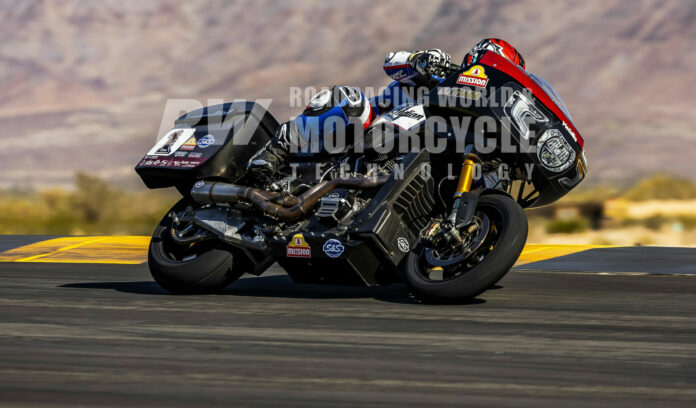
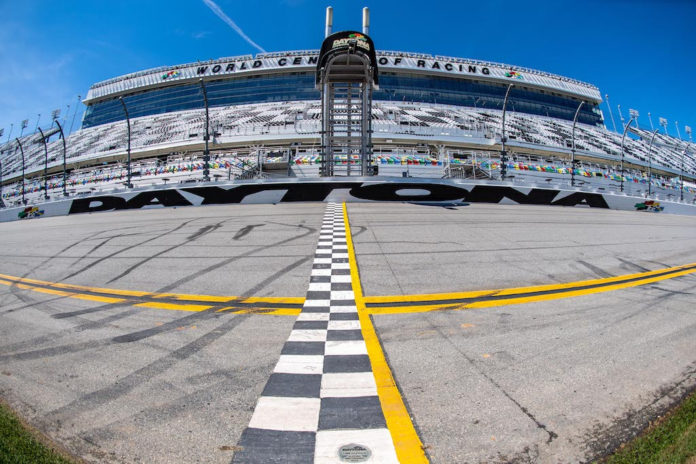
Fifth place went to Ed Sullivan, the Giaccmoto Yamaha Racing rider whose real job is crew chief for Mathew Scholtz’s Westby Racing Yamaha YZF-R1 Superbike.

Mission Super Hooligan National Championship

If getting Daytona’d isn’t a verb, it ought to be. The definition would be: Daytona’d (verb) to lead the entire race only to be beaten by a fraction of a second on the draft run from the final chicane to the finish line on the tri-oval of Daytona International Speedway.

Many have suffered the fate of being Daytona’d and on Friday it was Bobby Fong’s turn. Fong and his Roland Sands Design/Indian Motorcycle-backed FTR1200 led 99.9 percent of the six-lap Mission Super Hooligan National Championship race at the Speedway, but it was the .1 percent that hurt as Tyler O’Hara beat him to the line by .064 of a second on his Indian Motorcycle/Progressive/Mission Foods-sponsored FTR1200.
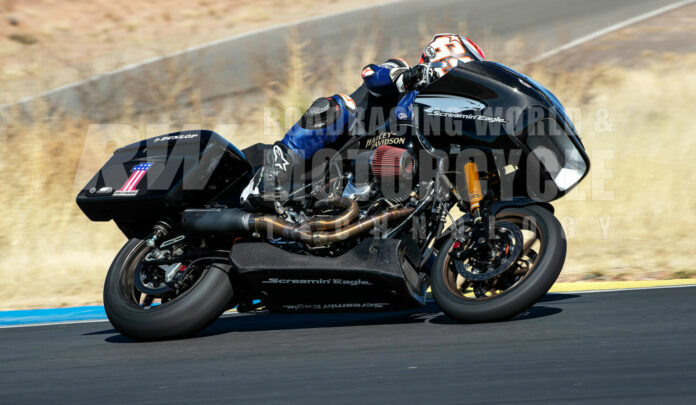
O’Hara’s teammate Jeremy McWilliams completed the podium in third, the Northern Irelander 1.2 seconds behind O’Hara and .144 of a second ahead of Cory West and the Team Saddlemen Harley-Davidson Pan America.

Fong’s teammate Kyle Ohnsorg finished a lonely fifth.


Bobby Fong (50) leads eventual winner Tyler O'Hara (1) in Super Hooligan National Championship Race One on Friday. Photo By Brian J. Nelson, courtesy MotoAmerica.
Bobby Fong (50) leads eventual winner Tyler O’Hara (1) in Super Hooligan National Championship Race One on Friday. Photo By Brian J. Nelson, courtesy MotoAmerica.


Notes…

Warhorse HSBK Racing Ducati NYC’s Josh Herrin will start Saturday’s Daytona 200, sponsored in part by Pirelli and Bridgestone, from pole position after leading the 15-minute Time Attack final qualifying session with his 1:48.741. He will be joined on the front row by Celtic/Tytlers Cycle/TSE Racing’s PJ Jacobsen and Vision Wheel M4 ECSTAR Suzuki’s Tyler Scott.

In addition to a solid effort that led to a front-row starting position, Scott and his Vision Wheel M4 ECSTAR Suzuki were victors in the second annual MotoAmerica Pit Stop Challenge that was held at the end of on-track action on Friday.

Quotes
 
Tyler O’Hara – Super Hooligan National Championship, Winner

“It was a good race. Bobby (Fong) had really good pace all weekend. That was the first time we got to ride together, and he had a really clean, open track. I was in the back learning and made a few mistakes myself and he gapped me. I was able to reel him back in, and then the lapper there through the chicane definitely played a big role. I don’t know if I was going to be able to draft pass him on the finish. He basically broke the draft. It was a good race. Just to sweep the podium, Indian Motorcycle, that’s huge for any motorcycle… all of our sponsors, Progressive have come on board this year, and Mission Foods. Everybody. Parts Unlimited. To win at Daytona is special. Just coming here it’s an amazing feeling. Just really enjoying it. Having fun and really just continuing to develop these motorcycles. It’s a lot of fun.”

Gus Rodio – REV’IT! Twins Cup, Winner

“I didn’t really know what to expect coming here. There as a lot of unknowns, of course. It’s the first race of the year, my first race in the class since last year at Daytona. I’ve been training with Brandon (Paasch). He’s like my big brother. It’s really cool to have somebody like that that I can just go out and stay at the house, spin laps, and really learn something from him. I’m always chasing him. So, I’m really happy. I can’t ask for anything more. My Rodio racing Aprilia feels incredible. I’ve never really felt a bike that I just clicked with, and I just feel like I’m one with this motorcycle right now. Obviously, that makes me happy so I’m having fun while I’m riding. I can put together clean laps and just stay consistent by myself and just stay focused throughout the race.”

Mission King Of The Baggers – James Rispoli, Winner

“I saw my life flash twice and then it just kept going. I was like, ‘maybe I’ll get out of it.’ It just kept going all the way up the banking. I don’t know, man. I summoned all the energy from my ancestors to keep that one going straight. But at the end of the day, to be honest, it was a really fun race. Once we saw Tyler (O’Hara) and Jeremy (McWilliams) not on there (the grid), the game plan is always to race hard but a little different because the Harleys react the same way. So, me and Hayden (Gillim) were just clicking off laps, passing each other in good spots. I think we figured out where he was strong, where I was strong, and we just made it work. To be honest, it’s a shame to see both factory Harleys go out, but I kind of feel like we were tracking them down a little bit in some areas. Maybe he was just blowing up. I don’t know. I feel like me and Hayden did a phenomenal job of just working together. You got to do that here at Daytona. Then me and Hayden started making quite a bit of mistakes out there, running wide and stuff. I was just hoping nobody else would catch up. I saw some people coming. Travis (Wyman) got in there with us, and he had a little bit of a moment. Thankfully, he’s super solid and got right off the line. But I’m just stoked. Vance & Hines have worked their butts off this off-season. We go out in FP1 and if we’re slow a mile an hour, it’s all forgotten, and it can’t be. These guys work so hard. We’re in the fight. Yeah, we might not have the mile an hour, but we lasted, and we got one and two. It’s the first King Of The Baggers (round). I’m super proud of my team and my teammate. We’ll just keep going. Terry (Vance) – just get the red numbers out because we’re looking at the red plate, baby.”


MotoAmerica: Riding Harley-Davidson’s Road Glide 131R Bagger Racebike

Chris Ulrich riding Kyle Wyman's MotoAmerica King Of The Baggers 2021 Championship-winning Harley-Davidson at Inde Motorsport Ranch near Tucson. Photos by Brian J. Nelson and Kevin Wing.

Editorial Note: This article originally appeared in the March 2022 issue of Roadracing World & Motorcycle Technology magazine.

Kyle Wyman’s Harley-Davidson Road Glide 131R Bagger

When Hogs Fly

By Chris Ulrich


Racing Is Entertainment

A bagger and a racetrack are not two things that really seem to go together with a positive outcome. Or at least not until 2020, when MotoAmerica hosted the King Of The Baggers invitational exhibition race at WeatherTech Raceway Laguna Seca. Purists scoffed at the concept and MotoAmerica took a lot of heat, but they pulled it off, gaining a massive amount of exposure and more importantly, attracting a new audience to the sport of road racing. Even Superbike mechanics came out to the pit wall to watch the race, and none of the bikes oiled the track.

That wildly successful first event led to King Of The Baggers (KOTB) races being included in three rounds during the 2021 MotoAmerica season, and all three of those races were aired on FOX Sports TV. The rival Bagger Racing League held two events, and Baggers are starting to gain traction at the club level, too, with forward thinking club racing organizations, like the California Racing Association (CRA), adding a class for baggers, giving riders an opportunity to test and race outside of the major sanctioned events.

My first on-track experience with a bagger wasn’t riding, but following, when I was asked by MotoAmerica to shoot some onboard footage at Laguna Seca (from my Suzuki GSX-R1000R 2-Seat Superbike) following Ben Bostrom on a Feuling Parts Harley-Davidson Road Glide. Bostrom was on the gas from pit out, despite the Big Twin bucking and wobbling all over the racetrack. He was faster than I expected and it was impressive to watch. Big movement while pushing the limits at speed on the racetrack is part of the game when you take a bike that was originally designed to cruise down the highway or meander through the canyons. That’s right, meander.


Based on a production Road Glide Special, the bagger racebike weighs 631 pounds in race trim and is set up very high to get cornering clearance out of a very wide motorcycle. Seat Height is a tall 36.6-inches.


While Harley-Davidson didn’t have an official team in the exhibition races, the brand obviously saw value in going racing and established a link between new model development, the Screamin’ Eagle Performance department, and racing in the KOTB series, which allowed the group to justify going racing. But there was a caveat for 2021: All members of the racing team had to continue to do their day jobs at Harley-Davidson, meaning anyone participating the KOTB program would be volunteering on their own time. Like most racing projects, it was part marketing, part engineering, and all fueled by passion.

Helping justify the racing program was the fact that there has been a shift in the market, with more riders wanting a more functional street motorcycle combining higher performance with the traditional bagger look and feel. Going racing allows Harley-Davidson’s Screamin’ Eagle Performance parts and accessory department to develop parts in racing and use the on-track success to reinforce the motor company’s high-performance credentials in the bagger arena. To Harley-Davidson’s credit, new 2022 models carry styling cues and upgrades from the 2021 KOTB racebikes. Win on Sunday, sell on Monday still works when applied correctly.


The Harley-Davidson 131R (which stands for 131 cubic inches engine displacement) racebike. The left-side footpeg and shift lever are mounted to the CNC-machined billet cover of the primary drive case, which houses a chain running from the crankshaft to the separate transmission's input shaft.
The Harley-Davidson 131R (which stands for 131 cubic inches engine displacement) racebike. The left-side footpeg and shift lever are mounted to the CNC-machined billet cover of the primary drive case, which houses a chain running from the crankshaft to the separate transmission’s input shaft.


Zero To Racing In Four Months

Harley-Davidson’s new official KOTB program kicked off in January 2021, with the first race scheduled at Road Atlanta in April. A ton of work had to be done to get the bikes on track in such a short amount of time. The group chose Superbike race team owner/rider Kyle Wyman as the lead rider for the project with his brother, Travis, filling a second spot on the team starting at the second round.

In 2021, Kyle won the KOTB Championship, taking wins at Road America and Laguna Seca. Travis finished fifth overall with a best finish of third. It’s clear Harley-Davidson showed up to win.


The Harley-Davidson 131R (which stands for 131 cubic inches engine displacement) racebike. The right-side footpeg and brake lever mount on the CNC-machined billet transmission cover. Note trellis-style swingarm machined out of a 400-pound block of billet aluminum.


Top Secret Tech Details

Wyman’s 2021 Championship-winning Harley-Davidson Road Glide 131R is heavily modified for KOTB racing. Given the rivalry between Indian and Harley-Davidson, engineers were reluctant to give away very many details of their winning weapon.

Everything is big on this bagger racebike from the massive air-cooled engine to the 65-inch wheelbase and 631-pound race weight. The dimensions of the motorcycle are extreme.

Electronics are limited, so the baggers must run the stock ECU and are not allowed to use data acquisition during race events. For testing, Harley-Davidson engineers run data through an AIM MXS 1.2 data logger dash. That means most of the performance modifications are old school, i.e. mechanical. But just looking at the parts used and engineering time required, I’d estimate the build cost for a top-line bagger to be between $150,000 and $200,000 without including the cost of the stock bike.


With a 65-inch wheelbase, the Harley-Davidson Bagger needs a lot of lean angle to turn, which requires cornering clearance gained by raising the bike a bunch. Footpegs are 18.8 inches off the pavement and 17.7 inches below the seat. Few riders at Inde could touch down both feet at once, and dragging knees took an effort.


At the heart of the Road Glide is an air-cooled 45-degree V-Twin Milwaukee-Eight 131R engine. HD engineers used an upgraded version of the Screamin’ Eagle 131 cubic inch (2,151cc) crate engine offered as an aftermarket replacement engine for the road. Upgraded camshafts are used and the shape of the piston dome has been changed to increase compression, and higher flow injectors are added to improve performance. The end result is an engine that Harley-Davidson claims puts out around 150 bhp and over 150 lbs.-ft. of torque at the rear wheel. Heat dissipation is the limiting factor for the Milwaukee-Eight engine, so engineers added larger fins to the cylinder heads and put the horn housing back onto the bike to push more air to the rear cylinder. A large oil cooler is fitted in the opening in the carbon-fiber front fairing; engineers pay close attention to the oil temperature to balance heat dissipation without having to increase oil viscosity, which reduces power output. On the racetrack the engine averages 6,000 rpm with redline set between 6,600 and 6,800 rpm, well above the stock rev limit.

On the chassis side, the big challenge is to create enough cornering clearance and still get the bike to go around the racetrack. There are some challenges to converting a bagger that comes with floor boards into a racetrack-capable machine with footpegs. There is no way to mount rearsets on the frame, so the billet primary drive and transmission covers are machined with peg mounts. The peg to ground height is 18.8 inches (480 mm) and the seat height is 36.6 inches (930mm), which is roughly four inches higher than an average sportbike. The peg-to-seat distance is 17.7 inches (450mm), which is a bit cramped for me. For better race ergonomics, the set-back stock handlebars have been replaced by a one-piece motocross/flatrack style bar. A large pommel was also added to the rear of the fuel tank so the riders can actually hang off, and the unit used on the bike I rode was version 4.0.


With a 65-inch wheelbase, the Harley-Davidson Bagger needs a lot of lean angle to turn, which requires cornering clearance gained by raising the bike a bunch. Footpegs are 18.8 inches off the pavement and 17.7 inches below the seat. Few riders at Inde could touch down both feet at once, and dragging knees took an effort.
Portrait of a championship-winning road racing bike at speed. The MotoAmerica King Of The Baggers Series has drawn new fans and teams, and opened new, paying gigs for riders, but also has polarized traditional fans. At the end of the day, it’s a modified streetbike being raced, as was normal in the beginning of U.S. racing.


The KOTB race spec Road Glide must use the stock mild-steel, backbone-style frame, but the rest of the chassis is wide open. The rake is stock, sitting around 25.5 degrees, but the trail is around 160mm, which is close to the stock trail on the stock Road Glide, but very extreme compared to a sportbike. The stock triple clamps were replaced with custom made, fully adjustable units. Like the stock bike, the fork mounts on the triple clamps are also offset (pushed out forward) from the steering stem, which increases the wheelbase and trail numbers. The conventional forks have been replaced by inverted 43mm Öhlins FGR 250 racing front forks. At the rear there is a set of Öhlins-built Screamin’ Eagle Shocks. The custom swingarm is machined from a 400-pound piece of billet aluminum down to the 18-pound unit used on the racebike. The swingarm mounts directly to the engine using rubber bushings, so there is a bit of movement when leaned over. Wheelbase on the bike tested was 65-inches (1651mm).

Stopping the Bagger is a set of radial-mount Accossato racing mono-bloc calipers with 34mm titanium pistons combined with a Brembo RCS master cylinder. The big bagger uses a set of 300mm front brake rotors, which is on the small side for such a heavy bike. Harley-Davison plans to upgrade the brake system to use Brembo mono-bloc calipers combined with a set of 330mm front rotors.

At the rear, Harley-Davidson engineers used another 34mm piston radial-mount front caliper with a 300mm single disc. Wyman, a former dirt tracker, relies on the rear brake to get the Bagger to rotate around the middle of the corner. The Road Glide rolls around on 17-inch Core Moto Apex 6 forged aluminum wheels.


Kyle (#1) and Travis (#10) Wyman's 2022 Harley-Davidson 131R Road Glide Special racebikes pose at Inde Motorsport Ranch. 
Kyle (#1) and Travis (#10) Wyman’s 2022 Harley-Davidson 131R Road Glide Special racebikes pose at Inde Motorsport Ranch.


A Bagger On Track

I hate to admit it, but for the first time in a long time, I was nervous and maybe a little intimidated to ride a motorcycle. I think the last time I’d had anxiety (besides normal pre-race jitters) about riding a motorcycle on a racetrack was at Brno Circuit in 2004, but that was on a MotoGP bike on course with all the MotoGP riders.

I was at Inde Motorsports Ranch in the Arizona’s high desert about to throw a leg over a 631-pound bagger. I don’t know why, but the bike just looks intimidating. Maybe it was fear of the unknown. It may have also been because due to scheduling conflicts, I hadn’t been on a bike in a few months.


Another view of Kyle's upgraded 2022 bike in new graphics.
Another view of Kyle’s upgraded 2022 bike in new graphics.


But my nerves calmed as I got suited up and threw my leg over the top of the Road Glide KOTB special. I could feel the weight of the bike as the crew let it down off the stand, stabilizing it with both feet. The 36-inch seat height combined with the big cylinders mounted high in the frame makes the bike a little unwieldly until you get used to it. Wobbling slightly, I clicked it into gear, opened the throttle while slipping the clutch and rolled out for my first laps behind 2021 KOTB Champion Kyle Wyman.

That unwieldy feeling carried onto the track, but corner-by-corner, I started to understand what I needed to do to ride the Road Glide. With a 65-inch wheel base, there isn’t much pitch on the brakes so you don’t get the same sensations from the front tire on corner entry. The most difficult part comes at turn-in, as the extreme height of the bike and high center of gravity make it difficult to initiate turn-in, but then the bike falls into the corner quicker than expected with a ton of momentum heading to full lean. I struggled to get my knee on the ground so it was difficult to judge lean angle. At the apex the Road Glide was really stable and gave great feedback. I pushed the front over one of the sealer patches, but it has so much trail that front came back immediately. And, surprisingly, it still finished the corner well. There was traction on corner exit; I think the weight of the bike helps drive the rear tire into the pavement. The lack of pitch to the rear didn’t cause any problems.

The Milwaukee-Eight engine was torquey, but also delivered smooth, linear power through the rev range. I was a little surprised how soft the power was in the lower part of the rev range, from first touch to about 1/3rd throttle. Power picked up as the revs climbed into the rev limiter which looked like it was set around 6,500. The engine makes a ton of power and torque on paper, but the sensation of power and acceleration is diminished by the weight of the bike.


Remote Reservoir Screamin' Eagle by Öhlins 36mm dual shocks were developed by the Swedish suspension manufacturer with extensive testing and input from Kyle Wyman and his crew. Photo by Brian J. Nelson.
Remote Reservoir Screamin’ Eagle by Öhlins 36mm dual shocks were developed by the Swedish suspension manufacturer with extensive testing and input from Kyle Wyman and his crew. Photo by Brian J. Nelson.


The transmission ratios are spread out, so the throw between gears can be problematic. I had to be very deliberate during upshifts and downshifts on the bike. I didn’t time a downshift right on the first lap and caught a neutral off the back straight. I made sure I gave the bike a proper two-stroke blip every time I downshifted after that moment.

By the end of the four-lap sessions, I started to gain some confidence on the bike and pick up the pace. By this time, I figured out the timing on turn-in; my inputs just had to be very smooth and deliberate. I definitely needed to roll the bike into the corner. I could get my knee down in most corners, which was reassuring. And, once I figured it out, the Road Glide generally felt like a normal motorcycle; it stopped, turned, and accelerated, but with a character unique to a custom bike doing something it wasn’t designed to do. Harley-Davidson’s Road Glide Bagger actually gets around the racetrack pretty quickly, which is impressive.


Specifications: 2020 Harley-Davidson Road Glide Special Racebike

Engine Configuration:             45-degree V-Twin

Engine Displacement:            131 cubic inches (2,152cc)

Engine Cooling:          Air

Combustion Chamber Design:           Screamin’ Eagle Stage IV Heads

Valves Per Cylinder:   4

Intake Valves Per Cylinder (Material):           2 (Stainless Steel)

Exhaust Valves Per Cylinder (Material):        2 (Inconel)

Bore x Stroke:             4.31-inches x 4.5-inches (109.474mm x 114.3mm)

Connecting Rod Length (center-to-center):   8.015 inches (203.6mm)

Connecting Rod Material:       Steel

Claimed Peak Rear-Wheel Horsepower:       150 bhp

Claimed Peak Rear-Wheel Torque:   150 lbs.-ft.

Engine Redline:          6,800 rpm

Valvetrain Type:          Pushrod

Valve Adjustment Interval:     Self-adjusting Hydraulic Lifters

Intake Valve Diameter:           41mm

Exhaust Valve Diameter:        34mm

Fuel Delivery System:            Digital Fuel Injection

Throttle Body Venturi Size:    64mm

Air Filter Type:            K&N Oiled Pleated Fabric Element

Exhaust System Type (Material):       2-1 (Stainless Steel)

Ignition System:          Digital (Stock)

Lubrication System:    Dry Sump, Screamin’ Eagle Pro High-Volume Oil Pump

Oil Capacity:   4-quarts Engine, 1-quart Transmission, 1-quart Primary

Engine Oil:      Screamin’ Eagle SYN3 Full Synthetic 20w50 Motorcycle Oil

Fuel Capacity:             20 liters (5.3 gallons)

Transmission Type:    6-speed, Constant Mesh

Clutch Type:   Multi-plate, Wet, Screamin’ Eagle High Capacity

Clutch Actuation System:       Cable

Clutch Spring Type:    Coil

Number Of Clutch Springs:    3

Number Of Clutch Plates:      10

Drive Plates:   10

Driven Plates: 10

Primary Drive:             Link-Plate Chain

Primary Drive Gear Teeth:     24-26

Final Drive Sprocket Teeth:    47-53

Frame Design (Material):        Stock FL Backbone (Steel)

Rake/Trail:      25.5 degrees/160mm

Measured Wheelbase:           65 inches (1,651mm)

Swingarm Type:          Asymmetric Billet Aluminum Alloy

Seat Height:    36.6 inches (930mm)

Footpeg Height:          18.8 inches (480mm)

Footpeg to Seat:         17.7 inches (450mm)

Front Forks:    Inverted Öhlins FGR250 Racing

Fork Tube Diameter: 43mm

Fork Adjustments:

Rebound Damping:    30-Click Range

Compression Damping:          30-Click Range

Spring Preload:           18-Turn Range

Front Wheel Travel:    130mm

Rear Wheel Travel:    81.5mm

Rear Suspension Type:          Remote Reservoir Screamin’ Eagle by Öhlins 36mm Dual Shocks

Rear Shock Adjustments:

Rebound Damping:     36-Click Range

Compression Damping:          22-Click Range

Spring Preload:           25mm Range

Front Brakes: 300mm (11.8-inch) Dual Discs, Radial-mount 4-piston Accossato PZ001 Calipers

Rear Brake:    300mm (11.8-inch) Disc, 4-piston Brembo Caliper

Front Wheel:   Core Moto Apex-6 17-inch x 3.50-inch Forged Aluminum Alloy

Rear Wheel:    Core Moto Apex-6 17-inch x 6.00-inch Forged Aluminum Alloy

Front Tire:       120/70-R17 Dunlop KR448

Rear Tire:        200/60-R17 Dunlop KR451

Claimed Racing Weight:         631 pounds

Weight Distribution, Percent: (46F/54R)

Estimated Build Cost:             $150,000 – $200,000


0322_RW_MARCH_AB_V18_WHEN HOGS FLY_H-D RACE BAGGER_WEB
0FansLike
0FollowersFollow
0FollowersFollow
1,620SubscribersSubscribe

Latest Posts