

Home Blog Page 1895

Opinion: How Attack Performance Used Advanced Electronics To Be Successful In MotoAmerica Superbike

FIRST PERSON/OPINION:

How We Did NOT Allow Advanced Electronics To Ruin Our Race Team

By Richard Stanboli, Attack Performance owner/crew chief/electronics engineer

We have been debating advanced electronics in Superbike racing for the past two decades and we have seen it go through several iterations before landing on the current World Superbike kit electronics from Magneti-Marelli (Marelli) and in 2019 the addition of the MotoAmerica intermediate-level MoTeC (Motec) system.

At the end of last season, I read about one team’s negative experience (https://www.roadracingworld.com/news/death-of-an-a…) and wanted to share ours. We found the Marelli SKS kit for the Yamaha to be the most complete, turn-key, affordable, reliable, and competitive system that we have ever used, and I will explain why.
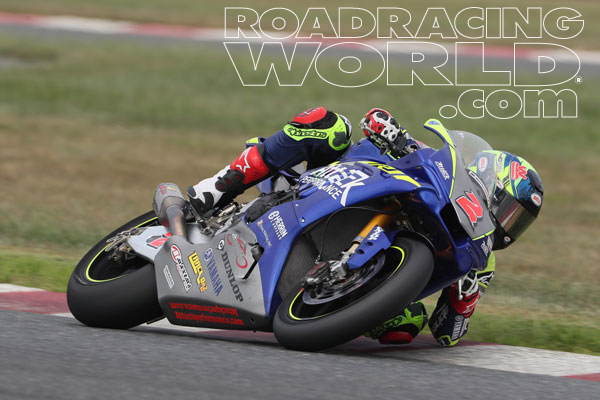
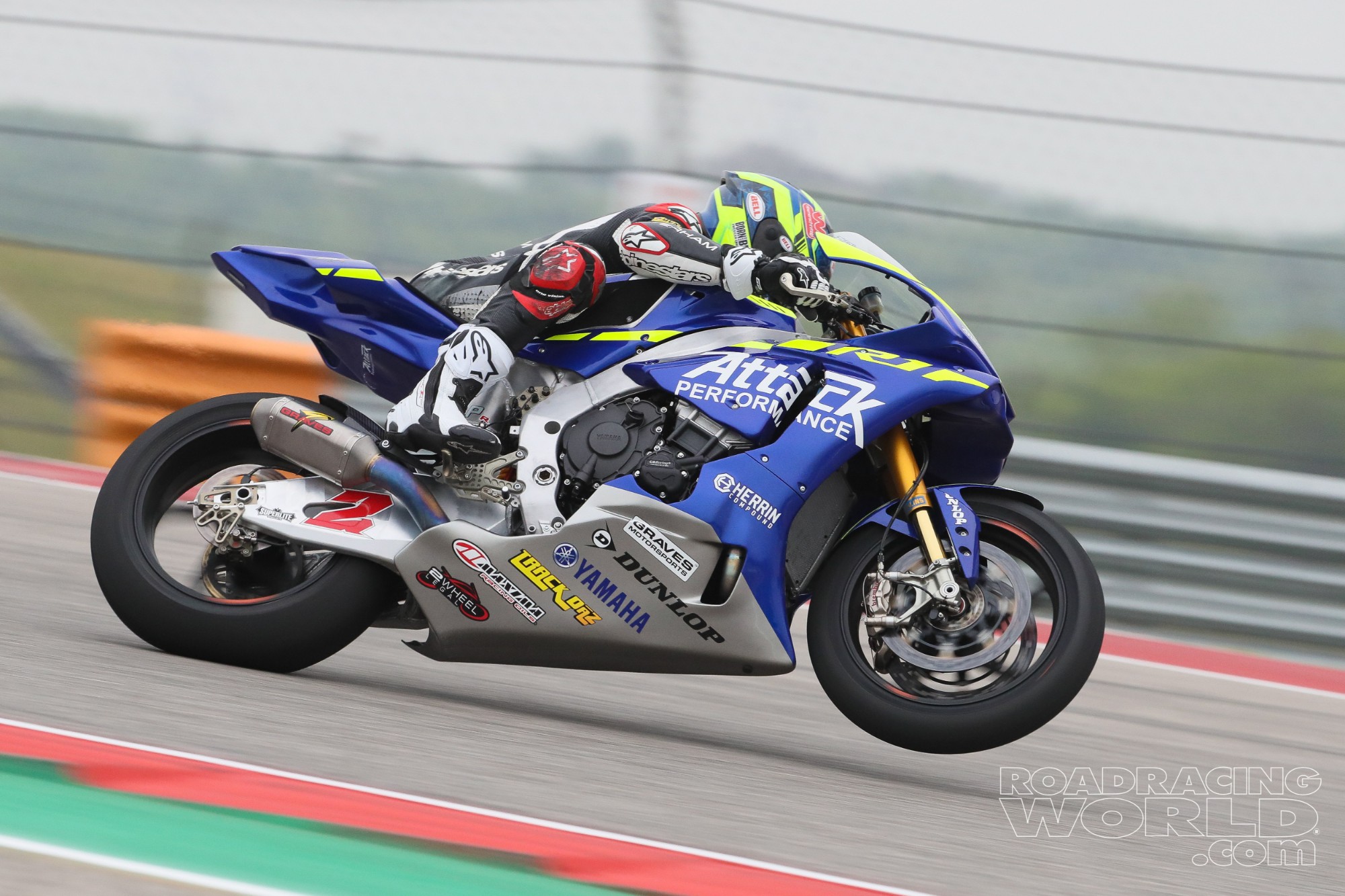
(Above) Josh Herrin (2) at speed on his Attack Performance/Herrin Compound Yamaha YZF-R1 MotoAmerica Superbike during the 2018 season. Photo by Brian J. Nelson.

In the past, for those who are not familiar with setting up aftermarket electronics, you would purchase an ECU (Engine Control Unit) from Motec, Marelli, Pectel, etc., and it would arrive pretty much as a useless box. If you were lucky, they would have a very basic automotive base map that you could not even consider using.

Before you could start the engine, you would spend several days, or weeks, configuring the firing order, engine synchronization (camshaft position vs. crank position), sensor calibration, coil outputs, servo motor calibration, stepper motor calibration, base maps, communication to the dash and other CAN (Controller Area Network) devices. The list seemed endless, and if for some reason you did not get all of that correct you probably would not make it out of the dyno room with your engine intact.

So why would we take a huge step backwards and work real hard just to get back to step one?

You may think it is the advance tuning, but this is only one part of the equation. The more complex strategies were not developed until later so the most important advantage at that time was the data. Visualizing the functions accurately gave the user the ability to fix an issue in a short amount of time, and speed is everything in racing.

So, why not just add a logger?

That would be the easier method, but it did not have the synergy that you would get from an ECU with an internal logger or an ECU with a good CAN stream to an external logger. Furthermore, you rarely could get a data stream from the OEM ECU and if you did the speed was so slow and the channels were so basic that it made the data useless.

At the end of 1999 we built our first fuel-injected Yamaha YZF-R7 [AMA Formula Xtreme racebike) powered by an YZF-R1 engine. We chose to use Motec, a well-known automotive ECU. Little did we know the development that was in store for us.

During our first run on the dyno we found out the hard way. The R1 cam sensor would change polarity at high rpm, affecting the synchronization and ignition timing. That ended our first day abruptly and made for a very long evening. After much struggle, time, and expense, we finally had a competitive machine, and by the end of the season we were on the podium at the Macau Grand Prix.

In 2001, we were picked up by Suzuki, and we took what we learned from the Yamaha and applied it to the Suzuki. Since the GSX-R1000 was a brand-new model, the first ever, we received the bikes very late and had zero time for testing. We assumed since we already took our lumps with the R1 that we should be good, but again it was a learning experience.

Our first event was at Infineon Raceway and the bike misfired all the way to the top of the podium. It turns out that the Suzuki cam sensor was prone to producing a noisy signal causing the misfire. After that event and many hours on the dyno, we fixed the issue. We went on to win many races but due to rider injuries the AMA Pro Formula Xtreme Championship had to wait until 2002.
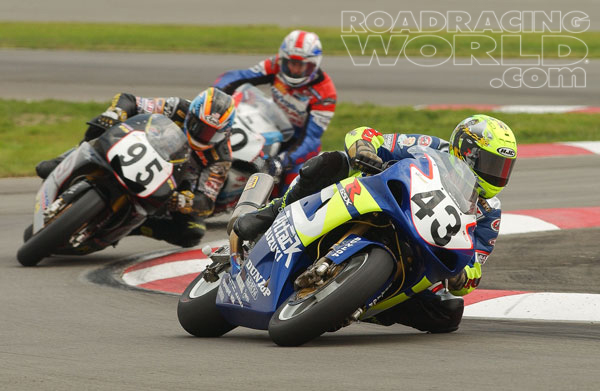
(Above) Jason Pridmore (43), riding his Attack Performance Suzuki GSX-R1000 AMA Formula Xtreme racebike, leading Roger Hayden (95) and Tom Kipp in 2002. Pridmore won the 2002 AMA Formula Xtreme Championship. Photo by Brian J. Nelson.

By now we were confident in our knowledge of the Motec electronics, or so we thought. With every new model came new challenges. We even had one ECU that would shut-off mid-session due to high-frequency engine vibration. That was a tough one to diagnose.

From 2004 to 2011 we spent most of our time as a factory-supported team with Kawasaki and mostly used the Motec and Marelli ECUs in Superbike, Formula Xtreme, and Supersport. We continued to move our same ECUs from one model to another and we were getting better at adapting them to suit different models. With every software update came new strategies and several of them were works in progress. It took quite a bit of testing to make progress with these new strategies. Again, we had good success with Formula Xtreme wins, two Daytona 200 wins, and some Superbike podiums.

The last big challenge was our MotoGP project in 2012 and 2013. MotoGP had been going through several challenges with ECU rules and, as a wildcard, the MotoGP Marelli option was not available. We chose the newest of the Motec ECUs, the M1. The programmability and the advanced data logging capability put it very close to the Marelli.
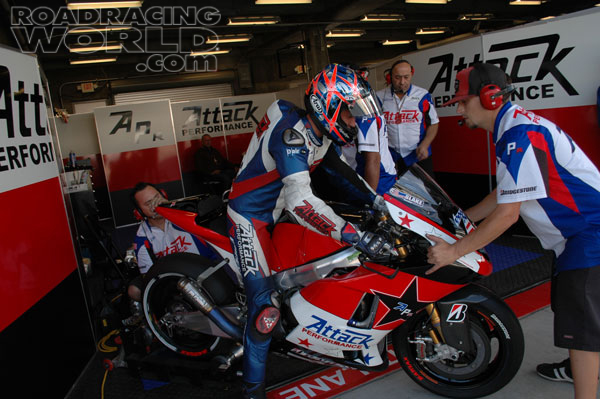
(Above) Richard Stanboli (second from right) with the APR MotoGP racebike he designed and built from pieces of billet aluminum and rider Blake Young at the Red Bull Indianapolis Grand Prix at Indianapolis Motor Speedway in 2013. Photo by David Swarts.

This new Motec ECU had all-new hardware, software, licensing, strategies, programmable firmware, etc. The “from scratch” challenge came back in a big way, and we found ourselves struggling with a limited baseline, limited test time, and new strategies that were not ready for prime time.

Our first MotoGP event was spent chasing wheel speed noises that caused the ECU to turn off all the rider aids. Consequently, we missed (barely) the qualifying cutoff. After that failed event, we were even more determined to do well, so it was back to the workshop and then to the track to confirm the fix. At the very next MotoGP we scored two World Championship points!

From 2014 to 2017, we did not field our own team but contracted to other teams–Riders Discount and Meen Motorsports. Meen Motorsports had partnered with Flash Tune (FTECU), which developed through the 2016 season a reflash of the R1 original equipment ECU. This gave us the capability to easily win the 2016 MotoAmerica Superstock 1000 Championship and with that result in hand the team decided to go “100%” into the MotoAmerica Superbike class in 2017.
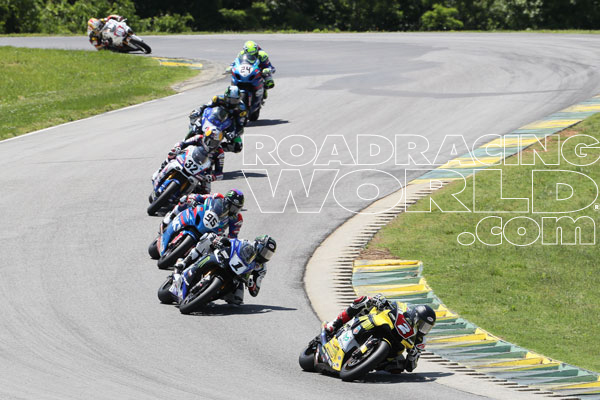
(Above) Josh Herrin (2) leading a MotoAmerica Superbike/Superstock 1000 race at VIRginia International Raceway on his Richard Stanboli-tuned Meen Motorsports Yamaha YZF-R1 Superstock 1000 racebike in 2017. Herrin won the 2017 MotoAmerica Superstock 1000 Championship. Photo by Brian J. Nelson.

Our position was that we would support the team but with the stipulation that we would be on the same level of equipment as the other teams. This meant the whole package: Electronics, engines, suspension, etc. Everything was agreed to, but through various forms of Meen Motorsports’ mismanagement the equipment never materialized. We found ourselves spending many costly hours — and more than the cost of a complete World Superbike Marelli SKS kit — pushing the reflash concept, but at the end, time and rules did not allow the development of a competitive package.

And I reiterate, it was costly!

This put us in an unfamiliar position of debating the continuation of support, but then the Meen Motorsports team folded a few races before the end of the 2017 season.
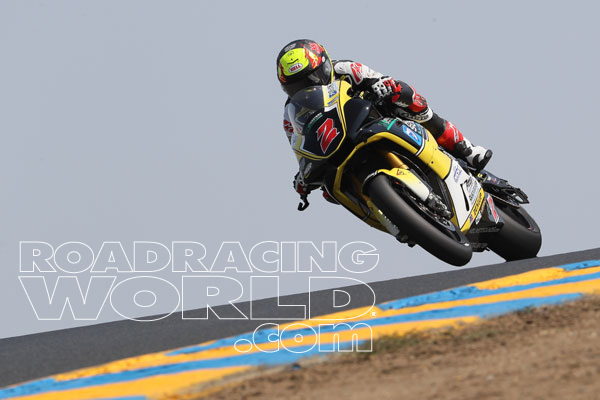
(Above) Josh Herrin (2) on his Meen Motorsports Yamaha YZF-R1 Superbike at Sonoma Raceway during the 2017 MotoAmerica Superbike season. It was the last event where Herrin raced this motorcycle. Photo by Brian J. Nelson.

After the failed season with Meen Motorsports, we swore that we would only go racing again if we controlled the budget and management. This meant that it would have to be an in-house team. Josh Herrin was jobless, and we were looking at our semi-truck, thinking of dusting it off. Josh spent most of the winter asking other teams for a ride, but he finally found himself back at our shop. At this point it was past the end-of-year holidays and we thought there was no way we could put a program together and build a proper Superbike. Not being afraid of a challenge, we said “OK, let’s give it a try.”

At the end of January, Yamaha stepped up with some product support and we had a couple of bikes on February 1, 2018. To say the least, it was going to be a big challenge.

After some back and forth, we opened a line of communication with YME (Yamaha Motor Europe), placed the order for the World Superbike Marelli SKS system way past the ordering deadline, and we prepared for the worst possible scenario.

The timing was very bad. Normally, you need some lead time, more than we had, for delivery of the Marelli SKS system. YME with some help from Yamaha Motor Corp, U.S.A. pulled some strings and everything went into process.

Once the door was opened with Yamaha Motor Europe, we received a flood of information: Software, documentation, wiring diagrams, a proven base map from the World Superbike test at Philip Island as well as a proven base map from the Yamaha Motor Corp., U.S.A., and a direct line of communication with the development engineer, Michele Garda.

The base map was so complete that I personally was amazed and felt a little guilty. The fueling, ignition timing, sensor calibration, CAN communication, strategy maps, were all there. It was a late Christmas for this race team! The biggest challenge was building the harness to spec, which was a small percentage of the challenge we faced with the MotoGP project.
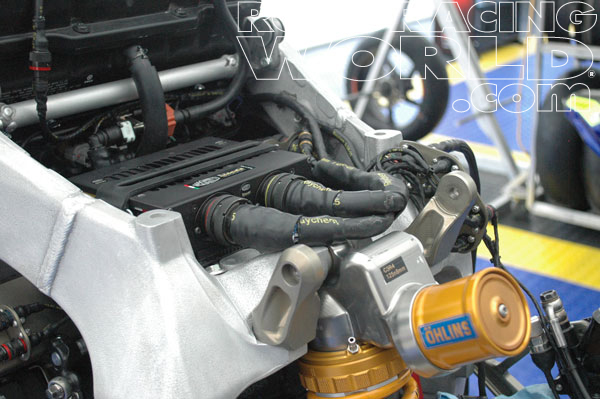
(Above) The Magneti Marelli ECU and custom wiring in the Attack Performance/Herrin Compound Yamaha YZF-R1 Superbike before it ran for the first time at Circuit of The Americas (COTA) in 2018. Photo by David Swarts.

Just to give you the idea of timing: Paul St. Clair with the Monster Energy/Yamalube/Yamaha team flashed our Marelli ECU with the U.S. version of the software in the Yamaha transporter while the team was loading for the first event of 2018. At this point, we did not have a running motorcycle or any familiarity with the strategies. Back to the shop we went to make a few changes to the harness and start the bike, but it would not start. The throttle would not calibrate, so instead of wasting a lot of time at the shop we decided that we would head to Road Atlanta and ask Paul or Vito (Bolognesi, with Magneti Marelli USA) to help us with the diagnostics. We were now out of time and just barely finished the bike and off we went.

On the way to Road Atlanta our transporter’s differential exploded, leaving us stranded in Shreveport, Louisiana. Without enough time to fix the transporter and no desire to have it picked clean at the repair shop parking lot, we decided to babysit the transporter, skip the Road Atlanta round, and head to COTA (Circuit of The Americas), the very next week’s event.

Once arriving at COTA, we spent setup day adding the final touches to the bike. Paul and Vito came over and within a few minutes the throttle was calibrated and the bike ran! Now came the hard part, making the bike competitive. We had yet to turn a single lap, eerily reminding me of our first race with the Suzuki in 2001. We won that race, so maybe lightning would strike twice.
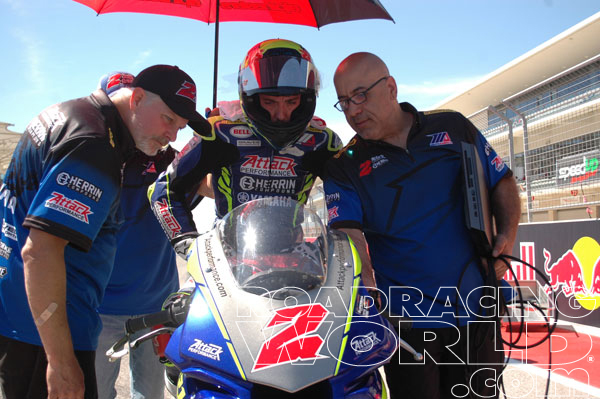
(Above) Richard Stanboli (right) explaining to Josh Herrin (center) the layout of the dashboard and functions of the buttons for their Magneti Marelli electronics prior to a MotoAmerica Superbike Race at Circuit of The Americas. Photo by David Swarts.

The first two sessions were a struggle, almost mirroring our first Suzuki adventure. We just missed qualifying for Superpole and had to start in P12. One more long evening with the data, a night of sleep for the rider, and we found ourselves on the grid for Race One.

Boom! The skies turned dark, it start raining, and I started laughing. No-one had any wet time, and this was exactly the break we needed. A few clicks on the suspension, some ride height changes, our best guess on the strategies, and few minutes later we are leading Race One! We ultimately finished second, which was not a bad outing. Even [MotoAmerica President] Wayne Rainey commented that he did not think we would finish the race…citing the earlier experiences of the team featured in the previous electronics article about Marelli.
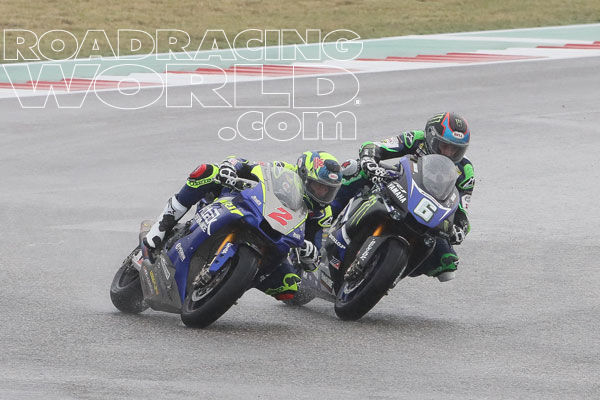
(Above) Josh Herrin (2) battling Cameron Beaubier (6) for second place in MotoAmerica Superbike Race One at COTA in 2018. Herrin finished second. Beaubier crashed, picked up his bike, and was still able to finish third in the wet race. Photo by Brian J. Nelson.

We would go on to continue the development of our bike and electronics with podium finishes at nearly every event and a couple of MotoAmerica Superbike race wins. The reliability and consistency were great, and we only had one failure due to an OEM connector that overheated, killing the engine during pre-race warmup at New Jersey Motorsports Park. Unfortunately, that DNS took us out of contention for second place in the 2018 MotoAmerica Superbike Championship and relegated us to third. But, overall, it was not a bad season for such a fast and challenging beginning.
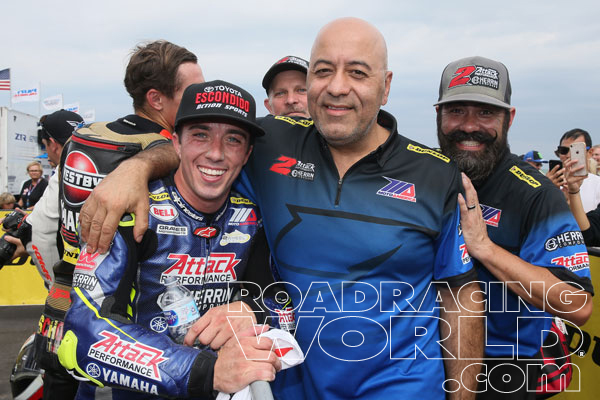
(Above) Josh Herrin (left) went on to win two MotoAmerica Superbike races on Richard Stanboli’s (center) Attack Performance/Herrin Compound Yamaha YZF-R1 Superbike in 2018 and finished third in the Championship. Photo by Brian J. Nelson.

Update:

Since I started writing this article, I had the opportunity to look at the new Motec GPR MotoAmerica Superbike electronics kit and software and, in my opinion, it is a significant step back from the Marelli SKS kit. Even though I am a fan of Motec product, I must honestly say that it comes up short in race readiness, strategy potential, and cost savings.

Race readiness: The Motec system does have sensor calibration for each model of motorcycle but the strategies are basic and have no baseline. As per World Superbike rules, teams using the SKS kit would be provided, by the factory, the most recent software which includes race-ready strategies. This is something each team using the Motec system will have to develop on their own, costing time and money.

Strategies: The Motec system is not torque-based. The Marelli system has strategies that rely heavily on torque models. The Yamaha Marelli SKS kit has the engine torque tables, both positive (acceleration) and negative (deceleration), modeled by the factory race team and ready for prime time. This means that the operator just needs to tell the ECU the amount of torque or force he would like to apply at the rear wheel for any situation and the ECU calculates the amount of throttle opening or torque, by adjusting ignition cut and timing. These torque models take a significant amount of dyno hours to replicate and are almost priceless. With the Motec system the operator will need to tell the ECU how much throttle or ignition cut to give the bike at any situation, and he will have to calculate or estimate how much torque or force would be applied to the rear wheel, including changes for any sprockets and transmission selection. It is substantially more work for the operator and will take away from other time-sensitive tasks. The torque-based strategies also make the Marelli more consistent from one event to another as well as race distance.

Cost: The Marelli SKS system comes in at €8,000, about $9,000 U.S., while the pricing of the MotoAmerica Motec system is right at $6,000 U.S. However, the Motec system does not include an IMU (Inertial Measurement Unit), lambda sensors (one vs. four in the SKS kit), suspension sensor, brake pressure sensor, oil pressure sensor, and download cable. You pay a bit more for the SKS kit up front, but the investment is recovered in very short order. As a past-to-present comparison, a complete Superbike advanced electronics system a decade ago would cost in the vicinity of $30,000 and hundreds of hours to make it 100% functional.

Marelli’s Wintax analysis software is more of an “engineering” level tool and Motec’s i2 Pro has a more user-friendly interface. The difference is like that of Windows and Apple. Once you take the time to learn each key and feature then both systems offer about the same analytical functionality. If we had to do it again all over again, without a doubt, we would go with the Marelli.

What does this mean for the future of the sport? Older racers, some of those who rode for us, tell me that they should just remove all the rider aids, while current World Superbike front runners tell me that they would like to ride MotoAmerica because the series and motorcycles are so much like World Superbike.

This reminds me of the first time I walked into NASA’s Jet Propulsion Laboratory and all the old drafting tables where slowly being replaced with computer design stations. The days of flat-slide carbs and throttle cables are over. What will happen when electric-powered motorcycles become more mainstream, put throttle cables on rheostats? Should we just throw out our smart phone calculators and bust out the abacus?

Going backwards is not an option and those who would like to remain in this sport and race at the front, which is totally possible, should learn the new tools, quit whining, and start winning.
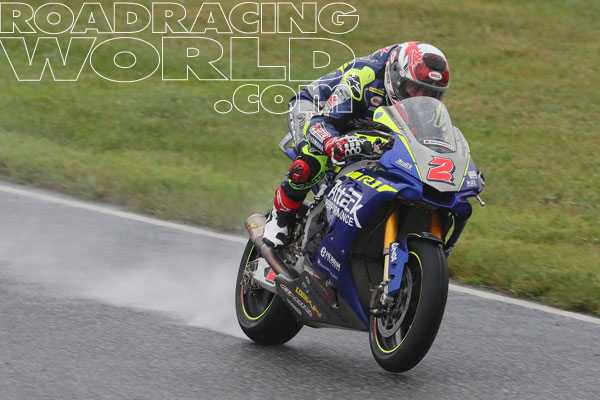
(Above) Josh Herrin (2) on his way to victory in MotoAmerica Superbike Race Two at New Jersey Motorsports Park in 2018. Photo by Brian J. Nelson.

MotoGP: Valentino Rossi: “Last Year‘s Race (In Argentina) Was Incredibly Tricky”

MONSTER ENERGY YAMAHA MOTOGP PLAN FOR ACTION IN ARGENTINA

Termas de Río Hondo (Argentina), 27th March 2019

The Monster Energy Yamaha MotoGP Team are about to get back on track for this weekend’s Grand Prix weekend at the Termas de Río Hondo Circuit.

Monster Energy Yamaha MotoGP’s Valentino Rossi and Maverick Viñales are ready to fight again at the upcoming second Grand Prix of the 2019 MotoGP season, held in Argentina this weekend.

Rossi was just 0.6s off the victory at the opening round, despite starting from P14 on the grid. The battling with his rivals in Qatar intensified his love for racing even more, and he is ready to challenge amongst the front-runners again this weekend.

The nine-time World Champion is hugely popular in Latin America. He can expect the support from thousands of fans who will be cheering him on from the Termas de Río Hondo stands. The Doctor aims to do them proud and greet them from the podium – like he did in 2015, when he secured the victory, and in 2016 and 2017, having taken second place – to make up for last year’s race result, obtained in tricky half-wet, half-dry conditions.

Though he didn’t end the first race of the season as high as he would have liked, Viñales took the positives from the first weekend in Losail and is motivated to show his speed again at the Gran Premio Motul de la República Argentina, which he has fond memories of.

Two years ago, he secured his second successive dominant win of the year on his Yamaha YZR-M1 in Argentina. The Spaniard struggled here last year in a slightly chaotic and challenging race, but he still took home solid points, securing fifth position. This year he wants to feel competitive again, so he can duplicate the 2017 result and once more enjoy the great sensation of winning in front of the Argentinian fans.

The 4.8km long Termas de Río Hondo Circuit was added to the MotoGP calendar in 2014. The track was remodelled two years earlier, to make it Latin America’s most modern and safest circuit. With an exciting lay-out that includes a mixture of fast corners (five left, nine right) and a 1076m longest straight, the Argentinian fans can be assured that they will see plenty of racing and overtaking action again.

MASSIMO MEREGALLI

TEAM DIRECTOR

“We didn’t finish as high as we wanted to in Qatar, but this only fuels us to work harder and we learned from that experience. Getting to the Termas de Río Hondo circuit is quite a journey for the team and riders, but once we get there it’s always very rewarding. The local fans are incredibly passionate about MotoGP, so we want to put on a good show for them this weekend. Though I’m sure the spectators all enjoyed the drama of last year’s unplanned and slightly chaotic starting procedure, we are hoping for a completely wet or dry race. We know this track suits our bike, and our riders also enjoy this circuit, so we hope to be in for another exciting GP weekend and work towards a strong result.”

VALENTINO ROSSI

“I enjoyed the race in Qatar, but now we focus on Argentina. First of all, we hope we‘ll have good track conditions at the circuit this weekend, because that‘s always crucial. Second of all, we hope we‘ll have good weather this year. Last year‘s race was incredibly tricky, riding on a half-wet, half-dry surface – it was very difficult to ride the bike with slicks over the wet patches. We hope we won‘t have to repeat that, and we will see if we‘re strong. I’ll do my best to fight for the podium.”

MAVERICK VIÑALES

“We did a good job in Qatar, during all the weekend, despite what the result of the race suggests. The team delivered really great work during the last race weekend, so now we’re looking forward to this week’s Grand Prix in Argentina. This season we’re going to take it race-by-race, trying to improve every day. I can‘t wait to ride at Termas de Río Hondo again – I know what it’s like to win there. I hope to have the same feeling again this year and be able to fight for the victory. I really think that we can do a good job this weekend and that we will be at the front during the entire race, with the possibility to win.”

WERA West: David Anthony, Bradley Ward Split Formula One Wins In Las Vegas

Bradley Ward and David “Aussie Dave” Anthony took
home the Formula One wins in the WERA West Presented by Lucas Oil Products
double-header at Las Vegas Motor Speedway on Saturday and Sunday.

Ward took his Dunlop-shod, Fly Racing-backed Kawasaki ZX-10R
to a clean 6.798-second win over Travis Wyman on a BMW S1000RR and Justin
Simons on his Kawasaki ZX-10R, setting a best lap of 1:17.360 around the
1.8-mile Classic Course.

Wyman backed up the runner-up spot in Formula One with wins
in the A Superstock and A Superbike races, while Simons took second in the A
Superstock race ahead of Sahar Zvik.

On Sunday, Anthony ran the big-bore table, taking the
Formula One, A Superbike and A Superstock wins on his Pirelli-shod, Fly
Racing-backed Kawasaki ZX-10R. Wyman took second and Zvik third in the A
Superbike and A Superbike races, while Wyman and Zvik took the podium places in
Formula One. Wyman laid down the fastest lap in the big-bore races on Sunday,
the only rider to dip into the 1:15 range with a 1:15.854 in the final race of
the weekend.

RACE RESULTS:

SATURDAY:

GROM CUP (all on Honda Grom):

1. Selin Buyuksonmez


MINI 50:

1. Cody Kitchens (KTM 65)

2. Owen Williams (Hon 50)

3. Fatih Buyuksonmez (Kaw 250R)


A SUPERSTOCK EXPERT:

1. Travis Wyman (BMW S1000RR)

2. Justin Simons (Kaw ZX-10R)

3. Sahar Zvik (Kaw ZX-10R)

4. Manny Segura (Kaw ZX-10R)

5. Terry Heard (Kaw ZX-10R)

6. Louis Jutras (BMW S1000RR)

A SUPERSTOCK NOVICE:

1. Bo Bin (BMW S1000RR)

2. Tony Lam (Yam YZF-R1)

3. Bryan Montgomery (Yam YZF-R1)

4. Ben Ahern (Apr RSV4)

5. Donald Martins (BMW S1000RR)


SRA SIDECARS:

1. Russel Biles

2. Bernard Juchi

3. Steven Stull

4. Gary McEwen

5. William Becker


HEAVYWEIGHT TWINS SUPERBIKE EXPERT:

1. Ruben Soto (KTM 1190)

HEAVYWEIGHT TWINS SUPERBIKE NOVICE:

1. Cody Kitchens (Mor MD250H)

C SUPERSTOCK EXPERT:

1. Mookie Wilkerson (Yam YZF-R6)

2. Jeremiah Walker (MV F3 675)

3. Connor Funk (Yam YZF-R6)

4. Mitsu Ueda (Yam YZF-R6)

5. Kevin Winter (Yam YZF-R6)

6. Anibal Arias (Kaw ZX-6R)

C SUPERSTOCK NOVICE:

1. Conner Brown (Yam YZF-R6)

2. Jai Dicipulo (Yam YZF-R6)


FORMULA TWO EXPERT:

1. JC Gibbs (Yam 700)

2. Lance Lewman (Suz SV650)

3. Anthony Morrison (Suz SV650)

4. Andrew Preciado (Mor MD250H)

5. Michael Gougis (Suz SV650)

FORMULA TWO NOVICE:

1. Cody Kitchens (Mor MD250H)

SENIOR SUPERBIKE HEAVYWEIGHT EXPERT:

1. Terry Heard (Kaw ZX-10R)

2. Louis Jutras (BMW S1000RR)

3. Ed Guzman (BMW S1000RR)

4. Ruben Soto (KTM 1190)

5. Jeff Semmig (Suz GSX-R1000)

SENIOR SUPERBIKE HEAVYWEIGHT NOVICE:

1. Brandon Pulli (Yam YZF-R1)

2. Kristopher Furrow (Yam YZF-R1)

3. Eric Gray (Kaw ZX-10R)

4. Donald Martins (BMW S1000RR)

5. Ben Ahem (Apr RSV4)

6. Dexter Stuart (Apr RSV4)


SENIOR SUPERBIKE MEDIUMWEIGHT EXPERT:

1. Mitsu Ueda (Yam YZF-R6)

2. Gilbert Silva (Kaw ZX-6R)

3. Eric Anderson (Yam YZF-R6)

4. Gerardo Flores (Kaw ZX-6R)

5. Moises Castaneda (Yam YZF-R6)

SENIOR SUPERBIKE MEDIUMWEIGHT NOVICE:

1. Wayne Gann (Yam YZF-R6)

2. Edward Hearn (Kaw ZX-6R)

3. James Salters (Kaw ZX-6R)


B SUPERSTOCK EXPERT:

1. Connor Funk (Yam YZF-R6)

2. Anibal Arias (Kaw ZX-6R)

3. Anas Sorhmat (Yam YZF-R6)

4. Max Zeronian (Yam YZF-R6)


B SUPERSTOCK NOVICE:

1. Conner Brown (Yam YZF-R6)

2. Jai Dicipulo (Yam YZF-R6)

3. James Salters (Kaw ZX-6R)


V8 MEDIUMWEIGHT:

1. Edward Hearn (Kaw ZX-6R)


D SUPERBIKE EXPERT:

1. David Purcell (Kaw Ninja 400R)

2. John Knowles (Kaw Ninja 400R)

3. Andrew Preciado (Mor MD250H)

4. Ron Gentile (KTM 390)

5. Laura Orozco (Mor MD250H)

D SUPERBIKE NOVICE:

1. Cody Kitchens (Mor MD250H)

2. Aden Thao (Kaw Ninja 400R)

E SUPERSTOCK NOVICE:

1. John Sosebee (Yam YZF-R3)

LIGHTWEIGHT TWINS SUPERSTOCK EXPERT:

1. JC Gibbs (Yam 700)

2. Ed Guzman (Suz SV650)

C SUPERBIKE EXPERT:

1. Jeremiah Walker (MV F3 675)

2. Connor Funk (Yam YZF-R6)

3. Mitsu Ueda (Yam YZF-R6)

4. Max Zeronian (Yam YZF-R6)

5. Anas Sorhmat (Yam YZF-R6)

C SUPERBIKE NOVICE:

1. Conner Brown (Yam YZF-R6)

2. Jai Dicipulo (Yam YZF-R6)

3. Arnold Munoz (Suz GSX-R600)

FORMULA ONE EXPERT:

1. Bradley Ward (Kaw ZX-10R)

2. Travis Wyman (BMW S1000RR)

3. Justin Simons (Kaw ZX-10R)

4. Sahar Zvik (Kaw ZX-10R)

5. Manny Segura (Kaw ZX-10R)

6. Nathan Shipman (Kaw ZX-10R)

7. Jeremiah Walker (MV F3 675)

8. Jeremy Sims (BMW S1000RR)

9. Zac Miller (BMW S1000RR)

10. John DuBois II (Kaw ZX-10R)

FORMULA ONE NOVICE:

1. Bo Bin (BMW S1000RR)

2. Tony Lam (Yam YZF-R1)

3. Thomas Asseo (Yam YZF-R1)

4. Brandon Pulli (Yam YZF-R1)

5. Kristopher Furrow (Yam YZF-R1)

6. Ben Ahern (Apr RSV4)

CLUBMAN EXPERT:

1. Andrew Preciado (Mor MD250H)

2. Ron Gentile (KTM 390)

3. Laura Orozco (Mor MD250H)


CLUBMAN NOVICE:

1. Cody Kitchens (Mor MD250H)

2. Aden Thao (Kaw Ninja 400R)

3. Owen Williams (Mor MD250H)


B SUPERBIKE EXPERT:

1. Connor Funk (Yam YZF-R6)

2. Mookie Wilkerson (Yam YZF-R6)

3. Mitsu Ueda (Yam YZF-R6)

4. Max Zeronian (Yam YZF-R6)

5. Anas Sorhmat (Yam YZF-R6)


B SUPERBIKE NOVICE:

1. Jai Dicipulo (Yam YZF-R6)

2. Arnold Munoz (Suz GSX-R600)


D SUPERSTOCK EXPERT:

1. John Knowles (Kaw Ninja 400R)


D SUPERSTOCK NOVICE:

1. Aden Thao (Kaw Ninja 400R)

2. John Sosebee (Yam YZF-R3)


LIGHTWEIGHT TWINS SUPERBIKE EXPERT:

1. Lance Lewman (Suz SV650)

2. JC Gibbs (Yam 700)

3. Anthony Morrison (Suz SV650)

4. Andrew Preciado (Mor MD250H)

5. Michael Gougis (Suz SV650)

6. Ed Guzman (Suz SV650)

LIGHTWEIGHT TWINS SUPERBIKE NOVICE:

1. Cody Kitchens (Mor MD250H)

A SUPERBIKE EXPERT:

1. Travis Wyman (BMW S1000RR)

2. Sahar Zvik (Kaw ZX-10R)

3. Jeremy Sims (BMW S1000RR)

4. Louis Jutras (BMW S1000RR)

5. Manny Segura (Kaw ZX-10R)

6. Zac Miller (BMW S1000RR)


A SUPERBIKE NOVICE:

1. Bo Bin (BMW S1000RR)

2. Thomas Asseo (Yam YZF-R1)

3. Tony Lam (Yam YZF-R1)

4. Bryan Montgomery (Yam YZF-R1)

5. Brandon Pulli (Yam YZF-R1)

6. Kristopher Furrow (Yam YZF-R1)


SUNDAY:

GROM CUP (all on Honda Grom):

1. Selin Buyuksonmez


MINI 50:

1. Owen Williams (Hon 50)

2. Fatih Buyuksonmez (Kaw 250R)

A SUPERSTOCK EXPERT:

1. David Anthony (Kaw ZX-10R)

2. Travis Wyman (BMW S1000RR)

3. Sahar Zvik (Kaw ZX-10R)

4. Justin Simons (Kaw ZX-10R)

5. Terry Heard (Kaw ZX-10R)

6. Manny Segura (Kaw ZX-10R)

A SUPERSTOCK NOVICE:

1. Bo Bin (BMW S1000RR)

2. Bryan Montgomery (Yam YZF-R1)

3. Donald Martins (BMW S1000RR)

4. Ben Ahern (Apr RSV4)

SRA SIDECARS:

1. Russel Biles

2. Bernard Juchi

3. Steven Stull

4. Gary McEwen

HEAVYWEIGHT TWINS SUPERBIKE EXPERT:

1. Ruben Soto (KTM 1190)

C SUPERSTOCK EXPERT:

1. Jeremiah Walker (MV F3 675)

2. Connor Funk (Yam YZF-R6)

3. Mookie Wilkerson (Yam YZF-R6)

4. David Henderson (Yam YZF-R6)

5. Mitsu Ueda (Yam YZF-R6)

6. Anibal Arias (Kaw ZX-6R)

C SUPERSTOCK NOVICE:

1. Conner Brown (Yam YZF-R6)

FORMULA TWO EXPERT:

1. Lance Lewman (Suz SV650)

2. JC Gibbs (Yam 700)

3. Andrew Preciado (Mor MD250H)

4. Michael Gougis (Suz SV650)

5. Cody Burton (Suz SV650)

FORMULA TWO NOVICE:

1. Cody Kitchens (Mor MD250H)

SENIOR SUPERBIKE HEAVYWEIGHT EXPERT:

1. Terry Heard (Kaw ZX-10R)

2. Louis Jutras (BMW S1000RR)

3. David Henderson (Yam YZF-R1)

4. Ruben Soto (KTM 1190)

5. Fatih Buyuksonmez (BMW S1000RR)

6. Ed Guzman (BMW S1000RR)

SENIOR SUPERBIKE HEAVYWEIGHT NOVICE:

1. Donald Martins (BMW S1000RR)

2. Ben Ahem (Apr RSV4)

3. Brandon Pulli (Yam YZF-R1)

4. Eric Gray (Kaw ZX-10R)


SENIOR SUPERBIKE MEDIUMWEIGHT EXPERT:

1. Eric Anderson (Yam YZF-R6)

2. Gerardo Flores (Kaw ZX-6R)

3. Mitsu Ueda (Yam YZF-R6)

4. John James (Hon CBR600RR)

SENIOR SUPERBIKE MEDIUMWEIGHT NOVICE:

1. Wayne Gann (Yam YZF-R6)

2. James Salters (Kaw ZX-6R)

3. Edward Hearn (Kaw ZX-6R)

B SUPERSTOCK EXPERT:

1. Connor Funk (Yam YZF-R6)

2. Anibal Arias (Kaw ZX-6R)

3. Anas Sorhmat (Yam YZF-R6)

4. Max Zeronian (Yam YZF-R6)


B SUPERSTOCK NOVICE:

1. Conner Brown (Yam YZF-R6)

2. James Salters (Kaw ZX-6R)

3. Arnold Munoz (Suz GSX-R600)

V8 MEDIUMWEIGHT:

1. John James (Hon CBR600RR)

2. Edward Hearn (Kaw ZX-6R)

D SUPERBIKE EXPERT:

1. Andrew Preciado (Mor MD250H)

2. John Knowles (Kaw Ninja 400R)

3. Ron Gentile (KTM 390)

4. Laura Orozco (Mor MD250H)

D SUPERBIKE NOVICE:

1. Cody Kitchens (Mor MD250H)

2. Owen Williams (Mor MD250H)

3. Aden Thao (Kaw Ninja 400R)


LIGHTWEIGHT TWINS SUPERSTOCK EXPERT:

1. JC Gibbs (Yam 700)

2. Ed Guzman (Suz SV650)

C SUPERBIKE EXPERT:

1. Connor Funk (Yam YZF-R6)

2. Jeremiah Walker (MV F3 675)

3. David Henderson (Yam YZF-R6)

4. Anas Sorhmat (Yam YZF-R6)

5. Max Zeronian (Yam YZF-R6)


C SUPERBIKE NOVICE:

1. Conner Brown (Yam YZF-R6)

2. Arnold Munoz (Suz GSX-R600)


FORMULA ONE EXPERT:

1. David Anthony (Kaw ZX-10R)

2. Travis Wyman (BMW S1000RR)

3. Justin Simons (Kaw ZX-10R)

4. Nathan Shipman (Kaw ZX-10R)

5. Sahar Zvik (Kaw ZX-10R)

6. Jeremiah Walker (MV F3 675)

7. Manny Segura (Kaw ZX-10R)

8. John DuBois II (Kaw ZX-10R)

9. Chris Baker (Yam YZF-R1)

10. Fatih Buyuksonmez (BMW S1000RR)


FORMULA ONE NOVICE:

1. Thomas Asseo (Yam YZF-R1)


V8 HEAVYWEIGHT:

1. John James (Hon CBR600RR)

CLUBMAN EXPERT:

1. Ron Gentile (KTM 390)

3. Laura Orozco (Mor MD250H)

CLUBMAN NOVICE:

1. Cody Kitchens (Mor MD250H)

2. Owen Williams (Mor MD250H)

3. Aden Thao (Kaw Ninja 400R)


B SUPERBIKE EXPERT:

1. Mookie Wilkerson (Yam YZF-R6)

2. Anas Sorhmat (Yam YZF-R6)

3. Max Zeronian (Yam YZF-R6)

4. Connor Funk (Yam YZF-R6)

B SUPERBIKE NOVICE:

1. Conner Brown (Yam YZF-R6)

D SUPERSTOCK EXPERT:

1. John Knowles (Kaw Ninja 400R)

D SUPERSTOCK NOVICE:

1. Aden Thao (Kaw Ninja 400R)


LIGHTWEIGHT TWINS SUPERBIKE EXPERT:

1. JC Gibbs (Yam 700)

2. Lance Lewman (Suz SV650)

3. Michael Gougis (Suz SV650)


LIGHTWEIGHT TWINS SUPERBIKE NOVICE:

1. Cody Kitchens (Mor MD250H)

A SUPERBIKE EXPERT:

1. David Anthony (Kaw ZX-10R)

2. Travis Wyman (BMW S1000RR)

3. Sahar Zvik (Kaw ZX-10R)

4. Manny Segura (Kaw ZX-10R)

5. John DuBois II (Kaw ZX-10R)

6. Jeremy Sims (BMW S1000RR)


A SUPERBIKE NOVICE:

1. Bo Bin (BMW S1000RR)

2. Thomas Asseo (Yam YZF-R1)

3. Brandon Pulli (Yam YZF-R1) 

Quick Look: KTM 390 Duke

.

FEATURED IN THE MARCH 2019 ISSUE OF ROADRACING WORLD…

     You always knew when Jamie James was going to try
something special. It’s not like the Ragin’ Cajun was hanging around when he
was on the track — four AMA Pro National Championships, including the 1989 AMA
Superbike title, were testament to his speed. But when he was planning a move
on someone, his elbows would come out, and you knew to watch carefully
…

     The first time I sat on the KTM 390 Duke, I thought
of James. The bike is short, compact, with tubular bars and relatively rearset
pegs. The riding position put me upright, over the tank, with elbows out in
full attack mode, and I couldn’t help but think that there had to be someone
around who needed me to out-brake and stuff them at an  apex …

Michael Gougis, Editor-At-Large, in the March 2019 Issue of Roadracing World


KTM’s 390
Duke is the smallest member of the company’s family of street-oriented hooligan
bikes. But don’t let the small displacement fool you; it’s a lightweight,
friendly bike that makes you want to ride hard, and rewards you for doing so.
Read the review of the littlest thrash-machine in the March 2019 issue of Roadracing
World
!

Roadracing World & Motorcycle Technology is THE definitive source for motorcycle racing, riding, and tech information.

SUBSCRIBE NOW FOR INSTANT ACCESS!

PREVIEW the March 2019 Issue

Roadracing World & Motorcycle Technology magazine is available in print and digital formats.

Log in or subscribe HERE.

Or call (909) 654-4779, 9:00 a.m. – 5:00 p.m. Pacific Time, Monday through Friday.

Visit www.roadracingworld.com daily for breaking news and events.

https://www.facebook.com/roadracingworld

https://twitter.com @roadracingworld

https://instagram.com @roadracing_world

Join the Roadracing World Online Community of Racers, Riders,& Fans. Post photos and results, make connections with sponsors, and more! Create your Roadracing World Online Profile today!

www.roadracingworld.com/signup

AMA: Utah Becomes Second State To Legalize Lane Splitting By Motorcyclists

Utah passes motorcycle lane-splitting legislation

Becomes second U.S. state to allow filtering in traffic

PICKERINGTON, Ohio — Utah became the second U.S. state to formally recognize a type of lane splitting, with the governor’s signature on a bill legalizing the filtering of motorcycles between lanes of stopped traffic.

“This is a major victory for motorcyclists in Utah and across the country,” said Mike Sayre, on-highway government relations manager for the American Motorcyclist Association. “As more states acknowledge the benefits of lane splitting, motorcyclists can become safer on the roads, and motorists can find some relief from traffic congestion.”

H.B. 149 allows motorcyclists traveling no faster than 15 mph to filter between lanes of stopped traffic traveling in the same direction on roads where the speed limit is 45 mph or less.

The bill, sponsored by state Rep. Walt Brooks (R-St. George) and state Sen. David P. Hinkins (R-Orangeville), was signed by Gov. Gary Herbert on March 21. The bill takes effect May 14.

There are provisions in the bill automatically repealing the law on July 1, 2022, if the legislature takes no action to extend it.

The AMA endorses lane splitting, given the long-term success in California and the University of California study by Berkeley researchers showing that it enhances motorcycle safety. And the AMA will assist groups and individuals working to bring legal lane splitting and/or filtering to their state.

The full AMA position statement on lane splitting can be found at www.americanmotorcyclist.com/About-The-AMA/lane-splitting-1.

About the American Motorcyclist Association

Founded in 1924, the AMA is a not-for-profit member-based association whose mission is to promote the motorcycle lifestyle and protect the future of motorcycling. As the world’s largest motorcycling rights and event sanctioning organization, the AMA advocates for riders’ interests at all levels of government and sanctions thousands of competition and recreational events every year. The AMA also provides money-saving discounts on products and services for its members. Through the AMA Motorcycle Hall of Fame in Pickerington, Ohio, the AMA honors the heroes and heritage of motorcycling. For more information, visit www.americanmotorcyclist.com.

Not a member? Join the AMA today: www.americanmotorcyclist.com/mobile-join 

MotoGP: Court Of Appeals Rules On Ducati Aerodynamic Device Protest

MotoGP Court of Appeal hands down decision

Case against Ducati aerodynamic devices

VisitQatar Grand Prix – Doha (QAT), 10 March

During the MotoGP race at the season opener in Qatar on 10 March 2019, technical protests concerning the use of a device on the Ducati machine were lodged with the FIM MotoGP Stewards by Team Suzuki Ecstar against #43 Jack Miller (Ducati), by Repsol Honda Team against #4 Andrea Dovizioso (Ducati), and by Red Bull KTM Factory Team and Aprilia Racing Team Gresini against #9 Danilo Petrucci (Ducati).

The protesting teams considered that the device was primarily an aerodynamic device and therefore not compliant with the MotoGP technical regulations. After a hearing, the four protests were rejected.

The same four teams then lodged appeals against the MotoGP Stewards’ decision to the MotoGP Appeal Stewards and a further hearing was conducted. The MotoGP Appeal Stewards determined that further technical evaluation was required and that this was not possible under the circumstances. They therefore decided to refer the matter to the MotoGP Court of Appeal in accordance with Art. 3.3.3.2 of the applicable Regulations.

Following a hearing in Mies on Friday 22 March, the MotoGP Court of Appeal handed down its decision today 26 March and the parties (the four appellants, Ducati and the FIM) have been duly notified.

On these grounds, the MotoGP Court of Appeal rules that:

The appeals filed by Team Aprilia, Team Suzuki, Team Honda and Team KTM are admissible.

The provisional race results are confirmed and are declared as final.

The request to declare the Device illegal and ban its use in future races is rejected.

An appeal against this decision may be lodged before the Court of Arbitration of Sport (CAS) in Lausanne Switzerland within 5 days pursuant to Article 3.9 of the 2019 FIM World Championship Grand Prix Regulations. 

CMRA: Team FellonKnee Racing Wins 8-Hour CMRA Ultra Lightweight Race At NOLA Motorsports Park

Team FellonKnee Racing endured a long eight-hour ultra lightweight endurance race and brought home the top spot during the Central Motorcycle Roadracing Association’s (CMRA) first round of the Ultra Lightweight Endurance this past Saturday, March 23, on the 16-turn, 2.75-mile-long course at NOLA Motorsports Park, in Avondale, Louisiana.

With the sun shining and the weather perfect, the morning races came to an end and the endurance teams lined up their bikes and put the final touches together to start the eight-hour endurance event. Just minutes before 11:30 a.m. the red lights went out and the racers were off, each turning laps and working their way through the pack trying to find their rhythm. Each passing presented its own set of variables that would determine the outcome of the race. Every pit stop counted and each second that passed would affect the end results. When the checkered flag flew 30 minutes early due to the setting sun, the top two positions were just over one minute apart. Team FellonKnee Racing brought home the win by just 1:34.391 over The Skidmarks. The third place team, Redline Racing, ran the fastest lap of the race on lap 38 with a 1:57.709 time.

Dustin Dominguez flew this weekend and broke the CMRA track record which was set back in 2013 by Danny Kelsey who ran a 1:44.549. Dominguez ran a 1:44.465 during the Bell Helmets-sponsored A Superstock Expert race on Saturday morning.

Brandon Clark cleaned up in his races and brought home three first-place wins. He earned first in D Superstock Novice running the fastest lap for his class with a 2:02.213, first in 500 Superbike Novice with a personal fast lap of 2:02.778, and first in 300 Superstock with a class fast lap of 2:02.574.

Ben Hunter was the fastest novice of the morning running a 1:52.299 during the A Superstock Novice class.

Dustin Dominguez #68 would like to thank his sponsors: Kawasaki, Dunlop, RaceworX, GP Suspension, Graves Motorsports, Motion Pro, Arai, GTZ Leathers, Specialized Race Gear.

Brandon Clark #823 would like to thank his sponsors: Continental, Clark Racing, Road and Track Suspension, T&W Auto Paint, Von Hertell, Jennifer Millsap Fight Like a Girl.

For a complete list of the weekend results and standings, please visit the CMRA website. www.CMRAracing.com. The next round of Mini, ULW, and Championship Sprints, and the second round of the CMRA Ultra-Lightweight Endurance Series, will be held on May 18, 2019, at Hallett Motor Racing Circuit in Hallett, Oklahoma. Details for the weekend will be announced when finalized. Come out and see some great racing action!

March 23, 2019

RACE RESULTS:

D SUPERSTOCK EXPERT

1. Jim Whitten (Duc 1000SS)

2. Zachary Boldwyn (Suz SV650)

3. Andrew Forsythe (Suz SV650)

4. Walter Walker III (Suz SV650)

5. Chandler Slagle (Suz SV650)

6. Rob Lackey (Suz SV650)

D SUPERSTOCK NOVICE

1. Brandon Clark (Suz SV650)

2. Damian Falcon (Suz SV650)

3. Zach Didier (Yam YZF-R3)

4. Topher Simmons (Suz SV650)

5. Eli Todich (Suz SV650)

6. James Hanson (Kaw EX300)

CLASSIC

1. David Dahms (Hon CBR600)

2. Seb Rowe (Hon CBR600)

3. Sean Brown (Kaw EX500)

MOTORSPORT RANCH B SUPERSTOCK EXPERT

1. Lucas Silva (Suz GSX-R600)

2. Cody Mecklenburg (Yam YZF-R6)

3. Jay Bullard (Kaw ZX-6R)

4. Shane Zelm (Suz GSX-R750)

5. Kyle Coles (Yam YZF-R6)

6. Chris Botha (Yam YZF-R6)

MOTORSPORT RANCH B SUPERSTOCK NOVICE

1. Bobby Crandell (Kaw ZX-6R)

2. Tyler Fisher (Yam YZF-R6)

3. Robin Lawson (Suz GSX-R600)

4. Carter Rossner (Kaw ZX-6R)

5. Jonathan Childers (Yam YZF-R6)

6. James Gutierrez (Suz GSX-R750)

500 SUPERBIKE EXPERT

1. Tyler Raboin (Kaw Ninja 400)

2. Jesse Smartt (Kaw Ninja 400)

3. Isaiah Burleson (Kaw Ninja 400)

4. Ryan Max Johnson (Yam YZF-R3)

5. Cory Burleson (Yam YZF-R3)

6. Steven Shakespeare (Kaw Ninja 400)

500 SUPERBIKE NOVICE

1. Brandon Clark (Yam YZF-R3)

2. Zach Didier (Yam YZF-R3)

3. Zach Morris (Kaw Ninja 400)

4. James Hanson (Kaw Ninja 300)

5. Branden Chaisorn (Yam YZF-R3)

6. Ben Avila (Kaw Ninja 400)

GROM CHALLENGE

1. Kasey Lewis (Kaw Z125)

FORMULA 6

1. Mikey Sanchez (Hon NSF100)

2. Chase Black (Ohvale GP 110)

FORMULA 8

1. Caleb Wood (Yam TTR110)

JUNIOR MOTARD

1. Josiah Burleson (Kaw KLX110)

FORMULA 7

1. Mikey Sanchez (Hon NSF100)

2. Chase Black (Ohvale GP110)

FORMULA 2 NOVICE

1. Seb Rowe (Hon CBR600)

2. Topher Simmons (Suz SV650)

3. Tamara Smith (Hon CBR500R)

300 SUPERSTOCK EXPERT

1. Ryan Max Johnson (Yam YZF-R3)

2. Cory Burleson (Yam YZF-R3)

3. Kyle Fox (Yam YZF-R3)

4. Rusty Grant (KTM RC 390)

5. Enrique Hernandez (Kaw Ninja 250)

6. Manny Poulis (Kaw Ninja 400)

300 SUPERSTOCK NOVICE

1. Brandon Clark (Yam YZF-R3)

2. Branden Chaisorn (Yam YZF-R3)

3. John DeMasters (Kaw Ninja 300)

4. Zach Didier (Yam YZF-R3)

5. Reid Hall (Yam YZF-R3)

6. Dezrae Caldwell (Yam YZF-R3)

BELL HELMETS A SUPERSTOCK EXPERT

1. Dustin Dominguez (Kaw ZX-10R)

2. Doug Frenchak (Kaw ZX-10R)

3. Bobby Davies (Yam YZF-R1)

4. Steven Shakespeare (Yam YZF-R1)

5. Shane Zelm (Suz GSX-R750)

6. Dolph McVicker (Yam YZF-R1)

A SUPERSTOCK NOVICE

1. Ben Hunter (Yam YZF-R1)

2. Dennis Black (Duc Panigale V4)

3. Ronnie Grove (Yam YZF-R1)

4. Marcelo Fartura (Suz GSX-R1000)

5. Richard Uva (Apr RSV4)

6. Tyler Fisher (Yam YZF-R6)

8-HOUR ULTRA-LIGHTWEIGHT ENDURANCE OVERALL

1. Team FellonKnee Racing (Manny Poulis/Steven Shakespeare/Enrique Corona/Cory Burleson/Tyler Raboin), Kaw 400; 2. The Skidmarks (Enoc Garza/Brady Ipock/Eugene Luja/Steve Need/Brian Prescott), Kaw ZX400; 3. Redline Racing (Patrick Ortega/David Rice/Kyle Fox/Matthew Palmore), Kaw ZX400; 4. HBR (JohnMcKenzie/Dustin Tessier/Isaac bauman/Taylor Lambert/Jesse Smartt), Yam YZF-R3; 5. Torque Addicts (Richard Uva/Marcelo Fartura/Isaiah Burleson/Chad Steinhoff), Yam YZF-R3; 6. Turtle Power Racing (Hayden Giarratano/Shaine Giarratano/Cody Kitchens/Brylin Schrock), Yam YZF-R3, ULWGP; 7. 720 Motorsports (Kyle Fox/Chris Woolsey/Ben Gooding), Yamaha YZF-R3; 8. Send Nudes Racing (Timothy Tran/Branden Chaisorn/Jonathan Rocha/JoJo Anaya), Yam YZF-R3); 9. Atomic Ham Badger (Charles Ergle/Mark Gerow/Shawn Treadaway), Kaw 400; 10. FMD Racing (Ryan Morse/Chris Delanghe/Marquis Davis), Yam YZF-R3.

VON HERTELL RACE SERVICES 500 SUPERSTOCK ENDURANCE

1. Team FellonKnee Racing (Manny Poulis/Steven Shakespeare/Enrique Corona/Cory Burleson/Tyler Raboin), Kaw 400; 2. The Skidmarks (Enoc Garza/Brady Ipock/Eugene Luja/Steve Need/Brian Prescott), Kaw ZX400; 3. Redline Racing (Patrick Ortega/David Rice/Kyle Fox/Matthew Palmore), Kaw ZX400; 4. Atomic Ham Badger (JohnMcKenzie/Dustin Tessier/Isaac bauman/Taylor Lambert/Jesse Smartt), Kaw 400; 5. Conti Von Hertell Racing (Hayden Giarratano/Shaine Giarratano/Cody Kitchens/Brylin Schrock), Hon CBR500; 6. TMP Motorcycle Parts (Kyle Fox/Chris Woolsey/Ben Gooding), Hon CBR500.

ROAD & TRACK SUSPENSION 300 SUPERSTOCK ENDURANCE

1. HBR (insert racers here), Yam YZF-R3; 2. Torque Addicts (Richard Uva/Marcelo Fartura/Isaiah Burleson/Chad Steinhoff), Yam YZF-R3; 3. Turtle Power Racing (Nick Lee/Dylan Deutschlander/Ryan Deutschlander), Yam YZF-R3; 4. 720 Motorsports (JoJo Anaya/Branden Chaisorn/David Gonzalez/Jonathan Rocha/Timothy Tran), Yam YZF-R3; 5. Send Nudes Racing (Timothy Tran/Branden Chaisorn/Jonathan Rocha/JoJo Anaya), Yam YZF-R3, 6. FMD Racing (Ryan Morse/Chris Delanghe/Marquis Davisracers), Yam YZF-R3.

500 CLASSIC ENDURANCE

1. The Good, Bad, & Ugly (Rusty Grant/Jack Moss/Matthew Palmore/Josh Simmons), Kaw EX500.

250 SUPERSTOCK ENDURANCE

1. Itty Bitty 250 Committee (insert racers here), Kaw EX250; 2. Purple Helmets (Charles Ergle/Mark Gerow/Shawn Treadaway), Kaw EX250; 3. Mi-6 Racing (Nick Lee/Dylan Deutschlander/Ryan Deutschlander), Kaw EX250.

UtahSBA To Become AMA-Sanctioned Organization In 2020

An agreement has been reached with the AMA to see the Utah Sport Bike Association (UtahSBA) be AMA sanctioned for its 2020 Road Racing Program. This will allow the club to be a springboard for riders looking to make the transition to professional road racing. It also means that all UtahSBA racers will have the backing of a nationwide organization that advocates for motorcycle riders.

With the sale of Utah Motorsports Campus now complete, the UtahSBA can focus on the future for its Masters of the Mountains racing series, run exclusively at UMC, and future stability for its membership.

“We’re excited to partner with the AMA for sanctioning starting in 2020,” said Scott Rybarik, President of the UtahSBA. “Their work with pro racing in the USA, especially with MotoAmerica, has seen that series grow in the past several years and we want to assure that the UtahSBA remains a viable feeder series into the pro racing ranks. This year we’re excited to see some of our racers both continuing in MotoAmerica and joining it for the first time. Riders like Gauge Rees, Liam Grant and Sean Thomas represent the future of racing. We look forward to working with the AMA to continue to make road racing easier to participate in from a membership and rules standpoint, and I believe that they will represent the unifying force across clubs as we move forward.”

2019 will be a transition year for UtahSBA and its members. The club will encourage its members to purchase an AMA membership for the 2019 season, unless someone is looking to earn AMA points, then this will be a requirement. During this transition, the UtahSBA will be working on meeting all the requirements of being an AMA-sanctioned organization. The big change will come at the start of the 2020 racing season, when all UtahSBA racers will be required to hold a valid AMA membership.

“We’re happy to be sanctioning the Utah Sport Bike Association’s 2020 Road Racing Program at the Utah Motorsports Campus,” said AMA Track Racing Manager Ken Saillant. “It’s exciting to see quality events being booked at the facility under the new ownership. And we look forward to a long and productive relationship with the UtahSBA.”

While several racers and non-racers already hold an AMA membership, those looking to purchase one can do so for $49 for one year, or $147 for three years. AMA membership includes a host of discounts and other benefits exclusive to its members. Discounts on insurance, MyLaps transponders, lodging, and car rentals plus roadside assistance are just a few of the many benefits available to AMA members.

Join today at:http://www.amajoin.com/UTSPBI

Use market code: UTSPBI

The Utah Sport Bike Association is a Utah Non-Profit dedicated to promoting education, safe riding, and competition in the Intermountain West. You can find more information about the UtahSBA, upcoming events, and schools at www.utahsba.com or find us on Facebook at https://www.facebook.com/utahsba/

World Superbike: Showa Becomes “Major” Sponsor Of Kawasaki Racing Team

SHOWA becomes key Kawasaki Racing Team sponsor

Having already worked very successfully with the Kawasaki Racing Team and its riders, SHOWA has increased its commitment to the successful World Superbike championship winning team for 2019 becoming a major sponsor partner.

At the opening round of the new championship at Phillip Island in Australia, Kawasaki’s WorldSBK race media officer, Gordon Richie, spent time with Horishi Ichimura Chief Operating Officer of the R&D Division, Tsutomu Kajino, General Manager R&D Division, Motorcycle Shock Absorber for SHOWA along with their colleagues who explained the background to the increased sponsorship profile and SHOWA’s wider ambitions in the field of suspension and suspension products.

Q: What does this new relationship mean to SHOWA? 

A: “With this announcement we will see SHOWA branding increased everywhere. Until now we have been concentrating only on the technical side, to develop new materials and new technologies. Now, for us, it’s important that everybody knows about the SHOWA brand. Already KRT is a strong team, so we thought, “Why not add more support and transmit the SHOWA brand to everybody through KRT?”.Our long term intention is that a team using SHOWA win every world championship race category. Of course we would not change our passion of supporting KRT, there is no change to that part of our philosophy”.

Q: You have had great success with Jonathan Rea with four consecutive world championships and with KRT in general. How much of an input has SHOWA had in that success and how important is it for you to build on it and increase it in the face of greater competition? 

A: “Previously, we have given Jonathan and KRT our full support. Now the important thing is to develop the products in racing and transmit to the production bike. From a technical point of view we will be keeping things at the maximum, but also for us we are thinking it is important to support KRT in a financial way and expand our brand image, so that people can recognize us in the market more easily. On the technical side we continue to work at full throttle!”

Q: Given that there is a cost cap on what can be charged to customers for forks and shocks in WorldSBK is this business sustainable? 

A: If a competitor based their business model on profit inside the paddock then our business model is different. Our main business is production parts, and its quantity production on a huge scale. Generally this kind of small amount prototype production is not our main business. But when developing our advanced technology we race first and then apply to a production bike such as the Ninja ZX-10RR later; we have enough valuable feedback from racing to work this way.

Q: In the past other suspension companies used to dominate in WorldSBK, now SHOWA is the dominant force. It seems if you run SHOWA you can fight for a win. How was that done?

A: “We used to be in MotoGP and had highly advanced technology. Ten years ago we started our journey with the KRT team in WorldSBK, we thought we still had some advanced technology from MotoGP and that would be useful for KRT. It was not just about suspension though, as KRT already had quite good technology for the chassis side, suspension side, and of course collaboration with Kawasaki Japan. In those times we did not think we were losing out to our competitor but maybe that was a perception from people outside, because maybe not so many people were using SHOWA at that time”.

Q: How big is SHOWA on the motorcycle side…between the road and racing divisions? How many people cross over between the two. Are you bigger than your rivals?

A: “The Company itself is large, because we have R&D center in Japan, India, other Asian countries, America and Europe, and we have quite a lot of people involved in production bikes. In our racing side it is not hundreds of people, ten to 20, something like that. We are still on the same floor of the office as the production guys, and we can easy to talk to each other”.

Q: For racing you need more servicing as the forks and shocks work so hard, but on the street this is not the case. How much can you take from racing to the street without having to have a SHOWA technician coming to your house every few months? 

A: “Already the BFF front fork has been implemented on the street bike Kawasaki, but not exactly the same material. We also have to think about durability and take into account the bigger – and many more – bumps you experience on the street. And of course – as you say – we cannot visit all end users to do maintenance check every few months! In this point of view, we cannot transfer exactly the same material to the street bike, but the basic technical functionality, and the idea, is very similar. All street riders maybe cannot feel 100% of the sensations from the track situation.. but I think all the riders can feel the difference if the suspension is better – that is the SHOWA philosophy”.

Opinion: How Attack Performance Used Advanced Electronics To Be Successful In MotoAmerica Superbike

FIRST PERSON/OPINION:

How We Did NOT Allow Advanced Electronics To Ruin Our Race Team

By Richard Stanboli, Attack Performance owner/crew chief/electronics engineer

We have been debating advanced electronics in Superbike racing for the past two decades and we have seen it go through several iterations before landing on the current World Superbike kit electronics from Magneti-Marelli (Marelli) and in 2019 the addition of the MotoAmerica intermediate-level MoTeC (Motec) system.

At the end of last season, I read about one team’s negative experience (https://www.roadracingworld.com/news/death-of-an-a…) and wanted to share ours. We found the Marelli SKS kit for the Yamaha to be the most complete, turn-key, affordable, reliable, and competitive system that we have ever used, and I will explain why.

(Above) Josh Herrin (2) at speed on his Attack Performance/Herrin Compound Yamaha YZF-R1 MotoAmerica Superbike during the 2018 season. Photo by Brian J. Nelson.

In the past, for those who are not familiar with setting up aftermarket electronics, you would purchase an ECU (Engine Control Unit) from Motec, Marelli, Pectel, etc., and it would arrive pretty much as a useless box. If you were lucky, they would have a very basic automotive base map that you could not even consider using.

Before you could start the engine, you would spend several days, or weeks, configuring the firing order, engine synchronization (camshaft position vs. crank position), sensor calibration, coil outputs, servo motor calibration, stepper motor calibration, base maps, communication to the dash and other CAN (Controller Area Network) devices. The list seemed endless, and if for some reason you did not get all of that correct you probably would not make it out of the dyno room with your engine intact.

So why would we take a huge step backwards and work real hard just to get back to step one?

You may think it is the advance tuning, but this is only one part of the equation. The more complex strategies were not developed until later so the most important advantage at that time was the data. Visualizing the functions accurately gave the user the ability to fix an issue in a short amount of time, and speed is everything in racing.

So, why not just add a logger?

That would be the easier method, but it did not have the synergy that you would get from an ECU with an internal logger or an ECU with a good CAN stream to an external logger. Furthermore, you rarely could get a data stream from the OEM ECU and if you did the speed was so slow and the channels were so basic that it made the data useless.

At the end of 1999 we built our first fuel-injected Yamaha YZF-R7 [AMA Formula Xtreme racebike) powered by an YZF-R1 engine. We chose to use Motec, a well-known automotive ECU. Little did we know the development that was in store for us.

During our first run on the dyno we found out the hard way. The R1 cam sensor would change polarity at high rpm, affecting the synchronization and ignition timing. That ended our first day abruptly and made for a very long evening. After much struggle, time, and expense, we finally had a competitive machine, and by the end of the season we were on the podium at the Macau Grand Prix.

In 2001, we were picked up by Suzuki, and we took what we learned from the Yamaha and applied it to the Suzuki. Since the GSX-R1000 was a brand-new model, the first ever, we received the bikes very late and had zero time for testing. We assumed since we already took our lumps with the R1 that we should be good, but again it was a learning experience.

Our first event was at Infineon Raceway and the bike misfired all the way to the top of the podium. It turns out that the Suzuki cam sensor was prone to producing a noisy signal causing the misfire. After that event and many hours on the dyno, we fixed the issue. We went on to win many races but due to rider injuries the AMA Pro Formula Xtreme Championship had to wait until 2002.

(Above) Jason Pridmore (43), riding his Attack Performance Suzuki GSX-R1000 AMA Formula Xtreme racebike, leading Roger Hayden (95) and Tom Kipp in 2002. Pridmore won the 2002 AMA Formula Xtreme Championship. Photo by Brian J. Nelson.

By now we were confident in our knowledge of the Motec electronics, or so we thought. With every new model came new challenges. We even had one ECU that would shut-off mid-session due to high-frequency engine vibration. That was a tough one to diagnose.

From 2004 to 2011 we spent most of our time as a factory-supported team with Kawasaki and mostly used the Motec and Marelli ECUs in Superbike, Formula Xtreme, and Supersport. We continued to move our same ECUs from one model to another and we were getting better at adapting them to suit different models. With every software update came new strategies and several of them were works in progress. It took quite a bit of testing to make progress with these new strategies. Again, we had good success with Formula Xtreme wins, two Daytona 200 wins, and some Superbike podiums.

The last big challenge was our MotoGP project in 2012 and 2013. MotoGP had been going through several challenges with ECU rules and, as a wildcard, the MotoGP Marelli option was not available. We chose the newest of the Motec ECUs, the M1. The programmability and the advanced data logging capability put it very close to the Marelli.

(Above) Richard Stanboli (second from right) with the APR MotoGP racebike he designed and built from pieces of billet aluminum and rider Blake Young at the Red Bull Indianapolis Grand Prix at Indianapolis Motor Speedway in 2013. Photo by David Swarts.

This new Motec ECU had all-new hardware, software, licensing, strategies, programmable firmware, etc. The “from scratch” challenge came back in a big way, and we found ourselves struggling with a limited baseline, limited test time, and new strategies that were not ready for prime time.

Our first MotoGP event was spent chasing wheel speed noises that caused the ECU to turn off all the rider aids. Consequently, we missed (barely) the qualifying cutoff. After that failed event, we were even more determined to do well, so it was back to the workshop and then to the track to confirm the fix. At the very next MotoGP we scored two World Championship points!

From 2014 to 2017, we did not field our own team but contracted to other teams–Riders Discount and Meen Motorsports. Meen Motorsports had partnered with Flash Tune (FTECU), which developed through the 2016 season a reflash of the R1 original equipment ECU. This gave us the capability to easily win the 2016 MotoAmerica Superstock 1000 Championship and with that result in hand the team decided to go “100%” into the MotoAmerica Superbike class in 2017.

(Above) Josh Herrin (2) leading a MotoAmerica Superbike/Superstock 1000 race at VIRginia International Raceway on his Richard Stanboli-tuned Meen Motorsports Yamaha YZF-R1 Superstock 1000 racebike in 2017. Herrin won the 2017 MotoAmerica Superstock 1000 Championship. Photo by Brian J. Nelson.

Our position was that we would support the team but with the stipulation that we would be on the same level of equipment as the other teams. This meant the whole package: Electronics, engines, suspension, etc. Everything was agreed to, but through various forms of Meen Motorsports’ mismanagement the equipment never materialized. We found ourselves spending many costly hours — and more than the cost of a complete World Superbike Marelli SKS kit — pushing the reflash concept, but at the end, time and rules did not allow the development of a competitive package.

And I reiterate, it was costly!

This put us in an unfamiliar position of debating the continuation of support, but then the Meen Motorsports team folded a few races before the end of the 2017 season.

(Above) Josh Herrin (2) on his Meen Motorsports Yamaha YZF-R1 Superbike at Sonoma Raceway during the 2017 MotoAmerica Superbike season. It was the last event where Herrin raced this motorcycle. Photo by Brian J. Nelson.

After the failed season with Meen Motorsports, we swore that we would only go racing again if we controlled the budget and management. This meant that it would have to be an in-house team. Josh Herrin was jobless, and we were looking at our semi-truck, thinking of dusting it off. Josh spent most of the winter asking other teams for a ride, but he finally found himself back at our shop. At this point it was past the end-of-year holidays and we thought there was no way we could put a program together and build a proper Superbike. Not being afraid of a challenge, we said “OK, let’s give it a try.”

At the end of January, Yamaha stepped up with some product support and we had a couple of bikes on February 1, 2018. To say the least, it was going to be a big challenge.

After some back and forth, we opened a line of communication with YME (Yamaha Motor Europe), placed the order for the World Superbike Marelli SKS system way past the ordering deadline, and we prepared for the worst possible scenario.

The timing was very bad. Normally, you need some lead time, more than we had, for delivery of the Marelli SKS system. YME with some help from Yamaha Motor Corp, U.S.A. pulled some strings and everything went into process.

Once the door was opened with Yamaha Motor Europe, we received a flood of information: Software, documentation, wiring diagrams, a proven base map from the World Superbike test at Philip Island as well as a proven base map from the Yamaha Motor Corp., U.S.A., and a direct line of communication with the development engineer, Michele Garda.

The base map was so complete that I personally was amazed and felt a little guilty. The fueling, ignition timing, sensor calibration, CAN communication, strategy maps, were all there. It was a late Christmas for this race team! The biggest challenge was building the harness to spec, which was a small percentage of the challenge we faced with the MotoGP project.

(Above) The Magneti Marelli ECU and custom wiring in the Attack Performance/Herrin Compound Yamaha YZF-R1 Superbike before it ran for the first time at Circuit of The Americas (COTA) in 2018. Photo by David Swarts.

Just to give you the idea of timing: Paul St. Clair with the Monster Energy/Yamalube/Yamaha team flashed our Marelli ECU with the U.S. version of the software in the Yamaha transporter while the team was loading for the first event of 2018. At this point, we did not have a running motorcycle or any familiarity with the strategies. Back to the shop we went to make a few changes to the harness and start the bike, but it would not start. The throttle would not calibrate, so instead of wasting a lot of time at the shop we decided that we would head to Road Atlanta and ask Paul or Vito (Bolognesi, with Magneti Marelli USA) to help us with the diagnostics. We were now out of time and just barely finished the bike and off we went.

On the way to Road Atlanta our transporter’s differential exploded, leaving us stranded in Shreveport, Louisiana. Without enough time to fix the transporter and no desire to have it picked clean at the repair shop parking lot, we decided to babysit the transporter, skip the Road Atlanta round, and head to COTA (Circuit of The Americas), the very next week’s event.

Once arriving at COTA, we spent setup day adding the final touches to the bike. Paul and Vito came over and within a few minutes the throttle was calibrated and the bike ran! Now came the hard part, making the bike competitive. We had yet to turn a single lap, eerily reminding me of our first race with the Suzuki in 2001. We won that race, so maybe lightning would strike twice.

(Above) Richard Stanboli (right) explaining to Josh Herrin (center) the layout of the dashboard and functions of the buttons for their Magneti Marelli electronics prior to a MotoAmerica Superbike Race at Circuit of The Americas. Photo by David Swarts.

The first two sessions were a struggle, almost mirroring our first Suzuki adventure. We just missed qualifying for Superpole and had to start in P12. One more long evening with the data, a night of sleep for the rider, and we found ourselves on the grid for Race One.

Boom! The skies turned dark, it start raining, and I started laughing. No-one had any wet time, and this was exactly the break we needed. A few clicks on the suspension, some ride height changes, our best guess on the strategies, and few minutes later we are leading Race One! We ultimately finished second, which was not a bad outing. Even [MotoAmerica President] Wayne Rainey commented that he did not think we would finish the race…citing the earlier experiences of the team featured in the previous electronics article about Marelli.

(Above) Josh Herrin (2) battling Cameron Beaubier (6) for second place in MotoAmerica Superbike Race One at COTA in 2018. Herrin finished second. Beaubier crashed, picked up his bike, and was still able to finish third in the wet race. Photo by Brian J. Nelson.

We would go on to continue the development of our bike and electronics with podium finishes at nearly every event and a couple of MotoAmerica Superbike race wins. The reliability and consistency were great, and we only had one failure due to an OEM connector that overheated, killing the engine during pre-race warmup at New Jersey Motorsports Park. Unfortunately, that DNS took us out of contention for second place in the 2018 MotoAmerica Superbike Championship and relegated us to third. But, overall, it was not a bad season for such a fast and challenging beginning.

(Above) Josh Herrin (left) went on to win two MotoAmerica Superbike races on Richard Stanboli’s (center) Attack Performance/Herrin Compound Yamaha YZF-R1 Superbike in 2018 and finished third in the Championship. Photo by Brian J. Nelson.

Update:

Since I started writing this article, I had the opportunity to look at the new Motec GPR MotoAmerica Superbike electronics kit and software and, in my opinion, it is a significant step back from the Marelli SKS kit. Even though I am a fan of Motec product, I must honestly say that it comes up short in race readiness, strategy potential, and cost savings.

Race readiness: The Motec system does have sensor calibration for each model of motorcycle but the strategies are basic and have no baseline. As per World Superbike rules, teams using the SKS kit would be provided, by the factory, the most recent software which includes race-ready strategies. This is something each team using the Motec system will have to develop on their own, costing time and money.

Strategies: The Motec system is not torque-based. The Marelli system has strategies that rely heavily on torque models. The Yamaha Marelli SKS kit has the engine torque tables, both positive (acceleration) and negative (deceleration), modeled by the factory race team and ready for prime time. This means that the operator just needs to tell the ECU the amount of torque or force he would like to apply at the rear wheel for any situation and the ECU calculates the amount of throttle opening or torque, by adjusting ignition cut and timing. These torque models take a significant amount of dyno hours to replicate and are almost priceless. With the Motec system the operator will need to tell the ECU how much throttle or ignition cut to give the bike at any situation, and he will have to calculate or estimate how much torque or force would be applied to the rear wheel, including changes for any sprockets and transmission selection. It is substantially more work for the operator and will take away from other time-sensitive tasks. The torque-based strategies also make the Marelli more consistent from one event to another as well as race distance.

Cost: The Marelli SKS system comes in at €8,000, about $9,000 U.S., while the pricing of the MotoAmerica Motec system is right at $6,000 U.S. However, the Motec system does not include an IMU (Inertial Measurement Unit), lambda sensors (one vs. four in the SKS kit), suspension sensor, brake pressure sensor, oil pressure sensor, and download cable. You pay a bit more for the SKS kit up front, but the investment is recovered in very short order. As a past-to-present comparison, a complete Superbike advanced electronics system a decade ago would cost in the vicinity of $30,000 and hundreds of hours to make it 100% functional.

Marelli’s Wintax analysis software is more of an “engineering” level tool and Motec’s i2 Pro has a more user-friendly interface. The difference is like that of Windows and Apple. Once you take the time to learn each key and feature then both systems offer about the same analytical functionality. If we had to do it again all over again, without a doubt, we would go with the Marelli.

What does this mean for the future of the sport? Older racers, some of those who rode for us, tell me that they should just remove all the rider aids, while current World Superbike front runners tell me that they would like to ride MotoAmerica because the series and motorcycles are so much like World Superbike.

This reminds me of the first time I walked into NASA’s Jet Propulsion Laboratory and all the old drafting tables where slowly being replaced with computer design stations. The days of flat-slide carbs and throttle cables are over. What will happen when electric-powered motorcycles become more mainstream, put throttle cables on rheostats? Should we just throw out our smart phone calculators and bust out the abacus?

Going backwards is not an option and those who would like to remain in this sport and race at the front, which is totally possible, should learn the new tools, quit whining, and start winning.

(Above) Josh Herrin (2) on his way to victory in MotoAmerica Superbike Race Two at New Jersey Motorsports Park in 2018. Photo by Brian J. Nelson.

MotoGP: Valentino Rossi: “Last Year‘s Race (In Argentina) Was Incredibly Tricky”

MONSTER ENERGY YAMAHA MOTOGP PLAN FOR ACTION IN ARGENTINA

Termas de Río Hondo (Argentina), 27th March 2019

The Monster Energy Yamaha MotoGP Team are about to get back on track for this weekend’s Grand Prix weekend at the Termas de Río Hondo Circuit.

Monster Energy Yamaha MotoGP’s Valentino Rossi and Maverick Viñales are ready to fight again at the upcoming second Grand Prix of the 2019 MotoGP season, held in Argentina this weekend.

Rossi was just 0.6s off the victory at the opening round, despite starting from P14 on the grid. The battling with his rivals in Qatar intensified his love for racing even more, and he is ready to challenge amongst the front-runners again this weekend.

The nine-time World Champion is hugely popular in Latin America. He can expect the support from thousands of fans who will be cheering him on from the Termas de Río Hondo stands. The Doctor aims to do them proud and greet them from the podium – like he did in 2015, when he secured the victory, and in 2016 and 2017, having taken second place – to make up for last year’s race result, obtained in tricky half-wet, half-dry conditions.

Though he didn’t end the first race of the season as high as he would have liked, Viñales took the positives from the first weekend in Losail and is motivated to show his speed again at the Gran Premio Motul de la República Argentina, which he has fond memories of.

Two years ago, he secured his second successive dominant win of the year on his Yamaha YZR-M1 in Argentina. The Spaniard struggled here last year in a slightly chaotic and challenging race, but he still took home solid points, securing fifth position. This year he wants to feel competitive again, so he can duplicate the 2017 result and once more enjoy the great sensation of winning in front of the Argentinian fans.

The 4.8km long Termas de Río Hondo Circuit was added to the MotoGP calendar in 2014. The track was remodelled two years earlier, to make it Latin America’s most modern and safest circuit. With an exciting lay-out that includes a mixture of fast corners (five left, nine right) and a 1076m longest straight, the Argentinian fans can be assured that they will see plenty of racing and overtaking action again.

MASSIMO MEREGALLI

TEAM DIRECTOR

“We didn’t finish as high as we wanted to in Qatar, but this only fuels us to work harder and we learned from that experience. Getting to the Termas de Río Hondo circuit is quite a journey for the team and riders, but once we get there it’s always very rewarding. The local fans are incredibly passionate about MotoGP, so we want to put on a good show for them this weekend. Though I’m sure the spectators all enjoyed the drama of last year’s unplanned and slightly chaotic starting procedure, we are hoping for a completely wet or dry race. We know this track suits our bike, and our riders also enjoy this circuit, so we hope to be in for another exciting GP weekend and work towards a strong result.”

VALENTINO ROSSI

“I enjoyed the race in Qatar, but now we focus on Argentina. First of all, we hope we‘ll have good track conditions at the circuit this weekend, because that‘s always crucial. Second of all, we hope we‘ll have good weather this year. Last year‘s race was incredibly tricky, riding on a half-wet, half-dry surface – it was very difficult to ride the bike with slicks over the wet patches. We hope we won‘t have to repeat that, and we will see if we‘re strong. I’ll do my best to fight for the podium.”

MAVERICK VIÑALES

“We did a good job in Qatar, during all the weekend, despite what the result of the race suggests. The team delivered really great work during the last race weekend, so now we’re looking forward to this week’s Grand Prix in Argentina. This season we’re going to take it race-by-race, trying to improve every day. I can‘t wait to ride at Termas de Río Hondo again – I know what it’s like to win there. I hope to have the same feeling again this year and be able to fight for the victory. I really think that we can do a good job this weekend and that we will be at the front during the entire race, with the possibility to win.”

WERA West: David Anthony, Bradley Ward Split Formula One Wins In Las Vegas

Bradley Ward and David “Aussie Dave” Anthony took
home the Formula One wins in the WERA West Presented by Lucas Oil Products
double-header at Las Vegas Motor Speedway on Saturday and Sunday.

Ward took his Dunlop-shod, Fly Racing-backed Kawasaki ZX-10R
to a clean 6.798-second win over Travis Wyman on a BMW S1000RR and Justin
Simons on his Kawasaki ZX-10R, setting a best lap of 1:17.360 around the
1.8-mile Classic Course.

Wyman backed up the runner-up spot in Formula One with wins
in the A Superstock and A Superbike races, while Simons took second in the A
Superstock race ahead of Sahar Zvik.

On Sunday, Anthony ran the big-bore table, taking the
Formula One, A Superbike and A Superstock wins on his Pirelli-shod, Fly
Racing-backed Kawasaki ZX-10R. Wyman took second and Zvik third in the A
Superbike and A Superbike races, while Wyman and Zvik took the podium places in
Formula One. Wyman laid down the fastest lap in the big-bore races on Sunday,
the only rider to dip into the 1:15 range with a 1:15.854 in the final race of
the weekend.

RACE RESULTS:

SATURDAY:

GROM CUP (all on Honda Grom):

1. Selin Buyuksonmez


MINI 50:

1. Cody Kitchens (KTM 65)

2. Owen Williams (Hon 50)

3. Fatih Buyuksonmez (Kaw 250R)


A SUPERSTOCK EXPERT:

1. Travis Wyman (BMW S1000RR)

2. Justin Simons (Kaw ZX-10R)

3. Sahar Zvik (Kaw ZX-10R)

4. Manny Segura (Kaw ZX-10R)

5. Terry Heard (Kaw ZX-10R)

6. Louis Jutras (BMW S1000RR)

A SUPERSTOCK NOVICE:

1. Bo Bin (BMW S1000RR)

2. Tony Lam (Yam YZF-R1)

3. Bryan Montgomery (Yam YZF-R1)

4. Ben Ahern (Apr RSV4)

5. Donald Martins (BMW S1000RR)


SRA SIDECARS:

1. Russel Biles

2. Bernard Juchi

3. Steven Stull

4. Gary McEwen

5. William Becker


HEAVYWEIGHT TWINS SUPERBIKE EXPERT:

1. Ruben Soto (KTM 1190)

HEAVYWEIGHT TWINS SUPERBIKE NOVICE:

1. Cody Kitchens (Mor MD250H)

C SUPERSTOCK EXPERT:

1. Mookie Wilkerson (Yam YZF-R6)

2. Jeremiah Walker (MV F3 675)

3. Connor Funk (Yam YZF-R6)

4. Mitsu Ueda (Yam YZF-R6)

5. Kevin Winter (Yam YZF-R6)

6. Anibal Arias (Kaw ZX-6R)

C SUPERSTOCK NOVICE:

1. Conner Brown (Yam YZF-R6)

2. Jai Dicipulo (Yam YZF-R6)


FORMULA TWO EXPERT:

1. JC Gibbs (Yam 700)

2. Lance Lewman (Suz SV650)

3. Anthony Morrison (Suz SV650)

4. Andrew Preciado (Mor MD250H)

5. Michael Gougis (Suz SV650)

FORMULA TWO NOVICE:

1. Cody Kitchens (Mor MD250H)

SENIOR SUPERBIKE HEAVYWEIGHT EXPERT:

1. Terry Heard (Kaw ZX-10R)

2. Louis Jutras (BMW S1000RR)

3. Ed Guzman (BMW S1000RR)

4. Ruben Soto (KTM 1190)

5. Jeff Semmig (Suz GSX-R1000)

SENIOR SUPERBIKE HEAVYWEIGHT NOVICE:

1. Brandon Pulli (Yam YZF-R1)

2. Kristopher Furrow (Yam YZF-R1)

3. Eric Gray (Kaw ZX-10R)

4. Donald Martins (BMW S1000RR)

5. Ben Ahem (Apr RSV4)

6. Dexter Stuart (Apr RSV4)


SENIOR SUPERBIKE MEDIUMWEIGHT EXPERT:

1. Mitsu Ueda (Yam YZF-R6)

2. Gilbert Silva (Kaw ZX-6R)

3. Eric Anderson (Yam YZF-R6)

4. Gerardo Flores (Kaw ZX-6R)

5. Moises Castaneda (Yam YZF-R6)

SENIOR SUPERBIKE MEDIUMWEIGHT NOVICE:

1. Wayne Gann (Yam YZF-R6)

2. Edward Hearn (Kaw ZX-6R)

3. James Salters (Kaw ZX-6R)


B SUPERSTOCK EXPERT:

1. Connor Funk (Yam YZF-R6)

2. Anibal Arias (Kaw ZX-6R)

3. Anas Sorhmat (Yam YZF-R6)

4. Max Zeronian (Yam YZF-R6)


B SUPERSTOCK NOVICE:

1. Conner Brown (Yam YZF-R6)

2. Jai Dicipulo (Yam YZF-R6)

3. James Salters (Kaw ZX-6R)


V8 MEDIUMWEIGHT:

1. Edward Hearn (Kaw ZX-6R)


D SUPERBIKE EXPERT:

1. David Purcell (Kaw Ninja 400R)

2. John Knowles (Kaw Ninja 400R)

3. Andrew Preciado (Mor MD250H)

4. Ron Gentile (KTM 390)

5. Laura Orozco (Mor MD250H)

D SUPERBIKE NOVICE:

1. Cody Kitchens (Mor MD250H)

2. Aden Thao (Kaw Ninja 400R)

E SUPERSTOCK NOVICE:

1. John Sosebee (Yam YZF-R3)

LIGHTWEIGHT TWINS SUPERSTOCK EXPERT:

1. JC Gibbs (Yam 700)

2. Ed Guzman (Suz SV650)

C SUPERBIKE EXPERT:

1. Jeremiah Walker (MV F3 675)

2. Connor Funk (Yam YZF-R6)

3. Mitsu Ueda (Yam YZF-R6)

4. Max Zeronian (Yam YZF-R6)

5. Anas Sorhmat (Yam YZF-R6)

C SUPERBIKE NOVICE:

1. Conner Brown (Yam YZF-R6)

2. Jai Dicipulo (Yam YZF-R6)

3. Arnold Munoz (Suz GSX-R600)

FORMULA ONE EXPERT:

1. Bradley Ward (Kaw ZX-10R)

2. Travis Wyman (BMW S1000RR)

3. Justin Simons (Kaw ZX-10R)

4. Sahar Zvik (Kaw ZX-10R)

5. Manny Segura (Kaw ZX-10R)

6. Nathan Shipman (Kaw ZX-10R)

7. Jeremiah Walker (MV F3 675)

8. Jeremy Sims (BMW S1000RR)

9. Zac Miller (BMW S1000RR)

10. John DuBois II (Kaw ZX-10R)

FORMULA ONE NOVICE:

1. Bo Bin (BMW S1000RR)

2. Tony Lam (Yam YZF-R1)

3. Thomas Asseo (Yam YZF-R1)

4. Brandon Pulli (Yam YZF-R1)

5. Kristopher Furrow (Yam YZF-R1)

6. Ben Ahern (Apr RSV4)

CLUBMAN EXPERT:

1. Andrew Preciado (Mor MD250H)

2. Ron Gentile (KTM 390)

3. Laura Orozco (Mor MD250H)


CLUBMAN NOVICE:

1. Cody Kitchens (Mor MD250H)

2. Aden Thao (Kaw Ninja 400R)

3. Owen Williams (Mor MD250H)


B SUPERBIKE EXPERT:

1. Connor Funk (Yam YZF-R6)

2. Mookie Wilkerson (Yam YZF-R6)

3. Mitsu Ueda (Yam YZF-R6)

4. Max Zeronian (Yam YZF-R6)

5. Anas Sorhmat (Yam YZF-R6)


B SUPERBIKE NOVICE:

1. Jai Dicipulo (Yam YZF-R6)

2. Arnold Munoz (Suz GSX-R600)


D SUPERSTOCK EXPERT:

1. John Knowles (Kaw Ninja 400R)


D SUPERSTOCK NOVICE:

1. Aden Thao (Kaw Ninja 400R)

2. John Sosebee (Yam YZF-R3)


LIGHTWEIGHT TWINS SUPERBIKE EXPERT:

1. Lance Lewman (Suz SV650)

2. JC Gibbs (Yam 700)

3. Anthony Morrison (Suz SV650)

4. Andrew Preciado (Mor MD250H)

5. Michael Gougis (Suz SV650)

6. Ed Guzman (Suz SV650)

LIGHTWEIGHT TWINS SUPERBIKE NOVICE:

1. Cody Kitchens (Mor MD250H)

A SUPERBIKE EXPERT:

1. Travis Wyman (BMW S1000RR)

2. Sahar Zvik (Kaw ZX-10R)

3. Jeremy Sims (BMW S1000RR)

4. Louis Jutras (BMW S1000RR)

5. Manny Segura (Kaw ZX-10R)

6. Zac Miller (BMW S1000RR)


A SUPERBIKE NOVICE:

1. Bo Bin (BMW S1000RR)

2. Thomas Asseo (Yam YZF-R1)

3. Tony Lam (Yam YZF-R1)

4. Bryan Montgomery (Yam YZF-R1)

5. Brandon Pulli (Yam YZF-R1)

6. Kristopher Furrow (Yam YZF-R1)


SUNDAY:

GROM CUP (all on Honda Grom):

1. Selin Buyuksonmez


MINI 50:

1. Owen Williams (Hon 50)

2. Fatih Buyuksonmez (Kaw 250R)

A SUPERSTOCK EXPERT:

1. David Anthony (Kaw ZX-10R)

2. Travis Wyman (BMW S1000RR)

3. Sahar Zvik (Kaw ZX-10R)

4. Justin Simons (Kaw ZX-10R)

5. Terry Heard (Kaw ZX-10R)

6. Manny Segura (Kaw ZX-10R)

A SUPERSTOCK NOVICE:

1. Bo Bin (BMW S1000RR)

2. Bryan Montgomery (Yam YZF-R1)

3. Donald Martins (BMW S1000RR)

4. Ben Ahern (Apr RSV4)

SRA SIDECARS:

1. Russel Biles

2. Bernard Juchi

3. Steven Stull

4. Gary McEwen

HEAVYWEIGHT TWINS SUPERBIKE EXPERT:

1. Ruben Soto (KTM 1190)

C SUPERSTOCK EXPERT:

1. Jeremiah Walker (MV F3 675)

2. Connor Funk (Yam YZF-R6)

3. Mookie Wilkerson (Yam YZF-R6)

4. David Henderson (Yam YZF-R6)

5. Mitsu Ueda (Yam YZF-R6)

6. Anibal Arias (Kaw ZX-6R)

C SUPERSTOCK NOVICE:

1. Conner Brown (Yam YZF-R6)

FORMULA TWO EXPERT:

1. Lance Lewman (Suz SV650)

2. JC Gibbs (Yam 700)

3. Andrew Preciado (Mor MD250H)

4. Michael Gougis (Suz SV650)

5. Cody Burton (Suz SV650)

FORMULA TWO NOVICE:

1. Cody Kitchens (Mor MD250H)

SENIOR SUPERBIKE HEAVYWEIGHT EXPERT:

1. Terry Heard (Kaw ZX-10R)

2. Louis Jutras (BMW S1000RR)

3. David Henderson (Yam YZF-R1)

4. Ruben Soto (KTM 1190)

5. Fatih Buyuksonmez (BMW S1000RR)

6. Ed Guzman (BMW S1000RR)

SENIOR SUPERBIKE HEAVYWEIGHT NOVICE:

1. Donald Martins (BMW S1000RR)

2. Ben Ahem (Apr RSV4)

3. Brandon Pulli (Yam YZF-R1)

4. Eric Gray (Kaw ZX-10R)


SENIOR SUPERBIKE MEDIUMWEIGHT EXPERT:

1. Eric Anderson (Yam YZF-R6)

2. Gerardo Flores (Kaw ZX-6R)

3. Mitsu Ueda (Yam YZF-R6)

4. John James (Hon CBR600RR)

SENIOR SUPERBIKE MEDIUMWEIGHT NOVICE:

1. Wayne Gann (Yam YZF-R6)

2. James Salters (Kaw ZX-6R)

3. Edward Hearn (Kaw ZX-6R)

B SUPERSTOCK EXPERT:

1. Connor Funk (Yam YZF-R6)

2. Anibal Arias (Kaw ZX-6R)

3. Anas Sorhmat (Yam YZF-R6)

4. Max Zeronian (Yam YZF-R6)


B SUPERSTOCK NOVICE:

1. Conner Brown (Yam YZF-R6)

2. James Salters (Kaw ZX-6R)

3. Arnold Munoz (Suz GSX-R600)

V8 MEDIUMWEIGHT:

1. John James (Hon CBR600RR)

2. Edward Hearn (Kaw ZX-6R)

D SUPERBIKE EXPERT:

1. Andrew Preciado (Mor MD250H)

2. John Knowles (Kaw Ninja 400R)

3. Ron Gentile (KTM 390)

4. Laura Orozco (Mor MD250H)

D SUPERBIKE NOVICE:

1. Cody Kitchens (Mor MD250H)

2. Owen Williams (Mor MD250H)

3. Aden Thao (Kaw Ninja 400R)


LIGHTWEIGHT TWINS SUPERSTOCK EXPERT:

1. JC Gibbs (Yam 700)

2. Ed Guzman (Suz SV650)

C SUPERBIKE EXPERT:

1. Connor Funk (Yam YZF-R6)

2. Jeremiah Walker (MV F3 675)

3. David Henderson (Yam YZF-R6)

4. Anas Sorhmat (Yam YZF-R6)

5. Max Zeronian (Yam YZF-R6)


C SUPERBIKE NOVICE:

1. Conner Brown (Yam YZF-R6)

2. Arnold Munoz (Suz GSX-R600)


FORMULA ONE EXPERT:

1. David Anthony (Kaw ZX-10R)

2. Travis Wyman (BMW S1000RR)

3. Justin Simons (Kaw ZX-10R)

4. Nathan Shipman (Kaw ZX-10R)

5. Sahar Zvik (Kaw ZX-10R)

6. Jeremiah Walker (MV F3 675)

7. Manny Segura (Kaw ZX-10R)

8. John DuBois II (Kaw ZX-10R)

9. Chris Baker (Yam YZF-R1)

10. Fatih Buyuksonmez (BMW S1000RR)


FORMULA ONE NOVICE:

1. Thomas Asseo (Yam YZF-R1)


V8 HEAVYWEIGHT:

1. John James (Hon CBR600RR)

CLUBMAN EXPERT:

1. Ron Gentile (KTM 390)

3. Laura Orozco (Mor MD250H)

CLUBMAN NOVICE:

1. Cody Kitchens (Mor MD250H)

2. Owen Williams (Mor MD250H)

3. Aden Thao (Kaw Ninja 400R)


B SUPERBIKE EXPERT:

1. Mookie Wilkerson (Yam YZF-R6)

2. Anas Sorhmat (Yam YZF-R6)

3. Max Zeronian (Yam YZF-R6)

4. Connor Funk (Yam YZF-R6)

B SUPERBIKE NOVICE:

1. Conner Brown (Yam YZF-R6)

D SUPERSTOCK EXPERT:

1. John Knowles (Kaw Ninja 400R)

D SUPERSTOCK NOVICE:

1. Aden Thao (Kaw Ninja 400R)


LIGHTWEIGHT TWINS SUPERBIKE EXPERT:

1. JC Gibbs (Yam 700)

2. Lance Lewman (Suz SV650)

3. Michael Gougis (Suz SV650)


LIGHTWEIGHT TWINS SUPERBIKE NOVICE:

1. Cody Kitchens (Mor MD250H)

A SUPERBIKE EXPERT:

1. David Anthony (Kaw ZX-10R)

2. Travis Wyman (BMW S1000RR)

3. Sahar Zvik (Kaw ZX-10R)

4. Manny Segura (Kaw ZX-10R)

5. John DuBois II (Kaw ZX-10R)

6. Jeremy Sims (BMW S1000RR)


A SUPERBIKE NOVICE:

1. Bo Bin (BMW S1000RR)

2. Thomas Asseo (Yam YZF-R1)

3. Brandon Pulli (Yam YZF-R1) 

Quick Look: KTM 390 Duke

.

FEATURED IN THE MARCH 2019 ISSUE OF ROADRACING WORLD…

     You always knew when Jamie James was going to try
something special. It’s not like the Ragin’ Cajun was hanging around when he
was on the track — four AMA Pro National Championships, including the 1989 AMA
Superbike title, were testament to his speed. But when he was planning a move
on someone, his elbows would come out, and you knew to watch carefully
…

     The first time I sat on the KTM 390 Duke, I thought
of James. The bike is short, compact, with tubular bars and relatively rearset
pegs. The riding position put me upright, over the tank, with elbows out in
full attack mode, and I couldn’t help but think that there had to be someone
around who needed me to out-brake and stuff them at an  apex …

Michael Gougis, Editor-At-Large, in the March 2019 Issue of Roadracing World


KTM’s 390
Duke is the smallest member of the company’s family of street-oriented hooligan
bikes. But don’t let the small displacement fool you; it’s a lightweight,
friendly bike that makes you want to ride hard, and rewards you for doing so.
Read the review of the littlest thrash-machine in the March 2019 issue of Roadracing
World
!

Roadracing World & Motorcycle Technology is THE definitive source for motorcycle racing, riding, and tech information.

SUBSCRIBE NOW FOR INSTANT ACCESS!

PREVIEW the March 2019 Issue

Roadracing World & Motorcycle Technology magazine is available in print and digital formats.

Log in or subscribe HERE.

Or call (909) 654-4779, 9:00 a.m. – 5:00 p.m. Pacific Time, Monday through Friday.

Visit www.roadracingworld.com daily for breaking news and events.

https://www.facebook.com/roadracingworld

https://twitter.com @roadracingworld

https://instagram.com @roadracing_world

Join the Roadracing World Online Community of Racers, Riders,& Fans. Post photos and results, make connections with sponsors, and more! Create your Roadracing World Online Profile today!

www.roadracingworld.com/signup

AMA: Utah Becomes Second State To Legalize Lane Splitting By Motorcyclists

Utah passes motorcycle lane-splitting legislation

Becomes second U.S. state to allow filtering in traffic

PICKERINGTON, Ohio — Utah became the second U.S. state to formally recognize a type of lane splitting, with the governor’s signature on a bill legalizing the filtering of motorcycles between lanes of stopped traffic.

“This is a major victory for motorcyclists in Utah and across the country,” said Mike Sayre, on-highway government relations manager for the American Motorcyclist Association. “As more states acknowledge the benefits of lane splitting, motorcyclists can become safer on the roads, and motorists can find some relief from traffic congestion.”

H.B. 149 allows motorcyclists traveling no faster than 15 mph to filter between lanes of stopped traffic traveling in the same direction on roads where the speed limit is 45 mph or less.

The bill, sponsored by state Rep. Walt Brooks (R-St. George) and state Sen. David P. Hinkins (R-Orangeville), was signed by Gov. Gary Herbert on March 21. The bill takes effect May 14.

There are provisions in the bill automatically repealing the law on July 1, 2022, if the legislature takes no action to extend it.

The AMA endorses lane splitting, given the long-term success in California and the University of California study by Berkeley researchers showing that it enhances motorcycle safety. And the AMA will assist groups and individuals working to bring legal lane splitting and/or filtering to their state.

The full AMA position statement on lane splitting can be found at www.americanmotorcyclist.com/About-The-AMA/lane-splitting-1.

About the American Motorcyclist Association

Founded in 1924, the AMA is a not-for-profit member-based association whose mission is to promote the motorcycle lifestyle and protect the future of motorcycling. As the world’s largest motorcycling rights and event sanctioning organization, the AMA advocates for riders’ interests at all levels of government and sanctions thousands of competition and recreational events every year. The AMA also provides money-saving discounts on products and services for its members. Through the AMA Motorcycle Hall of Fame in Pickerington, Ohio, the AMA honors the heroes and heritage of motorcycling. For more information, visit www.americanmotorcyclist.com.

Not a member? Join the AMA today: www.americanmotorcyclist.com/mobile-join 

MotoGP: Court Of Appeals Rules On Ducati Aerodynamic Device Protest

MotoGP Court of Appeal hands down decision

Case against Ducati aerodynamic devices

VisitQatar Grand Prix – Doha (QAT), 10 March

During the MotoGP race at the season opener in Qatar on 10 March 2019, technical protests concerning the use of a device on the Ducati machine were lodged with the FIM MotoGP Stewards by Team Suzuki Ecstar against #43 Jack Miller (Ducati), by Repsol Honda Team against #4 Andrea Dovizioso (Ducati), and by Red Bull KTM Factory Team and Aprilia Racing Team Gresini against #9 Danilo Petrucci (Ducati).

The protesting teams considered that the device was primarily an aerodynamic device and therefore not compliant with the MotoGP technical regulations. After a hearing, the four protests were rejected.

The same four teams then lodged appeals against the MotoGP Stewards’ decision to the MotoGP Appeal Stewards and a further hearing was conducted. The MotoGP Appeal Stewards determined that further technical evaluation was required and that this was not possible under the circumstances. They therefore decided to refer the matter to the MotoGP Court of Appeal in accordance with Art. 3.3.3.2 of the applicable Regulations.

Following a hearing in Mies on Friday 22 March, the MotoGP Court of Appeal handed down its decision today 26 March and the parties (the four appellants, Ducati and the FIM) have been duly notified.

On these grounds, the MotoGP Court of Appeal rules that:

The appeals filed by Team Aprilia, Team Suzuki, Team Honda and Team KTM are admissible.

The provisional race results are confirmed and are declared as final.

The request to declare the Device illegal and ban its use in future races is rejected.

An appeal against this decision may be lodged before the Court of Arbitration of Sport (CAS) in Lausanne Switzerland within 5 days pursuant to Article 3.9 of the 2019 FIM World Championship Grand Prix Regulations. 

CMRA: Team FellonKnee Racing Wins 8-Hour CMRA Ultra Lightweight Race At NOLA Motorsports Park

Team FellonKnee Racing endured a long eight-hour ultra lightweight endurance race and brought home the top spot during the Central Motorcycle Roadracing Association’s (CMRA) first round of the Ultra Lightweight Endurance this past Saturday, March 23, on the 16-turn, 2.75-mile-long course at NOLA Motorsports Park, in Avondale, Louisiana.

With the sun shining and the weather perfect, the morning races came to an end and the endurance teams lined up their bikes and put the final touches together to start the eight-hour endurance event. Just minutes before 11:30 a.m. the red lights went out and the racers were off, each turning laps and working their way through the pack trying to find their rhythm. Each passing presented its own set of variables that would determine the outcome of the race. Every pit stop counted and each second that passed would affect the end results. When the checkered flag flew 30 minutes early due to the setting sun, the top two positions were just over one minute apart. Team FellonKnee Racing brought home the win by just 1:34.391 over The Skidmarks. The third place team, Redline Racing, ran the fastest lap of the race on lap 38 with a 1:57.709 time.

Dustin Dominguez flew this weekend and broke the CMRA track record which was set back in 2013 by Danny Kelsey who ran a 1:44.549. Dominguez ran a 1:44.465 during the Bell Helmets-sponsored A Superstock Expert race on Saturday morning.

Brandon Clark cleaned up in his races and brought home three first-place wins. He earned first in D Superstock Novice running the fastest lap for his class with a 2:02.213, first in 500 Superbike Novice with a personal fast lap of 2:02.778, and first in 300 Superstock with a class fast lap of 2:02.574.

Ben Hunter was the fastest novice of the morning running a 1:52.299 during the A Superstock Novice class.

Dustin Dominguez #68 would like to thank his sponsors: Kawasaki, Dunlop, RaceworX, GP Suspension, Graves Motorsports, Motion Pro, Arai, GTZ Leathers, Specialized Race Gear.

Brandon Clark #823 would like to thank his sponsors: Continental, Clark Racing, Road and Track Suspension, T&W Auto Paint, Von Hertell, Jennifer Millsap Fight Like a Girl.

For a complete list of the weekend results and standings, please visit the CMRA website. www.CMRAracing.com. The next round of Mini, ULW, and Championship Sprints, and the second round of the CMRA Ultra-Lightweight Endurance Series, will be held on May 18, 2019, at Hallett Motor Racing Circuit in Hallett, Oklahoma. Details for the weekend will be announced when finalized. Come out and see some great racing action!

March 23, 2019

RACE RESULTS:

D SUPERSTOCK EXPERT

1. Jim Whitten (Duc 1000SS)

2. Zachary Boldwyn (Suz SV650)

3. Andrew Forsythe (Suz SV650)

4. Walter Walker III (Suz SV650)

5. Chandler Slagle (Suz SV650)

6. Rob Lackey (Suz SV650)

D SUPERSTOCK NOVICE

1. Brandon Clark (Suz SV650)

2. Damian Falcon (Suz SV650)

3. Zach Didier (Yam YZF-R3)

4. Topher Simmons (Suz SV650)

5. Eli Todich (Suz SV650)

6. James Hanson (Kaw EX300)

CLASSIC

1. David Dahms (Hon CBR600)

2. Seb Rowe (Hon CBR600)

3. Sean Brown (Kaw EX500)

MOTORSPORT RANCH B SUPERSTOCK EXPERT

1. Lucas Silva (Suz GSX-R600)

2. Cody Mecklenburg (Yam YZF-R6)

3. Jay Bullard (Kaw ZX-6R)

4. Shane Zelm (Suz GSX-R750)

5. Kyle Coles (Yam YZF-R6)

6. Chris Botha (Yam YZF-R6)

MOTORSPORT RANCH B SUPERSTOCK NOVICE

1. Bobby Crandell (Kaw ZX-6R)

2. Tyler Fisher (Yam YZF-R6)

3. Robin Lawson (Suz GSX-R600)

4. Carter Rossner (Kaw ZX-6R)

5. Jonathan Childers (Yam YZF-R6)

6. James Gutierrez (Suz GSX-R750)

500 SUPERBIKE EXPERT

1. Tyler Raboin (Kaw Ninja 400)

2. Jesse Smartt (Kaw Ninja 400)

3. Isaiah Burleson (Kaw Ninja 400)

4. Ryan Max Johnson (Yam YZF-R3)

5. Cory Burleson (Yam YZF-R3)

6. Steven Shakespeare (Kaw Ninja 400)

500 SUPERBIKE NOVICE

1. Brandon Clark (Yam YZF-R3)

2. Zach Didier (Yam YZF-R3)

3. Zach Morris (Kaw Ninja 400)

4. James Hanson (Kaw Ninja 300)

5. Branden Chaisorn (Yam YZF-R3)

6. Ben Avila (Kaw Ninja 400)

GROM CHALLENGE

1. Kasey Lewis (Kaw Z125)

FORMULA 6

1. Mikey Sanchez (Hon NSF100)

2. Chase Black (Ohvale GP 110)

FORMULA 8

1. Caleb Wood (Yam TTR110)

JUNIOR MOTARD

1. Josiah Burleson (Kaw KLX110)

FORMULA 7

1. Mikey Sanchez (Hon NSF100)

2. Chase Black (Ohvale GP110)

FORMULA 2 NOVICE

1. Seb Rowe (Hon CBR600)

2. Topher Simmons (Suz SV650)

3. Tamara Smith (Hon CBR500R)

300 SUPERSTOCK EXPERT

1. Ryan Max Johnson (Yam YZF-R3)

2. Cory Burleson (Yam YZF-R3)

3. Kyle Fox (Yam YZF-R3)

4. Rusty Grant (KTM RC 390)

5. Enrique Hernandez (Kaw Ninja 250)

6. Manny Poulis (Kaw Ninja 400)

300 SUPERSTOCK NOVICE

1. Brandon Clark (Yam YZF-R3)

2. Branden Chaisorn (Yam YZF-R3)

3. John DeMasters (Kaw Ninja 300)

4. Zach Didier (Yam YZF-R3)

5. Reid Hall (Yam YZF-R3)

6. Dezrae Caldwell (Yam YZF-R3)

BELL HELMETS A SUPERSTOCK EXPERT

1. Dustin Dominguez (Kaw ZX-10R)

2. Doug Frenchak (Kaw ZX-10R)

3. Bobby Davies (Yam YZF-R1)

4. Steven Shakespeare (Yam YZF-R1)

5. Shane Zelm (Suz GSX-R750)

6. Dolph McVicker (Yam YZF-R1)

A SUPERSTOCK NOVICE

1. Ben Hunter (Yam YZF-R1)

2. Dennis Black (Duc Panigale V4)

3. Ronnie Grove (Yam YZF-R1)

4. Marcelo Fartura (Suz GSX-R1000)

5. Richard Uva (Apr RSV4)

6. Tyler Fisher (Yam YZF-R6)

8-HOUR ULTRA-LIGHTWEIGHT ENDURANCE OVERALL

1. Team FellonKnee Racing (Manny Poulis/Steven Shakespeare/Enrique Corona/Cory Burleson/Tyler Raboin), Kaw 400; 2. The Skidmarks (Enoc Garza/Brady Ipock/Eugene Luja/Steve Need/Brian Prescott), Kaw ZX400; 3. Redline Racing (Patrick Ortega/David Rice/Kyle Fox/Matthew Palmore), Kaw ZX400; 4. HBR (JohnMcKenzie/Dustin Tessier/Isaac bauman/Taylor Lambert/Jesse Smartt), Yam YZF-R3; 5. Torque Addicts (Richard Uva/Marcelo Fartura/Isaiah Burleson/Chad Steinhoff), Yam YZF-R3; 6. Turtle Power Racing (Hayden Giarratano/Shaine Giarratano/Cody Kitchens/Brylin Schrock), Yam YZF-R3, ULWGP; 7. 720 Motorsports (Kyle Fox/Chris Woolsey/Ben Gooding), Yamaha YZF-R3; 8. Send Nudes Racing (Timothy Tran/Branden Chaisorn/Jonathan Rocha/JoJo Anaya), Yam YZF-R3); 9. Atomic Ham Badger (Charles Ergle/Mark Gerow/Shawn Treadaway), Kaw 400; 10. FMD Racing (Ryan Morse/Chris Delanghe/Marquis Davis), Yam YZF-R3.

VON HERTELL RACE SERVICES 500 SUPERSTOCK ENDURANCE

1. Team FellonKnee Racing (Manny Poulis/Steven Shakespeare/Enrique Corona/Cory Burleson/Tyler Raboin), Kaw 400; 2. The Skidmarks (Enoc Garza/Brady Ipock/Eugene Luja/Steve Need/Brian Prescott), Kaw ZX400; 3. Redline Racing (Patrick Ortega/David Rice/Kyle Fox/Matthew Palmore), Kaw ZX400; 4. Atomic Ham Badger (JohnMcKenzie/Dustin Tessier/Isaac bauman/Taylor Lambert/Jesse Smartt), Kaw 400; 5. Conti Von Hertell Racing (Hayden Giarratano/Shaine Giarratano/Cody Kitchens/Brylin Schrock), Hon CBR500; 6. TMP Motorcycle Parts (Kyle Fox/Chris Woolsey/Ben Gooding), Hon CBR500.

ROAD & TRACK SUSPENSION 300 SUPERSTOCK ENDURANCE

1. HBR (insert racers here), Yam YZF-R3; 2. Torque Addicts (Richard Uva/Marcelo Fartura/Isaiah Burleson/Chad Steinhoff), Yam YZF-R3; 3. Turtle Power Racing (Nick Lee/Dylan Deutschlander/Ryan Deutschlander), Yam YZF-R3; 4. 720 Motorsports (JoJo Anaya/Branden Chaisorn/David Gonzalez/Jonathan Rocha/Timothy Tran), Yam YZF-R3; 5. Send Nudes Racing (Timothy Tran/Branden Chaisorn/Jonathan Rocha/JoJo Anaya), Yam YZF-R3, 6. FMD Racing (Ryan Morse/Chris Delanghe/Marquis Davisracers), Yam YZF-R3.

500 CLASSIC ENDURANCE

1. The Good, Bad, & Ugly (Rusty Grant/Jack Moss/Matthew Palmore/Josh Simmons), Kaw EX500.

250 SUPERSTOCK ENDURANCE

1. Itty Bitty 250 Committee (insert racers here), Kaw EX250; 2. Purple Helmets (Charles Ergle/Mark Gerow/Shawn Treadaway), Kaw EX250; 3. Mi-6 Racing (Nick Lee/Dylan Deutschlander/Ryan Deutschlander), Kaw EX250.

UtahSBA To Become AMA-Sanctioned Organization In 2020

An agreement has been reached with the AMA to see the Utah Sport Bike Association (UtahSBA) be AMA sanctioned for its 2020 Road Racing Program. This will allow the club to be a springboard for riders looking to make the transition to professional road racing. It also means that all UtahSBA racers will have the backing of a nationwide organization that advocates for motorcycle riders.

With the sale of Utah Motorsports Campus now complete, the UtahSBA can focus on the future for its Masters of the Mountains racing series, run exclusively at UMC, and future stability for its membership.

“We’re excited to partner with the AMA for sanctioning starting in 2020,” said Scott Rybarik, President of the UtahSBA. “Their work with pro racing in the USA, especially with MotoAmerica, has seen that series grow in the past several years and we want to assure that the UtahSBA remains a viable feeder series into the pro racing ranks. This year we’re excited to see some of our racers both continuing in MotoAmerica and joining it for the first time. Riders like Gauge Rees, Liam Grant and Sean Thomas represent the future of racing. We look forward to working with the AMA to continue to make road racing easier to participate in from a membership and rules standpoint, and I believe that they will represent the unifying force across clubs as we move forward.”

2019 will be a transition year for UtahSBA and its members. The club will encourage its members to purchase an AMA membership for the 2019 season, unless someone is looking to earn AMA points, then this will be a requirement. During this transition, the UtahSBA will be working on meeting all the requirements of being an AMA-sanctioned organization. The big change will come at the start of the 2020 racing season, when all UtahSBA racers will be required to hold a valid AMA membership.

“We’re happy to be sanctioning the Utah Sport Bike Association’s 2020 Road Racing Program at the Utah Motorsports Campus,” said AMA Track Racing Manager Ken Saillant. “It’s exciting to see quality events being booked at the facility under the new ownership. And we look forward to a long and productive relationship with the UtahSBA.”

While several racers and non-racers already hold an AMA membership, those looking to purchase one can do so for $49 for one year, or $147 for three years. AMA membership includes a host of discounts and other benefits exclusive to its members. Discounts on insurance, MyLaps transponders, lodging, and car rentals plus roadside assistance are just a few of the many benefits available to AMA members.

Join today at:http://www.amajoin.com/UTSPBI

Use market code: UTSPBI

The Utah Sport Bike Association is a Utah Non-Profit dedicated to promoting education, safe riding, and competition in the Intermountain West. You can find more information about the UtahSBA, upcoming events, and schools at www.utahsba.com or find us on Facebook at https://www.facebook.com/utahsba/

World Superbike: Showa Becomes “Major” Sponsor Of Kawasaki Racing Team

SHOWA becomes key Kawasaki Racing Team sponsor

Having already worked very successfully with the Kawasaki Racing Team and its riders, SHOWA has increased its commitment to the successful World Superbike championship winning team for 2019 becoming a major sponsor partner.

At the opening round of the new championship at Phillip Island in Australia, Kawasaki’s WorldSBK race media officer, Gordon Richie, spent time with Horishi Ichimura Chief Operating Officer of the R&D Division, Tsutomu Kajino, General Manager R&D Division, Motorcycle Shock Absorber for SHOWA along with their colleagues who explained the background to the increased sponsorship profile and SHOWA’s wider ambitions in the field of suspension and suspension products.

Q: What does this new relationship mean to SHOWA? 

A: “With this announcement we will see SHOWA branding increased everywhere. Until now we have been concentrating only on the technical side, to develop new materials and new technologies. Now, for us, it’s important that everybody knows about the SHOWA brand. Already KRT is a strong team, so we thought, “Why not add more support and transmit the SHOWA brand to everybody through KRT?”.Our long term intention is that a team using SHOWA win every world championship race category. Of course we would not change our passion of supporting KRT, there is no change to that part of our philosophy”.

Q: You have had great success with Jonathan Rea with four consecutive world championships and with KRT in general. How much of an input has SHOWA had in that success and how important is it for you to build on it and increase it in the face of greater competition? 

A: “Previously, we have given Jonathan and KRT our full support. Now the important thing is to develop the products in racing and transmit to the production bike. From a technical point of view we will be keeping things at the maximum, but also for us we are thinking it is important to support KRT in a financial way and expand our brand image, so that people can recognize us in the market more easily. On the technical side we continue to work at full throttle!”

Q: Given that there is a cost cap on what can be charged to customers for forks and shocks in WorldSBK is this business sustainable? 

A: If a competitor based their business model on profit inside the paddock then our business model is different. Our main business is production parts, and its quantity production on a huge scale. Generally this kind of small amount prototype production is not our main business. But when developing our advanced technology we race first and then apply to a production bike such as the Ninja ZX-10RR later; we have enough valuable feedback from racing to work this way.

Q: In the past other suspension companies used to dominate in WorldSBK, now SHOWA is the dominant force. It seems if you run SHOWA you can fight for a win. How was that done?

A: “We used to be in MotoGP and had highly advanced technology. Ten years ago we started our journey with the KRT team in WorldSBK, we thought we still had some advanced technology from MotoGP and that would be useful for KRT. It was not just about suspension though, as KRT already had quite good technology for the chassis side, suspension side, and of course collaboration with Kawasaki Japan. In those times we did not think we were losing out to our competitor but maybe that was a perception from people outside, because maybe not so many people were using SHOWA at that time”.

Q: How big is SHOWA on the motorcycle side…between the road and racing divisions? How many people cross over between the two. Are you bigger than your rivals?

A: “The Company itself is large, because we have R&D center in Japan, India, other Asian countries, America and Europe, and we have quite a lot of people involved in production bikes. In our racing side it is not hundreds of people, ten to 20, something like that. We are still on the same floor of the office as the production guys, and we can easy to talk to each other”.

Q: For racing you need more servicing as the forks and shocks work so hard, but on the street this is not the case. How much can you take from racing to the street without having to have a SHOWA technician coming to your house every few months? 

A: “Already the BFF front fork has been implemented on the street bike Kawasaki, but not exactly the same material. We also have to think about durability and take into account the bigger – and many more – bumps you experience on the street. And of course – as you say – we cannot visit all end users to do maintenance check every few months! In this point of view, we cannot transfer exactly the same material to the street bike, but the basic technical functionality, and the idea, is very similar. All street riders maybe cannot feel 100% of the sensations from the track situation.. but I think all the riders can feel the difference if the suspension is better – that is the SHOWA philosophy”.