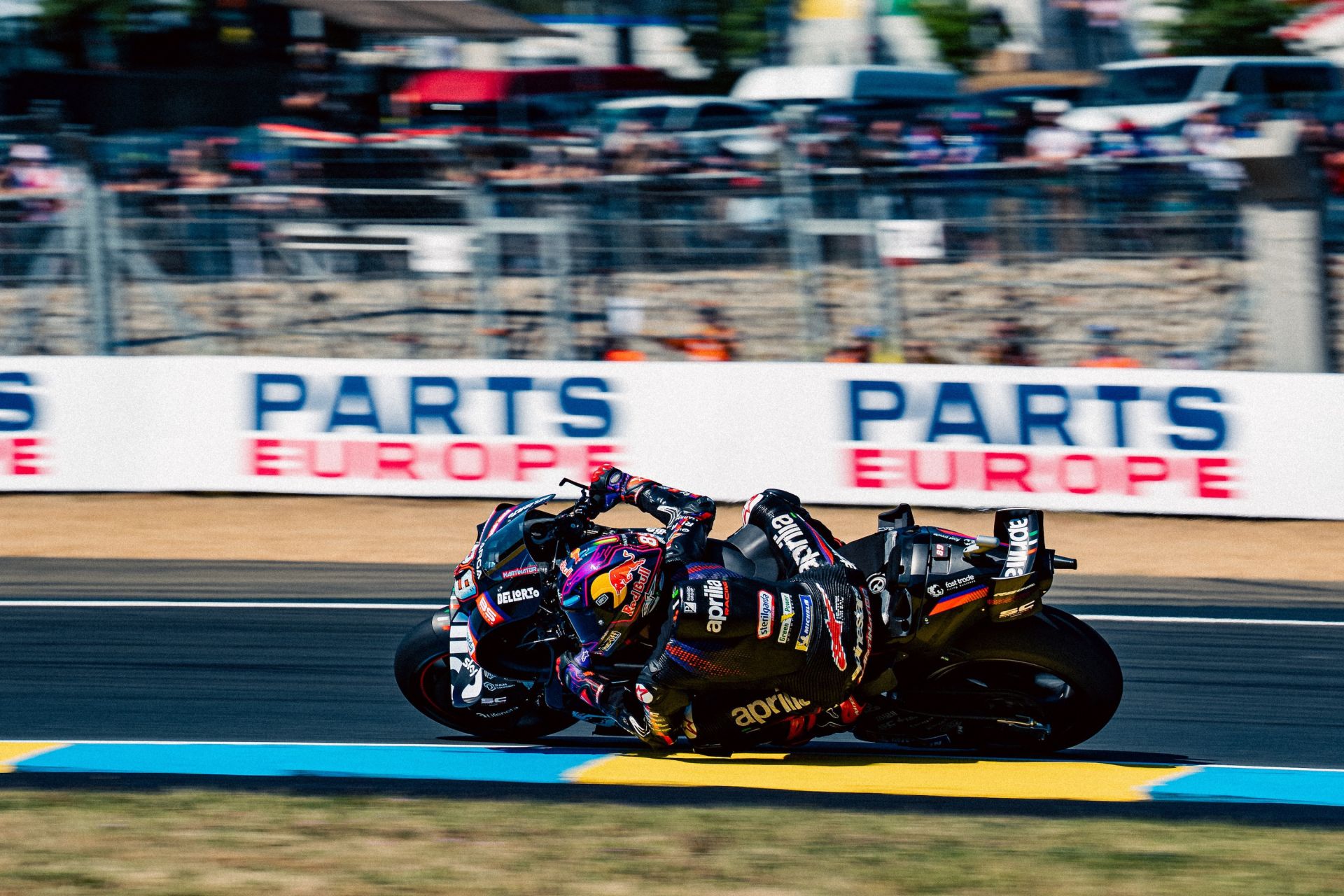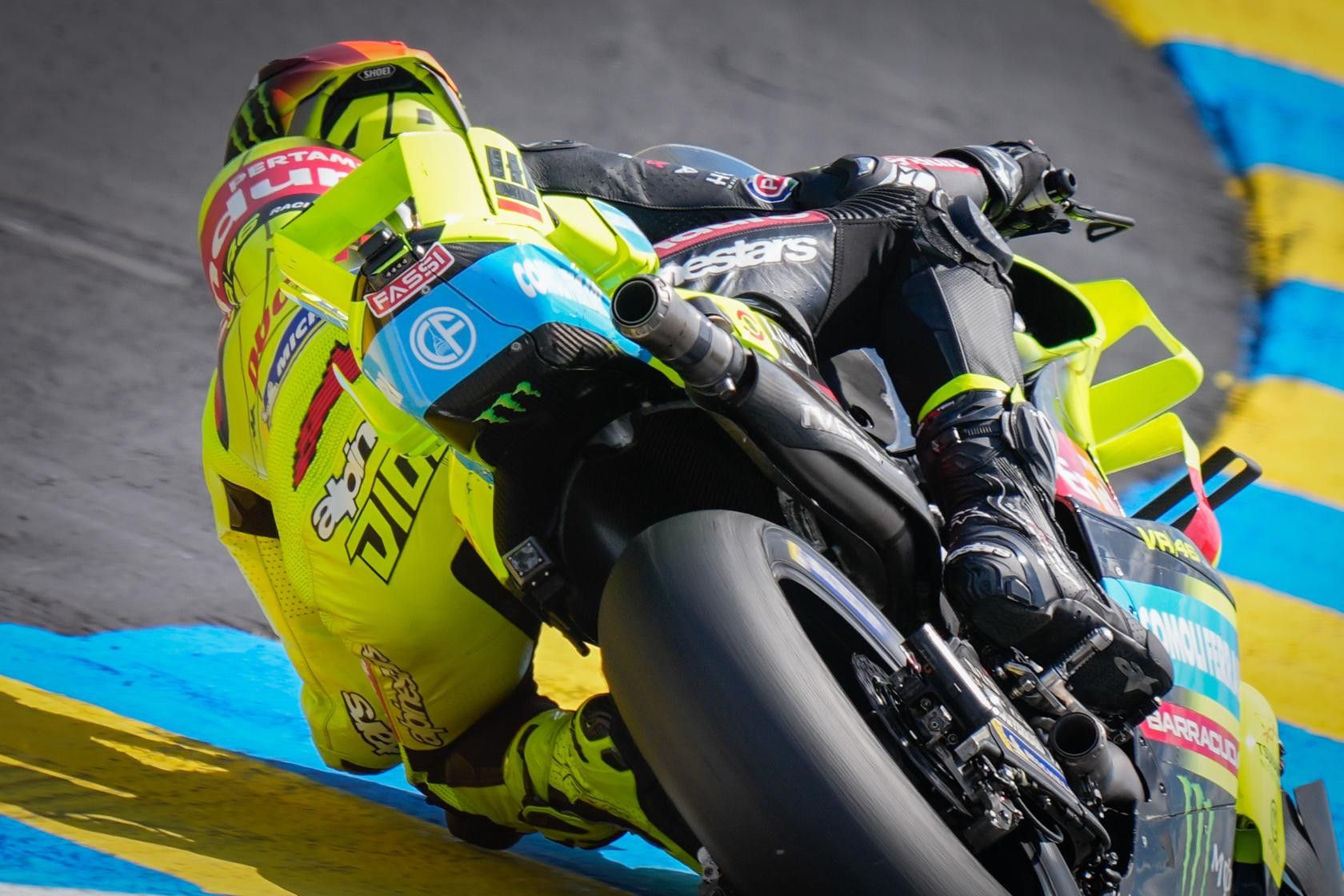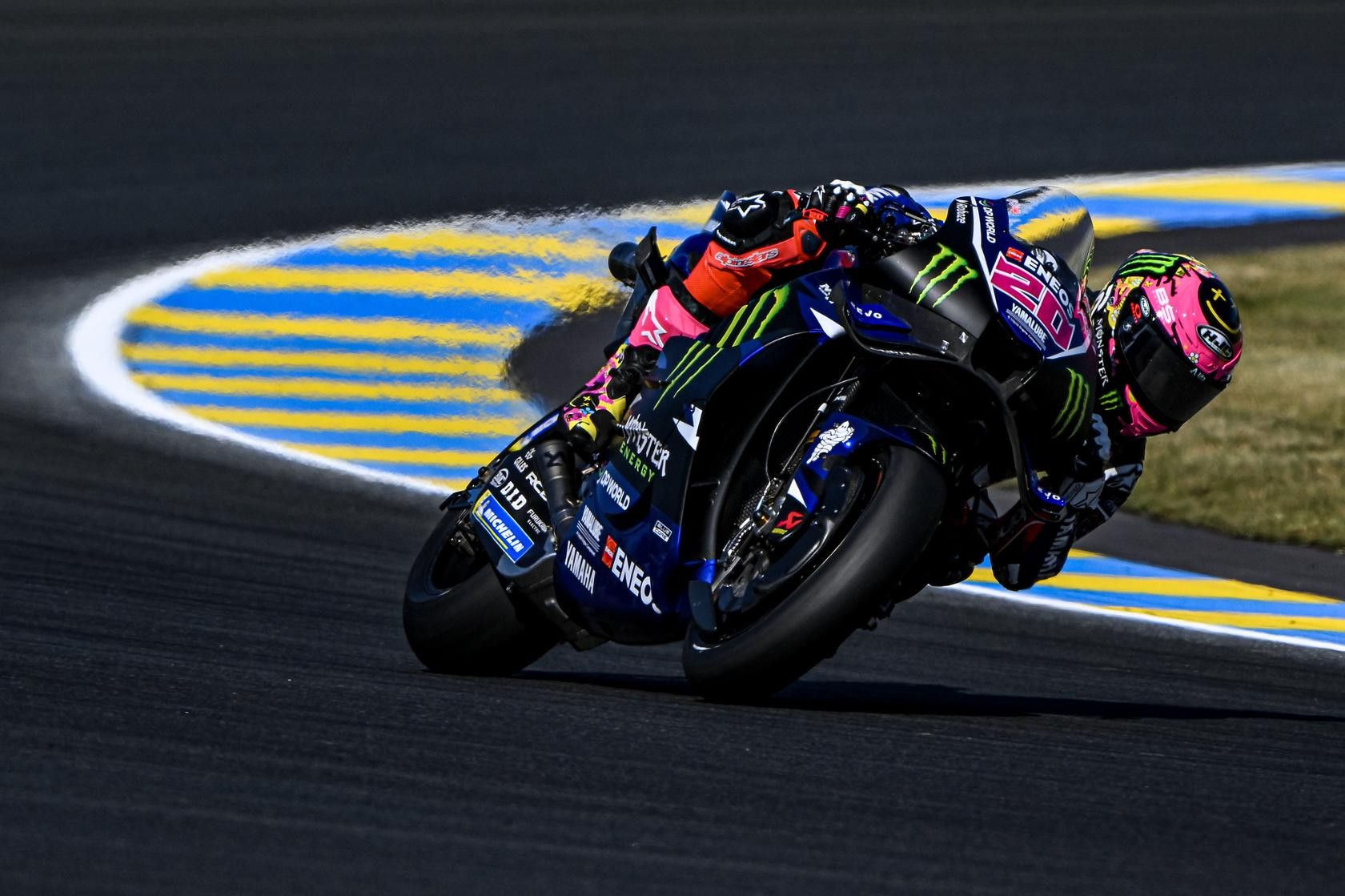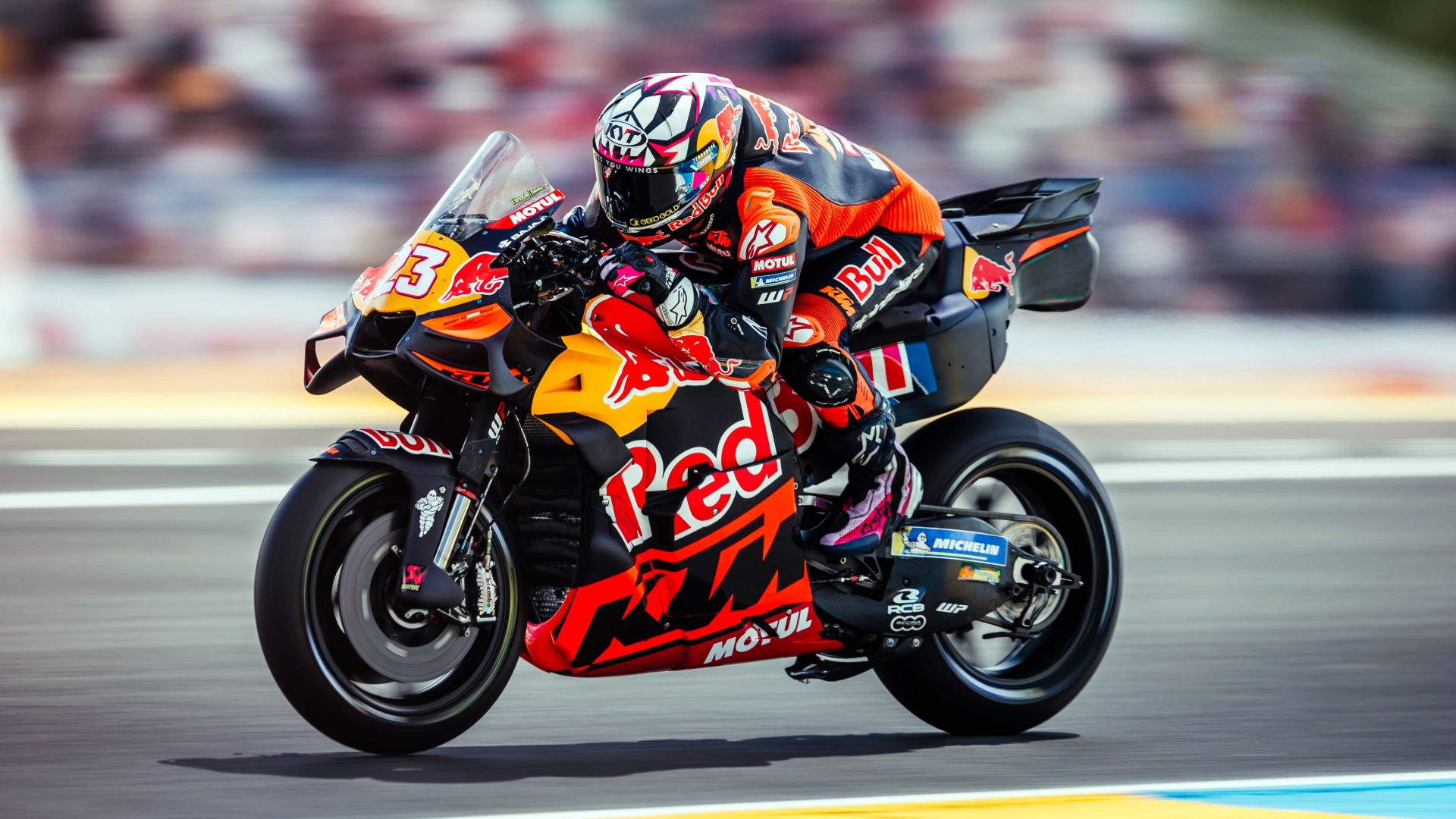

Anthony West’s rich vein of form in the 2025 mi-bike Motorcycle Insurance Australian Superbike Championship presented by Motul (ASBK) has continued at The Bend, with the Queenslander setting the fastest time in Friday practice at the season finale.
After being near the top of the timesheets all day, West cranked up his Addicted to Track Yamaha in the final SW-Motech Superbike session to set a best lap of 1:50.518, marginally under the current lap record of 1:50.529 held by Troy Herfoss.
With a strong wind providing both a help and hindrance to many riders – top speeds were certainly impressive with the 300km/h mark regularly eclipsed down the man straight – less than a second covered the top six riders at the end of Friday, with Cru Halliday (Stop and Seal Ducati) second from Josh Waters (McMartin Racing Ducati), Mike Jones (Yamaha Racing Team), Broc Pearson (DesmoSport Ducati) and Jonathan Nahlous (Omega Racing Team Honda).
Waters takes a 50pt lead into this weekend’s final round over Jones, and can wrap up the championship as early as Saturday afternoon if he secures pole position.
Meanwhile, Archie McDonald (Stop and Seal Yamaha) just got the better of teammate and visiting international Kyle Ryde in Kawasaki Supersport practice.
The Supersport battle is shaping as a beauty, as are the other ASBK Championship classes: Race and Road Supersport 300, ShopYamaha R3 Cup, BLU CRU Oceania Junior Cup and Superbike Masters. Only Supersport 300 has already crowned a champion, so the stakes are high.
There will be on-track action from 8am ACST on both Saturday and Sunday, as well as stunt shows and pillion rides at lunchtime, the ASBK Trade Alley and the Minimoto ‘come and try it’ sessions for the kids.
Hard on the anchors: Cru Halliday put in an impressive Friday. Photo by RbMotoLens
West’s purple patch was again on full display as he took the day one honours in the 20-rider SW-Motech Superbike field.
After a superb year, West is assured of finishing at least third in the championship, but with only 19pts separating him from Jones there’s still a final round carrot dangling in front of him.
Cameron Dunker (MotoGO Yamaha), Troy Herfoss (Yamaha Racing Team), Max Stauffer (Yamaha) and Ty Lynch (Yamaha) completed the top 10 on Friday, ahead of one more practice session tomorrow morning and then qualifying in the afternoon.
Kawasaki Supersport and Supersport Next Gen
Kyle Ryde didn’t waste anytime in getting up to speed in Kawasaki Supersport. Photo by RbMotoLens
Although feeling a little off colour, McDonald did enough to finish on top in Kawasaki Supersport ahead of Ryde, who showed why he is a two-time British Superbike champion with a consummate day one performance.
Ryde adapted to a new bike and a new track with clinical efficiency, while Olly Simpson (BCperformance Kawasaki) was third from Hayden Nelson (BCperformance Kawasaki), Jake Farnsworth (Yamaha) and championship leader Jack Mahaffy (Stop and Seal Yamaha).
Tom Toparis (Stop and Seal Ducati) was the pacesetter in Supersport Next Gen (and fourth overall), ahead of teammate Beau Beaton.
Qualifying is tomorrow morning followed by two nine-lap races on Sunday.
Race and Road Supersport 300/ShopYamaha R3 Cup
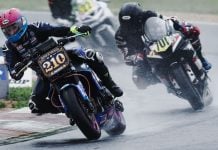
Riley NAUTA (42) at The Bend. Photo by RbMotoLens
Riley Nauta (Champions Ride Days Kawasaki) upped the ante in every session, and was over a second ahead of 2025 champion Scott Nicholson (Kawasaki) by the end of the day.
Yamaha trio Hudson Thompson, Mitch Simpson and Jordy Simpson saw out the top five, and in the ShopYamaha R3 Cup Thompson was the pacesetter from Oscar Lewis and Mitch Simpson.
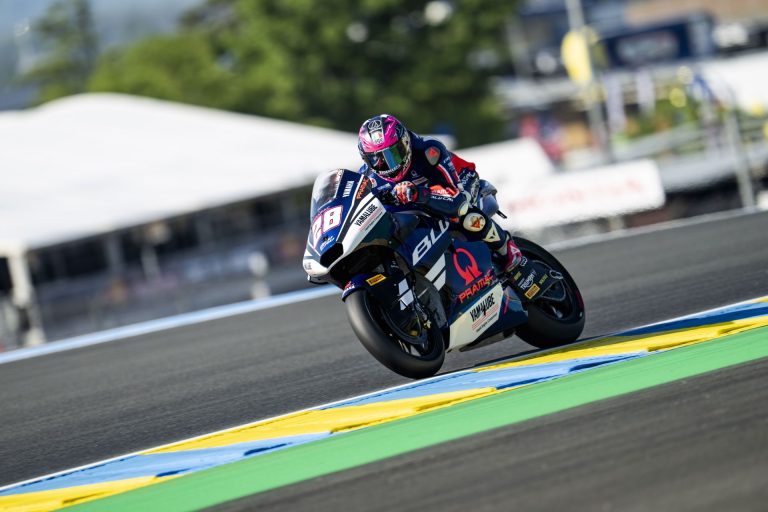
BLU CRU Oceania Junior Cup
Chaz Williams put the BLU CRU Oceania Junior Cup field on notice with a slick Friday. Photo by RbMotoLens
Chaz Williams put the hammer down in BLU CRU Oceania Junior Cup practice and finished well ahead of Hunter Charlett, followed by Ghage Plowman, Rossi McAdam and Xavier Curmi.
Connor Lewis, who is 3pts ahead of Williams as the title race goes down to the wire, was sixth.
Superbike Masters
Beau Beaton continued on his merry way in Superbike Masters qualifying. Photo by RbMotoLens
Qualifying officially kicked off at The Bend with the Superbike Masters brigade, as Beaton (Ducati) put on another clinic on his way to pole position. Ben Burke (Honda) and Michael Berti Mendez (Ducati) saw out the top three.
Beaton’s 1:59.977 was also a new qualifying benchmark for Superbike Masters.
For more information on the 2025 mi-bike Motorcycle Insurance Australian Superbike Championship presented by Motul:
November 7, 2025 – Portimão, Portugal. The American Racing Team and rider Marcos Ramírez have mutually agreed to end their collaboration at the end of the 2025 season.
The team wishes to extend its sincere thanks to Marcos Ramírez for his contribution and professionalism throughout our time together. Over the past seasons, he has played an important role in the team’s journey. We’re proud of the chapters we’ve written as a team and wish him the best in what’s next.
Eitan Butbul, Team Principal:“I’ve got so much appreciation for Marcos, he brought incredible energy, professionalism and heart when he rejoined the team in 2023. I’m proud of what he achieved with us and especially the podium at the end of 2023 was special. He’s one of the coolest riders we’ve ever had and will always be a part of this team’s history. We wish him nothing but the best moving forward.”
SR GT 400 is the new mid-engine GT that breaks all the rules, bringing Aprilia’s motorcycle expertise to scooters: it’s agile, responsive and stable, thanks to the Aprilia chassis and the 36 hp, 400 cc engine.
The SR GT 400 is 100% Aprilia:
powerful, light, beautiful
a precise ride with perfect hold and total control.
Electronics worthy of a sports bike.
City, travel, adventure: the SR GT 400 is designed to conquer both everyday tarmac roads and more remote routes.
Aprilia makes its debut in the mid-cc GT scooter segment, rewriting all the rules – as is its wont. The Aprilia SR GT 400 is the crossover that brings the design philosophy, innovation and motorcycling expertise that have made Aprilia an icon both on road and off to the world of scooters.
The Aprilia SR GT 400 stands for performance and adventure. In traffic, it is agile and easy to manoeuvre, in mixed conditions it’s responsive, and at high speeds, it’s stable. And when the tarmac runs out, it doesn’t’t hold back.
The new SR GT 400 accepts no half measures, aiming to establish itself as a benchmark in the category for its style and technology, as well as in all the areas that every motorcyclist looks for in a two-wheeler: thrills, fun and riding pleasure.
The Aprilia SR GT 400 combines a strictly-engineered chassis – designed by experts who have built extraordinary motorcycles that dominate both on the tarmac and off – plus a full range of technological equipment with a powerful 400 cc, 4-valve, liquid-cooled single-cylinder engine which boasts 36 hp of power. Weighing just 186 kg in running order, the SR GT 400 is at the top of its class in terms of power-to-weight ratio.
Aprilia SR GT 400. Photo courtesy Aprilia
THE APRILIA SR GT 400, A BOLD DESIGN AND CHARACTER
The Aprilia design centre took inspiration for the shape of the SR GT 400 from Aprilia’s sports bikes and the world of off-road riding.
The result is a stunning scooter with a strong personality that expresses real dynamism, courtesy of its sleek, sharp superstructures that echo enduro motorcycles, where every detail without a specific function has been eliminated.
The SR GT 400 boasts a minimalist design which makes a real impact. The front end of the bike is dominated by the three-element full LED light cluster, a signature feature of
Aprilia sports bikes. The suspended windscreen rises above, tapered vertically in pure off-road style, offering excellent protection and adjustability (five positions).
The flanks of the SR GT are brought to life by striking slits, while the ergonomic footrests are a nod to the protective external plates of off-road motorcycles.
From the side, the Aprilia SR GT 400 conveys a powerful sense of dynamism, with reduced overhangs and taut lines that highlight its sporty spirit. The central tunnel houses the fuel tank and connects the front and rear of the bike, giving the SR GT real motorcycle vibes.
The grit and dynamism of the SR GT 400 is also enhanced by the design of its slim, sleek tail; the rear light cluster is fully integrated into the number plate holder, leaving it completely free, evoking the high mudguards on enduro bikes.
Aprilia SR GT 400 Rugged Black. Photo courtesy Aprilia.
A 100% APRILIA CHASSIS
The SR GT 400 is 100% Aprilia; the frame and chassis are designed and manufactured to the very highest standards, delivering precise dynamic performance and a greater feeling of safety and control regardless of the riding conditions.
The double-cradle frame, crafted from all-new high-strength steel tubing, was designed with a motorbike-style approach. By tweaking the design and cross-section of the tubes, Aprilia’s technicians have succeeded in achieving extremely high rigidity, boosting the riding precision, front-end feel and stability. This has enabled another radical choice to be made: a reduced steering head angle which decreases the trail, for maximum manoeuvrability. This results in a safe, enjoyable ride, thanks to the perfect balance between agility and stability.
The suspension is also inspired by the motorcycling universe: the front is fitted with a 41 mm upside-down double-plate fork with a decent 120 mm of travel. During testing, a specific calibration was developed to ensure the perfect degree of support for sporty riding, offering comfort and good absorption of bumps even on the roughest roads.
The same applies to the rear of the SR GT 400, where a double gas shock absorber with separate reservoir takes the strain, with adjustable preload and 120 mm of travel.
Another key goal of this project was weight reduction: the frame, engine, superstructure and alloy rims, with a new design featuring five finely- tapered split spokes, contribute to a total weight of just 186 kg in running order, resulting in a record-breaking power-to-weight ratio for the category of approximately 7 kg per kW. This also reflects positively in the bike’s acceleration, which is among the best in its class, with a time of 5 seconds in 0 to 60 metres.
The generous braking system also features solutions that are usually found in motorcycling, with a 300 mm floating disc on the front with a radial-mounted calliper featuring four pistons and sintered pads. At the rear, meanwhile, is a 240 mm disc with a two-piston calliper. All this is supported by a dual-channel ABS system with dual mapping, either on both wheels or only on the front wheel.
Aprilia SR GT 400, Rally Replica. Photo courtesy Aprilia
CITY, TRAVEL, ADVENTURE: THE APRILIA SR GT IS READY FOR ALL ROUTES
Riding the Aprilia SR GT 400 is a real thrill: responsive and lively when pulling away, agile and easy to manoeuvre in traffic and on winding roads, and stable at higher speeds. Furthermore, it’s always ready to venture off the tarmac, to reach less crowded places on less travelled routes.
The active riding position and broad, double-section naked handlebars with hand guards evoke the typical ergonomics of adventure bikes, offering the best possible control, while the long-travel suspension and ample ground clearance – a minimum of 190 mm – allow riders to tackle the obstacles typical of off-road routes with ease.
The adventurous spirit of the SR GT 400 is complemented by the Mitas Enduro Trail tyres, developed specifically for this model: measuring 120/70 on the front and 150/70 on the rear, on 16-in and 14-in rims respectively, these wide tyres feature an all-terrain tread which is suitable for all road surfaces, from tarmac to cobblestones and from dirt roads to light off-road terrain.
Adventure is also synonymous with travel, and the SR GT 400 is ready for long distances, thanks to its capacious 12-litre fuel tank that guarantees a range of over 300 km.
Aprilia SR GT 400, Rally Replica. Photo courtesy Aprilia
BEST-IN-CLASS ELECTRONICS
The electronic equipment on the SR GT 400 continues the Aprilia tradition and is designed and built to emphasise riding enjoyment whilst maximising safety.
The ATC (Aprilia Traction Control) system can be adjusted to two levels of intervention, and can also be disabled, even while riding. ATC MAX and ATC MIN denote the levels of intervention.
The braking system is supported by Bosch dual-channel ABS with dual mapping, either on both wheels or just on the front. The ABS can be disabled on the rear wheel, or the rider can even choose to disable it every time the ATC OFF level is selected. This provides the perfect setting for off-road riding: traction control deactivated and ABS active only on the front wheel.
All parameters can be displayed and managed in a simple, intuitive manner via the instrument panel with 5″ colour TFT display and the striking graphic interface, which provides easy-to-read information in all lighting conditions as well as automatically adjusting between day and night modes.
Aprilia MIA is Aprilia’s multimedia platform which enables the rider to connect their smartphone to the vehicle, an accessory that further extends the functionality of the instrumentation. The system also provides access to a voice assistant, phone calls and music via the handlebar controls, as well as a navigation function that enables the rider to view pictogram directions directly on the instrument panel.
Aprilia SR GT 400. Photo courtesy Aprilia
COMFORT WORTHY OF GREAT TRAVELLERS
Comfort and sportiness go hand in hand on the Aprilia SR GT 400: the riding position is comfortable and relaxed, ideal for taking on even the longest distances. Despite the 190 mm ground clearance, the saddle height is limited to 820 mm, so all riders can keep their feet securely on the ground whenever they need.
The superior level of comfort is also enhanced by complete protection from air currents, achieved following detailed aerodynamic studies on the front end of the vehicle (which also enabled the best stability at high speeds to be achieved). The fairing, with its reduced footprint, guarantees protection in all conditions, thanks also to the option to manually adjust the height to five positions, with a total range of 70 mm.
The keyless system comes as standard, enabling the vehicle to be started with the electronic key still in the rider’s pocket. The engine is started by pressing the button on the control panel. The underseat compartment and fuel door can either be operated using the buttons or remotely with the electronic key, which can also be used to activate the Bike Finder function – a remote vehicle recognition system that flashes all the turn signals on the bike: very useful in crowded car parks!
The underseat compartment can hold a full-face helmet and other items, such as gloves. The central tunnel is equipped with a handy storage compartment with a USB-C socket for charging mobile devices.
ENGINE: EFFICIENCY, POWER AND PERFORMANCE
The refined chassis of the Aprilia SR GT 400 called for a cutting-edge engine to generate new levels of performance and riding pleasure.
The 400 hpe Euro 5+ is a 4-stroke, 4-valve, liquid-cooled engine with electronic injection, inspired by a design philosophy that combines high levels of performance and readability with lightness and compactness: key to achieving superb riding dynamics. With a maximum power of 36 HP (26.4 kW) at 7,500 rpm and a maximum torque of 37.7 Nm at 5,700 rpm, the 400 hpe engine boasts a host of advanced technical solutions.
The longer, weight-optimised connecting rod and lighter piston in stamped aluminium alloy – typically found on top-of-the-range motorcycles – help to reduce alternating inertial forces, reducing vibrations and increasing comfort, especially at cruising speeds, emphasising the SR GT 400’s suitability for touring outside the city.
An innovative patented system called PCV – Positive Crankcase Ventilation, which consists of two blades integrated into the engine casing, reduces pumping losses and boosts power. The engine’s performance, in terms of both power and torque, benefits from a specific intake system and optimised valve lift parameters. A progressive chain tensioner contributes to quieter operation of the timing system.
The overall efficiency of the engine is also enhanced by the optimised combustion chamber geometry based on CFD calculations, with a high-pressure injector that increases fuel atomisation and the use of low-viscosity engine oil (5W-40). The specially-
designed exhaust system, with its bold, motorcycle-inspired tailpipes, delivers a throaty, sporty roar.
Finally, the cover of the CVT automatic speed variator features a specific design to improve belt cooling.
Aprilia SR GT 400 Dusty Grey. Photo courtesy Aprilia.
COLOURS
The Aprilia SR GT 400 comes in four colourways.
Alongside Rugged Black are two different metallic grey shades: Boulder Grey, with a matte finish and a warm tone, and Dusty Grey, with a shiny finish and cooler tones.
These colours are paired with aluminium-coloured details, such as the passenger handles, footrest guards, exhaust tailpipes and centre console.
The sporty black dual-layer saddle is enhanced by contrasting red/black and grey/black double stitching, whilst red details on the channel stand out against the black rims.
The range is completed by the Aprilia SR GT 400 in Rally Replica colouring, inspired by the livery and graphics of the Aprilia Tuareg Rally, the bike which dominated in the last two editions of the Africa Eco Race, the gruelling rally raid on the historic Dakar roads in Africa.
The matte black livery with high-impact graphics, such as the large ‘Aprilia’ lettering that runs along the entire flank of the bike, is paired with other racing details, such as gold-coloured fork stems and red shock absorber springs. The equipment is completed by a dedicated saddle, enhanced by a bold red strip on the rear, plus the Aprilia MIA connectivity system as standard.
Aprilia SR GT 400. Photo courtesy Aprilia
DEDICATED ACCESSORIES AND TECHNICAL CLOTHING
The Aprilia SR GT 400 range of accessories is designed to further boost comfort and functionality.
In combination with the roomy underseat compartment, an ultra-resistant ABS square top box is also available to further increase load capacity.
Characterised by a rugged, robust style with a truly adventurous spirit, the top box is fitted on the rear luggage rack, which is also an accessory, by simply and intuitively removing the passenger handles. Equipped with an airtight seal that prevents water or dust from getting inside, the spacious top box can hold a full-face helmet. It is embellished by the Aprilia logo, backrest, removable internal padding and lock with personalised key.
The side protectors, crafted from steel tubes painted in matte black, echo the sporty lines of the vehicle, whilst protecting it from accidental impacts.
The sporty footrests, featuring a non-slip surface and aluminium inserts, emphasise the bike’s sporty character.
Heated handgrips ensure maximum comfort in all weather conditions; thanks to the Aprilia MIA system, also available as an accessory, the temperature level can be adjusted directly from the handlebar to three different levels, visible on the instrument panel.
The range of accessories is completed by a leg cover, the Aprilia MIA connectivity system (as standard with the Rally Replica version) which connects the rider’s smartphone to the bike via Bluetooth, an electronic anti-theft system and an outdoor cover.
The technical clothing developed by Aprilia, available at STORE.APRILIA.COM, also complements the style and characteristics of the Aprilia SR GT 400.
Overtake full-face helmet: developed in the wind tunnel to reduce turbulence, improve stability and enhance soundproofing at high speeds. Equipped with an efficient ventilation system, this helmet also comes with a retractable internal sun visor. Includes Pinlock anti-fog visor, action camera mount and air deflector for the chin guard. Available in white and black.
Speed Blast Air Tex Jacket: developed in collaboration with Alpinestars, it boasts a cutting-edge poly-fabric outer shell, offering high levels of abrasion and tear resistance. Equipped with air vents and extensive mesh-on-mesh panelling on the chest, back and arms to increase ventilation, it is perfect for all weather conditions. The Nucleon Flex Plus protectors on the shoulders and elbows feature an ergonomic design, guaranteeing ample freedom of movement.
Next Rival Tech sweatshirt: developed in collaboration with Alpinestars, this is the perfect garment for riding in urban environments. It offers superb abrasion resistance courtesy of the reinforcements on the shoulders, elbows and back. The main shell is made of woven fabric, lending it a casual look. The Nucleon Flex Plus protectors in the shoulder and elbow area ensure the very highest levels of protection.
APRILIA RS 457 GP REPLICA
A special version of the hugely popular RS 457 arrives from Aprilia: the most sought-after sporting bike among young riders is now also available in a GP Replica version, featuring more exclusive details and graphics inspired by the RS-GP motorcycle competing in the MotoGP.
Aprilia RS 457 Replica. Photo courtesy Aprilia.
The success of the RS 457 owes its thanks not only to its technical characteristics, which are best-in-class, but also to the fact that it has been able to provide an innovative response to the growing demand for easy-to-ride, fun bikes, with a technologically and stylistically advanced offering specifically dedicated to young motorcyclists, as it can be driven with an A2 license. Elegant, aggressive and with an unrivalled power-to-weight ratio, the RS 457 has rapidly become a point of reference in its category, popular amongst young motorcyclists everywhere and much lauded by critics.
It is now available in a truly unique version, with even better equipment and all-exclusive graphics. The RS 457 GP Replica boasts even better sporty riding performance, thanks to the super-useful quick shift, which allows the rider to shift up and down without using the clutch, just like on a real racing bike. Furthermore, the front brake pads have a higher friction coefficient, which enable even more effective braking. The special RS 457 GP Replica set-up is completed by the single-seat passenger saddle cover and the new black finish for the aluminum frame, swingarm and steering plate.
Aprilia RS 457 Replica. Photo courtesy Aprilia.
The GP Replica livery is a clear tribute to the RS-GP competing in the MotoGP championship and features glossy and matte black shades and the sponsor graphics that appear on Aprilia Racing’s prototype racing bike. This all-new Aprilia model is the ultimate in sophisticated Replica versions dedicated to young motorcyclists.
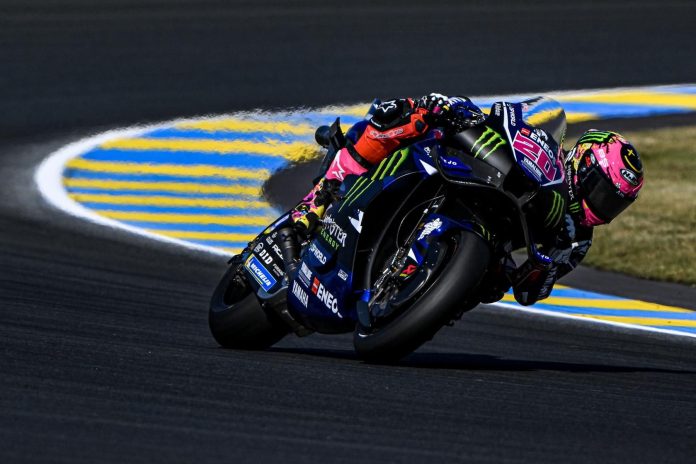
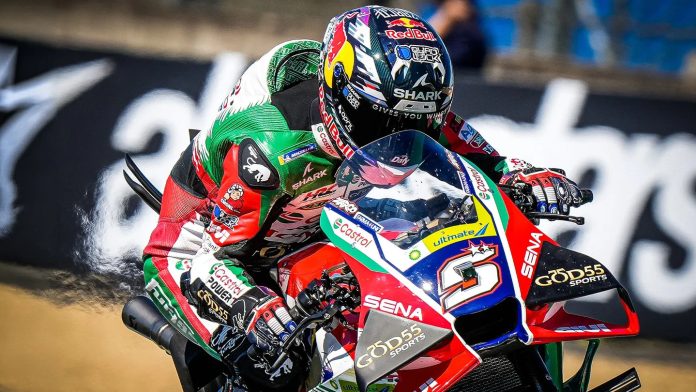
Alex Marquez led MotoGP World Championship practice Friday afternoon at Autódromo Internacional do Algarve, in Portugal. Riding his BK8 Gresini Ducati Desmosedici GP24 on spec Michelin tires, the Spaniard turned a lap time of 1:37.974 to lead the 22-rider field.
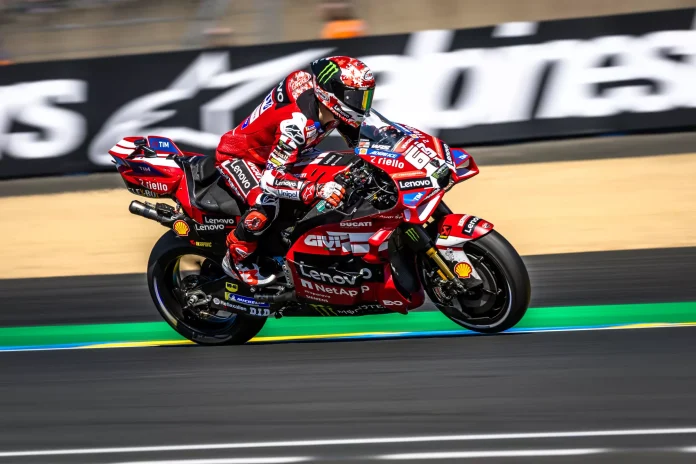
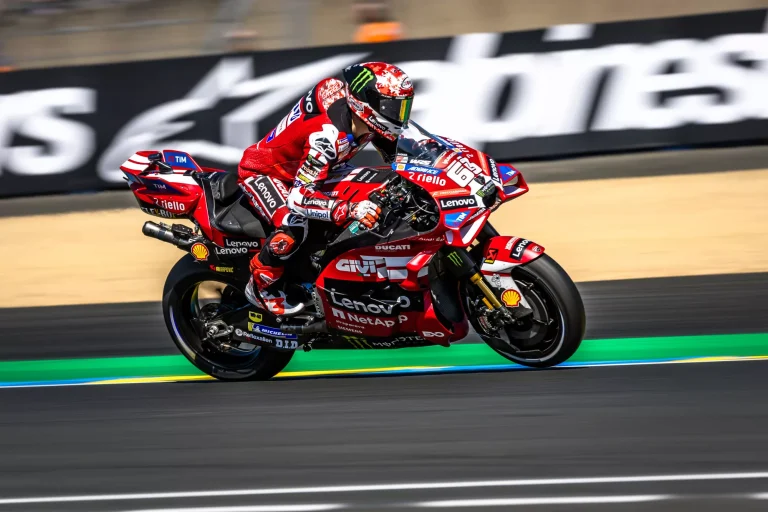
Francesco Bagnaia was the best of the rest with a 1:38.004 on his Lenovo Team Ducati Desmosedici GP25.
Red Bull KTM Factory Racing’s Pedro Acosta was third at 1:38.062.
Marco Bezzecchi finished the session fourth with a 1:38.133 on his Aprilia Racing RS-GP25.
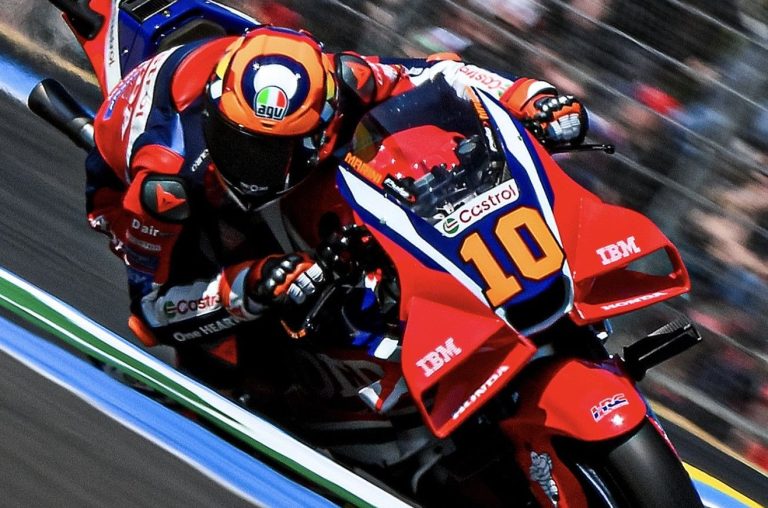
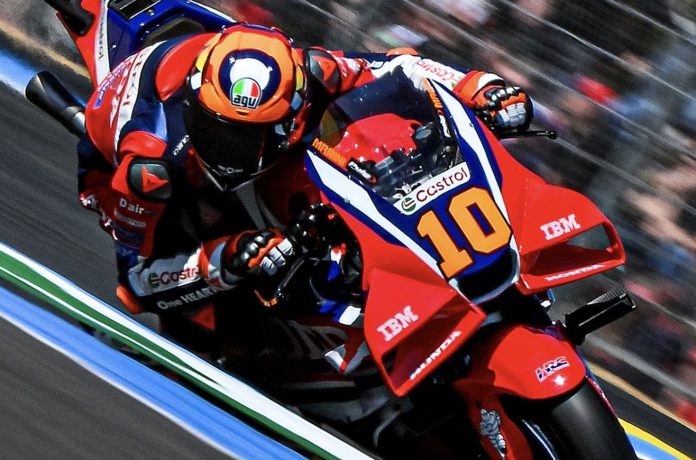
Joan Mir got fifth on his Honda HRC Castrol RC213V with a lap time of 1:38.183.
For his debut in MotoGP, Nicolo Bulega was 17th on his Lenovo Team Ducati Desmosedici GP25.
Alex Marquez rocks the rollercoaster on Friday, Bagnaia and Acosta give chase. You could throw a blanket over the top three on Day 1, with mixed conditions playing a role in the south of Portugal.
0.088s covering the top three at the end of Day 1 in Portimao? We’ll have some of that. It’s Alex Marquez (BK8 Gresini Racing MotoGP) who leads the field thanks to a 1:37.974, as Francesco Bagnaia (Ducati Lenovo Team) and Pedro Acosta (Red Bull KTM Factory Racing) hunt the #73 very closely on what turned out to be another brilliant Friday afternoon in MotoGP.
Marquez sets the early pace
After the opening half an hour, Alex Marquez was the session leader by a couple of tenths, with Acosta his nearest challenger. Johann Zarco (CASTROL Honda LCR) made it three manufacturers in the top three, as Pol Espargaro (Red Bull KTM Tech3) continued to impress while standing in for Maverick Viñales – the KTM Test Rider was fourth ahead of Bagnaia.
With just under 20 minutes left, the rain flags were being waved as spots of rain started to sprinkle the Algarve International Circuit. Rookie Ai Ogura (Trackhouse MotoGP Team) had just jumped into P6 to shove Alex Rins (Monster Energy Yamaha MotoGP) outside the top 10, and then more bad news followed for Yamaha because Jack Miller (Prima Pramac Yamaha MotoGP) crashed at Turn 5.
There might have been rain in the air, but it wasn’t fazing Acosta. The #37 improved his time to cut the gap to Marquez, but he remained P2. Not for long though. Acosta fired in a 1:38.062 to leapfrog Marquez into P1, meaning the KTM star now led the session by over two tenths.
Plenty of improvements were now coming in. Marco Bezzecchi (Aprilia Racing), Fabio Di Giannantonio (Pertamina Enduro VR46 Racing Team), Joan Mir (Honda HRC Castrol) and Fabio Quartararo (Monster Energy Yamaha MotoGP) all went quicker and jumped up the order inside the top 10, before Marquez landed the first 1:37 of the weekend to go P1 with eight minutes to go.
With under five minutes to go, having been P4 a few moments earlier, Quartararo found himself back outside the top 10. His first attempt wasn’t enough, while a Luca Marini (Honda HRC Castrol) personal best saw the Italian climb to P9, meaning Pecco was now P10 and in danger of missing an automatic Q2 spot. That danger became a reality following Espargaro’s latest lap, meaning Pecco was in P11.
The double MotoGP World Champion responded quickly to catapult himself into P7, that in turn knocked Marini back out of the top 10, as Quartararo’s best efforts weren’t enough. The Frenchman couldn’t find time, as Bagnaia went faster again to get within half a tenth of Marquez.
Your Friday top 10
Behind your top three, Bezzecchi’s last lap saw the Italian head into Saturday as the fourth fastest rider, with Mir completing the top five. Zarco makes it two Hondas in the top six, with Di Giannantonio, Rookie of the Year Fermin Aldeguer (BK8 Gresini Racing MotoGP), Espargaro, and Ogura the final automatic Q2 qualifiers – the latter gaining a Friday entry for the fourth time this season.
Coming up: Tissot Sprint Saturday
Well, that sets us up very nicely for Saturday. 0.088s between the top three, half a second covers the top 11, with Q1 – as always – stacked. Come back tomorrow for more.
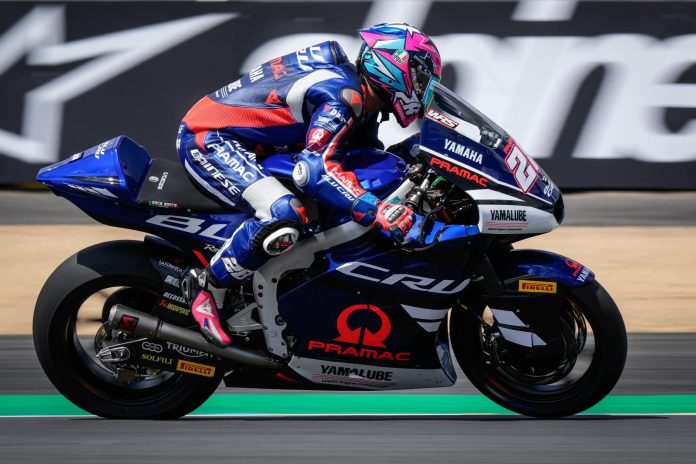
Aron Canet led Moto2 World Championship practice Friday afternoon at Autódromo Internacional do Algarve, in Portugal. Riding his Fantic Racing Kalex on Pirelli control tires, the Spaniard lapped the 2.85-mile (4.59 km) road course in 1:41.210, topping the field of 29 riders and breaking his own All-Time Lap Record of 1:41.460 he set this morning in FP1.
Jake Dixon was second-best with a time of 1:41.402 on his ELF Marc VDS Racing Boscoscuro.
Albert Arenas did a third-fastest 1:41.658 on his ITALJET Gresini Kalex.
Canet rivatlised to top Friday Practice. Still in with a mathematical chance, the #44 isn’t going to give up on title aspirations without a big fight.
With a late rain shower during Moto2™ Practice, the standings were decided before the chequered flag as Aron Canet (Fantic Racing) topped the order. Getting out early, the Spaniard was able to sport a 0.192s lead ahead of the opposition and lead the charge into Saturday.
Canet got his time bagged early on his third lap of the session with a 1’41.210 seeing him safely through in P1. He went back out to the track late on to get a practice start complete but he was uncatchable at the front. Malaysian GP winner Jake Dixon (ELF Marc VDS Racing Team) was second on the timing sheets, ahead of Albert Arenas (ITALJET Gresini Moto2) in his penultimate round of Moto2 action for the foreseeable.
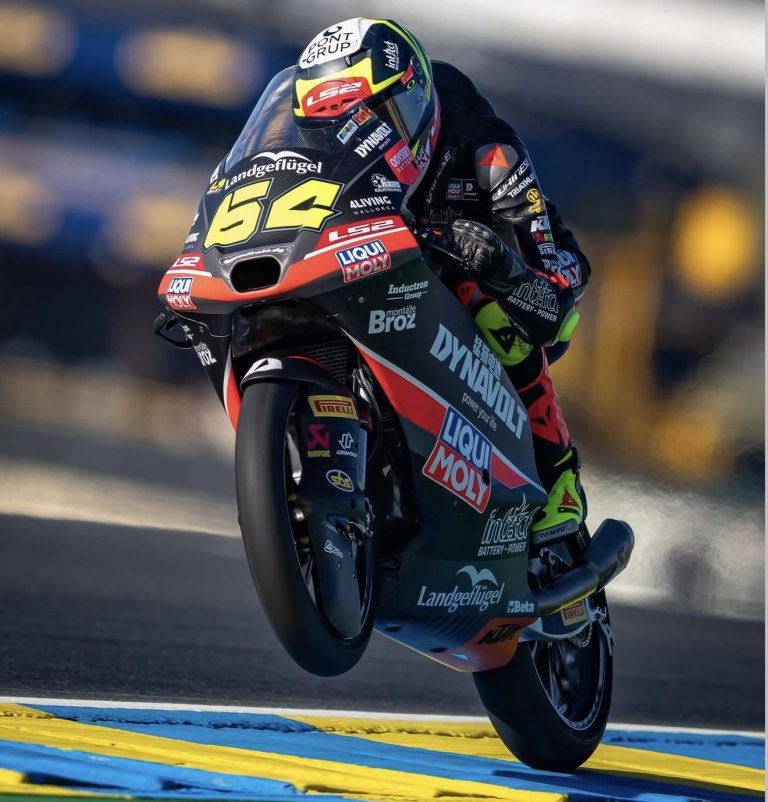
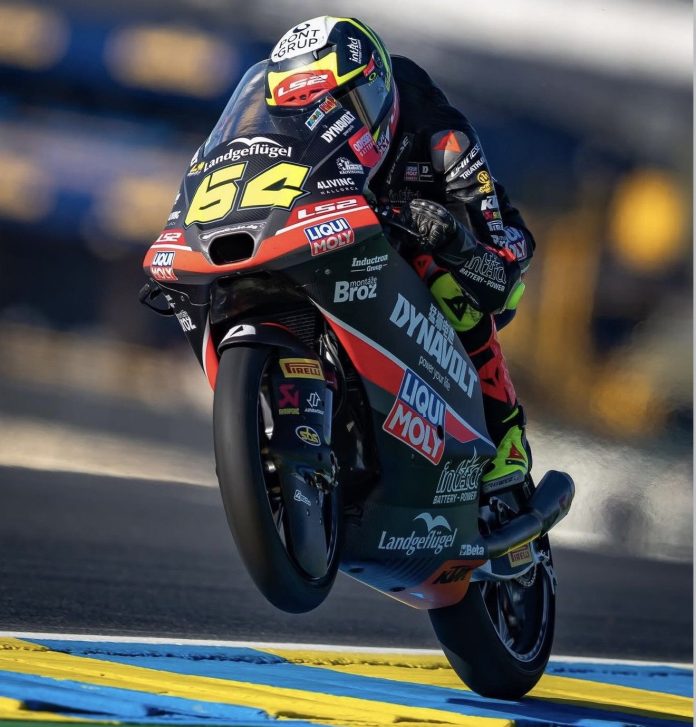
Demoted from the Championship lead last time out, Manuel Gonzalez (LIQUI MOLY Dynavolt Intact GP) came out the box fighting to secure fourth, ahead of teammate Senna Agius. There was late drama for Aspar duo Daniel Holgado (CFMOTO Inde Aspar Team) and teammate David Alonso; Alonso crashed at Turn 3 under braking on damp kerb, crashing out. Just moments later, Holgado replicated the Colombian’s error but in a bid to save it, was highsided off his Kalex. Both were OK and debriefed their incidents together on the service road. Championship leader Diogo Moreira (Italtrans Racing Team) improved late to go P12 but will want more if he’s to wrap the title up this weekend.
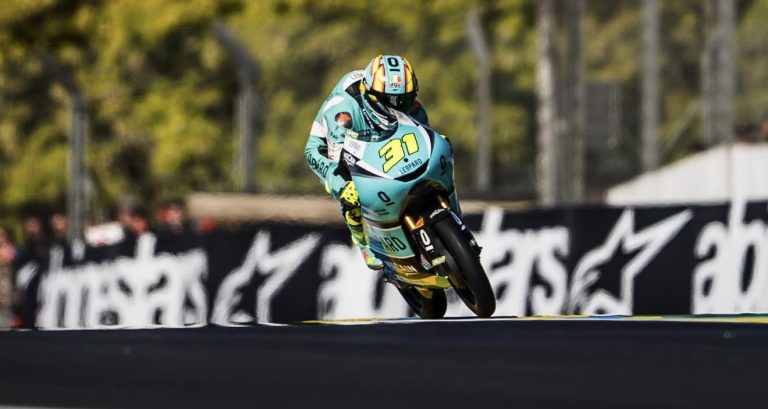
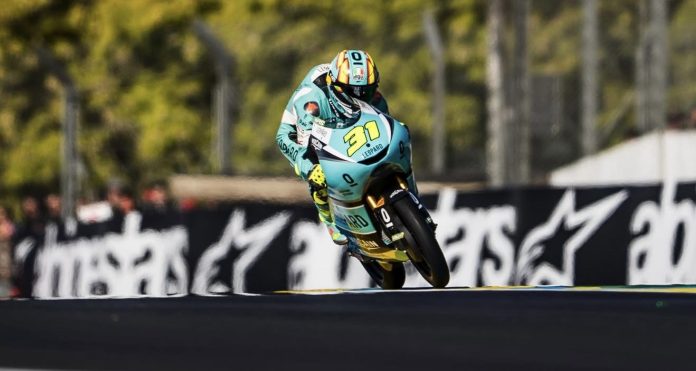
David Almansa led Moto3 World Championship practice Friday afternoon at Autódromo Internacional do Algarve, in Portugal. Almansa used his Pirelli-shod Leopard Racing Honda to lap the 2.85-mile (4.59 km) track in 1:47.056 to led the field of 25 riders.
Taiyo Furusato was second-best with a time of 1:47.191 on his Honda Team Asia machine.
Maximo Quiles, piloting his CFMOTO Gaviota Aspar Team KTM, claimed the third and final spot on the front with a lap time of 1:47.295.
Almansa tops rain-affected Moto3™ Practice in Portugal. Light rain stops some riders from improving in the closing stages as Furusato and Quiles complete the top three.
David Almansa (Leopard Racing) is the Moto3™ pacesetter heading into Saturday’s action in Portugal after his 1:47.056 was good enough to see the Malaysian GP podium finisher beat the Malaysian GP winner, Taiyo Furusato (Honda Team Asia), by 0.135s. A flurry of personal best lap times before the rain fell from Maximo Quiles (CFMOTO Gaviota Aspar Team) saw the newly crowned Rookie of the Year complete the top three.
A light shower heading into the final five minutes of Practice halted a lot of riders’ plans to improve in the closing stages, with the likes of 2025 podium finishers Matteo Bertelle (LEVELUP – MTA) and Guido Pini (Liqui Moly Dynavolt Intact GP) ultimately missing the automatic Q2 cut.
There were no such problems for the returning Dennis Foggia (CFMOTO Gaviota Aspar Team) and Adrian Fernandez (Leopard Racing) though. The Italian and Spaniard round out Friday’s top five, with Joel Kelso (LEVELUP – MTA), Angel Piqueras (FRINSA – MT Helmets – MSI) and Alvaro Carpe (Red Bull KTM Ajo) ending the day inside the top nine.
Three stand-in stars – Hakim Danish (FRINSA – MT Helmets – MSI), Casey O’Gorman (Liqui Moly Dynavolt Intact GP) and Brian Uriarte (Red Bull KTM Ajo) – all made it into the top 14, as we now gear up for qualifying on Saturday in Portimao.
Alex Marquez topped MotoGP World Championship Free Practice One (FP1) Friday morning at Autódromo Internacional do Algarve, in Portugal. Riding his Michelin-shod BK8 Gresini Ducati Desmosedici GP24, the Spaniard turned a lap of 1:39.145 around the 2.85-mile (4.59 km) track and led the 22-rider field.
Marco Bezzecchi was second-best with a 1:39.341 on his Aprilia Racing RS-GP25.
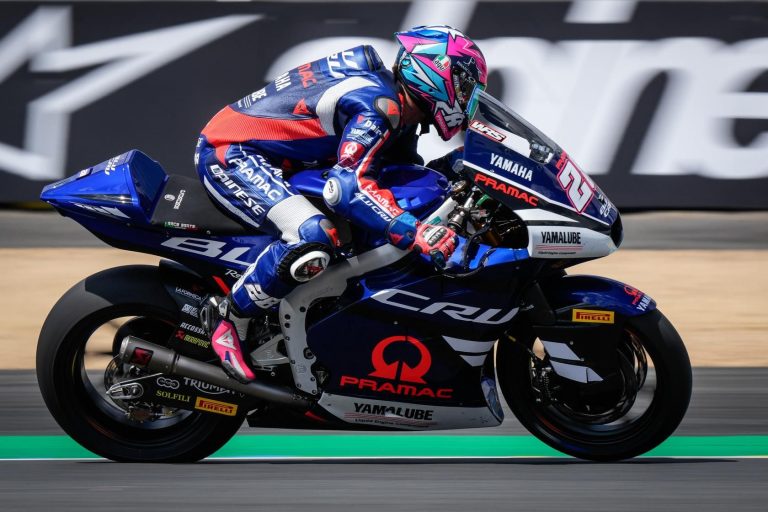
Jack Miller was third with a lap of 1:39.378 on his Prima Pramac Yamaha YZF-M1.
Alex Marquez tops FP1 at Portimao with Bezzecchi and Miller early contenders. The #73 was in mighty form at the front with five manufacturers split by 0.361s.
MotoGP FP1 at Portimao was topped by Alex Marquez (BK8 Gresini Racing MotoGP), with the 2025 runner-up looking to sign off his best season in MotoGP in style. Conditions remained dry despite a persistent threat of rain, with dark cloud rolling in over the hills of the Algarve late on.
Marquez set the pace throughout the session, eventually ending up 0.233s ahead of Marco Bezzecchi (Aprilia Racing) who stuck in a lap right at the end of the session to go second. He was just ahead of Jack Miller (Prima Pramac Yamaha MotoGP) who flew the Yamaha flag… quite literally. The Australian launched his trademark jump on the exit of Turn 8 and was as stylish as ever. Johann Zarco (CASTROL Honda LCR) clinched fourth ahead of Pol Espargaro (Red Bull KTM Tech 3), who was the first crasher of the weekend at Turn 2 but was able to walk away. In all, five different manufacturers inside the top five and covered by less than four tenths of a second makes for a very unpredictable Practice session later in the afternoon.
Franco Morbidelli (Pertamina Enduro VR46 Racing Team) was sixth as Luca Marini (Honda HRC Castrol) just pipped teammate and Sepang podium finisher Joan Mir, both taking P7 and P8 respectively. Ninth place went the way of Pedro Acosta (Red Bull KTM Factory Racing) with Indonesian GP winner Fermin Aldeguer (BK8 Gresini Racing MotoGP) bagging P10.
Further back and it was a fine debut for Nicolo Bulega (Ducati Lenovo Team) finishing 14thhaving set the joint-most laps of anyone, setting his fastest lap on his final lap. There was a big scalp straight away for ‘Bulegas’, who wasn’t just less than a second away from the top time but also more than two tenths clear of teammate Francesco Bagnaia who struggled in FP1 in 17th. There was a late crash for Raul Fernandez (Trackhouse MotoGP Team) at Turn 1, with the Australian GP winner taken to the medical centre for a check-up.
Aron Canet was quickest during Moto2 World Championship Free Practice One Friday morning at Autódromo Internacional do Algarve, in Portugal. Riding his Pirelli-shod Fantic Racing Kalex on the 2.85-mile (4.59 km) track, the Spaniard recorded a 1:41.460, topping the field of 29 riders and breaking Manuel Gonzalez’s All-Time Lap Record of 1:41.515 from 2024.
Jake Dixon was the best of the rest with a 1:41.623 on his ELF Marc VDS Boscoscuro.
Senna Agius was third-fastest with a 1:41.689 on his Liqui Moly Dynavolt IntactGP Kalex.
Dennis Foggia was quickest during Moto3 World Championship Free Practice One Friday morning at Autódromo Internacional do Algarve, in Portugal. Riding his CFMOTO Gaviota Aspar Team KTM on Pirelli control tires, the Italian covered the 2.85-mile (4.59 km) road course in 1:47.422, topping the field of 25 riders.
Joel Kelso was the best of the rest with a 1:47.458 on his LevelUp MTA KTM.
Joel Esteban was third with a lap time of 1:47.581 on his Red Bull Tech3 KTM.
The all-new Norton Manx R is the standard-bearer of Norton’s Resurgence, the embodiment of the brand’s unwavering commitment to creating some of the world’s most desirable motorcycles through innovation, emotional design, and real-world performance.
Its role is simple – to redefine the premium superbike segment by offering a charismatic and nuanced experience suited to both road and track. The mission – to unfailingly deliver a visceral connection between rider and machine.
The Manx R places the rider at the centre of the dynamic equation through a peerless combination of accessible performance, everyday usability and engineering intelligence. Dramatic in design and steeped in detail, the Manx R’s rider-centric approach will have deep-seated appeal to those who prioritise individuality, emotion and presence. It’s not about excess, it’s about the inimitable Norton riding experience.
Norton Manx R. Photo courtesy Norton Motorcycles
Positioning
“The Manx has a visceral ‘must-ride’ appeal to riders who crave adrenaline with refinement, riders who are connoisseurs of craftsmanship and exclusivity, and status seekers who demand their style with substance along with a generous helping of swagger and strut.” Richard Arnold, Executive Director, Norton Motorcycles
As first of four bikes leading the resurgence of Norton, the Manx R spearheads the storied marque into the modern superbike era with a balance of innovative technology, outstanding real-world performance and sensory connection. A bedrock of hallowed motorsport prowess, engineering innovation and an immutable character that has been shorthand for British excellence since Norton’s inception in 1898, is now augmented with head-turning design and impeccable detail, and a focus on desirability that confidently carries Norton into a bold new era.
Design
“Modernity, innovation and luxury are not terms you immediately think of when considering classic motorcycle brands. Motorcycles and cars are different, yet they share fundamental values. Chief among them is the ability to stir emotion. Though their design languages differ, both can become objects of desire. They also share essential principles of proportion, stance, and drama. Norton’s rich British heritage, something I’m deeply familiar with in the brands I creatively oversee, is compelling.” Professor Gerry McGovern, Chief Creative Advisor, Norton Motorcycles
“Our unique design strategy has been created to give every Norton a family continuity while allowing each model to have its own unique character. This creative vision remains true to the innovative DNA that made Norton one of the most revered two-wheel brands throughout history. This is Nortonness.
There are four key principles that guide us through the creation of all models: modern, Integrated, dramatic and connected. The most obvious and influential is modernity, our interpretation of modernity is one of reductivity. This principle stands out in a marketplace that is becoming ever more visually complex. The harmony needed between design and engineering to allow the execution of the design strategy is captured in integration. One function cannot lead the other, they must push forward together.
All Nortons should have a sense of drama, this is vital to create an emotional response. The Motorcycle should have forward movement regardless of the category. Finally we have connected, which is how the emotion of the design is carried forward into the riding experience, through materials, colours, touch points and intuitive HMI. Looking at a Norton should elevate the spirit.” Simon Skinner, Head of Design, Norton Motorcycles
From the very first pencil line on the very first sketch, the conception of the Manx R motorcycle was grounded in the integrated and inclusive approach to both design and engineering. Form does not need to follow function, or visa versa – at Norton both are as important as each other. This philosophy ensured both engineers and designers were on an equal footing during the development of the Manx R. Managing and channelling this joint creativity has allowed the Manx R to stand out as a unique proposition in the segment, carrying forward a new generation of Norton motorcycles that share the same philosophy.
Following this unifying approach has resulted in an all-new model that fuses reductive design with artisanal engineering. Reduction is the key element that sees Norton fly in the face of convention – Manx R is a superbike model without wings, lines, decals and creases. The Manx R has a distinct character, it is the embodiment of a ‘less-is-more’ approach, witnessed by the lack of visible fixings.
This visual dynamism has resulted in distinctive proportions and stance. The Manx R is compact and dramatic, giving a forward-focused stance even when stationary. Having every functional element on display led Norton’s designers to focus on creating a technical sculpture, inspired by high-end timepieces with exposed workings to showcase their next-level execution and surfacing sophistication. The result is the transformation of technical components into visually arresting jewels, with an unwavering commitment to detail.
Norton Manx R. Photo courtesy Norton Motorcycles
Powertrain
“This isn’t an upgrade — the Manx R’s V4 powerplant is all-new, a muscular and gutsy engine specifically developed with an operating range that brings any road alive. Through a stand-out torque delivery, the V4 is engineered for the real world by delivering torque where and when it matters.” Nevijo Mance, Executive Director, Norton Motorcycles
The pursuit of peak horsepower is often to the detriment of real-world drivability. Norton, unsurprisingly, has adopted a very different approach to performance. While still delivering world-class performance, Norton’s engineers analysed 18,500 miles (30,000 kms) of real-world riding telemetry to understand fully how riders actually rode their motorcycles in every-day riding conditions. The result was that true on-road performance lives below 11,000 rpm. This insight defined the fundamentals of the Manx R’s engine development, and of achieving the goal of delivering class-leading torque and usable power between 5,000 and 10,000 rpm – exactly where it counts. This philosophy encapsulates a rider-first mindset to create a ride that feels alive, responsive, and emotionally engaging.
The Manx R’s all-new 1,200 cc V4 engine is one of the largest capacity engines in the supersport sector. Developing 206 hp at a relatively low 11,500 rpm, the all-alloy 72-degree liquid-cooled unit has been meticulously developed to deliver muscular mid-range torque. The generous 130 Nm of torque peaks at an intentionally low 9,000 rpm to provide torque in the real-world rev range. At 204 kgs, the Manx R posts an excellent power-to-weight and torque-to-weight ratios, with 1 hp per kg the engineering goal from the outset. The result is explosive acceleration for whip-crack overtakes below 11,000rpm – where riders actually ride. This accessible performance has been achieved, in part, by a full ride-by-wire system that operates independently across the front and rear cylinder banks for exceptional throttle control and response.
Five riding modes – Rain, Road, Sport and two customisable track profiles – ensure riders can fully exploit the performance available whatever the road or the weather. Once customised, settings will be stored and remembered every time the bike is started, an example of the Norton focus on customers in the real-world.
Norton Manx R. Photo courtesy Norton Motorcycles
Transmission
The Manx R is equipped with a road-focused, six-speed constant mesh transmission. It features a wet, multiplate slipper clutch, and sophisticated electronic quickshifter and rev-matching systems to ensure seamless, up- and down-shifts. The closely stacked short-geared ratios and an intentionally taller-than-normal final drive ratio of 2.41:1 ensure the rider is always in the right gear to tap into the engine’s deep torque reserves, with the option of intelligent prompts from the transmission’s Optimal Gear Shift Suggestion system.
Chassis
“The Manx R’s chassis is engineered for feel. The cast frame has been meticulously tuned to deliver precise road feedback, giving riders a real sense of connection with the road for genuine confidence on every journey. By focusing on demanding road dynamics rather than just racetrack extremes, Norton delivers a chassis that always feels intuitive and rewarding.” Brian Gillen, Chief Technical Officer, Norton Motorcycles
Norton’s approach to motorcycle frame design marks a deliberate departure from a more conventional track-focused philosophy. Rather than prioritising lap times and racetrack performance, to the detriment of on-road civility and comfort, Norton engineers drew inspiration from the marque’s rich Isle of Man TT racing heritage to develop a frame that excels in real-world road conditions.
Single casting not only enhances structural consistency but also enables tighter tolerances and cleaner panel integration, contributing to both performance and aesthetics. The result is a frame whose composition and structure provides the optimal balanced stiffness with controlled flex – critical for responsive handling and rider comfort at typical road speeds.
Norton Manx R. Photo courtesy Norton Motorcycles
Suspension
“Our advanced suspension set-up reads the road and riding style in real time. It’s been developed to feel incredibly natural and intuitive on the road, as if the Manx R is built around the rider. This semi-active technology doesn’t just enhance performance – it transforms the entire riding experience, making every journey smoother, safer, and more enjoyable.” Brian Gillen, Chief Technical Officer, Norton Motorcycles
The Manx R introduces the most advanced suspension in Norton’s history, a class-leading system designed to put the rider in control for the perfect ride no matter what the road conditions. Co-developed with the Bologna-based suspension specialist Marzocchi, the system uses bespoke, fully-adjustable units.
Using powerful real-time sensors, the Marzocchi-managed system instantly adjusts compression and rebound damping separately at both front and rear. This infinite adjustment ensures the suspension is always working at its best, constantly adapting to throttle and braking inputs, cornering angles and the under-tyre conditions. The Manx R’s five selectable riding modes allow the rider to select from dramatically different suspension characteristics on the fly – from smooth long-distance cruising comfort to scalpel-sharp control for maximum attack on the track. A further benefit of the advanced sensors is the ability to monitor and react to changes in attitude instantly, assisting in the weight balance of the Manx R at all speeds without the need for aerodynamic additions.
Brakes and Wheels
“The performance and capabilities of Brembo’s lightweight HYPURE brakes gives the Manx R rider incredible confidence and control in the most demanding of conditions. Whether that’s braking later and harder on a challenging track or negotiating rush-hour traffic in the wet, the Manx R’s brakes will deliver – every time.” Brian Gillen, Chief Technical Officer, Norton Motorcycles
Brembo’s all-new HYPURE high-performance brake calliper set-up makes its Norton debut on the Manx R. With unparalleled performance, exceptional brake lever feel and a boundary-breaking asymmetrical design, these lightweight race-inspired monobloc callipers have been engineered to deliver tireless braking across all speeds and in all conditions. Manufactured from aluminium alloy, the asymmetrical design is a corollary of its sophisticated heat dispersion capability, while residual torque is minimised by a patented spring-pad-pin system.
The radially-mounted front callipers grip dual 330 mm floating discs, with a single 245 mm disc at the rear. The HYPURE braking system has been painstakingly tuned to work hand-in-glove with the Manx R’s advanced lean-sensitive ABS, constantly adjusting braking pressure based on the motorcycle’s lean angle, acceleration, and speed to maintain traction and stability while cornering.
The Manx R is fitted with 17-inch Carbon fibre BST wheels with Pirelli Diablo Supercorsa V4SP tyres – 120/70 profile at the front and 200/55 at the back.
Norton Manx R. Photo courtesy Norton Motorcycles
Technology and Connectivity
“When we developed the Manx R, our team’s sole aim was to ensure that all its advanced technology features operated in complete harmony to deliver a ride that never feels anything other than intuitive and instinctive. We focused on systems that intelligently enhance the relationship between the rider and the machine while offering the option to tailor them exactly to the individual, and smart connectivity services designed to enhance the riding experience without distraction. Our electronics cater to a wide rider cohort – Norton riders don’t need to be a track pro to fully experience the Manx R’s phenomenal capabilities.” Brian Gillan, Chief Technology Officer, Norton Motorcycles
The connection between the rider and their motorcycle is a fundamental Norton principle. How the motorcycle reacts to the rider, and how the rider feels the road through the motorcycle is what differentiates a Norton. The manner in which the Manx R deploys its suite of sophisticated rider assist technologies is central to achieving this connection, ensuring the rider feels the thrill, not the technology. Innovation has always been at Norton’s core, historically, today and in the future.
Working closely with industry-leaders Bosch and its advanced 10.3 electronic platform has created Bosch intelligence with Norton personality: safety and assist systems calibrated not only for outright performance, but also for nuance and personality. Built for the road and not just the racetrack, they proactively ‘think ahead’ to play a subtle and complementary role that enhances every ride. Every rider is able to tune precisely to their style the level of assistance they require, including no assistance at all.
The Manx features levels of smart connectivity that ensure keeping in contact is both intuitive and immersive – all accessed from the 8-inch touchscreen with smart device compatibility. With full GoPro integration and remote access via the Norton app, capturing and managing the ride has never been easier with connectivity designed to enhance the experience and keep rider and motorcycle in sync, without distraction.
Norton Manx R. Photo courtesy Norton Motorcycles
Key Riding Assistance Features
Cornering Cruise Control – unique to the Manx R in its segment, this sophisticated system enables the rider to safely maintain steady speeds through bends.
Ride Modes – Rain, Road, Sport, and two customisable Track profiles that instantly adjust power, suspension, and electronics to match road, track, or weather conditions.
Switchable Linear Traction Control and Cornering Traction Control – using a six-axis Inertial Measurement Unit to tailor grip assistance to road conditions or riding style for precision and confidence at every turn.
Wheelie and Rear Wheel Slide Control – prevents flips and smoothens landings for confidence-inspiring stability and control under acceleration, cornering and braking.
Slope Dependent Control – ensuring inclines and declines can be tackled smoothly and with full confidence.
Cornering-optimized ABS – outstanding control through the most challenging of bends and curves.
Quick Shifter and Auto Rev-Matching – Smooth, clutch-less gearshifts for faster and more exhilarating rides.
Optimal Gear Shift Suggestion – intelligent prompts that help the rider tap deep into the engine’s torque reserves.
Launch Control and Hill Start Support – ensuring fast and challenging pull-aways are safe and controlled.
Switch Cubes – seamlessly integrated with a tactile metal finish, for access to key features
Dynamic Brake Lights – high-visibility pulsing under hard braking to alert following road-users of sudden deceleration.
Key Connectivity Features
8-inch TFT touchscreen – full-featured and packed with data including fuel economy, distance covered, speed, engine temperature, top speed, and 0-100kmph times; intelligently restricted while on the move.
Bluetooth integration – make, answer and reject calls
Multimedia Control – play, pause, skip tracks and view song titles
GoPro Control – full integration to intuitively capture every moment
Smart Device Synchronisation – access ride statistics, data and media notifications straight to the rider’s wrist.
Key Premium Features
Keyless Entry – hassle-free start-up and access to the fuel tank and seat release
Signature Daytime Running Lights – bold and unmistakably Norton style for enhanced visibility.
Service Reminder – to ensure the Manx R remains in peak condition.
Live Tracking – provides real-time data on the location of the motorcycle.
Remote Immobilization and Theft Alerts – top-level security for added peace of mind.
About Norton Motorcycles:
Norton Motorcycles was founded in 1898 as a manufacturer of fittings and parts to the two-wheel trade. Norton Motorcycles went on to become one of the most iconic British motorcycle brands, manufacturing famous models such as the 650SS, Atlas, Commando, Dominator, Manx, Navigator and more – constantly innovating in motorcycle technology, with features advantageous for lightness and strength in motorcycle racing. Norton Motorcycles has an unrivalled history in motorsport and the brand name is synonymous with Isle of Man TT racing.
In April 2020, Norton Motorcycles was acquired by TVS Motor Company, India’s third-largest motorcycle manufacturer. Under the leadership of TVS, Norton is based out of a new manufacturing facility in Solihull, West Midlands, building British motorcycles in England using traditional hand-crafted techniques with modern day machinery for consistently high quality.
Anthony West was the star of the show in SW-Motech Superbike. Photo by RbMotoLens
Anthony West’s rich vein of form in the 2025 mi-bike Motorcycle Insurance Australian Superbike Championship presented by Motul (ASBK) has continued at The Bend, with the Queenslander setting the fastest time in Friday practice at the season finale.
After being near the top of the timesheets all day, West cranked up his Addicted to Track Yamaha in the final SW-Motech Superbike session to set a best lap of 1:50.518, marginally under the current lap record of 1:50.529 held by Troy Herfoss.
With a strong wind providing both a help and hindrance to many riders – top speeds were certainly impressive with the 300km/h mark regularly eclipsed down the man straight – less than a second covered the top six riders at the end of Friday, with Cru Halliday (Stop and Seal Ducati) second from Josh Waters (McMartin Racing Ducati), Mike Jones (Yamaha Racing Team), Broc Pearson (DesmoSport Ducati) and Jonathan Nahlous (Omega Racing Team Honda).
Waters takes a 50pt lead into this weekend’s final round over Jones, and can wrap up the championship as early as Saturday afternoon if he secures pole position.
Meanwhile, Archie McDonald (Stop and Seal Yamaha) just got the better of teammate and visiting international Kyle Ryde in Kawasaki Supersport practice.
The Supersport battle is shaping as a beauty, as are the other ASBK Championship classes: Race and Road Supersport 300, ShopYamaha R3 Cup, BLU CRU Oceania Junior Cup and Superbike Masters. Only Supersport 300 has already crowned a champion, so the stakes are high.
There will be on-track action from 8am ACST on both Saturday and Sunday, as well as stunt shows and pillion rides at lunchtime, the ASBK Trade Alley and the Minimoto ‘come and try it’ sessions for the kids.
Hard on the anchors: Cru Halliday put in an impressive Friday. Photo by RbMotoLens
West’s purple patch was again on full display as he took the day one honours in the 20-rider SW-Motech Superbike field.
After a superb year, West is assured of finishing at least third in the championship, but with only 19pts separating him from Jones there’s still a final round carrot dangling in front of him.
Cameron Dunker (MotoGO Yamaha), Troy Herfoss (Yamaha Racing Team), Max Stauffer (Yamaha) and Ty Lynch (Yamaha) completed the top 10 on Friday, ahead of one more practice session tomorrow morning and then qualifying in the afternoon.
Kawasaki Supersport and Supersport Next Gen
Kyle Ryde didn’t waste anytime in getting up to speed in Kawasaki Supersport. Photo by RbMotoLens
Although feeling a little off colour, McDonald did enough to finish on top in Kawasaki Supersport ahead of Ryde, who showed why he is a two-time British Superbike champion with a consummate day one performance.
Ryde adapted to a new bike and a new track with clinical efficiency, while Olly Simpson (BCperformance Kawasaki) was third from Hayden Nelson (BCperformance Kawasaki), Jake Farnsworth (Yamaha) and championship leader Jack Mahaffy (Stop and Seal Yamaha).
Tom Toparis (Stop and Seal Ducati) was the pacesetter in Supersport Next Gen (and fourth overall), ahead of teammate Beau Beaton.
Qualifying is tomorrow morning followed by two nine-lap races on Sunday.
Race and Road Supersport 300/ShopYamaha R3 Cup
Riley NAUTA (42) at The Bend. Photo by RbMotoLens
Riley Nauta (Champions Ride Days Kawasaki) upped the ante in every session, and was over a second ahead of 2025 champion Scott Nicholson (Kawasaki) by the end of the day.
Yamaha trio Hudson Thompson, Mitch Simpson and Jordy Simpson saw out the top five, and in the ShopYamaha R3 Cup Thompson was the pacesetter from Oscar Lewis and Mitch Simpson.
BLU CRU Oceania Junior Cup
Chaz Williams put the BLU CRU Oceania Junior Cup field on notice with a slick Friday. Photo by RbMotoLens
Chaz Williams put the hammer down in BLU CRU Oceania Junior Cup practice and finished well ahead of Hunter Charlett, followed by Ghage Plowman, Rossi McAdam and Xavier Curmi.
Connor Lewis, who is 3pts ahead of Williams as the title race goes down to the wire, was sixth.
Superbike Masters
Beau Beaton continued on his merry way in Superbike Masters qualifying. Photo by RbMotoLens
Qualifying officially kicked off at The Bend with the Superbike Masters brigade, as Beaton (Ducati) put on another clinic on his way to pole position. Ben Burke (Honda) and Michael Berti Mendez (Ducati) saw out the top three.
Beaton’s 1:59.977 was also a new qualifying benchmark for Superbike Masters.
For more information on the 2025 mi-bike Motorcycle Insurance Australian Superbike Championship presented by Motul:
Marcos Ramirez (24) at Mandalika. Photo courtesy American Racing Team.
November 7, 2025 – Portimão, Portugal. The American Racing Team and rider Marcos Ramírez have mutually agreed to end their collaboration at the end of the 2025 season.
The team wishes to extend its sincere thanks to Marcos Ramírez for his contribution and professionalism throughout our time together. Over the past seasons, he has played an important role in the team’s journey. We’re proud of the chapters we’ve written as a team and wish him the best in what’s next.
Eitan Butbul, Team Principal:“I’ve got so much appreciation for Marcos, he brought incredible energy, professionalism and heart when he rejoined the team in 2023. I’m proud of what he achieved with us and especially the podium at the end of 2023 was special. He’s one of the coolest riders we’ve ever had and will always be a part of this team’s history. We wish him nothing but the best moving forward.”
Aprilia SR GT 400, Rally Replica. Photo courtesy Aprilia
SR GT 400 is the new mid-engine GT that breaks all the rules, bringing Aprilia’s motorcycle expertise to scooters: it’s agile, responsive and stable, thanks to the Aprilia chassis and the 36 hp, 400 cc engine.
The SR GT 400 is 100% Aprilia:
powerful, light, beautiful
a precise ride with perfect hold and total control.
Electronics worthy of a sports bike.
City, travel, adventure: the SR GT 400 is designed to conquer both everyday tarmac roads and more remote routes.
Aprilia makes its debut in the mid-cc GT scooter segment, rewriting all the rules – as is its wont. The Aprilia SR GT 400 is the crossover that brings the design philosophy, innovation and motorcycling expertise that have made Aprilia an icon both on road and off to the world of scooters.
The Aprilia SR GT 400 stands for performance and adventure. In traffic, it is agile and easy to manoeuvre, in mixed conditions it’s responsive, and at high speeds, it’s stable. And when the tarmac runs out, it doesn’t’t hold back.
The new SR GT 400 accepts no half measures, aiming to establish itself as a benchmark in the category for its style and technology, as well as in all the areas that every motorcyclist looks for in a two-wheeler: thrills, fun and riding pleasure.
The Aprilia SR GT 400 combines a strictly-engineered chassis – designed by experts who have built extraordinary motorcycles that dominate both on the tarmac and off – plus a full range of technological equipment with a powerful 400 cc, 4-valve, liquid-cooled single-cylinder engine which boasts 36 hp of power. Weighing just 186 kg in running order, the SR GT 400 is at the top of its class in terms of power-to-weight ratio.
Aprilia SR GT 400. Photo courtesy Aprilia
THE APRILIA SR GT 400, A BOLD DESIGN AND CHARACTER
The Aprilia design centre took inspiration for the shape of the SR GT 400 from Aprilia’s sports bikes and the world of off-road riding.
The result is a stunning scooter with a strong personality that expresses real dynamism, courtesy of its sleek, sharp superstructures that echo enduro motorcycles, where every detail without a specific function has been eliminated.
The SR GT 400 boasts a minimalist design which makes a real impact. The front end of the bike is dominated by the three-element full LED light cluster, a signature feature of
Aprilia sports bikes. The suspended windscreen rises above, tapered vertically in pure off-road style, offering excellent protection and adjustability (five positions).
The flanks of the SR GT are brought to life by striking slits, while the ergonomic footrests are a nod to the protective external plates of off-road motorcycles.
From the side, the Aprilia SR GT 400 conveys a powerful sense of dynamism, with reduced overhangs and taut lines that highlight its sporty spirit. The central tunnel houses the fuel tank and connects the front and rear of the bike, giving the SR GT real motorcycle vibes.
The grit and dynamism of the SR GT 400 is also enhanced by the design of its slim, sleek tail; the rear light cluster is fully integrated into the number plate holder, leaving it completely free, evoking the high mudguards on enduro bikes.
Aprilia SR GT 400 Rugged Black. Photo courtesy Aprilia.
A 100% APRILIA CHASSIS
The SR GT 400 is 100% Aprilia; the frame and chassis are designed and manufactured to the very highest standards, delivering precise dynamic performance and a greater feeling of safety and control regardless of the riding conditions.
The double-cradle frame, crafted from all-new high-strength steel tubing, was designed with a motorbike-style approach. By tweaking the design and cross-section of the tubes, Aprilia’s technicians have succeeded in achieving extremely high rigidity, boosting the riding precision, front-end feel and stability. This has enabled another radical choice to be made: a reduced steering head angle which decreases the trail, for maximum manoeuvrability. This results in a safe, enjoyable ride, thanks to the perfect balance between agility and stability.
The suspension is also inspired by the motorcycling universe: the front is fitted with a 41 mm upside-down double-plate fork with a decent 120 mm of travel. During testing, a specific calibration was developed to ensure the perfect degree of support for sporty riding, offering comfort and good absorption of bumps even on the roughest roads.
The same applies to the rear of the SR GT 400, where a double gas shock absorber with separate reservoir takes the strain, with adjustable preload and 120 mm of travel.
Another key goal of this project was weight reduction: the frame, engine, superstructure and alloy rims, with a new design featuring five finely- tapered split spokes, contribute to a total weight of just 186 kg in running order, resulting in a record-breaking power-to-weight ratio for the category of approximately 7 kg per kW. This also reflects positively in the bike’s acceleration, which is among the best in its class, with a time of 5 seconds in 0 to 60 metres.
The generous braking system also features solutions that are usually found in motorcycling, with a 300 mm floating disc on the front with a radial-mounted calliper featuring four pistons and sintered pads. At the rear, meanwhile, is a 240 mm disc with a two-piston calliper. All this is supported by a dual-channel ABS system with dual mapping, either on both wheels or only on the front wheel.
Aprilia SR GT 400, Rally Replica. Photo courtesy Aprilia
CITY, TRAVEL, ADVENTURE: THE APRILIA SR GT IS READY FOR ALL ROUTES
Riding the Aprilia SR GT 400 is a real thrill: responsive and lively when pulling away, agile and easy to manoeuvre in traffic and on winding roads, and stable at higher speeds. Furthermore, it’s always ready to venture off the tarmac, to reach less crowded places on less travelled routes.
The active riding position and broad, double-section naked handlebars with hand guards evoke the typical ergonomics of adventure bikes, offering the best possible control, while the long-travel suspension and ample ground clearance – a minimum of 190 mm – allow riders to tackle the obstacles typical of off-road routes with ease.
The adventurous spirit of the SR GT 400 is complemented by the Mitas Enduro Trail tyres, developed specifically for this model: measuring 120/70 on the front and 150/70 on the rear, on 16-in and 14-in rims respectively, these wide tyres feature an all-terrain tread which is suitable for all road surfaces, from tarmac to cobblestones and from dirt roads to light off-road terrain.
Adventure is also synonymous with travel, and the SR GT 400 is ready for long distances, thanks to its capacious 12-litre fuel tank that guarantees a range of over 300 km.
Aprilia SR GT 400, Rally Replica. Photo courtesy Aprilia
BEST-IN-CLASS ELECTRONICS
The electronic equipment on the SR GT 400 continues the Aprilia tradition and is designed and built to emphasise riding enjoyment whilst maximising safety.
The ATC (Aprilia Traction Control) system can be adjusted to two levels of intervention, and can also be disabled, even while riding. ATC MAX and ATC MIN denote the levels of intervention.
The braking system is supported by Bosch dual-channel ABS with dual mapping, either on both wheels or just on the front. The ABS can be disabled on the rear wheel, or the rider can even choose to disable it every time the ATC OFF level is selected. This provides the perfect setting for off-road riding: traction control deactivated and ABS active only on the front wheel.
All parameters can be displayed and managed in a simple, intuitive manner via the instrument panel with 5″ colour TFT display and the striking graphic interface, which provides easy-to-read information in all lighting conditions as well as automatically adjusting between day and night modes.
Aprilia MIA is Aprilia’s multimedia platform which enables the rider to connect their smartphone to the vehicle, an accessory that further extends the functionality of the instrumentation. The system also provides access to a voice assistant, phone calls and music via the handlebar controls, as well as a navigation function that enables the rider to view pictogram directions directly on the instrument panel.
Aprilia SR GT 400. Photo courtesy Aprilia
COMFORT WORTHY OF GREAT TRAVELLERS
Comfort and sportiness go hand in hand on the Aprilia SR GT 400: the riding position is comfortable and relaxed, ideal for taking on even the longest distances. Despite the 190 mm ground clearance, the saddle height is limited to 820 mm, so all riders can keep their feet securely on the ground whenever they need.
The superior level of comfort is also enhanced by complete protection from air currents, achieved following detailed aerodynamic studies on the front end of the vehicle (which also enabled the best stability at high speeds to be achieved). The fairing, with its reduced footprint, guarantees protection in all conditions, thanks also to the option to manually adjust the height to five positions, with a total range of 70 mm.
The keyless system comes as standard, enabling the vehicle to be started with the electronic key still in the rider’s pocket. The engine is started by pressing the button on the control panel. The underseat compartment and fuel door can either be operated using the buttons or remotely with the electronic key, which can also be used to activate the Bike Finder function – a remote vehicle recognition system that flashes all the turn signals on the bike: very useful in crowded car parks!
The underseat compartment can hold a full-face helmet and other items, such as gloves. The central tunnel is equipped with a handy storage compartment with a USB-C socket for charging mobile devices.
ENGINE: EFFICIENCY, POWER AND PERFORMANCE
The refined chassis of the Aprilia SR GT 400 called for a cutting-edge engine to generate new levels of performance and riding pleasure.
The 400 hpe Euro 5+ is a 4-stroke, 4-valve, liquid-cooled engine with electronic injection, inspired by a design philosophy that combines high levels of performance and readability with lightness and compactness: key to achieving superb riding dynamics. With a maximum power of 36 HP (26.4 kW) at 7,500 rpm and a maximum torque of 37.7 Nm at 5,700 rpm, the 400 hpe engine boasts a host of advanced technical solutions.
The longer, weight-optimised connecting rod and lighter piston in stamped aluminium alloy – typically found on top-of-the-range motorcycles – help to reduce alternating inertial forces, reducing vibrations and increasing comfort, especially at cruising speeds, emphasising the SR GT 400’s suitability for touring outside the city.
An innovative patented system called PCV – Positive Crankcase Ventilation, which consists of two blades integrated into the engine casing, reduces pumping losses and boosts power. The engine’s performance, in terms of both power and torque, benefits from a specific intake system and optimised valve lift parameters. A progressive chain tensioner contributes to quieter operation of the timing system.
The overall efficiency of the engine is also enhanced by the optimised combustion chamber geometry based on CFD calculations, with a high-pressure injector that increases fuel atomisation and the use of low-viscosity engine oil (5W-40). The specially-
designed exhaust system, with its bold, motorcycle-inspired tailpipes, delivers a throaty, sporty roar.
Finally, the cover of the CVT automatic speed variator features a specific design to improve belt cooling.
Aprilia SR GT 400 Dusty Grey. Photo courtesy Aprilia.
COLOURS
The Aprilia SR GT 400 comes in four colourways.
Alongside Rugged Black are two different metallic grey shades: Boulder Grey, with a matte finish and a warm tone, and Dusty Grey, with a shiny finish and cooler tones.
These colours are paired with aluminium-coloured details, such as the passenger handles, footrest guards, exhaust tailpipes and centre console.
The sporty black dual-layer saddle is enhanced by contrasting red/black and grey/black double stitching, whilst red details on the channel stand out against the black rims.
The range is completed by the Aprilia SR GT 400 in Rally Replica colouring, inspired by the livery and graphics of the Aprilia Tuareg Rally, the bike which dominated in the last two editions of the Africa Eco Race, the gruelling rally raid on the historic Dakar roads in Africa.
The matte black livery with high-impact graphics, such as the large ‘Aprilia’ lettering that runs along the entire flank of the bike, is paired with other racing details, such as gold-coloured fork stems and red shock absorber springs. The equipment is completed by a dedicated saddle, enhanced by a bold red strip on the rear, plus the Aprilia MIA connectivity system as standard.
Aprilia SR GT 400. Photo courtesy Aprilia
DEDICATED ACCESSORIES AND TECHNICAL CLOTHING
The Aprilia SR GT 400 range of accessories is designed to further boost comfort and functionality.
In combination with the roomy underseat compartment, an ultra-resistant ABS square top box is also available to further increase load capacity.
Characterised by a rugged, robust style with a truly adventurous spirit, the top box is fitted on the rear luggage rack, which is also an accessory, by simply and intuitively removing the passenger handles. Equipped with an airtight seal that prevents water or dust from getting inside, the spacious top box can hold a full-face helmet. It is embellished by the Aprilia logo, backrest, removable internal padding and lock with personalised key.
The side protectors, crafted from steel tubes painted in matte black, echo the sporty lines of the vehicle, whilst protecting it from accidental impacts.
The sporty footrests, featuring a non-slip surface and aluminium inserts, emphasise the bike’s sporty character.
Heated handgrips ensure maximum comfort in all weather conditions; thanks to the Aprilia MIA system, also available as an accessory, the temperature level can be adjusted directly from the handlebar to three different levels, visible on the instrument panel.
The range of accessories is completed by a leg cover, the Aprilia MIA connectivity system (as standard with the Rally Replica version) which connects the rider’s smartphone to the bike via Bluetooth, an electronic anti-theft system and an outdoor cover.
The technical clothing developed by Aprilia, available at STORE.APRILIA.COM, also complements the style and characteristics of the Aprilia SR GT 400.
Overtake full-face helmet: developed in the wind tunnel to reduce turbulence, improve stability and enhance soundproofing at high speeds. Equipped with an efficient ventilation system, this helmet also comes with a retractable internal sun visor. Includes Pinlock anti-fog visor, action camera mount and air deflector for the chin guard. Available in white and black.
Speed Blast Air Tex Jacket: developed in collaboration with Alpinestars, it boasts a cutting-edge poly-fabric outer shell, offering high levels of abrasion and tear resistance. Equipped with air vents and extensive mesh-on-mesh panelling on the chest, back and arms to increase ventilation, it is perfect for all weather conditions. The Nucleon Flex Plus protectors on the shoulders and elbows feature an ergonomic design, guaranteeing ample freedom of movement.
Next Rival Tech sweatshirt: developed in collaboration with Alpinestars, this is the perfect garment for riding in urban environments. It offers superb abrasion resistance courtesy of the reinforcements on the shoulders, elbows and back. The main shell is made of woven fabric, lending it a casual look. The Nucleon Flex Plus protectors in the shoulder and elbow area ensure the very highest levels of protection.
APRILIA RS 457 GP REPLICA
A special version of the hugely popular RS 457 arrives from Aprilia: the most sought-after sporting bike among young riders is now also available in a GP Replica version, featuring more exclusive details and graphics inspired by the RS-GP motorcycle competing in the MotoGP.
Aprilia RS 457 Replica. Photo courtesy Aprilia.
The success of the RS 457 owes its thanks not only to its technical characteristics, which are best-in-class, but also to the fact that it has been able to provide an innovative response to the growing demand for easy-to-ride, fun bikes, with a technologically and stylistically advanced offering specifically dedicated to young motorcyclists, as it can be driven with an A2 license. Elegant, aggressive and with an unrivalled power-to-weight ratio, the RS 457 has rapidly become a point of reference in its category, popular amongst young motorcyclists everywhere and much lauded by critics.
It is now available in a truly unique version, with even better equipment and all-exclusive graphics. The RS 457 GP Replica boasts even better sporty riding performance, thanks to the super-useful quick shift, which allows the rider to shift up and down without using the clutch, just like on a real racing bike. Furthermore, the front brake pads have a higher friction coefficient, which enable even more effective braking. The special RS 457 GP Replica set-up is completed by the single-seat passenger saddle cover and the new black finish for the aluminum frame, swingarm and steering plate.
Aprilia RS 457 Replica. Photo courtesy Aprilia.
The GP Replica livery is a clear tribute to the RS-GP competing in the MotoGP championship and features glossy and matte black shades and the sponsor graphics that appear on Aprilia Racing’s prototype racing bike. This all-new Aprilia model is the ultimate in sophisticated Replica versions dedicated to young motorcyclists.
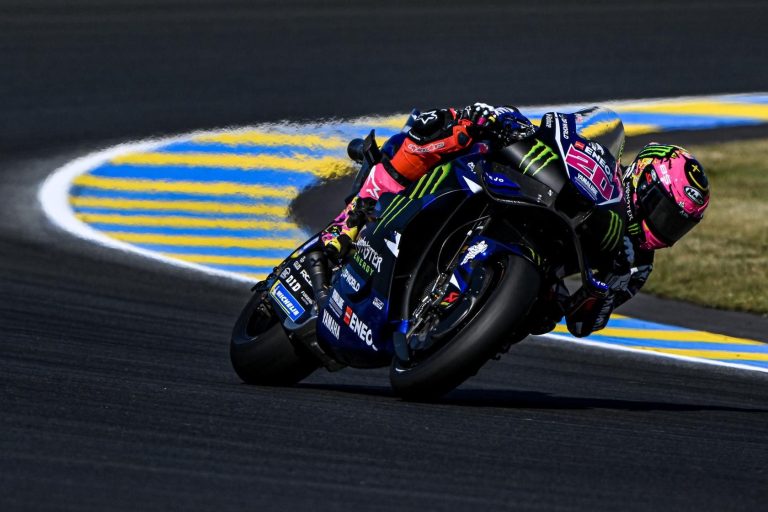
Alex Marquez (73) at Portimao. Photo courtesy Dorna
Alex Marquez led MotoGP World Championship practice Friday afternoon at Autódromo Internacional do Algarve, in Portugal. Riding his BK8 Gresini Ducati Desmosedici GP24 on spec Michelin tires, the Spaniard turned a lap time of 1:37.974 to lead the 22-rider field.
Francesco Bagnaia was the best of the rest with a 1:38.004 on his Lenovo Team Ducati Desmosedici GP25.
Red Bull KTM Factory Racing’s Pedro Acosta was third at 1:38.062.
Marco Bezzecchi finished the session fourth with a 1:38.133 on his Aprilia Racing RS-GP25.
Joan Mir got fifth on his Honda HRC Castrol RC213V with a lap time of 1:38.183.
For his debut in MotoGP, Nicolo Bulega was 17th on his Lenovo Team Ducati Desmosedici GP25.
Alex Marquez rocks the rollercoaster on Friday, Bagnaia and Acosta give chase. You could throw a blanket over the top three on Day 1, with mixed conditions playing a role in the south of Portugal.
0.088s covering the top three at the end of Day 1 in Portimao? We’ll have some of that. It’s Alex Marquez (BK8 Gresini Racing MotoGP) who leads the field thanks to a 1:37.974, as Francesco Bagnaia (Ducati Lenovo Team) and Pedro Acosta (Red Bull KTM Factory Racing) hunt the #73 very closely on what turned out to be another brilliant Friday afternoon in MotoGP.
Marquez sets the early pace
After the opening half an hour, Alex Marquez was the session leader by a couple of tenths, with Acosta his nearest challenger. Johann Zarco (CASTROL Honda LCR) made it three manufacturers in the top three, as Pol Espargaro (Red Bull KTM Tech3) continued to impress while standing in for Maverick Viñales – the KTM Test Rider was fourth ahead of Bagnaia.
With just under 20 minutes left, the rain flags were being waved as spots of rain started to sprinkle the Algarve International Circuit. Rookie Ai Ogura (Trackhouse MotoGP Team) had just jumped into P6 to shove Alex Rins (Monster Energy Yamaha MotoGP) outside the top 10, and then more bad news followed for Yamaha because Jack Miller (Prima Pramac Yamaha MotoGP) crashed at Turn 5.
There might have been rain in the air, but it wasn’t fazing Acosta. The #37 improved his time to cut the gap to Marquez, but he remained P2. Not for long though. Acosta fired in a 1:38.062 to leapfrog Marquez into P1, meaning the KTM star now led the session by over two tenths.
Plenty of improvements were now coming in. Marco Bezzecchi (Aprilia Racing), Fabio Di Giannantonio (Pertamina Enduro VR46 Racing Team), Joan Mir (Honda HRC Castrol) and Fabio Quartararo (Monster Energy Yamaha MotoGP) all went quicker and jumped up the order inside the top 10, before Marquez landed the first 1:37 of the weekend to go P1 with eight minutes to go.
With under five minutes to go, having been P4 a few moments earlier, Quartararo found himself back outside the top 10. His first attempt wasn’t enough, while a Luca Marini (Honda HRC Castrol) personal best saw the Italian climb to P9, meaning Pecco was now P10 and in danger of missing an automatic Q2 spot. That danger became a reality following Espargaro’s latest lap, meaning Pecco was in P11.
The double MotoGP World Champion responded quickly to catapult himself into P7, that in turn knocked Marini back out of the top 10, as Quartararo’s best efforts weren’t enough. The Frenchman couldn’t find time, as Bagnaia went faster again to get within half a tenth of Marquez.
Your Friday top 10
Behind your top three, Bezzecchi’s last lap saw the Italian head into Saturday as the fourth fastest rider, with Mir completing the top five. Zarco makes it two Hondas in the top six, with Di Giannantonio, Rookie of the Year Fermin Aldeguer (BK8 Gresini Racing MotoGP), Espargaro, and Ogura the final automatic Q2 qualifiers – the latter gaining a Friday entry for the fourth time this season.
Coming up: Tissot Sprint Saturday
Well, that sets us up very nicely for Saturday. 0.088s between the top three, half a second covers the top 11, with Q1 – as always – stacked. Come back tomorrow for more.
Aron Canet (44) at Sepang. Photo courtesy Fantic Team.
Aron Canet led Moto2 World Championship practice Friday afternoon at Autódromo Internacional do Algarve, in Portugal. Riding his Fantic Racing Kalex on Pirelli control tires, the Spaniard lapped the 2.85-mile (4.59 km) road course in 1:41.210, topping the field of 29 riders and breaking his own All-Time Lap Record of 1:41.460 he set this morning in FP1.
Jake Dixon was second-best with a time of 1:41.402 on his ELF Marc VDS Racing Boscoscuro.
Albert Arenas did a third-fastest 1:41.658 on his ITALJET Gresini Kalex.
Canet rivatlised to top Friday Practice. Still in with a mathematical chance, the #44 isn’t going to give up on title aspirations without a big fight.
With a late rain shower during Moto2™ Practice, the standings were decided before the chequered flag as Aron Canet (Fantic Racing) topped the order. Getting out early, the Spaniard was able to sport a 0.192s lead ahead of the opposition and lead the charge into Saturday.
Canet got his time bagged early on his third lap of the session with a 1’41.210 seeing him safely through in P1. He went back out to the track late on to get a practice start complete but he was uncatchable at the front. Malaysian GP winner Jake Dixon (ELF Marc VDS Racing Team) was second on the timing sheets, ahead of Albert Arenas (ITALJET Gresini Moto2) in his penultimate round of Moto2 action for the foreseeable.
Demoted from the Championship lead last time out, Manuel Gonzalez (LIQUI MOLY Dynavolt Intact GP) came out the box fighting to secure fourth, ahead of teammate Senna Agius. There was late drama for Aspar duo Daniel Holgado (CFMOTO Inde Aspar Team) and teammate David Alonso; Alonso crashed at Turn 3 under braking on damp kerb, crashing out. Just moments later, Holgado replicated the Colombian’s error but in a bid to save it, was highsided off his Kalex. Both were OK and debriefed their incidents together on the service road. Championship leader Diogo Moreira (Italtrans Racing Team) improved late to go P12 but will want more if he’s to wrap the title up this weekend.
David Almansa (22) in Portugal. Photo courtesy Dorna.
David Almansa led Moto3 World Championship practice Friday afternoon at Autódromo Internacional do Algarve, in Portugal. Almansa used his Pirelli-shod Leopard Racing Honda to lap the 2.85-mile (4.59 km) track in 1:47.056 to led the field of 25 riders.
Taiyo Furusato was second-best with a time of 1:47.191 on his Honda Team Asia machine.
Maximo Quiles, piloting his CFMOTO Gaviota Aspar Team KTM, claimed the third and final spot on the front with a lap time of 1:47.295.
Almansa tops rain-affected Moto3™ Practice in Portugal. Light rain stops some riders from improving in the closing stages as Furusato and Quiles complete the top three.
David Almansa (Leopard Racing) is the Moto3™ pacesetter heading into Saturday’s action in Portugal after his 1:47.056 was good enough to see the Malaysian GP podium finisher beat the Malaysian GP winner, Taiyo Furusato (Honda Team Asia), by 0.135s. A flurry of personal best lap times before the rain fell from Maximo Quiles (CFMOTO Gaviota Aspar Team) saw the newly crowned Rookie of the Year complete the top three.
A light shower heading into the final five minutes of Practice halted a lot of riders’ plans to improve in the closing stages, with the likes of 2025 podium finishers Matteo Bertelle (LEVELUP – MTA) and Guido Pini (Liqui Moly Dynavolt Intact GP) ultimately missing the automatic Q2 cut.
There were no such problems for the returning Dennis Foggia (CFMOTO Gaviota Aspar Team) and Adrian Fernandez (Leopard Racing) though. The Italian and Spaniard round out Friday’s top five, with Joel Kelso (LEVELUP – MTA), Angel Piqueras (FRINSA – MT Helmets – MSI) and Alvaro Carpe (Red Bull KTM Ajo) ending the day inside the top nine.
Three stand-in stars – Hakim Danish (FRINSA – MT Helmets – MSI), Casey O’Gorman (Liqui Moly Dynavolt Intact GP) and Brian Uriarte (Red Bull KTM Ajo) – all made it into the top 14, as we now gear up for qualifying on Saturday in Portimao.
Alex Marquez (73) at Mandalika. Photo courtesy BK8 Gresini Team.
Alex Marquez topped MotoGP World Championship Free Practice One (FP1) Friday morning at Autódromo Internacional do Algarve, in Portugal. Riding his Michelin-shod BK8 Gresini Ducati Desmosedici GP24, the Spaniard turned a lap of 1:39.145 around the 2.85-mile (4.59 km) track and led the 22-rider field.
Marco Bezzecchi was second-best with a 1:39.341 on his Aprilia Racing RS-GP25.
Jack Miller was third with a lap of 1:39.378 on his Prima Pramac Yamaha YZF-M1.
Alex Marquez tops FP1 at Portimao with Bezzecchi and Miller early contenders. The #73 was in mighty form at the front with five manufacturers split by 0.361s.
MotoGP FP1 at Portimao was topped by Alex Marquez (BK8 Gresini Racing MotoGP), with the 2025 runner-up looking to sign off his best season in MotoGP in style. Conditions remained dry despite a persistent threat of rain, with dark cloud rolling in over the hills of the Algarve late on.
Marquez set the pace throughout the session, eventually ending up 0.233s ahead of Marco Bezzecchi (Aprilia Racing) who stuck in a lap right at the end of the session to go second. He was just ahead of Jack Miller (Prima Pramac Yamaha MotoGP) who flew the Yamaha flag… quite literally. The Australian launched his trademark jump on the exit of Turn 8 and was as stylish as ever. Johann Zarco (CASTROL Honda LCR) clinched fourth ahead of Pol Espargaro (Red Bull KTM Tech 3), who was the first crasher of the weekend at Turn 2 but was able to walk away. In all, five different manufacturers inside the top five and covered by less than four tenths of a second makes for a very unpredictable Practice session later in the afternoon.
Franco Morbidelli (Pertamina Enduro VR46 Racing Team) was sixth as Luca Marini (Honda HRC Castrol) just pipped teammate and Sepang podium finisher Joan Mir, both taking P7 and P8 respectively. Ninth place went the way of Pedro Acosta (Red Bull KTM Factory Racing) with Indonesian GP winner Fermin Aldeguer (BK8 Gresini Racing MotoGP) bagging P10.
Further back and it was a fine debut for Nicolo Bulega (Ducati Lenovo Team) finishing 14thhaving set the joint-most laps of anyone, setting his fastest lap on his final lap. There was a big scalp straight away for ‘Bulegas’, who wasn’t just less than a second away from the top time but also more than two tenths clear of teammate Francesco Bagnaia who struggled in FP1 in 17th. There was a late crash for Raul Fernandez (Trackhouse MotoGP Team) at Turn 1, with the Australian GP winner taken to the medical centre for a check-up.
Aron Canet (44) at Sepang. Photo courtesy Fantic Team.
Aron Canet was quickest during Moto2 World Championship Free Practice One Friday morning at Autódromo Internacional do Algarve, in Portugal. Riding his Pirelli-shod Fantic Racing Kalex on the 2.85-mile (4.59 km) track, the Spaniard recorded a 1:41.460, topping the field of 29 riders and breaking Manuel Gonzalez’s All-Time Lap Record of 1:41.515 from 2024.
Jake Dixon was the best of the rest with a 1:41.623 on his ELF Marc VDS Boscoscuro.
Senna Agius was third-fastest with a 1:41.689 on his Liqui Moly Dynavolt IntactGP Kalex.
Dennis Foggia (71) at Misano. Photo courtesy Aspar Team.
Dennis Foggia was quickest during Moto3 World Championship Free Practice One Friday morning at Autódromo Internacional do Algarve, in Portugal. Riding his CFMOTO Gaviota Aspar Team KTM on Pirelli control tires, the Italian covered the 2.85-mile (4.59 km) road course in 1:47.422, topping the field of 25 riders.
Joel Kelso was the best of the rest with a 1:47.458 on his LevelUp MTA KTM.
Joel Esteban was third with a lap time of 1:47.581 on his Red Bull Tech3 KTM.
The all-new Norton Manx R is the standard-bearer of Norton’s Resurgence, the embodiment of the brand’s unwavering commitment to creating some of the world’s most desirable motorcycles through innovation, emotional design, and real-world performance.
Its role is simple – to redefine the premium superbike segment by offering a charismatic and nuanced experience suited to both road and track. The mission – to unfailingly deliver a visceral connection between rider and machine.
The Manx R places the rider at the centre of the dynamic equation through a peerless combination of accessible performance, everyday usability and engineering intelligence. Dramatic in design and steeped in detail, the Manx R’s rider-centric approach will have deep-seated appeal to those who prioritise individuality, emotion and presence. It’s not about excess, it’s about the inimitable Norton riding experience.
Norton Manx R. Photo courtesy Norton Motorcycles
Positioning
“The Manx has a visceral ‘must-ride’ appeal to riders who crave adrenaline with refinement, riders who are connoisseurs of craftsmanship and exclusivity, and status seekers who demand their style with substance along with a generous helping of swagger and strut.” Richard Arnold, Executive Director, Norton Motorcycles
As first of four bikes leading the resurgence of Norton, the Manx R spearheads the storied marque into the modern superbike era with a balance of innovative technology, outstanding real-world performance and sensory connection. A bedrock of hallowed motorsport prowess, engineering innovation and an immutable character that has been shorthand for British excellence since Norton’s inception in 1898, is now augmented with head-turning design and impeccable detail, and a focus on desirability that confidently carries Norton into a bold new era.
Design
“Modernity, innovation and luxury are not terms you immediately think of when considering classic motorcycle brands. Motorcycles and cars are different, yet they share fundamental values. Chief among them is the ability to stir emotion. Though their design languages differ, both can become objects of desire. They also share essential principles of proportion, stance, and drama. Norton’s rich British heritage, something I’m deeply familiar with in the brands I creatively oversee, is compelling.” Professor Gerry McGovern, Chief Creative Advisor, Norton Motorcycles
“Our unique design strategy has been created to give every Norton a family continuity while allowing each model to have its own unique character. This creative vision remains true to the innovative DNA that made Norton one of the most revered two-wheel brands throughout history. This is Nortonness.
There are four key principles that guide us through the creation of all models: modern, Integrated, dramatic and connected. The most obvious and influential is modernity, our interpretation of modernity is one of reductivity. This principle stands out in a marketplace that is becoming ever more visually complex. The harmony needed between design and engineering to allow the execution of the design strategy is captured in integration. One function cannot lead the other, they must push forward together.
All Nortons should have a sense of drama, this is vital to create an emotional response. The Motorcycle should have forward movement regardless of the category. Finally we have connected, which is how the emotion of the design is carried forward into the riding experience, through materials, colours, touch points and intuitive HMI. Looking at a Norton should elevate the spirit.” Simon Skinner, Head of Design, Norton Motorcycles
From the very first pencil line on the very first sketch, the conception of the Manx R motorcycle was grounded in the integrated and inclusive approach to both design and engineering. Form does not need to follow function, or visa versa – at Norton both are as important as each other. This philosophy ensured both engineers and designers were on an equal footing during the development of the Manx R. Managing and channelling this joint creativity has allowed the Manx R to stand out as a unique proposition in the segment, carrying forward a new generation of Norton motorcycles that share the same philosophy.
Following this unifying approach has resulted in an all-new model that fuses reductive design with artisanal engineering. Reduction is the key element that sees Norton fly in the face of convention – Manx R is a superbike model without wings, lines, decals and creases. The Manx R has a distinct character, it is the embodiment of a ‘less-is-more’ approach, witnessed by the lack of visible fixings.
This visual dynamism has resulted in distinctive proportions and stance. The Manx R is compact and dramatic, giving a forward-focused stance even when stationary. Having every functional element on display led Norton’s designers to focus on creating a technical sculpture, inspired by high-end timepieces with exposed workings to showcase their next-level execution and surfacing sophistication. The result is the transformation of technical components into visually arresting jewels, with an unwavering commitment to detail.
Norton Manx R. Photo courtesy Norton Motorcycles
Powertrain
“This isn’t an upgrade — the Manx R’s V4 powerplant is all-new, a muscular and gutsy engine specifically developed with an operating range that brings any road alive. Through a stand-out torque delivery, the V4 is engineered for the real world by delivering torque where and when it matters.” Nevijo Mance, Executive Director, Norton Motorcycles
The pursuit of peak horsepower is often to the detriment of real-world drivability. Norton, unsurprisingly, has adopted a very different approach to performance. While still delivering world-class performance, Norton’s engineers analysed 18,500 miles (30,000 kms) of real-world riding telemetry to understand fully how riders actually rode their motorcycles in every-day riding conditions. The result was that true on-road performance lives below 11,000 rpm. This insight defined the fundamentals of the Manx R’s engine development, and of achieving the goal of delivering class-leading torque and usable power between 5,000 and 10,000 rpm – exactly where it counts. This philosophy encapsulates a rider-first mindset to create a ride that feels alive, responsive, and emotionally engaging.
The Manx R’s all-new 1,200 cc V4 engine is one of the largest capacity engines in the supersport sector. Developing 206 hp at a relatively low 11,500 rpm, the all-alloy 72-degree liquid-cooled unit has been meticulously developed to deliver muscular mid-range torque. The generous 130 Nm of torque peaks at an intentionally low 9,000 rpm to provide torque in the real-world rev range. At 204 kgs, the Manx R posts an excellent power-to-weight and torque-to-weight ratios, with 1 hp per kg the engineering goal from the outset. The result is explosive acceleration for whip-crack overtakes below 11,000rpm – where riders actually ride. This accessible performance has been achieved, in part, by a full ride-by-wire system that operates independently across the front and rear cylinder banks for exceptional throttle control and response.
Five riding modes – Rain, Road, Sport and two customisable track profiles – ensure riders can fully exploit the performance available whatever the road or the weather. Once customised, settings will be stored and remembered every time the bike is started, an example of the Norton focus on customers in the real-world.
Norton Manx R. Photo courtesy Norton Motorcycles
Transmission
The Manx R is equipped with a road-focused, six-speed constant mesh transmission. It features a wet, multiplate slipper clutch, and sophisticated electronic quickshifter and rev-matching systems to ensure seamless, up- and down-shifts. The closely stacked short-geared ratios and an intentionally taller-than-normal final drive ratio of 2.41:1 ensure the rider is always in the right gear to tap into the engine’s deep torque reserves, with the option of intelligent prompts from the transmission’s Optimal Gear Shift Suggestion system.
Chassis
“The Manx R’s chassis is engineered for feel. The cast frame has been meticulously tuned to deliver precise road feedback, giving riders a real sense of connection with the road for genuine confidence on every journey. By focusing on demanding road dynamics rather than just racetrack extremes, Norton delivers a chassis that always feels intuitive and rewarding.” Brian Gillen, Chief Technical Officer, Norton Motorcycles
Norton’s approach to motorcycle frame design marks a deliberate departure from a more conventional track-focused philosophy. Rather than prioritising lap times and racetrack performance, to the detriment of on-road civility and comfort, Norton engineers drew inspiration from the marque’s rich Isle of Man TT racing heritage to develop a frame that excels in real-world road conditions.
Single casting not only enhances structural consistency but also enables tighter tolerances and cleaner panel integration, contributing to both performance and aesthetics. The result is a frame whose composition and structure provides the optimal balanced stiffness with controlled flex – critical for responsive handling and rider comfort at typical road speeds.
Norton Manx R. Photo courtesy Norton Motorcycles
Suspension
“Our advanced suspension set-up reads the road and riding style in real time. It’s been developed to feel incredibly natural and intuitive on the road, as if the Manx R is built around the rider. This semi-active technology doesn’t just enhance performance – it transforms the entire riding experience, making every journey smoother, safer, and more enjoyable.” Brian Gillen, Chief Technical Officer, Norton Motorcycles
The Manx R introduces the most advanced suspension in Norton’s history, a class-leading system designed to put the rider in control for the perfect ride no matter what the road conditions. Co-developed with the Bologna-based suspension specialist Marzocchi, the system uses bespoke, fully-adjustable units.
Using powerful real-time sensors, the Marzocchi-managed system instantly adjusts compression and rebound damping separately at both front and rear. This infinite adjustment ensures the suspension is always working at its best, constantly adapting to throttle and braking inputs, cornering angles and the under-tyre conditions. The Manx R’s five selectable riding modes allow the rider to select from dramatically different suspension characteristics on the fly – from smooth long-distance cruising comfort to scalpel-sharp control for maximum attack on the track. A further benefit of the advanced sensors is the ability to monitor and react to changes in attitude instantly, assisting in the weight balance of the Manx R at all speeds without the need for aerodynamic additions.
Brakes and Wheels
“The performance and capabilities of Brembo’s lightweight HYPURE brakes gives the Manx R rider incredible confidence and control in the most demanding of conditions. Whether that’s braking later and harder on a challenging track or negotiating rush-hour traffic in the wet, the Manx R’s brakes will deliver – every time.” Brian Gillen, Chief Technical Officer, Norton Motorcycles
Brembo’s all-new HYPURE high-performance brake calliper set-up makes its Norton debut on the Manx R. With unparalleled performance, exceptional brake lever feel and a boundary-breaking asymmetrical design, these lightweight race-inspired monobloc callipers have been engineered to deliver tireless braking across all speeds and in all conditions. Manufactured from aluminium alloy, the asymmetrical design is a corollary of its sophisticated heat dispersion capability, while residual torque is minimised by a patented spring-pad-pin system.
The radially-mounted front callipers grip dual 330 mm floating discs, with a single 245 mm disc at the rear. The HYPURE braking system has been painstakingly tuned to work hand-in-glove with the Manx R’s advanced lean-sensitive ABS, constantly adjusting braking pressure based on the motorcycle’s lean angle, acceleration, and speed to maintain traction and stability while cornering.
The Manx R is fitted with 17-inch Carbon fibre BST wheels with Pirelli Diablo Supercorsa V4SP tyres – 120/70 profile at the front and 200/55 at the back.
Norton Manx R. Photo courtesy Norton Motorcycles
Technology and Connectivity
“When we developed the Manx R, our team’s sole aim was to ensure that all its advanced technology features operated in complete harmony to deliver a ride that never feels anything other than intuitive and instinctive. We focused on systems that intelligently enhance the relationship between the rider and the machine while offering the option to tailor them exactly to the individual, and smart connectivity services designed to enhance the riding experience without distraction. Our electronics cater to a wide rider cohort – Norton riders don’t need to be a track pro to fully experience the Manx R’s phenomenal capabilities.” Brian Gillan, Chief Technology Officer, Norton Motorcycles
The connection between the rider and their motorcycle is a fundamental Norton principle. How the motorcycle reacts to the rider, and how the rider feels the road through the motorcycle is what differentiates a Norton. The manner in which the Manx R deploys its suite of sophisticated rider assist technologies is central to achieving this connection, ensuring the rider feels the thrill, not the technology. Innovation has always been at Norton’s core, historically, today and in the future.
Working closely with industry-leaders Bosch and its advanced 10.3 electronic platform has created Bosch intelligence with Norton personality: safety and assist systems calibrated not only for outright performance, but also for nuance and personality. Built for the road and not just the racetrack, they proactively ‘think ahead’ to play a subtle and complementary role that enhances every ride. Every rider is able to tune precisely to their style the level of assistance they require, including no assistance at all.
The Manx features levels of smart connectivity that ensure keeping in contact is both intuitive and immersive – all accessed from the 8-inch touchscreen with smart device compatibility. With full GoPro integration and remote access via the Norton app, capturing and managing the ride has never been easier with connectivity designed to enhance the experience and keep rider and motorcycle in sync, without distraction.
Norton Manx R. Photo courtesy Norton Motorcycles
Key Riding Assistance Features
Cornering Cruise Control – unique to the Manx R in its segment, this sophisticated system enables the rider to safely maintain steady speeds through bends.
Ride Modes – Rain, Road, Sport, and two customisable Track profiles that instantly adjust power, suspension, and electronics to match road, track, or weather conditions.
Switchable Linear Traction Control and Cornering Traction Control – using a six-axis Inertial Measurement Unit to tailor grip assistance to road conditions or riding style for precision and confidence at every turn.
Wheelie and Rear Wheel Slide Control – prevents flips and smoothens landings for confidence-inspiring stability and control under acceleration, cornering and braking.
Slope Dependent Control – ensuring inclines and declines can be tackled smoothly and with full confidence.
Cornering-optimized ABS – outstanding control through the most challenging of bends and curves.
Quick Shifter and Auto Rev-Matching – Smooth, clutch-less gearshifts for faster and more exhilarating rides.
Optimal Gear Shift Suggestion – intelligent prompts that help the rider tap deep into the engine’s torque reserves.
Launch Control and Hill Start Support – ensuring fast and challenging pull-aways are safe and controlled.
Switch Cubes – seamlessly integrated with a tactile metal finish, for access to key features
Dynamic Brake Lights – high-visibility pulsing under hard braking to alert following road-users of sudden deceleration.
Key Connectivity Features
8-inch TFT touchscreen – full-featured and packed with data including fuel economy, distance covered, speed, engine temperature, top speed, and 0-100kmph times; intelligently restricted while on the move.
Bluetooth integration – make, answer and reject calls
Multimedia Control – play, pause, skip tracks and view song titles
GoPro Control – full integration to intuitively capture every moment
Smart Device Synchronisation – access ride statistics, data and media notifications straight to the rider’s wrist.
Key Premium Features
Keyless Entry – hassle-free start-up and access to the fuel tank and seat release
Signature Daytime Running Lights – bold and unmistakably Norton style for enhanced visibility.
Service Reminder – to ensure the Manx R remains in peak condition.
Live Tracking – provides real-time data on the location of the motorcycle.
Remote Immobilization and Theft Alerts – top-level security for added peace of mind.
About Norton Motorcycles:
Norton Motorcycles was founded in 1898 as a manufacturer of fittings and parts to the two-wheel trade. Norton Motorcycles went on to become one of the most iconic British motorcycle brands, manufacturing famous models such as the 650SS, Atlas, Commando, Dominator, Manx, Navigator and more – constantly innovating in motorcycle technology, with features advantageous for lightness and strength in motorcycle racing. Norton Motorcycles has an unrivalled history in motorsport and the brand name is synonymous with Isle of Man TT racing.
In April 2020, Norton Motorcycles was acquired by TVS Motor Company, India’s third-largest motorcycle manufacturer. Under the leadership of TVS, Norton is based out of a new manufacturing facility in Solihull, West Midlands, building British motorcycles in England using traditional hand-crafted techniques with modern day machinery for consistently high quality.
A “press release” is promotional text issued by a rider, team, company or organization to inform
the public about an event, product, or service from the issuer’s own point of view, and if deemed
to have news value, may be placed on roadracingworld.com as a service to our readers.
A press release is not an article written by Roadracingworld.com staffers. When a post is labeled with the words “press release”, it means that Roadracingworld.com is not responsible for its content and that Roadracingworld.com makes no guarantee that it is accurate. Not all press releases are posted and Roadracingworld.com may reject press releases if the content is too heavy on commercial promotion with little or no news value or if the press release contains obvious errors.
Accessibility
Accessibility modes
Epilepsy Safe Mode
Dampens color and removes blinks
This mode enables people with epilepsy to use the website safely by eliminating the risk of seizures that result from flashing or blinking animations and risky color combinations.
Visually Impaired Mode
Improves website's visuals
This mode adjusts the website for the convenience of users with visual impairments such as Degrading Eyesight, Tunnel Vision, Cataract, Glaucoma, and others.
Cognitive Disability Mode
Helps to focus on specific content
This mode provides different assistive options to help users with cognitive impairments such as Dyslexia, Autism, CVA, and others, to focus on the essential elements of the website more easily.
ADHD Friendly Mode
Reduces distractions and improve focus
This mode helps users with ADHD and Neurodevelopmental disorders to read, browse, and focus on the main website elements more easily while significantly reducing distractions.
Blindness Mode
Allows using the site with your screen-reader
This mode configures the website to be compatible with screen-readers such as JAWS, NVDA, VoiceOver, and TalkBack. A screen-reader is software for blind users that is installed on a computer and smartphone, and websites must be compatible with it.
Online Dictionary
Readable Experience
Content Scaling
Default
Text Magnifier
Readable Font
Dyslexia Friendly
Highlight Titles
Highlight Links
Font Sizing
Default
Line Height
Default
Letter Spacing
Default
Left Aligned
Center Aligned
Right Aligned
Visually Pleasing Experience
Dark Contrast
Light Contrast
Monochrome
High Contrast
High Saturation
Low Saturation
Adjust Text Colors
Adjust Title Colors
Adjust Background Colors
Easy Orientation
Mute Sounds
Hide Images
Hide Emoji
Reading Guide
Stop Animations
Reading Mask
Highlight Hover
Highlight Focus
Big Dark Cursor
Big Light Cursor
Cognitive Reading
Virtual Keyboard
Navigation Keys
Voice Navigation
Accessibility Statement
www.roadracingworld.com
December 4, 2025
Compliance status
We firmly believe that the internet should be available and accessible to anyone, and are committed to providing a website that is accessible to the widest possible audience,
regardless of circumstance and ability.
To fulfill this, we aim to adhere as strictly as possible to the World Wide Web Consortium’s (W3C) Web Content Accessibility Guidelines 2.1 (WCAG 2.1) at the AA level.
These guidelines explain how to make web content accessible to people with a wide array of disabilities. Complying with those guidelines helps us ensure that the website is accessible
to all people: blind people, people with motor impairments, visual impairment, cognitive disabilities, and more.
This website utilizes various technologies that are meant to make it as accessible as possible at all times. We utilize an accessibility interface that allows persons with specific
disabilities to adjust the website’s UI (user interface) and design it to their personal needs.
Additionally, the website utilizes an AI-based application that runs in the background and optimizes its accessibility level constantly. This application remediates the website’s HTML,
adapts Its functionality and behavior for screen-readers used by the blind users, and for keyboard functions used by individuals with motor impairments.
If you’ve found a malfunction or have ideas for improvement, we’ll be happy to hear from you. You can reach out to the website’s operators by using the following email
Screen-reader and keyboard navigation
Our website implements the ARIA attributes (Accessible Rich Internet Applications) technique, alongside various different behavioral changes, to ensure blind users visiting with
screen-readers are able to read, comprehend, and enjoy the website’s functions. As soon as a user with a screen-reader enters your site, they immediately receive
a prompt to enter the Screen-Reader Profile so they can browse and operate your site effectively. Here’s how our website covers some of the most important screen-reader requirements,
alongside console screenshots of code examples:
Screen-reader optimization: we run a background process that learns the website’s components from top to bottom, to ensure ongoing compliance even when updating the website.
In this process, we provide screen-readers with meaningful data using the ARIA set of attributes. For example, we provide accurate form labels;
descriptions for actionable icons (social media icons, search icons, cart icons, etc.); validation guidance for form inputs; element roles such as buttons, menus, modal dialogues (popups),
and others. Additionally, the background process scans all the website’s images and provides an accurate and meaningful image-object-recognition-based description as an ALT (alternate text) tag
for images that are not described. It will also extract texts that are embedded within the image, using an OCR (optical character recognition) technology.
To turn on screen-reader adjustments at any time, users need only to press the Alt+1 keyboard combination. Screen-reader users also get automatic announcements to turn the Screen-reader mode on
as soon as they enter the website.
These adjustments are compatible with all popular screen readers, including JAWS and NVDA.
Keyboard navigation optimization: The background process also adjusts the website’s HTML, and adds various behaviors using JavaScript code to make the website operable by the keyboard. This includes the ability to navigate the website using the Tab and Shift+Tab keys, operate dropdowns with the arrow keys, close them with Esc, trigger buttons and links using the Enter key, navigate between radio and checkbox elements using the arrow keys, and fill them in with the Spacebar or Enter key.Additionally, keyboard users will find quick-navigation and content-skip menus, available at any time by clicking Alt+1, or as the first elements of the site while navigating with the keyboard. The background process also handles triggered popups by moving the keyboard focus towards them as soon as they appear, and not allow the focus drift outside it.
Users can also use shortcuts such as “M” (menus), “H” (headings), “F” (forms), “B” (buttons), and “G” (graphics) to jump to specific elements.
Disability profiles supported in our website
Epilepsy Safe Mode: this profile enables people with epilepsy to use the website safely by eliminating the risk of seizures that result from flashing or blinking animations and risky color combinations.
Visually Impaired Mode: this mode adjusts the website for the convenience of users with visual impairments such as Degrading Eyesight, Tunnel Vision, Cataract, Glaucoma, and others.
Cognitive Disability Mode: this mode provides different assistive options to help users with cognitive impairments such as Dyslexia, Autism, CVA, and others, to focus on the essential elements of the website more easily.
ADHD Friendly Mode: this mode helps users with ADHD and Neurodevelopmental disorders to read, browse, and focus on the main website elements more easily while significantly reducing distractions.
Blindness Mode: this mode configures the website to be compatible with screen-readers such as JAWS, NVDA, VoiceOver, and TalkBack. A screen-reader is software for blind users that is installed on a computer and smartphone, and websites must be compatible with it.
Keyboard Navigation Profile (Motor-Impaired): this profile enables motor-impaired persons to operate the website using the keyboard Tab, Shift+Tab, and the Enter keys. Users can also use shortcuts such as “M” (menus), “H” (headings), “F” (forms), “B” (buttons), and “G” (graphics) to jump to specific elements.
Additional UI, design, and readability adjustments
Font adjustments – users, can increase and decrease its size, change its family (type), adjust the spacing, alignment, line height, and more.
Color adjustments – users can select various color contrast profiles such as light, dark, inverted, and monochrome. Additionally, users can swap color schemes of titles, texts, and backgrounds, with over seven different coloring options.
Animations – person with epilepsy can stop all running animations with the click of a button. Animations controlled by the interface include videos, GIFs, and CSS flashing transitions.
Content highlighting – users can choose to emphasize important elements such as links and titles. They can also choose to highlight focused or hovered elements only.
Audio muting – users with hearing devices may experience headaches or other issues due to automatic audio playing. This option lets users mute the entire website instantly.
Cognitive disorders – we utilize a search engine that is linked to Wikipedia and Wiktionary, allowing people with cognitive disorders to decipher meanings of phrases, initials, slang, and others.
Additional functions – we provide users the option to change cursor color and size, use a printing mode, enable a virtual keyboard, and many other functions.
Browser and assistive technology compatibility
We aim to support the widest array of browsers and assistive technologies as possible, so our users can choose the best fitting tools for them, with as few limitations as possible. Therefore, we have worked very hard to be able to support all major systems that comprise over 95% of the user market share including Google Chrome, Mozilla Firefox, Apple Safari, Opera and Microsoft Edge, JAWS and NVDA (screen readers).
Notes, comments, and feedback
Despite our very best efforts to allow anybody to adjust the website to their needs. There may still be pages or sections that are not fully accessible, are in the process of becoming accessible, or are lacking an adequate technological solution to make them accessible. Still, we are continually improving our accessibility, adding, updating and improving its options and features, and developing and adopting new technologies. All this is meant to reach the optimal level of accessibility, following technological advancements. For any assistance, please reach out to