Home Blog Page 1896

Shops: Bell Powersports


FEATURED IN THE MARCH 2019 ISSUE OF ROADRACING WORLD…

     It is one of the oldest manufacturers of motorcycle
helmets, and in spite of the American company being acquired, merged, split,
and sold many times, Bell Powersports continues to design and develop
industry-leading motorcycle helmets where it started… California, U.S.A …

     Bell Helmets evolved out of Bell Auto Parts, a hot
rod speed shop that took its name from its 
location in Bell, California, a suburb of Los Angeles. In
1945, Ray Richter, an automobile racer and race car builder, bought Bell Auto
Parts and expanded the company into a nationwide distributor of
high-performance automobile parts and accessories.

     Tired of friends and fellow competitors dying in
crashes while competing in various motorsports events, Richter decided to
develop his own protective helmet for car racers. That was in 1954. The next
year Cal Niday became the first driver to wear a Bell helmet in the
Indianapolis 500, and although Niday suffered a bad crash that fractured his
skull, he credited his Bell helmet with saving him from a worse fate …

“Shops” by David Swarts, in the March 2019 Issue of Roadracing World

For
decades, Bell has been building helmets that protect riders and racers. The
company, still based in California, is founded on a passion for performance,
bicycle or motorsport. Associate Editor David Swarts visits the company’s
headquarters and takes a look at the design and development process of a helmet
company with deep roots in motorcycle racing. Read all the details in the March
2019 issue of Roadracing World!

Roadracing World & Motorcycle Technology is THE definitive source for motorcycle racing, riding, and tech information.

SUBSCRIBE NOW FOR INSTANT ACCESS!

PREVIEW the March 2019 Issue

Roadracing World & Motorcycle Technology magazine is available in print and digital formats.

Log in or subscribe HERE.

Or call (909) 654-4779, 9:00 a.m. – 5:00 p.m. Pacific Time, Monday through Friday.

Visit www.roadracingworld.com daily for breaking news and events.

https://www.facebook.com/roadracingworld

https://twitter.com @roadracingworld

https://instagram.com @roadracing_world

Join the Roadracing World Online Community of Racers, Riders,& Fans. Post photos and results, make connections with sponsors, and more! Create your Roadracing World Online Profile today!

www.roadracingworld.com/signup

MotoGP: Andrea Dovizioso Says “We Need To Improve Our Mid-Corner Speed”

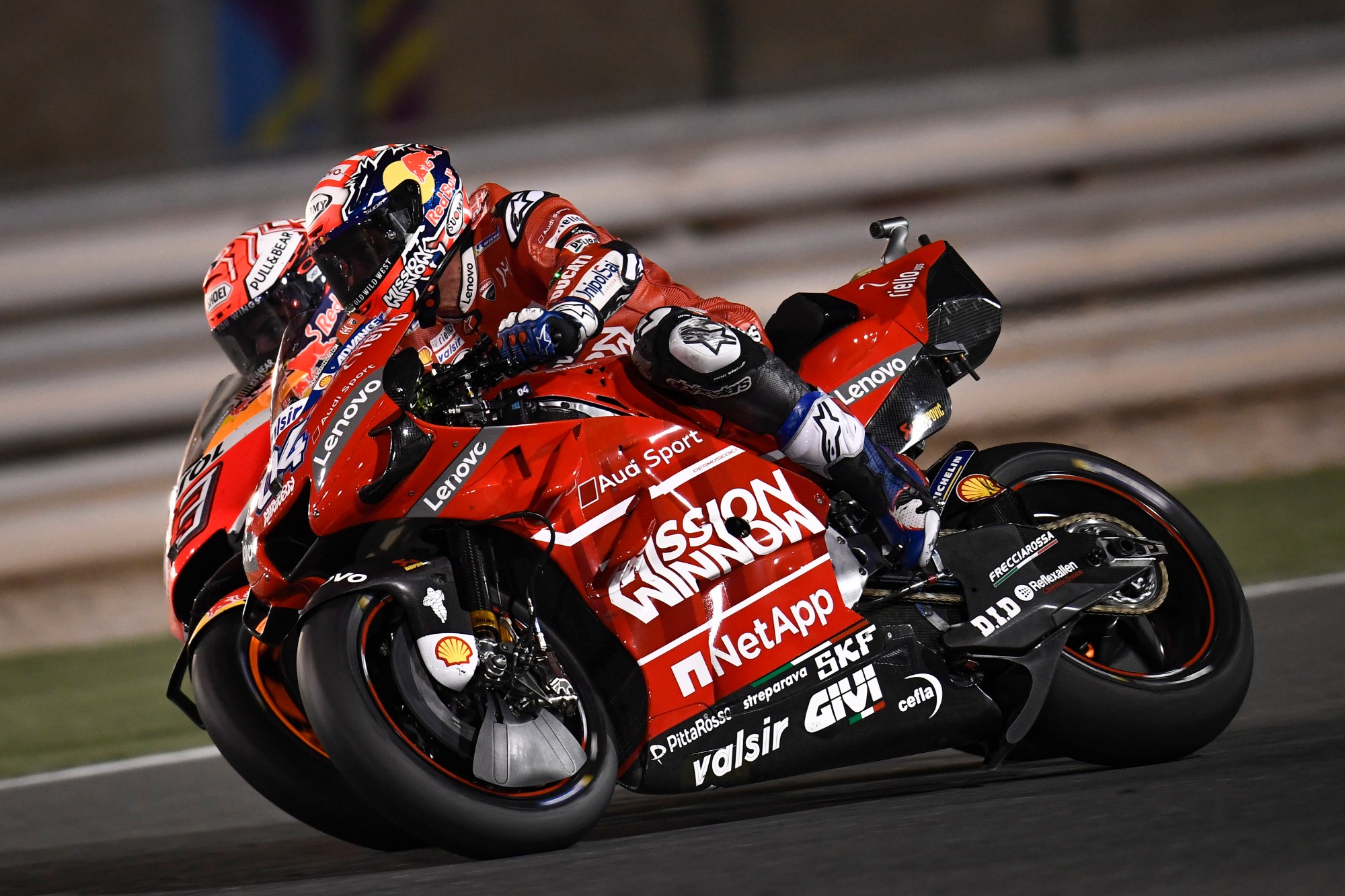
The Mission Winnow Ducati team ready for a new challenge in Argentina for the second round of the MotoGP World Championship
After achieving a spectacular win in the opening race of the year with Andrea Dovizioso in Qatar, the Mission Winnow Ducati team is ready to resume action in Argentina for the second round of the 2019 MotoGP World Championship, scheduled for March 29-31 on the Termas de Río Hondo track, located in the North of the country.

The Grand Prix of Argentina, which reached its 15th edition, will take place in the track located in the Santiago del Estero province for the sixth consecutive year. Andrea Dovizioso achieved his best result there in 2015, when he finished second, while in the past two seasons the Italian finished sixth and fifth, first among Ducati riders. Danilo Petrucci claimed seventh place in 2017 as his personal best result on this circuit, and is particularly determined to rewrite the stats.

Ahead of the GP, the FIM Court of Appeal ruled that the appendix mounted on the swingarm of the Ducati Desmosedici GP 19 of Andrea Dovizioso, Danilo Petrucci and Jack Miller is complying with the technical regulations and therefore can be utilized again during the 2019 championship.

“We were convinced we fully complied with the technical regulations and therefore we were confident about the ruling by the FIM Court of Appeal, so we can only express our satisfaction for the decision made, which further underlies the regularity of our endeavors,” said Luigi Dall’Igna, Ducati Corse General Manager. “Now we simply want to focus on the upcoming race, which is bound to be another tough and exciting challenge.”

Andrea Dovizioso (#04 Mission Winnow Ducati) – 1st (25 points)
“We started the season in the best possible way, winning the opening race in Qatar, but the championship is long and we know by experience we cannot let our guard down. We have a great base, we’re working efficiently and we were able to make the most of our strong suits at Losail, especially in terms of acceleration and top speed, but we need to improve our mid-corner speed. To this end, the upcoming race will represent a good benchmark and will allow us to try some new solutions. Our goal is to be on the podium also on less favorable tracks to be in contention until the very last race.”

Danilo Petrucci (#9 Mission Winnow Ducati) – 6th (10 points)
“I’m ready to tackle the next race with even more motivation after finishing sixth in Qatar. I need to continue to be fast, but also to improve my overall approach ahead of the race. The Termas de Río Hondo circuit is somewhat tricky to interpret, its layout is quite peculiar and in the past it’s been generally dirty in the early sessions, which increases tyre wear and doesn’t help finding the right feeling. Things can change real quick also in terms of weather, it’ll be crucial to start off on the right foot to maximize the track time during practice. I’m confident: last year we found a good setup for the race and we’ll try to restart from there, our goal is once again to finish within the top five.”

The Mission Winnow Ducati team will resume action Friday, March 29th, at 10:50 local time for the first free-practice session.

Circuit information

Country: Argentina
Name: Termas de Río Hondo
Fastest Lap: Marquez (Honda), 1’37.683 (177.1 km/h) – 2014
Circuit Record: Rossi (Yamaha), 1’39.019 (174.7 km/h) – 2015
Best Pole: Marquez (Honda), 1’37.683 (177.1 km/h) – 2014
Top Speed: Petrucci (Ducati), 334.4 km/h – 2017
Track Length: 4.8 km
Race Distance: 25 laps (120.2 km)
Corners: 14 (5 left, 9 right)

2018 results
Podium: 1st Crutchlow (Honda); 2nd Johann Zarco (Yamaha), 3rd Rins (Suzuki)
Pole Position: Miller (Ducati) 1:47.153 (161,4 km/h)
Fastest lap: Marquez (Honda) 1:39.902 (173,1 km/h)

Rider information

Andrea Dovizioso
Bike: Ducati Desmosedici GP
Race Number: 04
Age: 33 (born on 23 March 1986 in Forlimpopoli)
Residence: Forlì (Italy)
Races: 295 (197 x MotoGP, 49 x 250cc, 49 x 125cc)
First GP: 2008 Qatar (MotoGP), 2005 Spain (250cc), 2001 Italy (125cc)
Wins: 22 (13 x MotoGP, 4 x 250cc, 5 x 125cc)
First Win: 2009 Great Britain (MotoGP), 2006 Catalonia (250cc), 2004 South Africa (125cc)
Pole Positions: 20 (7 x MotoGP, 4 x 250cc, 9 x 125cc)
First Pole: 2010 Japan (MotoGP), 2006 France (250cc), 2003 France (125cc)
World Titles: 1 (1 x 125cc)

Danilo Petrucci
Bike: Ducati Desmosedici GP
Race number: 9
Age: 28 (born on 24 October 1990 in Terni)
Residence: Forlì (Italia)
Races: 119 (MotoGP)
First GP: 2012 Qatar (MotoGP)
Wins: –
Pole positions: –
World titles: –

MotoAmerica: Weir Everywhere Racing BMW And Travis Wyman Returning To Stock 1000 Class In 2019

Weir Everywhere Racing BMW revved up to return MotoAmerica competition in 2019

Rider Travis Wyman to compete in Stock 1000 Class, remains committed to capturing BMW’s first MotoAmerica championship

LAS VEGAS — Last year’s runner-up in MotoAmerica’s Stock 1000 class has his sights set on the goal he came oh so close to accomplishing in 2018.

Travis Wyman of Las Vegas, Nev., will again partner with the Weir Everywhere BMW team in an effort to win BMW its first MotoAmerica title. The partnership enjoyed strong results in its first year of competition in 2018 and will aim to use the experience and data it has acquired from racing and off-season testing to capture the 2019 Stock 1000 Class Championship.

“We’ve made some big strides with our BMW package during off-season testing, and we’re expecting even stronger results in 2019,” Wyman said. “Last year at this time, I had no experience racing a 1000cc motorcycle and had just started working with the team. We had three tests under our belt before we made our MotoAmerica debut.

“This season we have a year of experience and plenty of data from last year to work with, and we are heading into the season as proven championship contenders in the Stock 1000 Class.”

Wyman will again pilot a BMW S 1000 RR that will be tuned by BMW Motorrad North America HP Race Support Engineer Steve Weir, as well as Alex Torres of Fastline Motorcycle Performance in Fremont, Calif.

In addition to competing in the Stock 1000 Class, the team also plans to demonstrate the prowess of its BMW package by competing in the MotoAmerica Superbike Class races at Circuit of the Americas in Austin, Texas, on April 12-14.

The team welcomes back many of the sponsors, including Evol Technology LLC, Harv’s Harley-Davidson, Alpha1 Vinyl Works, Arai, SBS, Fastline Motorcycle Performance, MedAge, Drive Systems, MotoOption, LiteTech, Motul, Full Spectrum, Maxem, Orient Express and Cortech.

The team also welcomes back the support of Wyman’s employer California Superbike School, which supplied the team with tires for its off-season testing program. To learn more about California Superbike School, visit superbikeschool.com.

The team also has several title sponsorship opportunities available for select rounds of the 2019 season. Brand managers and business owners interested in using the team’s on-track success to promote their brand are encouraged to contact the team as soon as possible.

Opinion: How Attack Performance Used Advanced Electronics To Be Successful In MotoAmerica Superbike

FIRST PERSON/OPINION:

How We Did NOT Allow Advanced Electronics To Ruin Our Race Team

By Richard Stanboli, Attack Performance owner/crew chief/electronics engineer

We have been debating advanced electronics in Superbike racing for the past two decades and we have seen it go through several iterations before landing on the current World Superbike kit electronics from Magneti-Marelli (Marelli) and in 2019 the addition of the MotoAmerica intermediate-level MoTeC (Motec) system.

At the end of last season, I read about one team’s negative experience (https://www.roadracingworld.com/news/death-of-an-a…) and wanted to share ours. We found the Marelli SKS kit for the Yamaha to be the most complete, turn-key, affordable, reliable, and competitive system that we have ever used, and I will explain why.

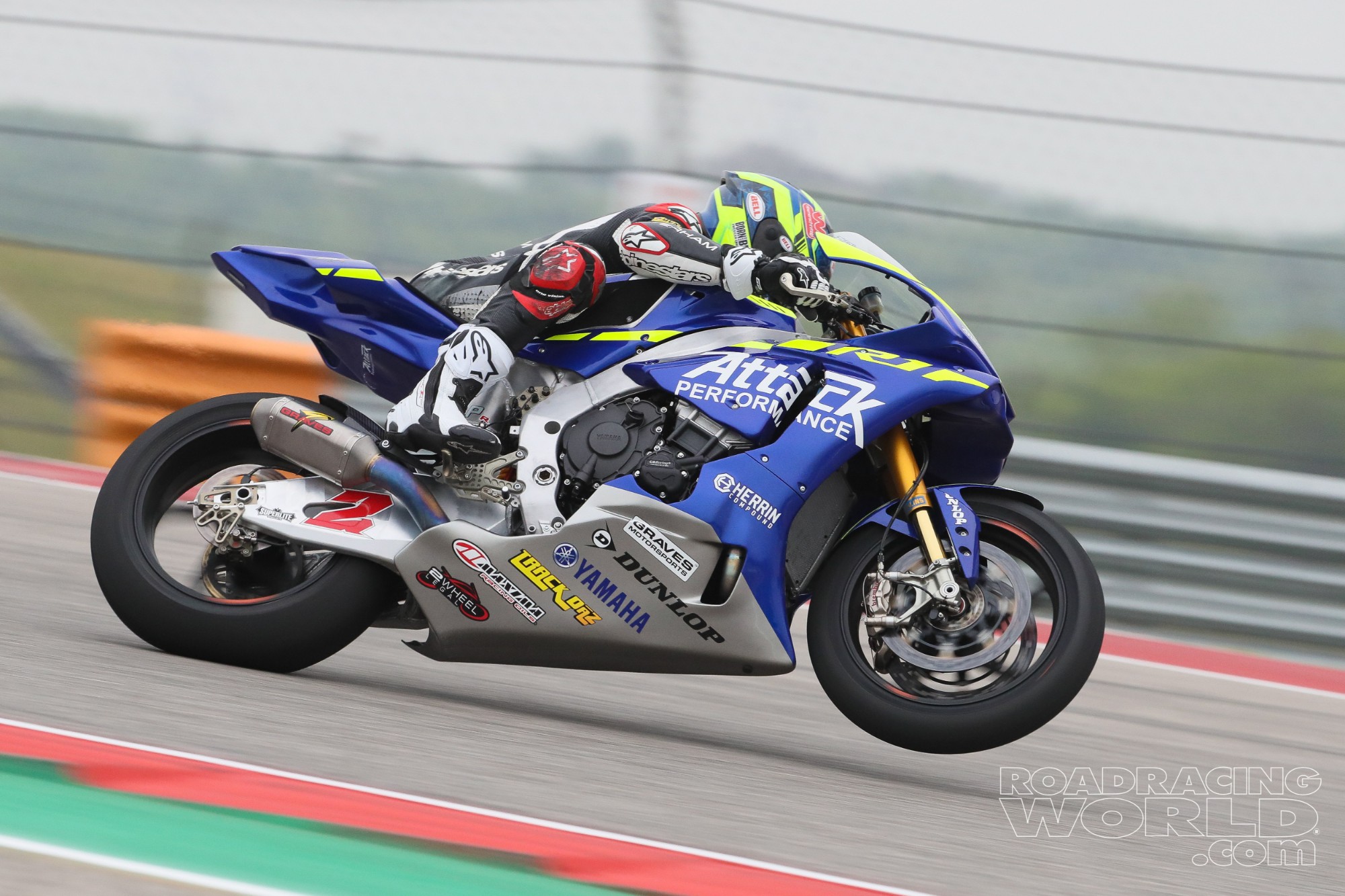
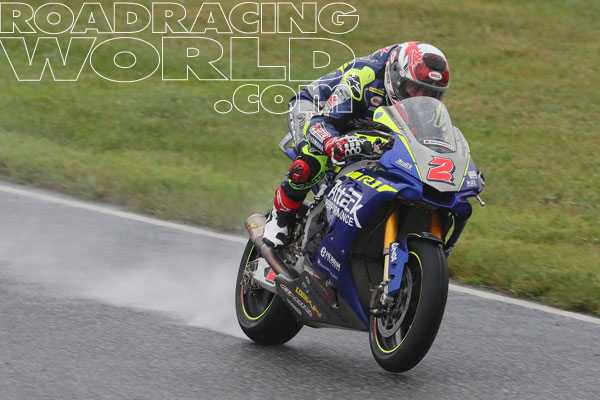
(Above) Josh Herrin (2) at speed on his Attack Performance/Herrin Compound Yamaha YZF-R1 MotoAmerica Superbike during the 2018 season. Photo by Brian J. Nelson.

In the past, for those who are not familiar with setting up aftermarket electronics, you would purchase an ECU (Engine Control Unit) from Motec, Marelli, Pectel, etc., and it would arrive pretty much as a useless box. If you were lucky, they would have a very basic automotive base map that you could not even consider using.

Before you could start the engine, you would spend several days, or weeks, configuring the firing order, engine synchronization (camshaft position vs. crank position), sensor calibration, coil outputs, servo motor calibration, stepper motor calibration, base maps, communication to the dash and other CAN (Controller Area Network) devices. The list seemed endless, and if for some reason you did not get all of that correct you probably would not make it out of the dyno room with your engine intact.

So why would we take a huge step backwards and work real hard just to get back to step one?

You may think it is the advance tuning, but this is only one part of the equation. The more complex strategies were not developed until later so the most important advantage at that time was the data. Visualizing the functions accurately gave the user the ability to fix an issue in a short amount of time, and speed is everything in racing.

So, why not just add a logger?

That would be the easier method, but it did not have the synergy that you would get from an ECU with an internal logger or an ECU with a good CAN stream to an external logger. Furthermore, you rarely could get a data stream from the OEM ECU and if you did the speed was so slow and the channels were so basic that it made the data useless.

At the end of 1999 we built our first fuel-injected Yamaha YZF-R7 [AMA Formula Xtreme racebike) powered by an YZF-R1 engine. We chose to use Motec, a well-known automotive ECU. Little did we know the development that was in store for us.

During our first run on the dyno we found out the hard way. The R1 cam sensor would change polarity at high rpm, affecting the synchronization and ignition timing. That ended our first day abruptly and made for a very long evening. After much struggle, time, and expense, we finally had a competitive machine, and by the end of the season we were on the podium at the Macau Grand Prix.

In 2001, we were picked up by Suzuki, and we took what we learned from the Yamaha and applied it to the Suzuki. Since the GSX-R1000 was a brand-new model, the first ever, we received the bikes very late and had zero time for testing. We assumed since we already took our lumps with the R1 that we should be good, but again it was a learning experience.

Our first event was at Infineon Raceway and the bike misfired all the way to the top of the podium. It turns out that the Suzuki cam sensor was prone to producing a noisy signal causing the misfire. After that event and many hours on the dyno, we fixed the issue. We went on to win many races but due to rider injuries the AMA Pro Formula Xtreme Championship had to wait until 2002.

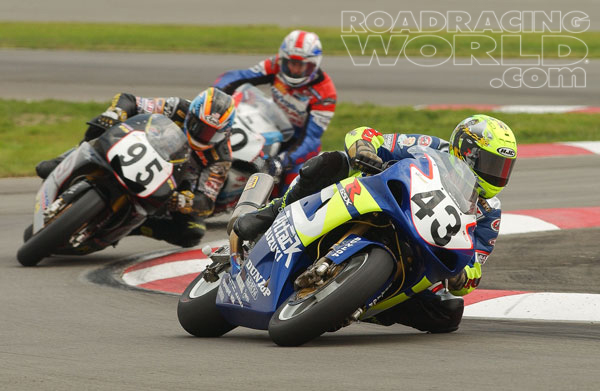
(Above) Jason Pridmore (43), riding his Attack Performance Suzuki GSX-R1000 AMA Formula Xtreme racebike, leading Roger Hayden (95) and Tom Kipp in 2002. Pridmore won the 2002 AMA Formula Xtreme Championship. Photo by Brian J. Nelson.

By now we were confident in our knowledge of the Motec electronics, or so we thought. With every new model came new challenges. We even had one ECU that would shut-off mid-session due to high-frequency engine vibration. That was a tough one to diagnose.

From 2004 to 2011 we spent most of our time as a factory-supported team with Kawasaki and mostly used the Motec and Marelli ECUs in Superbike, Formula Xtreme, and Supersport. We continued to move our same ECUs from one model to another and we were getting better at adapting them to suit different models. With every software update came new strategies and several of them were works in progress. It took quite a bit of testing to make progress with these new strategies. Again, we had good success with Formula Xtreme wins, two Daytona 200 wins, and some Superbike podiums.

The last big challenge was our MotoGP project in 2012 and 2013. MotoGP had been going through several challenges with ECU rules and, as a wildcard, the MotoGP Marelli option was not available. We chose the newest of the Motec ECUs, the M1. The programmability and the advanced data logging capability put it very close to the Marelli.

(Above) Richard Stanboli (second from right) with the APR MotoGP racebike he designed and built from pieces of billet aluminum and rider Blake Young at the Red Bull Indianapolis Grand Prix at Indianapolis Motor Speedway in 2013. Photo by David Swarts.

This new Motec ECU had all-new hardware, software, licensing, strategies, programmable firmware, etc. The “from scratch” challenge came back in a big way, and we found ourselves struggling with a limited baseline, limited test time, and new strategies that were not ready for prime time.

Our first MotoGP event was spent chasing wheel speed noises that caused the ECU to turn off all the rider aids. Consequently, we missed (barely) the qualifying cutoff. After that failed event, we were even more determined to do well, so it was back to the workshop and then to the track to confirm the fix. At the very next MotoGP we scored two World Championship points!

From 2014 to 2017, we did not field our own team but contracted to other teams–Riders Discount and Meen Motorsports. Meen Motorsports had partnered with Flash Tune (FTECU), which developed through the 2016 season a reflash of the R1 original equipment ECU. This gave us the capability to easily win the 2016 MotoAmerica Superstock 1000 Championship and with that result in hand the team decided to go “100%” into the MotoAmerica Superbike class in 2017.

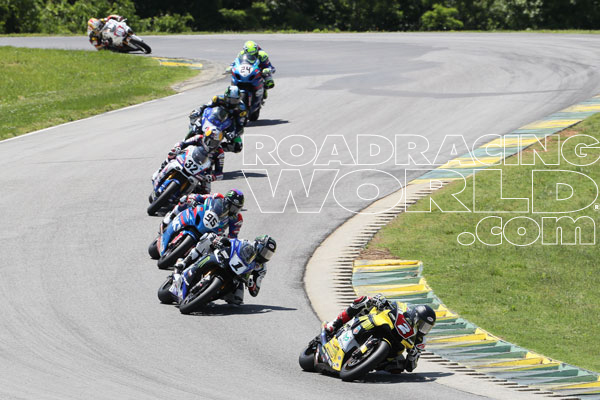
(Above) Josh Herrin (2) leading a MotoAmerica Superbike/Superstock 1000 race at VIRginia International Raceway on his Richard Stanboli-tuned Meen Motorsports Yamaha YZF-R1 Superstock 1000 racebike in 2017. Herrin won the 2017 MotoAmerica Superstock 1000 Championship. Photo by Brian J. Nelson.

Our position was that we would support the team but with the stipulation that we would be on the same level of equipment as the other teams. This meant the whole package: Electronics, engines, suspension, etc. Everything was agreed to, but through various forms of Meen Motorsports’ mismanagement the equipment never materialized. We found ourselves spending many costly hours — and more than the cost of a complete World Superbike Marelli SKS kit — pushing the reflash concept, but at the end, time and rules did not allow the development of a competitive package.

And I reiterate, it was costly!

This put us in an unfamiliar position of debating the continuation of support, but then the Meen Motorsports team folded a few races before the end of the 2017 season.

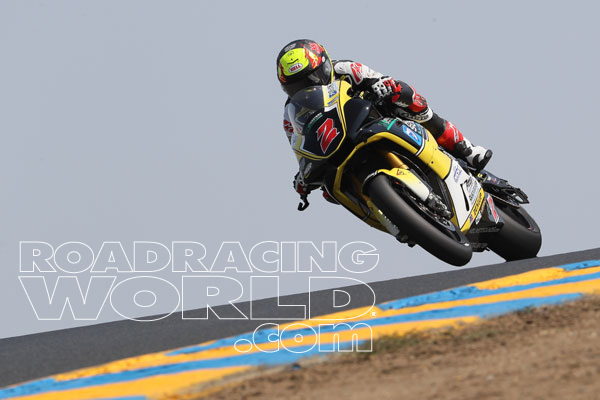
(Above) Josh Herrin (2) on his Meen Motorsports Yamaha YZF-R1 Superbike at Sonoma Raceway during the 2017 MotoAmerica Superbike season. It was the last event where Herrin raced this motorcycle. Photo by Brian J. Nelson.

After the failed season with Meen Motorsports, we swore that we would only go racing again if we controlled the budget and management. This meant that it would have to be an in-house team. Josh Herrin was jobless, and we were looking at our semi-truck, thinking of dusting it off. Josh spent most of the winter asking other teams for a ride, but he finally found himself back at our shop. At this point it was past the end-of-year holidays and we thought there was no way we could put a program together and build a proper Superbike. Not being afraid of a challenge, we said “OK, let’s give it a try.”

At the end of January, Yamaha stepped up with some product support and we had a couple of bikes on February 1, 2018. To say the least, it was going to be a big challenge.

After some back and forth, we opened a line of communication with YME (Yamaha Motor Europe), placed the order for the World Superbike Marelli SKS system way past the ordering deadline, and we prepared for the worst possible scenario.

The timing was very bad. Normally, you need some lead time, more than we had, for delivery of the Marelli SKS system. YME with some help from Yamaha Motor Corp, U.S.A. pulled some strings and everything went into process.

Once the door was opened with Yamaha Motor Europe, we received a flood of information: Software, documentation, wiring diagrams, a proven base map from the World Superbike test at Philip Island as well as a proven base map from the Yamaha Motor Corp., U.S.A., and a direct line of communication with the development engineer, Michele Garda.

The base map was so complete that I personally was amazed and felt a little guilty. The fueling, ignition timing, sensor calibration, CAN communication, strategy maps, were all there. It was a late Christmas for this race team! The biggest challenge was building the harness to spec, which was a small percentage of the challenge we faced with the MotoGP project.

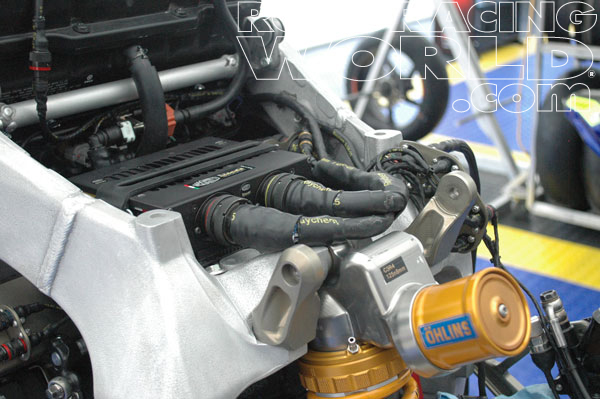
(Above) The Magneti Marelli ECU and custom wiring in the Attack Performance/Herrin Compound Yamaha YZF-R1 Superbike before it ran for the first time at Circuit of The Americas (COTA) in 2018. Photo by David Swarts.

Just to give you the idea of timing: Paul St. Clair with the Monster Energy/Yamalube/Yamaha team flashed our Marelli ECU with the U.S. version of the software in the Yamaha transporter while the team was loading for the first event of 2018. At this point, we did not have a running motorcycle or any familiarity with the strategies. Back to the shop we went to make a few changes to the harness and start the bike, but it would not start. The throttle would not calibrate, so instead of wasting a lot of time at the shop we decided that we would head to Road Atlanta and ask Paul or Vito (Bolognesi, with Magneti Marelli USA) to help us with the diagnostics. We were now out of time and just barely finished the bike and off we went.

On the way to Road Atlanta our transporter’s differential exploded, leaving us stranded in Shreveport, Louisiana. Without enough time to fix the transporter and no desire to have it picked clean at the repair shop parking lot, we decided to babysit the transporter, skip the Road Atlanta round, and head to COTA (Circuit of The Americas), the very next week’s event.

Once arriving at COTA, we spent setup day adding the final touches to the bike. Paul and Vito came over and within a few minutes the throttle was calibrated and the bike ran! Now came the hard part, making the bike competitive. We had yet to turn a single lap, eerily reminding me of our first race with the Suzuki in 2001. We won that race, so maybe lightning would strike twice.

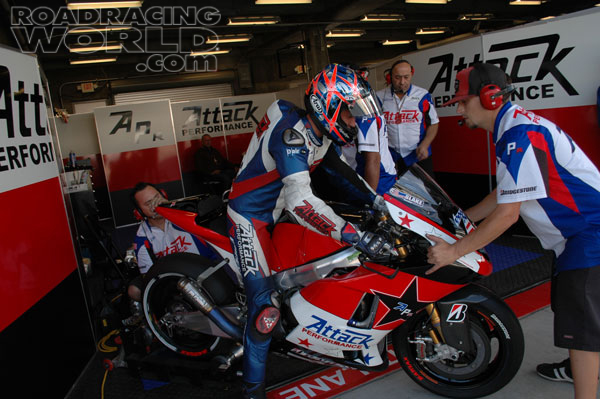
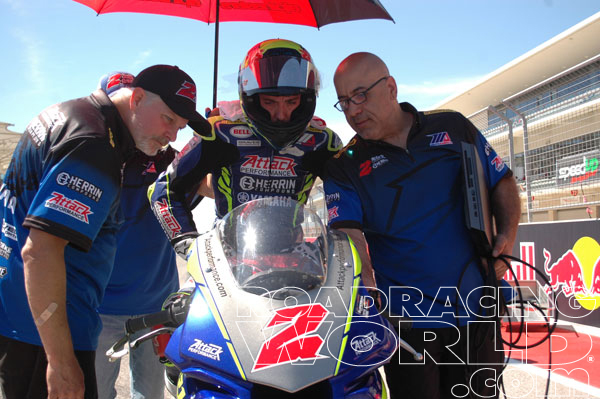
(Above) Richard Stanboli (right) explaining to Josh Herrin (center) the layout of the dashboard and functions of the buttons for their Magneti Marelli electronics prior to a MotoAmerica Superbike Race at Circuit of The Americas. Photo by David Swarts.

The first two sessions were a struggle, almost mirroring our first Suzuki adventure. We just missed qualifying for Superpole and had to start in P12. One more long evening with the data, a night of sleep for the rider, and we found ourselves on the grid for Race One.

Boom! The skies turned dark, it start raining, and I started laughing. No-one had any wet time, and this was exactly the break we needed. A few clicks on the suspension, some ride height changes, our best guess on the strategies, and few minutes later we are leading Race One! We ultimately finished second, which was not a bad outing. Even [MotoAmerica President] Wayne Rainey commented that he did not think we would finish the race…citing the earlier experiences of the team featured in the previous electronics article about Marelli.

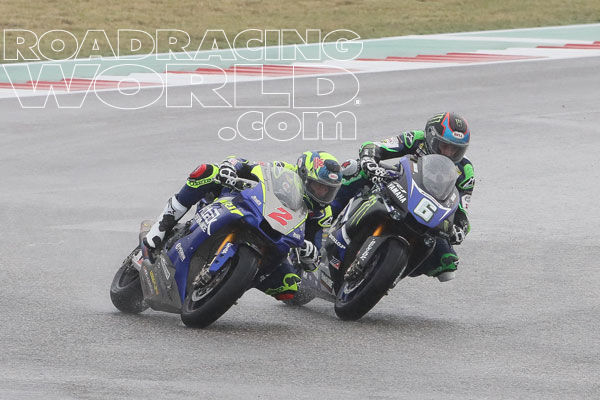
(Above) Josh Herrin (2) battling Cameron Beaubier (6) for second place in MotoAmerica Superbike Race One at COTA in 2018. Herrin finished second. Beaubier crashed, picked up his bike, and was still able to finish third in the wet race. Photo by Brian J. Nelson.

We would go on to continue the development of our bike and electronics with podium finishes at nearly every event and a couple of MotoAmerica Superbike race wins. The reliability and consistency were great, and we only had one failure due to an OEM connector that overheated, killing the engine during pre-race warmup at New Jersey Motorsports Park. Unfortunately, that DNS took us out of contention for second place in the 2018 MotoAmerica Superbike Championship and relegated us to third. But, overall, it was not a bad season for such a fast and challenging beginning.

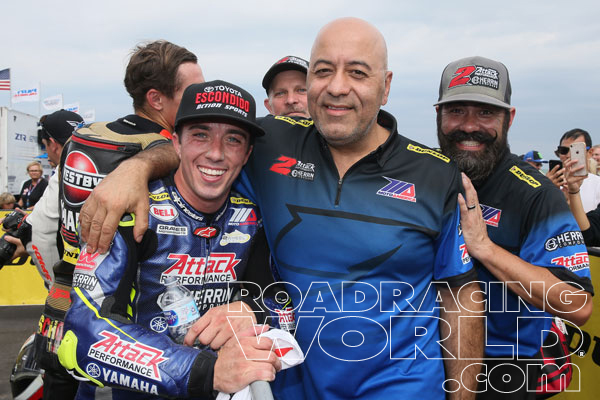
(Above) Josh Herrin (left) went on to win two MotoAmerica Superbike races on Richard Stanboli’s (center) Attack Performance/Herrin Compound Yamaha YZF-R1 Superbike in 2018 and finished third in the Championship. Photo by Brian J. Nelson.

Update:

Since I started writing this article, I had the opportunity to look at the new Motec GPR MotoAmerica Superbike electronics kit and software and, in my opinion, it is a significant step back from the Marelli SKS kit. Even though I am a fan of Motec product, I must honestly say that it comes up short in race readiness, strategy potential, and cost savings.

Race readiness: The Motec system does have sensor calibration for each model of motorcycle but the strategies are basic and have no baseline. As per World Superbike rules, teams using the SKS kit would be provided, by the factory, the most recent software which includes race-ready strategies. This is something each team using the Motec system will have to develop on their own, costing time and money.

Strategies: The Motec system is not torque-based. The Marelli system has strategies that rely heavily on torque models. The Yamaha Marelli SKS kit has the engine torque tables, both positive (acceleration) and negative (deceleration), modeled by the factory race team and ready for prime time. This means that the operator just needs to tell the ECU the amount of torque or force he would like to apply at the rear wheel for any situation and the ECU calculates the amount of throttle opening or torque, by adjusting ignition cut and timing. These torque models take a significant amount of dyno hours to replicate and are almost priceless. With the Motec system the operator will need to tell the ECU how much throttle or ignition cut to give the bike at any situation, and he will have to calculate or estimate how much torque or force would be applied to the rear wheel, including changes for any sprockets and transmission selection. It is substantially more work for the operator and will take away from other time-sensitive tasks. The torque-based strategies also make the Marelli more consistent from one event to another as well as race distance.

Cost: The Marelli SKS system comes in at €8,000, about $9,000 U.S., while the pricing of the MotoAmerica Motec system is right at $6,000 U.S. However, the Motec system does not include an IMU (Inertial Measurement Unit), lambda sensors (one vs. four in the SKS kit), suspension sensor, brake pressure sensor, oil pressure sensor, and download cable. You pay a bit more for the SKS kit up front, but the investment is recovered in very short order. As a past-to-present comparison, a complete Superbike advanced electronics system a decade ago would cost in the vicinity of $30,000 and hundreds of hours to make it 100% functional.

Marelli’s Wintax analysis software is more of an “engineering” level tool and Motec’s i2 Pro has a more user-friendly interface. The difference is like that of Windows and Apple. Once you take the time to learn each key and feature then both systems offer about the same analytical functionality. If we had to do it again all over again, without a doubt, we would go with the Marelli.

What does this mean for the future of the sport? Older racers, some of those who rode for us, tell me that they should just remove all the rider aids, while current World Superbike front runners tell me that they would like to ride MotoAmerica because the series and motorcycles are so much like World Superbike.

This reminds me of the first time I walked into NASA’s Jet Propulsion Laboratory and all the old drafting tables where slowly being replaced with computer design stations. The days of flat-slide carbs and throttle cables are over. What will happen when electric-powered motorcycles become more mainstream, put throttle cables on rheostats? Should we just throw out our smart phone calculators and bust out the abacus?

Going backwards is not an option and those who would like to remain in this sport and race at the front, which is totally possible, should learn the new tools, quit whining, and start winning.

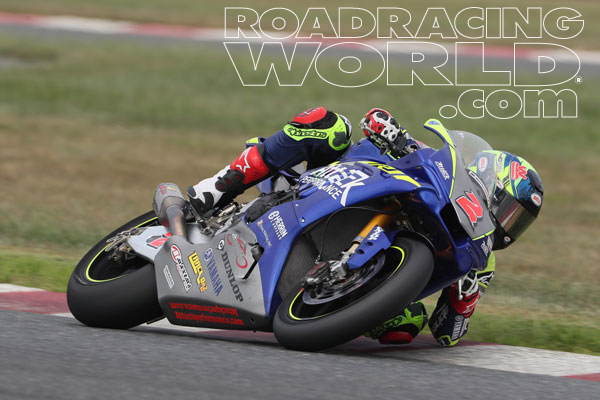
(Above) Josh Herrin (2) on his way to victory in MotoAmerica Superbike Race Two at New Jersey Motorsports Park in 2018. Photo by Brian J. Nelson.

MotoGP: Valentino Rossi: “Last Year‘s Race (In Argentina) Was Incredibly Tricky”

MONSTER ENERGY YAMAHA MOTOGP PLAN FOR ACTION IN ARGENTINA

Termas de Río Hondo (Argentina), 27th March 2019

The Monster Energy Yamaha MotoGP Team are about to get back on track for this weekend’s Grand Prix weekend at the Termas de Río Hondo Circuit.

Monster Energy Yamaha MotoGP’s Valentino Rossi and Maverick Viñales are ready to fight again at the upcoming second Grand Prix of the 2019 MotoGP season, held in Argentina this weekend.

Rossi was just 0.6s off the victory at the opening round, despite starting from P14 on the grid. The battling with his rivals in Qatar intensified his love for racing even more, and he is ready to challenge amongst the front-runners again this weekend.

The nine-time World Champion is hugely popular in Latin America. He can expect the support from thousands of fans who will be cheering him on from the Termas de Río Hondo stands. The Doctor aims to do them proud and greet them from the podium – like he did in 2015, when he secured the victory, and in 2016 and 2017, having taken second place – to make up for last year’s race result, obtained in tricky half-wet, half-dry conditions.

Though he didn’t end the first race of the season as high as he would have liked, Viñales took the positives from the first weekend in Losail and is motivated to show his speed again at the Gran Premio Motul de la República Argentina, which he has fond memories of.

Two years ago, he secured his second successive dominant win of the year on his Yamaha YZR-M1 in Argentina. The Spaniard struggled here last year in a slightly chaotic and challenging race, but he still took home solid points, securing fifth position. This year he wants to feel competitive again, so he can duplicate the 2017 result and once more enjoy the great sensation of winning in front of the Argentinian fans.

The 4.8km long Termas de Río Hondo Circuit was added to the MotoGP calendar in 2014. The track was remodelled two years earlier, to make it Latin America’s most modern and safest circuit. With an exciting lay-out that includes a mixture of fast corners (five left, nine right) and a 1076m longest straight, the Argentinian fans can be assured that they will see plenty of racing and overtaking action again.

MASSIMO MEREGALLI

TEAM DIRECTOR

“We didn’t finish as high as we wanted to in Qatar, but this only fuels us to work harder and we learned from that experience. Getting to the Termas de Río Hondo circuit is quite a journey for the team and riders, but once we get there it’s always very rewarding. The local fans are incredibly passionate about MotoGP, so we want to put on a good show for them this weekend. Though I’m sure the spectators all enjoyed the drama of last year’s unplanned and slightly chaotic starting procedure, we are hoping for a completely wet or dry race. We know this track suits our bike, and our riders also enjoy this circuit, so we hope to be in for another exciting GP weekend and work towards a strong result.”

VALENTINO ROSSI

“I enjoyed the race in Qatar, but now we focus on Argentina. First of all, we hope we‘ll have good track conditions at the circuit this weekend, because that‘s always crucial. Second of all, we hope we‘ll have good weather this year. Last year‘s race was incredibly tricky, riding on a half-wet, half-dry surface – it was very difficult to ride the bike with slicks over the wet patches. We hope we won‘t have to repeat that, and we will see if we‘re strong. I’ll do my best to fight for the podium.”

MAVERICK VIÑALES

“We did a good job in Qatar, during all the weekend, despite what the result of the race suggests. The team delivered really great work during the last race weekend, so now we’re looking forward to this week’s Grand Prix in Argentina. This season we’re going to take it race-by-race, trying to improve every day. I can‘t wait to ride at Termas de Río Hondo again – I know what it’s like to win there. I hope to have the same feeling again this year and be able to fight for the victory. I really think that we can do a good job this weekend and that we will be at the front during the entire race, with the possibility to win.”

WERA West: David Anthony, Bradley Ward Split Formula One Wins In Las Vegas

Bradley Ward and David “Aussie Dave” Anthony took
home the Formula One wins in the WERA West Presented by Lucas Oil Products
double-header at Las Vegas Motor Speedway on Saturday and Sunday.

Ward took his Dunlop-shod, Fly Racing-backed Kawasaki ZX-10R
to a clean 6.798-second win over Travis Wyman on a BMW S1000RR and Justin
Simons on his Kawasaki ZX-10R, setting a best lap of 1:17.360 around the
1.8-mile Classic Course.

Wyman backed up the runner-up spot in Formula One with wins
in the A Superstock and A Superbike races, while Simons took second in the A
Superstock race ahead of Sahar Zvik.

On Sunday, Anthony ran the big-bore table, taking the
Formula One, A Superbike and A Superstock wins on his Pirelli-shod, Fly
Racing-backed Kawasaki ZX-10R. Wyman took second and Zvik third in the A
Superbike and A Superbike races, while Wyman and Zvik took the podium places in
Formula One. Wyman laid down the fastest lap in the big-bore races on Sunday,
the only rider to dip into the 1:15 range with a 1:15.854 in the final race of
the weekend.

RACE RESULTS:

SATURDAY:

GROM CUP (all on Honda Grom):

1. Selin Buyuksonmez


MINI 50:

1. Cody Kitchens (KTM 65)

2. Owen Williams (Hon 50)

3. Fatih Buyuksonmez (Kaw 250R)


A SUPERSTOCK EXPERT:

1. Travis Wyman (BMW S1000RR)

2. Justin Simons (Kaw ZX-10R)

3. Sahar Zvik (Kaw ZX-10R)

4. Manny Segura (Kaw ZX-10R)

5. Terry Heard (Kaw ZX-10R)

6. Louis Jutras (BMW S1000RR)

A SUPERSTOCK NOVICE:

1. Bo Bin (BMW S1000RR)

2. Tony Lam (Yam YZF-R1)

3. Bryan Montgomery (Yam YZF-R1)

4. Ben Ahern (Apr RSV4)

5. Donald Martins (BMW S1000RR)


SRA SIDECARS:

1. Russel Biles

2. Bernard Juchi

3. Steven Stull

4. Gary McEwen

5. William Becker


HEAVYWEIGHT TWINS SUPERBIKE EXPERT:

1. Ruben Soto (KTM 1190)

HEAVYWEIGHT TWINS SUPERBIKE NOVICE:

1. Cody Kitchens (Mor MD250H)

C SUPERSTOCK EXPERT:

1. Mookie Wilkerson (Yam YZF-R6)

2. Jeremiah Walker (MV F3 675)

3. Connor Funk (Yam YZF-R6)

4. Mitsu Ueda (Yam YZF-R6)

5. Kevin Winter (Yam YZF-R6)

6. Anibal Arias (Kaw ZX-6R)

C SUPERSTOCK NOVICE:

1. Conner Brown (Yam YZF-R6)

2. Jai Dicipulo (Yam YZF-R6)


FORMULA TWO EXPERT:

1. JC Gibbs (Yam 700)

2. Lance Lewman (Suz SV650)

3. Anthony Morrison (Suz SV650)

4. Andrew Preciado (Mor MD250H)

5. Michael Gougis (Suz SV650)

FORMULA TWO NOVICE:

1. Cody Kitchens (Mor MD250H)

SENIOR SUPERBIKE HEAVYWEIGHT EXPERT:

1. Terry Heard (Kaw ZX-10R)

2. Louis Jutras (BMW S1000RR)

3. Ed Guzman (BMW S1000RR)

4. Ruben Soto (KTM 1190)

5. Jeff Semmig (Suz GSX-R1000)

SENIOR SUPERBIKE HEAVYWEIGHT NOVICE:

1. Brandon Pulli (Yam YZF-R1)

2. Kristopher Furrow (Yam YZF-R1)

3. Eric Gray (Kaw ZX-10R)

4. Donald Martins (BMW S1000RR)

5. Ben Ahem (Apr RSV4)

6. Dexter Stuart (Apr RSV4)


SENIOR SUPERBIKE MEDIUMWEIGHT EXPERT:

1. Mitsu Ueda (Yam YZF-R6)

2. Gilbert Silva (Kaw ZX-6R)

3. Eric Anderson (Yam YZF-R6)

4. Gerardo Flores (Kaw ZX-6R)

5. Moises Castaneda (Yam YZF-R6)

SENIOR SUPERBIKE MEDIUMWEIGHT NOVICE:

1. Wayne Gann (Yam YZF-R6)

2. Edward Hearn (Kaw ZX-6R)

3. James Salters (Kaw ZX-6R)


B SUPERSTOCK EXPERT:

1. Connor Funk (Yam YZF-R6)

2. Anibal Arias (Kaw ZX-6R)

3. Anas Sorhmat (Yam YZF-R6)

4. Max Zeronian (Yam YZF-R6)


B SUPERSTOCK NOVICE:

1. Conner Brown (Yam YZF-R6)

2. Jai Dicipulo (Yam YZF-R6)

3. James Salters (Kaw ZX-6R)


V8 MEDIUMWEIGHT:

1. Edward Hearn (Kaw ZX-6R)


D SUPERBIKE EXPERT:

1. David Purcell (Kaw Ninja 400R)

2. John Knowles (Kaw Ninja 400R)

3. Andrew Preciado (Mor MD250H)

4. Ron Gentile (KTM 390)

5. Laura Orozco (Mor MD250H)

D SUPERBIKE NOVICE:

1. Cody Kitchens (Mor MD250H)

2. Aden Thao (Kaw Ninja 400R)

E SUPERSTOCK NOVICE:

1. John Sosebee (Yam YZF-R3)

LIGHTWEIGHT TWINS SUPERSTOCK EXPERT:

1. JC Gibbs (Yam 700)

2. Ed Guzman (Suz SV650)

C SUPERBIKE EXPERT:

1. Jeremiah Walker (MV F3 675)

2. Connor Funk (Yam YZF-R6)

3. Mitsu Ueda (Yam YZF-R6)

4. Max Zeronian (Yam YZF-R6)

5. Anas Sorhmat (Yam YZF-R6)

C SUPERBIKE NOVICE:

1. Conner Brown (Yam YZF-R6)

2. Jai Dicipulo (Yam YZF-R6)

3. Arnold Munoz (Suz GSX-R600)

FORMULA ONE EXPERT:

1. Bradley Ward (Kaw ZX-10R)

2. Travis Wyman (BMW S1000RR)

3. Justin Simons (Kaw ZX-10R)

4. Sahar Zvik (Kaw ZX-10R)

5. Manny Segura (Kaw ZX-10R)

6. Nathan Shipman (Kaw ZX-10R)

7. Jeremiah Walker (MV F3 675)

8. Jeremy Sims (BMW S1000RR)

9. Zac Miller (BMW S1000RR)

10. John DuBois II (Kaw ZX-10R)

FORMULA ONE NOVICE:

1. Bo Bin (BMW S1000RR)

2. Tony Lam (Yam YZF-R1)

3. Thomas Asseo (Yam YZF-R1)

4. Brandon Pulli (Yam YZF-R1)

5. Kristopher Furrow (Yam YZF-R1)

6. Ben Ahern (Apr RSV4)

CLUBMAN EXPERT:

1. Andrew Preciado (Mor MD250H)

2. Ron Gentile (KTM 390)

3. Laura Orozco (Mor MD250H)


CLUBMAN NOVICE:

1. Cody Kitchens (Mor MD250H)

2. Aden Thao (Kaw Ninja 400R)

3. Owen Williams (Mor MD250H)


B SUPERBIKE EXPERT:

1. Connor Funk (Yam YZF-R6)

2. Mookie Wilkerson (Yam YZF-R6)

3. Mitsu Ueda (Yam YZF-R6)

4. Max Zeronian (Yam YZF-R6)

5. Anas Sorhmat (Yam YZF-R6)


B SUPERBIKE NOVICE:

1. Jai Dicipulo (Yam YZF-R6)

2. Arnold Munoz (Suz GSX-R600)


D SUPERSTOCK EXPERT:

1. John Knowles (Kaw Ninja 400R)


D SUPERSTOCK NOVICE:

1. Aden Thao (Kaw Ninja 400R)

2. John Sosebee (Yam YZF-R3)


LIGHTWEIGHT TWINS SUPERBIKE EXPERT:

1. Lance Lewman (Suz SV650)

2. JC Gibbs (Yam 700)

3. Anthony Morrison (Suz SV650)

4. Andrew Preciado (Mor MD250H)

5. Michael Gougis (Suz SV650)

6. Ed Guzman (Suz SV650)

LIGHTWEIGHT TWINS SUPERBIKE NOVICE:

1. Cody Kitchens (Mor MD250H)

A SUPERBIKE EXPERT:

1. Travis Wyman (BMW S1000RR)

2. Sahar Zvik (Kaw ZX-10R)

3. Jeremy Sims (BMW S1000RR)

4. Louis Jutras (BMW S1000RR)

5. Manny Segura (Kaw ZX-10R)

6. Zac Miller (BMW S1000RR)


A SUPERBIKE NOVICE:

1. Bo Bin (BMW S1000RR)

2. Thomas Asseo (Yam YZF-R1)

3. Tony Lam (Yam YZF-R1)

4. Bryan Montgomery (Yam YZF-R1)

5. Brandon Pulli (Yam YZF-R1)

6. Kristopher Furrow (Yam YZF-R1)


SUNDAY:

GROM CUP (all on Honda Grom):

1. Selin Buyuksonmez


MINI 50:

1. Owen Williams (Hon 50)

2. Fatih Buyuksonmez (Kaw 250R)

A SUPERSTOCK EXPERT:

1. David Anthony (Kaw ZX-10R)

2. Travis Wyman (BMW S1000RR)

3. Sahar Zvik (Kaw ZX-10R)

4. Justin Simons (Kaw ZX-10R)

5. Terry Heard (Kaw ZX-10R)

6. Manny Segura (Kaw ZX-10R)

A SUPERSTOCK NOVICE:

1. Bo Bin (BMW S1000RR)

2. Bryan Montgomery (Yam YZF-R1)

3. Donald Martins (BMW S1000RR)

4. Ben Ahern (Apr RSV4)

SRA SIDECARS:

1. Russel Biles

2. Bernard Juchi

3. Steven Stull

4. Gary McEwen

HEAVYWEIGHT TWINS SUPERBIKE EXPERT:

1. Ruben Soto (KTM 1190)

C SUPERSTOCK EXPERT:

1. Jeremiah Walker (MV F3 675)

2. Connor Funk (Yam YZF-R6)

3. Mookie Wilkerson (Yam YZF-R6)

4. David Henderson (Yam YZF-R6)

5. Mitsu Ueda (Yam YZF-R6)

6. Anibal Arias (Kaw ZX-6R)

C SUPERSTOCK NOVICE:

1. Conner Brown (Yam YZF-R6)

FORMULA TWO EXPERT:

1. Lance Lewman (Suz SV650)

2. JC Gibbs (Yam 700)

3. Andrew Preciado (Mor MD250H)

4. Michael Gougis (Suz SV650)

5. Cody Burton (Suz SV650)

FORMULA TWO NOVICE:

1. Cody Kitchens (Mor MD250H)

SENIOR SUPERBIKE HEAVYWEIGHT EXPERT:

1. Terry Heard (Kaw ZX-10R)

2. Louis Jutras (BMW S1000RR)

3. David Henderson (Yam YZF-R1)

4. Ruben Soto (KTM 1190)

5. Fatih Buyuksonmez (BMW S1000RR)

6. Ed Guzman (BMW S1000RR)

SENIOR SUPERBIKE HEAVYWEIGHT NOVICE:

1. Donald Martins (BMW S1000RR)

2. Ben Ahem (Apr RSV4)

3. Brandon Pulli (Yam YZF-R1)

4. Eric Gray (Kaw ZX-10R)


SENIOR SUPERBIKE MEDIUMWEIGHT EXPERT:

1. Eric Anderson (Yam YZF-R6)

2. Gerardo Flores (Kaw ZX-6R)

3. Mitsu Ueda (Yam YZF-R6)

4. John James (Hon CBR600RR)

SENIOR SUPERBIKE MEDIUMWEIGHT NOVICE:

1. Wayne Gann (Yam YZF-R6)

2. James Salters (Kaw ZX-6R)

3. Edward Hearn (Kaw ZX-6R)

B SUPERSTOCK EXPERT:

1. Connor Funk (Yam YZF-R6)

2. Anibal Arias (Kaw ZX-6R)

3. Anas Sorhmat (Yam YZF-R6)

4. Max Zeronian (Yam YZF-R6)


B SUPERSTOCK NOVICE:

1. Conner Brown (Yam YZF-R6)

2. James Salters (Kaw ZX-6R)

3. Arnold Munoz (Suz GSX-R600)

V8 MEDIUMWEIGHT:

1. John James (Hon CBR600RR)

2. Edward Hearn (Kaw ZX-6R)

D SUPERBIKE EXPERT:

1. Andrew Preciado (Mor MD250H)

2. John Knowles (Kaw Ninja 400R)

3. Ron Gentile (KTM 390)

4. Laura Orozco (Mor MD250H)

D SUPERBIKE NOVICE:

1. Cody Kitchens (Mor MD250H)

2. Owen Williams (Mor MD250H)

3. Aden Thao (Kaw Ninja 400R)


LIGHTWEIGHT TWINS SUPERSTOCK EXPERT:

1. JC Gibbs (Yam 700)

2. Ed Guzman (Suz SV650)

C SUPERBIKE EXPERT:

1. Connor Funk (Yam YZF-R6)

2. Jeremiah Walker (MV F3 675)

3. David Henderson (Yam YZF-R6)

4. Anas Sorhmat (Yam YZF-R6)

5. Max Zeronian (Yam YZF-R6)


C SUPERBIKE NOVICE:

1. Conner Brown (Yam YZF-R6)

2. Arnold Munoz (Suz GSX-R600)


FORMULA ONE EXPERT:

1. David Anthony (Kaw ZX-10R)

2. Travis Wyman (BMW S1000RR)

3. Justin Simons (Kaw ZX-10R)

4. Nathan Shipman (Kaw ZX-10R)

5. Sahar Zvik (Kaw ZX-10R)

6. Jeremiah Walker (MV F3 675)

7. Manny Segura (Kaw ZX-10R)

8. John DuBois II (Kaw ZX-10R)

9. Chris Baker (Yam YZF-R1)

10. Fatih Buyuksonmez (BMW S1000RR)


FORMULA ONE NOVICE:

1. Thomas Asseo (Yam YZF-R1)


V8 HEAVYWEIGHT:

1. John James (Hon CBR600RR)

CLUBMAN EXPERT:

1. Ron Gentile (KTM 390)

3. Laura Orozco (Mor MD250H)

CLUBMAN NOVICE:

1. Cody Kitchens (Mor MD250H)

2. Owen Williams (Mor MD250H)

3. Aden Thao (Kaw Ninja 400R)


B SUPERBIKE EXPERT:

1. Mookie Wilkerson (Yam YZF-R6)

2. Anas Sorhmat (Yam YZF-R6)

3. Max Zeronian (Yam YZF-R6)

4. Connor Funk (Yam YZF-R6)

B SUPERBIKE NOVICE:

1. Conner Brown (Yam YZF-R6)

D SUPERSTOCK EXPERT:

1. John Knowles (Kaw Ninja 400R)

D SUPERSTOCK NOVICE:

1. Aden Thao (Kaw Ninja 400R)


LIGHTWEIGHT TWINS SUPERBIKE EXPERT:

1. JC Gibbs (Yam 700)

2. Lance Lewman (Suz SV650)

3. Michael Gougis (Suz SV650)


LIGHTWEIGHT TWINS SUPERBIKE NOVICE:

1. Cody Kitchens (Mor MD250H)

A SUPERBIKE EXPERT:

1. David Anthony (Kaw ZX-10R)

2. Travis Wyman (BMW S1000RR)

3. Sahar Zvik (Kaw ZX-10R)

4. Manny Segura (Kaw ZX-10R)

5. John DuBois II (Kaw ZX-10R)

6. Jeremy Sims (BMW S1000RR)


A SUPERBIKE NOVICE:

1. Bo Bin (BMW S1000RR)

2. Thomas Asseo (Yam YZF-R1)

3. Brandon Pulli (Yam YZF-R1) 

Quick Look: KTM 390 Duke

.

FEATURED IN THE MARCH 2019 ISSUE OF ROADRACING WORLD…

     You always knew when Jamie James was going to try
something special. It’s not like the Ragin’ Cajun was hanging around when he
was on the track — four AMA Pro National Championships, including the 1989 AMA
Superbike title, were testament to his speed. But when he was planning a move
on someone, his elbows would come out, and you knew to watch carefully
…

     The first time I sat on the KTM 390 Duke, I thought
of James. The bike is short, compact, with tubular bars and relatively rearset
pegs. The riding position put me upright, over the tank, with elbows out in
full attack mode, and I couldn’t help but think that there had to be someone
around who needed me to out-brake and stuff them at an  apex …

Michael Gougis, Editor-At-Large, in the March 2019 Issue of Roadracing World


KTM’s 390
Duke is the smallest member of the company’s family of street-oriented hooligan
bikes. But don’t let the small displacement fool you; it’s a lightweight,
friendly bike that makes you want to ride hard, and rewards you for doing so.
Read the review of the littlest thrash-machine in the March 2019 issue of Roadracing
World
!

Roadracing World & Motorcycle Technology is THE definitive source for motorcycle racing, riding, and tech information.

SUBSCRIBE NOW FOR INSTANT ACCESS!

PREVIEW the March 2019 Issue

Roadracing World & Motorcycle Technology magazine is available in print and digital formats.

Log in or subscribe HERE.

Or call (909) 654-4779, 9:00 a.m. – 5:00 p.m. Pacific Time, Monday through Friday.

Visit www.roadracingworld.com daily for breaking news and events.

https://www.facebook.com/roadracingworld

https://twitter.com @roadracingworld

https://instagram.com @roadracing_world

Join the Roadracing World Online Community of Racers, Riders,& Fans. Post photos and results, make connections with sponsors, and more! Create your Roadracing World Online Profile today!

www.roadracingworld.com/signup

AMA: Utah Becomes Second State To Legalize Lane Splitting By Motorcyclists

Utah passes motorcycle lane-splitting legislation

Becomes second U.S. state to allow filtering in traffic

PICKERINGTON, Ohio — Utah became the second U.S. state to formally recognize a type of lane splitting, with the governor’s signature on a bill legalizing the filtering of motorcycles between lanes of stopped traffic.

“This is a major victory for motorcyclists in Utah and across the country,” said Mike Sayre, on-highway government relations manager for the American Motorcyclist Association. “As more states acknowledge the benefits of lane splitting, motorcyclists can become safer on the roads, and motorists can find some relief from traffic congestion.”

H.B. 149 allows motorcyclists traveling no faster than 15 mph to filter between lanes of stopped traffic traveling in the same direction on roads where the speed limit is 45 mph or less.

The bill, sponsored by state Rep. Walt Brooks (R-St. George) and state Sen. David P. Hinkins (R-Orangeville), was signed by Gov. Gary Herbert on March 21. The bill takes effect May 14.

There are provisions in the bill automatically repealing the law on July 1, 2022, if the legislature takes no action to extend it.

The AMA endorses lane splitting, given the long-term success in California and the University of California study by Berkeley researchers showing that it enhances motorcycle safety. And the AMA will assist groups and individuals working to bring legal lane splitting and/or filtering to their state.

The full AMA position statement on lane splitting can be found at www.americanmotorcyclist.com/About-The-AMA/lane-splitting-1.

About the American Motorcyclist Association

Founded in 1924, the AMA is a not-for-profit member-based association whose mission is to promote the motorcycle lifestyle and protect the future of motorcycling. As the world’s largest motorcycling rights and event sanctioning organization, the AMA advocates for riders’ interests at all levels of government and sanctions thousands of competition and recreational events every year. The AMA also provides money-saving discounts on products and services for its members. Through the AMA Motorcycle Hall of Fame in Pickerington, Ohio, the AMA honors the heroes and heritage of motorcycling. For more information, visit www.americanmotorcyclist.com.

Not a member? Join the AMA today: www.americanmotorcyclist.com/mobile-join 

MotoGP: Court Of Appeals Rules On Ducati Aerodynamic Device Protest

MotoGP Court of Appeal hands down decision

Case against Ducati aerodynamic devices

VisitQatar Grand Prix – Doha (QAT), 10 March

During the MotoGP race at the season opener in Qatar on 10 March 2019, technical protests concerning the use of a device on the Ducati machine were lodged with the FIM MotoGP Stewards by Team Suzuki Ecstar against #43 Jack Miller (Ducati), by Repsol Honda Team against #4 Andrea Dovizioso (Ducati), and by Red Bull KTM Factory Team and Aprilia Racing Team Gresini against #9 Danilo Petrucci (Ducati).

The protesting teams considered that the device was primarily an aerodynamic device and therefore not compliant with the MotoGP technical regulations. After a hearing, the four protests were rejected.

The same four teams then lodged appeals against the MotoGP Stewards’ decision to the MotoGP Appeal Stewards and a further hearing was conducted. The MotoGP Appeal Stewards determined that further technical evaluation was required and that this was not possible under the circumstances. They therefore decided to refer the matter to the MotoGP Court of Appeal in accordance with Art. 3.3.3.2 of the applicable Regulations.

Following a hearing in Mies on Friday 22 March, the MotoGP Court of Appeal handed down its decision today 26 March and the parties (the four appellants, Ducati and the FIM) have been duly notified.

On these grounds, the MotoGP Court of Appeal rules that:

The appeals filed by Team Aprilia, Team Suzuki, Team Honda and Team KTM are admissible.

The provisional race results are confirmed and are declared as final.

The request to declare the Device illegal and ban its use in future races is rejected.

An appeal against this decision may be lodged before the Court of Arbitration of Sport (CAS) in Lausanne Switzerland within 5 days pursuant to Article 3.9 of the 2019 FIM World Championship Grand Prix Regulations. 

Shops: Bell Powersports


FEATURED IN THE MARCH 2019 ISSUE OF ROADRACING WORLD…

     It is one of the oldest manufacturers of motorcycle
helmets, and in spite of the American company being acquired, merged, split,
and sold many times, Bell Powersports continues to design and develop
industry-leading motorcycle helmets where it started… California, U.S.A …

     Bell Helmets evolved out of Bell Auto Parts, a hot
rod speed shop that took its name from its 
location in Bell, California, a suburb of Los Angeles. In
1945, Ray Richter, an automobile racer and race car builder, bought Bell Auto
Parts and expanded the company into a nationwide distributor of
high-performance automobile parts and accessories.

     Tired of friends and fellow competitors dying in
crashes while competing in various motorsports events, Richter decided to
develop his own protective helmet for car racers. That was in 1954. The next
year Cal Niday became the first driver to wear a Bell helmet in the
Indianapolis 500, and although Niday suffered a bad crash that fractured his
skull, he credited his Bell helmet with saving him from a worse fate …

“Shops” by David Swarts, in the March 2019 Issue of Roadracing World

For
decades, Bell has been building helmets that protect riders and racers. The
company, still based in California, is founded on a passion for performance,
bicycle or motorsport. Associate Editor David Swarts visits the company’s
headquarters and takes a look at the design and development process of a helmet
company with deep roots in motorcycle racing. Read all the details in the March
2019 issue of Roadracing World!

Roadracing World & Motorcycle Technology is THE definitive source for motorcycle racing, riding, and tech information.

SUBSCRIBE NOW FOR INSTANT ACCESS!

PREVIEW the March 2019 Issue

Roadracing World & Motorcycle Technology magazine is available in print and digital formats.

Log in or subscribe HERE.

Or call (909) 654-4779, 9:00 a.m. – 5:00 p.m. Pacific Time, Monday through Friday.

Visit www.roadracingworld.com daily for breaking news and events.

https://www.facebook.com/roadracingworld

https://twitter.com @roadracingworld

https://instagram.com @roadracing_world

Join the Roadracing World Online Community of Racers, Riders,& Fans. Post photos and results, make connections with sponsors, and more! Create your Roadracing World Online Profile today!

www.roadracingworld.com/signup

MotoGP: Andrea Dovizioso Says “We Need To Improve Our Mid-Corner Speed”

The Mission Winnow Ducati team ready for a new challenge in Argentina for the second round of the MotoGP World Championship
After achieving a spectacular win in the opening race of the year with Andrea Dovizioso in Qatar, the Mission Winnow Ducati team is ready to resume action in Argentina for the second round of the 2019 MotoGP World Championship, scheduled for March 29-31 on the Termas de Río Hondo track, located in the North of the country.

The Grand Prix of Argentina, which reached its 15th edition, will take place in the track located in the Santiago del Estero province for the sixth consecutive year. Andrea Dovizioso achieved his best result there in 2015, when he finished second, while in the past two seasons the Italian finished sixth and fifth, first among Ducati riders. Danilo Petrucci claimed seventh place in 2017 as his personal best result on this circuit, and is particularly determined to rewrite the stats.

Ahead of the GP, the FIM Court of Appeal ruled that the appendix mounted on the swingarm of the Ducati Desmosedici GP 19 of Andrea Dovizioso, Danilo Petrucci and Jack Miller is complying with the technical regulations and therefore can be utilized again during the 2019 championship.

“We were convinced we fully complied with the technical regulations and therefore we were confident about the ruling by the FIM Court of Appeal, so we can only express our satisfaction for the decision made, which further underlies the regularity of our endeavors,” said Luigi Dall’Igna, Ducati Corse General Manager. “Now we simply want to focus on the upcoming race, which is bound to be another tough and exciting challenge.”

Andrea Dovizioso (#04 Mission Winnow Ducati) – 1st (25 points)
“We started the season in the best possible way, winning the opening race in Qatar, but the championship is long and we know by experience we cannot let our guard down. We have a great base, we’re working efficiently and we were able to make the most of our strong suits at Losail, especially in terms of acceleration and top speed, but we need to improve our mid-corner speed. To this end, the upcoming race will represent a good benchmark and will allow us to try some new solutions. Our goal is to be on the podium also on less favorable tracks to be in contention until the very last race.”

Danilo Petrucci (#9 Mission Winnow Ducati) – 6th (10 points)
“I’m ready to tackle the next race with even more motivation after finishing sixth in Qatar. I need to continue to be fast, but also to improve my overall approach ahead of the race. The Termas de Río Hondo circuit is somewhat tricky to interpret, its layout is quite peculiar and in the past it’s been generally dirty in the early sessions, which increases tyre wear and doesn’t help finding the right feeling. Things can change real quick also in terms of weather, it’ll be crucial to start off on the right foot to maximize the track time during practice. I’m confident: last year we found a good setup for the race and we’ll try to restart from there, our goal is once again to finish within the top five.”

The Mission Winnow Ducati team will resume action Friday, March 29th, at 10:50 local time for the first free-practice session.

Circuit information

Country: Argentina
Name: Termas de Río Hondo
Fastest Lap: Marquez (Honda), 1’37.683 (177.1 km/h) – 2014
Circuit Record: Rossi (Yamaha), 1’39.019 (174.7 km/h) – 2015
Best Pole: Marquez (Honda), 1’37.683 (177.1 km/h) – 2014
Top Speed: Petrucci (Ducati), 334.4 km/h – 2017
Track Length: 4.8 km
Race Distance: 25 laps (120.2 km)
Corners: 14 (5 left, 9 right)

2018 results
Podium: 1st Crutchlow (Honda); 2nd Johann Zarco (Yamaha), 3rd Rins (Suzuki)
Pole Position: Miller (Ducati) 1:47.153 (161,4 km/h)
Fastest lap: Marquez (Honda) 1:39.902 (173,1 km/h)

Rider information

Andrea Dovizioso
Bike: Ducati Desmosedici GP
Race Number: 04
Age: 33 (born on 23 March 1986 in Forlimpopoli)
Residence: Forlì (Italy)
Races: 295 (197 x MotoGP, 49 x 250cc, 49 x 125cc)
First GP: 2008 Qatar (MotoGP), 2005 Spain (250cc), 2001 Italy (125cc)
Wins: 22 (13 x MotoGP, 4 x 250cc, 5 x 125cc)
First Win: 2009 Great Britain (MotoGP), 2006 Catalonia (250cc), 2004 South Africa (125cc)
Pole Positions: 20 (7 x MotoGP, 4 x 250cc, 9 x 125cc)
First Pole: 2010 Japan (MotoGP), 2006 France (250cc), 2003 France (125cc)
World Titles: 1 (1 x 125cc)

Danilo Petrucci
Bike: Ducati Desmosedici GP
Race number: 9
Age: 28 (born on 24 October 1990 in Terni)
Residence: Forlì (Italia)
Races: 119 (MotoGP)
First GP: 2012 Qatar (MotoGP)
Wins: –
Pole positions: –
World titles: –

MotoAmerica: Weir Everywhere Racing BMW And Travis Wyman Returning To Stock 1000 Class In 2019

Weir Everywhere Racing BMW revved up to return MotoAmerica competition in 2019

Rider Travis Wyman to compete in Stock 1000 Class, remains committed to capturing BMW’s first MotoAmerica championship

LAS VEGAS — Last year’s runner-up in MotoAmerica’s Stock 1000 class has his sights set on the goal he came oh so close to accomplishing in 2018.

Travis Wyman of Las Vegas, Nev., will again partner with the Weir Everywhere BMW team in an effort to win BMW its first MotoAmerica title. The partnership enjoyed strong results in its first year of competition in 2018 and will aim to use the experience and data it has acquired from racing and off-season testing to capture the 2019 Stock 1000 Class Championship.

“We’ve made some big strides with our BMW package during off-season testing, and we’re expecting even stronger results in 2019,” Wyman said. “Last year at this time, I had no experience racing a 1000cc motorcycle and had just started working with the team. We had three tests under our belt before we made our MotoAmerica debut.

“This season we have a year of experience and plenty of data from last year to work with, and we are heading into the season as proven championship contenders in the Stock 1000 Class.”

Wyman will again pilot a BMW S 1000 RR that will be tuned by BMW Motorrad North America HP Race Support Engineer Steve Weir, as well as Alex Torres of Fastline Motorcycle Performance in Fremont, Calif.

In addition to competing in the Stock 1000 Class, the team also plans to demonstrate the prowess of its BMW package by competing in the MotoAmerica Superbike Class races at Circuit of the Americas in Austin, Texas, on April 12-14.

The team welcomes back many of the sponsors, including Evol Technology LLC, Harv’s Harley-Davidson, Alpha1 Vinyl Works, Arai, SBS, Fastline Motorcycle Performance, MedAge, Drive Systems, MotoOption, LiteTech, Motul, Full Spectrum, Maxem, Orient Express and Cortech.

The team also welcomes back the support of Wyman’s employer California Superbike School, which supplied the team with tires for its off-season testing program. To learn more about California Superbike School, visit superbikeschool.com.

The team also has several title sponsorship opportunities available for select rounds of the 2019 season. Brand managers and business owners interested in using the team’s on-track success to promote their brand are encouraged to contact the team as soon as possible.

Opinion: How Attack Performance Used Advanced Electronics To Be Successful In MotoAmerica Superbike

FIRST PERSON/OPINION:

How We Did NOT Allow Advanced Electronics To Ruin Our Race Team

By Richard Stanboli, Attack Performance owner/crew chief/electronics engineer

We have been debating advanced electronics in Superbike racing for the past two decades and we have seen it go through several iterations before landing on the current World Superbike kit electronics from Magneti-Marelli (Marelli) and in 2019 the addition of the MotoAmerica intermediate-level MoTeC (Motec) system.

At the end of last season, I read about one team’s negative experience (https://www.roadracingworld.com/news/death-of-an-a…) and wanted to share ours. We found the Marelli SKS kit for the Yamaha to be the most complete, turn-key, affordable, reliable, and competitive system that we have ever used, and I will explain why.

(Above) Josh Herrin (2) at speed on his Attack Performance/Herrin Compound Yamaha YZF-R1 MotoAmerica Superbike during the 2018 season. Photo by Brian J. Nelson.

In the past, for those who are not familiar with setting up aftermarket electronics, you would purchase an ECU (Engine Control Unit) from Motec, Marelli, Pectel, etc., and it would arrive pretty much as a useless box. If you were lucky, they would have a very basic automotive base map that you could not even consider using.

Before you could start the engine, you would spend several days, or weeks, configuring the firing order, engine synchronization (camshaft position vs. crank position), sensor calibration, coil outputs, servo motor calibration, stepper motor calibration, base maps, communication to the dash and other CAN (Controller Area Network) devices. The list seemed endless, and if for some reason you did not get all of that correct you probably would not make it out of the dyno room with your engine intact.

So why would we take a huge step backwards and work real hard just to get back to step one?

You may think it is the advance tuning, but this is only one part of the equation. The more complex strategies were not developed until later so the most important advantage at that time was the data. Visualizing the functions accurately gave the user the ability to fix an issue in a short amount of time, and speed is everything in racing.

So, why not just add a logger?

That would be the easier method, but it did not have the synergy that you would get from an ECU with an internal logger or an ECU with a good CAN stream to an external logger. Furthermore, you rarely could get a data stream from the OEM ECU and if you did the speed was so slow and the channels were so basic that it made the data useless.

At the end of 1999 we built our first fuel-injected Yamaha YZF-R7 [AMA Formula Xtreme racebike) powered by an YZF-R1 engine. We chose to use Motec, a well-known automotive ECU. Little did we know the development that was in store for us.

During our first run on the dyno we found out the hard way. The R1 cam sensor would change polarity at high rpm, affecting the synchronization and ignition timing. That ended our first day abruptly and made for a very long evening. After much struggle, time, and expense, we finally had a competitive machine, and by the end of the season we were on the podium at the Macau Grand Prix.

In 2001, we were picked up by Suzuki, and we took what we learned from the Yamaha and applied it to the Suzuki. Since the GSX-R1000 was a brand-new model, the first ever, we received the bikes very late and had zero time for testing. We assumed since we already took our lumps with the R1 that we should be good, but again it was a learning experience.

Our first event was at Infineon Raceway and the bike misfired all the way to the top of the podium. It turns out that the Suzuki cam sensor was prone to producing a noisy signal causing the misfire. After that event and many hours on the dyno, we fixed the issue. We went on to win many races but due to rider injuries the AMA Pro Formula Xtreme Championship had to wait until 2002.

(Above) Jason Pridmore (43), riding his Attack Performance Suzuki GSX-R1000 AMA Formula Xtreme racebike, leading Roger Hayden (95) and Tom Kipp in 2002. Pridmore won the 2002 AMA Formula Xtreme Championship. Photo by Brian J. Nelson.

By now we were confident in our knowledge of the Motec electronics, or so we thought. With every new model came new challenges. We even had one ECU that would shut-off mid-session due to high-frequency engine vibration. That was a tough one to diagnose.

From 2004 to 2011 we spent most of our time as a factory-supported team with Kawasaki and mostly used the Motec and Marelli ECUs in Superbike, Formula Xtreme, and Supersport. We continued to move our same ECUs from one model to another and we were getting better at adapting them to suit different models. With every software update came new strategies and several of them were works in progress. It took quite a bit of testing to make progress with these new strategies. Again, we had good success with Formula Xtreme wins, two Daytona 200 wins, and some Superbike podiums.

The last big challenge was our MotoGP project in 2012 and 2013. MotoGP had been going through several challenges with ECU rules and, as a wildcard, the MotoGP Marelli option was not available. We chose the newest of the Motec ECUs, the M1. The programmability and the advanced data logging capability put it very close to the Marelli.

(Above) Richard Stanboli (second from right) with the APR MotoGP racebike he designed and built from pieces of billet aluminum and rider Blake Young at the Red Bull Indianapolis Grand Prix at Indianapolis Motor Speedway in 2013. Photo by David Swarts.

This new Motec ECU had all-new hardware, software, licensing, strategies, programmable firmware, etc. The “from scratch” challenge came back in a big way, and we found ourselves struggling with a limited baseline, limited test time, and new strategies that were not ready for prime time.

Our first MotoGP event was spent chasing wheel speed noises that caused the ECU to turn off all the rider aids. Consequently, we missed (barely) the qualifying cutoff. After that failed event, we were even more determined to do well, so it was back to the workshop and then to the track to confirm the fix. At the very next MotoGP we scored two World Championship points!

From 2014 to 2017, we did not field our own team but contracted to other teams–Riders Discount and Meen Motorsports. Meen Motorsports had partnered with Flash Tune (FTECU), which developed through the 2016 season a reflash of the R1 original equipment ECU. This gave us the capability to easily win the 2016 MotoAmerica Superstock 1000 Championship and with that result in hand the team decided to go “100%” into the MotoAmerica Superbike class in 2017.

(Above) Josh Herrin (2) leading a MotoAmerica Superbike/Superstock 1000 race at VIRginia International Raceway on his Richard Stanboli-tuned Meen Motorsports Yamaha YZF-R1 Superstock 1000 racebike in 2017. Herrin won the 2017 MotoAmerica Superstock 1000 Championship. Photo by Brian J. Nelson.

Our position was that we would support the team but with the stipulation that we would be on the same level of equipment as the other teams. This meant the whole package: Electronics, engines, suspension, etc. Everything was agreed to, but through various forms of Meen Motorsports’ mismanagement the equipment never materialized. We found ourselves spending many costly hours — and more than the cost of a complete World Superbike Marelli SKS kit — pushing the reflash concept, but at the end, time and rules did not allow the development of a competitive package.

And I reiterate, it was costly!

This put us in an unfamiliar position of debating the continuation of support, but then the Meen Motorsports team folded a few races before the end of the 2017 season.

(Above) Josh Herrin (2) on his Meen Motorsports Yamaha YZF-R1 Superbike at Sonoma Raceway during the 2017 MotoAmerica Superbike season. It was the last event where Herrin raced this motorcycle. Photo by Brian J. Nelson.

After the failed season with Meen Motorsports, we swore that we would only go racing again if we controlled the budget and management. This meant that it would have to be an in-house team. Josh Herrin was jobless, and we were looking at our semi-truck, thinking of dusting it off. Josh spent most of the winter asking other teams for a ride, but he finally found himself back at our shop. At this point it was past the end-of-year holidays and we thought there was no way we could put a program together and build a proper Superbike. Not being afraid of a challenge, we said “OK, let’s give it a try.”

At the end of January, Yamaha stepped up with some product support and we had a couple of bikes on February 1, 2018. To say the least, it was going to be a big challenge.

After some back and forth, we opened a line of communication with YME (Yamaha Motor Europe), placed the order for the World Superbike Marelli SKS system way past the ordering deadline, and we prepared for the worst possible scenario.

The timing was very bad. Normally, you need some lead time, more than we had, for delivery of the Marelli SKS system. YME with some help from Yamaha Motor Corp, U.S.A. pulled some strings and everything went into process.

Once the door was opened with Yamaha Motor Europe, we received a flood of information: Software, documentation, wiring diagrams, a proven base map from the World Superbike test at Philip Island as well as a proven base map from the Yamaha Motor Corp., U.S.A., and a direct line of communication with the development engineer, Michele Garda.

The base map was so complete that I personally was amazed and felt a little guilty. The fueling, ignition timing, sensor calibration, CAN communication, strategy maps, were all there. It was a late Christmas for this race team! The biggest challenge was building the harness to spec, which was a small percentage of the challenge we faced with the MotoGP project.

(Above) The Magneti Marelli ECU and custom wiring in the Attack Performance/Herrin Compound Yamaha YZF-R1 Superbike before it ran for the first time at Circuit of The Americas (COTA) in 2018. Photo by David Swarts.

Just to give you the idea of timing: Paul St. Clair with the Monster Energy/Yamalube/Yamaha team flashed our Marelli ECU with the U.S. version of the software in the Yamaha transporter while the team was loading for the first event of 2018. At this point, we did not have a running motorcycle or any familiarity with the strategies. Back to the shop we went to make a few changes to the harness and start the bike, but it would not start. The throttle would not calibrate, so instead of wasting a lot of time at the shop we decided that we would head to Road Atlanta and ask Paul or Vito (Bolognesi, with Magneti Marelli USA) to help us with the diagnostics. We were now out of time and just barely finished the bike and off we went.

On the way to Road Atlanta our transporter’s differential exploded, leaving us stranded in Shreveport, Louisiana. Without enough time to fix the transporter and no desire to have it picked clean at the repair shop parking lot, we decided to babysit the transporter, skip the Road Atlanta round, and head to COTA (Circuit of The Americas), the very next week’s event.

Once arriving at COTA, we spent setup day adding the final touches to the bike. Paul and Vito came over and within a few minutes the throttle was calibrated and the bike ran! Now came the hard part, making the bike competitive. We had yet to turn a single lap, eerily reminding me of our first race with the Suzuki in 2001. We won that race, so maybe lightning would strike twice.

(Above) Richard Stanboli (right) explaining to Josh Herrin (center) the layout of the dashboard and functions of the buttons for their Magneti Marelli electronics prior to a MotoAmerica Superbike Race at Circuit of The Americas. Photo by David Swarts.

The first two sessions were a struggle, almost mirroring our first Suzuki adventure. We just missed qualifying for Superpole and had to start in P12. One more long evening with the data, a night of sleep for the rider, and we found ourselves on the grid for Race One.

Boom! The skies turned dark, it start raining, and I started laughing. No-one had any wet time, and this was exactly the break we needed. A few clicks on the suspension, some ride height changes, our best guess on the strategies, and few minutes later we are leading Race One! We ultimately finished second, which was not a bad outing. Even [MotoAmerica President] Wayne Rainey commented that he did not think we would finish the race…citing the earlier experiences of the team featured in the previous electronics article about Marelli.

(Above) Josh Herrin (2) battling Cameron Beaubier (6) for second place in MotoAmerica Superbike Race One at COTA in 2018. Herrin finished second. Beaubier crashed, picked up his bike, and was still able to finish third in the wet race. Photo by Brian J. Nelson.

We would go on to continue the development of our bike and electronics with podium finishes at nearly every event and a couple of MotoAmerica Superbike race wins. The reliability and consistency were great, and we only had one failure due to an OEM connector that overheated, killing the engine during pre-race warmup at New Jersey Motorsports Park. Unfortunately, that DNS took us out of contention for second place in the 2018 MotoAmerica Superbike Championship and relegated us to third. But, overall, it was not a bad season for such a fast and challenging beginning.

(Above) Josh Herrin (left) went on to win two MotoAmerica Superbike races on Richard Stanboli’s (center) Attack Performance/Herrin Compound Yamaha YZF-R1 Superbike in 2018 and finished third in the Championship. Photo by Brian J. Nelson.

Update:

Since I started writing this article, I had the opportunity to look at the new Motec GPR MotoAmerica Superbike electronics kit and software and, in my opinion, it is a significant step back from the Marelli SKS kit. Even though I am a fan of Motec product, I must honestly say that it comes up short in race readiness, strategy potential, and cost savings.

Race readiness: The Motec system does have sensor calibration for each model of motorcycle but the strategies are basic and have no baseline. As per World Superbike rules, teams using the SKS kit would be provided, by the factory, the most recent software which includes race-ready strategies. This is something each team using the Motec system will have to develop on their own, costing time and money.

Strategies: The Motec system is not torque-based. The Marelli system has strategies that rely heavily on torque models. The Yamaha Marelli SKS kit has the engine torque tables, both positive (acceleration) and negative (deceleration), modeled by the factory race team and ready for prime time. This means that the operator just needs to tell the ECU the amount of torque or force he would like to apply at the rear wheel for any situation and the ECU calculates the amount of throttle opening or torque, by adjusting ignition cut and timing. These torque models take a significant amount of dyno hours to replicate and are almost priceless. With the Motec system the operator will need to tell the ECU how much throttle or ignition cut to give the bike at any situation, and he will have to calculate or estimate how much torque or force would be applied to the rear wheel, including changes for any sprockets and transmission selection. It is substantially more work for the operator and will take away from other time-sensitive tasks. The torque-based strategies also make the Marelli more consistent from one event to another as well as race distance.

Cost: The Marelli SKS system comes in at €8,000, about $9,000 U.S., while the pricing of the MotoAmerica Motec system is right at $6,000 U.S. However, the Motec system does not include an IMU (Inertial Measurement Unit), lambda sensors (one vs. four in the SKS kit), suspension sensor, brake pressure sensor, oil pressure sensor, and download cable. You pay a bit more for the SKS kit up front, but the investment is recovered in very short order. As a past-to-present comparison, a complete Superbike advanced electronics system a decade ago would cost in the vicinity of $30,000 and hundreds of hours to make it 100% functional.

Marelli’s Wintax analysis software is more of an “engineering” level tool and Motec’s i2 Pro has a more user-friendly interface. The difference is like that of Windows and Apple. Once you take the time to learn each key and feature then both systems offer about the same analytical functionality. If we had to do it again all over again, without a doubt, we would go with the Marelli.

What does this mean for the future of the sport? Older racers, some of those who rode for us, tell me that they should just remove all the rider aids, while current World Superbike front runners tell me that they would like to ride MotoAmerica because the series and motorcycles are so much like World Superbike.

This reminds me of the first time I walked into NASA’s Jet Propulsion Laboratory and all the old drafting tables where slowly being replaced with computer design stations. The days of flat-slide carbs and throttle cables are over. What will happen when electric-powered motorcycles become more mainstream, put throttle cables on rheostats? Should we just throw out our smart phone calculators and bust out the abacus?

Going backwards is not an option and those who would like to remain in this sport and race at the front, which is totally possible, should learn the new tools, quit whining, and start winning.

(Above) Josh Herrin (2) on his way to victory in MotoAmerica Superbike Race Two at New Jersey Motorsports Park in 2018. Photo by Brian J. Nelson.

MotoGP: Valentino Rossi: “Last Year‘s Race (In Argentina) Was Incredibly Tricky”

MONSTER ENERGY YAMAHA MOTOGP PLAN FOR ACTION IN ARGENTINA

Termas de Río Hondo (Argentina), 27th March 2019

The Monster Energy Yamaha MotoGP Team are about to get back on track for this weekend’s Grand Prix weekend at the Termas de Río Hondo Circuit.

Monster Energy Yamaha MotoGP’s Valentino Rossi and Maverick Viñales are ready to fight again at the upcoming second Grand Prix of the 2019 MotoGP season, held in Argentina this weekend.

Rossi was just 0.6s off the victory at the opening round, despite starting from P14 on the grid. The battling with his rivals in Qatar intensified his love for racing even more, and he is ready to challenge amongst the front-runners again this weekend.

The nine-time World Champion is hugely popular in Latin America. He can expect the support from thousands of fans who will be cheering him on from the Termas de Río Hondo stands. The Doctor aims to do them proud and greet them from the podium – like he did in 2015, when he secured the victory, and in 2016 and 2017, having taken second place – to make up for last year’s race result, obtained in tricky half-wet, half-dry conditions.

Though he didn’t end the first race of the season as high as he would have liked, Viñales took the positives from the first weekend in Losail and is motivated to show his speed again at the Gran Premio Motul de la República Argentina, which he has fond memories of.

Two years ago, he secured his second successive dominant win of the year on his Yamaha YZR-M1 in Argentina. The Spaniard struggled here last year in a slightly chaotic and challenging race, but he still took home solid points, securing fifth position. This year he wants to feel competitive again, so he can duplicate the 2017 result and once more enjoy the great sensation of winning in front of the Argentinian fans.

The 4.8km long Termas de Río Hondo Circuit was added to the MotoGP calendar in 2014. The track was remodelled two years earlier, to make it Latin America’s most modern and safest circuit. With an exciting lay-out that includes a mixture of fast corners (five left, nine right) and a 1076m longest straight, the Argentinian fans can be assured that they will see plenty of racing and overtaking action again.

MASSIMO MEREGALLI

TEAM DIRECTOR

“We didn’t finish as high as we wanted to in Qatar, but this only fuels us to work harder and we learned from that experience. Getting to the Termas de Río Hondo circuit is quite a journey for the team and riders, but once we get there it’s always very rewarding. The local fans are incredibly passionate about MotoGP, so we want to put on a good show for them this weekend. Though I’m sure the spectators all enjoyed the drama of last year’s unplanned and slightly chaotic starting procedure, we are hoping for a completely wet or dry race. We know this track suits our bike, and our riders also enjoy this circuit, so we hope to be in for another exciting GP weekend and work towards a strong result.”

VALENTINO ROSSI

“I enjoyed the race in Qatar, but now we focus on Argentina. First of all, we hope we‘ll have good track conditions at the circuit this weekend, because that‘s always crucial. Second of all, we hope we‘ll have good weather this year. Last year‘s race was incredibly tricky, riding on a half-wet, half-dry surface – it was very difficult to ride the bike with slicks over the wet patches. We hope we won‘t have to repeat that, and we will see if we‘re strong. I’ll do my best to fight for the podium.”

MAVERICK VIÑALES

“We did a good job in Qatar, during all the weekend, despite what the result of the race suggests. The team delivered really great work during the last race weekend, so now we’re looking forward to this week’s Grand Prix in Argentina. This season we’re going to take it race-by-race, trying to improve every day. I can‘t wait to ride at Termas de Río Hondo again – I know what it’s like to win there. I hope to have the same feeling again this year and be able to fight for the victory. I really think that we can do a good job this weekend and that we will be at the front during the entire race, with the possibility to win.”

WERA West: David Anthony, Bradley Ward Split Formula One Wins In Las Vegas

Bradley Ward and David “Aussie Dave” Anthony took
home the Formula One wins in the WERA West Presented by Lucas Oil Products
double-header at Las Vegas Motor Speedway on Saturday and Sunday.

Ward took his Dunlop-shod, Fly Racing-backed Kawasaki ZX-10R
to a clean 6.798-second win over Travis Wyman on a BMW S1000RR and Justin
Simons on his Kawasaki ZX-10R, setting a best lap of 1:17.360 around the
1.8-mile Classic Course.

Wyman backed up the runner-up spot in Formula One with wins
in the A Superstock and A Superbike races, while Simons took second in the A
Superstock race ahead of Sahar Zvik.

On Sunday, Anthony ran the big-bore table, taking the
Formula One, A Superbike and A Superstock wins on his Pirelli-shod, Fly
Racing-backed Kawasaki ZX-10R. Wyman took second and Zvik third in the A
Superbike and A Superbike races, while Wyman and Zvik took the podium places in
Formula One. Wyman laid down the fastest lap in the big-bore races on Sunday,
the only rider to dip into the 1:15 range with a 1:15.854 in the final race of
the weekend.

RACE RESULTS:

SATURDAY:

GROM CUP (all on Honda Grom):

1. Selin Buyuksonmez


MINI 50:

1. Cody Kitchens (KTM 65)

2. Owen Williams (Hon 50)

3. Fatih Buyuksonmez (Kaw 250R)


A SUPERSTOCK EXPERT:

1. Travis Wyman (BMW S1000RR)

2. Justin Simons (Kaw ZX-10R)

3. Sahar Zvik (Kaw ZX-10R)

4. Manny Segura (Kaw ZX-10R)

5. Terry Heard (Kaw ZX-10R)

6. Louis Jutras (BMW S1000RR)

A SUPERSTOCK NOVICE:

1. Bo Bin (BMW S1000RR)

2. Tony Lam (Yam YZF-R1)

3. Bryan Montgomery (Yam YZF-R1)

4. Ben Ahern (Apr RSV4)

5. Donald Martins (BMW S1000RR)


SRA SIDECARS:

1. Russel Biles

2. Bernard Juchi

3. Steven Stull

4. Gary McEwen

5. William Becker


HEAVYWEIGHT TWINS SUPERBIKE EXPERT:

1. Ruben Soto (KTM 1190)

HEAVYWEIGHT TWINS SUPERBIKE NOVICE:

1. Cody Kitchens (Mor MD250H)

C SUPERSTOCK EXPERT:

1. Mookie Wilkerson (Yam YZF-R6)

2. Jeremiah Walker (MV F3 675)

3. Connor Funk (Yam YZF-R6)

4. Mitsu Ueda (Yam YZF-R6)

5. Kevin Winter (Yam YZF-R6)

6. Anibal Arias (Kaw ZX-6R)

C SUPERSTOCK NOVICE:

1. Conner Brown (Yam YZF-R6)

2. Jai Dicipulo (Yam YZF-R6)


FORMULA TWO EXPERT:

1. JC Gibbs (Yam 700)

2. Lance Lewman (Suz SV650)

3. Anthony Morrison (Suz SV650)

4. Andrew Preciado (Mor MD250H)

5. Michael Gougis (Suz SV650)

FORMULA TWO NOVICE:

1. Cody Kitchens (Mor MD250H)

SENIOR SUPERBIKE HEAVYWEIGHT EXPERT:

1. Terry Heard (Kaw ZX-10R)

2. Louis Jutras (BMW S1000RR)

3. Ed Guzman (BMW S1000RR)

4. Ruben Soto (KTM 1190)

5. Jeff Semmig (Suz GSX-R1000)

SENIOR SUPERBIKE HEAVYWEIGHT NOVICE:

1. Brandon Pulli (Yam YZF-R1)

2. Kristopher Furrow (Yam YZF-R1)

3. Eric Gray (Kaw ZX-10R)

4. Donald Martins (BMW S1000RR)

5. Ben Ahem (Apr RSV4)

6. Dexter Stuart (Apr RSV4)


SENIOR SUPERBIKE MEDIUMWEIGHT EXPERT:

1. Mitsu Ueda (Yam YZF-R6)

2. Gilbert Silva (Kaw ZX-6R)

3. Eric Anderson (Yam YZF-R6)

4. Gerardo Flores (Kaw ZX-6R)

5. Moises Castaneda (Yam YZF-R6)

SENIOR SUPERBIKE MEDIUMWEIGHT NOVICE:

1. Wayne Gann (Yam YZF-R6)

2. Edward Hearn (Kaw ZX-6R)

3. James Salters (Kaw ZX-6R)


B SUPERSTOCK EXPERT:

1. Connor Funk (Yam YZF-R6)

2. Anibal Arias (Kaw ZX-6R)

3. Anas Sorhmat (Yam YZF-R6)

4. Max Zeronian (Yam YZF-R6)


B SUPERSTOCK NOVICE:

1. Conner Brown (Yam YZF-R6)

2. Jai Dicipulo (Yam YZF-R6)

3. James Salters (Kaw ZX-6R)


V8 MEDIUMWEIGHT:

1. Edward Hearn (Kaw ZX-6R)


D SUPERBIKE EXPERT:

1. David Purcell (Kaw Ninja 400R)

2. John Knowles (Kaw Ninja 400R)

3. Andrew Preciado (Mor MD250H)

4. Ron Gentile (KTM 390)

5. Laura Orozco (Mor MD250H)

D SUPERBIKE NOVICE:

1. Cody Kitchens (Mor MD250H)

2. Aden Thao (Kaw Ninja 400R)

E SUPERSTOCK NOVICE:

1. John Sosebee (Yam YZF-R3)

LIGHTWEIGHT TWINS SUPERSTOCK EXPERT:

1. JC Gibbs (Yam 700)

2. Ed Guzman (Suz SV650)

C SUPERBIKE EXPERT:

1. Jeremiah Walker (MV F3 675)

2. Connor Funk (Yam YZF-R6)

3. Mitsu Ueda (Yam YZF-R6)

4. Max Zeronian (Yam YZF-R6)

5. Anas Sorhmat (Yam YZF-R6)

C SUPERBIKE NOVICE:

1. Conner Brown (Yam YZF-R6)

2. Jai Dicipulo (Yam YZF-R6)

3. Arnold Munoz (Suz GSX-R600)

FORMULA ONE EXPERT:

1. Bradley Ward (Kaw ZX-10R)

2. Travis Wyman (BMW S1000RR)

3. Justin Simons (Kaw ZX-10R)

4. Sahar Zvik (Kaw ZX-10R)

5. Manny Segura (Kaw ZX-10R)

6. Nathan Shipman (Kaw ZX-10R)

7. Jeremiah Walker (MV F3 675)

8. Jeremy Sims (BMW S1000RR)

9. Zac Miller (BMW S1000RR)

10. John DuBois II (Kaw ZX-10R)

FORMULA ONE NOVICE:

1. Bo Bin (BMW S1000RR)

2. Tony Lam (Yam YZF-R1)

3. Thomas Asseo (Yam YZF-R1)

4. Brandon Pulli (Yam YZF-R1)

5. Kristopher Furrow (Yam YZF-R1)

6. Ben Ahern (Apr RSV4)

CLUBMAN EXPERT:

1. Andrew Preciado (Mor MD250H)

2. Ron Gentile (KTM 390)

3. Laura Orozco (Mor MD250H)


CLUBMAN NOVICE:

1. Cody Kitchens (Mor MD250H)

2. Aden Thao (Kaw Ninja 400R)

3. Owen Williams (Mor MD250H)


B SUPERBIKE EXPERT:

1. Connor Funk (Yam YZF-R6)

2. Mookie Wilkerson (Yam YZF-R6)

3. Mitsu Ueda (Yam YZF-R6)

4. Max Zeronian (Yam YZF-R6)

5. Anas Sorhmat (Yam YZF-R6)


B SUPERBIKE NOVICE:

1. Jai Dicipulo (Yam YZF-R6)

2. Arnold Munoz (Suz GSX-R600)


D SUPERSTOCK EXPERT:

1. John Knowles (Kaw Ninja 400R)


D SUPERSTOCK NOVICE:

1. Aden Thao (Kaw Ninja 400R)

2. John Sosebee (Yam YZF-R3)


LIGHTWEIGHT TWINS SUPERBIKE EXPERT:

1. Lance Lewman (Suz SV650)

2. JC Gibbs (Yam 700)

3. Anthony Morrison (Suz SV650)

4. Andrew Preciado (Mor MD250H)

5. Michael Gougis (Suz SV650)

6. Ed Guzman (Suz SV650)

LIGHTWEIGHT TWINS SUPERBIKE NOVICE:

1. Cody Kitchens (Mor MD250H)

A SUPERBIKE EXPERT:

1. Travis Wyman (BMW S1000RR)

2. Sahar Zvik (Kaw ZX-10R)

3. Jeremy Sims (BMW S1000RR)

4. Louis Jutras (BMW S1000RR)

5. Manny Segura (Kaw ZX-10R)

6. Zac Miller (BMW S1000RR)


A SUPERBIKE NOVICE:

1. Bo Bin (BMW S1000RR)

2. Thomas Asseo (Yam YZF-R1)

3. Tony Lam (Yam YZF-R1)

4. Bryan Montgomery (Yam YZF-R1)

5. Brandon Pulli (Yam YZF-R1)

6. Kristopher Furrow (Yam YZF-R1)


SUNDAY:

GROM CUP (all on Honda Grom):

1. Selin Buyuksonmez


MINI 50:

1. Owen Williams (Hon 50)

2. Fatih Buyuksonmez (Kaw 250R)

A SUPERSTOCK EXPERT:

1. David Anthony (Kaw ZX-10R)

2. Travis Wyman (BMW S1000RR)

3. Sahar Zvik (Kaw ZX-10R)

4. Justin Simons (Kaw ZX-10R)

5. Terry Heard (Kaw ZX-10R)

6. Manny Segura (Kaw ZX-10R)

A SUPERSTOCK NOVICE:

1. Bo Bin (BMW S1000RR)

2. Bryan Montgomery (Yam YZF-R1)

3. Donald Martins (BMW S1000RR)

4. Ben Ahern (Apr RSV4)

SRA SIDECARS:

1. Russel Biles

2. Bernard Juchi

3. Steven Stull

4. Gary McEwen

HEAVYWEIGHT TWINS SUPERBIKE EXPERT:

1. Ruben Soto (KTM 1190)

C SUPERSTOCK EXPERT:

1. Jeremiah Walker (MV F3 675)

2. Connor Funk (Yam YZF-R6)

3. Mookie Wilkerson (Yam YZF-R6)

4. David Henderson (Yam YZF-R6)

5. Mitsu Ueda (Yam YZF-R6)

6. Anibal Arias (Kaw ZX-6R)

C SUPERSTOCK NOVICE:

1. Conner Brown (Yam YZF-R6)

FORMULA TWO EXPERT:

1. Lance Lewman (Suz SV650)

2. JC Gibbs (Yam 700)

3. Andrew Preciado (Mor MD250H)

4. Michael Gougis (Suz SV650)

5. Cody Burton (Suz SV650)

FORMULA TWO NOVICE:

1. Cody Kitchens (Mor MD250H)

SENIOR SUPERBIKE HEAVYWEIGHT EXPERT:

1. Terry Heard (Kaw ZX-10R)

2. Louis Jutras (BMW S1000RR)

3. David Henderson (Yam YZF-R1)

4. Ruben Soto (KTM 1190)

5. Fatih Buyuksonmez (BMW S1000RR)

6. Ed Guzman (BMW S1000RR)

SENIOR SUPERBIKE HEAVYWEIGHT NOVICE:

1. Donald Martins (BMW S1000RR)

2. Ben Ahem (Apr RSV4)

3. Brandon Pulli (Yam YZF-R1)

4. Eric Gray (Kaw ZX-10R)


SENIOR SUPERBIKE MEDIUMWEIGHT EXPERT:

1. Eric Anderson (Yam YZF-R6)

2. Gerardo Flores (Kaw ZX-6R)

3. Mitsu Ueda (Yam YZF-R6)

4. John James (Hon CBR600RR)

SENIOR SUPERBIKE MEDIUMWEIGHT NOVICE:

1. Wayne Gann (Yam YZF-R6)

2. James Salters (Kaw ZX-6R)

3. Edward Hearn (Kaw ZX-6R)

B SUPERSTOCK EXPERT:

1. Connor Funk (Yam YZF-R6)

2. Anibal Arias (Kaw ZX-6R)

3. Anas Sorhmat (Yam YZF-R6)

4. Max Zeronian (Yam YZF-R6)


B SUPERSTOCK NOVICE:

1. Conner Brown (Yam YZF-R6)

2. James Salters (Kaw ZX-6R)

3. Arnold Munoz (Suz GSX-R600)

V8 MEDIUMWEIGHT:

1. John James (Hon CBR600RR)

2. Edward Hearn (Kaw ZX-6R)

D SUPERBIKE EXPERT:

1. Andrew Preciado (Mor MD250H)

2. John Knowles (Kaw Ninja 400R)

3. Ron Gentile (KTM 390)

4. Laura Orozco (Mor MD250H)

D SUPERBIKE NOVICE:

1. Cody Kitchens (Mor MD250H)

2. Owen Williams (Mor MD250H)

3. Aden Thao (Kaw Ninja 400R)


LIGHTWEIGHT TWINS SUPERSTOCK EXPERT:

1. JC Gibbs (Yam 700)

2. Ed Guzman (Suz SV650)

C SUPERBIKE EXPERT:

1. Connor Funk (Yam YZF-R6)

2. Jeremiah Walker (MV F3 675)

3. David Henderson (Yam YZF-R6)

4. Anas Sorhmat (Yam YZF-R6)

5. Max Zeronian (Yam YZF-R6)


C SUPERBIKE NOVICE:

1. Conner Brown (Yam YZF-R6)

2. Arnold Munoz (Suz GSX-R600)


FORMULA ONE EXPERT:

1. David Anthony (Kaw ZX-10R)

2. Travis Wyman (BMW S1000RR)

3. Justin Simons (Kaw ZX-10R)

4. Nathan Shipman (Kaw ZX-10R)

5. Sahar Zvik (Kaw ZX-10R)

6. Jeremiah Walker (MV F3 675)

7. Manny Segura (Kaw ZX-10R)

8. John DuBois II (Kaw ZX-10R)

9. Chris Baker (Yam YZF-R1)

10. Fatih Buyuksonmez (BMW S1000RR)


FORMULA ONE NOVICE:

1. Thomas Asseo (Yam YZF-R1)


V8 HEAVYWEIGHT:

1. John James (Hon CBR600RR)

CLUBMAN EXPERT:

1. Ron Gentile (KTM 390)

3. Laura Orozco (Mor MD250H)

CLUBMAN NOVICE:

1. Cody Kitchens (Mor MD250H)

2. Owen Williams (Mor MD250H)

3. Aden Thao (Kaw Ninja 400R)


B SUPERBIKE EXPERT:

1. Mookie Wilkerson (Yam YZF-R6)

2. Anas Sorhmat (Yam YZF-R6)

3. Max Zeronian (Yam YZF-R6)

4. Connor Funk (Yam YZF-R6)

B SUPERBIKE NOVICE:

1. Conner Brown (Yam YZF-R6)

D SUPERSTOCK EXPERT:

1. John Knowles (Kaw Ninja 400R)

D SUPERSTOCK NOVICE:

1. Aden Thao (Kaw Ninja 400R)


LIGHTWEIGHT TWINS SUPERBIKE EXPERT:

1. JC Gibbs (Yam 700)

2. Lance Lewman (Suz SV650)

3. Michael Gougis (Suz SV650)


LIGHTWEIGHT TWINS SUPERBIKE NOVICE:

1. Cody Kitchens (Mor MD250H)

A SUPERBIKE EXPERT:

1. David Anthony (Kaw ZX-10R)

2. Travis Wyman (BMW S1000RR)

3. Sahar Zvik (Kaw ZX-10R)

4. Manny Segura (Kaw ZX-10R)

5. John DuBois II (Kaw ZX-10R)

6. Jeremy Sims (BMW S1000RR)


A SUPERBIKE NOVICE:

1. Bo Bin (BMW S1000RR)

2. Thomas Asseo (Yam YZF-R1)

3. Brandon Pulli (Yam YZF-R1) 

Quick Look: KTM 390 Duke

.

FEATURED IN THE MARCH 2019 ISSUE OF ROADRACING WORLD…

     You always knew when Jamie James was going to try
something special. It’s not like the Ragin’ Cajun was hanging around when he
was on the track — four AMA Pro National Championships, including the 1989 AMA
Superbike title, were testament to his speed. But when he was planning a move
on someone, his elbows would come out, and you knew to watch carefully
…

     The first time I sat on the KTM 390 Duke, I thought
of James. The bike is short, compact, with tubular bars and relatively rearset
pegs. The riding position put me upright, over the tank, with elbows out in
full attack mode, and I couldn’t help but think that there had to be someone
around who needed me to out-brake and stuff them at an  apex …

Michael Gougis, Editor-At-Large, in the March 2019 Issue of Roadracing World


KTM’s 390
Duke is the smallest member of the company’s family of street-oriented hooligan
bikes. But don’t let the small displacement fool you; it’s a lightweight,
friendly bike that makes you want to ride hard, and rewards you for doing so.
Read the review of the littlest thrash-machine in the March 2019 issue of Roadracing
World
!

Roadracing World & Motorcycle Technology is THE definitive source for motorcycle racing, riding, and tech information.

SUBSCRIBE NOW FOR INSTANT ACCESS!

PREVIEW the March 2019 Issue

Roadracing World & Motorcycle Technology magazine is available in print and digital formats.

Log in or subscribe HERE.

Or call (909) 654-4779, 9:00 a.m. – 5:00 p.m. Pacific Time, Monday through Friday.

Visit www.roadracingworld.com daily for breaking news and events.

https://www.facebook.com/roadracingworld

https://twitter.com @roadracingworld

https://instagram.com @roadracing_world

Join the Roadracing World Online Community of Racers, Riders,& Fans. Post photos and results, make connections with sponsors, and more! Create your Roadracing World Online Profile today!

www.roadracingworld.com/signup

AMA: Utah Becomes Second State To Legalize Lane Splitting By Motorcyclists

Utah passes motorcycle lane-splitting legislation

Becomes second U.S. state to allow filtering in traffic

PICKERINGTON, Ohio — Utah became the second U.S. state to formally recognize a type of lane splitting, with the governor’s signature on a bill legalizing the filtering of motorcycles between lanes of stopped traffic.

“This is a major victory for motorcyclists in Utah and across the country,” said Mike Sayre, on-highway government relations manager for the American Motorcyclist Association. “As more states acknowledge the benefits of lane splitting, motorcyclists can become safer on the roads, and motorists can find some relief from traffic congestion.”

H.B. 149 allows motorcyclists traveling no faster than 15 mph to filter between lanes of stopped traffic traveling in the same direction on roads where the speed limit is 45 mph or less.

The bill, sponsored by state Rep. Walt Brooks (R-St. George) and state Sen. David P. Hinkins (R-Orangeville), was signed by Gov. Gary Herbert on March 21. The bill takes effect May 14.

There are provisions in the bill automatically repealing the law on July 1, 2022, if the legislature takes no action to extend it.

The AMA endorses lane splitting, given the long-term success in California and the University of California study by Berkeley researchers showing that it enhances motorcycle safety. And the AMA will assist groups and individuals working to bring legal lane splitting and/or filtering to their state.

The full AMA position statement on lane splitting can be found at www.americanmotorcyclist.com/About-The-AMA/lane-splitting-1.

About the American Motorcyclist Association

Founded in 1924, the AMA is a not-for-profit member-based association whose mission is to promote the motorcycle lifestyle and protect the future of motorcycling. As the world’s largest motorcycling rights and event sanctioning organization, the AMA advocates for riders’ interests at all levels of government and sanctions thousands of competition and recreational events every year. The AMA also provides money-saving discounts on products and services for its members. Through the AMA Motorcycle Hall of Fame in Pickerington, Ohio, the AMA honors the heroes and heritage of motorcycling. For more information, visit www.americanmotorcyclist.com.

Not a member? Join the AMA today: www.americanmotorcyclist.com/mobile-join 

MotoGP: Court Of Appeals Rules On Ducati Aerodynamic Device Protest

MotoGP Court of Appeal hands down decision

Case against Ducati aerodynamic devices

VisitQatar Grand Prix – Doha (QAT), 10 March

During the MotoGP race at the season opener in Qatar on 10 March 2019, technical protests concerning the use of a device on the Ducati machine were lodged with the FIM MotoGP Stewards by Team Suzuki Ecstar against #43 Jack Miller (Ducati), by Repsol Honda Team against #4 Andrea Dovizioso (Ducati), and by Red Bull KTM Factory Team and Aprilia Racing Team Gresini against #9 Danilo Petrucci (Ducati).

The protesting teams considered that the device was primarily an aerodynamic device and therefore not compliant with the MotoGP technical regulations. After a hearing, the four protests were rejected.

The same four teams then lodged appeals against the MotoGP Stewards’ decision to the MotoGP Appeal Stewards and a further hearing was conducted. The MotoGP Appeal Stewards determined that further technical evaluation was required and that this was not possible under the circumstances. They therefore decided to refer the matter to the MotoGP Court of Appeal in accordance with Art. 3.3.3.2 of the applicable Regulations.

Following a hearing in Mies on Friday 22 March, the MotoGP Court of Appeal handed down its decision today 26 March and the parties (the four appellants, Ducati and the FIM) have been duly notified.

On these grounds, the MotoGP Court of Appeal rules that:

The appeals filed by Team Aprilia, Team Suzuki, Team Honda and Team KTM are admissible.

The provisional race results are confirmed and are declared as final.

The request to declare the Device illegal and ban its use in future races is rejected.

An appeal against this decision may be lodged before the Court of Arbitration of Sport (CAS) in Lausanne Switzerland within 5 days pursuant to Article 3.9 of the 2019 FIM World Championship Grand Prix Regulations.