NEW DATE FOR THE 43RD EDITION OF THE SUZUKA 8 HOURS
Following Japan’s declaration of a nationwide state of emergency to combat the Covid-19 pandemic, the Suzuka 8 Hours race has been postponed to 1 November 2020. The iconic race – grand finale of the FIM Endurance World Championship since the 2016/2017 season – will once again feature as the deciding race of the 2019/2020 season.
The FIM-International Motorcycling Federation, FIM EWC promoter Eurosport Events and Mobilityland, organizer of the Suzuka 8 Hours, have decided to postpone the race, initially scheduled to be held on 19 July 2020, to a new date: Sunday 1 November.
With border entry restrictions currently in effect in Japan making it impossible for Suzuka to host teams and riders from countries affected by coronavirus, the race has been postponed to later in the year.
Historically held in summer, ever since the first edition in 1978, the Suzuka 8 Hours will take place for the very first time in Autumn in 2020. In close collaboration with race organizer Mobilityland, the iconic Japanese race was promoted to the status of FIM EWC grand finale in 2017.
As the FIM EWC season final event, the 8-hour race will benefit from the bonus of 150% of the points.
The FIM, Eurosport Events and the various race organizers have together restructured the ongoing season calendar to ensure the number of races initially scheduled in the championship take place. The 2019-2020 season will therefore continue with the 24 Heures Motos (29 and 30 August 2020) followed by the Bol d’Or (19 and 20 September), and conclude with the FIM EWC grand finale at Suzuka on 1 November.
François Ribeiro, Head of Eurosport Events
“The global health crisis, the logistical constraints resulting from Japan’s entry restrictions and our priority to protect the health of everyone involved in the FIM EWC, have made it necessary to postpone the Suzuka 8 Hours. Praise is due to Mobilityland for adapting the Suzuka calendar to ensure that this major race in the championship remains Japan’s biggest celebration for motorcycling fans. To help teams with their logistics requirements in the opening phase of the 2020-2021 FIM EWC season, we will push back the date of the 8 Hours of Sepang to January if necessary, just ahead of the customary SBK/GP pre- tests on the circuit.”
Kaoru Tanaka, President of Mobilityland Corporation
“We had been preparing for the ‘Coca-Cola’ Suzuka 8 Hours Endurance Road Race to be held in July, but have decided to postpone it in consideration of the current situation in which there is prohibition of large-scale events that attract large numbers of people and restriction of travel is expected to continue to increase in European countries. We ask for the kind understanding of all the fans who were looking forward to attending the Suzuka 8 Hours for this unavoidable postponement and of all the other stakeholders involved in this race event. We will make due preparations so that we can welcome the start of the event on November 1st together with all the fans and stakeholders involved in this event.”
Jorge Viegas, FIM President
“Who would have ever imagined that the 8 Hours of Suzuka would have to be postponed just a few weeks ago? However, we must keep strong and do whatever is in our power to return to racing, as soon as possible, without taking any unnecessary risks. I am sure that the faithful spectators of Suzuka will enjoy a great show again and that this iconic race will retain its special place in the FIM Endurance World Championship. I would like to take this opportunity to thank all the efforts of the Japanese Motorcycling Federation (MFJ), Mobilityland Corporation and of course Eurosport Events!”
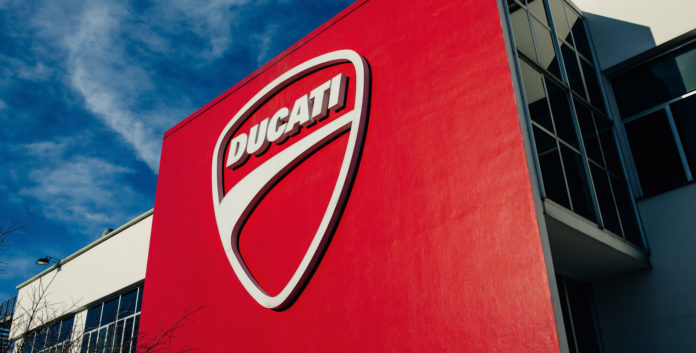
Ducati starts its engines again: new motorcycles soon to arrive in dealers
On Monday 27 April production will gradually start again at the Ducati factory in Borgo Panigale
Employees called to work will be the minimum necessary to carry out production and research activities and must comply with a rigid safety protocol developed together with the RSU and subject to a specific agreement. Masks will be mandatory for everyone, regardless of distancing
Claudio Domenicali: “It is absolutely essential to pay close attention to strict compliance with safety procedures: the virus has not disappeared. The work done jointly with the Emilia-Romagna Region has been important. It will be an extremely difficult year but starting up again is still a beginning; we have a lot of orders for the Streetfighter V4, for the Multistrada GT and for the Panigale V2. The motorbike is a perfect vehicle for ‘phase two’: no parking problems and distancing guaranteed; safety and fun at the same time.”
Borgo Panigale (Bologna, Italy) – Ducati is set to gradually return to normal, with the steady resumption of production in its Borgo Panigale factory, scheduled to begin on Monday April 27.
In compliance with the regulatory protocol for measures to combat and contain the spread of the Covid-19 virus in the workplace, Ducati temporarily suspended production in its Bologna plant on Friday 13 March to reorganize production schedules. Then came the decree that suspended all non-essential activities and therefore, despite the organization being ready, production did not restart. The gradual improvement in health conditions has allowed the government today to enable companies deemed strategic for the national economy, whose activity is mainly aimed at exports, and for which a prolongation of the suspension would risk losing our country additional market shares, to resume production.
This is a first phase of return, which at the moment will only involve a part of the workers destined for the production lines. Workshop staff will begin first, then engine assembly workers and, from Tuesday 28 April, motorcycle assembly workers. As for employees, the use of smart working will remain mandatory, only those who are not in a position to carry out their work from home will be allowed to access the factory. All resources employed in the commercial, marketing, IT, personnel management, finance, purchasing and logistics areas will therefore be working remotely. The production has been reorganized, going from an eight-hour shift to two seven-hour shifts to allow the minimum number of people to be inside the plant at the same time and thus minimize possible contact. The canteen will be active but with one seat for every four chairs.
The technicians engaged in Research and Development activities who cannot do their work from home were already at work as allowed by the specific ATECO code: therefore the engineers of the engine test rooms, those who carry out motorcycle tests and those who carry out laboratory testing are all present at Borgo Panigale. All designers, project managers, and those in the calculation department will work remotely. This will ensure the deliveries of Ducati motorcycles and the development of new products.
All the rules of conduct in force in Ducati comply with the updated shared protocol of April 24, and for some points they are even more restrictive. For example, inside the company there is an absolute requirement to use masks, regardless of distancing. The entire Ducati protocol is the result of the work of a joint commission between the company and the RSU (unified worker representation body) that was formed on February 23, just two days after the discovery of the first infected person in Italy. Many of the measures inserted are the result of a careful analysis of the protocols used in the Chinese plants of the VW Group, in particular the FAW-VW of Chanchung, where production was suspended only for one week but where strict protection, distancing and sanitizing measures are still in force.
“We are ready to go, we have worked hard over the past few weeks to minimize any risk,” said Claudio Domenicali, Ducati CEO. “Despite this we will have to be extremely cautious and rigorous. The virus is still in circulation and we must therefore be careful to combat any possible form of transmission. This is the reason why all the people present in the factory will wear masks, we must protect the population from the presence of asymptomatic positives who, although in a very small percentage, are present today and will not be identified by the mandatory temperature test. Serological tests can help but they represent only a snapshot; they should be repeated every day before entry, and this is obviously extremely difficult. This is why masks and distancing are so important. We will obviously adapt the protocols to the evolution of the health situation and to the indications given by the State and the Emilia-Romagna Region. We have been in constant touch with President Bonaccini, whom I thank for the support, with councillor Colla and with commissioner Venturi to prepare us better for this eventuality. The two-wheel market is highly seasonal, and the stop to production in March and April has already had negative effects on sales. The Chinese market is already booming, sales in Korea and Japan are doing well. In Germany, dealers have been open for a week and we already have a major shortage of product. I really believe that this restart can allow us to reduce at least in part the negative effects of the lockdown that we were forced to respect, unfortunately at the worst time. We have a splendid order book: the brand-new Streetfighter V4 just launched has obtained unanimous approval from the specialized press and is the undisputed queen of the category. Unfortunately, production was halted just one month after the start. Then there are also many orders for the Multistrada 1260 S Grand Tour and for the Panigale V2. We also have the empty warehouses of the Multistrada 950 and Ducati Scrambler 1100 PRO. I am convinced that in this ‘phase two’, the bike will prove to be an extraordinary means of combining fun, passion and the possibility of having a vehicle with which to spend the weekend but also to move around quickly and safely in the city, without any problems of parking or social distancing. I want to thank all Ducati employees who have patiently and collaboratively managed this very anomalous phase and are supporting us in the management of the restart.”
Despite the reopening of the production lines, Ducati confirms that visits to the Museum, Factory and Fisica in Moto continue to be suspended until further notice, in addition to entry into the factory being prohibited for suppliers, dealers, external contracted companies, and external staff in general, unless proven and unavoidably required for the continuity of production activities, product development and general services.
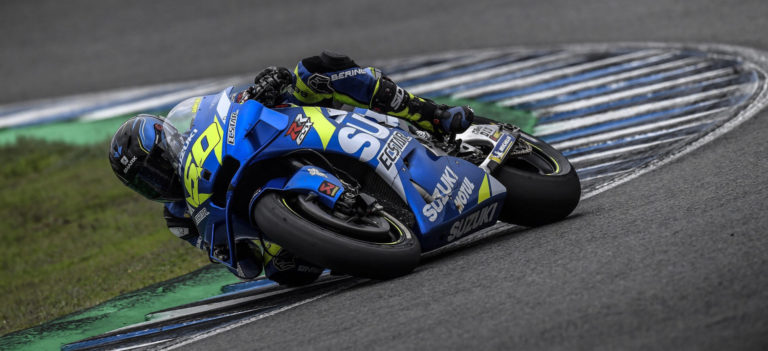
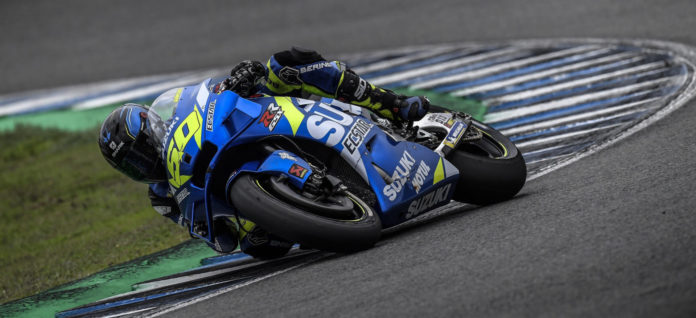
Former Superbike World Champion and current Suzuki MotoGP test rider Sylvain Guintoli explains short shifting and the benefits it can have when riding at the racetrack.
Chris Peris had told us he had leathers that we could borrow, but since I’m stupidly small, I knew no off-the-rack leathers would fit me. So Sam got me a custom-made, two-piece Vanson leather suit that I could wear on the street and the track. It’s crazy, I know. I’d ridden maybe a total of five hours on the street and I already had my own leathers—Vanson at that! But that’s what I mean when Sam makes sure I’m always prepared. So with my exquisitely fitted leathers, gloves, and a helmet and boots borrowed from Sam and Melissa, and 80 hours of dirt bike plus five hours of street riding experience, I ended up at Inde Motorsports Ranch in Tucson, Arizona.
Having ridden with Sam and Melissa, I may have been more well-prepared than any other young beginner street rider. But that didn’t make me any less nervous. I had no idea what to expect. Would the R3 be big, bulky, jerky, too powerful? Would the track be filled with other racers getting pissed at a tiny girl wobbling around on the track? Would I crash as much as I did on dirt bikes?
Having no idea what kind of day we were getting into, Sam, Melissa and I bought water and snacks from a Safeway and sandwiches from Subway to make sure we’d be adequately fueled and ready to ride our best. So we were pleasantly surprised when we arrived at Inde and realized it was nicer than any other racetrack I’d ever been to. It has an air-conditioned garage to change and hang out in, rental houses, actual bathrooms, showers, a clubhouse, fancy food made-to-order, an airplane museum, and a beautiful secluded glass-walled hilltop patio with a personal firepit. And the entire track is surrounded by the vast expanses of Arizona desert, with beautiful rocky mountains soaring on the horizon, the sky wide open in all directions.
Yamaha Champions Riding School instructor and Army of Darkness rider Chris Peris (left) explains explains to Hiyori Yoshida how trail-braking, or turning, loads the front tire and increases the contact patch.
Chris Peris greeted us as old friends, hugging us and laughing, super excited that we were there. Chris first raced with AOD at age 16, after which he raced in AMA Supersport for two years, World Supersport for another two years, and AMA Superbike from age 20, until he finally returned to AOD, with which he has since won four championships, on top of the one when he was 16! He started teaching racing in 2010 and has been working as an instructor for the Yamaha Champions Racing School with Nick Ienatsch, who was his racing instructor since 2014, when Chris was 13.
While his energy, humor, and youthful enthusiasm make him seem like he could be in college, Chris definitely knows how to teach. Sam and Melissa had told me the basic to-dos, including braking before turns and accelerating at the apex. But I never quite grasped why such techniques make the bike handle better until Chris grabbed a tire to demonstrate. He physically pushed against the tire, showing me how braking and compressing the forks pushes the tire down, increasing the contact area and therefore, traction.
Chris then told us to hop into our rented Tahoe and proceeded to drive onto the track. He started out slow, pointing out turns and describing how he’d set up cones to help me learn how to align the bike parallel to the apex to maximize exit acceleration. On the second lap he started driving the Tahoe like a race car, showing me how to brake into turns, increase lean angle, then sacrifice lean angle to accelerate out once the car was directed out of the turn. The brake pads and tires reeked of burnt friction compound and tread rubber as we raced around the track. Suddenly, Chris stops and says, “OK, your turn!” I looked up in surprise. “Wait what?! I’m not ready! No one told me I’d be driving an SUV like a race car today!” I thought to myself as he jumped out of the driver’s seat. I initially tried to steer around the turns like you would drive a normal car on a normal street, but by the second lap I got a feel for picking a line, braking gently into turns, lining up the car parallel to the apex, and accelerating out.
Once we got back from driving on the track, we suited up. I was glad I had all the gear, since that was one less thing to worry about. I felt comfortable in gear that I knew was good, and after Chris’s demonstration and getting a chance to test out his tips in the car, I felt more confident than I had that morning. But my heart was still racing. I nervously swung my leg over the R3, expecting it to be heavy, bulky, and too big for me (as most bikes are). But to my pleasant surprise, I could reach both toes to the ground! Although I knew I’d never put my feet down on the track, the fact that the bike was small enough that I could reach the ground made me feel less intimidated. As I reached for the throttle and clutch, hugging the gas tank, I was happy that the R3 was narrow and sleek, just like my KTM.
I followed Chris out of the pits for my first motorcycle ride on a racetrack. The track felt spacious, and to my great relief, Chris, Sam, Melissa and I had it all to ourselves. I felt nimble and free on the narrow R3 compared to lugging around in the Tahoe. I awkwardly maneuvered the bike through the first few turns as I subconsciously moved to the outside of the seat, pushing the bike down into the turns like a dirt bike. But as I noticed what my body was doing out of habit, I corrected myself and attempted to mimic Chris’s body position, hanging my body off the inside and looking out toward my shoulder into the turns. As I began to pick up more and more speed each time we went on the straightaway, I figured out that I needed to rev the engine super high (unlike dirt bikes) to be able to speed-shift. As I blipped the throttle and shifted into 4th and then into 5th gear, the engine reaching 13,000 rpm under me, and I felt almost like a badass racer.
Yamaha Champions Riding School instructor and Army of Darkness rider Chris Peris teaching Hiyori Yoshida proper sportbike riding body positioning. After years of learning to be positioned on the high side of the seat for dirt riding, it was a bit of an adjustment to be on the low side of the seat.
Before our second session on the track, Chris taught me body position. He first made me feel how my weight shifted on my toes as I stood on the ground and leaned my upper body to either side. He then made me sit on the bike. Inside butt off the seat. Knee out. Toe out. Ball of my foot on the footpeg. Ankle up with my knee against the gas tank. Lean into the turn. Inside shoulder open out towards the turn. Outer forearm straight against the gas tank. Fingers pointed away from the turn. Push the inner thigh of outside leg against the gas tank. Engage my abs. Relax my hands. Trying to remember all of this on top of everything I had just learned (choosing a line, braking, turning, getting direction, accelerating), I felt like there were a million things I had to feel and do simultaneously on the bike. When we went back out onto the track, I forgot many things at each turn. But each time, I remembered something else—“oh, don’t forget butt off the seat! Oh wait, also shoulder open!”—and tried to add that onto the list of things I was doing with my body and the bike in the next turn. Every time I did something right, I could see Chris giving me a thumbs up ahead of me.
After lunch in a civilized café at the track, the moment I had been hoping for came. Chris was going to show me what it’s like to actually race on a track, with me on the back of his motorcycle for a two-up ride. The first lap was fast but more peaceful than I thought it would be. I held onto the handles on the gas tank, turning my head into turns. It felt a lot like riding on the back of Sam’s FZ1 during our West Virginia street rides. But then Chris started picking up more and more speed. I felt my whole body being thrown backward, my head shoved back by the 145 mph wind as he sped down the straightaway. As he braked for the first turn, my whole body was thrown forward and I pushed as hard as I could against the gas tank, harder in those two seconds than I had throughout the earlier three sessions. The best part was when he accelerated over a small hill. I felt my heart jump into my throat while my brain was knocked around and squeezed in my helmet. The feeling of my insides flying around inside me was just like on a free-fall on a roller coaster, except we were going forward at immense speeds rather than downward. Sam had always described the exhilaration of “pulling Gs” on the racetrack, and I finally understood. And even though my body felt like it was being thrown around the racetrack in a whirlwind, I could tell Chris was still 100% under control. He braked for each turn, carefully increasing the tension on the brakes, aligning us parallel to the apex so he could open the throttle straight out of the turn.
Yamaha Champions Riding School instructor and Army of Darkness rider Chris Peris (right) used on-board video footage to help teach Hiyori Yoshida (left) how to ride a sportbike on a racetrack. Specifically, he is pointing out how in a double-apex turn she is looking to the second apex and then turning too early, instead of looking for the outside curbing to achieve a more proper line through the second apex.
When it was my turn to ride again, I realized how much more I could push myself and the bike. Being the cautious rider that I am, I didn’t go full-out with open throttle and full brakes. But with each turn, I pushed myself to look ahead and accelerate more as soon as I got direction in each turn. I learned to connect my eyes with the throttle like Chris had told me, rolling off the throttle and going for gentle but firm brake inputs, and trying to avoid extended periods of neutral throttle. Chris took some Go-Pro videos of me and explained what I was doing well and what I should work on in each turn. Seeing what I was actually doing rather than what I felt like I was doing really helped me visualize what more I could do, and that no matter how dangerously fast and leaned over I felt, I really wasn’t going that fast or leaning over that far and I could push myself further.
As we drove out of the track, the desert mountains loomed far on the horizon and an epic haboob swirled out in the desert. Rain started pattering on the windshield and the winds picked up even more, whistling wildly. As all the adrenaline simmered down and I realized that my day at the track was drawing to a close, a sudden melancholy grew in my throat. We had gotten six full half-hour sessions for a total of three hours of track riding, which was unheard of. But it went by so fast. “What if this is the last time I ever get to ride such a fun bike on such a beautiful track?” I thought. Sam, noticing the pensive look on my face, instantly knew what was spinning through my head.
“Oh, don’t worry! You’ll get to ride on a track again soon enough. And maybe next time we can take your KTM!” he reassured me.
Hiyori Yoshida on track aboard a Yamaha Champions Riding School YZF-R3 at Inde Motorsports Ranch. “She was riding precisely and applied every correction in the next session. I think she was doing great and, you know, the speed will come,” said coach Chris Peris.
Glowing, golden light shone through the oppressive clouds, beaming across the spectacular rocks. The magnificent silhouette of the desert mountains disappeared behind us as a breathtaking double rainbow glowed in the vast sky. A whole new world of challenge and excitement was awaiting me, and I couldn’t wait to get back on the racetrack.
If you wish you could be adopted into the Army Of Darkness but it seems like this dream isn’t going to come true, you can still train privately with Chris Peris and/or the Yamaha Champions Riding School. E-mail [email protected] or visit ridelikeachampion.com.
5,000 medical-grade masks to be distributed by county
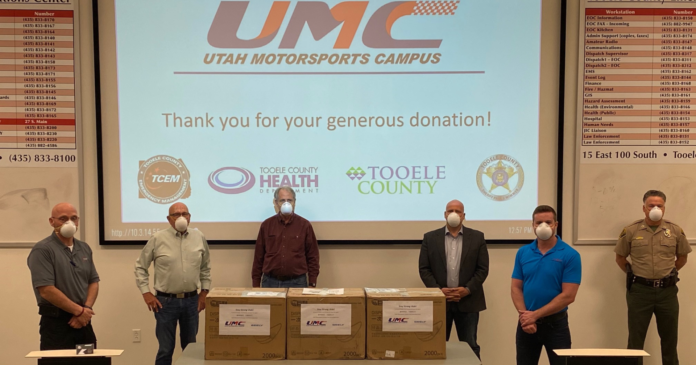
TOOELE VALLEY, UTAH — On Monday, April 20, representatives of Utah Motorsports Campus (UMC) delivered 5,000 medical-grade face masks to Tooele County to assist the community in the ongoing fight against the Coronavirus (COVID-19).
The masks were donated by UMC’s parent company, the Zhejiang Geely Holding Group (Geely), which purchased UMC from Tooele County in December 2018. Tooele County has set up a clearing-house operation to distribute donations to the most affected businesses in the most efficient manner.
“Tooele County is extremely grateful to our friends at UMC for this donation,” said Tooele County Commissioner Shawn Milne. “It will go to good use throughout our community with partner agencies that need them. This helps protect our community and ensure that we are ready should we need them. Tooele County appreciates the ongoing strong relationship between the county and UMC, and we look forward to a long and successful future together.”
“We are fortunate to be a small part of a very big global corporation,” said Dixon Hunt, UMC Senior Vice President. “Geely has facilities, and thousands of employees, located all over the world. They have been fighting hard to protect all their employees, and they have been outstanding in helping us here in Utah. We appreciate their support, and their generous donation of these masks to our community.”
“Tooele County, its officials and citizens, have been very warm and welcoming to us,” said William Lee, President of Mitime North America, the Geely division that oversees North American investments and operations. “They have made us feel at home, and we wanted to do something to give back to the community that we are so proud to be a part of.”
UMC is currently observing guidelines from the State of Utah and Tooele County and is closed to the public.
“We hope that everyone continues to follow the prescribed guidelines,” said Hunt, “and we look forward to welcoming everybody back to UMC once it is safe to do so.”
For event or ticket information, or for questions regarding UMC, call 435-277-8000 or visit the track’s website at www.UtahMotorsportsCampus.com.
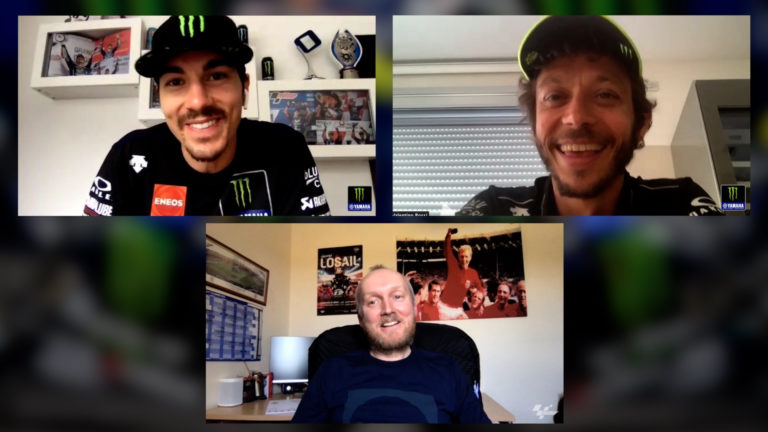
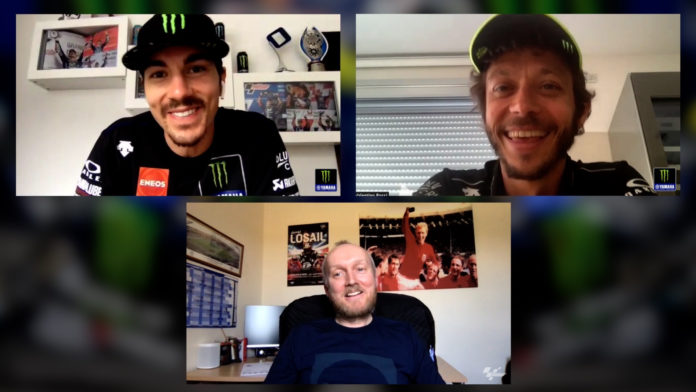
Monster Energy Yamaha MotoGP‘s Maverick Viñales and Valentino Rossi did a remote interview with renowned MotoGP commentator Matt Birt in an effort to share some honest thoughts as well as offer some much-needed comic relief during these uncertain times.
Monster Energy Yamaha MotoGP‘s Maverick Viñales and Valentino Rossi sat down in their respective homes to have a lighthearted, but at times also serious, chat with renowned MotoGP commentator Matt Birt.
On Monday 20 April, the Monster Energy Yamaha MotoGP team asked fans to share their questions for the Factory Yamaha duo on the team‘s social media channels. The best were picked, so Birt could get down to the topics that interest fans the most.
’What are Rossi‘s plans for 2021?‘, ’What are Viñales and Rossi‘s expectations for racing in 2020?‘, ’Why is Viñales so active in Covid-19 charity?‘, ’What does Rossi really think about Jorge Lorenzo being the test rider?‘, ’What does Viñales think about this being his last season as Rossi‘s team-mate and Fabio Quartararo becoming his team-mate?‘, ’Is Rossi still mad at Toni Elias for taking the 2006 championship away?‘, ’How does Viñales keep his heartrate so low during a race?‘, ’What words of encouragement would Rossi and Viñales say to healthcare professionals?‘, ’What MotoGP weekend would they like to relive over and over again?‘, and much, much more is revealed in this exclusive interview that will give fans plenty to think and talk about.
MotoAmerica Twins Cup Racebike Rental Program Offered by Hayden Schultz Racing
Hayden Schultz Racing and crew chief Gene Burcham are launching a race bike rental program for the MotoAmerica Twins Cup series on one of the team’s Yamaha FZ-07R. With a competitive bike and crew provided, this is a great opportunity for racers looking to make the step up to MotoAmerica racing. Rental spots are available for every round of the MotoAmerica series.
“MotoAmerica has provided a great opportunity for racers to get into pro racing with the Twins Cup. It has turned into arguably the most competitive class with large grids at every round. I am excited to offer an opportunity to race at the professional level with MotoAmerica. The team; Gene and Michael Burcham, Gary Jeffries, and Ron “Dink” Glidden have been working hard all offseason to provide great machinery. The opportunity to expand and offer rental spots became available and we thought this would be a great opportunity to expand the series to more riders.” said Hayden Schultz
For more details, pricing, and availability contact Hayden at [email protected]
The team thanks all their sponsors for making the program possible: Law Tigers, Brittenum Construction, Dreyer Motorsports, Wossner Pistons, Ohlins, 6D Helmets, Moto Liberty, RS Taichi, Ridgedale Homes, Woodcraft, Glidden Racing, Blud Lubricants, Robem Engineering
Roadracing World started this exclusive special feature recognizing the most promising young road racers as an answer to pessimists who claimed America had no new, up-and-coming young racers. This edition of the Roadracing World Young Gun Awards marks the 24th consecutive year of showcasing an abundance of new talent.
Roadracing World Young Guns have won:
FIM MotoGP and FIM Superbike races and World Championships;
AMA Pro races and Championships, including eight AMA Pro Superbike Championships;
A KTM RC Cup World Final race;
The Daytona 200 (8 times);
WERA National Endurance Championships and WERA National Challenge Championships;
ASRA/Formula USA Grand National and CCS National Championships;
AMA Road Racing Grand Championships and Horizon Awards;
USGPRU National Championships;
Many regional and local titles.
The competition has continually become more intense as more – and younger—racers with higher levels of accomplishment are nominated, and the level of achievement required to make the grade keeps getting tougher.
We’ve spent the last several months accepting nominations and evaluating road racers between the ages of 11 and 18 (as of the start of the 2020 season) who have, at a minimum, won Expert-level road races and/or Championships on a 125cc two-stroke/250cc four-stroke or larger racebike or had outstanding results as an Amateur/Novice. Most of the riders included here have done far more than the minimum.
The young riders recognized here are the most promising young road racers in North America. All have earned the title of Roadracing World Young Gun.
We will feature one Young Gun per day, presenting them in alphabetical order.
Kayla Yaakov. Photo by David Yaakov.
Kayla Yaakov
Age: 12.
Current home: Gettysburg, Pennsylvania.
Current height/weight: 5’1”/100 pounds.
Current school grade level: 7th grade.
Began riding at age: 4 years.
First road race: 2017, Talladega, Alabama, WERA, 3 different classes, 1st place in all.
Current racebikes: Honda NSF250R, Kramer HKR EVO 2.
Current tuner/mechanic: Dave Yaakov (father).
Primary race series: WERA, CCS/ASRA.
Top sponsors: One-X Custom Leathers, Shoei, SBS Brakes, Spectro Oil, Cox Racing Group, Helite Airvest, Jennings GP, Sportbike Track Time, N2 Racing, Magura USA, Yoshimura.
Recent racing accomplishments: 2019 season, won Lightweight Twins Superbike Expert AMA Grand Championship, won 3 WERA Sportsman Series Regional Championships (won 38 WERA races); 2018 season, named AMA Novice Road Racer of the Year, won 2 AMA Road Race Grand National Championships, won 5 WERA Sportsman National Championships, won 4 WERA Sportsman Regional Championships, won ASRA Moto3 (Combined) National race, 41 WERA race wins; 2017 season, named AMA Youth Road Racer of the Year, won 3 WERA Sportsman National Championships, won 5 WERA Sportsman Regional Championships, 37 WERA race wins.
2020 racing goal: Continue to improve and to win.
Racing career goal: Win at the MotoAmerica and World Championship level.
Our world has changed due to COVID-19, at least for now. Dunlop sends thoughts and prayers to everyone impacted by the virus. We also want to give a HUGE THANK YOU to all the first responders and our health care workers on the front line battling this virus. We look forward to when we can all return to riding and racing, to feeding our passion once again. In the meantime, we created this video to encourage everyone to stay strong and keep your passion alive. ENJOY! #wearedunlop #staystrong #firstresponders #love
About Dunlop Motorcycle Tires
Dunlop is the largest supplier of original equipment and replacement motorcycle tires in the U.S.A. For more information, visit www.dunlopmotorcycletires.com.
I feel the pressure in my arms as I hear Chris Peris’ mantra, “brakebrakebrake,” in my head as the forks compress, turning into the apex onto the straightaway. I hunch low on the gas tank, my right wrist holding the throttle wide open. I finally get the speedshift right and catch 4th, 5th, then finally, 6th gear. I can’t help but grin, my cheeks pressed against the sides of my helmet. For the first time, I feel like I’m letting the motorcycle fly free at its full capacity, with no trees, ruts, cars, or speed limits, and full traction.
Five years ago, racing into a 20-mph headwind chasing five-time Army of Darkness WERA National Endurance Champion Chris Peris astride a Yamaha YZF-R3 would have never seemed possible to the 15-year-old, quiet girl living in Japan. Growing up in Japan, I was taught to be respectful and not stand out, ever. I feared motorcycles and anyone associated with these loud, large, dangerous vehicles, since in Japan, motorcycles are taboos that provoke affiliations with the mysterious and scary Japanese gangster mob, the Yakuza. My wariness about motorcycles completely flipped when I got adopted by the captains of the multi-time WERA National Endurance Championship-winning team known as Army of Darkness (AOD).
Hiyori Yoshida (45) on track with adoptive parents Sam Fleming and Melissa Berkoff during a Yamaha Champions Riding School at Inde Motorsports Ranch, in Arizona.
Sam Fleming and Melissa Berkoff, my new parents, were the most adventurous, maybe crazy, and definitely loving parents I could’ve asked for. The first wheelie on an exhilarating street ride on Sam’s FZ1 made me realize that motorcycles are not that bad. In fact, they’re pretty damn fun. Sam and Melissa have made me realize this about many things, including rock climbing, SCUBA diving, and just living life in general.
I can safely say that, had I never left Japan, I would have lived my life never having heard of, let alone touching, a clutch. Motorcycles are loud and dangerous. Girls are dutiful and conform to kawaii (the Japanese culture of cute, liking Hello Kitty). And that’s that in Japan. When Sam first took me on the back of his motorcycle, I never would’ve imagined being the one to control such a beautiful, complex, powerful animal. But, of course, it would have been unacceptable for the daughter of the AOD to not be able to ride.
Sam first taught me how to ride on a Yamaha TT-R125 dirt bike (bored out to 150cc!) in the grassy fields surrounding the family cabin in West Virginia. My enthusiasm for motorcycle riding didn’t blossom as quickly as one would expect, partly because I still felt like such a loud, seemingly reckless activity was not meant for me and partly because anything beyond noodling around flat, treeless fields inevitably led to me lying in the grass, my dirt bike sputtering miserably beside me. But as Sam, Melissa, and various family friends and racers — including Ben Walters from AOD — taught me about throttle control, body position, braking, and counter-steering, I began to enjoy the challenges of counter-balancing the bike into tight turns, blipping over logs, carrying momentum up rooty hills, and even the occasional wheelie.
After a few months on the TT-R, Melissa let me try her Honda CRF150RB. It was love at first ride. The geometry, the power, the height, everything felt faster and a lot more challenging. I got my own CRF150RB, and it has been my favorite bike ever since. But it took me a whole summer to learn to ride the CRF. The first summer that I spent trying to tame it was blisteringly hot, suffocatingly humid, and mostly involved me throwing my bike on the ground or it throwing me off into the trees. With 10+ hours of repeating this cycle of crashing, getting banged up, and picking myself and my bike up off the ground, I got better and better at controlling the throttle and positioning myself to allow the bike to do what I wanted.
There are two things that Sam and Melissa have taught me that have enabled me to physically keep up with and enjoy not just the riding, but everything else we do: Physical conditioning, and risk mitigation. The only reason I can physically ride, crash, pick up my bike, and keep riding is because I consistently train at the gym and eat as healthily as possible. And the way I treat my body is the way I’ve learned to treat my bike. To be able to function at its best, Sam has taught me that I have to constantly maintain my bike. I have grown to really enjoy spending the afternoons with Sam and our other riding buddies in our garage, changing the oil, cleaning the air filter, adjusting valves, cleaning the pilot jet, and changing tires — all to make sure that when we go out there, our bikes are as ready as we are. Our risk mitigation doesn’t end in the garage. Before we ride, we check the fuel, tire pressures, and chain tension, and bleed the air from the forks. When we ride, we always wear all the gear — body armor, knee braces, boots, helmet, and gloves. We also check each other’s gear and bikes so everyone on the ride is as prepared as possible.
In all honesty, all of that training and preparation is probably how I’ve had some spectacular crashes (like high-siding over the handlebars and landing face-first in hard-packed dirt, or somehow pinning my arm between the bark-busters and a tree twice as wide as myself) yet have gotten away with nothing worse than swollen bruises and sore muscles. This is why when I took the MSF (Motorcycle Safety Foundation) street riding class, while nothing but jeans, boots, and a jacket were required, I brought my own body armor and one of Sam’s many full-face helmets to the parking lot training. It was probably overkill since all we did was do some exercises in the parking lot, but I didn’t want to risk it. If you have the gear, I thought, wear it all the time!
(From left) Melissa Berkoff, Yamaha Champions Riding School instructor Chris Peris, Hiyori Yoshida, and Sam Fleming at Inde Motorsports Ranch, in Arizona.
After getting my motorcycle license, I couldn’t wait to try riding on the street. One day, when I was walking on my college campus, I found a super cool-looking, sleek, orange bike— a KTM Duke 390. I snapped a photo and texted it to Sam, as I do whenever I spot any cool bikes around campus. It turns out the 390 is a good beginner’s streetbike, and Sam found a used one upon which we remapped the FI and upgraded the suspension. The first couple of times Sam and Melissa took me out on the street on my new KTM, I had fun, but I felt restrained. Coming from dirt biking where I could do whatever I wanted wherever I wanted, in the grass, the mud, the trees, on hills, and in creeks, I felt like I was not fully enjoying the power and freedom that my KTM had to offer on the busy streets of suburban Washington, DC.
I began to wonder what riding on a track was like, where there were no traffic lights and pedestrians, just turns, hills, and other motorcycles. Plus, Melissa insisted that I get some track training to understand how much I could ask from a bike when needed. So when AOD racer Chris Peris offered to train me at a racetrack in Arizona, I knew this was the opportunity I had been waiting for.
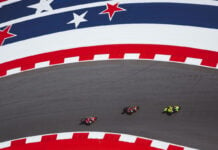
The start of the Suzuka 8-Hours race in 2019. Photo by Kohei Hirota.
NEW DATE FOR THE 43RD EDITION OF THE SUZUKA 8 HOURS
Following Japan’s declaration of a nationwide state of emergency to combat the Covid-19 pandemic, the Suzuka 8 Hours race has been postponed to 1 November 2020. The iconic race – grand finale of the FIM Endurance World Championship since the 2016/2017 season – will once again feature as the deciding race of the 2019/2020 season.
The FIM-International Motorcycling Federation, FIM EWC promoter Eurosport Events and Mobilityland, organizer of the Suzuka 8 Hours, have decided to postpone the race, initially scheduled to be held on 19 July 2020, to a new date: Sunday 1 November.
With border entry restrictions currently in effect in Japan making it impossible for Suzuka to host teams and riders from countries affected by coronavirus, the race has been postponed to later in the year.
Historically held in summer, ever since the first edition in 1978, the Suzuka 8 Hours will take place for the very first time in Autumn in 2020. In close collaboration with race organizer Mobilityland, the iconic Japanese race was promoted to the status of FIM EWC grand finale in 2017.
As the FIM EWC season final event, the 8-hour race will benefit from the bonus of 150% of the points.
The FIM, Eurosport Events and the various race organizers have together restructured the ongoing season calendar to ensure the number of races initially scheduled in the championship take place. The 2019-2020 season will therefore continue with the 24 Heures Motos (29 and 30 August 2020) followed by the Bol d’Or (19 and 20 September), and conclude with the FIM EWC grand finale at Suzuka on 1 November.
François Ribeiro, Head of Eurosport Events
“The global health crisis, the logistical constraints resulting from Japan’s entry restrictions and our priority to protect the health of everyone involved in the FIM EWC, have made it necessary to postpone the Suzuka 8 Hours. Praise is due to Mobilityland for adapting the Suzuka calendar to ensure that this major race in the championship remains Japan’s biggest celebration for motorcycling fans. To help teams with their logistics requirements in the opening phase of the 2020-2021 FIM EWC season, we will push back the date of the 8 Hours of Sepang to January if necessary, just ahead of the customary SBK/GP pre- tests on the circuit.”
Kaoru Tanaka, President of Mobilityland Corporation
“We had been preparing for the ‘Coca-Cola’ Suzuka 8 Hours Endurance Road Race to be held in July, but have decided to postpone it in consideration of the current situation in which there is prohibition of large-scale events that attract large numbers of people and restriction of travel is expected to continue to increase in European countries. We ask for the kind understanding of all the fans who were looking forward to attending the Suzuka 8 Hours for this unavoidable postponement and of all the other stakeholders involved in this race event. We will make due preparations so that we can welcome the start of the event on November 1st together with all the fans and stakeholders involved in this event.”
Jorge Viegas, FIM President
“Who would have ever imagined that the 8 Hours of Suzuka would have to be postponed just a few weeks ago? However, we must keep strong and do whatever is in our power to return to racing, as soon as possible, without taking any unnecessary risks. I am sure that the faithful spectators of Suzuka will enjoy a great show again and that this iconic race will retain its special place in the FIM Endurance World Championship. I would like to take this opportunity to thank all the efforts of the Japanese Motorcycling Federation (MFJ), Mobilityland Corporation and of course Eurosport Events!”
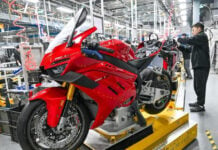
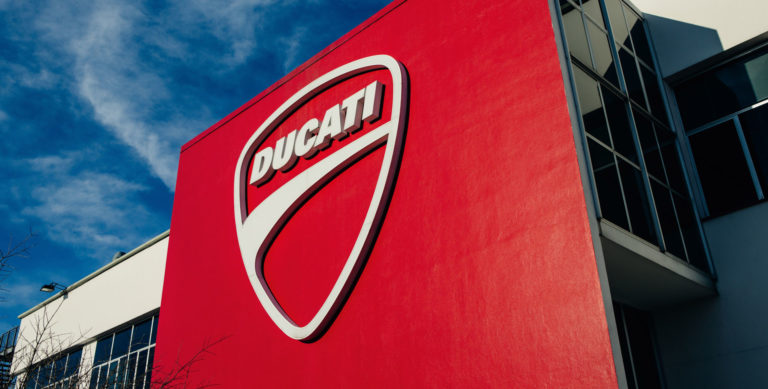
The Ducati factory in Italy. Photo courtesy of Ducati.
Ducati starts its engines again: new motorcycles soon to arrive in dealers
On Monday 27 April production will gradually start again at the Ducati factory in Borgo Panigale
Employees called to work will be the minimum necessary to carry out production and research activities and must comply with a rigid safety protocol developed together with the RSU and subject to a specific agreement. Masks will be mandatory for everyone, regardless of distancing
Claudio Domenicali: “It is absolutely essential to pay close attention to strict compliance with safety procedures: the virus has not disappeared. The work done jointly with the Emilia-Romagna Region has been important. It will be an extremely difficult year but starting up again is still a beginning; we have a lot of orders for the Streetfighter V4, for the Multistrada GT and for the Panigale V2. The motorbike is a perfect vehicle for ‘phase two’: no parking problems and distancing guaranteed; safety and fun at the same time.”
Borgo Panigale (Bologna, Italy) – Ducati is set to gradually return to normal, with the steady resumption of production in its Borgo Panigale factory, scheduled to begin on Monday April 27.
In compliance with the regulatory protocol for measures to combat and contain the spread of the Covid-19 virus in the workplace, Ducati temporarily suspended production in its Bologna plant on Friday 13 March to reorganize production schedules. Then came the decree that suspended all non-essential activities and therefore, despite the organization being ready, production did not restart. The gradual improvement in health conditions has allowed the government today to enable companies deemed strategic for the national economy, whose activity is mainly aimed at exports, and for which a prolongation of the suspension would risk losing our country additional market shares, to resume production.
This is a first phase of return, which at the moment will only involve a part of the workers destined for the production lines. Workshop staff will begin first, then engine assembly workers and, from Tuesday 28 April, motorcycle assembly workers. As for employees, the use of smart working will remain mandatory, only those who are not in a position to carry out their work from home will be allowed to access the factory. All resources employed in the commercial, marketing, IT, personnel management, finance, purchasing and logistics areas will therefore be working remotely. The production has been reorganized, going from an eight-hour shift to two seven-hour shifts to allow the minimum number of people to be inside the plant at the same time and thus minimize possible contact. The canteen will be active but with one seat for every four chairs.
The technicians engaged in Research and Development activities who cannot do their work from home were already at work as allowed by the specific ATECO code: therefore the engineers of the engine test rooms, those who carry out motorcycle tests and those who carry out laboratory testing are all present at Borgo Panigale. All designers, project managers, and those in the calculation department will work remotely. This will ensure the deliveries of Ducati motorcycles and the development of new products.
All the rules of conduct in force in Ducati comply with the updated shared protocol of April 24, and for some points they are even more restrictive. For example, inside the company there is an absolute requirement to use masks, regardless of distancing. The entire Ducati protocol is the result of the work of a joint commission between the company and the RSU (unified worker representation body) that was formed on February 23, just two days after the discovery of the first infected person in Italy. Many of the measures inserted are the result of a careful analysis of the protocols used in the Chinese plants of the VW Group, in particular the FAW-VW of Chanchung, where production was suspended only for one week but where strict protection, distancing and sanitizing measures are still in force.
“We are ready to go, we have worked hard over the past few weeks to minimize any risk,” said Claudio Domenicali, Ducati CEO. “Despite this we will have to be extremely cautious and rigorous. The virus is still in circulation and we must therefore be careful to combat any possible form of transmission. This is the reason why all the people present in the factory will wear masks, we must protect the population from the presence of asymptomatic positives who, although in a very small percentage, are present today and will not be identified by the mandatory temperature test. Serological tests can help but they represent only a snapshot; they should be repeated every day before entry, and this is obviously extremely difficult. This is why masks and distancing are so important. We will obviously adapt the protocols to the evolution of the health situation and to the indications given by the State and the Emilia-Romagna Region. We have been in constant touch with President Bonaccini, whom I thank for the support, with councillor Colla and with commissioner Venturi to prepare us better for this eventuality. The two-wheel market is highly seasonal, and the stop to production in March and April has already had negative effects on sales. The Chinese market is already booming, sales in Korea and Japan are doing well. In Germany, dealers have been open for a week and we already have a major shortage of product. I really believe that this restart can allow us to reduce at least in part the negative effects of the lockdown that we were forced to respect, unfortunately at the worst time. We have a splendid order book: the brand-new Streetfighter V4 just launched has obtained unanimous approval from the specialized press and is the undisputed queen of the category. Unfortunately, production was halted just one month after the start. Then there are also many orders for the Multistrada 1260 S Grand Tour and for the Panigale V2. We also have the empty warehouses of the Multistrada 950 and Ducati Scrambler 1100 PRO. I am convinced that in this ‘phase two’, the bike will prove to be an extraordinary means of combining fun, passion and the possibility of having a vehicle with which to spend the weekend but also to move around quickly and safely in the city, without any problems of parking or social distancing. I want to thank all Ducati employees who have patiently and collaboratively managed this very anomalous phase and are supporting us in the management of the restart.”
Despite the reopening of the production lines, Ducati confirms that visits to the Museum, Factory and Fisica in Moto continue to be suspended until further notice, in addition to entry into the factory being prohibited for suppliers, dealers, external contracted companies, and external staff in general, unless proven and unavoidably required for the continuity of production activities, product development and general services.
Sylvain Guintoli (50) testing a Suzuki GSX-RR at Jerez in November 2019. Photo courtesy of Team Suzuki Press Office.
Former Superbike World Champion and current Suzuki MotoGP test rider Sylvain Guintoli explains short shifting and the benefits it can have when riding at the racetrack.
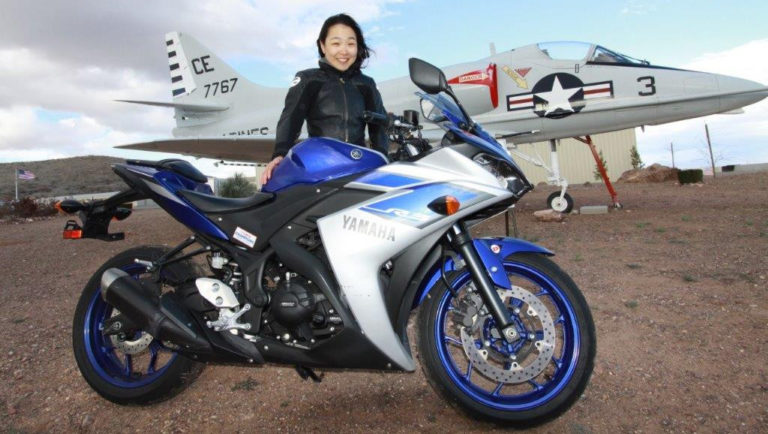
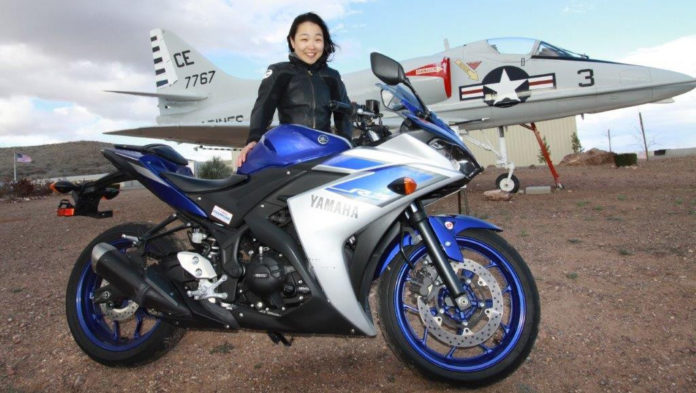
Engineering student and motorcycle enthusiast Hiyori Yoshida with a Yamaha Champions Riding School YZF-R3 at Inde Motorsports Ranch, in Arizona.
FIRST PERSON/OPINION:
My First Time On The Racetrack, Part 2
By Hiyori Yoshida
Chris Peris had told us he had leathers that we could borrow, but since I’m stupidly small, I knew no off-the-rack leathers would fit me. So Sam got me a custom-made, two-piece Vanson leather suit that I could wear on the street and the track. It’s crazy, I know. I’d ridden maybe a total of five hours on the street and I already had my own leathers—Vanson at that! But that’s what I mean when Sam makes sure I’m always prepared. So with my exquisitely fitted leathers, gloves, and a helmet and boots borrowed from Sam and Melissa, and 80 hours of dirt bike plus five hours of street riding experience, I ended up at Inde Motorsports Ranch in Tucson, Arizona.
Having ridden with Sam and Melissa, I may have been more well-prepared than any other young beginner street rider. But that didn’t make me any less nervous. I had no idea what to expect. Would the R3 be big, bulky, jerky, too powerful? Would the track be filled with other racers getting pissed at a tiny girl wobbling around on the track? Would I crash as much as I did on dirt bikes?
Having no idea what kind of day we were getting into, Sam, Melissa and I bought water and snacks from a Safeway and sandwiches from Subway to make sure we’d be adequately fueled and ready to ride our best. So we were pleasantly surprised when we arrived at Inde and realized it was nicer than any other racetrack I’d ever been to. It has an air-conditioned garage to change and hang out in, rental houses, actual bathrooms, showers, a clubhouse, fancy food made-to-order, an airplane museum, and a beautiful secluded glass-walled hilltop patio with a personal firepit. And the entire track is surrounded by the vast expanses of Arizona desert, with beautiful rocky mountains soaring on the horizon, the sky wide open in all directions.
Yamaha Champions Riding School instructor and Army of Darkness rider Chris Peris (left) explains explains to Hiyori Yoshida how trail-braking, or turning, loads the front tire and increases the contact patch.
Chris Peris greeted us as old friends, hugging us and laughing, super excited that we were there. Chris first raced with AOD at age 16, after which he raced in AMA Supersport for two years, World Supersport for another two years, and AMA Superbike from age 20, until he finally returned to AOD, with which he has since won four championships, on top of the one when he was 16! He started teaching racing in 2010 and has been working as an instructor for the Yamaha Champions Racing School with Nick Ienatsch, who was his racing instructor since 2014, when Chris was 13.
While his energy, humor, and youthful enthusiasm make him seem like he could be in college, Chris definitely knows how to teach. Sam and Melissa had told me the basic to-dos, including braking before turns and accelerating at the apex. But I never quite grasped why such techniques make the bike handle better until Chris grabbed a tire to demonstrate. He physically pushed against the tire, showing me how braking and compressing the forks pushes the tire down, increasing the contact area and therefore, traction.
Chris then told us to hop into our rented Tahoe and proceeded to drive onto the track. He started out slow, pointing out turns and describing how he’d set up cones to help me learn how to align the bike parallel to the apex to maximize exit acceleration. On the second lap he started driving the Tahoe like a race car, showing me how to brake into turns, increase lean angle, then sacrifice lean angle to accelerate out once the car was directed out of the turn. The brake pads and tires reeked of burnt friction compound and tread rubber as we raced around the track. Suddenly, Chris stops and says, “OK, your turn!” I looked up in surprise. “Wait what?! I’m not ready! No one told me I’d be driving an SUV like a race car today!” I thought to myself as he jumped out of the driver’s seat. I initially tried to steer around the turns like you would drive a normal car on a normal street, but by the second lap I got a feel for picking a line, braking gently into turns, lining up the car parallel to the apex, and accelerating out.
Once we got back from driving on the track, we suited up. I was glad I had all the gear, since that was one less thing to worry about. I felt comfortable in gear that I knew was good, and after Chris’s demonstration and getting a chance to test out his tips in the car, I felt more confident than I had that morning. But my heart was still racing. I nervously swung my leg over the R3, expecting it to be heavy, bulky, and too big for me (as most bikes are). But to my pleasant surprise, I could reach both toes to the ground! Although I knew I’d never put my feet down on the track, the fact that the bike was small enough that I could reach the ground made me feel less intimidated. As I reached for the throttle and clutch, hugging the gas tank, I was happy that the R3 was narrow and sleek, just like my KTM.
I followed Chris out of the pits for my first motorcycle ride on a racetrack. The track felt spacious, and to my great relief, Chris, Sam, Melissa and I had it all to ourselves. I felt nimble and free on the narrow R3 compared to lugging around in the Tahoe. I awkwardly maneuvered the bike through the first few turns as I subconsciously moved to the outside of the seat, pushing the bike down into the turns like a dirt bike. But as I noticed what my body was doing out of habit, I corrected myself and attempted to mimic Chris’s body position, hanging my body off the inside and looking out toward my shoulder into the turns. As I began to pick up more and more speed each time we went on the straightaway, I figured out that I needed to rev the engine super high (unlike dirt bikes) to be able to speed-shift. As I blipped the throttle and shifted into 4th and then into 5th gear, the engine reaching 13,000 rpm under me, and I felt almost like a badass racer.
Yamaha Champions Riding School instructor and Army of Darkness rider Chris Peris teaching Hiyori Yoshida proper sportbike riding body positioning. After years of learning to be positioned on the high side of the seat for dirt riding, it was a bit of an adjustment to be on the low side of the seat.
Before our second session on the track, Chris taught me body position. He first made me feel how my weight shifted on my toes as I stood on the ground and leaned my upper body to either side. He then made me sit on the bike. Inside butt off the seat. Knee out. Toe out. Ball of my foot on the footpeg. Ankle up with my knee against the gas tank. Lean into the turn. Inside shoulder open out towards the turn. Outer forearm straight against the gas tank. Fingers pointed away from the turn. Push the inner thigh of outside leg against the gas tank. Engage my abs. Relax my hands. Trying to remember all of this on top of everything I had just learned (choosing a line, braking, turning, getting direction, accelerating), I felt like there were a million things I had to feel and do simultaneously on the bike. When we went back out onto the track, I forgot many things at each turn. But each time, I remembered something else—“oh, don’t forget butt off the seat! Oh wait, also shoulder open!”—and tried to add that onto the list of things I was doing with my body and the bike in the next turn. Every time I did something right, I could see Chris giving me a thumbs up ahead of me.
After lunch in a civilized café at the track, the moment I had been hoping for came. Chris was going to show me what it’s like to actually race on a track, with me on the back of his motorcycle for a two-up ride. The first lap was fast but more peaceful than I thought it would be. I held onto the handles on the gas tank, turning my head into turns. It felt a lot like riding on the back of Sam’s FZ1 during our West Virginia street rides. But then Chris started picking up more and more speed. I felt my whole body being thrown backward, my head shoved back by the 145 mph wind as he sped down the straightaway. As he braked for the first turn, my whole body was thrown forward and I pushed as hard as I could against the gas tank, harder in those two seconds than I had throughout the earlier three sessions. The best part was when he accelerated over a small hill. I felt my heart jump into my throat while my brain was knocked around and squeezed in my helmet. The feeling of my insides flying around inside me was just like on a free-fall on a roller coaster, except we were going forward at immense speeds rather than downward. Sam had always described the exhilaration of “pulling Gs” on the racetrack, and I finally understood. And even though my body felt like it was being thrown around the racetrack in a whirlwind, I could tell Chris was still 100% under control. He braked for each turn, carefully increasing the tension on the brakes, aligning us parallel to the apex so he could open the throttle straight out of the turn.
Yamaha Champions Riding School instructor and Army of Darkness rider Chris Peris (right) used on-board video footage to help teach Hiyori Yoshida (left) how to ride a sportbike on a racetrack. Specifically, he is pointing out how in a double-apex turn she is looking to the second apex and then turning too early, instead of looking for the outside curbing to achieve a more proper line through the second apex.
When it was my turn to ride again, I realized how much more I could push myself and the bike. Being the cautious rider that I am, I didn’t go full-out with open throttle and full brakes. But with each turn, I pushed myself to look ahead and accelerate more as soon as I got direction in each turn. I learned to connect my eyes with the throttle like Chris had told me, rolling off the throttle and going for gentle but firm brake inputs, and trying to avoid extended periods of neutral throttle. Chris took some Go-Pro videos of me and explained what I was doing well and what I should work on in each turn. Seeing what I was actually doing rather than what I felt like I was doing really helped me visualize what more I could do, and that no matter how dangerously fast and leaned over I felt, I really wasn’t going that fast or leaning over that far and I could push myself further.
As we drove out of the track, the desert mountains loomed far on the horizon and an epic haboob swirled out in the desert. Rain started pattering on the windshield and the winds picked up even more, whistling wildly. As all the adrenaline simmered down and I realized that my day at the track was drawing to a close, a sudden melancholy grew in my throat. We had gotten six full half-hour sessions for a total of three hours of track riding, which was unheard of. But it went by so fast. “What if this is the last time I ever get to ride such a fun bike on such a beautiful track?” I thought. Sam, noticing the pensive look on my face, instantly knew what was spinning through my head.
“Oh, don’t worry! You’ll get to ride on a track again soon enough. And maybe next time we can take your KTM!” he reassured me.
Hiyori Yoshida on track aboard a Yamaha Champions Riding School YZF-R3 at Inde Motorsports Ranch. “She was riding precisely and applied every correction in the next session. I think she was doing great and, you know, the speed will come,” said coach Chris Peris.
Glowing, golden light shone through the oppressive clouds, beaming across the spectacular rocks. The magnificent silhouette of the desert mountains disappeared behind us as a breathtaking double rainbow glowed in the vast sky. A whole new world of challenge and excitement was awaiting me, and I couldn’t wait to get back on the racetrack.
If you wish you could be adopted into the Army Of Darkness but it seems like this dream isn’t going to come true, you can still train privately with Chris Peris and/or the Yamaha Champions Riding School. E-mail [email protected] or visit ridelikeachampion.com.
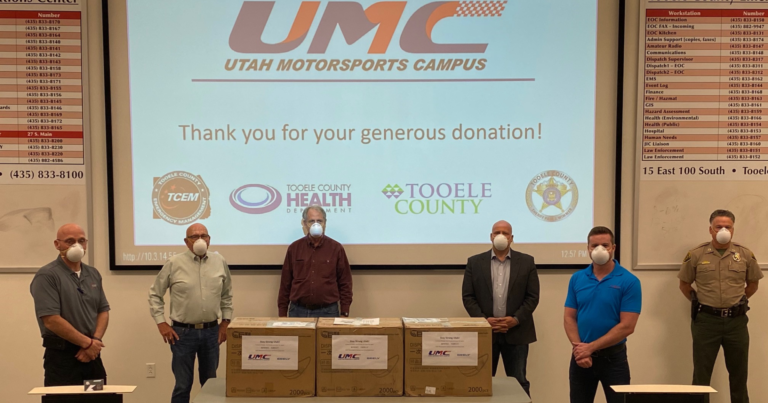
Utah Motorsports Campus donates 5,000 medical-grade face masks to Tooele County. Pictured left to right are: Bucky Whitehouse, Tooele County Emergency Manager; Kendall Thomas, Tooele County Commissioner; Tom Tripp, Tooele County Commissioner; Shawn Milne, Tooele County Commissioner; Dixon Hunt, UMC Senior Vice President; Paul Wimmer, Tooele County Sheriff. Photo courtesy of Utah Motorsports Campus.
5,000 medical-grade masks to be distributed by county
TOOELE VALLEY, UTAH — On Monday, April 20, representatives of Utah Motorsports Campus (UMC) delivered 5,000 medical-grade face masks to Tooele County to assist the community in the ongoing fight against the Coronavirus (COVID-19).
The masks were donated by UMC’s parent company, the Zhejiang Geely Holding Group (Geely), which purchased UMC from Tooele County in December 2018. Tooele County has set up a clearing-house operation to distribute donations to the most affected businesses in the most efficient manner.
“Tooele County is extremely grateful to our friends at UMC for this donation,” said Tooele County Commissioner Shawn Milne. “It will go to good use throughout our community with partner agencies that need them. This helps protect our community and ensure that we are ready should we need them. Tooele County appreciates the ongoing strong relationship between the county and UMC, and we look forward to a long and successful future together.”
“We are fortunate to be a small part of a very big global corporation,” said Dixon Hunt, UMC Senior Vice President. “Geely has facilities, and thousands of employees, located all over the world. They have been fighting hard to protect all their employees, and they have been outstanding in helping us here in Utah. We appreciate their support, and their generous donation of these masks to our community.”
“Tooele County, its officials and citizens, have been very warm and welcoming to us,” said William Lee, President of Mitime North America, the Geely division that oversees North American investments and operations. “They have made us feel at home, and we wanted to do something to give back to the community that we are so proud to be a part of.”
UMC is currently observing guidelines from the State of Utah and Tooele County and is closed to the public.
“We hope that everyone continues to follow the prescribed guidelines,” said Hunt, “and we look forward to welcoming everybody back to UMC once it is safe to do so.”
For event or ticket information, or for questions regarding UMC, call 435-277-8000 or visit the track’s website at www.UtahMotorsportsCampus.com.
Monster Energy Yamaha MotoGP‘s Maverick Viñales and Valentino Rossi did a remote interview with renowned MotoGP commentator Matt Birt in an effort to share some honest thoughts as well as offer some much-needed comic relief during these uncertain times.
Monster Energy Yamaha MotoGP‘s Maverick Viñales and Valentino Rossi sat down in their respective homes to have a lighthearted, but at times also serious, chat with renowned MotoGP commentator Matt Birt.
On Monday 20 April, the Monster Energy Yamaha MotoGP team asked fans to share their questions for the Factory Yamaha duo on the team‘s social media channels. The best were picked, so Birt could get down to the topics that interest fans the most.
’What are Rossi‘s plans for 2021?‘, ’What are Viñales and Rossi‘s expectations for racing in 2020?‘, ’Why is Viñales so active in Covid-19 charity?‘, ’What does Rossi really think about Jorge Lorenzo being the test rider?‘, ’What does Viñales think about this being his last season as Rossi‘s team-mate and Fabio Quartararo becoming his team-mate?‘, ’Is Rossi still mad at Toni Elias for taking the 2006 championship away?‘, ’How does Viñales keep his heartrate so low during a race?‘, ’What words of encouragement would Rossi and Viñales say to healthcare professionals?‘, ’What MotoGP weekend would they like to relive over and over again?‘, and much, much more is revealed in this exclusive interview that will give fans plenty to think and talk about.
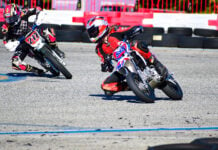
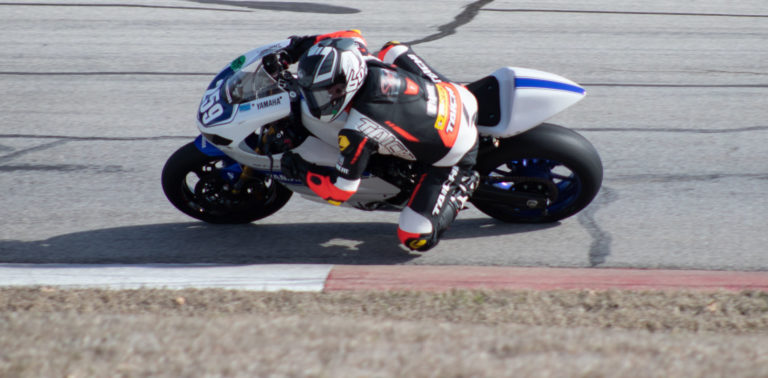
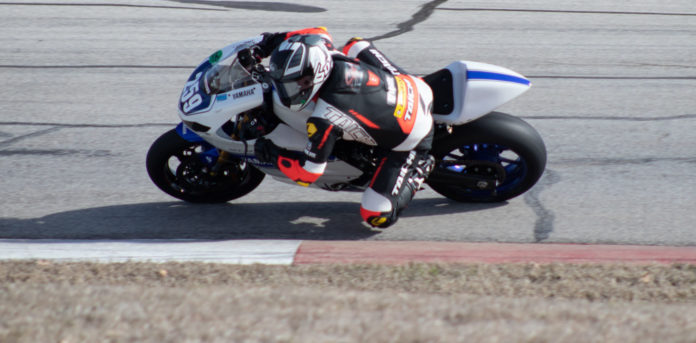
MotoAmerica Twins Cup racer Hayden Schultz (259). Photo courtesy of Hayden Schultz Racing.
MotoAmerica Twins Cup Racebike Rental Program Offered by Hayden Schultz Racing
Hayden Schultz Racing and crew chief Gene Burcham are launching a race bike rental program for the MotoAmerica Twins Cup series on one of the team’s Yamaha FZ-07R. With a competitive bike and crew provided, this is a great opportunity for racers looking to make the step up to MotoAmerica racing. Rental spots are available for every round of the MotoAmerica series.
“MotoAmerica has provided a great opportunity for racers to get into pro racing with the Twins Cup. It has turned into arguably the most competitive class with large grids at every round. I am excited to offer an opportunity to race at the professional level with MotoAmerica. The team; Gene and Michael Burcham, Gary Jeffries, and Ron “Dink” Glidden have been working hard all offseason to provide great machinery. The opportunity to expand and offer rental spots became available and we thought this would be a great opportunity to expand the series to more riders.” said Hayden Schultz
For more details, pricing, and availability contact Hayden at [email protected]
The team thanks all their sponsors for making the program possible: Law Tigers, Brittenum Construction, Dreyer Motorsports, Wossner Pistons, Ohlins, 6D Helmets, Moto Liberty, RS Taichi, Ridgedale Homes, Woodcraft, Glidden Racing, Blud Lubricants, Robem Engineering
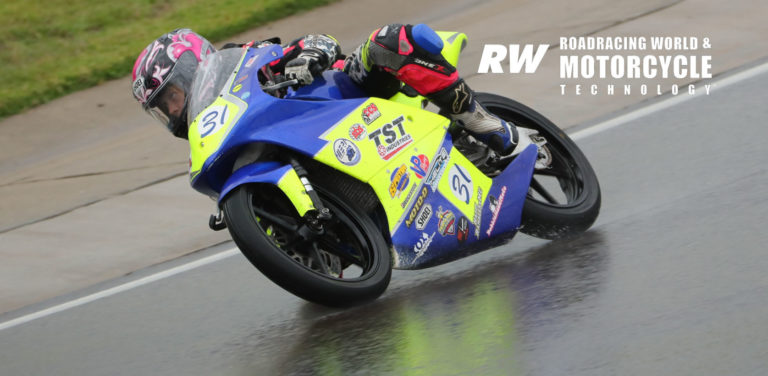
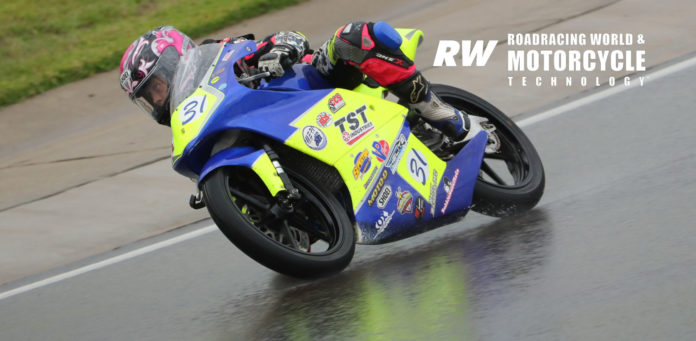
Kayla Yaakov (31) in action during a wet race at the 2019 WERA Grand National Finals (GNF) at Barber Motorsports Park. Photo by Brian J. Nelson.
24th-Annual Roadracing World Young Gun Honors:
By David Swarts
Roadracing World started this exclusive special feature recognizing the most promising young road racers as an answer to pessimists who claimed America had no new, up-and-coming young racers. This edition of the Roadracing World Young Gun Awards marks the 24th consecutive year of showcasing an abundance of new talent.
Roadracing World Young Guns have won:
FIM MotoGP and FIM Superbike races and World Championships;
AMA Pro races and Championships, including eight AMA Pro Superbike Championships;
A KTM RC Cup World Final race;
The Daytona 200 (8 times);
WERA National Endurance Championships and WERA National Challenge Championships;
ASRA/Formula USA Grand National and CCS National Championships;
AMA Road Racing Grand Championships and Horizon Awards;
USGPRU National Championships;
Many regional and local titles.
The competition has continually become more intense as more – and younger—racers with higher levels of accomplishment are nominated, and the level of achievement required to make the grade keeps getting tougher.
We’ve spent the last several months accepting nominations and evaluating road racers between the ages of 11 and 18 (as of the start of the 2020 season) who have, at a minimum, won Expert-level road races and/or Championships on a 125cc two-stroke/250cc four-stroke or larger racebike or had outstanding results as an Amateur/Novice. Most of the riders included here have done far more than the minimum.
The young riders recognized here are the most promising young road racers in North America. All have earned the title of Roadracing World Young Gun.
We will feature one Young Gun per day, presenting them in alphabetical order.
Kayla Yaakov. Photo by David Yaakov.
Kayla Yaakov
Age: 12.
Current home: Gettysburg, Pennsylvania.
Current height/weight: 5’1”/100 pounds.
Current school grade level: 7th grade.
Began riding at age: 4 years.
First road race: 2017, Talladega, Alabama, WERA, 3 different classes, 1st place in all.
Current racebikes: Honda NSF250R, Kramer HKR EVO 2.
Current tuner/mechanic: Dave Yaakov (father).
Primary race series: WERA, CCS/ASRA.
Top sponsors: One-X Custom Leathers, Shoei, SBS Brakes, Spectro Oil, Cox Racing Group, Helite Airvest, Jennings GP, Sportbike Track Time, N2 Racing, Magura USA, Yoshimura.
Recent racing accomplishments: 2019 season, won Lightweight Twins Superbike Expert AMA Grand Championship, won 3 WERA Sportsman Series Regional Championships (won 38 WERA races); 2018 season, named AMA Novice Road Racer of the Year, won 2 AMA Road Race Grand National Championships, won 5 WERA Sportsman National Championships, won 4 WERA Sportsman Regional Championships, won ASRA Moto3 (Combined) National race, 41 WERA race wins; 2017 season, named AMA Youth Road Racer of the Year, won 3 WERA Sportsman National Championships, won 5 WERA Sportsman Regional Championships, 37 WERA race wins.
2020 racing goal: Continue to improve and to win.
Racing career goal: Win at the MotoAmerica and World Championship level.
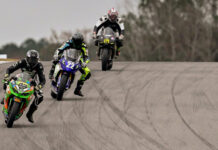
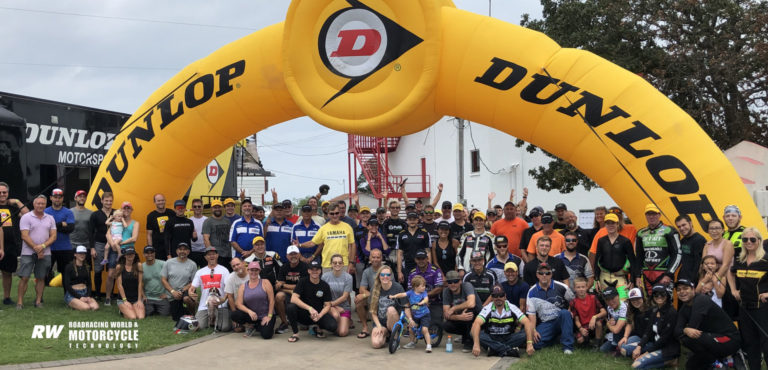
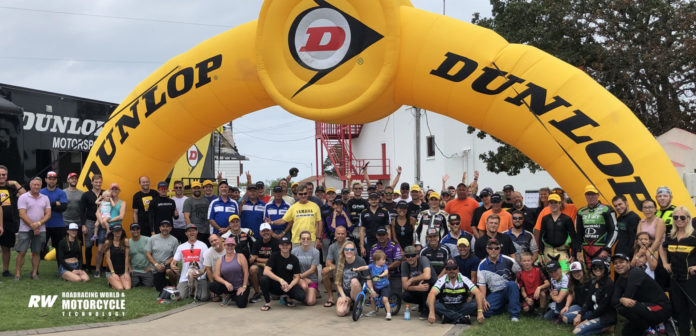
Participants at The Invite Presented by Dunlop event at Hallett Motor Racing Circuit. Photo by David Swarts, copyright Roadracing World Publishing, Inc.
Our world has changed due to COVID-19, at least for now. Dunlop sends thoughts and prayers to everyone impacted by the virus. We also want to give a HUGE THANK YOU to all the first responders and our health care workers on the front line battling this virus. We look forward to when we can all return to riding and racing, to feeding our passion once again. In the meantime, we created this video to encourage everyone to stay strong and keep your passion alive. ENJOY! #wearedunlop #staystrong #firstresponders #love
About Dunlop Motorcycle Tires
Dunlop is the largest supplier of original equipment and replacement motorcycle tires in the U.S.A. For more information, visit www.dunlopmotorcycletires.com.
Engineering student and motorcycle enthusiast Hiyori Yoshida with a Yamaha Champions Riding School YZF-R3 at Inde Motorsports Ranch, in Arizona.
FIRST PERSON/OPINION:
My First Time On The Racetrack
By Hiyori Yoshida
I feel the pressure in my arms as I hear Chris Peris’ mantra, “brakebrakebrake,” in my head as the forks compress, turning into the apex onto the straightaway. I hunch low on the gas tank, my right wrist holding the throttle wide open. I finally get the speedshift right and catch 4th, 5th, then finally, 6th gear. I can’t help but grin, my cheeks pressed against the sides of my helmet. For the first time, I feel like I’m letting the motorcycle fly free at its full capacity, with no trees, ruts, cars, or speed limits, and full traction.
Five years ago, racing into a 20-mph headwind chasing five-time Army of Darkness WERA National Endurance Champion Chris Peris astride a Yamaha YZF-R3 would have never seemed possible to the 15-year-old, quiet girl living in Japan. Growing up in Japan, I was taught to be respectful and not stand out, ever. I feared motorcycles and anyone associated with these loud, large, dangerous vehicles, since in Japan, motorcycles are taboos that provoke affiliations with the mysterious and scary Japanese gangster mob, the Yakuza. My wariness about motorcycles completely flipped when I got adopted by the captains of the multi-time WERA National Endurance Championship-winning team known as Army of Darkness (AOD).
Hiyori Yoshida (45) on track with adoptive parents Sam Fleming and Melissa Berkoff during a Yamaha Champions Riding School at Inde Motorsports Ranch, in Arizona.
Sam Fleming and Melissa Berkoff, my new parents, were the most adventurous, maybe crazy, and definitely loving parents I could’ve asked for. The first wheelie on an exhilarating street ride on Sam’s FZ1 made me realize that motorcycles are not that bad. In fact, they’re pretty damn fun. Sam and Melissa have made me realize this about many things, including rock climbing, SCUBA diving, and just living life in general.
I can safely say that, had I never left Japan, I would have lived my life never having heard of, let alone touching, a clutch. Motorcycles are loud and dangerous. Girls are dutiful and conform to kawaii (the Japanese culture of cute, liking Hello Kitty). And that’s that in Japan. When Sam first took me on the back of his motorcycle, I never would’ve imagined being the one to control such a beautiful, complex, powerful animal. But, of course, it would have been unacceptable for the daughter of the AOD to not be able to ride.
Sam first taught me how to ride on a Yamaha TT-R125 dirt bike (bored out to 150cc!) in the grassy fields surrounding the family cabin in West Virginia. My enthusiasm for motorcycle riding didn’t blossom as quickly as one would expect, partly because I still felt like such a loud, seemingly reckless activity was not meant for me and partly because anything beyond noodling around flat, treeless fields inevitably led to me lying in the grass, my dirt bike sputtering miserably beside me. But as Sam, Melissa, and various family friends and racers — including Ben Walters from AOD — taught me about throttle control, body position, braking, and counter-steering, I began to enjoy the challenges of counter-balancing the bike into tight turns, blipping over logs, carrying momentum up rooty hills, and even the occasional wheelie.
After a few months on the TT-R, Melissa let me try her Honda CRF150RB. It was love at first ride. The geometry, the power, the height, everything felt faster and a lot more challenging. I got my own CRF150RB, and it has been my favorite bike ever since. But it took me a whole summer to learn to ride the CRF. The first summer that I spent trying to tame it was blisteringly hot, suffocatingly humid, and mostly involved me throwing my bike on the ground or it throwing me off into the trees. With 10+ hours of repeating this cycle of crashing, getting banged up, and picking myself and my bike up off the ground, I got better and better at controlling the throttle and positioning myself to allow the bike to do what I wanted.
There are two things that Sam and Melissa have taught me that have enabled me to physically keep up with and enjoy not just the riding, but everything else we do: Physical conditioning, and risk mitigation. The only reason I can physically ride, crash, pick up my bike, and keep riding is because I consistently train at the gym and eat as healthily as possible. And the way I treat my body is the way I’ve learned to treat my bike. To be able to function at its best, Sam has taught me that I have to constantly maintain my bike. I have grown to really enjoy spending the afternoons with Sam and our other riding buddies in our garage, changing the oil, cleaning the air filter, adjusting valves, cleaning the pilot jet, and changing tires — all to make sure that when we go out there, our bikes are as ready as we are. Our risk mitigation doesn’t end in the garage. Before we ride, we check the fuel, tire pressures, and chain tension, and bleed the air from the forks. When we ride, we always wear all the gear — body armor, knee braces, boots, helmet, and gloves. We also check each other’s gear and bikes so everyone on the ride is as prepared as possible.
In all honesty, all of that training and preparation is probably how I’ve had some spectacular crashes (like high-siding over the handlebars and landing face-first in hard-packed dirt, or somehow pinning my arm between the bark-busters and a tree twice as wide as myself) yet have gotten away with nothing worse than swollen bruises and sore muscles. This is why when I took the MSF (Motorcycle Safety Foundation) street riding class, while nothing but jeans, boots, and a jacket were required, I brought my own body armor and one of Sam’s many full-face helmets to the parking lot training. It was probably overkill since all we did was do some exercises in the parking lot, but I didn’t want to risk it. If you have the gear, I thought, wear it all the time!
(From left) Melissa Berkoff, Yamaha Champions Riding School instructor Chris Peris, Hiyori Yoshida, and Sam Fleming at Inde Motorsports Ranch, in Arizona.
After getting my motorcycle license, I couldn’t wait to try riding on the street. One day, when I was walking on my college campus, I found a super cool-looking, sleek, orange bike— a KTM Duke 390. I snapped a photo and texted it to Sam, as I do whenever I spot any cool bikes around campus. It turns out the 390 is a good beginner’s streetbike, and Sam found a used one upon which we remapped the FI and upgraded the suspension. The first couple of times Sam and Melissa took me out on the street on my new KTM, I had fun, but I felt restrained. Coming from dirt biking where I could do whatever I wanted wherever I wanted, in the grass, the mud, the trees, on hills, and in creeks, I felt like I was not fully enjoying the power and freedom that my KTM had to offer on the busy streets of suburban Washington, DC.
I began to wonder what riding on a track was like, where there were no traffic lights and pedestrians, just turns, hills, and other motorcycles. Plus, Melissa insisted that I get some track training to understand how much I could ask from a bike when needed. So when AOD racer Chris Peris offered to train me at a racetrack in Arizona, I knew this was the opportunity I had been waiting for.
A “press release” is promotional text issued by a rider, team, company or organization to inform
the public about an event, product, or service from the issuer’s own point of view, and if deemed
to have news value, may be placed on roadracingworld.com as a service to our readers.
A press release is not an article written by Roadracingworld.com staffers. When a post is labeled with the words “press release”, it means that Roadracingworld.com is not responsible for its content and that Roadracingworld.com makes no guarantee that it is accurate. Not all press releases are posted and Roadracingworld.com may reject press releases if the content is too heavy on commercial promotion with little or no news value or if the press release contains obvious errors.
Accessibility
Accessibility modes
Epilepsy Safe Mode
Dampens color and removes blinks
This mode enables people with epilepsy to use the website safely by eliminating the risk of seizures that result from flashing or blinking animations and risky color combinations.
Visually Impaired Mode
Improves website's visuals
This mode adjusts the website for the convenience of users with visual impairments such as Degrading Eyesight, Tunnel Vision, Cataract, Glaucoma, and others.
Cognitive Disability Mode
Helps to focus on specific content
This mode provides different assistive options to help users with cognitive impairments such as Dyslexia, Autism, CVA, and others, to focus on the essential elements of the website more easily.
ADHD Friendly Mode
Reduces distractions and improve focus
This mode helps users with ADHD and Neurodevelopmental disorders to read, browse, and focus on the main website elements more easily while significantly reducing distractions.
Blindness Mode
Allows using the site with your screen-reader
This mode configures the website to be compatible with screen-readers such as JAWS, NVDA, VoiceOver, and TalkBack. A screen-reader is software for blind users that is installed on a computer and smartphone, and websites must be compatible with it.
Online Dictionary
Readable Experience
Content Scaling
Default
Text Magnifier
Readable Font
Dyslexia Friendly
Highlight Titles
Highlight Links
Font Sizing
Default
Line Height
Default
Letter Spacing
Default
Left Aligned
Center Aligned
Right Aligned
Visually Pleasing Experience
Dark Contrast
Light Contrast
Monochrome
High Contrast
High Saturation
Low Saturation
Adjust Text Colors
Adjust Title Colors
Adjust Background Colors
Easy Orientation
Mute Sounds
Hide Images
Hide Emoji
Reading Guide
Stop Animations
Reading Mask
Highlight Hover
Highlight Focus
Big Dark Cursor
Big Light Cursor
Cognitive Reading
Virtual Keyboard
Navigation Keys
Voice Navigation
Accessibility Statement
www.roadracingworld.com
November 13, 2026
Compliance status
We firmly believe that the internet should be available and accessible to anyone, and are committed to providing a website that is accessible to the widest possible audience,
regardless of circumstance and ability.
To fulfill this, we aim to adhere as strictly as possible to the World Wide Web Consortium’s (W3C) Web Content Accessibility Guidelines 2.1 (WCAG 2.1) at the AA level.
These guidelines explain how to make web content accessible to people with a wide array of disabilities. Complying with those guidelines helps us ensure that the website is accessible
to all people: blind people, people with motor impairments, visual impairment, cognitive disabilities, and more.
This website utilizes various technologies that are meant to make it as accessible as possible at all times. We utilize an accessibility interface that allows persons with specific
disabilities to adjust the website’s UI (user interface) and design it to their personal needs.
Additionally, the website utilizes an AI-based application that runs in the background and optimizes its accessibility level constantly. This application remediates the website’s HTML,
adapts Its functionality and behavior for screen-readers used by the blind users, and for keyboard functions used by individuals with motor impairments.
If you’ve found a malfunction or have ideas for improvement, we’ll be happy to hear from you. You can reach out to the website’s operators by using the following email
Screen-reader and keyboard navigation
Our website implements the ARIA attributes (Accessible Rich Internet Applications) technique, alongside various different behavioral changes, to ensure blind users visiting with
screen-readers are able to read, comprehend, and enjoy the website’s functions. As soon as a user with a screen-reader enters your site, they immediately receive
a prompt to enter the Screen-Reader Profile so they can browse and operate your site effectively. Here’s how our website covers some of the most important screen-reader requirements,
alongside console screenshots of code examples:
Screen-reader optimization: we run a background process that learns the website’s components from top to bottom, to ensure ongoing compliance even when updating the website.
In this process, we provide screen-readers with meaningful data using the ARIA set of attributes. For example, we provide accurate form labels;
descriptions for actionable icons (social media icons, search icons, cart icons, etc.); validation guidance for form inputs; element roles such as buttons, menus, modal dialogues (popups),
and others. Additionally, the background process scans all the website’s images and provides an accurate and meaningful image-object-recognition-based description as an ALT (alternate text) tag
for images that are not described. It will also extract texts that are embedded within the image, using an OCR (optical character recognition) technology.
To turn on screen-reader adjustments at any time, users need only to press the Alt+1 keyboard combination. Screen-reader users also get automatic announcements to turn the Screen-reader mode on
as soon as they enter the website.
These adjustments are compatible with all popular screen readers, including JAWS and NVDA.
Keyboard navigation optimization: The background process also adjusts the website’s HTML, and adds various behaviors using JavaScript code to make the website operable by the keyboard. This includes the ability to navigate the website using the Tab and Shift+Tab keys, operate dropdowns with the arrow keys, close them with Esc, trigger buttons and links using the Enter key, navigate between radio and checkbox elements using the arrow keys, and fill them in with the Spacebar or Enter key.Additionally, keyboard users will find quick-navigation and content-skip menus, available at any time by clicking Alt+1, or as the first elements of the site while navigating with the keyboard. The background process also handles triggered popups by moving the keyboard focus towards them as soon as they appear, and not allow the focus drift outside it.
Users can also use shortcuts such as “M” (menus), “H” (headings), “F” (forms), “B” (buttons), and “G” (graphics) to jump to specific elements.
Disability profiles supported in our website
Epilepsy Safe Mode: this profile enables people with epilepsy to use the website safely by eliminating the risk of seizures that result from flashing or blinking animations and risky color combinations.
Visually Impaired Mode: this mode adjusts the website for the convenience of users with visual impairments such as Degrading Eyesight, Tunnel Vision, Cataract, Glaucoma, and others.
Cognitive Disability Mode: this mode provides different assistive options to help users with cognitive impairments such as Dyslexia, Autism, CVA, and others, to focus on the essential elements of the website more easily.
ADHD Friendly Mode: this mode helps users with ADHD and Neurodevelopmental disorders to read, browse, and focus on the main website elements more easily while significantly reducing distractions.
Blindness Mode: this mode configures the website to be compatible with screen-readers such as JAWS, NVDA, VoiceOver, and TalkBack. A screen-reader is software for blind users that is installed on a computer and smartphone, and websites must be compatible with it.
Keyboard Navigation Profile (Motor-Impaired): this profile enables motor-impaired persons to operate the website using the keyboard Tab, Shift+Tab, and the Enter keys. Users can also use shortcuts such as “M” (menus), “H” (headings), “F” (forms), “B” (buttons), and “G” (graphics) to jump to specific elements.
Additional UI, design, and readability adjustments
Font adjustments – users, can increase and decrease its size, change its family (type), adjust the spacing, alignment, line height, and more.
Color adjustments – users can select various color contrast profiles such as light, dark, inverted, and monochrome. Additionally, users can swap color schemes of titles, texts, and backgrounds, with over seven different coloring options.
Animations – person with epilepsy can stop all running animations with the click of a button. Animations controlled by the interface include videos, GIFs, and CSS flashing transitions.
Content highlighting – users can choose to emphasize important elements such as links and titles. They can also choose to highlight focused or hovered elements only.
Audio muting – users with hearing devices may experience headaches or other issues due to automatic audio playing. This option lets users mute the entire website instantly.
Cognitive disorders – we utilize a search engine that is linked to Wikipedia and Wiktionary, allowing people with cognitive disorders to decipher meanings of phrases, initials, slang, and others.
Additional functions – we provide users the option to change cursor color and size, use a printing mode, enable a virtual keyboard, and many other functions.
Browser and assistive technology compatibility
We aim to support the widest array of browsers and assistive technologies as possible, so our users can choose the best fitting tools for them, with as few limitations as possible. Therefore, we have worked very hard to be able to support all major systems that comprise over 95% of the user market share including Google Chrome, Mozilla Firefox, Apple Safari, Opera and Microsoft Edge, JAWS and NVDA (screen readers).
Notes, comments, and feedback
Despite our very best efforts to allow anybody to adjust the website to their needs. There may still be pages or sections that are not fully accessible, are in the process of becoming accessible, or are lacking an adequate technological solution to make them accessible. Still, we are continually improving our accessibility, adding, updating and improving its options and features, and developing and adopting new technologies. All this is meant to reach the optimal level of accessibility, following technological advancements. For any assistance, please reach out to