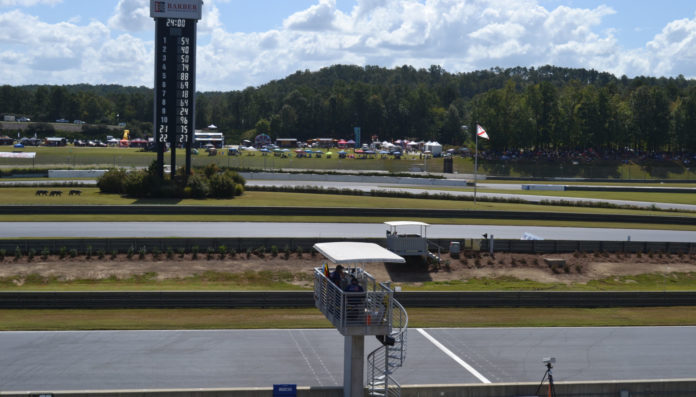
MotoAmerica is offering discounts on tickets for its upcoming events at Michelin Raceway Road Atlanta (July 31-Aug. 2), Pittsburgh International Race Complex (Aug. 7-9), New Jersey Motorsports Park (Sept. 11-13), Barber Motorsports Park (Sept. 18-20), and WeatherTech Raceway Laguna Seca (Oct. 23-25).
Fans who purchase tickets through July 5 and use the discount code “MERICA” at checkout can save up to 40% on their ticket purchases.
For more information or to purchase tickets, go HERE.
CELEBRATE JULY 4TH WITH WERA AT BARBER MOTORSPORTS PARK!
WERA Motorcycle Roadracing will host a Double Header Sportsman Series weekend for over the 4th of July weekend at Barber Motorsports Park which will host the 2nd Annual Concours De Competition et D’Elegance. The historic machines participating in this year’s event will bring history to the third tier of the Barber Motorsports Paddock and you can see these machines take laps three times on Saturday! Malcolm Tunstall will be our Grand Marshall for these activities. We encourage you to come out and share in some of motorcycle road racing history on the 4th of July at Barber Motorsports Park. The famous Barber Museum will be open as well for your viewing pleasure!
Also on Saturday and on Sunday the WERA Sportsman Riders will compete in their Sprint Races featuring the Pit Bull C Superstock Expert/Novice Classes. The A Superbike and C Superbike Expert Classes will be gridded on times in their second practice session each day as a qualifier, Lots of action and competition is on tap for the weekend.
With Covid-19 still with us we ask that everyone wear a mask while in public areas, that you social distance and bring your own pens to use. If you are feeling ill please stay home and get better. We want to keep motorcycle road racing happening and your cooperation is greatly appreciated in keeping everyone healthy!
WERA Motorcycle Roadracing was founded in 1973 and remains the foremost place to develop talent in the sport of motorcycle road racing. The legacy of Pro riders on a National and World level is legendary. All events are run by WERA Motorcycle Roadracing with a co-sanction by the AMA and they go coast to coast offering entry level racing with the WERA Sportsman Series as well as a Pro-Am Series with the WERA National Challenge Series, WERA Motorcycle Roadracing also offer Vintage Racing and limited Endurance Racing with Track Day Partners N2 and Sportbike Track Time. WERA Motorcycle Roadracing was voted the 2017 AMA Track Organizer of the Year.
For more information on WERA Motorcycle Roadracing please check out our web site at wera.com
For 2020, MV Agusta’s aim for its premium hypernaked Brutale 1000 RR is to keep all of the performance that its name suggests, yet make that performance available to a wide range of riders, including those new to the marque.
In a video conference from Schiranna, Italy, executives from the company introduced the new model as not just a new motorcycle, but the product of new and innovative thinking and processes from the company.
“Inside of MV Agusta in the last five years, not only have we been looking at bringing new technologies directly to the bike, we’re also pushing the boundaries inside of MV Agusta, looking to adapt and apply new technologies to our thought processes, in our internal procedures, in our engineering department, in our marketing department,” said Brian Gillen, MV Agusta R&D Director, in a live video presentation from Schiranna, Italy.
MV Agusta has produced its Brutale naked bikes for nearly two decades. Unlike many other machines in its category, the bike is not a detuned sportbike with tubular handlebars and smaller (or nonexistent) fairing panels.
“This motorcycle is born directly as a naked, and has been developed as such. It is not an undressing of a supersport,” said MV Agusta Design Director Giorgio Mazzotti.
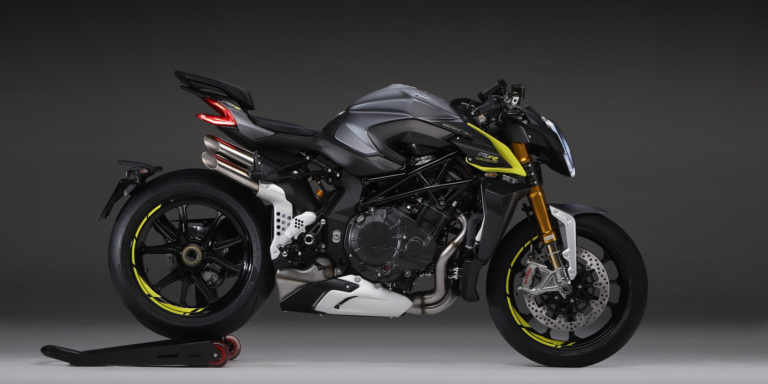
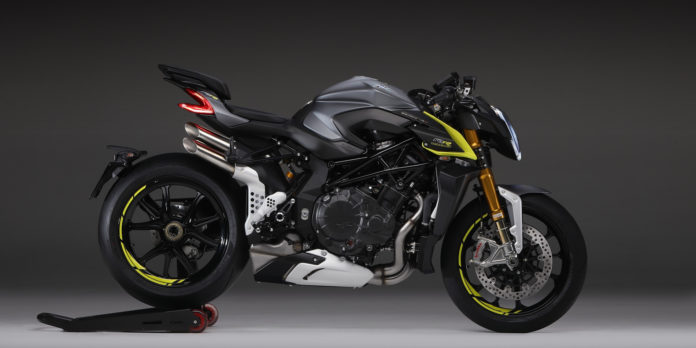
Attention to style is part of the MV Agusta aesthetic. Note the unique and eye-catching exhausts. on the Brutale 1000 RR. Photo courtesy MV Agusta.
The Brutale 1000 RR is the production version, so to speak, of the limited edition Brutale 1000 RR Serie Oro introduced last year. That bike, with a claimed 212 horsepower, was marketed as the fastest naked bike available; the Brutale 1000 RR is just a tick less powerful, at a claimed 208 bhp. The bike will go head-to-head in the marketplace with naked hypersports from KTM, Kawasaki and Ducati.
But ultimate power wasn’t the only goal for MV Agusta with this machine, Gillen said.
“The Brutale RR is born from a completely new mentality inside of the design and development area. That new mentality is not only absolute power, being the most powerful hypernaked model in the market, but that we need to be able to make this bike much more approachable to all of the riders,” he said.
Central to accomplishing that goal is the inclusion of rider-friendly, sophisticated electronic rider aids. Launch control, wheelie control and traction control are standard, as are electronically controlled Ohlins forks, shock and steering damper. Multiple power maps are available, as are clutchless upshifts and downshifts, courtesy of the electronic shift assist. The Bosch 9 ABS system includes a race mode and an anti rear-wheel lift electronic strategy.
The latest iteration of the Brutale features revised hardware in the engine compartment as well. A new cylinder head with CNC-machined combustion chambers carries overhead cams with cam followers that are treated for lower friction. Primary gears and transmission gears also receive low noise/friction treatments, and the piston rings are designed for reduced friction as well. The crankshaft is lightened, and titanium connecting rods are standard.
Other features include forged aluminum wheels and Pirelli Supercorsa SP V3 radial tires, Brembo Stylema front brake calipers, and bodywork and downforce-producing wings constructed from carbon fiber as well as thermoplastic materials.
Developing this machine incorporated the use of cutting-edge design technology and theories, Gillen said. Thousands and thousands of hours of computer modeling, simulation and design have gone into the latest Brutale, something that reflects a change throughout the company.
“The last five years have seen another industrial revolution, and … that means technologies are changing so quickly that we have to keep pushing, not only to apply existing technology, but to learn and adapt to new technologies that are coming out every single day,” he said.
Overall, the machine reflects state-of-the-art design parameters, although MV Agusta has incorporated or retained specific design elements that give the Brutale its identity. The inline-Four engine displaces 998cc via a 79mm x 50.9mm bore and stroke. Each cylinder has two exhaust and two intake valves arranged in a radial configuration, and the exhaust system has two outlets per side, exiting the bike midway between footpeg height and seat height in a manner that draws attention to them. Wheelbase is 55.71 inches, and the claimed dry weight is 410.06 pounds. The trellis frame is mated to a single-sided swingarm.
The front brake rotors are 320mm, and a Brembo radial master cylinder feeds the radial-mounted, single-piece, four-piston calipers. The rear disc is 220mm, and the twin-piston caliper also is Brembo. In a touch of old-school charm, the official factory spec sheet for the bike lists a claimed top speed – in this case, in excess of 186 mph.
PIAGGIO GROUP: 60 MILLION EURO CREDIT FACILITY ARRANGED WITH CDP AND BANCA MPS
The new line of credit will fund investments in research, development and innovation, and further strengthen the Group’s financial structure
Milan, 02 July 2020 – The Piaggio Group (PIA.MI) has signed a 60 million euro credit facility with Banca Monte dei Paschi di Siena and Cassa Depositi e Prestiti (in equal proportions).
The new line of credit will support the Piaggio Group’s planned investments in research and development of innovative technological and product solutions in areas such as active and passive safety and sustainability (including reduced consumption and emissions on internal combustion engines), with a view to strengthening its range of scooters, motorcycles and commercial vehicles. It will enable Piaggio to continue consolidating and expanding its leadership position in the mobility sector, and further strengthen the Group’s financial structure.
The transaction is one of the initiatives organised by Banca MPS and Cassa Depositi e Prestiti to provide liquidity and support the resumption of production activities in Italy. Specifically, the financial product in question was launched by CDP a few months ago to support medium-large Italian companies and assist communities and allied industries.
The FIM MotoGP™ Stewards have been advised of possible breaches of the FIM Grand Prix Regulations covering practice and testing, specifically Article 1.15.1. c) Rider Training and Track familiarisation, regarding the type of machines permitted for rider training.
As a reminder and following the decision of the Grand Prix Commission published on 27 May 2020, riders in Moto3 and Moto2 classes are not permitted to make further private testing in 2020 until further notice, the same applies to MotoGP class riders unless they are riding for Manufacturers that qualify for concessions. Practice and testing restrictions for all classes are expressly provided for in Article 1.15.1 of the FIM Grand Prix Regulations, including details of what machines are allowed to be used for Rider Training and Track Familiarisation.
Hearings for riders who may have broken the rules should be scheduled to take place at the 2020 Gran Premio Red Bull de España at the Circuito de Jerez-Angel Nieto, in order to hear from the parties concerned and to allow further time to investigate the details.
At this stage the FIM will not make any further comments on this matter.
BMW Motorrad WorldSBK Team will race with Michael van der Mark in 2021.
Michael van der Mark becomes the team’s new rider in the FIM Superbike World Championship.
Competing in WorldSBK since 2015.
Marc Bongers: “We are convinced that Michael is an asset to our project.”
Munich. The rider planning of the BMW Motorrad WorldSBK Team for the 2021 season in the FIM Superbike World Championship (WorldSBK) is taking shape. New to the team is 27-year-old Dutchman Michael van der Mark, who will contest his first season on the BMW S 1000 RR in 2021.
Van der Mark was crowned Supersport World Champion in 2014. For the 2015 season, he switched to the Superbike World Championship, in which he has been active since and has won three victories and 29 podiums. The team’s second rider for the 2021 season will be announced at a later date.
Quotes.
Marc Bongers, BMW Motorrad Motorsport Director: “We are very pleased about our agreement with Michael, who has developed very strongly in the Superbike World Championship in recent years. We are convinced that Michael is an asset to our project, and together, in combination with the strong package we can offer him, we can reach the next level in terms of results. We would like to welcome Michael to the BMW Motorrad WorldSBK Team and look forward to a strong cooperation.”
Shaun Muir, Team Principal BMW Motorrad WorldSBK Team: “We are delighted to welcome Michael to the BMW Motorrad WorldSBK Team. He brings a wealth of experience and is one of the youngest, most talented riders on the WorldSBK grid. Securing Michael’s services emphasis the focus and determination we have to compete for top honours, and we will give Michael every chance to reach that goal.”
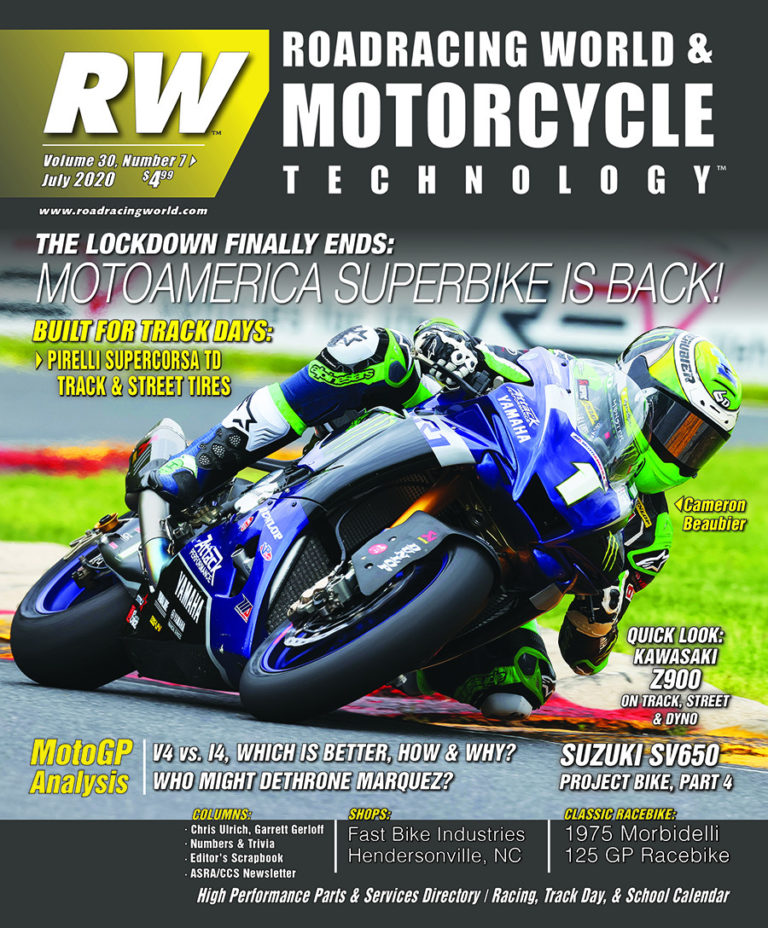
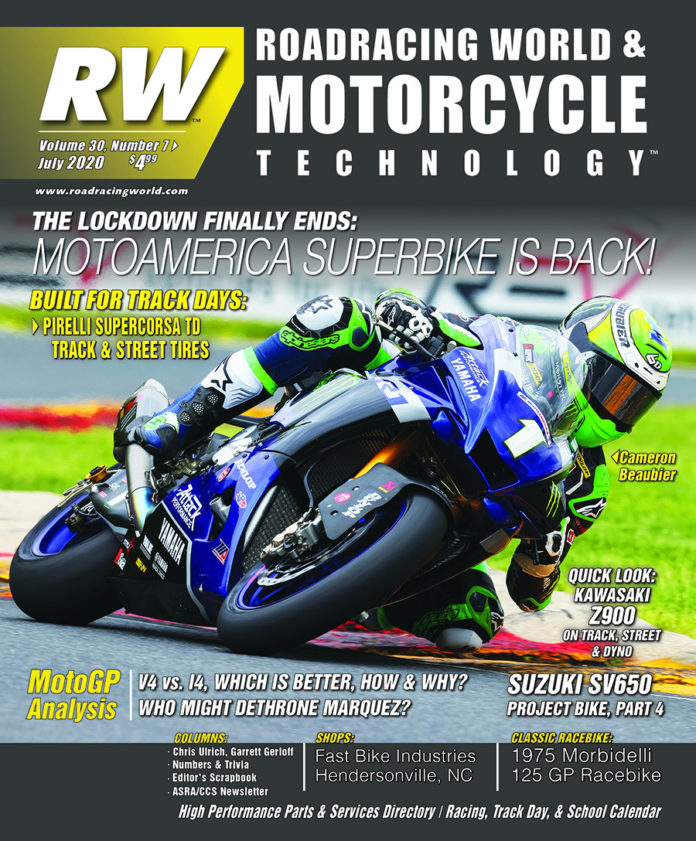
On the Front Cover: With lockdown rules starting to relax, Cameron Beaubier distanced himself from everybody, sweeping both Superbike races at long-delayed, long-awaited Round #1 of the MotoAmerica AMA/FIM North American Championship at Road America, sans spectators. Photo by Brian J. Nelson.
Roadracing World & Motorcycle Technology is THE definitive source for motorcycle racing, riding, and tech information.
Roadracing World & Motorcycle Technology magazine is available in print and digital formats. SUBSCRIBE NOW . Or call (909) 654-4779, 9:00 a.m. – 5:00 p.m. Pacific Time, Monday through Friday.
Read the July 2020 issue of Roadracing World & Motorcycle Technologywith your online subscription. Log in HERE
In This Issue:
FEATURES
Inside Info: Aprilia & Ohvale Cooperate On A Spec Bike, & More
Quick Look: Kawasaki Z900 On Street, Track, And Dyno
Track Day Evaluation: Pirelli Diablo Supercorsa TD Tires
MotoGP Analysis: MotoGP’s Biggest Battle: V4 vs. I4
MotoGP Analysis: The Men Most Likely To Dethrone Marc Marquez?
Peaky Bikers: The Care and Feeding Of A 1952 Vincent Black Shadow, Part Four
Suzuki SV650 Racebike Project Reborn, Part Four
Shops: Fast Bike Industries
PROFESSIONAL RACING
MotoAmerica At Road America: Beaubier!
COLUMNS
Letters To The Editor
10 Years Ago: Elena Myers, First Woman To Win AMA Pro Sprint Road Race, in July 2010 Issue
Trivia & Numbers: MotoAmerica Superbike Lap Times At Road America, 2019-2020
Garrett Gerloff: Garrett Against The World
Back In The Day Editor’s Scrapbook: International Press Intros: Riding the $36,995 1999 MV Agusta F4 750 Serie Oro in Italy; Riding the 2001 Aprilia RSV Mille R in Spain
The Crash Page: Michael Gilbert, Ready For Lift-Off
New Products: GBRacing Front Brake Lever Guard; Woodcraft Race Handlebar Switches
Professional Services Directory: Racers Helping Racers
Racing, School, & Track Day Calendar
ASRA/CCS Newsletter
High-Performance Parts & Services Directory
Chris Ulrich: Adventures Of An Ex-Racer: MotoAmerica Season Opener At Road America
Motorcycle track day and riding school operators are experiencing strong demand, as racetracks around the United States have begun to open, but they’re also experiencing challenges.
“It’s been really good,” Sarah Domingo, co-owner of California-based Let’s Ride Track Days, told Roadracingworld.com. “We’ve had lots of sellouts, very few cancellations, long waiting lists. Everyone has been very enthusiastic and very compliant with the extra health and safety measures we’ve asked them to follow. Everyone wears a facial covering when they’re not in their helmet and not in their own pit area. Yeah, it’s been really good.”
A participant and a control rider at a Let’s Ride Track Day event at Buttonwillow Raceway Park. Photo courtesy of Let’s Ride Track Days.
“We’ve done a few events, and it’s been interesting,” said Ken Hill, a partner with Track Time track days based in the Pacific Northwest. “We were sold out for the first event, and then the third and fourth events were 70-80% sold out, and our next events aren’t sold out yet but they’re pretty close.”
And that’s without a significant portion of Track Time’s market, Canadians, who currently cannot cross the border into Washington state due to COVID-19 travel restrictions.
“I would say 40-50% of our business is Canadians, and the fact that the border is closed has hurt us,” said Hill. “But if you look at 40-50% of our business is Canadians and we’re 70-80% sold out, it’s actually not too bad. If you look at it that way we are getting more U.S.-based clients.”
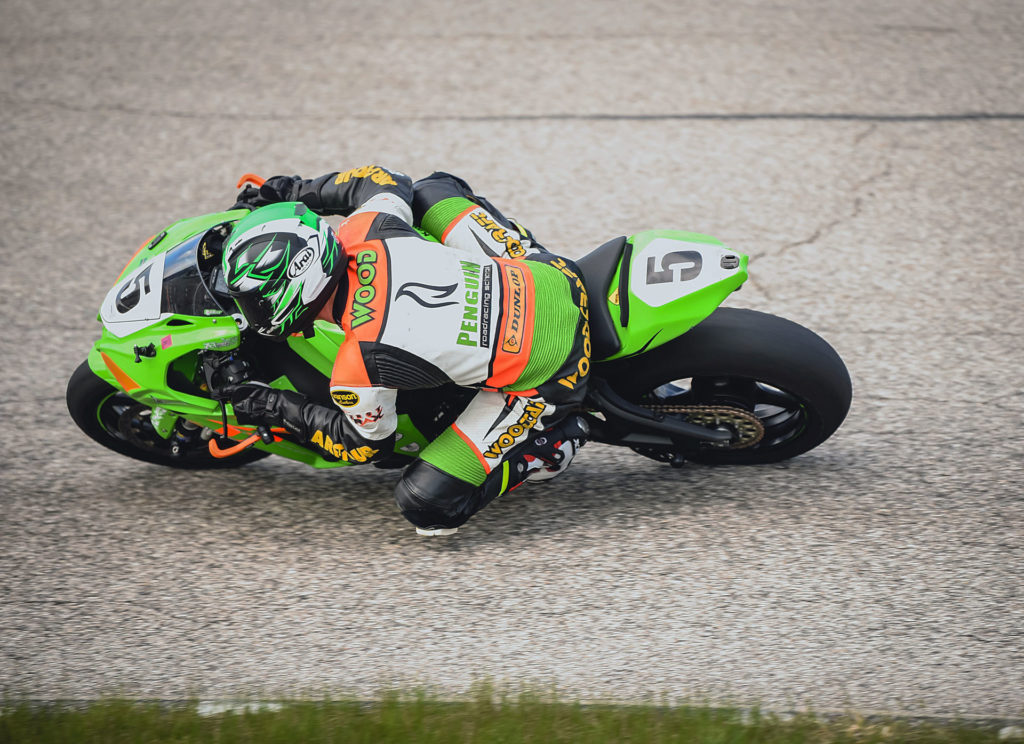
Penguin Racing School’s Eric Wood (5) in action. Photo courtesy Penguin Racing School.
“As far as demand goes, there’s a huge pent-up demand to get on the racetrack and ride right now,” said Eric Wood, head instructor at Penguin Racing School, which operates in the northeastern U.S. “Our guys are anxious to ride and at the event that we put on recently [at Thompson Speedway, in Thompson, Connecticut] there was an overwhelming sense of we’re willing to do whatever it takes so we can get out there and ride. The guys and girls who do this truly love the sport. If that means they have to make a little sacrifice and stay separated a little bit and wear a mask from time to time that’s a sacrifice they are willing to make.
“We had a really successful day. We sold it out. We didn’t go crazy because for multiple different reasons I’d rather have 80 or 90 happy customers than 150 customers that are unhappy with the track conditions and the crowdedness and the inability to distance because we’ve got them packed in there like sardines.
“For our upcoming events we have coming up [at New Hampshire Motor Speedway] in New Hampshire, we’ve had to make a bunch of different plans. We’ve taken our usual classrooms and cut that class size to less than half, so we have at maximum 10-12 people inside the classroom.
“We’re going to do a lot more outdoor instruction. We’re going to do a lot more on-track kind of stuff, drills, and that type of thing. To be honest with you, the curriculum we came up with and the ideas that we tried during our last event went over really, really well.”
“Demand is strong,” said Chip Spalding, Business Development Manager for Yamaha Champions Riding School, a school that operates at several venues across the country. “People want to come out and ride. Like we’ve seen in other parts of the motorcycle industry, COVID has removed a lot of the other activities that people were doing and spending their money on that involved being around lots of people, so they’ve gravitated towards things [where] they didn’t have to spend a lot of time around people. So they bought motorcycles and did motorcycle stuff, which is great for the motorcycle industry.”
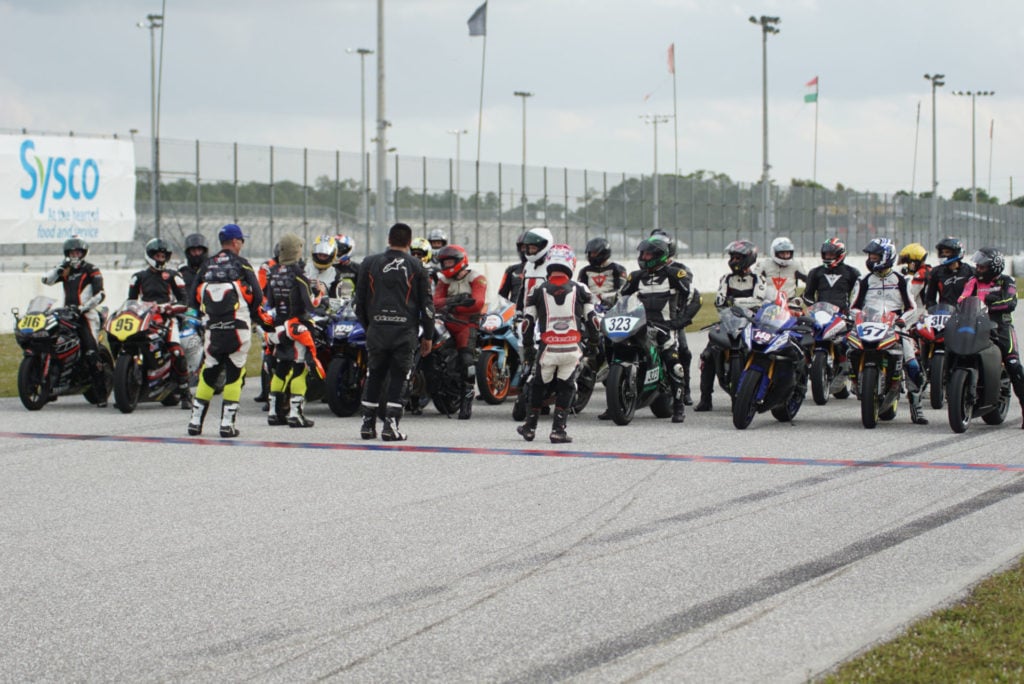
A scene from a Yamaha Champions Riding School pre-COVID-19. Photo courtesy Yamaha Champions Riding School.
But for California Superbike School, one of the oldest and largest motorcycle riding schools, which tours worldwide, the strong current demand may not be enough to make up for the loss of so many events earlier this year.
“Demand seems to be pretty good, but I don’t think we’re out of the woods yet,” said Dylan Code, lead instructor and son of California Superbike School founder Keith Code. “We have overhead. We have 23 paid staff at every event. We have two semi-trailers. We have permanent staff that work every day all year long. So, when we cancel an event or have someone drop out of a two-day camp it hurts. Then somebody says ‘I can’t go because I have COVID,’ what are you going to say? You just have to take it on the chin.”
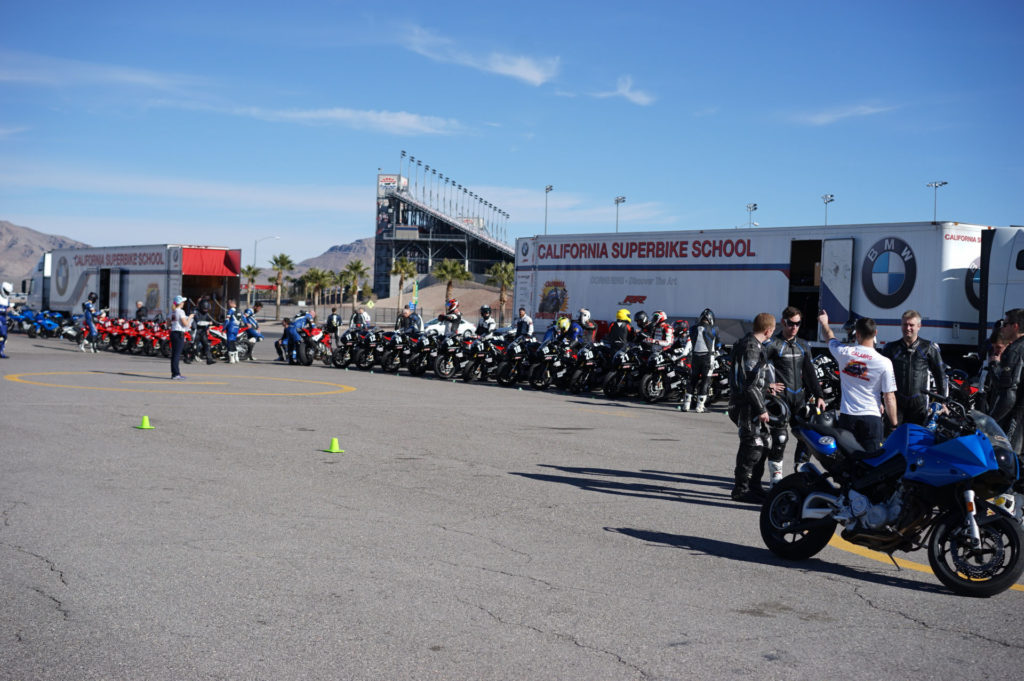
A scene from a California Superbike School prior to the COVID-19 pandemic. Photo by etechphoto.com, courtesy California Superbike School.
Everyone we interviewed for this article talked about the challenge of constantly working with racetrack staff and monitoring ever-evolving local guidelines to develop health and safety plans for their events. And for those who run events at multiple venues, those challenges are multiplied.
All parties also mentioned that nearly all of their participants were more than willing to abide by health and social distancing requests in order to ride.
But Dustin Coyner, owner of California-based track day operator TrackDaz, offered a story of just how quickly things can turn bad if participants don’t take the health and safety protocols seriously.
“It seems like when people found out they could sign up and ride again it kind of opened the floodgates. It’s been insane, record attendance at every event with a waiting list, that kind of thing,” Coyner told Roadracingworld.com. “Then Laguna Seca shut us down at 3:00 p.m. last Friday [June 26].
“In the morning, they [Laguna Seca] had staff roaming the pits, and then they stopped patrolling because it seemed like everybody was being compliant and wearing their masks. They wanted everyone to wear masks even when they were alone in their own pit area.
“Then right before 3:00 p.m. I was talking to the track supervisor guy. I was like, ‘Hey, how’s everything going?’ And he’s like, ‘Oh, yeah. You guys are doing a good job. I’m roaming the pits. Everyone’s pretty much wearing a mask.’ I’m like, ‘OK, cool!’
“Then, I guess the big boss must have driven through and watched people putting their masks on as they saw him driving up and then in his rearview mirror he watched them take their masks back off. He got back to his office, was super pissed off, and cancelled our event. It’s some crazy shit. It was quite a shock to get the plug pulled on our event.
“We’re going back to Laguna in a couple of weeks, and we’re going to have [our own] mask nazi rolling through the pits going, ‘Dude, put your mask on!’ Either it’s that or, ‘Put your mask on or we’ll kick you out so we can keep riding.’”
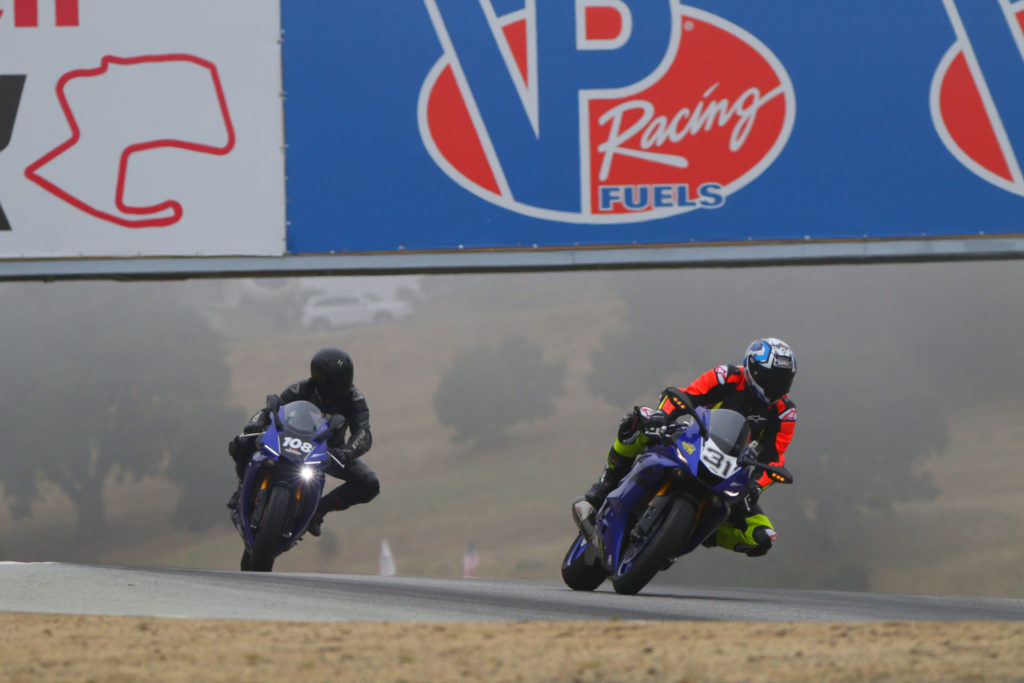
TrackDaz track day participants in action at WeatherTech Raceway Laguna Seca. Photo by CaliPhotography.com, courtesy TrackDaz.
Because it’s difficult to accurately predict what will happen with the COVID-19 outbreak in the U.S. or the efforts that will be taken to combat its spread by local, state, and federal authorities, it’s also difficult to predict what will happen in the motorcycle track day and riding school market. But for now, racetracks are reopening, demand for track time is strong, and participants for the most part are willing to abide by whatever measures are necessary to enjoy that track time.
Morbidelli is unique in the history of Grand Prix racing; it’s the only non-motorcycle company to win a Grand Prix race. In 1959 Giancarlo Morbidelli founded the Morbidelli Woodworking Machinery Company in Pesaro. An avid road racing enthusiast, Giancarlo became an entrant in 1968 with Luciano Mele riding a modified Benelli 60cc two-stroke to win the Junior Italian Championship.
Encouraged by this, Giancarlo decided to build his own 50cc machine with help from designer/rider Franco Ringhini. The following year Ringhini scored Morbidelli’s first World Championship points with sixth place at the East German GP! For 1970, Giancarlo had Ringhini design a Twin to contest the 125cc World Championship with Giberto Parlotti as rider …
—Historic Racebike Illustrations: 1975 Morbidelli 125, by Mick Ofield
Morbidelli followed a simple, effective route to racing success—build a proven design with the highest-quality components and materials available. It worked— the company’s 125cc Grand Prix machines utterly dominated the class at the world level for the last part of the 1970s. Read the story of these fascinating machines, designed (literally, sometimes) by racers and fueled by passion – it’s all in the latest issue of Roadracing World!
Roadracing World & Motorcycle Technology is THE definitive source for motorcycle racing, riding, and tech information.
Roadracing World & Motorcycle Technology magazine is available in print and digital formats. SUBSCRIBE NOW . Or call (909) 654-4779, 9:00 a.m. – 5:00 p.m. Pacific Time, Monday through Friday.
Available at Cycle Gear and other motorcycle retailers.
Visit www.roadracingworld.com daily for breaking news and events.
Like us on Facebook https://www.facebook.com/roadracingworld
Follow us on Twitter: https://twitter.com @roadracingworld
Follow us on Instagram https://instagram.com @roadracing_world
Cameron Beaubier (1) passed Bobby Fong (50) for the lead early in MotoAmerica HONOS Superbike Race Two at Road America in 2020. Photo by Brian J. Nelson, courtesy MotoAmerica.
MotoAmerica is offering discounts on tickets for its upcoming events at Michelin Raceway Road Atlanta (July 31-Aug. 2), Pittsburgh International Race Complex (Aug. 7-9), New Jersey Motorsports Park (Sept. 11-13), Barber Motorsports Park (Sept. 18-20), and WeatherTech Raceway Laguna Seca (Oct. 23-25).
Fans who purchase tickets through July 5 and use the discount code “MERICA” at checkout can save up to 40% on their ticket purchases.
For more information or to purchase tickets, go HERE.
CELEBRATE JULY 4TH WITH WERA AT BARBER MOTORSPORTS PARK!
WERA Motorcycle Roadracing will host a Double Header Sportsman Series weekend for over the 4th of July weekend at Barber Motorsports Park which will host the 2nd Annual Concours De Competition et D’Elegance. The historic machines participating in this year’s event will bring history to the third tier of the Barber Motorsports Paddock and you can see these machines take laps three times on Saturday! Malcolm Tunstall will be our Grand Marshall for these activities. We encourage you to come out and share in some of motorcycle road racing history on the 4th of July at Barber Motorsports Park. The famous Barber Museum will be open as well for your viewing pleasure!
Also on Saturday and on Sunday the WERA Sportsman Riders will compete in their Sprint Races featuring the Pit Bull C Superstock Expert/Novice Classes. The A Superbike and C Superbike Expert Classes will be gridded on times in their second practice session each day as a qualifier, Lots of action and competition is on tap for the weekend.
With Covid-19 still with us we ask that everyone wear a mask while in public areas, that you social distance and bring your own pens to use. If you are feeling ill please stay home and get better. We want to keep motorcycle road racing happening and your cooperation is greatly appreciated in keeping everyone healthy!
WERA Motorcycle Roadracing was founded in 1973 and remains the foremost place to develop talent in the sport of motorcycle road racing. The legacy of Pro riders on a National and World level is legendary. All events are run by WERA Motorcycle Roadracing with a co-sanction by the AMA and they go coast to coast offering entry level racing with the WERA Sportsman Series as well as a Pro-Am Series with the WERA National Challenge Series, WERA Motorcycle Roadracing also offer Vintage Racing and limited Endurance Racing with Track Day Partners N2 and Sportbike Track Time. WERA Motorcycle Roadracing was voted the 2017 AMA Track Organizer of the Year.
For more information on WERA Motorcycle Roadracing please check out our web site at wera.com
Solid and compact in appearance, the MV Agusta Brutale 1000 RR is packed with high-end components from Brembo, Ohlins and Bosch. Photo courtesy MV Agusta.
Schiranna, Italy
For 2020, MV Agusta’s aim for its premium hypernaked Brutale 1000 RR is to keep all of the performance that its name suggests, yet make that performance available to a wide range of riders, including those new to the marque.
In a video conference from Schiranna, Italy, executives from the company introduced the new model as not just a new motorcycle, but the product of new and innovative thinking and processes from the company.
“Inside of MV Agusta in the last five years, not only have we been looking at bringing new technologies directly to the bike, we’re also pushing the boundaries inside of MV Agusta, looking to adapt and apply new technologies to our thought processes, in our internal procedures, in our engineering department, in our marketing department,” said Brian Gillen, MV Agusta R&D Director, in a live video presentation from Schiranna, Italy.
MV Agusta has produced its Brutale naked bikes for nearly two decades. Unlike many other machines in its category, the bike is not a detuned sportbike with tubular handlebars and smaller (or nonexistent) fairing panels.
“This motorcycle is born directly as a naked, and has been developed as such. It is not an undressing of a supersport,” said MV Agusta Design Director Giorgio Mazzotti.
Attention to style is part of the MV Agusta aesthetic. Note the unique and eye-catching exhausts. on the Brutale 1000 RR. Photo courtesy MV Agusta.
The Brutale 1000 RR is the production version, so to speak, of the limited edition Brutale 1000 RR Serie Oro introduced last year. That bike, with a claimed 212 horsepower, was marketed as the fastest naked bike available; the Brutale 1000 RR is just a tick less powerful, at a claimed 208 bhp. The bike will go head-to-head in the marketplace with naked hypersports from KTM, Kawasaki and Ducati.
But ultimate power wasn’t the only goal for MV Agusta with this machine, Gillen said.
“The Brutale RR is born from a completely new mentality inside of the design and development area. That new mentality is not only absolute power, being the most powerful hypernaked model in the market, but that we need to be able to make this bike much more approachable to all of the riders,” he said.
Central to accomplishing that goal is the inclusion of rider-friendly, sophisticated electronic rider aids. Launch control, wheelie control and traction control are standard, as are electronically controlled Ohlins forks, shock and steering damper. Multiple power maps are available, as are clutchless upshifts and downshifts, courtesy of the electronic shift assist. The Bosch 9 ABS system includes a race mode and an anti rear-wheel lift electronic strategy.
The latest iteration of the Brutale features revised hardware in the engine compartment as well. A new cylinder head with CNC-machined combustion chambers carries overhead cams with cam followers that are treated for lower friction. Primary gears and transmission gears also receive low noise/friction treatments, and the piston rings are designed for reduced friction as well. The crankshaft is lightened, and titanium connecting rods are standard.
Other features include forged aluminum wheels and Pirelli Supercorsa SP V3 radial tires, Brembo Stylema front brake calipers, and bodywork and downforce-producing wings constructed from carbon fiber as well as thermoplastic materials.
Developing this machine incorporated the use of cutting-edge design technology and theories, Gillen said. Thousands and thousands of hours of computer modeling, simulation and design have gone into the latest Brutale, something that reflects a change throughout the company.
“The last five years have seen another industrial revolution, and … that means technologies are changing so quickly that we have to keep pushing, not only to apply existing technology, but to learn and adapt to new technologies that are coming out every single day,” he said.
Overall, the machine reflects state-of-the-art design parameters, although MV Agusta has incorporated or retained specific design elements that give the Brutale its identity. The inline-Four engine displaces 998cc via a 79mm x 50.9mm bore and stroke. Each cylinder has two exhaust and two intake valves arranged in a radial configuration, and the exhaust system has two outlets per side, exiting the bike midway between footpeg height and seat height in a manner that draws attention to them. Wheelbase is 55.71 inches, and the claimed dry weight is 410.06 pounds. The trellis frame is mated to a single-sided swingarm.
The front brake rotors are 320mm, and a Brembo radial master cylinder feeds the radial-mounted, single-piece, four-piston calipers. The rear disc is 220mm, and the twin-piston caliper also is Brembo. In a touch of old-school charm, the official factory spec sheet for the bike lists a claimed top speed – in this case, in excess of 186 mph.
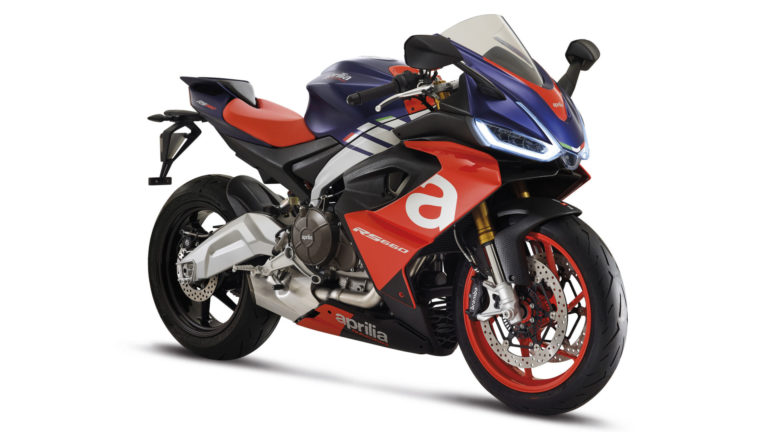
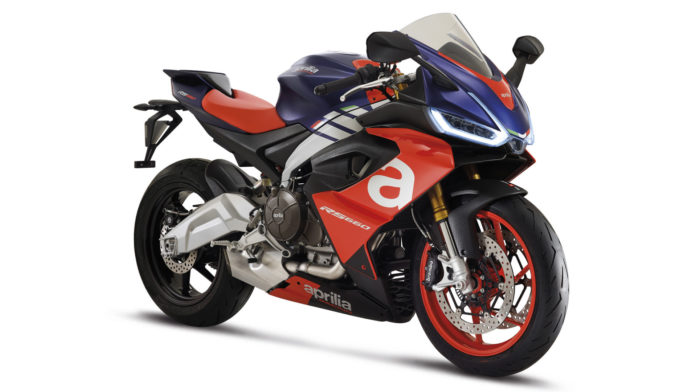
Aprilia's new RS 660 twin-cylinder sportbike. Photo courtesy of Piaggio Group.
PIAGGIO GROUP: 60 MILLION EURO CREDIT FACILITY ARRANGED WITH CDP AND BANCA MPS
The new line of credit will fund investments in research, development and innovation, and further strengthen the Group’s financial structure
Milan, 02 July 2020 – The Piaggio Group (PIA.MI) has signed a 60 million euro credit facility with Banca Monte dei Paschi di Siena and Cassa Depositi e Prestiti (in equal proportions).
The new line of credit will support the Piaggio Group’s planned investments in research and development of innovative technological and product solutions in areas such as active and passive safety and sustainability (including reduced consumption and emissions on internal combustion engines), with a view to strengthening its range of scooters, motorcycles and commercial vehicles. It will enable Piaggio to continue consolidating and expanding its leadership position in the mobility sector, and further strengthen the Group’s financial structure.
The transaction is one of the initiatives organised by Banca MPS and Cassa Depositi e Prestiti to provide liquidity and support the resumption of production activities in Italy. Specifically, the financial product in question was launched by CDP a few months ago to support medium-large Italian companies and assist communities and allied industries.
The FIM MotoGP™ Stewards have been advised of possible breaches of the FIM Grand Prix Regulations covering practice and testing, specifically Article 1.15.1. c) Rider Training and Track familiarisation, regarding the type of machines permitted for rider training.
As a reminder and following the decision of the Grand Prix Commission published on 27 May 2020, riders in Moto3 and Moto2 classes are not permitted to make further private testing in 2020 until further notice, the same applies to MotoGP class riders unless they are riding for Manufacturers that qualify for concessions. Practice and testing restrictions for all classes are expressly provided for in Article 1.15.1 of the FIM Grand Prix Regulations, including details of what machines are allowed to be used for Rider Training and Track Familiarisation.
Hearings for riders who may have broken the rules should be scheduled to take place at the 2020 Gran Premio Red Bull de España at the Circuito de Jerez-Angel Nieto, in order to hear from the parties concerned and to allow further time to investigate the details.
At this stage the FIM will not make any further comments on this matter.
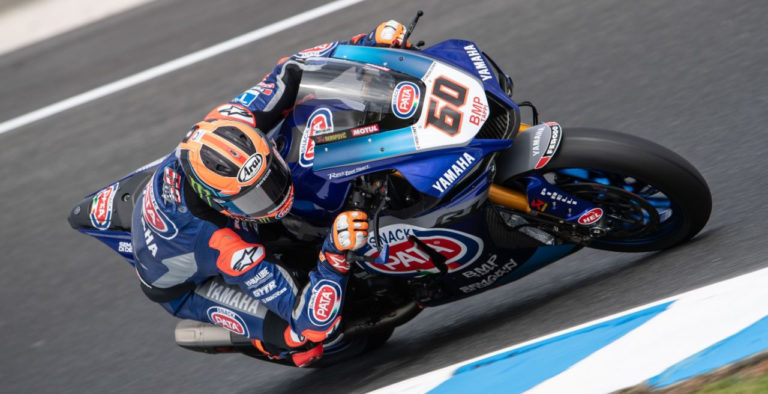
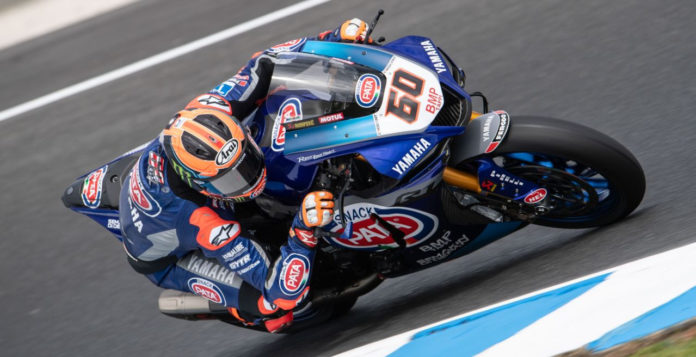
Michael van der Mark (60). Photo courtesy of Pata Yamaha.
BMW Motorrad WorldSBK Team will race with Michael van der Mark in 2021.
Michael van der Mark becomes the team’s new rider in the FIM Superbike World Championship.
Competing in WorldSBK since 2015.
Marc Bongers: “We are convinced that Michael is an asset to our project.”
Munich. The rider planning of the BMW Motorrad WorldSBK Team for the 2021 season in the FIM Superbike World Championship (WorldSBK) is taking shape. New to the team is 27-year-old Dutchman Michael van der Mark, who will contest his first season on the BMW S 1000 RR in 2021.
Van der Mark was crowned Supersport World Champion in 2014. For the 2015 season, he switched to the Superbike World Championship, in which he has been active since and has won three victories and 29 podiums. The team’s second rider for the 2021 season will be announced at a later date.
Quotes.
Marc Bongers, BMW Motorrad Motorsport Director: “We are very pleased about our agreement with Michael, who has developed very strongly in the Superbike World Championship in recent years. We are convinced that Michael is an asset to our project, and together, in combination with the strong package we can offer him, we can reach the next level in terms of results. We would like to welcome Michael to the BMW Motorrad WorldSBK Team and look forward to a strong cooperation.”
Shaun Muir, Team Principal BMW Motorrad WorldSBK Team: “We are delighted to welcome Michael to the BMW Motorrad WorldSBK Team. He brings a wealth of experience and is one of the youngest, most talented riders on the WorldSBK grid. Securing Michael’s services emphasis the focus and determination we have to compete for top honours, and we will give Michael every chance to reach that goal.”
On the Front Cover: With lockdown rules starting to relax, Cameron Beaubier distanced himself from everybody, sweeping both Superbike races at long-delayed, long-awaited Round #1 of the MotoAmerica AMA/FIM North American Championship at Road America, sans spectators. Photo by Brian J. Nelson.
Roadracing World & Motorcycle Technology is THE definitive source for motorcycle racing, riding, and tech information.
Roadracing World & Motorcycle Technology magazine is available in print and digital formats. SUBSCRIBE NOW . Or call (909) 654-4779, 9:00 a.m. – 5:00 p.m. Pacific Time, Monday through Friday.
Read the July 2020 issue of Roadracing World & Motorcycle Technologywith your online subscription. Log in HERE
In This Issue:
FEATURES
Inside Info: Aprilia & Ohvale Cooperate On A Spec Bike, & More
Quick Look: Kawasaki Z900 On Street, Track, And Dyno
Track Day Evaluation: Pirelli Diablo Supercorsa TD Tires
MotoGP Analysis: MotoGP’s Biggest Battle: V4 vs. I4
MotoGP Analysis: The Men Most Likely To Dethrone Marc Marquez?
Peaky Bikers: The Care and Feeding Of A 1952 Vincent Black Shadow, Part Four
Suzuki SV650 Racebike Project Reborn, Part Four
Shops: Fast Bike Industries
PROFESSIONAL RACING
MotoAmerica At Road America: Beaubier!
COLUMNS
Letters To The Editor
10 Years Ago: Elena Myers, First Woman To Win AMA Pro Sprint Road Race, in July 2010 Issue
Trivia & Numbers: MotoAmerica Superbike Lap Times At Road America, 2019-2020
Garrett Gerloff: Garrett Against The World
Back In The Day Editor’s Scrapbook: International Press Intros: Riding the $36,995 1999 MV Agusta F4 750 Serie Oro in Italy; Riding the 2001 Aprilia RSV Mille R in Spain
The Crash Page: Michael Gilbert, Ready For Lift-Off
New Products: GBRacing Front Brake Lever Guard; Woodcraft Race Handlebar Switches
Professional Services Directory: Racers Helping Racers
Racing, School, & Track Day Calendar
ASRA/CCS Newsletter
High-Performance Parts & Services Directory
Chris Ulrich: Adventures Of An Ex-Racer: MotoAmerica Season Opener At Road America
Riders in action during a TrackDaz track day. Photo by CaliPhotography.com, courtesy TrackDaz.
Motorcycle track day and riding school operators are experiencing strong demand, as racetracks around the United States have begun to open, but they’re also experiencing challenges.
“It’s been really good,” Sarah Domingo, co-owner of California-based Let’s Ride Track Days, told Roadracingworld.com. “We’ve had lots of sellouts, very few cancellations, long waiting lists. Everyone has been very enthusiastic and very compliant with the extra health and safety measures we’ve asked them to follow. Everyone wears a facial covering when they’re not in their helmet and not in their own pit area. Yeah, it’s been really good.”
A participant and a control rider at a Let’s Ride Track Day event at Buttonwillow Raceway Park. Photo courtesy of Let’s Ride Track Days.
“We’ve done a few events, and it’s been interesting,” said Ken Hill, a partner with Track Time track days based in the Pacific Northwest. “We were sold out for the first event, and then the third and fourth events were 70-80% sold out, and our next events aren’t sold out yet but they’re pretty close.”
And that’s without a significant portion of Track Time’s market, Canadians, who currently cannot cross the border into Washington state due to COVID-19 travel restrictions.
“I would say 40-50% of our business is Canadians, and the fact that the border is closed has hurt us,” said Hill. “But if you look at 40-50% of our business is Canadians and we’re 70-80% sold out, it’s actually not too bad. If you look at it that way we are getting more U.S.-based clients.”
Penguin Racing School’s Eric Wood (5) in action. Photo courtesy Penguin Racing School.
“As far as demand goes, there’s a huge pent-up demand to get on the racetrack and ride right now,” said Eric Wood, head instructor at Penguin Racing School, which operates in the northeastern U.S. “Our guys are anxious to ride and at the event that we put on recently [at Thompson Speedway, in Thompson, Connecticut] there was an overwhelming sense of we’re willing to do whatever it takes so we can get out there and ride. The guys and girls who do this truly love the sport. If that means they have to make a little sacrifice and stay separated a little bit and wear a mask from time to time that’s a sacrifice they are willing to make.
“We had a really successful day. We sold it out. We didn’t go crazy because for multiple different reasons I’d rather have 80 or 90 happy customers than 150 customers that are unhappy with the track conditions and the crowdedness and the inability to distance because we’ve got them packed in there like sardines.
“For our upcoming events we have coming up [at New Hampshire Motor Speedway] in New Hampshire, we’ve had to make a bunch of different plans. We’ve taken our usual classrooms and cut that class size to less than half, so we have at maximum 10-12 people inside the classroom.
“We’re going to do a lot more outdoor instruction. We’re going to do a lot more on-track kind of stuff, drills, and that type of thing. To be honest with you, the curriculum we came up with and the ideas that we tried during our last event went over really, really well.”
“Demand is strong,” said Chip Spalding, Business Development Manager for Yamaha Champions Riding School, a school that operates at several venues across the country. “People want to come out and ride. Like we’ve seen in other parts of the motorcycle industry, COVID has removed a lot of the other activities that people were doing and spending their money on that involved being around lots of people, so they’ve gravitated towards things [where] they didn’t have to spend a lot of time around people. So they bought motorcycles and did motorcycle stuff, which is great for the motorcycle industry.”
A scene from a Yamaha Champions Riding School pre-COVID-19. Photo courtesy Yamaha Champions Riding School.
But for California Superbike School, one of the oldest and largest motorcycle riding schools, which tours worldwide, the strong current demand may not be enough to make up for the loss of so many events earlier this year.
“Demand seems to be pretty good, but I don’t think we’re out of the woods yet,” said Dylan Code, lead instructor and son of California Superbike School founder Keith Code. “We have overhead. We have 23 paid staff at every event. We have two semi-trailers. We have permanent staff that work every day all year long. So, when we cancel an event or have someone drop out of a two-day camp it hurts. Then somebody says ‘I can’t go because I have COVID,’ what are you going to say? You just have to take it on the chin.”
A scene from a California Superbike School prior to the COVID-19 pandemic. Photo by etechphoto.com, courtesy California Superbike School.
Everyone we interviewed for this article talked about the challenge of constantly working with racetrack staff and monitoring ever-evolving local guidelines to develop health and safety plans for their events. And for those who run events at multiple venues, those challenges are multiplied.
All parties also mentioned that nearly all of their participants were more than willing to abide by health and social distancing requests in order to ride.
But Dustin Coyner, owner of California-based track day operator TrackDaz, offered a story of just how quickly things can turn bad if participants don’t take the health and safety protocols seriously.
“It seems like when people found out they could sign up and ride again it kind of opened the floodgates. It’s been insane, record attendance at every event with a waiting list, that kind of thing,” Coyner told Roadracingworld.com. “Then Laguna Seca shut us down at 3:00 p.m. last Friday [June 26].
“In the morning, they [Laguna Seca] had staff roaming the pits, and then they stopped patrolling because it seemed like everybody was being compliant and wearing their masks. They wanted everyone to wear masks even when they were alone in their own pit area.
“Then right before 3:00 p.m. I was talking to the track supervisor guy. I was like, ‘Hey, how’s everything going?’ And he’s like, ‘Oh, yeah. You guys are doing a good job. I’m roaming the pits. Everyone’s pretty much wearing a mask.’ I’m like, ‘OK, cool!’
“Then, I guess the big boss must have driven through and watched people putting their masks on as they saw him driving up and then in his rearview mirror he watched them take their masks back off. He got back to his office, was super pissed off, and cancelled our event. It’s some crazy shit. It was quite a shock to get the plug pulled on our event.
“We’re going back to Laguna in a couple of weeks, and we’re going to have [our own] mask nazi rolling through the pits going, ‘Dude, put your mask on!’ Either it’s that or, ‘Put your mask on or we’ll kick you out so we can keep riding.’”
TrackDaz track day participants in action at WeatherTech Raceway Laguna Seca. Photo by CaliPhotography.com, courtesy TrackDaz.
Because it’s difficult to accurately predict what will happen with the COVID-19 outbreak in the U.S. or the efforts that will be taken to combat its spread by local, state, and federal authorities, it’s also difficult to predict what will happen in the motorcycle track day and riding school market. But for now, racetracks are reopening, demand for track time is strong, and participants for the most part are willing to abide by whatever measures are necessary to enjoy that track time.
Morbidelli is unique in the history of Grand Prix racing; it’s the only non-motorcycle company to win a Grand Prix race. In 1959 Giancarlo Morbidelli founded the Morbidelli Woodworking Machinery Company in Pesaro. An avid road racing enthusiast, Giancarlo became an entrant in 1968 with Luciano Mele riding a modified Benelli 60cc two-stroke to win the Junior Italian Championship.
Encouraged by this, Giancarlo decided to build his own 50cc machine with help from designer/rider Franco Ringhini. The following year Ringhini scored Morbidelli’s first World Championship points with sixth place at the East German GP! For 1970, Giancarlo had Ringhini design a Twin to contest the 125cc World Championship with Giberto Parlotti as rider …
—Historic Racebike Illustrations: 1975 Morbidelli 125, by Mick Ofield
Morbidelli followed a simple, effective route to racing success—build a proven design with the highest-quality components and materials available. It worked— the company’s 125cc Grand Prix machines utterly dominated the class at the world level for the last part of the 1970s. Read the story of these fascinating machines, designed (literally, sometimes) by racers and fueled by passion – it’s all in the latest issue of Roadracing World!
Roadracing World & Motorcycle Technology is THE definitive source for motorcycle racing, riding, and tech information.
Roadracing World & Motorcycle Technology magazine is available in print and digital formats. SUBSCRIBE NOW . Or call (909) 654-4779, 9:00 a.m. – 5:00 p.m. Pacific Time, Monday through Friday.
Available at Cycle Gear and other motorcycle retailers.
Visit www.roadracingworld.com daily for breaking news and events.
Like us on Facebook https://www.facebook.com/roadracingworld
Follow us on Twitter: https://twitter.com @roadracingworld
Follow us on Instagram https://instagram.com @roadracing_world
A “press release” is promotional text issued by a rider, team, company or organization to inform
the public about an event, product, or service from the issuer’s own point of view, and if deemed
to have news value, may be placed on roadracingworld.com as a service to our readers.
A press release is not an article written by Roadracingworld.com staffers. When a post is labeled with the words “press release”, it means that Roadracingworld.com is not responsible for its content and that Roadracingworld.com makes no guarantee that it is accurate. Not all press releases are posted and Roadracingworld.com may reject press releases if the content is too heavy on commercial promotion with little or no news value or if the press release contains obvious errors.
Accessibility
Accessibility modes
Epilepsy Safe Mode
Dampens color and removes blinks
This mode enables people with epilepsy to use the website safely by eliminating the risk of seizures that result from flashing or blinking animations and risky color combinations.
Visually Impaired Mode
Improves website's visuals
This mode adjusts the website for the convenience of users with visual impairments such as Degrading Eyesight, Tunnel Vision, Cataract, Glaucoma, and others.
Cognitive Disability Mode
Helps to focus on specific content
This mode provides different assistive options to help users with cognitive impairments such as Dyslexia, Autism, CVA, and others, to focus on the essential elements of the website more easily.
ADHD Friendly Mode
Reduces distractions and improve focus
This mode helps users with ADHD and Neurodevelopmental disorders to read, browse, and focus on the main website elements more easily while significantly reducing distractions.
Blindness Mode
Allows using the site with your screen-reader
This mode configures the website to be compatible with screen-readers such as JAWS, NVDA, VoiceOver, and TalkBack. A screen-reader is software for blind users that is installed on a computer and smartphone, and websites must be compatible with it.
Online Dictionary
Readable Experience
Content Scaling
Default
Text Magnifier
Readable Font
Dyslexia Friendly
Highlight Titles
Highlight Links
Font Sizing
Default
Line Height
Default
Letter Spacing
Default
Left Aligned
Center Aligned
Right Aligned
Visually Pleasing Experience
Dark Contrast
Light Contrast
Monochrome
High Contrast
High Saturation
Low Saturation
Adjust Text Colors
Adjust Title Colors
Adjust Background Colors
Easy Orientation
Mute Sounds
Hide Images
Hide Emoji
Reading Guide
Stop Animations
Reading Mask
Highlight Hover
Highlight Focus
Big Dark Cursor
Big Light Cursor
Cognitive Reading
Virtual Keyboard
Navigation Keys
Voice Navigation
Accessibility Statement
www.roadracingworld.com
November 20, 2026
Compliance status
We firmly believe that the internet should be available and accessible to anyone, and are committed to providing a website that is accessible to the widest possible audience,
regardless of circumstance and ability.
To fulfill this, we aim to adhere as strictly as possible to the World Wide Web Consortium’s (W3C) Web Content Accessibility Guidelines 2.1 (WCAG 2.1) at the AA level.
These guidelines explain how to make web content accessible to people with a wide array of disabilities. Complying with those guidelines helps us ensure that the website is accessible
to all people: blind people, people with motor impairments, visual impairment, cognitive disabilities, and more.
This website utilizes various technologies that are meant to make it as accessible as possible at all times. We utilize an accessibility interface that allows persons with specific
disabilities to adjust the website’s UI (user interface) and design it to their personal needs.
Additionally, the website utilizes an AI-based application that runs in the background and optimizes its accessibility level constantly. This application remediates the website’s HTML,
adapts Its functionality and behavior for screen-readers used by the blind users, and for keyboard functions used by individuals with motor impairments.
If you’ve found a malfunction or have ideas for improvement, we’ll be happy to hear from you. You can reach out to the website’s operators by using the following email
Screen-reader and keyboard navigation
Our website implements the ARIA attributes (Accessible Rich Internet Applications) technique, alongside various different behavioral changes, to ensure blind users visiting with
screen-readers are able to read, comprehend, and enjoy the website’s functions. As soon as a user with a screen-reader enters your site, they immediately receive
a prompt to enter the Screen-Reader Profile so they can browse and operate your site effectively. Here’s how our website covers some of the most important screen-reader requirements,
alongside console screenshots of code examples:
Screen-reader optimization: we run a background process that learns the website’s components from top to bottom, to ensure ongoing compliance even when updating the website.
In this process, we provide screen-readers with meaningful data using the ARIA set of attributes. For example, we provide accurate form labels;
descriptions for actionable icons (social media icons, search icons, cart icons, etc.); validation guidance for form inputs; element roles such as buttons, menus, modal dialogues (popups),
and others. Additionally, the background process scans all the website’s images and provides an accurate and meaningful image-object-recognition-based description as an ALT (alternate text) tag
for images that are not described. It will also extract texts that are embedded within the image, using an OCR (optical character recognition) technology.
To turn on screen-reader adjustments at any time, users need only to press the Alt+1 keyboard combination. Screen-reader users also get automatic announcements to turn the Screen-reader mode on
as soon as they enter the website.
These adjustments are compatible with all popular screen readers, including JAWS and NVDA.
Keyboard navigation optimization: The background process also adjusts the website’s HTML, and adds various behaviors using JavaScript code to make the website operable by the keyboard. This includes the ability to navigate the website using the Tab and Shift+Tab keys, operate dropdowns with the arrow keys, close them with Esc, trigger buttons and links using the Enter key, navigate between radio and checkbox elements using the arrow keys, and fill them in with the Spacebar or Enter key.Additionally, keyboard users will find quick-navigation and content-skip menus, available at any time by clicking Alt+1, or as the first elements of the site while navigating with the keyboard. The background process also handles triggered popups by moving the keyboard focus towards them as soon as they appear, and not allow the focus drift outside it.
Users can also use shortcuts such as “M” (menus), “H” (headings), “F” (forms), “B” (buttons), and “G” (graphics) to jump to specific elements.
Disability profiles supported in our website
Epilepsy Safe Mode: this profile enables people with epilepsy to use the website safely by eliminating the risk of seizures that result from flashing or blinking animations and risky color combinations.
Visually Impaired Mode: this mode adjusts the website for the convenience of users with visual impairments such as Degrading Eyesight, Tunnel Vision, Cataract, Glaucoma, and others.
Cognitive Disability Mode: this mode provides different assistive options to help users with cognitive impairments such as Dyslexia, Autism, CVA, and others, to focus on the essential elements of the website more easily.
ADHD Friendly Mode: this mode helps users with ADHD and Neurodevelopmental disorders to read, browse, and focus on the main website elements more easily while significantly reducing distractions.
Blindness Mode: this mode configures the website to be compatible with screen-readers such as JAWS, NVDA, VoiceOver, and TalkBack. A screen-reader is software for blind users that is installed on a computer and smartphone, and websites must be compatible with it.
Keyboard Navigation Profile (Motor-Impaired): this profile enables motor-impaired persons to operate the website using the keyboard Tab, Shift+Tab, and the Enter keys. Users can also use shortcuts such as “M” (menus), “H” (headings), “F” (forms), “B” (buttons), and “G” (graphics) to jump to specific elements.
Additional UI, design, and readability adjustments
Font adjustments – users, can increase and decrease its size, change its family (type), adjust the spacing, alignment, line height, and more.
Color adjustments – users can select various color contrast profiles such as light, dark, inverted, and monochrome. Additionally, users can swap color schemes of titles, texts, and backgrounds, with over seven different coloring options.
Animations – person with epilepsy can stop all running animations with the click of a button. Animations controlled by the interface include videos, GIFs, and CSS flashing transitions.
Content highlighting – users can choose to emphasize important elements such as links and titles. They can also choose to highlight focused or hovered elements only.
Audio muting – users with hearing devices may experience headaches or other issues due to automatic audio playing. This option lets users mute the entire website instantly.
Cognitive disorders – we utilize a search engine that is linked to Wikipedia and Wiktionary, allowing people with cognitive disorders to decipher meanings of phrases, initials, slang, and others.
Additional functions – we provide users the option to change cursor color and size, use a printing mode, enable a virtual keyboard, and many other functions.
Browser and assistive technology compatibility
We aim to support the widest array of browsers and assistive technologies as possible, so our users can choose the best fitting tools for them, with as few limitations as possible. Therefore, we have worked very hard to be able to support all major systems that comprise over 95% of the user market share including Google Chrome, Mozilla Firefox, Apple Safari, Opera and Microsoft Edge, JAWS and NVDA (screen readers).
Notes, comments, and feedback
Despite our very best efforts to allow anybody to adjust the website to their needs. There may still be pages or sections that are not fully accessible, are in the process of becoming accessible, or are lacking an adequate technological solution to make them accessible. Still, we are continually improving our accessibility, adding, updating and improving its options and features, and developing and adopting new technologies. All this is meant to reach the optimal level of accessibility, following technological advancements. For any assistance, please reach out to