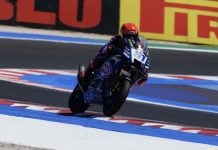
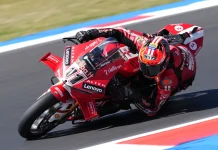
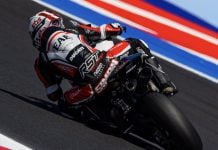
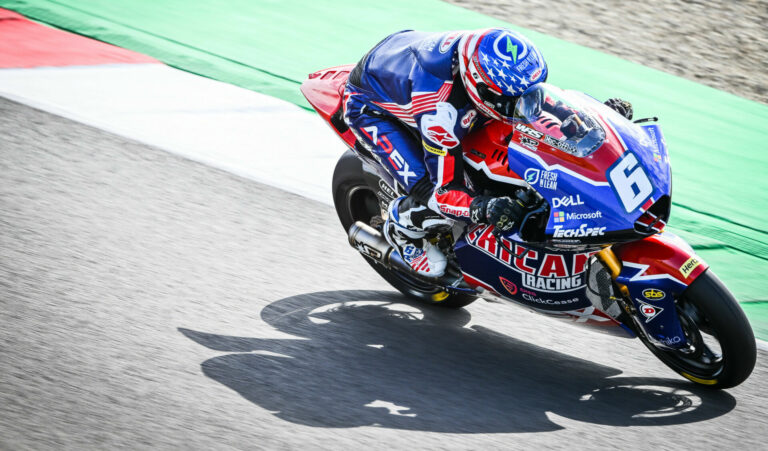
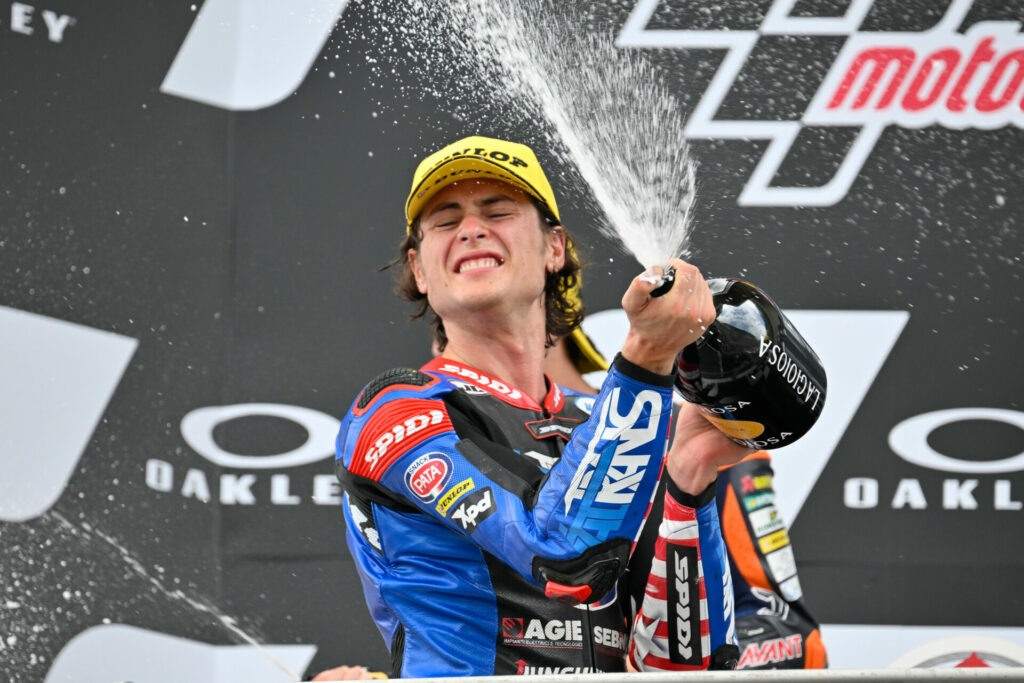
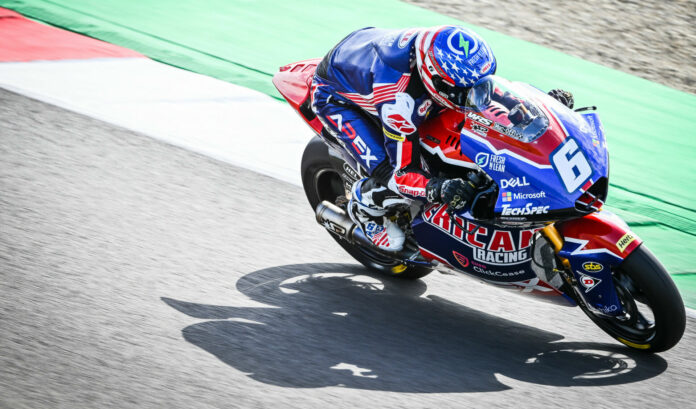
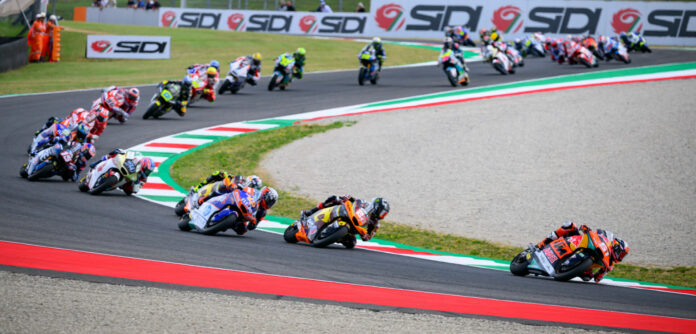
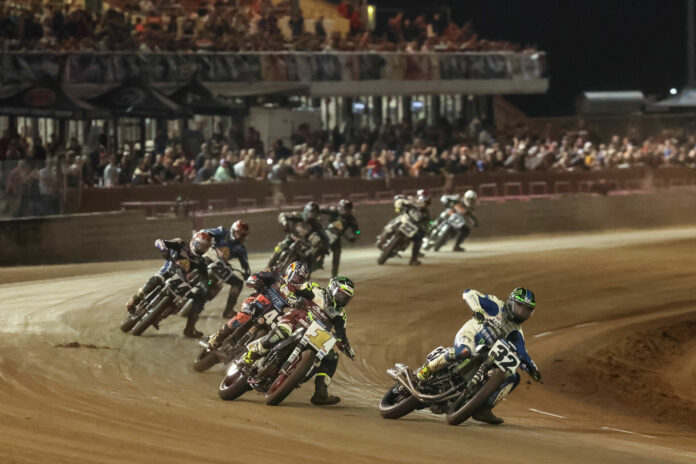
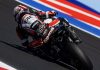
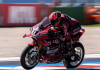
Magical Mugello provides smiles all round at the American Racing Team with Cam Beaubier finishing 7th just off the back of the podium battle, and Sean Dylan Kelly having his closest ever finish time to the winner in his rookie season.
After a stunning ride from well outside the top 25 to 8th in last year’s Italian Grand Prix, Cam was cautiously excited coming into the weekend, though despite a direct seeding through to Q2, he was unable to capitalise on that second qualifying session and ended up starting from 18th on the grid. An outstanding opening lap in the race left him hot on the tails of the top 10 riders, charging through like the five-time MotoAmerica Superbike Champion does best but ultimately falling short of a top four finish by half a second.
Sean’s weekend got off to a less than ideal start, with a crash in FP1 leaving him on the back foot. But taking the lessons from previous races in work method & ethic throughout the practice sessions, he picked up the pace substantially in FP3 and carried it through to the race on Sunday, where he finished with his closest time gap to the winner yet, and running pace matching those of the points finishers in the second half of the Grand Prix.
Experience from private and official testing leaves Sean excited for next weekend’s race in Barcelona, where he hopes to close the gap even further and take a big leap towards his next set of World Championship points in Moto2!
Cameron Beaubier #6 – 7th
“I’m honestly pretty happy with the way the race went after qualifying. No BS, I was struggling super bad to go fast here alone. I needed a reference to put in a good lap time – when I get in with a group, not even someone faster than me but just a reference up the road, it helped me so much here – so the way that qualifying went and knowing how much I struggled last year here, it felt good to put in a good showing in the race.
The first two laps I was able to make some good passes and safely too, not going crazy at all! I was able to make some good clean passes and not screw myself up by running too wide. Coming into the race I wanted to be methodical with my passes, make them clean and not screw myself up by running too wide, as especially on this track, you run wide and riders pass you, with one corner leading to another here… that’s not ideal!
I tried to chase Vietti and bridge the gap to the front group but I was riding out my skin to catch up, so I thought I’d better reel it back in. I’m happy with the tyre choice we made though, we went with the harder rear option so I felt pretty good and consistent the whole race, which I’m not sure how it would have been on the soft.
Even right there at the end, I saw fourth all the way to the chequered flag. I didn’t have anything to fight anyone at the end but I’m super stoked with a seventh. Mugello and Barcelona, going off last year, these are the two toughest tracks for me with the long flow corners and corners that turn around on themselves, that’s where I struggle with this bike. So I’m happy with that and onto the next one!”
Sean Dylan Kelly (4). Photo courtesy American Racing Team.
Sean Dylan Kelly #4 – 23rd
“Overall it was another interesting but I think a positive weekend for me. We started off on the wrong foot on Friday with a crash in FP1, which took us a step back. But we learned a lot doing a full session non-stop in FP2, allowing me to make a step up in FP3 where I was able to find a feeling on the bike I had been missing. Qualifying was difficult due to the conditions really, being so mixed. We were able to carry what we found in FP3 into Sunday though, making the most of warm up in even more difficult conditions and finishing in the top 10 just before race time – which always helps the confidence!
We managed to finish with our smallest gap to the front & P1, which is a big step. There’s of course more to work on in that area but my pace in the last ten laps of the race was pretty strong, it was the same as fighting for points so if I can make a step up in the first ten laps of the race, in that phase, I’ll be able to fight further forward. So I’m happy we were also able to turn it around from Friday and the tough weekends we’ve been having! See you guys in Barcelona!”
John Hopkins, Racing Director –
“I think Cam rode perfectly all weekend, though qualifying didn’t go to plan and that’s the only thing that hindered him from being on the podium this weekend. But as far as the race goes, he rode perfectly.
A perfect start straight from the beginning after we made a plan at the start to execute as I have a lot of experience of coming through the pack here at Mugello specifically. Outside to inside to outside in the first few corners and he made up some awesome positions, which was amazing to see. He had the pace to run with the leaders but got mixed up with Navarro mid-race which separated him from Vietti, allowing the gap to open and losing the draft from the podium contenders. When you lose the draft in Mugello, it’s game over. But he kept his head down and had a great race, exactly what he needed to do…
With Sean, we have some really good positives this weekend. He closed the gap significantly with his best ever result in respect to his time to the leaders, closed by well over 10 seconds compared to previous races at one of the most difficult tracks on the calendar. He’s improved his riding, performance and overall preparation; he’s made that next step and I think Barcelona will be a race where he’s able to show it!”
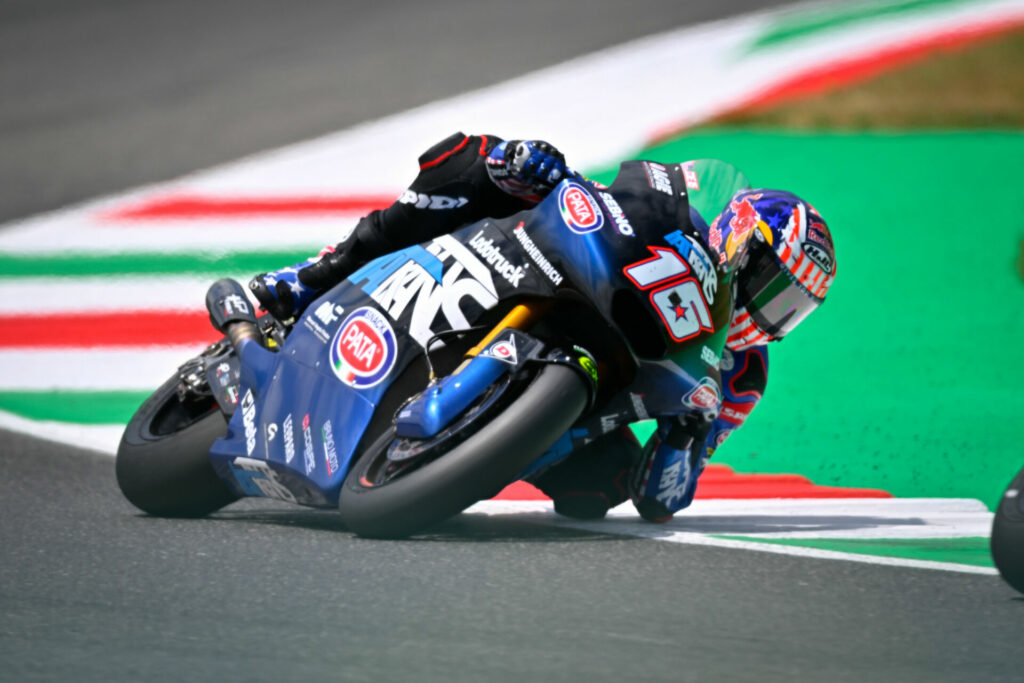
Joe Roberts (16) at Mugello. Photo by Kohei Hirota.
An Italian Grand Prix of intense emotions for Italtrans Racing Team at Mugello Circuit. An incredible home race where the team proved once again to have the qualities to be among the rulers of this 2022 World Championship with an amazing Joe Roberts on the 2nd step of the podium.
Started from the 3rd row, Joe pushed since the beginning, fighting in the top five. With 8 laps to go he overtook Vietti and Ogura, conquering the second position and maintaining it until the chequered flag. Ahead of him only Acosta. This second step of the podium worth 20 important points for the standings: Roberts is now 4th with 86 points.
Unlucky race for teammate Lorenzo Dalla Porta. Starting 11th on the grid and ready to fight in the top ten, he crashed at the Bucine – fortunately without consequences.
Now no break: the MotoGP World Championship moves to Barcelona for the Catalan GP.
Lorenzo Dalla Porta, DNF:
“I’m really sorry. I was struggling a lot, then at the Bucine I braked probably a bit late and the front tyre couldn’t take it. Too bad. The upside of all this is that we did a good qualifying and could have finished in the points. Let’s put this race behind us and look ahead to Barcelona”.
Joe Roberts (16) on the Moto2 podium at Mugello. Photo by Kohei Hirota.
Joe Roberts, 2nd:
“Super happy with this 2nd place! I felt really good this morning and that we could be in the fight for a good position. Thank you to my team for their hard work all weekend was a weekend to remember!”.
Franco Brugnara, Lorenzo Dalla Porta’s Crew Chief:
“We could have a good race. Lorenzo didn’t start good, but he was recovering when he crashed. Too bad, because we could have gotten some points. We’ll try again in Barcelona”.
Giovanni Sandi, Joe Roberts’ Crew Chief:
“Yesterday we had the best qualifying of the season and I knew today we could have a great race. We did a great job together: the bike was competitive and Joe was really good. He fought for the podium with determination, showing that he is a talented rider”.
More, from a press release issued by Red Bull MotoGP Rookies Cup:
Perfect Veijer takes Farioli on the line for Rookies 2 in Mugello
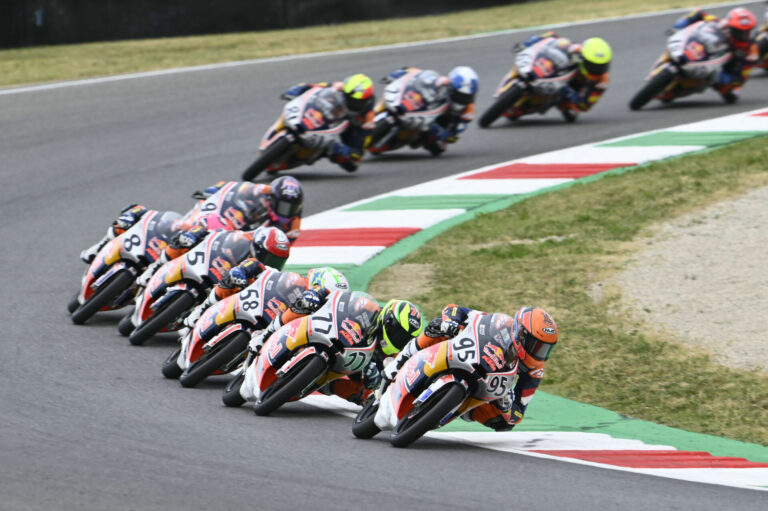
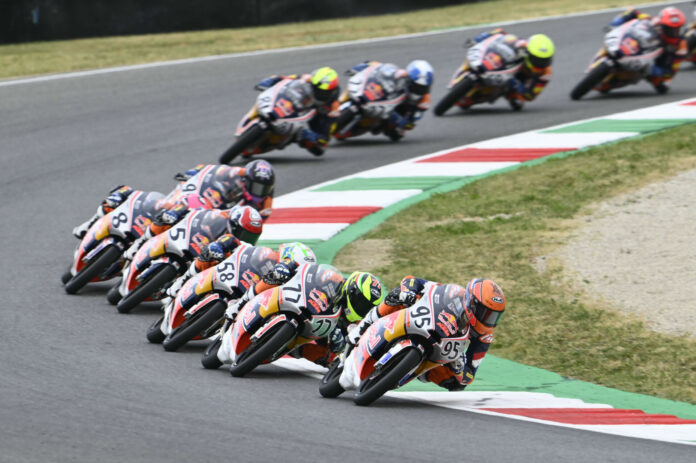
Collin Veijer flicked out of the slipstream of Filippo Farioli’s KTM and willed his identical RC 250 R alongside and ahead as the pair led a pack of 13 Red Bull Moto GP Rookies across the Mugello finish line covered by just 2 seconds.
It was a masterly performance by the 16-year-old Dutchman who was never too far from the front along with pole man Farioli the 17-year-old Italian.
It had been one of the truly great Cup races and third went to Tatchakorn Buasri, the 21-year-old Thai by just 1 thousandth of a second over 15-year-old Briton Eddie O‘Shea.
The conditions were so different to Saturday’s soaker and 15 laps in virtually perfect conditions allowed the youngsters to produce their best with no one coming close to breaking away and places swapping many times every corner.
Veijer had a plan
“I knew what I wanted to do on the last lap. I thought I could get far enough ahead that they would not be able to catch me before the line. I had tried it a few laps earlier and I thought it was possible.”
“So I went for it on the last lap to make a gap but then Filippo came past and I thought, ‘well maybe that is not so bad,’ and I got in behind him and concentrated on making a perfect run through the last corner and into his slipstream.”
“I had no idea how close the others were behind me I was just concentrating on Filippo. It is great to get the win. I had tried to break away but I was running long gearing and I couldn’t do it, a great race.”
Farioli with a beautiful ride
“The start was not so bad, the first lap was good. After I saw that it was not possible to escape from the other riders, I stayed in the group, made a good management of the situation. In the end I finished 2nd, I was in front through the last corner but Collin did a very good job to exit fast and passed me.”
“Coming to the last lap I realised I had good pace in the second part of the track and I thought, OK I will pass Collin after the Arrabbiata. But after I did they stayed with me, he exited faster from the Bucine and he won. The Strategy was good but in the end I was 2nd. I am very happy, I must congratulate Collin and thank everyone who helps me.”
“It was a fantastic weekend. I was fast in practice and took Pole but yesterday was a difficult race because it started to rain just as we took off the tyre warmers. It was very difficult and I crashed first lap but after made a good comeback.”
Tatchakorn Buasri saved it until the end
“My plan today was really only to push on the last lap, because there was so much overtaking going on that I could try and lead but it was impossible to break away and I knew the race would only be decided on the last lap.”
“I tried to get in the right place on the last lap and I made it to 3rd place. Not bad for me,” he added with his broad grin, the only rider to be on the podium in both races.
Eddie O‘Shea so close to the podium
“It was definitely the best race of my European career so far. I managed to stay in the front group the whole race, I was comfortable in P5, P6, I was comfortable overtaking on the brakes and the bike felt near perfect and I’d like to thank all the team for that.”
“I came out of the final corner 5th, I dragged Tatchakorn and Filippo for 3rd and Tatchakorn beat me by 0.001 I believe. I am happy to take 4th but I’m more happy that I am gutted not to get on the podium.”
Luca Lunetta loved finishing 5th
“It was a very beautiful race, it is fantastic to ride here in Mugello and I enjoyed the race a lot, so much overtaking and I think this is one of the most enjoyable races I have ever made. I can’t wait to get to Sachsenring, I want more,” enthused the 16-year.old Italian.
José Rueda lost the run in to the line
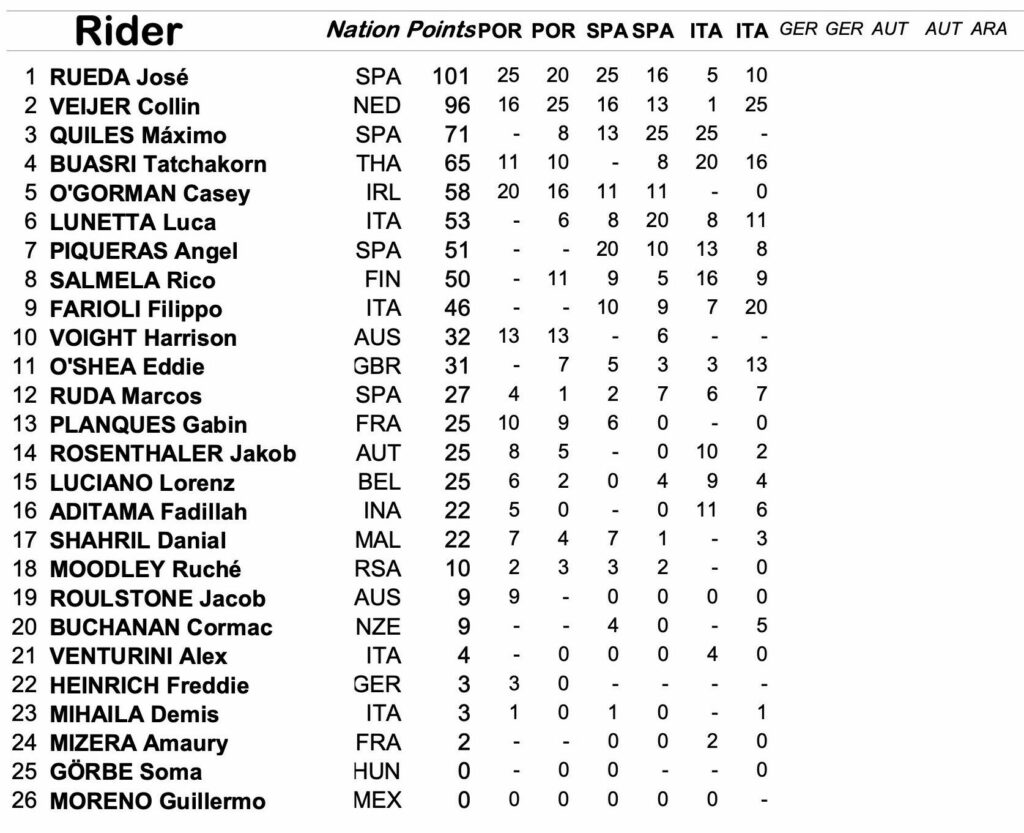
“The race was OK, but not too much,” chuckled the 16-year-old Spanish points leader who is now just 5 ahead of Veijer. “Normally I would like to have more points for the championship. On the last lap, in the last corner I came out in 3rd position and then finished 6th,” he laughed. “That’s how it goes on this track, it’s crazy. The bike was good I enjoyed the battle but….”
Max Quiles could not repeat
“In the last corner I was going to overtake, I was P8, I was on the inside and when I tried to open the gas the front tyre slid away and I went down. I was trying to get the good drive out and overtake in the straight before the line but….” shrugged yesterday’s winner, the 14-year-old Spaniard.
Provisional Mission Production Twins Main Event Results (all on Dunlop tires):
1. Jesse Janisch (Har), 19 laps
2. Cory Texter (Yam), -01.952 seconds
3. Ben Lowe (Yam), -02.557
4. Ryan Varnes (KTM), -07.005
5. Michael Rush (Har), -13.434
6. Cody Johncox (Yam), -13.445
7. Cameron Smith (Yam), -13.534
8. Cole Zabala (Yam), -19.182
9. Jeremiah Duffy (Kaw), -19.386
10. Billy Ross (Har), -22.986
11. Kasey Sciscoe (Har), -23.214
12. Nick Armstrong (Yam), -24.072
13. Michael Hill (Yam), -29.518
14. James Rispoli (KTM), -40.150
15. Brandon Newman (Kaw), -5 laps
16. Jordan Harris (Kaw), -8 laps
Provisional Parts Unlimited AFT Singles Main Event Results (all on Dunlop tires):
1. Dalton Gauthier (Hon), 18 laps
2. Morgen Mischler (Hon), -00.029 seconds
3. Max Whale (KTM), -00.057
4. Kody Kopp (KTM), -00.111
5. Trevor Brunner (Yam), -00.245
6. Chase Saathoff (Hon), -00.463
7. Kevin Stollings (Hon), -00.639
8. Michael Inderbitzin (Hon), -03.328
9. Hunter Bauer (KTM), -03.347
10. James Ott (KTM), -03.351
11. Travis Petton (KTM), -03.435
12. Gage Smith (Hon), -03.486
13. Ferran Cardus (Hon), -03.722
14. Aidan RoosEvans (Hon), -08.224
15. Tyler Raggio (Hon), -08.227
16. Chad Cose (Hon), -4 laps
17. Trent Lowe (Hon), -18 laps
Provisional Mission SuperTwins Main Event Results (all on Dunlop tires):
1. Jared Mees (Ind), 26 laps
2. Davis Fisher (Ind), -00.126 seconds
3. JD Beach (Yam), -02.628
4. Dallas Daniels (Yam), -02.695
5. Briar Bauman (Ind), -03.357
6. Jesse Janisch (PT) (Har), -07.409
7. Jarod Vanderkooi (Ind), -07.698
8. Bronson Bauman (Har), -07.719
9. Brandon Robinson (Ind), -13.143
10. Ben Lowe (PT) (Yam), -20.274
11. Ryan Varnes (PT) (KTM), -27.963
12. Shayna Texter-Bauman (Ind), -12 laps
13. Robert Pearson (Ind), -15 laps
14. Cory Texter (PT) (Yam), -18 laps
15. Brandon Price (Kaw), -26 laps
More, from a press release issued by American Flat Track (AFT):
Mees Back on Top in Red Mile II Rematch
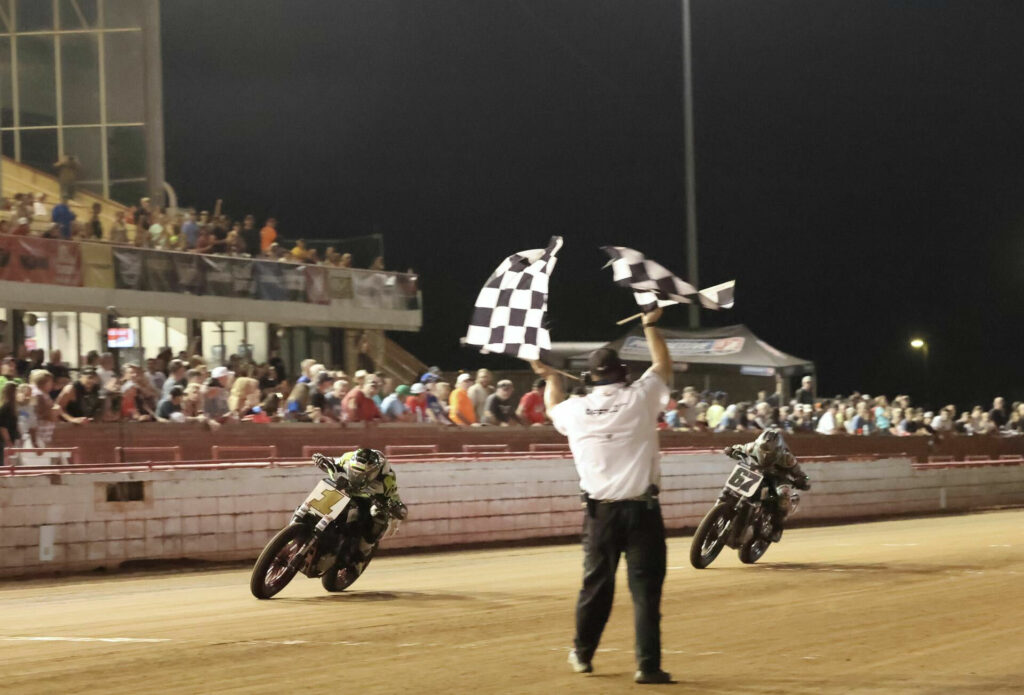
Jared Mees (1) takes the checkered flag ahead of Davis Fisher (67) at the Red Mile II, Photo by Brian J. Nelson, courtesy AFT.
DAYTONA BEACH, Fla. (May 29, 2022) – Progressive American Flat Track legend Jared Mees (No. 1 Indian Motorcycle/Progressive Insurance FTR750) returned to the top of the box in stunning fashion in Sunday night’s Mission Red Mile II presented by Indian Motorcycle of Lexington.
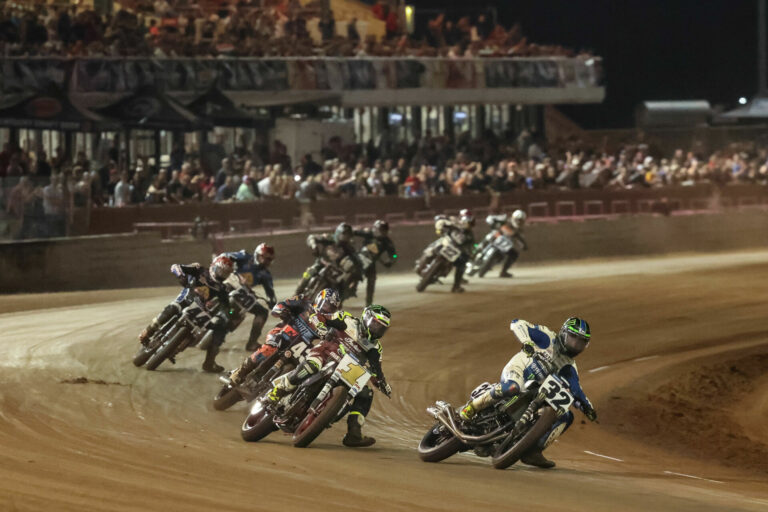
24 hours after being beaten to the stripe at the Red Mile by Mission SuperTwins presented by S&S Cycle rookie sensation Dallas Daniels (No. 32 Estenson Racing Yamaha MT-07 DT), Mees and Daniels settled into a rematch at the front of the premier-class Main Event.
The two threatened to drop the remainder of the pack from the start but were gradually reeled back in by Davis Fisher (No. 67 Bob Lanphere’s BMC Racing Indian FTR750) and Briar Bauman (No. 3 Indian Motorcycle/Progressive Insurance FTR750).
However, just after half-distance Bauman’s charge faded, leaving Fisher as the only pilot with a shot at transforming the battle for the win into a three-rider affair. He made good on that promise with five minutes to go, creating a contest of contrasting strengths and lines.
Daniels led to open the last lap but with Mees and Fisher both in close pursuit. As the three exited Turn 2, it still appeared to be anyone’s race until Mees and Fisher both stormed past Daniels with unexpected ease.
The rookie’s inopportune bike issues turned the fight back into a two-rider match-up for the final half-lap. Fisher did all he could to draft by the reigning champion at the stripe, but he came up 0.126 seconds short of beating one of history’s best Mile racers at one of his best tracks.
The victory was Mees’ 23rd Mile win, tying him with Ricky Graham for fifth all-time in the discipline. It was also his fourth in five attempts in Lexington, Kentucky.
The triumphant Mees said, “It was actually beneficial to have the Jumbotron on the front straightaway because I was able to glance at it. The first couple of laps, Dallas and I had a pretty comfortable lead. That was good because I could hold back and pace off of him and see where I was strong and see where I could maybe pull out. I sat there and studied him because I have to ride very precise to make everything count.
“It felt good – it really did. I think (Dallas) had a bit of an issue going down the back straightaway, but you’ve got to get to the checkered flag to win these things. It’s unfortunate for him because he was riding so good.”
Daniels seemed capable of limping to the podium but instead got zapped at the line by 0.067 seconds by teammate JD Beach (No. 95 Estenson Racing Yamaha MT-07 DT). While Beach’s expected challenge for victory failed to materialize, he did manage to register a late charge to climb back into podium contention. The Kentuckian overhauled eventual fifth-place finisher Bauman and sixth-placed Mission Production Twins Challenge entrant Jesse Janisch (No. 33 Vance & Hines Harley-Davidson XG750R), before finally sailing by Daniels at the flag.
Jarod Vanderkooi (No. 20 Mission Roof Systems Indian FTR750) finished a couple tenths back of Janisch in seventh, with Bronson Bauman (No. 37 Latus Motors Racing Harley-Davidson XG750R), Brandon Robinson (No. 44 Mission Roof Systems Indian FTR750), and Ben Lowe (No. 25 Mission Foods/Roof Systems Yamaha MT-07) rounding out the top ten.
Mission Production Twins presented by Vance & Hines
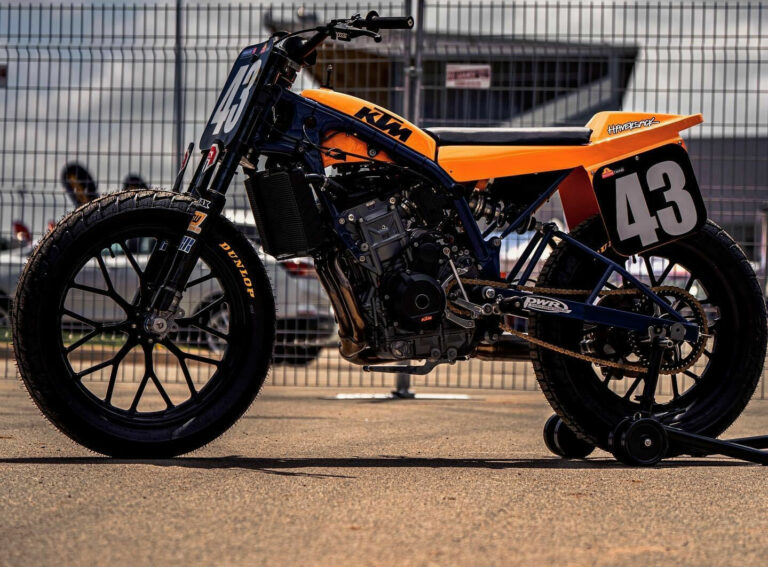
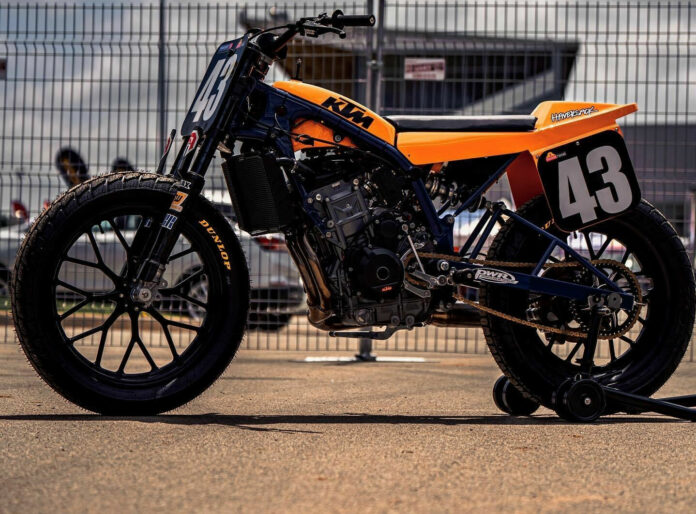
The WBR KTM of James Rispoli (No. 43 Wally Brown Racing/Haversack KTM 890 Duke) went from untested to heavy favorite following a debut night of racing that saw it dominate Saturday’s Mission Production Twins presented by Vance & Hines Main Event and then deliver a podium in the Mission SuperTwins Main as an encore. However, any fears that it might prove invincible on its second day were more than balanced out by reality that it’s still in a relatively early state of development.
Rather than break free after taking the lead early in Sunday’s race, Rispoli found himself embroiled in an intense battle with Jesse Janisch (No. 33 Vance & Hines Harley-Davidson XG750R), as the two raced their way away from the pack.
Rispoli and Janisch swapped the lead back and forth repeatedly with Janisch grabbing the lead just as the clock expired. He then put his head down in hopes of corralling his opponent behind him for the final two laps, but the drama of a potential photo finish ended a straightaway early; Rispoli sat up as the two exited Turn 4 for the final time due to a mechanical issue.
After scoring his second victory of the ‘22 season, Janisch said, “The bike was getting off the corners a little better tonight. The bike was on rails. I’m stoked. It was a good race.”
A couple seconds back of the fight for the lead, Cory Texter (No. 1 G&G Racing/Yamaha Racing Yamaha MT-07) waged a similarly back-and-forth battle with Ben Lowe (No. 25 Mission Foods/Roof Systems Yamaha MT-07) for third. The defending champ swept past Lowe late and held on to inherit second position.
Ryan Varnes (No. 68 Schaeffer’s Motorsports/Rausch Fuel & Oil KTM 890 Duke) dropped out of podium contention but managed to hold on for fourth. Meanwhile, Michael Rush (No. 15 Hellipower Racing/Las Vegas Harley-Davidson XG750R) charged his way from Row 4 to fifth position as he made his paddock presence felt in a big way in his return weekend.
Nick Armstrong (No. 60 Competitive Racing Frames/Lessley Brothers Yamaha MT-07), who came into the night leading in the points, finished 12th. Despite that, Texter continues to sit second in the championship fight as both men were overtaken by race winner Janisch, who now leads Texter by one point (92-91) with Armstrong a further 10 points back in third at 81.
Parts Unlimited AFT Singles presented by KICKER
Dalton Gauthier (No. 79 American Honda/Progressive Insurance CRF450R) took top honors in a barn-burning Parts Unlimited AFT Singles presented by KICKER Main Event.
The drama to come was teased early on when Trevor Brunner (No. 21 Estenson Racing Yamaha YZ450F) got into the rear wheel of Saturday winner Morgen Mischler (No. 13 American Honda/Progressive Insurance CRF450R). Fortunately, both frontrunners escaped the contact unscathed.
Max Whale (No. 18 Red Bull KTM Factory Racing 450 SX-FFE) wouldn’t be as lucky a couple minutes later when Brunner got into him and the Australian was sent off his bike and up into the Airfence.
Following the resulting red flag, there was barely a moment to breathe as the lead pack consisted of the entire field up until the two-minute mark. With one minute remaining on the clock, a seven-rider pack emerged – and one that somehow included both Whale and Brunner, who had fought their way together up from back row starting position at the restart.
Mischler opened up a slight advantage to open the final lap but was pulled back in by the chasing group as they charged to the flag. Gauthier nipped past his teammate at the last possible moment, edging ahead of Mischler at the flag by just 0.029 seconds to earn his first win of the season.
2019 class champ Gauthier said, “Me and my teammate worked together perfectly in the race. My last corner on the last lap was my best of the entire race. I really focused on that and needed to do it to get the win. I think we’re only going to get better from here. I need to make up some points, so I really needed this win.”
Whale got his revenge by securing the final spot on the box, taking third ahead of title leader Kody Kopp (No. 12 Red Bull KTM Factory Racing 450 SX-FFE) and Brunner.
Rookie ace Chase Saathoff (No. 106 American Honda/Progressive Insurance CRF450R) finished in sixth with 2017 Red Mile winner Kevin Stollings (No. 99 Roof Systems/Ice Barn Honda CRF450R) ending up in seventh despite finishing just 0.639 seconds back of the win.
The Mission Red Mile II will premiere on FS1 on Saturday, June 18, at 11:00 a.m. ET/8:00 a.m, PT, including exclusive features, cutting-edge aerial drone and onboard footage, and expert commentary.
Next Up:
Progressive AFT will go from wide-open drafting battles to close-quarters clashes at the Progressive Laconia Short Track presented by MOMS, at New Hampshire Motor Speedway in Loudon, New Hampshire, on Saturday, June 11. Gates will open for fans at 12:30 p.m. ET/9:30 a.m. PT with Opening Ceremonies scheduled to begin at 4:00 p.m. ET/1:00 p.m. PT ahead of the evening’s Main Event program. Visit https://store.americanflattrack.com/ebooking/ticket/view/id/3692/ to reserve your tickets today.
You can catch the livestream of all the weekend’s racing activities on FansChoice.tv. FansChoice.tv provides free-to-view livestreaming of Practice and Qualifying. FansChoice.tv subscribers will then be able to watch the drama unfold from Opening Ceremonies through the Semis, Main Events, and podium celebrations. FansChoice.tv offers two subscription options, granting unlimited access to premium AFT content. Monthly subscriptions start at just $7.99, while a six-month subscription is available for $44.99.
To score the latest gear for the Progressive American Flat Track fan, visit our official merchandise store at https://store.americanflattrack.com.
How to Watch:
FOX Sports and FansChoice.tv are the official homes for coverage of Progressive American Flat Track. For the 2022 season, all races will premiere in one-hour telecasts on FS1 during highly desirable weekend time slots. The complete schedule can be viewed at https://www.americanflattrack.com/events-foxsports. FansChoice.tv provides livestreaming coverage of every Progressive AFT round can watch livestreaming coverage of every Progressive AFT round at http://www.FansChoice.tv.
After a long awaited return, the weather gods were smiling on competitors for the opening qualifying session of the 2022 Isle of Man TT Races fuelled by Monster Energy. With sunshine all around the Island and it was Davey Todd (Milenco by Padgett’s Motorcycles) who topped the Superbike class with a speed of 127.492mph ahead of Dean Harrison (DAO Racing Kawasaki, 126.984mph) and John McGuinness MBE (Honda Racing UK, 124.955mph).
Peter Hickman posted the third quickest lap of the afternoon, 126.49mph, onboard the Gas Monkey Garage by FHO Racing machine, to lead the way in the Superstock category with Michael Dunlop (MD Racing) fastest in the Supersport class at 124.103mph and Jamie Coward (KTS Racing by Steadplan) the pacesetter in the Supertwin division at 117.573mph.
Meanwhile, newcomer Glenn Irwin had a superb first session with the Honda Racing UK rider lapping at a stunning 122.616mph on his Superstock Fireblade. It was a similar case in the sidecars with newcomer Harry Payne, with Mark Wilkes in the chair, putting in a superb performance at 110.364mph.
After a short delay to lock the course down, the TT soared back into life at 13.50pm with the newcomers getting their first taste of the 37.73-mile Mountain Course. TT Rider Liaison Officers Richard Quayle and John Barton were joined by ten-time TT winner Ian Lougher in taking Jamie Cringle, Glenn Irwin, Milo Ward, Ilja Caljouw, Joe Loughlin, Craig Szczypek and Jason Burrill for their maiden lap on closed roads.
At 14.15, the main session got underway and it was Michael Rutter (Bathams Ales) who led the field away followed ten seconds later by Harrison, the duo both Superbike-mounted. Lee Johnston was next to go on his Ashcourt Racing Yamaha Supersport machine with Ian Hutchinson (Milwaukee BMW Motorrad) and Michael Dunlop (Hawk Racing) in hot pursuit on their Superbikes.
First to complete the lap was Rutter at 121.111mph with Harrison next across the line at 120.442, the Bradford rider immediately pulling back into the pits. They were both upstaged by Hutchinson who lapped at 122.315mph but it was Hickman who was quickest of all, the outright lap record holder posting a speed of 124.786mph on his Superstock mount.
The similarly mounted Milenco by Padgett’s Motorcycles duo of Conor Cummins and Todd slotted into second and third at 124.280mph and 123.237mph respectively. Meanwhile, Hutchinson was knocked off the top spot in the Superbike class by 23-time winner John McGuinness MBE with the Honda Racing UK man lapping at 122.819mph.
Jamie Coward moved into third at 122.105mph with Dominic Herbertson (121.501mph) and Derek Sheils (121.276mph) pushing Rutter down to sixth. Quickest newcomer overall on the first lap was Loughlin at 111.136mph which was half a second quicker than Irwin’s 111.093mph.
Second time around and, understandably, the pace increased at the head of the field and it was again the three Superstock riders of Hickman, Cummins and Todd who were quickest overall, Hickman’s lap of 126.485mph putting him 2.5s quicker than Cummins (126.19). Todd was a further second back in third (126.072) with all three lapping under 18 minutes.
McGuinness (124.955) was again the quickest in the Superbike class followed by Hutchinson (123.435), Sam West (123.1) and Sheils (123.047). Irwin’s second lap, on his Superstock Honda, was an impressive 116.463mph with the Supersport-mounted Loughlin upping his speed to 113.179mph, whilst Ward had now broken the 110mph barrier with a lap of 111.381mph.
Harrison was back out on track on his Superbike machine and his second lap of 124.393mph put him second quickest behind McGuinness, but Hickman was encountering issues on his Superbike as he toured round Ramsey Hairpin. James Hillier then bumped Harrison briefly back to third, the RICH Energy OMG Racing man lapping at 124.831mph, but on his third lap Harrison not only went quickest in the Superbike class but also overall with a speed of 126.984mph.
Hickman made it back to the pits and returned to the fray on his Superstock BMW but Cummins wasn’t as lucky as he stopped at the Mountain Box. Teammate Todd was faring better though and after lapping at 126.752mph, his final lap of 127.492mph sent him quickest overall, with West moving up to third in the Superbikes with 125.216mph. Irwin’s fifth lap saw him break the 121mph barrier to slot into 13th overall in the Superstock class.
At 15.30, it was the turn of the Supersport/ Supertwin qualifying session with Dunlop (122.512mph) the quickest Supersport runner in the early stages from Harrison (122.042mph) and Coward (121.925mph). Gary Johnson (Dafabet Racing) was setting the pace in the Supertwins at 114.43mph followed by Aprilia-mounted Stefano Bonetti (113.446mph) and the Paton of Rutter (112.316mph).
On the second lap, Coward moved to the top of the Supersport speeds with a lap of 123.311mph but only briefly as Dunlop’s second lap was 124.103mph and there was change too in the Supertwins with Bonetti upping his speed to 114.121mph and John Barton slotting in behind at 113.931mph.
As the solo session came to a conclusion, there was no change at the top of the Supersport leaderboard but Hickman (K2 Trooper Beer by PHR Performance) moved into third with a speed of 122.949mph.
Late laps though from both Coward and Michael Dunlop (MD Racing) at 117.753mph and 116.631mph respectively moved them up to first and second in the Supertwins category with Johnson slipping back to third ahead of Dominic Herbertson, James Hind and Rutter. Newcomer Loughlin also impressed with the seventh fastest time (113.361) on the Team ILR/Mark Coverdale Paton.
With the sun continuing to shine, the Sidecar class got their first session underway at 16.30pm, the newcomers having had their speed-controlled laps at the beginning of the afternoon but Ryan and Callum Crowe (Haven Homes) were early casualties stopping in Kirk Michael village.
Leading the way on the road were the Birchalls on their Haith Honda and they completed their opening lap at 110.427mph but that was only good enough for second with Peter Founds/Jevan Walmsley (FHO Racing) going quickest at 112.426mph. Tim Reeves with newcomer passenger Kevin Rousseau had an encouraging start at 109.107mph to go fourth.
That put them one place behind newcomer driver Lee Crawford, with Scott Hardie in the chair, who put in a stunning lap of 109.292mph whilst fellow newcomer Harry Payne, partnered by Mark Wilkes, was also going well at exactly 108mph. That put them eighth quickest behind regulars Gary Bryan/Phil Hyde, Conrad Harrison/Andrew Winkle and Lewis Blackstock/Patrick Rosney.
On the second lap, the Birchalls improved to 111.908mph with Payne/Wilkes jumping up to a sensational third at 110.364mph. They were the only three crews to break the 110mph barrier with Bryan/Hyde, Crawford/Hardie and Reeves/Rousseau completing the top six.
More, from a press release issued by Honda Racing UK:
Strong first qualifying for Honda Racing UK at the Isle of Man TT Races
The Honda Racing UK team started the Isle of Man TT Races fortnight with a strong first outing for John McGuinness MBE and Glenn Irwin on the Honda CBR1000RR-R Fireblade SP. Under blue skies and blazing sunshine, albeit coolish temperatures, John finished fourth fastest in both the Superbike and Superstock classes, while Glenn was an impressive ninth fastest in the Superstock class as he made his TT Races debut.
The Honda Racing UK teammates made the most of the conditions with John putting in two laps apiece on his Superbike and Superstock Fireblade machines – and was immediately into his stride posting the fastest first lap of any of the Superbikes – before rounding out the day with a lap on his Supersport bike. Glenn meanwhile rode lap after lap after lap, completing seven in total, as he worked at learning the 37.75-mile Mountain course.
After a first lap behind TT Rider Liaison Officer Richard ‘Milky’ Quayle (also riding a Honda CBR1000RR-R Fireblade SP), Glenn then put in an astounding five quick-fire laps on his Superstock bike, building up his lap speed from a first lap of 111mph through to his best 121.535mph on lap five. He then took advantage of an option for newcomers to ride a second session to put in two laps on his Superbike and posted an even faster lap, clocking an impressive 122.616mph, despite being slowed on track by other riders.
After three years the fans were back in force, enjoying the first night of Qualifying packing the paddock and the course alike, and with such great late-spring weather it all made for a highly enjoyable, atmospheric return to road racing for the island.
The Honda Racing UK team will be back in action tomorrow evening, as they look forward to five nights of Qualifying next week, before the first race of the TT fortnight takes place on Saturday 4 June, with the six-lap RST Superbike TT Race.
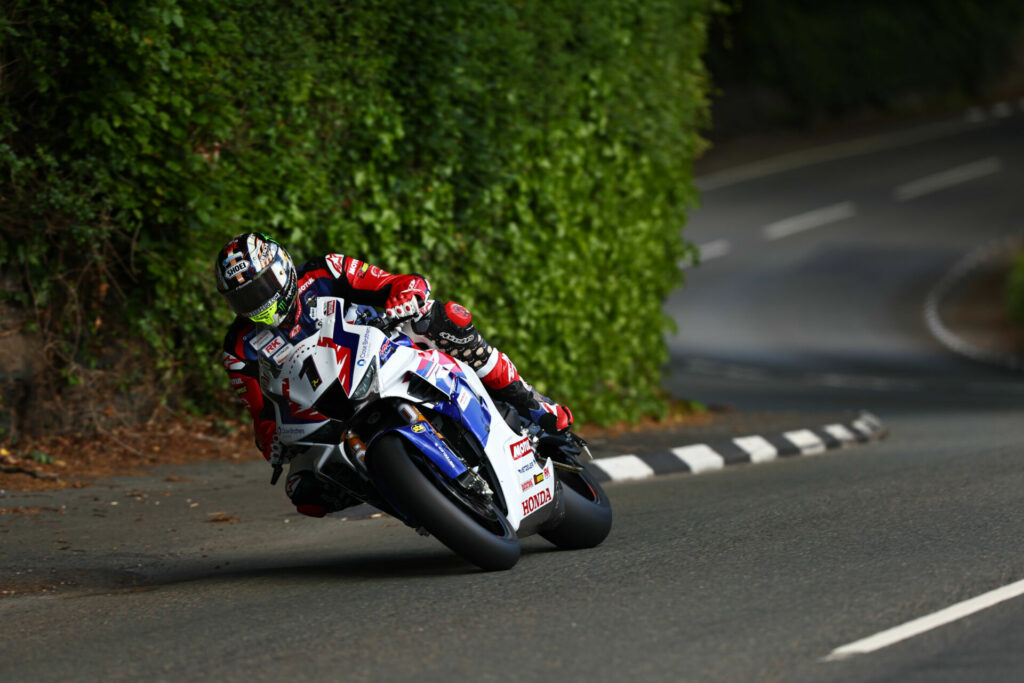
John McGuinness MBE (1). Photo courtesy Honda Racing UK.
#1 John McGuinness MBE
That definitely got my attention, that first lap down Bray Hill! Wow! I haven’t been on a Superbike for a while, 2016 I think was last time I was on something that was competitive and I felt confident with. And after four laps I feel like I’ve been run over! This places pulls muscles you forgot you ever had. But look at the weather, feel the atmosphere in the paddock, it’s a cool place to be, and out there on the track I’ve never seen so many people trackside for the first day of practice! It’s cool to see, great to be back.
The new Fireblade is feeling good, it’s faster, sharper, and the Superbike certainly gets your attention, it’s that fast and of course demanding. I’m also learning some new stuff, there’s a lot of nice new tech that’s come with this bike. So I’m happy to be inside the top five in both classes today, that’s probably down to experience, and for sure the pace will get faster and faster as the week goes on, but it’s good to be at the sharp end and to have four good safe laps under our belt. I’ll just need to digest what’s gone on today, what the bikes were doing – I’ll need to sleep on it, lie in bed and let it come back to me! But no question, the bikes are good and it’s great to back here at the TT.
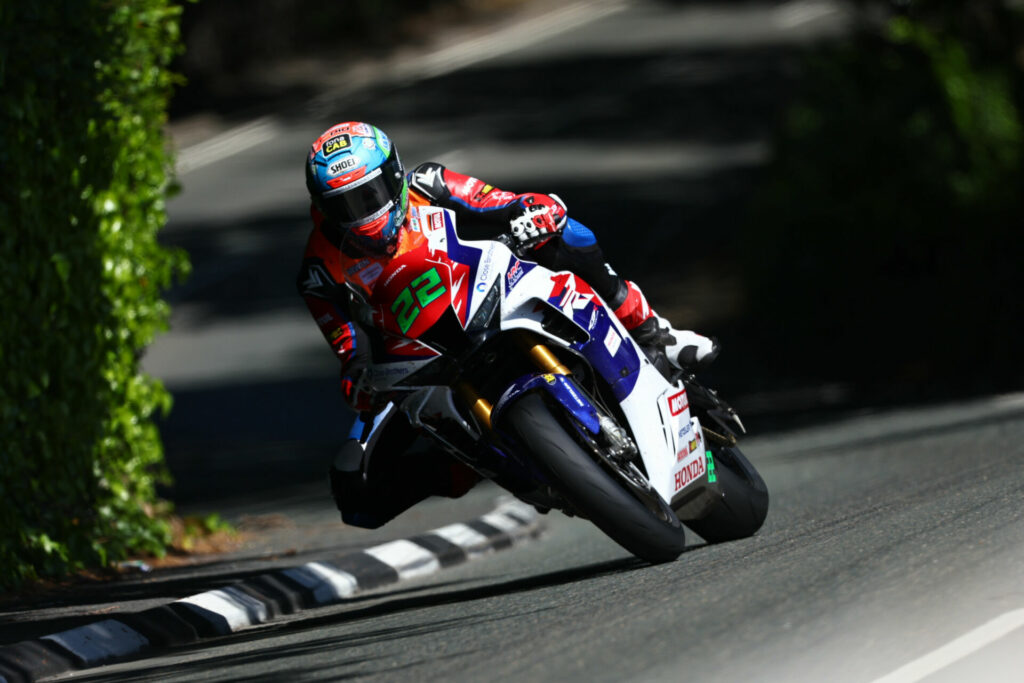
Glenn Irwin (22), wearing his orange Newcomer’s vest. Photo courtesy Honda Racing UK.
#22 Glenn Irwin
First impressions – it’s absolutely mental! For now, I’m just learning the course but I’m really happy with the homework I’ve done on this, it’s really helped. I know where I’m going, but what I need to understand is how these guys take some of these big corners flat out. But all that will come with time, for now I’m concentrating on hitting my markers.
I’m not paying any attention to the lap times, but ninth, that’s alright isn’t it!? I came in after that first newcomers lap saying I didn’t like the sections under the trees, I still feel that way, it’s easy to be drawn into the hedges, because the straights aren’t straight and then there’s the strobe effect, I’ve never raced under so many trees. So I’ve put in the maximum laps I could and I’ve learned lots by following the guys as they’ve come past. I think my favourite corner so far would be Cronk ny Mona (the left after Hillberry) – they say never go over the white line or you might crash, so I don’t go over it, but I enjoy really sitting on it!
So I’ve had lots of fun today. The Superbike felt good and the Superstock I felt very comfortable on, so I think we can improve it a lot over the week.
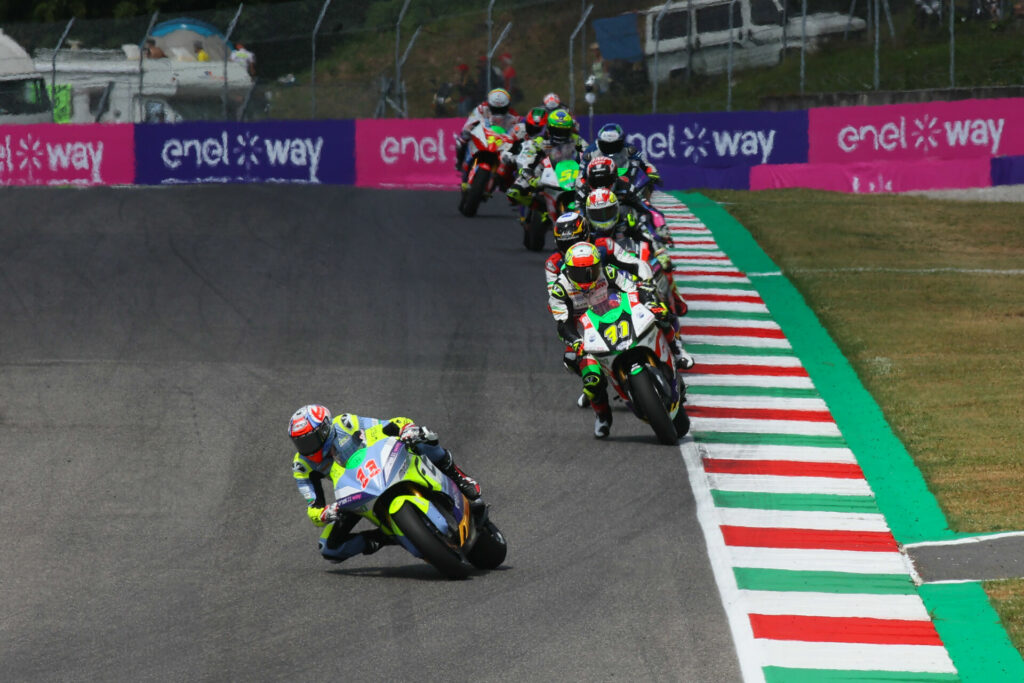
Ferrari wins another classic MotoE™ race at Mugello
The Italian takes to the top step on home turf after a masterclass in MotoE™ tactics
Matteo Ferrari (11) leading MotoE Race Two at Mugello. Photo courtesy Dorna.
Sunday, 29 May 2022
The win was a classic: Matteo Ferrari (Felo Gresini MotoE™) was back on top in Race 2 of the FIM Enel MotoE™ World Cup at Mugello, taking victory with a small margin over another huge group battle as the Italian played his cards to perfection on home turf. Dominique Aegerter (Dynavolt Intact GP MotoE™) took second, crossing the line at exactly the same time as Marc Alcoba (Openbank Aspar Team) but taking P2 thanks to setting the fastest lap. And the eagle-eyed Swiss rider spotted something else: passes under Yellow Flags earlier in the race.
After a thorough review from the FIM Stewards, changes of position were applied. For Alcoba it was three positions, demoting him from the podium and meaning Miquel Pons (LCR E-Team) takes third place. For Niccolo Canepa (WithU GRT RNF MotoE™ Team) and Eric Granado (LCR E-Team) it was one position each, so Canepa is classified sixth and Granado eighth. But let’s rewind…
Kevin Zannoni (Ongetta SIC58 Squadra Corse) made the best start and it was he who led the field out of San Donato for the first time, from Aegerter and Ferrari. Just behind that trio, Mattia Casadei (Pons Racing 40) fell as he exited the corner, while Hikari Okubo (Avant Ajo MotoE™) was also on the deck later on the opening lap. He would be taken to the medical centre with pain in his right leg, but was ultimately passed Unfit for showing he’d sustained an impact to his head, so he’ll need a check up to be passed fit for the next round.
Meanwhile at the front, Zannoni continued to lead into the second lap, but Aegerter was swamped as they all slipstreamed towards San Donato and the Swiss rider dropped back to sixth. Ferrari had taken over second spot while Pons was up to third and Alcoba fourth, a rise of six positions relative to where each had qualified.
Ferrari gained one more position – the most important one – when he outbraked Zannoni at San Donato on Lap 3, as Alcoba rode around the outside of Pons just behind them. Canepa was fifth at that point while Aegerter would soon have a battle for sixth position on his hands with closest rival in the standings, Granado.
The end of the main straight was clearly the prime overtaking zone but Zannoni found resistance when he tried to go around Ferrari in a bid to reclaim first position at the start of Lap 4. Pons and Canepa, on the other hand, were able to slip underneath Alcoba and push him back to fifth spot.
Of course, San Donato was not the only place where overtaking was coming thick and fast in MotoE™, and Pons proved that when he moved ahead of Zannoni through Scarperia/Palagio on Lap 5. That promoted the Spaniard to second, and it also allowed Ferrari to stretch his advantage slightly.
Then Alcoba, who was already back in front of Canepa, passed Zannoni at Bucine. That much was straightforward, but they nearly touched on exit and the Italian had to pick up his bike, which caused him to drop yet more positions. Zannoni was fifth when the crossed the stripe to start the final lap, and eighth by the time they were on their way out of San Donato and back down the hill.
In all of that, Aegerter had risen from seventh to fourth, but the previous day’s race winner was not done. He nabbed third from Alcoba as they went through Bucine for the final time, but it would still come down to a drag to the finish line. Ferrari won by 0.529 seconds, but it was astonishingly close in terms of who would be declared second.
Aegerter and Alcoba were separated by 0.001 seconds according to timing, then that was revised to a dead heat for second and the former was officially given second using fastest lap times as tie-break. For Alcoba, it still seemed like his first MotoE™ podium, but later came the heartbreak and the position penalties, giving Pons third although the Spaniard didn’t make it to parc ferme.
WithU GRT RNF MotoE™ Team rider Andrea Mantovani is now classified fourth after again pipping Granado on track, but with the shuffle on Saturday the Italian gains instead of losing out after the DSQ in Race 1 for low tyre pressure. Zannoni takes P5 ahead of Canepa, with Alcoba classified seventh.
Granado is classified eighth, ahead of Kevin Manfredi (Octo Pramac MotoE™), and Hector Garzo (Tech3 E-Racing).
With a win and a second placing at Mugello, Aegerter’s lead at the top of the World Cup standings is now 29 points over Granado and 30 over Ferrari. After six hectic races to start the season, it is time for the FIM Enel MotoE™ World Cup field to take a break before their fourth round of the season at the Motul TT Assen on June 24-26, so join us then for more!
That home turf feeling! Ferrari takes the spoils at Mugello
Matteo Ferrari: “I’m really happy because this is my 11th podium, like my number, so it’s really special. Also, winning at Mugello is really incredible, in front of these fans. I changed the strategy from yesterday, I pushed a little bit more in the first part of the race. I was really confident with the bike and I think we took another step, so I’m really happy about that. When I saw that I had a little gap, I said, ‘Okay, continue to push,’ because today there was a lot to win. It was really, really difficult to manage the bike but I’m really happy about this podium and this first victory of this year.”
Pecco paints a masterpiece to defeat Quartararo at Mugello
Ducati take back their turf as another 63 vs 20 chess match lights up Tuscany, with Aleix Espargaro making another little piece of history in third
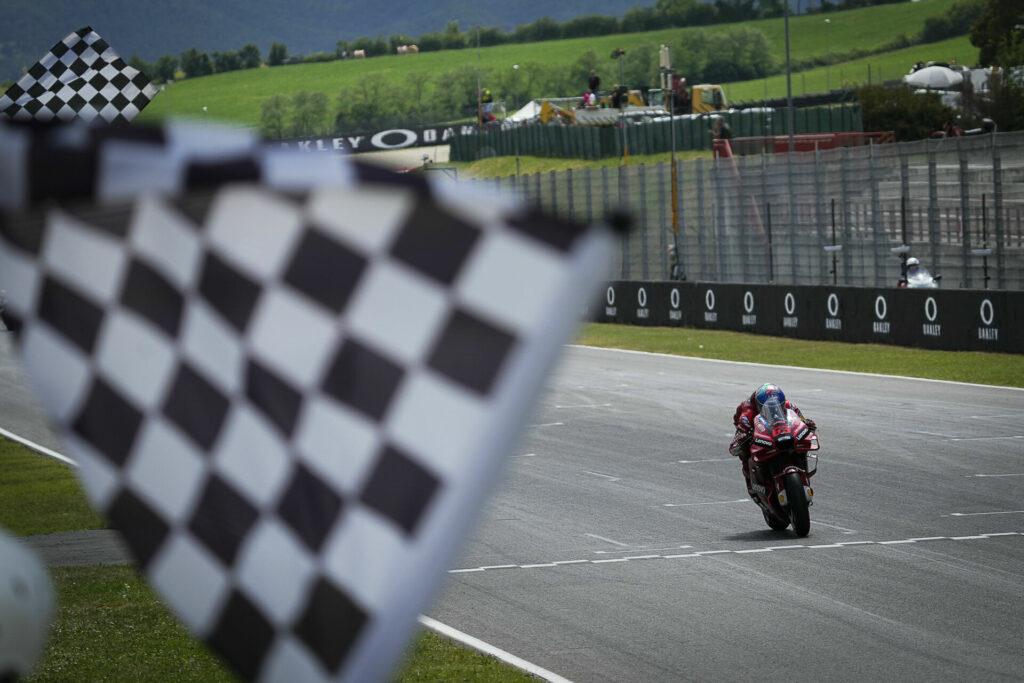
Francesco Bagnaia (63) takes the checkered flag at Mugello. Photo courtesy Dorna.
Sunday, 29 May 2022
Pecco is back on top! In another classic 63 vs 20, Francesco Bagnaia (Ducati Lenovo Team) was back to his flawless winning ways at the front of the field in the Gran Premio d’Italia Oakley, bouncing back in style from a crash out in France. Fabio Quartararo (Monster Energy Yamaha MotoGP™) nevertheless gave it everything he had, stalking the Ducati rider for the majority of the race after the two picked their way to the front. In taking second, ‘El Diablo’ also extends his lead in the Championship.
Aleix Espargaro (Aprilia Racing) came through into third for his fourth podium in a row, giving Aprilia some home turf glory and becoming only the third rider on the grid, along with Marc Marquez (Repsol Honda Team) and Andrea Dovizioso (WithU Yamaha RNF MotoGP™), to have taken four or more premier class podiums in a row.
Ducati had swept the top five in qualifying but, rather than the slightly more accustomed Bagnaia being on the front row, it was rookie Fabio Di Giannantonio (Gresini Racing MotoGP™) starting from pole, fellow rookie Marco Bezzecchi sitting second and Mooney VR46 Racing teammate Luca Marini alongside. Di Giannantonio made a good launch and emerged with the lead from San Donato despite an attack from the VR46 duo, but Marini got past as they turned into Materassi as Bezzecchi slotted into third at the start of the 23 laps that lay ahead.
Bezzecchi overtook Di Giannantonio through Scarperia/Palagio, before Quartararo snatched fourth spot back from Aleix Espargaro on Lap 2 after the Aprilia rider had made a bold move down the hill on the opening lap. Quartararo was third when he slipped by Di Giannantonio at Scarperia/Palagio on Lap 2, but he had a serious challenge on his hands to try and keep the Ducatis at bay given the power they had on tap up the main straight.
A new Ducati threat then emerged when Bagnaia, who had been shuffled back to ninth on the opening lap, got through on Aleix Espargaro for fifth on Lap 4. However, Quartararo was also on the march as he slipped past Marini later on that same lap, promoting ‘El Diablo’ to second.
Bagnaia slipstreamed past Di Giannantonio as Lap 4 became Lap 5, and then pulled off a big move the next time he charged up the hill towards San Donato, passing both Quartararo and Marini to move into second. ‘Pecco’ was in the lead after he overtook Bezzecchi at the start of Lap 9, while Quartararo relied on superior turning to pass the VR46 Ducati rider at Scarperia, on Lap 11. The stage was set and so began the see saw at the front. 1.2, 1 second, 1.1, 0.9… the two pounded on at the front.
Meanwhile, Di Giannantonio’s charge began to fade and Aleix Espargaro again found himself in the top five, just behind a battle between VR46 teammates Bezzecchi and Marini. Enea Bastianini (Gresini Racing MotoGP™) and Johann Zarco (Prima Pramac Racing) caught that bunch around 13 laps in, but the former was then out of the race when he tucked the front through Materassi, on Lap 14. Rider ok, standings taking a dent.
Aleix Espargaro finally got back through to fourth as he went down the inside of Marini on Lap 14 at Correntaio, and Zarco relegated #10 to sixth position at the start of Lap 17. Then, Aprilia’s ‘Captain’ got ahead of the next impressive VR46 hurdle with a pass of Bezzecchi at Scarperia on lap 17.
While that was elbows out, Quartararo was starting to make inroads on Bagnaia’s margin. ‘El Diablo’ brought the gap back under a second with around half a dozen laps to go and was able to keep it there, but then the Ducati rider was able to respond. It was back out to 1.1 with a lap to go, and by the time he crossed the line for an emotional win, it was just over half a second. And those 25 points put Pecco fourth, 41 points off Quartararo.
Aleix Espargaro, meanwhile, finished just under two seconds further back, while Zarco passed Bezzechi on the final lap to claim fourth. Marini made it VR46 bikes fifth and sixth, while Brad Binder (Red Bull KTM Factory Racing) proved once again that he is the ‘Sunday man’ by climbing from 16th on the grid to seventh all-told, and only a couple of tenths off the VR46 battle.
Rounding out the top 10 were Takaaki Nakagami (LCR Honda Idemitsu), Miguel Oliveira (Red Bull KTM Factory Racing), and – in his last race before surgery on his right arm – Marc Marquez (Repsol Honda Team).
It took a video review to decide 11th position, in favour of Di Giannantonio, after he and Maverick Viñales (Aprilia Racing) has initially posted identical race times. Jorge Martin (Prima Pramac Racing) finished 13th, Alex Marquez (LCR Honda Castrol) took 14th, and Jack Miller (Ducati Lenovo Team) scored the last World Championship point in 15th. The non-finishers in addition to Bastianini were Pol Espargaro (Repsol Honda Team), who crashed out on Lap 5, and Team Suzuki Ecstar duo Joan Mir and Alex Rins, who both went down in separate incidents on Lap 8. Rins’ crash was after contact with Nakagami, but the incident was reviewed and no action taken.
In the World Championship, Quartararo’s lead over Aleix Espargaro has crept up to eight points, while Bastianini is now 28 points off the pace in third spot. And Pecco is on the march…
Can he make up more ground when MotoGP™ heads to the Circuit de Barcelona-Catalunya for the Gran Premi Monster Energy de Catalunya? Find out next weekend!
MotoGP™ PODIUM
1 Francesco Bagnaia (Ducati Lenovo Team) – Ducati – 41:18.923
Francesco Bagnaia: “Incredible. I’m already without my voice; I screamed loud and too much. it’s incredible. I think all of the team and me have really deserved this victory because we have worked a lot. Last week, we were as strong, but we were more unlucky. In any case, we worked so well during this weekend. The start was not my best start ever and in the first braking zone I was a bit late, but in any case, I’m very happy to have won this race at home, in front of our fans. It’s really great.”
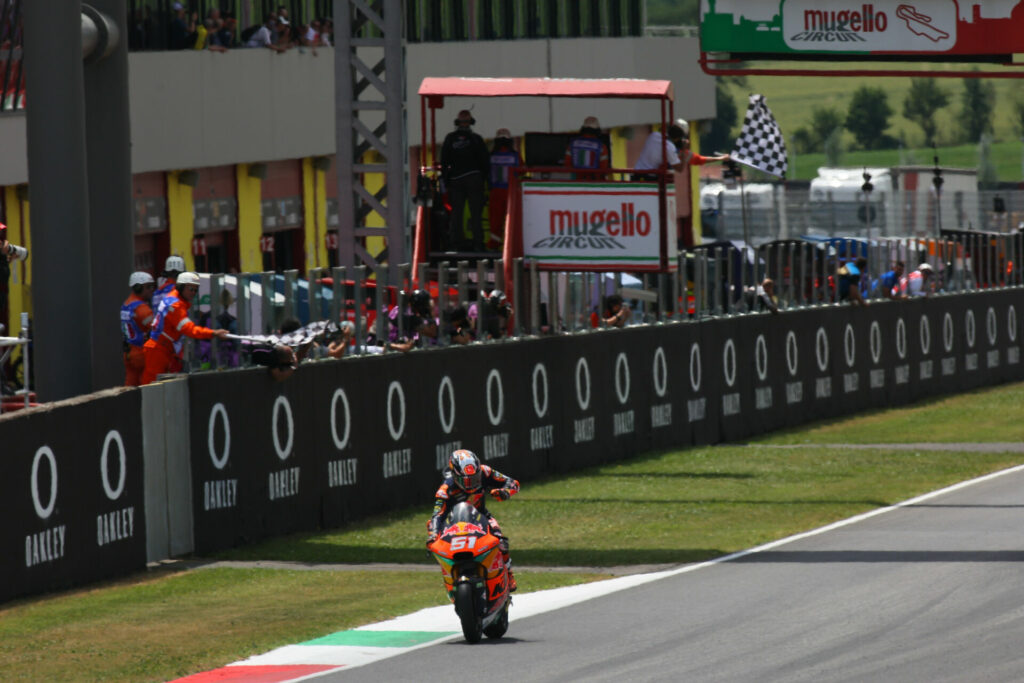
Pedro Acosta (51) won the Moto2 race at Mugello. Photo courtesy Dorna.
Acosta makes history to become youngest intermediate class winner
The rookie sensation reclaims his moniker, taking his first Moto2™ win at Mugello and beating Marquez’ record
There’s a new history maker in town, or more accurately, Pedro Acosta (Red Bull KTM Ajo) has done it again. After crashing out the lead at Le Mans, the rookie sensation reclaimed that moniker in some style as he became the youngest intermediate class winner, pulling clear in the latter stages at Mugello to take back to the top step. The previous record holder? Marc Marquez. A group fight just behind saw Joe Roberts (Italtrans Racing Team) come home second and Ai Ogura (Idemitsu Honda Team Asia) complete the podium.
In doing so the Japanese rider moves up to second overall but equal on points with Championship leader Celestino Vietti (Mooney VR46 Racing Team) after heartbreak at home for the Italian, with a technical problem taking him out the fight when sat behind Roberts. There was more drama too, with Aron Canet (Flexbox HP 40) sliding out of second earlier in the race, rider ok.
Canet had got the holeshot from pole position but Acosta outbraked him when they arrived at San Donato and he led the field down the hill for the first time. Sam Lowes (Elf Marc VDS Racing Team) went past Canet through the Casanova/Savelli complex on Lap 1 but the Spaniard returned the favour on Lap 2, and Lowes instead found himself in a battle with teammate Tony Arbolino over third spot for several laps.
Acosta rode a composed race, his only real blemish being when he ran wide exiting Arrabbiata 2 on Lap 3 and got loose on the kerb. That moment allowed Canet back past, but he held the lead only until #51 slipstreamed back in front at the start of Lap 4. They were still first and second, having pulled around a second clear of the chasing pack, when disaster struck for Canet on Lap 13. He tucked the front going through Bucine and went sliding into the gravel trap, marking the end of his afternoon but rider ok.
That incident left Acosta on his own at the head of the field, but there were battles aplenty going on not too far behind. In addition to the intra-team battle between Lowes and Arbolino, Roberts and Ogura were going hard it for fifth position initially, while Vietti was on the comeback trail after he was swamped at the first corner of the race and had dropped to 10th.
The pre-race World Championship leader was back up to seventh, albeit one second from the group ahead of him, when he passed wildcard Mattia Pasini (Inde GASGAS Aspar Team) on Lap 6, before Ogura got himself into fourth position when he got by Lowes on Lap 9 at San Donato. The Japanese rider was third when he did likewise to Arbolino on Lap 10, but the Italian got back ahead exactly a lap later.
Ogura overtook Arbolino once more into San Donato on Lap 13, just before Vietti picked off Lowes for sixth through Casanova/Savelli. With Canet out of the picture, Roberts and Vietti were third and fourth once they also got ahead of Arbolino, and then they went after Ogura. The American made a bold move at Palagio on Lap 14 which held up Ogura on exit and Vietti rode through the gap too, relegating the Honda Team Asia rider to fourth.
Meanwhile, the Marc VDS duo continued to lose touch with the four ahead as they sliced and diced with each other. Matters came to a head on Lap 19 when Arbolino had a dive at Turn 2, making contact with Lowes which caused his team-mate to crash. The Briton vented his fury from the gravel trap while Arbolino would soon be issued a long lap penalty.
It was looking like a solid recovery for Vietti, who would have extended his World Championship lead if he stayed ahead of Ogura, but then his bike suffered a problem less than three laps from home. Not only did he miss out on 16 points, the extra three which Ogura would collect by inheriting third position draws them level on points at the top of the table.
There were no such dramas for Acosta. He continued to pull away and ultimately took the chequered flag 4.051 seconds up on Roberts. Ogura finished third, and Arbolino still grabbed fourth, though just 0.015 seconds ahead of Augusto Fernandez (Red Bull KTM Ajo) after a long comeback from outside the points after a tougher qualifying and then start for the Le Mans winner.
The rest of the top 10 was Jake Dixon (Inde GASGAS Aspar Team) in sixth, from Cameron Beaubier (American Racing), impressive rookie and new full-time rider Alonso Lopez (MB Conveyors Speed Up), Marcel Schrötter (Liqui Moly Intact GP), and Albert Arenas (Inde GASGAS Aspar Team). Somkiat Chantra (Idemitsu Honda Team Asia) was a notable DNF after his spill at Scarperia on Lap 5.
That’s all from Mugello, and now the field head for Barcelona for a quick turnaround and another racing Sunday. Join us next weekend for more in Moto2™!
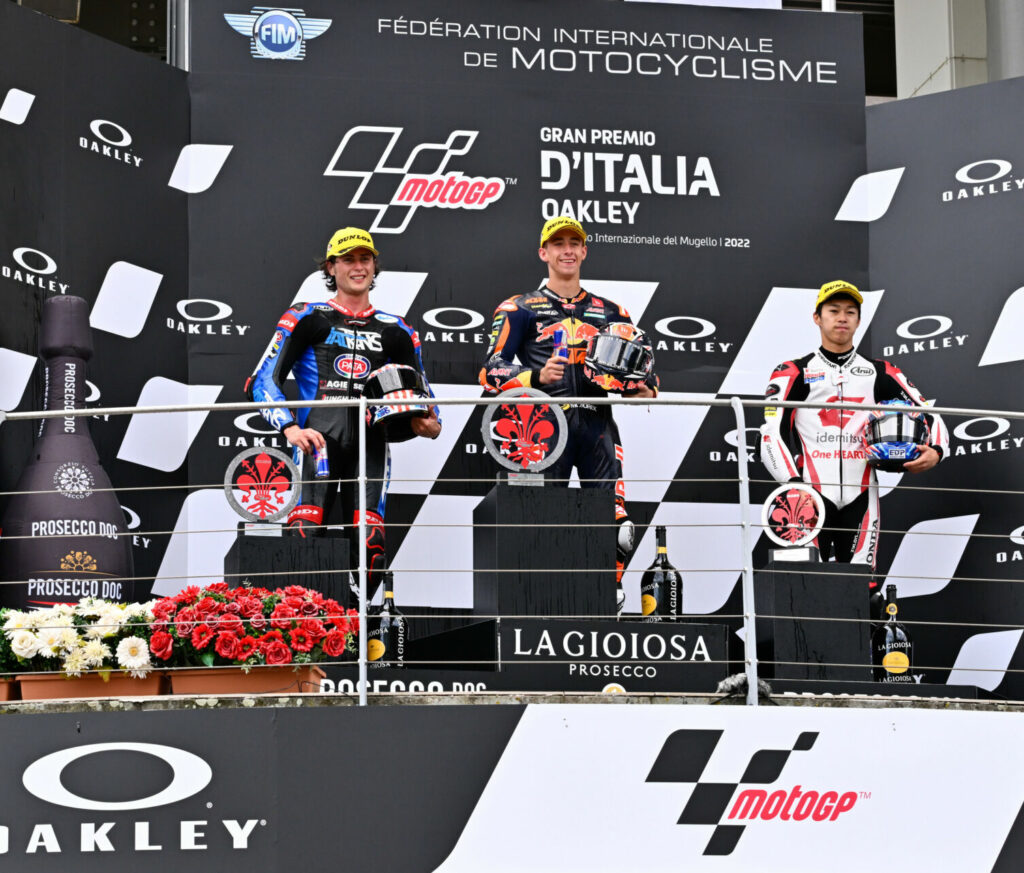
Moto2 race winner Pedro Acosta (center), runner-up Joe Roberts (left), and third-place finisher Ai Ogura (right) on the podium at Mugello. Photo courtesy Dorna.
2 Joe Roberts (Italtrans Racing Team) – Kalex – +4.051
3 Ai Ogura (Idemitsu Honda Team Asia) – Kalex – +6.749
Pedro Acosta: “It was a long way, a long way to be here. We lost a good opportunity in Le Mans, we lost a good opportunity in America, and finally we have arrived. I think we are doing an accurate job and if we can continue in this way, we can have so much fun at the end of the season.”
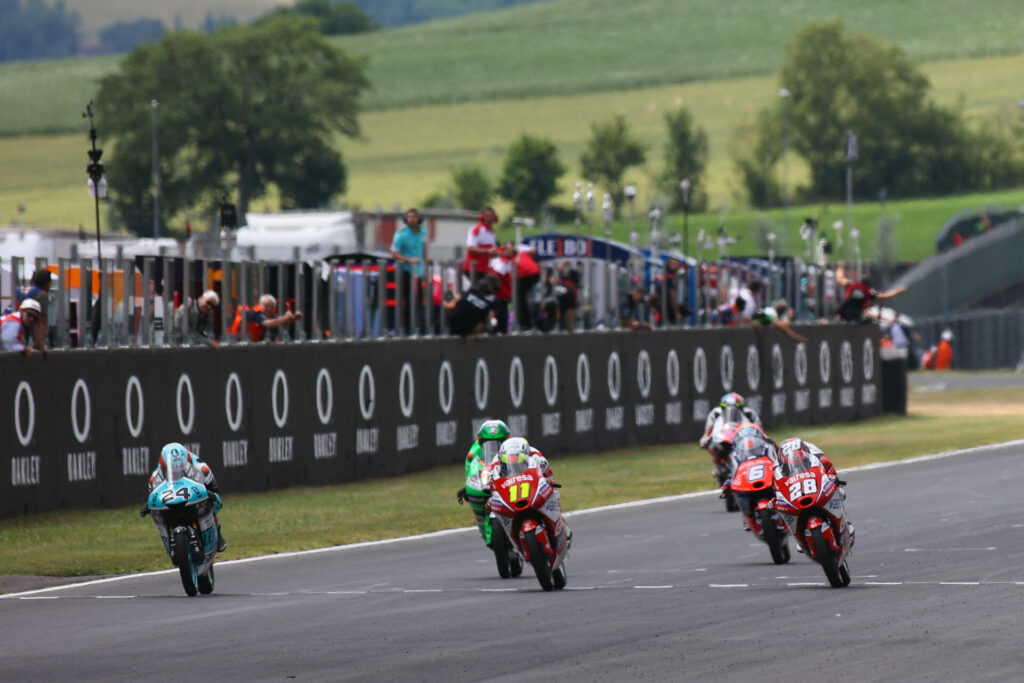
Sergio Garcia (11), Izan Guevara (28), and Tatsuki Suzuki (24) race to the finish line in Moto3. Photo courtesy Dorna.
Garcia, Guevara and Suzuki decide Moto3™ thriller at Mugello
Guevara crosses the line first, gets demoted for track limits, Garcia takes the win and it’s still almost a dead heat over the line
Sergio Garcia (Valresa GASGAS Aspar Team) came out on top in a last lap classic at Mugello, with plenty of drama as two title rivals failed to score and teammate Izan Guevara crossed the finish line first. The number 28 had exceeded track limits on the last lap, however, and forfeits the win to Garcia. Tatsuki Suzuki (Leopard Racing) completed the podium as his step back into frontrunning speed continued, the number 24 overcoming a Long Lap and still crossing the line almost in unison with the GASGAS duo.
Deniz Öncü (Red Bull KTM Tech3) got the holeshot and after only a lap, there was a trio at the front: the Turk leading Guevara and Diogo Moreira (MT Helmets – MSI), with Andrea Migno (Rivacold Snipers Team) on the chase at the front of a freight train. It didn’t stay that way for long though, with a long snake of Moto3™ machines soon making their way round Mugello.
Drama then hit for Öncü as the fight lit up though, with contact from Suzuki seeing the Turk slide out. The Japanese rider was given a Long Lap to take, and Öncü was able to rejoin, facing a fight back from well outside the points.
Meawhile, Jamue Masia (Red Bull KTM Ajo) had a moment that dropped him down the order too, just as Dennis Foggia (Leopard Racing) had taken up the mantle at the front, the Italian starting to build a gap. It wasn’t to be this time round though, with the number 7 crashing from the lead and Carlos Tatay (CFMoto PrüstelGP) avoiding that, just before some more drama as John McPhee (Sterilgarda Max Racing Team) crashed and Daniel Holgado (Red Bull KTM Ajo) went down in the incident too.
The shuffle left a gap behind the leading six of Moreira, Garcia, Guevara, Ryusei Yamanaka (CFMoto PrüstelGP), Riccardo Rossi (SIC58 Squadra Corse) and Migno, with Suzuki then tucked in on a mission to tag back on after completing the Long Lap. And he did it, creating a seven-rider fight for the win by five to go and then taking the lead with four to go.
On the last lap, Guevara was leading Garcia leading Suzuki, with Migno looking to attack the Japanese rider. And in classic Moto3™ style it all went down to the final corner as Garcia headed up the inside and Guevara tucked into the slipstream, with Suzuki doing the same and getting some great drive to add to the grunt of his Leopard Honda.
It was neck and neck all the way to the line, but Guevara got there first… just. And then news came through the number 28 had exceeded track limits on the final lap and the victory slipped through his fingers, promoting Garcia to the win and the 25 points. Guevara is classified second, with Suzuki completing the incredibly tight podium.
Migno just lost out on home glory in fourth, with Yamanaka completing the top five and taking his best race result yet. Rossi was the last of the front group in P6 after a tangle with Moreira at the final corner. The two suffered some light contact and then, trying to recover, the Brazilian overgassed it and highsided out.
Five seconds back there was another incredibly close trio, with Ivan Ortola (Angeluss MTA Team) beating Elia Bartolini (QJMotor Avintia Racing Team) and Matteo Bertelle (QJMotor Avintia Racing Team) to seventh. Adrian Fernandez (Red Bull KTM Tech 3) just pipped debutant David Muñoz (BOE Motorsports) to the top ten, with Joel Kelso (CIP Green Power) a couple of tenths back. Mario Aji (Honda Team Asia) takes P13, with Lorenzo Fellon (SIC58 Squadra Corse) dropping to 14th after a Long Lap.
The points were completed by Öncü as the Turk put the pedal to the metal on his comeback, with Kaito Toba (CIP Green Power) and Masia joining him in a three-way battle to the line. But Öncü took it, making Sunday at Mugello a 0 for both Foggia and Masia, and a day of big gains in the standings for GASGAS.
That’s a wrap on Mugello, and next up it’s Catalunya with a quick turnaround. What will Barcelona bring? We’ll find out in less than a week!
Sergio Garcia: “Yeah, I’m really happy. For me, the Mugello race last year was the most difficult. It’s really difficult to win here and I’m very happy. This race is for my friend, and for all his family. Thank you.”
Provisional Mission Production Twins Main Event Results (all on Dunlop tires):
1. James Rispoli (KTM), 19 laps
2. Jesse Janisch (Har), -01.365 seconds
3. Cory Texter (Yam), -11.858
4. Ben Lowe (Yam), -11.980
5. Nick Armstrong (Yam), -13.905
6. Ryan Varnes (KTM), -13.962
7. Michael Rush (Har), -14.045
8. Cody Johncox (Yam), -19.679
9. Cameron Smith (Yam), -19.733
10. Jeremiah Duffy (Kaw), -35.613
11. Kasey Sciscoe (Har), -35.739
12. Jordan Harris (Kaw), -37.586
13. Billy Ross (Har), -37.676
14. Shelby Miller (Kaw), -1 lap, -03.890
15. Brandon Newman (Kaw), -1 lap, -26.078
16. Johnny Lewis (Roy), -12 laps, -*0.**0
17. Cole Zabala (Yam), -19 laps
Provisional Parts Unlimited AFT Singles Main Event Results (all on Dunlop tires):
1. Morgen Mischler (Hon), 18 laps
2. Kody Kopp (KTM), -00.053 seconds
3. Trent Lowe (Hon), -00.131
4. Max Whale (KTM), -00.196
5. Dalton Gauthier (Hon), -00.231
6. Trevor Brunner (Yam), -00.420
7. Hunter Bauer (KTM), -04.949
8. Kevin Stollings (Hon), -10.538
9. Gage Smith (Hon), -10.555
10. James Ott (KTM), -10.563
11. Michael Inderbitzin (Hon), -10.579
12. Ferran Cardus (Hon), -11.103
13. Jared Lowe (Hon), -20.901
14. Aidan RoosEvans (Hon), -20.978
15. Tyler Raggio (Hon), -2 laps
16. Chad Cose (Hon), -6 laps
17. Travis Petton (KTM), -10 laps
Provisional Mission SuperTwins Main Event Results (all on Dunlop tires):
1. Dallas Daniels (Yam), 25 laps
2. Jared Mees (Ind), -00.008 seconds
3. James Rispoli (PT) (KTM), -00.282
4. Brandon Robinson (Ind), -01.597
5. Ben Lowe (PT) (Yam), -03.821
6. Jarod Vanderkooi (Ind), -03.916
7. Briar Bauman (Ind), -04.768
8. Davis Fisher (Ind), -06.565
9. Jesse Janisch (PT) (Har), -10.460
10. Robert Pearson (Ind), -16.123
11. Shayna Texter-Bauman (Ind), -27.174
12. Bronson Bauman (Har), -10 laps
13. Brandon Price (Kaw), -12 laps
14. JD Beach (Yam), -19 laps
More, from a press release issued by AMA Pro Racing:
Night of Firsts as Daniels Wins Red Mile I By 0.008 Seconds
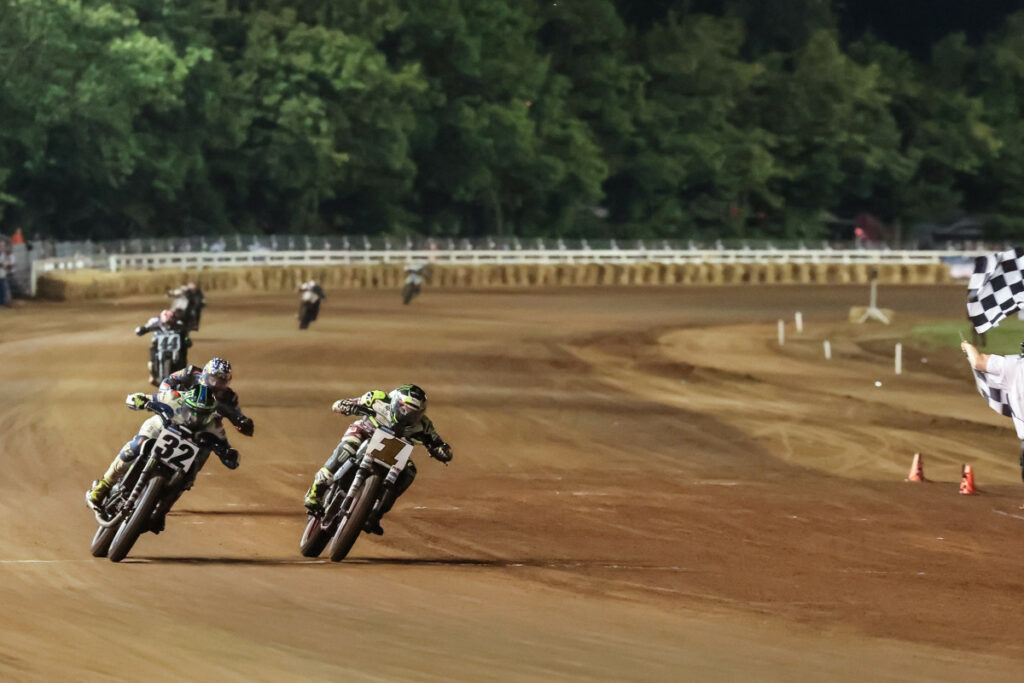
Dallas Daniels (32) and Jared Mees (1) race for the lead in the Mission SuperTwins main event at Red Mile I in Kentucky. Photo courtesy AMA Pro Racing.
DAYTONA BEACH, Fla. (May 29, 2022) – It was a night of firsts as Progressive American Flat Track enjoyed an epic evening of racing at the Mission Red Mile I presented by Indian Motorcycle of Lexington in Lexington, Kentucky.
Following 14 minutes and two laps of nail-biting action in front of the massive Red Mile crowd, Mission SuperTwins presented by S&S Cycle rookie Dallas Daniels (No. 32 Estenson Racing Yamaha MT-07 DT) officially added his name to the exclusive list of premier-class Main Event winners.
But prior to Daniels’ exhilaration, it was heartbreak for teammate JD Beach (No. 95 Estenson Racing Yamaha MT-07 DT). Beach had established himself the rider to beat in the lead-up to the Main, but he was unlucky to be forced out by mechanical issues a couple minutes into the race.
That left reigning champion Jared Mees (No. 1 Indian Motorcycle/Progressive Insurance FTR750), Daniels, and Mission Production Twins Challenge entrant James Rispoli (No. 43 Wally Brown Racing/Haversack KTM 890 Duke) to battle it out in the lead pack.
The trend of heartbreak continued a couple of minutes later when the machine of Bronson Bauman (No. 37 Latus Motors Racing Harley-Davidson XG750R) dumped oil on the circuit while running fourth, forcing a red flag stoppage near half-distance.
The race resumed with Mees, Daniels, and Rispoli sitting 1-2-3, and Brandon Robinson (No. 44 Mission Roof Systems Indian FTR750) joining the lead group in fourth. While Rispoli took a peak on a few occasions, it was Mees and Daniels who traded back first and second for the remainder of the contest.
Mees lined up Daniels and made what he hoped would be the race’s decisive maneuver entering Turn 3 for the final time. He pulled it off perfectly and seemed destined to keep his perfect Red Mile streak intact, right up until the final moment when Daniels blasted by at the stripe to steal away the win by 0.008 seconds.
The victory was not only Daniels’ first in the premier class, it was also Yamaha’s first on a Mile going all the way back to Kenny Roberts’ legendary victory aboard the TZ750 at the 1975 Indy Mile. Daniels also became the first rookie to win in the premier class since Mikey Rush won at Daytona in 2007 and the first rookie to win on a Mile since Scott Parker did so at Indy in 1979.
“I can’t believe I won a Grand National,” Daniels said. “I’ve been dreaming of this my whole life. It’s been a long road for me and the team. Those guys have worked their butts off. It’s been a long road since they started, and I know this is so rewarding for them.
“Taking my dad on that victory lap… I’ve been talking about that since I was like eight years old. We did it… It’s awesome!”
Rispoli held on for third to become the first Mission Production Twins Challenge rider to land on the Mission SuperTwins podium and add to what was already an incredible debut for the WBR KTM.
Robinson came home fourth, followed by another Mission Production Twins Challenge pilot in Ben Lowe (No. 25 Mission Foods/Roof Systems Yamaha MT-07) to complete the top five.
Jarod Vanderkooi (No. 20 Mission Roof Systems Indian FTR750) was sixth, followed by an uncharacteristically quiet Briar Bauman (No. 3 Indian Motorcycle/Progressive Insurance FTR750). Davis Fisher (No. 67 Bob Lanphere’s BMC Racing Indian FTR750), Jesse Janisch (No. 33 Vance & Hines Harley-Davidson XG750R), and Robert Pearson (No. 27 Rackley Racing/John Franklin Indian FTR750) rounded out the top ten.
Mission Production Twins presented by Vance & Hines
If anyone forgot just how dominant James Rispoli (No. 43 Wally Brown Racing/Haversack KTM 890 Duke) was at times when he won the 2020 Mission Production Twins presented by Vance & Hines championship, he provided a most compelling reminder on Saturday night.
Rispoli made his return to the class at the Red Mile to debut the WBR KTM 890 Duke and did so in style. He not only made the bike a winner, he did so in runaway fashion, leading from start to finish.
The only rider who even managed to keep him honest was Jesse Janisch (No. 33 Vance & Hines Harley-Davidson XG750R). Janisch clung on behind him just outside the draft, but he never managed to present a realistic challenge to Rispoli’s position at the front.
After claiming the win, Rispoli said, “The Wally Brown Racing team has a wealth of experience. They’re smart guys. We took the common sense route and they built a phenomenal package. KTM built a great platform, but these guys found a way to get that horsepower to the ground. I’m so pumped. I’m stoked to return to Mission Production Twins, and to win? I’m stoked.”
While Rispoli may have had a drama-free run to victory, the battle for the final spot on the podium was most entertaining. A tight five-rider pack made up of the returning Michael Rush (No. 15 Hellipower Racing/Las Vegas Harley-Davidson XG750R), Ryan Varnes (No. 68 Schaeffer’s Motorsports/Rausch Fuel & Oil KTM 890 Duke), Ben Lowe (No. 25 Mission Foods/Roof Systems Yamaha MT-07), Cory Texter (No. 1 G&G Racing/Yamaha Racing Yamaha MT-07), and Nick Armstrong (No. 60 Competitive Racing Frames/Lessley Brothers Yamaha MT-07).
Among a great deal of shuffling, points leader Armstrong systematically made his way from seventh to third, but went off the groove and dropped right back to seventh, erasing all his hard work.
Defending champion Texter did what he does and emerged late as he and Lowe scrapped for third over the final two laps. Ultimately, Texter took the position by 0.122 to further a three-race podium streak. However, he’s still three points back of Armstrong in the championship chase after Armstrong clawed his way back up to fifth at the flag.
Varnes finished sixth with Rush taking seventh, a welcome result in his return ride after suffering a serious leg injury in last year’s finale.
Parts Unlimited AFT Singles presented by KICKER
Combining the Parts Unlimited AFT Singles presented by KICKER class and a big Mile racetrack is typically the recipe for an ultra-tight pack war. Saturday’s showdown was no exception.
As many as eight riders were in with a shot for victory deep into the race before a couple of them went off the groove, leaving a six-rider shootout on the race’s final lap.
The on-form Morgen Mischler (No. 13 American Honda/Progressive Insurance CRF450R) did his best to control the chaotic affair from the front and it paid off with a 0.053 seconds margin of victory.
While Mischler regularly traded the lead with teammate Dalton Gauthier (No. 79 American Honda/Progressive Insurance CRF450R) for much of the contest, the final sprint came down to him, title rival Kody Kopp (No. 12 Red Bull KTM Factory Racing 450 SX-FFE), and Trent Lowe (No. 48 Mission Foods/Al Lamb’s Dallas Honda CRF450R).
Mischler opened the final lap in the lead and made the most of his Honda’s horsepower to just fend off his challengers.
The win was Mischler’s first ever on a Mile as he continues to increasingly prove himself a well-rounded title contender. He said, “The puzzle pieces are fitting, and I see us just getting better with everything the team has been putting into it. For me, it’s just a matter of me doing my job.”
Despite just missing out on the win, Kopp continues to lead the championship on the strength of an early season that has seen him finish no worse than second.
Kopp’s teammate Max Whale (No. 18 Red Bull KTM Factory Racing 450 SX-FFE), finished off the podium for the first time this season with a fourth-place effort. Gauthier, who is dealing with a partially torn ACL and MCL finished fifth, while Trevor Brunner (No. 21 Estenson Racing Yamaha YZ450F) finished sixth, just 0.420 seconds off the win, despite being forced to start from the back of the pack after using a provisional start to earn a spot in the Main.
The Mission Red Mile I will premiere on FS1 on Sunday, June 5, at 10:00 p.m. ET/7:00 p.m. PT, including exclusive features, cutting-edge aerial drone and onboard footage, and expert commentary.
Next Up:
Progressive AFT will be back on track at the Red Mile today to conclude the Mission Red Mile doubleheader. Gates will open for fans at 3:00 p.m. ET/12:00 p.m. PT with Opening Ceremonies scheduled to begin at 7:00 p.m. ET/4:00 p.m. PT ahead of the evening’s Main Event program. Secure your tickets now at https://store.americanflattrack.com/ebooking/ticket/view/id/3723/.
You can catch the livestream of all the weekend’s racing activities on FansChoice.tv. FansChoice.tv provides free-to-view livestreaming of Practice and Qualifying. FansChoice.tv subscribers will then be able to watch the drama unfold from Opening Ceremonies through the Semis, Main Events, and podium celebrations. FansChoice.tv offers two subscription options, granting unlimited access to premium AFT content. Monthly subscriptions start at just $7.99, while a six-month subscription is available for $44.99.
To score the latest gear for the Progressive American Flat Track fan, visit our official merchandise store at https://store.americanflattrack.com.
How to Watch:
FOX Sports and FansChoice.tv are the official homes for coverage of Progressive American Flat Track. For the 2022 season, all races will premiere in one-hour telecasts on FS1 during highly desirable weekend time slots. The complete schedule can be viewed at https://www.americanflattrack.com/events-foxsports. FansChoice.tv provides livestreaming coverage of every Progressive AFT round can watch livestreaming coverage of every Progressive AFT round at http://www.FansChoice.tv.
Cameron Beaubier (6). Photo courtesy American Racing Team.
Magical Mugello provides smiles all round at the American Racing Team with Cam Beaubier finishing 7th just off the back of the podium battle, and Sean Dylan Kelly having his closest ever finish time to the winner in his rookie season.
After a stunning ride from well outside the top 25 to 8th in last year’s Italian Grand Prix, Cam was cautiously excited coming into the weekend, though despite a direct seeding through to Q2, he was unable to capitalise on that second qualifying session and ended up starting from 18th on the grid. An outstanding opening lap in the race left him hot on the tails of the top 10 riders, charging through like the five-time MotoAmerica Superbike Champion does best but ultimately falling short of a top four finish by half a second.
Sean’s weekend got off to a less than ideal start, with a crash in FP1 leaving him on the back foot. But taking the lessons from previous races in work method & ethic throughout the practice sessions, he picked up the pace substantially in FP3 and carried it through to the race on Sunday, where he finished with his closest time gap to the winner yet, and running pace matching those of the points finishers in the second half of the Grand Prix.
Experience from private and official testing leaves Sean excited for next weekend’s race in Barcelona, where he hopes to close the gap even further and take a big leap towards his next set of World Championship points in Moto2!
Cameron Beaubier #6 – 7th
“I’m honestly pretty happy with the way the race went after qualifying. No BS, I was struggling super bad to go fast here alone. I needed a reference to put in a good lap time – when I get in with a group, not even someone faster than me but just a reference up the road, it helped me so much here – so the way that qualifying went and knowing how much I struggled last year here, it felt good to put in a good showing in the race.
The first two laps I was able to make some good passes and safely too, not going crazy at all! I was able to make some good clean passes and not screw myself up by running too wide. Coming into the race I wanted to be methodical with my passes, make them clean and not screw myself up by running too wide, as especially on this track, you run wide and riders pass you, with one corner leading to another here… that’s not ideal!
I tried to chase Vietti and bridge the gap to the front group but I was riding out my skin to catch up, so I thought I’d better reel it back in. I’m happy with the tyre choice we made though, we went with the harder rear option so I felt pretty good and consistent the whole race, which I’m not sure how it would have been on the soft.
Even right there at the end, I saw fourth all the way to the chequered flag. I didn’t have anything to fight anyone at the end but I’m super stoked with a seventh. Mugello and Barcelona, going off last year, these are the two toughest tracks for me with the long flow corners and corners that turn around on themselves, that’s where I struggle with this bike. So I’m happy with that and onto the next one!”
Sean Dylan Kelly (4). Photo courtesy American Racing Team.
Sean Dylan Kelly #4 – 23rd
“Overall it was another interesting but I think a positive weekend for me. We started off on the wrong foot on Friday with a crash in FP1, which took us a step back. But we learned a lot doing a full session non-stop in FP2, allowing me to make a step up in FP3 where I was able to find a feeling on the bike I had been missing. Qualifying was difficult due to the conditions really, being so mixed. We were able to carry what we found in FP3 into Sunday though, making the most of warm up in even more difficult conditions and finishing in the top 10 just before race time – which always helps the confidence!
We managed to finish with our smallest gap to the front & P1, which is a big step. There’s of course more to work on in that area but my pace in the last ten laps of the race was pretty strong, it was the same as fighting for points so if I can make a step up in the first ten laps of the race, in that phase, I’ll be able to fight further forward. So I’m happy we were also able to turn it around from Friday and the tough weekends we’ve been having! See you guys in Barcelona!”
John Hopkins, Racing Director –
“I think Cam rode perfectly all weekend, though qualifying didn’t go to plan and that’s the only thing that hindered him from being on the podium this weekend. But as far as the race goes, he rode perfectly.
A perfect start straight from the beginning after we made a plan at the start to execute as I have a lot of experience of coming through the pack here at Mugello specifically. Outside to inside to outside in the first few corners and he made up some awesome positions, which was amazing to see. He had the pace to run with the leaders but got mixed up with Navarro mid-race which separated him from Vietti, allowing the gap to open and losing the draft from the podium contenders. When you lose the draft in Mugello, it’s game over. But he kept his head down and had a great race, exactly what he needed to do…
With Sean, we have some really good positives this weekend. He closed the gap significantly with his best ever result in respect to his time to the leaders, closed by well over 10 seconds compared to previous races at one of the most difficult tracks on the calendar. He’s improved his riding, performance and overall preparation; he’s made that next step and I think Barcelona will be a race where he’s able to show it!”
Pedro Acosta (51) and Joe Roberts (16) is sixth early in the Moto2 race at Mugello. Photo by Kohei Hirota.
Joe Roberts amazing second at Italian GP
Joe Roberts (16) at Mugello. Photo by Kohei Hirota.
An Italian Grand Prix of intense emotions for Italtrans Racing Team at Mugello Circuit. An incredible home race where the team proved once again to have the qualities to be among the rulers of this 2022 World Championship with an amazing Joe Roberts on the 2nd step of the podium.
Started from the 3rd row, Joe pushed since the beginning, fighting in the top five. With 8 laps to go he overtook Vietti and Ogura, conquering the second position and maintaining it until the chequered flag. Ahead of him only Acosta. This second step of the podium worth 20 important points for the standings: Roberts is now 4th with 86 points.
Unlucky race for teammate Lorenzo Dalla Porta. Starting 11th on the grid and ready to fight in the top ten, he crashed at the Bucine – fortunately without consequences.
Now no break: the MotoGP World Championship moves to Barcelona for the Catalan GP.
Lorenzo Dalla Porta, DNF:
“I’m really sorry. I was struggling a lot, then at the Bucine I braked probably a bit late and the front tyre couldn’t take it. Too bad. The upside of all this is that we did a good qualifying and could have finished in the points. Let’s put this race behind us and look ahead to Barcelona”.
Joe Roberts (16) on the Moto2 podium at Mugello. Photo by Kohei Hirota.
Joe Roberts, 2nd:
“Super happy with this 2nd place! I felt really good this morning and that we could be in the fight for a good position. Thank you to my team for their hard work all weekend was a weekend to remember!”.
Franco Brugnara, Lorenzo Dalla Porta’s Crew Chief:
“We could have a good race. Lorenzo didn’t start good, but he was recovering when he crashed. Too bad, because we could have gotten some points. We’ll try again in Barcelona”.
Giovanni Sandi, Joe Roberts’ Crew Chief:
“Yesterday we had the best qualifying of the season and I knew today we could have a great race. We did a great job together: the bike was competitive and Joe was really good. He fought for the podium with determination, showing that he is a talented rider”.
More, from a press release issued by Red Bull MotoGP Rookies Cup:
Perfect Veijer takes Farioli on the line for Rookies 2 in Mugello
Collin Veijer flicked out of the slipstream of Filippo Farioli’s KTM and willed his identical RC 250 R alongside and ahead as the pair led a pack of 13 Red Bull Moto GP Rookies across the Mugello finish line covered by just 2 seconds.
It was a masterly performance by the 16-year-old Dutchman who was never too far from the front along with pole man Farioli the 17-year-old Italian.
It had been one of the truly great Cup races and third went to Tatchakorn Buasri, the 21-year-old Thai by just 1 thousandth of a second over 15-year-old Briton Eddie O‘Shea.
The conditions were so different to Saturday’s soaker and 15 laps in virtually perfect conditions allowed the youngsters to produce their best with no one coming close to breaking away and places swapping many times every corner.
Veijer had a plan
“I knew what I wanted to do on the last lap. I thought I could get far enough ahead that they would not be able to catch me before the line. I had tried it a few laps earlier and I thought it was possible.”
“So I went for it on the last lap to make a gap but then Filippo came past and I thought, ‘well maybe that is not so bad,’ and I got in behind him and concentrated on making a perfect run through the last corner and into his slipstream.”
“I had no idea how close the others were behind me I was just concentrating on Filippo. It is great to get the win. I had tried to break away but I was running long gearing and I couldn’t do it, a great race.”
Farioli with a beautiful ride
“The start was not so bad, the first lap was good. After I saw that it was not possible to escape from the other riders, I stayed in the group, made a good management of the situation. In the end I finished 2nd, I was in front through the last corner but Collin did a very good job to exit fast and passed me.”
“Coming to the last lap I realised I had good pace in the second part of the track and I thought, OK I will pass Collin after the Arrabbiata. But after I did they stayed with me, he exited faster from the Bucine and he won. The Strategy was good but in the end I was 2nd. I am very happy, I must congratulate Collin and thank everyone who helps me.”
“It was a fantastic weekend. I was fast in practice and took Pole but yesterday was a difficult race because it started to rain just as we took off the tyre warmers. It was very difficult and I crashed first lap but after made a good comeback.”
Tatchakorn Buasri saved it until the end
“My plan today was really only to push on the last lap, because there was so much overtaking going on that I could try and lead but it was impossible to break away and I knew the race would only be decided on the last lap.”
“I tried to get in the right place on the last lap and I made it to 3rd place. Not bad for me,” he added with his broad grin, the only rider to be on the podium in both races.
Eddie O‘Shea so close to the podium
“It was definitely the best race of my European career so far. I managed to stay in the front group the whole race, I was comfortable in P5, P6, I was comfortable overtaking on the brakes and the bike felt near perfect and I’d like to thank all the team for that.”
“I came out of the final corner 5th, I dragged Tatchakorn and Filippo for 3rd and Tatchakorn beat me by 0.001 I believe. I am happy to take 4th but I’m more happy that I am gutted not to get on the podium.”
Luca Lunetta loved finishing 5th
“It was a very beautiful race, it is fantastic to ride here in Mugello and I enjoyed the race a lot, so much overtaking and I think this is one of the most enjoyable races I have ever made. I can’t wait to get to Sachsenring, I want more,” enthused the 16-year.old Italian.
José Rueda lost the run in to the line
“The race was OK, but not too much,” chuckled the 16-year-old Spanish points leader who is now just 5 ahead of Veijer. “Normally I would like to have more points for the championship. On the last lap, in the last corner I came out in 3rd position and then finished 6th,” he laughed. “That’s how it goes on this track, it’s crazy. The bike was good I enjoyed the battle but….”
Max Quiles could not repeat
“In the last corner I was going to overtake, I was P8, I was on the inside and when I tried to open the gas the front tyre slid away and I went down. I was trying to get the good drive out and overtake in the straight before the line but….” shrugged yesterday’s winner, the 14-year-old Spaniard.
Dallas Daniels (32), Jared Mees (1), James Rispoli (43), Brandon Robinson (44) and the rest of the Mission SuperTwins field in Red Mile 1 action on Saturday, May 28th. Photo by Brian J. Nelson.
The Red Mile II/American Flat Track
Red Mile
Lexington, Kentucky
May 29, 2022
Mission SuperTwins Provisional Free Practice 1 Results (all on Dunlop tires):
1. Davis Fisher (Ind), 36.875
2. Jared Mees (Ind), 36.915
3. Brandon Robinson (Ind), 37.179
4. Dallas Daniels (Yam), 37.293
5. Jarod Vanderkooi (Ind), 37.415
6. Bronson Bauman (Har), 37.638
7. Briar Bauman (Ind), 37.757
8. Robert Pearson (Ind), 38.091
9. Brandon Price (Kaw), 38.280
10. Shayna Texter-Bauman (Ind), 38.718
11. JD Beach (Yam), 42.334
Mission Production Twins Provisional Free Practice 1 Results (all on Dunlop tires):
1. James Rispoli (KTM), 36.685
2. Ryan Varnes (KTM), 36.968
3. Cory Texter (Yam), 37.072
4. Jesse Janisch (Har), 37.111
5. Ben Lowe (Yam), 37.208
6. Michael Rush (Har), 37.252
7. Kasey Sciscoe (Har), 37.523
8. Cameron Smith (Yam), 37.569
9. Nick Armstrong (Yam), 37.768
10. Michael Hill (Yam), 37.847
11. Cody Johncox (Yam), 37.912
12. Cole Zabala (Yam), 37.924
13. Jordan Harris (Kaw), 38.053
14. Johnny Lewis (Roy), 38.116
15. Billy Ross (Har), 38.153
16. Jeremiah Duffy (Kaw), 38.281
17. David Wiggin (Har), 38.454
18. Brandon Newman (Kaw), 38.577
19. Shelby Miller (Kaw), 38.852
20. Gary Ketchum (Har), 40.047
Parts Unlimited AFT Singles Provisional Free Practice 1 Results (all on Dunlop tires):
1. Max Whale (KTM), 37.148
2. Morgen Mischler (Hon), 37.293
3. Chase Saathoff (Hon), 37.438
4. Brandon Kitchen (Hus), 37.512
5. Hunter Bauer (KTM), 37.590
6. Gage Smith (Hon), 37.611
7. Kody Kopp (KTM), 37.624
8. Michael Inderbitzin (Hon), 37.678
9. Trent Lowe (Hon), 37.698
10. Trevor Brunner (Yam), 37.699
11. Dalton Gauthier (Hon), 37.815
12. Chad Cose (Hon), 37.901
13. James Ott (KTM), 37.971
14. Tyler Raggio (Hon), 38.039
15. Damon Ream (Hon), 38.092
16. Kevin Stollings (Hon), 38.133
17. Ferran Cardus (Hon), 38.157
18. Travis Petton (KTM), 38.190
19. Ryan Wells (KTM), 38.199
20. Aidan RoosEvans (Hon), 38.243
21. Grant Holmes (Suz), 38.411
22. Jared Lowe (Hon), 38.469
23. Logan McGrane (KTM), 38.558
24. Justin Jones (Hon), 38.618
25. Jacob Cascio (Yam), 39.030
26. Ezra Brusky (Hon), 39.036
27. Jacob Walter (Hon), 39.088
28. Ian Wolfe (Hon), 39.122
Mission SuperTwins Provisional Free Practice 2 Results (all on Dunlop tires):
1. Davis Fisher (Ind), 35.906
2. Jared Mees (Ind), 35.950
3. Dallas Daniels (Yam), 36.077
4. JD Beach (Yam), 36.203
5. Bronson Bauman (Har), 36.210
6. Jarod Vanderkooi (Ind), 36.341
7. Brandon Robinson (Ind), 36.357
8. Robert Pearson (Ind), 36.515
9. Briar Bauman (Ind), 36.610
10. Brandon Price (Kaw), 37.056
11. Shayna Texter-Bauman (Ind), 38.127
Mission Production Twins Qualifying 1 Provisional Qualifying 1 Results (all on Dunlop tires):
1. James Rispoli (KTM), 36.151
2. Cory Texter (Yam), 36.562
3. Jesse Janisch (Har), 36.653
4. Cody Johncox (Yam), 36.725
5. Ben Lowe (Yam), 36.853
6. Ryan Varnes (KTM), 36.907
7. Michael Hill (Yam), 37.165
8. Jordan Harris (Kaw), 37.204
9. Cameron Smith (Yam), 37.289
10. Kasey Sciscoe (Har), 37.306
11. Billy Ross (Har), 37.330
12. Jeremiah Duffy (Kaw), 37.435
13. Cole Zabala (Yam), 37.445
14. Shelby Miller (Kaw), 37.616
15. David Wiggin (Har), 37.885
16. Brandon Newman (Kaw), 37.886
17. Gary Ketchum (Har), 38.523
18. Johnny Lewis (Roy), 43.429
19. Nick Armstrong (Yam), no time recorded
20. Michael Rush (Har), no time recorded
Parts Unlimited AFT Singles Provisional Qualifying 1 Results (all on Dunlop tires):
1. Trevor Brunner (Yam), 36.485
2. Max Whale (KTM), 36.781
3. Chad Cose (Hon), 37.087
4. Gage Smith (Hon), 37.116
5. Kody Kopp (KTM), 37.151
6. James Ott (KTM), 37.245
7. Ferran Cardus (Hon), 37.263
8. Michael Inderbitzin (Hon), 37.276
9. Brandon Kitchen (Hus), 37.322
10. Travis Petton (KTM), 37.354
11. Tyler Raggio (Hon), 37.370
12. Kevin Stollings (Hon), 37.418
13. Morgen Mischler (Hon), 37.473
14. Dalton Gauthier (Hon), 37.483
15. Trent Lowe (Hon), 37.492
16. Chase Saathoff (Hon), 37.512
17. Aidan RoosEvans (Hon), 37.525
18. Jared Lowe (Hon), 37.529
19. Logan McGrane (KTM), 37.616
20. Justin Jones (Hon), 37.647
21. Hunter Bauer (KTM), 37.973
22. Ryan Wells (KTM), 37.975
23. Damon Ream (Hon), 38.030
24. Grant Holmes (Suz), 38.250
25. Jacob Cascio (Yam), 38.309
26. Ian Wolfe (Hon), 38.623
27. Ezra Brusky (Hon), 38.668
28. Jacob Walter (Hon), 39.197
Mission SuperTwins Provisional Qualifying 1 Results (all on Dunlop tires):
1. Jared Mees (Ind), 35.531
2. Dallas Daniels (Yam), 35.616
3. Davis Fisher (Ind), 35.657
4. Jarod Vanderkooi (Ind), 35.747
5. Bronson Bauman (Har), 35.786
6. Brandon Robinson (Ind), 35.908
7. Briar Bauman (Ind), 35.993
8. JD Beach (Yam), 36.021
9. Robert Pearson (Ind), 36.210
10. Shayna Texter-Bauman (Ind), 36.946
11. Brandon Price (Kaw), 37.121
Mission Production Twins Provisional Qualifying 2 Results (all on Dunlop tires):
1. James Rispoli (KTM), 35.309
2. Ben Lowe (Yam), 35.926
3. Jesse Janisch (Har), 35.960
4. Cory Texter (Yam), 36.080
5. Ryan Varnes (KTM), 36.201
6. Cody Johncox (Yam), 36.237
7. Johnny Lewis (Roy), 36.427
8. Nick Armstrong (Yam), 36.874
9. Cole Zabala (Yam), 36.925
10. Michael Hill (Yam), 36.950
11. Michael Rush (Har), 36.977
12. Cameron Smith (Yam), 36.993
13. Jeremiah Duffy (Kaw), 37.000
14. Kasey Sciscoe (Har), 37.009
15. Billy Ross (Har), 37.227
16. Brandon Newman (Kaw), 37.307
17. Jordan Harris (Kaw), 37.343
18. Shelby Miller (Kaw), 37.648
19. Gary Ketchum (Har), 37.803
20. David Wiggin (Har), 37.891
Parts Unlimited AFT Singles Provisional Qualifying 2 Results (all on Dunlop tires):
1. Trevor Brunner (Yam), 36.503
2. Trent Lowe (Hon), 36.600
3. Max Whale (KTM), 36.697
4. Kody Kopp (KTM), 36.706
5. Michael Inderbitzin (Hon), 36.997
6. Kevin Stollings (Hon), 37.156
7. Morgen Mischler (Hon), 37.175
8. Damon Ream (Hon), 37.230
9. Chad Cose (Hon), 37.269
10. Aidan RoosEvans (Hon), 37.394
11. Travis Petton (KTM), 37.434
12. Chase Saathoff (Hon), 37.441
13. Brandon Kitchen (Hus), 37.443
14. Dalton Gauthier (Hon), 37.483
15. Gage Smith (Hon), 37.509
16. Justin Jones (Hon), 37.574
17. Logan McGrane (KTM), 37.594
18. Tyler Raggio (Hon), 37.627
19. Ryan Wells (KTM), 37.631
20. James Ott (KTM), 37.634
21. Ferran Cardus (Hon), 37.741
22. Jared Lowe (Hon), 37.760
23. Hunter Bauer (KTM), 37.823
24. Ian Wolfe (Hon), 38.158
25. Jacob Cascio (Yam), 38.174
26. Grant Holmes (Suz), 38.175
27. Ezra Brusky (Hon), 38.455
28. Jacob Walter (Hon), 38.959
Mission SuperTwins Provisional Qualifying 2 Results (all on Dunlop tires):
1. Dallas Daniels (Yam), 35.483
2. Jared Mees (Ind), 35.918
3. Jarod Vanderkooi (Ind), 35.936
4. JD Beach (Yam), 35.953
5. Davis Fisher (Ind), 36.000
6. Bronson Bauman (Har), 36.022
7. Briar Bauman (Ind), 36.077
8. Brandon Robinson (Ind), 36.120
9. Brandon Price (Kaw), 36.191
10. Robert Pearson (Ind), 36.346
11. Shayna Texter-Bauman (Ind), no time recorded
Mission Production Twins Provisional Semi 1 Results (all on Dunlop tires):
1. James Rispoli (KTM), 8 laps
2. Jesse Janisch (Har), -01.635 seconds
3. Ryan Varnes (KTM), -03.115
4. Cole Zabala (Yam), -08.470
5. Jordan Harris (Kaw), -09.013
6. Jeremiah Duffy (Kaw), -10.456
7. Brandon Newman (Kaw), -17.843
8. Michael Rush (Har), -7 laps
9. Johnny Lewis (Roy), -8 laps
Mission Production Twins Provisional Semi 2 Results (all on Dunlop tires):
1. Cory Texter (Yam), 8 laps
2. Nick Armstrong (Yam), -03.142 seconds
3. Cody Johncox (Yam), -03.248
4. Ben Lowe (Yam), -03.577
5. Cameron Smith (Yam), -04.812
6. Kasey Sciscoe (Har), -08.126
7. Billy Ross (Har), -08.205
8. Michael Hill (Yam), -08.367
9. Shelby Miller (Kaw), -14.443
Parts Unlimited AFT Singles Provisional Semi 1 Results (all on Dunlop tires):
1. Morgen Mischler (Hon), 7 laps
2. Trevor Brunner (Yam), -00.195 seconds
3. Max Whale (KTM), -00.245
4. Chase Saathoff (Hon), -00.653
5. Hunter Bauer (KTM), -00.695
6. Michael Inderbitzin (Hon), -00.756
7. Tyler Raggio (Hon), -01.388
8. Logan McGrane (KTM), -01.439
9. James Ott (KTM), -01.563
10. Gage Smith (Hon), -01.607
11. Jacob Cascio (Yam), -02.287
12. Ezra Brusky (Hon), -03.000
13. Brandon Kitchen (Hus), -1 lap
14. Jared Lowe (Hon), -1 lap
Parts Unlimited AFT Singles Provisional Semi 2 Results (all on Dunlop tires):
1. Dalton Gauthier (Hon), 8 laps
2. Kevin Stollings (Hon), -00.029 seconds
3. Trent Lowe (Hon), -00.070
4. Kody Kopp (KTM), -00.129
5. Chad Cose (Hon), -00.552
6. Travis Petton (KTM), -00.635
7. Aidan RoosEvans (Hon), -01.167
8. Ferran Cardus (Hon), -02.292
9. Ryan Wells (KTM), -03.282
10. Justin Jones (Hon), -03.338
11. Damon Ream (Hon), -03.875
12. Grant Holmes (Suz), -09.230
13. Ian Wolfe (Hon), -09.305
14. Jacob Walter (Hon), -19.009
Mission SuperTwins Provisional Semi 1 Results (all on Dunlop tires):
1. Dallas Daniels (Yam), 8 laps
2. Davis Fisher (Ind), -00.280 seconds
3. JD Beach (Yam), -00.792
4. Bronson Bauman (Har), -02.876
5. Brandon Price (Kaw), -04.662
6. Shayna Texter-Bauman (Ind), -6 laps
Mission SuperTwins Provisional Semi 2 Results (all on Dunlop tires):
1. Jared Mees (Ind), 8 laps
2. Brandon Robinson (Ind), -02.101 seconds
3. Jarod Vanderkooi (Ind), -02.285
4. Briar Bauman (Ind), -02.321
5. Robert Pearson (Ind), -09.446
Parts Unlimited AFT Singles Provisional Al Lamb’s Dallas Honda Challenge Results (all on Dunlop tires):
Provisional Mission Production Twins Main Event Results (all on Dunlop tires):
1. Jesse Janisch (Har), 19 laps
2. Cory Texter (Yam), -01.952 seconds
3. Ben Lowe (Yam), -02.557
4. Ryan Varnes (KTM), -07.005
5. Michael Rush (Har), -13.434
6. Cody Johncox (Yam), -13.445
7. Cameron Smith (Yam), -13.534
8. Cole Zabala (Yam), -19.182
9. Jeremiah Duffy (Kaw), -19.386
10. Billy Ross (Har), -22.986
11. Kasey Sciscoe (Har), -23.214
12. Nick Armstrong (Yam), -24.072
13. Michael Hill (Yam), -29.518
14. James Rispoli (KTM), -40.150
15. Brandon Newman (Kaw), -5 laps
16. Jordan Harris (Kaw), -8 laps
Provisional Parts Unlimited AFT Singles Main Event Results (all on Dunlop tires):
1. Dalton Gauthier (Hon), 18 laps
2. Morgen Mischler (Hon), -00.029 seconds
3. Max Whale (KTM), -00.057
4. Kody Kopp (KTM), -00.111
5. Trevor Brunner (Yam), -00.245
6. Chase Saathoff (Hon), -00.463
7. Kevin Stollings (Hon), -00.639
8. Michael Inderbitzin (Hon), -03.328
9. Hunter Bauer (KTM), -03.347
10. James Ott (KTM), -03.351
11. Travis Petton (KTM), -03.435
12. Gage Smith (Hon), -03.486
13. Ferran Cardus (Hon), -03.722
14. Aidan RoosEvans (Hon), -08.224
15. Tyler Raggio (Hon), -08.227
16. Chad Cose (Hon), -4 laps
17. Trent Lowe (Hon), -18 laps
Provisional Mission SuperTwins Main Event Results (all on Dunlop tires):
1. Jared Mees (Ind), 26 laps
2. Davis Fisher (Ind), -00.126 seconds
3. JD Beach (Yam), -02.628
4. Dallas Daniels (Yam), -02.695
5. Briar Bauman (Ind), -03.357
6. Jesse Janisch (PT) (Har), -07.409
7. Jarod Vanderkooi (Ind), -07.698
8. Bronson Bauman (Har), -07.719
9. Brandon Robinson (Ind), -13.143
10. Ben Lowe (PT) (Yam), -20.274
11. Ryan Varnes (PT) (KTM), -27.963
12. Shayna Texter-Bauman (Ind), -12 laps
13. Robert Pearson (Ind), -15 laps
14. Cory Texter (PT) (Yam), -18 laps
15. Brandon Price (Kaw), -26 laps
More, from a press release issued by American Flat Track (AFT):
Mees Back on Top in Red Mile II Rematch
Jared Mees (1) takes the checkered flag ahead of Davis Fisher (67) at the Red Mile II, Photo by Brian J. Nelson, courtesy AFT.
DAYTONA BEACH, Fla. (May 29, 2022) – Progressive American Flat Track legend Jared Mees (No. 1 Indian Motorcycle/Progressive Insurance FTR750) returned to the top of the box in stunning fashion in Sunday night’s Mission Red Mile II presented by Indian Motorcycle of Lexington.
24 hours after being beaten to the stripe at the Red Mile by Mission SuperTwins presented by S&S Cycle rookie sensation Dallas Daniels (No. 32 Estenson Racing Yamaha MT-07 DT), Mees and Daniels settled into a rematch at the front of the premier-class Main Event.
The two threatened to drop the remainder of the pack from the start but were gradually reeled back in by Davis Fisher (No. 67 Bob Lanphere’s BMC Racing Indian FTR750) and Briar Bauman (No. 3 Indian Motorcycle/Progressive Insurance FTR750).
However, just after half-distance Bauman’s charge faded, leaving Fisher as the only pilot with a shot at transforming the battle for the win into a three-rider affair. He made good on that promise with five minutes to go, creating a contest of contrasting strengths and lines.
Daniels led to open the last lap but with Mees and Fisher both in close pursuit. As the three exited Turn 2, it still appeared to be anyone’s race until Mees and Fisher both stormed past Daniels with unexpected ease.
The rookie’s inopportune bike issues turned the fight back into a two-rider match-up for the final half-lap. Fisher did all he could to draft by the reigning champion at the stripe, but he came up 0.126 seconds short of beating one of history’s best Mile racers at one of his best tracks.
The victory was Mees’ 23rd Mile win, tying him with Ricky Graham for fifth all-time in the discipline. It was also his fourth in five attempts in Lexington, Kentucky.
The triumphant Mees said, “It was actually beneficial to have the Jumbotron on the front straightaway because I was able to glance at it. The first couple of laps, Dallas and I had a pretty comfortable lead. That was good because I could hold back and pace off of him and see where I was strong and see where I could maybe pull out. I sat there and studied him because I have to ride very precise to make everything count.
“It felt good – it really did. I think (Dallas) had a bit of an issue going down the back straightaway, but you’ve got to get to the checkered flag to win these things. It’s unfortunate for him because he was riding so good.”
Daniels seemed capable of limping to the podium but instead got zapped at the line by 0.067 seconds by teammate JD Beach (No. 95 Estenson Racing Yamaha MT-07 DT). While Beach’s expected challenge for victory failed to materialize, he did manage to register a late charge to climb back into podium contention. The Kentuckian overhauled eventual fifth-place finisher Bauman and sixth-placed Mission Production Twins Challenge entrant Jesse Janisch (No. 33 Vance & Hines Harley-Davidson XG750R), before finally sailing by Daniels at the flag.
Jarod Vanderkooi (No. 20 Mission Roof Systems Indian FTR750) finished a couple tenths back of Janisch in seventh, with Bronson Bauman (No. 37 Latus Motors Racing Harley-Davidson XG750R), Brandon Robinson (No. 44 Mission Roof Systems Indian FTR750), and Ben Lowe (No. 25 Mission Foods/Roof Systems Yamaha MT-07) rounding out the top ten.
Mission Production Twins presented by Vance & Hines
The WBR KTM of James Rispoli (No. 43 Wally Brown Racing/Haversack KTM 890 Duke) went from untested to heavy favorite following a debut night of racing that saw it dominate Saturday’s Mission Production Twins presented by Vance & Hines Main Event and then deliver a podium in the Mission SuperTwins Main as an encore. However, any fears that it might prove invincible on its second day were more than balanced out by reality that it’s still in a relatively early state of development.
Rather than break free after taking the lead early in Sunday’s race, Rispoli found himself embroiled in an intense battle with Jesse Janisch (No. 33 Vance & Hines Harley-Davidson XG750R), as the two raced their way away from the pack.
Rispoli and Janisch swapped the lead back and forth repeatedly with Janisch grabbing the lead just as the clock expired. He then put his head down in hopes of corralling his opponent behind him for the final two laps, but the drama of a potential photo finish ended a straightaway early; Rispoli sat up as the two exited Turn 4 for the final time due to a mechanical issue.
After scoring his second victory of the ‘22 season, Janisch said, “The bike was getting off the corners a little better tonight. The bike was on rails. I’m stoked. It was a good race.”
A couple seconds back of the fight for the lead, Cory Texter (No. 1 G&G Racing/Yamaha Racing Yamaha MT-07) waged a similarly back-and-forth battle with Ben Lowe (No. 25 Mission Foods/Roof Systems Yamaha MT-07) for third. The defending champ swept past Lowe late and held on to inherit second position.
Ryan Varnes (No. 68 Schaeffer’s Motorsports/Rausch Fuel & Oil KTM 890 Duke) dropped out of podium contention but managed to hold on for fourth. Meanwhile, Michael Rush (No. 15 Hellipower Racing/Las Vegas Harley-Davidson XG750R) charged his way from Row 4 to fifth position as he made his paddock presence felt in a big way in his return weekend.
Nick Armstrong (No. 60 Competitive Racing Frames/Lessley Brothers Yamaha MT-07), who came into the night leading in the points, finished 12th. Despite that, Texter continues to sit second in the championship fight as both men were overtaken by race winner Janisch, who now leads Texter by one point (92-91) with Armstrong a further 10 points back in third at 81.
Parts Unlimited AFT Singles presented by KICKER
Dalton Gauthier (No. 79 American Honda/Progressive Insurance CRF450R) took top honors in a barn-burning Parts Unlimited AFT Singles presented by KICKER Main Event.
The drama to come was teased early on when Trevor Brunner (No. 21 Estenson Racing Yamaha YZ450F) got into the rear wheel of Saturday winner Morgen Mischler (No. 13 American Honda/Progressive Insurance CRF450R). Fortunately, both frontrunners escaped the contact unscathed.
Max Whale (No. 18 Red Bull KTM Factory Racing 450 SX-FFE) wouldn’t be as lucky a couple minutes later when Brunner got into him and the Australian was sent off his bike and up into the Airfence.
Following the resulting red flag, there was barely a moment to breathe as the lead pack consisted of the entire field up until the two-minute mark. With one minute remaining on the clock, a seven-rider pack emerged – and one that somehow included both Whale and Brunner, who had fought their way together up from back row starting position at the restart.
Mischler opened up a slight advantage to open the final lap but was pulled back in by the chasing group as they charged to the flag. Gauthier nipped past his teammate at the last possible moment, edging ahead of Mischler at the flag by just 0.029 seconds to earn his first win of the season.
2019 class champ Gauthier said, “Me and my teammate worked together perfectly in the race. My last corner on the last lap was my best of the entire race. I really focused on that and needed to do it to get the win. I think we’re only going to get better from here. I need to make up some points, so I really needed this win.”
Whale got his revenge by securing the final spot on the box, taking third ahead of title leader Kody Kopp (No. 12 Red Bull KTM Factory Racing 450 SX-FFE) and Brunner.
Rookie ace Chase Saathoff (No. 106 American Honda/Progressive Insurance CRF450R) finished in sixth with 2017 Red Mile winner Kevin Stollings (No. 99 Roof Systems/Ice Barn Honda CRF450R) ending up in seventh despite finishing just 0.639 seconds back of the win.
The Mission Red Mile II will premiere on FS1 on Saturday, June 18, at 11:00 a.m. ET/8:00 a.m, PT, including exclusive features, cutting-edge aerial drone and onboard footage, and expert commentary.
Next Up:
Progressive AFT will go from wide-open drafting battles to close-quarters clashes at the Progressive Laconia Short Track presented by MOMS, at New Hampshire Motor Speedway in Loudon, New Hampshire, on Saturday, June 11. Gates will open for fans at 12:30 p.m. ET/9:30 a.m. PT with Opening Ceremonies scheduled to begin at 4:00 p.m. ET/1:00 p.m. PT ahead of the evening’s Main Event program. Visit https://store.americanflattrack.com/ebooking/ticket/view/id/3692/ to reserve your tickets today.
You can catch the livestream of all the weekend’s racing activities on FansChoice.tv. FansChoice.tv provides free-to-view livestreaming of Practice and Qualifying. FansChoice.tv subscribers will then be able to watch the drama unfold from Opening Ceremonies through the Semis, Main Events, and podium celebrations. FansChoice.tv offers two subscription options, granting unlimited access to premium AFT content. Monthly subscriptions start at just $7.99, while a six-month subscription is available for $44.99.
To score the latest gear for the Progressive American Flat Track fan, visit our official merchandise store at https://store.americanflattrack.com.
How to Watch:
FOX Sports and FansChoice.tv are the official homes for coverage of Progressive American Flat Track. For the 2022 season, all races will premiere in one-hour telecasts on FS1 during highly desirable weekend time slots. The complete schedule can be viewed at https://www.americanflattrack.com/events-foxsports. FansChoice.tv provides livestreaming coverage of every Progressive AFT round can watch livestreaming coverage of every Progressive AFT round at http://www.FansChoice.tv.
Davey Todd. Photo courtesy Isle of Man TT Press Office.
TODD FASTEST AS TT RACES RETURN
After a long awaited return, the weather gods were smiling on competitors for the opening qualifying session of the 2022 Isle of Man TT Races fuelled by Monster Energy. With sunshine all around the Island and it was Davey Todd (Milenco by Padgett’s Motorcycles) who topped the Superbike class with a speed of 127.492mph ahead of Dean Harrison (DAO Racing Kawasaki, 126.984mph) and John McGuinness MBE (Honda Racing UK, 124.955mph).
Peter Hickman posted the third quickest lap of the afternoon, 126.49mph, onboard the Gas Monkey Garage by FHO Racing machine, to lead the way in the Superstock category with Michael Dunlop (MD Racing) fastest in the Supersport class at 124.103mph and Jamie Coward (KTS Racing by Steadplan) the pacesetter in the Supertwin division at 117.573mph.
Meanwhile, newcomer Glenn Irwin had a superb first session with the Honda Racing UK rider lapping at a stunning 122.616mph on his Superstock Fireblade. It was a similar case in the sidecars with newcomer Harry Payne, with Mark Wilkes in the chair, putting in a superb performance at 110.364mph.
After a short delay to lock the course down, the TT soared back into life at 13.50pm with the newcomers getting their first taste of the 37.73-mile Mountain Course. TT Rider Liaison Officers Richard Quayle and John Barton were joined by ten-time TT winner Ian Lougher in taking Jamie Cringle, Glenn Irwin, Milo Ward, Ilja Caljouw, Joe Loughlin, Craig Szczypek and Jason Burrill for their maiden lap on closed roads.
At 14.15, the main session got underway and it was Michael Rutter (Bathams Ales) who led the field away followed ten seconds later by Harrison, the duo both Superbike-mounted. Lee Johnston was next to go on his Ashcourt Racing Yamaha Supersport machine with Ian Hutchinson (Milwaukee BMW Motorrad) and Michael Dunlop (Hawk Racing) in hot pursuit on their Superbikes.
First to complete the lap was Rutter at 121.111mph with Harrison next across the line at 120.442, the Bradford rider immediately pulling back into the pits. They were both upstaged by Hutchinson who lapped at 122.315mph but it was Hickman who was quickest of all, the outright lap record holder posting a speed of 124.786mph on his Superstock mount.
The similarly mounted Milenco by Padgett’s Motorcycles duo of Conor Cummins and Todd slotted into second and third at 124.280mph and 123.237mph respectively. Meanwhile, Hutchinson was knocked off the top spot in the Superbike class by 23-time winner John McGuinness MBE with the Honda Racing UK man lapping at 122.819mph.
Jamie Coward moved into third at 122.105mph with Dominic Herbertson (121.501mph) and Derek Sheils (121.276mph) pushing Rutter down to sixth. Quickest newcomer overall on the first lap was Loughlin at 111.136mph which was half a second quicker than Irwin’s 111.093mph.
Second time around and, understandably, the pace increased at the head of the field and it was again the three Superstock riders of Hickman, Cummins and Todd who were quickest overall, Hickman’s lap of 126.485mph putting him 2.5s quicker than Cummins (126.19). Todd was a further second back in third (126.072) with all three lapping under 18 minutes.
McGuinness (124.955) was again the quickest in the Superbike class followed by Hutchinson (123.435), Sam West (123.1) and Sheils (123.047). Irwin’s second lap, on his Superstock Honda, was an impressive 116.463mph with the Supersport-mounted Loughlin upping his speed to 113.179mph, whilst Ward had now broken the 110mph barrier with a lap of 111.381mph.
Harrison was back out on track on his Superbike machine and his second lap of 124.393mph put him second quickest behind McGuinness, but Hickman was encountering issues on his Superbike as he toured round Ramsey Hairpin. James Hillier then bumped Harrison briefly back to third, the RICH Energy OMG Racing man lapping at 124.831mph, but on his third lap Harrison not only went quickest in the Superbike class but also overall with a speed of 126.984mph.
Hickman made it back to the pits and returned to the fray on his Superstock BMW but Cummins wasn’t as lucky as he stopped at the Mountain Box. Teammate Todd was faring better though and after lapping at 126.752mph, his final lap of 127.492mph sent him quickest overall, with West moving up to third in the Superbikes with 125.216mph. Irwin’s fifth lap saw him break the 121mph barrier to slot into 13th overall in the Superstock class.
At 15.30, it was the turn of the Supersport/ Supertwin qualifying session with Dunlop (122.512mph) the quickest Supersport runner in the early stages from Harrison (122.042mph) and Coward (121.925mph). Gary Johnson (Dafabet Racing) was setting the pace in the Supertwins at 114.43mph followed by Aprilia-mounted Stefano Bonetti (113.446mph) and the Paton of Rutter (112.316mph).
On the second lap, Coward moved to the top of the Supersport speeds with a lap of 123.311mph but only briefly as Dunlop’s second lap was 124.103mph and there was change too in the Supertwins with Bonetti upping his speed to 114.121mph and John Barton slotting in behind at 113.931mph.
As the solo session came to a conclusion, there was no change at the top of the Supersport leaderboard but Hickman (K2 Trooper Beer by PHR Performance) moved into third with a speed of 122.949mph.
Late laps though from both Coward and Michael Dunlop (MD Racing) at 117.753mph and 116.631mph respectively moved them up to first and second in the Supertwins category with Johnson slipping back to third ahead of Dominic Herbertson, James Hind and Rutter. Newcomer Loughlin also impressed with the seventh fastest time (113.361) on the Team ILR/Mark Coverdale Paton.
With the sun continuing to shine, the Sidecar class got their first session underway at 16.30pm, the newcomers having had their speed-controlled laps at the beginning of the afternoon but Ryan and Callum Crowe (Haven Homes) were early casualties stopping in Kirk Michael village.
Leading the way on the road were the Birchalls on their Haith Honda and they completed their opening lap at 110.427mph but that was only good enough for second with Peter Founds/Jevan Walmsley (FHO Racing) going quickest at 112.426mph. Tim Reeves with newcomer passenger Kevin Rousseau had an encouraging start at 109.107mph to go fourth.
That put them one place behind newcomer driver Lee Crawford, with Scott Hardie in the chair, who put in a stunning lap of 109.292mph whilst fellow newcomer Harry Payne, partnered by Mark Wilkes, was also going well at exactly 108mph. That put them eighth quickest behind regulars Gary Bryan/Phil Hyde, Conrad Harrison/Andrew Winkle and Lewis Blackstock/Patrick Rosney.
On the second lap, the Birchalls improved to 111.908mph with Payne/Wilkes jumping up to a sensational third at 110.364mph. They were the only three crews to break the 110mph barrier with Bryan/Hyde, Crawford/Hardie and Reeves/Rousseau completing the top six.
More, from a press release issued by Honda Racing UK:
Strong first qualifying for Honda Racing UK at the Isle of Man TT Races
The Honda Racing UK team started the Isle of Man TT Races fortnight with a strong first outing for John McGuinness MBE and Glenn Irwin on the Honda CBR1000RR-R Fireblade SP. Under blue skies and blazing sunshine, albeit coolish temperatures, John finished fourth fastest in both the Superbike and Superstock classes, while Glenn was an impressive ninth fastest in the Superstock class as he made his TT Races debut.
The Honda Racing UK teammates made the most of the conditions with John putting in two laps apiece on his Superbike and Superstock Fireblade machines – and was immediately into his stride posting the fastest first lap of any of the Superbikes – before rounding out the day with a lap on his Supersport bike. Glenn meanwhile rode lap after lap after lap, completing seven in total, as he worked at learning the 37.75-mile Mountain course.
After a first lap behind TT Rider Liaison Officer Richard ‘Milky’ Quayle (also riding a Honda CBR1000RR-R Fireblade SP), Glenn then put in an astounding five quick-fire laps on his Superstock bike, building up his lap speed from a first lap of 111mph through to his best 121.535mph on lap five. He then took advantage of an option for newcomers to ride a second session to put in two laps on his Superbike and posted an even faster lap, clocking an impressive 122.616mph, despite being slowed on track by other riders.
After three years the fans were back in force, enjoying the first night of Qualifying packing the paddock and the course alike, and with such great late-spring weather it all made for a highly enjoyable, atmospheric return to road racing for the island.
The Honda Racing UK team will be back in action tomorrow evening, as they look forward to five nights of Qualifying next week, before the first race of the TT fortnight takes place on Saturday 4 June, with the six-lap RST Superbike TT Race.
John McGuinness MBE (1). Photo courtesy Honda Racing UK.
#1 John McGuinness MBE
That definitely got my attention, that first lap down Bray Hill! Wow! I haven’t been on a Superbike for a while, 2016 I think was last time I was on something that was competitive and I felt confident with. And after four laps I feel like I’ve been run over! This places pulls muscles you forgot you ever had. But look at the weather, feel the atmosphere in the paddock, it’s a cool place to be, and out there on the track I’ve never seen so many people trackside for the first day of practice! It’s cool to see, great to be back.
The new Fireblade is feeling good, it’s faster, sharper, and the Superbike certainly gets your attention, it’s that fast and of course demanding. I’m also learning some new stuff, there’s a lot of nice new tech that’s come with this bike. So I’m happy to be inside the top five in both classes today, that’s probably down to experience, and for sure the pace will get faster and faster as the week goes on, but it’s good to be at the sharp end and to have four good safe laps under our belt. I’ll just need to digest what’s gone on today, what the bikes were doing – I’ll need to sleep on it, lie in bed and let it come back to me! But no question, the bikes are good and it’s great to back here at the TT.
Glenn Irwin (22), wearing his orange Newcomer’s vest. Photo courtesy Honda Racing UK.
#22 Glenn Irwin
First impressions – it’s absolutely mental! For now, I’m just learning the course but I’m really happy with the homework I’ve done on this, it’s really helped. I know where I’m going, but what I need to understand is how these guys take some of these big corners flat out. But all that will come with time, for now I’m concentrating on hitting my markers.
I’m not paying any attention to the lap times, but ninth, that’s alright isn’t it!? I came in after that first newcomers lap saying I didn’t like the sections under the trees, I still feel that way, it’s easy to be drawn into the hedges, because the straights aren’t straight and then there’s the strobe effect, I’ve never raced under so many trees. So I’ve put in the maximum laps I could and I’ve learned lots by following the guys as they’ve come past. I think my favourite corner so far would be Cronk ny Mona (the left after Hillberry) – they say never go over the white line or you might crash, so I don’t go over it, but I enjoy really sitting on it!
So I’ve had lots of fun today. The Superbike felt good and the Superstock I felt very comfortable on, so I think we can improve it a lot over the week.
Ferrari wins another classic MotoE™ race at Mugello
The Italian takes to the top step on home turf after a masterclass in MotoE™ tactics
Matteo Ferrari (11) leading MotoE Race Two at Mugello. Photo courtesy Dorna.
Sunday, 29 May 2022
The win was a classic: Matteo Ferrari (Felo Gresini MotoE™) was back on top in Race 2 of the FIM Enel MotoE™ World Cup at Mugello, taking victory with a small margin over another huge group battle as the Italian played his cards to perfection on home turf. Dominique Aegerter (Dynavolt Intact GP MotoE™) took second, crossing the line at exactly the same time as Marc Alcoba (Openbank Aspar Team) but taking P2 thanks to setting the fastest lap. And the eagle-eyed Swiss rider spotted something else: passes under Yellow Flags earlier in the race.
After a thorough review from the FIM Stewards, changes of position were applied. For Alcoba it was three positions, demoting him from the podium and meaning Miquel Pons (LCR E-Team) takes third place. For Niccolo Canepa (WithU GRT RNF MotoE™ Team) and Eric Granado (LCR E-Team) it was one position each, so Canepa is classified sixth and Granado eighth. But let’s rewind…
Kevin Zannoni (Ongetta SIC58 Squadra Corse) made the best start and it was he who led the field out of San Donato for the first time, from Aegerter and Ferrari. Just behind that trio, Mattia Casadei (Pons Racing 40) fell as he exited the corner, while Hikari Okubo (Avant Ajo MotoE™) was also on the deck later on the opening lap. He would be taken to the medical centre with pain in his right leg, but was ultimately passed Unfit for showing he’d sustained an impact to his head, so he’ll need a check up to be passed fit for the next round.
Meanwhile at the front, Zannoni continued to lead into the second lap, but Aegerter was swamped as they all slipstreamed towards San Donato and the Swiss rider dropped back to sixth. Ferrari had taken over second spot while Pons was up to third and Alcoba fourth, a rise of six positions relative to where each had qualified.
Ferrari gained one more position – the most important one – when he outbraked Zannoni at San Donato on Lap 3, as Alcoba rode around the outside of Pons just behind them. Canepa was fifth at that point while Aegerter would soon have a battle for sixth position on his hands with closest rival in the standings, Granado.
The end of the main straight was clearly the prime overtaking zone but Zannoni found resistance when he tried to go around Ferrari in a bid to reclaim first position at the start of Lap 4. Pons and Canepa, on the other hand, were able to slip underneath Alcoba and push him back to fifth spot.
Of course, San Donato was not the only place where overtaking was coming thick and fast in MotoE™, and Pons proved that when he moved ahead of Zannoni through Scarperia/Palagio on Lap 5. That promoted the Spaniard to second, and it also allowed Ferrari to stretch his advantage slightly.
Then Alcoba, who was already back in front of Canepa, passed Zannoni at Bucine. That much was straightforward, but they nearly touched on exit and the Italian had to pick up his bike, which caused him to drop yet more positions. Zannoni was fifth when the crossed the stripe to start the final lap, and eighth by the time they were on their way out of San Donato and back down the hill.
In all of that, Aegerter had risen from seventh to fourth, but the previous day’s race winner was not done. He nabbed third from Alcoba as they went through Bucine for the final time, but it would still come down to a drag to the finish line. Ferrari won by 0.529 seconds, but it was astonishingly close in terms of who would be declared second.
Aegerter and Alcoba were separated by 0.001 seconds according to timing, then that was revised to a dead heat for second and the former was officially given second using fastest lap times as tie-break. For Alcoba, it still seemed like his first MotoE™ podium, but later came the heartbreak and the position penalties, giving Pons third although the Spaniard didn’t make it to parc ferme.
WithU GRT RNF MotoE™ Team rider Andrea Mantovani is now classified fourth after again pipping Granado on track, but with the shuffle on Saturday the Italian gains instead of losing out after the DSQ in Race 1 for low tyre pressure. Zannoni takes P5 ahead of Canepa, with Alcoba classified seventh.
Granado is classified eighth, ahead of Kevin Manfredi (Octo Pramac MotoE™), and Hector Garzo (Tech3 E-Racing).
With a win and a second placing at Mugello, Aegerter’s lead at the top of the World Cup standings is now 29 points over Granado and 30 over Ferrari. After six hectic races to start the season, it is time for the FIM Enel MotoE™ World Cup field to take a break before their fourth round of the season at the Motul TT Assen on June 24-26, so join us then for more!
That home turf feeling! Ferrari takes the spoils at Mugello
Matteo Ferrari: “I’m really happy because this is my 11th podium, like my number, so it’s really special. Also, winning at Mugello is really incredible, in front of these fans. I changed the strategy from yesterday, I pushed a little bit more in the first part of the race. I was really confident with the bike and I think we took another step, so I’m really happy about that. When I saw that I had a little gap, I said, ‘Okay, continue to push,’ because today there was a lot to win. It was really, really difficult to manage the bike but I’m really happy about this podium and this first victory of this year.”
Pecco paints a masterpiece to defeat Quartararo at Mugello
Ducati take back their turf as another 63 vs 20 chess match lights up Tuscany, with Aleix Espargaro making another little piece of history in third
Francesco Bagnaia (63) takes the checkered flag at Mugello. Photo courtesy Dorna.
Sunday, 29 May 2022
Pecco is back on top! In another classic 63 vs 20, Francesco Bagnaia (Ducati Lenovo Team) was back to his flawless winning ways at the front of the field in the Gran Premio d’Italia Oakley, bouncing back in style from a crash out in France. Fabio Quartararo (Monster Energy Yamaha MotoGP™) nevertheless gave it everything he had, stalking the Ducati rider for the majority of the race after the two picked their way to the front. In taking second, ‘El Diablo’ also extends his lead in the Championship.
Aleix Espargaro (Aprilia Racing) came through into third for his fourth podium in a row, giving Aprilia some home turf glory and becoming only the third rider on the grid, along with Marc Marquez (Repsol Honda Team) and Andrea Dovizioso (WithU Yamaha RNF MotoGP™), to have taken four or more premier class podiums in a row.
Ducati had swept the top five in qualifying but, rather than the slightly more accustomed Bagnaia being on the front row, it was rookie Fabio Di Giannantonio (Gresini Racing MotoGP™) starting from pole, fellow rookie Marco Bezzecchi sitting second and Mooney VR46 Racing teammate Luca Marini alongside. Di Giannantonio made a good launch and emerged with the lead from San Donato despite an attack from the VR46 duo, but Marini got past as they turned into Materassi as Bezzecchi slotted into third at the start of the 23 laps that lay ahead.
Bezzecchi overtook Di Giannantonio through Scarperia/Palagio, before Quartararo snatched fourth spot back from Aleix Espargaro on Lap 2 after the Aprilia rider had made a bold move down the hill on the opening lap. Quartararo was third when he slipped by Di Giannantonio at Scarperia/Palagio on Lap 2, but he had a serious challenge on his hands to try and keep the Ducatis at bay given the power they had on tap up the main straight.
A new Ducati threat then emerged when Bagnaia, who had been shuffled back to ninth on the opening lap, got through on Aleix Espargaro for fifth on Lap 4. However, Quartararo was also on the march as he slipped past Marini later on that same lap, promoting ‘El Diablo’ to second.
Bagnaia slipstreamed past Di Giannantonio as Lap 4 became Lap 5, and then pulled off a big move the next time he charged up the hill towards San Donato, passing both Quartararo and Marini to move into second. ‘Pecco’ was in the lead after he overtook Bezzecchi at the start of Lap 9, while Quartararo relied on superior turning to pass the VR46 Ducati rider at Scarperia, on Lap 11. The stage was set and so began the see saw at the front. 1.2, 1 second, 1.1, 0.9… the two pounded on at the front.
Meanwhile, Di Giannantonio’s charge began to fade and Aleix Espargaro again found himself in the top five, just behind a battle between VR46 teammates Bezzecchi and Marini. Enea Bastianini (Gresini Racing MotoGP™) and Johann Zarco (Prima Pramac Racing) caught that bunch around 13 laps in, but the former was then out of the race when he tucked the front through Materassi, on Lap 14. Rider ok, standings taking a dent.
Aleix Espargaro finally got back through to fourth as he went down the inside of Marini on Lap 14 at Correntaio, and Zarco relegated #10 to sixth position at the start of Lap 17. Then, Aprilia’s ‘Captain’ got ahead of the next impressive VR46 hurdle with a pass of Bezzecchi at Scarperia on lap 17.
While that was elbows out, Quartararo was starting to make inroads on Bagnaia’s margin. ‘El Diablo’ brought the gap back under a second with around half a dozen laps to go and was able to keep it there, but then the Ducati rider was able to respond. It was back out to 1.1 with a lap to go, and by the time he crossed the line for an emotional win, it was just over half a second. And those 25 points put Pecco fourth, 41 points off Quartararo.
Aleix Espargaro, meanwhile, finished just under two seconds further back, while Zarco passed Bezzechi on the final lap to claim fourth. Marini made it VR46 bikes fifth and sixth, while Brad Binder (Red Bull KTM Factory Racing) proved once again that he is the ‘Sunday man’ by climbing from 16th on the grid to seventh all-told, and only a couple of tenths off the VR46 battle.
Rounding out the top 10 were Takaaki Nakagami (LCR Honda Idemitsu), Miguel Oliveira (Red Bull KTM Factory Racing), and – in his last race before surgery on his right arm – Marc Marquez (Repsol Honda Team).
It took a video review to decide 11th position, in favour of Di Giannantonio, after he and Maverick Viñales (Aprilia Racing) has initially posted identical race times. Jorge Martin (Prima Pramac Racing) finished 13th, Alex Marquez (LCR Honda Castrol) took 14th, and Jack Miller (Ducati Lenovo Team) scored the last World Championship point in 15th. The non-finishers in addition to Bastianini were Pol Espargaro (Repsol Honda Team), who crashed out on Lap 5, and Team Suzuki Ecstar duo Joan Mir and Alex Rins, who both went down in separate incidents on Lap 8. Rins’ crash was after contact with Nakagami, but the incident was reviewed and no action taken.
In the World Championship, Quartararo’s lead over Aleix Espargaro has crept up to eight points, while Bastianini is now 28 points off the pace in third spot. And Pecco is on the march…
Can he make up more ground when MotoGP™ heads to the Circuit de Barcelona-Catalunya for the Gran Premi Monster Energy de Catalunya? Find out next weekend!
MotoGP™ PODIUM
1 Francesco Bagnaia (Ducati Lenovo Team) – Ducati – 41:18.923
Francesco Bagnaia: “Incredible. I’m already without my voice; I screamed loud and too much. it’s incredible. I think all of the team and me have really deserved this victory because we have worked a lot. Last week, we were as strong, but we were more unlucky. In any case, we worked so well during this weekend. The start was not my best start ever and in the first braking zone I was a bit late, but in any case, I’m very happy to have won this race at home, in front of our fans. It’s really great.”
Pedro Acosta (51) won the Moto2 race at Mugello. Photo courtesy Dorna.
Acosta makes history to become youngest intermediate class winner
The rookie sensation reclaims his moniker, taking his first Moto2™ win at Mugello and beating Marquez’ record
There’s a new history maker in town, or more accurately, Pedro Acosta (Red Bull KTM Ajo) has done it again. After crashing out the lead at Le Mans, the rookie sensation reclaimed that moniker in some style as he became the youngest intermediate class winner, pulling clear in the latter stages at Mugello to take back to the top step. The previous record holder? Marc Marquez. A group fight just behind saw Joe Roberts (Italtrans Racing Team) come home second and Ai Ogura (Idemitsu Honda Team Asia) complete the podium.
In doing so the Japanese rider moves up to second overall but equal on points with Championship leader Celestino Vietti (Mooney VR46 Racing Team) after heartbreak at home for the Italian, with a technical problem taking him out the fight when sat behind Roberts. There was more drama too, with Aron Canet (Flexbox HP 40) sliding out of second earlier in the race, rider ok.
Canet had got the holeshot from pole position but Acosta outbraked him when they arrived at San Donato and he led the field down the hill for the first time. Sam Lowes (Elf Marc VDS Racing Team) went past Canet through the Casanova/Savelli complex on Lap 1 but the Spaniard returned the favour on Lap 2, and Lowes instead found himself in a battle with teammate Tony Arbolino over third spot for several laps.
Acosta rode a composed race, his only real blemish being when he ran wide exiting Arrabbiata 2 on Lap 3 and got loose on the kerb. That moment allowed Canet back past, but he held the lead only until #51 slipstreamed back in front at the start of Lap 4. They were still first and second, having pulled around a second clear of the chasing pack, when disaster struck for Canet on Lap 13. He tucked the front going through Bucine and went sliding into the gravel trap, marking the end of his afternoon but rider ok.
That incident left Acosta on his own at the head of the field, but there were battles aplenty going on not too far behind. In addition to the intra-team battle between Lowes and Arbolino, Roberts and Ogura were going hard it for fifth position initially, while Vietti was on the comeback trail after he was swamped at the first corner of the race and had dropped to 10th.
The pre-race World Championship leader was back up to seventh, albeit one second from the group ahead of him, when he passed wildcard Mattia Pasini (Inde GASGAS Aspar Team) on Lap 6, before Ogura got himself into fourth position when he got by Lowes on Lap 9 at San Donato. The Japanese rider was third when he did likewise to Arbolino on Lap 10, but the Italian got back ahead exactly a lap later.
Ogura overtook Arbolino once more into San Donato on Lap 13, just before Vietti picked off Lowes for sixth through Casanova/Savelli. With Canet out of the picture, Roberts and Vietti were third and fourth once they also got ahead of Arbolino, and then they went after Ogura. The American made a bold move at Palagio on Lap 14 which held up Ogura on exit and Vietti rode through the gap too, relegating the Honda Team Asia rider to fourth.
Meanwhile, the Marc VDS duo continued to lose touch with the four ahead as they sliced and diced with each other. Matters came to a head on Lap 19 when Arbolino had a dive at Turn 2, making contact with Lowes which caused his team-mate to crash. The Briton vented his fury from the gravel trap while Arbolino would soon be issued a long lap penalty.
It was looking like a solid recovery for Vietti, who would have extended his World Championship lead if he stayed ahead of Ogura, but then his bike suffered a problem less than three laps from home. Not only did he miss out on 16 points, the extra three which Ogura would collect by inheriting third position draws them level on points at the top of the table.
There were no such dramas for Acosta. He continued to pull away and ultimately took the chequered flag 4.051 seconds up on Roberts. Ogura finished third, and Arbolino still grabbed fourth, though just 0.015 seconds ahead of Augusto Fernandez (Red Bull KTM Ajo) after a long comeback from outside the points after a tougher qualifying and then start for the Le Mans winner.
The rest of the top 10 was Jake Dixon (Inde GASGAS Aspar Team) in sixth, from Cameron Beaubier (American Racing), impressive rookie and new full-time rider Alonso Lopez (MB Conveyors Speed Up), Marcel Schrötter (Liqui Moly Intact GP), and Albert Arenas (Inde GASGAS Aspar Team). Somkiat Chantra (Idemitsu Honda Team Asia) was a notable DNF after his spill at Scarperia on Lap 5.
That’s all from Mugello, and now the field head for Barcelona for a quick turnaround and another racing Sunday. Join us next weekend for more in Moto2™!
Moto2 race winner Pedro Acosta (center), runner-up Joe Roberts (left), and third-place finisher Ai Ogura (right) on the podium at Mugello. Photo courtesy Dorna.
2 Joe Roberts (Italtrans Racing Team) – Kalex – +4.051
3 Ai Ogura (Idemitsu Honda Team Asia) – Kalex – +6.749
Pedro Acosta: “It was a long way, a long way to be here. We lost a good opportunity in Le Mans, we lost a good opportunity in America, and finally we have arrived. I think we are doing an accurate job and if we can continue in this way, we can have so much fun at the end of the season.”
Sergio Garcia (11), Izan Guevara (28), and Tatsuki Suzuki (24) race to the finish line in Moto3. Photo courtesy Dorna.
Garcia, Guevara and Suzuki decide Moto3™ thriller at Mugello
Guevara crosses the line first, gets demoted for track limits, Garcia takes the win and it’s still almost a dead heat over the line
Sergio Garcia (Valresa GASGAS Aspar Team) came out on top in a last lap classic at Mugello, with plenty of drama as two title rivals failed to score and teammate Izan Guevara crossed the finish line first. The number 28 had exceeded track limits on the last lap, however, and forfeits the win to Garcia. Tatsuki Suzuki (Leopard Racing) completed the podium as his step back into frontrunning speed continued, the number 24 overcoming a Long Lap and still crossing the line almost in unison with the GASGAS duo.
Deniz Öncü (Red Bull KTM Tech3) got the holeshot and after only a lap, there was a trio at the front: the Turk leading Guevara and Diogo Moreira (MT Helmets – MSI), with Andrea Migno (Rivacold Snipers Team) on the chase at the front of a freight train. It didn’t stay that way for long though, with a long snake of Moto3™ machines soon making their way round Mugello.
Drama then hit for Öncü as the fight lit up though, with contact from Suzuki seeing the Turk slide out. The Japanese rider was given a Long Lap to take, and Öncü was able to rejoin, facing a fight back from well outside the points.
Meawhile, Jamue Masia (Red Bull KTM Ajo) had a moment that dropped him down the order too, just as Dennis Foggia (Leopard Racing) had taken up the mantle at the front, the Italian starting to build a gap. It wasn’t to be this time round though, with the number 7 crashing from the lead and Carlos Tatay (CFMoto PrüstelGP) avoiding that, just before some more drama as John McPhee (Sterilgarda Max Racing Team) crashed and Daniel Holgado (Red Bull KTM Ajo) went down in the incident too.
The shuffle left a gap behind the leading six of Moreira, Garcia, Guevara, Ryusei Yamanaka (CFMoto PrüstelGP), Riccardo Rossi (SIC58 Squadra Corse) and Migno, with Suzuki then tucked in on a mission to tag back on after completing the Long Lap. And he did it, creating a seven-rider fight for the win by five to go and then taking the lead with four to go.
On the last lap, Guevara was leading Garcia leading Suzuki, with Migno looking to attack the Japanese rider. And in classic Moto3™ style it all went down to the final corner as Garcia headed up the inside and Guevara tucked into the slipstream, with Suzuki doing the same and getting some great drive to add to the grunt of his Leopard Honda.
It was neck and neck all the way to the line, but Guevara got there first… just. And then news came through the number 28 had exceeded track limits on the final lap and the victory slipped through his fingers, promoting Garcia to the win and the 25 points. Guevara is classified second, with Suzuki completing the incredibly tight podium.
Migno just lost out on home glory in fourth, with Yamanaka completing the top five and taking his best race result yet. Rossi was the last of the front group in P6 after a tangle with Moreira at the final corner. The two suffered some light contact and then, trying to recover, the Brazilian overgassed it and highsided out.
Five seconds back there was another incredibly close trio, with Ivan Ortola (Angeluss MTA Team) beating Elia Bartolini (QJMotor Avintia Racing Team) and Matteo Bertelle (QJMotor Avintia Racing Team) to seventh. Adrian Fernandez (Red Bull KTM Tech 3) just pipped debutant David Muñoz (BOE Motorsports) to the top ten, with Joel Kelso (CIP Green Power) a couple of tenths back. Mario Aji (Honda Team Asia) takes P13, with Lorenzo Fellon (SIC58 Squadra Corse) dropping to 14th after a Long Lap.
The points were completed by Öncü as the Turk put the pedal to the metal on his comeback, with Kaito Toba (CIP Green Power) and Masia joining him in a three-way battle to the line. But Öncü took it, making Sunday at Mugello a 0 for both Foggia and Masia, and a day of big gains in the standings for GASGAS.
That’s a wrap on Mugello, and next up it’s Catalunya with a quick turnaround. What will Barcelona bring? We’ll find out in less than a week!
Sergio Garcia: “Yeah, I’m really happy. For me, the Mugello race last year was the most difficult. It’s really difficult to win here and I’m very happy. This race is for my friend, and for all his family. Thank you.”
Provisional Mission Production Twins Main Event Results (all on Dunlop tires):
1. James Rispoli (KTM), 19 laps
2. Jesse Janisch (Har), -01.365 seconds
3. Cory Texter (Yam), -11.858
4. Ben Lowe (Yam), -11.980
5. Nick Armstrong (Yam), -13.905
6. Ryan Varnes (KTM), -13.962
7. Michael Rush (Har), -14.045
8. Cody Johncox (Yam), -19.679
9. Cameron Smith (Yam), -19.733
10. Jeremiah Duffy (Kaw), -35.613
11. Kasey Sciscoe (Har), -35.739
12. Jordan Harris (Kaw), -37.586
13. Billy Ross (Har), -37.676
14. Shelby Miller (Kaw), -1 lap, -03.890
15. Brandon Newman (Kaw), -1 lap, -26.078
16. Johnny Lewis (Roy), -12 laps, -*0.**0
17. Cole Zabala (Yam), -19 laps
Provisional Parts Unlimited AFT Singles Main Event Results (all on Dunlop tires):
1. Morgen Mischler (Hon), 18 laps
2. Kody Kopp (KTM), -00.053 seconds
3. Trent Lowe (Hon), -00.131
4. Max Whale (KTM), -00.196
5. Dalton Gauthier (Hon), -00.231
6. Trevor Brunner (Yam), -00.420
7. Hunter Bauer (KTM), -04.949
8. Kevin Stollings (Hon), -10.538
9. Gage Smith (Hon), -10.555
10. James Ott (KTM), -10.563
11. Michael Inderbitzin (Hon), -10.579
12. Ferran Cardus (Hon), -11.103
13. Jared Lowe (Hon), -20.901
14. Aidan RoosEvans (Hon), -20.978
15. Tyler Raggio (Hon), -2 laps
16. Chad Cose (Hon), -6 laps
17. Travis Petton (KTM), -10 laps
Provisional Mission SuperTwins Main Event Results (all on Dunlop tires):
1. Dallas Daniels (Yam), 25 laps
2. Jared Mees (Ind), -00.008 seconds
3. James Rispoli (PT) (KTM), -00.282
4. Brandon Robinson (Ind), -01.597
5. Ben Lowe (PT) (Yam), -03.821
6. Jarod Vanderkooi (Ind), -03.916
7. Briar Bauman (Ind), -04.768
8. Davis Fisher (Ind), -06.565
9. Jesse Janisch (PT) (Har), -10.460
10. Robert Pearson (Ind), -16.123
11. Shayna Texter-Bauman (Ind), -27.174
12. Bronson Bauman (Har), -10 laps
13. Brandon Price (Kaw), -12 laps
14. JD Beach (Yam), -19 laps
More, from a press release issued by AMA Pro Racing:
Night of Firsts as Daniels Wins Red Mile I By 0.008 Seconds
Dallas Daniels (32) and Jared Mees (1) race for the lead in the Mission SuperTwins main event at Red Mile I in Kentucky. Photo courtesy AMA Pro Racing.
DAYTONA BEACH, Fla. (May 29, 2022) – It was a night of firsts as Progressive American Flat Track enjoyed an epic evening of racing at the Mission Red Mile I presented by Indian Motorcycle of Lexington in Lexington, Kentucky.
Following 14 minutes and two laps of nail-biting action in front of the massive Red Mile crowd, Mission SuperTwins presented by S&S Cycle rookie Dallas Daniels (No. 32 Estenson Racing Yamaha MT-07 DT) officially added his name to the exclusive list of premier-class Main Event winners.
But prior to Daniels’ exhilaration, it was heartbreak for teammate JD Beach (No. 95 Estenson Racing Yamaha MT-07 DT). Beach had established himself the rider to beat in the lead-up to the Main, but he was unlucky to be forced out by mechanical issues a couple minutes into the race.
That left reigning champion Jared Mees (No. 1 Indian Motorcycle/Progressive Insurance FTR750), Daniels, and Mission Production Twins Challenge entrant James Rispoli (No. 43 Wally Brown Racing/Haversack KTM 890 Duke) to battle it out in the lead pack.
The trend of heartbreak continued a couple of minutes later when the machine of Bronson Bauman (No. 37 Latus Motors Racing Harley-Davidson XG750R) dumped oil on the circuit while running fourth, forcing a red flag stoppage near half-distance.
The race resumed with Mees, Daniels, and Rispoli sitting 1-2-3, and Brandon Robinson (No. 44 Mission Roof Systems Indian FTR750) joining the lead group in fourth. While Rispoli took a peak on a few occasions, it was Mees and Daniels who traded back first and second for the remainder of the contest.
Mees lined up Daniels and made what he hoped would be the race’s decisive maneuver entering Turn 3 for the final time. He pulled it off perfectly and seemed destined to keep his perfect Red Mile streak intact, right up until the final moment when Daniels blasted by at the stripe to steal away the win by 0.008 seconds.
The victory was not only Daniels’ first in the premier class, it was also Yamaha’s first on a Mile going all the way back to Kenny Roberts’ legendary victory aboard the TZ750 at the 1975 Indy Mile. Daniels also became the first rookie to win in the premier class since Mikey Rush won at Daytona in 2007 and the first rookie to win on a Mile since Scott Parker did so at Indy in 1979.
“I can’t believe I won a Grand National,” Daniels said. “I’ve been dreaming of this my whole life. It’s been a long road for me and the team. Those guys have worked their butts off. It’s been a long road since they started, and I know this is so rewarding for them.
“Taking my dad on that victory lap… I’ve been talking about that since I was like eight years old. We did it… It’s awesome!”
Rispoli held on for third to become the first Mission Production Twins Challenge rider to land on the Mission SuperTwins podium and add to what was already an incredible debut for the WBR KTM.
Robinson came home fourth, followed by another Mission Production Twins Challenge pilot in Ben Lowe (No. 25 Mission Foods/Roof Systems Yamaha MT-07) to complete the top five.
Jarod Vanderkooi (No. 20 Mission Roof Systems Indian FTR750) was sixth, followed by an uncharacteristically quiet Briar Bauman (No. 3 Indian Motorcycle/Progressive Insurance FTR750). Davis Fisher (No. 67 Bob Lanphere’s BMC Racing Indian FTR750), Jesse Janisch (No. 33 Vance & Hines Harley-Davidson XG750R), and Robert Pearson (No. 27 Rackley Racing/John Franklin Indian FTR750) rounded out the top ten.
Mission Production Twins presented by Vance & Hines
If anyone forgot just how dominant James Rispoli (No. 43 Wally Brown Racing/Haversack KTM 890 Duke) was at times when he won the 2020 Mission Production Twins presented by Vance & Hines championship, he provided a most compelling reminder on Saturday night.
Rispoli made his return to the class at the Red Mile to debut the WBR KTM 890 Duke and did so in style. He not only made the bike a winner, he did so in runaway fashion, leading from start to finish.
The only rider who even managed to keep him honest was Jesse Janisch (No. 33 Vance & Hines Harley-Davidson XG750R). Janisch clung on behind him just outside the draft, but he never managed to present a realistic challenge to Rispoli’s position at the front.
After claiming the win, Rispoli said, “The Wally Brown Racing team has a wealth of experience. They’re smart guys. We took the common sense route and they built a phenomenal package. KTM built a great platform, but these guys found a way to get that horsepower to the ground. I’m so pumped. I’m stoked to return to Mission Production Twins, and to win? I’m stoked.”
While Rispoli may have had a drama-free run to victory, the battle for the final spot on the podium was most entertaining. A tight five-rider pack made up of the returning Michael Rush (No. 15 Hellipower Racing/Las Vegas Harley-Davidson XG750R), Ryan Varnes (No. 68 Schaeffer’s Motorsports/Rausch Fuel & Oil KTM 890 Duke), Ben Lowe (No. 25 Mission Foods/Roof Systems Yamaha MT-07), Cory Texter (No. 1 G&G Racing/Yamaha Racing Yamaha MT-07), and Nick Armstrong (No. 60 Competitive Racing Frames/Lessley Brothers Yamaha MT-07).
Among a great deal of shuffling, points leader Armstrong systematically made his way from seventh to third, but went off the groove and dropped right back to seventh, erasing all his hard work.
Defending champion Texter did what he does and emerged late as he and Lowe scrapped for third over the final two laps. Ultimately, Texter took the position by 0.122 to further a three-race podium streak. However, he’s still three points back of Armstrong in the championship chase after Armstrong clawed his way back up to fifth at the flag.
Varnes finished sixth with Rush taking seventh, a welcome result in his return ride after suffering a serious leg injury in last year’s finale.
Parts Unlimited AFT Singles presented by KICKER
Combining the Parts Unlimited AFT Singles presented by KICKER class and a big Mile racetrack is typically the recipe for an ultra-tight pack war. Saturday’s showdown was no exception.
As many as eight riders were in with a shot for victory deep into the race before a couple of them went off the groove, leaving a six-rider shootout on the race’s final lap.
The on-form Morgen Mischler (No. 13 American Honda/Progressive Insurance CRF450R) did his best to control the chaotic affair from the front and it paid off with a 0.053 seconds margin of victory.
While Mischler regularly traded the lead with teammate Dalton Gauthier (No. 79 American Honda/Progressive Insurance CRF450R) for much of the contest, the final sprint came down to him, title rival Kody Kopp (No. 12 Red Bull KTM Factory Racing 450 SX-FFE), and Trent Lowe (No. 48 Mission Foods/Al Lamb’s Dallas Honda CRF450R).
Mischler opened the final lap in the lead and made the most of his Honda’s horsepower to just fend off his challengers.
The win was Mischler’s first ever on a Mile as he continues to increasingly prove himself a well-rounded title contender. He said, “The puzzle pieces are fitting, and I see us just getting better with everything the team has been putting into it. For me, it’s just a matter of me doing my job.”
Despite just missing out on the win, Kopp continues to lead the championship on the strength of an early season that has seen him finish no worse than second.
Kopp’s teammate Max Whale (No. 18 Red Bull KTM Factory Racing 450 SX-FFE), finished off the podium for the first time this season with a fourth-place effort. Gauthier, who is dealing with a partially torn ACL and MCL finished fifth, while Trevor Brunner (No. 21 Estenson Racing Yamaha YZ450F) finished sixth, just 0.420 seconds off the win, despite being forced to start from the back of the pack after using a provisional start to earn a spot in the Main.
The Mission Red Mile I will premiere on FS1 on Sunday, June 5, at 10:00 p.m. ET/7:00 p.m. PT, including exclusive features, cutting-edge aerial drone and onboard footage, and expert commentary.
Next Up:
Progressive AFT will be back on track at the Red Mile today to conclude the Mission Red Mile doubleheader. Gates will open for fans at 3:00 p.m. ET/12:00 p.m. PT with Opening Ceremonies scheduled to begin at 7:00 p.m. ET/4:00 p.m. PT ahead of the evening’s Main Event program. Secure your tickets now at https://store.americanflattrack.com/ebooking/ticket/view/id/3723/.
You can catch the livestream of all the weekend’s racing activities on FansChoice.tv. FansChoice.tv provides free-to-view livestreaming of Practice and Qualifying. FansChoice.tv subscribers will then be able to watch the drama unfold from Opening Ceremonies through the Semis, Main Events, and podium celebrations. FansChoice.tv offers two subscription options, granting unlimited access to premium AFT content. Monthly subscriptions start at just $7.99, while a six-month subscription is available for $44.99.
To score the latest gear for the Progressive American Flat Track fan, visit our official merchandise store at https://store.americanflattrack.com.
How to Watch:
FOX Sports and FansChoice.tv are the official homes for coverage of Progressive American Flat Track. For the 2022 season, all races will premiere in one-hour telecasts on FS1 during highly desirable weekend time slots. The complete schedule can be viewed at https://www.americanflattrack.com/events-foxsports. FansChoice.tv provides livestreaming coverage of every Progressive AFT round can watch livestreaming coverage of every Progressive AFT round at http://www.FansChoice.tv.
A “press release” is promotional text issued by a rider, team, company or organization to inform
the public about an event, product, or service from the issuer’s own point of view, and if deemed
to have news value, may be placed on roadracingworld.com as a service to our readers.
A press release is not an article written by Roadracingworld.com staffers. When a post is labeled with the words “press release”, it means that Roadracingworld.com is not responsible for its content and that Roadracingworld.com makes no guarantee that it is accurate. Not all press releases are posted and Roadracingworld.com may reject press releases if the content is too heavy on commercial promotion with little or no news value or if the press release contains obvious errors.
Accessibility
Accessibility modes
Epilepsy Safe Mode
Dampens color and removes blinks
This mode enables people with epilepsy to use the website safely by eliminating the risk of seizures that result from flashing or blinking animations and risky color combinations.
Visually Impaired Mode
Improves website's visuals
This mode adjusts the website for the convenience of users with visual impairments such as Degrading Eyesight, Tunnel Vision, Cataract, Glaucoma, and others.
Cognitive Disability Mode
Helps to focus on specific content
This mode provides different assistive options to help users with cognitive impairments such as Dyslexia, Autism, CVA, and others, to focus on the essential elements of the website more easily.
ADHD Friendly Mode
Reduces distractions and improve focus
This mode helps users with ADHD and Neurodevelopmental disorders to read, browse, and focus on the main website elements more easily while significantly reducing distractions.
Blindness Mode
Allows using the site with your screen-reader
This mode configures the website to be compatible with screen-readers such as JAWS, NVDA, VoiceOver, and TalkBack. A screen-reader is software for blind users that is installed on a computer and smartphone, and websites must be compatible with it.
Online Dictionary
Readable Experience
Content Scaling
Default
Text Magnifier
Readable Font
Dyslexia Friendly
Highlight Titles
Highlight Links
Font Sizing
Default
Line Height
Default
Letter Spacing
Default
Left Aligned
Center Aligned
Right Aligned
Visually Pleasing Experience
Dark Contrast
Light Contrast
Monochrome
High Contrast
High Saturation
Low Saturation
Adjust Text Colors
Adjust Title Colors
Adjust Background Colors
Easy Orientation
Mute Sounds
Hide Images
Hide Emoji
Reading Guide
Stop Animations
Reading Mask
Highlight Hover
Highlight Focus
Big Dark Cursor
Big Light Cursor
Cognitive Reading
Virtual Keyboard
Navigation Keys
Voice Navigation
Accessibility Statement
www.roadracingworld.com
June 12, 2026
Compliance status
We firmly believe that the internet should be available and accessible to anyone, and are committed to providing a website that is accessible to the widest possible audience,
regardless of circumstance and ability.
To fulfill this, we aim to adhere as strictly as possible to the World Wide Web Consortium’s (W3C) Web Content Accessibility Guidelines 2.1 (WCAG 2.1) at the AA level.
These guidelines explain how to make web content accessible to people with a wide array of disabilities. Complying with those guidelines helps us ensure that the website is accessible
to all people: blind people, people with motor impairments, visual impairment, cognitive disabilities, and more.
This website utilizes various technologies that are meant to make it as accessible as possible at all times. We utilize an accessibility interface that allows persons with specific
disabilities to adjust the website’s UI (user interface) and design it to their personal needs.
Additionally, the website utilizes an AI-based application that runs in the background and optimizes its accessibility level constantly. This application remediates the website’s HTML,
adapts Its functionality and behavior for screen-readers used by the blind users, and for keyboard functions used by individuals with motor impairments.
If you’ve found a malfunction or have ideas for improvement, we’ll be happy to hear from you. You can reach out to the website’s operators by using the following email
Screen-reader and keyboard navigation
Our website implements the ARIA attributes (Accessible Rich Internet Applications) technique, alongside various different behavioral changes, to ensure blind users visiting with
screen-readers are able to read, comprehend, and enjoy the website’s functions. As soon as a user with a screen-reader enters your site, they immediately receive
a prompt to enter the Screen-Reader Profile so they can browse and operate your site effectively. Here’s how our website covers some of the most important screen-reader requirements,
alongside console screenshots of code examples:
Screen-reader optimization: we run a background process that learns the website’s components from top to bottom, to ensure ongoing compliance even when updating the website.
In this process, we provide screen-readers with meaningful data using the ARIA set of attributes. For example, we provide accurate form labels;
descriptions for actionable icons (social media icons, search icons, cart icons, etc.); validation guidance for form inputs; element roles such as buttons, menus, modal dialogues (popups),
and others. Additionally, the background process scans all the website’s images and provides an accurate and meaningful image-object-recognition-based description as an ALT (alternate text) tag
for images that are not described. It will also extract texts that are embedded within the image, using an OCR (optical character recognition) technology.
To turn on screen-reader adjustments at any time, users need only to press the Alt+1 keyboard combination. Screen-reader users also get automatic announcements to turn the Screen-reader mode on
as soon as they enter the website.
These adjustments are compatible with all popular screen readers, including JAWS and NVDA.
Keyboard navigation optimization: The background process also adjusts the website’s HTML, and adds various behaviors using JavaScript code to make the website operable by the keyboard. This includes the ability to navigate the website using the Tab and Shift+Tab keys, operate dropdowns with the arrow keys, close them with Esc, trigger buttons and links using the Enter key, navigate between radio and checkbox elements using the arrow keys, and fill them in with the Spacebar or Enter key.Additionally, keyboard users will find quick-navigation and content-skip menus, available at any time by clicking Alt+1, or as the first elements of the site while navigating with the keyboard. The background process also handles triggered popups by moving the keyboard focus towards them as soon as they appear, and not allow the focus drift outside it.
Users can also use shortcuts such as “M” (menus), “H” (headings), “F” (forms), “B” (buttons), and “G” (graphics) to jump to specific elements.
Disability profiles supported in our website
Epilepsy Safe Mode: this profile enables people with epilepsy to use the website safely by eliminating the risk of seizures that result from flashing or blinking animations and risky color combinations.
Visually Impaired Mode: this mode adjusts the website for the convenience of users with visual impairments such as Degrading Eyesight, Tunnel Vision, Cataract, Glaucoma, and others.
Cognitive Disability Mode: this mode provides different assistive options to help users with cognitive impairments such as Dyslexia, Autism, CVA, and others, to focus on the essential elements of the website more easily.
ADHD Friendly Mode: this mode helps users with ADHD and Neurodevelopmental disorders to read, browse, and focus on the main website elements more easily while significantly reducing distractions.
Blindness Mode: this mode configures the website to be compatible with screen-readers such as JAWS, NVDA, VoiceOver, and TalkBack. A screen-reader is software for blind users that is installed on a computer and smartphone, and websites must be compatible with it.
Keyboard Navigation Profile (Motor-Impaired): this profile enables motor-impaired persons to operate the website using the keyboard Tab, Shift+Tab, and the Enter keys. Users can also use shortcuts such as “M” (menus), “H” (headings), “F” (forms), “B” (buttons), and “G” (graphics) to jump to specific elements.
Additional UI, design, and readability adjustments
Font adjustments – users, can increase and decrease its size, change its family (type), adjust the spacing, alignment, line height, and more.
Color adjustments – users can select various color contrast profiles such as light, dark, inverted, and monochrome. Additionally, users can swap color schemes of titles, texts, and backgrounds, with over seven different coloring options.
Animations – person with epilepsy can stop all running animations with the click of a button. Animations controlled by the interface include videos, GIFs, and CSS flashing transitions.
Content highlighting – users can choose to emphasize important elements such as links and titles. They can also choose to highlight focused or hovered elements only.
Audio muting – users with hearing devices may experience headaches or other issues due to automatic audio playing. This option lets users mute the entire website instantly.
Cognitive disorders – we utilize a search engine that is linked to Wikipedia and Wiktionary, allowing people with cognitive disorders to decipher meanings of phrases, initials, slang, and others.
Additional functions – we provide users the option to change cursor color and size, use a printing mode, enable a virtual keyboard, and many other functions.
Browser and assistive technology compatibility
We aim to support the widest array of browsers and assistive technologies as possible, so our users can choose the best fitting tools for them, with as few limitations as possible. Therefore, we have worked very hard to be able to support all major systems that comprise over 95% of the user market share including Google Chrome, Mozilla Firefox, Apple Safari, Opera and Microsoft Edge, JAWS and NVDA (screen readers).
Notes, comments, and feedback
Despite our very best efforts to allow anybody to adjust the website to their needs. There may still be pages or sections that are not fully accessible, are in the process of becoming accessible, or are lacking an adequate technological solution to make them accessible. Still, we are continually improving our accessibility, adding, updating and improving its options and features, and developing and adopting new technologies. All this is meant to reach the optimal level of accessibility, following technological advancements. For any assistance, please reach out to