Three weeks later, the action from The Ridge is still worth watching. Catch the best moments from Superbike, Supersport, Talent Cup, Super Hooligans and Royal Enfield BTR Races 1 & 2.
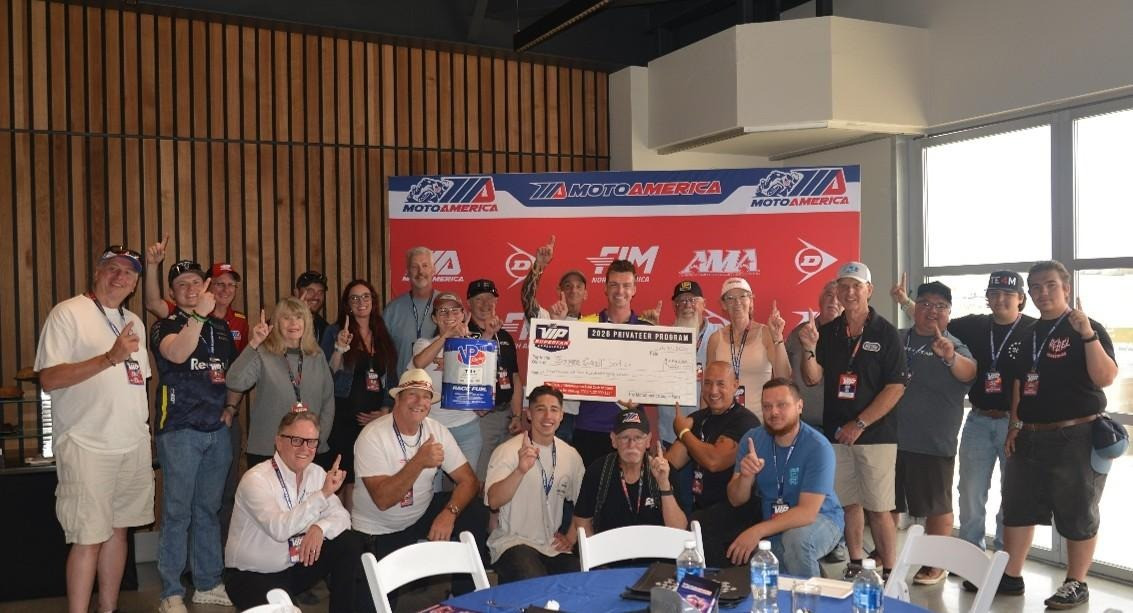
MotoAmerica Superbike Cup rider “Super” Carl Soltisz and his Super Carl 57 Rider Development team had quite a weekend at WeatherTech Raceway Laguna Seca. The Minnesota-based Michigan native was named the latest recipient of the VIP Superfan Privateer Support Program, and the timing couldn’t have been better.
Nearly 200 VIPs packed the Pavilion Suite daily, boosting the new program to a record-breaking weekend. Through donations, limited-edition MotoAmerica VIP hat sales, and an auction of Scott Odell’s artwork, the initiative raised $6,030 for Soltisz. This included a 5-gallon fuel drum donation from VP Racing Fuels, marking the program’s largest single-rider haul since its March launch at Daytona International Speedway. At the season’s midpoint, the new initiative has raised more than $15,000 for privateers.
A few VIPs went above and beyond: CeCe Saimo, Elijah Williams and Craig Simonian each made major contributions and walked away with signed memorabilia for their generosity. Thanks also go to the guest speakers who took a few minutes to sign VIP hats, helping push the fundraising total even higher.
Carl Soltisz (center, holding check) and some of the many VIP Superfans that donated to Carl’s privateer effort. Photo courtesy MotoAmerica.
Soltisz races a Honda CBR1000RR-R Fireblade SP in the Superbike Cup category which runs alongside the Superbike class on track, but scores its own standings — essentially a championship within a championship.
He’s currently sitting second in Superbike Cup points after putting his Honda on the box with a P3 finish in Race 1 at Laguna Seca, and the momentum keeps building.
It’s a big turnaround from last season, when an injury sidelined Soltisz for most of the year and forced him to put his race bike up for sale in order to cover medical bills. Back in action for 2026, he’ll put this support to good use — including getting himself and the team across the country to the next round at Mid-Ohio Sports Car Course in Lexington, Ohio, July 31 – August 2.
Carl Soltisz aboard his Honda CBR 1000RR-R Fireblade SP at WeatherTech Raceway Laguna Seca. Photo by Brian J. Nelson.
The following quote is from Superbike Cup competitor Carl Soltisz:
“I am so incredibly grateful to Scott Odell, VP Racing Fuels and all the VIP Superfans for their generous donations. Receiving this check was a huge surprise, and it means the world to me to receive this support. It’s always a challenge trying to pull together the funding needed to compete in MotoAmerica, and this contribution eases that burden in a big way. I want to give a massive thank you to everyone who chipped in, and especially to ‘Slicer’ Ron Heben for creating the Privateer Support program. After the injury I had last year, this is just the boost I needed. I am going to give everything I have to make all of you proud this season. Thank you all again so, so much for helping me chase my dream.”
There are plenty of ways to experience a MotoAmerica race weekend. You can watch from the grandstands, explore the paddock or follow the action from pit lane.
Or you can become part of the team that makes it all happen.
MotoAmerica is seeking volunteers for its upcoming visit to Mid-Ohio Sports Car Course, July 31-Aug. 2, giving racing fans a chance to experience America’s premier motorcycle road racing championship from an entirely different perspective.
Every race weekend relies on dedicated volunteers who work alongside MotoAmerica officials and staff to keep the event organized, competitive and running smoothly. Their efforts touch nearly every aspect of the weekend, from preparing the grid before a race to supporting teams and assisting officials behind the scenes.
Volunteers can choose from several important roles throughout the weekend.
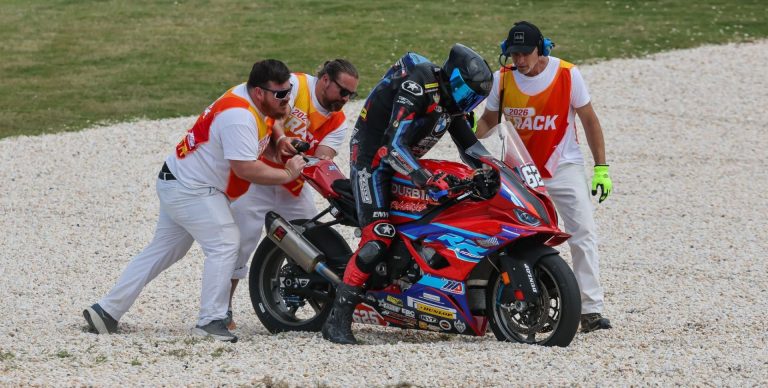
Course Marshals work trackside, displaying flags, communicating track conditions, assisting riders after on-track incidents and helping prepare the circuit for competition. Their role is one of the most visible and rewarding positions at any MotoAmerica event.
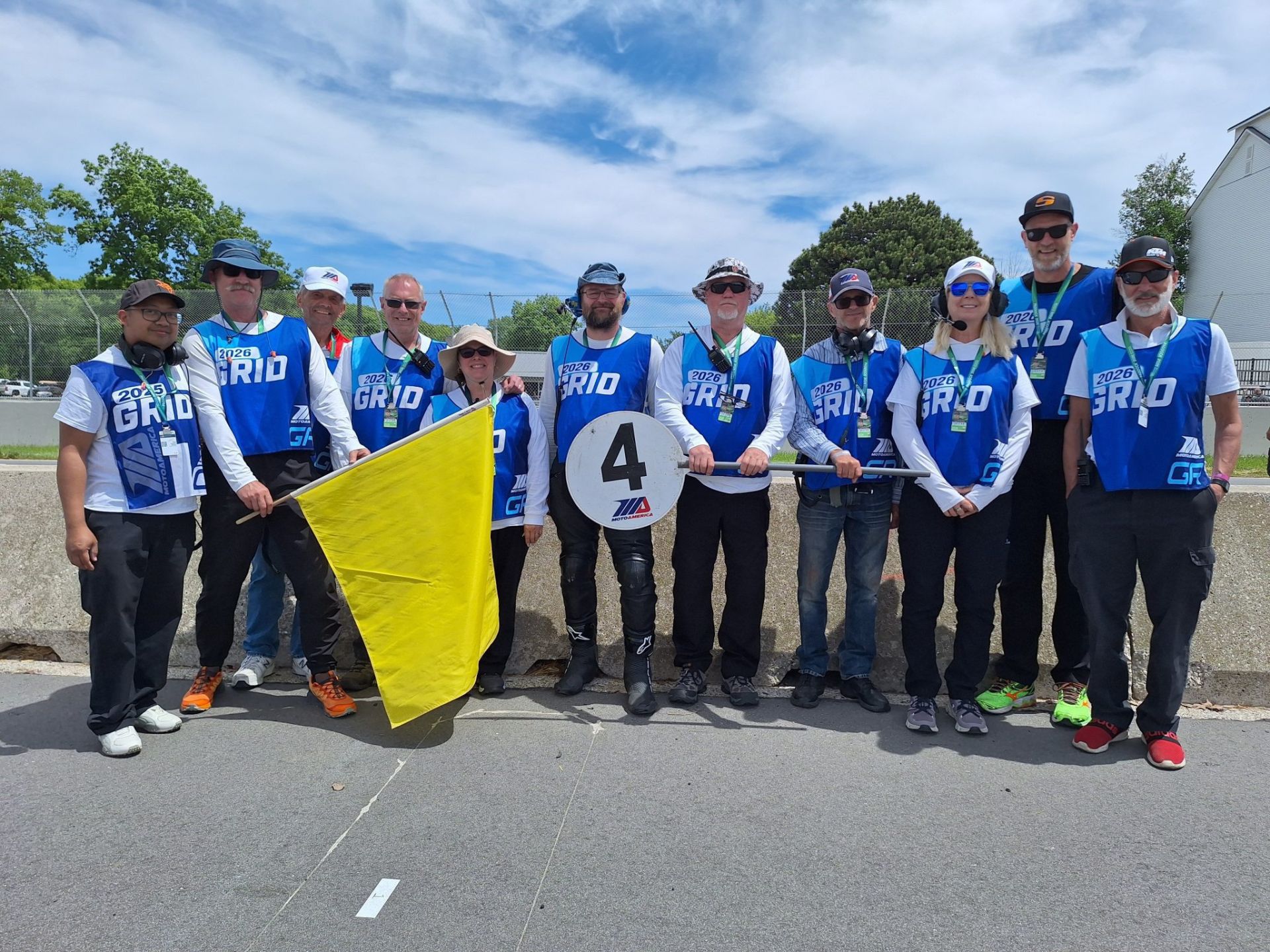
Grid marshals at the 2026 Road America round getting ready to stage riders on the grid. Photo by Brian J. Nelson.
Grid Marshals guide riders into their proper starting positions while performing final visual inspections of the motorcycles before each race begins.
Tire Control Marshals work alongside officials to ensure every team complies with MotoAmerica’s tire regulations throughout the weekend, helping maintain a level playing field across every class.
Hospitality Volunteers assist MotoAmerica staff, special guests, fellow volunteers and race teams, helping ensure everyone has what they need throughout the event.
No matter the assignment, volunteers become an integral part of race weekend while enjoying behind-the-scenes access and experiences unavailable to the average spectator. It’s an opportunity to meet fellow motorcycle racing enthusiasts, work alongside experienced officials and be on the front lines of a national championship event.
Don’t worry if you lack experience—MotoAmerica’s safety team will fully train you before the race weekend begins.
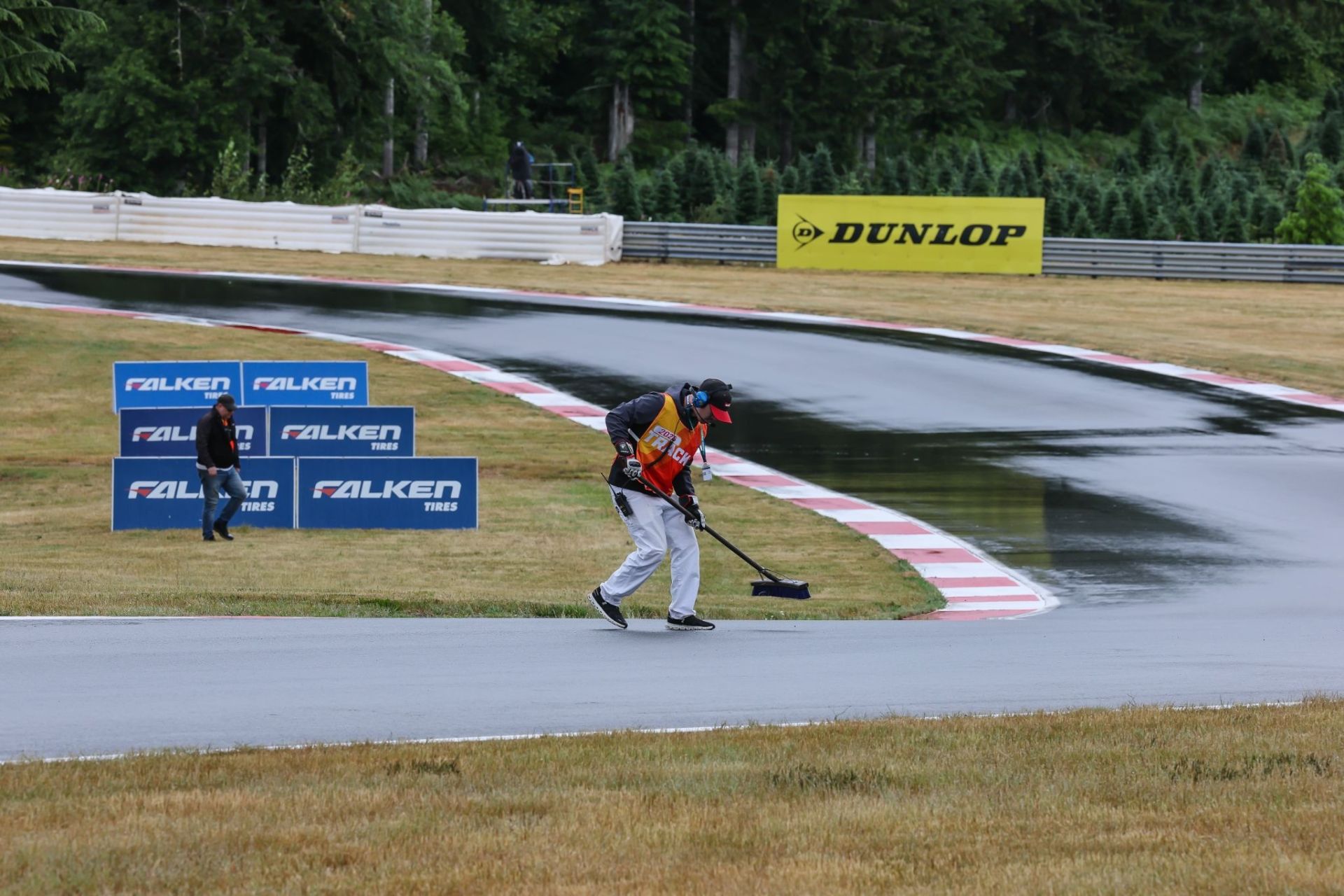
MotoAmerica course marshals also help to maintain safe track conditions. Photo by Brian J. Nelson.
The Mid-Ohio round is one of the highlights of the 2026 season, and MotoAmerica is looking for volunteers ready to help deliver another outstanding weekend of racing.
For more information on how to sign up and volunteer for the Mid-Ohio round, CLICK HERE.
For the full 2026 MotoAmerica schedule, and to purchase tickets for MotoAmerica events, CLICK HERE
For information on how to watch the MotoAmerica series, CLICK HERE
Redding stays ahead with top 15 riders covered by just 0.976s at Brands Hatch.
Scott Redding remained ahead of his British Superbike Championship rivals in the Pre-Qualifying session at Brands Hatch, keeping the Hager PBM Racing Team at the top of the times to lead the pack into tomorrow’s raceday.
The top 15 riders were covered by 0.976s as the top 12 riders secured their position in tomorrow’s ROKiT Oxygen Performance Qualifying 2 session.
Redding came to within 0.135s of the lap record, holding off reigning champion Kyle Ryde by 0.035s with Max Cook on the AJN Steelstock bimota completing the top three after the times continued to tumble in the closing stages.
Bradley Ray was on the attack and he climbed to fourth on the McAMS Yamaha, pushing Leon Haslam to fifth for Moto Rapido Racing, whilst rookie Joe Talbot surged into sixth on the second of the AJN Steelstock bimotas.
Christian Iddon was seventh on the Sencat Racing Yamaha ahead of Glenn Irwin, who has continued to bounce back after his Snetterton crash in eighth place and only 0.522s adrift of the pace-setting time.
Storm Stacey was ninth fastest ahead of Ilya Mikhalchik, who was back inside the top ten with Danny Kent and Ryan Vickers completing the top 12 riders through to tomorrow’s ROKiT Oxygen Performance Qualifying 2 session.
British Superbike Championship, Brands Hatch, Pre-Qualifying:
“It feels good to come to a circuit I raced at last year. Snetterton threw a curveball in. I was fast, but I felt like the stars weren’t aligning with me. Coming back here I hit the ground running again with the rhythm I’ve already had at a couple of races this year.
“It’s a track I love and I enjoy but I always feel like I can improve and that’s what I’m trying to do. What I like about here is you can be super fast in the first sector, but kind of suck in sector three and four and then maybe get it back at the end!
“So that’s what makes it interesting and tomorrow is going to be exciting but you’ll have to tune into the races to find out!”
It’s been awhile since we started the Baby on a Strider series of articles documenting my baby daughter’s journey learning to ride her Strider bike. The last update was nearly a year and a half ago, after Olivia’s first birthday, when she was just learning to pull herself up to stand on her Strider with the rocking base. She was also still in the sensory-exploring stage—spinning the wheels, tugging on various hard parts, laughing at the funny sounds she could make by scratching and hitting it, and getting a few tasty licks in when she could. All fun baby stuff!
Around the time she turned one year old, once she got fully acquainted with all the parts on the bike and realized it was there to stay… she totally lost interest. No joke. Imagine my shock—as a former MotoAmerica motorcycle racer and someone with a lifelong passion for cycling (and who has stood on a mountain bike race podium!)—that my kiddo did not care about two wheels! I could not believe it.
I’m never going to force Olivia to do any sport or activity she doesn’t want to do. I want her to find her own way, and I’m happy and committed to doing my best to provide her the tools to pursue whatever she chooses. Once she started walking, she basically took off running. Her balance and perception were incredible. I knew that one day, if she ever took an interest in the bike again, she wouldn’t need the rocking base at all. I removed it and parked the little yellow bike in the corner of the living room, hoping it might entice her to pick it up again.
It sat. And sat some more. And then… it didn’t. More than a year (14 months to be exact), and then one day she grabbed the handlebars, leaned it away from the wall, swung her leg over, shuffled her little feet, and slowly scooted away.
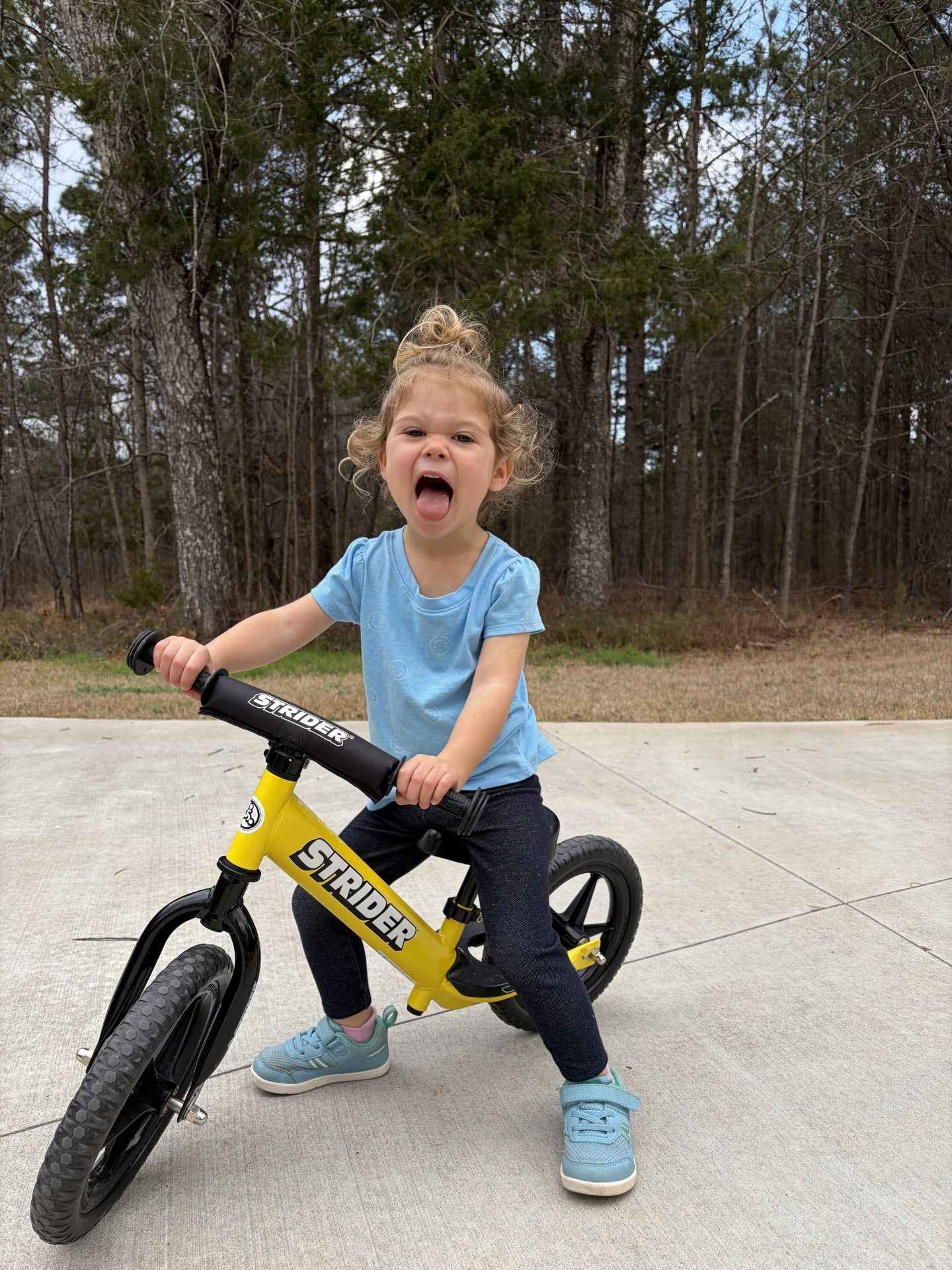
Olivia Grace “OG” Barnes and her Strider. Photo by Anne Barnes.
For the first week of being reacquainted with the bike, she would only stand and walk with it. Sometimes she would sit on the seat, but mostly she preferred to stand. The seat on the Strider is easy to adjust with a single lever, so we tried a few different heights before settling on one that made the most sense—even though she wasn’t really using the seat yet and couldn’t tell us what she preferred. Honestly, she didn’t want us touching her bike much at all!
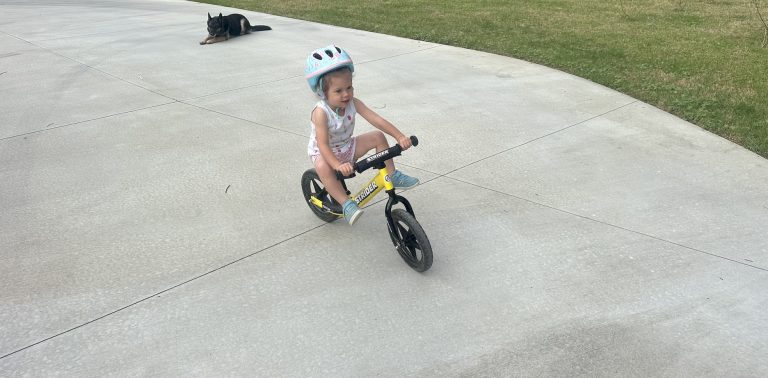
By week two, she was fully capable of coasting with her feet up—and gasp—she had picked up a lot of speed riding around the house and driveway. We gave her a little blue-and-pink butterfly helmet, just in case.
I guess she noticed the look of amazement (and a little terror) on my face when she would buzz around the corner of the countertop after flying down the long hallway. So now, that’s her favorite trick. She gets the bike going at top speed down the hall, lifts her feet, and coasts through all the obstacles—coffee table, kitchen counters, couch, etc.—with jaw-dropping precision, sometimes even skidding the little front tire.
Olivia is a very calm, sweet, and somewhat shy little girl. My favorite thing about her little Strider is how it built her confidence—not only her self-confidence when she achieved a new milestone, but also her confidence when interacting with others.
For example, when we go to local playgrounds and parks, Olivia tends to hang back and either watch the other kids on the playset or play with me. There are always other kids her age around, many who have Strider bikes, too. Once Olivia sharpened her riding skills, I started bringing her bike along. It’s been a great icebreaker for her to meet and connect with other kids. Most of the time, they don’t even need to talk—they just see another kid on a bike, lock eyes, and set off riding together.
Olivia Grace “OG” Barnes and her Strider during an All Kids Bike event. Photo by Anne Barnes.
The single coolest moment since becoming a parent happened at the Daytona 200 earlier this year. Olivia and I headed to the vendor area to hang out with some Roadracing World partners, play some games, and collect a few cool souvenirs. She spotted the All Kids Bike display and asked to ride their course. She strapped on one of their helmets, grabbed a blue demo Strider just like it was her own, and confidently set off through the roped-off course—riding up and coasting down small wooden ramps while I walked alongside her. This was big-kid territory. So cool.
I’m incredibly happy that Olivia shares a love for bicycles, just like I do. Beyond opening doors for her sense of achievement and social interaction, it’s also been a durable toy we’ll keep around for a long time. Writing this series and lookingback on how far she has come has been a joy for me, too.
Pipe Dreams Podcast returns with a special episode featuring one of the most respected and resilient riders in American motorcycle racing, Cory West. From his beginnings as a motocross kid in Arkansas to becoming the 2024 MotoAmerica Super Hooligan National Champion, Cory’s career is a testament to perseverance, adaptability, and an unwavering passion for racing.
In this episode, Cory reflects on more than two decades of competing at the highest level of American road racing, earning AMA Superbike Rookie of the Year honors, navigating the challenges of life as a privateer, and building a reputation as one of the paddock’s most versatile riders. He shares stories from years spent piecing together rides, adapting to countless motorcycles, and finding new opportunities as the sport evolved through King of the Baggers and Super Hooligan competition.
Beyond the racetrack, Cory discusses helping develop the Harley-Davidson Pan America into a championship-winning platform, balancing the demands of racing with family life, and the emotions of finally capturing his first professional national championship after 23 years as a pro. From surviving the highs and lows of professional racing to proving that persistence can ultimately pay off, this conversation offers an inside look at one of the sport’s most inspiring careers. This is Cory West.
🎧 Episode 40 is now streaming on all major podcast platforms including Spotify, Apple Music, and Amazon Music, the full episodeis out now.
Missed the action at WeatherTech Laguna Seca? Catch all the race highlights from Superbike, Supersport, Talent Cup, Mission King of the Baggers, and Super Hooligans Races 1 & 2 now!
Desert Center, CA — As preparations continue for the upcoming 2026-27 Winter Series, Chuckwalla Valley Motorcycle Association (CVMA) is pleased to announce some key staff promotions.
Rainey Pogue Named Technical Director
CVMA has officially appointed Rainey Pogue as Technical Director following her successful service in the position during the second half of last season.
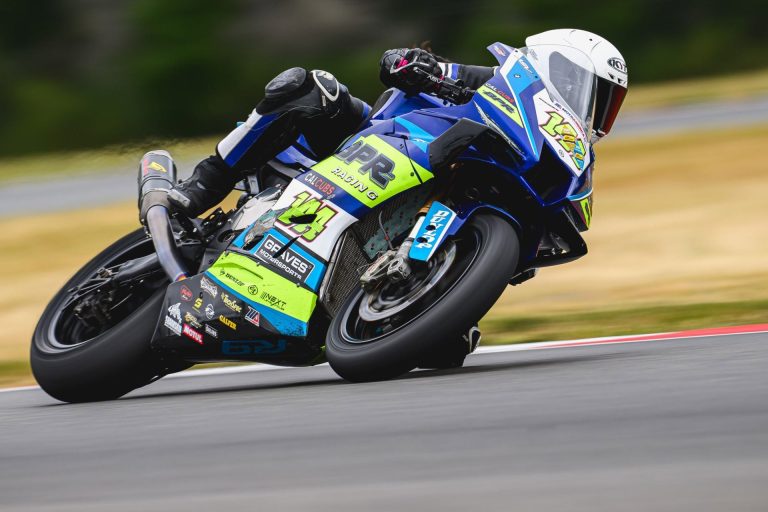
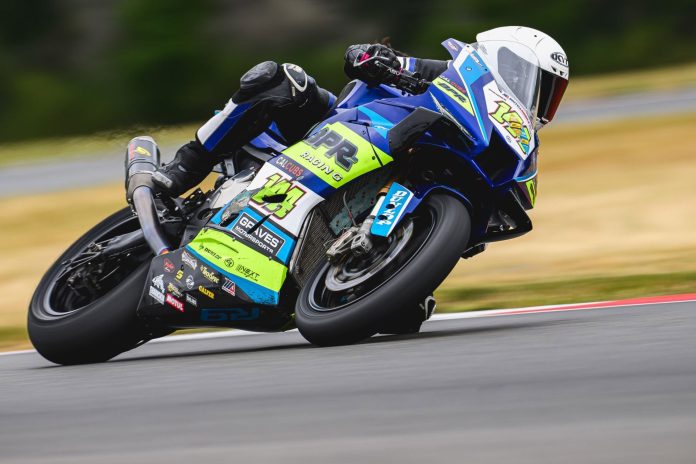
Pogue brings a lifelong passion for motorcycles and racing, along with the attention to detail, professionalism, and consistency that are essential to one of the club’s most important operational roles. Outside of CVMA, she serves as mechanic for MotoAmerica racer Brenden Ketelsen and the BPR Racing team, bringing professional-level experience back to the paddock each race weekend.
As Technical Director, Pogue oversees motorcycle technical inspections, ensures compliance with CVMA’s rulebook, and works closely with racers and officials to maintain the high standards of safety and fairness that racers expect.
“Rainey has earned the respect of everyone in the paddock. She’s organized, fair, and incredibly knowledgeable. She stepped into the Technical Director role last season and immediately made a positive impact. I’m excited to have her leading Tech as we move forward,” said Richard “Cowboy” Stampp, CVMA Operations Director.
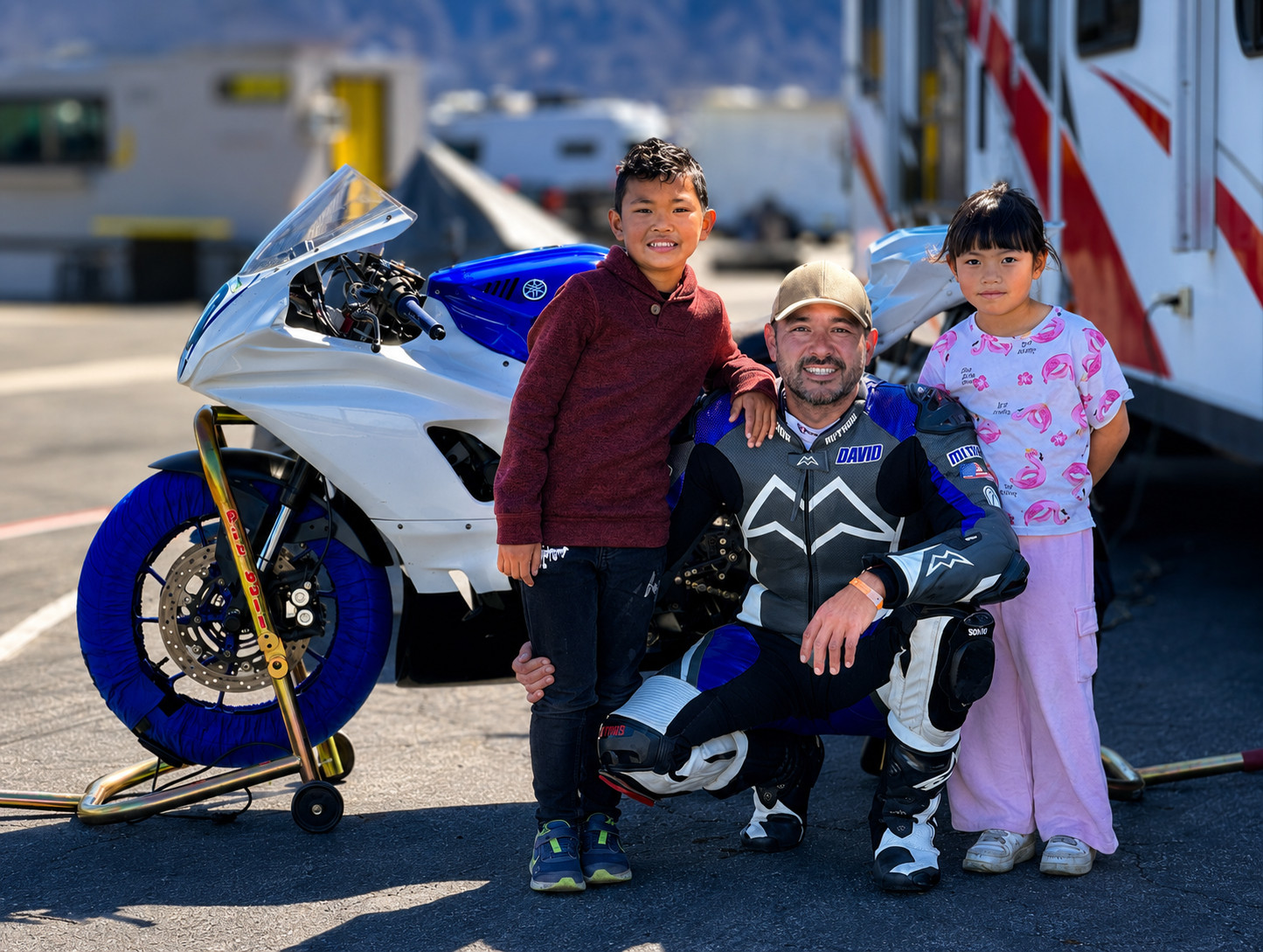
David Martin at the track with kids Nico (left) and Eva. Photo courtesy CVMA.
David Martin Named Assistant Race Director
CVMA is also proud to announce the promotion of David Martin to Assistant Race Director.
Few individuals know CVMA operations as thoroughly as Martin. Since the club’s inception, he has raced with CVMA while also volunteering in nearly every operational department. Over the years, he has served in technical inspection, assisted with registration, provided backup support for race timing, filled in as Assistant Race Director when needed, and most recently has led one of the busiest positions on race weekends as Chief Grid Marshal.
Martin will continue serving as Chief Grid Marshal while permanently assuming the responsibilities of Assistant Race Director, helping oversee race operations and ensuring events continue to run safely and efficiently.
Outside of CVMA, Martin also serves as Race Director for California Roadrace Association (CRA), reflecting the strong working relationship between the two organizations and the shared commitment to developing motorcycle road racing throughout the region.
“David has done just about every job this club has to offer, and he’s always been someone we can count on. His experience, calm demeanor, and understanding of race operations make him a natural fit for Assistant Race Director,” said Jay Tanner, CVMA Race Director.
Aleks Palacios. Photo courtesy CVMA.
Aleks Palacios Named CVMA’s Coordinador Español
To better serve its growing Spanish-speaking community, CVMA has appointed Aleks Palacios as Coordinador Español.
As the number of Spanish-speaking racers continues to grow—including many competitors traveling from Mexico to race with CVMA—the club recognized the need for a dedicated bilingual staff member to help ensure every racer has access to the information and support they need.
Palacios will assist Spanish-speaking racers during registration, provide bilingual support between race rounds, and serve as a point of contact for racers who prefer to communicate in Spanish. He will also help translate and communicate important race weekend information, including riders’ meetings and other official announcements.
Spanish-speaking racers may contact Aleks directly at [email protected] for assistance before or during race weekends
This new position reflects CVMA’s ongoing commitment to making motorcycle road racing welcoming and accessible to competitors from throughout the Southwest and Mexico.
Building for the Future
These appointments reflect CVMA’s commitment to promoting experienced individuals from within the organization while continuing to deliver the safe, professional, racer-focused environment that has become the hallmark of the Winter Series.
The 2026-2027 CVMA Winter Series begins this fall at Chuckwalla Valley Raceway, with licensing now open for returning and new racers.
About CVMA:
The Chuckwalla Valley Motorcycle Association (CVMA) hosts the premier winter motorcycle road racing series in North America. With a racer-first focus and a mission of constant improvement, CVMA provides safe, competitive, and fun racing for riders of all levels.
The question we hear from customers more than any other: what’s next? ChampTour grew directly out of that question. This is how it came to be.
#WHATSNEXT
In 2018, Keith Culver and Chris Peris started working on an idea that came from Chris’ much better half, and star of ChampBody, Jennifer Peris. The concept was a retreat, originally envisioned for YCRS graduates interested in continuing to improve their skills to fully enjoy riding a motorcycle well. Keith’s wife, Tischa, a Sommelier and Certified Specialist of Wine, was looped in and the team spent a weekend in Temecula “researching” the idea while scouting locations that could host such a retreat.
Relax, Ride, Repeat and Enjoy
The idea itself was simple: a relaxing location, yoga and ChampBody sessions in the morning, a beautiful motorcycle ride to somewhere interesting for lunch, and the twistiest ride back they could find in the afternoon. Rinse and repeat for several days, then cap it all off with a day in wine country guided by an expert in the field. The goal was a truly balanced five or so days built around motorcycle riding.
By 2019, they sharpened the pencil and started polling students to see whether an experience like this was actually viable. A resounding “YES!” Then came 2020, and Covid sidelined “ChampRetreat”.
Fast forward to 2022. Keith wanted to take a European motorcycle vacation and found a group offering exactly what he was looking for, and then some. What started as one rider wanting to experience motorcycles on the other side of the world quietly turned into a yearly pilgrimage for ChampSchool graduates and a few staff members. It became the best of both worlds, helping YCRS grads answer their own #WHATSNEXT without the need to pencil out numbers, take on financial risk, or pull focus away from the school which remains the bread and butter. Perfect.
Over the next four years, ChampSchool was organically gaining more and more experience in the motorcycle touring world as our instructors helped lead tours of mostly ChampSchool grads in Europe and Thailand. The questions started: When are you guys going to do your own tours? When are you going to do something in the United States?
At the same time, a multi time ChampSchool graduate and friend of the school, George Beavers of MotoCalifornia, a small California based tour company in Los Angeles, had been quietly expanding his offerings into Europe. After 2025, when we realized it was time for a partner change, we decided to partner with MotoCalifornia on one of the Tuscany tours, confident it would meet the level of service and experience YCRS clients are accustomed to.
What Grads Want
Over the years, Yamaha Champions Riding School has grown by responding to what riders were asking for, rather than by chasing new ideas or markets. What started primarily with racers has naturally evolved into a rider-first platform that now serves a majority of street riders, applying the same principles used at the highest levels of the sport to everyday riding. Along the way, we’ve expanded into military, police, street, and online training, each one driven by demand rather than design. ChampTour follows that same path, not something we set out to build, but something riders kept asking for, and now, with the right partners in place, something we can finally deliver the right way.
That’s the background. The “why” is simple. Being good at something is enormously more fun than struggling, especially when there’s risk involved! And when you get to share being good at something with others who are good at the same thing, the fun multiplies.
For riders in the ChampSchool ecosystem, perhaps you’ve only experienced Champions Habits on the track, or on your local roads. How much fun would it be to street ride with other YCRS grads and instructors on America’s best roads through our country’s most beautiful scenery?
That’s where ChampTour really comes to life. You awake each morning in a wonderful hotel and breakfast with riders as obsessed with motorcycles as you are. Over coffee, the day starts to take shape. The coaches talk through the route, the type of roads you’ll be riding, how elevation plays into the day, and which ChampSchool techniques will matter most. Hint, it almost always comes back to the brakes. You can feel the anticipation building before you even suit up.
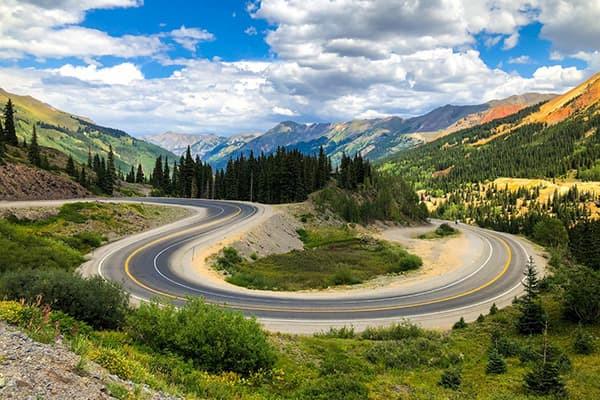
The road starts out flowing and open, the scenery easing you in. As elevation increases, the corners begin to stack up and the road tightens. Early on, you’re climbing, which feels predictable and comfortable. You find a rhythm, left, right, brake, right, left, brake. The brake pressure stays light, because gravity is helping you out. You’re relaxed, focused, and completely in the zone. When you finally pull in for a coffee stop, the smiles that were tucked inside helmets back at the hotel come out twice the size.
After a quick snack, you’re back on the road. This time, the route starts tipping downhill, but you’re ready. At the stop, the coaches remind you that you need roughly twice as much brake downhill as uphill. You’ve heard it in ChampSchool before, but now you get to really apply it. And you know what? It works. A little more brake pressure, applied lighter and longer, and what many riders find slightly nerve-racking now feels calm and controlled. The first five percent loads the tire, you hold pressure, and the bike stays on line, exactly where you want it. You repeat it again and again, corner after corner, and your smile grows the same way.
By lunchtime, you’re somewhere high in the mountains, snowcapped peaks in the distance, comparing notes with fellow riders who are feeling the same progression. Then a coach chimes in, don’t give up on your brakes, but let’s see what moving your head does for corner entry in the next section. Helmets go back on, engines fire, and you roll out for the afternoon. The rest of the day is spent layering these techniques together, making small, incremental adjustments until you find that sweet spot where everything just clicks.
Before you know it, you’re rolling back toward the hotel, wishing there were another hundred miles left in the day. When you pull in, you’re too energized to disappear into your room, so you meet in the lobby bar for a refreshment and start replaying the ride. The corners, the breakthroughs, the moments where things finally clicked.
Then it’s good food, a glass of wine or your favorite beverage, lots of laughter, and somewhere between the second story and the next sip, it hits: you get to wake up tomorrow and do it all over again with this same group of people. Just don’t overdo the wine. You do have to ride in the morning.
We’ve lived this day more than once, and even writing it down makes us want the first ChampTour to start tomorrow. If you’re asking yourself what’s next, we hope to see you in Colorado, Italy, or the Smoky Mountains.
The N2RA KYT Americas 6-Hours of VIR Delivers One of the Best Values in American Motorcycle Road Racing.
Media, PA – July 2026 – Whether your goal is to race for the richest endurance purse in American history, sharpen your skills before MotoAmerica arrives at Virginia International Raceway, or simply spend an unforgettable weekend riding motorcycles with your friends, the N2RA KYT Americas 6-Hours of VIR delivers an incredible amount of track time, competition, and value.
Held August 7–9 at Virginia International Raceway, the event combines practice, qualifying, sprint endurance racing, and America’s richest motorcycle endurance race into one action-packed weekend.
Unlike a traditional race weekend where competitors may only spend a handful of laps on track, the N2RA format is designed to maximize your time on the motorcycle. Riders have the opportunity to accumulate more than 10 hours of on-track activity over three days, making this one of the best values in American motorcycle road racing.
For club racers, that’s exceptional value.
For MotoAmerica teams preparing for the following weekend at VIR, it’s the perfect opportunity to test motorcycles, riders, strategy, tire management, pit stops, and team communication under real race conditions.
Three Days of Riding
The weekend begins Wednesday and Thursday with Yamaha Champions Riding School. Thursday evening as the paddock comes alive with gates opening, registration, and technical inspection, giving teams the opportunity to get settled before the action begins.
Friday is dedicated to preparation. Riders (Novice, Intermediate, and Racers) receive a full day of practice with six 20-minute sessions. It’s a full day to learn the track, dial in the motorcycle, develop rider consistency, and refine pit procedures before qualifying begins.
Saturday transitions into race mode. Morning 30-minute practice and 30-minute qualifying sessions determine the starting grids before an afternoon packed with competition, including the 30-minute Lightsport, Supersport, Superbike Endurance, and the Alpha Omega 2-Hour Endurance Race. The day concludes with the always-entertaining Pit Stop Challenge, where fast, efficient teamwork takes center stage.
Sunday is Championship Sunday. Following final practice and last-chance qualifying races, the Ultra Lightweight Endurance 30 leads into the marquee event—the KYT Americas 6-Hours of VIR. Six hours of strategy, consistency, rider changes, tire management, and teamwork will determine who stands atop the podium at one of the premier motorcycle racing facilities in North America. Awards follow immediately after the checkered flag.
More Than Just a Race
Endurance racing has always been about far more than outright speed.
The fastest lap rarely wins a six-hour race. Consistency does. Teamwork does. Smart strategy, clean pit stops, disciplined riding, and six hours of executing the fundamentals are what separate great teams from everyone else.
Whether you’re racing with longtime teammates or assembling your first endurance squad, there’s simply nothing else in motorcycle racing that builds friendships quite like endurance competition.
Race for America’s Richest Endurance Purse
The KYT Americas 6-Hours of VIR will feature more than $62,000 in combined cash payouts, contingency, and bonus awards, making it the richest single endurance motorcycle race in United States history. Teams competing in Superbike, Supersport, Lightsport, and the Alpha Omega 2-Hour Ultralight Endurance will compete for substantial cash prizes while enjoying one of North America’s premier road racing circuits.
Whether you’re an ASRA regular, a WERA veteran, a MotoAmerica professional, or simply looking for the most riding you’ll get all season, the N2RA 6-Hours of VIR offers an unmatched combination of track time, competition, camaraderie, and value.
Founded in 2014, N2’s mission is to build a sustainable motorcycle community through safe, structured track days and advanced rider training based on Yamaha Champions Riding School methodology.
In 2017, N2 revived motorcycle endurance racing in America with the creation of the N2 National Endurance Series, now N2RA. Today, N2RA continues to provide affordable, competitive, professionally managed endurance racing while helping grow the sport through exceptional events and rider development.
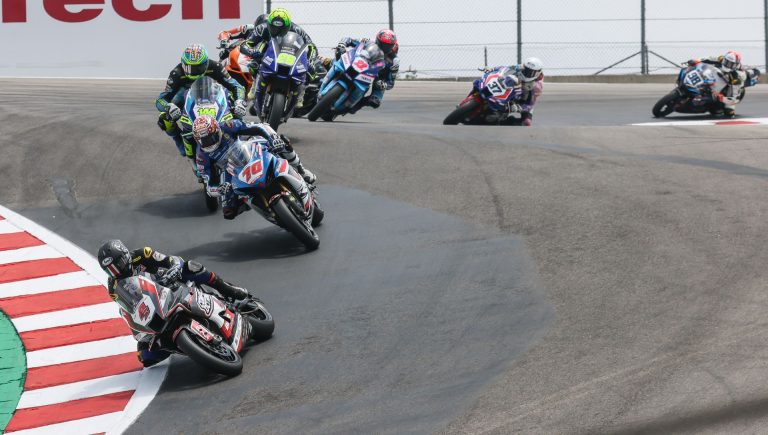
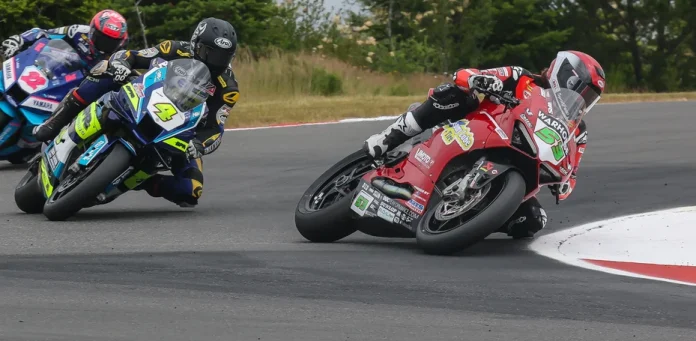
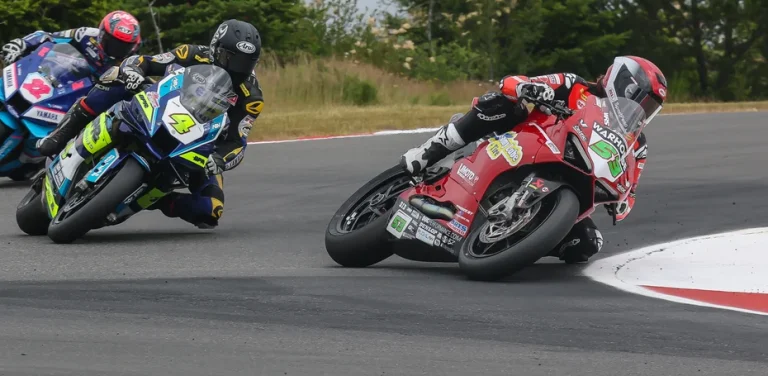
Darryn Binder (53) leads Josh Hayes (4) and Blake Davis (22) in a Supersport race at The Ridge. Binder has only missed the podium once this season, and that was at the Daytona 200. Photo by Brian J. Nelson.
Three weeks later, the action from The Ridge is still worth watching. Catch the best moments from Superbike, Supersport, Talent Cup, Super Hooligans and Royal Enfield BTR Races 1 & 2.
Super Carl’s superb season just got a whole lot better. Photo by Brian J. Nelson
MotoAmerica Superbike Cup rider “Super” Carl Soltisz and his Super Carl 57 Rider Development team had quite a weekend at WeatherTech Raceway Laguna Seca. The Minnesota-based Michigan native was named the latest recipient of the VIP Superfan Privateer Support Program, and the timing couldn’t have been better.
Nearly 200 VIPs packed the Pavilion Suite daily, boosting the new program to a record-breaking weekend. Through donations, limited-edition MotoAmerica VIP hat sales, and an auction of Scott Odell’s artwork, the initiative raised $6,030 for Soltisz. This included a 5-gallon fuel drum donation from VP Racing Fuels, marking the program’s largest single-rider haul since its March launch at Daytona International Speedway. At the season’s midpoint, the new initiative has raised more than $15,000 for privateers.
A few VIPs went above and beyond: CeCe Saimo, Elijah Williams and Craig Simonian each made major contributions and walked away with signed memorabilia for their generosity. Thanks also go to the guest speakers who took a few minutes to sign VIP hats, helping push the fundraising total even higher.
Carl Soltisz (center, holding check) and some of the many VIP Superfans that donated to Carl’s privateer effort. Photo courtesy MotoAmerica.
Soltisz races a Honda CBR1000RR-R Fireblade SP in the Superbike Cup category which runs alongside the Superbike class on track, but scores its own standings — essentially a championship within a championship.
He’s currently sitting second in Superbike Cup points after putting his Honda on the box with a P3 finish in Race 1 at Laguna Seca, and the momentum keeps building.
It’s a big turnaround from last season, when an injury sidelined Soltisz for most of the year and forced him to put his race bike up for sale in order to cover medical bills. Back in action for 2026, he’ll put this support to good use — including getting himself and the team across the country to the next round at Mid-Ohio Sports Car Course in Lexington, Ohio, July 31 – August 2.
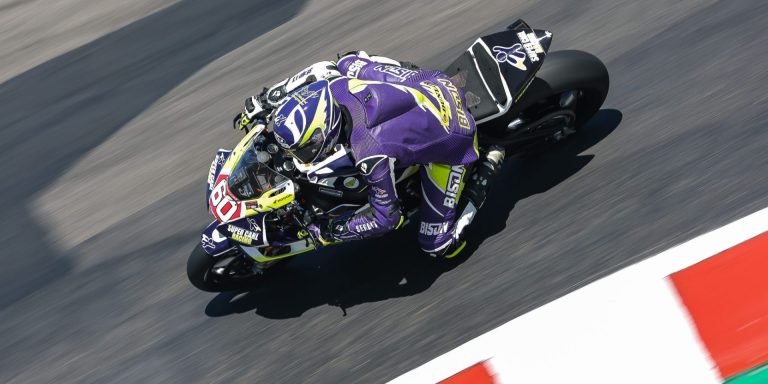
Carl Soltisz aboard his Honda CBR 1000RR-R Fireblade SP at WeatherTech Raceway Laguna Seca. Photo by Brian J. Nelson.
The following quote is from Superbike Cup competitor Carl Soltisz:
“I am so incredibly grateful to Scott Odell, VP Racing Fuels and all the VIP Superfans for their generous donations. Receiving this check was a huge surprise, and it means the world to me to receive this support. It’s always a challenge trying to pull together the funding needed to compete in MotoAmerica, and this contribution eases that burden in a big way. I want to give a massive thank you to everyone who chipped in, and especially to ‘Slicer’ Ron Heben for creating the Privateer Support program. After the injury I had last year, this is just the boost I needed. I am going to give everything I have to make all of you proud this season. Thank you all again so, so much for helping me chase my dream.”
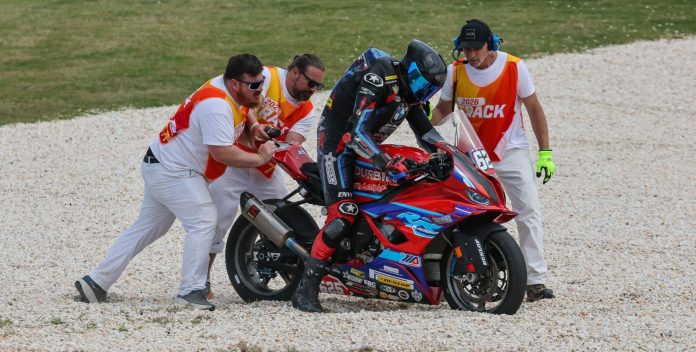
Course Marshals help Durbin Racing’s Christopher Durbin get his BMW M 10000 RR out of the gravel trap and back onto the race track. Photo by Brian J. Nelson.
There are plenty of ways to experience a MotoAmerica race weekend. You can watch from the grandstands, explore the paddock or follow the action from pit lane.
Or you can become part of the team that makes it all happen.
MotoAmerica is seeking volunteers for its upcoming visit to Mid-Ohio Sports Car Course, July 31-Aug. 2, giving racing fans a chance to experience America’s premier motorcycle road racing championship from an entirely different perspective.
Every race weekend relies on dedicated volunteers who work alongside MotoAmerica officials and staff to keep the event organized, competitive and running smoothly. Their efforts touch nearly every aspect of the weekend, from preparing the grid before a race to supporting teams and assisting officials behind the scenes.
Volunteers can choose from several important roles throughout the weekend.
Course Marshals work trackside, displaying flags, communicating track conditions, assisting riders after on-track incidents and helping prepare the circuit for competition. Their role is one of the most visible and rewarding positions at any MotoAmerica event.
Grid marshals at the 2026 Road America round getting ready to stage riders on the grid. Photo by Brian J. Nelson.
Grid Marshals guide riders into their proper starting positions while performing final visual inspections of the motorcycles before each race begins.
Tire Control Marshals work alongside officials to ensure every team complies with MotoAmerica’s tire regulations throughout the weekend, helping maintain a level playing field across every class.
Hospitality Volunteers assist MotoAmerica staff, special guests, fellow volunteers and race teams, helping ensure everyone has what they need throughout the event.
No matter the assignment, volunteers become an integral part of race weekend while enjoying behind-the-scenes access and experiences unavailable to the average spectator. It’s an opportunity to meet fellow motorcycle racing enthusiasts, work alongside experienced officials and be on the front lines of a national championship event.
Don’t worry if you lack experience—MotoAmerica’s safety team will fully train you before the race weekend begins.
MotoAmerica course marshals also help to maintain safe track conditions. Photo by Brian J. Nelson.
The Mid-Ohio round is one of the highlights of the 2026 season, and MotoAmerica is looking for volunteers ready to help deliver another outstanding weekend of racing.
For more information on how to sign up and volunteer for the Mid-Ohio round, CLICK HERE.
For the full 2026 MotoAmerica schedule, and to purchase tickets for MotoAmerica events, CLICK HERE
For information on how to watch the MotoAmerica series, CLICK HERE
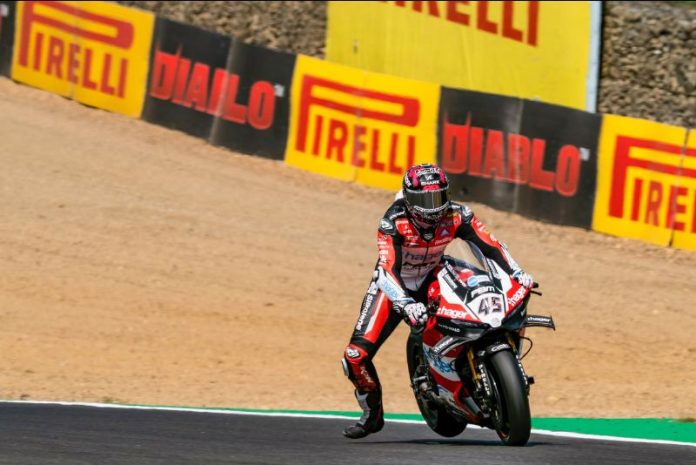
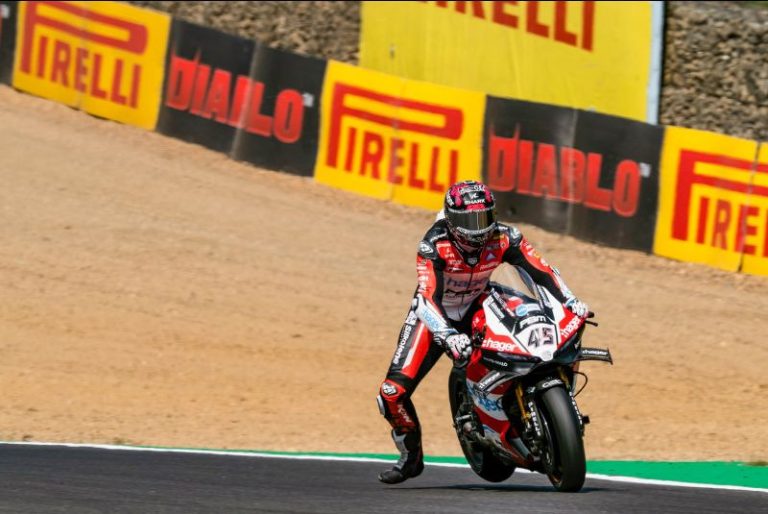
Scott Redding (45) at Brands Hatch. Photo courtesy BSB
Redding stays ahead with top 15 riders covered by just 0.976s at Brands Hatch.
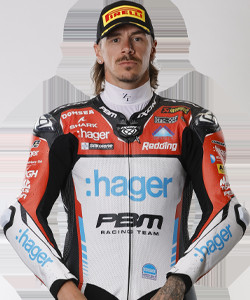
Scott Redding remained ahead of his British Superbike Championship rivals in the Pre-Qualifying session at Brands Hatch, keeping the Hager PBM Racing Team at the top of the times to lead the pack into tomorrow’s raceday.
The top 15 riders were covered by 0.976s as the top 12 riders secured their position in tomorrow’s ROKiT Oxygen Performance Qualifying 2 session.
Redding came to within 0.135s of the lap record, holding off reigning champion Kyle Ryde by 0.035s with Max Cook on the AJN Steelstock bimota completing the top three after the times continued to tumble in the closing stages.
Bradley Ray was on the attack and he climbed to fourth on the McAMS Yamaha, pushing Leon Haslam to fifth for Moto Rapido Racing, whilst rookie Joe Talbot surged into sixth on the second of the AJN Steelstock bimotas.
Christian Iddon was seventh on the Sencat Racing Yamaha ahead of Glenn Irwin, who has continued to bounce back after his Snetterton crash in eighth place and only 0.522s adrift of the pace-setting time.
Storm Stacey was ninth fastest ahead of Ilya Mikhalchik, who was back inside the top ten with Danny Kent and Ryan Vickers completing the top 12 riders through to tomorrow’s ROKiT Oxygen Performance Qualifying 2 session.
British Superbike Championship, Brands Hatch, Pre-Qualifying:
“It feels good to come to a circuit I raced at last year. Snetterton threw a curveball in. I was fast, but I felt like the stars weren’t aligning with me. Coming back here I hit the ground running again with the rhythm I’ve already had at a couple of races this year.
“It’s a track I love and I enjoy but I always feel like I can improve and that’s what I’m trying to do. What I like about here is you can be super fast in the first sector, but kind of suck in sector three and four and then maybe get it back at the end!
“So that’s what makes it interesting and tomorrow is going to be exciting but you’ll have to tune into the races to find out!”
Olivia Grace "OG" Barnes and her Strider. Photo by Anne Barnes.
By Anne Barnes
From Licking It to Sending It!
It’s been awhile since we started the Baby on a Strider series of articles documenting my baby daughter’s journey learning to ride her Strider bike. The last update was nearly a year and a half ago, after Olivia’s first birthday, when she was just learning to pull herself up to stand on her Strider with the rocking base. She was also still in the sensory-exploring stage—spinning the wheels, tugging on various hard parts, laughing at the funny sounds she could make by scratching and hitting it, and getting a few tasty licks in when she could. All fun baby stuff!
Around the time she turned one year old, once she got fully acquainted with all the parts on the bike and realized it was there to stay… she totally lost interest. No joke. Imagine my shock—as a former MotoAmerica motorcycle racer and someone with a lifelong passion for cycling (and who has stood on a mountain bike race podium!)—that my kiddo did not care about two wheels! I could not believe it.
I’m never going to force Olivia to do any sport or activity she doesn’t want to do. I want her to find her own way, and I’m happy and committed to doing my best to provide her the tools to pursue whatever she chooses. Once she started walking, she basically took off running. Her balance and perception were incredible. I knew that one day, if she ever took an interest in the bike again, she wouldn’t need the rocking base at all. I removed it and parked the little yellow bike in the corner of the living room, hoping it might entice her to pick it up again.
It sat. And sat some more. And then… it didn’t. More than a year (14 months to be exact), and then one day she grabbed the handlebars, leaned it away from the wall, swung her leg over, shuffled her little feet, and slowly scooted away.
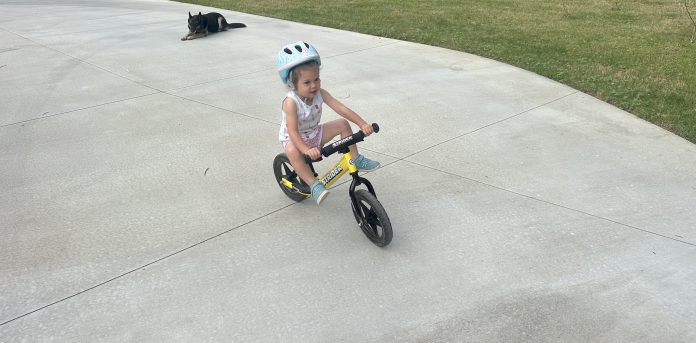
Olivia Grace “OG” Barnes and her Strider. Photo by Anne Barnes.
For the first week of being reacquainted with the bike, she would only stand and walk with it. Sometimes she would sit on the seat, but mostly she preferred to stand. The seat on the Strider is easy to adjust with a single lever, so we tried a few different heights before settling on one that made the most sense—even though she wasn’t really using the seat yet and couldn’t tell us what she preferred. Honestly, she didn’t want us touching her bike much at all!
By week two, she was fully capable of coasting with her feet up—and gasp—she had picked up a lot of speed riding around the house and driveway. We gave her a little blue-and-pink butterfly helmet, just in case.
I guess she noticed the look of amazement (and a little terror) on my face when she would buzz around the corner of the countertop after flying down the long hallway. So now, that’s her favorite trick. She gets the bike going at top speed down the hall, lifts her feet, and coasts through all the obstacles—coffee table, kitchen counters, couch, etc.—with jaw-dropping precision, sometimes even skidding the little front tire.
Olivia is a very calm, sweet, and somewhat shy little girl. My favorite thing about her little Strider is how it built her confidence—not only her self-confidence when she achieved a new milestone, but also her confidence when interacting with others.
For example, when we go to local playgrounds and parks, Olivia tends to hang back and either watch the other kids on the playset or play with me. There are always other kids her age around, many who have Strider bikes, too. Once Olivia sharpened her riding skills, I started bringing her bike along. It’s been a great icebreaker for her to meet and connect with other kids. Most of the time, they don’t even need to talk—they just see another kid on a bike, lock eyes, and set off riding together.
Olivia Grace “OG” Barnes and her Strider during an All Kids Bike event. Photo by Anne Barnes.
The single coolest moment since becoming a parent happened at the Daytona 200 earlier this year. Olivia and I headed to the vendor area to hang out with some Roadracing World partners, play some games, and collect a few cool souvenirs. She spotted the All Kids Bike display and asked to ride their course. She strapped on one of their helmets, grabbed a blue demo Strider just like it was her own, and confidently set off through the roped-off course—riding up and coasting down small wooden ramps while I walked alongside her. This was big-kid territory. So cool.
I’m incredibly happy that Olivia shares a love for bicycles, just like I do. Beyond opening doors for her sense of achievement and social interaction, it’s also been a durable toy we’ll keep around for a long time. Writing this series and lookingback on how far she has come has been a joy for me, too.
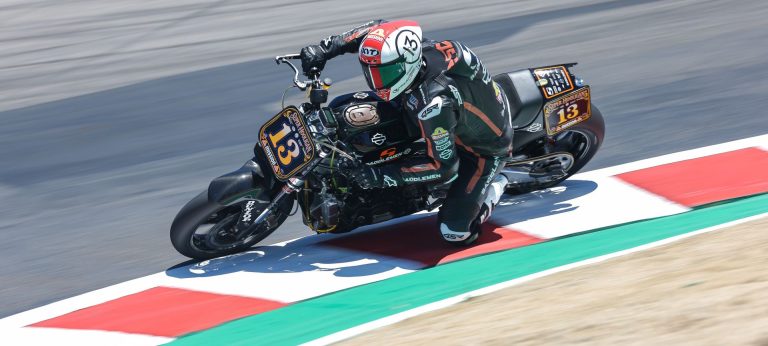
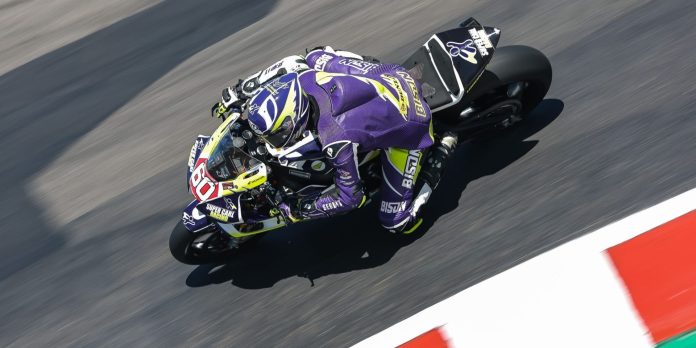
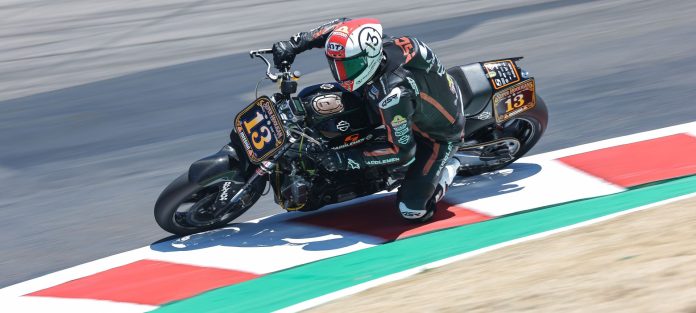
Cory West (13) at Laguna Seca. Photo by Brian J. Nelson.
Pipe Dreams Podcast returns with a special episode featuring one of the most respected and resilient riders in American motorcycle racing, Cory West. From his beginnings as a motocross kid in Arkansas to becoming the 2024 MotoAmerica Super Hooligan National Champion, Cory’s career is a testament to perseverance, adaptability, and an unwavering passion for racing.
In this episode, Cory reflects on more than two decades of competing at the highest level of American road racing, earning AMA Superbike Rookie of the Year honors, navigating the challenges of life as a privateer, and building a reputation as one of the paddock’s most versatile riders. He shares stories from years spent piecing together rides, adapting to countless motorcycles, and finding new opportunities as the sport evolved through King of the Baggers and Super Hooligan competition.
Beyond the racetrack, Cory discusses helping develop the Harley-Davidson Pan America into a championship-winning platform, balancing the demands of racing with family life, and the emotions of finally capturing his first professional national championship after 23 years as a pro. From surviving the highs and lows of professional racing to proving that persistence can ultimately pay off, this conversation offers an inside look at one of the sport’s most inspiring careers. This is Cory West.
🎧 Episode 40 is now streaming on all major podcast platforms including Spotify, Apple Music, and Amazon Music, the full episodeis out now.
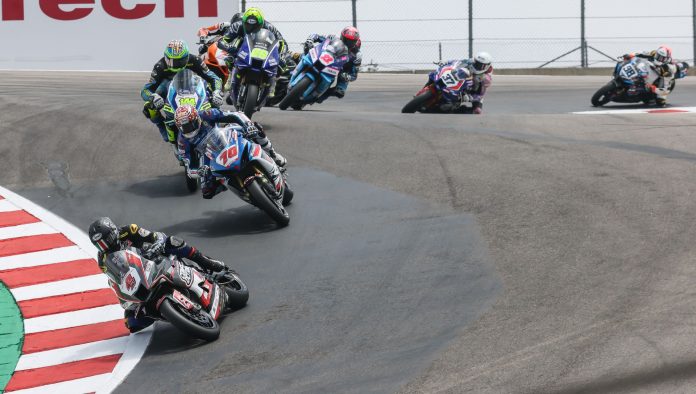
Josh Hayes (4), Tyler Scott (70), Brenden Ketelsen (144), Dominic Doyle (26), Alessandro Di Mario (27), Blake Davis (22), Stefano Mesa (37) and Aiden Sneed (98) during Supersport Race 2 at Laguna Seca. Photo by Brian J. Nelson.
Missed the action at WeatherTech Laguna Seca? Catch all the race highlights from Superbike, Supersport, Talent Cup, Mission King of the Baggers, and Super Hooligans Races 1 & 2 now!
Rainey Pogue riding Brenden Ketelsen's bike at The Ridge. Photo courtesy CVMA.
Desert Center, CA — As preparations continue for the upcoming 2026-27 Winter Series, Chuckwalla Valley Motorcycle Association (CVMA) is pleased to announce some key staff promotions.
Rainey Pogue Named Technical Director
CVMA has officially appointed Rainey Pogue as Technical Director following her successful service in the position during the second half of last season.
Pogue brings a lifelong passion for motorcycles and racing, along with the attention to detail, professionalism, and consistency that are essential to one of the club’s most important operational roles. Outside of CVMA, she serves as mechanic for MotoAmerica racer Brenden Ketelsen and the BPR Racing team, bringing professional-level experience back to the paddock each race weekend.
As Technical Director, Pogue oversees motorcycle technical inspections, ensures compliance with CVMA’s rulebook, and works closely with racers and officials to maintain the high standards of safety and fairness that racers expect.
“Rainey has earned the respect of everyone in the paddock. She’s organized, fair, and incredibly knowledgeable. She stepped into the Technical Director role last season and immediately made a positive impact. I’m excited to have her leading Tech as we move forward,” said Richard “Cowboy” Stampp, CVMA Operations Director.
David Martin at the track with kids Nico (left) and Eva. Photo courtesy CVMA.
David Martin Named Assistant Race Director
CVMA is also proud to announce the promotion of David Martin to Assistant Race Director.
Few individuals know CVMA operations as thoroughly as Martin. Since the club’s inception, he has raced with CVMA while also volunteering in nearly every operational department. Over the years, he has served in technical inspection, assisted with registration, provided backup support for race timing, filled in as Assistant Race Director when needed, and most recently has led one of the busiest positions on race weekends as Chief Grid Marshal.
Martin will continue serving as Chief Grid Marshal while permanently assuming the responsibilities of Assistant Race Director, helping oversee race operations and ensuring events continue to run safely and efficiently.
Outside of CVMA, Martin also serves as Race Director for California Roadrace Association (CRA), reflecting the strong working relationship between the two organizations and the shared commitment to developing motorcycle road racing throughout the region.
“David has done just about every job this club has to offer, and he’s always been someone we can count on. His experience, calm demeanor, and understanding of race operations make him a natural fit for Assistant Race Director,” said Jay Tanner, CVMA Race Director.
Aleks Palacios. Photo courtesy CVMA.
Aleks Palacios Named CVMA’s Coordinador Español
To better serve its growing Spanish-speaking community, CVMA has appointed Aleks Palacios as Coordinador Español.
As the number of Spanish-speaking racers continues to grow—including many competitors traveling from Mexico to race with CVMA—the club recognized the need for a dedicated bilingual staff member to help ensure every racer has access to the information and support they need.
Palacios will assist Spanish-speaking racers during registration, provide bilingual support between race rounds, and serve as a point of contact for racers who prefer to communicate in Spanish. He will also help translate and communicate important race weekend information, including riders’ meetings and other official announcements.
Spanish-speaking racers may contact Aleks directly at [email protected] for assistance before or during race weekends
This new position reflects CVMA’s ongoing commitment to making motorcycle road racing welcoming and accessible to competitors from throughout the Southwest and Mexico.
Building for the Future
These appointments reflect CVMA’s commitment to promoting experienced individuals from within the organization while continuing to deliver the safe, professional, racer-focused environment that has become the hallmark of the Winter Series.
The 2026-2027 CVMA Winter Series begins this fall at Chuckwalla Valley Raceway, with licensing now open for returning and new racers.
About CVMA:
The Chuckwalla Valley Motorcycle Association (CVMA) hosts the premier winter motorcycle road racing series in North America. With a racer-first focus and a mission of constant improvement, CVMA provides safe, competitive, and fun racing for riders of all levels.
Keith Culver (right) of ChampSchool, and Mark Thompson, who joined the organization after attending a motorcycle safety course for military mariners—and never left. Photo courtesy ChampSchool.
What Is ChampTour, and Where Did It Come From?
The question we hear from customers more than any other: what’s next? ChampTour grew directly out of that question. This is how it came to be.
#WHATSNEXT
In 2018, Keith Culver and Chris Peris started working on an idea that came from Chris’ much better half, and star of ChampBody, Jennifer Peris. The concept was a retreat, originally envisioned for YCRS graduates interested in continuing to improve their skills to fully enjoy riding a motorcycle well. Keith’s wife, Tischa, a Sommelier and Certified Specialist of Wine, was looped in and the team spent a weekend in Temecula “researching” the idea while scouting locations that could host such a retreat.
Relax, Ride, Repeat and Enjoy
The idea itself was simple: a relaxing location, yoga and ChampBody sessions in the morning, a beautiful motorcycle ride to somewhere interesting for lunch, and the twistiest ride back they could find in the afternoon. Rinse and repeat for several days, then cap it all off with a day in wine country guided by an expert in the field. The goal was a truly balanced five or so days built around motorcycle riding.
By 2019, they sharpened the pencil and started polling students to see whether an experience like this was actually viable. A resounding “YES!” Then came 2020, and Covid sidelined “ChampRetreat”.
Fast forward to 2022. Keith wanted to take a European motorcycle vacation and found a group offering exactly what he was looking for, and then some. What started as one rider wanting to experience motorcycles on the other side of the world quietly turned into a yearly pilgrimage for ChampSchool graduates and a few staff members. It became the best of both worlds, helping YCRS grads answer their own #WHATSNEXT without the need to pencil out numbers, take on financial risk, or pull focus away from the school which remains the bread and butter. Perfect.
Over the next four years, ChampSchool was organically gaining more and more experience in the motorcycle touring world as our instructors helped lead tours of mostly ChampSchool grads in Europe and Thailand. The questions started: When are you guys going to do your own tours? When are you going to do something in the United States?
At the same time, a multi time ChampSchool graduate and friend of the school, George Beavers of MotoCalifornia, a small California based tour company in Los Angeles, had been quietly expanding his offerings into Europe. After 2025, when we realized it was time for a partner change, we decided to partner with MotoCalifornia on one of the Tuscany tours, confident it would meet the level of service and experience YCRS clients are accustomed to.
What Grads Want
Over the years, Yamaha Champions Riding School has grown by responding to what riders were asking for, rather than by chasing new ideas or markets. What started primarily with racers has naturally evolved into a rider-first platform that now serves a majority of street riders, applying the same principles used at the highest levels of the sport to everyday riding. Along the way, we’ve expanded into military, police, street, and online training, each one driven by demand rather than design. ChampTour follows that same path, not something we set out to build, but something riders kept asking for, and now, with the right partners in place, something we can finally deliver the right way.
That’s the background. The “why” is simple. Being good at something is enormously more fun than struggling, especially when there’s risk involved! And when you get to share being good at something with others who are good at the same thing, the fun multiplies.
For riders in the ChampSchool ecosystem, perhaps you’ve only experienced Champions Habits on the track, or on your local roads. How much fun would it be to street ride with other YCRS grads and instructors on America’s best roads through our country’s most beautiful scenery?
That’s where ChampTour really comes to life. You awake each morning in a wonderful hotel and breakfast with riders as obsessed with motorcycles as you are. Over coffee, the day starts to take shape. The coaches talk through the route, the type of roads you’ll be riding, how elevation plays into the day, and which ChampSchool techniques will matter most. Hint, it almost always comes back to the brakes. You can feel the anticipation building before you even suit up.
The road starts out flowing and open, the scenery easing you in. As elevation increases, the corners begin to stack up and the road tightens. Early on, you’re climbing, which feels predictable and comfortable. You find a rhythm, left, right, brake, right, left, brake. The brake pressure stays light, because gravity is helping you out. You’re relaxed, focused, and completely in the zone. When you finally pull in for a coffee stop, the smiles that were tucked inside helmets back at the hotel come out twice the size.
After a quick snack, you’re back on the road. This time, the route starts tipping downhill, but you’re ready. At the stop, the coaches remind you that you need roughly twice as much brake downhill as uphill. You’ve heard it in ChampSchool before, but now you get to really apply it. And you know what? It works. A little more brake pressure, applied lighter and longer, and what many riders find slightly nerve-racking now feels calm and controlled. The first five percent loads the tire, you hold pressure, and the bike stays on line, exactly where you want it. You repeat it again and again, corner after corner, and your smile grows the same way.
By lunchtime, you’re somewhere high in the mountains, snowcapped peaks in the distance, comparing notes with fellow riders who are feeling the same progression. Then a coach chimes in, don’t give up on your brakes, but let’s see what moving your head does for corner entry in the next section. Helmets go back on, engines fire, and you roll out for the afternoon. The rest of the day is spent layering these techniques together, making small, incremental adjustments until you find that sweet spot where everything just clicks.
Before you know it, you’re rolling back toward the hotel, wishing there were another hundred miles left in the day. When you pull in, you’re too energized to disappear into your room, so you meet in the lobby bar for a refreshment and start replaying the ride. The corners, the breakthroughs, the moments where things finally clicked.
Then it’s good food, a glass of wine or your favorite beverage, lots of laughter, and somewhere between the second story and the next sip, it hits: you get to wake up tomorrow and do it all over again with this same group of people. Just don’t overdo the wine. You do have to ride in the morning.
We’ve lived this day more than once, and even writing it down makes us want the first ChampTour to start tomorrow. If you’re asking yourself what’s next, we hope to see you in Colorado, Italy, or the Smoky Mountains.
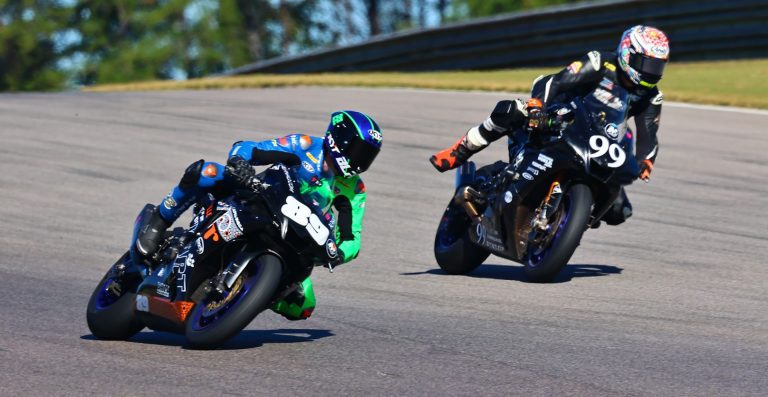
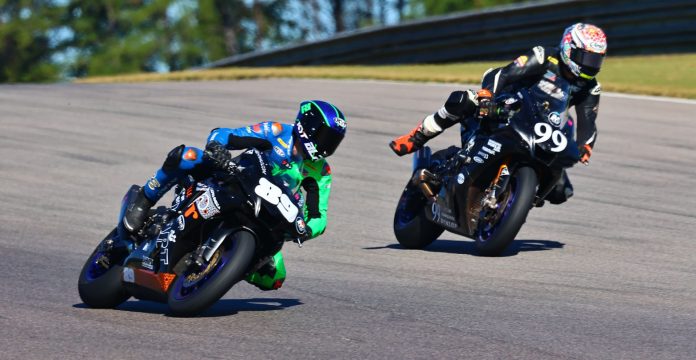
Blake Davis (89) and Taylor Knapp (99). Photos by E-Tech
The N2RA KYT Americas 6-Hours of VIR Delivers One of the Best Values in American Motorcycle Road Racing.
Media, PA – July 2026 – Whether your goal is to race for the richest endurance purse in American history, sharpen your skills before MotoAmerica arrives at Virginia International Raceway, or simply spend an unforgettable weekend riding motorcycles with your friends, the N2RA KYT Americas 6-Hours of VIR delivers an incredible amount of track time, competition, and value.
Held August 7–9 at Virginia International Raceway, the event combines practice, qualifying, sprint endurance racing, and America’s richest motorcycle endurance race into one action-packed weekend.
Unlike a traditional race weekend where competitors may only spend a handful of laps on track, the N2RA format is designed to maximize your time on the motorcycle. Riders have the opportunity to accumulate more than 10 hours of on-track activity over three days, making this one of the best values in American motorcycle road racing.
For club racers, that’s exceptional value.
For MotoAmerica teams preparing for the following weekend at VIR, it’s the perfect opportunity to test motorcycles, riders, strategy, tire management, pit stops, and team communication under real race conditions.
Three Days of Riding
The weekend begins Wednesday and Thursday with Yamaha Champions Riding School. Thursday evening as the paddock comes alive with gates opening, registration, and technical inspection, giving teams the opportunity to get settled before the action begins.
Friday is dedicated to preparation. Riders (Novice, Intermediate, and Racers) receive a full day of practice with six 20-minute sessions. It’s a full day to learn the track, dial in the motorcycle, develop rider consistency, and refine pit procedures before qualifying begins.
Saturday transitions into race mode. Morning 30-minute practice and 30-minute qualifying sessions determine the starting grids before an afternoon packed with competition, including the 30-minute Lightsport, Supersport, Superbike Endurance, and the Alpha Omega 2-Hour Endurance Race. The day concludes with the always-entertaining Pit Stop Challenge, where fast, efficient teamwork takes center stage.
Sunday is Championship Sunday. Following final practice and last-chance qualifying races, the Ultra Lightweight Endurance 30 leads into the marquee event—the KYT Americas 6-Hours of VIR. Six hours of strategy, consistency, rider changes, tire management, and teamwork will determine who stands atop the podium at one of the premier motorcycle racing facilities in North America. Awards follow immediately after the checkered flag.
More Than Just a Race
Endurance racing has always been about far more than outright speed.
The fastest lap rarely wins a six-hour race. Consistency does. Teamwork does. Smart strategy, clean pit stops, disciplined riding, and six hours of executing the fundamentals are what separate great teams from everyone else.
Whether you’re racing with longtime teammates or assembling your first endurance squad, there’s simply nothing else in motorcycle racing that builds friendships quite like endurance competition.
Race for America’s Richest Endurance Purse
The KYT Americas 6-Hours of VIR will feature more than $62,000 in combined cash payouts, contingency, and bonus awards, making it the richest single endurance motorcycle race in United States history. Teams competing in Superbike, Supersport, Lightsport, and the Alpha Omega 2-Hour Ultralight Endurance will compete for substantial cash prizes while enjoying one of North America’s premier road racing circuits.
Whether you’re an ASRA regular, a WERA veteran, a MotoAmerica professional, or simply looking for the most riding you’ll get all season, the N2RA 6-Hours of VIR offers an unmatched combination of track time, competition, camaraderie, and value.
Founded in 2014, N2’s mission is to build a sustainable motorcycle community through safe, structured track days and advanced rider training based on Yamaha Champions Riding School methodology.
In 2017, N2 revived motorcycle endurance racing in America with the creation of the N2 National Endurance Series, now N2RA. Today, N2RA continues to provide affordable, competitive, professionally managed endurance racing while helping grow the sport through exceptional events and rider development.
A “press release” is promotional text issued by a rider, team, company or organization to inform
the public about an event, product, or service from the issuer’s own point of view, and if deemed
to have news value, may be placed on roadracingworld.com as a service to our readers.
A press release is not an article written by Roadracingworld.com staffers. When a post is labeled with the words “press release”, it means that Roadracingworld.com is not responsible for its content and that Roadracingworld.com makes no guarantee that it is accurate. Not all press releases are posted and Roadracingworld.com may reject press releases if the content is too heavy on commercial promotion with little or no news value or if the press release contains obvious errors.
Accessibility
Accessibility modes
Epilepsy Safe Mode
Dampens color and removes blinks
This mode enables people with epilepsy to use the website safely by eliminating the risk of seizures that result from flashing or blinking animations and risky color combinations.
Visually Impaired Mode
Improves website's visuals
This mode adjusts the website for the convenience of users with visual impairments such as Degrading Eyesight, Tunnel Vision, Cataract, Glaucoma, and others.
Cognitive Disability Mode
Helps to focus on specific content
This mode provides different assistive options to help users with cognitive impairments such as Dyslexia, Autism, CVA, and others, to focus on the essential elements of the website more easily.
ADHD Friendly Mode
Reduces distractions and improve focus
This mode helps users with ADHD and Neurodevelopmental disorders to read, browse, and focus on the main website elements more easily while significantly reducing distractions.
Blindness Mode
Allows using the site with your screen-reader
This mode configures the website to be compatible with screen-readers such as JAWS, NVDA, VoiceOver, and TalkBack. A screen-reader is software for blind users that is installed on a computer and smartphone, and websites must be compatible with it.
Online Dictionary
Readable Experience
Content Scaling
Default
Text Magnifier
Readable Font
Dyslexia Friendly
Highlight Titles
Highlight Links
Font Sizing
Default
Line Height
Default
Letter Spacing
Default
Left Aligned
Center Aligned
Right Aligned
Visually Pleasing Experience
Dark Contrast
Light Contrast
Monochrome
High Contrast
High Saturation
Low Saturation
Adjust Text Colors
Adjust Title Colors
Adjust Background Colors
Easy Orientation
Mute Sounds
Hide Images
Hide Emoji
Reading Guide
Stop Animations
Reading Mask
Highlight Hover
Highlight Focus
Big Dark Cursor
Big Light Cursor
Cognitive Reading
Virtual Keyboard
Navigation Keys
Voice Navigation
Accessibility Statement
www.roadracingworld.com
November 10, 2026
Compliance status
We firmly believe that the internet should be available and accessible to anyone, and are committed to providing a website that is accessible to the widest possible audience,
regardless of circumstance and ability.
To fulfill this, we aim to adhere as strictly as possible to the World Wide Web Consortium’s (W3C) Web Content Accessibility Guidelines 2.1 (WCAG 2.1) at the AA level.
These guidelines explain how to make web content accessible to people with a wide array of disabilities. Complying with those guidelines helps us ensure that the website is accessible
to all people: blind people, people with motor impairments, visual impairment, cognitive disabilities, and more.
This website utilizes various technologies that are meant to make it as accessible as possible at all times. We utilize an accessibility interface that allows persons with specific
disabilities to adjust the website’s UI (user interface) and design it to their personal needs.
Additionally, the website utilizes an AI-based application that runs in the background and optimizes its accessibility level constantly. This application remediates the website’s HTML,
adapts Its functionality and behavior for screen-readers used by the blind users, and for keyboard functions used by individuals with motor impairments.
If you’ve found a malfunction or have ideas for improvement, we’ll be happy to hear from you. You can reach out to the website’s operators by using the following email
Screen-reader and keyboard navigation
Our website implements the ARIA attributes (Accessible Rich Internet Applications) technique, alongside various different behavioral changes, to ensure blind users visiting with
screen-readers are able to read, comprehend, and enjoy the website’s functions. As soon as a user with a screen-reader enters your site, they immediately receive
a prompt to enter the Screen-Reader Profile so they can browse and operate your site effectively. Here’s how our website covers some of the most important screen-reader requirements,
alongside console screenshots of code examples:
Screen-reader optimization: we run a background process that learns the website’s components from top to bottom, to ensure ongoing compliance even when updating the website.
In this process, we provide screen-readers with meaningful data using the ARIA set of attributes. For example, we provide accurate form labels;
descriptions for actionable icons (social media icons, search icons, cart icons, etc.); validation guidance for form inputs; element roles such as buttons, menus, modal dialogues (popups),
and others. Additionally, the background process scans all the website’s images and provides an accurate and meaningful image-object-recognition-based description as an ALT (alternate text) tag
for images that are not described. It will also extract texts that are embedded within the image, using an OCR (optical character recognition) technology.
To turn on screen-reader adjustments at any time, users need only to press the Alt+1 keyboard combination. Screen-reader users also get automatic announcements to turn the Screen-reader mode on
as soon as they enter the website.
These adjustments are compatible with all popular screen readers, including JAWS and NVDA.
Keyboard navigation optimization: The background process also adjusts the website’s HTML, and adds various behaviors using JavaScript code to make the website operable by the keyboard. This includes the ability to navigate the website using the Tab and Shift+Tab keys, operate dropdowns with the arrow keys, close them with Esc, trigger buttons and links using the Enter key, navigate between radio and checkbox elements using the arrow keys, and fill them in with the Spacebar or Enter key.Additionally, keyboard users will find quick-navigation and content-skip menus, available at any time by clicking Alt+1, or as the first elements of the site while navigating with the keyboard. The background process also handles triggered popups by moving the keyboard focus towards them as soon as they appear, and not allow the focus drift outside it.
Users can also use shortcuts such as “M” (menus), “H” (headings), “F” (forms), “B” (buttons), and “G” (graphics) to jump to specific elements.
Disability profiles supported in our website
Epilepsy Safe Mode: this profile enables people with epilepsy to use the website safely by eliminating the risk of seizures that result from flashing or blinking animations and risky color combinations.
Visually Impaired Mode: this mode adjusts the website for the convenience of users with visual impairments such as Degrading Eyesight, Tunnel Vision, Cataract, Glaucoma, and others.
Cognitive Disability Mode: this mode provides different assistive options to help users with cognitive impairments such as Dyslexia, Autism, CVA, and others, to focus on the essential elements of the website more easily.
ADHD Friendly Mode: this mode helps users with ADHD and Neurodevelopmental disorders to read, browse, and focus on the main website elements more easily while significantly reducing distractions.
Blindness Mode: this mode configures the website to be compatible with screen-readers such as JAWS, NVDA, VoiceOver, and TalkBack. A screen-reader is software for blind users that is installed on a computer and smartphone, and websites must be compatible with it.
Keyboard Navigation Profile (Motor-Impaired): this profile enables motor-impaired persons to operate the website using the keyboard Tab, Shift+Tab, and the Enter keys. Users can also use shortcuts such as “M” (menus), “H” (headings), “F” (forms), “B” (buttons), and “G” (graphics) to jump to specific elements.
Additional UI, design, and readability adjustments
Font adjustments – users, can increase and decrease its size, change its family (type), adjust the spacing, alignment, line height, and more.
Color adjustments – users can select various color contrast profiles such as light, dark, inverted, and monochrome. Additionally, users can swap color schemes of titles, texts, and backgrounds, with over seven different coloring options.
Animations – person with epilepsy can stop all running animations with the click of a button. Animations controlled by the interface include videos, GIFs, and CSS flashing transitions.
Content highlighting – users can choose to emphasize important elements such as links and titles. They can also choose to highlight focused or hovered elements only.
Audio muting – users with hearing devices may experience headaches or other issues due to automatic audio playing. This option lets users mute the entire website instantly.
Cognitive disorders – we utilize a search engine that is linked to Wikipedia and Wiktionary, allowing people with cognitive disorders to decipher meanings of phrases, initials, slang, and others.
Additional functions – we provide users the option to change cursor color and size, use a printing mode, enable a virtual keyboard, and many other functions.
Browser and assistive technology compatibility
We aim to support the widest array of browsers and assistive technologies as possible, so our users can choose the best fitting tools for them, with as few limitations as possible. Therefore, we have worked very hard to be able to support all major systems that comprise over 95% of the user market share including Google Chrome, Mozilla Firefox, Apple Safari, Opera and Microsoft Edge, JAWS and NVDA (screen readers).
Notes, comments, and feedback
Despite our very best efforts to allow anybody to adjust the website to their needs. There may still be pages or sections that are not fully accessible, are in the process of becoming accessible, or are lacking an adequate technological solution to make them accessible. Still, we are continually improving our accessibility, adding, updating and improving its options and features, and developing and adopting new technologies. All this is meant to reach the optimal level of accessibility, following technological advancements. For any assistance, please reach out to



 Scott Redding – Hager PBM Racing Team