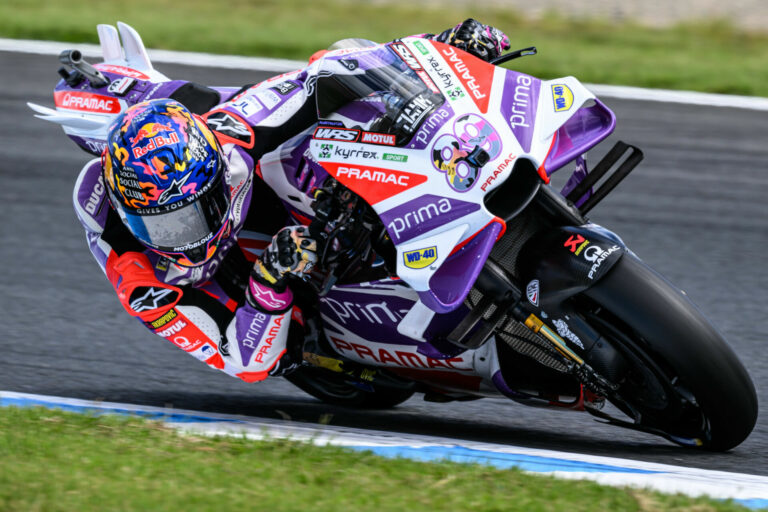
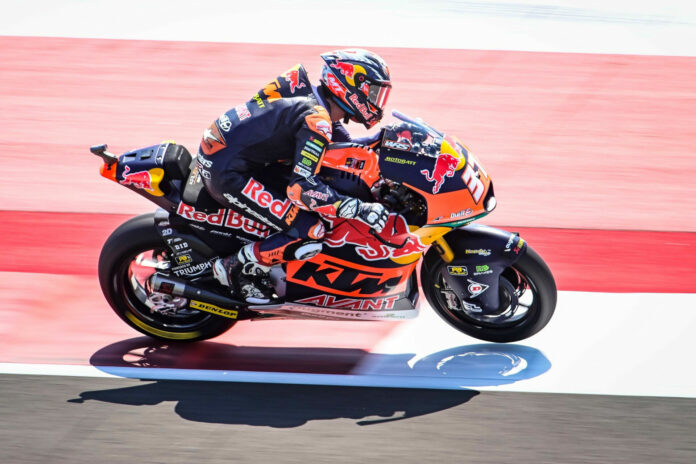
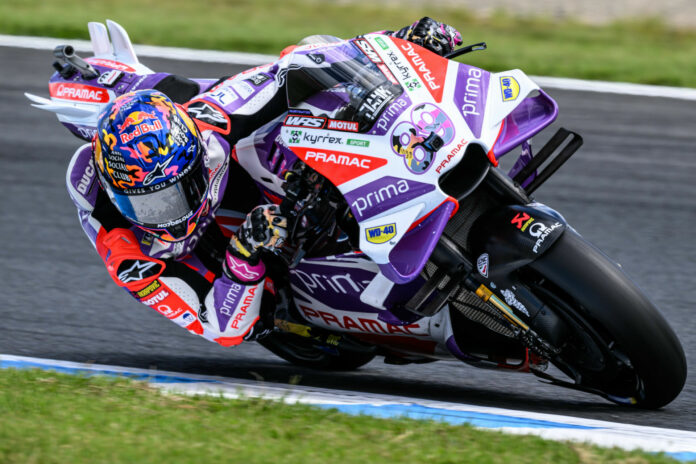
Aleix Espargaro was fastest during MotoGP World Championship Free Practice Two (FP2) Friday afternoon at Mandalika International Street Circuit, in Indonesia. Riding his factory Aprilia RS-GP, the Spaniard lapped the 2.6-mile (4.3 km) track in 1:30.474, smashing Fabio Quartararo’s 2022 All-Time Lap Record of 1:31.067.
Espargaro’s teammate Maverick Vinales was second-quickest with a 1:30.628.
And Marco Bezzecchi was third in FP2 with a 1:30.644 on his Mooney VR46 Racing Team Ducati just days after undergoing surgery to repair a broken collarbone.
Aprilia top, Bezzecchi third, Bagnaia out of Q2 on headline-packed Day 1 in Indonesia
Aleix Espargaro heads Viñales as Bezzecchi makes a stunning return to competition – with Bagnaia out of Q2 and Martin in the top five
Friday, 13 October 2023
The opening day of the Pertamina Grand Prix of Indonesia has perfectly set the stage for what is set to be a barnstorming weekend of action in Mandalika. Aleix Espargaro (Aprilia Racing) took top honours in Friday afternoon’s Practice as he turned his session around with a 1:30.474 after hitting the deck earlier on, and it’s his teammate Maverick Viñales in second as he also spent a lot of Friday towards the top end of the timing screens.
The headlines kept coming from there on out as a battered and bruised Marco Bezzecchi (Mooney VR46 Racing Team) took third despite an FP1 crash AND coming back from recent collarbone surgery, with reigning Champion and Championship leader Francesco Bagnaia (Ducati Lenovo Team) more on the back foot after a late mistake sees him heading for Q1.
From the gravel trap to the top of the pile
With Friday afternoon’s Practice session deciding who goes through to Q2, the riders spent the majority of the session working on their race packages before putting in those late time attacks. With six minutes remaining, all riders were in the pits ready to fight for the all-important top 10, and the battle was about to commence with only a few bankers already set.
Bezzecchi already had his flyer in and was top of the pile after a heroic effort saw him move the goalposts at the 10-minute mark. But Aleix Espargaro had fire in his belly after crashing out of what was set to be a very hot lap earlier on, in the final five minutes he changed the benchmark time once more to smash the lap record and stamp some authority on Friday’s running.
With the Aprilia on rails around Mandalika, Espargaro was then joined by teammate Viñales as the factory Aprilia duo took the top two spots to demote Bezzecchi to P3.
Another hurdle for the World Champion…
Bagnaia was very much in the danger zone after leaving it to his very last lap of the session to put in a hot lap. With the chequered flag already out Bagnaia was sat outside of the top 10 but was motoring on, on course for a personal best. It looked as if the Champ’s lap was looking pretty safe until a big moment in the latter part of the lap saw his flyer scrapped, heading off at Turn 15 after a moment – and Joan Mir (Repsol Honda Team) then also crashing out almost in tandem.
Now with just a 3-point advantage over his title rival Jorge Martin (Prima Pramac Racing), Bagnaia will be forced to go through Q1 with Martin comfortably sat in the top five just behind Brad Binder (Red Bull KTM Factory Racing), who took fourth.
Marc Marquez (Repsol Honda Team) was next up in 6th. The Spaniard has been all over recent headlines after his switch to Gresini Racing MotoGP™ for 2024 was announced, but is proving there are still very much six Grands Prix remaining this year for him to keep pushing.
Fabio Di Giannantonio (Gresini Racing MotoGP™), the rider Marc Marquez will be replacing, finished just behind the eight-time champ in P8, with Jack Miller (Red Bull KTM Factory Racing) and Fabio Quartararo (Monster Energy Yamaha MotoGP™) taking the final two Q2 spots in 9th and 10th.
The Q1 battle
There’s plenty of competition Bagnaia will have to contend with, as Pol Espargaro (GASGAS Factory Racing Tech3), Luca Marini (Mooney VR46 Racing Team), and Johann Zarco (Prima Pramac Racing) will all be eyeing up the top two spots.
Equally with the Aprilia looking like a fine package in Indonesia, the CryptoDATA RNF MotoGP™ Team riders Raul Fernandez and Miguel Oliveira cannot be discounted either. Make sure you don’t miss a single detail as the action unfolds in Indonesia with Qualifying and Tissot Sprint coming up on Saturday!
Pedro Acosta lowered the All-Time Lap Record during Moto2 World Championship Free Practice Two (FP2) Friday at Mandalika International Street Circuit, in Indonesia.
Riding his Red Bull KTM Ajo Kalex, the Spaniard lapped the 2.6-mile (4.3 km) track in 1:34.456, which eclipsed Manuel Gonzalez’s hours-old record of 1:34.871.
American Joe Roberts was 12th in the session with a 1:35.183 on his Italtrans Racing Kalex.
American Sean Dylan Kelly’s fill-in role at Forward Racing has ended, and he is not riding in Indonesia.
Jorge Martin was quickest during MotoGP World Championship Free Practice One (FP1) Friday morning at Mandalika International Street Circuit, in Indonesia. Riding his Prima Pramac Racing Ducati, the Spaniard led the 22-rider field with a 1:31.811.
Maverick Vinales was second-best with a 1:31.913 on his factory Aprilia RS-GP, and Vinales’ friend and teammate Aleix Espargaro was third in the session at 1:32.913.
Deniz Oncu was fastest during Moto3 World Championship Free Practice Two (FP2) Friday afternoon at Mandalika International Street Circuit, in Indonesia. Riding his Red Bull KTM Ajo machine, the Turkish racer covered the 2.6-mile (4.3 km) course in 1:39.855 to set a lap All-Time Lap Record.
Roadracing World MotoGP Editor and Isle of Man TT winner Mat Oxley and two-time World Championship-winning Crew Chief Peter Bom have started “The Oxley Bom MotoGP Podcast,” which will be focused on the FIM MotoGP World Championship.
This podcast is “Motegi 2023 – The Great Rain Robbery.”
The original podcast can be found on BuzzSprout.com or listened to via other places you get podcasts.
In the early 1940s, the war was making life very hard for everyone in Italy, starting with everyday activities. Getting around, for example, was difficult and costly, given an essential absence of public transport. And this is why Domenico Agusta, having taken over the family business in 1927 following the death of his father Giovanni, turned to motorcycles, believing that this might be a way to simplify mobility and guarantee himself and his employees a future at the Officine Aeronautiche Giovanni Agusta.
The first MV Agusta engine came into being in 1943. A 98 cc single-cylinder, it made use of a lubricated two-speed gearbox. Light and compact, it immediately went into production but occupation of the factory, in September 1943, brought all activity to a halt just a few weeks later. The project was shelved until just after the war when, the hostilities over, assembly of the complete motorcycle could resume. On its debut, the MV 98 was ‘dressed’ in an elegant shade of burgundy.
It is difficult to imagine the reasons behind such an unusual colour choice – perhaps relating to Giovanni Agusta’s aristocratic roots, that his son wanted to honour, or simply a flash of inspiration, a matter of personal taste. The burgundy colour scheme nevertheless added a significant touch of elegance to a motorcycle that was ready to take on the devastated streets of that time.
Today, 80 years after the birth of the first MV Agusta engine, the “98” signature reappears on the fairings of another MV Agusta motorcycle. Produced in just 300 numbered units, the Superveloce 98 Edizione Limitata is immediately recognisable thanks to its “Rosso Verghera” colour scheme. Directly inspired by the original colour palette, Rosso Verghera is a sophisticated and very high-quality product, the formula of which was developed at an experimental level in the CRC research centre and then industrialised exclusively for MV Agusta. Applied by hand in multiple phases, the colour comprises a two-component matte base paired with a polished layer for a finish that magnifies the metallic pigments. A tribute to a tale of success, courage, and initiative that could never have been written without the design of the 98 engine, back in 1943.
A new MV Agusta Superveloce 98 Edizione Limitata. Photo courtesy MV Agusta.
The “98 Edizione Limitata” signature is positioned laterally on the tail section as well as on the upper part. It is flanked by the Italian flag, which highlights the quintessential “Made in Italy” origins of every MV Agusta, built without exception in the factory in Schiranna, on the banks of Varese Lake. Reference to the size of the historic engine designed in 1943 and the limited-edition status of the motorcycle is also flaunted on the steering plate, thanks to laser engraving technology, and highlighted on the certificate of authenticity, delivered together with the motorcycle.
The racing vocation of the Superveloce has been important ever since the model’s launch and is emphasised on the Superveloce 98 Edizione Limitata by way of a dedicated kit. A burgundy-coloured box contains the tail cover, dedicated motorcycle cover, aforementioned certificate of authenticity and two refined parts, or rather the Arrow triple-exit exhaust, for exclusive track use (in North America not included but available as Technical Accessory), and the dedicated racing ECU, perfect for extracting maximum performance from the Italian three-cylinder engine.
The engine in question is the iconic 798 cc inline three. Powerful (147 hp), compact and extremely lightweight, it contributes to keeping the dry weight of the motorcycle down to just 173 kg, or as little as 165 kg with the racing kit. Many technical characteristics ensure that this engine is an example of efficiency and performance, not least the counter-rotating crankshaft, cams with DLC coating to reduce friction and heighten performance, titanium valves, and bearings and rods developed to reduce mechanical losses.
The technical excellence of the Superveloce 98 Edizione Limitata is guaranteed by its comprehensive equipment, including spoked wheels with a gold finish, an optimised and more lightweight braking system complete with Brembo PR 16/19 radial master cylinder and M4.30 Stylema front callipers, and the support of the recalibrated Continental MK100 ABS. This, in addition to Ride by Wire that is improved thanks to the negative throttle rotation; the 5.5” colour TFT instrument panel, highly customisable and connected to the smartphone; high-performance Pirelli Diablo Rosso IV Corsa tyres, and Mobisat anti-theft satellite positioning system.
Only 300 units of the Superveloce 98 Edizione Limitata will be made available, most of which have already been ordered by the brand’s most loyal collectors.
Manuel Gonzalez smashed the All-Time Lap Record during Moto2 World Championship Free Practice One (FP1) Friday morning at Mandalika International Street Circuit, in Indonesia. Riding his Correos Prepago Yamaha VR46 Team Kalex, the Spaniard lapped the 2.6-mile (4.3 km) track in 1:34.871. That time smashed Somkiat Chantra’s 2022 lap record of 1:35.591.
American Joe Roberts was 11th with a 1:35.846 on his Italtrans Racing Kalex.
Sean Dylan Kelly’s fill-in ride at Forward Racing has come to an end, and the Floridian is not riding in Indonesia.
Diogo Moreira topped Moto3 World Championship Free Practice One (FP1) Friday morning at Mandalika International Street Circuit, in Indonesia. Riding his MT Helmets – MSI KTM, the Brazilian rider lapped the 2.6-mile (4.3 km) track in 1:40.590 to lead the field of 29 competitors.
Additional Clarification On Gagne’s DQ From Circuit Of The Americas Race Two
MotoAmerica Adds More Clarity To Fuel Situation As It Relates To Sanction
IRVINE, CA (October 12, 2023) – MotoAmerica is offering the following for further clarification regarding the disqualification of Jake Gagne from his second-place finish in race two of the Circuit of The Americas round of the 2023 MotoAmerica Medallia Superbike Championship.
VP has provided the same blend of fuel to MotoAmerica since 2019 and the sample taken from the machine at COTA after Superbike race two was not compliant with any batch of VP MGP manufactured between 2019 and 2023. VP has analytical results from each batch of fuel produced and the results of the fuel sample in question did not match the baseline results provided by VP. This was also substantiated by a third-party certified lab, Intertek, who confirmed that a foreign chemical component outside the specification was found.
There is also an outstanding issue regarding a drum of MGP that was obtained by Gagne’s team and had incorrect warning information. VP confirms that this was due to a software issue, which was rectified. The contents of the drum contained the correct MGP fuel as labelled.
MotoAmerica is North America’s premier motorcycle road racing series. Established in 2014, MotoAmerica is home to the AMA Superbike Championship as well as additional classes including Supersport, Stock 1000, Twins Cup, Junior Cup, and King Of The Baggers. MotoAmerica is an affiliate of KRAVE Group LLC, a partnership including three-time 500cc World Champion, two-time AMA Superbike Champion, and AMA Hall of Famer Wayne Rainey; ex-racer and former manager of Team Roberts Chuck Aksland; motorsports marketing executive Terry Karges; and businessman Richard Varner. For more information, please visit www.MotoAmerica.com and follow MotoAmerica on Facebook, Instagram, TikTok, Twitter, and YouTube.
Editorial Note: This article originally appeared in the June 2019 issue of Roadracing World & Motorcycle Technology magazine.
Shops: VP Racing Fuels
By David Swarts
VP Racing Fuels is one of the most recognizable brands in motorsports. Now, it is becoming a major player in mainstream automotive consumer products with VP-branded retail gasoline stations and convenience stores popping up across North America. And it all started with a young man using a chemistry set to formulate his own racing fuel in his parents’ one-car garage.
“That’s bulls—!” Steve Burns, the founder of VP Racing Fuels told Roadracing World. “That’s the story the marketing guys feed people. There’s lies, there’s stories, and there’s the truth. Here’s the truth.”
Steve Burns founded VP Racing Fuels four decades ago and remains involved in racing fuel development. Photo courtesy VP Racing Fuels.
Burns’ father, a World War II veteran who lived in San Antonio, Texas, often took his family on trips across the USA to reinforce his—and instill their–love of country. During one trip to the Smithsonian Institute in Washington D.C., Burns asked his father about a strange looking building he saw.
“My father said, ‘That’s the Library of Congress. Everything that man knows is written down in that library,’” said Burns.
Years later, Burns was a recent high school graduate and an aspiring amateur car racer who had machined a little too much off the block of his car’s engine and suddenly had a fueling problem. “So I started doing some reading on fuels,” said Burns, who added he barely found one or two pages of material on racing fuels in the entire University of Texas library.
The VP Racing Fuels plant south of San Antonio has over one million gallons of storage and mixing capacity, including the 20,000-gallon tanks seen in the foreground and the 150,000-gallon tanks in the background. Photo by David Swarts.
Burns drove to Virginia, set up a tent at a campground, and drove to the Library of Congress every day to educate himself about racing fuels. “This young librarian takes a liking to me and she starts feeding me a bunch of once-classified stuff from the war,” Burns. “I learned a s—load about engines. I learned more about engines and engine theories than I probably could have learned anywhere else in America.”
Burns came home and tried a few things with different fuel components, and he and some other local racers had some success with his stuff. Now what? “I needed components, chemicals, but where do they exist? How do you get them?” said Burns. “The refineries make them, but they don’t sell five- or 10-gallon drums. So how do I get these components that I need?”
Storage tanks at the VP Racing Fuels production plant are connected by pipes so components can be easily mixed, according to formula, into finished products. Photo by David Swarts.
Burns then went on a quest and visited every refinery from San Antonio to Baton Rouge, Louisiana, that would let him in the gate. And even though Burns managed to talk to some high-level people at these refineries, the answer was always negative.
“One of them told me, ‘Steven, even if your dad owned this place I couldn’t do what you’re asking me to do. I can’t go out there and take a tap off of one of these lines of products going down the pipeline for you,’” said Burns.
Undeterred, Burns decided to revisit a refinery in San Antonio he had been to before (“Because they only said ‘No’ and not ‘Hell no,’” Burns said.), but this time he learned that the refinery was owned by the father of a guy he had played football against in high school.
Everything that comes in or goes out of the VP plant is tested in an on-site lab by full-time chemists like Marina Nolin, seen here. Photo by David Swarts.
While waiting in the lobby for his high school friend to come in, the plant manager Burns had seen previously walked by. “He looks down at me, and says, ‘Steve Burns, what are you doing here?’” recalled Burns. “I looked up at him and said, ‘Hoping to see anybody but you.’ “I didn’t mean it bad. It just slipped out. He looked down at me and said, ‘Come on.’
“He took me down to his office. He sits behind his desk and literally puts his feet up on his desk and says, ‘So you’re here again. What do you want me to do for you?’ I started rattling off all these chemical names, and he goes, ‘Whoa! Stop, stop, stop!’
“I thought, ‘This is not good.’
“He picks up the phone, calls somebody, and goes, ‘Hey, Tom. I’ve got a good buddy in here who wants to make race fuel, and I want to help him. I want you to come over here and I want to get started on the project.’ He puts down the phone, turns to me, and he goes, ‘Is that what you want me to do?’ I said, ‘Yes, sir.’”
Finished VP Racing Fuels are pumped into specially-coated drums, including 55-gallon drums seen here. Photo by David Swarts.
Burns went to work at the refinery, and for the next six months he swept floors, emptied trash, and cleaned equipment in the refinery’s laboratory before the chemists started helping him work on his own fuel. About one year later, Burns took some of his new fuel to a drag racing test in California where Larry Torres and John Lingenfelter were preparing for the next season. Burns gave each man a five-gallon drum of fuel to try, and each man said they might try it if they had enough time.
“Torres tried it at the very end of the day and his car picked up 0.15 second. That’s a car length and a half. That’s significant,” said Burns. “He comes over to me and goes, ‘Did John try the fuel?’ I said, ‘No.’ He said, ‘I did.’ I said, ‘Well?’ He said, ‘It’s OK, but I want to talk to you. I will tell you what it did, and I will use it, and I will do an ad for you, but you’ve got to promise me you won’t give him any or sell him any.’
VP’s MGP blend (seen here) is the official spec fuel of MotoAmerica and American Flat Track racing. Photo by David Swarts.
“You can probably guess who the last two racers were in that next event in Pomona, California, and on the cover of the magazines is Larry Torres winning by half a car length over Lingenfelter. Cover shot! And Larry did what he said he was going to do and did an ad for me.”
Six weeks later at the next National drag race, Burns said all of the top competitors in the gasoline classes were using Burns’ new fuel, C12, the first product for VP Racing Fuels, and Lingenfelter became the first VP Racing Fuels dealer.
That was 1975, and within a few years nearly every top motorsports team in America that burned gasoline was using VP Racing Fuels. “I did not start it as a business,” said Burns. “I was just doing it to get enough money to stay in racing, and in the end I went racing against major corporations with major corporations. It was an all-out race, racing against Sunoco, Union 76, the guys over at Phillips.”
From there, VP Racing Fuels grew to where it now has 70 different racing fuel products, over 150 employees, five production facilities in the United States, and hundreds of dealers and retail outlets all over the world.
VP two-stroke and four-stroke small engine fuels – sold at stores including Walmart and Home Depot in one-quart and one-gallon containers – are ethanol-free, making them more stable and much less likely to break down and foul-up fuel systems. Photo by David Swarts.
In 2011, Alan Cerwick, a former executive who helped refiner Valero set up gas stations, joined VP Racing Fuels as its new President and led a rapid expansion of the company by adding new consumer product lines – including octane boosters and motor oil for passenger cars – and launched a program to rebrand independent gasoline stations into VP Fuels stations selling passenger car fuel, racing fuels, and VP’s consumer products.
Everything worked so well that Burns, now 66, decided to sell VP Racing Fuels to Cerwick, step back into a part-time role in Research & Development (R&D), and get back to – you guessed it – racing.
In the last few years, Burns has driven in the Pirelli World Challenge series, achieved top finishes in SCCA Pro and Trans Am races, and even won a World Championship on a three-man sailboat.
“I don’t have to worry about meetings and insurance and legislation and people who say we’ve don’t have enough trees on our property,” said Burns. “Al [Cerwick] and those guys do a great job with that, and I just need to make sure no one kicks our ass in fuels. To do that I’ve got to maintain an awareness of what’s changing in racing, because racing is obviously not static.
“And by going racing as an owner and driver I realized it’s different than it is sitting in VP’s seat. It doesn’t matter at VP what you want to do. It only matters what your customers want to do. You can make the coolest s— in the world but it doesn’t matter if no one wants it. So you’ve got to build stuff people want and stuff they need. That’s my job now.”
VP Racing Fuels is expanding into gas stations selling street and racing fuels nationwide. Photo courtesy VP Racing Fuels.
VP Racing Fuels’ main production facility is located on 50 acres just south of San Antonio. There, raw components come in from refineries via rail cars and tanker trucks. Those components are then tested at VP’s on-site lab to verify quality before they are offloaded into one of the many storage tanks, which range from 8,000 to 150,000 gallons in capacity.
All of the tanks at the facility are connected by pipes. To make a product, components are piped into specially constructed blend tanks according to an established recipe that is measured down to the gallon of each component, and for the most part the same man has been doing all the blending in San Antonio since 1985.
The mixture is then analyzed by one of two full-time chemists using a gas chromatograph, and if it meets the desired specification, it is then piped to a storage tank. From there, finished products are piped to a nearby warehouse where they are then pumped into the appropriate five-, 15-, and 54-gallon drums, which have a special anti-corrosion coating on the interior. The plant in San Antonio also produces VP’s own, iconic five-gallon plastic fluid jugs, and also bottles VP small engine fuel, which is sold at Walmart, Home Depot, and other retail outlets.
Even with its tremendous growth expanding into consumer products and gas stations over the last few years, VP Racing Fuels still hasn’t forgotten where it came from. Evidence of that fact is the company recently going out of its way (selling fuel at subsidized prices) to replace Sunoco as the official fuel of MotoAmerica.
“A lot of our competition’s race fuels are kind of a side thing for them,” said Burns. “It helps with their marketing, but realistically if they stopped making race fuel tomorrow it wouldn’t affect their business. In our case, race fuel is our business. It’s our core. Even with all of the other new products that we have, race fuel is still our core.”
Aleix Espargaro was fastest during MotoGP World Championship Free Practice Two (FP2) Friday afternoon at Mandalika International Street Circuit, in Indonesia. Riding his factory Aprilia RS-GP, the Spaniard lapped the 2.6-mile (4.3 km) track in 1:30.474, smashing Fabio Quartararo’s 2022 All-Time Lap Record of 1:31.067.
Espargaro’s teammate Maverick Vinales was second-quickest with a 1:30.628.
And Marco Bezzecchi was third in FP2 with a 1:30.644 on his Mooney VR46 Racing Team Ducati just days after undergoing surgery to repair a broken collarbone.
Aprilia top, Bezzecchi third, Bagnaia out of Q2 on headline-packed Day 1 in Indonesia
Aleix Espargaro heads Viñales as Bezzecchi makes a stunning return to competition – with Bagnaia out of Q2 and Martin in the top five
Friday, 13 October 2023
The opening day of the Pertamina Grand Prix of Indonesia has perfectly set the stage for what is set to be a barnstorming weekend of action in Mandalika. Aleix Espargaro (Aprilia Racing) took top honours in Friday afternoon’s Practice as he turned his session around with a 1:30.474 after hitting the deck earlier on, and it’s his teammate Maverick Viñales in second as he also spent a lot of Friday towards the top end of the timing screens.
The headlines kept coming from there on out as a battered and bruised Marco Bezzecchi (Mooney VR46 Racing Team) took third despite an FP1 crash AND coming back from recent collarbone surgery, with reigning Champion and Championship leader Francesco Bagnaia (Ducati Lenovo Team) more on the back foot after a late mistake sees him heading for Q1.
From the gravel trap to the top of the pile
With Friday afternoon’s Practice session deciding who goes through to Q2, the riders spent the majority of the session working on their race packages before putting in those late time attacks. With six minutes remaining, all riders were in the pits ready to fight for the all-important top 10, and the battle was about to commence with only a few bankers already set.
Bezzecchi already had his flyer in and was top of the pile after a heroic effort saw him move the goalposts at the 10-minute mark. But Aleix Espargaro had fire in his belly after crashing out of what was set to be a very hot lap earlier on, in the final five minutes he changed the benchmark time once more to smash the lap record and stamp some authority on Friday’s running.
With the Aprilia on rails around Mandalika, Espargaro was then joined by teammate Viñales as the factory Aprilia duo took the top two spots to demote Bezzecchi to P3.
Another hurdle for the World Champion…
Bagnaia was very much in the danger zone after leaving it to his very last lap of the session to put in a hot lap. With the chequered flag already out Bagnaia was sat outside of the top 10 but was motoring on, on course for a personal best. It looked as if the Champ’s lap was looking pretty safe until a big moment in the latter part of the lap saw his flyer scrapped, heading off at Turn 15 after a moment – and Joan Mir (Repsol Honda Team) then also crashing out almost in tandem.
Now with just a 3-point advantage over his title rival Jorge Martin (Prima Pramac Racing), Bagnaia will be forced to go through Q1 with Martin comfortably sat in the top five just behind Brad Binder (Red Bull KTM Factory Racing), who took fourth.
Marc Marquez (Repsol Honda Team) was next up in 6th. The Spaniard has been all over recent headlines after his switch to Gresini Racing MotoGP™ for 2024 was announced, but is proving there are still very much six Grands Prix remaining this year for him to keep pushing.
Fabio Di Giannantonio (Gresini Racing MotoGP™), the rider Marc Marquez will be replacing, finished just behind the eight-time champ in P8, with Jack Miller (Red Bull KTM Factory Racing) and Fabio Quartararo (Monster Energy Yamaha MotoGP™) taking the final two Q2 spots in 9th and 10th.
The Q1 battle
There’s plenty of competition Bagnaia will have to contend with, as Pol Espargaro (GASGAS Factory Racing Tech3), Luca Marini (Mooney VR46 Racing Team), and Johann Zarco (Prima Pramac Racing) will all be eyeing up the top two spots.
Equally with the Aprilia looking like a fine package in Indonesia, the CryptoDATA RNF MotoGP™ Team riders Raul Fernandez and Miguel Oliveira cannot be discounted either. Make sure you don’t miss a single detail as the action unfolds in Indonesia with Qualifying and Tissot Sprint coming up on Saturday!
Pedro Acosta (37). Photo courtesy Red Bull KTM Ajo.
Pedro Acosta lowered the All-Time Lap Record during Moto2 World Championship Free Practice Two (FP2) Friday at Mandalika International Street Circuit, in Indonesia.
Riding his Red Bull KTM Ajo Kalex, the Spaniard lapped the 2.6-mile (4.3 km) track in 1:34.456, which eclipsed Manuel Gonzalez’s hours-old record of 1:34.871.
American Joe Roberts was 12th in the session with a 1:35.183 on his Italtrans Racing Kalex.
American Sean Dylan Kelly’s fill-in role at Forward Racing has ended, and he is not riding in Indonesia.
Jorge Martin was quickest during MotoGP World Championship Free Practice One (FP1) Friday morning at Mandalika International Street Circuit, in Indonesia. Riding his Prima Pramac Racing Ducati, the Spaniard led the 22-rider field with a 1:31.811.
Maverick Vinales was second-best with a 1:31.913 on his factory Aprilia RS-GP, and Vinales’ friend and teammate Aleix Espargaro was third in the session at 1:32.913.
Deniz Oncu was fastest during Moto3 World Championship Free Practice Two (FP2) Friday afternoon at Mandalika International Street Circuit, in Indonesia. Riding his Red Bull KTM Ajo machine, the Turkish racer covered the 2.6-mile (4.3 km) course in 1:39.855 to set a lap All-Time Lap Record.
Roadracing World MotoGP Editor and Isle of Man TT winner Mat Oxley (left) and two-time World Championship-winning Crew Chief Peter Bom (right) in the paddock at Jerez. Photo courtesy Mat Oxley.
Roadracing World MotoGP Editor and Isle of Man TT winner Mat Oxley and two-time World Championship-winning Crew Chief Peter Bom have started “The Oxley Bom MotoGP Podcast,” which will be focused on the FIM MotoGP World Championship.
This podcast is “Motegi 2023 – The Great Rain Robbery.”
The original podcast can be found on BuzzSprout.com or listened to via other places you get podcasts.
A new MV Agusta Superveloce 98 Edizione Limitata (right) with a 1945 MV 98cc (left). Photo courtesy MV Agusta.
MV AGUSTA SUPERVELOCE 98
EDIZIONE LIMITATA
A TALE TO TELL
In the early 1940s, the war was making life very hard for everyone in Italy, starting with everyday activities. Getting around, for example, was difficult and costly, given an essential absence of public transport. And this is why Domenico Agusta, having taken over the family business in 1927 following the death of his father Giovanni, turned to motorcycles, believing that this might be a way to simplify mobility and guarantee himself and his employees a future at the Officine Aeronautiche Giovanni Agusta.
The first MV Agusta engine came into being in 1943. A 98 cc single-cylinder, it made use of a lubricated two-speed gearbox. Light and compact, it immediately went into production but occupation of the factory, in September 1943, brought all activity to a halt just a few weeks later. The project was shelved until just after the war when, the hostilities over, assembly of the complete motorcycle could resume. On its debut, the MV 98 was ‘dressed’ in an elegant shade of burgundy.
It is difficult to imagine the reasons behind such an unusual colour choice – perhaps relating to Giovanni Agusta’s aristocratic roots, that his son wanted to honour, or simply a flash of inspiration, a matter of personal taste. The burgundy colour scheme nevertheless added a significant touch of elegance to a motorcycle that was ready to take on the devastated streets of that time.
Today, 80 years after the birth of the first MV Agusta engine, the “98” signature reappears on the fairings of another MV Agusta motorcycle. Produced in just 300 numbered units, the Superveloce 98 Edizione Limitata is immediately recognisable thanks to its “Rosso Verghera” colour scheme. Directly inspired by the original colour palette, Rosso Verghera is a sophisticated and very high-quality product, the formula of which was developed at an experimental level in the CRC research centre and then industrialised exclusively for MV Agusta. Applied by hand in multiple phases, the colour comprises a two-component matte base paired with a polished layer for a finish that magnifies the metallic pigments. A tribute to a tale of success, courage, and initiative that could never have been written without the design of the 98 engine, back in 1943.
A new MV Agusta Superveloce 98 Edizione Limitata. Photo courtesy MV Agusta.
The “98 Edizione Limitata” signature is positioned laterally on the tail section as well as on the upper part. It is flanked by the Italian flag, which highlights the quintessential “Made in Italy” origins of every MV Agusta, built without exception in the factory in Schiranna, on the banks of Varese Lake. Reference to the size of the historic engine designed in 1943 and the limited-edition status of the motorcycle is also flaunted on the steering plate, thanks to laser engraving technology, and highlighted on the certificate of authenticity, delivered together with the motorcycle.
The racing vocation of the Superveloce has been important ever since the model’s launch and is emphasised on the Superveloce 98 Edizione Limitata by way of a dedicated kit. A burgundy-coloured box contains the tail cover, dedicated motorcycle cover, aforementioned certificate of authenticity and two refined parts, or rather the Arrow triple-exit exhaust, for exclusive track use (in North America not included but available as Technical Accessory), and the dedicated racing ECU, perfect for extracting maximum performance from the Italian three-cylinder engine.
The engine in question is the iconic 798 cc inline three. Powerful (147 hp), compact and extremely lightweight, it contributes to keeping the dry weight of the motorcycle down to just 173 kg, or as little as 165 kg with the racing kit. Many technical characteristics ensure that this engine is an example of efficiency and performance, not least the counter-rotating crankshaft, cams with DLC coating to reduce friction and heighten performance, titanium valves, and bearings and rods developed to reduce mechanical losses.
The technical excellence of the Superveloce 98 Edizione Limitata is guaranteed by its comprehensive equipment, including spoked wheels with a gold finish, an optimised and more lightweight braking system complete with Brembo PR 16/19 radial master cylinder and M4.30 Stylema front callipers, and the support of the recalibrated Continental MK100 ABS. This, in addition to Ride by Wire that is improved thanks to the negative throttle rotation; the 5.5” colour TFT instrument panel, highly customisable and connected to the smartphone; high-performance Pirelli Diablo Rosso IV Corsa tyres, and Mobisat anti-theft satellite positioning system.
Only 300 units of the Superveloce 98 Edizione Limitata will be made available, most of which have already been ordered by the brand’s most loyal collectors.
Manuel Gonzalez (18). Photo courtesy VR46 Racing Team.
Manuel Gonzalez smashed the All-Time Lap Record during Moto2 World Championship Free Practice One (FP1) Friday morning at Mandalika International Street Circuit, in Indonesia. Riding his Correos Prepago Yamaha VR46 Team Kalex, the Spaniard lapped the 2.6-mile (4.3 km) track in 1:34.871. That time smashed Somkiat Chantra’s 2022 lap record of 1:35.591.
American Joe Roberts was 11th with a 1:35.846 on his Italtrans Racing Kalex.
Sean Dylan Kelly’s fill-in ride at Forward Racing has come to an end, and the Floridian is not riding in Indonesia.
Diogo Moreira topped Moto3 World Championship Free Practice One (FP1) Friday morning at Mandalika International Street Circuit, in Indonesia. Riding his MT Helmets – MSI KTM, the Brazilian rider lapped the 2.6-mile (4.3 km) track in 1:40.590 to lead the field of 29 competitors.
Three-time MotoAmerica Superbike Champion Jake Gagne (1). Photo by Brian J. Nelson.
Additional Clarification On Gagne’s DQ From Circuit Of The Americas Race Two
MotoAmerica Adds More Clarity To Fuel Situation As It Relates To Sanction
IRVINE, CA (October 12, 2023) – MotoAmerica is offering the following for further clarification regarding the disqualification of Jake Gagne from his second-place finish in race two of the Circuit of The Americas round of the 2023 MotoAmerica Medallia Superbike Championship.
VP has provided the same blend of fuel to MotoAmerica since 2019 and the sample taken from the machine at COTA after Superbike race two was not compliant with any batch of VP MGP manufactured between 2019 and 2023. VP has analytical results from each batch of fuel produced and the results of the fuel sample in question did not match the baseline results provided by VP. This was also substantiated by a third-party certified lab, Intertek, who confirmed that a foreign chemical component outside the specification was found.
There is also an outstanding issue regarding a drum of MGP that was obtained by Gagne’s team and had incorrect warning information. VP confirms that this was due to a software issue, which was rectified. The contents of the drum contained the correct MGP fuel as labelled.
MotoAmerica is North America’s premier motorcycle road racing series. Established in 2014, MotoAmerica is home to the AMA Superbike Championship as well as additional classes including Supersport, Stock 1000, Twins Cup, Junior Cup, and King Of The Baggers. MotoAmerica is an affiliate of KRAVE Group LLC, a partnership including three-time 500cc World Champion, two-time AMA Superbike Champion, and AMA Hall of Famer Wayne Rainey; ex-racer and former manager of Team Roberts Chuck Aksland; motorsports marketing executive Terry Karges; and businessman Richard Varner. For more information, please visit www.MotoAmerica.com and follow MotoAmerica on Facebook, Instagram, TikTok, Twitter, and YouTube.
The VP Racing Fuels main production plant is on 50 acres south of San Antonio, Texas. Photo by David Swarts.
Editorial Note: This article originally appeared in the June 2019 issue of Roadracing World & Motorcycle Technology magazine.
Shops: VP Racing Fuels
By David Swarts
VP Racing Fuels is one of the most recognizable brands in motorsports. Now, it is becoming a major player in mainstream automotive consumer products with VP-branded retail gasoline stations and convenience stores popping up across North America. And it all started with a young man using a chemistry set to formulate his own racing fuel in his parents’ one-car garage.
“That’s bulls—!” Steve Burns, the founder of VP Racing Fuels told Roadracing World. “That’s the story the marketing guys feed people. There’s lies, there’s stories, and there’s the truth. Here’s the truth.”
Steve Burns founded VP Racing Fuels four decades ago and remains involved in racing fuel development. Photo courtesy VP Racing Fuels.
Burns’ father, a World War II veteran who lived in San Antonio, Texas, often took his family on trips across the USA to reinforce his—and instill their–love of country. During one trip to the Smithsonian Institute in Washington D.C., Burns asked his father about a strange looking building he saw.
“My father said, ‘That’s the Library of Congress. Everything that man knows is written down in that library,’” said Burns.
Years later, Burns was a recent high school graduate and an aspiring amateur car racer who had machined a little too much off the block of his car’s engine and suddenly had a fueling problem. “So I started doing some reading on fuels,” said Burns, who added he barely found one or two pages of material on racing fuels in the entire University of Texas library.
The VP Racing Fuels plant south of San Antonio has over one million gallons of storage and mixing capacity, including the 20,000-gallon tanks seen in the foreground and the 150,000-gallon tanks in the background. Photo by David Swarts.
Burns drove to Virginia, set up a tent at a campground, and drove to the Library of Congress every day to educate himself about racing fuels. “This young librarian takes a liking to me and she starts feeding me a bunch of once-classified stuff from the war,” Burns. “I learned a s—load about engines. I learned more about engines and engine theories than I probably could have learned anywhere else in America.”
Burns came home and tried a few things with different fuel components, and he and some other local racers had some success with his stuff. Now what? “I needed components, chemicals, but where do they exist? How do you get them?” said Burns. “The refineries make them, but they don’t sell five- or 10-gallon drums. So how do I get these components that I need?”
Storage tanks at the VP Racing Fuels production plant are connected by pipes so components can be easily mixed, according to formula, into finished products. Photo by David Swarts.
Burns then went on a quest and visited every refinery from San Antonio to Baton Rouge, Louisiana, that would let him in the gate. And even though Burns managed to talk to some high-level people at these refineries, the answer was always negative.
“One of them told me, ‘Steven, even if your dad owned this place I couldn’t do what you’re asking me to do. I can’t go out there and take a tap off of one of these lines of products going down the pipeline for you,’” said Burns.
Undeterred, Burns decided to revisit a refinery in San Antonio he had been to before (“Because they only said ‘No’ and not ‘Hell no,’” Burns said.), but this time he learned that the refinery was owned by the father of a guy he had played football against in high school.
Everything that comes in or goes out of the VP plant is tested in an on-site lab by full-time chemists like Marina Nolin, seen here. Photo by David Swarts.
While waiting in the lobby for his high school friend to come in, the plant manager Burns had seen previously walked by. “He looks down at me, and says, ‘Steve Burns, what are you doing here?’” recalled Burns. “I looked up at him and said, ‘Hoping to see anybody but you.’ “I didn’t mean it bad. It just slipped out. He looked down at me and said, ‘Come on.’
“He took me down to his office. He sits behind his desk and literally puts his feet up on his desk and says, ‘So you’re here again. What do you want me to do for you?’ I started rattling off all these chemical names, and he goes, ‘Whoa! Stop, stop, stop!’
“I thought, ‘This is not good.’
“He picks up the phone, calls somebody, and goes, ‘Hey, Tom. I’ve got a good buddy in here who wants to make race fuel, and I want to help him. I want you to come over here and I want to get started on the project.’ He puts down the phone, turns to me, and he goes, ‘Is that what you want me to do?’ I said, ‘Yes, sir.’”
Finished VP Racing Fuels are pumped into specially-coated drums, including 55-gallon drums seen here. Photo by David Swarts.
Burns went to work at the refinery, and for the next six months he swept floors, emptied trash, and cleaned equipment in the refinery’s laboratory before the chemists started helping him work on his own fuel. About one year later, Burns took some of his new fuel to a drag racing test in California where Larry Torres and John Lingenfelter were preparing for the next season. Burns gave each man a five-gallon drum of fuel to try, and each man said they might try it if they had enough time.
“Torres tried it at the very end of the day and his car picked up 0.15 second. That’s a car length and a half. That’s significant,” said Burns. “He comes over to me and goes, ‘Did John try the fuel?’ I said, ‘No.’ He said, ‘I did.’ I said, ‘Well?’ He said, ‘It’s OK, but I want to talk to you. I will tell you what it did, and I will use it, and I will do an ad for you, but you’ve got to promise me you won’t give him any or sell him any.’
VP’s MGP blend (seen here) is the official spec fuel of MotoAmerica and American Flat Track racing. Photo by David Swarts.
“You can probably guess who the last two racers were in that next event in Pomona, California, and on the cover of the magazines is Larry Torres winning by half a car length over Lingenfelter. Cover shot! And Larry did what he said he was going to do and did an ad for me.”
Six weeks later at the next National drag race, Burns said all of the top competitors in the gasoline classes were using Burns’ new fuel, C12, the first product for VP Racing Fuels, and Lingenfelter became the first VP Racing Fuels dealer.
That was 1975, and within a few years nearly every top motorsports team in America that burned gasoline was using VP Racing Fuels. “I did not start it as a business,” said Burns. “I was just doing it to get enough money to stay in racing, and in the end I went racing against major corporations with major corporations. It was an all-out race, racing against Sunoco, Union 76, the guys over at Phillips.”
From there, VP Racing Fuels grew to where it now has 70 different racing fuel products, over 150 employees, five production facilities in the United States, and hundreds of dealers and retail outlets all over the world.
VP two-stroke and four-stroke small engine fuels – sold at stores including Walmart and Home Depot in one-quart and one-gallon containers – are ethanol-free, making them more stable and much less likely to break down and foul-up fuel systems. Photo by David Swarts.
In 2011, Alan Cerwick, a former executive who helped refiner Valero set up gas stations, joined VP Racing Fuels as its new President and led a rapid expansion of the company by adding new consumer product lines – including octane boosters and motor oil for passenger cars – and launched a program to rebrand independent gasoline stations into VP Fuels stations selling passenger car fuel, racing fuels, and VP’s consumer products.
Everything worked so well that Burns, now 66, decided to sell VP Racing Fuels to Cerwick, step back into a part-time role in Research & Development (R&D), and get back to – you guessed it – racing.
In the last few years, Burns has driven in the Pirelli World Challenge series, achieved top finishes in SCCA Pro and Trans Am races, and even won a World Championship on a three-man sailboat.
“I don’t have to worry about meetings and insurance and legislation and people who say we’ve don’t have enough trees on our property,” said Burns. “Al [Cerwick] and those guys do a great job with that, and I just need to make sure no one kicks our ass in fuels. To do that I’ve got to maintain an awareness of what’s changing in racing, because racing is obviously not static.
“And by going racing as an owner and driver I realized it’s different than it is sitting in VP’s seat. It doesn’t matter at VP what you want to do. It only matters what your customers want to do. You can make the coolest s— in the world but it doesn’t matter if no one wants it. So you’ve got to build stuff people want and stuff they need. That’s my job now.”
VP Racing Fuels is expanding into gas stations selling street and racing fuels nationwide. Photo courtesy VP Racing Fuels.
VP Racing Fuels’ main production facility is located on 50 acres just south of San Antonio. There, raw components come in from refineries via rail cars and tanker trucks. Those components are then tested at VP’s on-site lab to verify quality before they are offloaded into one of the many storage tanks, which range from 8,000 to 150,000 gallons in capacity.
All of the tanks at the facility are connected by pipes. To make a product, components are piped into specially constructed blend tanks according to an established recipe that is measured down to the gallon of each component, and for the most part the same man has been doing all the blending in San Antonio since 1985.
The mixture is then analyzed by one of two full-time chemists using a gas chromatograph, and if it meets the desired specification, it is then piped to a storage tank. From there, finished products are piped to a nearby warehouse where they are then pumped into the appropriate five-, 15-, and 54-gallon drums, which have a special anti-corrosion coating on the interior. The plant in San Antonio also produces VP’s own, iconic five-gallon plastic fluid jugs, and also bottles VP small engine fuel, which is sold at Walmart, Home Depot, and other retail outlets.
Even with its tremendous growth expanding into consumer products and gas stations over the last few years, VP Racing Fuels still hasn’t forgotten where it came from. Evidence of that fact is the company recently going out of its way (selling fuel at subsidized prices) to replace Sunoco as the official fuel of MotoAmerica.
“A lot of our competition’s race fuels are kind of a side thing for them,” said Burns. “It helps with their marketing, but realistically if they stopped making race fuel tomorrow it wouldn’t affect their business. In our case, race fuel is our business. It’s our core. Even with all of the other new products that we have, race fuel is still our core.”
A “press release” is promotional text issued by a rider, team, company or organization to inform
the public about an event, product, or service from the issuer’s own point of view, and if deemed
to have news value, may be placed on roadracingworld.com as a service to our readers.
A press release is not an article written by Roadracingworld.com staffers. When a post is labeled with the words “press release”, it means that Roadracingworld.com is not responsible for its content and that Roadracingworld.com makes no guarantee that it is accurate. Not all press releases are posted and Roadracingworld.com may reject press releases if the content is too heavy on commercial promotion with little or no news value or if the press release contains obvious errors.
Accessibility
Accessibility modes
Epilepsy Safe Mode
Dampens color and removes blinks
This mode enables people with epilepsy to use the website safely by eliminating the risk of seizures that result from flashing or blinking animations and risky color combinations.
Visually Impaired Mode
Improves website's visuals
This mode adjusts the website for the convenience of users with visual impairments such as Degrading Eyesight, Tunnel Vision, Cataract, Glaucoma, and others.
Cognitive Disability Mode
Helps to focus on specific content
This mode provides different assistive options to help users with cognitive impairments such as Dyslexia, Autism, CVA, and others, to focus on the essential elements of the website more easily.
ADHD Friendly Mode
Reduces distractions and improve focus
This mode helps users with ADHD and Neurodevelopmental disorders to read, browse, and focus on the main website elements more easily while significantly reducing distractions.
Blindness Mode
Allows using the site with your screen-reader
This mode configures the website to be compatible with screen-readers such as JAWS, NVDA, VoiceOver, and TalkBack. A screen-reader is software for blind users that is installed on a computer and smartphone, and websites must be compatible with it.
Online Dictionary
Readable Experience
Content Scaling
Default
Text Magnifier
Readable Font
Dyslexia Friendly
Highlight Titles
Highlight Links
Font Sizing
Default
Line Height
Default
Letter Spacing
Default
Left Aligned
Center Aligned
Right Aligned
Visually Pleasing Experience
Dark Contrast
Light Contrast
Monochrome
High Contrast
High Saturation
Low Saturation
Adjust Text Colors
Adjust Title Colors
Adjust Background Colors
Easy Orientation
Mute Sounds
Hide Images
Hide Emoji
Reading Guide
Stop Animations
Reading Mask
Highlight Hover
Highlight Focus
Big Dark Cursor
Big Light Cursor
Cognitive Reading
Virtual Keyboard
Navigation Keys
Voice Navigation
Accessibility Statement
www.roadracingworld.com
November 12, 2026
Compliance status
We firmly believe that the internet should be available and accessible to anyone, and are committed to providing a website that is accessible to the widest possible audience,
regardless of circumstance and ability.
To fulfill this, we aim to adhere as strictly as possible to the World Wide Web Consortium’s (W3C) Web Content Accessibility Guidelines 2.1 (WCAG 2.1) at the AA level.
These guidelines explain how to make web content accessible to people with a wide array of disabilities. Complying with those guidelines helps us ensure that the website is accessible
to all people: blind people, people with motor impairments, visual impairment, cognitive disabilities, and more.
This website utilizes various technologies that are meant to make it as accessible as possible at all times. We utilize an accessibility interface that allows persons with specific
disabilities to adjust the website’s UI (user interface) and design it to their personal needs.
Additionally, the website utilizes an AI-based application that runs in the background and optimizes its accessibility level constantly. This application remediates the website’s HTML,
adapts Its functionality and behavior for screen-readers used by the blind users, and for keyboard functions used by individuals with motor impairments.
If you’ve found a malfunction or have ideas for improvement, we’ll be happy to hear from you. You can reach out to the website’s operators by using the following email
Screen-reader and keyboard navigation
Our website implements the ARIA attributes (Accessible Rich Internet Applications) technique, alongside various different behavioral changes, to ensure blind users visiting with
screen-readers are able to read, comprehend, and enjoy the website’s functions. As soon as a user with a screen-reader enters your site, they immediately receive
a prompt to enter the Screen-Reader Profile so they can browse and operate your site effectively. Here’s how our website covers some of the most important screen-reader requirements,
alongside console screenshots of code examples:
Screen-reader optimization: we run a background process that learns the website’s components from top to bottom, to ensure ongoing compliance even when updating the website.
In this process, we provide screen-readers with meaningful data using the ARIA set of attributes. For example, we provide accurate form labels;
descriptions for actionable icons (social media icons, search icons, cart icons, etc.); validation guidance for form inputs; element roles such as buttons, menus, modal dialogues (popups),
and others. Additionally, the background process scans all the website’s images and provides an accurate and meaningful image-object-recognition-based description as an ALT (alternate text) tag
for images that are not described. It will also extract texts that are embedded within the image, using an OCR (optical character recognition) technology.
To turn on screen-reader adjustments at any time, users need only to press the Alt+1 keyboard combination. Screen-reader users also get automatic announcements to turn the Screen-reader mode on
as soon as they enter the website.
These adjustments are compatible with all popular screen readers, including JAWS and NVDA.
Keyboard navigation optimization: The background process also adjusts the website’s HTML, and adds various behaviors using JavaScript code to make the website operable by the keyboard. This includes the ability to navigate the website using the Tab and Shift+Tab keys, operate dropdowns with the arrow keys, close them with Esc, trigger buttons and links using the Enter key, navigate between radio and checkbox elements using the arrow keys, and fill them in with the Spacebar or Enter key.Additionally, keyboard users will find quick-navigation and content-skip menus, available at any time by clicking Alt+1, or as the first elements of the site while navigating with the keyboard. The background process also handles triggered popups by moving the keyboard focus towards them as soon as they appear, and not allow the focus drift outside it.
Users can also use shortcuts such as “M” (menus), “H” (headings), “F” (forms), “B” (buttons), and “G” (graphics) to jump to specific elements.
Disability profiles supported in our website
Epilepsy Safe Mode: this profile enables people with epilepsy to use the website safely by eliminating the risk of seizures that result from flashing or blinking animations and risky color combinations.
Visually Impaired Mode: this mode adjusts the website for the convenience of users with visual impairments such as Degrading Eyesight, Tunnel Vision, Cataract, Glaucoma, and others.
Cognitive Disability Mode: this mode provides different assistive options to help users with cognitive impairments such as Dyslexia, Autism, CVA, and others, to focus on the essential elements of the website more easily.
ADHD Friendly Mode: this mode helps users with ADHD and Neurodevelopmental disorders to read, browse, and focus on the main website elements more easily while significantly reducing distractions.
Blindness Mode: this mode configures the website to be compatible with screen-readers such as JAWS, NVDA, VoiceOver, and TalkBack. A screen-reader is software for blind users that is installed on a computer and smartphone, and websites must be compatible with it.
Keyboard Navigation Profile (Motor-Impaired): this profile enables motor-impaired persons to operate the website using the keyboard Tab, Shift+Tab, and the Enter keys. Users can also use shortcuts such as “M” (menus), “H” (headings), “F” (forms), “B” (buttons), and “G” (graphics) to jump to specific elements.
Additional UI, design, and readability adjustments
Font adjustments – users, can increase and decrease its size, change its family (type), adjust the spacing, alignment, line height, and more.
Color adjustments – users can select various color contrast profiles such as light, dark, inverted, and monochrome. Additionally, users can swap color schemes of titles, texts, and backgrounds, with over seven different coloring options.
Animations – person with epilepsy can stop all running animations with the click of a button. Animations controlled by the interface include videos, GIFs, and CSS flashing transitions.
Content highlighting – users can choose to emphasize important elements such as links and titles. They can also choose to highlight focused or hovered elements only.
Audio muting – users with hearing devices may experience headaches or other issues due to automatic audio playing. This option lets users mute the entire website instantly.
Cognitive disorders – we utilize a search engine that is linked to Wikipedia and Wiktionary, allowing people with cognitive disorders to decipher meanings of phrases, initials, slang, and others.
Additional functions – we provide users the option to change cursor color and size, use a printing mode, enable a virtual keyboard, and many other functions.
Browser and assistive technology compatibility
We aim to support the widest array of browsers and assistive technologies as possible, so our users can choose the best fitting tools for them, with as few limitations as possible. Therefore, we have worked very hard to be able to support all major systems that comprise over 95% of the user market share including Google Chrome, Mozilla Firefox, Apple Safari, Opera and Microsoft Edge, JAWS and NVDA (screen readers).
Notes, comments, and feedback
Despite our very best efforts to allow anybody to adjust the website to their needs. There may still be pages or sections that are not fully accessible, are in the process of becoming accessible, or are lacking an adequate technological solution to make them accessible. Still, we are continually improving our accessibility, adding, updating and improving its options and features, and developing and adopting new technologies. All this is meant to reach the optimal level of accessibility, following technological advancements. For any assistance, please reach out to