Home Blog Page 4936

Mladin Tweets Imply That He’s Considering Coming Out Of Retirement For World Superbike Ride

0

Seven-time AMA Superbike Champion Mat Mladin, 37, seems to be implying that he’s considering coming out of retirement to accept a ride in the 2010 FIM Superbike World Championship. On December 9, Mladin posted the following on his Twitter page: “a couple of world superbike offers have come my way in the past month. 1 of them very good in regards to machinery. decisions decisions ;-)” Mladin, the 2009 AMA Pro American Superbike Champion and the winningest rider ever in the class, announced his retirement prior to the end of the season. He often spoke of his discontent with the new management and direction of AMA Pro Racing and told reporters that he had subsequently lost the motivation that had propelled him through much of his career. Mladin’s most recent rival, Ben Spies, moved to the Superbike World Championship in 2009 and won the title in his rookie season. Spies will race in the MotoGP World Championship in 2010. Mladin did not reply to an e-mail requesting clarification.

KYMCO USA Named Official Scooter, ATV Of NHRA

Spartanburg, SC KYMCO USA announced today that they will partner with NHRA, the world’s largest motorsports sanctioning body. As part of the agreement, KYMCO USA will become the Official Scooter and ATV of the NHRA. KYMCO USA will provide NHRA with scooters and ATV vehicles for use at the NHRA Full Throttle Drag Racing Series events and at its five owned and operated drag racing facilities. As an NHRA official sponsor, KYMCO USA will receive visibility at NHRA Full Throttle Drag Racing Series events as well as exposure throughout NHRA’s various media platforms. “We are pleased to welcome KYMCO USA into the NHRA family of official sponsors,” said Gary Darcy, senior vice president of sales and marketing, NHRA. “The quality scooters and ATVs that KYMCO USA provides NHRA will certainly help our Safety Safari team as well as our track officials do their jobs in a more efficient manner. In turn, we feel the partnership will offer exceptional exposure opportunities to generate awareness and recognition for KYMCO USA.” This is the first sponsorship relationship between NHRA and KYMCO USA. “We’re extremely excited to be partnering with the NHRA,” from KYMCO USA president/CEO Eric Bondy. “They’re a world class organization that provides tremendous entertainment for all members of the family. This partnership falls directly in line with our strategy of partnering with great organizations to build national awareness of the KYMCO brand. We look forward to a long and mutually beneficial relationship.” About KYMCO USA KYMCO’s roots in the motorsports industry go back to its founding in 1963 as the Kwang Yang Motor Company, Ltd., with headquarters in Taiwan. Long a leader in quality, fuel economy, and versatility, today KYMCO manufactures motor scooters, motorcycles, and ATVs at five plants in Asia, including the main facility in the city of Kaohsiung. KYMCO is the largest scooter manufacturer in Taiwan and currently exports to 88 countries worldwide. All KYMCO plants use the latest technology for the engineering and production of reliable engine, chassis, and other components. Since 2004, KYMCO has been officially accredited for ISO-9001 quality in manufacturing. KYMCO is committed to maximum customer satisfaction and constant innovation, making use of the most advanced CAD/CAE tools to bring superior engineering and design to their products. The company’s partner in the United States is KYMCO USA with headquarters, marketing and distribution centered in Spartanburg, South Carolina. KYMCO USA is dedicated to building the brand’s reputation and market share through superior value, frequent new product introductions, strategic industry partnerships, and excellence in dealer network support. KYMCO USA has a reputation and expertise gained through over 30 years in the U.S. motorsports industry. For more information, log on to kymcousa.com or visit the KYMCO USA pages on Facebook. About NHRA Headquartered in Glendora, Calif., NHRA has 80,000 members and 140 member tracks nationwide. As the primary sanctioning body for the sport of drag racing in the United States, NHRA presents 23 national events in the U.S. featuring the NHRA Full Throttle Drag Racing Series, NHRA Lucas Oil Drag Racing Series and NHRA Get Screened America Pro Mod Drag Racing Series. Two NHRA-sanctioned bracket racing series provide competition opportunities for drivers of all levels: the NHRA Summit Racing Series and the NHRA Drags: Street Legal Style presented by AAA. NHRA also offers the Jr. Drag Racing League for youth ages 8 to 17. In addition, NHRA owns and operates five racing facilities: Gainesville Raceway in Florida; Atlanta Dragway in Georgia; National Trail Raceway in Ohio; O’Reilly Raceway Park at Indianapolis; and Auto Club Raceway at Pomona in Southern California. For more information, log on to NHRA.com, or visit the Official NHRA Pages on Facebook, YouTube and Twitter.

Toronto Motorcycle Show Opens Today

(TORONTO, ON / DECEMBER 10, 2009) Some of the hottest bikes from the Canadian racing scene will be on display at the Inside Motorcycles/Inside MotoX & Off Road booth at this weekend’s Toronto Motorcycle Show. The opening show of the 2009-10 winter season runs from Friday through Sunday in the South Building of the Metro Toronto Convention Centre at 222 Bremner Boulevard, next to the CN Tower. The show will feature over 150 exhibitors, including manufacturer displays from the likes of BMW, Harley- Davidson, Honda, Hyosung, Kawasaki, KTM, Suzuki, Triumph, Victory and Yamaha. The Inside Motorcycles/Inside MotoX & Off Road presentation will include motorcycles from the world of off road competition, motocross and road racing, each with a unique story from the 2009 racing season. Two national title winning bikes will be on show. Vicki Schouten’s Kahuna Powersports Kawasaki ZX-6R, with which the Richmond, ON racer won the Pro Honda Oils Women’s Cup in 2009, will be present and fans can also see the bike that took Hamilton, ON’s Steven Nickerson to the Honda CBR125R Challenge title. KTM Canada has made available the KTM 450 XC-F that Hungary’s Kornel Nemeth rode to victory in the inaugural Endurocross at October’s Montreal Supercross. Also on display will be the Cernics Kawasaki KX450F ridden by Bobby Kiniry of Syracuse, N.Y. to a third place finish in the 2009 Canadian Motocross Nationals. Completing the line-up will be the RMP Motorsports Suzuki GSX-R1000 that Ross Millson of Hamilton rode to 13th in the Parts Canada Superbike Championship. “We think all types of motorcycle enthusiasts will enjoy seeing this diverse collection of racing bikes,” said editor John Hopkins. “Each forms a part of a tremendous year of motorcycle racing in Canada.” In addition to these race bikes, the booth will have copies of the latest issues of Inside Motorcycles and Inside MotoX & Off Road magazines. Both publications include the annual Holiday Buyers’ Guide. Visitors are encouraged to meet members of the Inside Motorcycles and Inside MotoX & Off Road team, talk bikes and pick up an Inside Motorcycles Parking Puck for just $5, $2 of which will go to the Hospital for Sick Children.

2010 British Superbike Scheduled Revised

0

MSVR, the commercial and organisational rights holder of the MCE Insurance British Superbike Championship in association with Pirelli has today issued a revised 2010 calendar. The major change concerns Donington Park which has not been able to be included in the 2010 calendar. The Donington circuit operating companies entered into administration last month and the track is currently in an unusable condition. Earlier this year several planned race meetings were cancelled and the BSB round was only able to be confirmed as going ahead eight days before the event, which was quite unsatisfactory. Such uncertainty is clearly unacceptable for the teams, series organisers and spectators. Donington Park had occupied September 10/11/12 on the provisional calendar. Croft is now re-instated to this date, whilst on May 21/22/23 the championship will now visit the popular Cadwell Park circuit in Lincolnshire for the first of two championship rounds. Other minor changes in the month of July see Knockhill moving to July 2/3/4 and Snetterton to July 16/17/18. MSVR Chief Executive Jonathan Palmer said; “It is very important for the teams, our broadcast and commercial partners and above all the fans that we prepare a calendar consisting of venues where there is no doubt about whether or not the event will actually take place. The prospect of a second event at Cadwell Park in May will I’m sure be great news for the many thousands of fans that already flock to the August Bank Holiday meeting.” 2010 MCE INSURANCE BRITISH SUPERBIKE CHAMPIONSHIP CALENDAR April 3/4/5 Brands Hatch (Indy) April 16/17/18 Thruxton May 1/2/3 Oulton Park May 21/22/23 Cadwell Park June 25/26/27 Mallory Park July 2/3/4 Knockhill July 16/17/18 Snetterton August 6/7/8 Brands Hatch (GP)* August 28/29/30 Cadwell Park September 10/11/12 Croft September 24/25/26 Silverstone (Arena GP) October 8/9/10 Oulton Park * Events in bold are changes from the previous calendar issued on the 9th October 2009. * – Denotes three BSB races at these events, all others two. For more information please visit www.britishsuperbike.com

ADV Completes Two-Day Test Of Moto2 Prototype At Valencia

Last 9th and 10th December in Spain and more precisely in Valencia, the AT02, the motorcycle by ADV, made its debut. The vehicle will race the MotoGP Moto 2 with the Team WTR S. Marino and it firstly appeared on track on 9th December then again on 10th for further improvement testings that are necessary in these cases. The bike raced 60 laps on Wednesday and 65 laps on Thursday equal to more than 500 Km, without any particular problems while the technicians were focused on finding the best setting in order to challenge the track in the best way. A meaningful palmarès and a timing of 1’39″4 obtained by the testing rider of ADV, Alessandro Brannetti who is expected to do a great job with this new GP motorcycle. Everybody knows that experience on track is fundamental to settle the vehicle at its best and this is why, there are even teams that have been setting their bikes for a year in order to find the most suitable settlement. Yet, only teams really know the condition of the engine and electronic setting after testing. The AT02 raced at 15.800 rpm autolimited engine and with MotoGP setting with a Honda/2D combined electronics, exhaust with regular silencer at 115 decibel at 5.500 rpm, airbox and suitable equipment according to MotoGP regulations. Moreover, in this first test some parts of the bike had the aim to underline the behaviour on track in order to let engineers to study the best solutions, and therefore they were not the finished parts, as for example the fairing and the ergonomic position of the rider. Good behaviour came from the whole cooling system of the engine, Taleo that never exceeded 80° with a shutter on the radiator of at least two stripes of tapes. Also the MIVV exhaust was excellent, as the FrenTubo carbon fiber pipes that perfectly conveyed the brake oil from the pump to the calipsers. In its whole AT02 demonstrated to be reliable and fulfilled the expectations of ADV as regards this first test, and also demonstrated that the technologies used in collaboration with CRP Technology have been meaningful.

MotoGP Will Go Back To 1000cc Engines In 2012

FIM Road Racing World Championship Grand Prix – Changes to the 2010 Regulations – The Grand Prix Commission, composed of Messrs. Carmelo Ezpeleta (Dorna, Chairman), Claude Danis (FIM), Hervé Poncharal (IRTA) and Takanao Tsubouchi (MSMA), in the presence of Messrs Vito Ippolito (FIM President), Ignacio Verneda (FIM Sport Director), Javier Alonso (Dorna) and M. Paul Butler (Secretary of the meeting), in a meeting held on December 11 in FIM Headquarters in Mies, unanimously decided to introduce the following amendments to the Road Racing World Championship Grand Prix Regulations. Changes in bold. Application 2010 Sporting Regulations 1.1.1 A series of motorcycle races counting toward the FIM World Championship for riders and constructors (engine for 125cc and MotoGP – frame for Moto2) will be organised. 1.21 Behaviour During Practice and Race “¦/”¦ 20) Penalties for infrigment of article 2.3.6 (Engine durability in MotoGP). – Infringement before the race: the rider will start the race from the pit lane 20′ after the start of the race. – Infringement during the race: ride through. Application: from 2012 Basic concept for MotoGP – Maximum displacement: 1000cc – Maximum number of cylinders: 4 – Maximum bore: 81 mm Technical Regulations Application 2010 2 Technical Regulations These Regulations derogate and supersede all and any other previous regulations in place before the date of publication of these regulations. Specifically for the Moto2 class these regulations derogate and supersede the technical regulations published in December 2008. 2.2 Classes The following classes will be accommodated, which will be designated by engine capacity: 125 Over 80cc up to 125cc – Maximum one cylinder Moto2 Moto2 Official Engine over 175cc up to 250cc – Maximum two cylinders MotoGP Up to 800cc Unlimited cylinders 4-stroke only Four stroke motorcycles participating in the MotoGP class must be prototypes. Those that are not entered by a member of MSMA must be approved for participation by the Grand Prix Commission. 2.3.6 Moto2 class Engines Engine Supply 1) Only engines from the official Supplier are allowed to be used. The term official Supplier shall refer to the engine producer and/or to the company nominated to perform such functions as engine assembling, rebuilding, maintenance, and logistics. 2) Sealed engines will be provided to each team, allocated on a random basis by the Technical Director and staff. 3) Security seals may not be removed or broken and the team may not open the engine, except to remove unsealed covers for maintenance as described in Art 2.3.6. 4) Specifically the cam cover, cylinder head, cylinders, crankcase may not be opened or removed. 4) Teams may only perform maintenance of parts specifically authorised by the Championship Organisers which does not involve removal of security seals. This includes change of oil and external items as detailed in the following articles including cooling, fuel and electrical systems, and clutch parts including plates, hubs, control mechanisms. 5) All other maintenance and repair, specifically that involving removal of security seals will be carried out by the official Supplier. Regular maintenance, rebuilding and replacement of engines will be at the sole discretion of the Championship Organisers, and on a schedule determined by them. 6) Engines returned for maintenance, repair or replacement must be in the original condition as delivered, that is with the original fittings in place as required by the Championship Organiser, which may include: covers, cooling system including hoses and connectors, electrical system including wiring and connectors, clutch. 7) In the case of engine breakdown or damage, another engine may be allocated by the Technical Director. Such allocation can not be made during a Moto2 practice session or within 30 minutes of the pitlane being opened for the race sighting lap. Engine Definition, Specification and Modification 8) Use of the complete engine is mandatory, and it may not be modified in any way except as specifically described in these regulations. The engine design and specification will be determined by the official Supplier in consultation with the Championship Organisers. The engine design and specification may be changed at any time with the agreement of both the official Supplier and the Championship Organiser. New technologies (for example; materials, cylinder head and valve design, valve operating mechanisms, alternative fuels, etc.) are encouraged provided they meet the Series’ principle of cost reduction and long-term cost control, and are agreed by the official Supplier and Championship Organiser. The official Supplier may change the specification of individual parts from time to time, as is normal to improve reliability and function. All engines supplied to teams must be equal in specification and performance (within a reasonable margin of error for such measurements). The complete engine (‘engine’ in these regulations) is defined as the supplied engine cases, covers and everything contained within, and including the following external parts supplied by the official Supplier: a) Fuel system including airbox, air filter, fuel pump & regulator, throttle bodies, intake manifolds, air intake funnels, fuel injectors primary & secondary, fuel delivery lines and hoses. b) Electrical system including generator, ignition coils, ECU (engine electronic control unit). c) Lubrication system including oil filter, oil cooler, oil pressure switch. 9) To ensure reliability and performance, the official Supplier does not recommend any changes to the engine. However at the Team’s risk the following items may be replaced and/or modified: a) Coolant hoses and fittings may be changed to suit individual radiator designs. Where an inlet/outlet pipe fitting is changed it must have the same internal diameter as the original part. b) The fuel delivery line between the fuel pump and the primary injectors may be modified to adjust the length and/or to fit a connector in-line. 10) The following external items may not be replaced, removed or modified, except if replaced with an original part due to malfunction or damage (as authorised by the Technical Director): a) Water pump b) Oil cooler (heat exchanger) c) Oil filter d) Oil pressure sensor e) Gearbox output speed sensor f) Water temperature sensor g) Electrical cables and connectors supplied as part of the engine Cooling System 11) Design and construction of the cooling system is free, provided it complies with Articles 2.3.6. 9) and 2.3.6. 10), and Article 2.3.6.15) ensuring that the engine meets the operating parameters specified by the official Supplier (refer to Table 2 in the Appendix). 12) The standard engine oil cooler is mandatory, and additional oil coolers are not permitted. Engine Use 13) The engine may be used only at official Moto2 events as defined by the Championship Organisers. Moto2 events include Official Tests and Grand Prix race events. 14) The Championship Organisers may require that engines are returned at the completion of certain events and/or maintenance period (Art. 2.3.6. 5). This is at the sole discretion of the Championship Organisers, and Teams must comply with such requests. 15) The engine must be used at all times respecting the range of operating parameters provided by the official Supplier, and avoiding deliberate misuse. Refer to Table 2 in the Appendix. Ignition and Electronics 16) Only the electronic ignition/fuel injection control units (ECU) supplied by the official Supplier are allowed. This ECU must remain unmodified in hardware and software as delivered by the official Supplier, with the exception of the normal tuning adjustments allowed only by the standard software ‘Setting Tool’ supplied as part of the Moto2 Kit. 17) The ECU is defined as part of the engine (refer to Art. 2.3.6.8. b)). ECU units may be distributed to teams at official Moto2 events, and may be required to be returned during or after the event for checking and/or re-distribution. 18) The Technical Director may inspect all ECU hardware and software at any time, including access to all stored information. The Technical Director may require the team to change the ECU on any machine for another identical standard one at any time. 19) Design and construction of the wiring harness is free to accommodate the needs of different machine designs, provided it respects the official Supplier’s wiring diagram. Only the standard ECU, Datalogger and junction units may be connected to the harness, and connection of the components listed in Art. 2.3.6. 8 and 2.3.6.10 is mandatory. Datalogger 20) Only the standard Moto2 Datalogger system (including hardware, sensors and software) approved by the Championship Organiser is allowed to be used at official Moto2 race and test events. 21) The Technical Director may inspect and access the datalogger system at any time, including the reading and downloading of data. Team data, with the exception of engine performance data, will be treated as confidential. The Technical Director may require the team to change the datalogger for another identical standard one at any time. 22) The Moto2 Datalogger will be supplied with a standard sensor package. There are additional logger channels available for optional sensors. No other sensors are permitted on the machine at official Moto2 events. Refer to Table 1 in the Appendix. 2.3.7 Engine Durability 1.) In the MotoGP class the number of engines available for use by each rider is limited. For the 2010 season a maximum of 6 engines may be used by each permanent contracted rider for all the scheduled races of the season. that is from and including the Czech Grand Prix until the end of the season. Should a rider be replaced for any reason, the replacement rider will be deemed to be the original rider for purposes of engine allocation. Each manufacturer is allowed 2 additional engines for the exclusive use of Wild Card riders only. 2.) The engines available for the exclusive use of each rider must be marked and sealed by the Technical Director prior to first use. It is the Team’s obligation to register any new engine with the Technical Director prior to use. Once registered and used for the first time, engines may not be swapped between riders, even within the same team. A new engine is deemed to be used when the motorcycle with that engine crosses the transponder timing point at the pitlane exit. 3.) The engines will be sealed by means of wiring and identification tabs, so that: a. the timing system is not accessible (e.g. the head cover must be wired to the cylinder head), b. the timing driving system is not accessible (e.g. the geartrain/chain cover is wired so that it cannot be removed), c. the cylinder head and the cylinders block (if any) cannot be removed from the engine (e.g. the cylinder head is wired to the cylinders block and the cylinders block is wired to the engine crankcase), d. the crankcase cannot be opened (e.g. the crankcase halves are wired together). All the parts that are accessible without removing the sealing wiring can be replaced. Breaking or removing the sealing or wiring without supervision by the Technical Director will be deemed to be “engine rebuilding” and engines with broken, tampered with or missing security seals will be treated as a new engine in the allocation. 4.) Should a competitor, for any reason (e.g. mechanical failure, crash major damage, etc.) require the use of another engine above their allocation, the Technical Director must be informed before the new engine is used, and Race Direction will apply the appropriate penalty according to the Sporting Regulations. The damaged engine will be removed from the allocation and if it is used again, it will be treated as a new engine with the appropriate penalty. 5.) There is no limit to the number of times a sealed, allocated engine can be fitted to and used in a motorcycle, provided the security seal is not broken or removed. Replacing an engine with another sealed engine (new or used) from the rider’s allocation is allowed with no penalty. 6.) To prevent the running of a used, allocated engine outside of MotoGP events, all allocated engines will have security seals placed over either exhaust or inlet ports (on at least one cylinder bank, in the case of V-type engines) before leaving the circuit. Teams wishing to re-use such an allocated and sealed engine must request the Technical Director to remove the security seals. If the Technical Director or his staff finds that the security seals are not intact, the engine will be deemed to be a new engine in the allocation, with the appropriate penalty. 2.3.8 Control Systems 2.3.8.1 In the MotoGP class, the use of hydraulic and/or pneumatic pressurized powered systems is not allowed, with the exception of cylinder inlet/exhaust valve springs. All hydraulic systems on the motorcycle must be powered only by the rider’s manual inputs. Normal hydraulic hand/foot controls such as master/slave cylinders for brakes/clutch are allowed. Pneumatic engine valve actuating systems are allowed. Oil/water pumps for engine lubricating/cooling are allowed. The use of engine lubricating oil for any purpose other than lubrication and cooling (such as powered hydraulic systems) is not allowed. In the case of a new manufacturer who has never participated in the MotoGP class prior to 1.1.2010, this regulation will apply only from 1.1.2011. 2.3.8.2 In the MotoGP class, variable valve timing and variable valve lift systems, driven by hydraulic and/or electric/electronic systems are not permitted. 2.3.9 Fuel System 2.3.9.1 In the MotoGP class the maximum permitted fuel pressure is 10 Bar. 2.3.9.2 Moto2 class fuel system 1) Use of the fuel system (as described in Article 2.3.6.8. a)) from the official Supplier is mandatory, and it must remain standard, as delivered by the official Supplier. The only modifications permitted are those specifically described in these regulations. The Technical Director may require the team to exchange any parts of the fuel system for another standard part, at any time. 2) Fuel Pump: The fuel tank gauge assembly (ie. float, arm and support bracket) of the standard fuel pump may be removed. 3) Fuel Tank: Design and construction of the fuel tank is free, within the constraints of the FIM Grand Prix Regulations, Art. 2.6. There are no capacity restrictions. 4) Fuel Delivery Hoses: Fuel delivery hose fittings must remain standard, as supplied. However it is permitted to fit quick -connectors (eg. “dry-break” connectors) in the fuel lines. 5) Airbox: Only the standard airbox supplied by the official Supplier (including air filter and secondary injectors) may be used. No modifications, alterations or additions to this airbox are allowed, except as described in Art. 2.3.9.2. 6) 6) To ensure correct performance the official Supplier does not recommend any change to the airbox. However at the risk of the team, the following changes are allowed: a) The intake ducts, ahead of the air filter, may be changed to suit individual chassis designs. b) The resonance chambers on top of the airbox lid may be removed, either together with the top cover they are attached to, or the top cover may be left in place. They may be replaced by a blanking cover approximately flat in shape. The total airbox volume, from the filter back, may not be increased from the original. Refer to Diagram 4 in the Appendix. If such a blanking cover is fitted, the original air temperature sensor must be fitted on this cover in a position equivalent to the original position, and may not be horizontally closer to the secondary injectors than the original position. Refer to Diagram 5 in the Appendix. 2.4 Gears Transmission 2.4.1 There must be A maximum of six gear ratios is permitted. 2.4.2 Twin clutch transmission systems (DSG) are not permitted. 2.4.3 Continuously Variable Transmission systems (CVT) are not permitted. 2.4.4 Automatic transmission systems are not permitted. Manual transmissions with gearshifts assisted by quick-shifter systems are permitted. 2.4.5 Moto2 class Clutch 1) A racing slipper clutch (back-torque-limiter) and clutch cover will be supplied to each rider. Only this clutch and cover may be used, without modification, and it’s use is mandatory at all official Moto2 events. 2) It is the team’s responsibility to fit, adjust and maintain all parts of the clutch. Engines returned for maintenance, repair or replacement will have the racing clutch removed, and the team retains their own clutch for use with subsequent engines. 2.5 Weights 2.5.1 The following are the minimum weights permitted: 125cc motorcycle + rider 136 kg 250cc 1 cylinder motorcycle 100 kg 2 cylinders motorcycle 100 kg Moto2 motorcycle 135 kg MotoGP 2 cylinders or less motorcycle 135 kg 3 cylinders motorcycle 142,5 kg 4 cylinders motorcycle 150 kg 5 cylinders motorcycle 157,5 kg 6 cylinders or more motorcycle 165 kg 2.7 Safety and Construction Criteria Note: Please also refer to diagrams 1, 2 and 3. Chassis Design and Construction In the Moto2 class, the chassis must be a prototype, the design and construction of which is free within the constraints of the FIM Grand Prix Technical Regulations. The main frame, swingarm, fuel tank, seat and fairing/bodywork from a non-prototype (ie. series production road-homologated) motorcycle may not be used. 2.7.3 Brakes 2.7.3.1 Motorcycles must have a minimum of one brake on each wheel that is independently operated. 2.7.3.2 In the 125cc and 250cc Moto2 classes, only brake discs of ferrous materials are allowed. 2.7.3.3 In the MotoGP class, carbon brake discs may be a maximum diameter of 320mm. From 1.1.2011 onwards carbon brake discs will be allowed with only 320mm diameter, and only 2 standard choices of disc mass. Carbon brakes will be permitted in MotoGP at least until the end of the 2012 season. 2.7.3.4 In all classes, ceramic composite materials are not permitted for brake discs or brake pads. Ceramic materials are defined as inorganic, non metallic solids (e.g. Al2O3, SiC, B4C, Ti5Si3, SiO2, Si3N4). 2.7.4 Exhausts 2.7.4.3 Variable length exhaust systems are not permitted. 2.7.4.4 Exhaust Gas Recirculation (EGR) systems are not permitted. 2.7.4.5 Moto2 class exhaust: 1) The design and construction of the exhaust system is free provided it conforms to the FIM Grand Prix regulations, and respects the engine Supplier’s specified layout (ie. 4 into 2 into 1). There are recommended dimensions from the engine Supplier. Refer to Diagram 6 in the Appendix. 2) The Linear Air-Fuel sensor (LAF, or Lambda) will be located 120mm after the final 2 into 1 junction of the exhaust, with a tolerance of 20mm (minimum 100mm, maximum 140mm after the 2 into 1 junction). Refer to Diagram 6 in the Appendix. 2.7.9 Breather Pipes Any breather pipe from the engine or gearbox must discharge into the airbox and/or a suitable container. with a minimum capacity of 200cc and a maximum of 250cc. There must be a separate container for each breather pipe. 2.7.10 Materials The use of titanium in the construction of the frame, the front forks, the handle-bars, the swinging arm spindles, and the wheel spindles is forbidden. For wheel spindles, the use of light alloys is also forbidden. The basic structure of the crankshaft and camshafts must be made from steel or cast iron. Pistons, cylinder heads and cylinder blocks may not be composite structures which use carbon or aramid fibre reinforcing materials. Brake callipers calipers must be made from aluminium materials with a modulus of elasticity no greater than 80 Gpa. No parts of the motorcycle or engine may be made from metallic materials which have a specific modulus of elasticity greater than 50 Gpa / (g/cm3). The use of MMC (Metal Matrix Composite) and FRM (Fibre Reinforced Metal) materials is forbidden. In the MotoGP class, hollow structure connecting rods are not permitted. Oil galleries of less than 2mm diameter in the connecting rod are permitted. 2.7.12 Suspension and Dampers Electric/electronic controlled suspension, ride height and steering damper systems are not allowed. Adjustments to the suspension and steering damper systems may only be made by manual human inputs and mechanical/hydraulic adjusters. 2.7.13 Tyre temperature sensors are not permitted. 2.8 Wheel Rims 2.8.1 Maximum Permitted wheel rim widths sizes are as follows: 125cc Front 2.5″ maximum width, Rear 3.5″ maximum width 250cc Front 4.0″ maximum width, Rear 5.5″ maximum width Moto2 Front 3.75″ x 17″ only, Rear 6.00″ x 17″ only MotoGP Front 4.0″ maximum width, 16.5″ diameter only, Rear 6.25″ maximum width, 16.5″ diameter only In the MotoGP class for the seasons 2010, 2011, 2012, each manufacturer is restricted to two different widths of front wheel rim, and one width of rear wheel rim, within the maximum widths noted above. All MotoGP wheel rims must be 16.5″ diameter. Each MotoGP manufacturer must notify the Technical Director of their selected wheel sizes no later than the close of technical control at the first race of the 2010 season. 2.8.2 In the Moto2 class, composite construction wheels (including carbon fibre reinforced, glass fibre reinforced, and similar) are not permitted. 2.9 Tyre restrictions for MotoGP 2.9.1 In the MotoGP and Moto2 classes, only tyres from the official appointed tyre supplier for each class may be used in a Grand Prix event, including official MotoGP tests. The official tyre supplier will provide sufficient tyres for all riders entered in the event. The tyre specifications available at each event will be determined by the tyre supplier. Identical tyres of each specification must be available to every rider, and the allocated total quantity of each specification of tyres will be the same for every rider. 2.9.2 On the day prior to the start of official practice, the tyre supplier must provide to the Technical Director details including specifications, quantities and the identification markings of the tyres available for that event. The Technical Director and staff will allocate the tyres available for the exclusive use of each entered rider (as described in Article 2.9.3). The allocation of individual tyres will be made on a random basis with no involvement of any representative from the tyre supplier, teams or riders. This allocation should be completed by 12.00 14.00 hrs of the same day and no further allocation of tyres is allowed after 17.00 hrs. on the day prior to the start of official practice (except under Arts. 2.9.3 front tyre specification choice, 2.9.7 or 2.9.8). In the case of a rider change after the final tyre allocation has been made, the replacement rider must use only the tyres allocated to the original rider. 2.9.3 For Grand Prix race events, each rider will be restricted in the quantity and specification of tyres that they may use at a single race event as follows: MotoGP Class: During all practice sessions, warm up and the race a maximum of 20 18 slick tyres, specifically: Front slick tyres: 4 of Specification “A” + 4 of Specification “B” = 8 in total, comprised of either: 3 of specification “A” + 5 of specification “B”, or: 4 of specification “A” + 4 of specification “B”, or: 5 of specification “A” + 3 of specification “B”. Front tyre specification choice will be made as follows: 6 tyres comprised of: 3 of specification “A” and 3 of specification “B” will be allocated on the day before the start of official practice, as per Art. 2.9.2. 2 tyres will be allocated after the first practice, comprised of: 2 of specification “A” or 2 of specification “B” or 1 each of specification “A” and “B”. The rider’s selection of front tyre specification must be informed to the tyre supplier no later than 2 hours after the end of the first practice session. If no specification selection is received by this time the allocation of the 2 tyres will automatically be 1 of specification “A” and 1 of specification “B”. This allocation will be final and no changes are permitted after this time. In the case of a rider being replaced after this tyre selection deadline, the replacement rider must use only the tyres allocated to the original rider. Rear slick tyres: 6 5 of Specification “A” + 6 5 of Specification “B” = 12 10 in total, all allocated on the day before official practice starts as per Art. 2.9.2 During all practice sessions, warm up and the race a maximum of 8 wet tyres, specifically Front wet tyres: 4 of the standard specification Rear wet tyres: 4 of the standard specification Moto2 Class: During all practice sessions, warm up and the race a maximum of 16 slick tyres, specifically: Front slick tyres: 4 of specification “A” + 3 of specification “B” = 7 in total Rear slick tyres: 5 of specification “A” + 4 of specification “B” = 9 in total During all practice sessions, warm up and the race a maximum of 6 wet tyres, specifically Front wet tyres: 3 of the standard specification Rear wet tyres: 3 of the standard specification Wet tyres, MotoGP and Moto2 classes: The tyre supplier may allocate 1 extra set (1 front + 1 rear) of wet tyres to every rider, should this be deemed necessary by Race Direction due to weather conditions at the event. Specifically in the case of every practice session being fully declared wet, and requiring the use of wet tyres, 1 extra set of wet tyres will be allocated to every rider for the race. A wet tyre is defined as a tyre which has a land to sea ratio of at least 20% overall, and a minimum ratio of 7% in each third of the section profile. The tyre may be moulded or hand cut, but each groove must have a minimum depth of three millimetres over 90% of its length. Any tyre with a land to sea ratio of less than 20% will be deemed a slick tyre and therefore must be part of the rider’s slick tyre allocation. In case of dispute the decision of the Technical Director will be final. 2.9.4 1) Riders may use only the tyres allocated for his/her exclusive use (as described in Article 2.9.3). 2) Tyres will be individually identified and may not be exchanged between riders, including between team-mates, and may not be exchanged by the tyre supplier after allocation, except with the permission of the Technical Director (for example, under Article 2.9.8). 3) Tyres may not be materially altered in any way after allocation, such as hand-cutting and any other action or treatment that will alter the tyre’s performance (with the exception of the use of tyre warmers), unless deemed necessary by the tyre supplier. Such alterations may be performed only by the tyre supplier, and shall be made equally for all riders. 2.9.5 Each allocated tyre must be marked with it’s specification and carry an official identification label with a unique serial number. In the event of damage to or loss of the official label, the tyre company must be able to satisfy the Technical Director as to the tyre’s specification. Tyres may be checked for compliance at any time, before or after use. 2.9.6 In the case of an interrupted race, a rider must use tyres from his allocation of marked tyres for the restarted race. 2.9.7 In the unlikely event of a tyre being accidentally damaged before it is used (for example during the fitting process) and deemed to be unusable by the Technical Director, it may be replaced with a tyre of the same specification with the permission of the Technical Director. Such replacement tyres will be marked and included in the allocation of the rider concerned. The damaged tyre will be removed from the allocation and may not be allocated again. Once it is used (ie. has exited pitlane) a tyre may not be replaced because of damage or defect, except in the following circumstances: a) The tyre supplier must confirm to the Technical Director that the damage is solely due to a manufacturing defect or problem, and not due to any other reason such as impact, cut, abrasion or accident. b) The tyre supplier must confirm to the Technical Director that the damage is significant enough to deem the tyre unsafe to use. c) For each rider at any one event, any single tyre deemed to be defective after use will not be eligible for a replacement tyre. Only the second and any subsequent used tyre(s) deemed to be defective by the tyre company (whether due to the same defect or a different defect) during the same event, will be eligible for replacement. d) In determining whether a replacement will be allowed the decision of the Technical Director will be final. e) If a replacement tyre is granted, it must be of the same specification as the damaged tyre and selected at random by the Technical Director and/or his staff. 2.9.8 Should an exceptional and unpredictable safety problem arise for the tyre supplier during an event, so as to prevent riders from safely competing in the race, then the tyre supplier must inform the Technical Director and Race Direction of the problem as soon as possible. A re-allocation of suitable tyres may be made under the supervision of the Technical Director. Such allocated tyres will be the same specification(s) and quantities for all riders, the quantity being determined by the tyre supplier in consultation with the Technical Director. 2.9.9 Tests, MotoGP Class: 1) For official Post-Race tests of 1 day duration, each rider will be restricted in the quantity and specification of tyres that they may use at a single test event as follows: During all practice sessions, a maximum of 8 slick tyres, specifically: Front slick tyres: 2 of Specification “A” + 2 of Specification “B” = 4 in total Rear slick tyres: 2 of Specification “A” + 2 of Specification “B” = 4 in total During all practice sessions, a maximum of 4 wet tyres, specifically: Front wet tyres: 2 of the standard specification Rear wet tyres: 2 of the standard specification 2) For official Winter tests of 2 days (or more) duration, each rider will be restricted in the quantity and specification of tyres that they may use at a single test event as follows: During all practice sessions on Day 1, a maximum of 8 slick tyres, specifically: Front slick tyres: 2 of Specification “A” + 2 of Specification “B” = 4 in total Rear slick tyres: 2 of Specification “A” + 2 of Specification “B” = 4 in total During all practice sessions on each additional day, a maximum of 6 slick tyres, specifically: Front slick tyres: 3 tyres out of the 2 specifications “A” and “B” = 3 in total Rear slick tyres: 3 tyres out of the 2 specifications “A” and “B” = 3 in total During all practice sessions over the 2 (or more) days of the test, a maximum of 4 wet tyres per day, up to a maximum total of 8 wet tyres, specifically: Front wet tyres: 4 of the standard specification, (maximum of 2 per day) Rear wet tyres: 4 of the standard specification, (maximum of 2 per day) 3) At any official Post-race or Winter test, the tyre supplier may choose to allocate extra tyre sets with a different specification. Such extra allocation will be determined solely by the tyre supplier. The same quantity of identical specification tyres will be allocated to at least all permanent MotoGP class riders contracted to factory teams at the test. When a new specification tyre is to be introduced, the tyre supplier should inform all teams at least two months in advance of the proposed test date for the new specification. Tests, Moto2 Class: For all official winter and post race tests, each rider will be restricted in the quantity and specification of tyres they may use at a single test. The tyre supplier will determine the number of specifications and quantities it will bring to each test. Every rider present at the test will receive the same allocation of tyre quantities and specifications. 2.10 Numbers and Backgrounds 2.10.1 Racing numbers must be affixed to the front and the two sides of the motorcycle. For the MotoGP class, only the front number is compulsory. 2.10.2 Numbers must should be a minimum height of 140 mm. 2.10.3 In the 125cc and 250cc classes, the main body of the Numbers must be of a single colour which is easily legible, distinctive and contrast strongly with the background colour. 2.10.4 Backgrounds must be of one single colour over an area large enough to provide a minimum clear area of 25mm around the numbers. 2.10.5 In case of a dispute concerning the legibility of numbers, the decision of the Technical Director will be final. 2.11 Fuel and Oil All motorcycles must be fuelled with unleaded petrol Moto2 class fuel and oil: 1) Only fuel from the appointed fuel supplier is permitted. This fuel will be available at all official Moto2 events, and will conform to the FIM Grand Prix ‘Moto2’ specification. Use of this fuel without any addition or alteration is mandatory. 2) Only engine oil from the appointed oil supplier is permitted. This oil will be available at all official Moto2 events and will conform to the FIM Grand Prix ‘Moto2’ specification. The use of this oil without any addition or alteration is mandatory. The Technical Director may require that an oil sample be taken from any team or machine at any time. 2.11.1 Unleaded petrol must comply with the FIM Grand Prix specification for each racing class. 2.11.2 Unleaded petrol will comply with the FIM Grand Prix specification if: (a) It has the following characteristics: MotoGP and 125cc classes (same as 2009 regulation) Moto2 class (tba) (h) In the Moto2 class, oil for engine lubrication will comply with the FIM Grand Prix Moto2 specification if: (tba) 2.11.3 Implementation of the fuel regulation In the MotoGP and 125cc classes when a rider taking part in a meeting is under contract or agreement for the exclusive use of a certain brand of petrol or oil, the Organisers must give free access to the circuit for that fuel or oil. Any final dispute will be settled in accordance with the FIM Grand Prix Disciplinary and Arbitration Code. 2.11.4.1 Fuel and Oil Approval 2. All companies supplying oil, for mixing with petrol to create a two stroke mixture or for engine lubrication in the Moto2 class, to participating teams must submit two litres (2 x 1 L) of the oil to the laboratory appointed by the FIM/Dorna for approval. If the oil conforms to the specifications, a certificate will be issued. The test report number given on the certificate must be supplied to teams which intend to use the oil. 2.11.4.2 Fuel and Oil Sampling and Testing 14. In the Moto2 class, the above fuel sampling and testing procedure will apply to engine oil also. In the case that the oil sample does not comply with the Moto2 specification as described in Art. 2.11.2.(h), the Technical Director will inform Race Direction who may impose a penalty. 2.12.7 Helmets must be of the full face type and conform to one of the recognised international standards: Europe ECE 22-05 ‘P’ Japan JIS T 8133 : 2000, JIS T 8133: 2007 USA SNELL M 2005, SNELL M 2010 2.14.4 The maximum noise levels at all times are: 2 stroke: 113 dB/A Moto2: 115 dB/A MotoGP 4 stroke: 130 dB/A measured at a mean piston speed of 13 metres per second (two stroke) and 11 metres per second (four stroke). For the convenience, made possible by the similarity of piston stroke per engine configuration within capacity classes, the test may be conducted at a fixed RPM. 125cc (2-stroke), 1 cylinder, 7000 rpm 250cc (2-stroke), 2 cylinders, 7000 rpm Moto2 4 cylinders, 5500 rpm MotoGP 2 cylinders, 5000 rpm MotoGP 3 cylinders, 5500 rpm MotoGP 4 cylinders or more, 5500 rpm —————————————————————————————————————– About FIM FIM (WWW.FIM-LIVE.COM), the world governing body for motorcycle sport, is an independent association formed by 98 National Federations throughout the world. It is recognized as the sole competent authority in motorcycle sport by the International Olympic Committee (IOC). Among its 49 FIM World Championships its main events are MotoGP, Superbike, Endurance, Motocross, Supercross, Trial, Enduro and Speedway. FIM also deals with non-sporting matters such as leisure motorcycling, mobility, transport, road safety and public policy and the environment, FIM was the first International sporting Federation to enforce an Environmental Code in 1994.


New Jersey Motorsports Park’s Coats For Kids Program Concludes Friday

Millville, N.J. (December 10, 2009) – Over 630 local school children are expected to visit New Jersey Motorsports Park on Friday, December 11, to benefit from the Coats For Kids holiday program hosted by the Millville, N.J., Park and the Green Flag Children’s Charities. Cumberland County elementary and middle school students, selected by their school, will select a brand new winter coat, a pair of gloves or mittens, a hat or a scarf, a book, and enjoy a hot, healthy lunch. Each item has been donated to the drive by South Jersey individuals and businesses and generous support from the motorsports industry. “The support of the community in assisting these area kids with warm-weather clothing has been tremendous,” said Michelle Boger-Haines, New Jersey Motorsports Park Director of Events and coordinator of the Coats For Kids drive. “We’ve increased the number of children we’ve been able to outfit by 33% this year, thanks to the generosity of our community and other partners.” In addition to contributions to the Coats For Kids drive, the Green Flag Children’s Charities will use Friday to host the second annual Holiday Donation to local children’s charities. $4,000 will be donated to local charities from money raised via individual contributions, including Green Flag Committee members and New Jersey Motorsports Park Driver’s Club members, corporate donations, area car clubs and fund-raising events like the Tom Walkup Memorial Poker Run that were hosted at the Park. This year’s Green Flag Children’s Charities holiday donations will go to the Boys and Girls Club of Vineland, Ranch Hope, Bethel Development, and Shine Ministries. Each group will be presented a $1,000 check on Friday. “The Green Flag Children’s Charities was created with the mission to provide local chidren’s-based organization with additional funding when possible,” said Dan Rieck, Green Flag Committee Chairman. “For the second year in a row, we’ve been able to help support four local organizations in addition to the Coats For Kids drive during the holiday season. We’re thankful for the support of the community and our members that helped us raise this money.” Among those local businesses that answered the call for donations was Forman Mills Clothing Factory Warehouse, serving communities in New Jersey, Philadelphia, Delaware, Maryland, New York and Michigan. The clothing company, with help from its various suppliers and vendors, have accounted for half of the donated coats and an estimated 95% of donated gloves, mittens, scarves and hats. “At Forman Mills, it’s important to us to support our local communities,” said Rick Forman, President and CEO of Forman Mills. “When we learned about the Coats For Kids drive at New Jersey Motorsports Park, we offered to do what we could to help. We put out a call to our suppliers, and each one went above and beyond what could be expected. We’re proud of the efforts of everyone involved in helping these children feel just a little bit warmer this winter.” The motorsports industry has also supported this year’s Coats For Kids drive. Ferrari Challenge driver Richard Fant, through his family’s Houston, Texas-based Fant Foundation, made a monetary donation to support the Coats For Kids drive. The Fant Foundation is administered through New Process Steel, where Fant serves as President, and its employees, dedicated to making a difference in the communities in which they operate. The Grand-Am Rolex Series also made contributions to the Coats For Kids drive, donating a variety of racing merchandise, ranging from clothing to Rolex Series flags and key chains. Local donations have come from across South Jersey, stretching well beyond the Cumberland County borders. For example, over 1200 pairs of slippers have been donated to the drive by Goodwill of Pennsauken, N.J. Children from 17 different Cumberland County elementary schools, middle schools, and learning institutions will visit New Jersey Motorsports Park between 10 a.m. and 2 p.m. on Friday. The Green Flag Children’s Charities check presentation will begin at 1 p.m. In addition to the Coats For Kids program, New Jersey Motorsports Park plays hosts to a number of community fund raising events throughout the year. The world-class motorsports facility also annually hosts the Barbara Cook Run-Ride-Walk For Cancer and this winter hosted a Daytona 500 viewing party that raises funds for the New Jersey Motorsports Park Green Flag Children’s Charities organization associated with the track. Nearly $100,000 has been raised for various charities since New Jersey Motorsports Park opened in July of 2008. More information on the Coats For Kids drive and New Jersey Motorsports Park, including the recently-announced 2010 spectator schedule that includes the Grand-Am Rolex Sports Car Series and the Ferrari Challenge, is available at www.njmp.com. Sitting on more than 500 acres in Millville, N.J., New Jersey Motorsports Park is conveniently located to Philadelphia, the Jersey Shore, New York and Baltimore, and offers diverse and dynamic motorsports attractions. The facility includes two world-class road courses (Thunderbolt and Lightning), a motorsports country club known as the Drivers Club, the Breighton Room Restaurant open to the general public, and F1 New Jersey, one of the top karting facilities in America. Approaching its third race season, New Jersey Motorsports Park hosts a number of professional motorsports events and countless club events and track rentals. The 2010 spectator schedule includes return visits by the AMA Superbike Championship, Grand-Am Rolex Sports Car Series, ARCA Racing Series presented by RE/MAX, the Atlantic Championship powered by Mazda, and the Ferrari Challenge. Two vintage race weekends dot the 2010 schedule. For more information on New Jersey Motorsports Park, F1 New Jersey, Breighton Room, or to purchase tickets, visit www.njmp.com or call 856-327-7217. Children 12 and under are admitted free to every event at New Jersey Motorsports Park.

No Pay, No Play: Yamaha YZF-R1 Banned From 2010 Canadian Superbike Series Run By Colin Fraser

0

Read about it here, on the official series website: ~http://www.cdnsuperbike.com/index.php?option=com_content&task=view&id=2023&Itemid=136~

Thursday Video: Looking Back At Colombian Tomas Puerta Riding Injured During The AMA Pro Racing Weekend At Topeka

0

For the third time this season Tomas Puerta started from the front row of the SuperSport race presented by Shoei. The 2008 Red Bull Rookies graduate rode through a wrist injury at Heartland Park Topeka to a respectable seventh place finish on his LTD Racing Yamaha YZF-R6. Be sure to check out other Roadracing World feature videos. Video provided by ~http://www.OnTheThrottle.tv~ and ~www.YouTube.com~

Hannspree Ten Kate Honda’s Sofuoglu Bounces Back From Crash To Complete Valencia Test

0

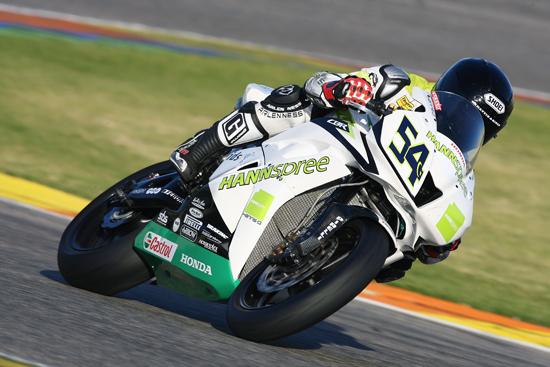
Hannspree Ten Kate Honda’s Kenan Sofuoglu has successfully completed a two-day World Supersport test at Valencia in Spain, despite the pain of a badly cut finger sustained in a crash yesterday. Sofuoglu highsided his Honda CBR600RR on the out lap of his first session yesterday morning and required a visit to hospital to have three stitches inserted in the index finger of his left hand. However, the Turkish rider returned to the track yesterday afternoon and had completed a total of 65 laps of the 4.005km circuit before today’s conclusion, testing a range of parts that included front forks, gearbox and electronics. Sofuoglu was joined at the Valencia test by Italian Michele Pirro (120 laps), his new Hannspree Ten Kate Honda team-mate for next season’s World Supersport championship, which kicks off at Phillip Island on 28th February 2010. It was the 23-year-old Italian rider’s first official Hannspree Ten Kate Honda test following a provisional outing on the team’s Honda CBR600RR at Portimao in Portugal in October. Kenan Sofuoglu best time 1’36.1s It’s been a difficult day after the crash of yesterday. A difficult test because I only had one good hand and found it really difficult to use the clutch. I was feeling so confident before I went out yesterday morning, but maybe a little too confident. I touched the white line between turns four and five and had a very big crash. I slid for a long way and my leathers are pretty bad. But, although I have been really sore today, I was able to do consistently fast laps, which was especially good after 20 laps on an old tyre. We were able to test some new parts as well and these improved the bike even more after our last test at Portimao. I’ll get some rest now and get fit again for the next test back in Portugal at the end of next month. Michele Pirro best time 1’36.4s I am really happy with these two days in Valencia, which have given me a chance to improve my feeling with the bike even more after the good test we had in Portimao. I am so happy with the bike and the team and I am confident of a good season next year because this bike is so fast! I had a small crash this morning at turn two and hurt my finger, but nothing like Kenan! Maybe I pushed a bit too hard on cold tyres. I would like to thank the team and Gerrit and Ronald [ten Kate] again for this fantastic opportunity I hope to get very good results from the very start of next season. Ronald ten Kate team manager Apart from Kenan’s silly crash yesterday, we’ve had a very successful test and got through a lot of different settings and front fork specifications. It’s been full-on but our race pace has been very good and Kenan was able to do some consistent low 36s laps, so we’re very happy. After his shakedown test at Portimao, Michele has been getting more used to the bike and got through a lot of work to go after a good base setting. Our last outing of 2009 gives us a very positive feeling but we know we must still push to find even more for 2010. We wish all our friends and fans a good Christmas holiday and we’re looking forward to getting back on track next year. More, from a press release issued by Hannspree Ten Kate Honda: In the final World Superbike track action of 2009, Hannspree Ten Kate Honda’s Jonathan Rea set the fourth fastest unofficial time in a two-day test, which concluded this afternoon at Valencia in Spain. Despite a small crash yesterday, the 22-year-old, who finished his debut WSBK season in championship fifth place, completed 190 laps of the 4.005km Ricardo Tormo circuit with a best time of 1’34.2s as he tested a combination of new swingarm, front forks and electronics on his 2009 Honda CBR1000RR Fireblade. The Valencia test marked Rea’s first track outing since his coronation in the ‘Kings of Wanneroo’ meeting in Perth, Australia last month where the Northern Irishman won all three races on a stock Honda CBR1000RR. Also testing in Valencia was Max Neukirchner, Rea’s new Hannspree Ten Kate Honda team-mate for the 2010 season, continuing his familiarisation with the team and the Honda CBR1000RR a process which started in October at Portimao in Portugal. The German ace spent most of 2009 on the sidelines through injury but Neukirchner has been training hard and his current fitness levels are high enough for the 26-year-old to have completed 160 laps during his two days at Valencia, setting a best time of 1’34.7s. Jonathan Rea best time 1’34.2s We’ve had a really constructive couple of days here and got through a lot of work. We evaluated three sets of forks with different internal specifications, a slightly modified swing arm and some different electronics, so there was a big list of things to assess. What we didn’t get much of a chance to do was combine all the good things we found into one package and we were still working through things when Pirelli asked us to test the two new tyres they had. One of them felt pretty good, but we didn’t really have the right set up to get the best out of it. Overall, I’m really happy though, because it was a big workload we had to get through. Max Neukirchner best time 1’34.7s I’m really happy with this test, because it was really important for me to get more time on the bike and look for a good base setting. We only made some suspension adjustments and didn’t really test any new parts. I built up my pace slowly and only this afternoon did I really start to push a little harder when I had a good feeling and began to feel confident enough to open the throttle. This was only my fourth day with the team and I have not ridden very much since the crash at Monza in May. Of course, I still need some more time on the bike but I can go into the winter holidays with a good feeling now and continue my training, which has been quite intense recently. I did 160 laps here at Valencia and had no fitness problems; I might be a little sore tomorrow, but I’m feeling very good! Ronald ten Kate team manager All the stuff that we needed to test here has been tested, and it was a lot of work to get through. The improvement from our race here in April is like the difference between night and day so it’s definitely been a good step forward for Jonathan, who has put in a lot of laps and worked really hard. We’re also beginning to find to clear direction forward with Max. We tested a lot of different settings so we will be able to narrow the window a lot more for him at our next test in Portimao in January. For now, we head back to our families in a very positive frame of mind and take this opportunity to wish everyone a merry Christmas and a very happy and successful New Year.

Mladin Tweets Imply That He’s Considering Coming Out Of Retirement For World Superbike Ride

Seven-time AMA Superbike Champion Mat Mladin, 37, seems to be implying that he’s considering coming out of retirement to accept a ride in the 2010 FIM Superbike World Championship. On December 9, Mladin posted the following on his Twitter page: “a couple of world superbike offers have come my way in the past month. 1 of them very good in regards to machinery. decisions decisions ;-)” Mladin, the 2009 AMA Pro American Superbike Champion and the winningest rider ever in the class, announced his retirement prior to the end of the season. He often spoke of his discontent with the new management and direction of AMA Pro Racing and told reporters that he had subsequently lost the motivation that had propelled him through much of his career. Mladin’s most recent rival, Ben Spies, moved to the Superbike World Championship in 2009 and won the title in his rookie season. Spies will race in the MotoGP World Championship in 2010. Mladin did not reply to an e-mail requesting clarification.

KYMCO USA Named Official Scooter, ATV Of NHRA

Spartanburg, SC KYMCO USA announced today that they will partner with NHRA, the world’s largest motorsports sanctioning body. As part of the agreement, KYMCO USA will become the Official Scooter and ATV of the NHRA. KYMCO USA will provide NHRA with scooters and ATV vehicles for use at the NHRA Full Throttle Drag Racing Series events and at its five owned and operated drag racing facilities. As an NHRA official sponsor, KYMCO USA will receive visibility at NHRA Full Throttle Drag Racing Series events as well as exposure throughout NHRA’s various media platforms. “We are pleased to welcome KYMCO USA into the NHRA family of official sponsors,” said Gary Darcy, senior vice president of sales and marketing, NHRA. “The quality scooters and ATVs that KYMCO USA provides NHRA will certainly help our Safety Safari team as well as our track officials do their jobs in a more efficient manner. In turn, we feel the partnership will offer exceptional exposure opportunities to generate awareness and recognition for KYMCO USA.” This is the first sponsorship relationship between NHRA and KYMCO USA. “We’re extremely excited to be partnering with the NHRA,” from KYMCO USA president/CEO Eric Bondy. “They’re a world class organization that provides tremendous entertainment for all members of the family. This partnership falls directly in line with our strategy of partnering with great organizations to build national awareness of the KYMCO brand. We look forward to a long and mutually beneficial relationship.” About KYMCO USA KYMCO’s roots in the motorsports industry go back to its founding in 1963 as the Kwang Yang Motor Company, Ltd., with headquarters in Taiwan. Long a leader in quality, fuel economy, and versatility, today KYMCO manufactures motor scooters, motorcycles, and ATVs at five plants in Asia, including the main facility in the city of Kaohsiung. KYMCO is the largest scooter manufacturer in Taiwan and currently exports to 88 countries worldwide. All KYMCO plants use the latest technology for the engineering and production of reliable engine, chassis, and other components. Since 2004, KYMCO has been officially accredited for ISO-9001 quality in manufacturing. KYMCO is committed to maximum customer satisfaction and constant innovation, making use of the most advanced CAD/CAE tools to bring superior engineering and design to their products. The company’s partner in the United States is KYMCO USA with headquarters, marketing and distribution centered in Spartanburg, South Carolina. KYMCO USA is dedicated to building the brand’s reputation and market share through superior value, frequent new product introductions, strategic industry partnerships, and excellence in dealer network support. KYMCO USA has a reputation and expertise gained through over 30 years in the U.S. motorsports industry. For more information, log on to kymcousa.com or visit the KYMCO USA pages on Facebook. About NHRA Headquartered in Glendora, Calif., NHRA has 80,000 members and 140 member tracks nationwide. As the primary sanctioning body for the sport of drag racing in the United States, NHRA presents 23 national events in the U.S. featuring the NHRA Full Throttle Drag Racing Series, NHRA Lucas Oil Drag Racing Series and NHRA Get Screened America Pro Mod Drag Racing Series. Two NHRA-sanctioned bracket racing series provide competition opportunities for drivers of all levels: the NHRA Summit Racing Series and the NHRA Drags: Street Legal Style presented by AAA. NHRA also offers the Jr. Drag Racing League for youth ages 8 to 17. In addition, NHRA owns and operates five racing facilities: Gainesville Raceway in Florida; Atlanta Dragway in Georgia; National Trail Raceway in Ohio; O’Reilly Raceway Park at Indianapolis; and Auto Club Raceway at Pomona in Southern California. For more information, log on to NHRA.com, or visit the Official NHRA Pages on Facebook, YouTube and Twitter.

Toronto Motorcycle Show Opens Today

(TORONTO, ON / DECEMBER 10, 2009) Some of the hottest bikes from the Canadian racing scene will be on display at the Inside Motorcycles/Inside MotoX & Off Road booth at this weekend’s Toronto Motorcycle Show. The opening show of the 2009-10 winter season runs from Friday through Sunday in the South Building of the Metro Toronto Convention Centre at 222 Bremner Boulevard, next to the CN Tower. The show will feature over 150 exhibitors, including manufacturer displays from the likes of BMW, Harley- Davidson, Honda, Hyosung, Kawasaki, KTM, Suzuki, Triumph, Victory and Yamaha. The Inside Motorcycles/Inside MotoX & Off Road presentation will include motorcycles from the world of off road competition, motocross and road racing, each with a unique story from the 2009 racing season. Two national title winning bikes will be on show. Vicki Schouten’s Kahuna Powersports Kawasaki ZX-6R, with which the Richmond, ON racer won the Pro Honda Oils Women’s Cup in 2009, will be present and fans can also see the bike that took Hamilton, ON’s Steven Nickerson to the Honda CBR125R Challenge title. KTM Canada has made available the KTM 450 XC-F that Hungary’s Kornel Nemeth rode to victory in the inaugural Endurocross at October’s Montreal Supercross. Also on display will be the Cernics Kawasaki KX450F ridden by Bobby Kiniry of Syracuse, N.Y. to a third place finish in the 2009 Canadian Motocross Nationals. Completing the line-up will be the RMP Motorsports Suzuki GSX-R1000 that Ross Millson of Hamilton rode to 13th in the Parts Canada Superbike Championship. “We think all types of motorcycle enthusiasts will enjoy seeing this diverse collection of racing bikes,” said editor John Hopkins. “Each forms a part of a tremendous year of motorcycle racing in Canada.” In addition to these race bikes, the booth will have copies of the latest issues of Inside Motorcycles and Inside MotoX & Off Road magazines. Both publications include the annual Holiday Buyers’ Guide. Visitors are encouraged to meet members of the Inside Motorcycles and Inside MotoX & Off Road team, talk bikes and pick up an Inside Motorcycles Parking Puck for just $5, $2 of which will go to the Hospital for Sick Children.

2010 British Superbike Scheduled Revised

MSVR, the commercial and organisational rights holder of the MCE Insurance British Superbike Championship in association with Pirelli has today issued a revised 2010 calendar. The major change concerns Donington Park which has not been able to be included in the 2010 calendar. The Donington circuit operating companies entered into administration last month and the track is currently in an unusable condition. Earlier this year several planned race meetings were cancelled and the BSB round was only able to be confirmed as going ahead eight days before the event, which was quite unsatisfactory. Such uncertainty is clearly unacceptable for the teams, series organisers and spectators. Donington Park had occupied September 10/11/12 on the provisional calendar. Croft is now re-instated to this date, whilst on May 21/22/23 the championship will now visit the popular Cadwell Park circuit in Lincolnshire for the first of two championship rounds. Other minor changes in the month of July see Knockhill moving to July 2/3/4 and Snetterton to July 16/17/18. MSVR Chief Executive Jonathan Palmer said; “It is very important for the teams, our broadcast and commercial partners and above all the fans that we prepare a calendar consisting of venues where there is no doubt about whether or not the event will actually take place. The prospect of a second event at Cadwell Park in May will I’m sure be great news for the many thousands of fans that already flock to the August Bank Holiday meeting.” 2010 MCE INSURANCE BRITISH SUPERBIKE CHAMPIONSHIP CALENDAR April 3/4/5 Brands Hatch (Indy) April 16/17/18 Thruxton May 1/2/3 Oulton Park May 21/22/23 Cadwell Park June 25/26/27 Mallory Park July 2/3/4 Knockhill July 16/17/18 Snetterton August 6/7/8 Brands Hatch (GP)* August 28/29/30 Cadwell Park September 10/11/12 Croft September 24/25/26 Silverstone (Arena GP) October 8/9/10 Oulton Park * Events in bold are changes from the previous calendar issued on the 9th October 2009. * – Denotes three BSB races at these events, all others two. For more information please visit www.britishsuperbike.com

ADV Completes Two-Day Test Of Moto2 Prototype At Valencia

Last 9th and 10th December in Spain and more precisely in Valencia, the AT02, the motorcycle by ADV, made its debut. The vehicle will race the MotoGP Moto 2 with the Team WTR S. Marino and it firstly appeared on track on 9th December then again on 10th for further improvement testings that are necessary in these cases. The bike raced 60 laps on Wednesday and 65 laps on Thursday equal to more than 500 Km, without any particular problems while the technicians were focused on finding the best setting in order to challenge the track in the best way. A meaningful palmarès and a timing of 1’39″4 obtained by the testing rider of ADV, Alessandro Brannetti who is expected to do a great job with this new GP motorcycle. Everybody knows that experience on track is fundamental to settle the vehicle at its best and this is why, there are even teams that have been setting their bikes for a year in order to find the most suitable settlement. Yet, only teams really know the condition of the engine and electronic setting after testing. The AT02 raced at 15.800 rpm autolimited engine and with MotoGP setting with a Honda/2D combined electronics, exhaust with regular silencer at 115 decibel at 5.500 rpm, airbox and suitable equipment according to MotoGP regulations. Moreover, in this first test some parts of the bike had the aim to underline the behaviour on track in order to let engineers to study the best solutions, and therefore they were not the finished parts, as for example the fairing and the ergonomic position of the rider. Good behaviour came from the whole cooling system of the engine, Taleo that never exceeded 80° with a shutter on the radiator of at least two stripes of tapes. Also the MIVV exhaust was excellent, as the FrenTubo carbon fiber pipes that perfectly conveyed the brake oil from the pump to the calipsers. In its whole AT02 demonstrated to be reliable and fulfilled the expectations of ADV as regards this first test, and also demonstrated that the technologies used in collaboration with CRP Technology have been meaningful.

MotoGP Will Go Back To 1000cc Engines In 2012

FIM Road Racing World Championship Grand Prix – Changes to the 2010 Regulations – The Grand Prix Commission, composed of Messrs. Carmelo Ezpeleta (Dorna, Chairman), Claude Danis (FIM), Hervé Poncharal (IRTA) and Takanao Tsubouchi (MSMA), in the presence of Messrs Vito Ippolito (FIM President), Ignacio Verneda (FIM Sport Director), Javier Alonso (Dorna) and M. Paul Butler (Secretary of the meeting), in a meeting held on December 11 in FIM Headquarters in Mies, unanimously decided to introduce the following amendments to the Road Racing World Championship Grand Prix Regulations. Changes in bold. Application 2010 Sporting Regulations 1.1.1 A series of motorcycle races counting toward the FIM World Championship for riders and constructors (engine for 125cc and MotoGP – frame for Moto2) will be organised. 1.21 Behaviour During Practice and Race “¦/”¦ 20) Penalties for infrigment of article 2.3.6 (Engine durability in MotoGP). – Infringement before the race: the rider will start the race from the pit lane 20′ after the start of the race. – Infringement during the race: ride through. Application: from 2012 Basic concept for MotoGP – Maximum displacement: 1000cc – Maximum number of cylinders: 4 – Maximum bore: 81 mm Technical Regulations Application 2010 2 Technical Regulations These Regulations derogate and supersede all and any other previous regulations in place before the date of publication of these regulations. Specifically for the Moto2 class these regulations derogate and supersede the technical regulations published in December 2008. 2.2 Classes The following classes will be accommodated, which will be designated by engine capacity: 125 Over 80cc up to 125cc – Maximum one cylinder Moto2 Moto2 Official Engine over 175cc up to 250cc – Maximum two cylinders MotoGP Up to 800cc Unlimited cylinders 4-stroke only Four stroke motorcycles participating in the MotoGP class must be prototypes. Those that are not entered by a member of MSMA must be approved for participation by the Grand Prix Commission. 2.3.6 Moto2 class Engines Engine Supply 1) Only engines from the official Supplier are allowed to be used. The term official Supplier shall refer to the engine producer and/or to the company nominated to perform such functions as engine assembling, rebuilding, maintenance, and logistics. 2) Sealed engines will be provided to each team, allocated on a random basis by the Technical Director and staff. 3) Security seals may not be removed or broken and the team may not open the engine, except to remove unsealed covers for maintenance as described in Art 2.3.6. 4) Specifically the cam cover, cylinder head, cylinders, crankcase may not be opened or removed. 4) Teams may only perform maintenance of parts specifically authorised by the Championship Organisers which does not involve removal of security seals. This includes change of oil and external items as detailed in the following articles including cooling, fuel and electrical systems, and clutch parts including plates, hubs, control mechanisms. 5) All other maintenance and repair, specifically that involving removal of security seals will be carried out by the official Supplier. Regular maintenance, rebuilding and replacement of engines will be at the sole discretion of the Championship Organisers, and on a schedule determined by them. 6) Engines returned for maintenance, repair or replacement must be in the original condition as delivered, that is with the original fittings in place as required by the Championship Organiser, which may include: covers, cooling system including hoses and connectors, electrical system including wiring and connectors, clutch. 7) In the case of engine breakdown or damage, another engine may be allocated by the Technical Director. Such allocation can not be made during a Moto2 practice session or within 30 minutes of the pitlane being opened for the race sighting lap. Engine Definition, Specification and Modification 8) Use of the complete engine is mandatory, and it may not be modified in any way except as specifically described in these regulations. The engine design and specification will be determined by the official Supplier in consultation with the Championship Organisers. The engine design and specification may be changed at any time with the agreement of both the official Supplier and the Championship Organiser. New technologies (for example; materials, cylinder head and valve design, valve operating mechanisms, alternative fuels, etc.) are encouraged provided they meet the Series’ principle of cost reduction and long-term cost control, and are agreed by the official Supplier and Championship Organiser. The official Supplier may change the specification of individual parts from time to time, as is normal to improve reliability and function. All engines supplied to teams must be equal in specification and performance (within a reasonable margin of error for such measurements). The complete engine (‘engine’ in these regulations) is defined as the supplied engine cases, covers and everything contained within, and including the following external parts supplied by the official Supplier: a) Fuel system including airbox, air filter, fuel pump & regulator, throttle bodies, intake manifolds, air intake funnels, fuel injectors primary & secondary, fuel delivery lines and hoses. b) Electrical system including generator, ignition coils, ECU (engine electronic control unit). c) Lubrication system including oil filter, oil cooler, oil pressure switch. 9) To ensure reliability and performance, the official Supplier does not recommend any changes to the engine. However at the Team’s risk the following items may be replaced and/or modified: a) Coolant hoses and fittings may be changed to suit individual radiator designs. Where an inlet/outlet pipe fitting is changed it must have the same internal diameter as the original part. b) The fuel delivery line between the fuel pump and the primary injectors may be modified to adjust the length and/or to fit a connector in-line. 10) The following external items may not be replaced, removed or modified, except if replaced with an original part due to malfunction or damage (as authorised by the Technical Director): a) Water pump b) Oil cooler (heat exchanger) c) Oil filter d) Oil pressure sensor e) Gearbox output speed sensor f) Water temperature sensor g) Electrical cables and connectors supplied as part of the engine Cooling System 11) Design and construction of the cooling system is free, provided it complies with Articles 2.3.6. 9) and 2.3.6. 10), and Article 2.3.6.15) ensuring that the engine meets the operating parameters specified by the official Supplier (refer to Table 2 in the Appendix). 12) The standard engine oil cooler is mandatory, and additional oil coolers are not permitted. Engine Use 13) The engine may be used only at official Moto2 events as defined by the Championship Organisers. Moto2 events include Official Tests and Grand Prix race events. 14) The Championship Organisers may require that engines are returned at the completion of certain events and/or maintenance period (Art. 2.3.6. 5). This is at the sole discretion of the Championship Organisers, and Teams must comply with such requests. 15) The engine must be used at all times respecting the range of operating parameters provided by the official Supplier, and avoiding deliberate misuse. Refer to Table 2 in the Appendix. Ignition and Electronics 16) Only the electronic ignition/fuel injection control units (ECU) supplied by the official Supplier are allowed. This ECU must remain unmodified in hardware and software as delivered by the official Supplier, with the exception of the normal tuning adjustments allowed only by the standard software ‘Setting Tool’ supplied as part of the Moto2 Kit. 17) The ECU is defined as part of the engine (refer to Art. 2.3.6.8. b)). ECU units may be distributed to teams at official Moto2 events, and may be required to be returned during or after the event for checking and/or re-distribution. 18) The Technical Director may inspect all ECU hardware and software at any time, including access to all stored information. The Technical Director may require the team to change the ECU on any machine for another identical standard one at any time. 19) Design and construction of the wiring harness is free to accommodate the needs of different machine designs, provided it respects the official Supplier’s wiring diagram. Only the standard ECU, Datalogger and junction units may be connected to the harness, and connection of the components listed in Art. 2.3.6. 8 and 2.3.6.10 is mandatory. Datalogger 20) Only the standard Moto2 Datalogger system (including hardware, sensors and software) approved by the Championship Organiser is allowed to be used at official Moto2 race and test events. 21) The Technical Director may inspect and access the datalogger system at any time, including the reading and downloading of data. Team data, with the exception of engine performance data, will be treated as confidential. The Technical Director may require the team to change the datalogger for another identical standard one at any time. 22) The Moto2 Datalogger will be supplied with a standard sensor package. There are additional logger channels available for optional sensors. No other sensors are permitted on the machine at official Moto2 events. Refer to Table 1 in the Appendix. 2.3.7 Engine Durability 1.) In the MotoGP class the number of engines available for use by each rider is limited. For the 2010 season a maximum of 6 engines may be used by each permanent contracted rider for all the scheduled races of the season. that is from and including the Czech Grand Prix until the end of the season. Should a rider be replaced for any reason, the replacement rider will be deemed to be the original rider for purposes of engine allocation. Each manufacturer is allowed 2 additional engines for the exclusive use of Wild Card riders only. 2.) The engines available for the exclusive use of each rider must be marked and sealed by the Technical Director prior to first use. It is the Team’s obligation to register any new engine with the Technical Director prior to use. Once registered and used for the first time, engines may not be swapped between riders, even within the same team. A new engine is deemed to be used when the motorcycle with that engine crosses the transponder timing point at the pitlane exit. 3.) The engines will be sealed by means of wiring and identification tabs, so that: a. the timing system is not accessible (e.g. the head cover must be wired to the cylinder head), b. the timing driving system is not accessible (e.g. the geartrain/chain cover is wired so that it cannot be removed), c. the cylinder head and the cylinders block (if any) cannot be removed from the engine (e.g. the cylinder head is wired to the cylinders block and the cylinders block is wired to the engine crankcase), d. the crankcase cannot be opened (e.g. the crankcase halves are wired together). All the parts that are accessible without removing the sealing wiring can be replaced. Breaking or removing the sealing or wiring without supervision by the Technical Director will be deemed to be “engine rebuilding” and engines with broken, tampered with or missing security seals will be treated as a new engine in the allocation. 4.) Should a competitor, for any reason (e.g. mechanical failure, crash major damage, etc.) require the use of another engine above their allocation, the Technical Director must be informed before the new engine is used, and Race Direction will apply the appropriate penalty according to the Sporting Regulations. The damaged engine will be removed from the allocation and if it is used again, it will be treated as a new engine with the appropriate penalty. 5.) There is no limit to the number of times a sealed, allocated engine can be fitted to and used in a motorcycle, provided the security seal is not broken or removed. Replacing an engine with another sealed engine (new or used) from the rider’s allocation is allowed with no penalty. 6.) To prevent the running of a used, allocated engine outside of MotoGP events, all allocated engines will have security seals placed over either exhaust or inlet ports (on at least one cylinder bank, in the case of V-type engines) before leaving the circuit. Teams wishing to re-use such an allocated and sealed engine must request the Technical Director to remove the security seals. If the Technical Director or his staff finds that the security seals are not intact, the engine will be deemed to be a new engine in the allocation, with the appropriate penalty. 2.3.8 Control Systems 2.3.8.1 In the MotoGP class, the use of hydraulic and/or pneumatic pressurized powered systems is not allowed, with the exception of cylinder inlet/exhaust valve springs. All hydraulic systems on the motorcycle must be powered only by the rider’s manual inputs. Normal hydraulic hand/foot controls such as master/slave cylinders for brakes/clutch are allowed. Pneumatic engine valve actuating systems are allowed. Oil/water pumps for engine lubricating/cooling are allowed. The use of engine lubricating oil for any purpose other than lubrication and cooling (such as powered hydraulic systems) is not allowed. In the case of a new manufacturer who has never participated in the MotoGP class prior to 1.1.2010, this regulation will apply only from 1.1.2011. 2.3.8.2 In the MotoGP class, variable valve timing and variable valve lift systems, driven by hydraulic and/or electric/electronic systems are not permitted. 2.3.9 Fuel System 2.3.9.1 In the MotoGP class the maximum permitted fuel pressure is 10 Bar. 2.3.9.2 Moto2 class fuel system 1) Use of the fuel system (as described in Article 2.3.6.8. a)) from the official Supplier is mandatory, and it must remain standard, as delivered by the official Supplier. The only modifications permitted are those specifically described in these regulations. The Technical Director may require the team to exchange any parts of the fuel system for another standard part, at any time. 2) Fuel Pump: The fuel tank gauge assembly (ie. float, arm and support bracket) of the standard fuel pump may be removed. 3) Fuel Tank: Design and construction of the fuel tank is free, within the constraints of the FIM Grand Prix Regulations, Art. 2.6. There are no capacity restrictions. 4) Fuel Delivery Hoses: Fuel delivery hose fittings must remain standard, as supplied. However it is permitted to fit quick -connectors (eg. “dry-break” connectors) in the fuel lines. 5) Airbox: Only the standard airbox supplied by the official Supplier (including air filter and secondary injectors) may be used. No modifications, alterations or additions to this airbox are allowed, except as described in Art. 2.3.9.2. 6) 6) To ensure correct performance the official Supplier does not recommend any change to the airbox. However at the risk of the team, the following changes are allowed: a) The intake ducts, ahead of the air filter, may be changed to suit individual chassis designs. b) The resonance chambers on top of the airbox lid may be removed, either together with the top cover they are attached to, or the top cover may be left in place. They may be replaced by a blanking cover approximately flat in shape. The total airbox volume, from the filter back, may not be increased from the original. Refer to Diagram 4 in the Appendix. If such a blanking cover is fitted, the original air temperature sensor must be fitted on this cover in a position equivalent to the original position, and may not be horizontally closer to the secondary injectors than the original position. Refer to Diagram 5 in the Appendix. 2.4 Gears Transmission 2.4.1 There must be A maximum of six gear ratios is permitted. 2.4.2 Twin clutch transmission systems (DSG) are not permitted. 2.4.3 Continuously Variable Transmission systems (CVT) are not permitted. 2.4.4 Automatic transmission systems are not permitted. Manual transmissions with gearshifts assisted by quick-shifter systems are permitted. 2.4.5 Moto2 class Clutch 1) A racing slipper clutch (back-torque-limiter) and clutch cover will be supplied to each rider. Only this clutch and cover may be used, without modification, and it’s use is mandatory at all official Moto2 events. 2) It is the team’s responsibility to fit, adjust and maintain all parts of the clutch. Engines returned for maintenance, repair or replacement will have the racing clutch removed, and the team retains their own clutch for use with subsequent engines. 2.5 Weights 2.5.1 The following are the minimum weights permitted: 125cc motorcycle + rider 136 kg 250cc 1 cylinder motorcycle 100 kg 2 cylinders motorcycle 100 kg Moto2 motorcycle 135 kg MotoGP 2 cylinders or less motorcycle 135 kg 3 cylinders motorcycle 142,5 kg 4 cylinders motorcycle 150 kg 5 cylinders motorcycle 157,5 kg 6 cylinders or more motorcycle 165 kg 2.7 Safety and Construction Criteria Note: Please also refer to diagrams 1, 2 and 3. Chassis Design and Construction In the Moto2 class, the chassis must be a prototype, the design and construction of which is free within the constraints of the FIM Grand Prix Technical Regulations. The main frame, swingarm, fuel tank, seat and fairing/bodywork from a non-prototype (ie. series production road-homologated) motorcycle may not be used. 2.7.3 Brakes 2.7.3.1 Motorcycles must have a minimum of one brake on each wheel that is independently operated. 2.7.3.2 In the 125cc and 250cc Moto2 classes, only brake discs of ferrous materials are allowed. 2.7.3.3 In the MotoGP class, carbon brake discs may be a maximum diameter of 320mm. From 1.1.2011 onwards carbon brake discs will be allowed with only 320mm diameter, and only 2 standard choices of disc mass. Carbon brakes will be permitted in MotoGP at least until the end of the 2012 season. 2.7.3.4 In all classes, ceramic composite materials are not permitted for brake discs or brake pads. Ceramic materials are defined as inorganic, non metallic solids (e.g. Al2O3, SiC, B4C, Ti5Si3, SiO2, Si3N4). 2.7.4 Exhausts 2.7.4.3 Variable length exhaust systems are not permitted. 2.7.4.4 Exhaust Gas Recirculation (EGR) systems are not permitted. 2.7.4.5 Moto2 class exhaust: 1) The design and construction of the exhaust system is free provided it conforms to the FIM Grand Prix regulations, and respects the engine Supplier’s specified layout (ie. 4 into 2 into 1). There are recommended dimensions from the engine Supplier. Refer to Diagram 6 in the Appendix. 2) The Linear Air-Fuel sensor (LAF, or Lambda) will be located 120mm after the final 2 into 1 junction of the exhaust, with a tolerance of 20mm (minimum 100mm, maximum 140mm after the 2 into 1 junction). Refer to Diagram 6 in the Appendix. 2.7.9 Breather Pipes Any breather pipe from the engine or gearbox must discharge into the airbox and/or a suitable container. with a minimum capacity of 200cc and a maximum of 250cc. There must be a separate container for each breather pipe. 2.7.10 Materials The use of titanium in the construction of the frame, the front forks, the handle-bars, the swinging arm spindles, and the wheel spindles is forbidden. For wheel spindles, the use of light alloys is also forbidden. The basic structure of the crankshaft and camshafts must be made from steel or cast iron. Pistons, cylinder heads and cylinder blocks may not be composite structures which use carbon or aramid fibre reinforcing materials. Brake callipers calipers must be made from aluminium materials with a modulus of elasticity no greater than 80 Gpa. No parts of the motorcycle or engine may be made from metallic materials which have a specific modulus of elasticity greater than 50 Gpa / (g/cm3). The use of MMC (Metal Matrix Composite) and FRM (Fibre Reinforced Metal) materials is forbidden. In the MotoGP class, hollow structure connecting rods are not permitted. Oil galleries of less than 2mm diameter in the connecting rod are permitted. 2.7.12 Suspension and Dampers Electric/electronic controlled suspension, ride height and steering damper systems are not allowed. Adjustments to the suspension and steering damper systems may only be made by manual human inputs and mechanical/hydraulic adjusters. 2.7.13 Tyre temperature sensors are not permitted. 2.8 Wheel Rims 2.8.1 Maximum Permitted wheel rim widths sizes are as follows: 125cc Front 2.5″ maximum width, Rear 3.5″ maximum width 250cc Front 4.0″ maximum width, Rear 5.5″ maximum width Moto2 Front 3.75″ x 17″ only, Rear 6.00″ x 17″ only MotoGP Front 4.0″ maximum width, 16.5″ diameter only, Rear 6.25″ maximum width, 16.5″ diameter only In the MotoGP class for the seasons 2010, 2011, 2012, each manufacturer is restricted to two different widths of front wheel rim, and one width of rear wheel rim, within the maximum widths noted above. All MotoGP wheel rims must be 16.5″ diameter. Each MotoGP manufacturer must notify the Technical Director of their selected wheel sizes no later than the close of technical control at the first race of the 2010 season. 2.8.2 In the Moto2 class, composite construction wheels (including carbon fibre reinforced, glass fibre reinforced, and similar) are not permitted. 2.9 Tyre restrictions for MotoGP 2.9.1 In the MotoGP and Moto2 classes, only tyres from the official appointed tyre supplier for each class may be used in a Grand Prix event, including official MotoGP tests. The official tyre supplier will provide sufficient tyres for all riders entered in the event. The tyre specifications available at each event will be determined by the tyre supplier. Identical tyres of each specification must be available to every rider, and the allocated total quantity of each specification of tyres will be the same for every rider. 2.9.2 On the day prior to the start of official practice, the tyre supplier must provide to the Technical Director details including specifications, quantities and the identification markings of the tyres available for that event. The Technical Director and staff will allocate the tyres available for the exclusive use of each entered rider (as described in Article 2.9.3). The allocation of individual tyres will be made on a random basis with no involvement of any representative from the tyre supplier, teams or riders. This allocation should be completed by 12.00 14.00 hrs of the same day and no further allocation of tyres is allowed after 17.00 hrs. on the day prior to the start of official practice (except under Arts. 2.9.3 front tyre specification choice, 2.9.7 or 2.9.8). In the case of a rider change after the final tyre allocation has been made, the replacement rider must use only the tyres allocated to the original rider. 2.9.3 For Grand Prix race events, each rider will be restricted in the quantity and specification of tyres that they may use at a single race event as follows: MotoGP Class: During all practice sessions, warm up and the race a maximum of 20 18 slick tyres, specifically: Front slick tyres: 4 of Specification “A” + 4 of Specification “B” = 8 in total, comprised of either: 3 of specification “A” + 5 of specification “B”, or: 4 of specification “A” + 4 of specification “B”, or: 5 of specification “A” + 3 of specification “B”. Front tyre specification choice will be made as follows: 6 tyres comprised of: 3 of specification “A” and 3 of specification “B” will be allocated on the day before the start of official practice, as per Art. 2.9.2. 2 tyres will be allocated after the first practice, comprised of: 2 of specification “A” or 2 of specification “B” or 1 each of specification “A” and “B”. The rider’s selection of front tyre specification must be informed to the tyre supplier no later than 2 hours after the end of the first practice session. If no specification selection is received by this time the allocation of the 2 tyres will automatically be 1 of specification “A” and 1 of specification “B”. This allocation will be final and no changes are permitted after this time. In the case of a rider being replaced after this tyre selection deadline, the replacement rider must use only the tyres allocated to the original rider. Rear slick tyres: 6 5 of Specification “A” + 6 5 of Specification “B” = 12 10 in total, all allocated on the day before official practice starts as per Art. 2.9.2 During all practice sessions, warm up and the race a maximum of 8 wet tyres, specifically Front wet tyres: 4 of the standard specification Rear wet tyres: 4 of the standard specification Moto2 Class: During all practice sessions, warm up and the race a maximum of 16 slick tyres, specifically: Front slick tyres: 4 of specification “A” + 3 of specification “B” = 7 in total Rear slick tyres: 5 of specification “A” + 4 of specification “B” = 9 in total During all practice sessions, warm up and the race a maximum of 6 wet tyres, specifically Front wet tyres: 3 of the standard specification Rear wet tyres: 3 of the standard specification Wet tyres, MotoGP and Moto2 classes: The tyre supplier may allocate 1 extra set (1 front + 1 rear) of wet tyres to every rider, should this be deemed necessary by Race Direction due to weather conditions at the event. Specifically in the case of every practice session being fully declared wet, and requiring the use of wet tyres, 1 extra set of wet tyres will be allocated to every rider for the race. A wet tyre is defined as a tyre which has a land to sea ratio of at least 20% overall, and a minimum ratio of 7% in each third of the section profile. The tyre may be moulded or hand cut, but each groove must have a minimum depth of three millimetres over 90% of its length. Any tyre with a land to sea ratio of less than 20% will be deemed a slick tyre and therefore must be part of the rider’s slick tyre allocation. In case of dispute the decision of the Technical Director will be final. 2.9.4 1) Riders may use only the tyres allocated for his/her exclusive use (as described in Article 2.9.3). 2) Tyres will be individually identified and may not be exchanged between riders, including between team-mates, and may not be exchanged by the tyre supplier after allocation, except with the permission of the Technical Director (for example, under Article 2.9.8). 3) Tyres may not be materially altered in any way after allocation, such as hand-cutting and any other action or treatment that will alter the tyre’s performance (with the exception of the use of tyre warmers), unless deemed necessary by the tyre supplier. Such alterations may be performed only by the tyre supplier, and shall be made equally for all riders. 2.9.5 Each allocated tyre must be marked with it’s specification and carry an official identification label with a unique serial number. In the event of damage to or loss of the official label, the tyre company must be able to satisfy the Technical Director as to the tyre’s specification. Tyres may be checked for compliance at any time, before or after use. 2.9.6 In the case of an interrupted race, a rider must use tyres from his allocation of marked tyres for the restarted race. 2.9.7 In the unlikely event of a tyre being accidentally damaged before it is used (for example during the fitting process) and deemed to be unusable by the Technical Director, it may be replaced with a tyre of the same specification with the permission of the Technical Director. Such replacement tyres will be marked and included in the allocation of the rider concerned. The damaged tyre will be removed from the allocation and may not be allocated again. Once it is used (ie. has exited pitlane) a tyre may not be replaced because of damage or defect, except in the following circumstances: a) The tyre supplier must confirm to the Technical Director that the damage is solely due to a manufacturing defect or problem, and not due to any other reason such as impact, cut, abrasion or accident. b) The tyre supplier must confirm to the Technical Director that the damage is significant enough to deem the tyre unsafe to use. c) For each rider at any one event, any single tyre deemed to be defective after use will not be eligible for a replacement tyre. Only the second and any subsequent used tyre(s) deemed to be defective by the tyre company (whether due to the same defect or a different defect) during the same event, will be eligible for replacement. d) In determining whether a replacement will be allowed the decision of the Technical Director will be final. e) If a replacement tyre is granted, it must be of the same specification as the damaged tyre and selected at random by the Technical Director and/or his staff. 2.9.8 Should an exceptional and unpredictable safety problem arise for the tyre supplier during an event, so as to prevent riders from safely competing in the race, then the tyre supplier must inform the Technical Director and Race Direction of the problem as soon as possible. A re-allocation of suitable tyres may be made under the supervision of the Technical Director. Such allocated tyres will be the same specification(s) and quantities for all riders, the quantity being determined by the tyre supplier in consultation with the Technical Director. 2.9.9 Tests, MotoGP Class: 1) For official Post-Race tests of 1 day duration, each rider will be restricted in the quantity and specification of tyres that they may use at a single test event as follows: During all practice sessions, a maximum of 8 slick tyres, specifically: Front slick tyres: 2 of Specification “A” + 2 of Specification “B” = 4 in total Rear slick tyres: 2 of Specification “A” + 2 of Specification “B” = 4 in total During all practice sessions, a maximum of 4 wet tyres, specifically: Front wet tyres: 2 of the standard specification Rear wet tyres: 2 of the standard specification 2) For official Winter tests of 2 days (or more) duration, each rider will be restricted in the quantity and specification of tyres that they may use at a single test event as follows: During all practice sessions on Day 1, a maximum of 8 slick tyres, specifically: Front slick tyres: 2 of Specification “A” + 2 of Specification “B” = 4 in total Rear slick tyres: 2 of Specification “A” + 2 of Specification “B” = 4 in total During all practice sessions on each additional day, a maximum of 6 slick tyres, specifically: Front slick tyres: 3 tyres out of the 2 specifications “A” and “B” = 3 in total Rear slick tyres: 3 tyres out of the 2 specifications “A” and “B” = 3 in total During all practice sessions over the 2 (or more) days of the test, a maximum of 4 wet tyres per day, up to a maximum total of 8 wet tyres, specifically: Front wet tyres: 4 of the standard specification, (maximum of 2 per day) Rear wet tyres: 4 of the standard specification, (maximum of 2 per day) 3) At any official Post-race or Winter test, the tyre supplier may choose to allocate extra tyre sets with a different specification. Such extra allocation will be determined solely by the tyre supplier. The same quantity of identical specification tyres will be allocated to at least all permanent MotoGP class riders contracted to factory teams at the test. When a new specification tyre is to be introduced, the tyre supplier should inform all teams at least two months in advance of the proposed test date for the new specification. Tests, Moto2 Class: For all official winter and post race tests, each rider will be restricted in the quantity and specification of tyres they may use at a single test. The tyre supplier will determine the number of specifications and quantities it will bring to each test. Every rider present at the test will receive the same allocation of tyre quantities and specifications. 2.10 Numbers and Backgrounds 2.10.1 Racing numbers must be affixed to the front and the two sides of the motorcycle. For the MotoGP class, only the front number is compulsory. 2.10.2 Numbers must should be a minimum height of 140 mm. 2.10.3 In the 125cc and 250cc classes, the main body of the Numbers must be of a single colour which is easily legible, distinctive and contrast strongly with the background colour. 2.10.4 Backgrounds must be of one single colour over an area large enough to provide a minimum clear area of 25mm around the numbers. 2.10.5 In case of a dispute concerning the legibility of numbers, the decision of the Technical Director will be final. 2.11 Fuel and Oil All motorcycles must be fuelled with unleaded petrol Moto2 class fuel and oil: 1) Only fuel from the appointed fuel supplier is permitted. This fuel will be available at all official Moto2 events, and will conform to the FIM Grand Prix ‘Moto2’ specification. Use of this fuel without any addition or alteration is mandatory. 2) Only engine oil from the appointed oil supplier is permitted. This oil will be available at all official Moto2 events and will conform to the FIM Grand Prix ‘Moto2’ specification. The use of this oil without any addition or alteration is mandatory. The Technical Director may require that an oil sample be taken from any team or machine at any time. 2.11.1 Unleaded petrol must comply with the FIM Grand Prix specification for each racing class. 2.11.2 Unleaded petrol will comply with the FIM Grand Prix specification if: (a) It has the following characteristics: MotoGP and 125cc classes (same as 2009 regulation) Moto2 class (tba) (h) In the Moto2 class, oil for engine lubrication will comply with the FIM Grand Prix Moto2 specification if: (tba) 2.11.3 Implementation of the fuel regulation In the MotoGP and 125cc classes when a rider taking part in a meeting is under contract or agreement for the exclusive use of a certain brand of petrol or oil, the Organisers must give free access to the circuit for that fuel or oil. Any final dispute will be settled in accordance with the FIM Grand Prix Disciplinary and Arbitration Code. 2.11.4.1 Fuel and Oil Approval 2. All companies supplying oil, for mixing with petrol to create a two stroke mixture or for engine lubrication in the Moto2 class, to participating teams must submit two litres (2 x 1 L) of the oil to the laboratory appointed by the FIM/Dorna for approval. If the oil conforms to the specifications, a certificate will be issued. The test report number given on the certificate must be supplied to teams which intend to use the oil. 2.11.4.2 Fuel and Oil Sampling and Testing 14. In the Moto2 class, the above fuel sampling and testing procedure will apply to engine oil also. In the case that the oil sample does not comply with the Moto2 specification as described in Art. 2.11.2.(h), the Technical Director will inform Race Direction who may impose a penalty. 2.12.7 Helmets must be of the full face type and conform to one of the recognised international standards: Europe ECE 22-05 ‘P’ Japan JIS T 8133 : 2000, JIS T 8133: 2007 USA SNELL M 2005, SNELL M 2010 2.14.4 The maximum noise levels at all times are: 2 stroke: 113 dB/A Moto2: 115 dB/A MotoGP 4 stroke: 130 dB/A measured at a mean piston speed of 13 metres per second (two stroke) and 11 metres per second (four stroke). For the convenience, made possible by the similarity of piston stroke per engine configuration within capacity classes, the test may be conducted at a fixed RPM. 125cc (2-stroke), 1 cylinder, 7000 rpm 250cc (2-stroke), 2 cylinders, 7000 rpm Moto2 4 cylinders, 5500 rpm MotoGP 2 cylinders, 5000 rpm MotoGP 3 cylinders, 5500 rpm MotoGP 4 cylinders or more, 5500 rpm —————————————————————————————————————– About FIM FIM (WWW.FIM-LIVE.COM), the world governing body for motorcycle sport, is an independent association formed by 98 National Federations throughout the world. It is recognized as the sole competent authority in motorcycle sport by the International Olympic Committee (IOC). Among its 49 FIM World Championships its main events are MotoGP, Superbike, Endurance, Motocross, Supercross, Trial, Enduro and Speedway. FIM also deals with non-sporting matters such as leisure motorcycling, mobility, transport, road safety and public policy and the environment, FIM was the first International sporting Federation to enforce an Environmental Code in 1994.
New Jersey Motorsports Park’s Coats For Kids Program Concludes Friday

Millville, N.J. (December 10, 2009) – Over 630 local school children are expected to visit New Jersey Motorsports Park on Friday, December 11, to benefit from the Coats For Kids holiday program hosted by the Millville, N.J., Park and the Green Flag Children’s Charities. Cumberland County elementary and middle school students, selected by their school, will select a brand new winter coat, a pair of gloves or mittens, a hat or a scarf, a book, and enjoy a hot, healthy lunch. Each item has been donated to the drive by South Jersey individuals and businesses and generous support from the motorsports industry. “The support of the community in assisting these area kids with warm-weather clothing has been tremendous,” said Michelle Boger-Haines, New Jersey Motorsports Park Director of Events and coordinator of the Coats For Kids drive. “We’ve increased the number of children we’ve been able to outfit by 33% this year, thanks to the generosity of our community and other partners.” In addition to contributions to the Coats For Kids drive, the Green Flag Children’s Charities will use Friday to host the second annual Holiday Donation to local children’s charities. $4,000 will be donated to local charities from money raised via individual contributions, including Green Flag Committee members and New Jersey Motorsports Park Driver’s Club members, corporate donations, area car clubs and fund-raising events like the Tom Walkup Memorial Poker Run that were hosted at the Park. This year’s Green Flag Children’s Charities holiday donations will go to the Boys and Girls Club of Vineland, Ranch Hope, Bethel Development, and Shine Ministries. Each group will be presented a $1,000 check on Friday. “The Green Flag Children’s Charities was created with the mission to provide local chidren’s-based organization with additional funding when possible,” said Dan Rieck, Green Flag Committee Chairman. “For the second year in a row, we’ve been able to help support four local organizations in addition to the Coats For Kids drive during the holiday season. We’re thankful for the support of the community and our members that helped us raise this money.” Among those local businesses that answered the call for donations was Forman Mills Clothing Factory Warehouse, serving communities in New Jersey, Philadelphia, Delaware, Maryland, New York and Michigan. The clothing company, with help from its various suppliers and vendors, have accounted for half of the donated coats and an estimated 95% of donated gloves, mittens, scarves and hats. “At Forman Mills, it’s important to us to support our local communities,” said Rick Forman, President and CEO of Forman Mills. “When we learned about the Coats For Kids drive at New Jersey Motorsports Park, we offered to do what we could to help. We put out a call to our suppliers, and each one went above and beyond what could be expected. We’re proud of the efforts of everyone involved in helping these children feel just a little bit warmer this winter.” The motorsports industry has also supported this year’s Coats For Kids drive. Ferrari Challenge driver Richard Fant, through his family’s Houston, Texas-based Fant Foundation, made a monetary donation to support the Coats For Kids drive. The Fant Foundation is administered through New Process Steel, where Fant serves as President, and its employees, dedicated to making a difference in the communities in which they operate. The Grand-Am Rolex Series also made contributions to the Coats For Kids drive, donating a variety of racing merchandise, ranging from clothing to Rolex Series flags and key chains. Local donations have come from across South Jersey, stretching well beyond the Cumberland County borders. For example, over 1200 pairs of slippers have been donated to the drive by Goodwill of Pennsauken, N.J. Children from 17 different Cumberland County elementary schools, middle schools, and learning institutions will visit New Jersey Motorsports Park between 10 a.m. and 2 p.m. on Friday. The Green Flag Children’s Charities check presentation will begin at 1 p.m. In addition to the Coats For Kids program, New Jersey Motorsports Park plays hosts to a number of community fund raising events throughout the year. The world-class motorsports facility also annually hosts the Barbara Cook Run-Ride-Walk For Cancer and this winter hosted a Daytona 500 viewing party that raises funds for the New Jersey Motorsports Park Green Flag Children’s Charities organization associated with the track. Nearly $100,000 has been raised for various charities since New Jersey Motorsports Park opened in July of 2008. More information on the Coats For Kids drive and New Jersey Motorsports Park, including the recently-announced 2010 spectator schedule that includes the Grand-Am Rolex Sports Car Series and the Ferrari Challenge, is available at www.njmp.com. Sitting on more than 500 acres in Millville, N.J., New Jersey Motorsports Park is conveniently located to Philadelphia, the Jersey Shore, New York and Baltimore, and offers diverse and dynamic motorsports attractions. The facility includes two world-class road courses (Thunderbolt and Lightning), a motorsports country club known as the Drivers Club, the Breighton Room Restaurant open to the general public, and F1 New Jersey, one of the top karting facilities in America. Approaching its third race season, New Jersey Motorsports Park hosts a number of professional motorsports events and countless club events and track rentals. The 2010 spectator schedule includes return visits by the AMA Superbike Championship, Grand-Am Rolex Sports Car Series, ARCA Racing Series presented by RE/MAX, the Atlantic Championship powered by Mazda, and the Ferrari Challenge. Two vintage race weekends dot the 2010 schedule. For more information on New Jersey Motorsports Park, F1 New Jersey, Breighton Room, or to purchase tickets, visit www.njmp.com or call 856-327-7217. Children 12 and under are admitted free to every event at New Jersey Motorsports Park.

No Pay, No Play: Yamaha YZF-R1 Banned From 2010 Canadian Superbike Series Run By Colin Fraser

Read about it here, on the official series website: ~http://www.cdnsuperbike.com/index.php?option=com_content&task=view&id=2023&Itemid=136~

Thursday Video: Looking Back At Colombian Tomas Puerta Riding Injured During The AMA Pro Racing Weekend At Topeka

For the third time this season Tomas Puerta started from the front row of the SuperSport race presented by Shoei. The 2008 Red Bull Rookies graduate rode through a wrist injury at Heartland Park Topeka to a respectable seventh place finish on his LTD Racing Yamaha YZF-R6. Be sure to check out other Roadracing World feature videos. Video provided by ~http://www.OnTheThrottle.tv~ and ~www.YouTube.com~

Hannspree Ten Kate Honda’s Sofuoglu Bounces Back From Crash To Complete Valencia Test

Hannspree Ten Kate Honda’s Kenan Sofuoglu has successfully completed a two-day World Supersport test at Valencia in Spain, despite the pain of a badly cut finger sustained in a crash yesterday. Sofuoglu highsided his Honda CBR600RR on the out lap of his first session yesterday morning and required a visit to hospital to have three stitches inserted in the index finger of his left hand. However, the Turkish rider returned to the track yesterday afternoon and had completed a total of 65 laps of the 4.005km circuit before today’s conclusion, testing a range of parts that included front forks, gearbox and electronics. Sofuoglu was joined at the Valencia test by Italian Michele Pirro (120 laps), his new Hannspree Ten Kate Honda team-mate for next season’s World Supersport championship, which kicks off at Phillip Island on 28th February 2010. It was the 23-year-old Italian rider’s first official Hannspree Ten Kate Honda test following a provisional outing on the team’s Honda CBR600RR at Portimao in Portugal in October. Kenan Sofuoglu best time 1’36.1s It’s been a difficult day after the crash of yesterday. A difficult test because I only had one good hand and found it really difficult to use the clutch. I was feeling so confident before I went out yesterday morning, but maybe a little too confident. I touched the white line between turns four and five and had a very big crash. I slid for a long way and my leathers are pretty bad. But, although I have been really sore today, I was able to do consistently fast laps, which was especially good after 20 laps on an old tyre. We were able to test some new parts as well and these improved the bike even more after our last test at Portimao. I’ll get some rest now and get fit again for the next test back in Portugal at the end of next month. Michele Pirro best time 1’36.4s I am really happy with these two days in Valencia, which have given me a chance to improve my feeling with the bike even more after the good test we had in Portimao. I am so happy with the bike and the team and I am confident of a good season next year because this bike is so fast! I had a small crash this morning at turn two and hurt my finger, but nothing like Kenan! Maybe I pushed a bit too hard on cold tyres. I would like to thank the team and Gerrit and Ronald [ten Kate] again for this fantastic opportunity I hope to get very good results from the very start of next season. Ronald ten Kate team manager Apart from Kenan’s silly crash yesterday, we’ve had a very successful test and got through a lot of different settings and front fork specifications. It’s been full-on but our race pace has been very good and Kenan was able to do some consistent low 36s laps, so we’re very happy. After his shakedown test at Portimao, Michele has been getting more used to the bike and got through a lot of work to go after a good base setting. Our last outing of 2009 gives us a very positive feeling but we know we must still push to find even more for 2010. We wish all our friends and fans a good Christmas holiday and we’re looking forward to getting back on track next year. More, from a press release issued by Hannspree Ten Kate Honda: In the final World Superbike track action of 2009, Hannspree Ten Kate Honda’s Jonathan Rea set the fourth fastest unofficial time in a two-day test, which concluded this afternoon at Valencia in Spain. Despite a small crash yesterday, the 22-year-old, who finished his debut WSBK season in championship fifth place, completed 190 laps of the 4.005km Ricardo Tormo circuit with a best time of 1’34.2s as he tested a combination of new swingarm, front forks and electronics on his 2009 Honda CBR1000RR Fireblade. The Valencia test marked Rea’s first track outing since his coronation in the ‘Kings of Wanneroo’ meeting in Perth, Australia last month where the Northern Irishman won all three races on a stock Honda CBR1000RR. Also testing in Valencia was Max Neukirchner, Rea’s new Hannspree Ten Kate Honda team-mate for the 2010 season, continuing his familiarisation with the team and the Honda CBR1000RR a process which started in October at Portimao in Portugal. The German ace spent most of 2009 on the sidelines through injury but Neukirchner has been training hard and his current fitness levels are high enough for the 26-year-old to have completed 160 laps during his two days at Valencia, setting a best time of 1’34.7s. Jonathan Rea best time 1’34.2s We’ve had a really constructive couple of days here and got through a lot of work. We evaluated three sets of forks with different internal specifications, a slightly modified swing arm and some different electronics, so there was a big list of things to assess. What we didn’t get much of a chance to do was combine all the good things we found into one package and we were still working through things when Pirelli asked us to test the two new tyres they had. One of them felt pretty good, but we didn’t really have the right set up to get the best out of it. Overall, I’m really happy though, because it was a big workload we had to get through. Max Neukirchner best time 1’34.7s I’m really happy with this test, because it was really important for me to get more time on the bike and look for a good base setting. We only made some suspension adjustments and didn’t really test any new parts. I built up my pace slowly and only this afternoon did I really start to push a little harder when I had a good feeling and began to feel confident enough to open the throttle. This was only my fourth day with the team and I have not ridden very much since the crash at Monza in May. Of course, I still need some more time on the bike but I can go into the winter holidays with a good feeling now and continue my training, which has been quite intense recently. I did 160 laps here at Valencia and had no fitness problems; I might be a little sore tomorrow, but I’m feeling very good! Ronald ten Kate team manager All the stuff that we needed to test here has been tested, and it was a lot of work to get through. The improvement from our race here in April is like the difference between night and day so it’s definitely been a good step forward for Jonathan, who has put in a lot of laps and worked really hard. We’re also beginning to find to clear direction forward with Max. We tested a lot of different settings so we will be able to narrow the window a lot more for him at our next test in Portimao in January. For now, we head back to our families in a very positive frame of mind and take this opportunity to wish everyone a merry Christmas and a very happy and successful New Year.