Home Blog Page 2498

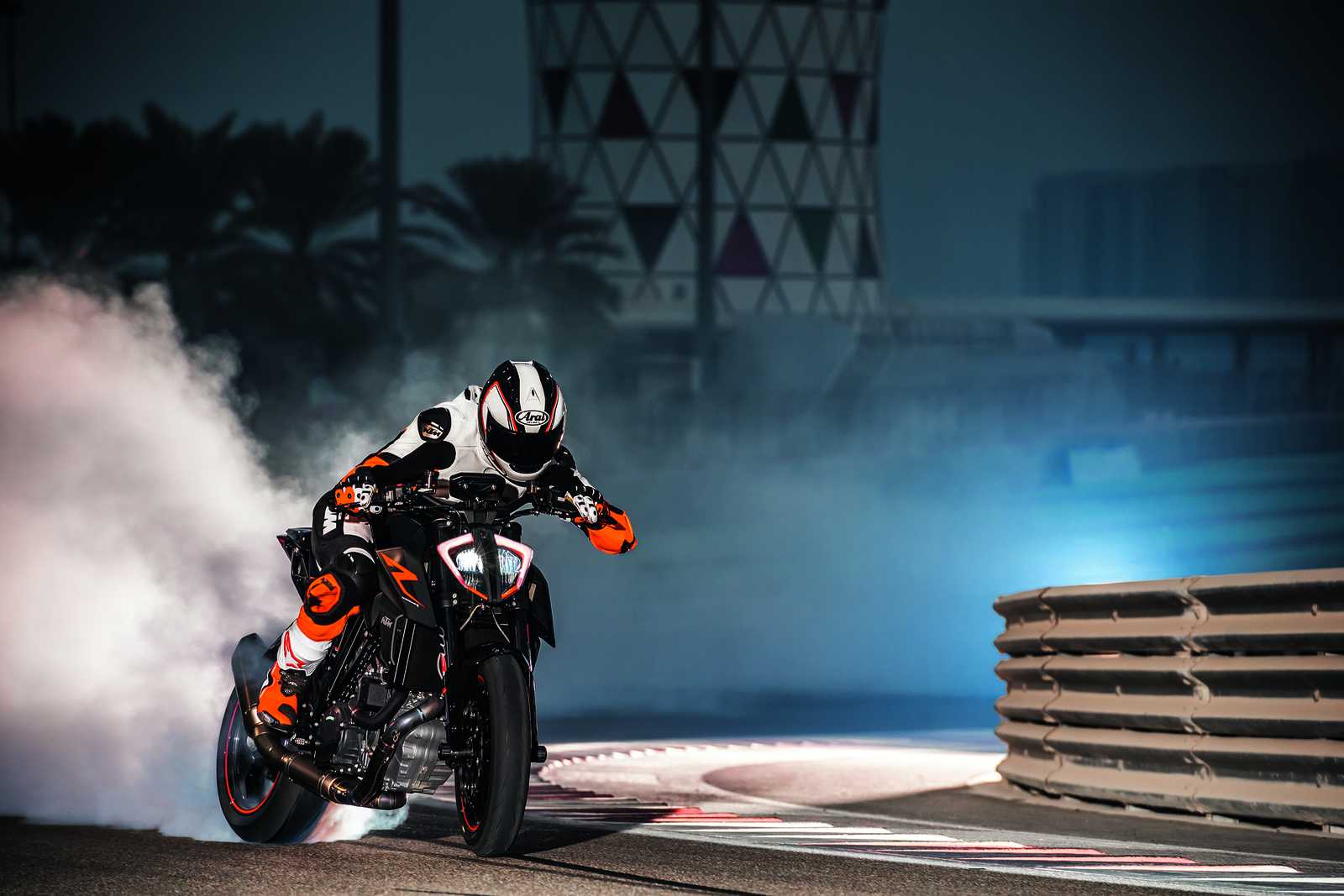
KTM Introduces 2017 1290 Super Duke R With More Power And New Electronics And Upgraded 390 Duke With Ride-By-Wire Throttle Body

It is with great pleasure that we introduce the 2017 KTM 390 DUKE, the sharpest power-to-weight weapon in the small NAKED class, and the extensively upgraded KTM 1290 SUPER DUKE R. Building off the success of the ADVENTURE range released in Cologne, Italy last month, KTM continues to increase the versatility and performance of each individual bike, ensuring that everybody is able to find just the right KTM for their specific requirements.

KTM 1290 SUPER DUKE R – THE BEAST 2.0 – NOTHING BUT THE BEST

Every part was reconsidered to perform on and off the racetrack for a truly READY TO RACE motorcycle. The innovative construction of the new LED headlight ensures that no unnecessary additional parts or weight are added. The new multifunctional TFT-dashboard displays all important information in a clear and bright display. A tremendous power-to-weight ratio ensures a dominating performance in any situation. The 1290 SUPER DUKE R now bristles with more power thanks to reworked cylinder head and intake, while new electronic features allow for class-leading rideability and convenience.

KTM 390 DUKE – CORNER ROCKET

New, aggressive styling proclaims that the 390 DUKE is a READY TO RACE naked motorcycle with the performance and handling to back it up. The bodywork is sharp and modern with a slammed, predatory stance. Up front, a new LED headlight and bright, full-color TFT digital dash boast features not found in this class of motorcycle. At the rear, an exposed bolt-on subframe sits below the redesigned seat and pillion. A new form-fitting 3.5-gallon steel fuel tank increases the 390 DUKE’s range. Putting the power to the ground is now smoother and more controllable than ever before thanks to the new ride-by-wire throttle. That power, combined with a steel trellis frame, a new 43 mm WP upside-down fork and a larger, more powerful 320 mm front brake rotor take the ride to the next level.

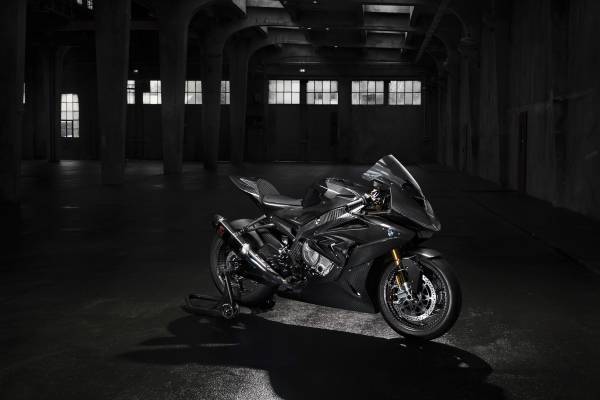
BMW Unveils Carbon-Fiber Framed HP4 RACE Prototype At EICMA Show

The most exclusive BMW motorcycle of all time: the BMW HP4 RACE. Advanced prototype with full carbon fiber main frame and carbon fiber rims presented at the EICMA in Milan. Serial production vehicle announced for 2017.

Munich/Milan.At this year’s EICMA, BMW Motorrad reveals an initial glimpse of the most exclusive model in its history to date: the BMW HP4 RACE.

It was initially left open as to how far the advanced prototype reflected what the final motorcycle would look like. The only definitive information provided by the Stephan Schaller, President BMW Motorrad, related to the frame and wheels: “The HP4 RACE will feature the full carbon fiber main frame and carbon fiber rims as shown here. We will reveal more about this model next spring.”

It is also certain that the BMW HP4 RACE will be manufactured by hand in an exclusive limited series and supplied in the second half of 2017.

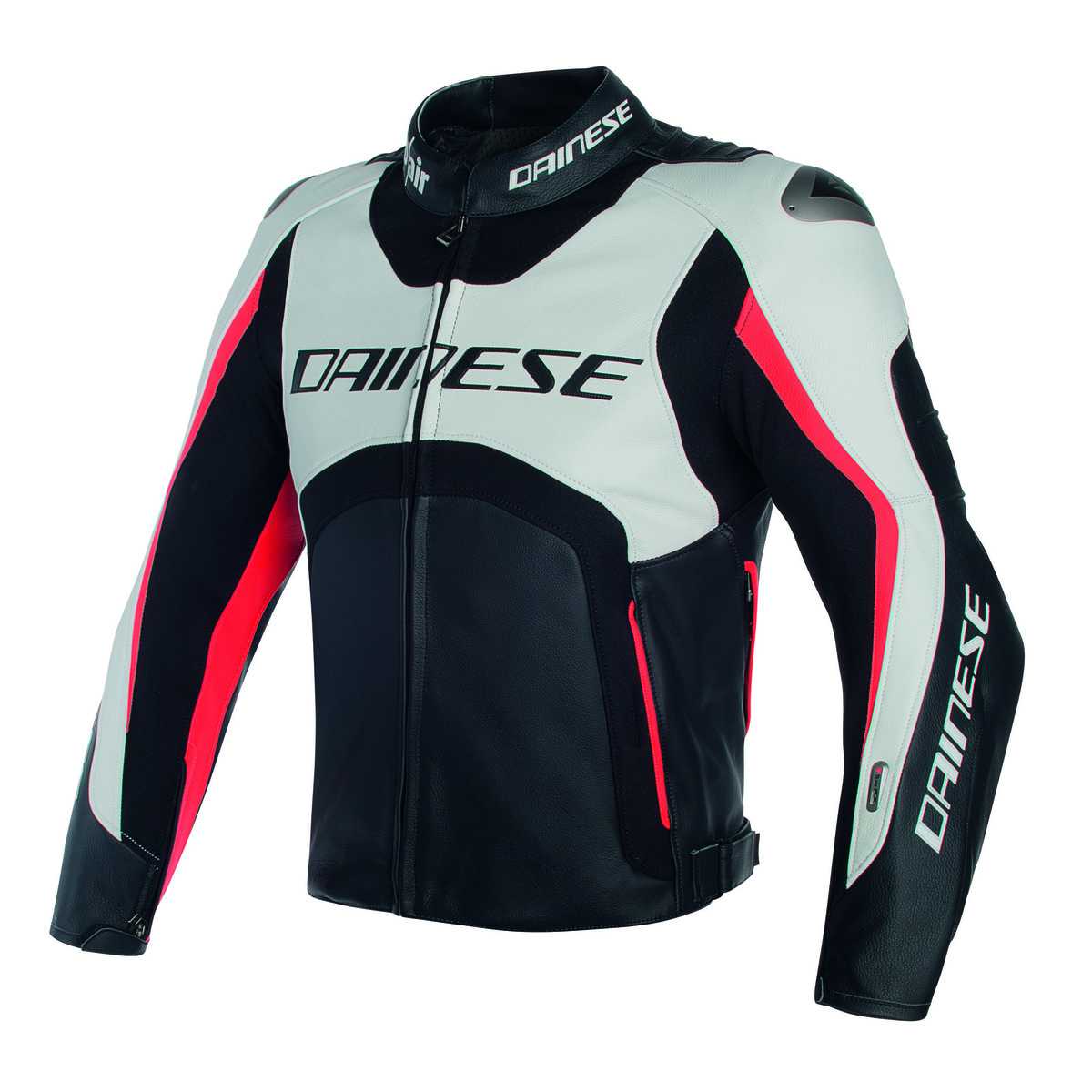
Dainese Introduces Street Gear With Airbags And New Energy-Absorbing Armor At EICMA Motorcycle Show

The Dainese Group Presents the New Generation of Head-to-Toe Protection Systems for Road Use

MILAN, Italy (Nov. 8, 2016) – Following the recent introduction of head-to-toe protection systems for motorcycle racing, such as the AGV Pista GP R helmet and the Dainese Mugello R D-air® racing suit, the Dainese Group is proud present the new generation of protection for road use, at EICMA.

After five years, Dainese returns to EICMA with important news in the world of protection and presents the new collection of D-air jackets for road use and the new family of certified Pro-Armor protectors.

The new Misano D-air, Cyclone D-air and Continental D-air jackets, dedicated respectively to sport, sport-touring and urban segments, integrate the brand-new D-air airbag system in its stand-alone version, which means no sensor kits need to be fitted to the motorcycle. Finally, the ultimate level of protection is available for all types of road use.

The proprietary 3D Dainese airbag is the heart of the system. Thanks to an internal structure made of micro-filaments, the airbag deploys in a controlled thickness over its full length and wraps around the rider’s body, providing at the same time maximum protection and comfort. The patented airbag is unique and differs from all other airbags used in the automotive industry. The pioneering Dainese airbag system has been further improved and now covers neck, collarbones, shoulders, chest and back.

The electronic platform and the algorithm—the brain and true intelligence of the system—have been further improved. Thanks to data acquired from six sensors (accelerometers and gyroscopes) and from the GPS housed in the back protector, the system monitors a rider’s dynamics 1000 times per second and deploys the system in the event of impact, high-side, and low-side with or without tumbling.

The system equips a new LED interface positioned on the forearm that keeps the rider informed about the system’s operating status. The new battery provides power for over 24 hours of continuous use (three times more than the previous battery), and the time needed for a full recharge is down to four hours.

The future of protection is in the air, and the data gathered by Dainese demonstrates just that. Over 1,200 deployments documented by the team at the Dainese Science and Research Center over 600,000 miles from tracks and roads all over the world confirm both the efficiency and reliability of the system. The analysis carried out on the massive amount of data acquired contributes to further refining the triggering algorithms of the technological platform. Sixteen years of constant research have led to 35 patents relating to the manufacture of airbags, triggering algorithms, the architecture of the electronic platform and the integration of airbags and protective clothing.

The new jackets use the latest-generation Pro-Armor back protector to house the electronic platform (sensors, GPS and battery) for the D-air airbag system, achieving unparalleled standards of comfort.

The new Pro-Armor family of protectors, composed of protectors for shoulders, elbows, back, chest, lumbar region, side and knees, follow an innovative design inspired by fractals, which nature uses to create complex structures. The fractal structure emphasizes the characteristics of the carbon-based elastomer that forms the protective component of the system. The carbon elastomer absorbs up to 83% of the force that strikes the safety device. The fractal-inspired design provides an extended perforated surface (43% in the case of the back protector) that works in perfect harmony with the variable depth of the protector to simultaneously provide superb freedom of movement, light weight, comfort and unmatched breathability.

AGV, the historical Italian brand, has fully reengineered its helmet interiors, extending the improvements introduced with the Pista GP R to its new range for road use. The Corsa R, Veloce S, K-5 S and Compact ST models feature entirely redesigned interiors, providing improved comfort and significant noise reduction.

“The Dainese Group confirms its total commitment to head-to-toe protection for all motorcyclists,” said Cristiano Silei, CEO of the Dainese Group. “Taking the D-air system from the sport to the touring and urban sectors is another significant milestone in the process of increasing the presence of our technology in the world of motorcycles.”

December 2016

0

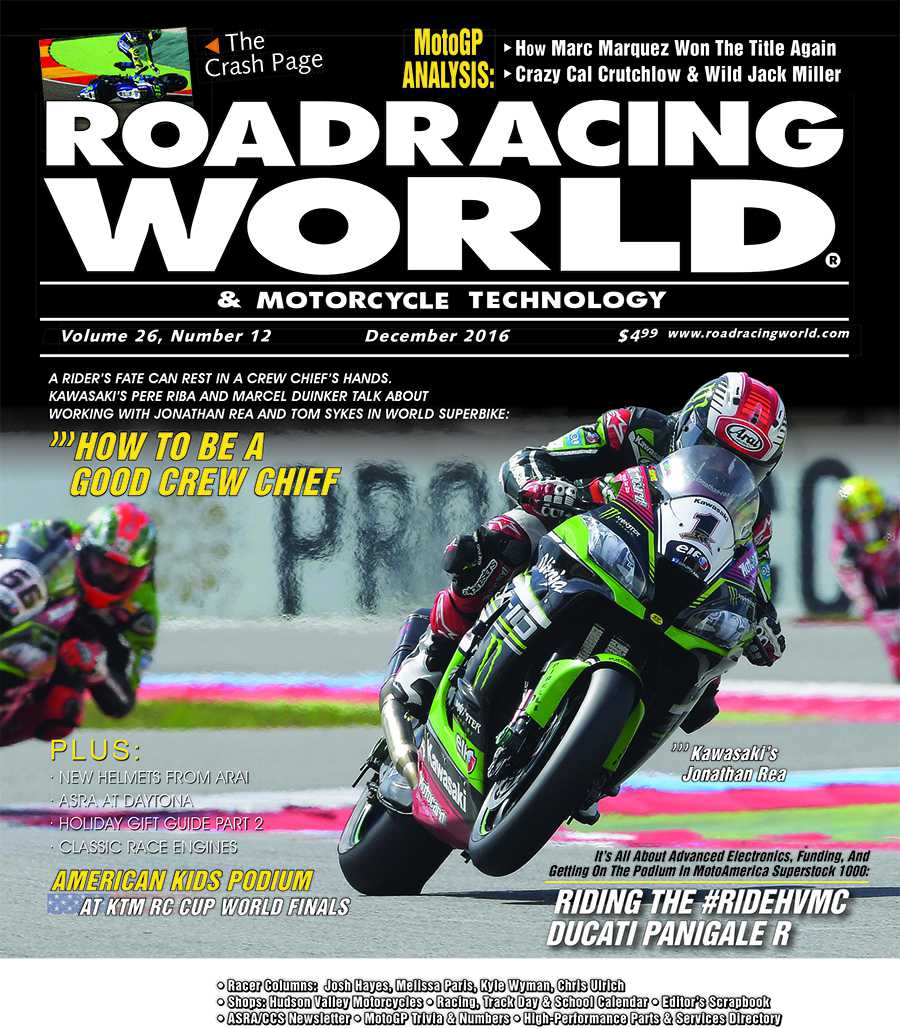
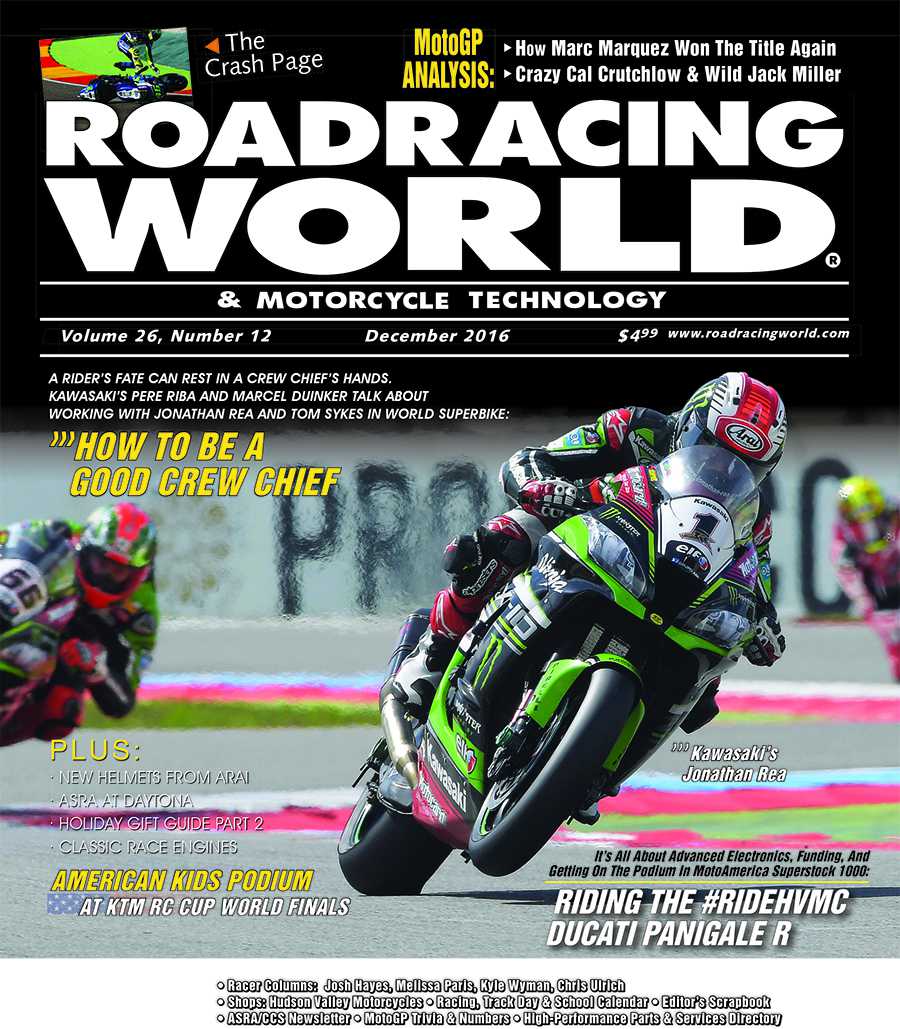
On The Front Cover: Kawasaki Racing Team’s Jonathan Rea (1) leads teammate Tom Sykes (66) in World Superbike. As this issue went to print, the team had won the Superbike World Championship twice in five years and was on the brink of winning the title a third time. Photo by Studio Milagro/DPPI Media.

Read the December 2016 issue of Roadracing World now with your online subscription.

Log in or subscribe HERE.

In This Issue:

FEATURES

Inside Info

Historic Racebike Illustrations: Classic Race Engines III

Racebike Review:

#RIDEHVMC 1000 Superstock Ducati Panigale R

2016 Holiday Gift Guide, Part Two

MotoGP Analysis:

Marc Marquez, On Learning “The Right Approach”

Cal Crutchlow & Jack Miller: MotoGP Winners And Pals

Lessons From The Best: How To Be A Good Crew Chief

Interview: Pirelli Moto Racing Director, Giorgio Barbier

Product Intro: Arai Quantum-X and Signet-X Helmets

Back In The Day: Editor’s Scrapbook

Shops: Hudson Valley Motorcycles

PROFESSIONAL RACING

MotoGP At Motegi: Marc Marquez Crowned

Motegi MotoGP Notes: Yamaha’s Disastrous Race

MotoGP At Phillip Island: Cal Crutchlow Wins Again!

Phillip Island MotoGP Notes: Yamaha Falls Behind

World Superbike At Magny-Cours: All Davies In Wet and Dry

World Superbike At Jerez: Davies Dominates Again

American Kids Podium: KTM RC390 Cup World Finals

SEMI-PRO AND CLUB RACING

ASRA National Championship at Daytona

Racer Profile: Drew Jankord

COLUMN

Letters To The Editor

10 Years Ago

MotoGP Trivia

Numbers

Josh Hayes: Mississippi Madman

Melissa Paris: Just A Girl Who Likes To Go Fast

Kyle Wyman: Where’s Wyman?

The Kids’ Page: Errol Sullivan

Racing, School, & Track Day Calendar

High Performance Parts & Services Directory

The Crash Page: Valentino Rossi

ASRA/CCS Newsletter

Classified Ads

Advertisers Index

Chris Ulrich: Adventures Of  An Ex-Racer  

The December 2016 Issue Of Roadracing World & Motorcycle Technology Is Now Available Online

0

On The Front Cover: Kawasaki Racing Team’s Jonathan Rea (1) leads teammate Tom Sykes (66) in World Superbike. As this issue went to print, the team had won the Superbike World Championship twice in five years and was on the brink of winning the title a third time. Photo by Studio Miligro/DPPI Media.

Read the December 2016 issue of Roadracing World now with your online subscription at www.roadracingworld.com/magazine/digital/.

In This Issue:

FEATURES

Inside Info

Historic Racebike Illustrations: Classic Race Engines III

Racebike Review:

#RIDEHVMC 1000 Superstock Ducati Panigale R

2016 Holiday Gift Guide, Part Two

MotoGP Analysis:

Marc Marquez, On Learning “The Right Approach”

Cal Crutchlow & Jack Miller: MotoGP Winners And Pals

Lessons From The Best: How To Be A Good Crew Chief

Interview: Pirelli Moto Racing Director, Giorgio Barbier

Product Intro: Arai Quantum-X and Signet-X Helmets

Back In The Day: Editor’s Scrapbook

Shops: Hudson Valley Motorcycles

PROFESSIONAL RACING

MotoGP At Motegi: Marc Marquez Crowned

Motegi MotoGP Notes: Yamaha’s Disastrous Race

MotoGP At Phillip Island: Cal Crutchlow Wins Again!

Phillip Island MotoGP Notes: Yamaha Falls Behind

World Superbike At Magny-Cours: All Davies In Wet and Dry

World Superbike At Jerez: Davies Dominates Again

American Kids Podium: KTM RC390 Cup World Finals

SEMI-PRO AND CLUB RACING

ASRA National Championship at Daytona

Racer Profile: Drew Jankord

COLUMN

Letters To The Editor

10 Years Ago

MotoGP Trivia

Numbers

Josh Hayes: Mississippi Madman

Melissa Paris: Just A Girl Who Likes To Go Fast

Kyle Wyman: Where’s Wyman?

The Kids’ Page: Errol Sullivan

Racing, School, & Track Day Calendar

High Performance Parts & Services Directory

The Crash Page: Valentino Rossi

ASRA/CCS Newsletter

Classified Ads

Advertisers Index

Chris Ulrich: Adventures Of An Ex-Racer  

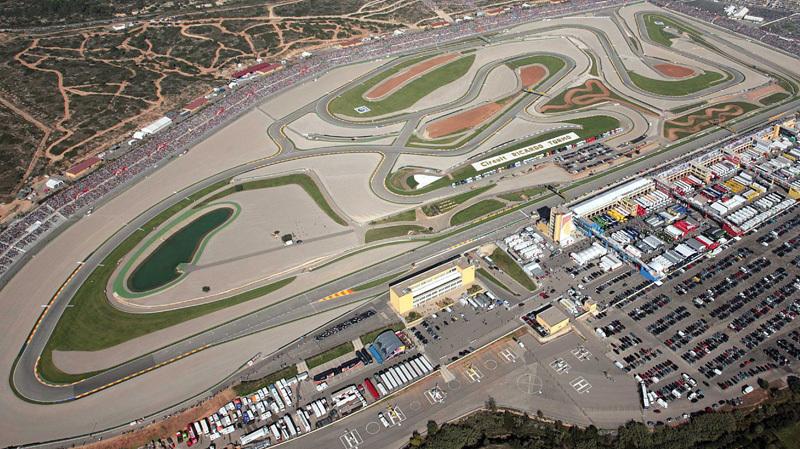
MotoGP World Championship Finale Happening This Coming Weekend At Valencia

Last call: can Valencia provide that perfect ten?

The Circuit Ricardo Tormo awaits, with a new era beckoning around the corner

The 2016 MotoGP™ season finale already has its place in history secure. The curtain call for a new era as half the grid move teams, Red Bull KTM Factory Racing make their debut, and the history-making 2016 season draws to a close, the Circuit de la Comunitat Valenciana is primed for another incredible end-of-season party. And after a history-making Malaysian GP, there’s that chance of a tenth winner.

No one could have imagined an honour roll with nine names on it when the season began. But that’s the incredible outcome of a truly historic season in the premier class of Grand Prix racing, after Andrea Dovizioso (Ducati Team) became the ninth different winner of the year in Malaysia.

With the Championship wrapped up, Marc Marquez (Repsol Honda Team) will be one of the first attempting to assure victory in Valencia for one of the nine who have already won this year. An error in Phillip Island when the pressure was off followed by an easy mistake to make in Malaysia mean the newly-crowned 5-time World Champion will be fired up as the paddock gets back on home turf – but so will the only other men to have won at the venue in over a decade: Jorge Lorenzo (Movistar Yamaha MotoGP) and Dani Pedrosa (Repsol Honda Team).

Lorenzo especially will be out for glory. Trying to secure third in the Championship and looking to end the season on a high, the race also sees the end of an era for the Mallorcan before he moves to the Ducati Team. After 3 MotoGP™ World Championships, 43 race wins and 106 podiums before the Spaniard’s final race in Yamaha colours approaches, the relationship is one that has played a key role in defining an era of MotoGP™. With wins at the track in 2010, 2013 and 2015, Lorenzo’s last dance in blue could be one to remember.

Valentino Rossi (Movistar Yamaha MotoGP) has a more difficult record at the Circuit Ricardo Tormo but, having secured P2 in the Championship in Sepang and finished the tough race on the podium, the Italian’s focus is solely forward and he has a point to prove behind enemy lines once again – having already spoiled the hometown party in Jerez and Catalunya, and staged a stunning fight through the field in Valencia in 2015.

As Lorenzo leaves the other side of the Yamaha garage, Rossi’s 2017 teammate will be another out for glory at home. Maverick Viñales (Team Suzuki Ecstar) is already a winner in 2016 at Silverstone, and will want to close out his incredible run with Suzuki as far towards the front as possible. With weather less likely to make life harder for the Hamamatsu factory machines, Viñales and teammate Aleix Espargaro will have their sights set squarely on the podium once again – at least – as they prepare to say goodbye to Suzuki.

Dani Pedrosa is the other man, along with Lorenzo, who has an incredible record at the track – but isn’t yet sure whether he will be fit to return after his highside in Motegi and collarbone break. Hoping to be able to contest the round on home turf, the venue will be a kind one for Pedrosa if he makes the grid – another of those circuits that sees his name penciled on a trophy before arrival, like Sepang: a race Pedrosa sat out.

Sepang winner Andrea Dovizioso will be one to watch after his incredible ride in Malaysia on a roll of good form, as well as teammate Andrea Iannone – who is another of the many on the grid whose future lies down a different path. His last race for the factory Ducati Team, after taking their first win since 2010 in Austria, will mean the ‘Maniac’ is sure to put on a good show once again. A frontrunner in Malaysia despite his ongoing recovery from cracked vertebrae, Iannone was back with a bang in Sepang.

After Cal Crutchlow (LCR Honda) crashed out in Malaysia, Valencia gives the Brit his final shot at securing the title of Top Independent team rider in 2016 – with Monster Yamaha Tech 3’s Pol Espargaro the only one in mathematical distance of the Brno and Phillip Island winner, and counting on home support. Espargaro is another of those who will be moving teams in the end of season shuffle – this time to KTM – and is set to remain alongside current teammate Bradley Smith in 2017.

The eyes of the world will be on Red Bull KTM Factory Racing in the season finale. Their first appearance, with test rider and GP winner Mika Kallio on board, will be the first benchmark for the Austrian factory as they prepare to line up on the grid full time next season – with a reputation for winning built on their incredible success in Moto3™.

Whatever hand Valencia deals for the season finale, one thing is sure: 2016 has been one for the record books – or more accurately, it’s rewritten them.

The final call for 2016 goes out at 9:00 local time on Friday (GMT +1), with lights out for the race on Sunday at 14:00.

MotoGP™ World Championship Standings

1 – Marc Márquez (SPA) HONDA 278 points

2 – Valentino Rossi (ITA) YAMAHA 236 points

3 – Jorge Lorenzo (SPA) YAMAHA 208 points

4 – Maverick Viñales (SPA) SUZUKI 191 points

5 – Andrea Dovizioso (ITA) DUCATI 162 points

Three-way fight for second after the triple-header

Lüthi, Rins and Morbidelli head into the final countdown

Johann Zarco (Ajo Motorsport) reigned the rain in Sepang, and in doing so took his second Moto2™ World Championship. The first Frenchman to win two titles in Grand Prix Racing and the first man to defend the Moto2™ crown since its introduction in 2010, Zarco heads into Valencia with the pressure he admitted to feeling now gone – and that pressure is now sitting on the shoulders of the men who sit behind him in the standings.

On the paddock’s arrival to Sepang, Tom Lüthi (Garage Plus Interwetten) was the man on the move. Taking over in second in the title and holding onto that after another top six in Malaysia, the Swiss rider’s comeback since his crash in Brno sees him head into the final round in the best position to secure second. With his form since missing the Czech GP matched by no other rider on the grid, and pressure not having seen him crack, Lüthi will be the odds-on favourite for P2.

Alex Rins (Paginas Amarillas HP40) had a tough triple-header and after cutting the gap to Zarco to one point, comes into the final round now on the defensive against a charging Franco Morbidelli (Estrella Galicia 0,0 Marc VDS). Rins is now six points ahead of the Italian in the standings as they sit in third and fourth respectively, but is returning to both home turf and home support in Valencia. Rins and Morbidelli also have a shot at taking second in the title in the final showdown – but will need Lüthi’s recent form to desert him. With Morbidelli ever present in the fight for the win, the Italian also has an added incentive: win his first Moto2™ race.

His teammate at Estrella Galicia 0,0 Marc VDS, Alex Marquez, will be on the hunt for another podium at home after his stunning ride at MotorLand Aragon – and the man in front of him on that day, Sam Lowes (Federal Oil Gresini Moto2), will be looming large in everyone’s mirrors as he attempts one last leap up the table before his move to MotoGP™. Jonas Folger (Dynavolt Intact GP) will also be looking to say goodbye to his intermediate class career with another win – with MotoGP™ just around the corner.

One final race, and one more shot at 25 points – the Circuit de Ricardo Tormo is ready for the last battle of another spectacular Moto2™ season.

Moto2™ World Championship Standings

1 – Johann Zarco (FRA) KALEX 251 points

2 – Thomas Lüthi (SWI) KALEX 214 points

3 – Alex Rins (SPA) KALEX 203 points

4 – Franco Morbidelli (ITA) KALEX 197 points

5 – Sam Lowes (GBR) KALEX 162 points

The fight behind Binder reaches fever pitch

24 laps of Valencia and so much still to play for

As the Moto3™ paddock prepare for their final battle of the year, 2016 World Champion Brad Binder (Red Bull KTM Ajo) returns to Spanish soil after last racing in the country at the Aragon GP and securing the crown. Crashing last time out in Sepang, the South African will be focused on winning one final Moto3™ race ahead of his move up to the intermediate class. One of the key men in his way is sure to be fellow 2017 Moto2™ rider Jorge Navarro (Estrella Galicia 0,0) – the local.

Navarro is from Valencia, and will have big home support from both his Fan Club and the crowd as he also prepares to bid adieu to Moto3™ with another victory. In addition, Navarro is facing down Enea Bastianini (Gresini Racing Moto3) – the man set to replace him at EG0,0 in 2017 – and Francesco Bagnaia (Pull&Bear Aspar Mahindra) for second in the Championship, and nothing will be left on the table.

Bagnaia was the man to make big gains in Sepang. Taking a stunning second career win with Navarro crashing out, the Italian moved up into third in the standings – but is only two points clear of the Spaniard. 19 points behind Bastianini in second, Bagnaia’s crosshairs are sure to be on Navarro at the Valencian’s home round.

Bastianini is hoping to be back on track after a crash at Phillip Island – where he was caught in the crossfire of a crash for John McPhee (Peugeot MC Saxoprint) and then collided with Navarro. The Italian has a points margin over compatriot Bagnaia of 19 points, and over Navarro of 21. If he is able to compete in Valencia, the goal will be taking P2 in the title – and that may only require a handful of points.

The exciting fight just behind the three-way battle for P2 sees another three riders locked in competition, this time for the coveted prize of Rookie of the Year. 2015 FIM CEV Repsol Moto3™ Junior World Championship winner Nicolo Bulega (Sky Racing Team VR46) leads that charge on 129 points, with Austrian GP winner Joan Mir (Leopard Racing) on 124 and Fabio Di Giannantonio (Gresini Racing Moto3) on 123. With all three of the riders knowing the track, the final rookie showdown – where every point counts – is sure to be an amazing show once again.

Last year, Navarro was on the podium, Binder just off it – and Bulega in the points as a wildcard. Now, just 24 laps of the Circuit Ricardo Tormo remain to bid adieu to the spectacular 2016 Moto3™ season – with so much still to play for.

Moto3™ World Championship Standings

1 – Brad Binder (RSA) KTM 294 points

2 – Enea Bastianini (ITA) HONDA 164 points

3 – Francesco Bagnaia (ITA) MAHINDRA 145 points

4 – Jorge Navarro (SPA) HONDA 143 points

5 – Nicolo Bulega (ITA) KTM 129 points

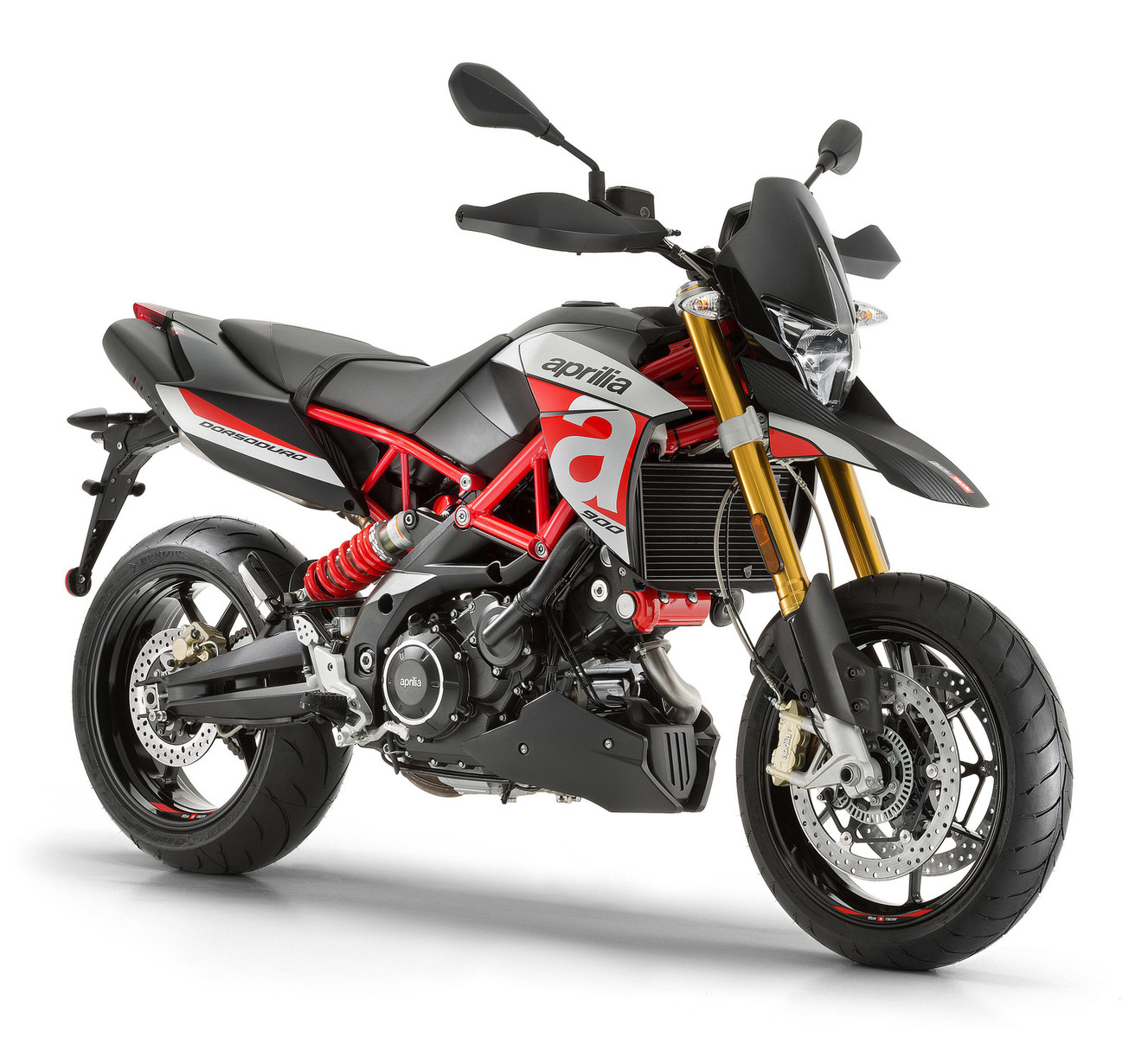
Aprilia Introduces New Dorsoduro 900 And New Shiver 900

THE THRILL SEEKER’S MOTORCYCLE FROM APRILIA EVOLVES WITH THE SOLE OBJECTIVE OF PROVIDING MAXIMUM RIDING ENJOYMENT. MORE PERFORMANCE FROM THE REVAMPED TWIN-CYLINDER ENGINE, A TIGHTER RIDE AND BETTER HANDLING FROM THE REFINED CHASSIS ARCHITECTURE AND THE BEST AVAILABLE TECHNOLOGY

Aprilia Dorsoduro is the fun bike par excellence. Born out of an ingenious intuition by Aprilia, it was built with the sole objective of providing the most possible road riding fun, drawing from the best characteristics of sport bikes with the best characteristics of a supermotard. The result is a bike with advanced technical solutions, agile and with performance at the top of its category. A truly unique bike, achieved not only thanks to Aprilia’s skills in packaging particularly efficient chassis architectures combined with high performance powerplants, but also thanks to collaboration with the Aprilia Racing Department, which has earned 54 world titles, 7 of which were claimed in world Supermoto championship.

Dorsoduro 900 is born out of Aprilia’s solid tradition in this motorcycle segment and it is a true thrill generator. The exclusivity is also due to its original and innovative technical choices, like the mixed steel trellis/aluminum plates frame with excellent handling and tight cornering characteristics. The 90° V-twin engine puts a smile on the rider’s face every time the throttle is twisted, thanks to new characteristics of maximum torque and power that amplify its personality. The fine electronic management that includes, besides the Ride-by-wire multi-map accelerator, traction control and ABS, complete the technical equipment on the Dorsoduro 900.

The Design: The Balancing Point Between Form and Function

The Aprilia Dorsoduro 900 project places riding fun at the center of its focus: for this reason, the superstructures are reduced to the minimum indispensable, as anything that is not essential for performance and maximum riding pleasure has been foregone. The technical elements, on the other hand, play a fundamental role, becoming a fundamental part of the design. It is not just the hand guards on the handlebar and the number plate on the front that highlight the close bond with the racing world. The shape of the center area, the one that most involves the rider during sport riding, also highlights the design created to achieve optimized and compact dimensions that allow the rider to find the right feeling straight away. Aprilia engineers achieved this result by designing a long and flat saddle, clearly derived from the sports world, capable of ensuring the most effective riding position at all times and allowing plenty of room for longitudinal movement. The tail is one of the most representative aesthetic aspects of the Dorsoduro: sleek and slender, it also houses the double exhaust, a solution that allows for excellent proportional symmetry and weight distribution.

Better Performance from the Revamped V-twin Engine

Starting from the 750cc 90° V-twin engine base, well-known and popular because of its character and reliability, Aprilia developed a new 900cc unit with the goal of obtaining more torque and response at low and medium rpms for a thrilling riding experience. The Aprilia V-twin was therefore revisited in numerous details to achieve this purpose. The new engine capacity was obtained by increasing the stroke from 56.4 mm to 67.4 mm and leaving the bore unchanged (92 mm). By doing so, maximum power now peaks at 95.2 HP at 8,750 rpm, but more important is the maximum torque value that goes from 82 Nm (60.48 lb ft) at 4,500 rpm on the 750cc V-twin to 90Nm (66.38 lb ft) at 6,500 rpm on the new 900cc V-twin, a value that is truly at the top of its category. It should be noted that, despite the fact that maximum torque peak for the new 900cc V-twin is reached at higher rpms, the torque curve is more flat and always higher than the 750cc predecessor. This change allowed the acceleration response to be increased, all to the advantage of a fun ride, without limiting in any way whatsoever the proverbial reliability of the powerplant, that in any case, now benefits from a new internal lubrication circuit capable of limiting power loss due to churning and lubrication consumption. The exhaust system, fitted with a double oxygen sensor, contributes to bringing the engine to within the limits established by the Euro 4 pollution standard.

New Electronic Management

Electronic engine management is now handled by the new and more powerful Marelli 7SM ECU that communicates with the new full Ride-by-wire electronic accelerator system, completely built into the throttle grip. This system allows even more accurate management of the fuel/air mixture and the injection throttle valve opening based on numerous parameters including engine speed, gearbox position, air flow (in quantity and speed), throttle grip and temperature, with great benefits in terms of smooth riding without opening/closing jerks, containment of harmful emissions and fuel consumption. The engine is, therefore, always able to distribute the ideal torque and provide the best acceleration, all to the advantage of a satisfying and fun machine to ride.

The system also allows a weight reduction of 550 grams compared to the previous Ride-by-wire that equipped the Dorsoduro 750. The sophisticated electronic management also provides the possibility of changing the engine mapping, radically changing the character of how the power it is capable of developing is unloaded onto the ground. The Sport setting provides an immediate and aggressive throttle response; the Touring logic provides a smoother response, ideal for touring and daily use, whereas the Rain map is ideal in the event of difficult weather conditions or on slippery road surfaces. Dorsoduro 900 introduces a new Aprilia traction control system with sensitivity adjustable to three levels (it can also be disabled) to limit rear wheel spin by acting on ignition and the injection throttle valves.

The Dorsoduro 900’s Aprilia Traction Control system is combined with a Continental two-channel ABS system that can also be disabled, with developed calibration in order not to take anything away from the sport-dedication of the ride. The new electrical system places the engine control and management systems in communication with the new color TFT digital instrumentation. The compact unit with a 4.3-inch screen contains a wealth of information that is always highly legible thanks to the light sensor detection capabilities. One of the optional features is the AMP (Aprilia Multimedia Platform) installation kit, the package that connects a smartphone to the vehicle to provide an exceptional quantity of information useful for the ride: the new instrumentation lets you view all the data related to incoming/current calls on the screen, as well as intercom or audio details you may be utilizing.

Chassis Architecture: Better Handling and Control

Aprilia bikes have always been considered a point of reference for their excellence in chassis architecture. The Dorsoduro 900 chassis provides high characteristics of efficiency, balance, a tight ride and precision even in extreme track riding, but at the same time it is easy and intuitive for daily use. These qualities are the merit of the particular layout of its various elements.

The frame takes advantage of the solutions Aprilia has developed in racing competitions, drawing deeply from the experience gained on the mixed structures used in the Supermoto world championship. The trellis upper part in steel tubing (now painted red, like the saddle support frame) is combined with wide spread aluminum lateral plates using special, high-resistance bolts. The result is an extremely rigid and lightweight structure, the best solution for taking full advantage of the revamped capacity of the 900cc V-twin, with an aesthetic impact that communicates light weight, extremely high technical content, and Italian style.

Another strongly distinctive technical feature is the lateral and inclined positioning of the shock absorber, a unit that is adjustable in spring preload and hydraulic rebound. This solution has created precious space for an optimum exhaust manifold layout, without having an impact on the length of the bike and without stressing the shock absorber thermally. The aluminum swingarm is sized to withstand the asymmetrical stress due to the lateral positioning of the shock absorber and it boasts the torsional stiffness and elasticity characteristics indispensable for precision at rest and the ride feeling in transitory stages.

On the Dorsoduro 900 a new Kayaba fork makes its début (combined with forged aluminum steering yoke plates), 450 grams lighter, adjustable in hydraulic rebound damping and spring preload and better capable of withstanding the stress of sport riding and absorbing bumps on the road surface, providing control in aggressive riding and greater comfort for those more relaxed rides. The overall improved performance of both the Dorsoduro 900 suspension systems is also due to the new pair of three-split-spoke wheels, more than 2 kg lighter than those that equipped the Dorsoduro 750. Reducing the gyroscopic effect increases handling and acceleration, as well as providing benefits for suspension performance due to reduction of unsprung masses.

The Dorsoduro 900’s top shelf chassis structure is completed by a sport-derived braking system. The front end relies on radial 4-piston callipers and a pair of 320 mm steel floating discs, lightweight and capable of guaranteeing reduced braking distances and excellent modulation. The 240 mm rear disc is gripped by a single-piston calliper. Both the front and rear systems have metal braided lines derived from the aeronautic sector, which eliminate the annoying buffering effect of conventional lines and guarantee precision and resistance to force.

Original Aprilia Accessories Range: Sport and Touring

A wide range of accessories dedicated to sport and touring is available for the Dorsoduro 900 as well. The former highlight the sport soul and the unmistakable Aprilia racing character: parts in precious carbon, billet aluminum components, such as brake and clutch fluid reservoir covers, brake and clutch levers and mirrors, as well as the must-have frame guard and fork bumpers. The accessories dedicated to touring increase the comfort of the Dorsoduro 900, such as the comfort saddle, side panniers and the seat bag. As with the other Aprilia motorcycles, the Aprilia Multimedia Platform is available which, thanks to Bluetooth connectivity and the interface with handlebar controls and the new TFT display, allow the rider to manage and share all the trip information, from data on more sport-oriented riding to touring-related information, with indications on consumption, routes and trip speeds, grip conditions and even Aprilia dealerships.

APRILIA DORSODURO 900 – TECHNICAL SPECIFICATIONS

Engine type

Aprilia V90 Longitudinal 90° V-twin engine, 4-stroke, liquid cooled, double overhead camshaft with mixed gear/chain timing system, four valves per cylinder, Ride-by-wire system

Fuel Unleaded petrol

Bore and stroke 92 x 67.4 mm

Total engine capacity 896.1 cc

Compression ratio 11 : 1

Maximum power at crankshaft 70.0 kW (95.2 HP) at 8,750 rpm

Maximum torque at crankshaft 90.0 Nm (9.17 kgm) at 6,500 rpm

Fuel system

Integrated engine management system. Injection with 3-map Ride-by-wire throttle valve opening management (Sport, Touring, Rain) 

Ignition Digital electronic, integrated with the injection

Starter Electric

Exhaust 100% stainless steel 2-in-1 with 3-way catalytic converter and oxygen sensor

Alternator 450 W at 6,000 rpm

Lubrication Wet sump

Gearbox

6 speeds, drive ratio:

1st 14/36 (2.57) 

2nd 17/32 (1.88) 

3rd 20/30 (1.5) 

4th 22/28 (1.27)

5th 23/26 (1.13) 

6th 24/25 (1.04)

Clutch Multiplate wet clutch, hydraulically operated

Primary drive Straight cut gears, drive ratio: 38/71 (1.87)

Secondary drive Chain-driven

Frame

Modular tubular steel frame fastened to aluminum side plates by high strength bolts. Dismountable rear frame

Front suspension

Upside-down fork, stanchions ? 41 mm. Adjustable hydraulic rebound damping and spring preload. Wheel travel 160 mm.

Rear suspension

Aluminum alloy swingarm

Hydraulic shock absorber with adjustable extension and spring preload

Wheel travel 160 mm.

Brakes

Front: Dual 320 mm stainless floating discs. Radial, four-piston callipers.

Metal braided brake hose

Rear: 240 mm stainless steel disc. Single piston calliper. Metal braided line.

Continental two-channel ABS system

Wheel rims

Aluminum alloy

Front: 3.50 X 17″ Rear: 6.00 x 17″

Tires Radial tubeless tires; Front: 120/70 ZR 17, Rear: 180/55 ZR 17

Dimensions

Max length 2210 mm (87.0 inches)

Max width 905 mm (35.6 inches) at the handlebar

Max height 1100 mm (43.3 inches) at the instrument cluster

Saddle height 870 mm (34.2 inches)

Wheelbase 1500 mm (59.0 inches)

Trail 108 mm (4.2 inches)

Steering angle 26°

Tank 12 liters (3.17 gallons)

More, from another press release issued by Aprilia:

2017 APRILIA SHIVER 900

THE NAKED BIKE FROM NOALE GROWS IN DISPLACEMENT WITH A NEW EURO 4 TWIN-CYLINDER CAPABLE OF MORE THAN 95 HP AND 90 NM OF TORQUE

NEW PERFORMANCE COMBINED WITH AN ABSOLUTELY TOP SHELF FRAME FOR A RIDEABILITY THAT RAISES THE BAR TO NEW HEIGHTS IN THE NAKED SPORT BIKE SEGMENT

AN INTUITIVE, POWERFUL, AGILE AND TECHNOLOGICAL BIKE IS BORN IN THE BEST APRILIA TRADITION, DEDICATED TO ABSOLUTE RIDING PLEASURE

As always, Aprilia makes refined mechanics and an excellent chassis structure the winning values on its new bike. The new Aprilia Shiver 900 evolves the original project of a bike that, from its first appearance on the scene in 2007, marked a turning point as the first factory bike fitted with ride-by-wire technology to manage engine throttle valve electronics. A technological first from Aprilia derived directly from the racing world, the Aprilia Cube, in fact, was the first MotoGP bike to use this technology in 2002 and since then all of the global manufacturers have followed suit.

The Aprilia Shiver 900 increases in performance, thanks to the new 900 V-twin engine, capable of increasing not only the power, but more importantly, the maximum torque delivered at any rpm at top levels for its category. More power and more character that translate into great riding satisfaction without sacrificing the ease and comfort that have always been characteristics of the Aprilia Shiver. It stems from a bike that has made novice and expert riders alike fall in love, thanks to its chassis architecture that, in the best Aprilia tradition, draws on the know-how of a manufacturer that has won 54 world titles in its brief history and that currently has bikes in premier competitions like MotoGP and Superbike.

The new superstructures – fuel tank covers, side panels, tail fairing, front mudguard – a profound revamp to the aesthetics make the new naked sport bike from Noale stand out at a glance. The new twin cylinder also stands out for its aggressive features highlighting its distinct sport character: the wheels, frame, shock spring and the cylinder head covers are now painted red.

The instrument cluster is completely new and made up of modern TFT technology to ensure information is perfectly legible. The large, 4.3” screen (the same one used on the new Aprilia RSV4 and Aprilia Tuono 1100 V4 versions) allows all on board information to be clear at all times, thanks in part to its capacity of adapting the background and font colors based on light sensor detection of conditions. Connectivity with your smartphone, provided as an accessory with the AMP (Aprilia Multimedia Platform) kit, also provides the data related to incoming/active calls on the screen, as well as information related to the use of an intercom or any audio files being played.

For the first time, the easy to ride, powerful and technologically advanced Aprilia Shiver 900 now has an advanced traction control increasing safety while ensuring dedicated performance. From stop and go to flowing routes, mountain passes to touring treks, even long range the Shiver 900 invites you to fasten your helmet and set off in search of the best sensations on two wheels.

A New Engine, New Power

The new Euro 4 engine grows to 900cc from the 750cc on the first version. This increase was achieved thanks to the increased stroke that means the power at the shaft exceeds the threshold of 95 HP and, more importantly, significantly increases torque at medium rpms, all to the advantage of pick up power during acceleration and coming out of corners. The 90 Nm (66.38 lb ft) of torque at 6,500 rpm that are consequently obtained guarantee pure fun in the saddle.

The new powerplant maintains the 90-degree angle between the two cylinders, as well as a timing system with four valves per cylinder, dual overhead cam and liquid cooling. On the other hand, the engine now has a more efficient lubrication circuit and the new Marelli 7SM ECU.

The new Shiver 900 receives the full benefits of Aprilia’s extensive experience in electronic control systems and riding support for which the Aprilia RSV4 – the supersport bike that has won seven World SBK titles (three Rider and four Manufacturer) in its racing version and that is consistently at the top of its category in the street version – is an unrivalled example.

Out of this experience and from this Aprilia technological first, the Shiver 900 features an advanced traction control system that guarantees maximum safety, but also pure brilliant riding enjoyment thanks to the dual control that acts on both ignition and on the motorized throttle valves, making its intervention smooth and easy to manage.

The Ride-by-wire feature, that made its début as standard equipment for a factory bike on none other than the first Shiver version, also changes and evolves. On this latest version, the system becomes lighter thanks to a reduction in weight of more than half a kilo.

The exhaust pipes, one of the characterizing aesthetic elements of the Aprilia Shiver with their placement under the saddle to give the side view of the bike an extremely clean look, have also been redesigned. They maintain the original position, but the end of the silencer is shorter and directed upward. The exhaust flow is now directed downward and to the side in order to prevent interference with the passenger and to guarantee greater comfort.

A Chassis Architecture Worthy of the Aprilia Tradition

The performance provided by the new engine is perfectly matched to an ultra-fine chassis architecture, easy to ride and intuitive, but at the same time incredibly high performance that, in the best Aprilia tradition, is simply unmatched in the category. In fact, the mixed steel trellis/aluminum plates frame provides standard-setting stiffness, defines an extremely compact bike and ensures that it is capable of catering to all riders with no problem, as well as enhancing the riding skills of more expert motorcyclists. This makes technical routes a favorite playground for the Shiver 900.

The Shiver 900 structure takes advantage of all the proverbial Aprilia know-how where frames are concerned and draws from the on-track experience gained in the Supermoto competitions where Aprilia boasts no less than seven World Titles. The trellis upper part in steel tubing is connected to wide spread aluminum lateral plates using special, high-resistance bolts. The combination formed by these elements forms an extremely stiff and lightweight frame, an extremely rational and excellent solution for reining in all the horses of the new Aprilia V90.

The contained longitudinal development of the engine has led to obtaining an agile bike, a feature that also benefits from the choice to position the shock absorber laterally. Thanks to this solution, space was created for the exhaust manifolds that have a shape and volume calibrated to perfection in order to get the best performance from the engine. This has allowed for an optimum

exhaust manifold layout, without having a significant impact on the length of the bike and without thermally stressing a fundamental riding element like the shock absorber.

The aluminum alloy swingarm with stiffening truss boasts stiffness values at the top of its category and it is sized to withstand the asymmetrical stress of the laterally positioned shock absorber.

Aprilia Shiver 900 adopts a new 41 mm stanchions Kayaba fork, almost a half kilo lighter than the one mounted on the first version, adjustable in hydraulic rebound damping and spring preload, with chill cast feet to support the radial callipers. The 120 mm travel lets you smoothly tackle urban and mountain routes. The two steering yoke plates are made of forged aluminum.

Rear shock absorber, mounted on the side, is pivoted directly to the swingarm, following the cantilever layout. Adjustable spring preload and hydraulic rebound, with rear wheel travel of 130 mm.

The sporty, three-spoked rims are also new, inspired by the standard Aprilia Tuono V4 wheels and contributors to containing the weight, reducing the front by 0.9 kg and the rear by 1.3 kg. This leads to a drastic reduction of the gyroscopic effect and therefore greater agility for the bike, improved suspension functionality thanks to the reduction of unsprung masses and quicker acceleration. The new wheels come with 120/70 front tires and 180/55 on the rear.

The braking system, equipped with two-channel ABS, implements radial callipers to highlight the sport-orientation and 320 mm discs on the front, and single-piston calliper with a 240 mm disc in the rear. Both front and rear systems have metal braided lines derived from the aeronautic sector, eliminating buffering effect of conventional lines while guaranteeing maximum braking precision.

Original Aprilia Accessories Range: Sport and Touring

A wide range of accessories dedicated to sport and touring is available for the Shiver 900 as well. The former highlight the sport soul and the unmistakable Aprilia racing character: parts in precious carbon, billet aluminum components, such as brake and clutch fluid reservoir covers, brake and clutch levers and mirrors, as well as the must-have frame guard and fork bumpers. The accessories dedicated to touring increase the comfort of the Shiver 900, such as the comfort saddle, side panniers and the seat bag. As with the other Aprilia motorcycles, the Aprilia Multimedia Platform is available which, thanks to Bluetooth connectivity and the interface with handlebar controls and the new TFT display, allow the rider to manage and share all the trip information, from data on more sport-oriented riding to touring-related information, with indications on consumption, routes and trip speeds, grip conditions and even Aprilia locations.

2017 Aprilia Shiver 900

Technical specifications

Engine type

Aprilia V90 Longitudinal 90° V-twin engine, 4-stroke, liquid cooled, double overhead camshaft with mixed gear/chain timing system, four valves per cylinder

Fuel

Unleaded petrol

Bore and stroke

92 x 56.4 mm

Total engine capacity

896.1 cc

Compression ratio

11 : 1

Maximum power at crankshaft

70 kW (95.2 HP) at 8,750 rpm

Maximum torque at crankshaft

90 Nm (9.17 kgm) at 6,500 rpm

Fuel system

Integrated engine management system with Ride-by-Wire.

Ignition

Digital electronic, integrated with the injection.

Starter

Electric

Exhaust

100% stainless steel 2-in-1 exhaust system with three-way catalytic converter and oxygen sensor

Alternator

450 W at 6,000 rpm

Lubrication

Wet sump

Gearbox

6 speeds, drive ratio:

1st 36/14 (2.57)

2nd 32/17 (1.88)

3rd 30/20 (1.5)

4th 28/22 (1.27)

5th 26/23 (1.13)

6th 25/24 (1.04)

Clutch

Multiplate wet clutch, hydraulically operated

Primary drive

Straight cut gears, drive ratio: 38/71 (1:1.87)

Secondary drive

Chain. Drive ratio: 16/44

Frame

Modular tubular steel frame fastened to aluminum side plates by high strength bolts. Dismountable rear frame.

Front suspension

Upside-down fork, stanchions ? 41, with adjustable hydraulic rebound damping and spring preload. Wheel travel 120 mm.

Rear suspension

Aluminum alloy swingarm with stiffening truss.

Hydraulic shock absorber with adjustable extension and spring preload Wheel travel 130 mm.

Brakes

Front: Dual 320 mm stainless steel floating discs. Radial, four-piston callipers. Metal braided brake line

Continental two-channel ABS system

Rear: ?240 mm stainless steel disc. Single piston calliper. Metal braided line.

Wheel rims

Aluminum alloy

Front: 3.50 X 17″ Rear: 6.00 X 17″

Tires

Radial tubeless tires;

Front: 120/70 ZR 17

Rear: 180/55 ZR 17

Dimensions

Max length 2,120 mm (83.5 inches)

Max width 800 mm (31.5 inches) at the handlebar

Max height 1,135 mm (44.7 inches) at the instrument cluster

Saddle height 810 mm (31.9 inches)

Wheelbase 1,440 mm (56.7 inches)

Trail 109 mm (4.3 inches)

Steering angle 25.9°

Tank

15 liters (3.96 gallons)

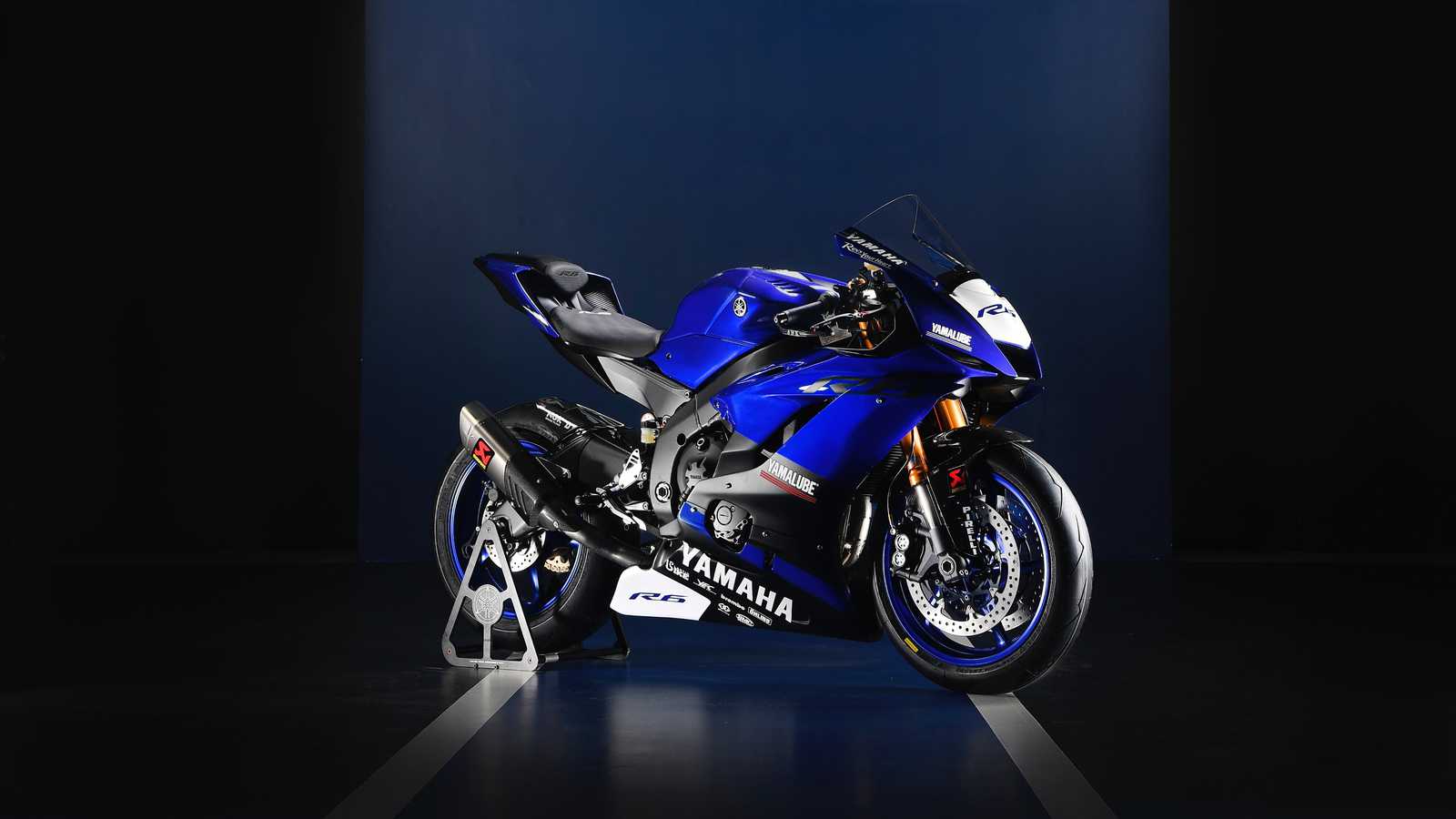
Yamaha Planning To Field New YZF-R6 In 2017 FIM Supersport World Championship

Yamaha Reveals the Race Ready 2017 YZF-R6

Yamaha Motor Europe N.V. welcomed all thrill seekers into ‘ouR World’ with the launch of the race-ready YZF-R6 during the EICMA International Motorcycle Exhibition in Milan. Inspired by YZR-M1 technology with the distinctive R-Series design, the showcasing of this full-blooded racing machine was Yamaha’s first step in preparing its customers and racers for what’s to come in the next year, when the YZF-R6 will demonstrate its racing excellence on track, chasing glory in the 2017 FIM Supersport World Championship.

GRT Yamaha Official WorldSSP Team’s Lucas Mahias and Federico Caricasulo as well as Kallio Yamaha Supported WorldSSP Team’s Niki Tuuli and Sheridan Morais attended the EICMA Press Conference to get a first glimpse of the 2017 YZF-R6. This new middleweight Supersport bike is incredibly similar to their racing bikes for next season due to the championship’s regulations that only allow very subtle alterations made to the consumer bike’s cylinder head, gearbox, suspension, rear shock, front fork, electronic system and brake disks.

Having won the FIM Supersport World Championship three times in the last seven years (2009: Cal Crutchlow / 2011:Chaz Davies / 2013: Sam Lowes), the YZF-R6 has already proved it’s top of the line, but that hasn’t stopped Yamaha from taking it one step further with the new 2017 model.

M1 and R1-inspired design

As the YZF-R6 is to re-enter the WorldSSP Championship in 2017, Yamaha have completely restyled the 600cc Supersport bike with a radical new look to match its ambitions. The new design is clearly inspired by the latest generation MotoGP and WorldSBK models – the M1-type central forced air intake, recessed LED twin headlights and new YZF-R1 style tail just being three examples – giving the bike an intense look that’s instantly recognizable as being a member of the R-series family, while its own unique character still shines through.

Most efficient YZF-R6 aerodynamics

The YZF-R6 is known for its light handling, agility and speed. Yamaha’s Supersport design team has been working relentlessly to push the performance in each of these areas and their hard work has paid off. A new front cowl, windscreen and a low drag front fairing, developed using some of the key elements from the YZF-R1, give a significant improvement of 8% in aerodynamic efficiency. Additionally, the YZF-R6 also comes with a new slimline magnesium rear subframe that’s 20mm narrower at the front, allowing the rider to tuck in more closely to the tank for a more streamlined rider position, while a newly designed seat and rear subframe make it quicker and easier for the rider to shift his body weight.

Sophisticated electronic control technology

The YZF-R6 has always been a frontrunner, both in terms of getting the results on track and being the first to adopt innovative technology. Besides being equipped with a Yamaha Chip Controlled Throttle (YCC-T) and a Yamaha Chip Controlled Intake (YCC-I) for a high degree of controllability in a wide range of conditions, the new YZF-R6 comes with an advanced Traction Control System (TCS) that is adjustable by a switch on the handlebars. The YZF-R6 also comes equipped with a new Quick Shift System (QSS) for even faster gear changing. This system is similar to the design used on the YZF-R1, and instantly cancels drive torque when an upshift is detected – enabling full throttle clutchless upshifts for outstanding acceleration through the close ratio 6-speed transmission.

Special Racing Component

Other outstanding bike features of the YZF-R6 displayed at EICMA include the full race fairing (consisting of a two-piece front and single piece seat), an Akrapovic Evo full Titanium exhaust, dual Brembo T-drive front brakes (disc Ø 320 mm), single Brembo rear brake (disc Ø 220 mm), telescopic forks (Ø 43 mm) front suspension with Ohlins Cartridge kit, and threaded Pirelli Diablo tyres (front: 120/70 ZR17M/C, rear: 180/55 ZR17M/C) as per championship regulations.

Alongside the genuine accessories, the showcased racing features are all available through the official Yamaha dealer network.

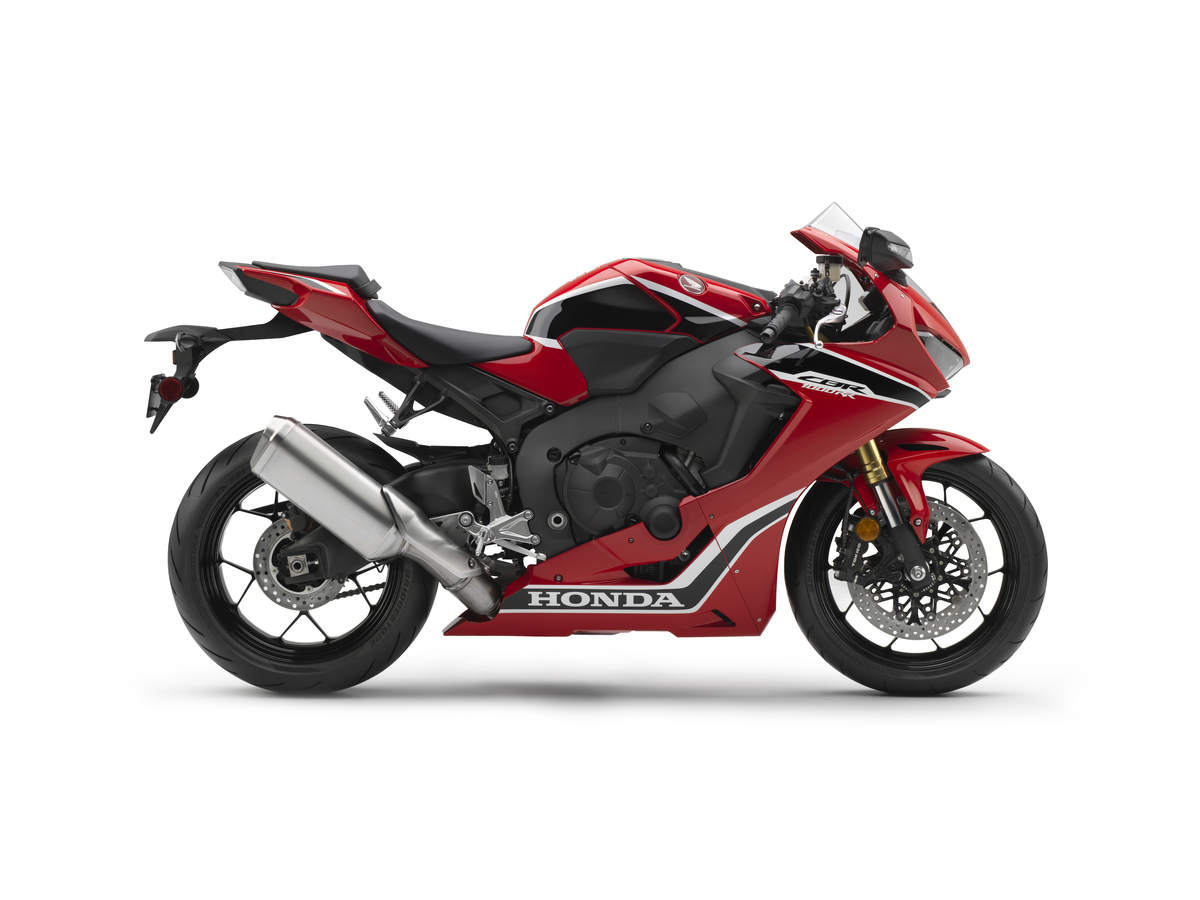
Standard 2017 Honda CBR1000RR To Come With Power Boost, Weight Reduction, Advanced Electronics

Honda today unveiled a new adventure-focused model known as the CRF250L Rally. Inspired by the factory CRF450 Rally machine raced in the Dakar by Team HRC, and based on the standard CRF250L (which has also been updated for the new model year), the CRF250L Rally is ready for weekend adventure, long-distance tour or the daily commute. Featuring styling that evokes images of adventure and travel, the bike has long-travel suspension, large-disk ABS brakes, excellent weather protection and an impressive cruising range. Engine performance combines solid bottom-end torque with substantial top-end power. Meanwhile, the standard CRF250L also features important upgrades for 2017, including a number of powertrain changes that are aimed at increasing power and improving throttle response.

In the same announcement, Honda unveiled the standard CBR1000RR, which boasts most of the same updates as the recently revealed CBR1000RR SP.

“We’re pleased to announce this exciting new CRF250L Rally for 2017,” said Lee Edmunds, Manager of Motorcycle Marketing Communications at American Honda. “Adventure touring continues to grow in popularity, and our customers have shown that small-displacement motorcycles can be extremely effective in this application, whether that means making epic journeys or the daily urban commute. We really wanted to build on the capabilities of the CRF250L and open up new opportunities for riders both young and old, and the CRF250 Rally brings the spirit of rally-raid racing to every ride.”

More info

CRF250L Rally
Based on the updated CRF250L, the CRF250L Rally adds a wide range of changes that make it a unique proposition in the market, with styling inspiration from the Team HRC CRF450 Rally race machine. At the front, the rally-type “floating” screen, fairing and radiator shrouds provide wind protection, with the rest of the machine showing off minimal MX style. The asymmetric headlights are LED, as are the turn signals. A large fuel tank allows extensive range, and the new digital dash includes a fuel gauge and tachometer. Long-travel suspension and high ground clearance enhance its long-distance off-road ability, and a larger floating front disc—plus ABS that can be switched off for the rear brake—delivers stopping power. The engine boasts solid bottom-end torque coupled with substantial top-end power, thanks to updates from the original CRF250L including revised PGM-FI and throttle body, a new airbox and a lightweight exhaust.

  • Colors: Red/Black/White
  • Price: $5,899
  • Availability: March 2017

CRF250L
With a light, slim package that’s able to easily maneuver through congested city streets, along with a confidence-inspiring seat height and suspension that deliver a fun and comfortable ride on rough tarmac and trails, the adaptable CRF250L is already an extremely popular dual-sport model, and it benefits from a number of upgrades for 2017. Visually, it’s strikingly different thanks to new graphics that match those of the revolutionary 2017 CRF450R motocross machine. Technically, a 38mm throttle body (2mm up from 2016) combines with a revised airbox, reshaped air boot, new muffler design and a larger-diameter exhaust head pipe to provide improved response and better power in the low and midranges. There’s a new ECU as well, and the meter assembly, taillight and license-plate holder have all been updated as well.

  • Color: Red
  • Price: $5,099
  • Availability: March 2017

CBR1000RR
As is the case with the CBR1000RR SP, the CBR1000RR follows a “Next Stage Total Control” design philosophy that was achieved by updating 68% of the components. A 10 horsepower increase and a significant weight reduction result in a 14% better power-to-weight ratio, and much of the technology is derived from the RC213V-S. The engine has revised valve lift and cam timing, magnesium covers, a titanium muffler and a redesigned slipper clutch. The new electronic control system provides constant, selectable and fine-tunable rider support, utilizing a five-axis Inertial Measurement Unit (IMU) that works the Honda Selectable Torque System (HSTC) to precisely manage rear-wheel traction via the FI-ECU and Throttle By Wire (TBW). Selectable Engine Brake, Riding Mode Select System and Power Selector are all standard. The titanium fuel tank from the SP version is utilized, and the rigidity balance of the aluminum frame has been adjusted. Showa suspension includes a 43mm large-volume BPF inverted fork and Balance Free Rear Cushion (BFRC) shock, and the highly rigid Tokico four-piston opposed radial-mounted front brake calipers have high-friction brake pads fitted. The CBR1000RR is available in both standard and ABS versions.

  • Colors
    • CBR1000RR: Red/Black/White; Matte Black Metallic
    • CBR1000RR ABS: Matte Black Metallic
  • Price: TBA
  • Availability: April 2017

ABOUT AMERICAN HONDA
American Honda Motor Co., Inc., is the sole distributor of Honda motorcycles, scooters, ATVs and Side-by-Sides in the U.S. American Honda’s Motorcycle Division conducts the sales, marketing and operational activities for these products through independent authorized Honda retail dealers. For more information on Honda products, go to powersports.honda.com.

Motovid.com And MOTO-D Racing Teaming Up For 2017 Season

Motovid.com and MOTO-D Racing team up for riding performance in 2017

To help riders improve performance each time they take the track, Motovid.com and MOTO-D Racing have teamed up for the 2017 season. Through this partnership, Motovid.com riders will have the entire catalog of MOTO-D Racing performance accessories such as Bonamici rearsets and case covers available for trackside delivery alongside “Try and Buy” rental opportunities for GPS lap timers, tire warmers and paddock stands when they register for any Motovid.com event in 2017.

“We’ve been hearing great things about Motovid.com trackday events for a while and the sportbike community got us together because they saw great synergy. It was an immediate partnership founded on safety, rider training skills, and the mutual desire of both groups to offer the sportbike community an enhanced riding experience. We’re very excited at MOTO-D to be a part of the Motovid.com family and we can’t wait to ride with them” said Scott Diamond of MOTO-D Racing.

“Many of our riders have asked about performance accessories from MOTO-D, so this was a natural fit for us” said John Udell, Motovid.com. “The ability to offer tire warmers, lap timers, and stands for rent demonstrates the value before they make an investment. We’re excited to partner with MOTO-D and offer the entire line of performance accessories and parts for our participants in 2017” Udell added.

About MOTO-D Racing

MOTO-D Racing is a distributor of Performance Riding Sportbike Accessories, Parts, and Apparel including the MOTO-D, Bonamici Italy, and Eazi-Grip brands. Highly involved in the sportbike riding and racing community all backed by enthusiastic customer service. Founded in 2010 with motorcycle dealer accounts throughout North America, their showroom and distribution space is in Mahopac, NY. For more info visit www.motodracing.com

About Motovid.com

Motovid.com operates the widely successful All Levels Track Days and Performance Riding Clinics programs, including Sport Riding 101, Performance Riding 201 and Jason Pridmore’s JP43 Training with events at Blackhawk Farms Raceway, Milwaukee Mile and Road America since 2004. For more details, please go to the company website, http://www.motovid.com. 

KTM Introduces 2017 1290 Super Duke R With More Power And New Electronics And Upgraded 390 Duke With Ride-By-Wire Throttle Body

It is with great pleasure that we introduce the 2017 KTM 390 DUKE, the sharpest power-to-weight weapon in the small NAKED class, and the extensively upgraded KTM 1290 SUPER DUKE R. Building off the success of the ADVENTURE range released in Cologne, Italy last month, KTM continues to increase the versatility and performance of each individual bike, ensuring that everybody is able to find just the right KTM for their specific requirements.

KTM 1290 SUPER DUKE R – THE BEAST 2.0 – NOTHING BUT THE BEST

Every part was reconsidered to perform on and off the racetrack for a truly READY TO RACE motorcycle. The innovative construction of the new LED headlight ensures that no unnecessary additional parts or weight are added. The new multifunctional TFT-dashboard displays all important information in a clear and bright display. A tremendous power-to-weight ratio ensures a dominating performance in any situation. The 1290 SUPER DUKE R now bristles with more power thanks to reworked cylinder head and intake, while new electronic features allow for class-leading rideability and convenience.

KTM 390 DUKE – CORNER ROCKET

New, aggressive styling proclaims that the 390 DUKE is a READY TO RACE naked motorcycle with the performance and handling to back it up. The bodywork is sharp and modern with a slammed, predatory stance. Up front, a new LED headlight and bright, full-color TFT digital dash boast features not found in this class of motorcycle. At the rear, an exposed bolt-on subframe sits below the redesigned seat and pillion. A new form-fitting 3.5-gallon steel fuel tank increases the 390 DUKE’s range. Putting the power to the ground is now smoother and more controllable than ever before thanks to the new ride-by-wire throttle. That power, combined with a steel trellis frame, a new 43 mm WP upside-down fork and a larger, more powerful 320 mm front brake rotor take the ride to the next level.

BMW Unveils Carbon-Fiber Framed HP4 RACE Prototype At EICMA Show

The most exclusive BMW motorcycle of all time: the BMW HP4 RACE. Advanced prototype with full carbon fiber main frame and carbon fiber rims presented at the EICMA in Milan. Serial production vehicle announced for 2017.

Munich/Milan.At this year’s EICMA, BMW Motorrad reveals an initial glimpse of the most exclusive model in its history to date: the BMW HP4 RACE.

It was initially left open as to how far the advanced prototype reflected what the final motorcycle would look like. The only definitive information provided by the Stephan Schaller, President BMW Motorrad, related to the frame and wheels: “The HP4 RACE will feature the full carbon fiber main frame and carbon fiber rims as shown here. We will reveal more about this model next spring.”

It is also certain that the BMW HP4 RACE will be manufactured by hand in an exclusive limited series and supplied in the second half of 2017.

Dainese Introduces Street Gear With Airbags And New Energy-Absorbing Armor At EICMA Motorcycle Show

The Dainese Group Presents the New Generation of Head-to-Toe Protection Systems for Road Use

MILAN, Italy (Nov. 8, 2016) – Following the recent introduction of head-to-toe protection systems for motorcycle racing, such as the AGV Pista GP R helmet and the Dainese Mugello R D-air® racing suit, the Dainese Group is proud present the new generation of protection for road use, at EICMA.

After five years, Dainese returns to EICMA with important news in the world of protection and presents the new collection of D-air jackets for road use and the new family of certified Pro-Armor protectors.

The new Misano D-air, Cyclone D-air and Continental D-air jackets, dedicated respectively to sport, sport-touring and urban segments, integrate the brand-new D-air airbag system in its stand-alone version, which means no sensor kits need to be fitted to the motorcycle. Finally, the ultimate level of protection is available for all types of road use.

The proprietary 3D Dainese airbag is the heart of the system. Thanks to an internal structure made of micro-filaments, the airbag deploys in a controlled thickness over its full length and wraps around the rider’s body, providing at the same time maximum protection and comfort. The patented airbag is unique and differs from all other airbags used in the automotive industry. The pioneering Dainese airbag system has been further improved and now covers neck, collarbones, shoulders, chest and back.

The electronic platform and the algorithm—the brain and true intelligence of the system—have been further improved. Thanks to data acquired from six sensors (accelerometers and gyroscopes) and from the GPS housed in the back protector, the system monitors a rider’s dynamics 1000 times per second and deploys the system in the event of impact, high-side, and low-side with or without tumbling.

The system equips a new LED interface positioned on the forearm that keeps the rider informed about the system’s operating status. The new battery provides power for over 24 hours of continuous use (three times more than the previous battery), and the time needed for a full recharge is down to four hours.

The future of protection is in the air, and the data gathered by Dainese demonstrates just that. Over 1,200 deployments documented by the team at the Dainese Science and Research Center over 600,000 miles from tracks and roads all over the world confirm both the efficiency and reliability of the system. The analysis carried out on the massive amount of data acquired contributes to further refining the triggering algorithms of the technological platform. Sixteen years of constant research have led to 35 patents relating to the manufacture of airbags, triggering algorithms, the architecture of the electronic platform and the integration of airbags and protective clothing.

The new jackets use the latest-generation Pro-Armor back protector to house the electronic platform (sensors, GPS and battery) for the D-air airbag system, achieving unparalleled standards of comfort.

The new Pro-Armor family of protectors, composed of protectors for shoulders, elbows, back, chest, lumbar region, side and knees, follow an innovative design inspired by fractals, which nature uses to create complex structures. The fractal structure emphasizes the characteristics of the carbon-based elastomer that forms the protective component of the system. The carbon elastomer absorbs up to 83% of the force that strikes the safety device. The fractal-inspired design provides an extended perforated surface (43% in the case of the back protector) that works in perfect harmony with the variable depth of the protector to simultaneously provide superb freedom of movement, light weight, comfort and unmatched breathability.

AGV, the historical Italian brand, has fully reengineered its helmet interiors, extending the improvements introduced with the Pista GP R to its new range for road use. The Corsa R, Veloce S, K-5 S and Compact ST models feature entirely redesigned interiors, providing improved comfort and significant noise reduction.

“The Dainese Group confirms its total commitment to head-to-toe protection for all motorcyclists,” said Cristiano Silei, CEO of the Dainese Group. “Taking the D-air system from the sport to the touring and urban sectors is another significant milestone in the process of increasing the presence of our technology in the world of motorcycles.”

December 2016

On The Front Cover: Kawasaki Racing Team’s Jonathan Rea (1) leads teammate Tom Sykes (66) in World Superbike. As this issue went to print, the team had won the Superbike World Championship twice in five years and was on the brink of winning the title a third time. Photo by Studio Milagro/DPPI Media.

Read the December 2016 issue of Roadracing World now with your online subscription.

Log in or subscribe HERE.

In This Issue:

FEATURES

Inside Info

Historic Racebike Illustrations: Classic Race Engines III

Racebike Review:

#RIDEHVMC 1000 Superstock Ducati Panigale R

2016 Holiday Gift Guide, Part Two

MotoGP Analysis:

Marc Marquez, On Learning “The Right Approach”

Cal Crutchlow & Jack Miller: MotoGP Winners And Pals

Lessons From The Best: How To Be A Good Crew Chief

Interview: Pirelli Moto Racing Director, Giorgio Barbier

Product Intro: Arai Quantum-X and Signet-X Helmets

Back In The Day: Editor’s Scrapbook

Shops: Hudson Valley Motorcycles

PROFESSIONAL RACING

MotoGP At Motegi: Marc Marquez Crowned

Motegi MotoGP Notes: Yamaha’s Disastrous Race

MotoGP At Phillip Island: Cal Crutchlow Wins Again!

Phillip Island MotoGP Notes: Yamaha Falls Behind

World Superbike At Magny-Cours: All Davies In Wet and Dry

World Superbike At Jerez: Davies Dominates Again

American Kids Podium: KTM RC390 Cup World Finals

SEMI-PRO AND CLUB RACING

ASRA National Championship at Daytona

Racer Profile: Drew Jankord

COLUMN

Letters To The Editor

10 Years Ago

MotoGP Trivia

Numbers

Josh Hayes: Mississippi Madman

Melissa Paris: Just A Girl Who Likes To Go Fast

Kyle Wyman: Where’s Wyman?

The Kids’ Page: Errol Sullivan

Racing, School, & Track Day Calendar

High Performance Parts & Services Directory

The Crash Page: Valentino Rossi

ASRA/CCS Newsletter

Classified Ads

Advertisers Index

Chris Ulrich: Adventures Of  An Ex-Racer  

The December 2016 Issue Of Roadracing World & Motorcycle Technology Is Now Available Online

On The Front Cover: Kawasaki Racing Team’s Jonathan Rea (1) leads teammate Tom Sykes (66) in World Superbike. As this issue went to print, the team had won the Superbike World Championship twice in five years and was on the brink of winning the title a third time. Photo by Studio Miligro/DPPI Media.

Read the December 2016 issue of Roadracing World now with your online subscription at www.roadracingworld.com/magazine/digital/.

In This Issue:

FEATURES

Inside Info

Historic Racebike Illustrations: Classic Race Engines III

Racebike Review:

#RIDEHVMC 1000 Superstock Ducati Panigale R

2016 Holiday Gift Guide, Part Two

MotoGP Analysis:

Marc Marquez, On Learning “The Right Approach”

Cal Crutchlow & Jack Miller: MotoGP Winners And Pals

Lessons From The Best: How To Be A Good Crew Chief

Interview: Pirelli Moto Racing Director, Giorgio Barbier

Product Intro: Arai Quantum-X and Signet-X Helmets

Back In The Day: Editor’s Scrapbook

Shops: Hudson Valley Motorcycles

PROFESSIONAL RACING

MotoGP At Motegi: Marc Marquez Crowned

Motegi MotoGP Notes: Yamaha’s Disastrous Race

MotoGP At Phillip Island: Cal Crutchlow Wins Again!

Phillip Island MotoGP Notes: Yamaha Falls Behind

World Superbike At Magny-Cours: All Davies In Wet and Dry

World Superbike At Jerez: Davies Dominates Again

American Kids Podium: KTM RC390 Cup World Finals

SEMI-PRO AND CLUB RACING

ASRA National Championship at Daytona

Racer Profile: Drew Jankord

COLUMN

Letters To The Editor

10 Years Ago

MotoGP Trivia

Numbers

Josh Hayes: Mississippi Madman

Melissa Paris: Just A Girl Who Likes To Go Fast

Kyle Wyman: Where’s Wyman?

The Kids’ Page: Errol Sullivan

Racing, School, & Track Day Calendar

High Performance Parts & Services Directory

The Crash Page: Valentino Rossi

ASRA/CCS Newsletter

Classified Ads

Advertisers Index

Chris Ulrich: Adventures Of An Ex-Racer  

MotoGP World Championship Finale Happening This Coming Weekend At Valencia

Last call: can Valencia provide that perfect ten?

The Circuit Ricardo Tormo awaits, with a new era beckoning around the corner

The 2016 MotoGP™ season finale already has its place in history secure. The curtain call for a new era as half the grid move teams, Red Bull KTM Factory Racing make their debut, and the history-making 2016 season draws to a close, the Circuit de la Comunitat Valenciana is primed for another incredible end-of-season party. And after a history-making Malaysian GP, there’s that chance of a tenth winner.

No one could have imagined an honour roll with nine names on it when the season began. But that’s the incredible outcome of a truly historic season in the premier class of Grand Prix racing, after Andrea Dovizioso (Ducati Team) became the ninth different winner of the year in Malaysia.

With the Championship wrapped up, Marc Marquez (Repsol Honda Team) will be one of the first attempting to assure victory in Valencia for one of the nine who have already won this year. An error in Phillip Island when the pressure was off followed by an easy mistake to make in Malaysia mean the newly-crowned 5-time World Champion will be fired up as the paddock gets back on home turf – but so will the only other men to have won at the venue in over a decade: Jorge Lorenzo (Movistar Yamaha MotoGP) and Dani Pedrosa (Repsol Honda Team).

Lorenzo especially will be out for glory. Trying to secure third in the Championship and looking to end the season on a high, the race also sees the end of an era for the Mallorcan before he moves to the Ducati Team. After 3 MotoGP™ World Championships, 43 race wins and 106 podiums before the Spaniard’s final race in Yamaha colours approaches, the relationship is one that has played a key role in defining an era of MotoGP™. With wins at the track in 2010, 2013 and 2015, Lorenzo’s last dance in blue could be one to remember.

Valentino Rossi (Movistar Yamaha MotoGP) has a more difficult record at the Circuit Ricardo Tormo but, having secured P2 in the Championship in Sepang and finished the tough race on the podium, the Italian’s focus is solely forward and he has a point to prove behind enemy lines once again – having already spoiled the hometown party in Jerez and Catalunya, and staged a stunning fight through the field in Valencia in 2015.

As Lorenzo leaves the other side of the Yamaha garage, Rossi’s 2017 teammate will be another out for glory at home. Maverick Viñales (Team Suzuki Ecstar) is already a winner in 2016 at Silverstone, and will want to close out his incredible run with Suzuki as far towards the front as possible. With weather less likely to make life harder for the Hamamatsu factory machines, Viñales and teammate Aleix Espargaro will have their sights set squarely on the podium once again – at least – as they prepare to say goodbye to Suzuki.

Dani Pedrosa is the other man, along with Lorenzo, who has an incredible record at the track – but isn’t yet sure whether he will be fit to return after his highside in Motegi and collarbone break. Hoping to be able to contest the round on home turf, the venue will be a kind one for Pedrosa if he makes the grid – another of those circuits that sees his name penciled on a trophy before arrival, like Sepang: a race Pedrosa sat out.

Sepang winner Andrea Dovizioso will be one to watch after his incredible ride in Malaysia on a roll of good form, as well as teammate Andrea Iannone – who is another of the many on the grid whose future lies down a different path. His last race for the factory Ducati Team, after taking their first win since 2010 in Austria, will mean the ‘Maniac’ is sure to put on a good show once again. A frontrunner in Malaysia despite his ongoing recovery from cracked vertebrae, Iannone was back with a bang in Sepang.

After Cal Crutchlow (LCR Honda) crashed out in Malaysia, Valencia gives the Brit his final shot at securing the title of Top Independent team rider in 2016 – with Monster Yamaha Tech 3’s Pol Espargaro the only one in mathematical distance of the Brno and Phillip Island winner, and counting on home support. Espargaro is another of those who will be moving teams in the end of season shuffle – this time to KTM – and is set to remain alongside current teammate Bradley Smith in 2017.

The eyes of the world will be on Red Bull KTM Factory Racing in the season finale. Their first appearance, with test rider and GP winner Mika Kallio on board, will be the first benchmark for the Austrian factory as they prepare to line up on the grid full time next season – with a reputation for winning built on their incredible success in Moto3™.

Whatever hand Valencia deals for the season finale, one thing is sure: 2016 has been one for the record books – or more accurately, it’s rewritten them.

The final call for 2016 goes out at 9:00 local time on Friday (GMT +1), with lights out for the race on Sunday at 14:00.

MotoGP™ World Championship Standings

1 – Marc Márquez (SPA) HONDA 278 points

2 – Valentino Rossi (ITA) YAMAHA 236 points

3 – Jorge Lorenzo (SPA) YAMAHA 208 points

4 – Maverick Viñales (SPA) SUZUKI 191 points

5 – Andrea Dovizioso (ITA) DUCATI 162 points

Three-way fight for second after the triple-header

Lüthi, Rins and Morbidelli head into the final countdown

Johann Zarco (Ajo Motorsport) reigned the rain in Sepang, and in doing so took his second Moto2™ World Championship. The first Frenchman to win two titles in Grand Prix Racing and the first man to defend the Moto2™ crown since its introduction in 2010, Zarco heads into Valencia with the pressure he admitted to feeling now gone – and that pressure is now sitting on the shoulders of the men who sit behind him in the standings.

On the paddock’s arrival to Sepang, Tom Lüthi (Garage Plus Interwetten) was the man on the move. Taking over in second in the title and holding onto that after another top six in Malaysia, the Swiss rider’s comeback since his crash in Brno sees him head into the final round in the best position to secure second. With his form since missing the Czech GP matched by no other rider on the grid, and pressure not having seen him crack, Lüthi will be the odds-on favourite for P2.

Alex Rins (Paginas Amarillas HP40) had a tough triple-header and after cutting the gap to Zarco to one point, comes into the final round now on the defensive against a charging Franco Morbidelli (Estrella Galicia 0,0 Marc VDS). Rins is now six points ahead of the Italian in the standings as they sit in third and fourth respectively, but is returning to both home turf and home support in Valencia. Rins and Morbidelli also have a shot at taking second in the title in the final showdown – but will need Lüthi’s recent form to desert him. With Morbidelli ever present in the fight for the win, the Italian also has an added incentive: win his first Moto2™ race.

His teammate at Estrella Galicia 0,0 Marc VDS, Alex Marquez, will be on the hunt for another podium at home after his stunning ride at MotorLand Aragon – and the man in front of him on that day, Sam Lowes (Federal Oil Gresini Moto2), will be looming large in everyone’s mirrors as he attempts one last leap up the table before his move to MotoGP™. Jonas Folger (Dynavolt Intact GP) will also be looking to say goodbye to his intermediate class career with another win – with MotoGP™ just around the corner.

One final race, and one more shot at 25 points – the Circuit de Ricardo Tormo is ready for the last battle of another spectacular Moto2™ season.

Moto2™ World Championship Standings

1 – Johann Zarco (FRA) KALEX 251 points

2 – Thomas Lüthi (SWI) KALEX 214 points

3 – Alex Rins (SPA) KALEX 203 points

4 – Franco Morbidelli (ITA) KALEX 197 points

5 – Sam Lowes (GBR) KALEX 162 points

The fight behind Binder reaches fever pitch

24 laps of Valencia and so much still to play for

As the Moto3™ paddock prepare for their final battle of the year, 2016 World Champion Brad Binder (Red Bull KTM Ajo) returns to Spanish soil after last racing in the country at the Aragon GP and securing the crown. Crashing last time out in Sepang, the South African will be focused on winning one final Moto3™ race ahead of his move up to the intermediate class. One of the key men in his way is sure to be fellow 2017 Moto2™ rider Jorge Navarro (Estrella Galicia 0,0) – the local.

Navarro is from Valencia, and will have big home support from both his Fan Club and the crowd as he also prepares to bid adieu to Moto3™ with another victory. In addition, Navarro is facing down Enea Bastianini (Gresini Racing Moto3) – the man set to replace him at EG0,0 in 2017 – and Francesco Bagnaia (Pull&Bear Aspar Mahindra) for second in the Championship, and nothing will be left on the table.

Bagnaia was the man to make big gains in Sepang. Taking a stunning second career win with Navarro crashing out, the Italian moved up into third in the standings – but is only two points clear of the Spaniard. 19 points behind Bastianini in second, Bagnaia’s crosshairs are sure to be on Navarro at the Valencian’s home round.

Bastianini is hoping to be back on track after a crash at Phillip Island – where he was caught in the crossfire of a crash for John McPhee (Peugeot MC Saxoprint) and then collided with Navarro. The Italian has a points margin over compatriot Bagnaia of 19 points, and over Navarro of 21. If he is able to compete in Valencia, the goal will be taking P2 in the title – and that may only require a handful of points.

The exciting fight just behind the three-way battle for P2 sees another three riders locked in competition, this time for the coveted prize of Rookie of the Year. 2015 FIM CEV Repsol Moto3™ Junior World Championship winner Nicolo Bulega (Sky Racing Team VR46) leads that charge on 129 points, with Austrian GP winner Joan Mir (Leopard Racing) on 124 and Fabio Di Giannantonio (Gresini Racing Moto3) on 123. With all three of the riders knowing the track, the final rookie showdown – where every point counts – is sure to be an amazing show once again.

Last year, Navarro was on the podium, Binder just off it – and Bulega in the points as a wildcard. Now, just 24 laps of the Circuit Ricardo Tormo remain to bid adieu to the spectacular 2016 Moto3™ season – with so much still to play for.

Moto3™ World Championship Standings

1 – Brad Binder (RSA) KTM 294 points

2 – Enea Bastianini (ITA) HONDA 164 points

3 – Francesco Bagnaia (ITA) MAHINDRA 145 points

4 – Jorge Navarro (SPA) HONDA 143 points

5 – Nicolo Bulega (ITA) KTM 129 points

Aprilia Introduces New Dorsoduro 900 And New Shiver 900

THE THRILL SEEKER’S MOTORCYCLE FROM APRILIA EVOLVES WITH THE SOLE OBJECTIVE OF PROVIDING MAXIMUM RIDING ENJOYMENT. MORE PERFORMANCE FROM THE REVAMPED TWIN-CYLINDER ENGINE, A TIGHTER RIDE AND BETTER HANDLING FROM THE REFINED CHASSIS ARCHITECTURE AND THE BEST AVAILABLE TECHNOLOGY

Aprilia Dorsoduro is the fun bike par excellence. Born out of an ingenious intuition by Aprilia, it was built with the sole objective of providing the most possible road riding fun, drawing from the best characteristics of sport bikes with the best characteristics of a supermotard. The result is a bike with advanced technical solutions, agile and with performance at the top of its category. A truly unique bike, achieved not only thanks to Aprilia’s skills in packaging particularly efficient chassis architectures combined with high performance powerplants, but also thanks to collaboration with the Aprilia Racing Department, which has earned 54 world titles, 7 of which were claimed in world Supermoto championship.

Dorsoduro 900 is born out of Aprilia’s solid tradition in this motorcycle segment and it is a true thrill generator. The exclusivity is also due to its original and innovative technical choices, like the mixed steel trellis/aluminum plates frame with excellent handling and tight cornering characteristics. The 90° V-twin engine puts a smile on the rider’s face every time the throttle is twisted, thanks to new characteristics of maximum torque and power that amplify its personality. The fine electronic management that includes, besides the Ride-by-wire multi-map accelerator, traction control and ABS, complete the technical equipment on the Dorsoduro 900.

The Design: The Balancing Point Between Form and Function

The Aprilia Dorsoduro 900 project places riding fun at the center of its focus: for this reason, the superstructures are reduced to the minimum indispensable, as anything that is not essential for performance and maximum riding pleasure has been foregone. The technical elements, on the other hand, play a fundamental role, becoming a fundamental part of the design. It is not just the hand guards on the handlebar and the number plate on the front that highlight the close bond with the racing world. The shape of the center area, the one that most involves the rider during sport riding, also highlights the design created to achieve optimized and compact dimensions that allow the rider to find the right feeling straight away. Aprilia engineers achieved this result by designing a long and flat saddle, clearly derived from the sports world, capable of ensuring the most effective riding position at all times and allowing plenty of room for longitudinal movement. The tail is one of the most representative aesthetic aspects of the Dorsoduro: sleek and slender, it also houses the double exhaust, a solution that allows for excellent proportional symmetry and weight distribution.

Better Performance from the Revamped V-twin Engine

Starting from the 750cc 90° V-twin engine base, well-known and popular because of its character and reliability, Aprilia developed a new 900cc unit with the goal of obtaining more torque and response at low and medium rpms for a thrilling riding experience. The Aprilia V-twin was therefore revisited in numerous details to achieve this purpose. The new engine capacity was obtained by increasing the stroke from 56.4 mm to 67.4 mm and leaving the bore unchanged (92 mm). By doing so, maximum power now peaks at 95.2 HP at 8,750 rpm, but more important is the maximum torque value that goes from 82 Nm (60.48 lb ft) at 4,500 rpm on the 750cc V-twin to 90Nm (66.38 lb ft) at 6,500 rpm on the new 900cc V-twin, a value that is truly at the top of its category. It should be noted that, despite the fact that maximum torque peak for the new 900cc V-twin is reached at higher rpms, the torque curve is more flat and always higher than the 750cc predecessor. This change allowed the acceleration response to be increased, all to the advantage of a fun ride, without limiting in any way whatsoever the proverbial reliability of the powerplant, that in any case, now benefits from a new internal lubrication circuit capable of limiting power loss due to churning and lubrication consumption. The exhaust system, fitted with a double oxygen sensor, contributes to bringing the engine to within the limits established by the Euro 4 pollution standard.

New Electronic Management

Electronic engine management is now handled by the new and more powerful Marelli 7SM ECU that communicates with the new full Ride-by-wire electronic accelerator system, completely built into the throttle grip. This system allows even more accurate management of the fuel/air mixture and the injection throttle valve opening based on numerous parameters including engine speed, gearbox position, air flow (in quantity and speed), throttle grip and temperature, with great benefits in terms of smooth riding without opening/closing jerks, containment of harmful emissions and fuel consumption. The engine is, therefore, always able to distribute the ideal torque and provide the best acceleration, all to the advantage of a satisfying and fun machine to ride.

The system also allows a weight reduction of 550 grams compared to the previous Ride-by-wire that equipped the Dorsoduro 750. The sophisticated electronic management also provides the possibility of changing the engine mapping, radically changing the character of how the power it is capable of developing is unloaded onto the ground. The Sport setting provides an immediate and aggressive throttle response; the Touring logic provides a smoother response, ideal for touring and daily use, whereas the Rain map is ideal in the event of difficult weather conditions or on slippery road surfaces. Dorsoduro 900 introduces a new Aprilia traction control system with sensitivity adjustable to three levels (it can also be disabled) to limit rear wheel spin by acting on ignition and the injection throttle valves.

The Dorsoduro 900’s Aprilia Traction Control system is combined with a Continental two-channel ABS system that can also be disabled, with developed calibration in order not to take anything away from the sport-dedication of the ride. The new electrical system places the engine control and management systems in communication with the new color TFT digital instrumentation. The compact unit with a 4.3-inch screen contains a wealth of information that is always highly legible thanks to the light sensor detection capabilities. One of the optional features is the AMP (Aprilia Multimedia Platform) installation kit, the package that connects a smartphone to the vehicle to provide an exceptional quantity of information useful for the ride: the new instrumentation lets you view all the data related to incoming/current calls on the screen, as well as intercom or audio details you may be utilizing.

Chassis Architecture: Better Handling and Control

Aprilia bikes have always been considered a point of reference for their excellence in chassis architecture. The Dorsoduro 900 chassis provides high characteristics of efficiency, balance, a tight ride and precision even in extreme track riding, but at the same time it is easy and intuitive for daily use. These qualities are the merit of the particular layout of its various elements.

The frame takes advantage of the solutions Aprilia has developed in racing competitions, drawing deeply from the experience gained on the mixed structures used in the Supermoto world championship. The trellis upper part in steel tubing (now painted red, like the saddle support frame) is combined with wide spread aluminum lateral plates using special, high-resistance bolts. The result is an extremely rigid and lightweight structure, the best solution for taking full advantage of the revamped capacity of the 900cc V-twin, with an aesthetic impact that communicates light weight, extremely high technical content, and Italian style.

Another strongly distinctive technical feature is the lateral and inclined positioning of the shock absorber, a unit that is adjustable in spring preload and hydraulic rebound. This solution has created precious space for an optimum exhaust manifold layout, without having an impact on the length of the bike and without stressing the shock absorber thermally. The aluminum swingarm is sized to withstand the asymmetrical stress due to the lateral positioning of the shock absorber and it boasts the torsional stiffness and elasticity characteristics indispensable for precision at rest and the ride feeling in transitory stages.

On the Dorsoduro 900 a new Kayaba fork makes its début (combined with forged aluminum steering yoke plates), 450 grams lighter, adjustable in hydraulic rebound damping and spring preload and better capable of withstanding the stress of sport riding and absorbing bumps on the road surface, providing control in aggressive riding and greater comfort for those more relaxed rides. The overall improved performance of both the Dorsoduro 900 suspension systems is also due to the new pair of three-split-spoke wheels, more than 2 kg lighter than those that equipped the Dorsoduro 750. Reducing the gyroscopic effect increases handling and acceleration, as well as providing benefits for suspension performance due to reduction of unsprung masses.

The Dorsoduro 900’s top shelf chassis structure is completed by a sport-derived braking system. The front end relies on radial 4-piston callipers and a pair of 320 mm steel floating discs, lightweight and capable of guaranteeing reduced braking distances and excellent modulation. The 240 mm rear disc is gripped by a single-piston calliper. Both the front and rear systems have metal braided lines derived from the aeronautic sector, which eliminate the annoying buffering effect of conventional lines and guarantee precision and resistance to force.

Original Aprilia Accessories Range: Sport and Touring

A wide range of accessories dedicated to sport and touring is available for the Dorsoduro 900 as well. The former highlight the sport soul and the unmistakable Aprilia racing character: parts in precious carbon, billet aluminum components, such as brake and clutch fluid reservoir covers, brake and clutch levers and mirrors, as well as the must-have frame guard and fork bumpers. The accessories dedicated to touring increase the comfort of the Dorsoduro 900, such as the comfort saddle, side panniers and the seat bag. As with the other Aprilia motorcycles, the Aprilia Multimedia Platform is available which, thanks to Bluetooth connectivity and the interface with handlebar controls and the new TFT display, allow the rider to manage and share all the trip information, from data on more sport-oriented riding to touring-related information, with indications on consumption, routes and trip speeds, grip conditions and even Aprilia dealerships.

APRILIA DORSODURO 900 – TECHNICAL SPECIFICATIONS

Engine type

Aprilia V90 Longitudinal 90° V-twin engine, 4-stroke, liquid cooled, double overhead camshaft with mixed gear/chain timing system, four valves per cylinder, Ride-by-wire system

Fuel Unleaded petrol

Bore and stroke 92 x 67.4 mm

Total engine capacity 896.1 cc

Compression ratio 11 : 1

Maximum power at crankshaft 70.0 kW (95.2 HP) at 8,750 rpm

Maximum torque at crankshaft 90.0 Nm (9.17 kgm) at 6,500 rpm

Fuel system

Integrated engine management system. Injection with 3-map Ride-by-wire throttle valve opening management (Sport, Touring, Rain) 

Ignition Digital electronic, integrated with the injection

Starter Electric

Exhaust 100% stainless steel 2-in-1 with 3-way catalytic converter and oxygen sensor

Alternator 450 W at 6,000 rpm

Lubrication Wet sump

Gearbox

6 speeds, drive ratio:

1st 14/36 (2.57) 

2nd 17/32 (1.88) 

3rd 20/30 (1.5) 

4th 22/28 (1.27)

5th 23/26 (1.13) 

6th 24/25 (1.04)

Clutch Multiplate wet clutch, hydraulically operated

Primary drive Straight cut gears, drive ratio: 38/71 (1.87)

Secondary drive Chain-driven

Frame

Modular tubular steel frame fastened to aluminum side plates by high strength bolts. Dismountable rear frame

Front suspension

Upside-down fork, stanchions ? 41 mm. Adjustable hydraulic rebound damping and spring preload. Wheel travel 160 mm.

Rear suspension

Aluminum alloy swingarm

Hydraulic shock absorber with adjustable extension and spring preload

Wheel travel 160 mm.

Brakes

Front: Dual 320 mm stainless floating discs. Radial, four-piston callipers.

Metal braided brake hose

Rear: 240 mm stainless steel disc. Single piston calliper. Metal braided line.

Continental two-channel ABS system

Wheel rims

Aluminum alloy

Front: 3.50 X 17″ Rear: 6.00 x 17″

Tires Radial tubeless tires; Front: 120/70 ZR 17, Rear: 180/55 ZR 17

Dimensions

Max length 2210 mm (87.0 inches)

Max width 905 mm (35.6 inches) at the handlebar

Max height 1100 mm (43.3 inches) at the instrument cluster

Saddle height 870 mm (34.2 inches)

Wheelbase 1500 mm (59.0 inches)

Trail 108 mm (4.2 inches)

Steering angle 26°

Tank 12 liters (3.17 gallons)

More, from another press release issued by Aprilia:

2017 APRILIA SHIVER 900

THE NAKED BIKE FROM NOALE GROWS IN DISPLACEMENT WITH A NEW EURO 4 TWIN-CYLINDER CAPABLE OF MORE THAN 95 HP AND 90 NM OF TORQUE

NEW PERFORMANCE COMBINED WITH AN ABSOLUTELY TOP SHELF FRAME FOR A RIDEABILITY THAT RAISES THE BAR TO NEW HEIGHTS IN THE NAKED SPORT BIKE SEGMENT

AN INTUITIVE, POWERFUL, AGILE AND TECHNOLOGICAL BIKE IS BORN IN THE BEST APRILIA TRADITION, DEDICATED TO ABSOLUTE RIDING PLEASURE

As always, Aprilia makes refined mechanics and an excellent chassis structure the winning values on its new bike. The new Aprilia Shiver 900 evolves the original project of a bike that, from its first appearance on the scene in 2007, marked a turning point as the first factory bike fitted with ride-by-wire technology to manage engine throttle valve electronics. A technological first from Aprilia derived directly from the racing world, the Aprilia Cube, in fact, was the first MotoGP bike to use this technology in 2002 and since then all of the global manufacturers have followed suit.

The Aprilia Shiver 900 increases in performance, thanks to the new 900 V-twin engine, capable of increasing not only the power, but more importantly, the maximum torque delivered at any rpm at top levels for its category. More power and more character that translate into great riding satisfaction without sacrificing the ease and comfort that have always been characteristics of the Aprilia Shiver. It stems from a bike that has made novice and expert riders alike fall in love, thanks to its chassis architecture that, in the best Aprilia tradition, draws on the know-how of a manufacturer that has won 54 world titles in its brief history and that currently has bikes in premier competitions like MotoGP and Superbike.

The new superstructures – fuel tank covers, side panels, tail fairing, front mudguard – a profound revamp to the aesthetics make the new naked sport bike from Noale stand out at a glance. The new twin cylinder also stands out for its aggressive features highlighting its distinct sport character: the wheels, frame, shock spring and the cylinder head covers are now painted red.

The instrument cluster is completely new and made up of modern TFT technology to ensure information is perfectly legible. The large, 4.3” screen (the same one used on the new Aprilia RSV4 and Aprilia Tuono 1100 V4 versions) allows all on board information to be clear at all times, thanks in part to its capacity of adapting the background and font colors based on light sensor detection of conditions. Connectivity with your smartphone, provided as an accessory with the AMP (Aprilia Multimedia Platform) kit, also provides the data related to incoming/active calls on the screen, as well as information related to the use of an intercom or any audio files being played.

For the first time, the easy to ride, powerful and technologically advanced Aprilia Shiver 900 now has an advanced traction control increasing safety while ensuring dedicated performance. From stop and go to flowing routes, mountain passes to touring treks, even long range the Shiver 900 invites you to fasten your helmet and set off in search of the best sensations on two wheels.

A New Engine, New Power

The new Euro 4 engine grows to 900cc from the 750cc on the first version. This increase was achieved thanks to the increased stroke that means the power at the shaft exceeds the threshold of 95 HP and, more importantly, significantly increases torque at medium rpms, all to the advantage of pick up power during acceleration and coming out of corners. The 90 Nm (66.38 lb ft) of torque at 6,500 rpm that are consequently obtained guarantee pure fun in the saddle.

The new powerplant maintains the 90-degree angle between the two cylinders, as well as a timing system with four valves per cylinder, dual overhead cam and liquid cooling. On the other hand, the engine now has a more efficient lubrication circuit and the new Marelli 7SM ECU.

The new Shiver 900 receives the full benefits of Aprilia’s extensive experience in electronic control systems and riding support for which the Aprilia RSV4 – the supersport bike that has won seven World SBK titles (three Rider and four Manufacturer) in its racing version and that is consistently at the top of its category in the street version – is an unrivalled example.

Out of this experience and from this Aprilia technological first, the Shiver 900 features an advanced traction control system that guarantees maximum safety, but also pure brilliant riding enjoyment thanks to the dual control that acts on both ignition and on the motorized throttle valves, making its intervention smooth and easy to manage.

The Ride-by-wire feature, that made its début as standard equipment for a factory bike on none other than the first Shiver version, also changes and evolves. On this latest version, the system becomes lighter thanks to a reduction in weight of more than half a kilo.

The exhaust pipes, one of the characterizing aesthetic elements of the Aprilia Shiver with their placement under the saddle to give the side view of the bike an extremely clean look, have also been redesigned. They maintain the original position, but the end of the silencer is shorter and directed upward. The exhaust flow is now directed downward and to the side in order to prevent interference with the passenger and to guarantee greater comfort.

A Chassis Architecture Worthy of the Aprilia Tradition

The performance provided by the new engine is perfectly matched to an ultra-fine chassis architecture, easy to ride and intuitive, but at the same time incredibly high performance that, in the best Aprilia tradition, is simply unmatched in the category. In fact, the mixed steel trellis/aluminum plates frame provides standard-setting stiffness, defines an extremely compact bike and ensures that it is capable of catering to all riders with no problem, as well as enhancing the riding skills of more expert motorcyclists. This makes technical routes a favorite playground for the Shiver 900.

The Shiver 900 structure takes advantage of all the proverbial Aprilia know-how where frames are concerned and draws from the on-track experience gained in the Supermoto competitions where Aprilia boasts no less than seven World Titles. The trellis upper part in steel tubing is connected to wide spread aluminum lateral plates using special, high-resistance bolts. The combination formed by these elements forms an extremely stiff and lightweight frame, an extremely rational and excellent solution for reining in all the horses of the new Aprilia V90.

The contained longitudinal development of the engine has led to obtaining an agile bike, a feature that also benefits from the choice to position the shock absorber laterally. Thanks to this solution, space was created for the exhaust manifolds that have a shape and volume calibrated to perfection in order to get the best performance from the engine. This has allowed for an optimum

exhaust manifold layout, without having a significant impact on the length of the bike and without thermally stressing a fundamental riding element like the shock absorber.

The aluminum alloy swingarm with stiffening truss boasts stiffness values at the top of its category and it is sized to withstand the asymmetrical stress of the laterally positioned shock absorber.

Aprilia Shiver 900 adopts a new 41 mm stanchions Kayaba fork, almost a half kilo lighter than the one mounted on the first version, adjustable in hydraulic rebound damping and spring preload, with chill cast feet to support the radial callipers. The 120 mm travel lets you smoothly tackle urban and mountain routes. The two steering yoke plates are made of forged aluminum.

Rear shock absorber, mounted on the side, is pivoted directly to the swingarm, following the cantilever layout. Adjustable spring preload and hydraulic rebound, with rear wheel travel of 130 mm.

The sporty, three-spoked rims are also new, inspired by the standard Aprilia Tuono V4 wheels and contributors to containing the weight, reducing the front by 0.9 kg and the rear by 1.3 kg. This leads to a drastic reduction of the gyroscopic effect and therefore greater agility for the bike, improved suspension functionality thanks to the reduction of unsprung masses and quicker acceleration. The new wheels come with 120/70 front tires and 180/55 on the rear.

The braking system, equipped with two-channel ABS, implements radial callipers to highlight the sport-orientation and 320 mm discs on the front, and single-piston calliper with a 240 mm disc in the rear. Both front and rear systems have metal braided lines derived from the aeronautic sector, eliminating buffering effect of conventional lines while guaranteeing maximum braking precision.

Original Aprilia Accessories Range: Sport and Touring

A wide range of accessories dedicated to sport and touring is available for the Shiver 900 as well. The former highlight the sport soul and the unmistakable Aprilia racing character: parts in precious carbon, billet aluminum components, such as brake and clutch fluid reservoir covers, brake and clutch levers and mirrors, as well as the must-have frame guard and fork bumpers. The accessories dedicated to touring increase the comfort of the Shiver 900, such as the comfort saddle, side panniers and the seat bag. As with the other Aprilia motorcycles, the Aprilia Multimedia Platform is available which, thanks to Bluetooth connectivity and the interface with handlebar controls and the new TFT display, allow the rider to manage and share all the trip information, from data on more sport-oriented riding to touring-related information, with indications on consumption, routes and trip speeds, grip conditions and even Aprilia locations.

2017 Aprilia Shiver 900

Technical specifications

Engine type

Aprilia V90 Longitudinal 90° V-twin engine, 4-stroke, liquid cooled, double overhead camshaft with mixed gear/chain timing system, four valves per cylinder

Fuel

Unleaded petrol

Bore and stroke

92 x 56.4 mm

Total engine capacity

896.1 cc

Compression ratio

11 : 1

Maximum power at crankshaft

70 kW (95.2 HP) at 8,750 rpm

Maximum torque at crankshaft

90 Nm (9.17 kgm) at 6,500 rpm

Fuel system

Integrated engine management system with Ride-by-Wire.

Ignition

Digital electronic, integrated with the injection.

Starter

Electric

Exhaust

100% stainless steel 2-in-1 exhaust system with three-way catalytic converter and oxygen sensor

Alternator

450 W at 6,000 rpm

Lubrication

Wet sump

Gearbox

6 speeds, drive ratio:

1st 36/14 (2.57)

2nd 32/17 (1.88)

3rd 30/20 (1.5)

4th 28/22 (1.27)

5th 26/23 (1.13)

6th 25/24 (1.04)

Clutch

Multiplate wet clutch, hydraulically operated

Primary drive

Straight cut gears, drive ratio: 38/71 (1:1.87)

Secondary drive

Chain. Drive ratio: 16/44

Frame

Modular tubular steel frame fastened to aluminum side plates by high strength bolts. Dismountable rear frame.

Front suspension

Upside-down fork, stanchions ? 41, with adjustable hydraulic rebound damping and spring preload. Wheel travel 120 mm.

Rear suspension

Aluminum alloy swingarm with stiffening truss.

Hydraulic shock absorber with adjustable extension and spring preload Wheel travel 130 mm.

Brakes

Front: Dual 320 mm stainless steel floating discs. Radial, four-piston callipers. Metal braided brake line

Continental two-channel ABS system

Rear: ?240 mm stainless steel disc. Single piston calliper. Metal braided line.

Wheel rims

Aluminum alloy

Front: 3.50 X 17″ Rear: 6.00 X 17″

Tires

Radial tubeless tires;

Front: 120/70 ZR 17

Rear: 180/55 ZR 17

Dimensions

Max length 2,120 mm (83.5 inches)

Max width 800 mm (31.5 inches) at the handlebar

Max height 1,135 mm (44.7 inches) at the instrument cluster

Saddle height 810 mm (31.9 inches)

Wheelbase 1,440 mm (56.7 inches)

Trail 109 mm (4.3 inches)

Steering angle 25.9°

Tank

15 liters (3.96 gallons)

Yamaha Planning To Field New YZF-R6 In 2017 FIM Supersport World Championship

Yamaha Reveals the Race Ready 2017 YZF-R6

Yamaha Motor Europe N.V. welcomed all thrill seekers into ‘ouR World’ with the launch of the race-ready YZF-R6 during the EICMA International Motorcycle Exhibition in Milan. Inspired by YZR-M1 technology with the distinctive R-Series design, the showcasing of this full-blooded racing machine was Yamaha’s first step in preparing its customers and racers for what’s to come in the next year, when the YZF-R6 will demonstrate its racing excellence on track, chasing glory in the 2017 FIM Supersport World Championship.

GRT Yamaha Official WorldSSP Team’s Lucas Mahias and Federico Caricasulo as well as Kallio Yamaha Supported WorldSSP Team’s Niki Tuuli and Sheridan Morais attended the EICMA Press Conference to get a first glimpse of the 2017 YZF-R6. This new middleweight Supersport bike is incredibly similar to their racing bikes for next season due to the championship’s regulations that only allow very subtle alterations made to the consumer bike’s cylinder head, gearbox, suspension, rear shock, front fork, electronic system and brake disks.

Having won the FIM Supersport World Championship three times in the last seven years (2009: Cal Crutchlow / 2011:Chaz Davies / 2013: Sam Lowes), the YZF-R6 has already proved it’s top of the line, but that hasn’t stopped Yamaha from taking it one step further with the new 2017 model.

M1 and R1-inspired design

As the YZF-R6 is to re-enter the WorldSSP Championship in 2017, Yamaha have completely restyled the 600cc Supersport bike with a radical new look to match its ambitions. The new design is clearly inspired by the latest generation MotoGP and WorldSBK models – the M1-type central forced air intake, recessed LED twin headlights and new YZF-R1 style tail just being three examples – giving the bike an intense look that’s instantly recognizable as being a member of the R-series family, while its own unique character still shines through.

Most efficient YZF-R6 aerodynamics

The YZF-R6 is known for its light handling, agility and speed. Yamaha’s Supersport design team has been working relentlessly to push the performance in each of these areas and their hard work has paid off. A new front cowl, windscreen and a low drag front fairing, developed using some of the key elements from the YZF-R1, give a significant improvement of 8% in aerodynamic efficiency. Additionally, the YZF-R6 also comes with a new slimline magnesium rear subframe that’s 20mm narrower at the front, allowing the rider to tuck in more closely to the tank for a more streamlined rider position, while a newly designed seat and rear subframe make it quicker and easier for the rider to shift his body weight.

Sophisticated electronic control technology

The YZF-R6 has always been a frontrunner, both in terms of getting the results on track and being the first to adopt innovative technology. Besides being equipped with a Yamaha Chip Controlled Throttle (YCC-T) and a Yamaha Chip Controlled Intake (YCC-I) for a high degree of controllability in a wide range of conditions, the new YZF-R6 comes with an advanced Traction Control System (TCS) that is adjustable by a switch on the handlebars. The YZF-R6 also comes equipped with a new Quick Shift System (QSS) for even faster gear changing. This system is similar to the design used on the YZF-R1, and instantly cancels drive torque when an upshift is detected – enabling full throttle clutchless upshifts for outstanding acceleration through the close ratio 6-speed transmission.

Special Racing Component

Other outstanding bike features of the YZF-R6 displayed at EICMA include the full race fairing (consisting of a two-piece front and single piece seat), an Akrapovic Evo full Titanium exhaust, dual Brembo T-drive front brakes (disc Ø 320 mm), single Brembo rear brake (disc Ø 220 mm), telescopic forks (Ø 43 mm) front suspension with Ohlins Cartridge kit, and threaded Pirelli Diablo tyres (front: 120/70 ZR17M/C, rear: 180/55 ZR17M/C) as per championship regulations.

Alongside the genuine accessories, the showcased racing features are all available through the official Yamaha dealer network.

Standard 2017 Honda CBR1000RR To Come With Power Boost, Weight Reduction, Advanced Electronics

Honda today unveiled a new adventure-focused model known as the CRF250L Rally. Inspired by the factory CRF450 Rally machine raced in the Dakar by Team HRC, and based on the standard CRF250L (which has also been updated for the new model year), the CRF250L Rally is ready for weekend adventure, long-distance tour or the daily commute. Featuring styling that evokes images of adventure and travel, the bike has long-travel suspension, large-disk ABS brakes, excellent weather protection and an impressive cruising range. Engine performance combines solid bottom-end torque with substantial top-end power. Meanwhile, the standard CRF250L also features important upgrades for 2017, including a number of powertrain changes that are aimed at increasing power and improving throttle response.

In the same announcement, Honda unveiled the standard CBR1000RR, which boasts most of the same updates as the recently revealed CBR1000RR SP.

“We’re pleased to announce this exciting new CRF250L Rally for 2017,” said Lee Edmunds, Manager of Motorcycle Marketing Communications at American Honda. “Adventure touring continues to grow in popularity, and our customers have shown that small-displacement motorcycles can be extremely effective in this application, whether that means making epic journeys or the daily urban commute. We really wanted to build on the capabilities of the CRF250L and open up new opportunities for riders both young and old, and the CRF250 Rally brings the spirit of rally-raid racing to every ride.”

More info

CRF250L Rally
Based on the updated CRF250L, the CRF250L Rally adds a wide range of changes that make it a unique proposition in the market, with styling inspiration from the Team HRC CRF450 Rally race machine. At the front, the rally-type “floating” screen, fairing and radiator shrouds provide wind protection, with the rest of the machine showing off minimal MX style. The asymmetric headlights are LED, as are the turn signals. A large fuel tank allows extensive range, and the new digital dash includes a fuel gauge and tachometer. Long-travel suspension and high ground clearance enhance its long-distance off-road ability, and a larger floating front disc—plus ABS that can be switched off for the rear brake—delivers stopping power. The engine boasts solid bottom-end torque coupled with substantial top-end power, thanks to updates from the original CRF250L including revised PGM-FI and throttle body, a new airbox and a lightweight exhaust.

  • Colors: Red/Black/White
  • Price: $5,899
  • Availability: March 2017

CRF250L
With a light, slim package that’s able to easily maneuver through congested city streets, along with a confidence-inspiring seat height and suspension that deliver a fun and comfortable ride on rough tarmac and trails, the adaptable CRF250L is already an extremely popular dual-sport model, and it benefits from a number of upgrades for 2017. Visually, it’s strikingly different thanks to new graphics that match those of the revolutionary 2017 CRF450R motocross machine. Technically, a 38mm throttle body (2mm up from 2016) combines with a revised airbox, reshaped air boot, new muffler design and a larger-diameter exhaust head pipe to provide improved response and better power in the low and midranges. There’s a new ECU as well, and the meter assembly, taillight and license-plate holder have all been updated as well.

  • Color: Red
  • Price: $5,099
  • Availability: March 2017

CBR1000RR
As is the case with the CBR1000RR SP, the CBR1000RR follows a “Next Stage Total Control” design philosophy that was achieved by updating 68% of the components. A 10 horsepower increase and a significant weight reduction result in a 14% better power-to-weight ratio, and much of the technology is derived from the RC213V-S. The engine has revised valve lift and cam timing, magnesium covers, a titanium muffler and a redesigned slipper clutch. The new electronic control system provides constant, selectable and fine-tunable rider support, utilizing a five-axis Inertial Measurement Unit (IMU) that works the Honda Selectable Torque System (HSTC) to precisely manage rear-wheel traction via the FI-ECU and Throttle By Wire (TBW). Selectable Engine Brake, Riding Mode Select System and Power Selector are all standard. The titanium fuel tank from the SP version is utilized, and the rigidity balance of the aluminum frame has been adjusted. Showa suspension includes a 43mm large-volume BPF inverted fork and Balance Free Rear Cushion (BFRC) shock, and the highly rigid Tokico four-piston opposed radial-mounted front brake calipers have high-friction brake pads fitted. The CBR1000RR is available in both standard and ABS versions.

  • Colors
    • CBR1000RR: Red/Black/White; Matte Black Metallic
    • CBR1000RR ABS: Matte Black Metallic
  • Price: TBA
  • Availability: April 2017

ABOUT AMERICAN HONDA
American Honda Motor Co., Inc., is the sole distributor of Honda motorcycles, scooters, ATVs and Side-by-Sides in the U.S. American Honda’s Motorcycle Division conducts the sales, marketing and operational activities for these products through independent authorized Honda retail dealers. For more information on Honda products, go to powersports.honda.com.

Motovid.com And MOTO-D Racing Teaming Up For 2017 Season

Motovid.com and MOTO-D Racing team up for riding performance in 2017

To help riders improve performance each time they take the track, Motovid.com and MOTO-D Racing have teamed up for the 2017 season. Through this partnership, Motovid.com riders will have the entire catalog of MOTO-D Racing performance accessories such as Bonamici rearsets and case covers available for trackside delivery alongside “Try and Buy” rental opportunities for GPS lap timers, tire warmers and paddock stands when they register for any Motovid.com event in 2017.

“We’ve been hearing great things about Motovid.com trackday events for a while and the sportbike community got us together because they saw great synergy. It was an immediate partnership founded on safety, rider training skills, and the mutual desire of both groups to offer the sportbike community an enhanced riding experience. We’re very excited at MOTO-D to be a part of the Motovid.com family and we can’t wait to ride with them” said Scott Diamond of MOTO-D Racing.

“Many of our riders have asked about performance accessories from MOTO-D, so this was a natural fit for us” said John Udell, Motovid.com. “The ability to offer tire warmers, lap timers, and stands for rent demonstrates the value before they make an investment. We’re excited to partner with MOTO-D and offer the entire line of performance accessories and parts for our participants in 2017” Udell added.

About MOTO-D Racing

MOTO-D Racing is a distributor of Performance Riding Sportbike Accessories, Parts, and Apparel including the MOTO-D, Bonamici Italy, and Eazi-Grip brands. Highly involved in the sportbike riding and racing community all backed by enthusiastic customer service. Founded in 2010 with motorcycle dealer accounts throughout North America, their showroom and distribution space is in Mahopac, NY. For more info visit www.motodracing.com

About Motovid.com

Motovid.com operates the widely successful All Levels Track Days and Performance Riding Clinics programs, including Sport Riding 101, Performance Riding 201 and Jason Pridmore’s JP43 Training with events at Blackhawk Farms Raceway, Milwaukee Mile and Road America since 2004. For more details, please go to the company website, http://www.motovid.com.