After a brief respite, the Repsol Honda Team return to action recharged and ready to attack the second half of 2019.
Always among the busiest and highest attended races of the year, the Czech GP is a favourite with fans and riders alike. The 5.4km long circuit welcomes the MotoGP World Championship back to action after their brief summer break, the Repsol Honda Team eager to return to track and continue fighting for victory.
Having delivered a supreme performance at the German GP, Marc Marquez entered the mid-season break with a generous 58-point lead in the MotoGP World Championship. Defending this advantage over his title rivals is the main objective for the reigning World Champion at the Czech GP. The Automotodrom Brno is amongst Marquez’s most consistent circuits – only once finishing off the podium since joining the premier class in 2013 and never finishing outside of the top five.
HRC Test Rider Stefan Bradl will again join Marc Marquez in the Repsol Honda Team garage as Jorge Lorenzo continues his recovery from his fall in Assen. The German rider has had an intense workload since finishing in the top ten at the Sachsenring; going on to take a podium finish at the legendary Suzuka 8 Hours race alongside his usual testing duties. Bradl is aiming for another strong weekend and is looking to build on the what he and the team achieved in Germany.
Jorge Lorenzo continues to work on his recovery in order to return for the British GP.
Marc Marquez
“I am very excited to get back on the bike. Summer break is always nice to relax a little bit, but soon you miss the team and the bike! I am ready to get back to work and Brno is a fun circuit to ride. We finished the first half of the season in a very strong way and now we must keep our focus to continue this. Brno is a circuit where lots of riders are often strong so we can’t take anything for granted. I hope Jorge’s recovery is going well and we will soon have him back in the team.”
Stefan Bradl
“Of course I’m looking forward to Brno and it’s great to be back with the Repsol Honda Team as I really enjoyed working with them at the Sachsenring. Our aim is to carry on from where we left in Germany and keep moving forward with the bike. I’m happy to get this chance again and I want to thank HRC and the Repsol Honda Team. Of course all the best to Jorge in his recovery and that he can come back strong.”
In this video, MotoAmerica Superbike racer Mathew Scholtz tells Dave Williams about how he gets his Westby Racing Yamaha YZF-R1 around WeatherTech Raceway Laguna Seca.
Ready To Get On The Track? The 2019 Roadracing World Annual Trackday Directory Special Issue Has All The Info You Need. Available Now! Click here to order.
When you’re ready to hit the racetrack for some track day
fun, turn to the 2019 Roadracing World Trackday Directory! Everything – and we
mean everything – you need before you start out doing track days can be found
in one place. How to select, acquire and improve a motorcycle for track days.
How to learn to ride more quickly and safely. Loading and unloading a
motorcycle – and what else to load before you leave.
But the 2019 Roadracing World Trackday Directory has far
more than just information about your motorcycle. Read the information you must
have when selecting the best protective gear, the right tires for you and your
bike, the racing suits that perform best for men and women.
You’ll also read about coaching, training, and dream
vacations that include track days at Grand Prix racetracks, where and when
every track day in the United States is scheduled to take place, and contact
information for the track day organization nearest you.
Pick up a copy of the 2019 Roadracing World Trackday
Directory today. It’s the one piece of equipment every track day rider needs. Click here to order.
PREVIEW2019
Roadracing World Annual Trackday Directory
Roadracing World & Motorcycle Technology is THE definitive source for motorcycle racing, riding, and tech information.
Join the Roadracing World Online Community of Racers, Riders,
& Fans. Post photos and results, make connections with sponsors, and more!
Create your Roadracing World Online Profile today!
Jayson Uribe, a top star in the AFM regional series and a
top-10-finishing privateer in the MotoAmerica Superbike Championship, was
injured in a crash he suffered during round four of the AFM Championship series
July 27 at Thunderhill Raceway Park.
Uribe was riding his Honda CBR1000RR during qualifying for
Formula Pacific, AFM’s premier class, when he lost traction and subsequently suffered
a third-gear highside crash exiting Turn Two.
“I saw on my pit board P2 and +0.3,” Uribe told Roadracingworld.com.
“I thought, ‘I can do that.’ I decided to go for a quicker lap time. I think
what ended up happening was I power slid a little bit coming out of Turn Two
and it slid just enough to get the engine case to slide on the ground. And then
as soon as the case touched the ground it picked up the bike like it had a
third pivot point and spun the bike all the way around and spit me off.”
And as if spitting him off at over 100 mph wasn’t bad
enough, Uribe’s motorcycle wasn’t finished with him.
“I was looking backwards at the track,” said Uribe, “and
pretty much the bike hit me in the face. I never lost consciousness. My head’s
fine. My Arai helmet did a great job.”
Uribe, however, was transported from the racetrack via
medivac helicopter to Enloe Medical Center, in Chico, California, where he underwent
surgery to repair damage to his left arm.
“I have lost two more bones from my elbow,” said Uribe. “One
ground away to nothing and one got ejected out of my body in the crash. And I
tore my triceps [muscle] off of my elbow. So I got my triceps re-attached to my
elbow, and we’re good to go.”
Uribe expected to be released from the hospital Monday, but
he isn’t sure exactly when he will return to racing action.
“I’m trying my best to heal up as quickly as I can,” said
Uribe. “I want to ride in the MotoAmerica round at Sonoma, but right now all of
the [sponsor] contracts I have are for AFM. So my priority is to make sure I do
that and see where it goes from there.”
Championship Point Standings (after 5 of 11 races):
1. Hofer, 120 points
2. Kern, 85
3. Jurgens, 84
4. Kitsch, 55
5. Spenner, 46
6. TIE, Bender/Iten, 39
8. Gluch, 38
9. Werth, 36
10. Lenz, 33
More, from a press release issued by Wunderlich Motorsport:
Wunderlich MOTORSPORT dominates in BMW BoxerCup at Schleizer Dreieck as a part of the IDM
The Wunderlich MOTORSPORT Team and its riders Nate N8! Kern #12 and Christof “Fifty” Höfer #73 took part in the third round of the 2019 BMW Motorrad BoxerCup promoted by Wilbers at the Schleizer Dreieck last weekend, with both earning a race win each.
The race track of “Schleizer Dreieck” is the highlight of the season in the “Internationale Deutsche Motorradmeisterschaft” (IDM) with ten thousands of fans attending the specatular races at Germany’s oldest street racing circuit. The 3.805 kilometre long triangular course is a combination of public roads with gravel traps plus a motodrom section. It is the race of the year in the IDM with most fans coming to here.
So Nate Kern from USA and Christof “Fifty” Höfer from Hessen presented themselves highly motivated to hold the Wunderlich MOTORSPORT flags as high as possible to the Schleizer sky. Already in qualifying both proved to be quick with Kern earning the pole position by only 0.107 seconds in front of his team mate Höfer. Both were unreachable for the opponents.
And again both should be battling it out in race one for the victory with team boss Frank Hoffmann watching the on goings nervously. Höfer did take a bad start and had to fight his way back to Kern. After that, both were changing the leading position in a permanent way with the final decision only to be made on the last lap. Kern took his first BMW BoxerCup race win of the season.
In the second race both, Kern and Höfer, did not take a good start and it was only in lap two when both were again touching the leading positions. Höfer studied his team mate until mid race and then took over at the front and rode through to his fourth win of the season. But it was not a easy cruising for Kern who got a new opponent in Marvin Jürgens – whom he had to take under control during the last laps.
Three out of six BMW BoxerCup rounds are in the books, meaning Höfer leads with 120 points by half time of the season. Team mate Kern (85 pts.) trails him by 35 points, with Jürgen being one behind Kern.
The next race of the BMW Motorrad BoxerCup promoted by Wilbers is to be held from 09. to 11. of August at the Automotodrom Most (Czech republic).
Christof Höfer:
“It has been an unbelievably great weekend at Schleiz – as always! Around 30.000 people attended the event and the atmosphere simply was mega. Fans at Schleiz are celebrating motor racing and it is always a honour to be riding there. Nate and myself were battling to the fullest. Especially in race 1 we were changing positions almost in every corner and nothing separated us. I went to the last lap leading but then he took me coming into the ‘Seng’ corner in sixth gear flat out – I did not expect that move and he took the win and deserved it. So I wanted to win the second race so badly to give my fan club, friends and family something to cheer about. It was another brilliant fight and at the end I could pull a gap. It was also good to see Marvin Jürgens taking us on a fight so we will expect some harder fights and competition in the future.”
Nate Kern:
“What a weekend, what a race track! It was my first time at Schleiz and the fans are outstanding. The track itself was not a problem, we got some more dangerous tracks in the US. It was fun, a proper men’s track. Of course I am happy with my first win and another second. It’s also nice to see some more people mixing is up at the front with us and it will not only be Fifty and me fighting anymore. That’s how it is supposed to be. I am looking forward to our next race in Most already!”
Frank Hoffmann:
“Of course it is a perfect weekend when your riders take home a 1-2 twice – but as team manager you are also happy when everything is over and all are back to the pits safe and sound. Nate and Fifty did not make any presents to each other at all, so you can only bite your nails and hope. But both are experienced racers and know what they are doing. It is also nice to see they got some further competition out there, it is always good to have competition. Both underlined their position in the championship and exceeded their lead. We are very happy.”
Editorial Note: This article was originally published in the May 2019 print issue of Roadracing World & Motorcycle Technology.
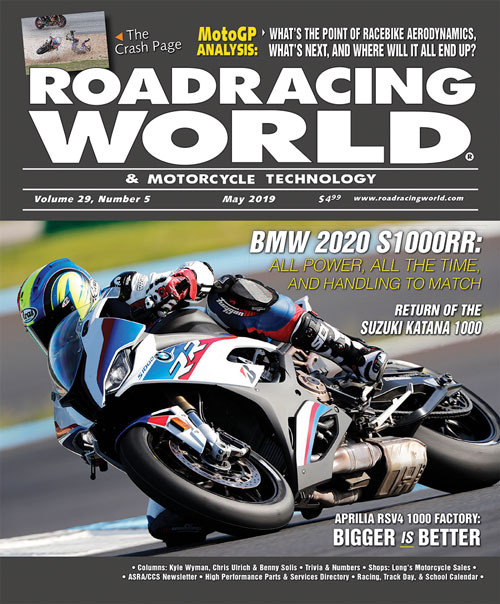
BIKE INTRO: 2020 BMW S1000RR
Estoril, Portugal
ALL POWER, ALL THE TIME
By Chris Ulrich
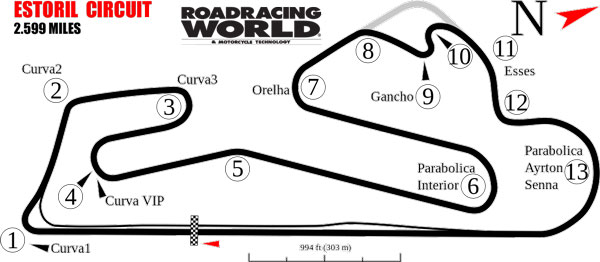
I roll on the throttle and
load the pegs as I push my body forward over the fuel tank of the BMW at the
exit of Estoril Circuit’s left-hand, 180-degree Turn Four. The front wheel
comes up slightly as the S1000RR rips up through the rpm on the way to Turn
Five, a slightly downhill, fast fifth-gear right-hander with an open exit. I
breathe the throttle to set the front suspension on entry, then get back on the
gas to drive through the corner, and the BMW lights up the rear wheel as I grab
fifth gear and accelerate down the straightaway toward Turn Six. The S1000RR
pulls hard as I wind out fifth gear until I get to the braking zone for Turn
Six, a slightly-downhill, long left-hand turn made famous when Dani Pedrosa
rammed Nicky Hayden during the 2006 MotoGP World Championship race here. But
there are no torpedo jobs on this day as I grab the front brakes and downshift
to second gear. I trail the brakes off as I turn in, releasing the brakes as I
get to full lean, then let the bike drift wide before rotating the BMW around
three quarters of the way through the corner, and clip the inside curb to open
up the exit. The rear wheel spins and the front wheel lifts as I accelerate out
of Turn Six.
I am now at the point where the track gets
really physical, with a long acceleration zone followed by a fast kink, a long
braking zone, then another long corner followed by an acceleration zone that
requires real effort to get through, but I wasn’t in the physical or mental red
zone despite the hot pace. For comparison, on the HP4 RACE in 2017, I had
started to feel some fatigue at this point on the track. It was then that I
realized that BMW engineers really have made the S1000RR easier to ride, and
have still gained performance.
—
The BMW S1000RR redefined
the 1000cc segment when it was introduced in 2009. In the company’s first fully-faired
inline four-cylinder sportbike, BMW engineers created a machine that raised the
performance bar for the category. Before BMW arrived, most 1000cc sportbikes
made less than 160 horsepower at the rear wheel, but the 2009 S1000RR put out
185+ horsepower at the rear wheel, and the arms race was on! The first edition
of the S1000RR had a powerful engine, handled on par with the rest of the
category, and had advanced electronics for the time. It delivered pure
performance but was hard to tame.
The S1000RR also boosted
BMW Motorrad’s public image. The German company now had a cutting-edge
high-performance flagship sportbike to demonstrate its engineering prowess,
sending the message that the company was no longer only about touring and
adventure bikes and opposed twins. BMW’s new machine has claimed a chunk of 1000cc
sportbike sales, too, the company selling 80,000 units worldwide since 2010,
despite a challenging overall motorcycle sales environment. The halo effect the
powerful bike has had on the rest of the model line is also evident, with BMW
marketeers giving the S1000RR credit for helping BMW Motorrad sales grow year
over year. In 2018 alone, BMW sold 165,000 motorcycles and scooters
worldwide.
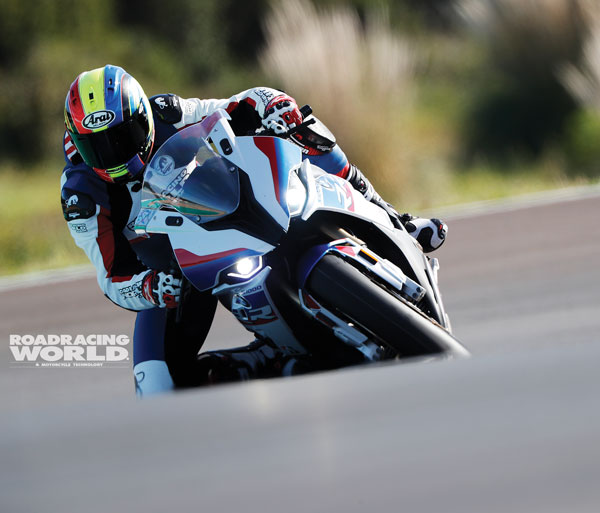
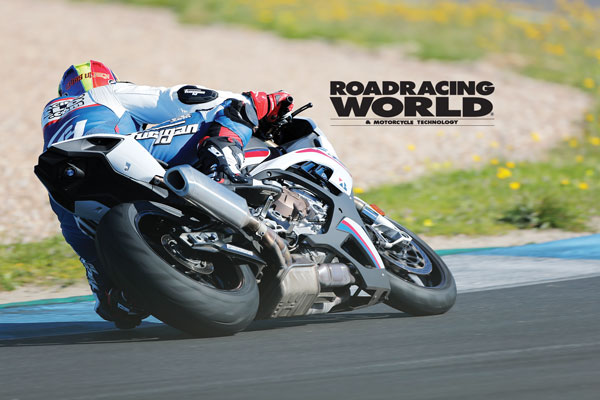
(Above) Besides making much more power, the 2020 BMW S1000RR is also easier to ride fast at full-power settings on the racetrack, thanks to carefully engineered power delivery and chassis flex characteristics.
Record unit sales, a new
model launch, and a change to an upper management team that believes in racing
as an effective marketing tool also saw the company field an official factory
team in the 2019 Superbike World Championship. BMW’s desire to use the S1000RR
as a marketing tool to reinforce the brand’s high-performance credentials is stronger than
ever.
—
The goals when BMW officials
decided to build a new 2020 S1000RR were very clear. Create a bike that is
lighter, faster, and more powerful than anything in the segment. Build a
machine that creates a revolution of sorts, like the first S1000RR did. The
ground-up project took close to 300 BMW engineers 46 months to complete and the
results include 8.0 more horsepower, and 24 pounds less weight.
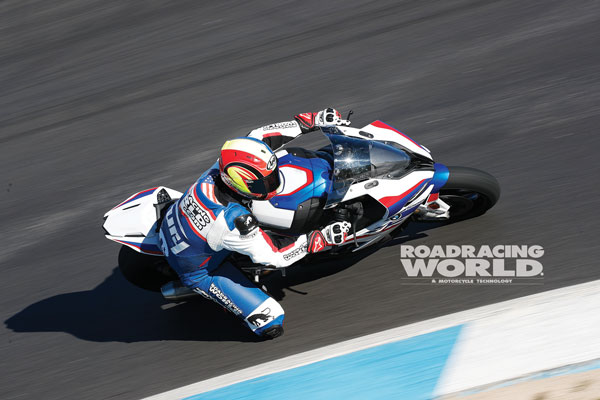
(Above) Because it’s easier to ride hard, the latest BMW doesn’t wear out the rider as quickly as the previous versions.
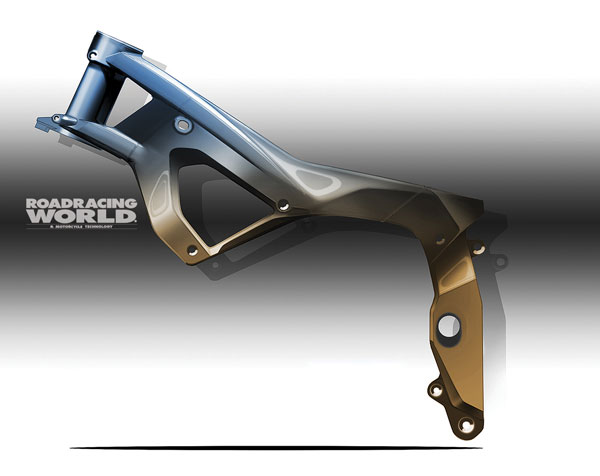
The 2020 model has a new
twin-spar aluminum frame tuned for optimum handling-enhancing flex (BMW
actually calls it “Flex Frame”) that uses the engine as a stressed member.
The swingarm is effectively longer, the engine is all-new, and a new, more
refined electronics package is easier to adjust and more effective on the
racetrack. So yeah, the new BMW S1000RR
is set to redefine the segment again, with three models, including the base
version, a Race Package version, and an M Package version. The hopped-up M
Package replaces the HP RACE and aligns the brand’s performance motorcycle marketing with the BMW
auto division’s
high-performance M-labeled model variants. The 2020 S1000RR is the
best-balanced, most powerful and most advanced four-cylinder streetbike in the
company’s
history. What it really all means is that the bike makes more power, and the
handling has finally caught up to the power.
—
Because the S1000RR has
been all about power from the start, I’ll start the tech briefing with the powerplant.
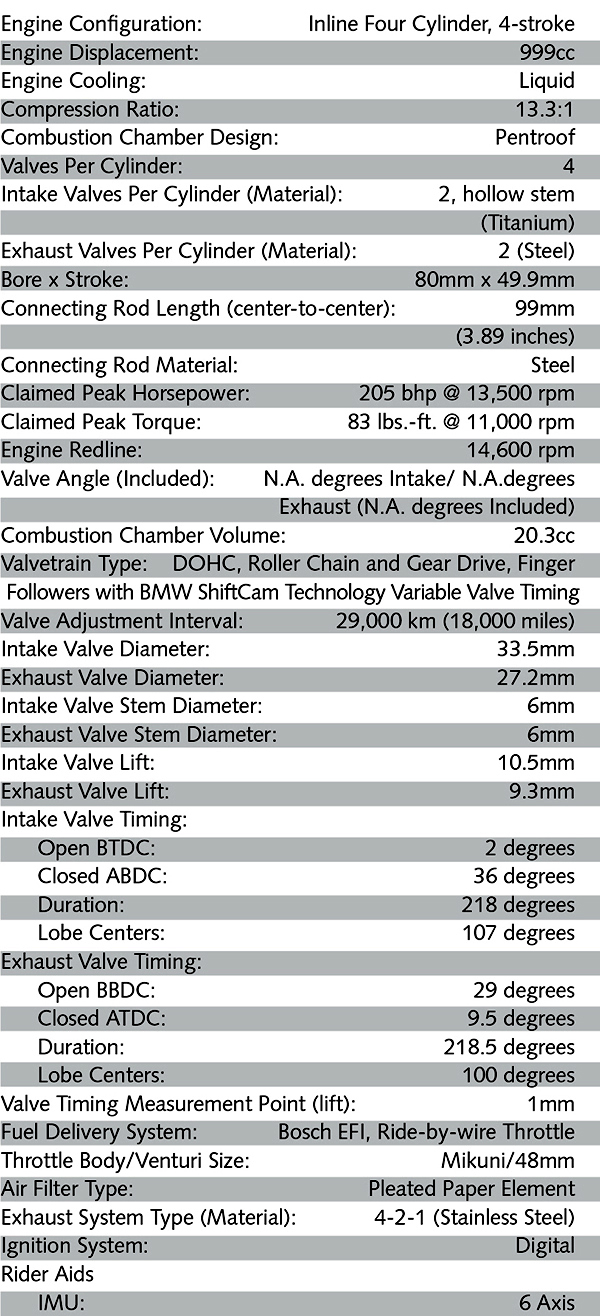
It is an all-new 999cc DOHC Inline Four with a bore and stroke of 80mm x
49.7mm, a 13.3:1 compression ratio, and an advanced variable valve timing
system. The new engine is 8.8 pounds lighter, 12mm narrower, shorter, and more
powerful than the previous version’s engine, putting out a claimed 205 bhp at
13,500 rpm and 83.3 lbs.-ft. of torque at 11,000 rpm. More impressive is that
the S1000RR engine makes 73 lbs.-ft. of torque from 4,500 rpm and builds all
the way up to the 14,600 rpm redline.
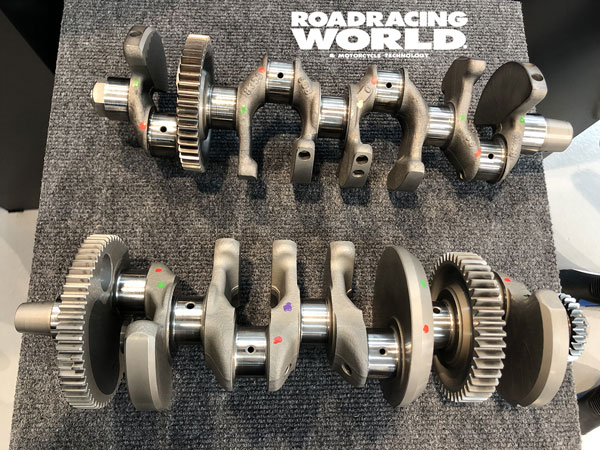
The weight reduction in the
engine was helped by shaving 3.5 pounds off the crankshaft, which allows the
engine to rev quicker during acceleration while also helping braking and
turning characteristics due to a reduction in centrifugal force. The connecting
rods are also slightly shorter center-to-center, going from 103mm to 99mm.
(Above) The latest S1000RR has a more compact and much lighter crankshaft, without sacrificing power delivery.
BMW engineers wanted to
create an engine with increased top-end power along with more low-end and
mid-range power, but those are normally opposing tuning goals and it’s usually impossible to
have the best of both—unless the valve timing changes midway through the rpm
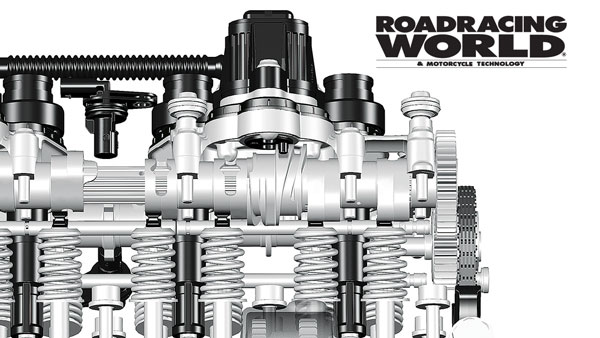
range. Enter BMW ShiftCam Technology, which changes intake cam timing and lift
on the fly. The system uses servo motors that can only be controlled by BMW’s
Bosch ECU to drop pins into a channel on the intake cam, which moves paired
low-lift/short-duration and high-lift/long-duration lobes controlling each set
of intake valves. Below 9,000 rpm, the
camshaft opens the intake valves with the low-lift/short-duration lobes to
produce better low-end and mid-range power, and above 9,000 rpm the camshaft
opens the intake valves with the adjacent high-lift/long-duration lobes for
better top-end power.
(Above) The Shift-Cam system uses paired low-lift/shorter-duration and high-lift/longer-duration cam lobes, which slide into position over the finger followers depending upon engine rpm, shifting at 9,000 rpm.
The intake port shape has
been changed to work with the ShiftCam system. The head has four valves per
cylinder, titanium intake valves with the center of each stem bored out to
reduce weight, while the exhaust valves are made out of steel. The valves are
actuated by short finger-follower rocker arms that are plated with DLC (Diamond
Like Coating) and weigh 8-grams per unit, which makes them 25% lighter than the
rockers used on the previous model. The lighter weight valve train also allows
the safe rev limit to be increased by 400 rpm to 14,600 rpm. The engine
breathes through a set of four 48mm dual-injector throttle bodies with variable
intake tract length—the air-funnels (velocity stacks) change from long (for
better mid-range) to short (for better top-end) at 11,700 rpm.
The stainless steel exhaust
system contains two-three way catalytic converters. The mid-pipe and silencer
are shorter to increase performance and improve the sound, and the system is
2.8 pounds lighter thanks to the exhaust tube thickness being reduced from
0.8mm to 0.5mm.
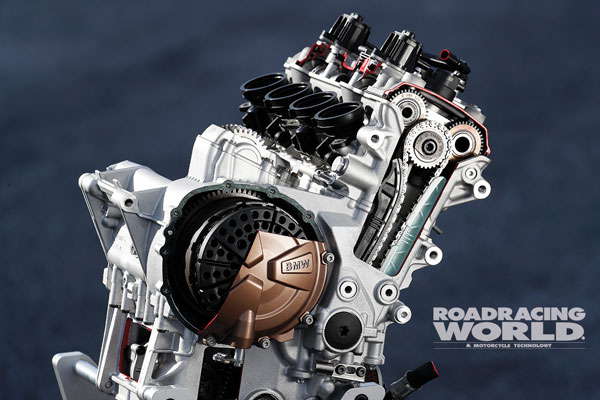
(Above) The S1000RR engine uses a link-plate chain to drive the cams through a central gear.
The engine is tilted
forward at a 32-degree angle; using the engine as a load-bearing element
allowed engineers to reduce the new twin-spar frame’s weight by 2.8 pounds. The
geometry has also been changed, with rake reduced to 23.1 degrees which, when
combined with a triple clamp offset of 29.5mm, reduces the trail by 2.6mm to
93.9mm. Overall frame width at the base of the fuel tank has been slimmed down
by between 13mm and 30mm, depending on where it is measured. This might not be
a detail many people understand or pay attention to, but the center point of
the bike is where the rider meets the fuel tank and establishes their base.
Having the width right is important to allow the correct amount of support for
the legs to reduce fatigue, but not so much that is hinders movement. The
previous versions of the S1000RR were too wide in this area.
(Above) BMW has caught up in chassis performance with its “Flex Frame.”
The new chassis also
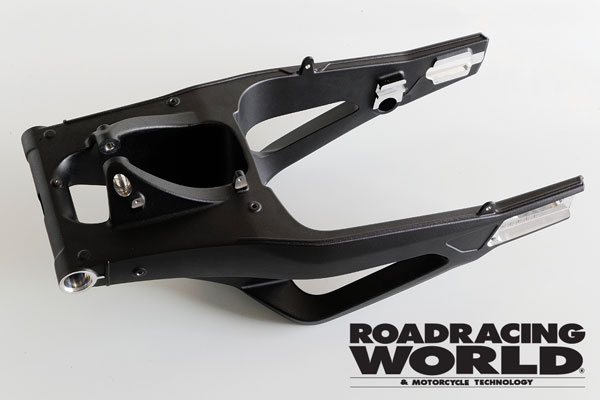
features a works-style cast-aluminum-alloy underslung swingarm that is just over
half a pound lighter than the previous model’s swingarm. Measured from the pivot to the
axle, the swingarm is 610mm long, which is the same as the previous model’s swingarm, but there is
an additional 35mm of chain adjustment left to actually increase the effective
swingarm length. Three options for swingarm pivot position adjustment are also
available: Stock, +2mm or -2mm. The swingarm downslope angle in the stock
position sits at 12.54 degrees, which is about optimal for the balance between
grip and linear slide characteristics.
(Above) The swingarm also has engineered flex.
BMW has switched to an
electronically controlled Marzocchi rear shock with a 46mm piston. The shock is
now mounted vertically and moved to minimize its exposure to radiant heat from
the engine. Changes to suspension linkage allow the rear spring rate to be
reduced from a 9.5 Nm to a 6.0 Nm, and the motion ratio for the rear shock
linkage went from 1.900:1 to 1.673:1 with a progression of 11.5 degrees. What
this means in the real world is more rear grip and longer tire life.
A set of electronically
controlled 45mm inverted Marzocchi cartridge front forks replace the 46mm Sachs
units used on the previous model. Like with the rest of the bike, the aim for
the front fork change was to increase feel reaching the rider without sacrificing
the balance of the bike. Reducing the
slider diameter is a good way to do that.
Suspension action front and
rear is controlled by BMW’s Dynamic Damping Control (DDC) system. The Marzzochi
version of DDC uses a conventional piston that has shims to control the damping
force based on the Riding Mode Selected. BMW engineers switched to a more
conventional suspension set up to give the S1000RR a more natural feeling on
the road and racetrack. There are four DDC settings available on the standard
bike, and each setting coincides with a Riding mode. In the standard Rain,
Road, Dynamic, and Race Modes the DDC is semi-active—reacting to suspension
movement and rate of change by increasing or reducing damping within a pre-set
range that can’t
be adjusted. Dynamic Mode gives more support and Race Mode gives the most
support. Full adjustment of the suspension settings is available in the Riding
Mode Pro, which is sold as an ECU upgrade. The semi-active feature is turned
off in the Pro modes; damping changes are still made through the DDC function
in the dash, but the system is designed to do nothing automatically in that
mode. The way BMW engineers describe computer interaction between the modes is
simple: Rain and Road Modes are 90% DDC and 10% conventional, while the Race
track settings are 100% conventional. Again, the aim is to give the rider a
more natural feeling while also allowing easy adjustment of suspension
settings.
(Above) Making power and also meeting emissions regulations requires lots of exhaust system volume, which BMW engineers placed underneath the engine to keep the muffler relatively small.
As with all modern 1000cc
sportbikes, the S1000RR comes with an advanced electronics suite with an
ever-growing list of capabilities. The 2020 version seems to be the
least-complicated, yet most-advanced version yet. All strategies are based on
measurements taken from a six-axis Bosch Inertial Measurement Unit (IMU). The
base ECU setting comes with the four Standard Riding Modes: Rain, Road,
Dynamic, and Race. Each riding mode has pre-set settings for throttle response,
torque maps, ABS, DDC, engine braking, Dynamic Brake Control, and wheelie
control. As before, traction control can be adjusted in the standard mode, with
15 levels of TC intervention—stock, stock +7, stock -7, and off. There are also
pre-set display options for the 6.5-inch TFT dash.
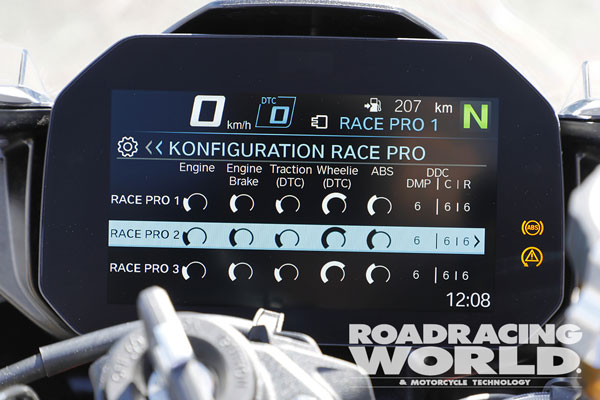
(Above) Race Pro electronics on the Race Package and M Package models include three settings, each with pre-set parameters. It’s an available $250 option on the standard model.
Additional functionality is
available by upgrading the ECU software to unlock the Pro Modes, which include
three setting options that can be customized to suit the rider’s preferences.
The software upgrades are included with the Race Package and M Package or can
be purchased individually for $250.
There are three
customizable Pro Modes: Pro Mode 1, Pro Mode 2, and Pro Mode 3, each setting
having a subset of adjustment that is customizable. For example, there are 15
levels of traction control available in each riding mode within Pro Mode. Other
rider aids that tended to confuse riders by providing too much adjustability—for example, Engine
Braking and Wheelie Control—now have three levels of adjustment. Traction
control can be changed on the fly, but all other settings, including the mode,
cannot.
BMW fans will notice that
the new Bimmer has a symmetrical front fairing; the previous asymmetrical
headlight version was created with styling in mind, but the main reason behind
the look was to reduce weight. Separating the low and high beam lights allowed
engineers to reduce the weight of the headlight package, but now, that’s not necessary thanks to
advancements in LED lighting technology. The 2020 model has a sleek,
symmetrical, aerodynamic upper fairing.
Cast aluminum wheels come
fitted on the base model, while the Race Package gets forged aluminum wheels,
and the M Package bike comes equipped with a set of lightweight carbon-fiber
wheels. The braking components have been changed, and all three versions come with American-made Hayes front brake
calipers with 32mm pistons and a Nissan radial master cylinder. Front disc
diameter remains 320mm. And for the first time, BMW is offering the S1000RR
with Bridgestone S21 DOT-labeled tires as original equipment.
The base model is available
for $16,995, the Race Package adds $1,600, while the M Package will cost an
additional $3,700. BMW is expecting 2020 S1000RRs to available in showroom
floors late in 2019.
—
The day of riding consisted
of five, 15-minute sessions for each rider/reporter. The press group started
the day on Bridgestone Battlax S21 DOT-labeled tires before moving on to
Battlax VO2 slicks in the afternoon. We all rode S1000RR models with the M
Package upgrade which is highlighted by carbon-fiber wheels and the Pro Mode
electronics package.
The first session of the
day was spent rolling around in Pro Mode 2 with the traction control turned up
to Level 3. It was a good opportunity for me to reacquaint myself with the
layout of Estoril while checking out the grip of the new pavement laid down in
the second half of 2018. The layout of Estoril is good for testing, combining
long braking zones and a good mix of slow, medium, and high-speed corners.
The new S1000RR made more
power than I expected and the power removal was much smoother than in previous
models—which demonstrates that BMW engineers worked really hard on the
ride-by-wire throttle maps. At full lean and through the acceleration zone, the
ECU removed power, but then smoothly fed the power back in when the bike was
straight up and down. My initial
impression of the ergonomics and chassis was positive. The bike turned in
better and was easier to transition than the previous model, and no doubt this
was helped by the carbon-fiber wheels
With the cobwebs blown out,
I upped my pace in the second session, but I left the traction control turned
up just to see how the S1000RR and Bridgestone S21s reacted as I went
quicker. A lot of power available at my
wrist combined with a street tire made for an entertaining session, but it also
showed how much the traction control strategies have improved since 2009. BMW
uses a two-stage approach to traction control; the first is what the engineers
described as slow, or pre-control, which removes power based on lean angle and
TC setting using the throttle plates. The second is by ignition cut, which is for
fast, unexpected events, like a sudden slide. Think of it as the Save Your Ass
(SYA) tool—and I used the SYA feature of the TC a few times on the S21 tires!
Anyway, BMW engineers improved the function of the traction control by placing
both pre-control TC and SYA TC on the same channel in the ECU. Both systems get
the same feedback from sensors, allowing them to work in unison when
intervening.
On corner entry the ABS was
busier than the traction control; I had a few more front-end tucks than I was
comfortable with as I went quicker; after four big moments, I backed off the
pace and decided to wait for the slicks before I pushed any harder.
The real testing started
when the Bridgestone V02 slicks were fitted onto the bike for the afternoon
sessions. As usual grip brings out the best (or worst) in a bike and the BMW
was no exception. I was able to get down to business with grippy slick tires on
the bike. I played with some traction control settings as the day went on, but
eventually ended up on TC -2 because it had the right ratio of spin-to-power
removal to allow me to turn better lap times around Estoril.
I really noticed the
changes to the ergonomics as I picked up the pace. The new fuel tank design
allowed me to lock in my outer leg and support myself during heavy braking,
which took pressure off my shoulders and forearms, while still allowing me to
move side-to-side without any hindrance. The seating position and seat height
also helped take pressure off my shoulders, while allowing me to be agile on
the bike. You see a theme here? BMW’s engineers paid close attention to the
dynamic position of the rider to limit fatigue. And it was apparent on-track at
Estoril.
The S1000RR engine has a
very linear power band that delivers tractable power—the whole point of
variable valve timing. The engine starts making good power as low as 4,000 rpm
and carries it until the ShiftCam switches to the top-end setting as engine
speed climbs past 9,000 rpm. The throttle connection from first touch all the
way through the acceleration zone is really good; the power is there, so you
always know where you are, but it isn’t so much that the bike is unmanageable.
Then it keeps pulling as the ShiftCam transitions to top-end power settings.
Another power boost comes in when the variable-length stacks open to their
top-end phase as the engine passes through 11,700 rpm. There isn’t any big,
defined hit along the way; the bike just keeps making more power and ripping
through the rpm gear after gear! The power never goes away!
There’s something about ABS and ripping around a
racetrack that does not compute, and while the new BMW’s ABS is better on-track than the previous
models, it isn’t
perfect—and nobody else’s is, either. It still starts to fade (or intervene) after 3-4 laps of
hard riding, but it feels like fade. But unlike with the previous models, the
system then remains consistent and predictable. (Sometimes the lever would
unexpectedly come in to the handlebar on the previous models.)
The front suspension
performance during braking was good, especially in the long braking zone coming
off the front straight into Turn One; the forks had plenty of support to allow
me to brake later as I went from sixth to second gear, but still had good feel
that allowed me to trail the brakes deep into the corner. The biggest
improvement from Marzocchi DDC forks is the feel deep in the stroke; BMW engineers
have managed to find the right damping setting and oil level to improve front
feel from corner entry all the way into the middle of the corner.
The rear suspension worked
well on corner exit through the acceleration zone. I added some support to the
rear by changing the DDC setting to make the bike finish the corner a little
better. The feel from first touch of the throttle was good, and drive grip was
also decent, as were the slide characteristics of the rear during hard
acceleration.
I experimented with some of
the other rider aids as the day went on, starting with the engine braking
control. I tried moving the engine braking setting from the mid-range Level 2
to the least amount of intervention, Level 1, but then struggled to slow the
bike down without using more brake pressure than I wanted and I started missing
apexes all over the track. So I returned to the pits and put the setting back
to Level 2.
The middle wheelie control
setting also functioned well, allowing the S1000RR to carry the front wheel
during acceleration, but not let things get out of control or slow the bike
down. That demonstrates that BMW engineers have
really done a good job with the most recent ECU and electronics
development.
—
By the end of the day, I’d
done all five of my 15-minute sessions including a lot of hard riding on the
2020 S1000RR and I wasn’t sore. In fact, I was barely tired, which says a lot
about the rideability of the bike. In 2009 BMW unleashed a high-powered weapon
that forced every manufacturer in the segment to step up their performance.
They did, and they brought weapons that were just as fast, but easier to ride
for longer periods of time. Now BMW has responded and made one of the most
brutal 1000cc sportbikes on the market also one of the easiest sportbikes to
ride without sacrificing any of the pure performance we’ve come to expect from
the Bavarian company’s engineers.
It’s really good!
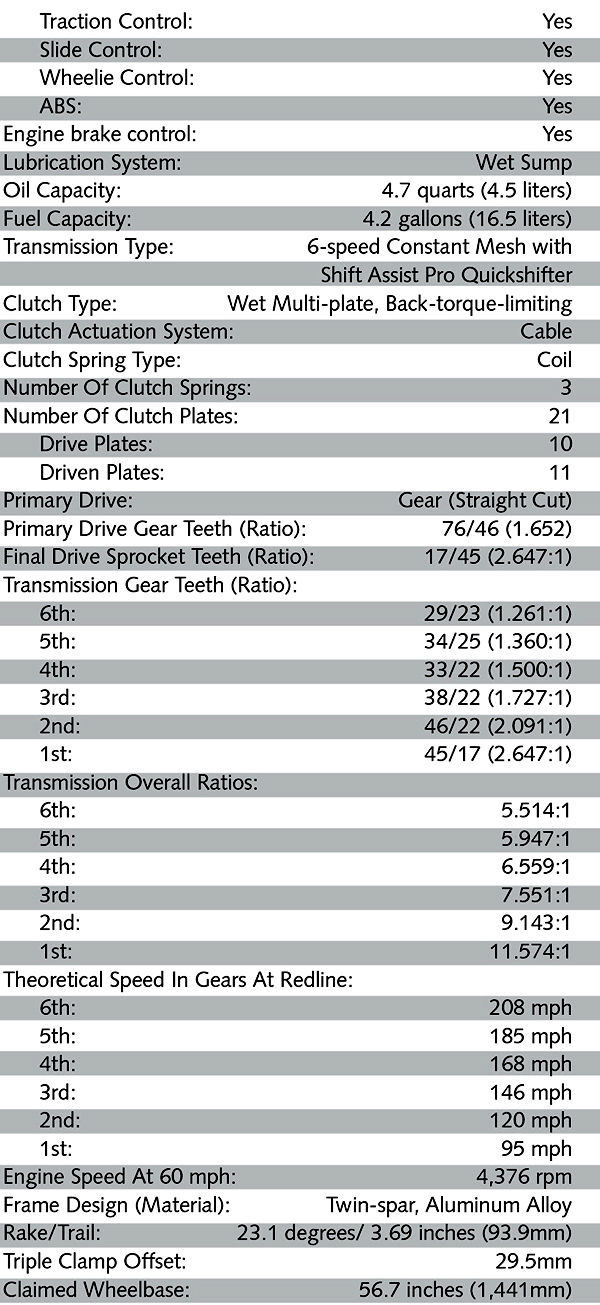
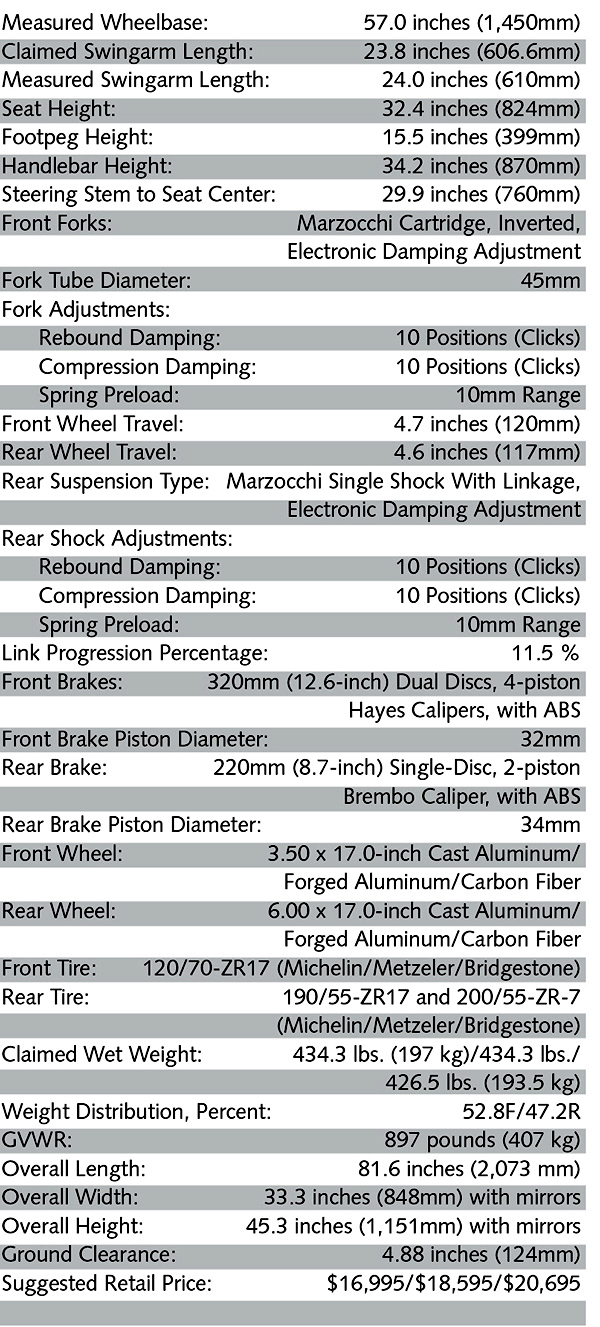
SPECIFICATIONS: 2020 BMW S1000RR Standard/Race Package/M Package
Kaleb De Keyrel, the 22-year-old who won his debut race in the MotoAmerica Twins Cup class at July 13 WeatherTech Raceway Laguna Seca, was seriously injured in a crash July 27, during this past weekend’s AFM race event at Thunderhill Raceway Park.
Earlier Monday, De Keyrel posted the following to his Facebook page: “Just wanted to give everyone an update on what’s going on and up until this point we weren’t 100% sure on everything. I had an extremely fast crash yesterday in my first race of the day at Thunderhill at the AFM series, when my brakes failed going into turn 1. I didn’t have any choice but to lay the bike or I was going to hit a wall at 160 mph. As soon as I laid it down I start to flip and as a result of the tumbling. I broke my femur and sacrum. They airlifted me in a helicopter due to the hospital being a 50min drive away. I will be going into surgery at noon today to get a rod put in my femur and just ask if you could pray that everything goes well with the surgery. I am extremely lucky with how everything played out and God was definitely looking out for me every step of the way. I am feeling pretty good being the situation and just want to get this surgery out of the way so I can get to recovery. Huge thank you to everyone that has reached out y’all are amazing! Also thank you to my amazing girlfriend for taking care of me here in the hospital and my team for everything this weekend! Thank you too all of my sponsors for having the best equipment to keep me protected.”
Roadracingworld.com attempted to reach De Keyrel, but he did not answer his mobile phone.
De Keyrel was riding a John Anderson Racing Yamaha YZF-R1 at Thunderhill and not the Roaring Toyz/1-833-CJ-Knows Yamaha FZ-07 he used to win the MotoAmerica Twins Cup race at Laguna Seca.
We will post updated information as it becomes available.
UPDATE: Roaring Toyz/1-833-CJ-Knows Team Owner Robert Fisher has relayed a report from De Keyrel’s girlfriend Marissa Lahner stating De Keyrel is out of surgery, the procedure went well, and he should be able to start his recovery and rehabilitation immediately.
The recent launch of the Northern Talent Cup spread KTM’s influence wider into the foundations of road racing and further increased the credibility of the newest manufacturer to join the MotoGP entry list.
2019 represents the third season for KTM and their Red Bull-backed teams in MotoGP and in rapid time the KTM RC16 has sliced race deficits to Grand Prix-winning rivals substantially. The motorcycle, in the hands of Red Bull KTM’s Pol Espargaro, has already crested the MotoGP podium and continues to inch closer to repeating the distinction in the foreseeable future.
But while KTM may be relative ‘new guys’ to the premier class the factory has been accomplishing feats in Grand Prix and feeding elite talent into the upper echelons of the sport for almost two decades. Firstly their supply of RC 250 R machinery to the Red Bull MotoGP Rookies Cup from 2012 (previously providing 125cc two-stroke motorcycles from 2007) has helped over 180 riders from more than 30 countries sample the high-profile series on international FIM World Championship spec circuits and twenty of the alumni are currently competing in either Moto3, Moto2 or MotoGP.
The ‘Rookies’ contest has amassed over 150 races in 13 seasons and is still the pinnacle ‘feeder’ into Moto3. The very first champion, Johann Zarco, is Red Bull KTM’s third representative in MotoGP.
KTM previously excelled in the old 125cc and 250cc divisions between 2003-2008 where their two-stroke technology helped athletes like Casey Stoner and Marc Marquez to the initial chequered flags of their careers. In their first entry to Moto3 in 2012 (after dipping out of 125s in 2009) KTM snared the title with their RC 250 GP in the hands of Sandro Cortese and have remained protagonists ever since with stars like Jack Miller, Miguel Oliveira and Brad Binder shining; the last two names being the first racers to make the full climb in KTM colours from the Red Bull MotoGP Rookies through the stages up into MotoGP and passing through the capable climes of long-term partners Red Bull KTM Ajo.
The ‘ladder’ was made complete with Moto2 (thanks again to the Ajo framework) and MotoGP participation in 2017: that same year was the ultimate milestone as KTM took two places on the premier class grid.
Less than two years on another landmark was dropped in the Grand Prix story thanks to the alliance with Red Bull KTM Tech3 for 2019. Partnership with one of the best satellite teams in the history of the sport permitted four RC16s to echo through the paddock and allow a significant acceleration in R&D and development. Amplification of the test team with KTM stalwart Mika Kallio and Dani Pedrosa accumulating essential non-race mileage was another noteworthy deed.
Now the Northern Talent Cup solidifies the base of the pyramid from 2020 (the initiative replaces the ADAC Junior Cup powered by KTM where the KTM RC390 Cup bike was used) and where the levels begin. The extremely competitive but also simplistic and functional KTM RC4R is the technical base in the newly established battle for northern and central Europe from next year. Moving up, the RC 250 R is run in the Red Bull MotoGP Rookies Cup and brings the bright and best young talent even closer to the tech of Grand Prix. By the time riders might consider FIM CEV Moto3 Junior World Championship and the last ‘examination’ before the FIM World Championship then they will already be very familiar with the KTM RC4 currently used by 15 racers in Moto3. The RC12 in Moto2 is steered by 9 athletes while the chosen few (4) have the RC16 at the peak of the sport: MotoGP.
KTM hold three titles in road racing (2012, 2013 and 2016 in Moto3 with Sandro Cortese, Maverick Viñales and Brad Binder respectively) that take a valuable place in the 302 already won in all FIM disciplines by the factory from Mattighofen. With the fresh investment into the Northern Talent Cup KTM have made another statement in their belief, passion and value towards prototype racing and their role in the future for years to come.
Pit Beirer, KTM Motorsports Director: “As we mentioned at the launch of the Northern Talent Cup in Sachsenring recently we are proud of what we have been able to contribute to the world of road racing so far and in normal KTM style, when we set our eyes on something we like to ‘go for it’. We already have a strong base thanks to the Red Bull MotoGP Rookies Cup but the Northern Talent Cup allows us to go even closer to the beginning for many riders who want to be racers, and for families that want to start the dream but wonder how to make it work. For us it means a truly great stretch down through the prototypes and to that base machinery that might let the Espargaros and Zarcos of tomorrow start their journey. For a company like us – that takes such a big pride in our racing – there is no better feeling than watching that progression and helping it happen.”
For the third year in a row the entire scope of KTM’s prototype efforts across the divisions will be in full evidence at the Red Bull Ring in Spielberg, Austria on August 9-11 for the myWorld MOTORRAD GRAND PRIX VON ÖSTERREICH.
IRWIN JOINS IDDON AT TYCO BMW FOR THE REMAINDER OF THE 2019 BSB SEASON
TAS Racing would like to welcome Glenn Irwin – third in last season’s Bennetts British Superbike Championship – into the Tyco BMW team for the remainder of the 2019 BSB season, where he will ride alongside Christian Iddon, campaigning BMW Motorrad S1000RR machinery.
A BSB race winner in 2018, the 29-year-old is delighted to be joining BMW Motorrad UK’s official team in the British Superbike Championship, as he explained.
“First of all, I’d like to thank TAS Racing, Tyco and BMW for this opportunity to ride the Tyco BMW S1000RR for the remainder of the season. They are a team I’ve always looked up to and aspired to race for, so to now get that opportunity, I’m absolutely delighted. I’ve raced against the new BMW S1000RR this season already, and it looks like a strong package with plenty of potential, so I can’t wait to get going.”
Glenn Irwin – Tyco BMW British Superbike Rider #2
“Glenn had a strong 2018 season in the British Superbike Championship finishing third overall and taking his debut race win in the class; so, to get the opportunity to sign someone of his calibre half way through the season, will hopefully prove to be a big plus for everyone involved with Tyco BMW.
“He will be thrown into the deep end a little at Thruxton, learning a new bike and working with a new team, but having six rounds left for him to show his full potential on the S1000RR, will allow us to be realistic this weekend with our expectations..”
It’s time to reset, bounce back and get ready for the second half of the season
Monday, 29 July 2019
Marc Marquez (Repsol Honda Team) is in good shape heading into the second half of 2019. The reigning Champion has 58 points in his pocket, he’s won more than half the races so far and there’s been little sign of many chinks in his armour since his crash out the lead at the Circuit of the Americas. But this is MotoGP™ and the course of racing rarely did run smooth, with Brno next up – the circuit that ended his omnipotent run in 2014 – and there is still a maximum of 250 points up for grabs in the remaining ten races. Can his rivals reset, bounce back and start taking the fight to the number 93?
His closest challenger remains Andrea Dovizioso (Ducati Team) despite a couple of more difficult races for the Italian, and the good news for him is that he won in the Czech Republic last year, in some style. So it’s a good track to begin his assault on the second half of the season, with confidence and good memories nothing to be sniffed at when glory and defeat can be thousandths apart. But Dovizioso’s teammate Danilo Petrucci is now pretty hot on his heels, only six points back, and he could complicate life for the now two-time runner up in the Championship. And ‘Petrux’ knows the bike he’s now on took a 1-2 at Brno last year. Will it repeat the feat in 2019? And if so, in which order?
Alex Rins (Team Suzuki Ecstar), meanwhile, is the man looking for a little more redemption. After two DNFs in a row, both from near the front, the Suzuki man went into summer on the back foot despite having some serious speed at both races. He’s now 84 points off Marquez and fourth in the Championship, but the upside is Rins now races with much less pressure. He’ll simply want to win and win as much as possible in the remaining ten rounds. He’s already taken a MotoGP™ victory, so why not again?
That’s also true of Maverick Viñales (Monster Energy Yamaha MotoGP) and nine-time World Champion teammate Valentino Rossi, although they arrive the second half of 2019 with very different recent runs of form. Viñales opened his victory account for the year at Assen and then followed it up with a podium, heading into summer looking like a serious threat. Can he start back up where he left off? If yes, it’ll be the first time he’s taken three premier class podiums in a row. For Rossi, it’s the opposite – with three DNFs prefacing an eighth place in Germany, the ‘Doctor’ needs to bounce back and turn it around. But his CV at Brno is a good one, with a win in every category he’s raced there – including five in the premier class. After such a stellar start to the season, can Rossi come back out swinging for round two?
Then there’s the fight for top Independent Team rider. Jack Miller (Pramac Racing) currently leads it by virtue of consistency and that impressive podium earlier in the year, but he’s only three points ahead of rookie sensation Fabio Quartararo (Petronas Yamaha SRT). The Frenchman is another looking to bounce back at Brno but only from one mistake in Germany – incredibly, his first DNF caused by a crash – and if his form so far in 2019 hasn’t been quite ominous enough, he’ll now be much more recovered from the arm pump surgery that nevertheless didn’t hold him back from the podium. At full power, Quartararo will doubtless be bothering the field for more than the accolade of top Independent Team rider or Rookie of the Year. Brno, beware.
Cal Crutchlow (LCR Honda Castrol), however, will want to be one of those making that as difficult as possible. The Brit is equal on points with Quartararo and his unforgettable first win came at Brno in 2016 as Crutchlow was impeccable in difficult conditions – so he’s another for whom the Czech venue holds good memories. He also took his second podium of the season in Germany despite recovering from a cycling mishap and is another who will be in much better shape heading into the second half. A podium contender? Don’t doubt it.
The fight throughout the top ten has been tight this year and the likes of Pol Espargaro (Red Bull KTM Factory Racing), Takaaki Nakagami (LCR Honda Idemitsu), Franco Morbidelli (Petronas Yamaha SRT) and Joan Mir (Team Suzuki Ecstar) will all be gunning to remain key presences in the battle, with all having taken some top finishes in 2019 so far. And what of Aleix Espargaro (Aprilia Racing Team Gresini) and teammate Andrea Iannone? And they’ll also have someone else to contend with: Stefan Bradl, Honda test rider, who replaces the absent and recovering Jorge Lorenzo at the Repsol Honda Team. The German has put in some solid rides and could cause the odd headache in the fight for Q2 and good points.
As we head for Brno for the 50th time, we’re back in business for 2019, with ten races remaining and 250 points on the table. Healed, reset and fired up to go racing again, the field is deep and gunning for glory…with everything far from decided. Another twist could be just around the corner in Czechia, so tune in on Sunday 4th August for the Monster Energy Grand Prix Ceské republiky at the Automotodrom Brno.
Championship standings
1 – Marc Marquez (SPA – Honda) – 185
2 – Andrea Dovizioso (ITA – Ducati) – 127
3 – Danilo Petrucci (ITA – Ducati) – 121
4 – Alex Rins (SPA – Suzuki) – 101
5 – Maverick Viñales (SPA – Yamaha) – 85
Operation domination: can Alex Marquez continue his roll in Czechia?
Since Le Mans, the Championship leader has won every race bar one serious dose of bad luck. Will it continue in Brno?
For the first part of 2019, Moto2™ seemed like it was going to be the most unpredictable Championship this season. But then came Alex Marquez’ (EG 0,0 Marc VDS) roll of indomitable form, winning every race since – and including – the French GP, with the sole exception of crashing out the lead in Assen through no fault of his own. And despite that drama, as well as a P24 in Jerez, again through no fault of his own, the number 73 sits eight points clear as we head into the second part of the Championship. “Shoulda woulda coulda” is often something to avoid in racing, but this is a case where it merits the question: how big could that gap have been?
The bad news for the competition is that Marquez has a good record at Brno and has had since he got a first glimpse at the podium fight in his rookie year in the intermediate class. The good news is that no one is ever unbeatable, and he’s never won there. Even more good news for key challenger Tom Lüthi (Dynavolt Intact GP) is that the Swiss rider has. It may have been a shortened race in the wet, but it was an impressive performance nonetheless and the veteran’s CV at the venue doesn’t stop there.
The next man up is Augusto Fernandez (Flexbox HP 40) and he could be a key threat, with his incredible step forward in 2019 making it hard to rule him out of a challenge at the front. And he’s now ahead of teammate Lorenzo Baldassarri in the standings, so the man who dominated early on this season has some bouncing back to do. Jorge Navarro (HDR Heidrun Speed Up) will want to be back on the podium and knocking on the door to that first win too, as will Marcel Schrötter (Dynavolt Intact GP), and Mattia Pasini comes in from Brno at Tasca Racing Scuderia Moto2…can the veteran Italian get in the mix? And then, finally, what of Brad Binder (Red Bull KTM Ajo)? The South African had a tough start to the year but it appears the Austrian factory are back on track. Will he be a force to be reckoned with at Brno?
Whatever happens, it’s Marquez who arrives with the target on his back. Will he keep it into Austria as the second half of the season comes thick and fast? Find out on Sunday 4th August at 12:20 (GMT +2).
Championship standings
1 – Alex Marquez (SPA – Kalex) – 136
2 – Tom Lüthi (SWI – Kalex) – 128
3 – Augusto Fernandez (SPA – Kalex) – 102
4 – Lorenzo Baldassarri (ITA – Kalex) – 97
5 – Jorge Navarro (SPA – Speed Up) – 97
Two points in it as Moto3™ get back on track at Brno
Dalla Porta took the lead last time out, can Canet strike back as the second half of the season begins?
Germany was a pivotal race in the Moto3™ title fight, with Lorenzo Dalla Porta (Leopard Racing) taking over at the top from Aron Canet (Sterilgarda Max Racing Team), but it remains tight: just two points separate the two as we head into part two of the year. Can Canet strike back and make it continue to see-saw? Or can one of them start to pull clear at Brno?
Canet has podium form at the Czech track, but Dalla Porta is the man on a consistent run. Bar his mechanical retirement from the race in Barcelona, the Italian has been on the podium in every race since France. The Spaniard, meanwhile, has had a couple of blips: a seventh and a 12th; not the form he’ll want to continue in as the pressure amps up and the races tick down…
Then there are the rivals: John McPhee (Petronas Sprinta Racing) is a winner at Brno and a winner already in 2019, as is Niccolo Antonelli (SIC58 Squadra Corse), currently third in the Championship, on both counts. Marcos Ramirez (Leopard Racing) has a couple of solid finishes at the track, and Tony Arbolino (VNE Snipers) is a man who’s taken a big step forward this season. They’re sure to make sure the race, at least, is far from Dalla Porta vs Canet.
There’s also local hero Filip Salac (Redox PrüstelGP) who’ll be aiming to make a mark, and two wildcards: former Idemitsu Asia Talent Cup Champion Deniz Öncü (Red Bull KTM Ajo) and Moto3™ Junior World Championship and Red Bull MotoGP Rookies Cup challenger Yuki Kunii (Asia Talent Team).
Moto3™ are back in action on 4th August, with everything to play for in the title fight and a huge list of winners this season gunning for more glory. Tune in at 11:00 (GMT +2) local time.
A “press release” is promotional text issued by a rider, team, company or organization to inform
the public about an event, product, or service from the issuer’s own point of view, and if deemed
to have news value, may be placed on roadracingworld.com as a service to our readers.
A press release is not an article written by Roadracingworld.com staffers. When a post is labeled with the words “press release”, it means that Roadracingworld.com is not responsible for its content and that Roadracingworld.com makes no guarantee that it is accurate. Not all press releases are posted and Roadracingworld.com may reject press releases if the content is too heavy on commercial promotion with little or no news value or if the press release contains obvious errors.
Accessibility
Accessibility modes
Epilepsy Safe Mode
Dampens color and removes blinks
This mode enables people with epilepsy to use the website safely by eliminating the risk of seizures that result from flashing or blinking animations and risky color combinations.
Visually Impaired Mode
Improves website's visuals
This mode adjusts the website for the convenience of users with visual impairments such as Degrading Eyesight, Tunnel Vision, Cataract, Glaucoma, and others.
Cognitive Disability Mode
Helps to focus on specific content
This mode provides different assistive options to help users with cognitive impairments such as Dyslexia, Autism, CVA, and others, to focus on the essential elements of the website more easily.
ADHD Friendly Mode
Reduces distractions and improve focus
This mode helps users with ADHD and Neurodevelopmental disorders to read, browse, and focus on the main website elements more easily while significantly reducing distractions.
Blindness Mode
Allows using the site with your screen-reader
This mode configures the website to be compatible with screen-readers such as JAWS, NVDA, VoiceOver, and TalkBack. A screen-reader is software for blind users that is installed on a computer and smartphone, and websites must be compatible with it.
Online Dictionary
Readable Experience
Content Scaling
Default
Text Magnifier
Readable Font
Dyslexia Friendly
Highlight Titles
Highlight Links
Font Sizing
Default
Line Height
Default
Letter Spacing
Default
Left Aligned
Center Aligned
Right Aligned
Visually Pleasing Experience
Dark Contrast
Light Contrast
Monochrome
High Contrast
High Saturation
Low Saturation
Adjust Text Colors
Adjust Title Colors
Adjust Background Colors
Easy Orientation
Mute Sounds
Hide Images
Hide Emoji
Reading Guide
Stop Animations
Reading Mask
Highlight Hover
Highlight Focus
Big Dark Cursor
Big Light Cursor
Cognitive Reading
Virtual Keyboard
Navigation Keys
Voice Navigation
Accessibility Statement
www.roadracingworld.com
November 15, 2026
Compliance status
We firmly believe that the internet should be available and accessible to anyone, and are committed to providing a website that is accessible to the widest possible audience,
regardless of circumstance and ability.
To fulfill this, we aim to adhere as strictly as possible to the World Wide Web Consortium’s (W3C) Web Content Accessibility Guidelines 2.1 (WCAG 2.1) at the AA level.
These guidelines explain how to make web content accessible to people with a wide array of disabilities. Complying with those guidelines helps us ensure that the website is accessible
to all people: blind people, people with motor impairments, visual impairment, cognitive disabilities, and more.
This website utilizes various technologies that are meant to make it as accessible as possible at all times. We utilize an accessibility interface that allows persons with specific
disabilities to adjust the website’s UI (user interface) and design it to their personal needs.
Additionally, the website utilizes an AI-based application that runs in the background and optimizes its accessibility level constantly. This application remediates the website’s HTML,
adapts Its functionality and behavior for screen-readers used by the blind users, and for keyboard functions used by individuals with motor impairments.
If you’ve found a malfunction or have ideas for improvement, we’ll be happy to hear from you. You can reach out to the website’s operators by using the following email
Screen-reader and keyboard navigation
Our website implements the ARIA attributes (Accessible Rich Internet Applications) technique, alongside various different behavioral changes, to ensure blind users visiting with
screen-readers are able to read, comprehend, and enjoy the website’s functions. As soon as a user with a screen-reader enters your site, they immediately receive
a prompt to enter the Screen-Reader Profile so they can browse and operate your site effectively. Here’s how our website covers some of the most important screen-reader requirements,
alongside console screenshots of code examples:
Screen-reader optimization: we run a background process that learns the website’s components from top to bottom, to ensure ongoing compliance even when updating the website.
In this process, we provide screen-readers with meaningful data using the ARIA set of attributes. For example, we provide accurate form labels;
descriptions for actionable icons (social media icons, search icons, cart icons, etc.); validation guidance for form inputs; element roles such as buttons, menus, modal dialogues (popups),
and others. Additionally, the background process scans all the website’s images and provides an accurate and meaningful image-object-recognition-based description as an ALT (alternate text) tag
for images that are not described. It will also extract texts that are embedded within the image, using an OCR (optical character recognition) technology.
To turn on screen-reader adjustments at any time, users need only to press the Alt+1 keyboard combination. Screen-reader users also get automatic announcements to turn the Screen-reader mode on
as soon as they enter the website.
These adjustments are compatible with all popular screen readers, including JAWS and NVDA.
Keyboard navigation optimization: The background process also adjusts the website’s HTML, and adds various behaviors using JavaScript code to make the website operable by the keyboard. This includes the ability to navigate the website using the Tab and Shift+Tab keys, operate dropdowns with the arrow keys, close them with Esc, trigger buttons and links using the Enter key, navigate between radio and checkbox elements using the arrow keys, and fill them in with the Spacebar or Enter key.Additionally, keyboard users will find quick-navigation and content-skip menus, available at any time by clicking Alt+1, or as the first elements of the site while navigating with the keyboard. The background process also handles triggered popups by moving the keyboard focus towards them as soon as they appear, and not allow the focus drift outside it.
Users can also use shortcuts such as “M” (menus), “H” (headings), “F” (forms), “B” (buttons), and “G” (graphics) to jump to specific elements.
Disability profiles supported in our website
Epilepsy Safe Mode: this profile enables people with epilepsy to use the website safely by eliminating the risk of seizures that result from flashing or blinking animations and risky color combinations.
Visually Impaired Mode: this mode adjusts the website for the convenience of users with visual impairments such as Degrading Eyesight, Tunnel Vision, Cataract, Glaucoma, and others.
Cognitive Disability Mode: this mode provides different assistive options to help users with cognitive impairments such as Dyslexia, Autism, CVA, and others, to focus on the essential elements of the website more easily.
ADHD Friendly Mode: this mode helps users with ADHD and Neurodevelopmental disorders to read, browse, and focus on the main website elements more easily while significantly reducing distractions.
Blindness Mode: this mode configures the website to be compatible with screen-readers such as JAWS, NVDA, VoiceOver, and TalkBack. A screen-reader is software for blind users that is installed on a computer and smartphone, and websites must be compatible with it.
Keyboard Navigation Profile (Motor-Impaired): this profile enables motor-impaired persons to operate the website using the keyboard Tab, Shift+Tab, and the Enter keys. Users can also use shortcuts such as “M” (menus), “H” (headings), “F” (forms), “B” (buttons), and “G” (graphics) to jump to specific elements.
Additional UI, design, and readability adjustments
Font adjustments – users, can increase and decrease its size, change its family (type), adjust the spacing, alignment, line height, and more.
Color adjustments – users can select various color contrast profiles such as light, dark, inverted, and monochrome. Additionally, users can swap color schemes of titles, texts, and backgrounds, with over seven different coloring options.
Animations – person with epilepsy can stop all running animations with the click of a button. Animations controlled by the interface include videos, GIFs, and CSS flashing transitions.
Content highlighting – users can choose to emphasize important elements such as links and titles. They can also choose to highlight focused or hovered elements only.
Audio muting – users with hearing devices may experience headaches or other issues due to automatic audio playing. This option lets users mute the entire website instantly.
Cognitive disorders – we utilize a search engine that is linked to Wikipedia and Wiktionary, allowing people with cognitive disorders to decipher meanings of phrases, initials, slang, and others.
Additional functions – we provide users the option to change cursor color and size, use a printing mode, enable a virtual keyboard, and many other functions.
Browser and assistive technology compatibility
We aim to support the widest array of browsers and assistive technologies as possible, so our users can choose the best fitting tools for them, with as few limitations as possible. Therefore, we have worked very hard to be able to support all major systems that comprise over 95% of the user market share including Google Chrome, Mozilla Firefox, Apple Safari, Opera and Microsoft Edge, JAWS and NVDA (screen readers).
Notes, comments, and feedback
Despite our very best efforts to allow anybody to adjust the website to their needs. There may still be pages or sections that are not fully accessible, are in the process of becoming accessible, or are lacking an adequate technological solution to make them accessible. Still, we are continually improving our accessibility, adding, updating and improving its options and features, and developing and adopting new technologies. All this is meant to reach the optimal level of accessibility, following technological advancements. For any assistance, please reach out to