Distributing Giant A Supporting Partner Of The Series For 2020
IRVINE, CA (May 22, 2020) – MotoAmerica is proud to announce that global powersports distributor Parts Unlimited, one of the series’ longest serving sponsors, will again be a supporting partner of the 2020 MotoAmerica Series.
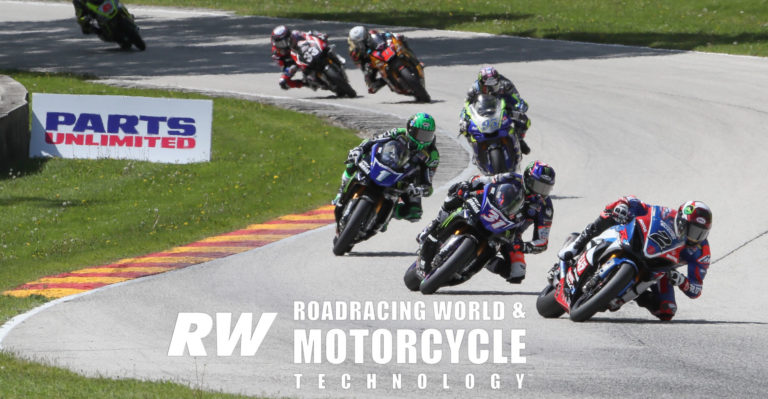
Distributing giant Parts Unlimited will again be a sponsor of the MotoAmerica Series in 2020. Photo by Brian J. Nelson.
“Parts Unlimited has been a partner of ours since we started and were actually one of the first companies that came on board,” said MotoAmerica President Wayne Rainey. “They are a company with a passion for racing worldwide and are a perfect fit for MotoAmerica and its fans. We’re thrilled to have them partnering with us again.”
Parts Unlimited is the world’s largest distributor of aftermarket accessories in the powersports industry and is owned by LeMans Corporation, which is headquartered in Janesville, Wisconsin. Parts Unlimited sells to over 12,000 dealerships worldwide and continues to expand its market penetration with its sister companies, Parts Canada, Parts Europe and Drag Specialties.
“Our partnership with MotoAmerica has always been a good one and we’re happy we can continue with them,” said Hylton Beattie, Parts Unlimited’s Global Motorsports Director. “Parts Unlimited is heavily involved in racing and MotoAmerica is the premier road racing series in the U.S. It’s natural that we are on board as a sponsor and we can’t wait to get the 2020 season rolling next weekend at Road America.”
American Flat Track Announces Updated 2020 Race Schedule
18 races over 9 doubleheader weekends on tap for America’s Original Extreme Sport
DAYTONA BEACH, Fla. (May 22, 2020) – American Flat Track announced today a relaunch of its 2020 race schedule featuring doubleheader race weekends and kicking off on July 17 and 18 with the Volusia Half-Mile at Volusia Speedway Park in Barberville, Fla. The revised schedule features 18 races over nine doubleheader weekends and culminates in a two-day finale during Biketoberfest in Daytona Beach.
In addition to NBC Sports coverage on NBCSN and live streaming of all 18 events via TrackPass on NBC Sports Gold, AFT has worked diligently toward the goal of having fan attendance at all of its venues. This would include the implementation of new health & safety protocols that will help provide a safe environment for fans, competitors and staff, including reduced capacity, staggered seating, mobile ticketing, cashless transactions and enhanced sanitation.
AFT officials continue to collaborate with public health experts to develop this comprehensive plan in accordance with all federal, state and local requirements. All race-day procedures have been thoroughly reviewed and will continue to be examined and updated to follow specific guidelines set by the Centers for Disease Control and Prevention (CDC) and local authorities.
At all American Flat Track events new guidelines and protocols will include:
Reduction in ticket availability to conform with state and local guidelines for sporting events
Reserved seating areas to include buffer zones to provide ample space between fans
Fans entering the venue will be provided with complimentary facial coverings
Enhanced sanitation and disinfection protocols with frequent cleaning throughout the facility
Enhancements to mobile ticketing and elimination of printed tickets
Cashless, contactless transactions for concessions and merchandise
Regular medical screening of staff and competitors
As an additional precaution, there will be no public access to the paddock area and AFT officials have suspended Fan Walk, rider autograph sessions and paddock upgrades for the remainder of the season. Event-specific health & safety procedures will be updated to meet or exceed state and local requirements as they are updated over the coming months. Through an updated communication protocol, AFT and its promoter partners will provide regular updates to fans via press releases, website updates, social media posts, email distribution and text messaging.
Careful consideration has been given to secure a full 18-round race schedule that is logistically possible for riders, teams and staff, while also providing the opportunity for fan attendance. Following a thorough review of state guidelines and consultation with local officials by AFT’s promoter partners, certain events that were originally scheduled for 2020 have been cancelled. All ticketholders for cancelled events are eligible to receive a full refund or a credit for use at future events. Please contact [email protected] for more information.
For more information about the revised 2020 schedule, details on receiving credits or refunds for cancelled rounds and how fans can watch American Flat Track action from anywhere in the country, please visit the 2020 American Flat Track Schedule Update FAQ.
Further communication will be made as tickets go on sale and event announcements are made. For the latest information, stay connected via www.americanflattrack.com and AFT’s social media pages.
Updated 2020 American Flat Track Schedule*:
1. July 17 (Fri): Volusia Half-Mile I – Volusia Speedway Park, Barberville, FL
2. July 18 (Sat): Volusia Half-Mile II – Volusia Speedway Park, Barberville, FL
3. July 31 (Fri): Lima Half-Mile I – Allen County Fairgrounds, Lima, OH
4. August 1 (Sat): Lima Half-Mile II – Allen County Fairgrounds, Lima, OH
5. August 28 (Fri): TBA, Northeast U.S.
6. August 29 (Sat): TBA, Northeast U.S.
7. September 5 (Sat): Springfield Mile I** – Illinois State Fairgrounds – Springfield, IL
8. September 6 (Sun): Springfield Mile II – Illinois State Fairgrounds – Springfield, IL
9. September 11 (Fri):Williams Grove Half-Mile I – Williams Grove Speedway – Mechanicsburg, PA
10. September 12 (Sat): Williams Grove Half-Mile II – Williams Grove Speedway – Mechanicsburg, PA
11. September 25 (Fri): TBA, TX
12. September 26 (Sat): TBA, TX
13. October 2 (Fri): Atlanta Short Track I – Dixie Speedway – Woodstock, GA
14. October 3 (Sat): Atlanta Short Track II – Dixie Speedway – Woodstock, GA
15. October 9 (Fri): TBA, NC
16. October 10 (Sat): TBA, NC
17. October 15 (Thu): AFT Season Finale I – Daytona Beach, FL
18. October 16 (Fri): AFT Season Finale II – Daytona Beach, FL
*As the situation, regulations and protocols regarding COVID-19 progress, dates and venues listed above are subject to change.
**AFT Singles presented by Russ Brown Motorcycle Attorneys will participate in the Springfield TT on Friday, September 4.
NBCSN and TrackPass on NBC Sports Gold are the official homes for coverage of American Flat Track. For the 2020 season, NBCSN’s coverage of AFT remains in highly-coveted programming slots within two weeks of each event. The complete schedule for AFT on NBCSN can be viewed at http://www.americanflattrack.com/events-nbcsn/. TrackPass on NBC Sports Gold – the most-robust motorsports offering in the digital marketplace – is a cornerstone of AFT’s digital strategy, providing live streaming coverage of every event and maintaining an active archive of all AFT content.
About American Flat Track:
American Flat Track is the world’s premier dirt track motorcycle racing series and one of the longest-running championships in the history of motorsports. Sanctioned by AMA Pro Racing in Daytona Beach, Fla., the series is highly regarded as the most competitive form of dirt track motorcycle racing on the globe. For more information on American Flat Track, please visit http://www.americanflattrack.com, like us on Facebook, follow us on Twitter, check us out on Instagram, live stream the events with TrackPass on NBC Sports Gold and catch all the American Flat Track racing action on NBCSN.
TSE Racing is excited to be back at their home track on the MotoAmerica
calendar, Road America. May 29-31 is finally the kick off of the season.
Stefan Dolipski, on his BMW S1000RR, will be competing in the Stock 1000
class, while his teammate Nate Minster will be racing his Yamaha R6 in
the Supersport class. Although the race won’t be the same without our
fans and spectators, the team hopes everyone still tunes into the
action.
Stefan Dolipski – “This upcoming weekend at Road America, will be the
return of Pro Motorcycle racing in the US, after almost 8 months of no
racing it will be a fresh start for everyone. I’m very excited to be
lining up on my TSE Racing BMW S1000RR, with some of the very talented
riders from all across America and some from across the world. With the
restrictions on life that came with this Virus, I’m very happy to be
able to get to go and enjoy my passion for motorcycle racing again.
Although it’s with a smiling and a sad face at the same time, as one of
my reasons for getting enjoyment out of racing, is seeing the fans and
spectators at the events and they will be dearly missed. Despite the
late start we are hoping to have a successful and exciting year never
the less.”
Nate Minster – “I’m really excited to get back out on my TSE Racing
prepared Yamaha R6. I can’t wait any longer to get back on a bike and be
back at the track. It will be my first time racing my R6 at a
MotoAmerica round. I raced the Junior cup a couple of years back, and
now I’m excited to see how I do on the 600.”
The whole crew at TSE Racing would also like to take this time to thank
all the people involved in making this event happen, along with all the
first responders and healthcare professionals that enable us to move
back towards a normal life.
Be sure to check out TSE Racing on Instagram @tse_racing and Facebook
@TSERacingTeam to keep up with their season of racing.
WERA CYCLE JAM SCHEDULED FOR MAY 30/31 IS CANCELED!
After working with Road Atlanta and their parent company NASCAR this past week and the concerns expressed for our riders’ safety during these times it was mutually agreed to cancel the upcoming May 30/31 event. We are currently looking at a re-schedule and possibly moving the National Races to the September 5/6 already on the schedule for Road Atlanta and have that be the 2020 Cycle Jam. This decision was not easy for either of us and we trust that you all understand that we are dealing with circumstances we can’t control and are making decisions based on the good of all the participants in our paddock.
WERA Motorcycle Roadracing was founded in 1973 and remains the foremost place to develop talent in the sport of motorcycle road racing. The legacy of Pro riders on a National and World level is legendary. All events are run by WERA Motorcycle Roadracing with a co-sanction by the AMA and they go coast to coast offering entry level racing with the WERA Sportsman Series as well as a Pro-Am Series with the WERA National Challenge Series, WERA Motorcycle Roadracing also offer Vintage Racing and limited Endurance Racing with Track Day Partners N2 . WERA Motorcycle Roadracing was voted the 2017 AMA Track Organizer of the Year.
For more information on WERA Motorcycle Roadracing please check out our web site at wera.com
M4 ECSTAR Suzuki Team Preview for 2020 MotoAmerica Season
Toni Elias and Bobby Fong Kick-Off Round One at Road America on their Suzuki GSX-R1000’s
Brea, CA (May 21, 2020) – M4 ECSTAR Suzuki is excited to finally kick-off the delayed 2020 MotoAmerica Season next weekend at Road America in Elkhart Lake, Wisconsin. Toni Elias will spearhead Suzuki’s new premier Superbike team alongside teammate and 2019 MotoAmerica Supersport Champion Bobby Fong aboard their Suzuki GSX-R1000’s. Suzuki GSX-R600 riders Sean Dylan Kelly and Lucas Silva will contest the Supersport class while 2019 MotoAmerica Twins Cup Champion, Alex Dumas, takes on the Stock 1000 class in hopes to grab a back-to-back championship.
Spanish superstar, Elias will be entering his fifth season racing in the MotoAmerica Superbike Series, and has already established himself as one of the series’ all-time greats. With the 2017 MotoAmerica Superbike Championship under his belt, followed by impressive runner-up finishes in 2018 and 2019, Elias is eager to keep performing at the same level, win races, and regain the 2020 championship.
Teammate Fong earned the promotion to Superbike duty with his breakout 2019 season, in which he locked up the Supersport crown a round early through an epic campaign that included winning six times and finishing second 14 times. The Californian further rounded out his game with improved consistency and race craft, and looks forward to the new challenge of racing the premier class aboard his Suzuki GSX-R1000, and with a crew that has helped him physically and mentally prepare for the heightened competition.
Kelly is fresh off a breakthrough first MotoAmerica season and is determined to again be a strong contender in Supersport. The 18-year-old racked up seven podium finishes in 2019, including a spectacular double victory at Pittsburgh International Race Complex.
Teammate and rising star, Silva will compete alongside Kelly, building off his impressive season in 2019 with 10 top-10’s and an 11th overall finish.
Two-time MotoAmerica National Champion Dumas will contest in the 2020 MotoAmerica Stock 1000 Championship on a Suzuki GSX-R1000. In 2019, Dumas became the MotoAmerica Twins Cup Champion with five wins out of 11 races, and proved he has what it takes to compete at a higher-level in hopes to stack up more podiums and another championship victory.
M4 ECSTAR Suzuki will debut its full team and race livery at the first round of the 2020 MotoAmerica Championship series on May 29th at Road America. The action-packed weekend will be airing live on FOX Sports and MAVTV, and streaming live on MotoAmerica Live+ both Saturday and Sunday of the races. Check your local listings for times.
About Suzuki
Suzuki Motor of America, Inc. (SMAI) distributes Motorcycles, ATVs, Scooters, Outboard Motors and Automotive Parts and Accessories via an extensive dealer network throughout 49 states. Suzuki Motor Corporation (SMC), based in Hamamatsu, Japan, is a diversified worldwide manufacturer of Motorcycles, ATVs, Scooters, Automobiles, Outboard Motors and related products. Founded in 1909 and incorporated in 1920, SMC has business relations with 201 countries/regions. For more information, visit www.suzuki.com.
About Team Hammer
About Team Hammer: The 2020 season marks Team Hammer’s 40th consecutive year of operating as a professional road racing team. Racebikes built and fielded by Team Hammer have won 83 AMA Pro and MotoAmerica National races, have finished on AMA Pro and MotoAmerica National podiums 234 times and have won seven AMA Pro and MotoAmerica National Championships, as well as two FIM South American Championships (in Superbike and Supersport). The team has also won 137 endurance races overall (including seven 24-hour races) and 13 Overall WERA National Endurance Championships with Suzuki motorcycles, and holds the U.S. record for mileage covered in a 24-hour race. The team also competed in the televised 1990s Formula USA National Championship, famously running “Methanol Monster” GSX-R1100 Superbikes fueled by methanol, and won four F-USA Championships.
MotoAmerica Reschedules Superbike Speedfest at Monterey
The WeatherTech Raceway Laguna Seca Event Set For October 23-25
IRVINE, CA (May 21, 2020) – MotoAmerica has announced that it has rescheduled the GEICO Motorcycle Superbike Speedfest at Monterey to October 23-25 due to the still-unresolved rules regarding spectator events in California with the COVID-19 pandemic.
The original date for the WeatherTech Raceway Laguna Seca event was July 10-12.
“With the way things are in California right now, there is no way we can race with spectators at Laguna Seca in July,” said MotoAmerica President Wayne Rainey. “Thus, we’ve decided to reschedule the event for October and allow our fans the time to change their travel plans and make new ones that include the Speedfest at Monterey this fall. As always, the safety of our fans, our teams and our riders are of the utmost importance to us and postponing the race is our best option to ensure that.”
The original date at WeatherTech Raceway Laguna Seca called for the race to be the third round of the 2020 MotoAmerica Series. With the change, the GEICO Motorcycle Superbike Speedfest at Monterey will be the ninth round of the 10-round series – two weeks after the October 9-11 round at Indianapolis Motor Speedway.
The series is set to kick off at Road America next weekend, May 29-31, without fans in attendance.
2020 MotoAmerica Series Schedule
May 29-31 Road America Elkhart Lake, Wisconsin
June 26-28 Road America Elkhart Lake, Wisconsin
July 31-Aug. 2 Road Atlanta Braselton, Georgia
August 7-9 Pittsburgh Int’l Race Complex Wampum, Pennsylvania
August 28-30 Ridge Motorsports Park Shelton, Washington
September 11-13 New Jersey Motorsports Park Millville, New Jersey
September 18-20 Barber Motorsports Park Birmingham, Alabama
October 9-11 Indianapolis Motor Speedway Indianapolis, Indiana
October 23-25 Laguna Seca Monterey, California
November 13-15 Circuit of The Americas Austin, Texas
MAVTV To Air MotoAmerica Supersport Openers Live From Road America
Both Supersport Races Will Be Telecast Live On MAVTV
IRVINE, CA (May 21, 2020) – MotoAmerica is pleased to announce that its new partnership with MAVTV will start with a bang at round one of the 2020 MotoAmerica Series with the motorsports network set to air the first two Supersport races of the season live from Road America in Elkhart Lake, Wisconsin, May 30-31.
The opening round of the 2020 MotoAmerica Series at Road America will be run without fans due to the ongoing COVID-19 pandemic, but MAVTV’s live coverage will allow fans to watch the races from the comfort of their homes.
“It’s great to see MAVTV get on board in style by airing the Supersport races from Road America live,” said MotoAmerica President Wayne Rainey. “The first Road America round will definitely be different without our fans in attendance, but those same fans will appreciate MAVTV showing the races live. This shows how committed MAVTV is to the MotoAmerica Series and we look forward to a really exciting Supersport season on the motorsports network.”
The live broadcasts are scheduled to air at 3 p.m. (Eastern) on Saturday, May 30 and Sunday, May 31. MAVTV’s LIVE broadcasts will feature one-hour programming of the rising stars competing in the hotly contested Supersport class.
“MAVTV has a rich history with two-wheel racing and we are proud to offer America’s premier road racing series in our May broadcast schedule,” said John Duff, Head of Content, MAVTV Motorsports Network. “While racing without fans isn’t ideal, the ability to hold a live race is still a big win for the industry and its fans, and we’re excited to broadcast these live events to motorsports enthusiasts.”
MAVTV, which is owned and operated by Lucas Oil and located in Corona, California, airs programming focused around motorsports with national distribution that includes DirecTV, Charter/Spectrum, FiOS by Verizon, AT&T U-verse, fuboTV, Vidgo, Altice, Mediacom and more. MAVTV boasts distribution of 30 million customers.
APEX Motorsport Agency and The American Racing Academy Announces Signing of Young American Star Rocco Landers
Calabasas, CA (May 21, 2020) — APEX Motorsport Agency and the American Racing Academy are excited to announce the signing of American road racer Rocco Landers to a rider management contract. Landers is scheduled to participate in selected races as part of the 2020 MotoAmerica Liqui Moly Junior Cup on his Landers Racing Kawasaki Ninja 400. He will also compete in the MotoAmerica Twins Cup on board a Suzuki SV650 as part of a collaboration between the American Racing Team and Team Hammer, Inc.
Last fall, Landers was chosen to participate in the prestigious 2020 Red Bull Rookies Cup in Europe. Those plans are currently on hold due to the world-wide COVID-19 pandemic.
Landers brings with him his father, Stoney Landers, to be part of his management, training and technical team.
Landers will join the American Racing Academy Program managed by former MotoGP star John Hopkins. The signing of Landers to a 3-year rider management contract is part of APEX Motorsport Agency, and American Racing Team, owner Eitan Butbul’s plan to develop American riders for world championship competition. The Agency and American Racing Academy will provide coaching and support at the track by Hopkins and provide Moto2 bikes for track days in the US and training. Technical support will be provided for all contracted riders by Matthieu Grodecoeur, Technical Director for American Racing’s Moto2 team.
Butbul, along with Hopkins, continue to identify and recruit additional talented young Americans of different ages to join the Academy with the goal of preparing the next generation of world-class riders.
About the American Racing Team
The American Racing Team competes in the MotoGP World Championship. The team currently fields 2 riders in the Moto2 class; American Joe Roberts (#16) and Spaniard Marcos Ramirez (#42). The team is the only team in the MotoGP series owned by an American and featuring an American Rider. The team has grown under the guidance of team owner Eitan Butbul and is a respected part of the MotoGP world championship paddock.
No other manufacturer has made an entry into motorcycle Grand Prix racing quite like Honda.
In June 1959 Honda entered its first World Championship race, the Isle of Man Ultra-Lightweight TT. In 1960 Honda contested its first World Championship season, achieving its first podiums. In 1961 Honda scored its first Grand Prix victories and took the 125 and 250 World Championships. By the end of 1967 the company had won 138 GP races and 34 riders and constructors World Championships across all five categories: 50cc, 125cc, 250cc, 350cc and 500cc.
This unique achievement was inspired by one man: Soichiro Honda, who founded the Honda Motor Company in 1948.
Honda-san had a vision. At a time when Japanese motorcycles were unheard of in Europe he knew he had to conquer the European racing scene to make Honda a global force. And he was in no mood for hanging around.
In the spring of 1954, fewer than six years after he had established his company, he made this announcement. “My childhood dream was to be a motorsport World Champion with a machine built by myself,” he wrote. “I have decided to compete in the Isle of Man TT races… This aim is a difficult one, but we have to achieve it to test the viability of Japanese industrial technology, and to demonstrate it to the world… I here avow my definite intention that I will participate in the TT races and I proclaim with my fellow employees that I will pour in all my energy and creative powers to win.”
Naomi Taniguchi seated on his Honda RC142 Grand Prix racebike at the Isle of Man TT in 1959. Photo courtesy Honda Pro Racing.
That summer Honda-san travelled to the Isle of Man TT, at that time the biking world’s biggest racing event. His aim was to examine the machinery of his would-be rivals. And he was in for a nasty shock.
“We were astonished that the motorcycles were so much more powerful than we had imagined,” he wrote many years later.
Honda-san returned to Japan to develop a motorcycle fast enough to compete at the TT. Five years later he sent a small team of riders and engineers to the Isle of Man where Honda took the team prize in its first World Championship race, on June 3, 1959.
This was an extraordinary performance, considering that the TT was Honda’s first road race, because most racing in Japan took place on dirt roads. Indeed when the team arrived on the Isle of Man they had to adapt Honda’s 125cc RC142 machines, which had been equipped for racing on the dirt, not asphalt.
Not only that, Honda’s riders had spent the previous few months watching videos and reading guides to learn the full 37.75-mile Mountain course. Only when they got to the Island did they discover that the 125cc Ultra-Lightweight race would take place on a different circuit, the Clypse course!
Honda’s presence on the Isle of Man created a sensation because European motorcyclists had never seen Japanese motorcycles before. Some fans weren’t convinced by Honda’s first attempt at a GP bike – a twin-cylinder four-stroke that made 18 horsepower, good for a top speed of around 180kmh/110mph.
Naomi Taniguchi (8) at speed on his Honda RC142 Grand Prix racebike at the Isle of Man TT in 1959. Photo courtesy Honda Pro Racing.
However, the team’s debut race performance – Naomi Taniguchi finished in sixth place, Giichi Suzuki in seventh, Teisuke Tanaka in eighth and Junzo Suzuki in 11th – confirmed that Honda knew what it was doing. One onlooker – up-and-coming Australian GP rider Tom Phillis – was so impressed by the team’s scrupulous efficiency that he wrote a letter to Honda in Japan, seeking a ride for the 1960 season.
Tom Phillis (19) at speed on his Honda RC143, a DOHC 125cc Twin. Photo courtesy Honda Pro Racing.
The following spring Phillis became Honda’s first non-Japanese World Championship rider and was amazed at the progress Honda had made with its machines. In August he scored his first World Championship podium when he rode an RC161 four-cylinder 250 to second place at the Ulster GP. Two weeks before that Kenjiro Tanaka had made history by taking Honda’s first Grand Prix podium, also on an RC161, at the West German GP.
Honda’s rapid rate of improvement continued into 1961 when Phillis took the company’s first Grand Prix victory in the season-opening 125cc Spanish GP. Three weeks later Kunimitsu Takahashi won Honda’s first 250cc victory at Hockenheim.
Honda dominated both classes in its second season of world-class racing. In September 1961 Honda-san and his wife Sachi flew to Sweden where they witnessed Mike Hailwood take Honda’s first World Championship, in the 250 class. Four weeks later Phillis secured the 125cc title in Argentina. Honda also took its first constructors crowns, in both categories.
Mike Hailwood (1) at speed on his Honda RC166 , a 250cc six-cylinder machine, in 1967. Photo courtesy Honda Pro Racing.
From this moment Honda became the dominant force in Grand Prix racing. The next six seasons became an enthralling battle between Honda’s four-strokes and rival two-stroke machines. This technological race produced some of the most fabulous motorcycles ever to grace a racetrack: Honda’s six-cylinder 250, five-cylinder 125 and twin-cylinder 50.
Honda has always considered racing to be its laboratory on wheels and perhaps this was never truer than in the 1960s, when the company was relatively new to the game. The technological concept behind these three machines was the same. Honda needed more rpm to defeat the two-strokes, so engineers shortened engine stroke and multiplied the number of cylinders to raise rpm. At the same time they used four valves per cylinder, which fitted comfortably in the wider bores, while the lighter weight of the smaller valves solved high-rpm valve problems. Honda had hit upon a potent engine design.
In 1962 Honda contested the new 50cc World Championship, adding 50s to its efforts in the 125, 250 and 350 classes. At the opening Spanish GP in Barcelona Honda’s first 50 struggled, so Honda engineers went to work, in the most amazing way.
Honda riders told their engineers that the bike needed more gears than its original six. A few weeks later the riders arrived in Clermont-Ferrand for the French GP to find new engines with eight-speed gearboxes. Another two weeks later at the TT and the bikes were equipped with nine-speed gearboxes.
Such a rate of development was unheard of in Europe. And all this despite the small matter of transporting equipment from Japan. This entailed a gruelling flight route from Tokyo’s Haneda airport to Europe, via Hong Kong, Bangkok, Calcutta, Karachi and Beirut.
At the end of 1962 Honda replaced its 50cc single with a completely new twin-cylinder machine. The twin won the 50cc riders and constructors World Championships in 1965. The final iteration of the 50, which won the 1966 constructors crown, had a bore and stroke of 35.5 by 25.14mm, revved to 22,500rpm and produced 14 horsepower. That’s a specific power output of 280 horsepower per litre!
Although the 50cc was a miniature marvel it made fewer headlines than its bigger brothers, the 250 six and 125 five.
Honda’s 250 six is still revered as one of the most exciting Grand Prix bikes of all time – the sound of its engine through six open pipes was music to race fans of the 1960s.
A Honda RC166, which is powered by a DOHC 250cc six-cylinder engine. Photo courtesy Honda Pro Racing.
The machine was first unleashed at Monza in September 1964, when Honda flew one bike to Europe across three seats of a passenger plane, because they had run out of time to send the bike by air freight.
The six was remarkable in so many ways. The 24-valve, 39 x 34.8mm engine was barely wider than its four-cylinder predecessor and revved past 18,000rpm, producing 60 horsepower for a top speed of over 240kph/150mph.
Its crankshaft – almost 35cm long– ran with one-piece conrods and tiny flywheels, with most of the mass concentrated towards the centre, effectively halving the crank’s vibrating length.
The engine was bullet proof, even when Honda built a bored-and-stroked 297cc version, which took six 350cc riders and constructors World Championships between 1965 and 1967.
The five-cylinder 125 shared the 50cc twin’s engine measurements and made a shrieking noise, a couple of octaves above the 250’s. This engine also made its maximum power at over 20,000rpm, so it demanded huge skills from its riders, who played wonderful tunes with its eight-speed gearbox.
A Honda RC149, which is powered by a 125cc DOHC five-cylinder engine. Photo courtesy Honda Pro Racing.
Engine internals of both the 125 five and 50 twin were so tiny that mechanics used tweezers to fit valve collets and abrasive stones to grind tappets to a valve clearance of just 0.1778mm. The task of setting up the carburation was also extremely time-consuming: five carburettors with five jets each (main petrol and air jets, intermediate petrol and air jets and a slow-running air jet) plus three different lengths of inlet rubbers.
By 1965 Honda had conquered the 50cc, 125cc, 250cc and 350cc categories, leaving the company one final target: the premier 500cc World Championship.
Honda’s first premier-class GP bike was perhaps less exotic than its smaller stablemates – the RC181 had four cylinders – but was immediately successful. In its first race the RC181 took a dominant victory at the 1966 West German GP, with Rhodesian rider Jim Redman on board.
A Honda RC181, which is powered by a 500cc DOHC four-cylinder engine. Photo courtesy Honda Pro Racing.
Redman also won the second race at Assen and might have gone on to win the 500cc title at Honda’s first attempt, but he crashed out of the third race – around the terrifyingly fast Spa-Francorchamps street circuit – and sustained career-ending injuries. Hailwood, who had been concentrating on the 250 and 350 classes, took over Redman’s bikes to contest the last five 500 races of the nine-race season. He won three, but it wasn’t quite enough to take the title.
However, the five victories achieved by Redman and Hailwood did win the 500cc constructors title at Honda’s first attempt. And this gave the company a full-house of constructors World Championship in the 50, 125, 250, 350 and 500 categories, an achievement unmatched by any other manufacturer.
The 1967 Grand Prix season turned out to be Honda’s last for more than a decade. Once again the company won the 250 and 350cc titles, but the 500 eluded its riders and engineers. Hailwood finished the season equal on points with MV Agusta’s Giacomo Agostini, but points-scoring system gave the title to Ago.
Honda withdrew from motorcycle GP racing to focus its efforts on the Formula 1 car World Championship. Honda’s first F1 cars were powered by engines designed by the same engineers that had created the greatest 250 six and other machines.
There is no doubt that the 1960s was a very special time for Honda and for motorcycle racing. The duel for supremacy between four-stroke and two-stroke precipitated a technology race the like of which the sport has never seen, before or since.
Engineers and riders were pushed to their limits as they fought for victory, both in the design shop and on the racetrack. The people who were involved in that contest remember the 1960s as a golden age, when anything seemed possible. After all, man was on its way to the moon!
Honda returned to Grand Prix racing in 1979 and won its first premier-class World Championship in 1983. In 2001 the company became the first manufacturer to achieve 500 Grand Prix victories. The total now stands at more than 800 victories, plus 133 riders and constructors World Championships, including a clean sweep of the last four MotoGP riders and constructor titles, during which time Marc Marquez (Repsol Honda RC213V) became Honda’s most successful premier-class rider.
As the world begins to reopen after the global effort to limit the spread of Covid-19, the Repsol Honda Team pairing of Marc Marquez and Alex Marquez have been able to transition towards how they would normally train. Following all the guidelines and safety recommendations of the government and health experts, the two riders from Cervera returned to cycling outdoors in early May.
Now, after having not ridden a motorcycle since March 11, the pair have been able to restart their engines and enjoy the feeling that only riding can give at the ‘El Bosquet’ Circuit in Ponts on Tuesday, May 19. Delighted to experience this sensation once again, Marc and Alex will continue to expand and alter their training in line with government advice as they eagerly await the return of the MotoGP World Championship alongside the entire Repsol Honda Team.
Marc Marquez
“After two months, honestly it was a little strange at the start to be back on the bike for the first laps. But soon I was feeling better as all of the muscles and the mind started to remember everything again. It was really nice to be able to get back on the bike, this is a feeling you can’t find anywhere else. Step by step we’re coming closer and closer to normal life and this is the most important point.”
Alex Marquez
“It is great to be able to return to more normal training and it was a real pleasure to be back out on the motocross circuit. When something like this is your passion, you always enjoy it a lot so it was special to ride, you need the bike in your life. For at least a little bit it was like everything was normal. Unfortunately the world is still not yet back to normal and we as riders, as well as everyone else, must continue to adapt and do our best in this situation. Hopefully we can have more days like today.”
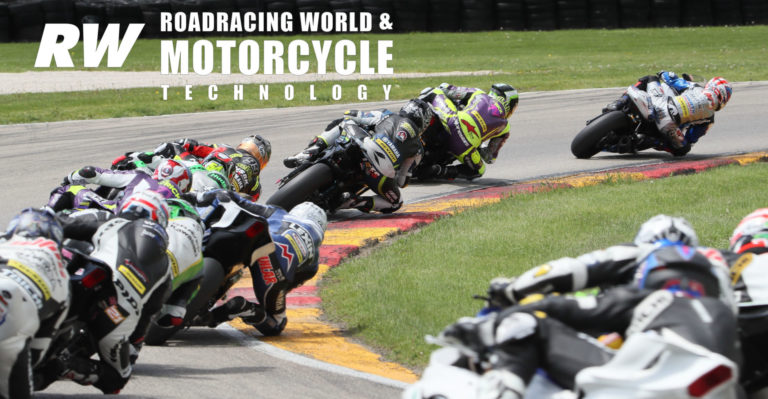
Josh Herrin (2) leads Garrett Gerloff (31), Cameron Beaubier (1), JD Beach (95), Mathew Scholtz (11), Kyle Wyman (33), and Cameron Petersen (45) into Turn 13 at Road America during MotoAmerica Superbike Race Two in 2019. Photo by Brian J. Nelson.
Parts Unlimited On Board With MotoAmerica Again
Distributing Giant A Supporting Partner Of The Series For 2020
IRVINE, CA (May 22, 2020) – MotoAmerica is proud to announce that global powersports distributor Parts Unlimited, one of the series’ longest serving sponsors, will again be a supporting partner of the 2020 MotoAmerica Series.
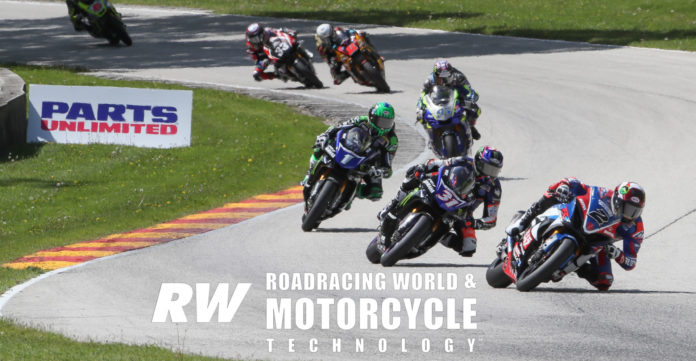
Distributing giant Parts Unlimited will again be a sponsor of the MotoAmerica Series in 2020. Photo by Brian J. Nelson.
“Parts Unlimited has been a partner of ours since we started and were actually one of the first companies that came on board,” said MotoAmerica President Wayne Rainey. “They are a company with a passion for racing worldwide and are a perfect fit for MotoAmerica and its fans. We’re thrilled to have them partnering with us again.”
Parts Unlimited is the world’s largest distributor of aftermarket accessories in the powersports industry and is owned by LeMans Corporation, which is headquartered in Janesville, Wisconsin. Parts Unlimited sells to over 12,000 dealerships worldwide and continues to expand its market penetration with its sister companies, Parts Canada, Parts Europe and Drag Specialties.
“Our partnership with MotoAmerica has always been a good one and we’re happy we can continue with them,” said Hylton Beattie, Parts Unlimited’s Global Motorsports Director. “Parts Unlimited is heavily involved in racing and MotoAmerica is the premier road racing series in the U.S. It’s natural that we are on board as a sponsor and we can’t wait to get the 2020 season rolling next weekend at Road America.”
Action from an AFT Twins heat race in Springfield, Illinois, in 2019. Photo by Scott Hunter, courtesy American Flat Track.
American Flat Track Announces Updated 2020 Race Schedule
18 races over 9 doubleheader weekends on tap for America’s Original Extreme Sport
DAYTONA BEACH, Fla. (May 22, 2020) – American Flat Track announced today a relaunch of its 2020 race schedule featuring doubleheader race weekends and kicking off on July 17 and 18 with the Volusia Half-Mile at Volusia Speedway Park in Barberville, Fla. The revised schedule features 18 races over nine doubleheader weekends and culminates in a two-day finale during Biketoberfest in Daytona Beach.
In addition to NBC Sports coverage on NBCSN and live streaming of all 18 events via TrackPass on NBC Sports Gold, AFT has worked diligently toward the goal of having fan attendance at all of its venues. This would include the implementation of new health & safety protocols that will help provide a safe environment for fans, competitors and staff, including reduced capacity, staggered seating, mobile ticketing, cashless transactions and enhanced sanitation.
AFT officials continue to collaborate with public health experts to develop this comprehensive plan in accordance with all federal, state and local requirements. All race-day procedures have been thoroughly reviewed and will continue to be examined and updated to follow specific guidelines set by the Centers for Disease Control and Prevention (CDC) and local authorities.
At all American Flat Track events new guidelines and protocols will include:
Reduction in ticket availability to conform with state and local guidelines for sporting events
Reserved seating areas to include buffer zones to provide ample space between fans
Fans entering the venue will be provided with complimentary facial coverings
Enhanced sanitation and disinfection protocols with frequent cleaning throughout the facility
Enhancements to mobile ticketing and elimination of printed tickets
Cashless, contactless transactions for concessions and merchandise
Regular medical screening of staff and competitors
As an additional precaution, there will be no public access to the paddock area and AFT officials have suspended Fan Walk, rider autograph sessions and paddock upgrades for the remainder of the season. Event-specific health & safety procedures will be updated to meet or exceed state and local requirements as they are updated over the coming months. Through an updated communication protocol, AFT and its promoter partners will provide regular updates to fans via press releases, website updates, social media posts, email distribution and text messaging.
Careful consideration has been given to secure a full 18-round race schedule that is logistically possible for riders, teams and staff, while also providing the opportunity for fan attendance. Following a thorough review of state guidelines and consultation with local officials by AFT’s promoter partners, certain events that were originally scheduled for 2020 have been cancelled. All ticketholders for cancelled events are eligible to receive a full refund or a credit for use at future events. Please contact [email protected] for more information.
For more information about the revised 2020 schedule, details on receiving credits or refunds for cancelled rounds and how fans can watch American Flat Track action from anywhere in the country, please visit the 2020 American Flat Track Schedule Update FAQ.
Further communication will be made as tickets go on sale and event announcements are made. For the latest information, stay connected via www.americanflattrack.com and AFT’s social media pages.
Updated 2020 American Flat Track Schedule*:
1. July 17 (Fri): Volusia Half-Mile I – Volusia Speedway Park, Barberville, FL
2. July 18 (Sat): Volusia Half-Mile II – Volusia Speedway Park, Barberville, FL
3. July 31 (Fri): Lima Half-Mile I – Allen County Fairgrounds, Lima, OH
4. August 1 (Sat): Lima Half-Mile II – Allen County Fairgrounds, Lima, OH
5. August 28 (Fri): TBA, Northeast U.S.
6. August 29 (Sat): TBA, Northeast U.S.
7. September 5 (Sat): Springfield Mile I** – Illinois State Fairgrounds – Springfield, IL
8. September 6 (Sun): Springfield Mile II – Illinois State Fairgrounds – Springfield, IL
9. September 11 (Fri):Williams Grove Half-Mile I – Williams Grove Speedway – Mechanicsburg, PA
10. September 12 (Sat): Williams Grove Half-Mile II – Williams Grove Speedway – Mechanicsburg, PA
11. September 25 (Fri): TBA, TX
12. September 26 (Sat): TBA, TX
13. October 2 (Fri): Atlanta Short Track I – Dixie Speedway – Woodstock, GA
14. October 3 (Sat): Atlanta Short Track II – Dixie Speedway – Woodstock, GA
15. October 9 (Fri): TBA, NC
16. October 10 (Sat): TBA, NC
17. October 15 (Thu): AFT Season Finale I – Daytona Beach, FL
18. October 16 (Fri): AFT Season Finale II – Daytona Beach, FL
*As the situation, regulations and protocols regarding COVID-19 progress, dates and venues listed above are subject to change.
**AFT Singles presented by Russ Brown Motorcycle Attorneys will participate in the Springfield TT on Friday, September 4.
NBCSN and TrackPass on NBC Sports Gold are the official homes for coverage of American Flat Track. For the 2020 season, NBCSN’s coverage of AFT remains in highly-coveted programming slots within two weeks of each event. The complete schedule for AFT on NBCSN can be viewed at http://www.americanflattrack.com/events-nbcsn/. TrackPass on NBC Sports Gold – the most-robust motorsports offering in the digital marketplace – is a cornerstone of AFT’s digital strategy, providing live streaming coverage of every event and maintaining an active archive of all AFT content.
About American Flat Track:
American Flat Track is the world’s premier dirt track motorcycle racing series and one of the longest-running championships in the history of motorsports. Sanctioned by AMA Pro Racing in Daytona Beach, Fla., the series is highly regarded as the most competitive form of dirt track motorcycle racing on the globe. For more information on American Flat Track, please visit http://www.americanflattrack.com, like us on Facebook, follow us on Twitter, check us out on Instagram, live stream the events with TrackPass on NBC Sports Gold and catch all the American Flat Track racing action on NBCSN.
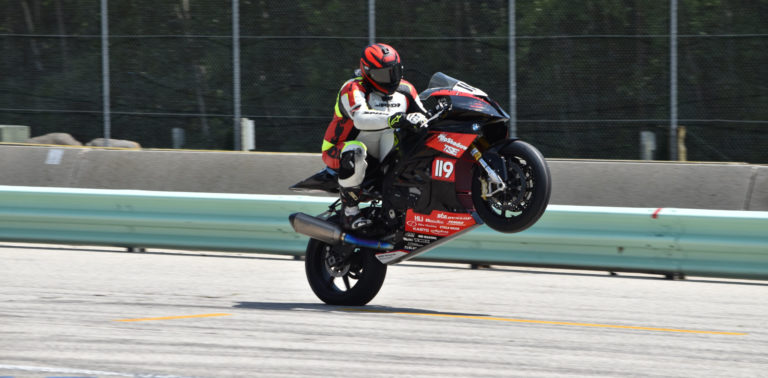
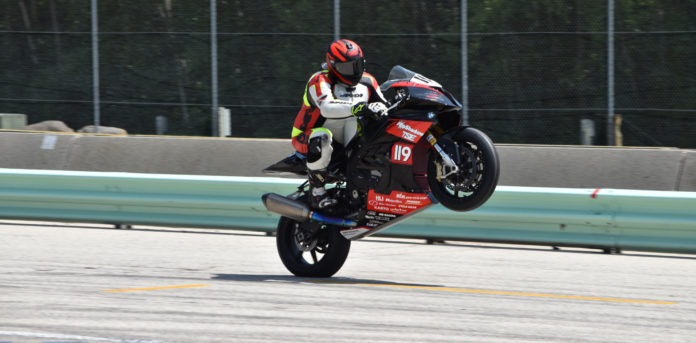
Stefan Dolipski (119) at speed. Photo by H&E Services, courtesy TSE Racing.
TSE Racing is excited to be back at their home track on the MotoAmerica
calendar, Road America. May 29-31 is finally the kick off of the season.
Stefan Dolipski, on his BMW S1000RR, will be competing in the Stock 1000
class, while his teammate Nate Minster will be racing his Yamaha R6 in
the Supersport class. Although the race won’t be the same without our
fans and spectators, the team hopes everyone still tunes into the
action.
Stefan Dolipski – “This upcoming weekend at Road America, will be the
return of Pro Motorcycle racing in the US, after almost 8 months of no
racing it will be a fresh start for everyone. I’m very excited to be
lining up on my TSE Racing BMW S1000RR, with some of the very talented
riders from all across America and some from across the world. With the
restrictions on life that came with this Virus, I’m very happy to be
able to get to go and enjoy my passion for motorcycle racing again.
Although it’s with a smiling and a sad face at the same time, as one of
my reasons for getting enjoyment out of racing, is seeing the fans and
spectators at the events and they will be dearly missed. Despite the
late start we are hoping to have a successful and exciting year never
the less.”
Nate Minster – “I’m really excited to get back out on my TSE Racing
prepared Yamaha R6. I can’t wait any longer to get back on a bike and be
back at the track. It will be my first time racing my R6 at a
MotoAmerica round. I raced the Junior cup a couple of years back, and
now I’m excited to see how I do on the 600.”
The whole crew at TSE Racing would also like to take this time to thank
all the people involved in making this event happen, along with all the
first responders and healthcare professionals that enable us to move
back towards a normal life.
Be sure to check out TSE Racing on Instagram @tse_racing and Facebook
@TSERacingTeam to keep up with their season of racing.
WERA CYCLE JAM SCHEDULED FOR MAY 30/31 IS CANCELED!
After working with Road Atlanta and their parent company NASCAR this past week and the concerns expressed for our riders’ safety during these times it was mutually agreed to cancel the upcoming May 30/31 event. We are currently looking at a re-schedule and possibly moving the National Races to the September 5/6 already on the schedule for Road Atlanta and have that be the 2020 Cycle Jam. This decision was not easy for either of us and we trust that you all understand that we are dealing with circumstances we can’t control and are making decisions based on the good of all the participants in our paddock.
WERA Motorcycle Roadracing was founded in 1973 and remains the foremost place to develop talent in the sport of motorcycle road racing. The legacy of Pro riders on a National and World level is legendary. All events are run by WERA Motorcycle Roadracing with a co-sanction by the AMA and they go coast to coast offering entry level racing with the WERA Sportsman Series as well as a Pro-Am Series with the WERA National Challenge Series, WERA Motorcycle Roadracing also offer Vintage Racing and limited Endurance Racing with Track Day Partners N2 . WERA Motorcycle Roadracing was voted the 2017 AMA Track Organizer of the Year.
For more information on WERA Motorcycle Roadracing please check out our web site at wera.com
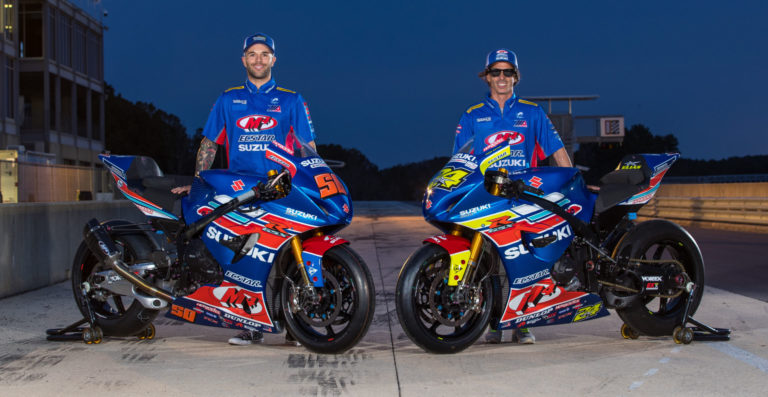
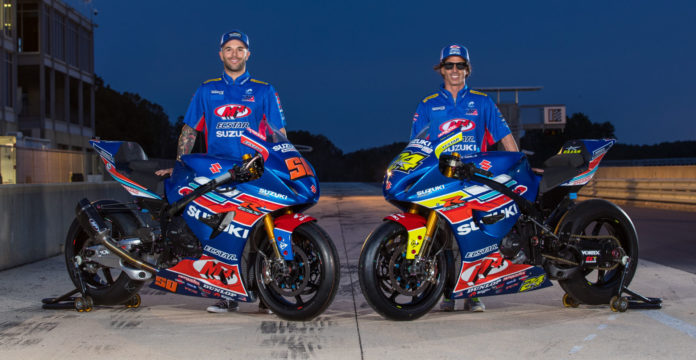
M4 ECSTAR Suzuki Superbike Riders Bobby Fong #50 (left) and Toni Elias #24 (right). Photo by Brian J. Nelson.
M4 ECSTAR Suzuki Team Preview for 2020 MotoAmerica Season
Toni Elias and Bobby Fong Kick-Off Round One at Road America on their Suzuki GSX-R1000’s
Brea, CA (May 21, 2020) – M4 ECSTAR Suzuki is excited to finally kick-off the delayed 2020 MotoAmerica Season next weekend at Road America in Elkhart Lake, Wisconsin. Toni Elias will spearhead Suzuki’s new premier Superbike team alongside teammate and 2019 MotoAmerica Supersport Champion Bobby Fong aboard their Suzuki GSX-R1000’s. Suzuki GSX-R600 riders Sean Dylan Kelly and Lucas Silva will contest the Supersport class while 2019 MotoAmerica Twins Cup Champion, Alex Dumas, takes on the Stock 1000 class in hopes to grab a back-to-back championship.
Spanish superstar, Elias will be entering his fifth season racing in the MotoAmerica Superbike Series, and has already established himself as one of the series’ all-time greats. With the 2017 MotoAmerica Superbike Championship under his belt, followed by impressive runner-up finishes in 2018 and 2019, Elias is eager to keep performing at the same level, win races, and regain the 2020 championship.
Teammate Fong earned the promotion to Superbike duty with his breakout 2019 season, in which he locked up the Supersport crown a round early through an epic campaign that included winning six times and finishing second 14 times. The Californian further rounded out his game with improved consistency and race craft, and looks forward to the new challenge of racing the premier class aboard his Suzuki GSX-R1000, and with a crew that has helped him physically and mentally prepare for the heightened competition.
Kelly is fresh off a breakthrough first MotoAmerica season and is determined to again be a strong contender in Supersport. The 18-year-old racked up seven podium finishes in 2019, including a spectacular double victory at Pittsburgh International Race Complex.
Teammate and rising star, Silva will compete alongside Kelly, building off his impressive season in 2019 with 10 top-10’s and an 11th overall finish.
Two-time MotoAmerica National Champion Dumas will contest in the 2020 MotoAmerica Stock 1000 Championship on a Suzuki GSX-R1000. In 2019, Dumas became the MotoAmerica Twins Cup Champion with five wins out of 11 races, and proved he has what it takes to compete at a higher-level in hopes to stack up more podiums and another championship victory.
M4 ECSTAR Suzuki will debut its full team and race livery at the first round of the 2020 MotoAmerica Championship series on May 29th at Road America. The action-packed weekend will be airing live on FOX Sports and MAVTV, and streaming live on MotoAmerica Live+ both Saturday and Sunday of the races. Check your local listings for times.
About Suzuki
Suzuki Motor of America, Inc. (SMAI) distributes Motorcycles, ATVs, Scooters, Outboard Motors and Automotive Parts and Accessories via an extensive dealer network throughout 49 states. Suzuki Motor Corporation (SMC), based in Hamamatsu, Japan, is a diversified worldwide manufacturer of Motorcycles, ATVs, Scooters, Automobiles, Outboard Motors and related products. Founded in 1909 and incorporated in 1920, SMC has business relations with 201 countries/regions. For more information, visit www.suzuki.com.
About Team Hammer
About Team Hammer: The 2020 season marks Team Hammer’s 40th consecutive year of operating as a professional road racing team. Racebikes built and fielded by Team Hammer have won 83 AMA Pro and MotoAmerica National races, have finished on AMA Pro and MotoAmerica National podiums 234 times and have won seven AMA Pro and MotoAmerica National Championships, as well as two FIM South American Championships (in Superbike and Supersport). The team has also won 137 endurance races overall (including seven 24-hour races) and 13 Overall WERA National Endurance Championships with Suzuki motorcycles, and holds the U.S. record for mileage covered in a 24-hour race. The team also competed in the televised 1990s Formula USA National Championship, famously running “Methanol Monster” GSX-R1100 Superbikes fueled by methanol, and won four F-USA Championships.
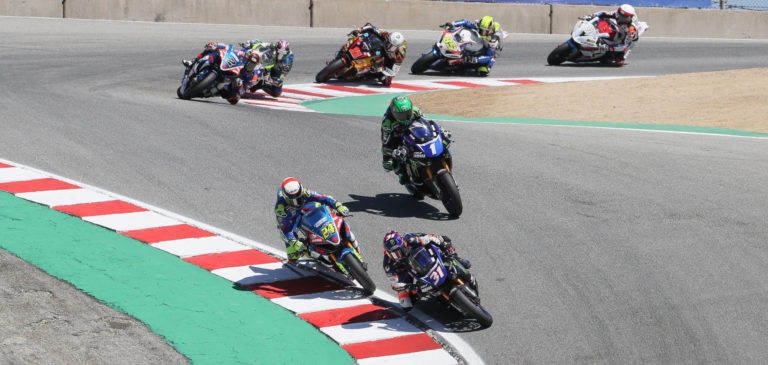
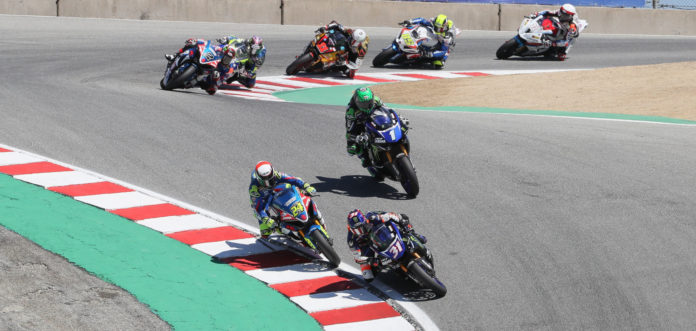
Garrett Gerloff (31) leads Toni Elias (24), Cameron Beaubier (1) and the rest of the MotoAmerica Superbike field at WeatherTech Raceway Laguna Seca in 2019. Photo by Brian J. Nelson.
MotoAmerica Reschedules Superbike Speedfest at Monterey
The WeatherTech Raceway Laguna Seca Event Set For October 23-25
IRVINE, CA (May 21, 2020) – MotoAmerica has announced that it has rescheduled the GEICO Motorcycle Superbike Speedfest at Monterey to October 23-25 due to the still-unresolved rules regarding spectator events in California with the COVID-19 pandemic.
The original date for the WeatherTech Raceway Laguna Seca event was July 10-12.
“With the way things are in California right now, there is no way we can race with spectators at Laguna Seca in July,” said MotoAmerica President Wayne Rainey. “Thus, we’ve decided to reschedule the event for October and allow our fans the time to change their travel plans and make new ones that include the Speedfest at Monterey this fall. As always, the safety of our fans, our teams and our riders are of the utmost importance to us and postponing the race is our best option to ensure that.”
The original date at WeatherTech Raceway Laguna Seca called for the race to be the third round of the 2020 MotoAmerica Series. With the change, the GEICO Motorcycle Superbike Speedfest at Monterey will be the ninth round of the 10-round series – two weeks after the October 9-11 round at Indianapolis Motor Speedway.
The series is set to kick off at Road America next weekend, May 29-31, without fans in attendance.
2020 MotoAmerica Series Schedule
May 29-31 Road America Elkhart Lake, Wisconsin
June 26-28 Road America Elkhart Lake, Wisconsin
July 31-Aug. 2 Road Atlanta Braselton, Georgia
August 7-9 Pittsburgh Int’l Race Complex Wampum, Pennsylvania
August 28-30 Ridge Motorsports Park Shelton, Washington
September 11-13 New Jersey Motorsports Park Millville, New Jersey
September 18-20 Barber Motorsports Park Birmingham, Alabama
October 9-11 Indianapolis Motor Speedway Indianapolis, Indiana
October 23-25 Laguna Seca Monterey, California
November 13-15 Circuit of The Americas Austin, Texas
With race leader Bobby Fong already out of frame to the right, Sean Dylan Kelly heads Hayden Gillim, Josh Hayes, PJ Jacobsen, Richie Escalante, and the rest of the field during MotoAmerica Supersport Race Two at Road America in 2019. Photo by Brian J. Nelson.
MAVTV To Air MotoAmerica Supersport Openers Live From Road America
Both Supersport Races Will Be Telecast Live On MAVTV
IRVINE, CA (May 21, 2020) – MotoAmerica is pleased to announce that its new partnership with MAVTV will start with a bang at round one of the 2020 MotoAmerica Series with the motorsports network set to air the first two Supersport races of the season live from Road America in Elkhart Lake, Wisconsin, May 30-31.
The opening round of the 2020 MotoAmerica Series at Road America will be run without fans due to the ongoing COVID-19 pandemic, but MAVTV’s live coverage will allow fans to watch the races from the comfort of their homes.
“It’s great to see MAVTV get on board in style by airing the Supersport races from Road America live,” said MotoAmerica President Wayne Rainey. “The first Road America round will definitely be different without our fans in attendance, but those same fans will appreciate MAVTV showing the races live. This shows how committed MAVTV is to the MotoAmerica Series and we look forward to a really exciting Supersport season on the motorsports network.”
The live broadcasts are scheduled to air at 3 p.m. (Eastern) on Saturday, May 30 and Sunday, May 31. MAVTV’s LIVE broadcasts will feature one-hour programming of the rising stars competing in the hotly contested Supersport class.
“MAVTV has a rich history with two-wheel racing and we are proud to offer America’s premier road racing series in our May broadcast schedule,” said John Duff, Head of Content, MAVTV Motorsports Network. “While racing without fans isn’t ideal, the ability to hold a live race is still a big win for the industry and its fans, and we’re excited to broadcast these live events to motorsports enthusiasts.”
MAVTV, which is owned and operated by Lucas Oil and located in Corona, California, airs programming focused around motorsports with national distribution that includes DirecTV, Charter/Spectrum, FiOS by Verizon, AT&T U-verse, fuboTV, Vidgo, Altice, Mediacom and more. MAVTV boasts distribution of 30 million customers.
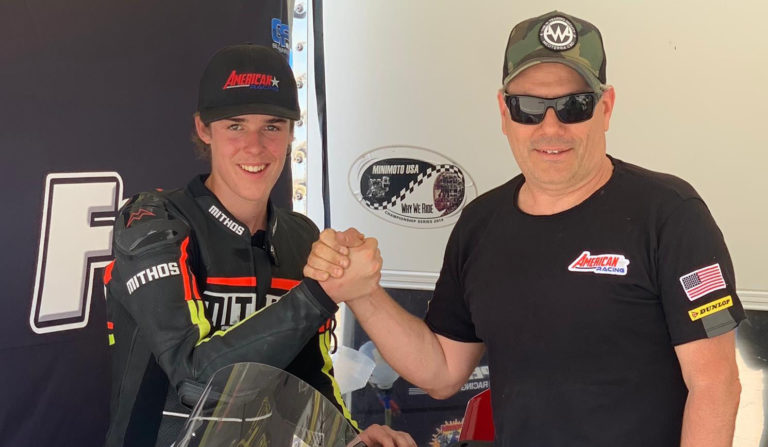
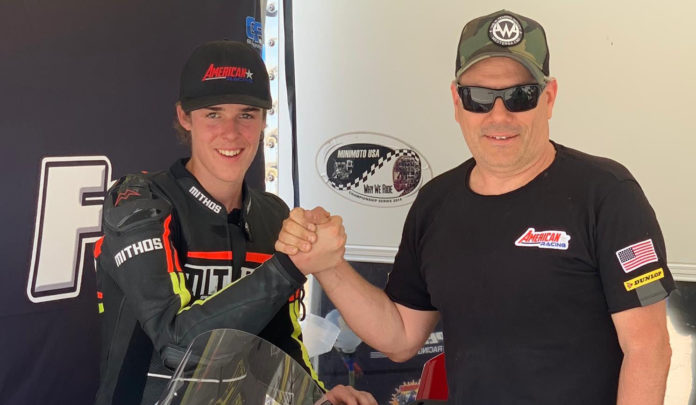
Rocco Landers (left) and American Racing Team and APEX Motorsport Agency owner Eitan Butbul (right). Photo courtesy APEX Motorsport Agency.
APEX Motorsport Agency and The American Racing Academy Announces Signing of Young American Star Rocco Landers
Calabasas, CA (May 21, 2020) — APEX Motorsport Agency and the American Racing Academy are excited to announce the signing of American road racer Rocco Landers to a rider management contract. Landers is scheduled to participate in selected races as part of the 2020 MotoAmerica Liqui Moly Junior Cup on his Landers Racing Kawasaki Ninja 400. He will also compete in the MotoAmerica Twins Cup on board a Suzuki SV650 as part of a collaboration between the American Racing Team and Team Hammer, Inc.
Last fall, Landers was chosen to participate in the prestigious 2020 Red Bull Rookies Cup in Europe. Those plans are currently on hold due to the world-wide COVID-19 pandemic.
Landers brings with him his father, Stoney Landers, to be part of his management, training and technical team.
Landers will join the American Racing Academy Program managed by former MotoGP star John Hopkins. The signing of Landers to a 3-year rider management contract is part of APEX Motorsport Agency, and American Racing Team, owner Eitan Butbul’s plan to develop American riders for world championship competition. The Agency and American Racing Academy will provide coaching and support at the track by Hopkins and provide Moto2 bikes for track days in the US and training. Technical support will be provided for all contracted riders by Matthieu Grodecoeur, Technical Director for American Racing’s Moto2 team.
Butbul, along with Hopkins, continue to identify and recruit additional talented young Americans of different ages to join the Academy with the goal of preparing the next generation of world-class riders.
About the American Racing Team
The American Racing Team competes in the MotoGP World Championship. The team currently fields 2 riders in the Moto2 class; American Joe Roberts (#16) and Spaniard Marcos Ramirez (#42). The team is the only team in the MotoGP series owned by an American and featuring an American Rider. The team has grown under the guidance of team owner Eitan Butbul and is a respected part of the MotoGP world championship paddock.
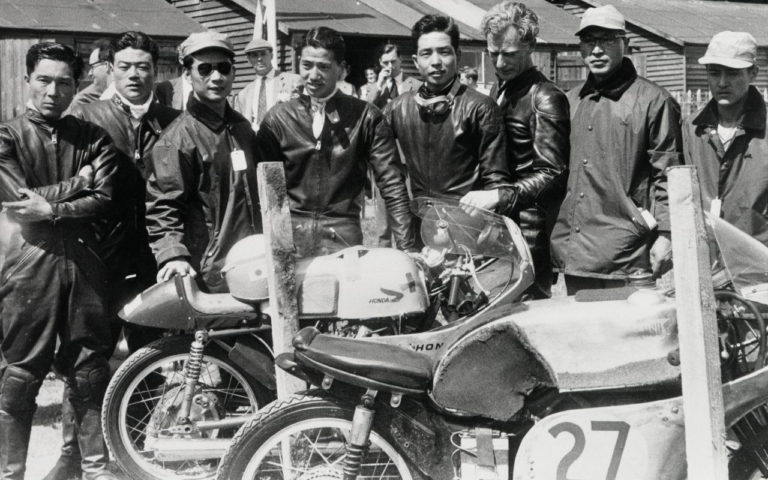
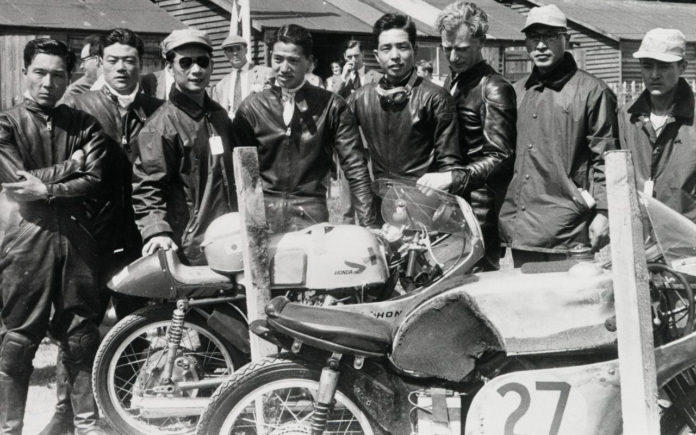
Honda's race team at the Isle of Man TT in 1959. Photo courtesy Honda Pro Racing.
No other manufacturer has made an entry into motorcycle Grand Prix racing quite like Honda.
In June 1959 Honda entered its first World Championship race, the Isle of Man Ultra-Lightweight TT. In 1960 Honda contested its first World Championship season, achieving its first podiums. In 1961 Honda scored its first Grand Prix victories and took the 125 and 250 World Championships. By the end of 1967 the company had won 138 GP races and 34 riders and constructors World Championships across all five categories: 50cc, 125cc, 250cc, 350cc and 500cc.
This unique achievement was inspired by one man: Soichiro Honda, who founded the Honda Motor Company in 1948.
Honda-san had a vision. At a time when Japanese motorcycles were unheard of in Europe he knew he had to conquer the European racing scene to make Honda a global force. And he was in no mood for hanging around.
In the spring of 1954, fewer than six years after he had established his company, he made this announcement. “My childhood dream was to be a motorsport World Champion with a machine built by myself,” he wrote. “I have decided to compete in the Isle of Man TT races… This aim is a difficult one, but we have to achieve it to test the viability of Japanese industrial technology, and to demonstrate it to the world… I here avow my definite intention that I will participate in the TT races and I proclaim with my fellow employees that I will pour in all my energy and creative powers to win.”
Naomi Taniguchi seated on his Honda RC142 Grand Prix racebike at the Isle of Man TT in 1959. Photo courtesy Honda Pro Racing.
That summer Honda-san travelled to the Isle of Man TT, at that time the biking world’s biggest racing event. His aim was to examine the machinery of his would-be rivals. And he was in for a nasty shock.
“We were astonished that the motorcycles were so much more powerful than we had imagined,” he wrote many years later.
Honda-san returned to Japan to develop a motorcycle fast enough to compete at the TT. Five years later he sent a small team of riders and engineers to the Isle of Man where Honda took the team prize in its first World Championship race, on June 3, 1959.
This was an extraordinary performance, considering that the TT was Honda’s first road race, because most racing in Japan took place on dirt roads. Indeed when the team arrived on the Isle of Man they had to adapt Honda’s 125cc RC142 machines, which had been equipped for racing on the dirt, not asphalt.
Not only that, Honda’s riders had spent the previous few months watching videos and reading guides to learn the full 37.75-mile Mountain course. Only when they got to the Island did they discover that the 125cc Ultra-Lightweight race would take place on a different circuit, the Clypse course!
Honda’s presence on the Isle of Man created a sensation because European motorcyclists had never seen Japanese motorcycles before. Some fans weren’t convinced by Honda’s first attempt at a GP bike – a twin-cylinder four-stroke that made 18 horsepower, good for a top speed of around 180kmh/110mph.
Naomi Taniguchi (8) at speed on his Honda RC142 Grand Prix racebike at the Isle of Man TT in 1959. Photo courtesy Honda Pro Racing.
However, the team’s debut race performance – Naomi Taniguchi finished in sixth place, Giichi Suzuki in seventh, Teisuke Tanaka in eighth and Junzo Suzuki in 11th – confirmed that Honda knew what it was doing. One onlooker – up-and-coming Australian GP rider Tom Phillis – was so impressed by the team’s scrupulous efficiency that he wrote a letter to Honda in Japan, seeking a ride for the 1960 season.
Tom Phillis (19) at speed on his Honda RC143, a DOHC 125cc Twin. Photo courtesy Honda Pro Racing.
The following spring Phillis became Honda’s first non-Japanese World Championship rider and was amazed at the progress Honda had made with its machines. In August he scored his first World Championship podium when he rode an RC161 four-cylinder 250 to second place at the Ulster GP. Two weeks before that Kenjiro Tanaka had made history by taking Honda’s first Grand Prix podium, also on an RC161, at the West German GP.
Honda’s rapid rate of improvement continued into 1961 when Phillis took the company’s first Grand Prix victory in the season-opening 125cc Spanish GP. Three weeks later Kunimitsu Takahashi won Honda’s first 250cc victory at Hockenheim.
Honda dominated both classes in its second season of world-class racing. In September 1961 Honda-san and his wife Sachi flew to Sweden where they witnessed Mike Hailwood take Honda’s first World Championship, in the 250 class. Four weeks later Phillis secured the 125cc title in Argentina. Honda also took its first constructors crowns, in both categories.
Mike Hailwood (1) at speed on his Honda RC166 , a 250cc six-cylinder machine, in 1967. Photo courtesy Honda Pro Racing.
From this moment Honda became the dominant force in Grand Prix racing. The next six seasons became an enthralling battle between Honda’s four-strokes and rival two-stroke machines. This technological race produced some of the most fabulous motorcycles ever to grace a racetrack: Honda’s six-cylinder 250, five-cylinder 125 and twin-cylinder 50.
Honda has always considered racing to be its laboratory on wheels and perhaps this was never truer than in the 1960s, when the company was relatively new to the game. The technological concept behind these three machines was the same. Honda needed more rpm to defeat the two-strokes, so engineers shortened engine stroke and multiplied the number of cylinders to raise rpm. At the same time they used four valves per cylinder, which fitted comfortably in the wider bores, while the lighter weight of the smaller valves solved high-rpm valve problems. Honda had hit upon a potent engine design.
In 1962 Honda contested the new 50cc World Championship, adding 50s to its efforts in the 125, 250 and 350 classes. At the opening Spanish GP in Barcelona Honda’s first 50 struggled, so Honda engineers went to work, in the most amazing way.
Honda riders told their engineers that the bike needed more gears than its original six. A few weeks later the riders arrived in Clermont-Ferrand for the French GP to find new engines with eight-speed gearboxes. Another two weeks later at the TT and the bikes were equipped with nine-speed gearboxes.
Such a rate of development was unheard of in Europe. And all this despite the small matter of transporting equipment from Japan. This entailed a gruelling flight route from Tokyo’s Haneda airport to Europe, via Hong Kong, Bangkok, Calcutta, Karachi and Beirut.
At the end of 1962 Honda replaced its 50cc single with a completely new twin-cylinder machine. The twin won the 50cc riders and constructors World Championships in 1965. The final iteration of the 50, which won the 1966 constructors crown, had a bore and stroke of 35.5 by 25.14mm, revved to 22,500rpm and produced 14 horsepower. That’s a specific power output of 280 horsepower per litre!
Although the 50cc was a miniature marvel it made fewer headlines than its bigger brothers, the 250 six and 125 five.
Honda’s 250 six is still revered as one of the most exciting Grand Prix bikes of all time – the sound of its engine through six open pipes was music to race fans of the 1960s.
A Honda RC166, which is powered by a DOHC 250cc six-cylinder engine. Photo courtesy Honda Pro Racing.
The machine was first unleashed at Monza in September 1964, when Honda flew one bike to Europe across three seats of a passenger plane, because they had run out of time to send the bike by air freight.
The six was remarkable in so many ways. The 24-valve, 39 x 34.8mm engine was barely wider than its four-cylinder predecessor and revved past 18,000rpm, producing 60 horsepower for a top speed of over 240kph/150mph.
Its crankshaft – almost 35cm long– ran with one-piece conrods and tiny flywheels, with most of the mass concentrated towards the centre, effectively halving the crank’s vibrating length.
The engine was bullet proof, even when Honda built a bored-and-stroked 297cc version, which took six 350cc riders and constructors World Championships between 1965 and 1967.
The five-cylinder 125 shared the 50cc twin’s engine measurements and made a shrieking noise, a couple of octaves above the 250’s. This engine also made its maximum power at over 20,000rpm, so it demanded huge skills from its riders, who played wonderful tunes with its eight-speed gearbox.
A Honda RC149, which is powered by a 125cc DOHC five-cylinder engine. Photo courtesy Honda Pro Racing.
Engine internals of both the 125 five and 50 twin were so tiny that mechanics used tweezers to fit valve collets and abrasive stones to grind tappets to a valve clearance of just 0.1778mm. The task of setting up the carburation was also extremely time-consuming: five carburettors with five jets each (main petrol and air jets, intermediate petrol and air jets and a slow-running air jet) plus three different lengths of inlet rubbers.
By 1965 Honda had conquered the 50cc, 125cc, 250cc and 350cc categories, leaving the company one final target: the premier 500cc World Championship.
Honda’s first premier-class GP bike was perhaps less exotic than its smaller stablemates – the RC181 had four cylinders – but was immediately successful. In its first race the RC181 took a dominant victory at the 1966 West German GP, with Rhodesian rider Jim Redman on board.
A Honda RC181, which is powered by a 500cc DOHC four-cylinder engine. Photo courtesy Honda Pro Racing.
Redman also won the second race at Assen and might have gone on to win the 500cc title at Honda’s first attempt, but he crashed out of the third race – around the terrifyingly fast Spa-Francorchamps street circuit – and sustained career-ending injuries. Hailwood, who had been concentrating on the 250 and 350 classes, took over Redman’s bikes to contest the last five 500 races of the nine-race season. He won three, but it wasn’t quite enough to take the title.
However, the five victories achieved by Redman and Hailwood did win the 500cc constructors title at Honda’s first attempt. And this gave the company a full-house of constructors World Championship in the 50, 125, 250, 350 and 500 categories, an achievement unmatched by any other manufacturer.
The 1967 Grand Prix season turned out to be Honda’s last for more than a decade. Once again the company won the 250 and 350cc titles, but the 500 eluded its riders and engineers. Hailwood finished the season equal on points with MV Agusta’s Giacomo Agostini, but points-scoring system gave the title to Ago.
Honda withdrew from motorcycle GP racing to focus its efforts on the Formula 1 car World Championship. Honda’s first F1 cars were powered by engines designed by the same engineers that had created the greatest 250 six and other machines.
There is no doubt that the 1960s was a very special time for Honda and for motorcycle racing. The duel for supremacy between four-stroke and two-stroke precipitated a technology race the like of which the sport has never seen, before or since.
Engineers and riders were pushed to their limits as they fought for victory, both in the design shop and on the racetrack. The people who were involved in that contest remember the 1960s as a golden age, when anything seemed possible. After all, man was on its way to the moon!
Honda returned to Grand Prix racing in 1979 and won its first premier-class World Championship in 1983. In 2001 the company became the first manufacturer to achieve 500 Grand Prix victories. The total now stands at more than 800 victories, plus 133 riders and constructors World Championships, including a clean sweep of the last four MotoGP riders and constructor titles, during which time Marc Marquez (Repsol Honda RC213V) became Honda’s most successful premier-class rider.
Marc Marquez (93) training on a motorcross bike in 2020. Photo by Javi Echevarria, courtesy Repsol Honda.
We Ride Again
As the world begins to reopen after the global effort to limit the spread of Covid-19, the Repsol Honda Team pairing of Marc Marquez and Alex Marquez have been able to transition towards how they would normally train. Following all the guidelines and safety recommendations of the government and health experts, the two riders from Cervera returned to cycling outdoors in early May.
Now, after having not ridden a motorcycle since March 11, the pair have been able to restart their engines and enjoy the feeling that only riding can give at the ‘El Bosquet’ Circuit in Ponts on Tuesday, May 19. Delighted to experience this sensation once again, Marc and Alex will continue to expand and alter their training in line with government advice as they eagerly await the return of the MotoGP World Championship alongside the entire Repsol Honda Team.
Marc Marquez
“After two months, honestly it was a little strange at the start to be back on the bike for the first laps. But soon I was feeling better as all of the muscles and the mind started to remember everything again. It was really nice to be able to get back on the bike, this is a feeling you can’t find anywhere else. Step by step we’re coming closer and closer to normal life and this is the most important point.”
Alex Marquez
“It is great to be able to return to more normal training and it was a real pleasure to be back out on the motocross circuit. When something like this is your passion, you always enjoy it a lot so it was special to ride, you need the bike in your life. For at least a little bit it was like everything was normal. Unfortunately the world is still not yet back to normal and we as riders, as well as everyone else, must continue to adapt and do our best in this situation. Hopefully we can have more days like today.”
A “press release” is promotional text issued by a rider, team, company or organization to inform
the public about an event, product, or service from the issuer’s own point of view, and if deemed
to have news value, may be placed on roadracingworld.com as a service to our readers.
A press release is not an article written by Roadracingworld.com staffers. When a post is labeled with the words “press release”, it means that Roadracingworld.com is not responsible for its content and that Roadracingworld.com makes no guarantee that it is accurate. Not all press releases are posted and Roadracingworld.com may reject press releases if the content is too heavy on commercial promotion with little or no news value or if the press release contains obvious errors.
Accessibility
Accessibility modes
Epilepsy Safe Mode
Dampens color and removes blinks
This mode enables people with epilepsy to use the website safely by eliminating the risk of seizures that result from flashing or blinking animations and risky color combinations.
Visually Impaired Mode
Improves website's visuals
This mode adjusts the website for the convenience of users with visual impairments such as Degrading Eyesight, Tunnel Vision, Cataract, Glaucoma, and others.
Cognitive Disability Mode
Helps to focus on specific content
This mode provides different assistive options to help users with cognitive impairments such as Dyslexia, Autism, CVA, and others, to focus on the essential elements of the website more easily.
ADHD Friendly Mode
Reduces distractions and improve focus
This mode helps users with ADHD and Neurodevelopmental disorders to read, browse, and focus on the main website elements more easily while significantly reducing distractions.
Blindness Mode
Allows using the site with your screen-reader
This mode configures the website to be compatible with screen-readers such as JAWS, NVDA, VoiceOver, and TalkBack. A screen-reader is software for blind users that is installed on a computer and smartphone, and websites must be compatible with it.
Online Dictionary
Readable Experience
Content Scaling
Default
Text Magnifier
Readable Font
Dyslexia Friendly
Highlight Titles
Highlight Links
Font Sizing
Default
Line Height
Default
Letter Spacing
Default
Left Aligned
Center Aligned
Right Aligned
Visually Pleasing Experience
Dark Contrast
Light Contrast
Monochrome
High Contrast
High Saturation
Low Saturation
Adjust Text Colors
Adjust Title Colors
Adjust Background Colors
Easy Orientation
Mute Sounds
Hide Images
Hide Emoji
Reading Guide
Stop Animations
Reading Mask
Highlight Hover
Highlight Focus
Big Dark Cursor
Big Light Cursor
Cognitive Reading
Virtual Keyboard
Navigation Keys
Voice Navigation
Accessibility Statement
www.roadracingworld.com
November 13, 2026
Compliance status
We firmly believe that the internet should be available and accessible to anyone, and are committed to providing a website that is accessible to the widest possible audience,
regardless of circumstance and ability.
To fulfill this, we aim to adhere as strictly as possible to the World Wide Web Consortium’s (W3C) Web Content Accessibility Guidelines 2.1 (WCAG 2.1) at the AA level.
These guidelines explain how to make web content accessible to people with a wide array of disabilities. Complying with those guidelines helps us ensure that the website is accessible
to all people: blind people, people with motor impairments, visual impairment, cognitive disabilities, and more.
This website utilizes various technologies that are meant to make it as accessible as possible at all times. We utilize an accessibility interface that allows persons with specific
disabilities to adjust the website’s UI (user interface) and design it to their personal needs.
Additionally, the website utilizes an AI-based application that runs in the background and optimizes its accessibility level constantly. This application remediates the website’s HTML,
adapts Its functionality and behavior for screen-readers used by the blind users, and for keyboard functions used by individuals with motor impairments.
If you’ve found a malfunction or have ideas for improvement, we’ll be happy to hear from you. You can reach out to the website’s operators by using the following email
Screen-reader and keyboard navigation
Our website implements the ARIA attributes (Accessible Rich Internet Applications) technique, alongside various different behavioral changes, to ensure blind users visiting with
screen-readers are able to read, comprehend, and enjoy the website’s functions. As soon as a user with a screen-reader enters your site, they immediately receive
a prompt to enter the Screen-Reader Profile so they can browse and operate your site effectively. Here’s how our website covers some of the most important screen-reader requirements,
alongside console screenshots of code examples:
Screen-reader optimization: we run a background process that learns the website’s components from top to bottom, to ensure ongoing compliance even when updating the website.
In this process, we provide screen-readers with meaningful data using the ARIA set of attributes. For example, we provide accurate form labels;
descriptions for actionable icons (social media icons, search icons, cart icons, etc.); validation guidance for form inputs; element roles such as buttons, menus, modal dialogues (popups),
and others. Additionally, the background process scans all the website’s images and provides an accurate and meaningful image-object-recognition-based description as an ALT (alternate text) tag
for images that are not described. It will also extract texts that are embedded within the image, using an OCR (optical character recognition) technology.
To turn on screen-reader adjustments at any time, users need only to press the Alt+1 keyboard combination. Screen-reader users also get automatic announcements to turn the Screen-reader mode on
as soon as they enter the website.
These adjustments are compatible with all popular screen readers, including JAWS and NVDA.
Keyboard navigation optimization: The background process also adjusts the website’s HTML, and adds various behaviors using JavaScript code to make the website operable by the keyboard. This includes the ability to navigate the website using the Tab and Shift+Tab keys, operate dropdowns with the arrow keys, close them with Esc, trigger buttons and links using the Enter key, navigate between radio and checkbox elements using the arrow keys, and fill them in with the Spacebar or Enter key.Additionally, keyboard users will find quick-navigation and content-skip menus, available at any time by clicking Alt+1, or as the first elements of the site while navigating with the keyboard. The background process also handles triggered popups by moving the keyboard focus towards them as soon as they appear, and not allow the focus drift outside it.
Users can also use shortcuts such as “M” (menus), “H” (headings), “F” (forms), “B” (buttons), and “G” (graphics) to jump to specific elements.
Disability profiles supported in our website
Epilepsy Safe Mode: this profile enables people with epilepsy to use the website safely by eliminating the risk of seizures that result from flashing or blinking animations and risky color combinations.
Visually Impaired Mode: this mode adjusts the website for the convenience of users with visual impairments such as Degrading Eyesight, Tunnel Vision, Cataract, Glaucoma, and others.
Cognitive Disability Mode: this mode provides different assistive options to help users with cognitive impairments such as Dyslexia, Autism, CVA, and others, to focus on the essential elements of the website more easily.
ADHD Friendly Mode: this mode helps users with ADHD and Neurodevelopmental disorders to read, browse, and focus on the main website elements more easily while significantly reducing distractions.
Blindness Mode: this mode configures the website to be compatible with screen-readers such as JAWS, NVDA, VoiceOver, and TalkBack. A screen-reader is software for blind users that is installed on a computer and smartphone, and websites must be compatible with it.
Keyboard Navigation Profile (Motor-Impaired): this profile enables motor-impaired persons to operate the website using the keyboard Tab, Shift+Tab, and the Enter keys. Users can also use shortcuts such as “M” (menus), “H” (headings), “F” (forms), “B” (buttons), and “G” (graphics) to jump to specific elements.
Additional UI, design, and readability adjustments
Font adjustments – users, can increase and decrease its size, change its family (type), adjust the spacing, alignment, line height, and more.
Color adjustments – users can select various color contrast profiles such as light, dark, inverted, and monochrome. Additionally, users can swap color schemes of titles, texts, and backgrounds, with over seven different coloring options.
Animations – person with epilepsy can stop all running animations with the click of a button. Animations controlled by the interface include videos, GIFs, and CSS flashing transitions.
Content highlighting – users can choose to emphasize important elements such as links and titles. They can also choose to highlight focused or hovered elements only.
Audio muting – users with hearing devices may experience headaches or other issues due to automatic audio playing. This option lets users mute the entire website instantly.
Cognitive disorders – we utilize a search engine that is linked to Wikipedia and Wiktionary, allowing people with cognitive disorders to decipher meanings of phrases, initials, slang, and others.
Additional functions – we provide users the option to change cursor color and size, use a printing mode, enable a virtual keyboard, and many other functions.
Browser and assistive technology compatibility
We aim to support the widest array of browsers and assistive technologies as possible, so our users can choose the best fitting tools for them, with as few limitations as possible. Therefore, we have worked very hard to be able to support all major systems that comprise over 95% of the user market share including Google Chrome, Mozilla Firefox, Apple Safari, Opera and Microsoft Edge, JAWS and NVDA (screen readers).
Notes, comments, and feedback
Despite our very best efforts to allow anybody to adjust the website to their needs. There may still be pages or sections that are not fully accessible, are in the process of becoming accessible, or are lacking an adequate technological solution to make them accessible. Still, we are continually improving our accessibility, adding, updating and improving its options and features, and developing and adopting new technologies. All this is meant to reach the optimal level of accessibility, following technological advancements. For any assistance, please reach out to