
Home Blog Page 1186

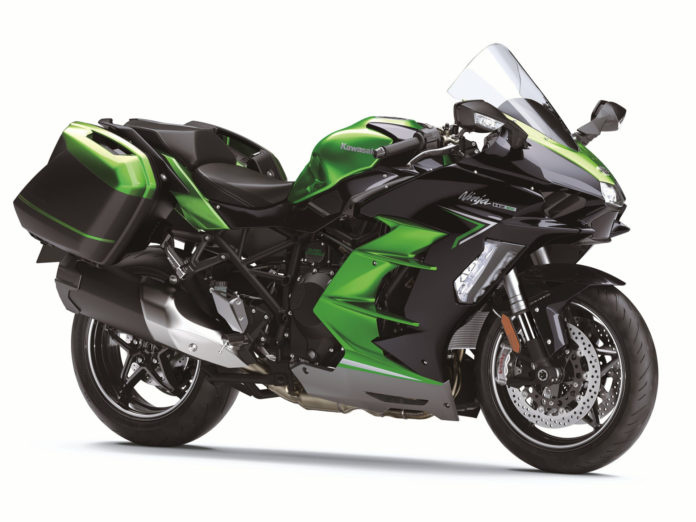
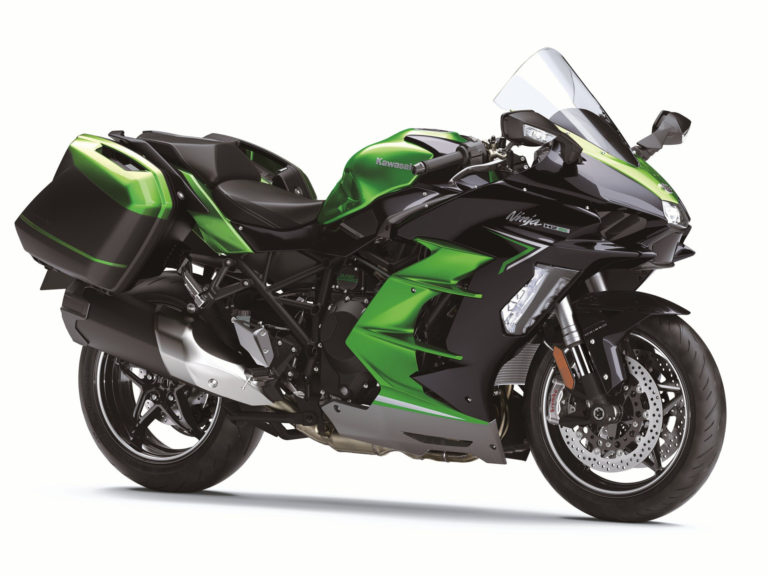
Kawasaki Ninja H2 SX SE Gets More Power & Technology For 2022

2022 Kawasaki Ninja H2® SX SE Motorcycle

ENGINEERED TO BE FREE

The Kawasaki Ninja H2® models are a testament to Kawasaki’s pursuit of innovation, performance, and passion for creating the world’s most advanced line of supercharged motorcycles. For 2022, the Ninja H2® SX SE motorcycle returns to Kawasaki’s hypersport lineup, new and improved by blending performance and ultimate real-world handling with Kawasaki’s most advanced suite of rider assist technologies to date.

The Kawasaki Ninja H2 SX SE brings the latest in electronically controlled suspension, braking, and rider aid technologies to the supercharged hyperbike platform, making it the ultimate sport touring package. The Ninja H2 SX SE is powered by an exhilarating unique balanced supercharged 998cc inline four-cylinder engine, which utilizes Kawasaki’s knowledge of precision engine tuning to distribute power to where it is most useful, in the low to mid-range for both long distance touring and daily riding. With this powerful engine at its core, Kawasaki has created one of the most advanced and well-balanced motorcycles in performance, comfort, and efficiency, to expand your supercharged journey.

Developed with the ability to go above and beyond the daily applications of today’s sportbike rider, the Ninja H2 SX SE is Kawasaki’s most advanced sport tourer ever and utilizes a balanced supercharged engine that offers optimal output performance in the low to mid RPM range, all while achieving excellent fuel efficiency. This highly refined package offers an unrivaled level of performance and comfort, with agile handling akin to its superbike counterparts.

New for 2022, the Ninja H2 SX SE features updated styling through a new headlight and upper cowl, Advanced Rider Assist System (ARAS) with Adaptive Cruise Control (ACC), Forward Collision Warning (FCW), and Blind Spot Detection (BSD), wider rider and passenger seats for comfort, 6.5” TFT Color Instrumentation with Kawasaki’s new Smartphone-based Infotainment app (SPIN), Tire Pressure Monitoring System (TPMS), Vehicle Hold Assist (VHA), Kawasaki Electronically Controlled Suspension (KECS) with Skyhook technology, and Kawasaki Intelligent Proximity Activation Start System(KIPASS) remote key fob.

2022 KAWASAKI NINJA H2® SX SE HIGHLIGHTS

  • NEW Headlight and upper cowl styling
  • NEW Advanced Rider Assist System (ARAS)
    • Adaptive Cruise Control (ACC)
    • Forward Collision Warning (FCW)
    • Blind Spot Detection (BSD)
  • NEW Wider seats for increased comfort
  • NEW5” TFT Color Instrumentation with a Smartphone-based Infotainment app (SPIN)
  • NEW Tire Pressure Monitoring System (TPMS)
  • NEW Vehicle Hold Assist (VHA)
  • NEW Kawasaki Electronic Control Suspension (KECS) with Showa Skyhook EERA technology
  • NEW Kawasaki Intelligent Proximity Activation Start System (KIPASS) remote key fob
  • NEW USB-style power outlet
  • NEW Grip heaters

ENGINE & CLUTCH

  • NEW Revised cam timing
  • NEW Exhaust silencer
  • NEW Elimination of exhaust pre-silencer
  • NEW Revised second gear
  • NEW Optimized hydraulic clutch fluid volume

A supercharged 998cc inline four-cylinder engine is designed to deliver both power and fuel efficiency on the 2022 Ninja H2® SX SE, focusing on low-mid range power delivery with exhilarating acceleration that prioritizes everyday usability in street-riding conditions. New for 2022 is a resin silencer that has been added to the secondary air inlet to reduce mechanical (intake) noise. Revised cam timing contributes to increased overall engine performance. The elimination of the exhaust’s pre-silencer chamber allows greater freedom with the new exhaust layout that features a longer collector pipe, increased catalyser volume, and a larger silencer. The new straight-pipe style layout delivers improved torque to benefit everyday ride ability.

A dog-ring transmission facilitates smooth, quick shifting and the number of gear teeth for second gear have been revised in order to minimize resonance when the gears mesh. Adding ribs to the inside of the clutch cover increases its stiffness, further helping to reduce mechanical noise. A hydraulic assist and slipper clutch offers light lever operation. The volume of the hydraulic fluid routed to the clutch plates has been revised and offers improved clutch release. As a result, the shift load due to the plates dragging can be minimized, an improvement that is noticeable when stopped, and it’s easier to shift into neutral.

NEW TFT COLOR INSTRUMENTATION WITH SMARTPHONE INTEGRATION (SPIN)

  • NEW5” TFT Color Instrumentation with a Smartphone-based Infotainment app (SPIN)

A large, easy-to-read 6.5” full-color TFT instrumentation screen adds a high-tech appearance to the cockpit. The new TFT instrumentation is complemented by multiple display modes (black, white or automatic) and smartphone connectivity as well as compatibility with Kawasaki SPIN to offer riders a wide range of information.  The home screen display is divided into three areas, upper, middle, and lower. Display functions in the upper area include integrated riding mode, gear position indicator, distance setting indicator, ACC indicator, tachometer, Kawasaki Quick Shift (KQS) indicator, Kawasaki Engine Brake Control (KEBC) indicator, and a multifunction gauge that visually shows the boost pressure plus the rider’s choice of throttle application, front brake pressure or G-force. The middle area display functions include a large digital speedometer, cornering light indicator, service indicator, VHA indicator, and economical riding indicator. In the lower area, a multifunction display allows riders to scroll through functions such as odometer, dual trip meters, bank angle display and bank angle recording function, tire pressure, boost pressure, boost temperature, current and average fuel consumption, remaining range, average speed, total time, and battery voltage. Additional display functions that can also be accessed include fuel gauge, KECS preload mode, outside temperature, ice warning, connected device indicator, and clock and coolant temperature.

Also new for 2022 is the addition of Kawasaki’s new smartphone-based infotainment app (SPIN) that enables various third party applications to be downloaded and mirrored on the cockpits TFT display. Basic functions available in the app include telephone, map display, music, calendar, and contacts. Additionally, riders can opt to download third party apps to add to their Kawasaki SPIN library to be able to interact with them on the TFT display. Available apps include Sygic (navigation), SENA (headset communication), and more.

Using Kawasaki SPIN provides riders access to several great functions, including:

  1. Vehicle Info: information such as fuel gauge, odometer, maintenance schedule, which can all be viewed via the smartphone
  2. Riding Log: GPS route information as well as vehicle running information can be logged and viewed via the smartphone
  3. Telephone Notices: when a call or mail is received by the smartphone, this is indicated on the instrument display

NEW ADVANCED RIDER ASSIST SYSTEM (ARAS)

  • Adaptive Cruise Control (ACC)
  • Forward Collision Warning (FCW)
  • Blind Spot Detection (BSD)

The Ninja H2® SX SE motorcycle has always boasted the latest cutting-edge technology, and for 2022 it’s no different with the addition of Bosch’s Advanced Rider Assist System (ARAS) that features surround-sensing functions based on radar sensors that generates a more relaxed riding experience. Oftentimes, riding in heavy traffic and maintaining the correct distance to the vehicle in front takes a great deal of concentration and can become strenuous over longer periods. Adaptive Cruise Control (ACC) maintains the speed set by the rider but adjusts the vehicle speed to maintain a suitable following distance from the vehicle in front. When the system is operating, a signal is shown on the instrument panel, including the symbol showing green when following a vehicle ahead and grey when there is no vehicle ahead. Once operational speed gets to a certain point, which varies in each gear, the system will disengage, and the rider will need to operate the brakes manually. Pressing the cruise control button on the left side of the handlebar turns the system off. Operating the brakes or engaging the clutch for several seconds causes ACC to be temporarily disengaged and closing the throttle completely will also disengage the system. Accelerating (throttle override) or shifting gears (as long as the new gear’s minimum operation speed is met) does not disengage the system unless the maximum speed allowed is reached.

Bosch’s development of Forward Collision Warning (FCW) was designed to reduce the risk of a rear-end collision or to mitigate its consequences through front-facing radar sensor monitors. The system is active as soon as the vehicle starts, and it supports the rider in all relevant speed ranges. If the system detects that another vehicle is in too close of range, and the rider does not react to the situation, it warns the rider with a bright flashing red LED light above the instrument panel and a warning is also shown on the TFT display. Riders can set the alert timing according to preference with options including early, medium or late. FCW can also be turned off, which will be indicated on the TFT display.

The Blind Spot Detection (BSD) function helps keep a lookout in all directions to assist motorcyclists with lane changes. A rear-facing radar sensor serves as the blind spot detection’s eye, registering objects in hard-to-see areas on both the left- and right-hand sides. When an approaching vehicle is detected, an LED built into the rearview mirror will illuminate, a first on a Kawasaki motorcycle. If a rider indicates the intent to change lanes by switching on the turn signal while a vehicle is detected in the blind spot, the mirror LED will flash. BSD can be turned off and will be indicated on the TFT display when doing so.

NEW TIRE PRESSURE MONITORING SYSTEM (TPMS)

The addition of the Tire Pressure Monitoring System (TPMS) allows tire air pressure to continuously be monitored while riding, adding reassurance for the rider on long rides. Tire pressure sensors are used to alert the rider when tire pressure falls below 31.9 PSI through a low-pressure warning that is displayed on the TFT meter.

NEW VEHICLE HOLD ASSIST (VHA)

Activated when the rider has stopped and firmly applies the brake(s), Vehicle Hold Assist (VHA) engages the rear brake to allow the rider to relax the hand brake.  The ABS pump exerts pressure to engage the rear brake, and a light/signal is indicated on the TFT meter to let the rider know the brake hand can be relaxed and the bike will remain in place. The system disengages automatically when the rider turns the throttle to accelerate, when the side stand goes down, or 10-minutes after activation. The rider can also disengage the system by quickly squeezing and releasing the brake lever (within 1 second).

NEW KAWASAKI INTELLIGENT PROXIMITY ACTIVATION START SYSTEM (KIPASS)

The Kawasaki Intelligent Proximity Activation Start System (KIPASS) master key system allows remote activation of the main switch and steering lock of the Ninja H2®SX SE motorcycle. The system offers increased convenience while acting as a deterrent to theft and vandalism. With the compact key fob in a pocket, the KIPASS sends out a signal that is picked up and recognized by the ECU. For added security, an immobilizer function is incorporated into the ignition system. As a flagship model, the key fob of the Ninja H2 SX SE is adorned with the Kawasaki River Mark.

NEW BOSCH 10.3ME ABS IMU

The Ninja H2® SX SE becomes Kawasaki’s first model to integrate an FI-ECU with torque-demand capabilities and the new IMU measures in six degrees of freedom (DOF) with a compact, boost circuit-equipped ABS with high computational power. IMU enables inertia along 6 DOF to be monitored. With the new unit, acceleration along longitudinal transverse and vertical axes, plus roll rate, pitch rate and yaw rate are all measured. Feedback from the IMU is used to give clearer real-time picture of chassis orientation. With more sophisticated torque-demand capabilities, the new FI-ECU is able to adjust torque in response to external direction, which enables it to work in concert with the ABS. This coordinated control of both the engine and brakes is essential for delivering smooth operation in systems like the new ACC. A boost circuit capable of increasing fluid pressure at the brake calipers enables the brakes to be activated independent of direct rider input, which is required for the new ACC and VHA systems.

SUSPENSION

  • NEW Kawasaki Electronic Control Suspension (KECS) with Showa Skyhook EERA technology

The Ninja H2® SX SE features KECS with Skyhook technology which helps support the motorcycle’s sprung weight and modulates the suspension damping force to allow the wheels to track road dips and bumps while maintaining the motorcycle’s vertical position with minimal disturbance. Combining high-level mechanical components with the latest electronic control technology, KECS offers both the suppleness to offer riding comfort in a wide range of riding situations, as well as the firm damping to facilitate sport riding.  Handling the suspension duties is a sporty 43 mm inverted Showa cartridge fork and a high-spec Showa Balance Free Rear Cushion (BFRC) lite rear shock – similar to the rear suspension used on the Ninja® ZX™-10R sportbike, except it also features electronically adjustable preload.

In the BFRC lite shock, damping force is generated in an external Damping Force Chamber, and compression and rebound damping are generated independently, allowing the whole surface of the main piston to act as a pump, pushing oil towards the valves. This configuration also helps to suppress pressure balance fluctuations as a result of shock compression and extension.

Compression and rebound damping for both the forks and shock are generated (and adjusted) electronically via the KECS system that is controlled by a solenoid valve with direct actuation and allows for extremely quick reaction time. Riders can choose from four modes: Sport, Road, Rain, and Manual. KECS then adjusts to the road surface environment in real time to provide the ideal damping, considering vehicle speed, stroke speed and deceleration. Riders can electronically control the rear shock preload settings as well. KECS offers three different preload settings: rider only, rider with luggage, and rider with passenger and luggage. Riders can fine-tune these settings with 10 levels of adjustment for each.

The updated software incorporates Showa’s Skyhook EERA (Electronically Equipped Ride Adjustment) technology to deliver an even more composed ride. Showa’s Skyhook software, carefully fine-tuned by Kawasaki engineers to ensure the sporty riding character of the Ninja H2 SX SE was preserved, delivers a smoother ride as it continually adapts to the road surface in real time.

The forks and shock have built-in stroke sensors that provide real-time stroke speed and compression information. The sensor coils provide input to the KECS ECU every millisecond. This is complemented by information provided by the IMU (acceleration/deceleration) every 10 milliseconds and the FI ECU (vehicle speed) every 10 milliseconds. The KECS ECU then directs current to the solenoids to adjust damping as required by the situation.

STYLING

  • NEW Upper and side cowls
  • NEW LED headlight
  • NEW Aerodynamic mirrors
  • NEW Supercharged emblems

Sleek new lines give the Ninja H2® SX SE a sharper, more compact look, while maintaining its aggressive and seductive Ninja® image. The new front face design points to its supercharged roots and instantly communicates that it’s more than the ordinary sport touring machine. The new upper cowl features angular lines and a slim, compact impression even with the addition of the radar sensor, which is positioned below the headlight. The radar sensor sits behind a cover, specially designed to not interfere with the radar function. The Kawasaki River Mark emblem is proudly displayed on the upper cowl – a true reflection of the high-level performance, comfort, and quality that the Ninja H2 SX SE offers. Full fairing bodywork adds to the bike’s sporty image and helps to reduce heat that can be felt by the rider.

In order to match the new upper cowl, simple surfaces have been added to the side cowl and contribute to the new styling. The upper cowl is more compact to accommodate the front radar sensor, and a new LED headlight is positioned at the front of the upper cowl, contributing to the intense design. It features integrated position lamps that are crystal-like in appearance, adding a high-class touch. LED cornering lights are built into each side of the fairing in sets of three to help illuminate the road when cornering. New aerodynamically shaped mirrors offer a clear view of the rear, even when the Kawasaki Genuine Accessories 28 L hard saddlebag set is fitted, and feature single-bulb LED-type turn signals. Rear-facing radar is built into the rear fender, and like the front radar, is cleverly hidden by a specially designed cover. LED turn signals contribute to the bike’s high-quality image and a handcrafted two-color “Supercharged” emblem has been added to communicate the flagship status of the Ninja H2 SX SE.

ERGONOMICS

  • NEW Wider seats for increased comfort
  • NEW USB-style power outlet
  • NEW Grip heaters
  • NEW Brembo front brake system

A new ergonomically designed front seat provides comfort for spending long hours in the saddle as well as accommodates position changes for sportier riding. Both rider and passenger seats are wider than previous models, and revised shapes, thickness and density all add to rider and passenger comfort. The wider rear seat features a flat surface at the front to help keep the passenger from sliding forward under braking. Under the rear seat, a new USB-type power outlet offers a convenient source for powering accessories or personal items. The riding position of the Ninja H2® SX SE offers a relaxed bend that is comfortable for in-town riding and long touring and features grip heaters to add to the comfort on cold days. The grip heater wiring is routed inside of the handlebar for a clean design. To match the handle-mounted Accelerator Position Sensor (APS) and grip heaters, a newly designed Brembo direct actuation front master cylinder is fitted.

BRAKES & WHEELS

  • NEW Bridgestone Battlax Hypersport S22 tires

The Ninja H2® SX SE comes equipped with high-grade Brembo Stylema front calipers. The design of key sections allows stiffness to be maintained while enabling a direct connection to the piston area. The Stylema calipers quickly cool thanks to increased airflow around the brake pads, space around the pistons, and an opening that allows air to exit from the central bridge. The dual radial mount opposed 4-piston Stylema front calipers grip a pair of semi-floating 320 mm discs, which complement the technical innovation and premium quality of the Ninja H2 SX SE. New Bridgestone Battlax Hypersport S22 tires provide a good balance of sport and touring performance.

INTEGRATED RIDING MODES

All-inclusive modes that link KTRC, Power Mode and KECS allow riders to efficiently set traction control, power delivery, and suspension characteristics to suit a given riding situation. Riders can choose from four settings: Sport, Road, Rain or a Manual setting. In the manual rider mode, each of the systems can be set independently. The Sport setting enables riders to enjoy sporty handling riding. The Road setting provides comfortable riding characteristics over a wide range of situations, from city riding to highway cruising and rural roads. The Rain setting offers rider reassurance when riding on a low traction surface.

HIGHLY DURABLE PAINT

Kawasaki’s Highly Durable Paint features a special top coat that allows certain types of scratches to repair themselves, enabling the paint to maintain its high quality finish through normal wear and tear†. The self-healing is achieved through microscopic soft and hard segments within the top coat working like a chemical spring, creating a trampoline effect that absorbs many impacts.

† Notes:
1.  Recovery can take a week or longer.
2. The paint will not recover in the case of scratches caused by a coin or key, or zip fasteners.

KAWASAKI GENUINE ACCESSORIES

  • NEW Premium high front seat
  • NEW Low front seat
  • NEW Color matched seat cowl
  • NEW Oil cap
  • NEW Helmet lock
  • NEW Clear 55 mm lower windshield

For 2022, several new Kawasaki Genuine Accessories are available for the Ninja H2® SX SE, including a high front seat, low front seat, color matched seat cowl, oil cap, helmet lock, and clear windshield that is 55 mm lower. Also returning to Kawasaki’s accessory list will be frame sliders, a 28 liter hard saddlebag set, bag fitting kit, color panel kit, trim set, and one key system.

COLOR AND PRICING

The 2022 Ninja H2® SX SE is available in a Emerald Blazed Green/Metallic Diablo Black/Metallic Graphite Gray color scheme with an MSRP of $27,500.

ABOUT KAWASAKI

Kawasaki Heavy Industries, Ltd. (KHI) started full-scale production of motorcycles over a half century ago. The first Kawasaki motorcycle engine was designed based on technical know-how garnered from the development and production of aircraft engines, and Kawasaki’s entry into the motorcycle industry was driven by the company’s constant effort to develop new technologies. Numerous new Kawasaki models introduced over the years have helped shape the market, and in the process have created enduring legends based on their unique engineering, power, design and riding pleasure. In the future, Kawasaki’s commitment to maintaining and furthering these strengths will surely give birth to new legends.

Kawasaki Motors Corp., U.S.A. (KMC) markets and distributes Kawasaki motorcycles, ATVs, side x sides, and JET SKI® watercraft through a network of approximately 1,100 independent retailers, with close to an additional 7,700 retailers specializing in general purpose engines. KMC and its affiliates employ nearly 3,100 people in the United States, with approximately 260 of them located at KMC’s Foothill Ranch, California headquarters.

Kawasaki’s tagline, “Let the good times roll.®”, is recognized worldwide. The Kawasaki brand is synonymous with powerful, stylish and category-leading vehicles. Information about Kawasaki’s complete line of powersports products and Kawasaki affiliates can be found on the Internet at www.kawasaki.com.
MV Agusta Launches Two New Adventure Motorcycles

LUCKY EXPLORER PROJECT

5.5 & 9.5

December 26th, 1978. That day marked the genesis of one of the most fascinating and dangerous adventures ever: the Paris-Dakar. Famous rally race crossing the Sahara Desert and born from the irreverent and visionary mind of Thierry Sabine. After its founder’s death in 1986 in the middle of unforgiving Ténéré region, the race has become the test bed for outstanding performance bikes, capable of travelling the desert tracks at insane speeds. 

The Elefant model in its Lucky Explorer livery is probably the most celebrated icon of that historic desert raid. From the very first sketches, the evocative power of the Elefant, dominating twice the final destination of Lac Rose in Dakar, has inspired many designers, committed to recreating, in a modern key, that magic feeling of motorcycles recognised as the emblem of the eternal struggle between the crudeness of nature and man. Rock, sand, gasoline and courage: a bunch of crucial elements on which those epic races were based. The “void” embraced full throttle. Looking for the right track, the one that truly makes the difference between a stage victory and an out-of-time arrival at base camp. 

It is not just about motorbikes. It’s about a comprehensive ecosystem, which is not only made up of evocative sensations but also deserves off-road effectiveness and skill. 


MORE THAN A PROJECT 

November 2021. MV Agusta launches the Lucky Explorer Project, a multi-faceted initiative aiming at gathering the passionate lovers of rally raid and off-road racing around Schiranna’s unforgettable legacy of epic participations and victories in the great African rallies of the golden age. 

That same spirit of adventure and freedom is the foundation of this ambitious teaser communication project which will be initially developed through digital communication activities followed by others in the real-life world to finally back up the launch of two new adventure bikes. 

The Lucky Explorer Project is not just a cold yet smart marketing project. It represents the ultimate character of the Company to express its sentiments in the motorcycle business, revamping deeply the passion, the emotions, the values, the style, the gestures of men and bikes who made the history of racing in the desert. It’s more than a project. 

The Lucky Explorer Project has been conceived to create a communication platform to support the launch of two brand new adventure bikes, creating anticipation and thrill, thus: 

  • Revamping the Lucky Explorer racing heritage 
  • Telling the story and spread the culture of the great African rallies
  • Building an adventure, off-road enthusiast community 
  • Involving and engaging participants in online and offline actions 

Lucky Explorer Project is not just about bikes, it’s about a comprehensive world of emotions, memories, values and a way of being. A long-awaited return for all the fans of Made-in-Schiranna, but also a new beginning and a leap into the future.

The project will be developed on the website www.luckyexplorerproject.com and through the Instagram channel @ luckyexplorer.official already online. Riders, personalities, clips and anecdotes, historical factory tours, vintage advertising, videos, memorabilia, new content and events will bring together a real community of enthusiasts. And Lucky Explorer ambassadors will turn up, with access to special content and exclusive previews.

The new 5.5 and 9.5 adventure bikes offer a concrete yet suggestive perspective in an increasingly crowded competitive arena, focused on riding efficiency and stylistic charm, as well as on advanced technical solutions. 

Both projects represent the modern interpretation of the desert race’s myth, which appealed the imagination of the Motorsport world since the mid-Eighties, conquering tons of enthusiasts in the continuous search for brand-new and thrilling adventures. 

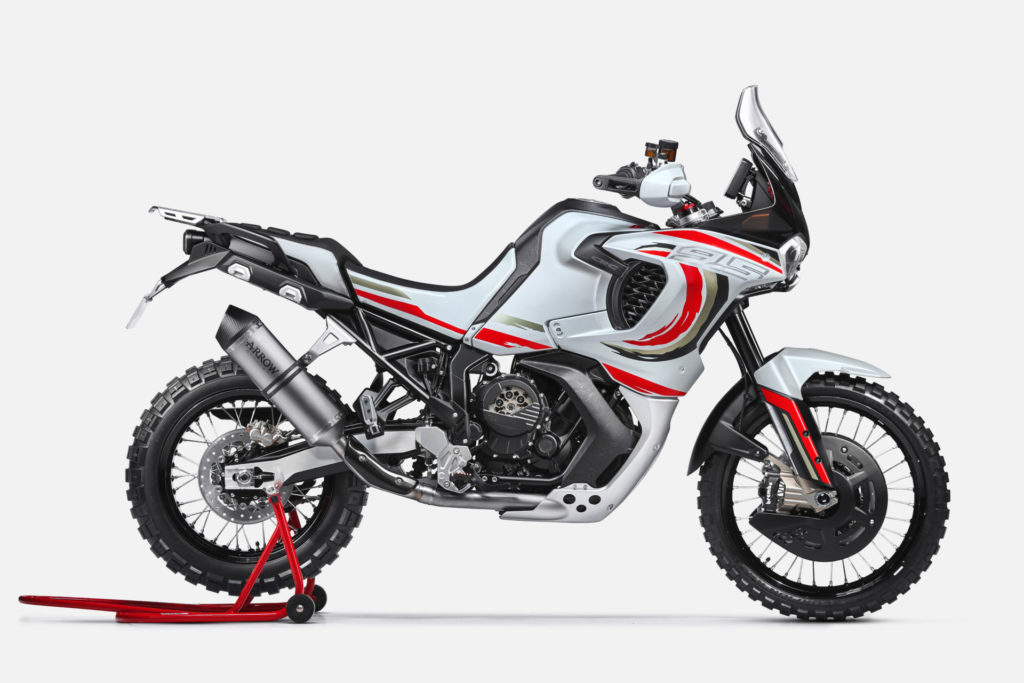
The 9.5 project represents the synthesis of a tireless design and development work that for many months has been aimed at creating a unique bike capable of offering breathless riding experience and user-friendly approach, without forgetting first-rate performance and charm. Compared to many of its main challengers, the 9.5 boasts an unprecedented off-road attitude, thanks to a bespoke chassis formula, starting with the wheel diameter: 21” at the front and 18” at the rear, together with 1,580 mm wheelbase. 

The primary goals of the project? Designing a motorcycle that is first and foremost compact, lightweight, essential and functional, with an intense off-road character. On top of this, out-of-the-ordinary versatility married to ability to move effectively and safely in whatever condition, from smooth asphalt to rocky terrain. With the aim to make this exclusive machine even more intuitive and easy to handle the saddle results adjustable in height. 

Originally, on the historic Elefant model, at centre-stage in the Dakar races, the Lucky Explorer logo was immediately recognisable, even from a distance, to the point of characterising the whole bike and emphasising its racing-oriented personality. Today, on both new models that logo blooms again thanks to the graphic and set-up winning choices. 


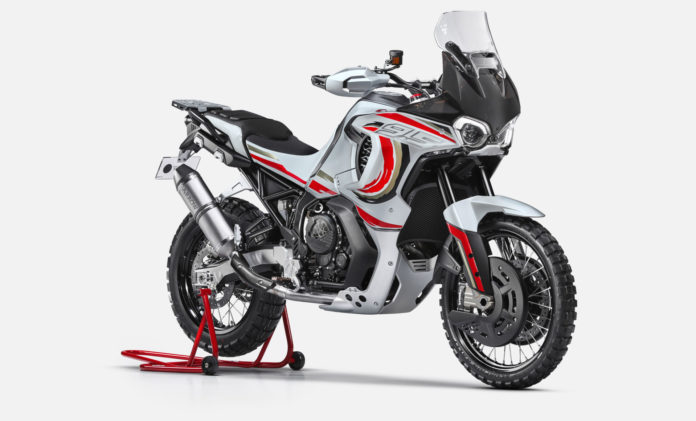
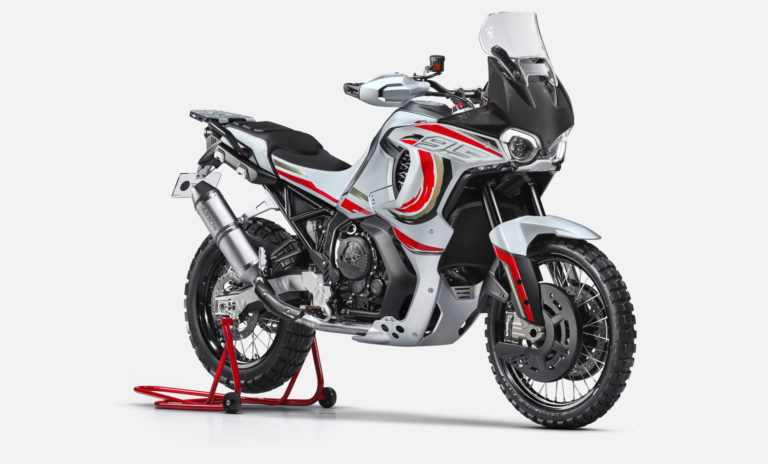
A 2022-model MV Agusta 5.5 adventure motorcycle. Photo courtesy MV Agusta.


5.5

The 5.5 version, developed in close collaboration with our partner QJ, is a new adventure bike inspired by the heritage of the Elefant. Despite being a mid-sized bike, its appearance is that of a higher displacement travel-oriented motorcycle, capable of seducing European riders looking for a sturdy and unstoppable companion. 

Such close collaboration with the partner has brought to life a truly advanced model if compared to the starting model: electronics, mechanics and chassis, in fact, have been carefully developed on the basis of detailed specifications. Electronics, for example, has been optimised to offer the perfect combination between performance and safety. The two-cylinder in-line liquid-cooled engine with double overhead camshaft distribution has also undergone specific refinement, aimed at further improving the high efficiency. The increase in displacement up to 550 cc (70.5 mm bore and 71 mm stroke), a distinctive content for this model, has the goal to further enrich the torque curve and smoothen delivery at all revs. That is what a motorcycle with such a wide spectrum of use deserves. 

Distinctive design of the 5.5 version can be seen both from the superstructures and from other aesthetic crucial features, such as the bespoke optical groups. Stylistic inspiration is shared with the 9.5 model and inspired by the legendary races in the desert, not to mention others features, which allows this new born to proudly claim its technical, conceptual and aesthetic identity. 


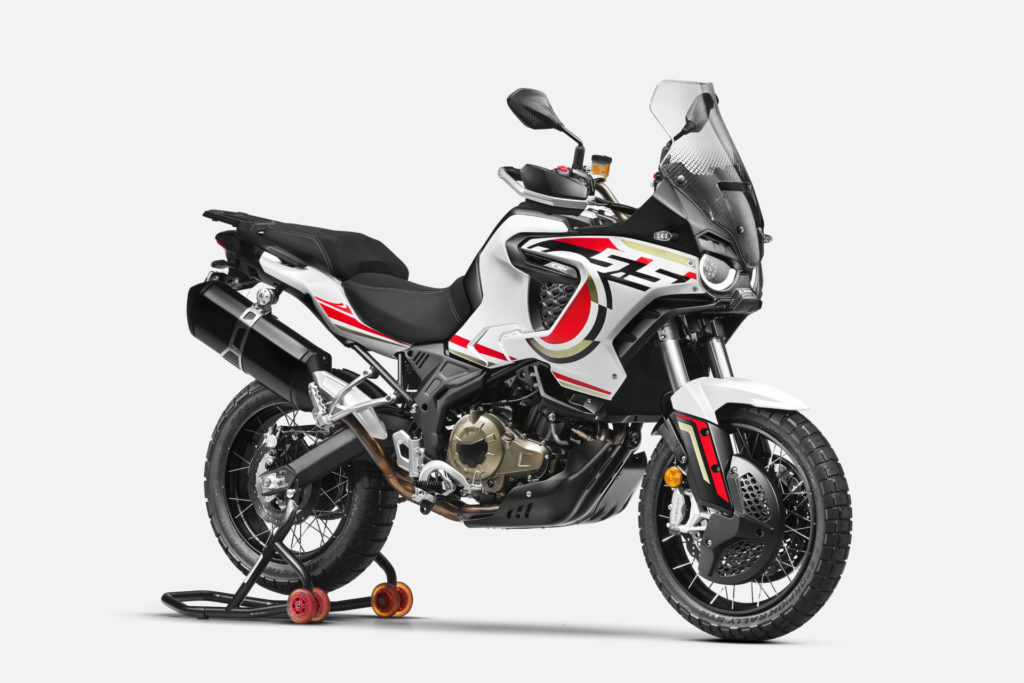
A profile view of a 2022-model MV Agusta 9.5 adventure motorcycle. Photo courtesy MV Agusta.


9.5

The 9.5 truly introduces a gateway to the future in the shape of a premium adventure bike, faithfully based on the new MV Agusta 950 engine, powered by class-leading technology and close to that racing spirit of the original Elefant. 

The two new models share numerous stylistic elements: the front end area and the sturdy handguard, for example, are both painted black. A side cover protect the radiator, which reveals a semicircle element in the central portion. Furthermore, a cover protects the front braking system, with a large flap to ensure the discs the right dose of air flow; the skid plate underlines the destination of the bike, which therefore results particularly off-road oriented. Even the extended use of high-technology materials along with their finishing are nature-inspired: the forged carbon fiber element, a link between the radiator area and the skid plate, reflects this vision. 

The instrumentation is automotive-standards developed: that is true in terms of easy-to-understand graphics, full suite of useful information as well as connectivity. It can count on a 7” full TFT panel, with Bluetooth connection to smartphones and Wi-Fi. The electrical switch cubes have been exclusively designed for this model: inspired by functionality and ergonomics criteria they allow the user to easily navigate amongst the numerous configurations available in the menus. In addition, a practical pannier fastening system, located in the tail area, comes with a retractable system: a smart solution that does not compromise the design of the bike. 

The optical assembly has been subjected to an extensive study, aimed at offering a stunning stylistic result and an indisputable light output as well. In particular, the 5.5 mounts DRL in a semicircle, which are clearly inspired by the classic Elefant 900. The optical assembly of the 9.5 is instead more complex and even more original, thanks to two concentric elements that add the front end an aggressive look. 

The chassis of the 9.5 is made of steel, with a closed double cradle structure. Designed to offer the best balance between the comfort required for touring road use and the stiffness to achieve interesting off-road performance, it is composed of forged and extruded elements, based on the loads required at different areas. Despite the excellent torsional strength and longitudinal stiffness values, it stops the scales at a mere weight. The sturdy swingarm makes use of lightweight aluminum alloy to achieve the highest strength-to-weight ratio. Aluminum is used also for the fork plates, while the rear subframe is made of steel. 

The 9.5 engine has been developed specifically for this model and creates an uncompromised balance of versatility, power and weight. Signed by MV Agusta and inspired by the well-known and admired 800 three-cylinder in-line, it is new in most of its components. The bore and stroke measurements have both been increased to achieve the effective displacement of 930.63 cc, delivering the highest possible values ​​of power and torque. All without changing the overall dimensions of the 800 engine currently in production. Numerous technical contents are confirmed, such as the head plane, cylinders angle together with the position of the motor mounts on the three axles and of the front sprocket.

The new 9.5 motorcycle also stands out for its three-cylinder in-line four-stroke liquid-cooled twin overhead camshaft engine boasts a compression ratio of 12.5: 1; the crankshaft is counter-rotating, to improve driving dynamics and reduce inertia. The removable gearbox is also offered in an unprecedented electro-actuated configuration, specially designed for this model. The maximum power and torque values ​​are respectively 123 hp at 10,000 rpm and 102 Nm at 7,000 rpm. The specific hp/l power is 132.25 while the complete mass of the engine is only 57 kg. 

9.5 engine main features:  

– New cylinder head

– New steel intake and exhaust valves

– New head-cylinder base gasket

– New steel crankshaft, counter-rotating, 120° cranks, 1-2-3 ignition

– New main and trimetallic connecting rod bearings

– New forged aluminum alloy pistons, three segments

The transmission can count on a new primary drive gear with straight teeth, with power take-off from the countershaft; the gears of the pump control are unprecedented. The base has been completely redesigned: it has integrated oil passages while the passage of water from the upper to the lower base takes place via an external aluminum pipe. What’s more, clutch, generator, starter, selector and gearbox covers have been redesigned. 

The 9.5 wet clutch comes in two versions: the automatic Rekluse variant and the standard, featuring hydraulic control on the left side. Lastly, the electro-actuated gearbox, offered as an option, represents a rare gem. 

R.I.P. Noted Race Mechanic Larry Worrell

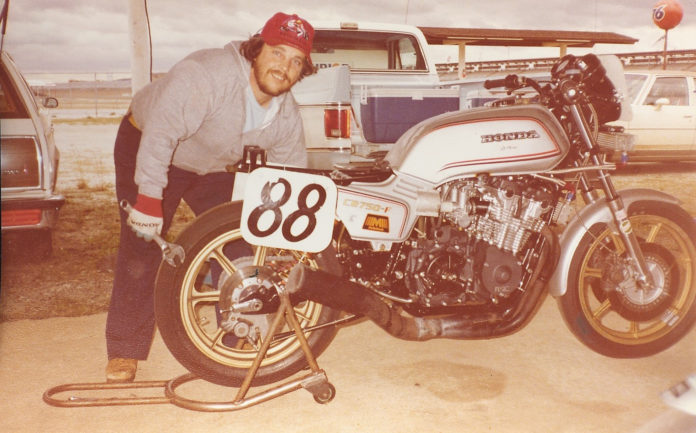
Noted Yamaha TZ750/OW31 and early AMA Superbike mechanic Larry “Round Man” Worrell died from cancer November 16 at a hospice care facility in Florence, Alabama. He was 77.

He is survived by his sisters Linda Worrell Cobb and Bette Worrell Royal and brother Gary Worrell.

“It is with immense sadness that I bring the news that my brother Larry Worrell passed away last night after a long-fought battle with cancer,” Linda Worrell Cobb posted to her Facebook page on November 17. “Larry was brave and faced this head on with my brother Gary and [Gary’s] wife Cathy by his side throughout.

“When we first got the news that his cancer was terminal, I told him I want to pray but I don’t know what to ask for. His answer was to go to sleep and not wake up, and God granted that prayer.”

During his career in racing, Worrell worked with riders Randy Cleek, Steve McLaughlin, Ron Pierce, and Roberto Pietri, among others.

Worrell tuned the Yamaha OW31 that Pierce rode to second place in the 1979 Daytona 200, and Pierce remembers him fondly.

“I knew Larry for a very long time, and he was just the nicest, sweetest man,” Pierce told Roadracingworld.com. “He was a great guy. He was a hard worker and very devoted to whoever he was working for. Really, you couldn’t ask for a finer human being.

“He was also a very good mechanic. He was there early in the morning and would stay there late at night, whatever was needed to take care of things, and he always did it with a smile. He was truly a great man and a fine character. I miss him dearly, and I pray for him every day, and I hope his family is getting through this fine.”

Pierce went on to finish second in the 1979 AMA Superbike Championship.

Worrell worked on the factory Honda AMA Superbike team in the early-1980s and built and tuned Roberto Pietri’s 1025cc Honda CB750F. Dennis Zickrick was Freddie Spencer’s mechanic and Worrell’s teammate.

“I stayed in touch with Larry for about 10 years until Roberto left the series,” said Zickrick. “So, I lost track of him, but about five or six years ago we made contact again on Facebook of all things.

“We talked back and forth. He had had several bouts with cancer and stuff. It seemed like it was about seven months ago, and he went in for a checkup, and they said, ‘Looks good. Go on with your life.’ Then about a month ago I called him, and he said, ‘I went in for my six-month checkup and it’s [cancer] back and it’s everywhere. And I just don’t have the fight to fight it.’

“I talked to him last week. You could tell he was fatigued, but he remembered stuff and people’s names. Then a couple of days later he was gone.”

According to Linda Worrell Cobb, Larry Worrell did not want a memorial service.

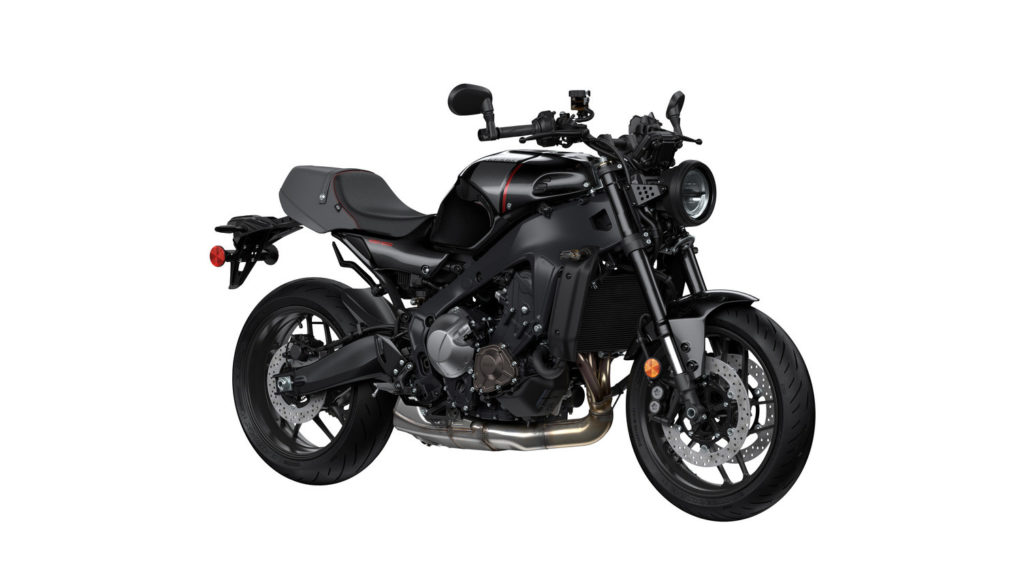
Yamaha XSR900 Gets Tech Upgrades For 2022

Yamaha Introduces Remaining 2022 Model Lineup Including the All-New 2022 XSR900: A Legend Reborn

Taking the Sport Heritage Class to New Levels of Performance & Style

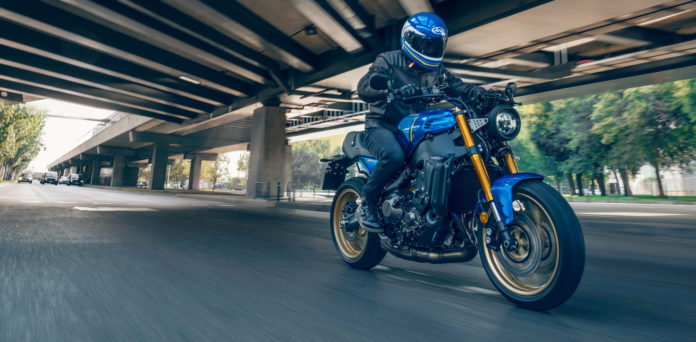
MARIETTA, Ga. – Yamaha Motor Corporation, USA is proud to unveil the newest iteration of its celebrated ‘Faster Son’ design philosophy—the striking, completely redesigned 2022 Yamaha XSR900. Inspired by Yamaha’s legendary racing heritage, the new XSR900 represents a significant advancement in both performance and style, boasting an all-new chassis, more powerful 890cc engine, more advanced electronics package and a brilliant new look drawn from Yamaha’s classic 1980s-era Grand Prix racing machines.

“The new generation XSR900 borrows its high performance CP3 engine, chassis and electronics directly from Yamaha’s extensively updated 2021 MT-09 Hyper Naked to create the lightest, most agile, most performance-driven motorcycle in its class,” said Derek Brooks, Yamaha Motorcycle Product Line Manager. “But it’s the styling that really sets this new bike apart. As someone who’s very familiar with Yamaha’s racing history, it’s exciting to see the design team’s clear nod to the iconic race designs of our past, while incorporating so much tech and premium detailing. This new XSR really cuts to the heart of why we are passionate about motorcycles.”

The Faster Sons Design Philosophy

Yamaha’s Sport Heritage motorcycle models draw inspiration from the marque’s extensive experience spanning seven decades of design and manufacture of famous and iconic motorcycles. During this time, the world of motorcycling has continually evolved, yet the unique emotions and intense excitement of riding on two wheels have always stayed the same. The Faster Sons design philosophy fuses iconic style with modern technology to create enjoyable and exciting motorcycles that recall the past while featuring the performance of today.


A 2022-model Yamaha XSR900 at rest. Photo courtesy Yamaha Motor Corp., U.S.A.

Retro Influence, Modern Style

The bold, striking new look of the next generation Yamaha XSR900 is apparent from every angle. With the tank design, exposed aluminum frame and side silhouette drawing clear inspiration from iconic Yamaha race bikes of the 1980s, there is also an unmistakably modern design element underscoring the machine’s high-performance capabilities. Full LED lighting, a new full-color 3.5-inch TFT display and a host of premium touches including drilled fork caps, machined headlight stays, forged brake pedal, hidden passenger pegs, blacked-out levers, darkened brake reservoirs, bar-end mirrors, embossed aluminum rear underplate and aluminum XSR logo all combine to reflect modernity and a higher level of fit and finish.

As an additional nod to the XSR900’s sporting heritage, one available colorway is a modern take on the classic French Sonauto Yamaha race colors—the stunning blue, cyan and yellow combination famously campaigned by legendary French Grand Prix champion Christian Sarron, an important page from Yamaha’s rich racing history.

Finally, ergonomics of the new XSR900 are also improved for a more aggressive profile and new emphasis on the rider. A lowered head pipe position, unique subframe with lower seat height and a lengthened swingarm improve straight-line performance while maintaining the XSR900’s trademark sharp handling, situating the rider more within the bike for a greater sense of control and confidence.

New 890cc CP3 Engine: More Power, More Torque

Sharing the same specifications, individual components and fuel injection as Yamaha’s new 2021 MT-09, the XSR900’s larger capacity 890cc CP3 engine is more powerful with a stronger, more linear torque curve for outstanding acceleration. Nearly every major component, from pistons and connecting rods to the crankshaft, camshafts and crankcase, are redesigned and lightened for a reduced overall engine weight and a freer revving engine character. To handle increased torque levels, the Assist and Slipper (A&S) clutch is updated with new friction plates and a modified cam angle to reduce load on the clutch springs for a lighter feel at the lever.

While the previous generation XSR900 was fitted with a Yamaha Chip Controlled Throttle (YCC-T), the new model takes the technology one step further with the addition of a YZF-R1-type Accelerator Position Sensor Grip (APSG). This is a full ride-by-wire system with a sensor in the twist grip to replicate varying degrees of resistance for a traditional throttle feel. The end result is a lively, torque-rich powerplant with the thrilling feel of direct connection between the throttle grip and the rear tire.

New CF Die-Cast Aluminum Frame: Lighter, Stronger, Sharper

A key feature on the new XSR900 is the all-new compact, lightweight aluminum frame. Yamaha’s Controlled Filling (CF) die-cast technology makes it possible to produce complex frame structures lighter and stronger than conventional casting methods. Featuring the thinnest sections ever for a Yamaha die-cast frame at just 1.7 mm, overall weight is reduced while the balance of longitudinal, lateral and torsional rigidity has been refined, enhancing straight-line stability and transmitting excellent feedback to the rider. Additionally, the lower head pipe position helps load the front for increased feel when cornering, providing the new XSR900 with an agile, responsive handling character.

Yamaha Exclusive Lightweight Spinforged Wheels

Through Yamaha’s exclusive new spinforging process, the sporty 10-spoke aluminum wheels on the new XSR900 enhance looks while significantly reducing unsprung weight. The result is improved suspension action and decreased moment of inertia for a more responsive feel, especially during cornering and braking.

High-Spec Brakes & Suspension

High quality components include a new Brembo radial front master cylinder for better feel at the lever. Additionally, a new front brake lever eases adjustability and improves looks. All-new suspension features an upgraded fully adjustable 41mm KYB inverted front fork, now shorter and lower profile due to the new head pipe position. It’s paired with an updated adjustable KYB rear shock, forward inclined and virtually hidden from sight, further enhancing the new model’s clean, aggressive side profile.

Six-Axis IMU Brings Modern Tech to the Sport Heritage Lineup

Taking the 2022 XSR900 to a new level of technological advancement is the same state-of-the-art Yamaha six-axis Inertial Measurement Unit (IMU) employed in the new MT-09. The new IMU has evolved into a smaller and lighter unit, featuring two sensors that measure three-axis angular velocity (pitch, roll and yaw) and three-axis acceleration (forward/backward, up/down and left/right). Data is transmitted to the ECU which controls an expanded suite of rider aids, including a lean sensitive Traction Control System, Slide Control System (SCS), front wheel Lift Control System (LIF) and Brake Control (BC) System. Each can be adjusted for different levels of intervention or turned off completely depending on rider preference.

Lean Sensitive Traction Control System Using the six-axis IMU data in conjunction with relative front and rear wheel speed data, the new lean sensitive Traction Control System adjusts the degree of intervention to correspond with the bike’s lean angle. A total of three intervention levels are available.

Slide Control System (SCS) When IMU sensors detect the rear wheel is beginning to slide sideways, the ECU intervenes by reducing drive to the rear wheel until the chassis is stabilized. A total of three intervention levels are available.

Lift Control System (LIF) To prevent front wheel lift during quick starts or hard acceleration, when IMU sensors detect front wheel lift the ECU adjusts drive power until the motorcycle is stabilized.

Brake Control System (BC) The Brake Control (BC) System independently controls and moderates front and rear brake pressure to prevent accidental wheel lock ups. The rider can select one of two ABS braking modes: BC1 Mode is a standard ABS-active mode for straight-line braking conditions which does not incorporate lean angle. BC2 Mode uses IMU data to determine lean angle and changes the ABS sensitivity as lean angle increases.

Tuned Triple Soundtrack

Yamaha engineers have carefully considered both intake and exhaust sound in developing the new XSR900, seeking to emphasize and enhance the unique soundtrack of the crossplane triple-cylinder powerplant. The airbox is completely redesigned, incorporating differing cross section and length air ducts tuned so induction noises resonate harmoniously at varying wavelengths. Two functional air intake vents located on either side of the fuel tank further boost the mid- and high-rpm induction sound traveling to the rider for a greater sense of acceleration. Likewise, a new 1.5-chambered exhaust features a left-right symmetrical tailpipe arrangement that directs sound pressure to both sides of the machine, adding to the feel of torque when opening the throttle. The low-slung exhaust design also centralizes mass and is significantly lighter than the previous generation.

Up & Down Quick Shift System Now Standard

The XSR900’s Quick Shift System (QSS) is now fitted as original equipment on the 2022 XSR900. By enabling quick, clutchless shifting both up and down the gear box, this system makes full-on acceleration more exciting, downshifting faster and smoother, with less chassis disruption when changing gears.

Cruise Control Now Standard

Another feature now fitted as original equipment on the new XSR900 is Cruise Control. The easily programmable system reduces rider fatigue, making longer journeys and highway riding more enjoyable.

XSR900 Colors, Availability & Price

The 2022 Yamaha XSR900 will be offered in two exciting color options: Legend Blue inspired by the French Sonauto Yamaha team race colors featuring gold wheels and gold front fork or Raven featuring black wheels and black front fork. It will begin arriving in dealerships in April 2022 for an MSRP of $9,999.


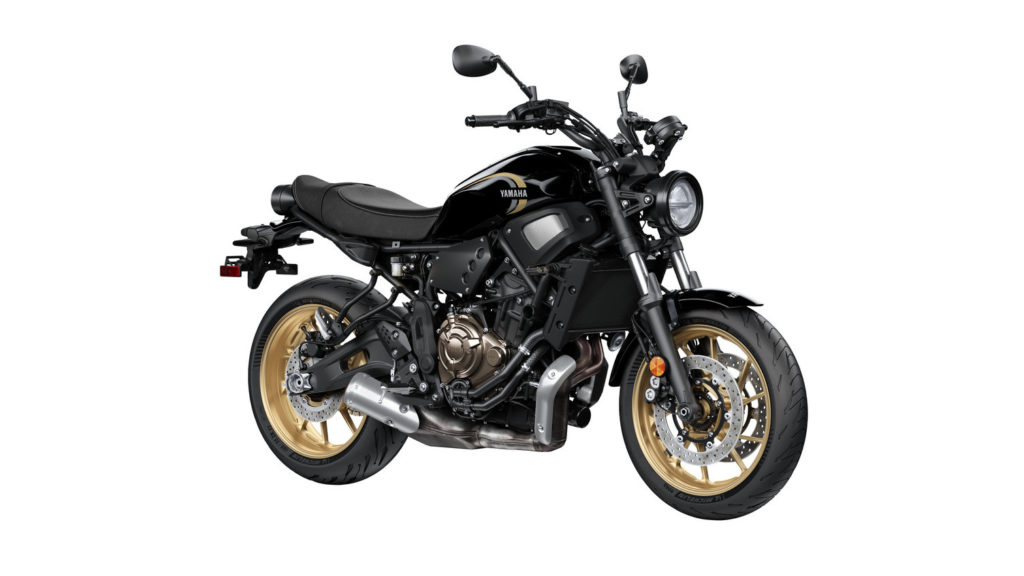
A 2022-model Yamaha XSR700 at rest. Photo courtesy Yamaha Motor Corp., U.S.A.
A 2022-model Yamaha XSR700. Photo courtesy Yamaha Motor Corp., U.S.A.

2022 Yamaha XSR700: The Urban Retro

With timeless style and modern, sporty performance, the 2022 XSR700 returns to Yamaha’s Sport Heritage lineup with a handful of key updates and a new classic, dark colorway. A favorite among riders seeking an exhilarating machine with a fashionable edge, the 2022 XSR700 matures without losing its versatile, fun-loving character.

Lighting is improved with an all-new heritage-inspired round LED headlight. New integrated headlight stays now connect into the fork shrouds for a more compact front expression.

The cockpit layout is revised with the inverted LCD meter repositioned for improved visibility and information is now controllable from the left handlebar switch. The lines and position are designed to match the all new head light, giving the bike a sleeker ‘snub-nose’ look. Switchgear is also upgraded, making them more user-friendly. The XSR700 also receives larger 298mm front brake discs and new radiator side covers.

The 2022 XSR700 is offered in Raven and will begin arriving in dealerships this December for an MSRP of $8,799.


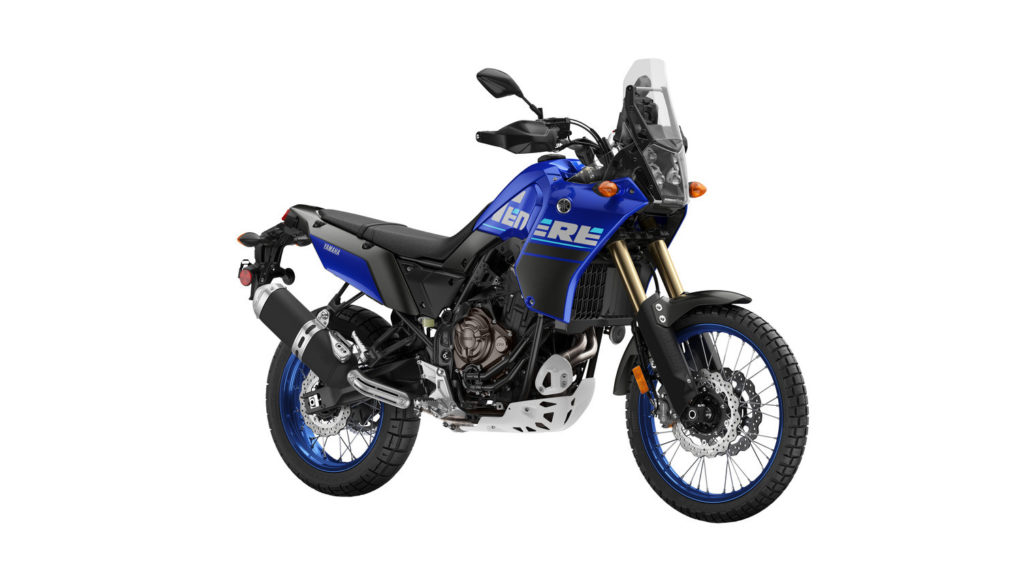
A 2022-model Yamaha Ténéré 700. Photo courtesy Yamaha Motor Corp., U.S.A.

2022 Yamaha Ténéré 700: Ready for Adventure

Yamaha’s extremely popular, adventure-ready Ténéré 700 returns for 2022 with two new color options, Team Yamaha Blue and Raven. The 2022 Ténéré 700 will begin arriving in dealerships this January for an MSRP of $10,299.


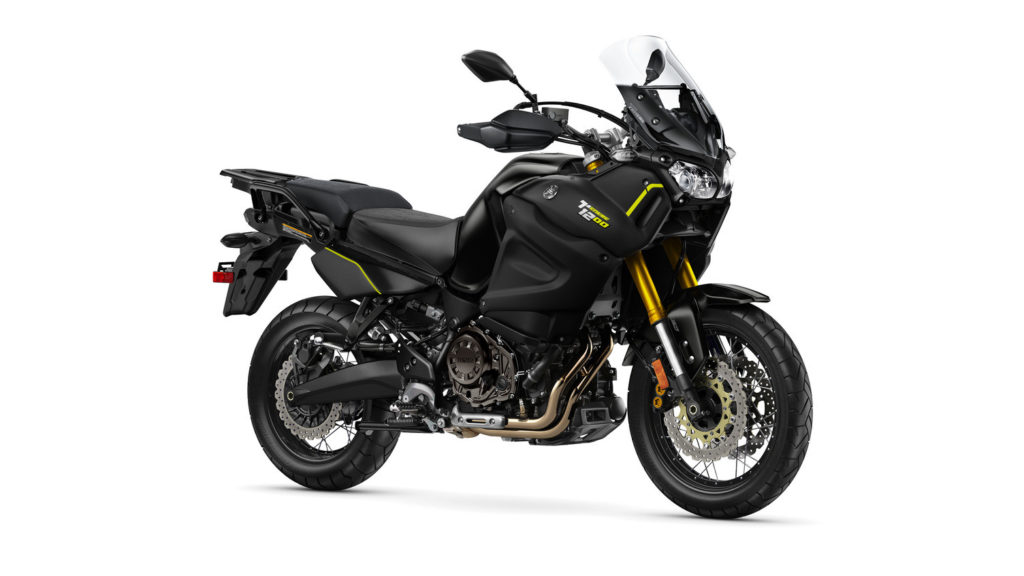
A 2022-model Yamaha Super Ténéré ES. Photo courtesy Yamaha Motor Corp., U.S.A.

Additional 2022 Returning Models

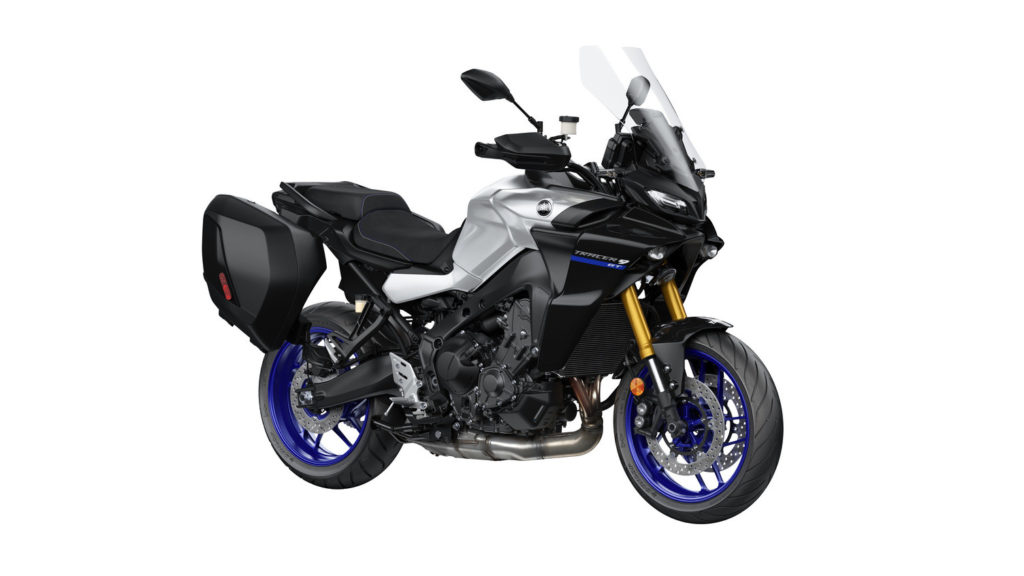
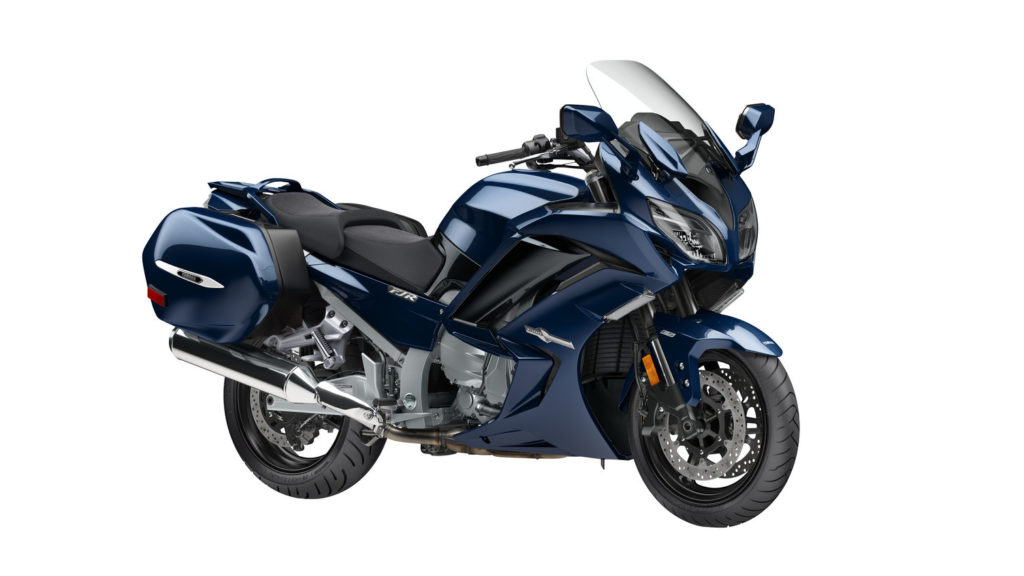
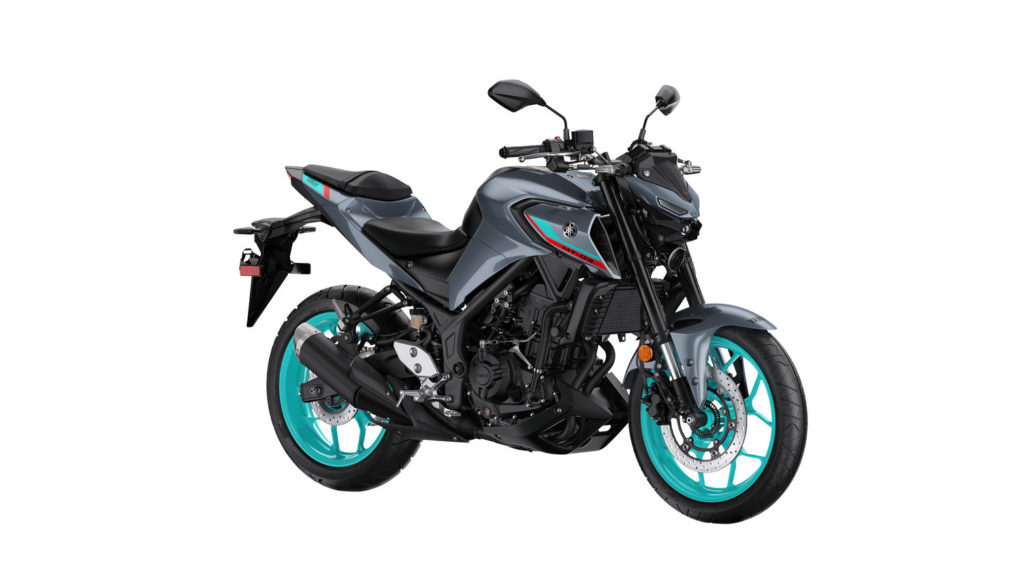
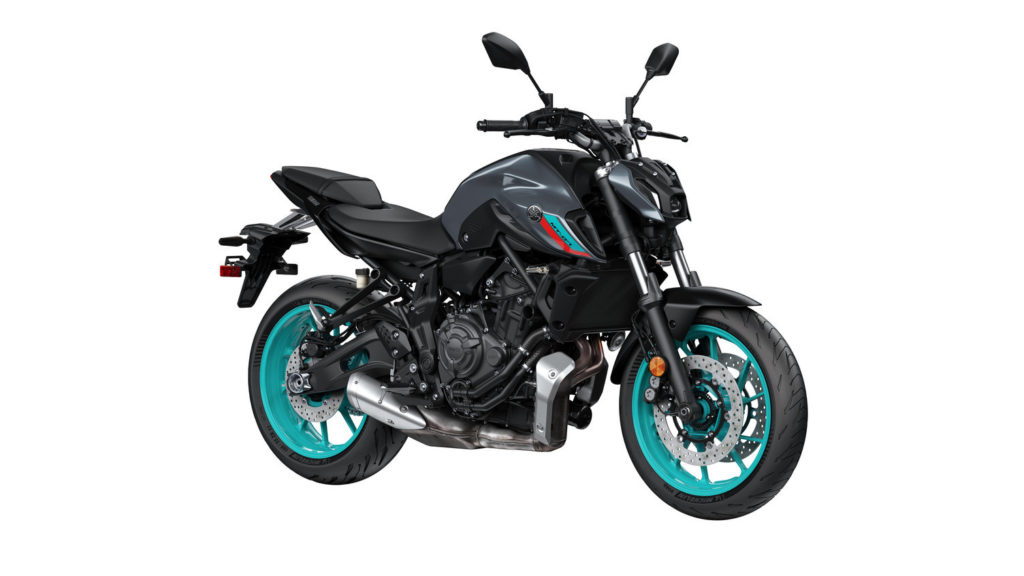
Remaining returning Yamaha models include the 2022 Yamaha Super Ténéré ES in Matte Raven Black for an MSRP of $16,299; 2022 Yamaha Tracer 9 GT in Liquid Metal or Redline for an MSRP of $14,999; 2022 Yamaha FJR1300ES in Cobalt Blue for an MSRP of $18,199; 2022 Yamaha MT-03 in Team Yamaha Blue, Cyan Storm or Matte Stealth Black for an MSRP of $4,799; 2022 Yamaha MT-07 in Team Yamaha Blue, Cyan Storm or Matte Raven Black for an MSRP of $7,899; 2022 Yamaha MT-09 in Team Yamaha Blue, Cyan Storm or Matte Raven Black for an MSRP of $9,499; and 2022 Yamaha MT-09 SP in Liquid Metal/Raven for an MSRP of $11,099.


A 2022-model Yamaha Tracer 9 GT. Photo courtesy Yamaha Motor Corp., U.S.A.
A 2022-model Yamaha FJR1300ES. Photo courtesy Yamaha Motor Corp., U.S.A.
A 2022-model Yamaha MT-03. Photo courtesy Yamaha Motor Corp., U.S.A.
A 2022-model Yamaha MT-07. Photo courtesy Yamaha Motor Corp., U.S.A.
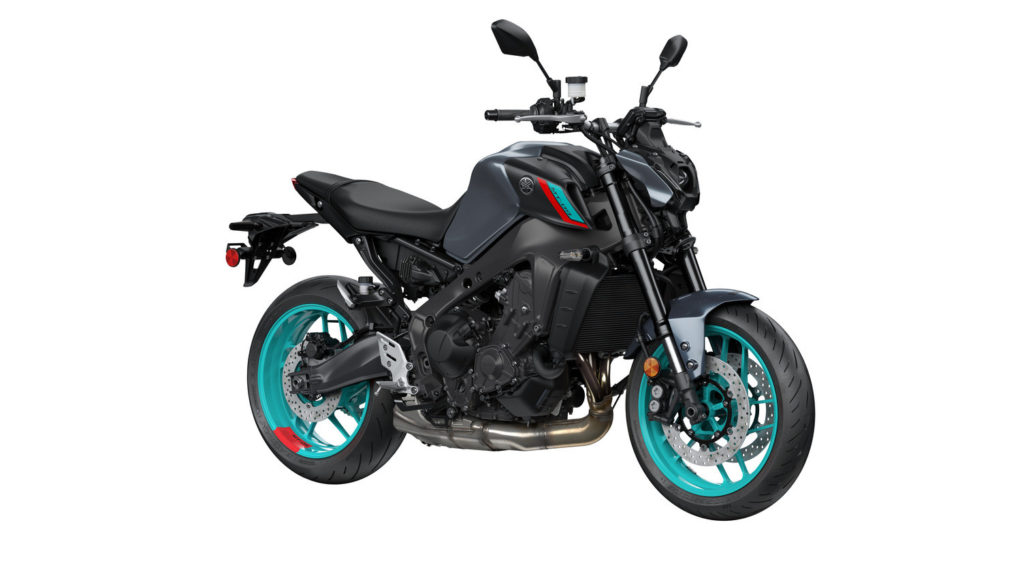
A 2022-model Yamaha MT-09. Photo courtesy Yamaha Motor Corp., U.S.A.
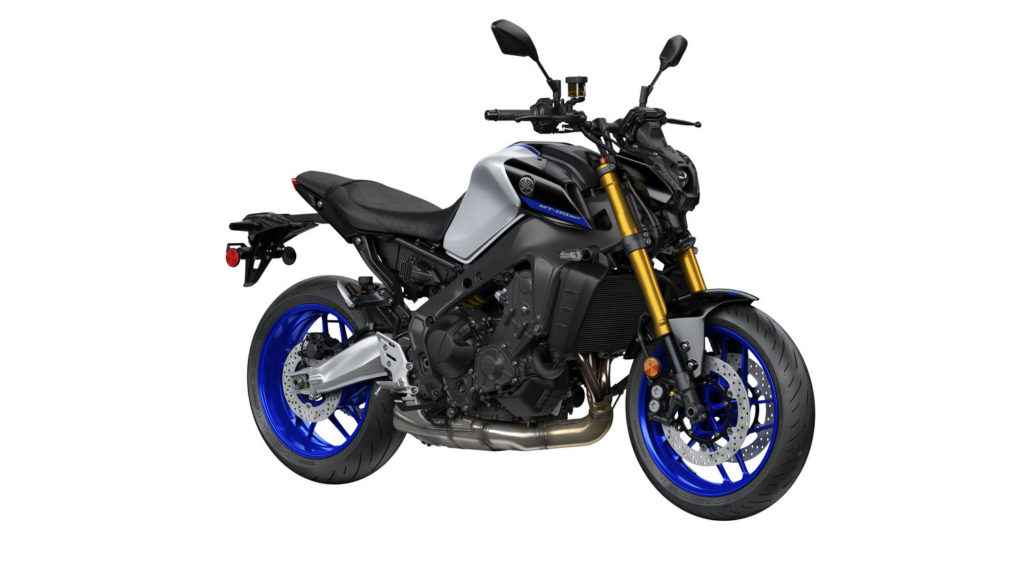
A 2022-model Yamaha MT-09 SP. Photo courtesy Yamaha Motor Corp., U.S.A.

Learn more about the 2022 Yamaha Sport Heritage model line at https://www.yamahamotorsports.com/sport-heritage.

Learn more about the 2022 Yamaha Adventure Touring model line at  https://www.yamahamotorsports.com/adventure-touring.

Learn more about the 2022 Yamaha Sport Touring model line at https://www.yamahamotorsports.com/sport-touring.

Learn more about the 2022 Yamaha Hyper Naked model line at https://www.yamahamotorsports.com/hyper-naked.

Find a range of Genuine Yamaha Accessories, apparel and more at https://www.shopyamaha.com.

For more information related to all Yamaha products, visit https://www.yamahamotorsports.com.

Follow Yamaha Motor Corporation, USA, through your favorite social media sites at www.facebook.com/yamahamotorusa, www.instagram.com/yamahamotorusa, www.twitter.com/yamahamotorusa. #Yamaha #YamahaMotor #YamahaMotorUSA

About Yamaha Motor Corporation, USA

Yamaha Motor Corporation, USA (YMUS), is a recognized leader in the outdoor recreation industry. The company’s ever-expanding product offerings include Motorcycles and Scooters, ATV and Side-by-Side vehicles, Snowmobiles, WaveRunner Personal Watercraft, Boats, Outboard Motors, Outdoor Power Equipment, Power Assist Bicycles, Golf Cars, Power Assist Wheelchair Systems, Surface Mount Technology (SMT) and Robotic Machines, Unmanned Helicopters, Accessories, Apparel, Yamalube products, and much more. YMUS products are sold through a nationwide network of distributors and dealers in the United States.

YMUS has a corporate office in California, two corporate offices in Georgia, facilities in Wisconsin and Alabama, and factory operations in Tennessee and Georgia. Additional U.S.-based subsidiaries include Yamaha Marine Systems Company (YMSC) with divisions Bennett Marine (Florida) and Kracor Systems (Wisconsin), Skeeter Boats (Texas), with division G3 Boats (Missouri), and Yamaha Precision Propeller (Indiana).

Yamaha Extends Partnership With USMCA Coaching

Yamaha Motor Corporation USA Extends USMCA Partnership

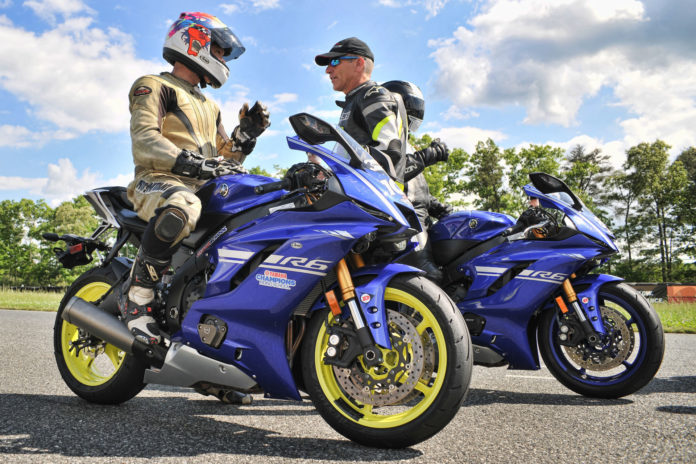
Temecula, California – The United States Motorcycle Coaching Association (USMCA) is proud to announce Yamaha Motor Corporation USA has officially agreed to carry their partnership into 2022.

Yamaha has a legacy of innovation, performance, and quality. Their continuation of support with the USMCA ensures more new and existing riders will get connected with certified motorcycle coaches.

“We’re excited to return as a sponsor partner and supporter of USMCA,” said Derek Brooks, Motorcycle Product Line Manager, Yamaha Motor Corporation USA. “Our sport has been blessed with an influx of new riders and budding enthusiasts during what has otherwise been a trying time.  Access to certified coaching as a means of stoking the fire we all know can easily grow into a full-blown passion is an excellent way to ensure we retain our new Powersports brothers and sisters.”

“Yamaha Motor Corporation USA has been a major leader in the industry for decades,” said USMCA Chairman Jon-Erik Burleson. “We are so thankful they see the vision of the USMCA and have added that to their long list of rider training support and give-back initiatives. They are also a longtime supporter and sponsor of one of our major coaching groups, Champ School. They take rider training and continuing education very seriously, and we are thrilled for their second year of support. The people at Yamaha are taking an important step in protecting and growing the future riders of our sport through quality coaching.”

About the U.S. Motorcycle Coaching Association (USMCA)

USMCA is an association where riders and parents can connect to motorcycle coaches they can trust through the network, www.MotorcycleCoaching.org.

All USMCA Certified Coaches are required to adhere to a code of conduct, pass a background check and hold certifications in abuse prevention, CPR/First Aid, concussion protocol, heat illness & cardiac arrest training.

For more information on the USMCA or become a USMCA Certified Coach, visit www.USMCA.org.

New North America Talent Cup Begins At COTA In 2022

Introducing: the North America Talent Cup

A new path on the Road to MotoGP™ is set to begin in 2022 

Tuesday, 23 November 2021

Dorna Sports is delighted to announce a new path on the Road to MotoGP™: the North America Talent Cup. Following the blueprint of other Talent Cup programmes, the series will be a one-make competition, with race weekends set to take place across the USA. The promoter and organiser will be a collaborative effort between MotoAmerica and Rise Moto. Rise Moto is an integral partner to MotoAmerica in the FIM MiniGP North America Series.

The new North America Talent Cup will partner with MotoAmerica and aims to provide riders across the continent with a vital link on the Road to MotoGP™, creating the stepping-stone between the FIM MiniGP North America Series and the Red Bull MotoGP Rookies Cup or FIM Moto3™ Junior World Championship. The sanctioning body will be the American Motorcyclist Association and FIM North America.

Riders will race on equal Aprilia RS250SP2 machinery and be between 13 and 16 years of age for the first season, with the minimum age raising to 14 from 2023 – as it will globally for similar competitions.

Rob Dingman, AMA and FIM North America President: “The North America Talent Cup is a perfect complement to MotoAmerica’s development efforts and will provide a critical element to the development of young road racers in North America.”

Wayne Rainey, MotoAmerica President: “The new North America Talent Cup will most definitely help us with our goal of developing more young riders who aspire to compete and represent the U.S. internationally, and we’re happy to be working with Dorna, Aprilia and Rise Moto to help make this happen. This program ensures that we will continue to build a system where young racers can advance their talents in a program designed to give them the tools they need to succeed. We look forward to the first race at Circuit of The Americas in April and to having the North America Talent Cup join us in our season finale at Barber Motorsports Park in September.”

Massimo Rivola, CEO of Aprilia Racing: “The North America Talent Cup, as a forge of future talent, fully reflects Aprilia’s racing philosophy of training technicians and riders who have gone on to make sports motorcycling history. Promising young American talent can count on a product we are proud of, the RS 250 SP2, already extremely popular as an intermediate step between MiniGP bikes and ‘high wheel’ bikes, thanks to its combination of performance and easy operation. I’m certain that we’ll see fun and educational races truly capable of launching new talent.”

Carmelo Ezpeleta, CEO of Dorna Sports: “We are delighted to announce this new project with Rise Moto and MotoAmerica, creating a vital new path on the Road to MotoGP. With the incredible success of the first FIM MiniGP World Series, we are more committed than ever to creating the best possible pathway for young riders from all over the world to further their careers, and the new North America Talent Cup, along with the MotoAmerica Championship, will complete the Road to MotoGP for riders across that continent.

“The support of Aprilia sees a new manufacturer become a key player on the Road to MotoGP, and all our partners will ensure the series is competitive and affordable – removing as many barriers as we can for those who wish to begin a career in racing and ensuring young talent has the best possible stage on which it can shine.”

THE EQUIPMENT & PARTNERS

Riders will race on equal Aprilia RS250SP2 machinery, with an affordable, complete race package to be priced especially for competitors.

The sole, official tyre supplier will be Dunlop. Seven sets of tyres will be provided per rider, per season.

KYT will be the helmet provider, providing two helmets per rider per season along with trackside support.

THE CALENDAR

The North America Talent Cup will be run across the USA as an Amateur National Series. The series will be limited to 20 riders for the first year with aims to expand the amount of riders permitted to 26 by 2023.

The season opener is planned to take place alongside MotoGP™ at the Circuit of the Americas.  The remaining rounds will be held in partnership with AMA sanctioned racing organization WERA, and the final round will be with MotoAmerica at their season finale at Barber Motorsports Park.

OPPORTUNITIES ON THE ROAD TO MotoGP™

Riders accepted into the North American Talent Cup will benefit from trackside coaching at each round from professional riders, as well as training in communication, fitness and nutrition.

The Champion of FIM MiniGP North America Series will automatically gain a place on the North America Talent Cup grid the following season.

The top two in each season of the North America Talent Cup will be invited to take part in the selection event for the following season of the Red Bull MotoGP Rookies Cup.

APPLICATIONS

Applications for the inaugural Cup will open on the 1st of December and close on the 31st of December, 2021.

Find out more about the new series, and how to apply, at www.northamericatalentcup.com.

Kawasaki Updates 2022 Versys 650 With Traction Control And More

2022 Kawasaki Versys® 650 & Versys® 650 LT Motorcycles

ANY ROAD, ANY TIME
The Kawasaki Versys® line of motorcycles was developed for people who have an adventurous spirit and seek out opportunities to explore the world we live in. Whether it’s reaching a remote corner of the world, devouring highway miles or commuting through the city, the passenger-friendly Versys motorcycles provide the ultimate platform for your next adventure or navigating through those long commutes.

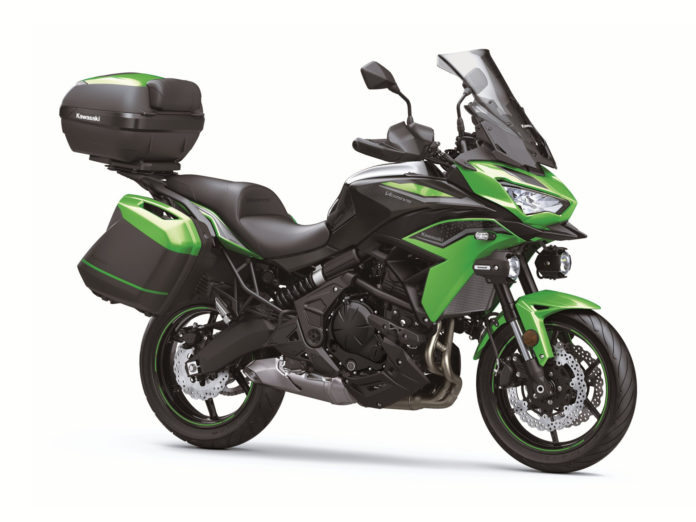
The widely popular Versys® 650 and Versys® 650 LT return to Kawasaki’s lineup stronger than ever for 2022 with several upgrades including Kawasaki TRaction Control (KTRC), new TFT Color Instrumentation with Smartphone Connectivity, sharper front cowl styling, LED headlight, and an adjustable windshield to ensure you enjoy every ride.

The Versys 650 and Versys 650 LT are ready to take on any road, any time for your next adventure with their long-travel suspension, proven reliability, back-road capabilities, and superb fuel-efficiency. Having already solidified their place as fan favorites, the Versys 650 continues to be a top choice as the ultimate travel guide for riding enthusiasts who are looking for reliable performance and versatile fun.


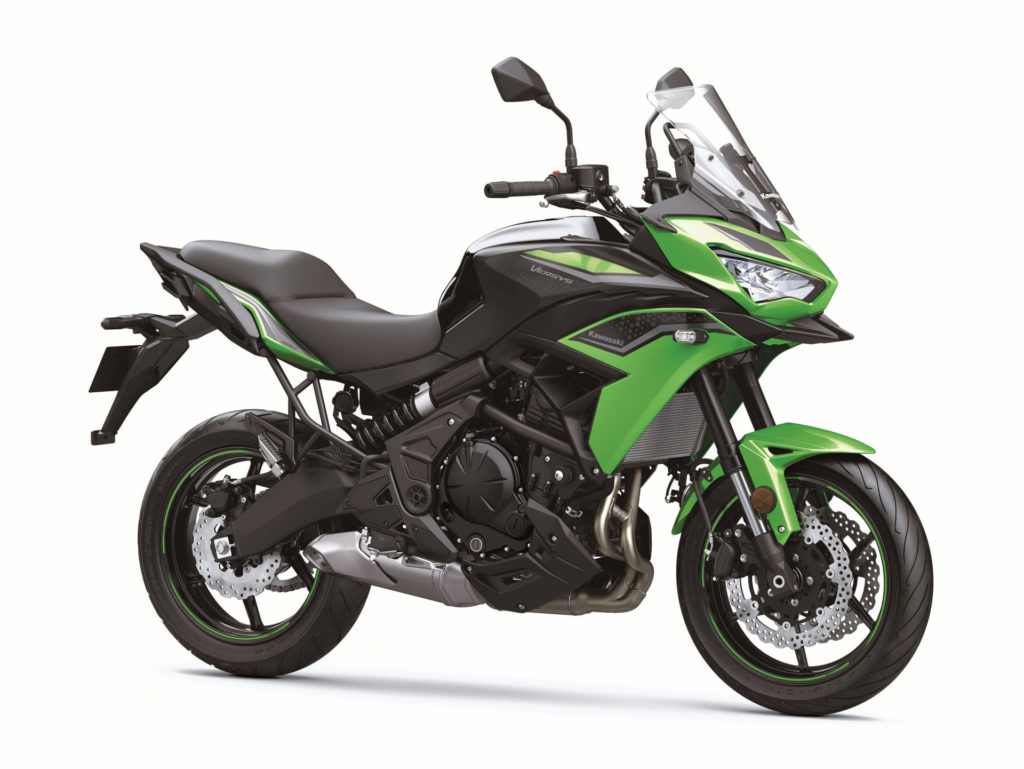
A 2022-model Kawasaki Versys 650. Photo courtesy Kawasaki Motors Corp., U.S.A.


2022 KAWASAKI VERSYS 650 HIGHLIGHTS:

·        NEW Kawasaki TRaction Control (KTRC)

·        NEW TFT Color Instrumentation with Smartphone Connectivity

·        NEW Sharper front cowl styling

·        NEW LED headlight

·        NEW 4-Way adjustable windshield

·        Slim, upright riding position

·        Sporty 17-inch cast aluminum wheels

·        Standard ABS


ELECTRONIC RIDER AIDS

·        NEW Kawasaki TRaction Control (KTRC)

For the first time on a Versys 650, the 2022 model is equipped with Kawasaki’s advanced traction control system that allows for enhanced sport riding performance and greater rider confidence. The system looks at a variety of factors for an accurate, real-time picture of conditions and acts before slippage exceeds the range for optimal traction and rider confidence. Two modes allow riders to adjust the system’s settings to suit the riding conditions and rider’s preference. In Mode 1, which is the least intrusive, the system helps manage traction during cornering and facilitates acceleration out of corners. Mode 2 allows for earlier intervention and reduces engine output when excessive wheel spin is detected, allowing for the tire to get maximum grip. Riders also have the option to turn the traction control system off using the switch located on the handlebar.

INSTRUMENTATION + STYLING

·        NEW TFT Color Instrumentation with Smartphone Connectivity

·        NEW Sharper front cowl styling

·        NEW LED headlights

·        NEW 4-Way adjustable windshield

A new 4.3” full-color all-digital TFT (thin-film transistor) instrument meter adorns the cockpit of the Versys 650 for model year 2022, giving the rider a high level of visibility during both day or night. The high-grade full color display features TFT technology, a selectable background color is offered (black or white) and the screen brightness automatically adjusts to suit available light. A wide variety of display functions are available and include a digital speedometer, digital bar-style tachometer, gear position indicator, shift lamp, fuel gauge, odometer, dual trip meters, current and average fuel consumption, remaining range, average speed, total time, coolant temperature, external air temperature, clock, battery voltage, Kawasaki service reminder, oil change reminder, and an Economical Riding Indicator. A Bluetooth® chip allows for connection to a compatible smartphone device and RIDEOLOGY THE APP*.

* RIDEOLOGY THE APP is not intended for use during vehicle operation.  Only use RIDEOLOGY THE APP when the vehicle is not being operated and it is safe to do so.

All meter functions and traction control modes can be easily controlled with switches located on the left side of the handlebar.

Taking after its larger Versys 1000® brethren, the Versys 650 features sharp, flowing styling from the front of the motorcycle to the rear. The refreshed design of the upper cowling and surrounding bodywork updates the Versys 650 to the latest eye-catching Versys family look, and the sharp tail cowl reinforces the bike’s compact, sporty image. A redesigned under-cowl and the use of color and graphics on the gas tank and side covers add to the strong Versys family looks and create an appealing visual flow. New LED headlights add a modern and aggressive look to the front of the motorcycle, while an LED taillight gives the Versys a modern, sporty visual identity.

Accompanying the redesigned upper cowl is a new windshield, offering increased wind protection and adding to the rider’s comfort, making the Versys 650 a highly capable touring partner. The stylish windshield features four positions for three inches of total adjustability, ranging from a sporty lower height to a taller wind protection height, to suit the rider’s preference. The four positions can be conveniently adjusted by hand using a release button below the TFT screen.

ENGINE

The dependable fuel-injected 649cc, parallel twin engine powers this light and nimble street motorcycle with its lively performance and smooth acceleration. Tuned for excellent torque, the engine inspires confidence for daily commuters and provides fun on weekend trips. The torquey twin delivers a deep ribbon of power in the low- and mid-range of the powerband, while also pulling vigorously to the top of the rev range.

The exhaust is tuned to enhance high-end RPM power, with matching ECU settings that optimize fuel economy. When combined with a large 5.5-gallon fuel tank, the fun-to-ride 2022 Kawasaki Versys 650 can enjoy extended periods between fill-ups.

Adding to the versatility of the motorcycle is its proven six-speed cassette style transmission that seamlessly shifts between the gears, enhancing maneuverability.

CHASSIS + SUSPENSION

Unique long-travel, high-tech suspension coupled with a comfortable riding position is critical to the multi-role mission of the Versys 650. Combine these qualities with a small, light and narrow frame and you have one of the most versatile bikes in Kawasaki’s motorcycle line-up.

In the front, the adjustable Showa fork increases rider confidence and comfort in all situations. It splits the damping and spring functions into separate fork tubes, giving the rider adjustability while the single spring also helps reduce weight. Longer outer fork tubes help to improve rigidity and provide the ultimate combination of light handling and supreme comfort. At the rear, a Showa shock allows riders to quickly make preload adjustments via the remote-mounted adjuster. This can compensate for cargo or passenger weight or be tuned to the rider’s preference.

BRAKES & WHEELS

The linear action ABS brake system comes as standard equipment and offers exellent performance and enhanced rider confidence in adverse conditions. Dual 300mm petal-style rotors with two-piston calipers in front and a single 220mm petal rotor with a single-piston caliper on the rear provide ample stopping power for the Versys 650, offering improved cooling and warp resistance compared to traditional brake discs. In fact, the same rotor design can be found on Kawasaki’s Ninja® supersport machines.

The Versys 650 features six-spoke cast aluminum wheels that are similar to the ones found on Ninja® ZX™-6R and ZX™-10R motorcycles, utilizing less material in between the spokes to reduce rim thickness and overall wheel weight. The lightweight wheels help to increase suspension performance, handling, acceleration, deceleration, and initial turn-in performance and come equipped with Dunlop Sportmax D222 tires for light handling and comfort.

VERSYS 650 LT FEATURES

In addition to all of the Versys 650’s features, the Versys 650 LT comes equipped with hand guards that help protect the rider’s hands against weather and wind, and a 28-liter KQR™ hard saddlebag set with quick release capabilities that can be removed and installed without the use of tools and offers enough space to fit a full face helmet. The hard saddlebag set also utilizes Kawasaki’s One Key System to keep things as simple as possible with the use of the ignition key.

ACCESSORIES

·        NEW USB outlet

·        NEW Tall Windshield

·        LED Auxiliary Light Set

·        KQR™ 28 Liter Hard Saddlebags

·        Engine Guards

·        Tank Pad

A full range of Kawasaki Genuine Accessories are available at authorized Kawasaki dealers, allowing riders to further enhance the Versys 650 to better suit their preferences. Options for the Versys 650 and Versys 650 LT include a new USB outlet with dual covers for high water resistance, engine guards, a tank pad, windshield kit that is lower for better wind resistance, a LED auxiliary light set, hand covers, a meter cover, a GPS navigation bracket, oil filler caps, hard saddlebag sets and fitting kits, and top case sets and fitting kits.

COLORS AND MSRP

The 2022 Versys® 650 motorcycle is available in Metallic Spark Black/Metallic Flat Spark Black with an MSRP of $8,899 or Candy Lime Green/Metallic Flat Spark Black/Metallic Spark Black with an MSRP of $9,099.

The 2022 Versys® 650 LT motorcycle is available in Metallic Spark Black/Metallic Flat Spark Black with an MSRP of $9,999.

A 12-month limited warranty is included with the Versys 650, while the Versys 650 LT features a 24-month limited warranty. Additionally, the Kawasaki Protection Plus™ plan (KPP) offers comprehensive coverage to extend the factory warranty and is available for purchase.

ABOUT KAWASAKI

Kawasaki Heavy Industries, Ltd. (KHI) started full-scale production of motorcycles over a half century ago. The first Kawasaki motorcycle engine was designed based on technical know-how garnered from the development and production of aircraft engines, and Kawasaki’s entry into the motorcycle industry was driven by the company’s constant effort to develop new technologies. Numerous new Kawasaki models introduced over the years have helped shape the market, and in the process have created enduring legends based on their unique engineering, power, design and riding pleasure. In the future, Kawasaki’s commitment to maintaining and furthering these strengths will surely give birth to new legends.

Kawasaki Motors Corp., U.S.A. (KMC) markets and distributes Kawasaki motorcycles, ATVs, side x sides, and JET SKI® watercraft through a network of approximately 1,100 independent retailers, with close to an additional 7,700 retailers specializing in general purpose engines. KMC and its affiliates employ nearly 3,100 people in the United States, with approximately 260 of them located at KMC’s Foothill Ranch, California headquarters.

Kawasaki’s tagline, “Let the good times roll.®”, is recognized worldwide. The Kawasaki brand is synonymous with powerful, stylish and category-leading vehicles. Information about Kawasaki’s complete line of powersports products and Kawasaki affiliates can be found on the Internet at www.kawasaki.com.
Aprilia Releases RS 660 Stars And Stripes Limited Edition

APRILIA RS 660 LIMITED EDITION

IN ITS FIRST TIME PARTICIPATING, RS 660 DOMINATES IN MOTOAMERICA

A SPECIAL STARS AND STRIPES LIVERY CELEBRATES THE TRIUMPH OF THE MEDIUM SIZED ITALIAN SPORT BIKE IN THE PRESTIGIOUS AMERICAN CHAMPIONSHIP

1500 NUMBERED UNITS WITH RACING PACKAGE AS STANDARD EQUIPMENT TO INCLUDE SINGLE-SEAT TAIL-FAIRING COVER, OVERSIZED TOP FAIRING, AND QUICK SHIFT WITH UPSIDE-DOWN GEARBOX

A year after its launch on the market, Aprilia RS 660 is already celebrating its first important sports milestone. The medium-sized Italian sport bike made this achievement in the United States, dominating the 2021 edition of the Twins Cup, the prestigious American championship dedicated to medium engine capacity twin-cylinders within MotoAmerica, the premier motorcycle racing series in the States.

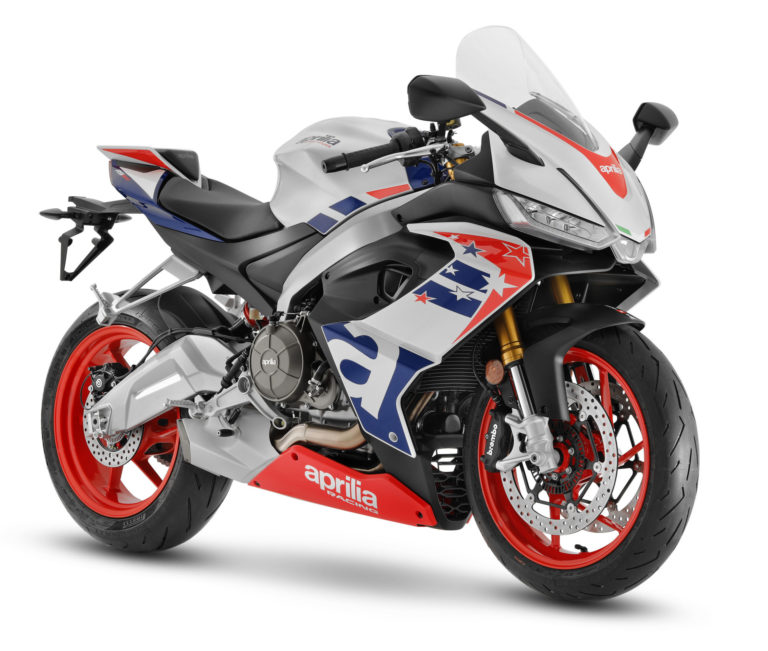
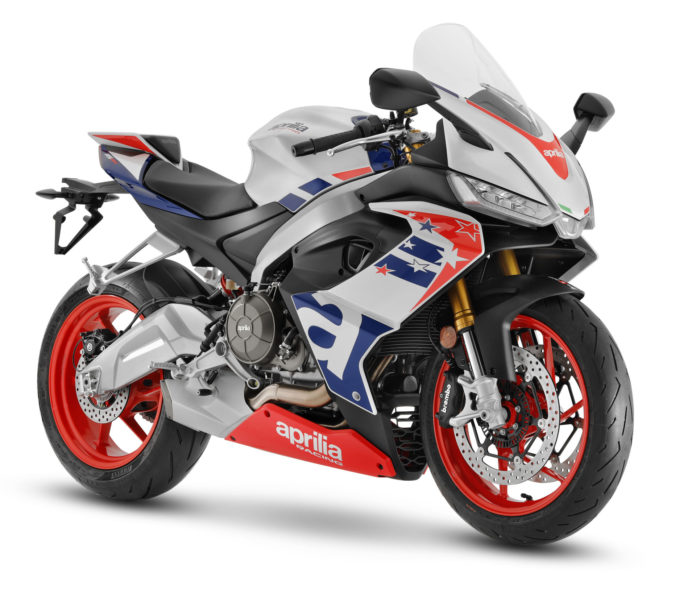
In celebration of this victory, at EICMA 2021, Aprilia introduces a numbered special edition of 1500 units of RS 660, characterized by a new stars and stripes livery inspired by the American flag. A color scheme closely derived from the special graphics on the bike that the Twins Cup champion, Kaleb De Keyrel, rode in the race at Vallelunga for the final round of the Aprilia RS 660 Trophy, where Kaleb had been invited to participate as a reward for his important championship victory on American soil.

Aprilia RS 660 Limited Edition also boasts a standard equipment package that includes some of the racing content from the competition version that proved to be unparalleled in the Twins Cup, taking 10 wins out of the 13 races held.

The sporty personality of Aprilia RS 660 Limited Edition is highlighted by the single-seat tail-fairing cover, which eliminates the passenger seat, enhancing the sleek design of the rear. The passenger’s seat comes with the bike, which is still approved for two-up riding. The oversized top fairing ensures greater protection for the rider against the wind, both on the road and on the track, and it also has the software that lets you set up the quick shift gearbox in upside-down configuration. This means that, depending on your needs, you can configure the gearbox entirely on your own, without replacing any parts on the bike, in street or upside-down version – ideal for the occasional track day.

A badge located on the fuel tank bears the progressive number of the bike and indicates the limited-edition of 1500 units.

Aprilia RS 660’s Winning Streak in MotoAmerica

Just a few months after making its début in the U.S.A. on an American track that is one of the most iconic in the world, the Laguna Seca circuit in California – ridden by Pikes Peak record holder astride an Aprilia Tuono V4, Rennie Scaysbrook – Aprilia RS 660 was the immediate protagonist of a thrilling sports story. Approved just in time for the beginning of the 2021 Twins Cup, the Italian twin-cylinder 659cc motorcycle took the top three spots straight away in the opening race on the Road Atlanta circuit. It was a blinding start, in some ways unexpected, followed by a winning streak: 10 total wins out of 13 races held, plus another 16 podiums (9 second places and 7 third places) and 6 pole positions. That first, extraordinary one-two-three was followed by others, at historic Laguna Seca circuit and in both races held in New Jersey.

Five of the 10 total wins were achieved by Kaleb De Keyrel, crowned Twins Cup 2021 champion astride his Aprilia RS 660 prepared by the Robem Engineering team. The other victories were credited to Jody Barry, Cory Ventura, Anthony Mazziotto (two wins) and Tommaso Marcon. The Aprilia RS 660 therefore confirmed its status as a versatile bike, able to win on extremely different circuits and with riders who have different riding styles.

Aprilia Adds Tuono 660 Factory To Lineup

APRILIA TUONO 660 FACTORY

TUONO 660 FACTORY DESCENDS DIRECTLY FROM TUONO V4 FACTORY AND INHERITS ITS KEY VALUES, BOASTING CONSIDERABLE EQUIPMENT AND PERFORMANCE

EVERY APRILIA FACTORY IS AN EXTRAORDINARY BIKE. TUONO 660 IS DEDICATED TO THE NEW GENERATION OF MOTORCYCLISTS WHO DEMAND MAXIMUM RIDING ENJOYMENT

181 KG FOR 100 HP: TUONO 660 FACTORY IS LIGHTER, MORE SOPHISTICATED, AND FLAUNTS FIRST-RATE EQUIPMENT

The Factory versions of Aprilia sports bikes have always been flagship products, dedicated to the most demanding and skilled riders, who can appreciate the quality of the most sophisticated outfitting.

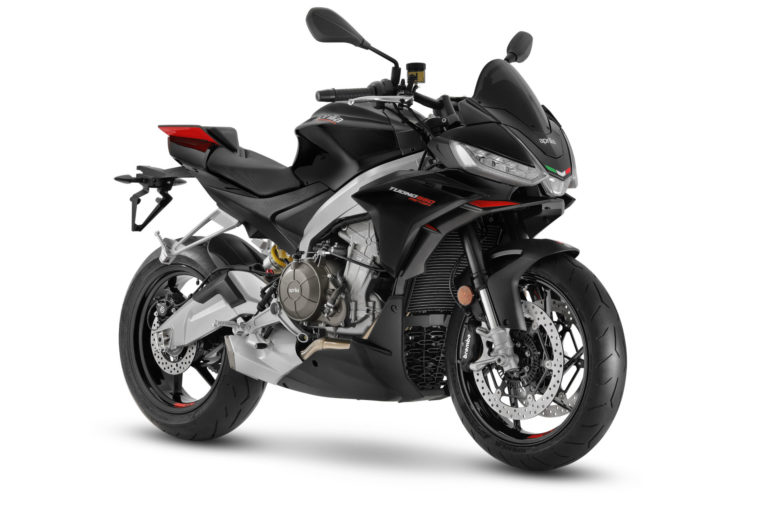
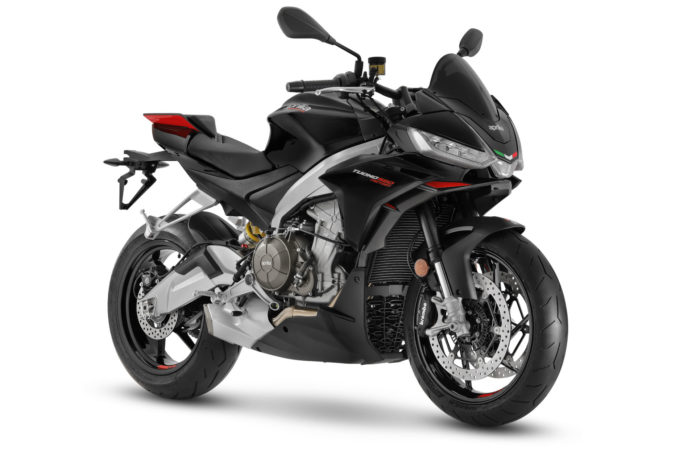
And now, the Factory trim is also available for the Tuono 660, which makes for a Tuono with unparalleled dynamic qualities, the most efficient and fun to use on the road and a true generator of emotions, accessible to everyone. All this, while respecting the Aprilia 660 project that promises bikes with a sensational weight/power ratio that are lightweight, high-performance, and built around the brand-new latest generation Aprilia parallel twin.

With respect to Tuono 660, already widely recognized and appreciated by the public and critics for its outstanding chassis qualities, Tuono 660 Factory boasts more sophisticated suspension, better suited to sport riding. The Kayaba fork with 41mm stanchions is fully adjustable in its compression and rebound damping and spring pre-load, while the Sachs shock with separate reservoir is also adjustable in its compression and rebound damping and spring pre-load.

There is an even better weight/power ratio, one of the main goals for all new Aprilia 660 models and already outstanding on the Tuono 660, thanks to the adoption of a light lithium battery that contributes to reducing the overall weight by roughly 2 kg (the curb weight is now 181 kg) and better engine performance.

A compact and lightweight latest-generation engine, the 660cc forward-facing twin with DOHC timing and four valves per cylinder is the result of experience gained with the very powerful engine that equips RSV4, from which the construction philosophy and basic concepts derive. The engine has a load-bearing function and houses the aluminum swingarm in its rear section. Combustion is asymmetric and offset by 270° to obtain irregular combustion which translates into performance and sound like that of a V-twin. The engine boasts even more drive-in acceleration, thanks to the use of a shorter final drive, with a 16-tooth pinion gear, one less than Tuono 660. The maximum torque remains unchanged, with 67 Nm at 8500 rpm, 80% of which is available from 4000 rpm, or 90% on reaching 6250 rpm.

Tuono 660 Factory offers a full suite of APRC electronic controls with a Ride-by-Wire electronic accelerator and six-axis inertial platform as standard. The latter, thanks to the accelerometers and gyroscopes it contains, can recognize the bike’s condition with respect to the road, measuring and processing the inputs that result from riding and sending the data to a control unit that intervenes to optimize the control parameters. The Tuono 660 Factory APRC includes ATC (Aprilia Traction Control), adjustable traction control characterized by high-performance intervention strategies; AWC (Aprilia Wheelie Control), the adjustable wheelie control system; ACC (Aprilia Cruise Control) to maintain a steady speed without using the throttle; AQS (Aprilia Quick Shift), the electronic gearbox that allows for very rapid shifting without closing the throttle or using the clutch. It is also equipped with the downshift function, to allow for clutchless downshifting; AEB (Aprilia Engine Brake), the adjustable system to control engine braking when closing the throttle; AEM (Aprilia Engine Map), with different mappings via which to alter the engine’s character and delivery.

Tuono 660 Factory also benefits from multi-map Cornering ABS. With its extremely contained weight and dimensions, the system can optimize braking and ABS intervention through the corners, thanks to a specific algorithm that constantly monitors various parameters such as lateral acceleration, the pressure applied to the front brake lever, and the lean, pitch and yaw angle, modulating the braking action to optimize the ratio between deceleration and stability.

As with the Tuono 660, there are five customizable Riding Modes (three for road use and two for track use) to simplify life on-board. The rider needs only to choose the Riding Mode that best interprets his or her riding needs to automatically obtain the best settings in terms of traction control, wheelie control, engine brake, ABS, and the other managed parameters. Adoption of the inertial platform has also allowed for activation of the “bending lights” function, incorporated into the front LED light cluster complete with perimeter DRL (this pair of additional lights illuminate the entire corner, increasing visibility when leaning).

With its reduced surfaces effectively highlighting a dynamic, sport character, the bike’s design stands out for the innovative double fairing that serves as an aerodynamic appendage. The pressure of the air channeled between the two walls contributes to optimizing stability at high speeds and, at the same time, increases rider comfort by protecting against direct air flow, also deflecting the hot air extracted from the engine. The Tuono 660 Factory version is further enhanced with the aggressive and sporty Factory Dark graphics and the presence of the single-seat tail fairing, painted black and red and supplied as standard together with the passenger seat and footpegs. These pegs, like those of the rider, are the same as those of the Aprilia RS 660.


Moto2: Vietti Quickest, SDK P9 During Private Testing At Jerez (Updated)

Celestino Vietti, riding his VR46 Racing Team Kalex, was unofficially quickest on Day Two of private Moto2 and Moto3 team testing at the Jerez Circuit, in Spain. Vietti’s best lap time was a 1:41.706, which isn’t far off Sam Lowes’ race lap record of 1:41.313.


Celestino Vietti (13). Photo courtesy VR46 Racing Team.


American Sean Dylan Kelly (1:42.749), the 2021 MotoAmerica Supersport Champion and a rookie in the Moto2 World Championship, was unofficially ninth out of at least 20 riders testing Monday. Kelly’s teammate, five-time MotoAmerica Superbike Champion Cameron Beaubier (1:43.237), was unofficially ranked 17th on Monday.

“No words!!!” Kelly posted to his Facebook page. “Incredible test and so happy to have started working with the American Racing Team. 177 laps in 2 days! Learning, adapting, working!! Really enjoyed riding the Moto2 bike and really happy with the outcome of these two days. Now eyes on 2022!!! Thank you ALL #SDK40”


The timing and scoring screen at the end of the day Monday at Jerez.


More, from a press release issued by VR46 Racing Team:

MOTO2 DEBUT ON THE KALEX FOR NICCOLÒ ANTONELLI

Two days of testing in Andalusia for the rookie of the VR46 Racing Team on track today with Celestino Vietti Ramus

Jerez de la Frontera (Spain), November 22nd 2021 – First steps towards the start of the 2022 season for the VR46 Racing Team in Jerez de la Frontera for a two days of testing for the Moto2 crew.

Yesterday Niccolò Antonelli make his debut on the Kalex and began to become familiar with the new bike. Overall a good Sunday and positive feelings with a best lap time of 1: 45.388 (51 laps) for the rookie who returned to work again today for the Dunlop test reserved to the Moto2 class, signing a good 1: 43.214 (64 laps).

Celestino Vietti Ramus was also on track today and immediately found the feeling he has in the last races and finished at the top of the standings with a best lap time of 1: 41.706 (78 laps).

Both riders will be back on track next February for the first testing session of the 2022 season.

Celestino Vietti:

A good test, definitely positive also considering the 2022 season. We tried new settings and the Dunlop compounds. The feeling was not bad at all and I am happy to say goodbye to the Team in this way. They were two beautiful days with the guys and also my new team mate (Niccolò Antonelli). Now a few weeks off and then full gas for the new season.

Niccolo Antonelli:

An incredible experience, I’m really happy to have tried the Moto2: I immediately felt at ease with the new Team. A pity for the weather, the tarmac has never been completely dry, but we have already managed to understand a lot about the new bike. Compared to yesterday, the feelings are good and we already know where to improve during the winter to be able to make a step forward. I can’t wait to get back on track in 2022.

Pablo Nieto, Team Manager:

A good debut for Niccolò and Celestino in Jerez. Two days of uncertain weather and not very high temperatures where it was important, especially for Niccolò, to begin to become familiar with the new bike. Niccolò took his first steps on the Kalex and the feelings are good. Celestino also did well, on the positive trend that has characterised the last races of the season. Let’s enjoy a few weeks off now and get back on track in 2022.


More, from a press release issued by Marc VDS Racing Team:

Lowes and Arbolino kick off 2022 Moto2 preparations in Jerez

Elf Marc VDS Racing has concluded a productive and positive one-day Dunlop tyre test at the Jerez track in Spain, with the Belgian squad thrilled to welcome Tony Arbolino for his first public appearance in the Team’s famous livery.

Damp and cool conditions prevented Sam Lowes and Arbolino from venturing out on track yesterday, but they were able to circulate in more favourable weather today.

Arbolino enjoyed a busy but positive final day on track in 2021 while assessing a range of tyres for Dunlop and acquainting himself with his new crew for next season.

Lowes limited his time on track today while still in considerable discomfort from the right foot injury he suffered during the opening practice session ahead of the final round in Valencia earlier this month.

“I’ll focus on being strong when we return in 2022”

Sam Lowes:

“We weren’t able to complete as many laps as I’d hoped coming into this test, but my foot was more painful than I expected. On a race weekend there’s not much time to think about an injury and the adrenaline always helps block out the pain. But at a test there’s more time to think and my foot felt quite sore. Track conditions weren’t fantastic, and I didn’t feel like I was able to push at my limit to give Dunlop the correct information and feedback required, so it was the right decision to stop and begin the recovery in the winter. It’s still been a positive test from the perspective of meeting some new members in the Team and sharing some time with Tony. The atmosphere is really good between everybody and that’s a great way to go into the winter break so I can focus on being strong when we get going again in 2022.”

“Already in this Team I feel we can achieve great results in 2022”

Tony Arbolino:

“Honestly, I’m feeling a bit tired at the end of the day because I did 96 laps, but it feels fantastic to begin working with my crew and this Team and we did a lot of good work. I instantly felt at home and comfortable with my crew and I felt very good on the bike, and we made some positive improvements throughout the day. The important thing now is to enjoy the winter break and have a good rest because already I feel like in this Team we can achieve great results in 2022.”


More, from a press release issued by Gresini Racing:

POSITIVE DEBUT FOR SALAC AND ZACCONE WITH GRESINI MOTO2 TEAM

Gresini Racing has concluded the opening test of the 2022 Moto2 World Championship winter season – and the last track outing of 2021 – with new arrivals Alessandro Zaccone and Filip Salac, both rookies in the category. It was surely an interesting two-day test, which saw both riders trying their skills in every possible track condition, from wet to dry, with the sole goal to find the best feeling with their Triumph-powered Kalex machines.

The two days of testing have been positive, with both riders able to constantly improve both their lap-times and confidence with the new bike. Filip Salac finished eighth after completing around 100 laps between yesterday and today. Alessandro Zaccone ended up right behind his new teammate (10th) despite a crash in the final moments of the test.

8º – FILIP SALAC #12 (1’42.548)

“The first day on the Moto2 bike was perfect. We quickly adapted to this bike even though we still need a lot more to be competitive. There’s a great feeling with the team already, and so with the bike: we improved lap after lap while trying to find the limit on a track which was far from ideal. We also had more reference points today with all riders on track – and dry conditions. We have been fast and I’m happy with the work done and I believe the team is, too.”

10º – ALESSANDRO ZACCONE #61 (1’42.783)

“Good feeling with the team and the bike. We tried a lot of things and with the soft tyre today we were unable to be quick, but it’s more due to my fitness condition than else. Despite a bit of traffic in the last split we were able to lap in 1’42.7… We could have almost been in the top five lap-time wise. Too bad for the crash at the last lap: I let the tyre cool down a bit too much, hence the crash. Generally speaking, though, things went very well and I think we can have a good season.”


Kawasaki Ninja H2 SX SE Gets More Power & Technology For 2022

A 2022 Kawasaki Ninja H2 SX SE fitted with optional side cases. Photo courtesy Kawasaki Motors Corp., U.S.A.

2022 Kawasaki Ninja H2® SX SE Motorcycle

ENGINEERED TO BE FREE

The Kawasaki Ninja H2® models are a testament to Kawasaki’s pursuit of innovation, performance, and passion for creating the world’s most advanced line of supercharged motorcycles. For 2022, the Ninja H2® SX SE motorcycle returns to Kawasaki’s hypersport lineup, new and improved by blending performance and ultimate real-world handling with Kawasaki’s most advanced suite of rider assist technologies to date.

The Kawasaki Ninja H2 SX SE brings the latest in electronically controlled suspension, braking, and rider aid technologies to the supercharged hyperbike platform, making it the ultimate sport touring package. The Ninja H2 SX SE is powered by an exhilarating unique balanced supercharged 998cc inline four-cylinder engine, which utilizes Kawasaki’s knowledge of precision engine tuning to distribute power to where it is most useful, in the low to mid-range for both long distance touring and daily riding. With this powerful engine at its core, Kawasaki has created one of the most advanced and well-balanced motorcycles in performance, comfort, and efficiency, to expand your supercharged journey.

Developed with the ability to go above and beyond the daily applications of today’s sportbike rider, the Ninja H2 SX SE is Kawasaki’s most advanced sport tourer ever and utilizes a balanced supercharged engine that offers optimal output performance in the low to mid RPM range, all while achieving excellent fuel efficiency. This highly refined package offers an unrivaled level of performance and comfort, with agile handling akin to its superbike counterparts.

New for 2022, the Ninja H2 SX SE features updated styling through a new headlight and upper cowl, Advanced Rider Assist System (ARAS) with Adaptive Cruise Control (ACC), Forward Collision Warning (FCW), and Blind Spot Detection (BSD), wider rider and passenger seats for comfort, 6.5” TFT Color Instrumentation with Kawasaki’s new Smartphone-based Infotainment app (SPIN), Tire Pressure Monitoring System (TPMS), Vehicle Hold Assist (VHA), Kawasaki Electronically Controlled Suspension (KECS) with Skyhook technology, and Kawasaki Intelligent Proximity Activation Start System(KIPASS) remote key fob.

2022 KAWASAKI NINJA H2® SX SE HIGHLIGHTS

  • NEW Headlight and upper cowl styling
  • NEW Advanced Rider Assist System (ARAS)
    • Adaptive Cruise Control (ACC)
    • Forward Collision Warning (FCW)
    • Blind Spot Detection (BSD)
  • NEW Wider seats for increased comfort
  • NEW5” TFT Color Instrumentation with a Smartphone-based Infotainment app (SPIN)
  • NEW Tire Pressure Monitoring System (TPMS)
  • NEW Vehicle Hold Assist (VHA)
  • NEW Kawasaki Electronic Control Suspension (KECS) with Showa Skyhook EERA technology
  • NEW Kawasaki Intelligent Proximity Activation Start System (KIPASS) remote key fob
  • NEW USB-style power outlet
  • NEW Grip heaters

ENGINE & CLUTCH

  • NEW Revised cam timing
  • NEW Exhaust silencer
  • NEW Elimination of exhaust pre-silencer
  • NEW Revised second gear
  • NEW Optimized hydraulic clutch fluid volume

A supercharged 998cc inline four-cylinder engine is designed to deliver both power and fuel efficiency on the 2022 Ninja H2® SX SE, focusing on low-mid range power delivery with exhilarating acceleration that prioritizes everyday usability in street-riding conditions. New for 2022 is a resin silencer that has been added to the secondary air inlet to reduce mechanical (intake) noise. Revised cam timing contributes to increased overall engine performance. The elimination of the exhaust’s pre-silencer chamber allows greater freedom with the new exhaust layout that features a longer collector pipe, increased catalyser volume, and a larger silencer. The new straight-pipe style layout delivers improved torque to benefit everyday ride ability.

A dog-ring transmission facilitates smooth, quick shifting and the number of gear teeth for second gear have been revised in order to minimize resonance when the gears mesh. Adding ribs to the inside of the clutch cover increases its stiffness, further helping to reduce mechanical noise. A hydraulic assist and slipper clutch offers light lever operation. The volume of the hydraulic fluid routed to the clutch plates has been revised and offers improved clutch release. As a result, the shift load due to the plates dragging can be minimized, an improvement that is noticeable when stopped, and it’s easier to shift into neutral.

NEW TFT COLOR INSTRUMENTATION WITH SMARTPHONE INTEGRATION (SPIN)

  • NEW5” TFT Color Instrumentation with a Smartphone-based Infotainment app (SPIN)

A large, easy-to-read 6.5” full-color TFT instrumentation screen adds a high-tech appearance to the cockpit. The new TFT instrumentation is complemented by multiple display modes (black, white or automatic) and smartphone connectivity as well as compatibility with Kawasaki SPIN to offer riders a wide range of information.  The home screen display is divided into three areas, upper, middle, and lower. Display functions in the upper area include integrated riding mode, gear position indicator, distance setting indicator, ACC indicator, tachometer, Kawasaki Quick Shift (KQS) indicator, Kawasaki Engine Brake Control (KEBC) indicator, and a multifunction gauge that visually shows the boost pressure plus the rider’s choice of throttle application, front brake pressure or G-force. The middle area display functions include a large digital speedometer, cornering light indicator, service indicator, VHA indicator, and economical riding indicator. In the lower area, a multifunction display allows riders to scroll through functions such as odometer, dual trip meters, bank angle display and bank angle recording function, tire pressure, boost pressure, boost temperature, current and average fuel consumption, remaining range, average speed, total time, and battery voltage. Additional display functions that can also be accessed include fuel gauge, KECS preload mode, outside temperature, ice warning, connected device indicator, and clock and coolant temperature.

Also new for 2022 is the addition of Kawasaki’s new smartphone-based infotainment app (SPIN) that enables various third party applications to be downloaded and mirrored on the cockpits TFT display. Basic functions available in the app include telephone, map display, music, calendar, and contacts. Additionally, riders can opt to download third party apps to add to their Kawasaki SPIN library to be able to interact with them on the TFT display. Available apps include Sygic (navigation), SENA (headset communication), and more.

Using Kawasaki SPIN provides riders access to several great functions, including:

  1. Vehicle Info: information such as fuel gauge, odometer, maintenance schedule, which can all be viewed via the smartphone
  2. Riding Log: GPS route information as well as vehicle running information can be logged and viewed via the smartphone
  3. Telephone Notices: when a call or mail is received by the smartphone, this is indicated on the instrument display

NEW ADVANCED RIDER ASSIST SYSTEM (ARAS)

  • Adaptive Cruise Control (ACC)
  • Forward Collision Warning (FCW)
  • Blind Spot Detection (BSD)

The Ninja H2® SX SE motorcycle has always boasted the latest cutting-edge technology, and for 2022 it’s no different with the addition of Bosch’s Advanced Rider Assist System (ARAS) that features surround-sensing functions based on radar sensors that generates a more relaxed riding experience. Oftentimes, riding in heavy traffic and maintaining the correct distance to the vehicle in front takes a great deal of concentration and can become strenuous over longer periods. Adaptive Cruise Control (ACC) maintains the speed set by the rider but adjusts the vehicle speed to maintain a suitable following distance from the vehicle in front. When the system is operating, a signal is shown on the instrument panel, including the symbol showing green when following a vehicle ahead and grey when there is no vehicle ahead. Once operational speed gets to a certain point, which varies in each gear, the system will disengage, and the rider will need to operate the brakes manually. Pressing the cruise control button on the left side of the handlebar turns the system off. Operating the brakes or engaging the clutch for several seconds causes ACC to be temporarily disengaged and closing the throttle completely will also disengage the system. Accelerating (throttle override) or shifting gears (as long as the new gear’s minimum operation speed is met) does not disengage the system unless the maximum speed allowed is reached.

Bosch’s development of Forward Collision Warning (FCW) was designed to reduce the risk of a rear-end collision or to mitigate its consequences through front-facing radar sensor monitors. The system is active as soon as the vehicle starts, and it supports the rider in all relevant speed ranges. If the system detects that another vehicle is in too close of range, and the rider does not react to the situation, it warns the rider with a bright flashing red LED light above the instrument panel and a warning is also shown on the TFT display. Riders can set the alert timing according to preference with options including early, medium or late. FCW can also be turned off, which will be indicated on the TFT display.

The Blind Spot Detection (BSD) function helps keep a lookout in all directions to assist motorcyclists with lane changes. A rear-facing radar sensor serves as the blind spot detection’s eye, registering objects in hard-to-see areas on both the left- and right-hand sides. When an approaching vehicle is detected, an LED built into the rearview mirror will illuminate, a first on a Kawasaki motorcycle. If a rider indicates the intent to change lanes by switching on the turn signal while a vehicle is detected in the blind spot, the mirror LED will flash. BSD can be turned off and will be indicated on the TFT display when doing so.

NEW TIRE PRESSURE MONITORING SYSTEM (TPMS)

The addition of the Tire Pressure Monitoring System (TPMS) allows tire air pressure to continuously be monitored while riding, adding reassurance for the rider on long rides. Tire pressure sensors are used to alert the rider when tire pressure falls below 31.9 PSI through a low-pressure warning that is displayed on the TFT meter.

NEW VEHICLE HOLD ASSIST (VHA)

Activated when the rider has stopped and firmly applies the brake(s), Vehicle Hold Assist (VHA) engages the rear brake to allow the rider to relax the hand brake.  The ABS pump exerts pressure to engage the rear brake, and a light/signal is indicated on the TFT meter to let the rider know the brake hand can be relaxed and the bike will remain in place. The system disengages automatically when the rider turns the throttle to accelerate, when the side stand goes down, or 10-minutes after activation. The rider can also disengage the system by quickly squeezing and releasing the brake lever (within 1 second).

NEW KAWASAKI INTELLIGENT PROXIMITY ACTIVATION START SYSTEM (KIPASS)

The Kawasaki Intelligent Proximity Activation Start System (KIPASS) master key system allows remote activation of the main switch and steering lock of the Ninja H2®SX SE motorcycle. The system offers increased convenience while acting as a deterrent to theft and vandalism. With the compact key fob in a pocket, the KIPASS sends out a signal that is picked up and recognized by the ECU. For added security, an immobilizer function is incorporated into the ignition system. As a flagship model, the key fob of the Ninja H2 SX SE is adorned with the Kawasaki River Mark.

NEW BOSCH 10.3ME ABS IMU

The Ninja H2® SX SE becomes Kawasaki’s first model to integrate an FI-ECU with torque-demand capabilities and the new IMU measures in six degrees of freedom (DOF) with a compact, boost circuit-equipped ABS with high computational power. IMU enables inertia along 6 DOF to be monitored. With the new unit, acceleration along longitudinal transverse and vertical axes, plus roll rate, pitch rate and yaw rate are all measured. Feedback from the IMU is used to give clearer real-time picture of chassis orientation. With more sophisticated torque-demand capabilities, the new FI-ECU is able to adjust torque in response to external direction, which enables it to work in concert with the ABS. This coordinated control of both the engine and brakes is essential for delivering smooth operation in systems like the new ACC. A boost circuit capable of increasing fluid pressure at the brake calipers enables the brakes to be activated independent of direct rider input, which is required for the new ACC and VHA systems.

SUSPENSION

  • NEW Kawasaki Electronic Control Suspension (KECS) with Showa Skyhook EERA technology

The Ninja H2® SX SE features KECS with Skyhook technology which helps support the motorcycle’s sprung weight and modulates the suspension damping force to allow the wheels to track road dips and bumps while maintaining the motorcycle’s vertical position with minimal disturbance. Combining high-level mechanical components with the latest electronic control technology, KECS offers both the suppleness to offer riding comfort in a wide range of riding situations, as well as the firm damping to facilitate sport riding.  Handling the suspension duties is a sporty 43 mm inverted Showa cartridge fork and a high-spec Showa Balance Free Rear Cushion (BFRC) lite rear shock – similar to the rear suspension used on the Ninja® ZX™-10R sportbike, except it also features electronically adjustable preload.

In the BFRC lite shock, damping force is generated in an external Damping Force Chamber, and compression and rebound damping are generated independently, allowing the whole surface of the main piston to act as a pump, pushing oil towards the valves. This configuration also helps to suppress pressure balance fluctuations as a result of shock compression and extension.

Compression and rebound damping for both the forks and shock are generated (and adjusted) electronically via the KECS system that is controlled by a solenoid valve with direct actuation and allows for extremely quick reaction time. Riders can choose from four modes: Sport, Road, Rain, and Manual. KECS then adjusts to the road surface environment in real time to provide the ideal damping, considering vehicle speed, stroke speed and deceleration. Riders can electronically control the rear shock preload settings as well. KECS offers three different preload settings: rider only, rider with luggage, and rider with passenger and luggage. Riders can fine-tune these settings with 10 levels of adjustment for each.

The updated software incorporates Showa’s Skyhook EERA (Electronically Equipped Ride Adjustment) technology to deliver an even more composed ride. Showa’s Skyhook software, carefully fine-tuned by Kawasaki engineers to ensure the sporty riding character of the Ninja H2 SX SE was preserved, delivers a smoother ride as it continually adapts to the road surface in real time.

The forks and shock have built-in stroke sensors that provide real-time stroke speed and compression information. The sensor coils provide input to the KECS ECU every millisecond. This is complemented by information provided by the IMU (acceleration/deceleration) every 10 milliseconds and the FI ECU (vehicle speed) every 10 milliseconds. The KECS ECU then directs current to the solenoids to adjust damping as required by the situation.

STYLING

  • NEW Upper and side cowls
  • NEW LED headlight
  • NEW Aerodynamic mirrors
  • NEW Supercharged emblems

Sleek new lines give the Ninja H2® SX SE a sharper, more compact look, while maintaining its aggressive and seductive Ninja® image. The new front face design points to its supercharged roots and instantly communicates that it’s more than the ordinary sport touring machine. The new upper cowl features angular lines and a slim, compact impression even with the addition of the radar sensor, which is positioned below the headlight. The radar sensor sits behind a cover, specially designed to not interfere with the radar function. The Kawasaki River Mark emblem is proudly displayed on the upper cowl – a true reflection of the high-level performance, comfort, and quality that the Ninja H2 SX SE offers. Full fairing bodywork adds to the bike’s sporty image and helps to reduce heat that can be felt by the rider.

In order to match the new upper cowl, simple surfaces have been added to the side cowl and contribute to the new styling. The upper cowl is more compact to accommodate the front radar sensor, and a new LED headlight is positioned at the front of the upper cowl, contributing to the intense design. It features integrated position lamps that are crystal-like in appearance, adding a high-class touch. LED cornering lights are built into each side of the fairing in sets of three to help illuminate the road when cornering. New aerodynamically shaped mirrors offer a clear view of the rear, even when the Kawasaki Genuine Accessories 28 L hard saddlebag set is fitted, and feature single-bulb LED-type turn signals. Rear-facing radar is built into the rear fender, and like the front radar, is cleverly hidden by a specially designed cover. LED turn signals contribute to the bike’s high-quality image and a handcrafted two-color “Supercharged” emblem has been added to communicate the flagship status of the Ninja H2 SX SE.

ERGONOMICS

  • NEW Wider seats for increased comfort
  • NEW USB-style power outlet
  • NEW Grip heaters
  • NEW Brembo front brake system

A new ergonomically designed front seat provides comfort for spending long hours in the saddle as well as accommodates position changes for sportier riding. Both rider and passenger seats are wider than previous models, and revised shapes, thickness and density all add to rider and passenger comfort. The wider rear seat features a flat surface at the front to help keep the passenger from sliding forward under braking. Under the rear seat, a new USB-type power outlet offers a convenient source for powering accessories or personal items. The riding position of the Ninja H2® SX SE offers a relaxed bend that is comfortable for in-town riding and long touring and features grip heaters to add to the comfort on cold days. The grip heater wiring is routed inside of the handlebar for a clean design. To match the handle-mounted Accelerator Position Sensor (APS) and grip heaters, a newly designed Brembo direct actuation front master cylinder is fitted.

BRAKES & WHEELS

  • NEW Bridgestone Battlax Hypersport S22 tires

The Ninja H2® SX SE comes equipped with high-grade Brembo Stylema front calipers. The design of key sections allows stiffness to be maintained while enabling a direct connection to the piston area. The Stylema calipers quickly cool thanks to increased airflow around the brake pads, space around the pistons, and an opening that allows air to exit from the central bridge. The dual radial mount opposed 4-piston Stylema front calipers grip a pair of semi-floating 320 mm discs, which complement the technical innovation and premium quality of the Ninja H2 SX SE. New Bridgestone Battlax Hypersport S22 tires provide a good balance of sport and touring performance.

INTEGRATED RIDING MODES

All-inclusive modes that link KTRC, Power Mode and KECS allow riders to efficiently set traction control, power delivery, and suspension characteristics to suit a given riding situation. Riders can choose from four settings: Sport, Road, Rain or a Manual setting. In the manual rider mode, each of the systems can be set independently. The Sport setting enables riders to enjoy sporty handling riding. The Road setting provides comfortable riding characteristics over a wide range of situations, from city riding to highway cruising and rural roads. The Rain setting offers rider reassurance when riding on a low traction surface.

HIGHLY DURABLE PAINT

Kawasaki’s Highly Durable Paint features a special top coat that allows certain types of scratches to repair themselves, enabling the paint to maintain its high quality finish through normal wear and tear†. The self-healing is achieved through microscopic soft and hard segments within the top coat working like a chemical spring, creating a trampoline effect that absorbs many impacts.

† Notes:
1.  Recovery can take a week or longer.
2. The paint will not recover in the case of scratches caused by a coin or key, or zip fasteners.

KAWASAKI GENUINE ACCESSORIES

  • NEW Premium high front seat
  • NEW Low front seat
  • NEW Color matched seat cowl
  • NEW Oil cap
  • NEW Helmet lock
  • NEW Clear 55 mm lower windshield

For 2022, several new Kawasaki Genuine Accessories are available for the Ninja H2® SX SE, including a high front seat, low front seat, color matched seat cowl, oil cap, helmet lock, and clear windshield that is 55 mm lower. Also returning to Kawasaki’s accessory list will be frame sliders, a 28 liter hard saddlebag set, bag fitting kit, color panel kit, trim set, and one key system.

COLOR AND PRICING

The 2022 Ninja H2® SX SE is available in a Emerald Blazed Green/Metallic Diablo Black/Metallic Graphite Gray color scheme with an MSRP of $27,500.

ABOUT KAWASAKI

Kawasaki Heavy Industries, Ltd. (KHI) started full-scale production of motorcycles over a half century ago. The first Kawasaki motorcycle engine was designed based on technical know-how garnered from the development and production of aircraft engines, and Kawasaki’s entry into the motorcycle industry was driven by the company’s constant effort to develop new technologies. Numerous new Kawasaki models introduced over the years have helped shape the market, and in the process have created enduring legends based on their unique engineering, power, design and riding pleasure. In the future, Kawasaki’s commitment to maintaining and furthering these strengths will surely give birth to new legends.

Kawasaki Motors Corp., U.S.A. (KMC) markets and distributes Kawasaki motorcycles, ATVs, side x sides, and JET SKI® watercraft through a network of approximately 1,100 independent retailers, with close to an additional 7,700 retailers specializing in general purpose engines. KMC and its affiliates employ nearly 3,100 people in the United States, with approximately 260 of them located at KMC’s Foothill Ranch, California headquarters.

Kawasaki’s tagline, “Let the good times roll.®”, is recognized worldwide. The Kawasaki brand is synonymous with powerful, stylish and category-leading vehicles. Information about Kawasaki’s complete line of powersports products and Kawasaki affiliates can be found on the Internet at www.kawasaki.com.
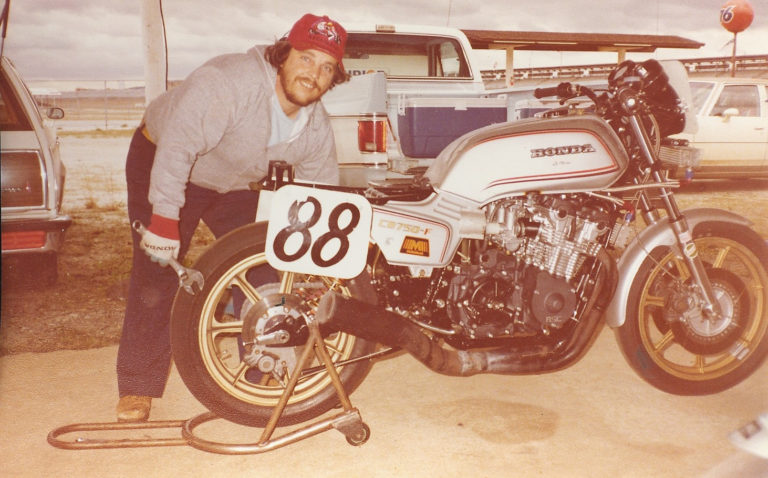
MV Agusta Launches Two New Adventure Motorcycles

A 2022-model MV Agusta 9.5 adventure motorcycle. Photo courtesy MV Agusta.

LUCKY EXPLORER PROJECT

5.5 & 9.5

December 26th, 1978. That day marked the genesis of one of the most fascinating and dangerous adventures ever: the Paris-Dakar. Famous rally race crossing the Sahara Desert and born from the irreverent and visionary mind of Thierry Sabine. After its founder’s death in 1986 in the middle of unforgiving Ténéré region, the race has become the test bed for outstanding performance bikes, capable of travelling the desert tracks at insane speeds. 

The Elefant model in its Lucky Explorer livery is probably the most celebrated icon of that historic desert raid. From the very first sketches, the evocative power of the Elefant, dominating twice the final destination of Lac Rose in Dakar, has inspired many designers, committed to recreating, in a modern key, that magic feeling of motorcycles recognised as the emblem of the eternal struggle between the crudeness of nature and man. Rock, sand, gasoline and courage: a bunch of crucial elements on which those epic races were based. The “void” embraced full throttle. Looking for the right track, the one that truly makes the difference between a stage victory and an out-of-time arrival at base camp. 

It is not just about motorbikes. It’s about a comprehensive ecosystem, which is not only made up of evocative sensations but also deserves off-road effectiveness and skill. 


MORE THAN A PROJECT 

November 2021. MV Agusta launches the Lucky Explorer Project, a multi-faceted initiative aiming at gathering the passionate lovers of rally raid and off-road racing around Schiranna’s unforgettable legacy of epic participations and victories in the great African rallies of the golden age. 

That same spirit of adventure and freedom is the foundation of this ambitious teaser communication project which will be initially developed through digital communication activities followed by others in the real-life world to finally back up the launch of two new adventure bikes. 

The Lucky Explorer Project is not just a cold yet smart marketing project. It represents the ultimate character of the Company to express its sentiments in the motorcycle business, revamping deeply the passion, the emotions, the values, the style, the gestures of men and bikes who made the history of racing in the desert. It’s more than a project. 

The Lucky Explorer Project has been conceived to create a communication platform to support the launch of two brand new adventure bikes, creating anticipation and thrill, thus: 

  • Revamping the Lucky Explorer racing heritage 
  • Telling the story and spread the culture of the great African rallies
  • Building an adventure, off-road enthusiast community 
  • Involving and engaging participants in online and offline actions 

Lucky Explorer Project is not just about bikes, it’s about a comprehensive world of emotions, memories, values and a way of being. A long-awaited return for all the fans of Made-in-Schiranna, but also a new beginning and a leap into the future.

The project will be developed on the website www.luckyexplorerproject.com and through the Instagram channel @ luckyexplorer.official already online. Riders, personalities, clips and anecdotes, historical factory tours, vintage advertising, videos, memorabilia, new content and events will bring together a real community of enthusiasts. And Lucky Explorer ambassadors will turn up, with access to special content and exclusive previews.

The new 5.5 and 9.5 adventure bikes offer a concrete yet suggestive perspective in an increasingly crowded competitive arena, focused on riding efficiency and stylistic charm, as well as on advanced technical solutions. 

Both projects represent the modern interpretation of the desert race’s myth, which appealed the imagination of the Motorsport world since the mid-Eighties, conquering tons of enthusiasts in the continuous search for brand-new and thrilling adventures. 

The 9.5 project represents the synthesis of a tireless design and development work that for many months has been aimed at creating a unique bike capable of offering breathless riding experience and user-friendly approach, without forgetting first-rate performance and charm. Compared to many of its main challengers, the 9.5 boasts an unprecedented off-road attitude, thanks to a bespoke chassis formula, starting with the wheel diameter: 21” at the front and 18” at the rear, together with 1,580 mm wheelbase. 

The primary goals of the project? Designing a motorcycle that is first and foremost compact, lightweight, essential and functional, with an intense off-road character. On top of this, out-of-the-ordinary versatility married to ability to move effectively and safely in whatever condition, from smooth asphalt to rocky terrain. With the aim to make this exclusive machine even more intuitive and easy to handle the saddle results adjustable in height. 

Originally, on the historic Elefant model, at centre-stage in the Dakar races, the Lucky Explorer logo was immediately recognisable, even from a distance, to the point of characterising the whole bike and emphasising its racing-oriented personality. Today, on both new models that logo blooms again thanks to the graphic and set-up winning choices. 


A 2022-model MV Agusta 5.5 adventure motorcycle. Photo courtesy MV Agusta.


5.5

The 5.5 version, developed in close collaboration with our partner QJ, is a new adventure bike inspired by the heritage of the Elefant. Despite being a mid-sized bike, its appearance is that of a higher displacement travel-oriented motorcycle, capable of seducing European riders looking for a sturdy and unstoppable companion. 

Such close collaboration with the partner has brought to life a truly advanced model if compared to the starting model: electronics, mechanics and chassis, in fact, have been carefully developed on the basis of detailed specifications. Electronics, for example, has been optimised to offer the perfect combination between performance and safety. The two-cylinder in-line liquid-cooled engine with double overhead camshaft distribution has also undergone specific refinement, aimed at further improving the high efficiency. The increase in displacement up to 550 cc (70.5 mm bore and 71 mm stroke), a distinctive content for this model, has the goal to further enrich the torque curve and smoothen delivery at all revs. That is what a motorcycle with such a wide spectrum of use deserves. 

Distinctive design of the 5.5 version can be seen both from the superstructures and from other aesthetic crucial features, such as the bespoke optical groups. Stylistic inspiration is shared with the 9.5 model and inspired by the legendary races in the desert, not to mention others features, which allows this new born to proudly claim its technical, conceptual and aesthetic identity. 


A profile view of a 2022-model MV Agusta 9.5 adventure motorcycle. Photo courtesy MV Agusta.


9.5

The 9.5 truly introduces a gateway to the future in the shape of a premium adventure bike, faithfully based on the new MV Agusta 950 engine, powered by class-leading technology and close to that racing spirit of the original Elefant. 

The two new models share numerous stylistic elements: the front end area and the sturdy handguard, for example, are both painted black. A side cover protect the radiator, which reveals a semicircle element in the central portion. Furthermore, a cover protects the front braking system, with a large flap to ensure the discs the right dose of air flow; the skid plate underlines the destination of the bike, which therefore results particularly off-road oriented. Even the extended use of high-technology materials along with their finishing are nature-inspired: the forged carbon fiber element, a link between the radiator area and the skid plate, reflects this vision. 

The instrumentation is automotive-standards developed: that is true in terms of easy-to-understand graphics, full suite of useful information as well as connectivity. It can count on a 7” full TFT panel, with Bluetooth connection to smartphones and Wi-Fi. The electrical switch cubes have been exclusively designed for this model: inspired by functionality and ergonomics criteria they allow the user to easily navigate amongst the numerous configurations available in the menus. In addition, a practical pannier fastening system, located in the tail area, comes with a retractable system: a smart solution that does not compromise the design of the bike. 

The optical assembly has been subjected to an extensive study, aimed at offering a stunning stylistic result and an indisputable light output as well. In particular, the 5.5 mounts DRL in a semicircle, which are clearly inspired by the classic Elefant 900. The optical assembly of the 9.5 is instead more complex and even more original, thanks to two concentric elements that add the front end an aggressive look. 

The chassis of the 9.5 is made of steel, with a closed double cradle structure. Designed to offer the best balance between the comfort required for touring road use and the stiffness to achieve interesting off-road performance, it is composed of forged and extruded elements, based on the loads required at different areas. Despite the excellent torsional strength and longitudinal stiffness values, it stops the scales at a mere weight. The sturdy swingarm makes use of lightweight aluminum alloy to achieve the highest strength-to-weight ratio. Aluminum is used also for the fork plates, while the rear subframe is made of steel. 

The 9.5 engine has been developed specifically for this model and creates an uncompromised balance of versatility, power and weight. Signed by MV Agusta and inspired by the well-known and admired 800 three-cylinder in-line, it is new in most of its components. The bore and stroke measurements have both been increased to achieve the effective displacement of 930.63 cc, delivering the highest possible values ​​of power and torque. All without changing the overall dimensions of the 800 engine currently in production. Numerous technical contents are confirmed, such as the head plane, cylinders angle together with the position of the motor mounts on the three axles and of the front sprocket.

The new 9.5 motorcycle also stands out for its three-cylinder in-line four-stroke liquid-cooled twin overhead camshaft engine boasts a compression ratio of 12.5: 1; the crankshaft is counter-rotating, to improve driving dynamics and reduce inertia. The removable gearbox is also offered in an unprecedented electro-actuated configuration, specially designed for this model. The maximum power and torque values ​​are respectively 123 hp at 10,000 rpm and 102 Nm at 7,000 rpm. The specific hp/l power is 132.25 while the complete mass of the engine is only 57 kg. 

9.5 engine main features:  

– New cylinder head

– New steel intake and exhaust valves

– New head-cylinder base gasket

– New steel crankshaft, counter-rotating, 120° cranks, 1-2-3 ignition

– New main and trimetallic connecting rod bearings

– New forged aluminum alloy pistons, three segments

The transmission can count on a new primary drive gear with straight teeth, with power take-off from the countershaft; the gears of the pump control are unprecedented. The base has been completely redesigned: it has integrated oil passages while the passage of water from the upper to the lower base takes place via an external aluminum pipe. What’s more, clutch, generator, starter, selector and gearbox covers have been redesigned. 

The 9.5 wet clutch comes in two versions: the automatic Rekluse variant and the standard, featuring hydraulic control on the left side. Lastly, the electro-actuated gearbox, offered as an option, represents a rare gem. 

R.I.P. Noted Race Mechanic Larry Worrell

Larry Worrell with Roberto Pietri's factory Honda CB750F/1025 AMA Superbike in the early 1980s. Photo courtesy Dennis Zickrick,

Noted Yamaha TZ750/OW31 and early AMA Superbike mechanic Larry “Round Man” Worrell died from cancer November 16 at a hospice care facility in Florence, Alabama. He was 77.

He is survived by his sisters Linda Worrell Cobb and Bette Worrell Royal and brother Gary Worrell.

“It is with immense sadness that I bring the news that my brother Larry Worrell passed away last night after a long-fought battle with cancer,” Linda Worrell Cobb posted to her Facebook page on November 17. “Larry was brave and faced this head on with my brother Gary and [Gary’s] wife Cathy by his side throughout.

“When we first got the news that his cancer was terminal, I told him I want to pray but I don’t know what to ask for. His answer was to go to sleep and not wake up, and God granted that prayer.”

During his career in racing, Worrell worked with riders Randy Cleek, Steve McLaughlin, Ron Pierce, and Roberto Pietri, among others.

Worrell tuned the Yamaha OW31 that Pierce rode to second place in the 1979 Daytona 200, and Pierce remembers him fondly.

“I knew Larry for a very long time, and he was just the nicest, sweetest man,” Pierce told Roadracingworld.com. “He was a great guy. He was a hard worker and very devoted to whoever he was working for. Really, you couldn’t ask for a finer human being.

“He was also a very good mechanic. He was there early in the morning and would stay there late at night, whatever was needed to take care of things, and he always did it with a smile. He was truly a great man and a fine character. I miss him dearly, and I pray for him every day, and I hope his family is getting through this fine.”

Pierce went on to finish second in the 1979 AMA Superbike Championship.

Worrell worked on the factory Honda AMA Superbike team in the early-1980s and built and tuned Roberto Pietri’s 1025cc Honda CB750F. Dennis Zickrick was Freddie Spencer’s mechanic and Worrell’s teammate.

“I stayed in touch with Larry for about 10 years until Roberto left the series,” said Zickrick. “So, I lost track of him, but about five or six years ago we made contact again on Facebook of all things.

“We talked back and forth. He had had several bouts with cancer and stuff. It seemed like it was about seven months ago, and he went in for a checkup, and they said, ‘Looks good. Go on with your life.’ Then about a month ago I called him, and he said, ‘I went in for my six-month checkup and it’s [cancer] back and it’s everywhere. And I just don’t have the fight to fight it.’

“I talked to him last week. You could tell he was fatigued, but he remembered stuff and people’s names. Then a couple of days later he was gone.”

According to Linda Worrell Cobb, Larry Worrell did not want a memorial service.

Yamaha XSR900 Gets Tech Upgrades For 2022

A 2022-model Yamaha XSR900 at speed. Photo courtesy Yamaha Motor Corp., U.S.A.

Yamaha Introduces Remaining 2022 Model Lineup Including the All-New 2022 XSR900: A Legend Reborn

Taking the Sport Heritage Class to New Levels of Performance & Style

MARIETTA, Ga. – Yamaha Motor Corporation, USA is proud to unveil the newest iteration of its celebrated ‘Faster Son’ design philosophy—the striking, completely redesigned 2022 Yamaha XSR900. Inspired by Yamaha’s legendary racing heritage, the new XSR900 represents a significant advancement in both performance and style, boasting an all-new chassis, more powerful 890cc engine, more advanced electronics package and a brilliant new look drawn from Yamaha’s classic 1980s-era Grand Prix racing machines.

“The new generation XSR900 borrows its high performance CP3 engine, chassis and electronics directly from Yamaha’s extensively updated 2021 MT-09 Hyper Naked to create the lightest, most agile, most performance-driven motorcycle in its class,” said Derek Brooks, Yamaha Motorcycle Product Line Manager. “But it’s the styling that really sets this new bike apart. As someone who’s very familiar with Yamaha’s racing history, it’s exciting to see the design team’s clear nod to the iconic race designs of our past, while incorporating so much tech and premium detailing. This new XSR really cuts to the heart of why we are passionate about motorcycles.”

The Faster Sons Design Philosophy

Yamaha’s Sport Heritage motorcycle models draw inspiration from the marque’s extensive experience spanning seven decades of design and manufacture of famous and iconic motorcycles. During this time, the world of motorcycling has continually evolved, yet the unique emotions and intense excitement of riding on two wheels have always stayed the same. The Faster Sons design philosophy fuses iconic style with modern technology to create enjoyable and exciting motorcycles that recall the past while featuring the performance of today.


A 2022-model Yamaha XSR900 at rest. Photo courtesy Yamaha Motor Corp., U.S.A.

Retro Influence, Modern Style

The bold, striking new look of the next generation Yamaha XSR900 is apparent from every angle. With the tank design, exposed aluminum frame and side silhouette drawing clear inspiration from iconic Yamaha race bikes of the 1980s, there is also an unmistakably modern design element underscoring the machine’s high-performance capabilities. Full LED lighting, a new full-color 3.5-inch TFT display and a host of premium touches including drilled fork caps, machined headlight stays, forged brake pedal, hidden passenger pegs, blacked-out levers, darkened brake reservoirs, bar-end mirrors, embossed aluminum rear underplate and aluminum XSR logo all combine to reflect modernity and a higher level of fit and finish.

As an additional nod to the XSR900’s sporting heritage, one available colorway is a modern take on the classic French Sonauto Yamaha race colors—the stunning blue, cyan and yellow combination famously campaigned by legendary French Grand Prix champion Christian Sarron, an important page from Yamaha’s rich racing history.

Finally, ergonomics of the new XSR900 are also improved for a more aggressive profile and new emphasis on the rider. A lowered head pipe position, unique subframe with lower seat height and a lengthened swingarm improve straight-line performance while maintaining the XSR900’s trademark sharp handling, situating the rider more within the bike for a greater sense of control and confidence.

New 890cc CP3 Engine: More Power, More Torque

Sharing the same specifications, individual components and fuel injection as Yamaha’s new 2021 MT-09, the XSR900’s larger capacity 890cc CP3 engine is more powerful with a stronger, more linear torque curve for outstanding acceleration. Nearly every major component, from pistons and connecting rods to the crankshaft, camshafts and crankcase, are redesigned and lightened for a reduced overall engine weight and a freer revving engine character. To handle increased torque levels, the Assist and Slipper (A&S) clutch is updated with new friction plates and a modified cam angle to reduce load on the clutch springs for a lighter feel at the lever.

While the previous generation XSR900 was fitted with a Yamaha Chip Controlled Throttle (YCC-T), the new model takes the technology one step further with the addition of a YZF-R1-type Accelerator Position Sensor Grip (APSG). This is a full ride-by-wire system with a sensor in the twist grip to replicate varying degrees of resistance for a traditional throttle feel. The end result is a lively, torque-rich powerplant with the thrilling feel of direct connection between the throttle grip and the rear tire.

New CF Die-Cast Aluminum Frame: Lighter, Stronger, Sharper

A key feature on the new XSR900 is the all-new compact, lightweight aluminum frame. Yamaha’s Controlled Filling (CF) die-cast technology makes it possible to produce complex frame structures lighter and stronger than conventional casting methods. Featuring the thinnest sections ever for a Yamaha die-cast frame at just 1.7 mm, overall weight is reduced while the balance of longitudinal, lateral and torsional rigidity has been refined, enhancing straight-line stability and transmitting excellent feedback to the rider. Additionally, the lower head pipe position helps load the front for increased feel when cornering, providing the new XSR900 with an agile, responsive handling character.

Yamaha Exclusive Lightweight Spinforged Wheels

Through Yamaha’s exclusive new spinforging process, the sporty 10-spoke aluminum wheels on the new XSR900 enhance looks while significantly reducing unsprung weight. The result is improved suspension action and decreased moment of inertia for a more responsive feel, especially during cornering and braking.

High-Spec Brakes & Suspension

High quality components include a new Brembo radial front master cylinder for better feel at the lever. Additionally, a new front brake lever eases adjustability and improves looks. All-new suspension features an upgraded fully adjustable 41mm KYB inverted front fork, now shorter and lower profile due to the new head pipe position. It’s paired with an updated adjustable KYB rear shock, forward inclined and virtually hidden from sight, further enhancing the new model’s clean, aggressive side profile.

Six-Axis IMU Brings Modern Tech to the Sport Heritage Lineup

Taking the 2022 XSR900 to a new level of technological advancement is the same state-of-the-art Yamaha six-axis Inertial Measurement Unit (IMU) employed in the new MT-09. The new IMU has evolved into a smaller and lighter unit, featuring two sensors that measure three-axis angular velocity (pitch, roll and yaw) and three-axis acceleration (forward/backward, up/down and left/right). Data is transmitted to the ECU which controls an expanded suite of rider aids, including a lean sensitive Traction Control System, Slide Control System (SCS), front wheel Lift Control System (LIF) and Brake Control (BC) System. Each can be adjusted for different levels of intervention or turned off completely depending on rider preference.

Lean Sensitive Traction Control System Using the six-axis IMU data in conjunction with relative front and rear wheel speed data, the new lean sensitive Traction Control System adjusts the degree of intervention to correspond with the bike’s lean angle. A total of three intervention levels are available.

Slide Control System (SCS) When IMU sensors detect the rear wheel is beginning to slide sideways, the ECU intervenes by reducing drive to the rear wheel until the chassis is stabilized. A total of three intervention levels are available.

Lift Control System (LIF) To prevent front wheel lift during quick starts or hard acceleration, when IMU sensors detect front wheel lift the ECU adjusts drive power until the motorcycle is stabilized.

Brake Control System (BC) The Brake Control (BC) System independently controls and moderates front and rear brake pressure to prevent accidental wheel lock ups. The rider can select one of two ABS braking modes: BC1 Mode is a standard ABS-active mode for straight-line braking conditions which does not incorporate lean angle. BC2 Mode uses IMU data to determine lean angle and changes the ABS sensitivity as lean angle increases.

Tuned Triple Soundtrack

Yamaha engineers have carefully considered both intake and exhaust sound in developing the new XSR900, seeking to emphasize and enhance the unique soundtrack of the crossplane triple-cylinder powerplant. The airbox is completely redesigned, incorporating differing cross section and length air ducts tuned so induction noises resonate harmoniously at varying wavelengths. Two functional air intake vents located on either side of the fuel tank further boost the mid- and high-rpm induction sound traveling to the rider for a greater sense of acceleration. Likewise, a new 1.5-chambered exhaust features a left-right symmetrical tailpipe arrangement that directs sound pressure to both sides of the machine, adding to the feel of torque when opening the throttle. The low-slung exhaust design also centralizes mass and is significantly lighter than the previous generation.

Up & Down Quick Shift System Now Standard

The XSR900’s Quick Shift System (QSS) is now fitted as original equipment on the 2022 XSR900. By enabling quick, clutchless shifting both up and down the gear box, this system makes full-on acceleration more exciting, downshifting faster and smoother, with less chassis disruption when changing gears.

Cruise Control Now Standard

Another feature now fitted as original equipment on the new XSR900 is Cruise Control. The easily programmable system reduces rider fatigue, making longer journeys and highway riding more enjoyable.

XSR900 Colors, Availability & Price

The 2022 Yamaha XSR900 will be offered in two exciting color options: Legend Blue inspired by the French Sonauto Yamaha team race colors featuring gold wheels and gold front fork or Raven featuring black wheels and black front fork. It will begin arriving in dealerships in April 2022 for an MSRP of $9,999.


A 2022-model Yamaha XSR700 at rest. Photo courtesy Yamaha Motor Corp., U.S.A.
A 2022-model Yamaha XSR700. Photo courtesy Yamaha Motor Corp., U.S.A.

2022 Yamaha XSR700: The Urban Retro

With timeless style and modern, sporty performance, the 2022 XSR700 returns to Yamaha’s Sport Heritage lineup with a handful of key updates and a new classic, dark colorway. A favorite among riders seeking an exhilarating machine with a fashionable edge, the 2022 XSR700 matures without losing its versatile, fun-loving character.

Lighting is improved with an all-new heritage-inspired round LED headlight. New integrated headlight stays now connect into the fork shrouds for a more compact front expression.

The cockpit layout is revised with the inverted LCD meter repositioned for improved visibility and information is now controllable from the left handlebar switch. The lines and position are designed to match the all new head light, giving the bike a sleeker ‘snub-nose’ look. Switchgear is also upgraded, making them more user-friendly. The XSR700 also receives larger 298mm front brake discs and new radiator side covers.

The 2022 XSR700 is offered in Raven and will begin arriving in dealerships this December for an MSRP of $8,799.


A 2022-model Yamaha Ténéré 700. Photo courtesy Yamaha Motor Corp., U.S.A.

2022 Yamaha Ténéré 700: Ready for Adventure

Yamaha’s extremely popular, adventure-ready Ténéré 700 returns for 2022 with two new color options, Team Yamaha Blue and Raven. The 2022 Ténéré 700 will begin arriving in dealerships this January for an MSRP of $10,299.


A 2022-model Yamaha Super Ténéré ES. Photo courtesy Yamaha Motor Corp., U.S.A.

Additional 2022 Returning Models

Remaining returning Yamaha models include the 2022 Yamaha Super Ténéré ES in Matte Raven Black for an MSRP of $16,299; 2022 Yamaha Tracer 9 GT in Liquid Metal or Redline for an MSRP of $14,999; 2022 Yamaha FJR1300ES in Cobalt Blue for an MSRP of $18,199; 2022 Yamaha MT-03 in Team Yamaha Blue, Cyan Storm or Matte Stealth Black for an MSRP of $4,799; 2022 Yamaha MT-07 in Team Yamaha Blue, Cyan Storm or Matte Raven Black for an MSRP of $7,899; 2022 Yamaha MT-09 in Team Yamaha Blue, Cyan Storm or Matte Raven Black for an MSRP of $9,499; and 2022 Yamaha MT-09 SP in Liquid Metal/Raven for an MSRP of $11,099.


A 2022-model Yamaha Tracer 9 GT. Photo courtesy Yamaha Motor Corp., U.S.A.
A 2022-model Yamaha FJR1300ES. Photo courtesy Yamaha Motor Corp., U.S.A.
A 2022-model Yamaha MT-03. Photo courtesy Yamaha Motor Corp., U.S.A.
A 2022-model Yamaha MT-07. Photo courtesy Yamaha Motor Corp., U.S.A.
A 2022-model Yamaha MT-09. Photo courtesy Yamaha Motor Corp., U.S.A.
A 2022-model Yamaha MT-09 SP. Photo courtesy Yamaha Motor Corp., U.S.A.

Learn more about the 2022 Yamaha Sport Heritage model line at https://www.yamahamotorsports.com/sport-heritage.

Learn more about the 2022 Yamaha Adventure Touring model line at  https://www.yamahamotorsports.com/adventure-touring.

Learn more about the 2022 Yamaha Sport Touring model line at https://www.yamahamotorsports.com/sport-touring.

Learn more about the 2022 Yamaha Hyper Naked model line at https://www.yamahamotorsports.com/hyper-naked.

Find a range of Genuine Yamaha Accessories, apparel and more at https://www.shopyamaha.com.

For more information related to all Yamaha products, visit https://www.yamahamotorsports.com.

Follow Yamaha Motor Corporation, USA, through your favorite social media sites at www.facebook.com/yamahamotorusa, www.instagram.com/yamahamotorusa, www.twitter.com/yamahamotorusa. #Yamaha #YamahaMotor #YamahaMotorUSA

About Yamaha Motor Corporation, USA

Yamaha Motor Corporation, USA (YMUS), is a recognized leader in the outdoor recreation industry. The company’s ever-expanding product offerings include Motorcycles and Scooters, ATV and Side-by-Side vehicles, Snowmobiles, WaveRunner Personal Watercraft, Boats, Outboard Motors, Outdoor Power Equipment, Power Assist Bicycles, Golf Cars, Power Assist Wheelchair Systems, Surface Mount Technology (SMT) and Robotic Machines, Unmanned Helicopters, Accessories, Apparel, Yamalube products, and much more. YMUS products are sold through a nationwide network of distributors and dealers in the United States.

YMUS has a corporate office in California, two corporate offices in Georgia, facilities in Wisconsin and Alabama, and factory operations in Tennessee and Georgia. Additional U.S.-based subsidiaries include Yamaha Marine Systems Company (YMSC) with divisions Bennett Marine (Florida) and Kracor Systems (Wisconsin), Skeeter Boats (Texas), with division G3 Boats (Missouri), and Yamaha Precision Propeller (Indiana).

Yamaha Extends Partnership With USMCA Coaching

USMCA-certified coach Nick Ienatsch (right) of the Yamaha Champions Riding School with a student. Photo courtesy USMCA.

Yamaha Motor Corporation USA Extends USMCA Partnership

Temecula, California – The United States Motorcycle Coaching Association (USMCA) is proud to announce Yamaha Motor Corporation USA has officially agreed to carry their partnership into 2022.

Yamaha has a legacy of innovation, performance, and quality. Their continuation of support with the USMCA ensures more new and existing riders will get connected with certified motorcycle coaches.

“We’re excited to return as a sponsor partner and supporter of USMCA,” said Derek Brooks, Motorcycle Product Line Manager, Yamaha Motor Corporation USA. “Our sport has been blessed with an influx of new riders and budding enthusiasts during what has otherwise been a trying time.  Access to certified coaching as a means of stoking the fire we all know can easily grow into a full-blown passion is an excellent way to ensure we retain our new Powersports brothers and sisters.”

“Yamaha Motor Corporation USA has been a major leader in the industry for decades,” said USMCA Chairman Jon-Erik Burleson. “We are so thankful they see the vision of the USMCA and have added that to their long list of rider training support and give-back initiatives. They are also a longtime supporter and sponsor of one of our major coaching groups, Champ School. They take rider training and continuing education very seriously, and we are thrilled for their second year of support. The people at Yamaha are taking an important step in protecting and growing the future riders of our sport through quality coaching.”

About the U.S. Motorcycle Coaching Association (USMCA)

USMCA is an association where riders and parents can connect to motorcycle coaches they can trust through the network, www.MotorcycleCoaching.org.

All USMCA Certified Coaches are required to adhere to a code of conduct, pass a background check and hold certifications in abuse prevention, CPR/First Aid, concussion protocol, heat illness & cardiac arrest training.

For more information on the USMCA or become a USMCA Certified Coach, visit www.USMCA.org.

New North America Talent Cup Begins At COTA In 2022

Aprilia Racing Technical Director Romano Albesiano (left) with Rise Moto CEO Brandon Cretu (right). Photo courtesy Dorna.
Aprilia Racing Technical Director Romano Albesiano (left) with Rise Moto CEO Brandon Cretu (right) with an Aprilia RS250 SP2, the spec motorcycle to be used in the North America Talent Cup. Photo courtesy Dorna.

Introducing: the North America Talent Cup

A new path on the Road to MotoGP™ is set to begin in 2022 

Tuesday, 23 November 2021

Dorna Sports is delighted to announce a new path on the Road to MotoGP™: the North America Talent Cup. Following the blueprint of other Talent Cup programmes, the series will be a one-make competition, with race weekends set to take place across the USA. The promoter and organiser will be a collaborative effort between MotoAmerica and Rise Moto. Rise Moto is an integral partner to MotoAmerica in the FIM MiniGP North America Series.

The new North America Talent Cup will partner with MotoAmerica and aims to provide riders across the continent with a vital link on the Road to MotoGP™, creating the stepping-stone between the FIM MiniGP North America Series and the Red Bull MotoGP Rookies Cup or FIM Moto3™ Junior World Championship. The sanctioning body will be the American Motorcyclist Association and FIM North America.

Riders will race on equal Aprilia RS250SP2 machinery and be between 13 and 16 years of age for the first season, with the minimum age raising to 14 from 2023 – as it will globally for similar competitions.

Rob Dingman, AMA and FIM North America President: “The North America Talent Cup is a perfect complement to MotoAmerica’s development efforts and will provide a critical element to the development of young road racers in North America.”

Wayne Rainey, MotoAmerica President: “The new North America Talent Cup will most definitely help us with our goal of developing more young riders who aspire to compete and represent the U.S. internationally, and we’re happy to be working with Dorna, Aprilia and Rise Moto to help make this happen. This program ensures that we will continue to build a system where young racers can advance their talents in a program designed to give them the tools they need to succeed. We look forward to the first race at Circuit of The Americas in April and to having the North America Talent Cup join us in our season finale at Barber Motorsports Park in September.”

Massimo Rivola, CEO of Aprilia Racing: “The North America Talent Cup, as a forge of future talent, fully reflects Aprilia’s racing philosophy of training technicians and riders who have gone on to make sports motorcycling history. Promising young American talent can count on a product we are proud of, the RS 250 SP2, already extremely popular as an intermediate step between MiniGP bikes and ‘high wheel’ bikes, thanks to its combination of performance and easy operation. I’m certain that we’ll see fun and educational races truly capable of launching new talent.”

Carmelo Ezpeleta, CEO of Dorna Sports: “We are delighted to announce this new project with Rise Moto and MotoAmerica, creating a vital new path on the Road to MotoGP. With the incredible success of the first FIM MiniGP World Series, we are more committed than ever to creating the best possible pathway for young riders from all over the world to further their careers, and the new North America Talent Cup, along with the MotoAmerica Championship, will complete the Road to MotoGP for riders across that continent.

“The support of Aprilia sees a new manufacturer become a key player on the Road to MotoGP, and all our partners will ensure the series is competitive and affordable – removing as many barriers as we can for those who wish to begin a career in racing and ensuring young talent has the best possible stage on which it can shine.”

THE EQUIPMENT & PARTNERS

Riders will race on equal Aprilia RS250SP2 machinery, with an affordable, complete race package to be priced especially for competitors.

The sole, official tyre supplier will be Dunlop. Seven sets of tyres will be provided per rider, per season.

KYT will be the helmet provider, providing two helmets per rider per season along with trackside support.

THE CALENDAR

The North America Talent Cup will be run across the USA as an Amateur National Series. The series will be limited to 20 riders for the first year with aims to expand the amount of riders permitted to 26 by 2023.

The season opener is planned to take place alongside MotoGP™ at the Circuit of the Americas.  The remaining rounds will be held in partnership with AMA sanctioned racing organization WERA, and the final round will be with MotoAmerica at their season finale at Barber Motorsports Park.

OPPORTUNITIES ON THE ROAD TO MotoGP™

Riders accepted into the North American Talent Cup will benefit from trackside coaching at each round from professional riders, as well as training in communication, fitness and nutrition.

The Champion of FIM MiniGP North America Series will automatically gain a place on the North America Talent Cup grid the following season.

The top two in each season of the North America Talent Cup will be invited to take part in the selection event for the following season of the Red Bull MotoGP Rookies Cup.

APPLICATIONS

Applications for the inaugural Cup will open on the 1st of December and close on the 31st of December, 2021.

Find out more about the new series, and how to apply, at www.northamericatalentcup.com.

Kawasaki Updates 2022 Versys 650 With Traction Control And More

A 2022-model Kawasaki Versys 650 LT. Photo courtesy Kawasaki Motors Corp., U.S.A.
A 2022-model Kawasaki Versys 650 LT equipped with optional lights and top case. Photo courtesy Kawasaki Motors Corp., U.S.A.

2022 Kawasaki Versys® 650 & Versys® 650 LT Motorcycles

ANY ROAD, ANY TIME
The Kawasaki Versys® line of motorcycles was developed for people who have an adventurous spirit and seek out opportunities to explore the world we live in. Whether it’s reaching a remote corner of the world, devouring highway miles or commuting through the city, the passenger-friendly Versys motorcycles provide the ultimate platform for your next adventure or navigating through those long commutes.

The widely popular Versys® 650 and Versys® 650 LT return to Kawasaki’s lineup stronger than ever for 2022 with several upgrades including Kawasaki TRaction Control (KTRC), new TFT Color Instrumentation with Smartphone Connectivity, sharper front cowl styling, LED headlight, and an adjustable windshield to ensure you enjoy every ride.

The Versys 650 and Versys 650 LT are ready to take on any road, any time for your next adventure with their long-travel suspension, proven reliability, back-road capabilities, and superb fuel-efficiency. Having already solidified their place as fan favorites, the Versys 650 continues to be a top choice as the ultimate travel guide for riding enthusiasts who are looking for reliable performance and versatile fun.


A 2022-model Kawasaki Versys 650. Photo courtesy Kawasaki Motors Corp., U.S.A.


2022 KAWASAKI VERSYS 650 HIGHLIGHTS:

·        NEW Kawasaki TRaction Control (KTRC)

·        NEW TFT Color Instrumentation with Smartphone Connectivity

·        NEW Sharper front cowl styling

·        NEW LED headlight

·        NEW 4-Way adjustable windshield

·        Slim, upright riding position

·        Sporty 17-inch cast aluminum wheels

·        Standard ABS


ELECTRONIC RIDER AIDS

·        NEW Kawasaki TRaction Control (KTRC)

For the first time on a Versys 650, the 2022 model is equipped with Kawasaki’s advanced traction control system that allows for enhanced sport riding performance and greater rider confidence. The system looks at a variety of factors for an accurate, real-time picture of conditions and acts before slippage exceeds the range for optimal traction and rider confidence. Two modes allow riders to adjust the system’s settings to suit the riding conditions and rider’s preference. In Mode 1, which is the least intrusive, the system helps manage traction during cornering and facilitates acceleration out of corners. Mode 2 allows for earlier intervention and reduces engine output when excessive wheel spin is detected, allowing for the tire to get maximum grip. Riders also have the option to turn the traction control system off using the switch located on the handlebar.

INSTRUMENTATION + STYLING

·        NEW TFT Color Instrumentation with Smartphone Connectivity

·        NEW Sharper front cowl styling

·        NEW LED headlights

·        NEW 4-Way adjustable windshield

A new 4.3” full-color all-digital TFT (thin-film transistor) instrument meter adorns the cockpit of the Versys 650 for model year 2022, giving the rider a high level of visibility during both day or night. The high-grade full color display features TFT technology, a selectable background color is offered (black or white) and the screen brightness automatically adjusts to suit available light. A wide variety of display functions are available and include a digital speedometer, digital bar-style tachometer, gear position indicator, shift lamp, fuel gauge, odometer, dual trip meters, current and average fuel consumption, remaining range, average speed, total time, coolant temperature, external air temperature, clock, battery voltage, Kawasaki service reminder, oil change reminder, and an Economical Riding Indicator. A Bluetooth® chip allows for connection to a compatible smartphone device and RIDEOLOGY THE APP*.

* RIDEOLOGY THE APP is not intended for use during vehicle operation.  Only use RIDEOLOGY THE APP when the vehicle is not being operated and it is safe to do so.

All meter functions and traction control modes can be easily controlled with switches located on the left side of the handlebar.

Taking after its larger Versys 1000® brethren, the Versys 650 features sharp, flowing styling from the front of the motorcycle to the rear. The refreshed design of the upper cowling and surrounding bodywork updates the Versys 650 to the latest eye-catching Versys family look, and the sharp tail cowl reinforces the bike’s compact, sporty image. A redesigned under-cowl and the use of color and graphics on the gas tank and side covers add to the strong Versys family looks and create an appealing visual flow. New LED headlights add a modern and aggressive look to the front of the motorcycle, while an LED taillight gives the Versys a modern, sporty visual identity.

Accompanying the redesigned upper cowl is a new windshield, offering increased wind protection and adding to the rider’s comfort, making the Versys 650 a highly capable touring partner. The stylish windshield features four positions for three inches of total adjustability, ranging from a sporty lower height to a taller wind protection height, to suit the rider’s preference. The four positions can be conveniently adjusted by hand using a release button below the TFT screen.

ENGINE

The dependable fuel-injected 649cc, parallel twin engine powers this light and nimble street motorcycle with its lively performance and smooth acceleration. Tuned for excellent torque, the engine inspires confidence for daily commuters and provides fun on weekend trips. The torquey twin delivers a deep ribbon of power in the low- and mid-range of the powerband, while also pulling vigorously to the top of the rev range.

The exhaust is tuned to enhance high-end RPM power, with matching ECU settings that optimize fuel economy. When combined with a large 5.5-gallon fuel tank, the fun-to-ride 2022 Kawasaki Versys 650 can enjoy extended periods between fill-ups.

Adding to the versatility of the motorcycle is its proven six-speed cassette style transmission that seamlessly shifts between the gears, enhancing maneuverability.

CHASSIS + SUSPENSION

Unique long-travel, high-tech suspension coupled with a comfortable riding position is critical to the multi-role mission of the Versys 650. Combine these qualities with a small, light and narrow frame and you have one of the most versatile bikes in Kawasaki’s motorcycle line-up.

In the front, the adjustable Showa fork increases rider confidence and comfort in all situations. It splits the damping and spring functions into separate fork tubes, giving the rider adjustability while the single spring also helps reduce weight. Longer outer fork tubes help to improve rigidity and provide the ultimate combination of light handling and supreme comfort. At the rear, a Showa shock allows riders to quickly make preload adjustments via the remote-mounted adjuster. This can compensate for cargo or passenger weight or be tuned to the rider’s preference.

BRAKES & WHEELS

The linear action ABS brake system comes as standard equipment and offers exellent performance and enhanced rider confidence in adverse conditions. Dual 300mm petal-style rotors with two-piston calipers in front and a single 220mm petal rotor with a single-piston caliper on the rear provide ample stopping power for the Versys 650, offering improved cooling and warp resistance compared to traditional brake discs. In fact, the same rotor design can be found on Kawasaki’s Ninja® supersport machines.

The Versys 650 features six-spoke cast aluminum wheels that are similar to the ones found on Ninja® ZX™-6R and ZX™-10R motorcycles, utilizing less material in between the spokes to reduce rim thickness and overall wheel weight. The lightweight wheels help to increase suspension performance, handling, acceleration, deceleration, and initial turn-in performance and come equipped with Dunlop Sportmax D222 tires for light handling and comfort.

VERSYS 650 LT FEATURES

In addition to all of the Versys 650’s features, the Versys 650 LT comes equipped with hand guards that help protect the rider’s hands against weather and wind, and a 28-liter KQR™ hard saddlebag set with quick release capabilities that can be removed and installed without the use of tools and offers enough space to fit a full face helmet. The hard saddlebag set also utilizes Kawasaki’s One Key System to keep things as simple as possible with the use of the ignition key.

ACCESSORIES

·        NEW USB outlet

·        NEW Tall Windshield

·        LED Auxiliary Light Set

·        KQR™ 28 Liter Hard Saddlebags

·        Engine Guards

·        Tank Pad

A full range of Kawasaki Genuine Accessories are available at authorized Kawasaki dealers, allowing riders to further enhance the Versys 650 to better suit their preferences. Options for the Versys 650 and Versys 650 LT include a new USB outlet with dual covers for high water resistance, engine guards, a tank pad, windshield kit that is lower for better wind resistance, a LED auxiliary light set, hand covers, a meter cover, a GPS navigation bracket, oil filler caps, hard saddlebag sets and fitting kits, and top case sets and fitting kits.

COLORS AND MSRP

The 2022 Versys® 650 motorcycle is available in Metallic Spark Black/Metallic Flat Spark Black with an MSRP of $8,899 or Candy Lime Green/Metallic Flat Spark Black/Metallic Spark Black with an MSRP of $9,099.

The 2022 Versys® 650 LT motorcycle is available in Metallic Spark Black/Metallic Flat Spark Black with an MSRP of $9,999.

A 12-month limited warranty is included with the Versys 650, while the Versys 650 LT features a 24-month limited warranty. Additionally, the Kawasaki Protection Plus™ plan (KPP) offers comprehensive coverage to extend the factory warranty and is available for purchase.

ABOUT KAWASAKI

Kawasaki Heavy Industries, Ltd. (KHI) started full-scale production of motorcycles over a half century ago. The first Kawasaki motorcycle engine was designed based on technical know-how garnered from the development and production of aircraft engines, and Kawasaki’s entry into the motorcycle industry was driven by the company’s constant effort to develop new technologies. Numerous new Kawasaki models introduced over the years have helped shape the market, and in the process have created enduring legends based on their unique engineering, power, design and riding pleasure. In the future, Kawasaki’s commitment to maintaining and furthering these strengths will surely give birth to new legends.

Kawasaki Motors Corp., U.S.A. (KMC) markets and distributes Kawasaki motorcycles, ATVs, side x sides, and JET SKI® watercraft through a network of approximately 1,100 independent retailers, with close to an additional 7,700 retailers specializing in general purpose engines. KMC and its affiliates employ nearly 3,100 people in the United States, with approximately 260 of them located at KMC’s Foothill Ranch, California headquarters.

Kawasaki’s tagline, “Let the good times roll.®”, is recognized worldwide. The Kawasaki brand is synonymous with powerful, stylish and category-leading vehicles. Information about Kawasaki’s complete line of powersports products and Kawasaki affiliates can be found on the Internet at www.kawasaki.com.
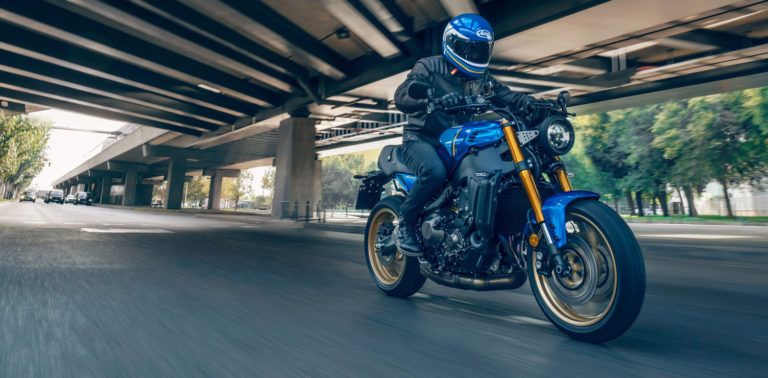
Aprilia Releases RS 660 Stars And Stripes Limited Edition

A 2022-model Aprilia RS 660 Limited Edition. Photo courtesy Aprilia.

APRILIA RS 660 LIMITED EDITION

IN ITS FIRST TIME PARTICIPATING, RS 660 DOMINATES IN MOTOAMERICA

A SPECIAL STARS AND STRIPES LIVERY CELEBRATES THE TRIUMPH OF THE MEDIUM SIZED ITALIAN SPORT BIKE IN THE PRESTIGIOUS AMERICAN CHAMPIONSHIP

1500 NUMBERED UNITS WITH RACING PACKAGE AS STANDARD EQUIPMENT TO INCLUDE SINGLE-SEAT TAIL-FAIRING COVER, OVERSIZED TOP FAIRING, AND QUICK SHIFT WITH UPSIDE-DOWN GEARBOX

A year after its launch on the market, Aprilia RS 660 is already celebrating its first important sports milestone. The medium-sized Italian sport bike made this achievement in the United States, dominating the 2021 edition of the Twins Cup, the prestigious American championship dedicated to medium engine capacity twin-cylinders within MotoAmerica, the premier motorcycle racing series in the States.

In celebration of this victory, at EICMA 2021, Aprilia introduces a numbered special edition of 1500 units of RS 660, characterized by a new stars and stripes livery inspired by the American flag. A color scheme closely derived from the special graphics on the bike that the Twins Cup champion, Kaleb De Keyrel, rode in the race at Vallelunga for the final round of the Aprilia RS 660 Trophy, where Kaleb had been invited to participate as a reward for his important championship victory on American soil.

Aprilia RS 660 Limited Edition also boasts a standard equipment package that includes some of the racing content from the competition version that proved to be unparalleled in the Twins Cup, taking 10 wins out of the 13 races held.

The sporty personality of Aprilia RS 660 Limited Edition is highlighted by the single-seat tail-fairing cover, which eliminates the passenger seat, enhancing the sleek design of the rear. The passenger’s seat comes with the bike, which is still approved for two-up riding. The oversized top fairing ensures greater protection for the rider against the wind, both on the road and on the track, and it also has the software that lets you set up the quick shift gearbox in upside-down configuration. This means that, depending on your needs, you can configure the gearbox entirely on your own, without replacing any parts on the bike, in street or upside-down version – ideal for the occasional track day.

A badge located on the fuel tank bears the progressive number of the bike and indicates the limited-edition of 1500 units.

Aprilia RS 660’s Winning Streak in MotoAmerica

Just a few months after making its début in the U.S.A. on an American track that is one of the most iconic in the world, the Laguna Seca circuit in California – ridden by Pikes Peak record holder astride an Aprilia Tuono V4, Rennie Scaysbrook – Aprilia RS 660 was the immediate protagonist of a thrilling sports story. Approved just in time for the beginning of the 2021 Twins Cup, the Italian twin-cylinder 659cc motorcycle took the top three spots straight away in the opening race on the Road Atlanta circuit. It was a blinding start, in some ways unexpected, followed by a winning streak: 10 total wins out of 13 races held, plus another 16 podiums (9 second places and 7 third places) and 6 pole positions. That first, extraordinary one-two-three was followed by others, at historic Laguna Seca circuit and in both races held in New Jersey.

Five of the 10 total wins were achieved by Kaleb De Keyrel, crowned Twins Cup 2021 champion astride his Aprilia RS 660 prepared by the Robem Engineering team. The other victories were credited to Jody Barry, Cory Ventura, Anthony Mazziotto (two wins) and Tommaso Marcon. The Aprilia RS 660 therefore confirmed its status as a versatile bike, able to win on extremely different circuits and with riders who have different riding styles.

Aprilia Adds Tuono 660 Factory To Lineup

A 2022-model Aprilia Tuono 660 Factory. Photo courtesy Aprilia.

APRILIA TUONO 660 FACTORY

TUONO 660 FACTORY DESCENDS DIRECTLY FROM TUONO V4 FACTORY AND INHERITS ITS KEY VALUES, BOASTING CONSIDERABLE EQUIPMENT AND PERFORMANCE

EVERY APRILIA FACTORY IS AN EXTRAORDINARY BIKE. TUONO 660 IS DEDICATED TO THE NEW GENERATION OF MOTORCYCLISTS WHO DEMAND MAXIMUM RIDING ENJOYMENT

181 KG FOR 100 HP: TUONO 660 FACTORY IS LIGHTER, MORE SOPHISTICATED, AND FLAUNTS FIRST-RATE EQUIPMENT

The Factory versions of Aprilia sports bikes have always been flagship products, dedicated to the most demanding and skilled riders, who can appreciate the quality of the most sophisticated outfitting.

And now, the Factory trim is also available for the Tuono 660, which makes for a Tuono with unparalleled dynamic qualities, the most efficient and fun to use on the road and a true generator of emotions, accessible to everyone. All this, while respecting the Aprilia 660 project that promises bikes with a sensational weight/power ratio that are lightweight, high-performance, and built around the brand-new latest generation Aprilia parallel twin.

With respect to Tuono 660, already widely recognized and appreciated by the public and critics for its outstanding chassis qualities, Tuono 660 Factory boasts more sophisticated suspension, better suited to sport riding. The Kayaba fork with 41mm stanchions is fully adjustable in its compression and rebound damping and spring pre-load, while the Sachs shock with separate reservoir is also adjustable in its compression and rebound damping and spring pre-load.

There is an even better weight/power ratio, one of the main goals for all new Aprilia 660 models and already outstanding on the Tuono 660, thanks to the adoption of a light lithium battery that contributes to reducing the overall weight by roughly 2 kg (the curb weight is now 181 kg) and better engine performance.

A compact and lightweight latest-generation engine, the 660cc forward-facing twin with DOHC timing and four valves per cylinder is the result of experience gained with the very powerful engine that equips RSV4, from which the construction philosophy and basic concepts derive. The engine has a load-bearing function and houses the aluminum swingarm in its rear section. Combustion is asymmetric and offset by 270° to obtain irregular combustion which translates into performance and sound like that of a V-twin. The engine boasts even more drive-in acceleration, thanks to the use of a shorter final drive, with a 16-tooth pinion gear, one less than Tuono 660. The maximum torque remains unchanged, with 67 Nm at 8500 rpm, 80% of which is available from 4000 rpm, or 90% on reaching 6250 rpm.

Tuono 660 Factory offers a full suite of APRC electronic controls with a Ride-by-Wire electronic accelerator and six-axis inertial platform as standard. The latter, thanks to the accelerometers and gyroscopes it contains, can recognize the bike’s condition with respect to the road, measuring and processing the inputs that result from riding and sending the data to a control unit that intervenes to optimize the control parameters. The Tuono 660 Factory APRC includes ATC (Aprilia Traction Control), adjustable traction control characterized by high-performance intervention strategies; AWC (Aprilia Wheelie Control), the adjustable wheelie control system; ACC (Aprilia Cruise Control) to maintain a steady speed without using the throttle; AQS (Aprilia Quick Shift), the electronic gearbox that allows for very rapid shifting without closing the throttle or using the clutch. It is also equipped with the downshift function, to allow for clutchless downshifting; AEB (Aprilia Engine Brake), the adjustable system to control engine braking when closing the throttle; AEM (Aprilia Engine Map), with different mappings via which to alter the engine’s character and delivery.

Tuono 660 Factory also benefits from multi-map Cornering ABS. With its extremely contained weight and dimensions, the system can optimize braking and ABS intervention through the corners, thanks to a specific algorithm that constantly monitors various parameters such as lateral acceleration, the pressure applied to the front brake lever, and the lean, pitch and yaw angle, modulating the braking action to optimize the ratio between deceleration and stability.

As with the Tuono 660, there are five customizable Riding Modes (three for road use and two for track use) to simplify life on-board. The rider needs only to choose the Riding Mode that best interprets his or her riding needs to automatically obtain the best settings in terms of traction control, wheelie control, engine brake, ABS, and the other managed parameters. Adoption of the inertial platform has also allowed for activation of the “bending lights” function, incorporated into the front LED light cluster complete with perimeter DRL (this pair of additional lights illuminate the entire corner, increasing visibility when leaning).

With its reduced surfaces effectively highlighting a dynamic, sport character, the bike’s design stands out for the innovative double fairing that serves as an aerodynamic appendage. The pressure of the air channeled between the two walls contributes to optimizing stability at high speeds and, at the same time, increases rider comfort by protecting against direct air flow, also deflecting the hot air extracted from the engine. The Tuono 660 Factory version is further enhanced with the aggressive and sporty Factory Dark graphics and the presence of the single-seat tail fairing, painted black and red and supplied as standard together with the passenger seat and footpegs. These pegs, like those of the rider, are the same as those of the Aprilia RS 660.


Moto2: Vietti Quickest, SDK P9 During Private Testing At Jerez (Updated)

Sean Dylan Kelly (4) in action during Moto2 testing at Jerez. Photo courtesy Sean Dylan Kelly.
Sean Dylan Kelly (4) in action during Moto2 testing at Jerez in early 2022. Photo courtesy Sean Dylan Kelly.

Celestino Vietti, riding his VR46 Racing Team Kalex, was unofficially quickest on Day Two of private Moto2 and Moto3 team testing at the Jerez Circuit, in Spain. Vietti’s best lap time was a 1:41.706, which isn’t far off Sam Lowes’ race lap record of 1:41.313.


Celestino Vietti (13). Photo courtesy VR46 Racing Team.


American Sean Dylan Kelly (1:42.749), the 2021 MotoAmerica Supersport Champion and a rookie in the Moto2 World Championship, was unofficially ninth out of at least 20 riders testing Monday. Kelly’s teammate, five-time MotoAmerica Superbike Champion Cameron Beaubier (1:43.237), was unofficially ranked 17th on Monday.

“No words!!!” Kelly posted to his Facebook page. “Incredible test and so happy to have started working with the American Racing Team. 177 laps in 2 days! Learning, adapting, working!! Really enjoyed riding the Moto2 bike and really happy with the outcome of these two days. Now eyes on 2022!!! Thank you ALL #SDK40”


The timing and scoring screen at the end of the day Monday at Jerez.


More, from a press release issued by VR46 Racing Team:

MOTO2 DEBUT ON THE KALEX FOR NICCOLÒ ANTONELLI

Two days of testing in Andalusia for the rookie of the VR46 Racing Team on track today with Celestino Vietti Ramus

Jerez de la Frontera (Spain), November 22nd 2021 – First steps towards the start of the 2022 season for the VR46 Racing Team in Jerez de la Frontera for a two days of testing for the Moto2 crew.

Yesterday Niccolò Antonelli make his debut on the Kalex and began to become familiar with the new bike. Overall a good Sunday and positive feelings with a best lap time of 1: 45.388 (51 laps) for the rookie who returned to work again today for the Dunlop test reserved to the Moto2 class, signing a good 1: 43.214 (64 laps).

Celestino Vietti Ramus was also on track today and immediately found the feeling he has in the last races and finished at the top of the standings with a best lap time of 1: 41.706 (78 laps).

Both riders will be back on track next February for the first testing session of the 2022 season.

Celestino Vietti:

A good test, definitely positive also considering the 2022 season. We tried new settings and the Dunlop compounds. The feeling was not bad at all and I am happy to say goodbye to the Team in this way. They were two beautiful days with the guys and also my new team mate (Niccolò Antonelli). Now a few weeks off and then full gas for the new season.

Niccolo Antonelli:

An incredible experience, I’m really happy to have tried the Moto2: I immediately felt at ease with the new Team. A pity for the weather, the tarmac has never been completely dry, but we have already managed to understand a lot about the new bike. Compared to yesterday, the feelings are good and we already know where to improve during the winter to be able to make a step forward. I can’t wait to get back on track in 2022.

Pablo Nieto, Team Manager:

A good debut for Niccolò and Celestino in Jerez. Two days of uncertain weather and not very high temperatures where it was important, especially for Niccolò, to begin to become familiar with the new bike. Niccolò took his first steps on the Kalex and the feelings are good. Celestino also did well, on the positive trend that has characterised the last races of the season. Let’s enjoy a few weeks off now and get back on track in 2022.


More, from a press release issued by Marc VDS Racing Team:

Lowes and Arbolino kick off 2022 Moto2 preparations in Jerez

Elf Marc VDS Racing has concluded a productive and positive one-day Dunlop tyre test at the Jerez track in Spain, with the Belgian squad thrilled to welcome Tony Arbolino for his first public appearance in the Team’s famous livery.

Damp and cool conditions prevented Sam Lowes and Arbolino from venturing out on track yesterday, but they were able to circulate in more favourable weather today.

Arbolino enjoyed a busy but positive final day on track in 2021 while assessing a range of tyres for Dunlop and acquainting himself with his new crew for next season.

Lowes limited his time on track today while still in considerable discomfort from the right foot injury he suffered during the opening practice session ahead of the final round in Valencia earlier this month.

“I’ll focus on being strong when we return in 2022”

Sam Lowes:

“We weren’t able to complete as many laps as I’d hoped coming into this test, but my foot was more painful than I expected. On a race weekend there’s not much time to think about an injury and the adrenaline always helps block out the pain. But at a test there’s more time to think and my foot felt quite sore. Track conditions weren’t fantastic, and I didn’t feel like I was able to push at my limit to give Dunlop the correct information and feedback required, so it was the right decision to stop and begin the recovery in the winter. It’s still been a positive test from the perspective of meeting some new members in the Team and sharing some time with Tony. The atmosphere is really good between everybody and that’s a great way to go into the winter break so I can focus on being strong when we get going again in 2022.”

“Already in this Team I feel we can achieve great results in 2022”

Tony Arbolino:

“Honestly, I’m feeling a bit tired at the end of the day because I did 96 laps, but it feels fantastic to begin working with my crew and this Team and we did a lot of good work. I instantly felt at home and comfortable with my crew and I felt very good on the bike, and we made some positive improvements throughout the day. The important thing now is to enjoy the winter break and have a good rest because already I feel like in this Team we can achieve great results in 2022.”


More, from a press release issued by Gresini Racing:

POSITIVE DEBUT FOR SALAC AND ZACCONE WITH GRESINI MOTO2 TEAM

Gresini Racing has concluded the opening test of the 2022 Moto2 World Championship winter season – and the last track outing of 2021 – with new arrivals Alessandro Zaccone and Filip Salac, both rookies in the category. It was surely an interesting two-day test, which saw both riders trying their skills in every possible track condition, from wet to dry, with the sole goal to find the best feeling with their Triumph-powered Kalex machines.

The two days of testing have been positive, with both riders able to constantly improve both their lap-times and confidence with the new bike. Filip Salac finished eighth after completing around 100 laps between yesterday and today. Alessandro Zaccone ended up right behind his new teammate (10th) despite a crash in the final moments of the test.

8º – FILIP SALAC #12 (1’42.548)

“The first day on the Moto2 bike was perfect. We quickly adapted to this bike even though we still need a lot more to be competitive. There’s a great feeling with the team already, and so with the bike: we improved lap after lap while trying to find the limit on a track which was far from ideal. We also had more reference points today with all riders on track – and dry conditions. We have been fast and I’m happy with the work done and I believe the team is, too.”

10º – ALESSANDRO ZACCONE #61 (1’42.783)

“Good feeling with the team and the bike. We tried a lot of things and with the soft tyre today we were unable to be quick, but it’s more due to my fitness condition than else. Despite a bit of traffic in the last split we were able to lap in 1’42.7… We could have almost been in the top five lap-time wise. Too bad for the crash at the last lap: I let the tyre cool down a bit too much, hence the crash. Generally speaking, though, things went very well and I think we can have a good season.”