GAS MONKEY GARAGE BECOMES TITLE SPONSOR FOR HICKMAN AND FHO RACING AT 2022 ISLE OF MAN TT RACES
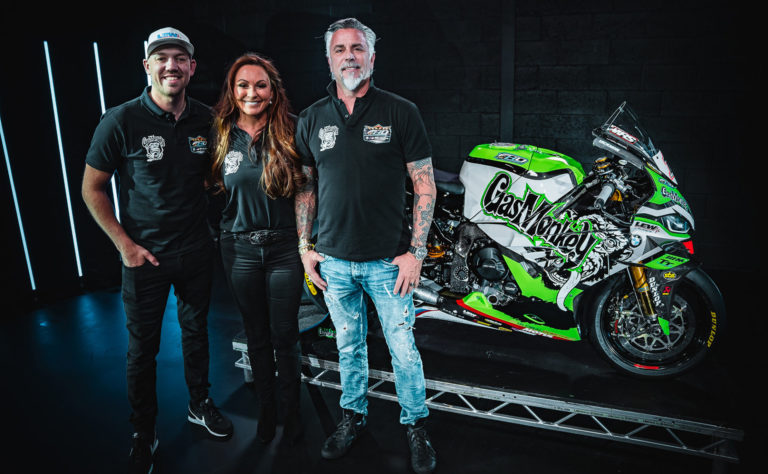
Gas Monkey Garage, the global leader in customized cars from Discovery Channel’s hit series Fast N’ Loud, will become the title sponsor of Peter Hickman and FHO Racing at the 2022 Isle of Man TT Races.
Headed by innovative entrepreneur Richard Rawlings, Gas Monkey Garage will utilise the platform of the world’s largest road race to spread the Gas Monkey influence and brand across the globe.
Gas Monkey Garage will showcase the iconic 37.73-mile Mountain Course to a whole new audience via their social media platforms which boast a staggering 20+ million followers.
The new partnership will see the Gas Monkey Garage logos and brand adorn outright lap record holder Hickman’s BMW M1000RR in the Superbike, Senior and Superstock races at the TT, which makes it’s much anticipated return to the calendar after being absent in 2020 and 2021 due to the COVID-19 pandemic.
With five wins and 14 podiums between 2017 and 2019, as well as the outright and Superstock lap records, 34-year old Hickman – who still holds the fastest Newcomer lap ever around the Mountain Course – will go into the meeting as the undoubted favourite for honours.
Watch the full episode of this legendary partnership come to life on Gas Monkey’s YouTube Channel
Based in Dallas, Texas, Richard Rawlings has propelled Gas Monkey Garage into the stratosphere and cemented the brand as a household name since its inception in 2004. From two custom cars for Hot Wheels®, numerous world records, becoming one of the world’s top automotive brands, for Richard and Gas Monkey Garage, it’s go big or go home.
Richard Rawlings: “The entire Gas Monkey family and I are ecstatic to be involved in this year’s Isle of Man TT! Getting the chance to be a part of the largest single viewed sporting event and the world’s longest standing time trials is a dream come true. We are honoured to be alongside the legendary FHO Racing, Team BMW, and the Fastest Man on Two Wheels, Peter Hickman, for a race that is surely to go down in the history books. We look forward to seeing Gas Monkey on the podium come June!”
Faye Ho, FHO Racing Team Owner: “I’m really happy to announce this new partnership with Gas Monkey Garage ahead of this year’s Isle of Man TT Races. We worked extremely hard as a team in our first year to show our potential and both Peter and the team are excited about taking that to the TT, even more so with the partnership with Richard and the Gas Monkey family. It’s always important to attract new sponsors to the sport and we’re grateful to the support and commitment they’ve shown and we aim to repay that faith by delivering a strong set of results at this year’s TT.”
Scott Grimsdall, National Marketing and PR Manager for BMW, commented: “I’m delighted to welcome Gas Monkey Garage to the BMW family as a title sponsor for the Isle of Man TT Races. Their global following speaks for itself whilst Richard’s passion for two and four wheels is clear and their sponsorship of Peter on the FHO Racing BMW can only strengthen our bid for success in June. We’re looking forward to working together to grow their brand within the two-wheel community.”
For more information please visit www.fhoracing.com
#MandalikaTest: Pol Espargaro fronts six-way factory fight on Day 1
Honda top after a day of changing and challenging conditions as MotoGP™ takes on Mandalika for the first time
Friday, 11 February 2022
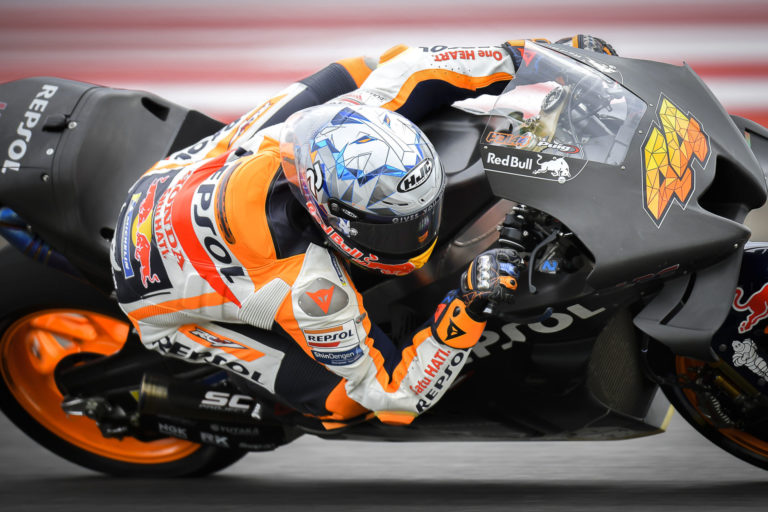
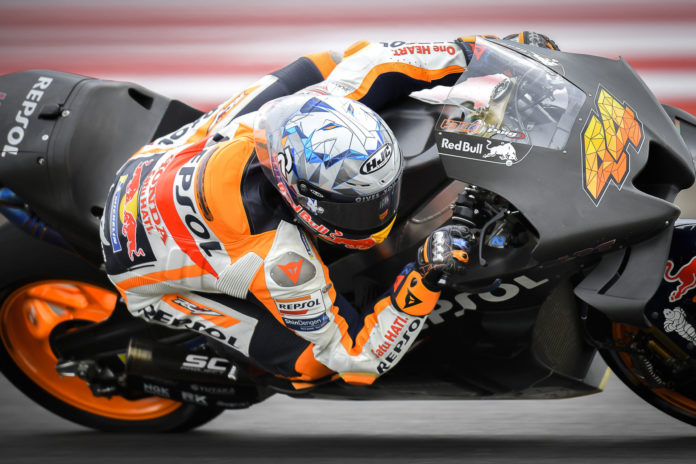
Repsol Honda Team’s Pol Espargaro finished Day 1 of the Official MotoGP™ Mandalika Test on top, with the field’s first touch with the new Pertamina Mandalika Circuit heavily affected by rain and tricky track conditions. Aleix Espargaro (Aprilia Racing) was second quickest to make it an Espargaro 1-2, with Brad Binder (Red Bull KTM Factory Racing) slotting into third as the top six saw every factory represented.
Due to track conditions, the red flags were brought out during the morning to get a clean up operation underway. Heavy overnight rain had caused the circuit to become dirty, but as the day went on, the track got quicker until we eventually saw three riders dip into the 1:32s. The riders were able to get some decent running under their belts in the closing stages, but light rain then started falling heading into the final half an hour, so any late time improvements weren’t possible.
HONDA
Due to the riders and teams having to learn the new Pertamina Mandalika Circuit, there wasn’t too much to talk about in terms of new updates on the bikes. After briefly running a 2021 RC213V at the Sepang Test, Marc Marquez (Repsol Honda Team) – unsurprisingly – was solely lapping on HRC’s 2022 spec machine.
Pacesetter Pol Espargaro completed 69 laps, setting his best right at the end of his run, as the Spaniard finished 0.9 clear of the next quickest Honda. That was 11th place Takaaki Nakagami (LCR Honda Idemitsu) who was one of a few riders who crashed at Turn 10 on the opening day. The Japanese rider was on a personal best lap when he went down uninjured, but that signalled the end of his day.
Alex Marquez (LCR Honda Castrol) and Marc Marquez were 1.2s and 1.3s off Pol Espargaro respectively, both notching just over 60 laps too. The number 93 explained it as a “good day” despite conditions being unpredictable but is remaining calm ahead of two big days of testing coming up.
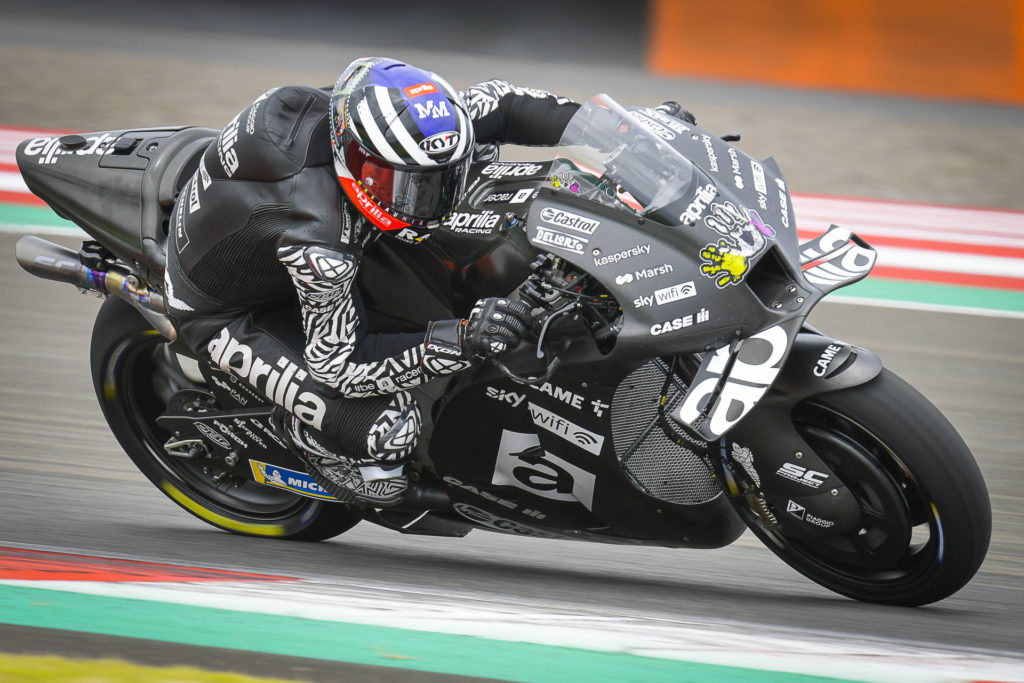
Aleix Espargaro. Photo courtesy Dorna.
APRILIA
The Noale factory’s most notable focus has been on chassis direction. Aleix Espargaro and teammate Maverick Viñales had a great time over in Sepang and if the times are anything to go by so far in Mandalika, the RS-GP continues to look in very good shape.
Espargaro was second and 0.4s behind his brother on the timesheets, completing 60 laps, with Viñales seventh quickest with a 1:33.147. Top Gun put in 56 more laps on board his new bike and was one of the first to bolt to the top with a couple of hours left on the clock.
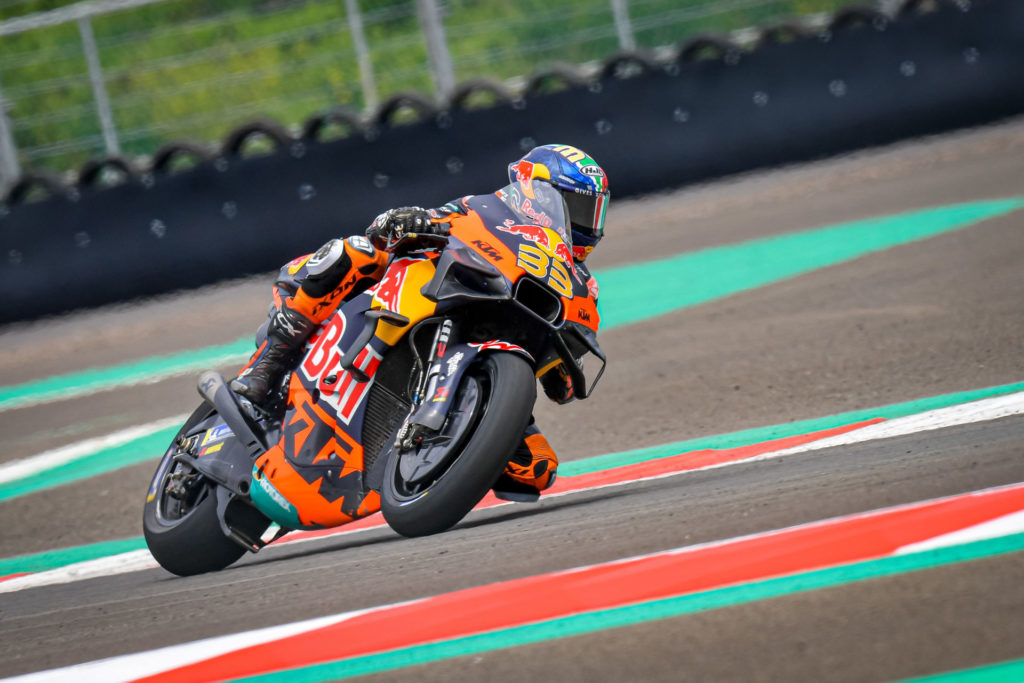
Brad Binder (33). Photo courtesy Dorna.
KTM
Brad Binder shot to the sharp end late in the day, and after having been penultimate on the timesheets earlier on. The South African ended the first day in third, just 0.006 off Aleix Espargaro, and was the last rider into the 1:32s. Teammate Miguel Oliveira’s best lap was a 1:33:748, slotting him in just ahead of eight-time World Champion Marc Marquez. Binder did 64 laps and Oliveira 77 on Day 1.
Raul Fernandez (Tech 3 KTM Factory Racing) was the first back out after the Red Flag, the rookie intent on using as much track time as possible, and he put in a best of 1:33.966. With difficult conditions; changing, wet and interrupted, the uphill challenge was even more so for the debutants. 2021 Moto2™ Champion Remy Gardner (Tech 3 KTM Factory Racing) was P24 as he continues to push through the pain barrier.
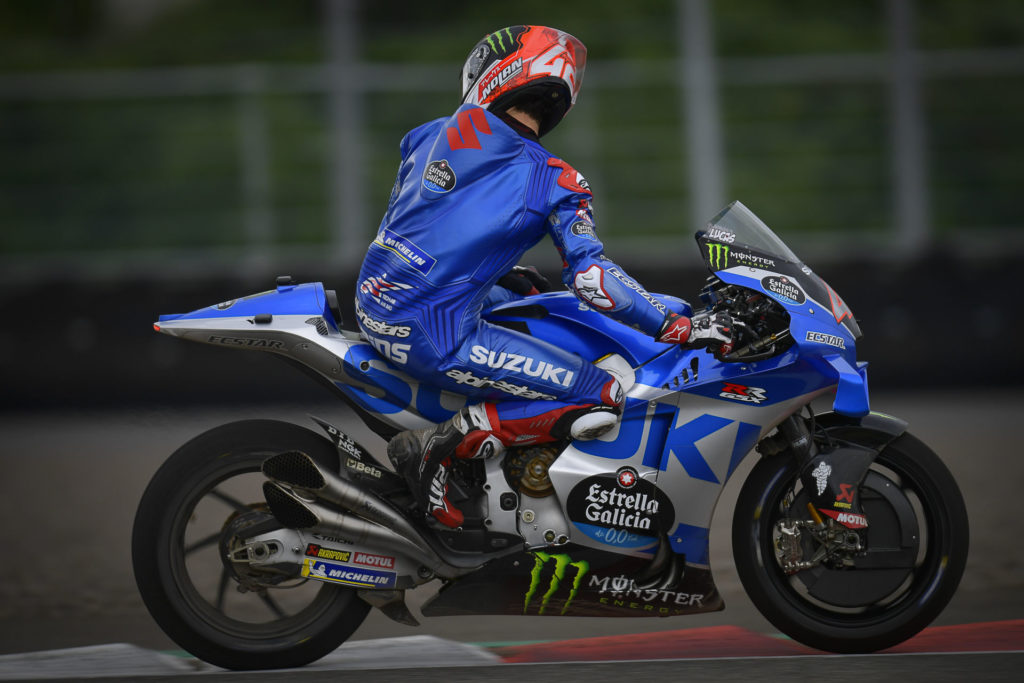
Alex Rins. Photo courtesy Dorna.
SUZUKI
The good vibes seemed to continue despite the challenges of taking on a brand new venue, with both Alex Rins and his Team Suzuki Ecstar teammate, 2020 MotoGP™ Champion Joan Mir, in the mix at the front again. Rins was fourth, just under six tenths off the top, and the Spaniard put in 72 laps. Mir was eighth with a deficit of 0.778 to the top, and he put in 58 laps.
Mir’s crew chief Frankie Carchedi joined MotoGP™’s Simon Crafar and Jack Appleyard half way through the day on YouTube, and repeated what Team Suzuki Ecstar Project Leader Shinichi Sahara had said in Sepang: “significant improvements” have been made for the Hamamatsu factory.
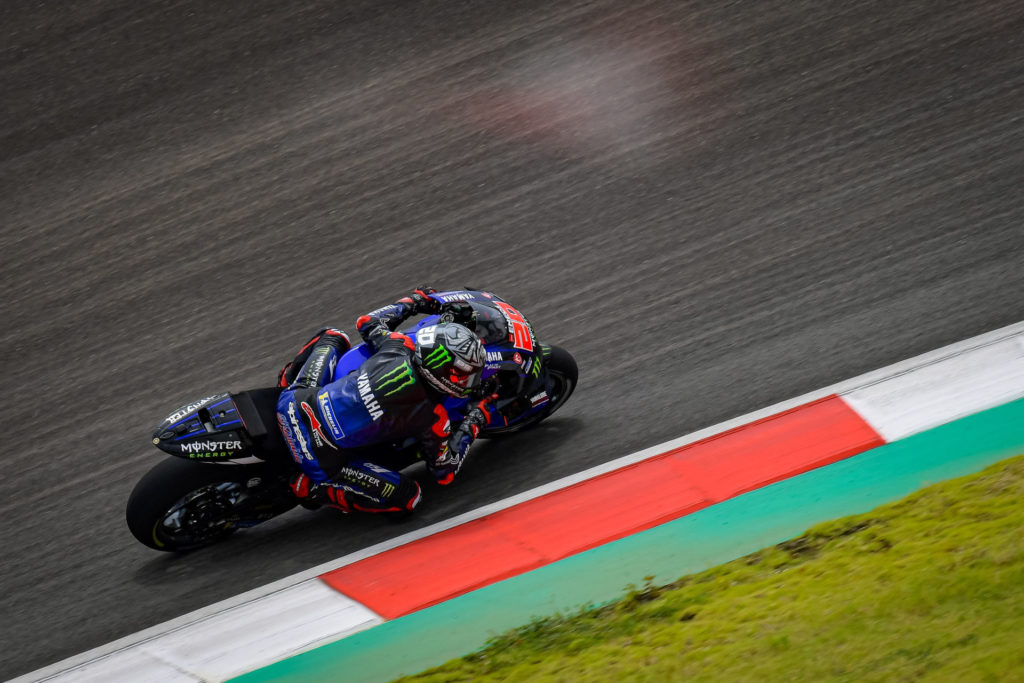
Fabio Quartararo (20). Photo courtesy Dorna.
YAMAHA
Reigning World Champion Fabio Quartararo (Monster Energy Yamaha MotoGP) was the fastest YZR-M1 rider on the opening day, as the Frenchman claimed P5 on the timesheets. A hefty 86 laps came in from Quartararo, the second most of anyone. His teammate Franco Morbidelli did 75 and finished P12, the Italian getting some important time on the 2022 bike.
Important time on the 2022 bike is exactly what Andrea Dovizioso (WithU Yamaha RNF MotoGP™ Team) needs too, and the Italian got just that on Day 1. 57 laps was the number Dovi clocked, with his best coming in at a 1:33.245 – placing the number 04 in ninth. Rookie Darryn Binder (WithU Yamaha RNF MotoGP™ Team) slashed plenty off his quickest time when the conditions became more favourable, the South African finished two seconds down on P1 having got a handy 58 more laps of experience in the bag.
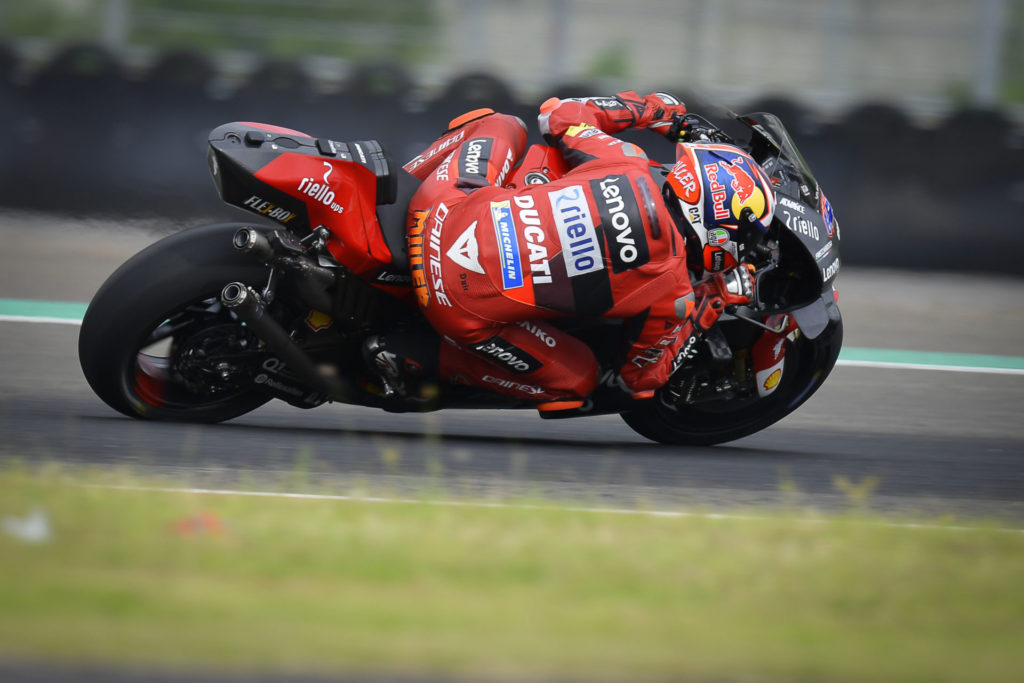
Jack Miller. Photo courtesy Dorna.
DUCATI
It was Jack Miller (Ducati Lenovo Team) who led the Bologna charge on Day 1, the Australian ending the day in sixth but just 0.006 off Quartararo. After Viñales had made the first push to the top in the latter stages, Miller responded to take over for a while before getting leapfrogged and pushed back down the order. The only other Ducati in the top ten was Jorge Martin (Pramac Racing) as the sophomore took P10 despite a tumble.
Johann Zarco (Pramac Racing) was P13 but stole some headlines with a whopping haul of 96 laps – only one other rider did more than 80, and that was reigning Champion Quartararo. Within a tenth of Zarco came the first rookie, once again on a Ducati as it was by the end of play in Sepang, but this time it was Fabio Di Giannantonio (Gresini Racing MotoGP™) – despite a crash, it was an impressive day’s work after the Italian missed two full days of track time at the Shakedown due to illness.
Sepang’s fastest rookie, Marco Bezzecchi (Mooney VR46 Racing Team), was P21 on Day 1 at Mandalika and suffered a couple of crashes, nevertheless ending the session 0.008 behind teammate Luca Marini.
Two riders seemingly very out of position after a challenging first touch with the stunning new venue are Sepang’s record breaker Enea Bastianini (Gresini Racing MotoGP™), who was P18, and Francesco Bagnaia (Ducati Lenovo Team) down in P22, suffering a crash and the last non-rookie – so we can expect much more from Pecco as the test goes on.
That’s a wrap on Day 1 of MotoGP™’s debut at Pertamina Mandalika Circuit. Two more days of action remain in Indonesia, with eyes on the sky to see what the conditions bring. Stay up to date on on motogp.com and across social media as we get our teeth into the #MandalikaTest.
More, from a press release issued by WithU Yamaha RNF MotoGP Team:
WITHU Yamaha RNF MotoGP Team covers first laps in Indonesia
Andrea Dovizioso and Darryn Binder discovered the Mandalika Circuit aboard their Yamaha YZR-M1 for the first time today.
Hot and humid conditions accompanied the MotoGP paddock on their way from Malaysia to Indonesia. After riders and teams had a few days to get used to conditions, to check out the brand-new Mandalika Circuit and set up the garages, the action on the 4.3-kilometer circuit got underway today.
Although proceedings have been slightly delayed due to a rain shower in the morning, and a dirty track surface didn’t facilitate the riders’ first taste of the newly added track, the WithU Yamaha RNF MotoGP Team pair was out shortly after midday to discover the layout, lines and braking points on their YZR-M1 machines.
With more and more rubber on the asphalt, track conditions improved slightly and Andrea Dovizioso did a total of 57 laps on day one and concluded Friday in 9th position with a fastest lap of 1:33.245 minutes.
Meanwhile MotoGP rookie Darryn Binder approached the opening day cautiously, still having to get used to the big bike and the track at the same time. He found himself 1.25 seconds behind his teammate after 58 laps today. Both will have two more days to prepare themselves for the season and the second round of 2022, the first ever Indonesian Grand Prix in March.
ANDREA DOVIZIOSO
“I’m happy about the way these three days started, because I was able to find a good line today in a very strange situation as the grip was very low. At the end, we could improve the braking, which is very important for me and very important in general for my riding style. So, I’m delighted about that. I was able to be consistent. For sure the track will change and this is not the reality in terms of lap time, because I’m convinced everybody will go faster. But for today, I’m happy.”
DARRYN BINDER
“Today has probably been the most difficult day of my MotoGP career so far. Arriving here, I’m still trying to learn the bike. I had to learn a new track and in the worst conditions possible. So, I really struggled at the beginning of the day. Luckily, towards the end of the day, the track was improving, which was a good thing and I was able to make a step right at the end, which I’m at least a little bit happier to end the day a little bit closer to the front. The difficult thing was, there was only a little line around the track, that was really good, so if you made any mistakes, it ruined the lap completely. Anyway, let’s see what the weather does. Hopefully the track improves again tomorrow and we can keep working and learning.”
More, from a press release issued by Tech3 KTM Factory Racing:
Fernandez and Gardner Both Conclude Tricky Day 1 of New Indonesian Adventure on a Positive Note
For the first time ever, Tech3 KTM Factory Racing was traveling to the beautiful island of Lombok in Indonesia for the first Official MotoGP Mandalika Test set to take place from February 11 to 13, with the aim to try the brand-new track of Mandalika circuit ahead of the Pertamina Grand Prix of Indonesia on March 20, 2022. The entire MotoGP class was trying out this new layout of 4.3km on Day 1, with six left corners and ten right corners, located in the south of the island, by the ocean.
With a scheduled start at 9:00 local time, the red flags were shown shortly after the first few laps due to track conditions. With a very heavy rain that had occurred a few hours before the start of the day, there was a lot of mud on the track, meaning that a clean up operation got underway and stopped the action until lunch time. Before 15:00 local time, the riders were told to complete around twenty laps each to see how the track conditions were evolving. Luckily, the track dried out and conditions improved quickly, meaning that the work could continue for the rest of the day.
Raul Fernandez was the first rider to leave the pit box after the red flag, eager to get the work going. At 13:30, he was in the Top 10, 1.604 seconds from the top. The Spaniard progressively improved as he started to understand better this brand-new layout of Pertamina Mandalika Circuit Indonesia. On lap 35, he registered 1’34.983, and later on progressed to 1’33.966 on his fifty-third lap, before calling it a day after fifty-seven laps completed. The rookie finished the day in P19, 1.500 seconds from the top and will look forward to continuing his progress here on Day 2.
It was a similar day for his teammate Remy Gardner who also jumped back on his KTM RC16 after some well deserved rest following an intensive week of testing in Sepang. The aim of the day was to do laps in order to learn the track as much as possible and get used to all its technicalities. On lap 30, the Australian crossed the line in 1’35.634. Eighteen laps later, we saw an encouraging improvement as he gained one second, with his best lap of the day in 1’34.603. Overall, Remy completed 64 laps despite his wrist continuing to hurt him, and will get some rest before the action returns tomorrow.
Raul Fernandez
Position: 19th
Time: 1’33.966
Laps: 57
“We did a good job today. The track is completely new, and I am still in the process of learning about the bike, the tyres and everything else. It was a positive day for me because I was very fast and I had a good feeling on the bike which is the most important to me. This morning, the track was very dirty so we didn’t ride too much, but I remain calm because we have two more days to work on this new layout.”
Remy Gardner
Position: 24th
Time: 1’34.603
Laps: 64
“The layout is quite fun, I enjoy it because you are on the gas a lot and there are some fast corners. However, the track was very dirty. At one point, I thought that we would not be able to ride at all. We got the red flag to allow the track to be cleaned, and when we all went out again to do twenty laps each, the track started to get better and times started to come down. My wrist continues to hurt me as we get more days on the bike, but I will get some rest tonight and hopefully I will feel better tomorrow.”
More, from a press release issued by Team Suzuki ECSTAR:
TEAM SUZUKI ECSTAR ENJOY FIRST TASTE OF MANDALIKA
Alex Rins: 4th – 1’33.058 (+ 0.592)
Joan Mir: 8th – 1’33.244 (+ 0.778)
Team Suzuki Ecstar’s riders were raring to go in Indonesia, ready to try the Pertamina Mandalika circuit for the first time. In fact, Alex Rins was the first rider in the field to put in a lap. The morning started off wet, but later in the day the main issue was dust and dirt on the track; due to this there was a long stoppage to allow for circuit cleaning.
Initially the focus was on learning the layout, this was important for the riders – who were trying to get to grips with the racing line – and the crew as they worked to establish the gearing and base settings.
Once this was done, both Rins and Joan Mir aimed to switch their attention to continuing the test plan they were unable to complete in Sepang last week, although this proved difficult with mud and stones still on the surface.
Rins reported great feelings with the track despite the conditions, as he put in 72 laps. His best time was just half a second from the top.
Mir was also impressed with the layout and he was happier when the track was cleaner. He did a total of 58 laps.
The team will remain at the track for another two days of testing.
Alex Rins:
“I really like Mandalika circuit, it’s nice and the layout is unbelievable. Today it was a little bit dirty, so we had to be careful, but lap by lap there was more grip. Overall I’m happy with this first day, we took time to learn how the circuit is, and because of that we didn’t try many things. We want to continue working on some areas that we couldn’t manage in Sepang, let’s see what we can achieve tomorrow.”
Joan Mir:
“I enjoyed today, it was nice to learn the layout but the conditions weren’t the best. In the end there was a grippy racing line, but it took a while to get to that point. The circuit has a good mix of fast places, hard braking, and flowing sections and I like it. Today we didn’t manage to test much, but I was getting quicker as the day went on and hopefully tomorrow we can work on set-up a bit more.”
Ken Kawauchi – Technical Manager:
“The beginning of the test was difficult, not just for us but for everybody, the riders were struggling to get grip in these conditions. The track started out wet, which wasn’t ideal but it was manageable, especially as it dried. But after that we had issues with the dirt. Towards the end of the day we did manage to try a few items, but tomorrow and Sunday we will work a lot more to prepare for the season opener.”
More, from a press release issued by Monster Energy Yamaha:
MONSTER ENERGY YAMAHA MOTOGP GET FAMILIAR WITH THE MANDALIKA TRACK
Lombok (Indonesia), 11 February 2022
MANDALIKA OFFICIAL MOTOGP TEST
TEST
The Monster Energy Yamaha MotoGP Team have been looking forward to this day for months. Today, Fabio Quartararo and Franco Morbidelli got their first laps in at Indonesia’s new Mandalika circuit and secured 5th and 12th place respectively in the Day 1 results.
5th FABIO QUARTARARO 1’33.108 / 86 LAPS
12th FRANCO MORBIDELLI 1’33.518 / 75 LAPS
Monster Energy Yamaha MotoGP‘s Fabio Quartararo and Franco Morbidelli resumed their 2022 MotoGP pre-season testing programme today. The teammates used the first of the three riding days in Indonesia to get a feel for the new Mandalika circuit and confirm their findings from last week‘s Sepang Test. They took 5th and 12th place respectively in today‘s time sheets.
Originally, testing at the Mandalika track was supposed to take place from 09:00 to 17:00 local track time every day, but due to overnight rain Day 1 was off to a wet and muddy start. The session was red flagged and later extended until 17:45 to compensate for the lost time during the clean-up in the morning.
Quartararo used his first laps to gauge the flow of the circuit, before it was hammer time in the afternoon. By 15:00 local time, he was topping the standings, with a 1‘34.074s. He ultimately finished the first day of testing in fifth place with a 1‘33.108s, set on used tyres on lap 85/86, that put him 0.642s from first.
Morbidelli was quick to head out to get a first feel for the track. Though he was mainly concerned with building on his findings from the previous testing days in Malaysia in the afternoon, he steadily improved his feeling with the bike in the final hours on track. His fastest lap, a 1‘33.518s, set on lap 67/75, put him in 12th place, 1.052s from the top.
FABIO QUARTARARO
To be honest, I‘m really happy because this morning was really tricky. The conditions were kind of like motocross. In the afternoon I felt much better, our pace was super strong. I set my fastest lap with 16 laps on the medium rear tyre, so I‘m super happy actually. And we still have two more days. We tried the aero package and rear settings again, and it was working well, so I am happy, but most of all about my pace with used tyres. I think this circuit is kind of like Qatar and Thailand, with a little bit of Argentina on the last heavy braking. I think it‘s a nice mixture of corners. I don‘t consider any track a ’Yamaha track‘, because I think that‘s a mistake. I see this as a normal circuit, and I give it my best shot, this is the best mentality.
FRANCO MORBIDELLI
It was a good day today. We improved the feeling much more compared to Sepang. It showed that I‘m getting more and more in tune with my new Crew Chief Patrick. He did a great job today; we improved the bike a lot and I feel much better. Now, we keep working to understand a few more things and improve the feeling with the bike even more, but so far, so good. For sure, the track is new, and there are spots on the track that aren‘t so good, like Sector 2. I lose everything there because it looks like today I didn‘t manage to get it right, but finally I feel good with the medium tyres. We tried the soft tyres at the end, the speed was good with both. We also tried the medium front, and I felt also quite okay with that, so we are spreading our performance on different tyres and with different things, so I would say that it was a good day.
More, from a press release issued by Mooney VR46 Racing Team:
FIRST TIME FOR THE MOONEY VR46 RACING TEAM AT MANDALIKA
The last official MotoGP test starts in Indonesia with Luca Marini in P20 and Marco Bezzecchi in P21
Lombok (Indonesia), February 11th 2022 – First approach to the Mandalika International Street Circuit for the MotoGP circus with Luca Marini and Marco Bezzecchi working on the Ducati Desmosedici GPs of the Mooney VR46 Racing Team and respectively in P20 and P21 in the combined standings.
A demanding Day1, characterised by heavy rain that hit the circuit area at the beginning and at the end of the session and even before that by a long break around 12.00 pm local time to allow the cleaning of the track due to the violent storms of the last night. At work from the early hours of the morning into the garage, but on track from 1.30 pm to make the most of the central hours of the day, Luca Marini completes 53 laps and sets a best lap time of 1.34.165.
Among the first to test the new circuit, with wet tires, Marco Bezzecchi finishes with a good lap time of 1.34.173 (dry track) and 63 laps despite two small crashes.
For both, next appointment on track tomorrow at 9.00 am local time for the second of the three days of official MotoGP tests.
Luca Marini #10
A good first day here in Mandalika: I like the track, it is very fast and with several long corners. At the same time there are a couple of strong braking points, it is definitely a track that in a good situation can be super! A pity for today, the asphalt was very dirty, conditions far from ideal for a first approach to a new circuit. Overall, I can’t complain, we discover a little be more the new Ducati GP22 and tomorrow we will get back at work for another step.
Marco Bezzecchi #72
An uphill day, but a good first impression of the new Mandalika track. The asphalt conditions were far from perfect and we wasted half session trying to clean the track as well as possible. The grip is not bad at all and tomorrow we can do even better. Too bad for the two small crashes, the second one above all because it was my mistake that with more experience I might have been able to avoid. Let’s get back to the data to get even closer.
Pablo Nieto
Team Manager
A more complicated day than we expected: it is not easy to ride on a new track for the first time in these conditions. The asphalt was really dirty and this forced us into the garage for most of the morning. Better in the afternoon, however, we need to consider that the track is not yet fully rubberised, but the track seems really fast and I think the lap times will drop soon. Luca continued to adapt to the new bike, even Marco who unfortunately crashed twice. Tomorrow we will get back to work on the set up.
More, from a press release issued by Repsol Honda:
Repsol Honda Team get first taste of Mandalika as Espargaro sets the pace
Pol Espargaro led the first day of MotoGP testing in Indonesia, utilizing all the available track time across a day of stops and starts as team-mate Marc Marquez enjoyed the first special feeling with the new Honda.
It was a wet introduction to the newest circuit on the MotoGP World Championship calendar, heavy overnight rain and continued morning showers leaving the 4.3kilometer-long tack wet for the opening salvo of laps. Both Repsol Honda Team riders were some of the first out on track, completing a handful of laps before the red flag came out. This was to allow the Mandalika circuit to be cleaned and a revised schedule was announced as the track went green just after midday local time.
Stable conditions allowed for plenty of laps in the afternoon, the entire MotoGP grid working to put rubber down and improve on-track conditions. Pol Espargaro took a measured approach to the opening day in Indonesia, building his speed over a number of laps as the weather and circuit condition evolved. As the closing hours approached, Espargaro’s effort were rewarded as he climbed up the time sheets, first inside the top three. On his penultimate lap with just over half an hour of testing remaining, the #44 set a 1’32.466 to lead the first ever MotoGP session at Mandalika.
Marc Marquez spent much of the early afternoon in and around the top three as riders began to assess the new circuit at full speed with a dry track. Mixed weather in the closing hour of testing saw Marquez and his team wrap up ahead of schedule after completing 64 laps during the course of the day. 17th on the time sheet, Marquez was not worried by his position as he focused on cleaning the track with a high volume of laps and improving his overall feeling with the new Honda RC213V.
Overnight weather is once again looking mixed as the paddock hope the rain stays away so they can pick up on Saturday where they left off today. Just two days of testing now remain before the start of the 2022 MotoGP World Championship.
Pol Espargaro
1ST 1’32.466
“It was a bit of a tricky start to the day in the morning, the track was dirty but the track improved as we continued to ride on it and cleaned the track. As the day went on, we could ride in a better way and start to learn more about the track and also our bike, which is still quite new. Finally, I did a good lap and overall my rhythm was good, but it’s just the first day and tomorrow everyone will go a bit faster. The bike keeps improving and we are just at the start of our journey but it’s promising. Now it’s time to rest tonight and get back to work tomorrow.”
Marc Marquez
17TH 1’33.776
“A normal day at a new circuit; it started dirty and it improved as the day went on. I didn’t find it difficult to find the good lines because it was easy to see where the black rubber was. I like the first and the fourth sector and it’s an interesting circuit, it will be nice to race at. We did a lot of laps today because this was the only way to clean the track and it helped. Already the line is improving and I think tomorrow it will improve more so we can be more consistent. I started to feel something special with the bike today, let’s see what tomorrow brings.”
More, from a press release issued by LCR Honda Idemitsu:
TAKA MAKES SOLID START TO MANDALIKA TEST
11 February 2022 | Mandalika Test Day 1
The second and final MotoGP pre-season test got underway in Indonesia on Friday morning. The first-ever action at the new Mandalika circuit in Lombok took place in mixed and dirty conditions, complicating matters for the premier class riders, with LCR Honda IDEMITSU rider Taka Nakagami finishing the day just outside the top 10.
After riders initially went out on a wet surface, the session was red-flagged to allow the track to be cleaned before proceedings resumed around midday. Taka continued his adaptation to the 2022 RC213v prototype at the new venue and completed a total of 52 laps as his times improved throughout the day. The Japanese star is now hopeful of improving on his 11th position in Saturday’s session.
Takaaki Nakagami – 11th
(1’33.394)
“Today was a little tough because the condition from the morning session was wet and then we had to wait for it to dry. There wasn’t much rubber on the track and a lot of dust, so the grip level was really difficult. Then in the afternoon the times got better as there were more bikes on the track and, lap by lap, I built confidence and my times got better. At the end of the day I made a mistake and had a crash at turn 10 around 5pm, so sorry to my team for that. I’m looking forward to tomorrow and improving my lap time.”
More, from a press release issued by LCR Honda Castrol:
ÁLEX MÁRQUEZ UPBEAT AFTER OPENING DAY OF INDONESIA TEST
11 February 2022 | Mandalika Test Day 1
Álex Márquez and the rest of the MotoGP class got their first taste of the new Mandalika circuit in Indonesia as the final pre-season test started on Friday. The LCR Honda CASTROL rider endured a tough introduction to the venue with wet conditions and a dirty track making life difficult, but was still able to make solid headway on the first of three days in Lombok.
The session got underway in wet conditions, but was then halted to allow for the track to be cleaned with dust and debris making grip hard to achieve. Álex again opted to focus his attention on set-up and race pace and was able to get through 62 laps in total. Although he finished the day in 15th on the timesheets, he was again happy with the rhythm and feeling he generated on his new 2022 machinery.
Álex Márquez – 15th
(1’33.700)
“Ok, so first day here in Mandalika. It was a really strange morning, it was difficult on the track and difficult to understand things, but then the track became cleaner and we were able to make some steps with our rhythm in the afternoon and we completed 62 laps in the dry which was important to give us some reference points. I’m really happy about the rhythm and bike performance and also how the team are working. We needed to put on a soft at the end, but we were more focused on race pace doing a good job there. I’m looking forward to tomorrow, making more steps and being closer, but I’m sure we can be competitive at this track.”
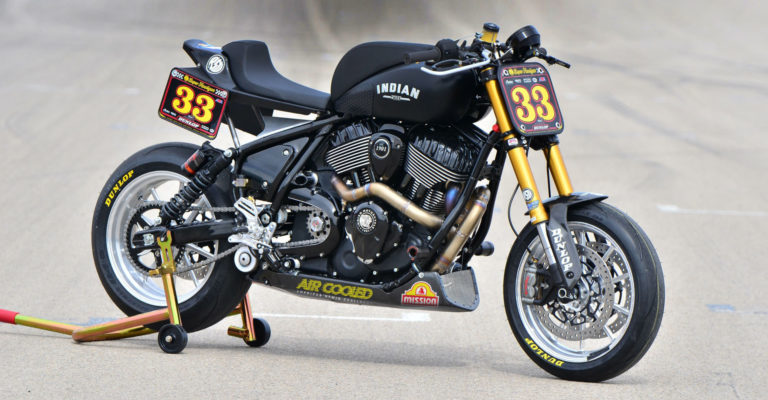
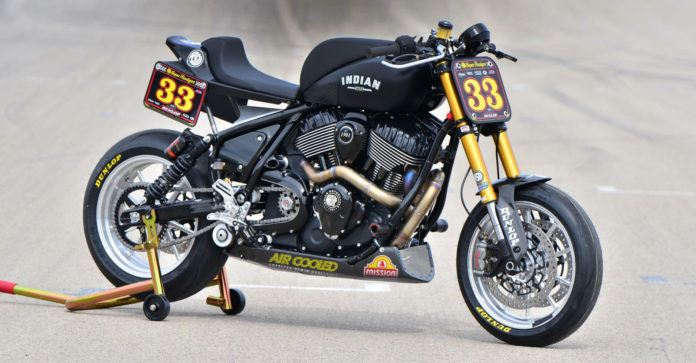
Roland Sands Design’s Super Hooligan National Championship has joined forces with North America’s #1 tortilla brand, Mission foods, to introduce the Mission Air-cooled American V-twin Challenge as part of this year’s Super Hooligan National Championship motorcycle road racing series with Moto America. The Mission Air-cooled American V-Twin Challenge is a race within the race, to be featured at all 4 rounds of the SHNC and kicking off with a doubleheader at the legendary Daytona Motor Speedway March 10-12, 2022.
The Mission American V-twin Challenge will award the fastest Air-Cooled American V-Twin racers in the Super Hooligan class with $2,500 in additional payouts per race, as well as an additional $2,500 bonus prize going to the rider with the most points after four rounds of SHNC road racing. The payout will award the top three finishers on Air-cooled American V-Twins. $1,250 for first place, $750 for second place, and $500 for the third-best finisher of each SHNC round. This payout is on-top of the SHNC race payouts of $2,500 per race.
Mission foods Air-cooled American V-Twin Challenge basic rules are 750cc and up Air-cooled American made V-twins, stock frames, high bars, flat number plates, 420lbs and over. (For complete rules for SHNC class visit http://www.superhooligan.com/rulesreg). All rules and regulations, sign-ups and information can be found online at http://www.superhooligan.com/. Mission foods Air-cooled American V-Twin Challenge riders will need to run Mission food logos on their bikes and leathers and adhere to all Moto America and Super Hooligan class rules.
The Super Hooligan class with Moto America features riders and bikes from many disciplines and has a broad set of rules meant to bring new riders and brands into road racing. With the addition of the Mission Air-cooled American V-Twin Challenge, we hope to inspire American V-twin riders who normally race at a local level, to come out and race with the SHNC at a national level and elevate the visibility of Air-cooled American V-twin road racing.
What is the Super Hooligan National Championship:
Roland Sands Design’s Super Hooligan National Championship features 750cc and up twins, 420-pound-plus, air-cooled, water-cooled, and electric, high-bar motorcycles. In 2022, Roland Sands Designs and MotoAmerica, North America’s premier motorcycle road racing series have announced the 2022 Super Hooligan National Championship (SHNC) Road Race Series, which will be held in conjunction with the MotoAmerica Series in an expanded four-race, three-round schedule that will begin with a doubleheader on the high banks of Daytona International Speedway in March. From there the action will return with an SHNC round at Michelin Raceway Road Atlanta, April 22-24, and will conclude with a return to WeatherTech Raceway Laguna Seca, July 8-10. The second half of the year will feature a short track SHNC California based series, with more details to be announced.
Who is Roland Sands Design:
Roland Sands Design was founded in 2005 and is a multifaceted business that includes commissioned custom motorcycle builds, aftermarket motorcycle parts and design, technical riding and casual apparel, the Super Hooligan National Championship amateur flat track series, Moto Classic Events, and more. Roland Sands Design incorporates a small team of dedicated designers, engineers, racers, builders, fabricators, mechanics, and more, that feed the collective creativity that emanates from their Southern California headquarters.
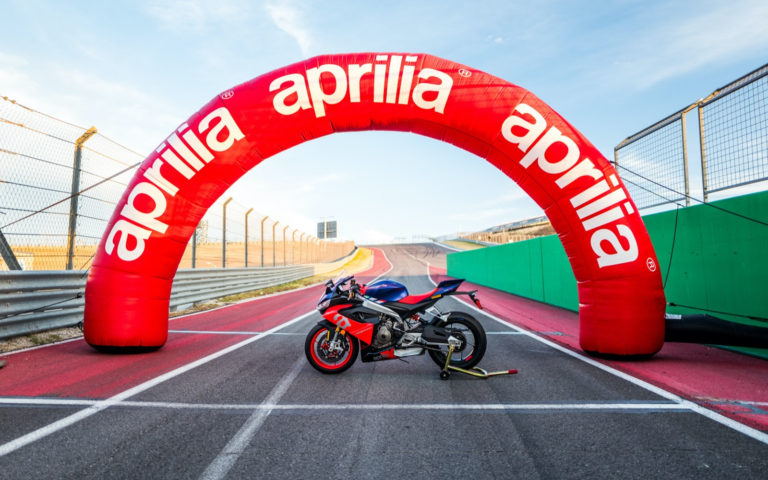
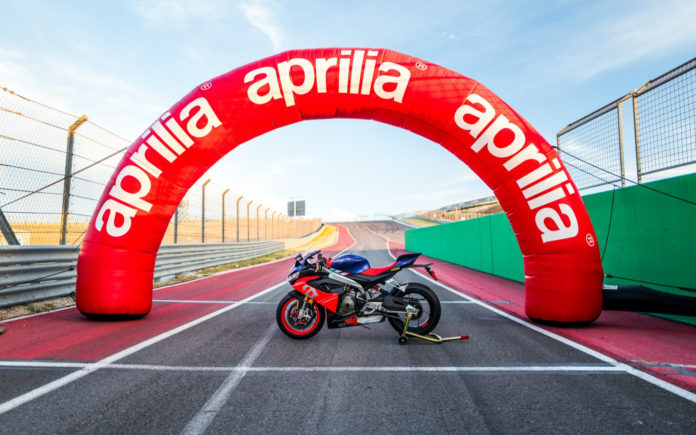
APRILIA 2022 “APRILIA RACERS DAYS” TRACK PROGRAM DATES ANNOUNCED
COVERING PREMIER CIRCUITS ACROSS NORTH AMERICA, APRILIA RACERS DAYS BRINGS PREMIUM MOTORCYCLE EXPERIENCE TO THE TRACK, MADE POSSIBLE WITH INDUSTRY LEADING TECHNICAL PARTNERSHIPS FROM PIRELLI, DAINESE, AND AGV
CIRCUIT OF THE AMERICAS WILL INCLUDE VIP MAX BIAGGI APRILIA RACING EXPERIENCE, LIMITED TO ADVANCED LEVEL APRILIA OWNERS. SELECT ROUNDS WILL OFFER APRILIA RACING SCHOOL INSTRUCTION OPEN TO ALL BRANDS AND SKILL LEVELS
NEW YORK, NY – FEBRUARY 10, 2022 – Aprilia USA has announced the 2022 dates for the celebrate Aprilia Racers Days, track day program. The unique activity brings leading industry partners to the track, allowing customers to experience not only the latest Aprilia motorcycle models on track, but also the latest protection equipment from Dainese and AGV, and performance tires from Pirelli.
Hosted at 7 circuits across North America, Aprilia Racers Days continues to grow an enthusiastic community of track riders, with rider coaching for all group levels, as well as the inclusion of photography and complimentary lunch. Each activity will include the complete street range from Aprilia; RSV4 Factory, RSV4, Tuono V4 Factory, Tuono V4, RS 660, Tuono 660 and Tuono 660 Factory models.
To launch the activity following North America’s biggest motorcycle race weekend in Austin, World Champion Max Biaggi will host a VIP Experience, exclusively for Aprilia owners, with advanced riding skills. Participants will have the unique opportunity to spend the day on-track with Max Biaggi, with access to dedicated garage and classroom, focusing on techniques to improve riding ability and race craft. The experience will include Aprilia Racing MotoGP apparel package, a commemorative gift signed by Max, an intimate dinner event, as well as the benefits of the track day activity included in price. The activity will be limited to 5 participants.
Hosted at select activities will be the Aprilia Racing School. With Aprilia’s dedicated race instruction program, riders of all skill levels will have professional coaching support to bring their performance to the next level. Students riding all marques are welcome to participate, and will receive dedicated track instruction in a private environment, covering a variety of elements, from body position, mental focus, to the performance of your machine, in order to make you a safer, more capable, and faster rider on track.
Aprilia Racers Days events will be supported directly by Aprilia trained technicians and product specialists, as well as partners Pirelli, Dainese and AGV to offer the best on-track experience with expert advice, performance and protection. The cost of participation in the events will not only qualify for an incredible track day experience with your existing motorcycle, but also include a VIP Aprilia Racers Days package, with ability to demo a new Aprilia for one of the track day sessions, equipped with Pirelli performance tires. Additionally, activities will include coaching, event photography, and an included lunch. Attendees will also have the ability to be measured for a custom suit from Dainese and try out the latest track suits as well as helmets from AGV.
ABOUT APRILIA RACERS DAYS PARTNERS
Using its 17 years as the Official Tire Supplier to the FIM Superbike World Championship, Pirelli developed the DIABLO ROSSO™ CORSA II, an innovative new tire derived from racing and designed for use on the road and track. DIABLO ROSSO™ CORSA II is the first-ever Pirelli motorcycle tire that uses two compounds applied in three zones on the front tire and three compounds applied at five zones on the rear, creating an aggressive combination. Innovative profiles, a new structure and a new tread design allow every rider to follow their leanings.
To learn more about the complete line of Pirelli motorcycle tires, please visit www.pirelli.com.
For each of the events, the latest sport-oriented technical apparel and helmets will be showcased by Dainese and AGV, the leader in protection for moto and dynamic sports, which joined Aprilia Racers Days in 2019 as the Official Safety Sponsor. The natural synergy between these two Italian brands – both known for premium products and innovation – brings a new level of excitement to every event.
At each stop along the tour, Dainese will have a Custom Works master tailor available for fittings and consultations, on how you can have Dainese build you a garment that will be your own piece of motorcycling history. Professionals from Dainese’s Retail Stores will be on hand with a demo fleet of D-Air equipped suits for both men and women, to try on and test on track. There will also be AGV helmets Pista GP RR and K6 for participants to try on and experience why most of the top riders in world class racing turn to AGV as their helmet of choice.
To learn more about the complete line of Dainese and AGV, please visit the respective websites:
Pirelli was founded in Milan in 1872 and today stands as a global brand known for its cutting edge technology, high-end production excellence and passion for innovation that draws heavily on its Italian roots. With around 30,000 employees, Pirelli is a major player in the tire industry and the only global player focused solely on the consumer tire market, which includes tires for cars, motorcycles and bicycles. In particular, Pirelli is a global leader in the production of racing and high performance motorcycle tires both for on and off road applications. Pirelli has a long link with motorsport and the multitude of successes include a record of seventy-two world titles gained in the FIM Motocross World Championship thanks to the performance of its mx product range. In road-racing, since 2004 Pirelli has made the FIM Superbike World Championship for production-based motorcycles the ideal proving ground to develop not only the products used in competition, but also tires used daily by motorcyclists all over the world. Inspired by the philosophy now become a motto “We sell what we race, we race what we sell”, Pirelli has managed to bring to fruition all the experience acquired in
ABOUT DAINESE GROUP
Founded in 1972 by Lino Dainese, true to its mission of advocating and delivering safety in dynamic sports, the Company designs advanced protective head-to-toe gear for motorcycling, winter sports, cycling, horse riding and sailing. In 2007 Dainese acquired the iconic premium sport helmet manufacturer AGV, established in 1947. The new Dainese Settantadue brand, established in 2017, reinterprets the design of historic garments that are a part of the stylistic heritage of the Group, with a contemporary twist. Dainese and AGV products represent the technology frontier in the field of protection for dynamic sports and are used by the world’s top athletes including Valentino Rossi and Sofia Goggia, Olympic Champion and winner of the Downhill World Cup.
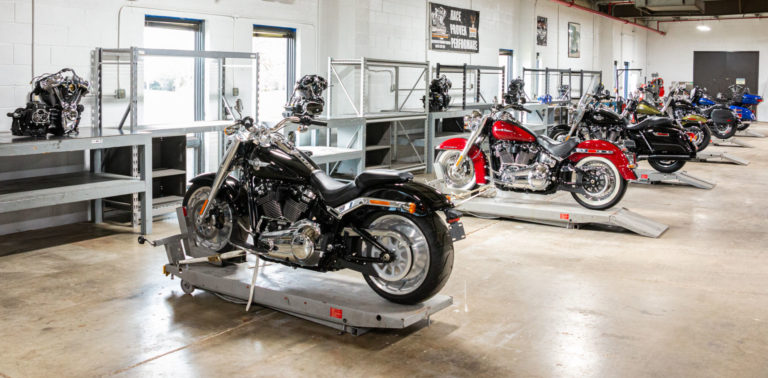
MIDWEST MOTORCYCLE MECHANIC SCHOOL LAUNCHES WITH INAUGURAL CLASS
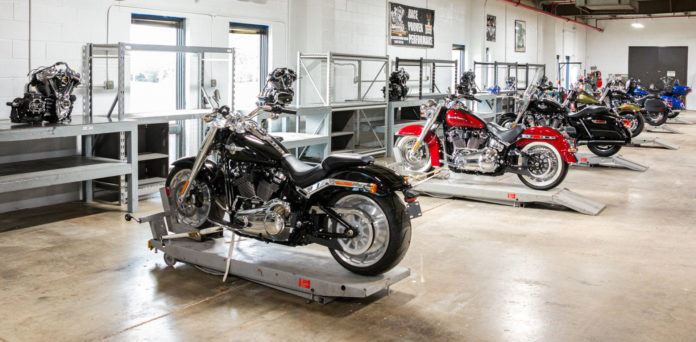
CHICAGO, ILLINOIS – Midwest Motorcycle Mechanic School, a joint effort between Windy City Motorcycle Company and McHenry County College, launched with its inaugural class on January 10, 2022!
The School offers a 12 week class taught by Certified Master Mechanics at a state of the art facility in Woodstock, Illinois. With 360 hours of instruction blending hands on training, classroom sessions, and job shadow opportunities, successful completion of the course will prepare the students to start their career in this in-demand and growing field.
“I highly recommend this class to anyone looking towards motorcycle mechanics as a career.” said Randy, a member of the inaugural Midwest Motorcycle Mechanic School class. “Great instructors. Modern motorcycles to learn on. You’ll be turning wrenches on the second day.”
“This class is perfect for learning the ins and outs” said Amber, another member of the class. “I learn something every day and the environment is very supportive.”
“The information I’ve learned in a few short weeks has been more beneficial than I could have ever thought possible” said Dustin, who is also taking the class. “Taking this course was the best possible decision I made for my career.”
“This has been a dream of mine for some time now.” said Doug Jackson, 40+ Year Industry Veteran, Woodstock Harley-Davidson/KTM/Triumph General Manager, and Midwest Motorcycle Mechanic School Leader. “Service is the foundation of a dealership, and to have a strong foundation you need to have highly skilled technicians. This school provides an affordable, local option for people interested in this exciting career.”
Through McHenry County College, students can access financial aid opportunities to assist with class enrollment for Midwest Motorcycle Mechanic School. If you need financial support for your training, please visit www.mchenry.edu/ncscholarships.
For more information on Windy City Motorcycle Company and the dealerships within the group, please visit www.windycitymc.com.
About Windy City Motorcycle Company:
Windy City Motorcycle Company commenced business in 2000 and today is among the largest motorcycle distributors in the U.S. representing five premium OEM brands and operating out of 15 locations in Northern Illinois and Southern Wisconsin. It is listed among Crain’s Chicago Business’ largest privately held businesses in Chicago employing approximately 350 people, teaching about 2,000 students annually to ride motorcycles, and delivering over 6,000 motorcycles per year into the market.”
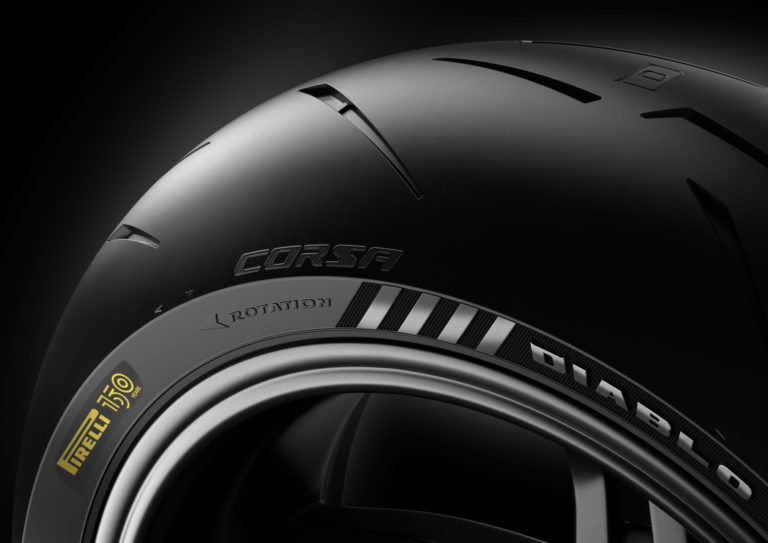
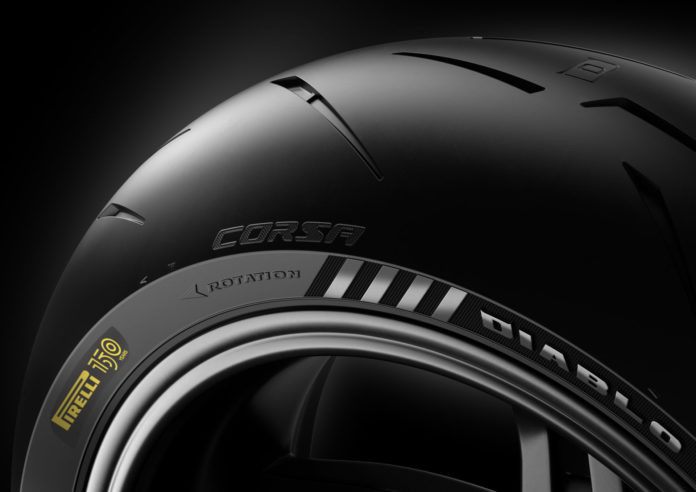
THE SPORTIEST TYRE OF THE DIABLO ROSSO FAMILY, AVAILABLE IN THE CELEBRATORY EDITION OF PIRELLI’S 150 YEAR ANNIVERSARY
Ideal for riders who want performance upgrades for their motorcycles
Higher grip, enhanced ‘fast’ handling and performance consistency
Bi-compound scheme both on front and rear tyre
Slicker tread pattern compared to DIABLO ROSSO IV
Racing derived technologies applied to profiles and structures
Milan (Italy) 10th February 2022 – Pirelli presents the new DIABLO ROSSO IV Corsa, the high-performance hypersport tyre that raises the bar of sport riding even higher within the DIABLO ROSSO family. The new DIABLO ROSSO IV Corsa represents a fiercer version of the DIABLO ROSSO IV supersport tyre, created to satisfy the most demanding motorcyclists seeking a tyre capable of high performance, to fully utilise the potential of their bikes.
DIABLO ROSSO IV Corsa was born in the year in which Pirelli celebrates its 150th anniversary and becomes an integral part of the celebrations. During 2022 a limited edition DIABLO ROSSO IV Corsa pays homage to this milestone and features the Pirelli’s 150th anniversary logo on its sidewall.
Formed in Milan on 28 January 1872, the company began its business with diversified rubber products, making the first tyre for bicycles in 1890. Always passionate about competition, Pirelli participated in the first motorcycle races in 1897 and today continues with the role of sole supplier to the Superbike World Championship, a collaboration that started in 2004, as well as being the most successful brand in MXGP. Today Pirelli is the only tyre company focused exclusively on the consumer world, with products and services for cars, motorcycles and bicycles.
Who is DIABLO ROSSO IV Corsa designed for?
DIABLO ROSSO IV Corsa is the ideal choice for:
Motorcyclists who love a dynamic riding style on winding roads and mountain passes, who want a tyre to match the sporty performance of their motorcycle;
Motorcyclists who are passionate about tuning, who look for performance upgrades and take care of the bike set-up and aesthetics. These riders seek the optimal set-up of their motorcycle according to the type of use, also through the upgrade to high-performance equipment. They also recognise the lightning-shaped tread design, here interrupted, as the iconic symbol representing DIABLO ROSSO sporty performance.
The benefits of DIABLO ROSSO IV Corsa:
The main benefits of DIABLO ROSSO IV Corsa are:
Higher grip in dry conditions, thanks to a slicker tread design that guarantees a larger footprint area alongside the use of innovative compounds that increase mechanical grip levels;
Enhanced hi-performance handling and precise feedback. The innovative technologies applied to the carcass make DIABLO ROSSO IV Corsa able to adhere to the micro-roughness of the asphalt, ensuring precise feedback and a feeling of control;
Performance consistency over multiple riding sessions, made possible by the characteristics of the tread pattern, where the intended repetition of the grooves offers high resistance to stress, and, by the new arrangement of the compounds, ensures optimal thermal balance.
THE TYRE IN DETAILS
Tread Pattern
The tread design of DIABLO ROSSO IV Corsa features a calculated repetition of the central grooves and a slicker shoulder area, for a void/fill ratio 25%[1] lower than DIABLO ROSSO IV.
In the central area, the group of longitudinal grooves assures directional stability and water evacuation. Their orientation follows the wear waves and enables an even wear, while their position increase the structural stability of the tyre to give performance consistency over multiple riding sessions.
In the intermediate area, linear grooves of different lengths are positioned using a scheme that balances compound flexibility and water evacuation. DIABLO ROSSO IV Corsa features a large slick area on the shoulders, able to offer high levels of grip, precision and stability at maximum lean angles.
Compounds
The front tyre is divided into three areas using two different compounds:
The central band has a Full Silica compound that occupies around 45% of the section width and is present in the contact area used up to 25 degrees of lean angle;
The side areas have a softer compound, also Full Silica, thanks to the use of innovative resins that offer excellent grip and improve the front tyre feedback.
The rear tyre also has a bi-compound scheme for excellent road performance and works in harmony with the front:
The central Full Silica compound allows for a quick warm-up and excellent chemical grip on different surface conditions;
The shoulder compound is 100% Carbon Black and derives directly from the compounds of DIABLO Supercorsa SC used in racing competitions. This compound is able to offer support at full lean and traction during acceleration managing the torque generated by the latest generation superbikes.
Profiles
Pirelli exploits all the know-how acquired in the fastest production-derived motorcycle championship. The profiles of DIABLO ROSSO IV Corsa are therefore race-derived and are characterised by a multi radius design that improves the tyre’s handling.
The central area has a sharper profile to facilitate immediate lean and rapid change of direction. In the lateral areas, on the other hand, the profile curvature is less accentuated in order to increase the contact area and ensure maximum traction when cornering. Front and rear tyres follow a similar profile design, thus ensuring a perfectly balanced and neutral behaviour of the set.
Structure
With DIABLO ROSSO IV Corsa Pirelli uses a racing-derived structure with zero-degree steel belt, which manages to adapt perfectly to different levels of stress without compromising comfort and work optimally with the most advanced electronic control systems.
The stiff cord technology features structural cords that are more rigid and at the same time distributed with less density (-20%) compared to a standard sport tyre[2]. This scheme leaves more room for the rubber compound, which improves riding feeling and precision thanks to its damping properties, thus transmitting to the rider, a safety feeling and control of the motorcycle.
The range
The DIABLO ROSSO IV Corsa range includes the following sizes.
Front
110/70 ZR 17 M/C 54W TL 07/2022
120/70 ZR 17 M/C (58W) TL 01/2022
Rear
150/60 ZR 17 M/C 66W TL 07/2022
180/55 ZR 17 M/C (73W) TL 01/2022
180/60 ZR 17 M/C (75W) TL 03/2022
190/50 ZR 17 M/C (73W) TL 06/2022
190/55 ZR 17 M/C (75W) TL 01/2022
200/55 ZR 17 M/C (78W) TL 04/2022
200/60 ZR 17 M/C (80W) TL 04/2022
[1] Rear size 190/55 ZR 17 of DIABLO ROSSO IV CORSA and DIABLO ROSSO IV compared
[2] cords distributed with 20% with less density compared to DIABLO ROSSO III tyre
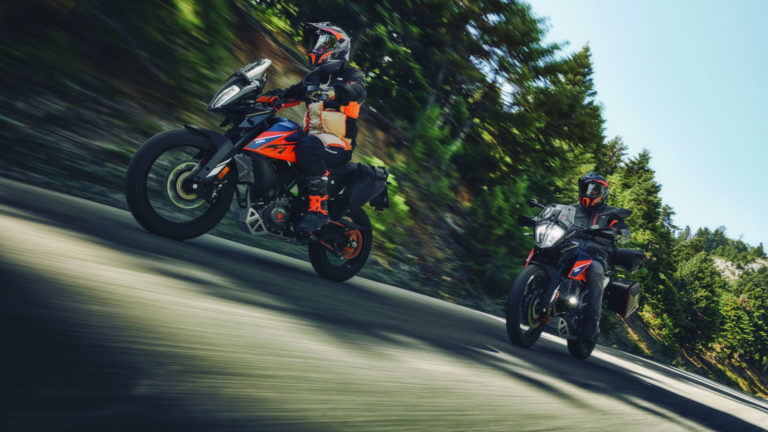
KTM ANNOUNCES NATIONWIDE 2022 RIDE ORANGE STREET DEMO TOUR
February 10, 2022
MURRIETA, Calif. – KTM North America, Inc. is pleased to announce details for the 2022 KTM RIDE ORANGE STREET DEMO TOUR, giving U.S. consumers a unique opportunity to get up close and personal with KTM’s versatile lineup of 2022 STREET models. Kicking off on Saturday, Feb. 26 at KTM’s North American Headquarters in Murrieta, California, the 2022 schedule will once again make stops at some of the largest motorcycle events in the country.
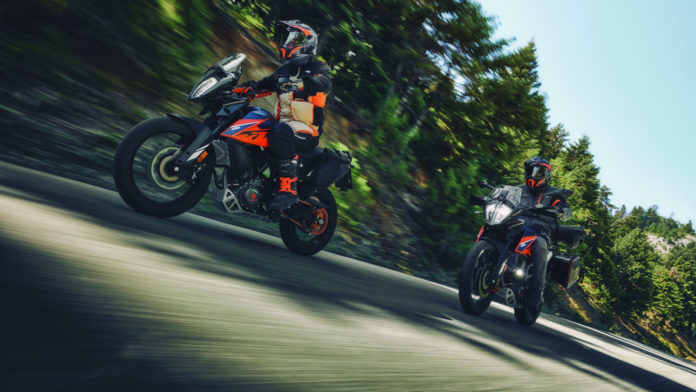
Riding on the nation’s best roads, participants of the KTM RIDE ORANGE STREET DEMO program will experience KTM’s pure performance on pre-planned routes that navigate through some great riding areas, thanks to a partnership with participating KTM dealers across the nation. Come explore KTM’s all-new ADVENTURE lineup, including heavy-hitters like the ultimate high-performance KTM 1290 SUPER ADVENTURE S and the all-terrain powerhouse KTM 1290 SUPER ADVENTURE R. Beginning this April, riders can also enjoy the pure race-inspired performance of the new KTM RC 390.
2022 KTM RIDE ORANGE STREET DEMO MODELS
KTM 1290 SUPER ADVENTURE R/S
KTM 1290 SUPER DUKE R EVO
KTM 890 DUKE R
KTM 890 DUKE
KTM 690 ENDURO R / SMC R
KTM 390 DUKE
KTM 390 ADVENTURE (at select demos)
KTM RC 390 (starting in April)
KTM 200 DUKE
KTM 350/500 EXC-F* (at select demos)
Participants will also receive a Ride Orange VIP Card voucher (valued up to $500 MSRP), redeemable on KTM PowerParts, KTM PowerWear and/or KTM SpareParts at an authorized KTM dealer with the purchase of a new KTM STREET model.
In order to participate in the KTM RIDE ORANGE STREET DEMO, you must be 25 years or older for 690 cc and up, and 21-years-old or above for 500 cc and under. Participants 21 to 24-years-old can ONLY ride motorcycles 500 cc and under. Experienced riders only (no beginners). All riders must show a government issued Photo ID with motorcycle endorsement. Demos are on a first-come first-served basis and registration will take place on-site the morning of the event.
For a list of KTM RIDE ORANGE STREET DEMO locations and to connect with your local participating dealer, please visit KTM.com or email [email protected]. Follow KTM USA on all social media platforms for the most up-to-date information on events.
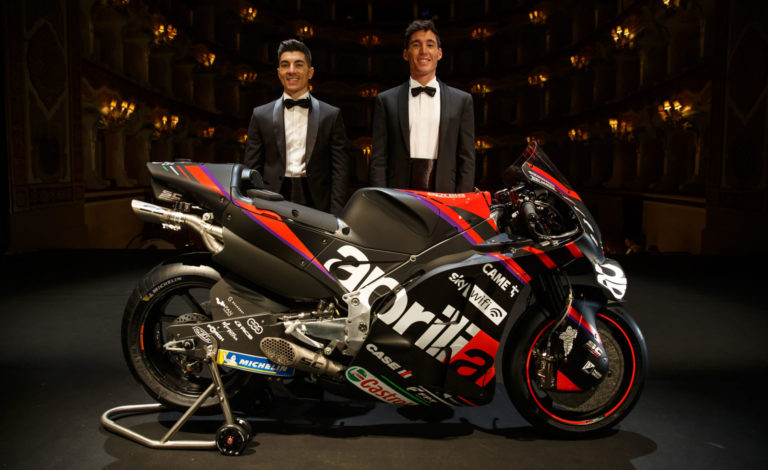
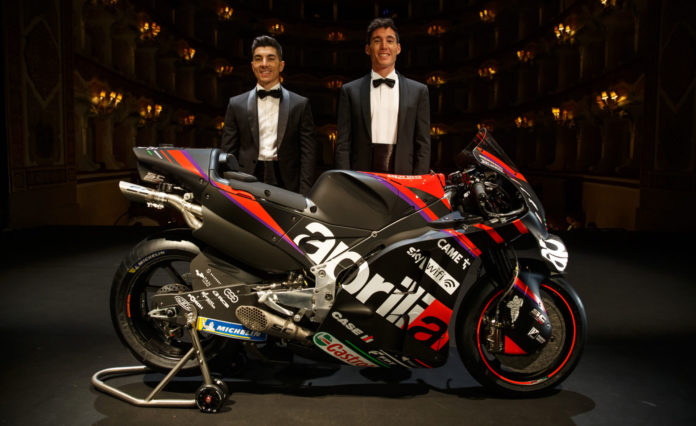
MOTOGP 2022: APRILIA SHOWS THEIR CARDS AND REVEALS THEIR AMBITIONS AN ADVANCED RS-GP AND THREE TOP-LEVEL RIDERS: ALEIX ESPARGARÓ, MAVERICK VIÑALES, AND TEST RIDER LORENZO SAVADORI
ON THE 30TH ANNIVERSARY OF THEIR FIRST WORLD TITLE, APRILIA RACING IS FINALLY ON THE GRID AS A FACTORY TEAM.
MASSIMO RIVOLA: “A HUGE RESPONSIBILITY BUT ALSO ADDED MOTIVATION”
ROMANO ALBESIANO: “THE NEW RS-GP IS THE PROFOUND EVOLUTION OF AN ALREADY OUTSTANDING PROJECT”
The year 2022 marks an important time for Aprilia Racing in its young MotoGP history. In fact, the Italian team gains Factory Team status, yet another step forward in a growth trend that has been clear over the last two seasons, culminating in the podium at Silverstone last year, a result that Aprilia had never before achieved in its history in MotoGP.
At the end of the 2021 season, Aleix Espargaró finished eighth in the overall championship standings, moving up nine positions and tripling the points he had earned in the previous seasons. This is a great result which is only the starting point for the 2022 evolution, a season where Aprilia will be on the grid with a profoundly revamped RS-GP with respect to what has proven to be a good technical base. Not only the results, but more than anything else, the gap behind the best riders (never before so consistently low in the brand’s history), convinced the racing department engineers to focus their work on all areas of performance. Without revolutionising, but with the innovative ability that has always made Aprilia’s efforts stand out in racing.
Taking the new RS-GP machines onto the track will be a line-up of extremely high-level riders. Riding alongside the ultra-confirmed “team captain” Aleix Espargaró will be Maverick Viñales, the newest member of the Aprilia family. Carrying out the dual role of tester and wild-card rider will be Lorenzo Savadori, the young rider who has demonstrated consistent progress since his début in an extremely demanding category.
Aleix Espargaró
“I can’t wait to get back on the track with my team. After many years together, they are no longer just mechs and techs. They are truly part of my family and, from that point of view, the winter break always seems too long. I’m extremely pumped up. The years may pass, but I am still just as hungry as I was when I began and I’m at the top of my game physically. For the first tests, I chose a helmet with graphics dedicated to all Aprilia’s first podiums in the various classes, including the one we earned together at Silverstone. It seems like the right way to kick off the season and pay tribute to this brand’s great racing heritage. The goal is obviously to add more images to this gallery”.
Maverick Viñales
“From my first moment on this team, I realised that I had been chosen for a purpose – to take Aprilia to the top of modern MotoGP. This is the goal we are all working towards. I don’t think it’s fair to make predictions. I prefer focusing on the job at hand and on preparing because I believe that results are a direct consequence of our efforts. We had the great opportunity of getting to know one another ahead of time, doing a few races together and beginning to understand our reciprocal needs. We’ll need to exploit this advantage as much as possible. I am highly satisfied with the job the racing department did over the winter and now all that’s left is to show our progress on the track”.
Lorenzo Savadori
“The role of tester, also considering the fact that I’ll do some wild card races, is extremely important in MotoGP. Everyone at Aprilia is working hard to improve the RS-GP even more. We are competing in a category where continued investments of time, resources, and efforts is indispensable. The overall level of our rivals is extremely high, but we are growing and we need to continue this trend. I’ve been part of this project since 2020 and I have grown along with the RS-GP, a bike that has consistently and progressively improved, and I’m confident that it will take another step forward in this new season”.
Massimo Rivola
“This is an important season. We are coming into MotoGP as a Factory Team precisely on the thirtieth anniversary of Aprilia’s first World Championship GP Motorcycle Racing title, won with Alex Gramigni. This is a great responsibility, but also an injection of extra motivation. The racing department is now a group of highly skilled individuals who work extremely well together and with a strong Italian footprint that we are extremely proud of. We are working well and the competitiveness we demonstrated last year must be just the starting points. The ’21 season was a good one, but we need to forget about it straight away and look forward. In my opinion, the 2022 RS-GP will be the most beautiful bike on the grid and I hope that it will also be one of the fastest. I think we have done some significant work, certain of the direction we have taken. We have three top-level riders: the “team captain” Aleix and a great champion like Maverick who we are getting to know better and better every day. Lorenzo will be our test rider. In spite of a season conditioned by injuries, he demonstrated significant growth and he will be a big help in developing the project”.
Romano Albesiano
“The RS-GP 2022 is a profound evolution of the outstanding base used in 2021. We focused on the main performance areas. The engine has undergone significant internal changes, maintaining the previous layout. The aerodynamics are constantly evolving and the chassis architecture and software areas have been revamped with the goal of improving important aspects such as braking, acceleration and the starting strategy. We have three riders with very different characteristics, both physically and in terms of riding style, and that means that we are able to develop a bike which is effective in a wider range of needs. In recent years, we have seen an uptick in performance, including our own, which is why we worked particularly hard during the winter break. I’m confident that we will have good cards to play in the 2022 championship season”.
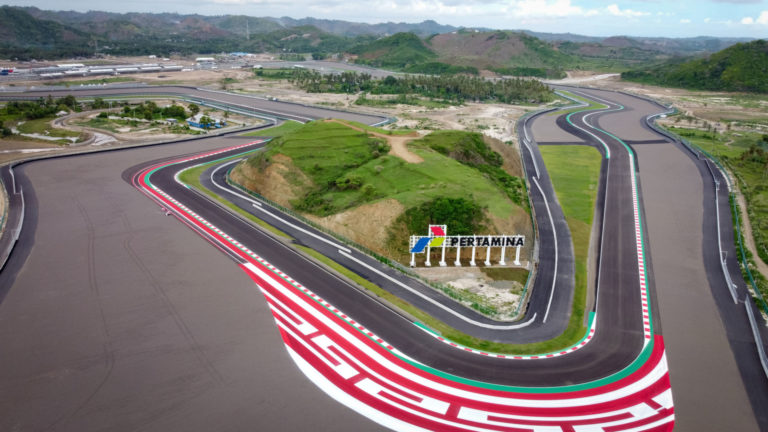
Three days of official testing await as the premier class arrive on Lombok for their first taste of Pertamina Mandalika Circuit
Thursday, 10 February 2022
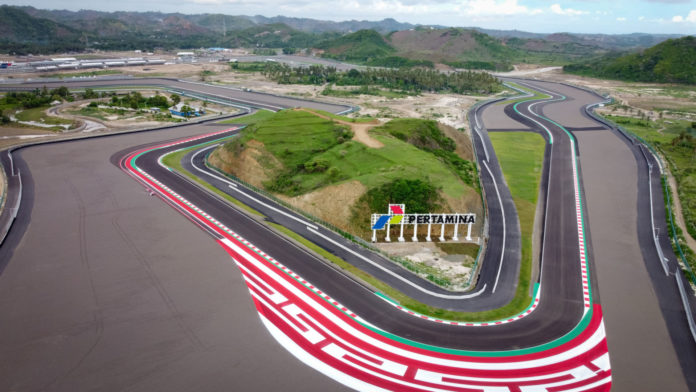
After the Shakedown Test and the two-day Sepang Test in Malaysia, the paddock is back on the road and heading for the island of Lombok in Indonesia. The FIM MotoGP™ World Championship returns to the country for the first time in over two decades, and it’s the brand new Pertamina Mandalika Circuit playing host.
There’s plenty on the agenda over the three days as riders aim to get to grips with the six left- and 11 right-handers. The circuit is more flowing and the straight is much shorter in comparison to Sepang, with only two hard braking zones. It’s sure to be an interesting three days as both rider and factory get their final preparations underway.
The test runs from 9:00 local time (GMT+8) until 17:00 on the 11th, 12th and 13th of February. As it was from Sepang, Live Timing will be available across the three days on motogp.com and on the official MotoGP™ app, as well as a range of updates, reports, highlights and more.
After The Flag will also be back in action with a live show each day, showcasing a host of interviews, analysis, features and footage of the track action. Once again, After The Flag will be hosted by MotoGP™’s Matt Birt and Louis Suddaby, and will link up live with Lombok for rider interviews and analysis, as well as unmissable insight from pitlane reporter Simon Crafar on the ground. The programme starts half an hour before the end of the test and continues for an hour after track action concludes at motogp.com.
TIMETABLE – LOCAL TIME
Friday 11th February
Track open: 09:00 – 17:00
After The Flag: 16:30 – 18:00
Saturday 12th February
Track open: 09:00 – 17:00
After The Flag: 16:30 – 18:00
Sunday 13th February
Track open: 09:00 – 17:00
After The Flag: 16:30 – 18:00
TIP: Head to the Mandalika Test page and select “Your Time” to see the details for your timezone!
The road to Mandalika: a recap of what we’ve seen so far
A brief look through each factory’s focus and progress in pre-season so far
DUCATI
Ducati left the Sepang Test on the front foot on the timesheets thanks to Enea Bastianini (Gresini Racing MotoGP™), with the sophomore putting in the fastest ever lap of Sepang on his GP21. The new GP22 also acquitted itself well, with the new engine showing gains in top speed and the new aero and updated air intake remaining a fixture. However, the feedback from riders at Sepang suggests there remains a margin for improvement and the Borgo Panigale factory will be keen to iron everything out ahead of Qatar.
Ducati’s updated ride-height device – which appears to now lower the front and rear of the machine – will likely steal more headlines at Mandalika too.
APRILIA
The Noale factory were one of the headline-stealers of the Sepang Test. After a 1-2 on Day 1, they ended the test second and fifth respectively – with both Aleix Espargaro and Maverick Viñales sounding very positive about the new, narrower 2022 machine. Espargaro praised the turning and corner speed improvements, although the Spaniard does remain undecided on which chassis is best.
Aprilia have said since the Jerez Test that Mandalika would be where they would finalise the machine. Will they have the same speed as we head for Indonesia? And are there are more innovations in the locker?
SUZUKI
Suzuki also made their improvements a headline act. The Hamamatsu factory confirmed they’ve improved their engine in the search for more top speed without compromising the established assets of the GSX-RR, and there were ripples of interest up and down pitlane at the steps forward on show in Sepang.
There were reportedly some more varied comments from the riders regarding aero and chassis updates, but plenty worked a treat. How will the Suzuki fare around the 17 apexes of Mandalika?
YAMAHA
The Iwata marque wanted more top speed heading into 2022 and there has reportedly been a small step forward, but not enough. Monster Energy Yamaha Team Manager Maio Meregalli admitted they expected a bigger improvement and in lieu of that, work has been focusing on finding more gains via aero.
Meregalli also said that the “real test” will be in Mandalika, so it’s almost time for Yamaha to choose their direction after another three days to try and maximise the 2022 YZR-M1.
HONDA
The new RC213V is one of the most compelling attractions of pre-season so far, as is the return of eight-time World Champion Marc Marquez (Repsol Honda Team). The number 93 is recovered and raring to go, despite feeling pretty tired after his return to the fray, and was the quickest Honda at Sepang. He says he needs to find its limits, but was positive about the all-new package.
Honda will continue refining the new machine at Mandalika, with all riders – Marc Marquez, Repsol Honda’s Pol Espargaro, Alex Marquez (LCR Honda Castrol) and Takaaki Nakagami (LCR Honda Idemitsu) – working on the 2022 bike.
KTM
Many would give more than a pfennig for KTM’s thoughts as the Austrian factory continue to prove coy. New Red Bull KTM Factory Racing Team Manager Francesco Guidotti did confirm the overall plan at Sepang, however, with KTM looking to find a solid base from which to begin the season and then use that as a springboard after a tougher 2021.
Evaluating new parts and re-examining plenty from last year, it’s been all hands on deck for Red Bull KTM Factory Racing’s Miguel Oliveira and Brad Binder, alongside test riders Mika Kallio and MotoGP™ Legend Dani Pedrosa – with Tech 3 rookies Remy Gardner and Raul Fernandez, of course, more focused on their own machines and adaptation.
The rookies: pre-season half term report
How the five premier class newbies are settling in so far
By the end of the Shakedown and the two-day Sepang Test, it was Mooney VR46 Racing Team’s Marco Bezzecchi who took the top rookie honours – and the Italian was the only debutant to get into the 1:58s. It’s early doors yet, but that bodes well for the multiple Grand Prix winner after a more muted season in Moto2™, including some lingering injury issues. Can he get on terms with Mandalika and keep the roll going?
At Tech 3 KTM Factory Racing, Raul Fernandez kept the upper hand on teammate and 2021 Moto2™ Champion Remy Gardner. The Spaniard was just under two tenths off a 1:58 by the end of the test and continued to impress. Gardner, however, is suffering with a broken wrist sustained in training before testing began – not stopping him from taking part, but surely a limitation and, hopefully, one that will have improved slightly for the final test on Lombok.
Fabio Di Giannantonio (Gresini Racing MotoGP™), meanwhile, got within 0.017 of Fernandez’ best – and despite missing two whole days of track time at the Shakedown due to illness. That’s an impressive job and the Italian will want to maximise his time on the circuit in Indonesia too. So will Darryn Binder (WithU Yamaha RNF MotoGP Team) as he makes the leap from Moto3™ straight to MotoGP™. The South African shaved another second off his best from Day 1 to Day 2, and got down to a 1:59.857 as his adaptation continues.
Who will be the fastest rookie ahead of the Qatar GP? We’ll find out at Mandalika!
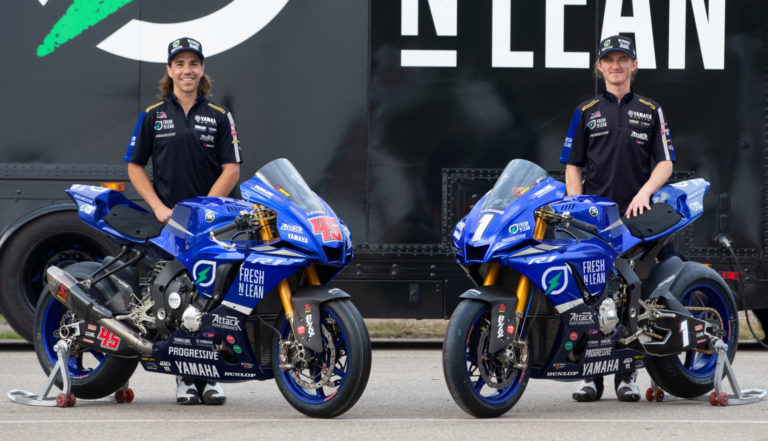
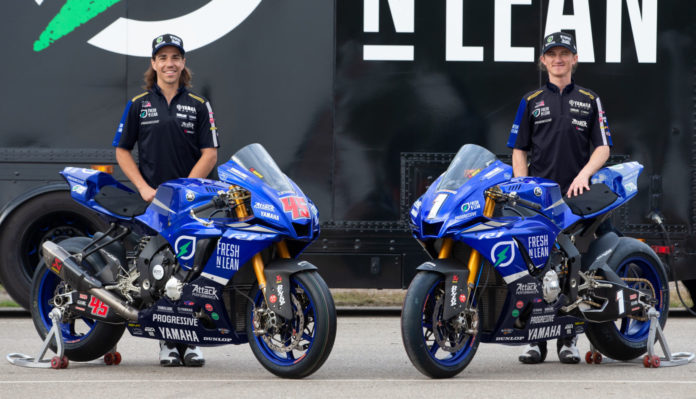
Yamaha Motor Corporation, U.S.A. is pleased to announce the Fresh N Lean Progressive Yamaha Racing team, which will head its efforts in the MotoAmerica Superbike Championship aboard the Attack Performance Yamaha R1s for the next two seasons. The team will field a two-rider effort led by the reigning MotoAmerica Superbike Champion Jake Gagne and new addition Cameron Petersen.
Fresh N Lean, America’s #1 Ready-to-Eat (RTE) meal delivery company, returns as the title sponsor and will continue to fuel the team for championship-proven performance on the track with quality nutrition that is easily prepared, organically sourced, and available in a variety of diets; all focused on optimizing human potential. Coming on board this season is another industry leading sponsor – Progressive Insurance, a leader in the commercial auto insurance industry and the #1 motorcycle insurer in the United States. Returning to the team’s powerhouse line-up of partners is Yamalube and Yamaha Financial Services.
Yamaha also extends its partnership with Attack Performance, one of the sport’s leading manufacturers of high-performance components and services for modern sportbikes. Since 2020, Attack has carried on the winning tradition of the Yamaha R1, enjoying two dominant seasons with 33 victories and two titles in the premier class. Attack Performance principal Richard Stanboli will also return as the team manager.
Gagne enters his third season with the team and aims to keep the #1 on the front of his Attack Performance Yamaha R1. Last year was a standout season for the Colorado rider who added several record-breaking accolades en route to claiming his first title in the premier class a weekend early. He notched an impressive 16-consecutive race wins, and then added one more victory to score the most wins in a season, putting him tied on the all-time win list with Nicky Hayden and making him the active leader in Superbike wins heading into the 2022 season. Gagne also has a pair of support class championships to his credit – the 2014 Daytona Sportbike Championship and the 2015 MotoAmerica Superstock 1000 Championship.
Petersen joins the team in 2022 and also has a championship-proven history in the support class category, taking the MotoAmerica Stock 1000 crown in 2020. The South African had a solid return to the premier class in 2021, scoring his debut Superbike victory at the season finale in Barber and ended the year third in the points standings with a total of five podium appearances. He looks to build on his progress in the MotoAmerica Superbike Championship as he returns to the Yamaha brand.
In addition to the 10-round MotoAmerica Superbike season, the team will race the Daytona 200 aboard the Attack Performance Yamaha R6 as the series makes its debut at the legendary Daytona International Speedway in Daytona Beach, Florida, on March 10-12.
The team would like to also thank its technical partners for their continued support of the championship-winning program: Akrapovic, Braking, TrackDaz, Capit, HHR-Carbonin, Suter, OZ, DID, NGK-NTK, and Zero Gravity.
Jim Roach – Yamaha Racing Department Manager for YMUS
“Yamaha Motor Corporation, USA, is excited to announce the return of Fresh N Lean as the title sponsor of our MotoAmerica Superbike effort for 2022 and 2023. The 2021 season was a resounding success, and we are looking to continue our winning tradition in the future.
“Also joining the team in sponsorship for 2022 and 2023 is Progressive Insurance. Yamaha is thrilled to have this new relationship with Progressive and is looking forward to the start of the season and some great racing.
“Returning for two more years is our 2021 MotoAmerica Superbike Champion, Jake Gagne. With 17 wins last year, Jake had a record-breaking season en route to claiming his championship. New to the Fresh N Lean Progressive Yamaha team for 2022 and 2023 is Cameron Peterson. In addition to great speed, Cameron has shown continued growth over the years. We look forward to going racing with Jake and Cameron.”
Tom Halverson – Yamaha Racing Assistant Department Manager for YMUS
“We are very proud to announce that we are continuing our partnership with Attack Performance for 2022 and 2023. We are very proud of the professionalism, skill, and passion the entire Attack Performance Team brings to the effort. Everyone on the team from 2021 will be back in 2022. Each of these team members played a vital part in our 2021 success, and we are looking forward to working with them all again.
“We are also very proud of Jake Gagne, who will be running the #1 on his Attack Performance Yamaha R1 Superbike after a record-breaking season in 2021. Cameron Petersen has a lot of talent and great potential and will be a fantastic addition to the team. We look forward to working with him to reach the next level in his career.
“We are very excited to continue with Fresh N Lean and bring on a new partner, Progressive Insurance. Along with Yamaha Financial Services and Yamalube, we have some great partners that provide us with the support to make this happen.”
Richard Stanboli – Fresh N Lean Progressive Yamaha Racing Team Manager
“Speaking for the entire Attack Performance team, we are very excited to continue our collaboration with Yamaha Motor Corporation, USA, to race the Yamaha R1 in the MotoAmerica Superbike Championship. We couldn’t have asked for a better companion in this racing journey. When we first accepted the responsibility as the official Superbike team, Yamaha’s in-house team had already recorded a decade of nearly continuous Superbike Championships. This was a very high bar to meet, and we feel fortunate to have delivered on the challenge. We now look forward to the future and continuing to build on our high level of performance.
“We are also very grateful to have Fresh N Lean back as the title sponsor. They have been a great partner to the team, and also provide the meals that fuel the staff and riders, helping us to perform at the highest level. We would also like to welcome our new sponsor, Progressive Insurance. They are also an industry leader and understand the needs of motorcyclists. We look forward to delivering them the #1 plate to match their #1 insurer status.
“Of course, we can’t leave out our riders who battle on the track. Jake Gagne has truly stepped up his craft to become the winningest rider in our series with his amazing 17 wins out of 20 races last season. A team could not ask for a more professional, easy-going, yet aggressive rider on the track. We look forward to helping him defend his title. Cameron Petersen, our newest rider, has shown great potential. At our first test, he wasted no time getting comfortable on the Yamaha R1 and getting up to speed on the racetrack, and we feel that he will be racing for the win at every event. His positive attitude is refreshing, and he has the same demeanor and professionalism as Jake, which we feel will be a winning combination for the team. We look forward to seeing our fans at Daytona and at every podium on the MotoAmerica calendar.”
Jake Gagne – Fresh N Lean Progressive Yamaha Racing
“This is my third year now with Yamaha, and I really feel a part of the family. I’m just so thankful that I’ve got a couple more years of racing superbikes here on the R1. It’s the best bike I’ve ever ridden and the best crew I’ve ever had, so for me, I’m just really enjoying it. Especially coming off of that amazing year last season, we want to keep doing our job and try to win as many races as we can and try to win that championship. I know it’s not going to be as easy to pull off what we did last year, as the other guys are really going to try and not make that happen. We’re going to keep fighting and do what we can. I’m just so happy to have such a great group of people around me. “
Cam Petersen – Fresh N Lean Progressive Yamaha Racing
“It’s been a dream of mine to ride for Attack and Yamaha. I’m so grateful that Tom and Richard believed in me and gave me the opportunity. I know that this is the kind of opportunity that comes around once in a lifetime, so I’m prepared and ready to make the most out of it. I’m really looking forward to the upcoming season and want to grab this opportunity with both hands and make Yamaha and everybody proud. I feel like I’ve got two good years under my belt now with positive things happening in the sport, so I’m ready to keep that forward momentum going and win some championships.”
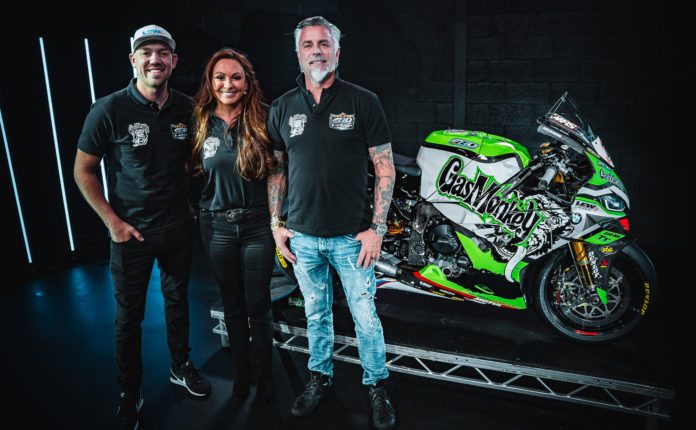
Peter Hickman (left), FHO Racing Team Owner Faye Ho (center), and Gas Monkey Garage's Richard Rawlings (right). Photo courtesy FHO Racing.
GAS MONKEY GARAGE BECOMES TITLE SPONSOR FOR HICKMAN AND FHO RACING AT 2022 ISLE OF MAN TT RACES
Gas Monkey Garage, the global leader in customized cars from Discovery Channel’s hit series Fast N’ Loud, will become the title sponsor of Peter Hickman and FHO Racing at the 2022 Isle of Man TT Races.
Headed by innovative entrepreneur Richard Rawlings, Gas Monkey Garage will utilise the platform of the world’s largest road race to spread the Gas Monkey influence and brand across the globe.
Gas Monkey Garage will showcase the iconic 37.73-mile Mountain Course to a whole new audience via their social media platforms which boast a staggering 20+ million followers.
The new partnership will see the Gas Monkey Garage logos and brand adorn outright lap record holder Hickman’s BMW M1000RR in the Superbike, Senior and Superstock races at the TT, which makes it’s much anticipated return to the calendar after being absent in 2020 and 2021 due to the COVID-19 pandemic.
With five wins and 14 podiums between 2017 and 2019, as well as the outright and Superstock lap records, 34-year old Hickman – who still holds the fastest Newcomer lap ever around the Mountain Course – will go into the meeting as the undoubted favourite for honours.
Watch the full episode of this legendary partnership come to life on Gas Monkey’s YouTube Channel
Based in Dallas, Texas, Richard Rawlings has propelled Gas Monkey Garage into the stratosphere and cemented the brand as a household name since its inception in 2004. From two custom cars for Hot Wheels®, numerous world records, becoming one of the world’s top automotive brands, for Richard and Gas Monkey Garage, it’s go big or go home.
Richard Rawlings: “The entire Gas Monkey family and I are ecstatic to be involved in this year’s Isle of Man TT! Getting the chance to be a part of the largest single viewed sporting event and the world’s longest standing time trials is a dream come true. We are honoured to be alongside the legendary FHO Racing, Team BMW, and the Fastest Man on Two Wheels, Peter Hickman, for a race that is surely to go down in the history books. We look forward to seeing Gas Monkey on the podium come June!”
Faye Ho, FHO Racing Team Owner: “I’m really happy to announce this new partnership with Gas Monkey Garage ahead of this year’s Isle of Man TT Races. We worked extremely hard as a team in our first year to show our potential and both Peter and the team are excited about taking that to the TT, even more so with the partnership with Richard and the Gas Monkey family. It’s always important to attract new sponsors to the sport and we’re grateful to the support and commitment they’ve shown and we aim to repay that faith by delivering a strong set of results at this year’s TT.”
Scott Grimsdall, National Marketing and PR Manager for BMW, commented: “I’m delighted to welcome Gas Monkey Garage to the BMW family as a title sponsor for the Isle of Man TT Races. Their global following speaks for itself whilst Richard’s passion for two and four wheels is clear and their sponsorship of Peter on the FHO Racing BMW can only strengthen our bid for success in June. We’re looking forward to working together to grow their brand within the two-wheel community.”
For more information please visit www.fhoracing.com
#MandalikaTest: Pol Espargaro fronts six-way factory fight on Day 1
Honda top after a day of changing and challenging conditions as MotoGP™ takes on Mandalika for the first time
Friday, 11 February 2022
Repsol Honda Team’s Pol Espargaro finished Day 1 of the Official MotoGP™ Mandalika Test on top, with the field’s first touch with the new Pertamina Mandalika Circuit heavily affected by rain and tricky track conditions. Aleix Espargaro (Aprilia Racing) was second quickest to make it an Espargaro 1-2, with Brad Binder (Red Bull KTM Factory Racing) slotting into third as the top six saw every factory represented.
Due to track conditions, the red flags were brought out during the morning to get a clean up operation underway. Heavy overnight rain had caused the circuit to become dirty, but as the day went on, the track got quicker until we eventually saw three riders dip into the 1:32s. The riders were able to get some decent running under their belts in the closing stages, but light rain then started falling heading into the final half an hour, so any late time improvements weren’t possible.
HONDA
Due to the riders and teams having to learn the new Pertamina Mandalika Circuit, there wasn’t too much to talk about in terms of new updates on the bikes. After briefly running a 2021 RC213V at the Sepang Test, Marc Marquez (Repsol Honda Team) – unsurprisingly – was solely lapping on HRC’s 2022 spec machine.
Pacesetter Pol Espargaro completed 69 laps, setting his best right at the end of his run, as the Spaniard finished 0.9 clear of the next quickest Honda. That was 11th place Takaaki Nakagami (LCR Honda Idemitsu) who was one of a few riders who crashed at Turn 10 on the opening day. The Japanese rider was on a personal best lap when he went down uninjured, but that signalled the end of his day.
Alex Marquez (LCR Honda Castrol) and Marc Marquez were 1.2s and 1.3s off Pol Espargaro respectively, both notching just over 60 laps too. The number 93 explained it as a “good day” despite conditions being unpredictable but is remaining calm ahead of two big days of testing coming up.
Aleix Espargaro. Photo courtesy Dorna.
APRILIA
The Noale factory’s most notable focus has been on chassis direction. Aleix Espargaro and teammate Maverick Viñales had a great time over in Sepang and if the times are anything to go by so far in Mandalika, the RS-GP continues to look in very good shape.
Espargaro was second and 0.4s behind his brother on the timesheets, completing 60 laps, with Viñales seventh quickest with a 1:33.147. Top Gun put in 56 more laps on board his new bike and was one of the first to bolt to the top with a couple of hours left on the clock.
Brad Binder (33). Photo courtesy Dorna.
KTM
Brad Binder shot to the sharp end late in the day, and after having been penultimate on the timesheets earlier on. The South African ended the first day in third, just 0.006 off Aleix Espargaro, and was the last rider into the 1:32s. Teammate Miguel Oliveira’s best lap was a 1:33:748, slotting him in just ahead of eight-time World Champion Marc Marquez. Binder did 64 laps and Oliveira 77 on Day 1.
Raul Fernandez (Tech 3 KTM Factory Racing) was the first back out after the Red Flag, the rookie intent on using as much track time as possible, and he put in a best of 1:33.966. With difficult conditions; changing, wet and interrupted, the uphill challenge was even more so for the debutants. 2021 Moto2™ Champion Remy Gardner (Tech 3 KTM Factory Racing) was P24 as he continues to push through the pain barrier.
Alex Rins. Photo courtesy Dorna.
SUZUKI
The good vibes seemed to continue despite the challenges of taking on a brand new venue, with both Alex Rins and his Team Suzuki Ecstar teammate, 2020 MotoGP™ Champion Joan Mir, in the mix at the front again. Rins was fourth, just under six tenths off the top, and the Spaniard put in 72 laps. Mir was eighth with a deficit of 0.778 to the top, and he put in 58 laps.
Mir’s crew chief Frankie Carchedi joined MotoGP™’s Simon Crafar and Jack Appleyard half way through the day on YouTube, and repeated what Team Suzuki Ecstar Project Leader Shinichi Sahara had said in Sepang: “significant improvements” have been made for the Hamamatsu factory.
Fabio Quartararo (20). Photo courtesy Dorna.
YAMAHA
Reigning World Champion Fabio Quartararo (Monster Energy Yamaha MotoGP) was the fastest YZR-M1 rider on the opening day, as the Frenchman claimed P5 on the timesheets. A hefty 86 laps came in from Quartararo, the second most of anyone. His teammate Franco Morbidelli did 75 and finished P12, the Italian getting some important time on the 2022 bike.
Important time on the 2022 bike is exactly what Andrea Dovizioso (WithU Yamaha RNF MotoGP™ Team) needs too, and the Italian got just that on Day 1. 57 laps was the number Dovi clocked, with his best coming in at a 1:33.245 – placing the number 04 in ninth. Rookie Darryn Binder (WithU Yamaha RNF MotoGP™ Team) slashed plenty off his quickest time when the conditions became more favourable, the South African finished two seconds down on P1 having got a handy 58 more laps of experience in the bag.
Jack Miller. Photo courtesy Dorna.
DUCATI
It was Jack Miller (Ducati Lenovo Team) who led the Bologna charge on Day 1, the Australian ending the day in sixth but just 0.006 off Quartararo. After Viñales had made the first push to the top in the latter stages, Miller responded to take over for a while before getting leapfrogged and pushed back down the order. The only other Ducati in the top ten was Jorge Martin (Pramac Racing) as the sophomore took P10 despite a tumble.
Johann Zarco (Pramac Racing) was P13 but stole some headlines with a whopping haul of 96 laps – only one other rider did more than 80, and that was reigning Champion Quartararo. Within a tenth of Zarco came the first rookie, once again on a Ducati as it was by the end of play in Sepang, but this time it was Fabio Di Giannantonio (Gresini Racing MotoGP™) – despite a crash, it was an impressive day’s work after the Italian missed two full days of track time at the Shakedown due to illness.
Sepang’s fastest rookie, Marco Bezzecchi (Mooney VR46 Racing Team), was P21 on Day 1 at Mandalika and suffered a couple of crashes, nevertheless ending the session 0.008 behind teammate Luca Marini.
Two riders seemingly very out of position after a challenging first touch with the stunning new venue are Sepang’s record breaker Enea Bastianini (Gresini Racing MotoGP™), who was P18, and Francesco Bagnaia (Ducati Lenovo Team) down in P22, suffering a crash and the last non-rookie – so we can expect much more from Pecco as the test goes on.
That’s a wrap on Day 1 of MotoGP™’s debut at Pertamina Mandalika Circuit. Two more days of action remain in Indonesia, with eyes on the sky to see what the conditions bring. Stay up to date on on motogp.com and across social media as we get our teeth into the #MandalikaTest.
More, from a press release issued by WithU Yamaha RNF MotoGP Team:
WITHU Yamaha RNF MotoGP Team covers first laps in Indonesia
Andrea Dovizioso and Darryn Binder discovered the Mandalika Circuit aboard their Yamaha YZR-M1 for the first time today.
Hot and humid conditions accompanied the MotoGP paddock on their way from Malaysia to Indonesia. After riders and teams had a few days to get used to conditions, to check out the brand-new Mandalika Circuit and set up the garages, the action on the 4.3-kilometer circuit got underway today.
Although proceedings have been slightly delayed due to a rain shower in the morning, and a dirty track surface didn’t facilitate the riders’ first taste of the newly added track, the WithU Yamaha RNF MotoGP Team pair was out shortly after midday to discover the layout, lines and braking points on their YZR-M1 machines.
With more and more rubber on the asphalt, track conditions improved slightly and Andrea Dovizioso did a total of 57 laps on day one and concluded Friday in 9th position with a fastest lap of 1:33.245 minutes.
Meanwhile MotoGP rookie Darryn Binder approached the opening day cautiously, still having to get used to the big bike and the track at the same time. He found himself 1.25 seconds behind his teammate after 58 laps today. Both will have two more days to prepare themselves for the season and the second round of 2022, the first ever Indonesian Grand Prix in March.
ANDREA DOVIZIOSO
“I’m happy about the way these three days started, because I was able to find a good line today in a very strange situation as the grip was very low. At the end, we could improve the braking, which is very important for me and very important in general for my riding style. So, I’m delighted about that. I was able to be consistent. For sure the track will change and this is not the reality in terms of lap time, because I’m convinced everybody will go faster. But for today, I’m happy.”
DARRYN BINDER
“Today has probably been the most difficult day of my MotoGP career so far. Arriving here, I’m still trying to learn the bike. I had to learn a new track and in the worst conditions possible. So, I really struggled at the beginning of the day. Luckily, towards the end of the day, the track was improving, which was a good thing and I was able to make a step right at the end, which I’m at least a little bit happier to end the day a little bit closer to the front. The difficult thing was, there was only a little line around the track, that was really good, so if you made any mistakes, it ruined the lap completely. Anyway, let’s see what the weather does. Hopefully the track improves again tomorrow and we can keep working and learning.”
More, from a press release issued by Tech3 KTM Factory Racing:
Fernandez and Gardner Both Conclude Tricky Day 1 of New Indonesian Adventure on a Positive Note
For the first time ever, Tech3 KTM Factory Racing was traveling to the beautiful island of Lombok in Indonesia for the first Official MotoGP Mandalika Test set to take place from February 11 to 13, with the aim to try the brand-new track of Mandalika circuit ahead of the Pertamina Grand Prix of Indonesia on March 20, 2022. The entire MotoGP class was trying out this new layout of 4.3km on Day 1, with six left corners and ten right corners, located in the south of the island, by the ocean.
With a scheduled start at 9:00 local time, the red flags were shown shortly after the first few laps due to track conditions. With a very heavy rain that had occurred a few hours before the start of the day, there was a lot of mud on the track, meaning that a clean up operation got underway and stopped the action until lunch time. Before 15:00 local time, the riders were told to complete around twenty laps each to see how the track conditions were evolving. Luckily, the track dried out and conditions improved quickly, meaning that the work could continue for the rest of the day.
Raul Fernandez was the first rider to leave the pit box after the red flag, eager to get the work going. At 13:30, he was in the Top 10, 1.604 seconds from the top. The Spaniard progressively improved as he started to understand better this brand-new layout of Pertamina Mandalika Circuit Indonesia. On lap 35, he registered 1’34.983, and later on progressed to 1’33.966 on his fifty-third lap, before calling it a day after fifty-seven laps completed. The rookie finished the day in P19, 1.500 seconds from the top and will look forward to continuing his progress here on Day 2.
It was a similar day for his teammate Remy Gardner who also jumped back on his KTM RC16 after some well deserved rest following an intensive week of testing in Sepang. The aim of the day was to do laps in order to learn the track as much as possible and get used to all its technicalities. On lap 30, the Australian crossed the line in 1’35.634. Eighteen laps later, we saw an encouraging improvement as he gained one second, with his best lap of the day in 1’34.603. Overall, Remy completed 64 laps despite his wrist continuing to hurt him, and will get some rest before the action returns tomorrow.
Raul Fernandez
Position: 19th
Time: 1’33.966
Laps: 57
“We did a good job today. The track is completely new, and I am still in the process of learning about the bike, the tyres and everything else. It was a positive day for me because I was very fast and I had a good feeling on the bike which is the most important to me. This morning, the track was very dirty so we didn’t ride too much, but I remain calm because we have two more days to work on this new layout.”
Remy Gardner
Position: 24th
Time: 1’34.603
Laps: 64
“The layout is quite fun, I enjoy it because you are on the gas a lot and there are some fast corners. However, the track was very dirty. At one point, I thought that we would not be able to ride at all. We got the red flag to allow the track to be cleaned, and when we all went out again to do twenty laps each, the track started to get better and times started to come down. My wrist continues to hurt me as we get more days on the bike, but I will get some rest tonight and hopefully I will feel better tomorrow.”
More, from a press release issued by Team Suzuki ECSTAR:
TEAM SUZUKI ECSTAR ENJOY FIRST TASTE OF MANDALIKA
Alex Rins: 4th – 1’33.058 (+ 0.592)
Joan Mir: 8th – 1’33.244 (+ 0.778)
Team Suzuki Ecstar’s riders were raring to go in Indonesia, ready to try the Pertamina Mandalika circuit for the first time. In fact, Alex Rins was the first rider in the field to put in a lap. The morning started off wet, but later in the day the main issue was dust and dirt on the track; due to this there was a long stoppage to allow for circuit cleaning.
Initially the focus was on learning the layout, this was important for the riders – who were trying to get to grips with the racing line – and the crew as they worked to establish the gearing and base settings.
Once this was done, both Rins and Joan Mir aimed to switch their attention to continuing the test plan they were unable to complete in Sepang last week, although this proved difficult with mud and stones still on the surface.
Rins reported great feelings with the track despite the conditions, as he put in 72 laps. His best time was just half a second from the top.
Mir was also impressed with the layout and he was happier when the track was cleaner. He did a total of 58 laps.
The team will remain at the track for another two days of testing.
Alex Rins:
“I really like Mandalika circuit, it’s nice and the layout is unbelievable. Today it was a little bit dirty, so we had to be careful, but lap by lap there was more grip. Overall I’m happy with this first day, we took time to learn how the circuit is, and because of that we didn’t try many things. We want to continue working on some areas that we couldn’t manage in Sepang, let’s see what we can achieve tomorrow.”
Joan Mir:
“I enjoyed today, it was nice to learn the layout but the conditions weren’t the best. In the end there was a grippy racing line, but it took a while to get to that point. The circuit has a good mix of fast places, hard braking, and flowing sections and I like it. Today we didn’t manage to test much, but I was getting quicker as the day went on and hopefully tomorrow we can work on set-up a bit more.”
Ken Kawauchi – Technical Manager:
“The beginning of the test was difficult, not just for us but for everybody, the riders were struggling to get grip in these conditions. The track started out wet, which wasn’t ideal but it was manageable, especially as it dried. But after that we had issues with the dirt. Towards the end of the day we did manage to try a few items, but tomorrow and Sunday we will work a lot more to prepare for the season opener.”
More, from a press release issued by Monster Energy Yamaha:
MONSTER ENERGY YAMAHA MOTOGP GET FAMILIAR WITH THE MANDALIKA TRACK
Lombok (Indonesia), 11 February 2022
MANDALIKA OFFICIAL MOTOGP TEST
TEST
The Monster Energy Yamaha MotoGP Team have been looking forward to this day for months. Today, Fabio Quartararo and Franco Morbidelli got their first laps in at Indonesia’s new Mandalika circuit and secured 5th and 12th place respectively in the Day 1 results.
5th FABIO QUARTARARO 1’33.108 / 86 LAPS
12th FRANCO MORBIDELLI 1’33.518 / 75 LAPS
Monster Energy Yamaha MotoGP‘s Fabio Quartararo and Franco Morbidelli resumed their 2022 MotoGP pre-season testing programme today. The teammates used the first of the three riding days in Indonesia to get a feel for the new Mandalika circuit and confirm their findings from last week‘s Sepang Test. They took 5th and 12th place respectively in today‘s time sheets.
Originally, testing at the Mandalika track was supposed to take place from 09:00 to 17:00 local track time every day, but due to overnight rain Day 1 was off to a wet and muddy start. The session was red flagged and later extended until 17:45 to compensate for the lost time during the clean-up in the morning.
Quartararo used his first laps to gauge the flow of the circuit, before it was hammer time in the afternoon. By 15:00 local time, he was topping the standings, with a 1‘34.074s. He ultimately finished the first day of testing in fifth place with a 1‘33.108s, set on used tyres on lap 85/86, that put him 0.642s from first.
Morbidelli was quick to head out to get a first feel for the track. Though he was mainly concerned with building on his findings from the previous testing days in Malaysia in the afternoon, he steadily improved his feeling with the bike in the final hours on track. His fastest lap, a 1‘33.518s, set on lap 67/75, put him in 12th place, 1.052s from the top.
FABIO QUARTARARO
To be honest, I‘m really happy because this morning was really tricky. The conditions were kind of like motocross. In the afternoon I felt much better, our pace was super strong. I set my fastest lap with 16 laps on the medium rear tyre, so I‘m super happy actually. And we still have two more days. We tried the aero package and rear settings again, and it was working well, so I am happy, but most of all about my pace with used tyres. I think this circuit is kind of like Qatar and Thailand, with a little bit of Argentina on the last heavy braking. I think it‘s a nice mixture of corners. I don‘t consider any track a ’Yamaha track‘, because I think that‘s a mistake. I see this as a normal circuit, and I give it my best shot, this is the best mentality.
FRANCO MORBIDELLI
It was a good day today. We improved the feeling much more compared to Sepang. It showed that I‘m getting more and more in tune with my new Crew Chief Patrick. He did a great job today; we improved the bike a lot and I feel much better. Now, we keep working to understand a few more things and improve the feeling with the bike even more, but so far, so good. For sure, the track is new, and there are spots on the track that aren‘t so good, like Sector 2. I lose everything there because it looks like today I didn‘t manage to get it right, but finally I feel good with the medium tyres. We tried the soft tyres at the end, the speed was good with both. We also tried the medium front, and I felt also quite okay with that, so we are spreading our performance on different tyres and with different things, so I would say that it was a good day.
More, from a press release issued by Mooney VR46 Racing Team:
FIRST TIME FOR THE MOONEY VR46 RACING TEAM AT MANDALIKA
The last official MotoGP test starts in Indonesia with Luca Marini in P20 and Marco Bezzecchi in P21
Lombok (Indonesia), February 11th 2022 – First approach to the Mandalika International Street Circuit for the MotoGP circus with Luca Marini and Marco Bezzecchi working on the Ducati Desmosedici GPs of the Mooney VR46 Racing Team and respectively in P20 and P21 in the combined standings.
A demanding Day1, characterised by heavy rain that hit the circuit area at the beginning and at the end of the session and even before that by a long break around 12.00 pm local time to allow the cleaning of the track due to the violent storms of the last night. At work from the early hours of the morning into the garage, but on track from 1.30 pm to make the most of the central hours of the day, Luca Marini completes 53 laps and sets a best lap time of 1.34.165.
Among the first to test the new circuit, with wet tires, Marco Bezzecchi finishes with a good lap time of 1.34.173 (dry track) and 63 laps despite two small crashes.
For both, next appointment on track tomorrow at 9.00 am local time for the second of the three days of official MotoGP tests.
Luca Marini #10
A good first day here in Mandalika: I like the track, it is very fast and with several long corners. At the same time there are a couple of strong braking points, it is definitely a track that in a good situation can be super! A pity for today, the asphalt was very dirty, conditions far from ideal for a first approach to a new circuit. Overall, I can’t complain, we discover a little be more the new Ducati GP22 and tomorrow we will get back at work for another step.
Marco Bezzecchi #72
An uphill day, but a good first impression of the new Mandalika track. The asphalt conditions were far from perfect and we wasted half session trying to clean the track as well as possible. The grip is not bad at all and tomorrow we can do even better. Too bad for the two small crashes, the second one above all because it was my mistake that with more experience I might have been able to avoid. Let’s get back to the data to get even closer.
Pablo Nieto
Team Manager
A more complicated day than we expected: it is not easy to ride on a new track for the first time in these conditions. The asphalt was really dirty and this forced us into the garage for most of the morning. Better in the afternoon, however, we need to consider that the track is not yet fully rubberised, but the track seems really fast and I think the lap times will drop soon. Luca continued to adapt to the new bike, even Marco who unfortunately crashed twice. Tomorrow we will get back to work on the set up.
More, from a press release issued by Repsol Honda:
Repsol Honda Team get first taste of Mandalika as Espargaro sets the pace
Pol Espargaro led the first day of MotoGP testing in Indonesia, utilizing all the available track time across a day of stops and starts as team-mate Marc Marquez enjoyed the first special feeling with the new Honda.
It was a wet introduction to the newest circuit on the MotoGP World Championship calendar, heavy overnight rain and continued morning showers leaving the 4.3kilometer-long tack wet for the opening salvo of laps. Both Repsol Honda Team riders were some of the first out on track, completing a handful of laps before the red flag came out. This was to allow the Mandalika circuit to be cleaned and a revised schedule was announced as the track went green just after midday local time.
Stable conditions allowed for plenty of laps in the afternoon, the entire MotoGP grid working to put rubber down and improve on-track conditions. Pol Espargaro took a measured approach to the opening day in Indonesia, building his speed over a number of laps as the weather and circuit condition evolved. As the closing hours approached, Espargaro’s effort were rewarded as he climbed up the time sheets, first inside the top three. On his penultimate lap with just over half an hour of testing remaining, the #44 set a 1’32.466 to lead the first ever MotoGP session at Mandalika.
Marc Marquez spent much of the early afternoon in and around the top three as riders began to assess the new circuit at full speed with a dry track. Mixed weather in the closing hour of testing saw Marquez and his team wrap up ahead of schedule after completing 64 laps during the course of the day. 17th on the time sheet, Marquez was not worried by his position as he focused on cleaning the track with a high volume of laps and improving his overall feeling with the new Honda RC213V.
Overnight weather is once again looking mixed as the paddock hope the rain stays away so they can pick up on Saturday where they left off today. Just two days of testing now remain before the start of the 2022 MotoGP World Championship.
Pol Espargaro
1ST 1’32.466
“It was a bit of a tricky start to the day in the morning, the track was dirty but the track improved as we continued to ride on it and cleaned the track. As the day went on, we could ride in a better way and start to learn more about the track and also our bike, which is still quite new. Finally, I did a good lap and overall my rhythm was good, but it’s just the first day and tomorrow everyone will go a bit faster. The bike keeps improving and we are just at the start of our journey but it’s promising. Now it’s time to rest tonight and get back to work tomorrow.”
Marc Marquez
17TH 1’33.776
“A normal day at a new circuit; it started dirty and it improved as the day went on. I didn’t find it difficult to find the good lines because it was easy to see where the black rubber was. I like the first and the fourth sector and it’s an interesting circuit, it will be nice to race at. We did a lot of laps today because this was the only way to clean the track and it helped. Already the line is improving and I think tomorrow it will improve more so we can be more consistent. I started to feel something special with the bike today, let’s see what tomorrow brings.”
More, from a press release issued by LCR Honda Idemitsu:
TAKA MAKES SOLID START TO MANDALIKA TEST
11 February 2022 | Mandalika Test Day 1
The second and final MotoGP pre-season test got underway in Indonesia on Friday morning. The first-ever action at the new Mandalika circuit in Lombok took place in mixed and dirty conditions, complicating matters for the premier class riders, with LCR Honda IDEMITSU rider Taka Nakagami finishing the day just outside the top 10.
After riders initially went out on a wet surface, the session was red-flagged to allow the track to be cleaned before proceedings resumed around midday. Taka continued his adaptation to the 2022 RC213v prototype at the new venue and completed a total of 52 laps as his times improved throughout the day. The Japanese star is now hopeful of improving on his 11th position in Saturday’s session.
Takaaki Nakagami – 11th
(1’33.394)
“Today was a little tough because the condition from the morning session was wet and then we had to wait for it to dry. There wasn’t much rubber on the track and a lot of dust, so the grip level was really difficult. Then in the afternoon the times got better as there were more bikes on the track and, lap by lap, I built confidence and my times got better. At the end of the day I made a mistake and had a crash at turn 10 around 5pm, so sorry to my team for that. I’m looking forward to tomorrow and improving my lap time.”
More, from a press release issued by LCR Honda Castrol:
ÁLEX MÁRQUEZ UPBEAT AFTER OPENING DAY OF INDONESIA TEST
11 February 2022 | Mandalika Test Day 1
Álex Márquez and the rest of the MotoGP class got their first taste of the new Mandalika circuit in Indonesia as the final pre-season test started on Friday. The LCR Honda CASTROL rider endured a tough introduction to the venue with wet conditions and a dirty track making life difficult, but was still able to make solid headway on the first of three days in Lombok.
The session got underway in wet conditions, but was then halted to allow for the track to be cleaned with dust and debris making grip hard to achieve. Álex again opted to focus his attention on set-up and race pace and was able to get through 62 laps in total. Although he finished the day in 15th on the timesheets, he was again happy with the rhythm and feeling he generated on his new 2022 machinery.
Álex Márquez – 15th
(1’33.700)
“Ok, so first day here in Mandalika. It was a really strange morning, it was difficult on the track and difficult to understand things, but then the track became cleaner and we were able to make some steps with our rhythm in the afternoon and we completed 62 laps in the dry which was important to give us some reference points. I’m really happy about the rhythm and bike performance and also how the team are working. We needed to put on a soft at the end, but we were more focused on race pace doing a good job there. I’m looking forward to tomorrow, making more steps and being closer, but I’m sure we can be competitive at this track.”
An air-cooled Indian racebike. Photo courtesy Roland Sands Design.
Roland Sands Design’s Super Hooligan National Championship has joined forces with North America’s #1 tortilla brand, Mission foods, to introduce the Mission Air-cooled American V-twin Challenge as part of this year’s Super Hooligan National Championship motorcycle road racing series with Moto America. The Mission Air-cooled American V-Twin Challenge is a race within the race, to be featured at all 4 rounds of the SHNC and kicking off with a doubleheader at the legendary Daytona Motor Speedway March 10-12, 2022.
The Mission American V-twin Challenge will award the fastest Air-Cooled American V-Twin racers in the Super Hooligan class with $2,500 in additional payouts per race, as well as an additional $2,500 bonus prize going to the rider with the most points after four rounds of SHNC road racing. The payout will award the top three finishers on Air-cooled American V-Twins. $1,250 for first place, $750 for second place, and $500 for the third-best finisher of each SHNC round. This payout is on-top of the SHNC race payouts of $2,500 per race.
Mission foods Air-cooled American V-Twin Challenge basic rules are 750cc and up Air-cooled American made V-twins, stock frames, high bars, flat number plates, 420lbs and over. (For complete rules for SHNC class visit http://www.superhooligan.com/rulesreg). All rules and regulations, sign-ups and information can be found online at http://www.superhooligan.com/. Mission foods Air-cooled American V-Twin Challenge riders will need to run Mission food logos on their bikes and leathers and adhere to all Moto America and Super Hooligan class rules.
The Super Hooligan class with Moto America features riders and bikes from many disciplines and has a broad set of rules meant to bring new riders and brands into road racing. With the addition of the Mission Air-cooled American V-Twin Challenge, we hope to inspire American V-twin riders who normally race at a local level, to come out and race with the SHNC at a national level and elevate the visibility of Air-cooled American V-twin road racing.
What is the Super Hooligan National Championship:
Roland Sands Design’s Super Hooligan National Championship features 750cc and up twins, 420-pound-plus, air-cooled, water-cooled, and electric, high-bar motorcycles. In 2022, Roland Sands Designs and MotoAmerica, North America’s premier motorcycle road racing series have announced the 2022 Super Hooligan National Championship (SHNC) Road Race Series, which will be held in conjunction with the MotoAmerica Series in an expanded four-race, three-round schedule that will begin with a doubleheader on the high banks of Daytona International Speedway in March. From there the action will return with an SHNC round at Michelin Raceway Road Atlanta, April 22-24, and will conclude with a return to WeatherTech Raceway Laguna Seca, July 8-10. The second half of the year will feature a short track SHNC California based series, with more details to be announced.
Who is Roland Sands Design:
Roland Sands Design was founded in 2005 and is a multifaceted business that includes commissioned custom motorcycle builds, aftermarket motorcycle parts and design, technical riding and casual apparel, the Super Hooligan National Championship amateur flat track series, Moto Classic Events, and more. Roland Sands Design incorporates a small team of dedicated designers, engineers, racers, builders, fabricators, mechanics, and more, that feed the collective creativity that emanates from their Southern California headquarters.
An Aprilia motorcycle on pit lane at Circuit of The Americas in 2021. Photo courtesy Aprilia.
APRILIA 2022 “APRILIA RACERS DAYS” TRACK PROGRAM DATES ANNOUNCED
COVERING PREMIER CIRCUITS ACROSS NORTH AMERICA, APRILIA RACERS DAYS BRINGS PREMIUM MOTORCYCLE EXPERIENCE TO THE TRACK, MADE POSSIBLE WITH INDUSTRY LEADING TECHNICAL PARTNERSHIPS FROM PIRELLI, DAINESE, AND AGV
CIRCUIT OF THE AMERICAS WILL INCLUDE VIP MAX BIAGGI APRILIA RACING EXPERIENCE, LIMITED TO ADVANCED LEVEL APRILIA OWNERS. SELECT ROUNDS WILL OFFER APRILIA RACING SCHOOL INSTRUCTION OPEN TO ALL BRANDS AND SKILL LEVELS
NEW YORK, NY – FEBRUARY 10, 2022 – Aprilia USA has announced the 2022 dates for the celebrate Aprilia Racers Days, track day program. The unique activity brings leading industry partners to the track, allowing customers to experience not only the latest Aprilia motorcycle models on track, but also the latest protection equipment from Dainese and AGV, and performance tires from Pirelli.
Hosted at 7 circuits across North America, Aprilia Racers Days continues to grow an enthusiastic community of track riders, with rider coaching for all group levels, as well as the inclusion of photography and complimentary lunch. Each activity will include the complete street range from Aprilia; RSV4 Factory, RSV4, Tuono V4 Factory, Tuono V4, RS 660, Tuono 660 and Tuono 660 Factory models.
To launch the activity following North America’s biggest motorcycle race weekend in Austin, World Champion Max Biaggi will host a VIP Experience, exclusively for Aprilia owners, with advanced riding skills. Participants will have the unique opportunity to spend the day on-track with Max Biaggi, with access to dedicated garage and classroom, focusing on techniques to improve riding ability and race craft. The experience will include Aprilia Racing MotoGP apparel package, a commemorative gift signed by Max, an intimate dinner event, as well as the benefits of the track day activity included in price. The activity will be limited to 5 participants.
Hosted at select activities will be the Aprilia Racing School. With Aprilia’s dedicated race instruction program, riders of all skill levels will have professional coaching support to bring their performance to the next level. Students riding all marques are welcome to participate, and will receive dedicated track instruction in a private environment, covering a variety of elements, from body position, mental focus, to the performance of your machine, in order to make you a safer, more capable, and faster rider on track.
Aprilia Racers Days events will be supported directly by Aprilia trained technicians and product specialists, as well as partners Pirelli, Dainese and AGV to offer the best on-track experience with expert advice, performance and protection. The cost of participation in the events will not only qualify for an incredible track day experience with your existing motorcycle, but also include a VIP Aprilia Racers Days package, with ability to demo a new Aprilia for one of the track day sessions, equipped with Pirelli performance tires. Additionally, activities will include coaching, event photography, and an included lunch. Attendees will also have the ability to be measured for a custom suit from Dainese and try out the latest track suits as well as helmets from AGV.
ABOUT APRILIA RACERS DAYS PARTNERS
Using its 17 years as the Official Tire Supplier to the FIM Superbike World Championship, Pirelli developed the DIABLO ROSSO™ CORSA II, an innovative new tire derived from racing and designed for use on the road and track. DIABLO ROSSO™ CORSA II is the first-ever Pirelli motorcycle tire that uses two compounds applied in three zones on the front tire and three compounds applied at five zones on the rear, creating an aggressive combination. Innovative profiles, a new structure and a new tread design allow every rider to follow their leanings.
To learn more about the complete line of Pirelli motorcycle tires, please visit www.pirelli.com.
For each of the events, the latest sport-oriented technical apparel and helmets will be showcased by Dainese and AGV, the leader in protection for moto and dynamic sports, which joined Aprilia Racers Days in 2019 as the Official Safety Sponsor. The natural synergy between these two Italian brands – both known for premium products and innovation – brings a new level of excitement to every event.
At each stop along the tour, Dainese will have a Custom Works master tailor available for fittings and consultations, on how you can have Dainese build you a garment that will be your own piece of motorcycling history. Professionals from Dainese’s Retail Stores will be on hand with a demo fleet of D-Air equipped suits for both men and women, to try on and test on track. There will also be AGV helmets Pista GP RR and K6 for participants to try on and experience why most of the top riders in world class racing turn to AGV as their helmet of choice.
To learn more about the complete line of Dainese and AGV, please visit the respective websites:
Pirelli was founded in Milan in 1872 and today stands as a global brand known for its cutting edge technology, high-end production excellence and passion for innovation that draws heavily on its Italian roots. With around 30,000 employees, Pirelli is a major player in the tire industry and the only global player focused solely on the consumer tire market, which includes tires for cars, motorcycles and bicycles. In particular, Pirelli is a global leader in the production of racing and high performance motorcycle tires both for on and off road applications. Pirelli has a long link with motorsport and the multitude of successes include a record of seventy-two world titles gained in the FIM Motocross World Championship thanks to the performance of its mx product range. In road-racing, since 2004 Pirelli has made the FIM Superbike World Championship for production-based motorcycles the ideal proving ground to develop not only the products used in competition, but also tires used daily by motorcyclists all over the world. Inspired by the philosophy now become a motto “We sell what we race, we race what we sell”, Pirelli has managed to bring to fruition all the experience acquired in
ABOUT DAINESE GROUP
Founded in 1972 by Lino Dainese, true to its mission of advocating and delivering safety in dynamic sports, the Company designs advanced protective head-to-toe gear for motorcycling, winter sports, cycling, horse riding and sailing. In 2007 Dainese acquired the iconic premium sport helmet manufacturer AGV, established in 1947. The new Dainese Settantadue brand, established in 2017, reinterprets the design of historic garments that are a part of the stylistic heritage of the Group, with a contemporary twist. Dainese and AGV products represent the technology frontier in the field of protection for dynamic sports and are used by the world’s top athletes including Valentino Rossi and Sofia Goggia, Olympic Champion and winner of the Downhill World Cup.
MIDWEST MOTORCYCLE MECHANIC SCHOOL LAUNCHES WITH INAUGURAL CLASS
CHICAGO, ILLINOIS – Midwest Motorcycle Mechanic School, a joint effort between Windy City Motorcycle Company and McHenry County College, launched with its inaugural class on January 10, 2022!
The School offers a 12 week class taught by Certified Master Mechanics at a state of the art facility in Woodstock, Illinois. With 360 hours of instruction blending hands on training, classroom sessions, and job shadow opportunities, successful completion of the course will prepare the students to start their career in this in-demand and growing field.
“I highly recommend this class to anyone looking towards motorcycle mechanics as a career.” said Randy, a member of the inaugural Midwest Motorcycle Mechanic School class. “Great instructors. Modern motorcycles to learn on. You’ll be turning wrenches on the second day.”
“This class is perfect for learning the ins and outs” said Amber, another member of the class. “I learn something every day and the environment is very supportive.”
“The information I’ve learned in a few short weeks has been more beneficial than I could have ever thought possible” said Dustin, who is also taking the class. “Taking this course was the best possible decision I made for my career.”
“This has been a dream of mine for some time now.” said Doug Jackson, 40+ Year Industry Veteran, Woodstock Harley-Davidson/KTM/Triumph General Manager, and Midwest Motorcycle Mechanic School Leader. “Service is the foundation of a dealership, and to have a strong foundation you need to have highly skilled technicians. This school provides an affordable, local option for people interested in this exciting career.”
Through McHenry County College, students can access financial aid opportunities to assist with class enrollment for Midwest Motorcycle Mechanic School. If you need financial support for your training, please visit www.mchenry.edu/ncscholarships.
For more information on Windy City Motorcycle Company and the dealerships within the group, please visit www.windycitymc.com.
About Windy City Motorcycle Company:
Windy City Motorcycle Company commenced business in 2000 and today is among the largest motorcycle distributors in the U.S. representing five premium OEM brands and operating out of 15 locations in Northern Illinois and Southern Wisconsin. It is listed among Crain’s Chicago Business’ largest privately held businesses in Chicago employing approximately 350 people, teaching about 2,000 students annually to ride motorcycles, and delivering over 6,000 motorcycles per year into the market.”
A closeup of a Diablo Rosso IV Corsa tire with a Pirelli 150th anniversary logo. Photo courtesy Pirelli.
PIRELLI UNVEILS THE NEW DIABLO ROSSO IV CORSA
THE SPORTIEST TYRE OF THE DIABLO ROSSO FAMILY, AVAILABLE IN THE CELEBRATORY EDITION OF PIRELLI’S 150 YEAR ANNIVERSARY
Ideal for riders who want performance upgrades for their motorcycles
Higher grip, enhanced ‘fast’ handling and performance consistency
Bi-compound scheme both on front and rear tyre
Slicker tread pattern compared to DIABLO ROSSO IV
Racing derived technologies applied to profiles and structures
Milan (Italy) 10th February 2022 – Pirelli presents the new DIABLO ROSSO IV Corsa, the high-performance hypersport tyre that raises the bar of sport riding even higher within the DIABLO ROSSO family. The new DIABLO ROSSO IV Corsa represents a fiercer version of the DIABLO ROSSO IV supersport tyre, created to satisfy the most demanding motorcyclists seeking a tyre capable of high performance, to fully utilise the potential of their bikes.
DIABLO ROSSO IV Corsa was born in the year in which Pirelli celebrates its 150th anniversary and becomes an integral part of the celebrations. During 2022 a limited edition DIABLO ROSSO IV Corsa pays homage to this milestone and features the Pirelli’s 150th anniversary logo on its sidewall.
Formed in Milan on 28 January 1872, the company began its business with diversified rubber products, making the first tyre for bicycles in 1890. Always passionate about competition, Pirelli participated in the first motorcycle races in 1897 and today continues with the role of sole supplier to the Superbike World Championship, a collaboration that started in 2004, as well as being the most successful brand in MXGP. Today Pirelli is the only tyre company focused exclusively on the consumer world, with products and services for cars, motorcycles and bicycles.
Who is DIABLO ROSSO IV Corsa designed for?
DIABLO ROSSO IV Corsa is the ideal choice for:
Motorcyclists who love a dynamic riding style on winding roads and mountain passes, who want a tyre to match the sporty performance of their motorcycle;
Motorcyclists who are passionate about tuning, who look for performance upgrades and take care of the bike set-up and aesthetics. These riders seek the optimal set-up of their motorcycle according to the type of use, also through the upgrade to high-performance equipment. They also recognise the lightning-shaped tread design, here interrupted, as the iconic symbol representing DIABLO ROSSO sporty performance.
The benefits of DIABLO ROSSO IV Corsa:
The main benefits of DIABLO ROSSO IV Corsa are:
Higher grip in dry conditions, thanks to a slicker tread design that guarantees a larger footprint area alongside the use of innovative compounds that increase mechanical grip levels;
Enhanced hi-performance handling and precise feedback. The innovative technologies applied to the carcass make DIABLO ROSSO IV Corsa able to adhere to the micro-roughness of the asphalt, ensuring precise feedback and a feeling of control;
Performance consistency over multiple riding sessions, made possible by the characteristics of the tread pattern, where the intended repetition of the grooves offers high resistance to stress, and, by the new arrangement of the compounds, ensures optimal thermal balance.
THE TYRE IN DETAILS
Tread Pattern
The tread design of DIABLO ROSSO IV Corsa features a calculated repetition of the central grooves and a slicker shoulder area, for a void/fill ratio 25%[1] lower than DIABLO ROSSO IV.
In the central area, the group of longitudinal grooves assures directional stability and water evacuation. Their orientation follows the wear waves and enables an even wear, while their position increase the structural stability of the tyre to give performance consistency over multiple riding sessions.
In the intermediate area, linear grooves of different lengths are positioned using a scheme that balances compound flexibility and water evacuation. DIABLO ROSSO IV Corsa features a large slick area on the shoulders, able to offer high levels of grip, precision and stability at maximum lean angles.
Compounds
The front tyre is divided into three areas using two different compounds:
The central band has a Full Silica compound that occupies around 45% of the section width and is present in the contact area used up to 25 degrees of lean angle;
The side areas have a softer compound, also Full Silica, thanks to the use of innovative resins that offer excellent grip and improve the front tyre feedback.
The rear tyre also has a bi-compound scheme for excellent road performance and works in harmony with the front:
The central Full Silica compound allows for a quick warm-up and excellent chemical grip on different surface conditions;
The shoulder compound is 100% Carbon Black and derives directly from the compounds of DIABLO Supercorsa SC used in racing competitions. This compound is able to offer support at full lean and traction during acceleration managing the torque generated by the latest generation superbikes.
Profiles
Pirelli exploits all the know-how acquired in the fastest production-derived motorcycle championship. The profiles of DIABLO ROSSO IV Corsa are therefore race-derived and are characterised by a multi radius design that improves the tyre’s handling.
The central area has a sharper profile to facilitate immediate lean and rapid change of direction. In the lateral areas, on the other hand, the profile curvature is less accentuated in order to increase the contact area and ensure maximum traction when cornering. Front and rear tyres follow a similar profile design, thus ensuring a perfectly balanced and neutral behaviour of the set.
Structure
With DIABLO ROSSO IV Corsa Pirelli uses a racing-derived structure with zero-degree steel belt, which manages to adapt perfectly to different levels of stress without compromising comfort and work optimally with the most advanced electronic control systems.
The stiff cord technology features structural cords that are more rigid and at the same time distributed with less density (-20%) compared to a standard sport tyre[2]. This scheme leaves more room for the rubber compound, which improves riding feeling and precision thanks to its damping properties, thus transmitting to the rider, a safety feeling and control of the motorcycle.
The range
The DIABLO ROSSO IV Corsa range includes the following sizes.
Front
110/70 ZR 17 M/C 54W TL 07/2022
120/70 ZR 17 M/C (58W) TL 01/2022
Rear
150/60 ZR 17 M/C 66W TL 07/2022
180/55 ZR 17 M/C (73W) TL 01/2022
180/60 ZR 17 M/C (75W) TL 03/2022
190/50 ZR 17 M/C (73W) TL 06/2022
190/55 ZR 17 M/C (75W) TL 01/2022
200/55 ZR 17 M/C (78W) TL 04/2022
200/60 ZR 17 M/C (80W) TL 04/2022
[1] Rear size 190/55 ZR 17 of DIABLO ROSSO IV CORSA and DIABLO ROSSO IV compared
[2] cords distributed with 20% with less density compared to DIABLO ROSSO III tyre
2022-model KTM 390 Adventure demo motorcycles will be available at selected events. Photo by @francescmonterophoto, courtesy KTM.
KTM ANNOUNCES NATIONWIDE 2022 RIDE ORANGE STREET DEMO TOUR
February 10, 2022
MURRIETA, Calif. – KTM North America, Inc. is pleased to announce details for the 2022 KTM RIDE ORANGE STREET DEMO TOUR, giving U.S. consumers a unique opportunity to get up close and personal with KTM’s versatile lineup of 2022 STREET models. Kicking off on Saturday, Feb. 26 at KTM’s North American Headquarters in Murrieta, California, the 2022 schedule will once again make stops at some of the largest motorcycle events in the country.
Riding on the nation’s best roads, participants of the KTM RIDE ORANGE STREET DEMO program will experience KTM’s pure performance on pre-planned routes that navigate through some great riding areas, thanks to a partnership with participating KTM dealers across the nation. Come explore KTM’s all-new ADVENTURE lineup, including heavy-hitters like the ultimate high-performance KTM 1290 SUPER ADVENTURE S and the all-terrain powerhouse KTM 1290 SUPER ADVENTURE R. Beginning this April, riders can also enjoy the pure race-inspired performance of the new KTM RC 390.
2022 KTM RIDE ORANGE STREET DEMO MODELS
KTM 1290 SUPER ADVENTURE R/S
KTM 1290 SUPER DUKE R EVO
KTM 890 DUKE R
KTM 890 DUKE
KTM 690 ENDURO R / SMC R
KTM 390 DUKE
KTM 390 ADVENTURE (at select demos)
KTM RC 390 (starting in April)
KTM 200 DUKE
KTM 350/500 EXC-F* (at select demos)
Participants will also receive a Ride Orange VIP Card voucher (valued up to $500 MSRP), redeemable on KTM PowerParts, KTM PowerWear and/or KTM SpareParts at an authorized KTM dealer with the purchase of a new KTM STREET model.
In order to participate in the KTM RIDE ORANGE STREET DEMO, you must be 25 years or older for 690 cc and up, and 21-years-old or above for 500 cc and under. Participants 21 to 24-years-old can ONLY ride motorcycles 500 cc and under. Experienced riders only (no beginners). All riders must show a government issued Photo ID with motorcycle endorsement. Demos are on a first-come first-served basis and registration will take place on-site the morning of the event.
For a list of KTM RIDE ORANGE STREET DEMO locations and to connect with your local participating dealer, please visit KTM.com or email [email protected]. Follow KTM USA on all social media platforms for the most up-to-date information on events.
Maverick Vinales (left) and Aleix Espargaro (right) with an Aprilia RS-GP MotoGP racebike at the team's official introduction. Photo courtesy Aprilia.
MOTOGP 2022: APRILIA SHOWS THEIR CARDS AND REVEALS THEIR AMBITIONS AN ADVANCED RS-GP AND THREE TOP-LEVEL RIDERS: ALEIX ESPARGARÓ, MAVERICK VIÑALES, AND TEST RIDER LORENZO SAVADORI
ON THE 30TH ANNIVERSARY OF THEIR FIRST WORLD TITLE, APRILIA RACING IS FINALLY ON THE GRID AS A FACTORY TEAM.
MASSIMO RIVOLA: “A HUGE RESPONSIBILITY BUT ALSO ADDED MOTIVATION”
ROMANO ALBESIANO: “THE NEW RS-GP IS THE PROFOUND EVOLUTION OF AN ALREADY OUTSTANDING PROJECT”
The year 2022 marks an important time for Aprilia Racing in its young MotoGP history. In fact, the Italian team gains Factory Team status, yet another step forward in a growth trend that has been clear over the last two seasons, culminating in the podium at Silverstone last year, a result that Aprilia had never before achieved in its history in MotoGP.
At the end of the 2021 season, Aleix Espargaró finished eighth in the overall championship standings, moving up nine positions and tripling the points he had earned in the previous seasons. This is a great result which is only the starting point for the 2022 evolution, a season where Aprilia will be on the grid with a profoundly revamped RS-GP with respect to what has proven to be a good technical base. Not only the results, but more than anything else, the gap behind the best riders (never before so consistently low in the brand’s history), convinced the racing department engineers to focus their work on all areas of performance. Without revolutionising, but with the innovative ability that has always made Aprilia’s efforts stand out in racing.
Taking the new RS-GP machines onto the track will be a line-up of extremely high-level riders. Riding alongside the ultra-confirmed “team captain” Aleix Espargaró will be Maverick Viñales, the newest member of the Aprilia family. Carrying out the dual role of tester and wild-card rider will be Lorenzo Savadori, the young rider who has demonstrated consistent progress since his début in an extremely demanding category.
Aleix Espargaró
“I can’t wait to get back on the track with my team. After many years together, they are no longer just mechs and techs. They are truly part of my family and, from that point of view, the winter break always seems too long. I’m extremely pumped up. The years may pass, but I am still just as hungry as I was when I began and I’m at the top of my game physically. For the first tests, I chose a helmet with graphics dedicated to all Aprilia’s first podiums in the various classes, including the one we earned together at Silverstone. It seems like the right way to kick off the season and pay tribute to this brand’s great racing heritage. The goal is obviously to add more images to this gallery”.
Maverick Viñales
“From my first moment on this team, I realised that I had been chosen for a purpose – to take Aprilia to the top of modern MotoGP. This is the goal we are all working towards. I don’t think it’s fair to make predictions. I prefer focusing on the job at hand and on preparing because I believe that results are a direct consequence of our efforts. We had the great opportunity of getting to know one another ahead of time, doing a few races together and beginning to understand our reciprocal needs. We’ll need to exploit this advantage as much as possible. I am highly satisfied with the job the racing department did over the winter and now all that’s left is to show our progress on the track”.
Lorenzo Savadori
“The role of tester, also considering the fact that I’ll do some wild card races, is extremely important in MotoGP. Everyone at Aprilia is working hard to improve the RS-GP even more. We are competing in a category where continued investments of time, resources, and efforts is indispensable. The overall level of our rivals is extremely high, but we are growing and we need to continue this trend. I’ve been part of this project since 2020 and I have grown along with the RS-GP, a bike that has consistently and progressively improved, and I’m confident that it will take another step forward in this new season”.
Massimo Rivola
“This is an important season. We are coming into MotoGP as a Factory Team precisely on the thirtieth anniversary of Aprilia’s first World Championship GP Motorcycle Racing title, won with Alex Gramigni. This is a great responsibility, but also an injection of extra motivation. The racing department is now a group of highly skilled individuals who work extremely well together and with a strong Italian footprint that we are extremely proud of. We are working well and the competitiveness we demonstrated last year must be just the starting points. The ’21 season was a good one, but we need to forget about it straight away and look forward. In my opinion, the 2022 RS-GP will be the most beautiful bike on the grid and I hope that it will also be one of the fastest. I think we have done some significant work, certain of the direction we have taken. We have three top-level riders: the “team captain” Aleix and a great champion like Maverick who we are getting to know better and better every day. Lorenzo will be our test rider. In spite of a season conditioned by injuries, he demonstrated significant growth and he will be a big help in developing the project”.
Romano Albesiano
“The RS-GP 2022 is a profound evolution of the outstanding base used in 2021. We focused on the main performance areas. The engine has undergone significant internal changes, maintaining the previous layout. The aerodynamics are constantly evolving and the chassis architecture and software areas have been revamped with the goal of improving important aspects such as braking, acceleration and the starting strategy. We have three riders with very different characteristics, both physically and in terms of riding style, and that means that we are able to develop a bike which is effective in a wider range of needs. In recent years, we have seen an uptick in performance, including our own, which is why we worked particularly hard during the winter break. I’m confident that we will have good cards to play in the 2022 championship season”.
Mandalika International Street Circuit, in Lombok, Indonesia. Photo courtesy Dorna.
#MandalikaTest: MotoGP™ touches down in Indonesia
Three days of official testing await as the premier class arrive on Lombok for their first taste of Pertamina Mandalika Circuit
Thursday, 10 February 2022
After the Shakedown Test and the two-day Sepang Test in Malaysia, the paddock is back on the road and heading for the island of Lombok in Indonesia. The FIM MotoGP™ World Championship returns to the country for the first time in over two decades, and it’s the brand new Pertamina Mandalika Circuit playing host.
There’s plenty on the agenda over the three days as riders aim to get to grips with the six left- and 11 right-handers. The circuit is more flowing and the straight is much shorter in comparison to Sepang, with only two hard braking zones. It’s sure to be an interesting three days as both rider and factory get their final preparations underway.
The test runs from 9:00 local time (GMT+8) until 17:00 on the 11th, 12th and 13th of February. As it was from Sepang, Live Timing will be available across the three days on motogp.com and on the official MotoGP™ app, as well as a range of updates, reports, highlights and more.
After The Flag will also be back in action with a live show each day, showcasing a host of interviews, analysis, features and footage of the track action. Once again, After The Flag will be hosted by MotoGP™’s Matt Birt and Louis Suddaby, and will link up live with Lombok for rider interviews and analysis, as well as unmissable insight from pitlane reporter Simon Crafar on the ground. The programme starts half an hour before the end of the test and continues for an hour after track action concludes at motogp.com.
TIMETABLE – LOCAL TIME
Friday 11th February
Track open: 09:00 – 17:00
After The Flag: 16:30 – 18:00
Saturday 12th February
Track open: 09:00 – 17:00
After The Flag: 16:30 – 18:00
Sunday 13th February
Track open: 09:00 – 17:00
After The Flag: 16:30 – 18:00
TIP: Head to the Mandalika Test page and select “Your Time” to see the details for your timezone!
The road to Mandalika: a recap of what we’ve seen so far
A brief look through each factory’s focus and progress in pre-season so far
DUCATI
Ducati left the Sepang Test on the front foot on the timesheets thanks to Enea Bastianini (Gresini Racing MotoGP™), with the sophomore putting in the fastest ever lap of Sepang on his GP21. The new GP22 also acquitted itself well, with the new engine showing gains in top speed and the new aero and updated air intake remaining a fixture. However, the feedback from riders at Sepang suggests there remains a margin for improvement and the Borgo Panigale factory will be keen to iron everything out ahead of Qatar.
Ducati’s updated ride-height device – which appears to now lower the front and rear of the machine – will likely steal more headlines at Mandalika too.
APRILIA
The Noale factory were one of the headline-stealers of the Sepang Test. After a 1-2 on Day 1, they ended the test second and fifth respectively – with both Aleix Espargaro and Maverick Viñales sounding very positive about the new, narrower 2022 machine. Espargaro praised the turning and corner speed improvements, although the Spaniard does remain undecided on which chassis is best.
Aprilia have said since the Jerez Test that Mandalika would be where they would finalise the machine. Will they have the same speed as we head for Indonesia? And are there are more innovations in the locker?
SUZUKI
Suzuki also made their improvements a headline act. The Hamamatsu factory confirmed they’ve improved their engine in the search for more top speed without compromising the established assets of the GSX-RR, and there were ripples of interest up and down pitlane at the steps forward on show in Sepang.
There were reportedly some more varied comments from the riders regarding aero and chassis updates, but plenty worked a treat. How will the Suzuki fare around the 17 apexes of Mandalika?
YAMAHA
The Iwata marque wanted more top speed heading into 2022 and there has reportedly been a small step forward, but not enough. Monster Energy Yamaha Team Manager Maio Meregalli admitted they expected a bigger improvement and in lieu of that, work has been focusing on finding more gains via aero.
Meregalli also said that the “real test” will be in Mandalika, so it’s almost time for Yamaha to choose their direction after another three days to try and maximise the 2022 YZR-M1.
HONDA
The new RC213V is one of the most compelling attractions of pre-season so far, as is the return of eight-time World Champion Marc Marquez (Repsol Honda Team). The number 93 is recovered and raring to go, despite feeling pretty tired after his return to the fray, and was the quickest Honda at Sepang. He says he needs to find its limits, but was positive about the all-new package.
Honda will continue refining the new machine at Mandalika, with all riders – Marc Marquez, Repsol Honda’s Pol Espargaro, Alex Marquez (LCR Honda Castrol) and Takaaki Nakagami (LCR Honda Idemitsu) – working on the 2022 bike.
KTM
Many would give more than a pfennig for KTM’s thoughts as the Austrian factory continue to prove coy. New Red Bull KTM Factory Racing Team Manager Francesco Guidotti did confirm the overall plan at Sepang, however, with KTM looking to find a solid base from which to begin the season and then use that as a springboard after a tougher 2021.
Evaluating new parts and re-examining plenty from last year, it’s been all hands on deck for Red Bull KTM Factory Racing’s Miguel Oliveira and Brad Binder, alongside test riders Mika Kallio and MotoGP™ Legend Dani Pedrosa – with Tech 3 rookies Remy Gardner and Raul Fernandez, of course, more focused on their own machines and adaptation.
The rookies: pre-season half term report
How the five premier class newbies are settling in so far
By the end of the Shakedown and the two-day Sepang Test, it was Mooney VR46 Racing Team’s Marco Bezzecchi who took the top rookie honours – and the Italian was the only debutant to get into the 1:58s. It’s early doors yet, but that bodes well for the multiple Grand Prix winner after a more muted season in Moto2™, including some lingering injury issues. Can he get on terms with Mandalika and keep the roll going?
At Tech 3 KTM Factory Racing, Raul Fernandez kept the upper hand on teammate and 2021 Moto2™ Champion Remy Gardner. The Spaniard was just under two tenths off a 1:58 by the end of the test and continued to impress. Gardner, however, is suffering with a broken wrist sustained in training before testing began – not stopping him from taking part, but surely a limitation and, hopefully, one that will have improved slightly for the final test on Lombok.
Fabio Di Giannantonio (Gresini Racing MotoGP™), meanwhile, got within 0.017 of Fernandez’ best – and despite missing two whole days of track time at the Shakedown due to illness. That’s an impressive job and the Italian will want to maximise his time on the circuit in Indonesia too. So will Darryn Binder (WithU Yamaha RNF MotoGP Team) as he makes the leap from Moto3™ straight to MotoGP™. The South African shaved another second off his best from Day 1 to Day 2, and got down to a 1:59.857 as his adaptation continues.
Who will be the fastest rookie ahead of the Qatar GP? We’ll find out at Mandalika!
Defending MotoAmerica Superbike Champion Jake Gagne (right) with his new Fresh N Lean Progressive Yamaha teammate Cameron Petersen (left). Photo courtesy Yamaha Motor Corp., U.S.A.
Yamaha Unveils 2022 MotoAmerica Superbike Team
Yamaha Motor Corporation, U.S.A. is pleased to announce the Fresh N Lean Progressive Yamaha Racing team, which will head its efforts in the MotoAmerica Superbike Championship aboard the Attack Performance Yamaha R1s for the next two seasons. The team will field a two-rider effort led by the reigning MotoAmerica Superbike Champion Jake Gagne and new addition Cameron Petersen.
Fresh N Lean, America’s #1 Ready-to-Eat (RTE) meal delivery company, returns as the title sponsor and will continue to fuel the team for championship-proven performance on the track with quality nutrition that is easily prepared, organically sourced, and available in a variety of diets; all focused on optimizing human potential. Coming on board this season is another industry leading sponsor – Progressive Insurance, a leader in the commercial auto insurance industry and the #1 motorcycle insurer in the United States. Returning to the team’s powerhouse line-up of partners is Yamalube and Yamaha Financial Services.
Yamaha also extends its partnership with Attack Performance, one of the sport’s leading manufacturers of high-performance components and services for modern sportbikes. Since 2020, Attack has carried on the winning tradition of the Yamaha R1, enjoying two dominant seasons with 33 victories and two titles in the premier class. Attack Performance principal Richard Stanboli will also return as the team manager.
Gagne enters his third season with the team and aims to keep the #1 on the front of his Attack Performance Yamaha R1. Last year was a standout season for the Colorado rider who added several record-breaking accolades en route to claiming his first title in the premier class a weekend early. He notched an impressive 16-consecutive race wins, and then added one more victory to score the most wins in a season, putting him tied on the all-time win list with Nicky Hayden and making him the active leader in Superbike wins heading into the 2022 season. Gagne also has a pair of support class championships to his credit – the 2014 Daytona Sportbike Championship and the 2015 MotoAmerica Superstock 1000 Championship.
Petersen joins the team in 2022 and also has a championship-proven history in the support class category, taking the MotoAmerica Stock 1000 crown in 2020. The South African had a solid return to the premier class in 2021, scoring his debut Superbike victory at the season finale in Barber and ended the year third in the points standings with a total of five podium appearances. He looks to build on his progress in the MotoAmerica Superbike Championship as he returns to the Yamaha brand.
In addition to the 10-round MotoAmerica Superbike season, the team will race the Daytona 200 aboard the Attack Performance Yamaha R6 as the series makes its debut at the legendary Daytona International Speedway in Daytona Beach, Florida, on March 10-12.
The team would like to also thank its technical partners for their continued support of the championship-winning program: Akrapovic, Braking, TrackDaz, Capit, HHR-Carbonin, Suter, OZ, DID, NGK-NTK, and Zero Gravity.
Jim Roach – Yamaha Racing Department Manager for YMUS
“Yamaha Motor Corporation, USA, is excited to announce the return of Fresh N Lean as the title sponsor of our MotoAmerica Superbike effort for 2022 and 2023. The 2021 season was a resounding success, and we are looking to continue our winning tradition in the future.
“Also joining the team in sponsorship for 2022 and 2023 is Progressive Insurance. Yamaha is thrilled to have this new relationship with Progressive and is looking forward to the start of the season and some great racing.
“Returning for two more years is our 2021 MotoAmerica Superbike Champion, Jake Gagne. With 17 wins last year, Jake had a record-breaking season en route to claiming his championship. New to the Fresh N Lean Progressive Yamaha team for 2022 and 2023 is Cameron Peterson. In addition to great speed, Cameron has shown continued growth over the years. We look forward to going racing with Jake and Cameron.”
Tom Halverson – Yamaha Racing Assistant Department Manager for YMUS
“We are very proud to announce that we are continuing our partnership with Attack Performance for 2022 and 2023. We are very proud of the professionalism, skill, and passion the entire Attack Performance Team brings to the effort. Everyone on the team from 2021 will be back in 2022. Each of these team members played a vital part in our 2021 success, and we are looking forward to working with them all again.
“We are also very proud of Jake Gagne, who will be running the #1 on his Attack Performance Yamaha R1 Superbike after a record-breaking season in 2021. Cameron Petersen has a lot of talent and great potential and will be a fantastic addition to the team. We look forward to working with him to reach the next level in his career.
“We are very excited to continue with Fresh N Lean and bring on a new partner, Progressive Insurance. Along with Yamaha Financial Services and Yamalube, we have some great partners that provide us with the support to make this happen.”
Richard Stanboli – Fresh N Lean Progressive Yamaha Racing Team Manager
“Speaking for the entire Attack Performance team, we are very excited to continue our collaboration with Yamaha Motor Corporation, USA, to race the Yamaha R1 in the MotoAmerica Superbike Championship. We couldn’t have asked for a better companion in this racing journey. When we first accepted the responsibility as the official Superbike team, Yamaha’s in-house team had already recorded a decade of nearly continuous Superbike Championships. This was a very high bar to meet, and we feel fortunate to have delivered on the challenge. We now look forward to the future and continuing to build on our high level of performance.
“We are also very grateful to have Fresh N Lean back as the title sponsor. They have been a great partner to the team, and also provide the meals that fuel the staff and riders, helping us to perform at the highest level. We would also like to welcome our new sponsor, Progressive Insurance. They are also an industry leader and understand the needs of motorcyclists. We look forward to delivering them the #1 plate to match their #1 insurer status.
“Of course, we can’t leave out our riders who battle on the track. Jake Gagne has truly stepped up his craft to become the winningest rider in our series with his amazing 17 wins out of 20 races last season. A team could not ask for a more professional, easy-going, yet aggressive rider on the track. We look forward to helping him defend his title. Cameron Petersen, our newest rider, has shown great potential. At our first test, he wasted no time getting comfortable on the Yamaha R1 and getting up to speed on the racetrack, and we feel that he will be racing for the win at every event. His positive attitude is refreshing, and he has the same demeanor and professionalism as Jake, which we feel will be a winning combination for the team. We look forward to seeing our fans at Daytona and at every podium on the MotoAmerica calendar.”
Jake Gagne – Fresh N Lean Progressive Yamaha Racing
“This is my third year now with Yamaha, and I really feel a part of the family. I’m just so thankful that I’ve got a couple more years of racing superbikes here on the R1. It’s the best bike I’ve ever ridden and the best crew I’ve ever had, so for me, I’m just really enjoying it. Especially coming off of that amazing year last season, we want to keep doing our job and try to win as many races as we can and try to win that championship. I know it’s not going to be as easy to pull off what we did last year, as the other guys are really going to try and not make that happen. We’re going to keep fighting and do what we can. I’m just so happy to have such a great group of people around me. “
Cam Petersen – Fresh N Lean Progressive Yamaha Racing
“It’s been a dream of mine to ride for Attack and Yamaha. I’m so grateful that Tom and Richard believed in me and gave me the opportunity. I know that this is the kind of opportunity that comes around once in a lifetime, so I’m prepared and ready to make the most out of it. I’m really looking forward to the upcoming season and want to grab this opportunity with both hands and make Yamaha and everybody proud. I feel like I’ve got two good years under my belt now with positive things happening in the sport, so I’m ready to keep that forward momentum going and win some championships.”
A “press release” is promotional text issued by a rider, team, company or organization to inform
the public about an event, product, or service from the issuer’s own point of view, and if deemed
to have news value, may be placed on roadracingworld.com as a service to our readers.
A press release is not an article written by Roadracingworld.com staffers. When a post is labeled with the words “press release”, it means that Roadracingworld.com is not responsible for its content and that Roadracingworld.com makes no guarantee that it is accurate. Not all press releases are posted and Roadracingworld.com may reject press releases if the content is too heavy on commercial promotion with little or no news value or if the press release contains obvious errors.
Accessibility
Accessibility modes
Epilepsy Safe Mode
Dampens color and removes blinks
This mode enables people with epilepsy to use the website safely by eliminating the risk of seizures that result from flashing or blinking animations and risky color combinations.
Visually Impaired Mode
Improves website's visuals
This mode adjusts the website for the convenience of users with visual impairments such as Degrading Eyesight, Tunnel Vision, Cataract, Glaucoma, and others.
Cognitive Disability Mode
Helps to focus on specific content
This mode provides different assistive options to help users with cognitive impairments such as Dyslexia, Autism, CVA, and others, to focus on the essential elements of the website more easily.
ADHD Friendly Mode
Reduces distractions and improve focus
This mode helps users with ADHD and Neurodevelopmental disorders to read, browse, and focus on the main website elements more easily while significantly reducing distractions.
Blindness Mode
Allows using the site with your screen-reader
This mode configures the website to be compatible with screen-readers such as JAWS, NVDA, VoiceOver, and TalkBack. A screen-reader is software for blind users that is installed on a computer and smartphone, and websites must be compatible with it.
Online Dictionary
Readable Experience
Content Scaling
Default
Text Magnifier
Readable Font
Dyslexia Friendly
Highlight Titles
Highlight Links
Font Sizing
Default
Line Height
Default
Letter Spacing
Default
Left Aligned
Center Aligned
Right Aligned
Visually Pleasing Experience
Dark Contrast
Light Contrast
Monochrome
High Contrast
High Saturation
Low Saturation
Adjust Text Colors
Adjust Title Colors
Adjust Background Colors
Easy Orientation
Mute Sounds
Hide Images
Hide Emoji
Reading Guide
Stop Animations
Reading Mask
Highlight Hover
Highlight Focus
Big Dark Cursor
Big Light Cursor
Cognitive Reading
Virtual Keyboard
Navigation Keys
Voice Navigation
Accessibility Statement
www.roadracingworld.com
May 27, 2026
Compliance status
We firmly believe that the internet should be available and accessible to anyone, and are committed to providing a website that is accessible to the widest possible audience,
regardless of circumstance and ability.
To fulfill this, we aim to adhere as strictly as possible to the World Wide Web Consortium’s (W3C) Web Content Accessibility Guidelines 2.1 (WCAG 2.1) at the AA level.
These guidelines explain how to make web content accessible to people with a wide array of disabilities. Complying with those guidelines helps us ensure that the website is accessible
to all people: blind people, people with motor impairments, visual impairment, cognitive disabilities, and more.
This website utilizes various technologies that are meant to make it as accessible as possible at all times. We utilize an accessibility interface that allows persons with specific
disabilities to adjust the website’s UI (user interface) and design it to their personal needs.
Additionally, the website utilizes an AI-based application that runs in the background and optimizes its accessibility level constantly. This application remediates the website’s HTML,
adapts Its functionality and behavior for screen-readers used by the blind users, and for keyboard functions used by individuals with motor impairments.
If you’ve found a malfunction or have ideas for improvement, we’ll be happy to hear from you. You can reach out to the website’s operators by using the following email
Screen-reader and keyboard navigation
Our website implements the ARIA attributes (Accessible Rich Internet Applications) technique, alongside various different behavioral changes, to ensure blind users visiting with
screen-readers are able to read, comprehend, and enjoy the website’s functions. As soon as a user with a screen-reader enters your site, they immediately receive
a prompt to enter the Screen-Reader Profile so they can browse and operate your site effectively. Here’s how our website covers some of the most important screen-reader requirements,
alongside console screenshots of code examples:
Screen-reader optimization: we run a background process that learns the website’s components from top to bottom, to ensure ongoing compliance even when updating the website.
In this process, we provide screen-readers with meaningful data using the ARIA set of attributes. For example, we provide accurate form labels;
descriptions for actionable icons (social media icons, search icons, cart icons, etc.); validation guidance for form inputs; element roles such as buttons, menus, modal dialogues (popups),
and others. Additionally, the background process scans all the website’s images and provides an accurate and meaningful image-object-recognition-based description as an ALT (alternate text) tag
for images that are not described. It will also extract texts that are embedded within the image, using an OCR (optical character recognition) technology.
To turn on screen-reader adjustments at any time, users need only to press the Alt+1 keyboard combination. Screen-reader users also get automatic announcements to turn the Screen-reader mode on
as soon as they enter the website.
These adjustments are compatible with all popular screen readers, including JAWS and NVDA.
Keyboard navigation optimization: The background process also adjusts the website’s HTML, and adds various behaviors using JavaScript code to make the website operable by the keyboard. This includes the ability to navigate the website using the Tab and Shift+Tab keys, operate dropdowns with the arrow keys, close them with Esc, trigger buttons and links using the Enter key, navigate between radio and checkbox elements using the arrow keys, and fill them in with the Spacebar or Enter key.Additionally, keyboard users will find quick-navigation and content-skip menus, available at any time by clicking Alt+1, or as the first elements of the site while navigating with the keyboard. The background process also handles triggered popups by moving the keyboard focus towards them as soon as they appear, and not allow the focus drift outside it.
Users can also use shortcuts such as “M” (menus), “H” (headings), “F” (forms), “B” (buttons), and “G” (graphics) to jump to specific elements.
Disability profiles supported in our website
Epilepsy Safe Mode: this profile enables people with epilepsy to use the website safely by eliminating the risk of seizures that result from flashing or blinking animations and risky color combinations.
Visually Impaired Mode: this mode adjusts the website for the convenience of users with visual impairments such as Degrading Eyesight, Tunnel Vision, Cataract, Glaucoma, and others.
Cognitive Disability Mode: this mode provides different assistive options to help users with cognitive impairments such as Dyslexia, Autism, CVA, and others, to focus on the essential elements of the website more easily.
ADHD Friendly Mode: this mode helps users with ADHD and Neurodevelopmental disorders to read, browse, and focus on the main website elements more easily while significantly reducing distractions.
Blindness Mode: this mode configures the website to be compatible with screen-readers such as JAWS, NVDA, VoiceOver, and TalkBack. A screen-reader is software for blind users that is installed on a computer and smartphone, and websites must be compatible with it.
Keyboard Navigation Profile (Motor-Impaired): this profile enables motor-impaired persons to operate the website using the keyboard Tab, Shift+Tab, and the Enter keys. Users can also use shortcuts such as “M” (menus), “H” (headings), “F” (forms), “B” (buttons), and “G” (graphics) to jump to specific elements.
Additional UI, design, and readability adjustments
Font adjustments – users, can increase and decrease its size, change its family (type), adjust the spacing, alignment, line height, and more.
Color adjustments – users can select various color contrast profiles such as light, dark, inverted, and monochrome. Additionally, users can swap color schemes of titles, texts, and backgrounds, with over seven different coloring options.
Animations – person with epilepsy can stop all running animations with the click of a button. Animations controlled by the interface include videos, GIFs, and CSS flashing transitions.
Content highlighting – users can choose to emphasize important elements such as links and titles. They can also choose to highlight focused or hovered elements only.
Audio muting – users with hearing devices may experience headaches or other issues due to automatic audio playing. This option lets users mute the entire website instantly.
Cognitive disorders – we utilize a search engine that is linked to Wikipedia and Wiktionary, allowing people with cognitive disorders to decipher meanings of phrases, initials, slang, and others.
Additional functions – we provide users the option to change cursor color and size, use a printing mode, enable a virtual keyboard, and many other functions.
Browser and assistive technology compatibility
We aim to support the widest array of browsers and assistive technologies as possible, so our users can choose the best fitting tools for them, with as few limitations as possible. Therefore, we have worked very hard to be able to support all major systems that comprise over 95% of the user market share including Google Chrome, Mozilla Firefox, Apple Safari, Opera and Microsoft Edge, JAWS and NVDA (screen readers).
Notes, comments, and feedback
Despite our very best efforts to allow anybody to adjust the website to their needs. There may still be pages or sections that are not fully accessible, are in the process of becoming accessible, or are lacking an adequate technological solution to make them accessible. Still, we are continually improving our accessibility, adding, updating and improving its options and features, and developing and adopting new technologies. All this is meant to reach the optimal level of accessibility, following technological advancements. For any assistance, please reach out to