




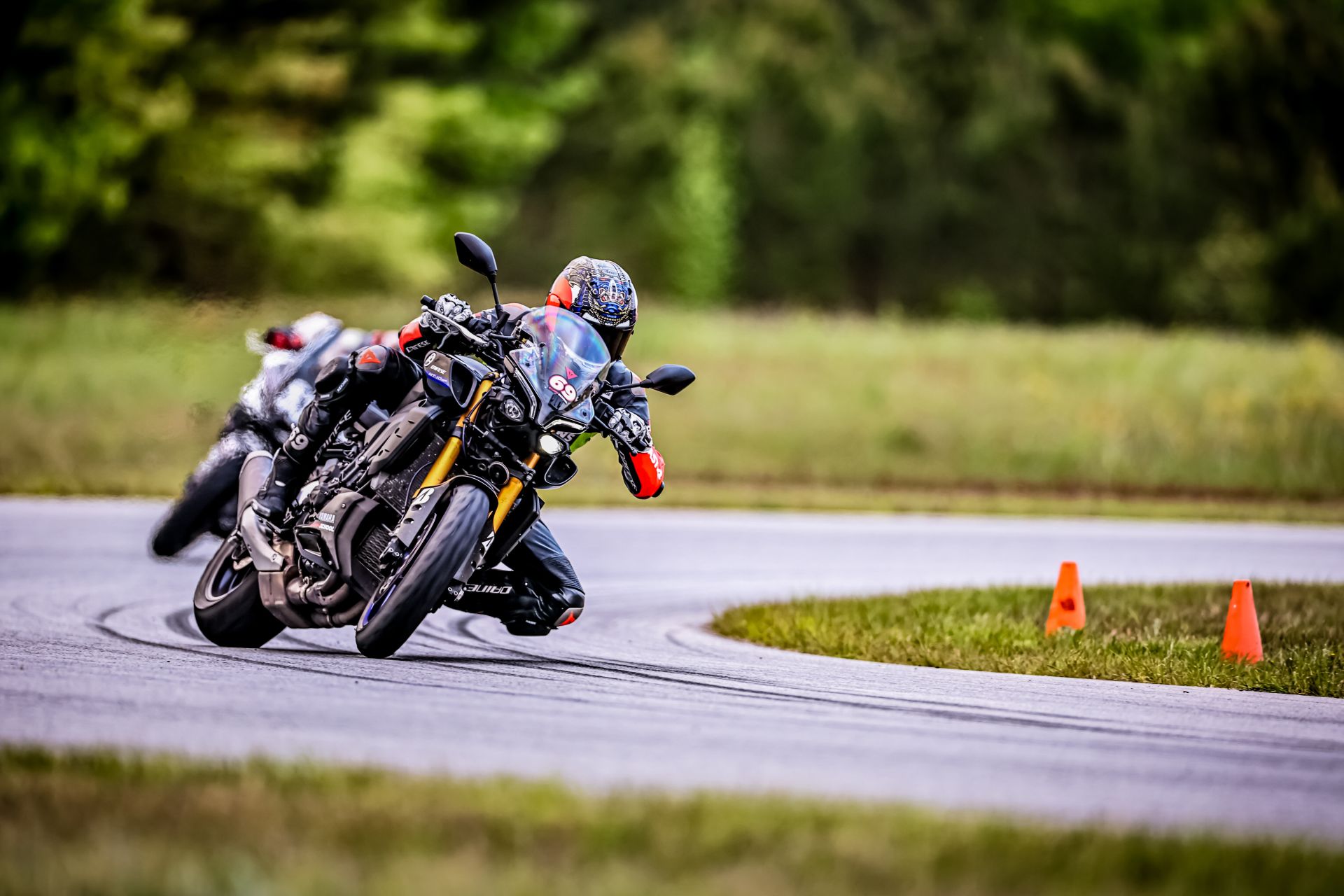
Tires are the most important component on the motorcycle after YOU. The rider.
How Motorcycle Tires Create Grip?
Motorcycle tires create grip in two ways: chemical grip and mechanical grip.
Those terms get thrown around a lot, but what do they actually mean? More importantly, what do they have to do with how we ride a motorcycle?
- Chemical Grip
Chemical grip comes from the rubber compound itself. Riders often describe tires as “soft” or “hard”, but modern tire chemistry is far more complex than that. Tire manufacturers spend enormous amounts of time and money engineering compounds that balance traction, durability, and heat management.
As riders, we actually have very little influence over chemical grip once we’re on the motorcycle. Our biggest influence happens when we buy the tire. The compound, construction, and intended temperature range are already engineered into the tire.
Where riders do influence chemical grip is through heat management.
A tire’s ability to generate grip changes dramatically depending on temperature. Many race tires work in a very narrow operating window. If they are too cold, they have very little grip. If street tires are overheated, they can degrade quickly and lose performance. We manage heat as riders by managing the contact patch of the tire and how we load the tire.
- Coefficient of Friction
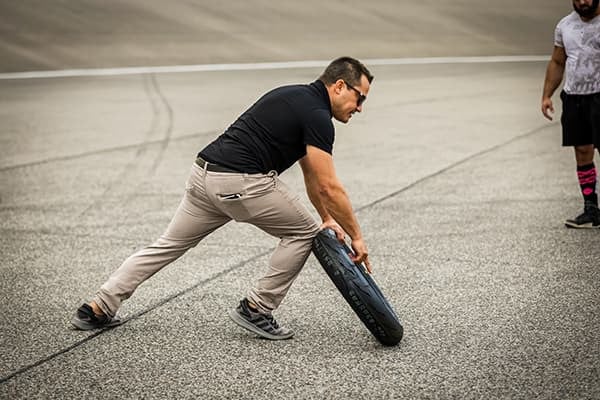
A simple way to visualize chemical grip is to imagine a block of rubber on a sheet of glass.
If the block of rubber is hard, like a hockey puck, it will slide easily across the glass. But if that same block of rubber, with the same size and weight, were soft like a pencil eraser, it would be much harder to slide.
The difference is the rubber compound. The chemical makeup of the rubber determines how much force is required to make it slide. That relationship between the surfaces is called the coefficient of friction.
So, if softer rubber creates more grip, why don’t we always use the softest compound possible?
Because we probably don’t want to buy new tires every day, or every session…or every lap.
Tire manufacturers are constantly searching for the perfect compromise between traction and durability. Modern tires use extremely advanced compounds and constructions to balance those competing goals. And once again, much of that balancing act revolves around heat management, the rider’s job.
- Mechanical Grip
Mechanical grip is something riders influence far more directly.
In the real world, we aren’t sliding a block of rubber across a sheet of glass. We are riding a very dynamic tire across a very inconsistent road surface.
Even the smoothest race track is not actually smooth. And public roads are far from perfect.
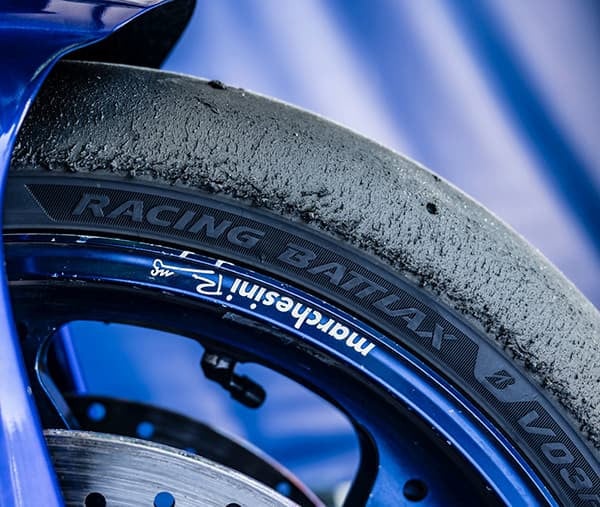
Mechanical grip comes from the tire’s ability to interlock with the surface of the road through the contact patch. The larger the contact patch, the more mechanical grip we have.
A larger contact patch also gives the tire more surface area to manage heat, which again plays a critical role in tire performance and durability.
Mechanical grip is largely influenced by the construction of the tire, tread compound, and tire pressure. Tire construction refers to how stiff the tire carcass is, how much it resists deformation, and how quickly it returns to its original shape after being loaded.
Tire pressure plays a major role in this behavior, and pressure is directly tied to temperature. As a tire heats up, its pressure increases, which changes how the carcass flexes and interacts with the pavement.
In reality, much of this setup is determined before we ever get on the motorcycle. The motorcycle manufacturer and the tire manufacturer design the chassis, suspension, and tire construction to work together within a specific pressure and temperature range.
But there is one major way riders influence mechanical grip in real time:
Tire Load – The Physics of Grip
Let’s go back to that block of rubber on the sheet of glass. Imagine sliding the hockey puck density rubber block across the glass again. Now place a 10-pound weight on top of it. Is it easier or more difficult to slide?
Much more difficult.
Nothing about the rubber changed. The coefficient of friction stayed exactly the same. But by adding load, we increased the friction force dramatically.
Friction is described by a simple physics equation:
F = μN
Where:
F = friction force
μ = coefficient of friction (chemical and mechanical grip of the tire and road surface)
N = normal force (load on the tire)
Motorcycles have the remarkable ability to transfer load violently from one tire to the other. This is known as weight pitch.
When a motorcycle is sitting still, the weight of the rider and bike may be distributed roughly 50/50 between the front and rear tires. But with the correct use of brakes and throttle, we can shift up to 100% of that load onto one tire or the other to create more grip.
When we brake, weight transfers forward.
When we accelerate, weight transfers rearward.
When we lean the motorcycle into a corner, centripetal forces add load to both tires, but with a bias to the front or rear based on where we are in the corner and how we are combining brake pressure and lean angle, neutral throttle and lean angle, or throttle and lean angle.
Used correctly, rider inputs can create more mechanical grip than the tire would generate on its own.
Load Equals Grip.
- Creating Front Tire Grip
Front tire grip is divided by two things:
Brake pressure and lean angle. We like to say that a tire has 100 points of grip all the time. Those 100 points are on a sliding scale based on conditions, but they always exist.
Brake pressure increases the normal force on the tire. Lean angle creates centripetal load as the bike turns.
The key is that if we add one, we must reduce the other. Trading braking load “points” for cornering load “points”.
If we are at 100 points of braking force and we add 20 points of lean angle force, we need to give up 20 points of braking force to maintain optimum grip.
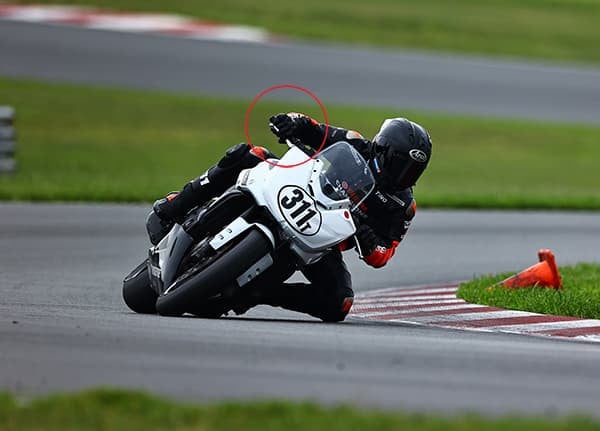
When riders release the brakes too early, the fork rebounds, the tire unloads, and the contact patch becomes very small right at the moment we are trying to countersteer to turn the motorcycle.
If the pace is high or the grip is low, this can lead to an unloaded front-end crash.
Done correctly, riders gradually trade braking force for lean angle, keeping the front tire loaded the entire time.
This technique is known as trail braking, and it allows the rider to accurately manage speed, chassis geometry, and front tire contact patch at any pace. The front brake is infinitely adjustable, giving the rider maximum control of more or less speed, load, or lean angle if required. If we are off the brakes before turn in, we are out of options, and the tire has less than ideal grip.
- Creating Rear Tire Grip
Rear tire grip is made up of two main forces at corner entry: Braking and lean angle, like the front. We are trailing off rear brake pressure as we add lean angle.
But our largest concern with rear-tire grip is under acceleration, where grip is divided by throttle and lean angle. The same 100 points of grip concept applies.
When we apply the throttle, the weight transfers rearward. The rear suspension compresses, the tire spreads out, and the contact patch grows.
This allows the tire to maintain better traction during the forward drive.
But if we are still adding lean angle while aggressively adding throttle, we are asking the tire to handle increasing throttle and lean angle points that will quickly exceed available grip.
We can get away with this if we are only using 30 points of lean angle and 30 points of throttle, but this grip is always changing and on a sliding scale. If the pace is high or the grip is low, the tire runs out of traction if we are constantly adding points rather than trading points.
- The Problem With Lean Angle
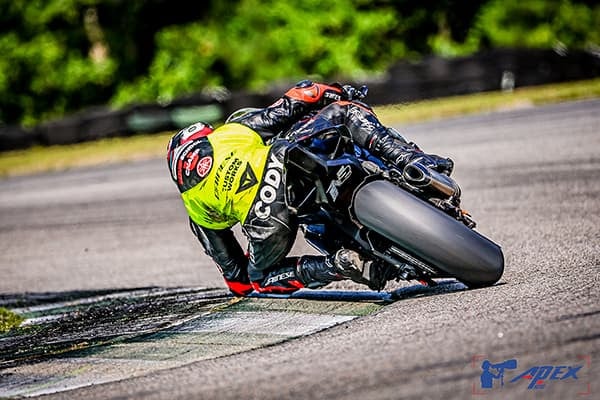
As the motorcycle leans, the tire flexes and the contact patch grows larger. That sounds like a good thing.But there is a limit.
Near the center of the tire, the rubber can flex and deform easily. Near the edge of the tire, we are pressing into the very stiff sidewall of the tire. The tire can’t deform as much, and the contact patch becomes smaller.
The smaller the contact patch and the higher the cornering load, the more heat is concentrated into a smaller area. This causes the tire to lose grip and durability. Tire grip and durability always comes back to heat management.
There’s Another Problem: Suspension.
As lean angle increases beyond roughly 45 degrees, the suspension becomes less effective. At extreme lean angles, the suspension doesn’t really work at all. Much of the bike’s capacity for handling surface irregularities comes down to tire and chassis flex, not the suspension.
That’s why, in our world, lean angle equals risk.
We must lean the motorcycle to turn, but we want to use the least amount of lean angle for the least amount of time for a given speed and corner radius. Riders who don’t get the bike pointed, or “get direction” mid-corner (see YCRS’s Radius = MPH), must spend a lot of time at maximum lean angle, or maximum risk.
- The Most Dangerous Motorcycle
The most unstable motorcycle is an unloaded motorcycle.
An unloaded motorcycle is a motorcycle with no meaningful forces being applied through the suspension into the tires. The suspension is not compressed, and the tire contact patch is very small.
This happens when riders coast into corners.
When we coast, we are not managing grip. We are not loading the tires. We are essentially passengers on the motorcycle and passengers don’t control motorcycles. If we are off the controls, we are out of control.
The riders who are faster and safer are simply doing one thing better than everyone else:
They are using the controls—brake pressure, throttle, and lean angle—to put more load into the tires to generate more mechanical grip.
– Chip Spalding
Special thanks to Keith, Andrew, and Rory at Bridgestone Motorcycle Tires, who took time out of their busy schedule to help make this article as accurate as possible.
- ChampSchool x Dainese