


Moto2 FP2


© , Roadracing World Publishing, Inc.
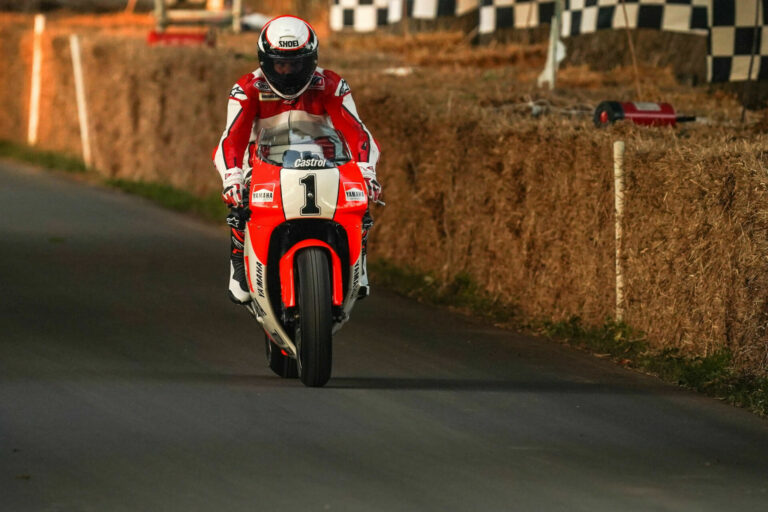
Three-time 500cc Grand Prix World Champion Wayne Rainey’s rides on his World Championship-winning 1992 Yamaha YZR500 at the Goodwood Festival of Speed in June created some memorable moments for the fans watching trackside and following along at home via social media and television coverage. The project, however, did not go off perfectly smoothly and there were some bumps along the way.

“The R1 that I rode a few years ago at Suzuka was very easy to set up for electric shift,” with hand controls,” Rainey told Roadracing World. “It had up/down buttons on the left handlebar, there was a gear indicator on the dash, I knew what speed I was going. As long as I didn’t fall down as I started, I was going to be OK. But there’s no electronics on these (old) Grand Prix bikes, and they’re not made to ride around easy. They’re made to race.
“The way they set it to upshift was by hitting the kill button on the left bar, and the way you back-shifted it was pulling in the clutch lever. All this had to happen at 8,000 rpm or less with no strain on the engine. It worked perfectly at the test track in Japan, but when we got it there it wouldn’t shift out of first gear.”

In spite of the bike shifting fine when run on a stand, neither the Yamaha test rider/technician who accompanied the bike from Japan nor Rainey could get the bike to shift while test riding it in a big parking lot. In the end, Rainey figured since the bike was geared for 80-90 mph in first gear, he would just do his rides in first gear.

“Most runs were pretty good,” said Rainey, who did eight runs in front of fans during the four-day event. “I started feeling a little more confident on it. Being stuck in first gear, the thing was always going to be difficult to ride, but it was going to be very responsive if you could ride it to a certain level. I was able to do that. Then the weather cooled down and leaned out the jetting, and I actually did some half-wheelies that weren’t really expected. So that was fun.”
Each run, however, was a big undertaking for Rainey, who was paralyzed from the chest down in a crash at Misano in 1993. Due to an unrelated shoulder injury he suffered earlier in 2022, Rainey needed assistance getting in and out of his custom Alpinestars leathers and getting on and off his motorcycle. Much of this help was provided by his son, Rex.
On the bike, Rainey’s Alpinestars boots were fastened to the footpegs using cycling clips; his legs were kept in place by special straps; and a stack of tank pads custom-made by Saddlemen not only allowed Rainey to maintain his torso’s position, they also allowed him to “feel” the bike, he said.

“It took 13 people to make a run,” stated Rainey. “I had five or six guys at the bike when I started. Then I had a driver who was driving me and my wheelchair, my leathers, and the stand to the bike in a $500,000 Rolls Royce SUV the Duke of Richmond gave us to use for the week.
“Each time I would go up the hill, my wife Shae, Rex, his wife Skylar, and the Yamaha test rider would all jump into the Rolls Royce and chase us going up the hill. So, if I had any incidents, they could be there to get me.”

As Rainey said, most runs went well, but on the last run of the weekend, the YZR500 suddenly bogged and died. Rainey knew he wouldn’t make it up the hill, and he also knew that dozens of other motorcycles were going to making a mass run up the hill behind him, as they did throughout the weekend.
“I pulled in the clutch and as I started coasting I thought, ‘This is going to be interesting,’” Rainey recalled. “I noticed there were haybales along both sides of the track. So, I decided I would stop and lean up against the haybales. But I didn’t know if the haybales were going to fall over or if I was going to bounce off them.
“I got my hand and my head out, so I was able to turn the bike to the haybales and stopped up against them. But then I started thinking, ‘What about these 60 other bikes that are about ride up the hill?’
“I was just about to put my hand up so everybody could see me when the Rolls Royce pulled up and these big ol’ eyes jumped out. It was Shae. I forgot that they had always been following us up the run every time.
“But other than that little hiccup, we had an amazing time. The Duke of Richmond really took good care of us, and the event was amazing. If you haven’t been to it, that’s the one to go to. It’s a motorsports playground.”

Celebrating four years of success: MotoE™ bids farewell to Energica
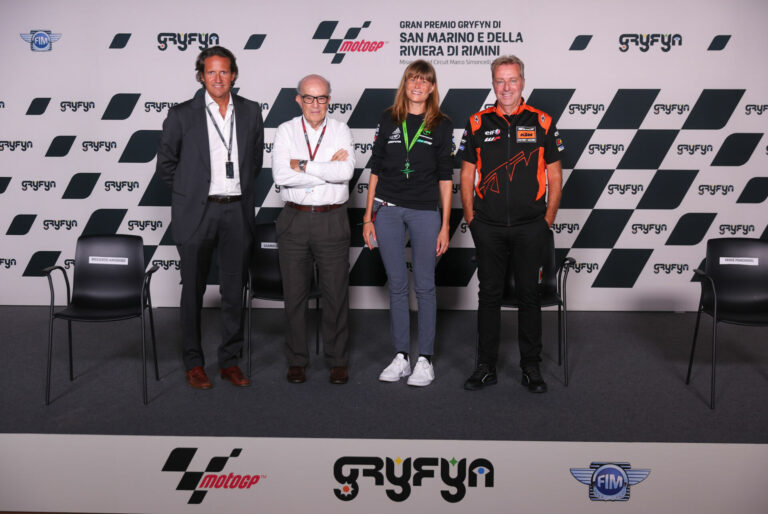
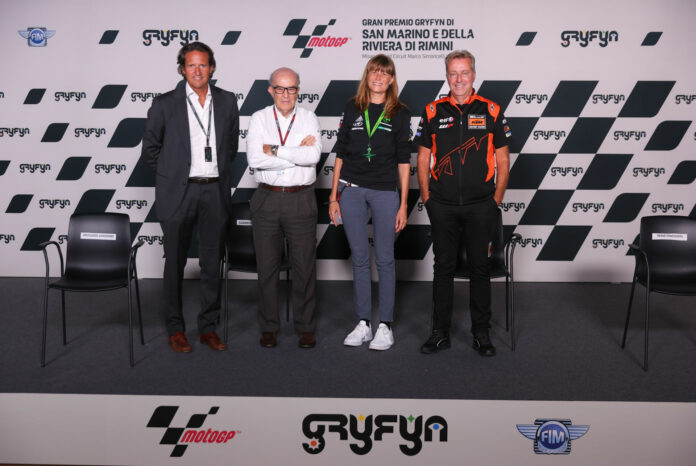
Since it began in 2019, and for the years of preparation before, the FIM Enel MotoE™ World Cup has been an incredible journey and some of the closest racing in any paddock. This season, Energica’s tenure as the sole MotoE™ manufacturer comes to an end, and a special press conference in Misano saw Dorna CEO Carmelo Ezpeleta joined by Energica CEO Livia Cevolini, Enel X Way Head of Global Marketing and Sales Riccardo Amoroso and IRTA President Herve Poncharal to talk about four seasons of genuinely electric competition.
DORNA CEO CARMELO EZPELETA
How proud are you to see MotoE™ go from idea to reality and four incredible seasons of racing?
“It feels like yesterday that we started this project, but it was a long time ago now. The first races were in 2019 but we started very early. As soon as we made contact with Energica, we realised this was something important. As I always say, Dorna is a company that makes races, and really, the goal has been achieved. In these four years, we have been making really exciting races, with fantastic performance from the bikes. They have been working very, very well, and we are extremely happy with this project. It’s something that is very important to us for the future, for different opportunities and different possibilities for technologies, and the agreement with Energica and with Enel has been crucial. We are extremely happy with these four years, and I think all together we have demonstrated that this is a very important category. Also, the system to have teams that are already working in the MotoGP™ championship has been a very good idea, and we are extremely proud of the result of these four years.”
ENERGICA CEO LIVIA CEVOLINI
What has it meant to be the sole bike supplier of this new series?
“Firstly, let me just start by thanking my Energica people. I can never thank them enough because we are here in MotoE™ thanks to them, because they engineered and produced the bikes for five years – one testing and four racing – supporting everybody – the teams, the riders, Dorna, Enel X Way – and they made miracles. So, I really have to thank them. For us, it was an incredible, important step, a strategic step for us, because it gave us the credibility that we deserve. MotoE™ for us gave visibility to the technology and to our potential to ourselves. Also, to improve our self-confidence, and to prove to the world that we were really a proper company in the motorcycling industry, and in the EV industry. So, that was really the best move that we could do.”
What do you think Energica has brought to MotoE™?
“I think that we wrote the visibility, the competition. So, with our racing bikes, we were able together, with our racing bikes, to make proper racing. We demonstrated to the world that the electric revolution was ready, was there, and was not too early, because we were able to put in place a real championship, with real racing. It was exciting, exactly like the petrol bikes, and this forced other people to watch it, forced the people to understand that it was ready, that the market was ready, and that we were ready. Also, I think that we pushed others to follow in our footsteps. That is exactly what we wanted; we wanted to grow the market, and this is exactly what we are doing here.”
What have you learnt from MotoE™?
“Of course, we learnt about the technology. We were able to test our technology in extreme conditions, but still safely. So, from a technology point of view, it was really important. It was important from a visibility point of view, to grow the brand, and it was very important for the strategic partnership that we were able to develop with Enel X Way, that supported us and helped us to develop the growth of the EV market, even outside of the race track. So, we learnt a lot, we gained a lot, and again, I think there’s a lot to be done yet, and we are very happy to be such an important part of this puzzle.”
What is the next chapter for Energica?
“We are doing so many things outside the race track. We have launched the very first green tourer for the two-wheel EV industry – opening a new market – that is called Experia, and we launched a new business unit. Being part of the family of Ideanomics, we were able to launch a new business unit that is supporting other industries and verticals to rush in the EV revolution and transition. So, there’s a lot to be done outside of the race track, but also inside the race track, so we will see. For sure, there’s a lot and we are very excited to be able to do so much more, even after this.”
ENEL X WAY HEAD OF GLOBAL MARKETING AND SALES RICCARDO AMOROSO
How has the experience been working on this project and with Energica on this technology?
“We are very happy about this whole initiative with Dorna and particularly happy with the partnership and how we have been working together with Energica. I think it’s been a very fruitful collaboration in order to develop the technological assets to make it possible to hold an e-race on two wheels. In particular, it has been very good because we have put together Energica – who very much know what it means to charge an e-bike, and so all the requirements and all that the battery can intake for charging – and us, Enel X Way, obviously knowing how to charge vehicles on the other side. Putting together these two players, we were able to find out all the right trade-offs when it comes to how much power you can give, and how much power the bike can take, managing all the heat issues that are very critical in the technicalities of the charging process. So, very happy about this collaboration that we have been putting together, allowing us to find out the best trade-off when it comes to charging technology.”
What are they biggest steps forward or discoveries from working with Energica?
“The very good thing about working with them is that we were able to find out the best optimal trade-off between power and speed for e-bikes, and we were able to understand all the needs of the owners of a bike when it comes to charging requirements. This allowed us to develop hardware – the JuiceRoll and the JuicePump 60 – specifically to charge a bike. These are devices that we can use commercially in the market, leveraging on the experience we gained in understanding what the real needs of an e-bike are. We very much look forward to further commercial collaborations with Energica on the commercial side of the business. Also, another key takeaway from us was on the management of the energy supply, in particular the renewable energy supply, in the microgrid at the race track. We were able to set up a microgrid, leveraging the 1MWh of energy storage capability in the JuiceRolls to smooth out the amount of energy we need to use from the grid. This is obviously very important in all those situations in which you need to have a charging device with a peak load, which is very difficult to manage on the grid. Instead, with this microgrid, we can smooth down the requirement and ultimately, in all sort of e-sport, it’s a very useful asset that we can sell in other situations.”
IRTA PRESIDENT HERVE PONCHARAL
How has the journey been, and what is the competition like with one bike supplier?
“First, I would like to back into the past and remember the action we have been seeing. When we first talked about the MotoE™ World Cup, a lot of people were laughing. I remember that, very quickly, it became obvious that we needed one supplier. Loris Capirossi, I think, was the one testing a few different bikes to decide which one was going to be the most accurate, the fastest, the best-handling bike, and the one with more autonomy. It was clearly the Energica that came out by far. I have to say that all the people who were doubting if you can make a proper championship with an e-bike, if you can make exciting racing with an e-bike, have understood that, yes, you can. That was also, of course, thanks a lot to Energica; the way they started to support the whole championship, the engineers that were on-track listening to all of our requests, trying to reply and to improve race-by-race. I think that this was the only way to go. I think Energica was by far the best, and the only partner at that time that could be eligible to be the MotoE™ supplier, and the results were four fantastic years of racing, it was action all the time. What I would like to say is that bike, I believe, was designed in the beginning as a proper production bike, not to go racing, but the lap times we are doing with this bike is very impressive. Sometimes we are quicker than the Moto3™ bikes, which are really proper prototype and fast bikes, so we have a great show, and we for sure have been learning a lot about e-racing, and we know how important e-racing will be in the future. I know that since yesterday in Paris, if you have an e-bike, you don’t pay for parking, and think this is clearly the way the whole world is going to move. So, we are very proud. Thanks to Energica, thanks to Enel, thanks to Carmelo to have had this idea. Because this is a little of our intimate relationship, but we were in Austria and one day I was having breakfast with Carmelo and a few other Dorna members and he said to me, ‘We have a dream.’ I said, ‘What is it, Carmelo?’ He said, ‘We will have an electric series,’ and we thought, ‘Wow.’ Great, Carmelo, for your vision; great, great, great.”
What has impressed you the most?
“I think Energica, Enel, and everybody else involved in this championship gave the possibility to showcase that you can do a proper championship with e-motorcycles. But also, what has impressed me is that Energica never failed, we always had the reliability you need, and that gave us the possibility for the men, the sportsmen, the riders to fight, and the result is down to the level of the riders, not due to a failure or a Did Not Finish due to technical reasons. So, what has really impressed me is the level of reliability that they’ve been showing, and also the consistency. When we decide the race distance, we never saw a drop on any bike, so we had fair competition, and this is what certainly has impressed me the most.”


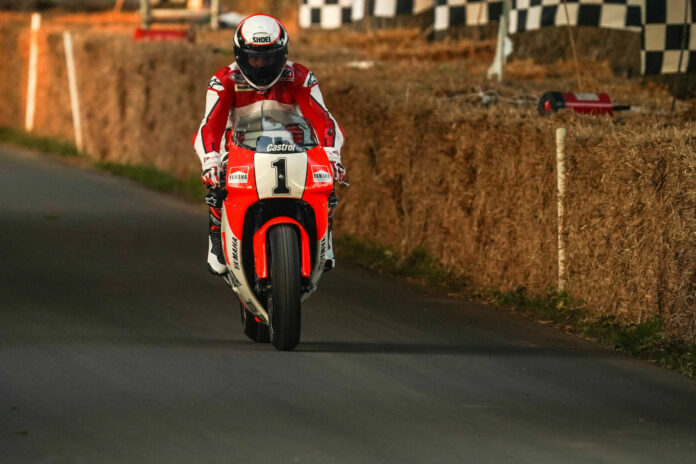
Three-time 500cc Grand Prix World Champion Wayne Rainey’s rides on his World Championship-winning 1992 Yamaha YZR500 at the Goodwood Festival of Speed in June created some memorable moments for the fans watching trackside and following along at home via social media and television coverage. The project, however, did not go off perfectly smoothly and there were some bumps along the way.
“The R1 that I rode a few years ago at Suzuka was very easy to set up for electric shift,” with hand controls,” Rainey told Roadracing World. “It had up/down buttons on the left handlebar, there was a gear indicator on the dash, I knew what speed I was going. As long as I didn’t fall down as I started, I was going to be OK. But there’s no electronics on these (old) Grand Prix bikes, and they’re not made to ride around easy. They’re made to race.
“The way they set it to upshift was by hitting the kill button on the left bar, and the way you back-shifted it was pulling in the clutch lever. All this had to happen at 8,000 rpm or less with no strain on the engine. It worked perfectly at the test track in Japan, but when we got it there it wouldn’t shift out of first gear.”
In spite of the bike shifting fine when run on a stand, neither the Yamaha test rider/technician who accompanied the bike from Japan nor Rainey could get the bike to shift while test riding it in a big parking lot. In the end, Rainey figured since the bike was geared for 80-90 mph in first gear, he would just do his rides in first gear.
“Most runs were pretty good,” said Rainey, who did eight runs in front of fans during the four-day event. “I started feeling a little more confident on it. Being stuck in first gear, the thing was always going to be difficult to ride, but it was going to be very responsive if you could ride it to a certain level. I was able to do that. Then the weather cooled down and leaned out the jetting, and I actually did some half-wheelies that weren’t really expected. So that was fun.”
Each run, however, was a big undertaking for Rainey, who was paralyzed from the chest down in a crash at Misano in 1993. Due to an unrelated shoulder injury he suffered earlier in 2022, Rainey needed assistance getting in and out of his custom Alpinestars leathers and getting on and off his motorcycle. Much of this help was provided by his son, Rex.
On the bike, Rainey’s Alpinestars boots were fastened to the footpegs using cycling clips; his legs were kept in place by special straps; and a stack of tank pads custom-made by Saddlemen not only allowed Rainey to maintain his torso’s position, they also allowed him to “feel” the bike, he said.
“It took 13 people to make a run,” stated Rainey. “I had five or six guys at the bike when I started. Then I had a driver who was driving me and my wheelchair, my leathers, and the stand to the bike in a $500,000 Rolls Royce SUV the Duke of Richmond gave us to use for the week.
“Each time I would go up the hill, my wife Shae, Rex, his wife Skylar, and the Yamaha test rider would all jump into the Rolls Royce and chase us going up the hill. So, if I had any incidents, they could be there to get me.”
As Rainey said, most runs went well, but on the last run of the weekend, the YZR500 suddenly bogged and died. Rainey knew he wouldn’t make it up the hill, and he also knew that dozens of other motorcycles were going to making a mass run up the hill behind him, as they did throughout the weekend.
“I pulled in the clutch and as I started coasting I thought, ‘This is going to be interesting,’” Rainey recalled. “I noticed there were haybales along both sides of the track. So, I decided I would stop and lean up against the haybales. But I didn’t know if the haybales were going to fall over or if I was going to bounce off them.
“I got my hand and my head out, so I was able to turn the bike to the haybales and stopped up against them. But then I started thinking, ‘What about these 60 other bikes that are about ride up the hill?’
“I was just about to put my hand up so everybody could see me when the Rolls Royce pulled up and these big ol’ eyes jumped out. It was Shae. I forgot that they had always been following us up the run every time.
“But other than that little hiccup, we had an amazing time. The Duke of Richmond really took good care of us, and the event was amazing. If you haven’t been to it, that’s the one to go to. It’s a motorsports playground.”
Celebrating four years of success: MotoE™ bids farewell to Energica
Since it began in 2019, and for the years of preparation before, the FIM Enel MotoE™ World Cup has been an incredible journey and some of the closest racing in any paddock. This season, Energica’s tenure as the sole MotoE™ manufacturer comes to an end, and a special press conference in Misano saw Dorna CEO Carmelo Ezpeleta joined by Energica CEO Livia Cevolini, Enel X Way Head of Global Marketing and Sales Riccardo Amoroso and IRTA President Herve Poncharal to talk about four seasons of genuinely electric competition.
DORNA CEO CARMELO EZPELETA
How proud are you to see MotoE™ go from idea to reality and four incredible seasons of racing?
“It feels like yesterday that we started this project, but it was a long time ago now. The first races were in 2019 but we started very early. As soon as we made contact with Energica, we realised this was something important. As I always say, Dorna is a company that makes races, and really, the goal has been achieved. In these four years, we have been making really exciting races, with fantastic performance from the bikes. They have been working very, very well, and we are extremely happy with this project. It’s something that is very important to us for the future, for different opportunities and different possibilities for technologies, and the agreement with Energica and with Enel has been crucial. We are extremely happy with these four years, and I think all together we have demonstrated that this is a very important category. Also, the system to have teams that are already working in the MotoGP™ championship has been a very good idea, and we are extremely proud of the result of these four years.”
ENERGICA CEO LIVIA CEVOLINI
What has it meant to be the sole bike supplier of this new series?
“Firstly, let me just start by thanking my Energica people. I can never thank them enough because we are here in MotoE™ thanks to them, because they engineered and produced the bikes for five years – one testing and four racing – supporting everybody – the teams, the riders, Dorna, Enel X Way – and they made miracles. So, I really have to thank them. For us, it was an incredible, important step, a strategic step for us, because it gave us the credibility that we deserve. MotoE™ for us gave visibility to the technology and to our potential to ourselves. Also, to improve our self-confidence, and to prove to the world that we were really a proper company in the motorcycling industry, and in the EV industry. So, that was really the best move that we could do.”
What do you think Energica has brought to MotoE™?
“I think that we wrote the visibility, the competition. So, with our racing bikes, we were able together, with our racing bikes, to make proper racing. We demonstrated to the world that the electric revolution was ready, was there, and was not too early, because we were able to put in place a real championship, with real racing. It was exciting, exactly like the petrol bikes, and this forced other people to watch it, forced the people to understand that it was ready, that the market was ready, and that we were ready. Also, I think that we pushed others to follow in our footsteps. That is exactly what we wanted; we wanted to grow the market, and this is exactly what we are doing here.”
What have you learnt from MotoE™?
“Of course, we learnt about the technology. We were able to test our technology in extreme conditions, but still safely. So, from a technology point of view, it was really important. It was important from a visibility point of view, to grow the brand, and it was very important for the strategic partnership that we were able to develop with Enel X Way, that supported us and helped us to develop the growth of the EV market, even outside of the race track. So, we learnt a lot, we gained a lot, and again, I think there’s a lot to be done yet, and we are very happy to be such an important part of this puzzle.”
What is the next chapter for Energica?
“We are doing so many things outside the race track. We have launched the very first green tourer for the two-wheel EV industry – opening a new market – that is called Experia, and we launched a new business unit. Being part of the family of Ideanomics, we were able to launch a new business unit that is supporting other industries and verticals to rush in the EV revolution and transition. So, there’s a lot to be done outside of the race track, but also inside the race track, so we will see. For sure, there’s a lot and we are very excited to be able to do so much more, even after this.”
ENEL X WAY HEAD OF GLOBAL MARKETING AND SALES RICCARDO AMOROSO
How has the experience been working on this project and with Energica on this technology?
“We are very happy about this whole initiative with Dorna and particularly happy with the partnership and how we have been working together with Energica. I think it’s been a very fruitful collaboration in order to develop the technological assets to make it possible to hold an e-race on two wheels. In particular, it has been very good because we have put together Energica – who very much know what it means to charge an e-bike, and so all the requirements and all that the battery can intake for charging – and us, Enel X Way, obviously knowing how to charge vehicles on the other side. Putting together these two players, we were able to find out all the right trade-offs when it comes to how much power you can give, and how much power the bike can take, managing all the heat issues that are very critical in the technicalities of the charging process. So, very happy about this collaboration that we have been putting together, allowing us to find out the best trade-off when it comes to charging technology.”
What are they biggest steps forward or discoveries from working with Energica?
“The very good thing about working with them is that we were able to find out the best optimal trade-off between power and speed for e-bikes, and we were able to understand all the needs of the owners of a bike when it comes to charging requirements. This allowed us to develop hardware – the JuiceRoll and the JuicePump 60 – specifically to charge a bike. These are devices that we can use commercially in the market, leveraging on the experience we gained in understanding what the real needs of an e-bike are. We very much look forward to further commercial collaborations with Energica on the commercial side of the business. Also, another key takeaway from us was on the management of the energy supply, in particular the renewable energy supply, in the microgrid at the race track. We were able to set up a microgrid, leveraging the 1MWh of energy storage capability in the JuiceRolls to smooth out the amount of energy we need to use from the grid. This is obviously very important in all those situations in which you need to have a charging device with a peak load, which is very difficult to manage on the grid. Instead, with this microgrid, we can smooth down the requirement and ultimately, in all sort of e-sport, it’s a very useful asset that we can sell in other situations.”
IRTA PRESIDENT HERVE PONCHARAL
How has the journey been, and what is the competition like with one bike supplier?
“First, I would like to back into the past and remember the action we have been seeing. When we first talked about the MotoE™ World Cup, a lot of people were laughing. I remember that, very quickly, it became obvious that we needed one supplier. Loris Capirossi, I think, was the one testing a few different bikes to decide which one was going to be the most accurate, the fastest, the best-handling bike, and the one with more autonomy. It was clearly the Energica that came out by far. I have to say that all the people who were doubting if you can make a proper championship with an e-bike, if you can make exciting racing with an e-bike, have understood that, yes, you can. That was also, of course, thanks a lot to Energica; the way they started to support the whole championship, the engineers that were on-track listening to all of our requests, trying to reply and to improve race-by-race. I think that this was the only way to go. I think Energica was by far the best, and the only partner at that time that could be eligible to be the MotoE™ supplier, and the results were four fantastic years of racing, it was action all the time. What I would like to say is that bike, I believe, was designed in the beginning as a proper production bike, not to go racing, but the lap times we are doing with this bike is very impressive. Sometimes we are quicker than the Moto3™ bikes, which are really proper prototype and fast bikes, so we have a great show, and we for sure have been learning a lot about e-racing, and we know how important e-racing will be in the future. I know that since yesterday in Paris, if you have an e-bike, you don’t pay for parking, and think this is clearly the way the whole world is going to move. So, we are very proud. Thanks to Energica, thanks to Enel, thanks to Carmelo to have had this idea. Because this is a little of our intimate relationship, but we were in Austria and one day I was having breakfast with Carmelo and a few other Dorna members and he said to me, ‘We have a dream.’ I said, ‘What is it, Carmelo?’ He said, ‘We will have an electric series,’ and we thought, ‘Wow.’ Great, Carmelo, for your vision; great, great, great.”
What has impressed you the most?
“I think Energica, Enel, and everybody else involved in this championship gave the possibility to showcase that you can do a proper championship with e-motorcycles. But also, what has impressed me is that Energica never failed, we always had the reliability you need, and that gave us the possibility for the men, the sportsmen, the riders to fight, and the result is down to the level of the riders, not due to a failure or a Did Not Finish due to technical reasons. So, what has really impressed me is the level of reliability that they’ve been showing, and also the consistency. When we decide the race distance, we never saw a drop on any bike, so we had fair competition, and this is what certainly has impressed me the most.”