Michael Gilbert Racing Returns to MotoAmerica Supersport in 2023
Michael Gilbert is set to return to MotoAmerica Supersport in 2023 aboard a Next Generation-spec Team Hammer-prepared Suzuki GSX-R750.
The step to Supersport follows a successful, several-year run in Stock 1000 and Superbike with numerous victories and podiums, and is a fresh start and opportunity to compete at the front of a premier MotoAmerica class after a tough year of injuries. The team’s infrastructure has also been rejuvenated and expanded, including the addition of paddock-veteran Poncho Rangel as Gilbert’s crew chief for 2023.
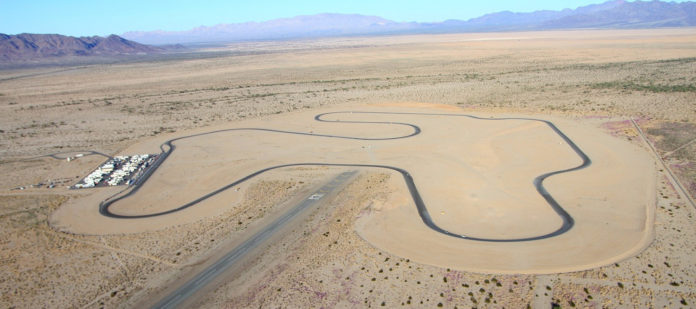
“Coming back to Supersport is like hitting the reset button,” says Gilbert. “There’s zero question that 2022 was the most difficult season of my career in more ways than one—namely two broken legs. That said, I couldn’t be more excited to get the season going! I’m feeling healthier and stronger by the day, and I’m extremely confident in the team we’ve assembled. Having already tested a Suzuki GSX-R750 at Chuckwalla Valley Raceway, I have a great feeling about the upcoming season and the bike’s potential.”
Owen Williams will also transition to Supersport as teammate to Gilbert following two years in Junior Cup. It will be a steep learning curve, but the 15-year-old Californian is excited for the challenge and guidance from Gilbert.
“I’m so proud to be back with the team again for the 2023 season and even more so to be alongside Mikey in the Supersport class,” says Williams. “There’s so much to learn on the Suzuki GSX-R750, but I know that the team will give me the best opportunity to prove myself.”
#SprintingInto2023: new MotoGP™ time schedule revealed!
It’s the start of a new era and the time schedule for the Grand Prix classes can now be confirmed as MotoGP™ sprints into 2023
Wednesday, 01 February 2023
New year, new MotoGP™! The season ahead is going to be the biggest yet, with more Grands Prix in more countries reaching more fans than ever before. And that’s not all, as the MotoGP™ Sprint prepares to debut across the calendar and inject even more adrenaline into Saturday’s track action.
Here’s the rundown:
FRIDAY
Friday will remain practice day and will include two sessions for MotoGP™. The first is at 10:45 and lasts 45 minutes, and the second has been extended to 60 minutes. That starts at 15:00, with the combined times from P1 and P2 determining direct entrants to Q1 and Q2 qualifying for MotoGP™. They’re no longer called Free – because they aren’t!
Moto2™ has two 40-minute sessions on Friday, and Moto3™ two 35-minute sessions. Both count towards the combined timings, but for the lower classes Saturday morning’s P3 is also taken into account.
SATURDAY
Saturday is now an absolute blockbuster. MotoGP™ has a 30-minute free practice session, similar to the previous FP4, and then it’s time to qualify as Q1 starts at 10:50 before Q2 finalises the rest of the grid at 11:15. Once that’s concluded, our new post-qualifying show will take riders to a new stage for some live interviews in front of the fans. Then, it’s time to sprint!
The MotoGP™ Sprint will have its own identity. After a condensed 15-minute grid, the new event gets underway at 15:00 every Saturday and the podium will take place at a different location – changeable depending on the Grand Prix – to take the celebrations closer to the fans. Thereafter, a Sprint press conference will take place at 16:15, where we’ll be able to hear from the top three in the Sprint Race, the polesitter and the Championship leader.
Before the Sprint, Moto2™ and Moto3™, will each have a 30-minute P3 session on Saturday morning, with the combined times from P1-P2-P3 determining their direct entrants to Q1 and Q2. Moto3™ qualify first from 12:50, before Moto2™ from 13:45.
SUNDAY
There are no Warm Up sessions for Moto2™ and Moto3™, so the MotoGP™ class opens and closes the show on Grand Prix race day. 9:45 sees a 10-minute Warm Up session get action underway, before a MotoGP™ rider fan parade at 10am lets the packed stands see their heroes ahead of lights out. The riders will head around the track and make a couple of pitstops before landing back at the Hero Walk for more face-to-face fan time.
Racing begins at 11:00 for Moto3™ before the Moto2™ race at the slightly earlier time of 12:15.
The MotoGP™ Grand Prix race begins at 14:00, with the traditional Grand Prix podium set for 15:00. The structure of Moto3™ – Moto2™ – MotoGP™ is to be maintained throughout the season, and the MotoGP™ Grand Prix race will always be the final track action on Sunday. At many events the fans will be given the chance to flood to the podium and get to the heart of the celebrations.
Sound good? Download the 2023 schedule for the MotoGP™, Moto2™ and Moto3™ classes below!
Kawasaki Ninja H2® models are a testament to Kawasaki’s pursuit of innovation, performance, and passion for creating the world’s most advanced line of supercharged motorcycles. For 2023, the Ninja H2® SX SE motorcycle returns to Kawasaki’s hypersport lineup, blending performance and ultimate real-world handling with Kawasaki’s most advanced suite of rider assist technologies to date.
The Kawasaki Ninja H2 SX SE brings the latest in electronically controlled suspension, braking, and rider aid technologies to the supercharged hyperbike platform, making it the ultimate sport touring package. New for 2023 is the addition of Auto Hi-Beam (AHB), which automatically turns the high beam lights on and off as necessary depending on brightness ahead. The Ninja H2 SX SE is powered by an exhilarating, balanced supercharged 998cc inline four-cylinder engine, which utilizes Kawasaki’s knowledge of precision engine tuning to distribute power to where it is most useful, in the low to mid-range for both long distance touring and daily riding. With this powerful engine at its core, Kawasaki has created one of the most advanced and well-balanced motorcycles in performance, comfort, and efficiency, to expand your supercharged journey.
Developed with the ability to go above and beyond the daily applications of today’s sportbike rider, the Ninja H2 SX SE is Kawasaki’s most advanced sport tourer ever and utilizes a balanced supercharged engine that offers optimal output performance in the low to mid RPM range, all while achieving excellent fuel efficiency. This highly refined package offers an unrivaled level of performance and comfort, with agile handling akin to its superbike counterparts.
Kawasaki Intelligent Proximity Activation Start System (KIPASS)
AUTO HI-BEAM (AHS)
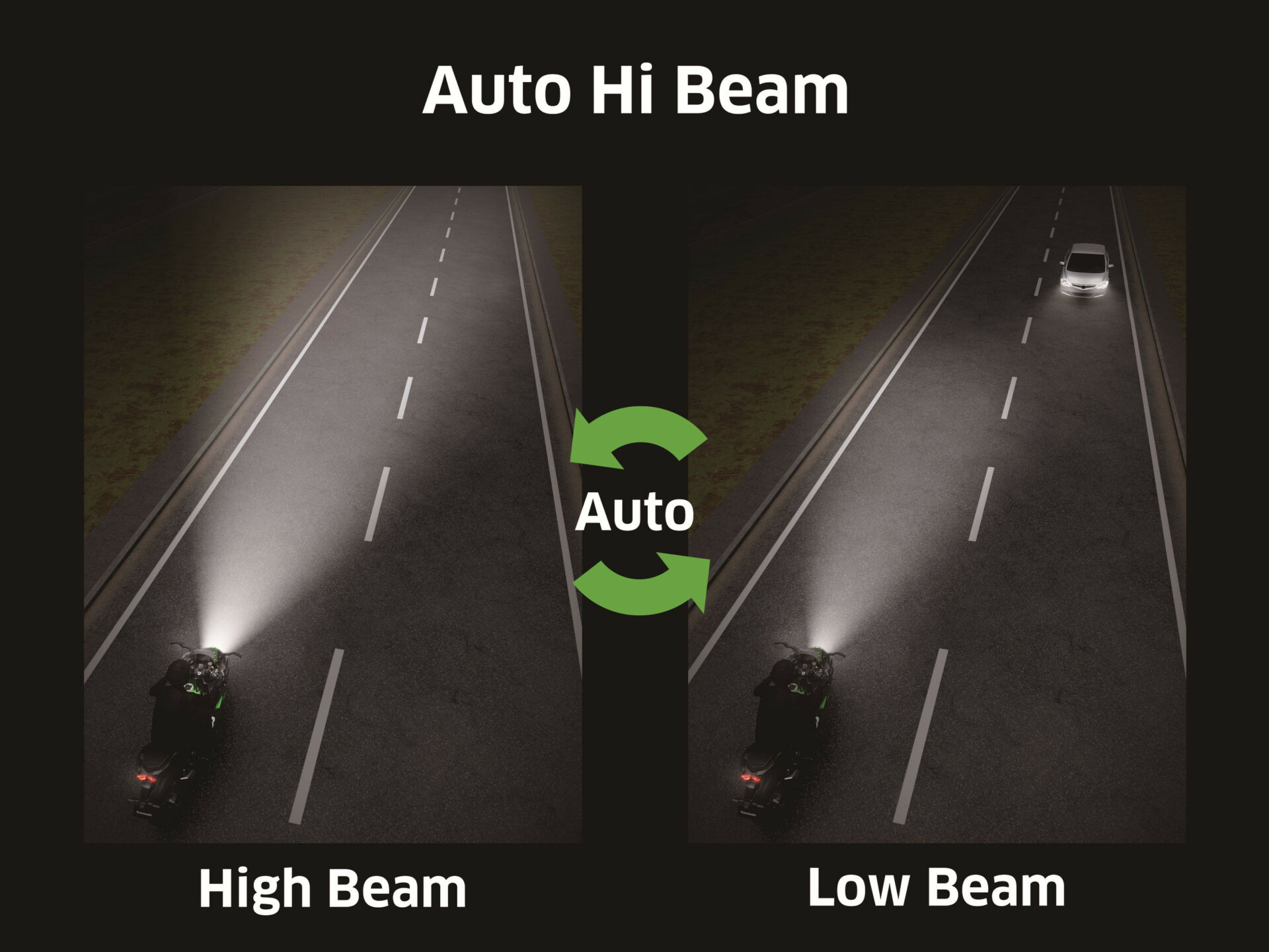
New for 2023, the Ninja H2® SX SE now has an AHB feature that utilizes a camera sensor to assess brightness of the lights of vehicles ahead, streetlights, and more. AHB automatically turns the bike’s high beams on or off as necessary based on brightness. For this feature to function, the dimmer/passing switch must be set to high beam, the bike must be traveling above 12.4mph, and it must be dark. Once the system has been engaged, the icon will be displayed in green on the instrument screen.
An illustration of the Auto Hi-Beam system on the 2023 Kawasaki Ninja H2 SX SE. Photo courtesy Kawasaki.
ENGINE & CLUTCH
A balanced supercharged 998cc inline four-cylinder engine is designed to deliver both power and fuel efficiency on the 2023 Ninja H2® SX SE, focusing on low-mid range power delivery with exhilarating acceleration that prioritizes everyday usability in street-riding conditions. Cam timing contributes to the overall engine performance, while the resin silencer added to the secondary air inlet reduces mechanical (intake) noise and the straight-pipe style layout delivers excellent torque to benefit everyday ride ability.
A dog-ring transmission complements the powerful engine and facilitates smooth, quick shifting. A hydraulic assist and slipper clutch offers light lever operation and the volume of the hydraulic fluid routed to the clutch plates delivers a smooth clutch release. As a result, the shift load due to the plates dragging can be minimized, which is noticeable when stopped, and it’s easier to shift into neutral.
TFT COLOR INSTRUMENTATION WITH SMARTPHONE INTEGRATION (SPIN)
A large, easy-to-read 6.5” full-color TFT instrumentation screen adds a high-tech appearance to the cockpit. The TFT instrumentation is complemented by multiple display modes (black, white or automatic) and smartphone connectivity as well as compatibility with Kawasaki Smartphone Integration (SPIN) to offer riders a wide range of information. The home screen display is divided into three areas, upper, middle, and lower. Display functions in the upper area include integrated riding mode, gear position indicator, distance setting indicator, ACC indicator, tachometer, Kawasaki Quick Shift (KQS) indicator, Kawasaki Engine Brake Control (KEBC) indicator, and a multifunction gauge that visually shows the boost pressure plus the rider’s choice of throttle application, front brake pressure or G-force. The middle area display functions include a large digital speedometer, cornering light indicator, service indicator, Vehicle Hold Assist (VHA) indicator, and economical riding indicator. In the lower area, a multifunction display allows riders to scroll through functions such as odometer, dual trip meters, bank angle display and bank angle recording function, tire pressure, boost pressure, boost temperature, current and average fuel consumption, remaining range, average speed, total time, and battery voltage. Additional display functions that can also be accessed include fuel gauge, Kawasaki Electronically Controlled Suspension (KECS) preload mode, outside temperature, ice warning, connected device indicator, and clock and coolant temperature.
Kawasaki’s smartphone-based infotainment app (SPIN) enables various third party applications to be downloaded and mirrored on the cockpits TFT display. Basic functions available in the app include telephone, map display, music, calendar, and contacts. Additionally, riders can opt to download third party apps to add to their Kawasaki SPIN library to be able to interact with them on the TFT display. Available apps include Sygic (navigation), SENA (headset communication), and more.
Using Kawasaki SPIN provides riders access to several great functions, including:
Vehicle Info: information such as fuel gauge, odometer, maintenance schedule, which can all be viewed via the smartphone
Riding Log: GPS route information as well as vehicle running information can be logged and viewed via the smartphone
Telephone Notices: when a call or mail is received by the smartphone, this is indicated on the instrument display
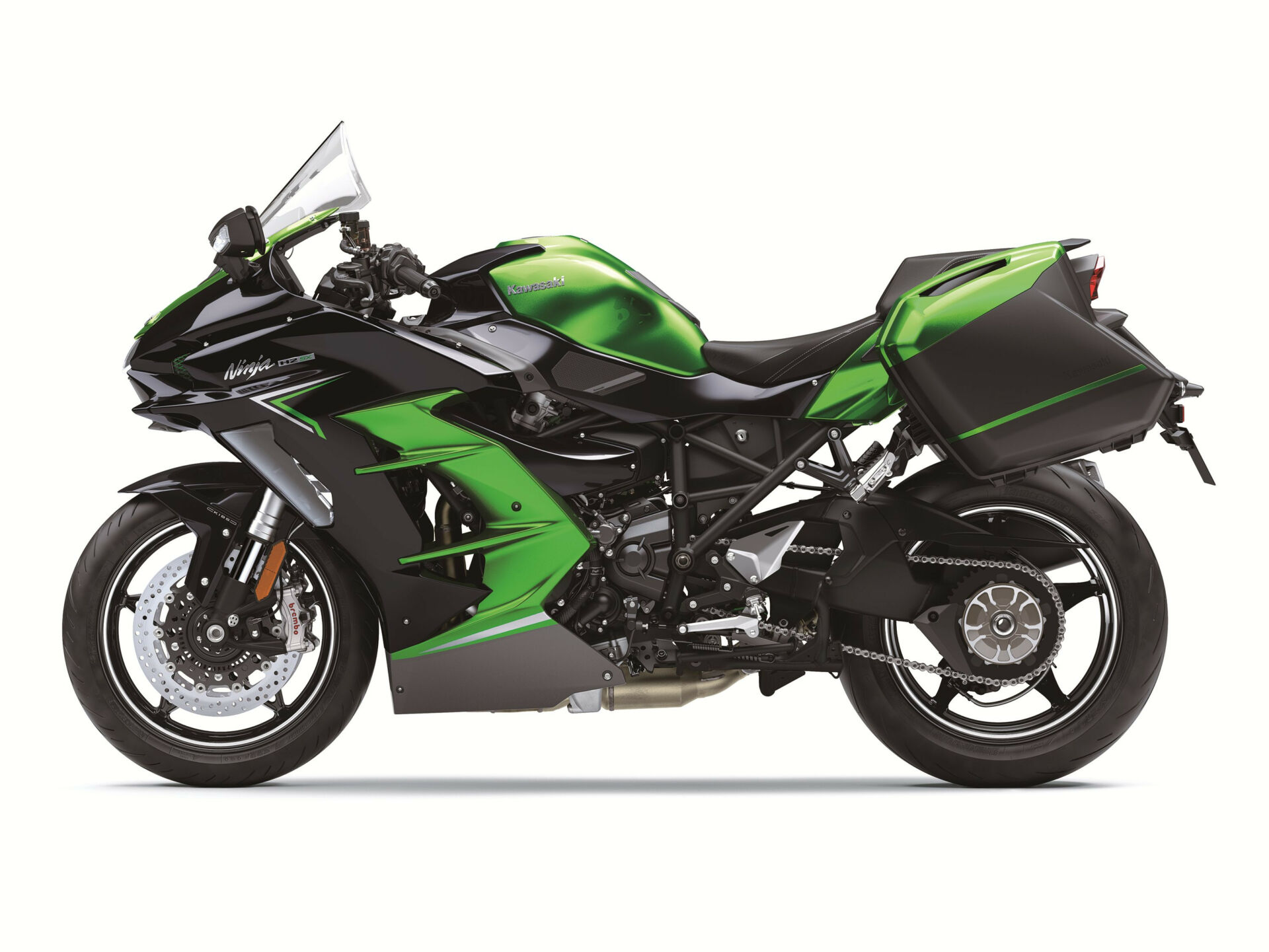
The left profile view of a the 2023 Kawasaki Ninja H2 SX SE. Photo courtesy Kawasaki.
ADVANCED RIDER ASSIST SYSTEM (ARAS)
The Ninja H2® SX SE motorcycle continues to boast the latest cutting-edge technology, which includes the Advanced Rider Assist System (ARAS) that features surround-sensing functions based on radar sensors that generates a more relaxed riding experience. Oftentimes, riding in heavy traffic and maintaining the correct distance to the vehicle in front takes a great deal of concentration and can become strenuous over longer periods. Adaptive Cruise Control (ACC) maintains the speed set by the rider but adjusts the vehicle speed to maintain a suitable following distance from the vehicle in front. When the system is operating, a signal is shown on the instrument panel, including the symbol showing green when following a vehicle ahead and grey when there is no vehicle ahead. Once operational speed gets to a certain point, which varies in each gear, the system will disengage, and the rider will need to operate the brakes manually. Pressing the cruise control button on the left side of the handlebar turns the system off. Operating the brakes or engaging the clutch for several seconds causes ACC to be temporarily disengaged and closing the throttle completely will also disengage the system. Accelerating (throttle override) or shifting gears (as long as the new gear’s minimum operation speed is met) does not disengage the system unless the maximum speed allowed is reached.
Bosch’s development of Forward Collision Warning (FCW) was designed to reduce the risk of a rear-end collision or to mitigate its consequences through front-facing radar sensor monitors. The system is active as soon as the vehicle starts, and it supports the rider in all relevant speed ranges. If the system detects that another vehicle is in too close of range, and the rider does not react to the situation, it warns the rider with a bright flashing red LED light above the instrument panel and a warning is also shown on the TFT display. Riders can set the alert timing according to preference with options including early, medium or late. FCW can also be turned off, which will be indicated on the TFT display.
The Blind Spot Detection (BSD) function helps keep a lookout in all directions to assist motorcyclists with lane changes. A rear-facing radar sensor serves as the blind spot detection’s eye, registering objects in hard-to-see areas on both the left- and right-hand sides. When an approaching vehicle is detected, an LED built into the rearview mirror will illuminate, a first on a Kawasaki motorcycle. If a rider indicates the intent to change lanes by switching on the turn signal while a vehicle is detected in the blind spot, the mirror LED will flash. BSD can be turned off and will be indicated on the TFT display when doing so.
TIRE PRESSURE MONITORING SYSTEM (TPMS)
The Tire Pressure Monitoring System (TPMS) allows tire air pressure to continuously be monitored while riding, adding reassurance for the rider on long rides. Tire pressure sensors are used to alert the rider when tire pressure falls below 31.9 PSI through a low-pressure warning that is displayed on the TFT meter.
VEHICLE HOLD ASSIST (VHA)
Activated when the rider has stopped and firmly applies the brake(s), Vehicle Hold Assist (VHA) engages the rear brake to allow the rider to relax the hand brake. The ABS pump exerts pressure to engage the rear brake, and a light/signal is indicated on the TFT meter to let the rider know the brake hand can be relaxed and the bike will remain in place. The system disengages automatically when the rider turns the throttle to accelerate, when the side stand goes down, or 10-minutes after activation. The rider can also disengage the system by quickly squeezing and releasing the brake lever (within 1 second).
KAWASAKI INTELLIGENT PROXIMITY ACTIVATION START SYSTEM (KIPASS)
The Kawasaki Intelligent Proximity Activation Start System (KIPASS) master key system allows remote activation of the main switch and steering lock of the Ninja H2 SX SE motorcycle. The system offers increased convenience while acting as a deterrent to theft and vandalism. With the compact key fob in a pocket, the KIPASS sends out a signal that is picked up and recognized by the ECU. For added security, an immobilizer function is incorporated into the ignition system. As a flagship model, the key fob of the Ninja H2 SX SE is adorned with the Kawasaki River Mark.
BOSCH 10.3ME ABS IMU
The Ninja H2® SX SE is Kawasaki’s first model to integrate an FI-ECU with torque-demand capabilities and the new IMU measures in six degrees of freedom (DOF) with a compact, boost circuit-equipped ABS with high computational power. IMU enables inertia along 6 DOF to be monitored. With the new unit, acceleration along longitudinal transverse and vertical axes, plus roll rate, pitch rate and yaw rate are all measured. Feedback from the IMU is used to give clearer real-time picture of chassis orientation. With more sophisticated torque-demand capabilities, the FI-ECU is able to adjust torque in response to external direction, which enables it to work in concert with the ABS. This coordinated control of both the engine and brakes is essential for delivering smooth operation in systems like the new ACC. A boost circuit capable of increasing fluid pressure at the brake calipers enables the brakes to be activated independent of direct rider input, which is required for the new ACC and VHA systems.
The Ninja H2® SX SE features KECS with Skyhook technology which helps support the motorcycle’s sprung weight and modulates the suspension damping force to allow the wheels to track road dips and bumps while maintaining the motorcycle’s vertical position with minimal disturbance. The updated software incorporates Showa’s Skyhook EERA (Electronically Equipped Ride Adjustment) technology to deliver an even more composed ride. Showa’s Skyhook software, carefully fine-tuned by Kawasaki engineers to ensure the sporty riding character of the Ninja H2 SX SE was preserved, delivers a smooth ride as it continually adapts to the road surface in real time. Combining high-level mechanical components with the latest electronic control technology, KECS offers both the suppleness to offer riding comfort in a wide range of riding situations, as well as the firm damping to facilitate sport riding. Handling the suspension duties is a sporty 43mm inverted Showa cartridge fork and a high-spec Showa Balance Free Rear Cushion (BFRC) lite rear shock – similar to the rear suspension used on the Ninja® ZX™-10R sportbike, except it also features electronically adjustable preload.
In the BFRC lite shock, damping force is generated in an external Damping Force Chamber, and compression and rebound damping are generated independently, allowing the whole surface of the main piston to act as a pump, pushing oil towards the valves. This configuration also helps to suppress pressure balance fluctuations as a result of shock compression and extension.
Compression and rebound damping for both the forks and shock are generated (and adjusted) electronically via the KECS system that is controlled by a solenoid valve with direct actuation and allows for extremely quick reaction time. Riders can choose from four modes: Sport, Road, Rain, and Manual. KECS then adjusts to the road surface environment in real time to provide the ideal damping, considering vehicle speed, stroke speed and deceleration. Riders can electronically control the rear shock preload settings as well. KECS offers three different preload settings: rider only, rider with luggage, and rider with passenger and luggage. Riders can fine-tune these settings with 10 levels of adjustment for each.
The forks and shock have built-in stroke sensors that provide real-time stroke speed and compression information. The sensor coils provide input to the KECS ECU every millisecond. This is complemented by information provided by the IMU (acceleration/deceleration) every 10 milliseconds and the FI ECU (vehicle speed) every 10 milliseconds. The KECS ECU then directs current to the solenoids to adjust damping as required by the situation.
STYLING
Sleek lines give the Ninja H2® SX SE a sharp, compact look, while maintaining its aggressive and seductive Ninja® image. The front face design points to its supercharged roots and instantly communicates that it’s more than the ordinary sport touring machine. The upper cowl features angular lines and a slim, compact impression even with the addition of the radar sensor, which is positioned below the headlight. The radar sensor sits behind a cover, specially designed to not interfere with the radar function. The Kawasaki River Mark emblem is proudly displayed on the upper cowl – a true reflection of the high-level performance, comfort, and quality that the Ninja H2 SX SE offers. Full fairing bodywork adds to the bike’s sporty image and helps to reduce heat that can be felt by the rider.
In order to match the upper cowl, simple surfaces have been added to the side cowl and contribute to the styling. The upper cowl is compact to accommodate the front radar sensor, and a LED headlight is positioned at the front of the upper cowl, contributing to the intense design. It features integrated position lamps that are crystal-like in appearance, adding a high-class touch. LED cornering lights are built into each side of the fairing in sets of three to help illuminate the road when cornering. Aerodynamically shaped mirrors offer a clear view of the rear, even when the Kawasaki Genuine Accessories 28L hard saddlebag set is fitted, and feature single-bulb LED-type turn signals. Rear-facing radar is built into the rear fender, and like the front radar, is cleverly hidden by a specially designed cover. LED turn signals contribute to the bike’s high-quality image and a handcrafted two-color “Supercharged” emblem is fitted to communicate the flagship status of the Ninja H2 SX SE.
ERGONOMICS
An ergonomically designed front seat provides comfort for spending long hours in the saddle as well as accommodates position changes for sportier riding. Both rider and passenger seats add to rider and passenger comfort. The wide rear seat features a flat surface at the front to help keep the passenger from sliding forward under braking. Under the rear seat, a USB-type power outlet offers a convenient source for powering accessories or personal items. The riding position of the Ninja H2® SX SE offers a relaxed bend that is comfortable for in-town riding and long touring and features grip heaters to add to the comfort on cold days. The grip heater wiring is routed inside of the handlebar for a clean design.
BRAKES & WHEELS
The Ninja H2® SX SE comes equipped with high-grade Brembo Stylema front calipers. The design of key sections allows stiffness to be maintained while enabling a direct connection to the piston area. The Stylema calipers quickly cool thanks to optimal airflow around the brake pads, space around the pistons, and an opening that allows air to exit from the central bridge. The dual radial mount opposed 4-piston Stylema front calipers grip a pair of semi-floating 320 mm discs, which complement the technical innovation and premium quality of the Ninja H2 SX SE. Bridgestone Battlax Hypersport S22 tires provide a good balance of sport and touring performance.
INTEGRATED RIDING MODES
All-inclusive modes that link KTRC, Power Mode and KECS allow riders to efficiently set traction control, power delivery, and suspension characteristics to suit a given riding situation. Riders can choose from four settings: Sport, Road, Rain or a Manual setting. In the manual rider mode, each of the systems can be set independently. The Sport setting enables riders to enjoy sporty handling riding. The Road setting provides comfortable riding characteristics over a wide range of situations, from city riding to highway cruising and rural roads. The Rain setting offers rider reassurance when riding on a low traction surface.
HIGHLY DURABLE PAINT
Kawasaki’s Highly Durable Paint features a special top coat that allows certain types of scratches to repair themselves, enabling the paint to maintain its high quality finish through normal wear and tear†. The self-healing is achieved through microscopic soft and hard segments within the top coat working like a chemical spring, creating a trampoline effect that absorbs many impacts.
† Notes:
1. Recovery can take a week or longer.
2. The paint will not recover in the case of scratches caused by a coin or key, or zip fasteners.
KAWASAKI GENUINE ACCESSORIES
For 2023, a variety of Kawasaki Genuine Accessories (KGA) are available for the Ninja H2® SX SE, including a high front seat, low front seat, color matched seat cowl, oil cap, helmet lock, and clear windshield that is 55mm lower. Additional accessories include frame sliders, a 28L hard saddlebag set, bag fitting kit, color panel kit, trim set, and one key system.
Ninja H2 SX SE
Color: Emerald Blazed Green / Metallic Diablo Black / Metallic Graphite Gray
MSRP: $28,000
Availability: Available Now
ABOUT KAWASAKI
Kawasaki started full-scale production of motorcycles over a half century ago. The first Kawasaki motorcycle engine was designed based on technical know-how garnered from the development and production of aircraft engines, and Kawasaki’s entry into the motorcycle industry was driven by the company’s constant effort to develop new technologies. Numerous new Kawasaki models introduced over the years have helped shape the market, and in the process have created enduring legends based on their unique engineering, power, design and riding pleasure. In the future, Kawasaki Motors, Ltd. is committed to maintaining and furthering these strengths which will surely give birth to new legends.
Kawasaki Motors Corp., U.S.A. markets and distributes Kawasaki motorcycles, ATVs, side x sides, and JET SKI® watercraft through a network of approximately 1,100 independent retailers, with close to an additional 7,700 retailers specializing in general purpose engines. Kawasaki and its affiliates employ nearly 3,100 people in the United States, with approximately 260 of them located at Kawasaki’s Foothill Ranch, California headquarters.
Kawasaki’s tagline, “Let the good times roll.®”, is recognized worldwide. The Kawasaki brand is synonymous with powerful, stylish and category-leading vehicles. Information about Kawasaki’s complete line of powersports products and Kawasaki affiliates can be found on the Internet at www.kawasaki.com.
Kawasaki is here to redefine the 400cc supersport category with the arrival of the all-new Ninja® ZX™-4RR KRT Edition motorcycle. This circuit-focused motorcycle combines real-world road enjoyment and track riding potential and provides the rider the satisfaction of being able to ride with confidence. The Ninja ZX-4RR KRT Edition is designed for the rider seeking a new exhilarating riding experience.
The Ninja ZX-4RR KRT Edition features a new, powerful 399cc in-line four-cylinder engine that produces music to the ears with its high-performance audible signal – helping it stand out from the competition. Thanks to its lightweight trellis frame, it is compact and nimble for exciting cornering performance. Dual front disc brakes and a high-performance Showa SFF-BP front fork as well as BFRC Lite rear shock have been fitted to ensure that the Ninja ZX-4RR KRT Edition breeds performance from the ground up.
The long list of impressive features doesn’t stop there as the Ninja ZX-4RR KRT Edition boasts numerous premium features that include a 4.3” TFT color instrumentation with smartphone connectivity, integrated riding modes that link Kawasaki TRaction Control (KTRC) and Power Modes, dual-direction Kawasaki Quick Shifter (KQS), and aggressive Ninja® ZX™ family styling that make it clear this is a high-performance supersport model from Kawasaki.
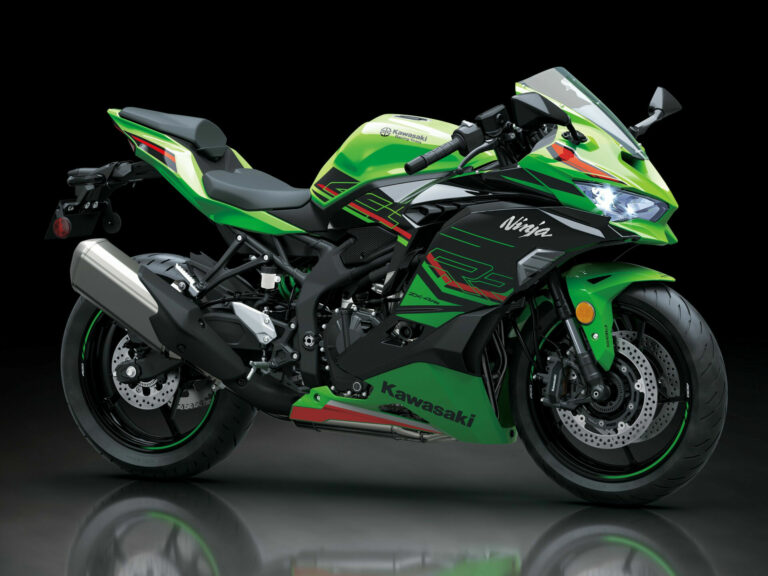
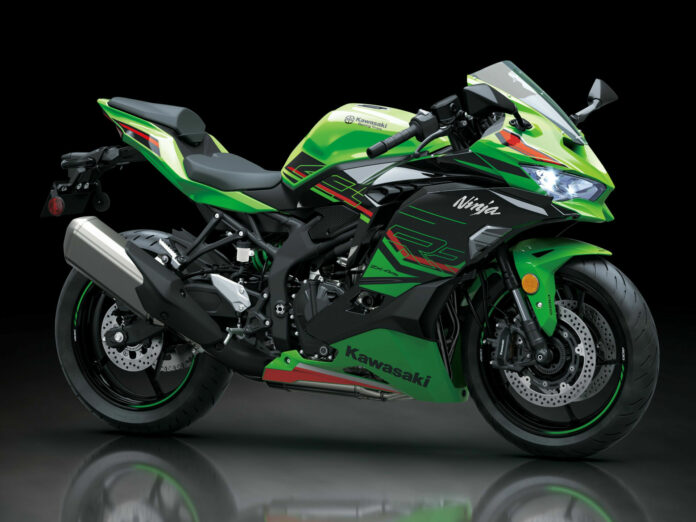
The left side of a 2023 Kawasaki Ninja ZX-4RR KRT Edition. Photo courtesy Kawasaki.
2023 NINJA ZX-4RR KRT EDITION HIGHLIGHTS:
NEW All-new 399cc liquid-cooled, 4-stroke, in-line four cylinder engine
NEW World Superbike-inspired chassis design
NEW Dual front disc brakes
NEW High-performance suspension
NEW Ergonomics for control and comfort
NEW Fierce Ninja ZX styling
NEW 3” TFT color instrumentation with circuit mode
NEW Smartphone connectivity via RIDEOLOGY THE APP
NEW All LED lighting
NEW Integrated riding modes
NEW Dual-direction Kawasaki Quick Shifter (KQS)
ENGINE
The Ninja ZX-4RR KRT Edition boasts an all-new 399cc liquid-cooled, 4-stroke, in-line four cylinder engine that delivers exhilarating performance and fun-to-ride power. Developed with feedback from other Kawasaki Ninja ZX supersport machines, the all-new engine found on the Ninja ZX-4RR KRT Edition features a quick-revving nature with a direct throttle response that combines strong low-mid range torque for city riding and high-rpm power that can be enjoyed when riding on the track. As riders roll on the throttle, they are rewarded with a satisfying surge of acceleration that is complemented by the distinct intake and exhaust notes of a Kawasaki in-line four cylinder engine.
The new Ninja ZX-4RR is powered by a 399cc DOHC inline four-cylinder engine with an indicated redline of 16,000 rpm. Photo courtesy Kawasaki.
The liquid-cooled, DOHC, 16-valve, 399cc in-line four cylinder engine features a bore and stroke of 57.0 x 39.16mm and packs impressive power and strong torque. The bore and stroke contributes to the impressive top-end power. A high-spec ECU is similar to that found on the Kawasaki Z H2, which allows for the use of Kawasaki’s latest electronics. Electronic Throttle Valves (ETV) with 34mm throttle bodies provide smooth, natural engine response by enabling the ECU to control the volume of both the fuel (via the injectors) and the air (via throttle valves) delivered to the engine. Additionally, they facilitate the use of Kawasaki electronic rider support systems such as integrated riding modes with traction control, selectable power modes, and a dual-direction Kawasaki Quick Shifter (KQS) that allows riders to feel “at one” with their machine.
Intake port interiors are sand cast using fine sand, which results in a smooth finish. Similar to the Ninja® ZX™-10R, the intake port exits have been machined in two stages, first along with the valve seats and then again at an inclined angle, to create a straighter path for intake air as it enters the combustion chamber. The straighter and wider path for the intake air promotes a smoother flow and a greater volume of fuel-air mixture that contributes to the engine’s high performance. Lightweight forged camshafts contribute to the high-revving and high-rpm performance.
Large 22.1mm intake valves are complemented by 19mm exhaust valves, flowing a great volume of air for excellent high-rpm performance. Triple-rate valve springs accommodate the valves and add to the Ninja ZX-4RR KRT Edition’s high-rpm performance. A narrow valve angle helps combustion efficiency as well as achieves a compact engine design. The combustion chambers are precision machined to high tolerances – a production technique that is limited to Kawasaki’s high-performance premium models.
Lightweight cast aluminum pistons contribute to low reciprocating weight for quick-climbing revs. The piston skirts have a molybdenum coating that increases durability. The piston crowns were designed to develop compression, which contributes to the 12.3:1 compression ratio that is found on the Ninja ZX-4RR KRT Edition and optimized to allow the use of regular gasoline while achieving strong performance. The piston’s wide bore facilitates the use of the large intake and exhaust valves for greater air flow, while their short stroke adds to the high-rpm performance. Utilizing an aluminum die-cast cylinder with an open-deck design, excellent heat dissipation and low engine weight is achieved.
In order to reduce mechanical loss and vibration, Kawasaki engineers carefully selected the connecting rod ratio, while a special carburizing treatment was used on the connecting rods to improve durability and reduce weight. Thanks to the crankshaft’s light flywheel mass, a low moment of inertia was reached, contributing to a quick-revving engine character and direct throttle response. A deep oil pan ensures that the oil pump inlet is always submerged, blocking air from being ingested, even during hard acceleration and deceleration while sport or track riding.
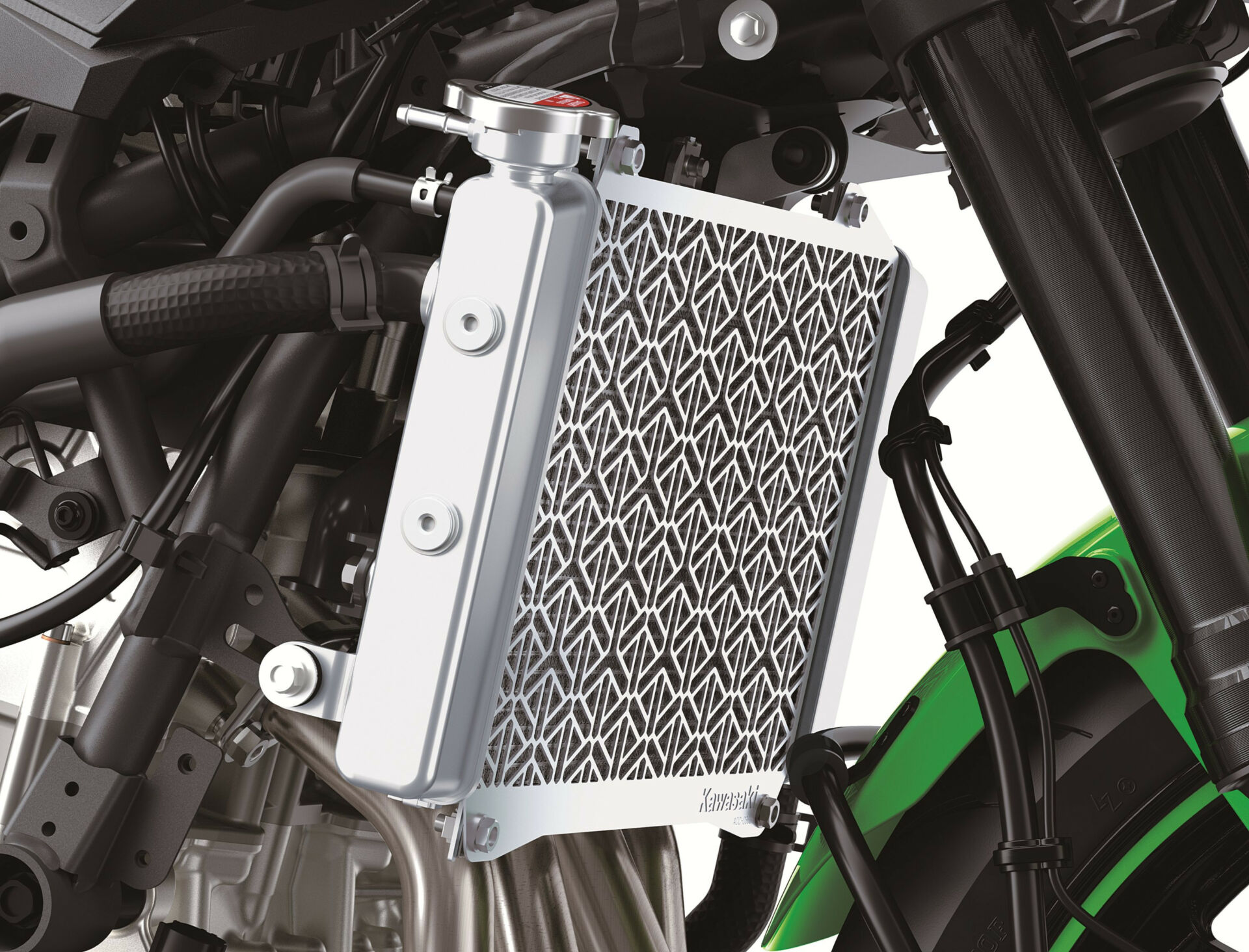
A large radiator keeps the Ninja ZX-4RR’s high-revving engine cool. Photo courtesy Kawasaki.
ADVANCED ENGINE COOLING
With the Ninja ZX-4RR KRT Edition engine designed for high performance, Kawasaki engineers placed a great emphasis on the engine’s cooling system in order to achieve optimum performance. The water jackets on the cylinder head were carefully designed and long-reach spark plugs offer greater contact with the water jacket, helping to prevent engine knocking. A large, 30-row radiator provides efficient engine cooling to handle the Ninja ZX-4RR KRT Edition’s performance capabilities. Side air ducts are built into the fairings to direct cool air towards the engine and promote heat dissipation that greatly contributes to engine performance. Innovative Kawasaki technology like the patented radiator fan cover that is located behind the radiator directs hot air out to the sides and away from the rider, improving rider comfort. The heat management system was designed using CFD analysis and controls the flow of air, helping keep the tank, frame, and other parts that contact the rider cooler, further increasing rider comfort.
The Ninja ZX-4RR benefits from ram air induction. Photo courtesy Kawasaki.
RAM AIR DUCT INTAKE SYSTEM
The Ram Air duct system is a trademark feature on Kawasaki’s Ninja ZX models. It’s a centrally positioned intake that improves filling efficiency and increases engine performance. Following a layout that is similar to that of the Ninja H2, the Ram Air duct is routed to the left of the front fork on its way to the airbox. This contributes to a duct with a highly efficient airflow, enabling cool, high-pressure air from the front of the bike to be ingested. Engine performance is increased at all rpm thanks to the increased pressure and cooler air. Additionally, the design is extremely effective at preventing water from entering the airbox while riding in the rain. The large Ram Air duct has “Ram Air” stamped into it, which is visible to the rider and adds to the Ninja ZX-4RR KRT Edition’s high-performance look and feel. Intake funnels, consisting of 60mm and 40mm lengths, contribute to efficient filling and produce a flat torque curve with smooth power delivery. The downdraft intake creates a shorter, more direct path for intake air to enter the cylinder, improving cylinder-filling efficiency and increasing engine power, especially at high rpm.
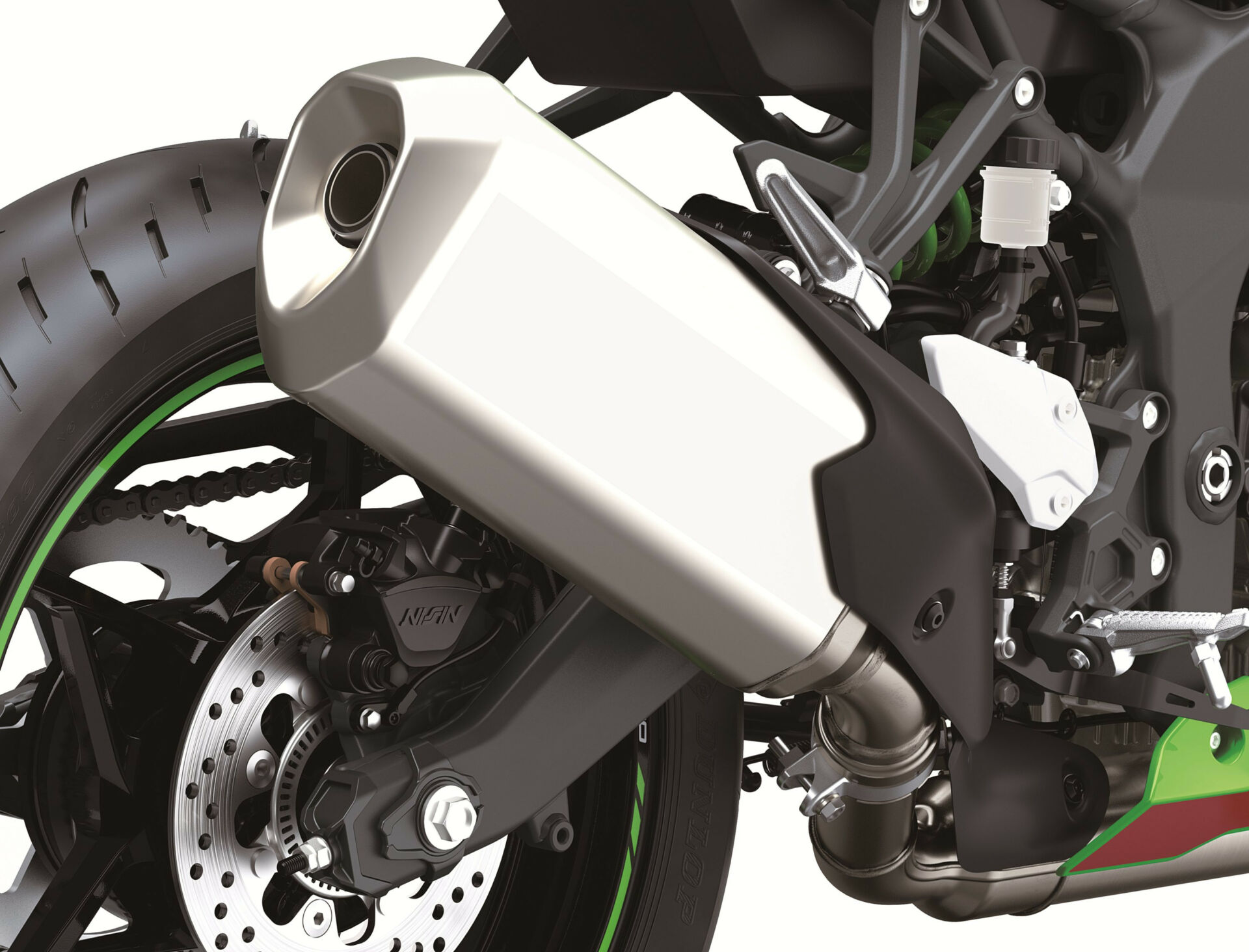
Kawasaki designed the exhaust system on the Ninja ZX-4RR so it is easy to add an aftermarket exhaust silencer. Photo courtesy Kawasaki.
EXHAUST
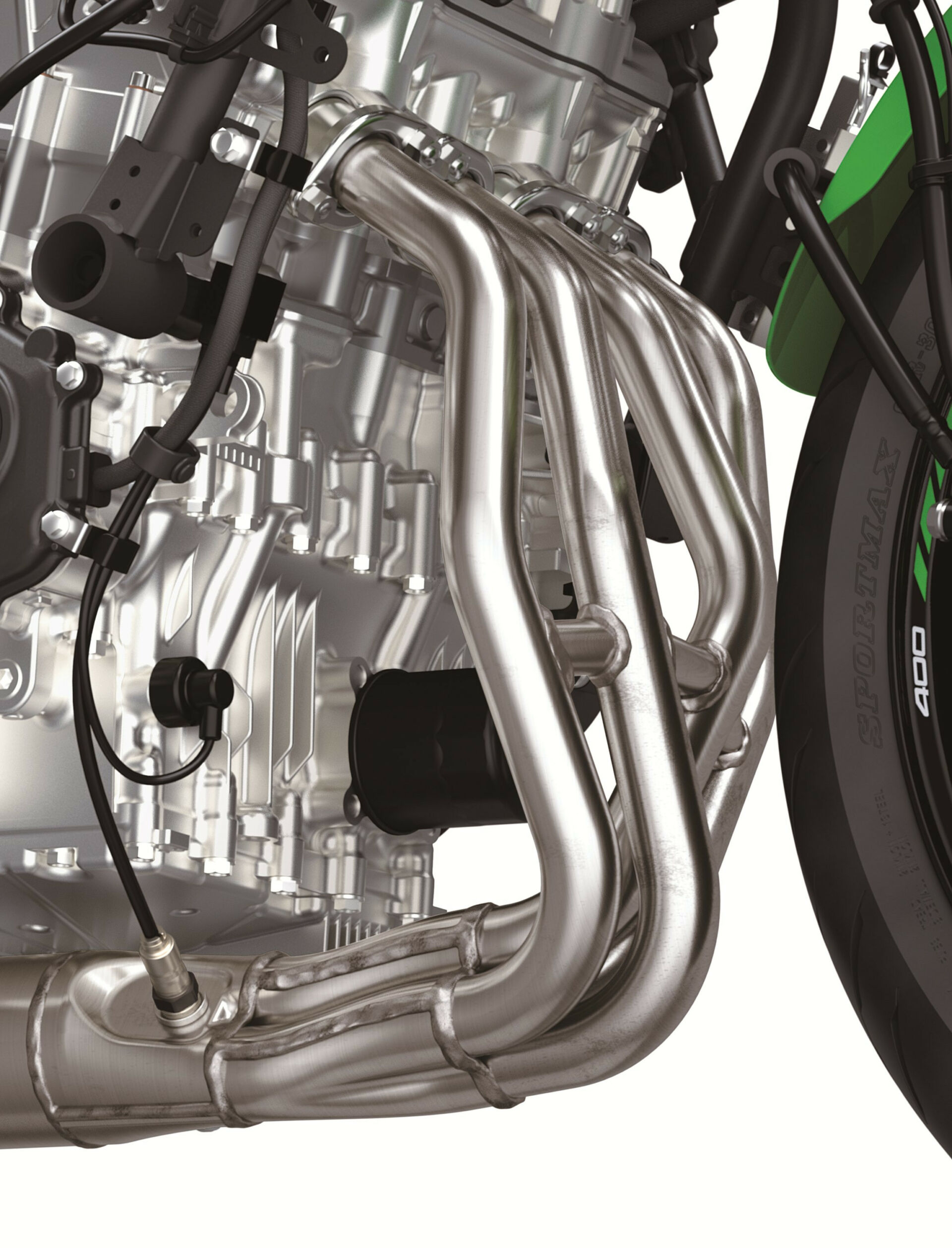
The header pipes and collector pipe layout were built with inspiration from the Ninja® ZX™-6R. Joint pipes link the headers, contributing to a strong power output while meeting emissions and sound regulations. A traditionally styled, long silencer produces a clear, racy exhaust note that is distinct to that found on a Kawasaki in-line four cylinder engine. The collector pipe features triple catalyzers to ensure emissions are met and their position makes it easy to add a slip-on muffler.
TRANSMISSION & CLUTCH
Complementing the high-performance 399cc engine is a smooth-shifting six-speed transmission that is designed to shine in all riding situations. It’s especially well suited for riders accelerating out of corners when sport or track riding and features a dual-direction Kawasaki Quick Shifter (KQS). Developed through Kawasaki’s racing efforts, the Ninja ZX-4RR KRT Edition is fitted with an Assist & Slipper Clutch that uses two types of cams (an assist cam and slipper cam), offering two functions that are not available on a standard clutch. When the engine is operating at normal rpm the assist cam functions act as a self-serve mechanism, pulling the clutch hub and operating plate together to compress the clutch plates. This allows the total clutch spring load to be reduced, resulting in a lighter clutch lever pull when operating the clutch. When excessive engine braking occurs, the slipper cam comes into play, forcing the clutch hub and operating plate apart. This relieves pressure on the clutch plates to reduce back torque and help prevent the rear tire from hopping or skidding.
ELECTRONICS
KAWASAKI TRACTION CONTROL (KTRC)
Kawasaki’s advanced KTRC system provides both enhanced sport riding performance and peace of mind under certain conditions to negotiate low-traction surfaces with confidence. Three selectable modes offer progressively greater levels of intrusion that cut fuel and ignition to help maintain traction and forward drive as well as suit the riding situation and rider preference. The system uses a number of parameters to get an accurate real-time picture and adapt accordingly. Mode 1 is the least intrusive and designed with sport riding in mind, Mode 2 intervention occurs earlier offering a balance of sport riding support and rider confidence, and Mode 3 is the most intrusive for navigating low-traction conditions. In addition to the three modes, the rider can elect to turn the system OFF.
POWER MODES
Power Modes offer riders an easily selectable choice of engine power delivery to suit riding conditions or preferences. In addition to Full Power mode, one (Low) alternate mode in which maximum power is limited and throttle response is milder is provided.
INTEGRATED RIDING MODES
All-inclusive modes that link KTRC and Power Mode allow riders to easily set traction control and power delivery to suit a given riding situation. Riders can choose from three settings (Sport, Road, Rain) or a manual setting (Rider). In the manual Rider mode, each of the systems can be set independently.
KAWASAKI QUICK SHIFTER (KQS)
Adding to its impressive list of high-performance features, the Ninja ZX-4RR KRT Edition comes equipped with dual-direction KQS. The KQS allows ultra-quick upshifts and downshifts without the need to use the clutch, resulting in a more enjoyable experience and quicker lap times. Designed for more effective sport riding, KQS can also be used on the street when the engine is above 2,500 rpm.
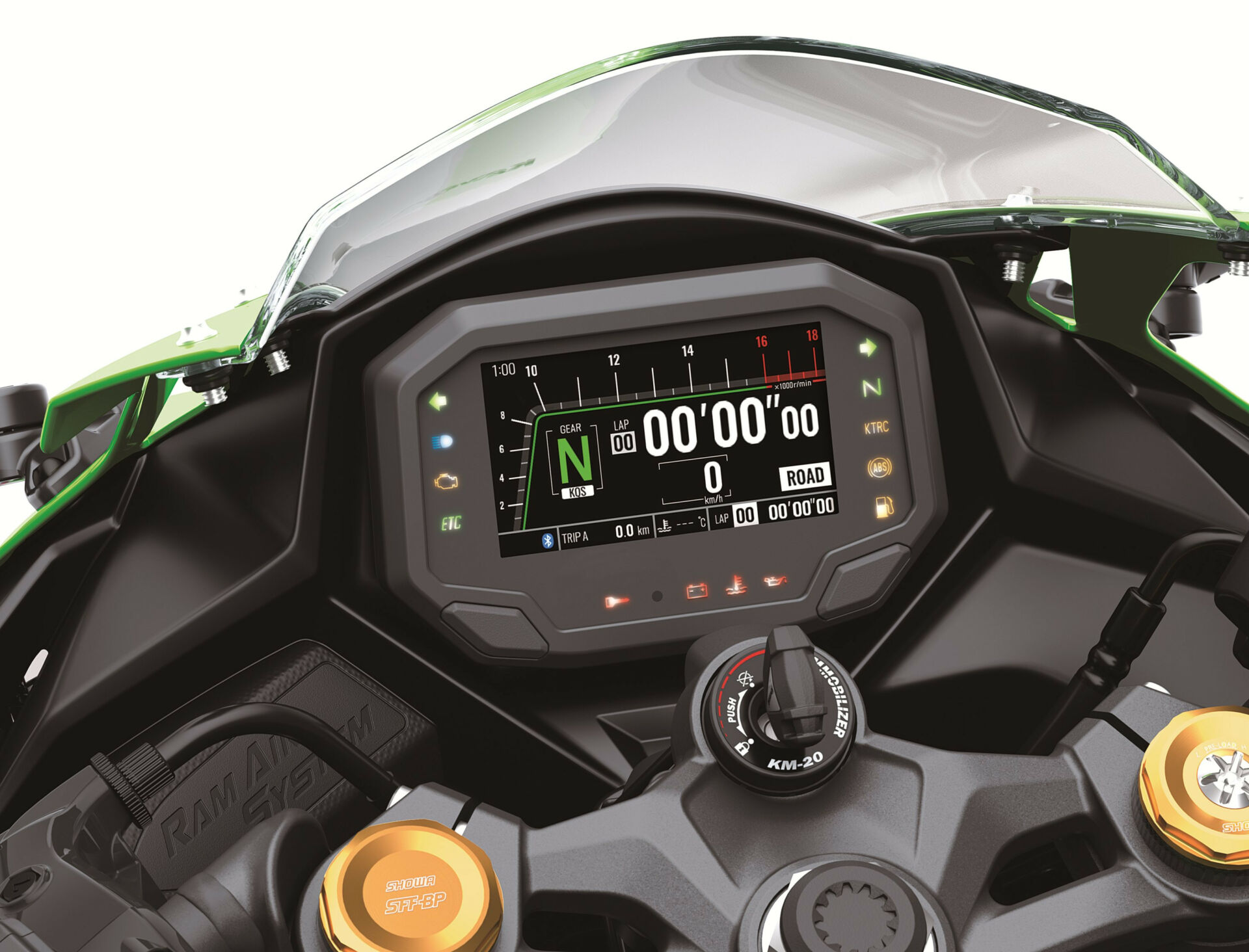
The Ninja ZX-4RR comes with a color TFT display with a Circuit Mode. Photo courtesy Kawasaki.
TFT COLOR INSTRUMENTATION
The 4.3” all-digital TFT color instrumentation gives the cockpit a high-tech, high-grade appearance and features a Circuit Mode that allows lap timing and shows track-related information in a more prominent and easier-to-view layout. The high-grade color LCD screen features TFT (thin-film transitory) technology, delivering a high level of visibility. Selectable background and text colors can be chosen to suit light or dark conditions and screen brightness automatically switches between five levels to suit available light.
Display functions include a digital speedometer, digital bar-style tachometer, gear position indicator, shift indicator (tachometer flashes), fuel gauge, odometer, dual trip meters, current and average fuel consumption, remaining range, average speed, riding time, coolant temperature, clock, battery voltage, lap timer (Circuit Mode only), Kawasaki service reminder, oil change reminder, integrated riding mode, KTRC and power mode indicators, smartphone call and mail notices, Bluetooth indicator, economical riding indicator, and KQS indicator.
Circuit mode can be toggled for use at track days and changes the display to make information for track riding more visible. This includes showing the lap time in the center with large text so that it can easily be ready while riding. The gear position and tachometer display is also more visible along the top when above 10,000 rpm, giving riders a clear view of the information needed when working towards faster lap times on the track.
RIDEOLOGY THE APP
Bluetooth® technology built into the instrument panel enables riders to connect to their motorcycle wirelessly. Using RIDEOLOGY THE APP*, a number of instrument functions can be accessed, logged, and reviewed contributing to an enhanced motorcycling experience. The following information can be viewed:
Vehicle Info – Information such as fuel gauge, odometer, maintenance schedule and more can be viewed via the smartphone
Riding Log – GPS route information as well as vehicle running information can be logged and viewed via the smartphone
Mobile Phone Notices – When a call or email is received by the smartphone, this is indicated on the instrument display
Tuning / General Settings – General instrument display settings such as preferred units, date, date format, and more can be adjusted via the smartphone
The app can also be used when away from the motorcycle. When riding (with the app ON), the bike and smartphone are always connected and riding log data is being recorded by the app. After your ride, the latest riding information is stored by the app and may be viewed on the smartphone. Any changes made via the app while the engine is off, or while out of range, will be implemented as soon as the ignition is turned on and the smartphone is in range with the app ON.
*RIDEOLOGY THE APP is not intended for use during vehicle operation. Only use RIDEOLOGY THE APP when the vehicle is not being operated and it is safe to do so.
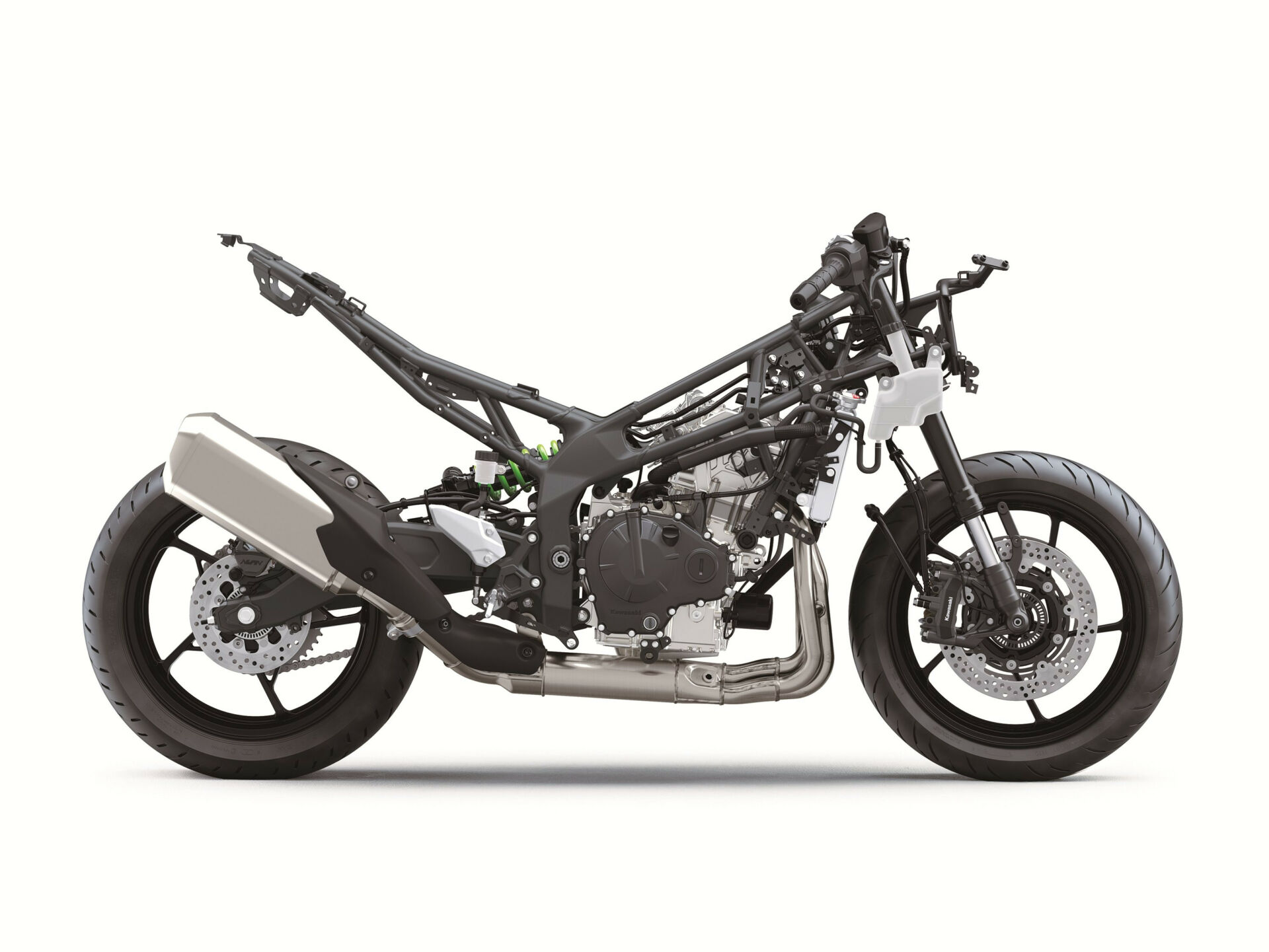
A Kawasaki Ninja ZX-4RR stripped of its bodywork to show off its tubular steel trellis-style frame. Photo courtesy Kawasaki.
CHASSIS
The Ninja ZX-4RR KRT Edition delivers light maneuverability when riding around town, however, its high-level supersport character shines when out sport riding on backroads or at the racetrack. Utilizing feedback derived directly from Kawasaki Racing Team’s (KRT) efforts in the FIM World Superbike Championship, Kawasaki engineers carefully selected key chassis components to achieve excellent rigidity balance. Formed from high-tensile steel, the trellis frame features various pipe diameter thicknesses with a swingarm pivot section. Kawasaki’s advanced dynamic rigidity analysis was used to ensure the required balance of strength and chassis flex.
Key chassis dimensions, such as center of gravity position, swingarm pivot position, engine axis positions, and the caster angle were inspired by Kawasaki’s World Superbike Ninja® ZX™-10RR, bringing World Superbike chassis design to the 400cc class. The long-style swingarm is made from high-tensile steel and allows the bike’s front-rear weight distribution to be set for the perfect balance of nimble handling and composed chassis behavior. An arch design on the right side of the swingarm delivers the required balance of rigidity and flex, enabling the silencer to be positioned as centrally as possible while adding to the Ninja ZX-4RR KRT Edition’s stylish, sporty looks.
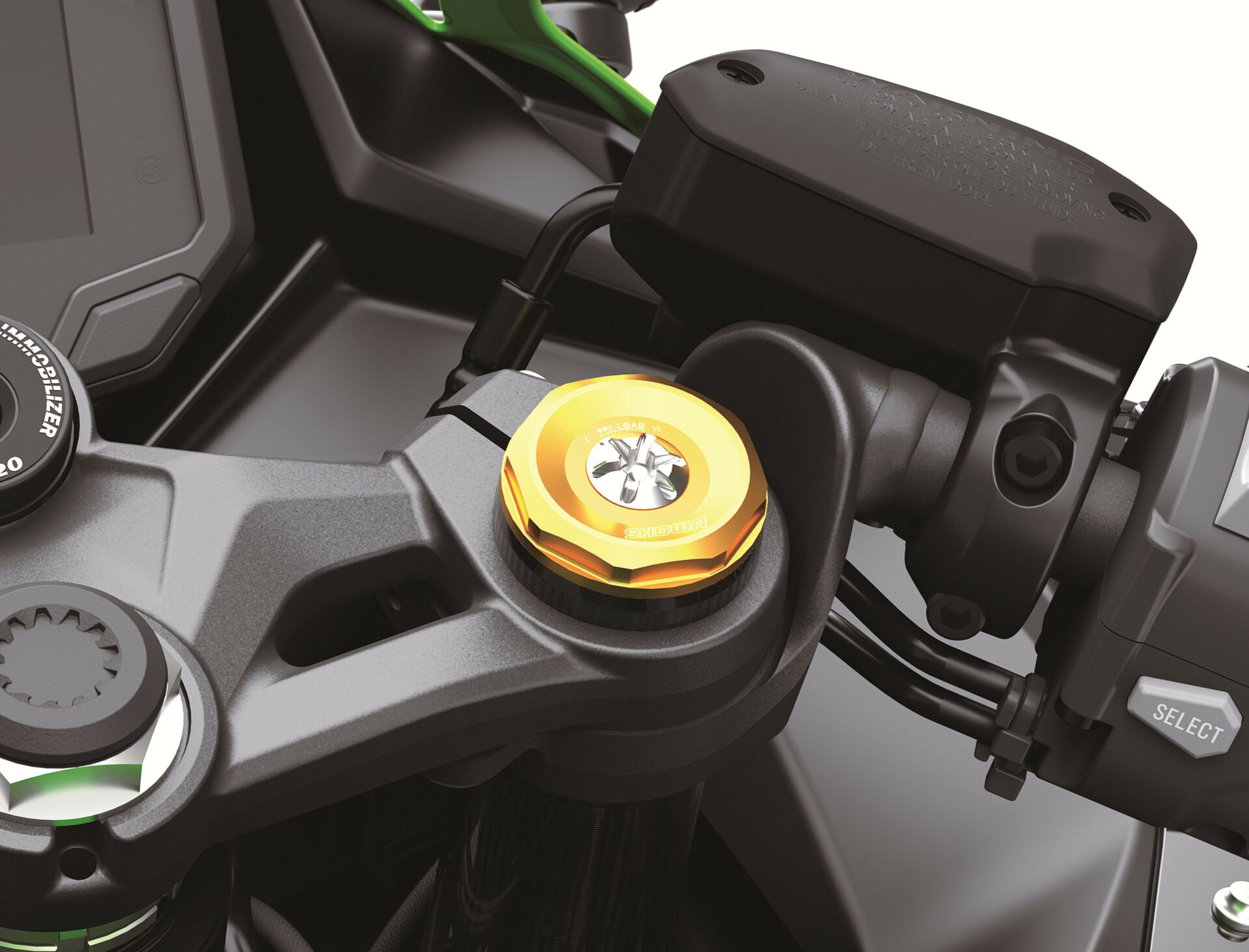
The Kawasaki Ninja ZX-4RR comes with inverted 37mm Showa SFF-BP (Separate Function Fork – Big Piston) front forks. Photo courtesy Kawasaki.
SUSPENSION
To complement the optimal rigidity balance of the chassis, the Ninja ZX-4RR KRT Edition front end is held up by a 37mm inverted front fork that features Showa’s SFF-BP (Separate Function Fork – Big Piston) technology. This advanced fork offers both racetrack performance and everyday usability. The technology is similar to that on the Ninja ZX-6R, while the spring rate and damping characteristics were developed specifically for the Ninja ZX-4RR KRT Edition. The front fork provides smooth action at the initial part of the stroke that contributes to excellent composure under braking. A large-diameter damping piston is used in the SFF-BP fork, which is much larger than that used in a cartridge-type fork. This allows oil inside the fork to act on a much larger surface area and damping pressure to be reduced while ensuring the same damping force. By reducing the damping pressure, it allows the slide pipe to move more smoothly, which is especially noticeable during the initial part of the stroke. This design allows for greater control as the fork begins to compress and a smooth transition as the Ninja ZX-4RR KRT Edition’s weight shifts forward when reducing speed, offering greater chassis stability on corner entry and a planted feel when braking. The fork settings were designed to accommodate a wide range of riding situations, from the city to the racetrack. The spring preload is adjustable and can be tailored to suit the rider’s preference, which is the first use of adjustable SFF-BP in the 400cc class.
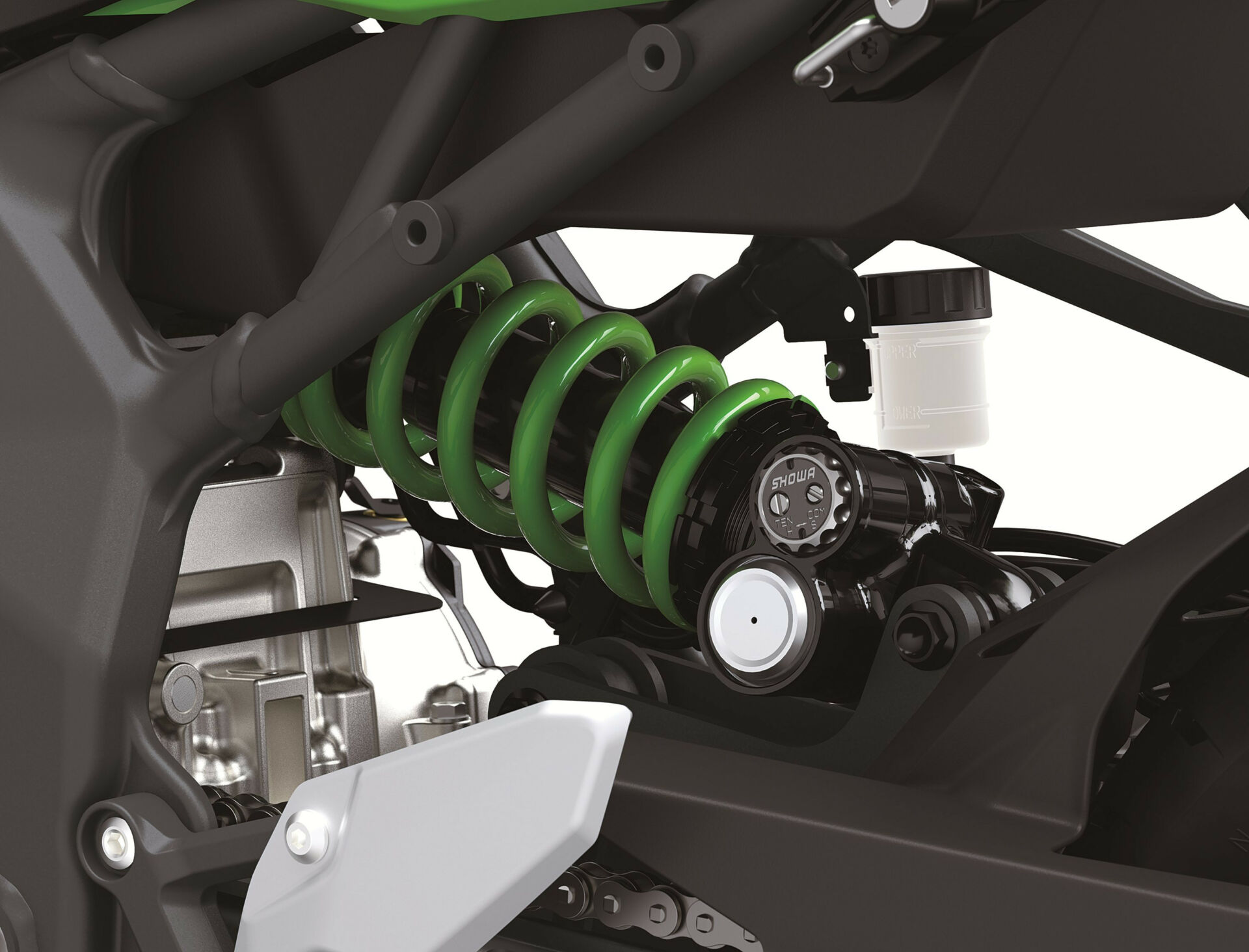
A Showa BFRC (Balance Free Rear Cushion) Lite shock on the back of a Kawasaki Ninja ZX-4RR. Photo courtesy Kawasaki.
At the rear of the Ninja ZX-4RR KRT Edition, horizontal back-link rear suspension mounted to a Showa BFRC (Balance Free Rear Cushion) Lite shock can be found. The shock is similar to that found on the Ninja ZX-10R and has been specially tuned for the Ninja ZX-4RR KRT Edition. Its excellent movement at the start of the stroke ensures comfort in day-to-day riding as well as a planted feel when riding on the track, while linear damping characteristics provide a stable, solid feel and peace of mind for the rider in a wide variety of situations. Additionally, it offers adjustable compression and rebound damping as well as adjustable spring preload so that riders can fine-tune the rear end to suit their riding preferences. The horizontal back-link rear suspension positions the shock unit and linkage above the swingarm and out of the way from engine and exhaust heat. A firm rear shock feel achieves a planted feel that is reassuring during sport riding, while also offering ample absorption for ride comfort when riding around town.
WHEELS & BRAKES
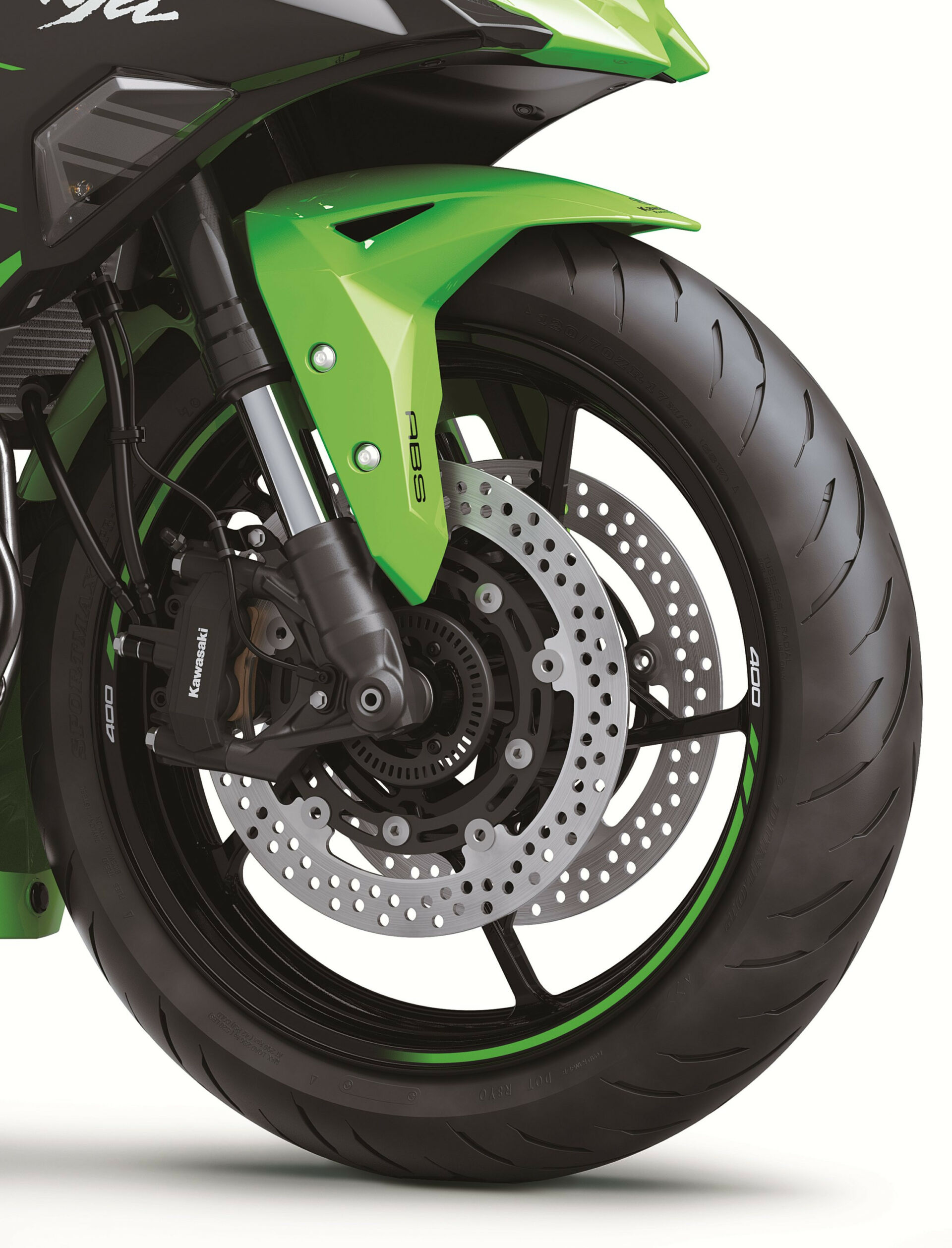
In order to stop the powerful Ninja ZX-4RR KRT Edition, a pair of 290mm semi-floating front discs handle the stopping duties up front and are gripped by 4-piston radial-mount monobloc calipers. The calipers feature different diameter pistons with the upper piston measuring 32mm and the lower piston 30mm. Dual front discs were chosen for additional stopping power and the monobloc calipers help achieve a firm initial touch. Brake pad selection contributes to both brake force and braking controllability.
The Kawasaki Ninja ZX-4RR is slowed by dual 290mm front discs and radial-mount four-piston monoblock front brake calipers. Photo courtesy Kawasaki.
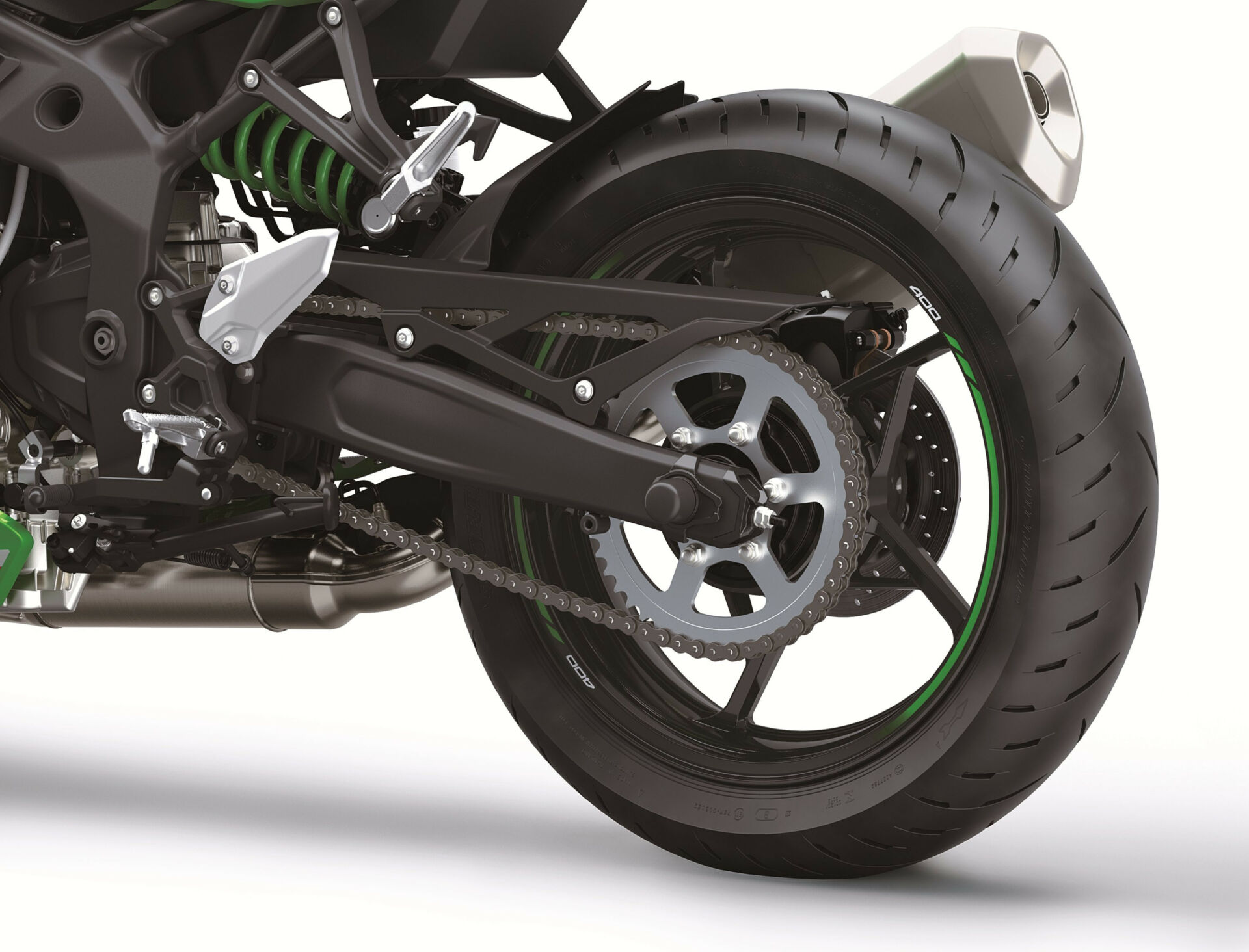
At the rear, a 220mm disc is slowed by a single-piston caliper that is powered by a 38mm piston. The master cylinder, caliper, brake pedal, and brake pad material were carefully selected for a balance of stopping power and control. Equipped with ABS, the Ninja ZX-4RR KRT Edition features Nissin’s latest ABS control unit that has been specially developed to deliver precise control and is the most compact and lightweight unit available.
Stylish star-pattern five-spoke wheels contribute to the bike’s overall lightweight and their high rigidity improves handling. The wheels also contribute to the bike’s light, nimble appearance. Dunlop Sportmax® GPR-300 radial tires are mounted on the front and rear, offering high grip in both wet and dry conditions and contributing to agile handling and excellent riding comfort. A 120/70ZR17 tire is used on the front and 160/60ZR17 is fitted on the rear.
The Kawasaki Ninja ZX-4RR rolls out of the factory on Dunlop Sportmax® GPR-300 radial tires, including a wide 160/60-ZR17 rear. Photo courtesy Kawasaki.
ERGONOMICS
To take full advantage of the Ninja ZX-4RR KRT Edition’s nimble, supersport-style handling is a naturally aggressive riding position that is more forward-leaning than that found on the Ninja 400. The riding position on the Ninja ZX-4RR KRT Edition offers a good balance of wind protection and aerodynamics that enable the rider to tuck in to get out of the wind, while still maintaining a relaxed feel. A slim design of the fuel tank between the rider’s legs promotes good contact with the bike and a low design on the top of the fuel tank facilitates the rider getting into a tucked position. A firm seat cushion offers both sports potential and comfort. The seat makes it easy for riders to shift their weight during sport or track riding and increases comfort on long rides. Supersport-style footpegs give the rider a direct feel and good controllability when sport riding. An adjustable brake and clutch lever each offer five position settings that allows the rider to set them to suit their hand size and preference.
STYLING
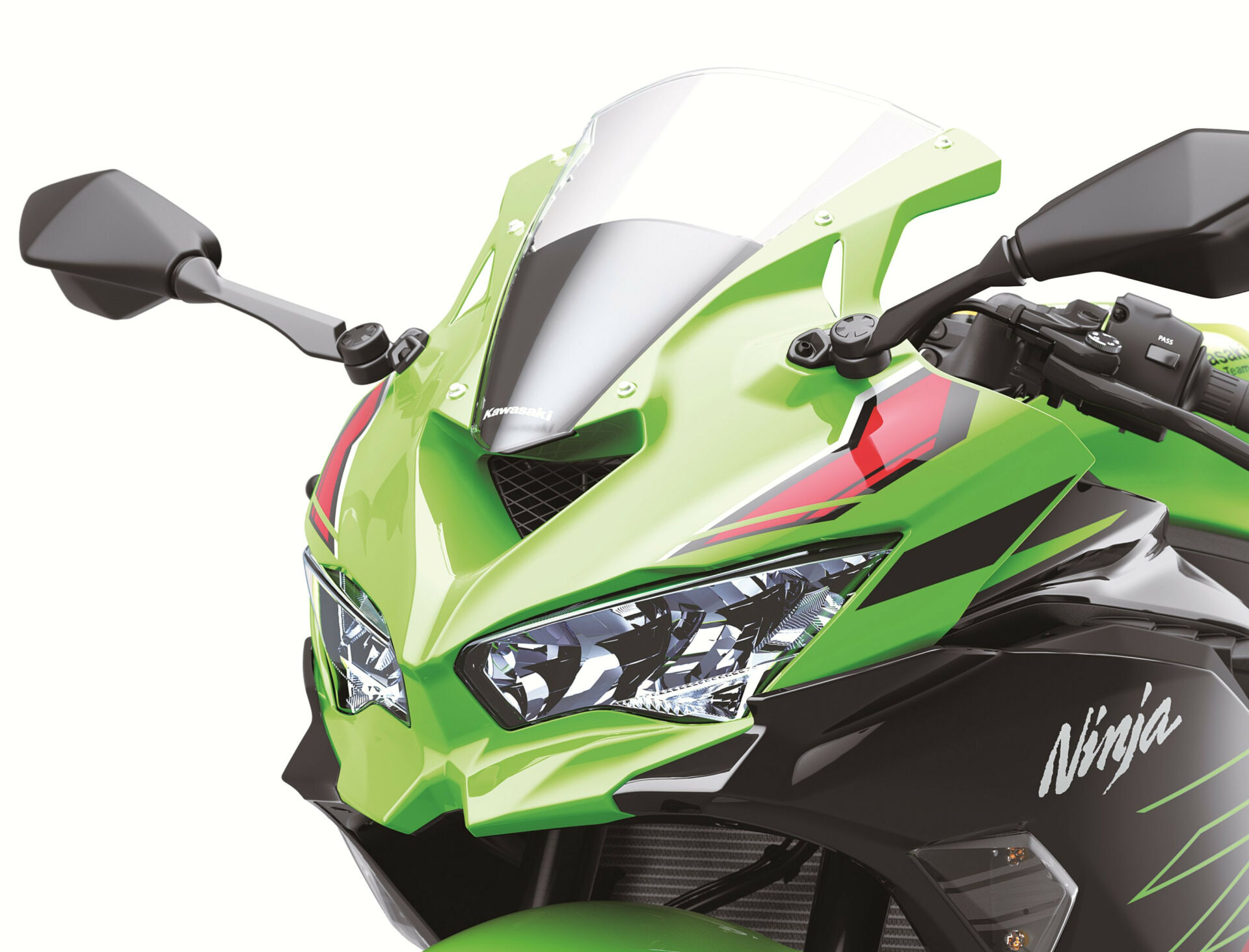
The aggressive Ninja styling of the Ninja ZX-4RR KRT Edition was designed to deliver a fierce look that contains its power and explosive action, benefitting the most powerful machine in the 400cc class. Prominently located at the center of the upper cowl, the Ram Air intake is a trademark feature on Ninja ZX models, setting the machine apart from its competition. It’s stamped with “Ram Air”, leaving a reminder of the bike’s high performance. A sharp chin spoiler further contributes to the strong Ninja family image. The supersport-style low fuel tank and minimalist tight-fitting bodywork that wraps around the in-line four engine gives the Ninja ZX-4RR KRT Edition a compact, high-class look. Sharply angled lines contribute to a lightweight image that reflects the bike’s nimble supersport-style handling. Side air ducts in the fairings provide a blend of form and function, directing cool air into the engine and adding aggressive lines for a stylish design. The upswept angle of the slim, race-style tail cowl puts off a lightweight appearance and the rear flap can easily be removed for track days.
Twin LED headlights help the Ninja ZX-4RR KRT Edition stand out and provide excellent illumination, while LED front turn signals are built into the fairings. The LED taillight was inspired by the Ninja ZX-10R, adding a high-grade touch to the rear of the motorcycle. Both the license plate bulb and rear turn signals are LED, completing the full LED package.
ACCESSORIES
A wide range of Kawasaki Genuine Accessories (KGA) are available and allow riders to personalize their Ninja ZX-4RR KRT Edition motorcycles. This includes a sport seat with firm urethane cushioning that makes it easier to feel the rear wheel traction during sport riding sessions and a USB outlet that provides a convenient charging point and is accessible under the seat. Other accessories such as a pillion seat cover, frame slider, tank pad, radiator screen, and meter protector are also available.
Ninja® ZX™-4RR KRT EDITION
Color: Lime Green / Ebony
MSRP: $9,699
Availability: Available Spring 2023
ABOUT KAWASAKI
Kawasaki started full-scale production of motorcycles over a half century ago. The first Kawasaki motorcycle engine was designed based on technical know-how garnered from the development and production of aircraft engines, and Kawasaki’s entry into the motorcycle industry was driven by the company’s constant effort to develop new technologies. Numerous new Kawasaki models introduced over the years have helped shape the market, and in the process have created enduring legends based on their unique engineering, power, design and riding pleasure. In the future, Kawasaki Motors, Ltd. is committed to maintaining and furthering these strengths which will surely give birth to new legends.
Kawasaki Motors Corp., U.S.A. markets and distributes Kawasaki motorcycles, ATVs, side x sides, and JET SKI® watercraft through a network of approximately 1,100 independent retailers, with close to an additional 7,700 retailers specializing in general purpose engines. Kawasaki and its affiliates employ nearly 3,100 people in the United States, with approximately 260 of them located at Kawasaki’s Foothill Ranch, California headquarters.
Kawasaki’s tagline, “Let the good times roll.®”, is recognized worldwide. The Kawasaki brand is synonymous with powerful, stylish and category-leading vehicles. Information about Kawasaki’s complete line of powersports products and Kawasaki affiliates can be found on the Internet at www.kawasaki.com.
The following track days, riding schools, and racing events are scheduled by organizations based in the United States and Canada during February 2023.
Motorcycle track days, riding schools, and races are posted under the Event Calendar tab on the home page of this website, or you can access the Event Calendar for February 2023 directly by clicking HERE.
Once on the Event Calendar page, you can search for the event you are looking for by its date.
When you click on the event you want to attend you should find a link to the website and/or email address of the host organization, a link to the website of the host venue, the physical address of the host venue, a Google map to the host venue, and buttons to add the event and its information to your calendar application.
To have your motorcycle racing or riding event added to the Event Calendar on this website and published in the print edition of Roadracing World & Motorcycle Technology magazine, submit your calendar and contact information via the contact page on this website or by clicking HERE.
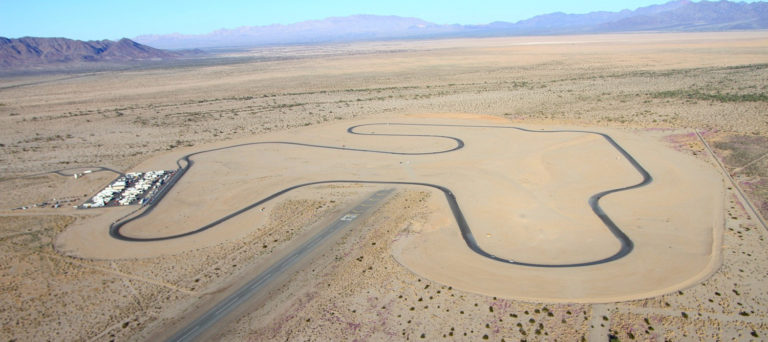
2/3 JP43 Training School, Chuckwalla Valley Raceway, Desert Center, CA
2/4 SoCal Supermoto School, Adams Motorsport Park, Riverside, CA
2/4 Superbike-Coach Corp. (Schools), Thunderhill Raceway Park, Willows CA
2/4-5 Pacific Track Time Track Days, Thunderhill Raceway Park, Willows, CA
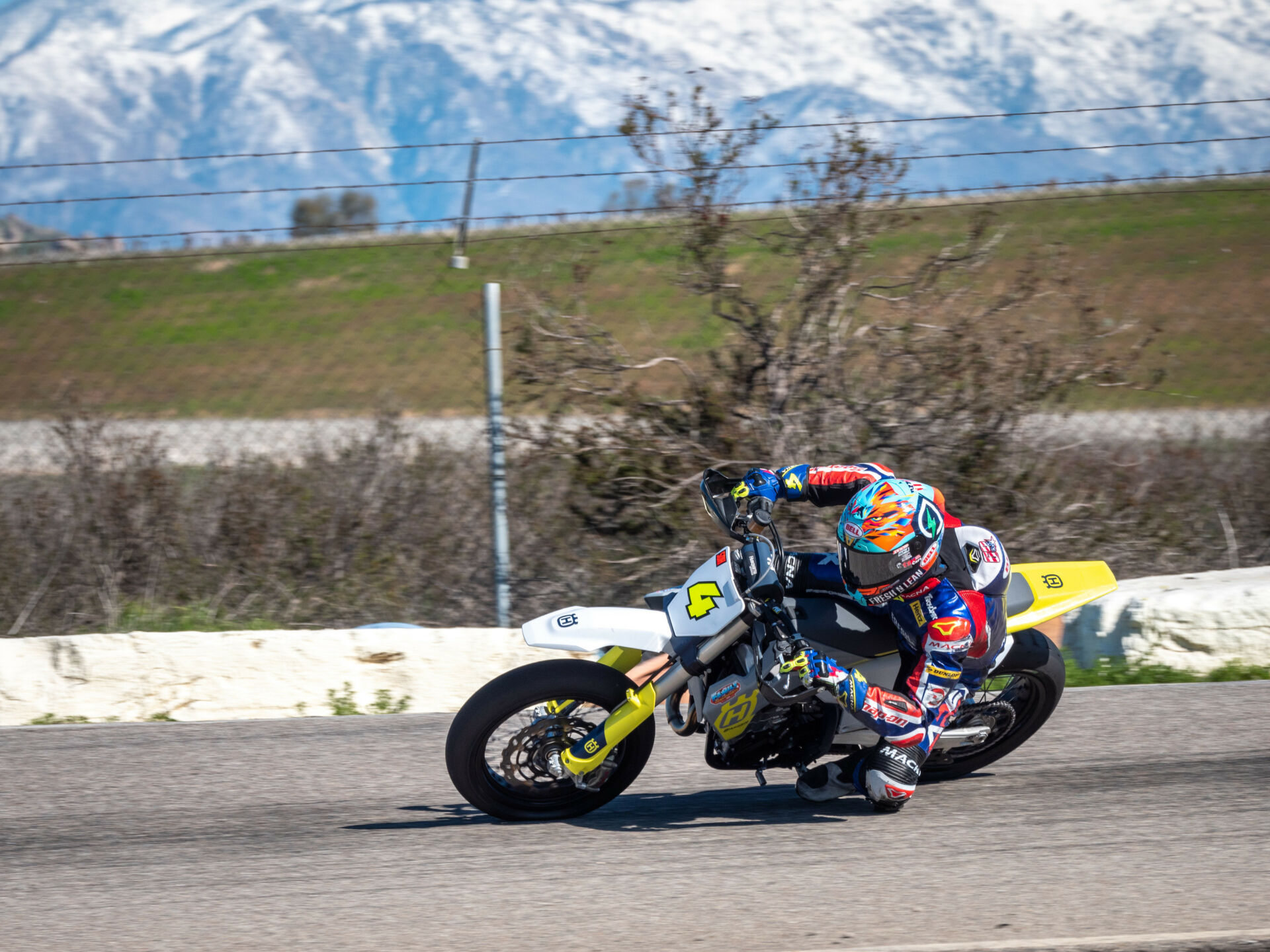
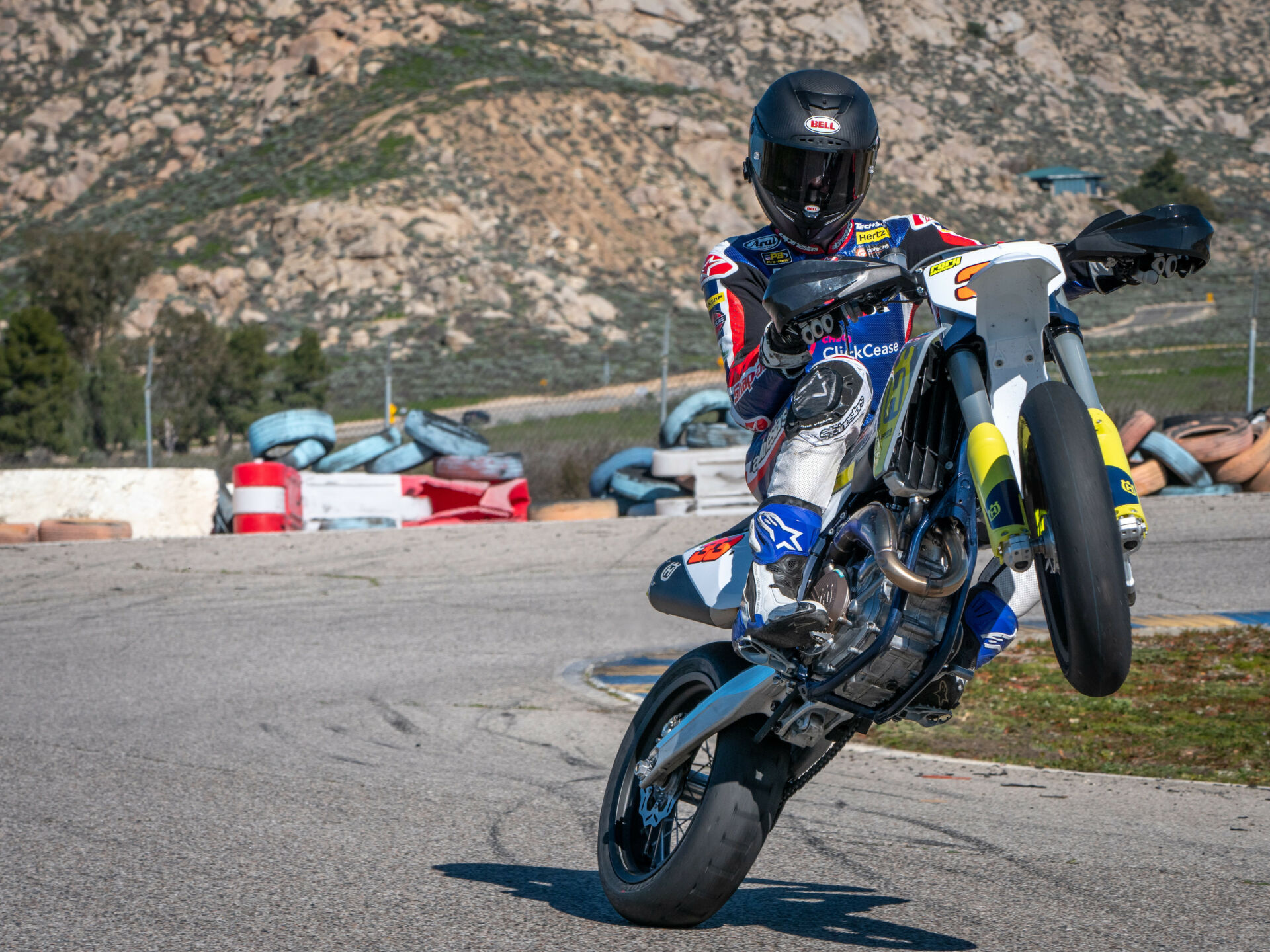
The American Racing Team’s 2023 lineup of Sean Dylan Kelly and Rory Skinner were reunited in January for the team’s inaugural three-week winter training camp in California. They were joined by the American Racing Academy’s newest member, Max Toth, who is preparing for his first season in the JuniorGP European Moto2 class.
Thanks to key partners of the team, Family Powersports Texas and the W Training Facility, the trio were flat-out for three weeks taking on as many disciplines of motorcycle riding as possible, sharpening their skills with Motocross, Supermoto, Flat Track, Enduro and mini bikes, while taking their fitness to new heights in the gym and on mountain bikes between riding sessions. Along with expert tuition from our Racing Director John Hopkins, the riders were able to pit themselves on track against 2021 MotoGP World Champion Fabio Quatararo and fellow Moto2 competitor Tony Arbolino thanks to Johnny Louch at the W Training Facility.
Sean Dylan Kelly (4). Photo courtesy American Racing Team.
A vital part of the American Racing Academy program is engaging the next generation of American talent with our European and World-level riders, through sharing the same track, and learning the methods & work ethic put into training regimes from the likes of Sean, Rory and Max. This gives them further insight into the world that they are aspiring to be a part of and to continue chasing for the future.
With the extended MotoGP calendar and the team aspect becoming all the more important with the intense travel schedule, the team opted to rent a house in the Temecula Wine Country area for the riders to stay in with some of the team, getting to know each other better before the 2023 lap of the world begins.
The riders go their separate ways for February before the team heads to the first pre-season tests ready for round one at Portimao in March!
Sean Dylan Kelly, #4 –
The training camp was absolutely amazing! I’ve never done something like this before. It was hugely intense with only two rest days in sixteen total of me being out there. It was action-packed full of different disciplines: from gym, to mountain biking, supermoto… mini dirt bikes… full flat track and motocross, pretty much everything including the Ohvales – very, very intense! I would say that one of the highlights for me was riding with Robbie Maddison at his place in his yard. There was a lot of sick days but that was the stand out to be sharing that time with a legend! It didn’t all quite go to plan though, for example, I wasn’t supposed to ram a tyre wall. That wasn’t intended but a nice false neutral on the supermoto led to my biggest crash in quite a while, fortunately with no consequences! On the plus side, we got it on video, so that’s all that really matters! Was really cool riding with Fabio and Tony. I’ve never spoken to Fabio before but he was really cool and a super chill guy. Tony is one of our competitors and was great to ride on the minibikes with him too.
Was cool to spend time with Rory here as well, starting that teammate relationship with something like this and everyone together. It’s so awesome to have a team like American Racing that puts events like this on, it really gets the most out of us all and looking forward to seeing it pay off on the track this year!
Rory Skinner (33). Photo courtesy American Racing Team.
Rory Skinner, #33 –
I had a great time. Every day kind of just merged into one. Flat out from the start with limited rest, sixteen days in total and having just two to really chill out. California is super cool. I’m loving it here. So much so that I’m staying for another three weeks at Hopper’s house to train some more. For me, the highlight in general was riding in the warmth of the Californian winter… you can imagine it’s not the same as home. Was super cool to ride with the Maddison family, Fabio and Tony. Wasn’t just on the bike though, being altogether as a team before and after was a real highlight as well. Was a great trip for us all to get to know each other better before we’re all on the road for so long. The American Racing Team is the best. The camp was amazing.
John Hopkins, Racing Director –
It’s been an awesome, awesome few weeks, even while I’m still recovering from my godsend of a hip replacement! But was great that I still managed to get out with the boys riding motocross on the pro track a week later! We were non-stop for nine-ten days straight on every type of riding: supermoto, minibike, dirt track, enduro… it was awesome, really good for all the riders to get that kind of experience. The aspects of MX and dirt track are hugely relevant in terms of what they’ll do on the road race bike: picking it up, getting it turned, your body positioning and bike control, all of it is extremely relevant to Moto2 – everything helps!
I’m very confident that these last couple of weeks will have brought them all heaps of confidence to be ready to go for the season. At the end of the day, seat and bike time is all about bike fitness. You could train your ass off in other ways, be the fittest guy out there but then get on the bike and find you’re not using those same muscles, so bike fitness is a whole other category. Sean’s headed back to Florida now to spend time with family before heading to Spain for the final stage of pre-season, get himself riding over there – it’s obviously a place he knows well and he speaks the language so that’s right for him. Rory has opted not to go back to Scotland for now and actually staying with me for a little longer. We’ll be putting in some more rides, MX trail riding, supermoto and get him on the Ohvale some more, too. On top of that, they’ve been doing a load of mountain biking, had full access to the W Training Facility with my good friend, Johnny Louch, so it’s been a great trip. Organising something like this was huge and we think it’ll pay off in the long run. We’re already counting down the days till round one!
MV AGUSTA ANNOUNCES FINAL RESOLUTION OF COMPOSITION WITH CREDITORS
MV Agusta Motor S.p.A. announces the final resolution of the composition with creditors, “Concordato Preventivo in Continuità Aziendale” under Italian law.
The Varese Court, in its ruling of December 29th, 2022, declared the procedure as resolved, after having ascertained that all outstanding debt with creditors and all obligations under the composition had been entirely settled.
The exit from the Composition with Creditors finalises the restructuring process of MV Agusta Motor S.p.A.. An outstanding result that was made possible thanks to the strong commitment of the Sardarov family, who took control of the company 4 years ago and supported it financially since the beginning of the Composition in 2017, by injecting more than 180€ Million in order to restructure all of the business practices, pay off all debt under the procedure, support MV Agusta’s day to day operations and make sure that the company has a solid business plan for the future growth.
The arrival of the new partner, KTM AG, a company of PIERER Mobility AG, proves that MV Agusta was put on the right path and marks a new positive development under the leadership of CEO Timur Sardarov, who is adamant that a difficult phase in the company’s history is officially over, and that now MV Agusta has a solid base to live up to its status of one of the greatest brands in motorcycle history.
Timur Sardarov, CEO of MV Agusta Motor S.p.A., said: “Since my arrival at MV Agusta, the settlement of the Composition with Creditors has been one of my main objectives, in order to regain the trust of our clients and our suppliers. Despite the negative effects of the pandemics, the strong increase in the cost of raw materials and the outbreak of war in Ukraine, the engagement and the professionalism of MV Agusta’s management brought this important result home. We must now look at the future with renewed confidence, comforted by the success of our new models. The partnership with KTM AG is already bringing new energy to our business on all fronts, from the production of new models and the expansion of our dealers network to the improve of the services quality for our clients. Our dark years are over, as we have finally created the conditions for MV Agusta to write a new chapter in the history of motorcycling.”
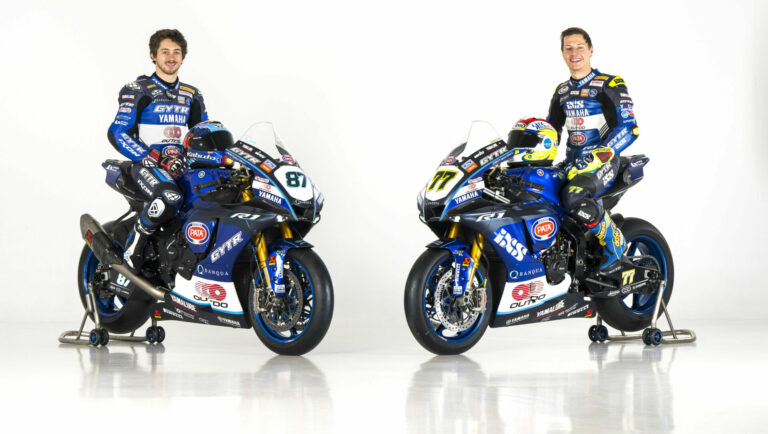
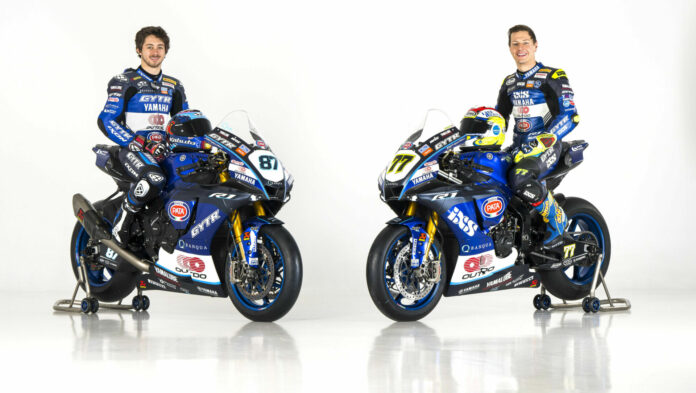
A NEW BEGINNING: THE GYTR GRT YAMAHA WORLDSBK RENEW ITSELF IN 2023
The time has finally come: the GYTR GRT Yamaha WorldSBK Team unveils Its 2023 colors ahead of the upcoming FIM Superbike World Championship champaign, with a brand new rookie duo composed by Remy Gardner and Dominique Aegerter, set to run the new livery for the first time at the Portimao test (31st January-1st February).
Gardner and Aegerter will make their debut in the WorldSBK, following an already successful career. Indeed, the Australian already boasts a Moto2 title in 2021, while the Swiss is a 3-time Champion, having secured the last two WorldSSP campaigns and being crowned FIM Enel MotoE World Cup Champion In 2022.
With both eager to shine in their new journey as well, the renewed GYTR GRT Yamaha WorldSBK Team duo look forward to a strong season, targeting to grow up each rounds making their way into the field to join soon the fight for the top positions.
The GYTR GRT Yamaha WorldSBK Team color scheme didn’t receive much updates from the past season, with minor but significant changes on its livery. Moreover, the team is delighted to welcome back several key partners, as well as introducing new ones for this season, who have been and will be significant in the squad’s successes.
Remy Gardner: ”Finally I can see myself in blue! I’m excited for this new chapter; new paddock, new bike, I’m really happy. The team and Yamaha are so great, we found good chemistry since the very first test. I can’t wait to start the season in Phillip Island, looking forward to start a new project, the championship looks very exciting. We’ll keep working during the test days, trying to extract as much potential as we could to be ready for the first round of the season.”
Dominique Aegerter: “I’m really looking forward to ride the new colors on track, I love the scheme and I can’t wait to show you on track the new livery. It’s cool and I hope you’ll like it and to be fast with it in every circuits, which is the most important thing. It’s nice to be part of Yamaha and GRT family, we already enjoyed good times in the first pre-season tests and I believe we’re working well together. We’ll try to grow up together and improve each round, I’m confident about it, so l cannot wait for Phillip Island to come to begin a new thrilling championship.”
Filippo Conti (Team Manager): “We’re all excited about this new beginning of the season. Having Remy (Gardner) and Dominique (Aegerter) with us represents a thrilling challenge that everyone in the team is looking forward to face. Both riders will be approaching the WorldSBK for the first time, but we’re still talking about two great riders, as well as World Champions. We’ll try to help them on expressing their maximum potential from the first races, with the goal of growing together each round. I’d like to thank Yamaha for the support they give us every year, we’re more than ready to begin a new season together. In the same way I’d like to thank all the partners who will support us again and say welcome to the new ones who will be crucial to the team’s results. Now we need to keep working during the test sessions to be ready for the first round of the 2023 FIM World Superbike Championship.”
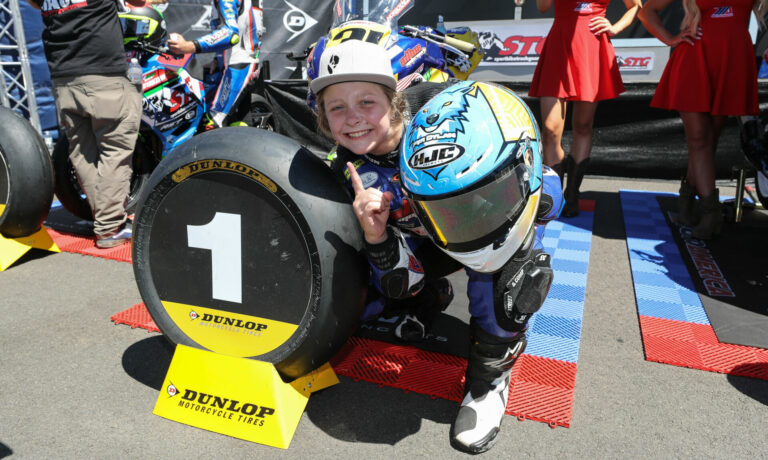
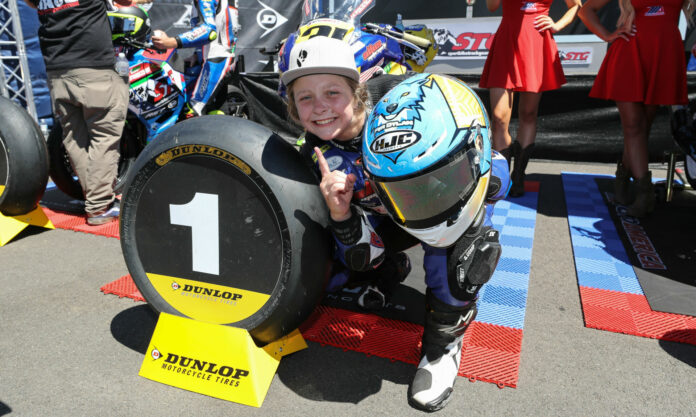
TUNE-IN ALERT: Kayla Yaakov Slated For Today Show On February 1
MotoAmerica Racer To Be Featured On “Today With Hoda And Jenna”
IRVINE, CA (January 31, 2023) – MotoAmerica Junior Cup race winner Kayla Yaakov will be a big part of the Today Show’s celebration of National Girls and Women in Sports Day on February 1 with the 15-year-old racer set to be a featured portion of tomorrow’s “Today With Hoda And Jenna” on NBC.
The “Today With Hoda And Jenna” segment with Yaakov is scheduled for the Today Show’s fourth hour at 10 a.m. (check your local listings).
Yaakov finished third in the 2022 MotoAmerica Junior Cup Championship with four race wins and seven additional podium finishes. She will make her MotoAmerica REV’IT! Twins Cup debut at Daytona International Speedway on Friday, March 10.
About MotoAmerica
MotoAmerica is North America’s premier motorcycle road racing series. Established in 2014, MotoAmerica is home to the AMA Superbike Championship as well as additional classes including Supersport, Stock 1000, Twins Cup, Junior Cup, and King Of The Baggers. MotoAmerica is an affiliate of KRAVE Group LLC, a partnership including three-time 500cc World Champion, two-time AMA Superbike Champion, and AMA Hall of Famer Wayne Rainey; ex-racer and former manager of Team Roberts Chuck Aksland; motorsports marketing executive Terry Karges; and businessman Richard Varner. For more information, please visit www.MotoAmerica.com and follow MotoAmerica on Facebook, Instagram, TikTok, Twitter, and YouTube.
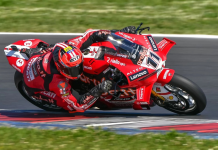
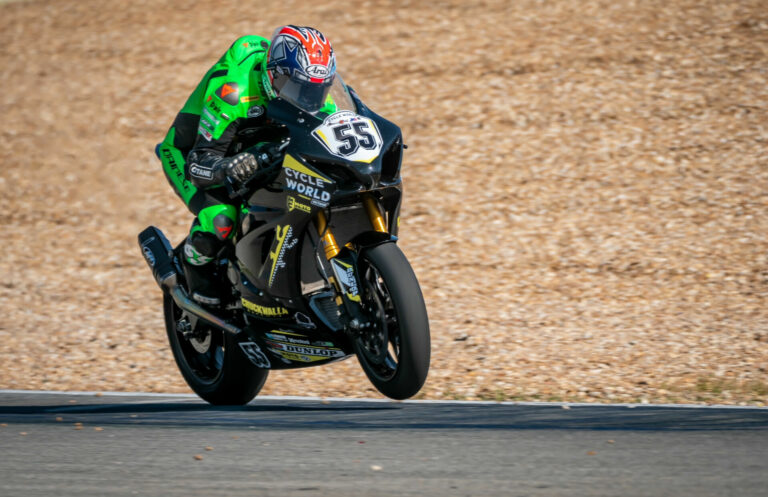
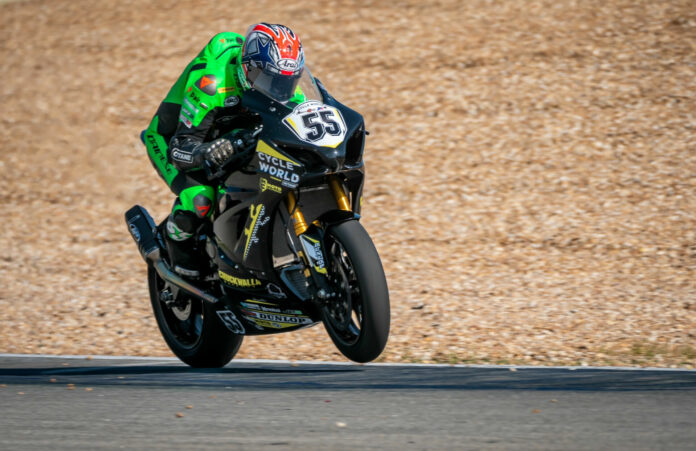
Michael Gilbert (55) in action before his season-ending injury in 2022. Photo by Karen E. Ott, courtesy Michael Gilbert Racing.
Michael Gilbert Racing Returns to MotoAmerica Supersport in 2023
Michael Gilbert is set to return to MotoAmerica Supersport in 2023 aboard a Next Generation-spec Team Hammer-prepared Suzuki GSX-R750.
The step to Supersport follows a successful, several-year run in Stock 1000 and Superbike with numerous victories and podiums, and is a fresh start and opportunity to compete at the front of a premier MotoAmerica class after a tough year of injuries. The team’s infrastructure has also been rejuvenated and expanded, including the addition of paddock-veteran Poncho Rangel as Gilbert’s crew chief for 2023.
“Coming back to Supersport is like hitting the reset button,” says Gilbert. “There’s zero question that 2022 was the most difficult season of my career in more ways than one—namely two broken legs. That said, I couldn’t be more excited to get the season going! I’m feeling healthier and stronger by the day, and I’m extremely confident in the team we’ve assembled. Having already tested a Suzuki GSX-R750 at Chuckwalla Valley Raceway, I have a great feeling about the upcoming season and the bike’s potential.”
Owen Williams will also transition to Supersport as teammate to Gilbert following two years in Junior Cup. It will be a steep learning curve, but the 15-year-old Californian is excited for the challenge and guidance from Gilbert.
“I’m so proud to be back with the team again for the 2023 season and even more so to be alongside Mikey in the Supersport class,” says Williams. “There’s so much to learn on the Suzuki GSX-R750, but I know that the team will give me the best opportunity to prove myself.”
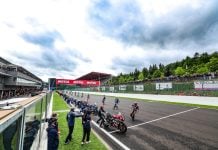
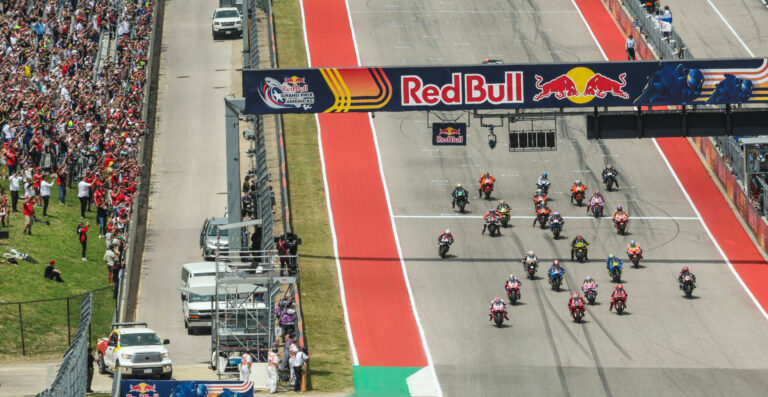
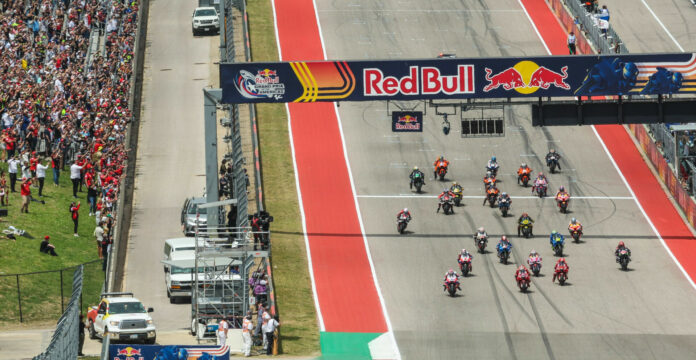
The new MotoGP sprint race will start at 3:00 p.m. local time each Saturday and the main MotoGP race will be the last thing on track each Sunday. MotoGP will race at Circuit of The Americas April 14-16, 2023. Photo by Brian J. Nelson.
#SprintingInto2023: new MotoGP™ time schedule revealed!
It’s the start of a new era and the time schedule for the Grand Prix classes can now be confirmed as MotoGP™ sprints into 2023
Wednesday, 01 February 2023
New year, new MotoGP™! The season ahead is going to be the biggest yet, with more Grands Prix in more countries reaching more fans than ever before. And that’s not all, as the MotoGP™ Sprint prepares to debut across the calendar and inject even more adrenaline into Saturday’s track action.
Here’s the rundown:
FRIDAY
Friday will remain practice day and will include two sessions for MotoGP™. The first is at 10:45 and lasts 45 minutes, and the second has been extended to 60 minutes. That starts at 15:00, with the combined times from P1 and P2 determining direct entrants to Q1 and Q2 qualifying for MotoGP™. They’re no longer called Free – because they aren’t!
Moto2™ has two 40-minute sessions on Friday, and Moto3™ two 35-minute sessions. Both count towards the combined timings, but for the lower classes Saturday morning’s P3 is also taken into account.
SATURDAY
Saturday is now an absolute blockbuster. MotoGP™ has a 30-minute free practice session, similar to the previous FP4, and then it’s time to qualify as Q1 starts at 10:50 before Q2 finalises the rest of the grid at 11:15. Once that’s concluded, our new post-qualifying show will take riders to a new stage for some live interviews in front of the fans. Then, it’s time to sprint!
The MotoGP™ Sprint will have its own identity. After a condensed 15-minute grid, the new event gets underway at 15:00 every Saturday and the podium will take place at a different location – changeable depending on the Grand Prix – to take the celebrations closer to the fans. Thereafter, a Sprint press conference will take place at 16:15, where we’ll be able to hear from the top three in the Sprint Race, the polesitter and the Championship leader.
Before the Sprint, Moto2™ and Moto3™, will each have a 30-minute P3 session on Saturday morning, with the combined times from P1-P2-P3 determining their direct entrants to Q1 and Q2. Moto3™ qualify first from 12:50, before Moto2™ from 13:45.
SUNDAY
There are no Warm Up sessions for Moto2™ and Moto3™, so the MotoGP™ class opens and closes the show on Grand Prix race day. 9:45 sees a 10-minute Warm Up session get action underway, before a MotoGP™ rider fan parade at 10am lets the packed stands see their heroes ahead of lights out. The riders will head around the track and make a couple of pitstops before landing back at the Hero Walk for more face-to-face fan time.
Racing begins at 11:00 for Moto3™ before the Moto2™ race at the slightly earlier time of 12:15.
The MotoGP™ Grand Prix race begins at 14:00, with the traditional Grand Prix podium set for 15:00. The structure of Moto3™ – Moto2™ – MotoGP™ is to be maintained throughout the season, and the MotoGP™ Grand Prix race will always be the final track action on Sunday. At many events the fans will be given the chance to flood to the podium and get to the heart of the celebrations.
Sound good? Download the 2023 schedule for the MotoGP™, Moto2™ and Moto3™ classes below!
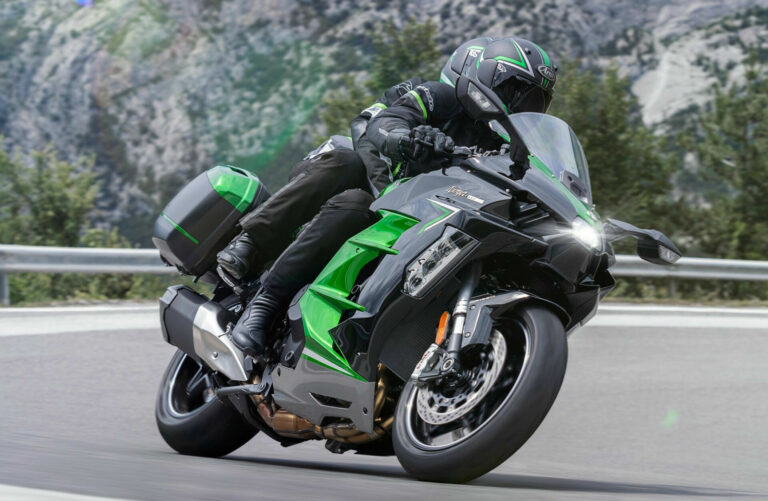
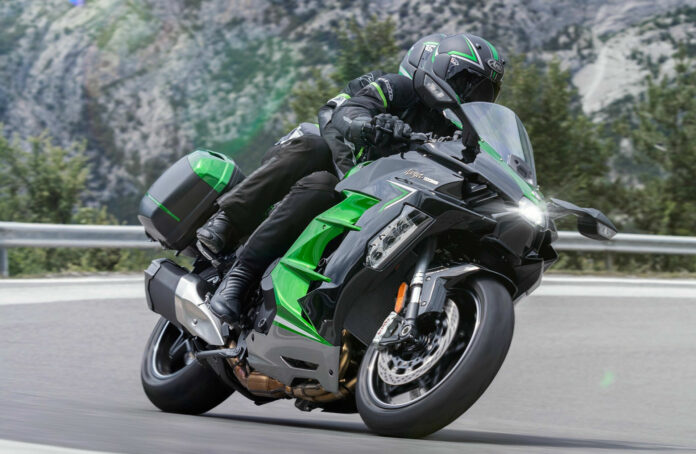
A 2023-model Kawasaki Ninja H2 SX SE sport tourer. Photo courtesy Kawasaki.
2023 KAWASAKI NINJA H2® SX SE MOTORCYCLE
ENGINEERED TO BE FREE
Kawasaki Ninja H2® models are a testament to Kawasaki’s pursuit of innovation, performance, and passion for creating the world’s most advanced line of supercharged motorcycles. For 2023, the Ninja H2® SX SE motorcycle returns to Kawasaki’s hypersport lineup, blending performance and ultimate real-world handling with Kawasaki’s most advanced suite of rider assist technologies to date.
The Kawasaki Ninja H2 SX SE brings the latest in electronically controlled suspension, braking, and rider aid technologies to the supercharged hyperbike platform, making it the ultimate sport touring package. New for 2023 is the addition of Auto Hi-Beam (AHB), which automatically turns the high beam lights on and off as necessary depending on brightness ahead. The Ninja H2 SX SE is powered by an exhilarating, balanced supercharged 998cc inline four-cylinder engine, which utilizes Kawasaki’s knowledge of precision engine tuning to distribute power to where it is most useful, in the low to mid-range for both long distance touring and daily riding. With this powerful engine at its core, Kawasaki has created one of the most advanced and well-balanced motorcycles in performance, comfort, and efficiency, to expand your supercharged journey.
Developed with the ability to go above and beyond the daily applications of today’s sportbike rider, the Ninja H2 SX SE is Kawasaki’s most advanced sport tourer ever and utilizes a balanced supercharged engine that offers optimal output performance in the low to mid RPM range, all while achieving excellent fuel efficiency. This highly refined package offers an unrivaled level of performance and comfort, with agile handling akin to its superbike counterparts.
Kawasaki Intelligent Proximity Activation Start System (KIPASS)
AUTO HI-BEAM (AHS)
New for 2023, the Ninja H2® SX SE now has an AHB feature that utilizes a camera sensor to assess brightness of the lights of vehicles ahead, streetlights, and more. AHB automatically turns the bike’s high beams on or off as necessary based on brightness. For this feature to function, the dimmer/passing switch must be set to high beam, the bike must be traveling above 12.4mph, and it must be dark. Once the system has been engaged, the icon will be displayed in green on the instrument screen.
An illustration of the Auto Hi-Beam system on the 2023 Kawasaki Ninja H2 SX SE. Photo courtesy Kawasaki.
ENGINE & CLUTCH
A balanced supercharged 998cc inline four-cylinder engine is designed to deliver both power and fuel efficiency on the 2023 Ninja H2® SX SE, focusing on low-mid range power delivery with exhilarating acceleration that prioritizes everyday usability in street-riding conditions. Cam timing contributes to the overall engine performance, while the resin silencer added to the secondary air inlet reduces mechanical (intake) noise and the straight-pipe style layout delivers excellent torque to benefit everyday ride ability.
A dog-ring transmission complements the powerful engine and facilitates smooth, quick shifting. A hydraulic assist and slipper clutch offers light lever operation and the volume of the hydraulic fluid routed to the clutch plates delivers a smooth clutch release. As a result, the shift load due to the plates dragging can be minimized, which is noticeable when stopped, and it’s easier to shift into neutral.
TFT COLOR INSTRUMENTATION WITH SMARTPHONE INTEGRATION (SPIN)
A large, easy-to-read 6.5” full-color TFT instrumentation screen adds a high-tech appearance to the cockpit. The TFT instrumentation is complemented by multiple display modes (black, white or automatic) and smartphone connectivity as well as compatibility with Kawasaki Smartphone Integration (SPIN) to offer riders a wide range of information. The home screen display is divided into three areas, upper, middle, and lower. Display functions in the upper area include integrated riding mode, gear position indicator, distance setting indicator, ACC indicator, tachometer, Kawasaki Quick Shift (KQS) indicator, Kawasaki Engine Brake Control (KEBC) indicator, and a multifunction gauge that visually shows the boost pressure plus the rider’s choice of throttle application, front brake pressure or G-force. The middle area display functions include a large digital speedometer, cornering light indicator, service indicator, Vehicle Hold Assist (VHA) indicator, and economical riding indicator. In the lower area, a multifunction display allows riders to scroll through functions such as odometer, dual trip meters, bank angle display and bank angle recording function, tire pressure, boost pressure, boost temperature, current and average fuel consumption, remaining range, average speed, total time, and battery voltage. Additional display functions that can also be accessed include fuel gauge, Kawasaki Electronically Controlled Suspension (KECS) preload mode, outside temperature, ice warning, connected device indicator, and clock and coolant temperature.
Kawasaki’s smartphone-based infotainment app (SPIN) enables various third party applications to be downloaded and mirrored on the cockpits TFT display. Basic functions available in the app include telephone, map display, music, calendar, and contacts. Additionally, riders can opt to download third party apps to add to their Kawasaki SPIN library to be able to interact with them on the TFT display. Available apps include Sygic (navigation), SENA (headset communication), and more.
Using Kawasaki SPIN provides riders access to several great functions, including:
Vehicle Info: information such as fuel gauge, odometer, maintenance schedule, which can all be viewed via the smartphone
Riding Log: GPS route information as well as vehicle running information can be logged and viewed via the smartphone
Telephone Notices: when a call or mail is received by the smartphone, this is indicated on the instrument display
The left profile view of a the 2023 Kawasaki Ninja H2 SX SE. Photo courtesy Kawasaki.
ADVANCED RIDER ASSIST SYSTEM (ARAS)
The Ninja H2® SX SE motorcycle continues to boast the latest cutting-edge technology, which includes the Advanced Rider Assist System (ARAS) that features surround-sensing functions based on radar sensors that generates a more relaxed riding experience. Oftentimes, riding in heavy traffic and maintaining the correct distance to the vehicle in front takes a great deal of concentration and can become strenuous over longer periods. Adaptive Cruise Control (ACC) maintains the speed set by the rider but adjusts the vehicle speed to maintain a suitable following distance from the vehicle in front. When the system is operating, a signal is shown on the instrument panel, including the symbol showing green when following a vehicle ahead and grey when there is no vehicle ahead. Once operational speed gets to a certain point, which varies in each gear, the system will disengage, and the rider will need to operate the brakes manually. Pressing the cruise control button on the left side of the handlebar turns the system off. Operating the brakes or engaging the clutch for several seconds causes ACC to be temporarily disengaged and closing the throttle completely will also disengage the system. Accelerating (throttle override) or shifting gears (as long as the new gear’s minimum operation speed is met) does not disengage the system unless the maximum speed allowed is reached.
Bosch’s development of Forward Collision Warning (FCW) was designed to reduce the risk of a rear-end collision or to mitigate its consequences through front-facing radar sensor monitors. The system is active as soon as the vehicle starts, and it supports the rider in all relevant speed ranges. If the system detects that another vehicle is in too close of range, and the rider does not react to the situation, it warns the rider with a bright flashing red LED light above the instrument panel and a warning is also shown on the TFT display. Riders can set the alert timing according to preference with options including early, medium or late. FCW can also be turned off, which will be indicated on the TFT display.
The Blind Spot Detection (BSD) function helps keep a lookout in all directions to assist motorcyclists with lane changes. A rear-facing radar sensor serves as the blind spot detection’s eye, registering objects in hard-to-see areas on both the left- and right-hand sides. When an approaching vehicle is detected, an LED built into the rearview mirror will illuminate, a first on a Kawasaki motorcycle. If a rider indicates the intent to change lanes by switching on the turn signal while a vehicle is detected in the blind spot, the mirror LED will flash. BSD can be turned off and will be indicated on the TFT display when doing so.
TIRE PRESSURE MONITORING SYSTEM (TPMS)
The Tire Pressure Monitoring System (TPMS) allows tire air pressure to continuously be monitored while riding, adding reassurance for the rider on long rides. Tire pressure sensors are used to alert the rider when tire pressure falls below 31.9 PSI through a low-pressure warning that is displayed on the TFT meter.
VEHICLE HOLD ASSIST (VHA)
Activated when the rider has stopped and firmly applies the brake(s), Vehicle Hold Assist (VHA) engages the rear brake to allow the rider to relax the hand brake. The ABS pump exerts pressure to engage the rear brake, and a light/signal is indicated on the TFT meter to let the rider know the brake hand can be relaxed and the bike will remain in place. The system disengages automatically when the rider turns the throttle to accelerate, when the side stand goes down, or 10-minutes after activation. The rider can also disengage the system by quickly squeezing and releasing the brake lever (within 1 second).
KAWASAKI INTELLIGENT PROXIMITY ACTIVATION START SYSTEM (KIPASS)
The Kawasaki Intelligent Proximity Activation Start System (KIPASS) master key system allows remote activation of the main switch and steering lock of the Ninja H2 SX SE motorcycle. The system offers increased convenience while acting as a deterrent to theft and vandalism. With the compact key fob in a pocket, the KIPASS sends out a signal that is picked up and recognized by the ECU. For added security, an immobilizer function is incorporated into the ignition system. As a flagship model, the key fob of the Ninja H2 SX SE is adorned with the Kawasaki River Mark.
BOSCH 10.3ME ABS IMU
The Ninja H2® SX SE is Kawasaki’s first model to integrate an FI-ECU with torque-demand capabilities and the new IMU measures in six degrees of freedom (DOF) with a compact, boost circuit-equipped ABS with high computational power. IMU enables inertia along 6 DOF to be monitored. With the new unit, acceleration along longitudinal transverse and vertical axes, plus roll rate, pitch rate and yaw rate are all measured. Feedback from the IMU is used to give clearer real-time picture of chassis orientation. With more sophisticated torque-demand capabilities, the FI-ECU is able to adjust torque in response to external direction, which enables it to work in concert with the ABS. This coordinated control of both the engine and brakes is essential for delivering smooth operation in systems like the new ACC. A boost circuit capable of increasing fluid pressure at the brake calipers enables the brakes to be activated independent of direct rider input, which is required for the new ACC and VHA systems.
The Ninja H2® SX SE features KECS with Skyhook technology which helps support the motorcycle’s sprung weight and modulates the suspension damping force to allow the wheels to track road dips and bumps while maintaining the motorcycle’s vertical position with minimal disturbance. The updated software incorporates Showa’s Skyhook EERA (Electronically Equipped Ride Adjustment) technology to deliver an even more composed ride. Showa’s Skyhook software, carefully fine-tuned by Kawasaki engineers to ensure the sporty riding character of the Ninja H2 SX SE was preserved, delivers a smooth ride as it continually adapts to the road surface in real time. Combining high-level mechanical components with the latest electronic control technology, KECS offers both the suppleness to offer riding comfort in a wide range of riding situations, as well as the firm damping to facilitate sport riding. Handling the suspension duties is a sporty 43mm inverted Showa cartridge fork and a high-spec Showa Balance Free Rear Cushion (BFRC) lite rear shock – similar to the rear suspension used on the Ninja® ZX™-10R sportbike, except it also features electronically adjustable preload.
In the BFRC lite shock, damping force is generated in an external Damping Force Chamber, and compression and rebound damping are generated independently, allowing the whole surface of the main piston to act as a pump, pushing oil towards the valves. This configuration also helps to suppress pressure balance fluctuations as a result of shock compression and extension.
Compression and rebound damping for both the forks and shock are generated (and adjusted) electronically via the KECS system that is controlled by a solenoid valve with direct actuation and allows for extremely quick reaction time. Riders can choose from four modes: Sport, Road, Rain, and Manual. KECS then adjusts to the road surface environment in real time to provide the ideal damping, considering vehicle speed, stroke speed and deceleration. Riders can electronically control the rear shock preload settings as well. KECS offers three different preload settings: rider only, rider with luggage, and rider with passenger and luggage. Riders can fine-tune these settings with 10 levels of adjustment for each.
The forks and shock have built-in stroke sensors that provide real-time stroke speed and compression information. The sensor coils provide input to the KECS ECU every millisecond. This is complemented by information provided by the IMU (acceleration/deceleration) every 10 milliseconds and the FI ECU (vehicle speed) every 10 milliseconds. The KECS ECU then directs current to the solenoids to adjust damping as required by the situation.
STYLING
Sleek lines give the Ninja H2® SX SE a sharp, compact look, while maintaining its aggressive and seductive Ninja® image. The front face design points to its supercharged roots and instantly communicates that it’s more than the ordinary sport touring machine. The upper cowl features angular lines and a slim, compact impression even with the addition of the radar sensor, which is positioned below the headlight. The radar sensor sits behind a cover, specially designed to not interfere with the radar function. The Kawasaki River Mark emblem is proudly displayed on the upper cowl – a true reflection of the high-level performance, comfort, and quality that the Ninja H2 SX SE offers. Full fairing bodywork adds to the bike’s sporty image and helps to reduce heat that can be felt by the rider.
In order to match the upper cowl, simple surfaces have been added to the side cowl and contribute to the styling. The upper cowl is compact to accommodate the front radar sensor, and a LED headlight is positioned at the front of the upper cowl, contributing to the intense design. It features integrated position lamps that are crystal-like in appearance, adding a high-class touch. LED cornering lights are built into each side of the fairing in sets of three to help illuminate the road when cornering. Aerodynamically shaped mirrors offer a clear view of the rear, even when the Kawasaki Genuine Accessories 28L hard saddlebag set is fitted, and feature single-bulb LED-type turn signals. Rear-facing radar is built into the rear fender, and like the front radar, is cleverly hidden by a specially designed cover. LED turn signals contribute to the bike’s high-quality image and a handcrafted two-color “Supercharged” emblem is fitted to communicate the flagship status of the Ninja H2 SX SE.
ERGONOMICS
An ergonomically designed front seat provides comfort for spending long hours in the saddle as well as accommodates position changes for sportier riding. Both rider and passenger seats add to rider and passenger comfort. The wide rear seat features a flat surface at the front to help keep the passenger from sliding forward under braking. Under the rear seat, a USB-type power outlet offers a convenient source for powering accessories or personal items. The riding position of the Ninja H2® SX SE offers a relaxed bend that is comfortable for in-town riding and long touring and features grip heaters to add to the comfort on cold days. The grip heater wiring is routed inside of the handlebar for a clean design.
BRAKES & WHEELS
The Ninja H2® SX SE comes equipped with high-grade Brembo Stylema front calipers. The design of key sections allows stiffness to be maintained while enabling a direct connection to the piston area. The Stylema calipers quickly cool thanks to optimal airflow around the brake pads, space around the pistons, and an opening that allows air to exit from the central bridge. The dual radial mount opposed 4-piston Stylema front calipers grip a pair of semi-floating 320 mm discs, which complement the technical innovation and premium quality of the Ninja H2 SX SE. Bridgestone Battlax Hypersport S22 tires provide a good balance of sport and touring performance.
INTEGRATED RIDING MODES
All-inclusive modes that link KTRC, Power Mode and KECS allow riders to efficiently set traction control, power delivery, and suspension characteristics to suit a given riding situation. Riders can choose from four settings: Sport, Road, Rain or a Manual setting. In the manual rider mode, each of the systems can be set independently. The Sport setting enables riders to enjoy sporty handling riding. The Road setting provides comfortable riding characteristics over a wide range of situations, from city riding to highway cruising and rural roads. The Rain setting offers rider reassurance when riding on a low traction surface.
HIGHLY DURABLE PAINT
Kawasaki’s Highly Durable Paint features a special top coat that allows certain types of scratches to repair themselves, enabling the paint to maintain its high quality finish through normal wear and tear†. The self-healing is achieved through microscopic soft and hard segments within the top coat working like a chemical spring, creating a trampoline effect that absorbs many impacts.
† Notes:
1. Recovery can take a week or longer.
2. The paint will not recover in the case of scratches caused by a coin or key, or zip fasteners.
KAWASAKI GENUINE ACCESSORIES
For 2023, a variety of Kawasaki Genuine Accessories (KGA) are available for the Ninja H2® SX SE, including a high front seat, low front seat, color matched seat cowl, oil cap, helmet lock, and clear windshield that is 55mm lower. Additional accessories include frame sliders, a 28L hard saddlebag set, bag fitting kit, color panel kit, trim set, and one key system.
Ninja H2 SX SE
Color: Emerald Blazed Green / Metallic Diablo Black / Metallic Graphite Gray
MSRP: $28,000
Availability: Available Now
ABOUT KAWASAKI
Kawasaki started full-scale production of motorcycles over a half century ago. The first Kawasaki motorcycle engine was designed based on technical know-how garnered from the development and production of aircraft engines, and Kawasaki’s entry into the motorcycle industry was driven by the company’s constant effort to develop new technologies. Numerous new Kawasaki models introduced over the years have helped shape the market, and in the process have created enduring legends based on their unique engineering, power, design and riding pleasure. In the future, Kawasaki Motors, Ltd. is committed to maintaining and furthering these strengths which will surely give birth to new legends.
Kawasaki Motors Corp., U.S.A. markets and distributes Kawasaki motorcycles, ATVs, side x sides, and JET SKI® watercraft through a network of approximately 1,100 independent retailers, with close to an additional 7,700 retailers specializing in general purpose engines. Kawasaki and its affiliates employ nearly 3,100 people in the United States, with approximately 260 of them located at Kawasaki’s Foothill Ranch, California headquarters.
Kawasaki’s tagline, “Let the good times roll.®”, is recognized worldwide. The Kawasaki brand is synonymous with powerful, stylish and category-leading vehicles. Information about Kawasaki’s complete line of powersports products and Kawasaki affiliates can be found on the Internet at www.kawasaki.com.
Kawasaki is here to redefine the 400cc supersport category with the arrival of the all-new Ninja® ZX™-4RR KRT Edition motorcycle. This circuit-focused motorcycle combines real-world road enjoyment and track riding potential and provides the rider the satisfaction of being able to ride with confidence. The Ninja ZX-4RR KRT Edition is designed for the rider seeking a new exhilarating riding experience.
The Ninja ZX-4RR KRT Edition features a new, powerful 399cc in-line four-cylinder engine that produces music to the ears with its high-performance audible signal – helping it stand out from the competition. Thanks to its lightweight trellis frame, it is compact and nimble for exciting cornering performance. Dual front disc brakes and a high-performance Showa SFF-BP front fork as well as BFRC Lite rear shock have been fitted to ensure that the Ninja ZX-4RR KRT Edition breeds performance from the ground up.
The long list of impressive features doesn’t stop there as the Ninja ZX-4RR KRT Edition boasts numerous premium features that include a 4.3” TFT color instrumentation with smartphone connectivity, integrated riding modes that link Kawasaki TRaction Control (KTRC) and Power Modes, dual-direction Kawasaki Quick Shifter (KQS), and aggressive Ninja® ZX™ family styling that make it clear this is a high-performance supersport model from Kawasaki.
The left side of a 2023 Kawasaki Ninja ZX-4RR KRT Edition. Photo courtesy Kawasaki.
2023 NINJA ZX-4RR KRT EDITION HIGHLIGHTS:
NEW All-new 399cc liquid-cooled, 4-stroke, in-line four cylinder engine
NEW World Superbike-inspired chassis design
NEW Dual front disc brakes
NEW High-performance suspension
NEW Ergonomics for control and comfort
NEW Fierce Ninja ZX styling
NEW 3” TFT color instrumentation with circuit mode
NEW Smartphone connectivity via RIDEOLOGY THE APP
NEW All LED lighting
NEW Integrated riding modes
NEW Dual-direction Kawasaki Quick Shifter (KQS)
ENGINE
The Ninja ZX-4RR KRT Edition boasts an all-new 399cc liquid-cooled, 4-stroke, in-line four cylinder engine that delivers exhilarating performance and fun-to-ride power. Developed with feedback from other Kawasaki Ninja ZX supersport machines, the all-new engine found on the Ninja ZX-4RR KRT Edition features a quick-revving nature with a direct throttle response that combines strong low-mid range torque for city riding and high-rpm power that can be enjoyed when riding on the track. As riders roll on the throttle, they are rewarded with a satisfying surge of acceleration that is complemented by the distinct intake and exhaust notes of a Kawasaki in-line four cylinder engine.
The new Ninja ZX-4RR is powered by a 399cc DOHC inline four-cylinder engine with an indicated redline of 16,000 rpm. Photo courtesy Kawasaki.
The liquid-cooled, DOHC, 16-valve, 399cc in-line four cylinder engine features a bore and stroke of 57.0 x 39.16mm and packs impressive power and strong torque. The bore and stroke contributes to the impressive top-end power. A high-spec ECU is similar to that found on the Kawasaki Z H2, which allows for the use of Kawasaki’s latest electronics. Electronic Throttle Valves (ETV) with 34mm throttle bodies provide smooth, natural engine response by enabling the ECU to control the volume of both the fuel (via the injectors) and the air (via throttle valves) delivered to the engine. Additionally, they facilitate the use of Kawasaki electronic rider support systems such as integrated riding modes with traction control, selectable power modes, and a dual-direction Kawasaki Quick Shifter (KQS) that allows riders to feel “at one” with their machine.
Intake port interiors are sand cast using fine sand, which results in a smooth finish. Similar to the Ninja® ZX™-10R, the intake port exits have been machined in two stages, first along with the valve seats and then again at an inclined angle, to create a straighter path for intake air as it enters the combustion chamber. The straighter and wider path for the intake air promotes a smoother flow and a greater volume of fuel-air mixture that contributes to the engine’s high performance. Lightweight forged camshafts contribute to the high-revving and high-rpm performance.
Large 22.1mm intake valves are complemented by 19mm exhaust valves, flowing a great volume of air for excellent high-rpm performance. Triple-rate valve springs accommodate the valves and add to the Ninja ZX-4RR KRT Edition’s high-rpm performance. A narrow valve angle helps combustion efficiency as well as achieves a compact engine design. The combustion chambers are precision machined to high tolerances – a production technique that is limited to Kawasaki’s high-performance premium models.
Lightweight cast aluminum pistons contribute to low reciprocating weight for quick-climbing revs. The piston skirts have a molybdenum coating that increases durability. The piston crowns were designed to develop compression, which contributes to the 12.3:1 compression ratio that is found on the Ninja ZX-4RR KRT Edition and optimized to allow the use of regular gasoline while achieving strong performance. The piston’s wide bore facilitates the use of the large intake and exhaust valves for greater air flow, while their short stroke adds to the high-rpm performance. Utilizing an aluminum die-cast cylinder with an open-deck design, excellent heat dissipation and low engine weight is achieved.
In order to reduce mechanical loss and vibration, Kawasaki engineers carefully selected the connecting rod ratio, while a special carburizing treatment was used on the connecting rods to improve durability and reduce weight. Thanks to the crankshaft’s light flywheel mass, a low moment of inertia was reached, contributing to a quick-revving engine character and direct throttle response. A deep oil pan ensures that the oil pump inlet is always submerged, blocking air from being ingested, even during hard acceleration and deceleration while sport or track riding.
A large radiator keeps the Ninja ZX-4RR’s high-revving engine cool. Photo courtesy Kawasaki.
ADVANCED ENGINE COOLING
With the Ninja ZX-4RR KRT Edition engine designed for high performance, Kawasaki engineers placed a great emphasis on the engine’s cooling system in order to achieve optimum performance. The water jackets on the cylinder head were carefully designed and long-reach spark plugs offer greater contact with the water jacket, helping to prevent engine knocking. A large, 30-row radiator provides efficient engine cooling to handle the Ninja ZX-4RR KRT Edition’s performance capabilities. Side air ducts are built into the fairings to direct cool air towards the engine and promote heat dissipation that greatly contributes to engine performance. Innovative Kawasaki technology like the patented radiator fan cover that is located behind the radiator directs hot air out to the sides and away from the rider, improving rider comfort. The heat management system was designed using CFD analysis and controls the flow of air, helping keep the tank, frame, and other parts that contact the rider cooler, further increasing rider comfort.
The Ninja ZX-4RR benefits from ram air induction. Photo courtesy Kawasaki.
RAM AIR DUCT INTAKE SYSTEM
The Ram Air duct system is a trademark feature on Kawasaki’s Ninja ZX models. It’s a centrally positioned intake that improves filling efficiency and increases engine performance. Following a layout that is similar to that of the Ninja H2, the Ram Air duct is routed to the left of the front fork on its way to the airbox. This contributes to a duct with a highly efficient airflow, enabling cool, high-pressure air from the front of the bike to be ingested. Engine performance is increased at all rpm thanks to the increased pressure and cooler air. Additionally, the design is extremely effective at preventing water from entering the airbox while riding in the rain. The large Ram Air duct has “Ram Air” stamped into it, which is visible to the rider and adds to the Ninja ZX-4RR KRT Edition’s high-performance look and feel. Intake funnels, consisting of 60mm and 40mm lengths, contribute to efficient filling and produce a flat torque curve with smooth power delivery. The downdraft intake creates a shorter, more direct path for intake air to enter the cylinder, improving cylinder-filling efficiency and increasing engine power, especially at high rpm.
Kawasaki designed the exhaust system on the Ninja ZX-4RR so it is easy to add an aftermarket exhaust silencer. Photo courtesy Kawasaki.
EXHAUST
The header pipes and collector pipe layout were built with inspiration from the Ninja® ZX™-6R. Joint pipes link the headers, contributing to a strong power output while meeting emissions and sound regulations. A traditionally styled, long silencer produces a clear, racy exhaust note that is distinct to that found on a Kawasaki in-line four cylinder engine. The collector pipe features triple catalyzers to ensure emissions are met and their position makes it easy to add a slip-on muffler.
TRANSMISSION & CLUTCH
Complementing the high-performance 399cc engine is a smooth-shifting six-speed transmission that is designed to shine in all riding situations. It’s especially well suited for riders accelerating out of corners when sport or track riding and features a dual-direction Kawasaki Quick Shifter (KQS). Developed through Kawasaki’s racing efforts, the Ninja ZX-4RR KRT Edition is fitted with an Assist & Slipper Clutch that uses two types of cams (an assist cam and slipper cam), offering two functions that are not available on a standard clutch. When the engine is operating at normal rpm the assist cam functions act as a self-serve mechanism, pulling the clutch hub and operating plate together to compress the clutch plates. This allows the total clutch spring load to be reduced, resulting in a lighter clutch lever pull when operating the clutch. When excessive engine braking occurs, the slipper cam comes into play, forcing the clutch hub and operating plate apart. This relieves pressure on the clutch plates to reduce back torque and help prevent the rear tire from hopping or skidding.
ELECTRONICS
KAWASAKI TRACTION CONTROL (KTRC)
Kawasaki’s advanced KTRC system provides both enhanced sport riding performance and peace of mind under certain conditions to negotiate low-traction surfaces with confidence. Three selectable modes offer progressively greater levels of intrusion that cut fuel and ignition to help maintain traction and forward drive as well as suit the riding situation and rider preference. The system uses a number of parameters to get an accurate real-time picture and adapt accordingly. Mode 1 is the least intrusive and designed with sport riding in mind, Mode 2 intervention occurs earlier offering a balance of sport riding support and rider confidence, and Mode 3 is the most intrusive for navigating low-traction conditions. In addition to the three modes, the rider can elect to turn the system OFF.
POWER MODES
Power Modes offer riders an easily selectable choice of engine power delivery to suit riding conditions or preferences. In addition to Full Power mode, one (Low) alternate mode in which maximum power is limited and throttle response is milder is provided.
INTEGRATED RIDING MODES
All-inclusive modes that link KTRC and Power Mode allow riders to easily set traction control and power delivery to suit a given riding situation. Riders can choose from three settings (Sport, Road, Rain) or a manual setting (Rider). In the manual Rider mode, each of the systems can be set independently.
KAWASAKI QUICK SHIFTER (KQS)
Adding to its impressive list of high-performance features, the Ninja ZX-4RR KRT Edition comes equipped with dual-direction KQS. The KQS allows ultra-quick upshifts and downshifts without the need to use the clutch, resulting in a more enjoyable experience and quicker lap times. Designed for more effective sport riding, KQS can also be used on the street when the engine is above 2,500 rpm.
The Ninja ZX-4RR comes with a color TFT display with a Circuit Mode. Photo courtesy Kawasaki.
TFT COLOR INSTRUMENTATION
The 4.3” all-digital TFT color instrumentation gives the cockpit a high-tech, high-grade appearance and features a Circuit Mode that allows lap timing and shows track-related information in a more prominent and easier-to-view layout. The high-grade color LCD screen features TFT (thin-film transitory) technology, delivering a high level of visibility. Selectable background and text colors can be chosen to suit light or dark conditions and screen brightness automatically switches between five levels to suit available light.
Display functions include a digital speedometer, digital bar-style tachometer, gear position indicator, shift indicator (tachometer flashes), fuel gauge, odometer, dual trip meters, current and average fuel consumption, remaining range, average speed, riding time, coolant temperature, clock, battery voltage, lap timer (Circuit Mode only), Kawasaki service reminder, oil change reminder, integrated riding mode, KTRC and power mode indicators, smartphone call and mail notices, Bluetooth indicator, economical riding indicator, and KQS indicator.
Circuit mode can be toggled for use at track days and changes the display to make information for track riding more visible. This includes showing the lap time in the center with large text so that it can easily be ready while riding. The gear position and tachometer display is also more visible along the top when above 10,000 rpm, giving riders a clear view of the information needed when working towards faster lap times on the track.
RIDEOLOGY THE APP
Bluetooth® technology built into the instrument panel enables riders to connect to their motorcycle wirelessly. Using RIDEOLOGY THE APP*, a number of instrument functions can be accessed, logged, and reviewed contributing to an enhanced motorcycling experience. The following information can be viewed:
Vehicle Info – Information such as fuel gauge, odometer, maintenance schedule and more can be viewed via the smartphone
Riding Log – GPS route information as well as vehicle running information can be logged and viewed via the smartphone
Mobile Phone Notices – When a call or email is received by the smartphone, this is indicated on the instrument display
Tuning / General Settings – General instrument display settings such as preferred units, date, date format, and more can be adjusted via the smartphone
The app can also be used when away from the motorcycle. When riding (with the app ON), the bike and smartphone are always connected and riding log data is being recorded by the app. After your ride, the latest riding information is stored by the app and may be viewed on the smartphone. Any changes made via the app while the engine is off, or while out of range, will be implemented as soon as the ignition is turned on and the smartphone is in range with the app ON.
*RIDEOLOGY THE APP is not intended for use during vehicle operation. Only use RIDEOLOGY THE APP when the vehicle is not being operated and it is safe to do so.
A Kawasaki Ninja ZX-4RR stripped of its bodywork to show off its tubular steel trellis-style frame. Photo courtesy Kawasaki.
CHASSIS
The Ninja ZX-4RR KRT Edition delivers light maneuverability when riding around town, however, its high-level supersport character shines when out sport riding on backroads or at the racetrack. Utilizing feedback derived directly from Kawasaki Racing Team’s (KRT) efforts in the FIM World Superbike Championship, Kawasaki engineers carefully selected key chassis components to achieve excellent rigidity balance. Formed from high-tensile steel, the trellis frame features various pipe diameter thicknesses with a swingarm pivot section. Kawasaki’s advanced dynamic rigidity analysis was used to ensure the required balance of strength and chassis flex.
Key chassis dimensions, such as center of gravity position, swingarm pivot position, engine axis positions, and the caster angle were inspired by Kawasaki’s World Superbike Ninja® ZX™-10RR, bringing World Superbike chassis design to the 400cc class. The long-style swingarm is made from high-tensile steel and allows the bike’s front-rear weight distribution to be set for the perfect balance of nimble handling and composed chassis behavior. An arch design on the right side of the swingarm delivers the required balance of rigidity and flex, enabling the silencer to be positioned as centrally as possible while adding to the Ninja ZX-4RR KRT Edition’s stylish, sporty looks.
The Kawasaki Ninja ZX-4RR comes with inverted 37mm Showa SFF-BP (Separate Function Fork – Big Piston) front forks. Photo courtesy Kawasaki.
SUSPENSION
To complement the optimal rigidity balance of the chassis, the Ninja ZX-4RR KRT Edition front end is held up by a 37mm inverted front fork that features Showa’s SFF-BP (Separate Function Fork – Big Piston) technology. This advanced fork offers both racetrack performance and everyday usability. The technology is similar to that on the Ninja ZX-6R, while the spring rate and damping characteristics were developed specifically for the Ninja ZX-4RR KRT Edition. The front fork provides smooth action at the initial part of the stroke that contributes to excellent composure under braking. A large-diameter damping piston is used in the SFF-BP fork, which is much larger than that used in a cartridge-type fork. This allows oil inside the fork to act on a much larger surface area and damping pressure to be reduced while ensuring the same damping force. By reducing the damping pressure, it allows the slide pipe to move more smoothly, which is especially noticeable during the initial part of the stroke. This design allows for greater control as the fork begins to compress and a smooth transition as the Ninja ZX-4RR KRT Edition’s weight shifts forward when reducing speed, offering greater chassis stability on corner entry and a planted feel when braking. The fork settings were designed to accommodate a wide range of riding situations, from the city to the racetrack. The spring preload is adjustable and can be tailored to suit the rider’s preference, which is the first use of adjustable SFF-BP in the 400cc class.
A Showa BFRC (Balance Free Rear Cushion) Lite shock on the back of a Kawasaki Ninja ZX-4RR. Photo courtesy Kawasaki.
At the rear of the Ninja ZX-4RR KRT Edition, horizontal back-link rear suspension mounted to a Showa BFRC (Balance Free Rear Cushion) Lite shock can be found. The shock is similar to that found on the Ninja ZX-10R and has been specially tuned for the Ninja ZX-4RR KRT Edition. Its excellent movement at the start of the stroke ensures comfort in day-to-day riding as well as a planted feel when riding on the track, while linear damping characteristics provide a stable, solid feel and peace of mind for the rider in a wide variety of situations. Additionally, it offers adjustable compression and rebound damping as well as adjustable spring preload so that riders can fine-tune the rear end to suit their riding preferences. The horizontal back-link rear suspension positions the shock unit and linkage above the swingarm and out of the way from engine and exhaust heat. A firm rear shock feel achieves a planted feel that is reassuring during sport riding, while also offering ample absorption for ride comfort when riding around town.
WHEELS & BRAKES
In order to stop the powerful Ninja ZX-4RR KRT Edition, a pair of 290mm semi-floating front discs handle the stopping duties up front and are gripped by 4-piston radial-mount monobloc calipers. The calipers feature different diameter pistons with the upper piston measuring 32mm and the lower piston 30mm. Dual front discs were chosen for additional stopping power and the monobloc calipers help achieve a firm initial touch. Brake pad selection contributes to both brake force and braking controllability.
The Kawasaki Ninja ZX-4RR is slowed by dual 290mm front discs and radial-mount four-piston monoblock front brake calipers. Photo courtesy Kawasaki.
At the rear, a 220mm disc is slowed by a single-piston caliper that is powered by a 38mm piston. The master cylinder, caliper, brake pedal, and brake pad material were carefully selected for a balance of stopping power and control. Equipped with ABS, the Ninja ZX-4RR KRT Edition features Nissin’s latest ABS control unit that has been specially developed to deliver precise control and is the most compact and lightweight unit available.
Stylish star-pattern five-spoke wheels contribute to the bike’s overall lightweight and their high rigidity improves handling. The wheels also contribute to the bike’s light, nimble appearance. Dunlop Sportmax® GPR-300 radial tires are mounted on the front and rear, offering high grip in both wet and dry conditions and contributing to agile handling and excellent riding comfort. A 120/70ZR17 tire is used on the front and 160/60ZR17 is fitted on the rear.
The Kawasaki Ninja ZX-4RR rolls out of the factory on Dunlop Sportmax® GPR-300 radial tires, including a wide 160/60-ZR17 rear. Photo courtesy Kawasaki.
ERGONOMICS
To take full advantage of the Ninja ZX-4RR KRT Edition’s nimble, supersport-style handling is a naturally aggressive riding position that is more forward-leaning than that found on the Ninja 400. The riding position on the Ninja ZX-4RR KRT Edition offers a good balance of wind protection and aerodynamics that enable the rider to tuck in to get out of the wind, while still maintaining a relaxed feel. A slim design of the fuel tank between the rider’s legs promotes good contact with the bike and a low design on the top of the fuel tank facilitates the rider getting into a tucked position. A firm seat cushion offers both sports potential and comfort. The seat makes it easy for riders to shift their weight during sport or track riding and increases comfort on long rides. Supersport-style footpegs give the rider a direct feel and good controllability when sport riding. An adjustable brake and clutch lever each offer five position settings that allows the rider to set them to suit their hand size and preference.
STYLING
The aggressive Ninja styling of the Ninja ZX-4RR KRT Edition was designed to deliver a fierce look that contains its power and explosive action, benefitting the most powerful machine in the 400cc class. Prominently located at the center of the upper cowl, the Ram Air intake is a trademark feature on Ninja ZX models, setting the machine apart from its competition. It’s stamped with “Ram Air”, leaving a reminder of the bike’s high performance. A sharp chin spoiler further contributes to the strong Ninja family image. The supersport-style low fuel tank and minimalist tight-fitting bodywork that wraps around the in-line four engine gives the Ninja ZX-4RR KRT Edition a compact, high-class look. Sharply angled lines contribute to a lightweight image that reflects the bike’s nimble supersport-style handling. Side air ducts in the fairings provide a blend of form and function, directing cool air into the engine and adding aggressive lines for a stylish design. The upswept angle of the slim, race-style tail cowl puts off a lightweight appearance and the rear flap can easily be removed for track days.
Twin LED headlights help the Ninja ZX-4RR KRT Edition stand out and provide excellent illumination, while LED front turn signals are built into the fairings. The LED taillight was inspired by the Ninja ZX-10R, adding a high-grade touch to the rear of the motorcycle. Both the license plate bulb and rear turn signals are LED, completing the full LED package.
ACCESSORIES
A wide range of Kawasaki Genuine Accessories (KGA) are available and allow riders to personalize their Ninja ZX-4RR KRT Edition motorcycles. This includes a sport seat with firm urethane cushioning that makes it easier to feel the rear wheel traction during sport riding sessions and a USB outlet that provides a convenient charging point and is accessible under the seat. Other accessories such as a pillion seat cover, frame slider, tank pad, radiator screen, and meter protector are also available.
Ninja® ZX™-4RR KRT EDITION
Color: Lime Green / Ebony
MSRP: $9,699
Availability: Available Spring 2023
ABOUT KAWASAKI
Kawasaki started full-scale production of motorcycles over a half century ago. The first Kawasaki motorcycle engine was designed based on technical know-how garnered from the development and production of aircraft engines, and Kawasaki’s entry into the motorcycle industry was driven by the company’s constant effort to develop new technologies. Numerous new Kawasaki models introduced over the years have helped shape the market, and in the process have created enduring legends based on their unique engineering, power, design and riding pleasure. In the future, Kawasaki Motors, Ltd. is committed to maintaining and furthering these strengths which will surely give birth to new legends.
Kawasaki Motors Corp., U.S.A. markets and distributes Kawasaki motorcycles, ATVs, side x sides, and JET SKI® watercraft through a network of approximately 1,100 independent retailers, with close to an additional 7,700 retailers specializing in general purpose engines. Kawasaki and its affiliates employ nearly 3,100 people in the United States, with approximately 260 of them located at Kawasaki’s Foothill Ranch, California headquarters.
Kawasaki’s tagline, “Let the good times roll.®”, is recognized worldwide. The Kawasaki brand is synonymous with powerful, stylish and category-leading vehicles. Information about Kawasaki’s complete line of powersports products and Kawasaki affiliates can be found on the Internet at www.kawasaki.com.
Chuckwalla Valley Raceway, in Desert Center, California, seen here under normal, dry conditions, shortly after it was built in 2010. Photo by Caliphotography.com, courtesy Chuckwalla Valley Raceway.
The following track days, riding schools, and racing events are scheduled by organizations based in the United States and Canada during February 2023.
Motorcycle track days, riding schools, and races are posted under the Event Calendar tab on the home page of this website, or you can access the Event Calendar for February 2023 directly by clicking HERE.
Once on the Event Calendar page, you can search for the event you are looking for by its date.
When you click on the event you want to attend you should find a link to the website and/or email address of the host organization, a link to the website of the host venue, the physical address of the host venue, a Google map to the host venue, and buttons to add the event and its information to your calendar application.
To have your motorcycle racing or riding event added to the Event Calendar on this website and published in the print edition of Roadracing World & Motorcycle Technology magazine, submit your calendar and contact information via the contact page on this website or by clicking HERE.
2/3 JP43 Training School, Chuckwalla Valley Raceway, Desert Center, CA
2/4 SoCal Supermoto School, Adams Motorsport Park, Riverside, CA
2/4 Superbike-Coach Corp. (Schools), Thunderhill Raceway Park, Willows CA
2/4-5 Pacific Track Time Track Days, Thunderhill Raceway Park, Willows, CA
American Racing Team's (from left) Sean Dylan Kelly, Max Toth, Eitan Butbul, Rory Skinner, and John Hopkins with 2021 MotoGP World Champion Fabio Quartararo and Moto2 World Championship rider Tony Arbolino at Apex Racing Center in Perris, California. Photo courtesy American Racing Team.
The American Racing Team’s 2023 lineup of Sean Dylan Kelly and Rory Skinner were reunited in January for the team’s inaugural three-week winter training camp in California. They were joined by the American Racing Academy’s newest member, Max Toth, who is preparing for his first season in the JuniorGP European Moto2 class.
Thanks to key partners of the team, Family Powersports Texas and the W Training Facility, the trio were flat-out for three weeks taking on as many disciplines of motorcycle riding as possible, sharpening their skills with Motocross, Supermoto, Flat Track, Enduro and mini bikes, while taking their fitness to new heights in the gym and on mountain bikes between riding sessions. Along with expert tuition from our Racing Director John Hopkins, the riders were able to pit themselves on track against 2021 MotoGP World Champion Fabio Quatararo and fellow Moto2 competitor Tony Arbolino thanks to Johnny Louch at the W Training Facility.
Sean Dylan Kelly (4). Photo courtesy American Racing Team.
A vital part of the American Racing Academy program is engaging the next generation of American talent with our European and World-level riders, through sharing the same track, and learning the methods & work ethic put into training regimes from the likes of Sean, Rory and Max. This gives them further insight into the world that they are aspiring to be a part of and to continue chasing for the future.
With the extended MotoGP calendar and the team aspect becoming all the more important with the intense travel schedule, the team opted to rent a house in the Temecula Wine Country area for the riders to stay in with some of the team, getting to know each other better before the 2023 lap of the world begins.
The riders go their separate ways for February before the team heads to the first pre-season tests ready for round one at Portimao in March!
Sean Dylan Kelly, #4 –
The training camp was absolutely amazing! I’ve never done something like this before. It was hugely intense with only two rest days in sixteen total of me being out there. It was action-packed full of different disciplines: from gym, to mountain biking, supermoto… mini dirt bikes… full flat track and motocross, pretty much everything including the Ohvales – very, very intense! I would say that one of the highlights for me was riding with Robbie Maddison at his place in his yard. There was a lot of sick days but that was the stand out to be sharing that time with a legend! It didn’t all quite go to plan though, for example, I wasn’t supposed to ram a tyre wall. That wasn’t intended but a nice false neutral on the supermoto led to my biggest crash in quite a while, fortunately with no consequences! On the plus side, we got it on video, so that’s all that really matters! Was really cool riding with Fabio and Tony. I’ve never spoken to Fabio before but he was really cool and a super chill guy. Tony is one of our competitors and was great to ride on the minibikes with him too.
Was cool to spend time with Rory here as well, starting that teammate relationship with something like this and everyone together. It’s so awesome to have a team like American Racing that puts events like this on, it really gets the most out of us all and looking forward to seeing it pay off on the track this year!
Rory Skinner (33). Photo courtesy American Racing Team.
Rory Skinner, #33 –
I had a great time. Every day kind of just merged into one. Flat out from the start with limited rest, sixteen days in total and having just two to really chill out. California is super cool. I’m loving it here. So much so that I’m staying for another three weeks at Hopper’s house to train some more. For me, the highlight in general was riding in the warmth of the Californian winter… you can imagine it’s not the same as home. Was super cool to ride with the Maddison family, Fabio and Tony. Wasn’t just on the bike though, being altogether as a team before and after was a real highlight as well. Was a great trip for us all to get to know each other better before we’re all on the road for so long. The American Racing Team is the best. The camp was amazing.
John Hopkins, Racing Director –
It’s been an awesome, awesome few weeks, even while I’m still recovering from my godsend of a hip replacement! But was great that I still managed to get out with the boys riding motocross on the pro track a week later! We were non-stop for nine-ten days straight on every type of riding: supermoto, minibike, dirt track, enduro… it was awesome, really good for all the riders to get that kind of experience. The aspects of MX and dirt track are hugely relevant in terms of what they’ll do on the road race bike: picking it up, getting it turned, your body positioning and bike control, all of it is extremely relevant to Moto2 – everything helps!
I’m very confident that these last couple of weeks will have brought them all heaps of confidence to be ready to go for the season. At the end of the day, seat and bike time is all about bike fitness. You could train your ass off in other ways, be the fittest guy out there but then get on the bike and find you’re not using those same muscles, so bike fitness is a whole other category. Sean’s headed back to Florida now to spend time with family before heading to Spain for the final stage of pre-season, get himself riding over there – it’s obviously a place he knows well and he speaks the language so that’s right for him. Rory has opted not to go back to Scotland for now and actually staying with me for a little longer. We’ll be putting in some more rides, MX trail riding, supermoto and get him on the Ohvale some more, too. On top of that, they’ve been doing a load of mountain biking, had full access to the W Training Facility with my good friend, Johnny Louch, so it’s been a great trip. Organising something like this was huge and we think it’ll pay off in the long run. We’re already counting down the days till round one!
MV Agusta's headquarters in Italy. Photo courtesy of MV Agusta.
MV AGUSTA ANNOUNCES FINAL RESOLUTION OF COMPOSITION WITH CREDITORS
MV Agusta Motor S.p.A. announces the final resolution of the composition with creditors, “Concordato Preventivo in Continuità Aziendale” under Italian law.
The Varese Court, in its ruling of December 29th, 2022, declared the procedure as resolved, after having ascertained that all outstanding debt with creditors and all obligations under the composition had been entirely settled.
The exit from the Composition with Creditors finalises the restructuring process of MV Agusta Motor S.p.A.. An outstanding result that was made possible thanks to the strong commitment of the Sardarov family, who took control of the company 4 years ago and supported it financially since the beginning of the Composition in 2017, by injecting more than 180€ Million in order to restructure all of the business practices, pay off all debt under the procedure, support MV Agusta’s day to day operations and make sure that the company has a solid business plan for the future growth.
The arrival of the new partner, KTM AG, a company of PIERER Mobility AG, proves that MV Agusta was put on the right path and marks a new positive development under the leadership of CEO Timur Sardarov, who is adamant that a difficult phase in the company’s history is officially over, and that now MV Agusta has a solid base to live up to its status of one of the greatest brands in motorcycle history.
Timur Sardarov, CEO of MV Agusta Motor S.p.A., said: “Since my arrival at MV Agusta, the settlement of the Composition with Creditors has been one of my main objectives, in order to regain the trust of our clients and our suppliers. Despite the negative effects of the pandemics, the strong increase in the cost of raw materials and the outbreak of war in Ukraine, the engagement and the professionalism of MV Agusta’s management brought this important result home. We must now look at the future with renewed confidence, comforted by the success of our new models. The partnership with KTM AG is already bringing new energy to our business on all fronts, from the production of new models and the expansion of our dealers network to the improve of the services quality for our clients. Our dark years are over, as we have finally created the conditions for MV Agusta to write a new chapter in the history of motorcycling.”
A NEW BEGINNING: THE GYTR GRT YAMAHA WORLDSBK RENEW ITSELF IN 2023
The time has finally come: the GYTR GRT Yamaha WorldSBK Team unveils Its 2023 colors ahead of the upcoming FIM Superbike World Championship champaign, with a brand new rookie duo composed by Remy Gardner and Dominique Aegerter, set to run the new livery for the first time at the Portimao test (31st January-1st February).
Gardner and Aegerter will make their debut in the WorldSBK, following an already successful career. Indeed, the Australian already boasts a Moto2 title in 2021, while the Swiss is a 3-time Champion, having secured the last two WorldSSP campaigns and being crowned FIM Enel MotoE World Cup Champion In 2022.
With both eager to shine in their new journey as well, the renewed GYTR GRT Yamaha WorldSBK Team duo look forward to a strong season, targeting to grow up each rounds making their way into the field to join soon the fight for the top positions.
The GYTR GRT Yamaha WorldSBK Team color scheme didn’t receive much updates from the past season, with minor but significant changes on its livery. Moreover, the team is delighted to welcome back several key partners, as well as introducing new ones for this season, who have been and will be significant in the squad’s successes.
Remy Gardner: ”Finally I can see myself in blue! I’m excited for this new chapter; new paddock, new bike, I’m really happy. The team and Yamaha are so great, we found good chemistry since the very first test. I can’t wait to start the season in Phillip Island, looking forward to start a new project, the championship looks very exciting. We’ll keep working during the test days, trying to extract as much potential as we could to be ready for the first round of the season.”
Dominique Aegerter: “I’m really looking forward to ride the new colors on track, I love the scheme and I can’t wait to show you on track the new livery. It’s cool and I hope you’ll like it and to be fast with it in every circuits, which is the most important thing. It’s nice to be part of Yamaha and GRT family, we already enjoyed good times in the first pre-season tests and I believe we’re working well together. We’ll try to grow up together and improve each round, I’m confident about it, so l cannot wait for Phillip Island to come to begin a new thrilling championship.”
Filippo Conti (Team Manager): “We’re all excited about this new beginning of the season. Having Remy (Gardner) and Dominique (Aegerter) with us represents a thrilling challenge that everyone in the team is looking forward to face. Both riders will be approaching the WorldSBK for the first time, but we’re still talking about two great riders, as well as World Champions. We’ll try to help them on expressing their maximum potential from the first races, with the goal of growing together each round. I’d like to thank Yamaha for the support they give us every year, we’re more than ready to begin a new season together. In the same way I’d like to thank all the partners who will support us again and say welcome to the new ones who will be crucial to the team’s results. Now we need to keep working during the test sessions to be ready for the first round of the 2023 FIM World Superbike Championship.”
Kayla Yaakov, after winning MotoAmerica Junior Cup Race Two at Ridge Motorsports Park in 2022. Photo by Brian J. Nelson.
TUNE-IN ALERT: Kayla Yaakov Slated For Today Show On February 1
MotoAmerica Racer To Be Featured On “Today With Hoda And Jenna”
IRVINE, CA (January 31, 2023) – MotoAmerica Junior Cup race winner Kayla Yaakov will be a big part of the Today Show’s celebration of National Girls and Women in Sports Day on February 1 with the 15-year-old racer set to be a featured portion of tomorrow’s “Today With Hoda And Jenna” on NBC.
The “Today With Hoda And Jenna” segment with Yaakov is scheduled for the Today Show’s fourth hour at 10 a.m. (check your local listings).
Yaakov finished third in the 2022 MotoAmerica Junior Cup Championship with four race wins and seven additional podium finishes. She will make her MotoAmerica REV’IT! Twins Cup debut at Daytona International Speedway on Friday, March 10.
About MotoAmerica
MotoAmerica is North America’s premier motorcycle road racing series. Established in 2014, MotoAmerica is home to the AMA Superbike Championship as well as additional classes including Supersport, Stock 1000, Twins Cup, Junior Cup, and King Of The Baggers. MotoAmerica is an affiliate of KRAVE Group LLC, a partnership including three-time 500cc World Champion, two-time AMA Superbike Champion, and AMA Hall of Famer Wayne Rainey; ex-racer and former manager of Team Roberts Chuck Aksland; motorsports marketing executive Terry Karges; and businessman Richard Varner. For more information, please visit www.MotoAmerica.com and follow MotoAmerica on Facebook, Instagram, TikTok, Twitter, and YouTube.
A “press release” is promotional text issued by a rider, team, company or organization to inform
the public about an event, product, or service from the issuer’s own point of view, and if deemed
to have news value, may be placed on roadracingworld.com as a service to our readers.
A press release is not an article written by Roadracingworld.com staffers. When a post is labeled with the words “press release”, it means that Roadracingworld.com is not responsible for its content and that Roadracingworld.com makes no guarantee that it is accurate. Not all press releases are posted and Roadracingworld.com may reject press releases if the content is too heavy on commercial promotion with little or no news value or if the press release contains obvious errors.
Accessibility
Accessibility modes
Epilepsy Safe Mode
Dampens color and removes blinks
This mode enables people with epilepsy to use the website safely by eliminating the risk of seizures that result from flashing or blinking animations and risky color combinations.
Visually Impaired Mode
Improves website's visuals
This mode adjusts the website for the convenience of users with visual impairments such as Degrading Eyesight, Tunnel Vision, Cataract, Glaucoma, and others.
Cognitive Disability Mode
Helps to focus on specific content
This mode provides different assistive options to help users with cognitive impairments such as Dyslexia, Autism, CVA, and others, to focus on the essential elements of the website more easily.
ADHD Friendly Mode
Reduces distractions and improve focus
This mode helps users with ADHD and Neurodevelopmental disorders to read, browse, and focus on the main website elements more easily while significantly reducing distractions.
Blindness Mode
Allows using the site with your screen-reader
This mode configures the website to be compatible with screen-readers such as JAWS, NVDA, VoiceOver, and TalkBack. A screen-reader is software for blind users that is installed on a computer and smartphone, and websites must be compatible with it.
Online Dictionary
Readable Experience
Content Scaling
Default
Text Magnifier
Readable Font
Dyslexia Friendly
Highlight Titles
Highlight Links
Font Sizing
Default
Line Height
Default
Letter Spacing
Default
Left Aligned
Center Aligned
Right Aligned
Visually Pleasing Experience
Dark Contrast
Light Contrast
Monochrome
High Contrast
High Saturation
Low Saturation
Adjust Text Colors
Adjust Title Colors
Adjust Background Colors
Easy Orientation
Mute Sounds
Hide Images
Hide Emoji
Reading Guide
Stop Animations
Reading Mask
Highlight Hover
Highlight Focus
Big Dark Cursor
Big Light Cursor
Cognitive Reading
Virtual Keyboard
Navigation Keys
Voice Navigation
Accessibility Statement
www.roadracingworld.com
May 23, 2026
Compliance status
We firmly believe that the internet should be available and accessible to anyone, and are committed to providing a website that is accessible to the widest possible audience,
regardless of circumstance and ability.
To fulfill this, we aim to adhere as strictly as possible to the World Wide Web Consortium’s (W3C) Web Content Accessibility Guidelines 2.1 (WCAG 2.1) at the AA level.
These guidelines explain how to make web content accessible to people with a wide array of disabilities. Complying with those guidelines helps us ensure that the website is accessible
to all people: blind people, people with motor impairments, visual impairment, cognitive disabilities, and more.
This website utilizes various technologies that are meant to make it as accessible as possible at all times. We utilize an accessibility interface that allows persons with specific
disabilities to adjust the website’s UI (user interface) and design it to their personal needs.
Additionally, the website utilizes an AI-based application that runs in the background and optimizes its accessibility level constantly. This application remediates the website’s HTML,
adapts Its functionality and behavior for screen-readers used by the blind users, and for keyboard functions used by individuals with motor impairments.
If you’ve found a malfunction or have ideas for improvement, we’ll be happy to hear from you. You can reach out to the website’s operators by using the following email
Screen-reader and keyboard navigation
Our website implements the ARIA attributes (Accessible Rich Internet Applications) technique, alongside various different behavioral changes, to ensure blind users visiting with
screen-readers are able to read, comprehend, and enjoy the website’s functions. As soon as a user with a screen-reader enters your site, they immediately receive
a prompt to enter the Screen-Reader Profile so they can browse and operate your site effectively. Here’s how our website covers some of the most important screen-reader requirements,
alongside console screenshots of code examples:
Screen-reader optimization: we run a background process that learns the website’s components from top to bottom, to ensure ongoing compliance even when updating the website.
In this process, we provide screen-readers with meaningful data using the ARIA set of attributes. For example, we provide accurate form labels;
descriptions for actionable icons (social media icons, search icons, cart icons, etc.); validation guidance for form inputs; element roles such as buttons, menus, modal dialogues (popups),
and others. Additionally, the background process scans all the website’s images and provides an accurate and meaningful image-object-recognition-based description as an ALT (alternate text) tag
for images that are not described. It will also extract texts that are embedded within the image, using an OCR (optical character recognition) technology.
To turn on screen-reader adjustments at any time, users need only to press the Alt+1 keyboard combination. Screen-reader users also get automatic announcements to turn the Screen-reader mode on
as soon as they enter the website.
These adjustments are compatible with all popular screen readers, including JAWS and NVDA.
Keyboard navigation optimization: The background process also adjusts the website’s HTML, and adds various behaviors using JavaScript code to make the website operable by the keyboard. This includes the ability to navigate the website using the Tab and Shift+Tab keys, operate dropdowns with the arrow keys, close them with Esc, trigger buttons and links using the Enter key, navigate between radio and checkbox elements using the arrow keys, and fill them in with the Spacebar or Enter key.Additionally, keyboard users will find quick-navigation and content-skip menus, available at any time by clicking Alt+1, or as the first elements of the site while navigating with the keyboard. The background process also handles triggered popups by moving the keyboard focus towards them as soon as they appear, and not allow the focus drift outside it.
Users can also use shortcuts such as “M” (menus), “H” (headings), “F” (forms), “B” (buttons), and “G” (graphics) to jump to specific elements.
Disability profiles supported in our website
Epilepsy Safe Mode: this profile enables people with epilepsy to use the website safely by eliminating the risk of seizures that result from flashing or blinking animations and risky color combinations.
Visually Impaired Mode: this mode adjusts the website for the convenience of users with visual impairments such as Degrading Eyesight, Tunnel Vision, Cataract, Glaucoma, and others.
Cognitive Disability Mode: this mode provides different assistive options to help users with cognitive impairments such as Dyslexia, Autism, CVA, and others, to focus on the essential elements of the website more easily.
ADHD Friendly Mode: this mode helps users with ADHD and Neurodevelopmental disorders to read, browse, and focus on the main website elements more easily while significantly reducing distractions.
Blindness Mode: this mode configures the website to be compatible with screen-readers such as JAWS, NVDA, VoiceOver, and TalkBack. A screen-reader is software for blind users that is installed on a computer and smartphone, and websites must be compatible with it.
Keyboard Navigation Profile (Motor-Impaired): this profile enables motor-impaired persons to operate the website using the keyboard Tab, Shift+Tab, and the Enter keys. Users can also use shortcuts such as “M” (menus), “H” (headings), “F” (forms), “B” (buttons), and “G” (graphics) to jump to specific elements.
Additional UI, design, and readability adjustments
Font adjustments – users, can increase and decrease its size, change its family (type), adjust the spacing, alignment, line height, and more.
Color adjustments – users can select various color contrast profiles such as light, dark, inverted, and monochrome. Additionally, users can swap color schemes of titles, texts, and backgrounds, with over seven different coloring options.
Animations – person with epilepsy can stop all running animations with the click of a button. Animations controlled by the interface include videos, GIFs, and CSS flashing transitions.
Content highlighting – users can choose to emphasize important elements such as links and titles. They can also choose to highlight focused or hovered elements only.
Audio muting – users with hearing devices may experience headaches or other issues due to automatic audio playing. This option lets users mute the entire website instantly.
Cognitive disorders – we utilize a search engine that is linked to Wikipedia and Wiktionary, allowing people with cognitive disorders to decipher meanings of phrases, initials, slang, and others.
Additional functions – we provide users the option to change cursor color and size, use a printing mode, enable a virtual keyboard, and many other functions.
Browser and assistive technology compatibility
We aim to support the widest array of browsers and assistive technologies as possible, so our users can choose the best fitting tools for them, with as few limitations as possible. Therefore, we have worked very hard to be able to support all major systems that comprise over 95% of the user market share including Google Chrome, Mozilla Firefox, Apple Safari, Opera and Microsoft Edge, JAWS and NVDA (screen readers).
Notes, comments, and feedback
Despite our very best efforts to allow anybody to adjust the website to their needs. There may still be pages or sections that are not fully accessible, are in the process of becoming accessible, or are lacking an adequate technological solution to make them accessible. Still, we are continually improving our accessibility, adding, updating and improving its options and features, and developing and adopting new technologies. All this is meant to reach the optimal level of accessibility, following technological advancements. For any assistance, please reach out to