Only Three Points Separate Top Three In Battle For Mission King Of The Baggers Title
Mission King Of The Baggers And Three Other Support Classes Roll Into Texas, September 8-10, for the .
IRVINE, CA (September 7, 2023) – Three points. Three riders. Three measly points is all that separates the top three racers in the heated battle for the 2023 Mission King Of The Baggers Championship as the series heads to the Circuit of The Americas in Austin, Texas, for the penultimate round, September 8-10.
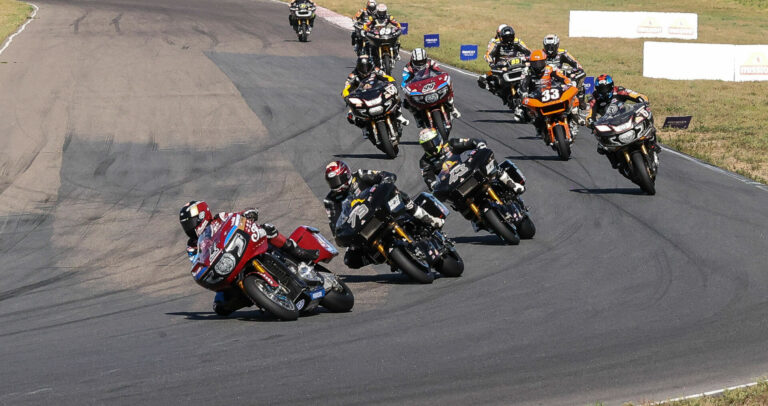
The man with the three-point lead as the series prepares for its eighth round is Vance & Hines/Mission/Harley-Davidson’s Hayden Gillim. The two men giving chase are H-D Screamin’ Eagle’s Kyle Wyman and Gillim’s teammate James Rispoli. All three have had crazily consistent seasons, and Wyman is the only one in the top three with a DNF on his scorecard.
Gillim earned his 175-point total with two wins, two seconds, three thirds, two fourths and a fifth with his two wins coming in the second half of the championship at WeatherTech Raceway Laguna Seca and Brainerd International Raceway.
Wyman, the 2021 Mission King Of The Baggers Champion, has the most wins of the three, but he also has a DNF. Wyman arrived at his 172 points via five wins and only one other podium finish, a third in race one at Road America. Wyman is coming off an off-for-Wyman weekend at Brainerd where he finished fourth and fifth in the two races. He also has a ninth-place finish on his points tally. Wyman knows how to win as he is the all-time wins leader in the class with 10 victories.
Wyman is tied for second with the personable James Rispoli with the Florida resident only winning one race, but with six other podium finishes. Like Wyman, Rispoli has 172 points.
With the top three all riding Harley-Davidson Road Glides, the first of the Indian Challengers is the one ridden by Bobby Fong and not defending series champion Tyler O’Hara. Fong is 45 points behind Gillim but has proven capable of winning on any given day as evidenced by his two wins thus far in 2023. (Road America and Brainerd). Fong has three other podium finishes on the year.
O’Hara is next and a disappointed fifth in the championship and is surprisingly winless on the season so far. O’Hara does have three second-place finishes and two third places, but he is seven points behind Fong and 52 behind his rival Kyle Wyman.
Mission King Of The Baggers rookie Jake Lewis sits sixth in the championship and has scored in every round but has yet to reach the podium.
The second of the two factory Indians and Harley-Davidsons have also had disappointing seasons with Jeremy McWilliams ninth and Travis Wyman 10th, respectively.
Steel Commander Stock 1000 – Beaubier vs. Gillim vs. De Keyrel
Orange Cat Racing’s Ezra Beaubier leads the Steel Commander Stock 1000 Championship over Disrupt Racing’s Hayden Gillim with just the two races at COTA remaining in the five-round, 10-race series. The margin? Eight points.
But that’s not all. Beaubier’s teammate Kaleb De Keyrel is just four more points behind, and Travis Wyman Racing’s Travis Wyman is on the outside looking in, 15 points behind De Keyrel and 27 behind Beaubier.
With his two wins at Brainerd International Raceway at the end of July, Gillim took over as the Stock 1000 racer with the most victories on the year – four. Beaubier, however, has won three, including the first two races of the season at Road Atlanta that put him atop the point standings where he has been ever since.
Beaubier’s 145 points come via three wins, a second, a third, a fourth, a fifth and a sixth. Gillim, meanwhile, has been fighting back from a miserable DNF/sixth-placed weekend to open his season in Atlanta. His four victories since then are what has him back in the championship chase.
De Keyrel is winless thus far but has four second-place finishes and five total podiums. Wyman is the third rider in the title chase to have tasted victory, but he has a non-finish that blemishes his scorecard.
Supersport – Forés On The Verge
Warhorse HSBK Racing Ducati NYC’s Xavi Forés is on the verge of capturing the 2023 MotoAmerica Supersport Championship with the Spaniard holding down a whopping 86-point lead heading into the two races at COTA and the final two at New Jersey Motorsports Park.
Forés won the first eight races of the season to build a lead that has his competition scratching their collective heads, but the series rookie has also gone the last four races without a victory.
Vision Wheel M4 ECSTAR Suzuki’s Tyler Scott sits second in the title chase with two wins and seven additional podium finishes and that has him 13 points clear of third-placed Stefano Mesa. Mesa, however, won’t be racing in the class for the two remaining rounds as he’s been drafted up by his Tytlers Cycle Racing team to fill in for the injured Cameron Beaubier in the Medallia Superbike Championship. Mesa will make his debut in the class this weekend at COTA.
That means that Squid Hunter Racing’s Josh Hayes will slot himself into the top three as he trails Mesa by just four points and is 67 points clear of Scott’s teammate Teagg Hobbs.
With Mesa heading to the Medallia Superbike for the final two rounds, the Tytlers Cycle Racing team is bringing in Kayla Yaakov to ride Mesa’s Kawasaki ZX-6R at COTA and NJMP. Yaakov has been released from her contract with The WagBar MP13 Racing where she has been competing in the REV’IT! Twins Cup series.
Disrupt Racing’s Jake Lewis rounds out the top five in the championship despite not being drafted into the team until the third round of the series.
Mission Super Hooligan National Championship – Tied At The Top
A three-point gap between first and third in the Mission King Of The Baggers Championship, an eight-point margin between first and second in the Steel Commander Stock 1000 Championship and (… wait for it) a tie at the top in the battle for supremacy in the Mission Super Hooligan National Championship.
Indian Motorcycle/Progressive/Mission Foods teammates Tyler O’Hara and Jeremy McWilliams arrive in the Lone Star State tied in the title chase with 106 points apiece.
O’Hara has three victories to McWilliams’ two wins and both riders have a non-points-paying race from their disqualification at Ridge Motorsports Park. O’Hara has one other podium to go with his three wins while McWilliams has three additional podiums.
This one truly does come down to a winner-take-all battle and calculators won’t be needed.
DiBrino Racing’s Andy DiBrino has also had a solid season on his KTM with his lone victory at Ridge Motorsports Park going with three additional podium finishes.
DiBrino is 15 points ahead of Team Saddlemen’s Cory West and his Harley-Davidson Pan America and another 14 ahead of Grey Area Racing’s Mark Price.
About MotoAmerica
MotoAmerica is North America’s premier motorcycle road racing series. Established in 2014, MotoAmerica is home to the AMA Superbike Championship as well as additional classes including Supersport, Stock 1000, Twins Cup, Junior Cup, and King Of The Baggers. MotoAmerica is an affiliate of KRAVE Group LLC, a partnership including three-time 500cc World Champion, two-time AMA Superbike Champion, and AMA Hall of Famer Wayne Rainey; ex-racer and former manager of Team Roberts Chuck Aksland; motorsports marketing executive Terry Karges; and businessman Richard Varner. For more information, please visit www.MotoAmerica.com and follow MotoAmerica on Facebook, Instagram, TikTok, Twitter, and YouTube.
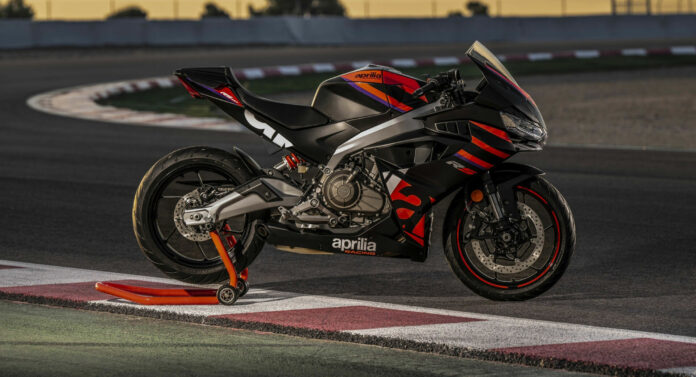
INTRODUCING APRILIA RS 457: A NEW ERA BEGINS IN THE WORLD OF APRILIA
The new RS 457 aims to establish itself as the new benchmark in technology and style for new and experienced motorcyclists worldwide
NEW YORK, N.Y. – September 7, 2023 – THE RS 457 REPRESENTS A HISTORIC LEAP FORWARD FOR APRILIA, NOT ONLY IN TECHNOLOGY BUT ALSO IN ITS APPEAL TO NEW DEMOGRAPHICS AND MARKETS TO MEET THE GROWING WORLDWIDE DEMAND FOR ACCESSIBLE YET THRILLING MOTORCYCLES. WITH THE ADDITION OF THE RS 457, APRILIA NOW TRULY OFFERS A MOTORCYCLE FOR EVERY CUSTOMER.
THE NEW ENGINE IS SEAMLESSLY INTEGRATED WITH A RIGID ALUMINUM FRAME, SETTING THE RS 457 APART IN ITS SEGMENT. DRAWING ON APRILIA’S DECADES OF EXPERTISE ACCUMULATED THROUGH VICTORIES ON RACETRACKS WORLDWIDE, THE CRANKCASE IS POSITIONED AS A LOAD-BEARING ELEMENT, MIRRORING THE APPROACH USED IN THE RS 660. THIS ENSURES LOW WEIGHT, EXCEPTIONAL DYNAMICS, AND THE RIDING PLEASURE FOR WHICH APRILIA IS RENOWNED.
THE ELECTRONIC EQUIPMENT ON THE APRILIA RS 457 IS UNRIVALED, CATERING TO A DIVERSE RANGE OF RIDERS WHILE REMAINING FAITHFUL TO APRILIA’S HERITAGE. THE RIDE BY WIRE SYSTEM, PIONEERED BY APRILIA ENGINEERS, MANAGES THE ENGINE MAPPING WITH THREE DISTINCT RIDING MODES THAT MODULATE POWER, TORQUE DELIVERY, AND TRACTION CONTROL. THESE FEATURES ARE ADJUSTABLE ACROSS THREE LEVELS.
THE APRILIA RS 457 AIMS TO ESTABLISH ITSELF AS THE NEW BENCHMARK IN TECHNOLOGY AND STYLE FOR NEW AND EXPERIENCED MOTORCYCLISTS WORLDWIDE. IT EMBODIES APRILIA’S DEVOTION TO PERFORMANCE.
Michele Colaninno – Piaggio Group CEO
“In recent years, the Aprilia brand has seen an intense burst of renewal, also supported by continued progress in the racing world. The recent introduction of the 660 family, with RS and Tuono first and Tuareg later, has expanded its target, creating a full and competitive range. We are now ready to take another step towards the future with an astonishing bike developed entirely in Noale, capable of stimulating and thrilling young people and opening up huge potential in new markets, near and far. It is a step closer to the globalization of a brand that has always had the perfect combination of technology, fun, and looking to the future in its DNA.”
The RS range has been a leading player in the racing world, dominating the 2-stroke categories. After reaffirming its technological prowess by winning SBK competitions, it has also risen to prominence in MotoGP. Now, Aprilia returns to its founding mission with a project for a new generation of motorcyclists, pooling the knowledge accumulated on tracks worldwide.
Starting in 2020, the massive success of the Aprilia RS 660 (Europe’s best-selling sport bike) has revolutionized the world of mid-range sport bikes, creating a new segment. The same winning formula is repeated with the Aprilia RS 457, which began as a completely new project, conceived, and developed in Noale, Italy, where all Aprilia’s are created, including MotoGP bikes. The new Aprilia is the ideal link between the first 125 engines and the RS 660. It completes the RS family that includes the powerful V4 superbikes and, at its most technologically advanced, the MotoGP-winning RS-GP.
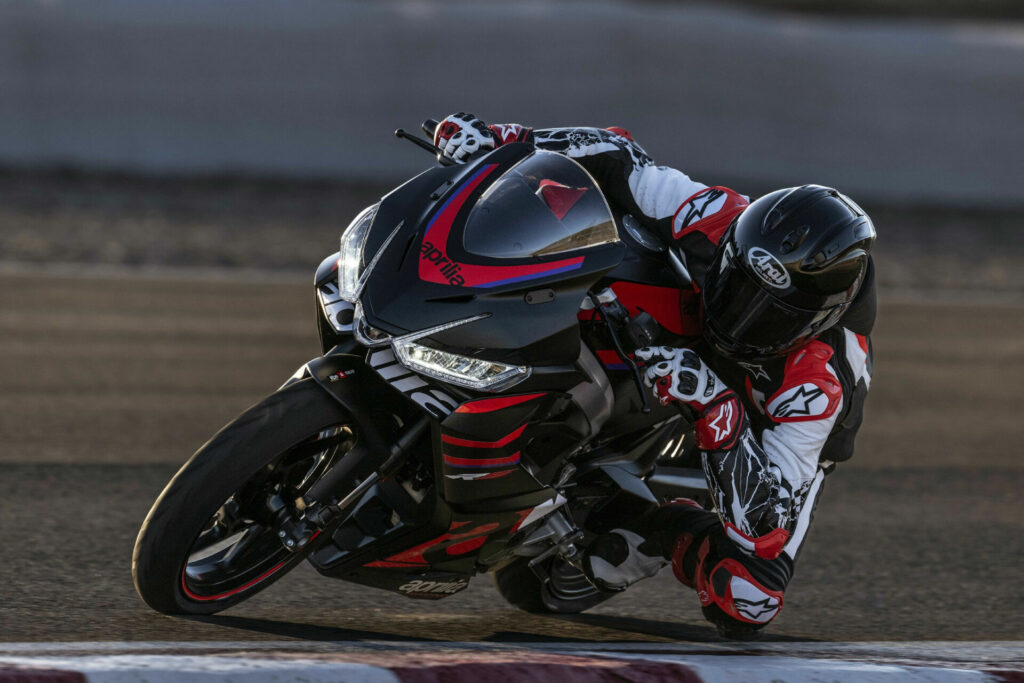
Maverick Vinales at speed on an Aprilia RS 457. Photo courtesy Aprilia.
The Aprilia RS 457 speaks to a new generation of riders, exploiting all the company’s expertise to design and build a true sport bike. The strengths of this motorcycle are its lightness, ease of handling, and technological equipment. The RS 457 is designed to accompany motorcyclists as they progress on road and track. The ergonomics feature clip-on handlebars mounted above the upper triple clamp, a practical solution that provides the best compromise between sportiness and riding comfort.
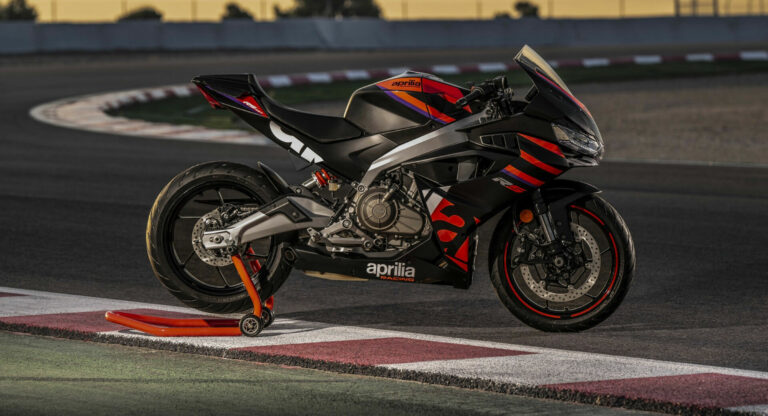
The new RS 457’s styling follows the legendary RS range; the supersport bikes that made motorcycling history. Starting from the aggressive aerodynamic front fairing to the underbelly silencer with a 2-in-1 exhaust, the RS 457 shares the same DNA from its larger siblings. The full LED front headlamp houses the iconic light signature shared across the Aprilia RS range. The dashboard boasts an elegant and practical 5-inch TFT color instrument display, along with all-new backlit handlebar controls.
The Aprilia RS 457 is powered by a state-of-the-art, liquid-cooled parallel twin-cylinder engine, with double overhead camshaft and four valves per cylinder, delivering 47 horsepower. Beyond just power, the motorcycle’s weight is equally impressive, with a dry weight of 350 lbs.
The new engine is paired with a stiff frame. The aluminum frame makes the RS 457 unique for bikes in its segment. All of Aprilia’s design expertise, honed over decades of victories on all the world’s racetracks, has gone into its development. The crankcase functions as a load-bearing element, a solution borrowed from the RS 660, which ensures the low weight, dynamic qualities, and riding pleasure that have made Aprilia famous.
The 41 mm front fork provides 120 mm of travel and the rear monoshock, working in tandem with the steel swingarm, provides 130 mm of wheel travel, both offering preload adjustability. The braking system incorporates a 320 mm front disc with a ByBre radial-mount 4-piston caliper. At the rear, a 220 mm steel disc is paired with a ByBre caliper. Both wheels benefit from a two-channel ABS system with dual map settings, available for both wheels or exclusively for the front. The 17-inch sport rims accommodate 110/70 tires at the front and 150/60 at the rear, providing exceptional grip while preserving agility, a defining characteristic in the Aprilia RS family.
The electronic equipment on the Aprilia RS 457 is unrivaled, catering to a diverse range of riders while remaining faithful to Aprilia’s heritage. The Ride by Wire system, pioneered by Aprilia engineers, manages the engine mapping with three distinct riding modes that modulate power, torque delivery, and traction control. These features are adjustable across three levels. Additionally, a quickshifter (up and down) is available as an accessory for enhanced performance.
With Labor Day in the past and summer coming to a close, most motorcycle racing organizations are finishing up their racing seasons. However, in the Chuckwalla Valley of the California desert things are just starting to heat up and CVMA is getting ready for seven awesome rounds of motorcycle road racing. The first round of the CVMA 2023-2024 winter series is just around the corner kicking things off on October 6-8. We expect racers from all over to join us for another season of some of the most competitive club racing in the country. If your local race season is coming to a close. We invite you to come out to Chuckwalla Valley Raceway and join us all winter long under the California sunshine!
If you would like to start racing, there is no better place than CVMA for amateurs to learn their craft and advance to compete against some of the best in the country. The first CVMA New Racer School of the new season will happen Friday, October 6th and registration is now open on the CVMA website:
CVMA would like to congratulate our Amateur racers who are taking the big step up to racing as experts with us this season and we look forward to seeing your progress throughout the coming season.
We would also like to congratulate those riders who earned a top 10 number plate for the coming season!
#1 Corey Alexander
#2 David Kohlstaedt
#3 Justin Bordonaro
#4 Owen Williams
#5 Sahar Zvik
#6 Jon Glaefke
#7 Igor Sokolov
#8 Angela Brunson
#9 Jasmine Nichols
#10 Dennis Bowers
CVMA would also like to welcome all the riders racing the MotoAmerica Next Generation Supersport class to come out and race with us over the winter. We have modified our Middleweight Shootout class rules to align closely with the MotoAmerica Next Generation Supersport rules so your bikes are legal for our premier Middleweight race!
Registration for round one will be open soon! Keep an eye on our website www.cvmaracing.com for an announcement. Also, when you register, be sure to opt in for email notifications so you don’t miss other important announcements.
CVMA offers two full days of racing every race weekend and includes Saturday qualifying for grid position in all classes, amateur, and expert, as well as a wide variety of classes to choose from. Also provided are two racer-only practice groups during the Friday track day hosted by Apex Assassins Motorcycle Track Days. CVMA offers free reciprocity as a means of encouraging racers from other clubs to come out and compete. CVMA also offers a New Racers School for those starting out in racing on the Friday before each race weekend. Log on to www.cvmaracing.com to sign up or for more information.
CVMA. Built for racers by racers and offering the best racing experience around!
CVMA would also like to thank the 2023/2024 Winter Series Sponsors: SoCal Track Days, Apex Assassins Track Days, Ryder Gear, and CaliPhotography
NRS Sponsors: Alpinestars, 6D Helmets, Racer Gloves, and Racer’s Edge
For six glorious laps, Aprilia not only led the Grand Prix of Catalunya, it locked out the podium. Riders on the RS-GP led every lap of the race, and for a chunk of it, Maverick Vinales, Aleix Espargaro, and Miguel Oliveira filled all the trophy spots. Espargaro won over Vinales, and while Oliveira faded to fifth at the end, behind him there were three riders who, between them, had 11 World Championships.
Remember, before the start of the 2021 season, Aprilia had tried to sign multiple riders to its MotoGP team, only to be told, in short, thanks but no thanks. Two years later, it’s one of the most desirable bikes on the grid.
I had a chance to talk to Romano Albesiano, Aprilia’s MotoGP Technical Director, in Portugal. We stood next to that iteration of the RS-GP, and he generously explained the bike’s aerodynamics to me. More than that, he said bluntly that aero was going to make the difference between winning and losing.
“Of course top speed is good for passing and to avoid getting passed,” Albesiano said. “But for improving the overall performance over the lap, this (aero) is the way to go.”
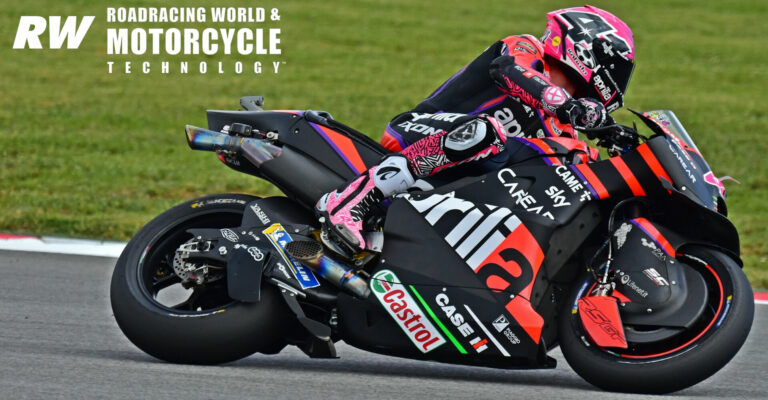
It’s not just about streamlining or wings anymore. Aprilia, to a greater extent than any other manufacturer, recognized that aero could be used to generate mid-corner downforce that loaded the tire directly, and chose to pursue that development path. By creating venturi tunnels in the fairing lowers that sucked the bike downward when it was leaned over, the engineers created more grip.
The faster the bike goes, the more downforce it creates. The longer and faster the curves, the more time such a bike gains; as every race coach I have ever had has told me, time is found in the fast turns, not the slow ones. The slicker the track, the bigger the gap between venturi-effect machines and bikes with more traditional aerodynamics. All of these factors were in evidence at the fast, curvy, low-grip Catalunya circuit last weekend, and there the RS-GP was untouchable.
Espargaro told me at Portugal that in the fast, fast right-handers that end the lap there, his bike was on rails. All that was needed, he said, was some additional fine-tuning, balancing the downforce against steering; downforce makes the machine harder to turn, so the chassis must be adapted deal with the new forces.
Aprilia’s engineers did some fine-tuning over the summer break and got it right. At the fast, flowing Silverstone circuit, Espargaro won the Grand Prix, Vinales was on the podium in the Sprint, and Aprilia took three of the top five places in the Grand Prix. Only an inspired ride by defending World Champion Francesco Bagnaia in the Sprint prevented Aprilia from going 1-2 in both races at Catalunya. And the way Bagnaia had to defend against Vinales in the short race, it was difficult to see him holding off Vinales for much longer. Bagnaia made it clear that he believed that Aprilia had the better machine.
Here’s the point: Barring massive rule changes, this is the future of road racing machines. Similar to the situation in F1 car racing, motorcycle road racing engineers can no longer ignore the simple fact that a well-designed fairing and ancillary aerodynamic components can create grip out of thin air. And grip = speed. That’s a formula every racer understands. Right now, Ducati can hold its own due to the sheer power of its desmodromic engine, stability under braking and the (probably under-appreciated) talent of Bagnaia. But Ducati already has started copying some of the Aprilia aero developments.
Aero isn’t a bolt-on solution. It’s a comprehensive way of looking at a modern MotoGP bike, a fundamental baseline from which to begin designing one, something that changes every aspect of riding one. (For example, Luca Marini pointed out after the Catalunya race that riders no longer try to “draft” another rider out of a corner if they can help it, because the “dirty” air from the leading bike reduces the effectiveness of the following bike’s front wings, which means more wheelie and less forward drive.)
No one seriously thinks Marc Marquez, Fabio Quartararo or Joan Mir–the above-mentioned MotoGP World Champions–have forgotten how to ride a racebike. But they are on machines designed with aero as an afterthought, a bolt-on. Honda and Yamaha are still messing around with front wings and exhaust systems. It’s like watching them race Moto2 bikes in a MotoGP race. Combined, so far this year Marquez, Quartararo, and Mir have 109 points. Espargaro has 154.
This revolution is over. Venturi-generated downforce is the future, and don’t be surprised when it increasingly shows up in the design of sportbikes for sale in a dealership near you.
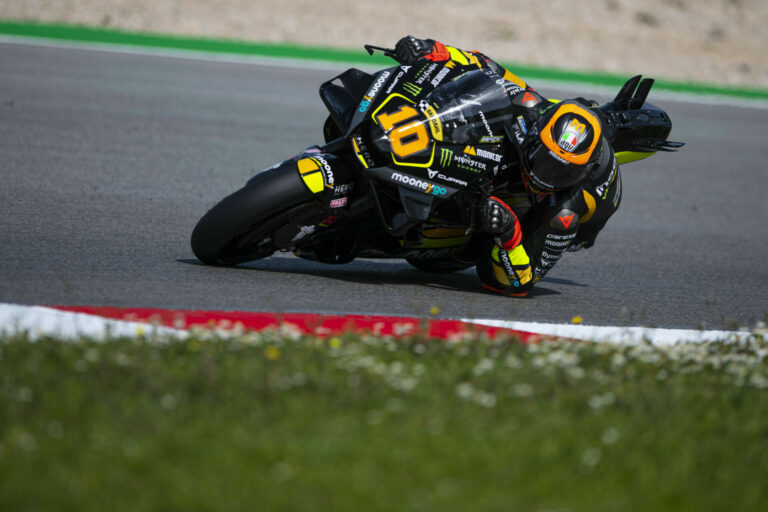
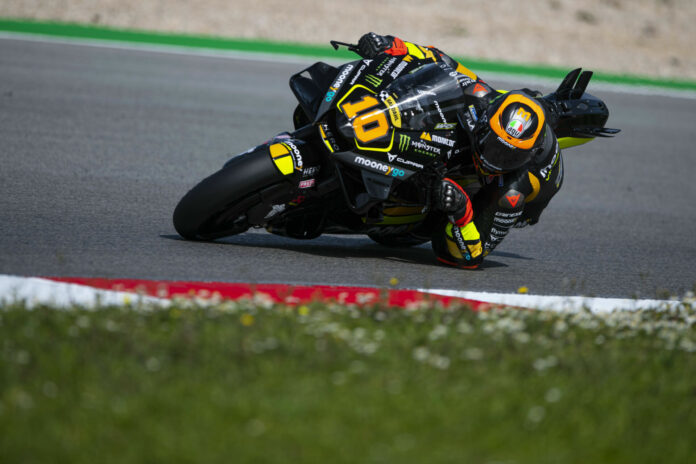
Luca will be a rider of the Mooney VR46 Racing Team also in 2024 on the Ducati Desmosedici GP
Misano Adriatico (Italy), September 7th 2023 – Luca Marini and the Mooney VR46 Racing Team will be together again in 2024. A choice of continuity for Luca, in the orbit of the Tavullia Team since 2018 and the first rider to wear the VR46 colors in MotoGP (Season 2021).
Joining the Moto2 Team in 2018, Luca links the key moments of his sporting career to this crew. First podium (GermanGP 2018) and the second place in the Championship in 2020 in the middle category (result also enhanced by the Team title).
Currently seventh in the general standings (125 points), Luca is among the most solid riders in MotoGP. Constantly in the Top10, once on the podium (P2 AmericasGP, plus P3 in the Sprint at ArgentinaGP) he will be lined up at the start of the new season on the Ducati Desmosedici GP.
LUCA MARINI – 10
Remaining in the Mooney VR46 Racing Team also in 2024 is for me a question of trust in a very close-knit working group, which has believed in me for many years. As a Team, we will do everything to achieve our goals the next season. Not only Vale, Uccio and Pablo whom I thank, but the whole technical Team that supports me and Ducati. Being among the protagonists of the 2024 season, fighting for the Championship as a rider and as a Team is certainly a real ambition.
ALESSIO SALUCCI, TEAM DIRECTOR
I am very pleased to be able to confirm that Luca will also stay with us in 2024. It will be the seventh season with the Team and this is a truly significant recognition of trust for all of us and all our partners who support the project. Confirming a growing Team with the support of Ducati has a symbolic meaning. Luca is a hard worker, always precise, focused on details and this is a real plus in today’s MotoGP. Fast, constant and very solid, I think he has collected less than he deserved so far and I hope he can do his best in these remaining races and in the future.
PABLO NIETO, TEAM MANAGER
Our 2024 line up is complete and I am very happy to have confirmed both riders. The extension of Luca’s contract for another year means a big boost of confidence for everyone in the Team. A solid working group, with the support of Ducati, built two years ago and which, thanks to the commitment of everyone, including our partners, is achieving ambitious results. Luca is now a certainty in the MotoGP Championship, always constantly among the first guys and I’m sure he will be able to obtain many satisfactions in the future.
Westby Racing’s Mathew Scholtz Is Ready To Bring The Heat This Weekend At Circuit Of The Americas
Tulsa, OK – Round eight, the penultimate round of the 2023 MotoAmerica Medallia Superbike Championship, takes place this weekend at the Circuit of The Americas (COTA) in Austin, Texas, and besides the triple-digit air temperatures forecast for the weekend, Mathew Scholtz and the Westby Racing team will also be bringing the heat in MotoAmerica’s Superbike class.
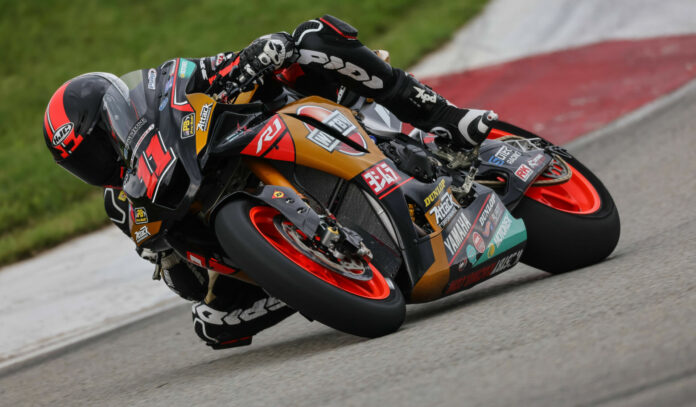
COTA has been the site of a lot of success for Mathew and his #11 Westby Racing Yamaha YZF-R1 Superbike. Last year, he had two runner-up results at the 20-turn, 3.426-mile circuit, and it’s also the track where he won his second career MotoAmerica Superbike race in 2018.
Also weighing in Mathew’s and the team’s favor is the fact that The Scholtz Kid is arguably the most physically fit Superbike rider in the MotoAmerica paddock. His training and nutrition regimen are well-suited for the conditions expected this weekend, which should give him a competitive edge on track.
“These are the kind of conditions I train for,” Mathew said. “It makes all those reps in the gym and all those motos in the heat down in Georgia worthwhile. I thrive in the heat because I prepare for it. And, I know the Westby team prepares the bike with the same attention to detail. I’m looking forward to COTA and to this second-to-last round of the season. We’ll be pushing hard to have our best weekend.”
Superbike final qualifying is on Saturday morning at 10:10 CT, Superbike race one will go green on Saturday afternoon at 3 CT and Superbike race two is on Sunday afternoon also at 3 CT. Both races will be shown live on MotoAmerica’s YouTube Channel.
For all the action from COTA, as it happens, subscribe to MotoAmerica Live+, which is MotoAmerica’s live streaming and on-demand service.
Meet Mathew, Get An Autographed Poster, And More
Mathew will be available for autographs during the Dunlop Hot Pit Walk & Autograph Session, scheduled for 11 a.m. to Noon Sunday on pit lane at COTA. He and the team will be handing out free posters and T-shirts, so don’t miss it.
Check Out The Westby Racing Sponsor Showcase
Miami Thread, Motorex USA, Renthal Ltd., and Suter Racing Products are the featured team sponsors on display in the Westby Racing paddock area this race weekend, so be sure to stop by to say hello and learn about some of the companies that support the team.
For more updates about Westby Racing, including news, photos, and videos, visit www.WestbyRacing.com
Also, follow “Westby Racing” on your favorite social media sites.
Coming Soon to New Jersey Motorsports Park NJMP Advanced Motorcycle Open Track Day October 18, 2023
Register NOW for the FIRST Motorcycle Open Track Day on Wednesday, October 18 on Lightning!
Get The Track Time You’ve Been Waiting For
New Jersey Motorsports Park is excited to introduce a brand-new concept for motorcycle track days. Our first NJMP Motorcycle Advanced Open Track Day will allow an open track format for 8 hours.
Our Advanced Riders will have the ability to enter and exit the track at any time. No RUN GROUPS or 15-to-20-minute sessions. Go on or off the track whenever you want. This will provide the ultimate opportunity for extended track time.
We will take an hour lunch and will provide a complimentary lunch buffet at the Finish Line Pub located at the Clubhouse.
This new format will be limited to 50 Advanced Riders Only! We will provide tech inspection in the morning, followed by a mandatory Riders Meeting in the classroom, and then the track goes hot for the rest of the day. Join us for the Ultimate Track Day with 8 hours of track time for Advanced Riders Only!
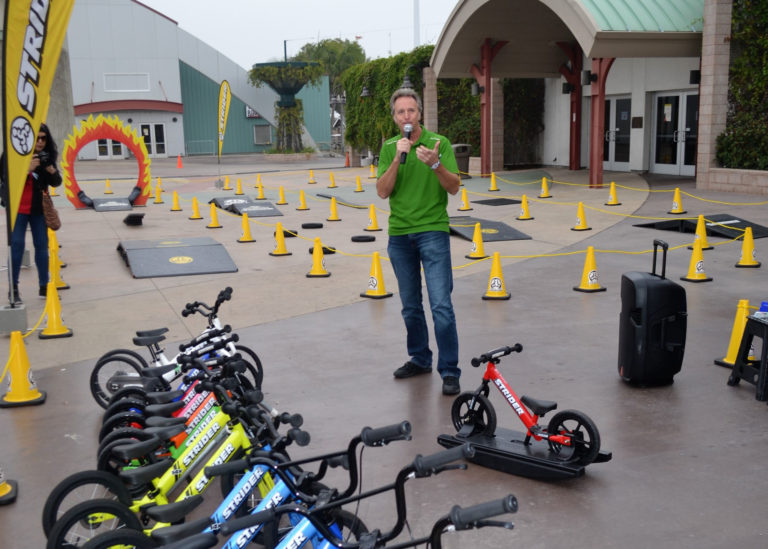
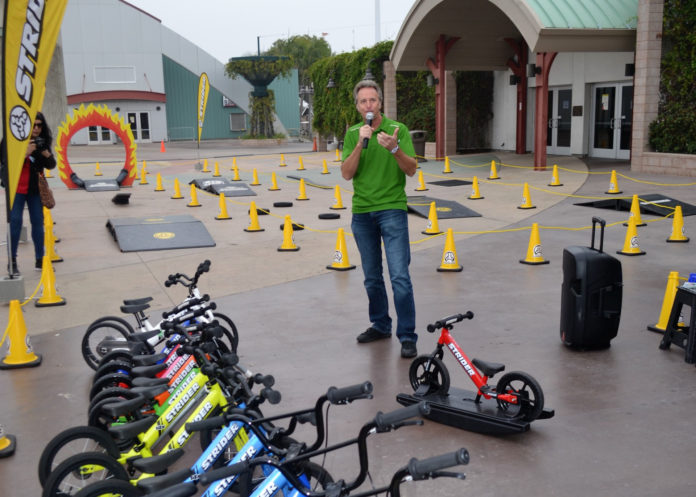
The balance bike leader celebrates helping over 10 million kids learn how to ride a bike
RAPID CITY, SD., September 7, 2023 — Strider Bikes, the leader in kids balance bikes, announced today that the company has sold over 4 million bikes – solidifying its position as the leader in the kids balance bike industry.
Strider Bikes was born out of founder Ryan McFarland’s desire to share his passion for biking with his son. One of the first pioneers in the balance bike space, Strider Bikes has been leading industry innovation since 2007– building lightweight, efficient, all-terrain bikes that develop two-wheeled balance, coordination, and confidence in children. Thanks to Strider’s groundbreaking 2-in-1 Rocking Bike, kids as young as 6 months old across the globe are learning how to ride a bike before they’re even out of diapers. Research has found that learning with a balance bike helps kids transition to pedal bikes an average of 2 years earlier than those who use training wheels.
“Our dedication to innovation and excellence has allowed us to lower the age at which kids learn to ride a bicycle and has transformed the way kids approach their two-wheeled journey,” said Ryan McFarland, Founder and CEO, Strider Bikes. “With this milestone, we‘re not only marking a significant sales milestone, but celebrating the millions of kids we’ve helped learn to ride.”
What makes this milestone even more special is the impact it has had beyond just the number of bikes sold. It is estimated that at least 10 million kids have learned to ride on Strider bikes through hand-me-down bikes, second-hand bikes, and Strider’s social impact programs. Additionally, Strider Bikes proudly contributes 1 percent of every bike sold to the Strider Rider Fund, which has helped create opportunities for young riders globally. Over $2 million has been donated to date.
The annual Strider Cup will be taking place in Bentonville, AR on September 23, 2023 and Strider Bikes will be present at Toy Fair in New York, NY from September 30 to October 3, 2023. For more information about Strider Bikes, visit www.StriderBikes.com.
About Strider Sports International, Inc:
Founded by Ryan McFarland in 2007, in Rapid City, South Dakota, Strider has sold more than 4 million bikes and is distributed in more than 75 countries. Strider’s bikes have been recognized as the best balance bikes on the market by publications such as The New York Times, Parents, and Today’s Parent. Beyond the bikes, the company has inspired and nurtured a thriving community and significantly contributes to social impact programs.
It’s Day Two Of A Blazing Hot Weekend, Your Head Aches And You Feel Terrible. What’s The Cure? Learn How To Hydrate Right And Deal With The Heat!
To read more articles like this one originally published in the December 2015 print issue of Roadracing World, subscribe to Roadracing World. (The article has been updated with additional photos and information from later MotoAmerica racing seasons.)
By Dr. Laura Ellis
Racers and team owners place great emphasis on building and tuning fast, lightweight, reliable bikes, but building and fueling the rider is just as important. Motorcycle racers are extreme athletes frequently performing in difficult conditions. I get a lot of questions from racers on how to optimize their performance. This article addresses some of the most common concerns I see in the sport.
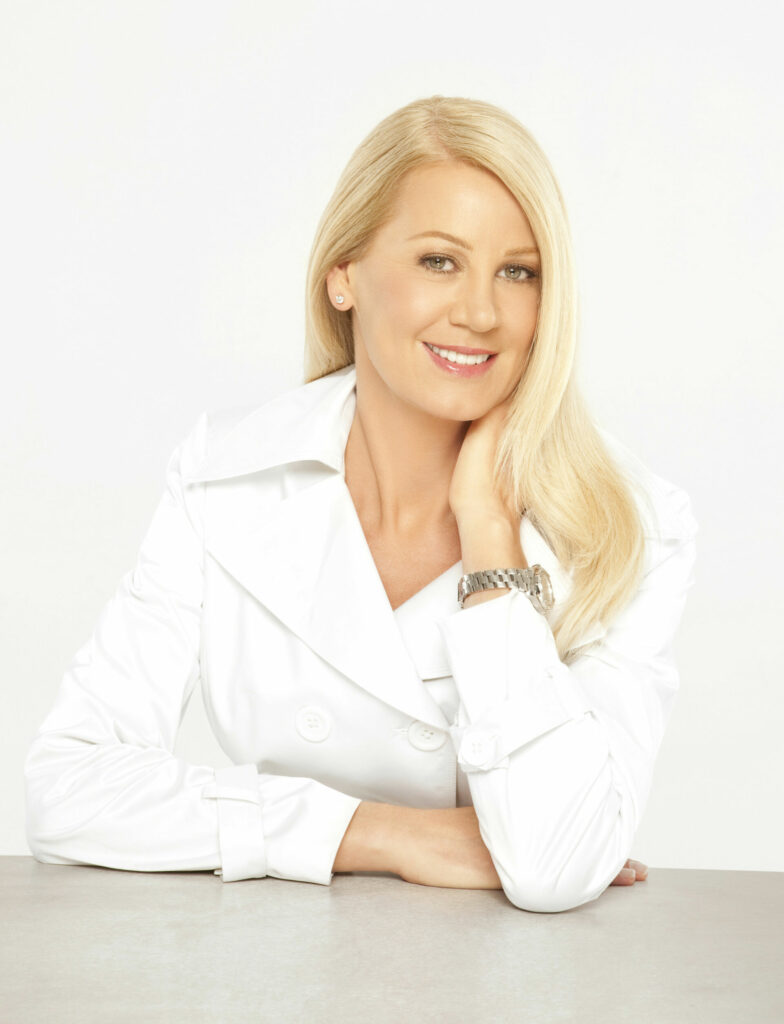
Dr. Laura Ellis, MD, author and web TV host. Photo courtesy medAge.
A critical part of fueling the racer is optimal hydration. Consider it part of race preparation. The two goals of optimal hydration are to improve athletic performance and prevent dangerous complications of dehydration, some of which can be severe.
In this article, we will define hydration and its relevance to racing; provide scientific facts to dispel some myths about hydration; and give the reader excellent hydration options.
In medicine, we define hydration as “the status of the fluid-electrolyte balance in a patient.” Fluid in this case is water. The electrolytes we’re concerned with are sodium, potassium, calcium and magnesium.
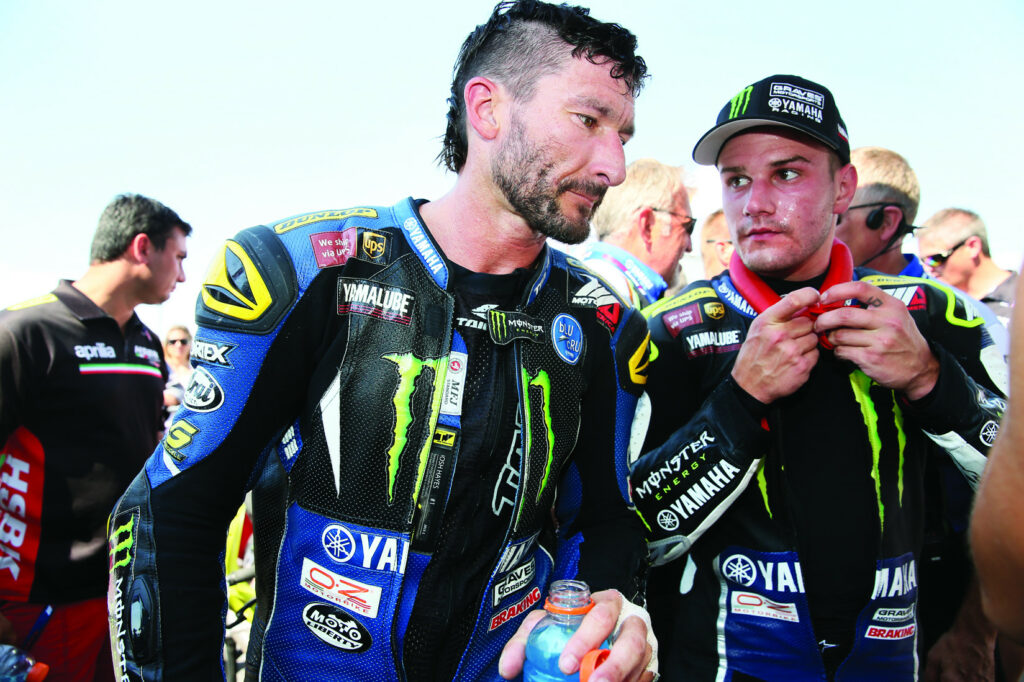
Josh Hayes (left) and Cameron Beaubier (right) after a hard race on a triple-digit day at Utah Motorsports Campus (formerly known as Miller Motorsports Park). Photo by Brian J. Nelson.
The human body is 60-75% water. Some parts of the body have more water than others. For example, the brain contains 95% water, the lungs 85% and blood 82%.
Body water is stored in two major ways; 2/3 is intra-cellular (inside the cells) and 1/3 is extra-cellular (outside the cells), in the blood stream and in between the cells.
Water is replenished by ingestion of food and water and is lost in a variety of ways called “insensible losses,” via exhaled air, urine, feces and sweat. Insensible water losses vary substantially with small changes in ambient temperature, humidity and physical exertion.
For optimal health and daily function I recommend drinking half your body weight in ounces of water. This assumes you are at or near your ideal body weight. For example, I weigh 132 pounds, which is ideal for me, so I drink around 66 ounces of water every day. That’s about 2.0 liters a day for me. Don’t count what you drink during exercise-that’s in addition to your baseline volume. Nearly everyone is under-hydrated so if you follow my daily rule you may find that you urinate quite frequently for a day or two. You’ll adjust. And you’ll notice you feel better, sleep better, are less hungry and lose unwanted weight easier. The feeling of thirst is a signal from the brain indicating we need more fluid. This thirst mechanism diminishes as we age so don’t rely on feeling thirsty before you drink. In fact, by the time you feel thirsty you’re already behind and will be functioning sub-par. Catching up can take hours or even days depending on how under-hydrated you are.
Loris Baz wearing a special cooling vest after doing a MotoAmerica Superbike race when it was 107 degrees F at Ridge Motorsports Park in 2021. Photo by Brian J. Nelson.
Current evidence suggests that many athletes start a training session or competitive game or race under-hydrated and do not consume enough fluids to replace sweat loss. This puts them at a distinct disadvantage, mentally and physically. Under-hydration can lead to dangerous outcomes due to poor decision-making, slower reaction times, muscle cramping and even seizures and occasionally death. Think about the times you’ve crashed. Can you attribute any of them to fatigue or slowed reaction time? Many racers tell me “yes.”
It’s important to know that sweat loss is mainly water, but it also contains minerals, which we refer to as electrolytes. Electrolytes are essential for conduction of electrical energy between and within cells, for maintaining cognitive function (decision-making), communication between nerves and muscles (reaction time) and for muscle contraction itself.
Sweat contains large amounts of sodium with much lower concentrations of potassium, magnesium and calcium.
Of the four key electrolytes contained in lost sweat only sodium can typically be depleted through sweat loss alone.
Sweating 2.0 liters per hour (which is not uncommon) in a hot race would mean that within two hours your daily intake of sodium has been depleted. Considering that there are no usable reserves of sodium in the body, you need to replace sodium as you exercise. The other three electrolytes can typically be replenished by tapping into stores within the body.
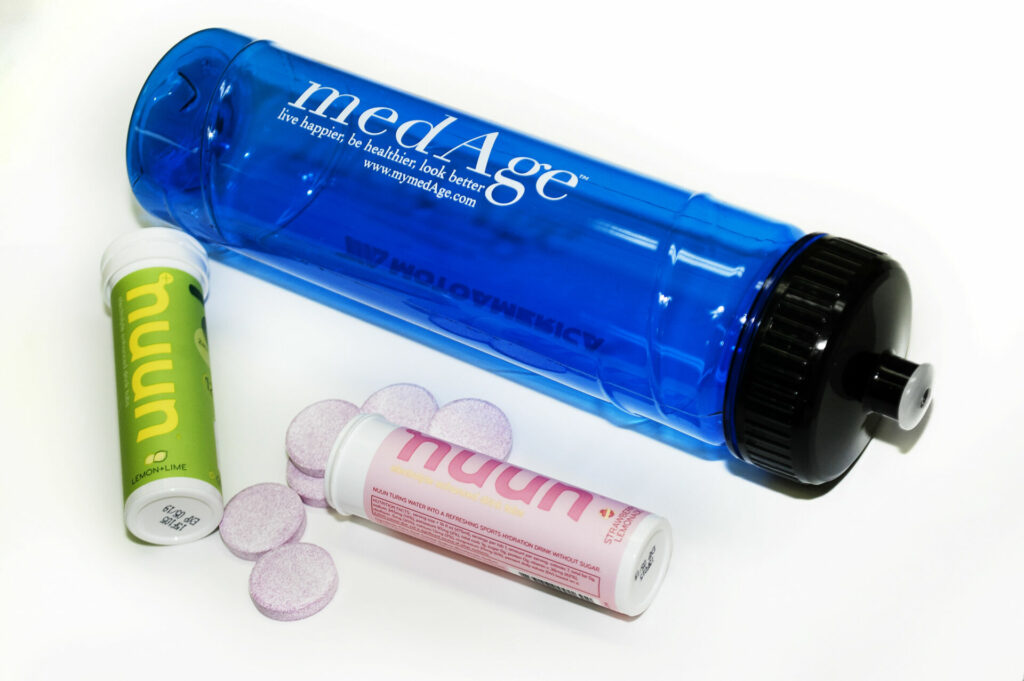
Dr. Laura Ellis uses water bottles and nuun rehydration tablets to promote her medAge practice. Photo by David Swarts.
Why is sodium so important?
Sodium is not only the most likely to be lost, it is also the electrolyte most required during training and racing.
Blood sodium loss and gains are tightly regulated by the kidneys with drives from the brain to increase salt intake or drink more water as necessary.
Normal blood levels are maintained between 135-145 mmol/l (mili moles/liter) concentration. Given sodium losses, small reserves and narrow band of operation, it is relatively easy for athletes to become sodium depleted.
Low blood sodium in sports is mostly due to the dilutional effects of drinking water or low-concentration sports drinks in excess of sweat and urine sodium losses.
This condition is known as Exercise Associated Hyponatremia (EAH).
With EAH, the athlete experiences weakness, nausea, muscle fatigue and cramping. As sodium levels drop even further, resultant fluid shifts occur in an effort to equalize and water moves into the brain. This can lead to agitation, seizures and occasionally death.
Risk factors for EAH include long (4-hour+) races, slow running pace, female gender, low body weight, pre-race excessive water intake, over-drinking (more than 1.5 liter/hour) during racing and abundance of drinks during the event weekend.
What about the other electrolytes?
Potassium
Along with sodium, potassium regulates the electrical integrity of the cell membrane and is therefore important in nerve conduction.
Potassium also helps transport glucose into the cell so it is crucial for energy generation.
Low blood potassium is usually due to diarrhea, fasting and taking certain drugs such as diuretics long-term–not from sweating.
In sports, low potassium is rare. Certain ultra-endurance athletes who generally have a poor solid-food diet may be prone to low potassium, leading to nausea, muscle fatigue and weakness.
Potassium supplements should always be taken with caution and on the advice of a doctor. Contrary to what your mother may have told you, eating bananas has no significant effect on blood potassium levels.
Calcium
Calcium is intimately involved in muscle contraction and relaxation and nerve conduction.
Your body has vast supplies of calcium stored in the bones which are tapped into when needed.
Generally, in a well-nourished athlete eating a normal diet with dark-green vegetables, calcium deficiency during racing is rare.
Dietary sources are generally better than supplements. Equally important are weight-bearing exercises. Swimmers and cyclists suffer the same bone calcium loss as sedentary individuals so remember to fit weight-bearing exercises into your regimen.
Magnesium
Magnesium is necessary in every cell for enzyme reactions as well as muscle contraction and energy production.
Prolonged exercise and training with poor diet can lead to depletion although this is rare to surface in an acute setting.
Magnesium deficiency can lead to dizziness, fatigue and depression.
There is no evidence that taking magnesium supplements by people with normal blood levels offers any benefit in sports performance.
To sum it up so far, inadequate replacement of water and sodium will lead to early fatigue, weakness, nausea, muscle fatigue and cramping.
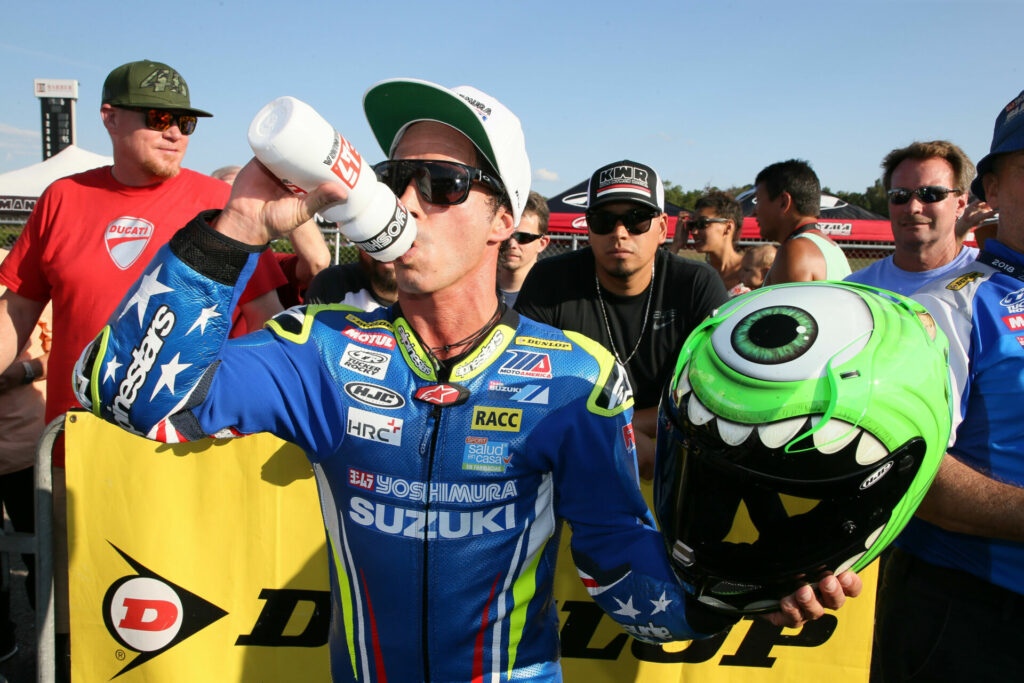
Toni Elias takes in fluids following a hot Superbike race at Barber Motorsports Park in 2018. Photo by Brian J. Nelson.
So, HOW MUCH should you drink while training and racing?
The American College of Sports Medicine (ACSM) Position Stand on Exercise and Fluid Replacement:
Before Exercise: Preload by drinking “500 mls (milliliters) fluid two hours before exercise to allow adequate hydration and allow excessive water to be excreted by the kidneys.”
During Exercise: “…individuals should be encouraged to consume the maximal amount of fluids during exercise that can be tolerated without gastrointestinal discomfort up to a rate equal to that lost from sweating…” In other words, figure out your sweat rate and simply replace what you lose. Example: A 1.2 kg loss would be replaced with 1200 mls of fluid. Measure this once or twice in various conditions (temperature and humidity) to get an idea of volume needed, then use it as a guideline for future activity in similar conditions. Sound complicated? It’s not. Professional athletes do it for a reason–it gives them an advantage. Here’s how you do it. Weigh yourself before and after a training or race event. Convert the difference in weight from pounds to kilograms, (1.0 pound x 0.4536 = kg; 1 kg x 2.2046 = lbs.). Your sweat/water loss in mls is 1000 x the kg difference. Most water bottles have ml and oz gradations so just look at the bottle for the conversion to ounces.
Now, WHAT should you drink while training and racing?
What’s the difference between all the drinks on the market? It’s confusing!
Rather unhelpfully the sports drink industry has confused hydration with fuel with recovery.
We classify sports drinks into the following groups:
Protein drinks (no carbohydrates).
Energy drinks.
Carbohydrate drinks (with or without electrolytes).
Electrolyte-only drinks.
Let’s look at each one.
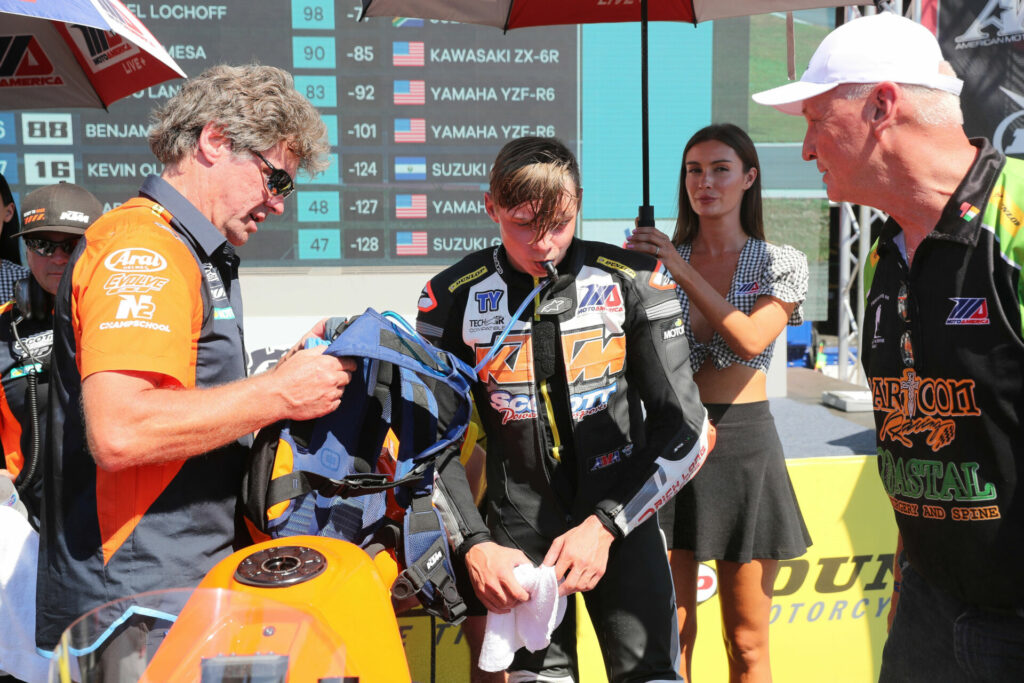
Tyler Scott (center) drinks from a fluid bladder following a MotoAmerica Junior Cup race at Ridge Motorsports Park in 2021. Photo by Brian J. Nelson.
Protein drinks are popular among bodybuilders. They are primarily designed for muscular recovery post-exercise or to act as a dietary protein supplement. Protein drinks will not aid in training/race hydration needs and are typically too light in electrolyte content to help significantly with fluid balance post-event. Certainly not useful as part of your race hydration. Examples are Muscle Milk, Maximuscle, Promax, Impact, Whey Protein.
Energy drinks usually contain a lot of sugar (8%-12%) and caffeine (or natural sources of it such as guarana). They are “lifestyle drinks,” not really “sports drinks,” but are marketed at sporting events and the companies behind them sponsor many top athletes and events, even though athletes are unlikely to be drinking them. (It’s sort of like the M&M’s sponsorship in NASCAR.) Energy drinks are too sugary to work as effective rehydration drinks (above 6%-8% carbohydrate fluids are hypertonic and absorption through the gut slows down) and they are unlikely to contain electrolyte volumes found in sweat loss. Examples are RedBull, Relentless, Monster, AMP. Again, these should not be part of your race hydration.
Carbohydrate drinks are the original sports drinks, typically with 6%-8% isotonic carbohydrate solution. They often contain modest amounts of electrolytes (approximately 200-350 mg/l sodium) to assist with electrolyte replenishment and to increase palatability. They have been proven effective in boosting endurance performance for activities lasting longer than one hour at a suitably high intensity. One major issue with carbohydrate drinks is that if they are used at times when fluid requirements are very high (e.g., in the heat or during very long events) and an athlete is drinking a lot of them they are consuming an unnecessarily large amount of calories which could lead to gastric upset. They serve a purpose but have some of the issues of energy drinks and typically do not sufficiently meet the electrolyte needs of most athletes. Mixing energy and hydration needs in one drink can create imbalances since often energy and hydration needs are at different ends of the scale. Examples are Powerade, Gatorade and Vitamin Water (which actually contains calories but no sodium!).
Electrolyte-only drinks contain no or negligible amounts of carbohydrate/sugars and no protein so are designed simply to maximize hydration. They are hypotonic so are absorbed more rapidly in the gut than carbohydrate drinks. While electrolyte-only drinks do not provide carbohydrate or protein sources to meet the energy demands of exercise, products such as energy gels and bars can be consumed as energy is needed. This allows an athlete to fine tune/balance their intake of fluids, electrolytes and calories separately depending on the ambient conditions, length and intensity of the activity they are taking part in. Electrolyte-only drinks can be used before, during or after exercise to replace fluids and electrolytes without the addition of carbohydrates or other calories if they are not required. Examples are H2ProHydrate, Hi5, Zero, nuun and Elete Water.
Some riders say they have had good results using Pedialyte (or generic equivalents) for rehydration. It’s important to note that electrolytes need to be replaced only when they are lost such as in sweating or with vomiting and diarrhea. In the case of athletes we’re concerned with losses due to sweating and this is nearly exclusively sodium loss. Calcium, magnesium and potassium are stored in certain body compartments and are mobilized as needed so rarely need to be replaced. Pedialyte is perfectly fine for athletes to use for replacement but has more potassium and phosphorus than is needed–but no harm done, you just pee it out. My favorite electrolyte replacement for hydration when sweating is H2ProHydrate simply because it has what you need and nothing you don’t need, plus it comes in tablet form which is easy to transport and use. It comes in 250, 500, 1000 and 1500 concentration tablets which allows you to use a prescribed strength for pre-loading the night before sweating and using a different strength for competition and training days and adjusting to conditions (temperature, intensity, humidity) as needed. A “sweat test” can determine your sodium loss, which is unique to each athlete; this is what the true pros do–prescription hydration.
Since 2014 my team has used H2ProHydrate by Precision Hydration for fluid and sodium management. It comes in an effervescent tablet that you simply drop in your water bottle. H2ProHydrate is widely used in Europe and is produced in the UK. Over the last year it has been added to the programs of many American pro soccer and football teams. You can obtain it in this country by ordering it from various distributors. Much of the information in this article was provided by Precision Hydration.
Another good product is nuun, also an easy to use and transport tablet, which is available in the U.S. at sporting goods stores and outfitters.
For maintaining energy for long days at the track and especially for endurance competition, I encourage a diet with quality protein and complex carbohydrates. Vegetables are a critical part of this. Avoid processed food and simple carbs. If you are exhausted and need quick energy for that last race of the day, then you can add a quick fuel such as fruit juice or sports gels but expect to experience a “sugar crash” when you get back to the pit. It’s always best to maintain steady fuel, which results in a steady, reliable output of energy. That’s what gives you the winning edge over the guy who’s gulping sugary drinks and eating honey buns.
Here’s to your optimal health and on-track performance!
Dr. Laura Ellis is a wellness physician and vein surgeon with practices in Asheville, North Carolina, and in Laguna Beach and West Hollywood in Southern California. She has authored numerous articles in medical journals, and has written two books, The Hormone Handbook and Inside Out. She is host of The Dr. Laura Ellis Show at Sunset Gower Studios in Hollywood. Her medAge® Comprehensive Health Program focuses on the prevention, apprehension, and reversal of degenerative illness in all patients and on optimization of cognitive and physical function for competitive athletes. Prior to establishing her current practices, Dr. Ellis worked as a trauma surgeon and as a general surgeon. And she is a former racer as well as a current street and track rider.
Dr. Ellis ran her own team, AXcess Racing, in the 2016 MotoAmerica KTM RC Cup Series, with riders Brandon Paasch and Jackson Blackmon. Paasch won the championship with seven race wins and a total of 16 podium finishes in 17 races.
For more information contact Dr. Laura Ellis via the medAge® website at www.medAge.com.
Dr. Laura Ellis (108) on track aboard her Yamaha YZF-R6. Photo by Lisa Theobald.
Racing Doctor: Who Is Laura Ellis, MD?
“A Minute Reduction In Your Reaction Time Can Be Devastating…”
By Michael Gougis
The journey from non-rider to racer for Dr. Laura Ellis was short. She started riding four years ago; last year, she won a rookie title with CCS. As a medical professional specializing in nutrition and exercise, she also quickly noted that lots of racers spend far more time on their machines than they do on their bodies.
Ellis applied her experience racing and working with athletes to the sport of motorcycle road racing, and has been working with racing organization staffers and racers across the nation to help them optimize their physical and mental performances. Racing provides a particular need for proper hydration, as few sports that drain the athlete’s fluids require said athlete to wear a full-face helmet, body armor and leather suit at the moment of maximum exertion.
And in few other sports are the stakes as high. “Even a slightly slower reaction time can be devastating on the track,” she says.
Dr. Laura Ellis in the paddock. Photo by Kurt Weigand.
Ellis is a surgeon with a practice in Asheville, North Carolina, and others in Laguna Beach and West Hollywood, California. She also is an author and the founder of medAge, a medical program designed to develop lifestyle changes to improve her clients’ health as they age, and she advises athletes on training and nutrition.
That was the background against which, four years ago, Ellis visited motorcycle-mad Italy and got hooked on two-wheelers.
“I started riding only four years ago–I was 48 when I started riding. Kinda strange, huh? Prior to that, I had never ridden a motorcycle,” she says. “I traveled to Italy four years ago and I noticed that lots of people ride two wheels, whether they are on scooters, motorcycles or bicycles. Men and women, younger and older. I thought it looked pretty cool! So I decided to learn how to do it myself.
“When I came back to the States, I took the Motorcycle Safety Foundation course at the local community college. I enjoyed riding so much that I hired a coach to help me to learn how to ride more acceptably and safely. I wanted to learn how to do it right.” The private coach she hired suggested training at the track.
“I met quite a few folks at the track who race and I got an invitation to race with a couple of guys the following year,” Ellis says. “I of course said yes, because I was turning 50, and I thought, ‘When else am I going to have an opportunity to do this?'”
Ellis quickly moved from a Suzuki Gladius to a Yamaha YZF-R6, and her first race was with CCS at Carolina Motorsports Park in April of 2014. “I wasn’t fast but I had pretty good technique. I had to be careful that I held my line well, that I didn’t deviate, because there were (other riders) passing me. I had to be predictable. My focus was on being predictable and holding my line,” Ellis says.
“It was great. It was a lot of fun. It was thrilling but not scary. As long as you’re prepared and you understand what is happening on the track-you have to be very cognizant of the other riders out there expecting you to behave like they do, which is to be predictable.
“A couple of guys got really, really close when they were passing me,” Ellis continued. “After the race, they came over and said, ‘I’m sorry, I didn’t mean to get that close.’ It really didn’t frighten me, but I could feel them and hear them very, very close to me! It was very polite and kind of them to come over and make sure I was OK with what had happened. And that’s typical of what I’ve seen from most racers.”
What she observed while racing and spending time at the track was that many racers focused on machine prep to the exclusion of preparing themselves.
“I noticed that many of the riders spent so much energy on the bike and not nearly enough on themselves as an athlete. The equipment was, generally, well thought-out. They prepared that well. But they didn’t always prepare themselves well,” Ellis says.
One area many riders can make an immediate improvement in is hydration, she says. “Many racers don’t realize that how they consume food and drink is very important during training and recovery as well as on the day before a race and on competition day itself,” she says. “Hydration is not just water. The communication between the brain and the muscle, between the nerve and the muscle, really relies on proper electrolyte concentration and the fluid shifts between the compartments of the body once you start sweating to keep sodium levels proper. If your sodium becomes very low, those fluid shifts can lead to either high or low concentrations of sodium in certain body compartments.
“What you see most of the time on the track is that the communication between the muscle and the nerve can be compromised. We call that reaction time. You begin to slow down. You might not be able to do as well–you might not win–but you can also make mistakes.”
Dr. Ellis ran her own team, AXcess Racing, in the 2016 MotoAmerica KTM Cup Series, with riders Brandon Paasch and Jackson Blackmon. Paasch won the championship with seven race wins and a total of 16 podium finishes in 17 races.
For more information about medAge and Dr. Laura Ellis, visit www.medage.com.
To read more articles like this one originally published in the December 2015 print issue of Roadracing World, subscribe to Roadracing World. (The article has been updated with additional photos and information from later MotoAmerica racing seasons.)
More, from a Competition Bulletin issued by MotoAmerica:
High Temperatures expected at COTA
We are expecting temperatures at this weekend’s COTA round to reach or exceed 100 degrees on most days.
Please see the document attached HERE regarding healthy hydration tips for all in attendance.
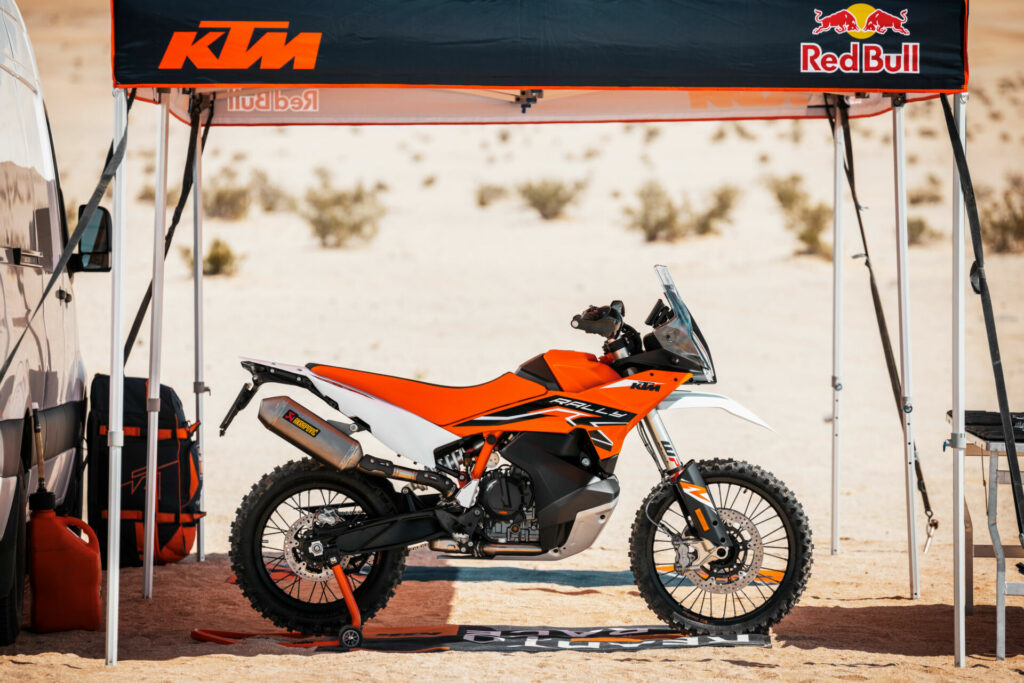
BUILT ON HARDCORE RALLY PERFORMANCE, KTM ANNOUNCES EXCLUSIVE 2024 KTM 890 ADVENTURE R RALLY PRE-ORDER
Inspired by the spirit of the world’s two-wheeled explorers, the 2024 KTM 890 ADVENTURE R RALLY harnesses the very best of KTM’s rally success and engineering know-how as the most performance-driven Adventure motorcycle yet. But that’s not all! This special model is ready to pre-order on September 20, and with it, KTM has launched an incredible ULTIMATE KTM DESERT EXPERIENCE event, exclusively available for those purchasing a new bike.
Offroad is at the very heart of KTM, and its rally racing prominence in iconic events such as the Dakar Rally is central to the READY TO RACE mantra of the Austrian brand. With that in mind, the KTM 890 ADVENTURE R RALLY encompasses that rally racing prowess in an Adventure machine like no other. With only 700 of these models available worldwide, this exceptional bike, with comparable components to 2023 Dakar Rally winner Kevin Benavides’ Red Bull KTM Factory Racing KTM 450 RALLY bike, is the most offroad-capable, two-wheeled adventurer on the market.
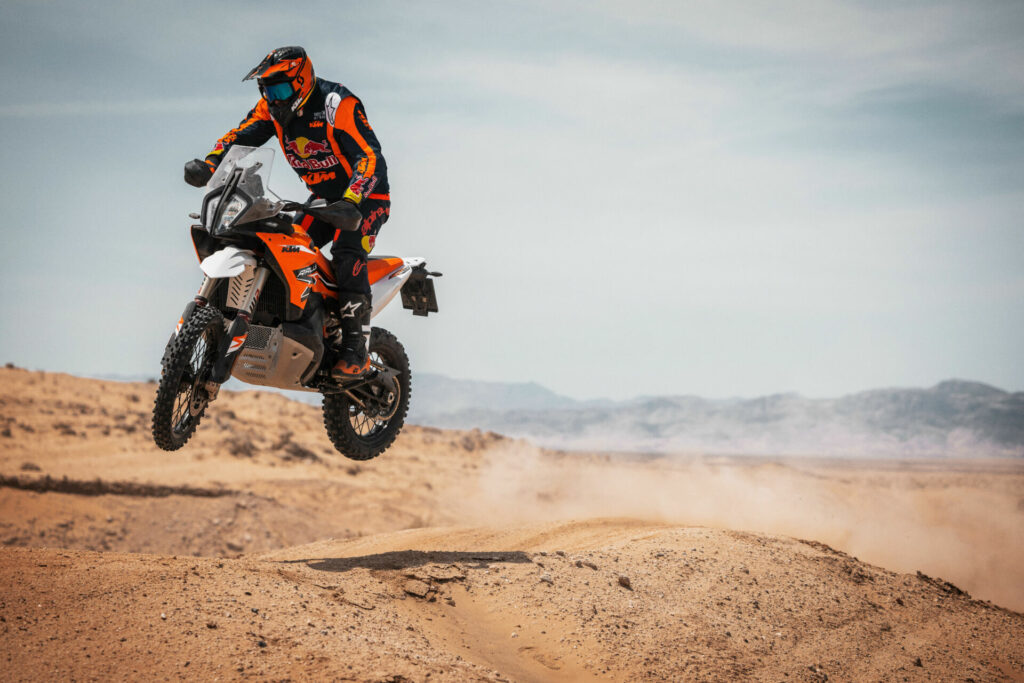
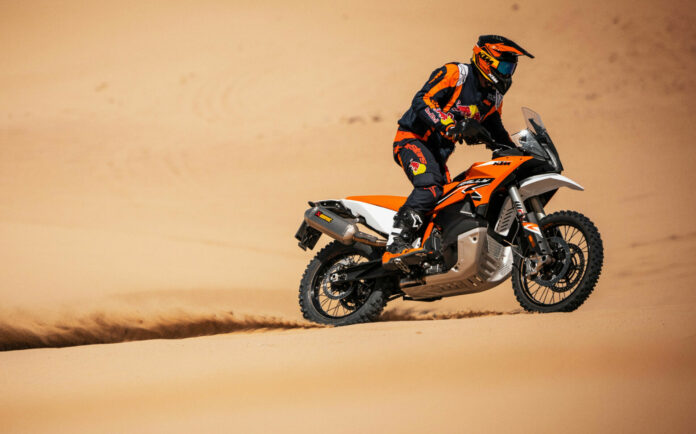
A 2024-model KTM 890 Adventure R Rally airborne. Photo by Markus Berger, courtesy KTM.
Style, functionality and technology are important, but feeling and rideability is perhaps the most critical feature of a motorcycle that’s been evolved in rally for the longest days in the desert and trickiest of stony ravines. That’s why the KTM 890 ADVENTURE R RALLY boasts sublime suspension componentry with the lightweight WP XPLOR PRO 7548 fork system using Cone Valve technology, combined with the WP XPLOR PRO 6746 shock absorber, that are both from the WP Pro Components program. With WP’s experience from successful rally competition, this premium suspension offers the highest level of damping performance in the toughest of conditions, giving the rider a limitless feeling to push harder and faster over obstacles, while maintaining a higher level of comfort and control. In addition, this suspension system provides a superior ride for globetrotters carrying large amounts of luggage or a passenger on their journeys – both on asphalt and offroad – with its 270 mm of travel.
Performance-driven means factory developed. The 889 cc LC8c KTM engine is combined with select components such as the lightweight Akrapovič Slip-on Line exhaust system, similar to that used by KTM’s factory racing teams. With its Offroad ABS system, Traction Control, TURN-BY-TURN+ navigation and multiple ride modes to select depending on terrain, the technology on the KTM 890 ADVENTURE R RALLY, with its 5” TFT display, TECH PACK and Connectivity Unit kit, makes this exciting two-wheeler extra-ready to explore new horizons. With all areas of the riding experience considered, this exceptional model boasts a race-specific Rally seat, heavy duty wheels (2.15×21″; 4.00×18”) for the tougher terrain, and Rally footpegs for increased feeling and grip on long liaisons. Carbon tank guards, combined with further protection for the engine, rear master cylinder and suspension are also fitted. A Supersprox-Stealth rear sprocket is utilized, as is a brand-new rally-derived and eye-catching functional design. No stone has been left unturned in developing this incredibly capable offroader, which is likely to make owners the envy of their fellow explorers.
A 2024-model KTM 890 Adventure R Rally at rest. Photo by Chris Tedesco, courtesy KTM.
In addition, for 34 thrill-seeking adventurers that purchase a KTM 890 ADVENTURE R RALLY, one of the most hardcore adventure machines available, KTM has organized an exclusive opportunity to join offroad KTM legends (like Johnny Aubert) at the ULTIMATE KTM DESERT EXPERIENCE. The event will take place in Morocco, with two groups having the option to choose from two dates: 3-7 March or 7-11 March, 2024. Participants are looking to be offered a full-factory style package including the use of a fully prepped bike provided by KTM with all the necessary technical support required for desert exploration, transport during the trip and luxury accommodation for a four-night stay, plus one special night camping with KTM in the desert for the total price of $5,400. With three days of riding in the area that the KTM Factory Racing Team carries out their Rally testing, a dedicated and fully guided route, and a prepared KTM 890 ADVENTURE R RALLY, this event will be a trip of a lifetime. Experience the KTM 890 ADVENTURE R RALLY the way it should be. THE ADVENTURE AWAITS!
To pre-order the 2024 KTM 890 ADVENTURE R RALLY and for more information about THE ULTIMATE KTM DESERT EXPERIENCE please visit KTM.com.
2024 KTM 890 ADVENTURE R RALLY HIGHLIGHTS
MSRP: $21,499 excluding fees
Powerful KTM 889 cc parallel twin engine
WP XPLOR PRO Suspension from the WP Pro Components program
TURN-BY-TURN+ navigation
Superior technology including ABS linked with Ride Modes
Akrapovič ‘Slip-on Line’
Race-specific Rally seat
Heavy duty wheels with Excel rims
Rally footpegs with wider footprint
Carbon tank guards
Aluminum guard for rear master cylinder
TECH PACK with Motor Slip Regulation, Cruise Control, Quickshifter+ and Rally Mode
Connectivity Unit kit fully compatible with KTMconnect
Engine protection grill
Supersprox-Stealth rear sprocket
New fork guard with additional protection towards the tire
New Rally CTG with two-color fuel tank
The KTM 890 ADVENTURE R RALLY will be ready to pre-order on September 20, 2023, and will begin arriving early 2024.
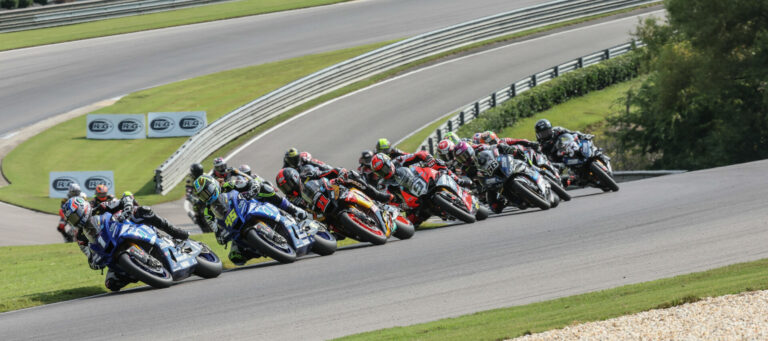
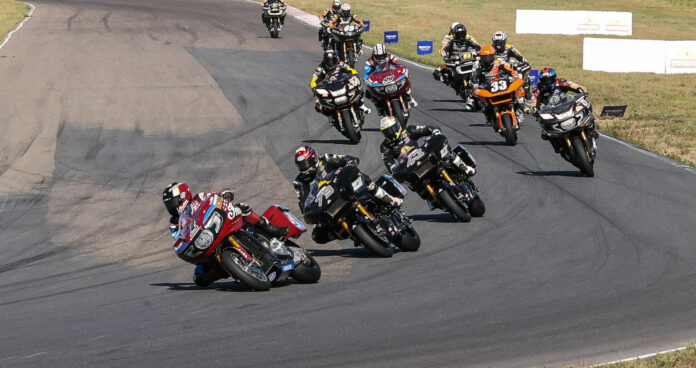
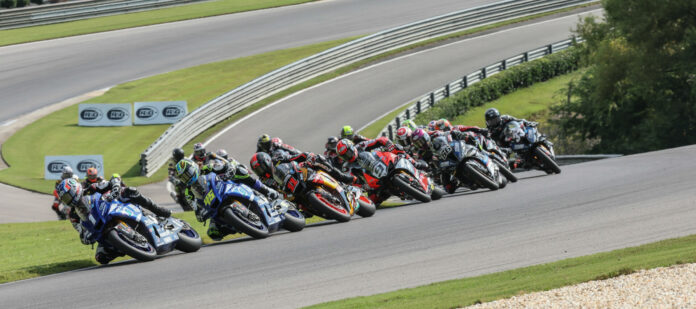
The battle for the 2023 Mission King Of The Baggers Championship went down to the wire between three riders - Hayden Gillim (79), James Rispoli (43) and Kyle Wyman (33). Here, Tyler O'Hara (1) is seen leading the field at Brainerd in 2023. Photo by Brian J. Nelson.
Only Three Points Separate Top Three In Battle For Mission King Of The Baggers Title
Mission King Of The Baggers And Three Other Support Classes Roll Into Texas, September 8-10, for the .
IRVINE, CA (September 7, 2023) – Three points. Three riders. Three measly points is all that separates the top three racers in the heated battle for the 2023 Mission King Of The Baggers Championship as the series heads to the Circuit of The Americas in Austin, Texas, for the penultimate round, September 8-10.
The man with the three-point lead as the series prepares for its eighth round is Vance & Hines/Mission/Harley-Davidson’s Hayden Gillim. The two men giving chase are H-D Screamin’ Eagle’s Kyle Wyman and Gillim’s teammate James Rispoli. All three have had crazily consistent seasons, and Wyman is the only one in the top three with a DNF on his scorecard.
Gillim earned his 175-point total with two wins, two seconds, three thirds, two fourths and a fifth with his two wins coming in the second half of the championship at WeatherTech Raceway Laguna Seca and Brainerd International Raceway.
Wyman, the 2021 Mission King Of The Baggers Champion, has the most wins of the three, but he also has a DNF. Wyman arrived at his 172 points via five wins and only one other podium finish, a third in race one at Road America. Wyman is coming off an off-for-Wyman weekend at Brainerd where he finished fourth and fifth in the two races. He also has a ninth-place finish on his points tally. Wyman knows how to win as he is the all-time wins leader in the class with 10 victories.
Wyman is tied for second with the personable James Rispoli with the Florida resident only winning one race, but with six other podium finishes. Like Wyman, Rispoli has 172 points.
With the top three all riding Harley-Davidson Road Glides, the first of the Indian Challengers is the one ridden by Bobby Fong and not defending series champion Tyler O’Hara. Fong is 45 points behind Gillim but has proven capable of winning on any given day as evidenced by his two wins thus far in 2023. (Road America and Brainerd). Fong has three other podium finishes on the year.
O’Hara is next and a disappointed fifth in the championship and is surprisingly winless on the season so far. O’Hara does have three second-place finishes and two third places, but he is seven points behind Fong and 52 behind his rival Kyle Wyman.
Mission King Of The Baggers rookie Jake Lewis sits sixth in the championship and has scored in every round but has yet to reach the podium.
The second of the two factory Indians and Harley-Davidsons have also had disappointing seasons with Jeremy McWilliams ninth and Travis Wyman 10th, respectively.
Steel Commander Stock 1000 – Beaubier vs. Gillim vs. De Keyrel
Orange Cat Racing’s Ezra Beaubier leads the Steel Commander Stock 1000 Championship over Disrupt Racing’s Hayden Gillim with just the two races at COTA remaining in the five-round, 10-race series. The margin? Eight points.
But that’s not all. Beaubier’s teammate Kaleb De Keyrel is just four more points behind, and Travis Wyman Racing’s Travis Wyman is on the outside looking in, 15 points behind De Keyrel and 27 behind Beaubier.
With his two wins at Brainerd International Raceway at the end of July, Gillim took over as the Stock 1000 racer with the most victories on the year – four. Beaubier, however, has won three, including the first two races of the season at Road Atlanta that put him atop the point standings where he has been ever since.
Beaubier’s 145 points come via three wins, a second, a third, a fourth, a fifth and a sixth. Gillim, meanwhile, has been fighting back from a miserable DNF/sixth-placed weekend to open his season in Atlanta. His four victories since then are what has him back in the championship chase.
De Keyrel is winless thus far but has four second-place finishes and five total podiums. Wyman is the third rider in the title chase to have tasted victory, but he has a non-finish that blemishes his scorecard.
Supersport – Forés On The Verge
Warhorse HSBK Racing Ducati NYC’s Xavi Forés is on the verge of capturing the 2023 MotoAmerica Supersport Championship with the Spaniard holding down a whopping 86-point lead heading into the two races at COTA and the final two at New Jersey Motorsports Park.
Forés won the first eight races of the season to build a lead that has his competition scratching their collective heads, but the series rookie has also gone the last four races without a victory.
Vision Wheel M4 ECSTAR Suzuki’s Tyler Scott sits second in the title chase with two wins and seven additional podium finishes and that has him 13 points clear of third-placed Stefano Mesa. Mesa, however, won’t be racing in the class for the two remaining rounds as he’s been drafted up by his Tytlers Cycle Racing team to fill in for the injured Cameron Beaubier in the Medallia Superbike Championship. Mesa will make his debut in the class this weekend at COTA.
That means that Squid Hunter Racing’s Josh Hayes will slot himself into the top three as he trails Mesa by just four points and is 67 points clear of Scott’s teammate Teagg Hobbs.
With Mesa heading to the Medallia Superbike for the final two rounds, the Tytlers Cycle Racing team is bringing in Kayla Yaakov to ride Mesa’s Kawasaki ZX-6R at COTA and NJMP. Yaakov has been released from her contract with The WagBar MP13 Racing where she has been competing in the REV’IT! Twins Cup series.
Disrupt Racing’s Jake Lewis rounds out the top five in the championship despite not being drafted into the team until the third round of the series.
Mission Super Hooligan National Championship – Tied At The Top
A three-point gap between first and third in the Mission King Of The Baggers Championship, an eight-point margin between first and second in the Steel Commander Stock 1000 Championship and (… wait for it) a tie at the top in the battle for supremacy in the Mission Super Hooligan National Championship.
Indian Motorcycle/Progressive/Mission Foods teammates Tyler O’Hara and Jeremy McWilliams arrive in the Lone Star State tied in the title chase with 106 points apiece.
O’Hara has three victories to McWilliams’ two wins and both riders have a non-points-paying race from their disqualification at Ridge Motorsports Park. O’Hara has one other podium to go with his three wins while McWilliams has three additional podiums.
This one truly does come down to a winner-take-all battle and calculators won’t be needed.
DiBrino Racing’s Andy DiBrino has also had a solid season on his KTM with his lone victory at Ridge Motorsports Park going with three additional podium finishes.
DiBrino is 15 points ahead of Team Saddlemen’s Cory West and his Harley-Davidson Pan America and another 14 ahead of Grey Area Racing’s Mark Price.
About MotoAmerica
MotoAmerica is North America’s premier motorcycle road racing series. Established in 2014, MotoAmerica is home to the AMA Superbike Championship as well as additional classes including Supersport, Stock 1000, Twins Cup, Junior Cup, and King Of The Baggers. MotoAmerica is an affiliate of KRAVE Group LLC, a partnership including three-time 500cc World Champion, two-time AMA Superbike Champion, and AMA Hall of Famer Wayne Rainey; ex-racer and former manager of Team Roberts Chuck Aksland; motorsports marketing executive Terry Karges; and businessman Richard Varner. For more information, please visit www.MotoAmerica.com and follow MotoAmerica on Facebook, Instagram, TikTok, Twitter, and YouTube.
INTRODUCING APRILIA RS 457: A NEW ERA BEGINS IN THE WORLD OF APRILIA
The new RS 457 aims to establish itself as the new benchmark in technology and style for new and experienced motorcyclists worldwide
NEW YORK, N.Y. – September 7, 2023 – THE RS 457 REPRESENTS A HISTORIC LEAP FORWARD FOR APRILIA, NOT ONLY IN TECHNOLOGY BUT ALSO IN ITS APPEAL TO NEW DEMOGRAPHICS AND MARKETS TO MEET THE GROWING WORLDWIDE DEMAND FOR ACCESSIBLE YET THRILLING MOTORCYCLES. WITH THE ADDITION OF THE RS 457, APRILIA NOW TRULY OFFERS A MOTORCYCLE FOR EVERY CUSTOMER.
THE NEW ENGINE IS SEAMLESSLY INTEGRATED WITH A RIGID ALUMINUM FRAME, SETTING THE RS 457 APART IN ITS SEGMENT. DRAWING ON APRILIA’S DECADES OF EXPERTISE ACCUMULATED THROUGH VICTORIES ON RACETRACKS WORLDWIDE, THE CRANKCASE IS POSITIONED AS A LOAD-BEARING ELEMENT, MIRRORING THE APPROACH USED IN THE RS 660. THIS ENSURES LOW WEIGHT, EXCEPTIONAL DYNAMICS, AND THE RIDING PLEASURE FOR WHICH APRILIA IS RENOWNED.
THE ELECTRONIC EQUIPMENT ON THE APRILIA RS 457 IS UNRIVALED, CATERING TO A DIVERSE RANGE OF RIDERS WHILE REMAINING FAITHFUL TO APRILIA’S HERITAGE. THE RIDE BY WIRE SYSTEM, PIONEERED BY APRILIA ENGINEERS, MANAGES THE ENGINE MAPPING WITH THREE DISTINCT RIDING MODES THAT MODULATE POWER, TORQUE DELIVERY, AND TRACTION CONTROL. THESE FEATURES ARE ADJUSTABLE ACROSS THREE LEVELS.
THE APRILIA RS 457 AIMS TO ESTABLISH ITSELF AS THE NEW BENCHMARK IN TECHNOLOGY AND STYLE FOR NEW AND EXPERIENCED MOTORCYCLISTS WORLDWIDE. IT EMBODIES APRILIA’S DEVOTION TO PERFORMANCE.
Michele Colaninno – Piaggio Group CEO
“In recent years, the Aprilia brand has seen an intense burst of renewal, also supported by continued progress in the racing world. The recent introduction of the 660 family, with RS and Tuono first and Tuareg later, has expanded its target, creating a full and competitive range. We are now ready to take another step towards the future with an astonishing bike developed entirely in Noale, capable of stimulating and thrilling young people and opening up huge potential in new markets, near and far. It is a step closer to the globalization of a brand that has always had the perfect combination of technology, fun, and looking to the future in its DNA.”
The RS range has been a leading player in the racing world, dominating the 2-stroke categories. After reaffirming its technological prowess by winning SBK competitions, it has also risen to prominence in MotoGP. Now, Aprilia returns to its founding mission with a project for a new generation of motorcyclists, pooling the knowledge accumulated on tracks worldwide.
Starting in 2020, the massive success of the Aprilia RS 660 (Europe’s best-selling sport bike) has revolutionized the world of mid-range sport bikes, creating a new segment. The same winning formula is repeated with the Aprilia RS 457, which began as a completely new project, conceived, and developed in Noale, Italy, where all Aprilia’s are created, including MotoGP bikes. The new Aprilia is the ideal link between the first 125 engines and the RS 660. It completes the RS family that includes the powerful V4 superbikes and, at its most technologically advanced, the MotoGP-winning RS-GP.
Maverick Vinales at speed on an Aprilia RS 457. Photo courtesy Aprilia.
The Aprilia RS 457 speaks to a new generation of riders, exploiting all the company’s expertise to design and build a true sport bike. The strengths of this motorcycle are its lightness, ease of handling, and technological equipment. The RS 457 is designed to accompany motorcyclists as they progress on road and track. The ergonomics feature clip-on handlebars mounted above the upper triple clamp, a practical solution that provides the best compromise between sportiness and riding comfort.
The new RS 457’s styling follows the legendary RS range; the supersport bikes that made motorcycling history. Starting from the aggressive aerodynamic front fairing to the underbelly silencer with a 2-in-1 exhaust, the RS 457 shares the same DNA from its larger siblings. The full LED front headlamp houses the iconic light signature shared across the Aprilia RS range. The dashboard boasts an elegant and practical 5-inch TFT color instrument display, along with all-new backlit handlebar controls.
The Aprilia RS 457 is powered by a state-of-the-art, liquid-cooled parallel twin-cylinder engine, with double overhead camshaft and four valves per cylinder, delivering 47 horsepower. Beyond just power, the motorcycle’s weight is equally impressive, with a dry weight of 350 lbs.
The new engine is paired with a stiff frame. The aluminum frame makes the RS 457 unique for bikes in its segment. All of Aprilia’s design expertise, honed over decades of victories on all the world’s racetracks, has gone into its development. The crankcase functions as a load-bearing element, a solution borrowed from the RS 660, which ensures the low weight, dynamic qualities, and riding pleasure that have made Aprilia famous.
The 41 mm front fork provides 120 mm of travel and the rear monoshock, working in tandem with the steel swingarm, provides 130 mm of wheel travel, both offering preload adjustability. The braking system incorporates a 320 mm front disc with a ByBre radial-mount 4-piston caliper. At the rear, a 220 mm steel disc is paired with a ByBre caliper. Both wheels benefit from a two-channel ABS system with dual map settings, available for both wheels or exclusively for the front. The 17-inch sport rims accommodate 110/70 tires at the front and 150/60 at the rear, providing exceptional grip while preserving agility, a defining characteristic in the Aprilia RS family.
The electronic equipment on the Aprilia RS 457 is unrivaled, catering to a diverse range of riders while remaining faithful to Aprilia’s heritage. The Ride by Wire system, pioneered by Aprilia engineers, manages the engine mapping with three distinct riding modes that modulate power, torque delivery, and traction control. These features are adjustable across three levels. Additionally, a quickshifter (up and down) is available as an accessory for enhanced performance.
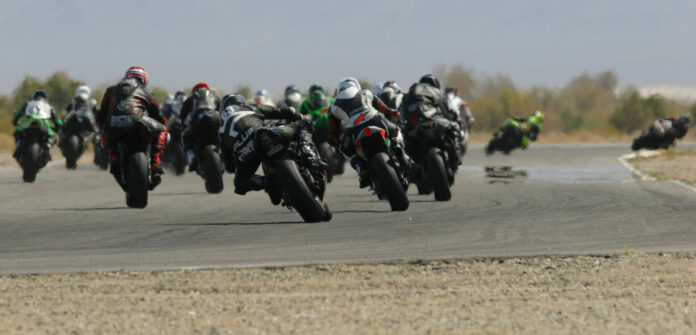
The start of a Supersport Middleweight race during the 2022-2023 CVMA Winter Series. Photo by CaliPhotography, courtesy CVMA.
CVMA Gearing Up for the 2023-2024 Winter Series
Chuckwalla Valley Raceway
With Labor Day in the past and summer coming to a close, most motorcycle racing organizations are finishing up their racing seasons. However, in the Chuckwalla Valley of the California desert things are just starting to heat up and CVMA is getting ready for seven awesome rounds of motorcycle road racing. The first round of the CVMA 2023-2024 winter series is just around the corner kicking things off on October 6-8. We expect racers from all over to join us for another season of some of the most competitive club racing in the country. If your local race season is coming to a close. We invite you to come out to Chuckwalla Valley Raceway and join us all winter long under the California sunshine!
If you would like to start racing, there is no better place than CVMA for amateurs to learn their craft and advance to compete against some of the best in the country. The first CVMA New Racer School of the new season will happen Friday, October 6th and registration is now open on the CVMA website:
CVMA would like to congratulate our Amateur racers who are taking the big step up to racing as experts with us this season and we look forward to seeing your progress throughout the coming season.
We would also like to congratulate those riders who earned a top 10 number plate for the coming season!
#1 Corey Alexander
#2 David Kohlstaedt
#3 Justin Bordonaro
#4 Owen Williams
#5 Sahar Zvik
#6 Jon Glaefke
#7 Igor Sokolov
#8 Angela Brunson
#9 Jasmine Nichols
#10 Dennis Bowers
CVMA would also like to welcome all the riders racing the MotoAmerica Next Generation Supersport class to come out and race with us over the winter. We have modified our Middleweight Shootout class rules to align closely with the MotoAmerica Next Generation Supersport rules so your bikes are legal for our premier Middleweight race!
Registration for round one will be open soon! Keep an eye on our website www.cvmaracing.com for an announcement. Also, when you register, be sure to opt in for email notifications so you don’t miss other important announcements.
CVMA offers two full days of racing every race weekend and includes Saturday qualifying for grid position in all classes, amateur, and expert, as well as a wide variety of classes to choose from. Also provided are two racer-only practice groups during the Friday track day hosted by Apex Assassins Motorcycle Track Days. CVMA offers free reciprocity as a means of encouraging racers from other clubs to come out and compete. CVMA also offers a New Racers School for those starting out in racing on the Friday before each race weekend. Log on to www.cvmaracing.com to sign up or for more information.
CVMA. Built for racers by racers and offering the best racing experience around!
CVMA would also like to thank the 2023/2024 Winter Series Sponsors: SoCal Track Days, Apex Assassins Track Days, Ryder Gear, and CaliPhotography
NRS Sponsors: Alpinestars, 6D Helmets, Racer Gloves, and Racer’s Edge
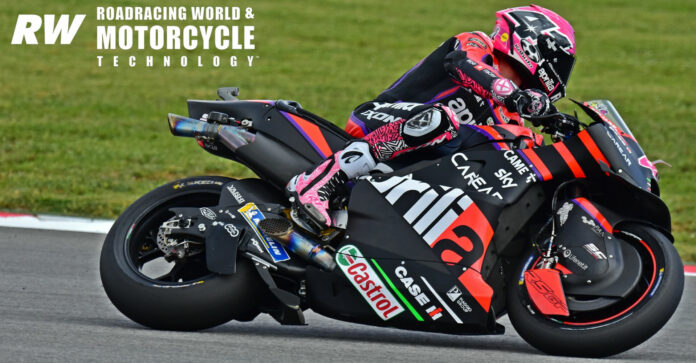
The Aprilia's fairing shape is designed to create a venturi effect to suck the bike toward the ground when it is at full lean. This means using a lower that is shaped like a cross-section of an airfoil, with the rear tapering back toward the center of the motorcycle and a “tunnel” that exhausts air from underneath the leading edge of the fairing lower. In this photo from the season-opening Grand Prix in Portugal, note how the section of the fairing just ahead of Aleix Espargaro's foot is shaped. That section is closer to the centerline of the bike. The fairing above and below it bulges outward. When the bike is on its side, that “tunnel” section creates a hollow that accelerates the flow of air along the fairing forward of it. That generates downforce. Note also the “spats” on the front wheel and swingarm, which manage airflow and help create downforce. Photo by Michael Gougis.
By Michael Gougis
For six glorious laps, Aprilia not only led the Grand Prix of Catalunya, it locked out the podium. Riders on the RS-GP led every lap of the race, and for a chunk of it, Maverick Vinales, Aleix Espargaro, and Miguel Oliveira filled all the trophy spots. Espargaro won over Vinales, and while Oliveira faded to fifth at the end, behind him there were three riders who, between them, had 11 World Championships.
Remember, before the start of the 2021 season, Aprilia had tried to sign multiple riders to its MotoGP team, only to be told, in short, thanks but no thanks. Two years later, it’s one of the most desirable bikes on the grid.
I had a chance to talk to Romano Albesiano, Aprilia’s MotoGP Technical Director, in Portugal. We stood next to that iteration of the RS-GP, and he generously explained the bike’s aerodynamics to me. More than that, he said bluntly that aero was going to make the difference between winning and losing.
“Of course top speed is good for passing and to avoid getting passed,” Albesiano said. “But for improving the overall performance over the lap, this (aero) is the way to go.”
It’s not just about streamlining or wings anymore. Aprilia, to a greater extent than any other manufacturer, recognized that aero could be used to generate mid-corner downforce that loaded the tire directly, and chose to pursue that development path. By creating venturi tunnels in the fairing lowers that sucked the bike downward when it was leaned over, the engineers created more grip.
The faster the bike goes, the more downforce it creates. The longer and faster the curves, the more time such a bike gains; as every race coach I have ever had has told me, time is found in the fast turns, not the slow ones. The slicker the track, the bigger the gap between venturi-effect machines and bikes with more traditional aerodynamics. All of these factors were in evidence at the fast, curvy, low-grip Catalunya circuit last weekend, and there the RS-GP was untouchable.
Espargaro told me at Portugal that in the fast, fast right-handers that end the lap there, his bike was on rails. All that was needed, he said, was some additional fine-tuning, balancing the downforce against steering; downforce makes the machine harder to turn, so the chassis must be adapted deal with the new forces.
Aprilia’s engineers did some fine-tuning over the summer break and got it right. At the fast, flowing Silverstone circuit, Espargaro won the Grand Prix, Vinales was on the podium in the Sprint, and Aprilia took three of the top five places in the Grand Prix. Only an inspired ride by defending World Champion Francesco Bagnaia in the Sprint prevented Aprilia from going 1-2 in both races at Catalunya. And the way Bagnaia had to defend against Vinales in the short race, it was difficult to see him holding off Vinales for much longer. Bagnaia made it clear that he believed that Aprilia had the better machine.
Here’s the point: Barring massive rule changes, this is the future of road racing machines. Similar to the situation in F1 car racing, motorcycle road racing engineers can no longer ignore the simple fact that a well-designed fairing and ancillary aerodynamic components can create grip out of thin air. And grip = speed. That’s a formula every racer understands. Right now, Ducati can hold its own due to the sheer power of its desmodromic engine, stability under braking and the (probably under-appreciated) talent of Bagnaia. But Ducati already has started copying some of the Aprilia aero developments.
Aero isn’t a bolt-on solution. It’s a comprehensive way of looking at a modern MotoGP bike, a fundamental baseline from which to begin designing one, something that changes every aspect of riding one. (For example, Luca Marini pointed out after the Catalunya race that riders no longer try to “draft” another rider out of a corner if they can help it, because the “dirty” air from the leading bike reduces the effectiveness of the following bike’s front wings, which means more wheelie and less forward drive.)
No one seriously thinks Marc Marquez, Fabio Quartararo or Joan Mir–the above-mentioned MotoGP World Champions–have forgotten how to ride a racebike. But they are on machines designed with aero as an afterthought, a bolt-on. Honda and Yamaha are still messing around with front wings and exhaust systems. It’s like watching them race Moto2 bikes in a MotoGP race. Combined, so far this year Marquez, Quartararo, and Mir have 109 points. Espargaro has 154.
This revolution is over. Venturi-generated downforce is the future, and don’t be surprised when it increasingly shows up in the design of sportbikes for sale in a dealership near you.
Luca Marini (10). Photo courtesy Mooney VR46 Racing Team.
YELLOW COLORED 2024 FOR LUCA MARINI
Luca will be a rider of the Mooney VR46 Racing Team also in 2024 on the Ducati Desmosedici GP
Misano Adriatico (Italy), September 7th 2023 – Luca Marini and the Mooney VR46 Racing Team will be together again in 2024. A choice of continuity for Luca, in the orbit of the Tavullia Team since 2018 and the first rider to wear the VR46 colors in MotoGP (Season 2021).
Joining the Moto2 Team in 2018, Luca links the key moments of his sporting career to this crew. First podium (GermanGP 2018) and the second place in the Championship in 2020 in the middle category (result also enhanced by the Team title).
Currently seventh in the general standings (125 points), Luca is among the most solid riders in MotoGP. Constantly in the Top10, once on the podium (P2 AmericasGP, plus P3 in the Sprint at ArgentinaGP) he will be lined up at the start of the new season on the Ducati Desmosedici GP.
LUCA MARINI – 10
Remaining in the Mooney VR46 Racing Team also in 2024 is for me a question of trust in a very close-knit working group, which has believed in me for many years. As a Team, we will do everything to achieve our goals the next season. Not only Vale, Uccio and Pablo whom I thank, but the whole technical Team that supports me and Ducati. Being among the protagonists of the 2024 season, fighting for the Championship as a rider and as a Team is certainly a real ambition.
ALESSIO SALUCCI, TEAM DIRECTOR
I am very pleased to be able to confirm that Luca will also stay with us in 2024. It will be the seventh season with the Team and this is a truly significant recognition of trust for all of us and all our partners who support the project. Confirming a growing Team with the support of Ducati has a symbolic meaning. Luca is a hard worker, always precise, focused on details and this is a real plus in today’s MotoGP. Fast, constant and very solid, I think he has collected less than he deserved so far and I hope he can do his best in these remaining races and in the future.
PABLO NIETO, TEAM MANAGER
Our 2024 line up is complete and I am very happy to have confirmed both riders. The extension of Luca’s contract for another year means a big boost of confidence for everyone in the Team. A solid working group, with the support of Ducati, built two years ago and which, thanks to the commitment of everyone, including our partners, is achieving ambitious results. Luca is now a certainty in the MotoGP Championship, always constantly among the first guys and I’m sure he will be able to obtain many satisfactions in the future.
Westby Racing's Mathew Scholtz (11). Photo by Brian J. Nelson, courtesy Westby Racing.
Westby Racing’s Mathew Scholtz Is Ready To Bring The Heat This Weekend At Circuit Of The Americas
Tulsa, OK – Round eight, the penultimate round of the 2023 MotoAmerica Medallia Superbike Championship, takes place this weekend at the Circuit of The Americas (COTA) in Austin, Texas, and besides the triple-digit air temperatures forecast for the weekend, Mathew Scholtz and the Westby Racing team will also be bringing the heat in MotoAmerica’s Superbike class.
COTA has been the site of a lot of success for Mathew and his #11 Westby Racing Yamaha YZF-R1 Superbike. Last year, he had two runner-up results at the 20-turn, 3.426-mile circuit, and it’s also the track where he won his second career MotoAmerica Superbike race in 2018.
Also weighing in Mathew’s and the team’s favor is the fact that The Scholtz Kid is arguably the most physically fit Superbike rider in the MotoAmerica paddock. His training and nutrition regimen are well-suited for the conditions expected this weekend, which should give him a competitive edge on track.
“These are the kind of conditions I train for,” Mathew said. “It makes all those reps in the gym and all those motos in the heat down in Georgia worthwhile. I thrive in the heat because I prepare for it. And, I know the Westby team prepares the bike with the same attention to detail. I’m looking forward to COTA and to this second-to-last round of the season. We’ll be pushing hard to have our best weekend.”
Superbike final qualifying is on Saturday morning at 10:10 CT, Superbike race one will go green on Saturday afternoon at 3 CT and Superbike race two is on Sunday afternoon also at 3 CT. Both races will be shown live on MotoAmerica’s YouTube Channel.
For all the action from COTA, as it happens, subscribe to MotoAmerica Live+, which is MotoAmerica’s live streaming and on-demand service.
Meet Mathew, Get An Autographed Poster, And More
Mathew will be available for autographs during the Dunlop Hot Pit Walk & Autograph Session, scheduled for 11 a.m. to Noon Sunday on pit lane at COTA. He and the team will be handing out free posters and T-shirts, so don’t miss it.
Check Out The Westby Racing Sponsor Showcase
Miami Thread, Motorex USA, Renthal Ltd., and Suter Racing Products are the featured team sponsors on display in the Westby Racing paddock area this race weekend, so be sure to stop by to say hello and learn about some of the companies that support the team.
For more updates about Westby Racing, including news, photos, and videos, visit www.WestbyRacing.com
Also, follow “Westby Racing” on your favorite social media sites.
A rider at speed at New Jersey Motorsports Park (NJMP). Photo courtesy NJMP.
Coming Soon to New Jersey Motorsports Park NJMP Advanced Motorcycle Open Track Day October 18, 2023
Register NOW for the FIRST Motorcycle Open Track Day on Wednesday, October 18 on Lightning!
Get The Track Time You’ve Been Waiting For
New Jersey Motorsports Park is excited to introduce a brand-new concept for motorcycle track days. Our first NJMP Motorcycle Advanced Open Track Day will allow an open track format for 8 hours.
Our Advanced Riders will have the ability to enter and exit the track at any time. No RUN GROUPS or 15-to-20-minute sessions. Go on or off the track whenever you want. This will provide the ultimate opportunity for extended track time.
We will take an hour lunch and will provide a complimentary lunch buffet at the Finish Line Pub located at the Clubhouse.
This new format will be limited to 50 Advanced Riders Only! We will provide tech inspection in the morning, followed by a mandatory Riders Meeting in the classroom, and then the track goes hot for the rest of the day. Join us for the Ultimate Track Day with 8 hours of track time for Advanced Riders Only!
Ryan McFarland, founder and CEO of Strider and AllKidsBike.org, giving a media presentation ahead of the IMS Outdoors show in Costa Mesa, California in 2021. Photo by David Swarts.
Strider Bikes Hits 4 Million Bikes Sold Milestone
The balance bike leader celebrates helping over 10 million kids learn how to ride a bike
RAPID CITY, SD., September 7, 2023 — Strider Bikes, the leader in kids balance bikes, announced today that the company has sold over 4 million bikes – solidifying its position as the leader in the kids balance bike industry.
Strider Bikes was born out of founder Ryan McFarland’s desire to share his passion for biking with his son. One of the first pioneers in the balance bike space, Strider Bikes has been leading industry innovation since 2007– building lightweight, efficient, all-terrain bikes that develop two-wheeled balance, coordination, and confidence in children. Thanks to Strider’s groundbreaking 2-in-1 Rocking Bike, kids as young as 6 months old across the globe are learning how to ride a bike before they’re even out of diapers. Research has found that learning with a balance bike helps kids transition to pedal bikes an average of 2 years earlier than those who use training wheels.
“Our dedication to innovation and excellence has allowed us to lower the age at which kids learn to ride a bicycle and has transformed the way kids approach their two-wheeled journey,” said Ryan McFarland, Founder and CEO, Strider Bikes. “With this milestone, we‘re not only marking a significant sales milestone, but celebrating the millions of kids we’ve helped learn to ride.”
What makes this milestone even more special is the impact it has had beyond just the number of bikes sold. It is estimated that at least 10 million kids have learned to ride on Strider bikes through hand-me-down bikes, second-hand bikes, and Strider’s social impact programs. Additionally, Strider Bikes proudly contributes 1 percent of every bike sold to the Strider Rider Fund, which has helped create opportunities for young riders globally. Over $2 million has been donated to date.
The annual Strider Cup will be taking place in Bentonville, AR on September 23, 2023 and Strider Bikes will be present at Toy Fair in New York, NY from September 30 to October 3, 2023. For more information about Strider Bikes, visit www.StriderBikes.com.
About Strider Sports International, Inc:
Founded by Ryan McFarland in 2007, in Rapid City, South Dakota, Strider has sold more than 4 million bikes and is distributed in more than 75 countries. Strider’s bikes have been recognized as the best balance bikes on the market by publications such as The New York Times, Parents, and Today’s Parent. Beyond the bikes, the company has inspired and nurtured a thriving community and significantly contributes to social impact programs.
The start of a MotoAmerica Superbike race at Barber Motorsports Park in 2022. Photo by Brian J. Nelson.
It’s Day Two Of A Blazing Hot Weekend, Your Head Aches And You Feel Terrible. What’s The Cure? Learn How To Hydrate Right And Deal With The Heat!
To read more articles like this one originally published in the December 2015 print issue of Roadracing World, subscribe to Roadracing World. (The article has been updated with additional photos and information from later MotoAmerica racing seasons.)
By Dr. Laura Ellis
Racers and team owners place great emphasis on building and tuning fast, lightweight, reliable bikes, but building and fueling the rider is just as important. Motorcycle racers are extreme athletes frequently performing in difficult conditions. I get a lot of questions from racers on how to optimize their performance. This article addresses some of the most common concerns I see in the sport.
Dr. Laura Ellis, MD, author and web TV host. Photo courtesy medAge.
A critical part of fueling the racer is optimal hydration. Consider it part of race preparation. The two goals of optimal hydration are to improve athletic performance and prevent dangerous complications of dehydration, some of which can be severe.
In this article, we will define hydration and its relevance to racing; provide scientific facts to dispel some myths about hydration; and give the reader excellent hydration options.
In medicine, we define hydration as “the status of the fluid-electrolyte balance in a patient.” Fluid in this case is water. The electrolytes we’re concerned with are sodium, potassium, calcium and magnesium.
Josh Hayes (left) and Cameron Beaubier (right) after a hard race on a triple-digit day at Utah Motorsports Campus (formerly known as Miller Motorsports Park). Photo by Brian J. Nelson.
The human body is 60-75% water. Some parts of the body have more water than others. For example, the brain contains 95% water, the lungs 85% and blood 82%.
Body water is stored in two major ways; 2/3 is intra-cellular (inside the cells) and 1/3 is extra-cellular (outside the cells), in the blood stream and in between the cells.
Water is replenished by ingestion of food and water and is lost in a variety of ways called “insensible losses,” via exhaled air, urine, feces and sweat. Insensible water losses vary substantially with small changes in ambient temperature, humidity and physical exertion.
For optimal health and daily function I recommend drinking half your body weight in ounces of water. This assumes you are at or near your ideal body weight. For example, I weigh 132 pounds, which is ideal for me, so I drink around 66 ounces of water every day. That’s about 2.0 liters a day for me. Don’t count what you drink during exercise-that’s in addition to your baseline volume. Nearly everyone is under-hydrated so if you follow my daily rule you may find that you urinate quite frequently for a day or two. You’ll adjust. And you’ll notice you feel better, sleep better, are less hungry and lose unwanted weight easier. The feeling of thirst is a signal from the brain indicating we need more fluid. This thirst mechanism diminishes as we age so don’t rely on feeling thirsty before you drink. In fact, by the time you feel thirsty you’re already behind and will be functioning sub-par. Catching up can take hours or even days depending on how under-hydrated you are.
Loris Baz wearing a special cooling vest after doing a MotoAmerica Superbike race when it was 107 degrees F at Ridge Motorsports Park in 2021. Photo by Brian J. Nelson.
Current evidence suggests that many athletes start a training session or competitive game or race under-hydrated and do not consume enough fluids to replace sweat loss. This puts them at a distinct disadvantage, mentally and physically. Under-hydration can lead to dangerous outcomes due to poor decision-making, slower reaction times, muscle cramping and even seizures and occasionally death. Think about the times you’ve crashed. Can you attribute any of them to fatigue or slowed reaction time? Many racers tell me “yes.”
It’s important to know that sweat loss is mainly water, but it also contains minerals, which we refer to as electrolytes. Electrolytes are essential for conduction of electrical energy between and within cells, for maintaining cognitive function (decision-making), communication between nerves and muscles (reaction time) and for muscle contraction itself.
Sweat contains large amounts of sodium with much lower concentrations of potassium, magnesium and calcium.
Of the four key electrolytes contained in lost sweat only sodium can typically be depleted through sweat loss alone.
Sweating 2.0 liters per hour (which is not uncommon) in a hot race would mean that within two hours your daily intake of sodium has been depleted. Considering that there are no usable reserves of sodium in the body, you need to replace sodium as you exercise. The other three electrolytes can typically be replenished by tapping into stores within the body.
Dr. Laura Ellis uses water bottles and nuun rehydration tablets to promote her medAge practice. Photo by David Swarts.
Why is sodium so important?
Sodium is not only the most likely to be lost, it is also the electrolyte most required during training and racing.
Blood sodium loss and gains are tightly regulated by the kidneys with drives from the brain to increase salt intake or drink more water as necessary.
Normal blood levels are maintained between 135-145 mmol/l (mili moles/liter) concentration. Given sodium losses, small reserves and narrow band of operation, it is relatively easy for athletes to become sodium depleted.
Low blood sodium in sports is mostly due to the dilutional effects of drinking water or low-concentration sports drinks in excess of sweat and urine sodium losses.
This condition is known as Exercise Associated Hyponatremia (EAH).
With EAH, the athlete experiences weakness, nausea, muscle fatigue and cramping. As sodium levels drop even further, resultant fluid shifts occur in an effort to equalize and water moves into the brain. This can lead to agitation, seizures and occasionally death.
Risk factors for EAH include long (4-hour+) races, slow running pace, female gender, low body weight, pre-race excessive water intake, over-drinking (more than 1.5 liter/hour) during racing and abundance of drinks during the event weekend.
What about the other electrolytes?
Potassium
Along with sodium, potassium regulates the electrical integrity of the cell membrane and is therefore important in nerve conduction.
Potassium also helps transport glucose into the cell so it is crucial for energy generation.
Low blood potassium is usually due to diarrhea, fasting and taking certain drugs such as diuretics long-term–not from sweating.
In sports, low potassium is rare. Certain ultra-endurance athletes who generally have a poor solid-food diet may be prone to low potassium, leading to nausea, muscle fatigue and weakness.
Potassium supplements should always be taken with caution and on the advice of a doctor. Contrary to what your mother may have told you, eating bananas has no significant effect on blood potassium levels.
Calcium
Calcium is intimately involved in muscle contraction and relaxation and nerve conduction.
Your body has vast supplies of calcium stored in the bones which are tapped into when needed.
Generally, in a well-nourished athlete eating a normal diet with dark-green vegetables, calcium deficiency during racing is rare.
Dietary sources are generally better than supplements. Equally important are weight-bearing exercises. Swimmers and cyclists suffer the same bone calcium loss as sedentary individuals so remember to fit weight-bearing exercises into your regimen.
Magnesium
Magnesium is necessary in every cell for enzyme reactions as well as muscle contraction and energy production.
Prolonged exercise and training with poor diet can lead to depletion although this is rare to surface in an acute setting.
Magnesium deficiency can lead to dizziness, fatigue and depression.
There is no evidence that taking magnesium supplements by people with normal blood levels offers any benefit in sports performance.
To sum it up so far, inadequate replacement of water and sodium will lead to early fatigue, weakness, nausea, muscle fatigue and cramping.
Toni Elias takes in fluids following a hot Superbike race at Barber Motorsports Park in 2018. Photo by Brian J. Nelson.
So, HOW MUCH should you drink while training and racing?
The American College of Sports Medicine (ACSM) Position Stand on Exercise and Fluid Replacement:
Before Exercise: Preload by drinking “500 mls (milliliters) fluid two hours before exercise to allow adequate hydration and allow excessive water to be excreted by the kidneys.”
During Exercise: “…individuals should be encouraged to consume the maximal amount of fluids during exercise that can be tolerated without gastrointestinal discomfort up to a rate equal to that lost from sweating…” In other words, figure out your sweat rate and simply replace what you lose. Example: A 1.2 kg loss would be replaced with 1200 mls of fluid. Measure this once or twice in various conditions (temperature and humidity) to get an idea of volume needed, then use it as a guideline for future activity in similar conditions. Sound complicated? It’s not. Professional athletes do it for a reason–it gives them an advantage. Here’s how you do it. Weigh yourself before and after a training or race event. Convert the difference in weight from pounds to kilograms, (1.0 pound x 0.4536 = kg; 1 kg x 2.2046 = lbs.). Your sweat/water loss in mls is 1000 x the kg difference. Most water bottles have ml and oz gradations so just look at the bottle for the conversion to ounces.
Now, WHAT should you drink while training and racing?
What’s the difference between all the drinks on the market? It’s confusing!
Rather unhelpfully the sports drink industry has confused hydration with fuel with recovery.
We classify sports drinks into the following groups:
Protein drinks (no carbohydrates).
Energy drinks.
Carbohydrate drinks (with or without electrolytes).
Electrolyte-only drinks.
Let’s look at each one.
Tyler Scott (center) drinks from a fluid bladder following a MotoAmerica Junior Cup race at Ridge Motorsports Park in 2021. Photo by Brian J. Nelson.
Protein drinks are popular among bodybuilders. They are primarily designed for muscular recovery post-exercise or to act as a dietary protein supplement. Protein drinks will not aid in training/race hydration needs and are typically too light in electrolyte content to help significantly with fluid balance post-event. Certainly not useful as part of your race hydration. Examples are Muscle Milk, Maximuscle, Promax, Impact, Whey Protein.
Energy drinks usually contain a lot of sugar (8%-12%) and caffeine (or natural sources of it such as guarana). They are “lifestyle drinks,” not really “sports drinks,” but are marketed at sporting events and the companies behind them sponsor many top athletes and events, even though athletes are unlikely to be drinking them. (It’s sort of like the M&M’s sponsorship in NASCAR.) Energy drinks are too sugary to work as effective rehydration drinks (above 6%-8% carbohydrate fluids are hypertonic and absorption through the gut slows down) and they are unlikely to contain electrolyte volumes found in sweat loss. Examples are RedBull, Relentless, Monster, AMP. Again, these should not be part of your race hydration.
Carbohydrate drinks are the original sports drinks, typically with 6%-8% isotonic carbohydrate solution. They often contain modest amounts of electrolytes (approximately 200-350 mg/l sodium) to assist with electrolyte replenishment and to increase palatability. They have been proven effective in boosting endurance performance for activities lasting longer than one hour at a suitably high intensity. One major issue with carbohydrate drinks is that if they are used at times when fluid requirements are very high (e.g., in the heat or during very long events) and an athlete is drinking a lot of them they are consuming an unnecessarily large amount of calories which could lead to gastric upset. They serve a purpose but have some of the issues of energy drinks and typically do not sufficiently meet the electrolyte needs of most athletes. Mixing energy and hydration needs in one drink can create imbalances since often energy and hydration needs are at different ends of the scale. Examples are Powerade, Gatorade and Vitamin Water (which actually contains calories but no sodium!).
Electrolyte-only drinks contain no or negligible amounts of carbohydrate/sugars and no protein so are designed simply to maximize hydration. They are hypotonic so are absorbed more rapidly in the gut than carbohydrate drinks. While electrolyte-only drinks do not provide carbohydrate or protein sources to meet the energy demands of exercise, products such as energy gels and bars can be consumed as energy is needed. This allows an athlete to fine tune/balance their intake of fluids, electrolytes and calories separately depending on the ambient conditions, length and intensity of the activity they are taking part in. Electrolyte-only drinks can be used before, during or after exercise to replace fluids and electrolytes without the addition of carbohydrates or other calories if they are not required. Examples are H2ProHydrate, Hi5, Zero, nuun and Elete Water.
Some riders say they have had good results using Pedialyte (or generic equivalents) for rehydration. It’s important to note that electrolytes need to be replaced only when they are lost such as in sweating or with vomiting and diarrhea. In the case of athletes we’re concerned with losses due to sweating and this is nearly exclusively sodium loss. Calcium, magnesium and potassium are stored in certain body compartments and are mobilized as needed so rarely need to be replaced. Pedialyte is perfectly fine for athletes to use for replacement but has more potassium and phosphorus than is needed–but no harm done, you just pee it out. My favorite electrolyte replacement for hydration when sweating is H2ProHydrate simply because it has what you need and nothing you don’t need, plus it comes in tablet form which is easy to transport and use. It comes in 250, 500, 1000 and 1500 concentration tablets which allows you to use a prescribed strength for pre-loading the night before sweating and using a different strength for competition and training days and adjusting to conditions (temperature, intensity, humidity) as needed. A “sweat test” can determine your sodium loss, which is unique to each athlete; this is what the true pros do–prescription hydration.
Since 2014 my team has used H2ProHydrate by Precision Hydration for fluid and sodium management. It comes in an effervescent tablet that you simply drop in your water bottle. H2ProHydrate is widely used in Europe and is produced in the UK. Over the last year it has been added to the programs of many American pro soccer and football teams. You can obtain it in this country by ordering it from various distributors. Much of the information in this article was provided by Precision Hydration.
Another good product is nuun, also an easy to use and transport tablet, which is available in the U.S. at sporting goods stores and outfitters.
For maintaining energy for long days at the track and especially for endurance competition, I encourage a diet with quality protein and complex carbohydrates. Vegetables are a critical part of this. Avoid processed food and simple carbs. If you are exhausted and need quick energy for that last race of the day, then you can add a quick fuel such as fruit juice or sports gels but expect to experience a “sugar crash” when you get back to the pit. It’s always best to maintain steady fuel, which results in a steady, reliable output of energy. That’s what gives you the winning edge over the guy who’s gulping sugary drinks and eating honey buns.
Here’s to your optimal health and on-track performance!
Dr. Laura Ellis is a wellness physician and vein surgeon with practices in Asheville, North Carolina, and in Laguna Beach and West Hollywood in Southern California. She has authored numerous articles in medical journals, and has written two books, The Hormone Handbook and Inside Out. She is host of The Dr. Laura Ellis Show at Sunset Gower Studios in Hollywood. Her medAge® Comprehensive Health Program focuses on the prevention, apprehension, and reversal of degenerative illness in all patients and on optimization of cognitive and physical function for competitive athletes. Prior to establishing her current practices, Dr. Ellis worked as a trauma surgeon and as a general surgeon. And she is a former racer as well as a current street and track rider.
Dr. Ellis ran her own team, AXcess Racing, in the 2016 MotoAmerica KTM RC Cup Series, with riders Brandon Paasch and Jackson Blackmon. Paasch won the championship with seven race wins and a total of 16 podium finishes in 17 races.
For more information contact Dr. Laura Ellis via the medAge® website at www.medAge.com.
Dr. Laura Ellis (108) on track aboard her Yamaha YZF-R6. Photo by Lisa Theobald.
Racing Doctor: Who Is Laura Ellis, MD?
“A Minute Reduction In Your Reaction Time Can Be Devastating…”
By Michael Gougis
The journey from non-rider to racer for Dr. Laura Ellis was short. She started riding four years ago; last year, she won a rookie title with CCS. As a medical professional specializing in nutrition and exercise, she also quickly noted that lots of racers spend far more time on their machines than they do on their bodies.
Ellis applied her experience racing and working with athletes to the sport of motorcycle road racing, and has been working with racing organization staffers and racers across the nation to help them optimize their physical and mental performances. Racing provides a particular need for proper hydration, as few sports that drain the athlete’s fluids require said athlete to wear a full-face helmet, body armor and leather suit at the moment of maximum exertion.
And in few other sports are the stakes as high. “Even a slightly slower reaction time can be devastating on the track,” she says.
Dr. Laura Ellis in the paddock. Photo by Kurt Weigand.
Ellis is a surgeon with a practice in Asheville, North Carolina, and others in Laguna Beach and West Hollywood, California. She also is an author and the founder of medAge, a medical program designed to develop lifestyle changes to improve her clients’ health as they age, and she advises athletes on training and nutrition.
That was the background against which, four years ago, Ellis visited motorcycle-mad Italy and got hooked on two-wheelers.
“I started riding only four years ago–I was 48 when I started riding. Kinda strange, huh? Prior to that, I had never ridden a motorcycle,” she says. “I traveled to Italy four years ago and I noticed that lots of people ride two wheels, whether they are on scooters, motorcycles or bicycles. Men and women, younger and older. I thought it looked pretty cool! So I decided to learn how to do it myself.
“When I came back to the States, I took the Motorcycle Safety Foundation course at the local community college. I enjoyed riding so much that I hired a coach to help me to learn how to ride more acceptably and safely. I wanted to learn how to do it right.” The private coach she hired suggested training at the track.
“I met quite a few folks at the track who race and I got an invitation to race with a couple of guys the following year,” Ellis says. “I of course said yes, because I was turning 50, and I thought, ‘When else am I going to have an opportunity to do this?'”
Ellis quickly moved from a Suzuki Gladius to a Yamaha YZF-R6, and her first race was with CCS at Carolina Motorsports Park in April of 2014. “I wasn’t fast but I had pretty good technique. I had to be careful that I held my line well, that I didn’t deviate, because there were (other riders) passing me. I had to be predictable. My focus was on being predictable and holding my line,” Ellis says.
“It was great. It was a lot of fun. It was thrilling but not scary. As long as you’re prepared and you understand what is happening on the track-you have to be very cognizant of the other riders out there expecting you to behave like they do, which is to be predictable.
“A couple of guys got really, really close when they were passing me,” Ellis continued. “After the race, they came over and said, ‘I’m sorry, I didn’t mean to get that close.’ It really didn’t frighten me, but I could feel them and hear them very, very close to me! It was very polite and kind of them to come over and make sure I was OK with what had happened. And that’s typical of what I’ve seen from most racers.”
What she observed while racing and spending time at the track was that many racers focused on machine prep to the exclusion of preparing themselves.
“I noticed that many of the riders spent so much energy on the bike and not nearly enough on themselves as an athlete. The equipment was, generally, well thought-out. They prepared that well. But they didn’t always prepare themselves well,” Ellis says.
One area many riders can make an immediate improvement in is hydration, she says. “Many racers don’t realize that how they consume food and drink is very important during training and recovery as well as on the day before a race and on competition day itself,” she says. “Hydration is not just water. The communication between the brain and the muscle, between the nerve and the muscle, really relies on proper electrolyte concentration and the fluid shifts between the compartments of the body once you start sweating to keep sodium levels proper. If your sodium becomes very low, those fluid shifts can lead to either high or low concentrations of sodium in certain body compartments.
“What you see most of the time on the track is that the communication between the muscle and the nerve can be compromised. We call that reaction time. You begin to slow down. You might not be able to do as well–you might not win–but you can also make mistakes.”
Dr. Ellis ran her own team, AXcess Racing, in the 2016 MotoAmerica KTM Cup Series, with riders Brandon Paasch and Jackson Blackmon. Paasch won the championship with seven race wins and a total of 16 podium finishes in 17 races.
For more information about medAge and Dr. Laura Ellis, visit www.medage.com.
To read more articles like this one originally published in the December 2015 print issue of Roadracing World, subscribe to Roadracing World. (The article has been updated with additional photos and information from later MotoAmerica racing seasons.)
More, from a Competition Bulletin issued by MotoAmerica:
High Temperatures expected at COTA
We are expecting temperatures at this weekend’s COTA round to reach or exceed 100 degrees on most days.
Please see the document attached HERE regarding healthy hydration tips for all in attendance.
A 2024-model KTM 890 Adventure R Rally at speed. Photo by Markus Berger, courtesy KTM.
BUILT ON HARDCORE RALLY PERFORMANCE, KTM ANNOUNCES EXCLUSIVE 2024 KTM 890 ADVENTURE R RALLY PRE-ORDER
Inspired by the spirit of the world’s two-wheeled explorers, the 2024 KTM 890 ADVENTURE R RALLY harnesses the very best of KTM’s rally success and engineering know-how as the most performance-driven Adventure motorcycle yet. But that’s not all! This special model is ready to pre-order on September 20, and with it, KTM has launched an incredible ULTIMATE KTM DESERT EXPERIENCE event, exclusively available for those purchasing a new bike.
Offroad is at the very heart of KTM, and its rally racing prominence in iconic events such as the Dakar Rally is central to the READY TO RACE mantra of the Austrian brand. With that in mind, the KTM 890 ADVENTURE R RALLY encompasses that rally racing prowess in an Adventure machine like no other. With only 700 of these models available worldwide, this exceptional bike, with comparable components to 2023 Dakar Rally winner Kevin Benavides’ Red Bull KTM Factory Racing KTM 450 RALLY bike, is the most offroad-capable, two-wheeled adventurer on the market.
A 2024-model KTM 890 Adventure R Rally airborne. Photo by Markus Berger, courtesy KTM.
Style, functionality and technology are important, but feeling and rideability is perhaps the most critical feature of a motorcycle that’s been evolved in rally for the longest days in the desert and trickiest of stony ravines. That’s why the KTM 890 ADVENTURE R RALLY boasts sublime suspension componentry with the lightweight WP XPLOR PRO 7548 fork system using Cone Valve technology, combined with the WP XPLOR PRO 6746 shock absorber, that are both from the WP Pro Components program. With WP’s experience from successful rally competition, this premium suspension offers the highest level of damping performance in the toughest of conditions, giving the rider a limitless feeling to push harder and faster over obstacles, while maintaining a higher level of comfort and control. In addition, this suspension system provides a superior ride for globetrotters carrying large amounts of luggage or a passenger on their journeys – both on asphalt and offroad – with its 270 mm of travel.
Performance-driven means factory developed. The 889 cc LC8c KTM engine is combined with select components such as the lightweight Akrapovič Slip-on Line exhaust system, similar to that used by KTM’s factory racing teams. With its Offroad ABS system, Traction Control, TURN-BY-TURN+ navigation and multiple ride modes to select depending on terrain, the technology on the KTM 890 ADVENTURE R RALLY, with its 5” TFT display, TECH PACK and Connectivity Unit kit, makes this exciting two-wheeler extra-ready to explore new horizons. With all areas of the riding experience considered, this exceptional model boasts a race-specific Rally seat, heavy duty wheels (2.15×21″; 4.00×18”) for the tougher terrain, and Rally footpegs for increased feeling and grip on long liaisons. Carbon tank guards, combined with further protection for the engine, rear master cylinder and suspension are also fitted. A Supersprox-Stealth rear sprocket is utilized, as is a brand-new rally-derived and eye-catching functional design. No stone has been left unturned in developing this incredibly capable offroader, which is likely to make owners the envy of their fellow explorers.
A 2024-model KTM 890 Adventure R Rally at rest. Photo by Chris Tedesco, courtesy KTM.
In addition, for 34 thrill-seeking adventurers that purchase a KTM 890 ADVENTURE R RALLY, one of the most hardcore adventure machines available, KTM has organized an exclusive opportunity to join offroad KTM legends (like Johnny Aubert) at the ULTIMATE KTM DESERT EXPERIENCE. The event will take place in Morocco, with two groups having the option to choose from two dates: 3-7 March or 7-11 March, 2024. Participants are looking to be offered a full-factory style package including the use of a fully prepped bike provided by KTM with all the necessary technical support required for desert exploration, transport during the trip and luxury accommodation for a four-night stay, plus one special night camping with KTM in the desert for the total price of $5,400. With three days of riding in the area that the KTM Factory Racing Team carries out their Rally testing, a dedicated and fully guided route, and a prepared KTM 890 ADVENTURE R RALLY, this event will be a trip of a lifetime. Experience the KTM 890 ADVENTURE R RALLY the way it should be. THE ADVENTURE AWAITS!
To pre-order the 2024 KTM 890 ADVENTURE R RALLY and for more information about THE ULTIMATE KTM DESERT EXPERIENCE please visit KTM.com.
2024 KTM 890 ADVENTURE R RALLY HIGHLIGHTS
MSRP: $21,499 excluding fees
Powerful KTM 889 cc parallel twin engine
WP XPLOR PRO Suspension from the WP Pro Components program
TURN-BY-TURN+ navigation
Superior technology including ABS linked with Ride Modes
Akrapovič ‘Slip-on Line’
Race-specific Rally seat
Heavy duty wheels with Excel rims
Rally footpegs with wider footprint
Carbon tank guards
Aluminum guard for rear master cylinder
TECH PACK with Motor Slip Regulation, Cruise Control, Quickshifter+ and Rally Mode
Connectivity Unit kit fully compatible with KTMconnect
Engine protection grill
Supersprox-Stealth rear sprocket
New fork guard with additional protection towards the tire
New Rally CTG with two-color fuel tank
The KTM 890 ADVENTURE R RALLY will be ready to pre-order on September 20, 2023, and will begin arriving early 2024.
A “press release” is promotional text issued by a rider, team, company or organization to inform
the public about an event, product, or service from the issuer’s own point of view, and if deemed
to have news value, may be placed on roadracingworld.com as a service to our readers.
A press release is not an article written by Roadracingworld.com staffers. When a post is labeled with the words “press release”, it means that Roadracingworld.com is not responsible for its content and that Roadracingworld.com makes no guarantee that it is accurate. Not all press releases are posted and Roadracingworld.com may reject press releases if the content is too heavy on commercial promotion with little or no news value or if the press release contains obvious errors.
Accessibility
Accessibility modes
Epilepsy Safe Mode
Dampens color and removes blinks
This mode enables people with epilepsy to use the website safely by eliminating the risk of seizures that result from flashing or blinking animations and risky color combinations.
Visually Impaired Mode
Improves website's visuals
This mode adjusts the website for the convenience of users with visual impairments such as Degrading Eyesight, Tunnel Vision, Cataract, Glaucoma, and others.
Cognitive Disability Mode
Helps to focus on specific content
This mode provides different assistive options to help users with cognitive impairments such as Dyslexia, Autism, CVA, and others, to focus on the essential elements of the website more easily.
ADHD Friendly Mode
Reduces distractions and improve focus
This mode helps users with ADHD and Neurodevelopmental disorders to read, browse, and focus on the main website elements more easily while significantly reducing distractions.
Blindness Mode
Allows using the site with your screen-reader
This mode configures the website to be compatible with screen-readers such as JAWS, NVDA, VoiceOver, and TalkBack. A screen-reader is software for blind users that is installed on a computer and smartphone, and websites must be compatible with it.
Online Dictionary
Readable Experience
Content Scaling
Default
Text Magnifier
Readable Font
Dyslexia Friendly
Highlight Titles
Highlight Links
Font Sizing
Default
Line Height
Default
Letter Spacing
Default
Left Aligned
Center Aligned
Right Aligned
Visually Pleasing Experience
Dark Contrast
Light Contrast
Monochrome
High Contrast
High Saturation
Low Saturation
Adjust Text Colors
Adjust Title Colors
Adjust Background Colors
Easy Orientation
Mute Sounds
Hide Images
Hide Emoji
Reading Guide
Stop Animations
Reading Mask
Highlight Hover
Highlight Focus
Big Dark Cursor
Big Light Cursor
Cognitive Reading
Virtual Keyboard
Navigation Keys
Voice Navigation
Accessibility Statement
www.roadracingworld.com
November 13, 2026
Compliance status
We firmly believe that the internet should be available and accessible to anyone, and are committed to providing a website that is accessible to the widest possible audience,
regardless of circumstance and ability.
To fulfill this, we aim to adhere as strictly as possible to the World Wide Web Consortium’s (W3C) Web Content Accessibility Guidelines 2.1 (WCAG 2.1) at the AA level.
These guidelines explain how to make web content accessible to people with a wide array of disabilities. Complying with those guidelines helps us ensure that the website is accessible
to all people: blind people, people with motor impairments, visual impairment, cognitive disabilities, and more.
This website utilizes various technologies that are meant to make it as accessible as possible at all times. We utilize an accessibility interface that allows persons with specific
disabilities to adjust the website’s UI (user interface) and design it to their personal needs.
Additionally, the website utilizes an AI-based application that runs in the background and optimizes its accessibility level constantly. This application remediates the website’s HTML,
adapts Its functionality and behavior for screen-readers used by the blind users, and for keyboard functions used by individuals with motor impairments.
If you’ve found a malfunction or have ideas for improvement, we’ll be happy to hear from you. You can reach out to the website’s operators by using the following email
Screen-reader and keyboard navigation
Our website implements the ARIA attributes (Accessible Rich Internet Applications) technique, alongside various different behavioral changes, to ensure blind users visiting with
screen-readers are able to read, comprehend, and enjoy the website’s functions. As soon as a user with a screen-reader enters your site, they immediately receive
a prompt to enter the Screen-Reader Profile so they can browse and operate your site effectively. Here’s how our website covers some of the most important screen-reader requirements,
alongside console screenshots of code examples:
Screen-reader optimization: we run a background process that learns the website’s components from top to bottom, to ensure ongoing compliance even when updating the website.
In this process, we provide screen-readers with meaningful data using the ARIA set of attributes. For example, we provide accurate form labels;
descriptions for actionable icons (social media icons, search icons, cart icons, etc.); validation guidance for form inputs; element roles such as buttons, menus, modal dialogues (popups),
and others. Additionally, the background process scans all the website’s images and provides an accurate and meaningful image-object-recognition-based description as an ALT (alternate text) tag
for images that are not described. It will also extract texts that are embedded within the image, using an OCR (optical character recognition) technology.
To turn on screen-reader adjustments at any time, users need only to press the Alt+1 keyboard combination. Screen-reader users also get automatic announcements to turn the Screen-reader mode on
as soon as they enter the website.
These adjustments are compatible with all popular screen readers, including JAWS and NVDA.
Keyboard navigation optimization: The background process also adjusts the website’s HTML, and adds various behaviors using JavaScript code to make the website operable by the keyboard. This includes the ability to navigate the website using the Tab and Shift+Tab keys, operate dropdowns with the arrow keys, close them with Esc, trigger buttons and links using the Enter key, navigate between radio and checkbox elements using the arrow keys, and fill them in with the Spacebar or Enter key.Additionally, keyboard users will find quick-navigation and content-skip menus, available at any time by clicking Alt+1, or as the first elements of the site while navigating with the keyboard. The background process also handles triggered popups by moving the keyboard focus towards them as soon as they appear, and not allow the focus drift outside it.
Users can also use shortcuts such as “M” (menus), “H” (headings), “F” (forms), “B” (buttons), and “G” (graphics) to jump to specific elements.
Disability profiles supported in our website
Epilepsy Safe Mode: this profile enables people with epilepsy to use the website safely by eliminating the risk of seizures that result from flashing or blinking animations and risky color combinations.
Visually Impaired Mode: this mode adjusts the website for the convenience of users with visual impairments such as Degrading Eyesight, Tunnel Vision, Cataract, Glaucoma, and others.
Cognitive Disability Mode: this mode provides different assistive options to help users with cognitive impairments such as Dyslexia, Autism, CVA, and others, to focus on the essential elements of the website more easily.
ADHD Friendly Mode: this mode helps users with ADHD and Neurodevelopmental disorders to read, browse, and focus on the main website elements more easily while significantly reducing distractions.
Blindness Mode: this mode configures the website to be compatible with screen-readers such as JAWS, NVDA, VoiceOver, and TalkBack. A screen-reader is software for blind users that is installed on a computer and smartphone, and websites must be compatible with it.
Keyboard Navigation Profile (Motor-Impaired): this profile enables motor-impaired persons to operate the website using the keyboard Tab, Shift+Tab, and the Enter keys. Users can also use shortcuts such as “M” (menus), “H” (headings), “F” (forms), “B” (buttons), and “G” (graphics) to jump to specific elements.
Additional UI, design, and readability adjustments
Font adjustments – users, can increase and decrease its size, change its family (type), adjust the spacing, alignment, line height, and more.
Color adjustments – users can select various color contrast profiles such as light, dark, inverted, and monochrome. Additionally, users can swap color schemes of titles, texts, and backgrounds, with over seven different coloring options.
Animations – person with epilepsy can stop all running animations with the click of a button. Animations controlled by the interface include videos, GIFs, and CSS flashing transitions.
Content highlighting – users can choose to emphasize important elements such as links and titles. They can also choose to highlight focused or hovered elements only.
Audio muting – users with hearing devices may experience headaches or other issues due to automatic audio playing. This option lets users mute the entire website instantly.
Cognitive disorders – we utilize a search engine that is linked to Wikipedia and Wiktionary, allowing people with cognitive disorders to decipher meanings of phrases, initials, slang, and others.
Additional functions – we provide users the option to change cursor color and size, use a printing mode, enable a virtual keyboard, and many other functions.
Browser and assistive technology compatibility
We aim to support the widest array of browsers and assistive technologies as possible, so our users can choose the best fitting tools for them, with as few limitations as possible. Therefore, we have worked very hard to be able to support all major systems that comprise over 95% of the user market share including Google Chrome, Mozilla Firefox, Apple Safari, Opera and Microsoft Edge, JAWS and NVDA (screen readers).
Notes, comments, and feedback
Despite our very best efforts to allow anybody to adjust the website to their needs. There may still be pages or sections that are not fully accessible, are in the process of becoming accessible, or are lacking an adequate technological solution to make them accessible. Still, we are continually improving our accessibility, adding, updating and improving its options and features, and developing and adopting new technologies. All this is meant to reach the optimal level of accessibility, following technological advancements. For any assistance, please reach out to