Home Blog Page 7120

Proton Team KR Previews Valencia, And Remembers Buster Roberts

0

From a press release issued by Proton Team KR:

For immediate release

FINAL CONFLICT FOR PLUCKY PROTON TWO-STROKE

The Ricardo Tormo circuit at Valencia will be a fitting venue for the last hurrah for the racing two-strokes. With its towering grandstands and steep hillsides crammed to bursting with avid fans, and a slow and tight circuit that should favour the 500 two-strokes against the clumsier 990cc four-strokes, Sunday’s Valencia GP should be a dramatic show-down.

Proton Team KR riders Jeremy McWilliams and Nobuatsu Aoki expect to be at the forefront of the final conflict. The Proton pairing have given the lightweight three-cylinder KR3 its strongest ever season of racing. The elegant and agile little two-stroke has not only mercilessly harried the big new 990cc four-strokes, which have dominated the reshaped premier class in their first season, but more significantly challenging the remaining four-cylinder factory two-strokes that were the KR3’s original target.

McWilliams and Aoki have been getting stronger and stronger in the Proton KR3’s final season – each rider’s first on the lightweight alternative racer. Challenging one another in a perfect example of friendly in-team rivalry, the two riders have forced the pace of development of the soon-to-be-retired racer. As a result, it has achieved new levels of performance as the dedicated team of England-based engineers apply the final polishing touches to a mature and well-integrated design.

Next year, Proton Team KR wheels out its own purpose-built 990cc V5 prototype four-stroke, to tackle the major factories head on with an equivalent heavyweight. This is a change of policy, after six years of David-and-Goliath struggle with the lightweight three-cylinder machine, which traded ultimate horsepower for better handling, braking and higher corner speed.

Team owner Kenny Roberts – racing legend and former triple World Champion – admits that even he was taken by surprise at how competitive his new pairing proved. “To tell the truth, it cost us some time on the four-stroke project, because they kept our engineers busy. They were riding the bike harder than it had ever been ridden, and finding some new weaknesses as a result. It took some time to improve our reliability record,” said Roberts.

By the midpoint of the season, the Proton was serving up one surprise after another, even at tracks not reckoned to suit its particular strengths. In Brazil and Australia McWilliams not only qualified on the front row of the grid, but also set the fastest-ever two-stroke laps of those circuits … records that are likely to stand when two-strokes are phased out for 2003.

Valencia is a last chance for the team to show what the Proton two-stroke concept can do.

The team is fielding test rider David Garcia at his final home GP as a wild card entry, bringing strength up to three. It will be the first top-class GP this year for the rider from Almeria, who turned 24 in September, though he competed at Brno as a replacement 250 rider.

“Our first aim to have all three fiish the race,” said team manager Chuck Aksland. “But we’re thinking that we could do better than some people expect.

“Valencia is another circuit where the emphasis is not on top speed, and our bike has gone well there in the past.

“The key this year will be the Bridgestone tyres. At the IRTA test there before the season, with very low temperatures, we left with the understanding that there was a lot of work to done to make the tyres competitive. Since then we’ve seen that Bridgestone have done a lot of work, and made very big steps. This time temperatures will be higher, which will also help them,” said Aksland.

“Maybe it will be another surprise GP,” he concluded.

The Valencia race is the 16th and final round of the MotoGP championship, which started in Japan on April 7.

JEREMY McWILLIAMS – HARD BRAKING WILL HELP US
We struggled a bit on our first outing at Valencia – but everything is a lot different now, especially the tyres. Generally we go better at circuits with faster corners, where we can really exploit our higher corner speed. Valencia is a very tight track. But at the same time it’s not a place where there are straights after the corners, and the bigger bikes won’t really be able to use their extra power. We’ll gain in all the hard braking and the corner entries, and I’m sure I can get a good result in what might be my last two-stroke race.

NOBUATSU AOKI – SOMETHING TO RIDE HARD ON SUNDAY
The way the team has been able to get the most out of my bike at the last few races has given me such a lot of confidence. Also the way the tyres have improved. On race day I always have something that I can push really hard. Valencia is that sort of track anyway: you need to be aggressive to make any progress. I think the Proton will be very good round there, and much easier to ride fast than the heavier motorcycles.

BUSTER ROBERTS – AN APPRECIATION
Buster Roberts, father and grandfather to world champions Kenny Roberts Senior and Junior, passed away on the night of Sunday, October 27. aged 82. Buster was a popular figure not only to Team Roberts but also throughout many spheres of racing, and all in Proton Team KR express their condolences to the Roberts family.

Michelin Previews Valencia MotoGP

0

From a press release issued by Michelin:

MICHELIN AIMS FOR MotoGP CLEAN SWEEP

This weekend Michelin aims to maintain its unbroken record in the new MotoGP World Championship – bike racing’s fastest and most demanding race series. The French company has totally dominated the enthralling first season of this new category, winning all 15 races so far. No surprise there, since Michelin had monopolised the top step of the podium throughout the last three seasons of 500 GP racing.

Michelin has already wrapped up the first MotoGP world title with Valentino Rossi (Repsol Honda Team RC211V-Michelin), though the runner-up spot is still to be decided between Tohru Ukawa (Repsol Honda Team RC211V-Michelin) and Max Biaggi (Marlboro Yamaha Team YZR-M1-Michelin). Rossi’s 2002 crown is Michelin’s 22nd premier-class title from the past 27 years and its 11th consecutive success. But Michelin’s strength isn’t only up front, Michelin riders have filled all but one of the 45 podium-finishing positions so far, all but eight of the 60 front-row slots and currently occupy the top ten places in the points standings.

The company’s all-dominant S4 profile rear slick – designed for the new four-strokes but equally effective with the traditional 500 two-strokes – is a crucial development of the company’s groundbreaking 16.5in tyre, offering a fatter footprint for more grip, extra traction and cooler running for extended endurance.

THE RIDERS AND VALENCIA

Sete Gibernau (Telefonica Movistar Suzuki GSV-R-Michelin) and team-mate Kenny Roberts Junior (Telefonica Movistar Suzuki GSV-R-Michelin) know that this weekend’s Valencia GP is their last chance to give Suzuki’s V4 four-stroke a debut-season MotoGP victory. And considering the duo’s performance in last year’s rain-affected Valencia race, in which they finished first and third aboard their RGV500 two-strokes, they’ve got to be in with a chance.

However, the 2002 World Championship hasn’t been easy for the Spaniard and American. Unlike their rivals at Honda and Yamaha, they came into the first-ever four-stroke-based MotoGP season without a year of development behind them, because Suzuki had originally planned to continue racing its RGV500 this year, introducing the GSV-R in 2003. But a change of plan commenced the GSV-R’s track-testing programme in January, just three months before the first MotoGP race.

To further complicate matters, Gibernau and Roberts started the season with a rival tyre manufacturer but soon switched to Michelin as they searched for improved competitiveness. Since then they’ve been on the pace on occasion, Gibernau leading September’s soaking Portuguese GP before falling with just three laps remaining, and Roberts scoring his first GSV-R podium at September’s Brazilian GP.

“It’s been tough – that’s inevitable where you’re racing and developing simultaneously,” says Gibernau. “But with a little more luck we could have already had a win and a few more podiums. I believe in this project and it’ll come good with a full winter of testing behind us.”

At least Gibernau and Roberts have been able to rely on race-winning rubber since they fitted Michelin for May’s Spanish GP – the pair has access to exactly the same tyres as all Michelin runners.

“Michelin has done an awesome job with its four-stroke tyres,” adds Gibernau. “The tyres are better than they were and they keep improving – they keep giving us more feel and feedback, which really helps us. And that’s even though the four-strokes give the tyres a harder time than the 500s – the bikes are heavier, faster and have more torque. Michelin definitely has the advantage over the other tyre manufacturers, the others have some catching up to do.”

Gibernau is still working to get the best out of his GSV-R. “I’ve pretty much learned to understand the four-stroke, the only real trouble we’ve had is with engine braking into corners. The four-stroke is easier out of the turns because you can control the tyre with the throttle, it’s less critical than the 500.”

Gibernau will never forget last year’s Valencia win – his first world-class success – and would love nothing more than to win again on Sunday. “I like the track. It’s nothing special, but I’m at home so I have to make it special. I need a good result, and I know what it takes to win at Valencia, so I’ve just got to put the pieces together to make it happen again.

“It’s one of those circuits where every corner is important, it all counts, so you’ve got to be good at every spot of the track. There’s no place where you can make up a few tenths all in one, it’s all a tenth here and a tenth there. You need a lot of front tyre for turning in on the brakes, because there’s a lot of tight corners, then you need good rear traction for acceleration.”


MICHELIN TYRES AND VALENCIA

Michelin tyres are unbeaten in the premier class at Valencia – taking pole position, fastest lap and race victory at the 1999, 2000 and 2001 GPs. This weekend the French tyre brand aims to maintain its unbeaten GP record at the Spanish track, the shortest and one of the slowest on the GP calendar. But if Valencia is short in distance, it’s not short on action, packing 14 corners into its 4.005km.

Valencia is therefore dominated by tight, in-and-out corners and a short-ish main straight, so bikes run ultra-low gearing here, making their low-gear acceleration more vicious than ever. Life at Valencia is complicated by the track’s left-biased anti-clockwise layout, with nine left-handers and just five right-handers, which generates boiling heat in the left side of tyres, but minimal warmth in the right side. Riders must bear this in mind every time they attack one of the circuit’s right-handed turns.

“Riders have to consider this especially at turn four, because the last time the right side of the tyre did any real work was in turn 11 on the previous lap,” says Michelin Grand Prix manager Emmanuel Fournier. “Our job is to make sure that riders have tyres that will cope with the many left-handers, while also holding enough heat for the rights. We have various solutions that work well, and we’ve already tested here this year – at the IRTA tests in February and with HRC in August.

“Valencia is very tight, with a lot of short turns, so the priority for most riders is light handling, and I think it will be a challenge for the four-strokes to beat the lighter two-strokes here. The front end is especially important, because most of the turns are quite short, so riders need good turn-in. Some of our riders will probably experiment with narrower wheel rims, which ‘sharpen’ the profile of the tyres, giving lighter handling and faster turn-in.”

Most MotoGP riders now limit their rear wheel rim choice to two sizes – 6.0in and 6.25in (the maximum width permitted by MotoGP regulations) – and their front alternatives to either 3.5in and 3.6in, or maybe 3.7in and 3.75in, depending on individual preference. The difference in these sizes might seem negligible but even a tenth of an inch (2.5mm) in rim width can have an effect on bike behaviour.

Juggling these rim widths with different compound and construction Michelin tyres, along with an endless possibility of suspension and geometry settings, should deliver a rider’s preferred handling and steering characteristics. It’s a labyrinthine task that demands expert know-how from engineers and intricate feeling from riders.

“Although most of the corners are quite short, riders still need good edge grip, as well as good driving traction at high lean angles because the engine character of the four-strokes allow riders to use the throttle very early,” continues Fournier. “There are also some long turns at Valencia, like the sweeping uphill left-hander near the end of the lap, and the long, downhill left Turn 13 that tightens into the final corner. That last turn is the opposite to the last left at Phillip Island, it really tightens up, rather than opening out, so riders need a strong construction front to help them brake while leant over.

“We won’t have anything ‘brand new’ at Valencia, just the latest evolution of our front and rear MotoGP tyres that we’ve developed this season, in compounds and constructions suited to the special demands of this track.”

Michelin’s efforts to maintain its position as the supreme creator of high-performance motorcycle tyres demands year-round hard work from its engineers and chemists. So it should be no surprise that Michelin’s MotoGP crew will get just two days off before commencing pre-2003 season testing with the new Ducati Desmosedici V4 at Valencia! “That’s not such a bad winter break!” jokes Michelin’s chief of motorcycling competition Nicolas Goubert.


VALENCIA DATA

Lap record
Alex Crivillé (Repsol YPF Honda NSR500-Michelin)
1:36.085 150.054kmh/93.239mph (2000)

Pole position 2001
Max Biaggi (Marlboro Yamaha Team YZR500-Michelin), 1:34.496

Recent winners at Valencia
1999 Regis Laconi (Red Bull Yamaha WCM YZR500-Michelin), 53:23.825 (damp race)

2000 Garry McCoy (Red Bull Yamaha WCM YZR500-Michelin), 48:27.799

2001 Sete Gibernau (Telefonica Movistar Suzuki RGV500-Michelin), 54:39.391 (damp race)


Michelin’s partners

Repsol Honda Team-Michelin (4S)
Valentino Rossi
Tohru Ukawa

Marlboro Yamaha Team-Michelin (4S)
Max Biaggi
Carlos Checa

Telefonica Movistar Suzuki Team-Michelin (4S)
Kenny Roberts
Sete Gibernau

West Honda Pons-Michelin (2&4S)
Loris Capirossi (2S)
Alex Barros (4S)

Fortuna Honda Gresini-Michelin (4S)
Daijiro Kato

Gauloises Yamaha Tech 3-Michelin (4S)
Shinya Nakano
Olivier Jacque

Antena 3 Yamaha-d’Antin-Michelin (2&4S)
Norick Abe (4S)
Jose Luis cardoso (2S)

What’s The Best MotoGP Event To Go To?

0

Copyright 2002, Roadracing World Publishing, Inc.

Roadracing World GP Editor Mat Oxley, responding to a reader who wanted to know which would be the best MotoGP event to go to in 2003:

Mugello is undoubtedly the best choice, Jerez second. Mugello–great fans, great track (layout and environs), great food, Florence just down the road, etc. etc. etc.

MonsterMob Ducati Signs Byrne For British Superbike

0

From a press release issued by Monstermob Ducati:

BYRNE AND EASTON TO LEAD TITLE DEFENCE

Double champions from 2002, Paul Bird Motorsport have today announced that Shane Byrne will join Stuart Easton in the MonsterMob Ducati team for the 2003 British Championship season.

25 year old Byrne, from Sittingbourne in Kent, will replace British Superbike Champion Steve Hislop aboard the 998cc Ducati Testastretta and having finished fourth in this season’s title chase on his first year with Ducati, ‘Shakey’ is confident of success:

“I’ve learned a lot from this season and can’t wait to start testing. The opportunity to join the most successful team in the British Championship at present was one I didn’t have to think twice about. I’ve been so excited about this since Paul Bird told me the deal was on and I’m confident we can have a very successful time next season in the British Superbike Championship”.

Winner of the National Supersport title last season, 18 year old Scot Stuart Easton has re-signed for the team for a fourth successive year and will defend his title aboard the all-conquering 748cc Ducati. The Hawick rider won seven races last season as well as scoring world championship points at Brands Hatch and is planning on continuing his domination:

“I have never raced two consecutive seasons on the same bike so I’m hoping the experience I gained this year will come in handy next season when the championship reverts back to British level. I know the competition will be stronger but I also know that both the bike and I are capable of winning again”.

For team boss Paul Bird, who has endured the wrath of Hislop fans since announcing he wasn’t renewing the Scot’s contract, is also confident that this team can achieve the same level of success next season:

“This is the start of our three year plan to take some very good and in particular, young British riders into the world championship, hopefully with ourselves. Both Shane and Stuart have talent in abundance and I see no reason why both shouldn’t make it to the very top”.

Mobile phone entertainment and communications specialists MonsterMob have also agreed to the title sponsorship of the team for a third successive year and along with Fuchs Silkolene, will be sporting the majority of logos on the Ducatis.

“We are proud of what Paul and his team have done for both ourselves and motorcycle racing in general and we are very happy to maintain our association with his team. Hopefully, Shane can emulate Steve’s success and Stuart can continue his rise to stardom next season” said Managing Director Martin Higginson.

The MonsterMob Ducati riders will kick off their season with a couple of tests in Spain prior to the season starting at Silverstone on March 30th 2003.

Buster Roberts Funeral Arrangements

0

Copyright 2002, Roadracing World Publishing, Inc.

Funeral arrangements for Buster Roberts are as follows:

Calling hours at Franklin And Downs Funeral Home, at the corner of 12th and G Street in Modesto, California will be Saturday, November 2 from 1:00 to 6:00 p.m. and Sunday, November 3 from 10:00 to 2:00 p.m.

A reception will be held from 3:00 to 6:00 p.m. Sunday at the same location.

The burial will be private.

In lieu of flowers, the family has requested that donations be made to the Roadracing World Action Fund, P.O. Box 1428, Lake Elsinore, CA 92531 or to the Clayton Memorial Foundation, 3505-M Cadillac Ave., Costa Mesa, CA 92626.

Suzuki Previews Valencia MotoGP Race

0

From a press release issued by Team Suzuki News Service:

SUZUKI RETURN TO HAPPY VALENCIA FOR FINAL SHOOT-OUT

MotoGP – Round 16, Valencia, Spain, November 3, 2002

The debut MotoGP season comes to an end at Valencia next weekend, at the track that saw Suzuki’s best result last year. This year, the new GSV-R 990cc four-stroke prototype is nearing the end of its first season of on-track race-development. The Telefónica MoviStar Suzuki team hopes the omens will be good for the new bike to finish its first year as it started.

The big baritone Suzuki, youngest of the new-generation Japanese GP four-strokes, aced its first-ever race, with factory wild card rider Akira Ryo leading the first half of the Japanese GP at Suzuka, and finishing a close second to eventual champion Valentino Rossi.

Seven months and 14 more hard races later, the GSV-R and riders Kenny Roberts Jr. and Sete Gibernau face the 2002 machine’s last GP from a position of greater strength. The 200-plus horsepower four-camshaft V4 is now a race-hardened and much more mature motorcycle, with a string of improving results to prove it. The GSV-R has developed in leaps and bounds from the first prototype raced at Suzuka.

History is on the side of the Suzuki riders, in two ways. There is the build-up through this season, as new hardware, software and ideas have been applied to the Mk1 MotoGP machine race by race. It has become increasingly competitive. Since the summer break, Roberts and Gibernau between them have led races, and racked up top five and even top-three results.

There is last year’s history. Late summer rains on race day opened a window of opportunity to the Telefónica MoviStar Suzuki pair, as others struggled to cope with the conditions. Roberts and Gibernau fought a breath-taking tooth-and-nail battle with Brazilian Alex Barros. At the finish they were still separated by inches, with Gibernau taking his first GP win and Suzuki’s first of the year, Roberts joining him on the rostrum in third.

Nobody is under any illusions that it will be easy, at a punishingly tight circuit against a field of rival four-strokes in ever-increasing numbers. They also have the benefit of a full season behind them. The tortuous Ricardo Tormo circuit will also favour a last chance for the die-hard 500cc two-strokes, which have challenged strongly towards the close of the first season that allowed the 990cc four-strokes to compete in their traditional stronghold.

It will be a tough contest for the final honours.

For Suzuki, this last race draws a line under the first stage of an impressively rapid development programme put forward a full year during last winter after very promising bench-tests of the all-new low-friction high-output V4 motor. Instead of a year testing in private followed by a debut in 2003, Suzuki took the bold step of throwing the new baby in at the deep end, ironing out teething troubles in full public gaze, while competing with other MotoGP machines with a year or more of extra development.

The focus at the final weekend is not only on giving the first prototype version of the machine a strong final race, but also to gather yet more data for next year’s GSV-R. For 2003, though development will continue as always, the aim is to be race-ready from the start of the year, for an uncompromising full-scale championship assault.

“We worked closely with senior factory personnel at the last rounds in Japan and Malaysia, with everyone making the most of the chance of face-to-face discussions between riders, mechanics and design engineers,” said Team Manager Garry Taylor.

“Suzuki promised the team an all-out effort this season, and that’s exactly what we got. The factory has worked non-stop to improve the basic machine, with ideas, personnel and equipment coming almost on a race-by-race basis,” said Taylor.

“As the riders have been able to go faster they have unearthed new problems that needed solving. That is the nature of development.

“Along with new levels of performance for this year’s motorcycle, we’ve also been working on ideas and techniques offering further improvements. Next year’s machine is on the drawing board already,” said Taylor. “It will take everything we’ve learned this year to the next level.”

After a full winter test programme, that machine will make its debut at the season-opening Japanese GP, scheduled for April 6 at Suzuka.

This year’s Valencia GP is the 16th race of the season, the fourth on the Iberian peninsula, and the third in Spain. Established in 1999, the race reliably draws big crowds to the spectacular stadium circuit, which packs GP length into a relatively small area, with all the action close at hand.

KENNY ROBERTS – ANOTHER YEAR LIKE BEFORE
“It’s strange. I really don’t like the nature of the Valencia circuit, and it’s hard to ride one of these things there. But I’ve had a lot of luck at this circuit. Last year, I was third after battling for the lead to the finish, the year before Rossi fell off trying to beat me. Seems like I’m always on the podium there. So while I don’t like to go there, I always come away happy. That’s my whole outlook for this year too.”

SETE GIBERNAU – BE READY TO TAKE WHAT COMES
“Valencia is a different sort of race track – nice for the crowd, but tough on the riders. I don’t mind working hard. We’ve been doing that all year, chipping away at our problems and doing the best with what we have. And that has meant some good races and results in both wet and dry, from Brno onwards. Last year the race came to us, and we were ready for it. For sure, it was a fantastic moment, to win my first GP at home in Spain. This year, we’ll make sure we’re ready for it again.”

ABOUT THIS TRACK
Named in honour of the late former World Champion Ricardo Tormo, the track at Valencia was first used in 1999, and typifies the new-millennium style of stadium circuit, with huge grandstands and natural hillside terraces offering spectators a view of almost the entire 2.489-mile length from a number of possible vantage points. To achieve this, the distance has been crammed into a very compact area, looping back and forth, and then back again in front of the massed spectators. Inevitably this means a lot of hard braking and only a few overtaking opportunities – but careful design has given the track a fast straight and some challenging faster corners as well. The lap starts with an epic left-hander, and closes with a series of medium-speed corners taken at high lean angles, but requiring both braking and acceleration – a stimulating riding challenge.

ABOUT THIS RACE
The European season started in Spain at Jerez, and closes at Valencia for a fourth year in succession. This year, for the first time, the Valencia race also closes the season, having swapped dates with the Rio race. The third Spanish race of the year, it is also the last course in a feast of classic action for the Spanish fans, passionate about motorcycle grand prix racing.

GP DATA – Ricardo Tormo Circuit, Valencia
Circuit Length: 2.489 miles – 4.005 km

Lap Record: 1:36.085 – 93.24 mph, 150.054 km/h, A Criville (Honda) 2000

2001 Race Winner: Sete Gibernau (Telefónica MoviStar Suzuki)

2001 Race Average: 54:39.391 – 81.96 mph / 131.8961 km/h

2001 Fastest Race Lap: Sete Gibernau (Telefónica MoviStar Suzuki) 1:38.792 – 92.558 mph / 148.958 km/h

2001 Pole Position: M Biaggi (Yamaha) 1:34.496

2001 Kenny Roberts: Third, qualified Seventh (Telefónica MoviStar Suzuki)

2001 Sete Gibernau: First, qualified 12th (Telefónica MoviStar Suzuki)

Marlboro Yamaha Previews Valencia Grand Prix

0

From a press release issued by Marlboro Yamaha:

MARLBORO YAMAHA TEAM GRAND PRIX PREVIEW

MARLBORO VALENCIA GRAND PRIX, VALENCIA
November 1/2/3 2002

MARLBORO YAMAHA MEN FACE CRUCIAL SEASON FINALE

The first-ever four-stroke-based MotoGP World Championship draws to a close this weekend at Valencia, where Max Biaggi and Carlos Checa will be going flat out to finish the year with a third victory for the Marlboro Yamaha Team. The last GP of the season is always a big event, and the Marlboro Valencia GP is particularly significant for Biaggi, who is fighting for runner-up spot in the MotoGP series, and for Checa, who needs a great result in front of an expectant home crowd.

Season-ending races are always crucial because they take riders into the five-month off-season period, and no one wants to have a poor last-race result hanging over them all winter. On the other hand, a good result will send a rider into the winter with a smile on his face, ready for the challenges and demands of a busy testing schedule. And this off-season promises to be another busy one, with riders, teams and factories working hard to further develop their bikes for 2003, when the MotoGP grid should be all four-stroke.

The first MotoGP campaign has been a massive success – the booming 200-plus horsepower four-strokes created by Yamaha, Honda, Suzuki, Kawasaki and Aprilia catching the imagination of fans around the globe, with TV viewing figures and spectator attendances up everywhere. And next year two more manufacturers join the four-stroke revolution – legendary Italian marque Ducati and nascent Malaysian constructor Proton.


TWO REASONS TO BE SUCCESSFUL – MAX AND CARLOS
The Marlboro Yamaha Team comes to Valencia determined to finish 2002 on a high note. The Italian-based squad has had a truly amazing season – kicking off with a podium finish in April’s soaking season-opener in Japan. Over the next few races factory engineers and team personnel worked tirelessly to get the YZR-M1 fully up to speed, Max Biaggi claiming the bike’s first success with pole position at June’s Marlboro Catalan GP. Two months later he rode the M1 to another pole and to its first race victory in the Czech Republic, securing a third pole position at Rio and another brilliant victory in last month’s Malaysian GP. Checa has also taken the M1 to pole position, at September’s Marlboro Portuguese GP, and to four podium finishes.

Those have been the highlights of an enthralling season, but there have, of course, also been low points, including the most recent GP in Australia, where both Biaggi and Checa struggled to get their M1s working to full effect. Marlboro Yamaha Team director Davide Brivio is confident the team can bounce back from that difficult weekend.

“Valencia is a big race for us,” says Brivio. “It’s another home-country race for Carlos and it’s Max’s last race with us and we hope to achieve with him 2nd place in the Championship, so there are many reasons for us to do well here. Hopefully we will be back to our normal performance level after a difficult time in Australia. We didn’t have the best preseason tests at Valencia but the bike has come a long way since then; we didn’t have a great test at Estoril either, but we got pole there and took second in the race.

“This Sunday is also the last race of Yamaha’s first season of four-stroke technology in GPs. During the year we’ve done a lot to improve the performance of the M1. We had some tough tests and early races, when we weren’t competitive enough to fight to win, but since then our engineers and crew have put in so much effort, and the riders also, because they’ve had to test many new parts at almost every race. I think we’ve done a good job, we’ve won two races, scored four pole positions, and over the last few months we’ve pretty much always been fighting up front.

“I think the four-stroke regulations have changed the way the factories approach racing. Four-stroke technology has opened up a whole new world of possibility, while the two-strokes had run into a bit of wall as far as development goes. It seems like all the factories want to get into this new class, because it’s good for developing new technology. We’re at the start of a new era, with more factories and more technology coming in. What we’ve done this year is just the beginning.”

It’s possible that no one in the MotoGP paddock has worked harder this year than Ichiro Yoda, unassuming project leader for the YZR-M1. Yoda-san has jetted back to Japan between most of the year’s 16 races, returning on each occasion with new parts or know-how for the M1. “We returned to the factory from Australia to analyse the problems we had there, and what we learned should help us for the future,” says Yoda. “Valencia is a very different kind of racetrack from Phillip Island. It’s very slow and very tight, so you need easy handling, quick turning and smooth power delivery. What we need to improve is front-end traction coming out of the turns, I think that was our problem in Australia. Other than that, we’ll do the usual work on suspension to give us the best-possible spring balance.”


BIAGGI READY FOR RUNNER-UP BATTLE
Max Biaggi could hardly have enjoyed more contrasting fortunes at the last two Grands Prix. Three weeks ago in Malaysia the Marlboro Yamaha Team star won a famous victory at Sepang, beating World Champion Valentino Rossi (Honda) into second place after a thrilling battle with his fellow Italian and Brazilian veteran Alex Barros (Honda). But two weeks ago in Australia Biaggi had an altogether tougher time, ending a difficult weekend with a sixth-place finish.

This Sunday it’s imperative that the former 250 king does much better than that, because he’s currently second overall, just one point ahead of Tohru Ukawa (Honda). Biaggi desperately wants to maintain his position in the championship and is ready for a fight on race day.

“I’m still second in the World Championship, so I’ve simply got to do better than Ukawa at Valencia, it’s imperative for me to finish second overall, for Yamaha and for myself,” says Biaggi, who was also second overall in last year’s final 500 series. “We will have to wait and see how we go here. Our pre-season tests at the track didn’t go so well, but the bike is working much better now, so I think we’ll be competitive. Honda tested there a few months back and were very quick, so I think we’ll be chasing them to start with, but we should have a good chance in the race. It’s a very tight circuit, maybe not ideal for a 200-plus horsepower motorcycle, but it’s our job to race at every kind of racetrack. It’s a tough place on a big bike -very stop and go – it’s not one of my favourites, but it’s not so bad.”

Last year Biaggi scored a famous pole position at Valencia, bravely outpacing his rivals as light drizzle fell across the circuit. But a pre-race rain shower and an incorrect tyre choice spoiled his hopes of race victory. He finished the event in tenth, one place ahead of arch-rival Rossi.


CHECA AIMS TO PLEASE LOCALS
Carlos Checa was the star of the show at last year’s Marlboro Valencia Grand Prix. The Marlboro Yamaha Team man bounced back after a sighting-lap crash which forced him to start the race from the pit lane, as the rest of the pack was already streaming into turn one. The first vehicle Checa had to pass was the circuit safety car! Once safely past the BMW he set off in pursuit of the 20 or so riders ahead of him, carving through the pack at a phenomenal rate despite the tricky wet ‘n’ dry conditions. He finished a remarkable fourth.

This weekend Checa wants to do even better than that – nothing less than a top-three finish will satisfy him. “We all want to win, that’s why we race, and that will be my aim as always on Sunday,” says Checa, who has already proved his class-leading speed aboard Yamaha’s mighty M1, qualifying on pole at Estoril in September. “But I’m aiming for anywhere on the podium. I hope and I wish to do my best, because I want to finish the year well, and also because Valencia is another home-country race, so there’ll be a lot of Spanish fans wanting me to do well. I want to give them a good result.

“Valencia is quite an unusual track, there’s a lot of corners in a very tight layout, so you are always working the bike hard, turning from side to side and trying to get through the short little corners as quickly as possible. It’s hard work but it’s quite fun too, especially if the bike is working well. You need very light handling and a user-friendly engine for this track. I’ll spend Friday and Saturday working with Antonio (Jimenez, Checa’s crew chief and a long-time friend), my Yamaha engineers and my Michelin technician Daniel (Croispine) to get the right engine/chassis set-up and the best tyre choice. The front is really important here, because you need good turn-in but we will be focusing on the bike’s on-gas steering.”


WHAT THE TEAM SAYS
Fiorenzo Fanali, Max Biaggi’s crew chief
“For sure, Valencia should be better than Phillip Island. And it’s a big weekend for us because our target is second overall in the World Championship, so we have to make sure that Max beats Ukawa. As usual, we will start practice comparing two slightly different chassis. Valencia has a couple of fast corners but most of the turns are tight and most of them are lefts, so it’s not easy to find grip through the rights. Light handling is a major priority, so we’ll adjust the chassis with that in mind. We also need to work to give Max the smoothest-possible power delivery for all the low-gear corner exits. We have checked the data from Phillip Island and hopefully that will help us to improve things.”

Antonio Jimenez, Carlos Checa’s crew chief
“We’ll start from zero. The settings we used at the pre-season Valencia tests don’t really apply to the bike because it’s improved so much since then. We may start the weekend with one machine running the new chassis, with the other using the older chassis. It’s a very tight track with only one straight, and the character is all twists and turns, with riders constantly going from left to right, then right to left. Carlos will need as much grip as he can get at maximum lean angle, so he can open the throttle early in the corners, so that’s what we’ll focus on. Braking and turn-in isn’t such a concern for us at the moment, it’s mid-corner and corner exits that concern us.”


THE TRACK
Valencia is the second-slowest circuit in GP racing with an average lap speed of just 150kmh, marginally faster than Estoril, venue for September’s Marlboro Portuguese GP. Most of the track’s corners are slow, in-and-out turns, grouped closely together, this unusual layout affording spectators a mostly unobstructed view of the entire circuit – a real rarity in the world of motorsport. It’s an immensely physical circuit with riders afforded little rest between bouts of heavy acceleration, braking and cornering. The relatively short straight requires machines to run low gearing, which makes a 220 horsepower MotoGP bike particularly difficult to control, with riders battling wheelies and wheelspin every time they get on the gas.

This weekend Valencia hosts its fourth Grand Prix after featuring on the World Championship calendar for the first time in 1999. The circuit is one of several recently created in Spain, where motorcycle racing is the nation’s second most popular sport, after football. The venue is officially christened the Ricardo Tormo circuit, in honour of the late Spanish rider, a former 50cc World Champion.

Lap record: Alex Crivillé (Honda), 1m 36.085s 150.054kmh/93.239mph (2000)

Pole position 2001: Max Biaggi (Marlboro Yamaha Team), 1m 34.496s


MARLBORO YAMAHA TEAM RIDER DATA LOGS
MAX BIAGGI
Age: 31. Lives: Monaco
Bike: Marlboro Yamaha Team YZR-M1
GP victories: 39 (2xMotoGP, 8×500, 29×250)
First GP victory: South Africa, 1992 (250)
First GP: France, 1991 (250)
GP starts: 164 (15xMotoGP, 62×500, 87×250)
Pole positions: 51 (3xMotoGP, 15×500, 33×250)
First pole: Europe, 1992 (250)
World Championships: 4 x 250 (’94, ’95, ’96, ’97)
Valencia 2001 results. Grid: pole. Race: 10th

CARLOS CHECA
Age: 30. Lives: Yorkshire, England
Bike: Marlboro Yamaha Team YZR-M1
GP victories: 2 (500)
First GP victory: Catalunya, 1996 (500)
First GP: Europe, 1993 (125)
GP starts: 135 (15xMotoGP, 92×500, 27×250, 1×125)
Pole positions: 2 (1xMotoGP, 1×500)
First pole: Spain, 1998 (500)
Valencia 2001 results. Grid: 8th. Race: 4th


BRP Named U.S. Distributor For Champion

0

From a press release:

BRP NAMED U.S. IMPORTER OF CHAMPION EQUIPMENT

Champion Equipment, the leader in high quality Pit Equipment from the European market, is now available in the U.S. through BRP. Champion Equipment makes innovative and affordable bike stands, spools, stand accessories, pit boards, and work benches.

At the forefront of the Champion Equipment line-up is the Rear Clam Stand. This unique and versatile rear stand is collapsible for ease of storage/transportation. Its innovative design allow for an adjustable lift height and lockable fork spacing. The handle is conveniently placed to one side for clearance of the numberplate. Additional support is given when the handle is slid through. With a removable handle the stand does not protrude past the rear of the bike. Four sturdy wheels and its “TUNNEL” shaped footprint reduces rocking. Each Rear Clam Stand comes with a choice of forks or rubberized cups.

For additional information on Champion Pit Equipment or a dealer package call BRP toll free at 866.462.7770 or visit www.fastbikes.us.


Craggill Signs With Bruce Transportation Group

0

From a press release issued by E. Bruce Lyskawa Sr.:

Bruce Group Racing/Bruce Transportation Group team (the school bus guys), announced the signing of rider Marty Craggill of Werribee South, Victoria, Australia to contest the AMA 600cc Supersport and the Formula Xtreme Series for the 2003 season. Marty Craggill filled in during the 2002 season for the injured Josh Hayes and had stellar results with one win in the Formula Xtreme Series despite riding the U.S. tracks for the first time. He also won the 1997 and 1998 Australia Superbike Series as well as finished 5th in the 1998 Suzuka 8-hour race.

Bruce Group Racing/Bruce Transportation Group is a privateer team with some limited Honda support. In the initial three years of racing, Bruce Group Racing has achieved significant successes. The 2002 race year culiminated in a tie for the Formula Xtreme Championship and was only lost in the tie-breaker.

Team Owner, Bruce Lyskawa, said, “It is exciting to sign on a rider of Marty’s credentials. We have been very successful at putting cutting edge Honda equipment under brake-thru (sic) riders. Marty’s signing with his experience represents a step up in our program. We feel this partnership will result in our becoming a force in both the 600 and Formula Xtreme classes. This will also help us develop equipment for a possible entry into the Superbike series in 2004.”

Joey Osowski, BGR crew chief, Trevor Wyder, R&D consultant for Xtreme bikes, and Jamie Briun, 600 R&D consultant all participated in the rider analysis and final decision. Trevor said, “Marty is a dream rider to be working with. His maturity and experience will provide the feedback to allow Jamie and I to dial in our new Honda 600s and further develop the Honda 954s.” Joey Osowski commented, “We ended last season with the hottest 600 and 900 bikes on the grid. Although we were the underdogs with limited resources available, we believe we have now leveled the playing field with the factory teams in 2003.”

Bill St. John On What Went Wrong At Road Atlanta Sunday

0

From a press release issued by BCM – Project Monza:

BCM/Project Monza Ducati racer Bill St. John made an early exit from the last WERA Heavyweight Twins National of the season, crashing out of the lead in T-7. “We had put all the pieces together to give Batey a run yesterday. The Pirelli 16.5″ slicks and the step 2 BCM motor we got in on Friday were amazing. I came through seven and had an instantaneous snap highside. It felt like I hit oil. The first hint of everything not going to plan was when my head hit the track.”

St. John suffered a broken collarbone in the incident.

Proton Team KR Previews Valencia, And Remembers Buster Roberts

From a press release issued by Proton Team KR:

For immediate release

FINAL CONFLICT FOR PLUCKY PROTON TWO-STROKE

The Ricardo Tormo circuit at Valencia will be a fitting venue for the last hurrah for the racing two-strokes. With its towering grandstands and steep hillsides crammed to bursting with avid fans, and a slow and tight circuit that should favour the 500 two-strokes against the clumsier 990cc four-strokes, Sunday’s Valencia GP should be a dramatic show-down.

Proton Team KR riders Jeremy McWilliams and Nobuatsu Aoki expect to be at the forefront of the final conflict. The Proton pairing have given the lightweight three-cylinder KR3 its strongest ever season of racing. The elegant and agile little two-stroke has not only mercilessly harried the big new 990cc four-strokes, which have dominated the reshaped premier class in their first season, but more significantly challenging the remaining four-cylinder factory two-strokes that were the KR3’s original target.

McWilliams and Aoki have been getting stronger and stronger in the Proton KR3’s final season – each rider’s first on the lightweight alternative racer. Challenging one another in a perfect example of friendly in-team rivalry, the two riders have forced the pace of development of the soon-to-be-retired racer. As a result, it has achieved new levels of performance as the dedicated team of England-based engineers apply the final polishing touches to a mature and well-integrated design.

Next year, Proton Team KR wheels out its own purpose-built 990cc V5 prototype four-stroke, to tackle the major factories head on with an equivalent heavyweight. This is a change of policy, after six years of David-and-Goliath struggle with the lightweight three-cylinder machine, which traded ultimate horsepower for better handling, braking and higher corner speed.

Team owner Kenny Roberts – racing legend and former triple World Champion – admits that even he was taken by surprise at how competitive his new pairing proved. “To tell the truth, it cost us some time on the four-stroke project, because they kept our engineers busy. They were riding the bike harder than it had ever been ridden, and finding some new weaknesses as a result. It took some time to improve our reliability record,” said Roberts.

By the midpoint of the season, the Proton was serving up one surprise after another, even at tracks not reckoned to suit its particular strengths. In Brazil and Australia McWilliams not only qualified on the front row of the grid, but also set the fastest-ever two-stroke laps of those circuits … records that are likely to stand when two-strokes are phased out for 2003.

Valencia is a last chance for the team to show what the Proton two-stroke concept can do.

The team is fielding test rider David Garcia at his final home GP as a wild card entry, bringing strength up to three. It will be the first top-class GP this year for the rider from Almeria, who turned 24 in September, though he competed at Brno as a replacement 250 rider.

“Our first aim to have all three fiish the race,” said team manager Chuck Aksland. “But we’re thinking that we could do better than some people expect.

“Valencia is another circuit where the emphasis is not on top speed, and our bike has gone well there in the past.

“The key this year will be the Bridgestone tyres. At the IRTA test there before the season, with very low temperatures, we left with the understanding that there was a lot of work to done to make the tyres competitive. Since then we’ve seen that Bridgestone have done a lot of work, and made very big steps. This time temperatures will be higher, which will also help them,” said Aksland.

“Maybe it will be another surprise GP,” he concluded.

The Valencia race is the 16th and final round of the MotoGP championship, which started in Japan on April 7.

JEREMY McWILLIAMS – HARD BRAKING WILL HELP US
We struggled a bit on our first outing at Valencia – but everything is a lot different now, especially the tyres. Generally we go better at circuits with faster corners, where we can really exploit our higher corner speed. Valencia is a very tight track. But at the same time it’s not a place where there are straights after the corners, and the bigger bikes won’t really be able to use their extra power. We’ll gain in all the hard braking and the corner entries, and I’m sure I can get a good result in what might be my last two-stroke race.

NOBUATSU AOKI – SOMETHING TO RIDE HARD ON SUNDAY
The way the team has been able to get the most out of my bike at the last few races has given me such a lot of confidence. Also the way the tyres have improved. On race day I always have something that I can push really hard. Valencia is that sort of track anyway: you need to be aggressive to make any progress. I think the Proton will be very good round there, and much easier to ride fast than the heavier motorcycles.

BUSTER ROBERTS – AN APPRECIATION
Buster Roberts, father and grandfather to world champions Kenny Roberts Senior and Junior, passed away on the night of Sunday, October 27. aged 82. Buster was a popular figure not only to Team Roberts but also throughout many spheres of racing, and all in Proton Team KR express their condolences to the Roberts family.

Michelin Previews Valencia MotoGP

From a press release issued by Michelin:

MICHELIN AIMS FOR MotoGP CLEAN SWEEP

This weekend Michelin aims to maintain its unbroken record in the new MotoGP World Championship – bike racing’s fastest and most demanding race series. The French company has totally dominated the enthralling first season of this new category, winning all 15 races so far. No surprise there, since Michelin had monopolised the top step of the podium throughout the last three seasons of 500 GP racing.

Michelin has already wrapped up the first MotoGP world title with Valentino Rossi (Repsol Honda Team RC211V-Michelin), though the runner-up spot is still to be decided between Tohru Ukawa (Repsol Honda Team RC211V-Michelin) and Max Biaggi (Marlboro Yamaha Team YZR-M1-Michelin). Rossi’s 2002 crown is Michelin’s 22nd premier-class title from the past 27 years and its 11th consecutive success. But Michelin’s strength isn’t only up front, Michelin riders have filled all but one of the 45 podium-finishing positions so far, all but eight of the 60 front-row slots and currently occupy the top ten places in the points standings.

The company’s all-dominant S4 profile rear slick – designed for the new four-strokes but equally effective with the traditional 500 two-strokes – is a crucial development of the company’s groundbreaking 16.5in tyre, offering a fatter footprint for more grip, extra traction and cooler running for extended endurance.

THE RIDERS AND VALENCIA

Sete Gibernau (Telefonica Movistar Suzuki GSV-R-Michelin) and team-mate Kenny Roberts Junior (Telefonica Movistar Suzuki GSV-R-Michelin) know that this weekend’s Valencia GP is their last chance to give Suzuki’s V4 four-stroke a debut-season MotoGP victory. And considering the duo’s performance in last year’s rain-affected Valencia race, in which they finished first and third aboard their RGV500 two-strokes, they’ve got to be in with a chance.

However, the 2002 World Championship hasn’t been easy for the Spaniard and American. Unlike their rivals at Honda and Yamaha, they came into the first-ever four-stroke-based MotoGP season without a year of development behind them, because Suzuki had originally planned to continue racing its RGV500 this year, introducing the GSV-R in 2003. But a change of plan commenced the GSV-R’s track-testing programme in January, just three months before the first MotoGP race.

To further complicate matters, Gibernau and Roberts started the season with a rival tyre manufacturer but soon switched to Michelin as they searched for improved competitiveness. Since then they’ve been on the pace on occasion, Gibernau leading September’s soaking Portuguese GP before falling with just three laps remaining, and Roberts scoring his first GSV-R podium at September’s Brazilian GP.

“It’s been tough – that’s inevitable where you’re racing and developing simultaneously,” says Gibernau. “But with a little more luck we could have already had a win and a few more podiums. I believe in this project and it’ll come good with a full winter of testing behind us.”

At least Gibernau and Roberts have been able to rely on race-winning rubber since they fitted Michelin for May’s Spanish GP – the pair has access to exactly the same tyres as all Michelin runners.

“Michelin has done an awesome job with its four-stroke tyres,” adds Gibernau. “The tyres are better than they were and they keep improving – they keep giving us more feel and feedback, which really helps us. And that’s even though the four-strokes give the tyres a harder time than the 500s – the bikes are heavier, faster and have more torque. Michelin definitely has the advantage over the other tyre manufacturers, the others have some catching up to do.”

Gibernau is still working to get the best out of his GSV-R. “I’ve pretty much learned to understand the four-stroke, the only real trouble we’ve had is with engine braking into corners. The four-stroke is easier out of the turns because you can control the tyre with the throttle, it’s less critical than the 500.”

Gibernau will never forget last year’s Valencia win – his first world-class success – and would love nothing more than to win again on Sunday. “I like the track. It’s nothing special, but I’m at home so I have to make it special. I need a good result, and I know what it takes to win at Valencia, so I’ve just got to put the pieces together to make it happen again.

“It’s one of those circuits where every corner is important, it all counts, so you’ve got to be good at every spot of the track. There’s no place where you can make up a few tenths all in one, it’s all a tenth here and a tenth there. You need a lot of front tyre for turning in on the brakes, because there’s a lot of tight corners, then you need good rear traction for acceleration.”


MICHELIN TYRES AND VALENCIA

Michelin tyres are unbeaten in the premier class at Valencia – taking pole position, fastest lap and race victory at the 1999, 2000 and 2001 GPs. This weekend the French tyre brand aims to maintain its unbeaten GP record at the Spanish track, the shortest and one of the slowest on the GP calendar. But if Valencia is short in distance, it’s not short on action, packing 14 corners into its 4.005km.

Valencia is therefore dominated by tight, in-and-out corners and a short-ish main straight, so bikes run ultra-low gearing here, making their low-gear acceleration more vicious than ever. Life at Valencia is complicated by the track’s left-biased anti-clockwise layout, with nine left-handers and just five right-handers, which generates boiling heat in the left side of tyres, but minimal warmth in the right side. Riders must bear this in mind every time they attack one of the circuit’s right-handed turns.

“Riders have to consider this especially at turn four, because the last time the right side of the tyre did any real work was in turn 11 on the previous lap,” says Michelin Grand Prix manager Emmanuel Fournier. “Our job is to make sure that riders have tyres that will cope with the many left-handers, while also holding enough heat for the rights. We have various solutions that work well, and we’ve already tested here this year – at the IRTA tests in February and with HRC in August.

“Valencia is very tight, with a lot of short turns, so the priority for most riders is light handling, and I think it will be a challenge for the four-strokes to beat the lighter two-strokes here. The front end is especially important, because most of the turns are quite short, so riders need good turn-in. Some of our riders will probably experiment with narrower wheel rims, which ‘sharpen’ the profile of the tyres, giving lighter handling and faster turn-in.”

Most MotoGP riders now limit their rear wheel rim choice to two sizes – 6.0in and 6.25in (the maximum width permitted by MotoGP regulations) – and their front alternatives to either 3.5in and 3.6in, or maybe 3.7in and 3.75in, depending on individual preference. The difference in these sizes might seem negligible but even a tenth of an inch (2.5mm) in rim width can have an effect on bike behaviour.

Juggling these rim widths with different compound and construction Michelin tyres, along with an endless possibility of suspension and geometry settings, should deliver a rider’s preferred handling and steering characteristics. It’s a labyrinthine task that demands expert know-how from engineers and intricate feeling from riders.

“Although most of the corners are quite short, riders still need good edge grip, as well as good driving traction at high lean angles because the engine character of the four-strokes allow riders to use the throttle very early,” continues Fournier. “There are also some long turns at Valencia, like the sweeping uphill left-hander near the end of the lap, and the long, downhill left Turn 13 that tightens into the final corner. That last turn is the opposite to the last left at Phillip Island, it really tightens up, rather than opening out, so riders need a strong construction front to help them brake while leant over.

“We won’t have anything ‘brand new’ at Valencia, just the latest evolution of our front and rear MotoGP tyres that we’ve developed this season, in compounds and constructions suited to the special demands of this track.”

Michelin’s efforts to maintain its position as the supreme creator of high-performance motorcycle tyres demands year-round hard work from its engineers and chemists. So it should be no surprise that Michelin’s MotoGP crew will get just two days off before commencing pre-2003 season testing with the new Ducati Desmosedici V4 at Valencia! “That’s not such a bad winter break!” jokes Michelin’s chief of motorcycling competition Nicolas Goubert.


VALENCIA DATA

Lap record
Alex Crivillé (Repsol YPF Honda NSR500-Michelin)
1:36.085 150.054kmh/93.239mph (2000)

Pole position 2001
Max Biaggi (Marlboro Yamaha Team YZR500-Michelin), 1:34.496

Recent winners at Valencia
1999 Regis Laconi (Red Bull Yamaha WCM YZR500-Michelin), 53:23.825 (damp race)

2000 Garry McCoy (Red Bull Yamaha WCM YZR500-Michelin), 48:27.799

2001 Sete Gibernau (Telefonica Movistar Suzuki RGV500-Michelin), 54:39.391 (damp race)


Michelin’s partners

Repsol Honda Team-Michelin (4S)
Valentino Rossi
Tohru Ukawa

Marlboro Yamaha Team-Michelin (4S)
Max Biaggi
Carlos Checa

Telefonica Movistar Suzuki Team-Michelin (4S)
Kenny Roberts
Sete Gibernau

West Honda Pons-Michelin (2&4S)
Loris Capirossi (2S)
Alex Barros (4S)

Fortuna Honda Gresini-Michelin (4S)
Daijiro Kato

Gauloises Yamaha Tech 3-Michelin (4S)
Shinya Nakano
Olivier Jacque

Antena 3 Yamaha-d’Antin-Michelin (2&4S)
Norick Abe (4S)
Jose Luis cardoso (2S)

What’s The Best MotoGP Event To Go To?

Copyright 2002, Roadracing World Publishing, Inc.

Roadracing World GP Editor Mat Oxley, responding to a reader who wanted to know which would be the best MotoGP event to go to in 2003:

Mugello is undoubtedly the best choice, Jerez second. Mugello–great fans, great track (layout and environs), great food, Florence just down the road, etc. etc. etc.

MonsterMob Ducati Signs Byrne For British Superbike

From a press release issued by Monstermob Ducati:

BYRNE AND EASTON TO LEAD TITLE DEFENCE

Double champions from 2002, Paul Bird Motorsport have today announced that Shane Byrne will join Stuart Easton in the MonsterMob Ducati team for the 2003 British Championship season.

25 year old Byrne, from Sittingbourne in Kent, will replace British Superbike Champion Steve Hislop aboard the 998cc Ducati Testastretta and having finished fourth in this season’s title chase on his first year with Ducati, ‘Shakey’ is confident of success:

“I’ve learned a lot from this season and can’t wait to start testing. The opportunity to join the most successful team in the British Championship at present was one I didn’t have to think twice about. I’ve been so excited about this since Paul Bird told me the deal was on and I’m confident we can have a very successful time next season in the British Superbike Championship”.

Winner of the National Supersport title last season, 18 year old Scot Stuart Easton has re-signed for the team for a fourth successive year and will defend his title aboard the all-conquering 748cc Ducati. The Hawick rider won seven races last season as well as scoring world championship points at Brands Hatch and is planning on continuing his domination:

“I have never raced two consecutive seasons on the same bike so I’m hoping the experience I gained this year will come in handy next season when the championship reverts back to British level. I know the competition will be stronger but I also know that both the bike and I are capable of winning again”.

For team boss Paul Bird, who has endured the wrath of Hislop fans since announcing he wasn’t renewing the Scot’s contract, is also confident that this team can achieve the same level of success next season:

“This is the start of our three year plan to take some very good and in particular, young British riders into the world championship, hopefully with ourselves. Both Shane and Stuart have talent in abundance and I see no reason why both shouldn’t make it to the very top”.

Mobile phone entertainment and communications specialists MonsterMob have also agreed to the title sponsorship of the team for a third successive year and along with Fuchs Silkolene, will be sporting the majority of logos on the Ducatis.

“We are proud of what Paul and his team have done for both ourselves and motorcycle racing in general and we are very happy to maintain our association with his team. Hopefully, Shane can emulate Steve’s success and Stuart can continue his rise to stardom next season” said Managing Director Martin Higginson.

The MonsterMob Ducati riders will kick off their season with a couple of tests in Spain prior to the season starting at Silverstone on March 30th 2003.

Buster Roberts Funeral Arrangements

Copyright 2002, Roadracing World Publishing, Inc.

Funeral arrangements for Buster Roberts are as follows:

Calling hours at Franklin And Downs Funeral Home, at the corner of 12th and G Street in Modesto, California will be Saturday, November 2 from 1:00 to 6:00 p.m. and Sunday, November 3 from 10:00 to 2:00 p.m.

A reception will be held from 3:00 to 6:00 p.m. Sunday at the same location.

The burial will be private.

In lieu of flowers, the family has requested that donations be made to the Roadracing World Action Fund, P.O. Box 1428, Lake Elsinore, CA 92531 or to the Clayton Memorial Foundation, 3505-M Cadillac Ave., Costa Mesa, CA 92626.

Suzuki Previews Valencia MotoGP Race

From a press release issued by Team Suzuki News Service:

SUZUKI RETURN TO HAPPY VALENCIA FOR FINAL SHOOT-OUT

MotoGP – Round 16, Valencia, Spain, November 3, 2002

The debut MotoGP season comes to an end at Valencia next weekend, at the track that saw Suzuki’s best result last year. This year, the new GSV-R 990cc four-stroke prototype is nearing the end of its first season of on-track race-development. The Telefónica MoviStar Suzuki team hopes the omens will be good for the new bike to finish its first year as it started.

The big baritone Suzuki, youngest of the new-generation Japanese GP four-strokes, aced its first-ever race, with factory wild card rider Akira Ryo leading the first half of the Japanese GP at Suzuka, and finishing a close second to eventual champion Valentino Rossi.

Seven months and 14 more hard races later, the GSV-R and riders Kenny Roberts Jr. and Sete Gibernau face the 2002 machine’s last GP from a position of greater strength. The 200-plus horsepower four-camshaft V4 is now a race-hardened and much more mature motorcycle, with a string of improving results to prove it. The GSV-R has developed in leaps and bounds from the first prototype raced at Suzuka.

History is on the side of the Suzuki riders, in two ways. There is the build-up through this season, as new hardware, software and ideas have been applied to the Mk1 MotoGP machine race by race. It has become increasingly competitive. Since the summer break, Roberts and Gibernau between them have led races, and racked up top five and even top-three results.

There is last year’s history. Late summer rains on race day opened a window of opportunity to the Telefónica MoviStar Suzuki pair, as others struggled to cope with the conditions. Roberts and Gibernau fought a breath-taking tooth-and-nail battle with Brazilian Alex Barros. At the finish they were still separated by inches, with Gibernau taking his first GP win and Suzuki’s first of the year, Roberts joining him on the rostrum in third.

Nobody is under any illusions that it will be easy, at a punishingly tight circuit against a field of rival four-strokes in ever-increasing numbers. They also have the benefit of a full season behind them. The tortuous Ricardo Tormo circuit will also favour a last chance for the die-hard 500cc two-strokes, which have challenged strongly towards the close of the first season that allowed the 990cc four-strokes to compete in their traditional stronghold.

It will be a tough contest for the final honours.

For Suzuki, this last race draws a line under the first stage of an impressively rapid development programme put forward a full year during last winter after very promising bench-tests of the all-new low-friction high-output V4 motor. Instead of a year testing in private followed by a debut in 2003, Suzuki took the bold step of throwing the new baby in at the deep end, ironing out teething troubles in full public gaze, while competing with other MotoGP machines with a year or more of extra development.

The focus at the final weekend is not only on giving the first prototype version of the machine a strong final race, but also to gather yet more data for next year’s GSV-R. For 2003, though development will continue as always, the aim is to be race-ready from the start of the year, for an uncompromising full-scale championship assault.

“We worked closely with senior factory personnel at the last rounds in Japan and Malaysia, with everyone making the most of the chance of face-to-face discussions between riders, mechanics and design engineers,” said Team Manager Garry Taylor.

“Suzuki promised the team an all-out effort this season, and that’s exactly what we got. The factory has worked non-stop to improve the basic machine, with ideas, personnel and equipment coming almost on a race-by-race basis,” said Taylor.

“As the riders have been able to go faster they have unearthed new problems that needed solving. That is the nature of development.

“Along with new levels of performance for this year’s motorcycle, we’ve also been working on ideas and techniques offering further improvements. Next year’s machine is on the drawing board already,” said Taylor. “It will take everything we’ve learned this year to the next level.”

After a full winter test programme, that machine will make its debut at the season-opening Japanese GP, scheduled for April 6 at Suzuka.

This year’s Valencia GP is the 16th race of the season, the fourth on the Iberian peninsula, and the third in Spain. Established in 1999, the race reliably draws big crowds to the spectacular stadium circuit, which packs GP length into a relatively small area, with all the action close at hand.

KENNY ROBERTS – ANOTHER YEAR LIKE BEFORE
“It’s strange. I really don’t like the nature of the Valencia circuit, and it’s hard to ride one of these things there. But I’ve had a lot of luck at this circuit. Last year, I was third after battling for the lead to the finish, the year before Rossi fell off trying to beat me. Seems like I’m always on the podium there. So while I don’t like to go there, I always come away happy. That’s my whole outlook for this year too.”

SETE GIBERNAU – BE READY TO TAKE WHAT COMES
“Valencia is a different sort of race track – nice for the crowd, but tough on the riders. I don’t mind working hard. We’ve been doing that all year, chipping away at our problems and doing the best with what we have. And that has meant some good races and results in both wet and dry, from Brno onwards. Last year the race came to us, and we were ready for it. For sure, it was a fantastic moment, to win my first GP at home in Spain. This year, we’ll make sure we’re ready for it again.”

ABOUT THIS TRACK
Named in honour of the late former World Champion Ricardo Tormo, the track at Valencia was first used in 1999, and typifies the new-millennium style of stadium circuit, with huge grandstands and natural hillside terraces offering spectators a view of almost the entire 2.489-mile length from a number of possible vantage points. To achieve this, the distance has been crammed into a very compact area, looping back and forth, and then back again in front of the massed spectators. Inevitably this means a lot of hard braking and only a few overtaking opportunities – but careful design has given the track a fast straight and some challenging faster corners as well. The lap starts with an epic left-hander, and closes with a series of medium-speed corners taken at high lean angles, but requiring both braking and acceleration – a stimulating riding challenge.

ABOUT THIS RACE
The European season started in Spain at Jerez, and closes at Valencia for a fourth year in succession. This year, for the first time, the Valencia race also closes the season, having swapped dates with the Rio race. The third Spanish race of the year, it is also the last course in a feast of classic action for the Spanish fans, passionate about motorcycle grand prix racing.

GP DATA – Ricardo Tormo Circuit, Valencia
Circuit Length: 2.489 miles – 4.005 km

Lap Record: 1:36.085 – 93.24 mph, 150.054 km/h, A Criville (Honda) 2000

2001 Race Winner: Sete Gibernau (Telefónica MoviStar Suzuki)

2001 Race Average: 54:39.391 – 81.96 mph / 131.8961 km/h

2001 Fastest Race Lap: Sete Gibernau (Telefónica MoviStar Suzuki) 1:38.792 – 92.558 mph / 148.958 km/h

2001 Pole Position: M Biaggi (Yamaha) 1:34.496

2001 Kenny Roberts: Third, qualified Seventh (Telefónica MoviStar Suzuki)

2001 Sete Gibernau: First, qualified 12th (Telefónica MoviStar Suzuki)

Marlboro Yamaha Previews Valencia Grand Prix

From a press release issued by Marlboro Yamaha:

MARLBORO YAMAHA TEAM GRAND PRIX PREVIEW

MARLBORO VALENCIA GRAND PRIX, VALENCIA
November 1/2/3 2002

MARLBORO YAMAHA MEN FACE CRUCIAL SEASON FINALE

The first-ever four-stroke-based MotoGP World Championship draws to a close this weekend at Valencia, where Max Biaggi and Carlos Checa will be going flat out to finish the year with a third victory for the Marlboro Yamaha Team. The last GP of the season is always a big event, and the Marlboro Valencia GP is particularly significant for Biaggi, who is fighting for runner-up spot in the MotoGP series, and for Checa, who needs a great result in front of an expectant home crowd.

Season-ending races are always crucial because they take riders into the five-month off-season period, and no one wants to have a poor last-race result hanging over them all winter. On the other hand, a good result will send a rider into the winter with a smile on his face, ready for the challenges and demands of a busy testing schedule. And this off-season promises to be another busy one, with riders, teams and factories working hard to further develop their bikes for 2003, when the MotoGP grid should be all four-stroke.

The first MotoGP campaign has been a massive success – the booming 200-plus horsepower four-strokes created by Yamaha, Honda, Suzuki, Kawasaki and Aprilia catching the imagination of fans around the globe, with TV viewing figures and spectator attendances up everywhere. And next year two more manufacturers join the four-stroke revolution – legendary Italian marque Ducati and nascent Malaysian constructor Proton.


TWO REASONS TO BE SUCCESSFUL – MAX AND CARLOS
The Marlboro Yamaha Team comes to Valencia determined to finish 2002 on a high note. The Italian-based squad has had a truly amazing season – kicking off with a podium finish in April’s soaking season-opener in Japan. Over the next few races factory engineers and team personnel worked tirelessly to get the YZR-M1 fully up to speed, Max Biaggi claiming the bike’s first success with pole position at June’s Marlboro Catalan GP. Two months later he rode the M1 to another pole and to its first race victory in the Czech Republic, securing a third pole position at Rio and another brilliant victory in last month’s Malaysian GP. Checa has also taken the M1 to pole position, at September’s Marlboro Portuguese GP, and to four podium finishes.

Those have been the highlights of an enthralling season, but there have, of course, also been low points, including the most recent GP in Australia, where both Biaggi and Checa struggled to get their M1s working to full effect. Marlboro Yamaha Team director Davide Brivio is confident the team can bounce back from that difficult weekend.

“Valencia is a big race for us,” says Brivio. “It’s another home-country race for Carlos and it’s Max’s last race with us and we hope to achieve with him 2nd place in the Championship, so there are many reasons for us to do well here. Hopefully we will be back to our normal performance level after a difficult time in Australia. We didn’t have the best preseason tests at Valencia but the bike has come a long way since then; we didn’t have a great test at Estoril either, but we got pole there and took second in the race.

“This Sunday is also the last race of Yamaha’s first season of four-stroke technology in GPs. During the year we’ve done a lot to improve the performance of the M1. We had some tough tests and early races, when we weren’t competitive enough to fight to win, but since then our engineers and crew have put in so much effort, and the riders also, because they’ve had to test many new parts at almost every race. I think we’ve done a good job, we’ve won two races, scored four pole positions, and over the last few months we’ve pretty much always been fighting up front.

“I think the four-stroke regulations have changed the way the factories approach racing. Four-stroke technology has opened up a whole new world of possibility, while the two-strokes had run into a bit of wall as far as development goes. It seems like all the factories want to get into this new class, because it’s good for developing new technology. We’re at the start of a new era, with more factories and more technology coming in. What we’ve done this year is just the beginning.”

It’s possible that no one in the MotoGP paddock has worked harder this year than Ichiro Yoda, unassuming project leader for the YZR-M1. Yoda-san has jetted back to Japan between most of the year’s 16 races, returning on each occasion with new parts or know-how for the M1. “We returned to the factory from Australia to analyse the problems we had there, and what we learned should help us for the future,” says Yoda. “Valencia is a very different kind of racetrack from Phillip Island. It’s very slow and very tight, so you need easy handling, quick turning and smooth power delivery. What we need to improve is front-end traction coming out of the turns, I think that was our problem in Australia. Other than that, we’ll do the usual work on suspension to give us the best-possible spring balance.”


BIAGGI READY FOR RUNNER-UP BATTLE
Max Biaggi could hardly have enjoyed more contrasting fortunes at the last two Grands Prix. Three weeks ago in Malaysia the Marlboro Yamaha Team star won a famous victory at Sepang, beating World Champion Valentino Rossi (Honda) into second place after a thrilling battle with his fellow Italian and Brazilian veteran Alex Barros (Honda). But two weeks ago in Australia Biaggi had an altogether tougher time, ending a difficult weekend with a sixth-place finish.

This Sunday it’s imperative that the former 250 king does much better than that, because he’s currently second overall, just one point ahead of Tohru Ukawa (Honda). Biaggi desperately wants to maintain his position in the championship and is ready for a fight on race day.

“I’m still second in the World Championship, so I’ve simply got to do better than Ukawa at Valencia, it’s imperative for me to finish second overall, for Yamaha and for myself,” says Biaggi, who was also second overall in last year’s final 500 series. “We will have to wait and see how we go here. Our pre-season tests at the track didn’t go so well, but the bike is working much better now, so I think we’ll be competitive. Honda tested there a few months back and were very quick, so I think we’ll be chasing them to start with, but we should have a good chance in the race. It’s a very tight circuit, maybe not ideal for a 200-plus horsepower motorcycle, but it’s our job to race at every kind of racetrack. It’s a tough place on a big bike -very stop and go – it’s not one of my favourites, but it’s not so bad.”

Last year Biaggi scored a famous pole position at Valencia, bravely outpacing his rivals as light drizzle fell across the circuit. But a pre-race rain shower and an incorrect tyre choice spoiled his hopes of race victory. He finished the event in tenth, one place ahead of arch-rival Rossi.


CHECA AIMS TO PLEASE LOCALS
Carlos Checa was the star of the show at last year’s Marlboro Valencia Grand Prix. The Marlboro Yamaha Team man bounced back after a sighting-lap crash which forced him to start the race from the pit lane, as the rest of the pack was already streaming into turn one. The first vehicle Checa had to pass was the circuit safety car! Once safely past the BMW he set off in pursuit of the 20 or so riders ahead of him, carving through the pack at a phenomenal rate despite the tricky wet ‘n’ dry conditions. He finished a remarkable fourth.

This weekend Checa wants to do even better than that – nothing less than a top-three finish will satisfy him. “We all want to win, that’s why we race, and that will be my aim as always on Sunday,” says Checa, who has already proved his class-leading speed aboard Yamaha’s mighty M1, qualifying on pole at Estoril in September. “But I’m aiming for anywhere on the podium. I hope and I wish to do my best, because I want to finish the year well, and also because Valencia is another home-country race, so there’ll be a lot of Spanish fans wanting me to do well. I want to give them a good result.

“Valencia is quite an unusual track, there’s a lot of corners in a very tight layout, so you are always working the bike hard, turning from side to side and trying to get through the short little corners as quickly as possible. It’s hard work but it’s quite fun too, especially if the bike is working well. You need very light handling and a user-friendly engine for this track. I’ll spend Friday and Saturday working with Antonio (Jimenez, Checa’s crew chief and a long-time friend), my Yamaha engineers and my Michelin technician Daniel (Croispine) to get the right engine/chassis set-up and the best tyre choice. The front is really important here, because you need good turn-in but we will be focusing on the bike’s on-gas steering.”


WHAT THE TEAM SAYS
Fiorenzo Fanali, Max Biaggi’s crew chief
“For sure, Valencia should be better than Phillip Island. And it’s a big weekend for us because our target is second overall in the World Championship, so we have to make sure that Max beats Ukawa. As usual, we will start practice comparing two slightly different chassis. Valencia has a couple of fast corners but most of the turns are tight and most of them are lefts, so it’s not easy to find grip through the rights. Light handling is a major priority, so we’ll adjust the chassis with that in mind. We also need to work to give Max the smoothest-possible power delivery for all the low-gear corner exits. We have checked the data from Phillip Island and hopefully that will help us to improve things.”

Antonio Jimenez, Carlos Checa’s crew chief
“We’ll start from zero. The settings we used at the pre-season Valencia tests don’t really apply to the bike because it’s improved so much since then. We may start the weekend with one machine running the new chassis, with the other using the older chassis. It’s a very tight track with only one straight, and the character is all twists and turns, with riders constantly going from left to right, then right to left. Carlos will need as much grip as he can get at maximum lean angle, so he can open the throttle early in the corners, so that’s what we’ll focus on. Braking and turn-in isn’t such a concern for us at the moment, it’s mid-corner and corner exits that concern us.”


THE TRACK
Valencia is the second-slowest circuit in GP racing with an average lap speed of just 150kmh, marginally faster than Estoril, venue for September’s Marlboro Portuguese GP. Most of the track’s corners are slow, in-and-out turns, grouped closely together, this unusual layout affording spectators a mostly unobstructed view of the entire circuit – a real rarity in the world of motorsport. It’s an immensely physical circuit with riders afforded little rest between bouts of heavy acceleration, braking and cornering. The relatively short straight requires machines to run low gearing, which makes a 220 horsepower MotoGP bike particularly difficult to control, with riders battling wheelies and wheelspin every time they get on the gas.

This weekend Valencia hosts its fourth Grand Prix after featuring on the World Championship calendar for the first time in 1999. The circuit is one of several recently created in Spain, where motorcycle racing is the nation’s second most popular sport, after football. The venue is officially christened the Ricardo Tormo circuit, in honour of the late Spanish rider, a former 50cc World Champion.

Lap record: Alex Crivillé (Honda), 1m 36.085s 150.054kmh/93.239mph (2000)

Pole position 2001: Max Biaggi (Marlboro Yamaha Team), 1m 34.496s


MARLBORO YAMAHA TEAM RIDER DATA LOGS
MAX BIAGGI
Age: 31. Lives: Monaco
Bike: Marlboro Yamaha Team YZR-M1
GP victories: 39 (2xMotoGP, 8×500, 29×250)
First GP victory: South Africa, 1992 (250)
First GP: France, 1991 (250)
GP starts: 164 (15xMotoGP, 62×500, 87×250)
Pole positions: 51 (3xMotoGP, 15×500, 33×250)
First pole: Europe, 1992 (250)
World Championships: 4 x 250 (’94, ’95, ’96, ’97)
Valencia 2001 results. Grid: pole. Race: 10th

CARLOS CHECA
Age: 30. Lives: Yorkshire, England
Bike: Marlboro Yamaha Team YZR-M1
GP victories: 2 (500)
First GP victory: Catalunya, 1996 (500)
First GP: Europe, 1993 (125)
GP starts: 135 (15xMotoGP, 92×500, 27×250, 1×125)
Pole positions: 2 (1xMotoGP, 1×500)
First pole: Spain, 1998 (500)
Valencia 2001 results. Grid: 8th. Race: 4th
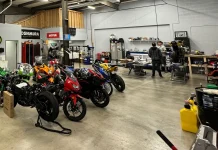
BRP Named U.S. Distributor For Champion

From a press release:

BRP NAMED U.S. IMPORTER OF CHAMPION EQUIPMENT

Champion Equipment, the leader in high quality Pit Equipment from the European market, is now available in the U.S. through BRP. Champion Equipment makes innovative and affordable bike stands, spools, stand accessories, pit boards, and work benches.

At the forefront of the Champion Equipment line-up is the Rear Clam Stand. This unique and versatile rear stand is collapsible for ease of storage/transportation. Its innovative design allow for an adjustable lift height and lockable fork spacing. The handle is conveniently placed to one side for clearance of the numberplate. Additional support is given when the handle is slid through. With a removable handle the stand does not protrude past the rear of the bike. Four sturdy wheels and its “TUNNEL” shaped footprint reduces rocking. Each Rear Clam Stand comes with a choice of forks or rubberized cups.

For additional information on Champion Pit Equipment or a dealer package call BRP toll free at 866.462.7770 or visit www.fastbikes.us.


Craggill Signs With Bruce Transportation Group

From a press release issued by E. Bruce Lyskawa Sr.:

Bruce Group Racing/Bruce Transportation Group team (the school bus guys), announced the signing of rider Marty Craggill of Werribee South, Victoria, Australia to contest the AMA 600cc Supersport and the Formula Xtreme Series for the 2003 season. Marty Craggill filled in during the 2002 season for the injured Josh Hayes and had stellar results with one win in the Formula Xtreme Series despite riding the U.S. tracks for the first time. He also won the 1997 and 1998 Australia Superbike Series as well as finished 5th in the 1998 Suzuka 8-hour race.

Bruce Group Racing/Bruce Transportation Group is a privateer team with some limited Honda support. In the initial three years of racing, Bruce Group Racing has achieved significant successes. The 2002 race year culiminated in a tie for the Formula Xtreme Championship and was only lost in the tie-breaker.

Team Owner, Bruce Lyskawa, said, “It is exciting to sign on a rider of Marty’s credentials. We have been very successful at putting cutting edge Honda equipment under brake-thru (sic) riders. Marty’s signing with his experience represents a step up in our program. We feel this partnership will result in our becoming a force in both the 600 and Formula Xtreme classes. This will also help us develop equipment for a possible entry into the Superbike series in 2004.”

Joey Osowski, BGR crew chief, Trevor Wyder, R&D consultant for Xtreme bikes, and Jamie Briun, 600 R&D consultant all participated in the rider analysis and final decision. Trevor said, “Marty is a dream rider to be working with. His maturity and experience will provide the feedback to allow Jamie and I to dial in our new Honda 600s and further develop the Honda 954s.” Joey Osowski commented, “We ended last season with the hottest 600 and 900 bikes on the grid. Although we were the underdogs with limited resources available, we believe we have now leveled the playing field with the factory teams in 2003.”

Bill St. John On What Went Wrong At Road Atlanta Sunday

From a press release issued by BCM – Project Monza:

BCM/Project Monza Ducati racer Bill St. John made an early exit from the last WERA Heavyweight Twins National of the season, crashing out of the lead in T-7. “We had put all the pieces together to give Batey a run yesterday. The Pirelli 16.5″ slicks and the step 2 BCM motor we got in on Friday were amazing. I came through seven and had an instantaneous snap highside. It felt like I hit oil. The first hint of everything not going to plan was when my head hit the track.”

St. John suffered a broken collarbone in the incident.

0FansLike
0FollowersFollow
0FollowersFollow
1,620SubscribersSubscribe

Latest Posts