Former racer Anthony “The Go Show” Gobert, age 48, is currently hospitalized with an undisclosed illness in Gold Coast, Queensland, Australia, and is receiving end-of-life care, according to his family.
The following was posted by Gobert’s middle brother, former racer Aaron Gobert, Wednesday on Facebook:
“It is with sadness that we have to announce that Anthony is currently hospitalized in palliative care and is in the final stages of his life following a short illness – please be aware that we will provide any available updates in due course. During this difficult time, the videos of Anthony being distributed during what has been an extremely troubled period of his life are deeply concerning, however, on behalf of Anthony, we must thank his many supporters from throughout his racing career.”
Anthony Gobert won Supercross and Superbike Championships in Australia, won seven World Superbike races, won 11 AMA Pro Superbike races, and took six top-10 race finishes in the 500cc GP World Championship. And he did so in flamboyant style that garnered him many fans worldwide.
Away from the track and TV cameras Gobert was kind, generous, and very funny.
Gobert last raced professionally in the Australian Superbike Championship in 2007.
One year later, Gobert was charged with two counts of “stealing” and served time in prison.
Throughout his life Gobert struggled with alcohol and drug abuse. In 1997, Gobert lost his ride with the Suzuki factory 500cc Grand Prix team after failing a drug test, and in more recent times, Gobert’s substance abuse led to legal problems and him becoming homeless.
We will post more information as it becomes available.
THE NEW GENERATION OF AUTONOMOUS ELECTRONIC AIRBAG SYSTEMS
CONSUMER ELECTRONICS SHOW, LAS VEGAS – Alpinestars has redefined protection for motorcyclists ever since the company was established in 1963, and today sees the brand launching Tech-Air® 7x, the all-new, autonomous motorcycling airbag system.
Tech-Air® 7x is the latest addition to the Alpinestars Tech-Air® family, which includes the Tech-Air® 10, Tech-Air® 5, Tech-Air® 3, and Tech-Air® OFF-ROAD systems. Alpinestars continues to lead the way in active air-bag technology for riders and their passengers. The all-new Tech-Air® 7x is a definitive demonstration of Alpinestars’ continued commitment to making the most versatile airbag technology products in the industry.
The Tech-Air®7x system was developed for Road Racing competitions, with full coverage protection focused on the upper body. (Full-Back, Full-Chest, Collar Bones, and Shoulders) The Tech-Air®7x system replaces the Tech-Air® RACE, with the latest innovations coming from the Alpinestars research and development team. This autonomous system complements the existing range Tech-Air® 10, Tech-Air® 5, and Tech-Air® 3 systems.
Like the Tech-Air® RACE, one of the key features of the Tech-Air® 7x is its integration (via attachment) to Alpinestars Tech-Air® compatible garments for increased practicality and comfort with select Alpinestars racing leather suits and jackets. Tech-Air® 7x is also compatible with garments as a stand-alone Tech-Air® vest (Similar to Tech-Air® 5) with a converter kit included in the package.
The Tech-Air® 7x supports dual deployments with the end user being able to replace the canisters for the first four deployments before sending it in for full service and airbag bladder replacement.
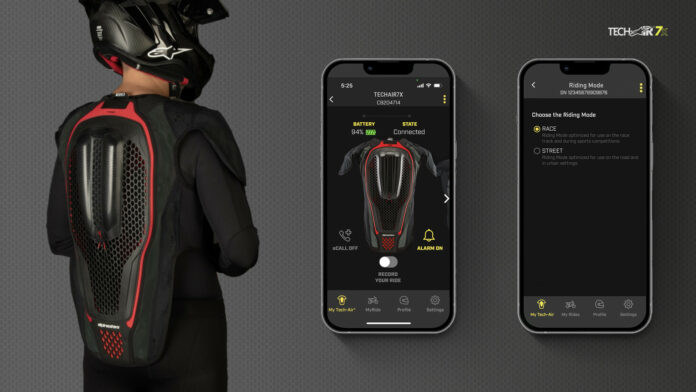
A convenience feature of Tech-Air® 7x is the USB-C charging port located in the activation flap on the chest. It’s easily accessible even when the system is integrated inside a suit or jacket.
Over 20 years ago, Alpinestars began development on the original Tech-Air® system. When launched in the market in 2011, the Tech-Air® system was recognized as the world’s first airbag providing full upper body protection with a completely independent electronic management system, in addition to having the versatility of the vest which could be easily zipped into a variety of Tech-Air® compatible jackets. In December 2019, Tech-Air® 5 was recognized by CES as one of the must-see innovative products in the Wearables Technology Marketplace.
ABOUT ALPINESTARS
Alpinestars was established in 1963 and is the world-leading manufacturer of professional racing products, motorcycling airbag protection, high-performance apparel, and technical footwear. Alpinestars understands that the best design and research are achieved under extreme conditions. The company’s involvement in Formula 1, NASCAR, AMA, World Motocross, and MotoGP has led to the creation of the most advanced technical equipment for the racing world’s top athletes. ALPINESTARS PROTECTS.
The celebrations begin as our 75th anniversary season gets ready to make more history
Wednesday, 10 January 2024
The chequered flag at the 2023 finale saw MotoGP™ complete 75 full seasons of competition since the world’s most exciting sport was born in 1949. To mark the occasion in Valencia, we revealed the logo for the 75th anniversary that will now take centre stage as we celebrate throughout the 2024 season – which is now just around the corner.
There will be more milestones along the way too, including the 75th anniversary of the very first race that counted towards the world championship classification – the 350cc race on the Isle of Man in 1949 – on the 13th of June. Then it’s the anniversary of the first premier class race, which was on the 17th of June 1949.
So as we get ready for the test ban to lift and engines to roar back into life for 2024, it’s time to start celebrating! Head to our all-new 75th anniversary page to check out some of the best content from then and now, with plenty more to be added throughout the season. First stop: some of the biggest stats from across 75 years of incredible racing, kicking off #MotoGP75 in style!
The Grands Prix
We celebrated GP1000 at Le Mans in 2023, so by the start of 2024, there have been 1015 Grands Prix staged since the start of the World Championship in 1949, comprising 3371 races for solo classes.
The Champions
126 riders have become World Champions – many more than once. The rider with most world titles is Giacomo Agostini with 15, followed by Angel Nieto (12 + 1), Mike Hailwood (9), Valentino Rossi (9) and Carlo Ubbiali (9). Another name could add theirs in 2024: Marc Marquez (Gresini Racing MotoGP™) has eight Championships on the way in…
The Winners
399 riders have won Grands Prix in solo classes – so reaching 400 in 2024 seems not only plausible or possible, but likely. The most recent maiden GP winner is Collin Veijer (Liqui Moly Husqvarna Intact GP) after his Moto3™ victory at Sepang.
The Manufacturers
Honda is the most successful manufacturer in Grand Prix racing (solo classes) with 821 wins followed by Yamaha (520), Aprilia (297), MV Agusta (275) and Kalex (176).
The Countries
30 nationalities have won solo Grand Prix races. Italy has the most wins, 888, followed by Spain on 722.
30 countries have staged Grands Prix too. The most recent country to debut on the calendar is India, with Buddh International Circuit welcoming MotoGP™ for the first time in 2023. 2024 sees Kazakhstan set to become country 31!
Throughout pre-season we’ll take a deeper dive into some of those numbers, so stay tuned for more as we look back on an incredible legacy and look forward to a record-breaking 2024 calendar just around the corner!
Editorial Note: The TS Ultra, Verge’s flagship electric motorcycle, is claimed to have a power output of 201 horsepower and 885 lbs.-ft. of torque, a range of up to 233 miles (373 km), and the ability to fast-charge in as little as 25 minutes.
Verge Motorcycles: “The Verge TS Ultra is the world’s first motorcycle with the sense of sight”
Verge Motorcycles has upgraded its flagship model with both hardware and software that make motorcycling safer than before. All Verge TS Ultra motorcycles now feature cameras and radars that use artificial intelligence and machine learning. New displays guarantee the rider a clear and informative overall view.
Electric superbike manufacturer Verge Motorcycles has announced that it has updated the hardware and software of its flagship TS Ultra model. The motorcycle now has six cameras and high-resolution front and rear radars. The upgraded Verge TS Ultra replaces the previous version, and customers who have already placed an order will automatically receive their bike with the new features.
The Verge TS Ultra is propelled by a rim-mounted motor powered by a 21.8 kWh lithium-ion battery pack. Photo courtesy Verge Motorcycles.
In November, the company unveiled its Starmatter software and intelligence platform with four different elements: automatic over-the-air updates (OTA), sensor technology, artificial intelligence and a Human-Machine-Interface (HMI). This package has now been completed with the advanced machine vision announced today, Starmatter Vision. With new functionalities, Verge is the first motorcycle manufacturer in the world to bring these advanced safety features to motorcycling. Besides the standard features, such as traction control and ABS brakes, Verge’s bikes have a low center of gravity, which enhances the control of the bike making the riding experience safer.
“Verge is making riding even smarter and safer, for example by improving the rider’s ability to observe the environment and the functions of the bike with the help of artificial intelligence and machine learning. The TS Ultra’s new cameras combined with the software update announced today make it the world’s first motorcycle equipped with the sense of sight, advising the rider and acting as a ‘whisperer’ while riding,” describes Verge CTO Marko Lehtimäki.
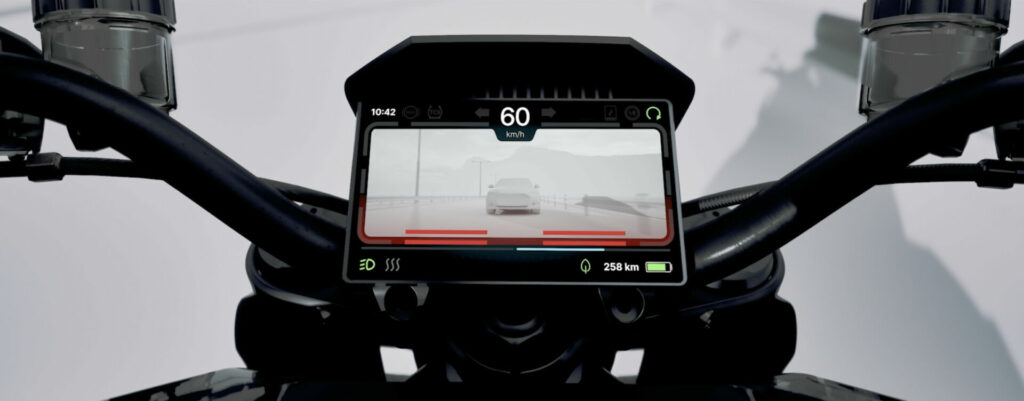
Starmatter Vision allows safety alerts to be displayed on the dashboard of the Verge TS Ultra. Photo courtesy Verge Motorcycles.
Autonomous driving has been a feature in the automotive industry for years already, but in motorcycling it is not a realistic or achievable goal in the same way. Riding a two-wheeler also comes with various restrictions and practical challenges that can cause safety risks. In addition, the helmet reduces visibility and dampens the sounds of the surrounding traffic. Verge believes that the solution can be found in technology and wants to promote not only riding comfort but also safety by utilizing new innovations. With the updated hardware and software, the bike analyses the environment and notifies the rider, for example, of a vehicle approaching from behind or if it changes lane.
Renewed display technology revolutionizes the way the rider interacts with the bike
The Verge TS Ultra now also features updated displays. The display on top of the tank is larger than before, which makes it easier to use. The new Starmatter Dash display and user interface that was unveiled today revolutionizes the way the rider interacts with the bike. The new dash makes managing essential functions easier and more intuitive, it informs and warns of potential hazards, and it displays the image from the rear view camera when the rider uses the turn signal, for example.
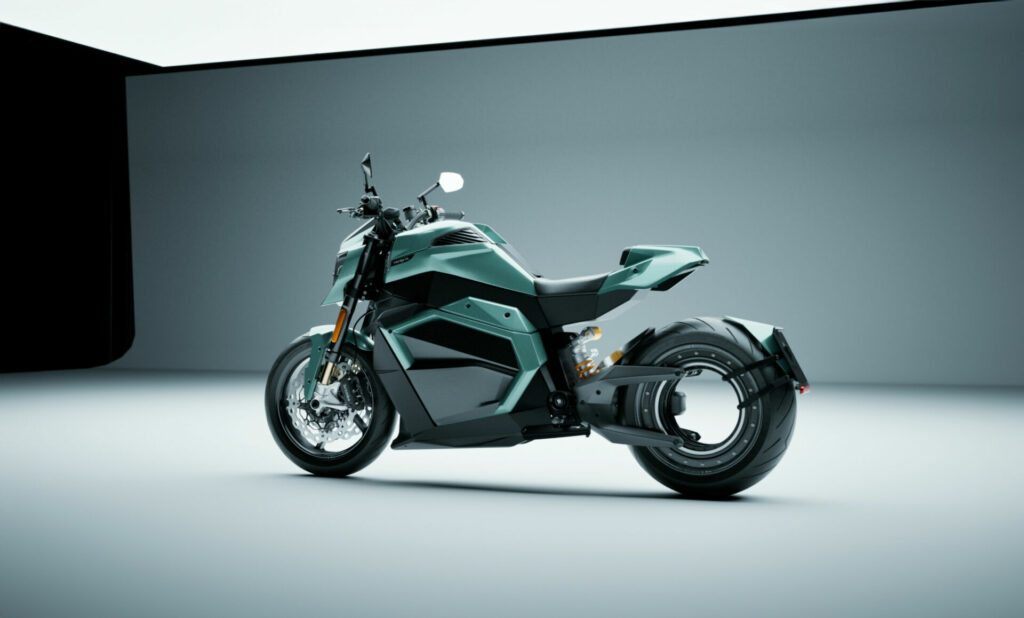
The Verge TS Ultra comes with a 245/45-ZR17 rear tire. Photo courtesy Verge Motorcycles.
“Verge is developing the world’s most advanced electric superbikes that focus on the riding experience. We do not want to compromise on that. Starmatter Dash provides a visual and intuitive interface, which gives the rider a clear real-time view of the bike’s features and status at a glance,” says Mark Laukkanen, VP of User Experience at Verge Motorcycles.
Renewed Verge TS Ultra and Starmatter Vision can be seen for the first time at CES [Consumer Electronics Show] in Las Vegas January 9–12, 2024.
AMA Motorcycle Hall of Famer Tom Heininger Passes Away at 97
Heininger co-founded Webco and served as president of the Motorcycle Industry Council
PICKERINGTON, Ohio — The American Motorcyclist Association sends its heartfelt condolences to the family and friends of motorcycle industry titan and AMA Motorcycle Hall of Famer Tom Heininger, who passed away Monday [January 8] at the age of 97.
As the co-founder of Webco, a popular motorcycle aftermarket and accessory company in the 1960s and 1970s, Heininger’s impact on the motorcycle industry was immense. Beyond his duties at Webco, Heininger served as president of the Motorcycle Industry Council in 1972 and played an influential role in the formation of the Motorcycle Safety Foundation during his tenure.
“Tom brought a tremendous amount of spirit, enthusiasm and value to the motorcycle industry as it was evolving in the 1960s and ’70s,” AMA Motorcycle Hall of Famer JR Kelley previously said of Heininger. “He added greatly to the business for the benefit of all. Tom loved motorcycling. He made money from it and put a lot of that back into the industry.”
Born in Los Angeles on Sept. 28, 1926, Heininger followed a similar path to his father, who worked in the auto parts business throughout his life. After serving aboard a submarine during World War II, Heininger entered the auto industry and worked for Offenhauser, a major automobile racing parts business at the time.
While at Offenhauser, Heininger met Bob Hughes and they became fast friends before forming Webco together in 1954. In the early days of the company, Webco primarily focused on manufacturing high-quality racing engine parts for motorcycles, but the brand later expanded to include all forms of aftermarket accessories and apparel.
A few years after its creation, Webco began sponsoring local racers from Southern California, which helped the brand grow to global markets. Heininger and Hughes also opened a pair of Honda dealerships in Los Angeles during the 1960s. During the decade, Heininger and Hughes also formed a nightly radio show during Daytona Bike Week with AMA announcer Roxy Rockwood.
Concurrently with his business pursuits in the 1960s, Heininger also worked to further the motorcycle industry by serving on the board of the Motorcycle, Scooter and Allied Trades Association (MS&ATA) during the decade — which the AMA formed out of in 1924. Heininger continued to offer his services after the MS&ATA merged with the California Motorcycle Safety Council to form the MIC in 1969, while the organization became an important entity in the federal fight for motorcycle rights.
As president of the MIC in 1972, Heininger used his connections with dealerships across the country to adequately defend their rights. Through these relationships, Heininger helped get the ball rolling on the MSF’s creation, and the organization grew to become a major force for rider education and training.
Heininger was inducted into the AMA Motorcycle Hall of Fame in 2003 and remained involved in motorcycling for the rest of his life.
About the American Motorcyclist Association
Founded in 1924, the AMA is a not-for-profit member-based association whose mission is to promote the motorcycle lifestyle and protect the future of motorcycling. As the world’s largest motorcycling rights and event sanctioning organization, the AMA advocates for riders’ interests at all levels of government and sanctions thousands of competition and recreational events every year. Besides offering members money-saving discounts on products and services, the AMA also publishes American Motorcyclist, a recently revitalized and monthly full-color magazine (and digital version of same) that covers current events and motorcycle history with brilliant photography and compelling writing. American Motorcyclist is also North America’s largest-circulation magazine. Through the AMA Motorcycle Hall of Fame in Pickerington, Ohio, the AMA honors the heroes and heritage of motorcycling. For more information, visit americanmotorcyclist.com.
GOMR Signs Rookie of the Year Declan Bender for Mission SuperTwins Duty
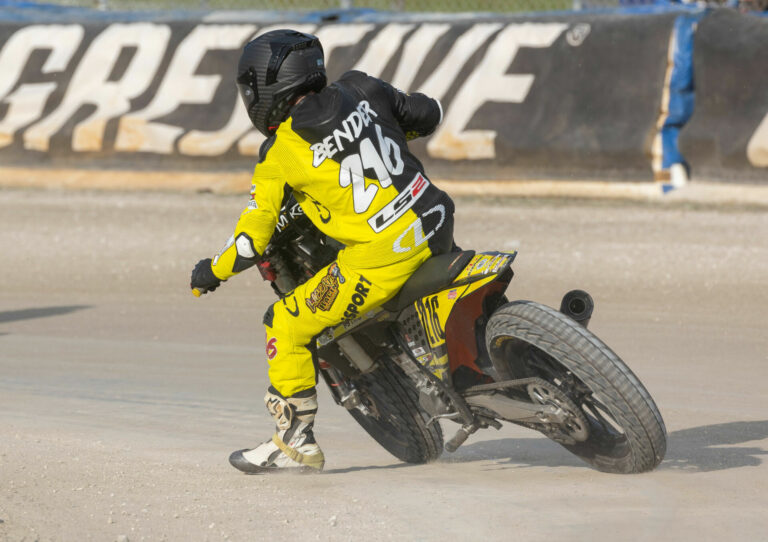
DAYTONA BEACH, Fla. (January 9, 2024) – GOMR (Grumpy Old Men Racing) is pleased to announce the signing of reigning Progressive American Flat Track Rookie of the Year Declan Bender to compete in the 2024 Mission SuperTwins championship aboard an Indian FTR750.
Bender turned pro in 2023 on the heels of a stellar amateur career that saw him earn 10 AMA Flat Track Grand Championships and more than 60 race victories among a host of other achievements. He then proved himself a frontrunner from the very start of his maiden Parts Unlimited AFT Singles presented by KICKER season, qualifying seventh at the ‘23 Daytona opener.
Bender continued to improve as he gained experience throughout the season. The Cooksville, Illinois, native ended the year in outstanding form, securing a sixth and two sevenths over the season’s final four Main Events, which propelled him to Rookie of the Year honors.
GOMR will once again enjoy significant support from BriggsAuto.com as the team’s biggest sponsor with additional backing from Martin Trucking and Precision Body Works. Johnny and Sarah Goad will continue to helm the GOMR operation with Johnny serving as Crew Chief and Sarah in the role of Team Manager. Tom Draina and Buddy Pulliam are back to assist in turning the wrenches, while Miriam Pulliam and Dick Tibbits will provide additional support.
Sarah Goad said, “Family has always been an important aspect of our racing program and that tradition continues with our children and grandchildren (Caylee, Raylynn, Raye and Clara) present to lend a hand or just root us on. I also think this makes Declan a great fit, as he and his father, Mike, have accomplished so much working as a rider/dad team throughout Declan’s career. Declan is an exciting young rider. He has a huge future in the sport, and we believe he’ll be a contender for Mission SuperTwins Rookie of the Year honors in 2024.
“I also want to thank Russ and Ilene Briggs of BriggsAuto.com, CD Martin of Martin Trucking, and Buddy and Miriam Pulliam of Precision Body Works. It’s only through their support that we are able to continue competing in this sport we love.”
Bender said, “I am beyond excited for the opportunity that Russ Briggs and the Goads have given me this year. Their deep roots and knowledge in the sport are all I could ask for and more. I am ready to give it everything I’ve got this season and look forward to building on the success that I ended with in ‘23.”
On the surface, it may seem that the new Precision Track Days organization is simply filling a gap in the market previously occupied by the now-closed Track Day Winner. In reality, however, Precision Track Days co-owners Fahad Khan and Rafael “Rafi” Pacheco say they have a fresh approach to track days in the eastern United States.
Pacheco, a racer, motorcycle service shop owner, and industry veteran for 10 years, was a major part of Track Day Winner track days. He helped run the events and provided trackside tire sales and service, among other things. So, Pacheco brought with him hands-on operational knowledge of the track day business.
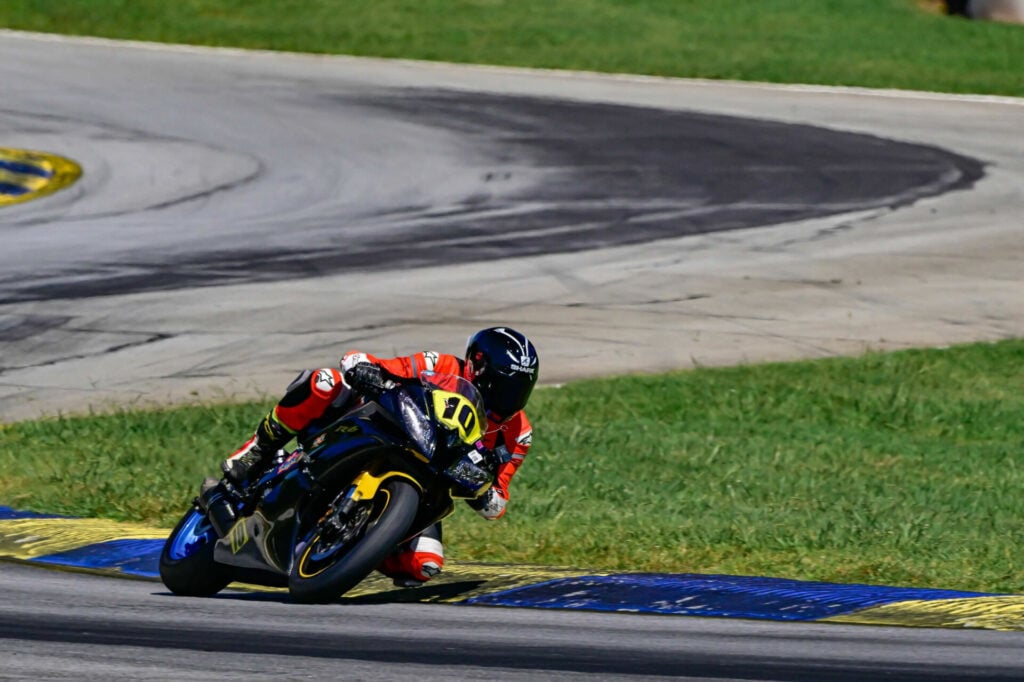
Precision Track Days co-owner Rafael “Rafi” Pacheco (10), as seen during the WERA Cycle Jam at Road Atlanta in 2023.
Khan, on the other hand, is an IT professional and entrepreneur who is new to motorcycling and track day riding. But with this background, Khan has been able to look at the track day business from a different view.
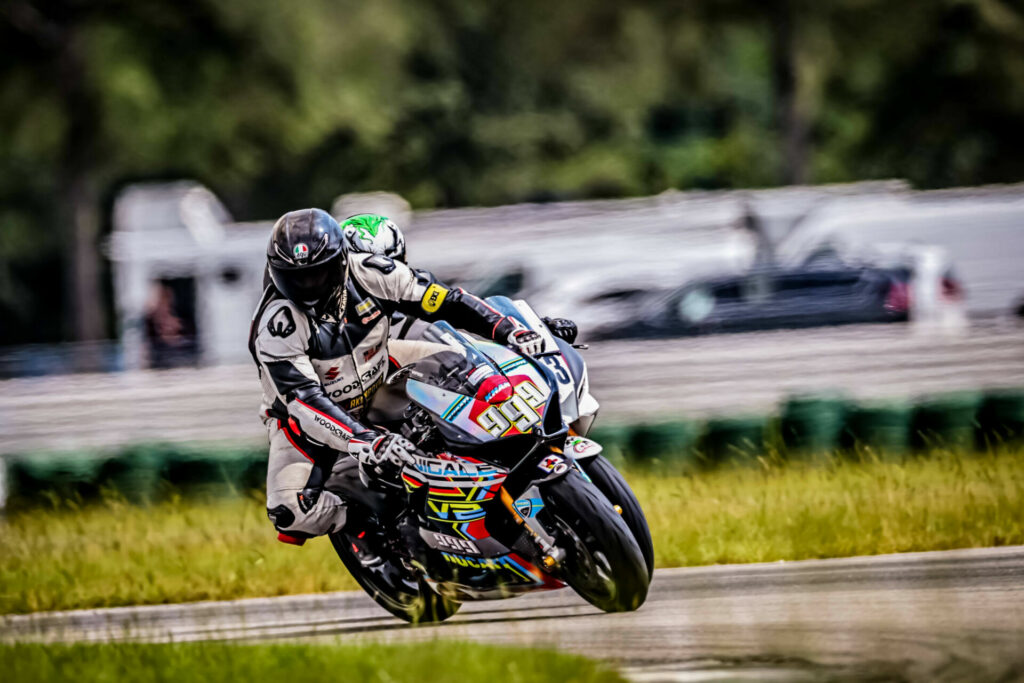
Precision Track Days co-owner Fahad Khan (999) couldn’t even ride a motorcycle until just a few years ago. The experience of being a track day “newbie” is fresh in his mind. Photo courtesy Precision Track Days.
“From my perspective, if you look at the rider lifecycle of a track day rider it’s three to four years before they jump into racing or before an unfortunate accident happens and they just completely abandon it,” said Khan. “So, the goal is we really want to focus and be very welcoming to the newcomers to the track, especially the Novice and the new Intermediates, and keep them coming back.
“Our goal is to keep the groups small. Keep them between 20-25 riders max. Make sure there is plenty of quality, open track time and people are more tightly grouped together [by skill level] in each of their riding groups. Our goal is to make sure people don’t give up and don’t drop out of the Novice and new Intermediate stages.”
Precision Track Days Lead Instructor Julian Lopez (standing) offers instruction to a group of first-time Novice riders. Photo courtesy Precision Track Days.
To accomplish this Precision Track Days has gone from the somewhat traditional structure of three rider groups – A/Novice, B/Intermediate, and C/Expert – getting one 20-minute session each hour to four rider groups – A/Novice, B-/Intermediate, B+/Intermediate, and C/Expert – each getting one 15-minute session each hour.
“I see a lot of people who come in, do two or three track days, they become faster, they immediately go into Intermediate, and then they are scared s–tless because they don’t know how to pass or they don’t know how to be passed,” said Khan. “One of the biggest goals with creating the second Intermediate group was to teach them how to pass, to teach them the etiquette that they need to grow more progressively.”
Instructor Jeremy Jarman (wearing a jersey, back to the camera) talks to new Intermediate riders before the start of their session to ensure they have a plan. Photo courtesy Precision Track Days.
Their focus on customer service goes beyond simply adding another group, though. Khan created a very professional website for Precision Track Days that provides new and experienced riders with a lot of information they need prior to their track day, from clear pricing (including early sign-up discounts and bundle deals) to refund policies to the benefits of becoming a member to other important things participants need to know. And not only can riders book and pay for their track day on the website, they can also sign their liability release waiver online, eliminating the long wait in line at the track entrance each morning.
While their arrive-and-ride rental programs are done in conjunction with outside vendors, Precision Track Days takes pride in doing everything else in-house.
“Not only do we focus on quality track time, we also focus on providing tire service and making parts and gear available,” said Pacheco. “When you have too many vendors you start losing consistency. Owning our tire service within the org we guarantee we will always have someone doing tire service for our events, and we don’t have to rely on third parties like most orgs do.”
The suspension service room at Pacheco’s Affordable Moto Service, in Dalton, Georgia. Photo courtesy Precision Track Days.
It may sound like Precision Track Days has been doing this for a long time, but the truth is the new organization just held its first event in December 2023 at Jennings GP. And by all accounts, the event went well.
“It went above expectations,” said Pacheco. “We know where we’re coming from. We are a new org in this small niche market with only so many riders and many good organizations out there. So, when a new group comes in the bar is pretty high. So, we busted our asses getting everything ready, making sure everything was up to date. We double, triple, quadruple-checked all the systems.
“The riders who were there told us it was a pretty quick process, that they enjoyed the emails with waivers, that they enjoyed how quickly we got them through tech, that they enjoyed the time they had on track, that they enjoyed having four groups, which was a small gamble for us because around this area it hasn’t been tried.”
Precision Track Days staff and instructors (standing from left) Julian Lopez, Robert Dooley, Seth Starnes, Jonathan Miglionco, Jeremy Jarman, Bryan Persall, Kris Steward, Michell Edwards, and Matt Cogdel (and crouching from left) Michael Henao (special guest instructor), George Balan, Rafael Pacheco, and Fahad Khan. Photo courtesy Precision Track Days.
Precision Track Days has 20 total track days scheduled at six different tracks in 2024 and hopes to add more dates as they become available through the year and into 2025. For more information, visit www.precisiontrackday.org.
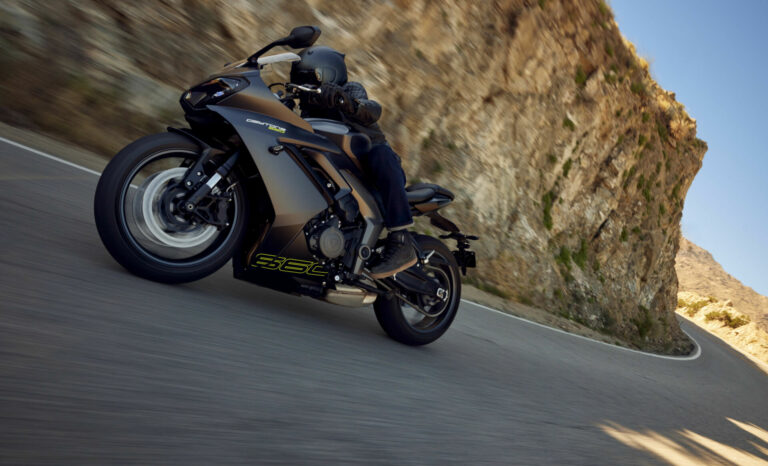
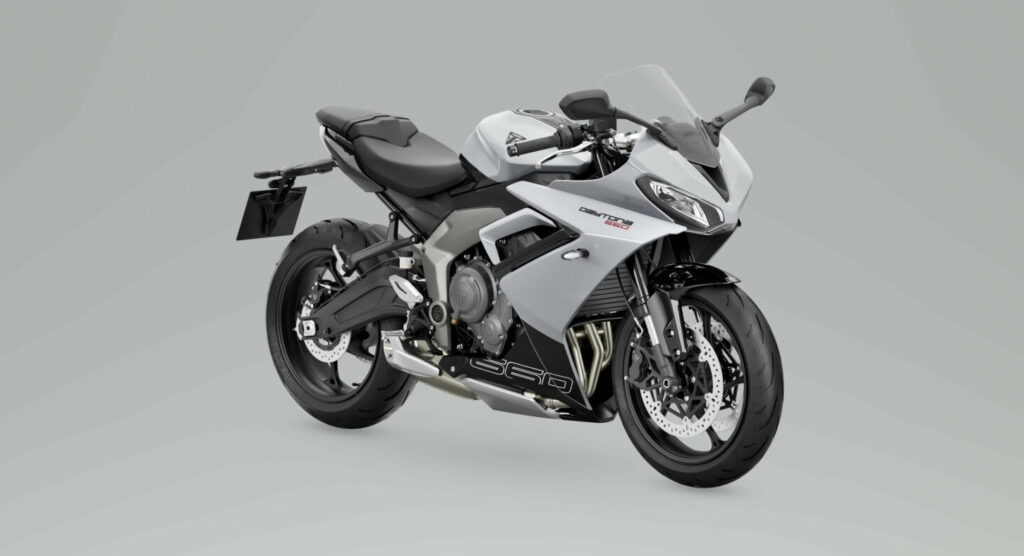
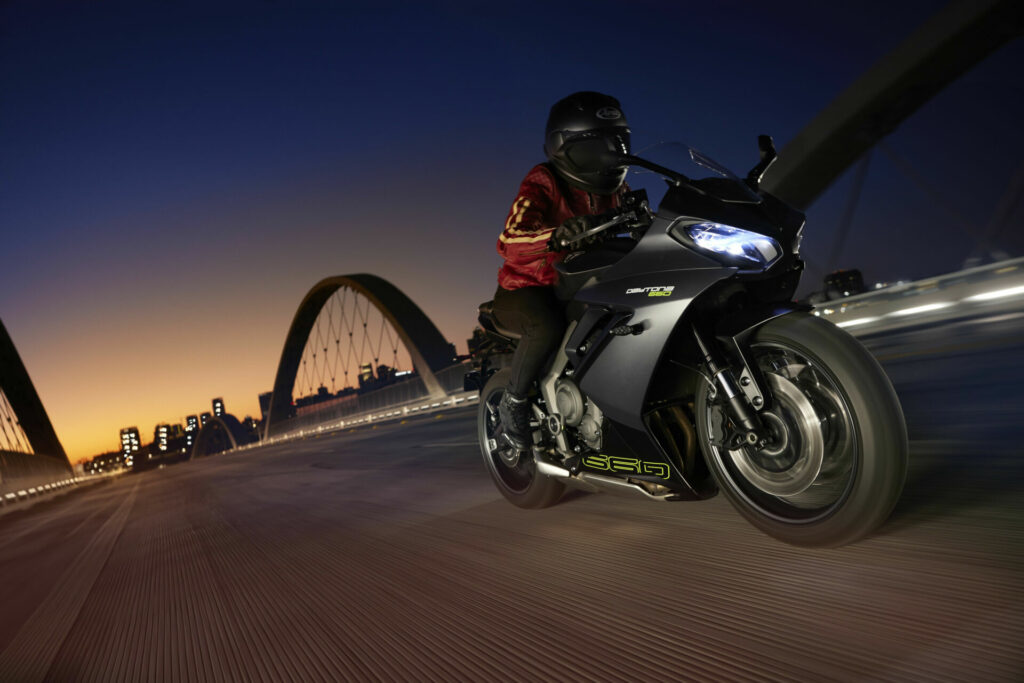
Triumph is re-entering the middleweight sportbike market with the introduction of its all-new 2024 Daytona 660.
At a glance, Triumph fans might think the Daytona 660 is simply a fully-faired version of the popular Trident 660 naked bike introduced in 2021, but they would be very wrong. While the new machine is based on the old machine, very few parts are shared by the two models, but the mission to provide performance and style with a low cost of ownership was retained.
For starters, the liquid-cooled, fuel-injected 660cc inline three-cylinder engine in the Daytona 660 is claimed to produce 94 horsepower at 11,250 rpm and 51 lbs.-ft. of torque at 8,250 rpm, which are about 17% and 9% more than a Trident 660, respectively. Even better, the Daytona 660 matches the power curve of the Trident 660 though the middle of its rev range before continuing to its peak outputs and then revving all the way out to 12,650 rpm. The Trident 660 only revs to 10,500 rpm.
Triumph accomplished this increase in performance by adding new throttle bodies, a new cylinder head with new intake ports, new camshafts with more lift and greater duration, new pistons with an anti-friction coating on the skirts, a new ram air intake and airbox, a new exhaust system, and a new crankshaft. And the internal gear ratios in the six-speed gearbox have been tightened up to take full advantage of all that new power.
“The 660 has all the attitude and agility you’d expect from the Daytona name, and brings with it the thrilling, useable, real-world performance, and all-day comfort that riders today are looking for,” said Triumph Chief Product Officer Steve Sargent. “We are excited by the impact the Daytona 660 is going to have on the growing middleweight sports world.”
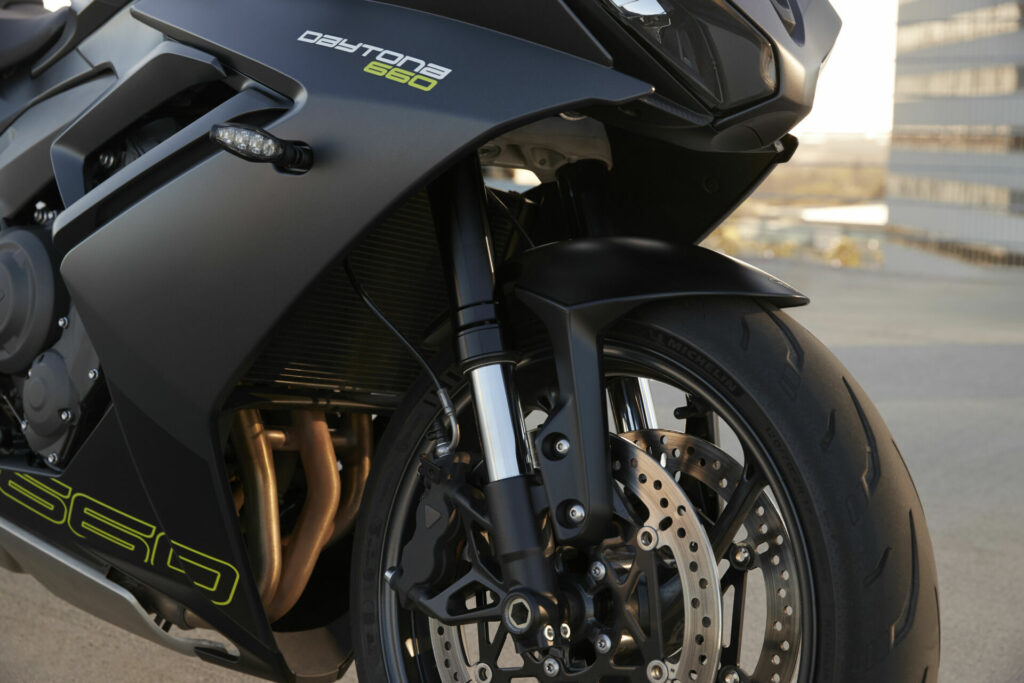
The Triumph Daytona 660 comes with non-adjustable Showa SFF-BP front forks and radial-mount four piston front brake calipers. Photo courtesy Triumph Motorcycles.
Electronic systems on the Daytona 660 include Ride-by-Wire (RbW) throttle control, three riding modes (Sport, Road, and Rain), Continental ABS (Anti-lock Braking System), adjustable (and defeatable) Traction Control that is integrated into the different riding modes, an Emergency Deceleration Warning system, and smart phone connectivity via the TFT (Thin-Film Transistor) color dashboard. An electronic quickshifter is available as an option.
While the double-sided steel swingarm is the same for both machines, the Daytona’s tubular steel main frame has been altered to accommodate the new airbox and wider throttle bodies. The new Supersport machine rolls on cast aluminum wheels measuring 17.0 x 3.50 inches front and 17.0 x 5.50 inches rear wearing Michelin Power 6 sport radials. The front braking system includes dual 310mm (12.2 inches) floating discs, radial-mount four-piston calipers, and braided brake lines.
Showa supplies the suspension components – non-adjustable 41mm inverted SFF-BP (Separate Function Fork – Big Piston) forks and a rear shock that is adjustable only for spring preload. Wheelbase is 56.1 inches (1,426mm), rake is 23.8°, trail is 3.24 inches (82.3mm), seat height is 31.9 inches (810mm), and claimed weight with the 3.7-gallon (14.0-liter) fuel tank at 90% capacity is 443 pounds (201 kg).
The 660cc inline three-cylinder engine of the Triumph Daytona 660 is claimed to produce 94 horsepower. Photo courtesy Triumph Motorcycles.
The all-new 2024 Triumph Daytona 660 will be supported by a two-year unlimited mileage factory warranty, over 30 genuine accessories, and an official race kit.
Manufacturer’s Suggested Retail Price (MSRP) is $9,195 in the United States and $11,295 in Canada. Units should be available at dealerships beginning in March.
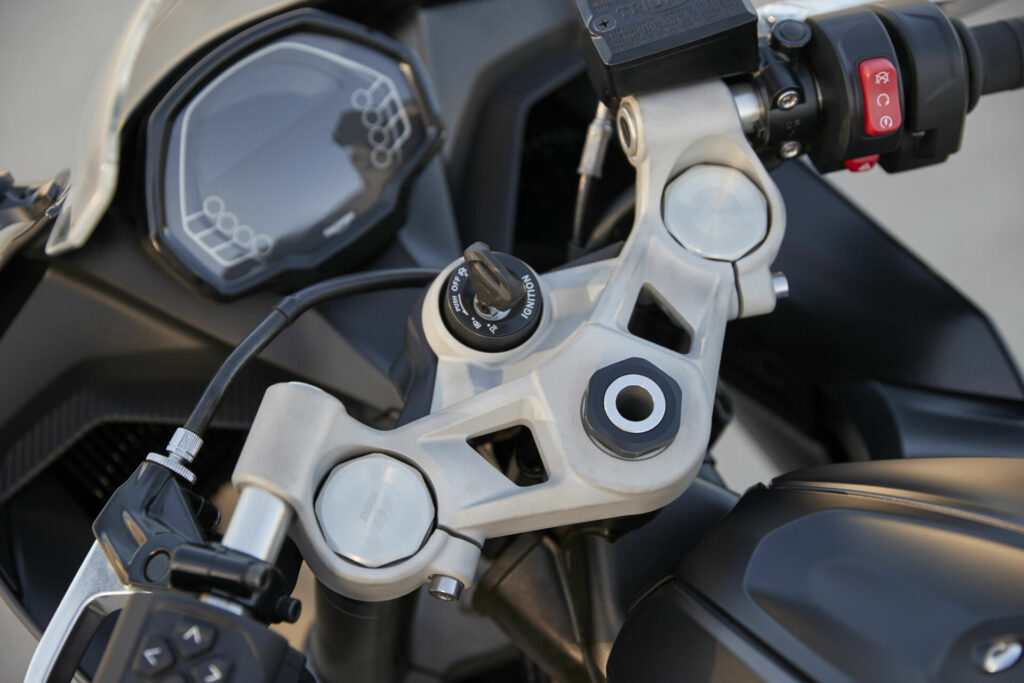
The cockpit of the 2024 Triumph Daytona 660. Photo courtesy Triumph Motorcycles.
ASRA is making changes to its endurance racing series for 2024.
Once called the AMA Sanctioned ASRA Team Challenge, the new series will now be known as the AMA Sanctioned ASRA National Endurance/Team Challenge Series in 2024.
Team Challenge is changing and will now be a relay-style race with multiple riders using separate motorcycles and swapping a single scoring transponder during a pit stop or stops.
The new National Endurance will use a tradition format with a single motorcycle and scoring transponder with rider swaps, refueling, and tire changes happening during a pit stop or stops.
Both Team Challenge and National Endurance will have GTO, GTU, and GT Lights (GTL) classes, which will be scored separately, but each class will be limited to four entries in the Team Challenge format.
All grid positions will be based on lap times recorded during timed qualifying and most races will run to a two-hour time limit, although two of the six scheduled events will be longer than two hours, according to ASRA.
All 2024 race license renewals and applications received prior to December 31, 2023, have been processed and mailed out, but due to an outbreak of flu among ASRA staff, renewals and applications received since January 1, 2024, are still being processed. As a result, the deadline to renew and keep an existing competition number has been extended to January 15. After January 15, all unclaimed race numbers will be available.
An ASRA Midwest Region “get-together” has been scheduled January 19 at Lake Lawn Resort, 2400 Geneva St., Delavan, WI 53115. RSVPs via the ASRA website are required.
Two BBQ/cookouts for the Atlantic/Mid-Atlantic region have been scheduled April 5-7 at Carolina Motorsports Park and April 27-28 at New Jersey Motorsports Park. For more information, go to www.asraracing.com.
“As you know, 2023 was the first year of the new ASRA,” ASRA’s Mark Lienhard wrote in an email. “While this was a massive undertaking both personally and financially, only with the help of several key people whom I greatly respect helping to rebuild and bring this back would this have been attempted.
“All that being said, 2024 is the year to come out and be even better. We have been working on streamlining processes, creating an easier user experience, upping the ante on the competition level, and creating a safer race day from qualifying grid times and positions for every race for both Amateurs and Experts, separating qualifying sessions for both Amateur and Expert, grid spacing, and starting lights. I want this to be an organization built for the racers by the racers. If you have an awesome idea, send it on.”
Roger Lyle’s Motorcycle Xcitement Track Days & Road Racing School has taken its final checkered flag!
All good things come to an end and after 40 years in the business of teaching thousands of riders and racers to have FUN on their motorcycles in a safe environment and family atmosphere, it’s time for Roger Lyle and Joan Erdesky to retire.
We thank all of our staff, coaches, the riders, racers, our partners, sponsors, the staff and track management at Summit Point Motorsports Park, West Virginia, and NCBIKE in Garysburg, North Carolina, who helped make this business so much FUN!
We had a Great Ride! Thanks for the memories!
Have FUN! Ride Smooth, Safe, Fast, and Happy Motoring!
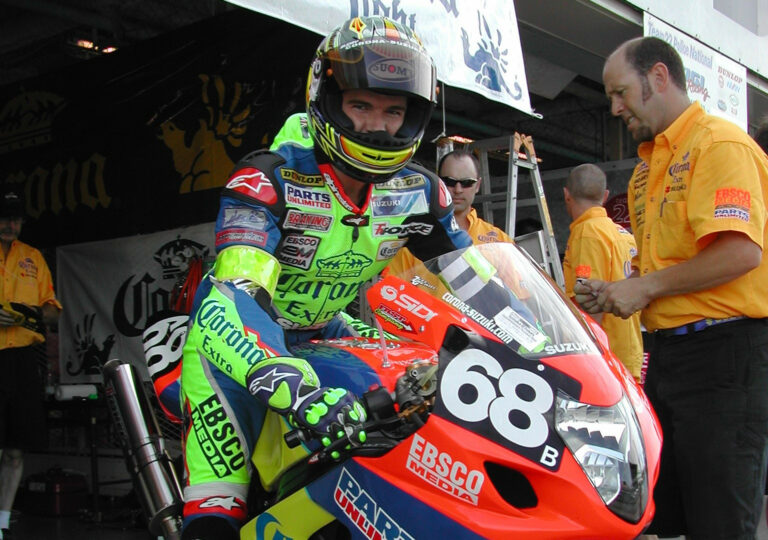
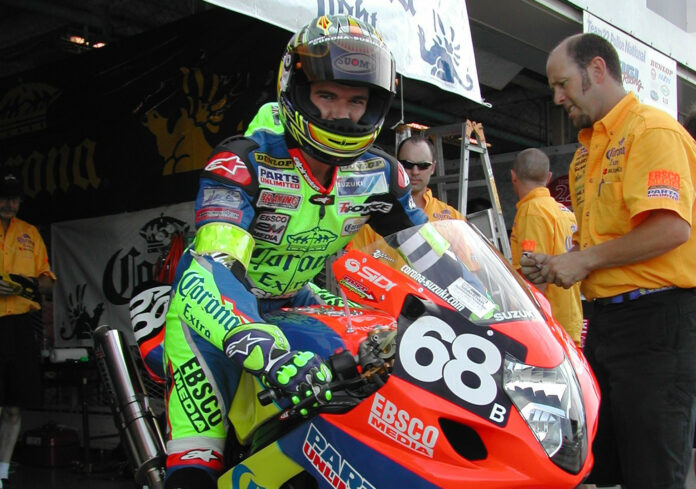
Anthony Gobert (68) preparing to go out on track at the 2003 Suzuka 8-Hours. He and teammate Adam "Krusty" Fergusson finished eighth overall on a Corona Extra - Ti Force Suzuki GSX-R10000. Photo by David Swarts.
Former racer Anthony “The Go Show” Gobert, age 48, is currently hospitalized with an undisclosed illness in Gold Coast, Queensland, Australia, and is receiving end-of-life care, according to his family.
The following was posted by Gobert’s middle brother, former racer Aaron Gobert, Wednesday on Facebook:
“It is with sadness that we have to announce that Anthony is currently hospitalized in palliative care and is in the final stages of his life following a short illness – please be aware that we will provide any available updates in due course. During this difficult time, the videos of Anthony being distributed during what has been an extremely troubled period of his life are deeply concerning, however, on behalf of Anthony, we must thank his many supporters from throughout his racing career.”
Anthony Gobert won Supercross and Superbike Championships in Australia, won seven World Superbike races, won 11 AMA Pro Superbike races, and took six top-10 race finishes in the 500cc GP World Championship. And he did so in flamboyant style that garnered him many fans worldwide.
Away from the track and TV cameras Gobert was kind, generous, and very funny.
Gobert last raced professionally in the Australian Superbike Championship in 2007.
One year later, Gobert was charged with two counts of “stealing” and served time in prison.
Throughout his life Gobert struggled with alcohol and drug abuse. In 1997, Gobert lost his ride with the Suzuki factory 500cc Grand Prix team after failing a drug test, and in more recent times, Gobert’s substance abuse led to legal problems and him becoming homeless.
We will post more information as it becomes available.
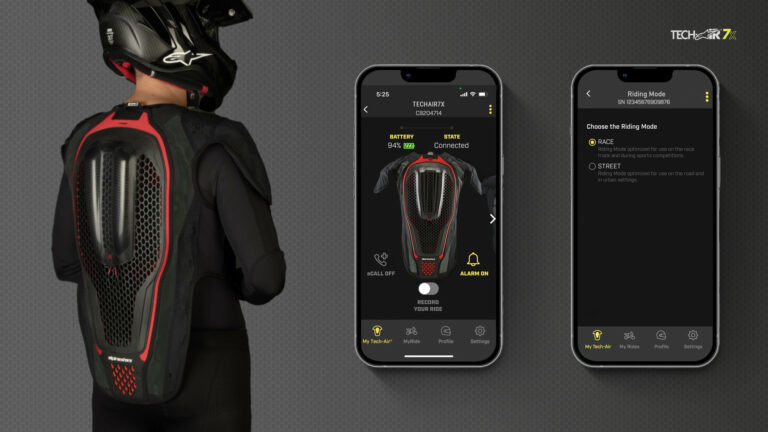
Alpinestars' autonomous Tech-Air 7x rider airbag protection system can be monitored and activated via Bluetooth using a Smartphone. Photo courtesy Alpinestars.
ALPINESTARS – TECHNICAL PREVIEW TECH-AIR® 7x
THE NEW GENERATION OF AUTONOMOUS ELECTRONIC AIRBAG SYSTEMS
CONSUMER ELECTRONICS SHOW, LAS VEGAS – Alpinestars has redefined protection for motorcyclists ever since the company was established in 1963, and today sees the brand launching Tech-Air® 7x, the all-new, autonomous motorcycling airbag system.
Tech-Air® 7x is the latest addition to the Alpinestars Tech-Air® family, which includes the Tech-Air® 10, Tech-Air® 5, Tech-Air® 3, and Tech-Air® OFF-ROAD systems. Alpinestars continues to lead the way in active air-bag technology for riders and their passengers. The all-new Tech-Air® 7x is a definitive demonstration of Alpinestars’ continued commitment to making the most versatile airbag technology products in the industry.
The Tech-Air®7x system was developed for Road Racing competitions, with full coverage protection focused on the upper body. (Full-Back, Full-Chest, Collar Bones, and Shoulders) The Tech-Air®7x system replaces the Tech-Air® RACE, with the latest innovations coming from the Alpinestars research and development team. This autonomous system complements the existing range Tech-Air® 10, Tech-Air® 5, and Tech-Air® 3 systems.
Like the Tech-Air® RACE, one of the key features of the Tech-Air® 7x is its integration (via attachment) to Alpinestars Tech-Air® compatible garments for increased practicality and comfort with select Alpinestars racing leather suits and jackets. Tech-Air® 7x is also compatible with garments as a stand-alone Tech-Air® vest (Similar to Tech-Air® 5) with a converter kit included in the package.
The Tech-Air® 7x supports dual deployments with the end user being able to replace the canisters for the first four deployments before sending it in for full service and airbag bladder replacement.
A convenience feature of Tech-Air® 7x is the USB-C charging port located in the activation flap on the chest. It’s easily accessible even when the system is integrated inside a suit or jacket.
Over 20 years ago, Alpinestars began development on the original Tech-Air® system. When launched in the market in 2011, the Tech-Air® system was recognized as the world’s first airbag providing full upper body protection with a completely independent electronic management system, in addition to having the versatility of the vest which could be easily zipped into a variety of Tech-Air® compatible jackets. In December 2019, Tech-Air® 5 was recognized by CES as one of the must-see innovative products in the Wearables Technology Marketplace.
ABOUT ALPINESTARS
Alpinestars was established in 1963 and is the world-leading manufacturer of professional racing products, motorcycling airbag protection, high-performance apparel, and technical footwear. Alpinestars understands that the best design and research are achieved under extreme conditions. The company’s involvement in Formula 1, NASCAR, AMA, World Motocross, and MotoGP has led to the creation of the most advanced technical equipment for the racing world’s top athletes. ALPINESTARS PROTECTS.
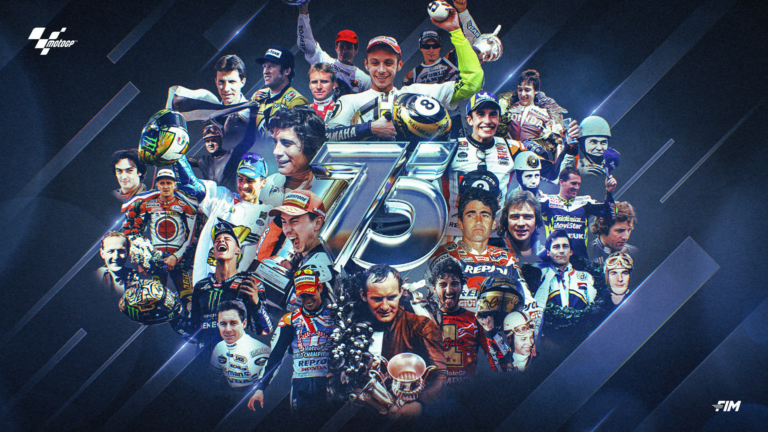
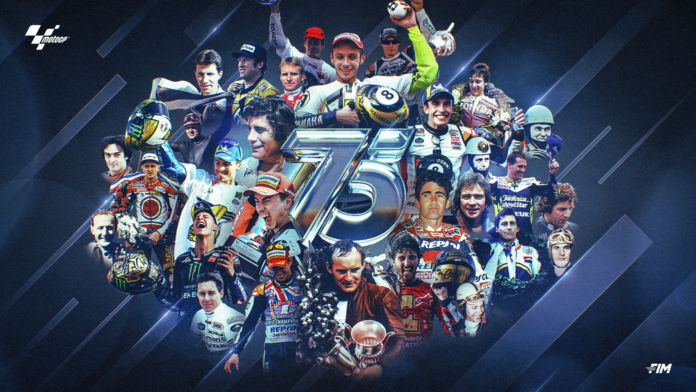
MotoGP will be celebrating its 75th anniversary and various milestones throughout 2024. Image courtesy Dorna.
75 years: MotoGP™ celebrates throughout 2024!
The celebrations begin as our 75th anniversary season gets ready to make more history
Wednesday, 10 January 2024
The chequered flag at the 2023 finale saw MotoGP™ complete 75 full seasons of competition since the world’s most exciting sport was born in 1949. To mark the occasion in Valencia, we revealed the logo for the 75th anniversary that will now take centre stage as we celebrate throughout the 2024 season – which is now just around the corner.
There will be more milestones along the way too, including the 75th anniversary of the very first race that counted towards the world championship classification – the 350cc race on the Isle of Man in 1949 – on the 13th of June. Then it’s the anniversary of the first premier class race, which was on the 17th of June 1949.
So as we get ready for the test ban to lift and engines to roar back into life for 2024, it’s time to start celebrating! Head to our all-new 75th anniversary page to check out some of the best content from then and now, with plenty more to be added throughout the season. First stop: some of the biggest stats from across 75 years of incredible racing, kicking off #MotoGP75 in style!
The Grands Prix
We celebrated GP1000 at Le Mans in 2023, so by the start of 2024, there have been 1015 Grands Prix staged since the start of the World Championship in 1949, comprising 3371 races for solo classes.
The Champions
126 riders have become World Champions – many more than once. The rider with most world titles is Giacomo Agostini with 15, followed by Angel Nieto (12 + 1), Mike Hailwood (9), Valentino Rossi (9) and Carlo Ubbiali (9). Another name could add theirs in 2024: Marc Marquez (Gresini Racing MotoGP™) has eight Championships on the way in…
The Winners
399 riders have won Grands Prix in solo classes – so reaching 400 in 2024 seems not only plausible or possible, but likely. The most recent maiden GP winner is Collin Veijer (Liqui Moly Husqvarna Intact GP) after his Moto3™ victory at Sepang.
The Manufacturers
Honda is the most successful manufacturer in Grand Prix racing (solo classes) with 821 wins followed by Yamaha (520), Aprilia (297), MV Agusta (275) and Kalex (176).
The Countries
30 nationalities have won solo Grand Prix races. Italy has the most wins, 888, followed by Spain on 722.
30 countries have staged Grands Prix too. The most recent country to debut on the calendar is India, with Buddh International Circuit welcoming MotoGP™ for the first time in 2023. 2024 sees Kazakhstan set to become country 31!
Throughout pre-season we’ll take a deeper dive into some of those numbers, so stay tuned for more as we look back on an incredible legacy and look forward to a record-breaking 2024 calendar just around the corner!
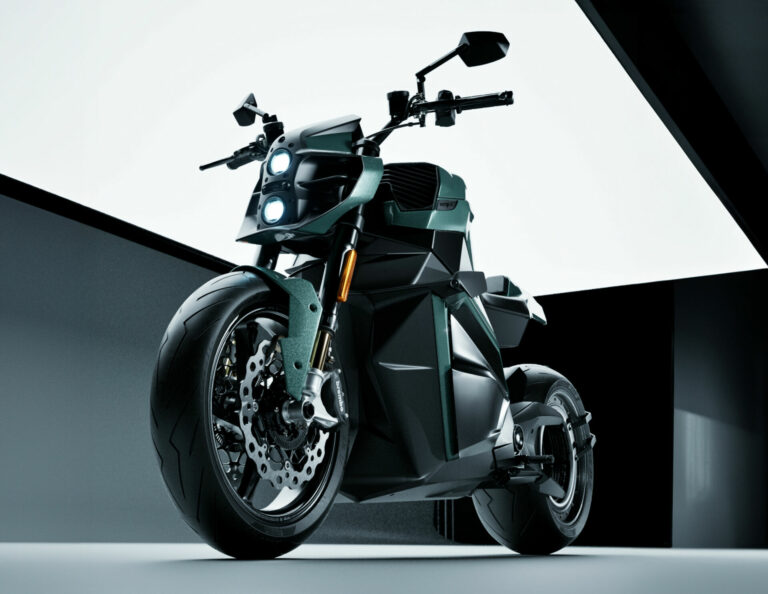
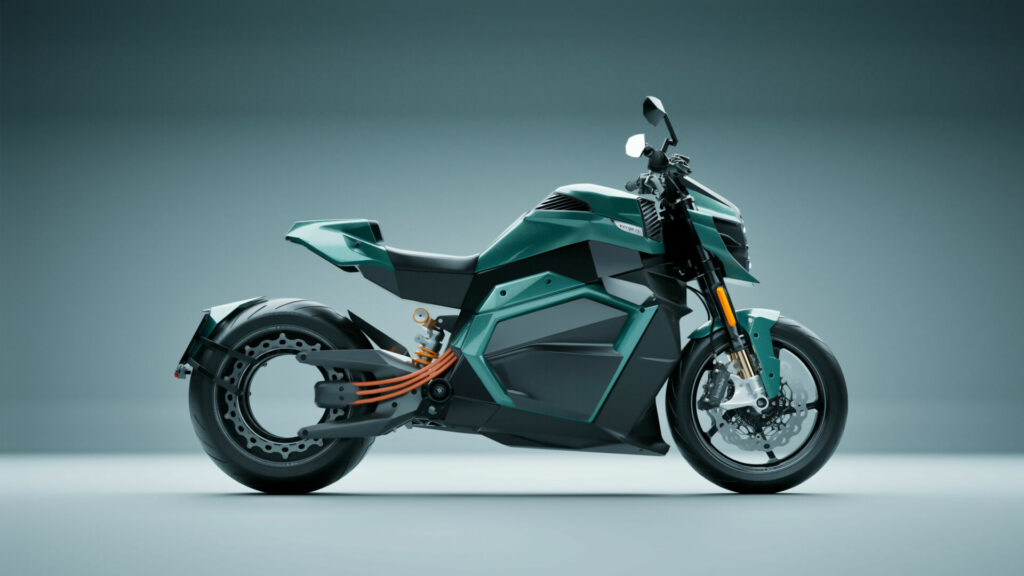
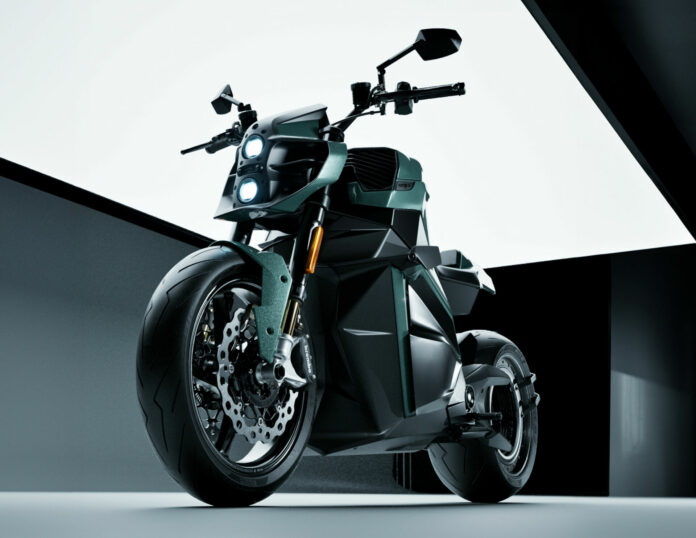
A Verge TS Ultra electric motorcycle. Photo courtesy Verge Motorcycles.
Editorial Note: The TS Ultra, Verge’s flagship electric motorcycle, is claimed to have a power output of 201 horsepower and 885 lbs.-ft. of torque, a range of up to 233 miles (373 km), and the ability to fast-charge in as little as 25 minutes.
Verge Motorcycles: “The Verge TS Ultra is the world’s first motorcycle with the sense of sight”
Verge Motorcycles has upgraded its flagship model with both hardware and software that make motorcycling safer than before. All Verge TS Ultra motorcycles now feature cameras and radars that use artificial intelligence and machine learning. New displays guarantee the rider a clear and informative overall view.
Electric superbike manufacturer Verge Motorcycles has announced that it has updated the hardware and software of its flagship TS Ultra model. The motorcycle now has six cameras and high-resolution front and rear radars. The upgraded Verge TS Ultra replaces the previous version, and customers who have already placed an order will automatically receive their bike with the new features.
The Verge TS Ultra is propelled by a rim-mounted motor powered by a 21.8 kWh lithium-ion battery pack. Photo courtesy Verge Motorcycles.
In November, the company unveiled its Starmatter software and intelligence platform with four different elements: automatic over-the-air updates (OTA), sensor technology, artificial intelligence and a Human-Machine-Interface (HMI). This package has now been completed with the advanced machine vision announced today, Starmatter Vision. With new functionalities, Verge is the first motorcycle manufacturer in the world to bring these advanced safety features to motorcycling. Besides the standard features, such as traction control and ABS brakes, Verge’s bikes have a low center of gravity, which enhances the control of the bike making the riding experience safer.
“Verge is making riding even smarter and safer, for example by improving the rider’s ability to observe the environment and the functions of the bike with the help of artificial intelligence and machine learning. The TS Ultra’s new cameras combined with the software update announced today make it the world’s first motorcycle equipped with the sense of sight, advising the rider and acting as a ‘whisperer’ while riding,” describes Verge CTO Marko Lehtimäki.
Starmatter Vision allows safety alerts to be displayed on the dashboard of the Verge TS Ultra. Photo courtesy Verge Motorcycles.
Autonomous driving has been a feature in the automotive industry for years already, but in motorcycling it is not a realistic or achievable goal in the same way. Riding a two-wheeler also comes with various restrictions and practical challenges that can cause safety risks. In addition, the helmet reduces visibility and dampens the sounds of the surrounding traffic. Verge believes that the solution can be found in technology and wants to promote not only riding comfort but also safety by utilizing new innovations. With the updated hardware and software, the bike analyses the environment and notifies the rider, for example, of a vehicle approaching from behind or if it changes lane.
Renewed display technology revolutionizes the way the rider interacts with the bike
The Verge TS Ultra now also features updated displays. The display on top of the tank is larger than before, which makes it easier to use. The new Starmatter Dash display and user interface that was unveiled today revolutionizes the way the rider interacts with the bike. The new dash makes managing essential functions easier and more intuitive, it informs and warns of potential hazards, and it displays the image from the rear view camera when the rider uses the turn signal, for example.
The Verge TS Ultra comes with a 245/45-ZR17 rear tire. Photo courtesy Verge Motorcycles.
“Verge is developing the world’s most advanced electric superbikes that focus on the riding experience. We do not want to compromise on that. Starmatter Dash provides a visual and intuitive interface, which gives the rider a clear real-time view of the bike’s features and status at a glance,” says Mark Laukkanen, VP of User Experience at Verge Motorcycles.
Renewed Verge TS Ultra and Starmatter Vision can be seen for the first time at CES [Consumer Electronics Show] in Las Vegas January 9–12, 2024.
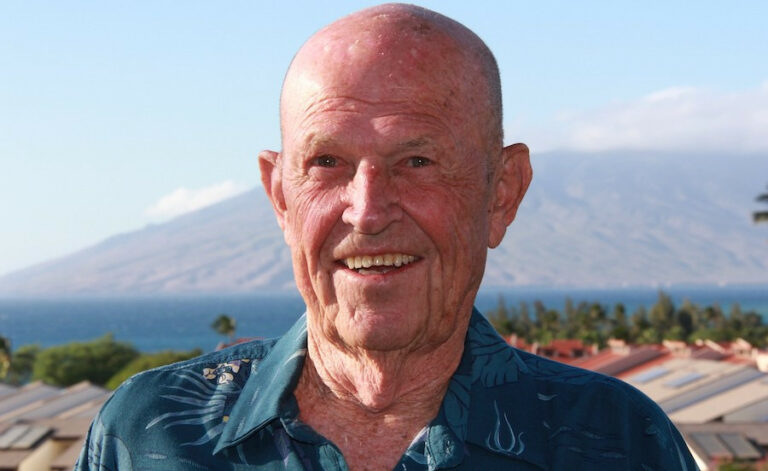
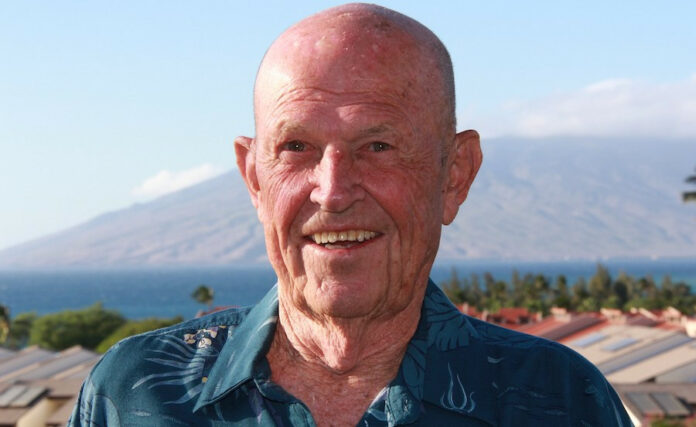
Tom Heininger, R.I.P. Photo courtesy Don Emde Collection.
AMA Motorcycle Hall of Famer Tom Heininger Passes Away at 97
Heininger co-founded Webco and served as president of the Motorcycle Industry Council
PICKERINGTON, Ohio — The American Motorcyclist Association sends its heartfelt condolences to the family and friends of motorcycle industry titan and AMA Motorcycle Hall of Famer Tom Heininger, who passed away Monday [January 8] at the age of 97.
As the co-founder of Webco, a popular motorcycle aftermarket and accessory company in the 1960s and 1970s, Heininger’s impact on the motorcycle industry was immense. Beyond his duties at Webco, Heininger served as president of the Motorcycle Industry Council in 1972 and played an influential role in the formation of the Motorcycle Safety Foundation during his tenure.
“Tom brought a tremendous amount of spirit, enthusiasm and value to the motorcycle industry as it was evolving in the 1960s and ’70s,” AMA Motorcycle Hall of Famer JR Kelley previously said of Heininger. “He added greatly to the business for the benefit of all. Tom loved motorcycling. He made money from it and put a lot of that back into the industry.”
Born in Los Angeles on Sept. 28, 1926, Heininger followed a similar path to his father, who worked in the auto parts business throughout his life. After serving aboard a submarine during World War II, Heininger entered the auto industry and worked for Offenhauser, a major automobile racing parts business at the time.
While at Offenhauser, Heininger met Bob Hughes and they became fast friends before forming Webco together in 1954. In the early days of the company, Webco primarily focused on manufacturing high-quality racing engine parts for motorcycles, but the brand later expanded to include all forms of aftermarket accessories and apparel.
A few years after its creation, Webco began sponsoring local racers from Southern California, which helped the brand grow to global markets. Heininger and Hughes also opened a pair of Honda dealerships in Los Angeles during the 1960s. During the decade, Heininger and Hughes also formed a nightly radio show during Daytona Bike Week with AMA announcer Roxy Rockwood.
Concurrently with his business pursuits in the 1960s, Heininger also worked to further the motorcycle industry by serving on the board of the Motorcycle, Scooter and Allied Trades Association (MS&ATA) during the decade — which the AMA formed out of in 1924. Heininger continued to offer his services after the MS&ATA merged with the California Motorcycle Safety Council to form the MIC in 1969, while the organization became an important entity in the federal fight for motorcycle rights.
As president of the MIC in 1972, Heininger used his connections with dealerships across the country to adequately defend their rights. Through these relationships, Heininger helped get the ball rolling on the MSF’s creation, and the organization grew to become a major force for rider education and training.
Heininger was inducted into the AMA Motorcycle Hall of Fame in 2003 and remained involved in motorcycling for the rest of his life.
About the American Motorcyclist Association
Founded in 1924, the AMA is a not-for-profit member-based association whose mission is to promote the motorcycle lifestyle and protect the future of motorcycling. As the world’s largest motorcycling rights and event sanctioning organization, the AMA advocates for riders’ interests at all levels of government and sanctions thousands of competition and recreational events every year. Besides offering members money-saving discounts on products and services, the AMA also publishes American Motorcyclist, a recently revitalized and monthly full-color magazine (and digital version of same) that covers current events and motorcycle history with brilliant photography and compelling writing. American Motorcyclist is also North America’s largest-circulation magazine. Through the AMA Motorcycle Hall of Fame in Pickerington, Ohio, the AMA honors the heroes and heritage of motorcycling. For more information, visit americanmotorcyclist.com.
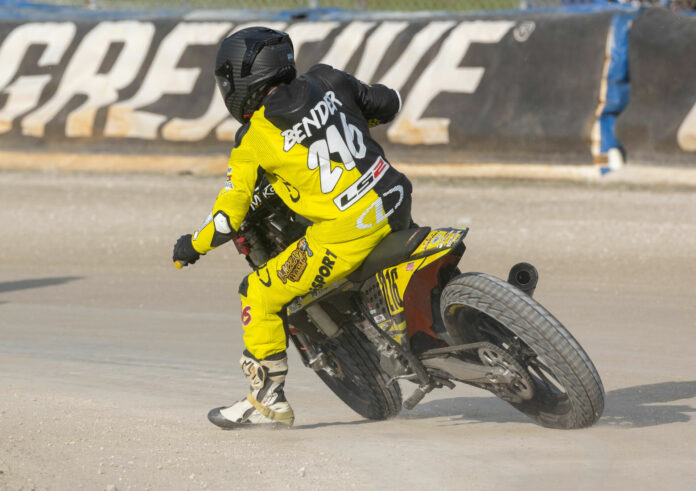
Declan Bender (216). Photo by Tim Lester, courtesy AFT.
GOMR Signs Rookie of the Year Declan Bender for Mission SuperTwins Duty
DAYTONA BEACH, Fla. (January 9, 2024) – GOMR (Grumpy Old Men Racing) is pleased to announce the signing of reigning Progressive American Flat Track Rookie of the Year Declan Bender to compete in the 2024 Mission SuperTwins championship aboard an Indian FTR750.
Bender turned pro in 2023 on the heels of a stellar amateur career that saw him earn 10 AMA Flat Track Grand Championships and more than 60 race victories among a host of other achievements. He then proved himself a frontrunner from the very start of his maiden Parts Unlimited AFT Singles presented by KICKER season, qualifying seventh at the ‘23 Daytona opener.
Bender continued to improve as he gained experience throughout the season. The Cooksville, Illinois, native ended the year in outstanding form, securing a sixth and two sevenths over the season’s final four Main Events, which propelled him to Rookie of the Year honors.
GOMR will once again enjoy significant support from BriggsAuto.com as the team’s biggest sponsor with additional backing from Martin Trucking and Precision Body Works. Johnny and Sarah Goad will continue to helm the GOMR operation with Johnny serving as Crew Chief and Sarah in the role of Team Manager. Tom Draina and Buddy Pulliam are back to assist in turning the wrenches, while Miriam Pulliam and Dick Tibbits will provide additional support.
Sarah Goad said, “Family has always been an important aspect of our racing program and that tradition continues with our children and grandchildren (Caylee, Raylynn, Raye and Clara) present to lend a hand or just root us on. I also think this makes Declan a great fit, as he and his father, Mike, have accomplished so much working as a rider/dad team throughout Declan’s career. Declan is an exciting young rider. He has a huge future in the sport, and we believe he’ll be a contender for Mission SuperTwins Rookie of the Year honors in 2024.
“I also want to thank Russ and Ilene Briggs of BriggsAuto.com, CD Martin of Martin Trucking, and Buddy and Miriam Pulliam of Precision Body Works. It’s only through their support that we are able to continue competing in this sport we love.”
Bender said, “I am beyond excited for the opportunity that Russ Briggs and the Goads have given me this year. Their deep roots and knowledge in the sport are all I could ask for and more. I am ready to give it everything I’ve got this season and look forward to building on the success that I ended with in ‘23.”
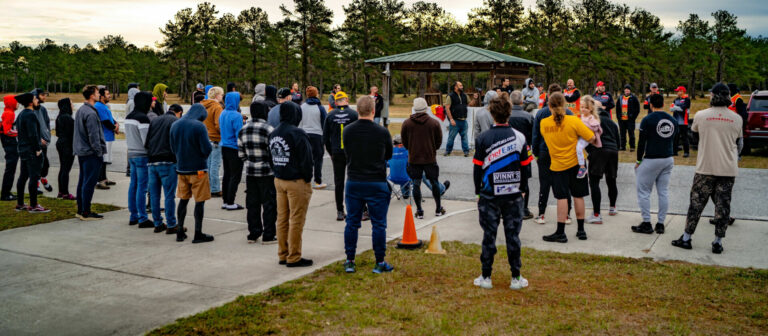
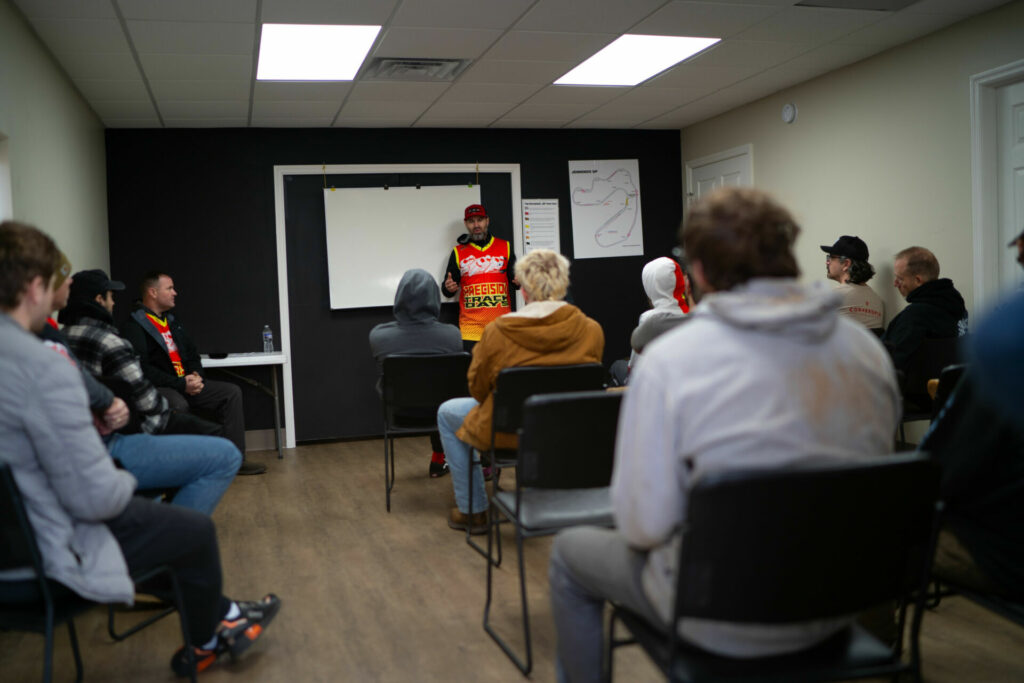
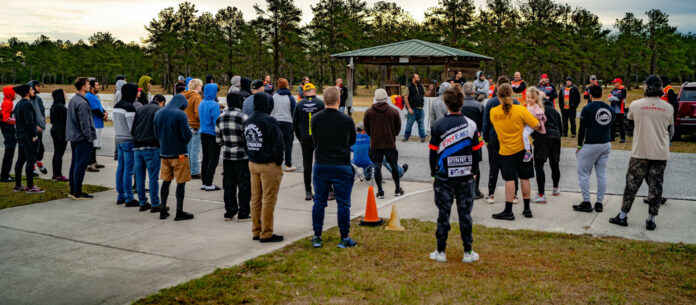
The rider's meeting at Precision Track Days' first-ever event, at Jennings GP in December 2023. Co-owner Fahad Khan (wearing a black vest and blue pants near the starter's shelter) is addressing the group. Photo courtesy Precision Track Days.
By David Swarts
On the surface, it may seem that the new Precision Track Days organization is simply filling a gap in the market previously occupied by the now-closed Track Day Winner. In reality, however, Precision Track Days co-owners Fahad Khan and Rafael “Rafi” Pacheco say they have a fresh approach to track days in the eastern United States.
Pacheco, a racer, motorcycle service shop owner, and industry veteran for 10 years, was a major part of Track Day Winner track days. He helped run the events and provided trackside tire sales and service, among other things. So, Pacheco brought with him hands-on operational knowledge of the track day business.
Precision Track Days co-owner Rafael “Rafi” Pacheco (10), as seen during the WERA Cycle Jam at Road Atlanta in 2023.
Khan, on the other hand, is an IT professional and entrepreneur who is new to motorcycling and track day riding. But with this background, Khan has been able to look at the track day business from a different view.
Precision Track Days co-owner Fahad Khan (999) couldn’t even ride a motorcycle until just a few years ago. The experience of being a track day “newbie” is fresh in his mind. Photo courtesy Precision Track Days.
“From my perspective, if you look at the rider lifecycle of a track day rider it’s three to four years before they jump into racing or before an unfortunate accident happens and they just completely abandon it,” said Khan. “So, the goal is we really want to focus and be very welcoming to the newcomers to the track, especially the Novice and the new Intermediates, and keep them coming back.
“Our goal is to keep the groups small. Keep them between 20-25 riders max. Make sure there is plenty of quality, open track time and people are more tightly grouped together [by skill level] in each of their riding groups. Our goal is to make sure people don’t give up and don’t drop out of the Novice and new Intermediate stages.”
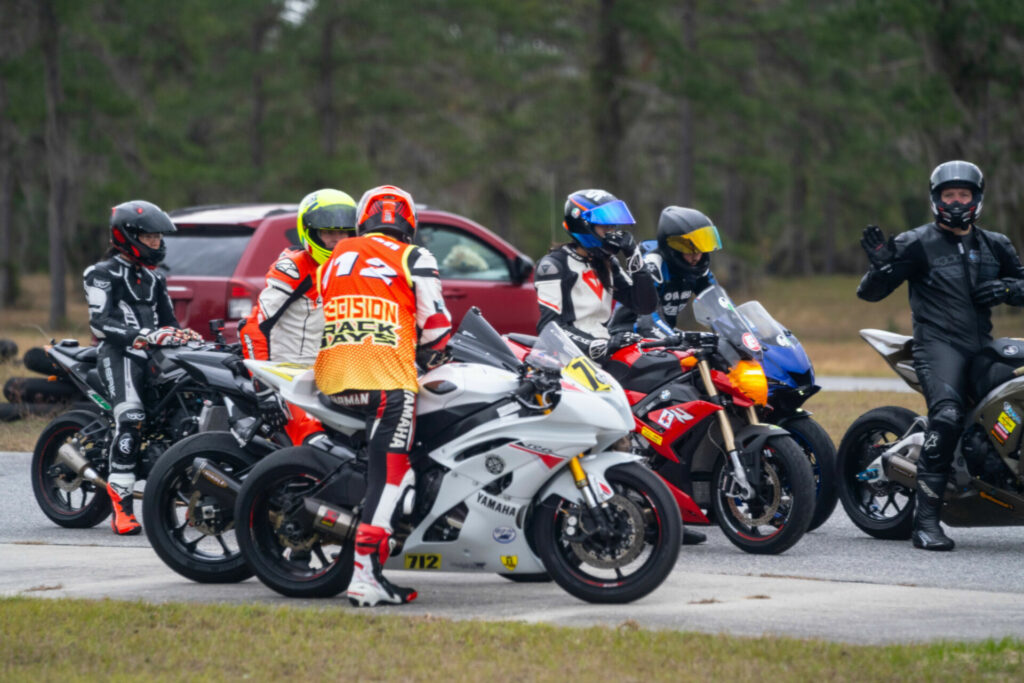
Precision Track Days Lead Instructor Julian Lopez (standing) offers instruction to a group of first-time Novice riders. Photo courtesy Precision Track Days.
To accomplish this Precision Track Days has gone from the somewhat traditional structure of three rider groups – A/Novice, B/Intermediate, and C/Expert – getting one 20-minute session each hour to four rider groups – A/Novice, B-/Intermediate, B+/Intermediate, and C/Expert – each getting one 15-minute session each hour.
“I see a lot of people who come in, do two or three track days, they become faster, they immediately go into Intermediate, and then they are scared s–tless because they don’t know how to pass or they don’t know how to be passed,” said Khan. “One of the biggest goals with creating the second Intermediate group was to teach them how to pass, to teach them the etiquette that they need to grow more progressively.”
Instructor Jeremy Jarman (wearing a jersey, back to the camera) talks to new Intermediate riders before the start of their session to ensure they have a plan. Photo courtesy Precision Track Days.
Their focus on customer service goes beyond simply adding another group, though. Khan created a very professional website for Precision Track Days that provides new and experienced riders with a lot of information they need prior to their track day, from clear pricing (including early sign-up discounts and bundle deals) to refund policies to the benefits of becoming a member to other important things participants need to know. And not only can riders book and pay for their track day on the website, they can also sign their liability release waiver online, eliminating the long wait in line at the track entrance each morning.
While their arrive-and-ride rental programs are done in conjunction with outside vendors, Precision Track Days takes pride in doing everything else in-house.
“Not only do we focus on quality track time, we also focus on providing tire service and making parts and gear available,” said Pacheco. “When you have too many vendors you start losing consistency. Owning our tire service within the org we guarantee we will always have someone doing tire service for our events, and we don’t have to rely on third parties like most orgs do.”
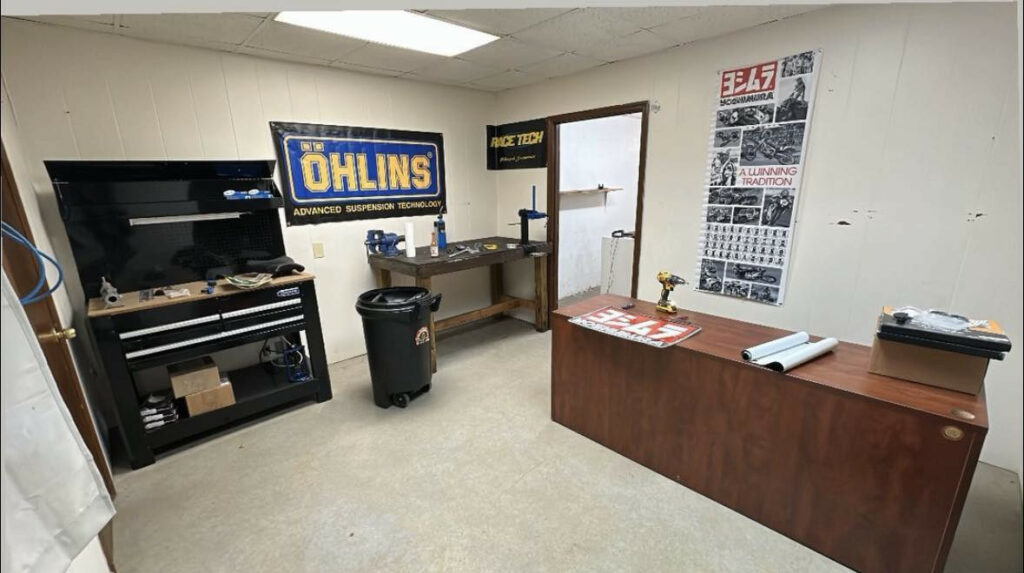
The suspension service room at Pacheco’s Affordable Moto Service, in Dalton, Georgia. Photo courtesy Precision Track Days.
It may sound like Precision Track Days has been doing this for a long time, but the truth is the new organization just held its first event in December 2023 at Jennings GP. And by all accounts, the event went well.
“It went above expectations,” said Pacheco. “We know where we’re coming from. We are a new org in this small niche market with only so many riders and many good organizations out there. So, when a new group comes in the bar is pretty high. So, we busted our asses getting everything ready, making sure everything was up to date. We double, triple, quadruple-checked all the systems.
“The riders who were there told us it was a pretty quick process, that they enjoyed the emails with waivers, that they enjoyed how quickly we got them through tech, that they enjoyed the time they had on track, that they enjoyed having four groups, which was a small gamble for us because around this area it hasn’t been tried.”
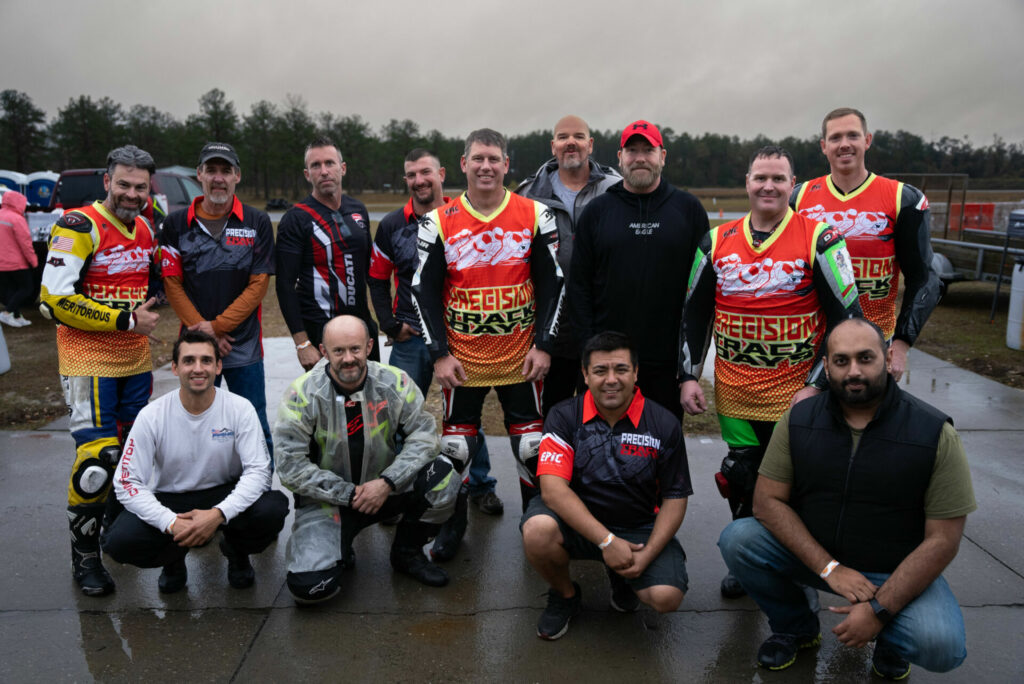
Precision Track Days staff and instructors (standing from left) Julian Lopez, Robert Dooley, Seth Starnes, Jonathan Miglionco, Jeremy Jarman, Bryan Persall, Kris Steward, Michell Edwards, and Matt Cogdel (and crouching from left) Michael Henao (special guest instructor), George Balan, Rafael Pacheco, and Fahad Khan. Photo courtesy Precision Track Days.
Precision Track Days has 20 total track days scheduled at six different tracks in 2024 and hopes to add more dates as they become available through the year and into 2025. For more information, visit www.precisiontrackday.org.
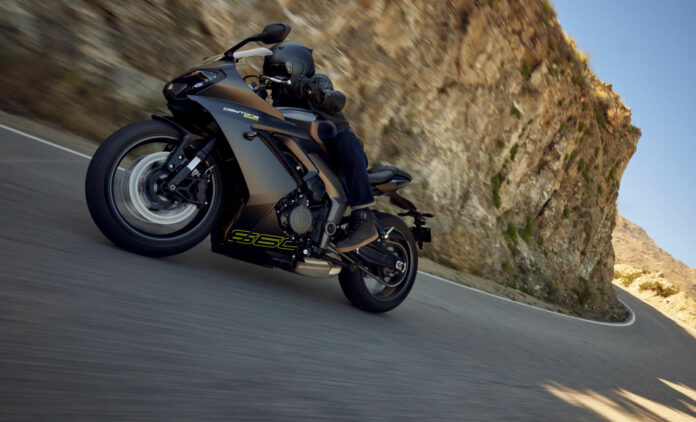
Triumph is back in the fully-faired sportbike market with its all-new 2024 Daytona 660. Photo courtesy Triumph Motorcycles.
By David Swarts
Triumph is re-entering the middleweight sportbike market with the introduction of its all-new 2024 Daytona 660.
At a glance, Triumph fans might think the Daytona 660 is simply a fully-faired version of the popular Trident 660 naked bike introduced in 2021, but they would be very wrong. While the new machine is based on the old machine, very few parts are shared by the two models, but the mission to provide performance and style with a low cost of ownership was retained.
For starters, the liquid-cooled, fuel-injected 660cc inline three-cylinder engine in the Daytona 660 is claimed to produce 94 horsepower at 11,250 rpm and 51 lbs.-ft. of torque at 8,250 rpm, which are about 17% and 9% more than a Trident 660, respectively. Even better, the Daytona 660 matches the power curve of the Trident 660 though the middle of its rev range before continuing to its peak outputs and then revving all the way out to 12,650 rpm. The Trident 660 only revs to 10,500 rpm.
Triumph accomplished this increase in performance by adding new throttle bodies, a new cylinder head with new intake ports, new camshafts with more lift and greater duration, new pistons with an anti-friction coating on the skirts, a new ram air intake and airbox, a new exhaust system, and a new crankshaft. And the internal gear ratios in the six-speed gearbox have been tightened up to take full advantage of all that new power.
“The 660 has all the attitude and agility you’d expect from the Daytona name, and brings with it the thrilling, useable, real-world performance, and all-day comfort that riders today are looking for,” said Triumph Chief Product Officer Steve Sargent. “We are excited by the impact the Daytona 660 is going to have on the growing middleweight sports world.”
The Triumph Daytona 660 comes with non-adjustable Showa SFF-BP front forks and radial-mount four piston front brake calipers. Photo courtesy Triumph Motorcycles.
Electronic systems on the Daytona 660 include Ride-by-Wire (RbW) throttle control, three riding modes (Sport, Road, and Rain), Continental ABS (Anti-lock Braking System), adjustable (and defeatable) Traction Control that is integrated into the different riding modes, an Emergency Deceleration Warning system, and smart phone connectivity via the TFT (Thin-Film Transistor) color dashboard. An electronic quickshifter is available as an option.
While the double-sided steel swingarm is the same for both machines, the Daytona’s tubular steel main frame has been altered to accommodate the new airbox and wider throttle bodies. The new Supersport machine rolls on cast aluminum wheels measuring 17.0 x 3.50 inches front and 17.0 x 5.50 inches rear wearing Michelin Power 6 sport radials. The front braking system includes dual 310mm (12.2 inches) floating discs, radial-mount four-piston calipers, and braided brake lines.
Showa supplies the suspension components – non-adjustable 41mm inverted SFF-BP (Separate Function Fork – Big Piston) forks and a rear shock that is adjustable only for spring preload. Wheelbase is 56.1 inches (1,426mm), rake is 23.8°, trail is 3.24 inches (82.3mm), seat height is 31.9 inches (810mm), and claimed weight with the 3.7-gallon (14.0-liter) fuel tank at 90% capacity is 443 pounds (201 kg).
The 660cc inline three-cylinder engine of the Triumph Daytona 660 is claimed to produce 94 horsepower. Photo courtesy Triumph Motorcycles.
The all-new 2024 Triumph Daytona 660 will be supported by a two-year unlimited mileage factory warranty, over 30 genuine accessories, and an official race kit.
Manufacturer’s Suggested Retail Price (MSRP) is $9,195 in the United States and $11,295 in Canada. Units should be available at dealerships beginning in March.
The cockpit of the 2024 Triumph Daytona 660. Photo courtesy Triumph Motorcycles.
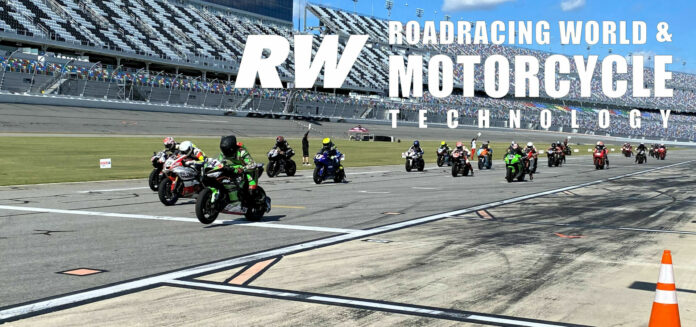
The restart of the ASRA Team Challenge at Daytona International Speedway in October 2023 with Max Angles (164) next to BPM's Diego Garcia (35), Bauce Racing's Joseph LiMandri, Jr. (931), YART Yamaha's Karel Hanika (7), and the rest. Photo by David Swarts.
ASRA is making changes to its endurance racing series for 2024.
Once called the AMA Sanctioned ASRA Team Challenge, the new series will now be known as the AMA Sanctioned ASRA National Endurance/Team Challenge Series in 2024.
Team Challenge is changing and will now be a relay-style race with multiple riders using separate motorcycles and swapping a single scoring transponder during a pit stop or stops.
The new National Endurance will use a tradition format with a single motorcycle and scoring transponder with rider swaps, refueling, and tire changes happening during a pit stop or stops.
Both Team Challenge and National Endurance will have GTO, GTU, and GT Lights (GTL) classes, which will be scored separately, but each class will be limited to four entries in the Team Challenge format.
All grid positions will be based on lap times recorded during timed qualifying and most races will run to a two-hour time limit, although two of the six scheduled events will be longer than two hours, according to ASRA.
All 2024 race license renewals and applications received prior to December 31, 2023, have been processed and mailed out, but due to an outbreak of flu among ASRA staff, renewals and applications received since January 1, 2024, are still being processed. As a result, the deadline to renew and keep an existing competition number has been extended to January 15. After January 15, all unclaimed race numbers will be available.
An ASRA Midwest Region “get-together” has been scheduled January 19 at Lake Lawn Resort, 2400 Geneva St., Delavan, WI 53115. RSVPs via the ASRA website are required.
Two BBQ/cookouts for the Atlantic/Mid-Atlantic region have been scheduled April 5-7 at Carolina Motorsports Park and April 27-28 at New Jersey Motorsports Park. For more information, go to www.asraracing.com.
“As you know, 2023 was the first year of the new ASRA,” ASRA’s Mark Lienhard wrote in an email. “While this was a massive undertaking both personally and financially, only with the help of several key people whom I greatly respect helping to rebuild and bring this back would this have been attempted.
“All that being said, 2024 is the year to come out and be even better. We have been working on streamlining processes, creating an easier user experience, upping the ante on the competition level, and creating a safer race day from qualifying grid times and positions for every race for both Amateurs and Experts, separating qualifying sessions for both Amateur and Expert, grid spacing, and starting lights. I want this to be an organization built for the racers by the racers. If you have an awesome idea, send it on.”
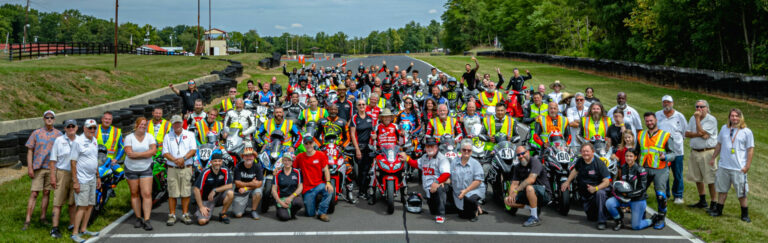
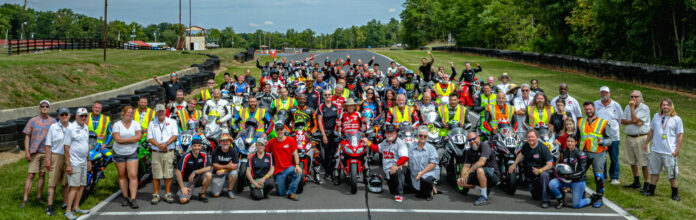
Participants and staff at Roger Lyle’s Motorcycle Xcitement's final track day and school event August 28, 2023, at Summit Point Raceway, West Virginia. Photo by Darin Morrell, courtesy Motorcycle Xcitement.
Roger Lyle’s Motorcycle Xcitement Track Days & Road Racing School has taken its final checkered flag!
All good things come to an end and after 40 years in the business of teaching thousands of riders and racers to have FUN on their motorcycles in a safe environment and family atmosphere, it’s time for Roger Lyle and Joan Erdesky to retire.
We thank all of our staff, coaches, the riders, racers, our partners, sponsors, the staff and track management at Summit Point Motorsports Park, West Virginia, and NCBIKE in Garysburg, North Carolina, who helped make this business so much FUN!
We had a Great Ride! Thanks for the memories!
Have FUN! Ride Smooth, Safe, Fast, and Happy Motoring!
A “press release” is promotional text issued by a rider, team, company or organization to inform
the public about an event, product, or service from the issuer’s own point of view, and if deemed
to have news value, may be placed on roadracingworld.com as a service to our readers.
A press release is not an article written by Roadracingworld.com staffers. When a post is labeled with the words “press release”, it means that Roadracingworld.com is not responsible for its content and that Roadracingworld.com makes no guarantee that it is accurate. Not all press releases are posted and Roadracingworld.com may reject press releases if the content is too heavy on commercial promotion with little or no news value or if the press release contains obvious errors.
Accessibility
Accessibility modes
Epilepsy Safe Mode
Dampens color and removes blinks
This mode enables people with epilepsy to use the website safely by eliminating the risk of seizures that result from flashing or blinking animations and risky color combinations.
Visually Impaired Mode
Improves website's visuals
This mode adjusts the website for the convenience of users with visual impairments such as Degrading Eyesight, Tunnel Vision, Cataract, Glaucoma, and others.
Cognitive Disability Mode
Helps to focus on specific content
This mode provides different assistive options to help users with cognitive impairments such as Dyslexia, Autism, CVA, and others, to focus on the essential elements of the website more easily.
ADHD Friendly Mode
Reduces distractions and improve focus
This mode helps users with ADHD and Neurodevelopmental disorders to read, browse, and focus on the main website elements more easily while significantly reducing distractions.
Blindness Mode
Allows using the site with your screen-reader
This mode configures the website to be compatible with screen-readers such as JAWS, NVDA, VoiceOver, and TalkBack. A screen-reader is software for blind users that is installed on a computer and smartphone, and websites must be compatible with it.
Online Dictionary
Readable Experience
Content Scaling
Default
Text Magnifier
Readable Font
Dyslexia Friendly
Highlight Titles
Highlight Links
Font Sizing
Default
Line Height
Default
Letter Spacing
Default
Left Aligned
Center Aligned
Right Aligned
Visually Pleasing Experience
Dark Contrast
Light Contrast
Monochrome
High Contrast
High Saturation
Low Saturation
Adjust Text Colors
Adjust Title Colors
Adjust Background Colors
Easy Orientation
Mute Sounds
Hide Images
Hide Emoji
Reading Guide
Stop Animations
Reading Mask
Highlight Hover
Highlight Focus
Big Dark Cursor
Big Light Cursor
Cognitive Reading
Virtual Keyboard
Navigation Keys
Voice Navigation
Accessibility Statement
www.roadracingworld.com
November 13, 2026
Compliance status
We firmly believe that the internet should be available and accessible to anyone, and are committed to providing a website that is accessible to the widest possible audience,
regardless of circumstance and ability.
To fulfill this, we aim to adhere as strictly as possible to the World Wide Web Consortium’s (W3C) Web Content Accessibility Guidelines 2.1 (WCAG 2.1) at the AA level.
These guidelines explain how to make web content accessible to people with a wide array of disabilities. Complying with those guidelines helps us ensure that the website is accessible
to all people: blind people, people with motor impairments, visual impairment, cognitive disabilities, and more.
This website utilizes various technologies that are meant to make it as accessible as possible at all times. We utilize an accessibility interface that allows persons with specific
disabilities to adjust the website’s UI (user interface) and design it to their personal needs.
Additionally, the website utilizes an AI-based application that runs in the background and optimizes its accessibility level constantly. This application remediates the website’s HTML,
adapts Its functionality and behavior for screen-readers used by the blind users, and for keyboard functions used by individuals with motor impairments.
If you’ve found a malfunction or have ideas for improvement, we’ll be happy to hear from you. You can reach out to the website’s operators by using the following email
Screen-reader and keyboard navigation
Our website implements the ARIA attributes (Accessible Rich Internet Applications) technique, alongside various different behavioral changes, to ensure blind users visiting with
screen-readers are able to read, comprehend, and enjoy the website’s functions. As soon as a user with a screen-reader enters your site, they immediately receive
a prompt to enter the Screen-Reader Profile so they can browse and operate your site effectively. Here’s how our website covers some of the most important screen-reader requirements,
alongside console screenshots of code examples:
Screen-reader optimization: we run a background process that learns the website’s components from top to bottom, to ensure ongoing compliance even when updating the website.
In this process, we provide screen-readers with meaningful data using the ARIA set of attributes. For example, we provide accurate form labels;
descriptions for actionable icons (social media icons, search icons, cart icons, etc.); validation guidance for form inputs; element roles such as buttons, menus, modal dialogues (popups),
and others. Additionally, the background process scans all the website’s images and provides an accurate and meaningful image-object-recognition-based description as an ALT (alternate text) tag
for images that are not described. It will also extract texts that are embedded within the image, using an OCR (optical character recognition) technology.
To turn on screen-reader adjustments at any time, users need only to press the Alt+1 keyboard combination. Screen-reader users also get automatic announcements to turn the Screen-reader mode on
as soon as they enter the website.
These adjustments are compatible with all popular screen readers, including JAWS and NVDA.
Keyboard navigation optimization: The background process also adjusts the website’s HTML, and adds various behaviors using JavaScript code to make the website operable by the keyboard. This includes the ability to navigate the website using the Tab and Shift+Tab keys, operate dropdowns with the arrow keys, close them with Esc, trigger buttons and links using the Enter key, navigate between radio and checkbox elements using the arrow keys, and fill them in with the Spacebar or Enter key.Additionally, keyboard users will find quick-navigation and content-skip menus, available at any time by clicking Alt+1, or as the first elements of the site while navigating with the keyboard. The background process also handles triggered popups by moving the keyboard focus towards them as soon as they appear, and not allow the focus drift outside it.
Users can also use shortcuts such as “M” (menus), “H” (headings), “F” (forms), “B” (buttons), and “G” (graphics) to jump to specific elements.
Disability profiles supported in our website
Epilepsy Safe Mode: this profile enables people with epilepsy to use the website safely by eliminating the risk of seizures that result from flashing or blinking animations and risky color combinations.
Visually Impaired Mode: this mode adjusts the website for the convenience of users with visual impairments such as Degrading Eyesight, Tunnel Vision, Cataract, Glaucoma, and others.
Cognitive Disability Mode: this mode provides different assistive options to help users with cognitive impairments such as Dyslexia, Autism, CVA, and others, to focus on the essential elements of the website more easily.
ADHD Friendly Mode: this mode helps users with ADHD and Neurodevelopmental disorders to read, browse, and focus on the main website elements more easily while significantly reducing distractions.
Blindness Mode: this mode configures the website to be compatible with screen-readers such as JAWS, NVDA, VoiceOver, and TalkBack. A screen-reader is software for blind users that is installed on a computer and smartphone, and websites must be compatible with it.
Keyboard Navigation Profile (Motor-Impaired): this profile enables motor-impaired persons to operate the website using the keyboard Tab, Shift+Tab, and the Enter keys. Users can also use shortcuts such as “M” (menus), “H” (headings), “F” (forms), “B” (buttons), and “G” (graphics) to jump to specific elements.
Additional UI, design, and readability adjustments
Font adjustments – users, can increase and decrease its size, change its family (type), adjust the spacing, alignment, line height, and more.
Color adjustments – users can select various color contrast profiles such as light, dark, inverted, and monochrome. Additionally, users can swap color schemes of titles, texts, and backgrounds, with over seven different coloring options.
Animations – person with epilepsy can stop all running animations with the click of a button. Animations controlled by the interface include videos, GIFs, and CSS flashing transitions.
Content highlighting – users can choose to emphasize important elements such as links and titles. They can also choose to highlight focused or hovered elements only.
Audio muting – users with hearing devices may experience headaches or other issues due to automatic audio playing. This option lets users mute the entire website instantly.
Cognitive disorders – we utilize a search engine that is linked to Wikipedia and Wiktionary, allowing people with cognitive disorders to decipher meanings of phrases, initials, slang, and others.
Additional functions – we provide users the option to change cursor color and size, use a printing mode, enable a virtual keyboard, and many other functions.
Browser and assistive technology compatibility
We aim to support the widest array of browsers and assistive technologies as possible, so our users can choose the best fitting tools for them, with as few limitations as possible. Therefore, we have worked very hard to be able to support all major systems that comprise over 95% of the user market share including Google Chrome, Mozilla Firefox, Apple Safari, Opera and Microsoft Edge, JAWS and NVDA (screen readers).
Notes, comments, and feedback
Despite our very best efforts to allow anybody to adjust the website to their needs. There may still be pages or sections that are not fully accessible, are in the process of becoming accessible, or are lacking an adequate technological solution to make them accessible. Still, we are continually improving our accessibility, adding, updating and improving its options and features, and developing and adopting new technologies. All this is meant to reach the optimal level of accessibility, following technological advancements. For any assistance, please reach out to