G&G Racing and Kolby Carlile Back for 2024 Mission SuperTwins Campaign
SOUTHERN CALIFORNIA (January 15, 2024) – G&G Racing/Yamaha Racing announced today that Kolby Carlile will return to the team for the 2024 Progressive American Flat Track season to again compete in the Mission SuperTwins class.
Now entering its ninth year in partnership with Yamaha Racing, G&G Racing has enjoyed a run of success that has seen the team garner 19 victories, 40 podiums, 51 top-fives, and 79 top-10s across classes throughout that collaboration. With Carlile at the controls of the team’s Yamaha MT-07 racebikes, the squad enters the ‘24 campaign from a position of strength.
The 2017 Parts Unlimited AFT Singles presented by KICKER champion and a multi-time Mission Production Twins race winner, Carlile registered an impressive maiden season with G&G Racing/Yamaha Racing a year ago. He notched up eight top-10s – including seven in a row – enroute to a 10th-place championship standing. In the midst of that run of top-10s, Carlisle scored a career-best premier-class finish of fourth at the Sacramento Mile, where he also earned a front-row starting position and qualified for the Mission #2Fast2Tasty Challenge.
Kolby Carlile – G&G Racing/Yamaha Racing
“I’m ecstatic to have the opportunity to ride for G&G Racing one more year at the highest level. LJ and John have provided me with great Yamahas every time we went to the track, and having a full year under my belt has allowed us to build a notebook of setups for me. Getting to know those guys all last year has grown a great friendship and trust in one another. Going into 2024, I feel as confident as ever and have made some adjustments off track to help my performance on track. I’ll look to build upon what we were able to accomplish last year. I really want to get that top-three finish we were so close to last season, and I feel I am more prepared for that coming into 2024.”
Jim Roach – Yamaha Racing Department Manager
“Yamaha Racing is looking forward to the return of G&G Racing to the Mission SuperTwins class for their ninth year. After taking a year to get acclimated with Kolby, 2024 is looking good!”
L.J. Gronek – Team Owner
“We are excited for Kolby to return for 2024. Kolby showed speed and demonstrated the ability to be up front. With a year on the bikes, notes, and the hard work he has put in the off season, we believe he can continue to push to show that he can be a contender. Also, we are thrilled to continue our partnership with Yamaha Racing. We could not have accomplished all we have without their help. The Yamaha MT-07 is a very capable platform with great power and delivery.”
G&G Racing would like to thank its sponsors who help make this happen: Yamaha Racing, Yamaha Motor Corporation, Yamalube, JMR, Twisted Development, Graves Sports, AIM, Fontana Radiators, Metalartopia, Motion Pro, and Rosa Plates.
About G&G Racing
G&G Racing is a two-time Mission Production Twins Championship team. A father and son who have built their own Yamaha MT-07s for the AFT SuperTwins and sponsor riders, amateur to pro, in flat track. All work is done in house from their garage.
Chase Sexton Wins Mudder at San Francisco Supercross
Jordon Smith Tops 250SX Class in the Rain
San Francisco, Calif., (January 14, 2024) At Round 2 of the 17-round series, Red Bull KTM’s Chase Sexton put in a near flawless ride under some of the most brutal race conditions ever seen at a Monster Energy AMA Supercross race. The win moves Sexton into the points lead.
Monster Energy Yamaha Star Racing’s Eli Tomac navigated the deteriorating track to earn second place inside Oracle Park; he jumped from ninth to being tied for third place in the point standings. Progressive Insurance ECSTAR Suzuki’s Ken Roczen recovered from an early mistake to pass his way up to third place. The event kicks off the season-long Love Moto Stop Cancer text-to-donate campaign as well as Ken Roczen’s Kickstart for a Cause bike sweepstakes, both to support St. Jude Children’s Research Hospital. In the Western Regional 250SX Class, Monster Energy Yamaha Star Racing’s Jordon Smith followed up last week’s second-place finish to earn the top spot at round two.
Chase Sexton (1) takes the leads in the 450 SX main event at rainy Oracle Park, in San Francisco, California. Photo courtesy Feld Motor Sports, Inc.
“Leading the race in a mud situation, it’s obviously where you want to be because you’re not getting roosted, but it also seems like it lasts forever. The first couple laps when I was by myself and I wasn’t dealing with lapped traffic it felt, not easy, but I had a good flow and was able to hit my lines. Then once we got into lapped traffic, that’s when the race kinda starts and being able to pick around those guys is key… It’s tough not to make a mistake out there but I was fairly consistent every lap and was pretty happy with how consistent I was.” – Chase Sexton.
“It was tough. It was like, it started out really thick, and then it stayed thick enough even with all that water. A lot of times when it’s just pure rain the whole time it’s not too bad because the ruts don’t get super deep and you’re kinda just spraying it around. But this one… I went in [an inside rut] one time and got stuck for like a second or two. It was one of those tracks where it was just heavy dirt, super deep ruts. And then there was another time in the second rhythm section I almost looped out because I grabbed a handful of throttle and hung off the back. But this was one of the tougher ones.” – Eli Tomac, describing the conditions as some of the toughest he’s faced in supercross.
“My mindset was [focused on] getting going. As soon as I got going I’m like, ‘Okay, this is 15 minutes, this is enough time, with people struggling going left and right… we can still make something happen.’ So I really just put my head down and charged forward. I was kinda blown away and really happy at the same time that I caught up to the field quick and was able to just pick people off left and right… I just wanted to go and go and kinda try to have fun with it.” – Ken Roczen, describing his race after a mistake after the first turn set him well back in the field.
The Western Regional 250SX Class held its second round and Jordon Smith took over the red plate and a five point lead in the 10-round championship. Monster Energy Pro Circuit Kawasaki’s Levi Kitchen landed on the podium again, this time moving up one spot to earn second place. Muc-Off FXR ClubMX Yamaha’s Garrett Marchbanks had to work hard for his third place finish after rounding the first lap in seventh place.
250SX main event winner Jordan Smith. Photo courtesy Feld Motor Sports, Inc.
“I’ve been pretty bad in mud races in my pro career, especially lately. At the mudder in New Jersey last year I did terrible, I think I got 18th. At High Point [motocross] in the mud I did not do good there, either. And we got here today and Bobby [Regan, the team owner] was like, ‘Jordon, I’ve seen you ride in the mud, you just need to try to survive today and get as many points as you can’. And I was like, ‘All right Bobby, I’m going to try to prove you wrong, but you’re kinda right.’ I do feel like I’ve gotten better in the mud… I think riding outdoors last year helped me.” – Jordon Smith
“The bike felt pretty good. That was the first time it’s ever really seen any rain at all or water. I did really well. After practice I just basically stiffened my fork as much as it would go, dropped it in the clamps, just kinda made the front end light so I could kinda ride around that way and yeah, it felt really good.” – Levi Kitchen, who switched to a new team and bike for 2024.
“I honestly didn’t know what position I was in the whole race. The first lap I fell over and was basically dead last. I was just covered and mud and didn’t know what was going on so I just basically pushed the whole way through and saw Phil [Nicoletti, a teammate] and didn’t know what position we were in, so I was like, ‘Maybe I’ll just try to get another guy and keep myself in the points hunt for a title…’ I was pretty happy for the third and yeah, it was exciting.” – Garrett Marchbanks
Round 2 kicked off the Love Moto Stop Cancer text-to-donate campaign which continues the sport’s partnership with St. Jude Children’s Research Hospital. Fans can text “SUPER” to 785-833 or click here to join racers and fans in supporting this great cause.
The series heads south to San Diego for Round 3 inside Snapdragon Stadium on January 20th. Each round pays championship points to both the 17-round Monster Energy Supercross series and the 31-round SuperMotocross World Championship. Doors open at 10:30AM local time. The racing starts earlier this year and opening ceremonies kick-off the San Diego action at 8:00 PM Eastern Time.
All 31 SuperMotocross World Championship rounds (which entail all 17 Monster Energy AMA Supercross rounds) will be streamed live on Peacock. Select rounds will be broadcast or streamed domestically on NBC, USA Network, CNBC, NBCSports.com, and the NBC Sports app. All season long, CNBC will air next-day encore presentations of each SuperMotocross event. An encore presentation of San Francisco will be featured on Sunday, January 14 on NBC at 2pm ET. Race coverage, both live and on-demand, is available for fans outside of the United States via the SuperMotocross Video Pass (supermotocross.tv); coverage is presented in both English and Spanish. As another way to tune in, fans can listen to each race’s live broadcast on SiriusXM channel 85.
Tickets for each remaining 2024 Monster Energy AMA Supercross event are on sale now. There’s no substitute for seeing the racing in-person. For ticket sales, videos, results, feature stories, and airtime schedules on Peacock, NBC, USA Network, and CNBC please go to SupercrossLIVE.com.
BENNETTS BSB – THRILL OF THE RACE – EPISODE 10 – RED ALERT
The latest episode of Thrill of the Race bringing you closer than ever before to the Bennetts British Superbike Championship, with the next installment coming from the dramatic tenth round at Donington Park as tensions rise in the battle to become 2023 Champion
Pioneering Superbike mechanic and former racer Mike Velasco died January 5 in a hospital in Washington state at the age of 74.
Velasco was a key player in the formative years of AMA Superbike with Yoshimura R&D and later with American Honda and worked with riders such as Wes Cooley (R.I.P.), David Emde, Gary Fisher (R.I.P.), Steve McLaughlin, Fred Merkel, Ron Pierce, Roberto Pietri, Larry Pegram, Bubba Shobert, Freddie Spencer, and Steve Wise, among others.
Here are a few tributes to Velasco:
Mike Baldwin.
Mike Baldwin: “Mike had that ‘Go get ‘em let’s win this thing’ attitude and style of prepping his race bikes. He loved winning as much as the riders did. RIP Mike.”
John Glover (24) back in the day. Photo by John Ulrich.
John Glover: “So sad, hell of a good guy, racer and mechanic, always smiling and happy. RIP, my friend.”
Terry Hampton (72).
Terry Hampton: “Sad. Mike was always nice and helpful to me. He and Merlyn Plumlee would leave used Fred gifts (parts) for me in rags in my pit, like elves!”
Steve Lang back in the day.
Steve Lang: “So sorry to hear he’s gone. We are all so lucky to have known someone like Mike and shared so many great memories. What a great guy and what a great run. Thanks, Mike.”
If you have a memory of Mike Velasco that you would like to share, please send it to [email protected].
Update:
Brad “The Bullet” Baker (left) with Mike Velasco (right). Photo courtesy Brad Baker.
Brad “The Bullet” Baker: “The world has unfortunately lost a great man, a legend, my dear friend, Mike Velasco. Mike has been one of my biggest supporters ever since I was only 12 years old when he started building my brother and I’s race engines. I’ll always remember showing up to @brothers_powersports for the first time to meet him and have him show us around. He made us feel right at home, like we were apart of the family from the very beginning. He was always so positive and happy, it was like nothing ever phased him, no matter how many difficult projects he had in front of him. He had a way of always putting a smile on my face, especially when he would let out his infectious laugh when talking about some of the crazy things he would do to make horsepower back in the early days of Superbikes. I owe so much to him, he contributed to so much to my success. Every engine he ever built for me was fast, I hardly ever had a mechanical and he never ever charged me a dime. I’ll admit, back then I feel like I took him for granted. I wish i could go back and do more for him to let him know just how much i appreciated him. But I mainly need to thank him for just being a great friend. After my accident he would always check in on me to see how I was doing and he never stopped helping me even though I wasn’t racing anymore and he was retired. I’m really glad that he was able to be apart of building the supermini that I just recently finished. We had a lot of fun talking back and forth during that project. I’ll always cherish the memories we had together. Mike will deeply missed by the many people he helped and touched over the years and he will definitely never be forgotten. My heart and thoughts go out to his awesome family during this very difficult time. Race in Peace Mike, see you on the other side my friend.”
Dave Wolman (right) with Mike Velasco (center) and another friend. Photo courtesy Dave Wolman.
Dave Wolman: “Mike Velasco RIP This is very sad news. Mike was an amazing person with incredible talent and super natural SKILLS. He was a Yoshimura and Factory Superbike mechanic. That in itself is a major accomplishment. Mike was a great leader and team member, who would work his magic, and GET IT DONE! We were Friends and Competitors. I was with Team Yoshimura Suzuki and he was with Team Honda. I recently got together with Mike and had some great Bench Racing. REST IN PEACE my old friend.”
Editorial Note: This article originally appeared in the August 2023 issue of Roadracing World & Motorcycle Technology magazine. Scroll all the way down to watch the video from the intro event at Thunderhill Raceway Park.
Intro: Kawasaki Ninja ZX-4RR
Screaming Fun!
By Chris Ulrich
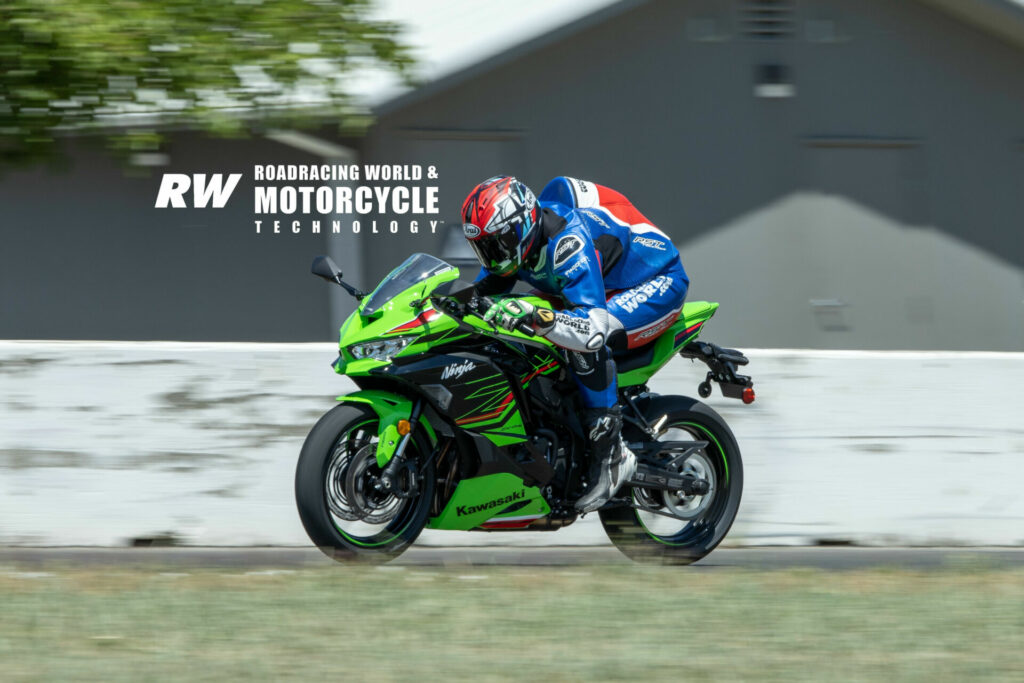
Kawasaki Motors Corp, U.S.A.’s decision to import the ZX-4RR global model paid off, with sales exceeding expectations. They’ll bring in more for 2024. The theme is more-usable power. Photo by Kevin Wing.
I was tucked in and flat-out with the throttle pinned as the revs climbed toward 15,000 rpm. I shifted into fourth gear before lifting my head and sticking my knee out just enough to create some drag as I turned into Thunderhill’s fast Turn 9 kink without breathing the throttle. It had taken me a couple of sessions and a few setting changes to get where I could go through the turn wide-open, but once I dialed in the bike’s set-up and my line, I could run through it at 107 mph lap after lap.
Ripping through corners flat out and picking up the throttle far earlier than sensible brought back memories of ripping around on my two-stroke Honda RS125 as a teenager. Except I was on a 400-class inline four-cylinder with a steel-tube chassis and street tires. The equipment was wildly different, but the technique used to hustle them around the racetrack is pretty close to being the same. And, sometimes, thinking (or over-thinking) about that progress, it’s mind-blowing how far mass-produced sportbikes have progressed over the years.
Why This Bike?
These days, high performance, small-displacement, four-cylinder sportbikes are not seen in the American market. Most of the motorcycles sold in the U.S. in this displacement category are price-point machines, so they cost less to build and buy, and have lower-performance engines, chassis, and assorted components. In the case of Kawasaki, its current entry-level model is the Ninja 400, powered by a Parallel Twin engine making less than 35 horsepower stock, and coming with conventional forks and a spindly, steel-tube chassis. Other products in the 400cc category—the twin-cylinder Yamaha YZF-R3 and the single-cylinder KTM RC390—share the same built-to-a-budget traits. A step up in terms of performance leads the consumer to the Yamaha YZF-R7, Kawasaki Ninja 650, and Suzuki SV650, but they all have a similar cost-down manufacturing directive and easy riding characteristics. None of them are pure-bred performance-oriented sportbikes.
Kawasaki is now changing the entry-level sportbike game with the new Ninja ZX-4RR, a 399cc Inline four-cylinder with a high-performance chassis, ride-by-wire throttle, and a premium electronics package, priced at $9,699. It’s a bold strategy, but brings another bike to the market with attainable performance for a regular rider and enough performance to entertain an experienced track-day or racing enthusiast. Kawasaki hopes that 15% of riders who purchase the ZX-4RR take it to the racetrack for track days or racing. If that happens, it would mean that owners are 40% more likely to take their bike to a racetrack than the next bike in Kawasaki’s sportbike line up, which is the 636cc ZX-6R.
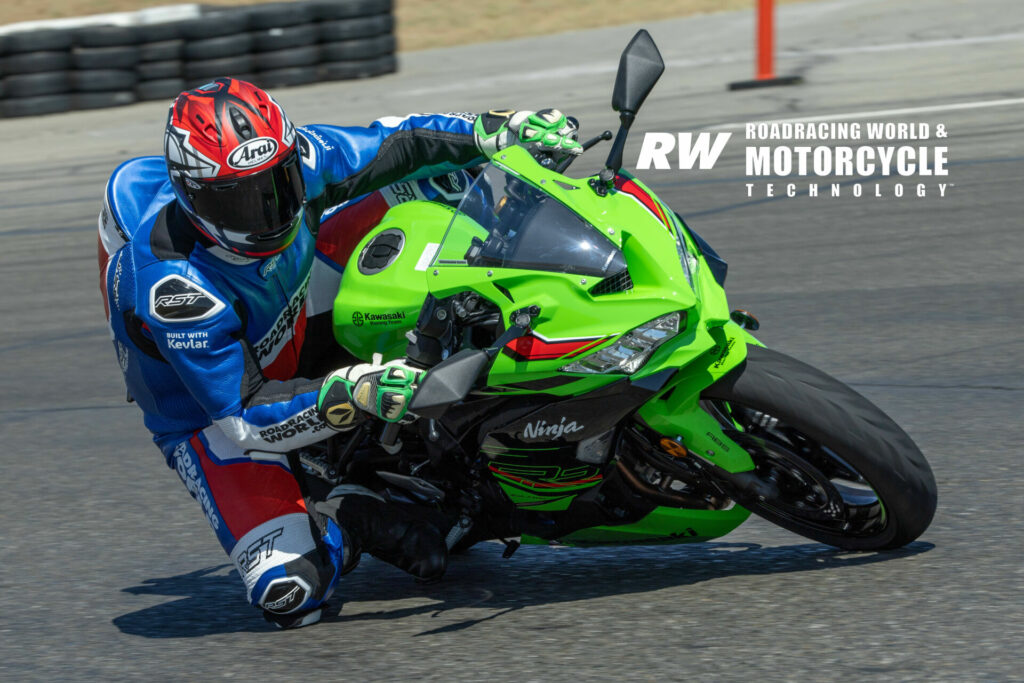
Chris Ulrich at speed on the 2023 Kawasaki Ninja ZX-4RR. Photo by Kevin Wing.
Ninja ZX-4RR TECH
Comparing the new Kawasaki Ninja ZX-4RR to the other bikes in its displacement category doesn’t do it justice, because Kawasaki’s 40%-sized Superbike is a ripper! The Ninja ZX-4RR is essentially in a performance category of its own. Most of the tech was previously covered in the March issue, but let’s hit a few of the high points.
The ZX-4RR has the same look and feel as its larger displacement brothers. It has a low fuel tank and sleek bodywork with styling similar to the ZX-6R. A large ram-air scoop in the center of the upper fairing takes advantage of the high-pressure zone to send cold air to the airbox via a tube that snakes around the left fork leg. The aerodynamic tailsection is sleek.
The Ninja is powered by a liquid-cooled, 16-valve, double-overhead cam (DOHC) 399cc Inline-Four engine with a 57mm bore and a 39.1 mm stroke. Like other high-performance Kawasaki models, the ZX-4RR has machined combustion chambers and pistons that are cast to match. A friction-reducing molybdenum coating has been applied to the piston skirts to reduce friction. The valve pockets on top of each piston are wide to accommodate the two large (for its displacement) 22.1mm intake and two 19mm exhaust valves that are actuated by a set of forged hollow core camshafts. The valve angle is narrow, with the intakes set at 11.8 degrees from the cylinder centerline and exhausts at 13 degrees, so included valve angle is 24.8 degrees. The air -fuel mixture is fed to the ZX-4RR engine via a set of electronically-controlled 34mm throttle bodies. To improve intake efficiency, Kawasaki engineers worked to straighten the intake path from the throttle bodies to the valves. The compression ratio is a relatively-low 12.6:1, which allows the little Superbike to run on 87-octane fuel.
The engineers paid close attention to reducing engine mechanical losses and vibration. A lightweight flywheel decreases rotating mass. The crankshaft has been balanced to reduce vibration and the lightweight rods were put through a carburizing treatment to harden the steel and improve durability. An interesting add to the ZX-4RR is a deep sump oil pan, to maintain oil pressure during acceleration and deceleration.
The stainless-steel 4-2-1 exhaust system has 31.8mm head pipes, and all four are connected with cross tubes to balance out the exhaust speed and the volume flowing though each pipe. Kawasaki also placed the three catalyzers (required to meet strict emission standards) in the collector, so riders can easily add a slip-on muffler and still be compliant.
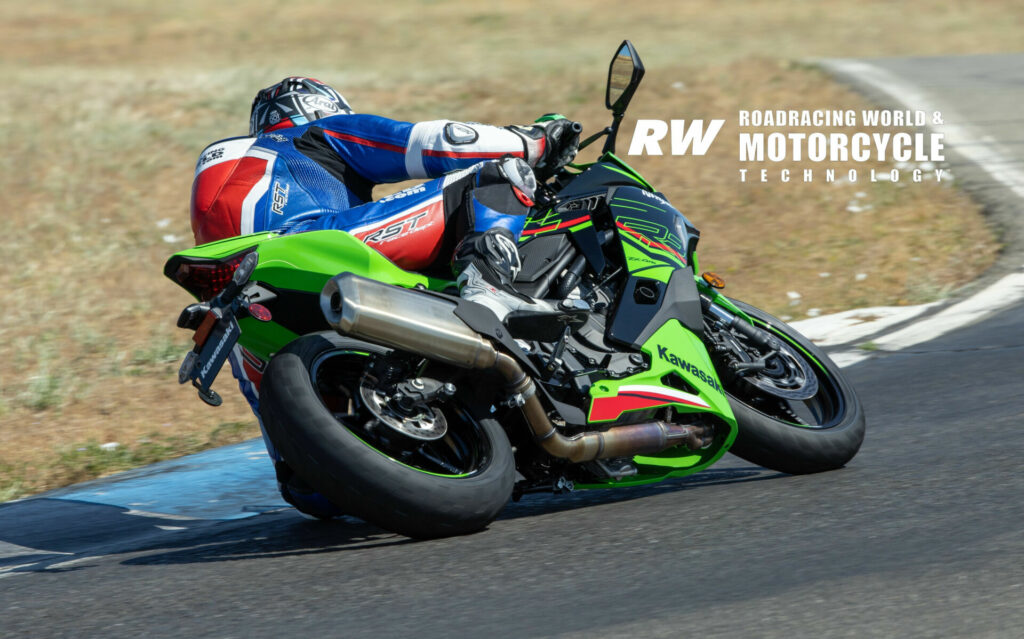
The Kawasaki ZX-4RR handles well, with the right rigidity balance. Photo by Kevin Wing.
The Kawasaki Ninja ZX-4R has an electronics suite with features usually reserved for a 1000c flagship model. Headlining the electronic capabilities is the Kawasaki Traction Control (KTRC) system, which features three levels of traction control (TC), plus an off position. As usual, TC Mode 1 is the least intrusive, Mode 2 is in the middle, and Mode 3 delivers the most intervention. The ZX-4RR does not have an IMU, so interventions are based on wheel speeds and the rate of rpm change. Two Power Modes are available; Low reduces power and the throttle opening rate, while Full has a more aggressive throttle map. (After riding the bike for a day, I believe the Full power throttle map gives more throttle opening than the rider is actually asking for in some rpm ranges.) Four Riding Modes—Sport, Road, Rain, and Rider—are available, with Sport, Road, and Rain pre-loaded with appropriate settings for each. Selecting Rider Mode allows customizing the power delivery, by mixing the KTRC settings and Power Mode settings individually. Another premium feature is the addition of a Kawasaki Quickshifter system, which allows clutchless upshifts and downshifts.
Bluetooth capability has been added to the ZX-4RR to allow connection to Kawasaki’s Rideology app. The app allows the user to log rides, make Mode changes, receive messages on the dash, and receive important vehicle data. Obviously, the phone must be in range to run the real-time features like GPS.
Moving onto the chassis, Kawasaki engineers chose to use a steel-tube trellis main frame that connects to large swingarm pivot plates. Tubular steel is also used for the subframe, which is not removable from the main frame.
Kawasaki says the engineers used the ZX-10R as a reference when deciding on the relative engine position, pivot position, center of gravity, and castor angle. There’s not a direct correlation considering that the ZX-4RR has 23.5 degrees of rake and 96.5mm of trail while the ZX-10RR comes with 25 degrees of rake and 106.6mm of trail. To be fair, the smaller and lighter bike doesn’t need as much rake and trail, but it also explains why raising the front improved the front feel of the ZX-4RR (more on that later).
The ZX-4RR comes with Showa suspension fitted on both ends. At the front there are 37mm Showa Separate Function Fork-Big Piston (SFF-BP) inverted forks. The SFF-BP system separates the spring and damping functions of the fork legs. In the case of the ZX-4RR, the right fork leg has spring-preload adjustment only, while the left fork takes care of the damping duties. There is no damping adjustment on the front, but the ZX-4RR still performs well on track. The SFF-BF forks help reduce unit costs without sacrificing a ton of performance. A Showa Balance Free Rear Cushion Lite (BFRC-Lite) is used at the rear of the ZX-4RR. Unlike the forks, the BFRC has adjustable compression and rebound damping, plus spring pre-load adjustment. The shock mounts directly to a relatively long steel swingarm.
Stopping the ZX-4RR is a set of Kawasaki-labeled four-piston Nissin brake calipers that place a larger 32mm piston above a 30mm piston in each side. The calipers clamp onto a set of fully-floating 11.4-inch (290mm) rotors. To comply with Euro5 safety standards, the Kawasaki has a Nissin ABS unit that reads wheel speeds to determine slip conditions.
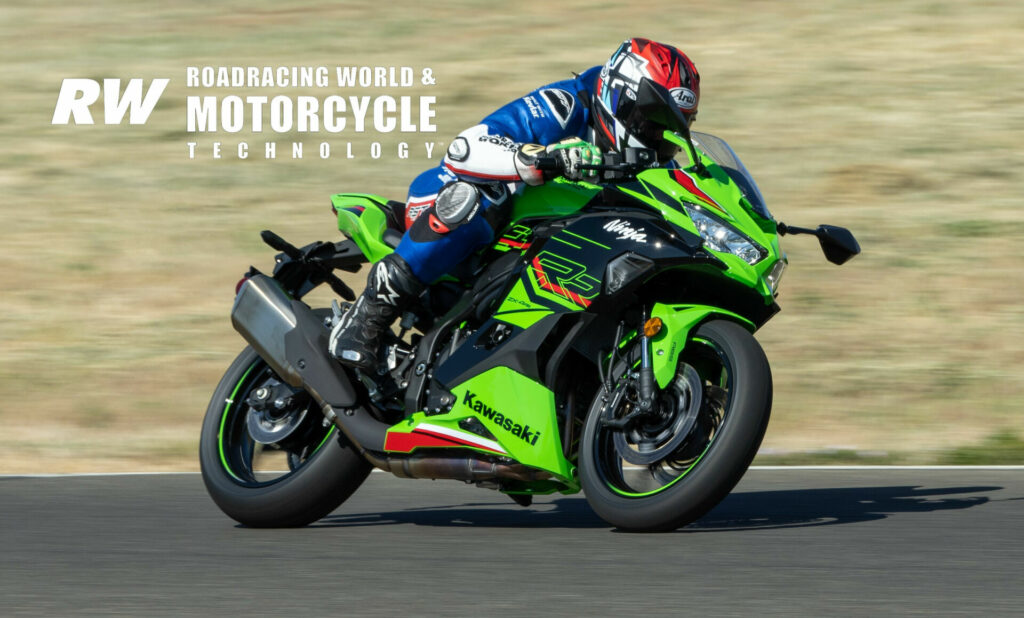
Part of the appeal of riding the ZX-4RR on a racetrack is the ability to use all of its power more often. Photo by Kevin Wing.
Spinning Laps On Track
I could tell the Ninja ZX-4RR was not a normal small-displacement, cost-down model a few corners into my first lap around Thunderhill Raceway Park. I fit on the bike pretty well; the rider triangle is sporty but not too cramped. The seat is firm and the fuel tank offers plenty of support.
I was comfortable right away on the ZX-4RR and that meant I quickly found the limit of the stock suspension settings. I was immediately into the bump stop on the front, and the rear setting didn’t allow me to finish the corners the way (and at the speed) I wanted to. While the stock suspension settings were too soft for me during the first session, I could still tell the ZX-4RR has a good engineering foundation. Meaning, the forks and head tube didn’t flex under heavy braking and turn-in; the bike didn’t wallow though the corners; and the rear did not twist and bind up on corner exits.
With the Electronic Throttle Valve (ETV) system Power Level set to Full and the Kawasaki Traction Control (KTRC) set on Level 1, the bike made good power, but was a little lazy during acceleration. Turning the KTRC off later in the day woke the ZX-4RR up. The quarter-size Superbike was happiest operating in a 4,500 rpm range from 10,000 to 14,500 rpm; the power nosed over as it approached the 15,000-rpm rev limit. (Early promotional materials said the ZX-4RR turned to 16,500 rpm, but that was before the EPA’s sound police stepped in.) Top speed is impressive for a 400; at Thunderhill, I was able to tag the rev limiter in fourth gear with a terminal speed of 121 mph just before letting off and dragging the front brake to set the front forks before peeling into Turn 1.
Moving to corner entry, the braking power and feel from the Nissin four-piston calipers and dual front brake discs were both great. But the behavior of the twist grip during deceleration was strange. I could feel the twist grip moving, mimicking the throttle plates, at certain points in the deceleration zone. This didn’t upset the chassis or add inputs and I eventually learned to ignore the movement, but it was alarming during the opening laps! The Kawasaki Quickshifter was good during acceleration, and each upshift was smooth and precise. But the ZX-4RR had a tendency to catch a false neutral downshifting between the 4th and 3rd-gear, so I had to be really deliberate on that downshift if I was using auto-blip—and I finally started using the clutch after my fifth missed shift. The throw is a bit long between those gears, so it takes care to get the shift. (The downshift between fourth and third is also a little dodgy on older Honda CBR1000RR and BMW S100RR models fitted with auto-blip, so it sometimes happens.)
With the first session over, I went to work on the chassis, taking advantage of the limited, yet effective, suspension adjustments available from the 37mm SFF-BP inverted forks and BFRC-Lite shock. My first change was adding 1.5mm of spring pre-load to the forks and shock. This change raised the bike, which improved cornering clearance and added support on both ends. As expected, I was then able to brake later at corner entry; front stability at the apex improved slightly; and the support at the rear helped the bike finish the corners. I then added a ¼-turn of compression and rebound damping to the Showa BFRC rear shock to improve support and slow down the pitch. This really helped me rotate the bike through the middle part of the corner. And increasing the rebound slowed the rate at which the shock returned, so braking stability was improved and the ZX-4RR was calmer on corner entry.
Compared to a 1000, a 400 is easier to ride well, and doesn’t burn up as many tires. Photo by Kevin Wing.
A bigger, more time-consuming change was adding 2mm of ride height to the front of the ZX-4RR by moving the tubes down in the triple clamps. Adding ride height to the front changed the weight bias, which made the Ninja more calm overall. The bike was then more stable on corner entry and at the apex, but the front sat a little high to really finish the corner. So, I then removed 1mm of preload from the front to balance out the changes, turned off the traction control, and rode the bike for the rest of the day with those settings.
Once the settings were in the zone, the Ninja ZX-4RR was really a lot of fun to ride. The chassis was stable in the low and mid-speed corners as well as in the fast sweepers at Thunderhill, and the relatively low overall weight and lack of crankshaft inertia made it easy to turn in, and nimble when I flicked side-to-side. It rotated and finished the corners well.
Rear grip wasn’t an issue; it shouldn’t be with around 65 horsepower at the rear wheel. I did have to constantly work on getting the throttle open as early as possible during the day. Convincing myself to grab a handful of throttle with a lot of lean angle is always an adjustment when coming off larger-displacement bikes!
Overall feel from the steel chassis was good. I had a big front-wheel slide going into Turn 5 late in the day, but I felt it start to go early and was able to slightly decrease brake pressure and dig my knee in to save myself from hitting the ground. At the rear, the feel from the chassis helped me gain the confidence to aggressively open the throttle mid-corner. Overall, Kawasaki got the rigidity balance of the chassis right, at least on the Dunlop Sportmax GPR-300 radial tires.
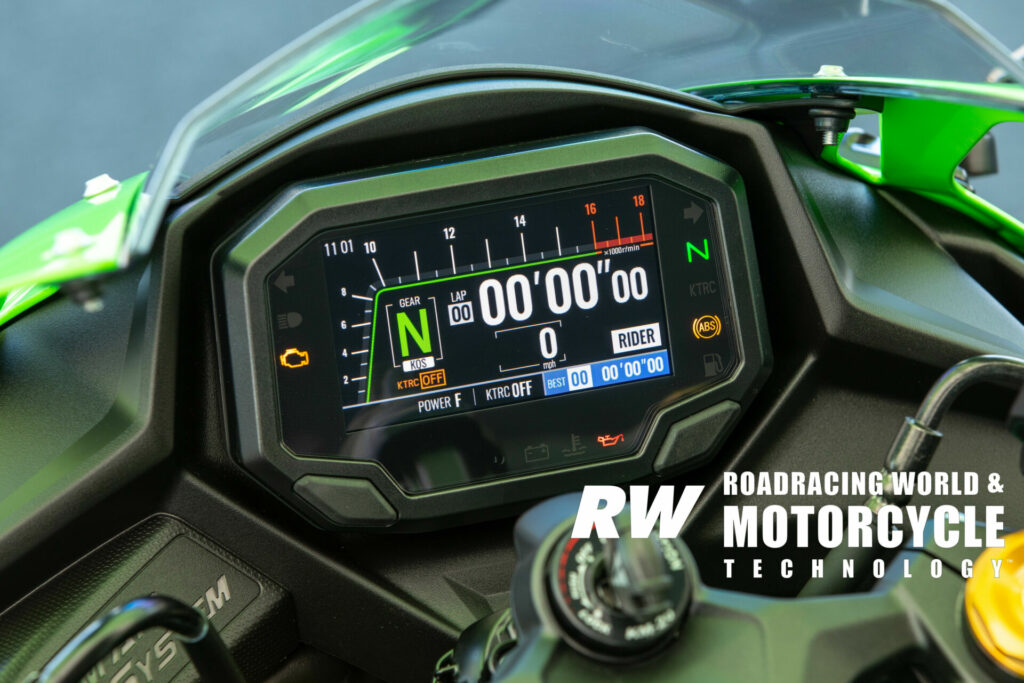
The ZX-4RR’s dash is ready to take lap times when the bike is in Rider mode. Photo by Kevin Wing.
Engine performance improved with the ZX-4RR set to Full power with the KTRC turned off. Throttle response was more direct and the engine gained rpm more quickly during acceleration, and recovered rpm fast between shifts. Top speed was also improved and I saw 120 mph on the dash. I get it, electronic aids are a selling point, and the European standards require them in the name of safety. But in my opinion, a good rider doesn’t need traction control on a bike with less than 150-horsepower.
By the end of day, I’d completed over seven 30-minute sessions on the racetrack and it felt like I could keep riding for seven more sessions. I rode the Ninja ZX-4RR to the limit of the tires, chassis, and my ability all day. Yet I wasn’t fatigued mentally or physically, and I had a blast. That is the best part of smaller-displacement high-performance motorcycles: Getting into a rhythm, pounding out the laps, and having so much fun. The Kawasaki Ninja ZX-4RR has the chassis and engine performance to entertain a seasoned Superbike guy like me, but is mellow enough that anyone can ride it. Which makes it stand alone in its spot in the industry.
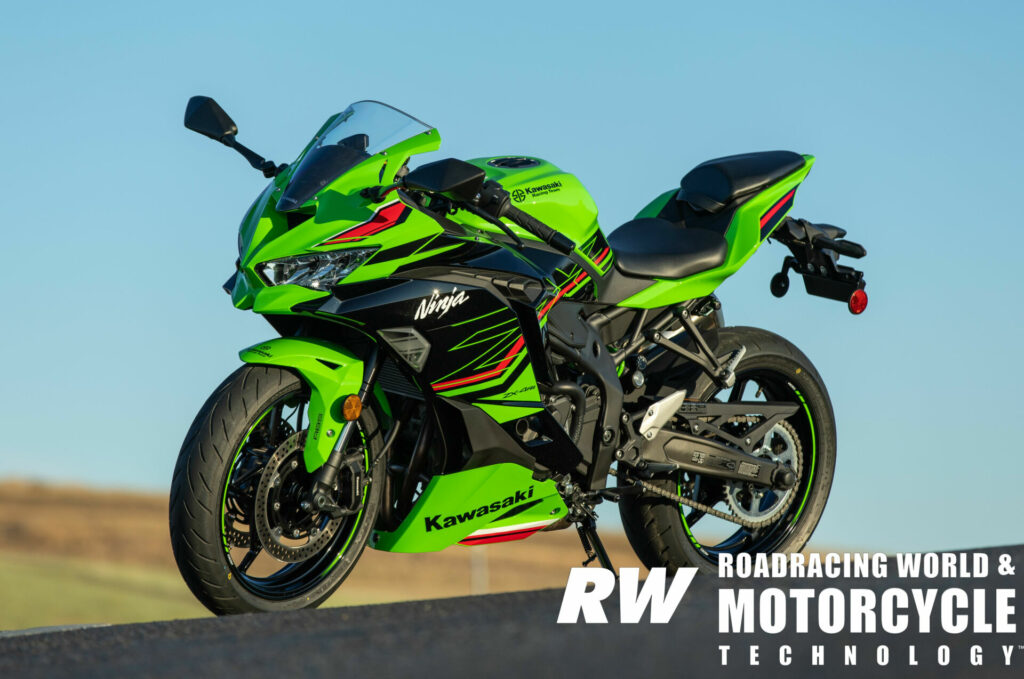
The Kawasaki looks the part of the serious sportbike, but without 200 horsepower. Photo by Kevin Wing.
Specifications: 2023 Kawasaki Ninja ZX-4RR
Engine Configuration: Inline Four, 4-stroke,
Engine Displacement: 399cc
Engine Cooling: Liquid
Compression Ratio: 12.3:1
Combustion Chamber Design: Pentroof
Valves Per Cylinder: 4
Intake Valves Per Cylinder (Material): 2 (Stainless Steel)
Exhaust Valves Per Cylinder (Material): 2 (Stainless Steel)
The California Superbike School (CSS) is making a return to the Madras International Circuit in Chennai, India. Having been a regular presence at the 12-turn, 2.3-mile circuit since 2009, the school is holding two 3-day weekend events January 26-28 and February 2-4.
California Superbike School instructors and students at a previous event at Madras International Circuit in Chennai, India. Photo by Aditya Bedre, courtesy California Superbike School.
Lead Instructor Dylan Code shared his thoughts on the upcoming events, saying, “Typically, we bring together our international coaches from the UK, USA, Australia, Poland, and Greece for the India events. Visiting India is a far out experience for our coaches, providing a change of pace. The track is fun and in good condition but probably the best part is the Indian students. They come with enthusiasm and eagerness that’s off the charts, and that amps us up, too. We don’t just get wealthy riders showing up. There is an emerging middle class there and also a program in place to provide school seats to riders who would otherwise not be able to afford the training.”
California Superbike School students in the classroom at Madras International Circuit in Chennai, India. Photo by Aditya Bedre, courtesy California Superbike School.
Code also mentioned CSS’s international activities, stating, “During the off-season in the USA, we take the opportunity to visit our foreign branches in Australia and Asia. We recently did schools in Taiwan and will return to the Philippines in April. For those interested in the idea of ‘running away with the circus,’ we are always looking for riders willing to put in the hard work and time to train as a professional coach with us.”
Tickets Now On Sale For The 82nd Running Of The Daytona 200
General Admission, VIP, Harley-Davidson Ticket Packages And Camping Now Available For All The Action At Daytona International Speedway
IRVINE, CA (January 12, 2024) – MotoAmerica, North America’s premier motorcycle road racing series, is pleased to announce that tickets are now on sale for the 82nd running of the Daytona 200 at Daytona International Speedway, including the Harley-Davidson Factory Race Fan ticket package.
The 82nd running of the Daytona 200 is expected to be one of the best yet as riders from all over the world will battle at the World Center Of Racing. But the Supersport-spec motorcycles and racers like Josh Hayes, Tyler Scott, PJ Jacobsen, Kayla Yaakov and more won’t be the only race at Daytona International Speedway as the event will feature the opening round of the Mission King Of The Baggers Championship, the Twins Cup title chase and the Mission Super Hooligan National Championship.
To celebrate the event, Harley-Davidson has its Harley-Davidson Factory Race Fan ticket package in place with exclusive perks as you watch the Factory Harley-Davidson team of Kyle Wyman and James Rispoli do battle.
The Harley-Davidson ticket package includes a three-day pass (a one-day pass is also available) to the Speedway to watch all the practice and qualifying sessions and, of course, the two Mission King Of The Baggers races.
Ticket package purchasers will get admission, an exclusive welcome gift and access to all Harley-Davidson displays and covered seating area in the H-D activation area for a livestream of the race. Harley fans who purchase the package also get Harley-Davidson motorcycle parking, and the opportunity to take part in the Harley-Davidson Parade Laps. The three-day Harley-Davidson Factory Race Fan passes sell for $110 per person (three-day), with single-day Friday and Saturday passes going for $80 each.
MotoAmerica fans also have the option of purchasing Daytona 200 VIP Superfan Experience tickets in three-day, two-day, and single-day options. All three of those feature two-day premier VIP admission and parking, access to the climate-controlled Daytona 500 Club suite with live feed on Friday and Saturday, meet and greets with MotoAmerica racers and industry reps, catered continental breakfast, coffee and iced tea, lunch and snacks on Friday and Saturday, a Superfan VIP appreciation bag, a MotoAmerica merchandise voucher, escorted pre-grid access for the Mission King Of The Baggers race (Friday) and the Daytona 200 (Saturday), preferred podium viewing and podium photos during King Of The Baggers and Daytona 200 post-race activities, premier viewing of the Pit Stop Challenge, the Cardo Fan Lap, a photo opportunity with the Daytona 200 trophy and a commemorative digital magazine is provided to all guests.
The Daytona VIP Superfan Experience packages are available for Thursday, Friday, and Saturday ($600 per person), for Friday and Saturday ($550 per person) and for single-day tickets – Friday and Saturday ($350 per person).
Single-day general admission tickets, which include infield access, start at $25 for Thursday and Friday and $35 for Saturday.
MotoAmerica is North America’s premier motorcycle road racing series. Established in 2014, MotoAmerica is home to the AMA Superbike Championship as well as additional classes including Supersport, Stock 1000, Twins Cup, Junior Cup, and King Of The Baggers. MotoAmerica is an affiliate of KRAVE Group LLC, a partnership including three-time 500cc World Champion, two-time AMA Superbike Champion, and AMA Hall of Famer Wayne Rainey; ex-racer and former manager of Team Roberts Chuck Aksland; motorsports marketing executive Terry Karges; and businessman Richard Varner. For more information, please visit www.MotoAmerica.com and follow MotoAmerica on Facebook, Instagram, TikTok, Twitter, and YouTube.
In this video, six-time Superbike World Champion Jonathan Rea answers fans’ questions from his winter training base in Spain. There were so many questions that Rea decided to do two videos.
American Motorcyclist Association Celebrates 100 Years
AMA to commemorate its 100-year anniversary throughout 2024
PICKERINGTON, Ohio — The American Motorcyclist Association (AMA) is gearing up for a year-long, historic celebration as it proudly commemorates its 100th anniversary in 2024. For a century the AMA has been at the forefront of promoting and protecting the interests of motorcyclists, creating a vibrant community of enthusiasts dedicated to the joy of riding.
AMA President and CEO Rob Dingman expressed excitement about the organization’s milestone, stating, “Reaching 100 years is a testament to the enduring spirit of motorcycling and the passionate community that has supported the AMA throughout its history. We invite the entire motorcycling community to join us in celebrating this incredible journey as we look forward to shaping the future of motorcycling over the next 100 years.”
Since its inception in 1924, the AMA has played a pivotal role in shaping the landscape of motorcycling in the United States. With a rich history rooted in passion, advocacy and the freedom of the open road, the AMA has become a driving force for riders across the nation.
As one of the largest motorcycling organizations in the world, the AMA has consistently championed the rights of motorcyclists from all walks of life, evolving to embrace a diverse and growing community of riders.
To mark this momentous occasion, the AMA has planned special events and initiatives throughout the year, including:
Centennial Celebrations: Join the AMA as it commemorates its 100-year anniversary at its Spring Bike Night (May 18), at AMA Hall of Fame Days (Oct. 10-13), and at its biggest event — AMA Vintage Motorcycle Days (July 25-28) — which will be the organization’s ultimate anniversary celebration, complete with an all-points ride from across the U.S. to the event. The AMA will also have anniversary displays at various AMA-sanctioned events throughout the year, including Daytona Bike Week, select AMA Supercross events, the Buckeye Motorcycle & Music Rally, and more.
Historical Exhibits: Explore a fascinating journey through the history of motorcycling and the AMA at the AMA Motorcycle Hall of Fame with special curated exhibits showcasing iconic motorcycles, memorable AMA moments, and the individuals who have shaped the association.
Commemorative Merchandise: Exclusive 100-year anniversary merchandise, including limited-edition apparel and accessories, are now available for enthusiasts who want to own a piece of AMA history at https://AMAGear.com.
Advocacy Initiatives: The AMA will continue its commitment to advocating for the rights of motorcyclists, addressing key issues affecting the community, promoting a positive image of motorcycling, and encouraging government recognition — at the local, state and federal levels — of the organization’s centennial.
As the American Motorcyclist Association enters its second century, it remains dedicated to its mission — promoting the motorcycle lifestyle and protecting the future of motorcycling — ensuring that the legacy of the organization and the freedom of the open road is preserved for generations to come.
In celebration of its 100th Anniversary, the organization released a video commemorating a century of the AMA.
About the American Motorcyclist Association
Founded in 1924, the AMA is a not-for-profit member-based association whose mission is to promote the motorcycle lifestyle and protect the future of motorcycling. As the world’s largest motorcycling rights and event sanctioning organization, the AMA advocates for riders’ interests at all levels of government and sanctions thousands of competition and recreational events every year. Besides offering members money-saving discounts on products and services, the AMA also publishes American Motorcyclist, a recently revitalized and monthly full-color magazine (and digital version of same) that covers current events and motorcycle history with brilliant photography and compelling writing. American Motorcyclist is also North America’s largest-circulation magazine. Through the AMA Motorcycle Hall of Fame in Pickerington, Ohio, the AMA honors the heroes and heritage of motorcycling. For more information, visit AmericanMotorcyclist.com.
Exciting Additions to Track Time Track Days and Instruction: Kayla Yaakov and Benjamin Smith Join as Guest Instructors
Olympia, Wa. Jan 11, 2024 – Track Time Track Days and Instruction, the Pacific Northwest’s premier motorcycle track day provider, is thrilled to announce the addition of motorcycle road racing professionals, Kayla Yaakov and Benjamin Smith, as guest instructors for the 2024 track day season. Their expertise and passion for racing and coaching will undoubtedly enhance the experience for Track Time customers, providing valuable insights and guidance on the track.
Kayla, known for her most recent achievements in MotoAmerica Junior Cup and Twins Cup classes, expresses gratitude to her new team, Rahal Ducati Moto for their continuous support. Kayla states, “I will be racing a Ducati V2 Panigale in the MotoAmerica Supersport class and I look forward to bringing the knowledge gained from my experiences to benefit customers at Track Time Track Days.”
Benjamin Smith, a seasoned professional in MotoAmerica, extends his appreciation to Flo4Law Racing for their support this year. Benjamin states. “I will be racing a Yamaha R1 in the Stock 1000 and Superbike classes in 2024 and I am excited to contribute my expertise to enhance the learning journey of participants at Track Time Track Days.
Alan Schwen, Owner of Track Time, is proud to be bringing Kayla Yaakov and Benjamin Smith to Track Time Events. Schwen states, “We believe their presence will elevate the overall experience for our participants, and we’re excited to see the positive impact on our track day community.”
Booking Information: Participants can now book a track day experience, one-on-one instruction, and rent a track-prepped motorcycle directly on the Track Time website at www.tracktime.bike. If you have more questions, give Track Time a call at 360-559-1400.
About Track Time Track Days and Instruction: Track Time Track Days and Instruction is the Pacific Northwest’s premier motorcycle track day provider, offering high-quality motorcycle instruction and track day experiences. With a commitment to excellence, the organization aims to empower enthusiasts to improve their riding skills and enjoy the thrill of the track in a safe and supportive environment.
Kolby Carlile (36) during practice at the Dallas Half-Mile in 2023. Photo by Tim Lester, courtesy AFT.
G&G Racing and Kolby Carlile Back for 2024 Mission SuperTwins Campaign
SOUTHERN CALIFORNIA (January 15, 2024) – G&G Racing/Yamaha Racing announced today that Kolby Carlile will return to the team for the 2024 Progressive American Flat Track season to again compete in the Mission SuperTwins class.
Now entering its ninth year in partnership with Yamaha Racing, G&G Racing has enjoyed a run of success that has seen the team garner 19 victories, 40 podiums, 51 top-fives, and 79 top-10s across classes throughout that collaboration. With Carlile at the controls of the team’s Yamaha MT-07 racebikes, the squad enters the ‘24 campaign from a position of strength.
The 2017 Parts Unlimited AFT Singles presented by KICKER champion and a multi-time Mission Production Twins race winner, Carlile registered an impressive maiden season with G&G Racing/Yamaha Racing a year ago. He notched up eight top-10s – including seven in a row – enroute to a 10th-place championship standing. In the midst of that run of top-10s, Carlisle scored a career-best premier-class finish of fourth at the Sacramento Mile, where he also earned a front-row starting position and qualified for the Mission #2Fast2Tasty Challenge.
Kolby Carlile – G&G Racing/Yamaha Racing
“I’m ecstatic to have the opportunity to ride for G&G Racing one more year at the highest level. LJ and John have provided me with great Yamahas every time we went to the track, and having a full year under my belt has allowed us to build a notebook of setups for me. Getting to know those guys all last year has grown a great friendship and trust in one another. Going into 2024, I feel as confident as ever and have made some adjustments off track to help my performance on track. I’ll look to build upon what we were able to accomplish last year. I really want to get that top-three finish we were so close to last season, and I feel I am more prepared for that coming into 2024.”
Jim Roach – Yamaha Racing Department Manager
“Yamaha Racing is looking forward to the return of G&G Racing to the Mission SuperTwins class for their ninth year. After taking a year to get acclimated with Kolby, 2024 is looking good!”
L.J. Gronek – Team Owner
“We are excited for Kolby to return for 2024. Kolby showed speed and demonstrated the ability to be up front. With a year on the bikes, notes, and the hard work he has put in the off season, we believe he can continue to push to show that he can be a contender. Also, we are thrilled to continue our partnership with Yamaha Racing. We could not have accomplished all we have without their help. The Yamaha MT-07 is a very capable platform with great power and delivery.”
G&G Racing would like to thank its sponsors who help make this happen: Yamaha Racing, Yamaha Motor Corporation, Yamalube, JMR, Twisted Development, Graves Sports, AIM, Fontana Radiators, Metalartopia, Motion Pro, and Rosa Plates.
About G&G Racing
G&G Racing is a two-time Mission Production Twins Championship team. A father and son who have built their own Yamaha MT-07s for the AFT SuperTwins and sponsor riders, amateur to pro, in flat track. All work is done in house from their garage.
Heavy rains abbreviated daytime qualifying, shortened Main Events, and instigated track changes. Still, many riders left Oracle Park with a DNF rather than championship points. Photo courtesy Feld Motor Sports, Inc.
Chase Sexton Wins Mudder at San Francisco Supercross
Jordon Smith Tops 250SX Class in the Rain
San Francisco, Calif., (January 14, 2024) At Round 2 of the 17-round series, Red Bull KTM’s Chase Sexton put in a near flawless ride under some of the most brutal race conditions ever seen at a Monster Energy AMA Supercross race. The win moves Sexton into the points lead.
Monster Energy Yamaha Star Racing’s Eli Tomac navigated the deteriorating track to earn second place inside Oracle Park; he jumped from ninth to being tied for third place in the point standings. Progressive Insurance ECSTAR Suzuki’s Ken Roczen recovered from an early mistake to pass his way up to third place. The event kicks off the season-long Love Moto Stop Cancer text-to-donate campaign as well as Ken Roczen’s Kickstart for a Cause bike sweepstakes, both to support St. Jude Children’s Research Hospital. In the Western Regional 250SX Class, Monster Energy Yamaha Star Racing’s Jordon Smith followed up last week’s second-place finish to earn the top spot at round two.
Chase Sexton (1) takes the leads in the 450 SX main event at rainy Oracle Park, in San Francisco, California. Photo courtesy Feld Motor Sports, Inc.
“Leading the race in a mud situation, it’s obviously where you want to be because you’re not getting roosted, but it also seems like it lasts forever. The first couple laps when I was by myself and I wasn’t dealing with lapped traffic it felt, not easy, but I had a good flow and was able to hit my lines. Then once we got into lapped traffic, that’s when the race kinda starts and being able to pick around those guys is key… It’s tough not to make a mistake out there but I was fairly consistent every lap and was pretty happy with how consistent I was.” – Chase Sexton.
“It was tough. It was like, it started out really thick, and then it stayed thick enough even with all that water. A lot of times when it’s just pure rain the whole time it’s not too bad because the ruts don’t get super deep and you’re kinda just spraying it around. But this one… I went in [an inside rut] one time and got stuck for like a second or two. It was one of those tracks where it was just heavy dirt, super deep ruts. And then there was another time in the second rhythm section I almost looped out because I grabbed a handful of throttle and hung off the back. But this was one of the tougher ones.” – Eli Tomac, describing the conditions as some of the toughest he’s faced in supercross.
“My mindset was [focused on] getting going. As soon as I got going I’m like, ‘Okay, this is 15 minutes, this is enough time, with people struggling going left and right… we can still make something happen.’ So I really just put my head down and charged forward. I was kinda blown away and really happy at the same time that I caught up to the field quick and was able to just pick people off left and right… I just wanted to go and go and kinda try to have fun with it.” – Ken Roczen, describing his race after a mistake after the first turn set him well back in the field.
The Western Regional 250SX Class held its second round and Jordon Smith took over the red plate and a five point lead in the 10-round championship. Monster Energy Pro Circuit Kawasaki’s Levi Kitchen landed on the podium again, this time moving up one spot to earn second place. Muc-Off FXR ClubMX Yamaha’s Garrett Marchbanks had to work hard for his third place finish after rounding the first lap in seventh place.
250SX main event winner Jordan Smith. Photo courtesy Feld Motor Sports, Inc.
“I’ve been pretty bad in mud races in my pro career, especially lately. At the mudder in New Jersey last year I did terrible, I think I got 18th. At High Point [motocross] in the mud I did not do good there, either. And we got here today and Bobby [Regan, the team owner] was like, ‘Jordon, I’ve seen you ride in the mud, you just need to try to survive today and get as many points as you can’. And I was like, ‘All right Bobby, I’m going to try to prove you wrong, but you’re kinda right.’ I do feel like I’ve gotten better in the mud… I think riding outdoors last year helped me.” – Jordon Smith
“The bike felt pretty good. That was the first time it’s ever really seen any rain at all or water. I did really well. After practice I just basically stiffened my fork as much as it would go, dropped it in the clamps, just kinda made the front end light so I could kinda ride around that way and yeah, it felt really good.” – Levi Kitchen, who switched to a new team and bike for 2024.
“I honestly didn’t know what position I was in the whole race. The first lap I fell over and was basically dead last. I was just covered and mud and didn’t know what was going on so I just basically pushed the whole way through and saw Phil [Nicoletti, a teammate] and didn’t know what position we were in, so I was like, ‘Maybe I’ll just try to get another guy and keep myself in the points hunt for a title…’ I was pretty happy for the third and yeah, it was exciting.” – Garrett Marchbanks
Round 2 kicked off the Love Moto Stop Cancer text-to-donate campaign which continues the sport’s partnership with St. Jude Children’s Research Hospital. Fans can text “SUPER” to 785-833 or click here to join racers and fans in supporting this great cause.
The series heads south to San Diego for Round 3 inside Snapdragon Stadium on January 20th. Each round pays championship points to both the 17-round Monster Energy Supercross series and the 31-round SuperMotocross World Championship. Doors open at 10:30AM local time. The racing starts earlier this year and opening ceremonies kick-off the San Diego action at 8:00 PM Eastern Time.
All 31 SuperMotocross World Championship rounds (which entail all 17 Monster Energy AMA Supercross rounds) will be streamed live on Peacock. Select rounds will be broadcast or streamed domestically on NBC, USA Network, CNBC, NBCSports.com, and the NBC Sports app. All season long, CNBC will air next-day encore presentations of each SuperMotocross event. An encore presentation of San Francisco will be featured on Sunday, January 14 on NBC at 2pm ET. Race coverage, both live and on-demand, is available for fans outside of the United States via the SuperMotocross Video Pass (supermotocross.tv); coverage is presented in both English and Spanish. As another way to tune in, fans can listen to each race’s live broadcast on SiriusXM channel 85.
Tickets for each remaining 2024 Monster Energy AMA Supercross event are on sale now. There’s no substitute for seeing the racing in-person. For ticket sales, videos, results, feature stories, and airtime schedules on Peacock, NBC, USA Network, and CNBC please go to SupercrossLIVE.com.
Fans on pit lane during a break in the action Sunday at Donington Park. Photo courtesy MSVR.
BENNETTS BSB – THRILL OF THE RACE – EPISODE 10 – RED ALERT
The latest episode of Thrill of the Race bringing you closer than ever before to the Bennetts British Superbike Championship, with the next installment coming from the dramatic tenth round at Donington Park as tensions rise in the battle to become 2023 Champion
Mike Velasco in 1982. Photo by John Owens, copyright 2023 “Superbike: An Illustrated Early History.”
Pioneering Superbike mechanic and former racer Mike Velasco died January 5 in a hospital in Washington state at the age of 74.
Velasco was a key player in the formative years of AMA Superbike with Yoshimura R&D and later with American Honda and worked with riders such as Wes Cooley (R.I.P.), David Emde, Gary Fisher (R.I.P.), Steve McLaughlin, Fred Merkel, Ron Pierce, Roberto Pietri, Larry Pegram, Bubba Shobert, Freddie Spencer, and Steve Wise, among others.
Here are a few tributes to Velasco:
Mike Baldwin.
Mike Baldwin: “Mike had that ‘Go get ‘em let’s win this thing’ attitude and style of prepping his race bikes. He loved winning as much as the riders did. RIP Mike.”
John Glover (24) back in the day. Photo by John Ulrich.
John Glover: “So sad, hell of a good guy, racer and mechanic, always smiling and happy. RIP, my friend.”
Terry Hampton (72).
Terry Hampton: “Sad. Mike was always nice and helpful to me. He and Merlyn Plumlee would leave used Fred gifts (parts) for me in rags in my pit, like elves!”
Steve Lang back in the day.
Steve Lang: “So sorry to hear he’s gone. We are all so lucky to have known someone like Mike and shared so many great memories. What a great guy and what a great run. Thanks, Mike.”
If you have a memory of Mike Velasco that you would like to share, please send it to [email protected].
Update:
Brad “The Bullet” Baker (left) with Mike Velasco (right). Photo courtesy Brad Baker.
Brad “The Bullet” Baker: “The world has unfortunately lost a great man, a legend, my dear friend, Mike Velasco. Mike has been one of my biggest supporters ever since I was only 12 years old when he started building my brother and I’s race engines. I’ll always remember showing up to @brothers_powersports for the first time to meet him and have him show us around. He made us feel right at home, like we were apart of the family from the very beginning. He was always so positive and happy, it was like nothing ever phased him, no matter how many difficult projects he had in front of him. He had a way of always putting a smile on my face, especially when he would let out his infectious laugh when talking about some of the crazy things he would do to make horsepower back in the early days of Superbikes. I owe so much to him, he contributed to so much to my success. Every engine he ever built for me was fast, I hardly ever had a mechanical and he never ever charged me a dime. I’ll admit, back then I feel like I took him for granted. I wish i could go back and do more for him to let him know just how much i appreciated him. But I mainly need to thank him for just being a great friend. After my accident he would always check in on me to see how I was doing and he never stopped helping me even though I wasn’t racing anymore and he was retired. I’m really glad that he was able to be apart of building the supermini that I just recently finished. We had a lot of fun talking back and forth during that project. I’ll always cherish the memories we had together. Mike will deeply missed by the many people he helped and touched over the years and he will definitely never be forgotten. My heart and thoughts go out to his awesome family during this very difficult time. Race in Peace Mike, see you on the other side my friend.”
Dave Wolman (right) with Mike Velasco (center) and another friend. Photo courtesy Dave Wolman.
Dave Wolman: “Mike Velasco RIP This is very sad news. Mike was an amazing person with incredible talent and super natural SKILLS. He was a Yoshimura and Factory Superbike mechanic. That in itself is a major accomplishment. Mike was a great leader and team member, who would work his magic, and GET IT DONE! We were Friends and Competitors. I was with Team Yoshimura Suzuki and he was with Team Honda. I recently got together with Mike and had some great Bench Racing. REST IN PEACE my old friend.”
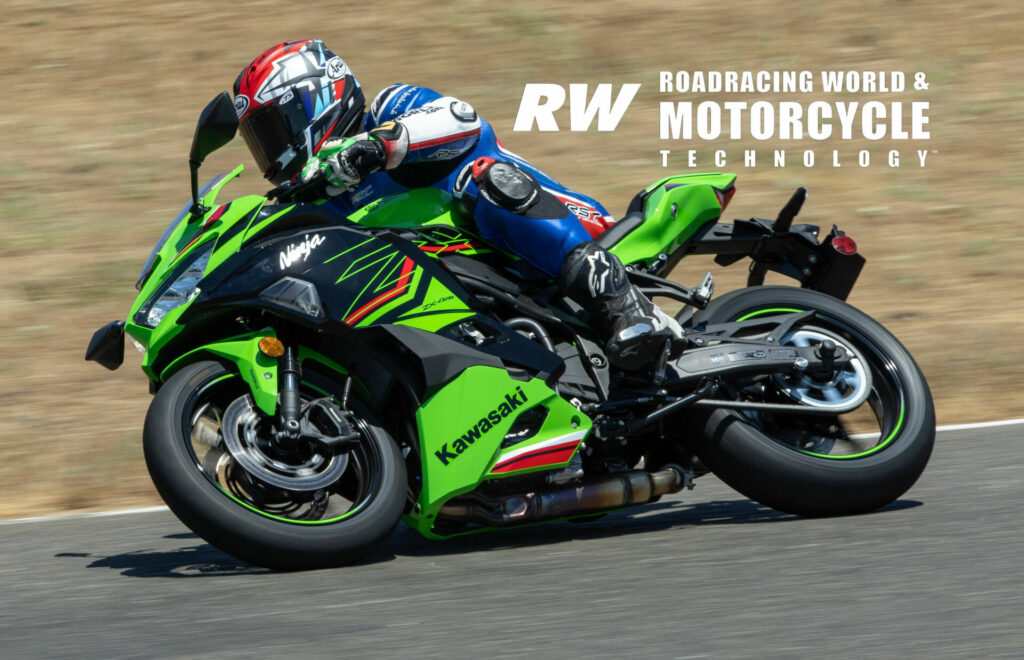
Racing Editor Chris Ulrich has screaming fun riding the all-new 399cc, 4-cylinder, 15,000-rpm 2023 Kawasaki Ninja ZX-4RR at Thunderhill Raceway Park, as seen on the cover of the August 2023 issue of Roadracing World & Motorcycle Technology magazine. Photo by Kevin Wing.
Editorial Note: This article originally appeared in the August 2023 issue of Roadracing World & Motorcycle Technology magazine. Scroll all the way down to watch the video from the intro event at Thunderhill Raceway Park.
Intro: Kawasaki Ninja ZX-4RR
Screaming Fun!
By Chris Ulrich
Kawasaki Motors Corp, U.S.A.’s decision to import the ZX-4RR global model paid off, with sales exceeding expectations. They’ll bring in more for 2024. The theme is more-usable power. Photo by Kevin Wing.
I was tucked in and flat-out with the throttle pinned as the revs climbed toward 15,000 rpm. I shifted into fourth gear before lifting my head and sticking my knee out just enough to create some drag as I turned into Thunderhill’s fast Turn 9 kink without breathing the throttle. It had taken me a couple of sessions and a few setting changes to get where I could go through the turn wide-open, but once I dialed in the bike’s set-up and my line, I could run through it at 107 mph lap after lap.
Ripping through corners flat out and picking up the throttle far earlier than sensible brought back memories of ripping around on my two-stroke Honda RS125 as a teenager. Except I was on a 400-class inline four-cylinder with a steel-tube chassis and street tires. The equipment was wildly different, but the technique used to hustle them around the racetrack is pretty close to being the same. And, sometimes, thinking (or over-thinking) about that progress, it’s mind-blowing how far mass-produced sportbikes have progressed over the years.
Why This Bike?
These days, high performance, small-displacement, four-cylinder sportbikes are not seen in the American market. Most of the motorcycles sold in the U.S. in this displacement category are price-point machines, so they cost less to build and buy, and have lower-performance engines, chassis, and assorted components. In the case of Kawasaki, its current entry-level model is the Ninja 400, powered by a Parallel Twin engine making less than 35 horsepower stock, and coming with conventional forks and a spindly, steel-tube chassis. Other products in the 400cc category—the twin-cylinder Yamaha YZF-R3 and the single-cylinder KTM RC390—share the same built-to-a-budget traits. A step up in terms of performance leads the consumer to the Yamaha YZF-R7, Kawasaki Ninja 650, and Suzuki SV650, but they all have a similar cost-down manufacturing directive and easy riding characteristics. None of them are pure-bred performance-oriented sportbikes.
Kawasaki is now changing the entry-level sportbike game with the new Ninja ZX-4RR, a 399cc Inline four-cylinder with a high-performance chassis, ride-by-wire throttle, and a premium electronics package, priced at $9,699. It’s a bold strategy, but brings another bike to the market with attainable performance for a regular rider and enough performance to entertain an experienced track-day or racing enthusiast. Kawasaki hopes that 15% of riders who purchase the ZX-4RR take it to the racetrack for track days or racing. If that happens, it would mean that owners are 40% more likely to take their bike to a racetrack than the next bike in Kawasaki’s sportbike line up, which is the 636cc ZX-6R.
Chris Ulrich at speed on the 2023 Kawasaki Ninja ZX-4RR. Photo by Kevin Wing.
Ninja ZX-4RR TECH
Comparing the new Kawasaki Ninja ZX-4RR to the other bikes in its displacement category doesn’t do it justice, because Kawasaki’s 40%-sized Superbike is a ripper! The Ninja ZX-4RR is essentially in a performance category of its own. Most of the tech was previously covered in the March issue, but let’s hit a few of the high points.
The ZX-4RR has the same look and feel as its larger displacement brothers. It has a low fuel tank and sleek bodywork with styling similar to the ZX-6R. A large ram-air scoop in the center of the upper fairing takes advantage of the high-pressure zone to send cold air to the airbox via a tube that snakes around the left fork leg. The aerodynamic tailsection is sleek.
The Ninja is powered by a liquid-cooled, 16-valve, double-overhead cam (DOHC) 399cc Inline-Four engine with a 57mm bore and a 39.1 mm stroke. Like other high-performance Kawasaki models, the ZX-4RR has machined combustion chambers and pistons that are cast to match. A friction-reducing molybdenum coating has been applied to the piston skirts to reduce friction. The valve pockets on top of each piston are wide to accommodate the two large (for its displacement) 22.1mm intake and two 19mm exhaust valves that are actuated by a set of forged hollow core camshafts. The valve angle is narrow, with the intakes set at 11.8 degrees from the cylinder centerline and exhausts at 13 degrees, so included valve angle is 24.8 degrees. The air -fuel mixture is fed to the ZX-4RR engine via a set of electronically-controlled 34mm throttle bodies. To improve intake efficiency, Kawasaki engineers worked to straighten the intake path from the throttle bodies to the valves. The compression ratio is a relatively-low 12.6:1, which allows the little Superbike to run on 87-octane fuel.
The engineers paid close attention to reducing engine mechanical losses and vibration. A lightweight flywheel decreases rotating mass. The crankshaft has been balanced to reduce vibration and the lightweight rods were put through a carburizing treatment to harden the steel and improve durability. An interesting add to the ZX-4RR is a deep sump oil pan, to maintain oil pressure during acceleration and deceleration.
The stainless-steel 4-2-1 exhaust system has 31.8mm head pipes, and all four are connected with cross tubes to balance out the exhaust speed and the volume flowing though each pipe. Kawasaki also placed the three catalyzers (required to meet strict emission standards) in the collector, so riders can easily add a slip-on muffler and still be compliant.
The Kawasaki ZX-4RR handles well, with the right rigidity balance. Photo by Kevin Wing.
The Kawasaki Ninja ZX-4R has an electronics suite with features usually reserved for a 1000c flagship model. Headlining the electronic capabilities is the Kawasaki Traction Control (KTRC) system, which features three levels of traction control (TC), plus an off position. As usual, TC Mode 1 is the least intrusive, Mode 2 is in the middle, and Mode 3 delivers the most intervention. The ZX-4RR does not have an IMU, so interventions are based on wheel speeds and the rate of rpm change. Two Power Modes are available; Low reduces power and the throttle opening rate, while Full has a more aggressive throttle map. (After riding the bike for a day, I believe the Full power throttle map gives more throttle opening than the rider is actually asking for in some rpm ranges.) Four Riding Modes—Sport, Road, Rain, and Rider—are available, with Sport, Road, and Rain pre-loaded with appropriate settings for each. Selecting Rider Mode allows customizing the power delivery, by mixing the KTRC settings and Power Mode settings individually. Another premium feature is the addition of a Kawasaki Quickshifter system, which allows clutchless upshifts and downshifts.
Bluetooth capability has been added to the ZX-4RR to allow connection to Kawasaki’s Rideology app. The app allows the user to log rides, make Mode changes, receive messages on the dash, and receive important vehicle data. Obviously, the phone must be in range to run the real-time features like GPS.
Moving onto the chassis, Kawasaki engineers chose to use a steel-tube trellis main frame that connects to large swingarm pivot plates. Tubular steel is also used for the subframe, which is not removable from the main frame.
Kawasaki says the engineers used the ZX-10R as a reference when deciding on the relative engine position, pivot position, center of gravity, and castor angle. There’s not a direct correlation considering that the ZX-4RR has 23.5 degrees of rake and 96.5mm of trail while the ZX-10RR comes with 25 degrees of rake and 106.6mm of trail. To be fair, the smaller and lighter bike doesn’t need as much rake and trail, but it also explains why raising the front improved the front feel of the ZX-4RR (more on that later).
The ZX-4RR comes with Showa suspension fitted on both ends. At the front there are 37mm Showa Separate Function Fork-Big Piston (SFF-BP) inverted forks. The SFF-BP system separates the spring and damping functions of the fork legs. In the case of the ZX-4RR, the right fork leg has spring-preload adjustment only, while the left fork takes care of the damping duties. There is no damping adjustment on the front, but the ZX-4RR still performs well on track. The SFF-BF forks help reduce unit costs without sacrificing a ton of performance. A Showa Balance Free Rear Cushion Lite (BFRC-Lite) is used at the rear of the ZX-4RR. Unlike the forks, the BFRC has adjustable compression and rebound damping, plus spring pre-load adjustment. The shock mounts directly to a relatively long steel swingarm.
Stopping the ZX-4RR is a set of Kawasaki-labeled four-piston Nissin brake calipers that place a larger 32mm piston above a 30mm piston in each side. The calipers clamp onto a set of fully-floating 11.4-inch (290mm) rotors. To comply with Euro5 safety standards, the Kawasaki has a Nissin ABS unit that reads wheel speeds to determine slip conditions.
Part of the appeal of riding the ZX-4RR on a racetrack is the ability to use all of its power more often. Photo by Kevin Wing.
Spinning Laps On Track
I could tell the Ninja ZX-4RR was not a normal small-displacement, cost-down model a few corners into my first lap around Thunderhill Raceway Park. I fit on the bike pretty well; the rider triangle is sporty but not too cramped. The seat is firm and the fuel tank offers plenty of support.
I was comfortable right away on the ZX-4RR and that meant I quickly found the limit of the stock suspension settings. I was immediately into the bump stop on the front, and the rear setting didn’t allow me to finish the corners the way (and at the speed) I wanted to. While the stock suspension settings were too soft for me during the first session, I could still tell the ZX-4RR has a good engineering foundation. Meaning, the forks and head tube didn’t flex under heavy braking and turn-in; the bike didn’t wallow though the corners; and the rear did not twist and bind up on corner exits.
With the Electronic Throttle Valve (ETV) system Power Level set to Full and the Kawasaki Traction Control (KTRC) set on Level 1, the bike made good power, but was a little lazy during acceleration. Turning the KTRC off later in the day woke the ZX-4RR up. The quarter-size Superbike was happiest operating in a 4,500 rpm range from 10,000 to 14,500 rpm; the power nosed over as it approached the 15,000-rpm rev limit. (Early promotional materials said the ZX-4RR turned to 16,500 rpm, but that was before the EPA’s sound police stepped in.) Top speed is impressive for a 400; at Thunderhill, I was able to tag the rev limiter in fourth gear with a terminal speed of 121 mph just before letting off and dragging the front brake to set the front forks before peeling into Turn 1.
Moving to corner entry, the braking power and feel from the Nissin four-piston calipers and dual front brake discs were both great. But the behavior of the twist grip during deceleration was strange. I could feel the twist grip moving, mimicking the throttle plates, at certain points in the deceleration zone. This didn’t upset the chassis or add inputs and I eventually learned to ignore the movement, but it was alarming during the opening laps! The Kawasaki Quickshifter was good during acceleration, and each upshift was smooth and precise. But the ZX-4RR had a tendency to catch a false neutral downshifting between the 4th and 3rd-gear, so I had to be really deliberate on that downshift if I was using auto-blip—and I finally started using the clutch after my fifth missed shift. The throw is a bit long between those gears, so it takes care to get the shift. (The downshift between fourth and third is also a little dodgy on older Honda CBR1000RR and BMW S100RR models fitted with auto-blip, so it sometimes happens.)
With the first session over, I went to work on the chassis, taking advantage of the limited, yet effective, suspension adjustments available from the 37mm SFF-BP inverted forks and BFRC-Lite shock. My first change was adding 1.5mm of spring pre-load to the forks and shock. This change raised the bike, which improved cornering clearance and added support on both ends. As expected, I was then able to brake later at corner entry; front stability at the apex improved slightly; and the support at the rear helped the bike finish the corners. I then added a ¼-turn of compression and rebound damping to the Showa BFRC rear shock to improve support and slow down the pitch. This really helped me rotate the bike through the middle part of the corner. And increasing the rebound slowed the rate at which the shock returned, so braking stability was improved and the ZX-4RR was calmer on corner entry.
Compared to a 1000, a 400 is easier to ride well, and doesn’t burn up as many tires. Photo by Kevin Wing.
A bigger, more time-consuming change was adding 2mm of ride height to the front of the ZX-4RR by moving the tubes down in the triple clamps. Adding ride height to the front changed the weight bias, which made the Ninja more calm overall. The bike was then more stable on corner entry and at the apex, but the front sat a little high to really finish the corner. So, I then removed 1mm of preload from the front to balance out the changes, turned off the traction control, and rode the bike for the rest of the day with those settings.
Once the settings were in the zone, the Ninja ZX-4RR was really a lot of fun to ride. The chassis was stable in the low and mid-speed corners as well as in the fast sweepers at Thunderhill, and the relatively low overall weight and lack of crankshaft inertia made it easy to turn in, and nimble when I flicked side-to-side. It rotated and finished the corners well.
Rear grip wasn’t an issue; it shouldn’t be with around 65 horsepower at the rear wheel. I did have to constantly work on getting the throttle open as early as possible during the day. Convincing myself to grab a handful of throttle with a lot of lean angle is always an adjustment when coming off larger-displacement bikes!
Overall feel from the steel chassis was good. I had a big front-wheel slide going into Turn 5 late in the day, but I felt it start to go early and was able to slightly decrease brake pressure and dig my knee in to save myself from hitting the ground. At the rear, the feel from the chassis helped me gain the confidence to aggressively open the throttle mid-corner. Overall, Kawasaki got the rigidity balance of the chassis right, at least on the Dunlop Sportmax GPR-300 radial tires.
The ZX-4RR’s dash is ready to take lap times when the bike is in Rider mode. Photo by Kevin Wing.
Engine performance improved with the ZX-4RR set to Full power with the KTRC turned off. Throttle response was more direct and the engine gained rpm more quickly during acceleration, and recovered rpm fast between shifts. Top speed was also improved and I saw 120 mph on the dash. I get it, electronic aids are a selling point, and the European standards require them in the name of safety. But in my opinion, a good rider doesn’t need traction control on a bike with less than 150-horsepower.
By the end of day, I’d completed over seven 30-minute sessions on the racetrack and it felt like I could keep riding for seven more sessions. I rode the Ninja ZX-4RR to the limit of the tires, chassis, and my ability all day. Yet I wasn’t fatigued mentally or physically, and I had a blast. That is the best part of smaller-displacement high-performance motorcycles: Getting into a rhythm, pounding out the laps, and having so much fun. The Kawasaki Ninja ZX-4RR has the chassis and engine performance to entertain a seasoned Superbike guy like me, but is mellow enough that anyone can ride it. Which makes it stand alone in its spot in the industry.
The Kawasaki looks the part of the serious sportbike, but without 200 horsepower. Photo by Kevin Wing.
Specifications: 2023 Kawasaki Ninja ZX-4RR
Engine Configuration: Inline Four, 4-stroke,
Engine Displacement: 399cc
Engine Cooling: Liquid
Compression Ratio: 12.3:1
Combustion Chamber Design: Pentroof
Valves Per Cylinder: 4
Intake Valves Per Cylinder (Material): 2 (Stainless Steel)
Exhaust Valves Per Cylinder (Material): 2 (Stainless Steel)
A California Superbike School instructor leading a student at Madras International Circuit in Chennai, India. Photo by Aditya Bedre, courtesy California Superbike School.
California Superbike School returns to India.
The California Superbike School (CSS) is making a return to the Madras International Circuit in Chennai, India. Having been a regular presence at the 12-turn, 2.3-mile circuit since 2009, the school is holding two 3-day weekend events January 26-28 and February 2-4.
California Superbike School instructors and students at a previous event at Madras International Circuit in Chennai, India. Photo by Aditya Bedre, courtesy California Superbike School.
Lead Instructor Dylan Code shared his thoughts on the upcoming events, saying, “Typically, we bring together our international coaches from the UK, USA, Australia, Poland, and Greece for the India events. Visiting India is a far out experience for our coaches, providing a change of pace. The track is fun and in good condition but probably the best part is the Indian students. They come with enthusiasm and eagerness that’s off the charts, and that amps us up, too. We don’t just get wealthy riders showing up. There is an emerging middle class there and also a program in place to provide school seats to riders who would otherwise not be able to afford the training.”
California Superbike School students in the classroom at Madras International Circuit in Chennai, India. Photo by Aditya Bedre, courtesy California Superbike School.
Code also mentioned CSS’s international activities, stating, “During the off-season in the USA, we take the opportunity to visit our foreign branches in Australia and Asia. We recently did schools in Taiwan and will return to the Philippines in April. For those interested in the idea of ‘running away with the circus,’ we are always looking for riders willing to put in the hard work and time to train as a professional coach with us.”
Josh Herrin (1), Danny Eslick (69), PJ Jacobsen (66), Richie Escalante (54), Cameron Petersen (45), Josh Hayes (4), and the rest of the field during the start of the 81st Daytona 200. Photo by Brian J. Nelson.
Tickets Now On Sale For The 82nd Running Of The Daytona 200
General Admission, VIP, Harley-Davidson Ticket Packages And Camping Now Available For All The Action At Daytona International Speedway
IRVINE, CA (January 12, 2024) – MotoAmerica, North America’s premier motorcycle road racing series, is pleased to announce that tickets are now on sale for the 82nd running of the Daytona 200 at Daytona International Speedway, including the Harley-Davidson Factory Race Fan ticket package.
The 82nd running of the Daytona 200 is expected to be one of the best yet as riders from all over the world will battle at the World Center Of Racing. But the Supersport-spec motorcycles and racers like Josh Hayes, Tyler Scott, PJ Jacobsen, Kayla Yaakov and more won’t be the only race at Daytona International Speedway as the event will feature the opening round of the Mission King Of The Baggers Championship, the Twins Cup title chase and the Mission Super Hooligan National Championship.
To celebrate the event, Harley-Davidson has its Harley-Davidson Factory Race Fan ticket package in place with exclusive perks as you watch the Factory Harley-Davidson team of Kyle Wyman and James Rispoli do battle.
The Harley-Davidson ticket package includes a three-day pass (a one-day pass is also available) to the Speedway to watch all the practice and qualifying sessions and, of course, the two Mission King Of The Baggers races.
Ticket package purchasers will get admission, an exclusive welcome gift and access to all Harley-Davidson displays and covered seating area in the H-D activation area for a livestream of the race. Harley fans who purchase the package also get Harley-Davidson motorcycle parking, and the opportunity to take part in the Harley-Davidson Parade Laps. The three-day Harley-Davidson Factory Race Fan passes sell for $110 per person (three-day), with single-day Friday and Saturday passes going for $80 each.
MotoAmerica fans also have the option of purchasing Daytona 200 VIP Superfan Experience tickets in three-day, two-day, and single-day options. All three of those feature two-day premier VIP admission and parking, access to the climate-controlled Daytona 500 Club suite with live feed on Friday and Saturday, meet and greets with MotoAmerica racers and industry reps, catered continental breakfast, coffee and iced tea, lunch and snacks on Friday and Saturday, a Superfan VIP appreciation bag, a MotoAmerica merchandise voucher, escorted pre-grid access for the Mission King Of The Baggers race (Friday) and the Daytona 200 (Saturday), preferred podium viewing and podium photos during King Of The Baggers and Daytona 200 post-race activities, premier viewing of the Pit Stop Challenge, the Cardo Fan Lap, a photo opportunity with the Daytona 200 trophy and a commemorative digital magazine is provided to all guests.
The Daytona VIP Superfan Experience packages are available for Thursday, Friday, and Saturday ($600 per person), for Friday and Saturday ($550 per person) and for single-day tickets – Friday and Saturday ($350 per person).
Single-day general admission tickets, which include infield access, start at $25 for Thursday and Friday and $35 for Saturday.
MotoAmerica is North America’s premier motorcycle road racing series. Established in 2014, MotoAmerica is home to the AMA Superbike Championship as well as additional classes including Supersport, Stock 1000, Twins Cup, Junior Cup, and King Of The Baggers. MotoAmerica is an affiliate of KRAVE Group LLC, a partnership including three-time 500cc World Champion, two-time AMA Superbike Champion, and AMA Hall of Famer Wayne Rainey; ex-racer and former manager of Team Roberts Chuck Aksland; motorsports marketing executive Terry Karges; and businessman Richard Varner. For more information, please visit www.MotoAmerica.com and follow MotoAmerica on Facebook, Instagram, TikTok, Twitter, and YouTube.
Jonathan Rea (65) during testing at Jerez. Photo courtesy Dorna.
In this video, six-time Superbike World Champion Jonathan Rea answers fans’ questions from his winter training base in Spain. There were so many questions that Rea decided to do two videos.
AMA Vintage Motorcycle Days 2024 has already been scheduled at Mid-Ohio Sports Car Course. Photo by Reine Down Photography, courtesy AMA.
American Motorcyclist Association Celebrates 100 Years
AMA to commemorate its 100-year anniversary throughout 2024
PICKERINGTON, Ohio — The American Motorcyclist Association (AMA) is gearing up for a year-long, historic celebration as it proudly commemorates its 100th anniversary in 2024. For a century the AMA has been at the forefront of promoting and protecting the interests of motorcyclists, creating a vibrant community of enthusiasts dedicated to the joy of riding.
AMA President and CEO Rob Dingman expressed excitement about the organization’s milestone, stating, “Reaching 100 years is a testament to the enduring spirit of motorcycling and the passionate community that has supported the AMA throughout its history. We invite the entire motorcycling community to join us in celebrating this incredible journey as we look forward to shaping the future of motorcycling over the next 100 years.”
Since its inception in 1924, the AMA has played a pivotal role in shaping the landscape of motorcycling in the United States. With a rich history rooted in passion, advocacy and the freedom of the open road, the AMA has become a driving force for riders across the nation.
As one of the largest motorcycling organizations in the world, the AMA has consistently championed the rights of motorcyclists from all walks of life, evolving to embrace a diverse and growing community of riders.
To mark this momentous occasion, the AMA has planned special events and initiatives throughout the year, including:
Centennial Celebrations: Join the AMA as it commemorates its 100-year anniversary at its Spring Bike Night (May 18), at AMA Hall of Fame Days (Oct. 10-13), and at its biggest event — AMA Vintage Motorcycle Days (July 25-28) — which will be the organization’s ultimate anniversary celebration, complete with an all-points ride from across the U.S. to the event. The AMA will also have anniversary displays at various AMA-sanctioned events throughout the year, including Daytona Bike Week, select AMA Supercross events, the Buckeye Motorcycle & Music Rally, and more.
Historical Exhibits: Explore a fascinating journey through the history of motorcycling and the AMA at the AMA Motorcycle Hall of Fame with special curated exhibits showcasing iconic motorcycles, memorable AMA moments, and the individuals who have shaped the association.
Commemorative Merchandise: Exclusive 100-year anniversary merchandise, including limited-edition apparel and accessories, are now available for enthusiasts who want to own a piece of AMA history at https://AMAGear.com.
Advocacy Initiatives: The AMA will continue its commitment to advocating for the rights of motorcyclists, addressing key issues affecting the community, promoting a positive image of motorcycling, and encouraging government recognition — at the local, state and federal levels — of the organization’s centennial.
As the American Motorcyclist Association enters its second century, it remains dedicated to its mission — promoting the motorcycle lifestyle and protecting the future of motorcycling — ensuring that the legacy of the organization and the freedom of the open road is preserved for generations to come.
In celebration of its 100th Anniversary, the organization released a video commemorating a century of the AMA.
About the American Motorcyclist Association
Founded in 1924, the AMA is a not-for-profit member-based association whose mission is to promote the motorcycle lifestyle and protect the future of motorcycling. As the world’s largest motorcycling rights and event sanctioning organization, the AMA advocates for riders’ interests at all levels of government and sanctions thousands of competition and recreational events every year. Besides offering members money-saving discounts on products and services, the AMA also publishes American Motorcyclist, a recently revitalized and monthly full-color magazine (and digital version of same) that covers current events and motorcycle history with brilliant photography and compelling writing. American Motorcyclist is also North America’s largest-circulation magazine. Through the AMA Motorcycle Hall of Fame in Pickerington, Ohio, the AMA honors the heroes and heritage of motorcycling. For more information, visit AmericanMotorcyclist.com.
Kayla Yaakov. Photo courtesy Track Time Track Days.
Exciting Additions to Track Time Track Days and Instruction: Kayla Yaakov and Benjamin Smith Join as Guest Instructors
Olympia, Wa. Jan 11, 2024 – Track Time Track Days and Instruction, the Pacific Northwest’s premier motorcycle track day provider, is thrilled to announce the addition of motorcycle road racing professionals, Kayla Yaakov and Benjamin Smith, as guest instructors for the 2024 track day season. Their expertise and passion for racing and coaching will undoubtedly enhance the experience for Track Time customers, providing valuable insights and guidance on the track.
Kayla, known for her most recent achievements in MotoAmerica Junior Cup and Twins Cup classes, expresses gratitude to her new team, Rahal Ducati Moto for their continuous support. Kayla states, “I will be racing a Ducati V2 Panigale in the MotoAmerica Supersport class and I look forward to bringing the knowledge gained from my experiences to benefit customers at Track Time Track Days.”
Benjamin Smith, a seasoned professional in MotoAmerica, extends his appreciation to Flo4Law Racing for their support this year. Benjamin states. “I will be racing a Yamaha R1 in the Stock 1000 and Superbike classes in 2024 and I am excited to contribute my expertise to enhance the learning journey of participants at Track Time Track Days.
Alan Schwen, Owner of Track Time, is proud to be bringing Kayla Yaakov and Benjamin Smith to Track Time Events. Schwen states, “We believe their presence will elevate the overall experience for our participants, and we’re excited to see the positive impact on our track day community.”
Booking Information: Participants can now book a track day experience, one-on-one instruction, and rent a track-prepped motorcycle directly on the Track Time website at www.tracktime.bike. If you have more questions, give Track Time a call at 360-559-1400.
About Track Time Track Days and Instruction: Track Time Track Days and Instruction is the Pacific Northwest’s premier motorcycle track day provider, offering high-quality motorcycle instruction and track day experiences. With a commitment to excellence, the organization aims to empower enthusiasts to improve their riding skills and enjoy the thrill of the track in a safe and supportive environment.
A “press release” is promotional text issued by a rider, team, company or organization to inform
the public about an event, product, or service from the issuer’s own point of view, and if deemed
to have news value, may be placed on roadracingworld.com as a service to our readers.
A press release is not an article written by Roadracingworld.com staffers. When a post is labeled with the words “press release”, it means that Roadracingworld.com is not responsible for its content and that Roadracingworld.com makes no guarantee that it is accurate. Not all press releases are posted and Roadracingworld.com may reject press releases if the content is too heavy on commercial promotion with little or no news value or if the press release contains obvious errors.
Accessibility
Accessibility modes
Epilepsy Safe Mode
Dampens color and removes blinks
This mode enables people with epilepsy to use the website safely by eliminating the risk of seizures that result from flashing or blinking animations and risky color combinations.
Visually Impaired Mode
Improves website's visuals
This mode adjusts the website for the convenience of users with visual impairments such as Degrading Eyesight, Tunnel Vision, Cataract, Glaucoma, and others.
Cognitive Disability Mode
Helps to focus on specific content
This mode provides different assistive options to help users with cognitive impairments such as Dyslexia, Autism, CVA, and others, to focus on the essential elements of the website more easily.
ADHD Friendly Mode
Reduces distractions and improve focus
This mode helps users with ADHD and Neurodevelopmental disorders to read, browse, and focus on the main website elements more easily while significantly reducing distractions.
Blindness Mode
Allows using the site with your screen-reader
This mode configures the website to be compatible with screen-readers such as JAWS, NVDA, VoiceOver, and TalkBack. A screen-reader is software for blind users that is installed on a computer and smartphone, and websites must be compatible with it.
Online Dictionary
Readable Experience
Content Scaling
Default
Text Magnifier
Readable Font
Dyslexia Friendly
Highlight Titles
Highlight Links
Font Sizing
Default
Line Height
Default
Letter Spacing
Default
Left Aligned
Center Aligned
Right Aligned
Visually Pleasing Experience
Dark Contrast
Light Contrast
Monochrome
High Contrast
High Saturation
Low Saturation
Adjust Text Colors
Adjust Title Colors
Adjust Background Colors
Easy Orientation
Mute Sounds
Hide Images
Hide Emoji
Reading Guide
Stop Animations
Reading Mask
Highlight Hover
Highlight Focus
Big Dark Cursor
Big Light Cursor
Cognitive Reading
Virtual Keyboard
Navigation Keys
Voice Navigation
Accessibility Statement
www.roadracingworld.com
November 11, 2026
Compliance status
We firmly believe that the internet should be available and accessible to anyone, and are committed to providing a website that is accessible to the widest possible audience,
regardless of circumstance and ability.
To fulfill this, we aim to adhere as strictly as possible to the World Wide Web Consortium’s (W3C) Web Content Accessibility Guidelines 2.1 (WCAG 2.1) at the AA level.
These guidelines explain how to make web content accessible to people with a wide array of disabilities. Complying with those guidelines helps us ensure that the website is accessible
to all people: blind people, people with motor impairments, visual impairment, cognitive disabilities, and more.
This website utilizes various technologies that are meant to make it as accessible as possible at all times. We utilize an accessibility interface that allows persons with specific
disabilities to adjust the website’s UI (user interface) and design it to their personal needs.
Additionally, the website utilizes an AI-based application that runs in the background and optimizes its accessibility level constantly. This application remediates the website’s HTML,
adapts Its functionality and behavior for screen-readers used by the blind users, and for keyboard functions used by individuals with motor impairments.
If you’ve found a malfunction or have ideas for improvement, we’ll be happy to hear from you. You can reach out to the website’s operators by using the following email
Screen-reader and keyboard navigation
Our website implements the ARIA attributes (Accessible Rich Internet Applications) technique, alongside various different behavioral changes, to ensure blind users visiting with
screen-readers are able to read, comprehend, and enjoy the website’s functions. As soon as a user with a screen-reader enters your site, they immediately receive
a prompt to enter the Screen-Reader Profile so they can browse and operate your site effectively. Here’s how our website covers some of the most important screen-reader requirements,
alongside console screenshots of code examples:
Screen-reader optimization: we run a background process that learns the website’s components from top to bottom, to ensure ongoing compliance even when updating the website.
In this process, we provide screen-readers with meaningful data using the ARIA set of attributes. For example, we provide accurate form labels;
descriptions for actionable icons (social media icons, search icons, cart icons, etc.); validation guidance for form inputs; element roles such as buttons, menus, modal dialogues (popups),
and others. Additionally, the background process scans all the website’s images and provides an accurate and meaningful image-object-recognition-based description as an ALT (alternate text) tag
for images that are not described. It will also extract texts that are embedded within the image, using an OCR (optical character recognition) technology.
To turn on screen-reader adjustments at any time, users need only to press the Alt+1 keyboard combination. Screen-reader users also get automatic announcements to turn the Screen-reader mode on
as soon as they enter the website.
These adjustments are compatible with all popular screen readers, including JAWS and NVDA.
Keyboard navigation optimization: The background process also adjusts the website’s HTML, and adds various behaviors using JavaScript code to make the website operable by the keyboard. This includes the ability to navigate the website using the Tab and Shift+Tab keys, operate dropdowns with the arrow keys, close them with Esc, trigger buttons and links using the Enter key, navigate between radio and checkbox elements using the arrow keys, and fill them in with the Spacebar or Enter key.Additionally, keyboard users will find quick-navigation and content-skip menus, available at any time by clicking Alt+1, or as the first elements of the site while navigating with the keyboard. The background process also handles triggered popups by moving the keyboard focus towards them as soon as they appear, and not allow the focus drift outside it.
Users can also use shortcuts such as “M” (menus), “H” (headings), “F” (forms), “B” (buttons), and “G” (graphics) to jump to specific elements.
Disability profiles supported in our website
Epilepsy Safe Mode: this profile enables people with epilepsy to use the website safely by eliminating the risk of seizures that result from flashing or blinking animations and risky color combinations.
Visually Impaired Mode: this mode adjusts the website for the convenience of users with visual impairments such as Degrading Eyesight, Tunnel Vision, Cataract, Glaucoma, and others.
Cognitive Disability Mode: this mode provides different assistive options to help users with cognitive impairments such as Dyslexia, Autism, CVA, and others, to focus on the essential elements of the website more easily.
ADHD Friendly Mode: this mode helps users with ADHD and Neurodevelopmental disorders to read, browse, and focus on the main website elements more easily while significantly reducing distractions.
Blindness Mode: this mode configures the website to be compatible with screen-readers such as JAWS, NVDA, VoiceOver, and TalkBack. A screen-reader is software for blind users that is installed on a computer and smartphone, and websites must be compatible with it.
Keyboard Navigation Profile (Motor-Impaired): this profile enables motor-impaired persons to operate the website using the keyboard Tab, Shift+Tab, and the Enter keys. Users can also use shortcuts such as “M” (menus), “H” (headings), “F” (forms), “B” (buttons), and “G” (graphics) to jump to specific elements.
Additional UI, design, and readability adjustments
Font adjustments – users, can increase and decrease its size, change its family (type), adjust the spacing, alignment, line height, and more.
Color adjustments – users can select various color contrast profiles such as light, dark, inverted, and monochrome. Additionally, users can swap color schemes of titles, texts, and backgrounds, with over seven different coloring options.
Animations – person with epilepsy can stop all running animations with the click of a button. Animations controlled by the interface include videos, GIFs, and CSS flashing transitions.
Content highlighting – users can choose to emphasize important elements such as links and titles. They can also choose to highlight focused or hovered elements only.
Audio muting – users with hearing devices may experience headaches or other issues due to automatic audio playing. This option lets users mute the entire website instantly.
Cognitive disorders – we utilize a search engine that is linked to Wikipedia and Wiktionary, allowing people with cognitive disorders to decipher meanings of phrases, initials, slang, and others.
Additional functions – we provide users the option to change cursor color and size, use a printing mode, enable a virtual keyboard, and many other functions.
Browser and assistive technology compatibility
We aim to support the widest array of browsers and assistive technologies as possible, so our users can choose the best fitting tools for them, with as few limitations as possible. Therefore, we have worked very hard to be able to support all major systems that comprise over 95% of the user market share including Google Chrome, Mozilla Firefox, Apple Safari, Opera and Microsoft Edge, JAWS and NVDA (screen readers).
Notes, comments, and feedback
Despite our very best efforts to allow anybody to adjust the website to their needs. There may still be pages or sections that are not fully accessible, are in the process of becoming accessible, or are lacking an adequate technological solution to make them accessible. Still, we are continually improving our accessibility, adding, updating and improving its options and features, and developing and adopting new technologies. All this is meant to reach the optimal level of accessibility, following technological advancements. For any assistance, please reach out to