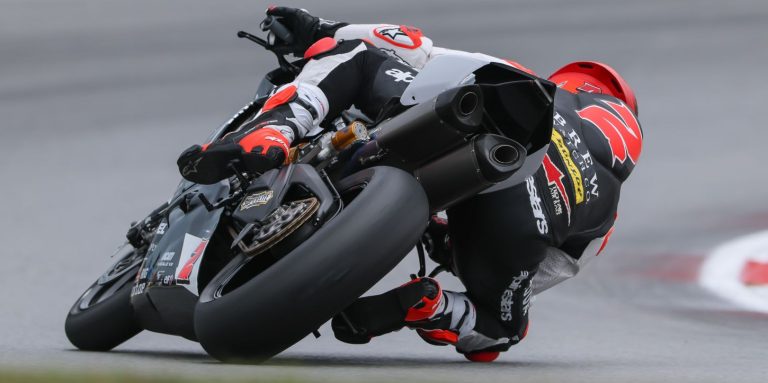
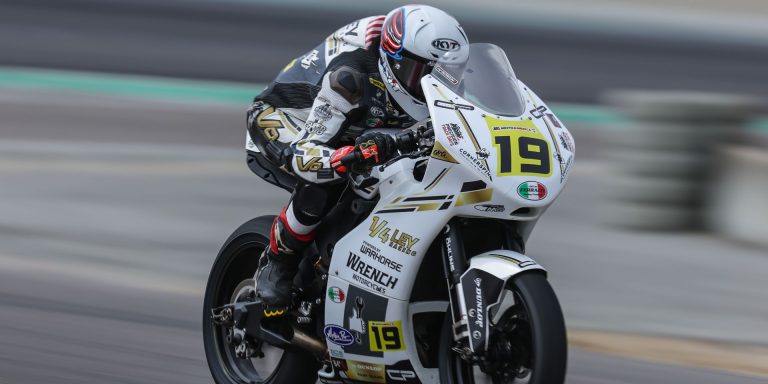
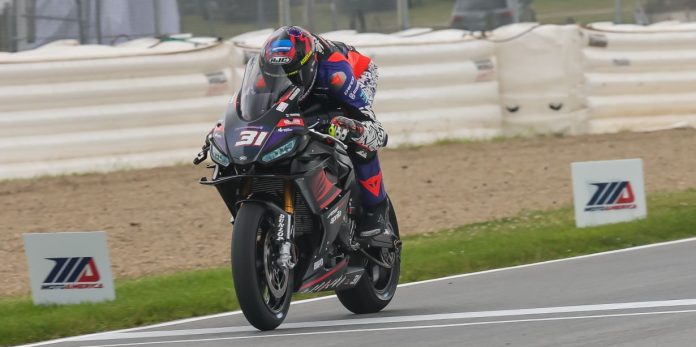
Rahal Ducati Moto with Desnuda Organic Tequila’s Josh Herrin took the provisional MotoAmerica Supersport pole Friday at Virginia International Raceway. Celtic/Economy Lube + Tire/Warhorse’s Darryn Binder, Rahal Ducati Moto with Droplight’s Kayla Yaakov, M4 ECSTAR Suzuki’s Tyler Scott and Rahal Ducati Moto with Roller Die & Forming’s Alessandro Di Mario followed in second through fifth.
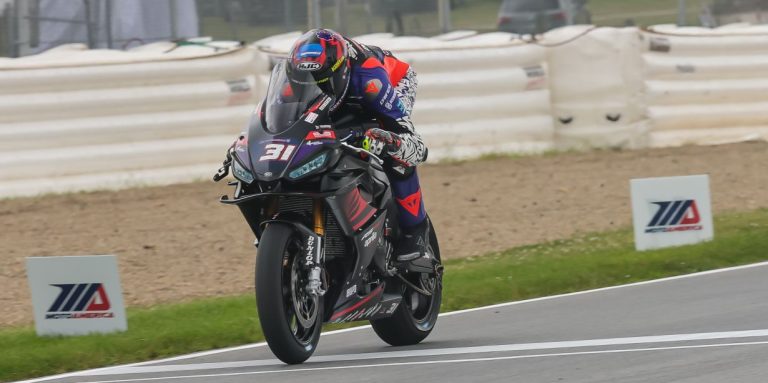
Robem Engineering’s Hank Vossberg was just quick enough to take the MotoAmerica Twins Cup provisional pole on Friday at Virginia International Raceway. Yamaha BLU CRU Estenson Racing’s Sam Drane was 0.072 seconds behind, with M4 ECSTAR Suzuki’s Matthew Chapin, Karns/TST Industries Racing’s Kevin Olmedo and M4 ECSTAR Suzuki’s Bodie Paige taking third through fifth.
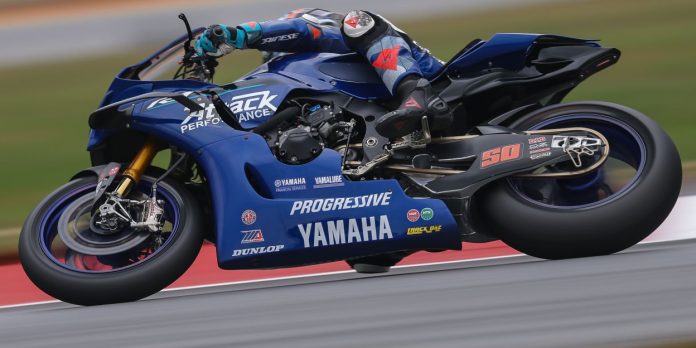
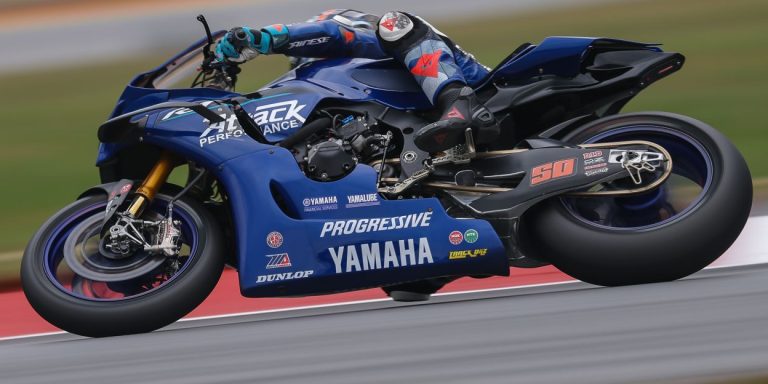
Attack Performance Progressive Yamaha Racing’s Bobby Fong was fastest Friday at Virginia International Raceway in MotoAmerica Quad Lock Superbike practice. Strack Racing’s Mathew Scholtz, OrangeCat Racing’s Sean Dylan Kelly, Attack Performance Progressive Yamaha Racing’s JD Beach and M4 ECSTAR Suzuki’s Richie Escalante followed in second through fifth.
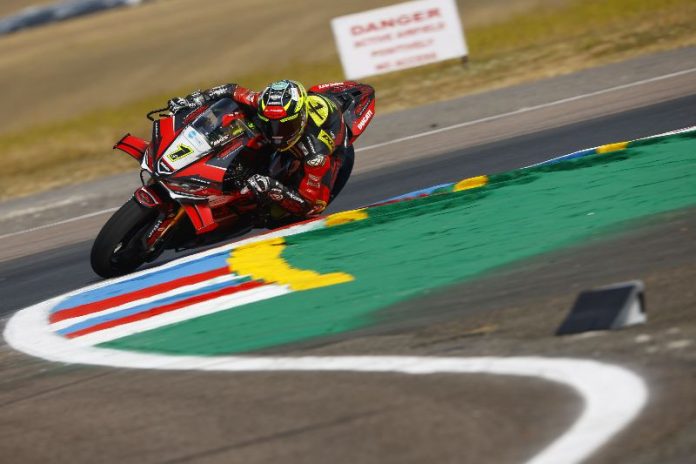
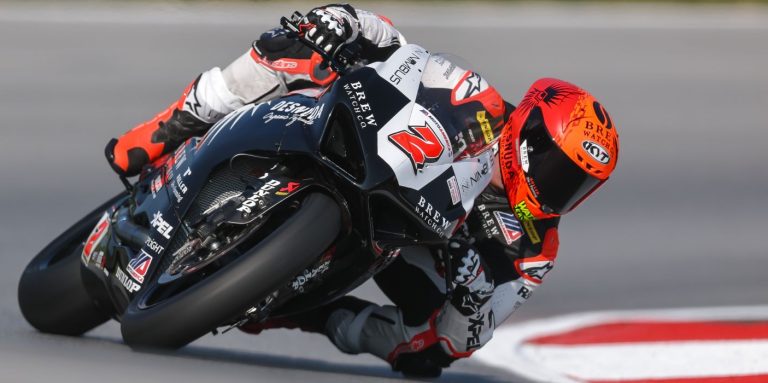
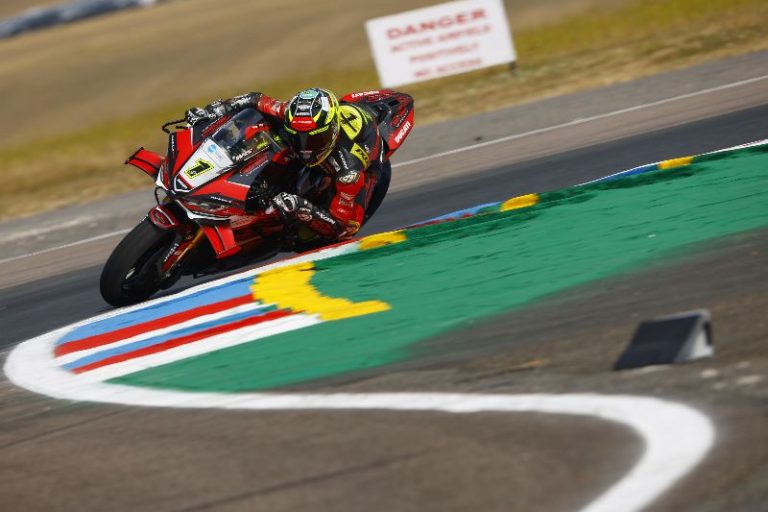
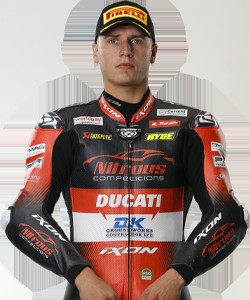
Defending champion Kyle Ryde set a scorching time inside the existing lap record at Thruxton to lead his rivals in the British Superbike Championship Pre-Qualifying session ahead of tomorrow’s race day, holding off Max Cook and Scott Redding on the opening day.
Ryde turned up the heat in the final session of the day, to slash 0.125s off the existing lap record and move back ahead of Cook and Redding.
Meanwhile, Leon Haslam had been leading the second Free Practice session, but he will now need to go through tomorrow’s ROKiT Oxygen Performance Qualifying 1 after he missed out on a place in the top 12 by 0.024s.
Joe Talbot had an impressive performance on the second AJN Steelstock bimota in fourth place as he continues his rookie season, holding off the Yamaha charge that was led by Rory Skinner on the Cheshire Mouldings Yamaha.
Christian Iddon split the teammates for the Sencat Racing Yamaha team, with Danny Kent claiming sixth place just ahead of Ryan Vickers who denied Bradley Ray a place inside the top eight for the McAMS Yamaha team.
Jason O’Halloran, Lee Jackson and Ilya Mikhalchik completed the top 12 riders through to tomorrow’s ROKiT Oxygen Performance Qualifying 2 session ahead of race one.
British Superbike Championship, Thruxton, Pre Qualifying result:
“It is obviously a different bike coming here this year, but for me, some of the characteristics were the same and I do feel the rider can make a difference around here too with how you make the bike feel.
“I have just tried to do what I experienced on the Yamaha; it took me a few years to figure it out – it has not been easy but we have had a good day.
“We have changed very little on the bike; we didn’t do a long run but we did a lot of time on one tyre and it has been the same the last five years; if you can nip into the 1m:15s at the end of the race you are normally on the podium and we wasn’t far off that.
“Nobody has got the pace to say they will win the race yet, but it has been a good day and that last lap was a bonus.
“The bike works well but like Max Cook said, it is the race that counts.”
Rahal Ducati Moto with Desnuda Organic Tequila’s Josh Herrin was fastest Friday in MotoAmerica Supersport practice at Virginia International Raceway. BPR Racing Yamaha’s Joshua Hayes, Rahal Ducati Moto with Roller Die & Forming’s Alessandro Di Mario, MP13 Racing/One Cure Racing’s Joseph LiMandri Jr. and Rahal Ducati Moto with Droplight’s Kayla Yaakov followed in second through fifth.
Quarterley Racing’s Nathan Gouker was fastest in MotoAmerica Talent Cup practice on Friday at Virginia International Raceway. Quarterley Racing’s Sam Drane, Team Roberts’ Kensei Matsudaira, Bettencourt Racing’s Nathan Bettencourt and Team Hammer’s Jake Paige followed in second through fifth.
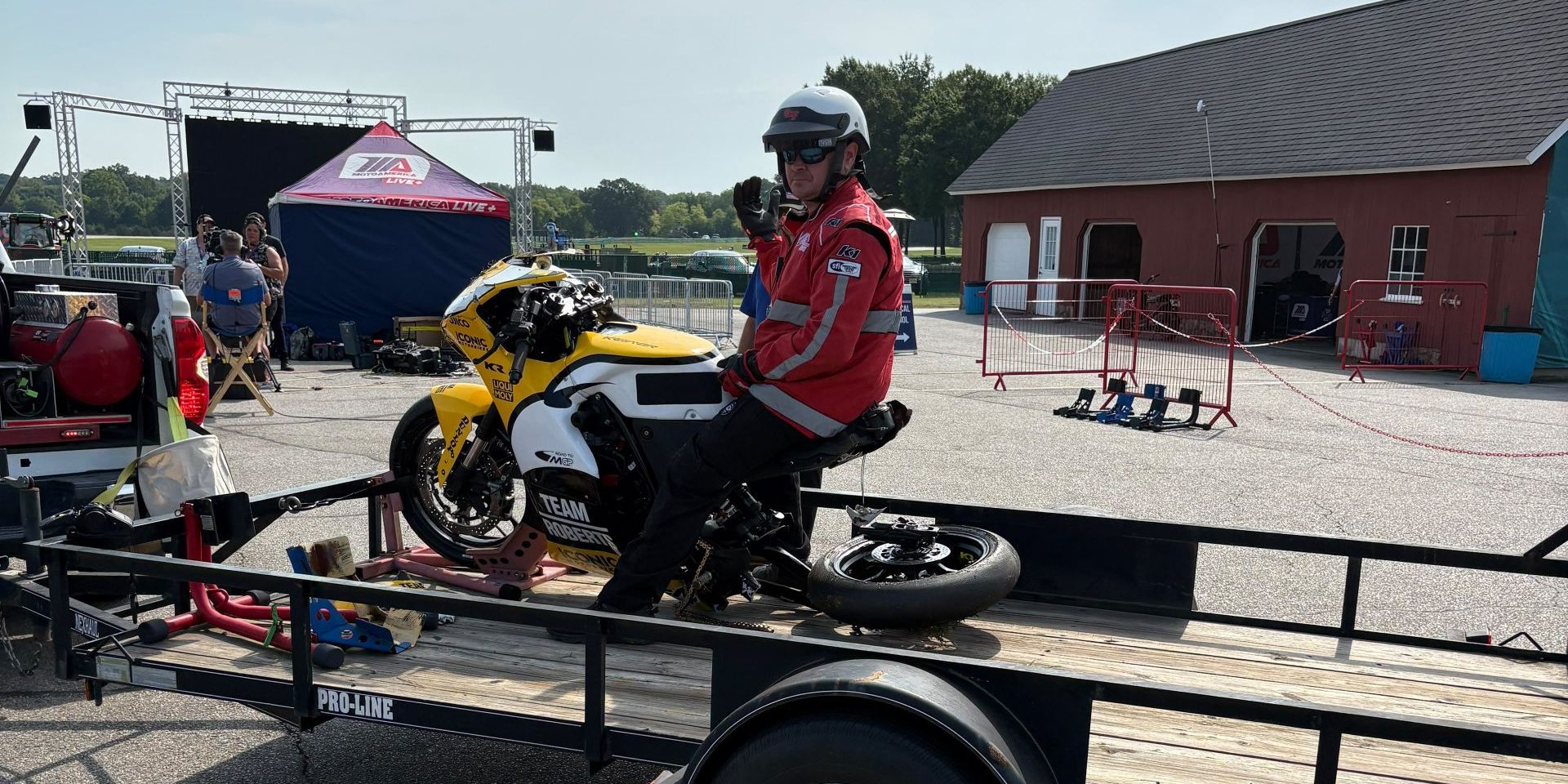
Kensei Matsudaira’s bike after he crashed in MotoAmerica Talent Cup practice on Friday at VIR.
Robem Engineering’s Hank Vossberg was fastest in MotoAmerica Twins Cup practice on Friday at Virginia International Raceway. Yamaha BLU CRU Estenson Racing’s Sam Drane, M4 ECSTAR Suzuki’s Matthew Chapin, teammate Bodie Paige and Team Roberts’ Kensei Matsudaira followed in second through fifth.
Part 4 of a series, reprinted from the April 2011 edition of Roadracing World & Motorcycle Technology Magazine. Copyright 2011, 2015, 2020, 2024. All rights reserved. www.roadracingworld.com
First Person/Opinion: What I Have Learned
By John Ulrich
Kids who really want to race are going to race sooner or later, one way or another. They may have to wait until they turn 18 (like I did), scrounge up second-rate safety gear and jump on some poorly-prepared, ill-handling pile of junk they put together themselves or get from somebody else, but they will race. If you’re a parent and you can, you’re better off accepting that fact and doing what you can to help your kid race as safely as possible, with the best gear and best-prepared, most reliable racebike you can get your hands on.
Chris Ulrich watches from his mother Trudy’s arms as John Ulrich and mechanic Ken Hoogland share a bottle of champagne after an six-hour win at Loudon, New Hampshire, in 1981.
Not all kids want to race. I have four kids. One wanted to be a racer from before he was five years old. The other three had other interests. Nobody can keep a racer from racing. Nobody can make anybody who doesn’t want to race, race. Don’t even try it.
Mini-clubs holding events on kart tracks are excellent places for kids to start racing, riding small-displacement miniature motorcycles like a Honda NSR50 or a converted-to-pavement-use small dirt bike. The parents of many young racers have found that access to racing makes an excellent carrot, providing very strong motivation for a kid to act right and do well in school. Racing can also help teach important life lessons, including being where you are supposed to be, when you are supposed to be there. For example, if you’re not on the grid in time, race officials are not going to wait for you before throwing the green flag.
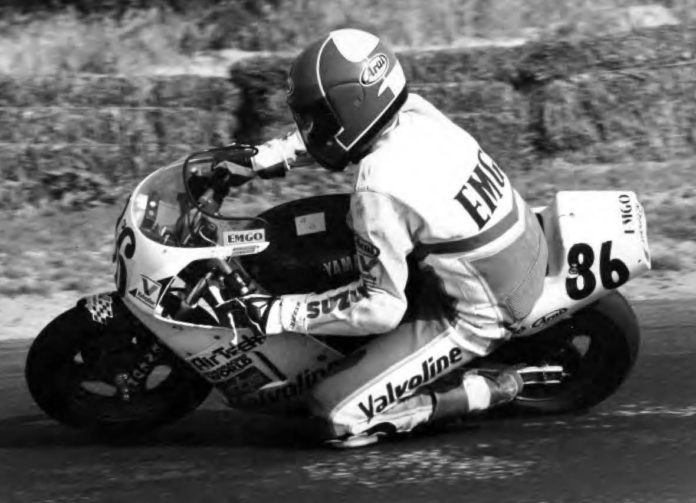
Chris Ulrich (86) on a YSR50 at a kart track in California in 1993.
Kids need a Plan B. Very few young racers will actually be able to make a career out of racing. They may have a lot of fun, make great friends and learn valuable life lessons, but turning racing into a paying profession is an extreme long shot. They need a back-up plan, and that starts with doing well in school and learning a trade or profession.
Kids are going to get hurt, whether you let them race or not. One of my kids rode his bicycle out into the street and got hit by a car when he was seven, suffering internal injuries and spending six weeks in the hospital. One of my daughters fell and crashed into the piano while running shoe-less in the house at age five, trying to make the corner between the living room and the hallway, and broke an ankle—five minutes after I told her for the millionth time not to run in the house. My other son broke his first bone riding a Yamaha YSR50 on a kart track, after he asked me how to do a plug chop and I neglected to add, “make sure you do the plug chop early enough on the front straight that you still have room to brake normally and make the pit entrance without flying end-over-end into a chain-link fence.”
If an ambulance delivers your seven-year-old after he’s been hit by a car and he has internal bleeding, nobody at the hospital will blame you for the kid getting hurt. If you bring your five-year-old daughter into the emergency room with a broken ankle and tell the doctors that she fell while running in the house and hit a piano, you won’t get too much grief from doctors and nurses. If you show up with a 13-year-old boy who crashed his YSR50 on a mini-bike track (while trying to do a plug chop) and broke his arm, you will get a lot of grief. The parents of a 13-year-old girl who is in the emergency room at the same time and has almost the identical arm injury—but suffered when she fell into a hot-tub while running on wet concrete—will not get any grief.
Exactly what a kid starts racing on doesn’t matter as much as it matters that the bike be well prepared and safe to ride, with no parts falling off or critical systems failing at the wrong time. If the brakes don’t work right, the throttle sticks open or the chain is prone to falling off, making laps without incident becomes a lot more difficult, especially for a youngster. Don’t worry about buying the fastest bike or getting more horsepower out of the bike you have for a beginning racer. Worry about making sure the bike works right, handles well and has good tires on it.
Racing is a lot like playing the piano. The more practice you get, the easier it is to do. The more laps a kid makes on the racetrack, the easier it is for them to race, and the easier it is for them to improve.
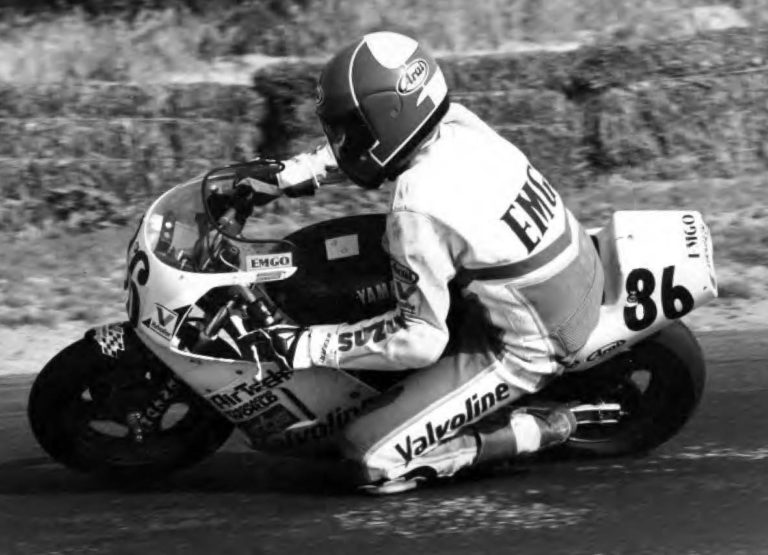
Chris Ulrich (86) on a Moriwaki MH80R at Perris Raceway in 1993.
Don’t be in a hurry to move a kid up. It’s a big jump from something like a Honda NSR50 to a Honda RS125 or a Moriwaki MD250H. It’s an even bigger jump between a 125cc GP bike like the RS125 and a 600cc Supersport bike, in every way: Physical size, weight, horsepower and sheer speed. The fastest I ever got a 150-pound Honda RS125 going was 124 mph (based on gearing and rpm). A 370-pound 600cc Supersport bike will push over 175 mph under the right conditions, and is a lot easier to crash. Lots of very successful riders have come up through two-stroke 50cc, 80cc, 125cc and 250cc purpose-built racebikes before making the move to larger, four-cylinder four-stroke racebikes. These days, riding a 650cc twin-cylinder four-stroke is a lot more common (and practical) than riding a 250cc two-stroke, but serves the same purpose. The same is true of racing a four-stroke Moriwaki MD250H instead of a two-stroke Honda RS125. And it’s OK to keep a young rider in a given class until they can run at or near the front consistently.
Chris Ulrich (86) on a Honda RS125 at Daytona in 1997. Photo by Brian J. Nelson.
Kids tend to pressurize themselves at the races, and the bigger the races and the faster the bikes, the more that can be a problem. The last thing they need is an adult adding to the pressure by telling them they better go faster or that they have to win. I try to keep kids calm and encourage them to work on incremental improvements in their riding during the course of a race weekend.
Big, professional event weekends that host races for young kids must be approached with caution. Too many parents of kids entered in races held at big events seem to think that it is their kid’s one and only chance at a lucrative career, and that he or she better perform well in front of all the professional team managers at the track.
But in reality nothing any young kid does on any given day is going to land them a professional ride or any extra support of any type, and the only people who really care about where a kid finishes already know the riders involved. In my opinion, a lot of kids are better off racing and honing their skills as part of a club weekend, without a big crowd and without the self-imposed (or parental) pressure that comes from racing during a pro race weekend.
Kids and their parents shouldn’t even think about racing at big events until the kid is mature enough to handle pressure, create reasonable expectations for themselves and deal with disappointment without throwing a fit. Kids will be better prepared and will get better results if they figure out how to race, get used to their racebike and learn racetracks at club or regional events.
Chris Ulrich being interviewed by Richard Chambers after qualifying on pole and finishing second in a NASB 125cc Grand Prix race at Daytona International Speedway, 1997.
Some race weekends are going to be a lot more fun than others, and some race weekends are just going to be bad. Kids need to know that up front, and to realize that one frustrating race or one bad race weekend is not the end of the world. Once during an AMA Pro weekend at Road America, a 17-year-old who rode for my team hit a bump and crashed out of the lead entering the Carousel on the first lap of one of his races. Then he gridded up and crashed out of the lead of his other race in the same place, on the same bump, also on the first lap. I found him up in the rider’s lounge of my semi-truck, tears running down his face as he sobbed, “I-I-I-I’m s-s-s-s-s-orry.” I told him, “Don’t worry about it, everybody crashes and if everybody didn’t crash, we wouldn’t all have to wear uncomfortable leathers on hot days! It’s OK, we’ll go to the next race and try again.” He went on to win multiple AMA Pro Championships and graduated to a career in the 500cc GP/MotoGP World Championship.
Fast forward to the 2010 AMA Pro weekend at Road America, when 16-year-old Elena Myers (who rode for my team at the time) crashed out of both her races, both times on a bump entering Canada Corner. She wasn’t crying when I found her, she was just mad! Every kid is different, and often, every situation is different.
Sometimes, especially in difficult conditions, all I’ve wanted to do is to see a kid finish a race on two wheels so we could regroup and come back to race on another—better—day.
Chris Ulrich (52) on a Yamaha TZ250 in AMA Pro 250cc Grand Prix at Las Vegas, 1998. Photo by Brian J. Nelson.
One young rider who rode for me in the 1990s was crashing way too much, sometimes three times a weekend. “Don’t even try to win,” I finally told him. “Don’t even worry about going fast. Just remember why we all started riding motorcycles—because it was fun. Go back to that, and concentrate on having fun.” He was finally able to do that, and suddenly he was finishing on the podium in every race he entered. He went on to a fabulous career in AMA Pro Superbike.
Another very nice, polite kid who rode for me not only crashed way too much, but worse still, he kept getting hurt, usually suffering a concussion and often breaking major bones. No matter what I told him, he kept crashing, and he kept getting hurt. I tried everything. I told him not to worry about results. I told him just to have fun. I even told him that the last thing I wanted to see was him getting carted off in the ambulance again after he crashed one of my bikes. Nothing worked. I finally figured out what was happening by talking to the kid’s friends. As soon as I finished telling the kid to have fun and left the immediate vicinity, his stepfather would tell him that this was his one and only chance for a professional career, and that he better go out there and go fast right now. He left the team, ended up estranged from his stepfather, and finally quit racing altogether.
Nothing good comes from crashing. One year I had two riders in AMA Pro who each averaged one crash for every 1400 racetrack miles they covered. My third rider averaged one crash every 200 racetrack miles, and a friend of mine had a kid who may have set a world record with an average of one crash every 50 racetrack miles! Whether it’s a race or a qualifying session or a practice session, finishing on two wheels counts!
I’ve always been on the lookout for talented young riders. One of the ways I used to scout new riders was to ride with them on the racetrack. One time I was racing a Honda RS125 in a WSMC Formula Three race at Willow Springs and found myself involved in a pitched battle with a 14-year-old on another RS125. The kid wasn’t very heavy and was able to out-accelerate me in a straight line, but I used every trick I knew to stay in touch with him. A few laps from the finish, I worked especially hard at going wider, turning, and getting back to full throttle and under the bubble while he was still running around at partial throttle on the inside of the final turn on the track. I’d roll off a little to keep from passing him at the line and tipping him off. On the last lap I set up for the corner and timed everything perfectly, sailing past him just before the finish line. After I came in and took off my helmet, I went over to where he was pitted to explain to him what I had done and why it had worked. As I walked around the corner of the trailer he was pitted out of, his father was yelling at him, “Why did you let that old man beat you?” I just turned and walked away, but I felt bad for the kid—and for the dad, who had missed a perfect opportunity for the kid to learn something that could have made him a better racer.
These days I rely on my son Chris Ulrich—the 13-year-old with the plug-chop problem mentioned earlier, now a seasoned AMA Pro Superbike rider—to do my on-track scouting; his reports were key in my decision to sign Martin Cardenas in 2007, as a replacement for an injured rider on my team. He won 25 AMA Pro Supersport and Superbike races, two AMA Pro Championships, and an FIM Latin American Supersport Championship on my bikes before continuing his career in a World Championship series.
Another way I have scouted riders is to watch them from trackside, and to look at their stats, compiled by pouring through AMA Pro Racing timing and scoring data and by looking at MyLaps.com AMB transponder reports from races. I’m less interested in seeing a single fast lap than I am in seeing consistent fast laps and an improving trend during a race weekend and during a race season. I also try to judge a rider’s lap times and results against my evaluation of their equipment and their crew.
First AMA Pro podium finish, 250cc Grand Prix at Road Atlanta, 1999. Photo by Brian J. Nelson.
After winning the Suzuki GSX-R1000 Cup Final during the WERA GNF at Road Atlanta, 2001.
Over the years I’ve worked with dozens of very young racers in one way or another, and I’m proud that I was able to help launch several into fantastic careers. Some people seem to resent that my own son was among the riders I’ve helped race. I’ve never really understood why some critics think it was OK for me to spend my own money to help Mrs. Hopkins’ 15-year-old kid John or Mrs. Spies’ 15-year-old kid Ben or Mr. and Mrs. Myers’ 12-year-old kid Elena or Mr. & Mrs. Solis’ 13-year-old kid Benny, but not OK for me to help Mr. and Mrs. Ulrich’s 13-year-old kid Chris.
Chris Ulrich, getting a hug from his dad after taking his career-first AMA Pro race win in 750cc Supersport at Laguna Seca in 2001.
But it doesn’t matter what anybody else thinks: I’d do it all over again. I had a lot of fun taking Chris racing and watching him progress from winning on a Yamaha YSR50 and on a Moriwaki MH8OR at CMRRA races held on kart tracks; to winning WERA National Challenge Series races on a Honda RS125; to finishing third in the AMA Pro 250cc Grand Prix Championship on a Yamaha TZ250; to becoming the first (and only) second-generation overall WERA National Endurance Champion; to winning AMA Pro Nationals on a GSX-R and becoming a team owner and manager in his own right.
One thing that was I completely unprepared for, was discovering that when your own kid does well in racing, it feels 10 times better than anything you ever accomplished in racing yourself. I found that out the first time Chris won a minibike race, and when he won his first AMA Pro National race, it completely blew me away.
It’s been a wild ride taking kids racing, including one of my own. For the most part, it’s also been incredibly rewarding, and I wouldn’t have missed it for anything.
(Editorial Note: Chris Ulrich retired from racing in MotoAmerica Superbike in 2016 and now manages his family’s professional team, Team Hammer, Inc., racing as M4 ECSTAR Suzuki.)
Chris Ulrich’s ninth AMA Pro National podium finish, Barber Motorsports Park, 1000cc Superstock, 2008.
Chris Ulrich (18) racing a Suzuki GSX-R1000 in AMA Pro Superbike at New Jersey Motorsports Park, 2010. Photo by Andrea Wilson.
Former AMA Pro and CSS Coach Misti Hurst Launches “Discovering the Art of Cornering” Featuring Keith Code Foreword and Special Scholarship Fund
– Limited special signed editions contribute to rider training fund.
VANCOUVER, BC — Street riders and track enthusiasts looking to master cornering dynamics have a new definitive guide.
Following a highly successful Kickstarter campaign and massive pre-sale momentum, former AMA Supersport racer, CSS Coach, moto-journalist, mom, and now author Misti Hurst has officially announced the US market release of Discovering the Art of Cornering, the foundational first installment of the new Life in the Fast Lane motorcycle book series.
The book features an exclusive foreword written by motorcycle training legend Keith Code, as well as a comprehensive interview.
The launch is accompanied by high-profile validation from Code himself, founder of the California Superbike School (CSS). Holding the newly released book, Code states, “You need to read this book. The straight dope is in here for you—it’s worth it.”
Discovering the Art of Cornering bridges the complex gap between riding physics and real-world street application, with foundational crossover skills for the track. Written with an unapologetic, simple and direct approach to building confidence and safety, the book targets the exact mechanics required to master bike placement, manage traction limits, and execute better cornering.
By pairing structured training concepts with real-world examples and stories from racing and coaching around the globe, the book acts as a comprehensive masterclass in high-performance street and track riding.
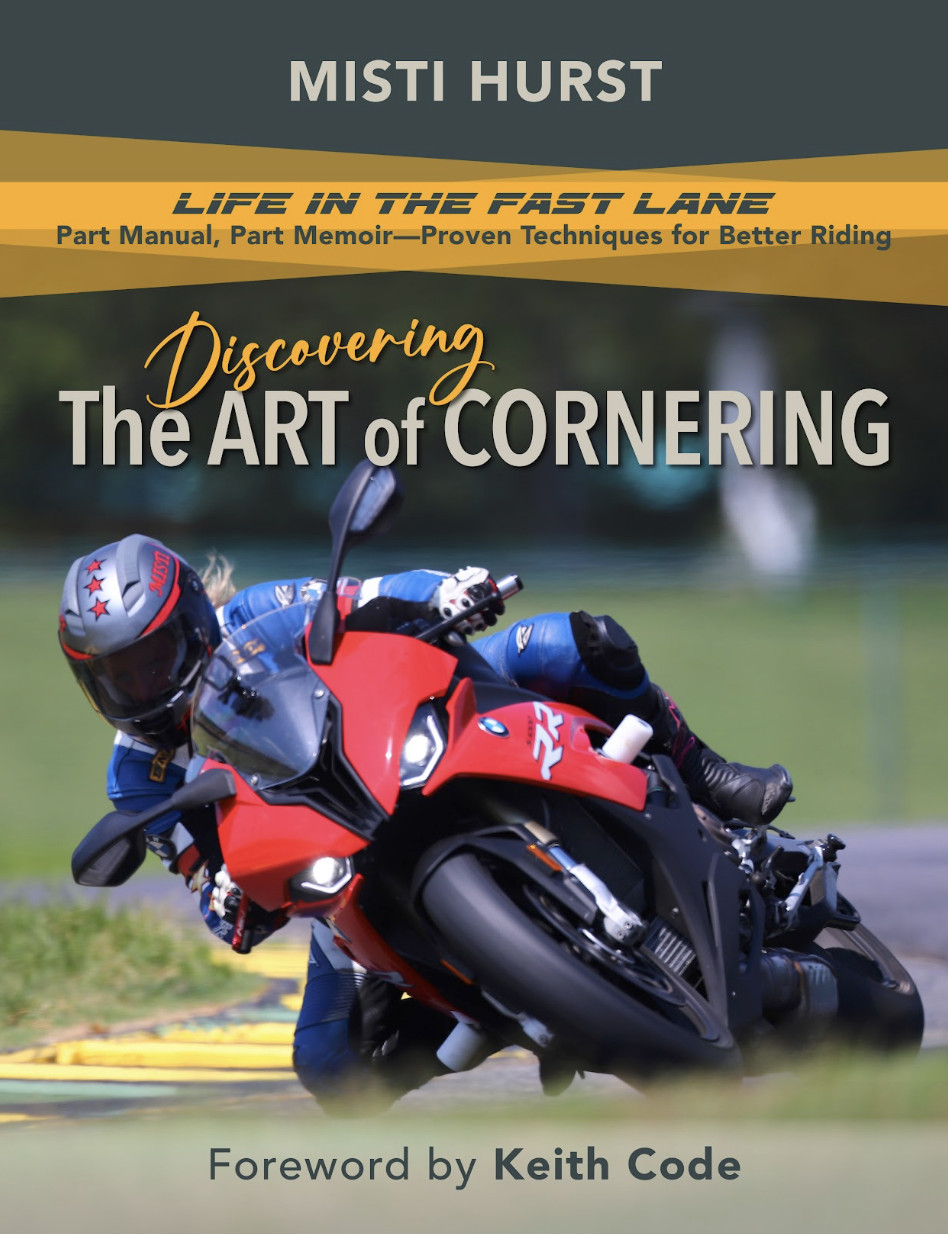
Final cover of “Life in the Fast Lane: Discovering the Art of Cornering” from Misti Hurst. Photo courtesy Misti Hurst.
Fast US Shipping and Rare “Tipped-In” Limited Editions
Backed by strong Kickstarter funding, a Project We Love Badge, and early pre-sale success, inventory is fully stocked and available for immediate, rapid shipping turnaround across the United States. (International and Canadian orders are currently being processed and will follow on a slightly longer timeline).
Alongside the standard US softcover ($34.95 USD) and hardcover ($49.95 USD) distributions, a highly restricted run of premium Limited Editions is available. These exclusive collector’s copies feature custom, artisan “tipped-in” signature sheets meticulously hand-bound and numbered by Misti into the front matter:
The Dual-Signed Scholarship Edition ($215 USD): Hand-signed by both Keith Code and Misti Hurst. Restricted to just 150 total copies worldwide, only 93 copies remain available. Every single purchase sends $36 USD directly to the scholarship fund.
The Single- Signed Scholarship Edition ($155 USD): Hand-signed and numbered by Misti Hurst. Limited to 250 total copies, with only about 150 remaining. Each copy sends $18 USD directly to the scholarship fund.
The Forever 45 Peter Lenz Scholarship Fund
More than just an instructional manual, the Life in the Fast Lane series is actively driving the future of the sport through its dedicated charitable initiative:
The Forever 45 Peter Lenz Scholarship Fund.
Fueled by book sales and community backing, the fund has already successfully raised enough capital to send its first recipient, a rider named Rachel, to the California Superbike School for a full day of elite, professional track instruction. Furthermore, a matching sponsor has already stepped up to fully fund a second rider’s tuition. The project is actively seeking additional corporate and community track sponsors to expand these life-saving training opportunities to even more riders.
A Look Ahead: “Track Minded”
As riders master the street fundamentals found in volume one, the series will pivot to closed-circuit performance. The highly anticipated second book in the series, Track Minded, is currently in development. Focusing entirely on advanced racing psychology, track layout mastery, and next-level high-speed riding, pre-orders for the sequel are expected to open by the end of the year.
“Riders are constantly bombarded with confusing, conflicting advice given without reasons why,” says Hurst. “This first book was written to cut through the noise, give riders the exact, simple tools they need to ride better, safer and faster, and directly fund real-world education for the next generation through Peter’s legacy.”
Discovering the Art of Cornering is available for immediate US shipping, international orders, and instant e-Book download through www.mistihurst.com
IOneMoto owner, Fred Baly, the home of SharkSkinz, Catalyst, TighTails, SE Moto & Fast Frank Racing has purchased the iconic Chicken Hawk Racing brand, has now taken the helm and will be focused on shifting the brand and products into High Gear.
Founded in 1993, Chicken Hawk Racing Tire Warmers has been at the forefront of Tire Warming Technology, the brands Tire Warmers have been a part of 16 World Championships and dozens of National Championships.
The Tire Warmers came first, but industrial clients in the aerospace, semi-conductor, bio-medical and Military sectors kept coming to the company asking for custom heating solutions.Those clients’ projects allowed the company’s technology to achieve a much more sophisticated heater, leading to Chicken Hawk Racing’s long-lasting success.
Chicken Hawk Racing founder, David Podolsky, said “we are thrilled to have Fred take over the brand as he has a great manufacturing and technical background as well as being a motorcyclist!The Motorsports Market needs someone who is involved and understands the motorcycles, the Racers and Track Day Riders.Our company was just growing more and more into industrial sectors and we could not give the Motorsports side the attention it deserved.We will be working along with Fred for the next few years assisting in all aspects needed to ensure the brand emerges stronger than ever”.
Contact Chicken Hawk Racing Tire Warmers for all your Tire Warming needs at: [email protected] or call (772) 388-9621
Rahal Ducati Moto with Desnuda Organic Tequila’s Josh Herrin took the provisional MotoAmerica Supersport pole Friday at Virginia International Raceway. Celtic/Economy Lube + Tire/Warhorse’s Darryn Binder, Rahal Ducati Moto with Droplight’s Kayla Yaakov, M4 ECSTAR Suzuki’s Tyler Scott and Rahal Ducati Moto with Roller Die & Forming’s Alessandro Di Mario followed in second through fifth.
Robem Engineering’s Hank Vossberg was just quick enough to take the MotoAmerica Twins Cup provisional pole on Friday at Virginia International Raceway. Yamaha BLU CRU Estenson Racing’s Sam Drane was 0.072 seconds behind, with M4 ECSTAR Suzuki’s Matthew Chapin, Karns/TST Industries Racing’s Kevin Olmedo and M4 ECSTAR Suzuki’s Bodie Paige taking third through fifth.
Attack Performance Progressive Yamaha Racing’s Bobby Fong was fastest Friday at Virginia International Raceway in MotoAmerica Quad Lock Superbike practice. Strack Racing’s Mathew Scholtz, OrangeCat Racing’s Sean Dylan Kelly, Attack Performance Progressive Yamaha Racing’s JD Beach and M4 ECSTAR Suzuki’s Richie Escalante followed in second through fifth.
Defending champion Kyle Ryde set a scorching time inside the existing lap record at Thruxton to lead his rivals in the British Superbike Championship Pre-Qualifying session ahead of tomorrow’s race day, holding off Max Cook and Scott Redding on the opening day.
Ryde turned up the heat in the final session of the day, to slash 0.125s off the existing lap record and move back ahead of Cook and Redding.
Meanwhile, Leon Haslam had been leading the second Free Practice session, but he will now need to go through tomorrow’s ROKiT Oxygen Performance Qualifying 1 after he missed out on a place in the top 12 by 0.024s.
Joe Talbot had an impressive performance on the second AJN Steelstock bimota in fourth place as he continues his rookie season, holding off the Yamaha charge that was led by Rory Skinner on the Cheshire Mouldings Yamaha.
Christian Iddon split the teammates for the Sencat Racing Yamaha team, with Danny Kent claiming sixth place just ahead of Ryan Vickers who denied Bradley Ray a place inside the top eight for the McAMS Yamaha team.
Jason O’Halloran, Lee Jackson and Ilya Mikhalchik completed the top 12 riders through to tomorrow’s ROKiT Oxygen Performance Qualifying 2 session ahead of race one.
British Superbike Championship, Thruxton, Pre Qualifying result:
“It is obviously a different bike coming here this year, but for me, some of the characteristics were the same and I do feel the rider can make a difference around here too with how you make the bike feel.
“I have just tried to do what I experienced on the Yamaha; it took me a few years to figure it out – it has not been easy but we have had a good day.
“We have changed very little on the bike; we didn’t do a long run but we did a lot of time on one tyre and it has been the same the last five years; if you can nip into the 1m:15s at the end of the race you are normally on the podium and we wasn’t far off that.
“Nobody has got the pace to say they will win the race yet, but it has been a good day and that last lap was a bonus.
“The bike works well but like Max Cook said, it is the race that counts.”
Rahal Ducati Moto with Desnuda Organic Tequila’s Josh Herrin was fastest Friday in MotoAmerica Supersport practice at Virginia International Raceway. BPR Racing Yamaha’s Joshua Hayes, Rahal Ducati Moto with Roller Die & Forming’s Alessandro Di Mario, MP13 Racing/One Cure Racing’s Joseph LiMandri Jr. and Rahal Ducati Moto with Droplight’s Kayla Yaakov followed in second through fifth.
Quarterley Racing’s Nathan Gouker was fastest in MotoAmerica Talent Cup practice on Friday at Virginia International Raceway. Quarterley Racing’s Sam Drane, Team Roberts’ Kensei Matsudaira, Bettencourt Racing’s Nathan Bettencourt and Team Hammer’s Jake Paige followed in second through fifth.
Kensei Matsudaira’s bike after he crashed in MotoAmerica Talent Cup practice on Friday at VIR.
Robem Engineering’s Hank Vossberg was fastest in MotoAmerica Twins Cup practice on Friday at Virginia International Raceway. Yamaha BLU CRU Estenson Racing’s Sam Drane, M4 ECSTAR Suzuki’s Matthew Chapin, teammate Bodie Paige and Team Roberts’ Kensei Matsudaira followed in second through fifth.
Chris Ulrich (86) on a YSR50 at a kart track in California, 1993.
Part 4 of a series, reprinted from the April 2011 edition of Roadracing World & Motorcycle Technology Magazine. Copyright 2011, 2015, 2020, 2024. All rights reserved. www.roadracingworld.com
First Person/Opinion: What I Have Learned
By John Ulrich
Kids who really want to race are going to race sooner or later, one way or another. They may have to wait until they turn 18 (like I did), scrounge up second-rate safety gear and jump on some poorly-prepared, ill-handling pile of junk they put together themselves or get from somebody else, but they will race. If you’re a parent and you can, you’re better off accepting that fact and doing what you can to help your kid race as safely as possible, with the best gear and best-prepared, most reliable racebike you can get your hands on.
Chris Ulrich watches from his mother Trudy’s arms as John Ulrich and mechanic Ken Hoogland share a bottle of champagne after an six-hour win at Loudon, New Hampshire, in 1981.
Not all kids want to race. I have four kids. One wanted to be a racer from before he was five years old. The other three had other interests. Nobody can keep a racer from racing. Nobody can make anybody who doesn’t want to race, race. Don’t even try it.
Mini-clubs holding events on kart tracks are excellent places for kids to start racing, riding small-displacement miniature motorcycles like a Honda NSR50 or a converted-to-pavement-use small dirt bike. The parents of many young racers have found that access to racing makes an excellent carrot, providing very strong motivation for a kid to act right and do well in school. Racing can also help teach important life lessons, including being where you are supposed to be, when you are supposed to be there. For example, if you’re not on the grid in time, race officials are not going to wait for you before throwing the green flag.
Chris Ulrich (86) on a YSR50 at a kart track in California in 1993.
Kids need a Plan B. Very few young racers will actually be able to make a career out of racing. They may have a lot of fun, make great friends and learn valuable life lessons, but turning racing into a paying profession is an extreme long shot. They need a back-up plan, and that starts with doing well in school and learning a trade or profession.
Kids are going to get hurt, whether you let them race or not. One of my kids rode his bicycle out into the street and got hit by a car when he was seven, suffering internal injuries and spending six weeks in the hospital. One of my daughters fell and crashed into the piano while running shoe-less in the house at age five, trying to make the corner between the living room and the hallway, and broke an ankle—five minutes after I told her for the millionth time not to run in the house. My other son broke his first bone riding a Yamaha YSR50 on a kart track, after he asked me how to do a plug chop and I neglected to add, “make sure you do the plug chop early enough on the front straight that you still have room to brake normally and make the pit entrance without flying end-over-end into a chain-link fence.”
If an ambulance delivers your seven-year-old after he’s been hit by a car and he has internal bleeding, nobody at the hospital will blame you for the kid getting hurt. If you bring your five-year-old daughter into the emergency room with a broken ankle and tell the doctors that she fell while running in the house and hit a piano, you won’t get too much grief from doctors and nurses. If you show up with a 13-year-old boy who crashed his YSR50 on a mini-bike track (while trying to do a plug chop) and broke his arm, you will get a lot of grief. The parents of a 13-year-old girl who is in the emergency room at the same time and has almost the identical arm injury—but suffered when she fell into a hot-tub while running on wet concrete—will not get any grief.
Exactly what a kid starts racing on doesn’t matter as much as it matters that the bike be well prepared and safe to ride, with no parts falling off or critical systems failing at the wrong time. If the brakes don’t work right, the throttle sticks open or the chain is prone to falling off, making laps without incident becomes a lot more difficult, especially for a youngster. Don’t worry about buying the fastest bike or getting more horsepower out of the bike you have for a beginning racer. Worry about making sure the bike works right, handles well and has good tires on it.
Racing is a lot like playing the piano. The more practice you get, the easier it is to do. The more laps a kid makes on the racetrack, the easier it is for them to race, and the easier it is for them to improve.
Chris Ulrich (86) on a Moriwaki MH80R at Perris Raceway in 1993.
Don’t be in a hurry to move a kid up. It’s a big jump from something like a Honda NSR50 to a Honda RS125 or a Moriwaki MD250H. It’s an even bigger jump between a 125cc GP bike like the RS125 and a 600cc Supersport bike, in every way: Physical size, weight, horsepower and sheer speed. The fastest I ever got a 150-pound Honda RS125 going was 124 mph (based on gearing and rpm). A 370-pound 600cc Supersport bike will push over 175 mph under the right conditions, and is a lot easier to crash. Lots of very successful riders have come up through two-stroke 50cc, 80cc, 125cc and 250cc purpose-built racebikes before making the move to larger, four-cylinder four-stroke racebikes. These days, riding a 650cc twin-cylinder four-stroke is a lot more common (and practical) than riding a 250cc two-stroke, but serves the same purpose. The same is true of racing a four-stroke Moriwaki MD250H instead of a two-stroke Honda RS125. And it’s OK to keep a young rider in a given class until they can run at or near the front consistently.
Chris Ulrich (86) on a Honda RS125 at Daytona in 1997. Photo by Brian J. Nelson.
Kids tend to pressurize themselves at the races, and the bigger the races and the faster the bikes, the more that can be a problem. The last thing they need is an adult adding to the pressure by telling them they better go faster or that they have to win. I try to keep kids calm and encourage them to work on incremental improvements in their riding during the course of a race weekend.
Big, professional event weekends that host races for young kids must be approached with caution. Too many parents of kids entered in races held at big events seem to think that it is their kid’s one and only chance at a lucrative career, and that he or she better perform well in front of all the professional team managers at the track.
But in reality nothing any young kid does on any given day is going to land them a professional ride or any extra support of any type, and the only people who really care about where a kid finishes already know the riders involved. In my opinion, a lot of kids are better off racing and honing their skills as part of a club weekend, without a big crowd and without the self-imposed (or parental) pressure that comes from racing during a pro race weekend.
Kids and their parents shouldn’t even think about racing at big events until the kid is mature enough to handle pressure, create reasonable expectations for themselves and deal with disappointment without throwing a fit. Kids will be better prepared and will get better results if they figure out how to race, get used to their racebike and learn racetracks at club or regional events.
Chris Ulrich being interviewed by Richard Chambers after qualifying on pole and finishing second in a NASB 125cc Grand Prix race at Daytona International Speedway, 1997.
Some race weekends are going to be a lot more fun than others, and some race weekends are just going to be bad. Kids need to know that up front, and to realize that one frustrating race or one bad race weekend is not the end of the world. Once during an AMA Pro weekend at Road America, a 17-year-old who rode for my team hit a bump and crashed out of the lead entering the Carousel on the first lap of one of his races. Then he gridded up and crashed out of the lead of his other race in the same place, on the same bump, also on the first lap. I found him up in the rider’s lounge of my semi-truck, tears running down his face as he sobbed, “I-I-I-I’m s-s-s-s-s-orry.” I told him, “Don’t worry about it, everybody crashes and if everybody didn’t crash, we wouldn’t all have to wear uncomfortable leathers on hot days! It’s OK, we’ll go to the next race and try again.” He went on to win multiple AMA Pro Championships and graduated to a career in the 500cc GP/MotoGP World Championship.
Fast forward to the 2010 AMA Pro weekend at Road America, when 16-year-old Elena Myers (who rode for my team at the time) crashed out of both her races, both times on a bump entering Canada Corner. She wasn’t crying when I found her, she was just mad! Every kid is different, and often, every situation is different.
Sometimes, especially in difficult conditions, all I’ve wanted to do is to see a kid finish a race on two wheels so we could regroup and come back to race on another—better—day.
Chris Ulrich (52) on a Yamaha TZ250 in AMA Pro 250cc Grand Prix at Las Vegas, 1998. Photo by Brian J. Nelson.
One young rider who rode for me in the 1990s was crashing way too much, sometimes three times a weekend. “Don’t even try to win,” I finally told him. “Don’t even worry about going fast. Just remember why we all started riding motorcycles—because it was fun. Go back to that, and concentrate on having fun.” He was finally able to do that, and suddenly he was finishing on the podium in every race he entered. He went on to a fabulous career in AMA Pro Superbike.
Another very nice, polite kid who rode for me not only crashed way too much, but worse still, he kept getting hurt, usually suffering a concussion and often breaking major bones. No matter what I told him, he kept crashing, and he kept getting hurt. I tried everything. I told him not to worry about results. I told him just to have fun. I even told him that the last thing I wanted to see was him getting carted off in the ambulance again after he crashed one of my bikes. Nothing worked. I finally figured out what was happening by talking to the kid’s friends. As soon as I finished telling the kid to have fun and left the immediate vicinity, his stepfather would tell him that this was his one and only chance for a professional career, and that he better go out there and go fast right now. He left the team, ended up estranged from his stepfather, and finally quit racing altogether.
Nothing good comes from crashing. One year I had two riders in AMA Pro who each averaged one crash for every 1400 racetrack miles they covered. My third rider averaged one crash every 200 racetrack miles, and a friend of mine had a kid who may have set a world record with an average of one crash every 50 racetrack miles! Whether it’s a race or a qualifying session or a practice session, finishing on two wheels counts!
I’ve always been on the lookout for talented young riders. One of the ways I used to scout new riders was to ride with them on the racetrack. One time I was racing a Honda RS125 in a WSMC Formula Three race at Willow Springs and found myself involved in a pitched battle with a 14-year-old on another RS125. The kid wasn’t very heavy and was able to out-accelerate me in a straight line, but I used every trick I knew to stay in touch with him. A few laps from the finish, I worked especially hard at going wider, turning, and getting back to full throttle and under the bubble while he was still running around at partial throttle on the inside of the final turn on the track. I’d roll off a little to keep from passing him at the line and tipping him off. On the last lap I set up for the corner and timed everything perfectly, sailing past him just before the finish line. After I came in and took off my helmet, I went over to where he was pitted to explain to him what I had done and why it had worked. As I walked around the corner of the trailer he was pitted out of, his father was yelling at him, “Why did you let that old man beat you?” I just turned and walked away, but I felt bad for the kid—and for the dad, who had missed a perfect opportunity for the kid to learn something that could have made him a better racer.
These days I rely on my son Chris Ulrich—the 13-year-old with the plug-chop problem mentioned earlier, now a seasoned AMA Pro Superbike rider—to do my on-track scouting; his reports were key in my decision to sign Martin Cardenas in 2007, as a replacement for an injured rider on my team. He won 25 AMA Pro Supersport and Superbike races, two AMA Pro Championships, and an FIM Latin American Supersport Championship on my bikes before continuing his career in a World Championship series.
Another way I have scouted riders is to watch them from trackside, and to look at their stats, compiled by pouring through AMA Pro Racing timing and scoring data and by looking at MyLaps.com AMB transponder reports from races. I’m less interested in seeing a single fast lap than I am in seeing consistent fast laps and an improving trend during a race weekend and during a race season. I also try to judge a rider’s lap times and results against my evaluation of their equipment and their crew.
First AMA Pro podium finish, 250cc Grand Prix at Road Atlanta, 1999. Photo by Brian J. Nelson.
After winning the Suzuki GSX-R1000 Cup Final during the WERA GNF at Road Atlanta, 2001.
Over the years I’ve worked with dozens of very young racers in one way or another, and I’m proud that I was able to help launch several into fantastic careers. Some people seem to resent that my own son was among the riders I’ve helped race. I’ve never really understood why some critics think it was OK for me to spend my own money to help Mrs. Hopkins’ 15-year-old kid John or Mrs. Spies’ 15-year-old kid Ben or Mr. and Mrs. Myers’ 12-year-old kid Elena or Mr. & Mrs. Solis’ 13-year-old kid Benny, but not OK for me to help Mr. and Mrs. Ulrich’s 13-year-old kid Chris.
Chris Ulrich, getting a hug from his dad after taking his career-first AMA Pro race win in 750cc Supersport at Laguna Seca in 2001.
But it doesn’t matter what anybody else thinks: I’d do it all over again. I had a lot of fun taking Chris racing and watching him progress from winning on a Yamaha YSR50 and on a Moriwaki MH8OR at CMRRA races held on kart tracks; to winning WERA National Challenge Series races on a Honda RS125; to finishing third in the AMA Pro 250cc Grand Prix Championship on a Yamaha TZ250; to becoming the first (and only) second-generation overall WERA National Endurance Champion; to winning AMA Pro Nationals on a GSX-R and becoming a team owner and manager in his own right.
One thing that was I completely unprepared for, was discovering that when your own kid does well in racing, it feels 10 times better than anything you ever accomplished in racing yourself. I found that out the first time Chris won a minibike race, and when he won his first AMA Pro National race, it completely blew me away.
It’s been a wild ride taking kids racing, including one of my own. For the most part, it’s also been incredibly rewarding, and I wouldn’t have missed it for anything.
(Editorial Note: Chris Ulrich retired from racing in MotoAmerica Superbike in 2016 and now manages his family’s professional team, Team Hammer, Inc., racing as M4 ECSTAR Suzuki.)
Chris Ulrich’s ninth AMA Pro National podium finish, Barber Motorsports Park, 1000cc Superstock, 2008.
Chris Ulrich (18) racing a Suzuki GSX-R1000 in AMA Pro Superbike at New Jersey Motorsports Park, 2010. Photo by Andrea Wilson.
Misti Hurst (5) in action on track. Photo credit ETECHPHOTO
Former AMA Pro and CSS Coach Misti Hurst Launches “Discovering the Art of Cornering” Featuring Keith Code Foreword and Special Scholarship Fund
– Limited special signed editions contribute to rider training fund.
VANCOUVER, BC — Street riders and track enthusiasts looking to master cornering dynamics have a new definitive guide.
Following a highly successful Kickstarter campaign and massive pre-sale momentum, former AMA Supersport racer, CSS Coach, moto-journalist, mom, and now author Misti Hurst has officially announced the US market release of Discovering the Art of Cornering, the foundational first installment of the new Life in the Fast Lane motorcycle book series.
The book features an exclusive foreword written by motorcycle training legend Keith Code, as well as a comprehensive interview.
The launch is accompanied by high-profile validation from Code himself, founder of the California Superbike School (CSS). Holding the newly released book, Code states, “You need to read this book. The straight dope is in here for you—it’s worth it.”
Discovering the Art of Cornering bridges the complex gap between riding physics and real-world street application, with foundational crossover skills for the track. Written with an unapologetic, simple and direct approach to building confidence and safety, the book targets the exact mechanics required to master bike placement, manage traction limits, and execute better cornering.
By pairing structured training concepts with real-world examples and stories from racing and coaching around the globe, the book acts as a comprehensive masterclass in high-performance street and track riding.
Final cover of “Life in the Fast Lane: Discovering the Art of Cornering” from Misti Hurst. Photo courtesy Misti Hurst.
Fast US Shipping and Rare “Tipped-In” Limited Editions
Backed by strong Kickstarter funding, a Project We Love Badge, and early pre-sale success, inventory is fully stocked and available for immediate, rapid shipping turnaround across the United States. (International and Canadian orders are currently being processed and will follow on a slightly longer timeline).
Alongside the standard US softcover ($34.95 USD) and hardcover ($49.95 USD) distributions, a highly restricted run of premium Limited Editions is available. These exclusive collector’s copies feature custom, artisan “tipped-in” signature sheets meticulously hand-bound and numbered by Misti into the front matter:
The Dual-Signed Scholarship Edition ($215 USD): Hand-signed by both Keith Code and Misti Hurst. Restricted to just 150 total copies worldwide, only 93 copies remain available. Every single purchase sends $36 USD directly to the scholarship fund.
The Single- Signed Scholarship Edition ($155 USD): Hand-signed and numbered by Misti Hurst. Limited to 250 total copies, with only about 150 remaining. Each copy sends $18 USD directly to the scholarship fund.
The Forever 45 Peter Lenz Scholarship Fund
More than just an instructional manual, the Life in the Fast Lane series is actively driving the future of the sport through its dedicated charitable initiative:
The Forever 45 Peter Lenz Scholarship Fund.
Fueled by book sales and community backing, the fund has already successfully raised enough capital to send its first recipient, a rider named Rachel, to the California Superbike School for a full day of elite, professional track instruction. Furthermore, a matching sponsor has already stepped up to fully fund a second rider’s tuition. The project is actively seeking additional corporate and community track sponsors to expand these life-saving training opportunities to even more riders.
A Look Ahead: “Track Minded”
As riders master the street fundamentals found in volume one, the series will pivot to closed-circuit performance. The highly anticipated second book in the series, Track Minded, is currently in development. Focusing entirely on advanced racing psychology, track layout mastery, and next-level high-speed riding, pre-orders for the sequel are expected to open by the end of the year.
“Riders are constantly bombarded with confusing, conflicting advice given without reasons why,” says Hurst. “This first book was written to cut through the noise, give riders the exact, simple tools they need to ride better, safer and faster, and directly fund real-world education for the next generation through Peter’s legacy.”
Discovering the Art of Cornering is available for immediate US shipping, international orders, and instant e-Book download through www.mistihurst.com
Professional Digital DTC5. Photo courtesy Chicken Hawk Racing.
IOneMoto owner, Fred Baly, the home of SharkSkinz, Catalyst, TighTails, SE Moto & Fast Frank Racing has purchased the iconic Chicken Hawk Racing brand, has now taken the helm and will be focused on shifting the brand and products into High Gear.
Founded in 1993, Chicken Hawk Racing Tire Warmers has been at the forefront of Tire Warming Technology, the brands Tire Warmers have been a part of 16 World Championships and dozens of National Championships.
The Tire Warmers came first, but industrial clients in the aerospace, semi-conductor, bio-medical and Military sectors kept coming to the company asking for custom heating solutions.Those clients’ projects allowed the company’s technology to achieve a much more sophisticated heater, leading to Chicken Hawk Racing’s long-lasting success.
Chicken Hawk Racing founder, David Podolsky, said “we are thrilled to have Fred take over the brand as he has a great manufacturing and technical background as well as being a motorcyclist!The Motorsports Market needs someone who is involved and understands the motorcycles, the Racers and Track Day Riders.Our company was just growing more and more into industrial sectors and we could not give the Motorsports side the attention it deserved.We will be working along with Fred for the next few years assisting in all aspects needed to ensure the brand emerges stronger than ever”.
Contact Chicken Hawk Racing Tire Warmers for all your Tire Warming needs at: [email protected] or call (772) 388-9621
A “press release” is promotional text issued by a rider, team, company or organization to inform
the public about an event, product, or service from the issuer’s own point of view, and if deemed
to have news value, may be placed on roadracingworld.com as a service to our readers.
A press release is not an article written by Roadracingworld.com staffers. When a post is labeled with the words “press release”, it means that Roadracingworld.com is not responsible for its content and that Roadracingworld.com makes no guarantee that it is accurate. Not all press releases are posted and Roadracingworld.com may reject press releases if the content is too heavy on commercial promotion with little or no news value or if the press release contains obvious errors.
Accessibility
Accessibility modes
Epilepsy Safe Mode
Dampens color and removes blinks
This mode enables people with epilepsy to use the website safely by eliminating the risk of seizures that result from flashing or blinking animations and risky color combinations.
Visually Impaired Mode
Improves website's visuals
This mode adjusts the website for the convenience of users with visual impairments such as Degrading Eyesight, Tunnel Vision, Cataract, Glaucoma, and others.
Cognitive Disability Mode
Helps to focus on specific content
This mode provides different assistive options to help users with cognitive impairments such as Dyslexia, Autism, CVA, and others, to focus on the essential elements of the website more easily.
ADHD Friendly Mode
Reduces distractions and improve focus
This mode helps users with ADHD and Neurodevelopmental disorders to read, browse, and focus on the main website elements more easily while significantly reducing distractions.
Blindness Mode
Allows using the site with your screen-reader
This mode configures the website to be compatible with screen-readers such as JAWS, NVDA, VoiceOver, and TalkBack. A screen-reader is software for blind users that is installed on a computer and smartphone, and websites must be compatible with it.
Online Dictionary
Readable Experience
Content Scaling
Default
Text Magnifier
Readable Font
Dyslexia Friendly
Highlight Titles
Highlight Links
Font Sizing
Default
Line Height
Default
Letter Spacing
Default
Left Aligned
Center Aligned
Right Aligned
Visually Pleasing Experience
Dark Contrast
Light Contrast
Monochrome
High Contrast
High Saturation
Low Saturation
Adjust Text Colors
Adjust Title Colors
Adjust Background Colors
Easy Orientation
Mute Sounds
Hide Images
Hide Emoji
Reading Guide
Stop Animations
Reading Mask
Highlight Hover
Highlight Focus
Big Dark Cursor
Big Light Cursor
Cognitive Reading
Virtual Keyboard
Navigation Keys
Voice Navigation
Accessibility Statement
www.roadracingworld.com
November 10, 2026
Compliance status
We firmly believe that the internet should be available and accessible to anyone, and are committed to providing a website that is accessible to the widest possible audience,
regardless of circumstance and ability.
To fulfill this, we aim to adhere as strictly as possible to the World Wide Web Consortium’s (W3C) Web Content Accessibility Guidelines 2.1 (WCAG 2.1) at the AA level.
These guidelines explain how to make web content accessible to people with a wide array of disabilities. Complying with those guidelines helps us ensure that the website is accessible
to all people: blind people, people with motor impairments, visual impairment, cognitive disabilities, and more.
This website utilizes various technologies that are meant to make it as accessible as possible at all times. We utilize an accessibility interface that allows persons with specific
disabilities to adjust the website’s UI (user interface) and design it to their personal needs.
Additionally, the website utilizes an AI-based application that runs in the background and optimizes its accessibility level constantly. This application remediates the website’s HTML,
adapts Its functionality and behavior for screen-readers used by the blind users, and for keyboard functions used by individuals with motor impairments.
If you’ve found a malfunction or have ideas for improvement, we’ll be happy to hear from you. You can reach out to the website’s operators by using the following email
Screen-reader and keyboard navigation
Our website implements the ARIA attributes (Accessible Rich Internet Applications) technique, alongside various different behavioral changes, to ensure blind users visiting with
screen-readers are able to read, comprehend, and enjoy the website’s functions. As soon as a user with a screen-reader enters your site, they immediately receive
a prompt to enter the Screen-Reader Profile so they can browse and operate your site effectively. Here’s how our website covers some of the most important screen-reader requirements,
alongside console screenshots of code examples:
Screen-reader optimization: we run a background process that learns the website’s components from top to bottom, to ensure ongoing compliance even when updating the website.
In this process, we provide screen-readers with meaningful data using the ARIA set of attributes. For example, we provide accurate form labels;
descriptions for actionable icons (social media icons, search icons, cart icons, etc.); validation guidance for form inputs; element roles such as buttons, menus, modal dialogues (popups),
and others. Additionally, the background process scans all the website’s images and provides an accurate and meaningful image-object-recognition-based description as an ALT (alternate text) tag
for images that are not described. It will also extract texts that are embedded within the image, using an OCR (optical character recognition) technology.
To turn on screen-reader adjustments at any time, users need only to press the Alt+1 keyboard combination. Screen-reader users also get automatic announcements to turn the Screen-reader mode on
as soon as they enter the website.
These adjustments are compatible with all popular screen readers, including JAWS and NVDA.
Keyboard navigation optimization: The background process also adjusts the website’s HTML, and adds various behaviors using JavaScript code to make the website operable by the keyboard. This includes the ability to navigate the website using the Tab and Shift+Tab keys, operate dropdowns with the arrow keys, close them with Esc, trigger buttons and links using the Enter key, navigate between radio and checkbox elements using the arrow keys, and fill them in with the Spacebar or Enter key.Additionally, keyboard users will find quick-navigation and content-skip menus, available at any time by clicking Alt+1, or as the first elements of the site while navigating with the keyboard. The background process also handles triggered popups by moving the keyboard focus towards them as soon as they appear, and not allow the focus drift outside it.
Users can also use shortcuts such as “M” (menus), “H” (headings), “F” (forms), “B” (buttons), and “G” (graphics) to jump to specific elements.
Disability profiles supported in our website
Epilepsy Safe Mode: this profile enables people with epilepsy to use the website safely by eliminating the risk of seizures that result from flashing or blinking animations and risky color combinations.
Visually Impaired Mode: this mode adjusts the website for the convenience of users with visual impairments such as Degrading Eyesight, Tunnel Vision, Cataract, Glaucoma, and others.
Cognitive Disability Mode: this mode provides different assistive options to help users with cognitive impairments such as Dyslexia, Autism, CVA, and others, to focus on the essential elements of the website more easily.
ADHD Friendly Mode: this mode helps users with ADHD and Neurodevelopmental disorders to read, browse, and focus on the main website elements more easily while significantly reducing distractions.
Blindness Mode: this mode configures the website to be compatible with screen-readers such as JAWS, NVDA, VoiceOver, and TalkBack. A screen-reader is software for blind users that is installed on a computer and smartphone, and websites must be compatible with it.
Keyboard Navigation Profile (Motor-Impaired): this profile enables motor-impaired persons to operate the website using the keyboard Tab, Shift+Tab, and the Enter keys. Users can also use shortcuts such as “M” (menus), “H” (headings), “F” (forms), “B” (buttons), and “G” (graphics) to jump to specific elements.
Additional UI, design, and readability adjustments
Font adjustments – users, can increase and decrease its size, change its family (type), adjust the spacing, alignment, line height, and more.
Color adjustments – users can select various color contrast profiles such as light, dark, inverted, and monochrome. Additionally, users can swap color schemes of titles, texts, and backgrounds, with over seven different coloring options.
Animations – person with epilepsy can stop all running animations with the click of a button. Animations controlled by the interface include videos, GIFs, and CSS flashing transitions.
Content highlighting – users can choose to emphasize important elements such as links and titles. They can also choose to highlight focused or hovered elements only.
Audio muting – users with hearing devices may experience headaches or other issues due to automatic audio playing. This option lets users mute the entire website instantly.
Cognitive disorders – we utilize a search engine that is linked to Wikipedia and Wiktionary, allowing people with cognitive disorders to decipher meanings of phrases, initials, slang, and others.
Additional functions – we provide users the option to change cursor color and size, use a printing mode, enable a virtual keyboard, and many other functions.
Browser and assistive technology compatibility
We aim to support the widest array of browsers and assistive technologies as possible, so our users can choose the best fitting tools for them, with as few limitations as possible. Therefore, we have worked very hard to be able to support all major systems that comprise over 95% of the user market share including Google Chrome, Mozilla Firefox, Apple Safari, Opera and Microsoft Edge, JAWS and NVDA (screen readers).
Notes, comments, and feedback
Despite our very best efforts to allow anybody to adjust the website to their needs. There may still be pages or sections that are not fully accessible, are in the process of becoming accessible, or are lacking an adequate technological solution to make them accessible. Still, we are continually improving our accessibility, adding, updating and improving its options and features, and developing and adopting new technologies. All this is meant to reach the optimal level of accessibility, following technological advancements. For any assistance, please reach out to



 Kyle Ryde – Nitrous Coin Nitrous Competitions Racing: