Home Blog Page 5814

Stoner: Misano Will Be A Strange Race

0

DUCATI MARLBORO TEAM CONTESTS ITS SECOND HOME GP OF 2007 The Ducati Marlboro Team comes home to race in Italy for the second time this year, with Casey Stoner leading the MotoGP World Championship aboard his Desmosedici V4. Winner of seven of the first 12 races so far this season, Stoner arrives at Misano with an impressive 60 point lead in the 18-race series, but the stunningly fast Australian will be treating this race like any other – working to get the best out of his machine and aiming to score another victory on Sunday. Team-mate Loris Capirossi will also be aiming for the best-possible result at Misano after a difficult race in the Czech Republic a fortnight ago. The Italian veteran is one of the few current riders who contested the last GP at Misano in 1993, when he finished second in the 250 race. This weekend’s Misano GP will be very different from the 1993 event because the circuit now runs in reverse direction. The venue will be essentially new to everyone, though Stoner and Capirossi did ride a couple of display laps during the hugely popular World Ducati Weekend in late June, with special dispensation from MotoGP race direction. As is usual when riders have to acquaint themselves with a new circuit, an extra hour of free practice has been added to the Friday schedule from 4:15 p.m. to 5:15 p.m. LIVIO SUPPO, Ducati MotoGP project director “As an Italian Factory it is always a special event for us to race in Italy and it is a dream for us to be going to Misano leading the World Championship. Although we are having a fantastic season we have yet to win a MotoGP race on home tarmac, so Casey and Loris will be doing their best on Sunday. Casey is doing a fantastic job at the moment, he really is an incredible rider, so talented and so focused, it is a real pleasure to work with him.” CASEY STONER, World Championship leader on 246 points “Misano will be a strange race because nobody really knows what it will be like to race a MotoGP bike round there. Loris and I did two display laps at the World Ducati Weekend because the fans wanted to see the Desmosedici race bike. The track isn’t too bad but I feel it needs to be improved because it’s very bumpy, so it’s going to be pretty loose on these bikes. We’ll just have to wait and see how it goes, it could be good for us. I still want to try and win races, if we do good work in practice and we have a good rhythm, we will try and win, if not we will just do the best job we can. Every race now I feel less pressure because this season has been unbelievable for us, we’ve proven we’re fast enough, we’ve already won a few races and we’ve got a bigger points advantage. I’m already very happy with the season, so I don’t feel any more pressure. We’re getting the results because we all work really hard: Ducati and the team work hard, Bridgestone works hard, I give them good information and I’ve been training really hard off the track.” LORIS CAPIROSSI, 9th overall on 87 points “The last time I rode at Misano was in 1993, that’s many, many years ago and everything is different now. Last time there I rode a 250, this time I ride a MotoGP bike, and now the track goes right instead of left. I did a couple of display laps on the Desmosedici at the World Ducati Weekend in June and before that I rode a lap or two with a Ducati 1098 streetbike when I inspected the track with Valentino [Rossi] for the Safety Commission. The layout is completely different from when I last raced there and I don’t think it will be easy, especially on a MotoGP bike. We have an extra hour of practice on Friday to help us understand the circuit a bit better because the layout is very technical with a lot of tight turns. It’s great to have a Grand Prix at Misano once again because everyone in the Emilia Romagna region loves motorcycles so the atmosphere should be huge. Of course it’s another race in front of the Italian fans and I want to do really well. As always I will do my best and we will be looking for a podium result on Sunday.” THE TRACK Misano returns to the Grand Prix calendar after an absence of 14 years. But the current circuit, situated near Riccione on Italy’s Adriatic coast, is completely different from, running clockwise instead of anti-clockwise. Misano is mostly dominated by slow-speed corners though the high-speed Curvone right-hander will be a real test of machine performance and rider mettle. DUCATI MARLBORO TEAM RIDER DATA LOGS LORIS CAPIROSSI Age: 34 (born 4 April 1973) Lives: Monaco Bike: Ducati Marlboro Team Desmosedici GP7 GP starts: 260 (90xMotoGP, 59×500, 84×250, 27×125) GP victories: 28 (6xMotoGP, 2×500, 12×250, 8×125) First GP victory: Britain, 1990 (125) First GP: Japan, 1990 (125) Pole positions: 41 (8xMotoGP, 5×500, 23×250, 5×125) First pole: Australia, 1991 (125) World Championships: 3 (125: 1990, 1991, 250: 1998) CASEY STONER Age: 21 (born 16 October 16 1985) Lives: Monaco Bike: Ducati Marlboro Team Desmosedici GP7 GP starts: 89 (28xMotoGP, 31×250, 30×125) GP victories: 14 (7xMotoGP, 5×250, 2×125) First GP victory: Valencia, 2003 (125) First GP: Britain, 2001 (125) Pole positions: 9 (5xMotoGP, 2×250, 2×125) First pole: Italy, 2003 (125)

The State Of AMA Racing, Part Two

0

What To Do About Superbike The debate is on over the question of what to do with AMA Superbike rules for 2009, specifically whether or not to slow down the bikes, and how. The same debate has taken place in other countries around the world, with the result that National Championships in Japan, Germany, Spain, Australia, Canada and Britain have all moved closer to Superstock rules. It’s something that the FIM is considering as well, as Roadracingworld.com discovered in an short interview that took place with FIM President Vito Ippolito in his office in Caracas, Venezuela prior to the start of the 2007 racing season. Roadracing World: There seems to be a lot of interest in having unified rules for Superbike racing around the world. But World Superbike allows a much higher technical specification than, for example, AMA Superbike and other National Championships. The problem that the AMA and other National Federations face is that the bikes are getting too fast for many of the racetracks, so they want to slow the bikes down. There is now some discussion about moving the National Federation specifications closer to Superstock instead of Superbike. What do you see as the future structure of Superbike racing in the world? Vito Ippolito: The question is very interesting because one of the problems is to harmonize the rules. But there are course various people involved, the federations, promoters, the factories, teams, and so on. And the job of the FIM in the immediate future will be to arrange meetings with all the persons involved in this matter. In principal, the main goal of the FIM is to maintain a structure so that this kind of bike is very close to production, series production. This is the main goal. And we hope to convince everybody that we are in the same ship and that we have to go in the same direction together. RW: In the U.S. we don’t have a class in the AMA National Series for the up and coming riders, and every class last season had full factory teams in it. Is this a problem in other parts of the world also? VI: This is an important problem, because I think all over the world, all the federation must create classes for beginners. This is a main goal also for the FIM, to convince some federations; in some countries like Spain, Italy, Germany and England, they have a good activity for beginners. One of the reasons these countries, especially Italy, Spain, Japan, have the best riders in road racing is because they have good programs for beginners, very good programs. In the case of a small federation like the Venezuelan Federation we made several years ago a program for beginners and now the riders you know from Venezuela, like Robertino Pietri, Fernando Amantini, Armandito Ferrer, Victor Chirinos, all these riders come from thess beginner categories. And I can say one of the last legacies of my Presidency for the Venezuelan Federation is that we will have again one category for beginners. Because it is the only way to have good riders, young riders in the future, not only for Venezuela, but for every country. If every country works in this way, we will have thousands of good riders in the future. RW: If you were going to speak to each rider in the world who is racing with the FIM, what message would you give them? VI: I am happy with the riders in our sport in comparison with other sports. I think the motorcycle riders are very good sportsman, with good ethics, they are ethical people; I’m happy with the riders of our sport, really. I don’t have any special recommendation. I think the only recommendation is to follow this way because they will be in any case the example for the new riders all over the world. I think they show in principal a good example for the riders. Our sport is safe, I think.

FIM Visits Indy Motor Speedway To Finalize New Road Course Drawings

FIM OFFICIALS HAPPY WITH PROGESSS OF IMS MOTORCYCLE COURSE INDIANAPOLIS, Thursday, Aug. 23, 2007 Officials from the Fédération Internationale de Motocyclisme were pleased with the progress of construction of the 2.601-mile motorcycle road course at the Indianapolis Motor Speedway during a visit Aug. 22-23. The FIM is the sanctioning body of the MotoGP World Championship. IMS will play host to MotoGP at the inaugural Red Bull Indianapolis GP on Sept. 14, 2008. FIM Safety Director Claude Danis, FIM Race Director Paul Butler and Franco Uncini, the 1982 500cc World Champion and MotoGP rider safety representative, walked the track with IMS engineers and officials Aug. 22. “The goal of this visit was to finalize the last drawing (of the course) we are laying for the race,” Danis said. “The visit before, we had some ideas, but the (existing) fence was wrong, (existing) wall was wrong. It was very difficult to be sure our ideas were good. The circuit is now working (on construction), and they’ve removed the wall, removed the fencing so now we’re sure that when we leave tonight, the layout will be the final one. The next visit, we’ll decide the exact position of the walls, the openings, the curbs, things like that. “More and more I’m coming here, more and more I think the race will be very good because we found (a) good layout.” Danis already has made numerous visits to the Speedway as far back as seven years ago when the idea of motorcycles at the modern IMS facility was in its infancy. This was Butler’s first visit to IMS. The site inspection was successful, he said. With the new circuit, the intensity of the MotoGP riders and the high performance of the 800cc prototype motorcycles, Butler is thrilled about the inaugural Red Bull Indianapolis GP. “We know Indianapolis is the heartland of motorsport,” Butler said. “We are so excited about it because of the tradition of automobile racing, and we’re coming in with a completely new sport to the Speedway, although the first race was a motorcycle race. “Two things, the expertise of the Indianapolis Motor Speedway and our exciting show, are going to blend perfectly and make a great day for the fans.” Red Bull Indianapolis GP tickets: Ticket orders are being accepted now for the inaugural Red Bull Indianapolis GP on Sept. 14, 2008. Orders can be placed either online at www.indianapolismotorspeedway.com or by mailing an order form to IMS. The order form is available at the IMS Web site or by calling the IMS Ticket Office at (800) 822-INDY outside the Indianapolis area or (317) 492-6700 locally. Ticket Office hours are 8 a.m.-5 p.m., Monday through Friday. All tickets for this event are three-day tickets, with both reserved and general admission seating available. Ticket orders will be fulfilled at a later date.

Czech Republic GP Debrief With Bridgestone’s Manager Of Motorcycle Sport

0

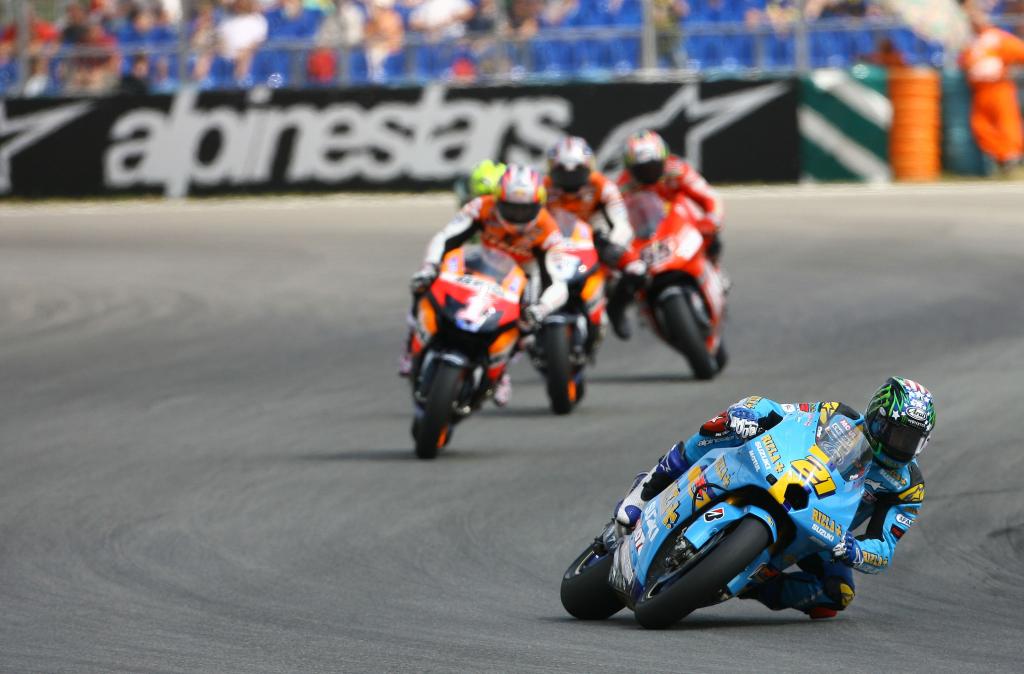
Bridgestone MotoGP: Czech Republic Debrief Q+A with Hiroshi Yamada – Bridgestone Motorsport – Manager Motorcycle Sport Thursday 23 August 2007 Ducati Corse’s Casey Stoner continued in Brno where he left off in Laguna Seca the previous month with a dominant pole to flag victory in the Czech Republic Grand Prix last weekend. The Australian rider’s performance scored him a seventh win of the season to further extend his championship lead to an impressive sixty points. The only time during the season so far that Stoner has relinquished his grip on the championship was after Jerez GP back in March. Bridgestone’s range of tyres performed well around the lengthy, undulating Brno track for the second consecutive Czech Republic GP win by a Bridgestone-equipped rider. This year, however, success was bolstered by a resounding performance from Suzuki’s John Hopkins who used his Bridgestone tyres to good effect to take a MotoGP career-best second position and his second podium of 2007 after China. Six riders on Bridgestone tyres finished the 22-lap event in the top nine with Hopkins’ team-mate Chris Vermeulen cementing his fourth place in the championship with a fine fifth place, Loris Capirossi in sixth, Randy de Puniet in eighth and Alex Barros in ninth. The hard work did not end at the chequered flag with most riders staying on for an extensive two day test, yielding important results for the climax of the 2007 season and beyond. Mr. Yamada, another win for the Casey Stoner-Ducati-Bridgestone package, was this an expected result? “Of course, we always head into each race weekend targeting victories and podiums, but after a one month break between races, and knowing how strong our competitors are, we never underestimated the challenge of Brno. It was just the second time this season that we returned to a track where our tyres had helped a rider to victory in 2006, so it was great to defend that honour with another formidable ride from Casey and Ducati. Additionally, it was a great performance from John Hopkins and the Suzuki team. John was on the pace in every single session and his second position, his best ever MotoGP result, was very well deserved.” Qualifying was another success for Bridgestone in Brno with Casey on pole? “Casey’s pole lap was another outstanding achievement and his best time was three-tenths quicker than everyone else. We had five riders on the front three rows and it is always an advantage to be higher up on the grid in those tense, close opening laps of the race. The qualifying times in Brno were not as quick as last year, but I think this can be attributed to the difference between how the more powerful 990cc machines used qualifying rubber compared to the 800cc bikes. Most riders improved their lap time by over a second on qualifying tyres and there was, I believe, more parity between the performance levels of the three tyre manufacturers’ qualifying tyres.” Were there any problems over the weekend or in the race itself? “We had a trouble-free first day but Brno is such a technical track that the teams used the two opening practice sessions to hone the set-up of the bikes. Although we had done the usual tyre evaluation work, we were not able to carry out any longer race simulation runs in practice. We were therefore pleased to see that the tyres were able to help riders achieve strong points and podium scoring results over the full 22-lap race distance. Our riders had opted for a variety of tyre combinations front and rear, the biggest range of the season, and all three tyres of rear compound soft, medium and hard were all represented in the top six, a great overall result.” Bridgestone stayed on for two days’ testing after the race what was learned? “We tried a lot of new specification tyres in the post race test, both front and rear, with new compound, construction and shapes. We found some promising specifications for later in this season and for the future. It was important to gain this data for our ongoing technical development, so thanks must go to each of our teams for their valuable contribution.”

How Much Stand-alone Private Testing Do Factory Teams Do In A Single Racing Season?

0

2007 Season Factory Team Testing Cartel Tests 1/11-12, Las Vegas Motor Speedway, Las Vegas, Nevada, primary renter Yamaha 1/11-12, Spring Valley Motorsports Park, Pahrump, Nevada, primary renter Yoshimura Suzuki 1/30-31, California Speedway, Fontana, California, primary renter Yamaha 2/6-7, California Speedway, Fontana, California, primary renter Yoshimura Suzuki 2/7-8, Laguna Seca Raceway, Monterey, California, primary renter Yamaha 3/19-20, Barber Motorsports Park, Birmingham, Alabama, primary renter Yoshimura Suzuki 4/4-5, Laguna Seca Raceway, Monterey, California, primary renter Yoshimura Suzuki 4/5-6, Infineon Raceway, Sonoma, California, primary renter Yamaha 5/8-9, Miller Motorsports Park, Tooele, Utah, primary renter Yamaha 6/6-7, Mid-Ohio Sports Car Course, Lexington, Ohio, primary renter Honda 6/28-29, VIR, Alton, Virginia, primary renter Kawasaki 8/7-8, Road Atlanta, Braselton, Georgia, primary renter Yoshimura Suzuki 12/TBA, Daytona International Speedway, Daytona Beach, Florida, primary renter Dunlop Total Days = 25

The State Of AMA Racing, Part One

0

FIRST PERSON/OPINION: A Look At Current AMA Officiating

Cutting The Course: What’s the Price?

By Michael Gougis

Team Roadracingworld.com’s Chris Ulrich got into a corner too hot and ran off the course during the AMA Superstock race at California Speedway earlier this season. Ulrich lost two positions and two seconds. With most sanctioning bodies, that would have been penalty enough.

But with the AMA supplemental regulations in place for that race, more penalties awaited Ulrich. AMA officials say he did not follow the precise additional rules formulated for re-entering the track specifically at California Speedway Ulrich, they say, went through one set of cones positioned in a haybale chicane, but failed to negotiate a second set of cones leading riders back onto the track. He got the meatball flag and was hauled into the pits for a penalty during the race, dropping him from eighth position and gaining on a fight for sixth to 12th, where he finished.

“I did exactly what the AMA’s Morgan Broadhead told me to do in the riders’ meeting. He said, ‘You get off the track over there, you have to go through the cones pointing in,'” Ulrich said in a news release.

“I did exactly that, following the printed bulletin the AMA had given to the riders. I lost two positions and countless seconds, yet still I was penalized. That was a potential sixth place, a very good finish. And now it’s 12th place and (I) probably lost another position or two in points. I’m extremely disappointed in how it turned out. I do not think the ruling was fair or correct.”

“I must start by saying that I was surprised that Chris received a drive-thru penalty at Cal Speedway,” fellow racer Jason Curtis said in an e-mail to Roadracing World. “Chris did in fact take the detour the AMA laid out to slow riders down to keep from gaining an advantage blowing that corner. I was far enough back that as he pulled back on the track, Chris did not gain any advantage on me…yet I did on him. Chris slowed down, followed the rules and kept racing. What did he do wrong?”

“When I witnessed Chris run off on lap three he did follow the correct path thru the haybales,” racer Scott Jensen said in another e-mail. “He went from in front of me to behind me, I did see him in my peripheral vision go thru the proper route. I must say it did take a pretty extreme effort on his part to get way back over to the haybale chicane.”

AMA officials concede that Ulrich wasn’t penalized for endangering another rider or gaining positions or time. They insist that in issuing the penalty, they followed the special rules that were in place for that race at California Speedway, a “roval” (combination road course/oval) that hosts an AMA round mostly because of its proximity to the large motorcycling community of Southern California and the corporate presence of the major Japanese manufacturers.

And by the time the green flags flew at Fontana, those “special rules” had gotten very, very complex. By the time the racing started, riders had to know the main AMA rulebook, the rules in the supplemental regulations for Fontana, and an addendum to the supplemental regulations handed out to mechanics at tech inspection.

If you blew Turn One, one set of procedures had to be followed. If you blew Turns Two and Eight, another set of procedures. And if you missed Turn 12 at the end of the back straight, yet another set of procedures. Get any of them wrong and you got a meatball flag.

Yipes.

California Speedway’s facility and its amenities are nice, but the course, with its temporary curbing and chicanes, is not in the league of the classic tracks like Road America, Laguna Seca, et. al. Hosting a race at a facility like this leads to certain challenges and policing course cuts is one of the big ones. And while Broadhead, AMA Pro Racing Road Race Manager, said the association followed its rules when penalizing Ulrich, he also conceded that the organizers could have made the supplemental rules clearer and would continue to make improvements.

“I actually set up the chicane with Cory West, the rider’s representative, and he also felt it was clear and understandable,” Broadhead said. “Of the 40-plus riders who left the course at that point during the weekend, more than 30 of them re-entered correctly.

“But I can certainly see where someone could think they were doing it correctly and, in good faith, get it wrong. Could we have set this up in a way that makes it more foolproof? Absolutely. California Speedway’s layout offers unique challenges. Every time we go there, we learn something. And we’ll try to make it better next year.”

This year’s event had far fewer course cuts than in prior years. But it also showed up shortcomings in the AMA’s plan for reducing course cuts and the way that plan was communicated to the racers.

Like almost every other sanctioning body’s rulebook, the AMA’s main road racing rulebook states: “A rider leaving the course may only continue the race by properly re-entering the course from the closest point to where that rider left the course without gaining an advantage. It will be the duty of the meet Race Manager or his designee to make the determination as to whether a rider gained any advantage by leaving the race course and re-entering. A rider may be determined to have gained an advantage without gaining race position.”

In other words, whether a rider gained positions or time determines whether a penalty will be assessed. But at California Speedway, trying to determine advantage particularly in terms of fractions of a second gained requires judgment calls on the part of AMA officials. And they wanted to eliminate the “human element” in calling penalties, Broadhead said.

“We were trying to make it black-and-white; cut the course, get a penalty, and we would not have to try to determine whether the course cut had resulted in an advantage,” Broadhead said. “We wanted to make sure it would not be a judgment call as to whether a rider had gained an advantage. We never anticipated making a judgment call on whether the cut happened or not.”

So under the supplemental rules issued on April 17 (just before the Barber round of the AMA Championship series) for California Speedway, riders “who failed to negotiate a turn must proceed through a haybale chicane, if available, and then safely blend back into traffic. Failure to proceed through a haybale chicane after missing a turn or cutting the track in an area where no haybale chicane is available will result in the rider being charged with a Track Cut. Any rider charged with a Track Cut during a race will be assessed a ride-through penalty even if no advantage was gained.” This is the section of the rules officials say Ulrich violated. According to them, Ulrich did not follow the exact course between haybale stacks and two sets of cones laid out for re-entering the track if a rider missed Turn 12 at the end of the back straight.

These regulations applied to Turn One, Turn Eight (if feasible) and Turn 12.

At the track, officials found that Turn Two had become a problem area, and that they did not have room to create a useable haybale chicane outside of Turn Eight. So the addendum issued at the track actually dated the Sunday of the racing weekend, April 29th said that riders who missed those turns had to “clearly slow down (sit up, roll off when safe to do so, let a rider pass, etc.) before rejoining the track or they would receive a ride-through penalty,” Broadhead said.

“This turned a black and white call into a discretionary call, which was what we were trying to avoid but there was no other way to enforce them available at the time,” Broadhead added.

But these new regulations applied only to Turns Two and Eight. So even though the new, updated rules did not say so specifically, the procedures for Turn One and Turn 12 remained unchanged.

In addition, there were gaps in communicating these new rules and procedures precisely to the riders.

AMA did not make it clear in writing what route a rider was supposed to take if they blew the turn at the end of the back straight. The supplemental regulations direct riders to follow the cone chicanes, but the only directions about how to do so were issued verbally at the riders’ meeting, Broadhead said. There were no diagrams or maps available, riders were not walked through the area, and the haybale-and-cone chicanes leading back to the track were configured differently at different turns. It’s easy to see where a rider could become confused and while most of them got it right, even by the AMA’s count, about 25% still got it wrong.

And while Broadhead says the regulations were available in print at the track, others said they were not available at tech inspection. In addition, many racers–particularly privateers–had driven straight to Fontana from the round at Barber the weekend prior, and did not have an opportunity to check the AMA’s website for supplemental rules.

The addendum to the supplemental regulations were handed out to race teams in the hot pits by grid officials at the beginning of practice on Saturday morning, Broadhead said.

Among other issues that arose during the post-race debate over the disputed call:

– Broadhead conceded that officials had mistakenly accused Ulrich of cutting the course on the first lap–a mistake they repeated when they posted a rebuttal to Ulrich’s press release on the official AMA website. “Even though every one in the tower heard the call come in as Lap One, our review showed that it actually took place on Lap Three,” Broadhead said.

– Timing and scoring data shows that Ulrich’s lap time was two seconds slower on the third lap. That lap data–available at AMASuperbike.com–even shows the segment of the track where Ulrich lost the time. On Lap Three, Ulrich’s time in the second section of the track was 20.451 seconds. On every other lap of the race, Ulrich’s times in that sector ranged from 18.4 seconds to 18.9 seconds. The data shows that Ulrich dropped two positions on that lap. Ulrich crossed the line in 9th at the end of Lap Two, and in 11th place at the end of Lap Three.

And the information about Ulrich’s lap times and positions were available to timing and scoring officials at the track, just as they were to anyone who was following the race on the Internet using the AMA’s @theWire LIVE! Timing system. This program allows fans to log on and get real-time lap time data on each rider during a race and during qualifying. It’s a great time-waster for those stuck in front of a computer monitor during race weekend. But that data clearly was available to race officials at the scene during the race.

– The AMA uses a high-tech, real-time video system to monitor its race starts. But Broadhead said that the distance to the back chicane was simply too far to run a cable to operate a similar real-time video monitoring system.

The dispute involving Ulrich shows that this is a vulnerability. It can be difficult to determine whether a rider has gained an advantage, especially at an event without video coverage, says Eric Kelcher, Director of Competition at Championship Cup Series/American SportBike Racing Association.

“You can’t always tell if someone has cut the course and picked up a second or two, or if they’ve made up a position and deliberately given it back or they just got passed again by the rider that used to be in front of them,” Kelcher says.

– The penalty that Ulrich was given is one that in itself can be controversial. A ride-through penalty is one that Colin Fraser, operator of the MOTO-ST endurance race series and the Parts Canada Superbike Championship, says a series operator should avoid whenever possible.

“If you give someone a stop-and-go or a ride-through penalty, you have altered the outcome of the race. You can’t un-do it. If you assess the penalty at the end of the event, you have more time to analyze the situation and consider more information,” Fraser says.

In addition, Fraser notes, there are some tracks where the pit configuration makes it dangerous to have riders piling through the pit lane at a high rate of speed.

Sean Clarke of WERA says that organization typically assesses the need for penalties based on whether the rider gains an advantage.

“Some tracks have areas where cutting the course can result in a dangerous re-entry, so at those tracks we may institute a penalty no matter what as a deterrent to the riders to try and keep things safer, but under normal circumstances gain of time or position is the main focus,” Clarke says. “If we can determine there is no gain of position or time then no penalty is enforced.

“However, there are indeed times where we get incorrect information or just flat-out make a mistake. In those cases where the riders is assessed a stop-and-go–our penalty rather than the ride-through the AMA uses–we are very hard pressed to be able to change history as it were and give the rider back any spots or time. If we can fairly determine the amount of lost time and add it back to the rider’s total time for the race–which is feasible via the scoring program we use–then we would do so and have done so in the past,” Clarke says. “We make every effort not to penalize riders for an official’s mistake, be it the cornerworkers, us in the tower, or any other official making a call at any level.”

But Broadhead said AMA officials were trying to avoid the timing and scoring issues that post-race penalties present. Specifically, they wanted to avoid an issue where a rider crossed the line in one position, then wound up in a different position after post-race penalties of time or laps were assessed. In the past, post-race penalties have changed the finish order to the extent that podium finishers later were dropped back in the standings.

“For the good of the TV audience and the fans, the finishing order and the order that the riders came across the line should be the same,” Broadhead said.

But that means that race officials get exactly one shot at making the right call on issuing a penalty in the heat of competition. And while it may preserve the finishing order at the top of the field, that makes little difference to those fighting for points and contingency money down the order, well away from the TV cameras.

It was also not lost on Team Roadracingworld.com that, at the end of all of this, Chris Ulrich was the only guy who got hauled in for a meatball flag in the race, even though many people went off the course. Ulrich says he felt the penalty was personal. Not only has he been a critic of the AMA in the past, but so has his father.

“I think it’s obvious that they singled me out,” Ulrich says. “My dad has a strong personality; that’s how he gets things done. And the only place they can exert some level of control over him is through me on the track. It’s been that way much of my life, except when I played hockey, because he wasn’t known in that area.”

“I wish I could convince people that it wasn’t something personal,” Broadhead says. “I’ve got no problem with anyone. But we had to enforce the rules.”

In retrospect, Broadhead says the AMA stands by its decision–race officials did exactly as they were supposed to, according to the rules. But Broadhead was willing to say that race officials could have done a better job of communicating their rules to the riders, and that riders could have tried to follow the AMA regulations and still wind up getting penalized. Broadhead says the AMA could have come up with a better system of controlling course cuts. And the AMA will try to do so in the future, he says.

Conclusion:

Racing at oval tracks presents a series of problems for track officials. Safety is a key one; making sure riders don’t cut the course is another. While it’s clear the AMA was trying to make the race at Fontana as safe and fair as they could, changing things real-time to address problems as they came up, it’s equally clear that things could have been handled better.

It’s asking a lot of a rider to try to remember three distinctly different sets of regulations for re-entering a track in the heat of battle, depending on what turn they happened to blow. Figuring out one set of rules preferably based on the “no advantage gained, no penalty” concept and sticking with that would make life a lot simpler for the pilot of a 170-mph missile.

If there is a precise pathway that a racer must use to re-enter a track after having run off, that should be laid out in writing and diagramed, and made available to the racers prior to their arrival at the track. It should be as detailed as possible. Maps, charts, a diagram, stick figures something other than verbal instructions are a must here. This is top-level National racing. This is not the place for “I thought I heard you say.”

And if there are substantial changes made to the regulations at the track, officials must be absolutely sure that those changes are presented clearly to the riders themselves. Handing out changes in the hot pits just doesn’t work riders, mechanics and others are way too busy at that point, trying to get a machine on the track, to deal with rules changes. Unless it is an emergency, sending a messenger to each pit or garage with a written set of the changes (and maybe requiring a signature confirming that they’ve been received) or making multiple announcements over the P.A. system that new regulations are in effect and written copies are available at a specific location would be a better system.

America is obsessed with NASCAR, which means we’re stuck racing on ovals for the foreseeable future. AMA officials have to go to great lengths to make sure what they’re doing promotes safe, fair competition and to make sure that it is crystal clear that everyone knows what is expected of them when the green flag drops.


Barber Motorsports Park Re-evaluating Plan To Host World Superbike In 2008

In the wake of Miller Motorsports Park announcing it will host the FIM Superbike World Championship in 2008 and beyond, Zoom Motorsports, which manages Barber Motorsports Park, in Birmingham, Alabama, is re-evaluating its plan to host a round of that series next year. “There is no final decision at this point,” Zoom Motorsports President Gene Hallman said Wednesday. Hallman originally told Roadracingworld.com that his company planned to make a decision on hosting World Superbike during the first week in August, but the deadline for making that decision has now been pushed back to the end of the month. “The biggest reason for the delay in the decision,” explained Hallman, “is the fact that Miller is announcing World Superbike, which is great for motorcycle racing in this country. [But] when you go from one event to three and then us potentially being the fourth global motorcycle event in this country [in 2008] it gives us cause to go back and look at our business model, because so much of that is predicated upon [motorcycle] industry dollars. The industry is somewhat static in this country. Marketing budgets are not necessarily expanding. We need to re-analyze the numbers to make sure we are comfortable with them.” Recent AMA Superbike events at both Barber Motorsports Park and Miller Motorsports Park have been sponsored by Honda. “I would say it is 50/50 right now,” continued Hallman. “Before Miller made the decision to move forward, we were leaning more toward doing it. But we’re in the process of talking to some of our industry partners now trying to determine if our original assumptions about industry dollars are still valid. Certainly when you have the prestigious Indy location, now Miller on top of a very successful Laguna Seca event, we need to really think hard about it. “And I guess another dimension is we’re quickly running out of time. We’re six weeks in front of Miller’s proposed date, which I believe is June 1. We’re the first of the four if we do it. Budgets are being finalized now. To put everything into action and get ready for April of next year is something we’ve got to give full consideration to. It’s truly 50/50, at this point. “And if we do pass in 2008, that in no way, shape or form precludes us from reconsidering and taking SBK’s offer for 2009. “Ultimately, in my very strong opinion, the Barber Motorsports Park will play host to a international motorcycle event in the near future. It’s a venue that deserves an international event. This is a great market for it, being in the southeast. We want to give the southeastern fans something in their backyard, something they can come see in person. I just think it’s a matter of time. We’ve just got to make sure it’s the right opportunity at the right time.” Barber Motorsports Park’s proposed World Superbike date would be a shared event with selected classes of the AMA Superbike Championship (probably two) on April 18-20, 2008.

Yamaha World Supersport Team Tags Onto World Endurance Test At Magny-Cours

0

Today the Yamaha World Supersport Team completed a two-day test at the Magny-Cours circuit in France. They were the only supersport team to participate in the test, which was largely for endurance teams. Magny-Cours has featured on the World Supersport calendar since 2003 and is the venue for the last round later this year. Built in 1960, the circuit was promoted to international status in the 1980s and is famous for hosting the Formula 1 Championship as well as the Bol d’Or. Broc Parkes has a good history at the circuit, having taken a win there in 2005 as well as pole position and fastest lap in 2004. He was joined for the first day’s testing by Tommy Hill who partnered him at Brands Hatch earlier this month, finishing fifth while Parkes took his first win of the season. The test was a good opportunity for Hill to familiarise himself with the circuit, which he hadn’t previously ridden. He showed impressive form in the wet from the outset on day one. He was unable to ride on the second day because of other commitments related to the British Superbike Championship. Although both days of testing were blighted by wet weather and blustery wind conditions the Yamaha World Supersport Team made the most of the opportunity to test all their wet weather settings as well as some new wet tyres from Pirelli. Both riders sampled the new tyres and worked on finding a good wet set-up, using the settings from Silverstone earlier this year as a base. Although no official times were recorded for either day, unofficial times showed Parkes made good progress over the duration of the test. The Yamaha World Supersport Team’s next outing will be their home round at Euro Speedway Lausitzring, Germany, in two weeks time. Broc Parkes (Yamaha World Supersport Team) “The weather changed the objectives for the test and we focused on our wet settings instead. I got some good time out on the track between rain showers on both days, although there was quite a bit of traffic out there and it was pretty miserable weather. I think we’ve got a good set-up sorted for the race if it rains here in October. I’m just looking forward to getting back to racing following my win at Brands, especially as the next round is the team’s home round.” Tommy Hill (Yamaha World Supersport Team) “It was good to be back on the bike and working with the team again after the summer break. Magny-Cours is a new track for me and I could’ve done with some dry track time really but I couldn’t do much about the weather so had to just get on with the job! The bike felt really good — as I remembered it from Brands. I also got some time to learn how to use the engine management system on the bike. It’s the first time I’ve used it and it felt good, especially in the wet. It was good to be able to work closely with the Pirelli team as well as the Yamaha team again; I feel we made some good progress considering the weather conditions.”

World Superbike And AMA To Run Different Courses During 2008 Event At Miller

The FIM Superbike World Championship and the AMA Superbike Championship will use different configurations of Miller Motorsports Park (MMP) during their joint event there in 2008. The World Superbikes will use the 3.048-mile Outer Track, which has been used by the AMA since it has been racing there. All of the classes of the AMA Superbike Championship series will now use the 4.5-mile Main Track, which AMA riders have not tried yet. There are two reasons for taking this approach, according to MMP Media Manager John Gardner. “First, so there will be no direct comparisons between World Superbike and AMA Superbike,” lap times, said Gardner. “And secondly, World Superbike requires a clean track as far as signage goes. So they will put their sponsor signage up on the Outer Course, and the AMA can out its sponsor signage up on the inner portion of the 4.5-mile course. It works out pretty well.” Gardner did not know how the logistics of the paddock will work, however. At the last two AMA events, only the top teams were allowed to work out of MMP’s Grand Prix garages along hot pit lane. The smaller teams and privateers had to work out of the Day Garages or the open paddock, hauling their pit equipment to and from a small area on pit lane beside the Grand Prix garages. Speculation is World Superbike teams will work out of the Grand Prix garages, while AMA Superbike teams will share space along the West Course’s hot pit lane, which does not have garages. The AMA Supermoto Championship, which has run in conjunction with the first two AMA Superbike events at MMP, will not run during the combined World Superbike/AMA Superbike weekend. MMP officials are currently looking at moving that event to either the WERA/AMA National event (which has been run the weekend prior to the AMA Superbike event the last two years) or to the Bonneville Vintage GP AHRMA event. Tickets for the June 1, 2008 World Superbike/AMA Superbike event are already being sold at ~http://www.millermotorsportspark.com/sbk08/ticketOptions.html~ .

Updated Again: The Final Round Of Press Releases From Last Weekend’s Various Races

0

Vesrah Wins Rainy Endurance, Batey Top Expert in WERA Nationals at Talladega OXFORD, Ala. This past weekend marked the first time that the WERA/Bridgestone National Endurance Series and the WERA/Michelin National Challenge Series have competed on the newly-reconfigured Talladega Gran Prix Raceway road course, but it was many of the same Talladega aces who won. Saturday’s endurance race, originally scheduled for four hours, was cut slightly short due to lightning in the near vicinity. It rained for nearly an hour before the red flag came out, but the wet track was not enough to slow down Vesrah Suzuki. The Heavyweight Superbike team took the win with Tray Batey, John Jacobi and Mark Junge on a Suzuki GSX-R1000, and they had a comfortable five laps over the rest of the field. Brand X got on the overall podium again, taking second overall and in Heavyweight Superbike. Riders Ben Walters and Brett Champagne shared the Suzuki GSX-R1000. Third overall and first in Mediumweight Superbike were Reuben Frankenfield, Mark Junge and Russell Wikle on the Suzuki Rider Development Suzuki GSX-R600, finishing on the same lap as Brand X. Team Moe’s/TVR’s fourth-place finish gave Chuck Ivey, Joshua Day and James Stroud first in Heavyweight Superstock on their Yamaha YZF-R1. Dalke Motorsports had a three-lap margin of victory in the Mediumweight Superstock class thanks to Giovanni Rojas, Ryan Clay, Wrenn Smith and Brian Dalke, who shared a Suzuki GSX-R600. Blue Ridge Performance earned their first Lightweight Superbike win of the season on a Kawasaki 650R. Daniel Parkerson, Lyles Sanders and Ben Probst also had a three-lap margin over the rest of their class field. The National Challenge expert sprint races on Sunday were a chance for Tray Batey to earn three more trophies. He got his Suzuki GSX-R1000 through Talladega’s tight layout to win both Open Superstock and Formula One, and he was victorious in Heavyweight Twins Superstock. Joshua Day’s performance was one of the surprises of the day. In his first visit to Talladega, he took the top spot in both 600 Superstock and 600 Superbike. Opie Caylor proved that he can still get around the Alabama track at fast pace, winning 750 Superstock by just 0.38-second over Lee Acree in one of the closest races of the day. Dane Westby won both Lightweight Twins Superstock and Formula 2, and Jimmy Wood won 750 Superbike. In the novice division, Russell Wikle was back to his winning ways, taking top honors in 600 and 750 Superstock, as well as 600 and 750 Superbike. Chad Clifton won Open Superstock novice, Josh Reed won Heavyweight Twins, Luke Echols finished first in Lightweight Twins and Jake Morman won Formula 2. The next round of the WERA National Series is in three weeks at Nelson Ledges Road Course in Ohio. More information about WERA, including updated championship points, can be found at www.WERA.com. More, from a press release issed by Rockwall Honda: TOUGH WEEKEND FOR ROCKWALL HONDA IN VIRGINIA Rockwall Honda racers Ryan Andrews and Ryan Elleby had a challenging weekend at the Big Kahuna Nationals in Alton, Virginia last weekend. Andrews finished in 14th in Supersport and 14th in Formula Xtreme. Elleby was 17th in Supersport and did not finish the Formula Xtreme race. The weekend was already a difficult one for Andrews when he was involved in a Thursday practice crash. Through no fault of his own, Ryan saw his Formula Xtreme race bike destroyed when another rider ran off the track and returned to the circuit, collecting Andrews mid-corner and damaging his CBR600RR beyond repair. For the rest of the weekend, Ryan was forced to use a previous generation bike he had not ridden since last year. “I didn’t have any time to react,” said Andrews. “I was really sore immediately. I couldn’t catch my breath and my elbow swelled up really fast. I ended up going to the hospital to get checked out, but fortunately nothing was broken. It really messed up my weekend because I was sore all three days, my leg, my elbow, my neck … everything, really. All three days I was so sore I could barely walk.” In Saturday’s Formula Xtreme race, Andrews finished fourteenth while Elleby retired with a clutch issue. “The team did a great job of getting the old bike ready for me to race,” said Andrews. “I did the best I could, considering how sore I was. I just wanted to finish the race. Considering the circumstances, it went pretty well. We got some points and made it through okay.” In a wild Supersport race, both riders fought through a red-flagged contest. Andrews finished 14th. “All weekend, I was sore and everyone was dealing with how slick the track was. We were searching for side grip the whole time. On Sunday morning, our crewchief Robert Ward said ‘Hey, let’s try a different direction with the setup.’ It was something new and it worked in the warm-up. I was confident going in, and got a killer start. We picked off a few guys, but then the red flag came out. I didn’t quite get the start I wanted and at that point, we were looking to survive some of the carnage that was going on out there.” For Ryan Elleby, a 17th place finish masked the gains he made on the weekend. “In Supersport, the pace was fast all weekend and we kept progressing,” said Ryan. “It was looking like we would get a good result, but on the second restart, I got pushed wide into the grass. So I was down in 20-something place and spent the rest of the race working my way back up to 17th. That really doesn’t show what we were capable of doing and it’s too bad because the crew worked hard all weekend.” The next race will be held at Road Atlanta Aug 30 through Sept 2. It’s the home track for Powder Springs Georgia resident Elleby. “It’s my home track, but I don’t have much track time out there,” said Elleby. “I haven’t ridden it that many times. Still, I’m stoked to be racing close to home.” More, from a press release issued by Scott Charlton: The Australian Superbike Championship finale was held at Eastern Creek last weekend, where we saw a beautiful racing weekend turn into a treachorous weekend for racing, as Mother Nature turned the rain on Sunday, causing many of the Championships to wrap up one race short of their full season. Saturday brought a superb day, with some of the best conditions for qualifying and we saw Superbikes set a cracking pace in qualifying with a 1.30.9 pole position time. The battle for grid positions in the Superbike class was fierce, and Scott was somewhat disappointed to qualify in 10th place, just over a second off the pole time. In the Naked Bike Class, Scott qualified on Pole position and managed to set a new qualifying lap record. In the Naked Bike Class, Scott was delighted to secure the Australian Naked Bike Title on Saturday after winning Race 1 on his Yamaha FZ1, and smashing the lap record by close to 1 second. Scott continued his winning form and went on to win Race 2 in the wet conditions on Sunday, finishing with a perfect score in the final round and finalising his 1st place in the Championship by a clear 73 point margin. Due to the weather conditions on Sunday, the Superbike Class ran only one race, in what was some of the slipperiest conditions Scott has ever ridden in. A number of competitors crashed in morning warm up and some riders crashed on the warm up lap before the race. It truly was a battle for survival, just to complete the race was an achievement! With Championship points in mind, Scott put the Yamaha R1 through its paces and kept the bike upright, crossing the line in 6th place. At the conclusion of one of the most competitive seasons in the Australian Superbike Championship, Scott cemented his 8th place in the Championship and was 2nd placed Privateer. More, from a press release issued by Team EMGO USA: Team EMGO USA’s Opie Caylor won his first WERA National Challenge Series race of 2007 this past weekend at Talladega Gran Prix Raceway. But it didn’t happen until after some drama! The weekend started off well enough. Opie qualified 5th in Formula One, with a 58.2, despite unbearably hot temperatures. Opie later explained that the ultra-hot temperatures along with a soft rear Dunlop N-Tech slick caused a bit of wheelspin. For 750 and 1000 Superstock qualifying, Opie decided to go to a harder compound rear Dunlop N-Tech to regain some of the grip. The adjustment made a big diference. In 750cc Superstock, Opie took his sixth pole position of the season with a 57.7. Then, at the end of the day, Opie went back out on the same set of Dunlops and qualified second in Open Superstock with a 57.8. On Sunday, things would go downhill quickly. Opie was second off the line in Open Superstock, and was quickly relegated to fourth place. On lap four, the top four started to encounter lapped novice riders in the combined expert and novice race. Caylor said “Going into turn four, we started coming up on lappers and there was this one guy down low on the inside of the corner. I decided to overtake him on the outside and just ride around him. At the last minute I guess the guy finally figured out where the line was and just started coming over on me. I had no where to go – I was already out so far wide to give the guy plenty of space but it didn’t matter. I went down but at least I was able to pick the bike up and finish the race and salvage some points. Luckily, for me, I was wearing my Komodo leathers, boots and gloves and an Arai helmet, which kept me from getting hurt!” Caylor was scored in 9th position after picking up and reteching the bike and re-entering the race. A little fired up after the Open Superstock race, Opie got a good start in 750cc Superstock and followed Robert Jensen into turn one. On lap two, Lee Acree dove up underneath Caylor coming off the back straight. In doing so, Opie’s drive onto the front straight wasn’t that good, which in turn allowed Chad Lewin to come by going into turn one. Clearly frustrated yet bitterly determined, Opie gathered his thoughts and calmly set about winning the race. On the next lap, Opie drove past Chad Lewin on the back straight and moved back into third. Opie then jumped the small gap to Robert Jensen and drove past him exiting the fast turn one and moved into second. On the next lap, Opie jumped the gap from Jensen up to Lee Acree and then dove underneath Acree coming onto the front straight to take the lead. From there, with four laps left, Opie was able to open up a small gap to go on to win the race. “That has been a long time comin! Lee and Robbie and Chad have been ridin’ hard all year and really making it tough on me! These guys don’t play! But neither do I! Huey back at the Marietta Motorsports has spent so much time tuning my 750. We’ve been working with different VP Fuels to try to figure out what works best in this engine. We found a really good combination of octane and oxygenation with VP’s MRX01 and the motor just loves that stuff. All that power along with Dunlops unbelievable N-Tech tires was an unbeatable combination today!” In the last race of the day, Formula One, Opie chose to ride his Pit Bull-sponsored Team EMGO USA Suzuki GSXR750 due to the 1000’s crash damage from the Open Superstock race. Opie got off the line OK but got swallowed up by a couple of 1000’s going down the first straightaway. Sixth on lap one, Opie ran down, caught and passed James Stroud. He got around Stroud and set off after Acree in fourth. Opie ran a 57.2 to catch Acree but had to work harder to make a pass. The three leaders had pulled a small gap that was insurmountable once Opie had gotten past Lee. Opie would finish the race in fourth position. To wrap up the weekend, Opie had this to say, “Overall, it was a good weekend. I finished 9th in the Open Superstock race even after the crash and I was lucky to do that! If I didn’t have those really strong Vortex rearsets, I bet the peg and shifter would’ve gotten completely ripped off! But the Vortex Componets did a great job! At least I was able to salvage some points! I love 750’s! I am really pleased with the way that bike is working right now. Thermosman really has the suspension dialed in and I feel like I can put that bike anywhere I want to at anytime. And actually Robert Jensen put it best after the 750 race. He said, ‘It’s about time you won a 750 race!’ I couldn’t agree more. And in F1, I got fourth. I made some Suzuki money and picked up some points.” More, from a press release issued by West Coast GP Cycles: West Coast GP Cycles-backed riders headed up to northern California and put on a strong showing at the AFM race event this weekend at Infineon Raceway, with one of the shop’s riders now leading the chase for a class title and West Coast GP Cycles’ newest racer turning heads. Reigning Willow Springs Motorcycle Club Champion Brant Wiwi took a big step toward his goal of winning a 600-class championship at AFM this season. Riding his Yamaha YZF-R6, Wiwi took a pair of second places and moved into first place in 600 Production and into second in 600 Superbike. Newcomer Drew Price, 16, a former mini road race champion who moved up to full-sized bikes this season, continued to demonstrate an ability to run strongly at new tracks. Riding his West Coast GP Cycles-tuned Suzuki SV650, he started the Middleweight Clubman race (mostly filled with inline-fours) in 20th and crossed the finish line first, although a red flag reverted scoring back to the previous lap and moved Price back to third in the final finishing order. In Formula IV, Price started at the back of a 40-bike grid and finished 20th; in 650 Twins, Price started at the back of a 45-bike field and finished 15th. West Coast GP Cycles is located at 11900 W. Pico Blvd. in Los Angeles, 90064, and offers performance tuning and accessories for street and race motorcycles. For more information, contact the shop at 310.477.0997.

Stoner: Misano Will Be A Strange Race

DUCATI MARLBORO TEAM CONTESTS ITS SECOND HOME GP OF 2007 The Ducati Marlboro Team comes home to race in Italy for the second time this year, with Casey Stoner leading the MotoGP World Championship aboard his Desmosedici V4. Winner of seven of the first 12 races so far this season, Stoner arrives at Misano with an impressive 60 point lead in the 18-race series, but the stunningly fast Australian will be treating this race like any other – working to get the best out of his machine and aiming to score another victory on Sunday. Team-mate Loris Capirossi will also be aiming for the best-possible result at Misano after a difficult race in the Czech Republic a fortnight ago. The Italian veteran is one of the few current riders who contested the last GP at Misano in 1993, when he finished second in the 250 race. This weekend’s Misano GP will be very different from the 1993 event because the circuit now runs in reverse direction. The venue will be essentially new to everyone, though Stoner and Capirossi did ride a couple of display laps during the hugely popular World Ducati Weekend in late June, with special dispensation from MotoGP race direction. As is usual when riders have to acquaint themselves with a new circuit, an extra hour of free practice has been added to the Friday schedule from 4:15 p.m. to 5:15 p.m. LIVIO SUPPO, Ducati MotoGP project director “As an Italian Factory it is always a special event for us to race in Italy and it is a dream for us to be going to Misano leading the World Championship. Although we are having a fantastic season we have yet to win a MotoGP race on home tarmac, so Casey and Loris will be doing their best on Sunday. Casey is doing a fantastic job at the moment, he really is an incredible rider, so talented and so focused, it is a real pleasure to work with him.” CASEY STONER, World Championship leader on 246 points “Misano will be a strange race because nobody really knows what it will be like to race a MotoGP bike round there. Loris and I did two display laps at the World Ducati Weekend because the fans wanted to see the Desmosedici race bike. The track isn’t too bad but I feel it needs to be improved because it’s very bumpy, so it’s going to be pretty loose on these bikes. We’ll just have to wait and see how it goes, it could be good for us. I still want to try and win races, if we do good work in practice and we have a good rhythm, we will try and win, if not we will just do the best job we can. Every race now I feel less pressure because this season has been unbelievable for us, we’ve proven we’re fast enough, we’ve already won a few races and we’ve got a bigger points advantage. I’m already very happy with the season, so I don’t feel any more pressure. We’re getting the results because we all work really hard: Ducati and the team work hard, Bridgestone works hard, I give them good information and I’ve been training really hard off the track.” LORIS CAPIROSSI, 9th overall on 87 points “The last time I rode at Misano was in 1993, that’s many, many years ago and everything is different now. Last time there I rode a 250, this time I ride a MotoGP bike, and now the track goes right instead of left. I did a couple of display laps on the Desmosedici at the World Ducati Weekend in June and before that I rode a lap or two with a Ducati 1098 streetbike when I inspected the track with Valentino [Rossi] for the Safety Commission. The layout is completely different from when I last raced there and I don’t think it will be easy, especially on a MotoGP bike. We have an extra hour of practice on Friday to help us understand the circuit a bit better because the layout is very technical with a lot of tight turns. It’s great to have a Grand Prix at Misano once again because everyone in the Emilia Romagna region loves motorcycles so the atmosphere should be huge. Of course it’s another race in front of the Italian fans and I want to do really well. As always I will do my best and we will be looking for a podium result on Sunday.” THE TRACK Misano returns to the Grand Prix calendar after an absence of 14 years. But the current circuit, situated near Riccione on Italy’s Adriatic coast, is completely different from, running clockwise instead of anti-clockwise. Misano is mostly dominated by slow-speed corners though the high-speed Curvone right-hander will be a real test of machine performance and rider mettle. DUCATI MARLBORO TEAM RIDER DATA LOGS LORIS CAPIROSSI Age: 34 (born 4 April 1973) Lives: Monaco Bike: Ducati Marlboro Team Desmosedici GP7 GP starts: 260 (90xMotoGP, 59×500, 84×250, 27×125) GP victories: 28 (6xMotoGP, 2×500, 12×250, 8×125) First GP victory: Britain, 1990 (125) First GP: Japan, 1990 (125) Pole positions: 41 (8xMotoGP, 5×500, 23×250, 5×125) First pole: Australia, 1991 (125) World Championships: 3 (125: 1990, 1991, 250: 1998) CASEY STONER Age: 21 (born 16 October 16 1985) Lives: Monaco Bike: Ducati Marlboro Team Desmosedici GP7 GP starts: 89 (28xMotoGP, 31×250, 30×125) GP victories: 14 (7xMotoGP, 5×250, 2×125) First GP victory: Valencia, 2003 (125) First GP: Britain, 2001 (125) Pole positions: 9 (5xMotoGP, 2×250, 2×125) First pole: Italy, 2003 (125)

The State Of AMA Racing, Part Two

What To Do About Superbike The debate is on over the question of what to do with AMA Superbike rules for 2009, specifically whether or not to slow down the bikes, and how. The same debate has taken place in other countries around the world, with the result that National Championships in Japan, Germany, Spain, Australia, Canada and Britain have all moved closer to Superstock rules. It’s something that the FIM is considering as well, as Roadracingworld.com discovered in an short interview that took place with FIM President Vito Ippolito in his office in Caracas, Venezuela prior to the start of the 2007 racing season. Roadracing World: There seems to be a lot of interest in having unified rules for Superbike racing around the world. But World Superbike allows a much higher technical specification than, for example, AMA Superbike and other National Championships. The problem that the AMA and other National Federations face is that the bikes are getting too fast for many of the racetracks, so they want to slow the bikes down. There is now some discussion about moving the National Federation specifications closer to Superstock instead of Superbike. What do you see as the future structure of Superbike racing in the world? Vito Ippolito: The question is very interesting because one of the problems is to harmonize the rules. But there are course various people involved, the federations, promoters, the factories, teams, and so on. And the job of the FIM in the immediate future will be to arrange meetings with all the persons involved in this matter. In principal, the main goal of the FIM is to maintain a structure so that this kind of bike is very close to production, series production. This is the main goal. And we hope to convince everybody that we are in the same ship and that we have to go in the same direction together. RW: In the U.S. we don’t have a class in the AMA National Series for the up and coming riders, and every class last season had full factory teams in it. Is this a problem in other parts of the world also? VI: This is an important problem, because I think all over the world, all the federation must create classes for beginners. This is a main goal also for the FIM, to convince some federations; in some countries like Spain, Italy, Germany and England, they have a good activity for beginners. One of the reasons these countries, especially Italy, Spain, Japan, have the best riders in road racing is because they have good programs for beginners, very good programs. In the case of a small federation like the Venezuelan Federation we made several years ago a program for beginners and now the riders you know from Venezuela, like Robertino Pietri, Fernando Amantini, Armandito Ferrer, Victor Chirinos, all these riders come from thess beginner categories. And I can say one of the last legacies of my Presidency for the Venezuelan Federation is that we will have again one category for beginners. Because it is the only way to have good riders, young riders in the future, not only for Venezuela, but for every country. If every country works in this way, we will have thousands of good riders in the future. RW: If you were going to speak to each rider in the world who is racing with the FIM, what message would you give them? VI: I am happy with the riders in our sport in comparison with other sports. I think the motorcycle riders are very good sportsman, with good ethics, they are ethical people; I’m happy with the riders of our sport, really. I don’t have any special recommendation. I think the only recommendation is to follow this way because they will be in any case the example for the new riders all over the world. I think they show in principal a good example for the riders. Our sport is safe, I think.

FIM Visits Indy Motor Speedway To Finalize New Road Course Drawings

FIM OFFICIALS HAPPY WITH PROGESSS OF IMS MOTORCYCLE COURSE INDIANAPOLIS, Thursday, Aug. 23, 2007 Officials from the Fédération Internationale de Motocyclisme were pleased with the progress of construction of the 2.601-mile motorcycle road course at the Indianapolis Motor Speedway during a visit Aug. 22-23. The FIM is the sanctioning body of the MotoGP World Championship. IMS will play host to MotoGP at the inaugural Red Bull Indianapolis GP on Sept. 14, 2008. FIM Safety Director Claude Danis, FIM Race Director Paul Butler and Franco Uncini, the 1982 500cc World Champion and MotoGP rider safety representative, walked the track with IMS engineers and officials Aug. 22. “The goal of this visit was to finalize the last drawing (of the course) we are laying for the race,” Danis said. “The visit before, we had some ideas, but the (existing) fence was wrong, (existing) wall was wrong. It was very difficult to be sure our ideas were good. The circuit is now working (on construction), and they’ve removed the wall, removed the fencing so now we’re sure that when we leave tonight, the layout will be the final one. The next visit, we’ll decide the exact position of the walls, the openings, the curbs, things like that. “More and more I’m coming here, more and more I think the race will be very good because we found (a) good layout.” Danis already has made numerous visits to the Speedway as far back as seven years ago when the idea of motorcycles at the modern IMS facility was in its infancy. This was Butler’s first visit to IMS. The site inspection was successful, he said. With the new circuit, the intensity of the MotoGP riders and the high performance of the 800cc prototype motorcycles, Butler is thrilled about the inaugural Red Bull Indianapolis GP. “We know Indianapolis is the heartland of motorsport,” Butler said. “We are so excited about it because of the tradition of automobile racing, and we’re coming in with a completely new sport to the Speedway, although the first race was a motorcycle race. “Two things, the expertise of the Indianapolis Motor Speedway and our exciting show, are going to blend perfectly and make a great day for the fans.” Red Bull Indianapolis GP tickets: Ticket orders are being accepted now for the inaugural Red Bull Indianapolis GP on Sept. 14, 2008. Orders can be placed either online at www.indianapolismotorspeedway.com or by mailing an order form to IMS. The order form is available at the IMS Web site or by calling the IMS Ticket Office at (800) 822-INDY outside the Indianapolis area or (317) 492-6700 locally. Ticket Office hours are 8 a.m.-5 p.m., Monday through Friday. All tickets for this event are three-day tickets, with both reserved and general admission seating available. Ticket orders will be fulfilled at a later date.

Czech Republic GP Debrief With Bridgestone’s Manager Of Motorcycle Sport

Bridgestone MotoGP: Czech Republic Debrief Q+A with Hiroshi Yamada – Bridgestone Motorsport – Manager Motorcycle Sport Thursday 23 August 2007 Ducati Corse’s Casey Stoner continued in Brno where he left off in Laguna Seca the previous month with a dominant pole to flag victory in the Czech Republic Grand Prix last weekend. The Australian rider’s performance scored him a seventh win of the season to further extend his championship lead to an impressive sixty points. The only time during the season so far that Stoner has relinquished his grip on the championship was after Jerez GP back in March. Bridgestone’s range of tyres performed well around the lengthy, undulating Brno track for the second consecutive Czech Republic GP win by a Bridgestone-equipped rider. This year, however, success was bolstered by a resounding performance from Suzuki’s John Hopkins who used his Bridgestone tyres to good effect to take a MotoGP career-best second position and his second podium of 2007 after China. Six riders on Bridgestone tyres finished the 22-lap event in the top nine with Hopkins’ team-mate Chris Vermeulen cementing his fourth place in the championship with a fine fifth place, Loris Capirossi in sixth, Randy de Puniet in eighth and Alex Barros in ninth. The hard work did not end at the chequered flag with most riders staying on for an extensive two day test, yielding important results for the climax of the 2007 season and beyond. Mr. Yamada, another win for the Casey Stoner-Ducati-Bridgestone package, was this an expected result? “Of course, we always head into each race weekend targeting victories and podiums, but after a one month break between races, and knowing how strong our competitors are, we never underestimated the challenge of Brno. It was just the second time this season that we returned to a track where our tyres had helped a rider to victory in 2006, so it was great to defend that honour with another formidable ride from Casey and Ducati. Additionally, it was a great performance from John Hopkins and the Suzuki team. John was on the pace in every single session and his second position, his best ever MotoGP result, was very well deserved.” Qualifying was another success for Bridgestone in Brno with Casey on pole? “Casey’s pole lap was another outstanding achievement and his best time was three-tenths quicker than everyone else. We had five riders on the front three rows and it is always an advantage to be higher up on the grid in those tense, close opening laps of the race. The qualifying times in Brno were not as quick as last year, but I think this can be attributed to the difference between how the more powerful 990cc machines used qualifying rubber compared to the 800cc bikes. Most riders improved their lap time by over a second on qualifying tyres and there was, I believe, more parity between the performance levels of the three tyre manufacturers’ qualifying tyres.” Were there any problems over the weekend or in the race itself? “We had a trouble-free first day but Brno is such a technical track that the teams used the two opening practice sessions to hone the set-up of the bikes. Although we had done the usual tyre evaluation work, we were not able to carry out any longer race simulation runs in practice. We were therefore pleased to see that the tyres were able to help riders achieve strong points and podium scoring results over the full 22-lap race distance. Our riders had opted for a variety of tyre combinations front and rear, the biggest range of the season, and all three tyres of rear compound soft, medium and hard were all represented in the top six, a great overall result.” Bridgestone stayed on for two days’ testing after the race what was learned? “We tried a lot of new specification tyres in the post race test, both front and rear, with new compound, construction and shapes. We found some promising specifications for later in this season and for the future. It was important to gain this data for our ongoing technical development, so thanks must go to each of our teams for their valuable contribution.”

How Much Stand-alone Private Testing Do Factory Teams Do In A Single Racing Season?

2007 Season Factory Team Testing Cartel Tests 1/11-12, Las Vegas Motor Speedway, Las Vegas, Nevada, primary renter Yamaha 1/11-12, Spring Valley Motorsports Park, Pahrump, Nevada, primary renter Yoshimura Suzuki 1/30-31, California Speedway, Fontana, California, primary renter Yamaha 2/6-7, California Speedway, Fontana, California, primary renter Yoshimura Suzuki 2/7-8, Laguna Seca Raceway, Monterey, California, primary renter Yamaha 3/19-20, Barber Motorsports Park, Birmingham, Alabama, primary renter Yoshimura Suzuki 4/4-5, Laguna Seca Raceway, Monterey, California, primary renter Yoshimura Suzuki 4/5-6, Infineon Raceway, Sonoma, California, primary renter Yamaha 5/8-9, Miller Motorsports Park, Tooele, Utah, primary renter Yamaha 6/6-7, Mid-Ohio Sports Car Course, Lexington, Ohio, primary renter Honda 6/28-29, VIR, Alton, Virginia, primary renter Kawasaki 8/7-8, Road Atlanta, Braselton, Georgia, primary renter Yoshimura Suzuki 12/TBA, Daytona International Speedway, Daytona Beach, Florida, primary renter Dunlop Total Days = 25

The State Of AMA Racing, Part One

FIRST PERSON/OPINION: A Look At Current AMA Officiating

Cutting The Course: What’s the Price?

By Michael Gougis

Team Roadracingworld.com’s Chris Ulrich got into a corner too hot and ran off the course during the AMA Superstock race at California Speedway earlier this season. Ulrich lost two positions and two seconds. With most sanctioning bodies, that would have been penalty enough.

But with the AMA supplemental regulations in place for that race, more penalties awaited Ulrich. AMA officials say he did not follow the precise additional rules formulated for re-entering the track specifically at California Speedway Ulrich, they say, went through one set of cones positioned in a haybale chicane, but failed to negotiate a second set of cones leading riders back onto the track. He got the meatball flag and was hauled into the pits for a penalty during the race, dropping him from eighth position and gaining on a fight for sixth to 12th, where he finished.

“I did exactly what the AMA’s Morgan Broadhead told me to do in the riders’ meeting. He said, ‘You get off the track over there, you have to go through the cones pointing in,'” Ulrich said in a news release.

“I did exactly that, following the printed bulletin the AMA had given to the riders. I lost two positions and countless seconds, yet still I was penalized. That was a potential sixth place, a very good finish. And now it’s 12th place and (I) probably lost another position or two in points. I’m extremely disappointed in how it turned out. I do not think the ruling was fair or correct.”

“I must start by saying that I was surprised that Chris received a drive-thru penalty at Cal Speedway,” fellow racer Jason Curtis said in an e-mail to Roadracing World. “Chris did in fact take the detour the AMA laid out to slow riders down to keep from gaining an advantage blowing that corner. I was far enough back that as he pulled back on the track, Chris did not gain any advantage on me…yet I did on him. Chris slowed down, followed the rules and kept racing. What did he do wrong?”

“When I witnessed Chris run off on lap three he did follow the correct path thru the haybales,” racer Scott Jensen said in another e-mail. “He went from in front of me to behind me, I did see him in my peripheral vision go thru the proper route. I must say it did take a pretty extreme effort on his part to get way back over to the haybale chicane.”

AMA officials concede that Ulrich wasn’t penalized for endangering another rider or gaining positions or time. They insist that in issuing the penalty, they followed the special rules that were in place for that race at California Speedway, a “roval” (combination road course/oval) that hosts an AMA round mostly because of its proximity to the large motorcycling community of Southern California and the corporate presence of the major Japanese manufacturers.

And by the time the green flags flew at Fontana, those “special rules” had gotten very, very complex. By the time the racing started, riders had to know the main AMA rulebook, the rules in the supplemental regulations for Fontana, and an addendum to the supplemental regulations handed out to mechanics at tech inspection.

If you blew Turn One, one set of procedures had to be followed. If you blew Turns Two and Eight, another set of procedures. And if you missed Turn 12 at the end of the back straight, yet another set of procedures. Get any of them wrong and you got a meatball flag.

Yipes.

California Speedway’s facility and its amenities are nice, but the course, with its temporary curbing and chicanes, is not in the league of the classic tracks like Road America, Laguna Seca, et. al. Hosting a race at a facility like this leads to certain challenges and policing course cuts is one of the big ones. And while Broadhead, AMA Pro Racing Road Race Manager, said the association followed its rules when penalizing Ulrich, he also conceded that the organizers could have made the supplemental rules clearer and would continue to make improvements.

“I actually set up the chicane with Cory West, the rider’s representative, and he also felt it was clear and understandable,” Broadhead said. “Of the 40-plus riders who left the course at that point during the weekend, more than 30 of them re-entered correctly.

“But I can certainly see where someone could think they were doing it correctly and, in good faith, get it wrong. Could we have set this up in a way that makes it more foolproof? Absolutely. California Speedway’s layout offers unique challenges. Every time we go there, we learn something. And we’ll try to make it better next year.”

This year’s event had far fewer course cuts than in prior years. But it also showed up shortcomings in the AMA’s plan for reducing course cuts and the way that plan was communicated to the racers.

Like almost every other sanctioning body’s rulebook, the AMA’s main road racing rulebook states: “A rider leaving the course may only continue the race by properly re-entering the course from the closest point to where that rider left the course without gaining an advantage. It will be the duty of the meet Race Manager or his designee to make the determination as to whether a rider gained any advantage by leaving the race course and re-entering. A rider may be determined to have gained an advantage without gaining race position.”

In other words, whether a rider gained positions or time determines whether a penalty will be assessed. But at California Speedway, trying to determine advantage particularly in terms of fractions of a second gained requires judgment calls on the part of AMA officials. And they wanted to eliminate the “human element” in calling penalties, Broadhead said.

“We were trying to make it black-and-white; cut the course, get a penalty, and we would not have to try to determine whether the course cut had resulted in an advantage,” Broadhead said. “We wanted to make sure it would not be a judgment call as to whether a rider had gained an advantage. We never anticipated making a judgment call on whether the cut happened or not.”

So under the supplemental rules issued on April 17 (just before the Barber round of the AMA Championship series) for California Speedway, riders “who failed to negotiate a turn must proceed through a haybale chicane, if available, and then safely blend back into traffic. Failure to proceed through a haybale chicane after missing a turn or cutting the track in an area where no haybale chicane is available will result in the rider being charged with a Track Cut. Any rider charged with a Track Cut during a race will be assessed a ride-through penalty even if no advantage was gained.” This is the section of the rules officials say Ulrich violated. According to them, Ulrich did not follow the exact course between haybale stacks and two sets of cones laid out for re-entering the track if a rider missed Turn 12 at the end of the back straight.

These regulations applied to Turn One, Turn Eight (if feasible) and Turn 12.

At the track, officials found that Turn Two had become a problem area, and that they did not have room to create a useable haybale chicane outside of Turn Eight. So the addendum issued at the track actually dated the Sunday of the racing weekend, April 29th said that riders who missed those turns had to “clearly slow down (sit up, roll off when safe to do so, let a rider pass, etc.) before rejoining the track or they would receive a ride-through penalty,” Broadhead said.

“This turned a black and white call into a discretionary call, which was what we were trying to avoid but there was no other way to enforce them available at the time,” Broadhead added.

But these new regulations applied only to Turns Two and Eight. So even though the new, updated rules did not say so specifically, the procedures for Turn One and Turn 12 remained unchanged.

In addition, there were gaps in communicating these new rules and procedures precisely to the riders.

AMA did not make it clear in writing what route a rider was supposed to take if they blew the turn at the end of the back straight. The supplemental regulations direct riders to follow the cone chicanes, but the only directions about how to do so were issued verbally at the riders’ meeting, Broadhead said. There were no diagrams or maps available, riders were not walked through the area, and the haybale-and-cone chicanes leading back to the track were configured differently at different turns. It’s easy to see where a rider could become confused and while most of them got it right, even by the AMA’s count, about 25% still got it wrong.

And while Broadhead says the regulations were available in print at the track, others said they were not available at tech inspection. In addition, many racers–particularly privateers–had driven straight to Fontana from the round at Barber the weekend prior, and did not have an opportunity to check the AMA’s website for supplemental rules.

The addendum to the supplemental regulations were handed out to race teams in the hot pits by grid officials at the beginning of practice on Saturday morning, Broadhead said.

Among other issues that arose during the post-race debate over the disputed call:

– Broadhead conceded that officials had mistakenly accused Ulrich of cutting the course on the first lap–a mistake they repeated when they posted a rebuttal to Ulrich’s press release on the official AMA website. “Even though every one in the tower heard the call come in as Lap One, our review showed that it actually took place on Lap Three,” Broadhead said.

– Timing and scoring data shows that Ulrich’s lap time was two seconds slower on the third lap. That lap data–available at AMASuperbike.com–even shows the segment of the track where Ulrich lost the time. On Lap Three, Ulrich’s time in the second section of the track was 20.451 seconds. On every other lap of the race, Ulrich’s times in that sector ranged from 18.4 seconds to 18.9 seconds. The data shows that Ulrich dropped two positions on that lap. Ulrich crossed the line in 9th at the end of Lap Two, and in 11th place at the end of Lap Three.

And the information about Ulrich’s lap times and positions were available to timing and scoring officials at the track, just as they were to anyone who was following the race on the Internet using the AMA’s @theWire LIVE! Timing system. This program allows fans to log on and get real-time lap time data on each rider during a race and during qualifying. It’s a great time-waster for those stuck in front of a computer monitor during race weekend. But that data clearly was available to race officials at the scene during the race.

– The AMA uses a high-tech, real-time video system to monitor its race starts. But Broadhead said that the distance to the back chicane was simply too far to run a cable to operate a similar real-time video monitoring system.

The dispute involving Ulrich shows that this is a vulnerability. It can be difficult to determine whether a rider has gained an advantage, especially at an event without video coverage, says Eric Kelcher, Director of Competition at Championship Cup Series/American SportBike Racing Association.

“You can’t always tell if someone has cut the course and picked up a second or two, or if they’ve made up a position and deliberately given it back or they just got passed again by the rider that used to be in front of them,” Kelcher says.

– The penalty that Ulrich was given is one that in itself can be controversial. A ride-through penalty is one that Colin Fraser, operator of the MOTO-ST endurance race series and the Parts Canada Superbike Championship, says a series operator should avoid whenever possible.

“If you give someone a stop-and-go or a ride-through penalty, you have altered the outcome of the race. You can’t un-do it. If you assess the penalty at the end of the event, you have more time to analyze the situation and consider more information,” Fraser says.

In addition, Fraser notes, there are some tracks where the pit configuration makes it dangerous to have riders piling through the pit lane at a high rate of speed.

Sean Clarke of WERA says that organization typically assesses the need for penalties based on whether the rider gains an advantage.

“Some tracks have areas where cutting the course can result in a dangerous re-entry, so at those tracks we may institute a penalty no matter what as a deterrent to the riders to try and keep things safer, but under normal circumstances gain of time or position is the main focus,” Clarke says. “If we can determine there is no gain of position or time then no penalty is enforced.

“However, there are indeed times where we get incorrect information or just flat-out make a mistake. In those cases where the riders is assessed a stop-and-go–our penalty rather than the ride-through the AMA uses–we are very hard pressed to be able to change history as it were and give the rider back any spots or time. If we can fairly determine the amount of lost time and add it back to the rider’s total time for the race–which is feasible via the scoring program we use–then we would do so and have done so in the past,” Clarke says. “We make every effort not to penalize riders for an official’s mistake, be it the cornerworkers, us in the tower, or any other official making a call at any level.”

But Broadhead said AMA officials were trying to avoid the timing and scoring issues that post-race penalties present. Specifically, they wanted to avoid an issue where a rider crossed the line in one position, then wound up in a different position after post-race penalties of time or laps were assessed. In the past, post-race penalties have changed the finish order to the extent that podium finishers later were dropped back in the standings.

“For the good of the TV audience and the fans, the finishing order and the order that the riders came across the line should be the same,” Broadhead said.

But that means that race officials get exactly one shot at making the right call on issuing a penalty in the heat of competition. And while it may preserve the finishing order at the top of the field, that makes little difference to those fighting for points and contingency money down the order, well away from the TV cameras.

It was also not lost on Team Roadracingworld.com that, at the end of all of this, Chris Ulrich was the only guy who got hauled in for a meatball flag in the race, even though many people went off the course. Ulrich says he felt the penalty was personal. Not only has he been a critic of the AMA in the past, but so has his father.

“I think it’s obvious that they singled me out,” Ulrich says. “My dad has a strong personality; that’s how he gets things done. And the only place they can exert some level of control over him is through me on the track. It’s been that way much of my life, except when I played hockey, because he wasn’t known in that area.”

“I wish I could convince people that it wasn’t something personal,” Broadhead says. “I’ve got no problem with anyone. But we had to enforce the rules.”

In retrospect, Broadhead says the AMA stands by its decision–race officials did exactly as they were supposed to, according to the rules. But Broadhead was willing to say that race officials could have done a better job of communicating their rules to the riders, and that riders could have tried to follow the AMA regulations and still wind up getting penalized. Broadhead says the AMA could have come up with a better system of controlling course cuts. And the AMA will try to do so in the future, he says.

Conclusion:

Racing at oval tracks presents a series of problems for track officials. Safety is a key one; making sure riders don’t cut the course is another. While it’s clear the AMA was trying to make the race at Fontana as safe and fair as they could, changing things real-time to address problems as they came up, it’s equally clear that things could have been handled better.

It’s asking a lot of a rider to try to remember three distinctly different sets of regulations for re-entering a track in the heat of battle, depending on what turn they happened to blow. Figuring out one set of rules preferably based on the “no advantage gained, no penalty” concept and sticking with that would make life a lot simpler for the pilot of a 170-mph missile.

If there is a precise pathway that a racer must use to re-enter a track after having run off, that should be laid out in writing and diagramed, and made available to the racers prior to their arrival at the track. It should be as detailed as possible. Maps, charts, a diagram, stick figures something other than verbal instructions are a must here. This is top-level National racing. This is not the place for “I thought I heard you say.”

And if there are substantial changes made to the regulations at the track, officials must be absolutely sure that those changes are presented clearly to the riders themselves. Handing out changes in the hot pits just doesn’t work riders, mechanics and others are way too busy at that point, trying to get a machine on the track, to deal with rules changes. Unless it is an emergency, sending a messenger to each pit or garage with a written set of the changes (and maybe requiring a signature confirming that they’ve been received) or making multiple announcements over the P.A. system that new regulations are in effect and written copies are available at a specific location would be a better system.

America is obsessed with NASCAR, which means we’re stuck racing on ovals for the foreseeable future. AMA officials have to go to great lengths to make sure what they’re doing promotes safe, fair competition and to make sure that it is crystal clear that everyone knows what is expected of them when the green flag drops.
Barber Motorsports Park Re-evaluating Plan To Host World Superbike In 2008

In the wake of Miller Motorsports Park announcing it will host the FIM Superbike World Championship in 2008 and beyond, Zoom Motorsports, which manages Barber Motorsports Park, in Birmingham, Alabama, is re-evaluating its plan to host a round of that series next year. “There is no final decision at this point,” Zoom Motorsports President Gene Hallman said Wednesday. Hallman originally told Roadracingworld.com that his company planned to make a decision on hosting World Superbike during the first week in August, but the deadline for making that decision has now been pushed back to the end of the month. “The biggest reason for the delay in the decision,” explained Hallman, “is the fact that Miller is announcing World Superbike, which is great for motorcycle racing in this country. [But] when you go from one event to three and then us potentially being the fourth global motorcycle event in this country [in 2008] it gives us cause to go back and look at our business model, because so much of that is predicated upon [motorcycle] industry dollars. The industry is somewhat static in this country. Marketing budgets are not necessarily expanding. We need to re-analyze the numbers to make sure we are comfortable with them.” Recent AMA Superbike events at both Barber Motorsports Park and Miller Motorsports Park have been sponsored by Honda. “I would say it is 50/50 right now,” continued Hallman. “Before Miller made the decision to move forward, we were leaning more toward doing it. But we’re in the process of talking to some of our industry partners now trying to determine if our original assumptions about industry dollars are still valid. Certainly when you have the prestigious Indy location, now Miller on top of a very successful Laguna Seca event, we need to really think hard about it. “And I guess another dimension is we’re quickly running out of time. We’re six weeks in front of Miller’s proposed date, which I believe is June 1. We’re the first of the four if we do it. Budgets are being finalized now. To put everything into action and get ready for April of next year is something we’ve got to give full consideration to. It’s truly 50/50, at this point. “And if we do pass in 2008, that in no way, shape or form precludes us from reconsidering and taking SBK’s offer for 2009. “Ultimately, in my very strong opinion, the Barber Motorsports Park will play host to a international motorcycle event in the near future. It’s a venue that deserves an international event. This is a great market for it, being in the southeast. We want to give the southeastern fans something in their backyard, something they can come see in person. I just think it’s a matter of time. We’ve just got to make sure it’s the right opportunity at the right time.” Barber Motorsports Park’s proposed World Superbike date would be a shared event with selected classes of the AMA Superbike Championship (probably two) on April 18-20, 2008.

Yamaha World Supersport Team Tags Onto World Endurance Test At Magny-Cours

Today the Yamaha World Supersport Team completed a two-day test at the Magny-Cours circuit in France. They were the only supersport team to participate in the test, which was largely for endurance teams. Magny-Cours has featured on the World Supersport calendar since 2003 and is the venue for the last round later this year. Built in 1960, the circuit was promoted to international status in the 1980s and is famous for hosting the Formula 1 Championship as well as the Bol d’Or. Broc Parkes has a good history at the circuit, having taken a win there in 2005 as well as pole position and fastest lap in 2004. He was joined for the first day’s testing by Tommy Hill who partnered him at Brands Hatch earlier this month, finishing fifth while Parkes took his first win of the season. The test was a good opportunity for Hill to familiarise himself with the circuit, which he hadn’t previously ridden. He showed impressive form in the wet from the outset on day one. He was unable to ride on the second day because of other commitments related to the British Superbike Championship. Although both days of testing were blighted by wet weather and blustery wind conditions the Yamaha World Supersport Team made the most of the opportunity to test all their wet weather settings as well as some new wet tyres from Pirelli. Both riders sampled the new tyres and worked on finding a good wet set-up, using the settings from Silverstone earlier this year as a base. Although no official times were recorded for either day, unofficial times showed Parkes made good progress over the duration of the test. The Yamaha World Supersport Team’s next outing will be their home round at Euro Speedway Lausitzring, Germany, in two weeks time. Broc Parkes (Yamaha World Supersport Team) “The weather changed the objectives for the test and we focused on our wet settings instead. I got some good time out on the track between rain showers on both days, although there was quite a bit of traffic out there and it was pretty miserable weather. I think we’ve got a good set-up sorted for the race if it rains here in October. I’m just looking forward to getting back to racing following my win at Brands, especially as the next round is the team’s home round.” Tommy Hill (Yamaha World Supersport Team) “It was good to be back on the bike and working with the team again after the summer break. Magny-Cours is a new track for me and I could’ve done with some dry track time really but I couldn’t do much about the weather so had to just get on with the job! The bike felt really good — as I remembered it from Brands. I also got some time to learn how to use the engine management system on the bike. It’s the first time I’ve used it and it felt good, especially in the wet. It was good to be able to work closely with the Pirelli team as well as the Yamaha team again; I feel we made some good progress considering the weather conditions.”

World Superbike And AMA To Run Different Courses During 2008 Event At Miller

The FIM Superbike World Championship and the AMA Superbike Championship will use different configurations of Miller Motorsports Park (MMP) during their joint event there in 2008. The World Superbikes will use the 3.048-mile Outer Track, which has been used by the AMA since it has been racing there. All of the classes of the AMA Superbike Championship series will now use the 4.5-mile Main Track, which AMA riders have not tried yet. There are two reasons for taking this approach, according to MMP Media Manager John Gardner. “First, so there will be no direct comparisons between World Superbike and AMA Superbike,” lap times, said Gardner. “And secondly, World Superbike requires a clean track as far as signage goes. So they will put their sponsor signage up on the Outer Course, and the AMA can out its sponsor signage up on the inner portion of the 4.5-mile course. It works out pretty well.” Gardner did not know how the logistics of the paddock will work, however. At the last two AMA events, only the top teams were allowed to work out of MMP’s Grand Prix garages along hot pit lane. The smaller teams and privateers had to work out of the Day Garages or the open paddock, hauling their pit equipment to and from a small area on pit lane beside the Grand Prix garages. Speculation is World Superbike teams will work out of the Grand Prix garages, while AMA Superbike teams will share space along the West Course’s hot pit lane, which does not have garages. The AMA Supermoto Championship, which has run in conjunction with the first two AMA Superbike events at MMP, will not run during the combined World Superbike/AMA Superbike weekend. MMP officials are currently looking at moving that event to either the WERA/AMA National event (which has been run the weekend prior to the AMA Superbike event the last two years) or to the Bonneville Vintage GP AHRMA event. Tickets for the June 1, 2008 World Superbike/AMA Superbike event are already being sold at ~http://www.millermotorsportspark.com/sbk08/ticketOptions.html~ .

Updated Again: The Final Round Of Press Releases From Last Weekend’s Various Races

Vesrah Wins Rainy Endurance, Batey Top Expert in WERA Nationals at Talladega OXFORD, Ala. This past weekend marked the first time that the WERA/Bridgestone National Endurance Series and the WERA/Michelin National Challenge Series have competed on the newly-reconfigured Talladega Gran Prix Raceway road course, but it was many of the same Talladega aces who won. Saturday’s endurance race, originally scheduled for four hours, was cut slightly short due to lightning in the near vicinity. It rained for nearly an hour before the red flag came out, but the wet track was not enough to slow down Vesrah Suzuki. The Heavyweight Superbike team took the win with Tray Batey, John Jacobi and Mark Junge on a Suzuki GSX-R1000, and they had a comfortable five laps over the rest of the field. Brand X got on the overall podium again, taking second overall and in Heavyweight Superbike. Riders Ben Walters and Brett Champagne shared the Suzuki GSX-R1000. Third overall and first in Mediumweight Superbike were Reuben Frankenfield, Mark Junge and Russell Wikle on the Suzuki Rider Development Suzuki GSX-R600, finishing on the same lap as Brand X. Team Moe’s/TVR’s fourth-place finish gave Chuck Ivey, Joshua Day and James Stroud first in Heavyweight Superstock on their Yamaha YZF-R1. Dalke Motorsports had a three-lap margin of victory in the Mediumweight Superstock class thanks to Giovanni Rojas, Ryan Clay, Wrenn Smith and Brian Dalke, who shared a Suzuki GSX-R600. Blue Ridge Performance earned their first Lightweight Superbike win of the season on a Kawasaki 650R. Daniel Parkerson, Lyles Sanders and Ben Probst also had a three-lap margin over the rest of their class field. The National Challenge expert sprint races on Sunday were a chance for Tray Batey to earn three more trophies. He got his Suzuki GSX-R1000 through Talladega’s tight layout to win both Open Superstock and Formula One, and he was victorious in Heavyweight Twins Superstock. Joshua Day’s performance was one of the surprises of the day. In his first visit to Talladega, he took the top spot in both 600 Superstock and 600 Superbike. Opie Caylor proved that he can still get around the Alabama track at fast pace, winning 750 Superstock by just 0.38-second over Lee Acree in one of the closest races of the day. Dane Westby won both Lightweight Twins Superstock and Formula 2, and Jimmy Wood won 750 Superbike. In the novice division, Russell Wikle was back to his winning ways, taking top honors in 600 and 750 Superstock, as well as 600 and 750 Superbike. Chad Clifton won Open Superstock novice, Josh Reed won Heavyweight Twins, Luke Echols finished first in Lightweight Twins and Jake Morman won Formula 2. The next round of the WERA National Series is in three weeks at Nelson Ledges Road Course in Ohio. More information about WERA, including updated championship points, can be found at www.WERA.com. More, from a press release issed by Rockwall Honda: TOUGH WEEKEND FOR ROCKWALL HONDA IN VIRGINIA Rockwall Honda racers Ryan Andrews and Ryan Elleby had a challenging weekend at the Big Kahuna Nationals in Alton, Virginia last weekend. Andrews finished in 14th in Supersport and 14th in Formula Xtreme. Elleby was 17th in Supersport and did not finish the Formula Xtreme race. The weekend was already a difficult one for Andrews when he was involved in a Thursday practice crash. Through no fault of his own, Ryan saw his Formula Xtreme race bike destroyed when another rider ran off the track and returned to the circuit, collecting Andrews mid-corner and damaging his CBR600RR beyond repair. For the rest of the weekend, Ryan was forced to use a previous generation bike he had not ridden since last year. “I didn’t have any time to react,” said Andrews. “I was really sore immediately. I couldn’t catch my breath and my elbow swelled up really fast. I ended up going to the hospital to get checked out, but fortunately nothing was broken. It really messed up my weekend because I was sore all three days, my leg, my elbow, my neck … everything, really. All three days I was so sore I could barely walk.” In Saturday’s Formula Xtreme race, Andrews finished fourteenth while Elleby retired with a clutch issue. “The team did a great job of getting the old bike ready for me to race,” said Andrews. “I did the best I could, considering how sore I was. I just wanted to finish the race. Considering the circumstances, it went pretty well. We got some points and made it through okay.” In a wild Supersport race, both riders fought through a red-flagged contest. Andrews finished 14th. “All weekend, I was sore and everyone was dealing with how slick the track was. We were searching for side grip the whole time. On Sunday morning, our crewchief Robert Ward said ‘Hey, let’s try a different direction with the setup.’ It was something new and it worked in the warm-up. I was confident going in, and got a killer start. We picked off a few guys, but then the red flag came out. I didn’t quite get the start I wanted and at that point, we were looking to survive some of the carnage that was going on out there.” For Ryan Elleby, a 17th place finish masked the gains he made on the weekend. “In Supersport, the pace was fast all weekend and we kept progressing,” said Ryan. “It was looking like we would get a good result, but on the second restart, I got pushed wide into the grass. So I was down in 20-something place and spent the rest of the race working my way back up to 17th. That really doesn’t show what we were capable of doing and it’s too bad because the crew worked hard all weekend.” The next race will be held at Road Atlanta Aug 30 through Sept 2. It’s the home track for Powder Springs Georgia resident Elleby. “It’s my home track, but I don’t have much track time out there,” said Elleby. “I haven’t ridden it that many times. Still, I’m stoked to be racing close to home.” More, from a press release issued by Scott Charlton: The Australian Superbike Championship finale was held at Eastern Creek last weekend, where we saw a beautiful racing weekend turn into a treachorous weekend for racing, as Mother Nature turned the rain on Sunday, causing many of the Championships to wrap up one race short of their full season. Saturday brought a superb day, with some of the best conditions for qualifying and we saw Superbikes set a cracking pace in qualifying with a 1.30.9 pole position time. The battle for grid positions in the Superbike class was fierce, and Scott was somewhat disappointed to qualify in 10th place, just over a second off the pole time. In the Naked Bike Class, Scott qualified on Pole position and managed to set a new qualifying lap record. In the Naked Bike Class, Scott was delighted to secure the Australian Naked Bike Title on Saturday after winning Race 1 on his Yamaha FZ1, and smashing the lap record by close to 1 second. Scott continued his winning form and went on to win Race 2 in the wet conditions on Sunday, finishing with a perfect score in the final round and finalising his 1st place in the Championship by a clear 73 point margin. Due to the weather conditions on Sunday, the Superbike Class ran only one race, in what was some of the slipperiest conditions Scott has ever ridden in. A number of competitors crashed in morning warm up and some riders crashed on the warm up lap before the race. It truly was a battle for survival, just to complete the race was an achievement! With Championship points in mind, Scott put the Yamaha R1 through its paces and kept the bike upright, crossing the line in 6th place. At the conclusion of one of the most competitive seasons in the Australian Superbike Championship, Scott cemented his 8th place in the Championship and was 2nd placed Privateer. More, from a press release issued by Team EMGO USA: Team EMGO USA’s Opie Caylor won his first WERA National Challenge Series race of 2007 this past weekend at Talladega Gran Prix Raceway. But it didn’t happen until after some drama! The weekend started off well enough. Opie qualified 5th in Formula One, with a 58.2, despite unbearably hot temperatures. Opie later explained that the ultra-hot temperatures along with a soft rear Dunlop N-Tech slick caused a bit of wheelspin. For 750 and 1000 Superstock qualifying, Opie decided to go to a harder compound rear Dunlop N-Tech to regain some of the grip. The adjustment made a big diference. In 750cc Superstock, Opie took his sixth pole position of the season with a 57.7. Then, at the end of the day, Opie went back out on the same set of Dunlops and qualified second in Open Superstock with a 57.8. On Sunday, things would go downhill quickly. Opie was second off the line in Open Superstock, and was quickly relegated to fourth place. On lap four, the top four started to encounter lapped novice riders in the combined expert and novice race. Caylor said “Going into turn four, we started coming up on lappers and there was this one guy down low on the inside of the corner. I decided to overtake him on the outside and just ride around him. At the last minute I guess the guy finally figured out where the line was and just started coming over on me. I had no where to go – I was already out so far wide to give the guy plenty of space but it didn’t matter. I went down but at least I was able to pick the bike up and finish the race and salvage some points. Luckily, for me, I was wearing my Komodo leathers, boots and gloves and an Arai helmet, which kept me from getting hurt!” Caylor was scored in 9th position after picking up and reteching the bike and re-entering the race. A little fired up after the Open Superstock race, Opie got a good start in 750cc Superstock and followed Robert Jensen into turn one. On lap two, Lee Acree dove up underneath Caylor coming off the back straight. In doing so, Opie’s drive onto the front straight wasn’t that good, which in turn allowed Chad Lewin to come by going into turn one. Clearly frustrated yet bitterly determined, Opie gathered his thoughts and calmly set about winning the race. On the next lap, Opie drove past Chad Lewin on the back straight and moved back into third. Opie then jumped the small gap to Robert Jensen and drove past him exiting the fast turn one and moved into second. On the next lap, Opie jumped the gap from Jensen up to Lee Acree and then dove underneath Acree coming onto the front straight to take the lead. From there, with four laps left, Opie was able to open up a small gap to go on to win the race. “That has been a long time comin! Lee and Robbie and Chad have been ridin’ hard all year and really making it tough on me! These guys don’t play! But neither do I! Huey back at the Marietta Motorsports has spent so much time tuning my 750. We’ve been working with different VP Fuels to try to figure out what works best in this engine. We found a really good combination of octane and oxygenation with VP’s MRX01 and the motor just loves that stuff. All that power along with Dunlops unbelievable N-Tech tires was an unbeatable combination today!” In the last race of the day, Formula One, Opie chose to ride his Pit Bull-sponsored Team EMGO USA Suzuki GSXR750 due to the 1000’s crash damage from the Open Superstock race. Opie got off the line OK but got swallowed up by a couple of 1000’s going down the first straightaway. Sixth on lap one, Opie ran down, caught and passed James Stroud. He got around Stroud and set off after Acree in fourth. Opie ran a 57.2 to catch Acree but had to work harder to make a pass. The three leaders had pulled a small gap that was insurmountable once Opie had gotten past Lee. Opie would finish the race in fourth position. To wrap up the weekend, Opie had this to say, “Overall, it was a good weekend. I finished 9th in the Open Superstock race even after the crash and I was lucky to do that! If I didn’t have those really strong Vortex rearsets, I bet the peg and shifter would’ve gotten completely ripped off! But the Vortex Componets did a great job! At least I was able to salvage some points! I love 750’s! I am really pleased with the way that bike is working right now. Thermosman really has the suspension dialed in and I feel like I can put that bike anywhere I want to at anytime. And actually Robert Jensen put it best after the 750 race. He said, ‘It’s about time you won a 750 race!’ I couldn’t agree more. And in F1, I got fourth. I made some Suzuki money and picked up some points.” More, from a press release issued by West Coast GP Cycles: West Coast GP Cycles-backed riders headed up to northern California and put on a strong showing at the AFM race event this weekend at Infineon Raceway, with one of the shop’s riders now leading the chase for a class title and West Coast GP Cycles’ newest racer turning heads. Reigning Willow Springs Motorcycle Club Champion Brant Wiwi took a big step toward his goal of winning a 600-class championship at AFM this season. Riding his Yamaha YZF-R6, Wiwi took a pair of second places and moved into first place in 600 Production and into second in 600 Superbike. Newcomer Drew Price, 16, a former mini road race champion who moved up to full-sized bikes this season, continued to demonstrate an ability to run strongly at new tracks. Riding his West Coast GP Cycles-tuned Suzuki SV650, he started the Middleweight Clubman race (mostly filled with inline-fours) in 20th and crossed the finish line first, although a red flag reverted scoring back to the previous lap and moved Price back to third in the final finishing order. In Formula IV, Price started at the back of a 40-bike grid and finished 20th; in 650 Twins, Price started at the back of a 45-bike field and finished 15th. West Coast GP Cycles is located at 11900 W. Pico Blvd. in Los Angeles, 90064, and offers performance tuning and accessories for street and race motorcycles. For more information, contact the shop at 310.477.0997.