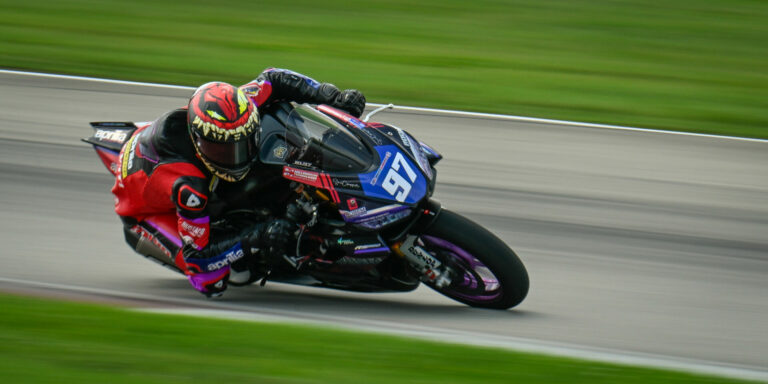
Rocco Landers dominated MotoAmerica REV’IT! Twins Cup Free Practice One (FP1) Friday morning at New Jersey Motorsports Park (NJMP), in Millville, New Jersey. Riding his Robem Engineering Aprilia RS 660, the title contender lapped the 2.25-mile Thunderbolt Raceway course in 1:27.629.
Dominic Doyle was second-best with a time of 1:29.110 on his Team Iso Yamaha YZF-R7, and Gus Rodio, another title contender, was third-quickest with a 1:29.403 on his Rodio Racing – Powered by Robem Engineering Aprilia.
Blake Davis, the third rider with a shot at the 2023 Twins Cup crown, was fifth in the session with a time of 1:30.178 on his N2 Racing/BobbleHeadMoto Yamaha. Spencer Humphreys was fourth with a time of 1:30.070 on his Triplestrong/Bartcon Racing Yamaha.
Nicolo Bulega was best in World Supersport Free Practice One (FP1) Friday morning at MotorLand Aragon, in Spain. Riding his Aruba.it Racing Ducati Panigale V2, the Italian navigated the 3.1-mile (5.0 km) road course in 1:54.043 to top the field of 32 riders.
Six-time World Champion Jonathan Rea was quickest in World Superbike Free Practice One (FP1) Friday morning at MotorLand Aragon, in Spain. Riding his factory Kawasaki Ninja ZX-10RR, the Northern Irishman covered the 3.1-mile (5.0 km) track in 1:50.309 to lead the field of 25 riders.
American Garrett Gerloff was fourth overall and the top BMW rider with a 1:50.692 on his Bonovo Action M 1000 RR.
Luca Marini was fastest in MotoGP World Championship Free Practice Two (FP2) Friday afternoon at Buddh International Circuit, in India. Riding his Mooney VR46 Racing Team Ducati at the new 3.1-mile (5.0 km) venue, the Italian topped the field of 22 riders with a 1:44.782.
Jorge Martin was second-best with a 1:44.790 on his Prima Pramac Racing Ducati, and Aleix Espargaro ranked third with a 1:44.833 on his factory Aprilia RS-GP.
Just 1.791 seconds covered the entire field with only one second separating the top 17 riders.
The top 10 riders in FP2 transfer directly to Qualifying Two (Q2). Riders outside of the top 10 in Practice must go to Qualifying One (Q1) and finish that session in the top two to advance to Q2 and compete for the top 12 grid spots.
History made! Just 0.008 splits Marini and Martin as MotoGP™ debuts in India
The duo are split by almost nothing as Aleix Espargaro sit just 0.051 off the top in third and Marc Marquez slots into P4
Friday, 22 September 2023
The first ever day of MotoGP™ action at Buddh International Circuit threw up a treat, with the timesheets incredibly tight at the top. The stage is certainly set for a barnstorming IndianOil Grand Prix of India as Luca Marini (Mooney VR46 Racing Team) put down a stunning 1:44.782 to lead Jorge Martin (Prima Pramac Racing) by just 0.008s, and the gap didn’t get much bigger down to third either as Aleix Espargaro (Aprilia Racing) started his weekend in P3 just 0.051 off Marini.
Crunch time in Practice!
With Friday afternoon’s Practice session deciding who goes through to Q2, the riders spent the majority of the session working on their race packages before tucking in for their late time attacks.
The top 10 go through to Q2, and it was a mad rush as the soft tyres went in with fifteen minutes to go. The times really began to tumble but it was late charge in the final moments that saw Marini set the benchmark with the fastest time of the weekend so far.
Martin was the man to beat for the majority of the session though, and did move the goalposts by half a second ahead of time-attack war before just being denied by Marini at the end, with yellow flags out and little time remaining.
Marc Marquez (Repsol Honda Team) was one of those threatening the top spots as well. Red sectors came in from the eight-time champ, but the ask was a little too much for the Repsol Honda to take over on top. Still, he took a positive P4. Marco Bezzecchi (Mooney VR46 Racing Team) was also looking strong after topping Friday morning’s Practice 1, but couldn’t put himself any higher than P5 in Practice.
Bagnaia with something up his sleeve?
Reigning Champion Francesco Bagnaia (Ducati Lenovo Team) was very much in the danger zone as the clock was ticking away in the final 10 minutes. The Championship leader was sat outside of Q2 contention and had some work to do, with the pace getting hotter and hotter. Bagnaia hadn’t been setting the world on fire throughout the day, but with the question asked of the Italian, he got the hammer down to bag P7 and an important Q2 spot just behind Maverick Viñales (Aprilia Racing). Is the champ struggling or keeping his cards close to his chest?
Fabio Quartararo (Monster Energy Yamaha MotoGP™) enjoyed a fairly positive day onboard his Yamaha M1. The Frenchman finds himself in an automatic Q2 spot in P8, and is looking confident with the new circuit leveling the playing field that little bit more. He suffered two mechanical issues in FP1 butstill took that all-important place in Q2.
The Frenchman’s compatriot Johann Zarco (Prima Pramac Racing) finished just behind in P9, with Joan Mir (Repsol Honda Team) also returning to Q2 with a much-needed top 10. It was close there though, with yellow flags out in the final few minutes and that causing both Brad Binder (Red Bull KTM Factory Racing) and Augusto Fernandez (GASGAS Factory Racing Tech3) to have their best laps scrubbed off, both of which would have easily seen them sail into Q2.
A packed house in Q1
Behind Mir, it’s Fabio Di Giannantonio (Gresini Racing MotoGP™) the first to miss out after finishing Practice in P11 following those lap cancellations.
Diggia, Binder and Augusto Fernandez will be joined in Q1 by the likes of Alex Marquez (Gresini Racing MotoGP™), Franco Morbidelli (Monster Energy Yamaha MotoGP™), Miguel Oliveira (CryptoDATA RNF MotoGP™ Team) and Jack Miller (Red Bull KTM Factory Racing) in a hotly-contested session on Saturday morning too, so don’t miss it!
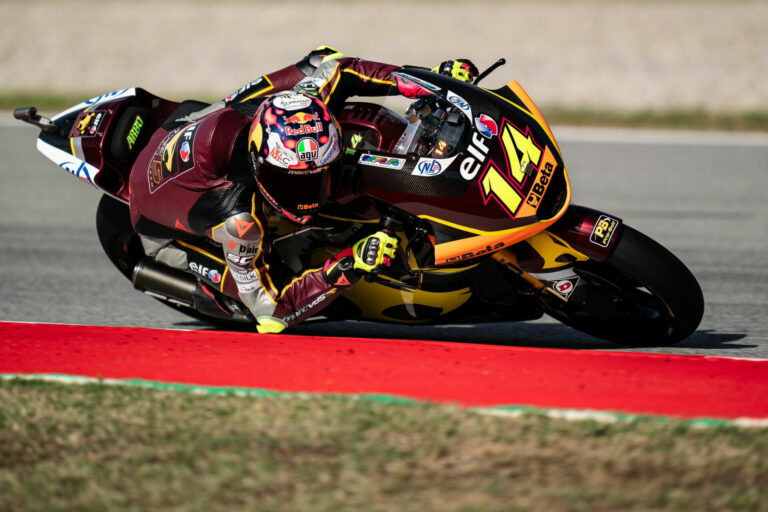
Tony Arbolino led Moto2 World Championship practice Friday afternoon at Buddh International Circuit, in India. Riding his Elf Marc VDS Racing Team Kalex, the Italian covered the 3.1-mile (5.0-mile) track in 1:52.105.
American Joe Roberts (1:53.037) was 17th on his Italtrans Racing Kalex, while his countryman Sean Dylan Kelly (1:53.787) ended up 25th on his Forward Racing machine.
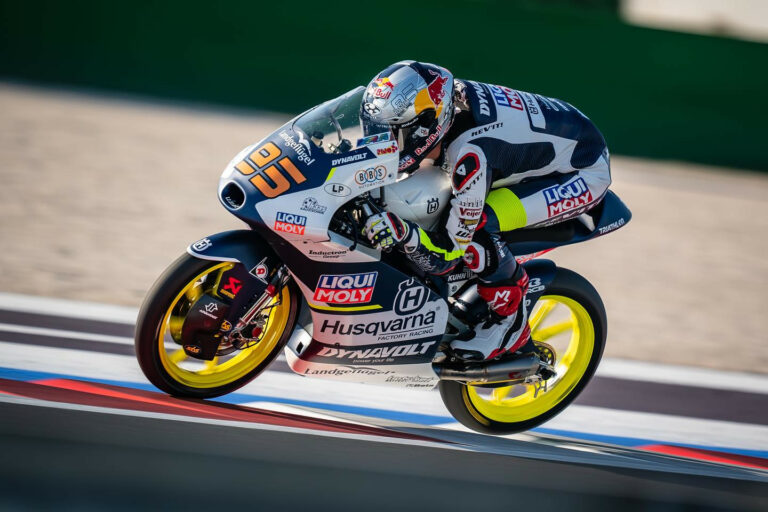
Collin Veijer topped Moto3 World Championship practice Friday afternoon at Buddh International Circuit, in India. Riding his Liqui Moly Intact GP Husqvarna, the Dutch racer lapped the 3.1-mile (5.0 km) course in 1:59.566 to lead the field of 30 riders.
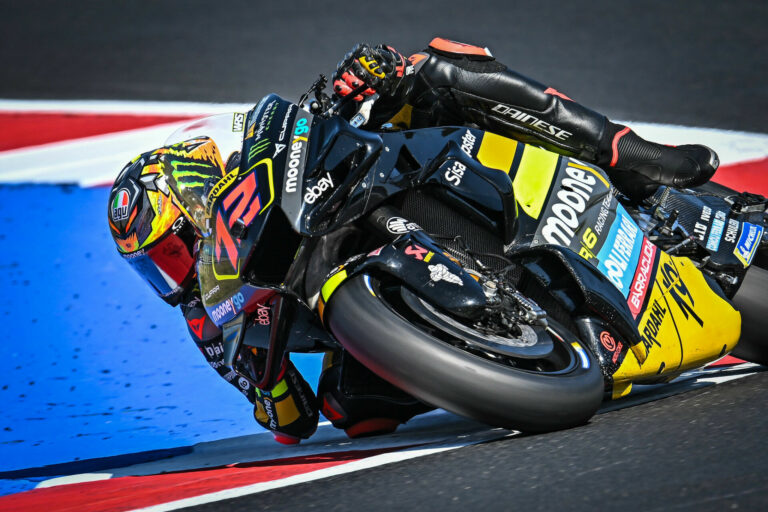
Marco Bezzecchi was quickest during MotoGP World Championship Free Practice One (FP1) in hot and humid conditions Friday morning at the new-to-the-series Buddh International Circuit, in India. Riding his Mooney VR46 Racing Team Ducati Desmosedici, the Italian lapped the unfamiliar and challenging 3.1-mile (5.0 km) track in 1:45.990 to lead the field of 22 riders.
The session was full of crashes and riders running off track, especially at tight Turn One, as they tried to learn the new circuit.
Fabio Quartararo lost valuable track time in FP1 when he suffered technical problems with both of his Monster Energy Yamaha YZR-M1s.
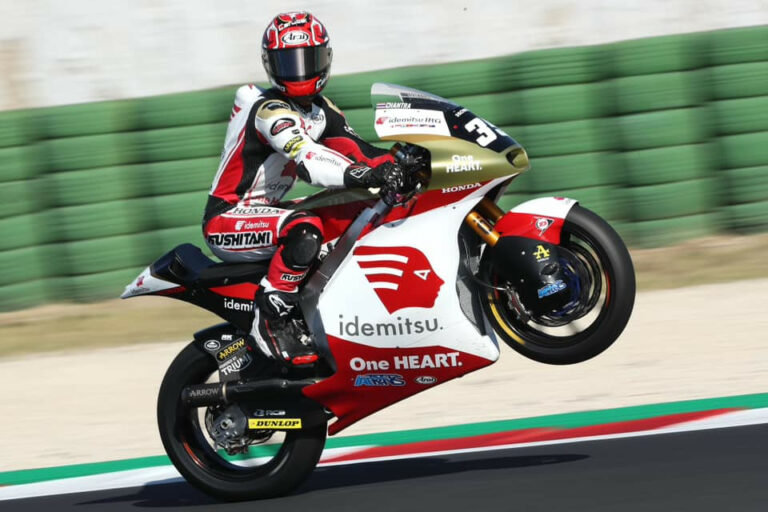
Somkiat Chantra led FIM Moto2 World Championship Free Practice One (FP1) Friday morning at Buddh International Circuit, in India. Riding his Idemitsu Honda Team Asia Kalex, the Thai rider lapped the 3.1-mile (5.0 km) road course in 1:52.596 to lead the field of 30 competitors.
American Joe Roberts and Sean Dylan Kelly (SDK) finished the session eighth and 20th, respectively. Roberts did a 1:53.808 on his Italtrans Racing Kalex, while SDK did a 1:54.662 on his Forward Racing machine.
Jaume Masia was quickest during FIM Moto3 World Championship Free Practice One (FP1) Friday morning at Buddh International Circuit, in India. Riding his Leopard Racing Honda, the Spaniard navigated the new 3.1-mile (5.0 km) circuit in 2:00.324 to lead the field of 30 riders.
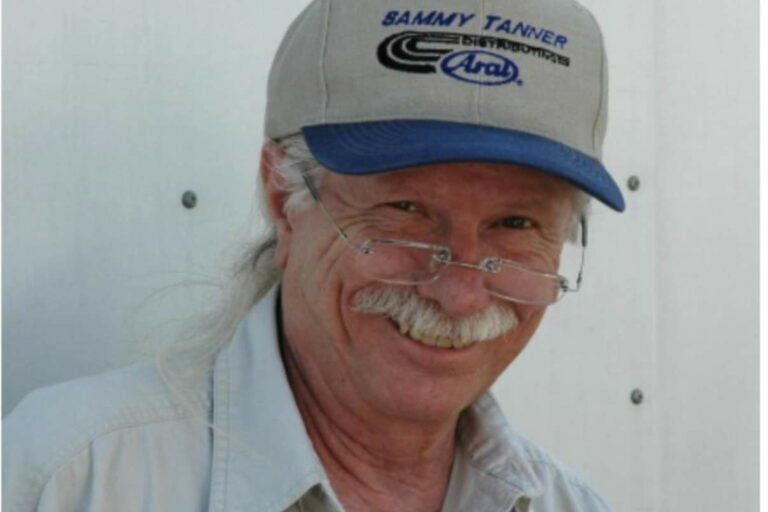
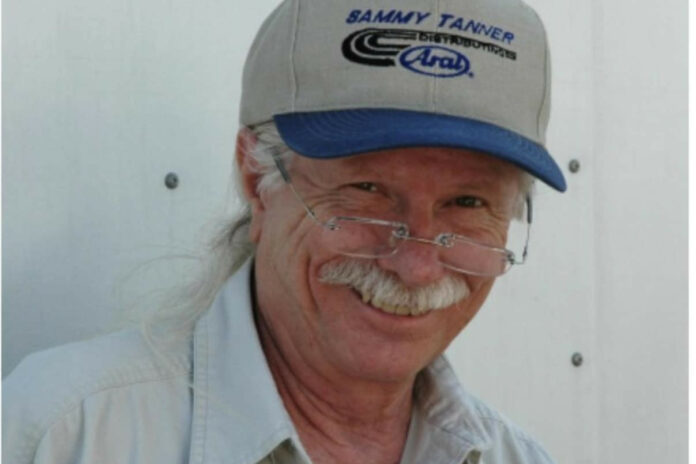
Former AMA Pro dirt track racer, Arai Helmet distributor, and AMA Motorcycle Hall of Famer Sammy Tanner has died. He was 84 years old.
Details are still coming in, and we will report more information as it becomes available.
The following is Sammy Tanner’s official AMA Motorcycle Hall of Fame biography:
Sammy Tanner was one of the top AMA professional racers from the late 1950s through all of the 1960s. Tanner won a total of seven AMA nationals, including the prestigious Springfield (Illinois) Mile. He rode for the Triumph and BSA factory teams and was one of the heroes of the famous weekly Friday night Ascot Park races in Gardena, California. When Tanner first began racing as a young teenager, he was just 5 feet tall and weighed barely 100 pounds, earning him the nickname the “Flying Flea.” He was also known for being one of the first riders on the Grand National circuit to wear white racing leathers.
Tanner was born on May 23, 1939 in Houston. He grew up in Houston and as a young boy loved to watch both sprint car and motorcycle dirt track racing. Fellow Texan A.J. Foyt was an early hero. He bought a sprint car as a teenager, but was too scared to drive it so he sold it, doubling his money. When he was 14, Tanner bought his first motorcycle – a Villiers James. Shortly afterwards, Tanner started racing in local field meets around Texas and soon earned a support ride on a 500cc Triumph.
While following the county fair circuit in the Midwest one summer, an announcer jokingly said that Tanner was a rock ‘n’ roll star back home in Texas. Fans swamped him after the race asking for his autograph and copies of his record, even though he had never made a recording in his life. The race announcer saw an opportunity and quickly put Tanner in the recording studio to cut a record, including a hastily written tune based on Tanner’s nickname. The song began: “When I was born in a Texas shack, Pop took one look and said send him back. No scrawnier runt ever lived than me, but now I’m known as the ‘Flying Flea.'”
Tanner burst onto the AMA Grand National scene as a rookie Expert in 1958. The “Flying Flea” did fly and finished sixth in his first year on the circuit. Indicative of what the future held in store was his runner-up finish in that year’s San Jose National Mile. After defending Grand National Champion Joe Leonard’s track record was broken not once but three times in time trials, the 25-lap race turned into a barnburner. Carroll Resweber, who would go on to win the first of his four Grand National titles that year, and eventual winner Everett Brashear and Don Hawley swapped the lead back and forth an astonishing 55 times! When the checkered flag fell, Brashear was first across the line, but it was the rookie Tanner in second ahead of Resweber. Tanner had arrived.
Tanner, who had established residency in California, topped the AMA’s half-mile race points list in his rookie year, and duplicated that feat in 1959. That year saw the opening of the new Ascot half-mile facility in Gardena, California, and it was Tanner who won the first-ever Grand National held there that July. In that era, AMA nationals were run for varying distances and that race was an 8-mile event. Tanner’s skill, combined with the ultra-fast characteristics of the track, produced a new eight-mile race record, breaking the old record by six seconds.
Sammy Tanner (7) at Heidelberg Speedway in 1965. Photo courtesy AMA Motorcycle Hall of Fame.
Tanner’s early successes came while riding a Triumph sponsored by Johnson Motors, the West Coast distributor of Triumph motorcycles. Ascot hosted races every Friday night during a lengthy southern California race season and for many years Tanner dueled with the likes of three-time Ascot National winner Al Gunter, 1961 Ascot National winner Neil Keen, Elliott Schultz, Stu Morley, Troy Lee, Jack O’Brien and Don Hawley. From the opening Ascot National that Tanner won in 1959 through the 1966 event, the winner was either Tanner, Gunter or Keen. After his opening-year Ascot win, Tanner topped the half-mile National at the track three more times, winning in three consecutive years, 1964-66. He had switched from riding Triumphs to competing on BSAs, prepared by the legendary C.R. Axtell.
Although four of Tanner’s seven Grand National victories came at his “hometown” Ascot track, perhaps his finest ride was turned in at the 1964 Springfield Mile. Tanner took the lead on the 26th lap of the 50-mile race and he dueled the remainder of the race with Dick Mann, and briefly Ronnie Rall, before crossing the finish line first, a narrow three bike lengths ahead of Mann. His victory on a BSA at Springfield broke a 10-year Harley-Davidson victory stretch at the famed oval. Mann was also BSA-mounted, so the first Harley finished third with Ralph White aboard.
Two years later, in 1966, Tanner scored his fourth Ascot National win, and added wins in half-mile Nationals at Elkhorn, Wisconsin, and Heidelberg, Pennsylvania. He finished the year third in the Grand National Championship point standings, trailing only fellow Motorcycle Hall of Fame members Bart Markel and Gary Nixon.
Tanner hung up his steel shoe in 1972 and now operates an Arai helmet distributorship in Southern California.
Inducted in 1999
More, from a social media post by Arai Americas:
It was with great sadness that we have learned of the passing of our good friend, and dedicated Arai Helmet distributor, Sammy Tanner.
Sammy was a successful flat tracker who, after hanging up his leathers, turned his passion for motorcycling into a business. He was one of the first to believe in the Arai difference and we will always remember and appreciate his dedication to always representing Arai to the best of his ability, which contributed greatly to the success of Arai in America.
He was a kind human being, who looked to not only grow his own business, but help others along the way. We will miss his positive attitude and infectious smile. He will be missed and remembered fondly.
More, from a press release issued by AMA:
The AMA Offers Condolences on the Passing of AMA Motorcycle Hall of Famer Sammy Tanner
PICKERINGTON, Ohio — The American Motorcyclist Association offers its condolences to the family, friends and team of seven-time AMA Grand National Championship event winner and 1999 AMA Motorcycle Hall of Fame Inductee Sammy Tanner, who passed away on Sept. 21.
Born May 23, 1939, in Houston, Tanner purchased his first motorcycle — a James Villiers — at 14 years old and fell in love with the sport right away. Shortly after purchasing his bike, Tanner started racing in local field meets throughout his home state of Texas, and soon after earned a support ride on a 500cc Triumph. Due to his 5-foot, 100-pound stature, Tanner was lovingly dubbed “The Flying Flea” by fans and fellow racers alike.
In 1958, Tanner made the leap to the professional ranks, finishing sixth in the AMA Grand National Championship during his rookie season and emerging as the top points earner in Half-Mile races, and duplicated that same feat in his sophomore campaign. In that same season, Tanner captured the first of his four AMA Grand National Championship wins at the legendary Ascot Half-Mile facility in Gardena, Calif.
After his first win at Ascot, Tanner ripped off three-straight victories at the famed Half-Mile track from 1964-66 while competing aboard both Triumphs and BSAs.
While Tanner’s dominance at Ascot is well-documented, his finest ride came at the 1964 Springfield Mile, in which he outlasted fellow AMA Motorcycle Hall of Famers Dick Mann and Ronnie Rall for the victory. His victory aboard the BSA broke a 10-year Harley-Davidson winning streak at the track.
In 1966, Tanner added Half-Mile victories in Elkhorn, Wis. and Heidelberg, Penn., and finished third in the Grand National Championship point standings behind fellow AMA Motorcycle Hall of Famers Bart Markel and Gary Nixon.
The Flying Flea retired in 1972, and operated an Arai helmet distributorship in Southern California following his racing career.
About the American Motorcyclist Association
Founded in 1924, the AMA is a not-for-profit member-based association whose mission is to promote the motorcycle lifestyle and protect the future of motorcycling. As the world’s largest motorcycling rights and event sanctioning organization, the AMA advocates for riders’ interests at all levels of government and sanctions thousands of competition and recreational events every year. Besides offering members money-saving discounts on products and services, the AMA also publishes American Motorcyclist, a recently revitalized and monthly full-color magazine (and digital version of same) that covers current events and motorcycle history with brilliant photography and compelling writing. American Motorcyclist is also North America’s largest-circulation magazine. Through the AMA Motorcycle Hall of Fame in Pickerington, Ohio, the AMA honors the heroes and heritage of motorcycling. For more information, visit americanmotorcyclist.com.
Not a member? Join the AMA today: americanmotorcyclist.com.
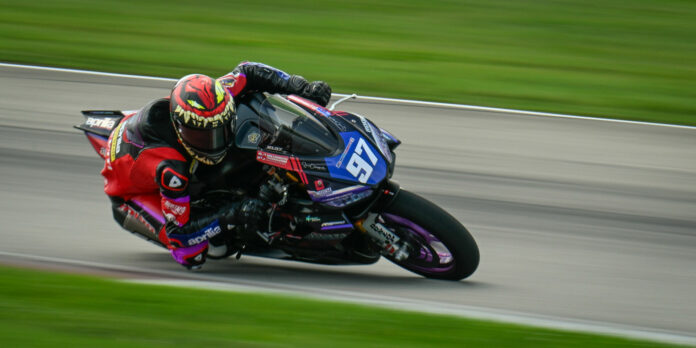
Rocco Landers dominated MotoAmerica REV’IT! Twins Cup Free Practice One (FP1) Friday morning at New Jersey Motorsports Park (NJMP), in Millville, New Jersey. Riding his Robem Engineering Aprilia RS 660, the title contender lapped the 2.25-mile Thunderbolt Raceway course in 1:27.629.
Dominic Doyle was second-best with a time of 1:29.110 on his Team Iso Yamaha YZF-R7, and Gus Rodio, another title contender, was third-quickest with a 1:29.403 on his Rodio Racing – Powered by Robem Engineering Aprilia.
Blake Davis, the third rider with a shot at the 2023 Twins Cup crown, was fifth in the session with a time of 1:30.178 on his N2 Racing/BobbleHeadMoto Yamaha. Spencer Humphreys was fourth with a time of 1:30.070 on his Triplestrong/Bartcon Racing Yamaha.
Nicolo Bulega was best in World Supersport Free Practice One (FP1) Friday morning at MotorLand Aragon, in Spain. Riding his Aruba.it Racing Ducati Panigale V2, the Italian navigated the 3.1-mile (5.0 km) road course in 1:54.043 to top the field of 32 riders.
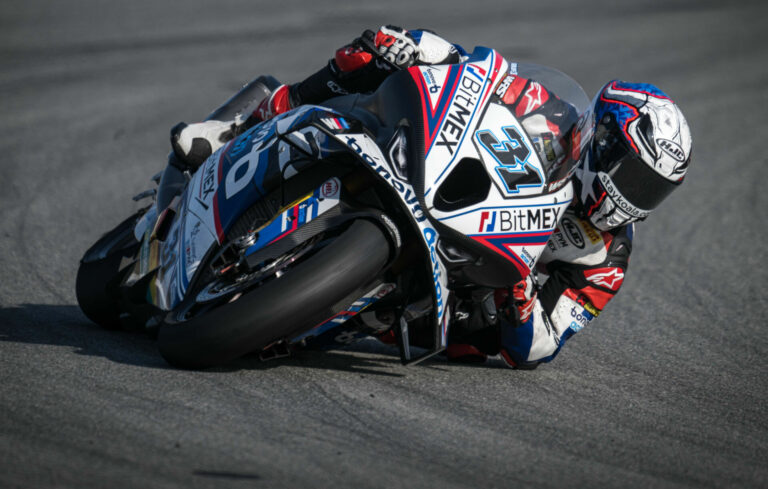
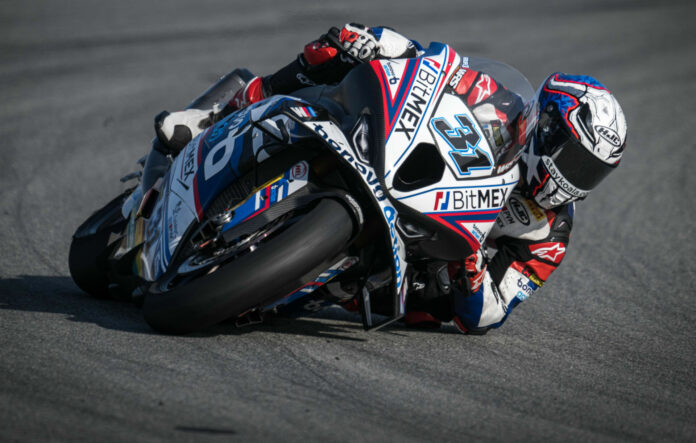
American Garrett Gerloff (31) at speed on his Bonovo Action BMW M 1000 RR Superbike earlier this season at Circuit de Barcelona - Catalunya. Photo courtesy BMW Motorrad Motorsport.
Six-time World Champion Jonathan Rea was quickest in World Superbike Free Practice One (FP1) Friday morning at MotorLand Aragon, in Spain. Riding his factory Kawasaki Ninja ZX-10RR, the Northern Irishman covered the 3.1-mile (5.0 km) track in 1:50.309 to lead the field of 25 riders.
American Garrett Gerloff was fourth overall and the top BMW rider with a 1:50.692 on his Bonovo Action M 1000 RR.
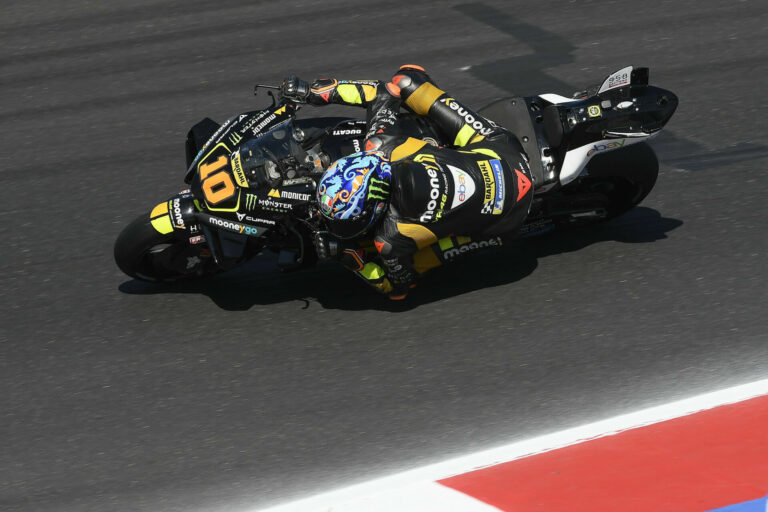
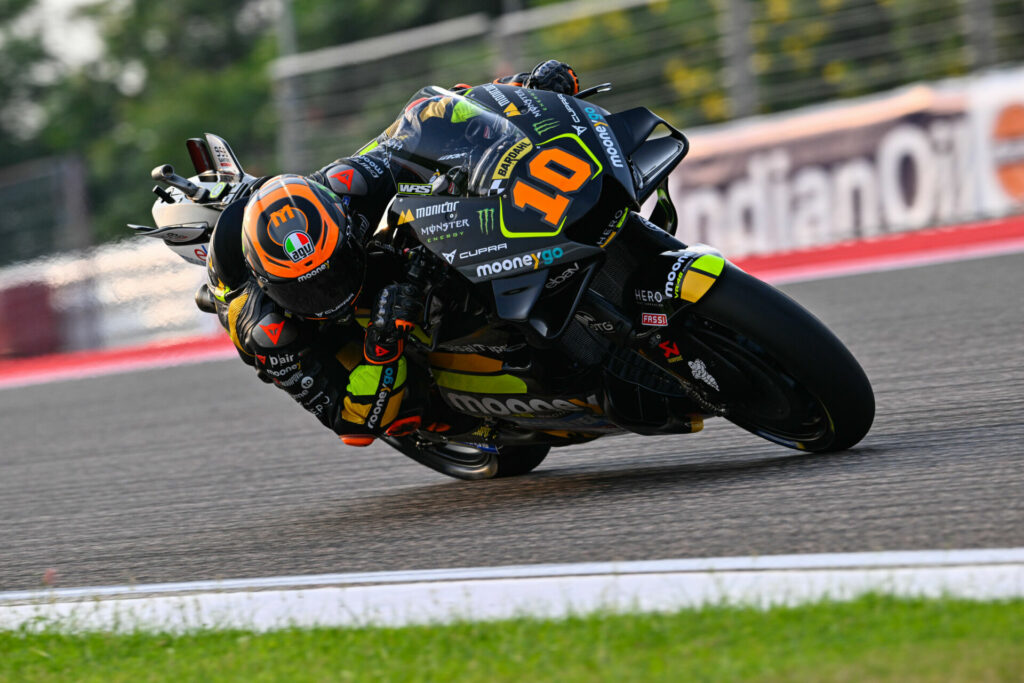
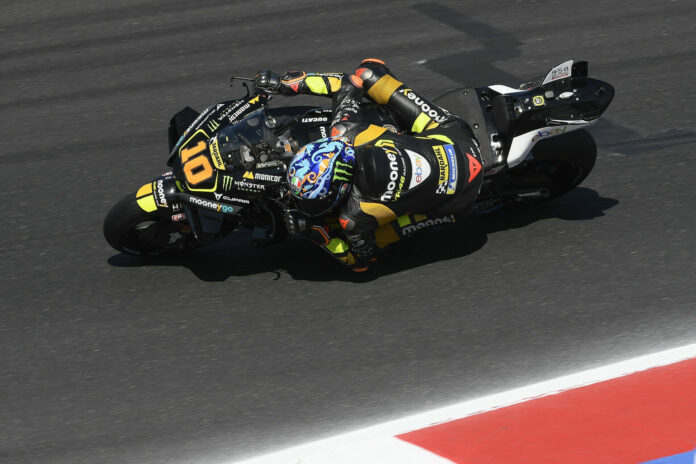
Luca Marini (10). Photo courtesy Mooney VR46 Racing Team.
Luca Marini was fastest in MotoGP World Championship Free Practice Two (FP2) Friday afternoon at Buddh International Circuit, in India. Riding his Mooney VR46 Racing Team Ducati at the new 3.1-mile (5.0 km) venue, the Italian topped the field of 22 riders with a 1:44.782.
Jorge Martin was second-best with a 1:44.790 on his Prima Pramac Racing Ducati, and Aleix Espargaro ranked third with a 1:44.833 on his factory Aprilia RS-GP.
Just 1.791 seconds covered the entire field with only one second separating the top 17 riders.
The top 10 riders in FP2 transfer directly to Qualifying Two (Q2). Riders outside of the top 10 in Practice must go to Qualifying One (Q1) and finish that session in the top two to advance to Q2 and compete for the top 12 grid spots.
History made! Just 0.008 splits Marini and Martin as MotoGP™ debuts in India
The duo are split by almost nothing as Aleix Espargaro sit just 0.051 off the top in third and Marc Marquez slots into P4
Friday, 22 September 2023
The first ever day of MotoGP™ action at Buddh International Circuit threw up a treat, with the timesheets incredibly tight at the top. The stage is certainly set for a barnstorming IndianOil Grand Prix of India as Luca Marini (Mooney VR46 Racing Team) put down a stunning 1:44.782 to lead Jorge Martin (Prima Pramac Racing) by just 0.008s, and the gap didn’t get much bigger down to third either as Aleix Espargaro (Aprilia Racing) started his weekend in P3 just 0.051 off Marini.
Crunch time in Practice!
With Friday afternoon’s Practice session deciding who goes through to Q2, the riders spent the majority of the session working on their race packages before tucking in for their late time attacks.
The top 10 go through to Q2, and it was a mad rush as the soft tyres went in with fifteen minutes to go. The times really began to tumble but it was late charge in the final moments that saw Marini set the benchmark with the fastest time of the weekend so far.
Martin was the man to beat for the majority of the session though, and did move the goalposts by half a second ahead of time-attack war before just being denied by Marini at the end, with yellow flags out and little time remaining.
Marc Marquez (Repsol Honda Team) was one of those threatening the top spots as well. Red sectors came in from the eight-time champ, but the ask was a little too much for the Repsol Honda to take over on top. Still, he took a positive P4. Marco Bezzecchi (Mooney VR46 Racing Team) was also looking strong after topping Friday morning’s Practice 1, but couldn’t put himself any higher than P5 in Practice.
Bagnaia with something up his sleeve?
Reigning Champion Francesco Bagnaia (Ducati Lenovo Team) was very much in the danger zone as the clock was ticking away in the final 10 minutes. The Championship leader was sat outside of Q2 contention and had some work to do, with the pace getting hotter and hotter. Bagnaia hadn’t been setting the world on fire throughout the day, but with the question asked of the Italian, he got the hammer down to bag P7 and an important Q2 spot just behind Maverick Viñales (Aprilia Racing). Is the champ struggling or keeping his cards close to his chest?
Fabio Quartararo (Monster Energy Yamaha MotoGP™) enjoyed a fairly positive day onboard his Yamaha M1. The Frenchman finds himself in an automatic Q2 spot in P8, and is looking confident with the new circuit leveling the playing field that little bit more. He suffered two mechanical issues in FP1 butstill took that all-important place in Q2.
The Frenchman’s compatriot Johann Zarco (Prima Pramac Racing) finished just behind in P9, with Joan Mir (Repsol Honda Team) also returning to Q2 with a much-needed top 10. It was close there though, with yellow flags out in the final few minutes and that causing both Brad Binder (Red Bull KTM Factory Racing) and Augusto Fernandez (GASGAS Factory Racing Tech3) to have their best laps scrubbed off, both of which would have easily seen them sail into Q2.
A packed house in Q1
Behind Mir, it’s Fabio Di Giannantonio (Gresini Racing MotoGP™) the first to miss out after finishing Practice in P11 following those lap cancellations.
Diggia, Binder and Augusto Fernandez will be joined in Q1 by the likes of Alex Marquez (Gresini Racing MotoGP™), Franco Morbidelli (Monster Energy Yamaha MotoGP™), Miguel Oliveira (CryptoDATA RNF MotoGP™ Team) and Jack Miller (Red Bull KTM Factory Racing) in a hotly-contested session on Saturday morning too, so don’t miss it!
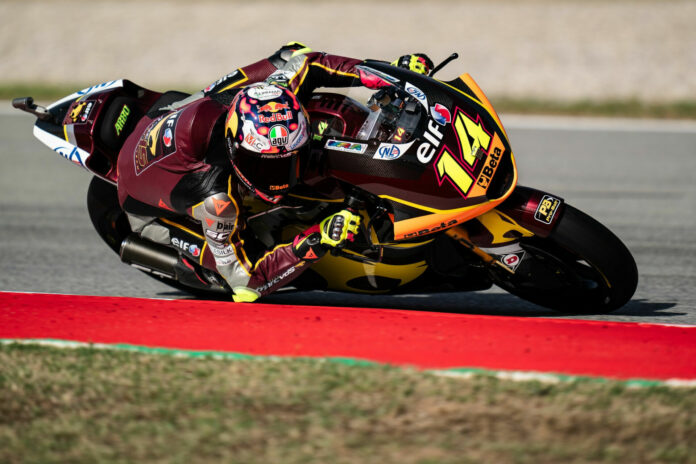
Tony Arbolino (14). Photo courtesy Marc VDS Racing Team.
Tony Arbolino led Moto2 World Championship practice Friday afternoon at Buddh International Circuit, in India. Riding his Elf Marc VDS Racing Team Kalex, the Italian covered the 3.1-mile (5.0-mile) track in 1:52.105.
American Joe Roberts (1:53.037) was 17th on his Italtrans Racing Kalex, while his countryman Sean Dylan Kelly (1:53.787) ended up 25th on his Forward Racing machine.
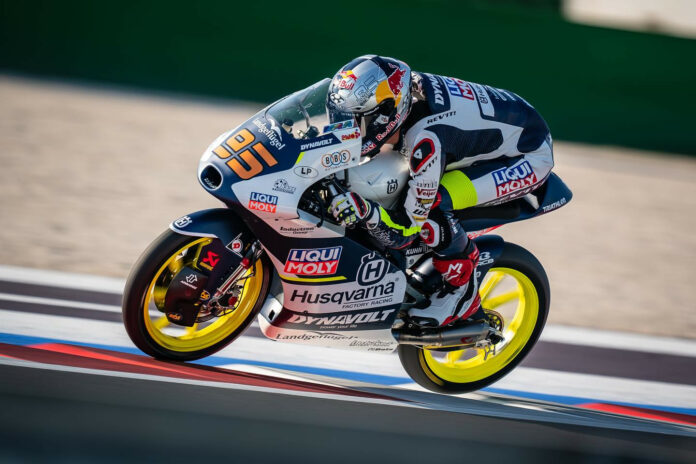
Collin Veijer (95). Photo courtesy Liqui Moly Intact GP Husqvarna.
Collin Veijer topped Moto3 World Championship practice Friday afternoon at Buddh International Circuit, in India. Riding his Liqui Moly Intact GP Husqvarna, the Dutch racer lapped the 3.1-mile (5.0 km) course in 1:59.566 to lead the field of 30 riders.
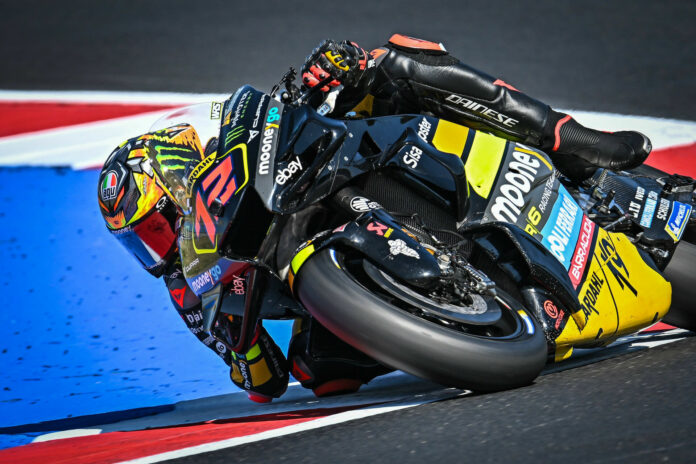
Marco Bezzecchi (72), as seen earlier this season. Photo courtesy Mooney VR46 Racing Team.
Marco Bezzecchi was quickest during MotoGP World Championship Free Practice One (FP1) in hot and humid conditions Friday morning at the new-to-the-series Buddh International Circuit, in India. Riding his Mooney VR46 Racing Team Ducati Desmosedici, the Italian lapped the unfamiliar and challenging 3.1-mile (5.0 km) track in 1:45.990 to lead the field of 22 riders.
The session was full of crashes and riders running off track, especially at tight Turn One, as they tried to learn the new circuit.
Fabio Quartararo lost valuable track time in FP1 when he suffered technical problems with both of his Monster Energy Yamaha YZR-M1s.
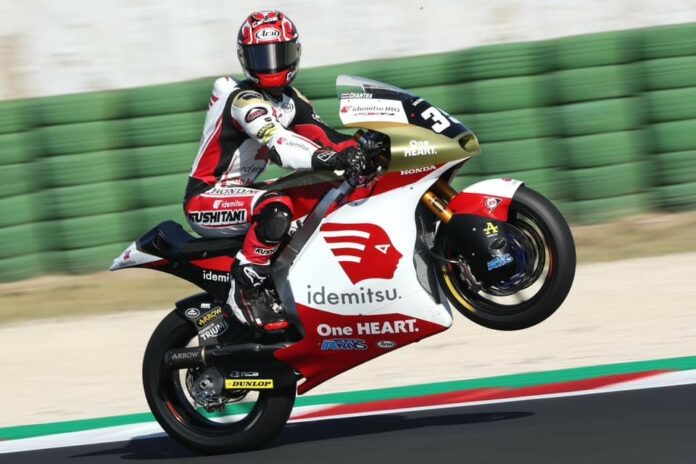
Somkiat Chantra (35). Photo courtesy Idemitsu Honda Team Asia.
Somkiat Chantra led FIM Moto2 World Championship Free Practice One (FP1) Friday morning at Buddh International Circuit, in India. Riding his Idemitsu Honda Team Asia Kalex, the Thai rider lapped the 3.1-mile (5.0 km) road course in 1:52.596 to lead the field of 30 competitors.
American Joe Roberts and Sean Dylan Kelly (SDK) finished the session eighth and 20th, respectively. Roberts did a 1:53.808 on his Italtrans Racing Kalex, while SDK did a 1:54.662 on his Forward Racing machine.
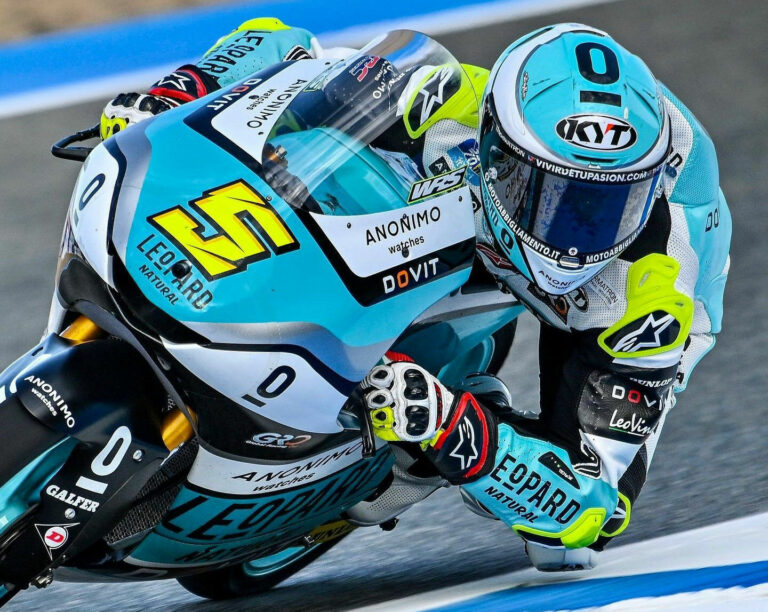
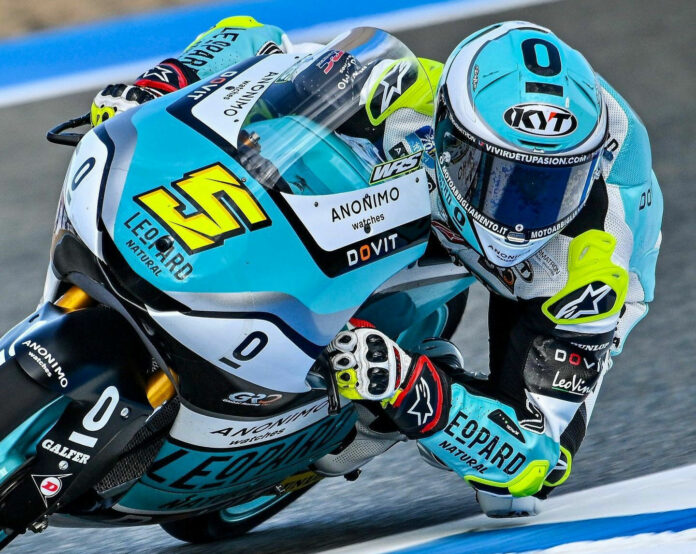
Jaume Masia (5), as seen earlier this season. Photo courtesy Leopard Racing Team.
Jaume Masia was quickest during FIM Moto3 World Championship Free Practice One (FP1) Friday morning at Buddh International Circuit, in India. Riding his Leopard Racing Honda, the Spaniard navigated the new 3.1-mile (5.0 km) circuit in 2:00.324 to lead the field of 30 riders.
Former AMA Pro dirt track racer, Arai Helmet distributor, and AMA Motorcycle Hall of Famer Sammy Tanner has died. He was 84 years old.
Details are still coming in, and we will report more information as it becomes available.
The following is Sammy Tanner’s official AMA Motorcycle Hall of Fame biography:
Sammy Tanner was one of the top AMA professional racers from the late 1950s through all of the 1960s. Tanner won a total of seven AMA nationals, including the prestigious Springfield (Illinois) Mile. He rode for the Triumph and BSA factory teams and was one of the heroes of the famous weekly Friday night Ascot Park races in Gardena, California. When Tanner first began racing as a young teenager, he was just 5 feet tall and weighed barely 100 pounds, earning him the nickname the “Flying Flea.” He was also known for being one of the first riders on the Grand National circuit to wear white racing leathers.
Tanner was born on May 23, 1939 in Houston. He grew up in Houston and as a young boy loved to watch both sprint car and motorcycle dirt track racing. Fellow Texan A.J. Foyt was an early hero. He bought a sprint car as a teenager, but was too scared to drive it so he sold it, doubling his money. When he was 14, Tanner bought his first motorcycle – a Villiers James. Shortly afterwards, Tanner started racing in local field meets around Texas and soon earned a support ride on a 500cc Triumph.
While following the county fair circuit in the Midwest one summer, an announcer jokingly said that Tanner was a rock ‘n’ roll star back home in Texas. Fans swamped him after the race asking for his autograph and copies of his record, even though he had never made a recording in his life. The race announcer saw an opportunity and quickly put Tanner in the recording studio to cut a record, including a hastily written tune based on Tanner’s nickname. The song began: “When I was born in a Texas shack, Pop took one look and said send him back. No scrawnier runt ever lived than me, but now I’m known as the ‘Flying Flea.'”
Tanner burst onto the AMA Grand National scene as a rookie Expert in 1958. The “Flying Flea” did fly and finished sixth in his first year on the circuit. Indicative of what the future held in store was his runner-up finish in that year’s San Jose National Mile. After defending Grand National Champion Joe Leonard’s track record was broken not once but three times in time trials, the 25-lap race turned into a barnburner. Carroll Resweber, who would go on to win the first of his four Grand National titles that year, and eventual winner Everett Brashear and Don Hawley swapped the lead back and forth an astonishing 55 times! When the checkered flag fell, Brashear was first across the line, but it was the rookie Tanner in second ahead of Resweber. Tanner had arrived.
Tanner, who had established residency in California, topped the AMA’s half-mile race points list in his rookie year, and duplicated that feat in 1959. That year saw the opening of the new Ascot half-mile facility in Gardena, California, and it was Tanner who won the first-ever Grand National held there that July. In that era, AMA nationals were run for varying distances and that race was an 8-mile event. Tanner’s skill, combined with the ultra-fast characteristics of the track, produced a new eight-mile race record, breaking the old record by six seconds.
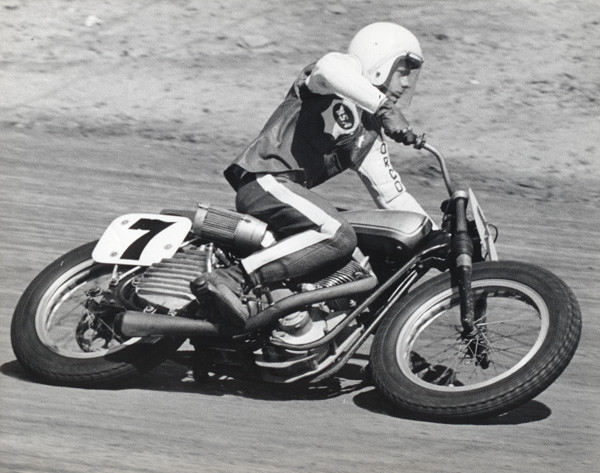
Sammy Tanner (7) at Heidelberg Speedway in 1965. Photo courtesy AMA Motorcycle Hall of Fame.
Tanner’s early successes came while riding a Triumph sponsored by Johnson Motors, the West Coast distributor of Triumph motorcycles. Ascot hosted races every Friday night during a lengthy southern California race season and for many years Tanner dueled with the likes of three-time Ascot National winner Al Gunter, 1961 Ascot National winner Neil Keen, Elliott Schultz, Stu Morley, Troy Lee, Jack O’Brien and Don Hawley. From the opening Ascot National that Tanner won in 1959 through the 1966 event, the winner was either Tanner, Gunter or Keen. After his opening-year Ascot win, Tanner topped the half-mile National at the track three more times, winning in three consecutive years, 1964-66. He had switched from riding Triumphs to competing on BSAs, prepared by the legendary C.R. Axtell.
Although four of Tanner’s seven Grand National victories came at his “hometown” Ascot track, perhaps his finest ride was turned in at the 1964 Springfield Mile. Tanner took the lead on the 26th lap of the 50-mile race and he dueled the remainder of the race with Dick Mann, and briefly Ronnie Rall, before crossing the finish line first, a narrow three bike lengths ahead of Mann. His victory on a BSA at Springfield broke a 10-year Harley-Davidson victory stretch at the famed oval. Mann was also BSA-mounted, so the first Harley finished third with Ralph White aboard.
Two years later, in 1966, Tanner scored his fourth Ascot National win, and added wins in half-mile Nationals at Elkhorn, Wisconsin, and Heidelberg, Pennsylvania. He finished the year third in the Grand National Championship point standings, trailing only fellow Motorcycle Hall of Fame members Bart Markel and Gary Nixon.
Tanner hung up his steel shoe in 1972 and now operates an Arai helmet distributorship in Southern California.
Inducted in 1999
More, from a social media post by Arai Americas:
It was with great sadness that we have learned of the passing of our good friend, and dedicated Arai Helmet distributor, Sammy Tanner.
Sammy was a successful flat tracker who, after hanging up his leathers, turned his passion for motorcycling into a business. He was one of the first to believe in the Arai difference and we will always remember and appreciate his dedication to always representing Arai to the best of his ability, which contributed greatly to the success of Arai in America.
He was a kind human being, who looked to not only grow his own business, but help others along the way. We will miss his positive attitude and infectious smile. He will be missed and remembered fondly.
More, from a press release issued by AMA:
The AMA Offers Condolences on the Passing of AMA Motorcycle Hall of Famer Sammy Tanner
PICKERINGTON, Ohio — The American Motorcyclist Association offers its condolences to the family, friends and team of seven-time AMA Grand National Championship event winner and 1999 AMA Motorcycle Hall of Fame Inductee Sammy Tanner, who passed away on Sept. 21.
Born May 23, 1939, in Houston, Tanner purchased his first motorcycle — a James Villiers — at 14 years old and fell in love with the sport right away. Shortly after purchasing his bike, Tanner started racing in local field meets throughout his home state of Texas, and soon after earned a support ride on a 500cc Triumph. Due to his 5-foot, 100-pound stature, Tanner was lovingly dubbed “The Flying Flea” by fans and fellow racers alike.
In 1958, Tanner made the leap to the professional ranks, finishing sixth in the AMA Grand National Championship during his rookie season and emerging as the top points earner in Half-Mile races, and duplicated that same feat in his sophomore campaign. In that same season, Tanner captured the first of his four AMA Grand National Championship wins at the legendary Ascot Half-Mile facility in Gardena, Calif.
After his first win at Ascot, Tanner ripped off three-straight victories at the famed Half-Mile track from 1964-66 while competing aboard both Triumphs and BSAs.
While Tanner’s dominance at Ascot is well-documented, his finest ride came at the 1964 Springfield Mile, in which he outlasted fellow AMA Motorcycle Hall of Famers Dick Mann and Ronnie Rall for the victory. His victory aboard the BSA broke a 10-year Harley-Davidson winning streak at the track.
In 1966, Tanner added Half-Mile victories in Elkhorn, Wis. and Heidelberg, Penn., and finished third in the Grand National Championship point standings behind fellow AMA Motorcycle Hall of Famers Bart Markel and Gary Nixon.
The Flying Flea retired in 1972, and operated an Arai helmet distributorship in Southern California following his racing career.
About the American Motorcyclist Association
Founded in 1924, the AMA is a not-for-profit member-based association whose mission is to promote the motorcycle lifestyle and protect the future of motorcycling. As the world’s largest motorcycling rights and event sanctioning organization, the AMA advocates for riders’ interests at all levels of government and sanctions thousands of competition and recreational events every year. Besides offering members money-saving discounts on products and services, the AMA also publishes American Motorcyclist, a recently revitalized and monthly full-color magazine (and digital version of same) that covers current events and motorcycle history with brilliant photography and compelling writing. American Motorcyclist is also North America’s largest-circulation magazine. Through the AMA Motorcycle Hall of Fame in Pickerington, Ohio, the AMA honors the heroes and heritage of motorcycling. For more information, visit americanmotorcyclist.com.
Not a member? Join the AMA today: americanmotorcyclist.com.
A “press release” is promotional text issued by a rider, team, company or organization to inform
the public about an event, product, or service from the issuer’s own point of view, and if deemed
to have news value, may be placed on roadracingworld.com as a service to our readers.
A press release is not an article written by Roadracingworld.com staffers. When a post is labeled with the words “press release”, it means that Roadracingworld.com is not responsible for its content and that Roadracingworld.com makes no guarantee that it is accurate. Not all press releases are posted and Roadracingworld.com may reject press releases if the content is too heavy on commercial promotion with little or no news value or if the press release contains obvious errors.
Accessibility
Accessibility modes
Epilepsy Safe Mode
Dampens color and removes blinks
This mode enables people with epilepsy to use the website safely by eliminating the risk of seizures that result from flashing or blinking animations and risky color combinations.
Visually Impaired Mode
Improves website's visuals
This mode adjusts the website for the convenience of users with visual impairments such as Degrading Eyesight, Tunnel Vision, Cataract, Glaucoma, and others.
Cognitive Disability Mode
Helps to focus on specific content
This mode provides different assistive options to help users with cognitive impairments such as Dyslexia, Autism, CVA, and others, to focus on the essential elements of the website more easily.
ADHD Friendly Mode
Reduces distractions and improve focus
This mode helps users with ADHD and Neurodevelopmental disorders to read, browse, and focus on the main website elements more easily while significantly reducing distractions.
Blindness Mode
Allows using the site with your screen-reader
This mode configures the website to be compatible with screen-readers such as JAWS, NVDA, VoiceOver, and TalkBack. A screen-reader is software for blind users that is installed on a computer and smartphone, and websites must be compatible with it.
Online Dictionary
Readable Experience
Content Scaling
Default
Text Magnifier
Readable Font
Dyslexia Friendly
Highlight Titles
Highlight Links
Font Sizing
Default
Line Height
Default
Letter Spacing
Default
Left Aligned
Center Aligned
Right Aligned
Visually Pleasing Experience
Dark Contrast
Light Contrast
Monochrome
High Contrast
High Saturation
Low Saturation
Adjust Text Colors
Adjust Title Colors
Adjust Background Colors
Easy Orientation
Mute Sounds
Hide Images
Hide Emoji
Reading Guide
Stop Animations
Reading Mask
Highlight Hover
Highlight Focus
Big Dark Cursor
Big Light Cursor
Cognitive Reading
Virtual Keyboard
Navigation Keys
Voice Navigation
Accessibility Statement
www.roadracingworld.com
April 1, 2026
Compliance status
We firmly believe that the internet should be available and accessible to anyone, and are committed to providing a website that is accessible to the widest possible audience,
regardless of circumstance and ability.
To fulfill this, we aim to adhere as strictly as possible to the World Wide Web Consortium’s (W3C) Web Content Accessibility Guidelines 2.1 (WCAG 2.1) at the AA level.
These guidelines explain how to make web content accessible to people with a wide array of disabilities. Complying with those guidelines helps us ensure that the website is accessible
to all people: blind people, people with motor impairments, visual impairment, cognitive disabilities, and more.
This website utilizes various technologies that are meant to make it as accessible as possible at all times. We utilize an accessibility interface that allows persons with specific
disabilities to adjust the website’s UI (user interface) and design it to their personal needs.
Additionally, the website utilizes an AI-based application that runs in the background and optimizes its accessibility level constantly. This application remediates the website’s HTML,
adapts Its functionality and behavior for screen-readers used by the blind users, and for keyboard functions used by individuals with motor impairments.
If you’ve found a malfunction or have ideas for improvement, we’ll be happy to hear from you. You can reach out to the website’s operators by using the following email
Screen-reader and keyboard navigation
Our website implements the ARIA attributes (Accessible Rich Internet Applications) technique, alongside various different behavioral changes, to ensure blind users visiting with
screen-readers are able to read, comprehend, and enjoy the website’s functions. As soon as a user with a screen-reader enters your site, they immediately receive
a prompt to enter the Screen-Reader Profile so they can browse and operate your site effectively. Here’s how our website covers some of the most important screen-reader requirements,
alongside console screenshots of code examples:
Screen-reader optimization: we run a background process that learns the website’s components from top to bottom, to ensure ongoing compliance even when updating the website.
In this process, we provide screen-readers with meaningful data using the ARIA set of attributes. For example, we provide accurate form labels;
descriptions for actionable icons (social media icons, search icons, cart icons, etc.); validation guidance for form inputs; element roles such as buttons, menus, modal dialogues (popups),
and others. Additionally, the background process scans all the website’s images and provides an accurate and meaningful image-object-recognition-based description as an ALT (alternate text) tag
for images that are not described. It will also extract texts that are embedded within the image, using an OCR (optical character recognition) technology.
To turn on screen-reader adjustments at any time, users need only to press the Alt+1 keyboard combination. Screen-reader users also get automatic announcements to turn the Screen-reader mode on
as soon as they enter the website.
These adjustments are compatible with all popular screen readers, including JAWS and NVDA.
Keyboard navigation optimization: The background process also adjusts the website’s HTML, and adds various behaviors using JavaScript code to make the website operable by the keyboard. This includes the ability to navigate the website using the Tab and Shift+Tab keys, operate dropdowns with the arrow keys, close them with Esc, trigger buttons and links using the Enter key, navigate between radio and checkbox elements using the arrow keys, and fill them in with the Spacebar or Enter key.Additionally, keyboard users will find quick-navigation and content-skip menus, available at any time by clicking Alt+1, or as the first elements of the site while navigating with the keyboard. The background process also handles triggered popups by moving the keyboard focus towards them as soon as they appear, and not allow the focus drift outside it.
Users can also use shortcuts such as “M” (menus), “H” (headings), “F” (forms), “B” (buttons), and “G” (graphics) to jump to specific elements.
Disability profiles supported in our website
Epilepsy Safe Mode: this profile enables people with epilepsy to use the website safely by eliminating the risk of seizures that result from flashing or blinking animations and risky color combinations.
Visually Impaired Mode: this mode adjusts the website for the convenience of users with visual impairments such as Degrading Eyesight, Tunnel Vision, Cataract, Glaucoma, and others.
Cognitive Disability Mode: this mode provides different assistive options to help users with cognitive impairments such as Dyslexia, Autism, CVA, and others, to focus on the essential elements of the website more easily.
ADHD Friendly Mode: this mode helps users with ADHD and Neurodevelopmental disorders to read, browse, and focus on the main website elements more easily while significantly reducing distractions.
Blindness Mode: this mode configures the website to be compatible with screen-readers such as JAWS, NVDA, VoiceOver, and TalkBack. A screen-reader is software for blind users that is installed on a computer and smartphone, and websites must be compatible with it.
Keyboard Navigation Profile (Motor-Impaired): this profile enables motor-impaired persons to operate the website using the keyboard Tab, Shift+Tab, and the Enter keys. Users can also use shortcuts such as “M” (menus), “H” (headings), “F” (forms), “B” (buttons), and “G” (graphics) to jump to specific elements.
Additional UI, design, and readability adjustments
Font adjustments – users, can increase and decrease its size, change its family (type), adjust the spacing, alignment, line height, and more.
Color adjustments – users can select various color contrast profiles such as light, dark, inverted, and monochrome. Additionally, users can swap color schemes of titles, texts, and backgrounds, with over seven different coloring options.
Animations – person with epilepsy can stop all running animations with the click of a button. Animations controlled by the interface include videos, GIFs, and CSS flashing transitions.
Content highlighting – users can choose to emphasize important elements such as links and titles. They can also choose to highlight focused or hovered elements only.
Audio muting – users with hearing devices may experience headaches or other issues due to automatic audio playing. This option lets users mute the entire website instantly.
Cognitive disorders – we utilize a search engine that is linked to Wikipedia and Wiktionary, allowing people with cognitive disorders to decipher meanings of phrases, initials, slang, and others.
Additional functions – we provide users the option to change cursor color and size, use a printing mode, enable a virtual keyboard, and many other functions.
Browser and assistive technology compatibility
We aim to support the widest array of browsers and assistive technologies as possible, so our users can choose the best fitting tools for them, with as few limitations as possible. Therefore, we have worked very hard to be able to support all major systems that comprise over 95% of the user market share including Google Chrome, Mozilla Firefox, Apple Safari, Opera and Microsoft Edge, JAWS and NVDA (screen readers).
Notes, comments, and feedback
Despite our very best efforts to allow anybody to adjust the website to their needs. There may still be pages or sections that are not fully accessible, are in the process of becoming accessible, or are lacking an adequate technological solution to make them accessible. Still, we are continually improving our accessibility, adding, updating and improving its options and features, and developing and adopting new technologies. All this is meant to reach the optimal level of accessibility, following technological advancements. For any assistance, please reach out to