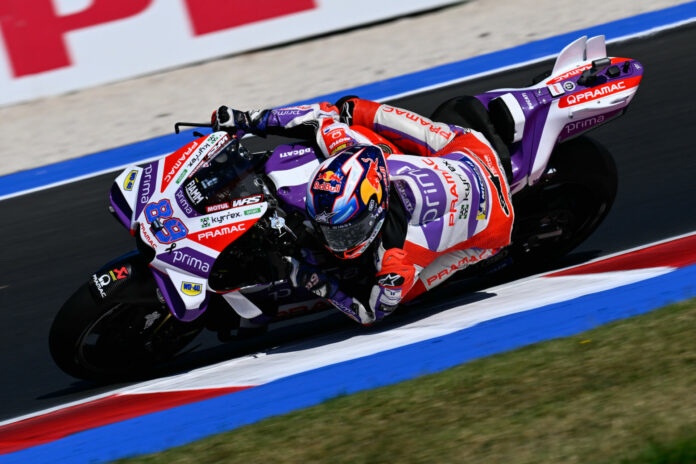
Jorge Martin led an incredibly close MotoGP World Championship Free Practice Two (FP2) Friday afternoon at Chang International Circuit, in Buriram, Thailand. Riding his Prima Pramac Racing Ducati, the Spaniard topped the 21-rider field with a lap time of 1:29.826 around the 2.83-mile (4.55 km) track. That time was just short of Marco Bezzecchi’s All-Time Lap Record of 1:29.671.
As he was in FP1, Maverick Vinales was the best of the rest with a 1:29.924 on his factory Aprilia RS-GP.
Vinales’ teammate Aleix Espargaro was third in the session with a 1:29.986.
The top 19 riders in FP2 were separated by just 0.541 second.
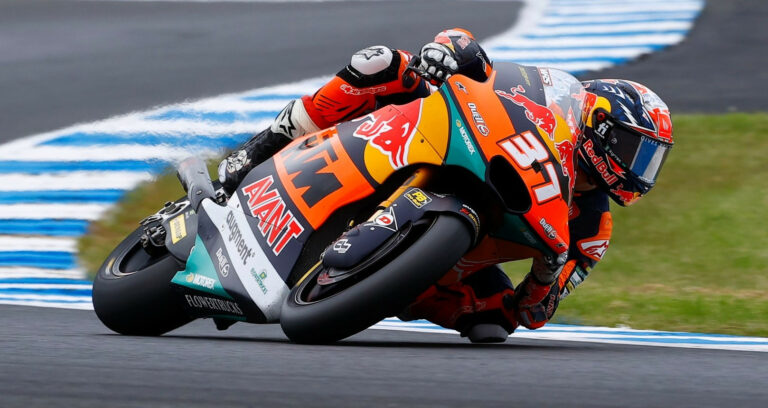
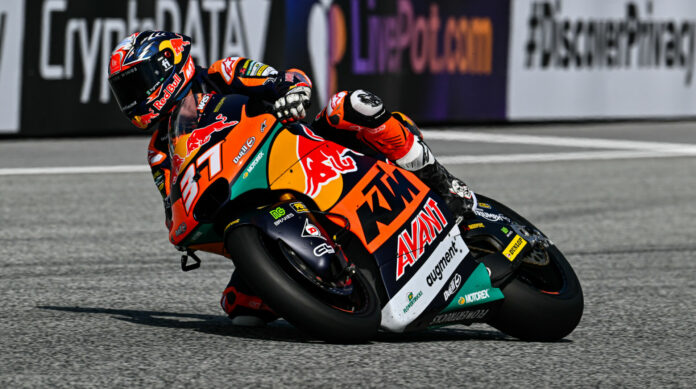
Pedro Acosta was fastest in Moto2 World Championship Free Practice Two (FP2) Friday afternoon at Chang International Circuit, in Buriram, Thailand. Riding his Red Bull KTM Ajo Kalex, the young Spaniard navigated the 2.83-mile (4.55 km) track in 1:35.985 to lead the field of 30 riders.
American Joe Roberts was 16th in the session with a lap time of 1:36.929, which was slightly slower than the 1:36.851 he did on his Italtrans Racing Kalex in FP1.
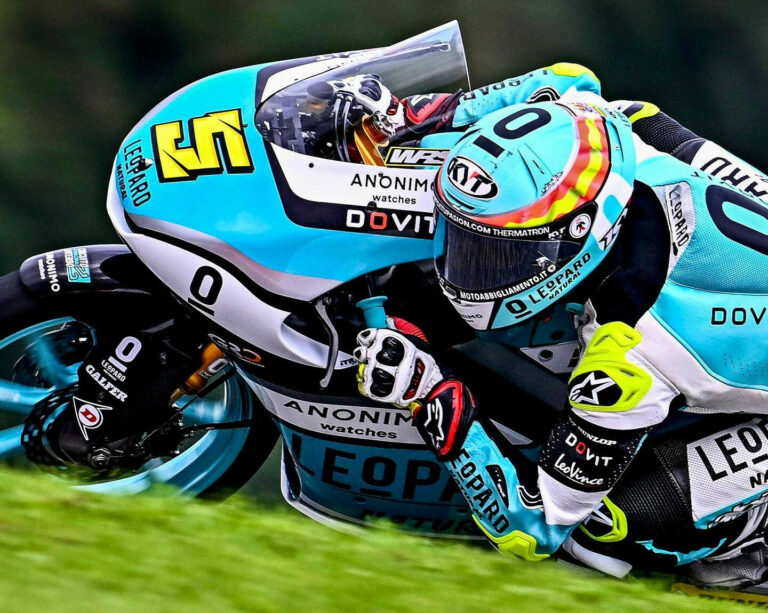
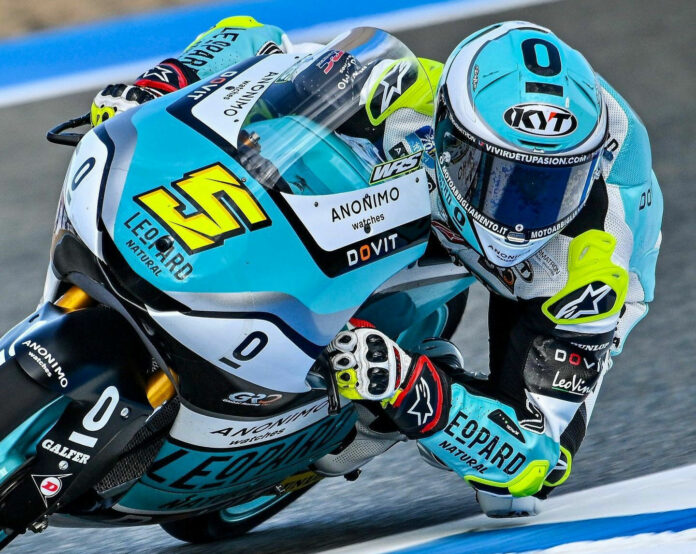
Jaume Masia was quickest during Moto3 World Championship Free Practice Two (FP2) Friday afternoon at Chang International Circuit, in Buriram, Thailand. Riding his Leopard Racing Honda, the Spaniard lapped the 2.83-mile (4.55 km) road course in 1:42.319, which nearly matched the 1:42.318 he did in FP1 Friday morning and led the field of 30 riders.
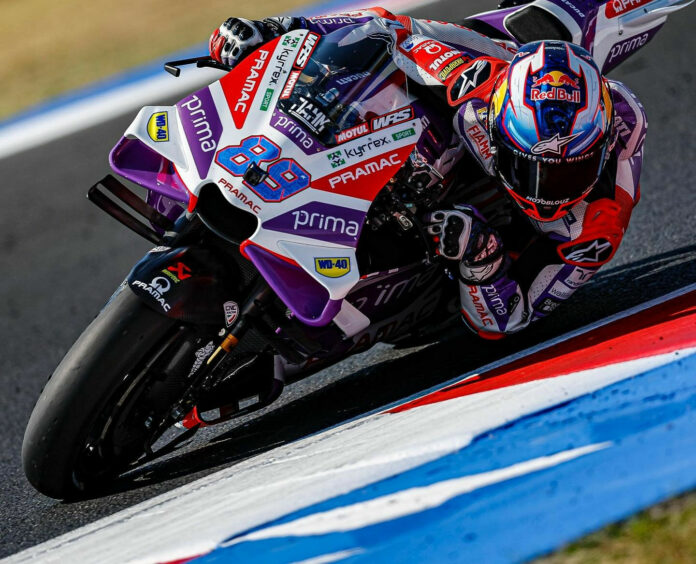
Jorge Martin topped MotoGP World Championship Free Practice One (FP1) Friday morning at Chang International Circuit, in Buriram, Thailand. Riding his Prima Pramac Racing Ducati Desmosedici, the Spaniard led the 21-rider field with a lap time of 1:30.520 around the 2.83-mile (4.55 km) course.
Maverick Vinales was second best with a 1:30.758 as he is still in search of his first victory on his factory Aprilia.
Pol Espargaro made it three different manufacturers in the top three with a 1:31.012 on his GASGAS Factory Racing Tech3 machine.
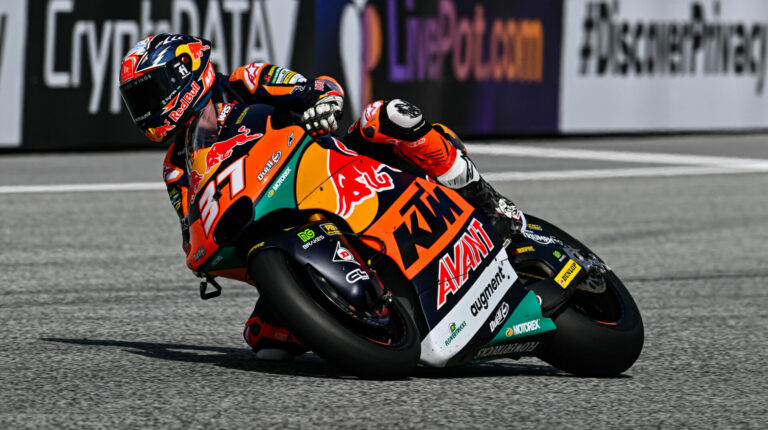
Pedro Acosta led Moto2 World Championship Free Practice One (FP1) Friday morning at Chang International Circuit, in Buriram, Thailand. Riding his Red Bull KTM Ajo Kalex, the young Spaniard navigated the 2.83-mile (4.55 km) track in 1:36.266 to lead the field of 30 riders.
American Joe Roberts was 14th in the session with a lap time of 1:36.851, just 0.585 second slower than Acosta, on his Italtrans Racing Kalex.
Jaume Masia was quickest during Moto3 World Championship Free Practice One (FP1) Friday morning at Chang International Circuit, in Buriram, Thailand. Riding his Leopard Racing Honda, the Spaniard lapped the 2.83-mile (4.55 km) road course in 1:42.318, which was quicker than Masia’s own Race Lap Record of 1:42.530.
The Kurt Caselli Foundation and USMCA Team Up to Host Free Beginner Dirt Bike Skills Class On December 2, 2023
Temecula, California (October 26, 2023) – In an effort to foster safety and skill among new and returning riders, The Kurt Caselli Foundation (TKCF) proudly unveils its collaboration with the U.S. Motorcycle Coaching Association (USMCA) to organize a complimentary dirt bike skills workshop for novice riders for its third consecutive year. Under the guidance of certified motorcycle coaches, participants will embark on a learning journey to hone their foundational dirt bike skills. The workshops, each lasting 2 hours, are scheduled between 8:30 AM to 12:30 PM. on Saturday, December 2nd, 2023, during The Ride Day 2023 Commemorating Kurt Caselli at Fox Raceway in Pala, California, and are open to enthusiasts of all ages.
To secure a spot in this exclusive workshop, participants will need to register at Interest Survey: Free Dirt Bike Beginner Skills Class with USMCA Certified Coaches. Participants must bring their own motorcycles or STACYC bikes and helmets. While there is no cost for the workshop itself, a general admission ticket is required for participants aged 13 and older to enter the event. All proceeds from the event go directly to The Kurt Caselli Foundation’s commitment to advancing safety initiatives and educational scholarships in 2024 and beyond. Additional event information and tickets are available at The Ride Day 2023 Commemorating Kurt Caselli.
TKCF President Donny Emler Jr. noted, “Our collaborative effort with USMCA’s Certified Coaches not only adds a layer of safety to our annual fundraiser but equips riders with essential skills before they advance to the track.” Lindsey Scheltema, USMCA Executive Director, shared, “This partnership aims to ensure that every participant is better equipped and safer on the track, reflecting the core values upheld by both the USMCA and The Kurt Caselli Foundation.”
About The Kurt Caselli Foundation Protecting and Supporting the Lives of Off-Road Riders
The Kurt Caselli Foundation was established in 2013. The focus of the foundation is the safety of riders and racers in the off-road motorcycling industry. While we understand the inherent elements of danger in this industry, we aim to help minimize this danger to the best of our ability. The foundation has a three-part mission that encompasses safety precautions for riders before, during, and after a racing career. Read more at www.KurtCaselli.com.
About the U.S. Motorcycle Coaching Association (USMCA)
USMCA is an association where riders and parents can connect to motorcycle coaches they can trust through the network, www.MotorcycleCoaching.org.
All USMCA Certified Coaches are required to adhere to a code of conduct, pass a background check and hold certifications in abuse prevention, CPR/First Aid, concussion protocol, heat illness & cardiac arrest training.
For more information on the USMCA or become a USMCA Certified Coach, visit www.USMCA.org.
Ducati Superquadro Mono: the new benchmark among single-cylinder road engines
77.5 hp, which becomes 85 with the racing exhaust, and maximum rotation speed of 10,250 rpm: performance never achieved before by a single-cylinder road engine
The Superquadro Mono derives from the twin-cylinder unit of the 1299 Panigale, from which it inherits the 116 mm bore piston, the combustion chamber, the titanium intake and steel exhaust valves and Desmodromic distribution
With an extremely short stroke of 62.4 mm, the Superquadro Mono has a bore/stroke ratio of 1.86. The most extreme value ever seen on a road single-cylinder engine
Not just benchmark performance, the Superquadro Mono is also the single-cylinder with the highest maintenance intervals: 30,000 km for checking and eventual valve clearance adjustment
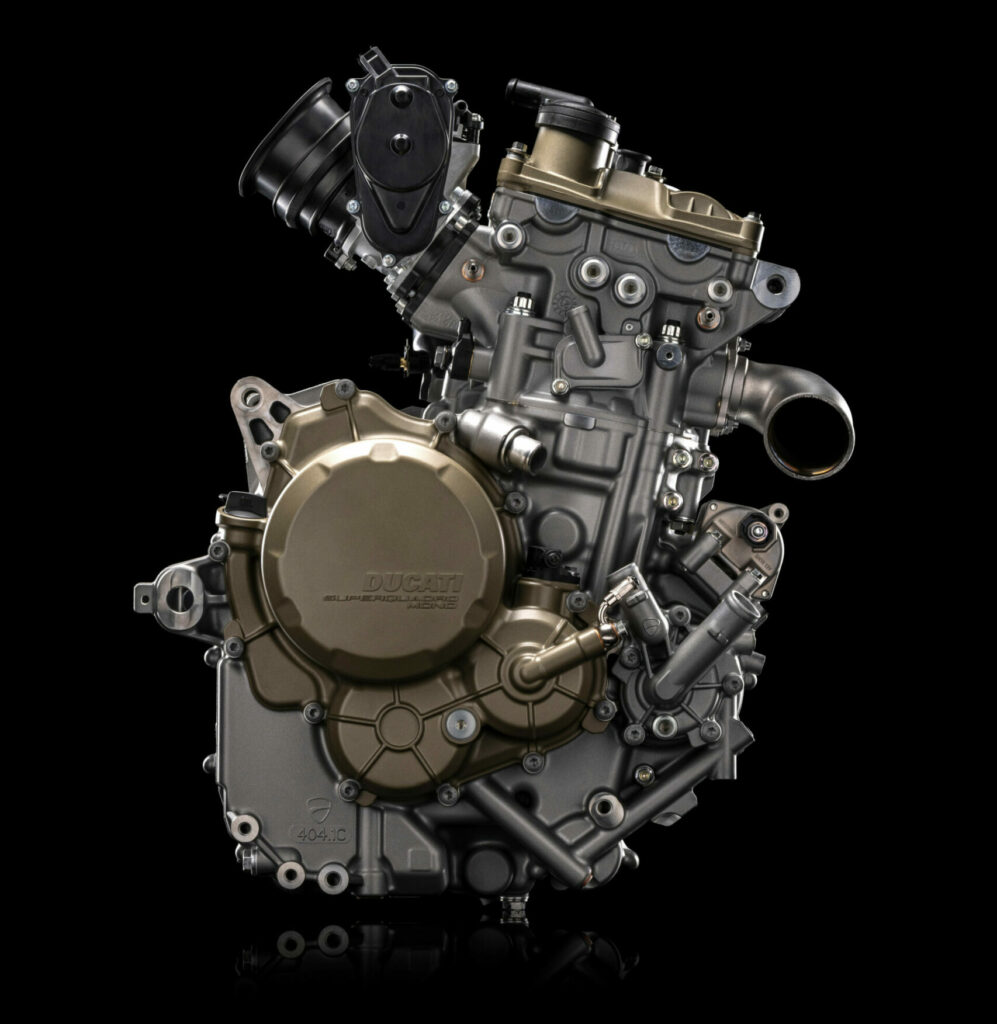
Borgo Panigale (Bologna, Italy), 26 October 2023 – Ducati returns to producing a road single-cylinder, 30 years after the legendary Supermono 550. It is called Superquadro Mono, has a displacement of 659 cc, is equipped with a Desmodromic system and sets itself as the new benchmark in the category in terms of performance.
This single-cylinder, designed by choosing refined materials and solutions for each component, is based on the Panigale 1299 engine, the 1285 cc Superquadro, which represents the maximum evolution of the Ducati street-legal twin-cylinder. The Superquadro Mono inherits the 116 mm diameter piston from the Panigale engine, the shape of the combustion chamber, the 46.8 mm diameter titanium intake valves, the 38.2 mm steel exhaust valves and the Desmodromic system.
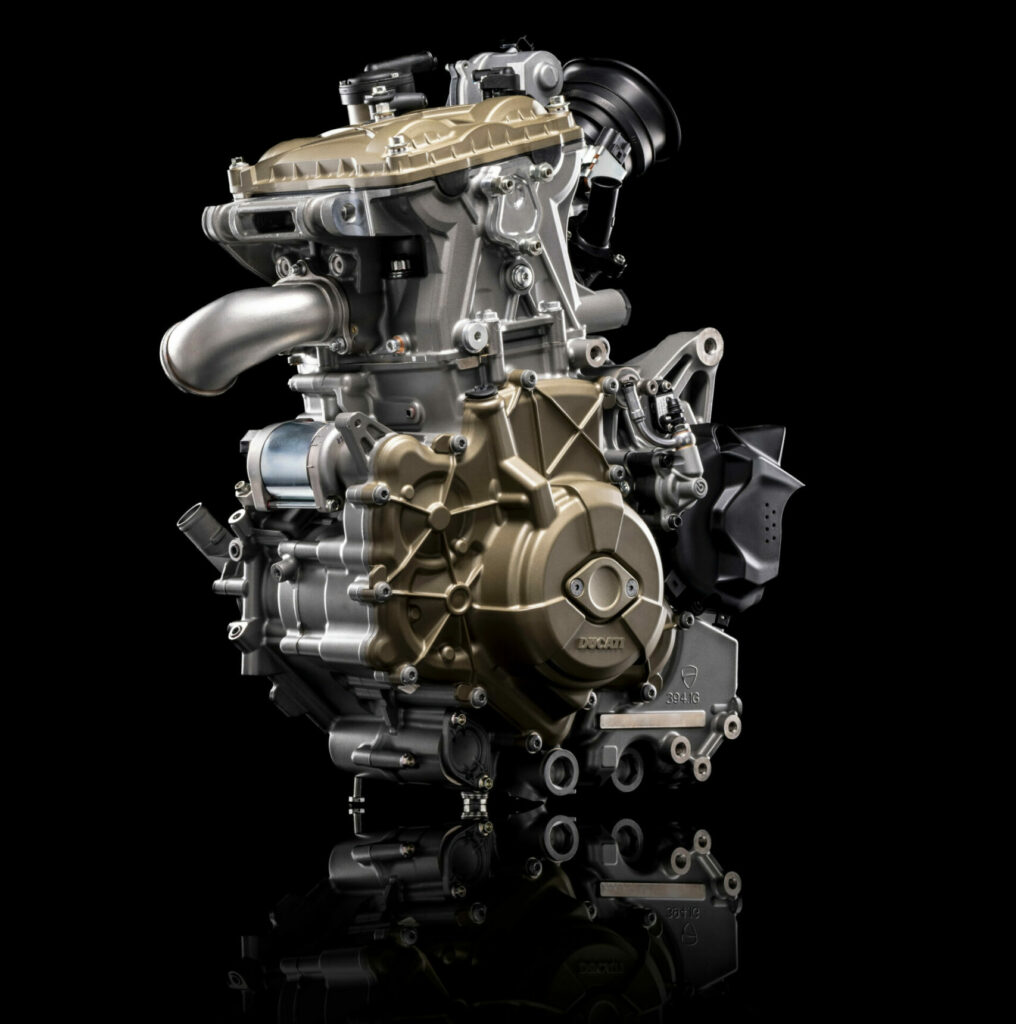
A Ducati Superquadro Mono single-cylinder engine. Copyright 2023 Ducati, used with permission.
The name Superquadro comes from the extreme ratio between bore and stroke which allows, thanks to the very short stroke, to reach rotation speeds typical of racing engines. On the Superquadro Mono this ratio is equal to 1.86 and is the most extreme in the category thanks to a stroke of just 62.4 mm. The record bore of 116 mm allows the adoption of large diameter valves to benefit performance, which however would not be possible without the Desmodromic system. This system, which Ducati also uses on the MotoGP bikes, allows the limits imposed by the valve springs to be overcome, enabling extreme valve lift laws. In this way, the Desmodromic system contributes significantly both to performance and to the possibility of reaching very high rotation speeds.
Thanks to these solutions, the Superquadro Mono delivers a maximum power of 77.5 hp at 9,750 rpm, and is capable of reaching 10,250 rpm*, values never achieved before by a road single-cylinder. The torque, whose maximum value is 6.4 kgm at 8,000 rpm, is distributed in a particularly favourable manner, resulting in linear and exploitable power delivery. All this while respecting the limits of Euro 5 homologation. In racing configuration with Termignoni exhaust, this single-cylinder is finally able to reach the incredible maximum power value of 85 hp at 9,500 rpm.
The Superquadro Mono will also be used on motorcycles for A2 [European] license holders in a detuned version.
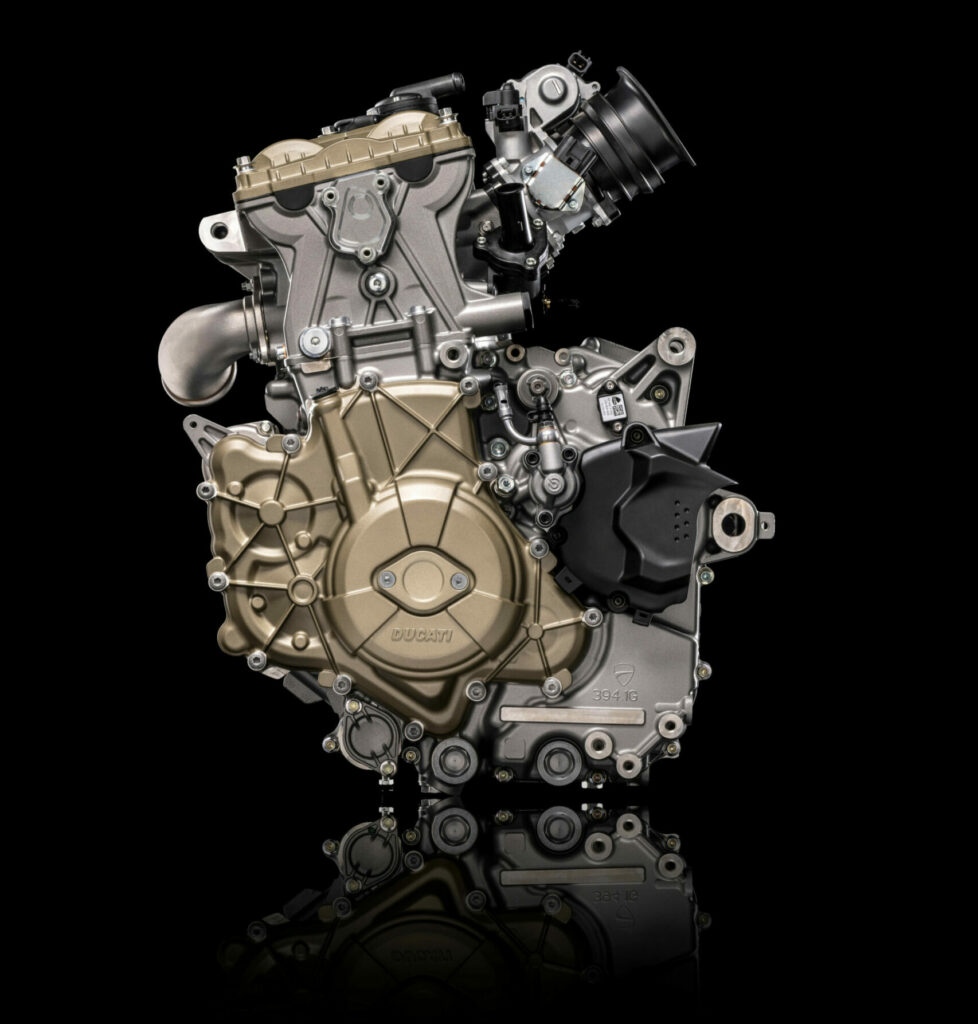
The right side of a Ducati Superquadro Mono single-cylinder engine. Copyright 2023 Ducati, used with permission.
Technical solutions and refined materials for performance and lightness
The 116 mm bore piston is an absolute record for a production single cylinder. Of racing origin, it is characterized by a “box in box” layout like the pistons of the Panigale V4 R, i.e. with a double-truss base to combine rigidity and resistance by reducing the thrust surfaces with the ultimate aim of containing friction. For the same reason, the piston pin is equipped with a Diamond Like Carbon (DLC) surface coating, the same treatment used for the piston skirt of the Panigale V4 R. The compression ratio is equal to 13.1:1.
As on the Desmosedici MotoGP engine, the rocker arms of the Desmodromic system also boast DLC (Diamond Like Carbon) surface coating to reduce friction and increase resistance to fatigue. Distribution is controlled through a mixed “silent” gear/chain system.
Fuel feed is entrusted to a single oval-section throttle body with an equivalent diameter of 62 mm, with an under-throttle injector controlled by a ride-by-wire system that offers three different Power Modes (High, Medium, Low) to adapt the delivery of the engine to different riding situations.
The die-cast engine crankcases integrate the water jacket around the cylinder barrel, made as on the 1299 Superleggera in aluminium rather than steel, with benefits in terms of weight and cooling due to the thinness of the walls. This solution also allows the head to be fixed directly to the crankcase, obtaining a much more compact engine with the same rigidity of the structure. The clutch, alternator and head covers are made by casting magnesium alloy, again to reduce the weight of the engine to a minimum while guaranteeing high mechanical resistance.
The left side of a Ducati Superquadro Mono single-cylinder engine. Copyright 2023 Ducati, used with permission.
The crankshaft is asymmetrical and mounted on differentiated main bearings to contain the weight. Engine balancing is guaranteed by the presence of two balancing countershafts (one front and one rear) mounted on ball bearings inside the crankcase and controlled by gears. The countershafts also control the water and oil pumps.
The layout of the two countershafts, placed on the side of the crankshaft, allows the first order inertia forces to be completely balanced without introducing further unwanted forces or moments. Thanks to this solution the engine is capable of running at very high speeds while maintaining a vibration level comparable to a 90° V-twin.
The Superquadro Mono relies on two lobe pumps, a delivery one which ensures efficient lubrication of the engine, and a recovery one, located in the connecting rod compartment and which takes the oil from the side compartments of the alternator and clutch covers in order to reduce the friction losses of the lubricant with the moving parts. This pump, together with a valve placed in the blow-by circuit, brings the crankshaft compartment under depression as in racing engines, in order to reduce the resistance of the moving parts and to ensure effective recovery of the lubricating oil in any conditions of use of the engine.
The transmission relies on a six-speed gearbox with racing ratios derived from the experience gained with the Panigale V4. The first gear is in fact long to allow its use in slow corners, exploiting the maximum thrust available. The clutch is in an oil bath with progressive interlocking hydraulic control, characterized by a particularly reduced lever load and specifically developed to offer easy and intuitive braking behaviour, with maximum modulability on release and in engine brake management to facilitate power-sliding in corner entry.
The gearbox can be equipped with Ducati Quick Shift (DQS) Up & Down. In this application, the DQS relies on a magnetic hall effect sensor and not the traditional load cell to improve accuracy and reliability.
The Superquadro Mono will equip the bike that will star in the fifth episode of the Ducati World Première 2024 “Live. Play. Ride.” on Thursday November 2nd at 4.00 pm CET on Ducati.com and on Ducati’s YouTube channel.
*In first gear only the limiter is set at 10,000 rpm
#Ducati #SuperquadroMono
Main technical data of the Superquadro Mono
659 cc vertical single-cylinder engine
Bore x stroke 116 x 62.4 mm
Compression ratio 13.1:1
Maximum power 57 kW (77.5 hp) at 9,750 rpm – 85 hp at 9,500 rpm with Termignoni racing exhaust
Maximum torque 63 Nm (6.4 Kgm) at 8,050 rpm – 6.8 Kgm with Termignoni racing exhaust
Aluminium cylinder barrel
Euro 5+ homologation
Mixed chain-gear Desmodromic distribution with double overhead camshaft, 4 valves per cylinder. 46.8 mm titanium intake valves, 38.2 mm exhaust valves.
Asymmetrical crankshaft mounted on differentiated diameter main bearings
Double balancing countershaft with control function of the water and oil pumps
Multi-disc oil-bath clutch, servo-driven and with anti-hopping function
Semi-dry sump lubrication with delivery pump and recovery pump
Fuel feed via oval section throttle body with an equivalent diameter of 62 mm
Six-speed gearbox with the possibility of fitting the Ducati Quick Shift (DQS) Up & Down
Oil change set at 15,000 km
Check and eventual adjustment of valve clearance set at 30,000 km
LEGENDARY EVENTS AT FAMOUS RACETRACKS FOR FIM EWC IN 2024
*New EWC season to open with 24 Heures Motos at Le Mans in April
*Format change for Spa event makes Bol d’Or the second of two 24-hour races
*EWC Superstock class and earlier July date for Suzuka 8 Hours
For immediate release (26 October 2023): Legendary events at famous racetracks in Europe and Japan will provide an exciting challenge for riders and teams contesting the 2024 FIM Endurance World Championship.
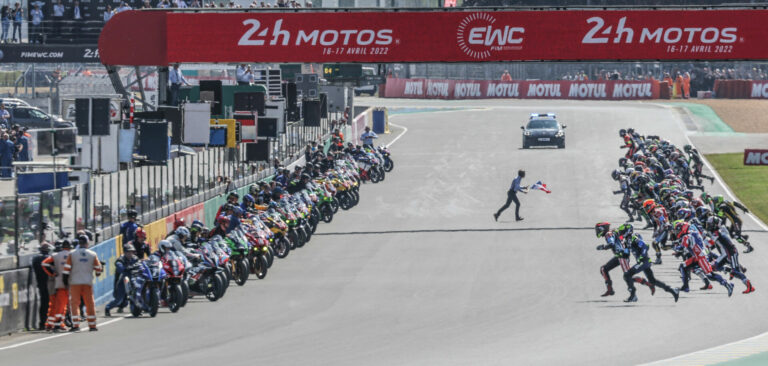
Kicking off with the 24 Heures Motos at Le Mans in April, the EWC will visit Circuit de Spa-Francorchamps in Belgium in June, Suzuka Circuit in Japan the following month and Circuit Paul Ricard in France for the Bol d’Or in September.
The EWC’s 45th season will consist of two races run for a duration of 24 hours and two taking place over eight hours. The 2024 FIM Endurance World Championship calendar is as follows:
Round 1: 24 Heures Motos (Le Mans, France): 18-21 April
Round 2: 8 Hours of Spa Motos (Circuit de Spa-Francorchamps, Belgium): 6-8 June
Round 4: Bol d’Or (Circuit Paul Ricard, France): 12-15 September
All the rounds will count for the FIM Endurance World Championship and FIM Endurance World Cup. FIM Endurance World Cup teams count their best three scores.
Jean-Baptiste Ley, EWC Series’ Director for promoter Warner Bros Discovery Sports, said: “We are delighted to present the calendar for the 2024 FIM Endurance World Championship when we will continue to count on legendary events at famous racetracks. Although expanding the calendar to include a fifth round remains a long-term target, it’s vital that we deliver a schedule that is accessible and achievable in practical and financial terms. The 2024 calendar achieves both and we look forward to another action-packed season.
“There has been a change to the format of the Spa event, which will strengthen the championship and assist our riders and teams. And in another exciting and positive move for the new season, the Suzuka 8 Hours will form part of the FIM Endurance World Cup schedule although Superstock teams will count their best three scores across the year, meaning participation in this event is not mandatory.”
Paul King, FIM Circuit Racing Commission Director added: “An excellent event programme for 2024, responding to the needs of competitors, promotors and partner organisations to strengthen the FIM Endurance World Championship and FIM Endurance World Cup in the long term.
“It’s good to see the opportunity for Superstock competitors to take part in the Suzuka event for the first time in 2024 – always a special event on the global motorcycle calendar. The FIM CCR and WBDS together have already agreed to count the best three scores from the four FIM Endurance World Cup rounds and to allow Superstock teams a fourth rider in the 24-hour events to enable and encourage participation.”
LIFT-OFF IN LE MANS
The race to become the ultimate FIM Endurance World Championship rider and team of 2024 begins next April when the 24 Heures Motos at Le Mans opens the new EWC season. Scheduled from 18-21 April, the 47th edition of the 24 Heures Motos will provide the first opportunity in 2024 for fans watching trackside and on TV or online around the world to witness the thrilling spectacle that is the all-action EWC. Running one week later than in 2023, organiser the Automobile Club de l’Ouest (ACO) is planning to introduce several measures for the 2024 edition to improve the fan experience by making the event more accessible and with a focus on ensuring all visitors feel safe and secure at all times. More information is available at 24h-motos.com where details of ticket sales can also be found.
SPA’S EIGHT WILL BE GREAT
After two successful 24-hour EWC races at Circuit de Spa-Francorchamps, Belgium’s round of the FIM Endurance World Championship will run over an eight-hour duration in 2024. The format change is a recognition by Warner Bros Discovery Sports, as championship promoter, that maintaining three 24-hour races on the calendar in the current economic climate is no longer achievable due to the significant financial investment required. The decision was therefore taken to run a race of eight hours duration at Spa in 2024. It is hoped the shorter distance will result in an increase of entries, including from teams new to the EWC, and a rise in spectator attendance. It is also hoped that more teams will be in a position to contest the Suzuka 8 Hours due to the costs saved by the reduction of the Spa race length. The 8 Hours of Spa Motos takes place from 6-8 June with Thursday 6 June reserved for testing. A day of free practice and qualifying is planned for Friday 7 June followed by the eight-hour race, which is due to run from 13h00-21h00 CET on Saturday 8 June.
MORE SUPER SUZUKA…
Suzuka Circuit will continue to play an integral role in the ongoing success of the FIM Endurance World Championship with the Japanese circuit’s iconic eight-hour event taking place from 19-21 July. Featuring a mid-morning start and early evening finish, the 45th Coca-Cola Suzuka 8 Hours Endurance Race won’t be the longest on the EWC calendar, but it’s set to be one of the toughest. This is due to the highly-demanding nature of the figure-of-eight track layout and the expected hot and humid conditions that will require the EWC stars to be at the peak of their physical powers. Having run during the first weekend of August in 2023, next year’s edition takes place across the penultimate weekend of July to avoid a clash with the Olympic Games Paris 2024.
…AND SUPER CHANCE FOR SUPERSTOCK STARS
The FIM Endurance World Cup schedule will expand to include the Suzuka 8 Hours in 2024. However, the number of rounds in which points can be scored will remain at three to give flexibility to the Superstock category competitors. That means it’s not mandatory for Superstock teams registered for the full EWC season to take part. Previously focused on the European EWC events only, the addition of Suzuka to the FIM Endurance World Cup calendar will is set to provide an exciting challenge for the Dunlop-equipped Superstock teams and their riders during the upcoming season. And with home-based manufacturers Honda, Kawasaki, Suzuki and Yamaha all represented – and successful – in the FIM Endurance World Cup, the chance for Superstock teams to compete and showcase their level of performance on Japanese soil will hold significant appeal.
BRING ON THE BOL
After celebrating its 100th anniversary in 2022, the 87th edition of the Bol d’Or is the second of two 24-hour EWC races planned for 2024. Due to take place at Circuit Paul Ricard in southern France for the 31st time, the legendary event is set to run from 12-15 September. Of the venue’s 5.673-kilometre layout, 1.8 kilometres are taken up by the imposing Mistral Straight. A place to pass and be passed, the Mistral requires bikes to run for 20 seconds at more than 300kph. Changeable weather and windy conditions can also be a factor.
Improved performance, optimised ergonomics, sleeker design, and more standard and optional features.
Updated engine with 170 hp (+5 hp) and 84 lbs-ft of torque.
Improved ergonomics thanks to 0.4-inch higher seat.
New standard equipment including Headlight Pro and Keyless Ride.
MSRP $17,495 plus Destination
Estimated Market launch Q2 2024.
Woodcliff Lake, NJ – Oct. 26, 2023 . . .BMW Motorrad proudly introduces the new, updated 2024 S 1000 XR, an enhanced version of the successful long-distance sports bike. Increased engine power, improved ergonomics, design refinements, and expanded standard features define the model’s upgrades.
The reworked in-line 4-cylinder engine now delivers more impressive performance, with a flow-optimized intake channels and a power output of 170 hp.
The new S 1000 XR shares its in-line 4-cylinder engine with the S 1000 RR, providing a smooth and powerful torque delivery that contributes to excellent rideability. Compared to the predecessor model, power has been increased by 5 hp to 170 hp, at an unchanged 11,000 rpm. The main reasons for the performance increase are the flow-optimized geometry of the intake runners and customized engine mapping. The maximum torque generated remains at 84 lbs-ft. at 9,250 rpm.
Improved ergonomics thanks to new seat and rear section.
In order to provide even more freedom of movement, especially during high-performance riding on country roads or at the track, the seat of the long-distance sports bike has been completely redesigned. It now offers an extra 0.4 inches of seat height (33.5 inches) and provides more space by increasing the usable length and width of the seat, allowing for better adjustment of the seating position depending on the riding conditions. The improved ergonomics make it easier for riders to maneuver the S 1000 XR on the street or on the track, providing better control. A total of three different seat heights are available.
The new S 1000 XR also benefits from redesigned elements in its design. The rear section now features new side panels and air intakes inspired by motorsports, giving it a more dynamic look. Additionally, the radiator trim now has a textured surface, and the previously black-colored “beak” front fender is now painted in body color.
Extended range of standard equipment and new options.
The new S 1000 XR comes with an expanded standard equipment list. As part of the standard equipment, Headlight Pro provides additional safety during night-time rides with its adaptive turning light. The rider benefits from improved road illumination in corners. Keyless Ride and a 12 Ah capacity battery are now standard features. Additionally, the new BMW S 1000 XR is equipped with a standard USB charging socket.
Other updates include standard Intelligent Emergency Call feature, the option to equip the S 1000 XR with the optional M GPS Laptrigger, and the availability of M Carbon wheels.
Three new color options.
Three new colors reflect the dynamic character of the new BMW S 1000 XR.
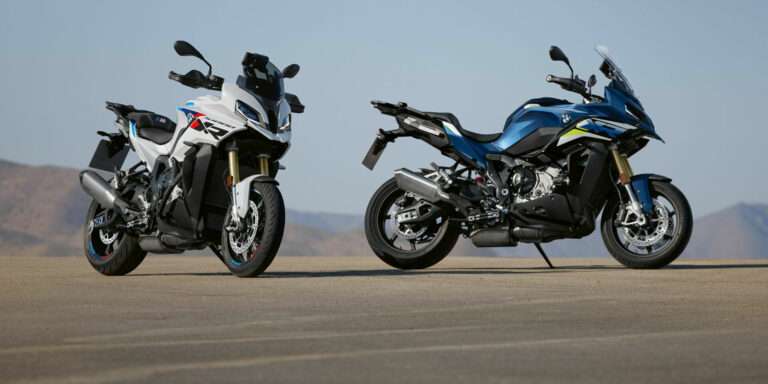
Blackstorm Metallic 2 (standard)
Gravity Blue Metallic (Style Sport)
Light White / M Motorsport (M Package)
The key features of the new BMW S 1000 XR:
Engine power has been increased from 165 hp to 170 hp at 11,000 rpm.
Torque remains unchanged at 84 lbs-ft at 9,250 rpm.
The intake runners have been modified.
Optimized Shift Assistant Pro ensures higher precision when shifting.
Improved ergonomics and freedom of movement with a redesigned seat (33.5- inch seat height vs previous 33.1 inches).
The Shock absorber has been optimized to provide a more sensitive and comfortable ride.
The rear section has a new, sportier design with new side panels and air intakes inspired by motorsports.
The handlebar clamp has been redesigned.
The front “beak” is now painted in the body color.
The radiator cover has a new, textured surface.
New battery with 12 Ah capacity instead of the previous 9 Ah.
M Carbon wheels available as an option.
Keyless Ride is now standard.
USB charging port is now standard.
Headlight Pro is now standard.
Intelligent Emergency Call has been added to standard equipment.
Use of the M GPS Laptrigger is possible.
Standard Equipment
999 cc inline 4-cylidner engine. 170 hp and 84 lb-ft of torque.
6-speed transmission with chain drive.
Cast aluminum wheels.
BMW Motorrad Integral ABS.
Race ABS Linked to Ride Modes.
Dynamic Traction Control.
Dynamic Brake Control.
Dynamic ESA.
Dynamic Engine Brake Control.
Ride Modes Pro.
Keyless Ride.
Steering Stabilizer.
Radial Front Brakes.
Upside Down 45mm Front Forks.
Anti-hopping, wet clutch.
Ultimate Care break-in service included.
Headlight Pro with cornering light.
Intelligent Emergency Call.
Drop Sensor.
Keyless Ride
USB Charging port.
12v Power Socket.
6.5-inch TFT Screen with Connectivity and Multi-controller.
On-Board Computer.
Electronic Immobilizer.
Headlight Pro with Adaptive Headlight.
Full LED Lighting.
Comfort Turn Signals.
Adjustable Handbrake and Clutch Levers.
Adjustable Windscreen.
Case Holder.
Storage Compartment.
Optional Equipment
Premium Package
Dynamic ESA
Gear Shift Assist Pro
Cruise Control
Luggage Rack
Center Stand
Heated Grips
Hand Protection
GPS Prep
TPM Tire Pressure Monitor
LED Auxiliary Lights
M Package
Light White / M Motorsport colors
M Sport Seat (standard, low or high)
Black Tank Cap
Sport Windshield
M Lightweight Battery
Sport Muffler
M Endurance Chain
M GPS Laptrigger
M Forged Wheels or M Carbon Wheels (extra charge)
M Carbon Package
M Carbon Side Panels
M Carbon Front Fender
M Carbon Ignition Lock Cover
Milled Billet Package
M Rider Footrests
M Passenger Footrests
M Brake and Clutch Levers
Individual Options
M Endurance Chain
M GPS Laptrigger
M Carbon Wheels
M Forged Wheels
Design Option Wheels
Sports Muffler
M Sport Seat
M Sport Seat, low
M Sport Seat, high
Seat, low
Seat, high
Lowering Kit
M Lightweight Battery
High Windshield
Technical specifications.
S 1000 XR
Engine
Capacity
cc/cu. in.
999 / 79
Bore x stroke
mm
80.0 x 49.7
Output
hp
170 @ 11,000 rpm
Torque
lb-ft.
84 @ 9,250 rpm
Type
Liquid-cooled in-line 4-cylinder engine
No. of cylinders
4
Compression / fuel
12.5:1 / premium unleaded
Valve / accelerator actuation
DOHC / 4-valves per cylinder
Ø intake/exhaust valve dia.
mm
33.5 / 27.2
Ø throttle body dia.
mm
48
Engine control
BMS-O
Emission control
Closed-loop 3-way catalytic converter, EU5+
Electrical system
Alternator
W
493
Battery
V/Ah
12/12 maintenance-free
Headlight
LED low and high beam
Starter
W
800
Transmission
Clutch
Self-reinforcing, anti-hopping wet clutch
Gearbox
Constant-mesh 6-speed gearbox
Primary ratio
1.652
Transmission ratios I
2.647
II
2.091
III
1.727
IV
1.476
V
1.304
VI
1.167
Rear wheel drive
chain
Transmission ratio
2.647
Suspension
Frame construction type
Aluminum composite bridge frame
Front suspension
Upside-down, 45 mm, telescopic forks
Rear suspension
Aluminum double-sided swing arm with central shock
Suspension travel front/rear
in.
5.9 / 5.9
Wheel castor
in.
4.6
Wheelbase
in.
61.1
Rake
°
24.9
Brakes
front
Twin floating brake disks Ø 320 mm
4-piston fixed calipers
rear
Single-disc brake Ø 220 mm
Single-piston floating caliper
ABS
BMW Motorrad ABS Pro
Wheels
Light alloy cast wheels
front
3.50 x 17″
rear
6.00 x 17”
Tires
Front
120/70 ZR 17
Rear
190/55 ZR 17
Dimensions and weights
Total length
in.
84.9
Total width
in.
33.5
Seat height
in.
33.5
DIN unladen weight
lbs.
500
Permitted total weight
lbs.
992
Fuel tank capacity
gal.
5.3
Performance figures
0-62 mph
sec.
3.3
Top speed
mph
124+
BMW Group in America
BMW of North America, LLC has been present in the United States since 1975. Rolls-Royce Motor Cars NA, LLC began distributing vehicles in 2003. The BMW Group in the United States has grown to include marketing, sales, and financial service organizations for the BMW brand of motor vehicles, including motorcycles, the MINI brand, and Rolls-Royce Motor Cars; Designworks, a strategic design consultancy based in California; a technology office in Silicon Valley and various other operations throughout the country. BMW Manufacturing Co., LLC in South Carolina is the BMW Group global center of competence for BMW X models and manufactures the X3, X4, X5, X6 and X7 Sports Activity Vehicles as well as the BMW XM. The BMW Group sales organization is represented in the U.S. through networks of 349 BMW passenger car and BMW Sports Activity Vehicle centers, 146 BMW motorcycle retailers, 104 MINI passenger car dealers, and 38 Rolls-Royce Motor Car dealers. BMW (US) Holding Corp., the BMW Group’s sales headquarters for North America, is located in Woodcliff Lake, New Jersey.
Jorge Martin led an incredibly close MotoGP World Championship Free Practice Two (FP2) Friday afternoon at Chang International Circuit, in Buriram, Thailand. Riding his Prima Pramac Racing Ducati, the Spaniard topped the 21-rider field with a lap time of 1:29.826 around the 2.83-mile (4.55 km) track. That time was just short of Marco Bezzecchi’s All-Time Lap Record of 1:29.671.
As he was in FP1, Maverick Vinales was the best of the rest with a 1:29.924 on his factory Aprilia RS-GP.
Vinales’ teammate Aleix Espargaro was third in the session with a 1:29.986.
The top 19 riders in FP2 were separated by just 0.541 second.
Pedro Acosta was fastest in Moto2 World Championship Free Practice Two (FP2) Friday afternoon at Chang International Circuit, in Buriram, Thailand. Riding his Red Bull KTM Ajo Kalex, the young Spaniard navigated the 2.83-mile (4.55 km) track in 1:35.985 to lead the field of 30 riders.
American Joe Roberts was 16th in the session with a lap time of 1:36.929, which was slightly slower than the 1:36.851 he did on his Italtrans Racing Kalex in FP1.
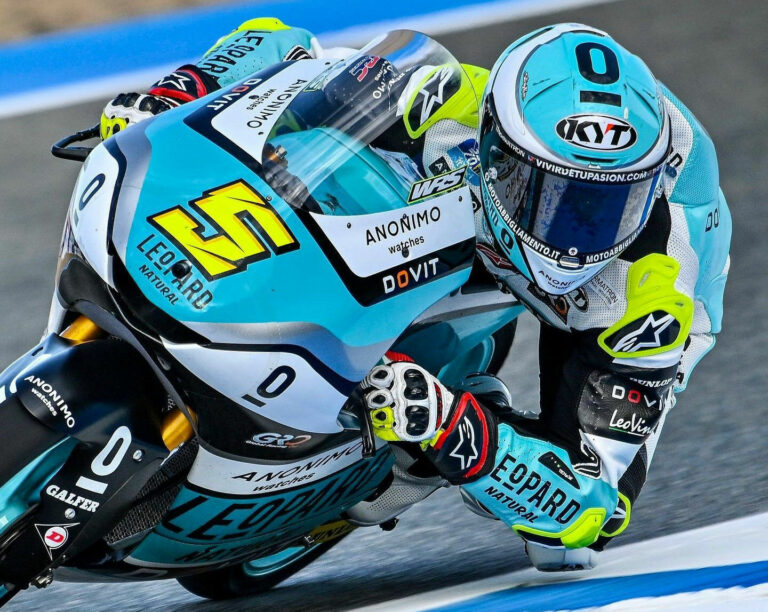
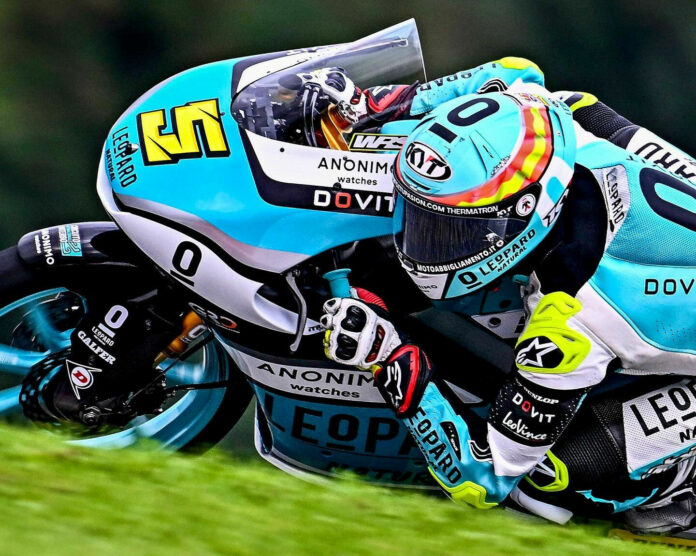
Jaume Masia (5), as seen earlier this season. Photo courtesy Leopard Racing Team.
Jaume Masia was quickest during Moto3 World Championship Free Practice Two (FP2) Friday afternoon at Chang International Circuit, in Buriram, Thailand. Riding his Leopard Racing Honda, the Spaniard lapped the 2.83-mile (4.55 km) road course in 1:42.319, which nearly matched the 1:42.318 he did in FP1 Friday morning and led the field of 30 riders.
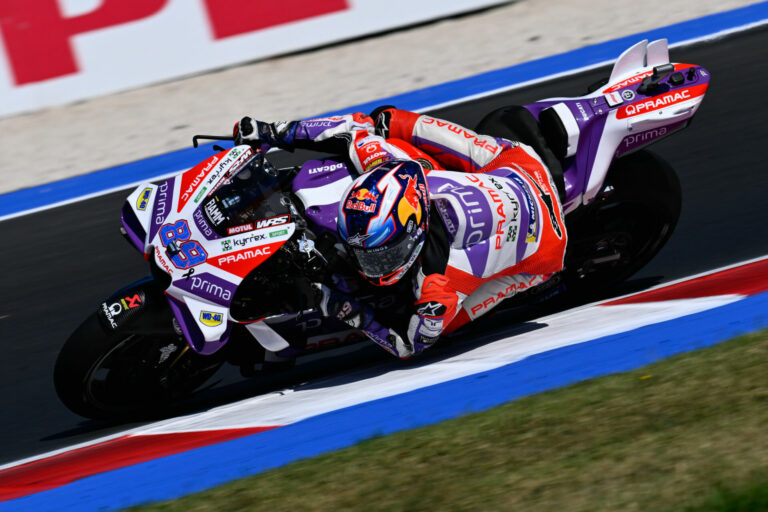
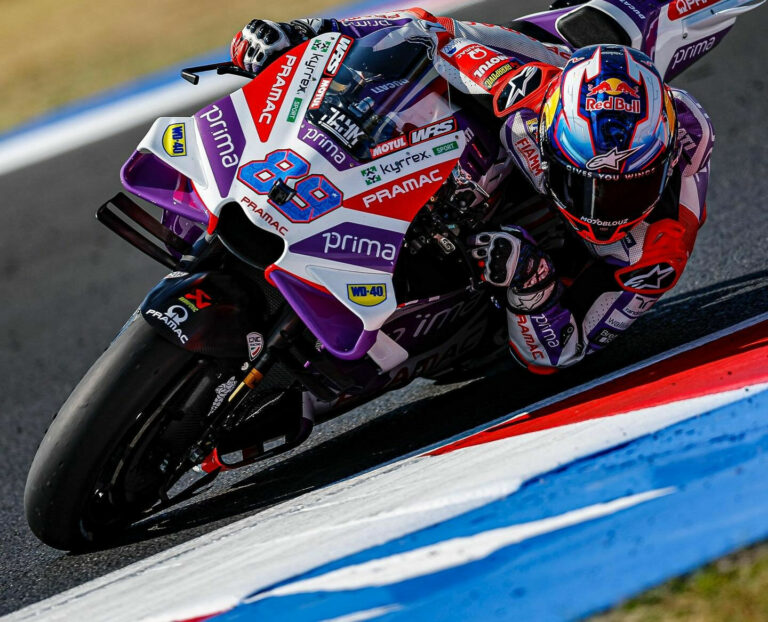
Jorge Martin (89). Photo courtesy Prima Pramac Racing.
Jorge Martin topped MotoGP World Championship Free Practice One (FP1) Friday morning at Chang International Circuit, in Buriram, Thailand. Riding his Prima Pramac Racing Ducati Desmosedici, the Spaniard led the 21-rider field with a lap time of 1:30.520 around the 2.83-mile (4.55 km) course.
Maverick Vinales was second best with a 1:30.758 as he is still in search of his first victory on his factory Aprilia.
Pol Espargaro made it three different manufacturers in the top three with a 1:31.012 on his GASGAS Factory Racing Tech3 machine.
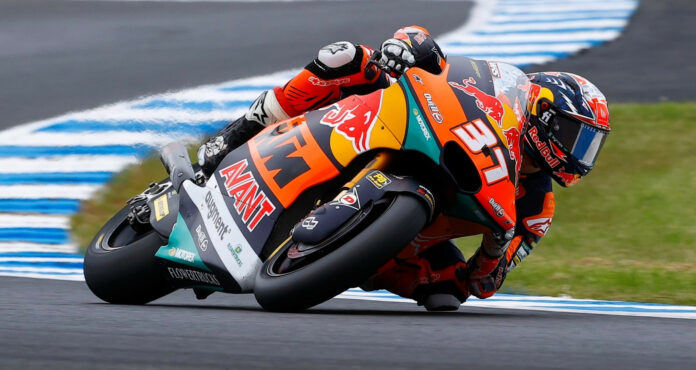
Pedro Acosta (37). Photo courtesy Red Bull KTM Ajo.
Pedro Acosta led Moto2 World Championship Free Practice One (FP1) Friday morning at Chang International Circuit, in Buriram, Thailand. Riding his Red Bull KTM Ajo Kalex, the young Spaniard navigated the 2.83-mile (4.55 km) track in 1:36.266 to lead the field of 30 riders.
American Joe Roberts was 14th in the session with a lap time of 1:36.851, just 0.585 second slower than Acosta, on his Italtrans Racing Kalex.
Jaume Masia was quickest during Moto3 World Championship Free Practice One (FP1) Friday morning at Chang International Circuit, in Buriram, Thailand. Riding his Leopard Racing Honda, the Spaniard lapped the 2.83-mile (4.55 km) road course in 1:42.318, which was quicker than Masia’s own Race Lap Record of 1:42.530.
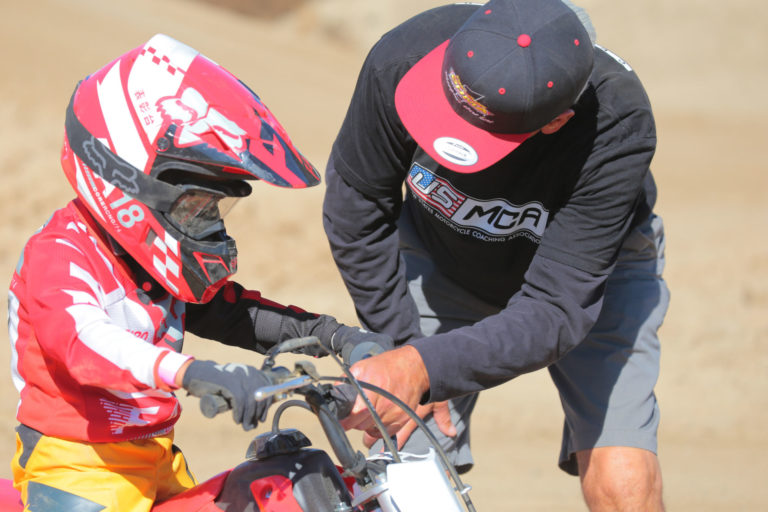
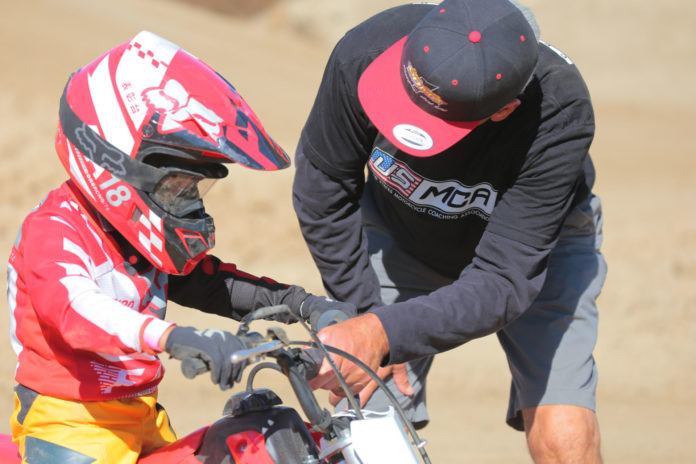
USMCA and The Kurt Caselli Foundation are teaming up to host a free Beginner Dirt Bike Skills Class December 2 in Pala, California. Photo courtesy USMCA.
The Kurt Caselli Foundation and USMCA Team Up to Host Free Beginner Dirt Bike Skills Class On December 2, 2023
Temecula, California (October 26, 2023) – In an effort to foster safety and skill among new and returning riders, The Kurt Caselli Foundation (TKCF) proudly unveils its collaboration with the U.S. Motorcycle Coaching Association (USMCA) to organize a complimentary dirt bike skills workshop for novice riders for its third consecutive year. Under the guidance of certified motorcycle coaches, participants will embark on a learning journey to hone their foundational dirt bike skills. The workshops, each lasting 2 hours, are scheduled between 8:30 AM to 12:30 PM. on Saturday, December 2nd, 2023, during The Ride Day 2023 Commemorating Kurt Caselli at Fox Raceway in Pala, California, and are open to enthusiasts of all ages.
To secure a spot in this exclusive workshop, participants will need to register at Interest Survey: Free Dirt Bike Beginner Skills Class with USMCA Certified Coaches. Participants must bring their own motorcycles or STACYC bikes and helmets. While there is no cost for the workshop itself, a general admission ticket is required for participants aged 13 and older to enter the event. All proceeds from the event go directly to The Kurt Caselli Foundation’s commitment to advancing safety initiatives and educational scholarships in 2024 and beyond. Additional event information and tickets are available at The Ride Day 2023 Commemorating Kurt Caselli.
TKCF President Donny Emler Jr. noted, “Our collaborative effort with USMCA’s Certified Coaches not only adds a layer of safety to our annual fundraiser but equips riders with essential skills before they advance to the track.” Lindsey Scheltema, USMCA Executive Director, shared, “This partnership aims to ensure that every participant is better equipped and safer on the track, reflecting the core values upheld by both the USMCA and The Kurt Caselli Foundation.”
About The Kurt Caselli Foundation Protecting and Supporting the Lives of Off-Road Riders
The Kurt Caselli Foundation was established in 2013. The focus of the foundation is the safety of riders and racers in the off-road motorcycling industry. While we understand the inherent elements of danger in this industry, we aim to help minimize this danger to the best of our ability. The foundation has a three-part mission that encompasses safety precautions for riders before, during, and after a racing career. Read more at www.KurtCaselli.com.
About the U.S. Motorcycle Coaching Association (USMCA)
USMCA is an association where riders and parents can connect to motorcycle coaches they can trust through the network, www.MotorcycleCoaching.org.
All USMCA Certified Coaches are required to adhere to a code of conduct, pass a background check and hold certifications in abuse prevention, CPR/First Aid, concussion protocol, heat illness & cardiac arrest training.
For more information on the USMCA or become a USMCA Certified Coach, visit www.USMCA.org.
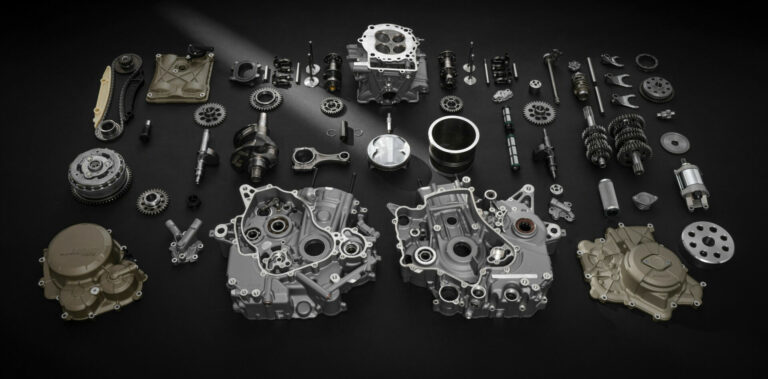
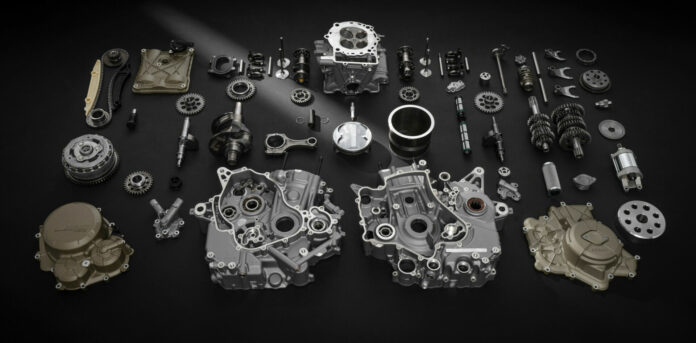
A disassembled Ducati Superquadro Mono single-cylinder engine and transmission. Copyright 2023 Ducati, used with permission.
Ducati Superquadro Mono: the new benchmark among single-cylinder road engines
77.5 hp, which becomes 85 with the racing exhaust, and maximum rotation speed of 10,250 rpm: performance never achieved before by a single-cylinder road engine
The Superquadro Mono derives from the twin-cylinder unit of the 1299 Panigale, from which it inherits the 116 mm bore piston, the combustion chamber, the titanium intake and steel exhaust valves and Desmodromic distribution
With an extremely short stroke of 62.4 mm, the Superquadro Mono has a bore/stroke ratio of 1.86. The most extreme value ever seen on a road single-cylinder engine
Not just benchmark performance, the Superquadro Mono is also the single-cylinder with the highest maintenance intervals: 30,000 km for checking and eventual valve clearance adjustment
Borgo Panigale (Bologna, Italy), 26 October 2023 – Ducati returns to producing a road single-cylinder, 30 years after the legendary Supermono 550. It is called Superquadro Mono, has a displacement of 659 cc, is equipped with a Desmodromic system and sets itself as the new benchmark in the category in terms of performance.
This single-cylinder, designed by choosing refined materials and solutions for each component, is based on the Panigale 1299 engine, the 1285 cc Superquadro, which represents the maximum evolution of the Ducati street-legal twin-cylinder. The Superquadro Mono inherits the 116 mm diameter piston from the Panigale engine, the shape of the combustion chamber, the 46.8 mm diameter titanium intake valves, the 38.2 mm steel exhaust valves and the Desmodromic system.
A Ducati Superquadro Mono single-cylinder engine. Copyright 2023 Ducati, used with permission.
The name Superquadro comes from the extreme ratio between bore and stroke which allows, thanks to the very short stroke, to reach rotation speeds typical of racing engines. On the Superquadro Mono this ratio is equal to 1.86 and is the most extreme in the category thanks to a stroke of just 62.4 mm. The record bore of 116 mm allows the adoption of large diameter valves to benefit performance, which however would not be possible without the Desmodromic system. This system, which Ducati also uses on the MotoGP bikes, allows the limits imposed by the valve springs to be overcome, enabling extreme valve lift laws. In this way, the Desmodromic system contributes significantly both to performance and to the possibility of reaching very high rotation speeds.
Thanks to these solutions, the Superquadro Mono delivers a maximum power of 77.5 hp at 9,750 rpm, and is capable of reaching 10,250 rpm*, values never achieved before by a road single-cylinder. The torque, whose maximum value is 6.4 kgm at 8,000 rpm, is distributed in a particularly favourable manner, resulting in linear and exploitable power delivery. All this while respecting the limits of Euro 5 homologation. In racing configuration with Termignoni exhaust, this single-cylinder is finally able to reach the incredible maximum power value of 85 hp at 9,500 rpm.
The Superquadro Mono will also be used on motorcycles for A2 [European] license holders in a detuned version.
The right side of a Ducati Superquadro Mono single-cylinder engine. Copyright 2023 Ducati, used with permission.
Technical solutions and refined materials for performance and lightness
The 116 mm bore piston is an absolute record for a production single cylinder. Of racing origin, it is characterized by a “box in box” layout like the pistons of the Panigale V4 R, i.e. with a double-truss base to combine rigidity and resistance by reducing the thrust surfaces with the ultimate aim of containing friction. For the same reason, the piston pin is equipped with a Diamond Like Carbon (DLC) surface coating, the same treatment used for the piston skirt of the Panigale V4 R. The compression ratio is equal to 13.1:1.
As on the Desmosedici MotoGP engine, the rocker arms of the Desmodromic system also boast DLC (Diamond Like Carbon) surface coating to reduce friction and increase resistance to fatigue. Distribution is controlled through a mixed “silent” gear/chain system.
Fuel feed is entrusted to a single oval-section throttle body with an equivalent diameter of 62 mm, with an under-throttle injector controlled by a ride-by-wire system that offers three different Power Modes (High, Medium, Low) to adapt the delivery of the engine to different riding situations.
The die-cast engine crankcases integrate the water jacket around the cylinder barrel, made as on the 1299 Superleggera in aluminium rather than steel, with benefits in terms of weight and cooling due to the thinness of the walls. This solution also allows the head to be fixed directly to the crankcase, obtaining a much more compact engine with the same rigidity of the structure. The clutch, alternator and head covers are made by casting magnesium alloy, again to reduce the weight of the engine to a minimum while guaranteeing high mechanical resistance.
The left side of a Ducati Superquadro Mono single-cylinder engine. Copyright 2023 Ducati, used with permission.
The crankshaft is asymmetrical and mounted on differentiated main bearings to contain the weight. Engine balancing is guaranteed by the presence of two balancing countershafts (one front and one rear) mounted on ball bearings inside the crankcase and controlled by gears. The countershafts also control the water and oil pumps.
The layout of the two countershafts, placed on the side of the crankshaft, allows the first order inertia forces to be completely balanced without introducing further unwanted forces or moments. Thanks to this solution the engine is capable of running at very high speeds while maintaining a vibration level comparable to a 90° V-twin.
The Superquadro Mono relies on two lobe pumps, a delivery one which ensures efficient lubrication of the engine, and a recovery one, located in the connecting rod compartment and which takes the oil from the side compartments of the alternator and clutch covers in order to reduce the friction losses of the lubricant with the moving parts. This pump, together with a valve placed in the blow-by circuit, brings the crankshaft compartment under depression as in racing engines, in order to reduce the resistance of the moving parts and to ensure effective recovery of the lubricating oil in any conditions of use of the engine.
The transmission relies on a six-speed gearbox with racing ratios derived from the experience gained with the Panigale V4. The first gear is in fact long to allow its use in slow corners, exploiting the maximum thrust available. The clutch is in an oil bath with progressive interlocking hydraulic control, characterized by a particularly reduced lever load and specifically developed to offer easy and intuitive braking behaviour, with maximum modulability on release and in engine brake management to facilitate power-sliding in corner entry.
The gearbox can be equipped with Ducati Quick Shift (DQS) Up & Down. In this application, the DQS relies on a magnetic hall effect sensor and not the traditional load cell to improve accuracy and reliability.
The Superquadro Mono will equip the bike that will star in the fifth episode of the Ducati World Première 2024 “Live. Play. Ride.” on Thursday November 2nd at 4.00 pm CET on Ducati.com and on Ducati’s YouTube channel.
*In first gear only the limiter is set at 10,000 rpm
#Ducati #SuperquadroMono
Main technical data of the Superquadro Mono
659 cc vertical single-cylinder engine
Bore x stroke 116 x 62.4 mm
Compression ratio 13.1:1
Maximum power 57 kW (77.5 hp) at 9,750 rpm – 85 hp at 9,500 rpm with Termignoni racing exhaust
Maximum torque 63 Nm (6.4 Kgm) at 8,050 rpm – 6.8 Kgm with Termignoni racing exhaust
Aluminium cylinder barrel
Euro 5+ homologation
Mixed chain-gear Desmodromic distribution with double overhead camshaft, 4 valves per cylinder. 46.8 mm titanium intake valves, 38.2 mm exhaust valves.
Asymmetrical crankshaft mounted on differentiated diameter main bearings
Double balancing countershaft with control function of the water and oil pumps
Multi-disc oil-bath clutch, servo-driven and with anti-hopping function
Semi-dry sump lubrication with delivery pump and recovery pump
Fuel feed via oval section throttle body with an equivalent diameter of 62 mm
Six-speed gearbox with the possibility of fitting the Ducati Quick Shift (DQS) Up & Down
Oil change set at 15,000 km
Check and eventual adjustment of valve clearance set at 30,000 km
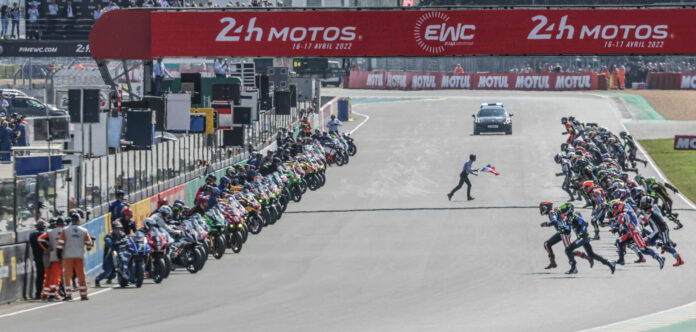
The Le Mans 24-Hours will once again kick off the 2024 FIM Endurance World Championship. Photo courtesy FIM EWC Press Office.
LEGENDARY EVENTS AT FAMOUS RACETRACKS FOR FIM EWC IN 2024
*New EWC season to open with 24 Heures Motos at Le Mans in April
*Format change for Spa event makes Bol d’Or the second of two 24-hour races
*EWC Superstock class and earlier July date for Suzuka 8 Hours
For immediate release (26 October 2023): Legendary events at famous racetracks in Europe and Japan will provide an exciting challenge for riders and teams contesting the 2024 FIM Endurance World Championship.
Kicking off with the 24 Heures Motos at Le Mans in April, the EWC will visit Circuit de Spa-Francorchamps in Belgium in June, Suzuka Circuit in Japan the following month and Circuit Paul Ricard in France for the Bol d’Or in September.
The EWC’s 45th season will consist of two races run for a duration of 24 hours and two taking place over eight hours. The 2024 FIM Endurance World Championship calendar is as follows:
Round 1: 24 Heures Motos (Le Mans, France): 18-21 April
Round 2: 8 Hours of Spa Motos (Circuit de Spa-Francorchamps, Belgium): 6-8 June
Round 4: Bol d’Or (Circuit Paul Ricard, France): 12-15 September
All the rounds will count for the FIM Endurance World Championship and FIM Endurance World Cup. FIM Endurance World Cup teams count their best three scores.
Jean-Baptiste Ley, EWC Series’ Director for promoter Warner Bros Discovery Sports, said: “We are delighted to present the calendar for the 2024 FIM Endurance World Championship when we will continue to count on legendary events at famous racetracks. Although expanding the calendar to include a fifth round remains a long-term target, it’s vital that we deliver a schedule that is accessible and achievable in practical and financial terms. The 2024 calendar achieves both and we look forward to another action-packed season.
“There has been a change to the format of the Spa event, which will strengthen the championship and assist our riders and teams. And in another exciting and positive move for the new season, the Suzuka 8 Hours will form part of the FIM Endurance World Cup schedule although Superstock teams will count their best three scores across the year, meaning participation in this event is not mandatory.”
Paul King, FIM Circuit Racing Commission Director added: “An excellent event programme for 2024, responding to the needs of competitors, promotors and partner organisations to strengthen the FIM Endurance World Championship and FIM Endurance World Cup in the long term.
“It’s good to see the opportunity for Superstock competitors to take part in the Suzuka event for the first time in 2024 – always a special event on the global motorcycle calendar. The FIM CCR and WBDS together have already agreed to count the best three scores from the four FIM Endurance World Cup rounds and to allow Superstock teams a fourth rider in the 24-hour events to enable and encourage participation.”
LIFT-OFF IN LE MANS
The race to become the ultimate FIM Endurance World Championship rider and team of 2024 begins next April when the 24 Heures Motos at Le Mans opens the new EWC season. Scheduled from 18-21 April, the 47th edition of the 24 Heures Motos will provide the first opportunity in 2024 for fans watching trackside and on TV or online around the world to witness the thrilling spectacle that is the all-action EWC. Running one week later than in 2023, organiser the Automobile Club de l’Ouest (ACO) is planning to introduce several measures for the 2024 edition to improve the fan experience by making the event more accessible and with a focus on ensuring all visitors feel safe and secure at all times. More information is available at 24h-motos.com where details of ticket sales can also be found.
SPA’S EIGHT WILL BE GREAT
After two successful 24-hour EWC races at Circuit de Spa-Francorchamps, Belgium’s round of the FIM Endurance World Championship will run over an eight-hour duration in 2024. The format change is a recognition by Warner Bros Discovery Sports, as championship promoter, that maintaining three 24-hour races on the calendar in the current economic climate is no longer achievable due to the significant financial investment required. The decision was therefore taken to run a race of eight hours duration at Spa in 2024. It is hoped the shorter distance will result in an increase of entries, including from teams new to the EWC, and a rise in spectator attendance. It is also hoped that more teams will be in a position to contest the Suzuka 8 Hours due to the costs saved by the reduction of the Spa race length. The 8 Hours of Spa Motos takes place from 6-8 June with Thursday 6 June reserved for testing. A day of free practice and qualifying is planned for Friday 7 June followed by the eight-hour race, which is due to run from 13h00-21h00 CET on Saturday 8 June.
MORE SUPER SUZUKA…
Suzuka Circuit will continue to play an integral role in the ongoing success of the FIM Endurance World Championship with the Japanese circuit’s iconic eight-hour event taking place from 19-21 July. Featuring a mid-morning start and early evening finish, the 45th Coca-Cola Suzuka 8 Hours Endurance Race won’t be the longest on the EWC calendar, but it’s set to be one of the toughest. This is due to the highly-demanding nature of the figure-of-eight track layout and the expected hot and humid conditions that will require the EWC stars to be at the peak of their physical powers. Having run during the first weekend of August in 2023, next year’s edition takes place across the penultimate weekend of July to avoid a clash with the Olympic Games Paris 2024.
…AND SUPER CHANCE FOR SUPERSTOCK STARS
The FIM Endurance World Cup schedule will expand to include the Suzuka 8 Hours in 2024. However, the number of rounds in which points can be scored will remain at three to give flexibility to the Superstock category competitors. That means it’s not mandatory for Superstock teams registered for the full EWC season to take part. Previously focused on the European EWC events only, the addition of Suzuka to the FIM Endurance World Cup calendar will is set to provide an exciting challenge for the Dunlop-equipped Superstock teams and their riders during the upcoming season. And with home-based manufacturers Honda, Kawasaki, Suzuki and Yamaha all represented – and successful – in the FIM Endurance World Cup, the chance for Superstock teams to compete and showcase their level of performance on Japanese soil will hold significant appeal.
BRING ON THE BOL
After celebrating its 100th anniversary in 2022, the 87th edition of the Bol d’Or is the second of two 24-hour EWC races planned for 2024. Due to take place at Circuit Paul Ricard in southern France for the 31st time, the legendary event is set to run from 12-15 September. Of the venue’s 5.673-kilometre layout, 1.8 kilometres are taken up by the imposing Mistral Straight. A place to pass and be passed, the Mistral requires bikes to run for 20 seconds at more than 300kph. Changeable weather and windy conditions can also be a factor.
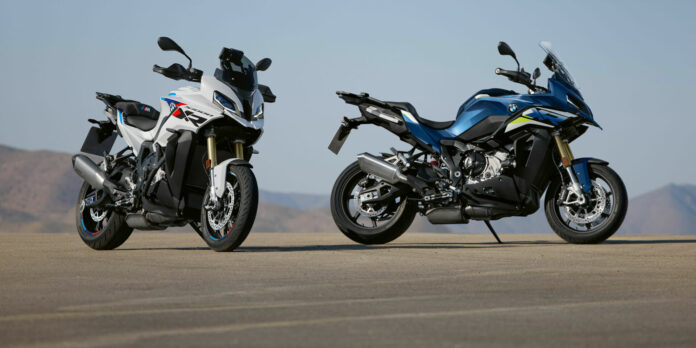
A 2024 BMW S 1000 XR in Gravity Blue Metallic (right) and a 2024 BMW S 1000 XR in Light White/M Motorsport (left) fitted with M Package equipment like the Sport Muffler and M Carbon Wheels. Photo courtesy BMW Motorrad.
The new 2024 BMW S 1000 XR.
Improved performance, optimised ergonomics, sleeker design, and more standard and optional features.
Updated engine with 170 hp (+5 hp) and 84 lbs-ft of torque.
Improved ergonomics thanks to 0.4-inch higher seat.
New standard equipment including Headlight Pro and Keyless Ride.
MSRP $17,495 plus Destination
Estimated Market launch Q2 2024.
Woodcliff Lake, NJ – Oct. 26, 2023 . . .BMW Motorrad proudly introduces the new, updated 2024 S 1000 XR, an enhanced version of the successful long-distance sports bike. Increased engine power, improved ergonomics, design refinements, and expanded standard features define the model’s upgrades.
The reworked in-line 4-cylinder engine now delivers more impressive performance, with a flow-optimized intake channels and a power output of 170 hp.
The new S 1000 XR shares its in-line 4-cylinder engine with the S 1000 RR, providing a smooth and powerful torque delivery that contributes to excellent rideability. Compared to the predecessor model, power has been increased by 5 hp to 170 hp, at an unchanged 11,000 rpm. The main reasons for the performance increase are the flow-optimized geometry of the intake runners and customized engine mapping. The maximum torque generated remains at 84 lbs-ft. at 9,250 rpm.
Improved ergonomics thanks to new seat and rear section.
In order to provide even more freedom of movement, especially during high-performance riding on country roads or at the track, the seat of the long-distance sports bike has been completely redesigned. It now offers an extra 0.4 inches of seat height (33.5 inches) and provides more space by increasing the usable length and width of the seat, allowing for better adjustment of the seating position depending on the riding conditions. The improved ergonomics make it easier for riders to maneuver the S 1000 XR on the street or on the track, providing better control. A total of three different seat heights are available.
The new S 1000 XR also benefits from redesigned elements in its design. The rear section now features new side panels and air intakes inspired by motorsports, giving it a more dynamic look. Additionally, the radiator trim now has a textured surface, and the previously black-colored “beak” front fender is now painted in body color.
Extended range of standard equipment and new options.
The new S 1000 XR comes with an expanded standard equipment list. As part of the standard equipment, Headlight Pro provides additional safety during night-time rides with its adaptive turning light. The rider benefits from improved road illumination in corners. Keyless Ride and a 12 Ah capacity battery are now standard features. Additionally, the new BMW S 1000 XR is equipped with a standard USB charging socket.
Other updates include standard Intelligent Emergency Call feature, the option to equip the S 1000 XR with the optional M GPS Laptrigger, and the availability of M Carbon wheels.
Three new color options.
Three new colors reflect the dynamic character of the new BMW S 1000 XR.
Blackstorm Metallic 2 (standard)
Gravity Blue Metallic (Style Sport)
Light White / M Motorsport (M Package)
The key features of the new BMW S 1000 XR:
Engine power has been increased from 165 hp to 170 hp at 11,000 rpm.
Torque remains unchanged at 84 lbs-ft at 9,250 rpm.
The intake runners have been modified.
Optimized Shift Assistant Pro ensures higher precision when shifting.
Improved ergonomics and freedom of movement with a redesigned seat (33.5- inch seat height vs previous 33.1 inches).
The Shock absorber has been optimized to provide a more sensitive and comfortable ride.
The rear section has a new, sportier design with new side panels and air intakes inspired by motorsports.
The handlebar clamp has been redesigned.
The front “beak” is now painted in the body color.
The radiator cover has a new, textured surface.
New battery with 12 Ah capacity instead of the previous 9 Ah.
M Carbon wheels available as an option.
Keyless Ride is now standard.
USB charging port is now standard.
Headlight Pro is now standard.
Intelligent Emergency Call has been added to standard equipment.
Use of the M GPS Laptrigger is possible.
Standard Equipment
999 cc inline 4-cylidner engine. 170 hp and 84 lb-ft of torque.
6-speed transmission with chain drive.
Cast aluminum wheels.
BMW Motorrad Integral ABS.
Race ABS Linked to Ride Modes.
Dynamic Traction Control.
Dynamic Brake Control.
Dynamic ESA.
Dynamic Engine Brake Control.
Ride Modes Pro.
Keyless Ride.
Steering Stabilizer.
Radial Front Brakes.
Upside Down 45mm Front Forks.
Anti-hopping, wet clutch.
Ultimate Care break-in service included.
Headlight Pro with cornering light.
Intelligent Emergency Call.
Drop Sensor.
Keyless Ride
USB Charging port.
12v Power Socket.
6.5-inch TFT Screen with Connectivity and Multi-controller.
On-Board Computer.
Electronic Immobilizer.
Headlight Pro with Adaptive Headlight.
Full LED Lighting.
Comfort Turn Signals.
Adjustable Handbrake and Clutch Levers.
Adjustable Windscreen.
Case Holder.
Storage Compartment.
Optional Equipment
Premium Package
Dynamic ESA
Gear Shift Assist Pro
Cruise Control
Luggage Rack
Center Stand
Heated Grips
Hand Protection
GPS Prep
TPM Tire Pressure Monitor
LED Auxiliary Lights
M Package
Light White / M Motorsport colors
M Sport Seat (standard, low or high)
Black Tank Cap
Sport Windshield
M Lightweight Battery
Sport Muffler
M Endurance Chain
M GPS Laptrigger
M Forged Wheels or M Carbon Wheels (extra charge)
M Carbon Package
M Carbon Side Panels
M Carbon Front Fender
M Carbon Ignition Lock Cover
Milled Billet Package
M Rider Footrests
M Passenger Footrests
M Brake and Clutch Levers
Individual Options
M Endurance Chain
M GPS Laptrigger
M Carbon Wheels
M Forged Wheels
Design Option Wheels
Sports Muffler
M Sport Seat
M Sport Seat, low
M Sport Seat, high
Seat, low
Seat, high
Lowering Kit
M Lightweight Battery
High Windshield
Technical specifications.
S 1000 XR
Engine
Capacity
cc/cu. in.
999 / 79
Bore x stroke
mm
80.0 x 49.7
Output
hp
170 @ 11,000 rpm
Torque
lb-ft.
84 @ 9,250 rpm
Type
Liquid-cooled in-line 4-cylinder engine
No. of cylinders
4
Compression / fuel
12.5:1 / premium unleaded
Valve / accelerator actuation
DOHC / 4-valves per cylinder
Ø intake/exhaust valve dia.
mm
33.5 / 27.2
Ø throttle body dia.
mm
48
Engine control
BMS-O
Emission control
Closed-loop 3-way catalytic converter, EU5+
Electrical system
Alternator
W
493
Battery
V/Ah
12/12 maintenance-free
Headlight
LED low and high beam
Starter
W
800
Transmission
Clutch
Self-reinforcing, anti-hopping wet clutch
Gearbox
Constant-mesh 6-speed gearbox
Primary ratio
1.652
Transmission ratios I
2.647
II
2.091
III
1.727
IV
1.476
V
1.304
VI
1.167
Rear wheel drive
chain
Transmission ratio
2.647
Suspension
Frame construction type
Aluminum composite bridge frame
Front suspension
Upside-down, 45 mm, telescopic forks
Rear suspension
Aluminum double-sided swing arm with central shock
Suspension travel front/rear
in.
5.9 / 5.9
Wheel castor
in.
4.6
Wheelbase
in.
61.1
Rake
°
24.9
Brakes
front
Twin floating brake disks Ø 320 mm
4-piston fixed calipers
rear
Single-disc brake Ø 220 mm
Single-piston floating caliper
ABS
BMW Motorrad ABS Pro
Wheels
Light alloy cast wheels
front
3.50 x 17″
rear
6.00 x 17”
Tires
Front
120/70 ZR 17
Rear
190/55 ZR 17
Dimensions and weights
Total length
in.
84.9
Total width
in.
33.5
Seat height
in.
33.5
DIN unladen weight
lbs.
500
Permitted total weight
lbs.
992
Fuel tank capacity
gal.
5.3
Performance figures
0-62 mph
sec.
3.3
Top speed
mph
124+
BMW Group in America
BMW of North America, LLC has been present in the United States since 1975. Rolls-Royce Motor Cars NA, LLC began distributing vehicles in 2003. The BMW Group in the United States has grown to include marketing, sales, and financial service organizations for the BMW brand of motor vehicles, including motorcycles, the MINI brand, and Rolls-Royce Motor Cars; Designworks, a strategic design consultancy based in California; a technology office in Silicon Valley and various other operations throughout the country. BMW Manufacturing Co., LLC in South Carolina is the BMW Group global center of competence for BMW X models and manufactures the X3, X4, X5, X6 and X7 Sports Activity Vehicles as well as the BMW XM. The BMW Group sales organization is represented in the U.S. through networks of 349 BMW passenger car and BMW Sports Activity Vehicle centers, 146 BMW motorcycle retailers, 104 MINI passenger car dealers, and 38 Rolls-Royce Motor Car dealers. BMW (US) Holding Corp., the BMW Group’s sales headquarters for North America, is located in Woodcliff Lake, New Jersey.
A “press release” is promotional text issued by a rider, team, company or organization to inform
the public about an event, product, or service from the issuer’s own point of view, and if deemed
to have news value, may be placed on roadracingworld.com as a service to our readers.
A press release is not an article written by Roadracingworld.com staffers. When a post is labeled with the words “press release”, it means that Roadracingworld.com is not responsible for its content and that Roadracingworld.com makes no guarantee that it is accurate. Not all press releases are posted and Roadracingworld.com may reject press releases if the content is too heavy on commercial promotion with little or no news value or if the press release contains obvious errors.
Accessibility
Accessibility modes
Epilepsy Safe Mode
Dampens color and removes blinks
This mode enables people with epilepsy to use the website safely by eliminating the risk of seizures that result from flashing or blinking animations and risky color combinations.
Visually Impaired Mode
Improves website's visuals
This mode adjusts the website for the convenience of users with visual impairments such as Degrading Eyesight, Tunnel Vision, Cataract, Glaucoma, and others.
Cognitive Disability Mode
Helps to focus on specific content
This mode provides different assistive options to help users with cognitive impairments such as Dyslexia, Autism, CVA, and others, to focus on the essential elements of the website more easily.
ADHD Friendly Mode
Reduces distractions and improve focus
This mode helps users with ADHD and Neurodevelopmental disorders to read, browse, and focus on the main website elements more easily while significantly reducing distractions.
Blindness Mode
Allows using the site with your screen-reader
This mode configures the website to be compatible with screen-readers such as JAWS, NVDA, VoiceOver, and TalkBack. A screen-reader is software for blind users that is installed on a computer and smartphone, and websites must be compatible with it.
Online Dictionary
Readable Experience
Content Scaling
Default
Text Magnifier
Readable Font
Dyslexia Friendly
Highlight Titles
Highlight Links
Font Sizing
Default
Line Height
Default
Letter Spacing
Default
Left Aligned
Center Aligned
Right Aligned
Visually Pleasing Experience
Dark Contrast
Light Contrast
Monochrome
High Contrast
High Saturation
Low Saturation
Adjust Text Colors
Adjust Title Colors
Adjust Background Colors
Easy Orientation
Mute Sounds
Hide Images
Hide Emoji
Reading Guide
Stop Animations
Reading Mask
Highlight Hover
Highlight Focus
Big Dark Cursor
Big Light Cursor
Cognitive Reading
Virtual Keyboard
Navigation Keys
Voice Navigation
Accessibility Statement
www.roadracingworld.com
April 6, 2026
Compliance status
We firmly believe that the internet should be available and accessible to anyone, and are committed to providing a website that is accessible to the widest possible audience,
regardless of circumstance and ability.
To fulfill this, we aim to adhere as strictly as possible to the World Wide Web Consortium’s (W3C) Web Content Accessibility Guidelines 2.1 (WCAG 2.1) at the AA level.
These guidelines explain how to make web content accessible to people with a wide array of disabilities. Complying with those guidelines helps us ensure that the website is accessible
to all people: blind people, people with motor impairments, visual impairment, cognitive disabilities, and more.
This website utilizes various technologies that are meant to make it as accessible as possible at all times. We utilize an accessibility interface that allows persons with specific
disabilities to adjust the website’s UI (user interface) and design it to their personal needs.
Additionally, the website utilizes an AI-based application that runs in the background and optimizes its accessibility level constantly. This application remediates the website’s HTML,
adapts Its functionality and behavior for screen-readers used by the blind users, and for keyboard functions used by individuals with motor impairments.
If you’ve found a malfunction or have ideas for improvement, we’ll be happy to hear from you. You can reach out to the website’s operators by using the following email
Screen-reader and keyboard navigation
Our website implements the ARIA attributes (Accessible Rich Internet Applications) technique, alongside various different behavioral changes, to ensure blind users visiting with
screen-readers are able to read, comprehend, and enjoy the website’s functions. As soon as a user with a screen-reader enters your site, they immediately receive
a prompt to enter the Screen-Reader Profile so they can browse and operate your site effectively. Here’s how our website covers some of the most important screen-reader requirements,
alongside console screenshots of code examples:
Screen-reader optimization: we run a background process that learns the website’s components from top to bottom, to ensure ongoing compliance even when updating the website.
In this process, we provide screen-readers with meaningful data using the ARIA set of attributes. For example, we provide accurate form labels;
descriptions for actionable icons (social media icons, search icons, cart icons, etc.); validation guidance for form inputs; element roles such as buttons, menus, modal dialogues (popups),
and others. Additionally, the background process scans all the website’s images and provides an accurate and meaningful image-object-recognition-based description as an ALT (alternate text) tag
for images that are not described. It will also extract texts that are embedded within the image, using an OCR (optical character recognition) technology.
To turn on screen-reader adjustments at any time, users need only to press the Alt+1 keyboard combination. Screen-reader users also get automatic announcements to turn the Screen-reader mode on
as soon as they enter the website.
These adjustments are compatible with all popular screen readers, including JAWS and NVDA.
Keyboard navigation optimization: The background process also adjusts the website’s HTML, and adds various behaviors using JavaScript code to make the website operable by the keyboard. This includes the ability to navigate the website using the Tab and Shift+Tab keys, operate dropdowns with the arrow keys, close them with Esc, trigger buttons and links using the Enter key, navigate between radio and checkbox elements using the arrow keys, and fill them in with the Spacebar or Enter key.Additionally, keyboard users will find quick-navigation and content-skip menus, available at any time by clicking Alt+1, or as the first elements of the site while navigating with the keyboard. The background process also handles triggered popups by moving the keyboard focus towards them as soon as they appear, and not allow the focus drift outside it.
Users can also use shortcuts such as “M” (menus), “H” (headings), “F” (forms), “B” (buttons), and “G” (graphics) to jump to specific elements.
Disability profiles supported in our website
Epilepsy Safe Mode: this profile enables people with epilepsy to use the website safely by eliminating the risk of seizures that result from flashing or blinking animations and risky color combinations.
Visually Impaired Mode: this mode adjusts the website for the convenience of users with visual impairments such as Degrading Eyesight, Tunnel Vision, Cataract, Glaucoma, and others.
Cognitive Disability Mode: this mode provides different assistive options to help users with cognitive impairments such as Dyslexia, Autism, CVA, and others, to focus on the essential elements of the website more easily.
ADHD Friendly Mode: this mode helps users with ADHD and Neurodevelopmental disorders to read, browse, and focus on the main website elements more easily while significantly reducing distractions.
Blindness Mode: this mode configures the website to be compatible with screen-readers such as JAWS, NVDA, VoiceOver, and TalkBack. A screen-reader is software for blind users that is installed on a computer and smartphone, and websites must be compatible with it.
Keyboard Navigation Profile (Motor-Impaired): this profile enables motor-impaired persons to operate the website using the keyboard Tab, Shift+Tab, and the Enter keys. Users can also use shortcuts such as “M” (menus), “H” (headings), “F” (forms), “B” (buttons), and “G” (graphics) to jump to specific elements.
Additional UI, design, and readability adjustments
Font adjustments – users, can increase and decrease its size, change its family (type), adjust the spacing, alignment, line height, and more.
Color adjustments – users can select various color contrast profiles such as light, dark, inverted, and monochrome. Additionally, users can swap color schemes of titles, texts, and backgrounds, with over seven different coloring options.
Animations – person with epilepsy can stop all running animations with the click of a button. Animations controlled by the interface include videos, GIFs, and CSS flashing transitions.
Content highlighting – users can choose to emphasize important elements such as links and titles. They can also choose to highlight focused or hovered elements only.
Audio muting – users with hearing devices may experience headaches or other issues due to automatic audio playing. This option lets users mute the entire website instantly.
Cognitive disorders – we utilize a search engine that is linked to Wikipedia and Wiktionary, allowing people with cognitive disorders to decipher meanings of phrases, initials, slang, and others.
Additional functions – we provide users the option to change cursor color and size, use a printing mode, enable a virtual keyboard, and many other functions.
Browser and assistive technology compatibility
We aim to support the widest array of browsers and assistive technologies as possible, so our users can choose the best fitting tools for them, with as few limitations as possible. Therefore, we have worked very hard to be able to support all major systems that comprise over 95% of the user market share including Google Chrome, Mozilla Firefox, Apple Safari, Opera and Microsoft Edge, JAWS and NVDA (screen readers).
Notes, comments, and feedback
Despite our very best efforts to allow anybody to adjust the website to their needs. There may still be pages or sections that are not fully accessible, are in the process of becoming accessible, or are lacking an adequate technological solution to make them accessible. Still, we are continually improving our accessibility, adding, updating and improving its options and features, and developing and adopting new technologies. All this is meant to reach the optimal level of accessibility, following technological advancements. For any assistance, please reach out to