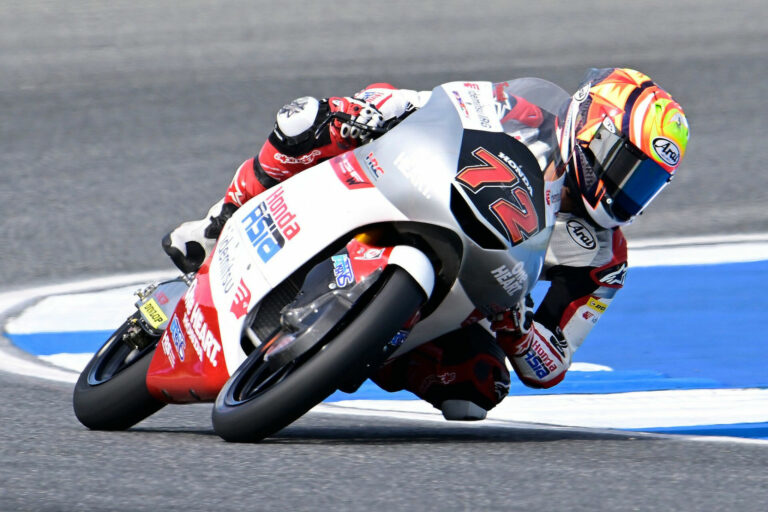
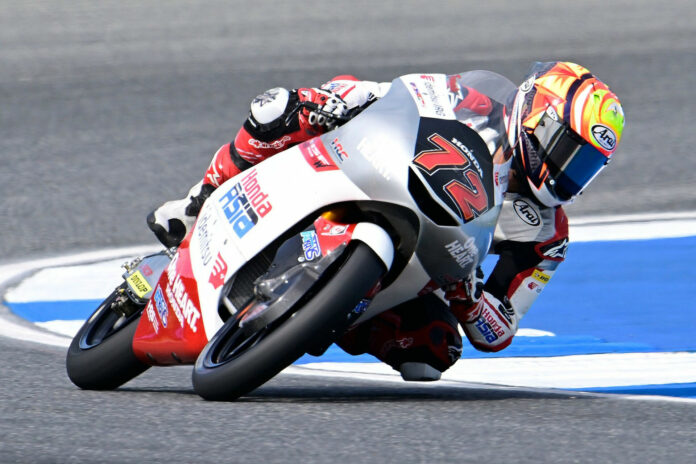
Taiyo Furusato was fastest during Moto3 World Championship Free Practice Two (FP2) Friday afternoon at Sepang International Circuit, in Malaysia. The Honda Team Asia pilot lapped the 3.4-mile (5.5 km) track in 2:12.518 to lead the field of 28 competitors.
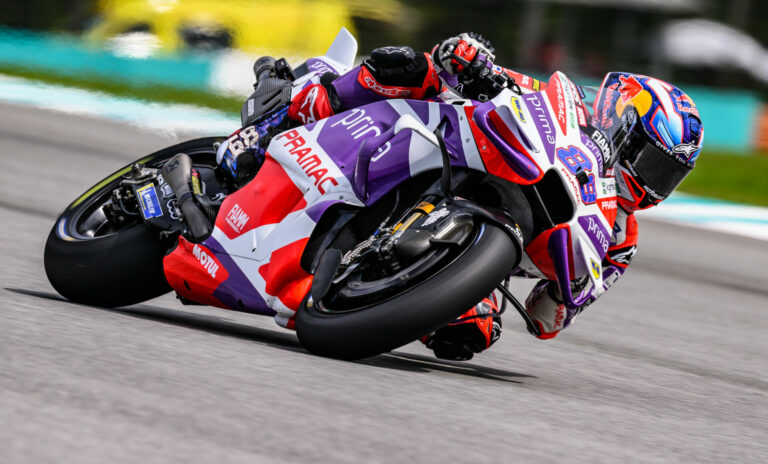
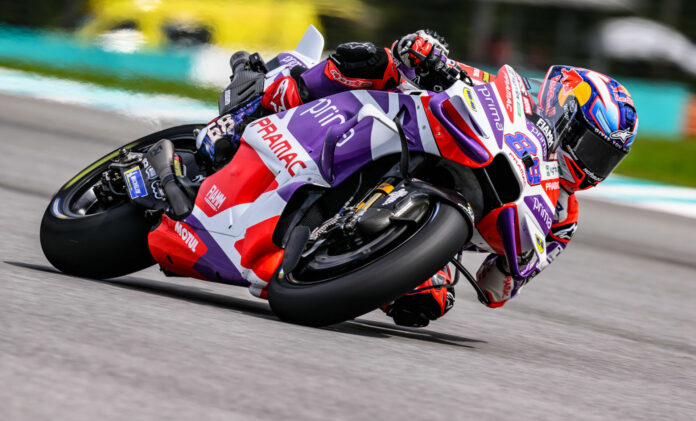
Jorge Martin topped MotoGP World Championship Free Practice One (FP1) Friday morning at Sepang International Circuit, in Malaysia. Piloting his Prima Pramac Racing Ducati, the Spaniard ripped up the 3.4-mile (5.5 km) road course in 1:59.513, which not only led the field of 23 riders it was quicker than Martin’s own Race Lap Record of 1:59.634 from 2022.
Alex Marquez was second-best with a 1:59.562 on his Gresini Racing Ducati, and Martin’s teammate Johann Zarco made it a Ducati sweep of the top three spots with a 1:59.914.
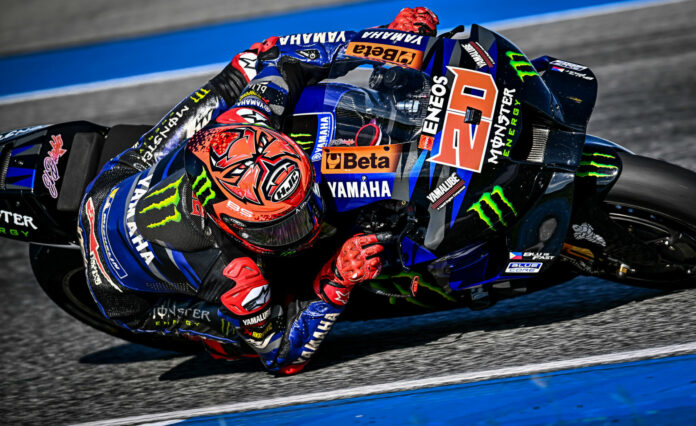
The quickest non-Ducati rider was Franco Morbidelli, who turned a fourth-fastest 2:00.055 on his Monster Energy Yamaha YZR-M1.
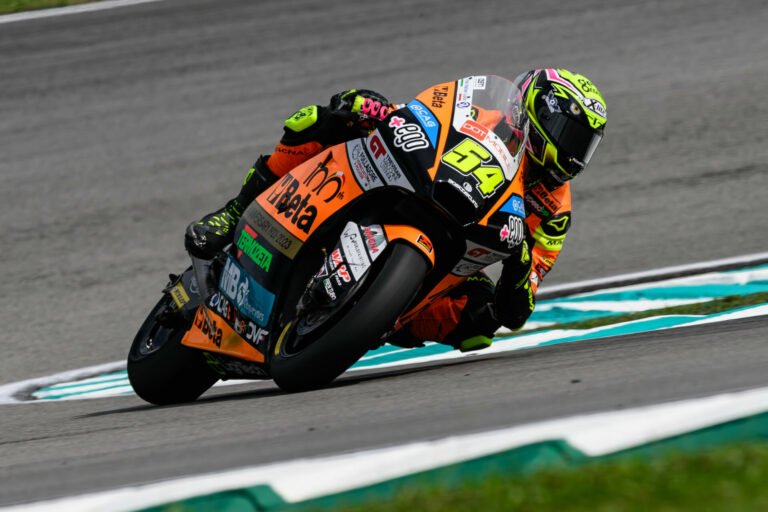
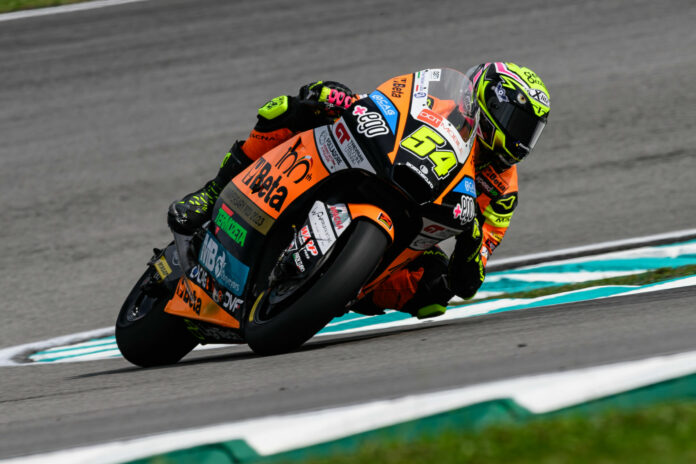
Fermin Aldeguer topped Moto2 World Championship Free Practice One (FP1) Friday morning at Sepang International Circuit, in Malaysia. Riding his Beta Tools SpeedUp Boscoscuro machine, the Spaniard covered the 3.4-mile (5.5 km) course in 2:06.163 to lead the field of 32 riders.
American Joe Roberts was sixth in the session with a 2:06.760 on his Italtrans Racing Kalex.
American Sean Dylan Kelly (SDK) was back in action on the Forward Team racebike and turned a 2:08.994, which ranked him 24th in the session and five spots better than his teammate Alex Escrig (2:09.335).
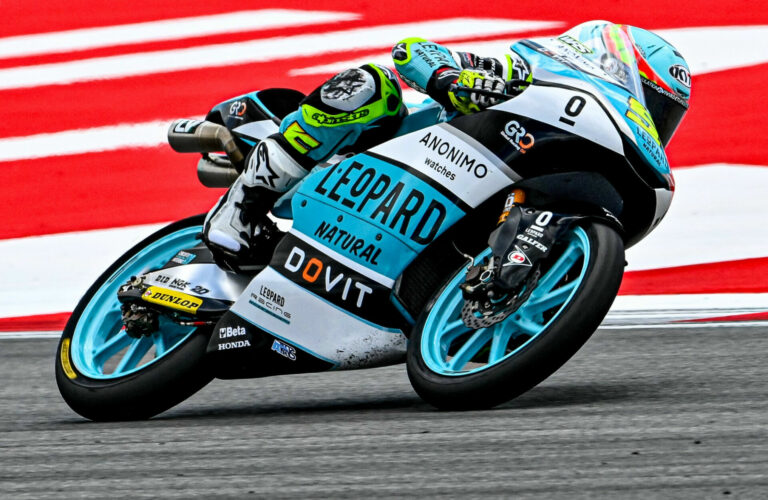
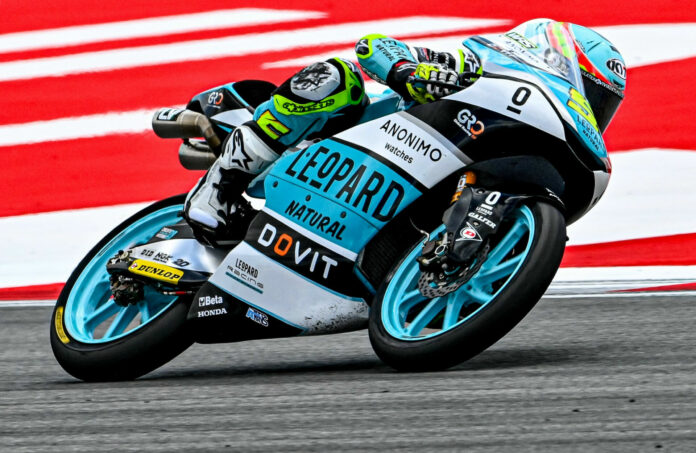
Jaume Masia was quickest during Moto3 World Championship Free Practice One (FP1) Friday morning at Sepang International Circuit, in Malaysia. Riding his Leopard Racing Honda, the Spaniard lapped the 3.4-mile (5.5 km) track in 2:12.065, which was quicker than Ayumu Sasaki’s Race Lap Record of 2:12.671 from 2022.
Round Two of the CVMA 2023/2024 Winter Series is approaching as fast as some of our racers! Registration is open for the event which occurs over the weekend of November 18th and 19th so get signed up for some of the most competitive club racing in the country.
CVMA is happy to welcome several new sponsors for this upcoming event!
Del’s Flooring in Palm Desert (www.delsflooring.com) will be sponsoring the Formula Ultra Lightweight class for this round and the remainder of the series. Del’s Flooring is a second- & third-generation, family-owned business priding itself on quality working relationships and a high standard of flooring experience. Del’s will be providing a $600.00 purse for each remaining round. Payouts for both races (Saturday and Sunday) will be as follows:
1st – $150
2nd – $100
3rd – $50
Road Race City – Bridgestone Tires (www.roadracecity.com) will be sponsoring the Formula Twins class for the remainder of the season offering a $600 purse for each of the remaining rounds. Road Race City is a full-service motorcycle service center based out of Temple City, CA, and provides trackside tire sales and support for Bridgestone tires. Payouts for both races (Saturday and Sunday) will be as follows:
1St – $150
2nd – $100
3rd – $50
RideHVMC (www.ridehvmc.com) a premier track experience provider will be sponsoring the Amateur SuperSport Middleweight class. They are rewarding the winner of the class (most points for the weekend) a 1-on-1 training day at Chuckwalla Valley Raceway with 2022 MotoAmerica Stock 1000 Champion Corey Alexander. RideHVMC offers many services at Chuckwalla Valley Raceway including seasonal garage membership and equipment storage, rider training, bike rentals, trackside service, and group track events.
With Veterans Day closely preceding this next round of the series, the veteran-owned-and-operated Ryder Gear (www.ryder-gear.com) will be offering special Veterans Day pricing on gloves the entire race weekend.
The weather forecast is looking pretty awesome for our next round and we are super pumped to welcome racers from all over the country to the California sunshine and some of the most competitive racing you will find anywhere. Come on out and race with us!
CVMA offers two full days of racing every race weekend and also includes Saturday qualifying for grid position in all classes, amateur, and expert, as well as a wide variety of classes to choose from.
CVMA offers free reciprocity to encourage racers from other clubs to come out and compete. CVMA also offers a New Racers School for those starting out in racing on the Friday prior to each race weekend. Log on to www.cvmaracing.com to sign up or for more information.
Come on out and race with us on November 18th and 19th for our next round for some of the most competitive racing in the country!
CVMA. Built for racers by racers and offering the best racing experience around!
CVMA would also like to thank the 2023/2024 Winter Series Sponsors: SoCal Track Days, Apex Assassins, Ryder Gear, Racers Edge/Dunlop, The California Superbike School, CaliPhotography, Del’s Flooring, Ride HMVC, Road Race City/Bridgestone
NRS Sponsors: Alpinestars, 6D Helmets, Racer Gloves, and Racer’s Edge
Bautista and the Ducati Desmosedici GP of the Aruba.it Racing team in Malaysia for the fascinating MotoGP wild card
There could not have been a more fascinating way to end the extraordinary 2023 season. After having been crowned Superbike World Champion for the second year in a row and having contributed to the “triple crown” conquered by the Aruba.it Racing – Ducati team in WorldSBK, Alvaro Bautista landed to Malaysia where the Grand Prix of Malaysia will kick off tomorrow at the Sepang circuit.
The Spaniard will climb aboard the Ducati Desmosedici GP of the Aruba.it Racing team for the third wild card of the season in MotoGP, following the ones held by Michele Pirro in Italy, first at the Mugello Circuit and then at the Misano World Circuit Marco Simoncelli.
Bautista therefore returns to MotoGP competition after last racing at Valencia in 2018.
Free practice for the Grand Prix of Malaysia will get underway tomorrow at 3.45 am CEST. Saturday’s schedule will see first qualifying (from 3.50 am CEST) then the Sprint Race (8.00 am CEST). On Sunday, finally, the Grand Prix of Malaysia (20 laps) will start at 8.00 am CEST.
Alvaro Bautista (Aruba.it Racing #19)
“I am happy to be back racing in Malaysia also because Sepang is definitely one of my favorite circuits. Having the opportunity to ride the Desmosedici GP again after a few years means a lot to me: it is a great emotion. I’m sure it will be a good weekend, also because we arrive in Malaysia with no expectations but only with the desire to do a good job with the team from Friday. The aim is to find a good feeling with the bike as soon as possible, as in the light of the new format, the time available is not much. It won’t be easy, but I’ll try my best and have fun. This is a bonus that Ducati and Aruba.it have given me for the results obtained in WorldSBK and I’d like to make the most of it”.
“It’s a pleasure to have this pressure”: a pivotal weekend begins at Sepang
Hear from Bagnaia, Martin, Bezzecchi and Binder as the final triple header begins
Thursday, 09 November 2023
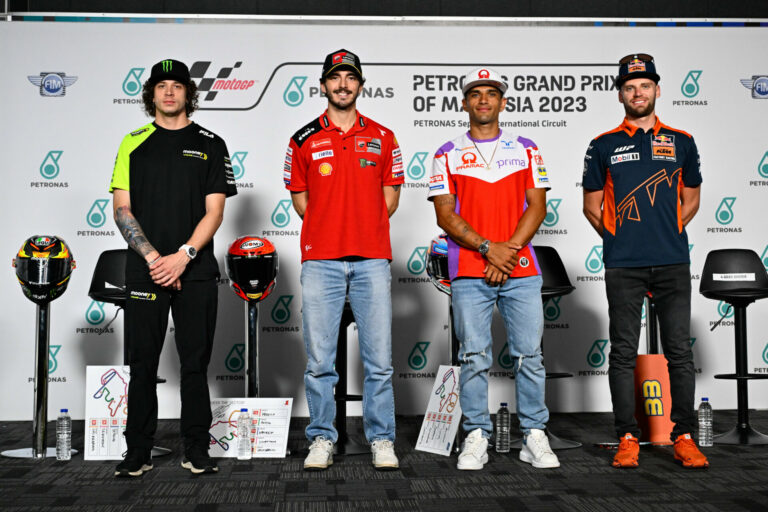
Three weekends, 111 points and it all starts here at Sepang for the PETRONAS Grand Prix of Malaysia. Before the bikes get out on track, it was time to hear from Championship leader Francesco Bagnaia (Ducati Lenovo Team), closest challenger Jorge Martin (Prima Pramac Racing), final rider in contention Marco Bezzecchi (Mooney VR46 Racing Team) and Brad Binder (Red Bull KTM Factory Racing) on the tails of a stunning Thai GP.
Here are some quotes and talking points from Thursday!
FRANCESCO BAGNAIA: “This is one of my favourite tracks. I always love being here. I have good memories from all the categories and I’m always very happy to be here. So we have to see and we have to have a bit of luck with the weather forecast. But I think we can be competitive in any situation. Some parts of the track have been resurfaced, so I think it will be great.”
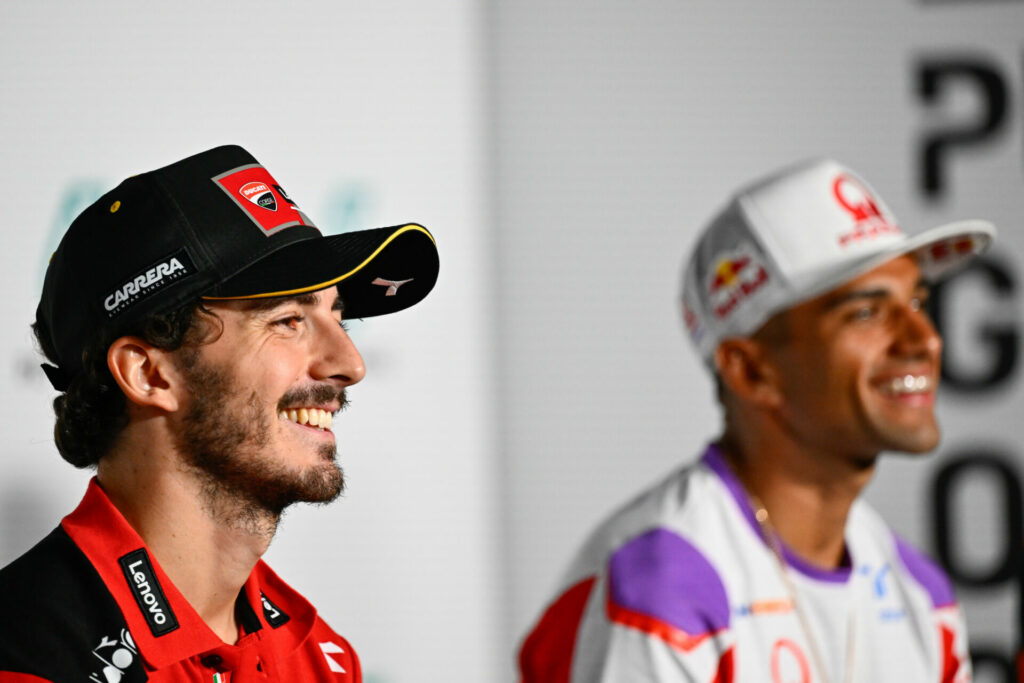
Francesco Bagnaia (left) and Jorge Martin (right). Photo courtesy Dorna.
Can you solve quali woes this weekend?
“I think so, for sure at this track it will be different because I think the race tyre will be the medium, that will be the ‘soft’ here, so maybe yes, last time we were here was the test in February and everything went perfectly. So let’s see. It will be interesting for sure because the level at this track is always really high across the board, not just us, so it would be nice to have a great battle, but I hope to start more at the front to not have some kind of battle like this.” (referencing Marc vs Aleix being shown on screen)
Do you feel pressure?
“I think it’s a pleasure to have this kind of pressure. We are fighting for the title and without pressure it means you don’t care too much about what you’re doing. So I think the pressure is normal. It’s a great fuel from my point of view, so we have to use this to improve on our side and to feel the hunger of being champion again.”
Will last year’s experience benefit this year?
“I don’t know, honestly. I remember last year there was a lot of pressure here and I won the race. Every person and every rider has a different feeling with the pressure. In my case it can affect me, but it’s always a motivation. I don’t know about Jorge, but for sure the experience of last year maybe can help me in some situations, but it’s totally different compared to the last year.”
JORGE MARTIN: “After the last race I was super happy. I think I did an amazing weekend and as you said a fourth double win of the year was great. I decided to stay here because normally I struggle with the jet lag so I thought it would be a good option to stay here and get used to the conditions and train in the heat. I’m happy, I think this week off I had too much time to think about everything, I prefer to race straight away because I had the feeling. Back in Malaysia and looking forward to race!”
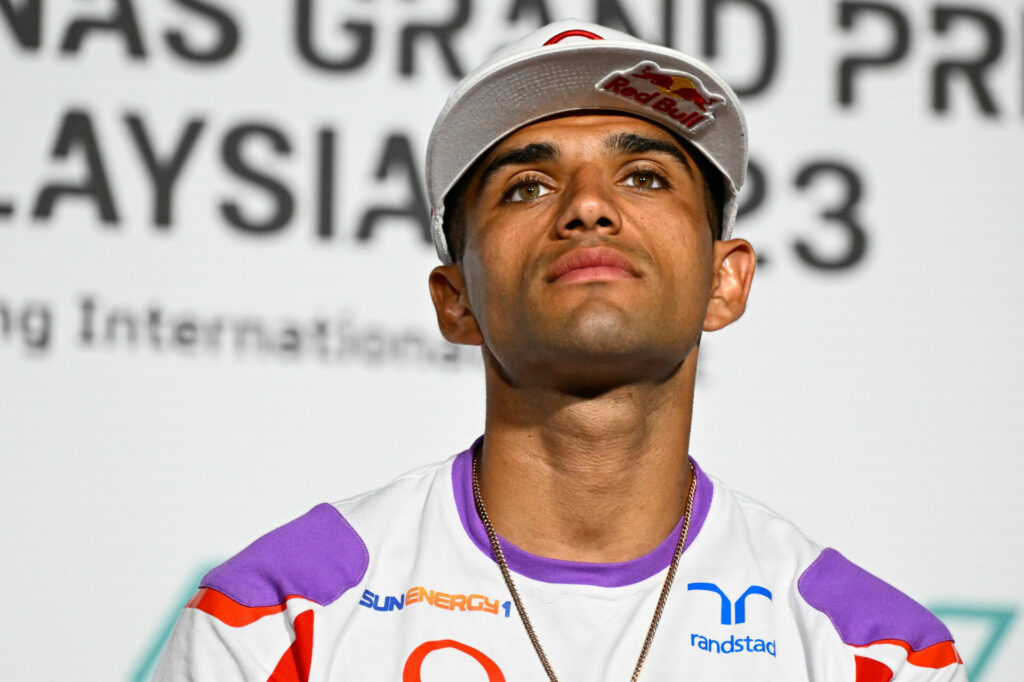
Jorge Martin. Photo courtesy Dorna.
What about that gesture on the podium in Thailand?
“It wasn’t on purpose, I don’t know why I did it. It was quite similar but more for the grandstand. Anyways, it’s not bad, some spicy moments, I didn’t want to make a funny thing or something like this, it just came naturally. You just have this impulse that sometimes happen, but I was so happy for the moment and I went to the podium and no one was shouting, so I was like ‘come on guys!’ After two bad results, and really unlucky situations we finally did a great job so I was super happy and proud.”
Is this a revenge mission after Malaysia 2022?
“Yeah I’m missing that victory, I felt I could make it. Maybe two or three more laps and I was able to make the gap but I couldn’t because I crashed. I think with the new asphalt we can improve because it seems the bumps are less so the turns could be faster and for the race, let’s see, maybe it’s not the best strategy to pull away.”
Are you feeling the pressure, how different was Buriram feeling?
“I feel it out of the races, for example when I was in Bali because you have time to think about winning or losing a big thing, but when I’m at the race track I’m just focused on racing. Today I was relaxed and feel confident that it can go well.”
And what about those rumours of the factory seat?
“I can’t say a lot. I would be proud to continue with Pramac next season but if Ducati want to join on the red bike next year, I would be super happy also.”
MARCO BEZZECCHI: “It was an intense triple header for me. Unfortunately, my physical condition wasn’t very good. It was important to go back home. I didn’t really rest, but I tried to recover as much as I could with the shoulder and continue to train to be able to arrive to the final part of the season. As ready as possible. Yeah, I can’t complain. I feel a bit better still. For sure it will be painful, but overall I have to say that my condition is surprising me a little bit.”
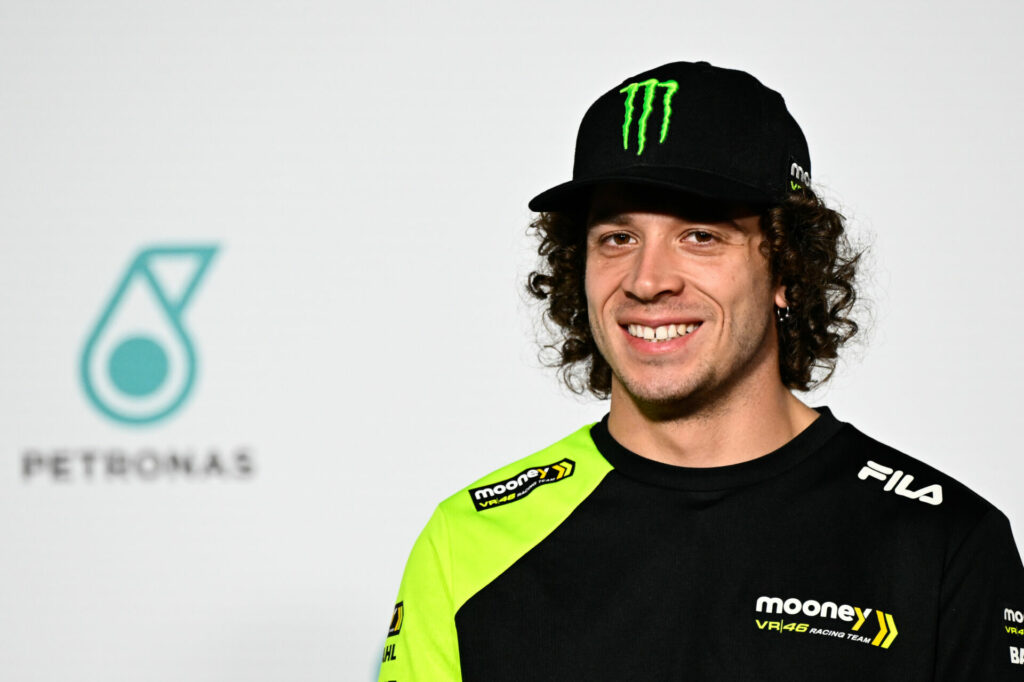
Marco Bezzecchi. Photo courtesy Dorna.
Did you go have time to go the ranch?
“I don’t want to see the ranch for many months! I didn’t ride the bike, I thought it was better to rest my body from motorbikes, especially because MotoGP is very stressful and I have to arrive in a good shape. I’m still not 100% for sure because as soon as I put some stress on the shoulder then all my neck in all my shoulder and my back starts to create a lot of problems for me, but at least I’ve recovered a little bit and I will try to be strong.”
Do you feel that you’re going to be more in the game to fight for victory this weekend?
“Yeah, in Thailand I was really fast but unfortunately in the race I made a few mistakes and then I lost too much time to be able to recover. But I was consistent and I was very quick and I think that here I can try to make the same and try to be fast and more consistent. Of course the weather conditions will be a key for the weekend because it might be a little bit crazy. But I will try my best to be strong.”
And the Championship?
“Yeah, well, it’s still possible. Of course. It’s really tough because you know, they are very quick and I’m still not fully fit. So it will be tough, but if I get a good result, I will go on the podium like this. Yeah, I will try… they are very strong, but I will give my best.”
BRAD BINDER: “The plan is to pick up where we left off last time, stay among the top bunch and try and fight it out till the last lap again but hopefully get it right! That would be nice! Yeah, I have some good memories here for sure, it’s a track I really enjoy. It’s going to be interesting for me because Testing we had a lot of issues and the guys have done a great job throughout the season on the bike. Things are completely different now, it’s going to be interesting to see how big the step is that we’ve made.”
Brad Binder. Photo courtesy Dorna.
Improvements since the Test?
“The biggest thing is when we were here in February is we were trying to decide which direction we needed to go in. I don’t think I did more than two exits with the same bike and played with all sorts of parameters. Oh yeah now if we look at where we were and where we are now things are completely different, where the biggest thing that I’m looking forward to is just riding this track comfortably. That should be fun.”
3 chances to win a race, where does Sepang sit in terms of those chances?
“If I look back at my last two races, I felt like Australia I messed up and last time I really wanted to give it a go and put myself on the green. I haven’t really been able to put it together. I feel like we’ve been fast over the last five or six tracks, and I’d love nothing more than to finally get a win for my team. Yeah, we’ve won two Sprints, but a main race is the goal.”
Now you’re the South African with most podiums, do you hope that can inspire more riders?
“It’s a really cool stat. It’s quite different. Nowadays we have 21 races and back then they had less than half so it’s not quite fair! It’s super cool anyways and awesome to know. For me it’s great to see how MotoGP is growing back in South Africa. Every time I go home it seems more and more people are enjoying the racing as much as I do. Who knows? The better things go here, the better they can go back home too!”
Broadcast Icon and Indelible Voice of the Sport Passes
The SuperMotocross community and the motocross industry as a whole is deeply saddened by the passing of broadcast icon Art Eckman. Best known in the racing world as the voice of the formative years of the Monster Energy AMA Supercross Championship and Pro Motocross Championship, sanctioned by AMA Pro Racing, Eckman’s instantly recognizable candor alongside AMA Hall of Famer David Bailey defined the fandom and passion of multiple generations who tuned into ESPN, ESPN 2, and ABC to watch the races.
His contributions for both Supercross and Pro Motocross broadcasts, in addition to hosting the popular MotoWorld weekly television news magazine, allowed Eckman to become synonymous with two-wheeled motorsports. His indelible voice is an integral part of the soundtrack for the legendary careers of Jeremy McGrath, Ricky Carmichael, Jeff Stanton, Damon Bradshaw, and so many more, while his mentorship helped carve a path to broadcasting for former star racers like Jeff Emig, Grant Langston, and James Stewart.
This past April, Eckman attended the Atlanta Supercross, which gave long-time fans and colleagues a chance to catch up with one of the most influential and beloved figures of the sport.
The SMX Insiders remember Art Eckman and celebrate his contributions to the sport.
The following obituary celebrating Art’s incredible life and storied career was provided by the Eckman Family, anchored by his wife of 46 years, Donna Haines Eckman, his daughters, Christine Eckman and Kara Eckman Mecke, his son-in-law, Ralph Mecke, and grandchildren, Alastair and Cedric Mecke.
ARTHUR GEORGE ECKMAN (1942 – 2023)
Sports Broadcaster/Commentator, humanitarian, husband, father, grandfather and friend ARTHUR G. ECKMAN (Art) died on November 4, 2023, at the age of 81. Born in Salem, Oregon, in April 1942, Art was the son of Harriett Wiseman Eckman and Bruce Page Eckman.
Known for his rich, deep, and often said to be ‘God-like’ voice, Art’s professional career spanned more than 55 years in the sports world for which he provided broadcasting and reporting services for over 20 different kinds of sports. If there was a ball involved, whether a football, basketball, baseball, bowling ball, or golf ball or if there was an engine involved, from a motorcycle to a motor boat, Art had the knowledge, wherewithal, skills and history to write or talk about it. Bottom line, Art loved sports and was a sports enthusiast and historian.
Art was a 1965 graduate of Washington State University’s Edward R. Murrow College of Communication and began his career working in the newsroom at KOIN-TV in Portland, Oregon. From news he segued into sports, becoming the Sports Director at KATU-TV and KEX radio where he called play-by-play for Oregon State football, basketball and triple-A baseball, twice earning the Oregon Sportscaster of the Year award.
From Portland, Art began broadcasting for the San Diego Rockets, which after one year, moved to Houston and became known as the Houston Rockets. Art served as Director of Broadcasting for the Houston Rockets for five years doing play-by-play radio and TV, including broadcasting two NBA All-Star games on network radio.
After Houston, Art worked at KSFO-Radio as Sports Director/Anchor and as a play-by-play Announcer for the San Francisco Giants and Stanford University. From 1976 to 1978, Art was the Sports Director/Anchor for KRON-TV, broadcasting for the Oakland Raiders pre-season football play-by-play and was Co-host of the Kenny Stabler Show. It was here that he was honored with the Kennedy Foundation National Award for producing a series featuring athletes with developmental disabilities.
In 1978, Art moved his family from San Francisco to Atlanta to become the Sports Director/Anchor for WXIA-TV until 1991. While at WXIA-TV, Art provided daily coverage of Falcons, Hawks, Flames and Braves games as well as for area colleges, universities and amateur sports. He also provided special coverage of Super Bowls, Collegiate Bowls, Indianapolis 500 and Daytona 500, Heavyweight Championship fights, Final Fours, The Masters, plus major golf, tennis, gymnastics and track and field events.
At this point in Art’s distinguished career, his professional path took him on a host of adventures where he was honored with many awards and acclamations including receiving the Man of the Year award from the Edward R. Murrow School of Broadcasting at Washington State University in 2015.
Among his many broadcasting duties, Art did play-by-play radio and television for the Atlanta Dream/WNBA; was host announcer, producer and writer for auto and boat racing; was Sportscaster/writer for ESPN and ESPN2 for such events as the Chick-fil-A Bowl Preview Show (hosting with Lee Corso and Bill Curry), was play-by-play announcer for webcast/radio and television for Supercross/Motocross, did the MotoWorld weekly magazine show serving as anchor, editor, writer and producer and was pit announcer for AMA Road Racing and CART Indy Cars. Additionally with ESPN and ESPN 2, Art called play-by-play for Formula One Tunnel-Boat Series, was reporter and host of the Suzuki Great Outdoors program, broadcasted for Unlimited Hydros and Off-Shore Boat Race Services including providing play-by-play for Wide World of Sports. He provided commentary for Full Contact Karate, the Great Britain Rugby League, Water Skiing, Pro Beach Volleyball, Pro Snow Skiing and the US Squash Open. He was the play-by-play announcer for replays of ACC football and basketball games.
Art was radio and television announcer for the Atlanta Hawks, the ACC Basketball-Jefferson Pilot, the ACC Football-Raycom series, the ACC Volleyball and Women’s basketball packages, the Atlanta Thunder World Team Tennis, Grand Prix Cycling WATL, Georgia and Florida All-Star High School Football, Metro Conference Basketball packages; and was host of the Bill Curry, Bobby Ross and Bobby Cremins TV shows.
One of Art’s favorite college teams was Georgia Tech where Art served as host of the WSB Radio Tailgate Show, was a sideline reporter for WGST, and did play-by-play for WGST Tech basketball. He also hosted American Sports Radio Network’s Final Four show with Al McGuire; was a reporter for Sports By-Line USA, nationwide syndicated talk show. He reported from Wimbledon, the French Open and the Monaco Grand Prix. He provided Atlanta Attack Indoor Soccer play-by-play and WGZC radio morning drive-time sports reports.
In addition to a full-time sports career, Art was familiar with the corporate world, lending his voice and expertise to numerous commercials, special promotions and videos. He was fond of writing and authored numerous feature articles to various publishers and companies.
In the latter part of his sports career, Art took special interest in working with Kennesaw State University in helping to further develop and expand its athletic department. At Kennesaw, Art served as Assistant Athletic Director and Media Relations liaison and consultant. He enjoyed instructing staff and students/athletes on dealing with the media, including crisis control, and he supervised the Sports Information Department among other tasks.
Another one of Art’s great loves was working with young athletes and corporate executives on how to better understand their roles with the media. Consequently, he developed a series of seminars to help many people build positive images and communicate with the media.
In addition to his love of sports, Art was known for his humanitarian efforts. For over 35 years, he served on the Board of Directors for InCommunity (formerly known as enAble of Georgia) – a system of 20 group homes for mentally handicapped and autistic adults. He was former chairman of the federally mandated Advisory Board for Special Education for the state of Georgia. And for nine years, Art served on the Board of Directors for Georgia Special Olympics. He was a founding member of the Georgia Autism Society, and, for 13 years, was Director of a high school student/athlete awards program in which he visited as many as 50 schools, charities and service groups each year. Art served as President and was one of 23 men honored with a lifetime membership in the Touchdown Club of Atlanta and served as a member of the Naismith basketball awards committee. In 2010, Art was inducted in the Portland Public Schools Sports Hall of Fame.
Art is survived by his wife, Donna Haines Eckman, as well as two daughters, Christine Eckman and Kara Eckman Mecke along with Kara’s husband Ralph Mecke and their two children, Alastair and Cedric Mecke.
Plans for a Celebration of Life service will be at 3 p.m. on Friday, November 10, 2023, at Peachtree Road United Methodist Church, 3180 Peachtree Road, NE, Atlanta, GA 30305. In memory of Art’s life and in lieu of flowers, the family suggests that a donation be made to InCommunity. InComunity, is a non-profit organization that provides support to individuals with developmental disabilities. Over the years, this organization has been a significant part of the Eckman family as its staff has helped Christine Eckman thrive in her community.
Editorial Note: As of post time, American Honda does not know if the updated 2024 CBR1000RR-R Fireblade SP will be imported to the United States.
24YM HONDA CBR1000RR-R FIREBLADE SP
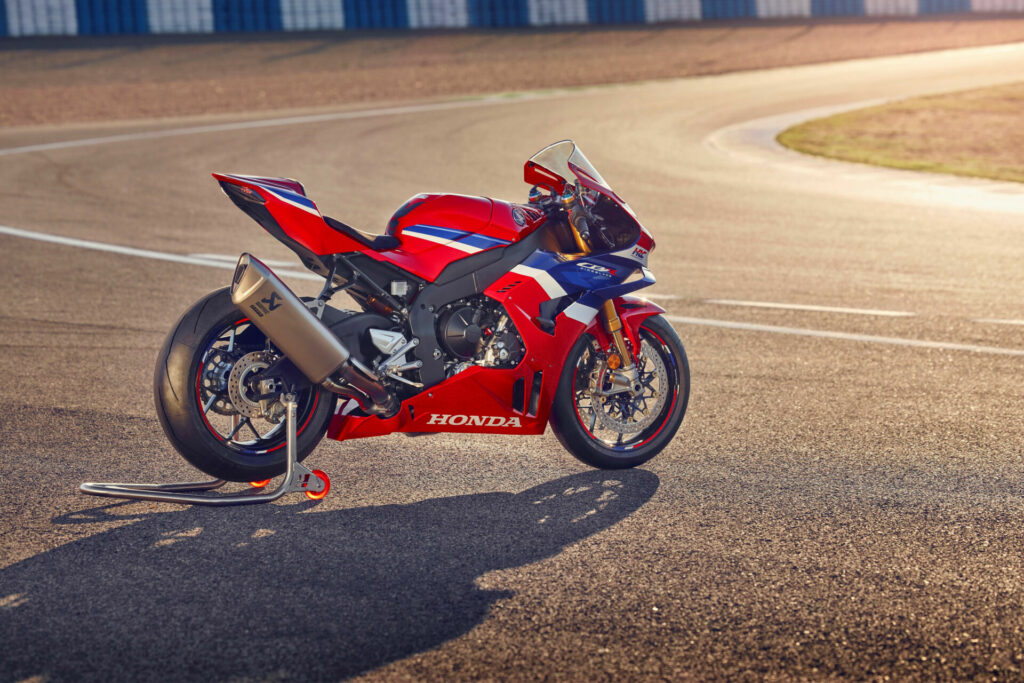
Model updates: The CBR1000RR-R Fireblade SP takes a huge step forward in development, with its 1,000cc inline four-cylinder semi-cam gear engine in a new state of tune to deliver even stronger mid-range acceleration as well as huge top-end power.The cylinder head, compression ratio, valve timing and springs have all been revised; the crankshaft and con-rods are lighter and there are new, shorter ratios all the way through gearbox. 2-Motor Throttle By Wire adds precise control and feel at lower rpm, with more engine braking if required. The aluminium diamond-style frame has a new, more pliant character to improve steering accuracy and traction. Specification also includes an RC213V-S-style swingarm, six-axis Inertial Measurement Unit (IMU) and 3-level Honda Electronic Steering Damper (HESD); full, race-quality suspension is provided by new Öhlins Smart Electronic Control (S-EC03) with Spool Valves and OBTi user interface. A new preload guide is also available on the instrument panel. Braking is by Brembo, with new Stylema R four-piston calipers up front. New winglets maintain downforce but with 10% less yaw moment in cornering. The riding position too has been adjusted to allow more control for the rider. A full-colour TFT screen offers intuitive control of riding modes and adjustment of Power, Engine Brake, HSTC, Wheelie Control and Start Mode; all settings have been revised to match the new power delivery and gearing. Cornering ABS now features an extra RACE setting. Honda’s Emergency Stop Signal and a Smart Key remains the finishing touch. A limited edition CBR1000RR-R Fireblade SP Carbon Edition is also available.
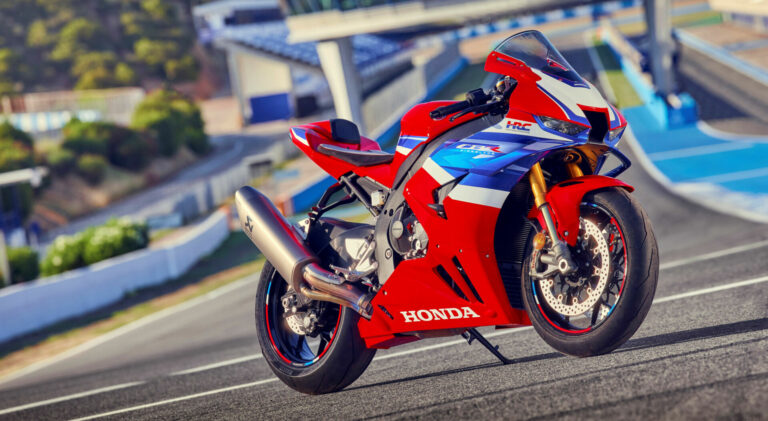
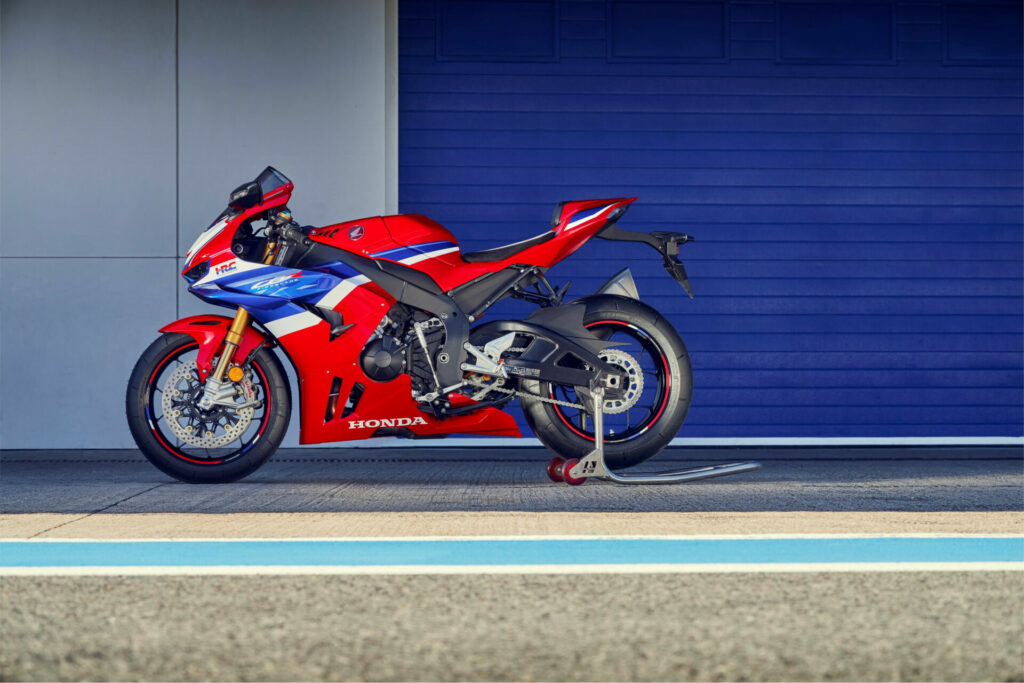
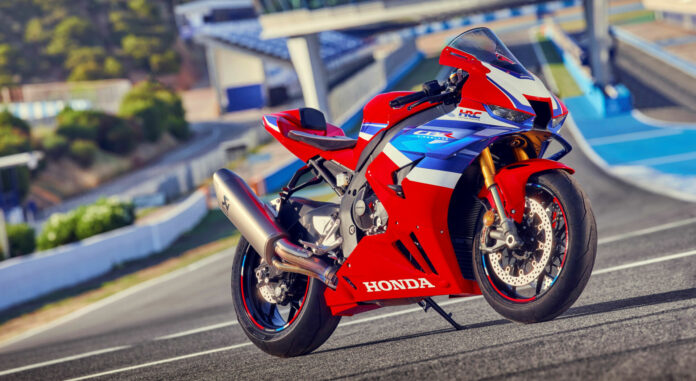
The left side of a 2024 Honda CBR1000RR-R Fireblade SP. Photo courtesy Honda Motor Europe.
Contents:
1 Introduction
2 Model overview
3 Key features
4 Accessories
5 Technical specifications
Introduction
Since its original 1992 introduction Honda’s iconic Fireblade has evolved into an incredible 1,000cc super sports motorcycle. And it’s also been the base of a competitive race machine, on short circuits around the world and the roads of the Isle of Man TT.
But time – and competition – always races on and in 20YM Honda drew the line under where the CBR1000RR Fireblade had been and looked forward to where it was going. And, as a result, two brand-new motorcycles – the CBR1000RR-R Fireblade* and CBR1000RR-R Fireblade SP – were created with heavy involvement from Honda Racing Corporation to carry the legend forward.
Leaning heavily on the engine and chassis technology of the RC213V-S ‘street-legal MotoGP machine’, with aerodynamics drawn from the RC213V MotoGP bike, the new Fireblade was designed from the ground up – in terms of engine, handling and aerodynamics – for pure, outright track performance.
22YM marked 30 years of the Fireblade which saw the introduction of a variety of detail upgrades to the engine to boost acceleration; the intake ports, airbox, airbox funnels and exhaust mid-section were all revised to deliver extra mid-range thrust. The final drive sprocket also went up 3 teeth, to 43, with quickshifter performance upgraded. Honda Selectable Torque Control (HSTC) was also optimised for refined rear tyre traction management, and throttle feel improved.
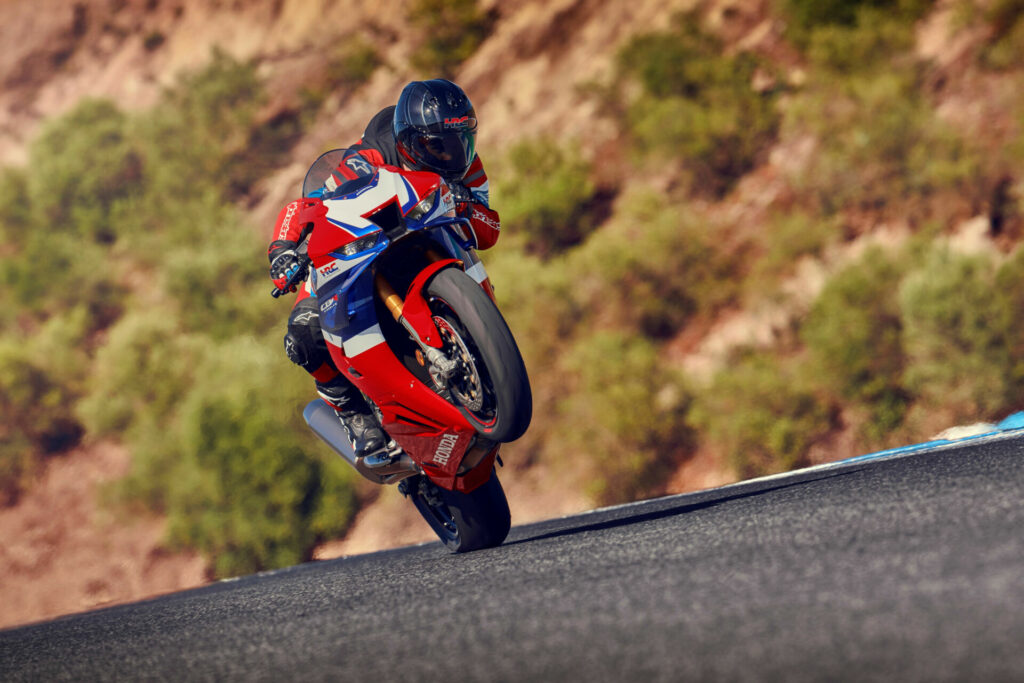
24YM sees the Fireblade SP drive further up its development curve once again. A host of engine and gearbox updates deliver a healthy mid-range performance boost, with improved throttle response, alongside detailed riding position changes and upgrades from Brembo and Öhlins, with the aim of producing the bike you need to win out-of-the-box and, at the same time, elevating the riding experience out on the open road.
A 2024 Honda CBR1000RR-R Fireblade SP at speed. Photo courtesy Honda Motor Europe.
Model Overview
The Fireblade SP’s inline four-cylinder semi-cam gear engine delivers 113Nm torque and makes peak power of 160Kw. And while the headline figures are familiar, the delivery through the rev-range has been completely changed – the product of a huge amount of HRC development and knowhow– to generate corner exit acceleration topped by huge top-end power.
The addition of 2-Motor Throttle By Wire (TBW) increases part-throttle control and allows amplified engine braking. Compression ratio has been raised, intake ports adjusted, and valve timing altered in conjunction with new valve springs, a lighter crankshaft and optimised, lighter titanium conrods. All gear ratios have been made shorter, to increase drive force to the rear wheel.
The 4-2-1 exhaust downpipes are ovalized and feed a titanium Akrapovič muffler now slightly larger in volume but 5dB quieter in operation.
Three default riding modes cover most conditions with options to fully adjust Power, Engine Brake, Wheelie Control and HSTC and all settings have been revised for the new output character. The electronics package also includes adjustable Start Mode and standard-fit quickshifter.
As before, the aluminium diamond frame uses the rear of the engine as upper shock mount while the swingarm is based on the RC213V-S design. The rigidity balance has been carefully optimised – and made more pliant – to exploit the engine’s performance in terms of feel for front and rear grip levels, and steering accuracy.
A six-axis Inertial Measurement Unit (IMU) provides accurate 3D estimation of riding dynamics and provides input to manage all of the electronic systems. It also controls the rod-type 3-level Honda Electronic Steering Damper (HESD).
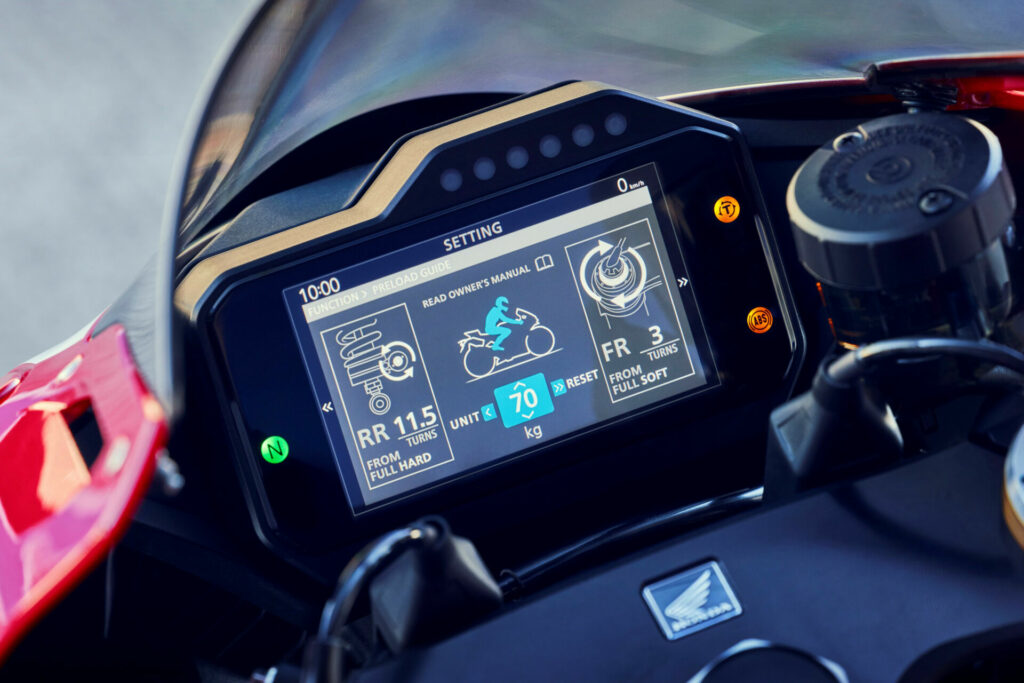
The 24YM CBR1000RR-R Fireblade SP is the first bike in the world to use the new, third generation Öhlins Smart Electronic Control (SE-C3.0) 43mm NPX (SV) forks and TTX36 (SV) rear shock, that now use Spool Valve internals and offer race-quality suspension, with settings managed by Öhlins Object Based Tuning interface (OBTi). A digital spring preload guide via the instrument panel is also a new feature.
A spring preload adjustment guide can be viewed on the five-inch TFT screen on the 2024 Honda CBR1000RR-R Fireblade SP. Photo courtesy Honda Motor Europe.
The front discs are worked by new Brembo Stylema R four-piston calipers and Brembo brake lever/master cylinder, while the Cornering ABS now features RACE mode, which allows the rear ABS to be turned off.
A redesigned fairing mid-section houses new winglets that generate downforce to improve braking stability and consistent front-end grip but with 10% less effort through high-speed corners. The riding position has also been adjusted to elevate control, with handlebars higher and footpegs lower.
The fully customisable 5-inch TFT display offers intuitive control via a four-way switch on the left handlebar. Now, on cold start, the redline moves up the rpm scale as operating temperature is reached.
Honda’s Smart Key system adds convenience and the Emergency Stop Signal (ESS) increases visibility to road users behind.
The 24YM CBR1000RR-R Fireblade SP will be available in Grand Prix Red (Tricolour).
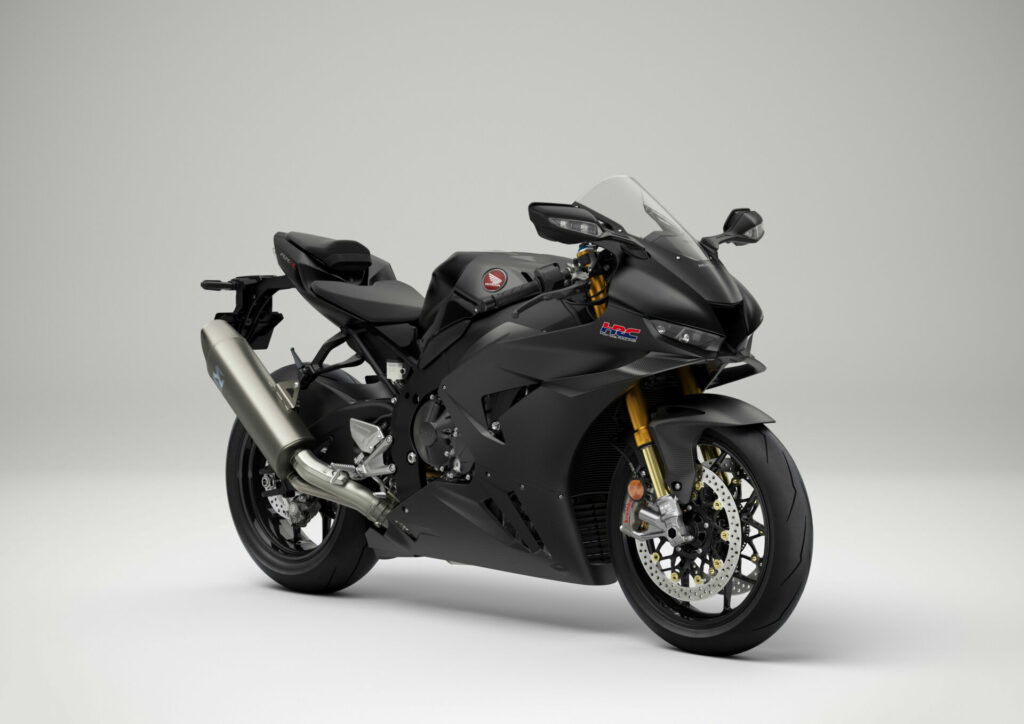
A 2024 Honda CBR1000RR-R Fireblade SP Carbon Edition. Photo courtesy Honda Motor Europe.
The CBR1000RR-R Fireblade SP Carbon Edition
The CBR1000RR-R Fireblade SP Carbon Edition will be available in unique Mat Pearl Morion Black paint. It will feature a stealthy carbon fibre Front Mudguard, Under Cowl, Middle Cowl, Winglets, Front Shelter and Mudguard Cover to maximise its appeal.
Limited to only 300 units and featuring a commemorative plaque on the airbox cover, the Carbon Edition is 1kg lighter, with 10 – 40% weight saving per component.
Key Features
3.1 Engine
Short-stroke, inline four-cylinder semi-cam gear train engine produces 160Kw @ 14,000rpm with peak torque of 113Nm @ 12,000rpm
Compression ratio raised for 24YM plus revised valve timing, with new 3-stage unequal pitch springs
Crankcase optimised for weight reduction, inertial mass reduction for crankshaft and con-rods
All gear ratios – and primary drive – shortened for improved acceleration and corner exit drive
Lightweight Akrapovič muffler features increased volume and noise reduction
The Fireblade’s 1,000cc, inline DOHC four-cylinder semi-cam gear engine was designed with heavy input from the HRC MotoGP development program. For 24YM it delivers peak power of 160Kw @ 14,000rpm with peak torque of 113Nm @ 12,000rpm.
A huge amount of HRC development has gone into the engine to change the way it delivers power and torque, throughout the rev-range, with a goal of increasing drive force to the rear wheel in every gear.
While continuing to share the same ‘over square’ 81mm bore and 48.5mm stroke as the RC213V, valve timing – duration and lift – have been revised for 24YM and compression ratio raised from 13.4:1 to 13.6:1. The inlet valves are 32.5mm diameter (and also lighter for 24YM) with 28.5mm exhaust; they’re operated by finger-follower rocker arms; valve angle on the intake side is 9°, reducing the surface area of the combustion chamber and improving combustion efficiency. Also new are 3-stage elliptical progressive springs for both inlet and exhaust, while the intake ports have been optimised for gas flow.
MotoGP technology is everywhere internally. Friction is reduced by the use of Diamond Like Carbon (DLC) on the cam lobes – just like the RC213V-S. 20YM marked the first time this process was used on a mass-produced motorcycle; it produces a reduction in valve train frictional loss of 35% compared to non DLC-coated lobes.
The valve train itself uses a semi-cam gear train system. To drive such high-rpm/high-cam lift performance the chain is driven from the timing gear located on the crankshaft via the cam idle gear; this makes it shorter in length. For 24YM the crankshaft pin and journal diameters have been optimised, saving 450g of inertial mass.
Forged TI-64A Titanium (a material developed by Honda) con-rods and con-rod caps save 50% in weight compared to the previous Chromium Molybdenum steel versions; they’re even lighter for 24YM (by 20g) and employ HB 149 Chromium Molybdenum Vanadium, (again a Honda development) steel bolts and do not use fastening nuts.
For durability the same configuration as the RC213V-S is applied to the sliding surfaces; the small-end bushings are made of shaved C1720-HT Beryllium copper (because of its high-rpm reliability) while the surfaces of the big-ends are treated with DLC. The pistons are forged aluminium for lightweight strength, durability and increased output.
To guarantee high-rpm wear resistance the piston skirts feature an Ober coating (Teflon and Molybdenum base) and nickel-phosphorous plating for the piston-pin clip-groove.
Managing temperature, the pistons themselves – now constructed from tougher material – use a multi-point piston jet which sprays cooling oil in multiple directions through each cycle. At low rpm (when not needed) check balls within the jets shut off the flow of oil in order to limit oil pressure loss and reduce friction. The oil ring features a new side rail barrel shape.
To reduce bore distortion (and thus friction), the cylinder features a built-in bottom bypass. This system circulates cool water from the radiator into the main water jacket, while the area below uses non-cooled water. The net effect is a lower, and more even, temperature at all points across the bores.
To minimise width, the engine is started by rotation of the clutch main shaft rather than the crankshaft. This design for a more compact crankshaft while double use of the primary driven gear (which itself has fewer teeth) to also transmit rotation from the starter motor saves space; the engine is short in length with short distances between the crankshaft, counter shaft and main shafts. The rear of the engine block also serves as upper shock mount; 250g has been shaved from the crankcase for 24YM.
Improving drive out of corners on track (and road), all of the gear ratios as well as the primary drive are now shorter.
Air is fed into the engine via a ram-air duct located at the high-surface pressure tip of the front fairing; the size of its aperture is equivalent to that of the RC213V MotoGP machine. A ribbed ‘turbulator’ to the right, left and above the duct entrance ensures maximum induction of moving air with minimal impact on handling. The draft angle of the aperture’s interior wall maintains flow under high-speed and acceleration.
To maintain stable performance across a wide speed range, pressurised air takes a straight shot through the headstock, around the steering stem and into the airbox. This smooth path is made possible by Honda’s Smart Key system and steering angle of 25°. To draw the volume of air needed the throttle bodies employ 52mm diameters.
The ‘dirty’ side of the air filter controls the direction of intake air separation and vortex generation, while on the ‘clean’ side, filtered air feeds slash-cut intake funnels. Mirroring the intake side, the four exhaust downpipes use an oval cross section.
Constructed from titanium, the Akrapovič muffler’s small physical size and light weight contribute to mass centralisation and right-side lean angle. It’s now 1L larger in volume; the exhaust valve was designed to deliver both low-rpm torque and high-rpm power – for 24YM the level of sound output has been reduced as the valve switches. 5dB quieter than the previous design, the exhaust note also rises linearly with engine rpm.
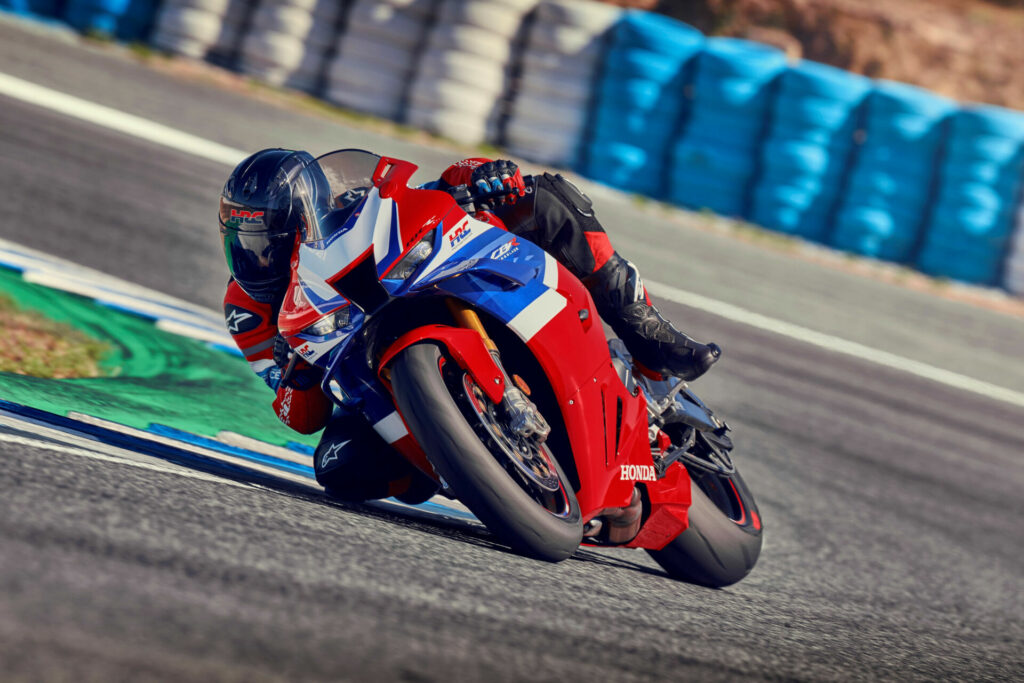
A 2024 Honda CBR1000RR-R Fireblade SP at speed. Photo courtesy Honda Motor Europe.
3.2 Engine Electronics
New 2-Motor Throttle By Wire system delivers smooth control for both acceleration and engine braking
9-level Honda Selectable Torque Control (HSTC) optimised for new power output character and gear ratios
3 default riding modes plus options to customise the revised Power, Engine Brake, HSTC and Wheelie Control parameters
4-level Start Mode standard fitment
The 17YM CBR1000RR was the first in-line four-cylinder engine from Honda to use Throttle By Wire (TBW). Derived and developed from the system used by the RC213V-S, it controls the throttle butterfly valve angle (relative to input from the throttle) to provide a linear delivery and puts precise throttle control – and a natural feel – in the rider’s right hand. It’s a critical area and in 22YM the TBW return spring load was reduced, further enhancing the response and linearity of throttle input.
To take the engine to the next level of control – and a first for a Honda – the TBW is now a 2-Motor system, 1 motor for cylinders 1 and 2, the other for 3 and 4. Through smaller throttle openings cylinders 1 and 2’s throttle valves open first to finely adjust output and generate crank rotation fluctuations. This makes the engine much easier to control and use through the lower rpm ranges. As revs climbs, all throttle valves open together, for a smooth rush of top-end power.
The other benefit of 2-Motor TBW is the amplification of engine braking. With the throttle fully closed during deceleration cylinders 3 and 4 open with the exhaust valve closed to increase the engine’s pumping loss – and therefore engine braking – while cylinders 1 and 2 are closed, ready to open smoothly on the next acceleration.
For the 9-level Honda Selectable Torque Control (HSTC) another 22YM update improved feel. The gap between the intervention timing and slip rate control (which monitors the rate at which slip is changing based on the ratio of front/rear wheel speeds) – was changed to give much smoother, intuitive grip management, with software developed with wide-ranging, top-level feedback from around the world, including HRC’s riders. For 24YM the HSTC has been optimised for the engine’s new power output characteristics and revised gear ratios.
There are three default riding modes with options to change engine output and character. Power (P) operates through levels 1-5 with 1 giving ultimate outright power. Engine Brake (EB) manages performance on a closed throttle through levels 1-3, with 1 being the strongest engine braking delivered by the 2-Motor TBW; Wheelie (W) manages through levels 1-3 (plus off) with 1 giving the weakest intervention. All settings across the board have been revised for 24YM.
Wheelie Control uses information gathered by the IMU on the Fireblade SP’s pitch angle, along with front and rear wheel speed sensors to maintain torque and manage the wheelie without sacrificing forward drive.
The Fireblade SP is also equipped with Start Mode for race starts. It limits engine rpm at 6,000, 7,000, 8,000 and 9,000rpm set points, even with a wide-open throttle, letting the rider focus on clutch release (and lights) alone. The standard-fit 3-level quickshifter delivers razor-fast changes, with short fuel cut time while shifting and smoother torque pickup after shifting.
Nearly every part of the 2024 Honda CBR1000RR-R Fireblade SP has been revised, including the frame. Photo courtesy Honda Motor Europe.
3.3 Chassis
Revised aluminium frame features new rigidity balance for enhanced steering accuracy and grip feel
Third generation Öhlins Smart Electronic Control (S-EC3.0) offers refined choice of settings, with new preload guide screen.
Öhlins 43mm NPX (SV) forks feature new Spool Valve internals, as does the TTX36 (SV) rear shock
New Brembo Stylema R radial-mount four-piston calipers managed by Cornering ABS now with 3 modes – STANDARD/TRACK/RACE
New riding position raises handlebars and lowers footpegs for increased rider freedom and control
Bosch six-axis Inertial Measurement Unit (IMU) gives accurate calculation of dynamic behaviour
Showa’s 3-level Honda Electronic Steering Damper (HESD) controlled by IMU for stability management
The diamond-style main frame is constructed from 2mm aluminium with an extremely accurate tuning of the rigidity balance; in manufacture, after the four main frame components are welded, the engine mounts in six locations improving machine handling.
For 24YM internal ribbing has been removed, the thin wall area expanded and shaping optimised. A total 960g has been shaved from the frame, with a further 140g from shorter engine hanger bolts. But the main aim of the work is to adjust the rigidity balance for a more supple handling feel with razor-sharp steering accuracy; lateral stiffness is reduced 17%, with 15% less torsional stiffness.
Wheelbase is set at 1,455mm with rake and trail of 24°7’ / 101.9mm. Wet weight is 201kg. Weight distribution is balanced at 53%/47% while a high c-of-g improves side-to-side agility.
The swingarm – constructed from 18 individual thicknesses of aluminium and as used by the RC213V-S – is 622.7mm long. Its horizontal and vertical rigidity are tuned to generate grip and feel.
For optimum design integrity (and to save weight) the top mount of the Pro-Link rear shock attaches to the rear of the engine block via a bracket. This also isolates the rear wheel from the headstock, improving high-speed stability and feel for rear wheel traction.
Round, thin-wall aluminium tubing forms the minimal subframe. It also mounts to the frame from the top to narrow the area around the rear of the fuel tank and seat, making for a compact – and aerodynamically efficient – riding position. Seat height is 830mm, and the riding position has been subtly adjusted for 24YM to allow more freedom of control – the handlebars are 19mm higher – and 23mm closer – with footpegs set 16mm lower.
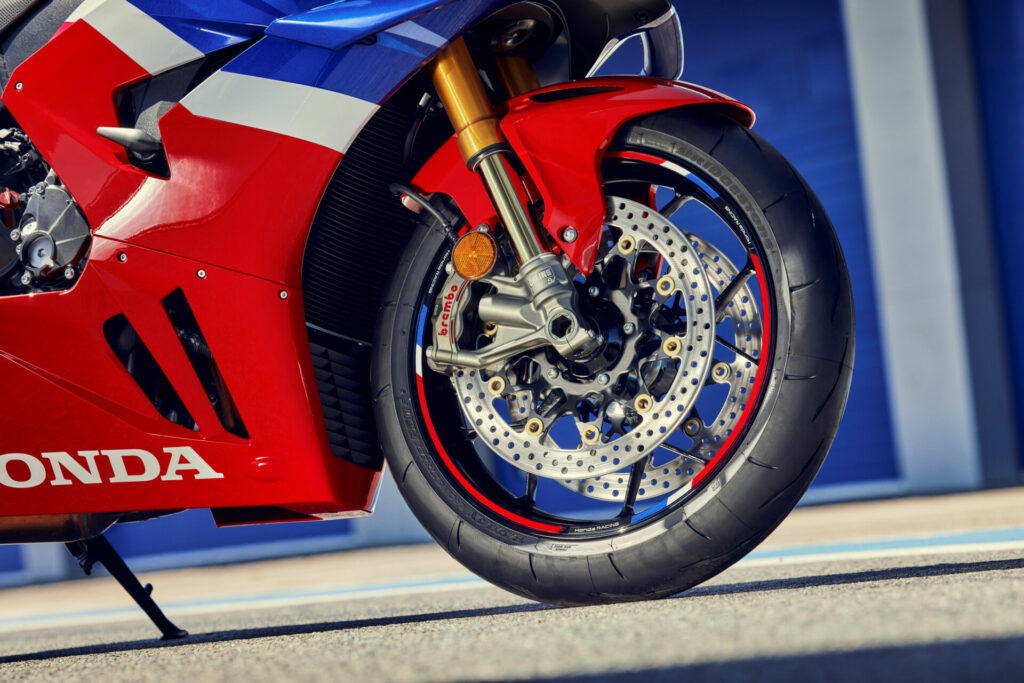
The third generation Öhlins 43mm S-EC3.0 (SV) NPX forks and Brembo Stylema R front brake calipers on the 2024 Honda CBR1000RR-R Fireblade SP. Photo courtesy Honda Motor Europe.
The CBR1000RR-R Fireblade SP is the first production bike in the world to feature the third generation Öhlins 43mm S-EC3.0 (SV) NPX USD forks. Using an internal spool valve structure, they improve ride quality and turning stability through the suspension stroke. Feel for front tyre grip is also enhanced. The forks are clamped by exclusive forged aluminium top and bottom yokes and their length also offers greater freedom for geometry changes. Matching the race-quality front end is an Öhlins TTX36 S-EC3.0 (SV) rear shock.
In conjunction with the hardware, Öhlins Objective Based Tuning interface (OBTi)
offers much finer suspension adjustment front and rear; both can be set independently from the default settings and 3 individual modes can be set and stored, allowing the rider to configure multiple settings for conditions such as weather, tyre wear or fuel load – and to switch instantly while riding. A new feature is a front/rear spring preload guide, accessible via the meter, which recommends the correct setting for the rider’s weight.
New Brembo Stylema R four-piston radial mount brake calipers are operated by Brembo master cylinder and brake lever and offer consistently high braking performance at the high temperatures generated on track. They grip 330mm diameter/5mm thick diameter discs that dissipate heat efficiently. The rear brake caliper is the same Brembo unit used by the RC213V-S.
A Bosch six-axis Inertial Measurement Unit (IMU) delivers accurate calculation of pitch and roll for precise control of the bike’s behaviour. The Fireblade SP is also equipped with Showa’s Honda Electronic Steering Damper (HESD), a lightweight, through-rod design that mounts on the bottom of the steering stem and attaches to the bottom yoke. HESD is controlled by input from the wheel speed sensors and IMU; 3 levels of control are available.
Rear lift control and ABS-managed brake force relative to lean angle boost confidence on turn-in. New for 24YM the system features now features 3 switchable set ups; STANDARD mode focuses on road-riding performance, with high brake force and less pitching, while TRACK mode offers performance in braking from much higher circuit speeds and does not suppress rear lift. RACE mode switches off the rear ABS function completely, with no Cornering ABS input.
The rear 17-inch 5-spoke cast aluminium rim mounts a 200/55-ZR17 sized tyre, minimising the change in chassis geometry when going from street to track rubber. The front 5-spoke cast aluminium rim mounts a 120/70-ZR17 tyre.
3.4 Aerodynamic Package & Equipment
Redesigned middle fairing includes new winglet shaping for high-speed agility; lower fairing features rear aero step to improve rear traction feel
5-inch colour TFT screen and four-way left-hand switch offer intuitive control of riding systems; redline now slides up rpm scale only when engine is at operating temperature
Fuel capacity increased to 16.5L
Smart Key operation adds convenience
An aggressive fairing design is no mere styling exercise: it’s designed to create a class-leading drag coefficient (with a tucked-in rider under track conditions) and restrict lift under acceleration while improving braking stability.
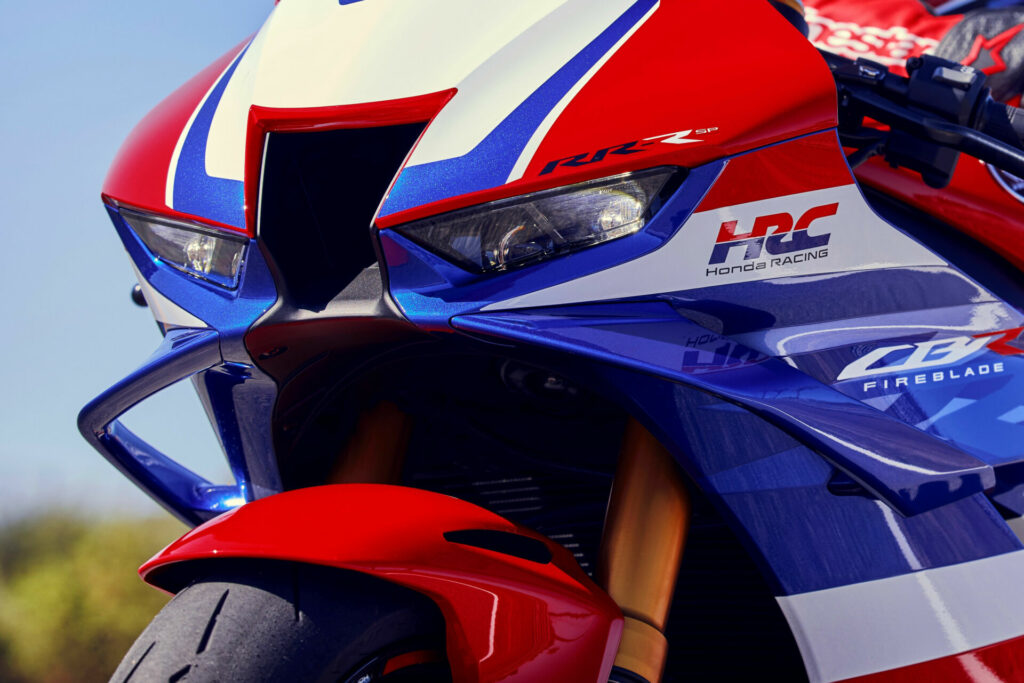
The fairing mid-section houses re-shaped, more forward-set winglets which now generate downforce – to reduce wheelies under acceleration and increase stability on braking and corner entry – with an aerodynamic frontal step. The new design reduces yaw moment through a corner by 10% to make high-speed turning easier.
The aerodynamic winglets on the 2024 Honda CBR1000RR-R Fireblade SP produce more downforce while requiring less effort to make transitions. Photo courtesy Honda Motor Europe.
To make steering easier a convex surface on each side of the front mudguard moves air flow away from the front wheel, smoothly directing it to the fairing sides. Cooling air for radiator and oil cooler is optimised by aerodynamic management of both velocity and pressure of air flowing from the tyre.
A new lower fairing design extends close to the rear tyre and now features an aerodynamic step to reduce airflow around the rear tyre improving handling.
To let air flow around the rider’s feet with minimum resistance the sides of the rear hugger are carefully shaped, while its upper side is cut-out to vent air that channels up from underneath either side of the swingarm, decreasing rear lift.
The fuel tank cover is set low, decreasing the frontal area with the rider prone. It’s been re-shaped to improve the rider’s knee grip and fuel capacity has been increased .4L to 16.5L. At a 35° angle the screen smoothly channels airflow from the upper fairing over the rider and seat cowl, which itself presents the minimum possible drag resistance.
For full and intuitive control of the Fireblade’s systems there’s a high resolution, full colour 5-inch TFT screen. It’s fully customisable to show exactly what the rider wants to see. The compact left-hand switchgear houses a four-way switch; fast and easy to use, the top/bottom buttons set riding mode parameters, while the left/right buttons cycle screen display information.
A new function – to protect the engine – moves the redline down to 8,000rpm on start up; as the coolant temperature reaches its operating zone the redline moves up to just over 14,000rpm.
Honda’s Smart Key System operates the ignition without having to insert a key, and the handlebar lock. This is both convenient in day-to-day use and allows use of a competition-style top yoke, with optimum space for the ram air system. The CBR1000RR-R Fireblade also features Emergency Stop Signal (ESS), that on sudden braking the rear indicators are activated to warn road users behind.
Accessories
A range of Honda Genuine Accessories are available for the 24YM CBR1000RR-R Fireblade SP both individually or as part of the Racing or Comfort accessory Packs.
HRC Race Kit – (not for road use)
HRC has developed a Race Kit for the CBR1000RR-R that ups engine performance, and heightens cornering ability and grip. Available to buy as a complete kit – and for circuit use only – the HRC kit parts include ECU, wiring harness, cylinder head gasket, clutch, quick release rear axle and racing exhaust.
Racing Pack
Adds the detail of speed; Frame Guards and a Tank Pad provide protection, an Alcantara Seat injects style matched by a Red or Black Seat Cowl. An Oil Filler Cap, Sprocket Protector, Wheel Stripes and High Smoked Screen are the finishing touches.
Comfort Pack
Ready to go the distance: A USB Type-C socket makes for easy smartphone charging, plus the flexible carrying capacity of a Tank Bag and Rear Seat Bag.
Technical Specification
ENGINE
Type
Liquid-cooled 4-stroke 16-valve DOHC Inline-4
Engine Displacement (cm³)
1000cc
No. of Valves per Cylinder
4
Bore ´ Stroke (mm)
81mm x 48.5mm
Compression Ratio
13.6:1
Max. Power Output
160kW @ 14,000rpm
Max. Torque
113Nm @ 12,000rpm
Noise Level
Lurban 76.2dB, Lwot 81.1dB
Oil Capacity
4.0L
FUEL SYSTEM
Carburation
PGM-FI
Fuel Tank Capacity
16.5L
C02 Emissions WMTC
155g/km
Fuel Consumption
14.9km/L (6.7L/100km)
ELECTRICAL SYSTEM
Starter
Electric
Battery Capacity
12-2.3Ah HJ12L(Li-ion
DRIVETRAIN
Clutch Type
Wet, multiplate clutch
Transmission Type
Manual 6-speed
Final Drive
Chain
FRAME
Type
Aluminium Twin Tube composite twin spar
CHASSIS
Dimensions (L x W x H)
2,105mm x 750mm x 1,140mm
Wheelbase
1,455mm
Caster Angle
24°7’
Trail
101.9mm
Seat Height
830mm
Ground Clearance
130mm
Kerb Weight
201kg
200kg Carbon Edition
SUSPENSION
Type Front
Öhlins 43mm S-EC3.0 (Spool Valve) NPX USD forks, with preload, compression and rebound adjustments, 125mm stroke.
Type Rear
Öhlins TTX36 S-EC3.0 (Spool Valve) Pro-Link swingarm with preload, compression and rebound damping, 143mm stroke.
WHEELS
Rim Size Front
17 inch x MT3.5
Rim Size Rear
17 inch x MT6.0
Tyres Front
120/70-ZR17 M/C (58W)
Pirelli Diablo Supercorsa SP V3
Bridgestone RS11
Tyres Rear
200/55-ZR17 M/C (78W)
Pirelli Diablo Supercorsa SP V3
Bridgestone RS11
BRAKES
ABS System Type
2 channel
Front
330mm disc with radial-mount 4-piston Brembo Stylema R caliper
Rear
220mm disc with 2-piston Brembo caliper
INSTRUMENTS & ELECTRICS
Instruments
TFT-LCD
Security System
Honda Smart Key
Headlight
LED
Taillight
LED
Auto Winker Cancel
Yes
Emergency Stop Signals
Yes
Quickshifter
Yes
All specifications are provisional and subject to change without notice.
** Please note that the figures provided are results obtained by Honda under standardised testing conditions prescribed by WMTC. Tests are conducted on a rolling road using a standard version of the vehicle with only one rider and no additional optional equipment. Actual fuel consumption may vary depending on how you ride, how you maintain your vehicle, weather, road conditions, tire pressure, installation of accessories, cargo, rider and passenger weight, and other factors.
Monster Energy Yamaha MotoGP to Give Final Push in Triple-Header Season Wrap-Up
Sepang (Malaysia), 8th November 2023
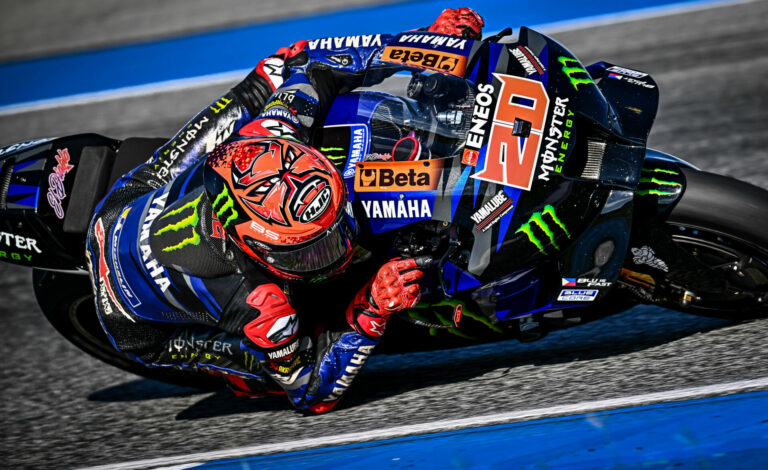
Monster Energy Yamaha MotoGP‘s Fabio Quartararo and Franco Morbidelli are determined to push to the limit at the Sepang International Circuit during this weekend‘s Grand Prix of Malaysia.
After a one-week break, the Monster Energy Yamaha MotoGP Team return to Asia for the Grand Prix of Malaysia held at the Sepang International Circuit this weekend. It is the first of the three back-to-back GPs that make up the final stretch to the end of the 2023 MotoGP season.
With a 145-point tally Fabio Quartararo has moved up to ninth in the championship standings, and he will be on the attack again this weekend. He has raced at the Sepang circuit five times (in the Moto3 class in 2016, in Moto2 in 2017 and 2018, and in MotoGP in 2019 and 2022) and never finished outside the top 7. He came close to a podium finish in 2016 and 2018, when he finished fourth and fifth, and got his first podium finish on Malaysian soil last year when he secured third place despite riding with a hand injury sustained in a crash in FP4.
Franco Morbidelli arrives at the final triple-header eager to see if he can carry forward the speed and pace he found at the Thai GP. The round once again showed the importance of a top-10 finish in the Friday Practice session, which is his aim here this weekend. The Italian has positive memories of the Malaysian GPs in the Moto2 class in 2016 and 2017 when he secured second and third place respectively. His highest MotoGP finish was with Yamaha in 2019, taking sixth place.
The Sepang International Circuit staged its first Grand Prix in 1999 and has been on the MotoGP calendar ever since. The 5.5 km track has a reputation for providing very exciting racing thanks to a mixture of slow and medium to high-speed corners (five left and ten right) and two long straights, the longest measuring 920m. The circuit is also one of the longest tracks of the MotoGP season, and the riders have to negotiate it in extremely hot and humid conditions, making this GP extra challenging.
Those who want to refresh their memory of what close racing action at the Malaysian track looks like can watch our latest MotoGP eSport video.
The Grand Prix of Malaysia is held in the GMT +8 time zone. FP1 will take place on Friday from 10:45 – 11:30 local track time and Practice will be held from 15:00 – 16:00. On Saturday, FP2 will be held from 10:10 – 10:40, and the qualifying sessions from 10:50 – 11:30, followed by the Sprint that starts at 15:00. On Sunday, Warm Up is held from 10:40 – 10:50 and the Race starts at 15:00.
MASSIMO MEREGALLI
Team Director
We are down to the final three race weekends of the season, starting with the Malaysian GP this weekend. We will be multitasking throughout: we can already work towards 2024, and we will still try to go all out in the Sprints and Races, aiming for good results. Sepang is a track that both Fabio and Franky like, so we hope to get on the pace quickly on the Friday and go from there.
FABIO QUARTARARO
Sepang is an especially great circuit to get a better understanding of where we can improve, already keeping next year in mind, which is not that far away anymore. Of course, these three last GPs are very important too, and we will be focusing on getting the best results possible, as always, but we also have to make sure that we prepare for 2024 as much as we can. In general, I‘m quite happy with how things are going. We usually struggle towards the end of the season, but this year we are doing well, so I want to keep it going that way.
FRANCO MORBIDELLI
The one-week break was a good opportunity to catch our breath for the final push of the 2023 season. We saw in Thailand that our speed and pace is up there, but the difficulties lie in our qualifying position, so we aim to work on that again this weekend. The Malaysian GP always comes with its own unique challenges: it can be sunny and very hot, which is physically demanding, or we can get one of the typical rainstorms and very wet conditions, which is mentally demanding, so we need to be ready for anything. We will do our best!
Taiyo Furusato (72). Photo courtesy Honda Team Asia.
Taiyo Furusato was fastest during Moto3 World Championship Free Practice Two (FP2) Friday afternoon at Sepang International Circuit, in Malaysia. The Honda Team Asia pilot lapped the 3.4-mile (5.5 km) track in 2:12.518 to lead the field of 28 competitors.
Jorge Martin topped MotoGP World Championship Free Practice One (FP1) Friday morning at Sepang International Circuit, in Malaysia. Piloting his Prima Pramac Racing Ducati, the Spaniard ripped up the 3.4-mile (5.5 km) road course in 1:59.513, which not only led the field of 23 riders it was quicker than Martin’s own Race Lap Record of 1:59.634 from 2022.
Alex Marquez was second-best with a 1:59.562 on his Gresini Racing Ducati, and Martin’s teammate Johann Zarco made it a Ducati sweep of the top three spots with a 1:59.914.
The quickest non-Ducati rider was Franco Morbidelli, who turned a fourth-fastest 2:00.055 on his Monster Energy Yamaha YZR-M1.
Fermin Aldeguer topped Moto2 World Championship Free Practice One (FP1) Friday morning at Sepang International Circuit, in Malaysia. Riding his Beta Tools SpeedUp Boscoscuro machine, the Spaniard covered the 3.4-mile (5.5 km) course in 2:06.163 to lead the field of 32 riders.
American Joe Roberts was sixth in the session with a 2:06.760 on his Italtrans Racing Kalex.
American Sean Dylan Kelly (SDK) was back in action on the Forward Team racebike and turned a 2:08.994, which ranked him 24th in the session and five spots better than his teammate Alex Escrig (2:09.335).
Jaume Masia was quickest during Moto3 World Championship Free Practice One (FP1) Friday morning at Sepang International Circuit, in Malaysia. Riding his Leopard Racing Honda, the Spaniard lapped the 3.4-mile (5.5 km) track in 2:12.065, which was quicker than Ayumu Sasaki’s Race Lap Record of 2:12.671 from 2022.
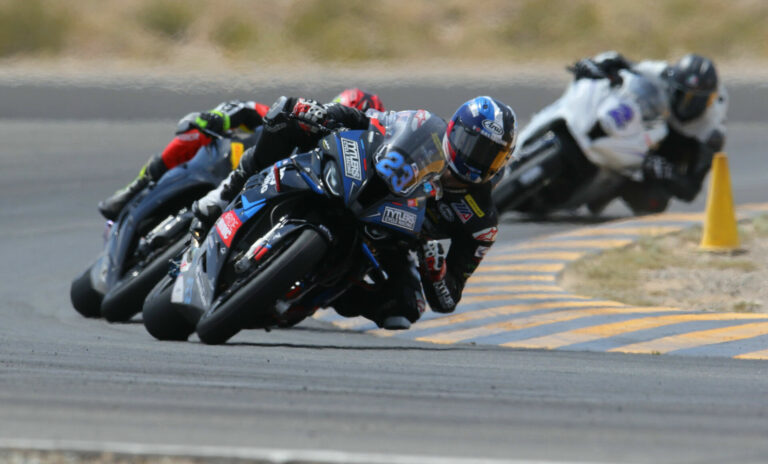
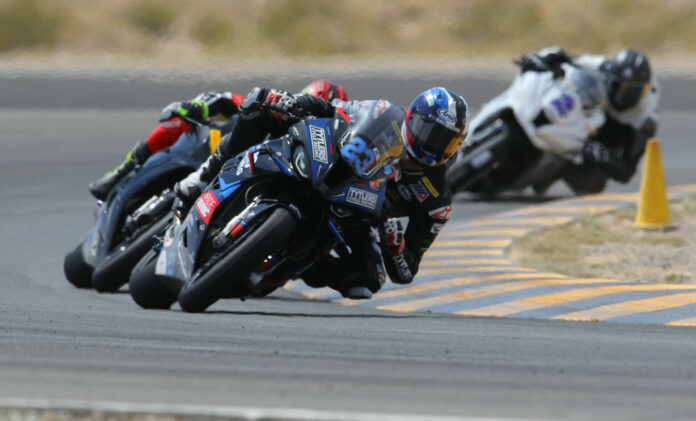
RideHVMC's Corey Alexander (23) leads David Anthony (25) and Anthony Norton (2) in the Stock 1000 Shootout. Photo by Caliphotography.com, courtesy CVMA.
CVMA Racing New Sponsors
Round Two of the CVMA 2023/2024 Winter Series is approaching as fast as some of our racers! Registration is open for the event which occurs over the weekend of November 18th and 19th so get signed up for some of the most competitive club racing in the country.
CVMA is happy to welcome several new sponsors for this upcoming event!
Del’s Flooring in Palm Desert (www.delsflooring.com) will be sponsoring the Formula Ultra Lightweight class for this round and the remainder of the series. Del’s Flooring is a second- & third-generation, family-owned business priding itself on quality working relationships and a high standard of flooring experience. Del’s will be providing a $600.00 purse for each remaining round. Payouts for both races (Saturday and Sunday) will be as follows:
1st – $150
2nd – $100
3rd – $50
Road Race City – Bridgestone Tires (www.roadracecity.com) will be sponsoring the Formula Twins class for the remainder of the season offering a $600 purse for each of the remaining rounds. Road Race City is a full-service motorcycle service center based out of Temple City, CA, and provides trackside tire sales and support for Bridgestone tires. Payouts for both races (Saturday and Sunday) will be as follows:
1St – $150
2nd – $100
3rd – $50
RideHVMC (www.ridehvmc.com) a premier track experience provider will be sponsoring the Amateur SuperSport Middleweight class. They are rewarding the winner of the class (most points for the weekend) a 1-on-1 training day at Chuckwalla Valley Raceway with 2022 MotoAmerica Stock 1000 Champion Corey Alexander. RideHVMC offers many services at Chuckwalla Valley Raceway including seasonal garage membership and equipment storage, rider training, bike rentals, trackside service, and group track events.
With Veterans Day closely preceding this next round of the series, the veteran-owned-and-operated Ryder Gear (www.ryder-gear.com) will be offering special Veterans Day pricing on gloves the entire race weekend.
The weather forecast is looking pretty awesome for our next round and we are super pumped to welcome racers from all over the country to the California sunshine and some of the most competitive racing you will find anywhere. Come on out and race with us!
CVMA offers two full days of racing every race weekend and also includes Saturday qualifying for grid position in all classes, amateur, and expert, as well as a wide variety of classes to choose from.
CVMA offers free reciprocity to encourage racers from other clubs to come out and compete. CVMA also offers a New Racers School for those starting out in racing on the Friday prior to each race weekend. Log on to www.cvmaracing.com to sign up or for more information.
Come on out and race with us on November 18th and 19th for our next round for some of the most competitive racing in the country!
CVMA. Built for racers by racers and offering the best racing experience around!
CVMA would also like to thank the 2023/2024 Winter Series Sponsors: SoCal Track Days, Apex Assassins, Ryder Gear, Racers Edge/Dunlop, The California Superbike School, CaliPhotography, Del’s Flooring, Ride HMVC, Road Race City/Bridgestone
NRS Sponsors: Alpinestars, 6D Helmets, Racer Gloves, and Racer’s Edge
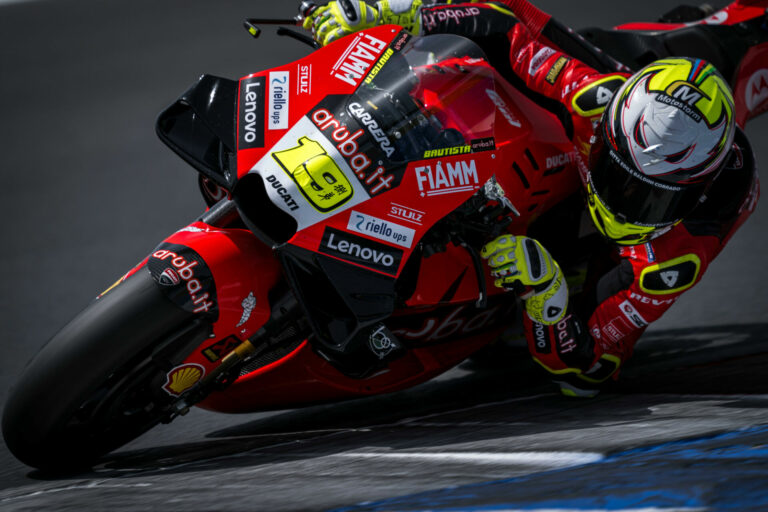
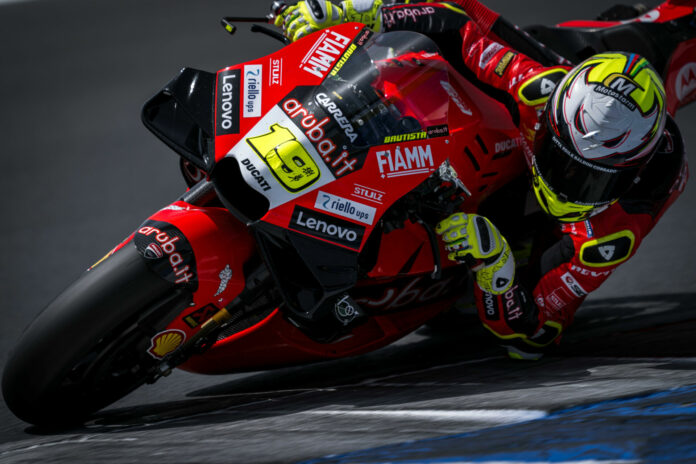
Alvaro Bautista (19) testing a Ducati Desmosedici MotoGP racebike at Misano. Photo courtesy Ducati.
Bautista and the Ducati Desmosedici GP of the Aruba.it Racing team in Malaysia for the fascinating MotoGP wild card
There could not have been a more fascinating way to end the extraordinary 2023 season. After having been crowned Superbike World Champion for the second year in a row and having contributed to the “triple crown” conquered by the Aruba.it Racing – Ducati team in WorldSBK, Alvaro Bautista landed to Malaysia where the Grand Prix of Malaysia will kick off tomorrow at the Sepang circuit.
The Spaniard will climb aboard the Ducati Desmosedici GP of the Aruba.it Racing team for the third wild card of the season in MotoGP, following the ones held by Michele Pirro in Italy, first at the Mugello Circuit and then at the Misano World Circuit Marco Simoncelli.
Bautista therefore returns to MotoGP competition after last racing at Valencia in 2018.
Free practice for the Grand Prix of Malaysia will get underway tomorrow at 3.45 am CEST. Saturday’s schedule will see first qualifying (from 3.50 am CEST) then the Sprint Race (8.00 am CEST). On Sunday, finally, the Grand Prix of Malaysia (20 laps) will start at 8.00 am CEST.
Alvaro Bautista (Aruba.it Racing #19)
“I am happy to be back racing in Malaysia also because Sepang is definitely one of my favorite circuits. Having the opportunity to ride the Desmosedici GP again after a few years means a lot to me: it is a great emotion. I’m sure it will be a good weekend, also because we arrive in Malaysia with no expectations but only with the desire to do a good job with the team from Friday. The aim is to find a good feeling with the bike as soon as possible, as in the light of the new format, the time available is not much. It won’t be easy, but I’ll try my best and have fun. This is a bonus that Ducati and Aruba.it have given me for the results obtained in WorldSBK and I’d like to make the most of it”.
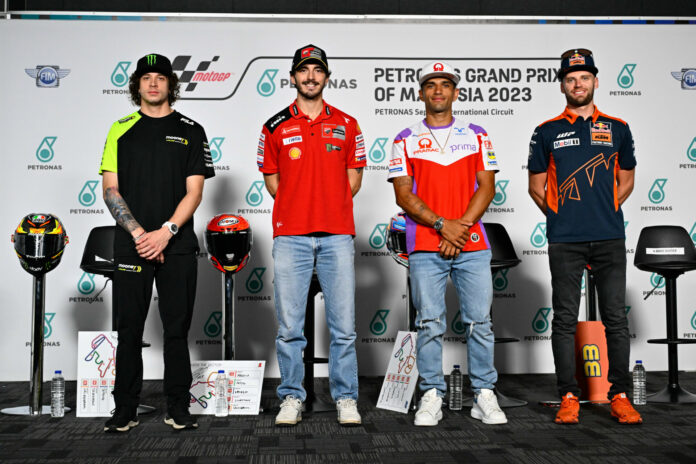
(From left) Marco Bezzecchi, Francesco Bagnaia, Jorge Martin, and Brad Binder. Photo courtesy Dorna.
“It’s a pleasure to have this pressure”: a pivotal weekend begins at Sepang
Hear from Bagnaia, Martin, Bezzecchi and Binder as the final triple header begins
Thursday, 09 November 2023
Three weekends, 111 points and it all starts here at Sepang for the PETRONAS Grand Prix of Malaysia. Before the bikes get out on track, it was time to hear from Championship leader Francesco Bagnaia (Ducati Lenovo Team), closest challenger Jorge Martin (Prima Pramac Racing), final rider in contention Marco Bezzecchi (Mooney VR46 Racing Team) and Brad Binder (Red Bull KTM Factory Racing) on the tails of a stunning Thai GP.
Here are some quotes and talking points from Thursday!
FRANCESCO BAGNAIA: “This is one of my favourite tracks. I always love being here. I have good memories from all the categories and I’m always very happy to be here. So we have to see and we have to have a bit of luck with the weather forecast. But I think we can be competitive in any situation. Some parts of the track have been resurfaced, so I think it will be great.”
Francesco Bagnaia (left) and Jorge Martin (right). Photo courtesy Dorna.
Can you solve quali woes this weekend?
“I think so, for sure at this track it will be different because I think the race tyre will be the medium, that will be the ‘soft’ here, so maybe yes, last time we were here was the test in February and everything went perfectly. So let’s see. It will be interesting for sure because the level at this track is always really high across the board, not just us, so it would be nice to have a great battle, but I hope to start more at the front to not have some kind of battle like this.” (referencing Marc vs Aleix being shown on screen)
Do you feel pressure?
“I think it’s a pleasure to have this kind of pressure. We are fighting for the title and without pressure it means you don’t care too much about what you’re doing. So I think the pressure is normal. It’s a great fuel from my point of view, so we have to use this to improve on our side and to feel the hunger of being champion again.”
Will last year’s experience benefit this year?
“I don’t know, honestly. I remember last year there was a lot of pressure here and I won the race. Every person and every rider has a different feeling with the pressure. In my case it can affect me, but it’s always a motivation. I don’t know about Jorge, but for sure the experience of last year maybe can help me in some situations, but it’s totally different compared to the last year.”
JORGE MARTIN: “After the last race I was super happy. I think I did an amazing weekend and as you said a fourth double win of the year was great. I decided to stay here because normally I struggle with the jet lag so I thought it would be a good option to stay here and get used to the conditions and train in the heat. I’m happy, I think this week off I had too much time to think about everything, I prefer to race straight away because I had the feeling. Back in Malaysia and looking forward to race!”
Jorge Martin. Photo courtesy Dorna.
What about that gesture on the podium in Thailand?
“It wasn’t on purpose, I don’t know why I did it. It was quite similar but more for the grandstand. Anyways, it’s not bad, some spicy moments, I didn’t want to make a funny thing or something like this, it just came naturally. You just have this impulse that sometimes happen, but I was so happy for the moment and I went to the podium and no one was shouting, so I was like ‘come on guys!’ After two bad results, and really unlucky situations we finally did a great job so I was super happy and proud.”
Is this a revenge mission after Malaysia 2022?
“Yeah I’m missing that victory, I felt I could make it. Maybe two or three more laps and I was able to make the gap but I couldn’t because I crashed. I think with the new asphalt we can improve because it seems the bumps are less so the turns could be faster and for the race, let’s see, maybe it’s not the best strategy to pull away.”
Are you feeling the pressure, how different was Buriram feeling?
“I feel it out of the races, for example when I was in Bali because you have time to think about winning or losing a big thing, but when I’m at the race track I’m just focused on racing. Today I was relaxed and feel confident that it can go well.”
And what about those rumours of the factory seat?
“I can’t say a lot. I would be proud to continue with Pramac next season but if Ducati want to join on the red bike next year, I would be super happy also.”
MARCO BEZZECCHI: “It was an intense triple header for me. Unfortunately, my physical condition wasn’t very good. It was important to go back home. I didn’t really rest, but I tried to recover as much as I could with the shoulder and continue to train to be able to arrive to the final part of the season. As ready as possible. Yeah, I can’t complain. I feel a bit better still. For sure it will be painful, but overall I have to say that my condition is surprising me a little bit.”
Marco Bezzecchi. Photo courtesy Dorna.
Did you go have time to go the ranch?
“I don’t want to see the ranch for many months! I didn’t ride the bike, I thought it was better to rest my body from motorbikes, especially because MotoGP is very stressful and I have to arrive in a good shape. I’m still not 100% for sure because as soon as I put some stress on the shoulder then all my neck in all my shoulder and my back starts to create a lot of problems for me, but at least I’ve recovered a little bit and I will try to be strong.”
Do you feel that you’re going to be more in the game to fight for victory this weekend?
“Yeah, in Thailand I was really fast but unfortunately in the race I made a few mistakes and then I lost too much time to be able to recover. But I was consistent and I was very quick and I think that here I can try to make the same and try to be fast and more consistent. Of course the weather conditions will be a key for the weekend because it might be a little bit crazy. But I will try my best to be strong.”
And the Championship?
“Yeah, well, it’s still possible. Of course. It’s really tough because you know, they are very quick and I’m still not fully fit. So it will be tough, but if I get a good result, I will go on the podium like this. Yeah, I will try… they are very strong, but I will give my best.”
BRAD BINDER: “The plan is to pick up where we left off last time, stay among the top bunch and try and fight it out till the last lap again but hopefully get it right! That would be nice! Yeah, I have some good memories here for sure, it’s a track I really enjoy. It’s going to be interesting for me because Testing we had a lot of issues and the guys have done a great job throughout the season on the bike. Things are completely different now, it’s going to be interesting to see how big the step is that we’ve made.”
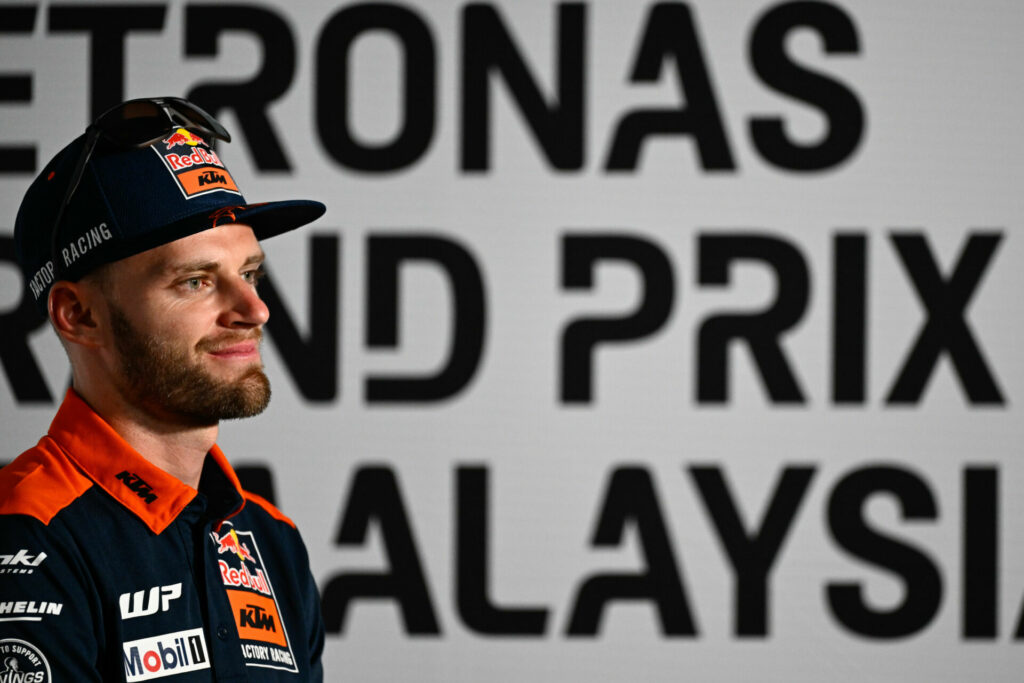
Brad Binder. Photo courtesy Dorna.
Improvements since the Test?
“The biggest thing is when we were here in February is we were trying to decide which direction we needed to go in. I don’t think I did more than two exits with the same bike and played with all sorts of parameters. Oh yeah now if we look at where we were and where we are now things are completely different, where the biggest thing that I’m looking forward to is just riding this track comfortably. That should be fun.”
3 chances to win a race, where does Sepang sit in terms of those chances?
“If I look back at my last two races, I felt like Australia I messed up and last time I really wanted to give it a go and put myself on the green. I haven’t really been able to put it together. I feel like we’ve been fast over the last five or six tracks, and I’d love nothing more than to finally get a win for my team. Yeah, we’ve won two Sprints, but a main race is the goal.”
Now you’re the South African with most podiums, do you hope that can inspire more riders?
“It’s a really cool stat. It’s quite different. Nowadays we have 21 races and back then they had less than half so it’s not quite fair! It’s super cool anyways and awesome to know. For me it’s great to see how MotoGP is growing back in South Africa. Every time I go home it seems more and more people are enjoying the racing as much as I do. Who knows? The better things go here, the better they can go back home too!”
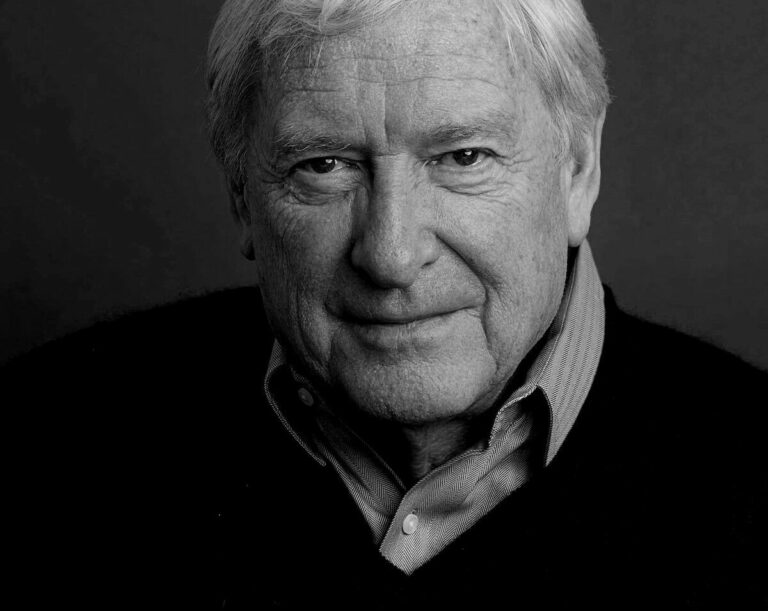
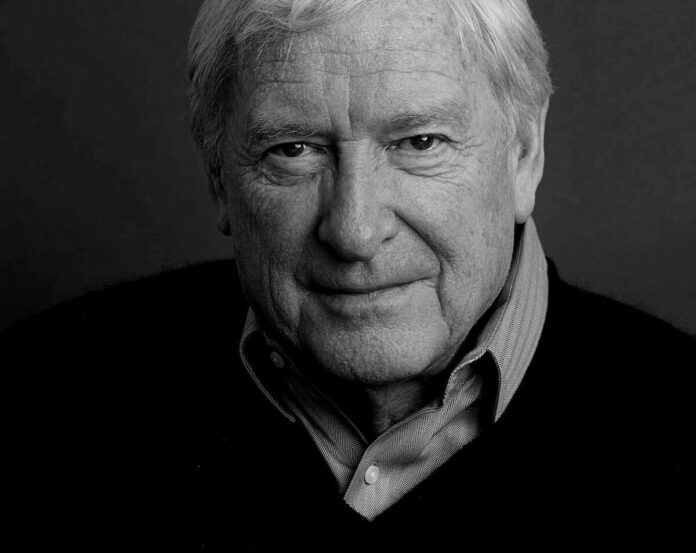
Art Eckman, R.I.P. Photo courtesy Feld Motor Sports.
Rest In Peace, Art Eckman (1942-2023)
Broadcast Icon and Indelible Voice of the Sport Passes
The SuperMotocross community and the motocross industry as a whole is deeply saddened by the passing of broadcast icon Art Eckman. Best known in the racing world as the voice of the formative years of the Monster Energy AMA Supercross Championship and Pro Motocross Championship, sanctioned by AMA Pro Racing, Eckman’s instantly recognizable candor alongside AMA Hall of Famer David Bailey defined the fandom and passion of multiple generations who tuned into ESPN, ESPN 2, and ABC to watch the races.
His contributions for both Supercross and Pro Motocross broadcasts, in addition to hosting the popular MotoWorld weekly television news magazine, allowed Eckman to become synonymous with two-wheeled motorsports. His indelible voice is an integral part of the soundtrack for the legendary careers of Jeremy McGrath, Ricky Carmichael, Jeff Stanton, Damon Bradshaw, and so many more, while his mentorship helped carve a path to broadcasting for former star racers like Jeff Emig, Grant Langston, and James Stewart.
This past April, Eckman attended the Atlanta Supercross, which gave long-time fans and colleagues a chance to catch up with one of the most influential and beloved figures of the sport.
The SMX Insiders remember Art Eckman and celebrate his contributions to the sport.
The following obituary celebrating Art’s incredible life and storied career was provided by the Eckman Family, anchored by his wife of 46 years, Donna Haines Eckman, his daughters, Christine Eckman and Kara Eckman Mecke, his son-in-law, Ralph Mecke, and grandchildren, Alastair and Cedric Mecke.
ARTHUR GEORGE ECKMAN (1942 – 2023)
Sports Broadcaster/Commentator, humanitarian, husband, father, grandfather and friend ARTHUR G. ECKMAN (Art) died on November 4, 2023, at the age of 81. Born in Salem, Oregon, in April 1942, Art was the son of Harriett Wiseman Eckman and Bruce Page Eckman.
Known for his rich, deep, and often said to be ‘God-like’ voice, Art’s professional career spanned more than 55 years in the sports world for which he provided broadcasting and reporting services for over 20 different kinds of sports. If there was a ball involved, whether a football, basketball, baseball, bowling ball, or golf ball or if there was an engine involved, from a motorcycle to a motor boat, Art had the knowledge, wherewithal, skills and history to write or talk about it. Bottom line, Art loved sports and was a sports enthusiast and historian.
Art was a 1965 graduate of Washington State University’s Edward R. Murrow College of Communication and began his career working in the newsroom at KOIN-TV in Portland, Oregon. From news he segued into sports, becoming the Sports Director at KATU-TV and KEX radio where he called play-by-play for Oregon State football, basketball and triple-A baseball, twice earning the Oregon Sportscaster of the Year award.
From Portland, Art began broadcasting for the San Diego Rockets, which after one year, moved to Houston and became known as the Houston Rockets. Art served as Director of Broadcasting for the Houston Rockets for five years doing play-by-play radio and TV, including broadcasting two NBA All-Star games on network radio.
After Houston, Art worked at KSFO-Radio as Sports Director/Anchor and as a play-by-play Announcer for the San Francisco Giants and Stanford University. From 1976 to 1978, Art was the Sports Director/Anchor for KRON-TV, broadcasting for the Oakland Raiders pre-season football play-by-play and was Co-host of the Kenny Stabler Show. It was here that he was honored with the Kennedy Foundation National Award for producing a series featuring athletes with developmental disabilities.
In 1978, Art moved his family from San Francisco to Atlanta to become the Sports Director/Anchor for WXIA-TV until 1991. While at WXIA-TV, Art provided daily coverage of Falcons, Hawks, Flames and Braves games as well as for area colleges, universities and amateur sports. He also provided special coverage of Super Bowls, Collegiate Bowls, Indianapolis 500 and Daytona 500, Heavyweight Championship fights, Final Fours, The Masters, plus major golf, tennis, gymnastics and track and field events.
At this point in Art’s distinguished career, his professional path took him on a host of adventures where he was honored with many awards and acclamations including receiving the Man of the Year award from the Edward R. Murrow School of Broadcasting at Washington State University in 2015.
Among his many broadcasting duties, Art did play-by-play radio and television for the Atlanta Dream/WNBA; was host announcer, producer and writer for auto and boat racing; was Sportscaster/writer for ESPN and ESPN2 for such events as the Chick-fil-A Bowl Preview Show (hosting with Lee Corso and Bill Curry), was play-by-play announcer for webcast/radio and television for Supercross/Motocross, did the MotoWorld weekly magazine show serving as anchor, editor, writer and producer and was pit announcer for AMA Road Racing and CART Indy Cars. Additionally with ESPN and ESPN 2, Art called play-by-play for Formula One Tunnel-Boat Series, was reporter and host of the Suzuki Great Outdoors program, broadcasted for Unlimited Hydros and Off-Shore Boat Race Services including providing play-by-play for Wide World of Sports. He provided commentary for Full Contact Karate, the Great Britain Rugby League, Water Skiing, Pro Beach Volleyball, Pro Snow Skiing and the US Squash Open. He was the play-by-play announcer for replays of ACC football and basketball games.
Art was radio and television announcer for the Atlanta Hawks, the ACC Basketball-Jefferson Pilot, the ACC Football-Raycom series, the ACC Volleyball and Women’s basketball packages, the Atlanta Thunder World Team Tennis, Grand Prix Cycling WATL, Georgia and Florida All-Star High School Football, Metro Conference Basketball packages; and was host of the Bill Curry, Bobby Ross and Bobby Cremins TV shows.
One of Art’s favorite college teams was Georgia Tech where Art served as host of the WSB Radio Tailgate Show, was a sideline reporter for WGST, and did play-by-play for WGST Tech basketball. He also hosted American Sports Radio Network’s Final Four show with Al McGuire; was a reporter for Sports By-Line USA, nationwide syndicated talk show. He reported from Wimbledon, the French Open and the Monaco Grand Prix. He provided Atlanta Attack Indoor Soccer play-by-play and WGZC radio morning drive-time sports reports.
In addition to a full-time sports career, Art was familiar with the corporate world, lending his voice and expertise to numerous commercials, special promotions and videos. He was fond of writing and authored numerous feature articles to various publishers and companies.
In the latter part of his sports career, Art took special interest in working with Kennesaw State University in helping to further develop and expand its athletic department. At Kennesaw, Art served as Assistant Athletic Director and Media Relations liaison and consultant. He enjoyed instructing staff and students/athletes on dealing with the media, including crisis control, and he supervised the Sports Information Department among other tasks.
Another one of Art’s great loves was working with young athletes and corporate executives on how to better understand their roles with the media. Consequently, he developed a series of seminars to help many people build positive images and communicate with the media.
In addition to his love of sports, Art was known for his humanitarian efforts. For over 35 years, he served on the Board of Directors for InCommunity (formerly known as enAble of Georgia) – a system of 20 group homes for mentally handicapped and autistic adults. He was former chairman of the federally mandated Advisory Board for Special Education for the state of Georgia. And for nine years, Art served on the Board of Directors for Georgia Special Olympics. He was a founding member of the Georgia Autism Society, and, for 13 years, was Director of a high school student/athlete awards program in which he visited as many as 50 schools, charities and service groups each year. Art served as President and was one of 23 men honored with a lifetime membership in the Touchdown Club of Atlanta and served as a member of the Naismith basketball awards committee. In 2010, Art was inducted in the Portland Public Schools Sports Hall of Fame.
Art is survived by his wife, Donna Haines Eckman, as well as two daughters, Christine Eckman and Kara Eckman Mecke along with Kara’s husband Ralph Mecke and their two children, Alastair and Cedric Mecke.
Plans for a Celebration of Life service will be at 3 p.m. on Friday, November 10, 2023, at Peachtree Road United Methodist Church, 3180 Peachtree Road, NE, Atlanta, GA 30305. In memory of Art’s life and in lieu of flowers, the family suggests that a donation be made to InCommunity. InComunity, is a non-profit organization that provides support to individuals with developmental disabilities. Over the years, this organization has been a significant part of the Eckman family as its staff has helped Christine Eckman thrive in her community.
A 2024 Honda CBR1000RR-R Fireblade SP. Photo courtesy Honda Motor Europe.
Editorial Note: As of post time, American Honda does not know if the updated 2024 CBR1000RR-R Fireblade SP will be imported to the United States.
24YM HONDA CBR1000RR-R FIREBLADE SP
Model updates: The CBR1000RR-R Fireblade SP takes a huge step forward in development, with its 1,000cc inline four-cylinder semi-cam gear engine in a new state of tune to deliver even stronger mid-range acceleration as well as huge top-end power.The cylinder head, compression ratio, valve timing and springs have all been revised; the crankshaft and con-rods are lighter and there are new, shorter ratios all the way through gearbox. 2-Motor Throttle By Wire adds precise control and feel at lower rpm, with more engine braking if required. The aluminium diamond-style frame has a new, more pliant character to improve steering accuracy and traction. Specification also includes an RC213V-S-style swingarm, six-axis Inertial Measurement Unit (IMU) and 3-level Honda Electronic Steering Damper (HESD); full, race-quality suspension is provided by new Öhlins Smart Electronic Control (S-EC03) with Spool Valves and OBTi user interface. A new preload guide is also available on the instrument panel. Braking is by Brembo, with new Stylema R four-piston calipers up front. New winglets maintain downforce but with 10% less yaw moment in cornering. The riding position too has been adjusted to allow more control for the rider. A full-colour TFT screen offers intuitive control of riding modes and adjustment of Power, Engine Brake, HSTC, Wheelie Control and Start Mode; all settings have been revised to match the new power delivery and gearing. Cornering ABS now features an extra RACE setting. Honda’s Emergency Stop Signal and a Smart Key remains the finishing touch. A limited edition CBR1000RR-R Fireblade SP Carbon Edition is also available.
The left side of a 2024 Honda CBR1000RR-R Fireblade SP. Photo courtesy Honda Motor Europe.
Contents:
1 Introduction
2 Model overview
3 Key features
4 Accessories
5 Technical specifications
Introduction
Since its original 1992 introduction Honda’s iconic Fireblade has evolved into an incredible 1,000cc super sports motorcycle. And it’s also been the base of a competitive race machine, on short circuits around the world and the roads of the Isle of Man TT.
But time – and competition – always races on and in 20YM Honda drew the line under where the CBR1000RR Fireblade had been and looked forward to where it was going. And, as a result, two brand-new motorcycles – the CBR1000RR-R Fireblade* and CBR1000RR-R Fireblade SP – were created with heavy involvement from Honda Racing Corporation to carry the legend forward.
Leaning heavily on the engine and chassis technology of the RC213V-S ‘street-legal MotoGP machine’, with aerodynamics drawn from the RC213V MotoGP bike, the new Fireblade was designed from the ground up – in terms of engine, handling and aerodynamics – for pure, outright track performance.
22YM marked 30 years of the Fireblade which saw the introduction of a variety of detail upgrades to the engine to boost acceleration; the intake ports, airbox, airbox funnels and exhaust mid-section were all revised to deliver extra mid-range thrust. The final drive sprocket also went up 3 teeth, to 43, with quickshifter performance upgraded. Honda Selectable Torque Control (HSTC) was also optimised for refined rear tyre traction management, and throttle feel improved.
24YM sees the Fireblade SP drive further up its development curve once again. A host of engine and gearbox updates deliver a healthy mid-range performance boost, with improved throttle response, alongside detailed riding position changes and upgrades from Brembo and Öhlins, with the aim of producing the bike you need to win out-of-the-box and, at the same time, elevating the riding experience out on the open road.
A 2024 Honda CBR1000RR-R Fireblade SP at speed. Photo courtesy Honda Motor Europe.
Model Overview
The Fireblade SP’s inline four-cylinder semi-cam gear engine delivers 113Nm torque and makes peak power of 160Kw. And while the headline figures are familiar, the delivery through the rev-range has been completely changed – the product of a huge amount of HRC development and knowhow– to generate corner exit acceleration topped by huge top-end power.
The addition of 2-Motor Throttle By Wire (TBW) increases part-throttle control and allows amplified engine braking. Compression ratio has been raised, intake ports adjusted, and valve timing altered in conjunction with new valve springs, a lighter crankshaft and optimised, lighter titanium conrods. All gear ratios have been made shorter, to increase drive force to the rear wheel.
The 4-2-1 exhaust downpipes are ovalized and feed a titanium Akrapovič muffler now slightly larger in volume but 5dB quieter in operation.
Three default riding modes cover most conditions with options to fully adjust Power, Engine Brake, Wheelie Control and HSTC and all settings have been revised for the new output character. The electronics package also includes adjustable Start Mode and standard-fit quickshifter.
As before, the aluminium diamond frame uses the rear of the engine as upper shock mount while the swingarm is based on the RC213V-S design. The rigidity balance has been carefully optimised – and made more pliant – to exploit the engine’s performance in terms of feel for front and rear grip levels, and steering accuracy.
A six-axis Inertial Measurement Unit (IMU) provides accurate 3D estimation of riding dynamics and provides input to manage all of the electronic systems. It also controls the rod-type 3-level Honda Electronic Steering Damper (HESD).
The 24YM CBR1000RR-R Fireblade SP is the first bike in the world to use the new, third generation Öhlins Smart Electronic Control (SE-C3.0) 43mm NPX (SV) forks and TTX36 (SV) rear shock, that now use Spool Valve internals and offer race-quality suspension, with settings managed by Öhlins Object Based Tuning interface (OBTi). A digital spring preload guide via the instrument panel is also a new feature.
A spring preload adjustment guide can be viewed on the five-inch TFT screen on the 2024 Honda CBR1000RR-R Fireblade SP. Photo courtesy Honda Motor Europe.
The front discs are worked by new Brembo Stylema R four-piston calipers and Brembo brake lever/master cylinder, while the Cornering ABS now features RACE mode, which allows the rear ABS to be turned off.
A redesigned fairing mid-section houses new winglets that generate downforce to improve braking stability and consistent front-end grip but with 10% less effort through high-speed corners. The riding position has also been adjusted to elevate control, with handlebars higher and footpegs lower.
The fully customisable 5-inch TFT display offers intuitive control via a four-way switch on the left handlebar. Now, on cold start, the redline moves up the rpm scale as operating temperature is reached.
Honda’s Smart Key system adds convenience and the Emergency Stop Signal (ESS) increases visibility to road users behind.
The 24YM CBR1000RR-R Fireblade SP will be available in Grand Prix Red (Tricolour).
A 2024 Honda CBR1000RR-R Fireblade SP Carbon Edition. Photo courtesy Honda Motor Europe.
The CBR1000RR-R Fireblade SP Carbon Edition
The CBR1000RR-R Fireblade SP Carbon Edition will be available in unique Mat Pearl Morion Black paint. It will feature a stealthy carbon fibre Front Mudguard, Under Cowl, Middle Cowl, Winglets, Front Shelter and Mudguard Cover to maximise its appeal.
Limited to only 300 units and featuring a commemorative plaque on the airbox cover, the Carbon Edition is 1kg lighter, with 10 – 40% weight saving per component.
Key Features
3.1 Engine
Short-stroke, inline four-cylinder semi-cam gear train engine produces 160Kw @ 14,000rpm with peak torque of 113Nm @ 12,000rpm
Compression ratio raised for 24YM plus revised valve timing, with new 3-stage unequal pitch springs
Crankcase optimised for weight reduction, inertial mass reduction for crankshaft and con-rods
All gear ratios – and primary drive – shortened for improved acceleration and corner exit drive
Lightweight Akrapovič muffler features increased volume and noise reduction
The Fireblade’s 1,000cc, inline DOHC four-cylinder semi-cam gear engine was designed with heavy input from the HRC MotoGP development program. For 24YM it delivers peak power of 160Kw @ 14,000rpm with peak torque of 113Nm @ 12,000rpm.
A huge amount of HRC development has gone into the engine to change the way it delivers power and torque, throughout the rev-range, with a goal of increasing drive force to the rear wheel in every gear.
While continuing to share the same ‘over square’ 81mm bore and 48.5mm stroke as the RC213V, valve timing – duration and lift – have been revised for 24YM and compression ratio raised from 13.4:1 to 13.6:1. The inlet valves are 32.5mm diameter (and also lighter for 24YM) with 28.5mm exhaust; they’re operated by finger-follower rocker arms; valve angle on the intake side is 9°, reducing the surface area of the combustion chamber and improving combustion efficiency. Also new are 3-stage elliptical progressive springs for both inlet and exhaust, while the intake ports have been optimised for gas flow.
MotoGP technology is everywhere internally. Friction is reduced by the use of Diamond Like Carbon (DLC) on the cam lobes – just like the RC213V-S. 20YM marked the first time this process was used on a mass-produced motorcycle; it produces a reduction in valve train frictional loss of 35% compared to non DLC-coated lobes.
The valve train itself uses a semi-cam gear train system. To drive such high-rpm/high-cam lift performance the chain is driven from the timing gear located on the crankshaft via the cam idle gear; this makes it shorter in length. For 24YM the crankshaft pin and journal diameters have been optimised, saving 450g of inertial mass.
Forged TI-64A Titanium (a material developed by Honda) con-rods and con-rod caps save 50% in weight compared to the previous Chromium Molybdenum steel versions; they’re even lighter for 24YM (by 20g) and employ HB 149 Chromium Molybdenum Vanadium, (again a Honda development) steel bolts and do not use fastening nuts.
For durability the same configuration as the RC213V-S is applied to the sliding surfaces; the small-end bushings are made of shaved C1720-HT Beryllium copper (because of its high-rpm reliability) while the surfaces of the big-ends are treated with DLC. The pistons are forged aluminium for lightweight strength, durability and increased output.
To guarantee high-rpm wear resistance the piston skirts feature an Ober coating (Teflon and Molybdenum base) and nickel-phosphorous plating for the piston-pin clip-groove.
Managing temperature, the pistons themselves – now constructed from tougher material – use a multi-point piston jet which sprays cooling oil in multiple directions through each cycle. At low rpm (when not needed) check balls within the jets shut off the flow of oil in order to limit oil pressure loss and reduce friction. The oil ring features a new side rail barrel shape.
To reduce bore distortion (and thus friction), the cylinder features a built-in bottom bypass. This system circulates cool water from the radiator into the main water jacket, while the area below uses non-cooled water. The net effect is a lower, and more even, temperature at all points across the bores.
To minimise width, the engine is started by rotation of the clutch main shaft rather than the crankshaft. This design for a more compact crankshaft while double use of the primary driven gear (which itself has fewer teeth) to also transmit rotation from the starter motor saves space; the engine is short in length with short distances between the crankshaft, counter shaft and main shafts. The rear of the engine block also serves as upper shock mount; 250g has been shaved from the crankcase for 24YM.
Improving drive out of corners on track (and road), all of the gear ratios as well as the primary drive are now shorter.
Air is fed into the engine via a ram-air duct located at the high-surface pressure tip of the front fairing; the size of its aperture is equivalent to that of the RC213V MotoGP machine. A ribbed ‘turbulator’ to the right, left and above the duct entrance ensures maximum induction of moving air with minimal impact on handling. The draft angle of the aperture’s interior wall maintains flow under high-speed and acceleration.
To maintain stable performance across a wide speed range, pressurised air takes a straight shot through the headstock, around the steering stem and into the airbox. This smooth path is made possible by Honda’s Smart Key system and steering angle of 25°. To draw the volume of air needed the throttle bodies employ 52mm diameters.
The ‘dirty’ side of the air filter controls the direction of intake air separation and vortex generation, while on the ‘clean’ side, filtered air feeds slash-cut intake funnels. Mirroring the intake side, the four exhaust downpipes use an oval cross section.
Constructed from titanium, the Akrapovič muffler’s small physical size and light weight contribute to mass centralisation and right-side lean angle. It’s now 1L larger in volume; the exhaust valve was designed to deliver both low-rpm torque and high-rpm power – for 24YM the level of sound output has been reduced as the valve switches. 5dB quieter than the previous design, the exhaust note also rises linearly with engine rpm.
A 2024 Honda CBR1000RR-R Fireblade SP at speed. Photo courtesy Honda Motor Europe.
3.2 Engine Electronics
New 2-Motor Throttle By Wire system delivers smooth control for both acceleration and engine braking
9-level Honda Selectable Torque Control (HSTC) optimised for new power output character and gear ratios
3 default riding modes plus options to customise the revised Power, Engine Brake, HSTC and Wheelie Control parameters
4-level Start Mode standard fitment
The 17YM CBR1000RR was the first in-line four-cylinder engine from Honda to use Throttle By Wire (TBW). Derived and developed from the system used by the RC213V-S, it controls the throttle butterfly valve angle (relative to input from the throttle) to provide a linear delivery and puts precise throttle control – and a natural feel – in the rider’s right hand. It’s a critical area and in 22YM the TBW return spring load was reduced, further enhancing the response and linearity of throttle input.
To take the engine to the next level of control – and a first for a Honda – the TBW is now a 2-Motor system, 1 motor for cylinders 1 and 2, the other for 3 and 4. Through smaller throttle openings cylinders 1 and 2’s throttle valves open first to finely adjust output and generate crank rotation fluctuations. This makes the engine much easier to control and use through the lower rpm ranges. As revs climbs, all throttle valves open together, for a smooth rush of top-end power.
The other benefit of 2-Motor TBW is the amplification of engine braking. With the throttle fully closed during deceleration cylinders 3 and 4 open with the exhaust valve closed to increase the engine’s pumping loss – and therefore engine braking – while cylinders 1 and 2 are closed, ready to open smoothly on the next acceleration.
For the 9-level Honda Selectable Torque Control (HSTC) another 22YM update improved feel. The gap between the intervention timing and slip rate control (which monitors the rate at which slip is changing based on the ratio of front/rear wheel speeds) – was changed to give much smoother, intuitive grip management, with software developed with wide-ranging, top-level feedback from around the world, including HRC’s riders. For 24YM the HSTC has been optimised for the engine’s new power output characteristics and revised gear ratios.
There are three default riding modes with options to change engine output and character. Power (P) operates through levels 1-5 with 1 giving ultimate outright power. Engine Brake (EB) manages performance on a closed throttle through levels 1-3, with 1 being the strongest engine braking delivered by the 2-Motor TBW; Wheelie (W) manages through levels 1-3 (plus off) with 1 giving the weakest intervention. All settings across the board have been revised for 24YM.
Wheelie Control uses information gathered by the IMU on the Fireblade SP’s pitch angle, along with front and rear wheel speed sensors to maintain torque and manage the wheelie without sacrificing forward drive.
The Fireblade SP is also equipped with Start Mode for race starts. It limits engine rpm at 6,000, 7,000, 8,000 and 9,000rpm set points, even with a wide-open throttle, letting the rider focus on clutch release (and lights) alone. The standard-fit 3-level quickshifter delivers razor-fast changes, with short fuel cut time while shifting and smoother torque pickup after shifting.
Nearly every part of the 2024 Honda CBR1000RR-R Fireblade SP has been revised, including the frame. Photo courtesy Honda Motor Europe.
3.3 Chassis
Revised aluminium frame features new rigidity balance for enhanced steering accuracy and grip feel
Third generation Öhlins Smart Electronic Control (S-EC3.0) offers refined choice of settings, with new preload guide screen.
Öhlins 43mm NPX (SV) forks feature new Spool Valve internals, as does the TTX36 (SV) rear shock
New Brembo Stylema R radial-mount four-piston calipers managed by Cornering ABS now with 3 modes – STANDARD/TRACK/RACE
New riding position raises handlebars and lowers footpegs for increased rider freedom and control
Bosch six-axis Inertial Measurement Unit (IMU) gives accurate calculation of dynamic behaviour
Showa’s 3-level Honda Electronic Steering Damper (HESD) controlled by IMU for stability management
The diamond-style main frame is constructed from 2mm aluminium with an extremely accurate tuning of the rigidity balance; in manufacture, after the four main frame components are welded, the engine mounts in six locations improving machine handling.
For 24YM internal ribbing has been removed, the thin wall area expanded and shaping optimised. A total 960g has been shaved from the frame, with a further 140g from shorter engine hanger bolts. But the main aim of the work is to adjust the rigidity balance for a more supple handling feel with razor-sharp steering accuracy; lateral stiffness is reduced 17%, with 15% less torsional stiffness.
Wheelbase is set at 1,455mm with rake and trail of 24°7’ / 101.9mm. Wet weight is 201kg. Weight distribution is balanced at 53%/47% while a high c-of-g improves side-to-side agility.
The swingarm – constructed from 18 individual thicknesses of aluminium and as used by the RC213V-S – is 622.7mm long. Its horizontal and vertical rigidity are tuned to generate grip and feel.
For optimum design integrity (and to save weight) the top mount of the Pro-Link rear shock attaches to the rear of the engine block via a bracket. This also isolates the rear wheel from the headstock, improving high-speed stability and feel for rear wheel traction.
Round, thin-wall aluminium tubing forms the minimal subframe. It also mounts to the frame from the top to narrow the area around the rear of the fuel tank and seat, making for a compact – and aerodynamically efficient – riding position. Seat height is 830mm, and the riding position has been subtly adjusted for 24YM to allow more freedom of control – the handlebars are 19mm higher – and 23mm closer – with footpegs set 16mm lower.
The third generation Öhlins 43mm S-EC3.0 (SV) NPX forks and Brembo Stylema R front brake calipers on the 2024 Honda CBR1000RR-R Fireblade SP. Photo courtesy Honda Motor Europe.
The CBR1000RR-R Fireblade SP is the first production bike in the world to feature the third generation Öhlins 43mm S-EC3.0 (SV) NPX USD forks. Using an internal spool valve structure, they improve ride quality and turning stability through the suspension stroke. Feel for front tyre grip is also enhanced. The forks are clamped by exclusive forged aluminium top and bottom yokes and their length also offers greater freedom for geometry changes. Matching the race-quality front end is an Öhlins TTX36 S-EC3.0 (SV) rear shock.
In conjunction with the hardware, Öhlins Objective Based Tuning interface (OBTi)
offers much finer suspension adjustment front and rear; both can be set independently from the default settings and 3 individual modes can be set and stored, allowing the rider to configure multiple settings for conditions such as weather, tyre wear or fuel load – and to switch instantly while riding. A new feature is a front/rear spring preload guide, accessible via the meter, which recommends the correct setting for the rider’s weight.
New Brembo Stylema R four-piston radial mount brake calipers are operated by Brembo master cylinder and brake lever and offer consistently high braking performance at the high temperatures generated on track. They grip 330mm diameter/5mm thick diameter discs that dissipate heat efficiently. The rear brake caliper is the same Brembo unit used by the RC213V-S.
A Bosch six-axis Inertial Measurement Unit (IMU) delivers accurate calculation of pitch and roll for precise control of the bike’s behaviour. The Fireblade SP is also equipped with Showa’s Honda Electronic Steering Damper (HESD), a lightweight, through-rod design that mounts on the bottom of the steering stem and attaches to the bottom yoke. HESD is controlled by input from the wheel speed sensors and IMU; 3 levels of control are available.
Rear lift control and ABS-managed brake force relative to lean angle boost confidence on turn-in. New for 24YM the system features now features 3 switchable set ups; STANDARD mode focuses on road-riding performance, with high brake force and less pitching, while TRACK mode offers performance in braking from much higher circuit speeds and does not suppress rear lift. RACE mode switches off the rear ABS function completely, with no Cornering ABS input.
The rear 17-inch 5-spoke cast aluminium rim mounts a 200/55-ZR17 sized tyre, minimising the change in chassis geometry when going from street to track rubber. The front 5-spoke cast aluminium rim mounts a 120/70-ZR17 tyre.
3.4 Aerodynamic Package & Equipment
Redesigned middle fairing includes new winglet shaping for high-speed agility; lower fairing features rear aero step to improve rear traction feel
5-inch colour TFT screen and four-way left-hand switch offer intuitive control of riding systems; redline now slides up rpm scale only when engine is at operating temperature
Fuel capacity increased to 16.5L
Smart Key operation adds convenience
An aggressive fairing design is no mere styling exercise: it’s designed to create a class-leading drag coefficient (with a tucked-in rider under track conditions) and restrict lift under acceleration while improving braking stability.
The fairing mid-section houses re-shaped, more forward-set winglets which now generate downforce – to reduce wheelies under acceleration and increase stability on braking and corner entry – with an aerodynamic frontal step. The new design reduces yaw moment through a corner by 10% to make high-speed turning easier.
The aerodynamic winglets on the 2024 Honda CBR1000RR-R Fireblade SP produce more downforce while requiring less effort to make transitions. Photo courtesy Honda Motor Europe.
To make steering easier a convex surface on each side of the front mudguard moves air flow away from the front wheel, smoothly directing it to the fairing sides. Cooling air for radiator and oil cooler is optimised by aerodynamic management of both velocity and pressure of air flowing from the tyre.
A new lower fairing design extends close to the rear tyre and now features an aerodynamic step to reduce airflow around the rear tyre improving handling.
To let air flow around the rider’s feet with minimum resistance the sides of the rear hugger are carefully shaped, while its upper side is cut-out to vent air that channels up from underneath either side of the swingarm, decreasing rear lift.
The fuel tank cover is set low, decreasing the frontal area with the rider prone. It’s been re-shaped to improve the rider’s knee grip and fuel capacity has been increased .4L to 16.5L. At a 35° angle the screen smoothly channels airflow from the upper fairing over the rider and seat cowl, which itself presents the minimum possible drag resistance.
For full and intuitive control of the Fireblade’s systems there’s a high resolution, full colour 5-inch TFT screen. It’s fully customisable to show exactly what the rider wants to see. The compact left-hand switchgear houses a four-way switch; fast and easy to use, the top/bottom buttons set riding mode parameters, while the left/right buttons cycle screen display information.
A new function – to protect the engine – moves the redline down to 8,000rpm on start up; as the coolant temperature reaches its operating zone the redline moves up to just over 14,000rpm.
Honda’s Smart Key System operates the ignition without having to insert a key, and the handlebar lock. This is both convenient in day-to-day use and allows use of a competition-style top yoke, with optimum space for the ram air system. The CBR1000RR-R Fireblade also features Emergency Stop Signal (ESS), that on sudden braking the rear indicators are activated to warn road users behind.
Accessories
A range of Honda Genuine Accessories are available for the 24YM CBR1000RR-R Fireblade SP both individually or as part of the Racing or Comfort accessory Packs.
HRC Race Kit – (not for road use)
HRC has developed a Race Kit for the CBR1000RR-R that ups engine performance, and heightens cornering ability and grip. Available to buy as a complete kit – and for circuit use only – the HRC kit parts include ECU, wiring harness, cylinder head gasket, clutch, quick release rear axle and racing exhaust.
Racing Pack
Adds the detail of speed; Frame Guards and a Tank Pad provide protection, an Alcantara Seat injects style matched by a Red or Black Seat Cowl. An Oil Filler Cap, Sprocket Protector, Wheel Stripes and High Smoked Screen are the finishing touches.
Comfort Pack
Ready to go the distance: A USB Type-C socket makes for easy smartphone charging, plus the flexible carrying capacity of a Tank Bag and Rear Seat Bag.
Technical Specification
ENGINE
Type
Liquid-cooled 4-stroke 16-valve DOHC Inline-4
Engine Displacement (cm³)
1000cc
No. of Valves per Cylinder
4
Bore ´ Stroke (mm)
81mm x 48.5mm
Compression Ratio
13.6:1
Max. Power Output
160kW @ 14,000rpm
Max. Torque
113Nm @ 12,000rpm
Noise Level
Lurban 76.2dB, Lwot 81.1dB
Oil Capacity
4.0L
FUEL SYSTEM
Carburation
PGM-FI
Fuel Tank Capacity
16.5L
C02 Emissions WMTC
155g/km
Fuel Consumption
14.9km/L (6.7L/100km)
ELECTRICAL SYSTEM
Starter
Electric
Battery Capacity
12-2.3Ah HJ12L(Li-ion
DRIVETRAIN
Clutch Type
Wet, multiplate clutch
Transmission Type
Manual 6-speed
Final Drive
Chain
FRAME
Type
Aluminium Twin Tube composite twin spar
CHASSIS
Dimensions (L x W x H)
2,105mm x 750mm x 1,140mm
Wheelbase
1,455mm
Caster Angle
24°7’
Trail
101.9mm
Seat Height
830mm
Ground Clearance
130mm
Kerb Weight
201kg
200kg Carbon Edition
SUSPENSION
Type Front
Öhlins 43mm S-EC3.0 (Spool Valve) NPX USD forks, with preload, compression and rebound adjustments, 125mm stroke.
Type Rear
Öhlins TTX36 S-EC3.0 (Spool Valve) Pro-Link swingarm with preload, compression and rebound damping, 143mm stroke.
WHEELS
Rim Size Front
17 inch x MT3.5
Rim Size Rear
17 inch x MT6.0
Tyres Front
120/70-ZR17 M/C (58W)
Pirelli Diablo Supercorsa SP V3
Bridgestone RS11
Tyres Rear
200/55-ZR17 M/C (78W)
Pirelli Diablo Supercorsa SP V3
Bridgestone RS11
BRAKES
ABS System Type
2 channel
Front
330mm disc with radial-mount 4-piston Brembo Stylema R caliper
Rear
220mm disc with 2-piston Brembo caliper
INSTRUMENTS & ELECTRICS
Instruments
TFT-LCD
Security System
Honda Smart Key
Headlight
LED
Taillight
LED
Auto Winker Cancel
Yes
Emergency Stop Signals
Yes
Quickshifter
Yes
All specifications are provisional and subject to change without notice.
** Please note that the figures provided are results obtained by Honda under standardised testing conditions prescribed by WMTC. Tests are conducted on a rolling road using a standard version of the vehicle with only one rider and no additional optional equipment. Actual fuel consumption may vary depending on how you ride, how you maintain your vehicle, weather, road conditions, tire pressure, installation of accessories, cargo, rider and passenger weight, and other factors.
Fabio Quartararo (20). Photo courtesy Monster Energy Yamaha.
Monster Energy Yamaha MotoGP to Give Final Push in Triple-Header Season Wrap-Up
Sepang (Malaysia), 8th November 2023
Monster Energy Yamaha MotoGP‘s Fabio Quartararo and Franco Morbidelli are determined to push to the limit at the Sepang International Circuit during this weekend‘s Grand Prix of Malaysia.
After a one-week break, the Monster Energy Yamaha MotoGP Team return to Asia for the Grand Prix of Malaysia held at the Sepang International Circuit this weekend. It is the first of the three back-to-back GPs that make up the final stretch to the end of the 2023 MotoGP season.
With a 145-point tally Fabio Quartararo has moved up to ninth in the championship standings, and he will be on the attack again this weekend. He has raced at the Sepang circuit five times (in the Moto3 class in 2016, in Moto2 in 2017 and 2018, and in MotoGP in 2019 and 2022) and never finished outside the top 7. He came close to a podium finish in 2016 and 2018, when he finished fourth and fifth, and got his first podium finish on Malaysian soil last year when he secured third place despite riding with a hand injury sustained in a crash in FP4.
Franco Morbidelli arrives at the final triple-header eager to see if he can carry forward the speed and pace he found at the Thai GP. The round once again showed the importance of a top-10 finish in the Friday Practice session, which is his aim here this weekend. The Italian has positive memories of the Malaysian GPs in the Moto2 class in 2016 and 2017 when he secured second and third place respectively. His highest MotoGP finish was with Yamaha in 2019, taking sixth place.
The Sepang International Circuit staged its first Grand Prix in 1999 and has been on the MotoGP calendar ever since. The 5.5 km track has a reputation for providing very exciting racing thanks to a mixture of slow and medium to high-speed corners (five left and ten right) and two long straights, the longest measuring 920m. The circuit is also one of the longest tracks of the MotoGP season, and the riders have to negotiate it in extremely hot and humid conditions, making this GP extra challenging.
Those who want to refresh their memory of what close racing action at the Malaysian track looks like can watch our latest MotoGP eSport video.
The Grand Prix of Malaysia is held in the GMT +8 time zone. FP1 will take place on Friday from 10:45 – 11:30 local track time and Practice will be held from 15:00 – 16:00. On Saturday, FP2 will be held from 10:10 – 10:40, and the qualifying sessions from 10:50 – 11:30, followed by the Sprint that starts at 15:00. On Sunday, Warm Up is held from 10:40 – 10:50 and the Race starts at 15:00.
MASSIMO MEREGALLI
Team Director
We are down to the final three race weekends of the season, starting with the Malaysian GP this weekend. We will be multitasking throughout: we can already work towards 2024, and we will still try to go all out in the Sprints and Races, aiming for good results. Sepang is a track that both Fabio and Franky like, so we hope to get on the pace quickly on the Friday and go from there.
FABIO QUARTARARO
Sepang is an especially great circuit to get a better understanding of where we can improve, already keeping next year in mind, which is not that far away anymore. Of course, these three last GPs are very important too, and we will be focusing on getting the best results possible, as always, but we also have to make sure that we prepare for 2024 as much as we can. In general, I‘m quite happy with how things are going. We usually struggle towards the end of the season, but this year we are doing well, so I want to keep it going that way.
FRANCO MORBIDELLI
The one-week break was a good opportunity to catch our breath for the final push of the 2023 season. We saw in Thailand that our speed and pace is up there, but the difficulties lie in our qualifying position, so we aim to work on that again this weekend. The Malaysian GP always comes with its own unique challenges: it can be sunny and very hot, which is physically demanding, or we can get one of the typical rainstorms and very wet conditions, which is mentally demanding, so we need to be ready for anything. We will do our best!
A “press release” is promotional text issued by a rider, team, company or organization to inform
the public about an event, product, or service from the issuer’s own point of view, and if deemed
to have news value, may be placed on roadracingworld.com as a service to our readers.
A press release is not an article written by Roadracingworld.com staffers. When a post is labeled with the words “press release”, it means that Roadracingworld.com is not responsible for its content and that Roadracingworld.com makes no guarantee that it is accurate. Not all press releases are posted and Roadracingworld.com may reject press releases if the content is too heavy on commercial promotion with little or no news value or if the press release contains obvious errors.
Accessibility
Accessibility modes
Epilepsy Safe Mode
Dampens color and removes blinks
This mode enables people with epilepsy to use the website safely by eliminating the risk of seizures that result from flashing or blinking animations and risky color combinations.
Visually Impaired Mode
Improves website's visuals
This mode adjusts the website for the convenience of users with visual impairments such as Degrading Eyesight, Tunnel Vision, Cataract, Glaucoma, and others.
Cognitive Disability Mode
Helps to focus on specific content
This mode provides different assistive options to help users with cognitive impairments such as Dyslexia, Autism, CVA, and others, to focus on the essential elements of the website more easily.
ADHD Friendly Mode
Reduces distractions and improve focus
This mode helps users with ADHD and Neurodevelopmental disorders to read, browse, and focus on the main website elements more easily while significantly reducing distractions.
Blindness Mode
Allows using the site with your screen-reader
This mode configures the website to be compatible with screen-readers such as JAWS, NVDA, VoiceOver, and TalkBack. A screen-reader is software for blind users that is installed on a computer and smartphone, and websites must be compatible with it.
Online Dictionary
Readable Experience
Content Scaling
Default
Text Magnifier
Readable Font
Dyslexia Friendly
Highlight Titles
Highlight Links
Font Sizing
Default
Line Height
Default
Letter Spacing
Default
Left Aligned
Center Aligned
Right Aligned
Visually Pleasing Experience
Dark Contrast
Light Contrast
Monochrome
High Contrast
High Saturation
Low Saturation
Adjust Text Colors
Adjust Title Colors
Adjust Background Colors
Easy Orientation
Mute Sounds
Hide Images
Hide Emoji
Reading Guide
Stop Animations
Reading Mask
Highlight Hover
Highlight Focus
Big Dark Cursor
Big Light Cursor
Cognitive Reading
Virtual Keyboard
Navigation Keys
Voice Navigation
Accessibility Statement
www.roadracingworld.com
April 7, 2026
Compliance status
We firmly believe that the internet should be available and accessible to anyone, and are committed to providing a website that is accessible to the widest possible audience,
regardless of circumstance and ability.
To fulfill this, we aim to adhere as strictly as possible to the World Wide Web Consortium’s (W3C) Web Content Accessibility Guidelines 2.1 (WCAG 2.1) at the AA level.
These guidelines explain how to make web content accessible to people with a wide array of disabilities. Complying with those guidelines helps us ensure that the website is accessible
to all people: blind people, people with motor impairments, visual impairment, cognitive disabilities, and more.
This website utilizes various technologies that are meant to make it as accessible as possible at all times. We utilize an accessibility interface that allows persons with specific
disabilities to adjust the website’s UI (user interface) and design it to their personal needs.
Additionally, the website utilizes an AI-based application that runs in the background and optimizes its accessibility level constantly. This application remediates the website’s HTML,
adapts Its functionality and behavior for screen-readers used by the blind users, and for keyboard functions used by individuals with motor impairments.
If you’ve found a malfunction or have ideas for improvement, we’ll be happy to hear from you. You can reach out to the website’s operators by using the following email
Screen-reader and keyboard navigation
Our website implements the ARIA attributes (Accessible Rich Internet Applications) technique, alongside various different behavioral changes, to ensure blind users visiting with
screen-readers are able to read, comprehend, and enjoy the website’s functions. As soon as a user with a screen-reader enters your site, they immediately receive
a prompt to enter the Screen-Reader Profile so they can browse and operate your site effectively. Here’s how our website covers some of the most important screen-reader requirements,
alongside console screenshots of code examples:
Screen-reader optimization: we run a background process that learns the website’s components from top to bottom, to ensure ongoing compliance even when updating the website.
In this process, we provide screen-readers with meaningful data using the ARIA set of attributes. For example, we provide accurate form labels;
descriptions for actionable icons (social media icons, search icons, cart icons, etc.); validation guidance for form inputs; element roles such as buttons, menus, modal dialogues (popups),
and others. Additionally, the background process scans all the website’s images and provides an accurate and meaningful image-object-recognition-based description as an ALT (alternate text) tag
for images that are not described. It will also extract texts that are embedded within the image, using an OCR (optical character recognition) technology.
To turn on screen-reader adjustments at any time, users need only to press the Alt+1 keyboard combination. Screen-reader users also get automatic announcements to turn the Screen-reader mode on
as soon as they enter the website.
These adjustments are compatible with all popular screen readers, including JAWS and NVDA.
Keyboard navigation optimization: The background process also adjusts the website’s HTML, and adds various behaviors using JavaScript code to make the website operable by the keyboard. This includes the ability to navigate the website using the Tab and Shift+Tab keys, operate dropdowns with the arrow keys, close them with Esc, trigger buttons and links using the Enter key, navigate between radio and checkbox elements using the arrow keys, and fill them in with the Spacebar or Enter key.Additionally, keyboard users will find quick-navigation and content-skip menus, available at any time by clicking Alt+1, or as the first elements of the site while navigating with the keyboard. The background process also handles triggered popups by moving the keyboard focus towards them as soon as they appear, and not allow the focus drift outside it.
Users can also use shortcuts such as “M” (menus), “H” (headings), “F” (forms), “B” (buttons), and “G” (graphics) to jump to specific elements.
Disability profiles supported in our website
Epilepsy Safe Mode: this profile enables people with epilepsy to use the website safely by eliminating the risk of seizures that result from flashing or blinking animations and risky color combinations.
Visually Impaired Mode: this mode adjusts the website for the convenience of users with visual impairments such as Degrading Eyesight, Tunnel Vision, Cataract, Glaucoma, and others.
Cognitive Disability Mode: this mode provides different assistive options to help users with cognitive impairments such as Dyslexia, Autism, CVA, and others, to focus on the essential elements of the website more easily.
ADHD Friendly Mode: this mode helps users with ADHD and Neurodevelopmental disorders to read, browse, and focus on the main website elements more easily while significantly reducing distractions.
Blindness Mode: this mode configures the website to be compatible with screen-readers such as JAWS, NVDA, VoiceOver, and TalkBack. A screen-reader is software for blind users that is installed on a computer and smartphone, and websites must be compatible with it.
Keyboard Navigation Profile (Motor-Impaired): this profile enables motor-impaired persons to operate the website using the keyboard Tab, Shift+Tab, and the Enter keys. Users can also use shortcuts such as “M” (menus), “H” (headings), “F” (forms), “B” (buttons), and “G” (graphics) to jump to specific elements.
Additional UI, design, and readability adjustments
Font adjustments – users, can increase and decrease its size, change its family (type), adjust the spacing, alignment, line height, and more.
Color adjustments – users can select various color contrast profiles such as light, dark, inverted, and monochrome. Additionally, users can swap color schemes of titles, texts, and backgrounds, with over seven different coloring options.
Animations – person with epilepsy can stop all running animations with the click of a button. Animations controlled by the interface include videos, GIFs, and CSS flashing transitions.
Content highlighting – users can choose to emphasize important elements such as links and titles. They can also choose to highlight focused or hovered elements only.
Audio muting – users with hearing devices may experience headaches or other issues due to automatic audio playing. This option lets users mute the entire website instantly.
Cognitive disorders – we utilize a search engine that is linked to Wikipedia and Wiktionary, allowing people with cognitive disorders to decipher meanings of phrases, initials, slang, and others.
Additional functions – we provide users the option to change cursor color and size, use a printing mode, enable a virtual keyboard, and many other functions.
Browser and assistive technology compatibility
We aim to support the widest array of browsers and assistive technologies as possible, so our users can choose the best fitting tools for them, with as few limitations as possible. Therefore, we have worked very hard to be able to support all major systems that comprise over 95% of the user market share including Google Chrome, Mozilla Firefox, Apple Safari, Opera and Microsoft Edge, JAWS and NVDA (screen readers).
Notes, comments, and feedback
Despite our very best efforts to allow anybody to adjust the website to their needs. There may still be pages or sections that are not fully accessible, are in the process of becoming accessible, or are lacking an adequate technological solution to make them accessible. Still, we are continually improving our accessibility, adding, updating and improving its options and features, and developing and adopting new technologies. All this is meant to reach the optimal level of accessibility, following technological advancements. For any assistance, please reach out to