


Home Blog Page 5207

Updated: More On Lead-Based Ban Of Kids’ Dirt Bikes And ATVs

0

MIC/SVIA INDUSTRY RESPONSE TO CPSC REJECTION OF LEAD STANDARD EXCLUSION PETITION AND PROPOSED STAY OF ENFORCEMENT IRVINE, Calif., April 17, 2009 — The Motorcycle Industry Council (MIC) and the Specialty Vehicle Institute of America (SVIA) are disappointed that the Consumer Product Safety Commission (CPSC) announced that they intend vote today to reject the petition that our industry submitted for an exclusion for all-terrain vehicles (ATVs), and motorcycles from the lead content limits found in the Consumer Product Safety Improvement Act (CPSIA). Both Commissioners have proposed a stay of enforcement, acknowledging that the current ban on youth model ATVs and motorcycles means larger and faster adult-size vehicles become likely alternatives for children 12 years of age and younger that as Acting Chairman Nord stated, “increas[e] their risk of injury or death.” Commissioner Moore stated, “There are compelling safety arguments that justify a stay of enforcement.” “While we are pleased that both Commissioners recognize the importance of ending the ban on youth model vehicles, we need to review the actual text of the proposed stay,” said Paul Vitrano, general counsel for the MIC and SVIA. It is also important to note that, even if a stay of enforcement can be implemented by the CPSC, this is not a solution and would only be a temporary reprieve as to the agency’s enforcement of the ban. It would not apply to state Attorney Generals or address other unintended consequences of the lead ban. “With today’s vote, it is now obvious that the only permanent solution is for Congress to end the ban once and for all by amending the Consumer Product Safety Improvement Act (CPSIA) so parents once again have access to appropriate-sized youth model ATVs and motorcycles for their children,” said Paul Vitrano. Since 1983, the Specialty Vehicle Institute of America® has promoted the safe and responsible use of All-Terrain Vehicles through rider training programs, public awareness campaigns, and state legislation. The SVIA also serves as a resource for ATV research, statistics, and vehicle standards. The SVIA, based in Irvine, Calif., is a not-for-profit trade association sponsored by Arctic Cat, BRP, Honda, Kawasaki, KTM, KYMCO, Polaris, Suzuki, Tomberlin, Tomoto and Yamaha. The Motorcycle Industry Council is a not-for-profit, national trade association representing manufacturers and distributors of motorcycles, scooters, motorcycle/ATV/ROV parts and accessories, and members of allied trades such as publishing companies, advertising agencies, insurance firms and consultants. The MIC is headquartered in Irvine, Calif., with a government relations office adjacent to Washington, D.C. The organization has been in operation since 1914. More, from a press release issued by AMA: CPSC poised to delay enforcement of law that bans sale of youth-model motorcycles and ATVs PICKERINGTON, Ohio –The Consumer Product Safety Commission (CPSC) has voted to deny a petition to exclude youth-model motorcycles and ATVs from a law that bans their sale because of possible lead concerns–but has cleared the way for a second vote by month’s end to delay enforcement of the law, the American Motorcyclist Association (AMA) reports. Because both members of the commission have said they favor a stay of enforcement, the move almost certainly will stay the execution of parts of the Consumer Product Safety Improvement Act (CPSIA) within the agency. On Friday, commission filings in preparation for the vote indicated a stay could be as long as two years, possibly expiring May 1, 2011. A planned second vote on that timeframe was expected by the end of April. In addition, it’s not clear whether state attorneys general, who are also charged with enforcing the law, will also stand down. “Clearly this latest move shows that the CPSC realizes that youth-model motorcycles and ATVs have no business getting caught up in a law aimed at children’s toys,” said Ed Moreland, the AMA’s vice president for government relations. “We’re heartened that both commissioners favor a stay of enforcement, and it appears that this could clear the way for dealers to sell youth-model motorcycles and ATVs–an important consideration for riders and motorsports businesses alike as the riding and racing season ramps up. “However, this vote doesn’t solve the larger, long-term issue, which is whether or not youth-model motorcycles and ATVs will be exempted from the CPSIA,” Moreland noted. “We believe they should be excluded, and we will continue to work with our partners in the industry and our friends in Congress to make that happen.” Acting CPSC Chairwoman Nancy Nord went on record on April 3 favoring a stay of enforcement. On April 16, Commissioner Thomas Moore agreed. “It is clear from the post-enactment statements of some Members of Congress who were Conferees on the CPSIA that they believe the Commission has the authority to make sensible allowances for these vehicles as long as child safety is not compromised,” Moore said in his statement. “Given the extremely restrictive language of the law, the only avenue I can see is for the Commission to establish an enforcement plan that follows, to the greatest extent possible, the Act’s intention for future production, while providing relief to the industry and the riding community for vehicles already manufactured and those manufactured during the stay.” The full text of Moore’s statement is below. STATEMENT OF THE HONORABLE THOMAS H. MOORE ON THE PETITION FOR TEMPORARY FINAL RULE TO EXCLUDE A CLASS OF MATERIALS UNDER SECTION 101(b) OF THE CONSUMER PRODUCT SAFETY IMPROVEMENT ACT OF 2008 (CPSIA) April 16, 2009 I am aware of the speculation that has surrounded my vote on this issue. My staff has spent the time since the ballot came to the Commission working on what I believe is a good solution for the riders of youth motorized recreational vehicles, building and expanding upon the initial position taken by Acting Chairman Nord. The direction my colleague and I are giving to the staff today balances the Congressional desire to protect children from unnecessary contact with leaded components in these vehicles with the need to protect those same children from the potential for physical injury related to riding inappropriate adult-sized vehicles, or riding vehicles either in need of repair or less structurally sound than the ones currently on the market. It is clear from the post-enactment statements of some Members of Congress who were Conferees on the CPSIA that they believe the Commission has the authority to make sensible allowances for these vehicles as long as child safety is not compromised. Given the extremely restrictive language of the law, the only avenue I can see is for the Commission to establish an enforcement plan that follows, to the greatest extent possible, the Act’s intention for future production, while providing relief to the industry and the riding community for vehicles already manufactured and those manufactured during the stay. There are compelling safety arguments that justify a stay of enforcement. It is ironic that I am defending vehicles that I consider to be dangerous for children under 12 to ride and which contain accessible parts with excess levels of lead. However, the alternatives appear to be more dangerous. American parents seem to be willing to accept the risk for their children riding these vehicles, so it is the agency’s task, at this stage, to ensure that the vehicles are as safe as possible. One safety rule the agency has stressed is keeping children off of adult-sized ATVs.1 To the extent that new children’s ATVs cannot currently meet the lead limits in the CPSIA, there is the likelihood that parents seeking new vehicles will buy adult-sized ATVs for their children to use. We have also been notified by one ATV manufacturer that they are simply relabeling their Y-6+ and Y-10+ youth ATVs as Y-12+, removing the speed limiting device and continuing to sell them. Thus the vehicles that are more accurately sized for younger children will be less safe because of their ability to attain higher speeds. The other part of the safety equation that helps balance an enforcement plan against the increased lead exposure it allows, is based on the assertions that certain vehicle components cannot be made with lead below a certain level without compromising the structural integrity (or another safety element) of the component. The enforcement plan of the Commission must require concrete data from the manufacturers on this point to justify their continued use of lead in excess of the applicable lead limit. The industry has pointed to the European Union’s RoHS and ELV Directives as a guide for what lead reductions or substitutions may be technologically infeasible for their youth vehicles. While we might not need to allow the high lead limits allowed in those Directives for all components, there is guidance to be taken in how the European system is administered. They set an expiration date for their exemptions. Prior to that expiration date it is up to industry to come in and make their case that it is still technologically infeasible to reduce lead to a level at which an exemption is no longer required. The evidence considered is strictly limited to technological feasibility, not on the higher cost of a viable substitute. The guiding principle for this agency’s determinations has to be the safety of the children riding these vehicles. I believe a stay of enforcement issued by the Commission should: –relieve all makers, sellers, and distributors of youth motorized recreational vehicles made to date and through the expiration date of the stay from enforcement actions for failure to meet the lead limits of the CPSIA; –allow those vehicles to be repaired, sold, traded, and otherwise used as they have been; –allow the sale, distribution and installation of replacement parts that are comparable in lead levels to the old part being replaced until such time as those parts can be brought into compliance; –expect industry to bring their vehicle components into compliance on a reasonable schedule, to the extent that is technologically feasible, and to provide us with the detailed information we need to make informed decisions about those components in the future. The Commission simply cannot ignore the safety tradeoffs that could arise by not providing this relief but it must also work with industry to bring the non-complying components of these youth vehicles as close to the lead limits established by law as is currently technologically feasible, to the extent those parts cannot be made inaccessible. The Commission also needs to let the riding community know that they can continue to use the vehicles they own as they always have. I believe the approach taken today by myself and Acting Chairman Nord of directing the staff to draft a Federal Register notice containing concrete elements of a stay is the reasonable approach that the Congress is looking for us to take. I anticipate that the Commission will vote to approve it in the near future. 1) Most of my discussion is focused on the ATV industry as they present the greatest (lead and non-lead) safety challenges. However, the enforcement program will also apply to children’s off-road motorcycles and snowmobiles. About the American Motorcyclist Association Since 1924, the AMA has promoted and protected the motorcycling lifestyle. AMA members come from all walks of life and they navigate many different routes on their journey to the same destination: freedom on two wheels. As the world’s largest motorcycle organization with nearly 300,000 members, the AMA advocates for motorcyclists’ interests in the halls of local, state and federal government, the committees of international governing organizations and the court of public opinion. Through member clubs, promoters and partners, the AMA sanctions more motorsports competition events than any other organization in the world. Through its Motorcycle Hall of Fame Museum, the AMA preserves the heritage of motorcycling for future generations. For more information, visit www.AmericanMotorcyclist.com.
Missouri Congressman Roy Blunt Responds To A Constituent Regarding Lead-Based Ban On Kid-Sized Dirt Bikes And ATVs

0

Thank you for contacting me regarding H.R. 4040, the Consumer Product Safety Commission Reform Act. I appreciate the opportunity to respond to your concerns. Congressman Bobby Rush introduced H.R. 4040 on November 1, 2007. This legislation would reduce lead levels in children’s consumer products and require independent third party testing of products for children. On July 30, 2008, the House of Representatives passed the conference report for H.R. 4040 with my support. Additionally, H.R. 4040 was passed by the United States Senate on July 31, 2008, and was signed into law by President Bush on August 14, 2008. Recently, concerns have been raised by all-terrain vehicles (ATVs) and dirt bike dealers regarding the implementation of this legislation by the CPSC. Of specific concern is the new requirement that children’s products sold after February 10, 2009 receive certification that they meet new federal guidelines. In light of these concerns, Congressman Joe Barton introduced H.R. 1815 on March 31, 2009. This legislation, which I have cosponsored, would clarify the applicability of certain provisions in the Consumer Product Safety Improvement Act. Specifically, this bill would create broader exemption authority with higher standards for those products that cannot meet the “regular” lead exemption standard when an exemption would better preserve child safety. For example, an exemption would better serve children, who are less likely to suffer lead exposure from youth ATVs than they are to suffer serious harm from using the same vehicle made for adults. Currently, this measure is being considered by the House Committee on Energy and Commerce. Please know that I will keep your thoughts in mind should H.R. 1815 come before the House of Representatives for a vote. Again, thank you for contacting me. I look forward to hearing from you in the future. Sincere regards, Roy Blunt Member of Congress

Australian Superbikes Will Run Doubleheader To Make Up For Round Called Off For Fatal Accident

0

After much discussion following on from the second round of the 2009 ASBK held at Symmons Plains in Tasmania, International Entertainment Group and Motorcycling Australia have some important announcements regarding the Championship series. Due to the abandonment of the second round, it has been decided that the upcoming round at Queensland Raceway will be run as a double-header. The official event will run from Thursday 28 May through to Sunday 31 May, with a schedule of events and additional entry forms to be made available on the ASBK and MA websites shortly. With regards to the second round in Tasmania, it has been decided that points for all categories which raced will stand (Superstock 1000, Superstock 600, FZ6 and 125GP/250GP Mono), and the points gained from attaining pole positions will also remain. These points will be updated on the results page of the ASBK website shortly. Round 3 at Queensland Raceway will be split into two separate rounds – Round 3a and 3b. In other Championship news, due to financial concerns raised by competitors, the suggested Western Australian round will not take place in July. A new venue for the Final Round of the Championship has yet to be determined, though the original date of 12-15 November will be retained.

Yamaha France GMT 94 On Pole Heading Into Superpole At 24 Hours Of Le Mans

0

With two of its three riders, Sébastien Gimbert and David Checa, below the 1’38 bar, Yamaha France GMT 94 managed to get the best from the second qualifying session at Le Mans. The third rider, Erwan Nigon, also improved his lap time this morning with a 1’38.172. Yamaha France GMT 94 leads over Honda France with Matthieu Lagrive, Sébastien Charpentier and Steve Plater. On the Honda, Matthieu Lagrive, who is the only one in the 1’37 bracket, suffered a small crash this morning while trying to improve his lap time. The best permanent team is Michelin Power Research Team, who is strongly placed in the leading trio with its homogeneous team of riders. Hugo Marchand did a lap in 1’37.610 and is closely followed by William Costes and Josep Monge. Apparently, Suzuki Endurance Racing Team is still looking for some solutions to improve their new GSX-R 1000. Slightly delayed by a small crash of Barry Veneman, the SERT is however holding tight against two followers in the likes of Kawasaki GSR and Yamaha Austria Racing Team. The top 10 of this second qualifying session also includes the Honda National Motos, the Kawasaki Bolliger Switzerland, the surprising Yamaha Loïc Moto Racing of Cyril Brivet, Patrick Piot and David Morillon, and the Suzuki of RT Racing Team Moto Virus. The starting grid is still to be finalised. The first ten places will be reallocated after the Superpole. Each team will have to design his best rider, who will be sent back on track for one hot lap. The Superpole will start at 4:10 pm at Le Mans, if the weather remains rain free. The Superpole will be cancelled in case of rain or wet track. In eleventh place, the Junior Team Suzuki LMS is second in the Superstock class and won’t take part of the Superpole. They are ahead of Yamaha BK Maco Moto Racing, who reckons to have missed of track time, the Suzuki Team 18 Sapeurs Pompiers, the Suzuki RAC 41 City Bike and the Suzuki AM Moto Racing, who fiercely defends his status of new permanent team of the 2009 Qtel FIM Endurance World Championship. A few teams had to experience some crashes, such as Honda RMT 21, in 16th place, or the Suzuki Endurance Moto 45, 23rd, as well as the Italians of MCS Racing, in 32nd place, but two of their riders discovered the Bugatti race track at Le Mans this week.

Team ROCKSTAR/Makita/Suzuki Featured In Rockstar/Pepsi Event At L.A. County Fairgrounds

0

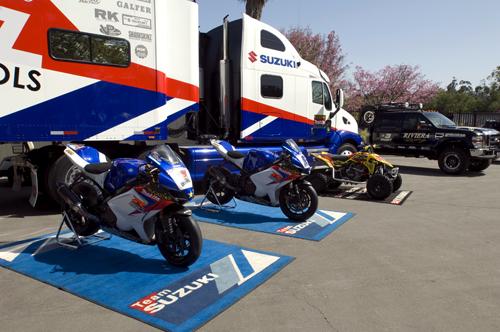
ROCKSTAR Energy Drink and Pepsi Team Up Suzuki and Yoshimura Show Their Support Pomona, Calif. ROCKSTAR Energy Drinks has teamed up with Pepsi in a business arrangement that will see the soft drink giant distribute ROCKSTAR Energy Drinks. To help usher in the new business arrangement, ROCKSTAR and Pepsi threw a well-attended “Pep Rally” for about 1,000 people to help launch the partnership. The event was held April 15th at the L.A. County Fairgrounds in Pomona California, home of drag racing’s Winter Nationals. The event showcased ROCKSTAR’s family of athletes and sporting activities with numerous off-road truck racing teams, freestyle athletes, surfers, skateboarders, and BMX athletes, and of course Team ROCKSTAR/Makita/Suzuki racing vehicles. Team ROCKSTAR/Makita/Suzuki showcased Road Racing Team bikes of Mladin and crew, Dustin Wimmer’s ATV Pro Championship quad, and Chad Reed’s Supercross #1 RMZ-450 on display. Pepsi and ROCKSTAR employees enjoyed tours of team transporters and learned about the various Suzuki racing machines while enjoying the music, food and ROCKSTAR. “This is a really fun event and a great way to launch our new distribution with Pepsi,” ROCKSTAR’s Marketing Director Mike Kelso said. “Pepsi provides industry leading customer service and is very aggressive. I think this new relationship is a perfect marriage that will benefit both of these fine companies. It’s also a good way to introduce the Pepsi people to our racing family, and all the various athletes who compete under the ROCKSTAR banner. We couldn’t be more thrilled.” “Suzuki is proud to be a part of the ROCKSTAR family,” American Suzuki’s National Sales Manager Rod Lopusnak commented. “ROCKSTAR has been an important partner with Suzuki’s racing efforts for the past three years. We are happy to see their new alliance with Pepsi and are pleased to be able to bring attention to the ROCKSTAR brand through our racing efforts. To date, ROCKSTAR/Makita/Suzuki racing teams are at the front of the AMA Superbike, Supercross, Pro ATV, and GNCC Pro ATV championship series. We are happy to help provide this positive exposure to ROCKSTAR and all our program partners.”

U.S. Senator Dianne Feinstein Comments On Lead-Related Ban Of Youth Motorcycles

0

Thank you very much for your letter expressing concern about the implementation of the Consumer Product Safety Improvement Act of 2008 (Public Law 110-314). I understand the challenges facing off-highway vehicle (OHV) manufacturers that must comply with the law’s requirements and welcome the opportunity to respond to your concerns. As you know, legislation enacted last year included requirements intended to limit the exposure of children to lead and phthalates in children’s products. Specifically, children’s products containing more than 600 parts per million of lead were banned from production and sale. An unexpected consequence of this legislation is that youth motorcycles and OHV’s are affected by these limits due to the high lead content of some metal components. I understand your concern that there is little potential for harm to children due to lead exposure in these vehicles. However, the CPSC currently believes that it does not have the legal authority to provide an exemption to the law at this time. That said, the Senate Committee on Commerce, Science and Transportation argues that the CPSC may provide a stay of enforcement in this situation and is hopeful that such action may be taken under new leadership at the Commission. Additionally, Senator Jon Tester (D-MT) has introduced legislation known as the “Common Sense in Consumer Product Safety Act” (S. 608), which would exempt vehicles intended for children between the ages of 7 and 12 from the law’s lead limits. In the meantime, the CPSC will continue to review this issue and provide appropriate guidance to manufacturers and retailers. Please know that I will keep your thoughts in mind should the Senate take further action regarding this matter. You may wish to visit the CPSC website at www.cpsc.gov/about/cpsia/cpsia.html for more information. Again, thank you for writing. If you have any further questions or comments, please do not hesitate to contact my Washington, D.C. office at (202) 224-3841. Best regards. Sincerely yours, Dianne Feinstein United States Senator

Honda France Leads First Qualifying Session At Le Mans 24-Hour World Endurance Race

0

Honda France leads the pack after the first qualifying session at Le Mans. Matthieu Lagrive hammered once again his competitors by signing a new lap record, in 1’37.460. With the average time of its three riders (Matthieu Lagrive, Sébastien Charpentier, Steve Plater), the official Honda leads the Honda Michelin Power Research Team. Michelin is the best permanent team after this first qualifying session, and the man of the day is Hugo Marchand with a 1’37.610 lap, despite a crash early in the session. Just behind Yamaha France GMT 94 is in third place with Sébastien Gimbert 1’37.678 lap. This allows the official Yamaha to be ahead of the Suzuki Endurance Racing Team. Yamaha Austria Racing Team is fifth on this provisional starting grid after the first qualifying session. The Austrian team is still battling with the final set-up of their new Yamaha R1, but YART still leads the Kawasaki GSR and their fastest rider Julien Da Costa. Honda National Motos is still carrying on serenely his way into the top 10. The Parisian team is ahead of Kawasaki Bolliger Switzerland, despite Patric Muff great 1’37.998 lap. RT Racing Team Moto Virus is also in the top 10 just behind the Junior Team Suzuki LMS. The Junior is in ninth place and is the only Superstock motorbike that can pretend entering in the Superpole contest so far, even if the Yamaha Loïc Moto Racing with Patrick Piot, David Morillon, and Cyril Brivet is a serious contender in eleventh place. The Yamaha BK Maco Moto Racing and Phase One Endurance were expected in better places. The Brits from Phase One reckons to be short of riding time with the new R1. The 46 teams engaged are all qualified for the start. The last on the starting grid is the twenty years old Honda RC 30 engaged by Moto Journal in the Open class. The nocturnal tests will start tonight from 9 pm. The second qualifying session will take place tomorrow Friday from 11 am.

Harley-Davidson’s First-Quarter Net Income Down At $117.3 Million

HARLEY-DAVIDSON REPORTS FIRST QUARTER 2009 RESULTS, RE-AFFIRMS FULL-YEAR SHIPMENT PLANS, AND PROVIDES STRATEGY AND RESTRUCTURING UPDATE Company Generates Net Income of $117.3 Million, Inclusive of Restructuring and One-Time Tax Charges First Quarter Revenue, Net Income and EPS Decrease MILWAUKEE, April 16, 2009 — Harley-Davidson, Inc. (NYSE:HOG) reported decreased revenue, net income and diluted earnings per share for the first quarter of 2009 compared to the year-ago period. Worldwide retail sales of Harley-Davidson® motorcycles in the first quarter declined 12.0 percent and U.S. retail sales declined 9.7 percent from last year’s first quarter. “While we are mildly encouraged by the fact that the U.S. retail sales rate declined less in the first quarter than in the prior two quarters, we remain cautious and continue to expect 2009 to be an extremely challenging business environment,” said Jim Ziemer, President and Chief Executive Officer of Harley-Davidson, Inc. “We continue to make good progress in executing our strategy for the economic downturn, and we will continue to manage our business with strong discipline.” In January, the Company announced initial estimates that its planned unit volume reduction and operations restructuring would result in the elimination of about 800 hourly production jobs during 2009 and 2010. After further development and refinement of production and restructuring plans, the Company now expects that approximately 300 to 400 additional production jobs will be eliminated over the two years. The Company today reaffirmed its plans to ship between 264,000 and 273,000 Harley-Davidson motorcycles to dealers worldwide in 2009, a 10 percent to 13 percent reduction from 2008. First Quarter Results Summary Net income and diluted earnings per share during the quarter were significantly affected by costs associated with previously announced volume reduction and operations restructuring activities and by an unrelated change in Wisconsin tax law. The Company recorded pre-tax restructuring costs of $34.9 million during the first quarter. The Company also incurred a one-time $22.5 million tax charge related to a change in Wisconsin tax law enacted mid-quarter without public hearings and which applied retroactively to Jan. 1, 2009. In light of these one-time costs, net income for the quarter was $117.3 million compared to $187.6 million in the first quarter of 2008, on revenue of $1.29 billion compared to $1.31 billion in the year-ago period. The Company reported diluted earnings per share of $0.50 in the quarter, versus $0.79 a year ago. The Company shipped 74,670 Harley-Davidson motorcycles in the first quarter of 2009 compared to 71,868 motorcycles shipped in the year-ago period and within the Company’s guidance for the quarter. Second-Quarter Shipments and Full-Year Gross Margins The Company plans to ship 55,000 to 59,000 Harley-Davidson motorcycles during the second quarter of 2009. The Company also reaffirmed its expectation for full-year gross margins to be between 30.5 percent and 31.5 percent, which compares to 34.5 percent for the full year 2008. The decrease is primarily due to an expected unfavorable shipment mix versus 2008, the allocation of fixed costs over fewer units, and expected unfavorable foreign currency exchange rates versus 2008. Strategy for the Current Economic Environment On Jan. 23, 2009, Harley-Davidson announced a three-part strategy for managing through the global economic downturn and strengthening its operations and financial results going forward. That strategy consists of: 1) continuing to invest in the Harley-Davidson brand; 2) creating the appropriate cost structure; and 3) obtaining funding to support the lending activities of Harley-Davidson Financial Services (HDFS). “We have a clear strategy and we expect that it will enable us to emerge from the economic downturn in a position of strength,” said Ziemer. “And our team continues to execute our strategy with confidence and conviction.” Brand Investment In the first quarter, the Company’s “Ride Free” Sportster® motorcycle trade-up program successfully created consumer interest and reinforced the brand value of Harley-Davidson motorcycles. Starting in April, the Company rolled out a national “Super Ride” program. This program provides an expanded opportunity for U.S. consumers to test ride a wide range of Harley-Davidson motorcycles at participating dealerships. “Demo rides have proven to be one of the most effective ways to turn dreamers into customers and to get current customers excited about a new motorcycle. Through all of our marketing, we are reaching consumers in ways that support the brand and the value proposition of our motorcycles,” said Ziemer. Cost Structure The Company is proceeding on schedule with its previously announced volume reduction and plans for consolidating production operations. Planning also continues on schedule for the consolidation of Parts and Accessories and General Merchandise distribution through a third-party provider. In early April, the Company completed the transition of its U.S. transportation fleet operations to a third-party provider. In January, the Company initially had estimated that the planned volume reduction and restructuring actions would result in the elimination of about 1,100 jobs over the course of 2009 and 2010, consisting of about 300 non-production, primarily salaried positions and about 800 hourly production positions. The Company now estimates that an additional 300 to 400 hourly production jobs will be eliminated. “We don’t make any job reduction decisions lightly,” said Ziemer. “But based on further planning since January and a deeper analysis of our production requirements, we have now determined that fewer production employees will be required. We will continue to work with the union leadership as we move forward, and as always, we will appropriately manage Harley-Davidson based on business conditions and the needs of the marketplace.” On a combined basis, Harley-Davidson expects the volume reduction and restructuring activities to result in one-time charges of approximately $120 million to $150 million over the course of 2009 and 2010, including $34.9 million incurred during the first quarter of 2009. The Company now estimates ongoing annual savings of approximately $70 million to $80 million upon completion of the restructuring actions, with 2009 savings estimated to be $20 million to $25 million and 2010 savings estimated to be $40 million to $55 million. HDFS Funding The Company continues to act on a number of fronts to obtain the necessary funding to support the lending activities of HDFS. In February, the Company raised $600 million for HDFS through the issuance of senior unsecured notes. Harley-Davidson, Inc. also preserved about $54 million in cash during the first quarter through a reduction in the dividend paid in March. On March 18, 2009, the Company extended its $500 million asset-backed commercial paper conduit facility to March 2010, and in coming weeks anticipates increasing the size of that facility to provide additional funding. At that same time, the Company also anticipates renewing a substantial portion of a $950 million, 364-day senior unsecured bank credit facility which is due to expire in July 2009. In addition, the Company intends to access the term asset-backed securitization market in the second quarter of 2009, which transaction the Company expects to be eligible for the Federal Reserve Bank’s Term Asset-Backed Securities Loan Facility (TALF) program. “We continue to make good progress on funding the needs of HDFS through the paths we have identified previously and anticipate that we will be able to obtain the needed liquidity,” said Tom Bergmann, Chief Financial Officer of Harley-Davidson, Inc. and interim President of HDFS. Additional Actions Management Transition On April 6, 2009, the Company announced that Keith Wandell would become President and Chief Executive Officer of Harley-Davidson, Inc. on May 1, 2009, succeeding Jim Ziemer, a 40-year Harley-Davidson veteran who had announced in December his intention to retire in 2009. Wandell comes to Harley-Davidson from Johnson Controls, Inc., where he is President and Chief Operating Officer. Details on First Quarter 2009 Results Motorcycles and Related Products Segment – First Quarter Results Revenue from Harley-Davidson motorcycles was $1.01 billion, a decrease of $2.7 million or 0.3 percent versus the same period last year. Shipments of Harley-Davidson motorcycles totaled 74,670 units, an increase of 2,802 units or 3.9 percent compared to last year’s first quarter. Shipment guidance for the quarter was 74,000 to 78,000 Harley-Davidson motorcycles. Revenue from Parts and Accessories (P&A), which consists of Genuine Motor Parts and Genuine Motor Accessories, totaled $169.8 million, a decrease of $12.2 million or 6.7 percent versus the year-ago quarter. Revenue from General Merchandise, which consists of MotorClothes™ apparel and collectibles, totaled $75.2 million, a decrease of $8.8 million or 10.5 percent from the year-ago quarter. Gross margin for the first quarter of 2009 was 36.9 percent of revenue compared to 36.4 percent for the first quarter last year. Operating margin was 17.7 percent, compared to 20.0 percent in the first quarter of 2008. Operating margin was adversely impacted during the quarter by $34.9 million in restructuring costs. Motorcycle Retail Sales Data During the first quarter, worldwide retail sales of Harley-Davidson motorcycles decreased 12.0 percent compared to the prior-year quarter. In the U.S., retail sales of Harley-Davidson motorcycles decreased 9.7 percent from the year-ago period. In last year’s first quarter, U.S. retail sales of Harley-Davidson motorcycles decreased 12.8 percent compared to the prior year. Industry-wide retail sales of heavyweight motorcycles in the U.S. declined 22.3 percent during the quarter. In international markets, retail sales of Harley-Davidson motorcycles decreased 17.2 percent during the first quarter of 2009 compared to the first quarter of 2008, reflecting the impact of the severe economic downturn in many markets. In last year’s first quarter, international retail Harley-Davidson motorcycle sales grew 16.8 percent compared to the prior year. In Canada, first-quarter retail sales of Harley-Davidson motorcycles decreased 30.4 percent on a retail unit volume decrease of 816 motorcycles; the Europe Region was down 17.4 percent on a decrease of 1,761 units; the Asia Pacific Region was down 7.2 percent on a decrease of 382 units; and the Latin America Region was down 26.3 percent on a decrease of 488 motorcycles. Financial Services Segment First quarter operating income from financial services was $11.2 million, a decrease of $23.7 million or 67.9 percent compared to the year-ago quarter. This decrease was primarily due to a $17.1 million write-down of retained securitization interests and an $8.6 million write-down to fair market value of finance receivables held for sale due to higher projected credit losses. Income Tax Rate The Company’s first quarter effective income tax rate was 47.6 percent, compared to 36.0 percent in the same quarter last year. The increase was due to a recent and unanticipated change in Wisconsin tax law which resulted in the Company establishing a valuation allowance of $22.5 million related to net operating loss carry-forwards, as well as tax implications of MV Agusta, which the Company acquired in August 2008. The Company expects its full-year 2009 effective tax rate to be approximately 43.0 percent. Cash Flow Cash and marketable securities totaled $899.3 million as of March 29, 2009, compared to $333.2 million at the end of the year-ago period. Cash used by operations was $244.6 million and capital expenditures were $22.9 million during the first quarter of 2009. For the full year of 2009, capital expenditures are now expected to be between $170 million and $200 million, including $20 million to $30 million related to restructuring activities. In total, the Company expects 2009 capital expenditures to be $20 million less than the range provided in January for the full year. Stock Repurchase Authorizations The Company did not repurchase shares in the first quarter of 2009. In the first quarter of 2008, the Company repurchased 2.6 million shares of its common stock. On March 29, 2009, the Company had 234.5 million shares of common stock outstanding. As of March 29, 2009, there were 16.7 million shares remaining on a board-approved share repurchase authorization. An additional board-approved share repurchase authorization is in place to offset option exercises. Company Background Harley-Davidson, Inc. is the parent company for the group of companies doing business as Harley-Davidson Motor Company (HDMC), Buell Motorcycle Company (Buell), MV Agusta and Harley-Davidson Financial Services (HDFS). Harley-Davidson Motor Company produces heavyweight custom, touring and cruiser motorcycles. Buell produces American sport performance motorcycles. MV Agusta produces premium, high-performance sport motorcycles sold under the MV Agusta® brand and lightweight sport motorcycles sold under the Cagiva® brand. HDFS provides wholesale and retail financing and insurance programs primarily to Harley-Davidson and Buell dealers and customers. Forward-Looking Statements The Company intends that certain matters discussed in this release are “forward-looking statements” intended to qualify for the safe harbor from liability established by the Private Securities Litigation Reform Act of 1995. These forward-looking statements can generally be identified as such because the context of the statement will include words such as the Company “believes,” “anticipates,” “expects,” “plans,” or “estimates” or words of similar meaning. Similarly, statements that describe future plans, objectives, outlooks, targets, guidance or goals are also forward-looking statements. Such forward-looking statements are subject to certain risks and uncertainties that could cause actual results to differ materially from those anticipated as of the date of this release. Certain of such risks and uncertainties are described below. Shareholders, potential investors, and other readers are urged to consider these factors in evaluating the forward-looking statements and cautioned not to place undue reliance on such forward-looking statements. The forward-looking statements included in this release are only made as of the date of this release, and the Company disclaims any obligation to publicly update such forward-looking statements to reflect subsequent events or circumstances. The Company’s ability to meet the targets and expectations noted depends upon, among other factors, the Company’s ability to (i) effectively execute the Company’s restructuring plans within expected costs, (ii) manage the risks that our independent dealers may have difficulty obtaining capital, and adjusting to the recession and slowdown in consumer demand, (iii) manage supply chain issues, (iv) anticipate the level of consumer confidence in the economy, (v) continue to have access to reliable sources of capital funding and adjust to fluctuations in the cost of capital, (vi) manage the credit quality, the loan servicing and collection activities, and the recovery rates of HDFS’ loan portfolio, (vii) continue to realize production efficiencies at its production facilities and manage operating costs including materials, labor and overhead, (viii) manage production capacity and production changes, (ix) provide products, services and experiences that are successful in the marketplace, (x) develop and implement sales and marketing plans that retain existing retail customers and attract new retail customers in an increasingly competitive marketplace, (xi) sell all of its motorcycles and related products and services to its independent dealers, (xii) continue to develop the capabilities of its distributor and dealer network, (xiii) manage changes and prepare for requirements in legislative and regulatory environments for its products, services and operations, (xiv) adjust to fluctuations in foreign currency exchange rates, interest rates and commodity prices, (xv) adjust to healthcare inflation, pension reform and tax changes, (xvi) retain and attract talented employees, (xvii) detect any issues with our motorcycles or manufacturing processes to avoid delays in new model launches, recall campaigns, increased warranty costs or litigation, (xvii) implement and manage enterprise-wide information technology solutions and secure data contained in those systems, and (xix) successfully integrate and profitably operate MV Agusta Group. In addition, the Company could experience delays or disruptions in its operations as a result of work stoppages, strikes, natural causes, terrorism or other factors. Other factors are described in risk factors that the Company has disclosed in documents previously filed with the Securities and Exchange Commission. Many of these risk factors are impacted by the current turbulent capital, credit and retail markets and our ability to adjust to the recession. The Company’s ability to sell its motorcycles and related products and services and to meet its financial expectations also depends on the ability of the Company’s independent dealers to sell its motorcycles and related products and services to retail customers. The Company depends on the capability and financial capacity of its independent dealers and distributors to develop and implement effective retail sales plans to create demand for the motorcycles and related products and services they purchase from the Company. In addition, the Company’s independent dealers and distributors may experience difficulties in operating their businesses and selling Harley-Davidson motorcycles and related products and services as a result of weather, economic conditions or other factors.

AMA President Rob Dingman: Team Obsolete vs. AHRMA Litigation Has Cost AMA Members $750,000 In Legal Fees

0

AMA President and CEO Rob Dingman discusses vintage racing at AMA Vintage Motorcycle Days PICKERINGTON, Ohio — In the following interview with AmericanMotorcyclist.com, the website of the American Motorcyclist Association, AMA President and CEO Rob Dingman speaks out about the dispute that has arisen with the American Historic Racing Motorcycle Association (AHRMA) and the future of that organization’s role at AMA Vintage Motorcycle Days. AmericanMotorcyclist.com (AM): AHRMA has been posting on its website statements regarding a vaguely defined “dispute” over its sanctioning agreement with the AMA, the most recent being on April 15. These statements have led to a number of rumors that AHRMA will not be involved with this year’s AMA Vintage Motorcycle Day at Mid-Ohio Sports Car Course in Lexington, Ohio. Can you tell AMA members and our readers what the fuss is all about? Rob Dingman: The dispute is not between the AMA and AHMRA, though readers of the AHMRA website are being led to believe that it is. We were drawn into a lawsuit between AHRMA’s founder, Rob Iannucci, and its existing leadership back in 2001 and have defended the AMA for seven years. This past February, the AMA settled with Mr. Iannucci. There remains an ongoing dispute between Mr. Iannucci and AHMRA. AHRMA’s most recent public statement says that the AMA’s leadership has agreed to join AHRMA and meet with Mr. Iannucci in an attempt to resolve their dispute. No meeting has been scheduled with Mr. Iannucci, and we are certainly not a party to the dispute. We have only said that we would attend if both parties agreed that we could help them work out their differences. I am very disappointed that AHMRA is choosing to negotiate this issue publicly, because it does a disservice to their members, many of whom are also AMA members. AM: Can you explain what is at issue, and how it arose? RD: First, I want to acknowledge the role that AHMRA has played over the years in the growing popularity of historic motorcycle racing. Many racers participate in vintage racing, and these individuals are the reason why so many people are enthused about the sport today. Mr. Iannucci’s lawsuit was filed against AHMRA on behalf of himself and his team, Team Obsolete, in 2001. The AMA was named in the suit because we sanction AHRMA racing. The nature of the dispute has been written about extensively elsewhere. Sadly, the suit cast a shadow over the very future of AHRMA, which subsequently filed for bankruptcy. In 2007, the bankruptcy court in Tennessee settled the financial claims between Mr. Iannucci and AHRMA. However, the AMA was left holding the bag for a dispute between the two parties that had nothing to do with us. This suit has cost AMA members three-quarters of a million dollars and, ironically, it was not even about money. That’s just outrageous. The current management of the AMA was not involved in the actions that led to the lawsuit or its ongoing prosecution, and I have never believed that the AMA and its members were being served by continuing it. After eight years, the AMA said, “Enough.” AMA Board of Directors Chairman Stan Simpson and I met with Mr. Iannucci last year to settle the matter. On Feb. 19, 2009, the AMA announced that we had entered into a Settlement Agreement, which resulted in the case being dismissed. I understand that AHRMA believes that the AMA should continue to fight with Mr. Iannucci and spend AMA members’ money, but that would be foolish for the AMA. AM: If the case against the AMA is now settled, what exactly is the problem? RD: The terms of our Settlement Agreement are confidential; however, Mr. Iannucci has agreed to allow us to discuss them for the purpose of this interview. One of the key provisions of the settlement is that, in order to receive future AMA sanctioning, AHRMA must resolve its differences with Mr. Iannucci and Team Obsolete on or before April 30, 2009. We arrived at this date because AHRMA had pending sanction requests with AMA at that time, and to be completely fair to AHRMA, we approved all of them, which took us out to the end of April. We continue to believe that it is in the best interest of vintage motorcycle racing to end the litigation and disagreements and move forward. On Wednesday, March 4, Stan Simpson and I met with the AHRMA board and its officers to explain our reasoning, answer questions and reiterate the need for them to reach a resolution. Despite what they wrote on their website subsequently, we provided them with a full understanding of the issues. So they’ve known for six weeks that they needed to work out their differences with Mr. Iannucci. Unfortunately, AHMRA has chosen to air the dispute publicly, and has left the impression that the AMA is responsible for the very problems that AHRMA created. This is not our dispute. We cannot resolve it. Only AHRMA and Mr. Iannucci can settle this matter. AM: What does this all mean for fans of vintage racing and AMA Vintage Motorcycle Days? RD: Make no mistake, there will be racing at AMA Vintage Motorcycle Days. We can’t stop the process because AHRMA hasn’t decided what they are going to do. So come May 1, we are going forward with our planning, one way or the other. We have advised AMA Organizers that if this issue is not resolved on or before April 30, the AMA will no longer sanction AHRMA events or activities, or otherwise engage in business with AHRMA. AM: Can you comment on the rumor that AMA is telling AHRMA what to do? RD: That is totally untrue. The AMA is not telling AHRMA what action it must take. That is up to AHRMA and Mr. Iannucci to work out to their mutual satisfaction. There is no reason why AHRMA cannot work this out. We met with Rob Iannucci and worked this out, and they need to do the same thing. AM: On April 7, the AMA announced that AMA Vintage Motorcycle Days would feature the inaugural AMA Racing Vintage Grand Championships. Some people have interpreted this to mean that AHRMA is already “out” this year at VMD. Why was the announcement was made at this time? RD: The timing of our announcement was forced upon us by a statement that AHRMA posted on its website, which essentially says that AHRMA is working on a replacement venue for AMA Vintage Motorcycle Days, in case the dispute is not settled. We also learned that AHMRA tried to secure one of AMA’s Vintage Motorcycle Days venues out from under us. We were flooded with e-mails from members asking us if AMA Vintage Motorcycle Days was cancelled, and we took this as a direct threat to our event. So we had an obligation to tell AMA members and vintage racing fans that there will be vintage racing at Mid-Ohio this year. Frankly, we were shocked that AHRMA would put themselves in competition with us. Why would they jeopardize our 20-year relationship in this way? AM: Can you tell us more about the AMA’s vintage racing program? RD: The reason for the AMA Racing Vintage Grand Championships is simple. Vintage motorcycle racing has become very popular in recent years in all its forms, including road racing, motocross, dirt track, hare scrambles and trials. The AMA believes it is only fitting that we elevate this genre to the same level as our other amateur championships, and that we do so at the granddaddy of all vintage racing events, AMA Vintage Motorcycle Days. The creation of the vintage grand championship is the next step for us to grow AMA Vintage Motorcycle Days and also increase the visibility of our AMA brand. We are doing this by honoring the top rider in each vintage discipline with a championship title, and premier class winners will receive an AMA Racing No. 1 plate. In addition, the rider who excels across multiple disciplines will be named the AMA Racing Vintage Grand National Champion. The class champions and the Grand National Champion will be invited to attend our AMA Racing annual awards banquet, where they’ll be recognized before all of our AMA Racing national champions. AM: If AHRMA and AMA go their own ways, what will become of vintage racing at AMA Vintage Motorcycle Days in the future? RD: I want to emphasize that the AMA sincerely hopes there will be an amicable resolution between AHRMA and Mr. Iannucci, and that we can continue to sanction AHRMA racing. That said, the AMA is committed to sustaining and growing this exciting form of amateur competition for the teams, the racers and their fans. That is why we created the AMA Racing Vintage Grand Championships. If AHRMA cannot work out its differences with Mr. Iannucci by April 30, then the AMA is fully prepared to conduct quality vintage racing in each of the disciplines at Mid Ohio this year — and in the future. AM: Do you have a message for AHRMA’s leaders and Mr. Iannucci? RD: Don’t try to settle this in the court of public opinion, because that is not working. Both parties need to meet in a room, face-to-face, and work this out. It can be done. We did it, and so can they. If they both agree that it would help for the AMA to attend while they work out their differences, we will do so. About the American Motorcyclist Association Since 1924, the AMA has promoted and protected the motorcycling lifestyle. AMA members come from all walks of life and they navigate many different routes on their journey to the same destination: freedom on two wheels. As the world’s largest motorcycle organization with nearly 300,000 members, the AMA advocates for motorcyclists’ interests in the halls of local, state and federal government, the committees of international governing organizations and the court of public opinion. Through member clubs, promoters and partners, the AMA sanctions more motorsports competition events than any other organization in the world. Through its Motorcycle Hall of Fame Museum, the AMA preserves the heritage of motorcycling for future generations. For more information, visit www.AmericanMotorcyclist.com.

Updated: More On Lead-Based Ban Of Kids’ Dirt Bikes And ATVs

MIC/SVIA INDUSTRY RESPONSE TO CPSC REJECTION OF LEAD STANDARD EXCLUSION PETITION AND PROPOSED STAY OF ENFORCEMENT IRVINE, Calif., April 17, 2009 — The Motorcycle Industry Council (MIC) and the Specialty Vehicle Institute of America (SVIA) are disappointed that the Consumer Product Safety Commission (CPSC) announced that they intend vote today to reject the petition that our industry submitted for an exclusion for all-terrain vehicles (ATVs), and motorcycles from the lead content limits found in the Consumer Product Safety Improvement Act (CPSIA). Both Commissioners have proposed a stay of enforcement, acknowledging that the current ban on youth model ATVs and motorcycles means larger and faster adult-size vehicles become likely alternatives for children 12 years of age and younger that as Acting Chairman Nord stated, “increas[e] their risk of injury or death.” Commissioner Moore stated, “There are compelling safety arguments that justify a stay of enforcement.” “While we are pleased that both Commissioners recognize the importance of ending the ban on youth model vehicles, we need to review the actual text of the proposed stay,” said Paul Vitrano, general counsel for the MIC and SVIA. It is also important to note that, even if a stay of enforcement can be implemented by the CPSC, this is not a solution and would only be a temporary reprieve as to the agency’s enforcement of the ban. It would not apply to state Attorney Generals or address other unintended consequences of the lead ban. “With today’s vote, it is now obvious that the only permanent solution is for Congress to end the ban once and for all by amending the Consumer Product Safety Improvement Act (CPSIA) so parents once again have access to appropriate-sized youth model ATVs and motorcycles for their children,” said Paul Vitrano. Since 1983, the Specialty Vehicle Institute of America® has promoted the safe and responsible use of All-Terrain Vehicles through rider training programs, public awareness campaigns, and state legislation. The SVIA also serves as a resource for ATV research, statistics, and vehicle standards. The SVIA, based in Irvine, Calif., is a not-for-profit trade association sponsored by Arctic Cat, BRP, Honda, Kawasaki, KTM, KYMCO, Polaris, Suzuki, Tomberlin, Tomoto and Yamaha. The Motorcycle Industry Council is a not-for-profit, national trade association representing manufacturers and distributors of motorcycles, scooters, motorcycle/ATV/ROV parts and accessories, and members of allied trades such as publishing companies, advertising agencies, insurance firms and consultants. The MIC is headquartered in Irvine, Calif., with a government relations office adjacent to Washington, D.C. The organization has been in operation since 1914. More, from a press release issued by AMA: CPSC poised to delay enforcement of law that bans sale of youth-model motorcycles and ATVs PICKERINGTON, Ohio –The Consumer Product Safety Commission (CPSC) has voted to deny a petition to exclude youth-model motorcycles and ATVs from a law that bans their sale because of possible lead concerns–but has cleared the way for a second vote by month’s end to delay enforcement of the law, the American Motorcyclist Association (AMA) reports. Because both members of the commission have said they favor a stay of enforcement, the move almost certainly will stay the execution of parts of the Consumer Product Safety Improvement Act (CPSIA) within the agency. On Friday, commission filings in preparation for the vote indicated a stay could be as long as two years, possibly expiring May 1, 2011. A planned second vote on that timeframe was expected by the end of April. In addition, it’s not clear whether state attorneys general, who are also charged with enforcing the law, will also stand down. “Clearly this latest move shows that the CPSC realizes that youth-model motorcycles and ATVs have no business getting caught up in a law aimed at children’s toys,” said Ed Moreland, the AMA’s vice president for government relations. “We’re heartened that both commissioners favor a stay of enforcement, and it appears that this could clear the way for dealers to sell youth-model motorcycles and ATVs–an important consideration for riders and motorsports businesses alike as the riding and racing season ramps up. “However, this vote doesn’t solve the larger, long-term issue, which is whether or not youth-model motorcycles and ATVs will be exempted from the CPSIA,” Moreland noted. “We believe they should be excluded, and we will continue to work with our partners in the industry and our friends in Congress to make that happen.” Acting CPSC Chairwoman Nancy Nord went on record on April 3 favoring a stay of enforcement. On April 16, Commissioner Thomas Moore agreed. “It is clear from the post-enactment statements of some Members of Congress who were Conferees on the CPSIA that they believe the Commission has the authority to make sensible allowances for these vehicles as long as child safety is not compromised,” Moore said in his statement. “Given the extremely restrictive language of the law, the only avenue I can see is for the Commission to establish an enforcement plan that follows, to the greatest extent possible, the Act’s intention for future production, while providing relief to the industry and the riding community for vehicles already manufactured and those manufactured during the stay.” The full text of Moore’s statement is below. STATEMENT OF THE HONORABLE THOMAS H. MOORE ON THE PETITION FOR TEMPORARY FINAL RULE TO EXCLUDE A CLASS OF MATERIALS UNDER SECTION 101(b) OF THE CONSUMER PRODUCT SAFETY IMPROVEMENT ACT OF 2008 (CPSIA) April 16, 2009 I am aware of the speculation that has surrounded my vote on this issue. My staff has spent the time since the ballot came to the Commission working on what I believe is a good solution for the riders of youth motorized recreational vehicles, building and expanding upon the initial position taken by Acting Chairman Nord. The direction my colleague and I are giving to the staff today balances the Congressional desire to protect children from unnecessary contact with leaded components in these vehicles with the need to protect those same children from the potential for physical injury related to riding inappropriate adult-sized vehicles, or riding vehicles either in need of repair or less structurally sound than the ones currently on the market. It is clear from the post-enactment statements of some Members of Congress who were Conferees on the CPSIA that they believe the Commission has the authority to make sensible allowances for these vehicles as long as child safety is not compromised. Given the extremely restrictive language of the law, the only avenue I can see is for the Commission to establish an enforcement plan that follows, to the greatest extent possible, the Act’s intention for future production, while providing relief to the industry and the riding community for vehicles already manufactured and those manufactured during the stay. There are compelling safety arguments that justify a stay of enforcement. It is ironic that I am defending vehicles that I consider to be dangerous for children under 12 to ride and which contain accessible parts with excess levels of lead. However, the alternatives appear to be more dangerous. American parents seem to be willing to accept the risk for their children riding these vehicles, so it is the agency’s task, at this stage, to ensure that the vehicles are as safe as possible. One safety rule the agency has stressed is keeping children off of adult-sized ATVs.1 To the extent that new children’s ATVs cannot currently meet the lead limits in the CPSIA, there is the likelihood that parents seeking new vehicles will buy adult-sized ATVs for their children to use. We have also been notified by one ATV manufacturer that they are simply relabeling their Y-6+ and Y-10+ youth ATVs as Y-12+, removing the speed limiting device and continuing to sell them. Thus the vehicles that are more accurately sized for younger children will be less safe because of their ability to attain higher speeds. The other part of the safety equation that helps balance an enforcement plan against the increased lead exposure it allows, is based on the assertions that certain vehicle components cannot be made with lead below a certain level without compromising the structural integrity (or another safety element) of the component. The enforcement plan of the Commission must require concrete data from the manufacturers on this point to justify their continued use of lead in excess of the applicable lead limit. The industry has pointed to the European Union’s RoHS and ELV Directives as a guide for what lead reductions or substitutions may be technologically infeasible for their youth vehicles. While we might not need to allow the high lead limits allowed in those Directives for all components, there is guidance to be taken in how the European system is administered. They set an expiration date for their exemptions. Prior to that expiration date it is up to industry to come in and make their case that it is still technologically infeasible to reduce lead to a level at which an exemption is no longer required. The evidence considered is strictly limited to technological feasibility, not on the higher cost of a viable substitute. The guiding principle for this agency’s determinations has to be the safety of the children riding these vehicles. I believe a stay of enforcement issued by the Commission should: –relieve all makers, sellers, and distributors of youth motorized recreational vehicles made to date and through the expiration date of the stay from enforcement actions for failure to meet the lead limits of the CPSIA; –allow those vehicles to be repaired, sold, traded, and otherwise used as they have been; –allow the sale, distribution and installation of replacement parts that are comparable in lead levels to the old part being replaced until such time as those parts can be brought into compliance; –expect industry to bring their vehicle components into compliance on a reasonable schedule, to the extent that is technologically feasible, and to provide us with the detailed information we need to make informed decisions about those components in the future. The Commission simply cannot ignore the safety tradeoffs that could arise by not providing this relief but it must also work with industry to bring the non-complying components of these youth vehicles as close to the lead limits established by law as is currently technologically feasible, to the extent those parts cannot be made inaccessible. The Commission also needs to let the riding community know that they can continue to use the vehicles they own as they always have. I believe the approach taken today by myself and Acting Chairman Nord of directing the staff to draft a Federal Register notice containing concrete elements of a stay is the reasonable approach that the Congress is looking for us to take. I anticipate that the Commission will vote to approve it in the near future. 1) Most of my discussion is focused on the ATV industry as they present the greatest (lead and non-lead) safety challenges. However, the enforcement program will also apply to children’s off-road motorcycles and snowmobiles. About the American Motorcyclist Association Since 1924, the AMA has promoted and protected the motorcycling lifestyle. AMA members come from all walks of life and they navigate many different routes on their journey to the same destination: freedom on two wheels. As the world’s largest motorcycle organization with nearly 300,000 members, the AMA advocates for motorcyclists’ interests in the halls of local, state and federal government, the committees of international governing organizations and the court of public opinion. Through member clubs, promoters and partners, the AMA sanctions more motorsports competition events than any other organization in the world. Through its Motorcycle Hall of Fame Museum, the AMA preserves the heritage of motorcycling for future generations. For more information, visit www.AmericanMotorcyclist.com.

Video: Mat Mladin Talks About Switching From A 2008 To A 2009 GSX-R1000 In AMA American Superbike

Be sure to check out other Roadracing World feature videos. Video provided by ~http://www.OnTheThrottle.tv~

Missouri Congressman Roy Blunt Responds To A Constituent Regarding Lead-Based Ban On Kid-Sized Dirt Bikes And ATVs

Thank you for contacting me regarding H.R. 4040, the Consumer Product Safety Commission Reform Act. I appreciate the opportunity to respond to your concerns. Congressman Bobby Rush introduced H.R. 4040 on November 1, 2007. This legislation would reduce lead levels in children’s consumer products and require independent third party testing of products for children. On July 30, 2008, the House of Representatives passed the conference report for H.R. 4040 with my support. Additionally, H.R. 4040 was passed by the United States Senate on July 31, 2008, and was signed into law by President Bush on August 14, 2008. Recently, concerns have been raised by all-terrain vehicles (ATVs) and dirt bike dealers regarding the implementation of this legislation by the CPSC. Of specific concern is the new requirement that children’s products sold after February 10, 2009 receive certification that they meet new federal guidelines. In light of these concerns, Congressman Joe Barton introduced H.R. 1815 on March 31, 2009. This legislation, which I have cosponsored, would clarify the applicability of certain provisions in the Consumer Product Safety Improvement Act. Specifically, this bill would create broader exemption authority with higher standards for those products that cannot meet the “regular” lead exemption standard when an exemption would better preserve child safety. For example, an exemption would better serve children, who are less likely to suffer lead exposure from youth ATVs than they are to suffer serious harm from using the same vehicle made for adults. Currently, this measure is being considered by the House Committee on Energy and Commerce. Please know that I will keep your thoughts in mind should H.R. 1815 come before the House of Representatives for a vote. Again, thank you for contacting me. I look forward to hearing from you in the future. Sincere regards, Roy Blunt Member of Congress

Australian Superbikes Will Run Doubleheader To Make Up For Round Called Off For Fatal Accident

After much discussion following on from the second round of the 2009 ASBK held at Symmons Plains in Tasmania, International Entertainment Group and Motorcycling Australia have some important announcements regarding the Championship series. Due to the abandonment of the second round, it has been decided that the upcoming round at Queensland Raceway will be run as a double-header. The official event will run from Thursday 28 May through to Sunday 31 May, with a schedule of events and additional entry forms to be made available on the ASBK and MA websites shortly. With regards to the second round in Tasmania, it has been decided that points for all categories which raced will stand (Superstock 1000, Superstock 600, FZ6 and 125GP/250GP Mono), and the points gained from attaining pole positions will also remain. These points will be updated on the results page of the ASBK website shortly. Round 3 at Queensland Raceway will be split into two separate rounds – Round 3a and 3b. In other Championship news, due to financial concerns raised by competitors, the suggested Western Australian round will not take place in July. A new venue for the Final Round of the Championship has yet to be determined, though the original date of 12-15 November will be retained.

Yamaha France GMT 94 On Pole Heading Into Superpole At 24 Hours Of Le Mans

With two of its three riders, Sébastien Gimbert and David Checa, below the 1’38 bar, Yamaha France GMT 94 managed to get the best from the second qualifying session at Le Mans. The third rider, Erwan Nigon, also improved his lap time this morning with a 1’38.172. Yamaha France GMT 94 leads over Honda France with Matthieu Lagrive, Sébastien Charpentier and Steve Plater. On the Honda, Matthieu Lagrive, who is the only one in the 1’37 bracket, suffered a small crash this morning while trying to improve his lap time. The best permanent team is Michelin Power Research Team, who is strongly placed in the leading trio with its homogeneous team of riders. Hugo Marchand did a lap in 1’37.610 and is closely followed by William Costes and Josep Monge. Apparently, Suzuki Endurance Racing Team is still looking for some solutions to improve their new GSX-R 1000. Slightly delayed by a small crash of Barry Veneman, the SERT is however holding tight against two followers in the likes of Kawasaki GSR and Yamaha Austria Racing Team. The top 10 of this second qualifying session also includes the Honda National Motos, the Kawasaki Bolliger Switzerland, the surprising Yamaha Loïc Moto Racing of Cyril Brivet, Patrick Piot and David Morillon, and the Suzuki of RT Racing Team Moto Virus. The starting grid is still to be finalised. The first ten places will be reallocated after the Superpole. Each team will have to design his best rider, who will be sent back on track for one hot lap. The Superpole will start at 4:10 pm at Le Mans, if the weather remains rain free. The Superpole will be cancelled in case of rain or wet track. In eleventh place, the Junior Team Suzuki LMS is second in the Superstock class and won’t take part of the Superpole. They are ahead of Yamaha BK Maco Moto Racing, who reckons to have missed of track time, the Suzuki Team 18 Sapeurs Pompiers, the Suzuki RAC 41 City Bike and the Suzuki AM Moto Racing, who fiercely defends his status of new permanent team of the 2009 Qtel FIM Endurance World Championship. A few teams had to experience some crashes, such as Honda RMT 21, in 16th place, or the Suzuki Endurance Moto 45, 23rd, as well as the Italians of MCS Racing, in 32nd place, but two of their riders discovered the Bugatti race track at Le Mans this week.

Team ROCKSTAR/Makita/Suzuki Featured In Rockstar/Pepsi Event At L.A. County Fairgrounds

ROCKSTAR Energy Drink and Pepsi Team Up Suzuki and Yoshimura Show Their Support Pomona, Calif. ROCKSTAR Energy Drinks has teamed up with Pepsi in a business arrangement that will see the soft drink giant distribute ROCKSTAR Energy Drinks. To help usher in the new business arrangement, ROCKSTAR and Pepsi threw a well-attended “Pep Rally” for about 1,000 people to help launch the partnership. The event was held April 15th at the L.A. County Fairgrounds in Pomona California, home of drag racing’s Winter Nationals. The event showcased ROCKSTAR’s family of athletes and sporting activities with numerous off-road truck racing teams, freestyle athletes, surfers, skateboarders, and BMX athletes, and of course Team ROCKSTAR/Makita/Suzuki racing vehicles. Team ROCKSTAR/Makita/Suzuki showcased Road Racing Team bikes of Mladin and crew, Dustin Wimmer’s ATV Pro Championship quad, and Chad Reed’s Supercross #1 RMZ-450 on display. Pepsi and ROCKSTAR employees enjoyed tours of team transporters and learned about the various Suzuki racing machines while enjoying the music, food and ROCKSTAR. “This is a really fun event and a great way to launch our new distribution with Pepsi,” ROCKSTAR’s Marketing Director Mike Kelso said. “Pepsi provides industry leading customer service and is very aggressive. I think this new relationship is a perfect marriage that will benefit both of these fine companies. It’s also a good way to introduce the Pepsi people to our racing family, and all the various athletes who compete under the ROCKSTAR banner. We couldn’t be more thrilled.” “Suzuki is proud to be a part of the ROCKSTAR family,” American Suzuki’s National Sales Manager Rod Lopusnak commented. “ROCKSTAR has been an important partner with Suzuki’s racing efforts for the past three years. We are happy to see their new alliance with Pepsi and are pleased to be able to bring attention to the ROCKSTAR brand through our racing efforts. To date, ROCKSTAR/Makita/Suzuki racing teams are at the front of the AMA Superbike, Supercross, Pro ATV, and GNCC Pro ATV championship series. We are happy to help provide this positive exposure to ROCKSTAR and all our program partners.”

U.S. Senator Dianne Feinstein Comments On Lead-Related Ban Of Youth Motorcycles

Thank you very much for your letter expressing concern about the implementation of the Consumer Product Safety Improvement Act of 2008 (Public Law 110-314). I understand the challenges facing off-highway vehicle (OHV) manufacturers that must comply with the law’s requirements and welcome the opportunity to respond to your concerns. As you know, legislation enacted last year included requirements intended to limit the exposure of children to lead and phthalates in children’s products. Specifically, children’s products containing more than 600 parts per million of lead were banned from production and sale. An unexpected consequence of this legislation is that youth motorcycles and OHV’s are affected by these limits due to the high lead content of some metal components. I understand your concern that there is little potential for harm to children due to lead exposure in these vehicles. However, the CPSC currently believes that it does not have the legal authority to provide an exemption to the law at this time. That said, the Senate Committee on Commerce, Science and Transportation argues that the CPSC may provide a stay of enforcement in this situation and is hopeful that such action may be taken under new leadership at the Commission. Additionally, Senator Jon Tester (D-MT) has introduced legislation known as the “Common Sense in Consumer Product Safety Act” (S. 608), which would exempt vehicles intended for children between the ages of 7 and 12 from the law’s lead limits. In the meantime, the CPSC will continue to review this issue and provide appropriate guidance to manufacturers and retailers. Please know that I will keep your thoughts in mind should the Senate take further action regarding this matter. You may wish to visit the CPSC website at www.cpsc.gov/about/cpsia/cpsia.html for more information. Again, thank you for writing. If you have any further questions or comments, please do not hesitate to contact my Washington, D.C. office at (202) 224-3841. Best regards. Sincerely yours, Dianne Feinstein United States Senator

Honda France Leads First Qualifying Session At Le Mans 24-Hour World Endurance Race

Honda France leads the pack after the first qualifying session at Le Mans. Matthieu Lagrive hammered once again his competitors by signing a new lap record, in 1’37.460. With the average time of its three riders (Matthieu Lagrive, Sébastien Charpentier, Steve Plater), the official Honda leads the Honda Michelin Power Research Team. Michelin is the best permanent team after this first qualifying session, and the man of the day is Hugo Marchand with a 1’37.610 lap, despite a crash early in the session. Just behind Yamaha France GMT 94 is in third place with Sébastien Gimbert 1’37.678 lap. This allows the official Yamaha to be ahead of the Suzuki Endurance Racing Team. Yamaha Austria Racing Team is fifth on this provisional starting grid after the first qualifying session. The Austrian team is still battling with the final set-up of their new Yamaha R1, but YART still leads the Kawasaki GSR and their fastest rider Julien Da Costa. Honda National Motos is still carrying on serenely his way into the top 10. The Parisian team is ahead of Kawasaki Bolliger Switzerland, despite Patric Muff great 1’37.998 lap. RT Racing Team Moto Virus is also in the top 10 just behind the Junior Team Suzuki LMS. The Junior is in ninth place and is the only Superstock motorbike that can pretend entering in the Superpole contest so far, even if the Yamaha Loïc Moto Racing with Patrick Piot, David Morillon, and Cyril Brivet is a serious contender in eleventh place. The Yamaha BK Maco Moto Racing and Phase One Endurance were expected in better places. The Brits from Phase One reckons to be short of riding time with the new R1. The 46 teams engaged are all qualified for the start. The last on the starting grid is the twenty years old Honda RC 30 engaged by Moto Journal in the Open class. The nocturnal tests will start tonight from 9 pm. The second qualifying session will take place tomorrow Friday from 11 am.

Harley-Davidson’s First-Quarter Net Income Down At $117.3 Million

HARLEY-DAVIDSON REPORTS FIRST QUARTER 2009 RESULTS, RE-AFFIRMS FULL-YEAR SHIPMENT PLANS, AND PROVIDES STRATEGY AND RESTRUCTURING UPDATE Company Generates Net Income of $117.3 Million, Inclusive of Restructuring and One-Time Tax Charges First Quarter Revenue, Net Income and EPS Decrease MILWAUKEE, April 16, 2009 — Harley-Davidson, Inc. (NYSE:HOG) reported decreased revenue, net income and diluted earnings per share for the first quarter of 2009 compared to the year-ago period. Worldwide retail sales of Harley-Davidson® motorcycles in the first quarter declined 12.0 percent and U.S. retail sales declined 9.7 percent from last year’s first quarter. “While we are mildly encouraged by the fact that the U.S. retail sales rate declined less in the first quarter than in the prior two quarters, we remain cautious and continue to expect 2009 to be an extremely challenging business environment,” said Jim Ziemer, President and Chief Executive Officer of Harley-Davidson, Inc. “We continue to make good progress in executing our strategy for the economic downturn, and we will continue to manage our business with strong discipline.” In January, the Company announced initial estimates that its planned unit volume reduction and operations restructuring would result in the elimination of about 800 hourly production jobs during 2009 and 2010. After further development and refinement of production and restructuring plans, the Company now expects that approximately 300 to 400 additional production jobs will be eliminated over the two years. The Company today reaffirmed its plans to ship between 264,000 and 273,000 Harley-Davidson motorcycles to dealers worldwide in 2009, a 10 percent to 13 percent reduction from 2008. First Quarter Results Summary Net income and diluted earnings per share during the quarter were significantly affected by costs associated with previously announced volume reduction and operations restructuring activities and by an unrelated change in Wisconsin tax law. The Company recorded pre-tax restructuring costs of $34.9 million during the first quarter. The Company also incurred a one-time $22.5 million tax charge related to a change in Wisconsin tax law enacted mid-quarter without public hearings and which applied retroactively to Jan. 1, 2009. In light of these one-time costs, net income for the quarter was $117.3 million compared to $187.6 million in the first quarter of 2008, on revenue of $1.29 billion compared to $1.31 billion in the year-ago period. The Company reported diluted earnings per share of $0.50 in the quarter, versus $0.79 a year ago. The Company shipped 74,670 Harley-Davidson motorcycles in the first quarter of 2009 compared to 71,868 motorcycles shipped in the year-ago period and within the Company’s guidance for the quarter. Second-Quarter Shipments and Full-Year Gross Margins The Company plans to ship 55,000 to 59,000 Harley-Davidson motorcycles during the second quarter of 2009. The Company also reaffirmed its expectation for full-year gross margins to be between 30.5 percent and 31.5 percent, which compares to 34.5 percent for the full year 2008. The decrease is primarily due to an expected unfavorable shipment mix versus 2008, the allocation of fixed costs over fewer units, and expected unfavorable foreign currency exchange rates versus 2008. Strategy for the Current Economic Environment On Jan. 23, 2009, Harley-Davidson announced a three-part strategy for managing through the global economic downturn and strengthening its operations and financial results going forward. That strategy consists of: 1) continuing to invest in the Harley-Davidson brand; 2) creating the appropriate cost structure; and 3) obtaining funding to support the lending activities of Harley-Davidson Financial Services (HDFS). “We have a clear strategy and we expect that it will enable us to emerge from the economic downturn in a position of strength,” said Ziemer. “And our team continues to execute our strategy with confidence and conviction.” Brand Investment In the first quarter, the Company’s “Ride Free” Sportster® motorcycle trade-up program successfully created consumer interest and reinforced the brand value of Harley-Davidson motorcycles. Starting in April, the Company rolled out a national “Super Ride” program. This program provides an expanded opportunity for U.S. consumers to test ride a wide range of Harley-Davidson motorcycles at participating dealerships. “Demo rides have proven to be one of the most effective ways to turn dreamers into customers and to get current customers excited about a new motorcycle. Through all of our marketing, we are reaching consumers in ways that support the brand and the value proposition of our motorcycles,” said Ziemer. Cost Structure The Company is proceeding on schedule with its previously announced volume reduction and plans for consolidating production operations. Planning also continues on schedule for the consolidation of Parts and Accessories and General Merchandise distribution through a third-party provider. In early April, the Company completed the transition of its U.S. transportation fleet operations to a third-party provider. In January, the Company initially had estimated that the planned volume reduction and restructuring actions would result in the elimination of about 1,100 jobs over the course of 2009 and 2010, consisting of about 300 non-production, primarily salaried positions and about 800 hourly production positions. The Company now estimates that an additional 300 to 400 hourly production jobs will be eliminated. “We don’t make any job reduction decisions lightly,” said Ziemer. “But based on further planning since January and a deeper analysis of our production requirements, we have now determined that fewer production employees will be required. We will continue to work with the union leadership as we move forward, and as always, we will appropriately manage Harley-Davidson based on business conditions and the needs of the marketplace.” On a combined basis, Harley-Davidson expects the volume reduction and restructuring activities to result in one-time charges of approximately $120 million to $150 million over the course of 2009 and 2010, including $34.9 million incurred during the first quarter of 2009. The Company now estimates ongoing annual savings of approximately $70 million to $80 million upon completion of the restructuring actions, with 2009 savings estimated to be $20 million to $25 million and 2010 savings estimated to be $40 million to $55 million. HDFS Funding The Company continues to act on a number of fronts to obtain the necessary funding to support the lending activities of HDFS. In February, the Company raised $600 million for HDFS through the issuance of senior unsecured notes. Harley-Davidson, Inc. also preserved about $54 million in cash during the first quarter through a reduction in the dividend paid in March. On March 18, 2009, the Company extended its $500 million asset-backed commercial paper conduit facility to March 2010, and in coming weeks anticipates increasing the size of that facility to provide additional funding. At that same time, the Company also anticipates renewing a substantial portion of a $950 million, 364-day senior unsecured bank credit facility which is due to expire in July 2009. In addition, the Company intends to access the term asset-backed securitization market in the second quarter of 2009, which transaction the Company expects to be eligible for the Federal Reserve Bank’s Term Asset-Backed Securities Loan Facility (TALF) program. “We continue to make good progress on funding the needs of HDFS through the paths we have identified previously and anticipate that we will be able to obtain the needed liquidity,” said Tom Bergmann, Chief Financial Officer of Harley-Davidson, Inc. and interim President of HDFS. Additional Actions Management Transition On April 6, 2009, the Company announced that Keith Wandell would become President and Chief Executive Officer of Harley-Davidson, Inc. on May 1, 2009, succeeding Jim Ziemer, a 40-year Harley-Davidson veteran who had announced in December his intention to retire in 2009. Wandell comes to Harley-Davidson from Johnson Controls, Inc., where he is President and Chief Operating Officer. Details on First Quarter 2009 Results Motorcycles and Related Products Segment – First Quarter Results Revenue from Harley-Davidson motorcycles was $1.01 billion, a decrease of $2.7 million or 0.3 percent versus the same period last year. Shipments of Harley-Davidson motorcycles totaled 74,670 units, an increase of 2,802 units or 3.9 percent compared to last year’s first quarter. Shipment guidance for the quarter was 74,000 to 78,000 Harley-Davidson motorcycles. Revenue from Parts and Accessories (P&A), which consists of Genuine Motor Parts and Genuine Motor Accessories, totaled $169.8 million, a decrease of $12.2 million or 6.7 percent versus the year-ago quarter. Revenue from General Merchandise, which consists of MotorClothes™ apparel and collectibles, totaled $75.2 million, a decrease of $8.8 million or 10.5 percent from the year-ago quarter. Gross margin for the first quarter of 2009 was 36.9 percent of revenue compared to 36.4 percent for the first quarter last year. Operating margin was 17.7 percent, compared to 20.0 percent in the first quarter of 2008. Operating margin was adversely impacted during the quarter by $34.9 million in restructuring costs. Motorcycle Retail Sales Data During the first quarter, worldwide retail sales of Harley-Davidson motorcycles decreased 12.0 percent compared to the prior-year quarter. In the U.S., retail sales of Harley-Davidson motorcycles decreased 9.7 percent from the year-ago period. In last year’s first quarter, U.S. retail sales of Harley-Davidson motorcycles decreased 12.8 percent compared to the prior year. Industry-wide retail sales of heavyweight motorcycles in the U.S. declined 22.3 percent during the quarter. In international markets, retail sales of Harley-Davidson motorcycles decreased 17.2 percent during the first quarter of 2009 compared to the first quarter of 2008, reflecting the impact of the severe economic downturn in many markets. In last year’s first quarter, international retail Harley-Davidson motorcycle sales grew 16.8 percent compared to the prior year. In Canada, first-quarter retail sales of Harley-Davidson motorcycles decreased 30.4 percent on a retail unit volume decrease of 816 motorcycles; the Europe Region was down 17.4 percent on a decrease of 1,761 units; the Asia Pacific Region was down 7.2 percent on a decrease of 382 units; and the Latin America Region was down 26.3 percent on a decrease of 488 motorcycles. Financial Services Segment First quarter operating income from financial services was $11.2 million, a decrease of $23.7 million or 67.9 percent compared to the year-ago quarter. This decrease was primarily due to a $17.1 million write-down of retained securitization interests and an $8.6 million write-down to fair market value of finance receivables held for sale due to higher projected credit losses. Income Tax Rate The Company’s first quarter effective income tax rate was 47.6 percent, compared to 36.0 percent in the same quarter last year. The increase was due to a recent and unanticipated change in Wisconsin tax law which resulted in the Company establishing a valuation allowance of $22.5 million related to net operating loss carry-forwards, as well as tax implications of MV Agusta, which the Company acquired in August 2008. The Company expects its full-year 2009 effective tax rate to be approximately 43.0 percent. Cash Flow Cash and marketable securities totaled $899.3 million as of March 29, 2009, compared to $333.2 million at the end of the year-ago period. Cash used by operations was $244.6 million and capital expenditures were $22.9 million during the first quarter of 2009. For the full year of 2009, capital expenditures are now expected to be between $170 million and $200 million, including $20 million to $30 million related to restructuring activities. In total, the Company expects 2009 capital expenditures to be $20 million less than the range provided in January for the full year. Stock Repurchase Authorizations The Company did not repurchase shares in the first quarter of 2009. In the first quarter of 2008, the Company repurchased 2.6 million shares of its common stock. On March 29, 2009, the Company had 234.5 million shares of common stock outstanding. As of March 29, 2009, there were 16.7 million shares remaining on a board-approved share repurchase authorization. An additional board-approved share repurchase authorization is in place to offset option exercises. Company Background Harley-Davidson, Inc. is the parent company for the group of companies doing business as Harley-Davidson Motor Company (HDMC), Buell Motorcycle Company (Buell), MV Agusta and Harley-Davidson Financial Services (HDFS). Harley-Davidson Motor Company produces heavyweight custom, touring and cruiser motorcycles. Buell produces American sport performance motorcycles. MV Agusta produces premium, high-performance sport motorcycles sold under the MV Agusta® brand and lightweight sport motorcycles sold under the Cagiva® brand. HDFS provides wholesale and retail financing and insurance programs primarily to Harley-Davidson and Buell dealers and customers. Forward-Looking Statements The Company intends that certain matters discussed in this release are “forward-looking statements” intended to qualify for the safe harbor from liability established by the Private Securities Litigation Reform Act of 1995. These forward-looking statements can generally be identified as such because the context of the statement will include words such as the Company “believes,” “anticipates,” “expects,” “plans,” or “estimates” or words of similar meaning. Similarly, statements that describe future plans, objectives, outlooks, targets, guidance or goals are also forward-looking statements. Such forward-looking statements are subject to certain risks and uncertainties that could cause actual results to differ materially from those anticipated as of the date of this release. Certain of such risks and uncertainties are described below. Shareholders, potential investors, and other readers are urged to consider these factors in evaluating the forward-looking statements and cautioned not to place undue reliance on such forward-looking statements. The forward-looking statements included in this release are only made as of the date of this release, and the Company disclaims any obligation to publicly update such forward-looking statements to reflect subsequent events or circumstances. The Company’s ability to meet the targets and expectations noted depends upon, among other factors, the Company’s ability to (i) effectively execute the Company’s restructuring plans within expected costs, (ii) manage the risks that our independent dealers may have difficulty obtaining capital, and adjusting to the recession and slowdown in consumer demand, (iii) manage supply chain issues, (iv) anticipate the level of consumer confidence in the economy, (v) continue to have access to reliable sources of capital funding and adjust to fluctuations in the cost of capital, (vi) manage the credit quality, the loan servicing and collection activities, and the recovery rates of HDFS’ loan portfolio, (vii) continue to realize production efficiencies at its production facilities and manage operating costs including materials, labor and overhead, (viii) manage production capacity and production changes, (ix) provide products, services and experiences that are successful in the marketplace, (x) develop and implement sales and marketing plans that retain existing retail customers and attract new retail customers in an increasingly competitive marketplace, (xi) sell all of its motorcycles and related products and services to its independent dealers, (xii) continue to develop the capabilities of its distributor and dealer network, (xiii) manage changes and prepare for requirements in legislative and regulatory environments for its products, services and operations, (xiv) adjust to fluctuations in foreign currency exchange rates, interest rates and commodity prices, (xv) adjust to healthcare inflation, pension reform and tax changes, (xvi) retain and attract talented employees, (xvii) detect any issues with our motorcycles or manufacturing processes to avoid delays in new model launches, recall campaigns, increased warranty costs or litigation, (xvii) implement and manage enterprise-wide information technology solutions and secure data contained in those systems, and (xix) successfully integrate and profitably operate MV Agusta Group. In addition, the Company could experience delays or disruptions in its operations as a result of work stoppages, strikes, natural causes, terrorism or other factors. Other factors are described in risk factors that the Company has disclosed in documents previously filed with the Securities and Exchange Commission. Many of these risk factors are impacted by the current turbulent capital, credit and retail markets and our ability to adjust to the recession. The Company’s ability to sell its motorcycles and related products and services and to meet its financial expectations also depends on the ability of the Company’s independent dealers to sell its motorcycles and related products and services to retail customers. The Company depends on the capability and financial capacity of its independent dealers and distributors to develop and implement effective retail sales plans to create demand for the motorcycles and related products and services they purchase from the Company. In addition, the Company’s independent dealers and distributors may experience difficulties in operating their businesses and selling Harley-Davidson motorcycles and related products and services as a result of weather, economic conditions or other factors.

AMA President Rob Dingman: Team Obsolete vs. AHRMA Litigation Has Cost AMA Members $750,000 In Legal Fees

AMA President and CEO Rob Dingman discusses vintage racing at AMA Vintage Motorcycle Days PICKERINGTON, Ohio — In the following interview with AmericanMotorcyclist.com, the website of the American Motorcyclist Association, AMA President and CEO Rob Dingman speaks out about the dispute that has arisen with the American Historic Racing Motorcycle Association (AHRMA) and the future of that organization’s role at AMA Vintage Motorcycle Days. AmericanMotorcyclist.com (AM): AHRMA has been posting on its website statements regarding a vaguely defined “dispute” over its sanctioning agreement with the AMA, the most recent being on April 15. These statements have led to a number of rumors that AHRMA will not be involved with this year’s AMA Vintage Motorcycle Day at Mid-Ohio Sports Car Course in Lexington, Ohio. Can you tell AMA members and our readers what the fuss is all about? Rob Dingman: The dispute is not between the AMA and AHMRA, though readers of the AHMRA website are being led to believe that it is. We were drawn into a lawsuit between AHRMA’s founder, Rob Iannucci, and its existing leadership back in 2001 and have defended the AMA for seven years. This past February, the AMA settled with Mr. Iannucci. There remains an ongoing dispute between Mr. Iannucci and AHMRA. AHRMA’s most recent public statement says that the AMA’s leadership has agreed to join AHRMA and meet with Mr. Iannucci in an attempt to resolve their dispute. No meeting has been scheduled with Mr. Iannucci, and we are certainly not a party to the dispute. We have only said that we would attend if both parties agreed that we could help them work out their differences. I am very disappointed that AHMRA is choosing to negotiate this issue publicly, because it does a disservice to their members, many of whom are also AMA members. AM: Can you explain what is at issue, and how it arose? RD: First, I want to acknowledge the role that AHMRA has played over the years in the growing popularity of historic motorcycle racing. Many racers participate in vintage racing, and these individuals are the reason why so many people are enthused about the sport today. Mr. Iannucci’s lawsuit was filed against AHMRA on behalf of himself and his team, Team Obsolete, in 2001. The AMA was named in the suit because we sanction AHRMA racing. The nature of the dispute has been written about extensively elsewhere. Sadly, the suit cast a shadow over the very future of AHRMA, which subsequently filed for bankruptcy. In 2007, the bankruptcy court in Tennessee settled the financial claims between Mr. Iannucci and AHRMA. However, the AMA was left holding the bag for a dispute between the two parties that had nothing to do with us. This suit has cost AMA members three-quarters of a million dollars and, ironically, it was not even about money. That’s just outrageous. The current management of the AMA was not involved in the actions that led to the lawsuit or its ongoing prosecution, and I have never believed that the AMA and its members were being served by continuing it. After eight years, the AMA said, “Enough.” AMA Board of Directors Chairman Stan Simpson and I met with Mr. Iannucci last year to settle the matter. On Feb. 19, 2009, the AMA announced that we had entered into a Settlement Agreement, which resulted in the case being dismissed. I understand that AHRMA believes that the AMA should continue to fight with Mr. Iannucci and spend AMA members’ money, but that would be foolish for the AMA. AM: If the case against the AMA is now settled, what exactly is the problem? RD: The terms of our Settlement Agreement are confidential; however, Mr. Iannucci has agreed to allow us to discuss them for the purpose of this interview. One of the key provisions of the settlement is that, in order to receive future AMA sanctioning, AHRMA must resolve its differences with Mr. Iannucci and Team Obsolete on or before April 30, 2009. We arrived at this date because AHRMA had pending sanction requests with AMA at that time, and to be completely fair to AHRMA, we approved all of them, which took us out to the end of April. We continue to believe that it is in the best interest of vintage motorcycle racing to end the litigation and disagreements and move forward. On Wednesday, March 4, Stan Simpson and I met with the AHRMA board and its officers to explain our reasoning, answer questions and reiterate the need for them to reach a resolution. Despite what they wrote on their website subsequently, we provided them with a full understanding of the issues. So they’ve known for six weeks that they needed to work out their differences with Mr. Iannucci. Unfortunately, AHMRA has chosen to air the dispute publicly, and has left the impression that the AMA is responsible for the very problems that AHRMA created. This is not our dispute. We cannot resolve it. Only AHRMA and Mr. Iannucci can settle this matter. AM: What does this all mean for fans of vintage racing and AMA Vintage Motorcycle Days? RD: Make no mistake, there will be racing at AMA Vintage Motorcycle Days. We can’t stop the process because AHRMA hasn’t decided what they are going to do. So come May 1, we are going forward with our planning, one way or the other. We have advised AMA Organizers that if this issue is not resolved on or before April 30, the AMA will no longer sanction AHRMA events or activities, or otherwise engage in business with AHRMA. AM: Can you comment on the rumor that AMA is telling AHRMA what to do? RD: That is totally untrue. The AMA is not telling AHRMA what action it must take. That is up to AHRMA and Mr. Iannucci to work out to their mutual satisfaction. There is no reason why AHRMA cannot work this out. We met with Rob Iannucci and worked this out, and they need to do the same thing. AM: On April 7, the AMA announced that AMA Vintage Motorcycle Days would feature the inaugural AMA Racing Vintage Grand Championships. Some people have interpreted this to mean that AHRMA is already “out” this year at VMD. Why was the announcement was made at this time? RD: The timing of our announcement was forced upon us by a statement that AHRMA posted on its website, which essentially says that AHRMA is working on a replacement venue for AMA Vintage Motorcycle Days, in case the dispute is not settled. We also learned that AHMRA tried to secure one of AMA’s Vintage Motorcycle Days venues out from under us. We were flooded with e-mails from members asking us if AMA Vintage Motorcycle Days was cancelled, and we took this as a direct threat to our event. So we had an obligation to tell AMA members and vintage racing fans that there will be vintage racing at Mid-Ohio this year. Frankly, we were shocked that AHRMA would put themselves in competition with us. Why would they jeopardize our 20-year relationship in this way? AM: Can you tell us more about the AMA’s vintage racing program? RD: The reason for the AMA Racing Vintage Grand Championships is simple. Vintage motorcycle racing has become very popular in recent years in all its forms, including road racing, motocross, dirt track, hare scrambles and trials. The AMA believes it is only fitting that we elevate this genre to the same level as our other amateur championships, and that we do so at the granddaddy of all vintage racing events, AMA Vintage Motorcycle Days. The creation of the vintage grand championship is the next step for us to grow AMA Vintage Motorcycle Days and also increase the visibility of our AMA brand. We are doing this by honoring the top rider in each vintage discipline with a championship title, and premier class winners will receive an AMA Racing No. 1 plate. In addition, the rider who excels across multiple disciplines will be named the AMA Racing Vintage Grand National Champion. The class champions and the Grand National Champion will be invited to attend our AMA Racing annual awards banquet, where they’ll be recognized before all of our AMA Racing national champions. AM: If AHRMA and AMA go their own ways, what will become of vintage racing at AMA Vintage Motorcycle Days in the future? RD: I want to emphasize that the AMA sincerely hopes there will be an amicable resolution between AHRMA and Mr. Iannucci, and that we can continue to sanction AHRMA racing. That said, the AMA is committed to sustaining and growing this exciting form of amateur competition for the teams, the racers and their fans. That is why we created the AMA Racing Vintage Grand Championships. If AHRMA cannot work out its differences with Mr. Iannucci by April 30, then the AMA is fully prepared to conduct quality vintage racing in each of the disciplines at Mid Ohio this year — and in the future. AM: Do you have a message for AHRMA’s leaders and Mr. Iannucci? RD: Don’t try to settle this in the court of public opinion, because that is not working. Both parties need to meet in a room, face-to-face, and work this out. It can be done. We did it, and so can they. If they both agree that it would help for the AMA to attend while they work out their differences, we will do so. About the American Motorcyclist Association Since 1924, the AMA has promoted and protected the motorcycling lifestyle. AMA members come from all walks of life and they navigate many different routes on their journey to the same destination: freedom on two wheels. As the world’s largest motorcycle organization with nearly 300,000 members, the AMA advocates for motorcyclists’ interests in the halls of local, state and federal government, the committees of international governing organizations and the court of public opinion. Through member clubs, promoters and partners, the AMA sanctions more motorsports competition events than any other organization in the world. Through its Motorcycle Hall of Fame Museum, the AMA preserves the heritage of motorcycling for future generations. For more information, visit www.AmericanMotorcyclist.com.