Home Blog Page 4962

Tuesday Video: Meeting Mat Mladin’s Long-time Crew Man Reg O’Rourke

0

Mat Mladin retired at the end of the 2009 season after winning seven AMA Superbike Championships. One of his long-time mechanics, Reg O’Rourke, also submitted his retirement papers. Dave Williams talked to Reg at Laguna Seca to learn more about his role on the Championship team. Be sure to check out other Roadracing World feature videos. Video provided by ~http://www.OnTheThrottle.tv~ and ~http://www.YouTube.com~

Spies Fourth-Fastest On Second Day Of MotoGP Testing At Valencia

0

Comunitat Valenciana Grand Prix of Valencia Event: Valencia Test Day Two Date: 10th November 2009 Ambient temperature: 20 degrees C Track temperature: 23 degrees C Humidity: 30% SEASON ENDS WITH SUCCESSFUL TEST IN VALENCIA A year of hard work finally came to an end for the Fiat Yamaha Team today with the last day of testing in Valencia. Jorge Lorenzo and Valentino Rossi finished the day first and third, signing off for the winter in strong form. Both riders continued to work on the new evolution YZR-M1, as well as doing some laps on their 2009 bikes in order to compare the new updates. Lorenzo set his best lap towards the end of the day’s work and was 0.256 seconds faster than Casey Stoner, with Rossi 0.333 seconds behind the Australian. Having swept the board of trophies this season, the team will now enjoy a hard-earned break before reconvening at Sepang, Malaysia in early February for the next test. Jorge Lorenzo Position: 1st Time: 1’31.939 Laps: 62 “I am happy that we are so competitive here with this new version of the bike. I was able to do some very fast laps and it feels good to be the fastest on the last day of the season. There is a long time now until the next text and it is good for me mentally to know that I was fast today. We have worked on some electronics and the suspension, and we have compared the new chassis to the old one and taken a lot of important information for our engineers. I am so happy about my season, I’ve won three races, taken many podiums and finished second in the championship. I think this is a great achievement by us and now I would like to wish everyone a good holiday to recover so we all come back in February at the maximum ready to work again!” Valentino Rossi Position: 3rd Time: 1’32.528 Laps: 55 “I am happy about what we have so far with the new evolution of the bike, because it’s already faster and already feels better than the old one. The throttle is easier to open and I think that Yamaha has done a good job so far. We were quite fast today and I’m happy about the work we have done over these two days. I think that we have given our engineers plenty to work on over the winter and I am looking forward to the next updates in February. It’s good to finally finish work and now we have some months to relax and recharge the batteries ahead of next year, which for sure is going to be a big, big fight!” Test Times 1. Jorge Lorenzo (SPA) Fiat Yamaha Team 1’31.939 2. Casey Stoner (AUS) Ducati Marlboro Team 1’32.195 3. Valentino Rossi (ITA) Fiat Yamaha Team 1’32.528 4. Ben Spies (USA) Monster Yamaha Tech 3 1’32.942 5. Nicky Hayden (USA) Ducati Marlboro Team 1’32.981 6. Dani Pedrosa (SPA) Repsol Honda 1’33.025 7. Randy De Puniet (FRA) LCR Honda MotoGP 1’33.111 8. Mika Kallio (FIN) Pramac Racing 1’33.125 9. Loris Capirossi (ITA) Rizla Suzuki MotoGP 1’33.211 10. Marco Melandri (ITA) San Carlo Honda Gresini 1’33.326 11. Alex Espagaro (SPA) Pramac Racing 1’33.345 12. Andrea Dovizioso (ITA) Repsol Honda 1’33.456 13. Hector Barbera (SPA) Aspar Team 1’34.206 14. Marco Simoncelli (ITA) San Carlo Honda Gresini 1’34.230 15. Alvaro Bautista (SPA) Rizla Suzuki MotoGP 1’34.540 16. Hiroshi Aoyama (JPN) Scot Racing Team 1’35.261 Comunitat Valenciana: Record Lap C. Stoner (Ducati) 2008, 1’32.582 Comunitat Valenciana: Best Lap V. Rossi (Yamaha) 2006, 1’31.002 More, from a press release issued by Rizla Suzuki: Big steps for both riders at Valencia test Loris Capirossi and Álvaro Bautista continued in a positive direction during the penultimate day of testing at Valencia, as the pair made use of the improved conditions in Spain today. Capirossi (1’33.211, 58 laps) produced his quickest ever lap on a Suzuki GSV-R around the 4,005m Ricardo Tormo circuit on race tyres, as he resumed from where he left off yesterday by trying the new parts that Suzuki has supplied for this test. Capirossi tested new-spec engine parts as well as continuing the evaluation of the Akrapovic exhaust systems and some new electronic strategies. Bautista continued with his acclimatisation of the Suzuki GSV-R following his step-up in class to MotoGP. Using the same specification bike as was raced the previous weekend without any on the new parts he circulated the Spanish circuit a further 73 times today, eventually fishing with a best time of 1’34.540, over a second quicker than his fastest lap from Monday. The Rizla Suzuki pair has a further half-of-a-day of testing tomorrow morning at Valencia, which will signal Capirossi’s final outing on the GSV-R for 2009, with only Bautista travelling to Estoril next week to join Nobuatsu Aoki for a further three-day test. Loris Capirossi: “It has been a positive day because we have continued to develop the bike and we tested many different things. We tested a new engine specification and a couple of sets of pipes, as well as a different electronics system on the bike. We have improved today and the whole team is quite happy and for sure the way to go quicker is now not so far away. We have a couple more important things to try tomorrow, especially on the electronics side. I think that the condition we had in the bike today was easily the best for the whole weekend and this is why we went much better. We still need to concentrate really hard and tomorrow will be an important day as will the test next week in Portugal for Álvaro and Nobu, because we need to understand as much about the bike in these tests as possible.” Paul Denning Team Manager: “We’ve got through a lot of work today and the conditions have been quite kind so that has helped us as well. The time difference from Loris to the front guys has reduced massively compared to race-day and this has been due to a number of modifications to the bike that the factory has introduced here. The most important one of those has without doubt been the change to the engine spec, which has helped a lot with the smoothness of power delivery and the way the bike exits the corners. “Alvaro has been quietly impressive today. On every pit exit he has made 10 or 12 lap runs which have been ultra consistent and he has lifted his pace steadily all day. His bike is completely the same specification as was used in Sunday’s Grand Prix without any of the test parts Loris has been running so bearing that in mind his pace looks encouraging for the future. So far in summary it’s been a better test already than we expected and a little bit of light is on the horizon.” More, from a press release issued by Pramac Racing: KALLIO AND ESPARGARO IMPROVE THEIR LAP TIMES IN THE SECOND DAY OF TESTING IN VALENCIA Fabiano Sterlacchini – Pramac Racing Technical Director “It was a very positive day. Mika wanted to try many different technical solutions, including the aluminum swingarm, which gave positive feedbacks. It seems that Mika is better with this set-up and we will continue to work towards this tomorrow morning. Aleix is very close to Mika lap time and this shows that despite his young age he will be already competitive in his first year in the MotoGP World Championship. Tomorrow morning our riders will still have some time on this bike before switching to the new one in February at Sepang test.” Mika Kallio – Pramac Racing rider – 8th best lap time in 1.33.125 in 83 laps “We have tried aluminum swingarm and compared to yesterday we have improved by six tenths of a second. Not too bad I would say. Work with the team went ahead without any big complications, on the contrary, in addition to the swingarm we tried other small changes that lead me to feel more comfortable riding the bike. I hope that tomorrow morning I can improve more to end positively my first year in MotoGP.” Aleix Espargarò – Pramac Racing rider – 11th best lap time in 1’33.345 in 74 laps “I do not know why but despite the time recorded today is good I feel I can do better. I must be patience because I still have a lot to learn in this category. Certainly my feeling with the bike is improving lap after lap and this is the most important thing. Sincerely we are a little sad because I know this winter I will miss very much my bike, but we will return loads in February for the first test of the year.” More, from a press release issued by LCR Honda: DE PUNIET LEAVES VALENCIA CIRCUIT WITH THE 7th LAP TIME Valencia, 10 November: After Sunday’s ultimate round of the season premier class riders and team are having three additional days on-track work at Ricardo Tormo circuit. Second day of testing at the 4.005 km circuit concluded today with Lorenzo on the top of the timesheets with the best time of 1’31.939. Yesterday testing started after lunch and ended at 17:00 local time whilst today the 800cc riders have lapped from 10 am to 5 pm with ambience temperature of 21°C. The LCR Honda MotoGP Randy De Puniet, who set the ninth quickest lap time yesterday afternoon (1’33.775), completed 76 laps today aboard the LCR Honda RC212V clocking his fastest lap time of 1’33.111 (second Honda rider in the standing). The Frenchman proceeded with his machine set up tuning the Öhlins suspension and lapping with new Bridgestone rubber. The 28-year-old won’t take part to the last testing day tomorrow and will be back on track next February in Malaysia to test the 2010 spec. machine. Randy De Puniet 7th 1’33.111 De Puniet: “Yesterday we have tried to understand what happened on Sunday’s race when I struggled with rear grip issues and today we have found a good solution to that problem. We worked on Öhlins suspension new link and on the chassis geometry to make the bike more stable in the corners. I am pretty satisfied about the things we have fixed in the last two days as those data will be helpful for the 2010 machine which we are going to test in February. In two weeks time I will remove the screws from my left ankle and will keep on training to be in a good form at Sepang”. More, from a press release issued by Repsol Honda: FRUITFUL FIRST TEST CONTINUES FOR REPSOL HONDA TEAM The Repsol Honda Team today joined most of the MotoGP field at the Valencia circuit as the final test of the 2009 season continued. Staring at around 11am, both Dani Pedrosa and Andrea Dovizioso ran through a useful testing programme today and declared themselves satisfied with progress. Today’s mission for the factory Honda pair was not to pursue outright fastest laps, but instead to continue gathering data on the 2010-spec RC212V machine. While some of the riders who will not return for tomorrow morning’s test session went in search of ultimate lap times, Pedrosa and Dovizioso instead explored a diverse range of setting options. Pedrosa shaved further time from his best from yesterday and set a lap of 1m 33.088s. Dovizioso also improved his pace from yesterday, setting his fastest time on only his eighth lap out of the pits this morning. At around lunchtime Dovi was unfortunate to have a highside fall on cold tyres, but the tough Italian was able to return to the track in the afternoon and continue lapping at a good pace, despite having suffered a strong impact on the left hip which caused a small fracture. The Repsol Honda Team will return here tomorrow for a final morning of testing before finally wrapping up for the 2009 season. Dani Pedrosa – Best lap 1m 33.025s “We completed a useful day’s testing today, and although I didn’t do a huge number of laps, we covered quite a lot of ground. Some of the adjustments we were making with the machine and suspension were quite big to allow us to fully understand the new chassis, and with these kind of changes you inevitably spend quite a lot of time in the pits. Also, we weren’t going after ultimate lap times – just continuing to get familiar with the new parts and understand how settings changes affect the performance. That’s normal, and now is the time to do this work, step-by-step. Tomorrow we’ll come back here for the final session of the season.” Andrea Dovizioso – Best lap 1m 33.546s “This morning we started well. I went out with a soft tyre that I used from the day before and I did my best lap really early on – on lap eight – and I had a good feeling out there. The track conditions and temperature were better than yesterday and allowed us to get through some useful work. When we changed from soft to hard tyres, I was trying to bring them up to temperature by sliding a little bit when I highsided without warning. I’ve injured my hip a little and it’s painful – but I carried on riding and fortunately the pain is not so bad when I’m on the bike. Overall though, I was much more satisfied today – especially with the braking stability – and we’ll continue testing a few more things tomorrow, focusing on the chassis.” Valencia Test lap times – Day 2 Jorge Lorenzo Fiat Yamaha 1m 31.939 62 laps Casey Stoner Marlboro Ducati 1m 32.195 44 Valentino Rossi Fiat Yamaha 1m 32.528 55 Ben Spies Monster Yamaha 1m 32.942 61 Nicky Hayden Marlboro Ducati 1m 32.981 84 Dani Pedrosa Repsol Honda 1m 33.025 46 Randy de Puniet LCR Honda 1m 33.111 76 Mika Kallio Pramac Racing 1m 33.125 84 Loris Capirossi Rizla Suzuki 1m 33.211 64 Marco Melandri San Carlo Honda 1m 33.326 85 Aleix Espargaro Pramac Racing 1m 33.345 74 Andrea Dovizioso Repsol Honda 1m 33.546 44 Hector Barbera Aspar Team 1m 34.206 100 Marco Simoncelli San Carlo Honda 1m 34.230 79 Alvaro Bautista Rizla Suzuki 1m 34.540 74 Hiroshi Aoyama Interwetten Honda 1m 35.261 88 More, from a press release issued by Monster Yamaha Tech 3: Super Spies shines at Valencia test Ben Spies played a starring role on the second day of MotoGP testing in Valencia today, the Texan producing another confident and assured performance on his Monster Yamaha Tech 3 YZR-M1 machine. Making only his fifth appearance on board Yamaha’s YZR-M1 machine, the 25-year-old continued his seamless transition from World Superbikes to finish with the fourth quickest time. Spies again resisted the temptation to experiment with different settings today, the reigning World Superbike champion taking full advantage of improved conditions to dedicate more time on adapting his riding style to suit the YZR-M1 machine. His best la p time of 1.32.942 was 0.5s faster than his fastest pace yesterday and for the majority of today he occupied third position on the timesheets behind Jorge Lorenzo and Casey Stoner. At the end of a positive and fruitful day, Spies was only 0.414s away from reigning MotoGP world champion Valentino Rossi in his 61-lap stint. Fellow Texan Colin Edwards was unable to test today, the 35-year-old struck down by a virus overnight that forced him to undergo treatment in the Clinica Mobile for a high temperature and low blood pressure. The Monster Yamaha Tech 3 Team now starts a thoroughly deserved winter break before reconvening at the Sepang circuit in Malaysia in early February. Ben Spies 1.32.942 61 laps “I’m really happy with this test. My performance in the race surpass ed my expectations and so did the test. I didn’t touch the set-up of the bike again and continued mainly working on adapting my style. I feel like I made a lot of progress. My data guy could see on the computer that I was riding with more of a MotoGP style and each day I’ve made steps and gained confidence with the tyres. At the end I put on some tyres that had half race distance on them, but I was still able to lap half-a-second faster than yesterday. And where I was running 34’1s in the race I could get into low 33s consistently today. I’ve been making small steps but I’m a lot closer to the front than the back, so that is a good sign. I’ve enjoyed working with my new guys at Monster Yamaha Tech 3. It has been a tough year but a great year for me and I’m looking forward to the winter, training hard and being ready to go again in February.” Colin Edwards “I woke up this morn ing at 5am and felt horrendous. I felt completely drained of all my energy. I thought I’d got food poisoning and I knew then I wasn’t going to be able to ride today. But the Clinica Mobile guys said I’d got a virus and I’ve just been lying in bed all day. It obviously wasn’t the way I wanted to end the year but I’m looking forward to a long break now and coming back strong for 2010. I’ve had another great season with the Monster Yamaha Tech 3 Team and would like to thank all my guys again for their hard work. They are an awesome bunch. And looking at the times today, Ben has done a great job. He’s not only showed what a fast learner he is, but how talented he is. There should be a good bit of friendly Texan rivalry in 2010 and I can’t wait.” More, from a press release issued by Honda: Valencia test 10.11.2009. Day two of three day MotoGP test session: Weather: sunny and cool Ambient temperature: + – 20 degrees Track temperature: + – 30 degrees Pedrosa and Dovizioso take a ‘Step by Step’ approach to testing the 2010 RC212V When the MotoGP riders arrived at the track for the second day of the planned three-day test they were pleased to find track and weather conditions were much improved on yesterdays cool and blustery experience at the 4.005 km grand prix venue. The warmer track top temperatures was reflected by the lap times with all six Honda RC212V riders improving their pace, albeit to varying degrees. The Repsol Honda factory team riders, Dani Pedrosa and Andrea Dovizioso, put in a day of step by step evaluation of the 2010 RC212V both men content with the progress made. Pedrosa concentrated on basic machine set up and working with the Ohlins suspension he is testing for the first time in combination with Bridgestone tyres. The young Spaniard did not chase fast lap times preferring to establish a good feeling with the new machine. Dovizioso was up to pace quickly and set his fastest time of the day on his eighth lap using soft compound Bridgestone tyres. When he went out on the harder compound rubber the Italian was high-sided from the RCV injuring his left hip. Despite a small fracture Dovi continued testing ending the day satisfied overall with the efforts he and the team put in today. He was particularly pleased with the improved machine stability under braking, one of the difficulties he had wrestled with during the 2009 campaign. San Carlo Gresini Honda new boys Marco Melandri and Marco Simoncelli both announced themselves satisfied with the progress made. Melandri spent the majority of his day improving traction and general feedback from the Bridgestone tyres. Simoncelli grew in confidence as the day wore on making it easier for him to master the 800cc four-stroke. The young Italian was riding with Bridgestone tyres for the first time and his burgeoning confidence was obvious from his body language and his improved his lap times. LCR Honda teamster Randy De Puniet continued working with the Ohlins suspension today in combination with the latest development tyres from Bridgestone. The Frenchman was satisfied with the test results and decided against testing tomorrow. De Puniet was also confident that the team technicians had gleaned sufficient data from the two days of testing that will benefit them when they test the 2010 version of RC212V for the first time at Sepang, Malaysia, in February next year. Hiro Aoyama (Interwetten Honda) put in a marathon stint today the 2009 250cc World Champion completing 88-laps of the tortuous Valencia circuit. With no previous MotoGP experience, and little time aboard a four-stroke race machine Aoyama is aware that he has a long hard task ahead of him if he is to e ready for the start of the 2010 season. Laps, laps and more laps is the only way to learn and he has learned a lot during today’s session and slashed 2.5s off his best lap time of yesterday! The three-day test ends tomorrow with the teams reconvening at Sepang in February for the first test session of 2010. Rider quotes and lap times: Dani Pedrosa, Repsol Honda: 6th 1m 33.025s, 46 laps. “We completed a useful day’s testing today, and although I didn’t do a huge number of laps, we covered quite a lot of ground. Some of the adjustments we were making with the machine and suspension were quite big to allow us to fully understand the new chassis, and with these kind of changes you inevitably spend quite a lot of time in the pits. Also, we weren’t going after ultimate lap times – just continuing to get familiar with the new parts and understand how settings changes affect the performance. That’s normal, and now is the time to do this work, step-by-step. Tomorrow we’ll come back here for the final session of the season.” Andrea Dovizioso, Repsol Honda: 12th 1m 33.546s, 44 laps. “This morning we started well. I went out with a soft tyre that I used from the day before and I did my best lap really early on – on lap eight – and I had a good feeling out there. The track conditions and temperature were better than yesterday and allowed us to get through some useful work. When we changed from soft to hard tyres, I was trying to bring them up to temperature by sliding a little bit when I high-sided without warning. I’ve injured my hip a little and it’s painful – but I carried on riding and fortunately the pain is not so bad when I’m on the bike. Overall though, I was much more satisfied today – especially with the braking stability – and we’ll continue testing a few more things tomorrow, focusing on the chassis.” Marco Melandri, San Carlo Honda Gresini: 10th 1m 33.326s, 85 laps. “I’m satisfied of today’s work even if we are still not so fast on the single lap time. For me this is a complete new machine to the one I used in 2007 and it is important to understand it. Today I could improve my pace and I did my best lap time with a tyre that had many laps, this makes me confident. Today we tested some solutions to improve the traction and the feeling with the tyres. We are working in the right direction. Tomorrow we have in mind some solutions also to use better the soft tyre as today I used one but I kind of spoiled it because at that moment I didn’t have the best set up.” Marco Simoncelli, San Carlo Honda Gresini: 14th 1m 34.230s, 79 laps. “Today the confidence with the bike improved as yesterday everything was new for me and I was riding more carefully. For sure we have a lot of work to do ahead us but today I could lap faster and things came easier. Yesterday I struggled to feel the front while today I had more confidence thanks to the set up modifications and my improved confidence in the tyres. Today I also tried a start without the launch control and my feeling that it was a good start, my feeling was good, I don’t know from outside.” Randy de Puniet, LCR Honda: 7th 1m 33.111s, 76 laps. “Yesterday we have tried to understand what happened on Sunday’s race when I struggled with rear grip issues and today we have found a good solution to that problem. We worked on Öhlins suspension new link and on the chassis geometry to make the bike more stable in the corners. I am pretty satisfied about the things we have fixed in the last two days as those data will be helpful for the 2010 machine which we are going to test in February. In two weeks time I will remove the screws from my left ankle and will keep on training to be in a good form at Sepang”. Hiroshi Aoyama, Interwetten Honda MotoGP: 16th 1m 35.261s, 88 laps. “Today I continue testing mainly without electronics control because the priority at the moment for me is to understand the character of the bike and to adapt my riding style to the bike. I still have to get used to the carbon brakes but compared to yesterday my feeling improved. Today the track conditions were better but and I also felt more comfortable.” Session 2 – 10/11/09 Pos / Rider / Team / Fastest lap / Prev. Gap / Lead. Gap / Laps 1 / Jorge Lorenzo / Fiat Yamaha Team / 1:31.939 / – / – / 62 2 / Casey Stoner / Ducati Marlboro Team / 1:32.195 / +0.256 / +0.256 / 44 3 / Valentino Rossi / Fiat Yamaha Team / 1:32.528 / +0.333 / +0.589 / 55 4 / Ben Spies / Monster Yamaha Tech 3 / 1:32.942 / +0.414 / +1.003 / 61 5 / Nicky Hayden / Ducati Marlboro Team / 1:32.981 / +0.039 / +1.042 / 84 6 / Dani Pedrosa / Repsol Honda Team / 1:33.025 / +0.044 / +1.086 / 46 7 / Randy De Puniet / Lcr Honda MotoGP / 1:33.111 / +0.086 / +1.172 / 76 8 / Mika Kallio / Pramac Racing / 1:33.125 / +0.014 / +1.186 / 84 9 / Loris Capirossi / Rizla Suzuki MotoGP / 1:33.211 / +0.086 / +1.272 / 64 10 / Marco Melandri / San Carlo Honda Gresini / 1:33.326 / +0.115 / +1.387 / 85 11 / Aleix Espargaro / Pramac Racing / 1:33.345 / +0.019 / +1.406 / 74 12 / Andrea Dovizioso / Repsol Honda Team / 1:33.546 / +0.201 / +1.607 / 44 13 / Hector Barbera / Aspar Team / 1:34.206 / +0.660 / +2.267 / 100 14 / Marco Simoncelli / San Carlo Honda Gresini / 1:34.230 / +0.024 / +2.291 / 79 15 / Alvaro Bautista / Rizla Suzuki MotoGP / 1:34.540 / +0.310 / +2.601 / 74 16 / Hiroshi Aoyama / Scot Racing Team / 1:35.261 / +0.721 / +3.322 / 88

Tech 3 Signs de Rosa, Takahashi To Moto2 Squad

0

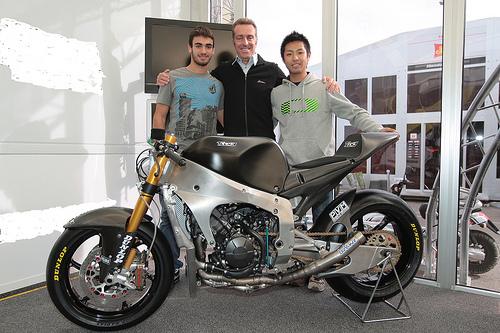
The Tech3 Team is delighted to announce that Raffaele de Rosa and Yuki Takahashi will spearhead the French squad’s exciting new Moto2 world championship project in 2010. Italian rider de Rosa joins Tech3 having emerged as one of the brightest young talents in Grand Prix racing in 2009. He finished sixth in this year’s 250cc world championship and a series of eye-catching performances earned him the coveted Rookie of the Year title. The 22-year-old joins Tech3 full of confidence and ready for the exciting challenge ahead after a stunning finish to the season saw him claim third place in Phillip Island and Valencia. Takahashi continues a long line of Japanese riders to work with Herve Poncharal’s team and follows the likes of Shinya Nakano and Makoto Tamada in riding for Tech3. The 25-year-old finished fifth in the 2008 world 250cc championship and has won two races. The Tech3 Team captured another sought after signature for its Moto2 project this week with Poncharal delighted to confirm Daniele Romagnoli will fill the role of de Rosa’s crew chief. Romagnoli brings a wealth of Grand Prix experience and knowledge to Tech3 having worked as a crew chief for Yamaha’s factory MotoGP team. Recently he worked as Jorge Lorenzo’s Team Manager in 2008 and 2009 and is relishing the prospect of playing a key role in the development of the new Tech3 Moto2 bike. Gary Reynders, who recently worked as crew chief for Colin Edwards and James Toseland in MotoGP, will move to the role of Takahashi’s crew chief. The Tech3 Team will debut its new Moto2 contender with de Rosa in Valencia at a two-day test on December 9/10. Takahashi is due to embark on a rigorous winter training regime before making his debut in early 2010. Herve Poncharal Team Manager “I am delighted that Tech3 has been able to attract such high calibre talent for our new and exciting Moto2 project. Raffaele is without doubt one of the hottest young talents we’ve seen for a long time and I am proud and excited about the prospect of working with him. I presented the Rookie of the Year award to him last weekend and he has impressed me a l ot in 2009 and I can’t wait to start working with him. I have always looked at our Moto2 team as an opportunity to develop young riders who may one day show they deserve a chance to move into MotoGP with us. I genuinely believe Raffaele has the potential to be a MotoGP rider in the future. I’m also thrilled that Yuki has joined Tech3. The French and Japanese connection at Tech3 has always worked well, particularly with Shinya Nakano, who we had a long and successful relationship with. I’ve no doubt that Yuki’s arrival will be very positive for us. He has had a lot of bad luck recently but I can see he is very determined and highly motivated to be part of our project. I’m also very happy that Daniele Romagnoli has agreed to join us. He has a top profile but more importantly he brings a lot of technical expertise and experience with him. I’ve no doubt that he will be a huge asset and his input will be vital in helping us develop the new bike.”

FIM Updates Provisional 2010 MotoGP Schedule

0

FIM Road Racing World Championship Grand Prix 2010 provisional calendar Dates Grand Prix Circuit 4/11 Losail International Circuit, Qatar * 4/25 Motegi, Japan 5/2 Jerez, Spain 5/23 Le Mans, France 6/6 Mugello, Italy 6/20 Silverstone, Great Britain 6/26 Assen, Netherlands ** 7/4 Catalunya, Spain 7/18 Sachsenring, Germany 7/25 Mazda Raceway Laguna Seca, USA *** 8/22 Brno, Czech Republic 8/29 Indianapolis Motor Speedway, USA 9/5 Misano, San Marino 9/19 Balatonring, Hungary 10/10 Sepang, Malaysia 10/17 Phillip Island, Australia 10/31 Estoril, Portugal 11/7 Valencia, Spain *: Evening Race **: Saturday ***: Only MotoGP class Reserve circuit,”Motorland Aragon Circuit”

More From The MotoGP Season Finale At Valencia

0

Valencia Grand Prix debrief with Tohru Ubukata Round 17: Valencia GP Post-race debrief Ricardo Tormo Circuit, Tuesday 10 November 2009 Bridgestone slick compounds available: Front: Soft, Medium. Rear: Medium, Hard (asymmetric) The last grand prix of the 2009 MotoGP season was won by Repsol Honda’s Dani Pedrosa. It was the second victory for the Spaniard on Bridgestone tyres, and after Ducati Team’s Casey Stoner crashed on the warm-up lap and was ruled out of the race, Pedrosa led from start to finish. The grand prix was held later this year than last and so conditions were cool, but still the harder of the available Bridgestone slicks were the favoured choice of the top four: Pedrosa, Valentino Rossi, Jorge Lorenzo and Colin Edwards. Although the top four all used the same tyre compounds, front tyre choices varied throughout the field. The top three in qualifying all lapped faster than the circuit lap record, but on Sunday the times were slower in the cooler and windy conditions. Q&A with Tohru Ubukata – Manager, Bridgestone Motorcycle Tyre Development Department What were the main challenges for the tyres during the grand prix weekend? “Valencia is not a circuit that is particularly tough on tyres in terms of abrasion and durability, but it does demand a lot from the tyre shoulders because it is so twisty. The conditions all weekend were actually quite cool too, especially with the wind, so good warm-up performance was important, and this is why we brought softer tyre compounds as these reach their optimum operating temperature faster.” We saw strong winds on all three days how did this affect the tyres? “Coupled with the already quite cool ambient temperature, the wind had a great cooling effect on the tyres, and we saw some teams on the grid using wind shields to protect the tyre warmers from the gusts to ensure the tyres reached their optimum temperature. The wind also brought dust onto the track which made the surface more slippery in places. I must say though that the biggest challenge caused by the wind was for the riders themselves, as it made it very difficult to put together a good lap whilst being buffeted by the strong gusts.” Why did we see such a mix of riders using the softer front and the harder front tyre during the race? “The track conditions and temperature were such that both the soft and the medium compound front tyres were working well so it came down to a case of rider preference and what worked best as a part of the rider, machine and tyre package. Some packages use the front tyre less hard and so could make use of the soft compound, but conversely some packages are optimised for the harder option. The soft front tyre has better warm-up performance and outright grip, whereas the medium compound offers better race distance durability and consistency.” How can you summarise tyre performance from this weekend? “We can see from the mixed front tyre choices that the performance operating ranges of both front tyre compounds were sufficiently wide as to overlap, and engineering wide operating ranges was one of our objectives this season. The times during Saturday’s qualifying session were good and the top three all lapped faster than the lap record so the performance indicators for Sunday’s race were good, but track conditions changed slightly after strong winds and light rain on Saturday night and the race pace was slightly slower. Nevertheless, Dani’s race time was almost the same as last year’s winning time, so this shows that even though laptimes were slower the overall consistency was good. Overall, I am pleased with the performance of our tyres in the last race of our first season as sole tyre supplier.”

International Motorcycle Show March 3-6 At Daytona Bike Week Will Have Free Admission

Santa Ana, Calif. Cycle World International Motorcycle Shows® announces the addition of a 12th tour stop on its nationwide tour, cruising into Ocean Center in conjunction with the 69th Annual Daytona Bike Week Wednesday, March 3 to Saturday, March 6. The final stop on this 12-city motorcycle extravaganza will offer free admission to all attendees, all show days. “We are pleased to be returning to Ocean Center after a five year hiatus as part of historic Daytona Bike Week,” said Group Show Director Jeff D’Entremont. “Daytona Bike Week is legendary amongst the biking community and we are thrilled to be able to bring all that the Cycle World International Motorcycle Shows can offer to bike week attendees for free this year making it the perfect place to host the final stop on our tour.” This hot spot for two wheeled rides will showcase the latest streetbikes, tricked-out customs, accessories and more. From gear heads to new riders, the Cycle World International Motorcycle Show is the perfect place for the public to immerse themselves in the bike culture, talk to experts, test out the latest gear and more. Additionally, this motorcycle extravaganza will pack Ocean Center with high-energy entertainment. From New York to Seattle, this motorcycle extravaganza is an all access pass to the world of motorcycling. For the 17th consecutive year, Cycle World, the world’s most popular motorcycle magazine, is the title sponsor for the series. The show will be open to the public Wednesday, March 3 through Saturday, March 6, at Ocean Center, located at 101 North Atlantic Avenue, in Daytona Beach. Show hours are Wednesday through Saturday, from 10 a.m. to 6 p.m. Admission to the event is free for all attendees. For more information, call 800/331-5706 or visit www.motorcycleshows.com.

Monday Video: Aaron Yates At Fontana–Just Say No To A DNF

0

Aaron Yates salvaged a 10th-place finish from near disaster during one of the Superbike races at Auto Club Speedway in Fontana, California last March. He managed this miracle without any front brakes and a flat front tire. Incredible. Be sure to check out other Roadracing World feature videos. Video provided by ~http://www.OnTheThrottle.tv~ and ~http://www.YouTube.com~

Monday Video: Roger Hayden From New Jersey Motorsports Park

0

OTT chatted with Roger Hayden during the 2009 AMA Pro Racing season finale at New Jersey Motorsports Park. Be sure to check out other Roadracing World feature videos. Video provided by ~http://www.OnTheThrottle.tv~ and ~http://www.YouTube.com~

CMRA Releases 2010 Schedule

0

The Central Motorcycle Roadracing Association has announced its schedule for the 2010 season. The 10-round schedule includes an 8-hour big-bike endurance race at Texas World Speedway in College Station, Texas, and 12-hour formula-mini endurance race at Oak Hill Raceway in Henderson, Texas. For more information go to www.cmraracing.com. February 19-21 Oak Hill Raceway Henderson, Texas Friday: LSTD Track Day/CMRA License School Saturday: Mini Sprints / 5 hr Mini Endurance Sunday: Big Bike Sprints March 12-14 Eagles Canyon Raceway Decatur, Texas Friday: LSTD Track Day/CMRA License School Saturday: Mini Sprints/6 hr Big Bike Endurance Sunday: Big Bike Sprints April 9-11 Texas World Speedway College Station, Texas Friday: LSTD Track Day/CMRA License School Saturday: Mini Sprints /8 hr Big Bike Endurance Sunday: Big Bike Sprints April 30 -May 2 Oak Hill Raceway Henderson, Texas Friday: LSTD Track Day/CMRA License School Saturday: 12 hr Mini Endurance Sunday: Big Bike and Mini Sprints May 28-30 Hallett Motor Racing Circuit (CCW direction) Hallett, Oklahoma Friday: LSTD Track Day/CMRA License School Saturday: Mini Sprints/ 4 hr Big Bike Endurance/3 hr Mini Endurance Sunday: Big Bike Sprints July 9-11 MotorSport Ranch (CCW direction) Cresson, Texas Friday: LSTD Track Day/CMRA License School Saturday: Mini Sprints/6 hr Big Bike Endurance Sunday: Big Bike Sprints August 6-8 Hallett Motor Racing Circuit (CW direction) Hallett, Oklahoma Friday: LSTD Track Day/CMRA License School Saturday: Mini Sprints/5 hr Big Bike Endurance/2 hr Mini Endurance Sunday: Big Bike Sprints August 28-29 Eagles Canyon Raceway Decatur, Texas Friday: LSTD Track Day/CMRA License School Saturday: Mini Sprints/5 hr Big Bike Endurance/2 hr Mini Endurance Sunday: Big Bike Sprints September 24-26 MotorSport Ranch (CW direction) Cresson, Texas Friday: LSTD Track Day/CMRA License School Saturday: Mini Sprints/4 hr Big Bike Endurance/ 3 hr Mini Endurance Sunday: Big Bike Sprints October 30-31 Texas World Speedway College Station, Texas Friday: LSTD Track Day/CMRA License School Saturday: Mini Sprints/6 hr Big Bike Endurance Sunday: Big Bike Sprints

Ducati Launches New 2010 Model Range

0

DUCATI PRESENTS 2010 INNOVATIONS FINALLY UNVEILED, WORLD PREVIEW OF THE NEW AND EAGERLY ANTICIPATED MULTISTRADA 1200. ALSO NEW FOR 2010: NEW “CORSE” LIVERY FOR THE 1198, TWO NEW HYPERMOTARD 1000EVO MODELS AND TECHNICAL ADVANCES IN THE MONSTER FAMILY Rho (Milan), 9 November 2009 As is tradition prior to the opening of the EICMA show, Ducati has officially revealed the innovations of its 2010 product range. Dream bikes, the fruit of Italian ingenuity and creativity, and destined to become new points of reference on the international market, are ready to take the spotlight at EICMA 2009, the 67th edition of the International Motorcycle Exhibition, taking place at the Fiera Internazionale di Milano in Rho, from 10 – 15 November. Before the unveiling of the 2010 line-up, the new Ducati Corse logo was presented to the international press, an evolution of the historic brand in the form of a new graphic, following on from the launch of the new Ducati logo at last year’s EICMA show. A press conference, eagerly anticipated and rich in content, took place immediately prior to the official opening of the trade show. Gabriele Del Torchio, President of Ducati Motor Holding, met with representatives of the international media to present the company’s recent sporting and commercial results, confirming the Italian manufacturer’s strength and performance, despite the difficulties that the sector is currently experiencing. “In 2009 Ducati has faced a year of important challenges but also one of important opportunities,” stated Gabriele Del Torchio, President of Ducati, during the conference. “The challenges arrive from a market that has entered a significant worldwide slump and where the segment in which we operate could have dropped by 35% by the end of this year. In this scenario Ducati knew how best to react, so much so that our shares have continuously grown and in 2009 we will register a record share of 7.2% on a worldwide level. This result was achieved by sticking strictly to the objectives we had set ourselves, in relation to the company’s three fundamental pillars. Firstly, product, with the 2010 innovations the clearest demonstration of how we have followed an intelligent plan for continuous renewal. Then the distribution network, constantly renewed and reinforced to improve and expand the service. Thanks also to the recent opening of stores in Shanghai, Mexico City and in Vietnam, Ducati today distributes in 80 countries of the world. Last but not least, the brand. We continue to work on the recognition of our brand name, and above all, on the role that Ducati has as an ambassador of Italian style across the world, a factor that is of fundamental value to us.” Claudio Domenicali, General Director of Ducati Motor Holding, then presented the many new bikes lining-up in Ducati’s 2010 Model Year. “We are present at EICMA with a series of important innovations, in accordance with our strategic industrial plan,” declared Claudio Domenicali, Ducati’s General Director, while presenting the 2010 Model Year. “The new Multistrada 1200 provides Ducati with an important opportunity to penetrate what is, for us, a completely new market segment, with a totally innovative concept, in terms of performance, usability and technological content. Four bikes in one, with four different riding modes, traction control and electronic suspension but, most importantly, a true Ducati, in its style, design and advanced technology, derived directly from Ducati’s racing experience on tracks across the world. The Hypermotard 796 e 1100 evo, the new “Corse” liveries for the 1198 S and 1198 R, as well as countless technical and style updates, complete the 2010 line-up of which we are so proud.” The undeniable star is the eagerly awaited Ducati Multistrada 1200, already in the running to take the prize for “best bike in show.” Faithful to the original intuition, which combined sport bike technology with comfort and versatility, Ducati now extends the concept further with a brand new Multistrada 1200 designed to satisfy the demands of all motorcyclists. Ducati have designed a motorcycle to tackle all kinds of journey and road surface using technology derived from the Bologna made race bikes in MotoGP and World Superbike. A bike with no limits, that can transform itself to suit the rider’s demands, from a supersport to a tourer for long journeys with a passenger and luggage, to an everyday bike which can breeze through the daily commute and also tackle off-road routes with the agility of an enduro; in other words, four bikes in one! Ducati have once again pushed the limits of motorcycle design by adding Italian innovation to the elegance, style and technology which characterise the motorcycles that leave the Bologna factory. All it needed was a heart, the perfect engine to fulfill the potential of this new design. The obvious starting point was the World Championship-winning engine, the Testastretta, used on the Superbike 1198. Engineers in Bologna have succeeded in harnessing the immense power of this engine, making it smooth and adaptable to any situation. The new Testastretta 11° engine is thus born, and represents a milestone in combining performance with usability. 2010 Special Editions celebrate the historic Ducati Corse logo change and two world titles in Superbike and Superstock. The 1198 S Corse Special Edition and 1198 R Corse Special Edition, both equipped with factory team-style aluminium fuel tanks, Ducati Traction Control and a special celebratory Ducati Corse livery, now complement the lightweight and agile 848 now in Dark colour scheme, the awesomely powerful 1198, and the high-spec 1198 S to complete the 2010 Superbike model line-up. There are more exciting new products in the Ducati Hypermotard range that now becomes a fully-fledged family of bikes in 2010. No longer just one, but three versions, designed to suit different needs, but each with the same specific objective: to provide excitement and fun. So here is the new, agile Hypermotard 796, which joins the new and even more powerful Hypermotard 1100EVO as well as the extreme version, the as yet unseen Hypermotard 1100 EVO SP. Hot on the heels of its early model year 2010 launch in October, the lightweight 796 is now joined by an evolution of the 1100 model that rolls out at an incredible 7kg (15.5lb) lighter and 5hp more powerful than the original. And if further weight reduction and more punch wasn’t already enough on a bike that was built to thrill, the Hypermotard 1100EVO SP pushes the limits even further with a model intended to perform on the track as well as the street. The exciting introduction to the Monster family for 2010 are the ABS equipped versions of the 696 and 1100 (basic and S), the first time that Ducati has ever equipped the Monster family with a safety-enhancing anti-lock braking system. Other 2010 introductions to the Monster family include new exhaust guards, which feature a longer shape and provide improved heat protection. Brand new crankcases for the 696, which are an impressive 1.2kg (2.6lb) lighter and, furthermore, the user-friendliness of the controls has been improved with 4-point adjustable clutch and brake levers to suit all hand sizes. In addition, Ducati presents many new accessories, special components and a new collection of Ducati clothing. More, from another press release issued by Ducati: DUCATI HYPERMOTARD More Hyper than ever The Hypermotard family expands for 2010 with the addition of the exciting new Hypermotard 796, the new and enhanced Hypermotard 1100EVO and the extreme Hypermotard 1100EVO SP. Hot on the heels of its early model year 2010 launch in October, the lightweight 796 is now joined by an evolution of the 1100 model that rolls out at an incredible 7kg (15.5lb) lighter and 5hp more powerful than the original. And if further weight reduction and more punch wasn’t already enough on a bike that was built to thrill, the Hypermotard 1100EVO SP pushes the limits even further with a model intended to perform on the track as well as the street. The latest evolution models, in addition to the new 796, represent Ducati’s continued excitement in the Hypermotard concept and their commitment to the family’s future development. Many features of the new models were in response to requests from Ducatisti worldwide and represent the factory’s ongoing ability to respond to direct owner feedback . The Hypermotard prototype was an instant success when first shown in Milan at the end of 2005 and soon became a top seller when its production started in 2007. Since then, its unique design has excited riders around the world and praise for this thrilling and versatile bike has never stopped and neither has its evolution. Now, the range is more Hyper than ever. So what’s all the hype for 2010? The original Hypermotard was built to thrill, with its dirtbike stance, empowering, asphalt-attacking riding position and enough torque on tap to elicit a smile with each twist of the throttle. But what could really be changed to make it better? Ducati applied their usual engineering process of evolution to an already successful model by improving it in the two most effective ways possible: Less weight and more power. Lighter Trellis frame The quick and precise handling that the Hypermotard provides is down to the construction and geometry of its famous Trellis frame. Its ability to handle the abundant torque from the L-Twin engine and its rigidity under powerful Brembo braking are just a few reasons why Ducati’s chassis department would never want to change it. But it could be made lighter. They realised that almost all of the heavy forged sections of the construction could be completely removed without reducing its strength or its performance, so they applied it to the entire family. Lighter, more powerful engines While the chassis department were busy reducing the weight of the frame, the engine department went back to the drawing board for the 796 and started with a clean sheet of paper. Their complete redesign of the crankcases rewarded them with an incredible saving of 1.2kg (2.64lb) compared to the 696 castings, and the new 796 crankshaft with 848-style flywheel further reduced the overall engine weight to an impressive 1.9kg (4.2lb) savings over the 696 power unit. And with 81hp (59.6kW) of smooth and flexible power, the 796 is a very credible package. The 1100 air-cooled Desmodue Evoluzione engine truly is an ‘evolution’ both in power and weight and is responsible for the model name extension 1100 EVO. Engineers used the same Vacural® technology employed for the lightweight Superbike engines when they vacuum die-cast the Hypermotard 1100 crankcases, a process that achieves a significant weight saving and ensures consistent wall thickness and increased strength. This process combined with the lightweight crankshaft assembly that uses an 848-style flywheel and use of lighter rare-earth magnets in the alternator reduced the 1100 power unit’s weight by a staggering 5.2kg (11.5lb). Couple those savings with a 5hp boost to 95hp (69.9kW) and it becomes clear why there’s all the hype. Compact and efficient, the Desmodue engine’s hyper-lightweight and narrow L-Twin layout, no wider than a single cylinder, ensures that all Hypermotards remain lean and agile. The air-cooled design eliminates the need for water radiators, hoses, reservoirs and pumps, keeping the motorcycle’s weight down to a minimum and its lines clean and race-like. New controls and instrumentation The entire Hypermotard family now inherits the electronic advances made in the compact and user-friendly switchgear and instrumentation first created for the Streetfighter. The slim-line switch bodies house easy-to-use switches and buttons, and feature a unique weapons-like ‘trigger catch’ that slides down to cover the starter button when the kill-switch is activated. Their minimalist design fits perfectly in the clean and essential lines of the Hypermotard’s sporting image. Looking clean and purposeful, the display provides an extensive amount of data including speed, revs, time, oil temperature, battery voltage, A & B trips, fuel reserve trip and scheduled maintenance, while the warning lights illuminate for neutral, turn signals, high-beam, rev-limit, oil pressure and fuel reserve. In addition, it can list recorded lap times by using the high-beam flash button as a stopwatch. Both the 1100EVO and 1100EVO SP use a white back-lighting while the 796 uses an orange back-lighting. The instrument display also doubles as a control panel for the activation of the Ducati Data Analyser (DDA) system, which is available as an accessory from Ducati Performance for the ‘system-ready’ Hypermotard 796 and 1100EVO and supplied as standard equipment on the 1100EVO SP. The DDA-intended USB connection port under all of the Hypermotard seats doubles as a charging point for a handy new battery charger, which is available as an accessory from Ducati Performance. Hyper mirrors Ducati pushed motorcycle design limits to find an innovative solution for the original Hypermotard mirrors and these are now used throughout the family. The challenge of maintaining a clean, racing look around the handlebar area motivated the design of the folding mirror concept which is based on the handguards typically found on off-road bikes. Flipped out for high visibility street mode and easily folded in for a quick change to ‘Hypermode’, the mirror handguard assemblies also integrate the LED directional indicators for an even cleaner front-end. Lighting and indicators The headlamp uses a highly compact lighting shape which blends with the single piece nose fairing and front fender moulding, while the rear light employs a specially designed strip of LEDs enhanced by a high diffusion lens shaped into the sleek lines of the tailpiece. The same LEDs are intensified under braking. The front directional indicators also employ the latest in LED technology for illumination, and are ingeniously integrated into the handguards which support the foldable rear view mirrors. Tailpiece The high intensity LED rear light assembly is moulded into a unique tailpiece positioned high behind the seat. The supporting structure has been designed so that the under tray of the tailpiece is formed perfectly to offer a sturdy pair of pillion grab-handles. This ingenious solution not only helps to merge the rear light into the Hypermotard styling but also provides a safe grip for the passenger. Footpegs Rider footpegs on all of the Hypermotard models have removable rubber inserts to expose the serrated metal edge and increase boot grip on the peg during extreme riding. The 1100EVO and 1100EVO SP provide a further minimalist and no-compromise feature by having removable passenger footpegs. This attention to detail enables a clean ‘monoposto’ look when on the track, while allowing a fast and easy change to ‘biposto’ for the street. DUCATI HYPERMOTARD 796 The new way to go Hyper Just as aggressively striking as the 1100, the new Hypermotard 796 features a lower seat height and brand new smooth and flexible engine to make it the perfect urban assault vehicle. Whether it’s working the daily commute or attacking the open roads, the 796 rides the common ground between manners and madness by mixing Ducati’s unrivalled twin-cylinder power and sportbike heredity with the lightweight and minimalist supermotard concept. Urban upstart The Hypermotard’s rigidly triangulated and now lighter than ever Trellis frame and track-tested chassis geometry is still stylised by a distinct high fender at the front and dual under-seat silencers at the rear, but the new 796’s overall profile says it all: Go Hyper! At 825mm (32.5in), the seat height of the 796 is a sure-footed 20mm (0.8in) lower than the 1100 and, when combined with the new engine’s smooth power delivery, this Hypermotard inspires confidence however and wherever its ridden. The upright seating position offers a commanding view of the road ahead, while the wide handlebars make the bike effortlessly flickable through the urban maze. Extreme image, accessible character The 796 has a dry weight of just 167kg (368lb), partly achieved by a lightweight engine, but also by continued chassis development that includes fork clamps, and radial fork bottoms. An improved frame layout eliminates almost all of the forged elements previously used on the Hypermotard. The lightened frame retains its torsional strength to become even more agile and easier to handle than before, while 17” wheels by Enkei are produced in lightweight aluminium to keep the unsprung weight low and handling, braking and acceleration performances high. The 796 uses exactly the same 3.50 front and 5.50 rear rim sizes and Pirelli Diablo Rosso tyres as its 1100cc big brother. Suspension duties up front are taken care of by a pair of very capable 43mm Marzocchi forks, while the rear is managed by a Sachs suspension unit featuring adjustable spring pre-load and return damping, allowing adjustments for riding style or load. The rear operates through a similar progressive link to the 1100 and uses the signature Hypermotard single-sided swingarm. Twin 305mm semi-floating discs gripped by radially mounted 4-piston Brembo callipers provide powerful and progressive front-end braking with that all-important rider-friendly ‘feeling’, while the rear is equipped with a 245mm disc and 2-piston calliper, also by Brembo. A brand new Ducati engine The 796 engine isn’t just a stroked 696 it’s a completely brand new Desmodue power unit that promises to deliver an exhilarating ride without compromising the smooth tractability found in Ducati’s other L-Twin engines. The crankshaft uses a lightweight 848-type flywheel, and spins with a 66mm stroke instead of the 696’s 57.2mm, helping to maximise power to an impressive 81hp (59.6kW) @ 8000rpm and torque to 55.7lb-ft (75.5Nm) @ 6250rpm while maintaining the smooth and enjoyable character, famous of all Desmodromic L-Twins. To protect power delivery and maintain optimum efficiency, an oil cooler similar to the 1100 is used, adding even more family resemblance to its bigger brother. Helping to increase the Hypermotard 796’s agility even further, the fully redesigned crankcases save an incredible 1.2kg (2.64lb) over the 696 castings, and are responsible for the major part of the impressive 1.9kg (4.2lb) total saving over the 696 power unit. The clutch and alternator outer casings of the new engine are finished in an 1100-style carbon grey. Breathing through a newly revised airbox intake duct and fed through 45mm throttle bodies, the 803cc swept volume is compressed to a ratio of 11:1 compared to the 696’s 10.7:1 before being injected and ignited with Siemens controlled electronics. The 2-1-2 catalytic exhaust system uses an efficient pre-silencer configuration with twin lambda probes providing finer fuel mapping and Euro3 conformity. The system’s lightweight and compact design is achieved by using 1mm thick tubing and terminates in Ducati’s trademark twin under-seat, black exhaust mufflers, stylishly contrasted with great looking aluminium end caps. An APTC ‘wet’ clutch gives a ‘slipper’ type action that prevents destabilizing of the rear-end under aggressive down-shifting and also gives the extra benefit of a super-light feel at the lever, a great benefit in stop-start city traffic or during longer journeys. The 21-plate oil-bath clutch (11 friction and 10 steel) represents a power-enhancing weight reduction over the ‘dry’ system as well as having a quieter operation and requiring less maintenance. The new Hypermotard 796 engine combines all recent advances in Ducati’s ongoing design, manufacture and production quality campaigns to offer competitive service intervals of 12,000 kilometres (or 7,500 miles). 796 controls While its motard feeling is enhanced by wide, tubular handlebars and handguards, the 796’s minimalist image is further characterised with integral construction Brembo master cylinders for both the clutch and brake systems. They maintain a clean handlebar arrangement for the rider and are fitted with user-friendly 4-point adjustable levers that provide easy-to-reach control for all hand sizes. Furthermore, the APTC clutch provides a super-light lever action ideal for use in the city. 796 in three colours The new 796 comes in an urban-style Dark finish with matte black tank and beak section, black frame and black wheels or, alternatively, matte white tank with contrasting matte black beak, black frame and black wheels. For the purists, an 1100 look-alike red tank with matching beak section, red frame and black wheels keeps the 796 in traditional livery. DUCATI HYPERMOTARD 1100EVO The introduction of the 1100EVO further enhances the original Hypermotard concept of ‘ruling the road’. The wide, tapered section handlebars continue to transfer control of the asphalt to the rider and the full length seat still eases the fore and aft movement for extreme riding. The difference now is that it does it all better than before. A new super-light dry weight of 172kg (379lb) and an increase of power to 95hp is the result of an intense program of redesigns and refinements intended to be the ‘evolution’ of the Hypermotard. Continued chassis development to the Hypermotard resulted in an improved frame layout which eliminated almost all of the heavier forged elements used on the previous model. The new rigidly triangulated Trellis frame and track-tested chassis geometry is matched by a state-of-the-art suspension. 50mm Marzocchi forks are gripped by a sturdy triple screw lower fork clamp for precise steering performance. These forks work as impressively as they look, with special high rigidity stainless steel sliders and external adjustability for compression and rebound damping, plus spring pre-load. The rear suspension performs with equal precision by using a fully adjustable ZF Sachs shock mounted to a robust single-sided swingarm. Lightweight wheels mounted on large diameter axles are fitted with Pirelli Diablo Rosso tyres. Stopping power is controlled by two radially mounted Brembo 4-piston callipers gripping lightweight 305mm twin discs up front, and a 245mm disc at the rear. All of this combines to make stopping as thrilling as accelerating. The Desmodue 1100 Evoluzione The lightweight, L-Twin stands at the pinnacle of more than three decades of Desmo air-cooled development and its torquey power delivery has excited riders worldwide. Its latest evolution is positively awesome and makes it the perfect engine to give its name to the Hypermotard 1100EVO. The 1100cc Desmodue Evoluzione power unit continues to use a bore and stroke of 98×71.5mm, but its long list of refinements have boosted its power by 5hp to 95hp (69.9kW) @ 7500rpm with 76lb-ft (10.5kgm) of torque @ 5750rpm giving it outstanding power delivery, from grunting low rpms to the singing howl at redline. The 1100’s crankcases are now vacuum cast using the same Vacural® technology employed for the lightweight Superbike engines, a process that achieves significant weight saving and ensures consistent wall thickness and increased strength. But the crankcases were just the starting point of the evolution. Apart from the new magnesium alternator cover, the 1100 now has a lighter crankshaft assembly by using an 848 Superbike flywheel and the search for further weight reduction even went as far as using lightweight rare-earth magnets for the generator assembly. The result reduced the 1100 power unit’s weight by a staggering 5.2kg (11.5lb) and contributed towards making the Hypermotard 1100EVO even more agile. Power gains have come not only from the new lightweight crankshaft assembly, but also from an evolution of the top-end of the Desmodue power unit. The cylinder head, which now has improved lubrication and cooling performance, also has a redesigned inlet port shape for optimum flow and a modified combustion chamber shape for improved burn efficiency. This improved efficiency is the result of a higher compression ratio and the change to a single spark per cylinder ignition now managed by high-speed Siemens electronics. Ensuring a sufficient feed to the higher compression set-up is an improved flow airbox intake duct and increased valve lift for maximum volumetric efficiency. The incredible valve performances of the Desmodue engine are only possible because of Ducati’s unique Desmodromic system, where valve closure is activated mechanically. At high rpm it would be almost impossible for the valve to follow the steep closure profile of the cam lobe if it were relying upon a normal valve spring. With the Desmo system, the valve is closed mechanically with the same accuracy as it is opened, enabling steep cam profiles and radical cam timings. This system is used on every single Ducati power unit including their world-beating Superbike and Desmosedici MotoGP engines. In keeping with its extreme character, Ducati continue to use the ‘dry’ racing-style clutch for the Hypermotard 1100, the popular preference of thousands of Ducatisti the world over. The clutch and alternator covers are finished in carbon grey for the 1100EVO and in gold for the 1100EVO SP. A new oil cooler with 85% more cooling area protects the increased power output of the Hypermotard 1100EVO whether ridden on the open roads or through stop-start urban traffic. Conforming to Euro3 regulations, the 2-1-2 exhaust system is now monitored by twin lambda probes to ensure the most efficient fuel injection under all conditions. The exhaust terminates with Ducati-famous twin under-seat mufflers. Having more experience and success with twin-cylinder high performance engines than any other manufacturer, the air-cooled L-Twin remains central to Ducati’s philosophy of motorcycling. This experience, plus constant investment in quality by design, advanced materials and engineering techniques, has enabled the distance between service intervals to increase to 12,000km (7,500 miles) making Ducati ownership even more enjoyable than ever. DUCATI HYPERMOTARD 1100EVO SP The Hypermotard 1100EVO SP takes the whole Hypermotard concept to a new level of extreme. Higher ground clearance, higher spec suspension, higher bars and even less weight makes the 1100EVO SP track-ready for action. When Ducati first launched the Hypermotard project they knew that there would be extreme riders out there who wanted more they just didn’t realise there would be so many! With a racing heritage built on direct rider feed-back, and two years of a Hypermotard category in the Italian Ducati Desmo Challenge series, Ducati’s reputation for listening to owners to improve their motorcycles has become legendary and the Hypermotard 1100EVO SP is no exception. Extreme riders all wanted the same thing from the Hypermotard: More power, more ground clearance, more control in extreme situations, more detail and less weight. For 2010, Ducati engineers have ticked all the boxes. SP suspension Brand new longer, black-bodied, fully adjustable 50mm Marzocchi forks have 30mm (1.2in) more travel and increase the SP’s ground clearance by 30mm (1.38in), extending the SP’s extreme cornering performance and providing a more track-oriented set-up. Coated with a durable low friction, DLC (diamond-like carbon) black coating, the sliders enable the Hypermotard ‘SP’ to respond effortlessly to every minute variation in the tarmac, improving on its already impressive road holding. The advanced ‘SP’ suspension is further enhanced with an Öhlins remote reservoir rear shock, renowned in racing as the ultimate performance choice. This incredible shock is fully adjustable for compression and rebound damping as well as spring pre-load, ensuring that the ‘SP’ is readily adaptable to every riding style and road or track it challenges. SP brakes With a bike as extreme as the Hypermotard 1100EVO SP, superior stopping power is fundamental, so world-class braking performance is assured by using the same Brembo Monobloc callipers as on Ducati’s top Superbikes. Machined from a single piece of alloy, the callipers achieve a higher rigidity and resistance to distortion during extreme braking, which not only delivers incredible braking power, but also provides an enhanced and precise ‘feel’ at the brake lever. The twin Monobloc callipers, each with four 34mm pistons gripping 305mm discs, guarantee spectacular braking performance. SP lightweight wheels by Marchesini Extreme riders know that one of the best ways to improve the handling and performance of a motorcycle is to reduce its unsprung weight by upgrading to superior lightweight wheels. Even from a distance, the 5-spoke black Marchesini wheels with red pin-striping confirm the high performance of the Hypermotard 1100EVO SP. Created from forged then machined alloy, both front and rear wheels are significantly lighter and create a lower moment of inertia and unsprung weight, resulting in improved acceleration and braking as well as quicker steering. Mounted to the lightweight wheels are Z-rated Pirelli Diablo Supercorsa SP tyres. Designed to deliver racing performance on the road, they give great feedback, are stable under severe braking and feature a sure-footed ‘feel’ when braking or accelerating is applied at considerable lean angles. SP extras The Hypermotard 1100EVO SP has serrated footpegs for increased boot grip during extreme conditions and a Teflon slider under each peg for protection in extreme lean angles. Ducati include a rubber insert with the bike for riders who prefer to cover the serration for increased comfort. To enhance control, the tapered alloy handlebars have a 20mm longer bar-riser that effectively changes the riding positioning to enable greater leverage under extreme riding conditions. The risers are finished in black along with the new Marzocchi forks, upper and lower fork clamps, footpeg carriers and pedals, exhaust guard, rear subframe and rear sprocket carrier. A carbon fibre rear hugger is fitted as standard equipment, enhancing the SP’s already extreme image and also providing protection for the Öhlins rear suspension unit. The advanced composite is also used for the fork protectors, timing belt covers, front fender rear section and tail side covers. SP colours The Hypermotard 1100EVO SP is boldly finished in a choice of red-themed or white-themed Ducati Corse livery to underline its competition intention. The white-themed livery has a white tank with thin red stripe and red Ducati graphic, contrasted with a black knee-panel area. The headlight fairing and beak section are also white with a wide red stripe along the centre of the beak and thin black striping around the fairing section. The tailpiece is white with a wide red stripe along its centre. The red-themed livery has a red tank with thin white stripe and white Ducati graphic, contrasted with a black knee-panel area. The headlight fairing and beak section are also red with a wide white stripe along the centre of the beak and thin white striping around the fairing section. The tailpiece is red with a wide white stripe along its centre. Both colour schemes have red Trellis frames with black wheels and the new Ducati Corse logo proudly displayed on the Hypermotard’s beak section. Hyper data Supplied as standard equipment on the 1100EVO SP, the Ducati Data Analyser (DDA), which includes PC software, a USB-ready data retrieval card and instructions, enables owners to review and analyse the performance of the bike and its rider, and make comparisons between various channels of information. The system records numerous channels of data including throttle opening, vehicle speed, engine rpm, engine temperature, distance travelled, laps and lap times. It also automatically calculates engine rpm and vehicle speed data, enabling it to display gear selection as an additional channel of information. At the end of a ride or track session, up to 4mb of data can be downloaded ready to compare, analyse and get an inside view of the performance of both the rider and the Hypermotard. The Hypermotard Story When the prototype Hypermotard was first shown at the Milan show it represented the creation of a new segment, one that bridged the gap between refined sportbikes and minimalist supermotards. But some at Ducati had reservations about the initial Hypermotard concept and were unsure whether or not the market was ready for such a motorcycle. Despite those reservations, the project continued to be developed, driven by the belief in the upright and in-control riding position of a dirtbike, but not the harsh characteristics of its single cylinder engine. These confident few liked the feel of a skinny, taut and agile chassis, but not the fact that its original off-road design made it a compromise on the street. They set about creating a bike that combined the agility and lightweight precision of a supermotard, with the refined power characteristics of a charismatic L-Twin Ducati sportbike. They were designing the future. As each day went past, more and more people in the factory got to hear about the completed bike and those who had the chance to catch sight of it all responded in the same way: “Wow! We’re going to produce it, right?” There was one way to gauge market response: show it at the 2005 Milan show as a prototype and conduct an online survey. Ducati presented the prototype Hypermotard as its centrepiece that year and their confidence was rewarded with a global ‘yes!’ from the public, the ‘Best of Show’ award, and demands from riders all over the world to produce it immediately. In fact, a staggering 15,000 people completed the Ducati.com survey, with more than 50% asking for the Hypermotard to be built exactly as shown at the show. But Ducati were serious when they asked the public for their feed-back and took time to sift through thousands of additional suggestions and requests, such as twin front brake discs instead of the prototype’s single, and integrated many of them into the final production design. The innovative Hypermotard spawned a new and exciting ‘cross-over’ category that had reinvented pure riding pleasure with a practical and versatile motorcycle that could be used every day. Riders hungry for excitement immediately understood the concept and have been enjoying it ever since. Quick glance history November 2005: Prototype Hypermotard 1100 shown at Milan International Motorcycle Show. Awarded ‘Best of Show’. November 2007: Production Hypermotard 1100 and 1100 S launched at Milan International Motorcycle show. June 2007: Hypermotard 1100 and 1100 S arrived in showrooms as an early release model year 2008. November 2008: Model year 2009 Hypermotard 1100 updated with an additional colour option of pearl white. Hypermotard 1100 S updated with Kayaba forks, an additional colour option of black and DDA kit supplied as standard equipment. The Hypermotard 1100 S takes victory at Pike’s Peak International Hill Climb, Colorado (1200cc category). October 2009: Release of new model year 2010 Hypermotard 796. November 2009: Model year 2010 Hypermotard 1100EVO and 1100EVO SP launched at Milan International Motorcycle show. More, from another press release issued by Ducati: MULTISTRADA 1200 THE BEGINNING ‘A new biking concept’. That was the brief given to the Ducati designers when they started work on the original Multistrada. It arrived on the market in spring of 2003 and created a new and exciting segment, typical of the Bologna manufacturer. A new vision which combined sports performance with trail-blazing capabilities while providing an extremely comfortable ride and unrivalled versatility. Initially produced with the air-cooled 1000 DS engine, which was later upgraded to 1100cc in 2006, the Multistrada immediately made a name for itself with its bold personality. Thanks to an impressive technical specification it soon became synonymous with pure riding pleasure, being equally at ease on mountain roads and motorways, ideal for long distances while agile and manageable in town. Now, Ducati have taken the concept further, with a design that satisfies all the demands of a motorcyclist combined into one bike: a Multistrada with the emphasis on Multi, a sportbike which is powerful and fun but also easy to ride and whose first priority is safety and comfort. The new Multistrada 1200 has arrived. Ducati wanted to produce a motorcycle to tackle any kind of journey and road surface, a motorcycle that used technology derived from the Bologna-made race bikes in MotoGP and World Superbike. A bike without limits, which could transform itself to suit the rider’s needs and not the other way around. A motorcycle that is four bikes in one. From a supersport to a tourer for long journeys with a passenger and luggage, to an everyday bike which could breeze through the daily commute and also tackle off-road routes with the agility of an enduro. The goal was a versatile bike able to achieve impressive levels of performance at all times and in all places. A bike that didn’t exist until now! Ducati have once again pushed the limits of motorcycle design by adding Italian innovation to the elegance, style and technology which characterises the motorcycles that come out of its Bologna factory. All it needed was a heart, the perfect engine to realise the potential of this new design. The obvious starting point was the World Championship-winning engine, the Testastretta, used on the Superbike 1198 and work started to create the perfect power characteristics for the Multistrada 1200. Engineers in Bologna have succeeded in harnessing the immense power of this engine, making it smooth and adaptable to suit to any occasion. They have created the new Testastretta 11° engine, a significant step forward in balancing performance with usability. MULTISTRADA 1200: FOUR-BIKES-IN-ONE! Four different motorcycles, available at the touch of a button, change the fundamental characteristics of the new Multistrada 1200. Power and torque delivery, suspension settings, and traction control can be changed even while riding to enable the motorcycle to adapt to the needs of the rider and not the other way around. With the Multistrada 1200, Ducati introduce the concept of four-bikes-in-one with four Riding Modes: Sport, Touring, Urban and Enduro. The Sport Riding Mode provides the rider with an adrenalin-fuelled ride, where 150hp and incredible torque delivery are combined with a sports-oriented suspension set-up. To impart precise and focussed handling like a sportbike, it also slightly reduces Ducati Traction Control intervention to level 3 for expert riders whose ‘comfort zone’ is closer to the limit. The Touring Riding Mode is still programmed to produce 150hp; however, the power characteristic is designed in a touring configuration with much smoother torque delivery, but ready to respond when needed. Safety is enhanced with the most advanced ABS technology and with the Ducati Traction Control system set to level 5 (intermediate intervention), specifically intended for a stable and relaxing ride. The suspension set-up is ideal for touring, ensuring maximum comfort for both the rider and passenger. Navigating through the urban jungle requires an even more manageable motorcycle that can be used 365 days a year, whether travelling to work or grabbing a coffee in town. Selecting the Urban Riding Mode instantly changes the power to 100hp, and the suspension to the perfect setting for tackling the maze of city streets full of speed bumps and drain covers. The traction control level is set to 7, providing high system intervention so the rider can enjoy enhanced safety even in the most chaotic of stop-start traffic. Should the journey aboard the Multistrada 1200 leave the beaten track, it has the capability to take off-road routes in its stride. Agile and lightweight and with high, wide handlebars, serrated footrests and specially designed tyres, the Multistrada also features an Enduro Riding Mode which instantly transforms the bike with a smooth 100hp engine, higher suspension, and the option to disable the ABS. Traction control is reduced to the minimum of level 1 for almost no intervention. The four-bikes-in-one concept uses three technologies which interact to instantly change the chassis set-up and character of the Multistrada 1200. Fitted as standard equipment on all versions, the electronic ride-by-wire system administers three different engine mappings to change the character of the engine, while Ducati Traction Control (DTC) uses eight levels of system interaction to enhance control. For the ‘S’ version, Ducati Electronic Suspension (DES) instantly configures the suspension set-up to suit ‘rider only’, ‘rider with luggage’, ‘rider and passenger’ or ‘rider and passenger with luggage’. RIDE-BY-WIRE The ride-by-wire system is an electronic interface between the throttle grip and the engine which decides the ideal power delivery of the engine depending on the Riding Mode selected and the rider’s throttle input. The throttle grip no longer uses a throttle cable, but instead delivers a signal to the control unit, which in turn operates the throttle body butterflies. The ride-by-wire system enables three different engine mappings to adjust the total power output and the way in which it is delivered. The three maps offer 150hp with a sports-type delivery, 150hp with a progressive delivery and 100hp also with progressive delivery. DUCATI TRACTION CONTROL (DTC) The racing-derived DTC is a highly intelligent system which acts as a filter between the rider’s right hand and the rear tyre. Within milliseconds, DTC is able to detect and then control rear wheel-spin, considerable increasing the bike’s safety and performance. The system offers eight ‘levels of sensitivity’, each programmed with a level of rear wheel-spin tolerance in line with progressive levels of riding skills classified from one to eight. Level one is programmed to offer the least amount of interaction while level eight uses the most amount of interaction. DTC is an integral part of the pre-programmed Riding Modes on the Multistrada 1200; however, its setting can be customised by the user. ÖHLINS SUSPENSION WITH DUCATI ELECTRONIC SUSPENSION (DES) The ‘S’ versions of the Multistrada 1200 are equipped with the latest generation 48mm Öhlins suspension featuring the innovative Ducati Electronic Suspension (DES). The brand new fork technology enables spring pre-load and rebound and compression damping adjustments electronically controlled via the instrument panel. The Öhlins rear monoshock is also adjusted electronically in spring pre-load and rebound and compression damping. The electronic suspension adjustment can either be made by using the pre-set riding modes, which have been developed by Ducati test riders, or in independent mode, which allows riders to use their own personal settings. Adjustments made via the instrumentation send a signal that initiates electronic actuators mounted on the suspension units. TESTASTRETTA 11° power and control, the ideal travelling companion The starting point for the complex and innovative Multistrada 1200 project was the engine. As a prestigious model the motorcycle had to be powered by the most advanced, evolved twin-cylinder engine to come out of the Ducati factory. It had to be the Testastretta Evoluzione used on the world-beating 1198. The challenge, however, was to produce an engine that would be enjoyable to use in all conditions and able to adapt to the rider’s character and not the other way around. Making the best ever L-Twin performance engine smoother and more user-friendly was indeed a challenge, but Ducati’s innovative designers and engineers met the challenge by creating the revolutionary Testastretta 11° engine. WHY 11°? For a motorcycle intended for touring, the smoothness and user-friendliness of the engine is key to achieving an effortless and comfortable ride. The main engine characteristic that enabled this configuration was the valve overlap angle. The overlap angle is defined as the interval of crankshaft rotation, measured in degrees, during which both the intake and exhaust valves are open at the same time. This overlap occurs between the end of the exhaust stroke and the start of the intake stroke. High performance engines, which are subject to compromising smoothness for extreme power delivery, use high values of this parameter in order to benefit from the pressure waves to improve engine performance by maximising volumetric efficiency. On the new Testastretta 11° engine, this angle has been reduced from 41°, used in the Testastretta Evoluzione engine which powers the 1198, to just 11°. As a result, the fresh inlet charge flow is less compromised by the exiting exhaust gases, resulting in a much smoother combustion in addition to improved fuel economy and lower exhaust emissions. Unburnt hydrocarbon emissions (pre-catalyser) are reduced by up to 65% and specific fuel consumption (and consequent CO2 emissions) by up to 15% (Euro3). With its 150hp and 12.1kgm (87.5lb-ft) of torque, the new Testastretta 11° sets a new standard for Ducati twin-cylinder engines. Tests on fluid dynamics through the ports and in the combustion chamber have resulted in a modified power delivery profile and specifically the torque. New intake and exhaust ports combined with a radical adjustment of the cam timing and slight reduction of the compression ratio have enabled Ducati to achieve a favourable torque curve at low rpm, which remains strong through a wide range. This particular characteristic considerably enhances the Multistrada 1200’s ridability. The gearbox and final drive ratios have also been optimised to enable the use of a higher-ratio 6th gear. This solution not only enables reduced fuel consumption, but also achieves increased riding comfort by reducing vibration. To give a practical example, if the 1198 reaches its top speed in 6th gear, the Multistrada 1200 is able to reach it in 5th gear and maintain it effortlessly in 6th. The Multistrada 1200 features an oil bath clutch with ‘slipper’ function and super-light feel at the lever. Its design uses a progressive self-servo mechanism that presses the plates together when under drive from the engine, enabling the reduction of the clutch spring rates. This results in a much lighter clutch lever at the handlebar, ideal in stop-start traffic or long journeys. When the drive force is reversed, the same mechanism reduces the pressure on the clutch plates, enabling them to provide a race-like ‘slipper’ action, which reduces the destabilizing effect of the rear-end under aggressive down-shifting and provides a much smoother feeling when closing the throttle or down-shifting under normal riding conditions. 189kg sets a new benchmark Constantly reducing weight is part of the design brief for all Ducati models. Less weight enables maximum performances both in terms of dynamic behaviour and safety. A lighter motorcycle will brake in a shorter distance, accelerate faster and be easier to steer. Every single component of the Multistrada 1200, therefore, has been designed to achieve weight reduction without compromising its load-bearing capacity. With a dry weight of just 189kg (417lb) the Multistrada 1200 is lighter than any other road enduro, touring or sport touring bike currently available. The light weight combined with an excellent chassis set-up ensures exceptional handling, a key factor for sports, touring, urban or enduro riding. This weight saving is the result of applying new technologies to Ducati’s design and engineering of all major components. Crankcases are now cast using Vacural® technology and frame components use welded Trellis tubes, cast alloy elements and hi-tech polymers. Further savings have also been made with the single-sided swingarm in aluminium and the fuel tank has been developed using blow moulding technology in pursuit of the best compromise between capacity and weight. Furthermore, the layout of the exhaust system, which is simple and minimalistic, uses two primary manifolds flowing directly into the triple chamber single silencer. Apart from carrying out the 2-1-2 compensator function, the silencer also contains the catalyser and sound-absorbent materials. The two compact and lightweight aluminium alloy end pipes depart in a low, lateral configuration to keep the overall weight to a minimum. ERGONOMICS AND COMFORT The Multistrada 1200 has undergone an extensive ergonomic study using both CAD and repeated prototype testing, in order to guarantee a high level of comfort with a fully loaded bike for long-range touring. The ‘ergonomics triangle’ of handlebar, seat and footpegs has been designed for both the rider and passenger, in order to optimise comfort while providing a commanding and upright riding position. The Multistrada 1200 feels spacious and seats two people in complete comfort, even with the top case and panniers in place. Underlining its multi-tasking intention, ergonomic attention was even applied when designing the riding position while standing on the footpegs, off-road style. The wide, tapered steel handlebars have been designed for maximum comfort and ensure a commanding riding position enhanced by a generous steering lock of 76° (38° left and right). In addition, the handlebars have been mounted on anti-vibration isolators, specially designed to balance riding comfort with precise road ‘feel’. The Multistrada 1200 seat immediately transmits a sense of comfort. Constructed in two separate sections for the rider and passenger, they were designed with particular focus on form and cushion density to ensure maximum comfort during long journeys. A confidence-inspiring passenger grab-handle offers a secure and comfortable grip. The footpeg position represents part of the optimum ‘ergonomics triangle’ for both the rider and passenger with added consideration to ground clearance during maximum lean angle and position of pannier luggage. The footpegs have rubber inserts that insulate vibration, removable to expose a motocross-style serrated edge that provides enhanced boot grip when riding off-road. The Multistrada 1200’s rear view mirrors have both vertical and horizontal adjustment and increased surface area to provide the most efficient visibility. Two handy onboard stowage areas are built into the motorcycle, one suitable for mobile phones or toll road tickets situated in the right cockpit side panel and a larger 3 litre area situated under the passenger seat. IDEAL FOR LONGER JOURNEYS The Multistrada 1200’s screen is designed with 60mm of vertical adjustment to ensure efficient wind protection for all rider heights and effortless high-speed riding over long distances. The fuel tank has been developed using a new moulding technology which enables a favourable balance between capacity and weight. Subject to riding style, the 20 litre (5.3 gallon US) capacity provides more than 300km (186 miles) of riding pleasure between fuel stops. Two 12V power outlets situated on either side of the area below the rider’s seat can be used to power up to 3A (fused) accessories such as thermal apparel, intercoms or mobile phone chargers. A special connection point for powering the GARMIN satellite navigator (optional feature) is situated near the instrumentation. DESIGN: “Character” of the Multistrada 1200 EXHAUST: style and sound For Ducati, design is not just creating an attractive look. It is about knowing how best to combine exciting appearance with intelligent function and outstanding performance. The Multistrada 1200’s exhaust tail pipes are a feature that perfectly demonstrates this concept. Their innovative design is well integrated with the motorcycle’s overall shape and positioned so as to improve overall weight distribution. The tailpipes are short so they do not impinge on the space needed for the large panniers. The internal structure of the silencer is designed to achieve the characteristic Ducati sound without compromising compliance with sound and hydrocarbon emission standards (Euro3). The frontal air intakes, which are carbon fibre on the ‘S’ Sport version, are not just a characteristic design aesthetic, but carry out the important function of acting as air flow conveyors, one to the oil coolers and the other to the airbox to feed the engine. The single-sided rear swingarm is also a good example of Ducati’s blend of design and functional engineering. It is made using a single piece casting, with fabricated and welded sections creating a strong, hollow and lightweight component that contributes considerably to the Multistrada’s sure-footed handling. The headlight is a characteristic feature of the face of the Multistrada 1200; its symmetrical layout uses four halogen lamps, two for low and two for high beam to provide excellent illumination. In addition, the front and rear side lights use LEDs, and feature a special shape of intense white light guidance, which both improves road illumination and makes the motorcycle more visible to other road users. CHASSIS SET-UP: frame, brakes and suspension All components used on the Multistrada 1200 are of the highest quality both in terms of design and build, and technical specification. Their selection and subsequent assembly is the result of a design brief based on uncompromised performance. Chassis geometry, such as wheelbase, swingarm length, and rake, trail and offset is the result of a quest for the best balance of stability at high speeds and dynamic agility. The chassis is designed to achieve lean angles of up to 45° and the combination of reduced weight and generous steering lock of 76° (38° left and right) makes tight manoeuvres at low speeds very easy to manage. FRAME The Ducati signature Trellis frame uses large diameter, light gauge tubing with two central cast aluminium sections and a Trellis rear subframe. The frame has 19% more torsional rigidity than the Multistrada 1100. The high pressure, die casted, magnesium front subframe reduces the high, frontal weight and contributes to chassis feel and control. Even if the front subframe is hidden below the fairing, it is precious and beautiful designed: why? Because we want our bikes to be beautiful inside as they are outside. TYRES Pirelli worked alongside Ducati as its technical partner throughout the project, developing the new Pirelli Scorpion Trail tyres specifically for the Multistrada 1200. They represent the first dual compound tyre for on/off road use with the central section of the tyre a harder compound than the outer sections. Combined with a special tread design and carcass structure, their 190/55 section delivers racing performance on the road in terms of grip and lean angles, while ensuring high mileage for touring and good off-road performance. The new generation tyres are purposely designed for the four-bikes-in-one concept. BRAKING SYSTEM The front brakes use twin radially mounted Brembo four piston, two pad callipers actuated by a master cylinder with an adjustable lever. The front is fitted with 320mm discs, while a single 245mm disc on the rear is gripped by a single Brembo calliper. Typical of all Ducatis, these components ensure high performance braking and set the standard in this segment. The Multistrada 1200 is also equipped with a Bosch-Brembo ABS system, optional for the standard version and fitted as original equipment on the ‘S’ version. It delivers outstanding braking performance in all conditions and provides a major contribution towards performance safety. An option to disable the ABS is available via the instrumentation, but is automatically reactivated at the next ignition-on. SUSPENSION The standard version Multistrada 1200 uses 50mm Marzocchi front forks, featuring a special forged fork bottom and full adjustability in spring pre-load, rebound and compression damping. The rear is controlled by a Sachs monoshock adjustable in spring pre-load, and rebound and compression damping. Both front and rear have 170mm of travel, the extra-long movement providing excellent comfort even when fully loaded and even if the rider decides to leave the asphalt for an off-road route. The ‘S’ version features the Ducati Electronic Suspension (DES) system, developed in conjunction with Öhlins. TECHNOLOGY HANDS FREE The Multistrada 1200 ignition is not actuated with a normal key. Instead, an electronic key in the rider’s pocket communicates with the Multistrada within a distance of approximately 2 metres, recognising the dedicated key code and automatically enabling the ignition. Pressing the key-on switch then activates the motorcycle’s electrics and the engine can then be started. The electronic key, which consists internally of a circuit with two radio systems, externally doubles as a mechanical flip-key, required to open the seat and fuel tank cap. When parking the motorcycle an electric steering lock, which is actuated by pressing a button, is automatically disabled upon the next ignition-on. ON-BOARD COMPUTER The on-board computer system is made up of a large, high visibility LCD with the main data and a dot-matrix circular LCD which visualises various functions according to whether the bike is stationary or moving. The main LCD displays speed, rpm, gear, total mileage, trip1/trip2, tyre pressures (as standard on the ‘S’ version Touring package), engine coolant temperature, fuel level and time. When the motorcycle is in motion, the dot-matrix LCD displays the selected riding mode, remaining fuel/distance, current fuel consumption, average fuel consumption, average speed, air temperature, trip time, and ‘freezing conditions’ alarm. When stationary, it enters a setting menu from where adjustments to the various functions can be made. The Sport, Touring, Urban or Enduro Riding Mode can be changed while either stationary or in motion, as well as the load settings for ‘rider only’, ‘rider with luggage’, ‘rider and passenger’ or ‘rider and passenger with luggage’. ‘S’ VERSION The main features of the ‘S’ version consist of the ABS system and the innovative Ducati Electronic Suspension (DES) system, developed specifically for the Multistrada 1200 by Öhlins in partnership with the Ducati engineers. The ‘S’ version is available in the two equipment options of Sport Edition and Touring Edition. SPORT EDITION The Sport Edition is enhanced with special carbon fibre components which further accentuate the distinctive character of the Multistrada 1200. They consist of front air intakes, cam belt covers, rear hugger and lateral air extractors. TOURING EDITION The Touring Edition focuses on comfort and convenience. A centre stand not only provides parking practicality, but is also essential in the event of tyre maintenance during a long distance journey. Easily connected heated grips are controlled via the instrument panel to three settings and are a must for any tour where adverse weather conditions threaten rider comfort. Stylish luggage panniers, designed together with the bike, offer a load capacity of 57 litres (or 77 litres with large lid versions) and use a fast and secure attachment system that blends perfectly when the panniers are removed. TAILOR-MADE ACCESSORIES With its wide range of potential uses and benchmark performance, Ducati decided to manage the development of some key Multistrada 1200 accessories in cooperation with both the product development and the design departments. This integration right from the start of the project has optimised both style and performance. Accessories such as the Garmin GPS system, a lower seat, panniers with capacity-increasing lids, a matching top case, an anti-theft alarm, electric filler cap, carbon fibre spray guards and front mudguard and a tyre pressure monitoring system. The current collection of accessories is in addition to those already included on the Sport and Touring Edition, which are also available individually. They include carbon fibre air intakes, cam belt covers, rear hugger and lateral air extractors, panniers, heated grips and centre stand. Garmin GPS The synergy between Ducati’s experience in the world of motorcycling and that of Garmin, the leading producer of satellite navigation systems, has led to the creation of a navigation system which offers advanced performance and perfect integration with the Multistrada 1200. Its various customisation options include the addresses of the entire official Ducati dealer network in addition to the main MotoGP and World Superbike circuits, which are pre-loaded into the system. The Ducati navigation system has an anti-glare touch screen, 18 bit LCD display, a lithium battery which remains charged for up to 8 hours, and a microSD expandable memory. It includes a mounting kit and dedicated plug-and-play cables. Low seat The lowered seat reduces height by 25mm and provides sure-footed confidence when fully loaded. Top case With 48 litres of capacity, the top case is able to hold two full-face helmets. Combined with the side panniers it provides the ideal way to pack for long journeys, or when used on its own, ideal for the daily commute. It comes with a soft cushion to provide passenger comfort with a backrest and an integrated fixing system that makes it easy to attach. When removed, its support plate acts as a practical luggage rack. Anti-theft alarm Ducati has developed an integrated anti-theft system, including movement, anti-tamper and lifting sensors, as well as a sound alarm to act as a further deterrent. Electric filler cap Thanks to the hands-free system, the Multistrada 1200 can be started without the key leaving the rider’s pocket. With the electric filler cap there is also no need to use the flip-key or remove gloves as it is opened simply by raising a tab and closed by pressing it down. At every power-down, the hands-free system allows 60 seconds for the electric filler cap to be opened. Carbon fibre spray guards From a protective part to a designer accessory the carbon fibre spray guards on the rear wheel not only carry out their traditional function but also make the bike lighter and add enduro style details. Carbon fibre front mudguard The carbon fibre front mudguard with its criss-cross pattern enhances the aggressive beauty of the front end. Tyre pressure monitoring system As well as the ABS, DTC and ride-by-wire, Ducati offers an additional safety tool. The system is made up of two sensors inserted inside the special tyre valves which communicate via the radio system inside the hands-free electronic key. This real time communication displays temperature and pressure information on the instrument panel and signals any problems. VERSIONS “¢ Standard “¢ ABS Package “¢ ‘S’ – with ABS and Öhlins suspension fitted with Ducati Electronic Suspension (DES) in Sport Edition or Touring Edition version MULTISTRADA 1200 S SPORT EDITION TOURING EDITION Carbon fiber engine covers Side Bags Carbon fiber front air intakes Heated handgrips Carbon fiber rear mudguard Center stand Carbon fiber spoilers COLOUR SCHEMES The new Multistrada 1200 will be available in the two color schemes: red or arctic white for the standard version, while the ‘S’ version will be available in red, arctic white or diamond black.


Tuesday Video: Meeting Mat Mladin’s Long-time Crew Man Reg O’Rourke

Mat Mladin retired at the end of the 2009 season after winning seven AMA Superbike Championships. One of his long-time mechanics, Reg O’Rourke, also submitted his retirement papers. Dave Williams talked to Reg at Laguna Seca to learn more about his role on the Championship team. Be sure to check out other Roadracing World feature videos. Video provided by ~http://www.OnTheThrottle.tv~ and ~http://www.YouTube.com~

Spies Fourth-Fastest On Second Day Of MotoGP Testing At Valencia

Comunitat Valenciana Grand Prix of Valencia Event: Valencia Test Day Two Date: 10th November 2009 Ambient temperature: 20 degrees C Track temperature: 23 degrees C Humidity: 30% SEASON ENDS WITH SUCCESSFUL TEST IN VALENCIA A year of hard work finally came to an end for the Fiat Yamaha Team today with the last day of testing in Valencia. Jorge Lorenzo and Valentino Rossi finished the day first and third, signing off for the winter in strong form. Both riders continued to work on the new evolution YZR-M1, as well as doing some laps on their 2009 bikes in order to compare the new updates. Lorenzo set his best lap towards the end of the day’s work and was 0.256 seconds faster than Casey Stoner, with Rossi 0.333 seconds behind the Australian. Having swept the board of trophies this season, the team will now enjoy a hard-earned break before reconvening at Sepang, Malaysia in early February for the next test. Jorge Lorenzo Position: 1st Time: 1’31.939 Laps: 62 “I am happy that we are so competitive here with this new version of the bike. I was able to do some very fast laps and it feels good to be the fastest on the last day of the season. There is a long time now until the next text and it is good for me mentally to know that I was fast today. We have worked on some electronics and the suspension, and we have compared the new chassis to the old one and taken a lot of important information for our engineers. I am so happy about my season, I’ve won three races, taken many podiums and finished second in the championship. I think this is a great achievement by us and now I would like to wish everyone a good holiday to recover so we all come back in February at the maximum ready to work again!” Valentino Rossi Position: 3rd Time: 1’32.528 Laps: 55 “I am happy about what we have so far with the new evolution of the bike, because it’s already faster and already feels better than the old one. The throttle is easier to open and I think that Yamaha has done a good job so far. We were quite fast today and I’m happy about the work we have done over these two days. I think that we have given our engineers plenty to work on over the winter and I am looking forward to the next updates in February. It’s good to finally finish work and now we have some months to relax and recharge the batteries ahead of next year, which for sure is going to be a big, big fight!” Test Times 1. Jorge Lorenzo (SPA) Fiat Yamaha Team 1’31.939 2. Casey Stoner (AUS) Ducati Marlboro Team 1’32.195 3. Valentino Rossi (ITA) Fiat Yamaha Team 1’32.528 4. Ben Spies (USA) Monster Yamaha Tech 3 1’32.942 5. Nicky Hayden (USA) Ducati Marlboro Team 1’32.981 6. Dani Pedrosa (SPA) Repsol Honda 1’33.025 7. Randy De Puniet (FRA) LCR Honda MotoGP 1’33.111 8. Mika Kallio (FIN) Pramac Racing 1’33.125 9. Loris Capirossi (ITA) Rizla Suzuki MotoGP 1’33.211 10. Marco Melandri (ITA) San Carlo Honda Gresini 1’33.326 11. Alex Espagaro (SPA) Pramac Racing 1’33.345 12. Andrea Dovizioso (ITA) Repsol Honda 1’33.456 13. Hector Barbera (SPA) Aspar Team 1’34.206 14. Marco Simoncelli (ITA) San Carlo Honda Gresini 1’34.230 15. Alvaro Bautista (SPA) Rizla Suzuki MotoGP 1’34.540 16. Hiroshi Aoyama (JPN) Scot Racing Team 1’35.261 Comunitat Valenciana: Record Lap C. Stoner (Ducati) 2008, 1’32.582 Comunitat Valenciana: Best Lap V. Rossi (Yamaha) 2006, 1’31.002 More, from a press release issued by Rizla Suzuki: Big steps for both riders at Valencia test Loris Capirossi and Álvaro Bautista continued in a positive direction during the penultimate day of testing at Valencia, as the pair made use of the improved conditions in Spain today. Capirossi (1’33.211, 58 laps) produced his quickest ever lap on a Suzuki GSV-R around the 4,005m Ricardo Tormo circuit on race tyres, as he resumed from where he left off yesterday by trying the new parts that Suzuki has supplied for this test. Capirossi tested new-spec engine parts as well as continuing the evaluation of the Akrapovic exhaust systems and some new electronic strategies. Bautista continued with his acclimatisation of the Suzuki GSV-R following his step-up in class to MotoGP. Using the same specification bike as was raced the previous weekend without any on the new parts he circulated the Spanish circuit a further 73 times today, eventually fishing with a best time of 1’34.540, over a second quicker than his fastest lap from Monday. The Rizla Suzuki pair has a further half-of-a-day of testing tomorrow morning at Valencia, which will signal Capirossi’s final outing on the GSV-R for 2009, with only Bautista travelling to Estoril next week to join Nobuatsu Aoki for a further three-day test. Loris Capirossi: “It has been a positive day because we have continued to develop the bike and we tested many different things. We tested a new engine specification and a couple of sets of pipes, as well as a different electronics system on the bike. We have improved today and the whole team is quite happy and for sure the way to go quicker is now not so far away. We have a couple more important things to try tomorrow, especially on the electronics side. I think that the condition we had in the bike today was easily the best for the whole weekend and this is why we went much better. We still need to concentrate really hard and tomorrow will be an important day as will the test next week in Portugal for Álvaro and Nobu, because we need to understand as much about the bike in these tests as possible.” Paul Denning Team Manager: “We’ve got through a lot of work today and the conditions have been quite kind so that has helped us as well. The time difference from Loris to the front guys has reduced massively compared to race-day and this has been due to a number of modifications to the bike that the factory has introduced here. The most important one of those has without doubt been the change to the engine spec, which has helped a lot with the smoothness of power delivery and the way the bike exits the corners. “Alvaro has been quietly impressive today. On every pit exit he has made 10 or 12 lap runs which have been ultra consistent and he has lifted his pace steadily all day. His bike is completely the same specification as was used in Sunday’s Grand Prix without any of the test parts Loris has been running so bearing that in mind his pace looks encouraging for the future. So far in summary it’s been a better test already than we expected and a little bit of light is on the horizon.” More, from a press release issued by Pramac Racing: KALLIO AND ESPARGARO IMPROVE THEIR LAP TIMES IN THE SECOND DAY OF TESTING IN VALENCIA Fabiano Sterlacchini – Pramac Racing Technical Director “It was a very positive day. Mika wanted to try many different technical solutions, including the aluminum swingarm, which gave positive feedbacks. It seems that Mika is better with this set-up and we will continue to work towards this tomorrow morning. Aleix is very close to Mika lap time and this shows that despite his young age he will be already competitive in his first year in the MotoGP World Championship. Tomorrow morning our riders will still have some time on this bike before switching to the new one in February at Sepang test.” Mika Kallio – Pramac Racing rider – 8th best lap time in 1.33.125 in 83 laps “We have tried aluminum swingarm and compared to yesterday we have improved by six tenths of a second. Not too bad I would say. Work with the team went ahead without any big complications, on the contrary, in addition to the swingarm we tried other small changes that lead me to feel more comfortable riding the bike. I hope that tomorrow morning I can improve more to end positively my first year in MotoGP.” Aleix Espargarò – Pramac Racing rider – 11th best lap time in 1’33.345 in 74 laps “I do not know why but despite the time recorded today is good I feel I can do better. I must be patience because I still have a lot to learn in this category. Certainly my feeling with the bike is improving lap after lap and this is the most important thing. Sincerely we are a little sad because I know this winter I will miss very much my bike, but we will return loads in February for the first test of the year.” More, from a press release issued by LCR Honda: DE PUNIET LEAVES VALENCIA CIRCUIT WITH THE 7th LAP TIME Valencia, 10 November: After Sunday’s ultimate round of the season premier class riders and team are having three additional days on-track work at Ricardo Tormo circuit. Second day of testing at the 4.005 km circuit concluded today with Lorenzo on the top of the timesheets with the best time of 1’31.939. Yesterday testing started after lunch and ended at 17:00 local time whilst today the 800cc riders have lapped from 10 am to 5 pm with ambience temperature of 21°C. The LCR Honda MotoGP Randy De Puniet, who set the ninth quickest lap time yesterday afternoon (1’33.775), completed 76 laps today aboard the LCR Honda RC212V clocking his fastest lap time of 1’33.111 (second Honda rider in the standing). The Frenchman proceeded with his machine set up tuning the Öhlins suspension and lapping with new Bridgestone rubber. The 28-year-old won’t take part to the last testing day tomorrow and will be back on track next February in Malaysia to test the 2010 spec. machine. Randy De Puniet 7th 1’33.111 De Puniet: “Yesterday we have tried to understand what happened on Sunday’s race when I struggled with rear grip issues and today we have found a good solution to that problem. We worked on Öhlins suspension new link and on the chassis geometry to make the bike more stable in the corners. I am pretty satisfied about the things we have fixed in the last two days as those data will be helpful for the 2010 machine which we are going to test in February. In two weeks time I will remove the screws from my left ankle and will keep on training to be in a good form at Sepang”. More, from a press release issued by Repsol Honda: FRUITFUL FIRST TEST CONTINUES FOR REPSOL HONDA TEAM The Repsol Honda Team today joined most of the MotoGP field at the Valencia circuit as the final test of the 2009 season continued. Staring at around 11am, both Dani Pedrosa and Andrea Dovizioso ran through a useful testing programme today and declared themselves satisfied with progress. Today’s mission for the factory Honda pair was not to pursue outright fastest laps, but instead to continue gathering data on the 2010-spec RC212V machine. While some of the riders who will not return for tomorrow morning’s test session went in search of ultimate lap times, Pedrosa and Dovizioso instead explored a diverse range of setting options. Pedrosa shaved further time from his best from yesterday and set a lap of 1m 33.088s. Dovizioso also improved his pace from yesterday, setting his fastest time on only his eighth lap out of the pits this morning. At around lunchtime Dovi was unfortunate to have a highside fall on cold tyres, but the tough Italian was able to return to the track in the afternoon and continue lapping at a good pace, despite having suffered a strong impact on the left hip which caused a small fracture. The Repsol Honda Team will return here tomorrow for a final morning of testing before finally wrapping up for the 2009 season. Dani Pedrosa – Best lap 1m 33.025s “We completed a useful day’s testing today, and although I didn’t do a huge number of laps, we covered quite a lot of ground. Some of the adjustments we were making with the machine and suspension were quite big to allow us to fully understand the new chassis, and with these kind of changes you inevitably spend quite a lot of time in the pits. Also, we weren’t going after ultimate lap times – just continuing to get familiar with the new parts and understand how settings changes affect the performance. That’s normal, and now is the time to do this work, step-by-step. Tomorrow we’ll come back here for the final session of the season.” Andrea Dovizioso – Best lap 1m 33.546s “This morning we started well. I went out with a soft tyre that I used from the day before and I did my best lap really early on – on lap eight – and I had a good feeling out there. The track conditions and temperature were better than yesterday and allowed us to get through some useful work. When we changed from soft to hard tyres, I was trying to bring them up to temperature by sliding a little bit when I highsided without warning. I’ve injured my hip a little and it’s painful – but I carried on riding and fortunately the pain is not so bad when I’m on the bike. Overall though, I was much more satisfied today – especially with the braking stability – and we’ll continue testing a few more things tomorrow, focusing on the chassis.” Valencia Test lap times – Day 2 Jorge Lorenzo Fiat Yamaha 1m 31.939 62 laps Casey Stoner Marlboro Ducati 1m 32.195 44 Valentino Rossi Fiat Yamaha 1m 32.528 55 Ben Spies Monster Yamaha 1m 32.942 61 Nicky Hayden Marlboro Ducati 1m 32.981 84 Dani Pedrosa Repsol Honda 1m 33.025 46 Randy de Puniet LCR Honda 1m 33.111 76 Mika Kallio Pramac Racing 1m 33.125 84 Loris Capirossi Rizla Suzuki 1m 33.211 64 Marco Melandri San Carlo Honda 1m 33.326 85 Aleix Espargaro Pramac Racing 1m 33.345 74 Andrea Dovizioso Repsol Honda 1m 33.546 44 Hector Barbera Aspar Team 1m 34.206 100 Marco Simoncelli San Carlo Honda 1m 34.230 79 Alvaro Bautista Rizla Suzuki 1m 34.540 74 Hiroshi Aoyama Interwetten Honda 1m 35.261 88 More, from a press release issued by Monster Yamaha Tech 3: Super Spies shines at Valencia test Ben Spies played a starring role on the second day of MotoGP testing in Valencia today, the Texan producing another confident and assured performance on his Monster Yamaha Tech 3 YZR-M1 machine. Making only his fifth appearance on board Yamaha’s YZR-M1 machine, the 25-year-old continued his seamless transition from World Superbikes to finish with the fourth quickest time. Spies again resisted the temptation to experiment with different settings today, the reigning World Superbike champion taking full advantage of improved conditions to dedicate more time on adapting his riding style to suit the YZR-M1 machine. His best la p time of 1.32.942 was 0.5s faster than his fastest pace yesterday and for the majority of today he occupied third position on the timesheets behind Jorge Lorenzo and Casey Stoner. At the end of a positive and fruitful day, Spies was only 0.414s away from reigning MotoGP world champion Valentino Rossi in his 61-lap stint. Fellow Texan Colin Edwards was unable to test today, the 35-year-old struck down by a virus overnight that forced him to undergo treatment in the Clinica Mobile for a high temperature and low blood pressure. The Monster Yamaha Tech 3 Team now starts a thoroughly deserved winter break before reconvening at the Sepang circuit in Malaysia in early February. Ben Spies 1.32.942 61 laps “I’m really happy with this test. My performance in the race surpass ed my expectations and so did the test. I didn’t touch the set-up of the bike again and continued mainly working on adapting my style. I feel like I made a lot of progress. My data guy could see on the computer that I was riding with more of a MotoGP style and each day I’ve made steps and gained confidence with the tyres. At the end I put on some tyres that had half race distance on them, but I was still able to lap half-a-second faster than yesterday. And where I was running 34’1s in the race I could get into low 33s consistently today. I’ve been making small steps but I’m a lot closer to the front than the back, so that is a good sign. I’ve enjoyed working with my new guys at Monster Yamaha Tech 3. It has been a tough year but a great year for me and I’m looking forward to the winter, training hard and being ready to go again in February.” Colin Edwards “I woke up this morn ing at 5am and felt horrendous. I felt completely drained of all my energy. I thought I’d got food poisoning and I knew then I wasn’t going to be able to ride today. But the Clinica Mobile guys said I’d got a virus and I’ve just been lying in bed all day. It obviously wasn’t the way I wanted to end the year but I’m looking forward to a long break now and coming back strong for 2010. I’ve had another great season with the Monster Yamaha Tech 3 Team and would like to thank all my guys again for their hard work. They are an awesome bunch. And looking at the times today, Ben has done a great job. He’s not only showed what a fast learner he is, but how talented he is. There should be a good bit of friendly Texan rivalry in 2010 and I can’t wait.” More, from a press release issued by Honda: Valencia test 10.11.2009. Day two of three day MotoGP test session: Weather: sunny and cool Ambient temperature: + – 20 degrees Track temperature: + – 30 degrees Pedrosa and Dovizioso take a ‘Step by Step’ approach to testing the 2010 RC212V When the MotoGP riders arrived at the track for the second day of the planned three-day test they were pleased to find track and weather conditions were much improved on yesterdays cool and blustery experience at the 4.005 km grand prix venue. The warmer track top temperatures was reflected by the lap times with all six Honda RC212V riders improving their pace, albeit to varying degrees. The Repsol Honda factory team riders, Dani Pedrosa and Andrea Dovizioso, put in a day of step by step evaluation of the 2010 RC212V both men content with the progress made. Pedrosa concentrated on basic machine set up and working with the Ohlins suspension he is testing for the first time in combination with Bridgestone tyres. The young Spaniard did not chase fast lap times preferring to establish a good feeling with the new machine. Dovizioso was up to pace quickly and set his fastest time of the day on his eighth lap using soft compound Bridgestone tyres. When he went out on the harder compound rubber the Italian was high-sided from the RCV injuring his left hip. Despite a small fracture Dovi continued testing ending the day satisfied overall with the efforts he and the team put in today. He was particularly pleased with the improved machine stability under braking, one of the difficulties he had wrestled with during the 2009 campaign. San Carlo Gresini Honda new boys Marco Melandri and Marco Simoncelli both announced themselves satisfied with the progress made. Melandri spent the majority of his day improving traction and general feedback from the Bridgestone tyres. Simoncelli grew in confidence as the day wore on making it easier for him to master the 800cc four-stroke. The young Italian was riding with Bridgestone tyres for the first time and his burgeoning confidence was obvious from his body language and his improved his lap times. LCR Honda teamster Randy De Puniet continued working with the Ohlins suspension today in combination with the latest development tyres from Bridgestone. The Frenchman was satisfied with the test results and decided against testing tomorrow. De Puniet was also confident that the team technicians had gleaned sufficient data from the two days of testing that will benefit them when they test the 2010 version of RC212V for the first time at Sepang, Malaysia, in February next year. Hiro Aoyama (Interwetten Honda) put in a marathon stint today the 2009 250cc World Champion completing 88-laps of the tortuous Valencia circuit. With no previous MotoGP experience, and little time aboard a four-stroke race machine Aoyama is aware that he has a long hard task ahead of him if he is to e ready for the start of the 2010 season. Laps, laps and more laps is the only way to learn and he has learned a lot during today’s session and slashed 2.5s off his best lap time of yesterday! The three-day test ends tomorrow with the teams reconvening at Sepang in February for the first test session of 2010. Rider quotes and lap times: Dani Pedrosa, Repsol Honda: 6th 1m 33.025s, 46 laps. “We completed a useful day’s testing today, and although I didn’t do a huge number of laps, we covered quite a lot of ground. Some of the adjustments we were making with the machine and suspension were quite big to allow us to fully understand the new chassis, and with these kind of changes you inevitably spend quite a lot of time in the pits. Also, we weren’t going after ultimate lap times – just continuing to get familiar with the new parts and understand how settings changes affect the performance. That’s normal, and now is the time to do this work, step-by-step. Tomorrow we’ll come back here for the final session of the season.” Andrea Dovizioso, Repsol Honda: 12th 1m 33.546s, 44 laps. “This morning we started well. I went out with a soft tyre that I used from the day before and I did my best lap really early on – on lap eight – and I had a good feeling out there. The track conditions and temperature were better than yesterday and allowed us to get through some useful work. When we changed from soft to hard tyres, I was trying to bring them up to temperature by sliding a little bit when I high-sided without warning. I’ve injured my hip a little and it’s painful – but I carried on riding and fortunately the pain is not so bad when I’m on the bike. Overall though, I was much more satisfied today – especially with the braking stability – and we’ll continue testing a few more things tomorrow, focusing on the chassis.” Marco Melandri, San Carlo Honda Gresini: 10th 1m 33.326s, 85 laps. “I’m satisfied of today’s work even if we are still not so fast on the single lap time. For me this is a complete new machine to the one I used in 2007 and it is important to understand it. Today I could improve my pace and I did my best lap time with a tyre that had many laps, this makes me confident. Today we tested some solutions to improve the traction and the feeling with the tyres. We are working in the right direction. Tomorrow we have in mind some solutions also to use better the soft tyre as today I used one but I kind of spoiled it because at that moment I didn’t have the best set up.” Marco Simoncelli, San Carlo Honda Gresini: 14th 1m 34.230s, 79 laps. “Today the confidence with the bike improved as yesterday everything was new for me and I was riding more carefully. For sure we have a lot of work to do ahead us but today I could lap faster and things came easier. Yesterday I struggled to feel the front while today I had more confidence thanks to the set up modifications and my improved confidence in the tyres. Today I also tried a start without the launch control and my feeling that it was a good start, my feeling was good, I don’t know from outside.” Randy de Puniet, LCR Honda: 7th 1m 33.111s, 76 laps. “Yesterday we have tried to understand what happened on Sunday’s race when I struggled with rear grip issues and today we have found a good solution to that problem. We worked on Öhlins suspension new link and on the chassis geometry to make the bike more stable in the corners. I am pretty satisfied about the things we have fixed in the last two days as those data will be helpful for the 2010 machine which we are going to test in February. In two weeks time I will remove the screws from my left ankle and will keep on training to be in a good form at Sepang”. Hiroshi Aoyama, Interwetten Honda MotoGP: 16th 1m 35.261s, 88 laps. “Today I continue testing mainly without electronics control because the priority at the moment for me is to understand the character of the bike and to adapt my riding style to the bike. I still have to get used to the carbon brakes but compared to yesterday my feeling improved. Today the track conditions were better but and I also felt more comfortable.” Session 2 – 10/11/09 Pos / Rider / Team / Fastest lap / Prev. Gap / Lead. Gap / Laps 1 / Jorge Lorenzo / Fiat Yamaha Team / 1:31.939 / – / – / 62 2 / Casey Stoner / Ducati Marlboro Team / 1:32.195 / +0.256 / +0.256 / 44 3 / Valentino Rossi / Fiat Yamaha Team / 1:32.528 / +0.333 / +0.589 / 55 4 / Ben Spies / Monster Yamaha Tech 3 / 1:32.942 / +0.414 / +1.003 / 61 5 / Nicky Hayden / Ducati Marlboro Team / 1:32.981 / +0.039 / +1.042 / 84 6 / Dani Pedrosa / Repsol Honda Team / 1:33.025 / +0.044 / +1.086 / 46 7 / Randy De Puniet / Lcr Honda MotoGP / 1:33.111 / +0.086 / +1.172 / 76 8 / Mika Kallio / Pramac Racing / 1:33.125 / +0.014 / +1.186 / 84 9 / Loris Capirossi / Rizla Suzuki MotoGP / 1:33.211 / +0.086 / +1.272 / 64 10 / Marco Melandri / San Carlo Honda Gresini / 1:33.326 / +0.115 / +1.387 / 85 11 / Aleix Espargaro / Pramac Racing / 1:33.345 / +0.019 / +1.406 / 74 12 / Andrea Dovizioso / Repsol Honda Team / 1:33.546 / +0.201 / +1.607 / 44 13 / Hector Barbera / Aspar Team / 1:34.206 / +0.660 / +2.267 / 100 14 / Marco Simoncelli / San Carlo Honda Gresini / 1:34.230 / +0.024 / +2.291 / 79 15 / Alvaro Bautista / Rizla Suzuki MotoGP / 1:34.540 / +0.310 / +2.601 / 74 16 / Hiroshi Aoyama / Scot Racing Team / 1:35.261 / +0.721 / +3.322 / 88

Tech 3 Signs de Rosa, Takahashi To Moto2 Squad

The Tech3 Team is delighted to announce that Raffaele de Rosa and Yuki Takahashi will spearhead the French squad’s exciting new Moto2 world championship project in 2010. Italian rider de Rosa joins Tech3 having emerged as one of the brightest young talents in Grand Prix racing in 2009. He finished sixth in this year’s 250cc world championship and a series of eye-catching performances earned him the coveted Rookie of the Year title. The 22-year-old joins Tech3 full of confidence and ready for the exciting challenge ahead after a stunning finish to the season saw him claim third place in Phillip Island and Valencia. Takahashi continues a long line of Japanese riders to work with Herve Poncharal’s team and follows the likes of Shinya Nakano and Makoto Tamada in riding for Tech3. The 25-year-old finished fifth in the 2008 world 250cc championship and has won two races. The Tech3 Team captured another sought after signature for its Moto2 project this week with Poncharal delighted to confirm Daniele Romagnoli will fill the role of de Rosa’s crew chief. Romagnoli brings a wealth of Grand Prix experience and knowledge to Tech3 having worked as a crew chief for Yamaha’s factory MotoGP team. Recently he worked as Jorge Lorenzo’s Team Manager in 2008 and 2009 and is relishing the prospect of playing a key role in the development of the new Tech3 Moto2 bike. Gary Reynders, who recently worked as crew chief for Colin Edwards and James Toseland in MotoGP, will move to the role of Takahashi’s crew chief. The Tech3 Team will debut its new Moto2 contender with de Rosa in Valencia at a two-day test on December 9/10. Takahashi is due to embark on a rigorous winter training regime before making his debut in early 2010. Herve Poncharal Team Manager “I am delighted that Tech3 has been able to attract such high calibre talent for our new and exciting Moto2 project. Raffaele is without doubt one of the hottest young talents we’ve seen for a long time and I am proud and excited about the prospect of working with him. I presented the Rookie of the Year award to him last weekend and he has impressed me a l ot in 2009 and I can’t wait to start working with him. I have always looked at our Moto2 team as an opportunity to develop young riders who may one day show they deserve a chance to move into MotoGP with us. I genuinely believe Raffaele has the potential to be a MotoGP rider in the future. I’m also thrilled that Yuki has joined Tech3. The French and Japanese connection at Tech3 has always worked well, particularly with Shinya Nakano, who we had a long and successful relationship with. I’ve no doubt that Yuki’s arrival will be very positive for us. He has had a lot of bad luck recently but I can see he is very determined and highly motivated to be part of our project. I’m also very happy that Daniele Romagnoli has agreed to join us. He has a top profile but more importantly he brings a lot of technical expertise and experience with him. I’ve no doubt that he will be a huge asset and his input will be vital in helping us develop the new bike.”

FIM Updates Provisional 2010 MotoGP Schedule

FIM Road Racing World Championship Grand Prix 2010 provisional calendar Dates Grand Prix Circuit 4/11 Losail International Circuit, Qatar * 4/25 Motegi, Japan 5/2 Jerez, Spain 5/23 Le Mans, France 6/6 Mugello, Italy 6/20 Silverstone, Great Britain 6/26 Assen, Netherlands ** 7/4 Catalunya, Spain 7/18 Sachsenring, Germany 7/25 Mazda Raceway Laguna Seca, USA *** 8/22 Brno, Czech Republic 8/29 Indianapolis Motor Speedway, USA 9/5 Misano, San Marino 9/19 Balatonring, Hungary 10/10 Sepang, Malaysia 10/17 Phillip Island, Australia 10/31 Estoril, Portugal 11/7 Valencia, Spain *: Evening Race **: Saturday ***: Only MotoGP class Reserve circuit,”Motorland Aragon Circuit”

More From The MotoGP Season Finale At Valencia

Valencia Grand Prix debrief with Tohru Ubukata Round 17: Valencia GP Post-race debrief Ricardo Tormo Circuit, Tuesday 10 November 2009 Bridgestone slick compounds available: Front: Soft, Medium. Rear: Medium, Hard (asymmetric) The last grand prix of the 2009 MotoGP season was won by Repsol Honda’s Dani Pedrosa. It was the second victory for the Spaniard on Bridgestone tyres, and after Ducati Team’s Casey Stoner crashed on the warm-up lap and was ruled out of the race, Pedrosa led from start to finish. The grand prix was held later this year than last and so conditions were cool, but still the harder of the available Bridgestone slicks were the favoured choice of the top four: Pedrosa, Valentino Rossi, Jorge Lorenzo and Colin Edwards. Although the top four all used the same tyre compounds, front tyre choices varied throughout the field. The top three in qualifying all lapped faster than the circuit lap record, but on Sunday the times were slower in the cooler and windy conditions. Q&A with Tohru Ubukata – Manager, Bridgestone Motorcycle Tyre Development Department What were the main challenges for the tyres during the grand prix weekend? “Valencia is not a circuit that is particularly tough on tyres in terms of abrasion and durability, but it does demand a lot from the tyre shoulders because it is so twisty. The conditions all weekend were actually quite cool too, especially with the wind, so good warm-up performance was important, and this is why we brought softer tyre compounds as these reach their optimum operating temperature faster.” We saw strong winds on all three days how did this affect the tyres? “Coupled with the already quite cool ambient temperature, the wind had a great cooling effect on the tyres, and we saw some teams on the grid using wind shields to protect the tyre warmers from the gusts to ensure the tyres reached their optimum temperature. The wind also brought dust onto the track which made the surface more slippery in places. I must say though that the biggest challenge caused by the wind was for the riders themselves, as it made it very difficult to put together a good lap whilst being buffeted by the strong gusts.” Why did we see such a mix of riders using the softer front and the harder front tyre during the race? “The track conditions and temperature were such that both the soft and the medium compound front tyres were working well so it came down to a case of rider preference and what worked best as a part of the rider, machine and tyre package. Some packages use the front tyre less hard and so could make use of the soft compound, but conversely some packages are optimised for the harder option. The soft front tyre has better warm-up performance and outright grip, whereas the medium compound offers better race distance durability and consistency.” How can you summarise tyre performance from this weekend? “We can see from the mixed front tyre choices that the performance operating ranges of both front tyre compounds were sufficiently wide as to overlap, and engineering wide operating ranges was one of our objectives this season. The times during Saturday’s qualifying session were good and the top three all lapped faster than the lap record so the performance indicators for Sunday’s race were good, but track conditions changed slightly after strong winds and light rain on Saturday night and the race pace was slightly slower. Nevertheless, Dani’s race time was almost the same as last year’s winning time, so this shows that even though laptimes were slower the overall consistency was good. Overall, I am pleased with the performance of our tyres in the last race of our first season as sole tyre supplier.”

International Motorcycle Show March 3-6 At Daytona Bike Week Will Have Free Admission

Santa Ana, Calif. Cycle World International Motorcycle Shows® announces the addition of a 12th tour stop on its nationwide tour, cruising into Ocean Center in conjunction with the 69th Annual Daytona Bike Week Wednesday, March 3 to Saturday, March 6. The final stop on this 12-city motorcycle extravaganza will offer free admission to all attendees, all show days. “We are pleased to be returning to Ocean Center after a five year hiatus as part of historic Daytona Bike Week,” said Group Show Director Jeff D’Entremont. “Daytona Bike Week is legendary amongst the biking community and we are thrilled to be able to bring all that the Cycle World International Motorcycle Shows can offer to bike week attendees for free this year making it the perfect place to host the final stop on our tour.” This hot spot for two wheeled rides will showcase the latest streetbikes, tricked-out customs, accessories and more. From gear heads to new riders, the Cycle World International Motorcycle Show is the perfect place for the public to immerse themselves in the bike culture, talk to experts, test out the latest gear and more. Additionally, this motorcycle extravaganza will pack Ocean Center with high-energy entertainment. From New York to Seattle, this motorcycle extravaganza is an all access pass to the world of motorcycling. For the 17th consecutive year, Cycle World, the world’s most popular motorcycle magazine, is the title sponsor for the series. The show will be open to the public Wednesday, March 3 through Saturday, March 6, at Ocean Center, located at 101 North Atlantic Avenue, in Daytona Beach. Show hours are Wednesday through Saturday, from 10 a.m. to 6 p.m. Admission to the event is free for all attendees. For more information, call 800/331-5706 or visit www.motorcycleshows.com.

Monday Video: Aaron Yates At Fontana–Just Say No To A DNF

Aaron Yates salvaged a 10th-place finish from near disaster during one of the Superbike races at Auto Club Speedway in Fontana, California last March. He managed this miracle without any front brakes and a flat front tire. Incredible. Be sure to check out other Roadracing World feature videos. Video provided by ~http://www.OnTheThrottle.tv~ and ~http://www.YouTube.com~

Monday Video: Roger Hayden From New Jersey Motorsports Park

OTT chatted with Roger Hayden during the 2009 AMA Pro Racing season finale at New Jersey Motorsports Park. Be sure to check out other Roadracing World feature videos. Video provided by ~http://www.OnTheThrottle.tv~ and ~http://www.YouTube.com~

CMRA Releases 2010 Schedule

The Central Motorcycle Roadracing Association has announced its schedule for the 2010 season. The 10-round schedule includes an 8-hour big-bike endurance race at Texas World Speedway in College Station, Texas, and 12-hour formula-mini endurance race at Oak Hill Raceway in Henderson, Texas. For more information go to www.cmraracing.com. February 19-21 Oak Hill Raceway Henderson, Texas Friday: LSTD Track Day/CMRA License School Saturday: Mini Sprints / 5 hr Mini Endurance Sunday: Big Bike Sprints March 12-14 Eagles Canyon Raceway Decatur, Texas Friday: LSTD Track Day/CMRA License School Saturday: Mini Sprints/6 hr Big Bike Endurance Sunday: Big Bike Sprints April 9-11 Texas World Speedway College Station, Texas Friday: LSTD Track Day/CMRA License School Saturday: Mini Sprints /8 hr Big Bike Endurance Sunday: Big Bike Sprints April 30 -May 2 Oak Hill Raceway Henderson, Texas Friday: LSTD Track Day/CMRA License School Saturday: 12 hr Mini Endurance Sunday: Big Bike and Mini Sprints May 28-30 Hallett Motor Racing Circuit (CCW direction) Hallett, Oklahoma Friday: LSTD Track Day/CMRA License School Saturday: Mini Sprints/ 4 hr Big Bike Endurance/3 hr Mini Endurance Sunday: Big Bike Sprints July 9-11 MotorSport Ranch (CCW direction) Cresson, Texas Friday: LSTD Track Day/CMRA License School Saturday: Mini Sprints/6 hr Big Bike Endurance Sunday: Big Bike Sprints August 6-8 Hallett Motor Racing Circuit (CW direction) Hallett, Oklahoma Friday: LSTD Track Day/CMRA License School Saturday: Mini Sprints/5 hr Big Bike Endurance/2 hr Mini Endurance Sunday: Big Bike Sprints August 28-29 Eagles Canyon Raceway Decatur, Texas Friday: LSTD Track Day/CMRA License School Saturday: Mini Sprints/5 hr Big Bike Endurance/2 hr Mini Endurance Sunday: Big Bike Sprints September 24-26 MotorSport Ranch (CW direction) Cresson, Texas Friday: LSTD Track Day/CMRA License School Saturday: Mini Sprints/4 hr Big Bike Endurance/ 3 hr Mini Endurance Sunday: Big Bike Sprints October 30-31 Texas World Speedway College Station, Texas Friday: LSTD Track Day/CMRA License School Saturday: Mini Sprints/6 hr Big Bike Endurance Sunday: Big Bike Sprints

Ducati Launches New 2010 Model Range

DUCATI PRESENTS 2010 INNOVATIONS FINALLY UNVEILED, WORLD PREVIEW OF THE NEW AND EAGERLY ANTICIPATED MULTISTRADA 1200. ALSO NEW FOR 2010: NEW “CORSE” LIVERY FOR THE 1198, TWO NEW HYPERMOTARD 1000EVO MODELS AND TECHNICAL ADVANCES IN THE MONSTER FAMILY Rho (Milan), 9 November 2009 As is tradition prior to the opening of the EICMA show, Ducati has officially revealed the innovations of its 2010 product range. Dream bikes, the fruit of Italian ingenuity and creativity, and destined to become new points of reference on the international market, are ready to take the spotlight at EICMA 2009, the 67th edition of the International Motorcycle Exhibition, taking place at the Fiera Internazionale di Milano in Rho, from 10 – 15 November. Before the unveiling of the 2010 line-up, the new Ducati Corse logo was presented to the international press, an evolution of the historic brand in the form of a new graphic, following on from the launch of the new Ducati logo at last year’s EICMA show. A press conference, eagerly anticipated and rich in content, took place immediately prior to the official opening of the trade show. Gabriele Del Torchio, President of Ducati Motor Holding, met with representatives of the international media to present the company’s recent sporting and commercial results, confirming the Italian manufacturer’s strength and performance, despite the difficulties that the sector is currently experiencing. “In 2009 Ducati has faced a year of important challenges but also one of important opportunities,” stated Gabriele Del Torchio, President of Ducati, during the conference. “The challenges arrive from a market that has entered a significant worldwide slump and where the segment in which we operate could have dropped by 35% by the end of this year. In this scenario Ducati knew how best to react, so much so that our shares have continuously grown and in 2009 we will register a record share of 7.2% on a worldwide level. This result was achieved by sticking strictly to the objectives we had set ourselves, in relation to the company’s three fundamental pillars. Firstly, product, with the 2010 innovations the clearest demonstration of how we have followed an intelligent plan for continuous renewal. Then the distribution network, constantly renewed and reinforced to improve and expand the service. Thanks also to the recent opening of stores in Shanghai, Mexico City and in Vietnam, Ducati today distributes in 80 countries of the world. Last but not least, the brand. We continue to work on the recognition of our brand name, and above all, on the role that Ducati has as an ambassador of Italian style across the world, a factor that is of fundamental value to us.” Claudio Domenicali, General Director of Ducati Motor Holding, then presented the many new bikes lining-up in Ducati’s 2010 Model Year. “We are present at EICMA with a series of important innovations, in accordance with our strategic industrial plan,” declared Claudio Domenicali, Ducati’s General Director, while presenting the 2010 Model Year. “The new Multistrada 1200 provides Ducati with an important opportunity to penetrate what is, for us, a completely new market segment, with a totally innovative concept, in terms of performance, usability and technological content. Four bikes in one, with four different riding modes, traction control and electronic suspension but, most importantly, a true Ducati, in its style, design and advanced technology, derived directly from Ducati’s racing experience on tracks across the world. The Hypermotard 796 e 1100 evo, the new “Corse” liveries for the 1198 S and 1198 R, as well as countless technical and style updates, complete the 2010 line-up of which we are so proud.” The undeniable star is the eagerly awaited Ducati Multistrada 1200, already in the running to take the prize for “best bike in show.” Faithful to the original intuition, which combined sport bike technology with comfort and versatility, Ducati now extends the concept further with a brand new Multistrada 1200 designed to satisfy the demands of all motorcyclists. Ducati have designed a motorcycle to tackle all kinds of journey and road surface using technology derived from the Bologna made race bikes in MotoGP and World Superbike. A bike with no limits, that can transform itself to suit the rider’s demands, from a supersport to a tourer for long journeys with a passenger and luggage, to an everyday bike which can breeze through the daily commute and also tackle off-road routes with the agility of an enduro; in other words, four bikes in one! Ducati have once again pushed the limits of motorcycle design by adding Italian innovation to the elegance, style and technology which characterise the motorcycles that leave the Bologna factory. All it needed was a heart, the perfect engine to fulfill the potential of this new design. The obvious starting point was the World Championship-winning engine, the Testastretta, used on the Superbike 1198. Engineers in Bologna have succeeded in harnessing the immense power of this engine, making it smooth and adaptable to any situation. The new Testastretta 11° engine is thus born, and represents a milestone in combining performance with usability. 2010 Special Editions celebrate the historic Ducati Corse logo change and two world titles in Superbike and Superstock. The 1198 S Corse Special Edition and 1198 R Corse Special Edition, both equipped with factory team-style aluminium fuel tanks, Ducati Traction Control and a special celebratory Ducati Corse livery, now complement the lightweight and agile 848 now in Dark colour scheme, the awesomely powerful 1198, and the high-spec 1198 S to complete the 2010 Superbike model line-up. There are more exciting new products in the Ducati Hypermotard range that now becomes a fully-fledged family of bikes in 2010. No longer just one, but three versions, designed to suit different needs, but each with the same specific objective: to provide excitement and fun. So here is the new, agile Hypermotard 796, which joins the new and even more powerful Hypermotard 1100EVO as well as the extreme version, the as yet unseen Hypermotard 1100 EVO SP. Hot on the heels of its early model year 2010 launch in October, the lightweight 796 is now joined by an evolution of the 1100 model that rolls out at an incredible 7kg (15.5lb) lighter and 5hp more powerful than the original. And if further weight reduction and more punch wasn’t already enough on a bike that was built to thrill, the Hypermotard 1100EVO SP pushes the limits even further with a model intended to perform on the track as well as the street. The exciting introduction to the Monster family for 2010 are the ABS equipped versions of the 696 and 1100 (basic and S), the first time that Ducati has ever equipped the Monster family with a safety-enhancing anti-lock braking system. Other 2010 introductions to the Monster family include new exhaust guards, which feature a longer shape and provide improved heat protection. Brand new crankcases for the 696, which are an impressive 1.2kg (2.6lb) lighter and, furthermore, the user-friendliness of the controls has been improved with 4-point adjustable clutch and brake levers to suit all hand sizes. In addition, Ducati presents many new accessories, special components and a new collection of Ducati clothing. More, from another press release issued by Ducati: DUCATI HYPERMOTARD More Hyper than ever The Hypermotard family expands for 2010 with the addition of the exciting new Hypermotard 796, the new and enhanced Hypermotard 1100EVO and the extreme Hypermotard 1100EVO SP. Hot on the heels of its early model year 2010 launch in October, the lightweight 796 is now joined by an evolution of the 1100 model that rolls out at an incredible 7kg (15.5lb) lighter and 5hp more powerful than the original. And if further weight reduction and more punch wasn’t already enough on a bike that was built to thrill, the Hypermotard 1100EVO SP pushes the limits even further with a model intended to perform on the track as well as the street. The latest evolution models, in addition to the new 796, represent Ducati’s continued excitement in the Hypermotard concept and their commitment to the family’s future development. Many features of the new models were in response to requests from Ducatisti worldwide and represent the factory’s ongoing ability to respond to direct owner feedback . The Hypermotard prototype was an instant success when first shown in Milan at the end of 2005 and soon became a top seller when its production started in 2007. Since then, its unique design has excited riders around the world and praise for this thrilling and versatile bike has never stopped and neither has its evolution. Now, the range is more Hyper than ever. So what’s all the hype for 2010? The original Hypermotard was built to thrill, with its dirtbike stance, empowering, asphalt-attacking riding position and enough torque on tap to elicit a smile with each twist of the throttle. But what could really be changed to make it better? Ducati applied their usual engineering process of evolution to an already successful model by improving it in the two most effective ways possible: Less weight and more power. Lighter Trellis frame The quick and precise handling that the Hypermotard provides is down to the construction and geometry of its famous Trellis frame. Its ability to handle the abundant torque from the L-Twin engine and its rigidity under powerful Brembo braking are just a few reasons why Ducati’s chassis department would never want to change it. But it could be made lighter. They realised that almost all of the heavy forged sections of the construction could be completely removed without reducing its strength or its performance, so they applied it to the entire family. Lighter, more powerful engines While the chassis department were busy reducing the weight of the frame, the engine department went back to the drawing board for the 796 and started with a clean sheet of paper. Their complete redesign of the crankcases rewarded them with an incredible saving of 1.2kg (2.64lb) compared to the 696 castings, and the new 796 crankshaft with 848-style flywheel further reduced the overall engine weight to an impressive 1.9kg (4.2lb) savings over the 696 power unit. And with 81hp (59.6kW) of smooth and flexible power, the 796 is a very credible package. The 1100 air-cooled Desmodue Evoluzione engine truly is an ‘evolution’ both in power and weight and is responsible for the model name extension 1100 EVO. Engineers used the same Vacural® technology employed for the lightweight Superbike engines when they vacuum die-cast the Hypermotard 1100 crankcases, a process that achieves a significant weight saving and ensures consistent wall thickness and increased strength. This process combined with the lightweight crankshaft assembly that uses an 848-style flywheel and use of lighter rare-earth magnets in the alternator reduced the 1100 power unit’s weight by a staggering 5.2kg (11.5lb). Couple those savings with a 5hp boost to 95hp (69.9kW) and it becomes clear why there’s all the hype. Compact and efficient, the Desmodue engine’s hyper-lightweight and narrow L-Twin layout, no wider than a single cylinder, ensures that all Hypermotards remain lean and agile. The air-cooled design eliminates the need for water radiators, hoses, reservoirs and pumps, keeping the motorcycle’s weight down to a minimum and its lines clean and race-like. New controls and instrumentation The entire Hypermotard family now inherits the electronic advances made in the compact and user-friendly switchgear and instrumentation first created for the Streetfighter. The slim-line switch bodies house easy-to-use switches and buttons, and feature a unique weapons-like ‘trigger catch’ that slides down to cover the starter button when the kill-switch is activated. Their minimalist design fits perfectly in the clean and essential lines of the Hypermotard’s sporting image. Looking clean and purposeful, the display provides an extensive amount of data including speed, revs, time, oil temperature, battery voltage, A & B trips, fuel reserve trip and scheduled maintenance, while the warning lights illuminate for neutral, turn signals, high-beam, rev-limit, oil pressure and fuel reserve. In addition, it can list recorded lap times by using the high-beam flash button as a stopwatch. Both the 1100EVO and 1100EVO SP use a white back-lighting while the 796 uses an orange back-lighting. The instrument display also doubles as a control panel for the activation of the Ducati Data Analyser (DDA) system, which is available as an accessory from Ducati Performance for the ‘system-ready’ Hypermotard 796 and 1100EVO and supplied as standard equipment on the 1100EVO SP. The DDA-intended USB connection port under all of the Hypermotard seats doubles as a charging point for a handy new battery charger, which is available as an accessory from Ducati Performance. Hyper mirrors Ducati pushed motorcycle design limits to find an innovative solution for the original Hypermotard mirrors and these are now used throughout the family. The challenge of maintaining a clean, racing look around the handlebar area motivated the design of the folding mirror concept which is based on the handguards typically found on off-road bikes. Flipped out for high visibility street mode and easily folded in for a quick change to ‘Hypermode’, the mirror handguard assemblies also integrate the LED directional indicators for an even cleaner front-end. Lighting and indicators The headlamp uses a highly compact lighting shape which blends with the single piece nose fairing and front fender moulding, while the rear light employs a specially designed strip of LEDs enhanced by a high diffusion lens shaped into the sleek lines of the tailpiece. The same LEDs are intensified under braking. The front directional indicators also employ the latest in LED technology for illumination, and are ingeniously integrated into the handguards which support the foldable rear view mirrors. Tailpiece The high intensity LED rear light assembly is moulded into a unique tailpiece positioned high behind the seat. The supporting structure has been designed so that the under tray of the tailpiece is formed perfectly to offer a sturdy pair of pillion grab-handles. This ingenious solution not only helps to merge the rear light into the Hypermotard styling but also provides a safe grip for the passenger. Footpegs Rider footpegs on all of the Hypermotard models have removable rubber inserts to expose the serrated metal edge and increase boot grip on the peg during extreme riding. The 1100EVO and 1100EVO SP provide a further minimalist and no-compromise feature by having removable passenger footpegs. This attention to detail enables a clean ‘monoposto’ look when on the track, while allowing a fast and easy change to ‘biposto’ for the street. DUCATI HYPERMOTARD 796 The new way to go Hyper Just as aggressively striking as the 1100, the new Hypermotard 796 features a lower seat height and brand new smooth and flexible engine to make it the perfect urban assault vehicle. Whether it’s working the daily commute or attacking the open roads, the 796 rides the common ground between manners and madness by mixing Ducati’s unrivalled twin-cylinder power and sportbike heredity with the lightweight and minimalist supermotard concept. Urban upstart The Hypermotard’s rigidly triangulated and now lighter than ever Trellis frame and track-tested chassis geometry is still stylised by a distinct high fender at the front and dual under-seat silencers at the rear, but the new 796’s overall profile says it all: Go Hyper! At 825mm (32.5in), the seat height of the 796 is a sure-footed 20mm (0.8in) lower than the 1100 and, when combined with the new engine’s smooth power delivery, this Hypermotard inspires confidence however and wherever its ridden. The upright seating position offers a commanding view of the road ahead, while the wide handlebars make the bike effortlessly flickable through the urban maze. Extreme image, accessible character The 796 has a dry weight of just 167kg (368lb), partly achieved by a lightweight engine, but also by continued chassis development that includes fork clamps, and radial fork bottoms. An improved frame layout eliminates almost all of the forged elements previously used on the Hypermotard. The lightened frame retains its torsional strength to become even more agile and easier to handle than before, while 17” wheels by Enkei are produced in lightweight aluminium to keep the unsprung weight low and handling, braking and acceleration performances high. The 796 uses exactly the same 3.50 front and 5.50 rear rim sizes and Pirelli Diablo Rosso tyres as its 1100cc big brother. Suspension duties up front are taken care of by a pair of very capable 43mm Marzocchi forks, while the rear is managed by a Sachs suspension unit featuring adjustable spring pre-load and return damping, allowing adjustments for riding style or load. The rear operates through a similar progressive link to the 1100 and uses the signature Hypermotard single-sided swingarm. Twin 305mm semi-floating discs gripped by radially mounted 4-piston Brembo callipers provide powerful and progressive front-end braking with that all-important rider-friendly ‘feeling’, while the rear is equipped with a 245mm disc and 2-piston calliper, also by Brembo. A brand new Ducati engine The 796 engine isn’t just a stroked 696 it’s a completely brand new Desmodue power unit that promises to deliver an exhilarating ride without compromising the smooth tractability found in Ducati’s other L-Twin engines. The crankshaft uses a lightweight 848-type flywheel, and spins with a 66mm stroke instead of the 696’s 57.2mm, helping to maximise power to an impressive 81hp (59.6kW) @ 8000rpm and torque to 55.7lb-ft (75.5Nm) @ 6250rpm while maintaining the smooth and enjoyable character, famous of all Desmodromic L-Twins. To protect power delivery and maintain optimum efficiency, an oil cooler similar to the 1100 is used, adding even more family resemblance to its bigger brother. Helping to increase the Hypermotard 796’s agility even further, the fully redesigned crankcases save an incredible 1.2kg (2.64lb) over the 696 castings, and are responsible for the major part of the impressive 1.9kg (4.2lb) total saving over the 696 power unit. The clutch and alternator outer casings of the new engine are finished in an 1100-style carbon grey. Breathing through a newly revised airbox intake duct and fed through 45mm throttle bodies, the 803cc swept volume is compressed to a ratio of 11:1 compared to the 696’s 10.7:1 before being injected and ignited with Siemens controlled electronics. The 2-1-2 catalytic exhaust system uses an efficient pre-silencer configuration with twin lambda probes providing finer fuel mapping and Euro3 conformity. The system’s lightweight and compact design is achieved by using 1mm thick tubing and terminates in Ducati’s trademark twin under-seat, black exhaust mufflers, stylishly contrasted with great looking aluminium end caps. An APTC ‘wet’ clutch gives a ‘slipper’ type action that prevents destabilizing of the rear-end under aggressive down-shifting and also gives the extra benefit of a super-light feel at the lever, a great benefit in stop-start city traffic or during longer journeys. The 21-plate oil-bath clutch (11 friction and 10 steel) represents a power-enhancing weight reduction over the ‘dry’ system as well as having a quieter operation and requiring less maintenance. The new Hypermotard 796 engine combines all recent advances in Ducati’s ongoing design, manufacture and production quality campaigns to offer competitive service intervals of 12,000 kilometres (or 7,500 miles). 796 controls While its motard feeling is enhanced by wide, tubular handlebars and handguards, the 796’s minimalist image is further characterised with integral construction Brembo master cylinders for both the clutch and brake systems. They maintain a clean handlebar arrangement for the rider and are fitted with user-friendly 4-point adjustable levers that provide easy-to-reach control for all hand sizes. Furthermore, the APTC clutch provides a super-light lever action ideal for use in the city. 796 in three colours The new 796 comes in an urban-style Dark finish with matte black tank and beak section, black frame and black wheels or, alternatively, matte white tank with contrasting matte black beak, black frame and black wheels. For the purists, an 1100 look-alike red tank with matching beak section, red frame and black wheels keeps the 796 in traditional livery. DUCATI HYPERMOTARD 1100EVO The introduction of the 1100EVO further enhances the original Hypermotard concept of ‘ruling the road’. The wide, tapered section handlebars continue to transfer control of the asphalt to the rider and the full length seat still eases the fore and aft movement for extreme riding. The difference now is that it does it all better than before. A new super-light dry weight of 172kg (379lb) and an increase of power to 95hp is the result of an intense program of redesigns and refinements intended to be the ‘evolution’ of the Hypermotard. Continued chassis development to the Hypermotard resulted in an improved frame layout which eliminated almost all of the heavier forged elements used on the previous model. The new rigidly triangulated Trellis frame and track-tested chassis geometry is matched by a state-of-the-art suspension. 50mm Marzocchi forks are gripped by a sturdy triple screw lower fork clamp for precise steering performance. These forks work as impressively as they look, with special high rigidity stainless steel sliders and external adjustability for compression and rebound damping, plus spring pre-load. The rear suspension performs with equal precision by using a fully adjustable ZF Sachs shock mounted to a robust single-sided swingarm. Lightweight wheels mounted on large diameter axles are fitted with Pirelli Diablo Rosso tyres. Stopping power is controlled by two radially mounted Brembo 4-piston callipers gripping lightweight 305mm twin discs up front, and a 245mm disc at the rear. All of this combines to make stopping as thrilling as accelerating. The Desmodue 1100 Evoluzione The lightweight, L-Twin stands at the pinnacle of more than three decades of Desmo air-cooled development and its torquey power delivery has excited riders worldwide. Its latest evolution is positively awesome and makes it the perfect engine to give its name to the Hypermotard 1100EVO. The 1100cc Desmodue Evoluzione power unit continues to use a bore and stroke of 98×71.5mm, but its long list of refinements have boosted its power by 5hp to 95hp (69.9kW) @ 7500rpm with 76lb-ft (10.5kgm) of torque @ 5750rpm giving it outstanding power delivery, from grunting low rpms to the singing howl at redline. The 1100’s crankcases are now vacuum cast using the same Vacural® technology employed for the lightweight Superbike engines, a process that achieves significant weight saving and ensures consistent wall thickness and increased strength. But the crankcases were just the starting point of the evolution. Apart from the new magnesium alternator cover, the 1100 now has a lighter crankshaft assembly by using an 848 Superbike flywheel and the search for further weight reduction even went as far as using lightweight rare-earth magnets for the generator assembly. The result reduced the 1100 power unit’s weight by a staggering 5.2kg (11.5lb) and contributed towards making the Hypermotard 1100EVO even more agile. Power gains have come not only from the new lightweight crankshaft assembly, but also from an evolution of the top-end of the Desmodue power unit. The cylinder head, which now has improved lubrication and cooling performance, also has a redesigned inlet port shape for optimum flow and a modified combustion chamber shape for improved burn efficiency. This improved efficiency is the result of a higher compression ratio and the change to a single spark per cylinder ignition now managed by high-speed Siemens electronics. Ensuring a sufficient feed to the higher compression set-up is an improved flow airbox intake duct and increased valve lift for maximum volumetric efficiency. The incredible valve performances of the Desmodue engine are only possible because of Ducati’s unique Desmodromic system, where valve closure is activated mechanically. At high rpm it would be almost impossible for the valve to follow the steep closure profile of the cam lobe if it were relying upon a normal valve spring. With the Desmo system, the valve is closed mechanically with the same accuracy as it is opened, enabling steep cam profiles and radical cam timings. This system is used on every single Ducati power unit including their world-beating Superbike and Desmosedici MotoGP engines. In keeping with its extreme character, Ducati continue to use the ‘dry’ racing-style clutch for the Hypermotard 1100, the popular preference of thousands of Ducatisti the world over. The clutch and alternator covers are finished in carbon grey for the 1100EVO and in gold for the 1100EVO SP. A new oil cooler with 85% more cooling area protects the increased power output of the Hypermotard 1100EVO whether ridden on the open roads or through stop-start urban traffic. Conforming to Euro3 regulations, the 2-1-2 exhaust system is now monitored by twin lambda probes to ensure the most efficient fuel injection under all conditions. The exhaust terminates with Ducati-famous twin under-seat mufflers. Having more experience and success with twin-cylinder high performance engines than any other manufacturer, the air-cooled L-Twin remains central to Ducati’s philosophy of motorcycling. This experience, plus constant investment in quality by design, advanced materials and engineering techniques, has enabled the distance between service intervals to increase to 12,000km (7,500 miles) making Ducati ownership even more enjoyable than ever. DUCATI HYPERMOTARD 1100EVO SP The Hypermotard 1100EVO SP takes the whole Hypermotard concept to a new level of extreme. Higher ground clearance, higher spec suspension, higher bars and even less weight makes the 1100EVO SP track-ready for action. When Ducati first launched the Hypermotard project they knew that there would be extreme riders out there who wanted more they just didn’t realise there would be so many! With a racing heritage built on direct rider feed-back, and two years of a Hypermotard category in the Italian Ducati Desmo Challenge series, Ducati’s reputation for listening to owners to improve their motorcycles has become legendary and the Hypermotard 1100EVO SP is no exception. Extreme riders all wanted the same thing from the Hypermotard: More power, more ground clearance, more control in extreme situations, more detail and less weight. For 2010, Ducati engineers have ticked all the boxes. SP suspension Brand new longer, black-bodied, fully adjustable 50mm Marzocchi forks have 30mm (1.2in) more travel and increase the SP’s ground clearance by 30mm (1.38in), extending the SP’s extreme cornering performance and providing a more track-oriented set-up. Coated with a durable low friction, DLC (diamond-like carbon) black coating, the sliders enable the Hypermotard ‘SP’ to respond effortlessly to every minute variation in the tarmac, improving on its already impressive road holding. The advanced ‘SP’ suspension is further enhanced with an Öhlins remote reservoir rear shock, renowned in racing as the ultimate performance choice. This incredible shock is fully adjustable for compression and rebound damping as well as spring pre-load, ensuring that the ‘SP’ is readily adaptable to every riding style and road or track it challenges. SP brakes With a bike as extreme as the Hypermotard 1100EVO SP, superior stopping power is fundamental, so world-class braking performance is assured by using the same Brembo Monobloc callipers as on Ducati’s top Superbikes. Machined from a single piece of alloy, the callipers achieve a higher rigidity and resistance to distortion during extreme braking, which not only delivers incredible braking power, but also provides an enhanced and precise ‘feel’ at the brake lever. The twin Monobloc callipers, each with four 34mm pistons gripping 305mm discs, guarantee spectacular braking performance. SP lightweight wheels by Marchesini Extreme riders know that one of the best ways to improve the handling and performance of a motorcycle is to reduce its unsprung weight by upgrading to superior lightweight wheels. Even from a distance, the 5-spoke black Marchesini wheels with red pin-striping confirm the high performance of the Hypermotard 1100EVO SP. Created from forged then machined alloy, both front and rear wheels are significantly lighter and create a lower moment of inertia and unsprung weight, resulting in improved acceleration and braking as well as quicker steering. Mounted to the lightweight wheels are Z-rated Pirelli Diablo Supercorsa SP tyres. Designed to deliver racing performance on the road, they give great feedback, are stable under severe braking and feature a sure-footed ‘feel’ when braking or accelerating is applied at considerable lean angles. SP extras The Hypermotard 1100EVO SP has serrated footpegs for increased boot grip during extreme conditions and a Teflon slider under each peg for protection in extreme lean angles. Ducati include a rubber insert with the bike for riders who prefer to cover the serration for increased comfort. To enhance control, the tapered alloy handlebars have a 20mm longer bar-riser that effectively changes the riding positioning to enable greater leverage under extreme riding conditions. The risers are finished in black along with the new Marzocchi forks, upper and lower fork clamps, footpeg carriers and pedals, exhaust guard, rear subframe and rear sprocket carrier. A carbon fibre rear hugger is fitted as standard equipment, enhancing the SP’s already extreme image and also providing protection for the Öhlins rear suspension unit. The advanced composite is also used for the fork protectors, timing belt covers, front fender rear section and tail side covers. SP colours The Hypermotard 1100EVO SP is boldly finished in a choice of red-themed or white-themed Ducati Corse livery to underline its competition intention. The white-themed livery has a white tank with thin red stripe and red Ducati graphic, contrasted with a black knee-panel area. The headlight fairing and beak section are also white with a wide red stripe along the centre of the beak and thin black striping around the fairing section. The tailpiece is white with a wide red stripe along its centre. The red-themed livery has a red tank with thin white stripe and white Ducati graphic, contrasted with a black knee-panel area. The headlight fairing and beak section are also red with a wide white stripe along the centre of the beak and thin white striping around the fairing section. The tailpiece is red with a wide white stripe along its centre. Both colour schemes have red Trellis frames with black wheels and the new Ducati Corse logo proudly displayed on the Hypermotard’s beak section. Hyper data Supplied as standard equipment on the 1100EVO SP, the Ducati Data Analyser (DDA), which includes PC software, a USB-ready data retrieval card and instructions, enables owners to review and analyse the performance of the bike and its rider, and make comparisons between various channels of information. The system records numerous channels of data including throttle opening, vehicle speed, engine rpm, engine temperature, distance travelled, laps and lap times. It also automatically calculates engine rpm and vehicle speed data, enabling it to display gear selection as an additional channel of information. At the end of a ride or track session, up to 4mb of data can be downloaded ready to compare, analyse and get an inside view of the performance of both the rider and the Hypermotard. The Hypermotard Story When the prototype Hypermotard was first shown at the Milan show it represented the creation of a new segment, one that bridged the gap between refined sportbikes and minimalist supermotards. But some at Ducati had reservations about the initial Hypermotard concept and were unsure whether or not the market was ready for such a motorcycle. Despite those reservations, the project continued to be developed, driven by the belief in the upright and in-control riding position of a dirtbike, but not the harsh characteristics of its single cylinder engine. These confident few liked the feel of a skinny, taut and agile chassis, but not the fact that its original off-road design made it a compromise on the street. They set about creating a bike that combined the agility and lightweight precision of a supermotard, with the refined power characteristics of a charismatic L-Twin Ducati sportbike. They were designing the future. As each day went past, more and more people in the factory got to hear about the completed bike and those who had the chance to catch sight of it all responded in the same way: “Wow! We’re going to produce it, right?” There was one way to gauge market response: show it at the 2005 Milan show as a prototype and conduct an online survey. Ducati presented the prototype Hypermotard as its centrepiece that year and their confidence was rewarded with a global ‘yes!’ from the public, the ‘Best of Show’ award, and demands from riders all over the world to produce it immediately. In fact, a staggering 15,000 people completed the Ducati.com survey, with more than 50% asking for the Hypermotard to be built exactly as shown at the show. But Ducati were serious when they asked the public for their feed-back and took time to sift through thousands of additional suggestions and requests, such as twin front brake discs instead of the prototype’s single, and integrated many of them into the final production design. The innovative Hypermotard spawned a new and exciting ‘cross-over’ category that had reinvented pure riding pleasure with a practical and versatile motorcycle that could be used every day. Riders hungry for excitement immediately understood the concept and have been enjoying it ever since. Quick glance history November 2005: Prototype Hypermotard 1100 shown at Milan International Motorcycle Show. Awarded ‘Best of Show’. November 2007: Production Hypermotard 1100 and 1100 S launched at Milan International Motorcycle show. June 2007: Hypermotard 1100 and 1100 S arrived in showrooms as an early release model year 2008. November 2008: Model year 2009 Hypermotard 1100 updated with an additional colour option of pearl white. Hypermotard 1100 S updated with Kayaba forks, an additional colour option of black and DDA kit supplied as standard equipment. The Hypermotard 1100 S takes victory at Pike’s Peak International Hill Climb, Colorado (1200cc category). October 2009: Release of new model year 2010 Hypermotard 796. November 2009: Model year 2010 Hypermotard 1100EVO and 1100EVO SP launched at Milan International Motorcycle show. More, from another press release issued by Ducati: MULTISTRADA 1200 THE BEGINNING ‘A new biking concept’. That was the brief given to the Ducati designers when they started work on the original Multistrada. It arrived on the market in spring of 2003 and created a new and exciting segment, typical of the Bologna manufacturer. A new vision which combined sports performance with trail-blazing capabilities while providing an extremely comfortable ride and unrivalled versatility. Initially produced with the air-cooled 1000 DS engine, which was later upgraded to 1100cc in 2006, the Multistrada immediately made a name for itself with its bold personality. Thanks to an impressive technical specification it soon became synonymous with pure riding pleasure, being equally at ease on mountain roads and motorways, ideal for long distances while agile and manageable in town. Now, Ducati have taken the concept further, with a design that satisfies all the demands of a motorcyclist combined into one bike: a Multistrada with the emphasis on Multi, a sportbike which is powerful and fun but also easy to ride and whose first priority is safety and comfort. The new Multistrada 1200 has arrived. Ducati wanted to produce a motorcycle to tackle any kind of journey and road surface, a motorcycle that used technology derived from the Bologna-made race bikes in MotoGP and World Superbike. A bike without limits, which could transform itself to suit the rider’s needs and not the other way around. A motorcycle that is four bikes in one. From a supersport to a tourer for long journeys with a passenger and luggage, to an everyday bike which could breeze through the daily commute and also tackle off-road routes with the agility of an enduro. The goal was a versatile bike able to achieve impressive levels of performance at all times and in all places. A bike that didn’t exist until now! Ducati have once again pushed the limits of motorcycle design by adding Italian innovation to the elegance, style and technology which characterises the motorcycles that come out of its Bologna factory. All it needed was a heart, the perfect engine to realise the potential of this new design. The obvious starting point was the World Championship-winning engine, the Testastretta, used on the Superbike 1198 and work started to create the perfect power characteristics for the Multistrada 1200. Engineers in Bologna have succeeded in harnessing the immense power of this engine, making it smooth and adaptable to suit to any occasion. They have created the new Testastretta 11° engine, a significant step forward in balancing performance with usability. MULTISTRADA 1200: FOUR-BIKES-IN-ONE! Four different motorcycles, available at the touch of a button, change the fundamental characteristics of the new Multistrada 1200. Power and torque delivery, suspension settings, and traction control can be changed even while riding to enable the motorcycle to adapt to the needs of the rider and not the other way around. With the Multistrada 1200, Ducati introduce the concept of four-bikes-in-one with four Riding Modes: Sport, Touring, Urban and Enduro. The Sport Riding Mode provides the rider with an adrenalin-fuelled ride, where 150hp and incredible torque delivery are combined with a sports-oriented suspension set-up. To impart precise and focussed handling like a sportbike, it also slightly reduces Ducati Traction Control intervention to level 3 for expert riders whose ‘comfort zone’ is closer to the limit. The Touring Riding Mode is still programmed to produce 150hp; however, the power characteristic is designed in a touring configuration with much smoother torque delivery, but ready to respond when needed. Safety is enhanced with the most advanced ABS technology and with the Ducati Traction Control system set to level 5 (intermediate intervention), specifically intended for a stable and relaxing ride. The suspension set-up is ideal for touring, ensuring maximum comfort for both the rider and passenger. Navigating through the urban jungle requires an even more manageable motorcycle that can be used 365 days a year, whether travelling to work or grabbing a coffee in town. Selecting the Urban Riding Mode instantly changes the power to 100hp, and the suspension to the perfect setting for tackling the maze of city streets full of speed bumps and drain covers. The traction control level is set to 7, providing high system intervention so the rider can enjoy enhanced safety even in the most chaotic of stop-start traffic. Should the journey aboard the Multistrada 1200 leave the beaten track, it has the capability to take off-road routes in its stride. Agile and lightweight and with high, wide handlebars, serrated footrests and specially designed tyres, the Multistrada also features an Enduro Riding Mode which instantly transforms the bike with a smooth 100hp engine, higher suspension, and the option to disable the ABS. Traction control is reduced to the minimum of level 1 for almost no intervention. The four-bikes-in-one concept uses three technologies which interact to instantly change the chassis set-up and character of the Multistrada 1200. Fitted as standard equipment on all versions, the electronic ride-by-wire system administers three different engine mappings to change the character of the engine, while Ducati Traction Control (DTC) uses eight levels of system interaction to enhance control. For the ‘S’ version, Ducati Electronic Suspension (DES) instantly configures the suspension set-up to suit ‘rider only’, ‘rider with luggage’, ‘rider and passenger’ or ‘rider and passenger with luggage’. RIDE-BY-WIRE The ride-by-wire system is an electronic interface between the throttle grip and the engine which decides the ideal power delivery of the engine depending on the Riding Mode selected and the rider’s throttle input. The throttle grip no longer uses a throttle cable, but instead delivers a signal to the control unit, which in turn operates the throttle body butterflies. The ride-by-wire system enables three different engine mappings to adjust the total power output and the way in which it is delivered. The three maps offer 150hp with a sports-type delivery, 150hp with a progressive delivery and 100hp also with progressive delivery. DUCATI TRACTION CONTROL (DTC) The racing-derived DTC is a highly intelligent system which acts as a filter between the rider’s right hand and the rear tyre. Within milliseconds, DTC is able to detect and then control rear wheel-spin, considerable increasing the bike’s safety and performance. The system offers eight ‘levels of sensitivity’, each programmed with a level of rear wheel-spin tolerance in line with progressive levels of riding skills classified from one to eight. Level one is programmed to offer the least amount of interaction while level eight uses the most amount of interaction. DTC is an integral part of the pre-programmed Riding Modes on the Multistrada 1200; however, its setting can be customised by the user. ÖHLINS SUSPENSION WITH DUCATI ELECTRONIC SUSPENSION (DES) The ‘S’ versions of the Multistrada 1200 are equipped with the latest generation 48mm Öhlins suspension featuring the innovative Ducati Electronic Suspension (DES). The brand new fork technology enables spring pre-load and rebound and compression damping adjustments electronically controlled via the instrument panel. The Öhlins rear monoshock is also adjusted electronically in spring pre-load and rebound and compression damping. The electronic suspension adjustment can either be made by using the pre-set riding modes, which have been developed by Ducati test riders, or in independent mode, which allows riders to use their own personal settings. Adjustments made via the instrumentation send a signal that initiates electronic actuators mounted on the suspension units. TESTASTRETTA 11° power and control, the ideal travelling companion The starting point for the complex and innovative Multistrada 1200 project was the engine. As a prestigious model the motorcycle had to be powered by the most advanced, evolved twin-cylinder engine to come out of the Ducati factory. It had to be the Testastretta Evoluzione used on the world-beating 1198. The challenge, however, was to produce an engine that would be enjoyable to use in all conditions and able to adapt to the rider’s character and not the other way around. Making the best ever L-Twin performance engine smoother and more user-friendly was indeed a challenge, but Ducati’s innovative designers and engineers met the challenge by creating the revolutionary Testastretta 11° engine. WHY 11°? For a motorcycle intended for touring, the smoothness and user-friendliness of the engine is key to achieving an effortless and comfortable ride. The main engine characteristic that enabled this configuration was the valve overlap angle. The overlap angle is defined as the interval of crankshaft rotation, measured in degrees, during which both the intake and exhaust valves are open at the same time. This overlap occurs between the end of the exhaust stroke and the start of the intake stroke. High performance engines, which are subject to compromising smoothness for extreme power delivery, use high values of this parameter in order to benefit from the pressure waves to improve engine performance by maximising volumetric efficiency. On the new Testastretta 11° engine, this angle has been reduced from 41°, used in the Testastretta Evoluzione engine which powers the 1198, to just 11°. As a result, the fresh inlet charge flow is less compromised by the exiting exhaust gases, resulting in a much smoother combustion in addition to improved fuel economy and lower exhaust emissions. Unburnt hydrocarbon emissions (pre-catalyser) are reduced by up to 65% and specific fuel consumption (and consequent CO2 emissions) by up to 15% (Euro3). With its 150hp and 12.1kgm (87.5lb-ft) of torque, the new Testastretta 11° sets a new standard for Ducati twin-cylinder engines. Tests on fluid dynamics through the ports and in the combustion chamber have resulted in a modified power delivery profile and specifically the torque. New intake and exhaust ports combined with a radical adjustment of the cam timing and slight reduction of the compression ratio have enabled Ducati to achieve a favourable torque curve at low rpm, which remains strong through a wide range. This particular characteristic considerably enhances the Multistrada 1200’s ridability. The gearbox and final drive ratios have also been optimised to enable the use of a higher-ratio 6th gear. This solution not only enables reduced fuel consumption, but also achieves increased riding comfort by reducing vibration. To give a practical example, if the 1198 reaches its top speed in 6th gear, the Multistrada 1200 is able to reach it in 5th gear and maintain it effortlessly in 6th. The Multistrada 1200 features an oil bath clutch with ‘slipper’ function and super-light feel at the lever. Its design uses a progressive self-servo mechanism that presses the plates together when under drive from the engine, enabling the reduction of the clutch spring rates. This results in a much lighter clutch lever at the handlebar, ideal in stop-start traffic or long journeys. When the drive force is reversed, the same mechanism reduces the pressure on the clutch plates, enabling them to provide a race-like ‘slipper’ action, which reduces the destabilizing effect of the rear-end under aggressive down-shifting and provides a much smoother feeling when closing the throttle or down-shifting under normal riding conditions. 189kg sets a new benchmark Constantly reducing weight is part of the design brief for all Ducati models. Less weight enables maximum performances both in terms of dynamic behaviour and safety. A lighter motorcycle will brake in a shorter distance, accelerate faster and be easier to steer. Every single component of the Multistrada 1200, therefore, has been designed to achieve weight reduction without compromising its load-bearing capacity. With a dry weight of just 189kg (417lb) the Multistrada 1200 is lighter than any other road enduro, touring or sport touring bike currently available. The light weight combined with an excellent chassis set-up ensures exceptional handling, a key factor for sports, touring, urban or enduro riding. This weight saving is the result of applying new technologies to Ducati’s design and engineering of all major components. Crankcases are now cast using Vacural® technology and frame components use welded Trellis tubes, cast alloy elements and hi-tech polymers. Further savings have also been made with the single-sided swingarm in aluminium and the fuel tank has been developed using blow moulding technology in pursuit of the best compromise between capacity and weight. Furthermore, the layout of the exhaust system, which is simple and minimalistic, uses two primary manifolds flowing directly into the triple chamber single silencer. Apart from carrying out the 2-1-2 compensator function, the silencer also contains the catalyser and sound-absorbent materials. The two compact and lightweight aluminium alloy end pipes depart in a low, lateral configuration to keep the overall weight to a minimum. ERGONOMICS AND COMFORT The Multistrada 1200 has undergone an extensive ergonomic study using both CAD and repeated prototype testing, in order to guarantee a high level of comfort with a fully loaded bike for long-range touring. The ‘ergonomics triangle’ of handlebar, seat and footpegs has been designed for both the rider and passenger, in order to optimise comfort while providing a commanding and upright riding position. The Multistrada 1200 feels spacious and seats two people in complete comfort, even with the top case and panniers in place. Underlining its multi-tasking intention, ergonomic attention was even applied when designing the riding position while standing on the footpegs, off-road style. The wide, tapered steel handlebars have been designed for maximum comfort and ensure a commanding riding position enhanced by a generous steering lock of 76° (38° left and right). In addition, the handlebars have been mounted on anti-vibration isolators, specially designed to balance riding comfort with precise road ‘feel’. The Multistrada 1200 seat immediately transmits a sense of comfort. Constructed in two separate sections for the rider and passenger, they were designed with particular focus on form and cushion density to ensure maximum comfort during long journeys. A confidence-inspiring passenger grab-handle offers a secure and comfortable grip. The footpeg position represents part of the optimum ‘ergonomics triangle’ for both the rider and passenger with added consideration to ground clearance during maximum lean angle and position of pannier luggage. The footpegs have rubber inserts that insulate vibration, removable to expose a motocross-style serrated edge that provides enhanced boot grip when riding off-road. The Multistrada 1200’s rear view mirrors have both vertical and horizontal adjustment and increased surface area to provide the most efficient visibility. Two handy onboard stowage areas are built into the motorcycle, one suitable for mobile phones or toll road tickets situated in the right cockpit side panel and a larger 3 litre area situated under the passenger seat. IDEAL FOR LONGER JOURNEYS The Multistrada 1200’s screen is designed with 60mm of vertical adjustment to ensure efficient wind protection for all rider heights and effortless high-speed riding over long distances. The fuel tank has been developed using a new moulding technology which enables a favourable balance between capacity and weight. Subject to riding style, the 20 litre (5.3 gallon US) capacity provides more than 300km (186 miles) of riding pleasure between fuel stops. Two 12V power outlets situated on either side of the area below the rider’s seat can be used to power up to 3A (fused) accessories such as thermal apparel, intercoms or mobile phone chargers. A special connection point for powering the GARMIN satellite navigator (optional feature) is situated near the instrumentation. DESIGN: “Character” of the Multistrada 1200 EXHAUST: style and sound For Ducati, design is not just creating an attractive look. It is about knowing how best to combine exciting appearance with intelligent function and outstanding performance. The Multistrada 1200’s exhaust tail pipes are a feature that perfectly demonstrates this concept. Their innovative design is well integrated with the motorcycle’s overall shape and positioned so as to improve overall weight distribution. The tailpipes are short so they do not impinge on the space needed for the large panniers. The internal structure of the silencer is designed to achieve the characteristic Ducati sound without compromising compliance with sound and hydrocarbon emission standards (Euro3). The frontal air intakes, which are carbon fibre on the ‘S’ Sport version, are not just a characteristic design aesthetic, but carry out the important function of acting as air flow conveyors, one to the oil coolers and the other to the airbox to feed the engine. The single-sided rear swingarm is also a good example of Ducati’s blend of design and functional engineering. It is made using a single piece casting, with fabricated and welded sections creating a strong, hollow and lightweight component that contributes considerably to the Multistrada’s sure-footed handling. The headlight is a characteristic feature of the face of the Multistrada 1200; its symmetrical layout uses four halogen lamps, two for low and two for high beam to provide excellent illumination. In addition, the front and rear side lights use LEDs, and feature a special shape of intense white light guidance, which both improves road illumination and makes the motorcycle more visible to other road users. CHASSIS SET-UP: frame, brakes and suspension All components used on the Multistrada 1200 are of the highest quality both in terms of design and build, and technical specification. Their selection and subsequent assembly is the result of a design brief based on uncompromised performance. Chassis geometry, such as wheelbase, swingarm length, and rake, trail and offset is the result of a quest for the best balance of stability at high speeds and dynamic agility. The chassis is designed to achieve lean angles of up to 45° and the combination of reduced weight and generous steering lock of 76° (38° left and right) makes tight manoeuvres at low speeds very easy to manage. FRAME The Ducati signature Trellis frame uses large diameter, light gauge tubing with two central cast aluminium sections and a Trellis rear subframe. The frame has 19% more torsional rigidity than the Multistrada 1100. The high pressure, die casted, magnesium front subframe reduces the high, frontal weight and contributes to chassis feel and control. Even if the front subframe is hidden below the fairing, it is precious and beautiful designed: why? Because we want our bikes to be beautiful inside as they are outside. TYRES Pirelli worked alongside Ducati as its technical partner throughout the project, developing the new Pirelli Scorpion Trail tyres specifically for the Multistrada 1200. They represent the first dual compound tyre for on/off road use with the central section of the tyre a harder compound than the outer sections. Combined with a special tread design and carcass structure, their 190/55 section delivers racing performance on the road in terms of grip and lean angles, while ensuring high mileage for touring and good off-road performance. The new generation tyres are purposely designed for the four-bikes-in-one concept. BRAKING SYSTEM The front brakes use twin radially mounted Brembo four piston, two pad callipers actuated by a master cylinder with an adjustable lever. The front is fitted with 320mm discs, while a single 245mm disc on the rear is gripped by a single Brembo calliper. Typical of all Ducatis, these components ensure high performance braking and set the standard in this segment. The Multistrada 1200 is also equipped with a Bosch-Brembo ABS system, optional for the standard version and fitted as original equipment on the ‘S’ version. It delivers outstanding braking performance in all conditions and provides a major contribution towards performance safety. An option to disable the ABS is available via the instrumentation, but is automatically reactivated at the next ignition-on. SUSPENSION The standard version Multistrada 1200 uses 50mm Marzocchi front forks, featuring a special forged fork bottom and full adjustability in spring pre-load, rebound and compression damping. The rear is controlled by a Sachs monoshock adjustable in spring pre-load, and rebound and compression damping. Both front and rear have 170mm of travel, the extra-long movement providing excellent comfort even when fully loaded and even if the rider decides to leave the asphalt for an off-road route. The ‘S’ version features the Ducati Electronic Suspension (DES) system, developed in conjunction with Öhlins. TECHNOLOGY HANDS FREE The Multistrada 1200 ignition is not actuated with a normal key. Instead, an electronic key in the rider’s pocket communicates with the Multistrada within a distance of approximately 2 metres, recognising the dedicated key code and automatically enabling the ignition. Pressing the key-on switch then activates the motorcycle’s electrics and the engine can then be started. The electronic key, which consists internally of a circuit with two radio systems, externally doubles as a mechanical flip-key, required to open the seat and fuel tank cap. When parking the motorcycle an electric steering lock, which is actuated by pressing a button, is automatically disabled upon the next ignition-on. ON-BOARD COMPUTER The on-board computer system is made up of a large, high visibility LCD with the main data and a dot-matrix circular LCD which visualises various functions according to whether the bike is stationary or moving. The main LCD displays speed, rpm, gear, total mileage, trip1/trip2, tyre pressures (as standard on the ‘S’ version Touring package), engine coolant temperature, fuel level and time. When the motorcycle is in motion, the dot-matrix LCD displays the selected riding mode, remaining fuel/distance, current fuel consumption, average fuel consumption, average speed, air temperature, trip time, and ‘freezing conditions’ alarm. When stationary, it enters a setting menu from where adjustments to the various functions can be made. The Sport, Touring, Urban or Enduro Riding Mode can be changed while either stationary or in motion, as well as the load settings for ‘rider only’, ‘rider with luggage’, ‘rider and passenger’ or ‘rider and passenger with luggage’. ‘S’ VERSION The main features of the ‘S’ version consist of the ABS system and the innovative Ducati Electronic Suspension (DES) system, developed specifically for the Multistrada 1200 by Öhlins in partnership with the Ducati engineers. The ‘S’ version is available in the two equipment options of Sport Edition and Touring Edition. SPORT EDITION The Sport Edition is enhanced with special carbon fibre components which further accentuate the distinctive character of the Multistrada 1200. They consist of front air intakes, cam belt covers, rear hugger and lateral air extractors. TOURING EDITION The Touring Edition focuses on comfort and convenience. A centre stand not only provides parking practicality, but is also essential in the event of tyre maintenance during a long distance journey. Easily connected heated grips are controlled via the instrument panel to three settings and are a must for any tour where adverse weather conditions threaten rider comfort. Stylish luggage panniers, designed together with the bike, offer a load capacity of 57 litres (or 77 litres with large lid versions) and use a fast and secure attachment system that blends perfectly when the panniers are removed. TAILOR-MADE ACCESSORIES With its wide range of potential uses and benchmark performance, Ducati decided to manage the development of some key Multistrada 1200 accessories in cooperation with both the product development and the design departments. This integration right from the start of the project has optimised both style and performance. Accessories such as the Garmin GPS system, a lower seat, panniers with capacity-increasing lids, a matching top case, an anti-theft alarm, electric filler cap, carbon fibre spray guards and front mudguard and a tyre pressure monitoring system. The current collection of accessories is in addition to those already included on the Sport and Touring Edition, which are also available individually. They include carbon fibre air intakes, cam belt covers, rear hugger and lateral air extractors, panniers, heated grips and centre stand. Garmin GPS The synergy between Ducati’s experience in the world of motorcycling and that of Garmin, the leading producer of satellite navigation systems, has led to the creation of a navigation system which offers advanced performance and perfect integration with the Multistrada 1200. Its various customisation options include the addresses of the entire official Ducati dealer network in addition to the main MotoGP and World Superbike circuits, which are pre-loaded into the system. The Ducati navigation system has an anti-glare touch screen, 18 bit LCD display, a lithium battery which remains charged for up to 8 hours, and a microSD expandable memory. It includes a mounting kit and dedicated plug-and-play cables. Low seat The lowered seat reduces height by 25mm and provides sure-footed confidence when fully loaded. Top case With 48 litres of capacity, the top case is able to hold two full-face helmets. Combined with the side panniers it provides the ideal way to pack for long journeys, or when used on its own, ideal for the daily commute. It comes with a soft cushion to provide passenger comfort with a backrest and an integrated fixing system that makes it easy to attach. When removed, its support plate acts as a practical luggage rack. Anti-theft alarm Ducati has developed an integrated anti-theft system, including movement, anti-tamper and lifting sensors, as well as a sound alarm to act as a further deterrent. Electric filler cap Thanks to the hands-free system, the Multistrada 1200 can be started without the key leaving the rider’s pocket. With the electric filler cap there is also no need to use the flip-key or remove gloves as it is opened simply by raising a tab and closed by pressing it down. At every power-down, the hands-free system allows 60 seconds for the electric filler cap to be opened. Carbon fibre spray guards From a protective part to a designer accessory the carbon fibre spray guards on the rear wheel not only carry out their traditional function but also make the bike lighter and add enduro style details. Carbon fibre front mudguard The carbon fibre front mudguard with its criss-cross pattern enhances the aggressive beauty of the front end. Tyre pressure monitoring system As well as the ABS, DTC and ride-by-wire, Ducati offers an additional safety tool. The system is made up of two sensors inserted inside the special tyre valves which communicate via the radio system inside the hands-free electronic key. This real time communication displays temperature and pressure information on the instrument panel and signals any problems. VERSIONS “¢ Standard “¢ ABS Package “¢ ‘S’ – with ABS and Öhlins suspension fitted with Ducati Electronic Suspension (DES) in Sport Edition or Touring Edition version MULTISTRADA 1200 S SPORT EDITION TOURING EDITION Carbon fiber engine covers Side Bags Carbon fiber front air intakes Heated handgrips Carbon fiber rear mudguard Center stand Carbon fiber spoilers COLOUR SCHEMES The new Multistrada 1200 will be available in the two color schemes: red or arctic white for the standard version, while the ‘S’ version will be available in red, arctic white or diamond black.