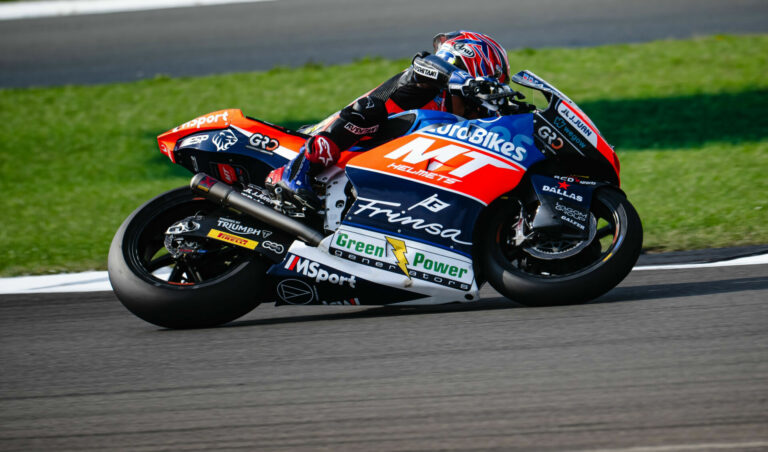
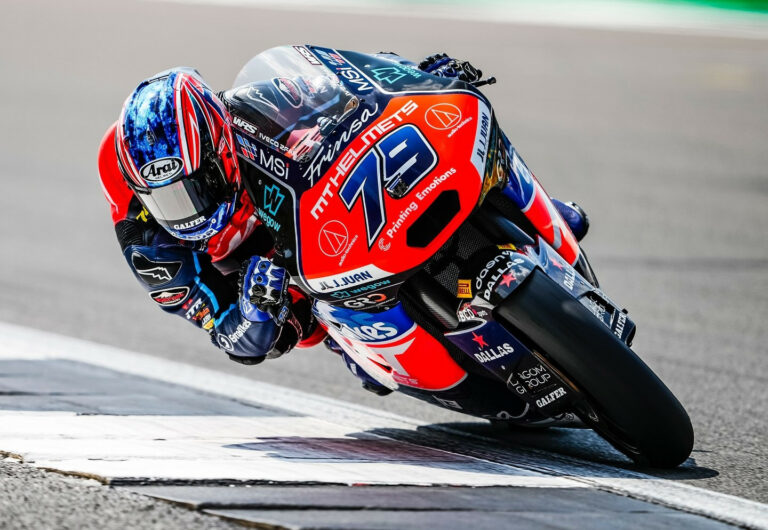
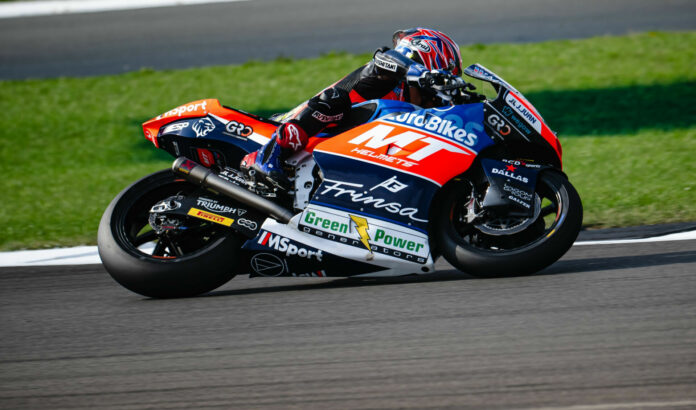
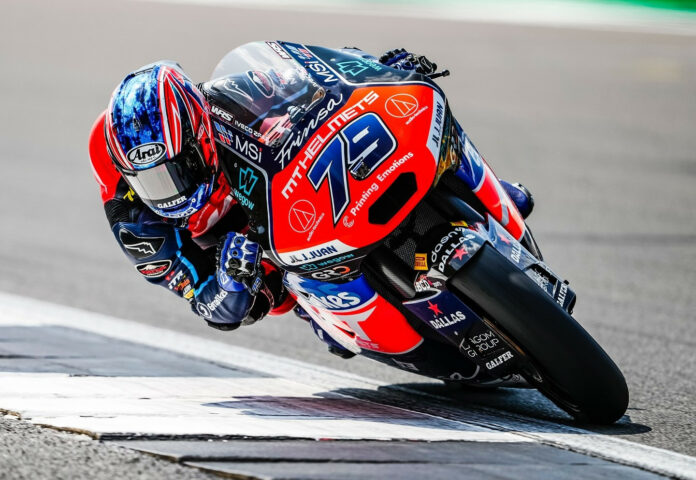
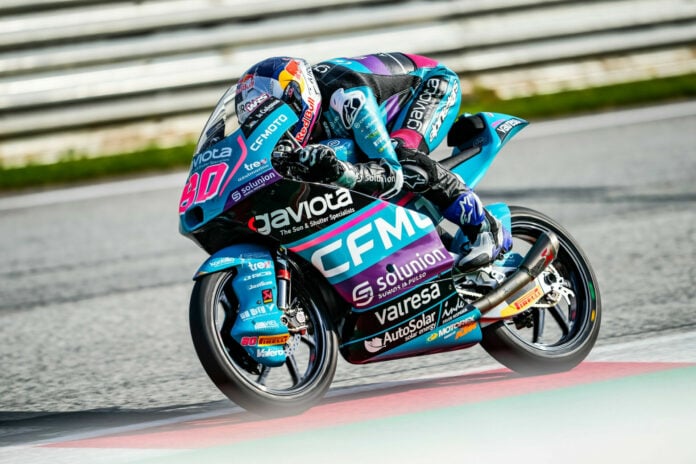
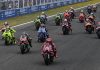
Ai Ogura was fastest in both Moto2 World Championship practice sessions Friday at the Red Bull Ring, in Austria. On board his MT Helmets – MSI Boscoscuro on Pirelli control tires, the Japanese rider led the first practice with a lap time of 1:34.233 and then improved on that with a 1:33.943 in the afternoon.
Aron Canet was the best of the rest with a 1:34.9095 on his Fantic Racing Kalex.
Manuel Gonzalez was once again third, this time with a 1:34.216 on his QJMOTOR Gresini Kalex.
After finishing the opening practice in eighth with a 1:34.779, American Joe Roberts slipped to 21st in the afternoon session with a 1:35.114 on his OnlyFans American Racing Team Kalex.
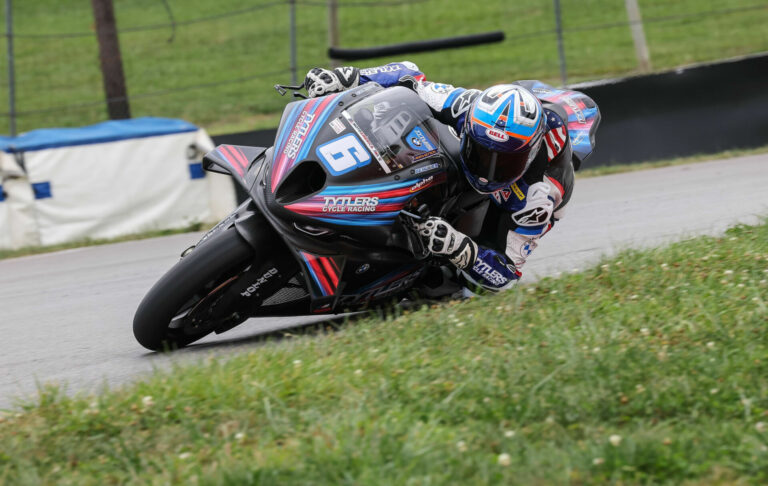
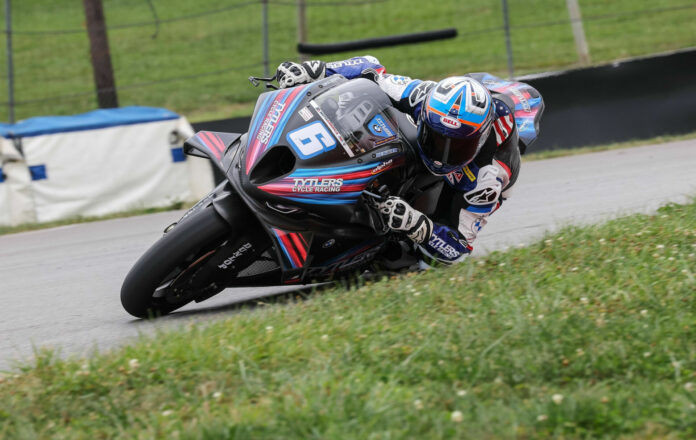
Cameron Beaubier led MotoAmerica Steel Commander Superbike Free Practice One (FP1) Friday morning at Mid-Ohio Sports Car Course, in Lexington, Ohio. Riding his Tytlers Cycle Racing BMW M 1000 RR on Dunlop Sportmax Slicks, the five-time Champion covered the 2.4-mile road course in 1:24.737 to lead the field.
Rookie sensation Sean Dylan Kelly was second-best, just 0.072 second behind Beaubier, with a 1:24.809 on his EasyHealthPlans.com/TopPro Racing BMW.
Three-time and defending Champion Jake Gagne was third with a 1:25.271 on his Attack Performance/Progressive Yamaha YZF-R1.
Josh Herrin, the current Championship point leader, posted the fourth-fastest lap, a 1:25.404, on his Warhorse HSBK Racing Ducati Panigale V4 R.
Bolstered by the testing day on Thursday, Brandon Paasch rounded out the top five with a 1:25.419 on his Vision Wheel M4 ECSTAR Suzuki GSX-R1000R.
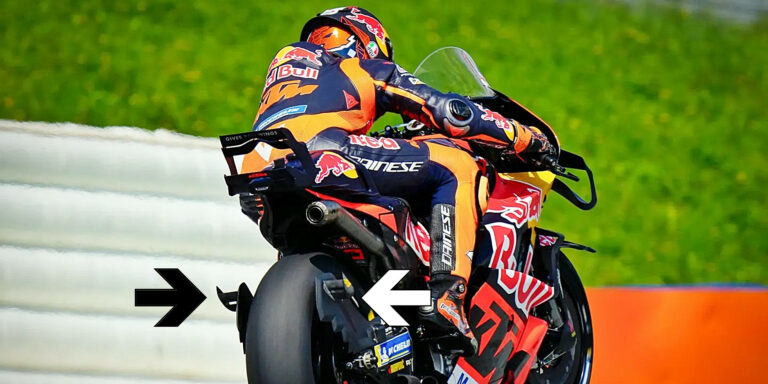
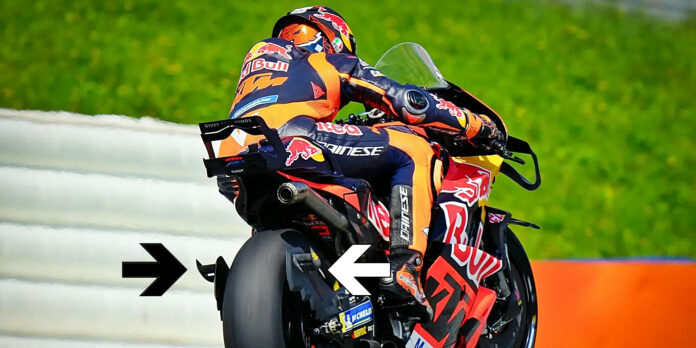
The evolution of MotoGP aerodynamic development continues unabated, with KTM testing new swingarm-mounted wings in Friday practice at the MotoGP race weekend at the Red Bull Ring. Test rider Pol Espargaro took to the track for his second MotoGP wildcard appearance this season with the new configuration.
The wings (see arrows above) are designed to deliver downforce directly to the rear tire. Wings mounted on the bodywork, such as the fairing nose or tailpiece, deliver their aerodynamic effect to the contact patch of the tires via the suspension. Mounting the downforce-producing devices directly to an unsprung component like a swingarm means the downforce is not reduced or compromised by the movement of the suspension.
Mounting the wings here is not perfect, because they are in compromised air behind the rider’s legs and boots. The areas behind the rider’s legs and between the rear wheel and tail section are, aerodynamically speaking, a mess. But locating the wings here can still be beneficial, as they would likely add to the downforce generated by the aerofoils located on the tail section – an area where KTM has experimented significantly this season.
Multiple MotoGP riders this year, in post-session media scrums, have said the Ducati Desmosedicis – especially this year’s GP24 – are able to get more from the new-for-2024 Michelin rear slick than other bikes. This has helped the Ducatis get better exit drive – the Desmosedicis are moving forward where other machines are spinning the rear tire. The KTM swingarm components are an attempt to help the RC16 get more grip from the rear.
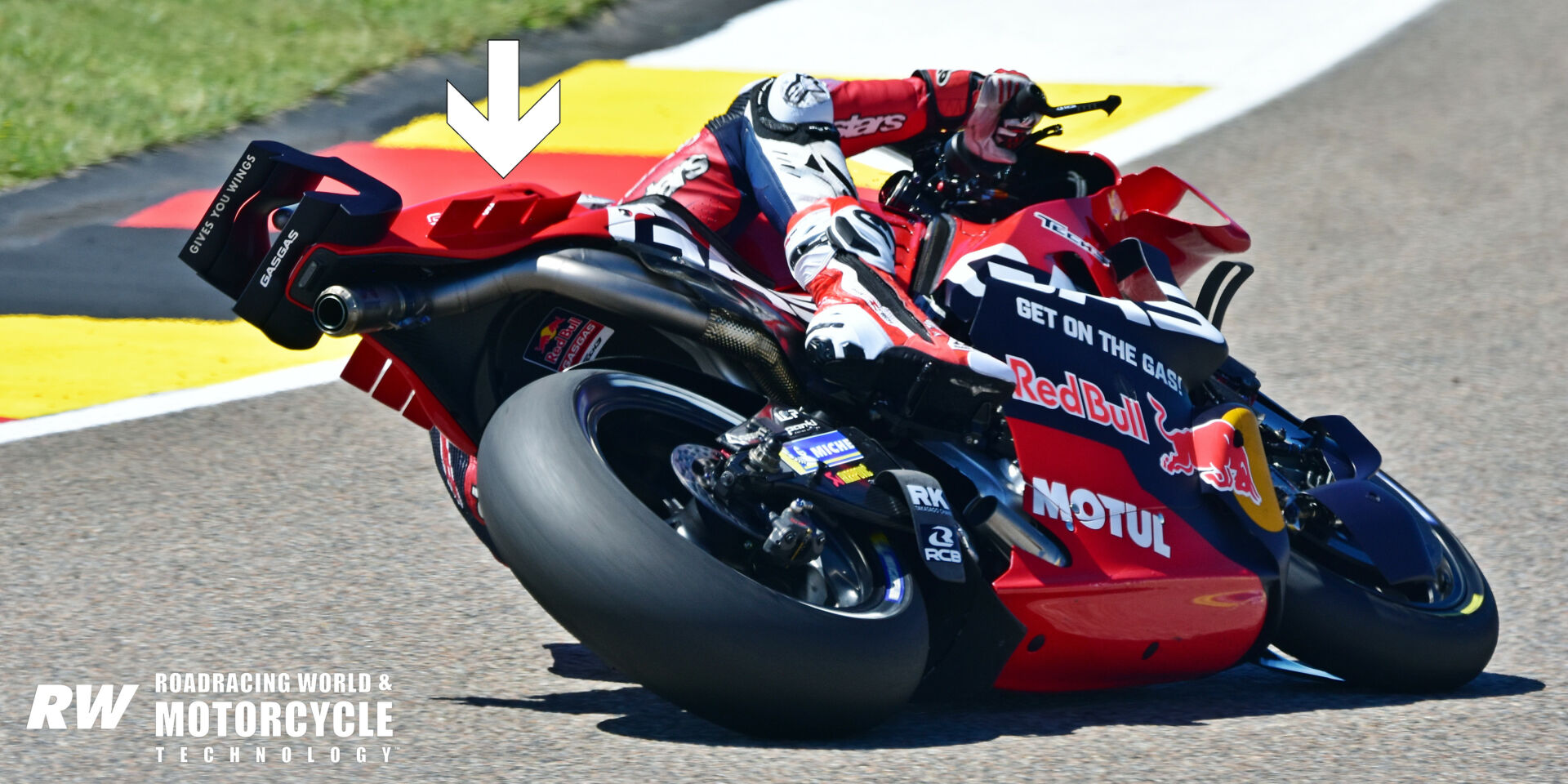
KTM has sought more downforce on the rear of the MotoGP RC16 racebike this season with increasingly extensive aerodynamic devices. The upper tail-mounted wing complex has been complemented by a set of side-mounted wings, as shown by the arrow above. The GASGAS machines appeared in this configuration at the Sachesnring. Photo by Michael Gougis.
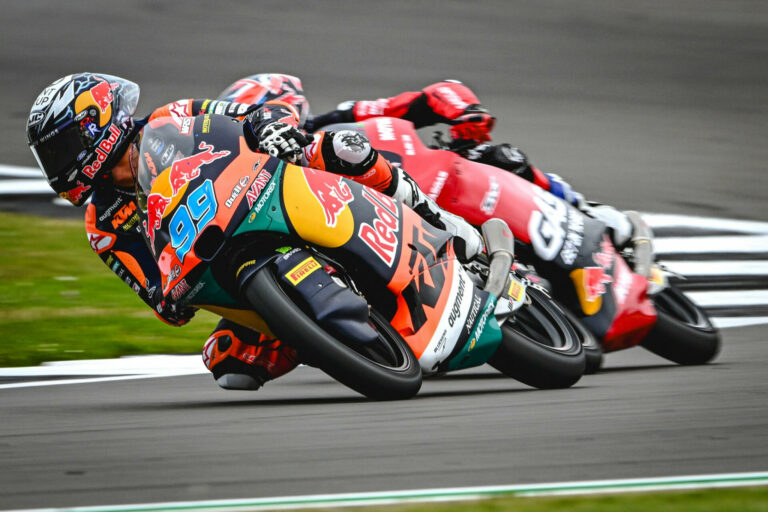
Jose Antonio Rueda topped Moto3 World Championship practice Friday afternoon at the Red Bull Ring, in Austria. Riding his Red Bull KTM Ajo machine, the Spaniard did a 1:40.171 to lead the field of 27 riders and break the All-Time Lap Record of 1:40.331 set by David Alonso Friday morning.
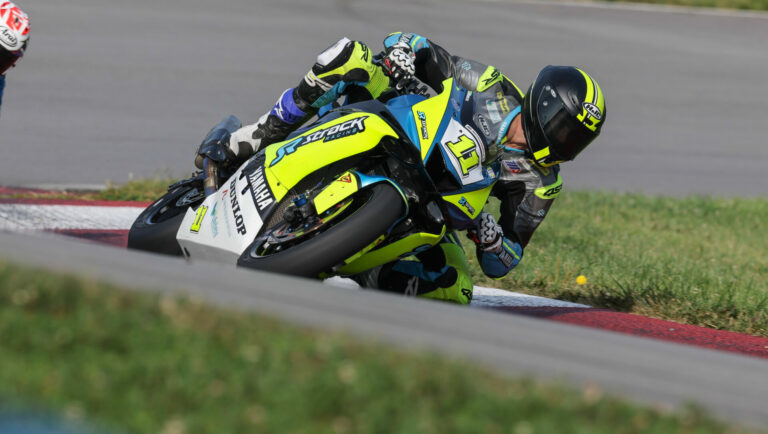
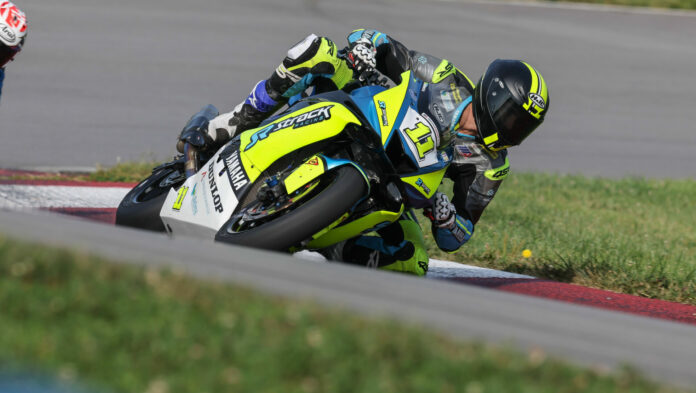
Mathew Scholtz led MotoAmerica Supersport Free Practice One (FP1) Friday morning at Mid-Ohio Sports Car Course, in Lexington, Ohio. Riding his Strack Racing Yamaha YZF-R6 on spec Dunlop tires, the South African turned a 1:28.267 to lead the field of 40 entries.
Jake Lewis was second-best with a 1:28.359 on his Altus Motorsports Suzuki GSX-R750.
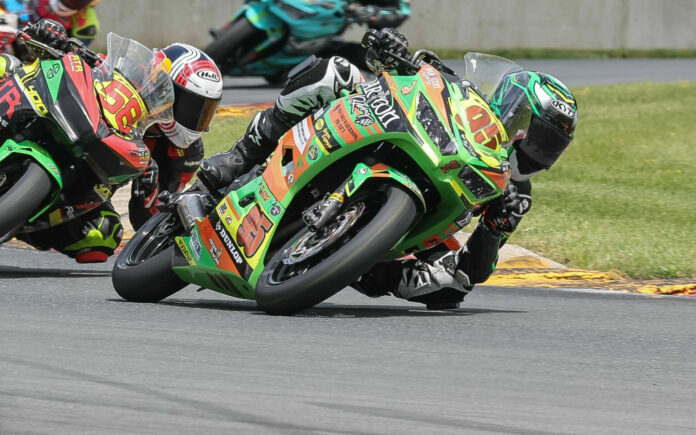
Stefano Mesa was third via a time of 1:28.974 on his Tytlers Cycle Racing Kawasaki Ninja ZX-6R.
N2 Racing/BobbleHeadMoto Yamaha rider Blake Davis did a fourth-fastest 1:29.115.
Title contender PJ Jacobsen rounded out the top five with a 1:29.318 on his Rahal Ducati Moto w/XPEL Panigale V2.
Former MotoAmerica Superbike regular and Ohio native Larry Pegram, age 51, was eighth in the session with a 1:29.767 on the EasyHealthPlans.com/TopPro Racing Suzuki he is riding as a wild card.
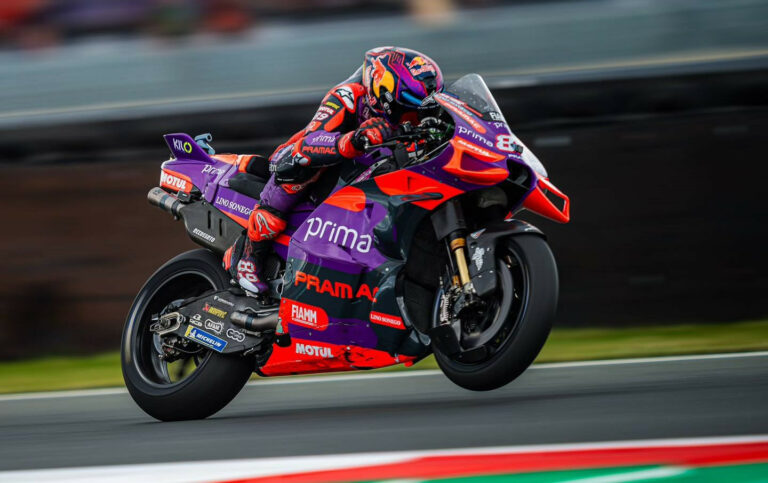
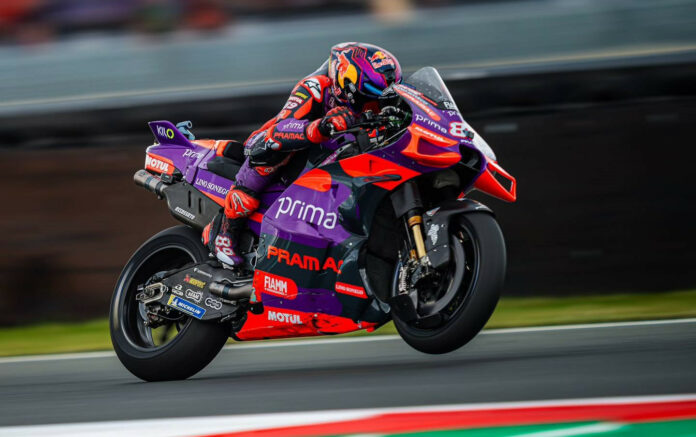
Jorge Martin topped MotoGP World Championship Free Practice One Friday morning at the Red Bull Ring, in Austria. Riding his Prima Pramac Racing Ducati Desmosedici on Michelin control tires, the current series point leader turned a 1:29.654 to lead the field of 25 riders.
Martin’s teammate Franco Morbidelli, who just signed with VR46 Racing Team for 2025, was second-best with a 1:29.872.
Test rider Pol Espargaro, riding as a wild card for Red Bull KTM Factory Racing, was third with a 1:29.944 on his RC 16.
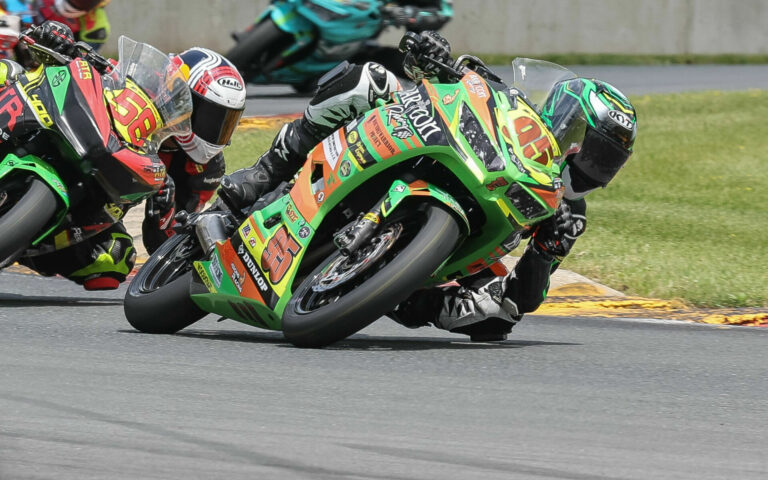
Matthew Chapin dominated MotoAmerica Junior Cup Free Practice One Friday morning at Mid-Ohio Sports Car Course, in Lexington, Ohio. Riding his BARTCON Racing Kawasaki Ninja 400, the current Championship point leader turned a 1:37.177. Not only was that fast enough to lead the field of 26 entries, it was 1.345 seconds faster than the next-fastest rider.
New York Safety Track’s Yandel Medina was the best of the rest with a 1:38.522.
Fernandez Racing’s Jayden Fernandez was third at 1:38.632.
Ai Ogura was fastest in the opening Moto2 World Championship practice session Friday at the Red Bull Ring, in Austria. Riding his MT Helmets – MSI Boscoscuro on Pirelli control tires, the rising Japanese star did a lap time of 1:34.233 to lead the field of 32 riders.
Somkiat Chantra was second-best with a 1:34.341 on his Idemitsu Honda Team Asia Kalex.
Manuel Gonzalez did a third-quickest 1:34.361 on his QJMOTOR Gresini Kalex.
American Joe Roberts finished the session eighth with a 1:34.779 on his OnlyFans American Racing Team Kalex.
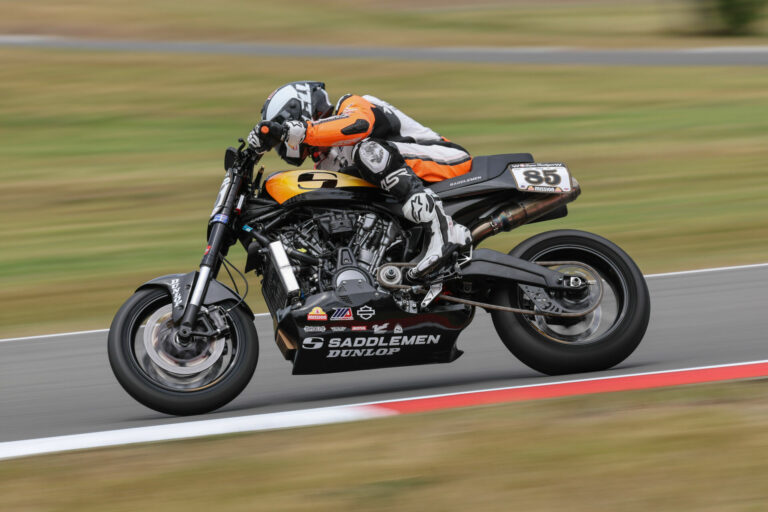
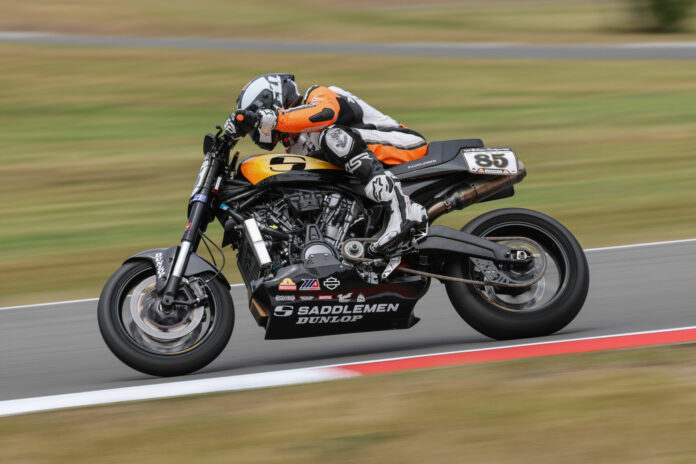
Jake Lewis topped MotoAmerica RSD Mission Super Hooligan Free Practice One Friday morning at Mid-Ohio Sports Car Course, in Lexington, Ohio. Riding his Saddlemen Harley-Davidson Pan America 1250 on Dunlop control tires, Lewis led the 39-rider field with a time of 1:31.030.
Reigning Australian Superbike Champion Troy Herfoss was second-best with a 1:31.183 on his S&S Indian FTR.
Tyler O’Hara, the defending Champion and Herfoss’ teammate, was third in the session with a 1:31.684.
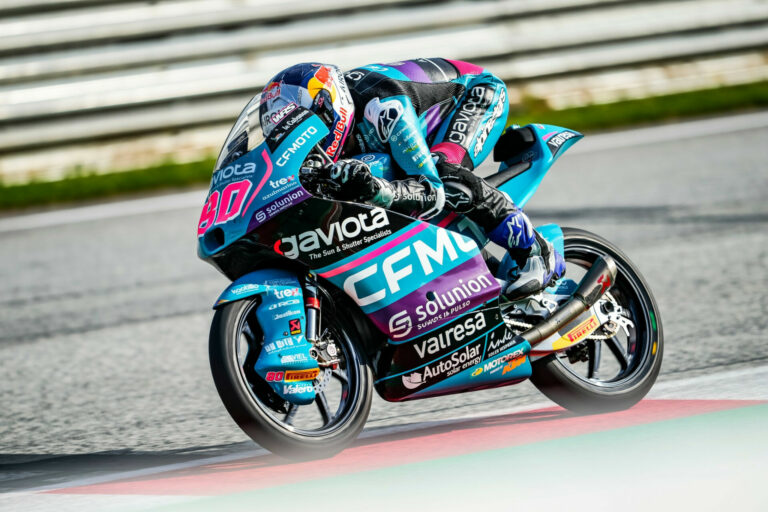
David Alonso led Moto3 World Championship Free Practice Friday morning at the Red Bull Ring, in Austria. Riding his Gaviota Aspar Team CFMOTO on Pirelli control tires, the young Colombian turned a 1:40.331, which was not only good enough to lead the 27-rider field it was also good enough to break David Munoz’s 2022 All-Time Lap Record of 1:40.910.
Ai Ogura was fastest in both Moto2 World Championship practice sessions Friday at the Red Bull Ring, in Austria. On board his MT Helmets – MSI Boscoscuro on Pirelli control tires, the Japanese rider led the first practice with a lap time of 1:34.233 and then improved on that with a 1:33.943 in the afternoon.
Aron Canet was the best of the rest with a 1:34.9095 on his Fantic Racing Kalex.
Manuel Gonzalez was once again third, this time with a 1:34.216 on his QJMOTOR Gresini Kalex.
After finishing the opening practice in eighth with a 1:34.779, American Joe Roberts slipped to 21st in the afternoon session with a 1:35.114 on his OnlyFans American Racing Team Kalex.
Cameron Beaubier led MotoAmerica Steel Commander Superbike Free Practice One (FP1) Friday morning at Mid-Ohio Sports Car Course, in Lexington, Ohio. Riding his Tytlers Cycle Racing BMW M 1000 RR on Dunlop Sportmax Slicks, the five-time Champion covered the 2.4-mile road course in 1:24.737 to lead the field.
Rookie sensation Sean Dylan Kelly was second-best, just 0.072 second behind Beaubier, with a 1:24.809 on his EasyHealthPlans.com/TopPro Racing BMW.
Three-time and defending Champion Jake Gagne was third with a 1:25.271 on his Attack Performance/Progressive Yamaha YZF-R1.
Josh Herrin, the current Championship point leader, posted the fourth-fastest lap, a 1:25.404, on his Warhorse HSBK Racing Ducati Panigale V4 R.
Bolstered by the testing day on Thursday, Brandon Paasch rounded out the top five with a 1:25.419 on his Vision Wheel M4 ECSTAR Suzuki GSX-R1000R.
The evolution of MotoGP aerodynamic development continues unabated, with KTM testing new swingarm-mounted wings in Friday practice at the MotoGP race weekend at the Red Bull Ring. Test rider Pol Espargaro took to the track for his second MotoGP wildcard appearance this season with the new configuration.
The wings (see arrows above) are designed to deliver downforce directly to the rear tire. Wings mounted on the bodywork, such as the fairing nose or tailpiece, deliver their aerodynamic effect to the contact patch of the tires via the suspension. Mounting the downforce-producing devices directly to an unsprung component like a swingarm means the downforce is not reduced or compromised by the movement of the suspension.
Mounting the wings here is not perfect, because they are in compromised air behind the rider’s legs and boots. The areas behind the rider’s legs and between the rear wheel and tail section are, aerodynamically speaking, a mess. But locating the wings here can still be beneficial, as they would likely add to the downforce generated by the aerofoils located on the tail section – an area where KTM has experimented significantly this season.
Multiple MotoGP riders this year, in post-session media scrums, have said the Ducati Desmosedicis – especially this year’s GP24 – are able to get more from the new-for-2024 Michelin rear slick than other bikes. This has helped the Ducatis get better exit drive – the Desmosedicis are moving forward where other machines are spinning the rear tire. The KTM swingarm components are an attempt to help the RC16 get more grip from the rear.
KTM has sought more downforce on the rear of the MotoGP RC16 racebike this season with increasingly extensive aerodynamic devices. The upper tail-mounted wing complex has been complemented by a set of side-mounted wings, as shown by the arrow above. The GASGAS machines appeared in this configuration at the Sachesnring. Photo by Michael Gougis.
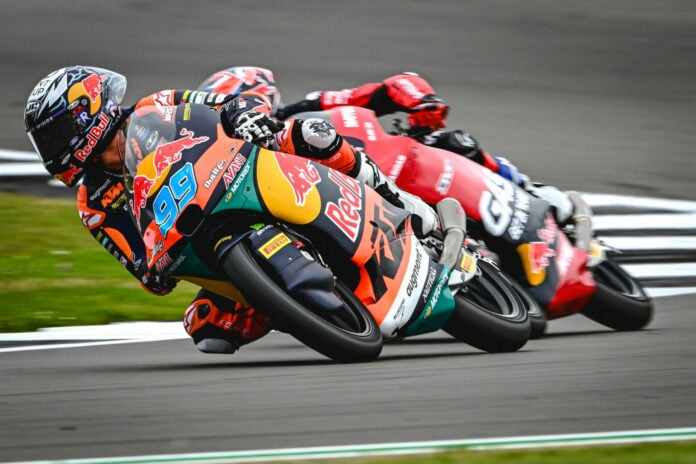
Jose Antonio Rueda (99). Photo courtesy Red Bull KTM Ajo.
Jose Antonio Rueda topped Moto3 World Championship practice Friday afternoon at the Red Bull Ring, in Austria. Riding his Red Bull KTM Ajo machine, the Spaniard did a 1:40.171 to lead the field of 27 riders and break the All-Time Lap Record of 1:40.331 set by David Alonso Friday morning.
Mathew Scholtz led MotoAmerica Supersport Free Practice One (FP1) Friday morning at Mid-Ohio Sports Car Course, in Lexington, Ohio. Riding his Strack Racing Yamaha YZF-R6 on spec Dunlop tires, the South African turned a 1:28.267 to lead the field of 40 entries.
Jake Lewis was second-best with a 1:28.359 on his Altus Motorsports Suzuki GSX-R750.
Stefano Mesa was third via a time of 1:28.974 on his Tytlers Cycle Racing Kawasaki Ninja ZX-6R.
N2 Racing/BobbleHeadMoto Yamaha rider Blake Davis did a fourth-fastest 1:29.115.
Title contender PJ Jacobsen rounded out the top five with a 1:29.318 on his Rahal Ducati Moto w/XPEL Panigale V2.
Former MotoAmerica Superbike regular and Ohio native Larry Pegram, age 51, was eighth in the session with a 1:29.767 on the EasyHealthPlans.com/TopPro Racing Suzuki he is riding as a wild card.
Jorge Martin (89). Photo courtesy Prima Pramac Racing.
Jorge Martin topped MotoGP World Championship Free Practice One Friday morning at the Red Bull Ring, in Austria. Riding his Prima Pramac Racing Ducati Desmosedici on Michelin control tires, the current series point leader turned a 1:29.654 to lead the field of 25 riders.
Martin’s teammate Franco Morbidelli, who just signed with VR46 Racing Team for 2025, was second-best with a 1:29.872.
Test rider Pol Espargaro, riding as a wild card for Red Bull KTM Factory Racing, was third with a 1:29.944 on his RC 16.
Matthew Chapin dominated MotoAmerica Junior Cup Free Practice One Friday morning at Mid-Ohio Sports Car Course, in Lexington, Ohio. Riding his BARTCON Racing Kawasaki Ninja 400, the current Championship point leader turned a 1:37.177. Not only was that fast enough to lead the field of 26 entries, it was 1.345 seconds faster than the next-fastest rider.
New York Safety Track’s Yandel Medina was the best of the rest with a 1:38.522.
Fernandez Racing’s Jayden Fernandez was third at 1:38.632.
Ai Ogura was fastest in the opening Moto2 World Championship practice session Friday at the Red Bull Ring, in Austria. Riding his MT Helmets – MSI Boscoscuro on Pirelli control tires, the rising Japanese star did a lap time of 1:34.233 to lead the field of 32 riders.
Somkiat Chantra was second-best with a 1:34.341 on his Idemitsu Honda Team Asia Kalex.
Manuel Gonzalez did a third-quickest 1:34.361 on his QJMOTOR Gresini Kalex.
American Joe Roberts finished the session eighth with a 1:34.779 on his OnlyFans American Racing Team Kalex.
Jake Lewis topped MotoAmerica RSD Mission Super Hooligan Free Practice One Friday morning at Mid-Ohio Sports Car Course, in Lexington, Ohio. Riding his Saddlemen Harley-Davidson Pan America 1250 on Dunlop control tires, Lewis led the 39-rider field with a time of 1:31.030.
Reigning Australian Superbike Champion Troy Herfoss was second-best with a 1:31.183 on his S&S Indian FTR.
Tyler O’Hara, the defending Champion and Herfoss’ teammate, was third in the session with a 1:31.684.
David Alonso led Moto3 World Championship Free Practice Friday morning at the Red Bull Ring, in Austria. Riding his Gaviota Aspar Team CFMOTO on Pirelli control tires, the young Colombian turned a 1:40.331, which was not only good enough to lead the 27-rider field it was also good enough to break David Munoz’s 2022 All-Time Lap Record of 1:40.910.
A “press release” is promotional text issued by a rider, team, company or organization to inform
the public about an event, product, or service from the issuer’s own point of view, and if deemed
to have news value, may be placed on roadracingworld.com as a service to our readers.
A press release is not an article written by Roadracingworld.com staffers. When a post is labeled with the words “press release”, it means that Roadracingworld.com is not responsible for its content and that Roadracingworld.com makes no guarantee that it is accurate. Not all press releases are posted and Roadracingworld.com may reject press releases if the content is too heavy on commercial promotion with little or no news value or if the press release contains obvious errors.
Accessibility
Accessibility modes
Epilepsy Safe Mode
Dampens color and removes blinks
This mode enables people with epilepsy to use the website safely by eliminating the risk of seizures that result from flashing or blinking animations and risky color combinations.
Visually Impaired Mode
Improves website's visuals
This mode adjusts the website for the convenience of users with visual impairments such as Degrading Eyesight, Tunnel Vision, Cataract, Glaucoma, and others.
Cognitive Disability Mode
Helps to focus on specific content
This mode provides different assistive options to help users with cognitive impairments such as Dyslexia, Autism, CVA, and others, to focus on the essential elements of the website more easily.
ADHD Friendly Mode
Reduces distractions and improve focus
This mode helps users with ADHD and Neurodevelopmental disorders to read, browse, and focus on the main website elements more easily while significantly reducing distractions.
Blindness Mode
Allows using the site with your screen-reader
This mode configures the website to be compatible with screen-readers such as JAWS, NVDA, VoiceOver, and TalkBack. A screen-reader is software for blind users that is installed on a computer and smartphone, and websites must be compatible with it.
Online Dictionary
Readable Experience
Content Scaling
Default
Text Magnifier
Readable Font
Dyslexia Friendly
Highlight Titles
Highlight Links
Font Sizing
Default
Line Height
Default
Letter Spacing
Default
Left Aligned
Center Aligned
Right Aligned
Visually Pleasing Experience
Dark Contrast
Light Contrast
Monochrome
High Contrast
High Saturation
Low Saturation
Adjust Text Colors
Adjust Title Colors
Adjust Background Colors
Easy Orientation
Mute Sounds
Hide Images
Hide Emoji
Reading Guide
Stop Animations
Reading Mask
Highlight Hover
Highlight Focus
Big Dark Cursor
Big Light Cursor
Cognitive Reading
Virtual Keyboard
Navigation Keys
Voice Navigation
Accessibility Statement
www.roadracingworld.com
May 8, 2026
Compliance status
We firmly believe that the internet should be available and accessible to anyone, and are committed to providing a website that is accessible to the widest possible audience,
regardless of circumstance and ability.
To fulfill this, we aim to adhere as strictly as possible to the World Wide Web Consortium’s (W3C) Web Content Accessibility Guidelines 2.1 (WCAG 2.1) at the AA level.
These guidelines explain how to make web content accessible to people with a wide array of disabilities. Complying with those guidelines helps us ensure that the website is accessible
to all people: blind people, people with motor impairments, visual impairment, cognitive disabilities, and more.
This website utilizes various technologies that are meant to make it as accessible as possible at all times. We utilize an accessibility interface that allows persons with specific
disabilities to adjust the website’s UI (user interface) and design it to their personal needs.
Additionally, the website utilizes an AI-based application that runs in the background and optimizes its accessibility level constantly. This application remediates the website’s HTML,
adapts Its functionality and behavior for screen-readers used by the blind users, and for keyboard functions used by individuals with motor impairments.
If you’ve found a malfunction or have ideas for improvement, we’ll be happy to hear from you. You can reach out to the website’s operators by using the following email
Screen-reader and keyboard navigation
Our website implements the ARIA attributes (Accessible Rich Internet Applications) technique, alongside various different behavioral changes, to ensure blind users visiting with
screen-readers are able to read, comprehend, and enjoy the website’s functions. As soon as a user with a screen-reader enters your site, they immediately receive
a prompt to enter the Screen-Reader Profile so they can browse and operate your site effectively. Here’s how our website covers some of the most important screen-reader requirements,
alongside console screenshots of code examples:
Screen-reader optimization: we run a background process that learns the website’s components from top to bottom, to ensure ongoing compliance even when updating the website.
In this process, we provide screen-readers with meaningful data using the ARIA set of attributes. For example, we provide accurate form labels;
descriptions for actionable icons (social media icons, search icons, cart icons, etc.); validation guidance for form inputs; element roles such as buttons, menus, modal dialogues (popups),
and others. Additionally, the background process scans all the website’s images and provides an accurate and meaningful image-object-recognition-based description as an ALT (alternate text) tag
for images that are not described. It will also extract texts that are embedded within the image, using an OCR (optical character recognition) technology.
To turn on screen-reader adjustments at any time, users need only to press the Alt+1 keyboard combination. Screen-reader users also get automatic announcements to turn the Screen-reader mode on
as soon as they enter the website.
These adjustments are compatible with all popular screen readers, including JAWS and NVDA.
Keyboard navigation optimization: The background process also adjusts the website’s HTML, and adds various behaviors using JavaScript code to make the website operable by the keyboard. This includes the ability to navigate the website using the Tab and Shift+Tab keys, operate dropdowns with the arrow keys, close them with Esc, trigger buttons and links using the Enter key, navigate between radio and checkbox elements using the arrow keys, and fill them in with the Spacebar or Enter key.Additionally, keyboard users will find quick-navigation and content-skip menus, available at any time by clicking Alt+1, or as the first elements of the site while navigating with the keyboard. The background process also handles triggered popups by moving the keyboard focus towards them as soon as they appear, and not allow the focus drift outside it.
Users can also use shortcuts such as “M” (menus), “H” (headings), “F” (forms), “B” (buttons), and “G” (graphics) to jump to specific elements.
Disability profiles supported in our website
Epilepsy Safe Mode: this profile enables people with epilepsy to use the website safely by eliminating the risk of seizures that result from flashing or blinking animations and risky color combinations.
Visually Impaired Mode: this mode adjusts the website for the convenience of users with visual impairments such as Degrading Eyesight, Tunnel Vision, Cataract, Glaucoma, and others.
Cognitive Disability Mode: this mode provides different assistive options to help users with cognitive impairments such as Dyslexia, Autism, CVA, and others, to focus on the essential elements of the website more easily.
ADHD Friendly Mode: this mode helps users with ADHD and Neurodevelopmental disorders to read, browse, and focus on the main website elements more easily while significantly reducing distractions.
Blindness Mode: this mode configures the website to be compatible with screen-readers such as JAWS, NVDA, VoiceOver, and TalkBack. A screen-reader is software for blind users that is installed on a computer and smartphone, and websites must be compatible with it.
Keyboard Navigation Profile (Motor-Impaired): this profile enables motor-impaired persons to operate the website using the keyboard Tab, Shift+Tab, and the Enter keys. Users can also use shortcuts such as “M” (menus), “H” (headings), “F” (forms), “B” (buttons), and “G” (graphics) to jump to specific elements.
Additional UI, design, and readability adjustments
Font adjustments – users, can increase and decrease its size, change its family (type), adjust the spacing, alignment, line height, and more.
Color adjustments – users can select various color contrast profiles such as light, dark, inverted, and monochrome. Additionally, users can swap color schemes of titles, texts, and backgrounds, with over seven different coloring options.
Animations – person with epilepsy can stop all running animations with the click of a button. Animations controlled by the interface include videos, GIFs, and CSS flashing transitions.
Content highlighting – users can choose to emphasize important elements such as links and titles. They can also choose to highlight focused or hovered elements only.
Audio muting – users with hearing devices may experience headaches or other issues due to automatic audio playing. This option lets users mute the entire website instantly.
Cognitive disorders – we utilize a search engine that is linked to Wikipedia and Wiktionary, allowing people with cognitive disorders to decipher meanings of phrases, initials, slang, and others.
Additional functions – we provide users the option to change cursor color and size, use a printing mode, enable a virtual keyboard, and many other functions.
Browser and assistive technology compatibility
We aim to support the widest array of browsers and assistive technologies as possible, so our users can choose the best fitting tools for them, with as few limitations as possible. Therefore, we have worked very hard to be able to support all major systems that comprise over 95% of the user market share including Google Chrome, Mozilla Firefox, Apple Safari, Opera and Microsoft Edge, JAWS and NVDA (screen readers).
Notes, comments, and feedback
Despite our very best efforts to allow anybody to adjust the website to their needs. There may still be pages or sections that are not fully accessible, are in the process of becoming accessible, or are lacking an adequate technological solution to make them accessible. Still, we are continually improving our accessibility, adding, updating and improving its options and features, and developing and adopting new technologies. All this is meant to reach the optimal level of accessibility, following technological advancements. For any assistance, please reach out to