

Home Blog Page 3080

Aprilia Unleashes 175-Horsepower Tuono V4 1100 Models

NEW APRILIA TUONO V4 1100 RANGE – RR AND FACTORY MODELS

THE FASTEST AND SPORTIEST NAKED EVER IS NOW EVEN BETTER AND BECOMES A TRUE COMPLETE WEAPON FOR THE ROAD AND FOR THE TRACK

DIRECT DESCENDANT OF THE RSV4, THE BIKE THAT HAS REPEATEDLY WON WORLD SBK CHAMPIONSHIP TITLES, THE APRILIA TUONO V4 1100 IS ADRENALINE IN ITS PUREST STATE

THE PERFORMANCE OF ITS UNRIVALLED, REVAMPED V4 HAS BEEN INCREASED TO 1100 CC AND 175 HP; MORE EFFICIENT TO RIDE THANKS TO ITS REVAMPED CHASSIS AND THE FURTHER DEVELOPMENT OF THE ALREADY EXCEPTIONAL aPRC ELECTRONICS SYSTEMS PACKAGE, BUT AT THE SAME TIME MORE CONVENIENT AND EVEN SAFER FOR ROAD USE

THERE ARE TWO MODELS IN THE RANGE – RR AND FACTORY – CHARACTERIZED BY A NEW LOOK AND DISTINCTIVE FEATURES, BUT WITH THE TYPICAL CHARACTER OF THE TUONO HERITAGE. AND FOR THE FIRST TIME TELEMETRY ARRIVES, THANKS TO THE V4-MP PLATFORM

Tuono V4 1100 is the latest and most spectacular evolution of a sport naked dynasty, born in 2002 out of Aprilia’s intuition to strip down and fit a handlebar on their flagship superbike (which at the time was the V-twin RSV mille), thereby combining all the advantages of a chassis par excellence with the fun of sitting up and dynamic riding. The patriarch of the new “supernaked” category was called the Tuono 1000 R, the first ultra-high performance naked. Aprilia Tuono has therefore always been a high handlebar superbike, unbeatable on the track and loads of fun on the road. Out of this tradition a completely new Tuono was born in 2011, a direct emanation from the unbeatable Aprilia RSV4 introduced in 2009 and World SBK dominator. It was an epic change: Tuono V4 R immediately made a place for itself as the highest performance, most technological and sophisticated naked sport bike ever manufactured, the most adrenaline pumping, fierce and effective naked ever seen, an excellence for the most purist of thrill seeking enthusiasts thanks to the V4 engine capable of 167 HP and the exceptional aPRC electronic controls package, still unrivalled in terms of effectiveness and technology. The evolution did not stop here – In 2014 an even more refined and powerful version was introduced: Tuono V4 R ABS which offered the new features which had already been successfully introduced on the second generation RSV4, such as the higher performance engine (170 HP), the revamped and recalibrated aPRC system and a Race ABS system capable of withstanding even the extreme stress of the track.

The know-how acquired in years of victorious competition at top levels and the experience of the Tuono history now allow Aprilia to exceed limits which had previously seemed insurmountable: introducing the newTuono V4 1100, an exclusive thrill generator and fun in its purest state. New 175 HP engine with a powerful maximum torque of 120 Nm, revamped chassis setup to achieve better agility, fine-tuned aPRC, new look, the possibility of connecting your smartphone to the vehicle through the PMP platform and two distinctly outfitted versions (Factory and RR) that have the same, strictly Aprilia character in common.

Two versions, the same spirit

Tuono V4 becomes a family of motorbikes made up of two distinctly outfitted models. Tuono V4 1100 RR represents an exceptional thrill machine and it is the true heir to the previous Aprilia V4 naked, acclaimed by critics as the most effective and fastest bike in its segment. In addition to this model there is now a version with exclusive standard equipment: Tuono V4 1100 Factory, dedicated to an extremely demanding public, this bike is equipped with components which are largely derived directly from the new Aprilia RSV4 RF superbike.

The new Aprilia naked range, heir to a family of motorbikes which has been voted over time as one of the most fun, adrenaline pumping and efficient bikes ever, thus achieves absolute performance levels and sophistication, but now these bikes are also more comfortable, safe and fun to ride on the road. In addition to receiving many of the important upgrades which were just introduced on the new RSV4, Aprilia Tuono V4 1100 RR and Tuono V4 1100 Factory also add a new look thanks to the more protective top fairing and the better aerodynamic penetration coefficient. The relative headlight unit changes as well, a whole 1.5 kg lighter, fitted with a LED technology parking light and a more modern shape which better integrates with the overall design of the bike without betraying the typical language of the Aprilia V4 characterized by three headlights. Tuono V4 1100 Factory stands out for its new rail fairing, derived from the RSV4’s, a true benchmark in sport motorbike design. The saddle has been made more comfortable, even with respect to its fairing-clad sister, thanks to the new foam production procedure which prevents the crystallization phenomenon – and therefore the hardening – of the foam itself. You can still naturally ride two-up by mounting the dedicated saddle portion. Thanks to the 15 mm lower seating position and the new, narrower handlebar, the on board ergonomics of both the Tuono V4 1100 versions change, becoming decidedly more comfortable.

World champion chassis

Simply incomparable, now more than ever. There is no other naked bike as sporty and effective as the Tuono V4 1100; its close derivation from the multiple World SBK champion is clear when you look at the beautiful double rail frame made from pressed and cast brushed aluminum elements, a structure that boasts unrivalled balance between torsional stiffness and flexibility; the new 65° V4 engine is set inside it in all of its purity and uniqueness, just like a precious stone set in a ring. In order to make the Tuono V4 1100 more agile on the road, without losing its legendary fierceness on the track, the headstock angle was changed from 25.1° to 24.7° and the trail went from 107.4 mm to 99.7 mm. These sleeker chassis dimensions combine with the 6 mm longer aluminum swingarm, the various suspension setups and the consequent adjustment of the electronic controls, including the wheelie control feature, to obtain a rock solid chassis at high speeds but more agile in direction changes.

Tuono V4 1100 RR is fitted with a high quality suspension: the upside-down Sachs fork with 43 mm stanchions has separate “one by one” hydraulic adjustments in compression and rebound as well as spring preload adjustment on both stanchions. The Sachs shock absorber with built-in piggy back allows the hydraulics to be adjusted in rebound and compression, as well as spring preload adjustment. The new standard calibration on both units is functional to the increased performance of the V4 engine and the revamped chassis dimensions and it also takes into consideration use of the bike on the road without any prejudice to the possibility of personalization in order to obtain maximum accuracy and precision in true racing style riding.

The more refined Factory version of the Aprilia Tuono V4 1100 comes with par excellence standard equipment unique in its category, borrowed from the king of superbike, the Aprilia RSV4 RF. The suspension section is made up of a trio of Öhlins elements (fork, rear shock absorber and steering damper) characterized by ultra-fine tuning possibilities and a base setup that has been calibrated to give the rider maximum performance feedback in sport riding.

The braking system on the new Tuono V4 1100 range has a pair of refined Brembo monobloc M432 calipers on the front which mounts pads with the best possible friction coefficient that grip lightweight aluminum flanged discs (for Tuono V4 1100 Factory). The wheel rims are the same for both models: their lightweight quality contributes to a maximum reduction of the gyroscopic effect, all to the advantage of great handling. Tuono V4 1100 Factory is shod with the sportier Pirelli Diablo Supercorsa, with a wider 200/55 on the rear, in any case approved for street use and available for the Tuono V4 RR as well.

The top of the line in electronic controls

The Tuono V4 1100 range has received all the upgrades to the already exceptional aPRC system that was first seen on the RSV4 RR and RSV4 RF. As everyone knows, aPRC (Aprilia Performance Ride Control) is the patented control systems package derived directly from the winning technology in the world Superbike championship, the most complete and refined of any on the market, which provides tire circumference self-calibration features and wheelie control. The third generation of aPRC, standard equipment on the new Tuono V4 1100 units, fully integrates with the fine full Ride-by-Wire multi-map electronic management of the revamped V4 engine. As always, the Tuono V4 benefits from a specifically developed calibration, but it has been evolved even further in order to provide maximum thrills on the road and maximum performance on the track.

The Tuono V4 1100 RR and Tuono V4 1100 Factory aPRC include:

–aTC: Aprilia Traction Control, adjustable on the fly (without having to release the throttle) to 8 settings thanks to a practical joystick on the left side of the handlebar, now has even more fine-tuned and higher performance operating logic. The percentage of slippage allowed also differs depending on the speed in the turn: the system’s performance is smoother and guarantees high support in long sweepers at high speeds without penalizing grip coming out of slow turns;

–aWC: Aprilia Wheelie Control,with 3 selectable settings, has been recalibrated to be even more sporty in map 1, whilst still guaranteeing a slight lift in quick acceleration and subsequent smoother descent of the front wheel to the tarmac;

–aLC: Aprilia Launch Control, the assisted starting system for use on the track only with 3 settings;

–aQS: Aprilia Quick Shift electronic gearbox for ultra-fast shifting without closing the throttle or using the clutch.

In addition to the third generation aPRC, the Tuono V4 1100 range is fitted with the highly advanced Race ABS system, developed in collaboration with Bosch to guarantee maximum safety on the road, without sacrificing any performance on the track. The 9MP system, which weighs in at just 2 kg, uses an actuation strategy called RLM (Rear wheel Lift-up Mitigation) that, as the name suggests, mitigates rear wheel lift in more abrupt braking situations; it can also be disengaged and it is adjustable to three levels easily by accessing the control menu on the instrument cluster.

–Level 1: this is dedicated to track use but is also approved for street use. It acts on both wheels to guarantee the best possible performance, even in the most intense braking conditions at any speed. It takes nothing away from the pleasure and performance of “extreme” riding. With this strategy RLM is disabled.

–Level 2: this is dedicated to sport riding on the road, acts on both wheels and is combined with the RLM tip over system which engages progressively based on the vehicle speed.

–Level 3: this is dedicated to riding on surfaces with poor grip, acts on both wheels and is combined with the RLM tip over system.

Each of the three Race ABS maps can be combined with any one of the three engine maps (Track, Sport, Road) to allow riders with varying experience and skill levels to find the best possible combination.

Higher performance than the V4

The primary goal of the changes made to the already extraordinary Aprilia Tuono V4 engine was to increase torque, especially at medium-low revs in order to increase effectiveness and riding pleasure on the road. To achieve this goal the engine capacity was increased to a full 1077 cc thanks to the new cylinder bore which was taken from 78 to 81 mm. This increase in displacement also resulted in higher top performance:the power peak went from 170 to 175 HP and places the Tuono V4 1100 range at the top of its segment (already at 8,000 rpm almost 20 HP more than before are available). This makes the new sport naked from Noale a complete weapon for thrills and effectiveness with superlative torque values that dominate on the road and uncompromising top performance to dominate on the track.

The Tuono V4 1100 is the only naked powered by a 65° V4 engine° with unique characteristics. The narrow V architecture made it possible to build an engine with incredibly reduced longitudinal bulk which favors centering the weight and creating a compact chassis. As in previous models, the monobloc crankcase with integrated aluminum cylinder liners ensures maximum rigidity and consistent performance. The upper half of the engine case is now made with a new shell fusion and has been lightened and reinforced; it also now has an optimized ventilation system in order to reduce power loss due to air pressure inside the engine crankcase. Also, the crankshaft now has connecting rod pins reduced to 36 mm in diameter, the pistons are new and the Pankl connecting rods are lighter by a total of 400 grams.

The other technical particulars which made this engine so popular have remained unchanged, such as the removable gearbox and the innovative timing system kinematics: the chain camshaft drives only the intake camshaft which in turn drives the exhaust camshaft via a single gear. This solution allows for extremely compact heads especially in the area beneath the frame spars, much narrower than would otherwise be possible. A countershaft dampens vibrations even more than in a 90° V engine.

Full Ride-by-Wire technology eliminates any direct connection between the throttle grip and the throttle valves, which are entirely controlled by a latest generation Marelli control unit that also controls the ignition and the four injectors. Each bank is fuelled by two throttle bodies managed by a dedicated servo unit. This means that the aperture of the throttle valves and consequently the quantity of fuel injected can be controlled independently. This solution opens up practically infinite possibilities for power delivery control.

The new and powerful engine ECO now allows the three maps to be more easily managed, each one of which corresponds to a different engine power output and now also to a dedicated engine brake management map. The two classic engine management maps, Track and Sport, are now joined by a Road map which is full power instead of the previous generation Tuono V4’s limited power map. All three maps are more manageable and less aggressive than the previous version, allowing a better relationship between the opening of the throttle and the torque sent to the wheels. This is a solution that provides further advantages, such as reducing rear tire wear and better management of the significant power that the new Aprilia V4 is capable of developing.

Versions and Colors

The new Aprilia Tuono V4 1100 range includes two models distinguished by different technical equipment and different color schemes: Tuono V4 1100 RR is available in two attractive color schemes, Grigio Portimao and Donington Blu, whereas the Superpole graphic of the Tuono V4 1100 Factory has that decidedly non-conformist spirit so typical of the Aprilia stylistic tradition that demands bright and very distinctive colors.

Telemetry arrives with V4-MP

In the rich accessories catalogue dedicated to the Aprilia Tuono V4 100 you can now find a highly advanced version of the Piaggio Multimedia Platform which transforms your smartphone into a semi-professional tool with exceptional information capacity. As you know, Piaggio Multimedia Platform is the innovative multimedia platform offered exclusively by the Piaggio Group which allows you to connect your vehicle to your smartphone and consequently to the web. With this exceptional application your smartphone becomes an actual sophisticated on board multifunctional computer and the link between the vehicle and the Internet. This is a window to the future which lays the foundation for a new way of looking at communication on two wheels. Thanks to a further development of this fascinating system fine-tuned by Aprilia, communication between the bike and smartphone now becomes active: from your smartphone you can change the settings on your Tuono V4, as well as receive tips in real time on how to improve your performance on the track in complete safety.

Some of the more prominent features of V4-MP are:

-Active electronic setup: this is as close as you can get to the “corner-by-corner” electronic management used in racing. Using the GPS feature of your smartphone, the system recognizes the position of the bike at any given time on the track and automatically changes the electronic adjustments (traction control, anti-wheelie, engine mapping, etc.), accessing a database of parameters recommended by Aprilia Racing. In any case you can set the electronic controls up according to your own preferences, turn by turn. This allows you to increase safety and effectiveness on the track, adjusting the control parameters at every point on the circuit and without distractions.

-Immersive virtual telemetry: your smartphone records the data from the engine and, using a sophisticated and realistic engine graphic, illustrates user performance. The lap reference is indicated by the “ghost” bike image and the performance relative to it can be downloaded to a database which collects all the laps made by Aprilia customers on each circuit.

-Adaptive race assistant: this feature provides tips in real time to safely achieve your best lap on the track with your Tuono V4. Thanks to Aprilia Racing Department simulation technology, you can establish the ideal lap for each track, considering the various grip and rider skill levels. The application compares rider performance in real time and assists by immediately indicating the need to brake or the possibility of opening up the throttle.

Aprilia Tuono V4 1100 RR: Technical Specifications

[Tuono V4 1100 Factory data in brackets]

Engine type:

Aprilia longitudinal 65° V4 cylinder, 4-stroke, liquid cooled engine with dual overhead cam (DOHC) and four valves per cylinder

Fuel:

Unleaded gasoline

Bore and stroke:

81 x 52.3 mm

Total engine capacity:

1077 cc

Maximum power at crankshaft:

175 HP (129 kW) at 11,000 rpm

Maximum torque at crankshaft:

120 Nm at 9,000 rpm

Fuel system:

Airbox with front dynamic air intakes.

4 Weber-Marelli 48-mm throttle bodies with 4 injectors and latest generation Ride-by-Wire engine management.

Choice of three different engine maps selectable by the rider with bike in motion: T (Track), S (Sport), R (Road)

Ignition:

Magneti Marelli digital electronic ignition system integrated in engine control system, with one spark plug per cylinder and “stick-coil”-type coils

Starting:

Electrical

Exhaust:

4 into 2 into 1 layout, single oxygen sensor, lateral single silencer with ECU-controlled bypass valve and integrated trivalent catalytic converter

Alternator:

Flywheel mounted 450 W alternator with rare earth magnets

Lubrication:

Wet sump lubrication system with oil radiator and two oil pumps (lubrication and cooling)

Gearbox:

6-speed cassette type gearbox

1st: 39/15 (2,600)

2nd: 33/16 (2.063)

3rd: 34/20 (1,700)

4th: 32/22 (1,455)

5th: 34/26 (1,308)

6th: 33/27 (1,222)

Gear lever with Aprilia Quick Shift electronic system (aQS)

Clutch: 

Multi-plate wet clutch

Primary drive:

Straight cut gears and integrated flexible coupling, drive ratio: 73/44 (1,659)

Secondary drive:

Chain: Drive ratio: 42/16 (2,625)

Traction management:

aPRC System (Aprilia Performance Ride Control), which includes Traction Control (aTC), Wheelie Control (aWC), Launch Control (aLC), all of which can be configured and deactivated independently.

Frame:

Aluminum dual beam chassis with pressed and cast sheet elements.

Sachs steering damper [Öhlins steering damper]

Front suspension:

Upside-down “one by one” Sachs fork, Ø 43 mm stanchions [Öhlins fork with TIN surface treatment]. Forged aluminum radial caliper mounting bracket. Completely adjustable spring preload and hydraulic compression and rebound damping. Wheel travel: 120 mm

Rear suspension:

Double braced aluminum swingarm; mixed low thickness and sheet casting technology.

Sachs monoshock with piggy-back, fully adjustable in: spring preload, hydraulics in compression and rebound [Öhlins Racing monoshock with piggy-back, fully adjustable in: spring preload, wheelbase length, hydraulics in compression and rebound]. APS progressive linkages. Wheel travel: 130 mm

Brakes:

Front: Dual 320 mm floating stainless steel discs with lightweight stainless steel rotor with 6 studs [aluminum flange] Brembo M432 monobloc radial calipers with 4 Ø 32 mm opposing pistons. Sintered pads. Axial pump master cylinder and metal braided brake hoses.

Rear: 220 mm diameter disc; Brembo floating caliper with two Ø 32 mm separate pistons. Sintered pads. Master cylinder with built in reservoir and metal braided hose.

Bosch 9MP ABS, adjustable to 3 maps equipped with RLM (can be disabled).

Wheel rims:

Cast aluminum wheels with 3 split spoke design.

Front: 3.5”X17”

Rear: 6.00”X17”

Tires:

Radial tubeless.

Front: 120/70 ZR 17

Rear: 190/55 ZR 17 (alternative: 190/50 ZR 17; 200/55 ZR 17) [200/55 ZR 17]

Dimensions:

Saddle height: 825 mm

Trail: 99.7 mm

Steering angle: 24.7°

Kerb weight: 184 kg * (406 lbs)

Fuel tank: 18.5 liters (4.88 gallons), including 4-litre (1-gallon) reserve

*Dry weight, without battery and fluids.

The Aprilia V4 1100 RR and V4 1100 Factory will be available in US dealerships in May 2015. MSRP to be confirmed.

Find out more about the latest Aprilia products, offerings and test ride opportunities at: ApriliaUSA.com and Aprilia Americas Facebook pages
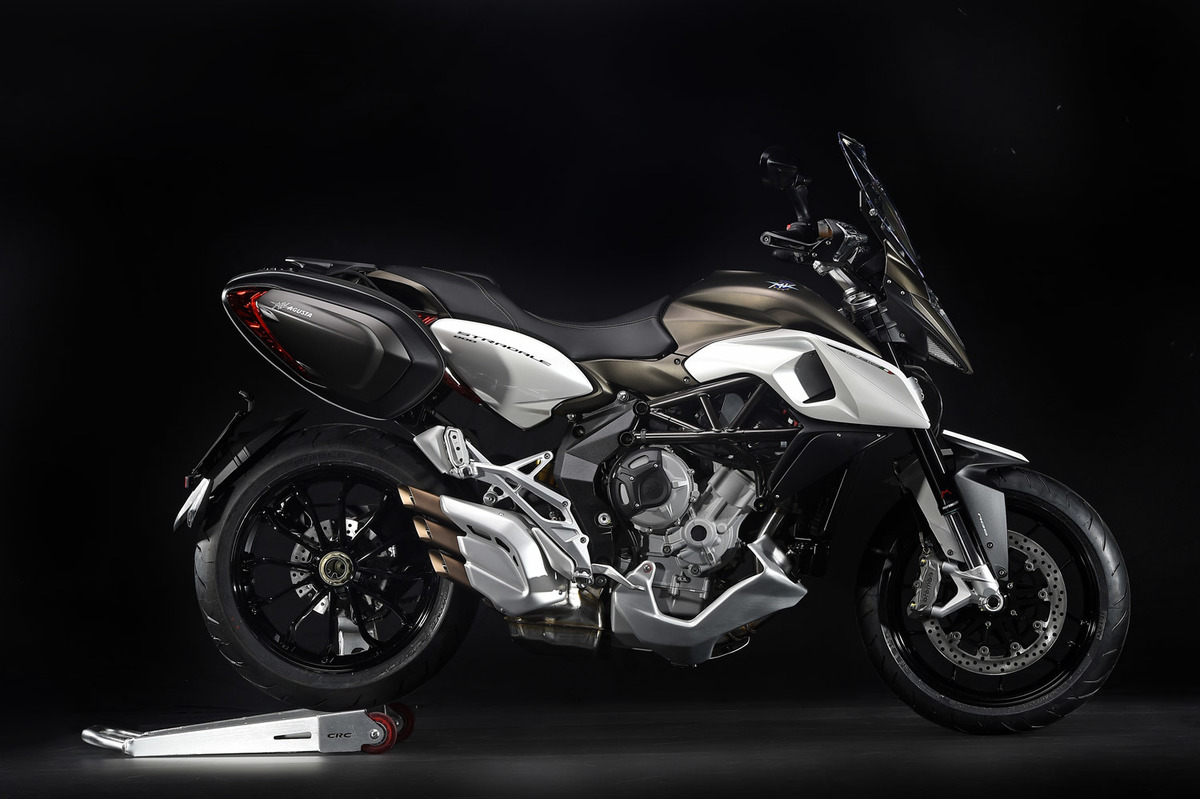
MV Agusta Introduces New Stradale 800

NEW MV AGUSTA STRADALE 800

Varese, 4 November 2014 – Breathtaking braking, awesome acceleration. City streets. Country roads. Motorways. Different situations that used to require different bikes – but not any more. The Stradale 800 rewrites the rules. Because it’s the right bike every time, whatever the road.

The new Stradale 800 combines the MV Agusta experience on various types of models to offer an original approach to riding. The ALS steel trellis frame is completed, in the single-sided swingarm pivot area, with lightweight aluminium alloy plates. To ensure the Stradale 800 keeps going no matter what the obstacle, great attention has gone into the design of the suspension: the upside-down Marzocchi fork – adjustable in compression, rebound and spring pre-load – guarantees 150 mm of travel; the single-sided swingarm, connected to the fully adjustable monoshock, provides 150 mm of travel. The chassis has been developed specifically for the Stradale 800.. The 1,460 mm wheelbase has been extended by 30 mm; consequently, the single-sided swingarm is also longer, improving traction. The riding position is completely new: the 870 mm high seat (-10 mm) makes the bike easier to handle and improves the rider’s stance on the vehicle to provide enhanced control and comfort. In fact, the front end has been equipped with a protective Plexiglas screen (featuring on-the-go onehanded adjustment) that merges perfectly with the unique Stradale 800 style. The fuel tank is now larger: its 16 litres (+ 4 litres of reserve), together with outstanding thermodynamic engine performance, ensure you’ll put in plenty of miles between refuelling stops. The hydraulic clutch makes gear shifts fluid and even. For completely carefree riding. Always.

The standard equipment includes two side panniers: perfectly in keeping with the Stradale 800 style, they also feature built-in turn indicators. This solution, which required specific type approval, gives an immediate advantage: even from behind, the entire width of the bike is clearly visible, exactly as it is from the front and side, where turn indicators on the hand guards serve the same purpose. 

The 798 cc three cylinder in-line engine was specially developed for this model: the maximum power and torque ratings, 115 hp at 11,000 rpm and 78.5 Nm at 9,000 rpm respectively, only partially describe a power unit that combines elasticity with outstanding acceleration. Exclusive solutions abound, such as the counter-rotating crankshaft, which reduces inertia during directional changes and thus makes for a more agile, gratifying ride, the bike also has an integrated cooling and oil circuit to keep it compact, lightweight and appealing.

Electronic MVICS (Motor & Vehicle Integrated Control System) control is comprehensive: from the Ride By Wire accelerator to the Mikuni throttle bodies, from knock control to the availability of 4 engine maps. These latter features offer specific logic and dedicated power-torque curves: the Sport map provides 115 hp, maximising performance and generating the classic buzz typical of any true MV Agusta. The Normal map offers 90 hp of power and a smoother throttle response, ideal for short range touring and commuting. Rain means safety first and foremost: The Stradale 800 puts the torque and power down on the tarmac as progressively as possible. The as-standard ABS has a Bosch 9 Plus unit equipped with RLM (Rear wheel Lift-up Mitigation): this technology prevents the rear wheel from lifting off the ground, effectively preventing one of the most dangerous riding situations. Also as standard is the EAS 2.0, the most complete quickshifter on the market: this provides the rider with electronic assistance and therefore eliminates the need to operate the clutch when up and downshifting. Comfort and sports performance, back together again.

Price: €13,990

Every country could have a price variation due to local import duties and taxes.

Colour schemes: Red/Silver, Pearl White/Aviation Grey, Bronze/Pearl White

Ducati Adds Variable Valve Timing To Multistrada 1200 Family

DUCATI MULTISTRADA 1200: SETTING A NEW STANDARD

As soon as it was launched back in 2010, the Multistrada 1200 revolutionised the motorcycling world by offering, for the very first time, nothing less than four bikes in one: from super sport to long-distance tourer, from everyday runabout to enduro. Now, Ducati’s technological expertise has produced a new generation of Multistradas, bikes featuring the latest Ducati Testastretta DVT (Desmodromic Variable Timing) engine and a state-of-the-art technological package that sets a whole new standard in its product segment. The new Multistrada 1200 is the “multibike” par excellence, with cutting-edge technology making it far more than just the 4-bikes-in-1 offered by its Riding Modes.

In what is a first for the motorcycle industry, the DVT engine features a variable valve timing system with independent control of both the intake and exhaust camshafts. This optimises engine performance throughout the power range in all riding conditions, thus ensuring maximum power at high rpm, fluid delivery, punchy low-rpm torque and low fuel consumption in full compliance with the latest Euro 4 regulations.

The new Multistrada 1200 also sets a new electronics benchmark thanks to the Inertial Measurement Unit (IMU) which dynamically measures roll, yaw and pitch angles as well as the rate of their change; with this information, the IMU enhances both performance and safety. For example, the presence of the IMU enables the ABS to include a Cornering system capable of controlling braking even on bends where wheel lock could otherwise cause skidding. On the Multistrada 1200 S it also enables control the Ducati Cornering Lights (DCL) in its full LED headlamp. Moreover, the IMU has allowed the introduction of Ducati Wheelie Control (DWC): this detects and corrects any front wheel lift to ensure maximum acceleration in complete safety. Like Ducati Traction Control (DTC), DWC features rider-settable 8-level sensitivity. Lastly, the IMU inertial platform also interacts with the semi-active Ducati Skyhook Suspension (DSS) Evolution (DSS) control system featured on the Multistrada 1200 S.

All models now feature Electronic Cruise Control, which the rider can set as desired using controls incorporated in the switchgear on the left handlebar. On the S version a Bluetooth module is included as standard: this activates the Ducati Multimedia System and can connect the bike to a smartphone for userfriendly control of basic functions such as receiving incoming calls, notification of text messages, or playing music via the handlebar controls and on-dash info. Thanks to an iOS/Android app, the Bluetooth connection lets riders use bike data to activate other functions which enhance, extend or let them share their everyday riding or touring experiences; the app even allows interaction with the ducati.com website and social networks.

Main standard features on the Multistrada family

Multistrada 1200

Colour

1. Ducati Red with black wheels rims

Features

o New Ducati Testastretta DVT engine

o IMU: Inertial Measurement Unit

o Bosch-Brembo ABS 9.1ME Cornering braking system

o Electronic cruise control

o Riding Modes

o Ride-by-Wire Power Modes (PM)

o Ducati Wheelie Control (DWC)

o Ducati Traction Control (DTC)

o Height-adjustable seat

o LCD instrument panel

Multistrada 1200 S (and Multistrada 1200 S D|air®)

Colours

1. Ducati Red with black wheels rims (1200 S and 1200 S D|air®)

2. Iceberg White with black wheels rims (1200 S only)

Features

o New Ducati Testastretta DVT engine

o IMU: Inertial Measurement Unit

o Bosch-Brembo ABS 9.1ME Cornering braking system

o Front brake discs with diameter of 330 mm, Brembo M504 4-piston radial calipers

o Electronic cruise control

o Ducati Multimedia System (DMS)

o Lightweight machine-finished forged wheels

o Riding Modes

o Ride-by-Wire Power Modes (PM)

o Ducati Wheelie Control (DWC)

o Ducati Traction Control (DTC)

o Height-adjustable seat

o Electronic Sachs suspension (front and back) with the semi-active Ducati Skyhook

Suspension (DSS) Evolution system

o Full LED headlamp with Ducati Cornering Lights (DCL)

o Instrument panel with 5” full colour TFT screen

o D|air system (Multistrada 1200 S D|air® only)

Personalisation Packs

? Touring Pack: heated grips, panniers and center stand

? Sport Pack: road-legal exhaust (homologated only for EU) Ducati Performance by Termignoni and carbon fibre front mudguard, machined-from-billet aluminium brake and clutch reservoir caps

? Urban Pack: top case, tank bag with lock and USB hub

? Enduro Pack: supplementary lights and Ducati Performance components by Touratech: engine protection bars, radiator guard, oil sump guard, bigger kickstand base and off-road footpegs 

The launch of the new Multistrada is enriched also by the Multistrada Link App: a smartphone app, available for iOS and Android, that further explains all content and new features of the bike. Through the app it‘s possible to rate individual aspects of the bike, and submit ideas and comments directly to Ducati. Further, it will deliver easily accessible weekly updates of a variety of content. 

Technology-inspired design

Stylistically inventive and technologically advanced, the new Multistrada 1200 is a limitless bike able to indulge and adapt to the rider’s every need. A simple click transforms it from super sport to long-distance tourer, yet it is equally capable as an everyday bike for getting to work or handling grittier off-road routes. All these characteristics have been poured into a new design that is more mature, sophisticated and effective than ever.

This new style of the Multistrada 1200 enhances its perceived quality compared to the previous model. Clean surfaces, taut lines and contrasting front and rear visual mass give it dynamism and sportiness. A greater number of painted parts lend it sophistication, while close attention to plastic part attachment has greatly reduced the number of screws in sight. Distinctive features also include the compact full LED headlamp which is aggressive-looking yet decidedly high-tech, and the rear tail light. Aspects such as the frame, which provides an optimum balance of weight and performance, the rear aluminium subframe with incorporated luggage rack, and the new, ergonomic practical switchgear are just some of the features that underscore Ducati’s conscientious attention to detail. Just like the new key with an aluminium insert, and the, modern, compact instrument panel (LCD on the standard, TFT on the S and D|air® versions). 

Everything on the new Multistrada 1200 has been designed for practicality and effectiveness. For example, the rider’s seat is narrow at the front, allowing an easier reach to the ground; it’s also 20 mm longer and offers 20 mm of height-adjustment. The passenger seat is lower and the passenger grab handles are more ergonomic. The new windshield height adjustment system is more fluid and can be operated with only one hand. Thanks to careful attention to every single component, the new Multistrada 1200 has a dry weight of just 209 kg. Together with the bike’s optimal chassis set-up, this low weight gives the Multistrada 1200 exceptional handling, crucial in sport riding and when weaving through city traffic or riding over uneven terrain.

Ergonomic, comfort-focussed design

Developed to perform also as a long-distance tourer, the Multistrada 1200 was, from the very start, the subject of in-depth ergonomic studies both at CAD level and via repeated prototype testing, the aim being to ensure outstanding comfort with a fully laden bike. Ducati carefully analysed the “ergonomic triangle” of both rider and passenger to ensure comfort that allows extended journeys without fatigue.

This spacious bike can easily accommodate two people plus top case and panniers. The 1,530 mm wheelbase ensures optimal centring of the rider (and panniers, where attached), thus enhancing dynamic vehicle performance. To underscore the multi-role nature of the Multistrada 1200 even further the ergonomics have been developed and tested to allow out-of-the-seat riding, essential for off-road use. The footpegs have been fitted with rubber inserts to insulate against vibration but these can also be removed to provide serrated-edge footpegs for added grip with off-road boots.

On the new Multistrada 1200 the seat is now height-adjustable between 825 and 845 mm and, thanks to generous dimensions, immediately offers a sensation of comfort and wanderlust. The wide, tapered handlebars have also been designed to optimise comfort and to provide a dominant riding position without compromising tight turning performance. Moreover, the handlebars are mounted on damping blocks to filter out vibration and provide an optimal mix of comfort and road feel. 

A roomy storage area under the passenger seat contains the tool kit, and manual, with space also for other personal items.

The windshield on the new Multistrada 1200 is high and wide, its surfaces shaped to provide greater rider protection over long distances. It also features a 60 mm vertical adjustment range: this is set with just one hand. Two 12V power sockets, one positioned immediately underneath the passenger seat and the other on the front section of the bike, are available: these can carry loads of up to 8A (fused) and power items such as heated clothing, intercoms or mobile phone chargers. Available as a Ducati Performance accessory, the GARMIN sat-nav is powered via a special connector near the instrumentation. A USB socket is also available in the under-seat zone; this can be connected to a smartphone.

Numerous optional features make the Multistrada perfect for long-distance touring: these include the stylish, roomy panniers, which are redesigned to enhance both style and practicality and are easily removable..Other touring features include heated grips, which are indispensable in poor weather, and the centre stand, which is useful when the bike is fully loaded.

DUCATI TESTASTRETTA DVT

A new generation

By independently varying the timing of the camshaft that controls the intake valves and the camshaft that controls the exhaust valves, the DVT engine optimises high-rpm performance to provide maximum power. At low-to-medium rpm, instead, it smooths operation, making power delivery more fluid and boosting torque. In practice, this is an engine that changes its characteristics as rpm varies while complying with Euro 4 specifications and giving good fuel economy.

When designing an engine one of the key performance parameters is intake and exhaust valve overlap. This is defined as the interval of crankshaft rotation, expressed in degrees, during which both valves remain open simultaneously. Overlap, which occurs between the end of the exhaust phase and the start of the intake phase, is usually a fixed parameter – but not on the DVT. 

Variance of the valve overlap angle has been achieved by adopting the DVT (Desmodromic Variable Timing) system: a valve timing adjuster applied on the ends of each of the two overhead camshafts. The DVT system is divided into two parts: an external housing rigidly connected to the timing belt and an internal mechanism connected to the camshaft: the latter is coaxial to the former and can rotate in advance or delay with respect to the housing depending on the oil pressure in special chambers. This oil pressure is adjusted by dedicated valves and the timing of each cam is controlled dynamically by a sensor in the cam covers. 

Desmo delight

As might be expected, the Testastretta DVT engine uses the Desmodromic valve actuation system that has made Ducati’s Bologna-built bikes famous worldwide. This special system closes the intake and exhaust valves mechanically, with the same precision as they are opened. The term desmodromic stems from the Greek words desmos (link) and dromos (stroke), and refers to mechanisms with a control to operate them in one direction (e.g. opening) and another to activate them in the other (closure or return).The soundness of this system, used on all Ducati models, is demonstrated by its utilisation on Ducati Corse’s Superbikes and MotoGP bikes.

In the Testastretta DVT engine, Desmodromic valve actuation provides a clear advantage over traditional valve springs; at low revs the system requires less force because there are no springs to be compressed. This makes it possible to keep the individual valve timing adjusters compact, which minimizes their weight and allows them to be smoothly integrated.

Ever-present strong torque

As a result, with a bore of 106 mm and stroke of 67.9 mm (giving a total displacement of 1198 cm³) the Ducati Testastretta DVT puts out 160 hp at 9500 rpm and 136 Nm of torque at 7500 rpm, with very linear delivery. In fact, even at just 3500 rpm the available torque is already 80 Nm and remains near-constant, exceeding 100 Nm between 5750 and 9500 rpm. 

Yet the DVT system, despite the increase in power, also decreases fuel consumption, which drops by an average of 8% over the riding cycle.

Ducati’s continuous research and development into injection systems has led, on the Testastretta DVT, to the use of fuel injectors positioned to direct their spray onto the heated rear of the intake valve instead of the relatively cooler intake duct wall. This maximises fuel vaporisation, improving combustion and smoothness.

The DVT is also equipped with the Dual Spark (DS) system, which uses two spark plugs per cylinder to enhance combustion efficiency and time. Each spark plug has independent ignition control to ensure optimisation throughout the rev range under all riding conditions. There is also an anti-knock sensor to keep the engine running smoothly even when lower-octane fuels are used or under other conditions (e.g. high altitude) that might affect combustion.

Lastly, to maximize performance and minimize emissions, the Testastretta DVT also features a secondary air system. This allows a richer fuel mixture to be used without increasing emissions, by completely oxidizing unburnt hydrocarbons to keep HC and CO levels to a minimum.

The clutch on the Multistrada 1200 is of the oil-bath slipper type and can be operated with light effort at the lever, thanks to a progressive self-servo mechanism which allows a reduced clutch spring load. The result is improved feel and outstanding comfort even during frequent gear changing, in city traffic or on long distance trips. Upon deceleration, the same mechanism reduces pressure on the clutch plates, giving them a slipper effect to prevent hopping of the rear end during aggressive downshifts.

The exhaust system layout is based on two primary manifolds that merge directly in the single 2-chamber silencer; the latter, in addition to acting as a 2-1-2 collector, contains the catalytic converter. From here exit two pipes directly to the light, compact silencers, which are side-mounted and feature aluminium alloy outer sleeves.

Long maintenance intervals

Constant investment in quality – ensured by design, advanced materials and cutting-edge engineering – has allowed Ducati to reduce scheduled maintenance requirements; routine maintenance intervals have been extended to 15,000 km (or one year) and valve timing adjustment to 30,000 km, providing clear advantages for customers. This has been achieved by employing special materials for the valve seats, improving combustion efficiency, and containing the running temperature of the Testastretta DVT engine. Moreover, the innovative DVT system does not in any way complicate the valve timing adjustment procedure.

INNOVATIVE TECHNOLOGY

A new benchmark

The introduction of the IMU (Inertial Measurement Unit) has reshaped the 4-bikes-in-1 concept that lies at the core of the Multistrada. In addition to allowing implementation of all the electronic strategies already featured on the previous version, the new Multistrada 1200 also introduces Ducati Wheelie Control (DWC) and Cornering ABS. The four Riding Modes (Sport, Touring, Urban and Enduro) are made even more effective as, on the Multistrada 1200 S, they are supported by the new Ducati Skyhook Suspension (DSS) Evolution; this configures the suspension setup dynamically in response to different road and riding conditions, maintaining control, performance, and comfort at all times. 

On the new Multistrada 1200 engine output is controlled by a Ride By Wire system. Power is not adjusted directly via a throttle cable; instead, throttle body opening is regulated by the engine control unit after it reads and processes the Ride by Wire signal input. This means three different mappings can be used to adjust power delivery.

Sport Riding Mode

Selecting Sport Riding Mode provides a thrilling 160 hp and a breathtaking 136 Nm of torque, together with (on the S version) a sporty suspension setupwith the appropriate DSS mapping. Sport Mode is also characterised by low levels of Ducati Traction Control and Ducati Wheelie Control, and a level 2 ABS setting. This gives braking response that suits highly dynamic riding, with a slight reduction in combined front/rear action and rear-wheel lift detection off, while maintaining Cornering ABS functionality.

Touring Riding Mode

In Touring Riding Mode the Multistrada 1200 provides the engine’s full 160 hp with a smoother, less direct throttle response compared to Sport Mode. Active safety is enhanced by higher DTC and DWC sensitivity levels, to maintain rock-solid stability. The ABS is set to interaction level 3, perfect for touring; this turns rear-wheel lift detection and Cornering ABS functionality on, while also optimising the front/rear combined braking effect. On the S version a suspension setup perfect for long-distance rides is selected, ensuring maximum comfort for rider and passenger alike, while the DSS mapping is reconfigured for additional on-bike load.

Urban Riding Mode

In Urban Riding Mode power output is reduced to a maximum of 100 hp, and on the S version suspension is set for optimum agility with corresponding DSS mapping. DTC and DWC are set to high levels for maximum security on less-than-perfect city roads. ABS is set to “Safe and Stable”(3), which maximises the sensation of confidence: rear-wheel lift detection is on, front/rear combined braking is optimised, and Cornering functionality is engaged.

Enduro Riding Mode

The Multistrada 1200’s Enduro Riding Mode sets engine power to a maximum of 100 hp, with off-road oriented suspension settings and DSS mapping for the S. DTC and DWC level settings are low and the ABS is set to level 1 interaction, suitable for off-road use on low grip surfaces: rear-wheel lift detection is off, Cornering functionality is off, and ABS on the rear wheel is disabled. 

DTC (Ducati Traction Control)

A key part of the Ducati Safety Pack, DTC – a pure racing offshoot – is an intelligent system that acts as a filter between the rider’s right hand and the rear tyre. In just a few thousandths of a second, DTC can detect and control rear wheelspin, boosting performance and active safety significantly. 

This system has eight different intervention levels. Each one has been programmed to provide a rear wheelspin tolerance that matches progressive levels of riding ability (classified from one to eight). Level one has the lowest degree of system intervention, while level eight, intended for wet road surfaces, gives maximum prevention of wheelspin. On the Multistrada 1200 DTC is incorporated into the Riding Modes. DTC levels within the four modes are initially pre-set but can subsequently be personalised and saved to suit individual riding styles or preferences. The outcome of thousands of hours of road and track tests, this technology significantly enhances safety when accelerating in turns. A Default function lets the user restore the original factory settings.

Ducati Wheelie Control (DWC)

This system was developed from that used on the 1199 Superleggera: using data from the IMU, it analyses the attitude of the bike (to detect any front wheel lift) and controls torque and power accordingly to maximise acceleration in safety without destabilising balance. Like DTC, it features 8-level adjustment and is incorporated into the Riding Modes. Again, a Default function lets the user restore the original factory settings.

Ducati Skyhook Suspension (DSS) Evolution

The DSS (Ducati Skyhook Suspension) Evolution system has now been developed even further. This evolved version includes a new Sachs fork with pressurised damper cartridge and low-friction stanchion, a new sensor to control the action of the rear damper plus new software that also handles data from the IMU and features new algorithms. Included as standard on the Multistrada 1200 S, the DSS platform has a 48 mm front fork and a Sachs rear monoshock, both electronic; this allows the DSS to continuously adjust hydraulic damper compression and rebound using semi-active control to ensure correct vehicle balance. In this way the bike remains stable independently of road surface conditions, significantly increasing comfort and safety.

The Skyhook name stems from the unique sensation experienced during riding, as if the bike were suspended from a hook in the sky, keeping it balanced and stable. This innovative technology outperforms conventional passive suspension systems through constant control of dynamic wheel behaviour. In the DSS Evolution system, settings have been further refined to maximize performance, safety, and comfort. 

DSS Evolution technology analyses data from numerous sensors on the sprung and unsprung weights of the bike to calculate and set the damping needed to make the ride as smooth as possible. An accelerometer on the steering yoke, one at the rear of the bike and one inside the control unit that tracks the DDS Evolution provide data on sprung weight while an accelerometer on the fork bottom provides input on unsprung weight. At the rear, another sensor measures suspension travel. The DSS Evolution processes this information via a semi-active control algorithm that, by referring to an imaginary fixed point in the sky above the bike, makes extremely rapid adjustments to the hydraulic damper to minimise vehicle movement in relation to this point: just as if the bike were suspended from it (hence the term “skyhook”).

To smooth the longitudinal forces of acceleration and deceleration, the system also makes use of the Ducati Traction Control (DTC) longitudinal accelerometer sensor, the ABS system pressure detectors for rapid calculation and activation of a response that reduces resulting vehicle oscillation, and the data from the IMU which dynamically reveals the bikes attitude on the two axes (lateral and vertical tilt).

Brembo brake system with Bosch Cornering ABS

The entire Multistrada 1200 family features a Brembo braking system with the Bosch 9.1ME ABS ECU, an integral part of the Ducati Safety Pack (DSP). Cornering ABS makes use of the IMU (Inertial Measurement Unit) platform to optimise front and rear braking power even in critical situations with the bike at considerable lean angles.

Through interaction with the Riding Modes, the system provides compromise-free solutions whatever the situation or riding conditions.

Thanks to its ABS control processor the Multistrada makes use of an Electronic Combined Braking System that is optimised for the Urban and Touring Riding Modes but has a lower degree of interaction in Sport mode where combined braking is less desirable. The combined braking system increases stability by using four pressure detectors to allocate braking power optimally between front and rear. 

Designed to improve rear tyre control during hard braking, the rear-wheel lift detection is fully enabled in Urban and Touring Riding Modes yet disabled in Sport and Enduro modes. ABS can also be applied to the front wheel only, as is the case in Enduro Riding Mode, the aim being to allow rear wheel lock on the dirt. ABS can also be fully disabled from the instrument panel in any Riding Mode, and settings can be saved and recalled at the next Key-On.

The system integrates smoothly with the Ducati Riding Modes and has three available levels. Level 2 ensures, in Sport mode, equilibrium between front and rear without rear wheel lift detection but with the Cornering function on and calibrated for sports-style riding. Level 3 allows, in Touring and Urban modes, optimisation of the combined braking action with rear wheel lift detection on for maximum safety and performance and with Cornering fucntionality on and calibrated for maximum safety. Level 1 maximises offroad performance by disabling rear-wheel lift detection and allowing the rear wheel to lock, with ABS being applied only at the front.

The front braking system on the new Multistrada 1200 features monobloc radially-mounted Brembo 4-piston callipers with 32 mm diameter pistons and 2 pads, a radial master cylinder with adjustable lever, and dual 320 mm discs. At the rear, there is a single 265 mm diameter disc gripped by a floating calliper, again from Brembo. These components ensure top braking performance, a standard Ducati feature. On the Multistrada 1200 S the braking system draws directly on solutions used by Ducati in Superbike competition: 330 mm discs at the front coupled with Brembo M50 monobloc radial 4-piston callipers with a 16 mm master cylinder.

Instrument panel and lighting

The dashboard consists of a large high-visibility LCD screen providing all primary and secondary information. On the Multistrada 1200 S the LCD is replaced by a full colour 5” TFT display. Both the LCD and TFT provide info on speed, rpm, selected gear, total mileage, trip1 and trip2, engine coolant temperature, fuel gauge and a clock. Other information shown includes the selected Riding Mode, miles remaining, current fuel consumption, average fuel consumption, average speed, air temperature, travelling time and an icy road surface warning.

At a standstill it is possible to gain access, via the left handlebar switchgear, to a settings menu which enables and adjusts various functions such as DTC and DWC personalisation and the 3-level Cornering ABS function. On the Multistrada 1200 S suspension can also be adjusted through the settings menu.. It is also possible, either at a standstill or on the move, to select the Riding Mode (Sport, Touring, Urban or Enduro) and load settings to correspond with the current riding configuration: rider only, rider with luggage, rider with passenger or rider with passenger and luggage.

The Multistrada 1200 S features a full LED headlight with Ducati Cornering Lights (DCL) functionality, which activates in curves to give optimal illumination of the road surface. Once again, it is the IMU inertial platform that makes this new function possible. Another option designed to enhance lighting efficiency consists of a pair of supplementary headlights: controlled via a dedicated key on the left switchgear, these provide excellent peripheral lighting. All models of the Multistrada 1200 also feature hazard lights, activated simply by pressing a dedicated button.

Hands Free Ignition

The Multistrada 1200 can be started without inserting a mechanical key, if its electronic key is within a 2 metre radius of the bike. The system automatically reads the key’s code, even if it is never removed from the rider’s pocket. Pressing the “on” button powers-up the bike, activates the display, and allows the engine to be started. The electronic key also includes a mechanical “flip” key for seat and filler cap removal. Further, the Multistrada 1200 features an electrical steering lock actuator: when the bike is parked, the steering lock can be engaged with the push of a button, and is automatically released when the bike is next turned on.

CHASSIS

Frame

The components used on the new Multistrada 1200 offer state-of-the art technological content and performance: all components and production technologies have been designed to ensure maximum vehicle performance and compliance with the distinctive design choices. Key chassis set-up parameters, such as wheelbase, swingarm length and steering geometry (trail and offset), have been defined by identifying the best possible compromise between high speed stability and handling. Low vehicle weight and a generous steering lock make low-speed tight manoeuvring simple and easy: so doing a U-turn on city streets or narrow mountain roads presents no problem at all.

The chassis design features a frontal Trellis frame with large-diameter yet thin tubing and two lateral subframes closed off by a rear load bearing element made of fibreglass-reinforced engineering plastic for maximum torsional rigidity.. On the new Multistrada 1200 the frame has been stiffened further and the ground clearance has been raised by 20 mm to 180 mm, a big advantage when riding off-road. 

From a mechanical viewpoint, the most important – and perhaps the most complex – component on the Multistrada 1200 is the single-sided swingarm. This single, die-casted part, with fabricated and welded sections, provides a strong, hollow and lightweight component that contributes considerably to the Multistrada’s sure-footed handling.

Suspension

The Multistrada 1200 features a 48 mm upside-down fork, with a dedicated cast lower, fully adjustable for spring preload, compression, and rebound. The rear is controlled by a Sachs monoshock, also fully adjustable in compression and rebound and with spring preload adjustable by using a handy remote manul adjuster. The spring works progressively, therefore providing augmented riding comfort even when the bike is fully laden.

The Multistrada 1200 S comes with a Sachs 48 mm front fork (with tubes in the typical ceramic grey) and rear damper, which are both semi-active and controlled by the Ducati Skyhook Suspension (DSS) Evolution system. In addition to allowing compression and rebound adjustment of the hydraulic damper and rear spring preload (automatic and integrated into the Riding Modes or personalised via the onboard computer), the semi-active system exerts continuous control to keep the bike perfectly balanced. 

Both suspension systems feature 170 mm travel (both front and rear), allowing for comfortable riding even with the bike loaded and, above all, safe handling on off-road routes. On the S comfort is enhanced further by the DSS Evolution which allows quick, user-friendly modification of the bike’s configuration to suit riding configuration and journey type: rider only, rider with luggage, rider with passenger and rider with passenger and luggage.

Tyres and wheels

In the first decade of the new millennium, Ducati launched the new Multistrada. Pirelli, one of Ducati’s most important partners, responded by developing the SCORPION™ Sync, the first sporty-on-the-road tyre to feature a knobby tread, produced in the 120/70-17 and 180/55-17 sizes. Some ten years later, Pirelli is still the leader – thanks to the introduction of SCORPION™ Trail dual compound 190/55-17” rear tyres – of a segment revolution that ushered in a new generation of street enduro bikes like the new Ducati Multistrada 1200. The SCORPION™ Trail II, as standard on the Ducati Multistrada (190/55 R17 rear and 120/70 R17 front), is Pirelli’s latest enduro street tyre and the direct successor of the SCORPION™ Trail.

Pirelli was the first company to introduce the dual compound solution on certain sizes of rear enduro street tyre like the SCORPION™ Trail. Now, the Italian manufacturer is able to apply this technology on all rear tyres in the SCORPION™ Trail II range. Combining road and off-road performance to perfection. it has been designed to satisfy even the most demanding motorcyclists: its strong points include outstanding mileage, consistent performance throughout its lifecycle and first-rate running in the wet. 

While the innovative SCORPION™ Trail II tread pattern is a derivative of the distinctive SCORPION™ offroad style, it also draws on Pirelli’s experience in developing the ANGEL™ GT, Pirelli’s best sport touring tyre that is also seen as the segment benchmark. Yet behind this aggressive-looking tread pattern typical of an off-road tyre, the SCORPION™ Trail II provides first-rate performance that merges the characteristics of both enduro and sport touring tyres.

The side slits on the new SCORPION™ Trail II are designed to channel away rainwater efficiently; water dispersion is also aided by the ‘dual trench’ central groove arrangement, which also ensures improved traction, greater solidity and more even wear. Compared to its predecessor, this new tyre gives greater mileage without compromising on cornering performance and, above all, performs excellently in the wet. SCORPION™ Trail II profiles derive directly from those used on the ANGEL™ GT, the winner of important comparative tests carried out by top international magazines. Thanks to a shorter yet wider contact patch, the profile reduces and evens out tread wear, ensuring greater mileage. Application of new profiles has also resulted in better handling, which remains consistent throughout the product lifetime.

The Multistrada 1200, 1200 S and 1200 S D|air feature light alloy Y-spoke wheels. All versions are equipped with 3.50 x 17’’ front wheels and 6.00 x 17’’ rear wheels.

MULTISTRADA 1200 S D|AIR

Ducati, ever-attentive to new technology and safety, has also introduced a D|air version of the new Multistrada 1200 S which, in addition to the other as-standard features, provides an intelligent on-vehicle system that is wirelessly connected to airbag-equipped Ducati Apparel D|air® clothing by Dainese. This solution, which brings together two major Italian brands, represents a big step forwards in two-wheel safety: the combined experience of Ducati and Dainese has led to the development of a passive safety system that, thanks to on-board sensors and electronics, constantly monitors the dynamic status of the vehicle so the airbag can be activated in the event of an accident. The Multistrada D|air analyses the data and can open both rider and passenger in-jacket airbags in just 45 milliseconds, considerably reducing the risk of impact-related injuries. The Multistrada 1200 S D|air is also certified by TÜV SÜD, the authoritative German body responsible for wearable airbag standards. Use of technology developed jointly with Dainese once again demonstrates Ducati’s constant commitment to safety, as already highlighted by the Ducati Safety Pack, provided as standard across the entire Multistrada 1200 range.

Colours

All Multistrada 1200 bikes are available in Ducati Red, and the S version (except the D|air) is also available in Iceberg White. All models in the Multistrada family have wheels with a black finish.

Personalisation Packs

All versions of the new Multistrada 1200 can be enhanced with special packs designed to meet specific needs. The Touring Pack includes heated grips, panniers and a centre stand; the Sport Pack provides a road-legal exhaust (homologated only for EU) Ducati Performance by Termignoni, carbon fibre front mudguard, and machined-from-billet aluminium brake and clutch reservoir caps; the Urban Pack has a top case and lockable tank bag with a USB hub, and the Enduro Pack offers supplementary lights and Ducati Performance components by Touratech: 4 mm thick engine protection bars, a radiator guard, an oil sump guard, a larger kickstand base and off-road footpegs.

Kawasaki Enhances Concours 14 ABS For 2015

2015 KAWASAKI CONCOURS®14 ABS

The ultimate backroad Supersport Tourer receives enhancementsto make it even more comfortable and capable

The 2015 Kawasaki Concours14 ABS is a remarkable machine because its power and poise will be familiar to riders of supersport motorcycles, yet its upright riding position offers far greater comfort than its superbike siblings. Riders can enjoy its high-powered but flexible 1,352cc engine derived from the world class Kawasaki Ninja® ZX™-14R, and for extended sport touring, the motorcycle’s chassis is tuned for comfort and poise.

The 2015 model benefits from a raft of enhancements, including a revised first gear ratio, lighter steering at low speed, stiffer rear suspension for enhanced carrying capacity, a new windshield, revised ABS braking and a new rear luggage base. Having come to definethe sport touring motorcycle category, these revisions keep the sophisticated Kawasaki Concours14 ABS at the top of the pile with its ample performance and nimble athleticism, making it equally at home carving canyons as it is traversing interstate highways.

HIGHLIGHTS OF THE 2015 KAWASAKI CONCOURS®14 ABS:

-1,352cc supersport engine derived from Ninja ZX-14R but tuned for long journeys

-NEW First gear ratio for easier starts from a standstill and low-speed maneuvering

-NEW Steering stem seal provides lighter steering at low speeds

-NEW Stiffer rear suspension settings for enhanced control and carrying ability

-NEW Sculpted seat for improved comfort (optional Touring Seat available)

-NEW Electricallyadjustable windshield with three-position vent

-NEW Exhaust heat shield improves rider comfort when stationary

-NEW Revised ABS settingsto reduce the linked braking effect

-NEW Silver bezels on instrumentation

The 2015 Kawasaki Concours14 ABS is about more than just power. The four-cylinder engine boasts Variable Valve Timing (VVT) for economy and fluid responses, providing the kind of torque that makes relaxed, sixth-gear overtaking maneuvers par for the course.

Kawasaki’s supersport expertise means the Concours14 ABS motorcycle also has a suite of technology fromthe latest K-ACT ABS brakes to KTRC traction control and a Fuel Economy Assistance Mode to help the rider optimize his extended time in the saddle. For convenience it also has a Tire Pressure Monitoring System (TPMS) as well as KIPASS keyless starting technology.

For 2015, the Kawasaki Concours14 ABS has been further enhanced with a series of key refinements. Kawasaki kept all of the standout performance, comfortand convenience items that already make the Concours14 ABSso popular, and have added some strategic upgrades. These include a revised first gear ratioto make it easier to pull away from a standstill. It also has revised catalysers for even cleaner emissions, as well as ECU updates to suit the changes to the transmission and cats. There is also a new seat that is narrower at the front to help the rider reach the ground more easily. The seat is sculpted at the front for improved comfort, while at the rear, the seat is flatter and longer for the passenger. The adjustable rear suspension was stiffenedon the initial preload setting to maintain the motorcycle’s legendary stability when carrying a passenger and full luggage.

Other updates to the 2015 Kawasaki Concours14 ABS include refinements to the ABS system, whichreduces the linked effect on the front brake when the rear brake is applied. There is also a new steering stem seal, which helps to reduce steering effort at slower speeds. And once speeds climb, thenew windshield reduces the aerodynamic load on the rider with itsintegrated, adjustable vent.

ALL-DAY COMFORT

The 2015 Kawasaki Concours14 ABS starts with a highly capable platform and adds several key enhancements,such as the new seat that has rounded edges to make it easier for riders to reach the ground. The seat is also sculpted to offer greater support but is wider and longer towards the rear to give the passenger a better experience. Other seat upgrades include a slip-resistant cover and double-stitched detailing to increase its visual appeal.

Owners who wish to use the 2015 Kawasaki Concours14 ABS for long distance touring will be pleased to hear that Kawasaki Genuine Accessories also offers an optional touring seat, which will provide enhanced comfort for extended journeys and is more resistant to heat accumulation when exposed to the sun –this is the material’s first application in the motorcycle industry and should make the seat cooler after the bike has been sitting in the sun.

The handlebar is more upright and closer to the rider than the Ninja ZX-14R. This reinforces its touring comfort yet is still more sporty than traditional sports touring motorcycles.

Additional new comfort features include a two-position adjustable vent on the electrically raised windshield. This windshield improves the airflow around the rider and reduces the buffeting effect, since the vent removes the low-pressure zone in the cockpit.

The passenger will appreciate the new rubber-padded footpegs that are designed to reduce vibrations. Additionally, a new heat shield has been designed to deflect engine heat away from the rider when he comes to a stop, helping to maintain comfort.

Finally, the stiffer rear suspension onthe 2015 Kawasaki Concours14 ABShelps it remain one of the most compliant sports-oriented touring bikes available. The stiffer setting enhances the ride while carrying a passenger and full saddlebags. What’s more, the rear suspension has a remote preload adjuster that allows the rider to tune the handling to their individual preference, without using any tools. It can also be adjusted to compensate for the addition of a passenger and full saddlebags.

POWERTRAIN

The heart of the Concours14 ABSsupersport touring package is its amazing and sophisticated 1,352cc DOHC inline-four powerplant. Although it is based on the same engine as the world-classKawasaki Ninja ZX-14R, in this application it has been tuned for excellent low- and mid-range power. In addition to the exhilarating low-endtorque, it deliversa top-end rush that will have riders nipping at the heels of sportbike riders when the need arises.

A key element of its tremendous power band is theVariable Valve Timing (VVT), which alters the camshaftvalve timing according to parameters such asRPMand engine load. The result is the enhanced low- and mid-range power without sacrificing that top-end shove.

Advanced fuel injection, ram-air induction and decades of experience building the world’s most potentsupersport engines has created a simply astonishing powerplant, one that makes the 2015 Concours14 ABS a force to be reckoned with in the sport-touring segment. And yet its advanced electronics mean the rider can use the Fuel Economy Assistance Mode to prioritize fuel savings, offering a significant increase in fuel economy and allowing the rider to travel farther on each tank of fuel.

CHASSIS

The 2015 Kawasaki Concours14 ABSuses a stiff monocoque frame that provides excellent handling characteristics and a high degree of rider feedback. Cradling the engine from the top, the compact structure keeps the motorcycle narrow, helping it to be more nimble than its competitors.

Kawasaki’s Superbike World Championship-winning expertise can be seen throughout the bike, particularly in areas such as the 43mm, inverted front forks and radial-mounted brakes. At the rear, there is an almost maintenance-free, four-link Tetra-Lever suspension system, which then reduces the shaft drive squatting and lifting effect when the rider gets on or off the power. The suspension uses stepless rebound damping adjustment and has a remote spring preload adjuster that doesn’t require any tools to tune to the rider’s preference or compensate for the weight of a passenger and luggage.

The braking system retains its 310mm petal-style front rotors with four-piston calipers, as well as the 270mm petal-style rear rotor, single-piston caliper. New for the 2015 model year the Kawasaki Advanced Coactive-braking Technology (K-ACT) ABS system has revised master cylinders and a new ABS module. The systemlinks the front and rear brakes for the most effective brake force distribution and the revisionsreduced the linked effect on the front brake when the rear brake is applied. This has the effect of making the braking feel more natural during low-speed maneuvers such as a U-turn. The small, lightweight ABS ECU also allows the rider tochoose one of two ABS modes to suit riding conditions or rider preference.

In Standard Mode the linked effect is reduced at initial lever stroke for a natural sensation when sport riding. In the High Combined Mode, there is a more pronounced linking effect from the beginning of the lever pull, making it ideally suited for touring and two-up highway use.

The rider also benefits from the inclusion of Kawasaki Traction Control (KTRC), which uses the ABS sensors to detect wheel speed. Once wheelspin is detected, the system helps the rear tire traction.

New for the 2015 Kawasaki Concours14 ABS is a revised first gearratio, which makes it easier to start the motorcycle from a standstill and to maneuver at low speeds. There is also a new low-friction steering stem seal, which contributes to lighter steering at low speeds, making the bike easier to maneuver in tight spaces.

STYLING & CONVENIENCE

The styling of the2015 Kawasaki Concours14 ABS reflects its nature as a comfortable sport touring motorcycle with sportbike DNA. While it boasts an aggressive cowling and sporty fairing design, it has a large, electricallyadjusted windshieldwith a three-position vent. In conjunction with the front cowling, these parts help protect the rider and passenger from the elements, reducing fatigue on long rides.

For 2015, the Concours14 ABSwill be available in a choice of Candy Lime Green or Metallic Spark Black, reflecting its sporty and sophisticated character.

The standard KQR™ (Kawasaki Quick Release) Hard Saddlebags are color-matched to the bodywork and can be removed and fitted in a matter of seconds thanks to the ingenious mounting system. The bags are locked with Kawasaki’s One Key system. This allows them to be locked with the bike’s ignition key, and the same applies to the optional Kawasaki Genuine Accessoriescolor-matched KQR 47-liter Top Case.

Another interesting technology involving the Kawasaki ignition key is KIPASS (Kawasaki Intelligent Proximity Activation Start System). It’s basically a smart key system that allows a rider to keep the electronic key in their pocket, while leaving the ignition key in the motorcycle at all times. The key sends out a signal to the KIPASSECU, and when in range, the ignition key is turned to the “On” position. No more digging in pockets for the ignition key with riding gloves on.The ignition keyalso allows access to the KQR Hard Saddlebags.

For the rider’s convenience, there is a fairing storage box, allowing the rider to stow small items. Additionally, there is a DC power socket to charge smartphones or navigation devices while on the move. The 2015 Kawasaki Concours14 ABS continues to have standard heated grips, which provide comfort and warmth even in harsh conditions.

New for 2015 are stainless steel bezels around the main instrument dials. These add an extra dose of class to the already well-appointed instrumentation. There is also a resin tank pad that was previously available as an accessory but is now standard equipment. It is designed to help prevent wear and scratches to the fuel tank.

ACCESSORIES

A range of optional Kawasaki Genuine Accessories are available at authorized Kawasaki dealers.These includea47L top case with optional backrest pad, tank bag, touring seat, protective coverand more.

ABOUT KAWASAKI

Kawasaki Heavy Industries, Ltd. (KHI) started full-scale production of motorcycles over a half century ago. The first Kawasaki motorcycle engine was designed based on technical know-how garnered from the development and production of aircraft engines, and Kawasaki’s entry into the motorcycle industry was driven by the company’s constant effort to develop new technologies. Numerous new Kawasaki models introduced over the years have helped shape the market, and in the process have created enduring legends based on their unique engineering, power, design and riding pleasure. In the future, Kawasaki’s commitment to maintaining and furthering these strengths will surely give birth to new legends.

Kawasaki Motors Corp., U.S.A. (KMC) markets and distributes Kawasaki motorcycles, ATVs, side x sides, and Jet Ski® watercraft through a network of almost 1,200 independent retailers, with close to an additional 7,400 retailers specializing in general purpose engines. KMC and its affiliates employ nearly 3,100 people in the United States, with approximately 300 of them located at KMC’s Irvine, California headquarters.

Kawasaki’s tagline, “Let the good times roll.™”, is recognized worldwide. The Kawasaki brand is synonymous with powerful, stylish and category-leading vehicles. Information about Kawasaki’s complete line of powersports products and Kawasaki affiliates can be found on the Internet at www.kawasaki.com.

# # #

2015 Kawasaki Concours®14 ABS

Features and Benefits

Key Features

-NEWMaster cylinder and ABS module for Kawasaki Advanced Coactive-braking Technology (K-ACT) ABS brakes, with reducedlink effect on the front brake when the rear brake is applied

-NEWFirst gear ratio for easier starting from a standstill and low-speed maneuvers

-NEWSteering stem seal provides lighter steering at low speeds

-NEWStiffer rear suspension settings for enhanced carrying ability

-NEWSculpted seat for improved comfort and easier reach to the ground (optional Touring Seat available)

-NEWWindshield with adjustable vent and electric height adjustment

-NEWExhaust heat shield improves rider comfort when stationary

-NEWSilver bezels on instrumentation

-1,352cc inline-four with variable valve timing based on the Ninja® ZX™-14R engine, provides smooth power across a wide rev range

-Kawasaki Traction Control (KTRC) reduces engine output when wheelspin is detected, helping rear tire traction

-Aluminum monocoque frame is lightweight, narrow and rigid

-Tetra-Lever rear suspension offsets the lifting and squatting tendencies of shaft drive when the rider comes on and off the power

-Fuel Economy Assistance Mode prioritizes fuel savings, for a significant mileage boost

-Standard heated grips help provide comfort even in harsh conditions

-Convenient Kawasaki Intelligent Proximity Activation Starting System (KIPASS) allows the rider to keep the ignition key in the bike and an electronic fob in histo start the motorcycle

-Includes a 36 month limited factory warranty that can be supplemented with up to an additional 36 months of KawasakiProtection Plus. That’s a total of up to an amazing SIX YEARS of coverage!

1,352cc Four-cylinder, DOHC Engine with Variable Valve Timing (VVT)

-Tuned to provide smooth power across an extremely wide rev range, the Concours14 ABS has power to spare

-Variable Valve Timing improves the engine’s flexibility and efficiency by altering camshaft profiles to boost low-end and mid-rangetorque without sacrificing top-end power

-Its compact and narrow engine design minimizes weight for maximum handling and performance

-Chrome composite-platedaluminum cylinder bores are lightweight, durable and quickly carry heat away from the combustion chamber and piston for supreme durability under high loads

Gear-driven Dual Engine Balancers

-Already in perfect primary balance, the Concours14’s inline four-cylinder engine uses dual secondary balancers to virtually eliminate unwanted vibrations for enhanced rider comfort

Ram Air Induction

-Ram air ducts provide a straight path for cool, high-pressure air to enter the airbox for maximum intake efficiency and power

Digital Fuel Injection (DFI®)

-A computer feeds the engine exactly the amount of fuel it needs for cleaner emissions and maximum fuel economy

-A 32-bit ECU works with the dual throttle-valve system to further enhance throttle response and control

Digital Ignition

-Four individual spark plug-mounted ignition coils fire each spark plug independently to achieve optimum timing

-An idle speed control system included in the ECU provides easy starting and warm-up

KTRC Traction Control

-Kawasaki’s Traction Control (KTRC) system reduces engine output when wheelspin is detected, helping rear tire traction

-Advanced, three-way control (airflow, ignition timing, fuel delivery) gives KTRC smooth operation and natural feel

-KTRC adds no weight, since it uses the existing ECU and ABS sensors

Brakes

-NEW Brake master cylinders

-Dual floating 310mm petal-style front rotors with four-piston calipers and ABS

-Single 270mm petal-style rear rotor, single-piston caliper, ABS

-Radial design uses mounting points at the top and bottom of the caliper, with mounting bolts inserted through the rear of the caliper for increased rigidity and optimum braking feel

-Separate brake pads for each caliper piston provide increased cooling efficiency and more consistent brake feel under extreme conditions

-Petal-style front and rear brake rotors provide enhanced cooling and great warp-resistance

-Radial-pump front brake master cylinder improves brake performance and lever feel

Second Generation K-ACT ABS

-NEW Revised ABS settings to reduce linked braking effect

-Second generation K-ACT (Kawasaki Advanced Coactive-braking Technology) ABS links front and rear brakes for most effective front-rear brake force distribution

-Small and lightweight K-ACT ABS unit with a high-spec ECU is capable of detailed calculations for ultra-smooth operation

-The rider can choose one of two modes to suit riding situation or rider preference: The linked effect from front brake lever actuation is largely the same in both modes, but the linked effect when actuating the rear brake pedal is quite different

-In Standard Mode, the linked effect is reduced at initial pedal stroke for natural sensation when sport riding

-In High Combined Mode, there’s a more pronounced linked effect from the beginning of the pedal stroke – ideal for touring and two-up highway use

Fuel Economy Assistance Mode

-Activating Fuel Economy Assistance Mode changes the engine to a more economy-oriented map, which prioritizes fuel economy for a significant MPG boost

-Fuel Economy Assistance works in any gear, provided the engine is below 6000rpm, the throttle opening less than 30 percent, and speed less than 80mph

KIPASS Keyless Ignition System

-The Concours14 ABS supersport tourer comes with one key fob (kept in a pocket) and a small card-type key for emergency/backup use

-The card-type key includes an immobilizer function (but no remote activation) and is highly portable, measuring just 1.2 x 1.6 x 0.25 inch

Radial Pump Clutch Master Cylinder

-A hydraulic radial pump clutch master cylinder delivers smooth, precise clutch engagement

Monocoque Aluminum Frame

-Hollow aluminum box sections arch over the engine from the steering head to the swingarm pivot for a narrow, rigid and very light frame

-The rigidly mounted engine acts as a stressed frame member to increase the frame’s torsional rigidity while reducing weight

-Forward engine positioning, wheelbase length and front/rear weight balance were carefully designed to achieve high-speed stability and responsive handling

Suspension

-NEW Stiffer rear suspension with remote preload adjuster that doesn’t require any tools to tune to the rider’s preference or compensate for the weight of a passenger and luggage

-43mm inverted, telescopic front fork with adjustable rebound damping and spring preload. There is 4.4” of front wheel travel

-Four-link Tetra-Lever rear suspension reduces shaft drive effect by limiting squat and lift when power is applied or the throttle is shut

-Rear suspension has stepless rebound damping adjustment and remote spring preload adjuster. There is 5.4” of rear wheel travel

Tetra-Lever Shaft Drive

-Unique four-link design offsets lifting and squatting tendencies of shaft drive when the throttle is opened and closed, significantly reduces driveline lash during sport riding, and provides smooth acceleration when exploiting the engine’s incredible power output

-Virtually maintenance-free, the Tetra-Lever system dramatically reduces routine maintenance requirements

Plenty of Storage

-Concours14 ABS has standard KQR™ (Kawasaki Quick Release) Hard Saddlebags. These hold a large volume of gear and are easily detachable. They are also water-resistant and easily hold a full-face helmet on each side

-The cases are mounted as close as possible to the bike’s centerline and center of gravity, with lightweight construction that minimizes their influence on handling

-A lightweight rear carrier is designed to be compatible with a Kawasaki Genuine Accessories Top Case

-An all-purpose 40-watt DC accessory socket is mounted on the dash, providing convenient access to power for personalelectronics

Full Instrumentation

-NEW Silver bezels around the main instruments

-Easy-to-read speedometer and tachometer, multi-function LCD digital display including an odometer, two trip meters, fuel gauge, gear position indicator, tire pressure indicator and a clock are just a partial listing of the 2014 Concours14’s display capabilities

-Controller Area Network (CAN) interface between the gauges uses fewer wires and allows a greater volume of information to be exchanged than in traditional instrument panels

-Other key instrument functions include the K-ACT mode indicator, Economical Riding Indicator, and Fuel Economy Assistance Mode mark

-Multi-function display includes outside air temperature, whose sensor is located at the intake duct (the farthest point from the engine)

-The Mode Select button on the front of the left grip lets the rider change LCD modes adjacent to the grip, toggling through average fuel consumption, instant fuel consumption, remaining range, tire pressure, battery voltage and outside temperature

Comfort & Touring Potential

-NEW TPMS sensors to warn of tire deflation

-NEW Tank pad to protect the paintwork from clothing scratches

-NEW Cushioned passenger footpegs

-NEW Larger electrically adjustable windscreen with a three-position vent reduces upper-body turbulence to reduce rider fatigue

-Aggressive fairing with specially designed venting facilitates heat dissipation, greatly reducing the amount of hot air transmitted to the rider

-When the power is turned off, the windscreen goes to its lowest position. When the power is turned back on, the windscreen’s memory function returns it to the selected preset position

-Passages from windscreen slits direct air through the inner fairing to vents next to the instrument panel; alleviating the lower pressure helps prevent turbulence around the rider’s head

-An exhaust pipe guard attached to the upper part of the exhaust mid-pipe helps protect the rider from heat when stopped

-Stepless adjustable grip heaters are standard, with an easy-to-reach switch located in front of a lockable storage case on the inner left fairing panel

-This lockable storage case in the left fairing inner panel uses an electromagnetic lock to prevent entry when the engine is off

-Mirrors are positioned to increase rear visibility and provide optimal hand protection from the wind

-Attachment hooks at the front of the tank facilitate securing a tank bag

-5.8-gallon fuel tank provides long-range touring capability

Quality Fit and Finish & Design

-Top-shelf fit and finish results in a high quality and luxurious feel

-Stylish muffler end cap gives the silencer a compact appearance

Kawasaki Genuine Accessories

-47-liter top case, mounts to the standard rear luggage rack using a carrier plate, is color-matched to the bodywork and uses Kawasaki’s One Key system

-A tank bag can be mounted to the fuel tank using a secure mounting system, and easily removed for portability

-The touring seat provides extra comfort on extended rides and has a heat-resistant cover

-A cover protects the motorcycle when parked or stored for extended periods

949-770-0400, www.kawasaki.com

BMW Turns S1000RR Superbike Into S1000XR “Adventure Sport” Motorcycle, Adds F800R

The BMW S 1000 XR – all good things come in fours.

Following on from the S 1000 RR and HP4 superbikes as well as the S 1000 R roadster, BMW Motorrad is now unveiling the fourth member in the BMW Motorrad line-up of high-power motorcycles with straight-four-cylinder engines and a distinctly sporty bias. Building on the tantalising and unique mix of innovative technology, performance and safety already inherent to the existing models in this series, BMW Motorrad has taken the next step by bringing out the S 1000 XR, which offers this repertoire of core characteristics in a brand-new blend dubbed “adventure sport”. This encompasses dynamic touring qualities, sporty performance and high levels of comfort as well as outstanding everyday usability. In short, the new S 1000 XR serves up its own individual mix of sporting and touring flair at the same time as injecting a generous dose of emotion.

Straight-four-cylinder engine for punchy adventure sport performance.

The straight-four-cylinder engine on the new BMW S 1000 XR is basically derived from the S 1000 R roadster. It has an output of 118 kW (160 hp) at 11,000 rpm and generates maximum torque of 112 Nm (83 lb-ft) at 9,250 rpm. This power unit produces torque in abundance, making it ideal for providing the punchy response at low and medium revs that riders seek when powering along country roads or carrying a passenger. The straight-four-cylinder unit combines tremendous pulling power and exhilarating acceleration with a high peak output, while offering the rider a usable rev range that spans over 10,000 rpm. This makes it just as adept at highly pleasurable touring as it is at sporty rides down winding country roads or holiday trips complete with passenger and luggage.

Two riding modes and ASC as standard as well as the option of Pro riding modes including Dynamic Traction Control (DTC) and ABS Pro.

To enable the riding characteristics to be adapted to the prevailing road conditions as effectively as possible, the new S 1000 XR already comes with the “Rain” and “Road” riding modes as standard. The standard-fit Automatic Stability Control (ASC) ensures a high standard of riding safety by optimising traction. The new S 1000 XR can be equipped ex-works with the Pro riding modes option, which includes the additional riding modes “Dynamic” and “Dynamic Pro” along with Dynamic Traction Control (DTC) and ABS Pro.

Innovative chassis with a new frame and Dynamic ESA (Electronic Suspension Adjustment) as an option.

The chassis of the new S 1000 XR adventure sport bike is every bit as impressive as the ferocious power delivery of the four-in-line engine. Based on this model series’ existing design, it employs an aluminium-alloy perimeter frame in which the engine forms part of the load-bearing structure. Wheel suspension at the front and rear is handled by an adjustable upside-down fork and a double-sided swing arm with adjustable central spring strut respectively. The chassis geometry has been completely redefined in order to cater to the specific requirements of the XR. When fitted with the optional electronically controlled suspension system BMW Motorrad Dynamic ESA (Electronic Suspension Adjustment), meanwhile, the new S 1000 XR takes riding safety, performance and comfort to even greater heights, while also promising adventure sport at its very finest.

ABS Pro available ex-works as part of the Pro riding modes option for even greater safety when braking in a banked position.

Whereas the standard ABS systems from BMW Motorrad to date have ensured an excellent standard of safety when braking while moving in a straight line, the optionally available ABS Pro feature now goes a step further to make braking while cornering safer as well by enabling ABS-assisted braking in a banked position. In such situations, ABS Pro prevents the wheels from locking up even when the brakes are applied sharply. This reduces abrupt changes in steering force, especially in response to panic braking, and thereby limits any undesirable righting of the bike. ABS Pro offers riders the benefit of increased braking and riding stability combined with optimum stopping power, even in corners.

The new S 1000 XR – style and function for both sport and adventuring.

The new BMW S 1000 XR fuses the characters and strengths of the BMW Motorrad GS, Touring and Sport models on a visual level as well to create a new breed of motorcycle tagged “adventure sport”. This is clearly mirrored in every design element and combines with the flawless ergonomics, ingenious wind and weather protection as well as the 20 – 30 mm increase in spring travel and greater ground clearance to make an impressive statement. Whether it’s mountain passes, a tour of the countryside, motorway riding or even rough sections of road – the new S 1000 XR handles it all with aplomb.

Highlights of the new BMW S 1000 XR:

Straight-four-cylinder engine with a displacement of 999 cc. Output 118 kW (160 hp) at 11,000 rpm, maximum torque of 112 Nm (83 lb-ft) at 9,250 rpm.

Dynamic, innovative design with sculptural surface styling.

BMW Motorrad ABS as standard (semi-integral, disengageable).

ABS Pro for even greater safety when braking in a banked position (as part of the Pro riding modes optional extra).

Automatic Stability Control (ASC) as standard for accelerating safely even in low-grip conditions.

Dynamic Traction Control (DTC) with banking sensor for supreme performance and active riding safety when accelerating (as part of the Pro riding modes optional extra).

Two riding modes that can be selected by the rider at the push of a button as standard (“Rain” and “Road”).

Two additional riding modes available, “Dynamic” and “Dynamic Pro” (as part of the Pro riding modes optional extra).

Spring elements with long spring travel for excellent agility and high damping reserves.

Electronically controlled suspension system, Dynamic ESA (Electronic Suspension Adjustment) for optimum adaptation to the prevailing conditions as an optional extra.

Light-footed handling and raised seating position.

Multifunctional instrument cluster with a wealth of features.

Extensive equipment and bespoke range of accessories made to BMW Motorrad’s customary high standards.

More, from another press release issued by BMW Motorrad:

The new F 800 R is the latest in the line of characterful parallel twin-cylinder motorcycles from BMW Motorrad. Consistent development of its all-round qualities has ensured the dynamic roadster is ready to delight owners with its sporty performance, agile handling and even greater versatility – all wrapped up in a dynamic package.

Power is sourced, as before, from a liquid-cooled four-valve twin-cylinder engine with 798 cc displacement. With output increasing to 66 kW (90 hp) at 8,000 rpm (up from 64 kW (87 hp) at 8,000 rpm) and shorter ratios for first and second gear, the parallel twin offers even greater sprinting ability while retaining the impressive pulling power, instantaneous responses and low fuel consumption familiar from the predecessor model. Peak torque remains 86 Nm (63 lb-ft) at 5,800 rpm.

The engaging riding experience on board the F 800 R is further enhanced by new suspension components and optimised ergonomics. For example, an upside-down fork now takes care of front suspension duties, while a hydraulic double-disc brake with radial brake callipers provides fade-resistant stopping power. A new seat fixed lower down (at 790 mm instead of the previous 800 mm), combined with new handlebars and rider foot pegs, creates even better ergonomics for the rider.

The design of the F 800 R – which is also pitched at novice riders – also provides a visual showcase for that extra rider engagement. With its newly designed fairings, radiator shields, front mudguard and wheels, plus a new range of colours, the sporty roadster cuts an extremely dynamic figure. The now symmetrical main headlight also gives it a distinctive “face”.

In keeping with the “Safety 360°” principle, the new F 800 R is fitted with ABS as standard. It can also be ordered with optional systems such as ASC (Automatic Stability Control) and ESA (Electronic Suspension Adjustment), ensuring it sets a new benchmark in the segment in terms of its safety performance and all-round qualities.

The new features of the BMW F 800 R:

• Higher output than its predecessor – 66 kW (90 hp) at 8,000 rpm (previously: 64 kW (87 hp) at 8,000 rpm).

• Modified ratios for first and second gear.

• New body features with an even more dynamic design.

• New colours.

• Symmetrical main headlight arrangement.

• Upside-down fork.

• Radial front brake callipers.

• Lighter wheels with dynamic design.

• Rider foot pegs.

• Seat height reduced to 790 mm (previously 800 mm).

• New tapered aluminium handlebars.

• ASC (Automatic Stability Control) – optional / special accessory.

• ESA (Electronic Suspension Adjustment) – optional.

• Output reduced to 35 kW (48 hp) – special accessory / optional.

    Husqvarna Launches Three New Street Models At EICMA Show

    HUSQVARNA UNVEILS EXCITING NEW STREET MODELS

    FIRST LOOK AT THE 701 SUPERMOTO AND PRESENTATION OF THE 401 VITPILEN AND 401 SVARTPILEN CONCEPT BIKES

    Husqvarna Motorcycles is proud to announce that it has unveiled three new street models at the International motorcycle Expo EICMA. With 111 years of heritage in both street and off-road motorcycling, Husqvarna today makes its return to the street segment delivering machinery featuring the finest characteristics – clean bodywork, state-of-the-art technology and functional Swedish inspired design.

    Years of supermoto tradition combined with the finest craftsmanship and unparalleled single cylinder performance are embodied in the all-new 701 SUPERMOTO. Highest quality components and uncompromising engineering provide outstanding levels of agility and handling. The new Husqvarna street model features the latest ride-by-wire throttle control and Engine Management System as well as the most advanced WP suspension, dedicated Supermoto ABS and APTC slipper clutch.

    145kg and producing 67hp, the 701 SUPERMOTO allows riders to accurately feed power to the rear wheel while enjoying superior levels of stability, safety and enjoyment. The bike will be available on dealer’s floor in Autumn 2015.

    With the unveiling of Husqvarna’s new concept bikes, the 401 VITPILEN and 401 SVARTPILEN, we have a small glimpse of what the future street chapters will look like. Inspired by the rebellious spirit of the golden age of the brand in the 60s and 70s, these concept machines are true Husqvarna – high quality motorcycles with a rich sense of heritage.

    The Husqvarna 401 VITPILEN (Swedish for ‘White Arrow’) draws on the DNA of the pioneering 1953 Silverpilen. With a ground-breaking design in its own right – interpreting the functional simplicity of the classic Silverpilen – it combines modern technology, cutting-edge design and high quality hardware to deliver an uncompromised, genuine riding experience for the street.

    The Husqvarna 401 SVARTPILEN (Swedish for ‘Black Arrow’) concept bike is a golden-age inspired modern street bike that draws its design ethos from past iconic Husqvarnas. Reduced to the bare functional essentials, it’s free of gimmicks, gadgets and extravagant design embellishments. It ensures a riding experience that honours the simple idea behind early, pioneering Husqvarnas. With a lightweight and powerful single-cylinder fourstroke engine in a compact chassis, the Husqvarna 401 SVARTPILEN provides a more upright, comfortable and natural riding position – designed to reflect the timeless authenticity evident in the growing revival of the motorcycling scene.

    The new Husqvarna 401s are very much new and progressive motorcycles, where advanced engineering meets authentic design. They bring back the honest and pioneering spirit of pure motorcycle riding from the good old days into our modern times.

    MV Agusta Adds Turismo Veloce 800 Sport Tourer To 2015 Lineup

    MV AGUSTA TURISMO VELOCE 800 & TURISMO VELOCE 800 LUSSO

    Varese, 4 November 2014 – A new dimension. A world described by turns and straight stretches, scenery and hairpin bends, asphalt. Unique sensations. And just one name: Turismo Veloce. MV Agusta forsakes common ground and outlines a new way of understanding touring. Available in dealerships from the beginning of 2015.

    Lightweight. Feeling. Riding pleasure. Performance. The lightweight 800 three cylinder engine at the centre of the precious frame with steel trellis structure and aluminium plates. Electronics at the service of the rider. And so MV Agusta reinvents the Tourer bike, fast, lightweight and dynamic.

    The new 3 cylinder engine with 110 HP maximum power and torque increased by 15% (in the most commonly used rpm range) with respect to the engine that equips the Rivale and Brutale. The weight/power ratio and torque value make this bike unique and give it unforgettable riding pleasure. Specific pistons, compression ratio that optimises performance and consumption, top shelf electronics management. In fact, with the new MVICS 2.0 (Motor & Vehicle Integrated Control System), the injection time and required quantity of fuel at any time or engine speed are calculated with absolute precision. MVICS 2.0 uses the new TC and the EAS 2.0 with blipper system, all managed through the new 5” colour TFT instrument cluster which means that the Turismo Veloce is both docile when riding with the throttle barely open and vivacious with a twist of the wrist. Acceleration and pick up allow you to take on the competition, thanks in part to the ratios of the refined removable gearbox which have been optimised for this model. The already low fuel consumption of the three cylinder MV Agusta engines has been further lowered compared to current models, up to 20% less. And the search for optimum combustion in the chamber has made Euro4 approval possible.

    The availability of 4 engine maps (Touring and Rain with 90 HP maximum power, Sport with 110 and Custom which can be personalised) translates into maximum freedom of choice to match your riding style in any conditions. Some of the parameters that can be personalised are the engine torque curve along the power distribution arc (two levels), the rev limiter mode (more or less abrupt), throttle sensitivity (three levels), engine brake (two levels) and engine response (two levels). 

    The substantial traction control evolution, adjustable to eight different levels or able to be disabled, gives the rider a system that guarantees safety first and foremost, but without penalising the feeling and sensations which are an essential part of the experience that comes with sitting in the saddle of every MV Agusta. The new operating logic of the quickshift gearbox falls under this same category: the EAS 2.0 lets the rider up and downshift without using the clutch. The result? Extremely reduced shifting times, comfort and a lot more focus dedicated on riding.

    The revolutionary concept at the base of this MV Agusta style Tourer is available in two versions: Turismo Veloce, for those who want light weight and sportiness above all without giving up any of the features, such as the full LED lights and the instrument cluster with large 5”TFT colour display and Bluetooth. Turismo Veloce Lusso: with electronically controlled suspension which acquires data on the dynamic performance of the inertial platform, Turismo Veloce is even more comfortable and efficient, turn after turn. The system acts on the hydraulic compression and rebound, even with the bike in motion. The instrument cluster with large 5” TFT colour display also provides GPS information acquisition. And the dedicated App provides full rider and passenger integration. The original arrangement of the panniers (30 litres each with identical dimensions) inserted perfectly into the tail fairing with a uniquely styled and practical solution, requires a bearing structure in cast aluminium which supports the rider saddle, the passenger saddle and the panniers to reduce the transversal bulk of the bike, as well as guaranteeing the cargo carrying capacity needed to press on even farther. To the horizon.

    Prices:

    Turismo Veloce 800 €15,990

    Turismo Veloce 800 Lusso €18,990

    Every country could have a price variation due to local import duties and taxes.

    Colours:

    Turismo Veloce 800: Red/Silver and Silver/Aviation Grey

    Turismo Veloce 800 Lusso: Red/Silver and Pearl White/Aviation Grey 

    More Previews Of This Coming Weekend’s MotoGP Event In Valencia

    Bridgestone MotoGP™ Preview – Round 18: Valencia

    Tuesday, November 4 2014

    Bridgestone slick compounds available:

    Front: Extra-soft & Soft (Symmetric) & Soft (Asymmetric). Rear: Soft, Medium & Hard (Asymmetric)

    Bridgestone wet tyre compounds available: Soft (Main), Hard (Alternative)

    The 2014 MotoGP™ season finale takes place at Valencia’s Circuito de la Comunitat Valenciana, a tight and technical circuit with an unbalanced layout and a stadium-like atmosphere.

    The Valencia circuit is 4005 metres in length and offers tyres little respite over the course of a lap due to the constant corners, so a good bike setup is important to ensure the most efficient use of the tyres. The circuit has an unbalanced layout with nine left corners compared to just five right corners, and this necessitates the use of asymmetric rear slicks with harder rubber on the left shoulder at this venue. Adding to the challenge is the likelihood of cool temperatures, which place further importance on the need of a good bike setup.

    Rear tyre options for the Factory Honda and Yamaha riders at Valencia will be the medium and hard compounds, while the Ducati and Open-class riders will be able to use the soft and medium compound rear slicks. Bridgestone will offer three front slick options at Valencia, an extra-soft and soft compound symmetric front slick and also the soft compound asymmetric front slick.

    The main wet tyre for the Valencia Grand Prix is the soft compound wet tyre, with each rider also being able to select up to two front and two rear tyres in the alternative, hard compound wet tyre.

    Hiroshi Yamada – Manager, Bridgestone Motorsport Department

    “The final race of the 2014 season takes place at Valencia and given the exciting races at this venue in the past few years, expectations are high that we will see another thrilling season finale this year. With Marc wanting to take the record for most premier-class wins in a season, Dani’s peerless record at Valencia and the fight for second place in the championship between Valentino and Jorge still wide open, there is a lot at stake this weekend. As soon as the curtain falls on the 2014 season, our preparations for 2015 will start the very next day as we will be supporting all the teams in the Valencia MotoGP test starting on Monday. The data we acquire at this test is very important as it gives us an indication of the performance characteristics of next year’s MotoGP machinery which will help steer our development for next year’s range of race tyres.”

    Shinji Aoki – Manager, Bridgestone Motorcycle Tyre Development Department

    “Valencia is the traditional season finale, and this circuit features a low-grip surface and a relatively slow layout with a large difference in the number of right and left-hand turns. The frequency of corners at this circuit means the tyres spend a lot of time at high lean angles and have little chance to cool down over the course of a whole lap. As this race is the last of the season, low ambient and track temperatures are usually encountered, suggesting the use of softer compounds, however harder compounds are needed on the left shoulder of the rear tyres because of the temperature generated by the last corner. This weekend marks the second time we are offering an asymmetric front slick option and given the unbalanced layout of the Valencia circuit, I expect this option to perform well this weekend.”

    More, from a press release issued by NGM Mobile Forward Racing:

    NGM Forward Racing arrives in Spain for Valencia GP season finale

    With eight months and seventeen races having passed since the 2014 season-opening round in Qatar, the NGM Forward Racing Team is heading to Spain for the finale event of the year, the Gran Premio de la Comunitat Valenciana.

    The Valencia Circuit, a stadium-like facility housing a relatively tight track that runs in an anticlockwise direction, will welcome teams, riders and MotoGP fans with its extraordinary season-finale atmosphere.

    For the NGM Forward Racing Team, Valencia will be the perfect place to celebrate the Open class title clinched by Aleix Espargaro with one race in advance. The title won in Malaysia 2 weeks ago crowned an exciting season that saw the Spaniard among the protagonist of the MotoGP class with one podium finish and a pole position.

    The Valencia GP will be an important appointment for Alex De Angelis, who made a very good race in Malaysia, despite the final result that saw him obliged to retire on the last lap for a technical problem when he was close to the top10.

    NGM Forward Racing Moto2 riders too look forward to the season finale. Mattia Pasini will try to repeat the strong performance he had at Sepang and to make a good result. Alongside Mattia, there will be also for the Spanish round, Florian Marino who has been replacing Simone Corsi since Misano Grand Prix. Corsi, who is recovering perfectly, preferred not to take additional risks racing at Valencia, aiming at facing the 2015 challenge with the NGM Forward Racing colours in the best possible shape.

    Aleix Espargaro

    “Valencia is a small track, it’s not fast but it’s technically demanding. It’s not one of my favorite but it’s always nice to race in Spain and the atmosphere is exciting. Valencia will be my last race with the team; I hope to make a good result to thank them for this great season together.”

    Mattia Pasini

    “After two difficult races in Japan and Australia, I did a very good recovery in Malaysia. I hope to find the same feeling at Valencia and close the 2014 season with a good result”.

    Alex De Angelis

    “I have scored good results at Valencia so I have good memories and it will be great to return on board of the Forward Yamaha. It’s a tight track for the MotoGP machines and you don’t need all the power so I think this could be an advantage for us. It’s my last race of the season so I arrive with more experience on the Forward Yamaha. I look forward to make a good result”.

    Florian Marino

    “I’d like to thank the team for the great opportunity to race these 6 rounds together on board the Kalex. It has been a great experience and I hope to get a good result in Valencia to thank everybody. The target is to finish in the Top15”.

    More, from a press release issued by Repsol Honda:

    Marquez and Pedrosa head home to Spain for final race of 2014

    Repsol Honda’s Marc Marquez and Dani Pedrosa are headed for the ultimate race of 2014 in front of their home fans. En route to Valencia, both riders paid a visit to the EICMA Milan motorcycle show where they unveiled Honda’s new production version of the RC213V (RC213V-S Prototype) and appeared with all HRC factory riders across multiple disciplines of motorcycle racing.

    The MotoGP race at the Circuito de la Comunitat Valenciana is held on a 4km track comprising of five right handed corners, eight left handers and a 650m straight. Although the track is regarded as quite small, the stadium style grandstands can seat up to 150,000 spectators, and many fans are expected to come and greet 2014 World Champion, Marc, and watch Lorenzo and Rossi battle it out for third in the World standings, with Dani a firm favourite at a track where he has an incredible record.

    Marc has experienced very dramatic Valencia GP’s in the past two years, after clinching the title here last year – in his maiden season – and in 2012 with his emphatic victory from last place on the grid to 1st in Moto2 however, these remain his only podiums at this track. Dani, who unfortunately crashed out of the Malaysian GP, has now secured fourth in the World Championship and has celebrated nine podiums in Valencia which include six 1st positions – 2012, 2009, 2007 (MotoGP), 2005, 2004 (250cc), 2002 (125cc).

    Both riders will be aiming to beat Lorenzo and Rossi to clinch the Team’s Title for Repsol Honda, and thus granting Honda back-to-back Triple Crowns (Rider, Constructor and Team Championships).

    TEAM QUOTES

    Marc Marquez

    2014 MotoGP World Champion

    “The past month has been a whirlwind and winning the Championship in Japan seems like a long time ago now! After Malaysia we attended an event with Honda and Alpinestars in Thailand on the way home and then had a few days to relax in Spain and do some training before leaving for Milan to visit the EICMA show. It was a really good event with many people there, I really appreciate all the kind words from everyone I met! Now we head to Valencia for the final race of an incredible season. It’s always nice to race in front of the home fans and this year will be much more relaxed and I will be able to enjoy it without any pressure!”

    Dani Pedrosa

    Championship Standing: 4th – 230 points

    “Obviously I’m now out of the race for second or third in the Championship, especially after the events in Malaysia, but I’m looking forward to going to Valencia and finishing the season on a high. This is always a special race for me, the fans are fantastic and they create a wonderful atmosphere. My results here in the past have been strong and this weekend I hope to repeat this and fight for victory on Sunday!”

    More, from a press release issued by Drive M7 Aspar Team:

    Hayden and Aoyama return to scene of greatest career moments

    DRIVE M7 Aspar riders ready to sign off for the season at the circuit that saw them crowned MotoGP and 250cc World Champions in 2006 and 2009 respectively

    Another season of MotoGP racing has gone by and once again the Comunidad Valenciana is ready to host the final round of the year. After three races on the other side of the world the paddock is back in Europe for one final showdown and even though the MotoGP title has already been decided the fourth Spanish round of the season always provides plenty of passion and entertainment. Whilst Marc Márquez gets to parade the title in front of his adoring home fans the chase for a coveted runner-up spot is still on between Yamaha team-mates Valentino Rossi and Jorge Lorenzo, with the Italian leading the Spaniard by twelve points but only too aware that anything can happen in this race, at this track.

    Eight years ago Rossi arrived here with an eight-point championship lead over Nicky Hayden but a sensational race saw the American crowned MotoGP World Champion. Now riding for the DRIVE M7 Aspar Team, the ‘Kentucky Kid’ is unsurprisingly a huge fan of the track and he is looking forward to riding in Spain again this weekend as he continues to recover strength in his wrist. On the other side of the DRIVE M7 Aspar garage Hiroshi Aoyama is determined to maintain his consistent points-scoring form until the end of the season. The Japanese rider has scored in sixteen of the seventeen races so far and after producing his best form so far in the three ‘flyaway’ races he is determined to sign off with another strong result at Valencia, where he too was crowned World Champion in the now-defunct 250cc class in 2009.

    Nicky Hayden: “Valencia is usually a pretty unique race because it’s the last of the year and it’s in Spain, in front of a great crowd, usually with a title to be decided. Every rider goes into the last race fired up and determined to finish the season with a strong result and this is a Grand Prix that always gets me excited, especially because I like the track. It is narrow and tight with a lot of time spent in second gear but I still love it. It’s also where I became MotoGP World Champion. This season has been tough for us and perhaps we’re not in perfect shape for this weekend but as always the objective is to push to the limit and finish the year in a satisfactory way. I am really hungry for a strong result at Valencia. It is quite a technical track and the weather can often throw up a few surprises but I am looking forward to getting to work and putting on a good show for the team, the sponsors and the fans.”

    Hiroshi Aoyama: “It is the final race of the 2014 season this weekend at Valencia and I am very much looking forward to, it is a place that holds wonderful memories for me. I won the 250cc title at Valencia in 2009 so it is a special place for me. It is also the team’s home track so my intention is to finish the season with the best possible result. It is my last race with the DRIVE M7 Aspar Team so I want to show them my appreciation for this fantastic season. We rode this bike at Valencia last year so we have some work already done in advance and we can start from a clear base in the first session. We have found a reliable set-up in recent weeks so hopefully we can continue to perform at the same high level. Valencia is a short and quite difficult circuit but I quite like it and we should be closer to the factory bikes here. We have had a consistent season and I want to keep it that way at Valencia.”

    More, from a press release issued by Ducati Corse:

    Ducati Team conclude 2014 season at Valencia’s Ricardo Tormo circuit with the Valencian Community GP

    Almost eight months and seventeen races since the start of the championship in Qatar, all the protagonists of 2014 MotoGP are gearing up for the final round of the season in Spain, the Valencian Community GP.

    The Ricardo Tormo circuit, which is situated at Cheste close to Valencia, is the fourth event this year on Spanish soil, and is a medium-slow and twisty track that runs in a counter-clockwise direction. As is tradition, the Sunday race will be followed by three days of official IRTA tests in preparation for next season, but for the two riders of the 2015 Ducati Team – Andrea Dovizioso and Andrea Iannone – participation will be limited to just one day on Monday.

    The Ducati Team have scored two wins in MotoGP at Valencia, one with Troy Bayliss in 2006 and the other with Casey Stoner in 2008. Andrea Dovizioso has taken part in the Valencia race six times, his best result being a third place in 2011, while Cal Crutchlow’s best performance in his three races at Valencia was fourth place in 2011.

    For Cal, the final event of the season will also be his last time in Ducati Team colours: the British rider in fact will be continuing his career in MotoGP next year with another team.

    After his eighth place at Sepang, Dovizioso is fifth overall in the standings with 174 points, while Crutchlow, who celebrated his 29th birthday last week, is fourteenth with 63 points.

    The race at Valencia will also see a return to the track for Ducati Team test-rider Michele Pirro, who will step onto his Desmosedici GP14 for the sixth time this season, the fifth time as wild-card.

    Andrea Dovizioso (Ducati Team #04)

    “I don’t think the Valencia race will be easy for us: the layout of the track is totally different to the others, but in any case we have to continue to give the best feedback to the team, as we have always done throughout the season. We’ve made some big steps forward recently in consistency and pace and I’m sure we can improve in the future. I’ve got some good memories of the 2011 race when I got onto the podium, beating Pedrosa for third overall, but I don’t like the track very much and I’m sure I’m not the only rider who thinks this way.”

    Cal Crutchlow (Ducati Team #35)

    “I’ve been feeling a lot more confident on the bike now since Aragòn, we’ve really found my pace back, so we need to take these positives to Valencia. This will be my last GP with the Ducati Team so a big thanks to them for this season, I’m going to miss them. They worked hard all through the year and I will try my best in the last race to get a good result.”

    Michele Pirro (Ducati Test Team #51)

    “I haven’t raced since Brno, so it’ll be great to be back in action. Valencia is a track that I like, and I’ve also won a race here. I hope to get a good result and gather all the info we need for the things we are testing on the bike. We’ve still got a few things in the electronics package to fine-tune and we hope to finish off the year in the best possible way”.

    The Ricardo Tormo Circuit, Valencia

    The Valencian Community circuit, which was inaugurated in 1999, hosted its first Grand Prix that same year. The 4 km long track contains fourteen corners and an 876 metre long main straight. Although the circuit is relatively small, the main complex houses 48 pits and the long grandstands that surround the track, stadium-like, can contain over 150,000 spectators. The circuit layout creates a unique atmosphere, giving the public a spectacular view of the entire arena.

    More, from a press release issued by AirAsia Caterham Moto2 Team:

    Valencia GP – Race Preview

    Spain – 9th November 2014

    Circuit: Comunitat Valenciana

    Circuit Length: 4.005 km

    Moto2 Records

    Fastest Lap: 2013 Pol ESPARGARO (SPA) Chassis: Kalex; Time: 1’34.957; Speed: 151.8 km/h

    Circuit Record: 2013 Jordi TORRES (SPA) Chassis: Suter; Time: 1’35.694; Speed: 150.6 km/h

    Best Pole: 2013 Pol ESPARGARO (SPA) Chassis: Kalex; Time: 1’34.957; Speed: 151.8 km/h

    Top Speed: 2012 Pol ESPARGARO (SPA) Chassis: Kalex; Speed: 279.6 km/h

    The final round of the 2014 Moto2 World Championship will take place at the unique Circuito de la Comunitat Valenciana.

    Having hosted Grand Prix’s since its completion in 1999, the Valencian Circuit, located in Cheste, is the ideal venue to stage the season finale.

    With capacity for 150,000 spectators, the fans can enjoy unrestricted views of the entire track from any grandstand, creating a natural amphitheater and an electric atmosphere throughout.

    Containing nine left corners, five right corners and a 650m straight, the compact layout is one of the slower tracks on the calendar, where good bike set up is essential for quick direction changes.

    Having secured sixth place overall at the penultimate round in Malaysia, Johann Zarco will be looking to finish his season on the podium, whilst teammate Ratthapark Wilairot is determined to finish on a high following his misfortune overseas.

    #5 Johann Zarco: “I have great memories from Valencia last year where I had a podium.

    It is the final race of the season and so everybody wants to finish with a good result. All the riders are ready for this Grand Prix because everybody knows the track. It’s quite a short track but I like it. If I feel good on the bike I hope to fight for the podium because I was very near in Malaysia, so I will really work for this and be focused on it.”

    #14 Ratthapark Wilairot: “I know the track quite well at Valencia and I enjoy riding there. There are many corners close together, so it is very important to set up the bike well to be able to turn quickly.

    I have become more and more comfortable on the Caterham Suter every round, so I think we can have a good weekend and finish the season with a good result. I hope to qualify well and make the same start as I did in Malaysia, if I can, for sure we can get some points.”

    Johan Stigefelt – Team Manager: “We have not been to Valencia since we were testing there at the beginning of the year. A lot has happened since then and we have learnt many things as a team during this time, so it will be interesting to see what we can achieve this weekend.

    “We know Johann can be fast around Valencia and with the recent development from his side and the teams’, it will make it interesting to see just how good we can do. We will certainly look for a win, as this is what we are missing. It would be great to show this before we end the season and for Johann as a rider.

    “For Ratthapark I must congratulate him on his 2nd place in Qatar last weekend in World Supersport. This just proves how good he is as a rider. We are yet to show this on the Caterham Suter, so as a team we must give him the best bike in order to do a great result.”

    Repsol-Liveried Honda CBR1000RRs Highlight American Honda’s Latest 2015 Model Announcement

    2015 MOTORCYCLE AND SIDE-BY-SIDE ANNOUNCEMENT

    2015 Honda model additions highlighted by Repsol Honda-liveried CBR1000RR

    TORRANCE, Calif. (Nov. 4, 2014) – With today’s announcement of additional 2015 motorcycle and side-by-side models, Honda celebrates the racing success of its factory MotoGP team. Commemorating the manufacturer’s record-breaking achievements over the past two seasons, the CBR1000RR and CBR1000RR SP sportbikes are offered with special Repsol Honda liveries. Also introduced are models for adventure touring, cruising, dual sport and enduro, along with a pair of scooters and the popular Pioneer 700 and 700-4 side-by-sides.

    “Honda has a long record of success on the racetrack, and we’re proud to recognize the company’s latest accomplishments with a special edition of the CBR1000RR,” said Lee Edmunds, Manager of Motorcycle Marketing Communications at American Honda. “The CBR supersport series has achieved a myriad of accomplishments in its own right, so we’re happy to offer the liter bike in the Repsol Honda colors of our World Championship-winning MotoGP team.”

    CBR1000RR

    This season saw Honda dominate MotoGP racing, securing the Rider and Manufacturer titles for the second year in a row. With one round remaining in the 2014 season, Marc Marquez has already scored a record-tying 12 victories to clinch his second Rider title four rounds early, at Honda’s home race. Meanwhile, the Manufacturer championship was Honda’s 21st in the premier class and 63rd across all three classes—both new marks. Honda is celebrating by offering its CBR1000RR SP and CBR1000RR with a special Repsol Honda livery, as well as a distinctive championship badge on the fuel tank. These editions even come with #93 and #26 number plate graphics, enabling owners to show their passion for Marquez or his teammate Dani Pedrosa. The CBR1000RR (also available in White/Blue/Red and Red) is an excellent overall liter bike package with a 43mm Showa Big Piston Fork, Unit Pro-Link rear suspension, twin-spar aluminum chassis, assisted slipper clutch and advanced Honda Electric Steering Damper (HESD). There’s also a version with Honda’s revolutionary Combined Antilock Braking System (C-ABS) that’s offered in Red, whereas the track-focused SP (available in the Repsol Edition only) achieves the maximum in performance through fully adjustable Öhlins front and rear suspension, Brembo front brakes, Pirelli Diablo Supercorsa SC premium tires and hand-selected and weight-matched piston and connecting rods.

    • ·Colors
    • oCBR1000RR: Repsol Edition (new); White/Blue/Red (new); Red (new)
    • oCBR1000RR ABS: Red (new)
    • oCBR1000RR SP: Repsol Edition (new)
    • ·Price:
    • oCBR1000RR: $13,999 – $14,599 (Repsol)
    • oCBR1000RR ABS: $14,999
    • oCBR1000RR SP: $17,299
    • ·Availability: January

    CBR600RR

    With PATA Honda’s Michael van der Mark having recently secured Honda’s record ninth Rider title and tenth Manufacturer title in the Supersport World Championship, and the CBR600RR engine serving as the basis for Grand Prix racing’s Moto2 class, the middleweight supersport bike’s performance credentials are unquestioned. The CBR600RR touts features like Honda Electric Steering Damper (HESD), Showa 41mm Big Piston Fork (BPF) and radial-mounted front-brake calipers. It’s even available in a version with Combined ABS.

    • ·Colors
    • oCBR600RR: Black (new)
    • oCBR600RR ABS: Red
    • ·Price: $11,490; $12,490 (ABS)
    • ·Availability: December

    CB1000R

    The CB1000R’s superbike roots are aptly demonstrated by its aluminum chassis and powerful, DOHC 998cc inline-four powerplant, both of which are proudly on display thanks to minimalist, naked-bike styling. A wide handlebar and upright seating position ensure rider comfort for long days in the saddle, making for an incredibly versatile open-class motorcycle.

    • ·Colors: Black/Red (new)
    • ·Price: TBD
    • ·Availability: February

    Interceptor

    Few motorcycles have earned more dedicated followings than Honda’s VFR series, and the latest edition of the Interceptor continues to earn diehard fans. It’s equipped with radial-mount front brakes, an adjustable seat, front-mounted radiator and a torquey 782cc V-4 VTEC fuel-injected engine. For riders looking for even more, there’s a Deluxe version that has traction control, ABS, self-canceling turn signals, a centerstand and heated handgrips.

    • ·Colors: Red; Pearl White
    • ·Price: $12,499; $13,499 (Deluxe)
    • ·Availability: March

    CBR650F

    Offering impressive performance at an incredible value, the CBR650F and CBR650F ABS house a torquey, smooth, inline-four engine in a nimble-handling, steel, twin-spar chassis, finished off with modern, sportbike styling. The result is a confidence-inspiring middleweight machine that’s great for almost any application, including two-up riding.

    • ·Colors
    • oCBR650F: Matte Black Metallic; Candy Blue; Red
    • oCBR650F ABS: Matte Black Metallic
    • ·Price: $8,499; $8,999 (ABS)
    • ·Availability: January

    CBR500R

    Available in both standard and ABS versions, the CBR500R combines aggressive looks evocative of Honda’s supersport models with a torquey, fuel-injected parallel-twin 471cc engine and a riding position that’s sporty but comfortable. The result is a versatile middleweight machine that’s great for everything from recreational riding to commuting.

    • ·Colors: Silver Metallic (new); Black
    • ·Price: TBD
    • ·Availability: March

    CB500F/CB500X

    While Honda’s CB500F and CB500X are both powered by a bulletproof DOHC, liquid-cooled 471cc parallel-twin engine, the packages are very different. The CB500F has a classic, upright riding position, naked-bike styling and a confidence-inspiring low seat height. The CB500X is an adventure bike with an adjustable windscreen, a wide handlebar and a generous 5.5 inches of front suspension travel, 4.7 inches rear. Both are comfortable and capable 500 class machines with adaptable powerbands, and both are also available in ABS versions.

    • ·Colors
    • oCB500F: White/Red (new)
    • oCB500X: Matte Black Metallic/Yellow (new)
    • ·Price: TBD
    • ·Availability: March

    Gold Wing Valkyrie

    Combining stripped-down, laid-back styling with the iconic, 1832cc opposed-six engine from Honda’s Gold Wing, you get the Valkyrie—a distinctive cruiser that turns heads wherever it goes. It has LED lighting, a slash-cut muffler, 10-spoke cast aluminum wheels, a customizable seat and a twin-spar aluminum frame with a low center of gravity, but what really sets the Valkyrie apart is its smooth and plentiful power.

    • ·Colors: Candy Red (new)
    • ·Price: TBD
    • ·Availability: January

    CTX700N

    The 2015 CTX®700N retains its torquey 670cc twin-cylinder engine and innovative styling but has an updated seat that positions the rider 30mm closer to the handlebar for improved comfort. Additional rider-friendly features include a low 28.3-inch seat height, forward-set footpegs and integrated storage, and there’s an available version with a high-tech automatic DCT transmission and ABS.

    • ·Colors: Light Silver Metallic (new)
    • ·Price: TBD
    • ·Availability: February

    CTX700

    Available with either a standard manual gearbox or Honda’s revolutionary automatic DCT transmission (DCT option includes ABS), the CTX700 is a futuristic touring machine with a full front fairing. It has a new seat that positions the rider forward, closer to the forward-set footpegs. A full range of comfort- and touring-related Honda Genuine Accessories enable riders to make this bike their own.

    • ·Colors: Gray Blue Metallic (new)
    • ·Price: TBD
    • ·Availability: February

    Rebel

    Offering classic styling in an economical, unintimidating package, Honda’s entry-level cruiser has a sub-27-inch seat height and legendary Honda reliability. The proven, smooth 234cc parallel-twin engine gets incredible fuel mileage and has plenty of power for highway use. The Rebel has spoke wheels front and rear, with a hydraulic disc front brake for solid stopping power.

    • ·Colors: Candy Red; Black
    • ·Price: $4,190
    • ·Availability: February

    NC700X

    A great choice for everything from weekend canyon carving to workday commuting, the NC700X is offered in two versions: one with a conventional six-speed manual transmission and one with Honda’s exclusive automatic DCT (the latter version also comes with ABS). The 670cc parallel-twin engine is powerful but fuel efficient, and there’s an integrated storage compartment that accepts most full-face helmets.

    • ·Colors: Red; Black
    • ·Price: $7,799; $$8,799 (DCT/ABS)
    • ·Availability: February

    CRF250L

    Honda’s popular and lightweight CRF250L is a fuel-efficient dual-sport bike that’s both fun and practical. The fuel-injected, DOHC single-cylinder engine has an electric starter and plenty of low- and midrange torque, while the long, motocross-style seat and upright body positioning are comfortable on the road or in the dirt. Front and rear hydraulic disc brakes are standard.

    • ·Colors: Red
    • ·Price: $4,999
    • ·Availability: March

    Forza

    Touting the convenience and approachability of a scooter but with the highway-ready power of a liquid-cooled, fuel-injected 279cc engine, the Forza™ is a master of adaptability. With features like a CVT automatic transmission, enough storage for two helmets and a 12-volt power outlet, it’s ready for everything from commuting to two-up weekend fun. An ABS version is also available.

    • ·Colors: Pearl Red
    • ·Price: $5,599; $6,099 (ABS)
    • ·Availability: February

    Ruckus

    Thanks to its stripped-down styling, wide tires and dual headlights, the Ruckus has fostered its own underground culture, marked by dedicated clubs and organized ride days all over the country. Powered by a fuel-sipping, liquid-cooled, single-cylinder 49cc engine, the popular scooter returns for 2015 with simple, rider-friendly features like an automatic one-speed transmission and electric start.

    • ·Colors: Black; White/Red
    • ·Price: $2,649
    • ·Availability: January

    Metropolitan

    With incredible fuel efficiency and a 22-liter under-seat storage compartment, practicality is the Metropolitan’s forte, but it also offers fun, smile-inducing performance. Programmed Fuel Injection (PGM-FI), a V-matic automatic transmission, a combined-braking system and a convenience hook for groceries are all standard.

    • ·Colors: White (new); Pearl Blue/Pearl Black; Pink Metallic/Pearl White
    • ·Price: $1,999
    • ·Availability: February

    CRF450X

    Combining MX-focused parts like the Honda Progressive Steering Damper with trail-ready features including a headlight, LED taillight, electric starter and 18-inch rear wheel, Honda created a great off-roader that’s ready for everything from the woods to the desert. The 449cc liquid-cooled engine with Unicam head and titanium intake valves delivers a wide, smooth powerband, and works-style hydraulic disc brakes front and rear slow things down in a hurry.

    • ·Colors: Red
    • ·Price: $8,440
    • ·Availability: December

    CRF250X

    While the CRF250X receives technology from Honda’s successful quarter-liter MX machine, it also gets off-road-specific features like a wide-ratio gearbox, retuned suspension and electric starting. With a compact, lightweight Unicam engine boasting twin-sump lubrication and a gear-driven counterbalance, as well as a standard aluminum Renthal handlebar, the CRF250X is ready to rule the trail.

    • ·Colors: Red
    • ·Price: $7,410
    • ·Availability: December

    Pioneer 700/Pioneer 700-4

    Honda’s do-it-all Pioneer 700s have taken the side-by-side world by storm with their versatility and affordability, and now they both have a new dual-rate front suspension designed to deliver a smoother ride while still providing plenty of travel and superior load-carrying capacity. They also feature a hydraulic-assisted tilt bed; durable, beltless automatic transmission; long-travel, double-wishbone front and rear suspension; and rubber-mounted 675cc liquid-cooled engine. There are also a number of comfort and convenience features and a long list of available accessories.

    The four-person Pioneer 700-4 boasts the industry’s first QuickFlip™ convertible rear seating design, which can switch from seating configurations for two, three or four people, and it’s available in a new Metallic Silver color. Both the Pioneer 700 and Pioneer 700-4 are designed, developed and built in the U.S.

    • ·Colors
    • oPioneer 700: Red; Honda Phantom Camo; Olive
    • oPioneer 700-4:Metallic Silver (new); Red; Honda Phantom Camo
    • ·Price
    • oPioneer 700: $10,299; $10,899 (Camo)
    • oPioneer 700-4: $11,899; $12,499 (Camo)
    • ·Availability: January

    ABOUT AMERICAN HONDA

    American Honda Motor Co., Inc., is the sole distributor of Honda motorcycles, scooters, ATVs and Side-by-Sides in the U.S. American Honda’s Motorcycle Division conducts the sales, marketing and operational activities for these products through independent authorized Honda retail dealers.

    For more information on Honda products, go to powersports.honda.com.

    Pianykh, Quinones Take Season-Ending WERA West Formula One Race Wins At Vegas

    0

    Oleg Pianykh and Luis Quinones split Formula One race wins at the Pirelli/WERA West Presented by Lucas Oils double-header season finale at Las Vegas Motor Speedway.

    On Saturday, Pianykh, who took his first WERA West Formula One win earlier in the season at Miller Motorsports Park, led every one of the six laps around the 1.8-mile Classic circuit en route to a 4.388-second margin of victory aboard his Pirelli-shod, Moto-Station-backed Suzuki GSX-R1000.

    Chad Lewin recovered from an earlier spill and took his CM Motorsports-backed, Dunlop-shod Yamaha YZF-R6 to second, ahead of Marcel Irnie on his Mobibuff-backed, Dunlop-shod BMW S1000RR.

    The newly resurfaced track, along with gusty winds, kept the lap times slower than expected–Pianykh, a two-time UtahSBA King Of The Mountains champion, was unable to crack the 1:20 barrier at a track where the lap record on a literbike is a 1:15.210 held by Jeremy Toye aboard a Kawasaki ZX-10R. Pianykh’s best in the Formula One race was a 1:20.3. Helmut Kohler Jr. finished fourth, ahead of Mario Orozco.

    Pianykh also won the A Superbike race on Saturday, while Lewin’s only other finish on Saturday was a 13th in C Superbike. Irnie crashed in the A Superbike race, but recovered to win the A Superstock race.

    Sunday’s Formula One race saw Quinones take his CM Motorsports-backed, Bridgestone-shod Yamaha YZR-F6 straight to the front and lead all six laps, turning a best of 1:21.068 en route to a 2.934-second margin of victory over Javelin Broderick and his MV Agusta 675. Irnie finished third, ahead of Orozco.

    Broderick, who won the C Superstock race on Saturday, won it again on Sunday, and backed it up with a second in the B Superstock race. Irnie took the A Superbike and A Superstock wins.

    RESULTS:

    SATURDAY:

    MINIS:
    1. Cheyenne Covarrubias (Hon 50)
    2. Andrew Kenefick (Hon 50)
    3. Roni Schuetrum (Hon 50)

    C SUPERBIKE EXPERT:
    1. Sahar Zvik (Kaw ZX-6R)
    2. Brad Saenz (Kaw ZX-6R)
    3. Luis Quinones (Yam YZF-R6)
    4. Andrew Zabzdyr (Yam YZF-R6)
    5. Christopher Carron (Tri 675)
    6. Ryan Harper (Yam YZF-R6)

    C SUPERBIKE NOVICE:
    1. Garrett Johnson (Kaw ZX-6R)
    2. David Guerrero (Yam YZF-R6)
    3. Andrew Buckland (Suz GSX-R600)
    4. Lance Gittinger (Yam YZF-R6)
    5. Jamison Woodworth (Yam YZF-R6)

    FORMULA ONE EXPERT:
    1. Oleg Pianykh (Suz GSX-R1000)
    2. Chad Lewin (Yam YZF-R6)
    3. Marcel Irnie (BMW S1000RR)
    4. Helmut Kohler Jr. (Kaw ZX-10R)
    5. Mario Orozco (BMW S1000RR)

    FORMULA ONE NOVICE:
    1. Robert Perez (BMW S1000RR)
    2. Timothy Chin (Kaw ZX-10R)
    3. Jeff Semmig (Yam YZF-R1)
    4. Michael Weir (BMW S1000RR)
    5. Gary Lee Smalz (Hon CBR1000RR)
    6. Tim Parchman (Yam YZF-R1)

    D SUPERBIKE EXPERT:
    1. Jack Baker (Suz 450)

    D SUPERBIKE NOVICE:
    1. Mike Ripley (Kaw 300R)

    E SUPERSTOCK NOVICE:
    1. Ruben Casearez (Kaw 250R)
    2. Ezra Beaubier (Kaw 250R)

    HEAVYWEIGHT TWINS SUPERBIKE EXPERT:
    1. Jason Catching (Suz SV650)

    B SUPERBIKE EXPERT:
    1. Sahar Zvik (Kaw ZX-6R)
    2. Luis Quinones (Yam YZF-R6)
    3. Brad Saenz (Kaw ZX-6R)
    4. Christopher Carron (Tri 675)
    5. Ryan Harper (Yam YZF-R6)
    6. Robert Pierce (Hon CBR600RR)

    B SUPERBIKE NOVICE:
    1. David Guerrero (Yam YZF-R6)
    2. Jamison Woodworth (Yam YZF-R6)

    SRA SIDECARS:
    1. Bernard Juchli
    2. Heidi Neidhofer
    3. Chris Wood
    4. Donn Sayre
    5. John Wood
    6. Phil Wood

    D SUPERSTOCK NOVICE:
    1. Ruben Casarez (Kaw 250R)
    2. Mike Ripley (Kaw 300R)
    3. Ezra Beaubier (Kaw 250R)

    LIGHTWEIGHT TWINS SUPERBIKE EXPERT:
    1. Jason Catching (Suz SV650)
    2. Michael Gougis (Suz SV650)

    LIGHTWEIGHT TWINS SUPERBIKE NOVICE:
    1. Anthony Morrison (Suz SV650)
    2. William Catching (Suz SV650)

    A SUPERBIKE EXPERT:
    1. Oleg Pianykh (Suz GSX-R1000)
    2. Steve Zoumaras (Kaw ZX-10R)
    3. Sherwick Min (Apr RSV4)
    4. Helmut Kohler Jr. (Kaw ZX-10R)
    5. Mario Orozco (BMW S1000RR)

    A SUPERBIKE NOVICE:
    1. John Wagner (Hon CBR1000RR)
    2. Michael Weir (BMW S1000RR)
    3. Timothy Chin (Kaw ZX-10R)
    4. Brian Morris (Yam YZF-R1)
    5. Gary Lee Smalz (Hon CBR1000RR)
    6. Robert Perez (BMW S1000RR)

    CLUBMAN EXPERT:
    1. Jack Baker (Suz 450)

    CLUBMAN NOVICE:
    1. Ruben Casarez (Kaw 250R)
    2. Ezra Beaubier (Kaw 250R)

    KENNY ANDERSON FORMULA THREE:
    1. Gabriel Hernandez (Hon RS125)
    2. Peter Yates (Hon RS125)

    A SUPERSTOCK EXPERT:
    1. Marcel Irnie (BMW S1000RR)
    2. Sherwick Min (Apr RSV4)
    3. Helmut Kohler Jr. (Kaw ZX-10R)
    4. Mario Orozco (BMW S1000RR)

    A SUPERSTOCK NOVICE:
    1. Michael Weir (BMW S1000RR)
    2. Brian Morris (Yam YZF-R1)
    3. Gary Lee Smalz (Hon CBR1000RR)
    4. David Guerrero (Yam YZF-R6)
    5. Jeff Semmig (Yam YZF-R1)
    6. Tim Parchman (Yam YZF-R1)

    FORMULA TWO EXPERT:
    1. Jason Catching (Suz SV650)
    2. Gabriel Hernandez (Hon RS125)
    3. Peter Yates (Hon RS125)

    FORMULA TWO NOVICE:
    1. Anthony Morrison (Suz SV650)

    C SUPERSTOCK EXPERT:
    1. Javelin Broderick (MV 675)
    2. Luis Quinones (Yam YZF-R6)
    3. Sahar Zvik (Kaw ZX-6R)
    4. Andrew Zabzdyr (Yam YZF-R6)
    5. Christopher Carron (Tri 675)
    6. James Toohey (Kaw ZX-6R)

    EZ-UP SHELTERS C SUPERSTOCK NOVICE:
    1. Garrett Johnson (Kaw ZX-6R)
    2. Andrew Buckland (Suz GSX-R600)

    SENIOR SUPERBIKE HEAVYWEIGHT EXPERT:
    1. Steve Zoumaras (Kaw ZX-10R)
    2. Sherwick Min (Apr RSV4)
    3. Mario Orozco (BMW S1000RR)

    SENIOR SUPERBIKE HEAVYWEIGHT NOVICE:
    1. John Wagner (Hon CBR1000RR)
    2. Jeff Semmig (Yam YZF-R1)

    SENIOR SUPERBIKE MEDIUMWEIGHT EXPERT:
    1. Eric Anderson (Yam YZF-R6)
    2. James Toohey (Kaw ZX-6R)
    3. John Slee (Yam YZF-R6)
    4. Ron Gentile (Tri 675)
    5. Tony D’Augusta (Suz GSX-R600)
    6. Keith Stie (Yam YZF-R6)

    SENIOR SUPERBIKE MEDIUMWEIGHT NOVICE:
    1. Lance Gittinger (Yam YZF-R6)
    2. Jamison Woodworth (Yam YZF-R6)

    B SUPERSTOCK EXPERT:
    1. Sahar Zvik (Kaw ZX-6R)
    2. Javelin Broderick (MV 675)
    3. Christopher Carron (Tri 675)
    4. Robert Pierce (Hon CBR600RR)
    5. John Slee (Yam YZF-R6)

    B SUPERSTOCK NOVICE:
    1. Garrett Johnson (Kaw ZX-6R)

    SUNDAY:

    MINIS:
    1. Andrew Kenefick (Hon 50)
    2. Roni Schuetrum (Hon 50)

    C SUPERBIKE EXPERT:
    1. Luis Quinones (Yam YZF-R6)
    2. Sahar Zvik (Kaw ZX-6R)
    3. Andrew Zabzdyr (Yam YZF-R6)
    4. Christopher Carron (Tri 675)
    5. Ryan Harper (Yam YZF-R6)
    6. Robert Pierce (Hon CBR600RR)

    C SUPERBIKE NOVICE:
    1. David Guerrero (Yam YZF-R6)
    2. Garrett Johnson (Kaw ZX-6R)
    3. Andrew Buckland (Suz GSX-R600)
    4. Lance Gittinger (Yam YZF-R6)
    5. Jamison Woodworth (Yam YZF-R6)

    HEAVYWEIGHT TWINS SUPERSTOCK EXPERT:
    1. Don MacEwan (Tri 675)

    HEAVYWEIGHT TWINS SUPERSTOCK NOVICE:
    1. Adam Taylor (Duc 996)

    FORMULA ONE EXPERT:
    1. Luis Quinones (Yam YZF-R6)
    2. Javelin Broderick (MV 675)
    3. Marcel Irnie (BMW S1000RR)
    4. Mario Orozco (BMW S1000RR)

    FORMULA ONE NOVICE:
    1. John Wagner (Hon CBR1000RR)
    2. Timothy Chin (Kaw ZX-10R)
    3. Robert Perez (BMW S1000RR)
    4. Michael Weir (BMW S1000RR)
    5. Brian Morris (BMW S1000RR)
    6. Gary Lee Smalz (Hon CBR1000RR)

    D SUPERBIKE EXPERT:
    1. Jack Baker (Suz 450)

    D SUPERBIKE NOVICE:
    1. Mike Ripley (Kaw 300R)

    E SUPERSTOCK NOVICE:
    1. Ruben Casarez (Kaw 250R)
    2. Ezra Beaubier (Kaw 250R)

    B SUPERBIKE EXPERT:
    1. Sahar Zvik (Kaw ZX-6R)
    2. Christopher Carron (Tri 675)
    3. Luis Quinones (Yam YZF-R6)
    4. Robert Pierce (Hon CBR600RR)
    5. Danielle Diaz (Kaw ZX-6R)
    6. Luke Luciano (Yam YZF-R6)

    B SUPERBIKE NOVICE:
    1. Jamison Woodworth (Yam YZF-R6)

    SRA SIDECARS:
    1. Bernard Juchli
    2. Kelly Bell
    3. Chris Wood
    4. Phil Wood
    5. Heidi Neidhofer
    6. John Wood

    LIGHTWEIGHT TWINS SUPERBIKE NOVICE:
    1. Anthony Morrison (Suz SV650)
    2. William Catching (Suz SV650)

    HEAVYWEIGHT TWINS SUPERBIKE NOVICE:
    1. Adam Taylor (Duc 996)

    D SUPERSTOCK NOVICE:
    1. Ruben Casarez (Kaw 250R)
    2. Ezra Beaubier (Kaw 250R)

    A SUPERBIKE EXPERT:
    1. Marcel Irnie (BMW S1000RR)
    2. Steve Zoumaras (Kaw ZX-10R)
    3. Sherwick Min (Apr RSV4)
    4. Mario Orozco (BMW S1000RR)

    A SUPERBIKE NOVICE:
    1. John Wagner (Hon CBR1000RR)
    2. Robert Perez (BMW S1000RR)
    3. Timothy Chin (Kaw ZX-10R)
    4. Michael Weir (BMW S1000RR)
    5. Brian Morris (BMW S1000RR)
    6. Gary Lee Smalz (Hon CBR1000RR)

    KENNY ANDERSON FORMULA THREE:
    1. Gabriel Hernandez (Hon RS125)
    2. Nicholas Swensgard (Hon RS125)
    3. Peter Yates (Hon RS125)

    CLUBMAN NOVICE:
    1. Ruben Casarez (Kaw 250R)
    2. Ezra Beaubier (Kaw 250R)

    CLUBMAN EXPERT:
    1. Jack Baker (Suz 450)

    A SUPERSTOCK EXPERT:
    1. Marcel Irnie (BMW S1000RR)
    2. Sherwick Min (Apr RSV4)

    A SUPERSTOCK NOVICE:
    1. Michael Weir (BMW S1000RR)
    2. David Guerrero (Yam YZF-R6)
    3. Brian Morris (Yam YZF-R1)
    4. Gary Lee Smalz (Hon CBR1000RR)
    5. Tim Parchman (Yam YZF-R1)
    6. Jose Guillermo Bruce (Suz GSX-R1000)

    FORMULA TWO EXPERT:
    1. Gabriel Hernandez (Hon RS125)
    2. Nicholas Swensgard (Hon RS125)
    3. Peter Yates (Hon RS125)

    FORMULA TWO NOVICE:
    1. Anthony Morrison (Suz SV650)

    C SUPERSTOCK EXPERT:
    1. Javelin Broderick (MV 675)
    2. Sahar Zvik (Kaw ZX-6R)
    3. Andrew Zabzdyr (Yam YZF-R6)
    4. Christopher Carron (Tri 675)
    5. Thiago Leal (Yam YZF-R6)
    6. Robert Pierce (Hon CBR600RR)

    EZ-UP SHELTERS C SUPERSTOCK NOVICE:
    1. Garrett Johnson (Kaw ZX-6R)
    2. Andrew Buckland (Suz GSX-R600)

    SENIOR SUPERBIKE HEAVYWEIGHT EXPERT:
    1. Steve Zoumaras (Kaw ZX-10R)
    2. Sherwick Min (Apr RSV4)

    SENIOR SUPERBIKE HEAVYWEIGHT NOVICE:
    1. Jeff Semmig (Yam YZF-R1)

    SENIOR SUPERBIKE MEDIUMWEIGHT EXPERT:
    1. Ryan Harper (Yam YZF-R6)
    2. John Slee (Yam YZF-R6)
    3. Thomas Bednash (Yam YZF-R6)
    4. Tony D’Augusta (Suz GSX-R600)
    5. Ron Gentile (Tri 675)
    6. Keith Stie (Yam YZF-R6)

    SENIOR SUPERBIKE MEDIUMWEIGHT NOVICE:
    1. Jamison Woodworth (Yam YZF-R6)
    2. Lance Gittinger (Yam YZF-R6)

    B SUPERSTOCK EXPERT:
    1. Sahar Zvik (Kaw ZX-6R)
    2. Javelin Broderick (MV 675)
    3. Christopher Carron (Tri 675)
    4. Robert Pierce (Hon CBR600RR)

    B SUPERSTOCK NOVICE:
    1. David Guerrero (Yam YZF-R6)
    2. Garrett Johnson (Kaw ZX-6R)

    Aprilia Unleashes 175-Horsepower Tuono V4 1100 Models

    NEW APRILIA TUONO V4 1100 RANGE – RR AND FACTORY MODELS

    THE FASTEST AND SPORTIEST NAKED EVER IS NOW EVEN BETTER AND BECOMES A TRUE COMPLETE WEAPON FOR THE ROAD AND FOR THE TRACK

    DIRECT DESCENDANT OF THE RSV4, THE BIKE THAT HAS REPEATEDLY WON WORLD SBK CHAMPIONSHIP TITLES, THE APRILIA TUONO V4 1100 IS ADRENALINE IN ITS PUREST STATE

    THE PERFORMANCE OF ITS UNRIVALLED, REVAMPED V4 HAS BEEN INCREASED TO 1100 CC AND 175 HP; MORE EFFICIENT TO RIDE THANKS TO ITS REVAMPED CHASSIS AND THE FURTHER DEVELOPMENT OF THE ALREADY EXCEPTIONAL aPRC ELECTRONICS SYSTEMS PACKAGE, BUT AT THE SAME TIME MORE CONVENIENT AND EVEN SAFER FOR ROAD USE

    THERE ARE TWO MODELS IN THE RANGE – RR AND FACTORY – CHARACTERIZED BY A NEW LOOK AND DISTINCTIVE FEATURES, BUT WITH THE TYPICAL CHARACTER OF THE TUONO HERITAGE. AND FOR THE FIRST TIME TELEMETRY ARRIVES, THANKS TO THE V4-MP PLATFORM

    Tuono V4 1100 is the latest and most spectacular evolution of a sport naked dynasty, born in 2002 out of Aprilia’s intuition to strip down and fit a handlebar on their flagship superbike (which at the time was the V-twin RSV mille), thereby combining all the advantages of a chassis par excellence with the fun of sitting up and dynamic riding. The patriarch of the new “supernaked” category was called the Tuono 1000 R, the first ultra-high performance naked. Aprilia Tuono has therefore always been a high handlebar superbike, unbeatable on the track and loads of fun on the road. Out of this tradition a completely new Tuono was born in 2011, a direct emanation from the unbeatable Aprilia RSV4 introduced in 2009 and World SBK dominator. It was an epic change: Tuono V4 R immediately made a place for itself as the highest performance, most technological and sophisticated naked sport bike ever manufactured, the most adrenaline pumping, fierce and effective naked ever seen, an excellence for the most purist of thrill seeking enthusiasts thanks to the V4 engine capable of 167 HP and the exceptional aPRC electronic controls package, still unrivalled in terms of effectiveness and technology. The evolution did not stop here – In 2014 an even more refined and powerful version was introduced: Tuono V4 R ABS which offered the new features which had already been successfully introduced on the second generation RSV4, such as the higher performance engine (170 HP), the revamped and recalibrated aPRC system and a Race ABS system capable of withstanding even the extreme stress of the track.

    The know-how acquired in years of victorious competition at top levels and the experience of the Tuono history now allow Aprilia to exceed limits which had previously seemed insurmountable: introducing the newTuono V4 1100, an exclusive thrill generator and fun in its purest state. New 175 HP engine with a powerful maximum torque of 120 Nm, revamped chassis setup to achieve better agility, fine-tuned aPRC, new look, the possibility of connecting your smartphone to the vehicle through the PMP platform and two distinctly outfitted versions (Factory and RR) that have the same, strictly Aprilia character in common.

    Two versions, the same spirit

    Tuono V4 becomes a family of motorbikes made up of two distinctly outfitted models. Tuono V4 1100 RR represents an exceptional thrill machine and it is the true heir to the previous Aprilia V4 naked, acclaimed by critics as the most effective and fastest bike in its segment. In addition to this model there is now a version with exclusive standard equipment: Tuono V4 1100 Factory, dedicated to an extremely demanding public, this bike is equipped with components which are largely derived directly from the new Aprilia RSV4 RF superbike.

    The new Aprilia naked range, heir to a family of motorbikes which has been voted over time as one of the most fun, adrenaline pumping and efficient bikes ever, thus achieves absolute performance levels and sophistication, but now these bikes are also more comfortable, safe and fun to ride on the road. In addition to receiving many of the important upgrades which were just introduced on the new RSV4, Aprilia Tuono V4 1100 RR and Tuono V4 1100 Factory also add a new look thanks to the more protective top fairing and the better aerodynamic penetration coefficient. The relative headlight unit changes as well, a whole 1.5 kg lighter, fitted with a LED technology parking light and a more modern shape which better integrates with the overall design of the bike without betraying the typical language of the Aprilia V4 characterized by three headlights. Tuono V4 1100 Factory stands out for its new rail fairing, derived from the RSV4’s, a true benchmark in sport motorbike design. The saddle has been made more comfortable, even with respect to its fairing-clad sister, thanks to the new foam production procedure which prevents the crystallization phenomenon – and therefore the hardening – of the foam itself. You can still naturally ride two-up by mounting the dedicated saddle portion. Thanks to the 15 mm lower seating position and the new, narrower handlebar, the on board ergonomics of both the Tuono V4 1100 versions change, becoming decidedly more comfortable.

    World champion chassis

    Simply incomparable, now more than ever. There is no other naked bike as sporty and effective as the Tuono V4 1100; its close derivation from the multiple World SBK champion is clear when you look at the beautiful double rail frame made from pressed and cast brushed aluminum elements, a structure that boasts unrivalled balance between torsional stiffness and flexibility; the new 65° V4 engine is set inside it in all of its purity and uniqueness, just like a precious stone set in a ring. In order to make the Tuono V4 1100 more agile on the road, without losing its legendary fierceness on the track, the headstock angle was changed from 25.1° to 24.7° and the trail went from 107.4 mm to 99.7 mm. These sleeker chassis dimensions combine with the 6 mm longer aluminum swingarm, the various suspension setups and the consequent adjustment of the electronic controls, including the wheelie control feature, to obtain a rock solid chassis at high speeds but more agile in direction changes.

    Tuono V4 1100 RR is fitted with a high quality suspension: the upside-down Sachs fork with 43 mm stanchions has separate “one by one” hydraulic adjustments in compression and rebound as well as spring preload adjustment on both stanchions. The Sachs shock absorber with built-in piggy back allows the hydraulics to be adjusted in rebound and compression, as well as spring preload adjustment. The new standard calibration on both units is functional to the increased performance of the V4 engine and the revamped chassis dimensions and it also takes into consideration use of the bike on the road without any prejudice to the possibility of personalization in order to obtain maximum accuracy and precision in true racing style riding.

    The more refined Factory version of the Aprilia Tuono V4 1100 comes with par excellence standard equipment unique in its category, borrowed from the king of superbike, the Aprilia RSV4 RF. The suspension section is made up of a trio of Öhlins elements (fork, rear shock absorber and steering damper) characterized by ultra-fine tuning possibilities and a base setup that has been calibrated to give the rider maximum performance feedback in sport riding.

    The braking system on the new Tuono V4 1100 range has a pair of refined Brembo monobloc M432 calipers on the front which mounts pads with the best possible friction coefficient that grip lightweight aluminum flanged discs (for Tuono V4 1100 Factory). The wheel rims are the same for both models: their lightweight quality contributes to a maximum reduction of the gyroscopic effect, all to the advantage of great handling. Tuono V4 1100 Factory is shod with the sportier Pirelli Diablo Supercorsa, with a wider 200/55 on the rear, in any case approved for street use and available for the Tuono V4 RR as well.

    The top of the line in electronic controls

    The Tuono V4 1100 range has received all the upgrades to the already exceptional aPRC system that was first seen on the RSV4 RR and RSV4 RF. As everyone knows, aPRC (Aprilia Performance Ride Control) is the patented control systems package derived directly from the winning technology in the world Superbike championship, the most complete and refined of any on the market, which provides tire circumference self-calibration features and wheelie control. The third generation of aPRC, standard equipment on the new Tuono V4 1100 units, fully integrates with the fine full Ride-by-Wire multi-map electronic management of the revamped V4 engine. As always, the Tuono V4 benefits from a specifically developed calibration, but it has been evolved even further in order to provide maximum thrills on the road and maximum performance on the track.

    The Tuono V4 1100 RR and Tuono V4 1100 Factory aPRC include:

    –aTC: Aprilia Traction Control, adjustable on the fly (without having to release the throttle) to 8 settings thanks to a practical joystick on the left side of the handlebar, now has even more fine-tuned and higher performance operating logic. The percentage of slippage allowed also differs depending on the speed in the turn: the system’s performance is smoother and guarantees high support in long sweepers at high speeds without penalizing grip coming out of slow turns;

    –aWC: Aprilia Wheelie Control,with 3 selectable settings, has been recalibrated to be even more sporty in map 1, whilst still guaranteeing a slight lift in quick acceleration and subsequent smoother descent of the front wheel to the tarmac;

    –aLC: Aprilia Launch Control, the assisted starting system for use on the track only with 3 settings;

    –aQS: Aprilia Quick Shift electronic gearbox for ultra-fast shifting without closing the throttle or using the clutch.

    In addition to the third generation aPRC, the Tuono V4 1100 range is fitted with the highly advanced Race ABS system, developed in collaboration with Bosch to guarantee maximum safety on the road, without sacrificing any performance on the track. The 9MP system, which weighs in at just 2 kg, uses an actuation strategy called RLM (Rear wheel Lift-up Mitigation) that, as the name suggests, mitigates rear wheel lift in more abrupt braking situations; it can also be disengaged and it is adjustable to three levels easily by accessing the control menu on the instrument cluster.

    –Level 1: this is dedicated to track use but is also approved for street use. It acts on both wheels to guarantee the best possible performance, even in the most intense braking conditions at any speed. It takes nothing away from the pleasure and performance of “extreme” riding. With this strategy RLM is disabled.

    –Level 2: this is dedicated to sport riding on the road, acts on both wheels and is combined with the RLM tip over system which engages progressively based on the vehicle speed.

    –Level 3: this is dedicated to riding on surfaces with poor grip, acts on both wheels and is combined with the RLM tip over system.

    Each of the three Race ABS maps can be combined with any one of the three engine maps (Track, Sport, Road) to allow riders with varying experience and skill levels to find the best possible combination.

    Higher performance than the V4

    The primary goal of the changes made to the already extraordinary Aprilia Tuono V4 engine was to increase torque, especially at medium-low revs in order to increase effectiveness and riding pleasure on the road. To achieve this goal the engine capacity was increased to a full 1077 cc thanks to the new cylinder bore which was taken from 78 to 81 mm. This increase in displacement also resulted in higher top performance:the power peak went from 170 to 175 HP and places the Tuono V4 1100 range at the top of its segment (already at 8,000 rpm almost 20 HP more than before are available). This makes the new sport naked from Noale a complete weapon for thrills and effectiveness with superlative torque values that dominate on the road and uncompromising top performance to dominate on the track.

    The Tuono V4 1100 is the only naked powered by a 65° V4 engine° with unique characteristics. The narrow V architecture made it possible to build an engine with incredibly reduced longitudinal bulk which favors centering the weight and creating a compact chassis. As in previous models, the monobloc crankcase with integrated aluminum cylinder liners ensures maximum rigidity and consistent performance. The upper half of the engine case is now made with a new shell fusion and has been lightened and reinforced; it also now has an optimized ventilation system in order to reduce power loss due to air pressure inside the engine crankcase. Also, the crankshaft now has connecting rod pins reduced to 36 mm in diameter, the pistons are new and the Pankl connecting rods are lighter by a total of 400 grams.

    The other technical particulars which made this engine so popular have remained unchanged, such as the removable gearbox and the innovative timing system kinematics: the chain camshaft drives only the intake camshaft which in turn drives the exhaust camshaft via a single gear. This solution allows for extremely compact heads especially in the area beneath the frame spars, much narrower than would otherwise be possible. A countershaft dampens vibrations even more than in a 90° V engine.

    Full Ride-by-Wire technology eliminates any direct connection between the throttle grip and the throttle valves, which are entirely controlled by a latest generation Marelli control unit that also controls the ignition and the four injectors. Each bank is fuelled by two throttle bodies managed by a dedicated servo unit. This means that the aperture of the throttle valves and consequently the quantity of fuel injected can be controlled independently. This solution opens up practically infinite possibilities for power delivery control.

    The new and powerful engine ECO now allows the three maps to be more easily managed, each one of which corresponds to a different engine power output and now also to a dedicated engine brake management map. The two classic engine management maps, Track and Sport, are now joined by a Road map which is full power instead of the previous generation Tuono V4’s limited power map. All three maps are more manageable and less aggressive than the previous version, allowing a better relationship between the opening of the throttle and the torque sent to the wheels. This is a solution that provides further advantages, such as reducing rear tire wear and better management of the significant power that the new Aprilia V4 is capable of developing.

    Versions and Colors

    The new Aprilia Tuono V4 1100 range includes two models distinguished by different technical equipment and different color schemes: Tuono V4 1100 RR is available in two attractive color schemes, Grigio Portimao and Donington Blu, whereas the Superpole graphic of the Tuono V4 1100 Factory has that decidedly non-conformist spirit so typical of the Aprilia stylistic tradition that demands bright and very distinctive colors.

    Telemetry arrives with V4-MP

    In the rich accessories catalogue dedicated to the Aprilia Tuono V4 100 you can now find a highly advanced version of the Piaggio Multimedia Platform which transforms your smartphone into a semi-professional tool with exceptional information capacity. As you know, Piaggio Multimedia Platform is the innovative multimedia platform offered exclusively by the Piaggio Group which allows you to connect your vehicle to your smartphone and consequently to the web. With this exceptional application your smartphone becomes an actual sophisticated on board multifunctional computer and the link between the vehicle and the Internet. This is a window to the future which lays the foundation for a new way of looking at communication on two wheels. Thanks to a further development of this fascinating system fine-tuned by Aprilia, communication between the bike and smartphone now becomes active: from your smartphone you can change the settings on your Tuono V4, as well as receive tips in real time on how to improve your performance on the track in complete safety.

    Some of the more prominent features of V4-MP are:

    -Active electronic setup: this is as close as you can get to the “corner-by-corner” electronic management used in racing. Using the GPS feature of your smartphone, the system recognizes the position of the bike at any given time on the track and automatically changes the electronic adjustments (traction control, anti-wheelie, engine mapping, etc.), accessing a database of parameters recommended by Aprilia Racing. In any case you can set the electronic controls up according to your own preferences, turn by turn. This allows you to increase safety and effectiveness on the track, adjusting the control parameters at every point on the circuit and without distractions.

    -Immersive virtual telemetry: your smartphone records the data from the engine and, using a sophisticated and realistic engine graphic, illustrates user performance. The lap reference is indicated by the “ghost” bike image and the performance relative to it can be downloaded to a database which collects all the laps made by Aprilia customers on each circuit.

    -Adaptive race assistant: this feature provides tips in real time to safely achieve your best lap on the track with your Tuono V4. Thanks to Aprilia Racing Department simulation technology, you can establish the ideal lap for each track, considering the various grip and rider skill levels. The application compares rider performance in real time and assists by immediately indicating the need to brake or the possibility of opening up the throttle.

    Aprilia Tuono V4 1100 RR: Technical Specifications

    [Tuono V4 1100 Factory data in brackets]

    Engine type:

    Aprilia longitudinal 65° V4 cylinder, 4-stroke, liquid cooled engine with dual overhead cam (DOHC) and four valves per cylinder

    Fuel:

    Unleaded gasoline

    Bore and stroke:

    81 x 52.3 mm

    Total engine capacity:

    1077 cc

    Maximum power at crankshaft:

    175 HP (129 kW) at 11,000 rpm

    Maximum torque at crankshaft:

    120 Nm at 9,000 rpm

    Fuel system:

    Airbox with front dynamic air intakes.

    4 Weber-Marelli 48-mm throttle bodies with 4 injectors and latest generation Ride-by-Wire engine management.

    Choice of three different engine maps selectable by the rider with bike in motion: T (Track), S (Sport), R (Road)

    Ignition:

    Magneti Marelli digital electronic ignition system integrated in engine control system, with one spark plug per cylinder and “stick-coil”-type coils

    Starting:

    Electrical

    Exhaust:

    4 into 2 into 1 layout, single oxygen sensor, lateral single silencer with ECU-controlled bypass valve and integrated trivalent catalytic converter

    Alternator:

    Flywheel mounted 450 W alternator with rare earth magnets

    Lubrication:

    Wet sump lubrication system with oil radiator and two oil pumps (lubrication and cooling)

    Gearbox:

    6-speed cassette type gearbox

    1st: 39/15 (2,600)

    2nd: 33/16 (2.063)

    3rd: 34/20 (1,700)

    4th: 32/22 (1,455)

    5th: 34/26 (1,308)

    6th: 33/27 (1,222)

    Gear lever with Aprilia Quick Shift electronic system (aQS)

    Clutch: 

    Multi-plate wet clutch

    Primary drive:

    Straight cut gears and integrated flexible coupling, drive ratio: 73/44 (1,659)

    Secondary drive:

    Chain: Drive ratio: 42/16 (2,625)

    Traction management:

    aPRC System (Aprilia Performance Ride Control), which includes Traction Control (aTC), Wheelie Control (aWC), Launch Control (aLC), all of which can be configured and deactivated independently.

    Frame:

    Aluminum dual beam chassis with pressed and cast sheet elements.

    Sachs steering damper [Öhlins steering damper]

    Front suspension:

    Upside-down “one by one” Sachs fork, Ø 43 mm stanchions [Öhlins fork with TIN surface treatment]. Forged aluminum radial caliper mounting bracket. Completely adjustable spring preload and hydraulic compression and rebound damping. Wheel travel: 120 mm

    Rear suspension:

    Double braced aluminum swingarm; mixed low thickness and sheet casting technology.

    Sachs monoshock with piggy-back, fully adjustable in: spring preload, hydraulics in compression and rebound [Öhlins Racing monoshock with piggy-back, fully adjustable in: spring preload, wheelbase length, hydraulics in compression and rebound]. APS progressive linkages. Wheel travel: 130 mm

    Brakes:

    Front: Dual 320 mm floating stainless steel discs with lightweight stainless steel rotor with 6 studs [aluminum flange] Brembo M432 monobloc radial calipers with 4 Ø 32 mm opposing pistons. Sintered pads. Axial pump master cylinder and metal braided brake hoses.

    Rear: 220 mm diameter disc; Brembo floating caliper with two Ø 32 mm separate pistons. Sintered pads. Master cylinder with built in reservoir and metal braided hose.

    Bosch 9MP ABS, adjustable to 3 maps equipped with RLM (can be disabled).

    Wheel rims:

    Cast aluminum wheels with 3 split spoke design.

    Front: 3.5”X17”

    Rear: 6.00”X17”

    Tires:

    Radial tubeless.

    Front: 120/70 ZR 17

    Rear: 190/55 ZR 17 (alternative: 190/50 ZR 17; 200/55 ZR 17) [200/55 ZR 17]

    Dimensions:

    Saddle height: 825 mm

    Trail: 99.7 mm

    Steering angle: 24.7°

    Kerb weight: 184 kg * (406 lbs)

    Fuel tank: 18.5 liters (4.88 gallons), including 4-litre (1-gallon) reserve

    *Dry weight, without battery and fluids.

    The Aprilia V4 1100 RR and V4 1100 Factory will be available in US dealerships in May 2015. MSRP to be confirmed.

    Find out more about the latest Aprilia products, offerings and test ride opportunities at: ApriliaUSA.com and Aprilia Americas Facebook pages

    MV Agusta Introduces New Stradale 800

    NEW MV AGUSTA STRADALE 800

    Varese, 4 November 2014 – Breathtaking braking, awesome acceleration. City streets. Country roads. Motorways. Different situations that used to require different bikes – but not any more. The Stradale 800 rewrites the rules. Because it’s the right bike every time, whatever the road.

    The new Stradale 800 combines the MV Agusta experience on various types of models to offer an original approach to riding. The ALS steel trellis frame is completed, in the single-sided swingarm pivot area, with lightweight aluminium alloy plates. To ensure the Stradale 800 keeps going no matter what the obstacle, great attention has gone into the design of the suspension: the upside-down Marzocchi fork – adjustable in compression, rebound and spring pre-load – guarantees 150 mm of travel; the single-sided swingarm, connected to the fully adjustable monoshock, provides 150 mm of travel. The chassis has been developed specifically for the Stradale 800.. The 1,460 mm wheelbase has been extended by 30 mm; consequently, the single-sided swingarm is also longer, improving traction. The riding position is completely new: the 870 mm high seat (-10 mm) makes the bike easier to handle and improves the rider’s stance on the vehicle to provide enhanced control and comfort. In fact, the front end has been equipped with a protective Plexiglas screen (featuring on-the-go onehanded adjustment) that merges perfectly with the unique Stradale 800 style. The fuel tank is now larger: its 16 litres (+ 4 litres of reserve), together with outstanding thermodynamic engine performance, ensure you’ll put in plenty of miles between refuelling stops. The hydraulic clutch makes gear shifts fluid and even. For completely carefree riding. Always.

    The standard equipment includes two side panniers: perfectly in keeping with the Stradale 800 style, they also feature built-in turn indicators. This solution, which required specific type approval, gives an immediate advantage: even from behind, the entire width of the bike is clearly visible, exactly as it is from the front and side, where turn indicators on the hand guards serve the same purpose. 

    The 798 cc three cylinder in-line engine was specially developed for this model: the maximum power and torque ratings, 115 hp at 11,000 rpm and 78.5 Nm at 9,000 rpm respectively, only partially describe a power unit that combines elasticity with outstanding acceleration. Exclusive solutions abound, such as the counter-rotating crankshaft, which reduces inertia during directional changes and thus makes for a more agile, gratifying ride, the bike also has an integrated cooling and oil circuit to keep it compact, lightweight and appealing.

    Electronic MVICS (Motor & Vehicle Integrated Control System) control is comprehensive: from the Ride By Wire accelerator to the Mikuni throttle bodies, from knock control to the availability of 4 engine maps. These latter features offer specific logic and dedicated power-torque curves: the Sport map provides 115 hp, maximising performance and generating the classic buzz typical of any true MV Agusta. The Normal map offers 90 hp of power and a smoother throttle response, ideal for short range touring and commuting. Rain means safety first and foremost: The Stradale 800 puts the torque and power down on the tarmac as progressively as possible. The as-standard ABS has a Bosch 9 Plus unit equipped with RLM (Rear wheel Lift-up Mitigation): this technology prevents the rear wheel from lifting off the ground, effectively preventing one of the most dangerous riding situations. Also as standard is the EAS 2.0, the most complete quickshifter on the market: this provides the rider with electronic assistance and therefore eliminates the need to operate the clutch when up and downshifting. Comfort and sports performance, back together again.

    Price: €13,990

    Every country could have a price variation due to local import duties and taxes.

    Colour schemes: Red/Silver, Pearl White/Aviation Grey, Bronze/Pearl White

    Ducati Adds Variable Valve Timing To Multistrada 1200 Family

    DUCATI MULTISTRADA 1200: SETTING A NEW STANDARD

    As soon as it was launched back in 2010, the Multistrada 1200 revolutionised the motorcycling world by offering, for the very first time, nothing less than four bikes in one: from super sport to long-distance tourer, from everyday runabout to enduro. Now, Ducati’s technological expertise has produced a new generation of Multistradas, bikes featuring the latest Ducati Testastretta DVT (Desmodromic Variable Timing) engine and a state-of-the-art technological package that sets a whole new standard in its product segment. The new Multistrada 1200 is the “multibike” par excellence, with cutting-edge technology making it far more than just the 4-bikes-in-1 offered by its Riding Modes.

    In what is a first for the motorcycle industry, the DVT engine features a variable valve timing system with independent control of both the intake and exhaust camshafts. This optimises engine performance throughout the power range in all riding conditions, thus ensuring maximum power at high rpm, fluid delivery, punchy low-rpm torque and low fuel consumption in full compliance with the latest Euro 4 regulations.

    The new Multistrada 1200 also sets a new electronics benchmark thanks to the Inertial Measurement Unit (IMU) which dynamically measures roll, yaw and pitch angles as well as the rate of their change; with this information, the IMU enhances both performance and safety. For example, the presence of the IMU enables the ABS to include a Cornering system capable of controlling braking even on bends where wheel lock could otherwise cause skidding. On the Multistrada 1200 S it also enables control the Ducati Cornering Lights (DCL) in its full LED headlamp. Moreover, the IMU has allowed the introduction of Ducati Wheelie Control (DWC): this detects and corrects any front wheel lift to ensure maximum acceleration in complete safety. Like Ducati Traction Control (DTC), DWC features rider-settable 8-level sensitivity. Lastly, the IMU inertial platform also interacts with the semi-active Ducati Skyhook Suspension (DSS) Evolution (DSS) control system featured on the Multistrada 1200 S.

    All models now feature Electronic Cruise Control, which the rider can set as desired using controls incorporated in the switchgear on the left handlebar. On the S version a Bluetooth module is included as standard: this activates the Ducati Multimedia System and can connect the bike to a smartphone for userfriendly control of basic functions such as receiving incoming calls, notification of text messages, or playing music via the handlebar controls and on-dash info. Thanks to an iOS/Android app, the Bluetooth connection lets riders use bike data to activate other functions which enhance, extend or let them share their everyday riding or touring experiences; the app even allows interaction with the ducati.com website and social networks.

    Main standard features on the Multistrada family

    Multistrada 1200

    Colour

    1. Ducati Red with black wheels rims

    Features

    o New Ducati Testastretta DVT engine

    o IMU: Inertial Measurement Unit

    o Bosch-Brembo ABS 9.1ME Cornering braking system

    o Electronic cruise control

    o Riding Modes

    o Ride-by-Wire Power Modes (PM)

    o Ducati Wheelie Control (DWC)

    o Ducati Traction Control (DTC)

    o Height-adjustable seat

    o LCD instrument panel

    Multistrada 1200 S (and Multistrada 1200 S D|air®)

    Colours

    1. Ducati Red with black wheels rims (1200 S and 1200 S D|air®)

    2. Iceberg White with black wheels rims (1200 S only)

    Features

    o New Ducati Testastretta DVT engine

    o IMU: Inertial Measurement Unit

    o Bosch-Brembo ABS 9.1ME Cornering braking system

    o Front brake discs with diameter of 330 mm, Brembo M504 4-piston radial calipers

    o Electronic cruise control

    o Ducati Multimedia System (DMS)

    o Lightweight machine-finished forged wheels

    o Riding Modes

    o Ride-by-Wire Power Modes (PM)

    o Ducati Wheelie Control (DWC)

    o Ducati Traction Control (DTC)

    o Height-adjustable seat

    o Electronic Sachs suspension (front and back) with the semi-active Ducati Skyhook

    Suspension (DSS) Evolution system

    o Full LED headlamp with Ducati Cornering Lights (DCL)

    o Instrument panel with 5” full colour TFT screen

    o D|air system (Multistrada 1200 S D|air® only)

    Personalisation Packs

    ? Touring Pack: heated grips, panniers and center stand

    ? Sport Pack: road-legal exhaust (homologated only for EU) Ducati Performance by Termignoni and carbon fibre front mudguard, machined-from-billet aluminium brake and clutch reservoir caps

    ? Urban Pack: top case, tank bag with lock and USB hub

    ? Enduro Pack: supplementary lights and Ducati Performance components by Touratech: engine protection bars, radiator guard, oil sump guard, bigger kickstand base and off-road footpegs 

    The launch of the new Multistrada is enriched also by the Multistrada Link App: a smartphone app, available for iOS and Android, that further explains all content and new features of the bike. Through the app it‘s possible to rate individual aspects of the bike, and submit ideas and comments directly to Ducati. Further, it will deliver easily accessible weekly updates of a variety of content. 

    Technology-inspired design

    Stylistically inventive and technologically advanced, the new Multistrada 1200 is a limitless bike able to indulge and adapt to the rider’s every need. A simple click transforms it from super sport to long-distance tourer, yet it is equally capable as an everyday bike for getting to work or handling grittier off-road routes. All these characteristics have been poured into a new design that is more mature, sophisticated and effective than ever.

    This new style of the Multistrada 1200 enhances its perceived quality compared to the previous model. Clean surfaces, taut lines and contrasting front and rear visual mass give it dynamism and sportiness. A greater number of painted parts lend it sophistication, while close attention to plastic part attachment has greatly reduced the number of screws in sight. Distinctive features also include the compact full LED headlamp which is aggressive-looking yet decidedly high-tech, and the rear tail light. Aspects such as the frame, which provides an optimum balance of weight and performance, the rear aluminium subframe with incorporated luggage rack, and the new, ergonomic practical switchgear are just some of the features that underscore Ducati’s conscientious attention to detail. Just like the new key with an aluminium insert, and the, modern, compact instrument panel (LCD on the standard, TFT on the S and D|air® versions). 

    Everything on the new Multistrada 1200 has been designed for practicality and effectiveness. For example, the rider’s seat is narrow at the front, allowing an easier reach to the ground; it’s also 20 mm longer and offers 20 mm of height-adjustment. The passenger seat is lower and the passenger grab handles are more ergonomic. The new windshield height adjustment system is more fluid and can be operated with only one hand. Thanks to careful attention to every single component, the new Multistrada 1200 has a dry weight of just 209 kg. Together with the bike’s optimal chassis set-up, this low weight gives the Multistrada 1200 exceptional handling, crucial in sport riding and when weaving through city traffic or riding over uneven terrain.

    Ergonomic, comfort-focussed design

    Developed to perform also as a long-distance tourer, the Multistrada 1200 was, from the very start, the subject of in-depth ergonomic studies both at CAD level and via repeated prototype testing, the aim being to ensure outstanding comfort with a fully laden bike. Ducati carefully analysed the “ergonomic triangle” of both rider and passenger to ensure comfort that allows extended journeys without fatigue.

    This spacious bike can easily accommodate two people plus top case and panniers. The 1,530 mm wheelbase ensures optimal centring of the rider (and panniers, where attached), thus enhancing dynamic vehicle performance. To underscore the multi-role nature of the Multistrada 1200 even further the ergonomics have been developed and tested to allow out-of-the-seat riding, essential for off-road use. The footpegs have been fitted with rubber inserts to insulate against vibration but these can also be removed to provide serrated-edge footpegs for added grip with off-road boots.

    On the new Multistrada 1200 the seat is now height-adjustable between 825 and 845 mm and, thanks to generous dimensions, immediately offers a sensation of comfort and wanderlust. The wide, tapered handlebars have also been designed to optimise comfort and to provide a dominant riding position without compromising tight turning performance. Moreover, the handlebars are mounted on damping blocks to filter out vibration and provide an optimal mix of comfort and road feel. 

    A roomy storage area under the passenger seat contains the tool kit, and manual, with space also for other personal items.

    The windshield on the new Multistrada 1200 is high and wide, its surfaces shaped to provide greater rider protection over long distances. It also features a 60 mm vertical adjustment range: this is set with just one hand. Two 12V power sockets, one positioned immediately underneath the passenger seat and the other on the front section of the bike, are available: these can carry loads of up to 8A (fused) and power items such as heated clothing, intercoms or mobile phone chargers. Available as a Ducati Performance accessory, the GARMIN sat-nav is powered via a special connector near the instrumentation. A USB socket is also available in the under-seat zone; this can be connected to a smartphone.

    Numerous optional features make the Multistrada perfect for long-distance touring: these include the stylish, roomy panniers, which are redesigned to enhance both style and practicality and are easily removable..Other touring features include heated grips, which are indispensable in poor weather, and the centre stand, which is useful when the bike is fully loaded.

    DUCATI TESTASTRETTA DVT

    A new generation

    By independently varying the timing of the camshaft that controls the intake valves and the camshaft that controls the exhaust valves, the DVT engine optimises high-rpm performance to provide maximum power. At low-to-medium rpm, instead, it smooths operation, making power delivery more fluid and boosting torque. In practice, this is an engine that changes its characteristics as rpm varies while complying with Euro 4 specifications and giving good fuel economy.

    When designing an engine one of the key performance parameters is intake and exhaust valve overlap. This is defined as the interval of crankshaft rotation, expressed in degrees, during which both valves remain open simultaneously. Overlap, which occurs between the end of the exhaust phase and the start of the intake phase, is usually a fixed parameter – but not on the DVT. 

    Variance of the valve overlap angle has been achieved by adopting the DVT (Desmodromic Variable Timing) system: a valve timing adjuster applied on the ends of each of the two overhead camshafts. The DVT system is divided into two parts: an external housing rigidly connected to the timing belt and an internal mechanism connected to the camshaft: the latter is coaxial to the former and can rotate in advance or delay with respect to the housing depending on the oil pressure in special chambers. This oil pressure is adjusted by dedicated valves and the timing of each cam is controlled dynamically by a sensor in the cam covers. 

    Desmo delight

    As might be expected, the Testastretta DVT engine uses the Desmodromic valve actuation system that has made Ducati’s Bologna-built bikes famous worldwide. This special system closes the intake and exhaust valves mechanically, with the same precision as they are opened. The term desmodromic stems from the Greek words desmos (link) and dromos (stroke), and refers to mechanisms with a control to operate them in one direction (e.g. opening) and another to activate them in the other (closure or return).The soundness of this system, used on all Ducati models, is demonstrated by its utilisation on Ducati Corse’s Superbikes and MotoGP bikes.

    In the Testastretta DVT engine, Desmodromic valve actuation provides a clear advantage over traditional valve springs; at low revs the system requires less force because there are no springs to be compressed. This makes it possible to keep the individual valve timing adjusters compact, which minimizes their weight and allows them to be smoothly integrated.

    Ever-present strong torque

    As a result, with a bore of 106 mm and stroke of 67.9 mm (giving a total displacement of 1198 cm³) the Ducati Testastretta DVT puts out 160 hp at 9500 rpm and 136 Nm of torque at 7500 rpm, with very linear delivery. In fact, even at just 3500 rpm the available torque is already 80 Nm and remains near-constant, exceeding 100 Nm between 5750 and 9500 rpm. 

    Yet the DVT system, despite the increase in power, also decreases fuel consumption, which drops by an average of 8% over the riding cycle.

    Ducati’s continuous research and development into injection systems has led, on the Testastretta DVT, to the use of fuel injectors positioned to direct their spray onto the heated rear of the intake valve instead of the relatively cooler intake duct wall. This maximises fuel vaporisation, improving combustion and smoothness.

    The DVT is also equipped with the Dual Spark (DS) system, which uses two spark plugs per cylinder to enhance combustion efficiency and time. Each spark plug has independent ignition control to ensure optimisation throughout the rev range under all riding conditions. There is also an anti-knock sensor to keep the engine running smoothly even when lower-octane fuels are used or under other conditions (e.g. high altitude) that might affect combustion.

    Lastly, to maximize performance and minimize emissions, the Testastretta DVT also features a secondary air system. This allows a richer fuel mixture to be used without increasing emissions, by completely oxidizing unburnt hydrocarbons to keep HC and CO levels to a minimum.

    The clutch on the Multistrada 1200 is of the oil-bath slipper type and can be operated with light effort at the lever, thanks to a progressive self-servo mechanism which allows a reduced clutch spring load. The result is improved feel and outstanding comfort even during frequent gear changing, in city traffic or on long distance trips. Upon deceleration, the same mechanism reduces pressure on the clutch plates, giving them a slipper effect to prevent hopping of the rear end during aggressive downshifts.

    The exhaust system layout is based on two primary manifolds that merge directly in the single 2-chamber silencer; the latter, in addition to acting as a 2-1-2 collector, contains the catalytic converter. From here exit two pipes directly to the light, compact silencers, which are side-mounted and feature aluminium alloy outer sleeves.

    Long maintenance intervals

    Constant investment in quality – ensured by design, advanced materials and cutting-edge engineering – has allowed Ducati to reduce scheduled maintenance requirements; routine maintenance intervals have been extended to 15,000 km (or one year) and valve timing adjustment to 30,000 km, providing clear advantages for customers. This has been achieved by employing special materials for the valve seats, improving combustion efficiency, and containing the running temperature of the Testastretta DVT engine. Moreover, the innovative DVT system does not in any way complicate the valve timing adjustment procedure.

    INNOVATIVE TECHNOLOGY

    A new benchmark

    The introduction of the IMU (Inertial Measurement Unit) has reshaped the 4-bikes-in-1 concept that lies at the core of the Multistrada. In addition to allowing implementation of all the electronic strategies already featured on the previous version, the new Multistrada 1200 also introduces Ducati Wheelie Control (DWC) and Cornering ABS. The four Riding Modes (Sport, Touring, Urban and Enduro) are made even more effective as, on the Multistrada 1200 S, they are supported by the new Ducati Skyhook Suspension (DSS) Evolution; this configures the suspension setup dynamically in response to different road and riding conditions, maintaining control, performance, and comfort at all times. 

    On the new Multistrada 1200 engine output is controlled by a Ride By Wire system. Power is not adjusted directly via a throttle cable; instead, throttle body opening is regulated by the engine control unit after it reads and processes the Ride by Wire signal input. This means three different mappings can be used to adjust power delivery.

    Sport Riding Mode

    Selecting Sport Riding Mode provides a thrilling 160 hp and a breathtaking 136 Nm of torque, together with (on the S version) a sporty suspension setupwith the appropriate DSS mapping. Sport Mode is also characterised by low levels of Ducati Traction Control and Ducati Wheelie Control, and a level 2 ABS setting. This gives braking response that suits highly dynamic riding, with a slight reduction in combined front/rear action and rear-wheel lift detection off, while maintaining Cornering ABS functionality.

    Touring Riding Mode

    In Touring Riding Mode the Multistrada 1200 provides the engine’s full 160 hp with a smoother, less direct throttle response compared to Sport Mode. Active safety is enhanced by higher DTC and DWC sensitivity levels, to maintain rock-solid stability. The ABS is set to interaction level 3, perfect for touring; this turns rear-wheel lift detection and Cornering ABS functionality on, while also optimising the front/rear combined braking effect. On the S version a suspension setup perfect for long-distance rides is selected, ensuring maximum comfort for rider and passenger alike, while the DSS mapping is reconfigured for additional on-bike load.

    Urban Riding Mode

    In Urban Riding Mode power output is reduced to a maximum of 100 hp, and on the S version suspension is set for optimum agility with corresponding DSS mapping. DTC and DWC are set to high levels for maximum security on less-than-perfect city roads. ABS is set to “Safe and Stable”(3), which maximises the sensation of confidence: rear-wheel lift detection is on, front/rear combined braking is optimised, and Cornering functionality is engaged.

    Enduro Riding Mode

    The Multistrada 1200’s Enduro Riding Mode sets engine power to a maximum of 100 hp, with off-road oriented suspension settings and DSS mapping for the S. DTC and DWC level settings are low and the ABS is set to level 1 interaction, suitable for off-road use on low grip surfaces: rear-wheel lift detection is off, Cornering functionality is off, and ABS on the rear wheel is disabled. 

    DTC (Ducati Traction Control)

    A key part of the Ducati Safety Pack, DTC – a pure racing offshoot – is an intelligent system that acts as a filter between the rider’s right hand and the rear tyre. In just a few thousandths of a second, DTC can detect and control rear wheelspin, boosting performance and active safety significantly. 

    This system has eight different intervention levels. Each one has been programmed to provide a rear wheelspin tolerance that matches progressive levels of riding ability (classified from one to eight). Level one has the lowest degree of system intervention, while level eight, intended for wet road surfaces, gives maximum prevention of wheelspin. On the Multistrada 1200 DTC is incorporated into the Riding Modes. DTC levels within the four modes are initially pre-set but can subsequently be personalised and saved to suit individual riding styles or preferences. The outcome of thousands of hours of road and track tests, this technology significantly enhances safety when accelerating in turns. A Default function lets the user restore the original factory settings.

    Ducati Wheelie Control (DWC)

    This system was developed from that used on the 1199 Superleggera: using data from the IMU, it analyses the attitude of the bike (to detect any front wheel lift) and controls torque and power accordingly to maximise acceleration in safety without destabilising balance. Like DTC, it features 8-level adjustment and is incorporated into the Riding Modes. Again, a Default function lets the user restore the original factory settings.

    Ducati Skyhook Suspension (DSS) Evolution

    The DSS (Ducati Skyhook Suspension) Evolution system has now been developed even further. This evolved version includes a new Sachs fork with pressurised damper cartridge and low-friction stanchion, a new sensor to control the action of the rear damper plus new software that also handles data from the IMU and features new algorithms. Included as standard on the Multistrada 1200 S, the DSS platform has a 48 mm front fork and a Sachs rear monoshock, both electronic; this allows the DSS to continuously adjust hydraulic damper compression and rebound using semi-active control to ensure correct vehicle balance. In this way the bike remains stable independently of road surface conditions, significantly increasing comfort and safety.

    The Skyhook name stems from the unique sensation experienced during riding, as if the bike were suspended from a hook in the sky, keeping it balanced and stable. This innovative technology outperforms conventional passive suspension systems through constant control of dynamic wheel behaviour. In the DSS Evolution system, settings have been further refined to maximize performance, safety, and comfort. 

    DSS Evolution technology analyses data from numerous sensors on the sprung and unsprung weights of the bike to calculate and set the damping needed to make the ride as smooth as possible. An accelerometer on the steering yoke, one at the rear of the bike and one inside the control unit that tracks the DDS Evolution provide data on sprung weight while an accelerometer on the fork bottom provides input on unsprung weight. At the rear, another sensor measures suspension travel. The DSS Evolution processes this information via a semi-active control algorithm that, by referring to an imaginary fixed point in the sky above the bike, makes extremely rapid adjustments to the hydraulic damper to minimise vehicle movement in relation to this point: just as if the bike were suspended from it (hence the term “skyhook”).

    To smooth the longitudinal forces of acceleration and deceleration, the system also makes use of the Ducati Traction Control (DTC) longitudinal accelerometer sensor, the ABS system pressure detectors for rapid calculation and activation of a response that reduces resulting vehicle oscillation, and the data from the IMU which dynamically reveals the bikes attitude on the two axes (lateral and vertical tilt).

    Brembo brake system with Bosch Cornering ABS

    The entire Multistrada 1200 family features a Brembo braking system with the Bosch 9.1ME ABS ECU, an integral part of the Ducati Safety Pack (DSP). Cornering ABS makes use of the IMU (Inertial Measurement Unit) platform to optimise front and rear braking power even in critical situations with the bike at considerable lean angles.

    Through interaction with the Riding Modes, the system provides compromise-free solutions whatever the situation or riding conditions.

    Thanks to its ABS control processor the Multistrada makes use of an Electronic Combined Braking System that is optimised for the Urban and Touring Riding Modes but has a lower degree of interaction in Sport mode where combined braking is less desirable. The combined braking system increases stability by using four pressure detectors to allocate braking power optimally between front and rear. 

    Designed to improve rear tyre control during hard braking, the rear-wheel lift detection is fully enabled in Urban and Touring Riding Modes yet disabled in Sport and Enduro modes. ABS can also be applied to the front wheel only, as is the case in Enduro Riding Mode, the aim being to allow rear wheel lock on the dirt. ABS can also be fully disabled from the instrument panel in any Riding Mode, and settings can be saved and recalled at the next Key-On.

    The system integrates smoothly with the Ducati Riding Modes and has three available levels. Level 2 ensures, in Sport mode, equilibrium between front and rear without rear wheel lift detection but with the Cornering function on and calibrated for sports-style riding. Level 3 allows, in Touring and Urban modes, optimisation of the combined braking action with rear wheel lift detection on for maximum safety and performance and with Cornering fucntionality on and calibrated for maximum safety. Level 1 maximises offroad performance by disabling rear-wheel lift detection and allowing the rear wheel to lock, with ABS being applied only at the front.

    The front braking system on the new Multistrada 1200 features monobloc radially-mounted Brembo 4-piston callipers with 32 mm diameter pistons and 2 pads, a radial master cylinder with adjustable lever, and dual 320 mm discs. At the rear, there is a single 265 mm diameter disc gripped by a floating calliper, again from Brembo. These components ensure top braking performance, a standard Ducati feature. On the Multistrada 1200 S the braking system draws directly on solutions used by Ducati in Superbike competition: 330 mm discs at the front coupled with Brembo M50 monobloc radial 4-piston callipers with a 16 mm master cylinder.

    Instrument panel and lighting

    The dashboard consists of a large high-visibility LCD screen providing all primary and secondary information. On the Multistrada 1200 S the LCD is replaced by a full colour 5” TFT display. Both the LCD and TFT provide info on speed, rpm, selected gear, total mileage, trip1 and trip2, engine coolant temperature, fuel gauge and a clock. Other information shown includes the selected Riding Mode, miles remaining, current fuel consumption, average fuel consumption, average speed, air temperature, travelling time and an icy road surface warning.

    At a standstill it is possible to gain access, via the left handlebar switchgear, to a settings menu which enables and adjusts various functions such as DTC and DWC personalisation and the 3-level Cornering ABS function. On the Multistrada 1200 S suspension can also be adjusted through the settings menu.. It is also possible, either at a standstill or on the move, to select the Riding Mode (Sport, Touring, Urban or Enduro) and load settings to correspond with the current riding configuration: rider only, rider with luggage, rider with passenger or rider with passenger and luggage.

    The Multistrada 1200 S features a full LED headlight with Ducati Cornering Lights (DCL) functionality, which activates in curves to give optimal illumination of the road surface. Once again, it is the IMU inertial platform that makes this new function possible. Another option designed to enhance lighting efficiency consists of a pair of supplementary headlights: controlled via a dedicated key on the left switchgear, these provide excellent peripheral lighting. All models of the Multistrada 1200 also feature hazard lights, activated simply by pressing a dedicated button.

    Hands Free Ignition

    The Multistrada 1200 can be started without inserting a mechanical key, if its electronic key is within a 2 metre radius of the bike. The system automatically reads the key’s code, even if it is never removed from the rider’s pocket. Pressing the “on” button powers-up the bike, activates the display, and allows the engine to be started. The electronic key also includes a mechanical “flip” key for seat and filler cap removal. Further, the Multistrada 1200 features an electrical steering lock actuator: when the bike is parked, the steering lock can be engaged with the push of a button, and is automatically released when the bike is next turned on.

    CHASSIS

    Frame

    The components used on the new Multistrada 1200 offer state-of-the art technological content and performance: all components and production technologies have been designed to ensure maximum vehicle performance and compliance with the distinctive design choices. Key chassis set-up parameters, such as wheelbase, swingarm length and steering geometry (trail and offset), have been defined by identifying the best possible compromise between high speed stability and handling. Low vehicle weight and a generous steering lock make low-speed tight manoeuvring simple and easy: so doing a U-turn on city streets or narrow mountain roads presents no problem at all.

    The chassis design features a frontal Trellis frame with large-diameter yet thin tubing and two lateral subframes closed off by a rear load bearing element made of fibreglass-reinforced engineering plastic for maximum torsional rigidity.. On the new Multistrada 1200 the frame has been stiffened further and the ground clearance has been raised by 20 mm to 180 mm, a big advantage when riding off-road. 

    From a mechanical viewpoint, the most important – and perhaps the most complex – component on the Multistrada 1200 is the single-sided swingarm. This single, die-casted part, with fabricated and welded sections, provides a strong, hollow and lightweight component that contributes considerably to the Multistrada’s sure-footed handling.

    Suspension

    The Multistrada 1200 features a 48 mm upside-down fork, with a dedicated cast lower, fully adjustable for spring preload, compression, and rebound. The rear is controlled by a Sachs monoshock, also fully adjustable in compression and rebound and with spring preload adjustable by using a handy remote manul adjuster. The spring works progressively, therefore providing augmented riding comfort even when the bike is fully laden.

    The Multistrada 1200 S comes with a Sachs 48 mm front fork (with tubes in the typical ceramic grey) and rear damper, which are both semi-active and controlled by the Ducati Skyhook Suspension (DSS) Evolution system. In addition to allowing compression and rebound adjustment of the hydraulic damper and rear spring preload (automatic and integrated into the Riding Modes or personalised via the onboard computer), the semi-active system exerts continuous control to keep the bike perfectly balanced. 

    Both suspension systems feature 170 mm travel (both front and rear), allowing for comfortable riding even with the bike loaded and, above all, safe handling on off-road routes. On the S comfort is enhanced further by the DSS Evolution which allows quick, user-friendly modification of the bike’s configuration to suit riding configuration and journey type: rider only, rider with luggage, rider with passenger and rider with passenger and luggage.

    Tyres and wheels

    In the first decade of the new millennium, Ducati launched the new Multistrada. Pirelli, one of Ducati’s most important partners, responded by developing the SCORPION™ Sync, the first sporty-on-the-road tyre to feature a knobby tread, produced in the 120/70-17 and 180/55-17 sizes. Some ten years later, Pirelli is still the leader – thanks to the introduction of SCORPION™ Trail dual compound 190/55-17” rear tyres – of a segment revolution that ushered in a new generation of street enduro bikes like the new Ducati Multistrada 1200. The SCORPION™ Trail II, as standard on the Ducati Multistrada (190/55 R17 rear and 120/70 R17 front), is Pirelli’s latest enduro street tyre and the direct successor of the SCORPION™ Trail.

    Pirelli was the first company to introduce the dual compound solution on certain sizes of rear enduro street tyre like the SCORPION™ Trail. Now, the Italian manufacturer is able to apply this technology on all rear tyres in the SCORPION™ Trail II range. Combining road and off-road performance to perfection. it has been designed to satisfy even the most demanding motorcyclists: its strong points include outstanding mileage, consistent performance throughout its lifecycle and first-rate running in the wet. 

    While the innovative SCORPION™ Trail II tread pattern is a derivative of the distinctive SCORPION™ offroad style, it also draws on Pirelli’s experience in developing the ANGEL™ GT, Pirelli’s best sport touring tyre that is also seen as the segment benchmark. Yet behind this aggressive-looking tread pattern typical of an off-road tyre, the SCORPION™ Trail II provides first-rate performance that merges the characteristics of both enduro and sport touring tyres.

    The side slits on the new SCORPION™ Trail II are designed to channel away rainwater efficiently; water dispersion is also aided by the ‘dual trench’ central groove arrangement, which also ensures improved traction, greater solidity and more even wear. Compared to its predecessor, this new tyre gives greater mileage without compromising on cornering performance and, above all, performs excellently in the wet. SCORPION™ Trail II profiles derive directly from those used on the ANGEL™ GT, the winner of important comparative tests carried out by top international magazines. Thanks to a shorter yet wider contact patch, the profile reduces and evens out tread wear, ensuring greater mileage. Application of new profiles has also resulted in better handling, which remains consistent throughout the product lifetime.

    The Multistrada 1200, 1200 S and 1200 S D|air feature light alloy Y-spoke wheels. All versions are equipped with 3.50 x 17’’ front wheels and 6.00 x 17’’ rear wheels.

    MULTISTRADA 1200 S D|AIR

    Ducati, ever-attentive to new technology and safety, has also introduced a D|air version of the new Multistrada 1200 S which, in addition to the other as-standard features, provides an intelligent on-vehicle system that is wirelessly connected to airbag-equipped Ducati Apparel D|air® clothing by Dainese. This solution, which brings together two major Italian brands, represents a big step forwards in two-wheel safety: the combined experience of Ducati and Dainese has led to the development of a passive safety system that, thanks to on-board sensors and electronics, constantly monitors the dynamic status of the vehicle so the airbag can be activated in the event of an accident. The Multistrada D|air analyses the data and can open both rider and passenger in-jacket airbags in just 45 milliseconds, considerably reducing the risk of impact-related injuries. The Multistrada 1200 S D|air is also certified by TÜV SÜD, the authoritative German body responsible for wearable airbag standards. Use of technology developed jointly with Dainese once again demonstrates Ducati’s constant commitment to safety, as already highlighted by the Ducati Safety Pack, provided as standard across the entire Multistrada 1200 range.

    Colours

    All Multistrada 1200 bikes are available in Ducati Red, and the S version (except the D|air) is also available in Iceberg White. All models in the Multistrada family have wheels with a black finish.

    Personalisation Packs

    All versions of the new Multistrada 1200 can be enhanced with special packs designed to meet specific needs. The Touring Pack includes heated grips, panniers and a centre stand; the Sport Pack provides a road-legal exhaust (homologated only for EU) Ducati Performance by Termignoni, carbon fibre front mudguard, and machined-from-billet aluminium brake and clutch reservoir caps; the Urban Pack has a top case and lockable tank bag with a USB hub, and the Enduro Pack offers supplementary lights and Ducati Performance components by Touratech: 4 mm thick engine protection bars, a radiator guard, an oil sump guard, a larger kickstand base and off-road footpegs.

    Kawasaki Enhances Concours 14 ABS For 2015

    2015 KAWASAKI CONCOURS®14 ABS

    The ultimate backroad Supersport Tourer receives enhancementsto make it even more comfortable and capable

    The 2015 Kawasaki Concours14 ABS is a remarkable machine because its power and poise will be familiar to riders of supersport motorcycles, yet its upright riding position offers far greater comfort than its superbike siblings. Riders can enjoy its high-powered but flexible 1,352cc engine derived from the world class Kawasaki Ninja® ZX™-14R, and for extended sport touring, the motorcycle’s chassis is tuned for comfort and poise.

    The 2015 model benefits from a raft of enhancements, including a revised first gear ratio, lighter steering at low speed, stiffer rear suspension for enhanced carrying capacity, a new windshield, revised ABS braking and a new rear luggage base. Having come to definethe sport touring motorcycle category, these revisions keep the sophisticated Kawasaki Concours14 ABS at the top of the pile with its ample performance and nimble athleticism, making it equally at home carving canyons as it is traversing interstate highways.

    HIGHLIGHTS OF THE 2015 KAWASAKI CONCOURS®14 ABS:

    -1,352cc supersport engine derived from Ninja ZX-14R but tuned for long journeys

    -NEW First gear ratio for easier starts from a standstill and low-speed maneuvering

    -NEW Steering stem seal provides lighter steering at low speeds

    -NEW Stiffer rear suspension settings for enhanced control and carrying ability

    -NEW Sculpted seat for improved comfort (optional Touring Seat available)

    -NEW Electricallyadjustable windshield with three-position vent

    -NEW Exhaust heat shield improves rider comfort when stationary

    -NEW Revised ABS settingsto reduce the linked braking effect

    -NEW Silver bezels on instrumentation

    The 2015 Kawasaki Concours14 ABS is about more than just power. The four-cylinder engine boasts Variable Valve Timing (VVT) for economy and fluid responses, providing the kind of torque that makes relaxed, sixth-gear overtaking maneuvers par for the course.

    Kawasaki’s supersport expertise means the Concours14 ABS motorcycle also has a suite of technology fromthe latest K-ACT ABS brakes to KTRC traction control and a Fuel Economy Assistance Mode to help the rider optimize his extended time in the saddle. For convenience it also has a Tire Pressure Monitoring System (TPMS) as well as KIPASS keyless starting technology.

    For 2015, the Kawasaki Concours14 ABS has been further enhanced with a series of key refinements. Kawasaki kept all of the standout performance, comfortand convenience items that already make the Concours14 ABSso popular, and have added some strategic upgrades. These include a revised first gear ratioto make it easier to pull away from a standstill. It also has revised catalysers for even cleaner emissions, as well as ECU updates to suit the changes to the transmission and cats. There is also a new seat that is narrower at the front to help the rider reach the ground more easily. The seat is sculpted at the front for improved comfort, while at the rear, the seat is flatter and longer for the passenger. The adjustable rear suspension was stiffenedon the initial preload setting to maintain the motorcycle’s legendary stability when carrying a passenger and full luggage.

    Other updates to the 2015 Kawasaki Concours14 ABS include refinements to the ABS system, whichreduces the linked effect on the front brake when the rear brake is applied. There is also a new steering stem seal, which helps to reduce steering effort at slower speeds. And once speeds climb, thenew windshield reduces the aerodynamic load on the rider with itsintegrated, adjustable vent.

    ALL-DAY COMFORT

    The 2015 Kawasaki Concours14 ABS starts with a highly capable platform and adds several key enhancements,such as the new seat that has rounded edges to make it easier for riders to reach the ground. The seat is also sculpted to offer greater support but is wider and longer towards the rear to give the passenger a better experience. Other seat upgrades include a slip-resistant cover and double-stitched detailing to increase its visual appeal.

    Owners who wish to use the 2015 Kawasaki Concours14 ABS for long distance touring will be pleased to hear that Kawasaki Genuine Accessories also offers an optional touring seat, which will provide enhanced comfort for extended journeys and is more resistant to heat accumulation when exposed to the sun –this is the material’s first application in the motorcycle industry and should make the seat cooler after the bike has been sitting in the sun.

    The handlebar is more upright and closer to the rider than the Ninja ZX-14R. This reinforces its touring comfort yet is still more sporty than traditional sports touring motorcycles.

    Additional new comfort features include a two-position adjustable vent on the electrically raised windshield. This windshield improves the airflow around the rider and reduces the buffeting effect, since the vent removes the low-pressure zone in the cockpit.

    The passenger will appreciate the new rubber-padded footpegs that are designed to reduce vibrations. Additionally, a new heat shield has been designed to deflect engine heat away from the rider when he comes to a stop, helping to maintain comfort.

    Finally, the stiffer rear suspension onthe 2015 Kawasaki Concours14 ABShelps it remain one of the most compliant sports-oriented touring bikes available. The stiffer setting enhances the ride while carrying a passenger and full saddlebags. What’s more, the rear suspension has a remote preload adjuster that allows the rider to tune the handling to their individual preference, without using any tools. It can also be adjusted to compensate for the addition of a passenger and full saddlebags.

    POWERTRAIN

    The heart of the Concours14 ABSsupersport touring package is its amazing and sophisticated 1,352cc DOHC inline-four powerplant. Although it is based on the same engine as the world-classKawasaki Ninja ZX-14R, in this application it has been tuned for excellent low- and mid-range power. In addition to the exhilarating low-endtorque, it deliversa top-end rush that will have riders nipping at the heels of sportbike riders when the need arises.

    A key element of its tremendous power band is theVariable Valve Timing (VVT), which alters the camshaftvalve timing according to parameters such asRPMand engine load. The result is the enhanced low- and mid-range power without sacrificing that top-end shove.

    Advanced fuel injection, ram-air induction and decades of experience building the world’s most potentsupersport engines has created a simply astonishing powerplant, one that makes the 2015 Concours14 ABS a force to be reckoned with in the sport-touring segment. And yet its advanced electronics mean the rider can use the Fuel Economy Assistance Mode to prioritize fuel savings, offering a significant increase in fuel economy and allowing the rider to travel farther on each tank of fuel.

    CHASSIS

    The 2015 Kawasaki Concours14 ABSuses a stiff monocoque frame that provides excellent handling characteristics and a high degree of rider feedback. Cradling the engine from the top, the compact structure keeps the motorcycle narrow, helping it to be more nimble than its competitors.

    Kawasaki’s Superbike World Championship-winning expertise can be seen throughout the bike, particularly in areas such as the 43mm, inverted front forks and radial-mounted brakes. At the rear, there is an almost maintenance-free, four-link Tetra-Lever suspension system, which then reduces the shaft drive squatting and lifting effect when the rider gets on or off the power. The suspension uses stepless rebound damping adjustment and has a remote spring preload adjuster that doesn’t require any tools to tune to the rider’s preference or compensate for the weight of a passenger and luggage.

    The braking system retains its 310mm petal-style front rotors with four-piston calipers, as well as the 270mm petal-style rear rotor, single-piston caliper. New for the 2015 model year the Kawasaki Advanced Coactive-braking Technology (K-ACT) ABS system has revised master cylinders and a new ABS module. The systemlinks the front and rear brakes for the most effective brake force distribution and the revisionsreduced the linked effect on the front brake when the rear brake is applied. This has the effect of making the braking feel more natural during low-speed maneuvers such as a U-turn. The small, lightweight ABS ECU also allows the rider tochoose one of two ABS modes to suit riding conditions or rider preference.

    In Standard Mode the linked effect is reduced at initial lever stroke for a natural sensation when sport riding. In the High Combined Mode, there is a more pronounced linking effect from the beginning of the lever pull, making it ideally suited for touring and two-up highway use.

    The rider also benefits from the inclusion of Kawasaki Traction Control (KTRC), which uses the ABS sensors to detect wheel speed. Once wheelspin is detected, the system helps the rear tire traction.

    New for the 2015 Kawasaki Concours14 ABS is a revised first gearratio, which makes it easier to start the motorcycle from a standstill and to maneuver at low speeds. There is also a new low-friction steering stem seal, which contributes to lighter steering at low speeds, making the bike easier to maneuver in tight spaces.

    STYLING & CONVENIENCE

    The styling of the2015 Kawasaki Concours14 ABS reflects its nature as a comfortable sport touring motorcycle with sportbike DNA. While it boasts an aggressive cowling and sporty fairing design, it has a large, electricallyadjusted windshieldwith a three-position vent. In conjunction with the front cowling, these parts help protect the rider and passenger from the elements, reducing fatigue on long rides.

    For 2015, the Concours14 ABSwill be available in a choice of Candy Lime Green or Metallic Spark Black, reflecting its sporty and sophisticated character.

    The standard KQR™ (Kawasaki Quick Release) Hard Saddlebags are color-matched to the bodywork and can be removed and fitted in a matter of seconds thanks to the ingenious mounting system. The bags are locked with Kawasaki’s One Key system. This allows them to be locked with the bike’s ignition key, and the same applies to the optional Kawasaki Genuine Accessoriescolor-matched KQR 47-liter Top Case.

    Another interesting technology involving the Kawasaki ignition key is KIPASS (Kawasaki Intelligent Proximity Activation Start System). It’s basically a smart key system that allows a rider to keep the electronic key in their pocket, while leaving the ignition key in the motorcycle at all times. The key sends out a signal to the KIPASSECU, and when in range, the ignition key is turned to the “On” position. No more digging in pockets for the ignition key with riding gloves on.The ignition keyalso allows access to the KQR Hard Saddlebags.

    For the rider’s convenience, there is a fairing storage box, allowing the rider to stow small items. Additionally, there is a DC power socket to charge smartphones or navigation devices while on the move. The 2015 Kawasaki Concours14 ABS continues to have standard heated grips, which provide comfort and warmth even in harsh conditions.

    New for 2015 are stainless steel bezels around the main instrument dials. These add an extra dose of class to the already well-appointed instrumentation. There is also a resin tank pad that was previously available as an accessory but is now standard equipment. It is designed to help prevent wear and scratches to the fuel tank.

    ACCESSORIES

    A range of optional Kawasaki Genuine Accessories are available at authorized Kawasaki dealers.These includea47L top case with optional backrest pad, tank bag, touring seat, protective coverand more.

    ABOUT KAWASAKI

    Kawasaki Heavy Industries, Ltd. (KHI) started full-scale production of motorcycles over a half century ago. The first Kawasaki motorcycle engine was designed based on technical know-how garnered from the development and production of aircraft engines, and Kawasaki’s entry into the motorcycle industry was driven by the company’s constant effort to develop new technologies. Numerous new Kawasaki models introduced over the years have helped shape the market, and in the process have created enduring legends based on their unique engineering, power, design and riding pleasure. In the future, Kawasaki’s commitment to maintaining and furthering these strengths will surely give birth to new legends.

    Kawasaki Motors Corp., U.S.A. (KMC) markets and distributes Kawasaki motorcycles, ATVs, side x sides, and Jet Ski® watercraft through a network of almost 1,200 independent retailers, with close to an additional 7,400 retailers specializing in general purpose engines. KMC and its affiliates employ nearly 3,100 people in the United States, with approximately 300 of them located at KMC’s Irvine, California headquarters.

    Kawasaki’s tagline, “Let the good times roll.™”, is recognized worldwide. The Kawasaki brand is synonymous with powerful, stylish and category-leading vehicles. Information about Kawasaki’s complete line of powersports products and Kawasaki affiliates can be found on the Internet at www.kawasaki.com.

    # # #

    2015 Kawasaki Concours®14 ABS

    Features and Benefits

    Key Features

    -NEWMaster cylinder and ABS module for Kawasaki Advanced Coactive-braking Technology (K-ACT) ABS brakes, with reducedlink effect on the front brake when the rear brake is applied

    -NEWFirst gear ratio for easier starting from a standstill and low-speed maneuvers

    -NEWSteering stem seal provides lighter steering at low speeds

    -NEWStiffer rear suspension settings for enhanced carrying ability

    -NEWSculpted seat for improved comfort and easier reach to the ground (optional Touring Seat available)

    -NEWWindshield with adjustable vent and electric height adjustment

    -NEWExhaust heat shield improves rider comfort when stationary

    -NEWSilver bezels on instrumentation

    -1,352cc inline-four with variable valve timing based on the Ninja® ZX™-14R engine, provides smooth power across a wide rev range

    -Kawasaki Traction Control (KTRC) reduces engine output when wheelspin is detected, helping rear tire traction

    -Aluminum monocoque frame is lightweight, narrow and rigid

    -Tetra-Lever rear suspension offsets the lifting and squatting tendencies of shaft drive when the rider comes on and off the power

    -Fuel Economy Assistance Mode prioritizes fuel savings, for a significant mileage boost

    -Standard heated grips help provide comfort even in harsh conditions

    -Convenient Kawasaki Intelligent Proximity Activation Starting System (KIPASS) allows the rider to keep the ignition key in the bike and an electronic fob in histo start the motorcycle

    -Includes a 36 month limited factory warranty that can be supplemented with up to an additional 36 months of KawasakiProtection Plus. That’s a total of up to an amazing SIX YEARS of coverage!

    1,352cc Four-cylinder, DOHC Engine with Variable Valve Timing (VVT)

    -Tuned to provide smooth power across an extremely wide rev range, the Concours14 ABS has power to spare

    -Variable Valve Timing improves the engine’s flexibility and efficiency by altering camshaft profiles to boost low-end and mid-rangetorque without sacrificing top-end power

    -Its compact and narrow engine design minimizes weight for maximum handling and performance

    -Chrome composite-platedaluminum cylinder bores are lightweight, durable and quickly carry heat away from the combustion chamber and piston for supreme durability under high loads

    Gear-driven Dual Engine Balancers

    -Already in perfect primary balance, the Concours14’s inline four-cylinder engine uses dual secondary balancers to virtually eliminate unwanted vibrations for enhanced rider comfort

    Ram Air Induction

    -Ram air ducts provide a straight path for cool, high-pressure air to enter the airbox for maximum intake efficiency and power

    Digital Fuel Injection (DFI®)

    -A computer feeds the engine exactly the amount of fuel it needs for cleaner emissions and maximum fuel economy

    -A 32-bit ECU works with the dual throttle-valve system to further enhance throttle response and control

    Digital Ignition

    -Four individual spark plug-mounted ignition coils fire each spark plug independently to achieve optimum timing

    -An idle speed control system included in the ECU provides easy starting and warm-up

    KTRC Traction Control

    -Kawasaki’s Traction Control (KTRC) system reduces engine output when wheelspin is detected, helping rear tire traction

    -Advanced, three-way control (airflow, ignition timing, fuel delivery) gives KTRC smooth operation and natural feel

    -KTRC adds no weight, since it uses the existing ECU and ABS sensors

    Brakes

    -NEW Brake master cylinders

    -Dual floating 310mm petal-style front rotors with four-piston calipers and ABS

    -Single 270mm petal-style rear rotor, single-piston caliper, ABS

    -Radial design uses mounting points at the top and bottom of the caliper, with mounting bolts inserted through the rear of the caliper for increased rigidity and optimum braking feel

    -Separate brake pads for each caliper piston provide increased cooling efficiency and more consistent brake feel under extreme conditions

    -Petal-style front and rear brake rotors provide enhanced cooling and great warp-resistance

    -Radial-pump front brake master cylinder improves brake performance and lever feel

    Second Generation K-ACT ABS

    -NEW Revised ABS settings to reduce linked braking effect

    -Second generation K-ACT (Kawasaki Advanced Coactive-braking Technology) ABS links front and rear brakes for most effective front-rear brake force distribution

    -Small and lightweight K-ACT ABS unit with a high-spec ECU is capable of detailed calculations for ultra-smooth operation

    -The rider can choose one of two modes to suit riding situation or rider preference: The linked effect from front brake lever actuation is largely the same in both modes, but the linked effect when actuating the rear brake pedal is quite different

    -In Standard Mode, the linked effect is reduced at initial pedal stroke for natural sensation when sport riding

    -In High Combined Mode, there’s a more pronounced linked effect from the beginning of the pedal stroke – ideal for touring and two-up highway use

    Fuel Economy Assistance Mode

    -Activating Fuel Economy Assistance Mode changes the engine to a more economy-oriented map, which prioritizes fuel economy for a significant MPG boost

    -Fuel Economy Assistance works in any gear, provided the engine is below 6000rpm, the throttle opening less than 30 percent, and speed less than 80mph

    KIPASS Keyless Ignition System

    -The Concours14 ABS supersport tourer comes with one key fob (kept in a pocket) and a small card-type key for emergency/backup use

    -The card-type key includes an immobilizer function (but no remote activation) and is highly portable, measuring just 1.2 x 1.6 x 0.25 inch

    Radial Pump Clutch Master Cylinder

    -A hydraulic radial pump clutch master cylinder delivers smooth, precise clutch engagement

    Monocoque Aluminum Frame

    -Hollow aluminum box sections arch over the engine from the steering head to the swingarm pivot for a narrow, rigid and very light frame

    -The rigidly mounted engine acts as a stressed frame member to increase the frame’s torsional rigidity while reducing weight

    -Forward engine positioning, wheelbase length and front/rear weight balance were carefully designed to achieve high-speed stability and responsive handling

    Suspension

    -NEW Stiffer rear suspension with remote preload adjuster that doesn’t require any tools to tune to the rider’s preference or compensate for the weight of a passenger and luggage

    -43mm inverted, telescopic front fork with adjustable rebound damping and spring preload. There is 4.4” of front wheel travel

    -Four-link Tetra-Lever rear suspension reduces shaft drive effect by limiting squat and lift when power is applied or the throttle is shut

    -Rear suspension has stepless rebound damping adjustment and remote spring preload adjuster. There is 5.4” of rear wheel travel

    Tetra-Lever Shaft Drive

    -Unique four-link design offsets lifting and squatting tendencies of shaft drive when the throttle is opened and closed, significantly reduces driveline lash during sport riding, and provides smooth acceleration when exploiting the engine’s incredible power output

    -Virtually maintenance-free, the Tetra-Lever system dramatically reduces routine maintenance requirements

    Plenty of Storage

    -Concours14 ABS has standard KQR™ (Kawasaki Quick Release) Hard Saddlebags. These hold a large volume of gear and are easily detachable. They are also water-resistant and easily hold a full-face helmet on each side

    -The cases are mounted as close as possible to the bike’s centerline and center of gravity, with lightweight construction that minimizes their influence on handling

    -A lightweight rear carrier is designed to be compatible with a Kawasaki Genuine Accessories Top Case

    -An all-purpose 40-watt DC accessory socket is mounted on the dash, providing convenient access to power for personalelectronics

    Full Instrumentation

    -NEW Silver bezels around the main instruments

    -Easy-to-read speedometer and tachometer, multi-function LCD digital display including an odometer, two trip meters, fuel gauge, gear position indicator, tire pressure indicator and a clock are just a partial listing of the 2014 Concours14’s display capabilities

    -Controller Area Network (CAN) interface between the gauges uses fewer wires and allows a greater volume of information to be exchanged than in traditional instrument panels

    -Other key instrument functions include the K-ACT mode indicator, Economical Riding Indicator, and Fuel Economy Assistance Mode mark

    -Multi-function display includes outside air temperature, whose sensor is located at the intake duct (the farthest point from the engine)

    -The Mode Select button on the front of the left grip lets the rider change LCD modes adjacent to the grip, toggling through average fuel consumption, instant fuel consumption, remaining range, tire pressure, battery voltage and outside temperature

    Comfort & Touring Potential

    -NEW TPMS sensors to warn of tire deflation

    -NEW Tank pad to protect the paintwork from clothing scratches

    -NEW Cushioned passenger footpegs

    -NEW Larger electrically adjustable windscreen with a three-position vent reduces upper-body turbulence to reduce rider fatigue

    -Aggressive fairing with specially designed venting facilitates heat dissipation, greatly reducing the amount of hot air transmitted to the rider

    -When the power is turned off, the windscreen goes to its lowest position. When the power is turned back on, the windscreen’s memory function returns it to the selected preset position

    -Passages from windscreen slits direct air through the inner fairing to vents next to the instrument panel; alleviating the lower pressure helps prevent turbulence around the rider’s head

    -An exhaust pipe guard attached to the upper part of the exhaust mid-pipe helps protect the rider from heat when stopped

    -Stepless adjustable grip heaters are standard, with an easy-to-reach switch located in front of a lockable storage case on the inner left fairing panel

    -This lockable storage case in the left fairing inner panel uses an electromagnetic lock to prevent entry when the engine is off

    -Mirrors are positioned to increase rear visibility and provide optimal hand protection from the wind

    -Attachment hooks at the front of the tank facilitate securing a tank bag

    -5.8-gallon fuel tank provides long-range touring capability

    Quality Fit and Finish & Design

    -Top-shelf fit and finish results in a high quality and luxurious feel

    -Stylish muffler end cap gives the silencer a compact appearance

    Kawasaki Genuine Accessories

    -47-liter top case, mounts to the standard rear luggage rack using a carrier plate, is color-matched to the bodywork and uses Kawasaki’s One Key system

    -A tank bag can be mounted to the fuel tank using a secure mounting system, and easily removed for portability

    -The touring seat provides extra comfort on extended rides and has a heat-resistant cover

    -A cover protects the motorcycle when parked or stored for extended periods

    949-770-0400, www.kawasaki.com

    BMW Turns S1000RR Superbike Into S1000XR “Adventure Sport” Motorcycle, Adds F800R

    The BMW S 1000 XR – all good things come in fours.

    Following on from the S 1000 RR and HP4 superbikes as well as the S 1000 R roadster, BMW Motorrad is now unveiling the fourth member in the BMW Motorrad line-up of high-power motorcycles with straight-four-cylinder engines and a distinctly sporty bias. Building on the tantalising and unique mix of innovative technology, performance and safety already inherent to the existing models in this series, BMW Motorrad has taken the next step by bringing out the S 1000 XR, which offers this repertoire of core characteristics in a brand-new blend dubbed “adventure sport”. This encompasses dynamic touring qualities, sporty performance and high levels of comfort as well as outstanding everyday usability. In short, the new S 1000 XR serves up its own individual mix of sporting and touring flair at the same time as injecting a generous dose of emotion.

    Straight-four-cylinder engine for punchy adventure sport performance.

    The straight-four-cylinder engine on the new BMW S 1000 XR is basically derived from the S 1000 R roadster. It has an output of 118 kW (160 hp) at 11,000 rpm and generates maximum torque of 112 Nm (83 lb-ft) at 9,250 rpm. This power unit produces torque in abundance, making it ideal for providing the punchy response at low and medium revs that riders seek when powering along country roads or carrying a passenger. The straight-four-cylinder unit combines tremendous pulling power and exhilarating acceleration with a high peak output, while offering the rider a usable rev range that spans over 10,000 rpm. This makes it just as adept at highly pleasurable touring as it is at sporty rides down winding country roads or holiday trips complete with passenger and luggage.

    Two riding modes and ASC as standard as well as the option of Pro riding modes including Dynamic Traction Control (DTC) and ABS Pro.

    To enable the riding characteristics to be adapted to the prevailing road conditions as effectively as possible, the new S 1000 XR already comes with the “Rain” and “Road” riding modes as standard. The standard-fit Automatic Stability Control (ASC) ensures a high standard of riding safety by optimising traction. The new S 1000 XR can be equipped ex-works with the Pro riding modes option, which includes the additional riding modes “Dynamic” and “Dynamic Pro” along with Dynamic Traction Control (DTC) and ABS Pro.

    Innovative chassis with a new frame and Dynamic ESA (Electronic Suspension Adjustment) as an option.

    The chassis of the new S 1000 XR adventure sport bike is every bit as impressive as the ferocious power delivery of the four-in-line engine. Based on this model series’ existing design, it employs an aluminium-alloy perimeter frame in which the engine forms part of the load-bearing structure. Wheel suspension at the front and rear is handled by an adjustable upside-down fork and a double-sided swing arm with adjustable central spring strut respectively. The chassis geometry has been completely redefined in order to cater to the specific requirements of the XR. When fitted with the optional electronically controlled suspension system BMW Motorrad Dynamic ESA (Electronic Suspension Adjustment), meanwhile, the new S 1000 XR takes riding safety, performance and comfort to even greater heights, while also promising adventure sport at its very finest.

    ABS Pro available ex-works as part of the Pro riding modes option for even greater safety when braking in a banked position.

    Whereas the standard ABS systems from BMW Motorrad to date have ensured an excellent standard of safety when braking while moving in a straight line, the optionally available ABS Pro feature now goes a step further to make braking while cornering safer as well by enabling ABS-assisted braking in a banked position. In such situations, ABS Pro prevents the wheels from locking up even when the brakes are applied sharply. This reduces abrupt changes in steering force, especially in response to panic braking, and thereby limits any undesirable righting of the bike. ABS Pro offers riders the benefit of increased braking and riding stability combined with optimum stopping power, even in corners.

    The new S 1000 XR – style and function for both sport and adventuring.

    The new BMW S 1000 XR fuses the characters and strengths of the BMW Motorrad GS, Touring and Sport models on a visual level as well to create a new breed of motorcycle tagged “adventure sport”. This is clearly mirrored in every design element and combines with the flawless ergonomics, ingenious wind and weather protection as well as the 20 – 30 mm increase in spring travel and greater ground clearance to make an impressive statement. Whether it’s mountain passes, a tour of the countryside, motorway riding or even rough sections of road – the new S 1000 XR handles it all with aplomb.

    Highlights of the new BMW S 1000 XR:

    Straight-four-cylinder engine with a displacement of 999 cc. Output 118 kW (160 hp) at 11,000 rpm, maximum torque of 112 Nm (83 lb-ft) at 9,250 rpm.

    Dynamic, innovative design with sculptural surface styling.

    BMW Motorrad ABS as standard (semi-integral, disengageable).

    ABS Pro for even greater safety when braking in a banked position (as part of the Pro riding modes optional extra).

    Automatic Stability Control (ASC) as standard for accelerating safely even in low-grip conditions.

    Dynamic Traction Control (DTC) with banking sensor for supreme performance and active riding safety when accelerating (as part of the Pro riding modes optional extra).

    Two riding modes that can be selected by the rider at the push of a button as standard (“Rain” and “Road”).

    Two additional riding modes available, “Dynamic” and “Dynamic Pro” (as part of the Pro riding modes optional extra).

    Spring elements with long spring travel for excellent agility and high damping reserves.

    Electronically controlled suspension system, Dynamic ESA (Electronic Suspension Adjustment) for optimum adaptation to the prevailing conditions as an optional extra.

    Light-footed handling and raised seating position.

    Multifunctional instrument cluster with a wealth of features.

    Extensive equipment and bespoke range of accessories made to BMW Motorrad’s customary high standards.

    More, from another press release issued by BMW Motorrad:

    The new F 800 R is the latest in the line of characterful parallel twin-cylinder motorcycles from BMW Motorrad. Consistent development of its all-round qualities has ensured the dynamic roadster is ready to delight owners with its sporty performance, agile handling and even greater versatility – all wrapped up in a dynamic package.

    Power is sourced, as before, from a liquid-cooled four-valve twin-cylinder engine with 798 cc displacement. With output increasing to 66 kW (90 hp) at 8,000 rpm (up from 64 kW (87 hp) at 8,000 rpm) and shorter ratios for first and second gear, the parallel twin offers even greater sprinting ability while retaining the impressive pulling power, instantaneous responses and low fuel consumption familiar from the predecessor model. Peak torque remains 86 Nm (63 lb-ft) at 5,800 rpm.

    The engaging riding experience on board the F 800 R is further enhanced by new suspension components and optimised ergonomics. For example, an upside-down fork now takes care of front suspension duties, while a hydraulic double-disc brake with radial brake callipers provides fade-resistant stopping power. A new seat fixed lower down (at 790 mm instead of the previous 800 mm), combined with new handlebars and rider foot pegs, creates even better ergonomics for the rider.

    The design of the F 800 R – which is also pitched at novice riders – also provides a visual showcase for that extra rider engagement. With its newly designed fairings, radiator shields, front mudguard and wheels, plus a new range of colours, the sporty roadster cuts an extremely dynamic figure. The now symmetrical main headlight also gives it a distinctive “face”.

    In keeping with the “Safety 360°” principle, the new F 800 R is fitted with ABS as standard. It can also be ordered with optional systems such as ASC (Automatic Stability Control) and ESA (Electronic Suspension Adjustment), ensuring it sets a new benchmark in the segment in terms of its safety performance and all-round qualities.

    The new features of the BMW F 800 R:

    • Higher output than its predecessor – 66 kW (90 hp) at 8,000 rpm (previously: 64 kW (87 hp) at 8,000 rpm).

    • Modified ratios for first and second gear.

    • New body features with an even more dynamic design.

    • New colours.

    • Symmetrical main headlight arrangement.

    • Upside-down fork.

    • Radial front brake callipers.

    • Lighter wheels with dynamic design.

    • Rider foot pegs.

    • Seat height reduced to 790 mm (previously 800 mm).

    • New tapered aluminium handlebars.

    • ASC (Automatic Stability Control) – optional / special accessory.

    • ESA (Electronic Suspension Adjustment) – optional.

    • Output reduced to 35 kW (48 hp) – special accessory / optional.

      Husqvarna Launches Three New Street Models At EICMA Show

      HUSQVARNA UNVEILS EXCITING NEW STREET MODELS

      FIRST LOOK AT THE 701 SUPERMOTO AND PRESENTATION OF THE 401 VITPILEN AND 401 SVARTPILEN CONCEPT BIKES

      Husqvarna Motorcycles is proud to announce that it has unveiled three new street models at the International motorcycle Expo EICMA. With 111 years of heritage in both street and off-road motorcycling, Husqvarna today makes its return to the street segment delivering machinery featuring the finest characteristics – clean bodywork, state-of-the-art technology and functional Swedish inspired design.

      Years of supermoto tradition combined with the finest craftsmanship and unparalleled single cylinder performance are embodied in the all-new 701 SUPERMOTO. Highest quality components and uncompromising engineering provide outstanding levels of agility and handling. The new Husqvarna street model features the latest ride-by-wire throttle control and Engine Management System as well as the most advanced WP suspension, dedicated Supermoto ABS and APTC slipper clutch.

      145kg and producing 67hp, the 701 SUPERMOTO allows riders to accurately feed power to the rear wheel while enjoying superior levels of stability, safety and enjoyment. The bike will be available on dealer’s floor in Autumn 2015.

      With the unveiling of Husqvarna’s new concept bikes, the 401 VITPILEN and 401 SVARTPILEN, we have a small glimpse of what the future street chapters will look like. Inspired by the rebellious spirit of the golden age of the brand in the 60s and 70s, these concept machines are true Husqvarna – high quality motorcycles with a rich sense of heritage.

      The Husqvarna 401 VITPILEN (Swedish for ‘White Arrow’) draws on the DNA of the pioneering 1953 Silverpilen. With a ground-breaking design in its own right – interpreting the functional simplicity of the classic Silverpilen – it combines modern technology, cutting-edge design and high quality hardware to deliver an uncompromised, genuine riding experience for the street.

      The Husqvarna 401 SVARTPILEN (Swedish for ‘Black Arrow’) concept bike is a golden-age inspired modern street bike that draws its design ethos from past iconic Husqvarnas. Reduced to the bare functional essentials, it’s free of gimmicks, gadgets and extravagant design embellishments. It ensures a riding experience that honours the simple idea behind early, pioneering Husqvarnas. With a lightweight and powerful single-cylinder fourstroke engine in a compact chassis, the Husqvarna 401 SVARTPILEN provides a more upright, comfortable and natural riding position – designed to reflect the timeless authenticity evident in the growing revival of the motorcycling scene.

      The new Husqvarna 401s are very much new and progressive motorcycles, where advanced engineering meets authentic design. They bring back the honest and pioneering spirit of pure motorcycle riding from the good old days into our modern times.

      MV Agusta Adds Turismo Veloce 800 Sport Tourer To 2015 Lineup

      MV AGUSTA TURISMO VELOCE 800 & TURISMO VELOCE 800 LUSSO

      Varese, 4 November 2014 – A new dimension. A world described by turns and straight stretches, scenery and hairpin bends, asphalt. Unique sensations. And just one name: Turismo Veloce. MV Agusta forsakes common ground and outlines a new way of understanding touring. Available in dealerships from the beginning of 2015.

      Lightweight. Feeling. Riding pleasure. Performance. The lightweight 800 three cylinder engine at the centre of the precious frame with steel trellis structure and aluminium plates. Electronics at the service of the rider. And so MV Agusta reinvents the Tourer bike, fast, lightweight and dynamic.

      The new 3 cylinder engine with 110 HP maximum power and torque increased by 15% (in the most commonly used rpm range) with respect to the engine that equips the Rivale and Brutale. The weight/power ratio and torque value make this bike unique and give it unforgettable riding pleasure. Specific pistons, compression ratio that optimises performance and consumption, top shelf electronics management. In fact, with the new MVICS 2.0 (Motor & Vehicle Integrated Control System), the injection time and required quantity of fuel at any time or engine speed are calculated with absolute precision. MVICS 2.0 uses the new TC and the EAS 2.0 with blipper system, all managed through the new 5” colour TFT instrument cluster which means that the Turismo Veloce is both docile when riding with the throttle barely open and vivacious with a twist of the wrist. Acceleration and pick up allow you to take on the competition, thanks in part to the ratios of the refined removable gearbox which have been optimised for this model. The already low fuel consumption of the three cylinder MV Agusta engines has been further lowered compared to current models, up to 20% less. And the search for optimum combustion in the chamber has made Euro4 approval possible.

      The availability of 4 engine maps (Touring and Rain with 90 HP maximum power, Sport with 110 and Custom which can be personalised) translates into maximum freedom of choice to match your riding style in any conditions. Some of the parameters that can be personalised are the engine torque curve along the power distribution arc (two levels), the rev limiter mode (more or less abrupt), throttle sensitivity (three levels), engine brake (two levels) and engine response (two levels). 

      The substantial traction control evolution, adjustable to eight different levels or able to be disabled, gives the rider a system that guarantees safety first and foremost, but without penalising the feeling and sensations which are an essential part of the experience that comes with sitting in the saddle of every MV Agusta. The new operating logic of the quickshift gearbox falls under this same category: the EAS 2.0 lets the rider up and downshift without using the clutch. The result? Extremely reduced shifting times, comfort and a lot more focus dedicated on riding.

      The revolutionary concept at the base of this MV Agusta style Tourer is available in two versions: Turismo Veloce, for those who want light weight and sportiness above all without giving up any of the features, such as the full LED lights and the instrument cluster with large 5”TFT colour display and Bluetooth. Turismo Veloce Lusso: with electronically controlled suspension which acquires data on the dynamic performance of the inertial platform, Turismo Veloce is even more comfortable and efficient, turn after turn. The system acts on the hydraulic compression and rebound, even with the bike in motion. The instrument cluster with large 5” TFT colour display also provides GPS information acquisition. And the dedicated App provides full rider and passenger integration. The original arrangement of the panniers (30 litres each with identical dimensions) inserted perfectly into the tail fairing with a uniquely styled and practical solution, requires a bearing structure in cast aluminium which supports the rider saddle, the passenger saddle and the panniers to reduce the transversal bulk of the bike, as well as guaranteeing the cargo carrying capacity needed to press on even farther. To the horizon.

      Prices:

      Turismo Veloce 800 €15,990

      Turismo Veloce 800 Lusso €18,990

      Every country could have a price variation due to local import duties and taxes.

      Colours:

      Turismo Veloce 800: Red/Silver and Silver/Aviation Grey

      Turismo Veloce 800 Lusso: Red/Silver and Pearl White/Aviation Grey 

      More Previews Of This Coming Weekend’s MotoGP Event In Valencia

      Bridgestone MotoGP™ Preview – Round 18: Valencia

      Tuesday, November 4 2014

      Bridgestone slick compounds available:

      Front: Extra-soft & Soft (Symmetric) & Soft (Asymmetric). Rear: Soft, Medium & Hard (Asymmetric)

      Bridgestone wet tyre compounds available: Soft (Main), Hard (Alternative)

      The 2014 MotoGP™ season finale takes place at Valencia’s Circuito de la Comunitat Valenciana, a tight and technical circuit with an unbalanced layout and a stadium-like atmosphere.

      The Valencia circuit is 4005 metres in length and offers tyres little respite over the course of a lap due to the constant corners, so a good bike setup is important to ensure the most efficient use of the tyres. The circuit has an unbalanced layout with nine left corners compared to just five right corners, and this necessitates the use of asymmetric rear slicks with harder rubber on the left shoulder at this venue. Adding to the challenge is the likelihood of cool temperatures, which place further importance on the need of a good bike setup.

      Rear tyre options for the Factory Honda and Yamaha riders at Valencia will be the medium and hard compounds, while the Ducati and Open-class riders will be able to use the soft and medium compound rear slicks. Bridgestone will offer three front slick options at Valencia, an extra-soft and soft compound symmetric front slick and also the soft compound asymmetric front slick.

      The main wet tyre for the Valencia Grand Prix is the soft compound wet tyre, with each rider also being able to select up to two front and two rear tyres in the alternative, hard compound wet tyre.

      Hiroshi Yamada – Manager, Bridgestone Motorsport Department

      “The final race of the 2014 season takes place at Valencia and given the exciting races at this venue in the past few years, expectations are high that we will see another thrilling season finale this year. With Marc wanting to take the record for most premier-class wins in a season, Dani’s peerless record at Valencia and the fight for second place in the championship between Valentino and Jorge still wide open, there is a lot at stake this weekend. As soon as the curtain falls on the 2014 season, our preparations for 2015 will start the very next day as we will be supporting all the teams in the Valencia MotoGP test starting on Monday. The data we acquire at this test is very important as it gives us an indication of the performance characteristics of next year’s MotoGP machinery which will help steer our development for next year’s range of race tyres.”

      Shinji Aoki – Manager, Bridgestone Motorcycle Tyre Development Department

      “Valencia is the traditional season finale, and this circuit features a low-grip surface and a relatively slow layout with a large difference in the number of right and left-hand turns. The frequency of corners at this circuit means the tyres spend a lot of time at high lean angles and have little chance to cool down over the course of a whole lap. As this race is the last of the season, low ambient and track temperatures are usually encountered, suggesting the use of softer compounds, however harder compounds are needed on the left shoulder of the rear tyres because of the temperature generated by the last corner. This weekend marks the second time we are offering an asymmetric front slick option and given the unbalanced layout of the Valencia circuit, I expect this option to perform well this weekend.”

      More, from a press release issued by NGM Mobile Forward Racing:

      NGM Forward Racing arrives in Spain for Valencia GP season finale

      With eight months and seventeen races having passed since the 2014 season-opening round in Qatar, the NGM Forward Racing Team is heading to Spain for the finale event of the year, the Gran Premio de la Comunitat Valenciana.

      The Valencia Circuit, a stadium-like facility housing a relatively tight track that runs in an anticlockwise direction, will welcome teams, riders and MotoGP fans with its extraordinary season-finale atmosphere.

      For the NGM Forward Racing Team, Valencia will be the perfect place to celebrate the Open class title clinched by Aleix Espargaro with one race in advance. The title won in Malaysia 2 weeks ago crowned an exciting season that saw the Spaniard among the protagonist of the MotoGP class with one podium finish and a pole position.

      The Valencia GP will be an important appointment for Alex De Angelis, who made a very good race in Malaysia, despite the final result that saw him obliged to retire on the last lap for a technical problem when he was close to the top10.

      NGM Forward Racing Moto2 riders too look forward to the season finale. Mattia Pasini will try to repeat the strong performance he had at Sepang and to make a good result. Alongside Mattia, there will be also for the Spanish round, Florian Marino who has been replacing Simone Corsi since Misano Grand Prix. Corsi, who is recovering perfectly, preferred not to take additional risks racing at Valencia, aiming at facing the 2015 challenge with the NGM Forward Racing colours in the best possible shape.

      Aleix Espargaro

      “Valencia is a small track, it’s not fast but it’s technically demanding. It’s not one of my favorite but it’s always nice to race in Spain and the atmosphere is exciting. Valencia will be my last race with the team; I hope to make a good result to thank them for this great season together.”

      Mattia Pasini

      “After two difficult races in Japan and Australia, I did a very good recovery in Malaysia. I hope to find the same feeling at Valencia and close the 2014 season with a good result”.

      Alex De Angelis

      “I have scored good results at Valencia so I have good memories and it will be great to return on board of the Forward Yamaha. It’s a tight track for the MotoGP machines and you don’t need all the power so I think this could be an advantage for us. It’s my last race of the season so I arrive with more experience on the Forward Yamaha. I look forward to make a good result”.

      Florian Marino

      “I’d like to thank the team for the great opportunity to race these 6 rounds together on board the Kalex. It has been a great experience and I hope to get a good result in Valencia to thank everybody. The target is to finish in the Top15”.

      More, from a press release issued by Repsol Honda:

      Marquez and Pedrosa head home to Spain for final race of 2014

      Repsol Honda’s Marc Marquez and Dani Pedrosa are headed for the ultimate race of 2014 in front of their home fans. En route to Valencia, both riders paid a visit to the EICMA Milan motorcycle show where they unveiled Honda’s new production version of the RC213V (RC213V-S Prototype) and appeared with all HRC factory riders across multiple disciplines of motorcycle racing.

      The MotoGP race at the Circuito de la Comunitat Valenciana is held on a 4km track comprising of five right handed corners, eight left handers and a 650m straight. Although the track is regarded as quite small, the stadium style grandstands can seat up to 150,000 spectators, and many fans are expected to come and greet 2014 World Champion, Marc, and watch Lorenzo and Rossi battle it out for third in the World standings, with Dani a firm favourite at a track where he has an incredible record.

      Marc has experienced very dramatic Valencia GP’s in the past two years, after clinching the title here last year – in his maiden season – and in 2012 with his emphatic victory from last place on the grid to 1st in Moto2 however, these remain his only podiums at this track. Dani, who unfortunately crashed out of the Malaysian GP, has now secured fourth in the World Championship and has celebrated nine podiums in Valencia which include six 1st positions – 2012, 2009, 2007 (MotoGP), 2005, 2004 (250cc), 2002 (125cc).

      Both riders will be aiming to beat Lorenzo and Rossi to clinch the Team’s Title for Repsol Honda, and thus granting Honda back-to-back Triple Crowns (Rider, Constructor and Team Championships).

      TEAM QUOTES

      Marc Marquez

      2014 MotoGP World Champion

      “The past month has been a whirlwind and winning the Championship in Japan seems like a long time ago now! After Malaysia we attended an event with Honda and Alpinestars in Thailand on the way home and then had a few days to relax in Spain and do some training before leaving for Milan to visit the EICMA show. It was a really good event with many people there, I really appreciate all the kind words from everyone I met! Now we head to Valencia for the final race of an incredible season. It’s always nice to race in front of the home fans and this year will be much more relaxed and I will be able to enjoy it without any pressure!”

      Dani Pedrosa

      Championship Standing: 4th – 230 points

      “Obviously I’m now out of the race for second or third in the Championship, especially after the events in Malaysia, but I’m looking forward to going to Valencia and finishing the season on a high. This is always a special race for me, the fans are fantastic and they create a wonderful atmosphere. My results here in the past have been strong and this weekend I hope to repeat this and fight for victory on Sunday!”

      More, from a press release issued by Drive M7 Aspar Team:

      Hayden and Aoyama return to scene of greatest career moments

      DRIVE M7 Aspar riders ready to sign off for the season at the circuit that saw them crowned MotoGP and 250cc World Champions in 2006 and 2009 respectively

      Another season of MotoGP racing has gone by and once again the Comunidad Valenciana is ready to host the final round of the year. After three races on the other side of the world the paddock is back in Europe for one final showdown and even though the MotoGP title has already been decided the fourth Spanish round of the season always provides plenty of passion and entertainment. Whilst Marc Márquez gets to parade the title in front of his adoring home fans the chase for a coveted runner-up spot is still on between Yamaha team-mates Valentino Rossi and Jorge Lorenzo, with the Italian leading the Spaniard by twelve points but only too aware that anything can happen in this race, at this track.

      Eight years ago Rossi arrived here with an eight-point championship lead over Nicky Hayden but a sensational race saw the American crowned MotoGP World Champion. Now riding for the DRIVE M7 Aspar Team, the ‘Kentucky Kid’ is unsurprisingly a huge fan of the track and he is looking forward to riding in Spain again this weekend as he continues to recover strength in his wrist. On the other side of the DRIVE M7 Aspar garage Hiroshi Aoyama is determined to maintain his consistent points-scoring form until the end of the season. The Japanese rider has scored in sixteen of the seventeen races so far and after producing his best form so far in the three ‘flyaway’ races he is determined to sign off with another strong result at Valencia, where he too was crowned World Champion in the now-defunct 250cc class in 2009.

      Nicky Hayden: “Valencia is usually a pretty unique race because it’s the last of the year and it’s in Spain, in front of a great crowd, usually with a title to be decided. Every rider goes into the last race fired up and determined to finish the season with a strong result and this is a Grand Prix that always gets me excited, especially because I like the track. It is narrow and tight with a lot of time spent in second gear but I still love it. It’s also where I became MotoGP World Champion. This season has been tough for us and perhaps we’re not in perfect shape for this weekend but as always the objective is to push to the limit and finish the year in a satisfactory way. I am really hungry for a strong result at Valencia. It is quite a technical track and the weather can often throw up a few surprises but I am looking forward to getting to work and putting on a good show for the team, the sponsors and the fans.”

      Hiroshi Aoyama: “It is the final race of the 2014 season this weekend at Valencia and I am very much looking forward to, it is a place that holds wonderful memories for me. I won the 250cc title at Valencia in 2009 so it is a special place for me. It is also the team’s home track so my intention is to finish the season with the best possible result. It is my last race with the DRIVE M7 Aspar Team so I want to show them my appreciation for this fantastic season. We rode this bike at Valencia last year so we have some work already done in advance and we can start from a clear base in the first session. We have found a reliable set-up in recent weeks so hopefully we can continue to perform at the same high level. Valencia is a short and quite difficult circuit but I quite like it and we should be closer to the factory bikes here. We have had a consistent season and I want to keep it that way at Valencia.”

      More, from a press release issued by Ducati Corse:

      Ducati Team conclude 2014 season at Valencia’s Ricardo Tormo circuit with the Valencian Community GP

      Almost eight months and seventeen races since the start of the championship in Qatar, all the protagonists of 2014 MotoGP are gearing up for the final round of the season in Spain, the Valencian Community GP.

      The Ricardo Tormo circuit, which is situated at Cheste close to Valencia, is the fourth event this year on Spanish soil, and is a medium-slow and twisty track that runs in a counter-clockwise direction. As is tradition, the Sunday race will be followed by three days of official IRTA tests in preparation for next season, but for the two riders of the 2015 Ducati Team – Andrea Dovizioso and Andrea Iannone – participation will be limited to just one day on Monday.

      The Ducati Team have scored two wins in MotoGP at Valencia, one with Troy Bayliss in 2006 and the other with Casey Stoner in 2008. Andrea Dovizioso has taken part in the Valencia race six times, his best result being a third place in 2011, while Cal Crutchlow’s best performance in his three races at Valencia was fourth place in 2011.

      For Cal, the final event of the season will also be his last time in Ducati Team colours: the British rider in fact will be continuing his career in MotoGP next year with another team.

      After his eighth place at Sepang, Dovizioso is fifth overall in the standings with 174 points, while Crutchlow, who celebrated his 29th birthday last week, is fourteenth with 63 points.

      The race at Valencia will also see a return to the track for Ducati Team test-rider Michele Pirro, who will step onto his Desmosedici GP14 for the sixth time this season, the fifth time as wild-card.

      Andrea Dovizioso (Ducati Team #04)

      “I don’t think the Valencia race will be easy for us: the layout of the track is totally different to the others, but in any case we have to continue to give the best feedback to the team, as we have always done throughout the season. We’ve made some big steps forward recently in consistency and pace and I’m sure we can improve in the future. I’ve got some good memories of the 2011 race when I got onto the podium, beating Pedrosa for third overall, but I don’t like the track very much and I’m sure I’m not the only rider who thinks this way.”

      Cal Crutchlow (Ducati Team #35)

      “I’ve been feeling a lot more confident on the bike now since Aragòn, we’ve really found my pace back, so we need to take these positives to Valencia. This will be my last GP with the Ducati Team so a big thanks to them for this season, I’m going to miss them. They worked hard all through the year and I will try my best in the last race to get a good result.”

      Michele Pirro (Ducati Test Team #51)

      “I haven’t raced since Brno, so it’ll be great to be back in action. Valencia is a track that I like, and I’ve also won a race here. I hope to get a good result and gather all the info we need for the things we are testing on the bike. We’ve still got a few things in the electronics package to fine-tune and we hope to finish off the year in the best possible way”.

      The Ricardo Tormo Circuit, Valencia

      The Valencian Community circuit, which was inaugurated in 1999, hosted its first Grand Prix that same year. The 4 km long track contains fourteen corners and an 876 metre long main straight. Although the circuit is relatively small, the main complex houses 48 pits and the long grandstands that surround the track, stadium-like, can contain over 150,000 spectators. The circuit layout creates a unique atmosphere, giving the public a spectacular view of the entire arena.

      More, from a press release issued by AirAsia Caterham Moto2 Team:

      Valencia GP – Race Preview

      Spain – 9th November 2014

      Circuit: Comunitat Valenciana

      Circuit Length: 4.005 km

      Moto2 Records

      Fastest Lap: 2013 Pol ESPARGARO (SPA) Chassis: Kalex; Time: 1’34.957; Speed: 151.8 km/h

      Circuit Record: 2013 Jordi TORRES (SPA) Chassis: Suter; Time: 1’35.694; Speed: 150.6 km/h

      Best Pole: 2013 Pol ESPARGARO (SPA) Chassis: Kalex; Time: 1’34.957; Speed: 151.8 km/h

      Top Speed: 2012 Pol ESPARGARO (SPA) Chassis: Kalex; Speed: 279.6 km/h

      The final round of the 2014 Moto2 World Championship will take place at the unique Circuito de la Comunitat Valenciana.

      Having hosted Grand Prix’s since its completion in 1999, the Valencian Circuit, located in Cheste, is the ideal venue to stage the season finale.

      With capacity for 150,000 spectators, the fans can enjoy unrestricted views of the entire track from any grandstand, creating a natural amphitheater and an electric atmosphere throughout.

      Containing nine left corners, five right corners and a 650m straight, the compact layout is one of the slower tracks on the calendar, where good bike set up is essential for quick direction changes.

      Having secured sixth place overall at the penultimate round in Malaysia, Johann Zarco will be looking to finish his season on the podium, whilst teammate Ratthapark Wilairot is determined to finish on a high following his misfortune overseas.

      #5 Johann Zarco: “I have great memories from Valencia last year where I had a podium.

      It is the final race of the season and so everybody wants to finish with a good result. All the riders are ready for this Grand Prix because everybody knows the track. It’s quite a short track but I like it. If I feel good on the bike I hope to fight for the podium because I was very near in Malaysia, so I will really work for this and be focused on it.”

      #14 Ratthapark Wilairot: “I know the track quite well at Valencia and I enjoy riding there. There are many corners close together, so it is very important to set up the bike well to be able to turn quickly.

      I have become more and more comfortable on the Caterham Suter every round, so I think we can have a good weekend and finish the season with a good result. I hope to qualify well and make the same start as I did in Malaysia, if I can, for sure we can get some points.”

      Johan Stigefelt – Team Manager: “We have not been to Valencia since we were testing there at the beginning of the year. A lot has happened since then and we have learnt many things as a team during this time, so it will be interesting to see what we can achieve this weekend.

      “We know Johann can be fast around Valencia and with the recent development from his side and the teams’, it will make it interesting to see just how good we can do. We will certainly look for a win, as this is what we are missing. It would be great to show this before we end the season and for Johann as a rider.

      “For Ratthapark I must congratulate him on his 2nd place in Qatar last weekend in World Supersport. This just proves how good he is as a rider. We are yet to show this on the Caterham Suter, so as a team we must give him the best bike in order to do a great result.”

      Repsol-Liveried Honda CBR1000RRs Highlight American Honda’s Latest 2015 Model Announcement

      2015 MOTORCYCLE AND SIDE-BY-SIDE ANNOUNCEMENT

      2015 Honda model additions highlighted by Repsol Honda-liveried CBR1000RR

      TORRANCE, Calif. (Nov. 4, 2014) – With today’s announcement of additional 2015 motorcycle and side-by-side models, Honda celebrates the racing success of its factory MotoGP team. Commemorating the manufacturer’s record-breaking achievements over the past two seasons, the CBR1000RR and CBR1000RR SP sportbikes are offered with special Repsol Honda liveries. Also introduced are models for adventure touring, cruising, dual sport and enduro, along with a pair of scooters and the popular Pioneer 700 and 700-4 side-by-sides.

      “Honda has a long record of success on the racetrack, and we’re proud to recognize the company’s latest accomplishments with a special edition of the CBR1000RR,” said Lee Edmunds, Manager of Motorcycle Marketing Communications at American Honda. “The CBR supersport series has achieved a myriad of accomplishments in its own right, so we’re happy to offer the liter bike in the Repsol Honda colors of our World Championship-winning MotoGP team.”

      CBR1000RR

      This season saw Honda dominate MotoGP racing, securing the Rider and Manufacturer titles for the second year in a row. With one round remaining in the 2014 season, Marc Marquez has already scored a record-tying 12 victories to clinch his second Rider title four rounds early, at Honda’s home race. Meanwhile, the Manufacturer championship was Honda’s 21st in the premier class and 63rd across all three classes—both new marks. Honda is celebrating by offering its CBR1000RR SP and CBR1000RR with a special Repsol Honda livery, as well as a distinctive championship badge on the fuel tank. These editions even come with #93 and #26 number plate graphics, enabling owners to show their passion for Marquez or his teammate Dani Pedrosa. The CBR1000RR (also available in White/Blue/Red and Red) is an excellent overall liter bike package with a 43mm Showa Big Piston Fork, Unit Pro-Link rear suspension, twin-spar aluminum chassis, assisted slipper clutch and advanced Honda Electric Steering Damper (HESD). There’s also a version with Honda’s revolutionary Combined Antilock Braking System (C-ABS) that’s offered in Red, whereas the track-focused SP (available in the Repsol Edition only) achieves the maximum in performance through fully adjustable Öhlins front and rear suspension, Brembo front brakes, Pirelli Diablo Supercorsa SC premium tires and hand-selected and weight-matched piston and connecting rods.

      • ·Colors
      • oCBR1000RR: Repsol Edition (new); White/Blue/Red (new); Red (new)
      • oCBR1000RR ABS: Red (new)
      • oCBR1000RR SP: Repsol Edition (new)
      • ·Price:
      • oCBR1000RR: $13,999 – $14,599 (Repsol)
      • oCBR1000RR ABS: $14,999
      • oCBR1000RR SP: $17,299
      • ·Availability: January

      CBR600RR

      With PATA Honda’s Michael van der Mark having recently secured Honda’s record ninth Rider title and tenth Manufacturer title in the Supersport World Championship, and the CBR600RR engine serving as the basis for Grand Prix racing’s Moto2 class, the middleweight supersport bike’s performance credentials are unquestioned. The CBR600RR touts features like Honda Electric Steering Damper (HESD), Showa 41mm Big Piston Fork (BPF) and radial-mounted front-brake calipers. It’s even available in a version with Combined ABS.

      • ·Colors
      • oCBR600RR: Black (new)
      • oCBR600RR ABS: Red
      • ·Price: $11,490; $12,490 (ABS)
      • ·Availability: December

      CB1000R

      The CB1000R’s superbike roots are aptly demonstrated by its aluminum chassis and powerful, DOHC 998cc inline-four powerplant, both of which are proudly on display thanks to minimalist, naked-bike styling. A wide handlebar and upright seating position ensure rider comfort for long days in the saddle, making for an incredibly versatile open-class motorcycle.

      • ·Colors: Black/Red (new)
      • ·Price: TBD
      • ·Availability: February

      Interceptor

      Few motorcycles have earned more dedicated followings than Honda’s VFR series, and the latest edition of the Interceptor continues to earn diehard fans. It’s equipped with radial-mount front brakes, an adjustable seat, front-mounted radiator and a torquey 782cc V-4 VTEC fuel-injected engine. For riders looking for even more, there’s a Deluxe version that has traction control, ABS, self-canceling turn signals, a centerstand and heated handgrips.

      • ·Colors: Red; Pearl White
      • ·Price: $12,499; $13,499 (Deluxe)
      • ·Availability: March

      CBR650F

      Offering impressive performance at an incredible value, the CBR650F and CBR650F ABS house a torquey, smooth, inline-four engine in a nimble-handling, steel, twin-spar chassis, finished off with modern, sportbike styling. The result is a confidence-inspiring middleweight machine that’s great for almost any application, including two-up riding.

      • ·Colors
      • oCBR650F: Matte Black Metallic; Candy Blue; Red
      • oCBR650F ABS: Matte Black Metallic
      • ·Price: $8,499; $8,999 (ABS)
      • ·Availability: January

      CBR500R

      Available in both standard and ABS versions, the CBR500R combines aggressive looks evocative of Honda’s supersport models with a torquey, fuel-injected parallel-twin 471cc engine and a riding position that’s sporty but comfortable. The result is a versatile middleweight machine that’s great for everything from recreational riding to commuting.

      • ·Colors: Silver Metallic (new); Black
      • ·Price: TBD
      • ·Availability: March

      CB500F/CB500X

      While Honda’s CB500F and CB500X are both powered by a bulletproof DOHC, liquid-cooled 471cc parallel-twin engine, the packages are very different. The CB500F has a classic, upright riding position, naked-bike styling and a confidence-inspiring low seat height. The CB500X is an adventure bike with an adjustable windscreen, a wide handlebar and a generous 5.5 inches of front suspension travel, 4.7 inches rear. Both are comfortable and capable 500 class machines with adaptable powerbands, and both are also available in ABS versions.

      • ·Colors
      • oCB500F: White/Red (new)
      • oCB500X: Matte Black Metallic/Yellow (new)
      • ·Price: TBD
      • ·Availability: March

      Gold Wing Valkyrie

      Combining stripped-down, laid-back styling with the iconic, 1832cc opposed-six engine from Honda’s Gold Wing, you get the Valkyrie—a distinctive cruiser that turns heads wherever it goes. It has LED lighting, a slash-cut muffler, 10-spoke cast aluminum wheels, a customizable seat and a twin-spar aluminum frame with a low center of gravity, but what really sets the Valkyrie apart is its smooth and plentiful power.

      • ·Colors: Candy Red (new)
      • ·Price: TBD
      • ·Availability: January

      CTX700N

      The 2015 CTX®700N retains its torquey 670cc twin-cylinder engine and innovative styling but has an updated seat that positions the rider 30mm closer to the handlebar for improved comfort. Additional rider-friendly features include a low 28.3-inch seat height, forward-set footpegs and integrated storage, and there’s an available version with a high-tech automatic DCT transmission and ABS.

      • ·Colors: Light Silver Metallic (new)
      • ·Price: TBD
      • ·Availability: February

      CTX700

      Available with either a standard manual gearbox or Honda’s revolutionary automatic DCT transmission (DCT option includes ABS), the CTX700 is a futuristic touring machine with a full front fairing. It has a new seat that positions the rider forward, closer to the forward-set footpegs. A full range of comfort- and touring-related Honda Genuine Accessories enable riders to make this bike their own.

      • ·Colors: Gray Blue Metallic (new)
      • ·Price: TBD
      • ·Availability: February

      Rebel

      Offering classic styling in an economical, unintimidating package, Honda’s entry-level cruiser has a sub-27-inch seat height and legendary Honda reliability. The proven, smooth 234cc parallel-twin engine gets incredible fuel mileage and has plenty of power for highway use. The Rebel has spoke wheels front and rear, with a hydraulic disc front brake for solid stopping power.

      • ·Colors: Candy Red; Black
      • ·Price: $4,190
      • ·Availability: February

      NC700X

      A great choice for everything from weekend canyon carving to workday commuting, the NC700X is offered in two versions: one with a conventional six-speed manual transmission and one with Honda’s exclusive automatic DCT (the latter version also comes with ABS). The 670cc parallel-twin engine is powerful but fuel efficient, and there’s an integrated storage compartment that accepts most full-face helmets.

      • ·Colors: Red; Black
      • ·Price: $7,799; $$8,799 (DCT/ABS)
      • ·Availability: February

      CRF250L

      Honda’s popular and lightweight CRF250L is a fuel-efficient dual-sport bike that’s both fun and practical. The fuel-injected, DOHC single-cylinder engine has an electric starter and plenty of low- and midrange torque, while the long, motocross-style seat and upright body positioning are comfortable on the road or in the dirt. Front and rear hydraulic disc brakes are standard.

      • ·Colors: Red
      • ·Price: $4,999
      • ·Availability: March

      Forza

      Touting the convenience and approachability of a scooter but with the highway-ready power of a liquid-cooled, fuel-injected 279cc engine, the Forza™ is a master of adaptability. With features like a CVT automatic transmission, enough storage for two helmets and a 12-volt power outlet, it’s ready for everything from commuting to two-up weekend fun. An ABS version is also available.

      • ·Colors: Pearl Red
      • ·Price: $5,599; $6,099 (ABS)
      • ·Availability: February

      Ruckus

      Thanks to its stripped-down styling, wide tires and dual headlights, the Ruckus has fostered its own underground culture, marked by dedicated clubs and organized ride days all over the country. Powered by a fuel-sipping, liquid-cooled, single-cylinder 49cc engine, the popular scooter returns for 2015 with simple, rider-friendly features like an automatic one-speed transmission and electric start.

      • ·Colors: Black; White/Red
      • ·Price: $2,649
      • ·Availability: January

      Metropolitan

      With incredible fuel efficiency and a 22-liter under-seat storage compartment, practicality is the Metropolitan’s forte, but it also offers fun, smile-inducing performance. Programmed Fuel Injection (PGM-FI), a V-matic automatic transmission, a combined-braking system and a convenience hook for groceries are all standard.

      • ·Colors: White (new); Pearl Blue/Pearl Black; Pink Metallic/Pearl White
      • ·Price: $1,999
      • ·Availability: February

      CRF450X

      Combining MX-focused parts like the Honda Progressive Steering Damper with trail-ready features including a headlight, LED taillight, electric starter and 18-inch rear wheel, Honda created a great off-roader that’s ready for everything from the woods to the desert. The 449cc liquid-cooled engine with Unicam head and titanium intake valves delivers a wide, smooth powerband, and works-style hydraulic disc brakes front and rear slow things down in a hurry.

      • ·Colors: Red
      • ·Price: $8,440
      • ·Availability: December

      CRF250X

      While the CRF250X receives technology from Honda’s successful quarter-liter MX machine, it also gets off-road-specific features like a wide-ratio gearbox, retuned suspension and electric starting. With a compact, lightweight Unicam engine boasting twin-sump lubrication and a gear-driven counterbalance, as well as a standard aluminum Renthal handlebar, the CRF250X is ready to rule the trail.

      • ·Colors: Red
      • ·Price: $7,410
      • ·Availability: December

      Pioneer 700/Pioneer 700-4

      Honda’s do-it-all Pioneer 700s have taken the side-by-side world by storm with their versatility and affordability, and now they both have a new dual-rate front suspension designed to deliver a smoother ride while still providing plenty of travel and superior load-carrying capacity. They also feature a hydraulic-assisted tilt bed; durable, beltless automatic transmission; long-travel, double-wishbone front and rear suspension; and rubber-mounted 675cc liquid-cooled engine. There are also a number of comfort and convenience features and a long list of available accessories.

      The four-person Pioneer 700-4 boasts the industry’s first QuickFlip™ convertible rear seating design, which can switch from seating configurations for two, three or four people, and it’s available in a new Metallic Silver color. Both the Pioneer 700 and Pioneer 700-4 are designed, developed and built in the U.S.

      • ·Colors
      • oPioneer 700: Red; Honda Phantom Camo; Olive
      • oPioneer 700-4:Metallic Silver (new); Red; Honda Phantom Camo
      • ·Price
      • oPioneer 700: $10,299; $10,899 (Camo)
      • oPioneer 700-4: $11,899; $12,499 (Camo)
      • ·Availability: January

      ABOUT AMERICAN HONDA

      American Honda Motor Co., Inc., is the sole distributor of Honda motorcycles, scooters, ATVs and Side-by-Sides in the U.S. American Honda’s Motorcycle Division conducts the sales, marketing and operational activities for these products through independent authorized Honda retail dealers.

      For more information on Honda products, go to powersports.honda.com.

      Pianykh, Quinones Take Season-Ending WERA West Formula One Race Wins At Vegas

      Oleg Pianykh and Luis Quinones split Formula One race wins at the Pirelli/WERA West Presented by Lucas Oils double-header season finale at Las Vegas Motor Speedway.

      On Saturday, Pianykh, who took his first WERA West Formula One win earlier in the season at Miller Motorsports Park, led every one of the six laps around the 1.8-mile Classic circuit en route to a 4.388-second margin of victory aboard his Pirelli-shod, Moto-Station-backed Suzuki GSX-R1000.

      Chad Lewin recovered from an earlier spill and took his CM Motorsports-backed, Dunlop-shod Yamaha YZF-R6 to second, ahead of Marcel Irnie on his Mobibuff-backed, Dunlop-shod BMW S1000RR.

      The newly resurfaced track, along with gusty winds, kept the lap times slower than expected–Pianykh, a two-time UtahSBA King Of The Mountains champion, was unable to crack the 1:20 barrier at a track where the lap record on a literbike is a 1:15.210 held by Jeremy Toye aboard a Kawasaki ZX-10R. Pianykh’s best in the Formula One race was a 1:20.3. Helmut Kohler Jr. finished fourth, ahead of Mario Orozco.

      Pianykh also won the A Superbike race on Saturday, while Lewin’s only other finish on Saturday was a 13th in C Superbike. Irnie crashed in the A Superbike race, but recovered to win the A Superstock race.

      Sunday’s Formula One race saw Quinones take his CM Motorsports-backed, Bridgestone-shod Yamaha YZR-F6 straight to the front and lead all six laps, turning a best of 1:21.068 en route to a 2.934-second margin of victory over Javelin Broderick and his MV Agusta 675. Irnie finished third, ahead of Orozco.

      Broderick, who won the C Superstock race on Saturday, won it again on Sunday, and backed it up with a second in the B Superstock race. Irnie took the A Superbike and A Superstock wins.

      RESULTS:

      SATURDAY:

      MINIS:
      1. Cheyenne Covarrubias (Hon 50)
      2. Andrew Kenefick (Hon 50)
      3. Roni Schuetrum (Hon 50)

      C SUPERBIKE EXPERT:
      1. Sahar Zvik (Kaw ZX-6R)
      2. Brad Saenz (Kaw ZX-6R)
      3. Luis Quinones (Yam YZF-R6)
      4. Andrew Zabzdyr (Yam YZF-R6)
      5. Christopher Carron (Tri 675)
      6. Ryan Harper (Yam YZF-R6)

      C SUPERBIKE NOVICE:
      1. Garrett Johnson (Kaw ZX-6R)
      2. David Guerrero (Yam YZF-R6)
      3. Andrew Buckland (Suz GSX-R600)
      4. Lance Gittinger (Yam YZF-R6)
      5. Jamison Woodworth (Yam YZF-R6)

      FORMULA ONE EXPERT:
      1. Oleg Pianykh (Suz GSX-R1000)
      2. Chad Lewin (Yam YZF-R6)
      3. Marcel Irnie (BMW S1000RR)
      4. Helmut Kohler Jr. (Kaw ZX-10R)
      5. Mario Orozco (BMW S1000RR)

      FORMULA ONE NOVICE:
      1. Robert Perez (BMW S1000RR)
      2. Timothy Chin (Kaw ZX-10R)
      3. Jeff Semmig (Yam YZF-R1)
      4. Michael Weir (BMW S1000RR)
      5. Gary Lee Smalz (Hon CBR1000RR)
      6. Tim Parchman (Yam YZF-R1)

      D SUPERBIKE EXPERT:
      1. Jack Baker (Suz 450)

      D SUPERBIKE NOVICE:
      1. Mike Ripley (Kaw 300R)

      E SUPERSTOCK NOVICE:
      1. Ruben Casearez (Kaw 250R)
      2. Ezra Beaubier (Kaw 250R)

      HEAVYWEIGHT TWINS SUPERBIKE EXPERT:
      1. Jason Catching (Suz SV650)

      B SUPERBIKE EXPERT:
      1. Sahar Zvik (Kaw ZX-6R)
      2. Luis Quinones (Yam YZF-R6)
      3. Brad Saenz (Kaw ZX-6R)
      4. Christopher Carron (Tri 675)
      5. Ryan Harper (Yam YZF-R6)
      6. Robert Pierce (Hon CBR600RR)

      B SUPERBIKE NOVICE:
      1. David Guerrero (Yam YZF-R6)
      2. Jamison Woodworth (Yam YZF-R6)

      SRA SIDECARS:
      1. Bernard Juchli
      2. Heidi Neidhofer
      3. Chris Wood
      4. Donn Sayre
      5. John Wood
      6. Phil Wood

      D SUPERSTOCK NOVICE:
      1. Ruben Casarez (Kaw 250R)
      2. Mike Ripley (Kaw 300R)
      3. Ezra Beaubier (Kaw 250R)

      LIGHTWEIGHT TWINS SUPERBIKE EXPERT:
      1. Jason Catching (Suz SV650)
      2. Michael Gougis (Suz SV650)

      LIGHTWEIGHT TWINS SUPERBIKE NOVICE:
      1. Anthony Morrison (Suz SV650)
      2. William Catching (Suz SV650)

      A SUPERBIKE EXPERT:
      1. Oleg Pianykh (Suz GSX-R1000)
      2. Steve Zoumaras (Kaw ZX-10R)
      3. Sherwick Min (Apr RSV4)
      4. Helmut Kohler Jr. (Kaw ZX-10R)
      5. Mario Orozco (BMW S1000RR)

      A SUPERBIKE NOVICE:
      1. John Wagner (Hon CBR1000RR)
      2. Michael Weir (BMW S1000RR)
      3. Timothy Chin (Kaw ZX-10R)
      4. Brian Morris (Yam YZF-R1)
      5. Gary Lee Smalz (Hon CBR1000RR)
      6. Robert Perez (BMW S1000RR)

      CLUBMAN EXPERT:
      1. Jack Baker (Suz 450)

      CLUBMAN NOVICE:
      1. Ruben Casarez (Kaw 250R)
      2. Ezra Beaubier (Kaw 250R)

      KENNY ANDERSON FORMULA THREE:
      1. Gabriel Hernandez (Hon RS125)
      2. Peter Yates (Hon RS125)

      A SUPERSTOCK EXPERT:
      1. Marcel Irnie (BMW S1000RR)
      2. Sherwick Min (Apr RSV4)
      3. Helmut Kohler Jr. (Kaw ZX-10R)
      4. Mario Orozco (BMW S1000RR)

      A SUPERSTOCK NOVICE:
      1. Michael Weir (BMW S1000RR)
      2. Brian Morris (Yam YZF-R1)
      3. Gary Lee Smalz (Hon CBR1000RR)
      4. David Guerrero (Yam YZF-R6)
      5. Jeff Semmig (Yam YZF-R1)
      6. Tim Parchman (Yam YZF-R1)

      FORMULA TWO EXPERT:
      1. Jason Catching (Suz SV650)
      2. Gabriel Hernandez (Hon RS125)
      3. Peter Yates (Hon RS125)

      FORMULA TWO NOVICE:
      1. Anthony Morrison (Suz SV650)

      C SUPERSTOCK EXPERT:
      1. Javelin Broderick (MV 675)
      2. Luis Quinones (Yam YZF-R6)
      3. Sahar Zvik (Kaw ZX-6R)
      4. Andrew Zabzdyr (Yam YZF-R6)
      5. Christopher Carron (Tri 675)
      6. James Toohey (Kaw ZX-6R)

      EZ-UP SHELTERS C SUPERSTOCK NOVICE:
      1. Garrett Johnson (Kaw ZX-6R)
      2. Andrew Buckland (Suz GSX-R600)

      SENIOR SUPERBIKE HEAVYWEIGHT EXPERT:
      1. Steve Zoumaras (Kaw ZX-10R)
      2. Sherwick Min (Apr RSV4)
      3. Mario Orozco (BMW S1000RR)

      SENIOR SUPERBIKE HEAVYWEIGHT NOVICE:
      1. John Wagner (Hon CBR1000RR)
      2. Jeff Semmig (Yam YZF-R1)

      SENIOR SUPERBIKE MEDIUMWEIGHT EXPERT:
      1. Eric Anderson (Yam YZF-R6)
      2. James Toohey (Kaw ZX-6R)
      3. John Slee (Yam YZF-R6)
      4. Ron Gentile (Tri 675)
      5. Tony D’Augusta (Suz GSX-R600)
      6. Keith Stie (Yam YZF-R6)

      SENIOR SUPERBIKE MEDIUMWEIGHT NOVICE:
      1. Lance Gittinger (Yam YZF-R6)
      2. Jamison Woodworth (Yam YZF-R6)

      B SUPERSTOCK EXPERT:
      1. Sahar Zvik (Kaw ZX-6R)
      2. Javelin Broderick (MV 675)
      3. Christopher Carron (Tri 675)
      4. Robert Pierce (Hon CBR600RR)
      5. John Slee (Yam YZF-R6)

      B SUPERSTOCK NOVICE:
      1. Garrett Johnson (Kaw ZX-6R)

      SUNDAY:

      MINIS:
      1. Andrew Kenefick (Hon 50)
      2. Roni Schuetrum (Hon 50)

      C SUPERBIKE EXPERT:
      1. Luis Quinones (Yam YZF-R6)
      2. Sahar Zvik (Kaw ZX-6R)
      3. Andrew Zabzdyr (Yam YZF-R6)
      4. Christopher Carron (Tri 675)
      5. Ryan Harper (Yam YZF-R6)
      6. Robert Pierce (Hon CBR600RR)

      C SUPERBIKE NOVICE:
      1. David Guerrero (Yam YZF-R6)
      2. Garrett Johnson (Kaw ZX-6R)
      3. Andrew Buckland (Suz GSX-R600)
      4. Lance Gittinger (Yam YZF-R6)
      5. Jamison Woodworth (Yam YZF-R6)

      HEAVYWEIGHT TWINS SUPERSTOCK EXPERT:
      1. Don MacEwan (Tri 675)

      HEAVYWEIGHT TWINS SUPERSTOCK NOVICE:
      1. Adam Taylor (Duc 996)

      FORMULA ONE EXPERT:
      1. Luis Quinones (Yam YZF-R6)
      2. Javelin Broderick (MV 675)
      3. Marcel Irnie (BMW S1000RR)
      4. Mario Orozco (BMW S1000RR)

      FORMULA ONE NOVICE:
      1. John Wagner (Hon CBR1000RR)
      2. Timothy Chin (Kaw ZX-10R)
      3. Robert Perez (BMW S1000RR)
      4. Michael Weir (BMW S1000RR)
      5. Brian Morris (BMW S1000RR)
      6. Gary Lee Smalz (Hon CBR1000RR)

      D SUPERBIKE EXPERT:
      1. Jack Baker (Suz 450)

      D SUPERBIKE NOVICE:
      1. Mike Ripley (Kaw 300R)

      E SUPERSTOCK NOVICE:
      1. Ruben Casarez (Kaw 250R)
      2. Ezra Beaubier (Kaw 250R)

      B SUPERBIKE EXPERT:
      1. Sahar Zvik (Kaw ZX-6R)
      2. Christopher Carron (Tri 675)
      3. Luis Quinones (Yam YZF-R6)
      4. Robert Pierce (Hon CBR600RR)
      5. Danielle Diaz (Kaw ZX-6R)
      6. Luke Luciano (Yam YZF-R6)

      B SUPERBIKE NOVICE:
      1. Jamison Woodworth (Yam YZF-R6)

      SRA SIDECARS:
      1. Bernard Juchli
      2. Kelly Bell
      3. Chris Wood
      4. Phil Wood
      5. Heidi Neidhofer
      6. John Wood

      LIGHTWEIGHT TWINS SUPERBIKE NOVICE:
      1. Anthony Morrison (Suz SV650)
      2. William Catching (Suz SV650)

      HEAVYWEIGHT TWINS SUPERBIKE NOVICE:
      1. Adam Taylor (Duc 996)

      D SUPERSTOCK NOVICE:
      1. Ruben Casarez (Kaw 250R)
      2. Ezra Beaubier (Kaw 250R)

      A SUPERBIKE EXPERT:
      1. Marcel Irnie (BMW S1000RR)
      2. Steve Zoumaras (Kaw ZX-10R)
      3. Sherwick Min (Apr RSV4)
      4. Mario Orozco (BMW S1000RR)

      A SUPERBIKE NOVICE:
      1. John Wagner (Hon CBR1000RR)
      2. Robert Perez (BMW S1000RR)
      3. Timothy Chin (Kaw ZX-10R)
      4. Michael Weir (BMW S1000RR)
      5. Brian Morris (BMW S1000RR)
      6. Gary Lee Smalz (Hon CBR1000RR)

      KENNY ANDERSON FORMULA THREE:
      1. Gabriel Hernandez (Hon RS125)
      2. Nicholas Swensgard (Hon RS125)
      3. Peter Yates (Hon RS125)

      CLUBMAN NOVICE:
      1. Ruben Casarez (Kaw 250R)
      2. Ezra Beaubier (Kaw 250R)

      CLUBMAN EXPERT:
      1. Jack Baker (Suz 450)

      A SUPERSTOCK EXPERT:
      1. Marcel Irnie (BMW S1000RR)
      2. Sherwick Min (Apr RSV4)

      A SUPERSTOCK NOVICE:
      1. Michael Weir (BMW S1000RR)
      2. David Guerrero (Yam YZF-R6)
      3. Brian Morris (Yam YZF-R1)
      4. Gary Lee Smalz (Hon CBR1000RR)
      5. Tim Parchman (Yam YZF-R1)
      6. Jose Guillermo Bruce (Suz GSX-R1000)

      FORMULA TWO EXPERT:
      1. Gabriel Hernandez (Hon RS125)
      2. Nicholas Swensgard (Hon RS125)
      3. Peter Yates (Hon RS125)

      FORMULA TWO NOVICE:
      1. Anthony Morrison (Suz SV650)

      C SUPERSTOCK EXPERT:
      1. Javelin Broderick (MV 675)
      2. Sahar Zvik (Kaw ZX-6R)
      3. Andrew Zabzdyr (Yam YZF-R6)
      4. Christopher Carron (Tri 675)
      5. Thiago Leal (Yam YZF-R6)
      6. Robert Pierce (Hon CBR600RR)

      EZ-UP SHELTERS C SUPERSTOCK NOVICE:
      1. Garrett Johnson (Kaw ZX-6R)
      2. Andrew Buckland (Suz GSX-R600)

      SENIOR SUPERBIKE HEAVYWEIGHT EXPERT:
      1. Steve Zoumaras (Kaw ZX-10R)
      2. Sherwick Min (Apr RSV4)

      SENIOR SUPERBIKE HEAVYWEIGHT NOVICE:
      1. Jeff Semmig (Yam YZF-R1)

      SENIOR SUPERBIKE MEDIUMWEIGHT EXPERT:
      1. Ryan Harper (Yam YZF-R6)
      2. John Slee (Yam YZF-R6)
      3. Thomas Bednash (Yam YZF-R6)
      4. Tony D’Augusta (Suz GSX-R600)
      5. Ron Gentile (Tri 675)
      6. Keith Stie (Yam YZF-R6)

      SENIOR SUPERBIKE MEDIUMWEIGHT NOVICE:
      1. Jamison Woodworth (Yam YZF-R6)
      2. Lance Gittinger (Yam YZF-R6)

      B SUPERSTOCK EXPERT:
      1. Sahar Zvik (Kaw ZX-6R)
      2. Javelin Broderick (MV 675)
      3. Christopher Carron (Tri 675)
      4. Robert Pierce (Hon CBR600RR)

      B SUPERSTOCK NOVICE:
      1. David Guerrero (Yam YZF-R6)
      2. Garrett Johnson (Kaw ZX-6R)