

Link to Dorna and MotoGP events like the one seen here will benefit the series…
© , Roadracing World Publishing, Inc.

Link to Dorna and MotoGP events like the one seen here will benefit the series…
Three-time 500cc Grand Prix World Champion Wayne Rainey talks about the new MotoAmerica AMA/FIM North American Road Racing Championship Series and the future of the sport in the U.S.

Roger Hayden has signed a new, two-year deal with Yoshimura Suzuki to race in the MotoAmerica AMA/FIM North American Motorcycle Road Racing Championship. That’s according to what Hayden was quoted as saying in an article appearing at http://owensboroliving.com/the-buzz/owensboro-racers-building-tradition/. The article was credited to Danny May, the co-author of Earl Hayden’s book “The First Family of Racing.”
When asked what are your future hopes and plans, Hayden is quoted as saying: “I just signed a two-year deal, which is a big relief because since 2010 I’ve only been on one-year contracts. It always leaves you wondering, ‘What am I gonna do next year?’ So this deal is a big relief for me. It’s the same team I rode for last year [Yoshimura Suzuki] but they renewed it for two more years. When I started out last year, I didn’t get a ride till Christmas. So now that I got a two-year deal on a factory team that’s a lot of stress off my shoulders. And it shows they have that much faith in me. Plus, Suzuki is coming out with a new bike next year [2016], and now I’ll have been in the Suzuki family for five years now.”
Hayden also posted photos on his Facebook page from a test he recently did with the Yoshimura Suzuki team at Thunderhill Raceway Park, in Willows, California.
Hayden was the runner-up in the 2014 AMA Pro Superbike Championship with one victory and eight podium finishes in 11 races.
The future of Hayden’s 2014 teammates Martin Cardenas and Chris Clark is uncertain at this time. Cardenas, a resident of Colombia, did not immediately respond to an e-mail from Roadracingworld.com seeking information, and Clark sent a text message to Roadracingworld.com on Thursday that read “Will not be back for 2015.”
Calls to Roger Hayden, Yoshimura Suzuki Team Manager Rich Doan and Senior Vice President of Yoshimura R&D of America Don Sakakura were not returned before post time.

2015 KAWASAKI NINJA H2™R
Built Beyond Belief
The launching point for the development of the Ninja H2™R motorcycle was a strong desire to offer riders something they had never experienced before. Convinced that an extraordinary riding experience would not be found by merely building on the performance of existing models, the design team committed to developing the “ultimate motorcycle” from a clean slate.
The bike needed to deliver intense acceleration and ultra-high top speed, coupled with supersport-level circuit performance. To realize this goal, help was enlisted from other companies within the Kawasaki Heavy Industries, Ltd. (KHI) group, precipitating an unprecedented level of collaboration.
Developing the Ninja H2R as a closed-course model allowed the unadulterated pursuit of performance, free from the limitations that street riding would impose. The result was a new model offering a sensory experience surpassing anything else that riders can find today.
The Ninja H2R is powered by a supercharged engine with a compact design on par with powerplants found in liter-class supersport models. The key to achieving its incredible performance lies in the engine’s supercharger, which is a motorcycle-specific unit designed completely in-house with technology from Kawasaki’s Gas Turbine & Machinery Company, Aerospace Company and Corporate Technology Division.
HIGHLIGHTS OF THE 2015 KAWASAKI NINJA H2™R:
-Trellis frame used for first time on a Kawasaki motorcycle to provide strength, controlled flex and air circulation
KHI Group’s technology was not limited to the supercharger. Advanced technological know-how shared from other Group companies is found throughout the innovative engine and chassis design. For example, the carbon fiber upper and lower wings that add stability for riding in the ultra-high speed range were designed with assistance from Kawasaki’s Aerospace Company. This collaboration, and the level of technology poured into the model was the reason the Kawasaki River Mark* is prominently displayed on the bike.
When it was time to name the model, “Ninja®” was an obvious choice because it is synonymous with Kawasaki performance, and is shared by legendary models over the years. Its name also pays homage to another iconic model: the 1973 “H2R”, which boasted the sort of intense acceleration that made it a worldwide sensation. For a motorcycle that delivers supersport-level handling coupled with acceleration no rider has experienced before, Ninja H2R was the perfect names. And so Kawasaki is again unleashing a new sensation upon the world.
*The Kawasaki River Mark is a symbol of KHI dating back to the 1870s. As a policy, its use is limited to models with historical significance. But permission was granted for the Ninja H2R to use this special symbol.
THE QUEST FOR POWER
In order to offer intense acceleration, it was essential that the engine was able to produce big power. While a large-displacement engine could easily provide high output, the engineers preferred it to be compact to help ensure a lightweight, compact motorcycle.
Using a supercharged engine enabled these engine design requirements to be met, and the immense potential of the compact, highly efficient engine is a testament to the technology developed by the KHI Group.
SUPERCHARGED 998cc IN-LINE FOUR
KHI-DESIGNED SUPERCHARGER
The supercharger used by the Ninja H2R was designed by Kawasaki motorcycle engineers with assistance from other companies within the KHI Group, namely the Kawasaki Gas Turbine & Machinery Company, Aerospace Company, and Corporate Technology Division. Designing the supercharger completely in-house allowed it to be developed to perfectly match the engine characteristics of the Ninja H2R. The highly efficient, motorcycle-specific supercharger was the key to achieving the maximum power and intense acceleration the engineers wanted.
POWER UNIT DESIGNED FOR HIGH PERFORMANCE
Despite its familiar in-line four configuration, the Ninja H2R engine is loaded with technology developed specifically for this supercharged engine: some new, others with know-how from the Kawasaki Group.
Every component of the engine was chosen to achieve a certain function. In order to accommodate the higher air pressure from the supercharger, as well as to help ensure reliability, the entire engine was designed to be able to handle stresses 1.5-2x greater than a naturally aspirated liter-class engine.
DOG-RING TRANSMISSION
To facilitate smooth, quick shifting, a dog-ring-type transmission was selected. This is similar to the kind of transmission commonly found in MotoGP™ or Formula 1®, and was developed with the Kawasaki Racing Team.
HYDRAULIC CLUTCH & BACK-TORQUE LIMITER
A high-quality hydraulic clutch offers less maintenance and helps to ensure that the initial bite point can be maintained. By using Brembo® components, superb linearity and smooth actuation are further benefits.
MAXIMIZING AIRFLOW EFFICIENCY
To maximize the performance of the supercharged engine, airflow efficiency was of paramount importance. How air enters the supercharger, how the compressed air enters the engine, and how the combusted air/fuel mixture is discharged were all carefully analyzed for maximum efficiency to help ensure the airflow characteristics would create the desired engine character.
RAM AIR INTAKE
ALUMINIUM INTAKE CHAMBER
ELECTRONIC THROTTLE VALVES
Kawasaki’s fully electronic throttle actuation system enables the ECU to control the volume of fuel (via fuel injectors) and air (via throttle valves) delivered to the engine. Ideal fuel injection and throttle valve position results in smooth, natural engine response and the ideal engine output. The system also makes a significant contribution to reduced emissions.
INTAKE & EXHAUST PORTS, CAMSHAFT PROFILES
EXHAUST SYSTEM
KEEPING THE ENGINE COOL
Cooling performance can be a substantial limiting factor for engine output, so maximizing the cooling efficiency was a key consideration when designing the engine. In addition to helping ensure that intake air remain as cool as possible, the heat generated by the high-output engine needs to be dissipated, and engine components themselves need to be kept cool to help ensure efficient operation. The extensive pursuit of cooling performance led to a highly complex engine layout, both for the lubrication system and the cooling system.
CYLINDER HEAD
The design of the aluminum cylinder head provides the necessary cooling performance. The large coolant passageways result in excellent cooling for the combustion chamber.
OIL JETS
In the interest of keeping the engine compact and simple, a single lubrication system provides cooling oil for the engine components, supercharger and the transmission.
LUBRICATION SYSTEM COMPONENTS
Because the lubrication system is servicing so many components, oil volume is 5.0 liters (1.3 gallons) – that is about 35% more than usually seen in a naturally aspirated engine of the same displacement.
RADIATOR
LIQUID-COOLED OIL COOLER
HIGH-SPEED STABILITY & LIGHT HANDLING
The objectives for the chassis were to provide superb motorcycle composure at ultra-high speeds, while offering cornering performance that allows the rider to enjoy circuit use, and finally to be very accommodating to the rider. Ordinarily, high-speed stability can easily be achieved with a long wheelbase, but a shorter wheelbase was selected to achieve the compact overall package and sharp handling that were desired. So the frame needed to not only be stiff, but also to be able to absorb external disturbances, which could otherwise unsettle the chassis when encountered at high speed. A trellis frame provided both the strength to harness the incredible power of the supercharged engine, and the balanced flex to achieve stability for high-speed riding.
INNOVATIVE CHASSIS DESIGN
TRELLIS FRAME
Using a trellis frame offered an elegant, lightweight solution to meeting the performance requirements for the chassis of the closed-course Ninja H2R. Able to harness the massive power of its engine, it has a balance of stiffness and flexibility that enables a high level of stability while being able to handle external disturbances at high speeds. Its open design also helps dissipate heat generated by the supercharged engine.
SWINGARM MOUNTING PLATE
This innovative new chassis mechanism allows the engine to act as part of the frame.
SINGLE-SIDED SWINGARM
The Ninja H2R features Kawasaki’s first single-sided swingarm.
CHASSIS GEOMETRY
To ensure fun at high speeds on the racing circuit, a compact package was desired. Therefore, the chassis geometry is very similar to that of a liter-class supersport motorcycle.
FRONT SUSPENSION
KYB® AOS-II racing suspension makes its debut on this innovative machine.
REAR SUSPENSION
Fully adjustable KYB rear suspension offers superb stability.
BRAKES
Given the high-speed potential of the Ninja H2R, the brakes chosen were the best available for a production motorcycle. Special tuning helped ensure that all play in the lever was removed from the system, so that the brakes respond immediately when they are applied.
ORIGINAL WHEEL DESIGN
The cast aluminum wheels were designed specifically for the Ninja H2R.
HIGH-SPEED TIRES
To help ensure sufficient tire durability when riding at high speed, high-performance tires are used.
SHAPED FOR SPEED
As speed increases, wind resistance increases exponentially. To enable high-speed operation, a combination of high power and slippery aerodynamics was needed. With power requirements taken care of by the supercharged engine, the next step was to design bodywork that provides both minimal drag and good control when riding at high speed. Assistance from Kawasaki’s Aerospace Company was enlisted in creating the aerodynamically sculpted bodywork to provide maximum aerodynamic efficiency.
AERODYNAMICS
AERODYNAMICALLY DESIGNED BODYWORK
It is no accident that when viewed from the side, the Ninja H2R does not have the aggressive forward-canted rake of most modern supersport motorcycles. While supersport bikes use their front-leaning attitude to aid quick steering, at the speeds for which the closed-course Ninja H2R was designed, such a posture would create drag, which would hinder top speed potential. Therefore, the motorcycle’s stance is very neutral, almost flat to make the body as aerodynamically sleek as possible.
GENERATING DOWNFORCE
In order to maintain both straight-line stability and the ability to change direction while running at high speed, the Ninja H2R features a number of aerodynamic devices to help ensure the front wheel has strong contact with the ground.
SEATING FOR ONE
RIDING POSITION & ERGONOMICS
The kind of riding the Ninja H2R was designed for, and a desire for a compact package resulted in a riding position similar to that of a supersport bike without being quite as aggressive. As enjoyment of the intense acceleration and high-speed capability was the first priority, a solo seat for the rider is the only seating provided.
INSTRUMENTATION & CONTROLS
The advanced, high-tech design of the instrumentation conveys the image of piloting a fighter jet. Handlebar control switches put all mode selection and display options at the rider’s fingertips.
ELECTRONIC RIDER SUPPORT
Complementing the Ninja H2R’s incredible engine and chassis performance, advanced electronics work behind the scenes to provide rider support. Depending on rider preference, many of the systems may be turned off. And while the high-performance engine was designed to be accommodating even without the benefit of rider aids, when electing to fully experience the Ninja H2R’s intense acceleration or high-speed potential, these systems are available to provide an extra degree of rider confidence.
ENGINE & CHASSIS MANAGEMENT SYSTEMS
KTRC (KAWASAKI TRACTION CONTROL)
The new KTRC system used on the Ninja H2R combines the best elements of Kawasaki’s earlier traction control systems. Multi-level modes offer riders a greater number of settings to choose from, with each mode providing a different level of intrusion to suit riding conditions and rider preference. And all modes are designed to manage output when sudden wheel slip occurs. The new system offers both enhanced sport riding performance and the peace of mind to negotiate slippery surfaces with confidence.
KAWASAKI LAUNCH CONTROL MODE
Designed to assist the rider by optimizing acceleration from a stop, Launch Mode electronically controls engine output to prevent wheelspin and minimize wheelies when launching.
KAWASAKI ENGINE BRAKE CONTROL
The system allows riders to select the amount of engine braking they prefer.
KIBS (KAWASAKI INTELLIGENT ANTI-LOCK BRAKE SYSTEM)
Kawasaki’s supersport-style ABS is standard equipment on the Ninja H2R. This is based on the same system used on the Ninja ZX-10R, with programming and settings revised to suit the performance parameters of the Ninja H2R.
KQS (KAWASAKI QUICK SHIFTER)
Ninja H2R is the first Kawasaki motorcycle to be fitted with a standard quick shifter.
ÖHLINS ELECTRONIC STEERING DAMPER
Unlike a mechanical steering damper – in which the settings, once fixed, must cover all riding conditions and speeds – the damping characteristics are changed electronically, according to vehicle speed and the degree of acceleration or deceleration.
At low speeds, the settings were chosen so that damping does not interfere with the bike’s intrinsic lightweight handling. At high speeds, damping increases to provide enhanced stability.
STYLING & CRAFTSMANSHIP
Wanting to ensure a bold design worthy of a model that carries both the “Ninja” and “H2” names, the prime styling concept for the Ninja H2R was “Intense Force” design.
As a flagship for the Kawasaki brand, it needs to have presence, and styling that reflects its incredible performance. But the design is much more than cosmetic. While its edged styling certainly looks the part, the Ninja H2R also possesses a functional beauty: each piece of its bodywork was aerodynamically sculpted to enhance high-speed stability; the cowling design also maximizes cooling performance and heat dissipation, aiding the engine’s incredible output; and the ram air duct is ideally positioned to bring air to the supercharger.
More than any Kawasaki motorcycle to date, the Ninja H2R is a showcase of craftsmanship, build quality and superb fit and finish – right down to the high-tech mirror-like paint specially developed for this model.
INTENSE FORCE DESIGN
STYLING & CRAFTSMANSHIP DETAILS
HIGH-TECH PAINT
The Kawasaki original silver mirror-like paint used on the Ninja H2R – known as mirror coated black – was developed by Kawasaki specifically for motorcycles. The highly reflective surface adds to the bike’s stunning design.
KAWASAKI RIVER MARK
Special permission was obtained to use the River Mark on the Ninja H2R. Its use is reserved for models of historical significance.
HIGH-PRECISION PRODUCTION
Unlike a regular mass-production model, the high-precision production of the Ninja H2R requires greater hands-on participation by skilled Kawasaki craftsmen. So each step, from metalworking, treatment, welding and painting to assembly, fine-tuning and inspection is carefully attended to create a product of superior quality. Within Kawasaki’s Akashi Factory in Japan, production takes place in an area dedicated exclusively to the Ninja H2R motorcycle.
COLOR
The Kawasaki Ninja H2R is only available in its very special mirror coated black paint with the remaining bodywork in carbon fiber.
ORDERING INFORMATION
The Kawasaki Ninja H2R is a limited-release production motorcycle, available for a short time in select markets. In order to reserve one of the world’s first supercharged production motorcycles, make a deposit at your local authorized Kawasaki dealer no later than December 19, 2014. Reservations will be taken on a first-come, first-served basis and are secured only with a deposit.
ABOUT KAWASAKI
Kawasaki Heavy Industries, Ltd. (KHI) started full-scale production of motorcycles over a half century ago. The first Kawasaki motorcycle engine was designed based on technical know-how garnered from the development and production of aircraft engines, and Kawasaki’s entry into the motorcycle industry was driven by the company’s constant effort to develop new technologies. Numerous new Kawasaki models introduced over the years have helped shape the market, and in the process have created enduring legends based on their unique engineering, power, design and riding pleasure. In the future, Kawasaki’s commitment to maintaining and furthering these strengths will surely give birth to new legends.
Kawasaki Motors Corp., U.S.A. (KMC) markets and distributes Kawasaki motorcycles, ATVs, side x sides, and Jet Ski® watercraft through a network of almost 1,200 independent retailers, with close to an additional 7,400 retailers specializing in general purpose engines. KMC and its affiliates employ nearly 3,100 people in the United States, with approximately 300 of them located at KMC’s Irvine, California headquarters.
Kawasaki’s tagline, “Let the good times roll.™”, is recognized worldwide. The Kawasaki brand is synonymous with powerful, stylish and category-leading vehicles. Information about Kawasaki’s complete line of powersports products and Kawasaki affiliates can be found on the Internet at www.kawasaki.com.
2015 Kawasaki Ninja H2™R Specifications*
| SPORTBIKES SPEC TEMPLATE | Ninja H2R |
| Engine | Liquid-cooled, 4-stroke in-line four |
| Displacement | 998cc |
| Bore x Stroke | 76 x 55mm |
| Compression Ratio | 8.3:1 |
| Fuel System | Digital Fuel injection (DFI®): 50mm throttle bodies x4 with dual injection |
| Intake System | Kawasaki supercharger |
| Cooling System | Water-cooled |
| Lubrication | Forced lubrication, wet sump with oil cooler |
| Ignition | Digital |
| Transmission | 6-speed, return, dog-ring |
| Final Drive | Chain |
| Frame Type | Trellis, high-tensile steel, with swingarm mounting plate |
| Rake/Trail | 25.1° / 4.3″ |
| Fuel Capacity | 4.5 gallons |
| Front Suspension / Wheel Travel | 43mm inverted AOS-II fork with rebound and compression damping, spring preload adjustability and top-out springs / 4.7 |
| Rear Suspension / Wheel Travel | New Uni-Trak® with gas-charged shock, piggyback reservoir, dual-range (high/low-speed) compression damping, rebound damping and preload adjustability, and top-out spring / 5.3″ |
| Front Tire Size | 120/70 ZR17 MC (58W) Bridgestone RACING BATTLAX V01 |
| Rear Tire Size | 190/65 ZR17 MC (78W) Bridgestone RACING BATTLAX V01 |
| Front Brakes | Dual radial-mount, opposed 4-piston calipers, dual semi-floating 330mm discs, KIBS ABS |
| Rear Brakes | Opposed 2-piston calipers, single 250mm disc, KIBS ABS |
| Overall Length | 81.5″ |
| Overall Width | 30.3″ |
| Overall Height | 45.7” |
| Overall Height Windscreen Lowered/Raised | N/A |
| Ground Clearance | 5.1″ |
| Seat Height | 32.7″ |
| Curb Weight** | 476.3 lb |
| Wheelbase | 57.1 |
| Color Choices | mirror coated black/ carbon fiber |
| MSRP | $50,000 |
| Warranty | N/A |
| Kawasaki Protection Plus (optional) | N/A |
| Wholesale Distributor | Kawasaki Motors Corp., U.S.A. 9950 Jeronimo Road, Irvine, California 92618 949-770-0400 www.kawasaki.com |
*Specifications are subject to change. Media are encouraged to visit www.kawasaki.com for most current specifications.
**Curb weight includes all necessary materials and fluids to operate correctly, full tank of fuel (more than 90 percent capacity) and tool kit (if supplied).
This vehicle is designed for the operator only. No passengers.
This vehicle is not manufactured for use on public streets, roads or highways.
The use of this vehicle is limited to riding on closed courses.
Observe the rules and regulations of the closed course you ride on.
For every 15 hours of running over 8,000rpm, the engine needs to be inspected. For every 30 hours, an engine bottom-end overhaul is needed.
The exhaust emission sound pressure level (stationary) of this vehicle is 120 dB (A) measured in the following method:
·Microphone position: 19.7” from the exhaust pipe at an angle of 45° measured from the centerline of the exhaust end and at the height of the exhaust pipe
·Engine speed: 5,500rpm (maintained for 3sec, then throttle is closed)
·Engine cooling water temperature: 194°F
Confirm the noise regulation of the closed course where you are going to ride beforehand. The exhaust noise level measuring method may differ from one course to another.
·Warm the tires to their operating temperature using tire warmers before riding.
·When storing your motorcycle, use front and rear stands and keep the tires off the ground.
·Do not use this vehicle in the rain.
·Do not use tires other than stipulated.

The Crescent Suzuki World Superbike Team begins testing for the 2015 FIM Superbike World Championship at the Circuito de Jerez in Spain next week, as new signing Randy de Puniet joins Alex Lowes to form the team’s new rider pairing.
Beginning work to prepare the Suzuki GSX-R1000 in line with 2015’s regulation changes, Crescent will be joined at the Spanish track by representatives from technical partner Yoshimura, alongside four new team members – Pete Jennings, Melvin Newnes, Christophe Lambert and Andy Berzins.
Having competed at the 4,423m Jerez circuit as recently as early September, Crescent Suzuki is scheduled to return for four days of testing between the 24th and 28th of November. The team’s initial plan is to evaluate the 2015 engine specifications and work on the front geometry settings for Lowes’ GSX-R following Qatar, while acquainting new signing de Puniet with his 2015 race machine.
Randy de Puniet:
“Jerez will be a very important test for me. It is my first time on the Crescent GSX-R1000 and our only test before the winter break. I am hoping for good weather to allow us to work a lot, I am aiming to do everything I can to learn the bike and work with the team to give as much information as I can to build the best bike ready to continue development in January. I am really excited for next year, my concrete goal is to be ready for Phillip Island and this test is my first step to achieving that.”
Alex Lowes:
“I can’t wait to ride at Jerez. It seems strange, as it’s only been a few weeks since the last race in Qatar, but I feel fresh and very excited to get back on the bike and start working patiently towards 2015. It will be my first opportunity to meet Randy and we’ve also made a few changes to the team structure so it will be nice to see how everything falls into place. The plan is to work on the electronics and engine power delivery and get a good feeling before heading into the winter break.”
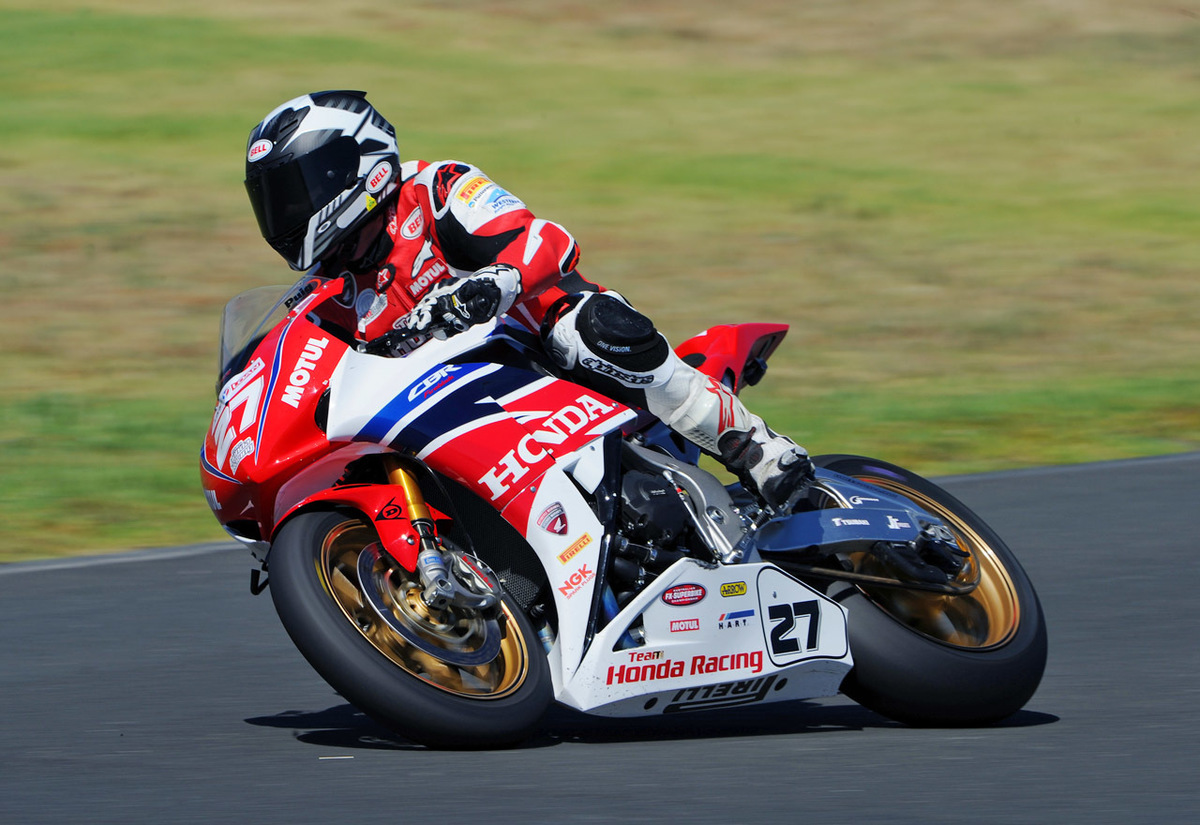
Honda riders tame the heat in scorching conditions
Eastern Creek set for final round action
21 November 2014: Eastern Creek, NSW
Team Honda Racing riders Jamie Stauffer, Wayne Maxwell and Tory Herfoss proved that the weather is no barrier to performance at the final round of the 2014 Swann Insurance Australasian Superbike Championship at Eastern Creek.
The trio recorded the fastest lap times in Superbike class qualifying at Sydney Motorsport Park at Eastern Creek on Friday.
A full day of practice and qualifying took place in hot conditions in Sydney, as riders and officials prepared themselves for the Grand Finale of the series – beginning with racing in the YMF-Loan Australian Superbike Championship on Saturday.
Riders and officials will be scurrying back to their rooms tonight for some cool relief – with temperatures at the venue reaching 39-plus degrees and a track temperature north of the 60-degree mark.
Superbikes
Riders were keen to conserve energy and machinery for the weekend, and half the field put in five laps or less over the course of the session.
The top-five riders all posted their fastest times in the second lap of qualifying, with Stauffer coming close to the circuit lap record (1:31.578) by posting a 1:31.706 on lap two of his five laps.
Maxwell was not far off the mark, also completing five laps – with his fastest time of 1:31.810 coming on lap two.
Herfoss, Cru Halliday (Yamaha Racing Team) and Glenn Allerton (NextGen Motorsports) all put in three laps each in the session, and finished qualifying in third, fourth and fifth places respectively.
Supersport
The 18-minute qualifying session for Supersport was also an exercise in conservation with riders again opting to put in minimal laps due to the conditions.
Only nine-points separate Aaron Morris (Maxima Yamaha) and Aiden Wagner (Wagner Soil Testing) in this category with a brand new R1 the prize for whoever comes out on top at the end of the weekend.
It was series challenger Wagner who posted the fastest time of the session with a 1:34.258 ahead of Morris, who clocked his fastest time of 1:34.603 on his third lap of three completed.
Callum Spriggs (Allsite Concrete Cutting) posted the third fastest time in the session.
Pro Twins / Nakedbikes
In the opening qualifying session of the day it was comeback king Kevin Curtain (Trinder Aprilia Racing) who had tongues wagging finishing the Pro-Twins class in second position.
He posted a fastest lap time of 1:35.952 on the second of his three qualifying laps, to finish just behind Ducati pilot Craig McMartin (Racers Edge Performance) who clocked a best lap time of 1:33.781.
McMartin posted five laps in the 18-minute qualifying session, and registered the fastest time on his opening lap.
In the Nakedbike class, KTM Racing rider Angus Reekie posted the fastest qualifying time with a 1:36.886 to finish ahead of Luke Follacchio (Lukey Luke Stuntrider) and Rennie Scaysbrook (LTR).
After a horrendous fifth round of the championship at Wakefield park a month ago, Reekie will be out seeking redemption and will do whatever it takes to come home with the round and series win.
Ninja FX 300 / Ninja FX 250 / eFXC
The combined qualifying for the Ninja classes and Electric Bikes threw up some surprising times, as Danny Pottage (O’Hanlon Electric Motorsports) clocked the fastest lap time of the session with a 1:47.423.
Jason Morris (Varley Electric Vehicles) recorded the third fastest time for the session abord his electric bike with a 1:50.657, while Daniel Ripperton (Ripperton Racing) rounded out the top-three in the eFXC class.
In the Ninja 300 category, it was Brandon Demmery (Noise Guard Racing) who will start from up front posting a 1:49.945 lap time on his fifth lap.
Demmery made his intentions clear for the weekend by completing nine laps in the session – the most of any rider out on the track.
Kyle Buckley (Bcperformance Motogo) and Bailie Perriton rounded out the top three for the class, posting times of 1:50.945 and 1:50.999 respectively.
The top-three times posted in the Ninja 250 category were by Grant Jordan, Stuart Smith and Stuart Green.
Formula Oz
Mathew Harding was the quickest out in the Formula Oz qualifying session clocking the fastest time of 1:33.548 on the second of his four completed laps.
Harding currently sits second in the championship – 12 points adrift of Ben Nicolson (NextGen Motorsports) but will have the ideal start on Saturday at the front of the grid.
Nicolson nabbed the second fastest time of the session with a lap time of 1:33.654 – just two hundredths of a second faster than Chris Trounson (Gas Honda Racing).
For a full list of the practice and qualifying results, head to: http://www.computime.com.au/meetings/index.aspx?M…
Stay tuned to www.fxsuperbikes.com.au or the fxsuperbikes Facebook page all weekend, to get minute by minute coverage of the final round.
More, from a press release issued by Team Honda Racing:
Team Honda Racing Qualify 1-2-3 on Grid
21st November 2014 – Things are definitely heating up for the Finale of the Australasian Superbike Championship at Sydney Motorsport Park with Team Honda Racing qualifying 1-2-3 on the grid heading into tomorrow’s races.
With track temperatures close to 60 degrees Celsius and an ambient temperature close to 40 degrees Celsius today it was hard going for all involved, but #27 Jamie Stauffer rose to the challenge, recording the fastest lap time of the Qualifying session, a 1:31.706 sec with #47 Wayne Maxwell a close second fastest with a lap time of 1:31.810 sec. Rounding out the top 3 Qualifying positions today was #17 Troy Herfoss, his fastest qualifying lap a 1:32.062 sec with team mate #16 Josh Hook qualifying in 7th position on the track heading into tomorrow’s races.
Stauffer is keen to back up today’s effort in tomorrow’s FX-Supebikes races. “Apart from the heat today it was a good day on the track. We made some progress in the practice sessions and we were able to make the most of it in qualifying. P1 heading into tomorrow’s races is a good start so let’s see if we can continue that through the weekend.”
The current series leader, Maxwell is ready to get down to racing, saying “P2 in Qualifying today will take me into tomorrow’s FX-Superbike races well. The Motul Honda is handling the conditions well so we’ll wait and see what tomorrow’s 3 races bring.”
Herfoss rounds out the top 3 on the grid heading into tomorrow’s event and is happy with the way the weekend is taking shape. “I am feeling really strong on the CBR1000RR SP this weekend; the team has delivered yet again. The field is really tight and the heat is fierce so it will definitely be interesting racing over the weekend. My focus for tomorrow is to put myself in the best position possible for Sunday’s final races.”
Josh Hook will start tomorrow’s races from 7th place on the grid and feels confident of a strong result. “We tried a few things today and found a really good direction for tomorrow’s races. The bike feels great and I’m really happy with the set up. I’ll start from the second row tomorrow in P7 so we will see what happens.”
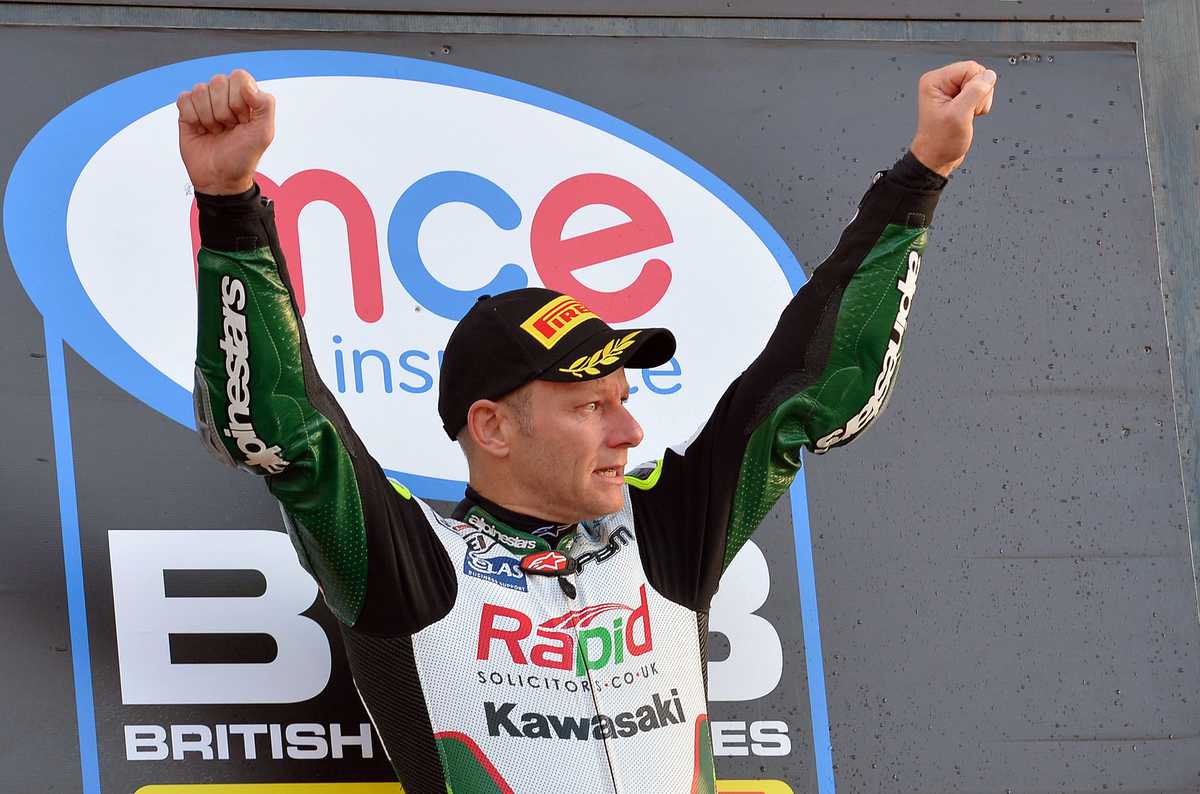
Byrne And Easton Remain At PBM For 2015
Having won both the MCE Insurance British Superbike Championship and the MCE Rider’s Cup in 2014, the Rapid Solicitors Kawasaki team of Shane ‘Shakey’ Byrne and Stuart Easton will remain with the Paul Bird Motorsport team for 2015.
Byrne became the most successful rider in MCE BSB history when he took his fourth title at a dramatic final round at Brands Hatch last month and is aiming for an unprecedented fifth MCE British Superbike title whereas Easton, fresh from winning last weekend’s Macau Grand Prix, will continue alongside Byrne in MCE BSB for the Cumbrian-based team on the Kawasaki Ninja ZX-10R.
The deal continues the successful relationship into a fourth year which has seen 37-year-old Byrne, originally from London but now living in Kent, claim two titles in 2012 and 2014 as well as finishing second on the Rapid Solicitors Kawasaki in 2013.
30-year-old Easton, from Hawick, returned from serious injury in 2012 with the PBM team and after winning the Motorpoint British Supersport title in 2013, moved back into MCE BSB last year to clinch the coveted MCE Rider’s Cup.
Shane Byrne: “Whereas I had lots of very good offers from other teams, my main aim was always to stay with the PBM team and I’m delighted to remain with Paul Bird for 2015. It’s important to have the best team around you and given our success over the past three years, it’s a proven and established package which I feel at home with. I’m even more determined to go out there and win the title again so I’m particularly pleased to get this all sorted now and we can focus on our preparations for next season.”
Stuart Easton: “It’s great to have the deal sorted early and we can concentrate on 2015. It was important to have continuity and to remain with the same team on the same bike so it’s a positive step for me. I found myself scoring good points and had some great results in the last few meetings of this year so the plan is to continue where I left off this season and to seriously challenge for the title in 2015.”
Paul Bird, Team Owner: “The plan was always to run Shakey and Stuart in MCE BSB next season and as both wanted to ride for us again, it was fairly straightforward. We’ve proved over the years what a successful package we have so none of us saw the need to change things. We will be the only official Kawasaki-supported team in the series next year and we don’t plan on relinquishing our number one plate. We are more determined than ever to win the title again next season.”
Further announcements regarding the team’s additional racing activities and commercial partnerships will be revealed in due course.
The opening round of the MCE Insurance British Superbike Championship takes place at Donington Park on 4/6th April 2015 and for further details, please visit www.pbmuk.net and www.pbmuk.net
Paul Bird Motorsport (PBM) are winners of over 150 races in British Superbike Championship, MotoGP CRT, World Superbike Championship, 125cc, 250cc, Supersport British Championships, Superstock National Championships, Isle of Man TT, North West 200, Daytona, Macau GP and British domestic races. Points scorers in 125cc, 250cc and 500cc GPs, Points scorers in World Supersport, podium finishers in WSB, Superpole winners in World Superbike. They are based at Langwathby near Penrith in Cumbria.
Key Successes
British Superbike Champions 2002/2003/2012/2014, British Supersport Champions 2002, British Superbike Rider’s Cup Champions 2014, British 250cc Champions 1999, National Superstock 1000 Champions 2012, National Superstock 600 Champions 2011, Isle of Man TT winners 1999/2000, Daytona winners 1999/2000, NW200 winners, Macau GP winners, WSB race winners, MotoGP CRT race winners. National Rally Champions 2005.
Paul Bird Motorsport in the British Superbike Championship 2000 – 2014
Races Entered: 439
Pole Positions: 42
Race Wins: 65
Podiums: 89
Fastest Laps: 53
Record Laps: 24
% Races Finished: 84.62%
% Victories 14.80%
% Podiums 35.08%
More, from a press release issued by MotorSport Vision:
BYRNE STRIVES FOR FIVE MCE BSB TITLES BY RE-SIGNING WITH PBM ALONGSIDE EASTON FOR 2015
Shane ‘Shakey’ Byrne, crowned MCE Insurance British Superbike Champion for a record-breaking fourth time this season, will defend his title in 2015 after re-signing for the Paul Bird Motorsport (PBM) team.
Byrne has won three of his four titles with PBM, including this year’s on board the Rapid Solicitors Kawasaki after a season-long battle with triple champion Ryuichi Kiyonari.
The Kent rider is focused on adding to his record-breaking achievements next season. Byrne said: “It has been another fantastic year for me and the Rapid Solicitors Kawasaki team, winning a fourth title, to make it two Championship wins from the past three seasons together. For 2015 I had some really interesting options available, but after weighing everything up the decision to stay with the team and with Paul Bird was a no-brainer.
“I am really happy to be back with the team next season as I feel almost like it is my own with the relationship we have built up over the last few years and how well we all work together. We want to be fighting at the front again in 2015 and our aim is to set the bar even higher and make it five titles!”
The team’s line-up is completed by Scot Stuart Easton, who returns as Byrne’s team-mate for the second consecutive season. Easton won the British Supersport title in 2013 before returning to the Superbike class last season with PBM. He scored a pair of podium finishes and narrowly missed out on a position in the Showdown before claiming an impressive victory in last weekend’s Macau Grand Prix.
Easton said: “I am looking forward to continuing with PBM in 2015, as in the last third of the season we found some real pace and it was very promising. We can come back next year stronger. To be given another year with this bike and in this team is ideal for me and I want to step it up and run consistently at the sharp end in 2015.”
Team Owner Paul Bird commented: “The plan was always to run Shakey and Stuart in MCE BSB next season and as both wanted to ride for us again, it was fairly straightforward. We’ve proved over the years what a successful package we have so none of us saw the need to change things. We don’t plan on relinquishing our number one plate. We are more determined than ever to win the title again.”
For more information please visit www.britishsuperbike.com

On board footage, front and rear view, of Dane Westby doing a flying lap aboard his Yamalube/Westby Racing YZF-R6 at the 2014 Daytona round of the Championship Cup Series. Footage courtesy of Broaster Racing.

Sofuoglu Hails Positive Test
Three-time WSS Champion Kenan Sofuoglu (Kawasaki San Carlo Puccetti Racing) took his first steps toward the 2015 WSS season at the Motorland Aragon circuit on 17 and 18 November, evaluating the latest machine developments to take to the next tests in Jerez next week.
Track time was limited on day one but in working between two specifications of engine set-up Sofuoglu set a high number of laps on the second day and posted positive lap times around the MotoGP version of the Motorland track layout.
The use of this version of the long Motorland circuit prevented any direct comparison of lap times with the same track layout Kenan won the 2014 WSS race on while riding a Ninja ZX-6R, but the team was pleased with both the pace and consistency shown by man and machine in this first test.
Kenan and the team are set to test again soon, on Monday and Tuesday of next week another popular Spanish circuit, Jerez de la Frontera.
Kenan Sofuoglu: “The test was very positive and gave us more than I expected. There was a big moment for us because there were two different kinds of package to test for the 2015 season, but it was a difficult choice to make because they were both good. We will continue testing in Jerez next week. On the personal side this first test towards the 2015 season gave me a great motivation. The old season is finished so now everybody has zero points and I feel a lot of confidence on the bike. I think our lap times were a good surprise for us because we did not expect to be able to make good lap times easily and consistently. I think this will be a good first step. Because we used the GP track layout at Motorland it was difficult to compare speeds or lap times, but from what we can see on the data we are faster than we were before. I think the whole package looks like it is working very well and most importantly I am back on the bike with great motivation. I am starting from zero again and I feel very strong. I did so many laps at this test and enjoyed the way it went.”
Manuel Puccetti: Team Manger: “The Motorland Aragon test was a very good one for Kenan. He tried many different configurations on the bike and set a very good lap time. The team had a lot of work to do as he completed 150 laps over the two days. The team and Kenan enjoyed a very good and consistent winter test at Motorland and next week we will continue with another Spanish test over two days at Jerez.”
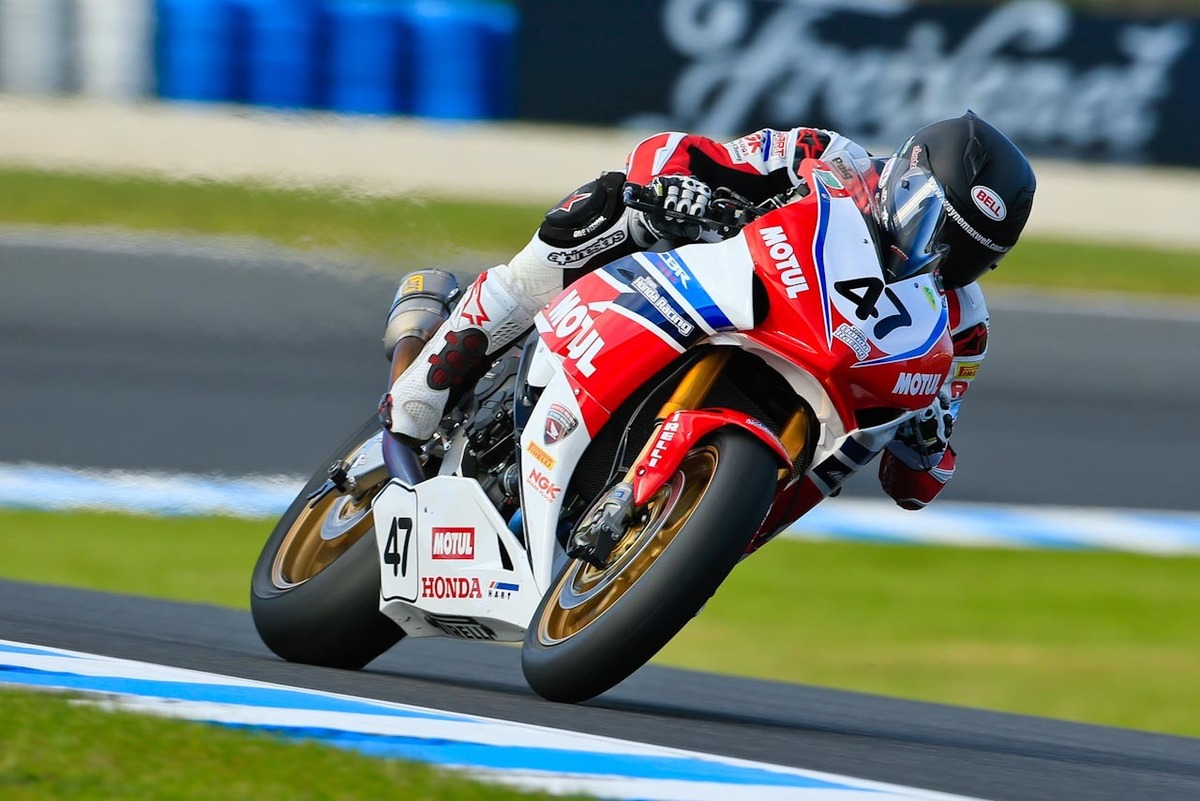
Team Honda Racing Ready for Final Title Charge
20th November 2014 – The Finale of the Australasian Superbike Championship will be held this weekend at Sydney Motorsport Park and Team Honda Racing is set for one last battle of the big guns to decide the 2014 Title. Having dominated the season onboard the Honda CBR1000RR SP the team holds the top 3 positions heading into the decider, and has no plans to relinquish any places on the podium if at all possible.
Focused, determined and business as usual would best describe the 4 Honda riders as they prepare for Round 6 ASC. #47 Wayne Maxwell currently sits in 1st place in championship points and as the 2013 Australian Superbike Champion he knows what it takes to see a campaign to the checkered flag.
Maxwell will be looking to complete back-to-back titles this weekend and with 317 points to date, he sits just 21 points ahead of team mate #27 Jamie Stauffer and 57 points ahead of #17 Troy Herfoss. #16 Josh Hook is the team underdog this season after missing the first round of the championship due to injury. Hook’s persistence has seen him claw back valuable points to currently sit in 6th place heading into the Finale this weekend. There is no doubt the young gun from Taree will finish his season strongly.
Team Principal, Paul Free is prepared for a big weekend at Sydney Motorsport Park, saying “This weekend is going to be huge. We have 4 of the best riders in the country and heading into the last races of the season we hold the top 3 championship positions. The field is extremely competitive and anything can happen. We will approach this event the same as any other, we will remain focused and work together to get the best results we can. No matter what happens I am immensely proud of the whole team and their efforts this year. I am really looking forward to the event and to see how the Finale unfolds.”
Live Streaming of all the races on Sunday can be viewed at www.teamhondaracing.com.au/live-stream
Link to Dorna and MotoGP events like the one seen here will benefit the series…
Three-time 500cc Grand Prix World Champion Wayne Rainey talks about the new MotoAmerica AMA/FIM North American Road Racing Championship Series and the future of the sport in the U.S.
Roger Hayden has signed a new, two-year deal with Yoshimura Suzuki to race in the MotoAmerica AMA/FIM North American Motorcycle Road Racing Championship. That’s according to what Hayden was quoted as saying in an article appearing at http://owensboroliving.com/the-buzz/owensboro-racers-building-tradition/. The article was credited to Danny May, the co-author of Earl Hayden’s book “The First Family of Racing.”
When asked what are your future hopes and plans, Hayden is quoted as saying: “I just signed a two-year deal, which is a big relief because since 2010 I’ve only been on one-year contracts. It always leaves you wondering, ‘What am I gonna do next year?’ So this deal is a big relief for me. It’s the same team I rode for last year [Yoshimura Suzuki] but they renewed it for two more years. When I started out last year, I didn’t get a ride till Christmas. So now that I got a two-year deal on a factory team that’s a lot of stress off my shoulders. And it shows they have that much faith in me. Plus, Suzuki is coming out with a new bike next year [2016], and now I’ll have been in the Suzuki family for five years now.”
Hayden also posted photos on his Facebook page from a test he recently did with the Yoshimura Suzuki team at Thunderhill Raceway Park, in Willows, California.
Hayden was the runner-up in the 2014 AMA Pro Superbike Championship with one victory and eight podium finishes in 11 races.
The future of Hayden’s 2014 teammates Martin Cardenas and Chris Clark is uncertain at this time. Cardenas, a resident of Colombia, did not immediately respond to an e-mail from Roadracingworld.com seeking information, and Clark sent a text message to Roadracingworld.com on Thursday that read “Will not be back for 2015.”
Calls to Roger Hayden, Yoshimura Suzuki Team Manager Rich Doan and Senior Vice President of Yoshimura R&D of America Don Sakakura were not returned before post time.
2015 KAWASAKI NINJA H2™R
Built Beyond Belief
The launching point for the development of the Ninja H2™R motorcycle was a strong desire to offer riders something they had never experienced before. Convinced that an extraordinary riding experience would not be found by merely building on the performance of existing models, the design team committed to developing the “ultimate motorcycle” from a clean slate.
The bike needed to deliver intense acceleration and ultra-high top speed, coupled with supersport-level circuit performance. To realize this goal, help was enlisted from other companies within the Kawasaki Heavy Industries, Ltd. (KHI) group, precipitating an unprecedented level of collaboration.
Developing the Ninja H2R as a closed-course model allowed the unadulterated pursuit of performance, free from the limitations that street riding would impose. The result was a new model offering a sensory experience surpassing anything else that riders can find today.
The Ninja H2R is powered by a supercharged engine with a compact design on par with powerplants found in liter-class supersport models. The key to achieving its incredible performance lies in the engine’s supercharger, which is a motorcycle-specific unit designed completely in-house with technology from Kawasaki’s Gas Turbine & Machinery Company, Aerospace Company and Corporate Technology Division.
HIGHLIGHTS OF THE 2015 KAWASAKI NINJA H2™R:
-Trellis frame used for first time on a Kawasaki motorcycle to provide strength, controlled flex and air circulation
KHI Group’s technology was not limited to the supercharger. Advanced technological know-how shared from other Group companies is found throughout the innovative engine and chassis design. For example, the carbon fiber upper and lower wings that add stability for riding in the ultra-high speed range were designed with assistance from Kawasaki’s Aerospace Company. This collaboration, and the level of technology poured into the model was the reason the Kawasaki River Mark* is prominently displayed on the bike.
When it was time to name the model, “Ninja®” was an obvious choice because it is synonymous with Kawasaki performance, and is shared by legendary models over the years. Its name also pays homage to another iconic model: the 1973 “H2R”, which boasted the sort of intense acceleration that made it a worldwide sensation. For a motorcycle that delivers supersport-level handling coupled with acceleration no rider has experienced before, Ninja H2R was the perfect names. And so Kawasaki is again unleashing a new sensation upon the world.
*The Kawasaki River Mark is a symbol of KHI dating back to the 1870s. As a policy, its use is limited to models with historical significance. But permission was granted for the Ninja H2R to use this special symbol.
THE QUEST FOR POWER
In order to offer intense acceleration, it was essential that the engine was able to produce big power. While a large-displacement engine could easily provide high output, the engineers preferred it to be compact to help ensure a lightweight, compact motorcycle.
Using a supercharged engine enabled these engine design requirements to be met, and the immense potential of the compact, highly efficient engine is a testament to the technology developed by the KHI Group.
SUPERCHARGED 998cc IN-LINE FOUR
KHI-DESIGNED SUPERCHARGER
The supercharger used by the Ninja H2R was designed by Kawasaki motorcycle engineers with assistance from other companies within the KHI Group, namely the Kawasaki Gas Turbine & Machinery Company, Aerospace Company, and Corporate Technology Division. Designing the supercharger completely in-house allowed it to be developed to perfectly match the engine characteristics of the Ninja H2R. The highly efficient, motorcycle-specific supercharger was the key to achieving the maximum power and intense acceleration the engineers wanted.
POWER UNIT DESIGNED FOR HIGH PERFORMANCE
Despite its familiar in-line four configuration, the Ninja H2R engine is loaded with technology developed specifically for this supercharged engine: some new, others with know-how from the Kawasaki Group.
Every component of the engine was chosen to achieve a certain function. In order to accommodate the higher air pressure from the supercharger, as well as to help ensure reliability, the entire engine was designed to be able to handle stresses 1.5-2x greater than a naturally aspirated liter-class engine.
DOG-RING TRANSMISSION
To facilitate smooth, quick shifting, a dog-ring-type transmission was selected. This is similar to the kind of transmission commonly found in MotoGP™ or Formula 1®, and was developed with the Kawasaki Racing Team.
HYDRAULIC CLUTCH & BACK-TORQUE LIMITER
A high-quality hydraulic clutch offers less maintenance and helps to ensure that the initial bite point can be maintained. By using Brembo® components, superb linearity and smooth actuation are further benefits.
MAXIMIZING AIRFLOW EFFICIENCY
To maximize the performance of the supercharged engine, airflow efficiency was of paramount importance. How air enters the supercharger, how the compressed air enters the engine, and how the combusted air/fuel mixture is discharged were all carefully analyzed for maximum efficiency to help ensure the airflow characteristics would create the desired engine character.
RAM AIR INTAKE
ALUMINIUM INTAKE CHAMBER
ELECTRONIC THROTTLE VALVES
Kawasaki’s fully electronic throttle actuation system enables the ECU to control the volume of fuel (via fuel injectors) and air (via throttle valves) delivered to the engine. Ideal fuel injection and throttle valve position results in smooth, natural engine response and the ideal engine output. The system also makes a significant contribution to reduced emissions.
INTAKE & EXHAUST PORTS, CAMSHAFT PROFILES
EXHAUST SYSTEM
KEEPING THE ENGINE COOL
Cooling performance can be a substantial limiting factor for engine output, so maximizing the cooling efficiency was a key consideration when designing the engine. In addition to helping ensure that intake air remain as cool as possible, the heat generated by the high-output engine needs to be dissipated, and engine components themselves need to be kept cool to help ensure efficient operation. The extensive pursuit of cooling performance led to a highly complex engine layout, both for the lubrication system and the cooling system.
CYLINDER HEAD
The design of the aluminum cylinder head provides the necessary cooling performance. The large coolant passageways result in excellent cooling for the combustion chamber.
OIL JETS
In the interest of keeping the engine compact and simple, a single lubrication system provides cooling oil for the engine components, supercharger and the transmission.
LUBRICATION SYSTEM COMPONENTS
Because the lubrication system is servicing so many components, oil volume is 5.0 liters (1.3 gallons) – that is about 35% more than usually seen in a naturally aspirated engine of the same displacement.
RADIATOR
LIQUID-COOLED OIL COOLER
HIGH-SPEED STABILITY & LIGHT HANDLING
The objectives for the chassis were to provide superb motorcycle composure at ultra-high speeds, while offering cornering performance that allows the rider to enjoy circuit use, and finally to be very accommodating to the rider. Ordinarily, high-speed stability can easily be achieved with a long wheelbase, but a shorter wheelbase was selected to achieve the compact overall package and sharp handling that were desired. So the frame needed to not only be stiff, but also to be able to absorb external disturbances, which could otherwise unsettle the chassis when encountered at high speed. A trellis frame provided both the strength to harness the incredible power of the supercharged engine, and the balanced flex to achieve stability for high-speed riding.
INNOVATIVE CHASSIS DESIGN
TRELLIS FRAME
Using a trellis frame offered an elegant, lightweight solution to meeting the performance requirements for the chassis of the closed-course Ninja H2R. Able to harness the massive power of its engine, it has a balance of stiffness and flexibility that enables a high level of stability while being able to handle external disturbances at high speeds. Its open design also helps dissipate heat generated by the supercharged engine.
SWINGARM MOUNTING PLATE
This innovative new chassis mechanism allows the engine to act as part of the frame.
SINGLE-SIDED SWINGARM
The Ninja H2R features Kawasaki’s first single-sided swingarm.
CHASSIS GEOMETRY
To ensure fun at high speeds on the racing circuit, a compact package was desired. Therefore, the chassis geometry is very similar to that of a liter-class supersport motorcycle.
FRONT SUSPENSION
KYB® AOS-II racing suspension makes its debut on this innovative machine.
REAR SUSPENSION
Fully adjustable KYB rear suspension offers superb stability.
BRAKES
Given the high-speed potential of the Ninja H2R, the brakes chosen were the best available for a production motorcycle. Special tuning helped ensure that all play in the lever was removed from the system, so that the brakes respond immediately when they are applied.
ORIGINAL WHEEL DESIGN
The cast aluminum wheels were designed specifically for the Ninja H2R.
HIGH-SPEED TIRES
To help ensure sufficient tire durability when riding at high speed, high-performance tires are used.
SHAPED FOR SPEED
As speed increases, wind resistance increases exponentially. To enable high-speed operation, a combination of high power and slippery aerodynamics was needed. With power requirements taken care of by the supercharged engine, the next step was to design bodywork that provides both minimal drag and good control when riding at high speed. Assistance from Kawasaki’s Aerospace Company was enlisted in creating the aerodynamically sculpted bodywork to provide maximum aerodynamic efficiency.
AERODYNAMICS
AERODYNAMICALLY DESIGNED BODYWORK
It is no accident that when viewed from the side, the Ninja H2R does not have the aggressive forward-canted rake of most modern supersport motorcycles. While supersport bikes use their front-leaning attitude to aid quick steering, at the speeds for which the closed-course Ninja H2R was designed, such a posture would create drag, which would hinder top speed potential. Therefore, the motorcycle’s stance is very neutral, almost flat to make the body as aerodynamically sleek as possible.
GENERATING DOWNFORCE
In order to maintain both straight-line stability and the ability to change direction while running at high speed, the Ninja H2R features a number of aerodynamic devices to help ensure the front wheel has strong contact with the ground.
SEATING FOR ONE
RIDING POSITION & ERGONOMICS
The kind of riding the Ninja H2R was designed for, and a desire for a compact package resulted in a riding position similar to that of a supersport bike without being quite as aggressive. As enjoyment of the intense acceleration and high-speed capability was the first priority, a solo seat for the rider is the only seating provided.
INSTRUMENTATION & CONTROLS
The advanced, high-tech design of the instrumentation conveys the image of piloting a fighter jet. Handlebar control switches put all mode selection and display options at the rider’s fingertips.
ELECTRONIC RIDER SUPPORT
Complementing the Ninja H2R’s incredible engine and chassis performance, advanced electronics work behind the scenes to provide rider support. Depending on rider preference, many of the systems may be turned off. And while the high-performance engine was designed to be accommodating even without the benefit of rider aids, when electing to fully experience the Ninja H2R’s intense acceleration or high-speed potential, these systems are available to provide an extra degree of rider confidence.
ENGINE & CHASSIS MANAGEMENT SYSTEMS
KTRC (KAWASAKI TRACTION CONTROL)
The new KTRC system used on the Ninja H2R combines the best elements of Kawasaki’s earlier traction control systems. Multi-level modes offer riders a greater number of settings to choose from, with each mode providing a different level of intrusion to suit riding conditions and rider preference. And all modes are designed to manage output when sudden wheel slip occurs. The new system offers both enhanced sport riding performance and the peace of mind to negotiate slippery surfaces with confidence.
KAWASAKI LAUNCH CONTROL MODE
Designed to assist the rider by optimizing acceleration from a stop, Launch Mode electronically controls engine output to prevent wheelspin and minimize wheelies when launching.
KAWASAKI ENGINE BRAKE CONTROL
The system allows riders to select the amount of engine braking they prefer.
KIBS (KAWASAKI INTELLIGENT ANTI-LOCK BRAKE SYSTEM)
Kawasaki’s supersport-style ABS is standard equipment on the Ninja H2R. This is based on the same system used on the Ninja ZX-10R, with programming and settings revised to suit the performance parameters of the Ninja H2R.
KQS (KAWASAKI QUICK SHIFTER)
Ninja H2R is the first Kawasaki motorcycle to be fitted with a standard quick shifter.
ÖHLINS ELECTRONIC STEERING DAMPER
Unlike a mechanical steering damper – in which the settings, once fixed, must cover all riding conditions and speeds – the damping characteristics are changed electronically, according to vehicle speed and the degree of acceleration or deceleration.
At low speeds, the settings were chosen so that damping does not interfere with the bike’s intrinsic lightweight handling. At high speeds, damping increases to provide enhanced stability.
STYLING & CRAFTSMANSHIP
Wanting to ensure a bold design worthy of a model that carries both the “Ninja” and “H2” names, the prime styling concept for the Ninja H2R was “Intense Force” design.
As a flagship for the Kawasaki brand, it needs to have presence, and styling that reflects its incredible performance. But the design is much more than cosmetic. While its edged styling certainly looks the part, the Ninja H2R also possesses a functional beauty: each piece of its bodywork was aerodynamically sculpted to enhance high-speed stability; the cowling design also maximizes cooling performance and heat dissipation, aiding the engine’s incredible output; and the ram air duct is ideally positioned to bring air to the supercharger.
More than any Kawasaki motorcycle to date, the Ninja H2R is a showcase of craftsmanship, build quality and superb fit and finish – right down to the high-tech mirror-like paint specially developed for this model.
INTENSE FORCE DESIGN
STYLING & CRAFTSMANSHIP DETAILS
HIGH-TECH PAINT
The Kawasaki original silver mirror-like paint used on the Ninja H2R – known as mirror coated black – was developed by Kawasaki specifically for motorcycles. The highly reflective surface adds to the bike’s stunning design.
KAWASAKI RIVER MARK
Special permission was obtained to use the River Mark on the Ninja H2R. Its use is reserved for models of historical significance.
HIGH-PRECISION PRODUCTION
Unlike a regular mass-production model, the high-precision production of the Ninja H2R requires greater hands-on participation by skilled Kawasaki craftsmen. So each step, from metalworking, treatment, welding and painting to assembly, fine-tuning and inspection is carefully attended to create a product of superior quality. Within Kawasaki’s Akashi Factory in Japan, production takes place in an area dedicated exclusively to the Ninja H2R motorcycle.
COLOR
The Kawasaki Ninja H2R is only available in its very special mirror coated black paint with the remaining bodywork in carbon fiber.
ORDERING INFORMATION
The Kawasaki Ninja H2R is a limited-release production motorcycle, available for a short time in select markets. In order to reserve one of the world’s first supercharged production motorcycles, make a deposit at your local authorized Kawasaki dealer no later than December 19, 2014. Reservations will be taken on a first-come, first-served basis and are secured only with a deposit.
ABOUT KAWASAKI
Kawasaki Heavy Industries, Ltd. (KHI) started full-scale production of motorcycles over a half century ago. The first Kawasaki motorcycle engine was designed based on technical know-how garnered from the development and production of aircraft engines, and Kawasaki’s entry into the motorcycle industry was driven by the company’s constant effort to develop new technologies. Numerous new Kawasaki models introduced over the years have helped shape the market, and in the process have created enduring legends based on their unique engineering, power, design and riding pleasure. In the future, Kawasaki’s commitment to maintaining and furthering these strengths will surely give birth to new legends.
Kawasaki Motors Corp., U.S.A. (KMC) markets and distributes Kawasaki motorcycles, ATVs, side x sides, and Jet Ski® watercraft through a network of almost 1,200 independent retailers, with close to an additional 7,400 retailers specializing in general purpose engines. KMC and its affiliates employ nearly 3,100 people in the United States, with approximately 300 of them located at KMC’s Irvine, California headquarters.
Kawasaki’s tagline, “Let the good times roll.™”, is recognized worldwide. The Kawasaki brand is synonymous with powerful, stylish and category-leading vehicles. Information about Kawasaki’s complete line of powersports products and Kawasaki affiliates can be found on the Internet at www.kawasaki.com.
2015 Kawasaki Ninja H2™R Specifications*
| SPORTBIKES SPEC TEMPLATE | Ninja H2R |
| Engine | Liquid-cooled, 4-stroke in-line four |
| Displacement | 998cc |
| Bore x Stroke | 76 x 55mm |
| Compression Ratio | 8.3:1 |
| Fuel System | Digital Fuel injection (DFI®): 50mm throttle bodies x4 with dual injection |
| Intake System | Kawasaki supercharger |
| Cooling System | Water-cooled |
| Lubrication | Forced lubrication, wet sump with oil cooler |
| Ignition | Digital |
| Transmission | 6-speed, return, dog-ring |
| Final Drive | Chain |
| Frame Type | Trellis, high-tensile steel, with swingarm mounting plate |
| Rake/Trail | 25.1° / 4.3″ |
| Fuel Capacity | 4.5 gallons |
| Front Suspension / Wheel Travel | 43mm inverted AOS-II fork with rebound and compression damping, spring preload adjustability and top-out springs / 4.7 |
| Rear Suspension / Wheel Travel | New Uni-Trak® with gas-charged shock, piggyback reservoir, dual-range (high/low-speed) compression damping, rebound damping and preload adjustability, and top-out spring / 5.3″ |
| Front Tire Size | 120/70 ZR17 MC (58W) Bridgestone RACING BATTLAX V01 |
| Rear Tire Size | 190/65 ZR17 MC (78W) Bridgestone RACING BATTLAX V01 |
| Front Brakes | Dual radial-mount, opposed 4-piston calipers, dual semi-floating 330mm discs, KIBS ABS |
| Rear Brakes | Opposed 2-piston calipers, single 250mm disc, KIBS ABS |
| Overall Length | 81.5″ |
| Overall Width | 30.3″ |
| Overall Height | 45.7” |
| Overall Height Windscreen Lowered/Raised | N/A |
| Ground Clearance | 5.1″ |
| Seat Height | 32.7″ |
| Curb Weight** | 476.3 lb |
| Wheelbase | 57.1 |
| Color Choices | mirror coated black/ carbon fiber |
| MSRP | $50,000 |
| Warranty | N/A |
| Kawasaki Protection Plus (optional) | N/A |
| Wholesale Distributor | Kawasaki Motors Corp., U.S.A. 9950 Jeronimo Road, Irvine, California 92618 949-770-0400 www.kawasaki.com |
*Specifications are subject to change. Media are encouraged to visit www.kawasaki.com for most current specifications.
**Curb weight includes all necessary materials and fluids to operate correctly, full tank of fuel (more than 90 percent capacity) and tool kit (if supplied).
This vehicle is designed for the operator only. No passengers.
This vehicle is not manufactured for use on public streets, roads or highways.
The use of this vehicle is limited to riding on closed courses.
Observe the rules and regulations of the closed course you ride on.
For every 15 hours of running over 8,000rpm, the engine needs to be inspected. For every 30 hours, an engine bottom-end overhaul is needed.
The exhaust emission sound pressure level (stationary) of this vehicle is 120 dB (A) measured in the following method:
·Microphone position: 19.7” from the exhaust pipe at an angle of 45° measured from the centerline of the exhaust end and at the height of the exhaust pipe
·Engine speed: 5,500rpm (maintained for 3sec, then throttle is closed)
·Engine cooling water temperature: 194°F
Confirm the noise regulation of the closed course where you are going to ride beforehand. The exhaust noise level measuring method may differ from one course to another.
·Warm the tires to their operating temperature using tire warmers before riding.
·When storing your motorcycle, use front and rear stands and keep the tires off the ground.
·Do not use this vehicle in the rain.
·Do not use tires other than stipulated.
The Crescent Suzuki World Superbike Team begins testing for the 2015 FIM Superbike World Championship at the Circuito de Jerez in Spain next week, as new signing Randy de Puniet joins Alex Lowes to form the team’s new rider pairing.
Beginning work to prepare the Suzuki GSX-R1000 in line with 2015’s regulation changes, Crescent will be joined at the Spanish track by representatives from technical partner Yoshimura, alongside four new team members – Pete Jennings, Melvin Newnes, Christophe Lambert and Andy Berzins.
Having competed at the 4,423m Jerez circuit as recently as early September, Crescent Suzuki is scheduled to return for four days of testing between the 24th and 28th of November. The team’s initial plan is to evaluate the 2015 engine specifications and work on the front geometry settings for Lowes’ GSX-R following Qatar, while acquainting new signing de Puniet with his 2015 race machine.
Randy de Puniet:
“Jerez will be a very important test for me. It is my first time on the Crescent GSX-R1000 and our only test before the winter break. I am hoping for good weather to allow us to work a lot, I am aiming to do everything I can to learn the bike and work with the team to give as much information as I can to build the best bike ready to continue development in January. I am really excited for next year, my concrete goal is to be ready for Phillip Island and this test is my first step to achieving that.”
Alex Lowes:
“I can’t wait to ride at Jerez. It seems strange, as it’s only been a few weeks since the last race in Qatar, but I feel fresh and very excited to get back on the bike and start working patiently towards 2015. It will be my first opportunity to meet Randy and we’ve also made a few changes to the team structure so it will be nice to see how everything falls into place. The plan is to work on the electronics and engine power delivery and get a good feeling before heading into the winter break.”
Honda riders tame the heat in scorching conditions
Eastern Creek set for final round action
21 November 2014: Eastern Creek, NSW
Team Honda Racing riders Jamie Stauffer, Wayne Maxwell and Tory Herfoss proved that the weather is no barrier to performance at the final round of the 2014 Swann Insurance Australasian Superbike Championship at Eastern Creek.
The trio recorded the fastest lap times in Superbike class qualifying at Sydney Motorsport Park at Eastern Creek on Friday.
A full day of practice and qualifying took place in hot conditions in Sydney, as riders and officials prepared themselves for the Grand Finale of the series – beginning with racing in the YMF-Loan Australian Superbike Championship on Saturday.
Riders and officials will be scurrying back to their rooms tonight for some cool relief – with temperatures at the venue reaching 39-plus degrees and a track temperature north of the 60-degree mark.
Superbikes
Riders were keen to conserve energy and machinery for the weekend, and half the field put in five laps or less over the course of the session.
The top-five riders all posted their fastest times in the second lap of qualifying, with Stauffer coming close to the circuit lap record (1:31.578) by posting a 1:31.706 on lap two of his five laps.
Maxwell was not far off the mark, also completing five laps – with his fastest time of 1:31.810 coming on lap two.
Herfoss, Cru Halliday (Yamaha Racing Team) and Glenn Allerton (NextGen Motorsports) all put in three laps each in the session, and finished qualifying in third, fourth and fifth places respectively.
Supersport
The 18-minute qualifying session for Supersport was also an exercise in conservation with riders again opting to put in minimal laps due to the conditions.
Only nine-points separate Aaron Morris (Maxima Yamaha) and Aiden Wagner (Wagner Soil Testing) in this category with a brand new R1 the prize for whoever comes out on top at the end of the weekend.
It was series challenger Wagner who posted the fastest time of the session with a 1:34.258 ahead of Morris, who clocked his fastest time of 1:34.603 on his third lap of three completed.
Callum Spriggs (Allsite Concrete Cutting) posted the third fastest time in the session.
Pro Twins / Nakedbikes
In the opening qualifying session of the day it was comeback king Kevin Curtain (Trinder Aprilia Racing) who had tongues wagging finishing the Pro-Twins class in second position.
He posted a fastest lap time of 1:35.952 on the second of his three qualifying laps, to finish just behind Ducati pilot Craig McMartin (Racers Edge Performance) who clocked a best lap time of 1:33.781.
McMartin posted five laps in the 18-minute qualifying session, and registered the fastest time on his opening lap.
In the Nakedbike class, KTM Racing rider Angus Reekie posted the fastest qualifying time with a 1:36.886 to finish ahead of Luke Follacchio (Lukey Luke Stuntrider) and Rennie Scaysbrook (LTR).
After a horrendous fifth round of the championship at Wakefield park a month ago, Reekie will be out seeking redemption and will do whatever it takes to come home with the round and series win.
Ninja FX 300 / Ninja FX 250 / eFXC
The combined qualifying for the Ninja classes and Electric Bikes threw up some surprising times, as Danny Pottage (O’Hanlon Electric Motorsports) clocked the fastest lap time of the session with a 1:47.423.
Jason Morris (Varley Electric Vehicles) recorded the third fastest time for the session abord his electric bike with a 1:50.657, while Daniel Ripperton (Ripperton Racing) rounded out the top-three in the eFXC class.
In the Ninja 300 category, it was Brandon Demmery (Noise Guard Racing) who will start from up front posting a 1:49.945 lap time on his fifth lap.
Demmery made his intentions clear for the weekend by completing nine laps in the session – the most of any rider out on the track.
Kyle Buckley (Bcperformance Motogo) and Bailie Perriton rounded out the top three for the class, posting times of 1:50.945 and 1:50.999 respectively.
The top-three times posted in the Ninja 250 category were by Grant Jordan, Stuart Smith and Stuart Green.
Formula Oz
Mathew Harding was the quickest out in the Formula Oz qualifying session clocking the fastest time of 1:33.548 on the second of his four completed laps.
Harding currently sits second in the championship – 12 points adrift of Ben Nicolson (NextGen Motorsports) but will have the ideal start on Saturday at the front of the grid.
Nicolson nabbed the second fastest time of the session with a lap time of 1:33.654 – just two hundredths of a second faster than Chris Trounson (Gas Honda Racing).
For a full list of the practice and qualifying results, head to: http://www.computime.com.au/meetings/index.aspx?M…
Stay tuned to www.fxsuperbikes.com.au or the fxsuperbikes Facebook page all weekend, to get minute by minute coverage of the final round.
More, from a press release issued by Team Honda Racing:
Team Honda Racing Qualify 1-2-3 on Grid
21st November 2014 – Things are definitely heating up for the Finale of the Australasian Superbike Championship at Sydney Motorsport Park with Team Honda Racing qualifying 1-2-3 on the grid heading into tomorrow’s races.
With track temperatures close to 60 degrees Celsius and an ambient temperature close to 40 degrees Celsius today it was hard going for all involved, but #27 Jamie Stauffer rose to the challenge, recording the fastest lap time of the Qualifying session, a 1:31.706 sec with #47 Wayne Maxwell a close second fastest with a lap time of 1:31.810 sec. Rounding out the top 3 Qualifying positions today was #17 Troy Herfoss, his fastest qualifying lap a 1:32.062 sec with team mate #16 Josh Hook qualifying in 7th position on the track heading into tomorrow’s races.
Stauffer is keen to back up today’s effort in tomorrow’s FX-Supebikes races. “Apart from the heat today it was a good day on the track. We made some progress in the practice sessions and we were able to make the most of it in qualifying. P1 heading into tomorrow’s races is a good start so let’s see if we can continue that through the weekend.”
The current series leader, Maxwell is ready to get down to racing, saying “P2 in Qualifying today will take me into tomorrow’s FX-Superbike races well. The Motul Honda is handling the conditions well so we’ll wait and see what tomorrow’s 3 races bring.”
Herfoss rounds out the top 3 on the grid heading into tomorrow’s event and is happy with the way the weekend is taking shape. “I am feeling really strong on the CBR1000RR SP this weekend; the team has delivered yet again. The field is really tight and the heat is fierce so it will definitely be interesting racing over the weekend. My focus for tomorrow is to put myself in the best position possible for Sunday’s final races.”
Josh Hook will start tomorrow’s races from 7th place on the grid and feels confident of a strong result. “We tried a few things today and found a really good direction for tomorrow’s races. The bike feels great and I’m really happy with the set up. I’ll start from the second row tomorrow in P7 so we will see what happens.”
Byrne And Easton Remain At PBM For 2015
Having won both the MCE Insurance British Superbike Championship and the MCE Rider’s Cup in 2014, the Rapid Solicitors Kawasaki team of Shane ‘Shakey’ Byrne and Stuart Easton will remain with the Paul Bird Motorsport team for 2015.
Byrne became the most successful rider in MCE BSB history when he took his fourth title at a dramatic final round at Brands Hatch last month and is aiming for an unprecedented fifth MCE British Superbike title whereas Easton, fresh from winning last weekend’s Macau Grand Prix, will continue alongside Byrne in MCE BSB for the Cumbrian-based team on the Kawasaki Ninja ZX-10R.
The deal continues the successful relationship into a fourth year which has seen 37-year-old Byrne, originally from London but now living in Kent, claim two titles in 2012 and 2014 as well as finishing second on the Rapid Solicitors Kawasaki in 2013.
30-year-old Easton, from Hawick, returned from serious injury in 2012 with the PBM team and after winning the Motorpoint British Supersport title in 2013, moved back into MCE BSB last year to clinch the coveted MCE Rider’s Cup.
Shane Byrne: “Whereas I had lots of very good offers from other teams, my main aim was always to stay with the PBM team and I’m delighted to remain with Paul Bird for 2015. It’s important to have the best team around you and given our success over the past three years, it’s a proven and established package which I feel at home with. I’m even more determined to go out there and win the title again so I’m particularly pleased to get this all sorted now and we can focus on our preparations for next season.”
Stuart Easton: “It’s great to have the deal sorted early and we can concentrate on 2015. It was important to have continuity and to remain with the same team on the same bike so it’s a positive step for me. I found myself scoring good points and had some great results in the last few meetings of this year so the plan is to continue where I left off this season and to seriously challenge for the title in 2015.”
Paul Bird, Team Owner: “The plan was always to run Shakey and Stuart in MCE BSB next season and as both wanted to ride for us again, it was fairly straightforward. We’ve proved over the years what a successful package we have so none of us saw the need to change things. We will be the only official Kawasaki-supported team in the series next year and we don’t plan on relinquishing our number one plate. We are more determined than ever to win the title again next season.”
Further announcements regarding the team’s additional racing activities and commercial partnerships will be revealed in due course.
The opening round of the MCE Insurance British Superbike Championship takes place at Donington Park on 4/6th April 2015 and for further details, please visit www.pbmuk.net and www.pbmuk.net
Paul Bird Motorsport (PBM) are winners of over 150 races in British Superbike Championship, MotoGP CRT, World Superbike Championship, 125cc, 250cc, Supersport British Championships, Superstock National Championships, Isle of Man TT, North West 200, Daytona, Macau GP and British domestic races. Points scorers in 125cc, 250cc and 500cc GPs, Points scorers in World Supersport, podium finishers in WSB, Superpole winners in World Superbike. They are based at Langwathby near Penrith in Cumbria.
Key Successes
British Superbike Champions 2002/2003/2012/2014, British Supersport Champions 2002, British Superbike Rider’s Cup Champions 2014, British 250cc Champions 1999, National Superstock 1000 Champions 2012, National Superstock 600 Champions 2011, Isle of Man TT winners 1999/2000, Daytona winners 1999/2000, NW200 winners, Macau GP winners, WSB race winners, MotoGP CRT race winners. National Rally Champions 2005.
Paul Bird Motorsport in the British Superbike Championship 2000 – 2014
Races Entered: 439
Pole Positions: 42
Race Wins: 65
Podiums: 89
Fastest Laps: 53
Record Laps: 24
% Races Finished: 84.62%
% Victories 14.80%
% Podiums 35.08%
More, from a press release issued by MotorSport Vision:
BYRNE STRIVES FOR FIVE MCE BSB TITLES BY RE-SIGNING WITH PBM ALONGSIDE EASTON FOR 2015
Shane ‘Shakey’ Byrne, crowned MCE Insurance British Superbike Champion for a record-breaking fourth time this season, will defend his title in 2015 after re-signing for the Paul Bird Motorsport (PBM) team.
Byrne has won three of his four titles with PBM, including this year’s on board the Rapid Solicitors Kawasaki after a season-long battle with triple champion Ryuichi Kiyonari.
The Kent rider is focused on adding to his record-breaking achievements next season. Byrne said: “It has been another fantastic year for me and the Rapid Solicitors Kawasaki team, winning a fourth title, to make it two Championship wins from the past three seasons together. For 2015 I had some really interesting options available, but after weighing everything up the decision to stay with the team and with Paul Bird was a no-brainer.
“I am really happy to be back with the team next season as I feel almost like it is my own with the relationship we have built up over the last few years and how well we all work together. We want to be fighting at the front again in 2015 and our aim is to set the bar even higher and make it five titles!”
The team’s line-up is completed by Scot Stuart Easton, who returns as Byrne’s team-mate for the second consecutive season. Easton won the British Supersport title in 2013 before returning to the Superbike class last season with PBM. He scored a pair of podium finishes and narrowly missed out on a position in the Showdown before claiming an impressive victory in last weekend’s Macau Grand Prix.
Easton said: “I am looking forward to continuing with PBM in 2015, as in the last third of the season we found some real pace and it was very promising. We can come back next year stronger. To be given another year with this bike and in this team is ideal for me and I want to step it up and run consistently at the sharp end in 2015.”
Team Owner Paul Bird commented: “The plan was always to run Shakey and Stuart in MCE BSB next season and as both wanted to ride for us again, it was fairly straightforward. We’ve proved over the years what a successful package we have so none of us saw the need to change things. We don’t plan on relinquishing our number one plate. We are more determined than ever to win the title again.”
For more information please visit www.britishsuperbike.com
On board footage, front and rear view, of Dane Westby doing a flying lap aboard his Yamalube/Westby Racing YZF-R6 at the 2014 Daytona round of the Championship Cup Series. Footage courtesy of Broaster Racing.
Sofuoglu Hails Positive Test
Three-time WSS Champion Kenan Sofuoglu (Kawasaki San Carlo Puccetti Racing) took his first steps toward the 2015 WSS season at the Motorland Aragon circuit on 17 and 18 November, evaluating the latest machine developments to take to the next tests in Jerez next week.
Track time was limited on day one but in working between two specifications of engine set-up Sofuoglu set a high number of laps on the second day and posted positive lap times around the MotoGP version of the Motorland track layout.
The use of this version of the long Motorland circuit prevented any direct comparison of lap times with the same track layout Kenan won the 2014 WSS race on while riding a Ninja ZX-6R, but the team was pleased with both the pace and consistency shown by man and machine in this first test.
Kenan and the team are set to test again soon, on Monday and Tuesday of next week another popular Spanish circuit, Jerez de la Frontera.
Kenan Sofuoglu: “The test was very positive and gave us more than I expected. There was a big moment for us because there were two different kinds of package to test for the 2015 season, but it was a difficult choice to make because they were both good. We will continue testing in Jerez next week. On the personal side this first test towards the 2015 season gave me a great motivation. The old season is finished so now everybody has zero points and I feel a lot of confidence on the bike. I think our lap times were a good surprise for us because we did not expect to be able to make good lap times easily and consistently. I think this will be a good first step. Because we used the GP track layout at Motorland it was difficult to compare speeds or lap times, but from what we can see on the data we are faster than we were before. I think the whole package looks like it is working very well and most importantly I am back on the bike with great motivation. I am starting from zero again and I feel very strong. I did so many laps at this test and enjoyed the way it went.”
Manuel Puccetti: Team Manger: “The Motorland Aragon test was a very good one for Kenan. He tried many different configurations on the bike and set a very good lap time. The team had a lot of work to do as he completed 150 laps over the two days. The team and Kenan enjoyed a very good and consistent winter test at Motorland and next week we will continue with another Spanish test over two days at Jerez.”
Team Honda Racing Ready for Final Title Charge
20th November 2014 – The Finale of the Australasian Superbike Championship will be held this weekend at Sydney Motorsport Park and Team Honda Racing is set for one last battle of the big guns to decide the 2014 Title. Having dominated the season onboard the Honda CBR1000RR SP the team holds the top 3 positions heading into the decider, and has no plans to relinquish any places on the podium if at all possible.
Focused, determined and business as usual would best describe the 4 Honda riders as they prepare for Round 6 ASC. #47 Wayne Maxwell currently sits in 1st place in championship points and as the 2013 Australian Superbike Champion he knows what it takes to see a campaign to the checkered flag.
Maxwell will be looking to complete back-to-back titles this weekend and with 317 points to date, he sits just 21 points ahead of team mate #27 Jamie Stauffer and 57 points ahead of #17 Troy Herfoss. #16 Josh Hook is the team underdog this season after missing the first round of the championship due to injury. Hook’s persistence has seen him claw back valuable points to currently sit in 6th place heading into the Finale this weekend. There is no doubt the young gun from Taree will finish his season strongly.
Team Principal, Paul Free is prepared for a big weekend at Sydney Motorsport Park, saying “This weekend is going to be huge. We have 4 of the best riders in the country and heading into the last races of the season we hold the top 3 championship positions. The field is extremely competitive and anything can happen. We will approach this event the same as any other, we will remain focused and work together to get the best results we can. No matter what happens I am immensely proud of the whole team and their efforts this year. I am really looking forward to the event and to see how the Finale unfolds.”
Live Streaming of all the races on Sunday can be viewed at www.teamhondaracing.com.au/live-stream