Home Blog Page 1936

World Superbike: Yamaha Motor Europe Officially Announces Its 2019 Rider Lineup

0

Yamaha Motor Europe Confirm Extended WorldSBK Line Up For 2019

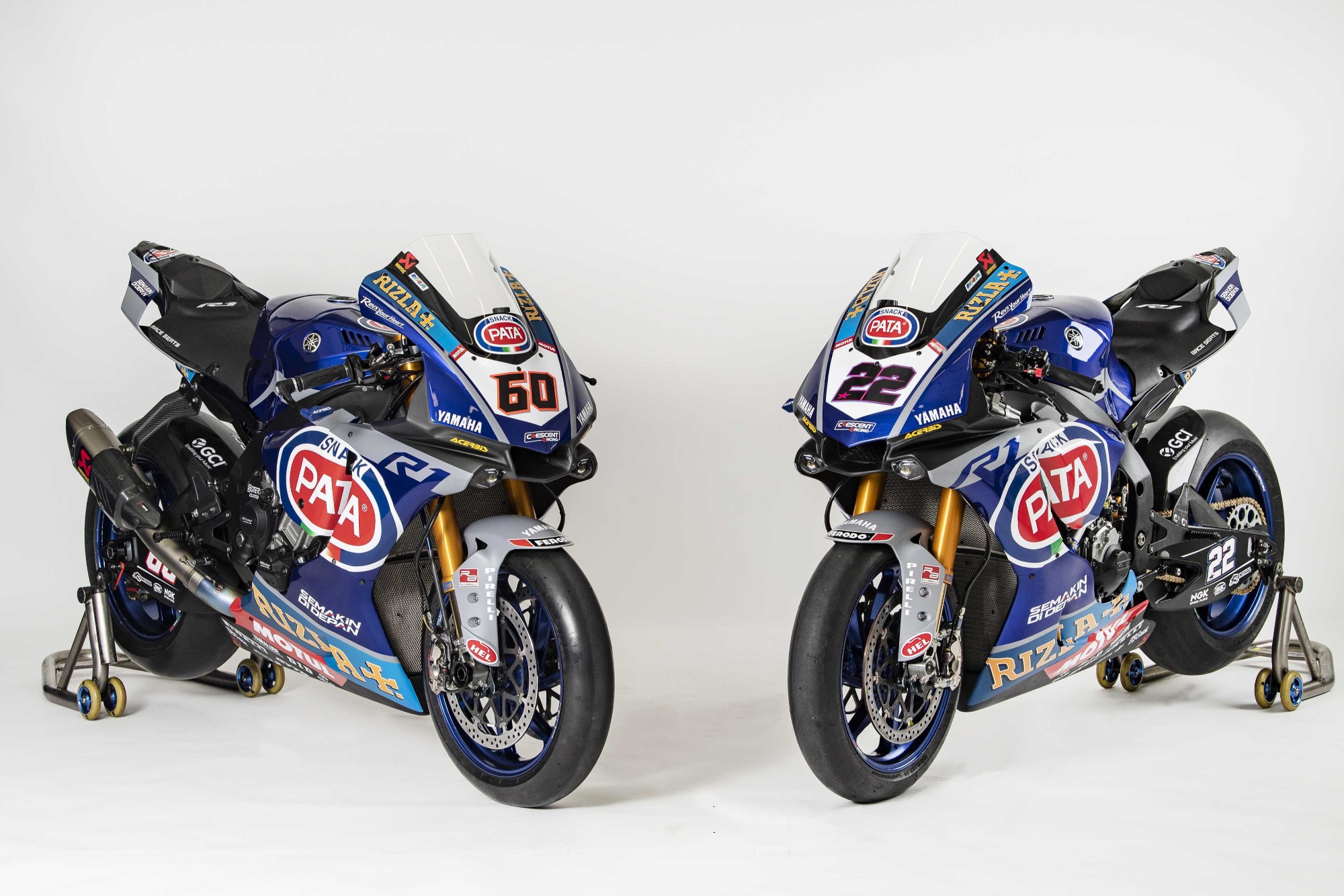
Yamaha Motor Europe is delighted to announce its official line up for the 2019 FIM Superbike World Championship. The Pata Yamaha WorldSBK Team will once again lead the way as Yamaha’s reference team, but this year they’ll be joined on the grid by the GRT Yamaha Supported WorldSBK Team, who step up to the premier production class for the 2019 season.

2019 marks the fourth year for the partnership between Yamaha and Crescent Racing and both parties are keen to build on the success of the 2018 season, during which the Pata Yamaha WorldSBK riders, Michael van der Mark and Alex Lowes, secured three race wins and a total of 14 podium finishes between them. Van der Mark and Lowes remain with the team for the coming season, with both keen to add to their tally of wins as they look to challenge for the championship in 2019.

Having achieved everything possible in WorldSSP, including winning the World Championship crown in 2017, GRT Yamaha face a new challenge in 2019, as the team step up to contest the FIM Superbike World Championship for the first time. Former 250cc World Champion and WorldSBK race winner Marco Melandri is joined at GRT Yamaha by the reigning WorldSSP Champion Sandro Cortese, who swaps last year’s title-winning YZF-R6 for the race winning Yamaha YZF-R1 WorldSBK machine this season.

The Pata Yamaha and GRT Yamaha teams are currently testing in Europe, but in February both teams will head south of the equator to test and then race at the iconic Phillip Island Circuit in Australia, venue for the opening round of the 2019 FIM Superbike World Championship.

Andrea Dosoli

Yamaha Motor Europe Road Racing Manager

“We are pleased with the way the Yamaha Motor Europe racing program has progressed. We saw a clear improvement in 2018, with not just our YZF-R1 reaching maturity but also our racing operation at the track and our operation in the factory. For this reason I’m very happy to confirm our relationship with Crescent Racing as our reference team in WorldSBK will continue for the 2019 season, with Michael van der Mark and Alex Lowes as the riders once again. I truly believe that continuity is critical for success in motorsport. If we can continue to work in the same way as we did in 2018 and strive to achieve the consistency that was maybe missing last year, I am confident we can make a further step in the right direction. The 2019 season will be a strategic one for us. The arrival of GRT Yamaha in WorldSBK means we now have four riders on the grid, which gives us a good opportunity to speed up development of the bike, but it’s also the final piece in our rider development program. We now have a program in place for young riders that starts with the Yamaha bLU cRU project and extends all the way to WorldSBK with a competitive machine and a competitive team. So I’m pleased to welcome GRT Yamaha to WorldSBK with Marco Melandri and Sandri Cortese, with the latter, having won the 2018 WorldSSP Championship aboard a Yamaha, being a clear example of the rider development program in action.”

International Island Classic: Aaron Morris Wins Two, Josh Hayes On The Podium, Jason Pridmore Injured At Phillip Island

0

Editorial Note: American Jason Pridmore was racing for a podium position in Race One when he crashed and suffered injuries during Race One, according to a post on the social media accounts of Pridmore’s JP43 Training.

From JP43 Training’s social media post: “Jason was running 3rd when he highsided on the 2nd lap. He has a broken left leg and shoulder. He’s being transported to a hospital for further treatment, we’ll keep everyone updated when we know more. He’s awake cracking jokes, but really sad to end the weekend like this.”

International Island Classic

Phillip Island Grand Prix Course

Phillip Island, Victoria, Australia

January 26, 2019

Race One Results:

1. Aaron Morris, Australia (1982 Suzuki Katana 1294), 6 laps, Total Race Time 9:52.088, Best Lap Time 1:36.789

2. Jed Metcher, Australia (1982 Honda Harris F1 1100), -1.260 seconds, 1:37.642

3. Josh Hayes, USA (1983 Yamaha FJ 1250), -1.614, 1:37.519

4. David Johnson, Australia (1982 Suzuki XR69 1100), -3.096, 1:37.742

5. Shawn Giles, Australia (1982 Suzuki Katana 1294), -4.507, 1:38.024

6. Alex Phillis, New Zealand (1980 Suzuki XR69 1170), -4.711, 1:38.294

7. Steve Martin, Australia (1982 Suzuki Katana 1294), -4.817, 1:38.182

8. Larry Pegram, USA (1983 Yamaha FJ 1250), -14.943, 1:38.428

9. Jay Lawrence, New Zealand (1981 Suzuki Katana 1100), -18.675, 1:40.119

10. John Reynolds, New Zealand (1985 Suzuki GSX-R1100), -20.509, 1:40.020

12. Mark Miller, USA (1984 Harris XR69 1200), -24.265, 1:41.292

15. Barrett Long, USA (1982 Kawasaki Harris 1200), -25.329, 1:40.246

16. Dale Quarterley, USA (1984 Suzuki XR69 1250), -27.219, 1:41.865

17. Michael Gilbert, USA (1983 Yamaha FJ 1250), -34.270, 1:40.729

21. Rennie Scaysbrook, USA (1982 Suzuki Katana 1290), -48.783, 1:44.060

25. Jorge Guerrero, USA (1982 Suzuki XR69 1200), -69.053, 1:47.066

26. David Crussell, USA (1978 Yamaha TZ750), -74.476, 1:49.003

33. Steve Rapp, USA (Yamaha CMR FJ 1100), -4 laps, DNF, 1:40.127

34. Jason Pridmore, USA (1983 Yamaha FJ 1298), DNS*

*did not start restarted race

Race Two Results:

1. Aaron Morris, Australia (1982 Suzuki Katana 1294), 6 laps, Total Race Time 9:52.507, Best Lap Time 1:36.730

2. Steve Martin, Australia (1982 Suzuki Katana 1294), -4.250 seconds, 1:37.827

3. Paul Byrne, Australia (1984 Suzuki McIntosh 1260), -6.522, 1:37.876

4. Josh Hayes, USA (1983 Yamaha FJ 1250), -12.386, 1:38.069

5. Alex Phillis, New Zealand (1980 Suzuki XR69 1170), -18.169, 1:38.560

6. Michael Gilbert, USA (1983 Yamaha FJ 1250), -19.390, 1:39.759

7. Steve Rapp, USA (Yamaha CMR FJ 1100), -19.663, 1:39.821

8. John Reynolds, New Zealand (1985 Suzuki GSX-R1100), -21.154, 1:39.883

9. Mark Miller, USA (1984 Harris XR69 1200), -22.281, 1:40.571

10. Barrett Long, USA (1982 Kawasaki Harris 1200), -22.611, 1:39.845

15. Larry Pegram, USA (1983 Yamaha FJ 1250), -35.060, 1:38.461

18. Rennie Scaysbrook, USA (1982 Suzuki Katana 1290), -47.807, 1:44.051

21. Jorge Guerrero, USA (1982 Suzuki XR69 1200), -52.950, 1:45.260

22. David Crussell, USA (1978 Yamaha TZ750), -71.985, 1:48.182

23. Joe Pethoud, USA (1984 Yamaha Harris 1250), -72.786, 1:48.139

28. Matt Morrison, USA (1982 Suzuki RGB MK7 500), -2 laps, DNF., 1:58.618

35. Dale Quarterley, USA (1984 Suzuki XR69 1250), -6 laps, DNF, no lap time recorded

DNS. Jason Pridmore, USA (1983 Yamaha FJ 1298)

More, from a press release issued by Phillip Island Grand Prix Circuit:

AUSTRALIA’S MORRIS PERFECT, BUT HAYES AND HIS TEAM USA IN PURSUIT

Newcastle’s Aaron Morris backed up his dominance in qualifying Friday, to go from pole position today to take victory in the two International Challenge races at Australia’s Phillip Island Grand Prix Circuit and grab a narrow lead for the Australians against Team USA and New

Zealand in the three nation historic motorcycle battle.

And while Morris was unstoppable, Team USA flexed their muscle with Josh Hayes breathing down the back of the

Aussie front runners and being backed by reliable performances from his team mates. While the Australians were solid, defending champion David Johnson was plagued by mechanical problems, and 2016 champ Jed Metcher lost the front end to bow out of race two. Alex Phillis and John Reynolds were the best for the Kiwis.

Drama also marred the start, with the Team USA’s Jason Pridmore and Australia’s Beau Beaton both crashing at turn 11 and being transported to hospital for observation.

The headline event of the International Island Classic, presented by Visit Phillip Island, the International Challenge was run today in far more pleasant mid 20 temperatures in comparison to yesterday’s stifling 40+ temps that sizzled machines and their riders

RACE ONE

Race one started with drama and a red-flag two laps in, when Team USA scalp, Jason Pridmore high-sided at turn 11, falling heavily and taking other riders out in the crash. Australia’s Beau Beaton came unstuck, and both he and Pridmore were taken to the medical centre with injuries. Conscious, both were transported to the hospital for observation and will not return to the grid this weekend.

For the race one re-start, polesitter Aaron Morris improved his start and stuck with the front runners, but it was Jed Metcher on the Honda Harris, and Suzuki riders David Johnson and Alex Phillis who headed the field by Southern Loop.

While the Australians Metcher and Johnson led early, team-mate Morris overhauled them aboard his Katana by lap three and held the lead through to the chequered flag. It was a solid victory, 1.2 seconds in front of Metcher. Team USA’s hot shot Josh Hayes came in third, impressive for his first visit to the circuit and his third day on the bike.

David Johnson, last year’s Ken Wootton Trophy winner for best individual performance, took fourth, with Australia’s Shawn Giles in 5th; and Suzuki rider Alex Phillis crossing the line for the New Zealanders in 6th , the best performer from the Kiwi squad.

RACE TWO

For the second International Challenge race mid-afternoon, it was American Josh Hayes – the four times AMA Superbike champion – who took the early lead after an impressive start. He was fiercely pursued though by a host of riders including race one winner Aaron Morris, Melbourne’s Jed Metcher and for the USA Larry Pegram.

Morris broke away early in lap two on the Katana and with him was Metcher on the Harris, leaving Hayes and Pegram in their wake. Metcher though tumbled at Lukey Heights with a front end issue, and Morris was away with clear track, building a four-second lead to take his second chequered flag in dominant fashion to complete a perfect day.

“The day went really well except my starts were pretty atrocious. I hadn’t done any clutch starts on the bike until this morning,” said 26 year old Morris.

“To come out with both wins, I am very happy with that, and hopefully we can fix a few gremlins in the bike overnight and get out there and do it all again tomorrow

“The competition is definitely keeping me honest. It’s been hard work out there. We are pretty lucky that we have a great bike.”

Completing the race two podium was former world endurance champion, Australia’s Steve Martin, in second, with Paul Byrne third for the locals; while Josh Hayes was fourth for the US on the Yamaha FJ.

Hayes is the dark horse and should not be underestimated. As he learns the track, he’s starting to play hard ball and is likely to terrorise the leading riders even further tomorrow.

With today’s two wins, Australia’s Morris leads the individual leader board with a perfect scorecard on 80 points, but Hayes just trails him, with 75 points to his name.

“I am learning how to wrestle a dinosaur. These bikes are a bit before my time but I am lucky that the bike is extremely stable in the corners. I’ve had to change my riding style as I am a front end rider but on these bikes I don’t have much feel at the front to push really hard,” said Hayes.

“I am really looking forward to getting a win tomorrow. I know we can do it.”

Hayes also has the backing of what seems a far more formidable Team USA in 2019. Consistency amongst all riders is the name of the game for team honours, and the Americans had five finishers in the top ten in race two today, with Hayes 4th, followed by Michael Gilbert in 6th, Steve Rapp in 7th, Mark Miller in 9th and Barrett Long in 10th.

At the end of day one, Australia leads the table on 326 points, with Team USA trailing by only 15 points on 311 points, with New Zealand on 253 points.

Phillis was the best performer for the Kiwis today with a 6th and a 5th place to sit 4th on the Ken Wootton table for individual glory; while three times British superbike champion, John Reynolds, is finding his pace and took a 10th and 8th spot today and is in 6th place overall.

Defending Ken Wootton trophy holder, Adelaide’s Dave Johnson had gear box problems in race one, and did not compete in race two due to electrical problems. He plans to be back on track in the morning, after his mechanics work some magic overnight.

ABOUT THE EVENT

The 26th International Island Classic, presented by Visit Phillip Island, is one of the worlds’ great historic bike meets, attracting over 450 bikes and riders from across the globe, competing in 56 races over the weekend. Celebrating a century of motorbikes, features old Indians, Nortons and Vincents through to vintage Triumphs, Harleys and Ducatis. There’s six historic categories from pre-WW1 bikes through Vintage (1920-1945), Classic and Post Classic (from 1946 to 1972) and the more recent Forgotten Era and New Era classes fighting for class honours and the Phil Irving Perpetual Trophy.

Tickets

Gates Open Sunday at 8am with tickets available at the gate. Camping also available on track with 24/7 access to the campground via gate 2. Kids 15 and under are free.

For further information www.islandclassic.com.au

INTERNATIONAL CHALLENGE QUALIFYING – RACE ONE RaceTime Behind

1. Aaron Morris – 1982 Suzuki Katana AUSTRALIA 9:52.088

2. Jed Metcher – 1982 Honda Harris F1 AUSTRALIA +1.260

3. Joshua Hayes – 1983 Yamaha FJ1250 USA +1.614

4. David Johnson – 1982 Suzuki XR691100 AUSTRALIA +3.096

5. Shawn Giles – 1982 Suzuki Katana 1294 AUSTRALIA +4.507

6. Alex Phillis – 1980 Suzuki XR69 1170 NEW ZEALAND +4.711

7. Steve Martin – 1982 Suzuki Katana 1294 AUSTRALIA +4.817

8. Larry Pegram – 1983 Yamaha FJ 1250 USA +14.943

9. Jay Lawrence – 1981 Suzuki Katana 1100 NZ +18.675

10. John Reynolds – 1985 Suzuki GSXR1100 NZ +20.509

INTERNATIONAL CHALLENGE QUALIFYING – RACE TWO Race Time Behind

1. Aaron Morris – 1982 Suzuki Katana AUSTRALIA 9:52.507

2. Steve Martin – 1982 Suzuki Katana 1294 AUSTRALIA +4.250

3. Paul Byrne – 1984 Suzuki McIntosh 1260 AUSTRALIA +6.522

4. Joshua Hayes – 1983 Yamaha FJ1250 USA +12.386

5. Alex Phillis – 1980 Suzuki XR69 1170 NEW ZEALAND +18.169

6. Michael Gilbert – 1983 Yamaha FJ1250 USA +19.390

7. Steve Rapp – Yamaha CMR FJ1100 USA +19.663

8. John Reynolds – 1985 Suzuki GSXR1100 NZ +21.154

9. Mark Miller – 1984 Harris XR69 1200 USA +22.281

10. Barrett Long -1982 Kawasaki Harris 1250 USA +22.611


INTERNATIONAL CHALLENGE POINTS – Three Nations – after Race 1 & 2

1. AUSTRALIA – 326 points

2. USA – 311 points

3. New Zealand – 253 points


Ken Wootton Perpetual Trophy – Individual Point Scores after Race 1 & 2

1. Aaron Morris AUSTRALIA 80 points

2. Josh Hayes USA 75 points

3. Steve Martin AUSTRALIA 73 points

4. Alex Phillis NEW ZEALAND 71 points

5. Shawn Giles AUSTRALIA 66 points

6. John Reynolds NEW ZEALAND 64 points

7. Mark Miller USA 61 points

8. Michael Gilbert USA 59 points

9. Larry Pegram USA 59 points

10. Barrett Long USA 57 points           

February 2019

0

On the Front Cover: Valentino Rossi (46) is working to improve Italy’s GP fortunes with his VR46 Academy training program, which includes riding mini road racers and flat track bikes. Photo by Milagro/DPPI.

Read the February 2019 issue of Roadracing World & Motorcycle Technology now with your online subscription.

Roadracing World & Motorcycle Technology magazine is available in print and digital formats.

Log in or subscribe HERE.


Roadracing World & Motorcycle Technology is THE definitive source for motorcycle racing, riding, and tech information.


In This Issue:

FEATURES

Inside Info: Aprilia, EBR, Suzuki, and Triumph Make News

A Vintage Racer’s Plan For American Team Redemption In The Island Classic, Part 4

Racing History: The Story Of Shoichiro Irimajiri and Honda’s 1960s 50cc Twin, 125cc Five, and 250cc Six

Historic Racebike Illustrations: Velocette KTT Mk VIII

MotoGP Analysis: How Valentino Rossi Builds Stars At His Italian Ranch, Including Using Minis, Part 1

Quick Ride: Kramer HKR EVO2 R, Built For The Racetrack 

Intro: Royal Enfield Gets Serious With GT 650/INT 650 Twins 

Back In The Day: Editor’s Scrapbook: 1985 AMA Superbike National At Willow Springs/Kevin Schwantz

Army Of Darkness Gets Pulled Back In: WERA Endurance Is Back, With N2 Racing!

Shops: Hayes Performance Systems

SEMI-PRO AND CLUB RACING

WERA National Challenge Series At Barber: Adams, Campbell, May, Melka, Win

46th WERA Grand National Finals At Barber: Champions Crowned

AMA Road Race Grand Championships At Barber: Dallas Daniels Makes History

N2 Racing/WERA Endurance Series At Barber: Army Of Darkness Wins Overall

COLUMNS

Letters To The Editor

10 Years Ago

MotoGP Trivia/Numbers

Kyle Wyman: Where’s Wyman?

The Kids’ Page: Nathan Bettencourt

The Crash Page: Steve Roth And Caleb Odom Crash In AMA Superstock Novice During WERA GNF At Barber

Professional Services Directory

Racing, School, & Track Day Calendar

High Performance Parts & Services Directory

ASRA/CCS Newsletter

Classified Ads

Advertisers Index

Chris Ulrich: Adventures Of An Ex-Racer

Remembering Racer, Inventor, Bike Designer Dan Hanebrink, R.I.P.

0

The following article was originally published in the December 2014 issue of Roadracing World & Motorcycle Technology magazine. To subscribe, click on the Subscribe tab on the home page.

Copyright 2014-2019, Roadracing World Publishing, Inc.

PROFILE: Inventor/Racer Dan Hanebrink

“I Don’t Do Things The Way Other People Do …”

By Michael Gougis

Most people who wanted to race an open-class production-based motorcycle in the early to mid-1970s chose between a Kawasaki four-cylinder DOHC Z1 900 or three-cylinder H2 two-stroke 750, a Honda four-cylinder SOHC CB750 or a Yamaha R5 350 two-stroke. If they wanted to race a limited production, purpose-built racebike, they could buy a Yamaha two-cylinder two-stroke 250 or 350 or later a four-cylinder two-stroke TZ700 or TZ750.

Then there is Dan Hanebrink, who built himself a monocoque racebike fitted with air/oil springless suspension, powered by a three-cylinder, two-stroke 750cc snowmobile engine with belt drive and a continuously variable transmission (CVT).

“I don’t do things the way other people do,” says Hanebrink, age 75, a pioneer in off-road bicycling and still pushing the performance envelope, now on the electric motorcycle frontier. “As I’ve been developing the bike and the batteries and the electronics, I’ve been working on performance.”

(Above) The “Monotrack” monocoque racebike without bodywork. Note three expansion chamber stingers, without mufflers. Photo courtesy Dan Hanebrink.

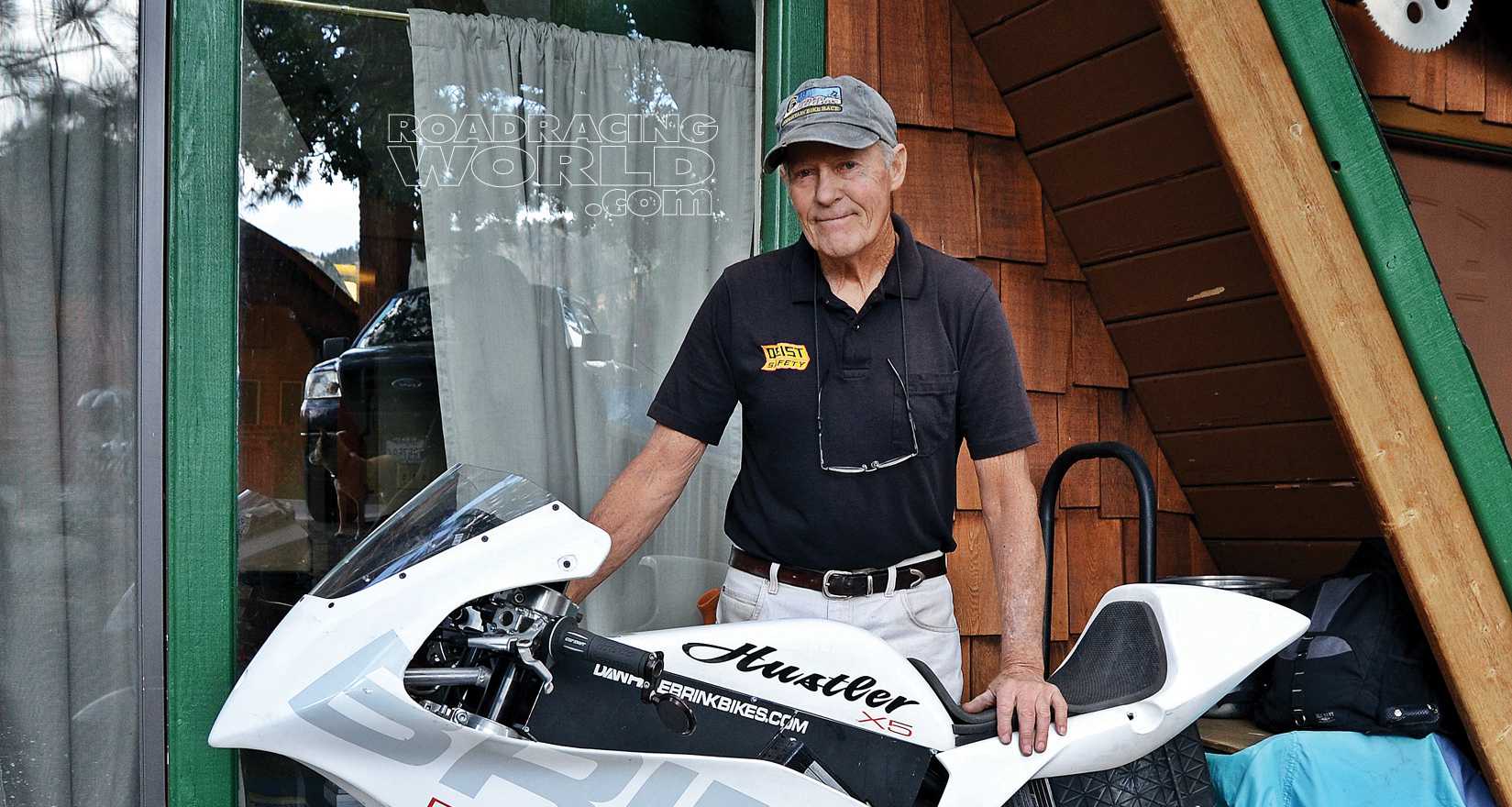
Hanebrink’s latest project is the Hustler X5, an electric motorcycle based on the idea that a smaller, lighter machine—about the size of a 250cc GP racebike—would make an excellent zero-emissions motorcycle.

The Hustler is designed to reach 130 mph, offer a range of more than 100 miles at a more sane speed before recharging, and attract motorcyclists interested in a performance electric bike who are willing to pay nearly $30,000 for one.

“You can go really fast for a short period of time, or you can turn down the power and go further,” Hanebrink says. “The range will be 100-150 miles, depending on power use, in an economical mode.”

It’s not surprising to find Hanebrink innovating on the edge of a new technology that promises to revolutionize every vehicle on the planet. Look through Hanebrink’s past, and he’s worked on rocket-ships, built revolutionary cars, made board-tracker replicas, designed mountain bikes that needed parachutes to slow down—the list goes on.

And Hanebrink is still creating madly. His base is an A-frame mountain cabin, crammed with streamliners, electric bikes designed for golf course use, the occasional road racer, mountain bikes hanging from the ceiling, and—of course—a machine shop in the basement where his creations come to life.

***

Back in the 1960s, Hanebrink moved to Southern California to attend the Art Center College of Design and study automotive design. He had an interest in vehicles, but had no desire to move to Detroit to work on cars there. So Hanebrink started working contract jobs in Southern California, engineering everything from farm equipment to Apollo rockets. The contracts were short-term, one month to six months at a pop. But they gave him a broad range of experience and the willingness to work on nearly anything that came along.

Hanebrink also served in the Marines, in the reserves during the Vietnam conflict. Interestingly, he learned to write for publications—newspapers, magazines—from the Corps’ public relations department. When he got out, he supplemented his engineering work with articles, photos and drawings of vehicles that he sold to car and bike magazines in Southern California.

But Hanebrink always was designing things, and was itching to build his own vehicles. One of the first was called “The Box.” It was designed with Matt Van Leeuwen, and it was a box-section four-wheeler made from a fiberglass/balsa wood composite and powered by a Kawasaki two-stroke engine. The initial version was steered with your feet—something that likely was quite interesting at the vehicle’s triple-digit top speed. Hanebrink sold eight of the vehicles in kit form, and learned a painful lesson. “I never kept one, because I couldn’t afford to keep one,” he says. “I try to keep one of everything I design now.”

Hanging around the motorcycle media at the time sparked Hanebrink’s interest in road racing motorcycles. Not one to mess around with easily available stuff, Hanebrink’s first road racing bike was a Honda CR93 originally purchased in Okinawa, he says. His was the equivalent of a satellite factory racebike, he says, with a five-speed transmission. What he remembers most is that it was slightly slower than the two-strokes that were coming to the fore, and that he had to pre-heat the oil on a stove before pouring it into the engine prior to starting, as recommended by the factory.

(Above) Dan Hanebrink (202) and his three-cylinder 750cc snowmobile-powered “Monotrack” road racer on the 3.76-mile road course at Ontario Motor Speedway, circa 1976. Photo by John Ulrich. 

When that bike eventually blew up, Hanebrink threw his lot in with the two-strokes, building kits for Kawasaki Triples. But eventually building kits wasn’t enough. He raced at Southern California tracks like Ontario Motor Speedway, Riverside International Raceway, Orange County International Raceway (a dragstrip/return-road course) and Willow Springs International Raceway.

He would show up with a monster—the Monotrack. This machine now sits in his crowded kitchen—because, you know, where else do you display a one-of-a-kind road racer? The spec chart is impressive and terrifying all at once. It started life with a 650cc, three-cylinder, two-stroke snowmobile engine. Hanebrink punched it out to 750cc. It powered the rear wheel (which Hanebrink made) via belt drive and a continuously variable transmission. The chassis was a magnesium monocoque. Hanebrink also built the springless suspension, which used oil to compress air in a remote reservoir. His favorite track was Willow Springs International Raceway, he says. Now, take a deep breath and imagine driving that thing off into Turn Eight at Willow with the throttle at the stop …

Hanebrink won a WERA Open GP race at Willow Springs on the machine, he says, but his favorite memory of riding it was at Ontario Motor Speedway. He snuck up on accomplished racers Keith Code and Rudy Galindo in practice, he explains, mugged them in the infield and smoked them on the banking. And sneaking up on someone on this thing was no small accomplishment, he says.

“People said it was the loudest motorcycle they’d ever heard,” Hanebrink remembers. “And because of the variable transmission, it didn’t sound like the other bikes. Other riders would complain all the time, ‘the sound of that thing is (messing) with my head!’ It was a challenge to get right. But when it was right, people would come up to you and tell you how good it was—that’s the payoff right there.”

Eventually, Hanebrink says he grew weary of the expense of road racing, and the danger. One day, he simply turned away from the sport, bought a Maico motocross machine and went racing at Saddleback Park, a now-defunct off-road facility in Irvine, California. He enjoyed the lower-key atmosphere, the lower costs and lower risks. Somewhere in here, he built a streamliner for a road race run on closed, public roads in Mexico; built magnesium wheels for a speedway racer—you get the idea.

Meanwhile, Hanebrink had moved to the mountains above San Bernardino, into a quiet little town called Big Bear Lake, a mile and a half in the sky. One day, someone came by his home with an off-road bicycle. This started a whole new series of adventures. Hanebrink made complete bikes; built forks that became as ubiquitous on race-winning bicycles as Öhlins forks are on MotoGP machines today; and got into off-road bicycling and downhill bike racing himself. He put himself on a fitness program that paid dividends; meet him today, and you wouldn’t come close to guessing his age, based on his looks.

Long story short, when the high-end off-road bicycle market collapsed, he got back into motorcycles, building street customs. When that market collapsed, he turned his attention to the electric bike market, and did well there with long-travel, fat-tired specials that sold for $8,000 to $12,000 or more.

His off-road machines are unique, designed to traverse rough terrain that would repulse a normally-tired bike. He’s also designed unique electric bikes for very specific applications, such as moving golfers across a course without causing damage to the delicate turf.

(Above) Monotrack racebike’s air/oil suspension uses a reservoir mounted behind each fork leg.

A silent electric drive allows Hanebrink’s machines to be used where a bike powered by an internal combustion engine can’t be used. Hanebrink just sold an off-road electric bike to a high-end dog trainer who is using it to replace his horse while training dogs in rough terrain.

But Hanebrink is a racer, and the pursuit of performance defines his history. It is not surprising that his latest creation is a performance machine, and it is equally unsurprising that he is pushing his suppliers to give him more power.

***

(Above) Dan Hanebrink poses with his Hustler X5 electric prototype, featuring a monocoque chassis, small wheels and bodywork off a Honda RS125.

From a pure powertrain point of view, there’s not a lot new on the Hustler X5. The drive train is based on his well-proven off-road machines, and power is transmitted through a three-speed derailleur chain drive system to the rear wheel. The lithium-ion batteries are liquid-cooled. It’s industry standard hardware, but Hanebrink has spent years developing his particular configuration to meet a variety of needs. “My electronics are made in the U.S. and Great Britain. But it’s pretty much the same stuff as everyone else has,” he says.

Where Hanebrink breaks from tradition is in the chassis. “What everyone else has done is take a twin-spar frame and build battery racks inside that frame. Essentially, they are standard chassis with batteries and an electric motor,” Hanebrink says. “I did not start with a regular bike. I started with my own concepts. This one is a full-blown aluminum monocoque. The frame is a box which contains the batteries and the electric motor and the majority of the electronics.

“I wanted a smaller bike, about the size of a road racing 250cc GP bike. I’m using 14-inch wheels—and there’s a great Bridgestone tire available for that size. That tire has a great profile—it’s like one that you’d see on a sportbike.”

From that starting point, Hanebrink’s machines are a blend of racebike engineering and unique thinking. An aluminum swingarm doesn’t raise any eyebrows, but the carbon-fiber bodywork does. The 14-inch wheel size certainly looks unique. The weight—about 195 to 220 pounds, depending on configuration—is definitely unique in the world of performance machines available for the street. With a wheelbase of 52 inches, Hanebrink says the small size and lack of weight of the machine accounts for a lot of its performance.

The machine features a single disc brake in the front, rear suspension by Race Tech and inverted forks by a company from China called Fast Ace, Hanebrink says. The front and rear brake calipers on the production bike will be Brembo. The test mule still uses a Hanebrink-built rear wheel, but that will be replaced with a 14-inch wheel on the production models. The triple clamps are amazing. The forks actually rotate in large ball bearing sockets where they pass through the triple clamps, and the steering stem can quickly be moved forward or backward to adjust the steering geometry.

(Above) Hustler electric motorcycle’s triple clamps allow quick geometry changes—note alignment marks to the right of the steering stem. After the steering stem nut is loosened, the steering stem can be moved forward or rearward by turning the bolt seen protruding below the upper clamp in this photo. 

The whole thing feels race-bike-small, but not toy-like. The seating position reminds one of a large 125cc GP machine, or a 250cc GP bike with less room between the seat and pegs. The test mule is finished with Honda RS125 bodywork.

“A lot of the parts on this thing are parts that I already make,” Hanebrink says. “I was amazed at how light it turned out. It’s the weight of a good racebike. It’s kind of a long bike, compared to a Moto3 machine. It’s not a minibike. It’s designed to fit a regular person.”

***

The Hustler X5 is an extension of the work he’s done on his off-road machines. But given his racing background, Hanebrink isn’t starting from scratch. He knows what he wants his machine to do, and is equally aware of his business model and his target customer. The bikes are built on custom order, and a deposit is required before the build starts. Hanebrink is currently building his first production Hustler X5 for a customer who plunked down a deposit on the $29,000 machine.

What the customer gets is something utterly unique in the world of performance motorcycling. And that has been Hanebrink’s business philosophy for a long time now—make something unique and functional, and the right customers will find a way to your door.

“You don’t need to sell a lot, but you need to get a decent price for the ones you do sell,” Hanebrink says. “I didn’t want to go toe-to-toe with the big boys in the electric bike market. And I know that the really big boys—Honda and Yamaha—are coming. I wanted to find a niche. I don’t want to follow other people.” RW 

Isle Of Man TT: Honda Announces Rider Lineup For 2019

0

Honda reveals a refreshed line-up on the roads as David Johnson joins Ian Hutchinson

Honda is pleased to announce that David Johnson will line-up next to Ian Hutchinson on the roads, as the Honda Racing team prepares for the start of the 2019 road race season.

Hutchinson and Johnson will lead Honda’s charge on the roads at The International North West 200 and the Isle of Man TT. Both road experts will contest the Superbike and Superstock 1000 classes aboard the CBR1000RR Fireblade SP2, with the team also preparing a CBR600RR Supersport machine for Ian.

‘Davo’ made his debut at the TT in 2010 aboard Honda machinery where he claimed the accolade of fastest newcomer that year. The Australian has since racked up three 4th place finishes at the Mountain Course and was close to a podium last year in the Superbike race. His best result at the Ulster GP has been 3rd (2018) and 7th at the NW200.

Teammate ‘Hutchy’ continues with Honda after a valiant return last year, while recovering from injury. Displaying incredible drive and determination throughout 2018, the ‘Bingley Bullet’ is coming into the new road racing season with more bike time under his belt as he looks to return to winning form.

The Honda Racing team will now embark on a comprehensive testing programme before tackling the road circuits, starting with the North West 200 in May.

For all the latest news on the team follow HondaRacingCBR on Twitter and keep up to date with all Honda news on Honda Pro Racing on Facebook and Instagram.

2019 Road Race Calendar:

12-18 May: The International North West 200

25 May – 7 June: The Isle of Man TT

Ian Hutchinson

I’m feeling confident coming into this season on the roads. Last year was about building back up and learning the Fireblade again. The results were a little disappointing, as they didn’t reflect the hard work that went in behind the scenes. But since the TT I have been out on a track Fireblade and also my road bike, so with that mileage and the testing programme we have for this year, I think we’ll be in a strong position when we arrive at the North West 200. I’m keen to get started and looking forward to the team’s first test.


David Johnson

I am really happy to join the Honda Racing team for this season. Over the years they have been incredibly successful on the roads and won a lot at the TT; I feel that I will gel with the Fireblade, so I’m very excited to get started and ride the bikes. With Hutchy getting fitter from his injuries I think we’ll work together well and I will have some great people around me in the team. I can’t wait to get back to the UK and start testing!


Jonny Twelvetrees

Team Manager

I’m really pleased to have ‘Davo’ with the team for this season, he’s been a strong contender since his debut in 2010 and I know it won’t be long before he’s on the TT podium. He had a good season last year with two 4th places at the TT and a podium at the Ulster, so I’m excited to see what he can do on the Fireblade this year. With Hutchy we’re certainly going to see a huge difference compared to last year. Since the TT he’s had a lot of quality bike time, both on-track and also road riding, as always he’s training hard and will be coming into the season right back up there; so I think we’re in for some good racing. I’m looking forward to getting everyone together at the first test so we can start pushing on. It’s a long time between the races so the competitiveness has time to build up!

World Superbike: BMW Motorrad WorldSBK Team Checks In From The Test At Jerez

0

The BMW Motorrad WorldSBK Team completes first competitive WorldSBK test.

25.01.19

Circuito de Jerez Ángel Nieto

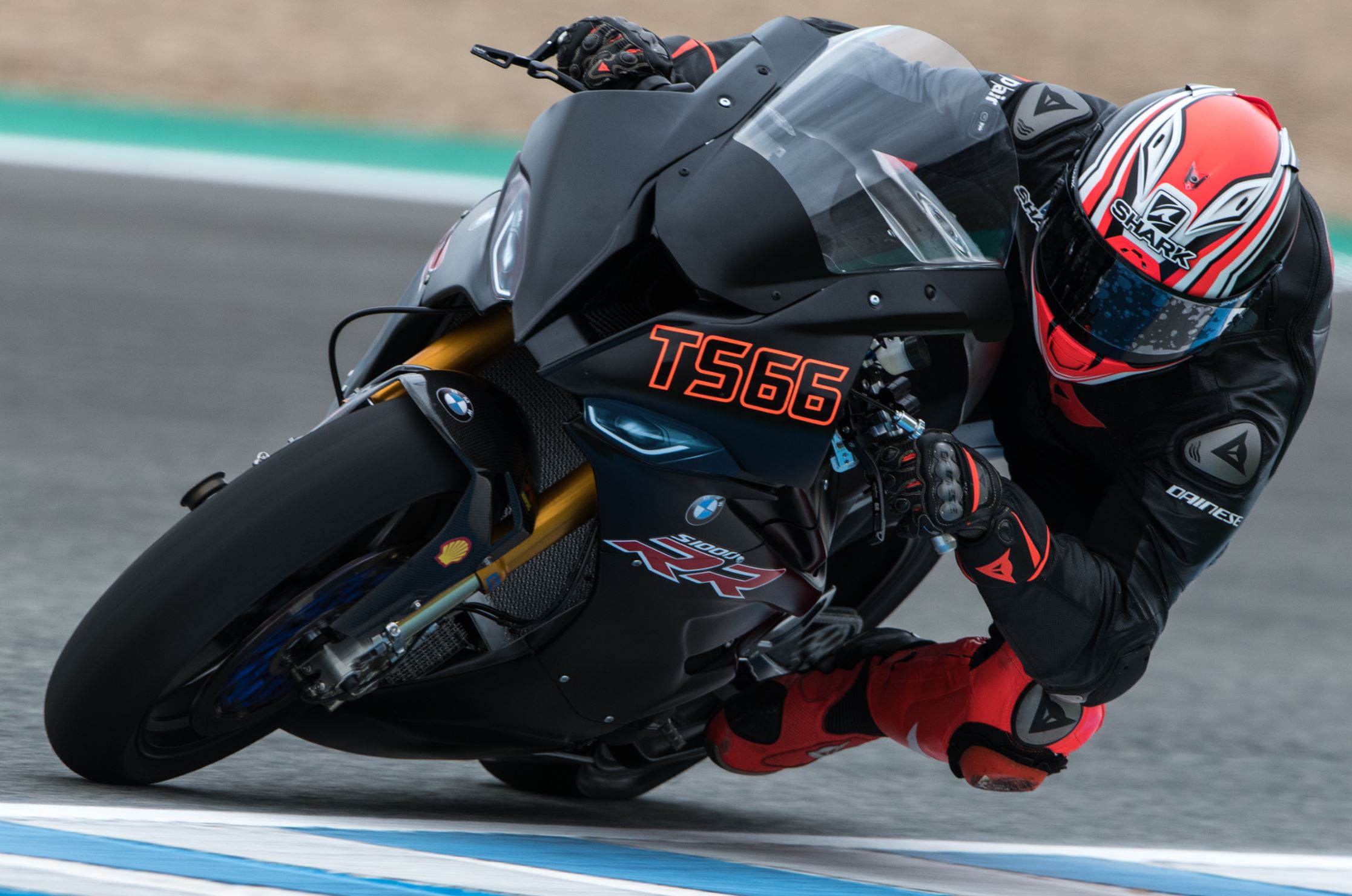
Following on from a successful test at Andalucía back in December, the BMW Motorrad WorldSBK Team this week had their first WorldSBK outing at the Circuito de Jerez Ángel Nieto, with riders Tom Sykes and newly crowned STK champion Markus Reiterberger.

Markus and Tom both worked heavily on their test schedule trying out different electronic strategies and various chassis configurations. Despite an early crash from Tom on day-two the BMW duo collected valuable data ahead of the second two-day test on Sunday and Monday in Portimao.

Shaun Muir – Team Principal

“The progress and development of the new S 1000 RR so far has been very positive. From the shakedown test in Andalucía we established a good base setting which gave a clear direction to work on here in Jerez. The SMR team and BMW Motorrad engineers together have done a great job in getting the Superbike to a good level.

Overall I am feeling positive with the way the test went, for Markus it was important that he completed his programme which he did, so this is a good step for him going into the second test. Tom also made good progress on day one, unfortunately he had an early crash on day two which set him back in terms of his test schedule, but he will get to complete the rest of his schedule over at Portimao in just a few days’ time.”

Tom Sykes (GBR)

“So far we’ve had a really successful run of tests, Andalucía we gained lot of valuable information so moving into day one at Jerez I couldn’t have asked for much more. Things were working smoothly and even the lap times we did were competitive considering it was the third day of the set up.

Day two obviously we had a little setback and basically lost a day of testing, but I have to say it was minor detail considering the positives that we’ve taken from the project so far.

The feedback from the new S 1000 RR has been really consistent and the whole team have been working in the right direction, so going Portimao now we try and continue to work in the same way.”

Markus Reiterberger (GER)

“I am quite happy with the way test went in Jerez. We tested a lot of things for my positioning on the bike and made some changes to my foot pegs and handlebars, this was a problem before but now I feel a little bit better.

We followed the schedule for Jerez which is good, tested a lot on the brakes, suspension and the electronics and made good progress with that. I am still not fully confident to make fast laps but we are working on it, today I have a meeting with my new crew chief so we can make a plan ahead of the second test.

I think going into Portimao now we need to make another few adjustments to my position, so I can achieve 100% feeling with my bike. We will also check the swing arm again and make some geometry changes, but overall I happy with the way the test went.”

BMW Motorrad WorldSBK Team livery reveal

The BMW Motorrad WorldSBK Team invites the media to a meet and greet on Monday 28th January in Portimao. At 10am both Markus Reiterberger and Tom Sykes will be present to reveal the 2019 new colours in the pit box, before completing laps around the Autódromo Internacional do Algarve for the media.

MotoAmerica: Kyle Wyman To Race Ducati Panigale V4 R In 2019 Superbike Championship

0

Kyle Wyman will ride a Ducati Panigale V4 R in the 2019 MotoAmerica Superbike Championship

Lucas Oil renews as title partner for Road Atlanta round

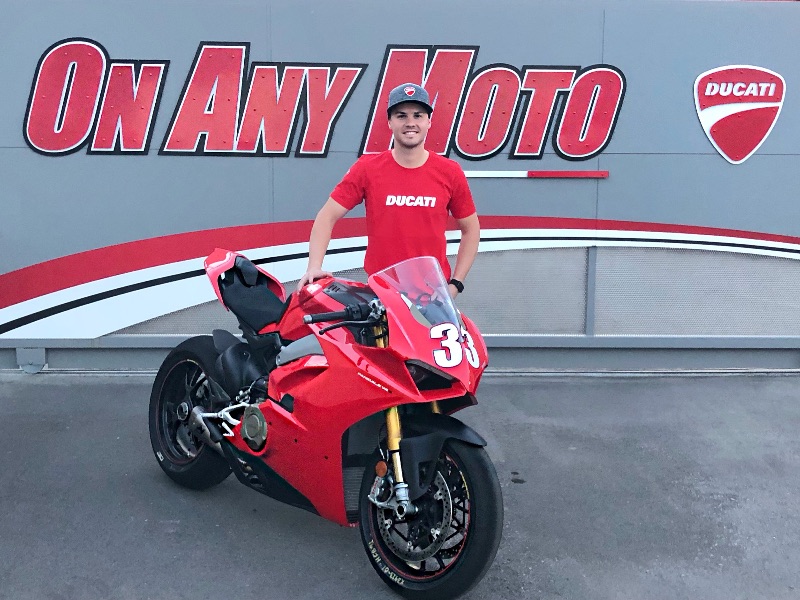
TUCSON, Ariz. (Jan. 25) — Kyle Wyman Racing (KWR) has announced a move to Ducati machinery for the 2019 MotoAmerica Superbike Championship. Wyman will ride the #33 KWR Ducati Panigale V4R with leadership from trusted crew chief Gary Dean and his shop, Speed Demon Motorcycles.

The move to the Panigale is a big change for Wyman and the team, who will be competing in their fourth consecutive season in MotoAmerica’s premier class. Originally approached by the multi-line dealer On Any Moto, based in Tucson, Arizona, Wyman rode the Panigale V4 S, the 1100cc version of the V4 platform, out at Inde Motorsports Ranch in early December as a test of Ducati’s incoming production 1000cc superbike. KWR will field the impressive new V4 R that is homologated for Superbike competition worldwide.

“I’m excited to be starting a new chapter for KWR, and fielding a motorcycle that, on paper, is an absolute weapon,” Wyman said. “The Panigale V4 R has shown its potential in tests and press launches and we expect to have a well rounded motorcycle in our stable. With Gary Dean in my corner, I know we will be able to develop the bike into a competitive machine in 2019.”

KWR also welcomes back Lucas Oil Products as a partner for the 2019 season, for a seventh year running. Wyman will utilize Lucas Oil lubricants and cleaning products in the race machine as well as transporter and support vehicles. Lucas Oil will title sponsor the KWR Superbike at the first round of the season, Road Atlanta.

“Lucas Oil has been a loyal partner of KWR since 2013, and I’m thrilled to have them aboard as we make our transition to the Ducati,” Wyman said. “It’s companies like Lucas that eliminate variables in my program and give us the reliability we need to be a threat on the race track each weekend. I look forward to having them as a title partner for the opening round at Road Atlanta.”

The first round of the MotoAmerica series begins at Road Atlanta April 3-5, 2019.

Visit www.kylewymanracing.com for news and updates.

International Island Classic: Australian Aaron Morris On Pole Position, American Jason Pridmore Qualifies Second At Phillip Island

0

International Island Classic

Phillip Island Grand Prix Course

Phillip Island, Victoria, Australia

January 25, 2019

Final Qualifying Results:

1. Aaron Morris, Australia (1982 Suzuki Katana 1294), 1:37.341

2. Jason Pridmore, USA (1983 Yamaha FJ 1298), 1:37.642

3. Paul Byrne, Australia (1984 Suzuki McIntosh 1260), 1:38.056

4. David Johnson, Australia (1982 Suzuki XR69 1100), 1:38.104

5. Jed Metcher, Australia (1982 Honda Harris F1 1100), 1:38.122

6. Josh Hayes, USA (1983 Yamaha FJ 1250), 1:38.202

7. Beau Beaton, Australia (1982 Irving Vincent 1300), 1:38.286

8. Steve Martin, Australia (1982 Suzuki Katana 1294), 1:38.454

9. Shawn Giles, Australia (1982 Suzuki Katana 1294), 1:38.642

10. Larry Pegram, USA (1983 Yamaha FJ 1250), 1:38.819

11. Alex Phillis, New Zealand (1980 Suzuki XR69 1170), 1:39.441

12. Jay Lawrence, New Zealand (1981 Suzuki Katana 1100), 1:39.556

13. John Reynolds, New Zealand (1985 Suzuki GSX-R1100), 1:39.901

14. Steve Rapp, USA (Yamaha CMR FJ 1100), 1:40.657

15. Dean Oughtred, Australia (1981 Suzuki Katana 1100), 1:41.107

16. Mark Miller, USA (1984 Harris XR69 1200), 1:41.634

17. Michael Gilbert, USA (1983 Yamaha FJ 1250), 1:41.821

18. Michael Neeves, New Zealand (1980 Suzuki GSX 1100), 1:41.846

19. Dale Quarterley, USA (1984 Suzuki XR69 1250), 1:42.123

20. Craig Ditchburn, Australia (1978 Yamaha TZ750), 1:42.266

22. Barrett Long, USA (1982 Kawasaki Harris 1200), 1:42.463

28. Rennie Scaysbrook, USA (1982 Suzuki Katana 1290), 1:44.336

31. Robert Ruwoldt, USA (1980 Kawasaki Harris 1200), 1:47.965

32. Jorge Guerrero, USA (1982 Suzuki XR69 1200), 1:48.582

33. David Crussell, USA (1978 Yamaha TZ750), 1:48.649

36. Joe Pethoud, USA (1984 Yamaha Harris 1250), 1:52.915

39. Martin Morrison, USA (1982 Suzuki RGB MK7 500), 2:00.787

40. Wade Boyd, USA (1980 Moto Guzzi LM 1000), 2:01.161

41. Bruce Lind, USA (1975 Yamaha TZ750), 2:02.846

42. Eric Lindauer, USA (1980 Kawasaki KZ 1000), 2:06.936

More, from a press release issued by Phillip Island Grand Prix Circuit:

AUSTRALIAN TEAM NEWCOMER, AARON MORRIS, TOPS QUALIFYING FOR THE LOCALS

(Above) Aaron Morris (64) at speed. Photo by Russell Colvin, courtesy of Phillip Island.

In blistering heat, Australia has kicked off the defence of their International Challenge crown in good shape at the Phillip Island Grand Prix Circuit today, topping qualifying for the weekend’s four historic bike races against formidable outfits from the Team USA and New Zealand.

Newcastle’s 26 year old Aaron Morris, a newcomer to Team Australia, nailed pole position with a 1m37.341 s lap on his 1982 Suzuki Katana; but on his heels was a fired up Jason Pridmore from the USA with a 1m37.642 s time. The duo were the only two racers to break into the 1m37’s in the searing heat that saw the track temperature near 60 degrees around midday.

The International Challenge field of world class riders representing Australia, New Zealand and the USA, will face four, six lap races over the weekend (Jan 26/27), and is the headline event of the 26th International Island Classic, presented by Visit Phillip Island.

As defending champion, Australia ended the day with seven riders in the top ten including Paul Byrne on the Suzuki, defending champion David Johnson and 2016 winner, Jed Metcher.

Team USA flexed its muscle and landed three in the top ten – Pridmore, the four times AMA Superbike champion Josh Hayes and the super experienced Larry Pegram.

(Above) Four-time AMA Superbike Champion Josh Hayes (4) qualified sixth. Photo by Russell Colvin, courtesy of Phillip Island.

New Zealand’s best performer was Alex Phillis who came in 11th, immediately followed by Jay Lawrence and John Reynolds on the Carl Cox prepared Suzukis.

It is Morris’s first time with the Australian team, and the 26 year old from Newcastle, despite only doing a few laps in both qualifying sessions, dominated with blistering times in extreme conditions.

“It’s just brilliant to grab pole position in my first run in the International Challenge. The bike is working superbly. We have done a lot of work on the bike, but fact of the matter, it was a very good bike before the improvements,” said an elated Morris, riding the ex-Shawn Giles machine that held the International Challenge lap record.

“We have to ensure that we get a good start and remember that we don’t have to win every race, although that would be fantastic. It’s all about accumulating points over the four races and maintaining consistency,” said Morris.

The first qualifying session was held in stifling conditions at the apex of the day’s heat. Thankfully, for the life of many motorcycles, conditions improved for the afternoon with the air and track temperature dropping considerably to allow faster lap times.

Jason Pridmore who is making his second visit to Phillip Island, is in fine form and after his experience in 2018 now knows what is needed to take out the International Challenge. Happy with second fastest Pridmore, like Morris, only did three laps in the second qualifying session before parking his bike – saving his machine for what counts in racing tomorrow.

Holder of the 2018 Ken Wootton Perpetual Trophy, Adelaide’s David Johnson qualified fourth. He is in threatening form, and looked in a good position to snatch pole, before a mistake in the third last corner curtailed his charge.

The 26th International Island Classic presented by Visit Phillip Island is one of the worlds’ great historic bike meets, attracting over 450 bikes and riders from across the globe, competing in 56 races over the weekend. Celebrating a century of motorbikes, features old Indians, Nortons and Vincents through to vintage Triumphs, Harleys and Ducatis. There’s six historic categories from pre-WW1 bikes through Vintage (1920-1945), Classic and Post Classic (from 1946 to 1972) and the more recent Forgotten Era and New Era classes fighting for class honours and the Phil Irving Perpetual Trophy.

Tickets

Gates Open Saturday and Sunday at 8am with tickets available at the gate. Camping also available on track with 24/7 access to the campground via gate 2. Kids 15 and under are free.

For further information www.islandclassic.com.au

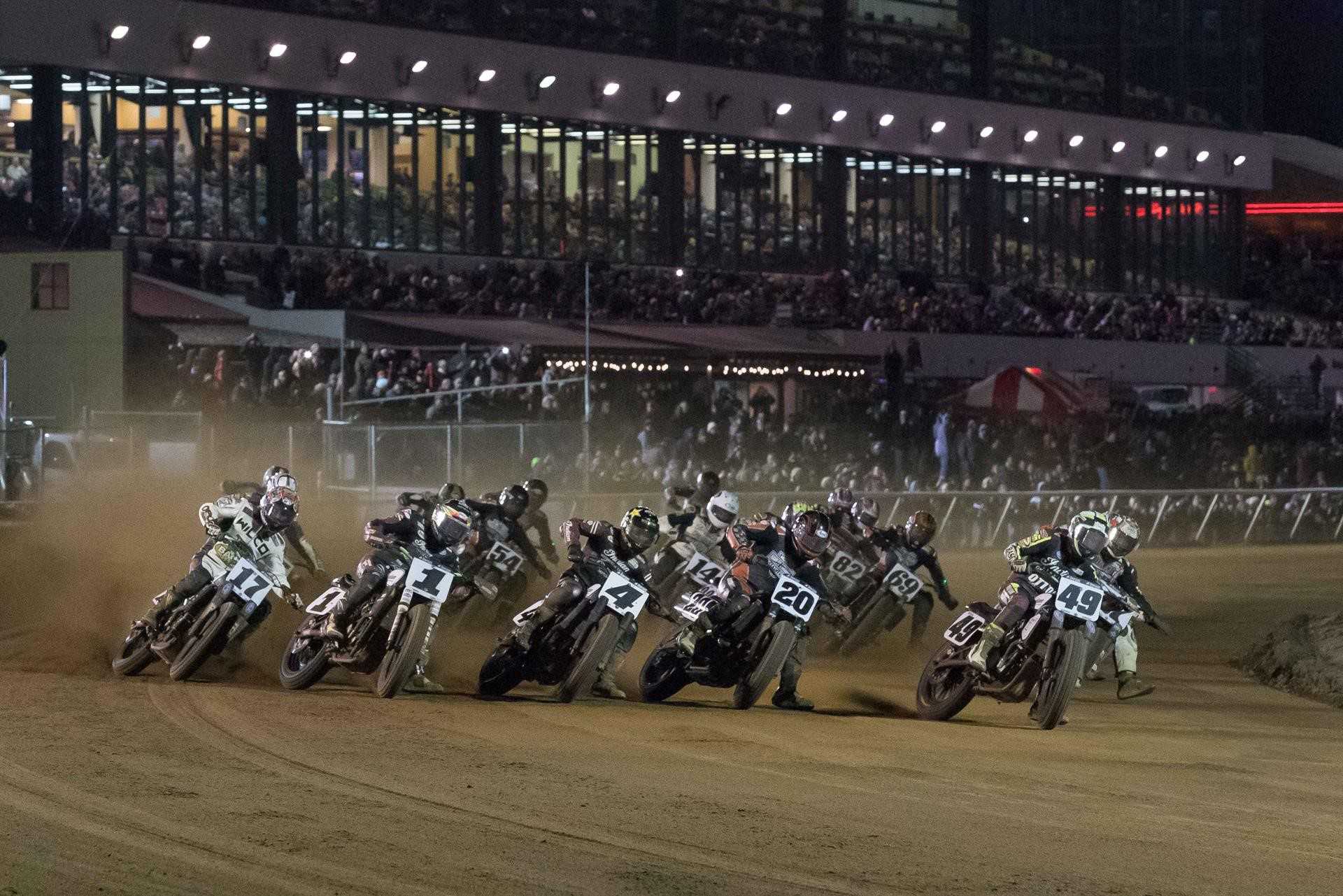
American Flat Track: New Race Director Hired

American Flat Track Adds Key Personnel to Competition and Administrative Departments

DAYTONA BEACH, Fla. (January 24, 2019) – As it gears up for its most-anticipated season to date, American Flat Track (AFT) is bolstering its Competition and Administrative departments with key hires.

Bringing with him over a decade of motorsports experience and eight years of emergency services experience, Ramin Shute-Mahini will serve as Race Director for American Flat Track. Shute-Mahini currently holds the position of Event Director for the Arizona region of the National Auto Sports Association. Concurrently, he serves as Manager of Emergency Services at ISM Raceway – formerly Phoenix International Raceway – in Avondale, AZ coordinating all emergency services for its facility.

“Ramin will bring more than a decade of experience in race control and emergency services to the sport,” said Joey Mancari, Chief Competition Officer of American Flat Track. “That experience will prove invaluable as we continue to scale American Flat Track in the coming seasons.”

AFT also welcomes Becky Cunningham into the position of Controller. With 22 years of experience under her belt, Cunningham has found her niche in bolstering financial growth for rapidly-growing enterprises.

Former Chief Competition Officer Chris Carr has elected to step away from AFT to pursue other opportunities with the sport.

“I have been deeply involved with flat track my entire life,” said Carr, “and I look forward to transitioning into a new role within the community.”

American Flat Track will kick off its 2019 season with its bar-banging DAYTONA TT in appropriate fashion – during the wild Bike Week festivities in Daytona Beach. The 2019 DAYTONA TT happens Thursday, March 14 once again under the lights of the iconic Daytona International Speedway. Tickets start at just $35 and are available now at www.americanflattrack.com.

For more information about American Flat Track and to keep up-to-date with the latest news about the sport, please visit www.americanflattrack.com.

How to Watch:

NBCSN and FansChoice.tv are the official homes for coverage of American Flat Track. For the 2019 season, NBCSN’s coverage of AFT moves to highly-coveted, weekend afternoon programming slots within two weeks of each event. The complete schedule for AFT on NBCSN can be viewed at http://www.americanflattrack.com/events-nbcsn/. FansChoice.tv remains a cornerstone of AFT’s digital strategy, providing live streaming coverage of every event on AFT’s live page while previous events and exclusive features are available on AFT’s VOD page.

About American Flat Track:

American Flat Track is the world’s premier dirt track motorcycle racing series and one of the longest-running championships in the history of motorsports. Sanctioned by AMA Pro Racing in Daytona Beach, Fla., the series is highly regarded as the most competitive form of dirt track motorcycle racing on the globe. For more information on American Flat Track, please visit http://www.americanflattrack.com, like us on Facebook, follow us on Twitter, check us out on Instagram, live stream the events at FansChoice.tv and catch all the American Flat Track racing action on NBCSN.

MotoAmerica: Tickets To All 2019 Events Are Now On Sale

0

MotoAmerica 2019 Tickets Available Now

Buy Online: Save Time And Money

COSTA MESA, CA (January 24, 2019)– MotoAmerica has announced that tickets for all 10 of its 2019 series rounds are available for preseason, online purchase, effective immediately.

The 10-round 2019 MotoAmerica Series begins at Road Atlanta in Braselton, Georgia, April 5-7, and concludes September 20-22 at Barber Motorsports Park in Birmingham, Alabama, with some of the top Superbike riders in the world vying for the coveted 2019 MotoAmerica Superbike crown. In all, five classes will compete at the majority of the events – Superbike, Supersport, Liqui Moly Junior Cup, Stock 1000 and Twins Cup.

“Everyone at MotoAmerica is excited to get the series rolling again,” said MotoAmerica President Wayne Rainey. “Our fans can now purchase tickets online at a discounted rate over buying them at the gate, so it’s time to plan those weekends and come spend some of them with us. There promises to be plenty of action on track this year and also off-track with more family friendly events than we’ve ever had. Let’s get this off-season over with and go racing.”

In addition, MotoAmerica has announced that kids 16 and under will be admitted for free with a paying adult at most of its rounds.

Those camping at our two-day events will be allowed access to the facility after 1 p.m. on Friday.

To purchase tickets, visit https://motoamerica.com/tickets/

April 5-7 – Road Atlanta, Braselton, Georgia

April 12-14 – Circuit of The Americas, Austin, Texas

May 4-5 – VIRginia International Raceway, Alton, Virginia

May 31-June 2 – Road America, Elkhart Lake, Wisconsin

June 15-16 – Utah Motosports Campus, Grantsville, Utah

July 12-14 – WeatherTech Raceway Laguna Seca, Monterey, California

August 10-11 – Sonoma Raceway, Sonoma, California

August 23-25 – Pittsburgh International Race Complex, Wampum, Pennsylvania

September 7-8 – New Jersey Motorsports Park, Millville, New Jersey

September 20-22 – Barber Motorsports Park, Birmingham, Alabama

About MotoAmerica

MotoAmerica is the North American road racing series created in 2014 that is home to the AMA Superbike Championship. MotoAmerica is an affiliate of KRAVE Group LLC, a partnership that includes three-time 500cc World Champion, two-time AMA Superbike Champion, and AMA Hall of Famer Wayne Rainey, ex-racer and former manager of Team Roberts Chuck Aksland, motorsports marketing executive Terry Karges, and businessman Richard Varner. For more information on MotoAmerica, visit www.MotoAmerica.com. Also make sure to follow MotoAmerica on Twitter, Facebook and Instagram.

World Superbike: Yamaha Motor Europe Officially Announces Its 2019 Rider Lineup

Yamaha Motor Europe Confirm Extended WorldSBK Line Up For 2019

Yamaha Motor Europe is delighted to announce its official line up for the 2019 FIM Superbike World Championship. The Pata Yamaha WorldSBK Team will once again lead the way as Yamaha’s reference team, but this year they’ll be joined on the grid by the GRT Yamaha Supported WorldSBK Team, who step up to the premier production class for the 2019 season.

2019 marks the fourth year for the partnership between Yamaha and Crescent Racing and both parties are keen to build on the success of the 2018 season, during which the Pata Yamaha WorldSBK riders, Michael van der Mark and Alex Lowes, secured three race wins and a total of 14 podium finishes between them. Van der Mark and Lowes remain with the team for the coming season, with both keen to add to their tally of wins as they look to challenge for the championship in 2019.

Having achieved everything possible in WorldSSP, including winning the World Championship crown in 2017, GRT Yamaha face a new challenge in 2019, as the team step up to contest the FIM Superbike World Championship for the first time. Former 250cc World Champion and WorldSBK race winner Marco Melandri is joined at GRT Yamaha by the reigning WorldSSP Champion Sandro Cortese, who swaps last year’s title-winning YZF-R6 for the race winning Yamaha YZF-R1 WorldSBK machine this season.

The Pata Yamaha and GRT Yamaha teams are currently testing in Europe, but in February both teams will head south of the equator to test and then race at the iconic Phillip Island Circuit in Australia, venue for the opening round of the 2019 FIM Superbike World Championship.

Andrea Dosoli

Yamaha Motor Europe Road Racing Manager

“We are pleased with the way the Yamaha Motor Europe racing program has progressed. We saw a clear improvement in 2018, with not just our YZF-R1 reaching maturity but also our racing operation at the track and our operation in the factory. For this reason I’m very happy to confirm our relationship with Crescent Racing as our reference team in WorldSBK will continue for the 2019 season, with Michael van der Mark and Alex Lowes as the riders once again. I truly believe that continuity is critical for success in motorsport. If we can continue to work in the same way as we did in 2018 and strive to achieve the consistency that was maybe missing last year, I am confident we can make a further step in the right direction. The 2019 season will be a strategic one for us. The arrival of GRT Yamaha in WorldSBK means we now have four riders on the grid, which gives us a good opportunity to speed up development of the bike, but it’s also the final piece in our rider development program. We now have a program in place for young riders that starts with the Yamaha bLU cRU project and extends all the way to WorldSBK with a competitive machine and a competitive team. So I’m pleased to welcome GRT Yamaha to WorldSBK with Marco Melandri and Sandri Cortese, with the latter, having won the 2018 WorldSSP Championship aboard a Yamaha, being a clear example of the rider development program in action.”

International Island Classic: Aaron Morris Wins Two, Josh Hayes On The Podium, Jason Pridmore Injured At Phillip Island

Editorial Note: American Jason Pridmore was racing for a podium position in Race One when he crashed and suffered injuries during Race One, according to a post on the social media accounts of Pridmore’s JP43 Training.

From JP43 Training’s social media post: “Jason was running 3rd when he highsided on the 2nd lap. He has a broken left leg and shoulder. He’s being transported to a hospital for further treatment, we’ll keep everyone updated when we know more. He’s awake cracking jokes, but really sad to end the weekend like this.”

International Island Classic

Phillip Island Grand Prix Course

Phillip Island, Victoria, Australia

January 26, 2019

Race One Results:

1. Aaron Morris, Australia (1982 Suzuki Katana 1294), 6 laps, Total Race Time 9:52.088, Best Lap Time 1:36.789

2. Jed Metcher, Australia (1982 Honda Harris F1 1100), -1.260 seconds, 1:37.642

3. Josh Hayes, USA (1983 Yamaha FJ 1250), -1.614, 1:37.519

4. David Johnson, Australia (1982 Suzuki XR69 1100), -3.096, 1:37.742

5. Shawn Giles, Australia (1982 Suzuki Katana 1294), -4.507, 1:38.024

6. Alex Phillis, New Zealand (1980 Suzuki XR69 1170), -4.711, 1:38.294

7. Steve Martin, Australia (1982 Suzuki Katana 1294), -4.817, 1:38.182

8. Larry Pegram, USA (1983 Yamaha FJ 1250), -14.943, 1:38.428

9. Jay Lawrence, New Zealand (1981 Suzuki Katana 1100), -18.675, 1:40.119

10. John Reynolds, New Zealand (1985 Suzuki GSX-R1100), -20.509, 1:40.020

12. Mark Miller, USA (1984 Harris XR69 1200), -24.265, 1:41.292

15. Barrett Long, USA (1982 Kawasaki Harris 1200), -25.329, 1:40.246

16. Dale Quarterley, USA (1984 Suzuki XR69 1250), -27.219, 1:41.865

17. Michael Gilbert, USA (1983 Yamaha FJ 1250), -34.270, 1:40.729

21. Rennie Scaysbrook, USA (1982 Suzuki Katana 1290), -48.783, 1:44.060

25. Jorge Guerrero, USA (1982 Suzuki XR69 1200), -69.053, 1:47.066

26. David Crussell, USA (1978 Yamaha TZ750), -74.476, 1:49.003

33. Steve Rapp, USA (Yamaha CMR FJ 1100), -4 laps, DNF, 1:40.127

34. Jason Pridmore, USA (1983 Yamaha FJ 1298), DNS*

*did not start restarted race

Race Two Results:

1. Aaron Morris, Australia (1982 Suzuki Katana 1294), 6 laps, Total Race Time 9:52.507, Best Lap Time 1:36.730

2. Steve Martin, Australia (1982 Suzuki Katana 1294), -4.250 seconds, 1:37.827

3. Paul Byrne, Australia (1984 Suzuki McIntosh 1260), -6.522, 1:37.876

4. Josh Hayes, USA (1983 Yamaha FJ 1250), -12.386, 1:38.069

5. Alex Phillis, New Zealand (1980 Suzuki XR69 1170), -18.169, 1:38.560

6. Michael Gilbert, USA (1983 Yamaha FJ 1250), -19.390, 1:39.759

7. Steve Rapp, USA (Yamaha CMR FJ 1100), -19.663, 1:39.821

8. John Reynolds, New Zealand (1985 Suzuki GSX-R1100), -21.154, 1:39.883

9. Mark Miller, USA (1984 Harris XR69 1200), -22.281, 1:40.571

10. Barrett Long, USA (1982 Kawasaki Harris 1200), -22.611, 1:39.845

15. Larry Pegram, USA (1983 Yamaha FJ 1250), -35.060, 1:38.461

18. Rennie Scaysbrook, USA (1982 Suzuki Katana 1290), -47.807, 1:44.051

21. Jorge Guerrero, USA (1982 Suzuki XR69 1200), -52.950, 1:45.260

22. David Crussell, USA (1978 Yamaha TZ750), -71.985, 1:48.182

23. Joe Pethoud, USA (1984 Yamaha Harris 1250), -72.786, 1:48.139

28. Matt Morrison, USA (1982 Suzuki RGB MK7 500), -2 laps, DNF., 1:58.618

35. Dale Quarterley, USA (1984 Suzuki XR69 1250), -6 laps, DNF, no lap time recorded

DNS. Jason Pridmore, USA (1983 Yamaha FJ 1298)

More, from a press release issued by Phillip Island Grand Prix Circuit:

AUSTRALIA’S MORRIS PERFECT, BUT HAYES AND HIS TEAM USA IN PURSUIT

Newcastle’s Aaron Morris backed up his dominance in qualifying Friday, to go from pole position today to take victory in the two International Challenge races at Australia’s Phillip Island Grand Prix Circuit and grab a narrow lead for the Australians against Team USA and New

Zealand in the three nation historic motorcycle battle.

And while Morris was unstoppable, Team USA flexed their muscle with Josh Hayes breathing down the back of the

Aussie front runners and being backed by reliable performances from his team mates. While the Australians were solid, defending champion David Johnson was plagued by mechanical problems, and 2016 champ Jed Metcher lost the front end to bow out of race two. Alex Phillis and John Reynolds were the best for the Kiwis.

Drama also marred the start, with the Team USA’s Jason Pridmore and Australia’s Beau Beaton both crashing at turn 11 and being transported to hospital for observation.

The headline event of the International Island Classic, presented by Visit Phillip Island, the International Challenge was run today in far more pleasant mid 20 temperatures in comparison to yesterday’s stifling 40+ temps that sizzled machines and their riders

RACE ONE

Race one started with drama and a red-flag two laps in, when Team USA scalp, Jason Pridmore high-sided at turn 11, falling heavily and taking other riders out in the crash. Australia’s Beau Beaton came unstuck, and both he and Pridmore were taken to the medical centre with injuries. Conscious, both were transported to the hospital for observation and will not return to the grid this weekend.

For the race one re-start, polesitter Aaron Morris improved his start and stuck with the front runners, but it was Jed Metcher on the Honda Harris, and Suzuki riders David Johnson and Alex Phillis who headed the field by Southern Loop.

While the Australians Metcher and Johnson led early, team-mate Morris overhauled them aboard his Katana by lap three and held the lead through to the chequered flag. It was a solid victory, 1.2 seconds in front of Metcher. Team USA’s hot shot Josh Hayes came in third, impressive for his first visit to the circuit and his third day on the bike.

David Johnson, last year’s Ken Wootton Trophy winner for best individual performance, took fourth, with Australia’s Shawn Giles in 5th; and Suzuki rider Alex Phillis crossing the line for the New Zealanders in 6th , the best performer from the Kiwi squad.

RACE TWO

For the second International Challenge race mid-afternoon, it was American Josh Hayes – the four times AMA Superbike champion – who took the early lead after an impressive start. He was fiercely pursued though by a host of riders including race one winner Aaron Morris, Melbourne’s Jed Metcher and for the USA Larry Pegram.

Morris broke away early in lap two on the Katana and with him was Metcher on the Harris, leaving Hayes and Pegram in their wake. Metcher though tumbled at Lukey Heights with a front end issue, and Morris was away with clear track, building a four-second lead to take his second chequered flag in dominant fashion to complete a perfect day.

“The day went really well except my starts were pretty atrocious. I hadn’t done any clutch starts on the bike until this morning,” said 26 year old Morris.

“To come out with both wins, I am very happy with that, and hopefully we can fix a few gremlins in the bike overnight and get out there and do it all again tomorrow

“The competition is definitely keeping me honest. It’s been hard work out there. We are pretty lucky that we have a great bike.”

Completing the race two podium was former world endurance champion, Australia’s Steve Martin, in second, with Paul Byrne third for the locals; while Josh Hayes was fourth for the US on the Yamaha FJ.

Hayes is the dark horse and should not be underestimated. As he learns the track, he’s starting to play hard ball and is likely to terrorise the leading riders even further tomorrow.

With today’s two wins, Australia’s Morris leads the individual leader board with a perfect scorecard on 80 points, but Hayes just trails him, with 75 points to his name.

“I am learning how to wrestle a dinosaur. These bikes are a bit before my time but I am lucky that the bike is extremely stable in the corners. I’ve had to change my riding style as I am a front end rider but on these bikes I don’t have much feel at the front to push really hard,” said Hayes.

“I am really looking forward to getting a win tomorrow. I know we can do it.”

Hayes also has the backing of what seems a far more formidable Team USA in 2019. Consistency amongst all riders is the name of the game for team honours, and the Americans had five finishers in the top ten in race two today, with Hayes 4th, followed by Michael Gilbert in 6th, Steve Rapp in 7th, Mark Miller in 9th and Barrett Long in 10th.

At the end of day one, Australia leads the table on 326 points, with Team USA trailing by only 15 points on 311 points, with New Zealand on 253 points.

Phillis was the best performer for the Kiwis today with a 6th and a 5th place to sit 4th on the Ken Wootton table for individual glory; while three times British superbike champion, John Reynolds, is finding his pace and took a 10th and 8th spot today and is in 6th place overall.

Defending Ken Wootton trophy holder, Adelaide’s Dave Johnson had gear box problems in race one, and did not compete in race two due to electrical problems. He plans to be back on track in the morning, after his mechanics work some magic overnight.

ABOUT THE EVENT

The 26th International Island Classic, presented by Visit Phillip Island, is one of the worlds’ great historic bike meets, attracting over 450 bikes and riders from across the globe, competing in 56 races over the weekend. Celebrating a century of motorbikes, features old Indians, Nortons and Vincents through to vintage Triumphs, Harleys and Ducatis. There’s six historic categories from pre-WW1 bikes through Vintage (1920-1945), Classic and Post Classic (from 1946 to 1972) and the more recent Forgotten Era and New Era classes fighting for class honours and the Phil Irving Perpetual Trophy.

Tickets

Gates Open Sunday at 8am with tickets available at the gate. Camping also available on track with 24/7 access to the campground via gate 2. Kids 15 and under are free.

For further information www.islandclassic.com.au

INTERNATIONAL CHALLENGE QUALIFYING – RACE ONE RaceTime Behind

1. Aaron Morris – 1982 Suzuki Katana AUSTRALIA 9:52.088

2. Jed Metcher – 1982 Honda Harris F1 AUSTRALIA +1.260

3. Joshua Hayes – 1983 Yamaha FJ1250 USA +1.614

4. David Johnson – 1982 Suzuki XR691100 AUSTRALIA +3.096

5. Shawn Giles – 1982 Suzuki Katana 1294 AUSTRALIA +4.507

6. Alex Phillis – 1980 Suzuki XR69 1170 NEW ZEALAND +4.711

7. Steve Martin – 1982 Suzuki Katana 1294 AUSTRALIA +4.817

8. Larry Pegram – 1983 Yamaha FJ 1250 USA +14.943

9. Jay Lawrence – 1981 Suzuki Katana 1100 NZ +18.675

10. John Reynolds – 1985 Suzuki GSXR1100 NZ +20.509

INTERNATIONAL CHALLENGE QUALIFYING – RACE TWO Race Time Behind

1. Aaron Morris – 1982 Suzuki Katana AUSTRALIA 9:52.507

2. Steve Martin – 1982 Suzuki Katana 1294 AUSTRALIA +4.250

3. Paul Byrne – 1984 Suzuki McIntosh 1260 AUSTRALIA +6.522

4. Joshua Hayes – 1983 Yamaha FJ1250 USA +12.386

5. Alex Phillis – 1980 Suzuki XR69 1170 NEW ZEALAND +18.169

6. Michael Gilbert – 1983 Yamaha FJ1250 USA +19.390

7. Steve Rapp – Yamaha CMR FJ1100 USA +19.663

8. John Reynolds – 1985 Suzuki GSXR1100 NZ +21.154

9. Mark Miller – 1984 Harris XR69 1200 USA +22.281

10. Barrett Long -1982 Kawasaki Harris 1250 USA +22.611


INTERNATIONAL CHALLENGE POINTS – Three Nations – after Race 1 & 2

1. AUSTRALIA – 326 points

2. USA – 311 points

3. New Zealand – 253 points


Ken Wootton Perpetual Trophy – Individual Point Scores after Race 1 & 2

1. Aaron Morris AUSTRALIA 80 points

2. Josh Hayes USA 75 points

3. Steve Martin AUSTRALIA 73 points

4. Alex Phillis NEW ZEALAND 71 points

5. Shawn Giles AUSTRALIA 66 points

6. John Reynolds NEW ZEALAND 64 points

7. Mark Miller USA 61 points

8. Michael Gilbert USA 59 points

9. Larry Pegram USA 59 points

10. Barrett Long USA 57 points           

February 2019

On the Front Cover: Valentino Rossi (46) is working to improve Italy’s GP fortunes with his VR46 Academy training program, which includes riding mini road racers and flat track bikes. Photo by Milagro/DPPI.

Read the February 2019 issue of Roadracing World & Motorcycle Technology now with your online subscription.

Roadracing World & Motorcycle Technology magazine is available in print and digital formats.

Log in or subscribe HERE.


Roadracing World & Motorcycle Technology is THE definitive source for motorcycle racing, riding, and tech information.


In This Issue:

FEATURES

Inside Info: Aprilia, EBR, Suzuki, and Triumph Make News

A Vintage Racer’s Plan For American Team Redemption In The Island Classic, Part 4

Racing History: The Story Of Shoichiro Irimajiri and Honda’s 1960s 50cc Twin, 125cc Five, and 250cc Six

Historic Racebike Illustrations: Velocette KTT Mk VIII

MotoGP Analysis: How Valentino Rossi Builds Stars At His Italian Ranch, Including Using Minis, Part 1

Quick Ride: Kramer HKR EVO2 R, Built For The Racetrack 

Intro: Royal Enfield Gets Serious With GT 650/INT 650 Twins 

Back In The Day: Editor’s Scrapbook: 1985 AMA Superbike National At Willow Springs/Kevin Schwantz

Army Of Darkness Gets Pulled Back In: WERA Endurance Is Back, With N2 Racing!

Shops: Hayes Performance Systems

SEMI-PRO AND CLUB RACING

WERA National Challenge Series At Barber: Adams, Campbell, May, Melka, Win

46th WERA Grand National Finals At Barber: Champions Crowned

AMA Road Race Grand Championships At Barber: Dallas Daniels Makes History

N2 Racing/WERA Endurance Series At Barber: Army Of Darkness Wins Overall

COLUMNS

Letters To The Editor

10 Years Ago

MotoGP Trivia/Numbers

Kyle Wyman: Where’s Wyman?

The Kids’ Page: Nathan Bettencourt

The Crash Page: Steve Roth And Caleb Odom Crash In AMA Superstock Novice During WERA GNF At Barber

Professional Services Directory

Racing, School, & Track Day Calendar

High Performance Parts & Services Directory

ASRA/CCS Newsletter

Classified Ads

Advertisers Index

Chris Ulrich: Adventures Of An Ex-Racer

Remembering Racer, Inventor, Bike Designer Dan Hanebrink, R.I.P.

The following article was originally published in the December 2014 issue of Roadracing World & Motorcycle Technology magazine. To subscribe, click on the Subscribe tab on the home page.

Copyright 2014-2019, Roadracing World Publishing, Inc.

PROFILE: Inventor/Racer Dan Hanebrink

“I Don’t Do Things The Way Other People Do …”

By Michael Gougis

Most people who wanted to race an open-class production-based motorcycle in the early to mid-1970s chose between a Kawasaki four-cylinder DOHC Z1 900 or three-cylinder H2 two-stroke 750, a Honda four-cylinder SOHC CB750 or a Yamaha R5 350 two-stroke. If they wanted to race a limited production, purpose-built racebike, they could buy a Yamaha two-cylinder two-stroke 250 or 350 or later a four-cylinder two-stroke TZ700 or TZ750.

Then there is Dan Hanebrink, who built himself a monocoque racebike fitted with air/oil springless suspension, powered by a three-cylinder, two-stroke 750cc snowmobile engine with belt drive and a continuously variable transmission (CVT).

“I don’t do things the way other people do,” says Hanebrink, age 75, a pioneer in off-road bicycling and still pushing the performance envelope, now on the electric motorcycle frontier. “As I’ve been developing the bike and the batteries and the electronics, I’ve been working on performance.”

(Above) The “Monotrack” monocoque racebike without bodywork. Note three expansion chamber stingers, without mufflers. Photo courtesy Dan Hanebrink.

Hanebrink’s latest project is the Hustler X5, an electric motorcycle based on the idea that a smaller, lighter machine—about the size of a 250cc GP racebike—would make an excellent zero-emissions motorcycle.

The Hustler is designed to reach 130 mph, offer a range of more than 100 miles at a more sane speed before recharging, and attract motorcyclists interested in a performance electric bike who are willing to pay nearly $30,000 for one.

“You can go really fast for a short period of time, or you can turn down the power and go further,” Hanebrink says. “The range will be 100-150 miles, depending on power use, in an economical mode.”

It’s not surprising to find Hanebrink innovating on the edge of a new technology that promises to revolutionize every vehicle on the planet. Look through Hanebrink’s past, and he’s worked on rocket-ships, built revolutionary cars, made board-tracker replicas, designed mountain bikes that needed parachutes to slow down—the list goes on.

And Hanebrink is still creating madly. His base is an A-frame mountain cabin, crammed with streamliners, electric bikes designed for golf course use, the occasional road racer, mountain bikes hanging from the ceiling, and—of course—a machine shop in the basement where his creations come to life.

***

Back in the 1960s, Hanebrink moved to Southern California to attend the Art Center College of Design and study automotive design. He had an interest in vehicles, but had no desire to move to Detroit to work on cars there. So Hanebrink started working contract jobs in Southern California, engineering everything from farm equipment to Apollo rockets. The contracts were short-term, one month to six months at a pop. But they gave him a broad range of experience and the willingness to work on nearly anything that came along.

Hanebrink also served in the Marines, in the reserves during the Vietnam conflict. Interestingly, he learned to write for publications—newspapers, magazines—from the Corps’ public relations department. When he got out, he supplemented his engineering work with articles, photos and drawings of vehicles that he sold to car and bike magazines in Southern California.

But Hanebrink always was designing things, and was itching to build his own vehicles. One of the first was called “The Box.” It was designed with Matt Van Leeuwen, and it was a box-section four-wheeler made from a fiberglass/balsa wood composite and powered by a Kawasaki two-stroke engine. The initial version was steered with your feet—something that likely was quite interesting at the vehicle’s triple-digit top speed. Hanebrink sold eight of the vehicles in kit form, and learned a painful lesson. “I never kept one, because I couldn’t afford to keep one,” he says. “I try to keep one of everything I design now.”

Hanging around the motorcycle media at the time sparked Hanebrink’s interest in road racing motorcycles. Not one to mess around with easily available stuff, Hanebrink’s first road racing bike was a Honda CR93 originally purchased in Okinawa, he says. His was the equivalent of a satellite factory racebike, he says, with a five-speed transmission. What he remembers most is that it was slightly slower than the two-strokes that were coming to the fore, and that he had to pre-heat the oil on a stove before pouring it into the engine prior to starting, as recommended by the factory.

(Above) Dan Hanebrink (202) and his three-cylinder 750cc snowmobile-powered “Monotrack” road racer on the 3.76-mile road course at Ontario Motor Speedway, circa 1976. Photo by John Ulrich. 

When that bike eventually blew up, Hanebrink threw his lot in with the two-strokes, building kits for Kawasaki Triples. But eventually building kits wasn’t enough. He raced at Southern California tracks like Ontario Motor Speedway, Riverside International Raceway, Orange County International Raceway (a dragstrip/return-road course) and Willow Springs International Raceway.

He would show up with a monster—the Monotrack. This machine now sits in his crowded kitchen—because, you know, where else do you display a one-of-a-kind road racer? The spec chart is impressive and terrifying all at once. It started life with a 650cc, three-cylinder, two-stroke snowmobile engine. Hanebrink punched it out to 750cc. It powered the rear wheel (which Hanebrink made) via belt drive and a continuously variable transmission. The chassis was a magnesium monocoque. Hanebrink also built the springless suspension, which used oil to compress air in a remote reservoir. His favorite track was Willow Springs International Raceway, he says. Now, take a deep breath and imagine driving that thing off into Turn Eight at Willow with the throttle at the stop …

Hanebrink won a WERA Open GP race at Willow Springs on the machine, he says, but his favorite memory of riding it was at Ontario Motor Speedway. He snuck up on accomplished racers Keith Code and Rudy Galindo in practice, he explains, mugged them in the infield and smoked them on the banking. And sneaking up on someone on this thing was no small accomplishment, he says.

“People said it was the loudest motorcycle they’d ever heard,” Hanebrink remembers. “And because of the variable transmission, it didn’t sound like the other bikes. Other riders would complain all the time, ‘the sound of that thing is (messing) with my head!’ It was a challenge to get right. But when it was right, people would come up to you and tell you how good it was—that’s the payoff right there.”

Eventually, Hanebrink says he grew weary of the expense of road racing, and the danger. One day, he simply turned away from the sport, bought a Maico motocross machine and went racing at Saddleback Park, a now-defunct off-road facility in Irvine, California. He enjoyed the lower-key atmosphere, the lower costs and lower risks. Somewhere in here, he built a streamliner for a road race run on closed, public roads in Mexico; built magnesium wheels for a speedway racer—you get the idea.

Meanwhile, Hanebrink had moved to the mountains above San Bernardino, into a quiet little town called Big Bear Lake, a mile and a half in the sky. One day, someone came by his home with an off-road bicycle. This started a whole new series of adventures. Hanebrink made complete bikes; built forks that became as ubiquitous on race-winning bicycles as Öhlins forks are on MotoGP machines today; and got into off-road bicycling and downhill bike racing himself. He put himself on a fitness program that paid dividends; meet him today, and you wouldn’t come close to guessing his age, based on his looks.

Long story short, when the high-end off-road bicycle market collapsed, he got back into motorcycles, building street customs. When that market collapsed, he turned his attention to the electric bike market, and did well there with long-travel, fat-tired specials that sold for $8,000 to $12,000 or more.

His off-road machines are unique, designed to traverse rough terrain that would repulse a normally-tired bike. He’s also designed unique electric bikes for very specific applications, such as moving golfers across a course without causing damage to the delicate turf.

(Above) Monotrack racebike’s air/oil suspension uses a reservoir mounted behind each fork leg.

A silent electric drive allows Hanebrink’s machines to be used where a bike powered by an internal combustion engine can’t be used. Hanebrink just sold an off-road electric bike to a high-end dog trainer who is using it to replace his horse while training dogs in rough terrain.

But Hanebrink is a racer, and the pursuit of performance defines his history. It is not surprising that his latest creation is a performance machine, and it is equally unsurprising that he is pushing his suppliers to give him more power.

***

(Above) Dan Hanebrink poses with his Hustler X5 electric prototype, featuring a monocoque chassis, small wheels and bodywork off a Honda RS125.

From a pure powertrain point of view, there’s not a lot new on the Hustler X5. The drive train is based on his well-proven off-road machines, and power is transmitted through a three-speed derailleur chain drive system to the rear wheel. The lithium-ion batteries are liquid-cooled. It’s industry standard hardware, but Hanebrink has spent years developing his particular configuration to meet a variety of needs. “My electronics are made in the U.S. and Great Britain. But it’s pretty much the same stuff as everyone else has,” he says.

Where Hanebrink breaks from tradition is in the chassis. “What everyone else has done is take a twin-spar frame and build battery racks inside that frame. Essentially, they are standard chassis with batteries and an electric motor,” Hanebrink says. “I did not start with a regular bike. I started with my own concepts. This one is a full-blown aluminum monocoque. The frame is a box which contains the batteries and the electric motor and the majority of the electronics.

“I wanted a smaller bike, about the size of a road racing 250cc GP bike. I’m using 14-inch wheels—and there’s a great Bridgestone tire available for that size. That tire has a great profile—it’s like one that you’d see on a sportbike.”

From that starting point, Hanebrink’s machines are a blend of racebike engineering and unique thinking. An aluminum swingarm doesn’t raise any eyebrows, but the carbon-fiber bodywork does. The 14-inch wheel size certainly looks unique. The weight—about 195 to 220 pounds, depending on configuration—is definitely unique in the world of performance machines available for the street. With a wheelbase of 52 inches, Hanebrink says the small size and lack of weight of the machine accounts for a lot of its performance.

The machine features a single disc brake in the front, rear suspension by Race Tech and inverted forks by a company from China called Fast Ace, Hanebrink says. The front and rear brake calipers on the production bike will be Brembo. The test mule still uses a Hanebrink-built rear wheel, but that will be replaced with a 14-inch wheel on the production models. The triple clamps are amazing. The forks actually rotate in large ball bearing sockets where they pass through the triple clamps, and the steering stem can quickly be moved forward or backward to adjust the steering geometry.

(Above) Hustler electric motorcycle’s triple clamps allow quick geometry changes—note alignment marks to the right of the steering stem. After the steering stem nut is loosened, the steering stem can be moved forward or rearward by turning the bolt seen protruding below the upper clamp in this photo. 

The whole thing feels race-bike-small, but not toy-like. The seating position reminds one of a large 125cc GP machine, or a 250cc GP bike with less room between the seat and pegs. The test mule is finished with Honda RS125 bodywork.

“A lot of the parts on this thing are parts that I already make,” Hanebrink says. “I was amazed at how light it turned out. It’s the weight of a good racebike. It’s kind of a long bike, compared to a Moto3 machine. It’s not a minibike. It’s designed to fit a regular person.”

***

The Hustler X5 is an extension of the work he’s done on his off-road machines. But given his racing background, Hanebrink isn’t starting from scratch. He knows what he wants his machine to do, and is equally aware of his business model and his target customer. The bikes are built on custom order, and a deposit is required before the build starts. Hanebrink is currently building his first production Hustler X5 for a customer who plunked down a deposit on the $29,000 machine.

What the customer gets is something utterly unique in the world of performance motorcycling. And that has been Hanebrink’s business philosophy for a long time now—make something unique and functional, and the right customers will find a way to your door.

“You don’t need to sell a lot, but you need to get a decent price for the ones you do sell,” Hanebrink says. “I didn’t want to go toe-to-toe with the big boys in the electric bike market. And I know that the really big boys—Honda and Yamaha—are coming. I wanted to find a niche. I don’t want to follow other people.” RW 

Isle Of Man TT: Honda Announces Rider Lineup For 2019

Honda reveals a refreshed line-up on the roads as David Johnson joins Ian Hutchinson

Honda is pleased to announce that David Johnson will line-up next to Ian Hutchinson on the roads, as the Honda Racing team prepares for the start of the 2019 road race season.

Hutchinson and Johnson will lead Honda’s charge on the roads at The International North West 200 and the Isle of Man TT. Both road experts will contest the Superbike and Superstock 1000 classes aboard the CBR1000RR Fireblade SP2, with the team also preparing a CBR600RR Supersport machine for Ian.

‘Davo’ made his debut at the TT in 2010 aboard Honda machinery where he claimed the accolade of fastest newcomer that year. The Australian has since racked up three 4th place finishes at the Mountain Course and was close to a podium last year in the Superbike race. His best result at the Ulster GP has been 3rd (2018) and 7th at the NW200.

Teammate ‘Hutchy’ continues with Honda after a valiant return last year, while recovering from injury. Displaying incredible drive and determination throughout 2018, the ‘Bingley Bullet’ is coming into the new road racing season with more bike time under his belt as he looks to return to winning form.

The Honda Racing team will now embark on a comprehensive testing programme before tackling the road circuits, starting with the North West 200 in May.

For all the latest news on the team follow HondaRacingCBR on Twitter and keep up to date with all Honda news on Honda Pro Racing on Facebook and Instagram.

2019 Road Race Calendar:

12-18 May: The International North West 200

25 May – 7 June: The Isle of Man TT

Ian Hutchinson

I’m feeling confident coming into this season on the roads. Last year was about building back up and learning the Fireblade again. The results were a little disappointing, as they didn’t reflect the hard work that went in behind the scenes. But since the TT I have been out on a track Fireblade and also my road bike, so with that mileage and the testing programme we have for this year, I think we’ll be in a strong position when we arrive at the North West 200. I’m keen to get started and looking forward to the team’s first test.


David Johnson

I am really happy to join the Honda Racing team for this season. Over the years they have been incredibly successful on the roads and won a lot at the TT; I feel that I will gel with the Fireblade, so I’m very excited to get started and ride the bikes. With Hutchy getting fitter from his injuries I think we’ll work together well and I will have some great people around me in the team. I can’t wait to get back to the UK and start testing!


Jonny Twelvetrees

Team Manager

I’m really pleased to have ‘Davo’ with the team for this season, he’s been a strong contender since his debut in 2010 and I know it won’t be long before he’s on the TT podium. He had a good season last year with two 4th places at the TT and a podium at the Ulster, so I’m excited to see what he can do on the Fireblade this year. With Hutchy we’re certainly going to see a huge difference compared to last year. Since the TT he’s had a lot of quality bike time, both on-track and also road riding, as always he’s training hard and will be coming into the season right back up there; so I think we’re in for some good racing. I’m looking forward to getting everyone together at the first test so we can start pushing on. It’s a long time between the races so the competitiveness has time to build up!

World Superbike: BMW Motorrad WorldSBK Team Checks In From The Test At Jerez

The BMW Motorrad WorldSBK Team completes first competitive WorldSBK test.

25.01.19

Circuito de Jerez Ángel Nieto

Following on from a successful test at Andalucía back in December, the BMW Motorrad WorldSBK Team this week had their first WorldSBK outing at the Circuito de Jerez Ángel Nieto, with riders Tom Sykes and newly crowned STK champion Markus Reiterberger.

Markus and Tom both worked heavily on their test schedule trying out different electronic strategies and various chassis configurations. Despite an early crash from Tom on day-two the BMW duo collected valuable data ahead of the second two-day test on Sunday and Monday in Portimao.

Shaun Muir – Team Principal

“The progress and development of the new S 1000 RR so far has been very positive. From the shakedown test in Andalucía we established a good base setting which gave a clear direction to work on here in Jerez. The SMR team and BMW Motorrad engineers together have done a great job in getting the Superbike to a good level.

Overall I am feeling positive with the way the test went, for Markus it was important that he completed his programme which he did, so this is a good step for him going into the second test. Tom also made good progress on day one, unfortunately he had an early crash on day two which set him back in terms of his test schedule, but he will get to complete the rest of his schedule over at Portimao in just a few days’ time.”

Tom Sykes (GBR)

“So far we’ve had a really successful run of tests, Andalucía we gained lot of valuable information so moving into day one at Jerez I couldn’t have asked for much more. Things were working smoothly and even the lap times we did were competitive considering it was the third day of the set up.

Day two obviously we had a little setback and basically lost a day of testing, but I have to say it was minor detail considering the positives that we’ve taken from the project so far.

The feedback from the new S 1000 RR has been really consistent and the whole team have been working in the right direction, so going Portimao now we try and continue to work in the same way.”

Markus Reiterberger (GER)

“I am quite happy with the way test went in Jerez. We tested a lot of things for my positioning on the bike and made some changes to my foot pegs and handlebars, this was a problem before but now I feel a little bit better.

We followed the schedule for Jerez which is good, tested a lot on the brakes, suspension and the electronics and made good progress with that. I am still not fully confident to make fast laps but we are working on it, today I have a meeting with my new crew chief so we can make a plan ahead of the second test.

I think going into Portimao now we need to make another few adjustments to my position, so I can achieve 100% feeling with my bike. We will also check the swing arm again and make some geometry changes, but overall I happy with the way the test went.”

BMW Motorrad WorldSBK Team livery reveal

The BMW Motorrad WorldSBK Team invites the media to a meet and greet on Monday 28th January in Portimao. At 10am both Markus Reiterberger and Tom Sykes will be present to reveal the 2019 new colours in the pit box, before completing laps around the Autódromo Internacional do Algarve for the media.

MotoAmerica: Kyle Wyman To Race Ducati Panigale V4 R In 2019 Superbike Championship

Kyle Wyman will ride a Ducati Panigale V4 R in the 2019 MotoAmerica Superbike Championship

Lucas Oil renews as title partner for Road Atlanta round

TUCSON, Ariz. (Jan. 25) — Kyle Wyman Racing (KWR) has announced a move to Ducati machinery for the 2019 MotoAmerica Superbike Championship. Wyman will ride the #33 KWR Ducati Panigale V4R with leadership from trusted crew chief Gary Dean and his shop, Speed Demon Motorcycles.

The move to the Panigale is a big change for Wyman and the team, who will be competing in their fourth consecutive season in MotoAmerica’s premier class. Originally approached by the multi-line dealer On Any Moto, based in Tucson, Arizona, Wyman rode the Panigale V4 S, the 1100cc version of the V4 platform, out at Inde Motorsports Ranch in early December as a test of Ducati’s incoming production 1000cc superbike. KWR will field the impressive new V4 R that is homologated for Superbike competition worldwide.

“I’m excited to be starting a new chapter for KWR, and fielding a motorcycle that, on paper, is an absolute weapon,” Wyman said. “The Panigale V4 R has shown its potential in tests and press launches and we expect to have a well rounded motorcycle in our stable. With Gary Dean in my corner, I know we will be able to develop the bike into a competitive machine in 2019.”

KWR also welcomes back Lucas Oil Products as a partner for the 2019 season, for a seventh year running. Wyman will utilize Lucas Oil lubricants and cleaning products in the race machine as well as transporter and support vehicles. Lucas Oil will title sponsor the KWR Superbike at the first round of the season, Road Atlanta.

“Lucas Oil has been a loyal partner of KWR since 2013, and I’m thrilled to have them aboard as we make our transition to the Ducati,” Wyman said. “It’s companies like Lucas that eliminate variables in my program and give us the reliability we need to be a threat on the race track each weekend. I look forward to having them as a title partner for the opening round at Road Atlanta.”

The first round of the MotoAmerica series begins at Road Atlanta April 3-5, 2019.

Visit www.kylewymanracing.com for news and updates.

International Island Classic: Australian Aaron Morris On Pole Position, American Jason Pridmore Qualifies Second At Phillip Island

International Island Classic

Phillip Island Grand Prix Course

Phillip Island, Victoria, Australia

January 25, 2019

Final Qualifying Results:

1. Aaron Morris, Australia (1982 Suzuki Katana 1294), 1:37.341

2. Jason Pridmore, USA (1983 Yamaha FJ 1298), 1:37.642

3. Paul Byrne, Australia (1984 Suzuki McIntosh 1260), 1:38.056

4. David Johnson, Australia (1982 Suzuki XR69 1100), 1:38.104

5. Jed Metcher, Australia (1982 Honda Harris F1 1100), 1:38.122

6. Josh Hayes, USA (1983 Yamaha FJ 1250), 1:38.202

7. Beau Beaton, Australia (1982 Irving Vincent 1300), 1:38.286

8. Steve Martin, Australia (1982 Suzuki Katana 1294), 1:38.454

9. Shawn Giles, Australia (1982 Suzuki Katana 1294), 1:38.642

10. Larry Pegram, USA (1983 Yamaha FJ 1250), 1:38.819

11. Alex Phillis, New Zealand (1980 Suzuki XR69 1170), 1:39.441

12. Jay Lawrence, New Zealand (1981 Suzuki Katana 1100), 1:39.556

13. John Reynolds, New Zealand (1985 Suzuki GSX-R1100), 1:39.901

14. Steve Rapp, USA (Yamaha CMR FJ 1100), 1:40.657

15. Dean Oughtred, Australia (1981 Suzuki Katana 1100), 1:41.107

16. Mark Miller, USA (1984 Harris XR69 1200), 1:41.634

17. Michael Gilbert, USA (1983 Yamaha FJ 1250), 1:41.821

18. Michael Neeves, New Zealand (1980 Suzuki GSX 1100), 1:41.846

19. Dale Quarterley, USA (1984 Suzuki XR69 1250), 1:42.123

20. Craig Ditchburn, Australia (1978 Yamaha TZ750), 1:42.266

22. Barrett Long, USA (1982 Kawasaki Harris 1200), 1:42.463

28. Rennie Scaysbrook, USA (1982 Suzuki Katana 1290), 1:44.336

31. Robert Ruwoldt, USA (1980 Kawasaki Harris 1200), 1:47.965

32. Jorge Guerrero, USA (1982 Suzuki XR69 1200), 1:48.582

33. David Crussell, USA (1978 Yamaha TZ750), 1:48.649

36. Joe Pethoud, USA (1984 Yamaha Harris 1250), 1:52.915

39. Martin Morrison, USA (1982 Suzuki RGB MK7 500), 2:00.787

40. Wade Boyd, USA (1980 Moto Guzzi LM 1000), 2:01.161

41. Bruce Lind, USA (1975 Yamaha TZ750), 2:02.846

42. Eric Lindauer, USA (1980 Kawasaki KZ 1000), 2:06.936

More, from a press release issued by Phillip Island Grand Prix Circuit:

AUSTRALIAN TEAM NEWCOMER, AARON MORRIS, TOPS QUALIFYING FOR THE LOCALS

(Above) Aaron Morris (64) at speed. Photo by Russell Colvin, courtesy of Phillip Island.

In blistering heat, Australia has kicked off the defence of their International Challenge crown in good shape at the Phillip Island Grand Prix Circuit today, topping qualifying for the weekend’s four historic bike races against formidable outfits from the Team USA and New Zealand.

Newcastle’s 26 year old Aaron Morris, a newcomer to Team Australia, nailed pole position with a 1m37.341 s lap on his 1982 Suzuki Katana; but on his heels was a fired up Jason Pridmore from the USA with a 1m37.642 s time. The duo were the only two racers to break into the 1m37’s in the searing heat that saw the track temperature near 60 degrees around midday.

The International Challenge field of world class riders representing Australia, New Zealand and the USA, will face four, six lap races over the weekend (Jan 26/27), and is the headline event of the 26th International Island Classic, presented by Visit Phillip Island.

As defending champion, Australia ended the day with seven riders in the top ten including Paul Byrne on the Suzuki, defending champion David Johnson and 2016 winner, Jed Metcher.

Team USA flexed its muscle and landed three in the top ten – Pridmore, the four times AMA Superbike champion Josh Hayes and the super experienced Larry Pegram.

(Above) Four-time AMA Superbike Champion Josh Hayes (4) qualified sixth. Photo by Russell Colvin, courtesy of Phillip Island.

New Zealand’s best performer was Alex Phillis who came in 11th, immediately followed by Jay Lawrence and John Reynolds on the Carl Cox prepared Suzukis.

It is Morris’s first time with the Australian team, and the 26 year old from Newcastle, despite only doing a few laps in both qualifying sessions, dominated with blistering times in extreme conditions.

“It’s just brilliant to grab pole position in my first run in the International Challenge. The bike is working superbly. We have done a lot of work on the bike, but fact of the matter, it was a very good bike before the improvements,” said an elated Morris, riding the ex-Shawn Giles machine that held the International Challenge lap record.

“We have to ensure that we get a good start and remember that we don’t have to win every race, although that would be fantastic. It’s all about accumulating points over the four races and maintaining consistency,” said Morris.

The first qualifying session was held in stifling conditions at the apex of the day’s heat. Thankfully, for the life of many motorcycles, conditions improved for the afternoon with the air and track temperature dropping considerably to allow faster lap times.

Jason Pridmore who is making his second visit to Phillip Island, is in fine form and after his experience in 2018 now knows what is needed to take out the International Challenge. Happy with second fastest Pridmore, like Morris, only did three laps in the second qualifying session before parking his bike – saving his machine for what counts in racing tomorrow.

Holder of the 2018 Ken Wootton Perpetual Trophy, Adelaide’s David Johnson qualified fourth. He is in threatening form, and looked in a good position to snatch pole, before a mistake in the third last corner curtailed his charge.

The 26th International Island Classic presented by Visit Phillip Island is one of the worlds’ great historic bike meets, attracting over 450 bikes and riders from across the globe, competing in 56 races over the weekend. Celebrating a century of motorbikes, features old Indians, Nortons and Vincents through to vintage Triumphs, Harleys and Ducatis. There’s six historic categories from pre-WW1 bikes through Vintage (1920-1945), Classic and Post Classic (from 1946 to 1972) and the more recent Forgotten Era and New Era classes fighting for class honours and the Phil Irving Perpetual Trophy.

Tickets

Gates Open Saturday and Sunday at 8am with tickets available at the gate. Camping also available on track with 24/7 access to the campground via gate 2. Kids 15 and under are free.

For further information www.islandclassic.com.au

American Flat Track: New Race Director Hired

American Flat Track Adds Key Personnel to Competition and Administrative Departments

DAYTONA BEACH, Fla. (January 24, 2019) – As it gears up for its most-anticipated season to date, American Flat Track (AFT) is bolstering its Competition and Administrative departments with key hires.

Bringing with him over a decade of motorsports experience and eight years of emergency services experience, Ramin Shute-Mahini will serve as Race Director for American Flat Track. Shute-Mahini currently holds the position of Event Director for the Arizona region of the National Auto Sports Association. Concurrently, he serves as Manager of Emergency Services at ISM Raceway – formerly Phoenix International Raceway – in Avondale, AZ coordinating all emergency services for its facility.

“Ramin will bring more than a decade of experience in race control and emergency services to the sport,” said Joey Mancari, Chief Competition Officer of American Flat Track. “That experience will prove invaluable as we continue to scale American Flat Track in the coming seasons.”

AFT also welcomes Becky Cunningham into the position of Controller. With 22 years of experience under her belt, Cunningham has found her niche in bolstering financial growth for rapidly-growing enterprises.

Former Chief Competition Officer Chris Carr has elected to step away from AFT to pursue other opportunities with the sport.

“I have been deeply involved with flat track my entire life,” said Carr, “and I look forward to transitioning into a new role within the community.”

American Flat Track will kick off its 2019 season with its bar-banging DAYTONA TT in appropriate fashion – during the wild Bike Week festivities in Daytona Beach. The 2019 DAYTONA TT happens Thursday, March 14 once again under the lights of the iconic Daytona International Speedway. Tickets start at just $35 and are available now at www.americanflattrack.com.

For more information about American Flat Track and to keep up-to-date with the latest news about the sport, please visit www.americanflattrack.com.

How to Watch:

NBCSN and FansChoice.tv are the official homes for coverage of American Flat Track. For the 2019 season, NBCSN’s coverage of AFT moves to highly-coveted, weekend afternoon programming slots within two weeks of each event. The complete schedule for AFT on NBCSN can be viewed at http://www.americanflattrack.com/events-nbcsn/. FansChoice.tv remains a cornerstone of AFT’s digital strategy, providing live streaming coverage of every event on AFT’s live page while previous events and exclusive features are available on AFT’s VOD page.

About American Flat Track:

American Flat Track is the world’s premier dirt track motorcycle racing series and one of the longest-running championships in the history of motorsports. Sanctioned by AMA Pro Racing in Daytona Beach, Fla., the series is highly regarded as the most competitive form of dirt track motorcycle racing on the globe. For more information on American Flat Track, please visit http://www.americanflattrack.com, like us on Facebook, follow us on Twitter, check us out on Instagram, live stream the events at FansChoice.tv and catch all the American Flat Track racing action on NBCSN.

MotoAmerica: Tickets To All 2019 Events Are Now On Sale

MotoAmerica 2019 Tickets Available Now

Buy Online: Save Time And Money

COSTA MESA, CA (January 24, 2019)– MotoAmerica has announced that tickets for all 10 of its 2019 series rounds are available for preseason, online purchase, effective immediately.

The 10-round 2019 MotoAmerica Series begins at Road Atlanta in Braselton, Georgia, April 5-7, and concludes September 20-22 at Barber Motorsports Park in Birmingham, Alabama, with some of the top Superbike riders in the world vying for the coveted 2019 MotoAmerica Superbike crown. In all, five classes will compete at the majority of the events – Superbike, Supersport, Liqui Moly Junior Cup, Stock 1000 and Twins Cup.

“Everyone at MotoAmerica is excited to get the series rolling again,” said MotoAmerica President Wayne Rainey. “Our fans can now purchase tickets online at a discounted rate over buying them at the gate, so it’s time to plan those weekends and come spend some of them with us. There promises to be plenty of action on track this year and also off-track with more family friendly events than we’ve ever had. Let’s get this off-season over with and go racing.”

In addition, MotoAmerica has announced that kids 16 and under will be admitted for free with a paying adult at most of its rounds.

Those camping at our two-day events will be allowed access to the facility after 1 p.m. on Friday.

To purchase tickets, visit https://motoamerica.com/tickets/

April 5-7 – Road Atlanta, Braselton, Georgia

April 12-14 – Circuit of The Americas, Austin, Texas

May 4-5 – VIRginia International Raceway, Alton, Virginia

May 31-June 2 – Road America, Elkhart Lake, Wisconsin

June 15-16 – Utah Motosports Campus, Grantsville, Utah

July 12-14 – WeatherTech Raceway Laguna Seca, Monterey, California

August 10-11 – Sonoma Raceway, Sonoma, California

August 23-25 – Pittsburgh International Race Complex, Wampum, Pennsylvania

September 7-8 – New Jersey Motorsports Park, Millville, New Jersey

September 20-22 – Barber Motorsports Park, Birmingham, Alabama

About MotoAmerica

MotoAmerica is the North American road racing series created in 2014 that is home to the AMA Superbike Championship. MotoAmerica is an affiliate of KRAVE Group LLC, a partnership that includes three-time 500cc World Champion, two-time AMA Superbike Champion, and AMA Hall of Famer Wayne Rainey, ex-racer and former manager of Team Roberts Chuck Aksland, motorsports marketing executive Terry Karges, and businessman Richard Varner. For more information on MotoAmerica, visit www.MotoAmerica.com. Also make sure to follow MotoAmerica on Twitter, Facebook and Instagram.