
Home Blog Page 1931

MotoGP: PETRONAS Sepang Racing Team Officially Introduced In Malaysia

PETRONAS Sepang Racing Team unveils new look for historic season

The first ever Malaysian team in MotoGP, PETRONAS Yamaha Sepang Racing Team, and the PETRONAS Sprinta Racing line-ups for Moto2 and Moto3, were officially presented today at the PETRONAS Twin Towers (Malaysia), with high hopes for a promising 2019 MotoGP season.

The PETRONAS Sepang Racing Team this afternoon presented their ambitious project for 2019 at the PETRONAS Twin Towers, unveiling the stunning new colour scheme that will adorn the team’s five riders and their machines across the three categories of the MotoGP World Championship this year. The new PETRONAS Yamaha Sepang Racing Team riders in MotoGP – Franco Morbidelli and Fabio Quartararo – and their 2019 Yamaha YZR-M1 machines lined up alongside PETRONAS Sprinta Racing riders Khairul Idham Pawi (Moto2), Ayumu Sasaki and John McPhee (Moto3) were the stars of the ceremony. This historic moment in Malaysian motorsport took place in the Dewan Filharmonik PETRONAS Foyer.

This special occasion also served as a statement of intent from the team, who for the first time ever in Southeast Asia will have a presence in all three categories of Grand Prix motorcycle racing – MotoGP, Moto2 and Moto3. Indeed, it was an unforgettable day for the whole of the PETRONAS Sepang Racing Team and the country in general – demonstrated by the presence of some of Malaysia’s dignitaries – as well as the many partners who have made this dream a reality.

The headline news of the event was the official unveiling of the PETRONAS Yamaha Sepang Racing Team line-up in MotoGP, which will feature 2018 Rookie of the Year Franco Morbidelli and the man who will look to relieve him of the title, Fabio Quartararo, who makes the step up from Moto2. The team will be Yamaha’s only satellite representation on the grid, receiving top level material and factory support thanks to the magnificent working relationship between the team and Yamaha Motor Co. Ltd.

In the intermediate category, the PETRONAS Sprinta Racing outfit heads into its second season with a new face on board – Malaysia’s two-time Grand Prix winner Khairul Idham Pawi. Meanwhile in Moto3, Ayumu Sasaki welcomes a new team-mate in John McPhee, forming a new pairing ready to fight for the positions of honour at the front of the pack.

The first track appearance for the new-look PETRONAS Yamaha Sepang Racing Team will take place from 6th – 8th February at the first Official MotoGP Test of 2019 in the Sepang International Circuit. Later, from the 11th-13th February, the PETRONAS Sprinta Racing Moto2 and Moto3 teams will take part in a private test at the same track.

Razlan Razali – PETRONAS Sepang Racing Team, Team Principal, and Sepang International Circuit CEO

“The launch of the team marks our intention as a serious contender in the new 2019 MotoGP season. It has been an unbelievable journey so far and the excitement continues. This launch is for all Malaysian fans whom have been supporting Malaysian MotoGP since 1991. We have come a long way and evolved to this point because of the success of Malaysia MotoGP. The journey so far marked the hard work of the team, PETRONAS and Yamaha. We worked tirelessly to get everything ready for today and for the first test at theSepang International Circuit in February. We know there’s a lot more work ahead but today, let’s enjoy this team presentation and be proud to what we have achieved so far.”

Tan Sri Wan Zulkiflee Wan Ariffin – PETRONAS President and Group Chief Executive Officer

“PETRONAS’ involvement in motorsports has spanned decades through our entry in Formula One and MotoGP. This partnership marks PETRONAS’ presence in the whole spectrum of motorcycle racing, from the grassroots level in Cub Prix right up to the international races of MotoGP, Moto2 and Moto3 further enhancing our global branding and technology partnership, particularly in the field of fuel and lubricants. Through PETRONAS’ Fluid Technology Solutions, we aim to significantly contribute to the teams’ performance by developing and testing customised product formulations to further boost its competitive edge.”

Johan Stigefelt – PETRONAS Sepang Racing Team, Team Director

“I am really happy to be able to present the team and riders today alongside PETRONAS, and it is a great feeling to show everybody our new colours. I am proud that the riders in all three categories will have the same look, which was the objective for us – that everybody sees us as a united structure. I also want to take the opportunity to thank all of the partners who have made it possible for this project to move forward.

We will be back to work on track very soon, at our home circuit, the Sepang International Circuit. We will start with the MotoGP riders, who will be able to enjoy their new bikes and new material from Yamaha. We have planned an extensive programme of tests, even though the riders already have a little experience on the Yamaha. The conditions will be demanding at Sepang and we have a lot of work to do, so it will be a big challenge for Franco [Morbidelli] and Fabio [Quartararo].

In Moto2 and Moto3 we have planned three days of tests, with new parts to try for the latter and a new bike in the intermediate class. We had a good test at the end of last year with the three riders so we just need to keep working and preparing for the first official test at Jerez at the end of February.”

Wilco Zeelenberg – PETRONAS Yamaha Sepang Racing Team, Team Manager

“It has been a real privilege for us to present the team here at the incredible PETRONAS Twin Towers and display our bikes with the definitive liveries for 2019. I am very proud of the look of the project and the work we have done over the last couple of months. The team is incredible and we are all very much looking forward to starting the first test in Malaysia. Our objective for the test will be to pick up where we left off at Jerez – we have new bikes for the riders and we are hoping they can build on the knowledge they acquired in November. After the winter break the first thing will be to get used to the Yamaha and its speed again, and to continue improving the feeling with the bike. We will also have to make a lot of technical adjustments, taking into account the fact that it will be three tough days because of the heat and with eight hours of available track time. We are very excited to get started and begin our preparations for the first race of the new season in Qatar.”

#21 Franco Morbidelli – PETRONAS Yamaha Sepang Racing Team MotoGP Rider

“This is my second team presentation as a MotoGP rider and my first with this ambitious team. To be honest it has been really impressive, everybody is very excited and committed to the team. I came to KLCC before but it never fails to impress. To make the presentation here, to see the colours on my Yamaha for the first time and to enjoy the moment with the people of Malaysia has been fantastic. This is a great day for PETRONAS Yamaha SRT! I love how the bike has turned out and the whole look with the leathers and helmet. I am looking forward to debuting it next week in the first test at the Sepang International Circuit. We all have a lot of work ahead so I am looking forward to getting back on the bike and joining up with the team to continue our progress and preparation for the start of the season in Qatar.”

#20 Fabio Quartararo – PETRONAS Yamaha Sepang Racing Team MotoGP Rider

“I am very excited to have unveiled the new design of the bike and to have presented the whole team here at home, in Malaysia. I love it! Now I am really excited to get back on the bike at the Sepang International Circuit in the three-day test we have ahead. I am happy to be starting the new season there because it is one of my favourite tracks. We will try to give our best to learn as much as possible. We have six days of tests before the first race in Qatar, so I will do everything possible to be ready for the opening Grand Prix. The goal for any rider moving up from Moto2 is to become Rookie of the Year, so we will work hard to achieve it.”

#89 Khairul Idham Pawi – PETRONAS Sprinta Racing Moto2 Rider

“It has been a dream presentation; for me it is something incredible to unveil the team’s new colours in Kuala Lumpur, my home, because I have never done anything like this here before. To see so many people together at the PETRONAS Twin Towers was very exciting. I love the new bike that the team have put together for the 2019 season and I am very much looking forward to getting back into action soon.”

#71 Ayumu Sasaki – PETRONAS Sprinta Racing Moto3 Rider

“It was an incredible day. It was very nice to have all five of the team’s riders here – it has been very exciting. I also love how the bikes look, so now I want to see what they’re like on track! I am very keen to get back on the bike, meet up again with my technical staff and complete some laps at the Sepang International Circuit. I hope to understand the bike as soon as possible and come back to my riding style after almost three months without riding. I’m really looking forward to Sepang and also the Jerez Test. Our target for this season will be really high. McPhee will be the best team-mate I can ask for and together we will try to be as fast as possible and fight for the podium when we can.”

#17 John McPhee – PETRONAS Sprinta Racing Moto3 Rider

“What an amazing day here in Kuala Lumpur! To have the PETRONAS Sepang Racing Team launch at the PETRONAS Twin Towers was something special. The new livery looks great and now I’m really excited to get the season underway. Now we head to the Sepang International Circuit to start our new season. My aim is to make the most of the next three days to kick off our season in our best possible way. We’ve got an exciting year ahead with lots to look forward to.”

MotoGP: Stefan Dorflinger, Jorge “Aspar” Martinez To Be Inducted Into MotoGP Legends Hall Of Fame

Stefan Dörflinger and Jorge “Aspar” Martinez to become MotoGP™ Legends

Swiss and Spanish riders set for induction into the Hall of Fame

Monday, 28 January 2019

Four-time World Champions Stefan Dörflinger and Jorge “Aspar” Martinez will become MotoGP™ Legends this season, with the Swiss rider set to be inducted into the MotoGP™ Legends Hall of Fame at the Sachsenring and the Spaniard at Valencia. This announcement comes on the 40th anniversary of “Aspar”‘s first ever race – a fitting occasion.

German-born Stefan Dörflinger won back-to-back 50cc titles in 1982 and 1983 before the introduction of the 80cc category in 1984 saw the Swiss rider take that crown and become the first ever Champion in the class. He followed that up by defending the Championship in 1985, taking the fourth of the four titles he would accrue over his career. That career began on the international stage in 1973 and spanned until 1990 when Dörflinger hung up his leathers, taking the 80cc runner up spot in his penultimate season of competition. He retired with 18 Grand Prix wins to his name.

“I was overwhelmed when I heard the news I was to become a MotoGP Legend,” says Dörflinger. “I was very pleased, and very proud to join a group of such illustrious names.

“When I was racing, my favourite number was the number one. In our time, it was customary to have this number as a World Champion and I was fortunate enough to have that opportunity four times. To now become a Legend, as I said, is overwhelming, and I’m very proud to be in the Hall of Fame.”

Jorge “Aspar” Martinez began racing on the world stage in 1982 in the 50cc class. He won his first Championship in 1986 in the 80cc category and defended the crown in style as he dominated 1987 with seven wins. The following season he took the 80cc World Championship once again and paired it with a season in the 125 World Championship where he also took the crown, winning a stunning nine of 11 races. He raced until 1997 and competed in the 50cc, 80cc, 125cc and 250cc categories over his career, accruing a total of 37 Grand Prix victories.

“It’s a great feeling of happiness,” begins ‘Aspar’. “It was a big surprise when Carmelo Ezpeleta called me to tell me I was to be named a MotoGP Legend. The news was emotional because it puts me into a group of great riders. In addition, it’s the 40th anniversary of my first race so it’s a lot of good news and great memories all at once.

“The riders who are named MotoGP Legends are the best in the history of motorcycling and it’s incredible to become part of a group of almost mythical riders with such impressive awards like Angel Nieto, Mick Doohan, Giacomo Agostini, Nicky Hayden and so many others. It’s a feeling of real satisfaction.

“Stefan Dörflinger is older than me and when I arrived into the World Championship he was already a Champion. He was one of the rivals to beat, one of my objectives, but I have great memories of my relationship with him. He was very smooth, fast and elegant – a classy rider.

Dörflinger and Martinez now join a long list of greats that have been made MotoGP™ Legends that includes Giacomo Agostini, Mick Doohan, Geoff Duke, Wayne Gardner, Mike Hailwood, Daijiro Kato, Eddie Lawson, Anton Mang, Angel Nieto, Wayne Rainey, Phil Read, Jim Redman, Kenny Roberts, Jarno Saarinen, Kevin Schwantz, Barry Sheene, Marco Simoncelli, Freddie Spencer, Casey Stoner, John Surtees, Carlo Ubbiali, Alex Crivillé, Franco Uncini, Marco Lucchinelli, Randy Mamola, Kork Ballington, Dani Pedrosa and the late, great Nicky Hayden.

World Superbike: BMW Motorrad Team Reveals Its 2019 Livery

0

BMW Motorrad WorldSBK Team reveals 2019 livery

28.01.19

Autódromo Internacional do Algarve

The BMW Motorrad WorldSBK Team, which will compete in the 2019 MOTUL FIM World Superbike championship, today revealed the teams 2019 livery at the Autódromo Internacional do Algarve.

Riders Tom Sykes and Markus Reiterberger this morning lifted the covers on the brand new BMW S 1000 RR, revealing the iconic BMW M Motorsports design ahead of media, guests and thousands of fans live across the globe.

The S 1000 RR design takes it cues from the iconic BMW M colours, with swathes of red and blue running through the matte white finish machine. The team now looks forward to what will be an exciting new era for the Shaun Muir Racing.

The BMW Motorrad WorldSBK Team today have also launched their new website www.bmw-motorradworldsbk.com ahead of the first round at Phillip Island, Australia next month. 

World Superbike: Jonathan Rea Fastest Again As New Test Begins In Portugal

Motul FIM Superbike World Championship Test

Autodromo do Algarve Portimao, Portugal

January 27, 2019

Day One Best Lap Times:

1. Jonathan Rea, UK (Kaw ZX-10RR), 1:42.195

2. Alex Lowes, UK (Yam YZF-R1), 1:42.614

3. Alvaro Bautista, Spain (Duc Panigale V4 R), 1:42.682

4. Toprak Razgatlioglu, Turkey (Kaw ZX-10RR), 1:42.687

5. Tom Sykes, UK (BMW S1000RR), 1:42.808

6. Leon Haslam, UK (Kaw ZX-10RR), 1:42.820

7. Michael Van Der Mark, Netherlands (Yam YZF-R1), 1:42.872

8. Marco Melandri, Italy (Yam YZF-R1), 1:43.033

9. Markus Reiterberger, Germany (BMW S1000RR), 1:43.682

10. Chaz Davies, UK (Duc Panigale V4 R), 1:43.702

11. Sandro Cortese, Germany (Yam YZF-R1), 1:43.847

12. Eugene Laverty, Ireland (Duc Panigale V4 R), 1:44.200

13. Michael Rinaldi, Italy (Duc Panigale V4 R), 1:44.663

14. Alessandro Delbianco, Italy (Hon CBR1000RR SP2), 1:45.732

More, from a press release issued by Dorna WSBK Press Office:

Jonathan Rea continues to set pace in Portimao Test.

Reigning World Champion leads the way at the end of an action-packed day at Portimao.

14 WorldSBK and 10 WordSSP riders continued their crucial preparations under sunny skies at Autodromo do Algarve Portimao, which from 27th-28th January host the final European winter test before the 2019 MOTUL FIM Superbike World Championship season will kick off in Australia next month.

Day one around the Portuguese race track saw high competition again, as the top ten riders finished all packed within a second. But once again it was reigning World Champion Jonathan Rea (Kawasaki Racing WorldSBK Team) to take the top spot. Continuing to work on the new items he tested in Jerez with all his focus on the first round of the season, Rea put in a stunning lap of 1’42.413 taking the lead ahead of Alex Lowes (Pata Yamaha WorldSBK Team), that again impressed with his remarkable pre-season pace.

Working on different aspects of their YZF R1 compared to the last test at Jerez, the Pata Yamaha WorldSBK team were able to confirm the excellent work done until now, as both Alex Lowes and Dutchman Michael van der Mark finished close to the top. Lowes was just 0.231 off Rea’s lap time, while on the other side of the garage van der Mark, who had a small issue in the morning that brought out the first red flag of the day, closed in seventh position just 0.677 s off the top of the timesheets.

(Above) Alex Lowes. Photo courtesy of Dorna WSBK Press Office.

The red machines weren´t far of the pace, as Alvaro Bautista (Aruba.it Racing -Ducati) finished third just a few tenths of a second behind the Yamaha of Lowes.

For the Aruba.it Racing – Ducati Team the first day at Portimao was a busy one, as they continued to work on all aspects of their all-new Ducati Panigale V4 R. Both Chaz Davies and the Spanish rider didn’t focus on their lap times, but they worked mostly on finding the base setup for the first round of the year. Still struggling with some back pain, Davies closed in tenth position, but will have another day tomorrow to put in more laps on the new Ducati beast.

(Above) Alvaro Bautista (19). Photo courtesy of Dorna WSBK Press Office.

Continuing to make steady progress, Toprak Razgatlioglu (Kawasaki Puccetti Racing) had a positive day working alongside his new crew chief and finding a good set-up for his Kawasaki ZX-10RR. The Turkish rider was the fastest rider in the morning and closed the day in fourth position.

(Above) Toprak Razgatlioglu (54). Photo courtesy of Dorna WSBK Press Office.

BMW Motorrad WorldSBK Team had a lot to do today as they were working on different areas including the chassis and different electronics strategies for the new BMW S1000 RR. Following both the same program, Tom Sykes and Markus Reiterberger put in respectively 47 laps and closed the day in fifth and ninth position. Pleased with their overall improvement, the two riders will have a special day two at Portimao tomorrow, as they will be unveiling the 2019 livery of their bikes before hitting to the track.

(Above) Tom Sykes (TS66). Photo courtesy of Dorna WSBK Press Office.

Resuming from where they left off at Jerez, Leon Haslam and the Kawasaki Racing WorldSBK team continued to work on consistency through race simulation while fine-tuning the bike set-up for Australia. The British rider closed in sixth, 0.625 s off his teammate, and will continue with the same program tomorrow.

Also, new team GRT Yamaha WorldSBK continued their preparation for their first season in WorldSBK around Portimao. The Italian based squad has been following two different testing programs to suit their riders’ needs. Veteran Marco Melandri finished eighth as he worked on improving the YZF R1s performance, while WorldSBK rookie Sandro Cortese, who closed eleventh, continued to adapt to his machine.

Taming the Ducati V4 R, Michael Rinaldi (Barni Racing Team) and Eugene Laverty (Team Goeleven) closed respectively in thirteenth and twelfth position. The young Italian rider had a tough day adapting his riding style to the new beast, while the Irishman who had his first shakedown test with the new Ducati bike at Jerez, was now focused on the chassis and finding the right balance.

2019 WorldSBK rookie Alessandro Delbianco (Althea Mie Racing Team) closed in fourteenth position as he spent the first day around Portimao working with different tyres and finding his confidence on board the Honda CBR1000RR S2.

Among the WorldSSP riders, who were also out testing today at the Portugal race venue, Frenchman Jules Cluzel set the fastest lap time in 1’45.694, followed by compatriot Lucas Mahias (Kawasaki Racing Team) who is still adapting to the Kawasaki machine. MV AGUSTA Reparto Corse rider Raffaele De Rosa closed with the third fastest lap time.

International Island Classic: More On Josh Hayes’ Big Win At Phillip Island

0

AUSTRALIA WINS INTERNATIONAL CHALLENGE; BUT JOSH HAYES AND HIS US TEAM MATES MAKE IT A FIGHT TO THE FINISH

Team USA’s Josh Hayes went to bed last night convinced he could get an International Challenge win, but after finishing 15th in the morning’s race three his dream looked dashed. But the American did not give up, and this afternoon he showed why he is a four-time AMA superbike champion with a resounding win in the fourth and final six-lapper at the Phillip Island Grand Prix circuit.

The outstanding Hayes on his first visit to the Australian high-speed circuit, led race four from the get-go and finished more than 4 seconds in front of Australia’s Steve Martin in 2nd , ahead of New Zealand’s Alex Phillis – with the final International Challenge podium representing all three nations competing.

With three race wins to the Australians over the four six lap battles, the defending champions walk away with the title once again finishing on 676 points, ahead of America on 634 points and NZ on 460 points. The International Challenge is the headline event if the Island Classic, presented by Visit Phillip Island, and one of the leading historic bike events in the world today.

In individual standings, it was experience over youth in the end, when Melbourne‘s Steve Martin – a former world endurance champion back in 2008 – took out the Ken Wootton Perpetual Trophy.

The race three winner took the title on 152 points, just two ahead of 26-year-old Novocastrian Aaron Morris who had his day on Saturday with a perfect score from two wins. Today was difficult for Morris with gear box problems pushing him back to 3rd in race three, and then for the final race, he rode with just three gears and only managed a 9th place.

“It is unbelievable, I’ve won this (Ken Wootton Perpetual Trophy) before, but that’s a long long time ago now, so to win it today with guys like Josh Hayes, Jason Pridmore and all of the young chargers that we have got from Australia, it means a lot to me,” said Martin.

“This game is all about a bit of luck, and I’ve had my bad luck in years gone by. Aaron was definitely very very fast all weekend. He should have won it if his bike had of stayed together, he had a little problem and it allowed me to sneak through.”

Hayes came in equal third with Australia’s Shawn Giles on 141 points; the USA’s Larry Pegram next on 130 points; followed by Michael Gilbert (USA) and the top finishing New Zealander, former BSB champ John Reynolds on 128 points.

Hayes was elated after his race four win, but his excitement was tempered with concern for his team-mate Jason Pridmore, who had invited him to join the US squad – but spent the last 36 hours in Melbourne’s Alfred Hospital with a broken leg after a nasty high-side in race one.

“I don’t necessarily feel like the first, I feel like Jason (Pridmore) was going to beat me to it, but with him being gone I am glad we were able to pull that off,” said Hayes of his race four win.

“I’m glad he (Jason) invited me and I hope he’s proud of what we were able to accomplish. We had our snafu’s in the second two races and stole some hearts and actually that’s the first time the right bike had run proper all weekend.

“We’re a lot more pleased with where the bikes at and it gives us a lot of hope that we can make this thing a bit better in the future and that was just our first shot at it.

“Everyone has been real nice to me, I’m hoping I’ve done enough that Dave and the boys ask me to come back,” said a modest Hayes of his achievements in the Dave Crussell captained Team USA.

Carl Cox spoke for Team NZ, with the international DJ bringing his Taupo based team to the Kiwi outfit and with a star roster of riders.

“Unbelievable! We got to see some really good battles, Phillip Island is always so emotional by the end of the day; the wins and losses, and things that do break down. It’s been an historic day with the Americans winning for the first time which is amazing, they’ve flown all the way over here and with all their efforts and passion to get to the top, they finally did it!” said Cox post race.

“We’ll have to step up, the Americans are here now, their laying their flag down, it’s happening.”

RACE THREE REPORT

Australian riders finished at the pointy end in this morning’s International Challenge six-lapper, with experience coming to the fore in the shape of elder ‘statesmen’ Steve Martin and Shawn Giles, who finished first and second ahead of day one hero and fellow Suzuki Katana rider Aaron Morris.

The local domination allowed Australia to build its buffer ahead of Team USA and New Zealand heading into the fourth and final race.

Martin, the former world endurance champion and soon-to-be 51-year-old, showed he still has what it takes in race three, finishing a whisker in front of three-time Aussie superbike champion, 46-year-old Giles, also on the Katana. Giles also set the fastest time of the race, a 1m37.425 flyer on lap four.

Twenty-six-year-old Morris, who hails from Newcastle, looked set for another victory before he erred on his final run to the line, allowing Martin and Giles the opportunity to fly past. Morris struggled with his machine today, with the Katana jumping out of fourth gear.

Melbourne’s Jed Metcher on the T-Rex Honda came in fourth to complete a quadrella for the Aussies.

It was a good effort from the Australians, with the only real disappointment the DNF of last year’s individual winner, David Johnson. He has struggled with his No. 3 Suzuki all weekend, plagued by mechanical problems.

Team USA took the next three spots on a fleet of Yamahas, with fast-starter Larry Pegram fifth across the line – before a jump start penalty pushed him back to seventh. Teammates Michael Gilbert and Steve Rapp then moved up the tally to take fifth and sixth.

Craig Ditchburn and Dean Oughtred took eighth and ninth, with first across the line for the Kiwis, John Reynolds in the 1985 Suzuki Katana. Alex Phillis, who was the best performer for the Team NZ on Saturday, sat out race three due to a problems with the cam chain.

For Team USA’s Josh Hayes, race three did not go as well as Saturday’s outings where he scored 3-4 results. He made an error that saw him drop back from the race leaders early and ended the bout in 15th place.

AND FROM THE MEDICAL WARD

Team USA’s Jason Pridmore and Australia’s Beau Beaton didn’t have the world’s greatest weekend after being injured in yesterday’s big crash at turn 11, early in race one.

Pridmore high-sided in his pursuit of Morris and Metcher, and Beaton crashed hard into the American’s Yamaha as it lay on the track. Transported to Melbourne, they are both in the hands of medics at the Alfred Hospital with Pridmore nursing a broken leg and Beaton with a fractured L5 vertebrae and small fractures to his pelvis and sacrum.

Both took to social media overnight to post updates, thanking the Racesafe medical staff at the circuit and the Alfred Hospital and wishing their teams good luck today.

“We wish both Jason and Beau a speedy recovery. I’m thankful for our medical staff here and at the Alfred and it’s good to know they are in such good hands. We look forward to welcoming them back to the Island next year bigger, better and less painful for both of them! ” said circuit general manager, David Bennett.

For further information www.islandclassic.com.au

INTERNATIONAL CHALLENGE QUALIFYING – RACE Three RaceTime Behind

  • 1.Steve Martin – 1982 Suzuki Katana 1294 AUSTRALIA 9:55.859
  • 2.Shawn Giles – 1982 Suzuki Katana 1294 AUSTRALIA +.142
  • 3.Aaron Morris – 1982 Suzuki Katana AUSTRALIA +.157
  • 4.Jed Metcher – 1982 Honda Harris F1 AUSTRALIA +3.547
  • 5.Michael Gilbert – 1983 Yamaha FJ1250 USA +8.984
  • 6.Steve Rapp – Yamaha CMR FJ1100 USA +14.261
  • 7.Larry Pegram – 1983 Yamaha FJ 1250 USA +4.312 + penalty
  • 8.Craig Ditchburn – 1978 Yamaha TZ 750 AUS +16.316
  • 9.Dean Oughtred – 1981 Suzuki Katana 1100 AUS +16.698
  • 10.John Reynolds – 1985 Suzuki GSXR1100 NZ +16.806

INTERNATIONAL CHALLENGE QUALIFYING – RACE FOUR

RaceTime Behind

  • 1.Josh Hayes – 1983 Yamahas FJ 1250 USA 9:51.085
  • 2.Steve Martin – 1982 Suzuki Katana 1294 AUS +4.052
  • 3.Alex Phillis – 1980 Suzuki XR69 1170 NZ +4.089
  • 4.Jed Metcher – 1982 Honda Harris F1 1100 AUS +4.114
  • 5.Shawn Giles – 1982 Suzuki Katana 1294 AUS +8.919
  • 6.Larry Pegram – 1983 Yamaha FJ 1250 USA +10.769
  • 7.Michael Gilbert – 1983 Yamaha FJ 1250 USA +10.771
  • 8.John Reynolds – 1985 Suzuki GSXR 1100 NZ +14.769
  • 9.Aaron Morris – 1982 Suzuki Katana 1294 AUS +15.233
  • 10.Mark Miller – 1984 Harris XR691200 USA +20.701

INTERNATIONAL CHALLENGE POINTS – Three Nations

  • 1.AUSTRALIA – 676 points
  • 2.USA – 634 points
  • 3.New Zealand – 460 points

Ken Wootton Perpetual Trophy – Individual Point Scores

  • 1.Steve Martin AUS 152 points
  • 2.Aaron Morris AUS 150 points
  • 3.Josh Hayes USA 141 points
  • 4.=Shawn Giles AUS 141 points
  • 5.Larry Pegram USA 130 points
  • 6.Michael Gilbert USA 128 points
  • 7.=John Reynolds NZ 128 points
  • 8.Mark Miller USA 121 points
  • 9.Craig Ditchburn 120 points
  • 10. Barrett Long 114 points

International Island Classic: Josh Hayes, Steve Martin Split Race Wins At Phillip Island

0

International Island Classic

Phillip Island Grand Prix Course

Phillip Island, Victoria, Australia

January 27, 2019

Race Three Results:

1. Steve Martin, Australia (1982 Suzuki Katana 1294), 6 laps, Total Race Time 9:55.859, Best Lap Time 1:37.587

2. Shawn Giles, Australia (1982 Suzuki Katana 1294), -0.142 second, 1:37.425

3. Aaron Morris, Australia (1982 Suzuki Katana 1294), -0.157, 1:37.860

4. Jed Metcher, Australia (1982 Honda Harris F1 1100), -3.547 seconds, 1:37.596

5. Larry Pegram, USA (1983 Yamaha FJ 1250), -4.312, 1:38.914

6. Michael Gilbert, USA (1983 Yamaha FJ 1250), -8.984, 1:39.245

7. Steve Rapp, USA (Yamaha CMR FJ 1100), -14.261, 1:39.626

8. Craig Ditchburn, Australia (1978 Yamaha TZ750), -16.316, 1:40.643

9. Dean Oughtred, Australia (1981 Suzuki Katana 1100), -16.698, 1:40.141

10. John Reynolds, New Zealand (1985 Suzuki GSX-R1100), -16.806, 1:40.179

11. Barrett Long, USA (1982 Kawasaki Harris 1200), -16.837, 1:40.020

12. Mark Miller, USA (1984 Harris XR69 1200), -18.581, 1:40.854

14. Dale Quarterley, USA (1984 Suzuki XR69 1250), -23.732, 1:41.189

15. Josh Hayes, USA (1983 Yamaha FJ 1250), -24.283, 1:41.338

19. Rennie Scaysbrook, USA (1982 Suzuki Katana 1290), -38.062, 1:43.274

21. Jorge Guerrero, USA (1982 Suzuki XR69 1200), -50.671, 1:45.919

23. David Crussell, USA (1978 Yamaha TZ750), -66.380, 1:48.529

25. Joe Pethoud, USA (1984 Yamaha Harris 1250), -74.755, 1:49.732

28. Martin Morrison, USA (1982 Suzuki RGB MK7 500), -1 lap, 1:58.372

DNS. Jason Pridmore, USA (1983 Yamaha FJ 1298)

Race Four Results:

1. Josh Hayes, USA (1983 Yamaha FJ 1250), 6 laps, Total Race Time 9:51.085, Best Lap Time 1:37.215

2. Steve Martin, Australia (1982 Suzuki Katana 1294), -4.052 seconds, 1:37.778

3. Alex Phillis, New Zealand (1980 Suzuki XR69 1170), -4.089, 1:37.461

4. Jed Metcher, Australia (1982 Honda Harris F1 1100), -4.114, 1:37.699

5. Shawn Giles, Australia (1982 Suzuki Katana 1294), -8.919, 1:37.339

6. Larry Pegram, USA (1983 Yamaha FJ 1250), -10.769, 1:38.741

7. Michael Gilbert, USA (1983 Yamaha FJ 1250), -10.771, 1:38.359

8. John Reynolds, New Zealand (1985 Suzuki GSX-R1100), -14.769, 1:38.769

9. Aaron Morris, Australia (1982 Suzuki Katana 1294), -15.233, 1:38.025

10. Mark Miller, USA (1984 Harris XR69 1200), -20.701, 1:40.364

14. Barrett Long, USA (1982 Kawasaki Harris 1200), -21.476, 1:40.367

15. Dale Quarterley, USA (1984 Suzuki XR69 1250), -29.966, 1:41.520

20. David Crussell, USA (1978 Yamaha TZ750), -67.774, 1:47.658

23. Joe Pethoud, USA (1984 Yamaha Harris 1250), -73.788, 1:48.435

24. Martin Morrison, USA (1982 Suzuki RGB MK7 500), -1 lap, 1:57.973

27. Jorge Guerrero, USA (1982 Suzuki XR69 1200), –6 laps, DNF, no lap time recorded

DNS. Steve Rapp, USA (Yamaha CMR FJ 1100)

DNS. Rennie Scaysbrook, USA (1982 Suzuki Katana 1290)

DNS. Jason Pridmore, USA (1983 Yamaha FJ 1298)

World Superbike: Yamaha Motor Europe Officially Announces Its 2019 Rider Lineup

0

Yamaha Motor Europe Confirm Extended WorldSBK Line Up For 2019

Yamaha Motor Europe is delighted to announce its official line up for the 2019 FIM Superbike World Championship. The Pata Yamaha WorldSBK Team will once again lead the way as Yamaha’s reference team, but this year they’ll be joined on the grid by the GRT Yamaha Supported WorldSBK Team, who step up to the premier production class for the 2019 season.

2019 marks the fourth year for the partnership between Yamaha and Crescent Racing and both parties are keen to build on the success of the 2018 season, during which the Pata Yamaha WorldSBK riders, Michael van der Mark and Alex Lowes, secured three race wins and a total of 14 podium finishes between them. Van der Mark and Lowes remain with the team for the coming season, with both keen to add to their tally of wins as they look to challenge for the championship in 2019.

Having achieved everything possible in WorldSSP, including winning the World Championship crown in 2017, GRT Yamaha face a new challenge in 2019, as the team step up to contest the FIM Superbike World Championship for the first time. Former 250cc World Champion and WorldSBK race winner Marco Melandri is joined at GRT Yamaha by the reigning WorldSSP Champion Sandro Cortese, who swaps last year’s title-winning YZF-R6 for the race winning Yamaha YZF-R1 WorldSBK machine this season.

The Pata Yamaha and GRT Yamaha teams are currently testing in Europe, but in February both teams will head south of the equator to test and then race at the iconic Phillip Island Circuit in Australia, venue for the opening round of the 2019 FIM Superbike World Championship.

Andrea Dosoli

Yamaha Motor Europe Road Racing Manager

“We are pleased with the way the Yamaha Motor Europe racing program has progressed. We saw a clear improvement in 2018, with not just our YZF-R1 reaching maturity but also our racing operation at the track and our operation in the factory. For this reason I’m very happy to confirm our relationship with Crescent Racing as our reference team in WorldSBK will continue for the 2019 season, with Michael van der Mark and Alex Lowes as the riders once again. I truly believe that continuity is critical for success in motorsport. If we can continue to work in the same way as we did in 2018 and strive to achieve the consistency that was maybe missing last year, I am confident we can make a further step in the right direction. The 2019 season will be a strategic one for us. The arrival of GRT Yamaha in WorldSBK means we now have four riders on the grid, which gives us a good opportunity to speed up development of the bike, but it’s also the final piece in our rider development program. We now have a program in place for young riders that starts with the Yamaha bLU cRU project and extends all the way to WorldSBK with a competitive machine and a competitive team. So I’m pleased to welcome GRT Yamaha to WorldSBK with Marco Melandri and Sandri Cortese, with the latter, having won the 2018 WorldSSP Championship aboard a Yamaha, being a clear example of the rider development program in action.”

International Island Classic: Aaron Morris Wins Two, Josh Hayes On The Podium, Jason Pridmore Injured At Phillip Island

0

Editorial Note: American Jason Pridmore was racing for a podium position in Race One when he crashed and suffered injuries during Race One, according to a post on the social media accounts of Pridmore’s JP43 Training.

From JP43 Training’s social media post: “Jason was running 3rd when he highsided on the 2nd lap. He has a broken left leg and shoulder. He’s being transported to a hospital for further treatment, we’ll keep everyone updated when we know more. He’s awake cracking jokes, but really sad to end the weekend like this.”

International Island Classic

Phillip Island Grand Prix Course

Phillip Island, Victoria, Australia

January 26, 2019

Race One Results:

1. Aaron Morris, Australia (1982 Suzuki Katana 1294), 6 laps, Total Race Time 9:52.088, Best Lap Time 1:36.789

2. Jed Metcher, Australia (1982 Honda Harris F1 1100), -1.260 seconds, 1:37.642

3. Josh Hayes, USA (1983 Yamaha FJ 1250), -1.614, 1:37.519

4. David Johnson, Australia (1982 Suzuki XR69 1100), -3.096, 1:37.742

5. Shawn Giles, Australia (1982 Suzuki Katana 1294), -4.507, 1:38.024

6. Alex Phillis, New Zealand (1980 Suzuki XR69 1170), -4.711, 1:38.294

7. Steve Martin, Australia (1982 Suzuki Katana 1294), -4.817, 1:38.182

8. Larry Pegram, USA (1983 Yamaha FJ 1250), -14.943, 1:38.428

9. Jay Lawrence, New Zealand (1981 Suzuki Katana 1100), -18.675, 1:40.119

10. John Reynolds, New Zealand (1985 Suzuki GSX-R1100), -20.509, 1:40.020

12. Mark Miller, USA (1984 Harris XR69 1200), -24.265, 1:41.292

15. Barrett Long, USA (1982 Kawasaki Harris 1200), -25.329, 1:40.246

16. Dale Quarterley, USA (1984 Suzuki XR69 1250), -27.219, 1:41.865

17. Michael Gilbert, USA (1983 Yamaha FJ 1250), -34.270, 1:40.729

21. Rennie Scaysbrook, USA (1982 Suzuki Katana 1290), -48.783, 1:44.060

25. Jorge Guerrero, USA (1982 Suzuki XR69 1200), -69.053, 1:47.066

26. David Crussell, USA (1978 Yamaha TZ750), -74.476, 1:49.003

33. Steve Rapp, USA (Yamaha CMR FJ 1100), -4 laps, DNF, 1:40.127

34. Jason Pridmore, USA (1983 Yamaha FJ 1298), DNS*

*did not start restarted race

Race Two Results:

1. Aaron Morris, Australia (1982 Suzuki Katana 1294), 6 laps, Total Race Time 9:52.507, Best Lap Time 1:36.730

2. Steve Martin, Australia (1982 Suzuki Katana 1294), -4.250 seconds, 1:37.827

3. Paul Byrne, Australia (1984 Suzuki McIntosh 1260), -6.522, 1:37.876

4. Josh Hayes, USA (1983 Yamaha FJ 1250), -12.386, 1:38.069

5. Alex Phillis, New Zealand (1980 Suzuki XR69 1170), -18.169, 1:38.560

6. Michael Gilbert, USA (1983 Yamaha FJ 1250), -19.390, 1:39.759

7. Steve Rapp, USA (Yamaha CMR FJ 1100), -19.663, 1:39.821

8. John Reynolds, New Zealand (1985 Suzuki GSX-R1100), -21.154, 1:39.883

9. Mark Miller, USA (1984 Harris XR69 1200), -22.281, 1:40.571

10. Barrett Long, USA (1982 Kawasaki Harris 1200), -22.611, 1:39.845

15. Larry Pegram, USA (1983 Yamaha FJ 1250), -35.060, 1:38.461

18. Rennie Scaysbrook, USA (1982 Suzuki Katana 1290), -47.807, 1:44.051

21. Jorge Guerrero, USA (1982 Suzuki XR69 1200), -52.950, 1:45.260

22. David Crussell, USA (1978 Yamaha TZ750), -71.985, 1:48.182

23. Joe Pethoud, USA (1984 Yamaha Harris 1250), -72.786, 1:48.139

28. Matt Morrison, USA (1982 Suzuki RGB MK7 500), -2 laps, DNF., 1:58.618

35. Dale Quarterley, USA (1984 Suzuki XR69 1250), -6 laps, DNF, no lap time recorded

DNS. Jason Pridmore, USA (1983 Yamaha FJ 1298)

More, from a press release issued by Phillip Island Grand Prix Circuit:

AUSTRALIA’S MORRIS PERFECT, BUT HAYES AND HIS TEAM USA IN PURSUIT

Newcastle’s Aaron Morris backed up his dominance in qualifying Friday, to go from pole position today to take victory in the two International Challenge races at Australia’s Phillip Island Grand Prix Circuit and grab a narrow lead for the Australians against Team USA and New

Zealand in the three nation historic motorcycle battle.

And while Morris was unstoppable, Team USA flexed their muscle with Josh Hayes breathing down the back of the

Aussie front runners and being backed by reliable performances from his team mates. While the Australians were solid, defending champion David Johnson was plagued by mechanical problems, and 2016 champ Jed Metcher lost the front end to bow out of race two. Alex Phillis and John Reynolds were the best for the Kiwis.

Drama also marred the start, with the Team USA’s Jason Pridmore and Australia’s Beau Beaton both crashing at turn 11 and being transported to hospital for observation.

The headline event of the International Island Classic, presented by Visit Phillip Island, the International Challenge was run today in far more pleasant mid 20 temperatures in comparison to yesterday’s stifling 40+ temps that sizzled machines and their riders

RACE ONE

Race one started with drama and a red-flag two laps in, when Team USA scalp, Jason Pridmore high-sided at turn 11, falling heavily and taking other riders out in the crash. Australia’s Beau Beaton came unstuck, and both he and Pridmore were taken to the medical centre with injuries. Conscious, both were transported to the hospital for observation and will not return to the grid this weekend.

For the race one re-start, polesitter Aaron Morris improved his start and stuck with the front runners, but it was Jed Metcher on the Honda Harris, and Suzuki riders David Johnson and Alex Phillis who headed the field by Southern Loop.

While the Australians Metcher and Johnson led early, team-mate Morris overhauled them aboard his Katana by lap three and held the lead through to the chequered flag. It was a solid victory, 1.2 seconds in front of Metcher. Team USA’s hot shot Josh Hayes came in third, impressive for his first visit to the circuit and his third day on the bike.

David Johnson, last year’s Ken Wootton Trophy winner for best individual performance, took fourth, with Australia’s Shawn Giles in 5th; and Suzuki rider Alex Phillis crossing the line for the New Zealanders in 6th , the best performer from the Kiwi squad.

RACE TWO

For the second International Challenge race mid-afternoon, it was American Josh Hayes – the four times AMA Superbike champion – who took the early lead after an impressive start. He was fiercely pursued though by a host of riders including race one winner Aaron Morris, Melbourne’s Jed Metcher and for the USA Larry Pegram.

Morris broke away early in lap two on the Katana and with him was Metcher on the Harris, leaving Hayes and Pegram in their wake. Metcher though tumbled at Lukey Heights with a front end issue, and Morris was away with clear track, building a four-second lead to take his second chequered flag in dominant fashion to complete a perfect day.

“The day went really well except my starts were pretty atrocious. I hadn’t done any clutch starts on the bike until this morning,” said 26 year old Morris.

“To come out with both wins, I am very happy with that, and hopefully we can fix a few gremlins in the bike overnight and get out there and do it all again tomorrow

“The competition is definitely keeping me honest. It’s been hard work out there. We are pretty lucky that we have a great bike.”

Completing the race two podium was former world endurance champion, Australia’s Steve Martin, in second, with Paul Byrne third for the locals; while Josh Hayes was fourth for the US on the Yamaha FJ.

Hayes is the dark horse and should not be underestimated. As he learns the track, he’s starting to play hard ball and is likely to terrorise the leading riders even further tomorrow.

With today’s two wins, Australia’s Morris leads the individual leader board with a perfect scorecard on 80 points, but Hayes just trails him, with 75 points to his name.

“I am learning how to wrestle a dinosaur. These bikes are a bit before my time but I am lucky that the bike is extremely stable in the corners. I’ve had to change my riding style as I am a front end rider but on these bikes I don’t have much feel at the front to push really hard,” said Hayes.

“I am really looking forward to getting a win tomorrow. I know we can do it.”

Hayes also has the backing of what seems a far more formidable Team USA in 2019. Consistency amongst all riders is the name of the game for team honours, and the Americans had five finishers in the top ten in race two today, with Hayes 4th, followed by Michael Gilbert in 6th, Steve Rapp in 7th, Mark Miller in 9th and Barrett Long in 10th.

At the end of day one, Australia leads the table on 326 points, with Team USA trailing by only 15 points on 311 points, with New Zealand on 253 points.

Phillis was the best performer for the Kiwis today with a 6th and a 5th place to sit 4th on the Ken Wootton table for individual glory; while three times British superbike champion, John Reynolds, is finding his pace and took a 10th and 8th spot today and is in 6th place overall.

Defending Ken Wootton trophy holder, Adelaide’s Dave Johnson had gear box problems in race one, and did not compete in race two due to electrical problems. He plans to be back on track in the morning, after his mechanics work some magic overnight.

ABOUT THE EVENT

The 26th International Island Classic, presented by Visit Phillip Island, is one of the worlds’ great historic bike meets, attracting over 450 bikes and riders from across the globe, competing in 56 races over the weekend. Celebrating a century of motorbikes, features old Indians, Nortons and Vincents through to vintage Triumphs, Harleys and Ducatis. There’s six historic categories from pre-WW1 bikes through Vintage (1920-1945), Classic and Post Classic (from 1946 to 1972) and the more recent Forgotten Era and New Era classes fighting for class honours and the Phil Irving Perpetual Trophy.

Tickets

Gates Open Sunday at 8am with tickets available at the gate. Camping also available on track with 24/7 access to the campground via gate 2. Kids 15 and under are free.

For further information www.islandclassic.com.au

INTERNATIONAL CHALLENGE QUALIFYING – RACE ONE RaceTime Behind

1. Aaron Morris – 1982 Suzuki Katana AUSTRALIA 9:52.088

2. Jed Metcher – 1982 Honda Harris F1 AUSTRALIA +1.260

3. Joshua Hayes – 1983 Yamaha FJ1250 USA +1.614

4. David Johnson – 1982 Suzuki XR691100 AUSTRALIA +3.096

5. Shawn Giles – 1982 Suzuki Katana 1294 AUSTRALIA +4.507

6. Alex Phillis – 1980 Suzuki XR69 1170 NEW ZEALAND +4.711

7. Steve Martin – 1982 Suzuki Katana 1294 AUSTRALIA +4.817

8. Larry Pegram – 1983 Yamaha FJ 1250 USA +14.943

9. Jay Lawrence – 1981 Suzuki Katana 1100 NZ +18.675

10. John Reynolds – 1985 Suzuki GSXR1100 NZ +20.509

INTERNATIONAL CHALLENGE QUALIFYING – RACE TWO Race Time Behind

1. Aaron Morris – 1982 Suzuki Katana AUSTRALIA 9:52.507

2. Steve Martin – 1982 Suzuki Katana 1294 AUSTRALIA +4.250

3. Paul Byrne – 1984 Suzuki McIntosh 1260 AUSTRALIA +6.522

4. Joshua Hayes – 1983 Yamaha FJ1250 USA +12.386

5. Alex Phillis – 1980 Suzuki XR69 1170 NEW ZEALAND +18.169

6. Michael Gilbert – 1983 Yamaha FJ1250 USA +19.390

7. Steve Rapp – Yamaha CMR FJ1100 USA +19.663

8. John Reynolds – 1985 Suzuki GSXR1100 NZ +21.154

9. Mark Miller – 1984 Harris XR69 1200 USA +22.281

10. Barrett Long -1982 Kawasaki Harris 1250 USA +22.611


INTERNATIONAL CHALLENGE POINTS – Three Nations – after Race 1 & 2

1. AUSTRALIA – 326 points

2. USA – 311 points

3. New Zealand – 253 points


Ken Wootton Perpetual Trophy – Individual Point Scores after Race 1 & 2

1. Aaron Morris AUSTRALIA 80 points

2. Josh Hayes USA 75 points

3. Steve Martin AUSTRALIA 73 points

4. Alex Phillis NEW ZEALAND 71 points

5. Shawn Giles AUSTRALIA 66 points

6. John Reynolds NEW ZEALAND 64 points

7. Mark Miller USA 61 points

8. Michael Gilbert USA 59 points

9. Larry Pegram USA 59 points

10. Barrett Long USA 57 points           

February 2019

0

On the Front Cover: Valentino Rossi (46) is working to improve Italy’s GP fortunes with his VR46 Academy training program, which includes riding mini road racers and flat track bikes. Photo by Milagro/DPPI.

Read the February 2019 issue of Roadracing World & Motorcycle Technology now with your online subscription.

Roadracing World & Motorcycle Technology magazine is available in print and digital formats.

Log in or subscribe HERE.


Roadracing World & Motorcycle Technology is THE definitive source for motorcycle racing, riding, and tech information.


In This Issue:

FEATURES

Inside Info: Aprilia, EBR, Suzuki, and Triumph Make News

A Vintage Racer’s Plan For American Team Redemption In The Island Classic, Part 4

Racing History: The Story Of Shoichiro Irimajiri and Honda’s 1960s 50cc Twin, 125cc Five, and 250cc Six

Historic Racebike Illustrations: Velocette KTT Mk VIII

MotoGP Analysis: How Valentino Rossi Builds Stars At His Italian Ranch, Including Using Minis, Part 1

Quick Ride: Kramer HKR EVO2 R, Built For The Racetrack 

Intro: Royal Enfield Gets Serious With GT 650/INT 650 Twins 

Back In The Day: Editor’s Scrapbook: 1985 AMA Superbike National At Willow Springs/Kevin Schwantz

Army Of Darkness Gets Pulled Back In: WERA Endurance Is Back, With N2 Racing!

Shops: Hayes Performance Systems

SEMI-PRO AND CLUB RACING

WERA National Challenge Series At Barber: Adams, Campbell, May, Melka, Win

46th WERA Grand National Finals At Barber: Champions Crowned

AMA Road Race Grand Championships At Barber: Dallas Daniels Makes History

N2 Racing/WERA Endurance Series At Barber: Army Of Darkness Wins Overall

COLUMNS

Letters To The Editor

10 Years Ago

MotoGP Trivia/Numbers

Kyle Wyman: Where’s Wyman?

The Kids’ Page: Nathan Bettencourt

The Crash Page: Steve Roth And Caleb Odom Crash In AMA Superstock Novice During WERA GNF At Barber

Professional Services Directory

Racing, School, & Track Day Calendar

High Performance Parts & Services Directory

ASRA/CCS Newsletter

Classified Ads

Advertisers Index

Chris Ulrich: Adventures Of An Ex-Racer

Remembering Racer, Inventor, Bike Designer Dan Hanebrink, R.I.P.

0

The following article was originally published in the December 2014 issue of Roadracing World & Motorcycle Technology magazine. To subscribe, click on the Subscribe tab on the home page.

Copyright 2014-2019, Roadracing World Publishing, Inc.

PROFILE: Inventor/Racer Dan Hanebrink

“I Don’t Do Things The Way Other People Do …”

By Michael Gougis

Most people who wanted to race an open-class production-based motorcycle in the early to mid-1970s chose between a Kawasaki four-cylinder DOHC Z1 900 or three-cylinder H2 two-stroke 750, a Honda four-cylinder SOHC CB750 or a Yamaha R5 350 two-stroke. If they wanted to race a limited production, purpose-built racebike, they could buy a Yamaha two-cylinder two-stroke 250 or 350 or later a four-cylinder two-stroke TZ700 or TZ750.

Then there is Dan Hanebrink, who built himself a monocoque racebike fitted with air/oil springless suspension, powered by a three-cylinder, two-stroke 750cc snowmobile engine with belt drive and a continuously variable transmission (CVT).

“I don’t do things the way other people do,” says Hanebrink, age 75, a pioneer in off-road bicycling and still pushing the performance envelope, now on the electric motorcycle frontier. “As I’ve been developing the bike and the batteries and the electronics, I’ve been working on performance.”

(Above) The “Monotrack” monocoque racebike without bodywork. Note three expansion chamber stingers, without mufflers. Photo courtesy Dan Hanebrink.

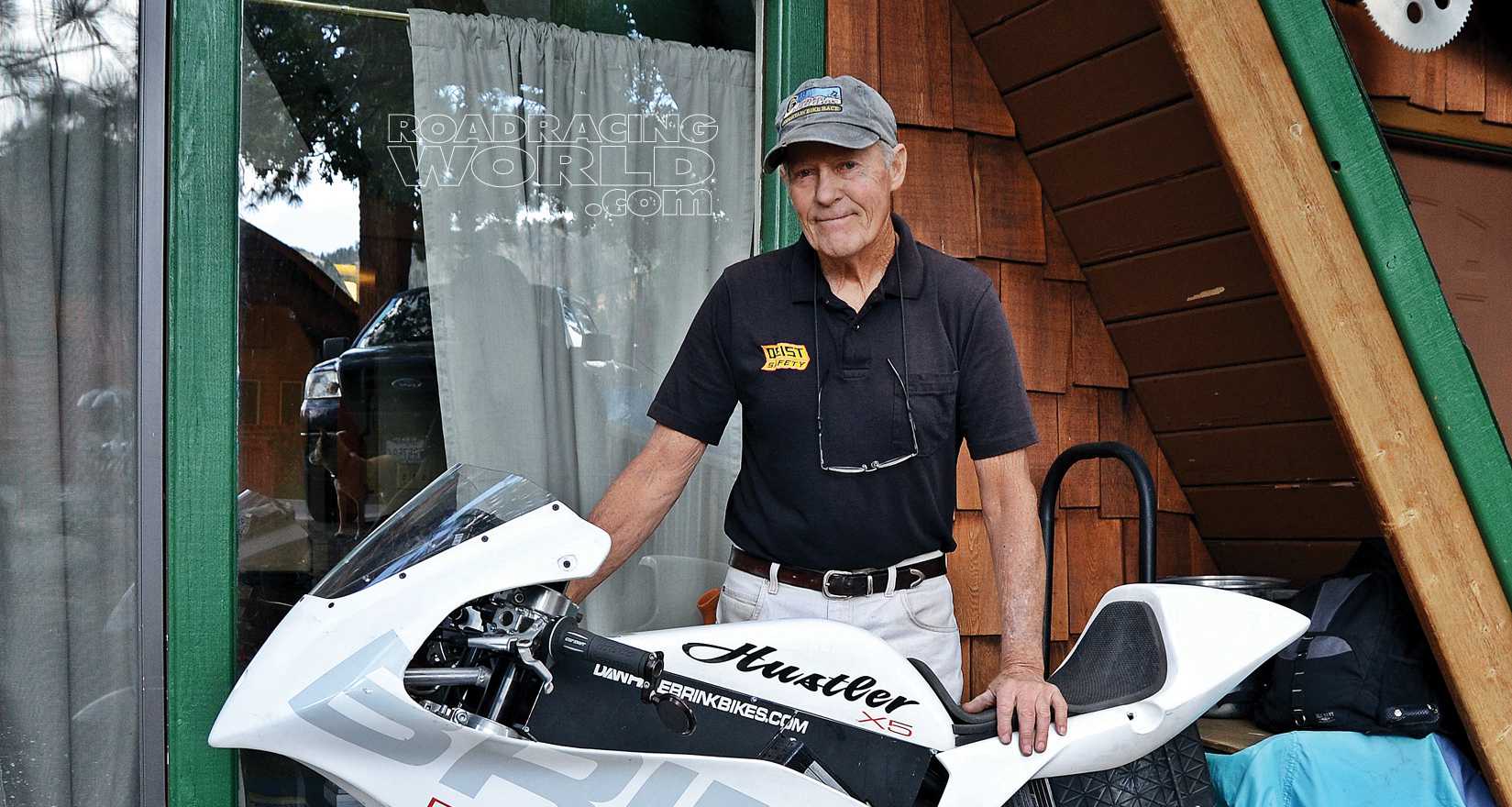
Hanebrink’s latest project is the Hustler X5, an electric motorcycle based on the idea that a smaller, lighter machine—about the size of a 250cc GP racebike—would make an excellent zero-emissions motorcycle.

The Hustler is designed to reach 130 mph, offer a range of more than 100 miles at a more sane speed before recharging, and attract motorcyclists interested in a performance electric bike who are willing to pay nearly $30,000 for one.

“You can go really fast for a short period of time, or you can turn down the power and go further,” Hanebrink says. “The range will be 100-150 miles, depending on power use, in an economical mode.”

It’s not surprising to find Hanebrink innovating on the edge of a new technology that promises to revolutionize every vehicle on the planet. Look through Hanebrink’s past, and he’s worked on rocket-ships, built revolutionary cars, made board-tracker replicas, designed mountain bikes that needed parachutes to slow down—the list goes on.

And Hanebrink is still creating madly. His base is an A-frame mountain cabin, crammed with streamliners, electric bikes designed for golf course use, the occasional road racer, mountain bikes hanging from the ceiling, and—of course—a machine shop in the basement where his creations come to life.

***

Back in the 1960s, Hanebrink moved to Southern California to attend the Art Center College of Design and study automotive design. He had an interest in vehicles, but had no desire to move to Detroit to work on cars there. So Hanebrink started working contract jobs in Southern California, engineering everything from farm equipment to Apollo rockets. The contracts were short-term, one month to six months at a pop. But they gave him a broad range of experience and the willingness to work on nearly anything that came along.

Hanebrink also served in the Marines, in the reserves during the Vietnam conflict. Interestingly, he learned to write for publications—newspapers, magazines—from the Corps’ public relations department. When he got out, he supplemented his engineering work with articles, photos and drawings of vehicles that he sold to car and bike magazines in Southern California.

But Hanebrink always was designing things, and was itching to build his own vehicles. One of the first was called “The Box.” It was designed with Matt Van Leeuwen, and it was a box-section four-wheeler made from a fiberglass/balsa wood composite and powered by a Kawasaki two-stroke engine. The initial version was steered with your feet—something that likely was quite interesting at the vehicle’s triple-digit top speed. Hanebrink sold eight of the vehicles in kit form, and learned a painful lesson. “I never kept one, because I couldn’t afford to keep one,” he says. “I try to keep one of everything I design now.”

Hanging around the motorcycle media at the time sparked Hanebrink’s interest in road racing motorcycles. Not one to mess around with easily available stuff, Hanebrink’s first road racing bike was a Honda CR93 originally purchased in Okinawa, he says. His was the equivalent of a satellite factory racebike, he says, with a five-speed transmission. What he remembers most is that it was slightly slower than the two-strokes that were coming to the fore, and that he had to pre-heat the oil on a stove before pouring it into the engine prior to starting, as recommended by the factory.

(Above) Dan Hanebrink (202) and his three-cylinder 750cc snowmobile-powered “Monotrack” road racer on the 3.76-mile road course at Ontario Motor Speedway, circa 1976. Photo by John Ulrich. 

When that bike eventually blew up, Hanebrink threw his lot in with the two-strokes, building kits for Kawasaki Triples. But eventually building kits wasn’t enough. He raced at Southern California tracks like Ontario Motor Speedway, Riverside International Raceway, Orange County International Raceway (a dragstrip/return-road course) and Willow Springs International Raceway.

He would show up with a monster—the Monotrack. This machine now sits in his crowded kitchen—because, you know, where else do you display a one-of-a-kind road racer? The spec chart is impressive and terrifying all at once. It started life with a 650cc, three-cylinder, two-stroke snowmobile engine. Hanebrink punched it out to 750cc. It powered the rear wheel (which Hanebrink made) via belt drive and a continuously variable transmission. The chassis was a magnesium monocoque. Hanebrink also built the springless suspension, which used oil to compress air in a remote reservoir. His favorite track was Willow Springs International Raceway, he says. Now, take a deep breath and imagine driving that thing off into Turn Eight at Willow with the throttle at the stop …

Hanebrink won a WERA Open GP race at Willow Springs on the machine, he says, but his favorite memory of riding it was at Ontario Motor Speedway. He snuck up on accomplished racers Keith Code and Rudy Galindo in practice, he explains, mugged them in the infield and smoked them on the banking. And sneaking up on someone on this thing was no small accomplishment, he says.

“People said it was the loudest motorcycle they’d ever heard,” Hanebrink remembers. “And because of the variable transmission, it didn’t sound like the other bikes. Other riders would complain all the time, ‘the sound of that thing is (messing) with my head!’ It was a challenge to get right. But when it was right, people would come up to you and tell you how good it was—that’s the payoff right there.”

Eventually, Hanebrink says he grew weary of the expense of road racing, and the danger. One day, he simply turned away from the sport, bought a Maico motocross machine and went racing at Saddleback Park, a now-defunct off-road facility in Irvine, California. He enjoyed the lower-key atmosphere, the lower costs and lower risks. Somewhere in here, he built a streamliner for a road race run on closed, public roads in Mexico; built magnesium wheels for a speedway racer—you get the idea.

Meanwhile, Hanebrink had moved to the mountains above San Bernardino, into a quiet little town called Big Bear Lake, a mile and a half in the sky. One day, someone came by his home with an off-road bicycle. This started a whole new series of adventures. Hanebrink made complete bikes; built forks that became as ubiquitous on race-winning bicycles as Öhlins forks are on MotoGP machines today; and got into off-road bicycling and downhill bike racing himself. He put himself on a fitness program that paid dividends; meet him today, and you wouldn’t come close to guessing his age, based on his looks.

Long story short, when the high-end off-road bicycle market collapsed, he got back into motorcycles, building street customs. When that market collapsed, he turned his attention to the electric bike market, and did well there with long-travel, fat-tired specials that sold for $8,000 to $12,000 or more.

His off-road machines are unique, designed to traverse rough terrain that would repulse a normally-tired bike. He’s also designed unique electric bikes for very specific applications, such as moving golfers across a course without causing damage to the delicate turf.

(Above) Monotrack racebike’s air/oil suspension uses a reservoir mounted behind each fork leg.

A silent electric drive allows Hanebrink’s machines to be used where a bike powered by an internal combustion engine can’t be used. Hanebrink just sold an off-road electric bike to a high-end dog trainer who is using it to replace his horse while training dogs in rough terrain.

But Hanebrink is a racer, and the pursuit of performance defines his history. It is not surprising that his latest creation is a performance machine, and it is equally unsurprising that he is pushing his suppliers to give him more power.

***

(Above) Dan Hanebrink poses with his Hustler X5 electric prototype, featuring a monocoque chassis, small wheels and bodywork off a Honda RS125.

From a pure powertrain point of view, there’s not a lot new on the Hustler X5. The drive train is based on his well-proven off-road machines, and power is transmitted through a three-speed derailleur chain drive system to the rear wheel. The lithium-ion batteries are liquid-cooled. It’s industry standard hardware, but Hanebrink has spent years developing his particular configuration to meet a variety of needs. “My electronics are made in the U.S. and Great Britain. But it’s pretty much the same stuff as everyone else has,” he says.

Where Hanebrink breaks from tradition is in the chassis. “What everyone else has done is take a twin-spar frame and build battery racks inside that frame. Essentially, they are standard chassis with batteries and an electric motor,” Hanebrink says. “I did not start with a regular bike. I started with my own concepts. This one is a full-blown aluminum monocoque. The frame is a box which contains the batteries and the electric motor and the majority of the electronics.

“I wanted a smaller bike, about the size of a road racing 250cc GP bike. I’m using 14-inch wheels—and there’s a great Bridgestone tire available for that size. That tire has a great profile—it’s like one that you’d see on a sportbike.”

From that starting point, Hanebrink’s machines are a blend of racebike engineering and unique thinking. An aluminum swingarm doesn’t raise any eyebrows, but the carbon-fiber bodywork does. The 14-inch wheel size certainly looks unique. The weight—about 195 to 220 pounds, depending on configuration—is definitely unique in the world of performance machines available for the street. With a wheelbase of 52 inches, Hanebrink says the small size and lack of weight of the machine accounts for a lot of its performance.

The machine features a single disc brake in the front, rear suspension by Race Tech and inverted forks by a company from China called Fast Ace, Hanebrink says. The front and rear brake calipers on the production bike will be Brembo. The test mule still uses a Hanebrink-built rear wheel, but that will be replaced with a 14-inch wheel on the production models. The triple clamps are amazing. The forks actually rotate in large ball bearing sockets where they pass through the triple clamps, and the steering stem can quickly be moved forward or backward to adjust the steering geometry.

(Above) Hustler electric motorcycle’s triple clamps allow quick geometry changes—note alignment marks to the right of the steering stem. After the steering stem nut is loosened, the steering stem can be moved forward or rearward by turning the bolt seen protruding below the upper clamp in this photo. 

The whole thing feels race-bike-small, but not toy-like. The seating position reminds one of a large 125cc GP machine, or a 250cc GP bike with less room between the seat and pegs. The test mule is finished with Honda RS125 bodywork.

“A lot of the parts on this thing are parts that I already make,” Hanebrink says. “I was amazed at how light it turned out. It’s the weight of a good racebike. It’s kind of a long bike, compared to a Moto3 machine. It’s not a minibike. It’s designed to fit a regular person.”

***

The Hustler X5 is an extension of the work he’s done on his off-road machines. But given his racing background, Hanebrink isn’t starting from scratch. He knows what he wants his machine to do, and is equally aware of his business model and his target customer. The bikes are built on custom order, and a deposit is required before the build starts. Hanebrink is currently building his first production Hustler X5 for a customer who plunked down a deposit on the $29,000 machine.

What the customer gets is something utterly unique in the world of performance motorcycling. And that has been Hanebrink’s business philosophy for a long time now—make something unique and functional, and the right customers will find a way to your door.

“You don’t need to sell a lot, but you need to get a decent price for the ones you do sell,” Hanebrink says. “I didn’t want to go toe-to-toe with the big boys in the electric bike market. And I know that the really big boys—Honda and Yamaha—are coming. I wanted to find a niche. I don’t want to follow other people.” RW 

MotoGP: PETRONAS Sepang Racing Team Officially Introduced In Malaysia

PETRONAS Sepang Racing Team unveils new look for historic season

The first ever Malaysian team in MotoGP, PETRONAS Yamaha Sepang Racing Team, and the PETRONAS Sprinta Racing line-ups for Moto2 and Moto3, were officially presented today at the PETRONAS Twin Towers (Malaysia), with high hopes for a promising 2019 MotoGP season.

The PETRONAS Sepang Racing Team this afternoon presented their ambitious project for 2019 at the PETRONAS Twin Towers, unveiling the stunning new colour scheme that will adorn the team’s five riders and their machines across the three categories of the MotoGP World Championship this year. The new PETRONAS Yamaha Sepang Racing Team riders in MotoGP – Franco Morbidelli and Fabio Quartararo – and their 2019 Yamaha YZR-M1 machines lined up alongside PETRONAS Sprinta Racing riders Khairul Idham Pawi (Moto2), Ayumu Sasaki and John McPhee (Moto3) were the stars of the ceremony. This historic moment in Malaysian motorsport took place in the Dewan Filharmonik PETRONAS Foyer.

This special occasion also served as a statement of intent from the team, who for the first time ever in Southeast Asia will have a presence in all three categories of Grand Prix motorcycle racing – MotoGP, Moto2 and Moto3. Indeed, it was an unforgettable day for the whole of the PETRONAS Sepang Racing Team and the country in general – demonstrated by the presence of some of Malaysia’s dignitaries – as well as the many partners who have made this dream a reality.

The headline news of the event was the official unveiling of the PETRONAS Yamaha Sepang Racing Team line-up in MotoGP, which will feature 2018 Rookie of the Year Franco Morbidelli and the man who will look to relieve him of the title, Fabio Quartararo, who makes the step up from Moto2. The team will be Yamaha’s only satellite representation on the grid, receiving top level material and factory support thanks to the magnificent working relationship between the team and Yamaha Motor Co. Ltd.

In the intermediate category, the PETRONAS Sprinta Racing outfit heads into its second season with a new face on board – Malaysia’s two-time Grand Prix winner Khairul Idham Pawi. Meanwhile in Moto3, Ayumu Sasaki welcomes a new team-mate in John McPhee, forming a new pairing ready to fight for the positions of honour at the front of the pack.

The first track appearance for the new-look PETRONAS Yamaha Sepang Racing Team will take place from 6th – 8th February at the first Official MotoGP Test of 2019 in the Sepang International Circuit. Later, from the 11th-13th February, the PETRONAS Sprinta Racing Moto2 and Moto3 teams will take part in a private test at the same track.

Razlan Razali – PETRONAS Sepang Racing Team, Team Principal, and Sepang International Circuit CEO

“The launch of the team marks our intention as a serious contender in the new 2019 MotoGP season. It has been an unbelievable journey so far and the excitement continues. This launch is for all Malaysian fans whom have been supporting Malaysian MotoGP since 1991. We have come a long way and evolved to this point because of the success of Malaysia MotoGP. The journey so far marked the hard work of the team, PETRONAS and Yamaha. We worked tirelessly to get everything ready for today and for the first test at theSepang International Circuit in February. We know there’s a lot more work ahead but today, let’s enjoy this team presentation and be proud to what we have achieved so far.”

Tan Sri Wan Zulkiflee Wan Ariffin – PETRONAS President and Group Chief Executive Officer

“PETRONAS’ involvement in motorsports has spanned decades through our entry in Formula One and MotoGP. This partnership marks PETRONAS’ presence in the whole spectrum of motorcycle racing, from the grassroots level in Cub Prix right up to the international races of MotoGP, Moto2 and Moto3 further enhancing our global branding and technology partnership, particularly in the field of fuel and lubricants. Through PETRONAS’ Fluid Technology Solutions, we aim to significantly contribute to the teams’ performance by developing and testing customised product formulations to further boost its competitive edge.”

Johan Stigefelt – PETRONAS Sepang Racing Team, Team Director

“I am really happy to be able to present the team and riders today alongside PETRONAS, and it is a great feeling to show everybody our new colours. I am proud that the riders in all three categories will have the same look, which was the objective for us – that everybody sees us as a united structure. I also want to take the opportunity to thank all of the partners who have made it possible for this project to move forward.

We will be back to work on track very soon, at our home circuit, the Sepang International Circuit. We will start with the MotoGP riders, who will be able to enjoy their new bikes and new material from Yamaha. We have planned an extensive programme of tests, even though the riders already have a little experience on the Yamaha. The conditions will be demanding at Sepang and we have a lot of work to do, so it will be a big challenge for Franco [Morbidelli] and Fabio [Quartararo].

In Moto2 and Moto3 we have planned three days of tests, with new parts to try for the latter and a new bike in the intermediate class. We had a good test at the end of last year with the three riders so we just need to keep working and preparing for the first official test at Jerez at the end of February.”

Wilco Zeelenberg – PETRONAS Yamaha Sepang Racing Team, Team Manager

“It has been a real privilege for us to present the team here at the incredible PETRONAS Twin Towers and display our bikes with the definitive liveries for 2019. I am very proud of the look of the project and the work we have done over the last couple of months. The team is incredible and we are all very much looking forward to starting the first test in Malaysia. Our objective for the test will be to pick up where we left off at Jerez – we have new bikes for the riders and we are hoping they can build on the knowledge they acquired in November. After the winter break the first thing will be to get used to the Yamaha and its speed again, and to continue improving the feeling with the bike. We will also have to make a lot of technical adjustments, taking into account the fact that it will be three tough days because of the heat and with eight hours of available track time. We are very excited to get started and begin our preparations for the first race of the new season in Qatar.”

#21 Franco Morbidelli – PETRONAS Yamaha Sepang Racing Team MotoGP Rider

“This is my second team presentation as a MotoGP rider and my first with this ambitious team. To be honest it has been really impressive, everybody is very excited and committed to the team. I came to KLCC before but it never fails to impress. To make the presentation here, to see the colours on my Yamaha for the first time and to enjoy the moment with the people of Malaysia has been fantastic. This is a great day for PETRONAS Yamaha SRT! I love how the bike has turned out and the whole look with the leathers and helmet. I am looking forward to debuting it next week in the first test at the Sepang International Circuit. We all have a lot of work ahead so I am looking forward to getting back on the bike and joining up with the team to continue our progress and preparation for the start of the season in Qatar.”

#20 Fabio Quartararo – PETRONAS Yamaha Sepang Racing Team MotoGP Rider

“I am very excited to have unveiled the new design of the bike and to have presented the whole team here at home, in Malaysia. I love it! Now I am really excited to get back on the bike at the Sepang International Circuit in the three-day test we have ahead. I am happy to be starting the new season there because it is one of my favourite tracks. We will try to give our best to learn as much as possible. We have six days of tests before the first race in Qatar, so I will do everything possible to be ready for the opening Grand Prix. The goal for any rider moving up from Moto2 is to become Rookie of the Year, so we will work hard to achieve it.”

#89 Khairul Idham Pawi – PETRONAS Sprinta Racing Moto2 Rider

“It has been a dream presentation; for me it is something incredible to unveil the team’s new colours in Kuala Lumpur, my home, because I have never done anything like this here before. To see so many people together at the PETRONAS Twin Towers was very exciting. I love the new bike that the team have put together for the 2019 season and I am very much looking forward to getting back into action soon.”

#71 Ayumu Sasaki – PETRONAS Sprinta Racing Moto3 Rider

“It was an incredible day. It was very nice to have all five of the team’s riders here – it has been very exciting. I also love how the bikes look, so now I want to see what they’re like on track! I am very keen to get back on the bike, meet up again with my technical staff and complete some laps at the Sepang International Circuit. I hope to understand the bike as soon as possible and come back to my riding style after almost three months without riding. I’m really looking forward to Sepang and also the Jerez Test. Our target for this season will be really high. McPhee will be the best team-mate I can ask for and together we will try to be as fast as possible and fight for the podium when we can.”

#17 John McPhee – PETRONAS Sprinta Racing Moto3 Rider

“What an amazing day here in Kuala Lumpur! To have the PETRONAS Sepang Racing Team launch at the PETRONAS Twin Towers was something special. The new livery looks great and now I’m really excited to get the season underway. Now we head to the Sepang International Circuit to start our new season. My aim is to make the most of the next three days to kick off our season in our best possible way. We’ve got an exciting year ahead with lots to look forward to.”

MotoGP: Stefan Dorflinger, Jorge “Aspar” Martinez To Be Inducted Into MotoGP Legends Hall Of Fame

Stefan Dörflinger and Jorge “Aspar” Martinez to become MotoGP™ Legends

Swiss and Spanish riders set for induction into the Hall of Fame

Monday, 28 January 2019

Four-time World Champions Stefan Dörflinger and Jorge “Aspar” Martinez will become MotoGP™ Legends this season, with the Swiss rider set to be inducted into the MotoGP™ Legends Hall of Fame at the Sachsenring and the Spaniard at Valencia. This announcement comes on the 40th anniversary of “Aspar”‘s first ever race – a fitting occasion.

German-born Stefan Dörflinger won back-to-back 50cc titles in 1982 and 1983 before the introduction of the 80cc category in 1984 saw the Swiss rider take that crown and become the first ever Champion in the class. He followed that up by defending the Championship in 1985, taking the fourth of the four titles he would accrue over his career. That career began on the international stage in 1973 and spanned until 1990 when Dörflinger hung up his leathers, taking the 80cc runner up spot in his penultimate season of competition. He retired with 18 Grand Prix wins to his name.

“I was overwhelmed when I heard the news I was to become a MotoGP Legend,” says Dörflinger. “I was very pleased, and very proud to join a group of such illustrious names.

“When I was racing, my favourite number was the number one. In our time, it was customary to have this number as a World Champion and I was fortunate enough to have that opportunity four times. To now become a Legend, as I said, is overwhelming, and I’m very proud to be in the Hall of Fame.”

Jorge “Aspar” Martinez began racing on the world stage in 1982 in the 50cc class. He won his first Championship in 1986 in the 80cc category and defended the crown in style as he dominated 1987 with seven wins. The following season he took the 80cc World Championship once again and paired it with a season in the 125 World Championship where he also took the crown, winning a stunning nine of 11 races. He raced until 1997 and competed in the 50cc, 80cc, 125cc and 250cc categories over his career, accruing a total of 37 Grand Prix victories.

“It’s a great feeling of happiness,” begins ‘Aspar’. “It was a big surprise when Carmelo Ezpeleta called me to tell me I was to be named a MotoGP Legend. The news was emotional because it puts me into a group of great riders. In addition, it’s the 40th anniversary of my first race so it’s a lot of good news and great memories all at once.

“The riders who are named MotoGP Legends are the best in the history of motorcycling and it’s incredible to become part of a group of almost mythical riders with such impressive awards like Angel Nieto, Mick Doohan, Giacomo Agostini, Nicky Hayden and so many others. It’s a feeling of real satisfaction.

“Stefan Dörflinger is older than me and when I arrived into the World Championship he was already a Champion. He was one of the rivals to beat, one of my objectives, but I have great memories of my relationship with him. He was very smooth, fast and elegant – a classy rider.

Dörflinger and Martinez now join a long list of greats that have been made MotoGP™ Legends that includes Giacomo Agostini, Mick Doohan, Geoff Duke, Wayne Gardner, Mike Hailwood, Daijiro Kato, Eddie Lawson, Anton Mang, Angel Nieto, Wayne Rainey, Phil Read, Jim Redman, Kenny Roberts, Jarno Saarinen, Kevin Schwantz, Barry Sheene, Marco Simoncelli, Freddie Spencer, Casey Stoner, John Surtees, Carlo Ubbiali, Alex Crivillé, Franco Uncini, Marco Lucchinelli, Randy Mamola, Kork Ballington, Dani Pedrosa and the late, great Nicky Hayden.

World Superbike: BMW Motorrad Team Reveals Its 2019 Livery

BMW Motorrad WorldSBK Team reveals 2019 livery

28.01.19

Autódromo Internacional do Algarve

The BMW Motorrad WorldSBK Team, which will compete in the 2019 MOTUL FIM World Superbike championship, today revealed the teams 2019 livery at the Autódromo Internacional do Algarve.

Riders Tom Sykes and Markus Reiterberger this morning lifted the covers on the brand new BMW S 1000 RR, revealing the iconic BMW M Motorsports design ahead of media, guests and thousands of fans live across the globe.

The S 1000 RR design takes it cues from the iconic BMW M colours, with swathes of red and blue running through the matte white finish machine. The team now looks forward to what will be an exciting new era for the Shaun Muir Racing.

The BMW Motorrad WorldSBK Team today have also launched their new website www.bmw-motorradworldsbk.com ahead of the first round at Phillip Island, Australia next month. 

World Superbike: Jonathan Rea Fastest Again As New Test Begins In Portugal

Motul FIM Superbike World Championship Test

Autodromo do Algarve Portimao, Portugal

January 27, 2019

Day One Best Lap Times:

1. Jonathan Rea, UK (Kaw ZX-10RR), 1:42.195

2. Alex Lowes, UK (Yam YZF-R1), 1:42.614

3. Alvaro Bautista, Spain (Duc Panigale V4 R), 1:42.682

4. Toprak Razgatlioglu, Turkey (Kaw ZX-10RR), 1:42.687

5. Tom Sykes, UK (BMW S1000RR), 1:42.808

6. Leon Haslam, UK (Kaw ZX-10RR), 1:42.820

7. Michael Van Der Mark, Netherlands (Yam YZF-R1), 1:42.872

8. Marco Melandri, Italy (Yam YZF-R1), 1:43.033

9. Markus Reiterberger, Germany (BMW S1000RR), 1:43.682

10. Chaz Davies, UK (Duc Panigale V4 R), 1:43.702

11. Sandro Cortese, Germany (Yam YZF-R1), 1:43.847

12. Eugene Laverty, Ireland (Duc Panigale V4 R), 1:44.200

13. Michael Rinaldi, Italy (Duc Panigale V4 R), 1:44.663

14. Alessandro Delbianco, Italy (Hon CBR1000RR SP2), 1:45.732

More, from a press release issued by Dorna WSBK Press Office:

Jonathan Rea continues to set pace in Portimao Test.

Reigning World Champion leads the way at the end of an action-packed day at Portimao.

14 WorldSBK and 10 WordSSP riders continued their crucial preparations under sunny skies at Autodromo do Algarve Portimao, which from 27th-28th January host the final European winter test before the 2019 MOTUL FIM Superbike World Championship season will kick off in Australia next month.

Day one around the Portuguese race track saw high competition again, as the top ten riders finished all packed within a second. But once again it was reigning World Champion Jonathan Rea (Kawasaki Racing WorldSBK Team) to take the top spot. Continuing to work on the new items he tested in Jerez with all his focus on the first round of the season, Rea put in a stunning lap of 1’42.413 taking the lead ahead of Alex Lowes (Pata Yamaha WorldSBK Team), that again impressed with his remarkable pre-season pace.

Working on different aspects of their YZF R1 compared to the last test at Jerez, the Pata Yamaha WorldSBK team were able to confirm the excellent work done until now, as both Alex Lowes and Dutchman Michael van der Mark finished close to the top. Lowes was just 0.231 off Rea’s lap time, while on the other side of the garage van der Mark, who had a small issue in the morning that brought out the first red flag of the day, closed in seventh position just 0.677 s off the top of the timesheets.

(Above) Alex Lowes. Photo courtesy of Dorna WSBK Press Office.

The red machines weren´t far of the pace, as Alvaro Bautista (Aruba.it Racing -Ducati) finished third just a few tenths of a second behind the Yamaha of Lowes.

For the Aruba.it Racing – Ducati Team the first day at Portimao was a busy one, as they continued to work on all aspects of their all-new Ducati Panigale V4 R. Both Chaz Davies and the Spanish rider didn’t focus on their lap times, but they worked mostly on finding the base setup for the first round of the year. Still struggling with some back pain, Davies closed in tenth position, but will have another day tomorrow to put in more laps on the new Ducati beast.

(Above) Alvaro Bautista (19). Photo courtesy of Dorna WSBK Press Office.

Continuing to make steady progress, Toprak Razgatlioglu (Kawasaki Puccetti Racing) had a positive day working alongside his new crew chief and finding a good set-up for his Kawasaki ZX-10RR. The Turkish rider was the fastest rider in the morning and closed the day in fourth position.

(Above) Toprak Razgatlioglu (54). Photo courtesy of Dorna WSBK Press Office.

BMW Motorrad WorldSBK Team had a lot to do today as they were working on different areas including the chassis and different electronics strategies for the new BMW S1000 RR. Following both the same program, Tom Sykes and Markus Reiterberger put in respectively 47 laps and closed the day in fifth and ninth position. Pleased with their overall improvement, the two riders will have a special day two at Portimao tomorrow, as they will be unveiling the 2019 livery of their bikes before hitting to the track.

(Above) Tom Sykes (TS66). Photo courtesy of Dorna WSBK Press Office.

Resuming from where they left off at Jerez, Leon Haslam and the Kawasaki Racing WorldSBK team continued to work on consistency through race simulation while fine-tuning the bike set-up for Australia. The British rider closed in sixth, 0.625 s off his teammate, and will continue with the same program tomorrow.

Also, new team GRT Yamaha WorldSBK continued their preparation for their first season in WorldSBK around Portimao. The Italian based squad has been following two different testing programs to suit their riders’ needs. Veteran Marco Melandri finished eighth as he worked on improving the YZF R1s performance, while WorldSBK rookie Sandro Cortese, who closed eleventh, continued to adapt to his machine.

Taming the Ducati V4 R, Michael Rinaldi (Barni Racing Team) and Eugene Laverty (Team Goeleven) closed respectively in thirteenth and twelfth position. The young Italian rider had a tough day adapting his riding style to the new beast, while the Irishman who had his first shakedown test with the new Ducati bike at Jerez, was now focused on the chassis and finding the right balance.

2019 WorldSBK rookie Alessandro Delbianco (Althea Mie Racing Team) closed in fourteenth position as he spent the first day around Portimao working with different tyres and finding his confidence on board the Honda CBR1000RR S2.

Among the WorldSSP riders, who were also out testing today at the Portugal race venue, Frenchman Jules Cluzel set the fastest lap time in 1’45.694, followed by compatriot Lucas Mahias (Kawasaki Racing Team) who is still adapting to the Kawasaki machine. MV AGUSTA Reparto Corse rider Raffaele De Rosa closed with the third fastest lap time.

International Island Classic: More On Josh Hayes’ Big Win At Phillip Island

AUSTRALIA WINS INTERNATIONAL CHALLENGE; BUT JOSH HAYES AND HIS US TEAM MATES MAKE IT A FIGHT TO THE FINISH

Team USA’s Josh Hayes went to bed last night convinced he could get an International Challenge win, but after finishing 15th in the morning’s race three his dream looked dashed. But the American did not give up, and this afternoon he showed why he is a four-time AMA superbike champion with a resounding win in the fourth and final six-lapper at the Phillip Island Grand Prix circuit.

The outstanding Hayes on his first visit to the Australian high-speed circuit, led race four from the get-go and finished more than 4 seconds in front of Australia’s Steve Martin in 2nd , ahead of New Zealand’s Alex Phillis – with the final International Challenge podium representing all three nations competing.

With three race wins to the Australians over the four six lap battles, the defending champions walk away with the title once again finishing on 676 points, ahead of America on 634 points and NZ on 460 points. The International Challenge is the headline event if the Island Classic, presented by Visit Phillip Island, and one of the leading historic bike events in the world today.

In individual standings, it was experience over youth in the end, when Melbourne‘s Steve Martin – a former world endurance champion back in 2008 – took out the Ken Wootton Perpetual Trophy.

The race three winner took the title on 152 points, just two ahead of 26-year-old Novocastrian Aaron Morris who had his day on Saturday with a perfect score from two wins. Today was difficult for Morris with gear box problems pushing him back to 3rd in race three, and then for the final race, he rode with just three gears and only managed a 9th place.

“It is unbelievable, I’ve won this (Ken Wootton Perpetual Trophy) before, but that’s a long long time ago now, so to win it today with guys like Josh Hayes, Jason Pridmore and all of the young chargers that we have got from Australia, it means a lot to me,” said Martin.

“This game is all about a bit of luck, and I’ve had my bad luck in years gone by. Aaron was definitely very very fast all weekend. He should have won it if his bike had of stayed together, he had a little problem and it allowed me to sneak through.”

Hayes came in equal third with Australia’s Shawn Giles on 141 points; the USA’s Larry Pegram next on 130 points; followed by Michael Gilbert (USA) and the top finishing New Zealander, former BSB champ John Reynolds on 128 points.

Hayes was elated after his race four win, but his excitement was tempered with concern for his team-mate Jason Pridmore, who had invited him to join the US squad – but spent the last 36 hours in Melbourne’s Alfred Hospital with a broken leg after a nasty high-side in race one.

“I don’t necessarily feel like the first, I feel like Jason (Pridmore) was going to beat me to it, but with him being gone I am glad we were able to pull that off,” said Hayes of his race four win.

“I’m glad he (Jason) invited me and I hope he’s proud of what we were able to accomplish. We had our snafu’s in the second two races and stole some hearts and actually that’s the first time the right bike had run proper all weekend.

“We’re a lot more pleased with where the bikes at and it gives us a lot of hope that we can make this thing a bit better in the future and that was just our first shot at it.

“Everyone has been real nice to me, I’m hoping I’ve done enough that Dave and the boys ask me to come back,” said a modest Hayes of his achievements in the Dave Crussell captained Team USA.

Carl Cox spoke for Team NZ, with the international DJ bringing his Taupo based team to the Kiwi outfit and with a star roster of riders.

“Unbelievable! We got to see some really good battles, Phillip Island is always so emotional by the end of the day; the wins and losses, and things that do break down. It’s been an historic day with the Americans winning for the first time which is amazing, they’ve flown all the way over here and with all their efforts and passion to get to the top, they finally did it!” said Cox post race.

“We’ll have to step up, the Americans are here now, their laying their flag down, it’s happening.”

RACE THREE REPORT

Australian riders finished at the pointy end in this morning’s International Challenge six-lapper, with experience coming to the fore in the shape of elder ‘statesmen’ Steve Martin and Shawn Giles, who finished first and second ahead of day one hero and fellow Suzuki Katana rider Aaron Morris.

The local domination allowed Australia to build its buffer ahead of Team USA and New Zealand heading into the fourth and final race.

Martin, the former world endurance champion and soon-to-be 51-year-old, showed he still has what it takes in race three, finishing a whisker in front of three-time Aussie superbike champion, 46-year-old Giles, also on the Katana. Giles also set the fastest time of the race, a 1m37.425 flyer on lap four.

Twenty-six-year-old Morris, who hails from Newcastle, looked set for another victory before he erred on his final run to the line, allowing Martin and Giles the opportunity to fly past. Morris struggled with his machine today, with the Katana jumping out of fourth gear.

Melbourne’s Jed Metcher on the T-Rex Honda came in fourth to complete a quadrella for the Aussies.

It was a good effort from the Australians, with the only real disappointment the DNF of last year’s individual winner, David Johnson. He has struggled with his No. 3 Suzuki all weekend, plagued by mechanical problems.

Team USA took the next three spots on a fleet of Yamahas, with fast-starter Larry Pegram fifth across the line – before a jump start penalty pushed him back to seventh. Teammates Michael Gilbert and Steve Rapp then moved up the tally to take fifth and sixth.

Craig Ditchburn and Dean Oughtred took eighth and ninth, with first across the line for the Kiwis, John Reynolds in the 1985 Suzuki Katana. Alex Phillis, who was the best performer for the Team NZ on Saturday, sat out race three due to a problems with the cam chain.

For Team USA’s Josh Hayes, race three did not go as well as Saturday’s outings where he scored 3-4 results. He made an error that saw him drop back from the race leaders early and ended the bout in 15th place.

AND FROM THE MEDICAL WARD

Team USA’s Jason Pridmore and Australia’s Beau Beaton didn’t have the world’s greatest weekend after being injured in yesterday’s big crash at turn 11, early in race one.

Pridmore high-sided in his pursuit of Morris and Metcher, and Beaton crashed hard into the American’s Yamaha as it lay on the track. Transported to Melbourne, they are both in the hands of medics at the Alfred Hospital with Pridmore nursing a broken leg and Beaton with a fractured L5 vertebrae and small fractures to his pelvis and sacrum.

Both took to social media overnight to post updates, thanking the Racesafe medical staff at the circuit and the Alfred Hospital and wishing their teams good luck today.

“We wish both Jason and Beau a speedy recovery. I’m thankful for our medical staff here and at the Alfred and it’s good to know they are in such good hands. We look forward to welcoming them back to the Island next year bigger, better and less painful for both of them! ” said circuit general manager, David Bennett.

For further information www.islandclassic.com.au

INTERNATIONAL CHALLENGE QUALIFYING – RACE Three RaceTime Behind

  • 1.Steve Martin – 1982 Suzuki Katana 1294 AUSTRALIA 9:55.859
  • 2.Shawn Giles – 1982 Suzuki Katana 1294 AUSTRALIA +.142
  • 3.Aaron Morris – 1982 Suzuki Katana AUSTRALIA +.157
  • 4.Jed Metcher – 1982 Honda Harris F1 AUSTRALIA +3.547
  • 5.Michael Gilbert – 1983 Yamaha FJ1250 USA +8.984
  • 6.Steve Rapp – Yamaha CMR FJ1100 USA +14.261
  • 7.Larry Pegram – 1983 Yamaha FJ 1250 USA +4.312 + penalty
  • 8.Craig Ditchburn – 1978 Yamaha TZ 750 AUS +16.316
  • 9.Dean Oughtred – 1981 Suzuki Katana 1100 AUS +16.698
  • 10.John Reynolds – 1985 Suzuki GSXR1100 NZ +16.806

INTERNATIONAL CHALLENGE QUALIFYING – RACE FOUR

RaceTime Behind

  • 1.Josh Hayes – 1983 Yamahas FJ 1250 USA 9:51.085
  • 2.Steve Martin – 1982 Suzuki Katana 1294 AUS +4.052
  • 3.Alex Phillis – 1980 Suzuki XR69 1170 NZ +4.089
  • 4.Jed Metcher – 1982 Honda Harris F1 1100 AUS +4.114
  • 5.Shawn Giles – 1982 Suzuki Katana 1294 AUS +8.919
  • 6.Larry Pegram – 1983 Yamaha FJ 1250 USA +10.769
  • 7.Michael Gilbert – 1983 Yamaha FJ 1250 USA +10.771
  • 8.John Reynolds – 1985 Suzuki GSXR 1100 NZ +14.769
  • 9.Aaron Morris – 1982 Suzuki Katana 1294 AUS +15.233
  • 10.Mark Miller – 1984 Harris XR691200 USA +20.701

INTERNATIONAL CHALLENGE POINTS – Three Nations

  • 1.AUSTRALIA – 676 points
  • 2.USA – 634 points
  • 3.New Zealand – 460 points

Ken Wootton Perpetual Trophy – Individual Point Scores

  • 1.Steve Martin AUS 152 points
  • 2.Aaron Morris AUS 150 points
  • 3.Josh Hayes USA 141 points
  • 4.=Shawn Giles AUS 141 points
  • 5.Larry Pegram USA 130 points
  • 6.Michael Gilbert USA 128 points
  • 7.=John Reynolds NZ 128 points
  • 8.Mark Miller USA 121 points
  • 9.Craig Ditchburn 120 points
  • 10. Barrett Long 114 points

International Island Classic: Josh Hayes, Steve Martin Split Race Wins At Phillip Island

International Island Classic

Phillip Island Grand Prix Course

Phillip Island, Victoria, Australia

January 27, 2019

Race Three Results:

1. Steve Martin, Australia (1982 Suzuki Katana 1294), 6 laps, Total Race Time 9:55.859, Best Lap Time 1:37.587

2. Shawn Giles, Australia (1982 Suzuki Katana 1294), -0.142 second, 1:37.425

3. Aaron Morris, Australia (1982 Suzuki Katana 1294), -0.157, 1:37.860

4. Jed Metcher, Australia (1982 Honda Harris F1 1100), -3.547 seconds, 1:37.596

5. Larry Pegram, USA (1983 Yamaha FJ 1250), -4.312, 1:38.914

6. Michael Gilbert, USA (1983 Yamaha FJ 1250), -8.984, 1:39.245

7. Steve Rapp, USA (Yamaha CMR FJ 1100), -14.261, 1:39.626

8. Craig Ditchburn, Australia (1978 Yamaha TZ750), -16.316, 1:40.643

9. Dean Oughtred, Australia (1981 Suzuki Katana 1100), -16.698, 1:40.141

10. John Reynolds, New Zealand (1985 Suzuki GSX-R1100), -16.806, 1:40.179

11. Barrett Long, USA (1982 Kawasaki Harris 1200), -16.837, 1:40.020

12. Mark Miller, USA (1984 Harris XR69 1200), -18.581, 1:40.854

14. Dale Quarterley, USA (1984 Suzuki XR69 1250), -23.732, 1:41.189

15. Josh Hayes, USA (1983 Yamaha FJ 1250), -24.283, 1:41.338

19. Rennie Scaysbrook, USA (1982 Suzuki Katana 1290), -38.062, 1:43.274

21. Jorge Guerrero, USA (1982 Suzuki XR69 1200), -50.671, 1:45.919

23. David Crussell, USA (1978 Yamaha TZ750), -66.380, 1:48.529

25. Joe Pethoud, USA (1984 Yamaha Harris 1250), -74.755, 1:49.732

28. Martin Morrison, USA (1982 Suzuki RGB MK7 500), -1 lap, 1:58.372

DNS. Jason Pridmore, USA (1983 Yamaha FJ 1298)

Race Four Results:

1. Josh Hayes, USA (1983 Yamaha FJ 1250), 6 laps, Total Race Time 9:51.085, Best Lap Time 1:37.215

2. Steve Martin, Australia (1982 Suzuki Katana 1294), -4.052 seconds, 1:37.778

3. Alex Phillis, New Zealand (1980 Suzuki XR69 1170), -4.089, 1:37.461

4. Jed Metcher, Australia (1982 Honda Harris F1 1100), -4.114, 1:37.699

5. Shawn Giles, Australia (1982 Suzuki Katana 1294), -8.919, 1:37.339

6. Larry Pegram, USA (1983 Yamaha FJ 1250), -10.769, 1:38.741

7. Michael Gilbert, USA (1983 Yamaha FJ 1250), -10.771, 1:38.359

8. John Reynolds, New Zealand (1985 Suzuki GSX-R1100), -14.769, 1:38.769

9. Aaron Morris, Australia (1982 Suzuki Katana 1294), -15.233, 1:38.025

10. Mark Miller, USA (1984 Harris XR69 1200), -20.701, 1:40.364

14. Barrett Long, USA (1982 Kawasaki Harris 1200), -21.476, 1:40.367

15. Dale Quarterley, USA (1984 Suzuki XR69 1250), -29.966, 1:41.520

20. David Crussell, USA (1978 Yamaha TZ750), -67.774, 1:47.658

23. Joe Pethoud, USA (1984 Yamaha Harris 1250), -73.788, 1:48.435

24. Martin Morrison, USA (1982 Suzuki RGB MK7 500), -1 lap, 1:57.973

27. Jorge Guerrero, USA (1982 Suzuki XR69 1200), –6 laps, DNF, no lap time recorded

DNS. Steve Rapp, USA (Yamaha CMR FJ 1100)

DNS. Rennie Scaysbrook, USA (1982 Suzuki Katana 1290)

DNS. Jason Pridmore, USA (1983 Yamaha FJ 1298)

World Superbike: Yamaha Motor Europe Officially Announces Its 2019 Rider Lineup

Yamaha Motor Europe Confirm Extended WorldSBK Line Up For 2019

Yamaha Motor Europe is delighted to announce its official line up for the 2019 FIM Superbike World Championship. The Pata Yamaha WorldSBK Team will once again lead the way as Yamaha’s reference team, but this year they’ll be joined on the grid by the GRT Yamaha Supported WorldSBK Team, who step up to the premier production class for the 2019 season.

2019 marks the fourth year for the partnership between Yamaha and Crescent Racing and both parties are keen to build on the success of the 2018 season, during which the Pata Yamaha WorldSBK riders, Michael van der Mark and Alex Lowes, secured three race wins and a total of 14 podium finishes between them. Van der Mark and Lowes remain with the team for the coming season, with both keen to add to their tally of wins as they look to challenge for the championship in 2019.

Having achieved everything possible in WorldSSP, including winning the World Championship crown in 2017, GRT Yamaha face a new challenge in 2019, as the team step up to contest the FIM Superbike World Championship for the first time. Former 250cc World Champion and WorldSBK race winner Marco Melandri is joined at GRT Yamaha by the reigning WorldSSP Champion Sandro Cortese, who swaps last year’s title-winning YZF-R6 for the race winning Yamaha YZF-R1 WorldSBK machine this season.

The Pata Yamaha and GRT Yamaha teams are currently testing in Europe, but in February both teams will head south of the equator to test and then race at the iconic Phillip Island Circuit in Australia, venue for the opening round of the 2019 FIM Superbike World Championship.

Andrea Dosoli

Yamaha Motor Europe Road Racing Manager

“We are pleased with the way the Yamaha Motor Europe racing program has progressed. We saw a clear improvement in 2018, with not just our YZF-R1 reaching maturity but also our racing operation at the track and our operation in the factory. For this reason I’m very happy to confirm our relationship with Crescent Racing as our reference team in WorldSBK will continue for the 2019 season, with Michael van der Mark and Alex Lowes as the riders once again. I truly believe that continuity is critical for success in motorsport. If we can continue to work in the same way as we did in 2018 and strive to achieve the consistency that was maybe missing last year, I am confident we can make a further step in the right direction. The 2019 season will be a strategic one for us. The arrival of GRT Yamaha in WorldSBK means we now have four riders on the grid, which gives us a good opportunity to speed up development of the bike, but it’s also the final piece in our rider development program. We now have a program in place for young riders that starts with the Yamaha bLU cRU project and extends all the way to WorldSBK with a competitive machine and a competitive team. So I’m pleased to welcome GRT Yamaha to WorldSBK with Marco Melandri and Sandri Cortese, with the latter, having won the 2018 WorldSSP Championship aboard a Yamaha, being a clear example of the rider development program in action.”

International Island Classic: Aaron Morris Wins Two, Josh Hayes On The Podium, Jason Pridmore Injured At Phillip Island

Editorial Note: American Jason Pridmore was racing for a podium position in Race One when he crashed and suffered injuries during Race One, according to a post on the social media accounts of Pridmore’s JP43 Training.

From JP43 Training’s social media post: “Jason was running 3rd when he highsided on the 2nd lap. He has a broken left leg and shoulder. He’s being transported to a hospital for further treatment, we’ll keep everyone updated when we know more. He’s awake cracking jokes, but really sad to end the weekend like this.”

International Island Classic

Phillip Island Grand Prix Course

Phillip Island, Victoria, Australia

January 26, 2019

Race One Results:

1. Aaron Morris, Australia (1982 Suzuki Katana 1294), 6 laps, Total Race Time 9:52.088, Best Lap Time 1:36.789

2. Jed Metcher, Australia (1982 Honda Harris F1 1100), -1.260 seconds, 1:37.642

3. Josh Hayes, USA (1983 Yamaha FJ 1250), -1.614, 1:37.519

4. David Johnson, Australia (1982 Suzuki XR69 1100), -3.096, 1:37.742

5. Shawn Giles, Australia (1982 Suzuki Katana 1294), -4.507, 1:38.024

6. Alex Phillis, New Zealand (1980 Suzuki XR69 1170), -4.711, 1:38.294

7. Steve Martin, Australia (1982 Suzuki Katana 1294), -4.817, 1:38.182

8. Larry Pegram, USA (1983 Yamaha FJ 1250), -14.943, 1:38.428

9. Jay Lawrence, New Zealand (1981 Suzuki Katana 1100), -18.675, 1:40.119

10. John Reynolds, New Zealand (1985 Suzuki GSX-R1100), -20.509, 1:40.020

12. Mark Miller, USA (1984 Harris XR69 1200), -24.265, 1:41.292

15. Barrett Long, USA (1982 Kawasaki Harris 1200), -25.329, 1:40.246

16. Dale Quarterley, USA (1984 Suzuki XR69 1250), -27.219, 1:41.865

17. Michael Gilbert, USA (1983 Yamaha FJ 1250), -34.270, 1:40.729

21. Rennie Scaysbrook, USA (1982 Suzuki Katana 1290), -48.783, 1:44.060

25. Jorge Guerrero, USA (1982 Suzuki XR69 1200), -69.053, 1:47.066

26. David Crussell, USA (1978 Yamaha TZ750), -74.476, 1:49.003

33. Steve Rapp, USA (Yamaha CMR FJ 1100), -4 laps, DNF, 1:40.127

34. Jason Pridmore, USA (1983 Yamaha FJ 1298), DNS*

*did not start restarted race

Race Two Results:

1. Aaron Morris, Australia (1982 Suzuki Katana 1294), 6 laps, Total Race Time 9:52.507, Best Lap Time 1:36.730

2. Steve Martin, Australia (1982 Suzuki Katana 1294), -4.250 seconds, 1:37.827

3. Paul Byrne, Australia (1984 Suzuki McIntosh 1260), -6.522, 1:37.876

4. Josh Hayes, USA (1983 Yamaha FJ 1250), -12.386, 1:38.069

5. Alex Phillis, New Zealand (1980 Suzuki XR69 1170), -18.169, 1:38.560

6. Michael Gilbert, USA (1983 Yamaha FJ 1250), -19.390, 1:39.759

7. Steve Rapp, USA (Yamaha CMR FJ 1100), -19.663, 1:39.821

8. John Reynolds, New Zealand (1985 Suzuki GSX-R1100), -21.154, 1:39.883

9. Mark Miller, USA (1984 Harris XR69 1200), -22.281, 1:40.571

10. Barrett Long, USA (1982 Kawasaki Harris 1200), -22.611, 1:39.845

15. Larry Pegram, USA (1983 Yamaha FJ 1250), -35.060, 1:38.461

18. Rennie Scaysbrook, USA (1982 Suzuki Katana 1290), -47.807, 1:44.051

21. Jorge Guerrero, USA (1982 Suzuki XR69 1200), -52.950, 1:45.260

22. David Crussell, USA (1978 Yamaha TZ750), -71.985, 1:48.182

23. Joe Pethoud, USA (1984 Yamaha Harris 1250), -72.786, 1:48.139

28. Matt Morrison, USA (1982 Suzuki RGB MK7 500), -2 laps, DNF., 1:58.618

35. Dale Quarterley, USA (1984 Suzuki XR69 1250), -6 laps, DNF, no lap time recorded

DNS. Jason Pridmore, USA (1983 Yamaha FJ 1298)

More, from a press release issued by Phillip Island Grand Prix Circuit:

AUSTRALIA’S MORRIS PERFECT, BUT HAYES AND HIS TEAM USA IN PURSUIT

Newcastle’s Aaron Morris backed up his dominance in qualifying Friday, to go from pole position today to take victory in the two International Challenge races at Australia’s Phillip Island Grand Prix Circuit and grab a narrow lead for the Australians against Team USA and New

Zealand in the three nation historic motorcycle battle.

And while Morris was unstoppable, Team USA flexed their muscle with Josh Hayes breathing down the back of the

Aussie front runners and being backed by reliable performances from his team mates. While the Australians were solid, defending champion David Johnson was plagued by mechanical problems, and 2016 champ Jed Metcher lost the front end to bow out of race two. Alex Phillis and John Reynolds were the best for the Kiwis.

Drama also marred the start, with the Team USA’s Jason Pridmore and Australia’s Beau Beaton both crashing at turn 11 and being transported to hospital for observation.

The headline event of the International Island Classic, presented by Visit Phillip Island, the International Challenge was run today in far more pleasant mid 20 temperatures in comparison to yesterday’s stifling 40+ temps that sizzled machines and their riders

RACE ONE

Race one started with drama and a red-flag two laps in, when Team USA scalp, Jason Pridmore high-sided at turn 11, falling heavily and taking other riders out in the crash. Australia’s Beau Beaton came unstuck, and both he and Pridmore were taken to the medical centre with injuries. Conscious, both were transported to the hospital for observation and will not return to the grid this weekend.

For the race one re-start, polesitter Aaron Morris improved his start and stuck with the front runners, but it was Jed Metcher on the Honda Harris, and Suzuki riders David Johnson and Alex Phillis who headed the field by Southern Loop.

While the Australians Metcher and Johnson led early, team-mate Morris overhauled them aboard his Katana by lap three and held the lead through to the chequered flag. It was a solid victory, 1.2 seconds in front of Metcher. Team USA’s hot shot Josh Hayes came in third, impressive for his first visit to the circuit and his third day on the bike.

David Johnson, last year’s Ken Wootton Trophy winner for best individual performance, took fourth, with Australia’s Shawn Giles in 5th; and Suzuki rider Alex Phillis crossing the line for the New Zealanders in 6th , the best performer from the Kiwi squad.

RACE TWO

For the second International Challenge race mid-afternoon, it was American Josh Hayes – the four times AMA Superbike champion – who took the early lead after an impressive start. He was fiercely pursued though by a host of riders including race one winner Aaron Morris, Melbourne’s Jed Metcher and for the USA Larry Pegram.

Morris broke away early in lap two on the Katana and with him was Metcher on the Harris, leaving Hayes and Pegram in their wake. Metcher though tumbled at Lukey Heights with a front end issue, and Morris was away with clear track, building a four-second lead to take his second chequered flag in dominant fashion to complete a perfect day.

“The day went really well except my starts were pretty atrocious. I hadn’t done any clutch starts on the bike until this morning,” said 26 year old Morris.

“To come out with both wins, I am very happy with that, and hopefully we can fix a few gremlins in the bike overnight and get out there and do it all again tomorrow

“The competition is definitely keeping me honest. It’s been hard work out there. We are pretty lucky that we have a great bike.”

Completing the race two podium was former world endurance champion, Australia’s Steve Martin, in second, with Paul Byrne third for the locals; while Josh Hayes was fourth for the US on the Yamaha FJ.

Hayes is the dark horse and should not be underestimated. As he learns the track, he’s starting to play hard ball and is likely to terrorise the leading riders even further tomorrow.

With today’s two wins, Australia’s Morris leads the individual leader board with a perfect scorecard on 80 points, but Hayes just trails him, with 75 points to his name.

“I am learning how to wrestle a dinosaur. These bikes are a bit before my time but I am lucky that the bike is extremely stable in the corners. I’ve had to change my riding style as I am a front end rider but on these bikes I don’t have much feel at the front to push really hard,” said Hayes.

“I am really looking forward to getting a win tomorrow. I know we can do it.”

Hayes also has the backing of what seems a far more formidable Team USA in 2019. Consistency amongst all riders is the name of the game for team honours, and the Americans had five finishers in the top ten in race two today, with Hayes 4th, followed by Michael Gilbert in 6th, Steve Rapp in 7th, Mark Miller in 9th and Barrett Long in 10th.

At the end of day one, Australia leads the table on 326 points, with Team USA trailing by only 15 points on 311 points, with New Zealand on 253 points.

Phillis was the best performer for the Kiwis today with a 6th and a 5th place to sit 4th on the Ken Wootton table for individual glory; while three times British superbike champion, John Reynolds, is finding his pace and took a 10th and 8th spot today and is in 6th place overall.

Defending Ken Wootton trophy holder, Adelaide’s Dave Johnson had gear box problems in race one, and did not compete in race two due to electrical problems. He plans to be back on track in the morning, after his mechanics work some magic overnight.

ABOUT THE EVENT

The 26th International Island Classic, presented by Visit Phillip Island, is one of the worlds’ great historic bike meets, attracting over 450 bikes and riders from across the globe, competing in 56 races over the weekend. Celebrating a century of motorbikes, features old Indians, Nortons and Vincents through to vintage Triumphs, Harleys and Ducatis. There’s six historic categories from pre-WW1 bikes through Vintage (1920-1945), Classic and Post Classic (from 1946 to 1972) and the more recent Forgotten Era and New Era classes fighting for class honours and the Phil Irving Perpetual Trophy.

Tickets

Gates Open Sunday at 8am with tickets available at the gate. Camping also available on track with 24/7 access to the campground via gate 2. Kids 15 and under are free.

For further information www.islandclassic.com.au

INTERNATIONAL CHALLENGE QUALIFYING – RACE ONE RaceTime Behind

1. Aaron Morris – 1982 Suzuki Katana AUSTRALIA 9:52.088

2. Jed Metcher – 1982 Honda Harris F1 AUSTRALIA +1.260

3. Joshua Hayes – 1983 Yamaha FJ1250 USA +1.614

4. David Johnson – 1982 Suzuki XR691100 AUSTRALIA +3.096

5. Shawn Giles – 1982 Suzuki Katana 1294 AUSTRALIA +4.507

6. Alex Phillis – 1980 Suzuki XR69 1170 NEW ZEALAND +4.711

7. Steve Martin – 1982 Suzuki Katana 1294 AUSTRALIA +4.817

8. Larry Pegram – 1983 Yamaha FJ 1250 USA +14.943

9. Jay Lawrence – 1981 Suzuki Katana 1100 NZ +18.675

10. John Reynolds – 1985 Suzuki GSXR1100 NZ +20.509

INTERNATIONAL CHALLENGE QUALIFYING – RACE TWO Race Time Behind

1. Aaron Morris – 1982 Suzuki Katana AUSTRALIA 9:52.507

2. Steve Martin – 1982 Suzuki Katana 1294 AUSTRALIA +4.250

3. Paul Byrne – 1984 Suzuki McIntosh 1260 AUSTRALIA +6.522

4. Joshua Hayes – 1983 Yamaha FJ1250 USA +12.386

5. Alex Phillis – 1980 Suzuki XR69 1170 NEW ZEALAND +18.169

6. Michael Gilbert – 1983 Yamaha FJ1250 USA +19.390

7. Steve Rapp – Yamaha CMR FJ1100 USA +19.663

8. John Reynolds – 1985 Suzuki GSXR1100 NZ +21.154

9. Mark Miller – 1984 Harris XR69 1200 USA +22.281

10. Barrett Long -1982 Kawasaki Harris 1250 USA +22.611


INTERNATIONAL CHALLENGE POINTS – Three Nations – after Race 1 & 2

1. AUSTRALIA – 326 points

2. USA – 311 points

3. New Zealand – 253 points


Ken Wootton Perpetual Trophy – Individual Point Scores after Race 1 & 2

1. Aaron Morris AUSTRALIA 80 points

2. Josh Hayes USA 75 points

3. Steve Martin AUSTRALIA 73 points

4. Alex Phillis NEW ZEALAND 71 points

5. Shawn Giles AUSTRALIA 66 points

6. John Reynolds NEW ZEALAND 64 points

7. Mark Miller USA 61 points

8. Michael Gilbert USA 59 points

9. Larry Pegram USA 59 points

10. Barrett Long USA 57 points           

February 2019

On the Front Cover: Valentino Rossi (46) is working to improve Italy’s GP fortunes with his VR46 Academy training program, which includes riding mini road racers and flat track bikes. Photo by Milagro/DPPI.

Read the February 2019 issue of Roadracing World & Motorcycle Technology now with your online subscription.

Roadracing World & Motorcycle Technology magazine is available in print and digital formats.

Log in or subscribe HERE.


Roadracing World & Motorcycle Technology is THE definitive source for motorcycle racing, riding, and tech information.


In This Issue:

FEATURES

Inside Info: Aprilia, EBR, Suzuki, and Triumph Make News

A Vintage Racer’s Plan For American Team Redemption In The Island Classic, Part 4

Racing History: The Story Of Shoichiro Irimajiri and Honda’s 1960s 50cc Twin, 125cc Five, and 250cc Six

Historic Racebike Illustrations: Velocette KTT Mk VIII

MotoGP Analysis: How Valentino Rossi Builds Stars At His Italian Ranch, Including Using Minis, Part 1

Quick Ride: Kramer HKR EVO2 R, Built For The Racetrack 

Intro: Royal Enfield Gets Serious With GT 650/INT 650 Twins 

Back In The Day: Editor’s Scrapbook: 1985 AMA Superbike National At Willow Springs/Kevin Schwantz

Army Of Darkness Gets Pulled Back In: WERA Endurance Is Back, With N2 Racing!

Shops: Hayes Performance Systems

SEMI-PRO AND CLUB RACING

WERA National Challenge Series At Barber: Adams, Campbell, May, Melka, Win

46th WERA Grand National Finals At Barber: Champions Crowned

AMA Road Race Grand Championships At Barber: Dallas Daniels Makes History

N2 Racing/WERA Endurance Series At Barber: Army Of Darkness Wins Overall

COLUMNS

Letters To The Editor

10 Years Ago

MotoGP Trivia/Numbers

Kyle Wyman: Where’s Wyman?

The Kids’ Page: Nathan Bettencourt

The Crash Page: Steve Roth And Caleb Odom Crash In AMA Superstock Novice During WERA GNF At Barber

Professional Services Directory

Racing, School, & Track Day Calendar

High Performance Parts & Services Directory

ASRA/CCS Newsletter

Classified Ads

Advertisers Index

Chris Ulrich: Adventures Of An Ex-Racer

Remembering Racer, Inventor, Bike Designer Dan Hanebrink, R.I.P.

The following article was originally published in the December 2014 issue of Roadracing World & Motorcycle Technology magazine. To subscribe, click on the Subscribe tab on the home page.

Copyright 2014-2019, Roadracing World Publishing, Inc.

PROFILE: Inventor/Racer Dan Hanebrink

“I Don’t Do Things The Way Other People Do …”

By Michael Gougis

Most people who wanted to race an open-class production-based motorcycle in the early to mid-1970s chose between a Kawasaki four-cylinder DOHC Z1 900 or three-cylinder H2 two-stroke 750, a Honda four-cylinder SOHC CB750 or a Yamaha R5 350 two-stroke. If they wanted to race a limited production, purpose-built racebike, they could buy a Yamaha two-cylinder two-stroke 250 or 350 or later a four-cylinder two-stroke TZ700 or TZ750.

Then there is Dan Hanebrink, who built himself a monocoque racebike fitted with air/oil springless suspension, powered by a three-cylinder, two-stroke 750cc snowmobile engine with belt drive and a continuously variable transmission (CVT).

“I don’t do things the way other people do,” says Hanebrink, age 75, a pioneer in off-road bicycling and still pushing the performance envelope, now on the electric motorcycle frontier. “As I’ve been developing the bike and the batteries and the electronics, I’ve been working on performance.”

(Above) The “Monotrack” monocoque racebike without bodywork. Note three expansion chamber stingers, without mufflers. Photo courtesy Dan Hanebrink.

Hanebrink’s latest project is the Hustler X5, an electric motorcycle based on the idea that a smaller, lighter machine—about the size of a 250cc GP racebike—would make an excellent zero-emissions motorcycle.

The Hustler is designed to reach 130 mph, offer a range of more than 100 miles at a more sane speed before recharging, and attract motorcyclists interested in a performance electric bike who are willing to pay nearly $30,000 for one.

“You can go really fast for a short period of time, or you can turn down the power and go further,” Hanebrink says. “The range will be 100-150 miles, depending on power use, in an economical mode.”

It’s not surprising to find Hanebrink innovating on the edge of a new technology that promises to revolutionize every vehicle on the planet. Look through Hanebrink’s past, and he’s worked on rocket-ships, built revolutionary cars, made board-tracker replicas, designed mountain bikes that needed parachutes to slow down—the list goes on.

And Hanebrink is still creating madly. His base is an A-frame mountain cabin, crammed with streamliners, electric bikes designed for golf course use, the occasional road racer, mountain bikes hanging from the ceiling, and—of course—a machine shop in the basement where his creations come to life.

***

Back in the 1960s, Hanebrink moved to Southern California to attend the Art Center College of Design and study automotive design. He had an interest in vehicles, but had no desire to move to Detroit to work on cars there. So Hanebrink started working contract jobs in Southern California, engineering everything from farm equipment to Apollo rockets. The contracts were short-term, one month to six months at a pop. But they gave him a broad range of experience and the willingness to work on nearly anything that came along.

Hanebrink also served in the Marines, in the reserves during the Vietnam conflict. Interestingly, he learned to write for publications—newspapers, magazines—from the Corps’ public relations department. When he got out, he supplemented his engineering work with articles, photos and drawings of vehicles that he sold to car and bike magazines in Southern California.

But Hanebrink always was designing things, and was itching to build his own vehicles. One of the first was called “The Box.” It was designed with Matt Van Leeuwen, and it was a box-section four-wheeler made from a fiberglass/balsa wood composite and powered by a Kawasaki two-stroke engine. The initial version was steered with your feet—something that likely was quite interesting at the vehicle’s triple-digit top speed. Hanebrink sold eight of the vehicles in kit form, and learned a painful lesson. “I never kept one, because I couldn’t afford to keep one,” he says. “I try to keep one of everything I design now.”

Hanging around the motorcycle media at the time sparked Hanebrink’s interest in road racing motorcycles. Not one to mess around with easily available stuff, Hanebrink’s first road racing bike was a Honda CR93 originally purchased in Okinawa, he says. His was the equivalent of a satellite factory racebike, he says, with a five-speed transmission. What he remembers most is that it was slightly slower than the two-strokes that were coming to the fore, and that he had to pre-heat the oil on a stove before pouring it into the engine prior to starting, as recommended by the factory.

(Above) Dan Hanebrink (202) and his three-cylinder 750cc snowmobile-powered “Monotrack” road racer on the 3.76-mile road course at Ontario Motor Speedway, circa 1976. Photo by John Ulrich. 

When that bike eventually blew up, Hanebrink threw his lot in with the two-strokes, building kits for Kawasaki Triples. But eventually building kits wasn’t enough. He raced at Southern California tracks like Ontario Motor Speedway, Riverside International Raceway, Orange County International Raceway (a dragstrip/return-road course) and Willow Springs International Raceway.

He would show up with a monster—the Monotrack. This machine now sits in his crowded kitchen—because, you know, where else do you display a one-of-a-kind road racer? The spec chart is impressive and terrifying all at once. It started life with a 650cc, three-cylinder, two-stroke snowmobile engine. Hanebrink punched it out to 750cc. It powered the rear wheel (which Hanebrink made) via belt drive and a continuously variable transmission. The chassis was a magnesium monocoque. Hanebrink also built the springless suspension, which used oil to compress air in a remote reservoir. His favorite track was Willow Springs International Raceway, he says. Now, take a deep breath and imagine driving that thing off into Turn Eight at Willow with the throttle at the stop …

Hanebrink won a WERA Open GP race at Willow Springs on the machine, he says, but his favorite memory of riding it was at Ontario Motor Speedway. He snuck up on accomplished racers Keith Code and Rudy Galindo in practice, he explains, mugged them in the infield and smoked them on the banking. And sneaking up on someone on this thing was no small accomplishment, he says.

“People said it was the loudest motorcycle they’d ever heard,” Hanebrink remembers. “And because of the variable transmission, it didn’t sound like the other bikes. Other riders would complain all the time, ‘the sound of that thing is (messing) with my head!’ It was a challenge to get right. But when it was right, people would come up to you and tell you how good it was—that’s the payoff right there.”

Eventually, Hanebrink says he grew weary of the expense of road racing, and the danger. One day, he simply turned away from the sport, bought a Maico motocross machine and went racing at Saddleback Park, a now-defunct off-road facility in Irvine, California. He enjoyed the lower-key atmosphere, the lower costs and lower risks. Somewhere in here, he built a streamliner for a road race run on closed, public roads in Mexico; built magnesium wheels for a speedway racer—you get the idea.

Meanwhile, Hanebrink had moved to the mountains above San Bernardino, into a quiet little town called Big Bear Lake, a mile and a half in the sky. One day, someone came by his home with an off-road bicycle. This started a whole new series of adventures. Hanebrink made complete bikes; built forks that became as ubiquitous on race-winning bicycles as Öhlins forks are on MotoGP machines today; and got into off-road bicycling and downhill bike racing himself. He put himself on a fitness program that paid dividends; meet him today, and you wouldn’t come close to guessing his age, based on his looks.

Long story short, when the high-end off-road bicycle market collapsed, he got back into motorcycles, building street customs. When that market collapsed, he turned his attention to the electric bike market, and did well there with long-travel, fat-tired specials that sold for $8,000 to $12,000 or more.

His off-road machines are unique, designed to traverse rough terrain that would repulse a normally-tired bike. He’s also designed unique electric bikes for very specific applications, such as moving golfers across a course without causing damage to the delicate turf.

(Above) Monotrack racebike’s air/oil suspension uses a reservoir mounted behind each fork leg.

A silent electric drive allows Hanebrink’s machines to be used where a bike powered by an internal combustion engine can’t be used. Hanebrink just sold an off-road electric bike to a high-end dog trainer who is using it to replace his horse while training dogs in rough terrain.

But Hanebrink is a racer, and the pursuit of performance defines his history. It is not surprising that his latest creation is a performance machine, and it is equally unsurprising that he is pushing his suppliers to give him more power.

***

(Above) Dan Hanebrink poses with his Hustler X5 electric prototype, featuring a monocoque chassis, small wheels and bodywork off a Honda RS125.

From a pure powertrain point of view, there’s not a lot new on the Hustler X5. The drive train is based on his well-proven off-road machines, and power is transmitted through a three-speed derailleur chain drive system to the rear wheel. The lithium-ion batteries are liquid-cooled. It’s industry standard hardware, but Hanebrink has spent years developing his particular configuration to meet a variety of needs. “My electronics are made in the U.S. and Great Britain. But it’s pretty much the same stuff as everyone else has,” he says.

Where Hanebrink breaks from tradition is in the chassis. “What everyone else has done is take a twin-spar frame and build battery racks inside that frame. Essentially, they are standard chassis with batteries and an electric motor,” Hanebrink says. “I did not start with a regular bike. I started with my own concepts. This one is a full-blown aluminum monocoque. The frame is a box which contains the batteries and the electric motor and the majority of the electronics.

“I wanted a smaller bike, about the size of a road racing 250cc GP bike. I’m using 14-inch wheels—and there’s a great Bridgestone tire available for that size. That tire has a great profile—it’s like one that you’d see on a sportbike.”

From that starting point, Hanebrink’s machines are a blend of racebike engineering and unique thinking. An aluminum swingarm doesn’t raise any eyebrows, but the carbon-fiber bodywork does. The 14-inch wheel size certainly looks unique. The weight—about 195 to 220 pounds, depending on configuration—is definitely unique in the world of performance machines available for the street. With a wheelbase of 52 inches, Hanebrink says the small size and lack of weight of the machine accounts for a lot of its performance.

The machine features a single disc brake in the front, rear suspension by Race Tech and inverted forks by a company from China called Fast Ace, Hanebrink says. The front and rear brake calipers on the production bike will be Brembo. The test mule still uses a Hanebrink-built rear wheel, but that will be replaced with a 14-inch wheel on the production models. The triple clamps are amazing. The forks actually rotate in large ball bearing sockets where they pass through the triple clamps, and the steering stem can quickly be moved forward or backward to adjust the steering geometry.

(Above) Hustler electric motorcycle’s triple clamps allow quick geometry changes—note alignment marks to the right of the steering stem. After the steering stem nut is loosened, the steering stem can be moved forward or rearward by turning the bolt seen protruding below the upper clamp in this photo. 

The whole thing feels race-bike-small, but not toy-like. The seating position reminds one of a large 125cc GP machine, or a 250cc GP bike with less room between the seat and pegs. The test mule is finished with Honda RS125 bodywork.

“A lot of the parts on this thing are parts that I already make,” Hanebrink says. “I was amazed at how light it turned out. It’s the weight of a good racebike. It’s kind of a long bike, compared to a Moto3 machine. It’s not a minibike. It’s designed to fit a regular person.”

***

The Hustler X5 is an extension of the work he’s done on his off-road machines. But given his racing background, Hanebrink isn’t starting from scratch. He knows what he wants his machine to do, and is equally aware of his business model and his target customer. The bikes are built on custom order, and a deposit is required before the build starts. Hanebrink is currently building his first production Hustler X5 for a customer who plunked down a deposit on the $29,000 machine.

What the customer gets is something utterly unique in the world of performance motorcycling. And that has been Hanebrink’s business philosophy for a long time now—make something unique and functional, and the right customers will find a way to your door.

“You don’t need to sell a lot, but you need to get a decent price for the ones you do sell,” Hanebrink says. “I didn’t want to go toe-to-toe with the big boys in the electric bike market. And I know that the really big boys—Honda and Yamaha—are coming. I wanted to find a niche. I don’t want to follow other people.” RW