Home Blog Page 1788

World Endurance: How To Watch The Suzuka 8-Hours Race This Coming Weekend

WATCH THE SUZUKA 8 HOURS LIVE

Viewers around the world can watch live coverage of the entire Suzuka 8 Hours, the 2018-2019 FIM EWC’s Grand Finale, on Sunday 28 July.

Full live coverage of the Suzuka 8 Hours, from the race start procedure to the podium ceremony, will be broadcast on Eurosport 2 from 4.15am to 1pm CEST. The 2018-2019 FIM EWC final will be shown in more than 60 countries and on Eurosport Player, with commentary in English and French.

Eurosport Events, the FIM EWC promoter, now releases coverage of the FIM Endurance World Championship races to more than 20 broadcasters around the globe.

Two new channels have been added to the list of networks offering international coverage of the FIM EWC. Motortrend in the United States, Canada, South America and Africa will show the entire race live on its digital platform. The Sky NZ channel will also provide full live coverage of the Suzuka 8 Hours in New Zealand.

Japanese fans can watch live coverage of the entire Suzuka 8 Hours on the digital platform Hulu as well as the Nippon TV group’s channels, G+, BS NTV and BS NTV2.

In France, sports channel L’Equipe will show live coverage from 8am to 12.45pm following a recap of the first few hours of the race.

To dive into the heart of the Suzuka 8 Hours action right from the Top 10 Trial, the Superpole unique to Suzuka featuring the 10 fastest teams in qualifying, tune in to the Facebook FIM EWC Live broadcast starting at 3.30pm local time on Saturday 27 July.

The “EWC All Access” segment summarizing the best moments of the race will air on Eurosport from 10pm CEST on Tuesday 30 July. “EWC All Access” and a 44-minute race highlights programme will be shown in 42 countries – across Asia (Fox Sports Asia), in Japan (BS Nippon), the United States and Canada (Motortrend), New Zealand (Sky NZ), India (Dsport), the Philippines (Hyper), Brazil (Band Sports), sub-Saharan Africa (Kwesé Free Sports), Italy (SkySport and Corse di Moto), Spain (Garage TV), the U.K. (Quest), Poland (Motowizja), the Czech Republic (CT Sport Channel) and Russia (Motosport TV).

To make sure you don’t miss out on any of the action, you can also follow the Suzuka 8 Hours on the website fimewc.com, on Facebook, Twitter, Instagram and YouTube, the live timing and the FIM EWC smartphone app.

CMRA Racing At MotorSport Ranch In Cresson, Texas This Coming Weekend

CMRA At MotorSport Ranch This Weekend

This coming weekend, July 26-28, the Central Motorcycle Roadracing Association (CMRA) hosts its fifth round of the 2019 season at MotorSport Ranch in Cresson, Texas. The track is located just 30 minutes south of Fort Worth on Highway 377.

Registration and Tech open for all activities at 6:30 a.m. Friday. The full weekend’s event schedule can be found here: http://www.cmraracing.com/2019-schedule/

Friday is a full day of CMRA Racer Practice, CMRA New Racer School, and Track Experience for the track day riders that want to experience the same track the racers are racing. Bring a friend along to ride Track Experience and help you pit! Track Experience is $150 and offers an optional mock race at the end of the day!

Saturday’s schedule includes Mini, Ultra-Lightweight, and Championship Sprint races, the third round of the Ultra-Lightweight Endurance Series, and Solo 30 sprint races.

Sunday’s schedule is packed full with more Big bike/Lightweight integrated sprints, with a longer morning practice and qualifying for Formula 1 Expert, C Superbike Expert, Formula 2 Expert, and 500 GP Expert.

Progressive Powersports of Granbury will be hosting a hospitality booth with refreshments, give-a-ways, some small parts and accessories for sale, and a drawing to win a suitcase generator. They will also have a LapKing demo special running throughout the weekend. LapKing is a new lap timing device that shows your lap times and also where you rank against your friends’ lap times. They will run a LapKing contest for everyone who completes 3 laps with a LapKing demo will be entered for a drawing for a $50.00 Progressive Powersports gift card + a 1 year free LapKing membership. For more information, be sure to stop by the hospitality booth located across from registration.

The Jennifer Millsap Foundation “Fight Like A Girl” award is also on this weekend, with $250 going to the expert or novice racer with the most accumulated points in the overall championship classes. A spectator lap of the track will be conducted during the lunch break, schedule and weather permitting.

Gates open each day at 6:00 a.m. and we race rain or shine! Weekend entry into the event is only $20 on Thursday, Friday, Saturday, and just $15 on Sunday. There is a $5 wristband refund for participants leaving Saturday night – turn in your wristband at the gate as you leave. Tickets are good for the entire weekend. Ride your street bike to the event and you’ll pay just $5 for entry on both Saturday and Sunday! Kids 12 and under are free. A spectator lap of the track will be conducted during the lunch break on Sunday, schedule and weather permitting.

Please note that NO PETS are allowed at any of the CMRA race events.

On behalf of our racers, the CMRA would like to thank our 2019 Class Sponsors including: 3:16 Track Days, Bell Helmets, JBM Enterprises, Jennifer Millsap Foundation, Metric Garage, MotorSport Ranch, RES, Road & Track Suspension, SportRiderCoaching, The Realtime Group/Shakespeare, TX Toy Sales, and Von Hertell Racing Services. Please remember to support the products and services of the companies who support you!

For more information about this event and a detailed event schedule, please visit our website at www.cmra-racing.com or call the CMRA office at 817-570-9779.   

American Flat Track: Plans For Three-Race Event In Springfield Announced

Labor Day Weekend in Springfield to Host Three-Race Roundup

DAYTONA BEACH, Fla. (July 22, 2019) – American Flat Track announced today its back-to-back-to-back racing extravaganza planned for Labor Day weekend.

AFT will take over the Illinois State Fairgrounds in Springfield, Ill. beginning with the Roof Systems AFT Singles presented by Russ Brown Motorcycle Attorneys class sparring on the Springfield Short Track on Friday, August 30, followed by a highly-anticipated AFT Twins presented by Vance & Hines Springfield Mile Double-Header on Saturday, August 31 and Sunday, September 1.

One of the tightest, wildest short tracks of the season, the Springfield Short Track will feature the Roof Systems AFT Singles going handlebar-to-handlebar as the championship race heats up. This Friday night event hosts many races in multiple classes, culminating in the AFT Singles Main Event. Tickets to this battle under the lights are available at www.springfieldmile.org.

Known as the world’s fastest Mile, the Springfield Mile, typically run twice a season in May and August, will now run back-to-back so that fans may experience twice the excitement in a single weekend. Fans holding tickets from May’s postponed event may use their tickets for Saturday’s Mile race. Tickets for Sunday’s Springfield Mile II are available at www.springfieldmile.org.

For more information on American Flat Track visit www.americanflattrack.com.

To get the latest American Flat Track clothing and merchandise visit www.americanflattracker.com.

How to Watch:

NBCSN and FansChoice.tv are the official homes for coverage of American Flat Track. For the 2019 season, NBCSN’s coverage of AFT moves to highly-coveted, weekend afternoon programming slots within two weeks of each event. The complete schedule for AFT on NBCSN can be viewed at http://www.americanflattrack.com/events-nbcsn/. FansChoice.tv remains a cornerstone of AFT’s digital strategy, providing live streaming coverage of every event on AFT’s live page while previous events and exclusive features are available on AFT’s VOD page.

About American Flat Track:

American Flat Track is the world’s premier dirt track motorcycle racing series and one of the longest-running championships in the history of motorsports. Sanctioned by AMA Pro Racing in Daytona Beach, Fla., the series is highly regarded as the most competitive form of dirt track motorcycle racing on the globe. For more information on American Flat Track, please visit http://www.americanflattrack.com, like us on Facebook, follow us on Twitter, check us out on Instagram, live stream the events at FansChoice.tv and catch all the American Flat Track racing action on NBCSN.

American Flat Track: Harley-Davidson Announces AFT Production Twins Contingency Program

Harley-Davidson Announces 2019 AFT Production Twins Contingency Program

DAYTONA BEACH, Fla. (July 22, 2019) – Harley-Davidson announced today its 2019 American Flat Track Contingency Program for the AFT Production Twins class to begin with the 2019 Black Hills Half-Mile presented by Law Tigers running Tuesday, August 6 in Rapid City, S.D.

The momentum behind the XG750R as an AFT Production Twins machine has been growing as James Rispoli took his first class podium aboard the Black Hills Harley-Davidson ProBEAM XG750R at the Lima Half-Mile.

Friday’s announcement of Roof Systems AFT Singles presented by Russ Brown Motorcycle Attorneys points leader Dalton Gauthier’s intention to race a second Black Hills Harley-Davidson ProBEAM XG750R has furthered the excitement around Harley-Davidson’s commitment to contingency support for the AFT Production Twins class.

“We are very excited to see the growth and emerging talent within the AFT Production Twins class,” said Eric Jensen, Global Brand Marketing Lead for Harley-Davidson. “Harley-Davidson motorcycles go back to the very foundation of professional flat track and we see the AFT Production Twins class as an opportunity to expand the legacy of Harley-Davidson within the sport.”

“Harley Davidson’s contingency announcement is the latest indication of excitement and momentum growing in our new AFT Production Twins class.” said Michael Lock, CEO of American Flat Track. “Terry Rymer, of Black Hills Harley-Davidson, has been a big supporter of Production Twins and his all-star lineup of Rispoli and Gauthier is sure to make a splash.”

The per-race contingency payouts are available to non-factory riders in the AFT Production Twins class and is broken down as follows:

Finishing Position

1. $2,500

2. $1,500

3. $1,000

Per-Race Subtotal $5,000

Races 7 races

Per-Race 2019 Total $30,000

To be eligible for contingency payouts, riders must run an eligible XG750R in the AFT Production Twins class. To remain eligible, all machines must maintain stock bodywork and riders must wear a Harley-Davidson logo on the upper-chest portion of their leathers.

To help riders take home as many contingency dollars as possible, American Flat Track has created online Contingency Guidelines for each of its three classes: 2019 American Flat Track Contingency Guidelines.

The American Flat Track competitors will be kicking off an intense and jam-packed August with the Buffalo Chip TT in Sturgis, S.D., on Sunday, August 4 and the Black Hills Half-Mile presented by Law Tigers in Rapid City, S.D. on Tuesday, August 6. As always, live coverage will be available at FansChoice.tv. Tickets are available through www.americanflattrack.com/.

For more information on American Flat Track visit www.americanflattrack.com.

How to Watch:

NBCSN and FansChoice.tv are the official homes for coverage of American Flat Track. For the 2019 season, NBCSN’s coverage of AFT moves to highly-coveted, weekend afternoon programming slots within two weeks of each event. The complete schedule for AFT on NBCSN can be viewed at http://www.americanflattrack.com/events-nbcsn/. FansChoice.tv remains a cornerstone of AFT’s digital strategy, providing live streaming coverage of every event on AFT’s live page while previous events and exclusive features are available on AFT’s VOD page.

About American Flat Track:

American Flat Track is the world’s premier dirt track motorcycle racing series and one of the longest-running championships in the history of motorsports. Sanctioned by AMA Pro Racing in Daytona Beach, Fla., the series is highly regarded as the most competitive form of dirt track motorcycle racing on the globe. For more information on American Flat Track, please visit http://www.americanflattrack.com, like us on Facebook, follow us on Twitter, check us out on Instagram, live stream the events at FansChoice.tv and catch all the American Flat Track racing action on NBCSN.

MOTORCYCLE MONDAY: Ducati Panigale V4 S Marked Dawn Of The New Ultra-Performance Era

Editorial Note: This article was originally published in the March 2018 print issue of Roadracing World & Motorcycle Technology. 
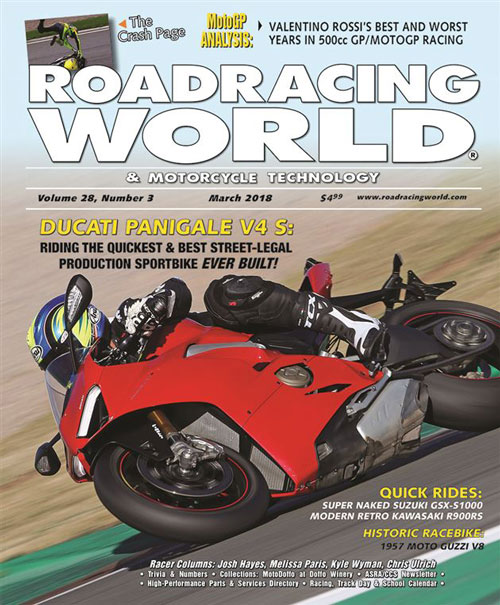

2018 Sportbike Intro: Ducati Panigale V4 S

Dawn Of The New Ultra-Performance Era

By Chris Ulrich

I could see a rider off in
the distance as I took the checkered flag at the end of my first racetrack
session of the day on the newest Ducati sportbike. Not wanting to give away
valuable testing time by touring, I stayed on the gas, pushing hard through
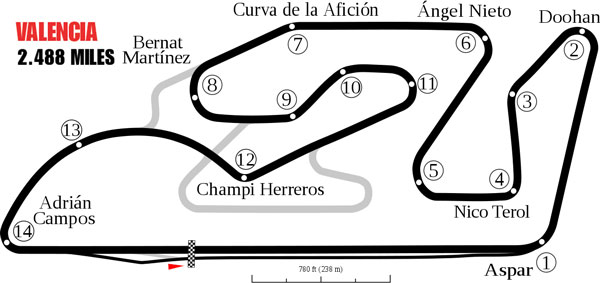
Valencia’s
fast third-gear left-hand Turn One, which is taken at well over 150 kph (over
90 mph). It’s
a daunting piece of racetrack that was forever etched into MotoGP history when
Marc Marquez famously saved his 2017 World Championship title there, losing the
front but keeping the bike upright on his knee!

Exiting the turn, I kept
pushing in the run to Turn Two, a relatively slow, second-gear corner. I got on
the brakes late, still careful to not rush the entry, rotated the Panigale V4 S
and fired it out with the DTC (Ducati Traction Control) and DWC (Ducati Wheelie
Control) indicators lighting up the dash.
I drew closer to the rider
ahead, and could see that he was slender and wearing slightly baggy leathers,
and reminded myself to stay on task. The V4 and I railed through the fast,
left-hand Turn Three and then headed toward the first right-hand turn on the
Valencia road course, Turn Four. I knew the tires were hot, but the ambient
temperature was cool, so I was a little careful on turn-in but was back on full
gas exiting and driving into Turn Five—another right-hand turn taken in second
gear—trailing off the brakes, the ABS barely kicking in. Hitting a late apex, I
clipped the inside curb late and opened the gas as the rear tire of the
Panigale dug in, the carcass flexing and the tire spinning slightly as the DTC
kicked in and helped the Pirelli Supercorsa SP regain enough traction to
flatten the contact patch and drive the bike forward, setting off a slight
wallow as I headed to Turn Six.

I lit the rear tire up and
ripped through the gears as I headed out of Turn Six and through the
back-straight kick, which doubles as Turn Seven, and slammed on the brakes for
Turn Eight. The rider ahead of me was larger, and I could make out the colors
of a Ducati Factory suit with the numbers 00 emblazoned on the center of the
back—and he wasn’t touring, either. The fun of making a pass never gets old; you can take
the racer out of the race, but you can’t take the race out of the racer. Through the
Turn Nine left-hand kink now, then back to the right for Turn 10 and into Turn
11, a 180-degree right. I trailed the brakes out to three-quarter track width,
then released them and rolled through the middle of the corner before
tightening my line; the Panigale V4 turned down nicely, allowing me to clip the
inside curb and open up the exit for maximum drive, and now I had just a few
more meters to close before I was within a safe striking distance for making a
pass.
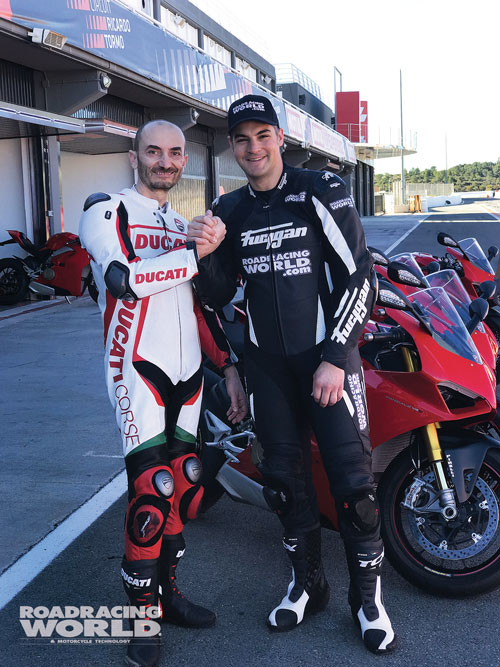
(Above) Chris Ulrich (right) with Ducati CEO Claudio Domenicali (left) on pit lane at Valencia.

I closed up more as I
braked late for Turn 12, a short, right-hand flick. Then I whipped the bike
from right to left and slammed it on my knee, pulling the throttle back to the
stop and flying around the outside of the rider I had been chasing. The rear
tire protested and I was well into the DTC followed by the DSC (Ducati Slide
Control) with the rear tire searching for grip. I stayed on the gas as I
crested a hill and spotted the final turn, before rolling off, signaling and
putting on the brakes. As we headed into pit lane, I realized the rider I’d chased down and gone by
well closer than necessary was Ducati CEO Claudio Domenicali. Thankfully it was
all smiles when we took our helmets off on pit lane.

***

When the motorcycle
industry is struggling to find its way and reach new riders, it is impressive
to see the CEO of Ducati going fast on the racetrack and enjoying the
motorcycles the iconic company sells. Domenicali is a CEO who is more in touch
with the passion of motorcycling than most top executives in the motorcycle
business, saying, “We have to always remember what we are existing for, as a brand, as a
company, as a group of people. It’s very, very important to come back to reality,
and remember what two-wheel emotion is about.”
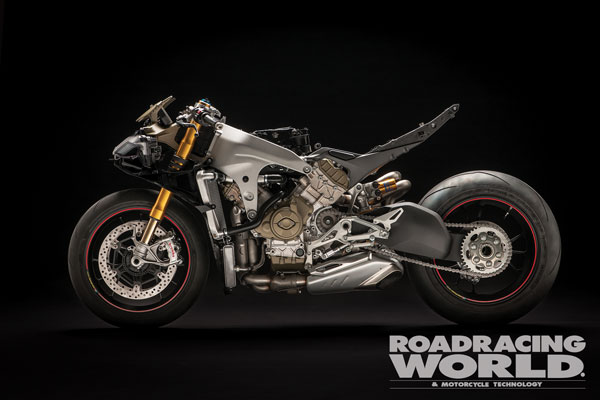
(Above) The Ducati Panigale V4 S without bodywork, showing the cast aluminum-alloy main frame and magnesium sub-frame, which both bolt to the engine.

That two-wheel emotion at
Valencia was about a MotoGP-derived V4 production street motorcycle with a
claimed 214 horsepower that happily does power-slides and power-wheelies, and
marks a new era for Ducati. The Italian company has built a streetbike that put
an ear-to-ear grin on the face of every member of the very seasoned group of
motojournalists gathered at Valencia for the official worldwide press intro.
The V4 era at Ducati is all about big passion, combined with big
performance. And that passion starts at
the top with Mr. Domenicali.
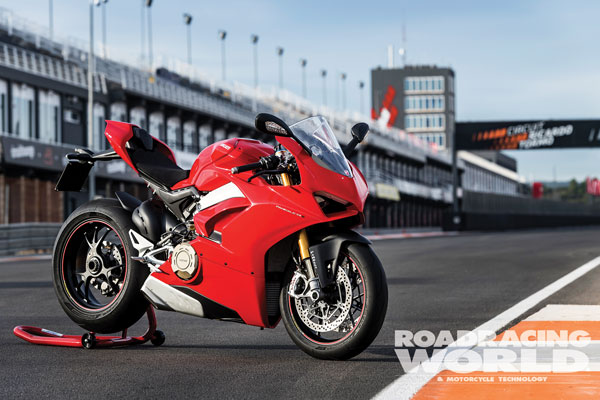
(Above) The Ducati Panigale V4 S with bodywork, posing at the racetrack.

Being in touch with the
emotions and sensations generated by motorcycling could explain why Ducati’s worldwide sales have
continued to grow. Granted, the brand’s U.S. sales grew just a little over 1%, but
hey, it’s
growth at a time when some companies are dealing with declining or flat sales.
In my opinion, Ducati’s corporate passion is a big part of the company’s success, along with a willingness to
continually build cutting-edge machinery without compromise. In regard to the
Panigale V4, Ducati abandoned the engine configuration that made the brand and
moved on without fear of the next challenge. And Ducati engineers then
designed, developed and built the fastest and most advanced street motorcycle
that has come to market this decade. And the company as a whole is unapologetic
about the big decision to build a four-cylinder flagship. That being said, fans
of V-Twins shouldn’t worry—Ducati will keep using the V-Twin configuration for models below
1000cc.
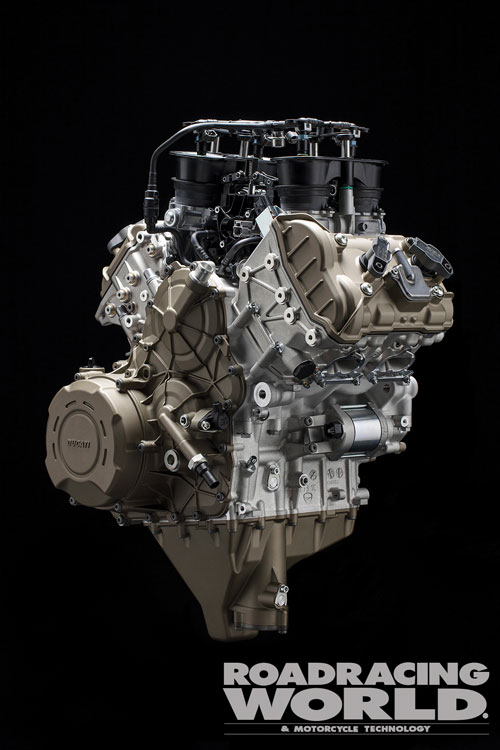
(Above) The Desmosedici Stradale V4 engine with Mikuni fuel injection throttle bodies in place.

Still, some die-hard
Ducatisti may say the latest Panigale and its Desmosedici Stradale V4 engine is
not a representation of Ducati and disrespects the brand’s V-Twin heritage, and that it’s heresy for Ducati to
build anything other than a street-legal, V-Twin four-stroke sportbike. But
Ducati’s
roots are in racing and building high-performance motorcycles that can win road
races at the highest level of competition. The Panigale V4 may be a new
direction, but it does not abandon Ducati’s roots, it embodies the company’s tradition of building
technologically advanced, high-performance motorcycles. Make no mistake: The
2018 Ducati Panigale V4 is all about performance. It is also packed with
technology, and is a fitting machine to lead Ducati’s line of performance-oriented sportbikes well
into the future.
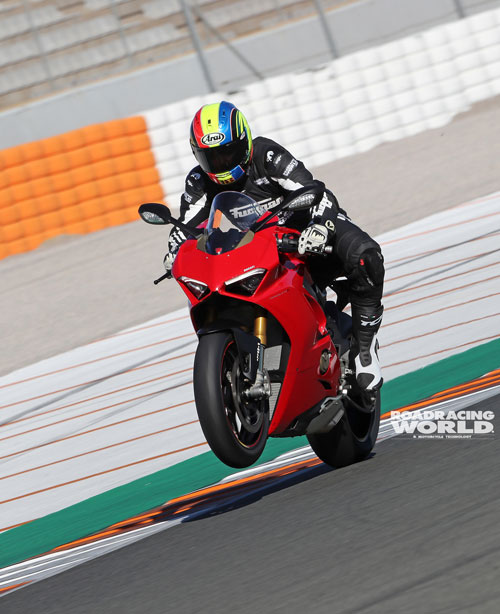
(Above) The Ducati Panigale V4 S has the best electronics available on a production sportbike sold to the public, including adjustable Ducati Traction Control (DTC), Ducati Wheelie Control (DWC) and Ducati Slide Control (DSC).

Let’s
face it, the Panigale 1299 and the preceding over-1000cc V-Twin Panigale models
could be very difficult to ride around a racetrack at speed. They demanded a
high level of skill, absolute concentration, and top-notch fitness to push
anywhere near the limits of the bike. The big V-Twin Panigales could also be
hard to understand, which made setting the bike up to be competitive at
different racetracks more complicated than it was with other bikes. The
demanding nature of the V-Twin Panigale showed in its results on the racetrack:
It took Ducati two seasons to win its first Superbike World Championship race
with the Panigale 1199 R and the bike never produced the type of consistent
racing success enjoyed with the steel-tube trellis-framed 851, 888, 916, 999,
and 1098-based Superbikes. (We could also list assorted subsets and
developments of those original models, but it would be moot. You get the point…)
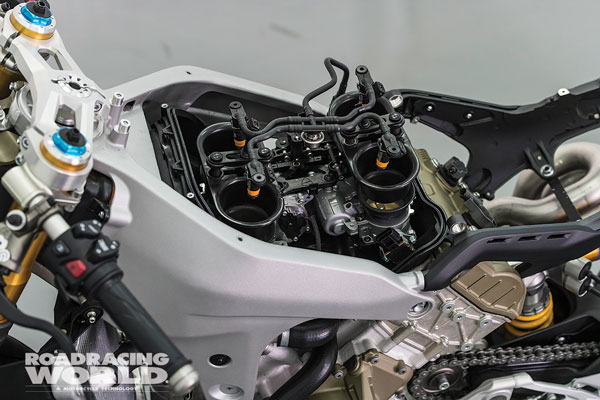
(Above) View from above the cast aluminum-alloy main frame and magnesium subframe bolted to the engine, and the double-barrel throttle bodies with variable length velocity stacks mounted above and between the cylinder banks.

This could be due to the
1199 R’s
monocoque chassis design or the extreme dimensions of the Supersquadro V-Twin
engine or a combination of both. Imagine the gyroscopic effect set off by the 1199 R’s two-massive 112 mm pistons (116 mm for the
1299 R, which is too big for World Superbike rules), located relatively high in
the chassis, banging around inside the engine and spinning the crankshaft at
very high rpm. The bottom line is that the racebike was a beast and Ducati
needed a big change to tame it.

Solidifying the decision was the fact that
Ducati engineers realized they would have to go to beyond 1299cc (the
displacement of the latest Panigale 1299 R streetbike) to make the Panigale the
most powerful production sportbike on the market. So they took the next logical
step, building a V4 powered sportbike using technology from Ducati’s title-contending
MotoGP program.

***

Ducati could have played it
safe for the international press introduction of the Panigale V4 S and gone to
a more forgiving track than the Ricardo Tormo Circuit in Valencia, Spain. The
track is relatively tight with only one real straightaway to rest on, which makes
it pretty physically demanding even if you are race-fit. That means it’s a total ball-buster if
you are a desk-bound journalist, but I’ll leave the subject of my non-racing fitness
level for a column! Ducati marketeers and engineers wanted a track where the
Panigale V4 could show off its handling prowess while highlighting the
strengths of both the engine and the electronics package, proving the new
flagship model to be the total package. So they chose Valencia as the ideal
location to do it.
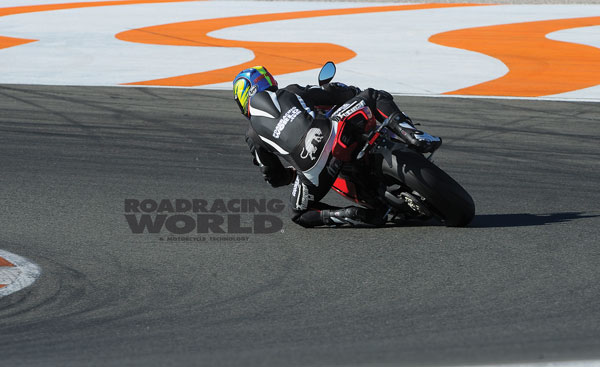
(Above) Chris Ulrich gets ready to square-up a corner at Valencia on the 2018 Ducati Panigale V4 S. The Ducati Slide Control (DSC) system allows the rider to drift the rear wheel to rotate the bike mid-corner.

In terms of ergonomics, the
Panigale V4 S feels very similar to its V-Twin predecessors. The seat position
is aggressive, the reach to the handlebars long, the fuel tank narrow, and the
footpegs high—10 mm higher than the pegs on the 1299 R. Thanks to an uneven
firing order, the V4 sounds slightly like a V-Twin while idling. In fact, the
power delivery feels slightly like a V-Twin out on the racetrack, too.

The Panigale V4 S didn’t disappoint at all on
the racetrack, even during the first orientation session when the electronics
were set in the less-aggressive Sport Mode, which slightly softens the throttle
map and the power delivery. At the start of the intro, the rider aid settings
were also turned up with DTC on 5, DWC on 4, DSC on 2 and ABS on 2. Even with
the softer throttle map and the rider aids turned up, the Stradale engine was
impressive from the first exit of pit lane. And the electronics intervened very
smoothly. It felt like power reduction is handled by reducing the rate at which
the throttle plates open, depending on the mode selected and the lean angle;
the abrupt power cuts experienced on the big Panigale V-Twin models are gone.

My first impression of the
chassis was also positive. It isn’t overly stiff, and the Panigale V4 turned in
well, rotated well at the apex, then finished the turn without pushing wide.
And it was much easier to close my line in Valencia’s long, 180-degree turns like right-hand Turn
11. I could carry good speed at corner entry, which forced the bike to the
middle of the track, then rotate around
at three-quarters of the way through the turn and get back down to the inside
curb, which put me in position for a great drive at the corner exit. I would
have been plowing the front tire and cursing if I had tried to do that at the
same entry speed on the old bike. The new, more balanced handling
characteristics are helped by the counter-rotating crankshaft, which helps
reduce the gyroscopic forces created by the wheels. In my first 10 minutes of
riding the Panigale V4 S, I could already tell that the Ducati engineers had
done something special.

Once that first orientation
session was over, technicians set the electronics in Race Mode for the
remainder of the sessions. That change delivered more direct throttle
opening—it feels like it’s 1:1—and
unleashed the full power of the Desmosedici Stradale engine. The techs also
dialed-in slightly more aggressive rider aid settings of DTC 3 and ABS 1. I
took it a step further as the day went on, turning the rider aids down in each
session before finally landing on DTC 1, DWC 2, DSC 1, and ABS 1.

In Race Mode, power starts
to build from around 7,500 rpm and the bike continues to pull hard until around
13,500 rpm. The Ducati feels like it really takes off as the revs climb over
11,000 on the straight, and I suspect this is a by-product of the constantly
adjusting variable-length intake track going from long to short funnels.
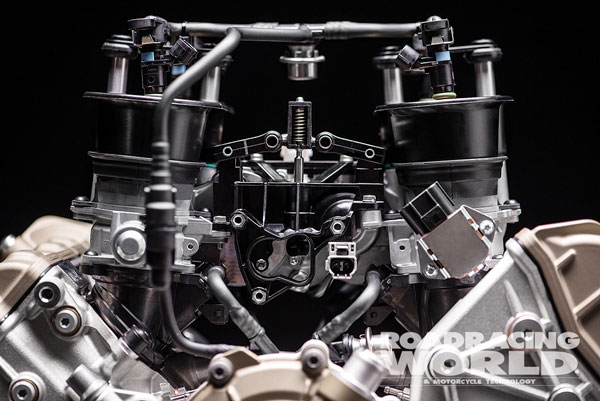
(Above) The double-barrel Mikuni 52mm throttle bodies are seen here with the variable-length velocity stacks in the closed, long position for better low-range power and acceleration. At about 11,000 rpm the upper section lifts off and opens shorter lower stacks for increased top-end performance.

Power was impressive when
accelerating, but it wasn’t too much to handle, even with the DTC and DSC turned down. The linear,
controllable power delivery is a product of what Ducati calls its
“twin-pulse” uneven firing order: The cylinders on the left side fire
at 0 and 90 degrees of crank rotation, followed by a 200-degree pause before
the cylinders on the right side fire at 290 and 380 degrees, which is why the
V4’s power
delivery feels similar to a V-Twin’s power delivery. The relatively long gap
between power pulses gives the rear tire time to recover traction before the
next power pulse hits. The result is smooth power from initial throttle opening
through the acceleration zone. The Stradale engine delivers strong, tractable
power throughout the rev range, and also has a high rev limit to produce top
speed.

The electronics obviously
contribute to the smooth, controllable power delivery without any
abruptness—especially at initial throttle opening—no matter what mode or DTC
setting is selected. What it all meant was that I could crack the throttle and
start my drive without having to think about being delicate when going back to
the throttle after the part of the corner when you’re between trail-braking and initiating
throttle.
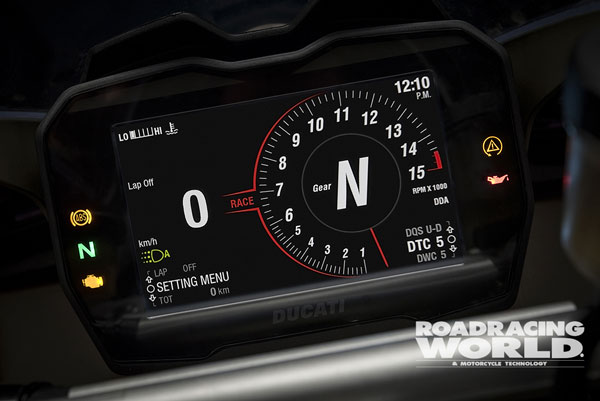

(Above) The Panigale V4 S TFT dash has what looks like an analog tach.

In terms of function, the
Ducati Traction Control (DTC), Ducati Wheelie Control (DWC), and Ducati Slide
Control (DSC) were solid. All three systems helped keep the Panigale V4 moving
forward through the acceleration zone without abruptly removing power. The DTC
would gently remove power from full lean to about three-quarters of the way
through the corner, then the slide control would take over, then the wheelie
control would come in as needed.

Ducati Slide Control is new
and makes you feel like a hero once you wrap your head around it. On most laps,
I’d get into
the DSC exiting Turn Six. The system allowed me to light up the rear tire and
drift out to the exit curb without letting off the throttle, the DTC and DSC
indicator lights on the dash lit up the whole time. But the slide control didn’t hold the bike back when
engaged; instead, it balanced the grip-to-slide ratio to keep the Ducati
Panigale V4 constantly driving forward.
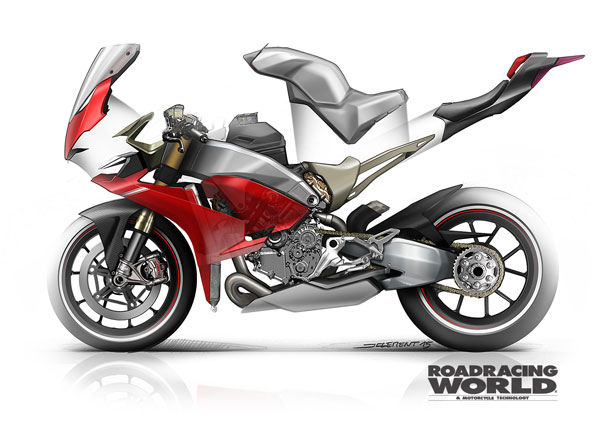
(Above) A diagram of how the tank fits over and behind the airbox and extends down and under the seat, to carry the weight of the fuel lower.

The Panigale V4 S chassis
was as impressive as the engine and electronics were. The new cast
aluminum-alloy frame with an attached magnesium subframe is stiffer and
provides a more direct feeling during turn-in and while transitioning the V4 S.
The frame had none of the twist, pump, twist experience common on the 1299
model. It was user-friendly from the start of the day until the end, whether I
was pushing or cruising around while playing with settings.

The fact is that I didn’t have to ask for many
changes to the chassis during the day, highlighting the improvements Ducati
engineers have made to the balance of the Panigale V4 S when compared to the
1299. It also responded as expected to suspension changes. The Öhlins Smart E.C. suspension
can be tuned for specific parts of a corner, with software dividing cornering
performance into three zones: Brake Support, Mid-Corner, and Acceleration. I
wanted more support on corner exits at Valencia, so I made an Acceleration zone
change (going from Level 2 to Level 4, which increased rear shock compression
damping) to give the Panigale V4 more
rear support. The change made the bike finish the corner better, but with
slightly less grip, which gave it more linear slide characteristics during
acceleration.

What was most impressive
was the fact that the change only affected the bike in the Acceleration
zone—the exit phase of the corner, from the end of the apex to the actual exit.
It was amazing to be able to change the bike’s behavior in a specific area of the corner,
without affecting any other section of the corner. The end result was a more
comfortable rider who turned faster lap times. Everything that happened made
sense.

I’ve
never been a big fan of ABS on motorcycles, but the new Bosch Cornering ABS EVO
system used on the Panigale V4 is really impressive. Set-up 1 is minimally
intrusive and allowed aggressive initial braking along with trail-braking down
to the apex without any apparent reduction of brake feel or power. The system
performed very well, allowing me to brake how I wanted, without intervening by
reducing braking power and causing the bike to run wide. The system also allows
the rider to slide the rear wheel and back in the bike when Set-up 2 is
selected. Frankly, backing the bike in is either specific to a rider’s style (and is usually a
slower way around the track) or a by-product of speed combined with poor clutch
or ECU set-up. And because I rarely use the rear brake, the ability to back it
into corners with the bike at 0-35 degrees off vertical did not really impress
me.

But staying on the subject
of electronic aids for braking, the Ducati Quick Shift (DQS) EVO worked and
Engine Brake Control (EBC) EVO helped keep the Panigale V4 S in line while
entering the corner. The duration and rev spike of the auto-blip function was
just right to provide smooth, clutchless downshifts without making the
transmission clunk into gear or pushing the bike into the corner. But I felt
the EBC had a little too much run-on, too early when braking hard for a corner,
even when set on Level 1, which is the maximum amount of engine braking
available. Once I had finished braking hard and was into the corner, the
lean-angle-dependent engine braking strategy provided the right amount of
engine brake to keep the wheels inline, dragging the bike down so I could
rotate it around the apex.

In an effort to find a
setting I was more comfortable with, I turned the EBC off completely for a few
laps during the session (I had to be stationary in the pit to turn it off). On
track, the Panigale was then better during hard braking, slowing down nicely,
but then there was too much engine braking once I got to the apex of the
corner—I had to crack the throttle early and get the engine going so I could
roll through the corner. In the end, I went back to EBC 1 and instead increased
my initial brake pressure.

To demonstrate the
performance of an uncorked Desmosedici Stradale V4 engine, Ducati sent
journalists out for one final session late in the day, aboard a modified Panigale
V4 S. The bike made 12 more horsepower than in standard trim, thanks to a
titanium Akrapovic racing exhaust system and revised engine mapping; had
revised DTC and DWC strategies; and was fitted with Pirelli Diablo Supercorsa
Pro slicks to handle the extra power. Ducati reps claimed the modified bike
made 226 horsepower at the crank and it only took one gear shift after my first
exit from pit lane to make me a believer! The modified Panigale V4 S pulled
harder than any of my Superbikes ever did and just kept going with no end to
the power. I’m
usually a less-is-more type of guy when it comes to electronics, but the
Panigale V4 S with the Akrapovic system made me regret my decision to turn down
the electronics before riding the bike! I tried to be conservative and waited
until the exit of Turn Six coming onto the back straight before I really
grabbed a handful of throttle. The front wheel was immediately off the ground
with the rear wheel lit up at the same time!

But the modified bike was
still a lot of fun to ride. Nothing brings out chassis problems like more
horsepower and grip, but the Panigale V4 was up to the challenge, and I found
myself cranking the V4 over and dragging my toes and boots more than usual
during my 15-minute final stint.

Ending the day ripping laps
on a hopped-up version of the Panigale V4 S drove home the fact that Ducati
motorcycles—at least since the first one I tested, the 998R—are all about
performance. And the company is willing to do what it needs to build the
best-performing, most-cutting-edge sportbike on the market, even if that means
abandoning the engine formula that it built its name on. I predict that the
Ducati Panigale V4 S not only marks the start of a new era for the brand, but
will also set the bar for ultra-performance sportbikes for years to come.

Tech Details

Motorcycles are becoming,
lighter, smaller, more compact, and more powerful than ever to gain an
incremental advantage on the competition. Small things count more than ever
these days, and what look like small details on paper can translate into big
lap time gains on the racetrack. The Panigale V4 is all about the details, from
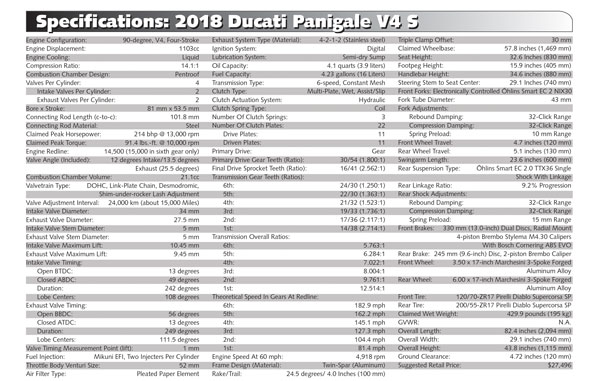
the engine to chassis. The Panigale V4 S I tested in Valencia puts out a
claimed 214 horsepower at the crank and weighs in at 430 pounds (195 kg) wet,
which gives it a power-to-weight ratio of 1.10 horsepower per pound. The
Panigale V4 is oozing with real MotoGP technology, not just a fairing, but
rather real-deal hard parts including the engine configuration, bore diameter,
Desmodromic valve actuation, firing order, and the crown jewel of its enhanced
performance, a counter-rotating crankshaft.
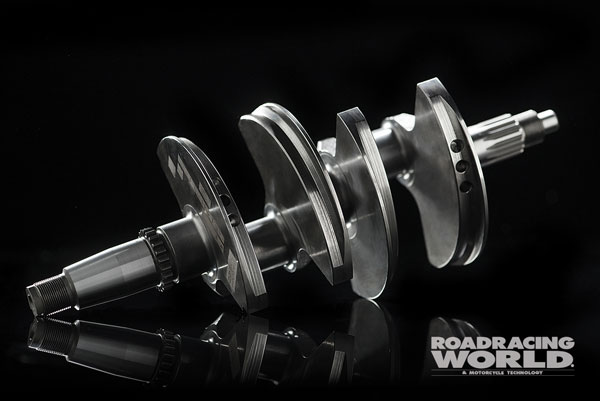
(Above) The Ducati Panigale V4 S crankpins are offset by 70 degrees to create what Ducati calls its “twin-pulse” uneven firing order, for better traction.

We’ll start with the
90-degree V-4, 16-valve Desmosedici Stradale engine. Ducati engineers leaned
heavily on the company’s MotoGP program for direction on the engine, and used the same bore, 81
mm—the maximum allowed by Moto­GP rules. Because the first Panigale V4 was
going to be sold as a streetbike, the engineers increased the displacement from
MotoGP’s
maximum of 1000cc to 1103cc by using a longer, 53.5 mm stroke to maximize
torque output and create a nice, linear powerband. The compression ratio is a
very stout 14.1:1.
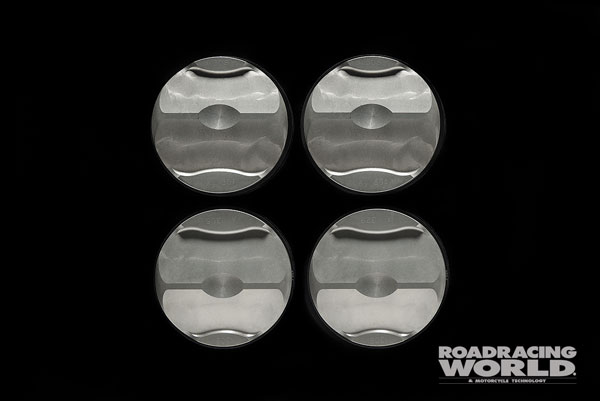
(Above) The Stradale engine’s 81 mm pistons are precisely shaped to produce a 14.1:1 compression ratio.

Probably the coolest and
most effective MotoGP feature is that counter-rotating crankshaft. Spinning the crank in the opposite direction
of the wheels helps negate some of the gyroscopic forces generated by the
wheels, which improves turning and makes it easier to change direction, and
also reduces pitch during braking and acceleration.

Ducati first implemented
the counter-rotating crankshaft on the 2015 Desmosedici MotoGP racebike, the
first MotoGP bike Gigi Dall’Inga was in charge of building after he left Aprilia and joined Ducati
in 2013. Reversing the crankshaft rotation helped fix some of the handling
problems Ducati riders had experienced with the Desmosedici up until then.

Reversing the rotation of
the crankshaft requires adding a jackshaft to allow the crank to spin backwards
while still propelling the bike forward via the transmission, countershaft, and
final drive. The jackshaft system adds weight and friction, which takes away
some horsepower, but the handling benefits are well worth the minor power
loss—and the V4 still has horsepower to spare.

As previously described,
the Desmosedici Stradale engine uses the same twin-pulse firing order as the
Desmosedici MotoGP racebike. This helps make the bike more tractable during
acceleration by allowing the rear tire
to recover traction between power pulses and gives the engine the power
characteristics of a V-Twin. To achieve the firing order they wanted in a
90-degree V-4, Ducati engineers offset the crank pins by 70 degrees.
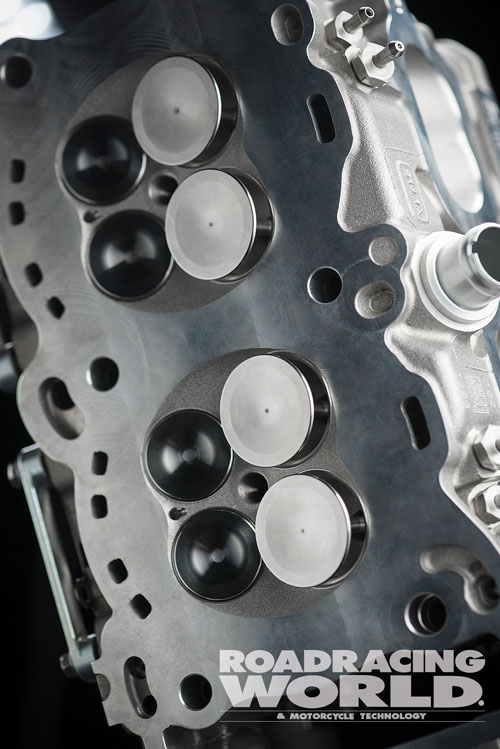
(Above) The engine has a 21.1 cc combustion chamber and four valves per cylinder.

The Panigale V4 also uses
Ducati’s
Desmodromic mechanical valve-opening and valve-closing system, which maintains
accurate valve actuation and control with high-lift cams and high peak rpm. The
34 mm intake valves and the 27.5 mm exhaust valves are steel, for durability.
The Stradale engine has a claimed redline of 14,500 rpm in first through fifth
gears, and adds another 500 rpm in sixth gear, taking the redline to 15,000
rpm—and an extra 500 rpm in top gear can be a life-saver (or position improver)
in race trim. Think of it as working like overdrive, while allowing the gear
ratios from first to fifth to be shorter without losing top speed in sixth
gear.

Feeding the engine is a
pair of double-barrel 52 mm ride-by-wire Mikuni throttle bodies fitted with
variable-length velocity stacks (a.k.a. air funnels) and eight fuel injection
nozzles, four located within the throttle bodies (one for each cylinder) and
four overhead shower injectors (one above each velocity stack). Each cylinder
bank has its own ride-by-wire motor, which allows them to be operated
independently, the best way to implement strategies ranging from traction
control to engine braking. The variable-length velocity stacks switch from long
to short depending on rpm (it feels like about 11,000 rpm) and throttle
position. Of course the basic idea is long stacks are better for lower rpm
power, while shorter stacks are better for top-end power.

The Stradale engine has a
semi-dry sump to reduce mechanical losses created by crankcase pressure. The
Ducati still has an oil pan, but it’s bolted to the bottom of the gearbox, not
underneath the crankshaft. Like the crankcases, the oil pan is made of magnesium,
and it is separated internally from the spinning crankshaft. The oiling system
uses four pumps: One delivers the oil; one scavenges oil from the cylinder head
and returns it to the sump; and the other two scavenge oil from the crankcase,
below the pistons, where pressure builds up. The system reduces internal
pressure and the drag caused by running the cams and the crankshaft through
accumulated (or pooled) oil. The Panigale V4 uses a six-speed transmission (as
mentioned earlier) and a hydraulically activated, assist-and-slip wet clutch
designed to increase plate pressure under acceleration (to reduce slip) and
decrease plate pressure under deceleration (to reduce back-torque and wheel hop
entering corners). The clutch has 22 plates, including 11 drive plates and 11
driven plates.

It’s all bundled together in a nice and compact,
but slightly heavy, V4. The engine configuration and dimensions have an
enormous role in the overall packaging of a bike, which also affects the way a
motorcycle handles. Ducati’s V-4 Desmosedici Stradale engine is 28 mm shorter vertically and 38 mm
shorter from front to back when compared to the latest version of the Panigale
V-Twin engine, but adding a cylinder to each side increased the width by 43 mm
compared to its V-Twin predecessor. The smaller dimensions allowed the V4
engine to be rotated backwards 42 degrees from the plane of the crankshaft,
placing it in what the engineers say is the same, optimal position as used for
the Desmosedici GP racebike. The V4 engine weighs 134 pounds (64.9 kg), making
it just 4.8-pounds (2.2 kg) heavier than the V-Twin Supersquadro engine despite
having more parts.

The V4 is all about
packaging, and Ducati engineers took full advantage of what was possible—which
means the chassis is a big departure from previous models that used a tubular
steel trellis chassis. The Panigale has an aluminum-alloy main frame, and it is
basically a short version of a conventional twin-spar, cast aluminum-alloy
perimeter spar frame, but is designed to work with the engine as a stressed
member, and the swingarm pivots in the crankcases. The main frame casting
incorporates a large headpiece and two sets of upper and lower spars, which
attach to each side of the engine. The main frame weighs 9.2 pounds (4.2 kg)
and gave Ducati engineers the ability to better tune the flex characteristics
of the chassis; the torsional (twist) rigidity and lateral (side to side)
rigidity of the frame can be tuned separately for the best balance between
stiffness and feel. The lower spars cradle the front cylinder, attaching to the
crankcases just below the cylinder, and the upper spar runs across the engine,
attaching to the rear cylinder bank using brackets. A magnesium subframe, which
weighs 4.2 pounds (1.9 kg), attaches to the top of the main frame and also
bolts to the rear cylinder bank at the bottom, forming a direct link from the
front to the rear of the bike.

Rake is 24.5 degrees, which
when combined with a triple clamp offset of 30 mm, produces 100 mm (4.2 inches)
of trail.

The 16-liter aluminum-alloy
fuel tank helps reduce weight while helping to centralize mass and minimize the
effect fuel sloshing has on handling. The tank is mounted above the upper frame
spars, runs down and behind the rear cylinder bank, and over the swingarm
pivot, with the base integrated into the seat above the rear shock. The shock
mount is also attached to the back of the engine, and the Öhlins EC 2.0 TTX 36 shock works through a
linkage with a 9.2% progression ratio.

Rotating the engine
rearward enabled engineers to move the swingarm pivot farther forward, allowing
the rear swingarm to be lengthened to 23.6 inches (600 mm)—which is hovering
around MotoGP length—without increasing the wheelbase. Using a longer swingarm
helps increase braking stability and rear grip, while also reducing the bike’s tendency to wheelie.
Swingarm angle is average, sitting around 11.67 degrees. The claimed wheelbase is 57.8 Inches (1,469
mm).

The Panigale V4 S model
comes standard with electronically controlled Öhlins suspension front and rear. At the front
is a set of 43mm NIX30 road and track forks with titanium nitride (TiN)
coating. Taking care of the rear is a TTX36 shock. The Öhlins Smart EC 2 system on the Panigale V4 S
has a new Objective Based Tuning interface (OBTi) which allows the system to
react to specific events. The Smart EC system uses input from the IMU along
with brake pressure, throttle position, and wheel speed to calculate where the
bike is in the corner, then adjusts the suspension accordingly. The system has
five levels of adjustment (1 being softest and 5 being hardest) for three
sections of the corner broken down into Brake Support, Mid-Corner, and
Acceleration.

The Panigale V4 comes with
Brembo 330 mm (12.9-inch) front brake discs and lightweight Brembo Stylema
monoblock calipers. Also standard are three-spoke Marchesini forged aluminum
wheels, and the Panigale V4 rolls on new generation Pirelli Diablo Supercorsa
SP tires. Pirelli engineers increased the width of the 120/70-ZR17 front tire
to produce a slightly larger contact patch. Rear tire width was increased by 16
mm, which made the rear contact patch 4.5 mm wider at full lean, on the
shoulder of the tire.

Ducati has upgraded the
electronics package on the Panigale V4 through a series of evolutions of
previously existing rider aids—which explains the EVO designation now used on
several. The upgraded rider aids are centered on a Bosch 6D (6-axis) Inertial
Measurement Unit (IMU), which detects roll, pitch, and yaw and sends the
information to the ECU to execute the necessary strategies to help keep the
bike under control and doing what the rider wants it to do. The use of an IMU
has become the standard for advanced motorcycle electronics these days, so it’s somewhat old news, but
the Bosch 6D IMU system processes the motorcycle’s movement very, very quickly,
improving the execution because it takes less time to detect the conditions
that create the need for electronic intervention.

The rider aids built into
the Panigale V4 S include ABS Cornering Bosch EVO (ABS EVO); Ducati Traction
Control EVO (DTC EVO); Ducati Slide Control (DSC); Ducati Wheelie Control EVO
(DWC EVO); Ducati Power Launch (DPL); Ducati Quick Shift up/down EVO (DQS EVO);
Engine Brake Control EVO (EBC EVO); and Ducati Electronic Suspension EVO (DES
EVO).

The Panigale V4 S features
three riding modes: Street, Sport, and Race. Full power is available in each
mode, but the rate of throttle opening is limited in the Street and Sport
modes. Street Mode has much softer throttle and suspension mapping, with the
rider aid levels turned up. Sport Mode has a more aggressive throttle map,
slightly stiffer suspension settings, less intrusive rider aid settings, and
allows the ABS value to be changed. Of course Race Mode is the most aggressive
of all, giving the rider direct throttle application, stiffer suspension, and
the ability to change all the settings.

It can be hard to keep up
with an ever-growing list of rider aids and functionality. But hitting the high
points, big changes were made to the ABS system on the Panigale V4. The EVO
system now has a three-level cornering ABS function aimed at improving
racetrack performance without sacrificing safety on the open roads. Level 3 is
for riding on the street, while Level 2 and Level 1 are designed for aggressive
riding on the racetrack. Level 2 has an interesting feature that allows the
rider to lock the rear brake and back the bike in at 0-35 degrees of lean. (I’d say the functional
racer in me looks at setting Level 2 as being unnecessary, but hey, it’s cool, have fun!) Level
1 is where the biggest advancements have been made, because the cornering
function allows the rider to brake aggressively without automatically reducing
brake pressure (and braking power) as the bike is leaned in. In other words, it
allows the rider to trail-brake to the apex of the corner, but if they overdo
it, it will react to help keep the rider from trail-braking themselves onto the
ground. It takes some of the danger out of trail-braking, although the system
can’t save a
rider who grabs a huge handful of brake lever and instantly spikes the brake
pressure!

DTC EVO offers nine levels
(1-8, plus Off) of traction control, with Level 1 producing the lowest and
Level 8 producing the highest level of intervention. As with previous models,
spin conditions are detected using input from the wheel speed sensors,
throttle, and IMU, with intervention being accomplished using either the
throttle plates to control power on corner exit, or by removing spark for an
unexpected big slide since the throttle plates react too slowly to catch that.
The strategy has been revised to limit big power cuts by recalculating the
allowable amount of grip in each setting. Ducati also gave the system a new “Spin on Demand” feature in DTC levels 1
and 2, which in theory should allow a less-experienced rider to use wheelspin
to finish the corner.

New on the Panigale V4 is
the two-level Ducati Slide Control (DSC). This system relies on the IMU’s ability to detect Yaw,
or when the bike goes sideways from sliding, and reacts to keep it from going
over the edge and highsiding the rider. Other measurements used to calculate
intervention requirements are acceleration (Pitch), lean angle (Roll), and
wheel speeds. The system limits wheel torque though a combination of reducing
throttle plate angle, cutting spark, and cutting fuel delivery as needed to
allow the rear tire to be hung out while still driving forward. Keeping the
Panigale moving forward, Ducati Wheelie Control EVO (DWC EVO) has been revised
to limit wheelies without removing too much power on acceleration. The EVO
system’s new
settings allow some wheel lift during corner exits, but doesn’t let it get out of
control or excessively slow acceleration.

Also new for 2018 is Ducati
Power Launch (DPL), or launch control. The system fitted on the Panigale V4
works in conjunction with the DWC and has three settings, with Level 3 being
least aggressive and Level 1 being the most aggressive. The system turns off at
about 100 mph or when the rider clicks into third gear. A clutch protection
feature was built into the system, which limits the number of consecutive
starts, to keep the clutch from getting burned up.

The revised strategies for
the Engine Brake Control EVO (EBC EVO) take engine braking to the next level on
a production bike. Ducati’s system adjusts pre-set engine braking parameters depending on the
situation, which is mainly based on rear tire wear. The system has four
settings (1-3, plus Off), with Level 1 producing the most engine braking, while
Level 3 has more run-on. Like most strategies, the engine braking is controlled
by throttle opening. Ducati’s Quick Shifter EVO up/down (DQS EVO) also works in conjunction with the
EBC system on downshifts, helping engage the desired gear by providing the
optimum amount of blip and duration via the ride-by-wire throttle control.

The DTC, DSC, DWC, and EBC
functions can be adjusted on the fly (while riding) through the left handlebar
switch bank. The functions that can’t be adjusted on the fly can be accessed using
the left handlebar to toggle through the new, 5-inch TFT dash display. The dash
has a choice of Track Layout, which displays lap time, and Street Layout, which
displays road information. Both modes have an analog-look tech display with
digital gear indicator and speed displays.

Ducati will also offer a
lower-spec Panigale V4, which comes fitted with Showa BPF (Big Piston Front)
forks and a Sachs rear shock along with a set of five-spoke cast aluminum-alloy
wheels and a U.S. MSRP of $21,195.

An ultra-premium, limited
production version, the Panigale V4 Speciale, will also be available, with
1,500 units being built. The Speciale boasts a claimed 226 bhp and weighs in at
414 pounds (188 kg). It comes fitted with a titanium Akrapovic exhaust, revised
rider aid and throttle maps, a host of special carbon-fiber parts, and a
special tri-color paint scheme with a MSRP of $39,995.

The Panigale V4 S as tested
in Valencia for this article will come with a MSRP of $27,496 and should be
available before spring.

Editorial Note: This article was originally published in the March 2018 print issue of Roadracing World & Motorcycle Technology. 
Canadian Superbike: Jordan Szoke Wins Rain-Delayed Race Two At Atlantic Motorsport Park

Szoke wins rain-delayed race two at AMP

Shubenacadie, ON – July 21, 2019 – Four-time defending Mopar Pro Superbike champion Jordan Szoke rebounded from a tough Saturday to record his second win of the season on Sunday, holding off rival Ben Young in changing conditions at round four of the Mopar Canadian Superbike Championship at Atlantic Motorsport Park, presented by Pro Cycle, LS2 Helmets, and Liqui Moly.

After a severe storm delayed the start of the feature race, the grid finally got going in wet conditions, with Young grabbing the holeshot and pacing the field through the opening laps. The Collingwood, ON native appeared set to extend his championship lead as he began to pull away, but it wasn’t long before Szoke had managed to work his way up from fourth on the grid and settled into second place.

With the track drying and the rain tires beginning to wear, Szoke managed to make his move on lap nine, taking the race lead from Young just a day after crashing out of race one. The Lynden, ON veteran briefly came under pressure from Young once more, but ultimately managed to stretch his lead and secure a much-needed victory aboard his Mopar Express Lane Kawasaki ZX-10R Ninja.

“I didn’t get the best of starts, but I typically do pretty well in wet races, so I was able to work my way to Ben just as the track started to dry out a bit and the tires really came together,” Szoke said. “It’s going to be an uphill battle, because Ben would really have to make some big mistakes to throw this one away, but anything can happen and this is a good start so now all we can do is look forward to CTMP.”

It was a smart ride for Young, who looked close to battling Szoke for the weekend sweep before ultimately settling for second place aboard his Barrie Trim/Scot-Build BMW S1000RR, leaving the East Coast with a 59-point lead over his rival.

“I actually didn’t think we were going to get to race because the weather was so bad. Then when it did start, I was able to get the holeshot which is normally pretty great, but it’s actually hard to lead sometimes in the wet,” Young said. “I sat with Jordan for a few laps and thought maybe I could pull it off, but I didn’t want to push too hard and once we ran into lapped traffic I decided to just bring home as many points as possible and play the long game heading into CTMP.”

Stealing the spotlight of Sunday’s race was the youngster who joined the two front-runners on the podium, as Tomas Casas scored the best result of his Pro Superbike career with a historic third-place finish aboard his Parts Canada Yamaha YZF-R1.

The 20-year old out of Peterborough, ON became the youngest podium finisher since Bodhie Edie in 2013, and the first Yamaha to finish inside the top-three since Edie’s third-place finish at CTMP in 2017.

“It’s hard to even put anything into words, because it just feels so awesome to be up here with these guys that I basically grew up watching,” Casas said. “I got an okay start, but I was able to pick off a few guys as the race went on, and I honestly think the rain did me a favour because I was able to relax a little and just ride a smart race.”

The result moves the youngster back into fourth in the overall standings and just five points behind Samuel Trepanier, who nearly caught Casas on the final lap as the St. Isidore, QC native mounted a late comeback aboard his Blysk Racing BMW.

Rounding out the top five for the second time this weekend was Inverary, ON veteran Jeff Williams, as the former Superbike race winner climbs to sixth in the standings after a strong round four aboard his G. Williams Paving BMW.

The top rookie of race two was Ottawa, ON native Vivian Mathews, as the Windmill Motorsports Yamaha rider capitalized on the changing conditions to record a career-best finish of ninth.

As a result, Mathews will pull within just ten points of top rookie Nicolas Meunier in the Brooklin Cycle Racing Pro Rookie of the Year fight, after the Verdun, QC youngster elected not to participate aboard his Turcotte Performance Kawasaki ZX-6R Ninja.

Will Hornblower extended his points lead in the Liqui Moly Pro Sport Bike class, leading from start to finish for his second victory of the season and first since the season opener.

After costing himself with a cautious approach on Saturday, the Sarnia, ON native said he was planning to be more aggressive in race two, and made good on that promise after getting a brilliant start aboard his Bluestreak Racing Yamaha YZF-R6.

“That aggressive strategy seemed to work I guess,” Hornblower joked after the race. “Yesterday was really frustrating, because if you try to follow here then you just tire yourself out. I knew I needed a good start, and I got a really great one, so from there I just tried to lay it down early and pull away.”

Hornblower also benefited from a strong performance behind him, as Sebastien Tremblay was able to put himself between the points leader and Casas to score his best finish of the season.

The Mirabel, QC native continues to recover from a broken collarbone suffered in round two but showed no signs of pain on Sunday, surpassing Casas at the midway point and settling into a comfortable second-place finish aboard his Turcotte Performance Kawasaki ZX-6R Ninja.

“I didn’t really get a good start, so I tried to hang with them in third for the first half and then plan something after that,” Tremblay said. “But then Tomas began to lose his pace a bit, and I didn’t want to let Will get away, but he didn’t make any mistakes so I was forced to settle for second. It’s not the result we wanted, but we’re happy.”

It was a tough race for Casas, who was feeling the effects of the extreme heat as he battled through his third of four races of the weekend. It even looked like the two-time defending champion would be forced to miss the podium, as he came under fire from Samuel Desmarais in the late stages before the Lasalle, QC native crashed out.

While the youngster was able to hang on to secure his fourth consecutive podium aboard his Parts Canada Yamaha YZF-R6, the result see’s his deficit grow to 34 points entering the season-finale doubleheader at Canadian Tire Motorsport Park.

“The pace was fast, and it was really, really hot, and after a while I just hit a wall,” the visibly exhausted Casas said. “This weekend’s taking a lot out of me, and Will was so consistent. I hope Sam’s okay, he was all over me, so it’s good to at least get the podium out of it.”

Desmarais would wind up 13th aboard his Playground Poker Club Kawasaki as a result of having caused a red flag, promoting Meunier to the best result of his Pro career in fourth. The 17-year old moved comfortably into sixth in the season standings as a result, as he continues to enjoy perhaps the most productive rookie campaign for a teenager since Casas in 2015.

Hornblower wasn’t the only Yamaha rider to win in convincing fashion on Sunday, however, as hometown favourite Avery Hart took another commanding victory in the TSN Motorcycle Experience Lightweight Sport Bike class.

The Princeville, NS native jumped out to an early start and never looked back, winning by over five seconds aboard his WRBF Yamaha YZF-R3. As a result, Hart trims his points deficit to just 14 points behind Ben LeClair, and didn’t hold back when mentioning his recent hot streak in comparison to LeClair.

“This championship is a perfect example of not starting something you can’t finish,” he said. “It’s going to be really close at CTMP, but winning at your home track is amazing, and this helps us out a lot, so I’m looking forward to winning that championship in a couple weeks.”

The comments had an even bigger impact considering LeClair’s third-place finish, as the Blackstock, ON teenager came out on the losing side of a terrific battle with fellow youngster Matthew Simpson. The Bowmanville, ON native managed to secure his best career finish in second place, as he returned to the podium for the first time since round one aboard his Evans Racing Honda CBR500.

As for LeClair, the younger brother of last year’s champion will return home in the midst of a brutal late-season slide, as he has not won since the very first race of the season aboard his bLU cRU Yamaha machine.

Christian Allard propelled his way to a dominant victory in the Mopar Express Lane Amateur Superbike race, winning by over 13 seconds in wet conditions aboard his Turcotte Performance Kawasaki ZX-6R Ninja sport bike.

Allard was the lone front-row rider who elected to start after a second burst of rain, and the Chambly, QC native used the extra asphalt to his advantage, cruising to his first Superbike victory of the year to climb to second in the overall standings.

Allard also continued to stretch his lead in the Parts Canada Amateur Sport Bike class, as he scored his second victory in a row and second of the day in dominant fashion over Jake LeClair.

The Turcotte Performance Kawasaki rider was able to grab the holeshot from third on the grid and never looked back, cruising to a comfortable win over LeClair and his bLU cRU Yamaha YZF-R6 machine as he takes an even 20-point lead into the season finale doubleheader at CTMP.

Allard wasn’t the only “winner” in the race on Sunday, however, as Sarah-Michelle Cotton was named the round four recipient of the Parts Canada Hard Charger Award. The Mont-St-Gregoire, QC rider was able to improve her time by over four seconds from qualifying to the race aboard her Kawasaki, the biggest improvement of the season.

The series will return to action for the final time in 2019 at the BMW Motorrad Doubleheader Weekend at Canadian Tire Motorsport Park, August 9-11.

Full results from the weekend’s action can be found at the series’ official website at www.csbk.ca. 

British Superbike: Race Two Results From Snetterton

American Brandon Paasch is not competing at Snetterton this weekend as the British Motostar class is not part of the event.

Bennetts British Superbike Championship

Snetterton Circuit, Scotland

July 21, 2019

Race Two Results (all on Pirelli tires):

1. Scott Redding, UK (Duc Panigale V4 R), 16 laps, Total Race Time 28:54.217, Best Lap Time 1:47.717

2. Josh Brookes, Australia (Duc Panigale V4 R), -0.279 second, 1:47.788

3. Tommy Bridewell, UK (Duc Panigale V4 R), -3.376 seconds, 1:47.891

4. Andrew Irwin, UK (Hon CBR1000RR SP2), -21.133, 1:48.611

5. Peter Hickman, UK (BMW S1000RR), -22.180, 1:48.792

6. Christian Iddon, UK (BMW S1000RR), -23.640, 1:48.776

7. Hector Barbera, Spain (Kaw ZX-10RR), -24.898, 1:49.083

8. Xavi Fores, Spain (Hon CBR1000RR SP2), -27.444, 1:49.265

9. Michael Laverty, UK (BMW S1000RR), -27.987, 1:48.944

10. Luke Mossey, UK (Suz GSX-R1000), -29.854, 1:49.316

11. Dan Linfoot, UK (Yam YZF-R1), -29.925, 1:49.140

12. Ryan Vickers, UK (Kaw ZX-10RR), -35.063, 1:49.405

13. Bradley Ray, UK (Suz GSX-R1000), -37.625, 1:49.729

14. Claudio Corti, Italy (Kaw ZX-10RR), -38.946, 1:49.751

15. Luke Stapleford, UK (Suz GSX-R1000), -50.048, 1:50.233

16. Matt Truelove, UK (Yam YZF-R1), -50.391, 1:50.163

17. James Ellison, UK (BMW S1000RR), -53.993, 1:50.229

18. Dean Harrison, UK (Kaw ZX-10RR), -57.517, 1:50.765

19. David Allingham, UK (Yam YZF-R1), -58.677, 1:50.943

20. Sam Coventry, UK (Kaw ZX-10RR), -63.270, 1:50.897

21. Dean Hipwell, UK (Kaw ZX-10RR), -68.993, 1:51.435

22. Shaun Winfield, UK (Yam YZF-R1), -82.247, 1:51.789

23. Tarran Mackenzie, UK (Yam YZF-R1), -6 laps, DNF, 1:47.810

24. Joe Francis, UK (BMW S1000RR), -9 laps, DNF, 1:50.260

25. Fraser Rogers, UK (Kaw ZX-10RR), -12 laps, DNF, 1:52.438

26. Jason O’Halloran, Australia (Yam YZF-R1), -13 laps, DNF, 1:48.429

27. Danny Buchan, UK (Kaw ZX-10RR), -16 laps, DNF, no lap time recorded

28. Josh Elliott, UK (Suz GSX-R1000), -16 laps, DNF, no lap time recorded

29. Ben Currie, Australia (Kaw ZX-10RR), DNS

30. Danny Kent, UK (MV Agusta F4 1000), DNS

Championship Point Standings (after 13 of 27 races):

1. Redding, 226 points

2. Bridewell, 188

3. Brookes, 185

4. Mackenzie, 144

5. Buchan, 132

6. Fores, 114

7. Hickman, 96

8. Andrew Irwin, 94

9. Iddon, 92

10. Mossey, 72

More, from a press release issued by MSVR:

Leader of the pack: Redding deals a double to win Monster Energy Race of Aces title

Scott Redding dealt a double win at the sixth round of the Bennetts British Superbike Championship to be awarded the Monster Energy Race of Aces trophy at Snetterton, holding off his Be Wiser Ducati teammate Josh Brookes in both races in Norfolk.

At the start of the race one Tarran Mackenzie got an incredible launch off the line to lead the pack on the opening lap ahead of Brookes and Redding with Tommy Bridewell in fourth. The Oxford Racing Ducati rider was not happy to settle where he was though and was instantly on the attack, moving ahead of Redding into Agostini for the first time.

On the fourth lap Bridewell had moved into second with a decisive dive down the inside at Riches, pushing Brookes back into third. At the front, Bridewell claimed the lead ahead of Mackenzie as Redding moved into third. Bridewell tried to make a break from the pack but he made a mistake into Agostini a lap later and crashed out unhurt.

Redding had cut through into second and with Bridewell out of the race he captured the race lead, but behind there was an intense battle between Brookes and Mackenzie with the pair trading blows for several laps. The fight between the pair gave Redding the opportunity to edge out a gap, but Brookes was then able to get the better of Mackenzie and keep him behind over the closing stages.

Danny Buchan maintained his position inside the top six in the standings with a fourth place, but the FS-3 Racing Kawasaki rider had a lonely end to the race. However behind him there was a scrap between the Honda Racing pairing; Xavi Forés and Andrew Irwin colliding on the final lap, but both formation flying to the finish line with the Spaniard having the edge at the chequered flag.

Peter Hickman was also in the group and he held off Luke Mossey for seventh place ahead of Jason O’Halloran who had a strong race to carve through the field from his seventh row start on the second McAMS Yamaha.

Christian Iddon completed the top ten, passing his Tyco BMW teammate Michael Laverty in the final moments of the race on his return after his Knockhill injury.

In race two Brookes had the perfect start off the line to lead the pack into Riches for the first time ahead of Redding, Bridewell and Mackenzie. Jason O’Halloran meanwhile had also made a good start to move into fifth on the second of the McAMS Yamahas. The Australian though crashed out on the fourth lap at Brundle, ending his race prematurely.

At the front Brookes held the lead until there were just three laps remaining as Redding made a dive down the inside on the brakes at the end of the Bentley Straight to take the lead. The race one winner was able to hold off his Be Wiser Ducati teammate to the finish line.

However it was a double disaster for McAMS Yamaha when Mackenzie crashed out at Wilson on lap eleven as he bid to close down Bridewell for the final podium position. The Oxford Racing Ducati rider bounced back from his race one crash to claim third place and maintain his second place position in the championship standings ahead of Brookes.

In the battle for fourth place Irwin scored his best result of the season so far for Honda Racing, holding off Peter Hickman and Iddon who had a strong performance despite still recovering from his Knockhill injuries.

Hector Barbera had an impressive performance on his first visit to Snetterton on the Quattro Plant JG Speedfit Kawasaki, taking the chequered flag ahead of Forés who maintained his position inside the top six in the overall standings.

Michael Laverty and Luke Mossey completed the top ten, whilst Buchan and Josh Elliott failed to score points after both crashing in individual incidents on the sighting lap.

Bennetts British Superbike Championship, Snetterton, Race 1 result:

Scott Redding (Be Wiser Ducati)

Josh Brookes (Be Wiser Ducati) +1.137s

Tarran Mackenzie (McAMS Yamaha) +3.989s

Danny Buchan (FS-3 Racing Kawasaki) +12.969s

Andrew Irwin (Honda Racing) +18.666s

Xavi Forés (Honda Racing) +19.884s

Peter Hickman (Smiths Racing BMW) +20.209s

Luke Mossey (OMG Racing Suzuki) +22.105s

Jason O’Halloran (McAMS Yamaha) +24.326s

Christian Iddon (Tyco BMW) +24.606s


Bennetts British Superbike Championship, Snetterton, Race 2 result:

Scott Redding (Be Wiser Ducati)

Josh Brookes (Be Wiser Ducati) +0.279s

Tommy Bridewell (Oxford Racing Ducati) +3.376s

Andrew Irwin (Honda Racing) +21.133s

Peter Hickman (Smiths Racing BMW) +22.180s

Christian Iddon (Tyco BMW) +23.640s

Hector Barbera (Quattro Plant JG Speedfit Kawasaki) +24.898s

Xavi Forés (Honda Racing) +27.444s

Michael Laverty (Tyco BMW) +27.987s

Luke Mossey (OMG Racing Suzuki) +29.854s


Bennetts British Superbike Championship standings after Snetterton:

Scott Redding (Be Wiser Ducati) 226

Tommy Bridewell (Oxford Racing Ducati) 188

Josh Brookes (Be Wiser Ducati) 185

Tarran Mackenzie (McAMS Yamaha) 144

Danny Buchan (FS-3 Racing Kawasaki) 132

Xavi Forés (Honda Racing) 114

For more information on the Bennetts British Superbike Championship visit www.britishsuperbike.com

Scott Redding – Be Wiser Ducati

Double race winner

“I felt better with the bike in race two, I felt more comfortable and more confident but I didn’t know whether I could be faster. Then when I passed Josh I went faster, so I learnt I need to believe in myself a bit more.

“I tried to see a what the other guys were doing with the tyres in the race as I didn’t want to break away and then have an issue later on. Again, I’m still learning, I’m still a rookie in this class and I don’t know the tracks. I’m really happy and I had a wicked time this weekend the fans have been amazing, we’ve had great fun, the reception was amazing. To come back with a pole and two race wins – I can’t take much more.

“To be a Monster athlete and for them to have an event here and for me to win the Race of Aces Trophy just puts the icing on the cake really.”

British Superbike: Race One Results From Snetterton

American Brandon Paasch is not competing at Snetterton this weekend as the British Motostar class is not part of the event.

Bennetts British Superbike Championship

Snetterton Circuit, Scotland

July 21, 2019

Race One Results (all on Pirelli tires):

1. Scott Redding, UK (Duc Panigale V4 R), 16 laps, Total Race Time 28:56.870, Best Lap Time 1:47.805

2. Josh Brookes, Australia (Duc Panigale V4 R), -1.137 seconds, 1:47.872

3. Tarran Mackenzie, UK (Yam YZF-R1), -3.989, 1:47.918

4. Danny Buchan, UK (Kaw ZX-10RR), -12.969, 1:48.198

5. Andrew Irwin, UK (Hon CBR1000RR SP2), -18.666, 1:48.370

6. Xavi Fores, Spain (Hon CBR1000RR SP2), -19.884, 1:48.702

7. Peter Hickman, UK (BMW S1000RR), -20.209, 1:49.022

8. Luke Mossey, UK (Suz GSX-R1000), -22.105, 1:49.004

9. Jason O’Halloran, Australia (Yam YZF-R1), -24.326, 1:49.002

10. Christian Iddon, UK (BMW S1000RR), -24.606, 1:48.858

11. Michael Laverty, UK (BMW S1000RR), -25.144, 1:49.031

12. Hector Barbera, Spain (Kaw ZX-10RR), -27.720, 1:49.146

13. Bradley Ray, UK (Suz GSX-R1000), -30.215, 1:49.098

14. Dan Linfoot, UK (Yam YZF-R1), -30.823, 1:49.174

15. Claudio Corti, Italy (Kaw ZX-10RR), -38.247, 1:49.710

16. Joe Francis, UK (BMW S1000RR), -42.487, 1:49.771

17. Matt Truelove, UK (Yam YZF-R1), -46.900, 1:50.193

18. Dean Harrison, UK (Kaw ZX-10RR), -53.232, 1:50.424

19. Ben Currie, Australia (Kaw ZX-10RR), -59.570, 1:49.699

20. Dean Hipwell, UK (Kaw ZX-10RR), -63.624, 1:51.150

21. Shaun Winfield, UK (Yam YZF-R1), -86.408, 1:51.538

22. Fraser Rogers, UK (Kaw ZX-10RR), -1 lap, 1:52.431

23. Josh Elliott, UK (Suz GSX-R1000), -6 laps, DNF, 1:50.235

24. Sam Coventry, UK (Kaw ZX-10RR), -7 laps, DNF, 1:50.954

25. Luke Stapleford, UK (Suz GSX-R1000), -8 laps, DNF, 1:49.421

26. David Allingham, UK (Yam YZF-R1), -8 laps, DNF, 1:50.898

27. Tommy Bridewell, UK (Duc Panigale V4 R), -9 laps, DNF, 1:47.606

28. James Ellison, UK (BMW S1000RR), -9 laps, DNF, 1:50.269

29. Ryan Vickers, UK (Kaw ZX-10RR), -10 laps, DNF, 1:49.396

30. Danny Kent, UK (MV Agusta F4 1000), -12 laps, DNF, 1:51.251

Canadian Superbike: Ben Young Wins Race One At AMP

Young completes stunning comeback to win in AMP after Szoke crashes out

Shubenacadie, ON – July 20, 2019 – Mopar Pro Superbike championship leader Ben Young inched drastically closer to his first ever National title on Saturday, winning in race one at Atlantic Motorsport Park at round four of the Mopar Canadian Superbike Championship, presented by Pro Cycle, LS2 Helmets, and Liqui Moly.

Young started from pole position but quickly went backwards on lap one, as Trevor Daley grabbed the holeshot ahead of Jordan Szoke with Young running in third. The Collingwood, ON rider was able to move up into second by lap two, and seemed poised to overtake Daley as the pack headed onto the front straightaway on lap three.

Instead, Daley lost grip exiting the final corner, causing Young and Szoke to slow up slightly. Desperately trying to avoid disaster, Szoke hammered on the brakes, clipping the rear wheel of Young’s Barrie Trim/Scot-Build BMWS1000RR and sending both riders into the grass.

Young was able to continue, staying upright and returning to the track in 10th position, but Szoke’s race – and potential championship hopes – ended in heartbreaking fashion as the four-time defending champion was unable to move his Mopar Express Lane Kawasaki ZX-10R Ninja machine.

With Daley now well out front aboard his Parts Canada Suzuki GSX-R1000R, it appeared as though the race was all but finished only a handful of laps in, but by the midway point the Mississauga, ON native had begun to come under pressure from Samuel Trepanier.

After nearly winning a year ago aboard his Blysk Racing BMW, the St. Isidore, QC native managed to take the lead once more with just eight laps to go, stretching a gap to Daley with his first career Pro victory in sight.

However, Young had managed to work his way back into a podium spot with six laps to go, and was continuing to set fast laps as he eventually overtook Daley. With just a lap to go and Young now charging onto the tail-end of Trepanier, the two rivals went to battle in the final three corners.

Young first made his pass in turn nine, but ran wide and allowed Trepanier back into the lead, only to once again stun his BMW counterpart in the final corner as he completed the miraculous comeback to score his third victory of the season.

“I honestly didn’t think I’d be up here [on the podium], even when I started to catch them I thought there was no way,” Young said. “When we collided and I ran off track, I looked back to see if Jordan was okay, and then I just knew I had to pick up as many points as I could for the championship, so I started to push again. It was crazy, I don’t know how we did it to be honest, but it should make for a phenomenal race tomorrow.”

The wild result extends Young’s championship lead to 69 points entering Sunday, as the BMW rider will have a mathematical chance to clinch the title as soon as race two on Sunday, though he would almost certainly need another DNF from Szoke.

It was a heartbreaking finish for Trepanier, who once again came painstakingly close to his first career victory only to fall up short on the final lap. Still, the fan-favourite was able to score his best result of the season and best since AMP a year ago, as he now sits within striking distance of Szoke for second in the championship.

“It was a really good race and a great battle at the end. It’s unfortunate for Jordan, but I’m glad we didn’t get caught up in it because I was just behind the pack,” said Trepanier. I knew I could catch Trevor, and I made a good pass on him, but I didn’t expect Ben to battle back. Either way, it was a really fun time out there.”

Daley managed to round out the podium for the third consecutive race, but it was the closest the former Amateur champion has come to scoring his first Pro Superbike victory as he continues to make progress aboard his factory Suzuki machine.

“I’ve had a lot of success on the Suzuki in the past, but it’s still a new bike and we still have a lot of progress to make, so to pick up three straight podiums is amazing,” Daley said. “Everything actually felt really good considering the heat and how long the race was, so hopefully we can move up a few spots on the podium tomorrow.”

It was also a solid ride for Tomas Casas, who tied his career-high result in the Superbike category as he finished fourth aboard his Parts Canada Yamaha YZF-R6 after a terrific battle with veteran Jeff Williams. The 20-year old out of Peterborough, ON led Williams and his G. Williams Paving BMW for virtually the entire race, though just a single bike length separated Casas from the Inverary, ON rider at the finish.

The top rookie of the day was once again 17-year-old phenom Nicolas Meunier, as the Verdun, QC youngster tied his own career-best finish in eighth aboard his Turcotte Performance Kawasaki ZX-6R Ninja and will now take a 20-point lead in the Brooklin Cycle Racing Pro Rookie of the Year battle.

Casas also continued his red-hot stretch in the Liqui Moly Pro Sport Bike class, winning another instant classic over rival Will Hornblower for his third consecutive victory as he continues to claw his way back into the championship.

The two-time defending champion got a mediocre start from pole position, following Hornblower down into turn one as Sebastien Tremblay grabbed the holeshot. It didn’t take long for the Parts Canada Yamaha YZF-R6 youngster to move back into second, however, as Hornblower made a crucial mistake in turn two that allowed Casas by.

After taking the lead from Tremblay on lap five, Casas began to pull away, stretching out a full-second gap before Hornblower ultimately moved back into second aboard his Bluestreak Racing Yamaha and began to hunt down the reigning champ.

The two nearly traded places a handful of times over the final few laps, but a last-corner attempt from Hornblower wasn’t quite enough to edge the victory, as Casas defeated his Sarnia, ON counterpart by just 0.092 seconds at the line in a finish reminiscent of Young and Trepanier.

“That was so close at the end, I knew they were right behind me the whole way and I even saw Will pull up beside me a couple times at the end,” Casas said. “I didn’t get a bad start and I was able to capitalize on Will’s mistake coming out of turn two, and from there the Dunlop tires held up really well and I was able to hang onto it.”

It was another disappointing break for Hornblower, who has seen his championship lead continue to fade away to just 19 points entering race two on Sunday, though the round one winner remained positive through the extreme temperatures.

“It’s insanely hot out there, I don’t know how Tommy held up so well for 18 laps,” Hornblower said, as a humidity warning in the area had temperatures feeling as high as 39 degrees. “I got a really good start but lost it right away in turn two, and Tomas ran a really good race to the end. The Dunlop’s were incredible, and the tires still look amazing which is just outlandish in this heat.”

Not far behind the front-running duo was Tremblay, who fell off the pace in the middle stages as he continues to recover from a broken collarbone, but returned at the end to finish just a quarter-second behind Hornblower aboard his Turcotte Performance Kawasaki ZX-6R Ninja.

“I gave it one hundred per cent, but I started to show my injury a bit towards the end,” the Mirabel, QC native said. “I couldn’t brake as deep or as hard as these guys, and the heat didn’t help because it’s a lot of work around here, but hopefully tomorrow things will feel a bit better.”

The three-rider battle nearly looked to be a four-rider pack at one point after a terrific start from Samuel Desmarais, though the Playground Poker Club Kawasaki rider lost steam towards the end of the race. Despite the fatigue, the Lasalle, QC native was still able to hold onto fourth as he continues to build upon his strong sophomore campaign.

The reigning Rookie of the Year was joined inside the top five by the current top Rookie, as Meunier tied his career-best Pro finish in fifth aboard his Turcotte Performance Kawasaki.

The third National race day of the day came and went with far less excitement, as Avery Hart cruised to his fifth victory of the season in the TSN Motorcycle Experience Lightweight Sport Bike class at his home circuit.

The Princeville, NS native got a good start from second on the grid and led start to finish, winning by just under four seconds aboard his WRBF Yamaha YZF-R3 ahead of championship rival Ben LeClair.

LeClair managed to limit the damage as much as possible aboard his bLU cRU Yamaha, as the Blackstock, ON teenager held off a strong charge from Strathroy, ON youngster Trevor Dion and his Fast Track Performance Kawasaki Ninja 400 as he maintains a 29-point lead entering Sunday.

With just one race on the weekend schedule, the Amateur classes entered their qualifying sessions on Saturday afternoon as usual, with Jake LeClair grabbing pole position in both categories aboard his bLU cRU Yamaha YZF-R6.

The Blackstock, ON teenager and older LeClair brother paced the Parts Canada Amateur Sport Bike class with a time of 1:11.345, before improving upon that time in the Mopar Express Lane Amateur Superbike class to post a fast-lap of 1:11.303.

Full results from Saturday’s racing and qualifying sessions can be found at the series’ official website at www.csbk.ca.

British Superbike: Scott Redding Earns Pole Position At Snetterton

American Brandon Paasch is not competing at Snetterton this weekend as the British Motostar class is not part of the event.

Bennetts British Superbike Championship

Snetterton Circuit, Scotland

July 20, 2019

Qualifying Results (all on Pirelli tires):

From Knockout Qualifying Session Three:

1. Scott Redding, UK (Duc Panigale V4 R), 1:47.323

2. Tarran Mackenzie, UK (Yam YZF-R1), 1:47.432

3. Tommy Bridewell, UK (Duc Panigale V4 R), 1:47.730

4. Josh Brookes, Australia (Duc Panigale V4 R), 1:47.835

5. Dan Linfoot, UK (Yam YZF-R1), 1:48.596

6. Xavi Fores, Spain (Hon CBR1000RR), 1:48.752

7. Danny Buchan, UK (Kaw ZX-10RR), 1:48.828

8. Andrew Irwin, UK (Hon CBR1000RR SP2), 1:49.445

9. Peter Hickman, UK (BMW S1000RR), no time recorded in Q3

From Knockout Qualifying Session Two:

10. Bradley Ray, UK (Suz GSX-R1000), 1:48.601

11. Luke Stapleford, UK (Suz GSX-R1000), 1:48.818

12. Luke Mossey, UK (Suz GSX-R1000), 1:48.832

13. Michael Laverty, UK (BMW S1000RR), 1:48.881

14. Hector Barbera, Spain (Kaw ZX-10RR), 1:48.885

15. Christian Iddon, UK (BMW S1000RR), 1:49.173

16. Josh Elliott, UK (Suz GSX-R1000), 1:49.294

17. Joe Francis, UK (BMW S1000RR), 1:49.639

18. Ben Currie, Australia (Kaw ZX-10RR), 1:49.739

From Knockout Qualifying Session One:

19. James Ellison, UK (BMW S1000RR), 1:49.818

20. Ryan Vickers, UK (Kaw ZX-10RR), 1:49.864

21. Jason O’Halloran, Australia (Yam YZF-R1), 1:49.971

22. Claudio Corti, Italy (Kaw ZX-10RR), 1:50.308

23. Matt Truelove, UK (Yam YZF-R1), 1:50.522

24. David Allingham, UK (Yam YZF-R1), 1:50.655

25. Dean Harrison, UK (Kaw ZX-10RR), 1:51.130

26. Shaun Winfield, UK (Yam YZF-R1), 1:51.223

27. Sam Coventry, UK (Kaw ZX-10RR), 1:52.102

28. Fraser Roger, UK (Kaw ZX-10RR), 1:52.262

29. Danny Kent, UK (MV Agusta F4 1000), 1:52.852

30. Dean Hipwell, UK (Kaw ZX-10RR), 1:53.063

More, from a press release issued by MotorSport Vision Racing:

Redding “over the moon” to land Snetterton pole position

Scott Redding celebrated landing his second pole position of the Bennetts British Superbike Championship season at Snetterton this afternoon by 0.109s from Tarran Mackenzie, with a last lap dash to the chequered flag in a hectic final stage of Datatag Qualifying.

Be Wiser Ducati’s Redding had topped the free practice times, but it wasn’t a perfect final stage of Datatag Qualifying when the red flag was brought out in the opening minutes after Peter Hickman crashed at Murrays. The Smiths Racing BMW rider was unhurt, but his stricken Smiths Racing BMW was in the middle of the track and so the session was briefly stopped.

When the session resumed the nine riders in the fight for pole position had less than four minutes remaining of the final stage of Datatag Qualifying, but Redding kept his composure to claim the top spot, but only just as Mackenzie improved on his final lap.

Mackenzie held second as he continued his impressive pace on the McAMS Yamaha, but by contrast his teammate Jason O’Halloran had a qualifying session to forget with two separate crashes at Agostini and he will start from row seven tomorrow.

Tommy Bridewell had made improvements throughout the session to set his fastest lap of the weekend; he completes the front row for tomorrow’s opening race in Norfolk. The Oxford Racing Ducati rider had managed to hold off Josh Brookes by 0.105s from Dan Linfoot who equalled his best qualifying performance of the season so far for Santander Salt TAG Yamaha.

Xavi Forés was again in Q3 on his first visit to Snetterton, leading the Honda Racing charge in sixth ahead of Danny Buchan who split the Fireblades with Andrew Irwin eighth fastest and Hickman starting ninth on the grid.

Bennetts British Superbike Championship, Snetterton, Datatag Qualifying:

Scott Redding (Be Wiser Ducati) 1m:47.323s

Tarran Mackenzie (McAMS Yamaha) +0.109s

Tommy Bridewell (Oxford Racing Ducati) +0.407s

Josh Brookes (Be Wiser Ducati) +0.512s

Dan Linfoot (Santander Salt TAG Yamaha) +1.273s

Xavi Forés (Honda Racing) +1.429s

Danny Buchan (FS-3 Racing Kawasaki) +1.505s

Andrew Irwin (Honda Racing) +2.122s

Peter Hickman (Smiths Racing BMW)

For more information on the Bennetts British Superbike Championship visit www.britishsuperbike.com

Scott Redding – Be Wiser Ducati

Pole position

“I’m over the moon to land on my feet and take pole position here today. It’s been great but the track conditions were changing a lot. I wanted to get into the 46s, which I dialled in on the lap that got red flagged.

“I was a bit frustrated when I first saw the red flag. It’s a bit like when you hurt yourself and you swear right after – the same thing happens in the helmet! I was a little bit frustrated to not get a 46s lap, but it is what it is and I can’t cry about it. With that red flag the race control did a great job, they did what they had to do for our safety.

“I feel like we did a good job though – the wind had picked up and the track was a little dirty after the rain we had earlier, so I had to adjust my riding style a little bit. I’m just so pleased with that and to get pole. I’ve never raced here and I’ve topped every session so I just need to get some wins tomorrow now!”

More, from a press release issued by Be Wiser Ducati:

Redding Rockets To Snetterton Pole, Brookes Heads Row Two

The Be Wiser Ducati pairing of Scott Redding and Josh Brookes will start tomorrow’s opening Scott ReddingBennetts British Superbike Championship race at Snetterton from the first and second rows respectively after Redding qualified in pole position and team-mate Brookes posted fourth place during this afternoon’s Datatag Extreme Qualifying session.

Ex-GP ace Redding had been in superb form throughout the weekend on the factory supported Be Wiser Ducati Panigale V4 R and having topped all three of the free practice sessions, he went into qualifying quickest on the combined classification by more than half a second. Brookes, meanwhile, set the seventh fastest time after he improved his time by over a second this morning.

Conditions at the Norfolk venue were fine for the three-part qualifying session, albeit with strong winds and both riders comfortably progressed from Q1 to Q2 with Gloucestershire’s Redding again fastest and 2015 BSB champion Brookes only 0.058s adrift in second.

Lasting 12 minutes in duration, Q2 followed a similar pattern as both riders again set their personal best lap times of the weekend and Redding maintained his position at the top of the leaderboard with Australian Brookes in third on this occasion as Tarran Mackenzie squeezed in between them in second.

That left just the final eight-minute long Q3 session but only Redding had registered a time when the red flag came out due a crash involving Peter Hickman. Re-started with less than four minutes of the session remaining, the riders only got one flying lap and it was Redding who again put the best lap in.

A lap of 1m 47.323s gave him pole position, his second of the season, and although Brookes wasn’t able to get close to his lap set in Q2, a lap of 1m 47.835s put him in fourth place and at the head of the second row for tomorrow’s first 16-lap race.

Scott Redding: “The track’s been kind to me so far and I can relate to a couple of the corners from my MotoGP days and that’s allowed me to relax more on the bike. The circuit suits my style and the bike’s working really well and I’ve just been gelling with everything all weekend. I would have liked to have got into the 1m 46s and I think I was on for doing that when the red flag came out, but the flags are there for a reason and the pole position is what matters.”

Josh Brookes: “It’s been a bit of a strange weekend so far and on Friday it felt like I was on a Josh Brookescompletely different bike to what I’ve been riding all year. It was frustrating as I know where the bike needs to be positioned on the circuit for a fast lap, but I just couldn’t put the bike where it needed to be and couldn’t really give the team the feedback they needed. We’ve chipped away in each session and in qualifying I was able to get somewhere close to the times at the front and I know now the specific areas to work on. We’ll look at the data and hopefully a few more small tweaks will put me where I need to be to challenge for the wins.”

Johnny Mowatt, Team Co-ordinator: “Considering it’s Scott’s first time here, he’s done a remarkable job and full credit to him for that. The layout has a bit more of a European feel to it and he’s put himself in a good position for tomorrow’s races particularly as his race pace looks strong. He’s just plugged away all weekend and has improved his times in each session, being quickest in all of them which shows just how well he’s riding and how confident he is. Josh has struggled a bit this weekend and it was only in Q1 that he started to look like his old self. He’s still lacking a bit of confidence in the front end and is searching for the feel he wants which isn’t coming easily. Where he ended qualifying was where he would have expected to have been on Friday, so he’s been on the back foot a bit but he’s in the ballpark now and the best position he’s been in all weekend. A few more tweaks overnight and he’ll be even closer so the aim, as always, will be to get both bikes on the podium in each race.”

Qualifying Results

1 Scott Redding (Be Wiser Ducati) 1m47.323s

2 Tarran Mackenzie (Yamaha) 1m47.432s

3 Tommy Bridewell (Ducati) 1m47.730s

4 Josh Brookes (Be Wiser Ducati) 1m47.835s

5 Dan Linfoot (Yamaha) 1m48.596s

6 Xavi Fores (Honda) 1m48.752s

For further information, please visit the team’s website, www.pbmuk.net and the official website of the Bennetts British Superbike Championship www.pbmuk.net

World Endurance: How To Watch The Suzuka 8-Hours Race This Coming Weekend

WATCH THE SUZUKA 8 HOURS LIVE

Viewers around the world can watch live coverage of the entire Suzuka 8 Hours, the 2018-2019 FIM EWC’s Grand Finale, on Sunday 28 July.

Full live coverage of the Suzuka 8 Hours, from the race start procedure to the podium ceremony, will be broadcast on Eurosport 2 from 4.15am to 1pm CEST. The 2018-2019 FIM EWC final will be shown in more than 60 countries and on Eurosport Player, with commentary in English and French.

Eurosport Events, the FIM EWC promoter, now releases coverage of the FIM Endurance World Championship races to more than 20 broadcasters around the globe.

Two new channels have been added to the list of networks offering international coverage of the FIM EWC. Motortrend in the United States, Canada, South America and Africa will show the entire race live on its digital platform. The Sky NZ channel will also provide full live coverage of the Suzuka 8 Hours in New Zealand.

Japanese fans can watch live coverage of the entire Suzuka 8 Hours on the digital platform Hulu as well as the Nippon TV group’s channels, G+, BS NTV and BS NTV2.

In France, sports channel L’Equipe will show live coverage from 8am to 12.45pm following a recap of the first few hours of the race.

To dive into the heart of the Suzuka 8 Hours action right from the Top 10 Trial, the Superpole unique to Suzuka featuring the 10 fastest teams in qualifying, tune in to the Facebook FIM EWC Live broadcast starting at 3.30pm local time on Saturday 27 July.

The “EWC All Access” segment summarizing the best moments of the race will air on Eurosport from 10pm CEST on Tuesday 30 July. “EWC All Access” and a 44-minute race highlights programme will be shown in 42 countries – across Asia (Fox Sports Asia), in Japan (BS Nippon), the United States and Canada (Motortrend), New Zealand (Sky NZ), India (Dsport), the Philippines (Hyper), Brazil (Band Sports), sub-Saharan Africa (Kwesé Free Sports), Italy (SkySport and Corse di Moto), Spain (Garage TV), the U.K. (Quest), Poland (Motowizja), the Czech Republic (CT Sport Channel) and Russia (Motosport TV).

To make sure you don’t miss out on any of the action, you can also follow the Suzuka 8 Hours on the website fimewc.com, on Facebook, Twitter, Instagram and YouTube, the live timing and the FIM EWC smartphone app.

CMRA Racing At MotorSport Ranch In Cresson, Texas This Coming Weekend

CMRA At MotorSport Ranch This Weekend

This coming weekend, July 26-28, the Central Motorcycle Roadracing Association (CMRA) hosts its fifth round of the 2019 season at MotorSport Ranch in Cresson, Texas. The track is located just 30 minutes south of Fort Worth on Highway 377.

Registration and Tech open for all activities at 6:30 a.m. Friday. The full weekend’s event schedule can be found here: http://www.cmraracing.com/2019-schedule/

Friday is a full day of CMRA Racer Practice, CMRA New Racer School, and Track Experience for the track day riders that want to experience the same track the racers are racing. Bring a friend along to ride Track Experience and help you pit! Track Experience is $150 and offers an optional mock race at the end of the day!

Saturday’s schedule includes Mini, Ultra-Lightweight, and Championship Sprint races, the third round of the Ultra-Lightweight Endurance Series, and Solo 30 sprint races.

Sunday’s schedule is packed full with more Big bike/Lightweight integrated sprints, with a longer morning practice and qualifying for Formula 1 Expert, C Superbike Expert, Formula 2 Expert, and 500 GP Expert.

Progressive Powersports of Granbury will be hosting a hospitality booth with refreshments, give-a-ways, some small parts and accessories for sale, and a drawing to win a suitcase generator. They will also have a LapKing demo special running throughout the weekend. LapKing is a new lap timing device that shows your lap times and also where you rank against your friends’ lap times. They will run a LapKing contest for everyone who completes 3 laps with a LapKing demo will be entered for a drawing for a $50.00 Progressive Powersports gift card + a 1 year free LapKing membership. For more information, be sure to stop by the hospitality booth located across from registration.

The Jennifer Millsap Foundation “Fight Like A Girl” award is also on this weekend, with $250 going to the expert or novice racer with the most accumulated points in the overall championship classes. A spectator lap of the track will be conducted during the lunch break, schedule and weather permitting.

Gates open each day at 6:00 a.m. and we race rain or shine! Weekend entry into the event is only $20 on Thursday, Friday, Saturday, and just $15 on Sunday. There is a $5 wristband refund for participants leaving Saturday night – turn in your wristband at the gate as you leave. Tickets are good for the entire weekend. Ride your street bike to the event and you’ll pay just $5 for entry on both Saturday and Sunday! Kids 12 and under are free. A spectator lap of the track will be conducted during the lunch break on Sunday, schedule and weather permitting.

Please note that NO PETS are allowed at any of the CMRA race events.

On behalf of our racers, the CMRA would like to thank our 2019 Class Sponsors including: 3:16 Track Days, Bell Helmets, JBM Enterprises, Jennifer Millsap Foundation, Metric Garage, MotorSport Ranch, RES, Road & Track Suspension, SportRiderCoaching, The Realtime Group/Shakespeare, TX Toy Sales, and Von Hertell Racing Services. Please remember to support the products and services of the companies who support you!

For more information about this event and a detailed event schedule, please visit our website at www.cmra-racing.com or call the CMRA office at 817-570-9779.   

American Flat Track: Plans For Three-Race Event In Springfield Announced

Labor Day Weekend in Springfield to Host Three-Race Roundup

DAYTONA BEACH, Fla. (July 22, 2019) – American Flat Track announced today its back-to-back-to-back racing extravaganza planned for Labor Day weekend.

AFT will take over the Illinois State Fairgrounds in Springfield, Ill. beginning with the Roof Systems AFT Singles presented by Russ Brown Motorcycle Attorneys class sparring on the Springfield Short Track on Friday, August 30, followed by a highly-anticipated AFT Twins presented by Vance & Hines Springfield Mile Double-Header on Saturday, August 31 and Sunday, September 1.

One of the tightest, wildest short tracks of the season, the Springfield Short Track will feature the Roof Systems AFT Singles going handlebar-to-handlebar as the championship race heats up. This Friday night event hosts many races in multiple classes, culminating in the AFT Singles Main Event. Tickets to this battle under the lights are available at www.springfieldmile.org.

Known as the world’s fastest Mile, the Springfield Mile, typically run twice a season in May and August, will now run back-to-back so that fans may experience twice the excitement in a single weekend. Fans holding tickets from May’s postponed event may use their tickets for Saturday’s Mile race. Tickets for Sunday’s Springfield Mile II are available at www.springfieldmile.org.

For more information on American Flat Track visit www.americanflattrack.com.

To get the latest American Flat Track clothing and merchandise visit www.americanflattracker.com.

How to Watch:

NBCSN and FansChoice.tv are the official homes for coverage of American Flat Track. For the 2019 season, NBCSN’s coverage of AFT moves to highly-coveted, weekend afternoon programming slots within two weeks of each event. The complete schedule for AFT on NBCSN can be viewed at http://www.americanflattrack.com/events-nbcsn/. FansChoice.tv remains a cornerstone of AFT’s digital strategy, providing live streaming coverage of every event on AFT’s live page while previous events and exclusive features are available on AFT’s VOD page.

About American Flat Track:

American Flat Track is the world’s premier dirt track motorcycle racing series and one of the longest-running championships in the history of motorsports. Sanctioned by AMA Pro Racing in Daytona Beach, Fla., the series is highly regarded as the most competitive form of dirt track motorcycle racing on the globe. For more information on American Flat Track, please visit http://www.americanflattrack.com, like us on Facebook, follow us on Twitter, check us out on Instagram, live stream the events at FansChoice.tv and catch all the American Flat Track racing action on NBCSN.

American Flat Track: Harley-Davidson Announces AFT Production Twins Contingency Program

Harley-Davidson Announces 2019 AFT Production Twins Contingency Program

DAYTONA BEACH, Fla. (July 22, 2019) – Harley-Davidson announced today its 2019 American Flat Track Contingency Program for the AFT Production Twins class to begin with the 2019 Black Hills Half-Mile presented by Law Tigers running Tuesday, August 6 in Rapid City, S.D.

The momentum behind the XG750R as an AFT Production Twins machine has been growing as James Rispoli took his first class podium aboard the Black Hills Harley-Davidson ProBEAM XG750R at the Lima Half-Mile.

Friday’s announcement of Roof Systems AFT Singles presented by Russ Brown Motorcycle Attorneys points leader Dalton Gauthier’s intention to race a second Black Hills Harley-Davidson ProBEAM XG750R has furthered the excitement around Harley-Davidson’s commitment to contingency support for the AFT Production Twins class.

“We are very excited to see the growth and emerging talent within the AFT Production Twins class,” said Eric Jensen, Global Brand Marketing Lead for Harley-Davidson. “Harley-Davidson motorcycles go back to the very foundation of professional flat track and we see the AFT Production Twins class as an opportunity to expand the legacy of Harley-Davidson within the sport.”

“Harley Davidson’s contingency announcement is the latest indication of excitement and momentum growing in our new AFT Production Twins class.” said Michael Lock, CEO of American Flat Track. “Terry Rymer, of Black Hills Harley-Davidson, has been a big supporter of Production Twins and his all-star lineup of Rispoli and Gauthier is sure to make a splash.”

The per-race contingency payouts are available to non-factory riders in the AFT Production Twins class and is broken down as follows:

Finishing Position

1. $2,500

2. $1,500

3. $1,000

Per-Race Subtotal $5,000

Races 7 races

Per-Race 2019 Total $30,000

To be eligible for contingency payouts, riders must run an eligible XG750R in the AFT Production Twins class. To remain eligible, all machines must maintain stock bodywork and riders must wear a Harley-Davidson logo on the upper-chest portion of their leathers.

To help riders take home as many contingency dollars as possible, American Flat Track has created online Contingency Guidelines for each of its three classes: 2019 American Flat Track Contingency Guidelines.

The American Flat Track competitors will be kicking off an intense and jam-packed August with the Buffalo Chip TT in Sturgis, S.D., on Sunday, August 4 and the Black Hills Half-Mile presented by Law Tigers in Rapid City, S.D. on Tuesday, August 6. As always, live coverage will be available at FansChoice.tv. Tickets are available through www.americanflattrack.com/.

For more information on American Flat Track visit www.americanflattrack.com.

How to Watch:

NBCSN and FansChoice.tv are the official homes for coverage of American Flat Track. For the 2019 season, NBCSN’s coverage of AFT moves to highly-coveted, weekend afternoon programming slots within two weeks of each event. The complete schedule for AFT on NBCSN can be viewed at http://www.americanflattrack.com/events-nbcsn/. FansChoice.tv remains a cornerstone of AFT’s digital strategy, providing live streaming coverage of every event on AFT’s live page while previous events and exclusive features are available on AFT’s VOD page.

About American Flat Track:

American Flat Track is the world’s premier dirt track motorcycle racing series and one of the longest-running championships in the history of motorsports. Sanctioned by AMA Pro Racing in Daytona Beach, Fla., the series is highly regarded as the most competitive form of dirt track motorcycle racing on the globe. For more information on American Flat Track, please visit http://www.americanflattrack.com, like us on Facebook, follow us on Twitter, check us out on Instagram, live stream the events at FansChoice.tv and catch all the American Flat Track racing action on NBCSN.

MOTORCYCLE MONDAY: Ducati Panigale V4 S Marked Dawn Of The New Ultra-Performance Era

Editorial Note: This article was originally published in the March 2018 print issue of Roadracing World & Motorcycle Technology. 


2018 Sportbike Intro: Ducati Panigale V4 S

Dawn Of The New Ultra-Performance Era

By Chris Ulrich

I could see a rider off in
the distance as I took the checkered flag at the end of my first racetrack
session of the day on the newest Ducati sportbike. Not wanting to give away
valuable testing time by touring, I stayed on the gas, pushing hard through
Valencia’s
fast third-gear left-hand Turn One, which is taken at well over 150 kph (over
90 mph). It’s
a daunting piece of racetrack that was forever etched into MotoGP history when
Marc Marquez famously saved his 2017 World Championship title there, losing the
front but keeping the bike upright on his knee!

Exiting the turn, I kept
pushing in the run to Turn Two, a relatively slow, second-gear corner. I got on
the brakes late, still careful to not rush the entry, rotated the Panigale V4 S
and fired it out with the DTC (Ducati Traction Control) and DWC (Ducati Wheelie
Control) indicators lighting up the dash.

I drew closer to the rider
ahead, and could see that he was slender and wearing slightly baggy leathers,
and reminded myself to stay on task. The V4 and I railed through the fast,
left-hand Turn Three and then headed toward the first right-hand turn on the
Valencia road course, Turn Four. I knew the tires were hot, but the ambient
temperature was cool, so I was a little careful on turn-in but was back on full
gas exiting and driving into Turn Five—another right-hand turn taken in second
gear—trailing off the brakes, the ABS barely kicking in. Hitting a late apex, I
clipped the inside curb late and opened the gas as the rear tire of the
Panigale dug in, the carcass flexing and the tire spinning slightly as the DTC
kicked in and helped the Pirelli Supercorsa SP regain enough traction to
flatten the contact patch and drive the bike forward, setting off a slight
wallow as I headed to Turn Six.

I lit the rear tire up and
ripped through the gears as I headed out of Turn Six and through the
back-straight kick, which doubles as Turn Seven, and slammed on the brakes for
Turn Eight. The rider ahead of me was larger, and I could make out the colors
of a Ducati Factory suit with the numbers 00 emblazoned on the center of the
back—and he wasn’t touring, either. The fun of making a pass never gets old; you can take
the racer out of the race, but you can’t take the race out of the racer. Through the
Turn Nine left-hand kink now, then back to the right for Turn 10 and into Turn
11, a 180-degree right. I trailed the brakes out to three-quarter track width,
then released them and rolled through the middle of the corner before
tightening my line; the Panigale V4 turned down nicely, allowing me to clip the
inside curb and open up the exit for maximum drive, and now I had just a few
more meters to close before I was within a safe striking distance for making a
pass.

(Above) Chris Ulrich (right) with Ducati CEO Claudio Domenicali (left) on pit lane at Valencia.

I closed up more as I
braked late for Turn 12, a short, right-hand flick. Then I whipped the bike
from right to left and slammed it on my knee, pulling the throttle back to the
stop and flying around the outside of the rider I had been chasing. The rear
tire protested and I was well into the DTC followed by the DSC (Ducati Slide
Control) with the rear tire searching for grip. I stayed on the gas as I
crested a hill and spotted the final turn, before rolling off, signaling and
putting on the brakes. As we headed into pit lane, I realized the rider I’d chased down and gone by
well closer than necessary was Ducati CEO Claudio Domenicali. Thankfully it was
all smiles when we took our helmets off on pit lane.

***

When the motorcycle
industry is struggling to find its way and reach new riders, it is impressive
to see the CEO of Ducati going fast on the racetrack and enjoying the
motorcycles the iconic company sells. Domenicali is a CEO who is more in touch
with the passion of motorcycling than most top executives in the motorcycle
business, saying, “We have to always remember what we are existing for, as a brand, as a
company, as a group of people. It’s very, very important to come back to reality,
and remember what two-wheel emotion is about.”

(Above) The Ducati Panigale V4 S without bodywork, showing the cast aluminum-alloy main frame and magnesium sub-frame, which both bolt to the engine.

That two-wheel emotion at
Valencia was about a MotoGP-derived V4 production street motorcycle with a
claimed 214 horsepower that happily does power-slides and power-wheelies, and
marks a new era for Ducati. The Italian company has built a streetbike that put
an ear-to-ear grin on the face of every member of the very seasoned group of
motojournalists gathered at Valencia for the official worldwide press intro.
The V4 era at Ducati is all about big passion, combined with big
performance. And that passion starts at
the top with Mr. Domenicali.

(Above) The Ducati Panigale V4 S with bodywork, posing at the racetrack.

Being in touch with the
emotions and sensations generated by motorcycling could explain why Ducati’s worldwide sales have
continued to grow. Granted, the brand’s U.S. sales grew just a little over 1%, but
hey, it’s
growth at a time when some companies are dealing with declining or flat sales.
In my opinion, Ducati’s corporate passion is a big part of the company’s success, along with a willingness to
continually build cutting-edge machinery without compromise. In regard to the
Panigale V4, Ducati abandoned the engine configuration that made the brand and
moved on without fear of the next challenge. And Ducati engineers then
designed, developed and built the fastest and most advanced street motorcycle
that has come to market this decade. And the company as a whole is unapologetic
about the big decision to build a four-cylinder flagship. That being said, fans
of V-Twins shouldn’t worry—Ducati will keep using the V-Twin configuration for models below
1000cc.

(Above) The Desmosedici Stradale V4 engine with Mikuni fuel injection throttle bodies in place.

Still, some die-hard
Ducatisti may say the latest Panigale and its Desmosedici Stradale V4 engine is
not a representation of Ducati and disrespects the brand’s V-Twin heritage, and that it’s heresy for Ducati to
build anything other than a street-legal, V-Twin four-stroke sportbike. But
Ducati’s
roots are in racing and building high-performance motorcycles that can win road
races at the highest level of competition. The Panigale V4 may be a new
direction, but it does not abandon Ducati’s roots, it embodies the company’s tradition of building
technologically advanced, high-performance motorcycles. Make no mistake: The
2018 Ducati Panigale V4 is all about performance. It is also packed with
technology, and is a fitting machine to lead Ducati’s line of performance-oriented sportbikes well
into the future.

(Above) The Ducati Panigale V4 S has the best electronics available on a production sportbike sold to the public, including adjustable Ducati Traction Control (DTC), Ducati Wheelie Control (DWC) and Ducati Slide Control (DSC).

Let’s
face it, the Panigale 1299 and the preceding over-1000cc V-Twin Panigale models
could be very difficult to ride around a racetrack at speed. They demanded a
high level of skill, absolute concentration, and top-notch fitness to push
anywhere near the limits of the bike. The big V-Twin Panigales could also be
hard to understand, which made setting the bike up to be competitive at
different racetracks more complicated than it was with other bikes. The
demanding nature of the V-Twin Panigale showed in its results on the racetrack:
It took Ducati two seasons to win its first Superbike World Championship race
with the Panigale 1199 R and the bike never produced the type of consistent
racing success enjoyed with the steel-tube trellis-framed 851, 888, 916, 999,
and 1098-based Superbikes. (We could also list assorted subsets and
developments of those original models, but it would be moot. You get the point…)

(Above) View from above the cast aluminum-alloy main frame and magnesium subframe bolted to the engine, and the double-barrel throttle bodies with variable length velocity stacks mounted above and between the cylinder banks.

This could be due to the
1199 R’s
monocoque chassis design or the extreme dimensions of the Supersquadro V-Twin
engine or a combination of both. Imagine the gyroscopic effect set off by the 1199 R’s two-massive 112 mm pistons (116 mm for the
1299 R, which is too big for World Superbike rules), located relatively high in
the chassis, banging around inside the engine and spinning the crankshaft at
very high rpm. The bottom line is that the racebike was a beast and Ducati
needed a big change to tame it.

Solidifying the decision was the fact that
Ducati engineers realized they would have to go to beyond 1299cc (the
displacement of the latest Panigale 1299 R streetbike) to make the Panigale the
most powerful production sportbike on the market. So they took the next logical
step, building a V4 powered sportbike using technology from Ducati’s title-contending
MotoGP program.

***

Ducati could have played it
safe for the international press introduction of the Panigale V4 S and gone to
a more forgiving track than the Ricardo Tormo Circuit in Valencia, Spain. The
track is relatively tight with only one real straightaway to rest on, which makes
it pretty physically demanding even if you are race-fit. That means it’s a total ball-buster if
you are a desk-bound journalist, but I’ll leave the subject of my non-racing fitness
level for a column! Ducati marketeers and engineers wanted a track where the
Panigale V4 could show off its handling prowess while highlighting the
strengths of both the engine and the electronics package, proving the new
flagship model to be the total package. So they chose Valencia as the ideal
location to do it.

(Above) Chris Ulrich gets ready to square-up a corner at Valencia on the 2018 Ducati Panigale V4 S. The Ducati Slide Control (DSC) system allows the rider to drift the rear wheel to rotate the bike mid-corner.

In terms of ergonomics, the
Panigale V4 S feels very similar to its V-Twin predecessors. The seat position
is aggressive, the reach to the handlebars long, the fuel tank narrow, and the
footpegs high—10 mm higher than the pegs on the 1299 R. Thanks to an uneven
firing order, the V4 sounds slightly like a V-Twin while idling. In fact, the
power delivery feels slightly like a V-Twin out on the racetrack, too.

The Panigale V4 S didn’t disappoint at all on
the racetrack, even during the first orientation session when the electronics
were set in the less-aggressive Sport Mode, which slightly softens the throttle
map and the power delivery. At the start of the intro, the rider aid settings
were also turned up with DTC on 5, DWC on 4, DSC on 2 and ABS on 2. Even with
the softer throttle map and the rider aids turned up, the Stradale engine was
impressive from the first exit of pit lane. And the electronics intervened very
smoothly. It felt like power reduction is handled by reducing the rate at which
the throttle plates open, depending on the mode selected and the lean angle;
the abrupt power cuts experienced on the big Panigale V-Twin models are gone.

My first impression of the
chassis was also positive. It isn’t overly stiff, and the Panigale V4 turned in
well, rotated well at the apex, then finished the turn without pushing wide.
And it was much easier to close my line in Valencia’s long, 180-degree turns like right-hand Turn
11. I could carry good speed at corner entry, which forced the bike to the
middle of the track, then rotate around
at three-quarters of the way through the turn and get back down to the inside
curb, which put me in position for a great drive at the corner exit. I would
have been plowing the front tire and cursing if I had tried to do that at the
same entry speed on the old bike. The new, more balanced handling
characteristics are helped by the counter-rotating crankshaft, which helps
reduce the gyroscopic forces created by the wheels. In my first 10 minutes of
riding the Panigale V4 S, I could already tell that the Ducati engineers had
done something special.

Once that first orientation
session was over, technicians set the electronics in Race Mode for the
remainder of the sessions. That change delivered more direct throttle
opening—it feels like it’s 1:1—and
unleashed the full power of the Desmosedici Stradale engine. The techs also
dialed-in slightly more aggressive rider aid settings of DTC 3 and ABS 1. I
took it a step further as the day went on, turning the rider aids down in each
session before finally landing on DTC 1, DWC 2, DSC 1, and ABS 1.

In Race Mode, power starts
to build from around 7,500 rpm and the bike continues to pull hard until around
13,500 rpm. The Ducati feels like it really takes off as the revs climb over
11,000 on the straight, and I suspect this is a by-product of the constantly
adjusting variable-length intake track going from long to short funnels.

(Above) The double-barrel Mikuni 52mm throttle bodies are seen here with the variable-length velocity stacks in the closed, long position for better low-range power and acceleration. At about 11,000 rpm the upper section lifts off and opens shorter lower stacks for increased top-end performance.

Power was impressive when
accelerating, but it wasn’t too much to handle, even with the DTC and DSC turned down. The linear,
controllable power delivery is a product of what Ducati calls its
“twin-pulse” uneven firing order: The cylinders on the left side fire
at 0 and 90 degrees of crank rotation, followed by a 200-degree pause before
the cylinders on the right side fire at 290 and 380 degrees, which is why the
V4’s power
delivery feels similar to a V-Twin’s power delivery. The relatively long gap
between power pulses gives the rear tire time to recover traction before the
next power pulse hits. The result is smooth power from initial throttle opening
through the acceleration zone. The Stradale engine delivers strong, tractable
power throughout the rev range, and also has a high rev limit to produce top
speed.

The electronics obviously
contribute to the smooth, controllable power delivery without any
abruptness—especially at initial throttle opening—no matter what mode or DTC
setting is selected. What it all meant was that I could crack the throttle and
start my drive without having to think about being delicate when going back to
the throttle after the part of the corner when you’re between trail-braking and initiating
throttle.


(Above) The Panigale V4 S TFT dash has what looks like an analog tach.

In terms of function, the
Ducati Traction Control (DTC), Ducati Wheelie Control (DWC), and Ducati Slide
Control (DSC) were solid. All three systems helped keep the Panigale V4 moving
forward through the acceleration zone without abruptly removing power. The DTC
would gently remove power from full lean to about three-quarters of the way
through the corner, then the slide control would take over, then the wheelie
control would come in as needed.

Ducati Slide Control is new
and makes you feel like a hero once you wrap your head around it. On most laps,
I’d get into
the DSC exiting Turn Six. The system allowed me to light up the rear tire and
drift out to the exit curb without letting off the throttle, the DTC and DSC
indicator lights on the dash lit up the whole time. But the slide control didn’t hold the bike back when
engaged; instead, it balanced the grip-to-slide ratio to keep the Ducati
Panigale V4 constantly driving forward.

(Above) A diagram of how the tank fits over and behind the airbox and extends down and under the seat, to carry the weight of the fuel lower.

The Panigale V4 S chassis
was as impressive as the engine and electronics were. The new cast
aluminum-alloy frame with an attached magnesium subframe is stiffer and
provides a more direct feeling during turn-in and while transitioning the V4 S.
The frame had none of the twist, pump, twist experience common on the 1299
model. It was user-friendly from the start of the day until the end, whether I
was pushing or cruising around while playing with settings.

The fact is that I didn’t have to ask for many
changes to the chassis during the day, highlighting the improvements Ducati
engineers have made to the balance of the Panigale V4 S when compared to the
1299. It also responded as expected to suspension changes. The Öhlins Smart E.C. suspension
can be tuned for specific parts of a corner, with software dividing cornering
performance into three zones: Brake Support, Mid-Corner, and Acceleration. I
wanted more support on corner exits at Valencia, so I made an Acceleration zone
change (going from Level 2 to Level 4, which increased rear shock compression
damping) to give the Panigale V4 more
rear support. The change made the bike finish the corner better, but with
slightly less grip, which gave it more linear slide characteristics during
acceleration.

What was most impressive
was the fact that the change only affected the bike in the Acceleration
zone—the exit phase of the corner, from the end of the apex to the actual exit.
It was amazing to be able to change the bike’s behavior in a specific area of the corner,
without affecting any other section of the corner. The end result was a more
comfortable rider who turned faster lap times. Everything that happened made
sense.

I’ve
never been a big fan of ABS on motorcycles, but the new Bosch Cornering ABS EVO
system used on the Panigale V4 is really impressive. Set-up 1 is minimally
intrusive and allowed aggressive initial braking along with trail-braking down
to the apex without any apparent reduction of brake feel or power. The system
performed very well, allowing me to brake how I wanted, without intervening by
reducing braking power and causing the bike to run wide. The system also allows
the rider to slide the rear wheel and back in the bike when Set-up 2 is
selected. Frankly, backing the bike in is either specific to a rider’s style (and is usually a
slower way around the track) or a by-product of speed combined with poor clutch
or ECU set-up. And because I rarely use the rear brake, the ability to back it
into corners with the bike at 0-35 degrees off vertical did not really impress
me.

But staying on the subject
of electronic aids for braking, the Ducati Quick Shift (DQS) EVO worked and
Engine Brake Control (EBC) EVO helped keep the Panigale V4 S in line while
entering the corner. The duration and rev spike of the auto-blip function was
just right to provide smooth, clutchless downshifts without making the
transmission clunk into gear or pushing the bike into the corner. But I felt
the EBC had a little too much run-on, too early when braking hard for a corner,
even when set on Level 1, which is the maximum amount of engine braking
available. Once I had finished braking hard and was into the corner, the
lean-angle-dependent engine braking strategy provided the right amount of
engine brake to keep the wheels inline, dragging the bike down so I could
rotate it around the apex.

In an effort to find a
setting I was more comfortable with, I turned the EBC off completely for a few
laps during the session (I had to be stationary in the pit to turn it off). On
track, the Panigale was then better during hard braking, slowing down nicely,
but then there was too much engine braking once I got to the apex of the
corner—I had to crack the throttle early and get the engine going so I could
roll through the corner. In the end, I went back to EBC 1 and instead increased
my initial brake pressure.

To demonstrate the
performance of an uncorked Desmosedici Stradale V4 engine, Ducati sent
journalists out for one final session late in the day, aboard a modified Panigale
V4 S. The bike made 12 more horsepower than in standard trim, thanks to a
titanium Akrapovic racing exhaust system and revised engine mapping; had
revised DTC and DWC strategies; and was fitted with Pirelli Diablo Supercorsa
Pro slicks to handle the extra power. Ducati reps claimed the modified bike
made 226 horsepower at the crank and it only took one gear shift after my first
exit from pit lane to make me a believer! The modified Panigale V4 S pulled
harder than any of my Superbikes ever did and just kept going with no end to
the power. I’m
usually a less-is-more type of guy when it comes to electronics, but the
Panigale V4 S with the Akrapovic system made me regret my decision to turn down
the electronics before riding the bike! I tried to be conservative and waited
until the exit of Turn Six coming onto the back straight before I really
grabbed a handful of throttle. The front wheel was immediately off the ground
with the rear wheel lit up at the same time!

But the modified bike was
still a lot of fun to ride. Nothing brings out chassis problems like more
horsepower and grip, but the Panigale V4 was up to the challenge, and I found
myself cranking the V4 over and dragging my toes and boots more than usual
during my 15-minute final stint.

Ending the day ripping laps
on a hopped-up version of the Panigale V4 S drove home the fact that Ducati
motorcycles—at least since the first one I tested, the 998R—are all about
performance. And the company is willing to do what it needs to build the
best-performing, most-cutting-edge sportbike on the market, even if that means
abandoning the engine formula that it built its name on. I predict that the
Ducati Panigale V4 S not only marks the start of a new era for the brand, but
will also set the bar for ultra-performance sportbikes for years to come.

Tech Details

Motorcycles are becoming,
lighter, smaller, more compact, and more powerful than ever to gain an
incremental advantage on the competition. Small things count more than ever
these days, and what look like small details on paper can translate into big
lap time gains on the racetrack. The Panigale V4 is all about the details, from
the engine to chassis. The Panigale V4 S I tested in Valencia puts out a
claimed 214 horsepower at the crank and weighs in at 430 pounds (195 kg) wet,
which gives it a power-to-weight ratio of 1.10 horsepower per pound. The
Panigale V4 is oozing with real MotoGP technology, not just a fairing, but
rather real-deal hard parts including the engine configuration, bore diameter,
Desmodromic valve actuation, firing order, and the crown jewel of its enhanced
performance, a counter-rotating crankshaft.

(Above) The Ducati Panigale V4 S crankpins are offset by 70 degrees to create what Ducati calls its “twin-pulse” uneven firing order, for better traction.

We’ll start with the
90-degree V-4, 16-valve Desmosedici Stradale engine. Ducati engineers leaned
heavily on the company’s MotoGP program for direction on the engine, and used the same bore, 81
mm—the maximum allowed by Moto­GP rules. Because the first Panigale V4 was
going to be sold as a streetbike, the engineers increased the displacement from
MotoGP’s
maximum of 1000cc to 1103cc by using a longer, 53.5 mm stroke to maximize
torque output and create a nice, linear powerband. The compression ratio is a
very stout 14.1:1.

(Above) The Stradale engine’s 81 mm pistons are precisely shaped to produce a 14.1:1 compression ratio.

Probably the coolest and
most effective MotoGP feature is that counter-rotating crankshaft. Spinning the crank in the opposite direction
of the wheels helps negate some of the gyroscopic forces generated by the
wheels, which improves turning and makes it easier to change direction, and
also reduces pitch during braking and acceleration.

Ducati first implemented
the counter-rotating crankshaft on the 2015 Desmosedici MotoGP racebike, the
first MotoGP bike Gigi Dall’Inga was in charge of building after he left Aprilia and joined Ducati
in 2013. Reversing the crankshaft rotation helped fix some of the handling
problems Ducati riders had experienced with the Desmosedici up until then.

Reversing the rotation of
the crankshaft requires adding a jackshaft to allow the crank to spin backwards
while still propelling the bike forward via the transmission, countershaft, and
final drive. The jackshaft system adds weight and friction, which takes away
some horsepower, but the handling benefits are well worth the minor power
loss—and the V4 still has horsepower to spare.

As previously described,
the Desmosedici Stradale engine uses the same twin-pulse firing order as the
Desmosedici MotoGP racebike. This helps make the bike more tractable during
acceleration by allowing the rear tire
to recover traction between power pulses and gives the engine the power
characteristics of a V-Twin. To achieve the firing order they wanted in a
90-degree V-4, Ducati engineers offset the crank pins by 70 degrees.

(Above) The engine has a 21.1 cc combustion chamber and four valves per cylinder.

The Panigale V4 also uses
Ducati’s
Desmodromic mechanical valve-opening and valve-closing system, which maintains
accurate valve actuation and control with high-lift cams and high peak rpm. The
34 mm intake valves and the 27.5 mm exhaust valves are steel, for durability.
The Stradale engine has a claimed redline of 14,500 rpm in first through fifth
gears, and adds another 500 rpm in sixth gear, taking the redline to 15,000
rpm—and an extra 500 rpm in top gear can be a life-saver (or position improver)
in race trim. Think of it as working like overdrive, while allowing the gear
ratios from first to fifth to be shorter without losing top speed in sixth
gear.

Feeding the engine is a
pair of double-barrel 52 mm ride-by-wire Mikuni throttle bodies fitted with
variable-length velocity stacks (a.k.a. air funnels) and eight fuel injection
nozzles, four located within the throttle bodies (one for each cylinder) and
four overhead shower injectors (one above each velocity stack). Each cylinder
bank has its own ride-by-wire motor, which allows them to be operated
independently, the best way to implement strategies ranging from traction
control to engine braking. The variable-length velocity stacks switch from long
to short depending on rpm (it feels like about 11,000 rpm) and throttle
position. Of course the basic idea is long stacks are better for lower rpm
power, while shorter stacks are better for top-end power.

The Stradale engine has a
semi-dry sump to reduce mechanical losses created by crankcase pressure. The
Ducati still has an oil pan, but it’s bolted to the bottom of the gearbox, not
underneath the crankshaft. Like the crankcases, the oil pan is made of magnesium,
and it is separated internally from the spinning crankshaft. The oiling system
uses four pumps: One delivers the oil; one scavenges oil from the cylinder head
and returns it to the sump; and the other two scavenge oil from the crankcase,
below the pistons, where pressure builds up. The system reduces internal
pressure and the drag caused by running the cams and the crankshaft through
accumulated (or pooled) oil. The Panigale V4 uses a six-speed transmission (as
mentioned earlier) and a hydraulically activated, assist-and-slip wet clutch
designed to increase plate pressure under acceleration (to reduce slip) and
decrease plate pressure under deceleration (to reduce back-torque and wheel hop
entering corners). The clutch has 22 plates, including 11 drive plates and 11
driven plates.

It’s all bundled together in a nice and compact,
but slightly heavy, V4. The engine configuration and dimensions have an
enormous role in the overall packaging of a bike, which also affects the way a
motorcycle handles. Ducati’s V-4 Desmosedici Stradale engine is 28 mm shorter vertically and 38 mm
shorter from front to back when compared to the latest version of the Panigale
V-Twin engine, but adding a cylinder to each side increased the width by 43 mm
compared to its V-Twin predecessor. The smaller dimensions allowed the V4
engine to be rotated backwards 42 degrees from the plane of the crankshaft,
placing it in what the engineers say is the same, optimal position as used for
the Desmosedici GP racebike. The V4 engine weighs 134 pounds (64.9 kg), making
it just 4.8-pounds (2.2 kg) heavier than the V-Twin Supersquadro engine despite
having more parts.

The V4 is all about
packaging, and Ducati engineers took full advantage of what was possible—which
means the chassis is a big departure from previous models that used a tubular
steel trellis chassis. The Panigale has an aluminum-alloy main frame, and it is
basically a short version of a conventional twin-spar, cast aluminum-alloy
perimeter spar frame, but is designed to work with the engine as a stressed
member, and the swingarm pivots in the crankcases. The main frame casting
incorporates a large headpiece and two sets of upper and lower spars, which
attach to each side of the engine. The main frame weighs 9.2 pounds (4.2 kg)
and gave Ducati engineers the ability to better tune the flex characteristics
of the chassis; the torsional (twist) rigidity and lateral (side to side)
rigidity of the frame can be tuned separately for the best balance between
stiffness and feel. The lower spars cradle the front cylinder, attaching to the
crankcases just below the cylinder, and the upper spar runs across the engine,
attaching to the rear cylinder bank using brackets. A magnesium subframe, which
weighs 4.2 pounds (1.9 kg), attaches to the top of the main frame and also
bolts to the rear cylinder bank at the bottom, forming a direct link from the
front to the rear of the bike.

Rake is 24.5 degrees, which
when combined with a triple clamp offset of 30 mm, produces 100 mm (4.2 inches)
of trail.

The 16-liter aluminum-alloy
fuel tank helps reduce weight while helping to centralize mass and minimize the
effect fuel sloshing has on handling. The tank is mounted above the upper frame
spars, runs down and behind the rear cylinder bank, and over the swingarm
pivot, with the base integrated into the seat above the rear shock. The shock
mount is also attached to the back of the engine, and the Öhlins EC 2.0 TTX 36 shock works through a
linkage with a 9.2% progression ratio.

Rotating the engine
rearward enabled engineers to move the swingarm pivot farther forward, allowing
the rear swingarm to be lengthened to 23.6 inches (600 mm)—which is hovering
around MotoGP length—without increasing the wheelbase. Using a longer swingarm
helps increase braking stability and rear grip, while also reducing the bike’s tendency to wheelie.
Swingarm angle is average, sitting around 11.67 degrees. The claimed wheelbase is 57.8 Inches (1,469
mm).

The Panigale V4 S model
comes standard with electronically controlled Öhlins suspension front and rear. At the front
is a set of 43mm NIX30 road and track forks with titanium nitride (TiN)
coating. Taking care of the rear is a TTX36 shock. The Öhlins Smart EC 2 system on the Panigale V4 S
has a new Objective Based Tuning interface (OBTi) which allows the system to
react to specific events. The Smart EC system uses input from the IMU along
with brake pressure, throttle position, and wheel speed to calculate where the
bike is in the corner, then adjusts the suspension accordingly. The system has
five levels of adjustment (1 being softest and 5 being hardest) for three
sections of the corner broken down into Brake Support, Mid-Corner, and
Acceleration.

The Panigale V4 comes with
Brembo 330 mm (12.9-inch) front brake discs and lightweight Brembo Stylema
monoblock calipers. Also standard are three-spoke Marchesini forged aluminum
wheels, and the Panigale V4 rolls on new generation Pirelli Diablo Supercorsa
SP tires. Pirelli engineers increased the width of the 120/70-ZR17 front tire
to produce a slightly larger contact patch. Rear tire width was increased by 16
mm, which made the rear contact patch 4.5 mm wider at full lean, on the
shoulder of the tire.

Ducati has upgraded the
electronics package on the Panigale V4 through a series of evolutions of
previously existing rider aids—which explains the EVO designation now used on
several. The upgraded rider aids are centered on a Bosch 6D (6-axis) Inertial
Measurement Unit (IMU), which detects roll, pitch, and yaw and sends the
information to the ECU to execute the necessary strategies to help keep the
bike under control and doing what the rider wants it to do. The use of an IMU
has become the standard for advanced motorcycle electronics these days, so it’s somewhat old news, but
the Bosch 6D IMU system processes the motorcycle’s movement very, very quickly,
improving the execution because it takes less time to detect the conditions
that create the need for electronic intervention.

The rider aids built into
the Panigale V4 S include ABS Cornering Bosch EVO (ABS EVO); Ducati Traction
Control EVO (DTC EVO); Ducati Slide Control (DSC); Ducati Wheelie Control EVO
(DWC EVO); Ducati Power Launch (DPL); Ducati Quick Shift up/down EVO (DQS EVO);
Engine Brake Control EVO (EBC EVO); and Ducati Electronic Suspension EVO (DES
EVO).

The Panigale V4 S features
three riding modes: Street, Sport, and Race. Full power is available in each
mode, but the rate of throttle opening is limited in the Street and Sport
modes. Street Mode has much softer throttle and suspension mapping, with the
rider aid levels turned up. Sport Mode has a more aggressive throttle map,
slightly stiffer suspension settings, less intrusive rider aid settings, and
allows the ABS value to be changed. Of course Race Mode is the most aggressive
of all, giving the rider direct throttle application, stiffer suspension, and
the ability to change all the settings.

It can be hard to keep up
with an ever-growing list of rider aids and functionality. But hitting the high
points, big changes were made to the ABS system on the Panigale V4. The EVO
system now has a three-level cornering ABS function aimed at improving
racetrack performance without sacrificing safety on the open roads. Level 3 is
for riding on the street, while Level 2 and Level 1 are designed for aggressive
riding on the racetrack. Level 2 has an interesting feature that allows the
rider to lock the rear brake and back the bike in at 0-35 degrees of lean. (I’d say the functional
racer in me looks at setting Level 2 as being unnecessary, but hey, it’s cool, have fun!) Level
1 is where the biggest advancements have been made, because the cornering
function allows the rider to brake aggressively without automatically reducing
brake pressure (and braking power) as the bike is leaned in. In other words, it
allows the rider to trail-brake to the apex of the corner, but if they overdo
it, it will react to help keep the rider from trail-braking themselves onto the
ground. It takes some of the danger out of trail-braking, although the system
can’t save a
rider who grabs a huge handful of brake lever and instantly spikes the brake
pressure!

DTC EVO offers nine levels
(1-8, plus Off) of traction control, with Level 1 producing the lowest and
Level 8 producing the highest level of intervention. As with previous models,
spin conditions are detected using input from the wheel speed sensors,
throttle, and IMU, with intervention being accomplished using either the
throttle plates to control power on corner exit, or by removing spark for an
unexpected big slide since the throttle plates react too slowly to catch that.
The strategy has been revised to limit big power cuts by recalculating the
allowable amount of grip in each setting. Ducati also gave the system a new “Spin on Demand” feature in DTC levels 1
and 2, which in theory should allow a less-experienced rider to use wheelspin
to finish the corner.

New on the Panigale V4 is
the two-level Ducati Slide Control (DSC). This system relies on the IMU’s ability to detect Yaw,
or when the bike goes sideways from sliding, and reacts to keep it from going
over the edge and highsiding the rider. Other measurements used to calculate
intervention requirements are acceleration (Pitch), lean angle (Roll), and
wheel speeds. The system limits wheel torque though a combination of reducing
throttle plate angle, cutting spark, and cutting fuel delivery as needed to
allow the rear tire to be hung out while still driving forward. Keeping the
Panigale moving forward, Ducati Wheelie Control EVO (DWC EVO) has been revised
to limit wheelies without removing too much power on acceleration. The EVO
system’s new
settings allow some wheel lift during corner exits, but doesn’t let it get out of
control or excessively slow acceleration.

Also new for 2018 is Ducati
Power Launch (DPL), or launch control. The system fitted on the Panigale V4
works in conjunction with the DWC and has three settings, with Level 3 being
least aggressive and Level 1 being the most aggressive. The system turns off at
about 100 mph or when the rider clicks into third gear. A clutch protection
feature was built into the system, which limits the number of consecutive
starts, to keep the clutch from getting burned up.

The revised strategies for
the Engine Brake Control EVO (EBC EVO) take engine braking to the next level on
a production bike. Ducati’s system adjusts pre-set engine braking parameters depending on the
situation, which is mainly based on rear tire wear. The system has four
settings (1-3, plus Off), with Level 1 producing the most engine braking, while
Level 3 has more run-on. Like most strategies, the engine braking is controlled
by throttle opening. Ducati’s Quick Shifter EVO up/down (DQS EVO) also works in conjunction with the
EBC system on downshifts, helping engage the desired gear by providing the
optimum amount of blip and duration via the ride-by-wire throttle control.

The DTC, DSC, DWC, and EBC
functions can be adjusted on the fly (while riding) through the left handlebar
switch bank. The functions that can’t be adjusted on the fly can be accessed using
the left handlebar to toggle through the new, 5-inch TFT dash display. The dash
has a choice of Track Layout, which displays lap time, and Street Layout, which
displays road information. Both modes have an analog-look tech display with
digital gear indicator and speed displays.

Ducati will also offer a
lower-spec Panigale V4, which comes fitted with Showa BPF (Big Piston Front)
forks and a Sachs rear shock along with a set of five-spoke cast aluminum-alloy
wheels and a U.S. MSRP of $21,195.

An ultra-premium, limited
production version, the Panigale V4 Speciale, will also be available, with
1,500 units being built. The Speciale boasts a claimed 226 bhp and weighs in at
414 pounds (188 kg). It comes fitted with a titanium Akrapovic exhaust, revised
rider aid and throttle maps, a host of special carbon-fiber parts, and a
special tri-color paint scheme with a MSRP of $39,995.

The Panigale V4 S as tested
in Valencia for this article will come with a MSRP of $27,496 and should be
available before spring.

Editorial Note: This article was originally published in the March 2018 print issue of Roadracing World & Motorcycle Technology. 

Canadian Superbike: Jordan Szoke Wins Rain-Delayed Race Two At Atlantic Motorsport Park

Szoke wins rain-delayed race two at AMP

Shubenacadie, ON – July 21, 2019 – Four-time defending Mopar Pro Superbike champion Jordan Szoke rebounded from a tough Saturday to record his second win of the season on Sunday, holding off rival Ben Young in changing conditions at round four of the Mopar Canadian Superbike Championship at Atlantic Motorsport Park, presented by Pro Cycle, LS2 Helmets, and Liqui Moly.

After a severe storm delayed the start of the feature race, the grid finally got going in wet conditions, with Young grabbing the holeshot and pacing the field through the opening laps. The Collingwood, ON native appeared set to extend his championship lead as he began to pull away, but it wasn’t long before Szoke had managed to work his way up from fourth on the grid and settled into second place.

With the track drying and the rain tires beginning to wear, Szoke managed to make his move on lap nine, taking the race lead from Young just a day after crashing out of race one. The Lynden, ON veteran briefly came under pressure from Young once more, but ultimately managed to stretch his lead and secure a much-needed victory aboard his Mopar Express Lane Kawasaki ZX-10R Ninja.

“I didn’t get the best of starts, but I typically do pretty well in wet races, so I was able to work my way to Ben just as the track started to dry out a bit and the tires really came together,” Szoke said. “It’s going to be an uphill battle, because Ben would really have to make some big mistakes to throw this one away, but anything can happen and this is a good start so now all we can do is look forward to CTMP.”

It was a smart ride for Young, who looked close to battling Szoke for the weekend sweep before ultimately settling for second place aboard his Barrie Trim/Scot-Build BMW S1000RR, leaving the East Coast with a 59-point lead over his rival.

“I actually didn’t think we were going to get to race because the weather was so bad. Then when it did start, I was able to get the holeshot which is normally pretty great, but it’s actually hard to lead sometimes in the wet,” Young said. “I sat with Jordan for a few laps and thought maybe I could pull it off, but I didn’t want to push too hard and once we ran into lapped traffic I decided to just bring home as many points as possible and play the long game heading into CTMP.”

Stealing the spotlight of Sunday’s race was the youngster who joined the two front-runners on the podium, as Tomas Casas scored the best result of his Pro Superbike career with a historic third-place finish aboard his Parts Canada Yamaha YZF-R1.

The 20-year old out of Peterborough, ON became the youngest podium finisher since Bodhie Edie in 2013, and the first Yamaha to finish inside the top-three since Edie’s third-place finish at CTMP in 2017.

“It’s hard to even put anything into words, because it just feels so awesome to be up here with these guys that I basically grew up watching,” Casas said. “I got an okay start, but I was able to pick off a few guys as the race went on, and I honestly think the rain did me a favour because I was able to relax a little and just ride a smart race.”

The result moves the youngster back into fourth in the overall standings and just five points behind Samuel Trepanier, who nearly caught Casas on the final lap as the St. Isidore, QC native mounted a late comeback aboard his Blysk Racing BMW.

Rounding out the top five for the second time this weekend was Inverary, ON veteran Jeff Williams, as the former Superbike race winner climbs to sixth in the standings after a strong round four aboard his G. Williams Paving BMW.

The top rookie of race two was Ottawa, ON native Vivian Mathews, as the Windmill Motorsports Yamaha rider capitalized on the changing conditions to record a career-best finish of ninth.

As a result, Mathews will pull within just ten points of top rookie Nicolas Meunier in the Brooklin Cycle Racing Pro Rookie of the Year fight, after the Verdun, QC youngster elected not to participate aboard his Turcotte Performance Kawasaki ZX-6R Ninja.

Will Hornblower extended his points lead in the Liqui Moly Pro Sport Bike class, leading from start to finish for his second victory of the season and first since the season opener.

After costing himself with a cautious approach on Saturday, the Sarnia, ON native said he was planning to be more aggressive in race two, and made good on that promise after getting a brilliant start aboard his Bluestreak Racing Yamaha YZF-R6.

“That aggressive strategy seemed to work I guess,” Hornblower joked after the race. “Yesterday was really frustrating, because if you try to follow here then you just tire yourself out. I knew I needed a good start, and I got a really great one, so from there I just tried to lay it down early and pull away.”

Hornblower also benefited from a strong performance behind him, as Sebastien Tremblay was able to put himself between the points leader and Casas to score his best finish of the season.

The Mirabel, QC native continues to recover from a broken collarbone suffered in round two but showed no signs of pain on Sunday, surpassing Casas at the midway point and settling into a comfortable second-place finish aboard his Turcotte Performance Kawasaki ZX-6R Ninja.

“I didn’t really get a good start, so I tried to hang with them in third for the first half and then plan something after that,” Tremblay said. “But then Tomas began to lose his pace a bit, and I didn’t want to let Will get away, but he didn’t make any mistakes so I was forced to settle for second. It’s not the result we wanted, but we’re happy.”

It was a tough race for Casas, who was feeling the effects of the extreme heat as he battled through his third of four races of the weekend. It even looked like the two-time defending champion would be forced to miss the podium, as he came under fire from Samuel Desmarais in the late stages before the Lasalle, QC native crashed out.

While the youngster was able to hang on to secure his fourth consecutive podium aboard his Parts Canada Yamaha YZF-R6, the result see’s his deficit grow to 34 points entering the season-finale doubleheader at Canadian Tire Motorsport Park.

“The pace was fast, and it was really, really hot, and after a while I just hit a wall,” the visibly exhausted Casas said. “This weekend’s taking a lot out of me, and Will was so consistent. I hope Sam’s okay, he was all over me, so it’s good to at least get the podium out of it.”

Desmarais would wind up 13th aboard his Playground Poker Club Kawasaki as a result of having caused a red flag, promoting Meunier to the best result of his Pro career in fourth. The 17-year old moved comfortably into sixth in the season standings as a result, as he continues to enjoy perhaps the most productive rookie campaign for a teenager since Casas in 2015.

Hornblower wasn’t the only Yamaha rider to win in convincing fashion on Sunday, however, as hometown favourite Avery Hart took another commanding victory in the TSN Motorcycle Experience Lightweight Sport Bike class.

The Princeville, NS native jumped out to an early start and never looked back, winning by over five seconds aboard his WRBF Yamaha YZF-R3. As a result, Hart trims his points deficit to just 14 points behind Ben LeClair, and didn’t hold back when mentioning his recent hot streak in comparison to LeClair.

“This championship is a perfect example of not starting something you can’t finish,” he said. “It’s going to be really close at CTMP, but winning at your home track is amazing, and this helps us out a lot, so I’m looking forward to winning that championship in a couple weeks.”

The comments had an even bigger impact considering LeClair’s third-place finish, as the Blackstock, ON teenager came out on the losing side of a terrific battle with fellow youngster Matthew Simpson. The Bowmanville, ON native managed to secure his best career finish in second place, as he returned to the podium for the first time since round one aboard his Evans Racing Honda CBR500.

As for LeClair, the younger brother of last year’s champion will return home in the midst of a brutal late-season slide, as he has not won since the very first race of the season aboard his bLU cRU Yamaha machine.

Christian Allard propelled his way to a dominant victory in the Mopar Express Lane Amateur Superbike race, winning by over 13 seconds in wet conditions aboard his Turcotte Performance Kawasaki ZX-6R Ninja sport bike.

Allard was the lone front-row rider who elected to start after a second burst of rain, and the Chambly, QC native used the extra asphalt to his advantage, cruising to his first Superbike victory of the year to climb to second in the overall standings.

Allard also continued to stretch his lead in the Parts Canada Amateur Sport Bike class, as he scored his second victory in a row and second of the day in dominant fashion over Jake LeClair.

The Turcotte Performance Kawasaki rider was able to grab the holeshot from third on the grid and never looked back, cruising to a comfortable win over LeClair and his bLU cRU Yamaha YZF-R6 machine as he takes an even 20-point lead into the season finale doubleheader at CTMP.

Allard wasn’t the only “winner” in the race on Sunday, however, as Sarah-Michelle Cotton was named the round four recipient of the Parts Canada Hard Charger Award. The Mont-St-Gregoire, QC rider was able to improve her time by over four seconds from qualifying to the race aboard her Kawasaki, the biggest improvement of the season.

The series will return to action for the final time in 2019 at the BMW Motorrad Doubleheader Weekend at Canadian Tire Motorsport Park, August 9-11.

Full results from the weekend’s action can be found at the series’ official website at www.csbk.ca. 

British Superbike: Race Two Results From Snetterton

American Brandon Paasch is not competing at Snetterton this weekend as the British Motostar class is not part of the event.

Bennetts British Superbike Championship

Snetterton Circuit, Scotland

July 21, 2019

Race Two Results (all on Pirelli tires):

1. Scott Redding, UK (Duc Panigale V4 R), 16 laps, Total Race Time 28:54.217, Best Lap Time 1:47.717

2. Josh Brookes, Australia (Duc Panigale V4 R), -0.279 second, 1:47.788

3. Tommy Bridewell, UK (Duc Panigale V4 R), -3.376 seconds, 1:47.891

4. Andrew Irwin, UK (Hon CBR1000RR SP2), -21.133, 1:48.611

5. Peter Hickman, UK (BMW S1000RR), -22.180, 1:48.792

6. Christian Iddon, UK (BMW S1000RR), -23.640, 1:48.776

7. Hector Barbera, Spain (Kaw ZX-10RR), -24.898, 1:49.083

8. Xavi Fores, Spain (Hon CBR1000RR SP2), -27.444, 1:49.265

9. Michael Laverty, UK (BMW S1000RR), -27.987, 1:48.944

10. Luke Mossey, UK (Suz GSX-R1000), -29.854, 1:49.316

11. Dan Linfoot, UK (Yam YZF-R1), -29.925, 1:49.140

12. Ryan Vickers, UK (Kaw ZX-10RR), -35.063, 1:49.405

13. Bradley Ray, UK (Suz GSX-R1000), -37.625, 1:49.729

14. Claudio Corti, Italy (Kaw ZX-10RR), -38.946, 1:49.751

15. Luke Stapleford, UK (Suz GSX-R1000), -50.048, 1:50.233

16. Matt Truelove, UK (Yam YZF-R1), -50.391, 1:50.163

17. James Ellison, UK (BMW S1000RR), -53.993, 1:50.229

18. Dean Harrison, UK (Kaw ZX-10RR), -57.517, 1:50.765

19. David Allingham, UK (Yam YZF-R1), -58.677, 1:50.943

20. Sam Coventry, UK (Kaw ZX-10RR), -63.270, 1:50.897

21. Dean Hipwell, UK (Kaw ZX-10RR), -68.993, 1:51.435

22. Shaun Winfield, UK (Yam YZF-R1), -82.247, 1:51.789

23. Tarran Mackenzie, UK (Yam YZF-R1), -6 laps, DNF, 1:47.810

24. Joe Francis, UK (BMW S1000RR), -9 laps, DNF, 1:50.260

25. Fraser Rogers, UK (Kaw ZX-10RR), -12 laps, DNF, 1:52.438

26. Jason O’Halloran, Australia (Yam YZF-R1), -13 laps, DNF, 1:48.429

27. Danny Buchan, UK (Kaw ZX-10RR), -16 laps, DNF, no lap time recorded

28. Josh Elliott, UK (Suz GSX-R1000), -16 laps, DNF, no lap time recorded

29. Ben Currie, Australia (Kaw ZX-10RR), DNS

30. Danny Kent, UK (MV Agusta F4 1000), DNS

Championship Point Standings (after 13 of 27 races):

1. Redding, 226 points

2. Bridewell, 188

3. Brookes, 185

4. Mackenzie, 144

5. Buchan, 132

6. Fores, 114

7. Hickman, 96

8. Andrew Irwin, 94

9. Iddon, 92

10. Mossey, 72

More, from a press release issued by MSVR:

Leader of the pack: Redding deals a double to win Monster Energy Race of Aces title

Scott Redding dealt a double win at the sixth round of the Bennetts British Superbike Championship to be awarded the Monster Energy Race of Aces trophy at Snetterton, holding off his Be Wiser Ducati teammate Josh Brookes in both races in Norfolk.

At the start of the race one Tarran Mackenzie got an incredible launch off the line to lead the pack on the opening lap ahead of Brookes and Redding with Tommy Bridewell in fourth. The Oxford Racing Ducati rider was not happy to settle where he was though and was instantly on the attack, moving ahead of Redding into Agostini for the first time.

On the fourth lap Bridewell had moved into second with a decisive dive down the inside at Riches, pushing Brookes back into third. At the front, Bridewell claimed the lead ahead of Mackenzie as Redding moved into third. Bridewell tried to make a break from the pack but he made a mistake into Agostini a lap later and crashed out unhurt.

Redding had cut through into second and with Bridewell out of the race he captured the race lead, but behind there was an intense battle between Brookes and Mackenzie with the pair trading blows for several laps. The fight between the pair gave Redding the opportunity to edge out a gap, but Brookes was then able to get the better of Mackenzie and keep him behind over the closing stages.

Danny Buchan maintained his position inside the top six in the standings with a fourth place, but the FS-3 Racing Kawasaki rider had a lonely end to the race. However behind him there was a scrap between the Honda Racing pairing; Xavi Forés and Andrew Irwin colliding on the final lap, but both formation flying to the finish line with the Spaniard having the edge at the chequered flag.

Peter Hickman was also in the group and he held off Luke Mossey for seventh place ahead of Jason O’Halloran who had a strong race to carve through the field from his seventh row start on the second McAMS Yamaha.

Christian Iddon completed the top ten, passing his Tyco BMW teammate Michael Laverty in the final moments of the race on his return after his Knockhill injury.

In race two Brookes had the perfect start off the line to lead the pack into Riches for the first time ahead of Redding, Bridewell and Mackenzie. Jason O’Halloran meanwhile had also made a good start to move into fifth on the second of the McAMS Yamahas. The Australian though crashed out on the fourth lap at Brundle, ending his race prematurely.

At the front Brookes held the lead until there were just three laps remaining as Redding made a dive down the inside on the brakes at the end of the Bentley Straight to take the lead. The race one winner was able to hold off his Be Wiser Ducati teammate to the finish line.

However it was a double disaster for McAMS Yamaha when Mackenzie crashed out at Wilson on lap eleven as he bid to close down Bridewell for the final podium position. The Oxford Racing Ducati rider bounced back from his race one crash to claim third place and maintain his second place position in the championship standings ahead of Brookes.

In the battle for fourth place Irwin scored his best result of the season so far for Honda Racing, holding off Peter Hickman and Iddon who had a strong performance despite still recovering from his Knockhill injuries.

Hector Barbera had an impressive performance on his first visit to Snetterton on the Quattro Plant JG Speedfit Kawasaki, taking the chequered flag ahead of Forés who maintained his position inside the top six in the overall standings.

Michael Laverty and Luke Mossey completed the top ten, whilst Buchan and Josh Elliott failed to score points after both crashing in individual incidents on the sighting lap.

Bennetts British Superbike Championship, Snetterton, Race 1 result:

Scott Redding (Be Wiser Ducati)

Josh Brookes (Be Wiser Ducati) +1.137s

Tarran Mackenzie (McAMS Yamaha) +3.989s

Danny Buchan (FS-3 Racing Kawasaki) +12.969s

Andrew Irwin (Honda Racing) +18.666s

Xavi Forés (Honda Racing) +19.884s

Peter Hickman (Smiths Racing BMW) +20.209s

Luke Mossey (OMG Racing Suzuki) +22.105s

Jason O’Halloran (McAMS Yamaha) +24.326s

Christian Iddon (Tyco BMW) +24.606s


Bennetts British Superbike Championship, Snetterton, Race 2 result:

Scott Redding (Be Wiser Ducati)

Josh Brookes (Be Wiser Ducati) +0.279s

Tommy Bridewell (Oxford Racing Ducati) +3.376s

Andrew Irwin (Honda Racing) +21.133s

Peter Hickman (Smiths Racing BMW) +22.180s

Christian Iddon (Tyco BMW) +23.640s

Hector Barbera (Quattro Plant JG Speedfit Kawasaki) +24.898s

Xavi Forés (Honda Racing) +27.444s

Michael Laverty (Tyco BMW) +27.987s

Luke Mossey (OMG Racing Suzuki) +29.854s


Bennetts British Superbike Championship standings after Snetterton:

Scott Redding (Be Wiser Ducati) 226

Tommy Bridewell (Oxford Racing Ducati) 188

Josh Brookes (Be Wiser Ducati) 185

Tarran Mackenzie (McAMS Yamaha) 144

Danny Buchan (FS-3 Racing Kawasaki) 132

Xavi Forés (Honda Racing) 114

For more information on the Bennetts British Superbike Championship visit www.britishsuperbike.com

Scott Redding – Be Wiser Ducati

Double race winner

“I felt better with the bike in race two, I felt more comfortable and more confident but I didn’t know whether I could be faster. Then when I passed Josh I went faster, so I learnt I need to believe in myself a bit more.

“I tried to see a what the other guys were doing with the tyres in the race as I didn’t want to break away and then have an issue later on. Again, I’m still learning, I’m still a rookie in this class and I don’t know the tracks. I’m really happy and I had a wicked time this weekend the fans have been amazing, we’ve had great fun, the reception was amazing. To come back with a pole and two race wins – I can’t take much more.

“To be a Monster athlete and for them to have an event here and for me to win the Race of Aces Trophy just puts the icing on the cake really.”

British Superbike: Race One Results From Snetterton

American Brandon Paasch is not competing at Snetterton this weekend as the British Motostar class is not part of the event.

Bennetts British Superbike Championship

Snetterton Circuit, Scotland

July 21, 2019

Race One Results (all on Pirelli tires):

1. Scott Redding, UK (Duc Panigale V4 R), 16 laps, Total Race Time 28:56.870, Best Lap Time 1:47.805

2. Josh Brookes, Australia (Duc Panigale V4 R), -1.137 seconds, 1:47.872

3. Tarran Mackenzie, UK (Yam YZF-R1), -3.989, 1:47.918

4. Danny Buchan, UK (Kaw ZX-10RR), -12.969, 1:48.198

5. Andrew Irwin, UK (Hon CBR1000RR SP2), -18.666, 1:48.370

6. Xavi Fores, Spain (Hon CBR1000RR SP2), -19.884, 1:48.702

7. Peter Hickman, UK (BMW S1000RR), -20.209, 1:49.022

8. Luke Mossey, UK (Suz GSX-R1000), -22.105, 1:49.004

9. Jason O’Halloran, Australia (Yam YZF-R1), -24.326, 1:49.002

10. Christian Iddon, UK (BMW S1000RR), -24.606, 1:48.858

11. Michael Laverty, UK (BMW S1000RR), -25.144, 1:49.031

12. Hector Barbera, Spain (Kaw ZX-10RR), -27.720, 1:49.146

13. Bradley Ray, UK (Suz GSX-R1000), -30.215, 1:49.098

14. Dan Linfoot, UK (Yam YZF-R1), -30.823, 1:49.174

15. Claudio Corti, Italy (Kaw ZX-10RR), -38.247, 1:49.710

16. Joe Francis, UK (BMW S1000RR), -42.487, 1:49.771

17. Matt Truelove, UK (Yam YZF-R1), -46.900, 1:50.193

18. Dean Harrison, UK (Kaw ZX-10RR), -53.232, 1:50.424

19. Ben Currie, Australia (Kaw ZX-10RR), -59.570, 1:49.699

20. Dean Hipwell, UK (Kaw ZX-10RR), -63.624, 1:51.150

21. Shaun Winfield, UK (Yam YZF-R1), -86.408, 1:51.538

22. Fraser Rogers, UK (Kaw ZX-10RR), -1 lap, 1:52.431

23. Josh Elliott, UK (Suz GSX-R1000), -6 laps, DNF, 1:50.235

24. Sam Coventry, UK (Kaw ZX-10RR), -7 laps, DNF, 1:50.954

25. Luke Stapleford, UK (Suz GSX-R1000), -8 laps, DNF, 1:49.421

26. David Allingham, UK (Yam YZF-R1), -8 laps, DNF, 1:50.898

27. Tommy Bridewell, UK (Duc Panigale V4 R), -9 laps, DNF, 1:47.606

28. James Ellison, UK (BMW S1000RR), -9 laps, DNF, 1:50.269

29. Ryan Vickers, UK (Kaw ZX-10RR), -10 laps, DNF, 1:49.396

30. Danny Kent, UK (MV Agusta F4 1000), -12 laps, DNF, 1:51.251

Canadian Superbike: Ben Young Wins Race One At AMP

Young completes stunning comeback to win in AMP after Szoke crashes out

Shubenacadie, ON – July 20, 2019 – Mopar Pro Superbike championship leader Ben Young inched drastically closer to his first ever National title on Saturday, winning in race one at Atlantic Motorsport Park at round four of the Mopar Canadian Superbike Championship, presented by Pro Cycle, LS2 Helmets, and Liqui Moly.

Young started from pole position but quickly went backwards on lap one, as Trevor Daley grabbed the holeshot ahead of Jordan Szoke with Young running in third. The Collingwood, ON rider was able to move up into second by lap two, and seemed poised to overtake Daley as the pack headed onto the front straightaway on lap three.

Instead, Daley lost grip exiting the final corner, causing Young and Szoke to slow up slightly. Desperately trying to avoid disaster, Szoke hammered on the brakes, clipping the rear wheel of Young’s Barrie Trim/Scot-Build BMWS1000RR and sending both riders into the grass.

Young was able to continue, staying upright and returning to the track in 10th position, but Szoke’s race – and potential championship hopes – ended in heartbreaking fashion as the four-time defending champion was unable to move his Mopar Express Lane Kawasaki ZX-10R Ninja machine.

With Daley now well out front aboard his Parts Canada Suzuki GSX-R1000R, it appeared as though the race was all but finished only a handful of laps in, but by the midway point the Mississauga, ON native had begun to come under pressure from Samuel Trepanier.

After nearly winning a year ago aboard his Blysk Racing BMW, the St. Isidore, QC native managed to take the lead once more with just eight laps to go, stretching a gap to Daley with his first career Pro victory in sight.

However, Young had managed to work his way back into a podium spot with six laps to go, and was continuing to set fast laps as he eventually overtook Daley. With just a lap to go and Young now charging onto the tail-end of Trepanier, the two rivals went to battle in the final three corners.

Young first made his pass in turn nine, but ran wide and allowed Trepanier back into the lead, only to once again stun his BMW counterpart in the final corner as he completed the miraculous comeback to score his third victory of the season.

“I honestly didn’t think I’d be up here [on the podium], even when I started to catch them I thought there was no way,” Young said. “When we collided and I ran off track, I looked back to see if Jordan was okay, and then I just knew I had to pick up as many points as I could for the championship, so I started to push again. It was crazy, I don’t know how we did it to be honest, but it should make for a phenomenal race tomorrow.”

The wild result extends Young’s championship lead to 69 points entering Sunday, as the BMW rider will have a mathematical chance to clinch the title as soon as race two on Sunday, though he would almost certainly need another DNF from Szoke.

It was a heartbreaking finish for Trepanier, who once again came painstakingly close to his first career victory only to fall up short on the final lap. Still, the fan-favourite was able to score his best result of the season and best since AMP a year ago, as he now sits within striking distance of Szoke for second in the championship.

“It was a really good race and a great battle at the end. It’s unfortunate for Jordan, but I’m glad we didn’t get caught up in it because I was just behind the pack,” said Trepanier. I knew I could catch Trevor, and I made a good pass on him, but I didn’t expect Ben to battle back. Either way, it was a really fun time out there.”

Daley managed to round out the podium for the third consecutive race, but it was the closest the former Amateur champion has come to scoring his first Pro Superbike victory as he continues to make progress aboard his factory Suzuki machine.

“I’ve had a lot of success on the Suzuki in the past, but it’s still a new bike and we still have a lot of progress to make, so to pick up three straight podiums is amazing,” Daley said. “Everything actually felt really good considering the heat and how long the race was, so hopefully we can move up a few spots on the podium tomorrow.”

It was also a solid ride for Tomas Casas, who tied his career-high result in the Superbike category as he finished fourth aboard his Parts Canada Yamaha YZF-R6 after a terrific battle with veteran Jeff Williams. The 20-year old out of Peterborough, ON led Williams and his G. Williams Paving BMW for virtually the entire race, though just a single bike length separated Casas from the Inverary, ON rider at the finish.

The top rookie of the day was once again 17-year-old phenom Nicolas Meunier, as the Verdun, QC youngster tied his own career-best finish in eighth aboard his Turcotte Performance Kawasaki ZX-6R Ninja and will now take a 20-point lead in the Brooklin Cycle Racing Pro Rookie of the Year battle.

Casas also continued his red-hot stretch in the Liqui Moly Pro Sport Bike class, winning another instant classic over rival Will Hornblower for his third consecutive victory as he continues to claw his way back into the championship.

The two-time defending champion got a mediocre start from pole position, following Hornblower down into turn one as Sebastien Tremblay grabbed the holeshot. It didn’t take long for the Parts Canada Yamaha YZF-R6 youngster to move back into second, however, as Hornblower made a crucial mistake in turn two that allowed Casas by.

After taking the lead from Tremblay on lap five, Casas began to pull away, stretching out a full-second gap before Hornblower ultimately moved back into second aboard his Bluestreak Racing Yamaha and began to hunt down the reigning champ.

The two nearly traded places a handful of times over the final few laps, but a last-corner attempt from Hornblower wasn’t quite enough to edge the victory, as Casas defeated his Sarnia, ON counterpart by just 0.092 seconds at the line in a finish reminiscent of Young and Trepanier.

“That was so close at the end, I knew they were right behind me the whole way and I even saw Will pull up beside me a couple times at the end,” Casas said. “I didn’t get a bad start and I was able to capitalize on Will’s mistake coming out of turn two, and from there the Dunlop tires held up really well and I was able to hang onto it.”

It was another disappointing break for Hornblower, who has seen his championship lead continue to fade away to just 19 points entering race two on Sunday, though the round one winner remained positive through the extreme temperatures.

“It’s insanely hot out there, I don’t know how Tommy held up so well for 18 laps,” Hornblower said, as a humidity warning in the area had temperatures feeling as high as 39 degrees. “I got a really good start but lost it right away in turn two, and Tomas ran a really good race to the end. The Dunlop’s were incredible, and the tires still look amazing which is just outlandish in this heat.”

Not far behind the front-running duo was Tremblay, who fell off the pace in the middle stages as he continues to recover from a broken collarbone, but returned at the end to finish just a quarter-second behind Hornblower aboard his Turcotte Performance Kawasaki ZX-6R Ninja.

“I gave it one hundred per cent, but I started to show my injury a bit towards the end,” the Mirabel, QC native said. “I couldn’t brake as deep or as hard as these guys, and the heat didn’t help because it’s a lot of work around here, but hopefully tomorrow things will feel a bit better.”

The three-rider battle nearly looked to be a four-rider pack at one point after a terrific start from Samuel Desmarais, though the Playground Poker Club Kawasaki rider lost steam towards the end of the race. Despite the fatigue, the Lasalle, QC native was still able to hold onto fourth as he continues to build upon his strong sophomore campaign.

The reigning Rookie of the Year was joined inside the top five by the current top Rookie, as Meunier tied his career-best Pro finish in fifth aboard his Turcotte Performance Kawasaki.

The third National race day of the day came and went with far less excitement, as Avery Hart cruised to his fifth victory of the season in the TSN Motorcycle Experience Lightweight Sport Bike class at his home circuit.

The Princeville, NS native got a good start from second on the grid and led start to finish, winning by just under four seconds aboard his WRBF Yamaha YZF-R3 ahead of championship rival Ben LeClair.

LeClair managed to limit the damage as much as possible aboard his bLU cRU Yamaha, as the Blackstock, ON teenager held off a strong charge from Strathroy, ON youngster Trevor Dion and his Fast Track Performance Kawasaki Ninja 400 as he maintains a 29-point lead entering Sunday.

With just one race on the weekend schedule, the Amateur classes entered their qualifying sessions on Saturday afternoon as usual, with Jake LeClair grabbing pole position in both categories aboard his bLU cRU Yamaha YZF-R6.

The Blackstock, ON teenager and older LeClair brother paced the Parts Canada Amateur Sport Bike class with a time of 1:11.345, before improving upon that time in the Mopar Express Lane Amateur Superbike class to post a fast-lap of 1:11.303.

Full results from Saturday’s racing and qualifying sessions can be found at the series’ official website at www.csbk.ca.

British Superbike: Scott Redding Earns Pole Position At Snetterton

American Brandon Paasch is not competing at Snetterton this weekend as the British Motostar class is not part of the event.

Bennetts British Superbike Championship

Snetterton Circuit, Scotland

July 20, 2019

Qualifying Results (all on Pirelli tires):

From Knockout Qualifying Session Three:

1. Scott Redding, UK (Duc Panigale V4 R), 1:47.323

2. Tarran Mackenzie, UK (Yam YZF-R1), 1:47.432

3. Tommy Bridewell, UK (Duc Panigale V4 R), 1:47.730

4. Josh Brookes, Australia (Duc Panigale V4 R), 1:47.835

5. Dan Linfoot, UK (Yam YZF-R1), 1:48.596

6. Xavi Fores, Spain (Hon CBR1000RR), 1:48.752

7. Danny Buchan, UK (Kaw ZX-10RR), 1:48.828

8. Andrew Irwin, UK (Hon CBR1000RR SP2), 1:49.445

9. Peter Hickman, UK (BMW S1000RR), no time recorded in Q3

From Knockout Qualifying Session Two:

10. Bradley Ray, UK (Suz GSX-R1000), 1:48.601

11. Luke Stapleford, UK (Suz GSX-R1000), 1:48.818

12. Luke Mossey, UK (Suz GSX-R1000), 1:48.832

13. Michael Laverty, UK (BMW S1000RR), 1:48.881

14. Hector Barbera, Spain (Kaw ZX-10RR), 1:48.885

15. Christian Iddon, UK (BMW S1000RR), 1:49.173

16. Josh Elliott, UK (Suz GSX-R1000), 1:49.294

17. Joe Francis, UK (BMW S1000RR), 1:49.639

18. Ben Currie, Australia (Kaw ZX-10RR), 1:49.739

From Knockout Qualifying Session One:

19. James Ellison, UK (BMW S1000RR), 1:49.818

20. Ryan Vickers, UK (Kaw ZX-10RR), 1:49.864

21. Jason O’Halloran, Australia (Yam YZF-R1), 1:49.971

22. Claudio Corti, Italy (Kaw ZX-10RR), 1:50.308

23. Matt Truelove, UK (Yam YZF-R1), 1:50.522

24. David Allingham, UK (Yam YZF-R1), 1:50.655

25. Dean Harrison, UK (Kaw ZX-10RR), 1:51.130

26. Shaun Winfield, UK (Yam YZF-R1), 1:51.223

27. Sam Coventry, UK (Kaw ZX-10RR), 1:52.102

28. Fraser Roger, UK (Kaw ZX-10RR), 1:52.262

29. Danny Kent, UK (MV Agusta F4 1000), 1:52.852

30. Dean Hipwell, UK (Kaw ZX-10RR), 1:53.063

More, from a press release issued by MotorSport Vision Racing:

Redding “over the moon” to land Snetterton pole position

Scott Redding celebrated landing his second pole position of the Bennetts British Superbike Championship season at Snetterton this afternoon by 0.109s from Tarran Mackenzie, with a last lap dash to the chequered flag in a hectic final stage of Datatag Qualifying.

Be Wiser Ducati’s Redding had topped the free practice times, but it wasn’t a perfect final stage of Datatag Qualifying when the red flag was brought out in the opening minutes after Peter Hickman crashed at Murrays. The Smiths Racing BMW rider was unhurt, but his stricken Smiths Racing BMW was in the middle of the track and so the session was briefly stopped.

When the session resumed the nine riders in the fight for pole position had less than four minutes remaining of the final stage of Datatag Qualifying, but Redding kept his composure to claim the top spot, but only just as Mackenzie improved on his final lap.

Mackenzie held second as he continued his impressive pace on the McAMS Yamaha, but by contrast his teammate Jason O’Halloran had a qualifying session to forget with two separate crashes at Agostini and he will start from row seven tomorrow.

Tommy Bridewell had made improvements throughout the session to set his fastest lap of the weekend; he completes the front row for tomorrow’s opening race in Norfolk. The Oxford Racing Ducati rider had managed to hold off Josh Brookes by 0.105s from Dan Linfoot who equalled his best qualifying performance of the season so far for Santander Salt TAG Yamaha.

Xavi Forés was again in Q3 on his first visit to Snetterton, leading the Honda Racing charge in sixth ahead of Danny Buchan who split the Fireblades with Andrew Irwin eighth fastest and Hickman starting ninth on the grid.

Bennetts British Superbike Championship, Snetterton, Datatag Qualifying:

Scott Redding (Be Wiser Ducati) 1m:47.323s

Tarran Mackenzie (McAMS Yamaha) +0.109s

Tommy Bridewell (Oxford Racing Ducati) +0.407s

Josh Brookes (Be Wiser Ducati) +0.512s

Dan Linfoot (Santander Salt TAG Yamaha) +1.273s

Xavi Forés (Honda Racing) +1.429s

Danny Buchan (FS-3 Racing Kawasaki) +1.505s

Andrew Irwin (Honda Racing) +2.122s

Peter Hickman (Smiths Racing BMW)

For more information on the Bennetts British Superbike Championship visit www.britishsuperbike.com

Scott Redding – Be Wiser Ducati

Pole position

“I’m over the moon to land on my feet and take pole position here today. It’s been great but the track conditions were changing a lot. I wanted to get into the 46s, which I dialled in on the lap that got red flagged.

“I was a bit frustrated when I first saw the red flag. It’s a bit like when you hurt yourself and you swear right after – the same thing happens in the helmet! I was a little bit frustrated to not get a 46s lap, but it is what it is and I can’t cry about it. With that red flag the race control did a great job, they did what they had to do for our safety.

“I feel like we did a good job though – the wind had picked up and the track was a little dirty after the rain we had earlier, so I had to adjust my riding style a little bit. I’m just so pleased with that and to get pole. I’ve never raced here and I’ve topped every session so I just need to get some wins tomorrow now!”

More, from a press release issued by Be Wiser Ducati:

Redding Rockets To Snetterton Pole, Brookes Heads Row Two

The Be Wiser Ducati pairing of Scott Redding and Josh Brookes will start tomorrow’s opening Scott ReddingBennetts British Superbike Championship race at Snetterton from the first and second rows respectively after Redding qualified in pole position and team-mate Brookes posted fourth place during this afternoon’s Datatag Extreme Qualifying session.

Ex-GP ace Redding had been in superb form throughout the weekend on the factory supported Be Wiser Ducati Panigale V4 R and having topped all three of the free practice sessions, he went into qualifying quickest on the combined classification by more than half a second. Brookes, meanwhile, set the seventh fastest time after he improved his time by over a second this morning.

Conditions at the Norfolk venue were fine for the three-part qualifying session, albeit with strong winds and both riders comfortably progressed from Q1 to Q2 with Gloucestershire’s Redding again fastest and 2015 BSB champion Brookes only 0.058s adrift in second.

Lasting 12 minutes in duration, Q2 followed a similar pattern as both riders again set their personal best lap times of the weekend and Redding maintained his position at the top of the leaderboard with Australian Brookes in third on this occasion as Tarran Mackenzie squeezed in between them in second.

That left just the final eight-minute long Q3 session but only Redding had registered a time when the red flag came out due a crash involving Peter Hickman. Re-started with less than four minutes of the session remaining, the riders only got one flying lap and it was Redding who again put the best lap in.

A lap of 1m 47.323s gave him pole position, his second of the season, and although Brookes wasn’t able to get close to his lap set in Q2, a lap of 1m 47.835s put him in fourth place and at the head of the second row for tomorrow’s first 16-lap race.

Scott Redding: “The track’s been kind to me so far and I can relate to a couple of the corners from my MotoGP days and that’s allowed me to relax more on the bike. The circuit suits my style and the bike’s working really well and I’ve just been gelling with everything all weekend. I would have liked to have got into the 1m 46s and I think I was on for doing that when the red flag came out, but the flags are there for a reason and the pole position is what matters.”

Josh Brookes: “It’s been a bit of a strange weekend so far and on Friday it felt like I was on a Josh Brookescompletely different bike to what I’ve been riding all year. It was frustrating as I know where the bike needs to be positioned on the circuit for a fast lap, but I just couldn’t put the bike where it needed to be and couldn’t really give the team the feedback they needed. We’ve chipped away in each session and in qualifying I was able to get somewhere close to the times at the front and I know now the specific areas to work on. We’ll look at the data and hopefully a few more small tweaks will put me where I need to be to challenge for the wins.”

Johnny Mowatt, Team Co-ordinator: “Considering it’s Scott’s first time here, he’s done a remarkable job and full credit to him for that. The layout has a bit more of a European feel to it and he’s put himself in a good position for tomorrow’s races particularly as his race pace looks strong. He’s just plugged away all weekend and has improved his times in each session, being quickest in all of them which shows just how well he’s riding and how confident he is. Josh has struggled a bit this weekend and it was only in Q1 that he started to look like his old self. He’s still lacking a bit of confidence in the front end and is searching for the feel he wants which isn’t coming easily. Where he ended qualifying was where he would have expected to have been on Friday, so he’s been on the back foot a bit but he’s in the ballpark now and the best position he’s been in all weekend. A few more tweaks overnight and he’ll be even closer so the aim, as always, will be to get both bikes on the podium in each race.”

Qualifying Results

1 Scott Redding (Be Wiser Ducati) 1m47.323s

2 Tarran Mackenzie (Yamaha) 1m47.432s

3 Tommy Bridewell (Ducati) 1m47.730s

4 Josh Brookes (Be Wiser Ducati) 1m47.835s

5 Dan Linfoot (Yamaha) 1m48.596s

6 Xavi Fores (Honda) 1m48.752s

For further information, please visit the team’s website, www.pbmuk.net and the official website of the Bennetts British Superbike Championship www.pbmuk.net