Home Blog Page 1637

AHRMA Classic MotoFest Series Launches May 22-24 At Heartland Park

AHRMA Announces its Inaugural AHRMA Classic MotoFest® at Heartland Motorsports Park

The American Historic Racing Motorcycle Association (AHRMA) in association with Heartland Motorsports Park and the Antique Motorcycle Club of America (AMCA) with will host the 2020 “AHRMA Classic MotoFest® at Heartland Motorsports Park” in Topeka, Kansas. The MotoFest will run from Friday, May 22 through Sunday, May 24 and will feature vintage events covering six different disciplines including Road Race, Dirt Track, Motocross, Cross Country, Trials, and Drag Racing. Several special guests will be in attendance including Trampas Parker, 2-Time world MX Champion, AMA Hall of Fame member David Aldana, 4-Time National Champion, AMA Hall of Fame member Terry Cunningham, 4-Time AMA Enduro Champion, and Tony Nicosia, NHRA AMA ProStar and titleholder of over 200 World and National Records.

Heartland Motorsports Park is one of the world’s finest, multi-purpose racing and entertainment destinations. Located on the south side of Topeka, KS, the facility features a championship NHRA-sanctioned 1/4-mile drag strip, four-level sponsor-suite tower, a 2.5-mile road course, and a 3/8-mile banked clay oval. In addition, a large off-road area has been designated for the construction of a custom motocross track and 5-mile forested cross country track especially for this event. For more information, go to https://www.ahrma.org/ahrma-classic-motofest/ahrma-announces-its-inaugural-ahrma-classic-motofest-at-heartland-motorsports-park/ for a more detailed schedule of the weekend’s activities.

MotoGP: Valentino Rossi’s Secret Archive, Part Two

Inside the Doctor’s hidden archive We have been to a secret location, somewhere no one has gone before. One secret room contains the whole story of one of the greatest legends in the history of the sport. Valentino Rossi has shown us suits, helmets, boots and, above all, stories and experiences stretching back more than 25 years, from a career at the apex of world motorcycle racing. Welcome to Valentino Rossi’’s Secret Room.

MV Agusta F4 Could Have Beaten All Comers–If It Had Been Launched Earlier

0

This Throwback Thursday featured article is from the June, 1999 edition of Roadracing World & Motorcycle Technology, when Editor John Ulrich traveled to Italy for the press introduction of the MV Agusta F4-750 Serie Oro, a new limited-edition, series-of-300, $36,995 sportbike built by Cagiva.To read more articles like this please subscribe to Roadracing World.


By John Ulrich

I was in Italy for the press introduction of the MV Agusta F4-750 Serie Oro, the new limited-edition, series-of-300, $36,995 sportbike built by Cagiva.

I’ll admit that I’d never had dinner at the home of the President of a motorcycle manufacturing company before, so maybe my viewpoint was distorted.

But sitting at the dinner table in Cagiva President Claudio Castiglioni’s expansive villa in the hills above Varese, it struck me that this man did not have the easiest of jobs, and that one of the difficulties he faced was having to deal with “experts” who did not have the slightest idea what the hell they were talking about.

There were 10 of us at the table, including five U.S. and British journalists, one of whom was now explaining to Castiglioni that the key to success in the U.S. market was to build a line of sporting Singles. The way the writer explained it, many people in his part of America installed 500cc single-cylinder four-stroke engines in TZ250 frames, and the demand for such a machine would be immense.

Earlier in the day, a German journalist had charged that the speedometer on the MV Agusta he rode at Monza had been rigged, because the bike felt slow and couldn’t possibly have reached the 265 kph (165 mph) indicated on the front straight. A radar gun retrieved from Cagiva headquarters proved the scribe wrong, and he spent the last part of the afternoon bowing and scraping as he apologized to everybody from Castiglioni down to the go-fers who had brought the timing equipment out to the racetrack.

And then there was the Italian writer who flicked away one of four sample F4s on his first run into the first of Monza’s infamous chicanes, becoming the first man to grind paint off the carbon-fiber bodywork of a running MV Agusta.

The MV Agusta F4 Serie Oro, a triumph of reality over journalism. Photo by Kel Edge.

Hey, crashes happen, and the MV Agusta’s fat, linear powerband is deceptive on a power-sucking track like Monza. But nobody’s been able to sell 500cc Singles in any real numbers to Americans, and the total population of TZ-framed Singles in the U.S. would have been 12 if racer Franz Volpi hadn’t re-installed the original TZ250 engine in his bike this winter.

• •

Castiglioni’s encounters with bullshit had not begun on this night in Varese, nor are they likely to ever end. Some writers had already declared the F4 dead, printing reports that the machine would never be produced, that Cagiva was out of money, out of time, out of expertise. One editor ran hot on the brakes into a chicane on a cold and green track during the test rides at Monza, tucked the front and placed immediately blame on the special-for-the-MV Pirelli front tire, much to the alarm and horror of Pirelli’s Salvo Pennisi, a rare tire company manager who can actually ride a motorcycle around a racetrack at a decent clip.

On the business front, Castiglioni has been criticized for his management of Cagiva and Ducati. Critics tend to forget that Castiglioni and his brother, Gianfranco, had already built Cagiva into a major force in the Italian market when they were urged by the Italian government to buy bankrupt Ducati in 1985.

The Castiglionis, industrialists involved in a range of non-motorcycling businesses in addition to Cagiva, rejuvenated Ducati, pouring in resources and attention, often at the expense of Cagiva. For example, the Ducati Paso was originally meant to be a Cagiva model, but was rebadged and sold as a Ducati when the Castiglionis decided to quickly modernize the Ducati line. Cagiva’s Massimo Tamburini designed the revolutionary look of the Ducati 996, and the Castiglionis took Ducati to dominance in the Superbike World Championship.

The way U.S. Cagiva importer Larry Ferracci tells the tale, Cagiva’s government-orchestrated purchase of Ducati was financed by certain special-rate, government-guaranteed loans. More money was spent acquiring Husqvarna and nearly-defunct Moto Morini and MV Agusta, as well as financing Cagiva’s foray into the 500cc World Championship. Production of Husqvarna off-road bikes was moved to Italy with Ducati and Cagiva, while the Moto Morini and MV Agusta brands lay dormant.

A Italian economic crisis and change in government led to the loans being called in, causing a severe cash-flow crisis, delays in payments to suppliers and the near-idling of Ducati production for want of outsourced parts. Ferracci was involved in the search for a financial solution,which came with the Texas-Pacific Group’s purchase of 49 percent of Ducati in 1996, followed by TPG’s purchase of the remaining 51 percent last year and the listing of Ducati on the New York Stock Exchange in March. The sale of once-bankrupt Ducati netted a healthy return for the Castiglionis, and Claudio, who manages the motorcycle businesses while Gianfranco handles the Cagiva Group’s other businesses, is investing large sums in the MV Agusta brand and the rest of the company.

• •

“Many people thought we wouldn’t be able to design the F4, let alone build it,” Castiglioni had told assembled reporters in a press conference the day before the test sessions at Monza. Castiglioni spoke in Italian, his words simultaneously translated into English beamed into headsets worn by journalists not fluent in Italian.

Castiglioni lavished praise on design chief Tamburini, and pointed out that Cagiva’s R&D operations in Varese and San Marino employ 150 people. Castiglioni said his company was investing $50 million U.S. in MV Agusta alone, with another $350 million earmarked for refurbishing existing production plants as well as building new production facilities and hiring additional workers over the next year. “We’re not just assemblers,” Castiglioni said in what may have been a jab at rival Aprilia, the closest thing to a virtual motorcycle company. “We try to conceive and produce motorcycles. We have a passion, we have a resolve, to create something.

“As a man,” Castiglioni continued, “I have realized a dream. When I was a little boy, 8, I would come to Monza with my father and see MV Agusta win. Now that I am Chairman of MV Agusta I can say that I have reached my dream. We want to make MV known worldwide.” The F4, Castiglioni said, would be the first in an entire range of MV motorcycles.

On the racetrack at Monza: "I'm sure they all thought I was insane. Maybe I was."

Photo by Kel Edge.

He had selected Monza, Castiglioni told the reporters, because Monza was an important part of MV history, and Giacomo Agostini won for the first time on an MV at Monza. “I hope soon we can see this motorcycle racing at tracks worldwide,” Castiglioni said at the press conference.

• •

It wasn’t until the dinner at his home the next night that we learned how much of a gamble the press intro at Monza really was. The tracks at Imola and Misano weren’t available for months, but Castiglioni didn’t want to wait. Production of the Serie Oro machines had already begun in March and the press reports of impending doom were interfering with marketing plans, so he decided to hold the press intro at Monza, without delay.

His advisers had counseled against using Monza. The journalists would tumble end-over-end in the tight chicanes punctuating Monza’s wide-open sections. The constant, wide-open running in the hands of ham-fisted writers would be too hard on the bikes. Something might go wrong. Castiglioni rolled the dice, concocted the historic-link cover story, and charged ahead. Each of the four test bikes covered between 1,100 and 1,250 miles on the day, mostly wide-open, with no mechanical failures or serious problems.

We also learned that Castiglioni figured he’d spend the next two years getting MV Agusta production and commercial operations in order, then look at going racing. On a personal level, Castiglioni said, he’d prefer to take MV Agusta back into Grand Prix racing, although running in World Superbike may prove more feasible. (Castiglioni’s dream includes signing racer Max Biaggi to ride for MV, one insider told me.) The problem, of course, is that MV used to dominate Grand Prix racing. Which means, as Castiglioni is painfully aware, that merely racing would not do.

Only winning with the reborn MV Agusta brand would be good enough.

• •

Original plans called for building 200 machines in the MV Agusta F4-750 Serie Oro, or Gold Series. But due to worldwide demand, the plans were changed to produce 300 of the bikes, and each of the 15-25 machines likely to reach the U.S. will sell for $36,995. Production began in March, the limited-edition machines hand-assembled on a short line at the rate of three per day. Over 50 engines have already been built.

Production of the Serie S, or Standard Series, will begin in July with shipments beginning in September. The price will be $18,900 in the U.S., with aluminum and plastic replacing the magnesium and carbon-fiber parts used on the Serie Oro. While the crankcases, cylinders and cylinder heads for the Serie Oro are sand-cast, the same parts will be die-cast for the Serie S, making the standard bike’s engine 1.5 to 2.0 kilograms (3.3 to 4.4 pounds) lighter. Internal engine parts and specifications will be identical, and the overall machine weight difference will be about 10 kilograms,or 22 pounds. Serie S machines should start showing up in the U.S. in January, 2000, and Larry Ferracci hopes to import about 200 of the machines then and another 200 by June of next year. Total Series S production will be about 1,000 in 1999 and about 4,000 in 2000.

The Serie Oro is meant to be made of precious materials with precision manufacturing, Centro Ricerche Cagiva (CRC) Technical Director Massimo Parenti told reporters. The chassis is easy to assemble and disassemble, the fairing is easy to remove, he said.

The F4 without bodywork. A steel trellis frame bolts to cast magnesium swingarm plates, with the engine as a structural part of the chassis. Note aluminum-alloy rear subframe, as well as hot-air-removal scoop behind and underneath radiator. Photo by Kel Edge.

It is an interesting design. The main frame is a trellis constructed of a micro-cast chrome-moly steel steering head and chrome-moly steel tubing, bolted to the cylinder head on each side and cast magnesium alloy swingarm pivot plates at the rear. The single-sided swingarm is also cast magnesium alloy, and an aluminum-alloy rear subframe attaches with four bolts and supports the seat, tailsection and mufflers. The lower triple clamp is a hollow magnesium alloy casting (the bottom is shaped to direct air into the radiator), with a large-diameter aluminum alloy steering stem and a forged aluminum alloy upper triple clamp. Steering head and swingarm pivot inserts allow geometry adjustments, and an adjustable Ohlins steering damper is transversely mounted behind the upper triple clamp, both ends of the damper shaft attached to the frame rails while the damper body is attached to the triple clamp itself.

MV Agusta F4’s combustion chamber is completely formed by valve pockets, without additional CNC work. Photo by John Ulrich.

Fully-adjustable Showa inverted forks have short axle/caliper-mount bodies, quick-release axle clamps and long upper tubes with widely-spaced bushings supporting the 49mm stanchion tubes.

The design and construction of the swingarm, the swingarm pivot plates, the steering head bearing installation and adjustment system (a collar threaded into the steering head holds the bearings in place), the steering damper mounting system and various other details are patented. The process used to design the swingarm is the subject of scientific papers; the trick was to make the swingarm as light as possible while also making it strong enough for every possible scenario with a look compatible with the overall design of the F4, and it is the styling of the swingarm which is actually patented.

The fully-adjustable Sachs rear shock is connected to the swingarm plates and the swingarm through a progressive link.

The wheels are Marvic cast magnesium with a star-shaped spoke layout, a 3.50 x 17-inch front carried by a thin-wall 35mm O.D. (32mm I.D.) axle and a 6.00 x 17-inch rear carried by a 50mm O.D. (45mm I.D.) forged spindle mounted in an eccentric hub; the rear sprocket is carried by a cush drive.

Nissin brakes include 310mm floating front discs and six-piston calipers with internal passageways designed for easy bleeding with no troublesome air pockets; the caliper piston sizes are staggered front to rear, 22.65mm, 25.4mm and 30.23mm (0.89, 1.0, 1.19-inch). The rear brake disc is 210mm with a four-piston caliper, all four pistons measuring 25.4mm, or 1.0 inch, in diameter.

The Nissin master cylinders developed for the MV’s front brakes and hydraulic clutch actuating system are also patented; according to Parenti, the position of the master cylinder piston relative to the lever itself allowed the integral reservoir to be lowered, making the entire assembly more compact, allowing the fairing to be pulled in tighter, and improving the rider’s view of the instruments and out the windscreen. The adjustable aluminum alloy handlebars have quick-release hinged clamps, each secured by a single bolt, and the aluminum-alloy footpegs and shift and brake pedals have built-in adjustment eccentrics. And the rear brake master cylinder, while conventional in design, is positioned horizontally underneath the engine instead of vertically or angled upright on a frame tube or swingarm pivot mount plate.

The stacked projector headlights improve aerodynamics and meet homologation requirements worldwide, Parenti said; the front turn signals are built into the rearview mirrors.

A compact instrument package includes an analog tach and a digital speedometer, along with a shift light, clock, odometer, dual trip and water temperature gauges, along with the usual warning lights.

The fuel tank and airbox are carbon-fiber, as are the body parts; carbon-fiber ram-air intakes are mounted underneath the nose of the fairing. The curved radiator carries two fans, one conventionally mounted, and another, larger fan mounted in a curved carbon-fiber scoop attached to the rear of the radiator and designed to suck hot air down, expelling it underneath the engine. The idea is to reduce the amount of hot air reaching the rider.

The engine management system is by Magneti-Marelli, with four 46mm single-injector throttle bodies. The bank of throttle bodies and the airbox are positioned ahead of the 5.3-gallon carbon-fiber fuel tank, which drops down vertically to use the space behind the cylinders. There’s a circle of small holes drilled in each velocity stack; the holes suck in condensed fuel seeping down through the outside stack seal, before it can run onto the outside of the throttle body.

The stainless steel exhaust system is a 4-into-2-into-1-into-2, each underseat muffler then split into two tuned exits for a four-pipe look. Perhaps stung by BMW’s copy of the 916’s underseat pipe look, this time CRC has patented the four-pipe style seen on the F4.

The view into an MV Agusta F4 exhaust port, showing its oval shape and relatively high floor. Photo by John Ulrich.

The tread pattern of the Pirelli Dragon EVO steel-belted radial tires was originally designed for the MV Agusta, Pirelli Testing Department Manager Pennisi said, and a new front tire size was developed to meet Tamburini’s demand that handling feel be as close as possible to a 500cc Grand Prix racebike. The size is 120/65-17, a compromise between the 120/60-17 size that reduces turn-in effort and the 120/70-17 size that is less agile but more stable at full lean, especially over bumps and during braking. The new size is 6.0 percent lighter than an equivalent 120/70-17 with a smaller tread radius and outside diameter but the same tangent lean angle. The rear tire is a 190/50-17.

Andrea Goggi, MV Agusta F4 engine designer. Photo by John Ulrich.

Engine Project Leader Andrea Goggi, 35, explained the details of the engine design, and pointed out that the engine design team worked with the chassis design team to make the bike as compact as possible.

The MV Agusta F4’s cassette transmission, which unbolts as a unit and also carries the countershaft sprocket (hidden at right). Shaft at left carries clutch hub. Photo by John Ulrich.

The four-cylinder, inline engine is Goggi’s design; Goggi previously designed the two-stroke C593 500cc Grand Prix racebike engine. Castiglioni had enlisted Ferrari design assistance for a new four-cylinder engine in 1992, but the design was unworkable for motorcycle use. In one version, the cylinder head was reversed, with throttle bodies forward, presenting packaging problems. In another, the cylinders were angled slightly apart, forming in essence two paired V-Twin engines. Neither design was built, Goggi said, declaring that there were no advantages to the design features and plenty of potential production problems, not only in packaging but also in maintaining precise bore machining at multiple angles. “It’s always difficult to have a balance between doing something different versus rational,” Goggi told me later in excellent English. “Sometimes different things are not very rational.” It sounded just like something a racing engineer would say—something that works is always better than something that’s trick for the sake of being trick.

MV Agusta crankshaft, with relatively heavy counterweights to smooth power delivery. Note central cam drive gear. - Photo by John Ulrich.

In 1994, Cagiva left the 500cc World Championship and Goggi was reassigned to Ducati. In July, 1995 Castiglioni moved Goggi out of Ducati and put him to work designing what became the F4 engine; the Inline Four, DOHC, water-cooled design was completed and approved for production in October of 1998. Bore and stroke measure 73.8 x 43.8mm for 749cc.

Goggi freely admits that he used the current Suzuki GSX-R750 engine as his starting point, or benchmark, and sought to improve on the Suzuki engine in every way.

Much of Goggi’s work involved packaging, but he also analyzed air flow through the cylinder head and combustion chamber, a practice critical, he said, to modern two-stroke racebike design. And throughout the design process, Goggi kept in mind the demands of production, the need to design something that could be produced on an assembly line in a straightforward, repeatable manner, as easily as possible, and to build a motorcycle that not only made competitive power but was also easy to ride.

The plan was to use the engine as a structural member of the frame, linking the bottom of the swingarm pivot mount plates to the trellis frame. Which meant the frame had to bolt to the cylinder head, which meant the cylinders had to be strong enough to carry the loads from the head to the cases and onto the swingarm pivot plates. Current conventional design of Inline Fours has the cam drive located on one end of the crankshaft; the theoretical benefits include a shorter crankshaft with fewer main bearings. But that layout combined with the F4’s stressed-engine design would require a super-heavy-duty, thick casting wall outside the cam chain. The simpler solution was to position the cam drive in the center of the crankshaft.

The latest conventional design trend also incorporates the cylinder block into the upper crankcase casting, making for fewer parts and gaskets and less sources for oil weepage. But using a separate, beefy cylinder casting secured by large nuts on big studs not only gave Goggi the rigidity he needed but also builds in a certain amount of design flexibility for the future, as in, the possibility of building a 900 on the same cases. As is the usual practice, the cylinder bores are plated with a nickel-silicon-carbide composite, the same coating Goggi used on the C593 GP bike.

Despite the centrally-located cam drive, this F4 engine is not excessively wide. The Denso alternator and electric starter are positioned behind the cylinders, and the engine measures 17 inches (432mm) at its widest point (a GSX-R750 engine measures 19 inches, or 483mm, and a Ducati 996 engine measures 17.5 inches, or 445mm). To keep the cylinder head as compact as possible, the cams are driven by a combination of gears and roller chain; the system allows the use of smaller-diameter cam sprockets, because a set of gears handles the initial crank-to-cam speed reduction with a chain then running to the cams. The use of smaller cam sprockets not only allows the outside dimension of the cylinder head to be reduced, but also allows the use of smaller valve angles. And with the intake valves set at 9.5 degrees and the exhaust valves at 12.5 degrees for a 22-degree included angle, the F4 engine has very steep valve angles. (The system also means that the F4’s cams run opposite crankshaft rotation, and the cam chain tensioner system is on the front of the cylinder, not the rear.)

Remember Goggi’s work at analyzing airflow through the cylinder head and combustion chamber? One result of that work is a radial valve layout—each valve is slightly tilted transversely outward, at 2.0 degrees from the cylinder centerline. That’s enough of a tilt to produce more room between the valve head and the cylinder wall, that room increasing with lift. The extra room reduces the shrouding effect that the cylinder wall has on a conventionally positioned valve, and increases the volume and improves the pattern of flow, especially at low valve lifts, which in turn helps smooth the power curve. The 2.0 degrees is enough to make a difference, yet small enough to not require a complicated rocker arm valve actuation system. Instead, the cam lobes are ground at a slight angle and operate directly on conventional bucket tappets. Another benefit of the radial valve layout is that the combustion chamber is entirely formed by the valve pockets, with no additional CNC work required, simplifying production.

Goggi’s analysis of gas flow also influenced the shape and finish of the ports. The intake ports are straight and oval, the exhaust ports oval, short and wide with a relatively high floor. Goggi found that port finishing had no influence on flow, so there isn’t any port cleanup or polishing. The only purpose of polishing ports is to make money, not power, Goggi said.

The cast slipper pistons made in Italy by Asso are slightly domed, and the valve cutouts are angled to accommodate the radial valve layout.

The MV Agusta F4 engine assembly line. About 50 of the 300 Serie Oro engines had been assembled by the time of the press tour. Photo by John Ulrich.

Continuing his quest for a smooth powerband with no peaks or dips, Goggi said he used a relatively heavy crankshaft and paid special attention to the electronic fuel injection system mapping, working to eliminate roughness in the off-on throttle transitions. Goggi is quick to point out that smooth power delivery also makes fewer demands on the chassis and suspension and thus aids handling.

An MV Agusta F4 engine, with throttle bodies. Note boss on the side of the cylinder head, where the frame attaches. Engine weighs 69 kilograms (152 pounds) dry.

With the transmission, Goggi managed to combine a trick feature with a practical production consideration. It’s a close-ratio six-speed, cassette style, which means the transmission shafts and shift mechanism attach to a plate which bolts to the cases as a single assembly. The production advantage is that the transmissions can be separately assembled and checked, brought to the engine line, and then installed into the cases. The same system will be used on other, future MV Agusta models, Goggi said, and an optional racing kit will include three or four alternate ratios for each transmission gear. (The kit will include inserts for the steering head and swingarm pivot as well.)

• •

The most amazing thing about the F4 is that even normally hidden parts are all well-finished, with attention paid to every detail. Every weld is nearly perfect. “Even the bolts are special,” Goggi said. When they say that the MV Agusta F4 is Motorcycle Art, they aren’t kidding.

But the proof is in the riding.

• •

Monza is an intimidating track, more so when the first day’s riding has been rained out and suddenly each journalist’s track time on the second day has been slashed to two sessions, 30 minutes the first time, 10 minutes the second. Especially when there are still wet patches in the blindingly fast curves and back-section turns.

Monza can be described this way: Wide open, slow chicane, wide open right curve, brake under bridge into chicane over bump that launches rear wheel into air, short straight, 90-right, 90-right, wide open, wide-open kink left, double-chicane, wide-open, fast sweeper, wide open.

Dying at Monza would be no trouble, and I had no intention of dying. I’m a slow learner at these press events, usually reaching a respectable clip around the fourth riding session. There are long-term advantages to such an approach, and, in reality, the real testing of any motorcycle isn’t at a supervised press launch anyway. At Monza, there were many people braver than me. I salute them.

My bike wouldn’t idle when I jumped on it for my first ride. Twice I started it, twice it died. The third time I held the throttle slightly open, dropped it into gear and rode away.

I decided immediately that Goggi has realized his goal of a strong, linear powerband without peaks or dips. The F4 has very smooth power delivery, although all the wide-open sections at Monza did little to showcase the bike’s strong points—Monza is a top-end type of place. Still, the MV was reaching 265 kph (165 mph) before I shut off for Turn One and headed into the chicane. The brakes are good and strong, with a linear feel and smooth action. And the bike is very stable, without a hint of head-shake through the back-straight kink.

But I was surprised with the off-on throttle action—it was not as perfect as I’d expected after Goggi told me about the extra effort that had gone into that area. It seemed about the same as a Hayabusa’s, although notably better than a GSX-R750’s. And I missed the fourth-fifth upshift several times, shifting without the clutch. Making that kind of shift—dipping the throttle for a brief instant while nudging the lever—is standard racetrack form, and easy to do with a smooth-shifting GSX-R750.

What really surprised me when my session was over was the discovery that my aging, bad wrists did not ache, my hands had not seized, and my fingers had not gone numb. For me, this is something new for the ergonomics of a 750cc sportbike.

Cycle World’s Brian Catterson ground through the heel of one boot—his foot had gotten against the rear wheel when he hung off. Several others melted plastic boot guards against the exhaust pipe after the small carbon-fiber heat shields fell off. I did not.

I was debriefed when I returned to the pits. Alarmed MV officials immediately sent out a test rider to check my bike—which idled perfectly before he pulled away. He returned, reporting no problem with the off-on throttle transition or the transmission, and I’m sure they all thought I was insane.

Maybe I was. The bike I rode in the next session idled perfectly at 1,500 rpm, the throttle transition seemed fine and I didn’t miss any shifts, although I purposely ran the thing right up below the 13,300 rpm rev limiter before making each shift. My last 10 minutes seemed much better, Monza a less foreign place. Another 60 minutes worth and I could have been really rolling. And then it was over.

• •

There was the Singles-Are-The-Answer dinner that night, and a factory tour the next day. The factory tour was Claudio Castiglioni’s way of answering the reported fiction that the F4 would never be built. There were F4 engines in various stages of assembly as well as engine parts and complete bikes in evidence throughout the factory. A huge bin held camshaft blanks awaiting machining; crates carried un-machined cylinder head castings; a giant box was full of crankcase sets. A newly-installed Heller machining center stood ready to finish 20 F4 cylinder heads per shift, with six more of the massive machines on order, according to our tour guides.

The factory’s four lines can be configured to produce any model in Cagiva’s line, and, once Serie S production is geared up, one line will be devoted to the F4 alone. A nearby engine plant can produce a total of 500 engines per shift, and 100 to 120 complete motorcycles can leave the factory each day. A nearby spare parts warehouse uses a computer-guided robot vehicle system to find parts; a human rides on the robot to actually retrieve the part. This is a going concern, up and running and serious.

• •

I flew back to LAX on Saturday, arriving in the afternoon, and on to Sears Point to see my kid race his TZ250 at an AMA Pro National event. The last time anybody I had anything to do with raced there was 1988, when Russ Paulk crashed one of my AMA 750 Supersport bikes, hit an embankment and died. Chris was 8 at the time and knew Russ well. The track is still a killer, the AMA having long ago failed in its responsibility to look out for the safety and welfare of its racing members, and I was worried about Chris.

I stayed as far away from him on raceday as I could stand, for as long as I could, lest my apprehension infect him. I watched mostly from a distance, and thought about the MV.

It looks to me like the MV Agusta F4 is a reality, is in production, and will be sold. Larry Ferracci is certain he’ll be able to sell all he can get in the U.S., and one of my better-off friends has already ordered a Serie S. As for the racing plans, we’ll see.

Chris did fine in his first race at Sears, getting the points and finishing seventh (on his way to finishing third in AMA 250cc GP points for the season).

The MV will do fine, too, I decided. If that’s not the story some writers have told their readers, so be it.

I’ll take reality over journalism any day.


This Throwback Thursday is from the June 1999 edition of Roadracing World and Motorcycle Technology. To read more articles like this please subscribe to Roadracing World.


Author’s Postscript: In the 20 years since this story was written, a lot has changed at Sears Point  (now known as Sonoma Raceway), starting with the track being purchased by Speedway Motorsports in 1996. In 2000-2003, track President Steve Page actively sought rider feedback and the track began a series of modifications based on input from Mat Mladin, Ben and Eric Bostrom, Miguel Duhamel, Aaron Yates, and other professional racers. The changes–including significantly improving run-off room and installing a chicane in the fast esses section where runoff could not be improved very much–dramatically improved rider safety, as did a soft-barrier initiative in conjunction with AFM. The track has come a long way from where it was in 1999, and as a rider and team owner, I appreciate it…John Ulrich


Daytona 200: More On TOBC Racing Returning With Danny Eslick

Once more Unto the Breach Dear Friends…Once More

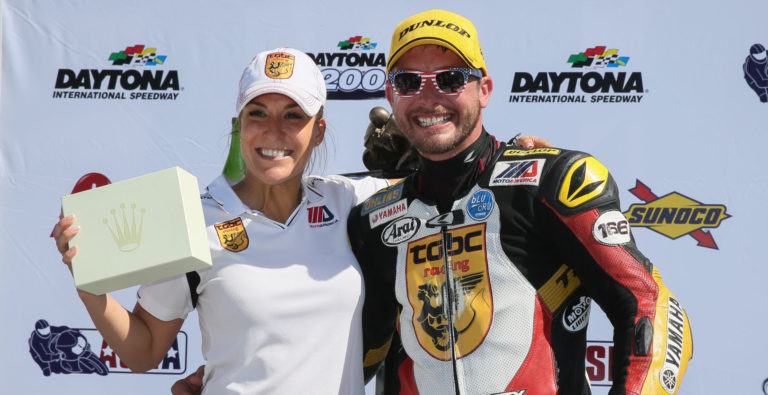
TOBC racing is excited to announce its return to the iconic Daytona 200 next week!

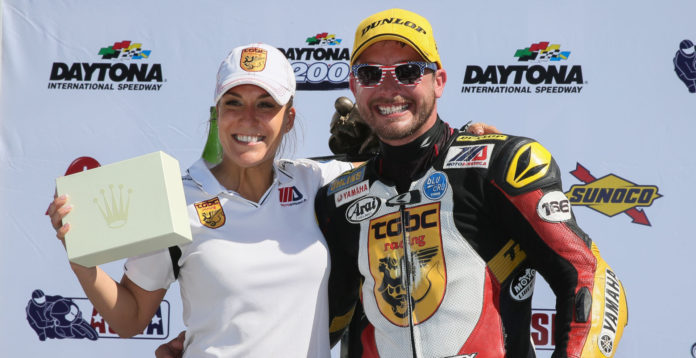
TOBC’s owner, Michelle Lindsay said, “I’m honored and excited to bring the team together once more to field Danny Eslick on a Suzuki GSX-R600 in his fight to capture his 5th Daytona 200 win!

“I really wasn’t sure given my recent health issues what 2020 would hold, or that I would have the ability to bring the team together again. I am beyond excited to have the opportunity to do so and with most of the 2015 winning team joining the effort for our last race.

“We are coming to the big race after being honored by being added to the Daytona 200 Monument in a celebration being held there Wednesday March the 11th.  Needless to say, it will be a very special week to race our final race.”

With the support of our two awesome repeat Title Sponsors, The Palm Beach Police Foundation and the Politis and Matovina Law Firm we are looking for a shot at our 4th Daytona 200 win and Danny Eslick’s 5th!

Special Thanks go to our new Sponsors Tulsa Power Sports, and Siren Services Solutions IT consulting and cyber security services for giving us the opportunity to get to Victory Lane once again.

Our gratitude also goes to Roger Lyle, Scott Harwell, Aussie Dave Anthony, Arai, Dunlop, Full Spectrum Power, CCS/ASRA, and our 2020 team for contributing to our efforts.

MotoGP: 2020 Calendar Updated

2020 FIM MotoGP™ World Championship calendar updated

Thursday, 05 March 2020

Please find below an updated 2020 FIM MotoGP™ World Championship calendar.

Due to the ongoing coronavirus outbreak, the OR Thailand Grand Prix was recently postponed.

The FIM, IRTA and Dorna have evaluated alternative dates for the event later this season and can now announce that the Thai GP has been rescheduled for the 2nd to 4th of October.

The Aragon Grand Prix will now be held a week earlier, from the 25th to 27th September.

FIM MotoGP World Championship 

3/6-8                Losail International Circuit, Doha, Qatar (Moto2 and Moto3 only)*

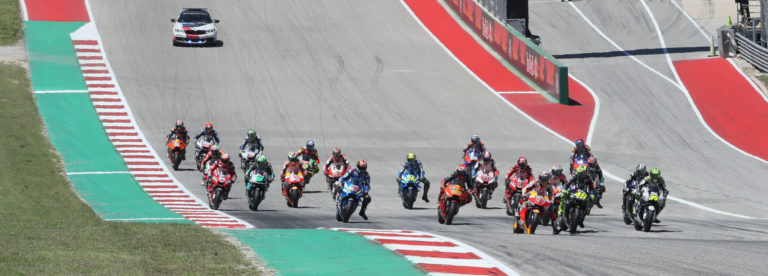
4/3-5                Circuit of the Americas, Austin, TX, USA

4/17-19            Termas de Rio Hondo, Argentina

5/1-3                Circuito de Jerez, Jerez de la Frontera, Spain

5/15-17            Circuit du Mans, Le Mans, France

5/29-31            Autodromo del Mugello, Scarperia, Italy

6/5-7                Circuit de Barcelona-Catalunya, Barcelona, Spain

6/19-21            Sachsenring, Hohenstein-Ernstthal, Germany

6/26-28            TT Circuit Assen, Assen, Netherlands

7/10-12            KymiRing, Kausala, Finland

8/7-9                Automotodrom Brno, Brno, Czech Republic

8/14-16            Red Bull Ring, Spielberg, Austria

8/28-30            Silverstone Circuit, Northamptonshire, UK

9/11-13            Misano World Circuit Marco Simoncelli, Misano, San Marino

9/25-27            MotorLand Aragón, Alcaniz, Spain

10/2-4             Chang International Circuit, Buriram, Thailand

10/16-18          Twin Ring Motegi, Motegi, Japan

10/23-25          Philip Island Grand Prix Circuit, Phillip Island, Australia

10/30-11/1      Sepang International Circuit, Sepang, Malaysia

11/13-15          Circuito de Comunitat Valenciana, Valencia, Spain

*Evening Race

Dorna CEO Ezpeletza Says U.S.G.P. At COTA Still A Go

By Neil Morrison

Editorial Note: The following is a transcription of a press conference held by Dorna Sports CEO Carmelo Ezpeleta in Qatar on the MotoGP World Championship, how the Coronavirus/COVID 19 is affecting it, and what Dorna Sports is doing going forward to salvage its 2020 season.


Good afternoon and thank you everybody. Arriving this weekend I have had many questions from many journalists so we decided it is better to do a press conference to say where we are, what has happened and what we are preparing to do between now until the end of the season.

First of all it is important to clarify the collaboration between the Qatar authorities has been really very good. The situation has been changing day by day and we have tried to accommodate ourselves with an agreement from all the people in the paddock to try to do the maximum we can. During Saturday we started to see some problems for some nationalities to come to Qatar. First of all, we have been very lucky the test for Moto2 and Moto3 has been a week before and everyone was already here, that made it easy for us to make the two races here this weekend. That is something we decided from the beginning with the Losail International Circuit and the Qatari Federation and the authorities of Qatar to do the Moto2, Moto3 races and the Asian Talent Cup also.

We were discussing day by day between Saturday morning and Sunday afternoon with the Qatari authorities, we were discussing different possibilities until Sunday morning everything more or less was okay but many people coming from Italy were arriving into Doha without problems but then suddenly in the middle of the day and because the situation in Europe changed it meant the situation changed here, so when it was clear the people coming from Italy or other countries needed to go into quarantine here in Qatar and obviously this is difficult and we cannot do that so we thought of other possibilities.

Of these possibilities one was to try to organise a chartered flight for all the Italian living people because it is not just for the Italian nationalities but also people living in Italy. We tried to organise a flight from France or wherever to try to bring the minimum amount of people to participate, try to get an agreement between the manufacturers or teams to be obliged to have a maximum number so we agreed between teams to have the same number [or people] for all MotoGP teams.

We tried to deduce that and on Saturday afternoon we almost agree on that. Everybody was coming very soon as they were allowed into Qatar but suddenly in the early afternoon on Sunday a flight from Rome was forbidden to come here. They gave two possibilities; go back to Italy or quarantine for 14 days. Obviously not any of the possibilities were good for us. We tried to organise a flight from Nice and here and to accept some positions from the MotoGP community, the mechanics and teams, to have one place to go to and then come here [the track] and back but also this in the afternoon of Sunday we saw it was not possible.

It is very important to say the collaboration with Qatari authorities, I was talking with the ministers of sport, they were talking to the ministers for health, we and Qatar were trying to make the race and this is the situation right now. What happens for the future? Well, it was not something we could prevent and it depends as the situation changes every single day around the world and we will try to do everything possible whether that is postpone or do whatever, our aim today is to work together as we have been doing all this time to try to make a championship in the best possible conditions but to try to maintain the championship and the maximum number of races that we can. We were prepared to do that.

The next Grand Prix is the United States but we don’t know nothing, we are waiting to send all of the materials until the last moment. If the situation changes between now and that moment we will take the decision. It was also clear that we tried to move the United States to the end of the year changing with the Spanish races but due to the short time we have to make these races at the end of March it was impossible for a circuit to organise a MotoGP race from now to the end of March. The situation now is that we announce today the change of the date of Thailand thanks to the help of the Aragon government to move one week early the Aragon Motorland race. We will do one week later the Thailand round.

We have a lot of possibilities and are considering everything but the main aim of the FIM, IRTA and Dorna is to maintain the championship.

Secondly, we ask all the MotoGP community, to not pay attention to the rumours please because the people are very happy to start to say what is forbidden or what is not forbidden. We are together, we are talking to all the people around the world. We will try to do the championship. The first article we have with the promoters is to respect the laws of the country. If there are laws in place we can do nothing, if the law forbids us to go anywhere we won’t continue, when the law permits it we think in the future to change. Our aim, I hope we’ve clarified everything, our aim as FIM, IRTA and Dorna is to maintain the championship with the maximum number of races. The rest we will take measures like here at the Losail International Circuit regarding the presence of the people, spectators about being in the paddock, regarding the possibility about something happening because if it was to happen with some cases in the MotoGP paddock we are prepared to create the specialist equipment to do that and we have split between the Moto2 and Moto3 teams some kind of measures to permit the situation to get better. We have the local authorities, the World Health Organisation all connected to try to do the maximum thing. The main interest from our side is to tell everybody that we want to do the Grands Prix and I am sure we can do it. Obviously it will not be a normal championship and maybe we will change things but always we want to maintain two things; the sporting side to be equal for everybody and secondly to try to accommodate ourselves for the situations. This is very clear.


Races like Austin and Argentina if hit by coronavirus, room to postpone them too or have to cancel?

Today, yes, both the United States and Argentina are okay. But I cannot say what happens in the future. Today we have all possibilities to save the problems. For me the thing is after the United States and Argentina we will be in Europe and it depends on the situation in Europe. That’s the most critical part. Today, some of the authorities have banned certain sizes of spectators coming together and the situation inside the paddock regarding nationalities who have been forbidden. We are thinking of solutions for both those things. Even on that we are thinking about possibilities to talk about everything and when any measures do come, we have some ideas to react about these measures.


Possibility of races with no spectators?

Everything is possible. The most important thing for us is to have any solution all together with everything. We say always that Dorna, in agreement with IRTA and FIM, is a company that makes races and this is our obligation despite any other things. For us it is more important than the economical side or whatever, it is to make races, I assure you with the collaboration with IRTA, the MotoGP, Moto2 and Moto3 team managers we will try to do as many races as we can.


I will not say now if I am optimistic but the only thing I promise to you is that we will work hard for any solution to happen make the 19 remaining races.


Qatar MotoGP race for 2020 after this weekend?

Qatar MotoGP race is cancelled. It is clear, all the teams here in Moto2, Moto3 and MotoGP will receive [payment] because they already spent the money to come here. The MotoGP race is cancelled because we have no other opportunities. Also, Qatar is committed to make it work for next year and they need to start as they are already contracted.

If at the end of the season there is a possibility then we will see but today we will have Moto2 and Moto3 races this weekend and in principle the Qatar MotoGP is cancelled.

After I was saying, whatever possibility has happened and whatever possibility ahead we will contemplate. Obviously, as this is a sporting battle between participants, when we published the calendar and rules it is set for everybody. Any changes are possible if everyone agrees but in my conversation with all the teams everyone wants as many races as we can with equal conditions and competition.


Qatar WorldSBK, postponement?

Absolutely, the reason Qatar WorldSBK has been cancelled for next week is because it is the exact same situation and there are a lot of people coming from Italy for WorldSBK. We will see if it is possible to do it later, especially in Qatar, as we moved WorldSBK from the end of the year previously as the traditional end of the year to the beginning of the year, just to permit to have it open to the future.


Chance for Dorna to promote Moto2 and Moto3 now?


We are trying to promote Moto2 and Moto3 always as they are very important categories. We always maintain the MotoGP championship is three categories and I think that is one of our biggest assets. This weekend the focus will be more on Moto2 and Moto3 than MotoGP because MotoGP is not happening, normally it is the opposite but it is a good move and we are happy, the riders and teams were already here so it permitted us to do it. If we knew the situation before then it would have been very simple to tell the MotoGP people to stay here. They left five days before and then we could have had everything but I will repeat one of things of this crisis of the coronavirus is the situation changes every day. You say what is happening, why can’t you prevent that but it is clear we are thinking from now, last weekend, to as much imagination about what we can do in any case.

Repeat, for us it is very important to maintain the calendar and secondly make the maximum number of races, leaving the sporting possibilities for everybody.


How many people on the chartered flight and blood tests a possibility?


We are considering if it was possible, to around 150 people coming from outside, the race would be possible but the problem was they banned all the people, people coming from Italy or who have been in Italy in the past 14 days.


Blood tests?


We were thinking but we followed what the Qatar health ministers said. We will contemplate it for the future situations, we could say come two days early if it helps, obviously here for 14 days was not possible, we think we have possibilities and in special cases we have just the MotoGP class not coming but in the future there are many more people in Moto2 and Moto3 from Italy so we need to consider the minimum number to make a Moto2, Moto3 and MotoGP race which is more than 1,000 people.


Worst case scenario for minimum races to make full championship?


Contractually with the FIM there are 13 races but our aim is to do 19 remaining races. There are possibilities even in the worst case, even with more cancellations and that we will have time. Maybe we will race in hot countries at Christmas! We are like that, our duty is to make races and we will do races. I was talking with the FIM President today who is coming tomorrow and maybe they need to postpone the FIM Prize Giving ceremony but the most important thing for us is to make races.

Daytona 200: MP13 Racing Promoting New Youth Riding Initiative

In addition to competing in the 79th Daytona 200 March 14 at Daytona International Speedway, MP13 Racing owner Melissa Paris and her rider/husband Josh Hayes will be actively promoting the All Kids Bike initiative.


The All Kids Bike® initiative is a national movement led by the Strider Education Foundation to place Kindergarten PE Learn-To-Ride Programs into public schools for free, using donations from individuals, businesses, and organizations.


“I can’t imagine a childhood without riding bikes,” Paris told Roadracingworld.com. “It’s crazy to me to learn that so many kids won’t have the opportunity to learn to ride a bicycle. I’m really honored to be an ambassador for All Kids Bike and for having the opportunity to change this trend! Motorcycles are such a huge part of my family’s life… and learning to ride a bicycle is the first step to becoming a motorcycle rider! So, from a selfish point of view, I want to help grow motorcycling, and I know introducing bikes to kids is a good start! I’m hoping that by spreading the word about this amazing initiative, we can raise the $4000 it takes to fund one school’s learn to ride program, and give thousands of kids the lifetime love of two wheels!”


MP13 Racing and All Kids Bike have established a special webpage to accept donations at https://support.allkidsbike.org/mp13-racing.


MP13 Racing’s fund-racing goal of $4,000 will fully fund a learn-to-ride program at one elementary school in Oceanside, California, where Paris, Hayes, and their son Hawk reside.


For more information on the All Kids Bike program, go to https://www.allkidsbike.org/

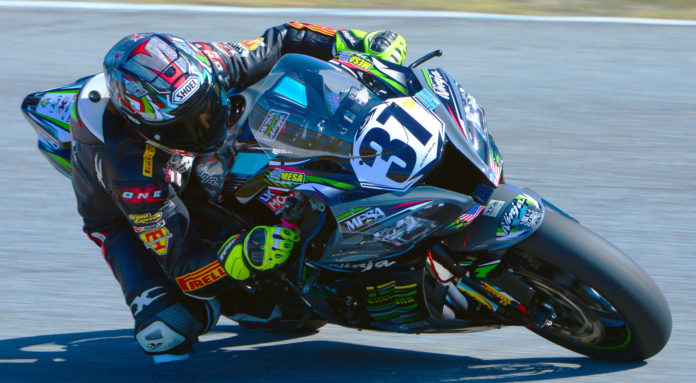
ASRA/CCS: Mesa Wins Four Races At Roebling Road Raceway

Mesa and Da Silva Tie for Most Expert Wins

ASRA/CCS/ASRA Team Challenge Florida, Mid-Atlantic, and Southeast Regions

Roebling Road Raceway, Bloomingdale, GA

February 29 – March 1, 2020


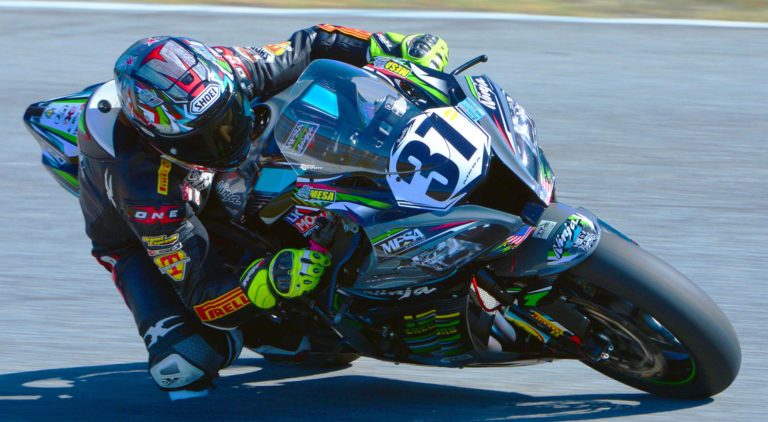
Stefano Mesa won four of his five races at Roebling Road Raceway during the ASRA and Championship Cup Series regional event, including the hotly contested Unlimited Grand Prix race. Young gun, Gabriel da Silva, tied with Mesa for most victories during the event, also winning four of his five races.  The two-day weekend schedule was action packed with GT and sprint races for the Florida, Southeast and Mid-Atlantic Championship Series.  Also featured were the AMA Sanctioned Team Challenge, presented by Michelin Tire, and AMA Sanctioned ASRA Sprint races, presented by Pirelli Tire.


Mesa started the weekend with his first victory on Saturday in the 25 minute-long GTO race on his Kawasaki ZX-10R.  Mark Heckles took the lead early with his Yamaha YZF-R1 with Mesa and Frankie Babuska, Jr. in hot pursuit.  After the halfway mark, Mesa was able to use lapped riders to advantage, moving up to second place with Heckles dropping back to third.  After a couple of laps, Heckles was behind the leader and working his way back to the front.  The two swapped positions until very end of the race when Mesa pulled ahead to take the win.  “The GTO was very good,” exclaimed Mesa after the race.  “I had to work hard to get to the front of the pack in no time, and get to the pace the boys were running.  I was able to latch on and made a couple of moves, but at the end, I had to be a bit smart and try to get the drive off the last corner to try and get Heckles at the line and I was able to get by the line just a wheel ahead.”


Mesa finished second to Heckles in the Unlimited Supersport race later on Saturday.   Heckles dominated the front of the race until the final run for the checkered flag when they ran into lap traffic.  “For the supersport race, we had more confidence and we went out and put some heaters on behind Heckles and Babuska,” Mesa stated.  “By the last lap, I was behind Heckles and he had a bunch of lappers in front.  Every hole he found he went through it and in the last corner, I was on his rear tire and I had a plan, but wasn’t able to execute, so we finished in second place.”


Mesa started from the back of the grid during the ten ASRA Superstock race on Sunday and was able to work his way quickly up to second place behind early leader, Babuska.   A few laps later, he was out front and opening a gap on the rest of the field to take his second victory of the weekend.   “We had a little mishap in the practice,” Mesa explained, “which was a burnt clutch. Unfortunately, we missed the ASRA qualifying, so we had to start all the way from the back of the pack.  Sunday was much better with the weather, and it was time to put some fast laps in for the ASRA race. By lap three, I was able to make a move and I put my head down to try and put a gap in between us, and I was able to get the win.”


Mark Heckles nabbed another holeshot and led the first few laps of the  Unlimited Grand Prix race with Babuska and Stefano Mesa in tow.  Mesa was able to maneuver his machine up front after a few laps  to take over the lead he would not relinquish for the rest of the race.  He took the checkered flag with Heckles in second, and Babuska finishing third.


Babuska was the early race leader during the Unlimited Superbike race with Mesa starting his final race of the day on the back row.  Once more, Mesa was able to quickly work his way through the rest of the field, close in on the leader, and take over the front spot.  He claimed his final victory of the day with Babuska in second and Ian Tetrick in third.  Later Mesa summarized, “The other two races were fast with the same company.  I was in the zone and lap times were very good considering the weather we had, and I was able to get the win in both of them.   It was a great weekend for the season opener at Roebling.  It was cold and windy, but Pirelli USA had us in lock and ripping with the new bigger sized tires.”


“Overall, it was a very good, positive weekend with some fast company and we all had a blast battling each other.” Mesa exclaimed.   “It’s always better to race for the win, than to win with no fast company.  Heckles and Babuska were on it all weekend and I can’t wait to go ripping and racing again with them!  I am extremely happy with the performance that Pirelli has given me over these years, and even more that my effort is paying off!  Mesa is sponsored by Pirelli, Thermosman, One-X, SBS Brakes, and Drippin Wet.


Gabriel da Silva dominated the front of the field in all of his races on board his Yamaha YZF-R6, winning the GTU, Heavyweight Supersport, Middleweight Superbike, and Middleweight Grand Prix races.  He finished second to Christian Miranda, with whom he battled all weekend, in the Heavyweight Supersport class.


“I had a blast racing at Roebling Road Raceway,” da Silva exclaimed.  “It’s one of my favorite tracks as it’s super fast going in and out of corners! Had a rough time with the winds on Saturday as they were really strong and pushing me off track. But Sunday’s weather was amazing and I really enjoyed the track had some fun battles and also got to work on some things I wanted to improve so it was a blast racing this past weekend. I got to meet some really great people and see some people I hadn’t seen in a while! I really enjoyed my weekend racing at RRR.”  Da Silva is sponsored by Galfer, Pirelli, Motion Pro, and Broward Motorsports.


The first ASRA Team Challenge race of the season kicked off with 21 teams competing to wrap up Saturday’s schedule.  The 75 lap endurance race ran without incident with only two teams completing the full 75 laps of the race.  LB Sorts and Grease Monkey Racing finished first and second, both Overall and in the GTO class.  Behind them, just one lap down, Bonnavedda Racing rounded off the top three for both Overall and GTO. Team Sticky D’s was the first GTU team to take the checkered flag, also with 74 laps completed.  Team LWT 61 Hardcore was the first to cross the line in the GTL class with 70 laps completed.


Lloyd Bayley, as usual, ran the entire Team Challenge race as the solo rider for LB Sports on board his BMW S1000RR without any practice time.  “It was very cold,” Bayley stated, “so that’s why I chose to skip all practices and qualifying, and just jump into the race cold turkey.   And it felt good every lap!  I would like to thank Dunlop Tires, DP Brakes, and Moto D Racing.”


Amateur Kyle Carrington dominated the lightweight classes on his Suzuki SV650, running undefeated.  He was the winningest racer of the weekend with five victories.  Carrington won the Lightweight Supersport, Rookie’s Cup GTL, Ultralight Superbike, Lightweight Superbike, and Ligtweight GP races.  Carrington is supported by Bridgestone Tires, Mise Mobile, EBC Brakes, Siloklene, and Vortex.


Daytona International Speedway is the venue for the next national event for both the ASRA and Championship Cup Series and will feature the running of the 79th Daytona 200.  The event, scheduled for March 13-15th, will include AMA Sanctioned ASRA Sprint Series & Championship Cup Series GT and sprint races.  The next ASRA Team Challenge race is scheduled to take place April 4-5th at Carolina Motorsports Park.  This regional event will include CCS Twin Sprint races for the Atlantic, Florida and Southeast regions.


Full race results, lap times, points standings, as well as information regarding the remaining 2020 schedule, licensing information, rules, and general information for all regions are available online at:   www.ccsracing.us.

RESULTS:
UNLIMITED GRAND PRIX EXPERT:
  1. Stefano Mesa (Kaw ZX-10R)
  2. Mark Heckles (Yam YZF-R1)
  3. Frankie Babuska, Jr. (Kaw ZX-10R)
  4. Joseph Giannotto (Yam YZF-R1)
  5. Lloyd Bayley (BMW S1000RR)
  6. Jesse Ruehling (Kaw ZX-10R)
  7. Ian Tetrick (Kaw ZX-10R)
  8. Antonio Rodriguez (Kaw ZX-10R)
  9. John Sackett (Kaw ZX-10R)
  10. Sean Oliver (Kaw ZX-10R)
UNLIMITED GRAND PRIX AMATEUR:
  1. Tyler Waters (Yam YZF-R1)
  2. RJ Wade (Yam YZR-R1)
  3. Jason Waters (Yam YZF-R1)
  4. Hyeong Suh (Kaw ZX-10R)
  5. Josh Roots (Suz GSX-R1000)
  6. Tedrick Boxley (Suz GSX-R1000)
  7. Richard Bradham (Yam YZF-R1)
  8. John Linker (Yam YZF-R1)
  9. Casey Wheeler (Suz GSX-R1000)
ASRA TEAM CHALLENGE OVERALL:
  1. LB Sports (BMW S1000RR)
  2. Grease Monkey Racing (BMW S1000RR)
  3. Bonnavedda Racing (BMW S1000RR)
  4. Sticky D’s (Yam YZF-R6)
  5. Barry Motorsports (BMW S1000RR)
  6. Fast Lane Racing (Kaw ZX-6R)
ASRA TEAM CHALLENGE GTO COMBINED:
  1. LB Sports (BMW S1000RR)
  2. Grease Monkey Racing (BMW S1000RR)
  3. Bonnavedda Racing (BMW S1000RR)
  4. Barry Motorsports (BMW S1000RR)
  5. Team Motrac LTD (Yam YZF-R6)
  6. Jinba Ittai Motorsport (Yam YZF-R1)
 ASRA TEAM CHALLENGE GTU COMBINED:
  1. Sticky D’s (Yam YZF-R6)
  2. Fast Lane Racing (Kaw ZX-6R)
  3. TST Industries (Yam YZF-R6)
  4. Hazardous Racing (Yam YZF-R6)
  5. Bonehead Racing (Kaw ZX-6R)
  6. National Granite Flooring (Yam YZF-R6)
 ASRA TEAM CHALLENGE GTL COMBINED:
  1. LWT 61 Hardcore (Suz SV650)
  2. SV Goons (Suz SV650)
  3. Chasing Shade Racing (Kaw Ninja 400)
  4. Making Memories Racing (Suz SV650)
  5. Ready-to-Rip (Suz SV650)
ASRA SUPERSTOCK EXPERT:
  1. Stefano Mesa (Kaw ZX-10R)
  2. Mark Heckles (Yam YZF-R1)
  3. Frankie Babuska, Jr. (Kaw ZX-10R)
  4. Joseph Giannotto (Yam YZF-R1)
  5. Lloyd Bayley (BMW S1000RR)
  6. Jesse Ruehling (Kaw ZX-10R)
ASRA SUPERSTOCK AMATEUR:
  1. Jason Waters (Yam YZF-R1)
  2. Tyler Waters (Yam YZF-R1)
  3. RJ Wade (Yam YZF-R1)
  4. Jonathan McCroskey (Yam YZF-R1)
  5. Hyeong Suh (Kaw ZX-10R)
  6. Tedrick Boxley (Suz GSX-R1000)
ASRA THUNDERBIKE EXPERT:
1. Ray Hofman (Suz SV650)
  1. William Finnerty (Suz SV650)
  2. Andrew Gold (Suz SV650)
  3. Benjamin Loyle (Suz SV650)
  4. John Linder (Suz SV650)
  5. Mark Evry (Yam FZR400)
ASRA THUNDERBIKE AMATEUR:
  1. Mack Laughridge(Suz SV650)
  2. David White (Suz SV50)
ASRA MOTO 3 EXPERT:
  1. Alexis Olivera (Kaw Ninja 400)
  2. Alex Ferreira (Kaw Ninja 400)
  3. Cameron Jones (Hon CBR500R)
  4. Lance Molnar (Kaw Ninja 400)
  5. Yandel Medina (Hon 125)
ASRA MOTO 3 AMATEUR:
  1. Anthony Pagan (Yam YZF-R3)
ASRA SPORTBIKE EXPERT:
  1. Christian Miranda (Yam YZF-R6)
  2. Ronald Shoffner III (Suz GSX-R600)
  3. Arthur Aznavuryan (Yam YZF-R6)
  4. George Letakis (Yam YZF-R6)
  5. Arnold Hastings (Suz GSX-R600)
  6. Austin Miller (Kaw ZX-6R)
ASRA SPORTBIKE AMATEUR:
  1. Nathan Seethaler (Yam YZF-R6)
  2. Joseph Scorah (Yam YZF-R6)
  3. Alex Spellman (Yam YZF-R6)

MotoAmerica: Kyle Wyman Racing Launches “Undeterred” Video Series

TUCSON, Ariz. — Kyle Wyman Racing (KWR) has launched a new behind-the-scenes web series that will cover rider/owner Kyle Wyman and the team’s trials and tribulations throughout the 2020 MotoAmerica Superbike championship. The series is produced by GP Industries and will have a total of 13 episodes throughout the year.

This pilot episode covers the pre-season preparations for the KWR team. Be sure to subscribe to the Kyle Wyman Racing YouTube channel and turn on notifications to not miss an episode.

MotoAmerica: Vet2Track Embedding Veterans With Four Teams

Veterans return to racetrack circuit in 2020

Working in the pits of the pro bike racing circuit might seem like an odd place to find veterans with Post-Traumatic Stress Disorder (PTSD).

But Jim Whittum, President of Vet2Track, said being part of a team with a mission can play a great part in a veteran’s recovery upon returning home from deployment.

“Over the past several years, we have put veterans on the track for track days. Last year,
we put our first veteran on an AMA Pro MotoAmerica* pit crew, [and] it was a great success,” Whittum said. “The focus required on the track, or on a pit crew helps them escape their own thoughts, along with the camaraderie of the track and the other veterans, gives them the strength to open up, trust and be able to enjoy something that is completely different than their normal lives.”

This year the selected veterans participating with Vet2Track will work with these MotoAmerica Riders and Teams:

Cliff Ramsdell – First XV Racing, MotoAmerica Twins Class #75

Shawn Hill – Myles Motorsports, MotoAmerica Twins Class #107

Nolan Lamkin – Nolan Lamkin Cycle Gear Racing, MotoAmerica, Supersport #52

Tony Blackall – Blackall Racing, MotoAmerica, Supersport #11

Whittum, a veteran himself, knows the challenges confronting military personnel who experience combat. He was deployed to Afghanistan in 2010, and he returned home struggling. He says the time he spent riding and racing his motorcycle on a track helped him return to feeling more normal.

Whittum founded the Vet2Track organization in 2015 to help veterans use motorsports as a type of therapy.

“We have a growing list of success stories about veterans who have experienced a positive change in the direction of their lives because of their participation with Vet2Track at a track day,” Whittum said. “We are expanding this year, looking to partner with MotoAmerica teams to place Veterans on racing teams. It gives vets an opportunity to see racing from a completely different perspective, it lets them be part of something bigger than themselves.

“Focusing on the team needs, they have an opportunity to forget about their own issues and use the time to clear their minds.”

In 2019 Vet2Track participant, Retired Chief Warrant Officer Lisa Niner, was placed on Shawn Hill’s Twins Cup team at the Pittsburgh race. The goal this year is to have one veteran per race team (currently a maximum of four teams) and have them engaged at a level that makes everyone comfortable.

While each team works with the veteran to develop their own list of duties, these duties often include: putting on and taking off tire warmers, checking tire pressures, fueling the bike, helping to get things to and from the grid, keeping track of time and more. On track or race weekends, Vet2Track provides a place to stay, breakfast and dinner at no charge to the veterans.

The 2020 Vet2Track event schedule includes:
(MotoAmerica races are in bold)

· April 3-5 MotoAmerica at Circuit of The Americas, Austin, Texas

· April 17-19 MotoAmerica at Michelin Raceway Road Atlanta, Braselton, Georgia

· May 1-3 MotoAmerica at Virginia International Raceway, Alton, Virginia

· May 16-17 Grattan Raceway, Belding, MI – Trackday

· May 29-31 MotoAmerica at Road America, Elkhart Lake, Wisconsin

· June 1-2 Road America, Elkhart Lake, Wisconsin – Trackday

· June 5 Grattan Raceway, Belding, MI – Ladies First Track Day

· June 6-7 Grattan Raceway, Belding, Michigan – Trackday

· June 13-14 Gingerman Raceway, South Haven, MI – Trackday

· July 4-5 Autobahn Country Club, Joliet, Illinois – Trackday

· July 11-12 Blackhawk Farms, South Beloit, Illinois – Trackday (tentative)

· July 18-19 Grattan Raceway, Belding, Michigan – Trackday

· August 7 Vet2Track Day – Gingerman Raceway, South Haven, Michigan – Track Day

· August 8-10 Gingerman Raceway, South Haven, Michigan – Track Day

· August 21-23 MotoAmerica at Indianapolis Motor Speedway, Indianapolis, Indiana

· September 11-13 MotoAmerica at New Jersey Motorsports Park, Millville, New Jersey

· September 7-20 MotoAmerica at Barber Motorsports Park, Birmingham, Alabama

Track Day Dates may be added or substituted


“We are proud of how this program has grown and the veterans that it helps,” Whittum said. “As more teams get involved, our ability to help more people increases. The long-term vision is to have racing teams work directly with veterans.”

For more information, donations or sponsorship opportunities, please contact Vet2Track directly at [email protected], go to www.vet2track.org or facebook.com\vet2track.

AHRMA Classic MotoFest Series Launches May 22-24 At Heartland Park

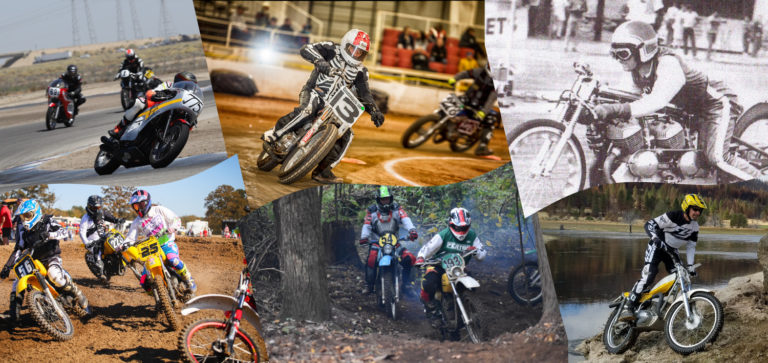
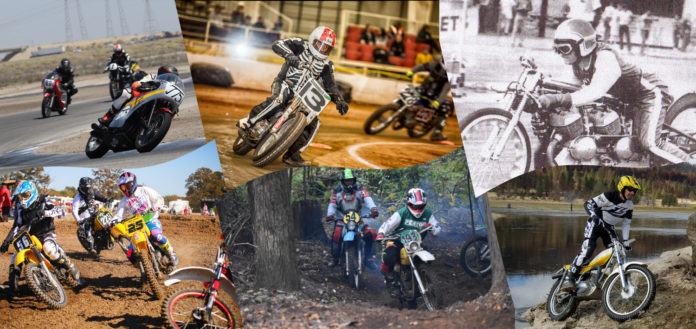
The “AHRMA Classic MotoFest® at Heartland Motorsports Park” will include road race, dirt track, motocross, cross country, trials, and drag racing events. Images courtesy of AHRMA.

AHRMA Announces its Inaugural AHRMA Classic MotoFest® at Heartland Motorsports Park

The American Historic Racing Motorcycle Association (AHRMA) in association with Heartland Motorsports Park and the Antique Motorcycle Club of America (AMCA) with will host the 2020 “AHRMA Classic MotoFest® at Heartland Motorsports Park” in Topeka, Kansas. The MotoFest will run from Friday, May 22 through Sunday, May 24 and will feature vintage events covering six different disciplines including Road Race, Dirt Track, Motocross, Cross Country, Trials, and Drag Racing. Several special guests will be in attendance including Trampas Parker, 2-Time world MX Champion, AMA Hall of Fame member David Aldana, 4-Time National Champion, AMA Hall of Fame member Terry Cunningham, 4-Time AMA Enduro Champion, and Tony Nicosia, NHRA AMA ProStar and titleholder of over 200 World and National Records.

Heartland Motorsports Park is one of the world’s finest, multi-purpose racing and entertainment destinations. Located on the south side of Topeka, KS, the facility features a championship NHRA-sanctioned 1/4-mile drag strip, four-level sponsor-suite tower, a 2.5-mile road course, and a 3/8-mile banked clay oval. In addition, a large off-road area has been designated for the construction of a custom motocross track and 5-mile forested cross country track especially for this event. For more information, go to https://www.ahrma.org/ahrma-classic-motofest/ahrma-announces-its-inaugural-ahrma-classic-motofest-at-heartland-motorsports-park/ for a more detailed schedule of the weekend’s activities.

MotoGP: Valentino Rossi’s Secret Archive, Part Two

Inside the Doctor’s hidden archive We have been to a secret location, somewhere no one has gone before. One secret room contains the whole story of one of the greatest legends in the history of the sport. Valentino Rossi has shown us suits, helmets, boots and, above all, stories and experiences stretching back more than 25 years, from a career at the apex of world motorcycle racing. Welcome to Valentino Rossi’’s Secret Room.

MV Agusta F4 Could Have Beaten All Comers–If It Had Been Launched Earlier


This Throwback Thursday featured article is from the June, 1999 edition of Roadracing World & Motorcycle Technology, when Editor John Ulrich traveled to Italy for the press introduction of the MV Agusta F4-750 Serie Oro, a new limited-edition, series-of-300, $36,995 sportbike built by Cagiva.To read more articles like this please subscribe to Roadracing World.


By John Ulrich

I was in Italy for the press introduction of the MV Agusta F4-750 Serie Oro, the new limited-edition, series-of-300, $36,995 sportbike built by Cagiva.

I’ll admit that I’d never had dinner at the home of the President of a motorcycle manufacturing company before, so maybe my viewpoint was distorted.

But sitting at the dinner table in Cagiva President Claudio Castiglioni’s expansive villa in the hills above Varese, it struck me that this man did not have the easiest of jobs, and that one of the difficulties he faced was having to deal with “experts” who did not have the slightest idea what the hell they were talking about.

There were 10 of us at the table, including five U.S. and British journalists, one of whom was now explaining to Castiglioni that the key to success in the U.S. market was to build a line of sporting Singles. The way the writer explained it, many people in his part of America installed 500cc single-cylinder four-stroke engines in TZ250 frames, and the demand for such a machine would be immense.

Earlier in the day, a German journalist had charged that the speedometer on the MV Agusta he rode at Monza had been rigged, because the bike felt slow and couldn’t possibly have reached the 265 kph (165 mph) indicated on the front straight. A radar gun retrieved from Cagiva headquarters proved the scribe wrong, and he spent the last part of the afternoon bowing and scraping as he apologized to everybody from Castiglioni down to the go-fers who had brought the timing equipment out to the racetrack.

And then there was the Italian writer who flicked away one of four sample F4s on his first run into the first of Monza’s infamous chicanes, becoming the first man to grind paint off the carbon-fiber bodywork of a running MV Agusta.

The MV Agusta F4 Serie Oro, a triumph of reality over journalism. Photo by Kel Edge.

Hey, crashes happen, and the MV Agusta’s fat, linear powerband is deceptive on a power-sucking track like Monza. But nobody’s been able to sell 500cc Singles in any real numbers to Americans, and the total population of TZ-framed Singles in the U.S. would have been 12 if racer Franz Volpi hadn’t re-installed the original TZ250 engine in his bike this winter.

• •

Castiglioni’s encounters with bullshit had not begun on this night in Varese, nor are they likely to ever end. Some writers had already declared the F4 dead, printing reports that the machine would never be produced, that Cagiva was out of money, out of time, out of expertise. One editor ran hot on the brakes into a chicane on a cold and green track during the test rides at Monza, tucked the front and placed immediately blame on the special-for-the-MV Pirelli front tire, much to the alarm and horror of Pirelli’s Salvo Pennisi, a rare tire company manager who can actually ride a motorcycle around a racetrack at a decent clip.

On the business front, Castiglioni has been criticized for his management of Cagiva and Ducati. Critics tend to forget that Castiglioni and his brother, Gianfranco, had already built Cagiva into a major force in the Italian market when they were urged by the Italian government to buy bankrupt Ducati in 1985.

The Castiglionis, industrialists involved in a range of non-motorcycling businesses in addition to Cagiva, rejuvenated Ducati, pouring in resources and attention, often at the expense of Cagiva. For example, the Ducati Paso was originally meant to be a Cagiva model, but was rebadged and sold as a Ducati when the Castiglionis decided to quickly modernize the Ducati line. Cagiva’s Massimo Tamburini designed the revolutionary look of the Ducati 996, and the Castiglionis took Ducati to dominance in the Superbike World Championship.

The way U.S. Cagiva importer Larry Ferracci tells the tale, Cagiva’s government-orchestrated purchase of Ducati was financed by certain special-rate, government-guaranteed loans. More money was spent acquiring Husqvarna and nearly-defunct Moto Morini and MV Agusta, as well as financing Cagiva’s foray into the 500cc World Championship. Production of Husqvarna off-road bikes was moved to Italy with Ducati and Cagiva, while the Moto Morini and MV Agusta brands lay dormant.

A Italian economic crisis and change in government led to the loans being called in, causing a severe cash-flow crisis, delays in payments to suppliers and the near-idling of Ducati production for want of outsourced parts. Ferracci was involved in the search for a financial solution,which came with the Texas-Pacific Group’s purchase of 49 percent of Ducati in 1996, followed by TPG’s purchase of the remaining 51 percent last year and the listing of Ducati on the New York Stock Exchange in March. The sale of once-bankrupt Ducati netted a healthy return for the Castiglionis, and Claudio, who manages the motorcycle businesses while Gianfranco handles the Cagiva Group’s other businesses, is investing large sums in the MV Agusta brand and the rest of the company.

• •

“Many people thought we wouldn’t be able to design the F4, let alone build it,” Castiglioni had told assembled reporters in a press conference the day before the test sessions at Monza. Castiglioni spoke in Italian, his words simultaneously translated into English beamed into headsets worn by journalists not fluent in Italian.

Castiglioni lavished praise on design chief Tamburini, and pointed out that Cagiva’s R&D operations in Varese and San Marino employ 150 people. Castiglioni said his company was investing $50 million U.S. in MV Agusta alone, with another $350 million earmarked for refurbishing existing production plants as well as building new production facilities and hiring additional workers over the next year. “We’re not just assemblers,” Castiglioni said in what may have been a jab at rival Aprilia, the closest thing to a virtual motorcycle company. “We try to conceive and produce motorcycles. We have a passion, we have a resolve, to create something.

“As a man,” Castiglioni continued, “I have realized a dream. When I was a little boy, 8, I would come to Monza with my father and see MV Agusta win. Now that I am Chairman of MV Agusta I can say that I have reached my dream. We want to make MV known worldwide.” The F4, Castiglioni said, would be the first in an entire range of MV motorcycles.

On the racetrack at Monza: "I'm sure they all thought I was insane. Maybe I was."

Photo by Kel Edge.

He had selected Monza, Castiglioni told the reporters, because Monza was an important part of MV history, and Giacomo Agostini won for the first time on an MV at Monza. “I hope soon we can see this motorcycle racing at tracks worldwide,” Castiglioni said at the press conference.

• •

It wasn’t until the dinner at his home the next night that we learned how much of a gamble the press intro at Monza really was. The tracks at Imola and Misano weren’t available for months, but Castiglioni didn’t want to wait. Production of the Serie Oro machines had already begun in March and the press reports of impending doom were interfering with marketing plans, so he decided to hold the press intro at Monza, without delay.

His advisers had counseled against using Monza. The journalists would tumble end-over-end in the tight chicanes punctuating Monza’s wide-open sections. The constant, wide-open running in the hands of ham-fisted writers would be too hard on the bikes. Something might go wrong. Castiglioni rolled the dice, concocted the historic-link cover story, and charged ahead. Each of the four test bikes covered between 1,100 and 1,250 miles on the day, mostly wide-open, with no mechanical failures or serious problems.

We also learned that Castiglioni figured he’d spend the next two years getting MV Agusta production and commercial operations in order, then look at going racing. On a personal level, Castiglioni said, he’d prefer to take MV Agusta back into Grand Prix racing, although running in World Superbike may prove more feasible. (Castiglioni’s dream includes signing racer Max Biaggi to ride for MV, one insider told me.) The problem, of course, is that MV used to dominate Grand Prix racing. Which means, as Castiglioni is painfully aware, that merely racing would not do.

Only winning with the reborn MV Agusta brand would be good enough.

• •

Original plans called for building 200 machines in the MV Agusta F4-750 Serie Oro, or Gold Series. But due to worldwide demand, the plans were changed to produce 300 of the bikes, and each of the 15-25 machines likely to reach the U.S. will sell for $36,995. Production began in March, the limited-edition machines hand-assembled on a short line at the rate of three per day. Over 50 engines have already been built.

Production of the Serie S, or Standard Series, will begin in July with shipments beginning in September. The price will be $18,900 in the U.S., with aluminum and plastic replacing the magnesium and carbon-fiber parts used on the Serie Oro. While the crankcases, cylinders and cylinder heads for the Serie Oro are sand-cast, the same parts will be die-cast for the Serie S, making the standard bike’s engine 1.5 to 2.0 kilograms (3.3 to 4.4 pounds) lighter. Internal engine parts and specifications will be identical, and the overall machine weight difference will be about 10 kilograms,or 22 pounds. Serie S machines should start showing up in the U.S. in January, 2000, and Larry Ferracci hopes to import about 200 of the machines then and another 200 by June of next year. Total Series S production will be about 1,000 in 1999 and about 4,000 in 2000.

The Serie Oro is meant to be made of precious materials with precision manufacturing, Centro Ricerche Cagiva (CRC) Technical Director Massimo Parenti told reporters. The chassis is easy to assemble and disassemble, the fairing is easy to remove, he said.

The F4 without bodywork. A steel trellis frame bolts to cast magnesium swingarm plates, with the engine as a structural part of the chassis. Note aluminum-alloy rear subframe, as well as hot-air-removal scoop behind and underneath radiator. Photo by Kel Edge.

It is an interesting design. The main frame is a trellis constructed of a micro-cast chrome-moly steel steering head and chrome-moly steel tubing, bolted to the cylinder head on each side and cast magnesium alloy swingarm pivot plates at the rear. The single-sided swingarm is also cast magnesium alloy, and an aluminum-alloy rear subframe attaches with four bolts and supports the seat, tailsection and mufflers. The lower triple clamp is a hollow magnesium alloy casting (the bottom is shaped to direct air into the radiator), with a large-diameter aluminum alloy steering stem and a forged aluminum alloy upper triple clamp. Steering head and swingarm pivot inserts allow geometry adjustments, and an adjustable Ohlins steering damper is transversely mounted behind the upper triple clamp, both ends of the damper shaft attached to the frame rails while the damper body is attached to the triple clamp itself.

MV Agusta F4’s combustion chamber is completely formed by valve pockets, without additional CNC work. Photo by John Ulrich.

Fully-adjustable Showa inverted forks have short axle/caliper-mount bodies, quick-release axle clamps and long upper tubes with widely-spaced bushings supporting the 49mm stanchion tubes.

The design and construction of the swingarm, the swingarm pivot plates, the steering head bearing installation and adjustment system (a collar threaded into the steering head holds the bearings in place), the steering damper mounting system and various other details are patented. The process used to design the swingarm is the subject of scientific papers; the trick was to make the swingarm as light as possible while also making it strong enough for every possible scenario with a look compatible with the overall design of the F4, and it is the styling of the swingarm which is actually patented.

The fully-adjustable Sachs rear shock is connected to the swingarm plates and the swingarm through a progressive link.

The wheels are Marvic cast magnesium with a star-shaped spoke layout, a 3.50 x 17-inch front carried by a thin-wall 35mm O.D. (32mm I.D.) axle and a 6.00 x 17-inch rear carried by a 50mm O.D. (45mm I.D.) forged spindle mounted in an eccentric hub; the rear sprocket is carried by a cush drive.

Nissin brakes include 310mm floating front discs and six-piston calipers with internal passageways designed for easy bleeding with no troublesome air pockets; the caliper piston sizes are staggered front to rear, 22.65mm, 25.4mm and 30.23mm (0.89, 1.0, 1.19-inch). The rear brake disc is 210mm with a four-piston caliper, all four pistons measuring 25.4mm, or 1.0 inch, in diameter.

The Nissin master cylinders developed for the MV’s front brakes and hydraulic clutch actuating system are also patented; according to Parenti, the position of the master cylinder piston relative to the lever itself allowed the integral reservoir to be lowered, making the entire assembly more compact, allowing the fairing to be pulled in tighter, and improving the rider’s view of the instruments and out the windscreen. The adjustable aluminum alloy handlebars have quick-release hinged clamps, each secured by a single bolt, and the aluminum-alloy footpegs and shift and brake pedals have built-in adjustment eccentrics. And the rear brake master cylinder, while conventional in design, is positioned horizontally underneath the engine instead of vertically or angled upright on a frame tube or swingarm pivot mount plate.

The stacked projector headlights improve aerodynamics and meet homologation requirements worldwide, Parenti said; the front turn signals are built into the rearview mirrors.

A compact instrument package includes an analog tach and a digital speedometer, along with a shift light, clock, odometer, dual trip and water temperature gauges, along with the usual warning lights.

The fuel tank and airbox are carbon-fiber, as are the body parts; carbon-fiber ram-air intakes are mounted underneath the nose of the fairing. The curved radiator carries two fans, one conventionally mounted, and another, larger fan mounted in a curved carbon-fiber scoop attached to the rear of the radiator and designed to suck hot air down, expelling it underneath the engine. The idea is to reduce the amount of hot air reaching the rider.

The engine management system is by Magneti-Marelli, with four 46mm single-injector throttle bodies. The bank of throttle bodies and the airbox are positioned ahead of the 5.3-gallon carbon-fiber fuel tank, which drops down vertically to use the space behind the cylinders. There’s a circle of small holes drilled in each velocity stack; the holes suck in condensed fuel seeping down through the outside stack seal, before it can run onto the outside of the throttle body.

The stainless steel exhaust system is a 4-into-2-into-1-into-2, each underseat muffler then split into two tuned exits for a four-pipe look. Perhaps stung by BMW’s copy of the 916’s underseat pipe look, this time CRC has patented the four-pipe style seen on the F4.

The view into an MV Agusta F4 exhaust port, showing its oval shape and relatively high floor. Photo by John Ulrich.

The tread pattern of the Pirelli Dragon EVO steel-belted radial tires was originally designed for the MV Agusta, Pirelli Testing Department Manager Pennisi said, and a new front tire size was developed to meet Tamburini’s demand that handling feel be as close as possible to a 500cc Grand Prix racebike. The size is 120/65-17, a compromise between the 120/60-17 size that reduces turn-in effort and the 120/70-17 size that is less agile but more stable at full lean, especially over bumps and during braking. The new size is 6.0 percent lighter than an equivalent 120/70-17 with a smaller tread radius and outside diameter but the same tangent lean angle. The rear tire is a 190/50-17.

Andrea Goggi, MV Agusta F4 engine designer. Photo by John Ulrich.

Engine Project Leader Andrea Goggi, 35, explained the details of the engine design, and pointed out that the engine design team worked with the chassis design team to make the bike as compact as possible.

The MV Agusta F4’s cassette transmission, which unbolts as a unit and also carries the countershaft sprocket (hidden at right). Shaft at left carries clutch hub. Photo by John Ulrich.

The four-cylinder, inline engine is Goggi’s design; Goggi previously designed the two-stroke C593 500cc Grand Prix racebike engine. Castiglioni had enlisted Ferrari design assistance for a new four-cylinder engine in 1992, but the design was unworkable for motorcycle use. In one version, the cylinder head was reversed, with throttle bodies forward, presenting packaging problems. In another, the cylinders were angled slightly apart, forming in essence two paired V-Twin engines. Neither design was built, Goggi said, declaring that there were no advantages to the design features and plenty of potential production problems, not only in packaging but also in maintaining precise bore machining at multiple angles. “It’s always difficult to have a balance between doing something different versus rational,” Goggi told me later in excellent English. “Sometimes different things are not very rational.” It sounded just like something a racing engineer would say—something that works is always better than something that’s trick for the sake of being trick.

MV Agusta crankshaft, with relatively heavy counterweights to smooth power delivery. Note central cam drive gear. - Photo by John Ulrich.

In 1994, Cagiva left the 500cc World Championship and Goggi was reassigned to Ducati. In July, 1995 Castiglioni moved Goggi out of Ducati and put him to work designing what became the F4 engine; the Inline Four, DOHC, water-cooled design was completed and approved for production in October of 1998. Bore and stroke measure 73.8 x 43.8mm for 749cc.

Goggi freely admits that he used the current Suzuki GSX-R750 engine as his starting point, or benchmark, and sought to improve on the Suzuki engine in every way.

Much of Goggi’s work involved packaging, but he also analyzed air flow through the cylinder head and combustion chamber, a practice critical, he said, to modern two-stroke racebike design. And throughout the design process, Goggi kept in mind the demands of production, the need to design something that could be produced on an assembly line in a straightforward, repeatable manner, as easily as possible, and to build a motorcycle that not only made competitive power but was also easy to ride.

The plan was to use the engine as a structural member of the frame, linking the bottom of the swingarm pivot mount plates to the trellis frame. Which meant the frame had to bolt to the cylinder head, which meant the cylinders had to be strong enough to carry the loads from the head to the cases and onto the swingarm pivot plates. Current conventional design of Inline Fours has the cam drive located on one end of the crankshaft; the theoretical benefits include a shorter crankshaft with fewer main bearings. But that layout combined with the F4’s stressed-engine design would require a super-heavy-duty, thick casting wall outside the cam chain. The simpler solution was to position the cam drive in the center of the crankshaft.

The latest conventional design trend also incorporates the cylinder block into the upper crankcase casting, making for fewer parts and gaskets and less sources for oil weepage. But using a separate, beefy cylinder casting secured by large nuts on big studs not only gave Goggi the rigidity he needed but also builds in a certain amount of design flexibility for the future, as in, the possibility of building a 900 on the same cases. As is the usual practice, the cylinder bores are plated with a nickel-silicon-carbide composite, the same coating Goggi used on the C593 GP bike.

Despite the centrally-located cam drive, this F4 engine is not excessively wide. The Denso alternator and electric starter are positioned behind the cylinders, and the engine measures 17 inches (432mm) at its widest point (a GSX-R750 engine measures 19 inches, or 483mm, and a Ducati 996 engine measures 17.5 inches, or 445mm). To keep the cylinder head as compact as possible, the cams are driven by a combination of gears and roller chain; the system allows the use of smaller-diameter cam sprockets, because a set of gears handles the initial crank-to-cam speed reduction with a chain then running to the cams. The use of smaller cam sprockets not only allows the outside dimension of the cylinder head to be reduced, but also allows the use of smaller valve angles. And with the intake valves set at 9.5 degrees and the exhaust valves at 12.5 degrees for a 22-degree included angle, the F4 engine has very steep valve angles. (The system also means that the F4’s cams run opposite crankshaft rotation, and the cam chain tensioner system is on the front of the cylinder, not the rear.)

Remember Goggi’s work at analyzing airflow through the cylinder head and combustion chamber? One result of that work is a radial valve layout—each valve is slightly tilted transversely outward, at 2.0 degrees from the cylinder centerline. That’s enough of a tilt to produce more room between the valve head and the cylinder wall, that room increasing with lift. The extra room reduces the shrouding effect that the cylinder wall has on a conventionally positioned valve, and increases the volume and improves the pattern of flow, especially at low valve lifts, which in turn helps smooth the power curve. The 2.0 degrees is enough to make a difference, yet small enough to not require a complicated rocker arm valve actuation system. Instead, the cam lobes are ground at a slight angle and operate directly on conventional bucket tappets. Another benefit of the radial valve layout is that the combustion chamber is entirely formed by the valve pockets, with no additional CNC work required, simplifying production.

Goggi’s analysis of gas flow also influenced the shape and finish of the ports. The intake ports are straight and oval, the exhaust ports oval, short and wide with a relatively high floor. Goggi found that port finishing had no influence on flow, so there isn’t any port cleanup or polishing. The only purpose of polishing ports is to make money, not power, Goggi said.

The cast slipper pistons made in Italy by Asso are slightly domed, and the valve cutouts are angled to accommodate the radial valve layout.

The MV Agusta F4 engine assembly line. About 50 of the 300 Serie Oro engines had been assembled by the time of the press tour. Photo by John Ulrich.

Continuing his quest for a smooth powerband with no peaks or dips, Goggi said he used a relatively heavy crankshaft and paid special attention to the electronic fuel injection system mapping, working to eliminate roughness in the off-on throttle transitions. Goggi is quick to point out that smooth power delivery also makes fewer demands on the chassis and suspension and thus aids handling.

An MV Agusta F4 engine, with throttle bodies. Note boss on the side of the cylinder head, where the frame attaches. Engine weighs 69 kilograms (152 pounds) dry.

With the transmission, Goggi managed to combine a trick feature with a practical production consideration. It’s a close-ratio six-speed, cassette style, which means the transmission shafts and shift mechanism attach to a plate which bolts to the cases as a single assembly. The production advantage is that the transmissions can be separately assembled and checked, brought to the engine line, and then installed into the cases. The same system will be used on other, future MV Agusta models, Goggi said, and an optional racing kit will include three or four alternate ratios for each transmission gear. (The kit will include inserts for the steering head and swingarm pivot as well.)

• •

The most amazing thing about the F4 is that even normally hidden parts are all well-finished, with attention paid to every detail. Every weld is nearly perfect. “Even the bolts are special,” Goggi said. When they say that the MV Agusta F4 is Motorcycle Art, they aren’t kidding.

But the proof is in the riding.

• •

Monza is an intimidating track, more so when the first day’s riding has been rained out and suddenly each journalist’s track time on the second day has been slashed to two sessions, 30 minutes the first time, 10 minutes the second. Especially when there are still wet patches in the blindingly fast curves and back-section turns.

Monza can be described this way: Wide open, slow chicane, wide open right curve, brake under bridge into chicane over bump that launches rear wheel into air, short straight, 90-right, 90-right, wide open, wide-open kink left, double-chicane, wide-open, fast sweeper, wide open.

Dying at Monza would be no trouble, and I had no intention of dying. I’m a slow learner at these press events, usually reaching a respectable clip around the fourth riding session. There are long-term advantages to such an approach, and, in reality, the real testing of any motorcycle isn’t at a supervised press launch anyway. At Monza, there were many people braver than me. I salute them.

My bike wouldn’t idle when I jumped on it for my first ride. Twice I started it, twice it died. The third time I held the throttle slightly open, dropped it into gear and rode away.

I decided immediately that Goggi has realized his goal of a strong, linear powerband without peaks or dips. The F4 has very smooth power delivery, although all the wide-open sections at Monza did little to showcase the bike’s strong points—Monza is a top-end type of place. Still, the MV was reaching 265 kph (165 mph) before I shut off for Turn One and headed into the chicane. The brakes are good and strong, with a linear feel and smooth action. And the bike is very stable, without a hint of head-shake through the back-straight kink.

But I was surprised with the off-on throttle action—it was not as perfect as I’d expected after Goggi told me about the extra effort that had gone into that area. It seemed about the same as a Hayabusa’s, although notably better than a GSX-R750’s. And I missed the fourth-fifth upshift several times, shifting without the clutch. Making that kind of shift—dipping the throttle for a brief instant while nudging the lever—is standard racetrack form, and easy to do with a smooth-shifting GSX-R750.

What really surprised me when my session was over was the discovery that my aging, bad wrists did not ache, my hands had not seized, and my fingers had not gone numb. For me, this is something new for the ergonomics of a 750cc sportbike.

Cycle World’s Brian Catterson ground through the heel of one boot—his foot had gotten against the rear wheel when he hung off. Several others melted plastic boot guards against the exhaust pipe after the small carbon-fiber heat shields fell off. I did not.

I was debriefed when I returned to the pits. Alarmed MV officials immediately sent out a test rider to check my bike—which idled perfectly before he pulled away. He returned, reporting no problem with the off-on throttle transition or the transmission, and I’m sure they all thought I was insane.

Maybe I was. The bike I rode in the next session idled perfectly at 1,500 rpm, the throttle transition seemed fine and I didn’t miss any shifts, although I purposely ran the thing right up below the 13,300 rpm rev limiter before making each shift. My last 10 minutes seemed much better, Monza a less foreign place. Another 60 minutes worth and I could have been really rolling. And then it was over.

• •

There was the Singles-Are-The-Answer dinner that night, and a factory tour the next day. The factory tour was Claudio Castiglioni’s way of answering the reported fiction that the F4 would never be built. There were F4 engines in various stages of assembly as well as engine parts and complete bikes in evidence throughout the factory. A huge bin held camshaft blanks awaiting machining; crates carried un-machined cylinder head castings; a giant box was full of crankcase sets. A newly-installed Heller machining center stood ready to finish 20 F4 cylinder heads per shift, with six more of the massive machines on order, according to our tour guides.

The factory’s four lines can be configured to produce any model in Cagiva’s line, and, once Serie S production is geared up, one line will be devoted to the F4 alone. A nearby engine plant can produce a total of 500 engines per shift, and 100 to 120 complete motorcycles can leave the factory each day. A nearby spare parts warehouse uses a computer-guided robot vehicle system to find parts; a human rides on the robot to actually retrieve the part. This is a going concern, up and running and serious.

• •

I flew back to LAX on Saturday, arriving in the afternoon, and on to Sears Point to see my kid race his TZ250 at an AMA Pro National event. The last time anybody I had anything to do with raced there was 1988, when Russ Paulk crashed one of my AMA 750 Supersport bikes, hit an embankment and died. Chris was 8 at the time and knew Russ well. The track is still a killer, the AMA having long ago failed in its responsibility to look out for the safety and welfare of its racing members, and I was worried about Chris.

I stayed as far away from him on raceday as I could stand, for as long as I could, lest my apprehension infect him. I watched mostly from a distance, and thought about the MV.

It looks to me like the MV Agusta F4 is a reality, is in production, and will be sold. Larry Ferracci is certain he’ll be able to sell all he can get in the U.S., and one of my better-off friends has already ordered a Serie S. As for the racing plans, we’ll see.

Chris did fine in his first race at Sears, getting the points and finishing seventh (on his way to finishing third in AMA 250cc GP points for the season).

The MV will do fine, too, I decided. If that’s not the story some writers have told their readers, so be it.

I’ll take reality over journalism any day.


This Throwback Thursday is from the June 1999 edition of Roadracing World and Motorcycle Technology. To read more articles like this please subscribe to Roadracing World.


Author’s Postscript: In the 20 years since this story was written, a lot has changed at Sears Point  (now known as Sonoma Raceway), starting with the track being purchased by Speedway Motorsports in 1996. In 2000-2003, track President Steve Page actively sought rider feedback and the track began a series of modifications based on input from Mat Mladin, Ben and Eric Bostrom, Miguel Duhamel, Aaron Yates, and other professional racers. The changes–including significantly improving run-off room and installing a chicane in the fast esses section where runoff could not be improved very much–dramatically improved rider safety, as did a soft-barrier initiative in conjunction with AFM. The track has come a long way from where it was in 1999, and as a rider and team owner, I appreciate it…John Ulrich
Daytona 200: More On TOBC Racing Returning With Danny Eslick

TOBC Racing Team Owner Michelle Lindsay (left) with rider Danny Eslick (right) after winning the 2018 Daytona 200, their third win together and Eslick’s fourth Daytona 200 win overall. Lindsay, Eslick, and TOBC Racing will be honored during a celebration on March 11 at the Daytona 200 Memorial in Daytona Beach, Florida. Photo by Brian J. Nelson.

Once more Unto the Breach Dear Friends…Once More

TOBC racing is excited to announce its return to the iconic Daytona 200 next week!

TOBC’s owner, Michelle Lindsay said, “I’m honored and excited to bring the team together once more to field Danny Eslick on a Suzuki GSX-R600 in his fight to capture his 5th Daytona 200 win!

“I really wasn’t sure given my recent health issues what 2020 would hold, or that I would have the ability to bring the team together again. I am beyond excited to have the opportunity to do so and with most of the 2015 winning team joining the effort for our last race.

“We are coming to the big race after being honored by being added to the Daytona 200 Monument in a celebration being held there Wednesday March the 11th.  Needless to say, it will be a very special week to race our final race.”

With the support of our two awesome repeat Title Sponsors, The Palm Beach Police Foundation and the Politis and Matovina Law Firm we are looking for a shot at our 4th Daytona 200 win and Danny Eslick’s 5th!

Special Thanks go to our new Sponsors Tulsa Power Sports, and Siren Services Solutions IT consulting and cyber security services for giving us the opportunity to get to Victory Lane once again.

Our gratitude also goes to Roger Lyle, Scott Harwell, Aussie Dave Anthony, Arai, Dunlop, Full Spectrum Power, CCS/ASRA, and our 2020 team for contributing to our efforts.

MotoGP: 2020 Calendar Updated

The start of the Grand Prix of Thailand in 2019. Photo courtesy of Dorna.

2020 FIM MotoGP™ World Championship calendar updated

Thursday, 05 March 2020

Please find below an updated 2020 FIM MotoGP™ World Championship calendar.

Due to the ongoing coronavirus outbreak, the OR Thailand Grand Prix was recently postponed.

The FIM, IRTA and Dorna have evaluated alternative dates for the event later this season and can now announce that the Thai GP has been rescheduled for the 2nd to 4th of October.

The Aragon Grand Prix will now be held a week earlier, from the 25th to 27th September.

FIM MotoGP World Championship 

3/6-8                Losail International Circuit, Doha, Qatar (Moto2 and Moto3 only)*

4/3-5                Circuit of the Americas, Austin, TX, USA

4/17-19            Termas de Rio Hondo, Argentina

5/1-3                Circuito de Jerez, Jerez de la Frontera, Spain

5/15-17            Circuit du Mans, Le Mans, France

5/29-31            Autodromo del Mugello, Scarperia, Italy

6/5-7                Circuit de Barcelona-Catalunya, Barcelona, Spain

6/19-21            Sachsenring, Hohenstein-Ernstthal, Germany

6/26-28            TT Circuit Assen, Assen, Netherlands

7/10-12            KymiRing, Kausala, Finland

8/7-9                Automotodrom Brno, Brno, Czech Republic

8/14-16            Red Bull Ring, Spielberg, Austria

8/28-30            Silverstone Circuit, Northamptonshire, UK

9/11-13            Misano World Circuit Marco Simoncelli, Misano, San Marino

9/25-27            MotorLand Aragón, Alcaniz, Spain

10/2-4             Chang International Circuit, Buriram, Thailand

10/16-18          Twin Ring Motegi, Motegi, Japan

10/23-25          Philip Island Grand Prix Circuit, Phillip Island, Australia

10/30-11/1      Sepang International Circuit, Sepang, Malaysia

11/13-15          Circuito de Comunitat Valenciana, Valencia, Spain

*Evening Race

Dorna CEO Ezpeletza Says U.S.G.P. At COTA Still A Go

The start of the MotoGP race at Circuit of The Americas in 2019. Photo by Brian J. Nelson.

By Neil Morrison

Editorial Note: The following is a transcription of a press conference held by Dorna Sports CEO Carmelo Ezpeleta in Qatar on the MotoGP World Championship, how the Coronavirus/COVID 19 is affecting it, and what Dorna Sports is doing going forward to salvage its 2020 season.


Good afternoon and thank you everybody. Arriving this weekend I have had many questions from many journalists so we decided it is better to do a press conference to say where we are, what has happened and what we are preparing to do between now until the end of the season.

First of all it is important to clarify the collaboration between the Qatar authorities has been really very good. The situation has been changing day by day and we have tried to accommodate ourselves with an agreement from all the people in the paddock to try to do the maximum we can. During Saturday we started to see some problems for some nationalities to come to Qatar. First of all, we have been very lucky the test for Moto2 and Moto3 has been a week before and everyone was already here, that made it easy for us to make the two races here this weekend. That is something we decided from the beginning with the Losail International Circuit and the Qatari Federation and the authorities of Qatar to do the Moto2, Moto3 races and the Asian Talent Cup also.

We were discussing day by day between Saturday morning and Sunday afternoon with the Qatari authorities, we were discussing different possibilities until Sunday morning everything more or less was okay but many people coming from Italy were arriving into Doha without problems but then suddenly in the middle of the day and because the situation in Europe changed it meant the situation changed here, so when it was clear the people coming from Italy or other countries needed to go into quarantine here in Qatar and obviously this is difficult and we cannot do that so we thought of other possibilities.

Of these possibilities one was to try to organise a chartered flight for all the Italian living people because it is not just for the Italian nationalities but also people living in Italy. We tried to organise a flight from France or wherever to try to bring the minimum amount of people to participate, try to get an agreement between the manufacturers or teams to be obliged to have a maximum number so we agreed between teams to have the same number [or people] for all MotoGP teams.

We tried to deduce that and on Saturday afternoon we almost agree on that. Everybody was coming very soon as they were allowed into Qatar but suddenly in the early afternoon on Sunday a flight from Rome was forbidden to come here. They gave two possibilities; go back to Italy or quarantine for 14 days. Obviously not any of the possibilities were good for us. We tried to organise a flight from Nice and here and to accept some positions from the MotoGP community, the mechanics and teams, to have one place to go to and then come here [the track] and back but also this in the afternoon of Sunday we saw it was not possible.

It is very important to say the collaboration with Qatari authorities, I was talking with the ministers of sport, they were talking to the ministers for health, we and Qatar were trying to make the race and this is the situation right now. What happens for the future? Well, it was not something we could prevent and it depends as the situation changes every single day around the world and we will try to do everything possible whether that is postpone or do whatever, our aim today is to work together as we have been doing all this time to try to make a championship in the best possible conditions but to try to maintain the championship and the maximum number of races that we can. We were prepared to do that.

The next Grand Prix is the United States but we don’t know nothing, we are waiting to send all of the materials until the last moment. If the situation changes between now and that moment we will take the decision. It was also clear that we tried to move the United States to the end of the year changing with the Spanish races but due to the short time we have to make these races at the end of March it was impossible for a circuit to organise a MotoGP race from now to the end of March. The situation now is that we announce today the change of the date of Thailand thanks to the help of the Aragon government to move one week early the Aragon Motorland race. We will do one week later the Thailand round.

We have a lot of possibilities and are considering everything but the main aim of the FIM, IRTA and Dorna is to maintain the championship.

Secondly, we ask all the MotoGP community, to not pay attention to the rumours please because the people are very happy to start to say what is forbidden or what is not forbidden. We are together, we are talking to all the people around the world. We will try to do the championship. The first article we have with the promoters is to respect the laws of the country. If there are laws in place we can do nothing, if the law forbids us to go anywhere we won’t continue, when the law permits it we think in the future to change. Our aim, I hope we’ve clarified everything, our aim as FIM, IRTA and Dorna is to maintain the championship with the maximum number of races. The rest we will take measures like here at the Losail International Circuit regarding the presence of the people, spectators about being in the paddock, regarding the possibility about something happening because if it was to happen with some cases in the MotoGP paddock we are prepared to create the specialist equipment to do that and we have split between the Moto2 and Moto3 teams some kind of measures to permit the situation to get better. We have the local authorities, the World Health Organisation all connected to try to do the maximum thing. The main interest from our side is to tell everybody that we want to do the Grands Prix and I am sure we can do it. Obviously it will not be a normal championship and maybe we will change things but always we want to maintain two things; the sporting side to be equal for everybody and secondly to try to accommodate ourselves for the situations. This is very clear.


Races like Austin and Argentina if hit by coronavirus, room to postpone them too or have to cancel?

Today, yes, both the United States and Argentina are okay. But I cannot say what happens in the future. Today we have all possibilities to save the problems. For me the thing is after the United States and Argentina we will be in Europe and it depends on the situation in Europe. That’s the most critical part. Today, some of the authorities have banned certain sizes of spectators coming together and the situation inside the paddock regarding nationalities who have been forbidden. We are thinking of solutions for both those things. Even on that we are thinking about possibilities to talk about everything and when any measures do come, we have some ideas to react about these measures.


Possibility of races with no spectators?

Everything is possible. The most important thing for us is to have any solution all together with everything. We say always that Dorna, in agreement with IRTA and FIM, is a company that makes races and this is our obligation despite any other things. For us it is more important than the economical side or whatever, it is to make races, I assure you with the collaboration with IRTA, the MotoGP, Moto2 and Moto3 team managers we will try to do as many races as we can.


I will not say now if I am optimistic but the only thing I promise to you is that we will work hard for any solution to happen make the 19 remaining races.


Qatar MotoGP race for 2020 after this weekend?

Qatar MotoGP race is cancelled. It is clear, all the teams here in Moto2, Moto3 and MotoGP will receive [payment] because they already spent the money to come here. The MotoGP race is cancelled because we have no other opportunities. Also, Qatar is committed to make it work for next year and they need to start as they are already contracted.

If at the end of the season there is a possibility then we will see but today we will have Moto2 and Moto3 races this weekend and in principle the Qatar MotoGP is cancelled.

After I was saying, whatever possibility has happened and whatever possibility ahead we will contemplate. Obviously, as this is a sporting battle between participants, when we published the calendar and rules it is set for everybody. Any changes are possible if everyone agrees but in my conversation with all the teams everyone wants as many races as we can with equal conditions and competition.


Qatar WorldSBK, postponement?

Absolutely, the reason Qatar WorldSBK has been cancelled for next week is because it is the exact same situation and there are a lot of people coming from Italy for WorldSBK. We will see if it is possible to do it later, especially in Qatar, as we moved WorldSBK from the end of the year previously as the traditional end of the year to the beginning of the year, just to permit to have it open to the future.


Chance for Dorna to promote Moto2 and Moto3 now?


We are trying to promote Moto2 and Moto3 always as they are very important categories. We always maintain the MotoGP championship is three categories and I think that is one of our biggest assets. This weekend the focus will be more on Moto2 and Moto3 than MotoGP because MotoGP is not happening, normally it is the opposite but it is a good move and we are happy, the riders and teams were already here so it permitted us to do it. If we knew the situation before then it would have been very simple to tell the MotoGP people to stay here. They left five days before and then we could have had everything but I will repeat one of things of this crisis of the coronavirus is the situation changes every day. You say what is happening, why can’t you prevent that but it is clear we are thinking from now, last weekend, to as much imagination about what we can do in any case.

Repeat, for us it is very important to maintain the calendar and secondly make the maximum number of races, leaving the sporting possibilities for everybody.


How many people on the chartered flight and blood tests a possibility?


We are considering if it was possible, to around 150 people coming from outside, the race would be possible but the problem was they banned all the people, people coming from Italy or who have been in Italy in the past 14 days.


Blood tests?


We were thinking but we followed what the Qatar health ministers said. We will contemplate it for the future situations, we could say come two days early if it helps, obviously here for 14 days was not possible, we think we have possibilities and in special cases we have just the MotoGP class not coming but in the future there are many more people in Moto2 and Moto3 from Italy so we need to consider the minimum number to make a Moto2, Moto3 and MotoGP race which is more than 1,000 people.


Worst case scenario for minimum races to make full championship?


Contractually with the FIM there are 13 races but our aim is to do 19 remaining races. There are possibilities even in the worst case, even with more cancellations and that we will have time. Maybe we will race in hot countries at Christmas! We are like that, our duty is to make races and we will do races. I was talking with the FIM President today who is coming tomorrow and maybe they need to postpone the FIM Prize Giving ceremony but the most important thing for us is to make races.

Daytona 200: MP13 Racing Promoting New Youth Riding Initiative

Josh Hayes (4) during the 2019 Daytona 200. Photo by Brian J. Nelson.

In addition to competing in the 79th Daytona 200 March 14 at Daytona International Speedway, MP13 Racing owner Melissa Paris and her rider/husband Josh Hayes will be actively promoting the All Kids Bike initiative.


The All Kids Bike® initiative is a national movement led by the Strider Education Foundation to place Kindergarten PE Learn-To-Ride Programs into public schools for free, using donations from individuals, businesses, and organizations.


“I can’t imagine a childhood without riding bikes,” Paris told Roadracingworld.com. “It’s crazy to me to learn that so many kids won’t have the opportunity to learn to ride a bicycle. I’m really honored to be an ambassador for All Kids Bike and for having the opportunity to change this trend! Motorcycles are such a huge part of my family’s life… and learning to ride a bicycle is the first step to becoming a motorcycle rider! So, from a selfish point of view, I want to help grow motorcycling, and I know introducing bikes to kids is a good start! I’m hoping that by spreading the word about this amazing initiative, we can raise the $4000 it takes to fund one school’s learn to ride program, and give thousands of kids the lifetime love of two wheels!”


MP13 Racing and All Kids Bike have established a special webpage to accept donations at https://support.allkidsbike.org/mp13-racing.


MP13 Racing’s fund-racing goal of $4,000 will fully fund a learn-to-ride program at one elementary school in Oceanside, California, where Paris, Hayes, and their son Hawk reside.


For more information on the All Kids Bike program, go to https://www.allkidsbike.org/

ASRA/CCS: Mesa Wins Four Races At Roebling Road Raceway

Stefano Mesa (37). Photo by Lisa Theobald, courtesy of ASRA/CCS.

Mesa and Da Silva Tie for Most Expert Wins

ASRA/CCS/ASRA Team Challenge Florida, Mid-Atlantic, and Southeast Regions

Roebling Road Raceway, Bloomingdale, GA

February 29 – March 1, 2020


Stefano Mesa won four of his five races at Roebling Road Raceway during the ASRA and Championship Cup Series regional event, including the hotly contested Unlimited Grand Prix race. Young gun, Gabriel da Silva, tied with Mesa for most victories during the event, also winning four of his five races.  The two-day weekend schedule was action packed with GT and sprint races for the Florida, Southeast and Mid-Atlantic Championship Series.  Also featured were the AMA Sanctioned Team Challenge, presented by Michelin Tire, and AMA Sanctioned ASRA Sprint races, presented by Pirelli Tire.


Mesa started the weekend with his first victory on Saturday in the 25 minute-long GTO race on his Kawasaki ZX-10R.  Mark Heckles took the lead early with his Yamaha YZF-R1 with Mesa and Frankie Babuska, Jr. in hot pursuit.  After the halfway mark, Mesa was able to use lapped riders to advantage, moving up to second place with Heckles dropping back to third.  After a couple of laps, Heckles was behind the leader and working his way back to the front.  The two swapped positions until very end of the race when Mesa pulled ahead to take the win.  “The GTO was very good,” exclaimed Mesa after the race.  “I had to work hard to get to the front of the pack in no time, and get to the pace the boys were running.  I was able to latch on and made a couple of moves, but at the end, I had to be a bit smart and try to get the drive off the last corner to try and get Heckles at the line and I was able to get by the line just a wheel ahead.”


Mesa finished second to Heckles in the Unlimited Supersport race later on Saturday.   Heckles dominated the front of the race until the final run for the checkered flag when they ran into lap traffic.  “For the supersport race, we had more confidence and we went out and put some heaters on behind Heckles and Babuska,” Mesa stated.  “By the last lap, I was behind Heckles and he had a bunch of lappers in front.  Every hole he found he went through it and in the last corner, I was on his rear tire and I had a plan, but wasn’t able to execute, so we finished in second place.”


Mesa started from the back of the grid during the ten ASRA Superstock race on Sunday and was able to work his way quickly up to second place behind early leader, Babuska.   A few laps later, he was out front and opening a gap on the rest of the field to take his second victory of the weekend.   “We had a little mishap in the practice,” Mesa explained, “which was a burnt clutch. Unfortunately, we missed the ASRA qualifying, so we had to start all the way from the back of the pack.  Sunday was much better with the weather, and it was time to put some fast laps in for the ASRA race. By lap three, I was able to make a move and I put my head down to try and put a gap in between us, and I was able to get the win.”


Mark Heckles nabbed another holeshot and led the first few laps of the  Unlimited Grand Prix race with Babuska and Stefano Mesa in tow.  Mesa was able to maneuver his machine up front after a few laps  to take over the lead he would not relinquish for the rest of the race.  He took the checkered flag with Heckles in second, and Babuska finishing third.


Babuska was the early race leader during the Unlimited Superbike race with Mesa starting his final race of the day on the back row.  Once more, Mesa was able to quickly work his way through the rest of the field, close in on the leader, and take over the front spot.  He claimed his final victory of the day with Babuska in second and Ian Tetrick in third.  Later Mesa summarized, “The other two races were fast with the same company.  I was in the zone and lap times were very good considering the weather we had, and I was able to get the win in both of them.   It was a great weekend for the season opener at Roebling.  It was cold and windy, but Pirelli USA had us in lock and ripping with the new bigger sized tires.”


“Overall, it was a very good, positive weekend with some fast company and we all had a blast battling each other.” Mesa exclaimed.   “It’s always better to race for the win, than to win with no fast company.  Heckles and Babuska were on it all weekend and I can’t wait to go ripping and racing again with them!  I am extremely happy with the performance that Pirelli has given me over these years, and even more that my effort is paying off!  Mesa is sponsored by Pirelli, Thermosman, One-X, SBS Brakes, and Drippin Wet.


Gabriel da Silva dominated the front of the field in all of his races on board his Yamaha YZF-R6, winning the GTU, Heavyweight Supersport, Middleweight Superbike, and Middleweight Grand Prix races.  He finished second to Christian Miranda, with whom he battled all weekend, in the Heavyweight Supersport class.


“I had a blast racing at Roebling Road Raceway,” da Silva exclaimed.  “It’s one of my favorite tracks as it’s super fast going in and out of corners! Had a rough time with the winds on Saturday as they were really strong and pushing me off track. But Sunday’s weather was amazing and I really enjoyed the track had some fun battles and also got to work on some things I wanted to improve so it was a blast racing this past weekend. I got to meet some really great people and see some people I hadn’t seen in a while! I really enjoyed my weekend racing at RRR.”  Da Silva is sponsored by Galfer, Pirelli, Motion Pro, and Broward Motorsports.


The first ASRA Team Challenge race of the season kicked off with 21 teams competing to wrap up Saturday’s schedule.  The 75 lap endurance race ran without incident with only two teams completing the full 75 laps of the race.  LB Sorts and Grease Monkey Racing finished first and second, both Overall and in the GTO class.  Behind them, just one lap down, Bonnavedda Racing rounded off the top three for both Overall and GTO. Team Sticky D’s was the first GTU team to take the checkered flag, also with 74 laps completed.  Team LWT 61 Hardcore was the first to cross the line in the GTL class with 70 laps completed.


Lloyd Bayley, as usual, ran the entire Team Challenge race as the solo rider for LB Sports on board his BMW S1000RR without any practice time.  “It was very cold,” Bayley stated, “so that’s why I chose to skip all practices and qualifying, and just jump into the race cold turkey.   And it felt good every lap!  I would like to thank Dunlop Tires, DP Brakes, and Moto D Racing.”


Amateur Kyle Carrington dominated the lightweight classes on his Suzuki SV650, running undefeated.  He was the winningest racer of the weekend with five victories.  Carrington won the Lightweight Supersport, Rookie’s Cup GTL, Ultralight Superbike, Lightweight Superbike, and Ligtweight GP races.  Carrington is supported by Bridgestone Tires, Mise Mobile, EBC Brakes, Siloklene, and Vortex.


Daytona International Speedway is the venue for the next national event for both the ASRA and Championship Cup Series and will feature the running of the 79th Daytona 200.  The event, scheduled for March 13-15th, will include AMA Sanctioned ASRA Sprint Series & Championship Cup Series GT and sprint races.  The next ASRA Team Challenge race is scheduled to take place April 4-5th at Carolina Motorsports Park.  This regional event will include CCS Twin Sprint races for the Atlantic, Florida and Southeast regions.


Full race results, lap times, points standings, as well as information regarding the remaining 2020 schedule, licensing information, rules, and general information for all regions are available online at:   www.ccsracing.us.

RESULTS:
UNLIMITED GRAND PRIX EXPERT:
  1. Stefano Mesa (Kaw ZX-10R)
  2. Mark Heckles (Yam YZF-R1)
  3. Frankie Babuska, Jr. (Kaw ZX-10R)
  4. Joseph Giannotto (Yam YZF-R1)
  5. Lloyd Bayley (BMW S1000RR)
  6. Jesse Ruehling (Kaw ZX-10R)
  7. Ian Tetrick (Kaw ZX-10R)
  8. Antonio Rodriguez (Kaw ZX-10R)
  9. John Sackett (Kaw ZX-10R)
  10. Sean Oliver (Kaw ZX-10R)
UNLIMITED GRAND PRIX AMATEUR:
  1. Tyler Waters (Yam YZF-R1)
  2. RJ Wade (Yam YZR-R1)
  3. Jason Waters (Yam YZF-R1)
  4. Hyeong Suh (Kaw ZX-10R)
  5. Josh Roots (Suz GSX-R1000)
  6. Tedrick Boxley (Suz GSX-R1000)
  7. Richard Bradham (Yam YZF-R1)
  8. John Linker (Yam YZF-R1)
  9. Casey Wheeler (Suz GSX-R1000)
ASRA TEAM CHALLENGE OVERALL:
  1. LB Sports (BMW S1000RR)
  2. Grease Monkey Racing (BMW S1000RR)
  3. Bonnavedda Racing (BMW S1000RR)
  4. Sticky D’s (Yam YZF-R6)
  5. Barry Motorsports (BMW S1000RR)
  6. Fast Lane Racing (Kaw ZX-6R)
ASRA TEAM CHALLENGE GTO COMBINED:
  1. LB Sports (BMW S1000RR)
  2. Grease Monkey Racing (BMW S1000RR)
  3. Bonnavedda Racing (BMW S1000RR)
  4. Barry Motorsports (BMW S1000RR)
  5. Team Motrac LTD (Yam YZF-R6)
  6. Jinba Ittai Motorsport (Yam YZF-R1)
 ASRA TEAM CHALLENGE GTU COMBINED:
  1. Sticky D’s (Yam YZF-R6)
  2. Fast Lane Racing (Kaw ZX-6R)
  3. TST Industries (Yam YZF-R6)
  4. Hazardous Racing (Yam YZF-R6)
  5. Bonehead Racing (Kaw ZX-6R)
  6. National Granite Flooring (Yam YZF-R6)
 ASRA TEAM CHALLENGE GTL COMBINED:
  1. LWT 61 Hardcore (Suz SV650)
  2. SV Goons (Suz SV650)
  3. Chasing Shade Racing (Kaw Ninja 400)
  4. Making Memories Racing (Suz SV650)
  5. Ready-to-Rip (Suz SV650)
ASRA SUPERSTOCK EXPERT:
  1. Stefano Mesa (Kaw ZX-10R)
  2. Mark Heckles (Yam YZF-R1)
  3. Frankie Babuska, Jr. (Kaw ZX-10R)
  4. Joseph Giannotto (Yam YZF-R1)
  5. Lloyd Bayley (BMW S1000RR)
  6. Jesse Ruehling (Kaw ZX-10R)
ASRA SUPERSTOCK AMATEUR:
  1. Jason Waters (Yam YZF-R1)
  2. Tyler Waters (Yam YZF-R1)
  3. RJ Wade (Yam YZF-R1)
  4. Jonathan McCroskey (Yam YZF-R1)
  5. Hyeong Suh (Kaw ZX-10R)
  6. Tedrick Boxley (Suz GSX-R1000)
ASRA THUNDERBIKE EXPERT:
1. Ray Hofman (Suz SV650)
  1. William Finnerty (Suz SV650)
  2. Andrew Gold (Suz SV650)
  3. Benjamin Loyle (Suz SV650)
  4. John Linder (Suz SV650)
  5. Mark Evry (Yam FZR400)
ASRA THUNDERBIKE AMATEUR:
  1. Mack Laughridge(Suz SV650)
  2. David White (Suz SV50)
ASRA MOTO 3 EXPERT:
  1. Alexis Olivera (Kaw Ninja 400)
  2. Alex Ferreira (Kaw Ninja 400)
  3. Cameron Jones (Hon CBR500R)
  4. Lance Molnar (Kaw Ninja 400)
  5. Yandel Medina (Hon 125)
ASRA MOTO 3 AMATEUR:
  1. Anthony Pagan (Yam YZF-R3)
ASRA SPORTBIKE EXPERT:
  1. Christian Miranda (Yam YZF-R6)
  2. Ronald Shoffner III (Suz GSX-R600)
  3. Arthur Aznavuryan (Yam YZF-R6)
  4. George Letakis (Yam YZF-R6)
  5. Arnold Hastings (Suz GSX-R600)
  6. Austin Miller (Kaw ZX-6R)
ASRA SPORTBIKE AMATEUR:
  1. Nathan Seethaler (Yam YZF-R6)
  2. Joseph Scorah (Yam YZF-R6)
  3. Alex Spellman (Yam YZF-R6)

MotoAmerica: Kyle Wyman Racing Launches “Undeterred” Video Series

TUCSON, Ariz. — Kyle Wyman Racing (KWR) has launched a new behind-the-scenes web series that will cover rider/owner Kyle Wyman and the team’s trials and tribulations throughout the 2020 MotoAmerica Superbike championship. The series is produced by GP Industries and will have a total of 13 episodes throughout the year.

This pilot episode covers the pre-season preparations for the KWR team. Be sure to subscribe to the Kyle Wyman Racing YouTube channel and turn on notifications to not miss an episode.

MotoAmerica: Vet2Track Embedding Veterans With Four Teams

Veterans return to racetrack circuit in 2020

Working in the pits of the pro bike racing circuit might seem like an odd place to find veterans with Post-Traumatic Stress Disorder (PTSD).

But Jim Whittum, President of Vet2Track, said being part of a team with a mission can play a great part in a veteran’s recovery upon returning home from deployment.

“Over the past several years, we have put veterans on the track for track days. Last year,
we put our first veteran on an AMA Pro MotoAmerica* pit crew, [and] it was a great success,” Whittum said. “The focus required on the track, or on a pit crew helps them escape their own thoughts, along with the camaraderie of the track and the other veterans, gives them the strength to open up, trust and be able to enjoy something that is completely different than their normal lives.”

This year the selected veterans participating with Vet2Track will work with these MotoAmerica Riders and Teams:

Cliff Ramsdell – First XV Racing, MotoAmerica Twins Class #75

Shawn Hill – Myles Motorsports, MotoAmerica Twins Class #107

Nolan Lamkin – Nolan Lamkin Cycle Gear Racing, MotoAmerica, Supersport #52

Tony Blackall – Blackall Racing, MotoAmerica, Supersport #11

Whittum, a veteran himself, knows the challenges confronting military personnel who experience combat. He was deployed to Afghanistan in 2010, and he returned home struggling. He says the time he spent riding and racing his motorcycle on a track helped him return to feeling more normal.

Whittum founded the Vet2Track organization in 2015 to help veterans use motorsports as a type of therapy.

“We have a growing list of success stories about veterans who have experienced a positive change in the direction of their lives because of their participation with Vet2Track at a track day,” Whittum said. “We are expanding this year, looking to partner with MotoAmerica teams to place Veterans on racing teams. It gives vets an opportunity to see racing from a completely different perspective, it lets them be part of something bigger than themselves.

“Focusing on the team needs, they have an opportunity to forget about their own issues and use the time to clear their minds.”

In 2019 Vet2Track participant, Retired Chief Warrant Officer Lisa Niner, was placed on Shawn Hill’s Twins Cup team at the Pittsburgh race. The goal this year is to have one veteran per race team (currently a maximum of four teams) and have them engaged at a level that makes everyone comfortable.

While each team works with the veteran to develop their own list of duties, these duties often include: putting on and taking off tire warmers, checking tire pressures, fueling the bike, helping to get things to and from the grid, keeping track of time and more. On track or race weekends, Vet2Track provides a place to stay, breakfast and dinner at no charge to the veterans.

The 2020 Vet2Track event schedule includes:
(MotoAmerica races are in bold)

· April 3-5 MotoAmerica at Circuit of The Americas, Austin, Texas

· April 17-19 MotoAmerica at Michelin Raceway Road Atlanta, Braselton, Georgia

· May 1-3 MotoAmerica at Virginia International Raceway, Alton, Virginia

· May 16-17 Grattan Raceway, Belding, MI – Trackday

· May 29-31 MotoAmerica at Road America, Elkhart Lake, Wisconsin

· June 1-2 Road America, Elkhart Lake, Wisconsin – Trackday

· June 5 Grattan Raceway, Belding, MI – Ladies First Track Day

· June 6-7 Grattan Raceway, Belding, Michigan – Trackday

· June 13-14 Gingerman Raceway, South Haven, MI – Trackday

· July 4-5 Autobahn Country Club, Joliet, Illinois – Trackday

· July 11-12 Blackhawk Farms, South Beloit, Illinois – Trackday (tentative)

· July 18-19 Grattan Raceway, Belding, Michigan – Trackday

· August 7 Vet2Track Day – Gingerman Raceway, South Haven, Michigan – Track Day

· August 8-10 Gingerman Raceway, South Haven, Michigan – Track Day

· August 21-23 MotoAmerica at Indianapolis Motor Speedway, Indianapolis, Indiana

· September 11-13 MotoAmerica at New Jersey Motorsports Park, Millville, New Jersey

· September 7-20 MotoAmerica at Barber Motorsports Park, Birmingham, Alabama

Track Day Dates may be added or substituted


“We are proud of how this program has grown and the veterans that it helps,” Whittum said. “As more teams get involved, our ability to help more people increases. The long-term vision is to have racing teams work directly with veterans.”

For more information, donations or sponsorship opportunities, please contact Vet2Track directly at [email protected], go to www.vet2track.org or facebook.com\vet2track.