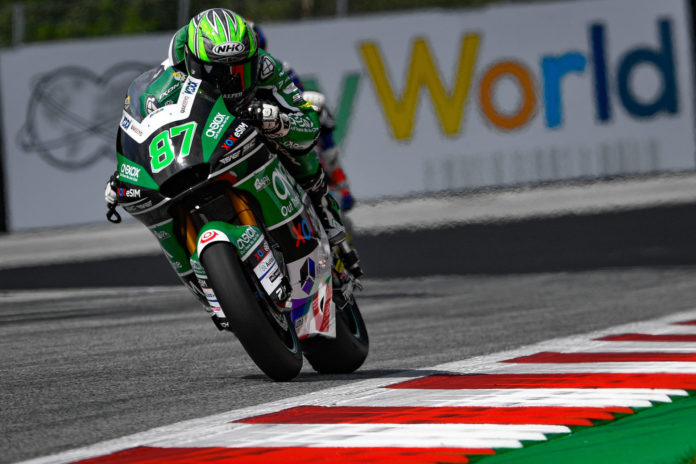
ESPARGARÓ, SAVADORI AND SMITH WITH APRILIA RACING IN THE 2021 SEASON
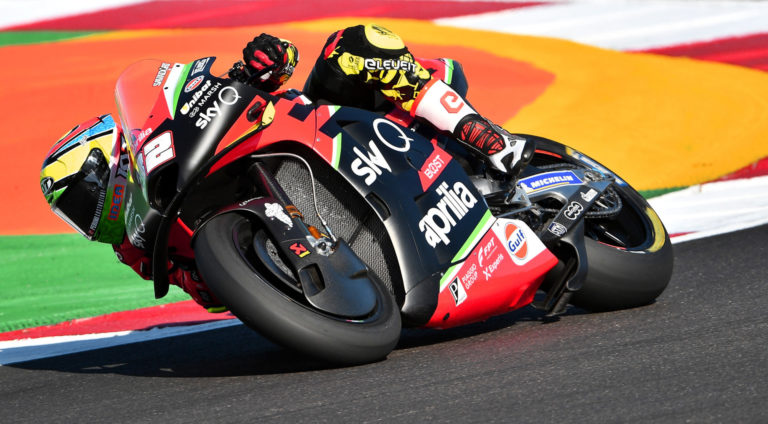
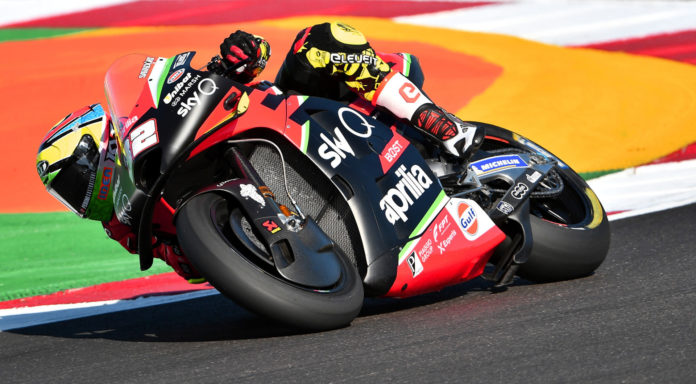
Aleix Espargaró, Lorenzo Savadori and Bradley Smith will be the Aprilia Racing riders for the 2021 MotoGP World Championship season.
The forced loss of Andrea Iannone, and above all, the vast amount of time his ordeal took, severely damaged Aprilia Racing, whose only “fault” was remaining loyal to their rider and rightfully trusting in reasonable times for the conclusion of the proceedings.
Over the last few weeks, the names of several riders have been associated with Aprilia Racing, as always happens in the negotiating phase. Some of the possibilities evaluated did not come to fruition independently of Aprilia Racing’s desires, so between the situations that were actually feasible and the possibility of continuing with the three riders who rode the RS-GP this season, the latter was chosen.
Given the clear growth of the RS-GP, which was improved in every area and continued to improve significantly in the final part of the season, this will provide continuity to the project for the upcoming season, which will be crucial in preparing for the subsequent five-year period, during which Aprilia intends to put more bikes on the track and implement a rider search and assessment policy.
MASSIMO RIVOLA – APRILIA RACING CEO
“It’s no secret that we offered three young riders an opportunity because we felt that our project could be very interesting for talented young riders, but they did not yet feel ready for the leap and, at the same time, the teams that have already signed them for the 2021 season preferred to keep them. We respectfully acknowledge their decision. We prefer to continue with our riders, rather than choosing solutions that are still open but about which we are not entirely convinced. Even in the difficult conditions of this season, particularly penalising for a fledgling project, the bike improved greatly and significantly reduced the gaps both in the races and in practice on basically all the circuits. Aleix finished on a high note and, even in the race yesterday, was lapping with the same times as the leaders. Lorenzo has also shown significant progress in just three races and we know that we can count on Bradley’s professionalism and experience. Aleix will obviously be our top rider. The roles of second rider and test rider will be decided at the end of the winter test schedule.”
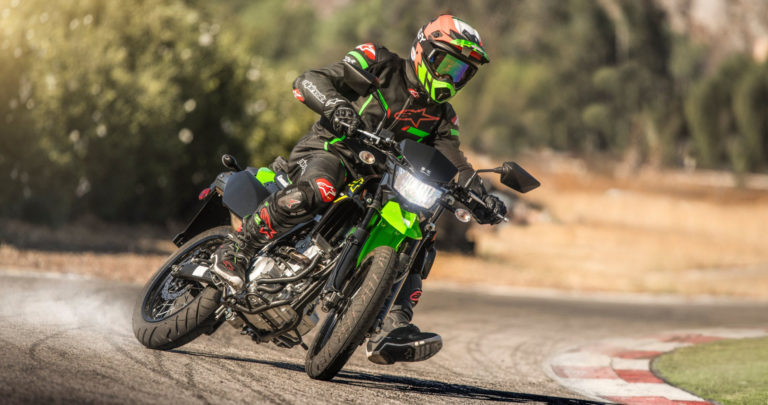
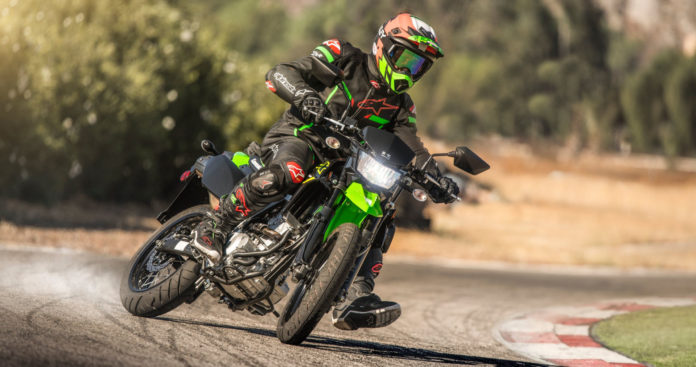
The all-new 2021 KLX®300SM takes the fun to the streets in full supermoto style. Staying true to its roots, the all-new KLX300SM street-focused lightweight supermoto motorcycle comes ready with all the tools necessary to deliver an exciting riding experience. Smooth power delivery and crisp throttle response helps riders maneuver through stop-and-go city traffic, navigate country back roads or experience the exhilaration of supermoto racing at their local track.
The 2021 KLX300SM was developed alongside the KLX®300 dual-sport and features similar DNA, including many shared engine and chassis components. Where the models differ is overall styling and intended use. While the KLX300 dual-sport is equal parts on-road and dirt, the KLX300SM receives a host of supermoto inspired componentry. This includes 17-inch front and rear wheels paired with street tires, supermoto tuned suspension, and aggressive styling. These differences establish the KLX300SM as the ultimate lightweight supermoto.
For riders looking for a sporty model that keeps to the streets, the all-new KLX300SM lightweight supermoto is quick to steal the scene with equal parts performance and attitude. This supermoto’s ability to hold a tight line around a corner will have riders smiling in their helmets, whether riding laps around the track or carving through city traffic.
Kawasaki’s new 2021-model KLX300SM at rest. Photo courtesy Kawasaki Motors Corp., U.S.A.
The liquid-cooled, fuel-injected, DOHC, 292cc single-cylinder engine of Kawasaki’s new 2021-model KLX300SM. Photo courtesy Kawasaki Motors Corp., U.S.A.
ENGINE
The new KLX300SM is powered by a supermoto-inspired 292 cc liquid-cooled DOHC engine with a rewarding spread of power across the rev range. The engine features cam profiles sourced from the KLX®300R off-road model, an electrofusion cylinder and ultra-hard coating in the aluminum cylinder. The result is a crisp throttle response that complements the motorcycle’s rider-friendly low to mid-range and offers improved engine reliability. A lightweight piston, piston pin and connecting rod also contribute to power-producing revs.
The engine has low reciprocating weight thanks to the use of a cam lobe for each valve, with shim-under tappet arrangement, which also contributes to better efficiency during high RPM. With a bore and stroke of 78.0 x 61.2 mm, the engine boasts 292 cc. Rider comfort on longer trips is also increased in part to the engine’s low mounting point, which effectively lowers its center of gravity. A flat piston and pent-roof combustion chamber deliver a 11.1:1 compression ratio.
The fuel injection system contributes to reliable starting in a wide range of conditions and electric start makes firing up the KLX300SM a breeze. Optimized ignition timing and a gear-driven engine balancer also contribute to a smooth engine with an easy to use power delivery, providing maximum rider comfort during long trips.
Several updates to the radiator deliver superior cooling efficiency, including the use of dual radiators and slimmer radiator sizing. An innovative radiator fan cover directs hot air down and away from the rider, significantly increasing comfort when stuck in heavy traffic or riding in warm conditions.
Gear ratios on the new KLX300SM facilitate shifting for optimal performance on and off the race track. The KLX300SM features a honeycomb catalyzer and a secondary air system for cleaner emissions, along with a spark arrester.
CHASSIS & SUSPENSION
The KLX300SM features a box-and-tubular-section high-tensile steel perimeter frame that creates a slim, lightweight package, offering maneuverability and excellent control at the track or on the street. A 26.7-degree caster angle and short wheelbase provide quick handling characteristics, while the high rigidity frame ensures a composed ride. The lightweight, highly rigid aluminum D-section swingarm also contributes to low unsprung weight.
The 43 mm inverted cartridge-style fork handles the suspension up front and comes with compression damping adjustability. A Uni-Trak® suspension can be found on the rear, which offers excellent road holding ability and bump absorption. A gas-charged shock with preload and rebound damping adjustments allows riders to tailor suspension settings to better suit different riding conditions.
BRAKES & WHEELS
Front and rear petal disc brakes on the KLX300SM offer impressive stopping performance with a twin-piston caliper gripping a 300 mm semi-floating disc up front and a single-piston caliper gripping the 240 mm disc in the rear.
The KLX300SM comes fitted with 17-inch front and rear wheels, for plenty of fast-paced riding possibilities. Excellent wheel rigidity contributes to light, smooth handling and offers outstanding durability.
Kawasaki’s new 2021-model KLX300SM at rest. Photo courtesy Kawasaki Motors Corp., U.S.A.
ERGONOMICS
For 2021, the KLX300SM motorcycle receives a narrow handlebar style with comfortable positioning that adds aggressive styling and puts the rider in a relaxed and upright position to deliver an easy to control ride. Footpegs are also positioned closer to the bike’s centerline for an optimal riding position.
Complementing the new KLX300SM adventure capabilities is a fine-tuned seat design for added comfort on longer rides and a 33.8-inch seat height for increased stability when stopped.
INSTRUMENTS & STYLING
The KLX300SM features modern styling that is guaranteed to turn heads in the city and at the track. The new sharp front cowl and headlight design give the bike an aggressive touch. Its rugged design includes a mounted supermoto style rear fender and sharp taillight that contributes to the motorcycle’s bold theme. Additionally, the KLX300SM mirrors have sharp lines contributing to a more modern and aggressive look.
An all-digital instrument panel offers the rider valuable information at a glance. The instrument panel features a digital speedometer, bar-type tachometer, clock, dual trip meters, and a range of warning/indicator lamps.
ACCESSORIES
A handful of Kawasaki Genuine Accessories (KGA) will allow riders to personalize the rugged look of the KLX300SM and offer added convenience. Rear carriers are designed to conveniently secure gear on the back of the motorcycle when it’s time to escape for a quick day trip or overnight adventure.
The accessory hand guards add an aggressive look while also blocking the wind from the rider’s hands. Handlebar pads are also available for an even more aggressive look.
COLORS
The 2021 KLX300SM supermoto model comes in the Lime Green/Ebony and the Oriental Blue/Ebony colorways.
MSRP
$5,999
ABOUT KAWASAKI
Kawasaki Heavy Industries, Ltd. (KHI) started full-scale production of motorcycles over a half century ago. The first Kawasaki motorcycle engine was designed based on technical know-how garnered from the development and production of aircraft engines, and Kawasaki’s entry into the motorcycle industry was driven by the company’s constant effort to develop new technologies. Numerous new Kawasaki models introduced over the years have helped shape the market, and in the process have created enduring legends based on their unique engineering, power, design and riding pleasure. In the future, Kawasaki’s commitment to maintaining and furthering these strengths will surely give birth to new legends.
Kawasaki Motors Corp., U.S.A. (KMC) markets and distributes Kawasaki motorcycles, ATVs, side x sides, and JET SKI® watercraft through a network of approximately 1,100 independent retailers, with close to an additional 7,700 retailers specializing in general purpose engines. KMC and its affiliates
employ nearly 3,100 people in the United States, with approximately 260 of them located at KMC’s Foothill Ranch, California headquarters.
Kawasaki’s tagline, “Let the good times roll.®”, is recognized worldwide. The Kawasaki brand is synonymous with powerful, stylish and category-leading vehicles. Information about Kawasaki’s complete line of powersports products and Kawasaki affiliates can be found on the Internet at www.kawasaki.com.
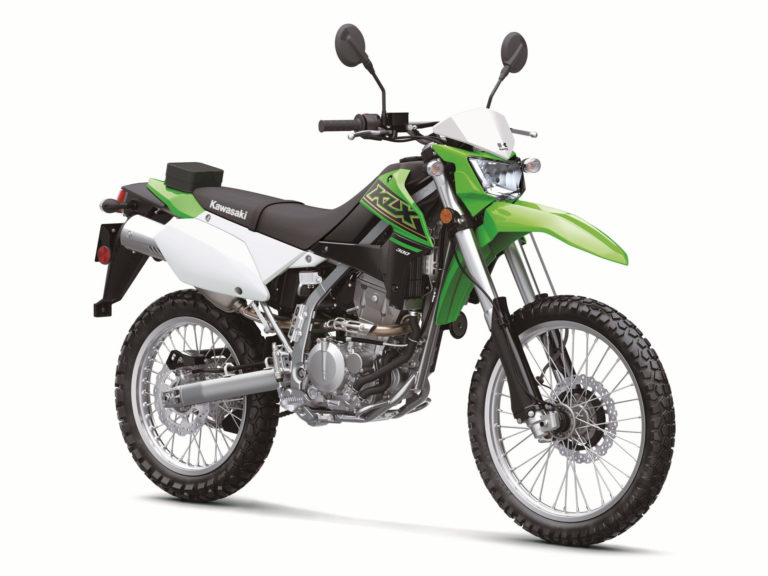
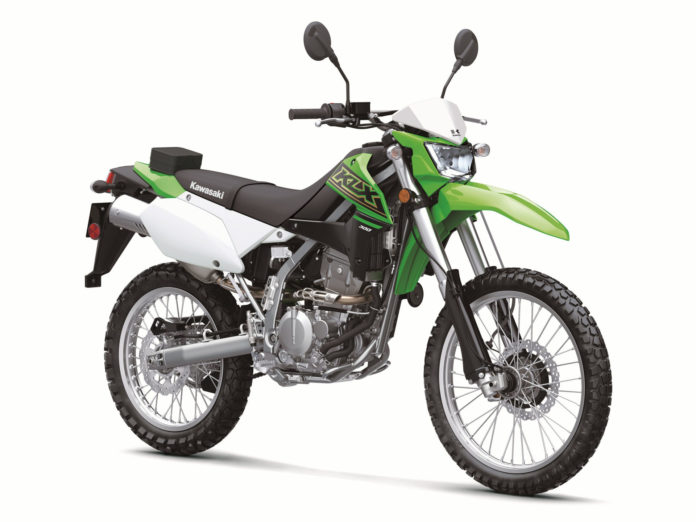
The all-new 2021 Kawasaki KLX®300 motorcycle is designed to provide unlimited on- and off-road fun for riders of all skill levels. Staying true to its roots, the all-new KLX300 lightweight dual-sport motorcycle comes ready with all the tools necessary to deliver an exciting riding experience, taking on paved streets, back roads, wooded trails and beyond.
The new engine on the KLX300 features an easy to use powerband that provides unmatched rider comfort and delivers an exhilarating pull at higher revs. Fitted with a 21-inch front wheel, off-road tires and upgraded suspension, the KLX300 is equally at home navigating city traffic or traversing wooded trails.
2021 KLX300 HIGHLIGHTS
· Powerful fuel-injected 292 cc liquid cooled four stroke engine
· Convenient electric start
· Dual-sport tuned long-travel suspension
· On-road dual-sport versatility
ENGINE
The new KLX300 dual-sport is powered by an enduro-inspired 292 cc liquid-cooled DOHC engine with a rewarding spread of power across the rev range. The engine features cam profiles sourced from the KLX®300R off-road model, an electrofusion cylinder and ultra-hard coating in the aluminum cylinder. The result is a crisp throttle response that complements the motorcycle’s rider-friendly low to mid-range and offers improved engine reliability. A lightweight piston, piston pin and connecting rod also contribute to power-producing revs.
The engine has low reciprocating weight thanks to the use of a cam lobe for each valve, with shim-under tappet arrangement, which also contributes to better efficiency during high RPM. With a bore and stroke of 78.0 x 61.2 mm, the engine boasts 292 cc. Rider comfort on longer trips is also increased in part to the engine’s low mounting point, which effectively lowers its center of gravity. A flat piston and pent-roof combustion chamber deliver a 11.1:1 compression ratio.
The fuel injection system contributes to reliable starting in a wide range of conditions and electric start makes firing up the KLX300 a breeze. Optimized ignition timing and a gear-driven engine balancer also contribute to a smooth engine with an easy to use power delivery, providing maximum rider comfort during long trips.
Several updates to the radiator deliver superior cooling efficiency, including the use of dual radiators and slimmer radiator sizing. An innovative radiator fan cover directs hot air down and away from the rider, significantly increasing comfort when stuck in heavy traffic or operating in warm riding conditions.
Gear ratios on the new KLX300 facilitate shifting for optimal performance off-road and on. The KLX300 features a honeycomb catalyzer and a secondary air system for clean emissions, along with a spark arrester.
CHASSIS & SUSPENSION
The KLX300 features a box-and-tubular-section high-tensile steel perimeter frame that creates a slim, lightweight package, which offers maneuverability and excellent handling on- or off-road. A 26.7-degree caster angle and short wheelbase provide quick handling characteristics, while the high rigidity frame ensures a composed ride. The lightweight, highly rigid aluminum D-section swingarm also contributes to low unsprung weight.
The 43mm inverted cartridge-style fork handles the suspension up front and comes with compression damping adjustability. A Uni-Trak® suspension can be found on the rear, which offers excellent road holding ability and bump absorption. A gas-charged shock with preload and rebound damping adjustments allows riders to tailor suspension settings to better suit different riding conditions.
BRAKES & WHEELS
Front and rear petal disc brakes on the KLX300 offer impressive stopping performance with a twin-piston caliper gripping a 250 mm disc up front and a single-piston caliper gripping the 240 mm disc in the rear.
The KLX300 comes fitted with a 21-inch front wheel and 18-inch rear wheel, for plenty of off-road possibilities. Excellent wheel rigidity contributes to light, smooth handling and offers outstanding durability.
A 2021 Kawasaki KLX300 in Fragment Camo Gray. Photo courtesy Kawasaki Motors Corp., U.S.A.
ERGONOMICS
The KLX300 dual-sport motorcycle receives a comfortable handlebar position that puts the rider in a relaxed and upright position to deliver an easy to control ride. Footpegs are also positioned closer to the bike’s centerline for an optimal riding position.
Complementing the new KLX300 adventure capabilities is a fine-tuned seat design for added comfort on longer rides and a 35.2-inch seat height for increased stability when stopped.
INSTRUMENTS & STYLING
The KLX300 features modern off-road styling that is guaranteed to turn heads in the city and off the beaten path. The new sharp front cowl and headlight design give the motorcycle an aggressive touch. Its rugged design includes a mounted off-road style rear fender and sharp taillight that contributes to the motorcycle’s bold theme. Additionally, the KLX300 has a more orthodox, round-shaped mirror.
An all-digital instrument panel offers the rider valuable information at a glance. The instrument panel features a digital speedometer, bar-type tachometer, clock, dual trip meters, and a range of warning/indicator lamps.
ACCESSORIES
A handful of Kawasaki Genuine Accessories (KGA) allow riders to personalize the rugged look of the KLX300 and offer added convenience. Rear carriers are designed to conveniently secure gear on the back of the motorcycle when it’s time to escape for a quick day trip or overnight adventure.
The accessory hand guards add an aggressive look while also blocking the wind from the rider’s hands. Handlebar pads are also available for an even stronger off-road look.
COLORS
The 2021 KLX300 dual-sport is available in the Lime Green and the Fragment Camo Gray colorways.
MSRP
$5,599 for Lime Green and $5,799 for Fragment Camo Gray
ABOUT KAWASAKI
Kawasaki Heavy Industries, Ltd. (KHI) started full-scale production of motorcycles over a half century ago. The first Kawasaki motorcycle engine was designed based on technical know-how garnered from the development and production of aircraft engines, and Kawasaki’s entry into the motorcycle industry was driven by the company’s constant effort to develop new technologies. Numerous new Kawasaki models introduced over the years have helped shape the market, and in the process have created enduring legends based on their unique engineering, power, design and riding pleasure. In the future, Kawasaki’s commitment to maintaining and furthering these strengths will surely give birth to new legends.
Kawasaki Motors Corp., U.S.A. (KMC) markets and distributes Kawasaki motorcycles, ATVs, side x sides, and JET SKI® watercraft through a network of approximately 1,100 independent retailers, with close to an additional 7,700 retailers specializing in general purpose engines. KMC and its affiliates employ nearly 3,100 people in the United States, with approximately 260 of them located at KMC’s Foothill Ranch, California headquarters.
Kawasaki’s tagline, “Let the good times roll.®”, is recognized worldwide. The Kawasaki brand is synonymous with powerful, stylish and category-leading vehicles. Information about Kawasaki’s complete line of powersports products and Kawasaki affiliates can be found on the Internet at www.kawasaki.com.
2021 KAWASAKI Z H2 SE MOTORCYCLE SUPERCHARGED SPECIAL EDITION
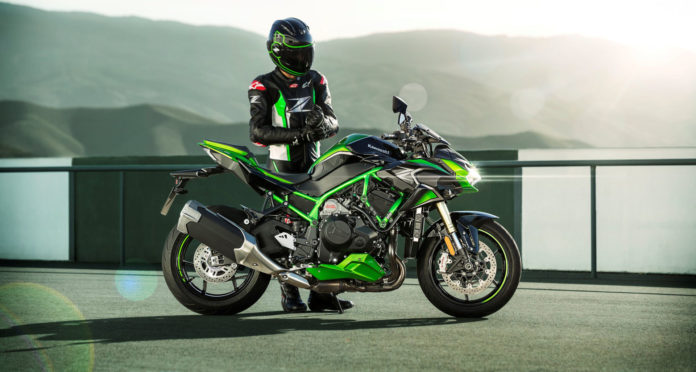
Kawasaki’s flagship model of the Z line of naked motorcycles just got better as the 2021 Z H2 SE adds a smoother ride and more stopping power to the already innovative Z H2 package.
While retaining the ultimate combination of outright power and controllability, the new 2021 Kawasaki Z H2 SE comes equipped with Kawasaki Electronic Control Suspension (KECS). The new electronic suspension also features Showa’s Skyhook technology, delivering a smoother ride, which contributes to increased comfort and enjoyment. Complementing the high-tech suspension are premium Brembo® front brake components, which add to even greater stopping power and control.
The Z H2 SE was developed to deliver supercharged power, a chassis that provides superb maneuverability, daily comfort, and a host of advanced features designed for maximum functionality. The Kawasaki Z H2 SE is a truly unique motorcycle and offers a glimpse of the future.
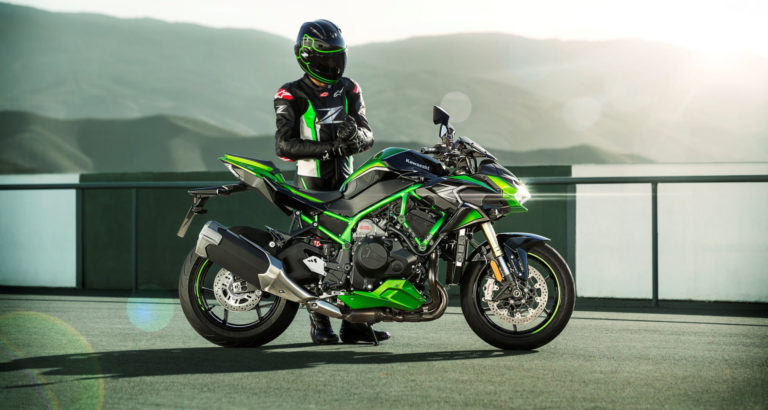
A 2021-model Kawasaki Z H2 SE. Photo courtesy Kawasaki Motors Corp., U.S.A.
Highlights of the 2021 Z H2 SE
· NEW Kawasaki Electronic Control Suspension with Skyhook EERA Technology
· NEW Brembo® Stylema Monobloc Brake Calipers and Brembo Front Brake Master Cylinder
· Powerful 998cc Balanced Supercharged Engine
· Dog-Ring Transmission
· Specially Designed, Lightweight Trellis Frame
· High-Performance Showa Suspension Components
· Aggressive Sugomi™ Styling and Minimalist Bodywork
· LED Lighting
· All-Digital TFT Color Instrumentation
· Smartphone Connectivity via RIDEOLOGY THE APP
· State-of-the-Art Electronics
The 2021-model Kawasaki Z H2 SE comes with new Kawasaki Electronic Control Suspension with Showa Skyhook EERA Technology. Photo courtesy Kawasaki Motors Corp., U.S.A.
Suspension
The 2021 Z H2 SE features KECS, Kawasaki’s semi-active electronic suspension system, which adapts to road and riding conditions in real-time, providing the ideal amount of damping by combining high-level mechanical components with the latest electronic control technology; KECS balances suppleness for daily commuting with firm damping to facilitate more sporty riding.
Showa’s Skyhook EERA (Electronically Equipped Ride Adjustment) technology offers an even more composed ride. Damping is adjusted electronically to suit vehicle speed and suspension stroke speed. Deceleration is also taken into account, allowing the pitching that occurs under braking to be managed. Showa’s Skyhook software was carefully fine-tuned by Kawasaki engineers to ensure the Z H2 SE’s sporty riding character remained, delivering a smoother ride as it continually adapts to the road surface in real-time. The Skyhook concept imagines a hook supporting the motorcycle’s sprung weight and modulates the suspension’s damping force to allow the wheels to track the dips and bumps encountered while maintaining the motorcycle’s vertical position with minimal disturbance. In Rain Mode, the Skyhook software reduces pitching, steering remains light, and the machine feels more planted by also taking into account vertical acceleration and pitch rate (each confirmed every 10 ms) when determining the damping force required.
The mechanical components are controlled via a solenoid valve with direct (single-stage) actuation. This results in a rapid reaction time of one millisecond, which is much quicker than systems that rely on step-motors or those that use pilot valves (two-stage actuation), which slow the system’s responsiveness. The quick reaction time gives the KECS system a more natural feeling and is ideal for sport riding applications, where real-time reaction to bumps and gaps in the road surface enable superior riding comfort.
The built-in stroke sensors on both the fork and rear shock provide real-time stroke speed and position information. The sensor coils provide input to the KECS ECU every millisecond and are complemented by information provided by the IMU (vehicle acceleration/deceleration), the FI ECU (front/rear wheel speed), and the ABS ECU (front brake caliper pressure) every 10 milliseconds. The KECS ECU then directs current to the solenoids to adjust damping as required by the situation.
The Z H2 SE uses a sporty 43 mm Showa SFF-CA (cartridge) fork and a high-spec BFRC lite rear shock and base damping character set according to the integrated Riding Mode (Sport, Road, Rain, Rider (manual)) selected. KECS then adjusts to the road surface environment in real-time to provide the ideal damping, taking into account vehicle speed, stroke speed and deceleration.
KECS is also monitored by Kawasaki’s advanced IMU-enhanced electronics package joining KTRC, KLCM, and KIBS, KECS as inputs for KCMF (Kawasaki Cornering Management Function) which incorporates multiple engine and chassis systems to facilitate smooth cornering.
The 2021-model Kawasaki Z H2 SE comes with new Brembo braking components, including new Stylema monoblock front brake calipers. Photo courtesy Kawasaki Motors Corp., U.S.A.
Brakes & Wheels
Also new on the Z H2 SE is a premium spec Brembo front brake package which includes Stylema monobloc calipers and a Brembo front master cylinder and steel-braided lines, offering stronger braking performance and enhanced control. The Stylema calipers are lighter, with smaller external dimensions and have less volume around the pistons and brake pads, enabling a more direct response. The Stylema calipers also cool rapidly, thanks to increased airflow around the brake pads, pistons and an opening that allows air to exit from the central bridge.
The lightweight 17” wheels are equipped with Pirelli Diablo Rosso III tires, front and rear. The front tire is a 120/70ZR17 M/C 58W; the rear tire is a 190/55ZR17 M/C 75W.
Engine
The Z H2 SE motorcycle’s balanced supercharged engine is the product of Kawasaki Group technology, designed in-house not only by the Motorcycle and Engine Company, but also with collaboration from the Aerospace Systems Company, Energy System and Plant Engineering Company, and Corporate Technology Division. Kawasaki created a supercharged engine with high output, yet manageable power delivery. The water-cooled DOHC 4-valve parallel 4-cylinder 998cc supercharged engine of the Z H2 SE is tuned to showcase high-performance throughout the rpm range. Its broad powerband creates optimal low-mid range torque for light handling and all-out supercharged performance on the top end. Smooth acceleration in the low to mid rpm range was achieved by shortening the second reduction ratio and optimizing the valve timing. In the chamberless exhaust system, an increase in the manifold assembly’s tube length further improves the output in the low to mid-rpm range output. Where torque is more apparent, in the low to mid-rpm range, the supercharged engine emphasizes easy-to-handle throttle response and smooth acceleration, while in the high-rpm range as the speed increases, the power from the supercharged engine is brought to the forefront. The Z H2 SE also features a ram air intake. The air duct provides a clean path for air flowing linearly from the ram air intake to the supercharged engine, contributing to higher performance.
The street specific Z H2 SE supercharger design and tuning were developed by Kawasaki Heavy Industries, Ltd. (KHI), showcasing the in-house knowledge of forced induction engine performance. The supercharger’s high efficiency and minimal heat gain meant an intercooler was unnecessary, allowing savings in both weight and space. The supercharger is located centrally in the best position to distribute the compressed air to all four cylinders evenly.
The supercharger is driven by a planetary gear train, which runs off the crankshaft. The gear train increases the impeller speed up to 9.2x the crank speed (1.15x step gear with an 8x planetary gear).
Transmission
The Z H2 SE uses a dog-ring transmission that has been developed through feedback from the Kawasaki Racing Team and utilizes optimal gear ratios for street performance. Rather than shifting the gears into place, the gears in this configuration stay in place, with the lightweight dog-rings moving to engage the gears. This design allows the shifting effort to be lighter and shorter for quicker acceleration.
Assist & Slipper Clutch
Complementing the transmission is an Assist & Slipper clutch, race-inspired technology that offers both a back-torque limiting function as well as a light feel at the lever.
The Assist function is noticed by the lighter pull at the clutch lever, helping to reduce rider fatigue, especially in stop and go traffic situations.
The Slipper function is noticed when excessive engine braking occurs as a result of quick or accidental downshifts. The slipper cam comes into play, forcing the clutch hub and operating plate apart, which relieves pressure on the clutch plates to reduce back-torque and help prevent the rear tire from hopping and skidding.
A 2021-model Kawasaki Z H2 SE. Photo courtesy Kawasaki Motors Corp., U.S.A.
Chassis
A specially designed, lightweight trellis frame delivers both light handling and excellent composure. The chassis offers excellent maneuverability while harnessing the massive supercharged power of the Z H2 SE engine. The compact naked model frame has a high-level of balance between flexibility and toughness so that you can ride on a variety of roads.
The high-tensile steel frame utilizes wheelbase and caster angle dimensions that showcase the light, sporty handling unique to the Z H2 SE. By achieving the desired riding position and center of gravity, the frame and suspension of the Z H2 SE performs well across a range of speeds.
A double-supported swingarm style was chosen for the Z H2 SE, similar to those found on Kawasaki supersport models. It offers the high rigidity and lightweight construction necessary for high performance. The swingarm mounting plate is located on the back of the engine, enabling it to play the role of a cross member in the frame, contributing to rigidity and weight reduction.
Ergonomics
A relaxed riding position has been created by a combination of an upright handlebar shape and a seat with an optimized base plate and cushion thickness. This design provides a high degree of freedom for riding posture and low vibration, allowing for a pleasant and comfortable ride. Adding to the Z H2 SE motorcycle’s comfort and strength is a fat-type handlebar and handle switches.
Electronics & Rider Aids
The strength of Kawasaki’s cutting-edge electronics has always been the highly sophisticated programming that uses minimal hardware to give the ECU an accurate real-time picture of what the chassis is doing and what the rider wants, to best support the rider’s inputs with a natural feel. Using the latest evolution of Kawasaki’s advanced modeling software, including input from a compact Bosch IMU (Inertial Measurement Unit), Kawasaki Cornering Management Function (KCMF) monitors engine and chassis parameters throughout the corner to assist riders in holding their intended line through the corner. The Z H2 SE utilizes the input from multiple sensors to optimize ride quality via the Kawasaki Traction Control (KTRC), Kawasaki Launch Control Mode (KLCM) and the Kawasaki Intelligent Anti-Lock Braking System (KIBS).
Electronic Cruise Control
The Z H2 SE is equipped with electronic cruise control, which improves overall comfort for those long days on the road. The cruise control system enables riders to set and maintain their desired speed with the simple press of a button. Once activated, the rider does not have to constantly apply the throttle to maintain speed. The cruise control helps to reduce rider fatigue when traveling on open roads, allowing the rider to relax and enjoy cruising, contributing to a high level of riding comfort.
KQS (Kawasaki Quick Shifter)
The Z H2 SE features a highly reliable contactless-type quick shifter that allows for ultra-quick, full power upshifts and seamless acceleration. The system detects that the shift lever has been actuated and sends a signal to the ECU to cut ignition so that the next gear can be engaged for clutchless shifting.
Power Mode Selection
Riders can set power delivery to suit conditions and/or preference, choosing from Full, Middle and Low. Middle Power is 75% of Full Power, while Low Power is 50% of Full Power.
Styling
The styling of the Z series flagship Z H2 SE has been shaped according to the Sugomi design concept and the minimalist bodywork that Kawasaki’s Z series lineup of motorcycles is known for. Sugomi describes the unique aura that radiates from beings possessing compelling presence and unrivaled power. Featuring a low crouching stance and the asymmetry of the air intake duct installed on the left side of the vehicle body, the Z H2 SE intensely and aggressively emphasizes the identity of Sugomi design. Only the air intake duct and the under cowl are asymmetrical; all other design work represents accurate symmetry, giving the Z H2 SE a well-balanced and highly harmonious design.
The supercharger housing is visible from the outside thanks to the naked model concept that does not have a cowl covering the motorcycle’s body. Providing a glimpse of the supercharger between the frame makes for a more impressive appearance.
The Z H2 SE is equipped with an LED headlight and taillight. The bulbs’ low power consumption and high durability improve maintainability while providing high-light intensity and high illumination with a clean headlight beam spread. The frame-mounted headlamps also influence the styling around the front and create an innovative look that is different from previous naked models.
TFT Color Instrumentation
The 4.3” all-digital TFT color instrumentation gives the cockpit of the Z H2 SE motorcycle a high-tech, high-grade appearance. The full-color display features TFT (thin-film transistor) technology and delivers a high level of visibility. Display functions include: digital speedometer, gear position indicator, shift indicator, odometer, dual trip meter, fuel gauge, remaining range, current/average fuel consumption, outside temperature, coolant temperature, clock, Economical Riding Indicator, IMU indicator, KIBS indicator, boost pressure and boost temperature.
RIDEOLOGY THE APP
Kawasaki continues to offer its Z lineup the addition of Bluetooth® Smartphone Connectivity. A chip built into the instrument panel enables riders to connect to their motorcycle wirelessly. Using RIDEOLOGY THE APP*, several instrument functions can be accessed, logged, and reviewed, contributing to an enhanced motorcycling experience. The following information can be viewed:
1. Vehicle Info
· Check latest status update
2. Riding Log
· Can be logged in detail and played back for review
· Route, Distance & Time travelled can be logged for review
· Riding conditions can be recorded in detail
3. Telephone Notifications
· Provides a notification on the dash when a call or mail is received by smartphone
4. Tuning
· General instrument display setting changes can be made on your smartphone
· Kawasaki Riding Management modes can be set
The app can also be used when away from the motorcycle. When riding (with the app ON), the bike and smartphone are always connected and riding log data is being recorded by the app. After the ride is complete, the latest riding information is stored by the app and may be viewed on the smartphone. Any changes made via the app while the engine is off, or while out of range, will be implemented as soon as the ignition is turned on and the smartphone is in range with the app ON.
* RIDEOLOGY THE APP is not intended for use during vehicle operation. Only use RIDEOLOGY THE APP when the vehicle is not being operated and it is safe to do so.
Colors
The 2021 Kawasaki Z H2 SE motorcycle is available in Golden Blazed Green/ Metallic Diablo Black.
MSRP
$19,700
ABOUT KAWASAKI
Kawasaki Heavy Industries, Ltd. (KHI) started full-scale production of motorcycles over a half century ago. The first Kawasaki motorcycle engine was designed based on technical know-how garnered from the development and production of aircraft engines, and Kawasaki’s entry into the motorcycle industry was driven by the company’s constant effort to develop new technologies. Numerous new Kawasaki models introduced over the years have helped shape the market, and in the process have created enduring legends based on their unique engineering, power, design and riding pleasure. In the future, Kawasaki’s commitment to maintaining and furthering these strengths will surely give birth to new legends.
Kawasaki Motors Corp., U.S.A. (KMC) markets and distributes Kawasaki motorcycles, ATVs, side x sides, and JET SKI® watercraft through a network of approximately 1,100 independent retailers, with close to an additional 7,700 retailers specializing in general purpose engines. KMC and its affiliates employ nearly 3,100 people in the United States, with approximately 260 of them located at KMC’s Foothill Ranch, California headquarters.
Kawasaki’s tagline, “Let the good times roll.®”, is recognized worldwide. The Kawasaki brand is synonymous with powerful, stylish and category-leading vehicles. Information about Kawasaki’s complete line of powersports products and Kawasaki affiliates can be found on the Internet at www.kawasaki.com.
2021 KAWASAKI NINJA® ZX™-10R and NINJA® ZX™-10RR SPORTBIKES
FACE YOURSELF
Kawasaki’s Ninja® line of liter class superbike motorcycles has been amassing record after record in the FIM Superbike World Championship (WorldSBK), including carrying Kawasaki to seven championship winning performances since 2013, The Kawasaki Racing Team (KRT) continues to set the bar high in the pinnacle of road racing around the globe and their unmatched success on the racetrack has allowed Kawasaki to continue delivering the racetrack precision of its sportbikes to the street.
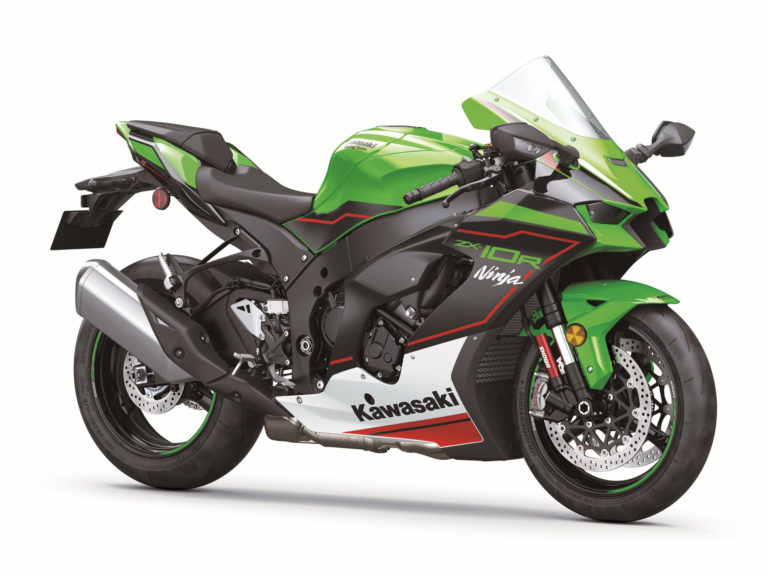
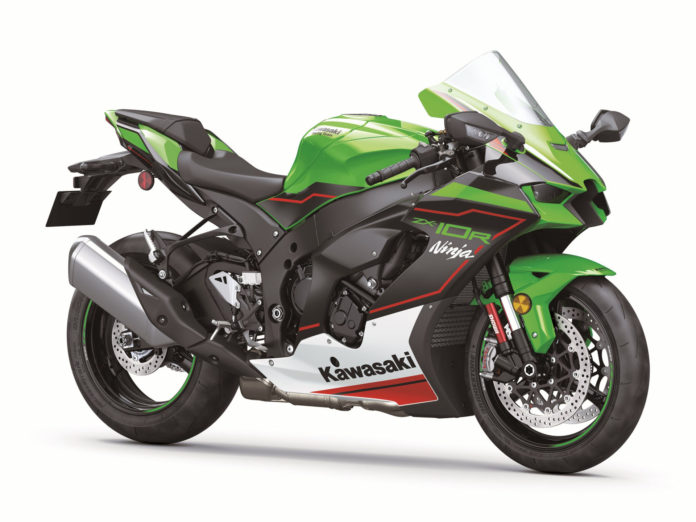
The new 2021 Ninja ZX-10R, Ninja ZX-10R KRT Edition and Ninja ZX-10RR are built for those who rise to the challenge: all new aerodynamic body with integrated winglets, small and light LED headlights, TFT color instrumentation, and Smartphone Connectivity plus high-tech updates derived right from the KRT. Kawasaki engineers have made several changes to the engine and chassis for 2021.
2021 NINJA® ZX™-10R HIGHLIGHTS
· NEW Updated Engine and Air-cooled Oil Cooler
· NEW Light Handling Chassis
· NEW Suspension Settings
· NEW Next Generation Aerodynamic Ninja Styling featuring Intergrated Winglets
The engine of the 2021 Ninja ZX-10R receives several updates for 2021 to offer cleaner emissions and maintain the performance of its predecessor. The 998cc in-line four-cylinder 16-valve engine balances stunning power with manageability. Positioning peak torque high up in the RPM range makes it easier for riders to get back on the throttle with confidence, while a strong low-mid range further contributes to acceleration when coming out of corners.
Utilizing feedback derived directly from Kawasaki’s factory WorldSBK team, state-of-the-art machining technology is used in the design of the intake ports, which is done in two stages to create a straighter path for intake air as it enters the combustion chamber. This design promotes smoother flow and greater volume of fuel-air mixture, both greatly contributing to performance. The finger-follower valve train designed by Kawasaki’s World Superbike engineers brings top-level racing technology to the Ninja ZX-10R platform. The valve train design enables tuning for a higher rev limit and more aggressive cam profile, aiding in high RPM performance. A Diamond-Like Carbon (DLC) coating is used on the finger-followers and helps protect against wear.
Titanium intake and exhaust valves ensure high heat resistance and low reciprocating weight. The cylinder head provides plenty of camshaft clearance and large coolant passages in the cylinder contribute to cooling performance for optimum performance. Lightweight chromoly camshafts received a soft nitriding treatment and the cam portions receive a lapping treatment to ensure the durability needed to handle the stiff valve springs and high power cams and speed of the Ninja ZX-10R sportbike. The pistons are made from a superb high heat resistance material and a dry film lubricant on the piston skirts reduces friction at low RPM and helps with the piston bedding-in process.
Kawasaki’s fully electronic throttle actuation system enables the ECU to control the volume of both fuel and the air delivered to the engine. Ideal fuel injection and throttle valve position results in a smooth, natural engine response and an optimized engine output. The accelerator position sensor was relocated for 2021, eliminating the throttle cable for less maintenance and freeing up the cockpit. To ensure a natural feel, friction is used to simulate the feel of a throttle cable.
On the bottom end, the crankshaft features low inertia, benefitting the bike’s overall performance with acceleration, deceleration, and cornering. An offset cylinder matches the crankshaft and results in reduced lateral piston force at the point of maximum cobustion pressure as well as enables the use of lighter pistons. The close-ratio transmission gearing on the Ninja ZX-10R has been revised and optimized for the days at the racetrack. The final gearing has been revised and shorter ratios for first, second, and third gears offer strong low-mid acceleration for quicker corner exits and better off-the-line acceleration.
The 2021 Kawasaki ZX-10R comes with a new air-cooled engine oil cooler. Photo courtesy Kawasaki Motors Corp., U.S.A.
Similar to that found on Kawasaki’s WorldSBK race machine, and new for 2021, is an air-cooled oil cooler that is seen on high-performance models. Instead of re-routing coolant from the radiator to the oil cooler and back to the engine, the new oil cooler is air-cooled and runs independently. This design allows oil to be routed from the left lower crankcase to the oil cooler, where it’s cooled, then returned on the right side. The increased cooling boosts engine performance increases throughout the entire RPM range.
In order to meet emission standards, the exhaust system benefits from several changes that include a revised collector pipe arrangement, which helps maintain the engines power output. For improved performance and cleaner emissions, engineers also moved one of the catalysers further forward and decreased pre-chamber volume while increasing the silencers overall length.
ELECTRONICS
· NEW Integrated Riding Modes
· NEW Electronic Cruise Control
· NEW TFT Instrumentation with Smartphone Connectivity
The 2021 Kawasaki ZX-10R comes with a 4.3-inch TFT full-color display and a host of electronic rider aids. Photo courtesy Kawasaki Motors Corp., U.S.A.
The Ninja ZX-10R continues to pave the way for the liter bike class with its championship proven technology that once again returns for 2021. The list of technology features includes Kawasaki Cornering Management Function (KCMF), Bosch IMU, Sport-Kawasaki TRaction Control (S-KTRC), Kawasaki Launch Control Mode (KLCM), Kawasaki Intelligent anti-lock Brake System (KIBS), Kawasaki Engine Brake Control, Kawasaki Quick Shifter (KQS), Ohlins Electronic Steering Damper and Power Modes. New for 2021 are Integrated Riding Modes, Electronic Cruise Control, TFT Color Instrumentation, and Smartphone Connectivity.
The Integrated Riding Modes now allow for riders to choose from three pre-determined modes (Sport, Road, Rain) or four manual modes (Rider 1-4) and feature the ability for changes to be made while riding through the use of a button located on the left handlebar. A new Electronic Cruise Control is also accessed conveniently from the left side of the handlebar, allowing for desired speed to be selected and it can easily be disengaged by operating the brake lever, clutch lever, brake pedal, closing the throttle completely or when shifting gears.
A new 4.3” all-digital TFT color instrumentation adds to the Ninja ZX-10R’s high-grade appearance with a full color display. Another new feature is smartphone connectivity which allows riders to connect to their motorcycle wirelessly via a Bluetooth® chip built into the instrument panel. Utilizing the smartphone application RIDEOLOGY THE APP, a number of instrument functions can be accessed to enhance the riding experience.
INTEGRATED RIDING MODES
· NEW Pre-Determined and Manual Settings
· NEW Ability to Change Riding Mode while Riding
All-inclusive modes that link S-KTRC and Power Mode allow riders to efficiently set traction control and power delivery to suit a given riding situation. Riders can now choose from three pre-determined modes (Sport, Road, Rain) or four manual modes (Rider 1-4). In the manual Rider modes, each of the systems can be set independently. For 2021, the riding mode can now be changed while riding, using the button located on the left side of the handlebar.
ELECTRONIC CRUISE CONTROL
· NEW Convenient Operation
· NEW Set Speed Adjustment
· NEW Electronic Cruise Control Disengagement
Electronic Cruise Control is standard and heated grips are an optional accessory on the 2021 Kawasaki ZX-10R. Photo courtesy Kawasaki Motors Corp., U.S.A.
Kawasaki’s cruise control system allows a desired speed to be maintained with the simple press of a button. Once activated, it eliminates the need to constantly have to apply the throttle, reducing fatigue on the right hand when riding and extending a high level of comfort. The electronic cruise control is conveniently operated from the left handle and can be engaged by the push of a button. The set speed can be adjusted using the “+” and “-“ buttons. The system can be disengaged several ways, including operating the brake lever, clutch lever, brake pedal or closing the throttle completely.
TFT COLOR INSTRUMENTATION
· NEW High-Grade Color Display
· NEW Display Functions
· NEW Multi-Function Windows
· NEW Shift Lamp
An all-new compact 4.3” all-digital TFT color instrumentation adds to the cockpit’s high-tech, high-grade appearance. The intrumentation now offers several new features that were unavailable on the previous model. The full color display features thin-film transistor (TFT) technolgy, which delivers a high level of visibility to the rider. The screen’s background color is selectable in either black or white and the screen brightness automatically adjusts to suit the available light.
Display functions have been updated to include digital speedometer, digital bar-style tachometer, gear position indicator, throttle application, odometer, dual trip meters, current and average fuel consumption, volume of fuel consumed, low fuel indicator, average speed, total time, coolant temperature, intake air temprature, clock, battery voltage, Kawasaki service reminder, oil change reminder, call and mail indicators (when connected to Bluetooth), and economical riding indicator.
In addition to scrollable multi-function windows, two display modes offer riders a choice of how they want their information presented. Type 1 is easy-to-read, offering a calm layout and substantial amount of information at a glance, while Type 2 was designed with circuit riding in mind and includes important information such as tachometer, current and best lap times, gear position, and is presented graphically. An external race-style shift lamp provides the rider with a highly visible signal to shift up when riding on the circuit.
RIDEOLOGY THE APP
A first for Kawasaki’s Ninja ZX-10R motorcycle is the addition of Bluetooth® Smartphone Connectivity. A chip built into the instrument panel enables riders to connect to their motorcycle wirelessly. Using RIDEOLOGY THE APP*, a number of instrument functions can be accessed, logged, and reviewed contributing to an enhanced motorcycling experience. The following information can be viewed:
1. Vehicle Info
· Check latest status update
2. Riding Log
· Can be logged in detail, and played back for review
· Route, Distance & Time traveled can be logged for review
· Riding conditions can be recorded in detail
3. Tuning
· Vehicle settings changes can be made on your smartphone
· New settings can easily be applied to your bike before riding
· Shift settings can be customized before riding
· Ride Mode & riding support system settings can be preselected before riding
The app can also be used when away from the motorcycle. When riding (with the app ON), the bike and smartphone are always connected and riding log data is being recorded by the app. After your ride, the latest riding information is stored by the app and may be viewed on the smartphone. Any changes made via the app while the engine is off, or while out of range, will be implemented as soon as the ignition is turned on and the smartphone is in range with the app ON.
* RIDEOLOGY THE APP is not intended for use during vehicle operation. Only use RIDEOLOGY THE APP when the vehicle is not being operated and it is safe to do so.
Adding to its impressive list of high-performance features, the Ninja ZX-10R comes equipped with dual direction KQS. The KQS allows ultra quick upshifts and downshifts without the need to use the clutch, resulting in a more enjoyable experience and quicker lap times. Designed for more effective sport riding, KQS can also be used on the street when the engine is above 2500 rpm.
BOSCH INERTIAL MEASUREMENT UNIT (IMU)
The use of Bosch’s IMU allows an additional layer of precision to be added to the already high-level electronics package. IMU enables inertia to be monitored, including acceleration along longitudinal, transverse and vertical axes, plus roll rate and pitch rate are measured. Those measurements are then combined with a sixth axis, yaw, that is calculated by the ECU using the Kawasaki proprietary software to give an ever clearer real-time picture of chassis orientation.
KAWASAKI CORNERING MANAGEMENT FUNCTION (KCMF)
Using the latest evolution of Kawasaki’s advanced modeling software and feedback from a compact IMU that gives an even clearer real-time picture of chassis orientation, KCMF monitors engine and chassis parameters throughout the corner – from entry, through the apex, to corner exit – and when working in conjunction with KIBS modulate brake force and engine power to facilitate a smooth transition from acceleration to braking and back again, and to assist riders in holding their intended line through the corner. The systems that KCMF oversees on the Ninja ZX-10R includes S-KTRC, KLCM, KIBS, and Kawasaki Engine Brake Control.
SPORT-KAWASAKI TRACTION CONTROL (S-KTRC)
· NEW Modes 4 and 5
The S-KTRC featured on the Ninja ZX-10R motorcycle has five modes for riders to choose from that enable optimal performance for a wide range of riding conditions, offering either enhanced sport riding performance or the peace of mind under certain conditions to negotiate a variety of surfaces with confidence. Kawasaki’s advanced modeling software, complemented by input from the IMU, delivers this one of a kind precise control. The system can also be turned off if the rider elects to do so.
KAWASAKI LAUNCH CONTROL MODE (KLCM)
Designed to assist riders by optimizing acceleration from a stop, KLCM electronically manages engine output to maximize acceleration when starting from a stop. With the clutch lever pulled in and the system activated, engine speed is limited to a determined speed while the rider holds the throttle open. Once the rider releases the clutch lever to engage the clutch, engine speed is allowed to increase, but power is regulated to minimize wheel spin and help keep the front wheel on the ground. The system disengages automatically once a predetermined speed has been reached, or when the rider shifts into third gear. Riders can choose from three modes, each offering a progressively greater level of intrusion.
KAWASAKI INTELLIGENT ANTI-LOCK BRAKE SYSTEM (KIBS)
Kawasaki’s supersport-grade brake management system uses high-precision control to regulate brake pressure during sport riding. High-precision brake pressure control enables the system to avoid reduced brake performance due to excessive pressure drops, allowing lever feel to be maintained when KIBS is active, and helps ensure ABS pulses feel smooth The system also reduces rear wheel lift under heavy braking and accounts for engine torque when downshifting.
KAWASAKI ENGINE BRAKE CONTROL
The Kawasaki Engine Brake Control system uses technology derived by KRT to give its riders maximum braking control regardless of gear selection and allows riders to select the amount of engine braking they prefer. When the system is activated, the engine braking effect is reduced, providing less interference when riding on the track.
POWER MODES
Power Modes offer riders an easily selectable choice of engine power delivery to suit riding conditions or preference. In addition to Full Power mode, one (Low) and one (Middle) alternate mode(s) in which maximum power is limited and throttle response is milder are provided.
OHLINS ELECTRONIC STEERING DAMPER
The Ohlins electronic steering damper allows damping characteristics to be changed electronically according to vehicle speed and the degree of acceleration or deceleration. At low speeds, the settings ensure the damping does not interfere with the bike’s intrinsic lightweight handling. At high speeds, damping increases to provide enhanced navigation of road surface conditions.
CHASSIS
· NEW Lower Swingarm Pivot
· NEW Longer Wheelbase
· NEW Front-Rear Balance
Complementing the already highly acclaimed stance of the Ninja ZX-10R chassis are updates to the chassis geometry, which moves the front-rear balance further forward and contributes to increased cornering performance and light handling. The aluminum twin-spar frame traces a direct line from the head pipe to the aluminum swingarm pivot, delivering linear behavior and greater control.
A 2021-model Kawasaki ZX-10R stripped down to show off its new chassis components. Photo courtesy Kawasaki Motors Corp., U.S.A.
New for this year, the swingarm pivot position has been lowered 1 mm to produce better rear suspension action when exiting corners. A longer wheelbase achieved by a greater fork offset and an 8 mm longer swingarm offers even greater overall composure– already a strength on the Ninja ZX-10R. A shorter trail is achieved thanks to the revised fork offset and facilitates in easier change of direction, especially when off the throttle before the apex of a corner.
SUSPENSION
· NEW Lower Triple Clamp
· NEW Front Fork and Shock Settings
Handling the front suspension duties is an advanced Showa Balance Free Front Fork (BFF) that has been developed with technology straight from Kawasaki’s WorldSBK factory racers. The 43 mm Showa fork provides numerous benefits, including ride comfort, braking stability, front-end feel, and independently adjustable compression and rebound damping. The 2021 model features a new wider fork clamping area on the lower triple clamp and revised rigidity balance for the fork outer tubes improve handling and turning performance. New circuit-focused fork settings include a lower spring rate, complemented by firmer compression damping and softer rebound damping to make it easier to weight the front wheel and contribute to lighter handling.
Horizontal back-link rear suspension and a Showa Balance Free Rear Cushion (BFRC) rear shock hold up the rear-end. The Showa BFRC high spec shock increases ride comfort, improves traction, offers independently adjustable compression and rebound damping, and reduces weight. Similar to the front fork, more circuit-focused settings include a stiffer spring rate, complemented by soft compression damping, and softer rebound damping. The revised settings make it easier to induce pitching motion even when on the throttle while maintaining a steady rear height.
BRAKES & WHEELS
· NEW Rear Brake Pads
· NEW Repositioned Rear Brake Reservoir
A pair of 330 mm Brembo semi-floating front discs with dual radial-mount four-piston calipers provide superb braking power and are tasked to handle the stopped duties of the powerful engine. At the rear, a 220 mm disc and single-piston caliper complement the strong front brake and feature revised rear brake pads that offer increased controllability and stronger braking force. The rear brake reservoir has also been repositioned further to the inside in order to give the rider greater freedom of movement as they change position on the bike. Three-spoke design cast wheels are light weight and provide the optimum rigidity to contribute to edge grip when riding on the track.
The cockpit of a 2021-model Kawasaki ZX-10R. Photo courtesy Kawasaki Motors Corp., U.S.A.
ERGONOMICS
· NEW Taller Windshield
· NEW Revised Handlebar Position
· NEW Seat Position
· NEW Taller Footpegs
In order to enhance rider comfort and complement the 2021 Ninja ZX-10R’s aerodynamic package are several updates, beginning with a new, taller windshield that is set at a steeper angle. The wind protection offered by the cowl and windshield translate to reduced stress from wind blast, enabling riders to change positions at ease when setting up for corner entry on the track. A revised handlebar position is now farther forward and straighter. A benefit of having more space between the handlebars and the seat is the ability to change positions for both track and street riding.
An increase of height has been made to the rear of the rider’s seat, encouraging riders to elevate their hips when in a full race crouch position. This position helps minimize drag when tucked behind the windshield. Footpegs are now positioned 5mm higher in order to meet the circuit-focused riding position that engineers sought after. The higher position makes it easier to weight the pegs when going through a corner.
A head-on view of a 2021-model Kawasaki ZX-10R shows its new front fairing with integrated aerodynamic winglets. Photo courtesy Kawasaki Motors Corp., U.S.A.
BODYWORK & STYLING
· NEW Next-Generation Ninja Styling
· NEW Integrated Winglets
· NEW Aerodynamic Riding Position
· NEW LED Headlight, Taillight, and Turn Signals
· NEW RAM Air Intake Design
The Ninja ZX-10R’s new styling package was designed with aerodynamic performance at the top of mind. The sleek, racy looks offer significantly improved drag resistance, an increase in downforce, and better wind protection for the rider. A new aerodynamic upper cowl contributes to the bike’s racing look and together with the taller windshield, helps to reduce drag. The new LED headlights are positioned on the underside of the upper cowl and are not visible from the rider’s point of view. The LED lamp is flush fit and contributes to the cowl’s aerodynamic performance.
The RAM air intake – a Ninja supersport trademark – has a new, more compact shape and the cowl’s design directs air towards the intake for efficiency. The cowl features built in winglets that generate significant downforce to help keep the front wheel on the ground when exiting corners and under strong acceleration. Openings are used in the side of the cowl to dissipate engine heat, directing hot engine air away from the rider’s knees. The lower cowl design helps direct air to the oil cooler, increasing its efficiency and adding to the aerodynamic characteristics.
New cowl-mounted mirrors feature integrated LED-type single bulb turn signals and are mounted via couplers. New LED rear turn signals complete the all-LED lighting package on the Ninja ZX-10R. Slots in the new tail cowl design contribute to the aerodynamic styling.
An illustration showing the aerodynamics of a 2021-model Kawasaki ZX-10R KRT Edition. Photo courtesy Kawasaki Motors Corp., U.S.A.
KAWASAKI RIVER MARK
· NEW 3D River Mark Emblem on the Upper Cowl
· NEW River Mark on the Upper Triple Clamp
In recognition of Kawasaki’s special achievement in the World Superbike Championship, special permission was granted to use the river mark on the Ninja ZX-10R. This marks the first time that the river mark has been used on a non-supercharged mass-production motorcycle. The 3D river mark emblem is proudly displayed on the upper cowl and upper triple clamp.
ACCESSORIES & RACE KIT PARTS
· NEW Grip Heaters
A number of Kawasaki Genuine Accessories (KGA) can be found available for riders to personalize their Ninja ZX-10R motorcycles. For 2021, new grip heaters have been added to the accessories list, enhancing street riding comfort on cold days. Marchesini forged aluminum wheels, which come as standard equipment on the Ninja ZX-10RR motorcycle, are offered for and fit on the Ninja ZX-10R. Necessary parts such as front brake discs and speed sensor ring are available via accessory kits.
Additional accessories for the Ninja ZX-10R include seat cowl, knee pads, frame sliders, axle sliders, and scratch resistant film for the TFT meter.
For riders focused on closed circuit riding, a number of race kits parts are available and help assist in building the Ninja ZX-10R and Ninja ZX-10RR to full superbike spec. The smallest details can be addressed with factory parts to help lower lap times on the racetrack. From a race kit ECU to multiple thickness plain bearings and trust washers for engine blue printing to factory catch tanks and chassis geometry adjusters, KGA is there to support racers.
A 2021-model Kawasaki Ninja ZX-10RR racing homologation special. Photo courtesy Kawasaki Motors Corp., U.S.A.
KAWASAKI NINJA® ZX™ – 10RR HIGHLIGHTS
· NEW Elimination of Intake Funnels
· NEW Camshafts
· NEW Intake and Exhaust Valve Springs
· NEW Pankl High-Performance Parts
· NEW Pirelli Diablo™ Supercorsa SP Tires
· Marchesini Forged Wheels
For 2021, in addition to the many engine, suspension, and chassis changes shared with the Ninja ZX-10R motorcycle, the basis for the World Championship winning superbike is the Single-seat Ninja ZX-10RR model which features several special updates that were developed through Kawasaki’s racing efforts in WorldSBK. The wide powerband further strengthens the easy-to-use character found on the Ninja ZX-10RR and a quicker engine response was also achieved with the engine updates.
The big differences between a 2021 Kawasaki ZX-10R and a ZX10RR are the camshafts, pistons, valve springs, connected rods, and forged aluminum wheels (not pictured). Photo courtesy Kawasaki Motors Corp., U.S.A.
The engine updates add a tremendous racing potential including the elimination of intake funnels in the airbox, newly designed camshafts specific for the Ninja ZX-10RR, and intake and exhaust valve springs that all match the higher performance. The use of lightweight titanium connecting rods manufactured by Pankl, a company specializing in developing and manufacturing engine and drivetrain components for high-performance race cars and the aerospace industry, is one of the key performance features found on the Ninja ZX-10RR. New, lighter weight pistons lower the reciprocating weight, aiding in the high rev limit and contributing to smooth-climbing revs. Now using one less piston ring than the standard model pistons, this enables a shorter piston height and prevents mechanical loss due to friction. Updated piston pins match the pistons and feature a DLC coating that protects against wear.
The 2021 Ninja ZX-10RR features new Pirelli Diablo™ Supercorsa SP tires that are fitted to forged Marchesini wheels that were designed to specifically meet the needs of the powerful engine. It’s available in a bold paint scheme in Lime Green.
A comparison of the power outputs of the 2021-model Kawasaki ZX-10R and the ZX-10RR. Image courtesy Kawasaki Motors Corp., U.S.A.
A comparison of the power outputs of a standard 2021-model Kawasaki ZX-10RR and a ZX-10RR outfitted with Kawasaki Genuine Accessories Race Kit parts. Image courtesy Kawasaki Motors Corp., U.S.A.
COLORS
The 2021 Ninja ZX-10R motorcycle is available with or without ABS in both color options of Metallic Spark Black/Metallic Matte Carbon Gray and the KRT Edition in Lime Green/Ebony/Pearl Blizzard White. The Ninja ZX-10RR model is available in Lime Green.
Kawasaki Heavy Industries, Ltd. (KHI) started full-scale production of motorcycles over a half century ago. The first Kawasaki motorcycle engine was designed based on technical know-how garnered from the development and production of aircraft engines, and Kawasaki’s entry into the motorcycle industry was driven by the company’s constant effort to develop new technologies. Numerous new Kawasaki models introduced over the years have helped shape the market, and in the process have created enduring legends based on their unique engineering, power, design and riding pleasure. In the future, Kawasaki’s commitment to maintaining and furthering these strengths will surely give birth to new legends.
Kawasaki Motors Corp., U.S.A. (KMC) markets and distributes Kawasaki motorcycles, ATVs, side x sides, and JET SKI® watercraft through a network of approximately 1,100 independent retailers, with close to an additional 7,700 retailers specializing in general purpose engines. KMC and its affiliates employ nearly 3,100 people in the United States, with approximately 260 of them located at KMC’s Foothill Ranch, California headquarters.
Kawasaki’s tagline, “Let the good times roll.®”, is recognized worldwide. The Kawasaki brand is synonymous with powerful, stylish and category-leading vehicles. Information about Kawasaki’s complete line of powersports products and Kawasaki affiliates can be found on the Internet at www.kawasaki.com.
CSBK Confirm 2021 Canadian National Roadracing Championship Dates
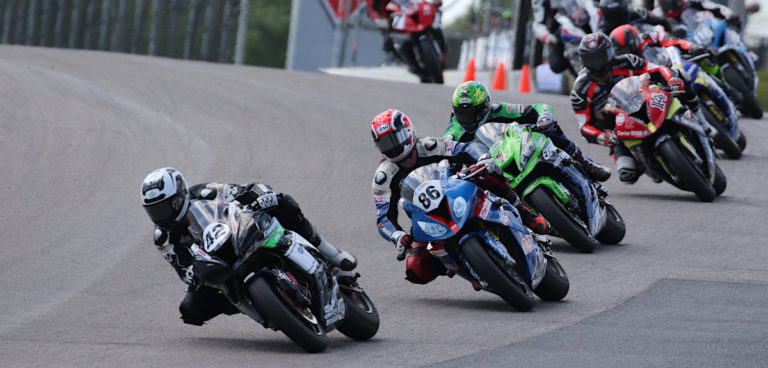
Toronto, ON – Canadian National Superbike Championship Organizers Professional Motorsports Productions of Toronto, ON, have confirmed the initial dates for the 2021 Championship tour for the National roadracing series.
After delays and restrictions caused by the ongoing COVID-19 pandemic and related restrictions during 2020, CSBK aim to provide a full schedule of events in 2021, and award National Championships in all five National series available to both Pro and Amateur status racers.
As well, events will be co-hosted by Pro 6 Cycle, organizers of Schools, Track Days and the recently announced inaugural Pro 6 G.P. Regional series based at Calabogie Motorsports Park south west of Ottawa, ON. Pro 6’s participation in the delayed 2020 CSBK Series was crucial in the development of a new format given the issues surrounding the ongoing pandemic.
“2020 was a tough year for everyone in many ways, and we are grateful we could eventually put together a program with Pro 6 to stage events for the 40th anniversary of the Canadian Superbike Championship,” explains series founder Colin Fraser.
“With four Pro Superbike races as our 2020 focus and an eventual five episodes of coverage on TSN, everyone involved in CSBK has learned a lot about how to conduct the events, and we really appreciate the support of our competitors, fans, staff and sponsors. We are well aware the health and safety guidelines might require changes to our plans on short notice next season.
“CSBK and Pro 6 are now working on all the elements of the 2021 National program and have based our plans on an expectation of no or extremely limited spectator participation in 2021, much the same as in 2020. Everyone involved is optimistic about the return of our crowds, but we do not expect that to happen until mid-summer of 2021 at the earliest.
2021 CSBK National Schedule
June 11-13 Grand Bend Motorplex, ON
July 10-11 Calabogie Motorsports Park, ON
July 31-Aug 1 Atlantic Motorsport Park, Shubenacadie, NS
August 14-15 Canadian Tire Motorsport Park, Bowmanville, ON
CSBK also plan to include a fifth event at either the top or the bottom of the 2021 Schedule and ask competitors to be prepared to race as early as late May 2021. The plan for next summer’s race season is to have two Pro Superbike Feature races per event, with a total of ten races counting toward the 2021 National overall Championship and number one plate.
The 2021 series opener marks a return to the traditional Grand Bend date, unavailable last year in the earliest portion of the pandemic. The second round at Calabogie will provide a full National event at the popular circuit for the first time since 2015, based on the success of the 2020 National opener.
The third round of 2021 marks a return to Atlantic Motorsport Park, an event cancelled for 2020 due to the “bubble” restrictions involving Canada’s east coast provinces. The traditional summer event at “Shubie” will again be organized by Pro Cycle in Dartmouth, with support from local racing group the Society of the Atlantic Racing League.
The potential ten race Pro Superbike season would be the longest-ever in the 41-year history of the CSBK Championship, and would be popular with Feature class racers, since more events makes it easier for Championship points contenders to overcome a mechanical or competition issue.
CSBK will compete exclusively with spec Dunlop rubber in 2021, the eight-straight year of support from the famed motorcycle tire supplier.
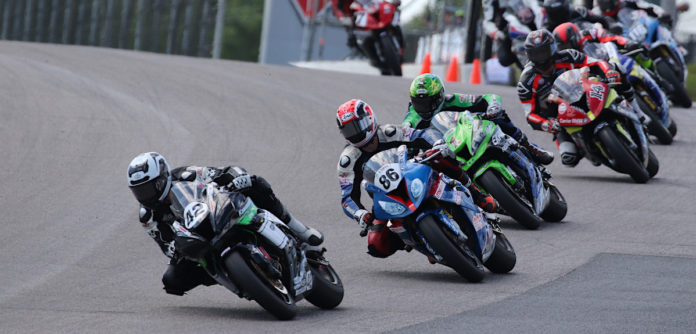
In 2020, Jordan Szoke of Lynden, ON, swept all four Pro Superbike Feature events on the Canada General Warranty-backed works Kawasaki ZX-10R Ninja. This success marked Szoke’s 14 overall Canadian Championship, and his fourth perfect season in the Superbike category. 41-year-old Szoke has confirmed his intent to seek another record-breaking title success in 2021.
Although CSBK did not run an official Championship for the middleweight Pro category in 2020, Sebastien Tremblay of Laval, QC won both the 2020 Liqui Moly Pro Sport Bike CSBK races aboard his Turcotte Performance Kawasaki ZX-6R Ninja. New father Tremblay, the godfather of the Quebec-based racers, is a heavy favorite to take his first Pro Sport Bike crown in 2021.
CSBK had earlier confirmed that many special awards would not be offered in 2020, due to the last minute and abbreviated nature of last summer’s series. This means prestigious opportunities, including the Brooklin Cycle Racing Pro Rookie of the Year, will be “rolled over” into 2021, with races who have made their Pro debut in 2020 and 2021 eligible to compete for the prize.
A kind of magic: Oliveira obliterates the opposition to reign on home turf
The Portuguese rider was off like a shot on his way to premier class win number two, rounding out the season in serious style as Miller gained some revenge on Morbidelli
Sunday, 22 November 2020
Miguel Oliveira (Red Bull KTM Tech 3) took a stunning pole position on Saturday at the Grande Premio MEO de Portugal, putting him in the perfect position to face down his home race with a clear view to Turn 1. And that clear view was never interrupted again once the lights went out as the Portuguese rider rode the race of his life to disappear at the front and decimate the field. Premier class win number two, Tech 3’s second win, another impressive victory for KTM in 2020… and in the first Portuguese Grand Prix since 2012, and the first ever held at Portimão. Sounds like a good Sunday’s work on home turf.
To complete the podium it was another Jack Miller (Pramac Racing) v Franco Morbidelli (Petronas Yamaha SRT) duel, with the Aussie coming out on top this time around and with that securing Ducati the contructors’ crown. Morbidelli’s third place gives him second overall in the Championship and the title of top Independent Team rider in 2020.
Oliveira got the dream start and into Turn 1, it was Portugal’s superstar who led the way. Morbidelli and Miller also got very good getaways from the front row and they both held station, before Miller then tried to get past the Yamaha at Turn 5. The Australian was slightly wide, however, and Morbidelli didn’t hesitate to take it straight back.
At the end of the opening lap, Oliveira already had a lead of over half a second, and he was pulling clear. Meanwhile World Champion Joan Mir (Team Suzuki Ecstar) had got himself on the fringes of the top 10 from P20 on the grid, but then was almost down on Lap 2 at Turn 3. The Majorcan hit the back of Johann Zarco (Esponsorama Racing) at the tight right-hander and was lucky to stay on, Mir then dropping back down to 20th with all the work to do again.
Meanwhile, Oliveira was in the zone. On Lap 3 his lead was up to 1.5 seconds and the Portuguese rider was into the 1:39s, Morbidelli and Miller with no answer. Cal Crutchlow (LCR Honda Castrol) was sitting P4 ahead of Pol Espargaro (Red Bull KTM Factory Racing) and Stefan Bradl (Repsol Honda Team), the KTM rider recovering from a Turn 1 mistake to eventually get the better of Crutchlow on Lap 7.
Oliveira’s lead was now over three seconds. Brilliant, scintillating pace from the Styrian GP winner, and the gap from third place Miller and fourth place Pol Espargaro was 2.7 seconds, with the latter having Crutchlow, Bradl and Zarco right behind him. In the battle for the Constructor crown, it was going the way of Ducati too as Rins was the best-placed Suzuki in P8 – with both Miller and Zarco ahead. On Lap 9, Oliveira struck another fastest lap of the race – a 1:39.855 – and his lead was now creeping up to the four-second mark. But would it last?
Behind him, Pol Espargaro’s podium hopes in his final KTM appearance were slipping away, with Miller gaining in small but important increments to get 3.4 seconds up the road as the Ducati man sat half a second behind Valencia GP nemesis Morbidelli…
The battle for the lower ends of the top 10 was a feisty one too, as Fabio Quartararo (Petronas Yamaha SRT) and Takaaki Nakagami (LCR Honda Idemitsu) were embroiled in an almighty tangle, the Japanese rider eventually getting the better of the Frenchman for P9. Andrea Dovizioso (Ducati Team) and Alex Marquez (Repsol Honda Team) then also passed Quartararo, the early season favourite slipping backwards.
Pol Espargaro was then wide at Turn 8 after almost losing the front on Lap 12, and Crutchlow was back up to P4 but briefly, as it turned out. The KTM struck back. Behind the duo were a whole host of riders: Bradl, Zarco, Rins, Nakagami and Dovizioso, with the three 2020 Yamahas now occupying P13, P14 and P15 – Quartararo leading Maverick Viñales and Monster Energy Yamaha MotoGP teammate Valentino Rossi.
With 12 to go, Oliveira’s lead remained just under the four-second mark. The Portuguese rider was on rails around the rollercoaster and with 11 to go, his advantage did then stretch up to and over four seconds.
Meanwhile, Suzuki’s fading hopes of the Triple Crown took another blow as both Dovizioso and Nakagami slid past Rins, the latter dropping to P10 with Mir still not in the points – P16 for the World Champion at that point. And then, with 10 laps to go, the 2020 World Champion’s race was over. A problem with his GSX-RR saw Mir pull into pitlane and it wasn’t the weekend Mir nor Suzuki would have been planning after an epic season. Rins’ race was also unravelling. The number 42 was fighting to keep all three 2020 YZR-M1s behind him for P12. Rins vs Viñales vs Quartararo vs Rossi for the final points? 2020 has been a crazy year!
Back nearer the front, Miller was still shadowing Morbidelli at just under half a second and there were no such troubles in Ducati’s quest to become Constructor Champions as Miller set his first 1:39 of the race to haunt Morbidelli. With that, the battle for second was now getting properly tasty with eight to go. It was a copy/paste from Valencia between Morbidelli and Miller, but this time it was for P2 as Oliveira had well and truly checked out.
Behind the duo, was nearly seven seconds of clear air ahead of Pol Espargaro. The Spaniard now had breathing space back to a sensational battle for P5 though, with Zarco was leading it from Crutchlow and Dovizioso after his Turn 1 pass on Bradl and Nakagami. Rins was now P14, Triple Crown hopes for Suzuki well and truly out the window and barring a mistake from Morbidelli and an upturn in speed for Rins, P2 in the title was lost as well.
Plunging down the hill with five laps to go, the fight for fifth saw Crutchlow run very wide. The British rider was almost in Lisbon and dropped to P9, just ahead of Aleix Espargaro (Aprilia Racing Team Gresini). It was more Moto3™ than MotoGP™…
7.6 seconds up the road though, Miller was back on the tailpipes of Morbidelli. Three laps remained; Miller following Morbidelli for two races and probably able to write a book on the Italian’s riding style by that point. But still, the number 43 couldn’t get close enough to pounce.
So, onto the last lap of the season we went. Out front, Oliveira had an easy – relatively speaking – run to victory, or at least made it look that way after undoubtedly one of the rides of the season. Behind him, Miller was close, very close, to Morbidelli and, finally, the Austrlian struck.
The move came at Turn 13, Miller through and holding it into Turn 14, turning the tables this time around to get some sweet revenge on the Italian. The podium was decided: Oliveira made more history, Miller secured the Constructors’ crown for Ducati (for the first time since 2007 no less), and Morbidelli took second in the Championship and top Independent Team rider after five podiums… three of them wins.
P4 for Pol Espargaro isn’t the podium or victory that he would have wanted in his KTM swan song, but another great ride sees the number 44 finish 5th in the World Championship. An amazing achievement from Pol, KTM and the whole team in 2020 as the Spaniard now says his goodbyes and heads for Honda. Nakagami bounced back from two crashes this weekend to finish the season on a high with his fourth top five, a strong campaign for the Japanese rider.
Dovizioso had a sterling final half of the race to earn P6 in his final race for Ducati. The Italian ends 2020 P4 in the standings before his 2021 sabbatical, it’s not the podium he’ll have been hoping for but a positive way to end his season. Bradl’s weekend in Portimao was insanely good, a crash in Warm Up was the only mistake he made across the three days. P7 for the HRC test rider beats his Le Mans P8 from this year as the Repsol Honda call-up flew the flag high in the finale.
Aleix Espargaro was another who had awesome late-race pace, the Aprilia man secures his third top 10 of the year with a great effort on the Algarve. Alex Marquez’ impressive rookie year ends with a P9 in Portimao, not quite enough to beat Brad Binder (Red Bull KTM Factory Racing) to the Rookie of the Year crown but nevertheless, the number 73 was an impressive contender in 2020. Binder crashed out of the finale, rider ok. Zarco crossed the line in P10 ahead of his switch from Esponsorama Ducati to Pramac Ducati, the Frenchman getting the better of factory Yamaha duo Viñales and Rossi.
Unfortunately for the Iwata factory, 2020 wasn’t the year they’d have hoped for after their Jerez success. Viñales finishes sixth in the standings, with Rossi’s final factory Yamaha race ending with a P12 in Portimao. The pair edged out Crutchlow as the British rider bows out of full-time racing with a 13th place, a fantastic career coming to an end for the number 35 as he gets ready for a Yamaha test rider role in 2021.
Quartararo was icing his arm at the end of another difficult race, the Frenchman finishing P14 in Portimao and that’s a result that sees El Diablo settle for P8 in the overall standings. Rins slipped right back in the latter stages and takes the final point of 2020, a disappointing end to a great season for the Spaniard who takes the 2020 bronze medal.
Danilo Petrucci (Ducati Team) waves goodbye to Ducati with a P16, Mika Kallio (Red Bull KTM Tech3) and Tito Rabat (Esponsorama Racing) were the two other finishers in Portimao as Rabat also – potentially – wraps up his MotoGP™ career. Lorenzo Savadori (Aprilia Racing Team Gresini) crashed out, Francesco Bagnaia (Pramac Racing) was forced to retire on Lap 1. Contact with Mir at Turn 3 saw the Italian in considerable pain back in the garage.
And so, the curtains are drawn on an incredible 2020 MotoGP™ World Championship. Thank you to the fans watching from home, the partners and broadcasters and promoters and everyone worked to make it possible. We did it, #RacingTogether. Congratulations to Joan Mir on becoming 2020 World Champion, it’s time now to get some well-earned rest and reflect on a challenging year off track… made better by the wonderful spectacle on it.
MotoGP™ podium
1 Miguel Oliveira* – Red Bull KTM Tech 3 – KTM 41:48.163
Miguel Oliveira: “It’s unreal. You know you dream about these kind of races and to finally be able to do it, it’s incredible. I have no words to describe my gratitude to all the people, the crowd watching at home who couldn’t be here today. Thank you! And to my team, this is my farewell to Tech 3 but it’s a great day, that I could give them this victory again, for Tech 3 and and KTM, it’s a huge accomplishment for me. It’s extra special because my family didn’t get to see my first win live and now they get to see it, they’re here and it’s an incredible day for me. Very emotional, and just glad to finish the season on a high and with a strong performance like today.”
#BeastMode engaged: Bastianini wins the 2020 Moto2™ World Championship
Sunday, 22 November 2020
Enea Bastianini. Photo courtesy Dorna.
Enea Bastianini (Italtrans Racing Team) is the 2020 FIM Moto2™ World Champion. The Italian took the crown with fifth place in the Grande Premio MEO de Portugal, enough to finish nine points clear of both Luca Marini (Sky Racing Team VR46) and Sam Lowes (EG 0,0 Marc VDS).
Bastianini began his career on minibikes in Italy before his first taste of the Grand Prix paddock came in the Red Bull MotoGP Rookies Cup in 2013. Ending the year in fourth and taking two victories and a pole, it was an impressive performance from the Italian and he moved up to the Moto3™ World Championship the year after. In his rookie year he took three podiums and ended the year inside the top ten overall – as well as being named Rookie of the Year.
The next season saw Bastianini become a Grand Prix winner as he won his first race at Misano World Circuit Marco Simoncelli, and he finished the season third overall after six podiums and four poles. He was again a winner in 2016 as he took victory in Motegi, and ended the year second overall in the standings. 2017 proved a tougher season but the ‘Beast’ gained traction by the end of the year to end the season with another three podiums to his name. The following year he was back to winning ways with victory in the Catalan Grand Prix and six podiums overall, proving a perfect springboard for a move to Moto2™ for 2019.
Bastianini’s rookie season in the intermediate class began with three top tens in a row and he was into the top five by Catalunya, showing off his impressive ability to adapt once again. Brno saw him take his first podium, and he was fighting for Rookie of the Year before getting crashed out in Austria and injury seeing him sit out the following British Grand Prix. He finished the year with some more top tens, but moreover, the seeds were sown for his sophomore year in the class.
As 2020 began under the floodlights, Bastianini took a podium first time out and immediately established himself as a frontrunner. Once competition re-started in Jerez the Italian had a tougher race in the Spanish Grand Prix, but he bounced back with two wins in a row to put himself well in contention for the title. Bad luck hit again in Austria as he crashed out, with 10th place next time out at the Red Bull Ring proving a more muted return to the points in the Styrian Grand Prix. But the ‘Beast’ got back to his consistent frontrunning ways thereafter, taking a third place and a win in the two races at Misano.
A sixth in Catalunya then prefaced an 11th place in France, but Bastianini kept calm to get back on the rostrum once again at Aragon with a second and third. As key rival Sam Lowes (EG 0,0 Marc VDS) won three in a row, it was the best damage control the Italian could do and it kept him well in touch before the European GP proved a turning point.
As Lowes crashed out, Bastianini fought back from 15th on the grid to take fourth and with it the Championship lead. That gave him his first shot at the title on take two at Valencia, and with Lowes suffering the after-effects of an FP3 crash the momentum was suddenly all with the Italian. After another tougher qualifying down in 12th, Bastianini produced yet another great comeback to finish P6. Not enough for the title in Valencia though.
This left the ‘Beast’ with a 14-point advantage over Lowes – who finished P14 in Valencia – heading to the final race of the season. Marini and Marco Bezzecchi (Sky Racing Team VR46) were also in the hunt, 18 and 23 points adrift, so the pressure was on. However, Bastianini dealt with it incredibly well. A last dash P4 in qualifying and an equally great P5 in a fantastic and tense race was enough to see the number 33 claim his first World Championship crown.
An outstanding season ends with Bastianini finishing on 205 points, helped by three wins and seven podiums in 15 races. Congratulations to Enea Bastianini and the Italtrans Racing Team on an awesome 2020 campaign, a wonderful sign off as The Beast looks forward to his MotoGP™ debut in 2021!
Enea Bastianini: “Incredible feeling. Today is the best day of my life I think. The race was really hard, the pace was really fast and in the middle of the race I thought, ‘ok, I have to push more’ because I was in sixth and Sam was at the front. I risked a bit more. And finally when I saw on the last lap, 2020 World Champion… it’s a dream come true for me. And I dedicate this World Championship to the guys, my trainer, my family, to all the team and to all the paddock because it’s been a very difficult season with Covid. It’s fantastic to be able to race this year. It was a dramatic situation.
“The strategy was to be fast the first two or three laps and get to the front, but when Luca and Sam overtook me I thought, ‘ok, now I need to stay behind’. When I was in sixth I thought to push more, because if Sam won I had to be fourth. but then I saw Sam in third and I knew fifth was good for me. It wasn’t necessary to overtake Marco. It’s incredible this season, for me.
“It’s important to be consistent, this Championship was short – good for me because I took three victories and seven podiums, one zero in Austria, and this was the key to the Championship. Luca and Sam were really fast. Now there’s another dream, MotoGP™, and I know it ill be hard to be fast, lots of electronics and I have to adapt my style for this. I think I have time to improve and we’ll see what we can do next year!”
Albert Arenas (Gaviota Aspar Team Moto3) is the 2020 FIM Moto3™ World Champion. The Spaniard, who started the year with a win in Qatar, sealed the deal in the final race of the season with a 12th place, taking his first World Championship by four points after three wins and two further podiums.
Arenas hit the ground running in the CEV 125 Championship, as it was then, with the Spaniard’s first season in 2011 seeing him score some solid points. The next year it changed to Moto3™ and he took his first podium and pole position, and the season after that his first win in the series. The end of 2014 saw Arenas make his Grand Prix debut in the final round in Valencia, before 2015 proved one of his most pivotal seasons on his journey to becoming a World Champion.
The first year it became the FIM Moto3™ Junior World Championship, Arenas gained traction from top fives early on to take podiums and then go on a winning spree to close out the season, ending 2015 in second overall after an impressive run. He then made some appearances as an injury replacement in the 2016 Moto3™ World Championship earlier in the year with Mahindra, before becoming a permanent fixture from Austria on.
His first full Moto3™ season in 2017 was a tougher one but Arenas scored points and took a top 10 in Misano before it all started to come together for 2018. After a tougher start, glory was just around the corner as the Spaniard took his first Grand Prix victory in a stunning French Grand Prix at Le Mans. He won again before the end of the year as he stood on the top step Down Under, having become a bona fide contender at the front.
2019 was more consistent. A victory came his way in Thailand that began a run of three consecutive podiums in Japan and Australia, with Arenas eventually ending the year 11th in the Championship on 108 points after one win, one second place and one third. Then came 2020.
Arenas’ season began with a phenomenal victory in Qatar before COVID-19 put a halt to proceedings, and he would have to wait until July to reignite his title charge. But on home soil in Jerez, the number 75 proved he was the real deal with a second win in two to extend his lead at the top.
A DNF in the Andalucia GP was quickly put to the back of his mind with two more podiums in the Czech Republic and Austria, the latter a third win of the campaign, and Arenas seemed the secure favourite for the title. However, he wouldn’t return to the rostrum until the French GP, five races after Austria, as he was hit by DNFs and bad luck. But Le Mans saw him back on the box after another impressive ride, and although that would turn out to be his last podium of the season, the points would prove crucial.
A tough European GP saw Arenas DNF and get DSQ’d, but he arrived in Portugal as the Championship leader with just two rivals remaining for the crown. In an outstanding final battle of 2020, a hard-fought 12th place under intense pressure was enough for the Spaniard to crown himself the 2020 Moto3™ World Champion.
Congratulations to Arenas and his Gaviota Aspar Team!
Albert Arenas. Photo courtesy Dorna.
Albert Arenas: “I’m still enjoying the moment, I don’t really believe it yet what happened today! I knew it was a matter of time, races, we were close in the last races but there were many things we couldn’t control. What was in my hands I was trying to have under control, enjoy riding. But today we made it and it’s incredible.
“I started the race with a lot of energy, I wanted to push and do a great result and enjoy the race. Until half race distance I was really comfortable then I started to have some problems, I don’t know, nerves, the rear tyre… but it was ok. There was a moment I was suffering more then I got the pace again. The last lap was out of control, I was catching Arbolino and then it was a typical Moto3 moment with a lot of touches, everyone didn’t have anything to lose and overtook everywhere, but I was there. I was pushing and when I crossed the line it was a relief. We made it, but until I saw my team I didn’t believe it! It’s incredible.”
Lorenzo Savadori (32). Photo courtesy Aprilia Gresini Racing.
APRILIA RACING CONFIRMS ALL THEIR RIDERS
ESPARGARÓ, SAVADORI AND SMITH WITH APRILIA RACING IN THE 2021 SEASON
Aleix Espargaró, Lorenzo Savadori and Bradley Smith will be the Aprilia Racing riders for the 2021 MotoGP World Championship season.
The forced loss of Andrea Iannone, and above all, the vast amount of time his ordeal took, severely damaged Aprilia Racing, whose only “fault” was remaining loyal to their rider and rightfully trusting in reasonable times for the conclusion of the proceedings.
Over the last few weeks, the names of several riders have been associated with Aprilia Racing, as always happens in the negotiating phase. Some of the possibilities evaluated did not come to fruition independently of Aprilia Racing’s desires, so between the situations that were actually feasible and the possibility of continuing with the three riders who rode the RS-GP this season, the latter was chosen.
Given the clear growth of the RS-GP, which was improved in every area and continued to improve significantly in the final part of the season, this will provide continuity to the project for the upcoming season, which will be crucial in preparing for the subsequent five-year period, during which Aprilia intends to put more bikes on the track and implement a rider search and assessment policy.
MASSIMO RIVOLA – APRILIA RACING CEO
“It’s no secret that we offered three young riders an opportunity because we felt that our project could be very interesting for talented young riders, but they did not yet feel ready for the leap and, at the same time, the teams that have already signed them for the 2021 season preferred to keep them. We respectfully acknowledge their decision. We prefer to continue with our riders, rather than choosing solutions that are still open but about which we are not entirely convinced. Even in the difficult conditions of this season, particularly penalising for a fledgling project, the bike improved greatly and significantly reduced the gaps both in the races and in practice on basically all the circuits. Aleix finished on a high note and, even in the race yesterday, was lapping with the same times as the leaders. Lorenzo has also shown significant progress in just three races and we know that we can count on Bradley’s professionalism and experience. Aleix will obviously be our top rider. The roles of second rider and test rider will be decided at the end of the winter test schedule.”
Kawasaki's new 2021-model KLX300SM in action. Photo courtesy Kawasaki Motors Corp., U.S.A.
2021 KLX®300SM Supermoto Motorcycle.
Get Out and Play.
The all-new 2021 KLX®300SM takes the fun to the streets in full supermoto style. Staying true to its roots, the all-new KLX300SM street-focused lightweight supermoto motorcycle comes ready with all the tools necessary to deliver an exciting riding experience. Smooth power delivery and crisp throttle response helps riders maneuver through stop-and-go city traffic, navigate country back roads or experience the exhilaration of supermoto racing at their local track.
The 2021 KLX300SM was developed alongside the KLX®300 dual-sport and features similar DNA, including many shared engine and chassis components. Where the models differ is overall styling and intended use. While the KLX300 dual-sport is equal parts on-road and dirt, the KLX300SM receives a host of supermoto inspired componentry. This includes 17-inch front and rear wheels paired with street tires, supermoto tuned suspension, and aggressive styling. These differences establish the KLX300SM as the ultimate lightweight supermoto.
For riders looking for a sporty model that keeps to the streets, the all-new KLX300SM lightweight supermoto is quick to steal the scene with equal parts performance and attitude. This supermoto’s ability to hold a tight line around a corner will have riders smiling in their helmets, whether riding laps around the track or carving through city traffic.
Kawasaki’s new 2021-model KLX300SM at rest. Photo courtesy Kawasaki Motors Corp., U.S.A.
The liquid-cooled, fuel-injected, DOHC, 292cc single-cylinder engine of Kawasaki’s new 2021-model KLX300SM. Photo courtesy Kawasaki Motors Corp., U.S.A.
ENGINE
The new KLX300SM is powered by a supermoto-inspired 292 cc liquid-cooled DOHC engine with a rewarding spread of power across the rev range. The engine features cam profiles sourced from the KLX®300R off-road model, an electrofusion cylinder and ultra-hard coating in the aluminum cylinder. The result is a crisp throttle response that complements the motorcycle’s rider-friendly low to mid-range and offers improved engine reliability. A lightweight piston, piston pin and connecting rod also contribute to power-producing revs.
The engine has low reciprocating weight thanks to the use of a cam lobe for each valve, with shim-under tappet arrangement, which also contributes to better efficiency during high RPM. With a bore and stroke of 78.0 x 61.2 mm, the engine boasts 292 cc. Rider comfort on longer trips is also increased in part to the engine’s low mounting point, which effectively lowers its center of gravity. A flat piston and pent-roof combustion chamber deliver a 11.1:1 compression ratio.
The fuel injection system contributes to reliable starting in a wide range of conditions and electric start makes firing up the KLX300SM a breeze. Optimized ignition timing and a gear-driven engine balancer also contribute to a smooth engine with an easy to use power delivery, providing maximum rider comfort during long trips.
Several updates to the radiator deliver superior cooling efficiency, including the use of dual radiators and slimmer radiator sizing. An innovative radiator fan cover directs hot air down and away from the rider, significantly increasing comfort when stuck in heavy traffic or riding in warm conditions.
Gear ratios on the new KLX300SM facilitate shifting for optimal performance on and off the race track. The KLX300SM features a honeycomb catalyzer and a secondary air system for cleaner emissions, along with a spark arrester.
CHASSIS & SUSPENSION
The KLX300SM features a box-and-tubular-section high-tensile steel perimeter frame that creates a slim, lightweight package, offering maneuverability and excellent control at the track or on the street. A 26.7-degree caster angle and short wheelbase provide quick handling characteristics, while the high rigidity frame ensures a composed ride. The lightweight, highly rigid aluminum D-section swingarm also contributes to low unsprung weight.
The 43 mm inverted cartridge-style fork handles the suspension up front and comes with compression damping adjustability. A Uni-Trak® suspension can be found on the rear, which offers excellent road holding ability and bump absorption. A gas-charged shock with preload and rebound damping adjustments allows riders to tailor suspension settings to better suit different riding conditions.
BRAKES & WHEELS
Front and rear petal disc brakes on the KLX300SM offer impressive stopping performance with a twin-piston caliper gripping a 300 mm semi-floating disc up front and a single-piston caliper gripping the 240 mm disc in the rear.
The KLX300SM comes fitted with 17-inch front and rear wheels, for plenty of fast-paced riding possibilities. Excellent wheel rigidity contributes to light, smooth handling and offers outstanding durability.
Kawasaki’s new 2021-model KLX300SM at rest. Photo courtesy Kawasaki Motors Corp., U.S.A.
ERGONOMICS
For 2021, the KLX300SM motorcycle receives a narrow handlebar style with comfortable positioning that adds aggressive styling and puts the rider in a relaxed and upright position to deliver an easy to control ride. Footpegs are also positioned closer to the bike’s centerline for an optimal riding position.
Complementing the new KLX300SM adventure capabilities is a fine-tuned seat design for added comfort on longer rides and a 33.8-inch seat height for increased stability when stopped.
INSTRUMENTS & STYLING
The KLX300SM features modern styling that is guaranteed to turn heads in the city and at the track. The new sharp front cowl and headlight design give the bike an aggressive touch. Its rugged design includes a mounted supermoto style rear fender and sharp taillight that contributes to the motorcycle’s bold theme. Additionally, the KLX300SM mirrors have sharp lines contributing to a more modern and aggressive look.
An all-digital instrument panel offers the rider valuable information at a glance. The instrument panel features a digital speedometer, bar-type tachometer, clock, dual trip meters, and a range of warning/indicator lamps.
ACCESSORIES
A handful of Kawasaki Genuine Accessories (KGA) will allow riders to personalize the rugged look of the KLX300SM and offer added convenience. Rear carriers are designed to conveniently secure gear on the back of the motorcycle when it’s time to escape for a quick day trip or overnight adventure.
The accessory hand guards add an aggressive look while also blocking the wind from the rider’s hands. Handlebar pads are also available for an even more aggressive look.
COLORS
The 2021 KLX300SM supermoto model comes in the Lime Green/Ebony and the Oriental Blue/Ebony colorways.
MSRP
$5,999
ABOUT KAWASAKI
Kawasaki Heavy Industries, Ltd. (KHI) started full-scale production of motorcycles over a half century ago. The first Kawasaki motorcycle engine was designed based on technical know-how garnered from the development and production of aircraft engines, and Kawasaki’s entry into the motorcycle industry was driven by the company’s constant effort to develop new technologies. Numerous new Kawasaki models introduced over the years have helped shape the market, and in the process have created enduring legends based on their unique engineering, power, design and riding pleasure. In the future, Kawasaki’s commitment to maintaining and furthering these strengths will surely give birth to new legends.
Kawasaki Motors Corp., U.S.A. (KMC) markets and distributes Kawasaki motorcycles, ATVs, side x sides, and JET SKI® watercraft through a network of approximately 1,100 independent retailers, with close to an additional 7,700 retailers specializing in general purpose engines. KMC and its affiliates
employ nearly 3,100 people in the United States, with approximately 260 of them located at KMC’s Foothill Ranch, California headquarters.
Kawasaki’s tagline, “Let the good times roll.®”, is recognized worldwide. The Kawasaki brand is synonymous with powerful, stylish and category-leading vehicles. Information about Kawasaki’s complete line of powersports products and Kawasaki affiliates can be found on the Internet at www.kawasaki.com.
A 2021-model Kawasaki KLX300. Photo courtesy Kawasaki Motors Corp., U.S.A.
2021 KLX® 300 Dual-Sport Motorcycle.
Get Out and Play.
The all-new 2021 Kawasaki KLX®300 motorcycle is designed to provide unlimited on- and off-road fun for riders of all skill levels. Staying true to its roots, the all-new KLX300 lightweight dual-sport motorcycle comes ready with all the tools necessary to deliver an exciting riding experience, taking on paved streets, back roads, wooded trails and beyond.
The new engine on the KLX300 features an easy to use powerband that provides unmatched rider comfort and delivers an exhilarating pull at higher revs. Fitted with a 21-inch front wheel, off-road tires and upgraded suspension, the KLX300 is equally at home navigating city traffic or traversing wooded trails.
2021 KLX300 HIGHLIGHTS
· Powerful fuel-injected 292 cc liquid cooled four stroke engine
· Convenient electric start
· Dual-sport tuned long-travel suspension
· On-road dual-sport versatility
ENGINE
The new KLX300 dual-sport is powered by an enduro-inspired 292 cc liquid-cooled DOHC engine with a rewarding spread of power across the rev range. The engine features cam profiles sourced from the KLX®300R off-road model, an electrofusion cylinder and ultra-hard coating in the aluminum cylinder. The result is a crisp throttle response that complements the motorcycle’s rider-friendly low to mid-range and offers improved engine reliability. A lightweight piston, piston pin and connecting rod also contribute to power-producing revs.
The engine has low reciprocating weight thanks to the use of a cam lobe for each valve, with shim-under tappet arrangement, which also contributes to better efficiency during high RPM. With a bore and stroke of 78.0 x 61.2 mm, the engine boasts 292 cc. Rider comfort on longer trips is also increased in part to the engine’s low mounting point, which effectively lowers its center of gravity. A flat piston and pent-roof combustion chamber deliver a 11.1:1 compression ratio.
The fuel injection system contributes to reliable starting in a wide range of conditions and electric start makes firing up the KLX300 a breeze. Optimized ignition timing and a gear-driven engine balancer also contribute to a smooth engine with an easy to use power delivery, providing maximum rider comfort during long trips.
Several updates to the radiator deliver superior cooling efficiency, including the use of dual radiators and slimmer radiator sizing. An innovative radiator fan cover directs hot air down and away from the rider, significantly increasing comfort when stuck in heavy traffic or operating in warm riding conditions.
Gear ratios on the new KLX300 facilitate shifting for optimal performance off-road and on. The KLX300 features a honeycomb catalyzer and a secondary air system for clean emissions, along with a spark arrester.
CHASSIS & SUSPENSION
The KLX300 features a box-and-tubular-section high-tensile steel perimeter frame that creates a slim, lightweight package, which offers maneuverability and excellent handling on- or off-road. A 26.7-degree caster angle and short wheelbase provide quick handling characteristics, while the high rigidity frame ensures a composed ride. The lightweight, highly rigid aluminum D-section swingarm also contributes to low unsprung weight.
The 43mm inverted cartridge-style fork handles the suspension up front and comes with compression damping adjustability. A Uni-Trak® suspension can be found on the rear, which offers excellent road holding ability and bump absorption. A gas-charged shock with preload and rebound damping adjustments allows riders to tailor suspension settings to better suit different riding conditions.
BRAKES & WHEELS
Front and rear petal disc brakes on the KLX300 offer impressive stopping performance with a twin-piston caliper gripping a 250 mm disc up front and a single-piston caliper gripping the 240 mm disc in the rear.
The KLX300 comes fitted with a 21-inch front wheel and 18-inch rear wheel, for plenty of off-road possibilities. Excellent wheel rigidity contributes to light, smooth handling and offers outstanding durability.
A 2021 Kawasaki KLX300 in Fragment Camo Gray. Photo courtesy Kawasaki Motors Corp., U.S.A.
ERGONOMICS
The KLX300 dual-sport motorcycle receives a comfortable handlebar position that puts the rider in a relaxed and upright position to deliver an easy to control ride. Footpegs are also positioned closer to the bike’s centerline for an optimal riding position.
Complementing the new KLX300 adventure capabilities is a fine-tuned seat design for added comfort on longer rides and a 35.2-inch seat height for increased stability when stopped.
INSTRUMENTS & STYLING
The KLX300 features modern off-road styling that is guaranteed to turn heads in the city and off the beaten path. The new sharp front cowl and headlight design give the motorcycle an aggressive touch. Its rugged design includes a mounted off-road style rear fender and sharp taillight that contributes to the motorcycle’s bold theme. Additionally, the KLX300 has a more orthodox, round-shaped mirror.
An all-digital instrument panel offers the rider valuable information at a glance. The instrument panel features a digital speedometer, bar-type tachometer, clock, dual trip meters, and a range of warning/indicator lamps.
ACCESSORIES
A handful of Kawasaki Genuine Accessories (KGA) allow riders to personalize the rugged look of the KLX300 and offer added convenience. Rear carriers are designed to conveniently secure gear on the back of the motorcycle when it’s time to escape for a quick day trip or overnight adventure.
The accessory hand guards add an aggressive look while also blocking the wind from the rider’s hands. Handlebar pads are also available for an even stronger off-road look.
COLORS
The 2021 KLX300 dual-sport is available in the Lime Green and the Fragment Camo Gray colorways.
MSRP
$5,599 for Lime Green and $5,799 for Fragment Camo Gray
ABOUT KAWASAKI
Kawasaki Heavy Industries, Ltd. (KHI) started full-scale production of motorcycles over a half century ago. The first Kawasaki motorcycle engine was designed based on technical know-how garnered from the development and production of aircraft engines, and Kawasaki’s entry into the motorcycle industry was driven by the company’s constant effort to develop new technologies. Numerous new Kawasaki models introduced over the years have helped shape the market, and in the process have created enduring legends based on their unique engineering, power, design and riding pleasure. In the future, Kawasaki’s commitment to maintaining and furthering these strengths will surely give birth to new legends.
Kawasaki Motors Corp., U.S.A. (KMC) markets and distributes Kawasaki motorcycles, ATVs, side x sides, and JET SKI® watercraft through a network of approximately 1,100 independent retailers, with close to an additional 7,700 retailers specializing in general purpose engines. KMC and its affiliates employ nearly 3,100 people in the United States, with approximately 260 of them located at KMC’s Foothill Ranch, California headquarters.
Kawasaki’s tagline, “Let the good times roll.®”, is recognized worldwide. The Kawasaki brand is synonymous with powerful, stylish and category-leading vehicles. Information about Kawasaki’s complete line of powersports products and Kawasaki affiliates can be found on the Internet at www.kawasaki.com.
A 2021-model Kawasaki Z H2 SE. Photo courtesy Kawasaki Motors Corp., U.S.A.
2021 KAWASAKI Z H2 SE MOTORCYCLE SUPERCHARGED SPECIAL EDITION
Kawasaki’s flagship model of the Z line of naked motorcycles just got better as the 2021 Z H2 SE adds a smoother ride and more stopping power to the already innovative Z H2 package.
While retaining the ultimate combination of outright power and controllability, the new 2021 Kawasaki Z H2 SE comes equipped with Kawasaki Electronic Control Suspension (KECS). The new electronic suspension also features Showa’s Skyhook technology, delivering a smoother ride, which contributes to increased comfort and enjoyment. Complementing the high-tech suspension are premium Brembo® front brake components, which add to even greater stopping power and control.
The Z H2 SE was developed to deliver supercharged power, a chassis that provides superb maneuverability, daily comfort, and a host of advanced features designed for maximum functionality. The Kawasaki Z H2 SE is a truly unique motorcycle and offers a glimpse of the future.
A 2021-model Kawasaki Z H2 SE. Photo courtesy Kawasaki Motors Corp., U.S.A.
Highlights of the 2021 Z H2 SE
· NEW Kawasaki Electronic Control Suspension with Skyhook EERA Technology
· NEW Brembo® Stylema Monobloc Brake Calipers and Brembo Front Brake Master Cylinder
· Powerful 998cc Balanced Supercharged Engine
· Dog-Ring Transmission
· Specially Designed, Lightweight Trellis Frame
· High-Performance Showa Suspension Components
· Aggressive Sugomi™ Styling and Minimalist Bodywork
· LED Lighting
· All-Digital TFT Color Instrumentation
· Smartphone Connectivity via RIDEOLOGY THE APP
· State-of-the-Art Electronics
The 2021-model Kawasaki Z H2 SE comes with new Kawasaki Electronic Control Suspension with Showa Skyhook EERA Technology. Photo courtesy Kawasaki Motors Corp., U.S.A.
Suspension
The 2021 Z H2 SE features KECS, Kawasaki’s semi-active electronic suspension system, which adapts to road and riding conditions in real-time, providing the ideal amount of damping by combining high-level mechanical components with the latest electronic control technology; KECS balances suppleness for daily commuting with firm damping to facilitate more sporty riding.
Showa’s Skyhook EERA (Electronically Equipped Ride Adjustment) technology offers an even more composed ride. Damping is adjusted electronically to suit vehicle speed and suspension stroke speed. Deceleration is also taken into account, allowing the pitching that occurs under braking to be managed. Showa’s Skyhook software was carefully fine-tuned by Kawasaki engineers to ensure the Z H2 SE’s sporty riding character remained, delivering a smoother ride as it continually adapts to the road surface in real-time. The Skyhook concept imagines a hook supporting the motorcycle’s sprung weight and modulates the suspension’s damping force to allow the wheels to track the dips and bumps encountered while maintaining the motorcycle’s vertical position with minimal disturbance. In Rain Mode, the Skyhook software reduces pitching, steering remains light, and the machine feels more planted by also taking into account vertical acceleration and pitch rate (each confirmed every 10 ms) when determining the damping force required.
The mechanical components are controlled via a solenoid valve with direct (single-stage) actuation. This results in a rapid reaction time of one millisecond, which is much quicker than systems that rely on step-motors or those that use pilot valves (two-stage actuation), which slow the system’s responsiveness. The quick reaction time gives the KECS system a more natural feeling and is ideal for sport riding applications, where real-time reaction to bumps and gaps in the road surface enable superior riding comfort.
The built-in stroke sensors on both the fork and rear shock provide real-time stroke speed and position information. The sensor coils provide input to the KECS ECU every millisecond and are complemented by information provided by the IMU (vehicle acceleration/deceleration), the FI ECU (front/rear wheel speed), and the ABS ECU (front brake caliper pressure) every 10 milliseconds. The KECS ECU then directs current to the solenoids to adjust damping as required by the situation.
The Z H2 SE uses a sporty 43 mm Showa SFF-CA (cartridge) fork and a high-spec BFRC lite rear shock and base damping character set according to the integrated Riding Mode (Sport, Road, Rain, Rider (manual)) selected. KECS then adjusts to the road surface environment in real-time to provide the ideal damping, taking into account vehicle speed, stroke speed and deceleration.
KECS is also monitored by Kawasaki’s advanced IMU-enhanced electronics package joining KTRC, KLCM, and KIBS, KECS as inputs for KCMF (Kawasaki Cornering Management Function) which incorporates multiple engine and chassis systems to facilitate smooth cornering.
The 2021-model Kawasaki Z H2 SE comes with new Brembo braking components, including new Stylema monoblock front brake calipers. Photo courtesy Kawasaki Motors Corp., U.S.A.
Brakes & Wheels
Also new on the Z H2 SE is a premium spec Brembo front brake package which includes Stylema monobloc calipers and a Brembo front master cylinder and steel-braided lines, offering stronger braking performance and enhanced control. The Stylema calipers are lighter, with smaller external dimensions and have less volume around the pistons and brake pads, enabling a more direct response. The Stylema calipers also cool rapidly, thanks to increased airflow around the brake pads, pistons and an opening that allows air to exit from the central bridge.
The lightweight 17” wheels are equipped with Pirelli Diablo Rosso III tires, front and rear. The front tire is a 120/70ZR17 M/C 58W; the rear tire is a 190/55ZR17 M/C 75W.
Engine
The Z H2 SE motorcycle’s balanced supercharged engine is the product of Kawasaki Group technology, designed in-house not only by the Motorcycle and Engine Company, but also with collaboration from the Aerospace Systems Company, Energy System and Plant Engineering Company, and Corporate Technology Division. Kawasaki created a supercharged engine with high output, yet manageable power delivery. The water-cooled DOHC 4-valve parallel 4-cylinder 998cc supercharged engine of the Z H2 SE is tuned to showcase high-performance throughout the rpm range. Its broad powerband creates optimal low-mid range torque for light handling and all-out supercharged performance on the top end. Smooth acceleration in the low to mid rpm range was achieved by shortening the second reduction ratio and optimizing the valve timing. In the chamberless exhaust system, an increase in the manifold assembly’s tube length further improves the output in the low to mid-rpm range output. Where torque is more apparent, in the low to mid-rpm range, the supercharged engine emphasizes easy-to-handle throttle response and smooth acceleration, while in the high-rpm range as the speed increases, the power from the supercharged engine is brought to the forefront. The Z H2 SE also features a ram air intake. The air duct provides a clean path for air flowing linearly from the ram air intake to the supercharged engine, contributing to higher performance.
The street specific Z H2 SE supercharger design and tuning were developed by Kawasaki Heavy Industries, Ltd. (KHI), showcasing the in-house knowledge of forced induction engine performance. The supercharger’s high efficiency and minimal heat gain meant an intercooler was unnecessary, allowing savings in both weight and space. The supercharger is located centrally in the best position to distribute the compressed air to all four cylinders evenly.
The supercharger is driven by a planetary gear train, which runs off the crankshaft. The gear train increases the impeller speed up to 9.2x the crank speed (1.15x step gear with an 8x planetary gear).
Transmission
The Z H2 SE uses a dog-ring transmission that has been developed through feedback from the Kawasaki Racing Team and utilizes optimal gear ratios for street performance. Rather than shifting the gears into place, the gears in this configuration stay in place, with the lightweight dog-rings moving to engage the gears. This design allows the shifting effort to be lighter and shorter for quicker acceleration.
Assist & Slipper Clutch
Complementing the transmission is an Assist & Slipper clutch, race-inspired technology that offers both a back-torque limiting function as well as a light feel at the lever.
The Assist function is noticed by the lighter pull at the clutch lever, helping to reduce rider fatigue, especially in stop and go traffic situations.
The Slipper function is noticed when excessive engine braking occurs as a result of quick or accidental downshifts. The slipper cam comes into play, forcing the clutch hub and operating plate apart, which relieves pressure on the clutch plates to reduce back-torque and help prevent the rear tire from hopping and skidding.
A 2021-model Kawasaki Z H2 SE. Photo courtesy Kawasaki Motors Corp., U.S.A.
Chassis
A specially designed, lightweight trellis frame delivers both light handling and excellent composure. The chassis offers excellent maneuverability while harnessing the massive supercharged power of the Z H2 SE engine. The compact naked model frame has a high-level of balance between flexibility and toughness so that you can ride on a variety of roads.
The high-tensile steel frame utilizes wheelbase and caster angle dimensions that showcase the light, sporty handling unique to the Z H2 SE. By achieving the desired riding position and center of gravity, the frame and suspension of the Z H2 SE performs well across a range of speeds.
A double-supported swingarm style was chosen for the Z H2 SE, similar to those found on Kawasaki supersport models. It offers the high rigidity and lightweight construction necessary for high performance. The swingarm mounting plate is located on the back of the engine, enabling it to play the role of a cross member in the frame, contributing to rigidity and weight reduction.
Ergonomics
A relaxed riding position has been created by a combination of an upright handlebar shape and a seat with an optimized base plate and cushion thickness. This design provides a high degree of freedom for riding posture and low vibration, allowing for a pleasant and comfortable ride. Adding to the Z H2 SE motorcycle’s comfort and strength is a fat-type handlebar and handle switches.
Electronics & Rider Aids
The strength of Kawasaki’s cutting-edge electronics has always been the highly sophisticated programming that uses minimal hardware to give the ECU an accurate real-time picture of what the chassis is doing and what the rider wants, to best support the rider’s inputs with a natural feel. Using the latest evolution of Kawasaki’s advanced modeling software, including input from a compact Bosch IMU (Inertial Measurement Unit), Kawasaki Cornering Management Function (KCMF) monitors engine and chassis parameters throughout the corner to assist riders in holding their intended line through the corner. The Z H2 SE utilizes the input from multiple sensors to optimize ride quality via the Kawasaki Traction Control (KTRC), Kawasaki Launch Control Mode (KLCM) and the Kawasaki Intelligent Anti-Lock Braking System (KIBS).
Electronic Cruise Control
The Z H2 SE is equipped with electronic cruise control, which improves overall comfort for those long days on the road. The cruise control system enables riders to set and maintain their desired speed with the simple press of a button. Once activated, the rider does not have to constantly apply the throttle to maintain speed. The cruise control helps to reduce rider fatigue when traveling on open roads, allowing the rider to relax and enjoy cruising, contributing to a high level of riding comfort.
KQS (Kawasaki Quick Shifter)
The Z H2 SE features a highly reliable contactless-type quick shifter that allows for ultra-quick, full power upshifts and seamless acceleration. The system detects that the shift lever has been actuated and sends a signal to the ECU to cut ignition so that the next gear can be engaged for clutchless shifting.
Power Mode Selection
Riders can set power delivery to suit conditions and/or preference, choosing from Full, Middle and Low. Middle Power is 75% of Full Power, while Low Power is 50% of Full Power.
Styling
The styling of the Z series flagship Z H2 SE has been shaped according to the Sugomi design concept and the minimalist bodywork that Kawasaki’s Z series lineup of motorcycles is known for. Sugomi describes the unique aura that radiates from beings possessing compelling presence and unrivaled power. Featuring a low crouching stance and the asymmetry of the air intake duct installed on the left side of the vehicle body, the Z H2 SE intensely and aggressively emphasizes the identity of Sugomi design. Only the air intake duct and the under cowl are asymmetrical; all other design work represents accurate symmetry, giving the Z H2 SE a well-balanced and highly harmonious design.
The supercharger housing is visible from the outside thanks to the naked model concept that does not have a cowl covering the motorcycle’s body. Providing a glimpse of the supercharger between the frame makes for a more impressive appearance.
The Z H2 SE is equipped with an LED headlight and taillight. The bulbs’ low power consumption and high durability improve maintainability while providing high-light intensity and high illumination with a clean headlight beam spread. The frame-mounted headlamps also influence the styling around the front and create an innovative look that is different from previous naked models.
TFT Color Instrumentation
The 4.3” all-digital TFT color instrumentation gives the cockpit of the Z H2 SE motorcycle a high-tech, high-grade appearance. The full-color display features TFT (thin-film transistor) technology and delivers a high level of visibility. Display functions include: digital speedometer, gear position indicator, shift indicator, odometer, dual trip meter, fuel gauge, remaining range, current/average fuel consumption, outside temperature, coolant temperature, clock, Economical Riding Indicator, IMU indicator, KIBS indicator, boost pressure and boost temperature.
RIDEOLOGY THE APP
Kawasaki continues to offer its Z lineup the addition of Bluetooth® Smartphone Connectivity. A chip built into the instrument panel enables riders to connect to their motorcycle wirelessly. Using RIDEOLOGY THE APP*, several instrument functions can be accessed, logged, and reviewed, contributing to an enhanced motorcycling experience. The following information can be viewed:
1. Vehicle Info
· Check latest status update
2. Riding Log
· Can be logged in detail and played back for review
· Route, Distance & Time travelled can be logged for review
· Riding conditions can be recorded in detail
3. Telephone Notifications
· Provides a notification on the dash when a call or mail is received by smartphone
4. Tuning
· General instrument display setting changes can be made on your smartphone
· Kawasaki Riding Management modes can be set
The app can also be used when away from the motorcycle. When riding (with the app ON), the bike and smartphone are always connected and riding log data is being recorded by the app. After the ride is complete, the latest riding information is stored by the app and may be viewed on the smartphone. Any changes made via the app while the engine is off, or while out of range, will be implemented as soon as the ignition is turned on and the smartphone is in range with the app ON.
* RIDEOLOGY THE APP is not intended for use during vehicle operation. Only use RIDEOLOGY THE APP when the vehicle is not being operated and it is safe to do so.
Colors
The 2021 Kawasaki Z H2 SE motorcycle is available in Golden Blazed Green/ Metallic Diablo Black.
MSRP
$19,700
ABOUT KAWASAKI
Kawasaki Heavy Industries, Ltd. (KHI) started full-scale production of motorcycles over a half century ago. The first Kawasaki motorcycle engine was designed based on technical know-how garnered from the development and production of aircraft engines, and Kawasaki’s entry into the motorcycle industry was driven by the company’s constant effort to develop new technologies. Numerous new Kawasaki models introduced over the years have helped shape the market, and in the process have created enduring legends based on their unique engineering, power, design and riding pleasure. In the future, Kawasaki’s commitment to maintaining and furthering these strengths will surely give birth to new legends.
Kawasaki Motors Corp., U.S.A. (KMC) markets and distributes Kawasaki motorcycles, ATVs, side x sides, and JET SKI® watercraft through a network of approximately 1,100 independent retailers, with close to an additional 7,700 retailers specializing in general purpose engines. KMC and its affiliates employ nearly 3,100 people in the United States, with approximately 260 of them located at KMC’s Foothill Ranch, California headquarters.
Kawasaki’s tagline, “Let the good times roll.®”, is recognized worldwide. The Kawasaki brand is synonymous with powerful, stylish and category-leading vehicles. Information about Kawasaki’s complete line of powersports products and Kawasaki affiliates can be found on the Internet at www.kawasaki.com.
2021 KAWASAKI NINJA® ZX™-10R and NINJA® ZX™-10RR SPORTBIKES
FACE YOURSELF
Kawasaki’s Ninja® line of liter class superbike motorcycles has been amassing record after record in the FIM Superbike World Championship (WorldSBK), including carrying Kawasaki to seven championship winning performances since 2013, The Kawasaki Racing Team (KRT) continues to set the bar high in the pinnacle of road racing around the globe and their unmatched success on the racetrack has allowed Kawasaki to continue delivering the racetrack precision of its sportbikes to the street.
The new 2021 Ninja ZX-10R, Ninja ZX-10R KRT Edition and Ninja ZX-10RR are built for those who rise to the challenge: all new aerodynamic body with integrated winglets, small and light LED headlights, TFT color instrumentation, and Smartphone Connectivity plus high-tech updates derived right from the KRT. Kawasaki engineers have made several changes to the engine and chassis for 2021.
2021 NINJA® ZX™-10R HIGHLIGHTS
· NEW Updated Engine and Air-cooled Oil Cooler
· NEW Light Handling Chassis
· NEW Suspension Settings
· NEW Next Generation Aerodynamic Ninja Styling featuring Intergrated Winglets
The engine of the 2021 Ninja ZX-10R receives several updates for 2021 to offer cleaner emissions and maintain the performance of its predecessor. The 998cc in-line four-cylinder 16-valve engine balances stunning power with manageability. Positioning peak torque high up in the RPM range makes it easier for riders to get back on the throttle with confidence, while a strong low-mid range further contributes to acceleration when coming out of corners.
Utilizing feedback derived directly from Kawasaki’s factory WorldSBK team, state-of-the-art machining technology is used in the design of the intake ports, which is done in two stages to create a straighter path for intake air as it enters the combustion chamber. This design promotes smoother flow and greater volume of fuel-air mixture, both greatly contributing to performance. The finger-follower valve train designed by Kawasaki’s World Superbike engineers brings top-level racing technology to the Ninja ZX-10R platform. The valve train design enables tuning for a higher rev limit and more aggressive cam profile, aiding in high RPM performance. A Diamond-Like Carbon (DLC) coating is used on the finger-followers and helps protect against wear.
Titanium intake and exhaust valves ensure high heat resistance and low reciprocating weight. The cylinder head provides plenty of camshaft clearance and large coolant passages in the cylinder contribute to cooling performance for optimum performance. Lightweight chromoly camshafts received a soft nitriding treatment and the cam portions receive a lapping treatment to ensure the durability needed to handle the stiff valve springs and high power cams and speed of the Ninja ZX-10R sportbike. The pistons are made from a superb high heat resistance material and a dry film lubricant on the piston skirts reduces friction at low RPM and helps with the piston bedding-in process.
Kawasaki’s fully electronic throttle actuation system enables the ECU to control the volume of both fuel and the air delivered to the engine. Ideal fuel injection and throttle valve position results in a smooth, natural engine response and an optimized engine output. The accelerator position sensor was relocated for 2021, eliminating the throttle cable for less maintenance and freeing up the cockpit. To ensure a natural feel, friction is used to simulate the feel of a throttle cable.
On the bottom end, the crankshaft features low inertia, benefitting the bike’s overall performance with acceleration, deceleration, and cornering. An offset cylinder matches the crankshaft and results in reduced lateral piston force at the point of maximum cobustion pressure as well as enables the use of lighter pistons. The close-ratio transmission gearing on the Ninja ZX-10R has been revised and optimized for the days at the racetrack. The final gearing has been revised and shorter ratios for first, second, and third gears offer strong low-mid acceleration for quicker corner exits and better off-the-line acceleration.
The 2021 Kawasaki ZX-10R comes with a new air-cooled engine oil cooler. Photo courtesy Kawasaki Motors Corp., U.S.A.
Similar to that found on Kawasaki’s WorldSBK race machine, and new for 2021, is an air-cooled oil cooler that is seen on high-performance models. Instead of re-routing coolant from the radiator to the oil cooler and back to the engine, the new oil cooler is air-cooled and runs independently. This design allows oil to be routed from the left lower crankcase to the oil cooler, where it’s cooled, then returned on the right side. The increased cooling boosts engine performance increases throughout the entire RPM range.
In order to meet emission standards, the exhaust system benefits from several changes that include a revised collector pipe arrangement, which helps maintain the engines power output. For improved performance and cleaner emissions, engineers also moved one of the catalysers further forward and decreased pre-chamber volume while increasing the silencers overall length.
ELECTRONICS
· NEW Integrated Riding Modes
· NEW Electronic Cruise Control
· NEW TFT Instrumentation with Smartphone Connectivity
The 2021 Kawasaki ZX-10R comes with a 4.3-inch TFT full-color display and a host of electronic rider aids. Photo courtesy Kawasaki Motors Corp., U.S.A.
The Ninja ZX-10R continues to pave the way for the liter bike class with its championship proven technology that once again returns for 2021. The list of technology features includes Kawasaki Cornering Management Function (KCMF), Bosch IMU, Sport-Kawasaki TRaction Control (S-KTRC), Kawasaki Launch Control Mode (KLCM), Kawasaki Intelligent anti-lock Brake System (KIBS), Kawasaki Engine Brake Control, Kawasaki Quick Shifter (KQS), Ohlins Electronic Steering Damper and Power Modes. New for 2021 are Integrated Riding Modes, Electronic Cruise Control, TFT Color Instrumentation, and Smartphone Connectivity.
The Integrated Riding Modes now allow for riders to choose from three pre-determined modes (Sport, Road, Rain) or four manual modes (Rider 1-4) and feature the ability for changes to be made while riding through the use of a button located on the left handlebar. A new Electronic Cruise Control is also accessed conveniently from the left side of the handlebar, allowing for desired speed to be selected and it can easily be disengaged by operating the brake lever, clutch lever, brake pedal, closing the throttle completely or when shifting gears.
A new 4.3” all-digital TFT color instrumentation adds to the Ninja ZX-10R’s high-grade appearance with a full color display. Another new feature is smartphone connectivity which allows riders to connect to their motorcycle wirelessly via a Bluetooth® chip built into the instrument panel. Utilizing the smartphone application RIDEOLOGY THE APP, a number of instrument functions can be accessed to enhance the riding experience.
INTEGRATED RIDING MODES
· NEW Pre-Determined and Manual Settings
· NEW Ability to Change Riding Mode while Riding
All-inclusive modes that link S-KTRC and Power Mode allow riders to efficiently set traction control and power delivery to suit a given riding situation. Riders can now choose from three pre-determined modes (Sport, Road, Rain) or four manual modes (Rider 1-4). In the manual Rider modes, each of the systems can be set independently. For 2021, the riding mode can now be changed while riding, using the button located on the left side of the handlebar.
ELECTRONIC CRUISE CONTROL
· NEW Convenient Operation
· NEW Set Speed Adjustment
· NEW Electronic Cruise Control Disengagement
Electronic Cruise Control is standard and heated grips are an optional accessory on the 2021 Kawasaki ZX-10R. Photo courtesy Kawasaki Motors Corp., U.S.A.
Kawasaki’s cruise control system allows a desired speed to be maintained with the simple press of a button. Once activated, it eliminates the need to constantly have to apply the throttle, reducing fatigue on the right hand when riding and extending a high level of comfort. The electronic cruise control is conveniently operated from the left handle and can be engaged by the push of a button. The set speed can be adjusted using the “+” and “-“ buttons. The system can be disengaged several ways, including operating the brake lever, clutch lever, brake pedal or closing the throttle completely.
TFT COLOR INSTRUMENTATION
· NEW High-Grade Color Display
· NEW Display Functions
· NEW Multi-Function Windows
· NEW Shift Lamp
An all-new compact 4.3” all-digital TFT color instrumentation adds to the cockpit’s high-tech, high-grade appearance. The intrumentation now offers several new features that were unavailable on the previous model. The full color display features thin-film transistor (TFT) technolgy, which delivers a high level of visibility to the rider. The screen’s background color is selectable in either black or white and the screen brightness automatically adjusts to suit the available light.
Display functions have been updated to include digital speedometer, digital bar-style tachometer, gear position indicator, throttle application, odometer, dual trip meters, current and average fuel consumption, volume of fuel consumed, low fuel indicator, average speed, total time, coolant temperature, intake air temprature, clock, battery voltage, Kawasaki service reminder, oil change reminder, call and mail indicators (when connected to Bluetooth), and economical riding indicator.
In addition to scrollable multi-function windows, two display modes offer riders a choice of how they want their information presented. Type 1 is easy-to-read, offering a calm layout and substantial amount of information at a glance, while Type 2 was designed with circuit riding in mind and includes important information such as tachometer, current and best lap times, gear position, and is presented graphically. An external race-style shift lamp provides the rider with a highly visible signal to shift up when riding on the circuit.
RIDEOLOGY THE APP
A first for Kawasaki’s Ninja ZX-10R motorcycle is the addition of Bluetooth® Smartphone Connectivity. A chip built into the instrument panel enables riders to connect to their motorcycle wirelessly. Using RIDEOLOGY THE APP*, a number of instrument functions can be accessed, logged, and reviewed contributing to an enhanced motorcycling experience. The following information can be viewed:
1. Vehicle Info
· Check latest status update
2. Riding Log
· Can be logged in detail, and played back for review
· Route, Distance & Time traveled can be logged for review
· Riding conditions can be recorded in detail
3. Tuning
· Vehicle settings changes can be made on your smartphone
· New settings can easily be applied to your bike before riding
· Shift settings can be customized before riding
· Ride Mode & riding support system settings can be preselected before riding
The app can also be used when away from the motorcycle. When riding (with the app ON), the bike and smartphone are always connected and riding log data is being recorded by the app. After your ride, the latest riding information is stored by the app and may be viewed on the smartphone. Any changes made via the app while the engine is off, or while out of range, will be implemented as soon as the ignition is turned on and the smartphone is in range with the app ON.
* RIDEOLOGY THE APP is not intended for use during vehicle operation. Only use RIDEOLOGY THE APP when the vehicle is not being operated and it is safe to do so.
Adding to its impressive list of high-performance features, the Ninja ZX-10R comes equipped with dual direction KQS. The KQS allows ultra quick upshifts and downshifts without the need to use the clutch, resulting in a more enjoyable experience and quicker lap times. Designed for more effective sport riding, KQS can also be used on the street when the engine is above 2500 rpm.
BOSCH INERTIAL MEASUREMENT UNIT (IMU)
The use of Bosch’s IMU allows an additional layer of precision to be added to the already high-level electronics package. IMU enables inertia to be monitored, including acceleration along longitudinal, transverse and vertical axes, plus roll rate and pitch rate are measured. Those measurements are then combined with a sixth axis, yaw, that is calculated by the ECU using the Kawasaki proprietary software to give an ever clearer real-time picture of chassis orientation.
KAWASAKI CORNERING MANAGEMENT FUNCTION (KCMF)
Using the latest evolution of Kawasaki’s advanced modeling software and feedback from a compact IMU that gives an even clearer real-time picture of chassis orientation, KCMF monitors engine and chassis parameters throughout the corner – from entry, through the apex, to corner exit – and when working in conjunction with KIBS modulate brake force and engine power to facilitate a smooth transition from acceleration to braking and back again, and to assist riders in holding their intended line through the corner. The systems that KCMF oversees on the Ninja ZX-10R includes S-KTRC, KLCM, KIBS, and Kawasaki Engine Brake Control.
SPORT-KAWASAKI TRACTION CONTROL (S-KTRC)
· NEW Modes 4 and 5
The S-KTRC featured on the Ninja ZX-10R motorcycle has five modes for riders to choose from that enable optimal performance for a wide range of riding conditions, offering either enhanced sport riding performance or the peace of mind under certain conditions to negotiate a variety of surfaces with confidence. Kawasaki’s advanced modeling software, complemented by input from the IMU, delivers this one of a kind precise control. The system can also be turned off if the rider elects to do so.
KAWASAKI LAUNCH CONTROL MODE (KLCM)
Designed to assist riders by optimizing acceleration from a stop, KLCM electronically manages engine output to maximize acceleration when starting from a stop. With the clutch lever pulled in and the system activated, engine speed is limited to a determined speed while the rider holds the throttle open. Once the rider releases the clutch lever to engage the clutch, engine speed is allowed to increase, but power is regulated to minimize wheel spin and help keep the front wheel on the ground. The system disengages automatically once a predetermined speed has been reached, or when the rider shifts into third gear. Riders can choose from three modes, each offering a progressively greater level of intrusion.
KAWASAKI INTELLIGENT ANTI-LOCK BRAKE SYSTEM (KIBS)
Kawasaki’s supersport-grade brake management system uses high-precision control to regulate brake pressure during sport riding. High-precision brake pressure control enables the system to avoid reduced brake performance due to excessive pressure drops, allowing lever feel to be maintained when KIBS is active, and helps ensure ABS pulses feel smooth The system also reduces rear wheel lift under heavy braking and accounts for engine torque when downshifting.
KAWASAKI ENGINE BRAKE CONTROL
The Kawasaki Engine Brake Control system uses technology derived by KRT to give its riders maximum braking control regardless of gear selection and allows riders to select the amount of engine braking they prefer. When the system is activated, the engine braking effect is reduced, providing less interference when riding on the track.
POWER MODES
Power Modes offer riders an easily selectable choice of engine power delivery to suit riding conditions or preference. In addition to Full Power mode, one (Low) and one (Middle) alternate mode(s) in which maximum power is limited and throttle response is milder are provided.
OHLINS ELECTRONIC STEERING DAMPER
The Ohlins electronic steering damper allows damping characteristics to be changed electronically according to vehicle speed and the degree of acceleration or deceleration. At low speeds, the settings ensure the damping does not interfere with the bike’s intrinsic lightweight handling. At high speeds, damping increases to provide enhanced navigation of road surface conditions.
CHASSIS
· NEW Lower Swingarm Pivot
· NEW Longer Wheelbase
· NEW Front-Rear Balance
Complementing the already highly acclaimed stance of the Ninja ZX-10R chassis are updates to the chassis geometry, which moves the front-rear balance further forward and contributes to increased cornering performance and light handling. The aluminum twin-spar frame traces a direct line from the head pipe to the aluminum swingarm pivot, delivering linear behavior and greater control.
A 2021-model Kawasaki ZX-10R stripped down to show off its new chassis components. Photo courtesy Kawasaki Motors Corp., U.S.A.
New for this year, the swingarm pivot position has been lowered 1 mm to produce better rear suspension action when exiting corners. A longer wheelbase achieved by a greater fork offset and an 8 mm longer swingarm offers even greater overall composure– already a strength on the Ninja ZX-10R. A shorter trail is achieved thanks to the revised fork offset and facilitates in easier change of direction, especially when off the throttle before the apex of a corner.
SUSPENSION
· NEW Lower Triple Clamp
· NEW Front Fork and Shock Settings
Handling the front suspension duties is an advanced Showa Balance Free Front Fork (BFF) that has been developed with technology straight from Kawasaki’s WorldSBK factory racers. The 43 mm Showa fork provides numerous benefits, including ride comfort, braking stability, front-end feel, and independently adjustable compression and rebound damping. The 2021 model features a new wider fork clamping area on the lower triple clamp and revised rigidity balance for the fork outer tubes improve handling and turning performance. New circuit-focused fork settings include a lower spring rate, complemented by firmer compression damping and softer rebound damping to make it easier to weight the front wheel and contribute to lighter handling.
Horizontal back-link rear suspension and a Showa Balance Free Rear Cushion (BFRC) rear shock hold up the rear-end. The Showa BFRC high spec shock increases ride comfort, improves traction, offers independently adjustable compression and rebound damping, and reduces weight. Similar to the front fork, more circuit-focused settings include a stiffer spring rate, complemented by soft compression damping, and softer rebound damping. The revised settings make it easier to induce pitching motion even when on the throttle while maintaining a steady rear height.
BRAKES & WHEELS
· NEW Rear Brake Pads
· NEW Repositioned Rear Brake Reservoir
A pair of 330 mm Brembo semi-floating front discs with dual radial-mount four-piston calipers provide superb braking power and are tasked to handle the stopped duties of the powerful engine. At the rear, a 220 mm disc and single-piston caliper complement the strong front brake and feature revised rear brake pads that offer increased controllability and stronger braking force. The rear brake reservoir has also been repositioned further to the inside in order to give the rider greater freedom of movement as they change position on the bike. Three-spoke design cast wheels are light weight and provide the optimum rigidity to contribute to edge grip when riding on the track.
The cockpit of a 2021-model Kawasaki ZX-10R. Photo courtesy Kawasaki Motors Corp., U.S.A.
ERGONOMICS
· NEW Taller Windshield
· NEW Revised Handlebar Position
· NEW Seat Position
· NEW Taller Footpegs
In order to enhance rider comfort and complement the 2021 Ninja ZX-10R’s aerodynamic package are several updates, beginning with a new, taller windshield that is set at a steeper angle. The wind protection offered by the cowl and windshield translate to reduced stress from wind blast, enabling riders to change positions at ease when setting up for corner entry on the track. A revised handlebar position is now farther forward and straighter. A benefit of having more space between the handlebars and the seat is the ability to change positions for both track and street riding.
An increase of height has been made to the rear of the rider’s seat, encouraging riders to elevate their hips when in a full race crouch position. This position helps minimize drag when tucked behind the windshield. Footpegs are now positioned 5mm higher in order to meet the circuit-focused riding position that engineers sought after. The higher position makes it easier to weight the pegs when going through a corner.
A head-on view of a 2021-model Kawasaki ZX-10R shows its new front fairing with integrated aerodynamic winglets. Photo courtesy Kawasaki Motors Corp., U.S.A.
BODYWORK & STYLING
· NEW Next-Generation Ninja Styling
· NEW Integrated Winglets
· NEW Aerodynamic Riding Position
· NEW LED Headlight, Taillight, and Turn Signals
· NEW RAM Air Intake Design
The Ninja ZX-10R’s new styling package was designed with aerodynamic performance at the top of mind. The sleek, racy looks offer significantly improved drag resistance, an increase in downforce, and better wind protection for the rider. A new aerodynamic upper cowl contributes to the bike’s racing look and together with the taller windshield, helps to reduce drag. The new LED headlights are positioned on the underside of the upper cowl and are not visible from the rider’s point of view. The LED lamp is flush fit and contributes to the cowl’s aerodynamic performance.
The RAM air intake – a Ninja supersport trademark – has a new, more compact shape and the cowl’s design directs air towards the intake for efficiency. The cowl features built in winglets that generate significant downforce to help keep the front wheel on the ground when exiting corners and under strong acceleration. Openings are used in the side of the cowl to dissipate engine heat, directing hot engine air away from the rider’s knees. The lower cowl design helps direct air to the oil cooler, increasing its efficiency and adding to the aerodynamic characteristics.
New cowl-mounted mirrors feature integrated LED-type single bulb turn signals and are mounted via couplers. New LED rear turn signals complete the all-LED lighting package on the Ninja ZX-10R. Slots in the new tail cowl design contribute to the aerodynamic styling.
An illustration showing the aerodynamics of a 2021-model Kawasaki ZX-10R KRT Edition. Photo courtesy Kawasaki Motors Corp., U.S.A.
KAWASAKI RIVER MARK
· NEW 3D River Mark Emblem on the Upper Cowl
· NEW River Mark on the Upper Triple Clamp
In recognition of Kawasaki’s special achievement in the World Superbike Championship, special permission was granted to use the river mark on the Ninja ZX-10R. This marks the first time that the river mark has been used on a non-supercharged mass-production motorcycle. The 3D river mark emblem is proudly displayed on the upper cowl and upper triple clamp.
ACCESSORIES & RACE KIT PARTS
· NEW Grip Heaters
A number of Kawasaki Genuine Accessories (KGA) can be found available for riders to personalize their Ninja ZX-10R motorcycles. For 2021, new grip heaters have been added to the accessories list, enhancing street riding comfort on cold days. Marchesini forged aluminum wheels, which come as standard equipment on the Ninja ZX-10RR motorcycle, are offered for and fit on the Ninja ZX-10R. Necessary parts such as front brake discs and speed sensor ring are available via accessory kits.
Additional accessories for the Ninja ZX-10R include seat cowl, knee pads, frame sliders, axle sliders, and scratch resistant film for the TFT meter.
For riders focused on closed circuit riding, a number of race kits parts are available and help assist in building the Ninja ZX-10R and Ninja ZX-10RR to full superbike spec. The smallest details can be addressed with factory parts to help lower lap times on the racetrack. From a race kit ECU to multiple thickness plain bearings and trust washers for engine blue printing to factory catch tanks and chassis geometry adjusters, KGA is there to support racers.
A 2021-model Kawasaki Ninja ZX-10RR racing homologation special. Photo courtesy Kawasaki Motors Corp., U.S.A.
KAWASAKI NINJA® ZX™ – 10RR HIGHLIGHTS
· NEW Elimination of Intake Funnels
· NEW Camshafts
· NEW Intake and Exhaust Valve Springs
· NEW Pankl High-Performance Parts
· NEW Pirelli Diablo™ Supercorsa SP Tires
· Marchesini Forged Wheels
For 2021, in addition to the many engine, suspension, and chassis changes shared with the Ninja ZX-10R motorcycle, the basis for the World Championship winning superbike is the Single-seat Ninja ZX-10RR model which features several special updates that were developed through Kawasaki’s racing efforts in WorldSBK. The wide powerband further strengthens the easy-to-use character found on the Ninja ZX-10RR and a quicker engine response was also achieved with the engine updates.
The big differences between a 2021 Kawasaki ZX-10R and a ZX10RR are the camshafts, pistons, valve springs, connected rods, and forged aluminum wheels (not pictured). Photo courtesy Kawasaki Motors Corp., U.S.A.
The engine updates add a tremendous racing potential including the elimination of intake funnels in the airbox, newly designed camshafts specific for the Ninja ZX-10RR, and intake and exhaust valve springs that all match the higher performance. The use of lightweight titanium connecting rods manufactured by Pankl, a company specializing in developing and manufacturing engine and drivetrain components for high-performance race cars and the aerospace industry, is one of the key performance features found on the Ninja ZX-10RR. New, lighter weight pistons lower the reciprocating weight, aiding in the high rev limit and contributing to smooth-climbing revs. Now using one less piston ring than the standard model pistons, this enables a shorter piston height and prevents mechanical loss due to friction. Updated piston pins match the pistons and feature a DLC coating that protects against wear.
The 2021 Ninja ZX-10RR features new Pirelli Diablo™ Supercorsa SP tires that are fitted to forged Marchesini wheels that were designed to specifically meet the needs of the powerful engine. It’s available in a bold paint scheme in Lime Green.
A comparison of the power outputs of the 2021-model Kawasaki ZX-10R and the ZX-10RR. Image courtesy Kawasaki Motors Corp., U.S.A.
A comparison of the power outputs of a standard 2021-model Kawasaki ZX-10RR and a ZX-10RR outfitted with Kawasaki Genuine Accessories Race Kit parts. Image courtesy Kawasaki Motors Corp., U.S.A.
COLORS
The 2021 Ninja ZX-10R motorcycle is available with or without ABS in both color options of Metallic Spark Black/Metallic Matte Carbon Gray and the KRT Edition in Lime Green/Ebony/Pearl Blizzard White. The Ninja ZX-10RR model is available in Lime Green.
Kawasaki Heavy Industries, Ltd. (KHI) started full-scale production of motorcycles over a half century ago. The first Kawasaki motorcycle engine was designed based on technical know-how garnered from the development and production of aircraft engines, and Kawasaki’s entry into the motorcycle industry was driven by the company’s constant effort to develop new technologies. Numerous new Kawasaki models introduced over the years have helped shape the market, and in the process have created enduring legends based on their unique engineering, power, design and riding pleasure. In the future, Kawasaki’s commitment to maintaining and furthering these strengths will surely give birth to new legends.
Kawasaki Motors Corp., U.S.A. (KMC) markets and distributes Kawasaki motorcycles, ATVs, side x sides, and JET SKI® watercraft through a network of approximately 1,100 independent retailers, with close to an additional 7,700 retailers specializing in general purpose engines. KMC and its affiliates employ nearly 3,100 people in the United States, with approximately 260 of them located at KMC’s Foothill Ranch, California headquarters.
Kawasaki’s tagline, “Let the good times roll.®”, is recognized worldwide. The Kawasaki brand is synonymous with powerful, stylish and category-leading vehicles. Information about Kawasaki’s complete line of powersports products and Kawasaki affiliates can be found on the Internet at www.kawasaki.com.
Kenny Riedmann (42), 2019 Canadian Superbike champion Ben Young (86), Jordan Szoke (1), and Samuel Trepanier (14) in action during the 2019 season. Photo by Rob O’Brien, courtesy of CSBK.
CSBK Confirm 2021 Canadian National Roadracing Championship Dates
Toronto, ON – Canadian National Superbike Championship Organizers Professional Motorsports Productions of Toronto, ON, have confirmed the initial dates for the 2021 Championship tour for the National roadracing series.
After delays and restrictions caused by the ongoing COVID-19 pandemic and related restrictions during 2020, CSBK aim to provide a full schedule of events in 2021, and award National Championships in all five National series available to both Pro and Amateur status racers.
As well, events will be co-hosted by Pro 6 Cycle, organizers of Schools, Track Days and the recently announced inaugural Pro 6 G.P. Regional series based at Calabogie Motorsports Park south west of Ottawa, ON. Pro 6’s participation in the delayed 2020 CSBK Series was crucial in the development of a new format given the issues surrounding the ongoing pandemic.
“2020 was a tough year for everyone in many ways, and we are grateful we could eventually put together a program with Pro 6 to stage events for the 40th anniversary of the Canadian Superbike Championship,” explains series founder Colin Fraser.
“With four Pro Superbike races as our 2020 focus and an eventual five episodes of coverage on TSN, everyone involved in CSBK has learned a lot about how to conduct the events, and we really appreciate the support of our competitors, fans, staff and sponsors. We are well aware the health and safety guidelines might require changes to our plans on short notice next season.
“CSBK and Pro 6 are now working on all the elements of the 2021 National program and have based our plans on an expectation of no or extremely limited spectator participation in 2021, much the same as in 2020. Everyone involved is optimistic about the return of our crowds, but we do not expect that to happen until mid-summer of 2021 at the earliest.
2021 CSBK National Schedule
June 11-13 Grand Bend Motorplex, ON
July 10-11 Calabogie Motorsports Park, ON
July 31-Aug 1 Atlantic Motorsport Park, Shubenacadie, NS
August 14-15 Canadian Tire Motorsport Park, Bowmanville, ON
CSBK also plan to include a fifth event at either the top or the bottom of the 2021 Schedule and ask competitors to be prepared to race as early as late May 2021. The plan for next summer’s race season is to have two Pro Superbike Feature races per event, with a total of ten races counting toward the 2021 National overall Championship and number one plate.
The 2021 series opener marks a return to the traditional Grand Bend date, unavailable last year in the earliest portion of the pandemic. The second round at Calabogie will provide a full National event at the popular circuit for the first time since 2015, based on the success of the 2020 National opener.
The third round of 2021 marks a return to Atlantic Motorsport Park, an event cancelled for 2020 due to the “bubble” restrictions involving Canada’s east coast provinces. The traditional summer event at “Shubie” will again be organized by Pro Cycle in Dartmouth, with support from local racing group the Society of the Atlantic Racing League.
The potential ten race Pro Superbike season would be the longest-ever in the 41-year history of the CSBK Championship, and would be popular with Feature class racers, since more events makes it easier for Championship points contenders to overcome a mechanical or competition issue.
CSBK will compete exclusively with spec Dunlop rubber in 2021, the eight-straight year of support from the famed motorcycle tire supplier.
In 2020, Jordan Szoke of Lynden, ON, swept all four Pro Superbike Feature events on the Canada General Warranty-backed works Kawasaki ZX-10R Ninja. This success marked Szoke’s 14 overall Canadian Championship, and his fourth perfect season in the Superbike category. 41-year-old Szoke has confirmed his intent to seek another record-breaking title success in 2021.
Although CSBK did not run an official Championship for the middleweight Pro category in 2020, Sebastien Tremblay of Laval, QC won both the 2020 Liqui Moly Pro Sport Bike CSBK races aboard his Turcotte Performance Kawasaki ZX-6R Ninja. New father Tremblay, the godfather of the Quebec-based racers, is a heavy favorite to take his first Pro Sport Bike crown in 2021.
CSBK had earlier confirmed that many special awards would not be offered in 2020, due to the last minute and abbreviated nature of last summer’s series. This means prestigious opportunities, including the Brooklin Cycle Racing Pro Rookie of the Year, will be “rolled over” into 2021, with races who have made their Pro debut in 2020 and 2021 eligible to compete for the prize.
A kind of magic: Oliveira obliterates the opposition to reign on home turf
The Portuguese rider was off like a shot on his way to premier class win number two, rounding out the season in serious style as Miller gained some revenge on Morbidelli
Sunday, 22 November 2020
Miguel Oliveira (Red Bull KTM Tech 3) took a stunning pole position on Saturday at the Grande Premio MEO de Portugal, putting him in the perfect position to face down his home race with a clear view to Turn 1. And that clear view was never interrupted again once the lights went out as the Portuguese rider rode the race of his life to disappear at the front and decimate the field. Premier class win number two, Tech 3’s second win, another impressive victory for KTM in 2020… and in the first Portuguese Grand Prix since 2012, and the first ever held at Portimão. Sounds like a good Sunday’s work on home turf.
To complete the podium it was another Jack Miller (Pramac Racing) v Franco Morbidelli (Petronas Yamaha SRT) duel, with the Aussie coming out on top this time around and with that securing Ducati the contructors’ crown. Morbidelli’s third place gives him second overall in the Championship and the title of top Independent Team rider in 2020.
Oliveira got the dream start and into Turn 1, it was Portugal’s superstar who led the way. Morbidelli and Miller also got very good getaways from the front row and they both held station, before Miller then tried to get past the Yamaha at Turn 5. The Australian was slightly wide, however, and Morbidelli didn’t hesitate to take it straight back.
At the end of the opening lap, Oliveira already had a lead of over half a second, and he was pulling clear. Meanwhile World Champion Joan Mir (Team Suzuki Ecstar) had got himself on the fringes of the top 10 from P20 on the grid, but then was almost down on Lap 2 at Turn 3. The Majorcan hit the back of Johann Zarco (Esponsorama Racing) at the tight right-hander and was lucky to stay on, Mir then dropping back down to 20th with all the work to do again.
Meanwhile, Oliveira was in the zone. On Lap 3 his lead was up to 1.5 seconds and the Portuguese rider was into the 1:39s, Morbidelli and Miller with no answer. Cal Crutchlow (LCR Honda Castrol) was sitting P4 ahead of Pol Espargaro (Red Bull KTM Factory Racing) and Stefan Bradl (Repsol Honda Team), the KTM rider recovering from a Turn 1 mistake to eventually get the better of Crutchlow on Lap 7.
Oliveira’s lead was now over three seconds. Brilliant, scintillating pace from the Styrian GP winner, and the gap from third place Miller and fourth place Pol Espargaro was 2.7 seconds, with the latter having Crutchlow, Bradl and Zarco right behind him. In the battle for the Constructor crown, it was going the way of Ducati too as Rins was the best-placed Suzuki in P8 – with both Miller and Zarco ahead. On Lap 9, Oliveira struck another fastest lap of the race – a 1:39.855 – and his lead was now creeping up to the four-second mark. But would it last?
Behind him, Pol Espargaro’s podium hopes in his final KTM appearance were slipping away, with Miller gaining in small but important increments to get 3.4 seconds up the road as the Ducati man sat half a second behind Valencia GP nemesis Morbidelli…
The battle for the lower ends of the top 10 was a feisty one too, as Fabio Quartararo (Petronas Yamaha SRT) and Takaaki Nakagami (LCR Honda Idemitsu) were embroiled in an almighty tangle, the Japanese rider eventually getting the better of the Frenchman for P9. Andrea Dovizioso (Ducati Team) and Alex Marquez (Repsol Honda Team) then also passed Quartararo, the early season favourite slipping backwards.
Pol Espargaro was then wide at Turn 8 after almost losing the front on Lap 12, and Crutchlow was back up to P4 but briefly, as it turned out. The KTM struck back. Behind the duo were a whole host of riders: Bradl, Zarco, Rins, Nakagami and Dovizioso, with the three 2020 Yamahas now occupying P13, P14 and P15 – Quartararo leading Maverick Viñales and Monster Energy Yamaha MotoGP teammate Valentino Rossi.
With 12 to go, Oliveira’s lead remained just under the four-second mark. The Portuguese rider was on rails around the rollercoaster and with 11 to go, his advantage did then stretch up to and over four seconds.
Meanwhile, Suzuki’s fading hopes of the Triple Crown took another blow as both Dovizioso and Nakagami slid past Rins, the latter dropping to P10 with Mir still not in the points – P16 for the World Champion at that point. And then, with 10 laps to go, the 2020 World Champion’s race was over. A problem with his GSX-RR saw Mir pull into pitlane and it wasn’t the weekend Mir nor Suzuki would have been planning after an epic season. Rins’ race was also unravelling. The number 42 was fighting to keep all three 2020 YZR-M1s behind him for P12. Rins vs Viñales vs Quartararo vs Rossi for the final points? 2020 has been a crazy year!
Back nearer the front, Miller was still shadowing Morbidelli at just under half a second and there were no such troubles in Ducati’s quest to become Constructor Champions as Miller set his first 1:39 of the race to haunt Morbidelli. With that, the battle for second was now getting properly tasty with eight to go. It was a copy/paste from Valencia between Morbidelli and Miller, but this time it was for P2 as Oliveira had well and truly checked out.
Behind the duo, was nearly seven seconds of clear air ahead of Pol Espargaro. The Spaniard now had breathing space back to a sensational battle for P5 though, with Zarco was leading it from Crutchlow and Dovizioso after his Turn 1 pass on Bradl and Nakagami. Rins was now P14, Triple Crown hopes for Suzuki well and truly out the window and barring a mistake from Morbidelli and an upturn in speed for Rins, P2 in the title was lost as well.
Plunging down the hill with five laps to go, the fight for fifth saw Crutchlow run very wide. The British rider was almost in Lisbon and dropped to P9, just ahead of Aleix Espargaro (Aprilia Racing Team Gresini). It was more Moto3™ than MotoGP™…
7.6 seconds up the road though, Miller was back on the tailpipes of Morbidelli. Three laps remained; Miller following Morbidelli for two races and probably able to write a book on the Italian’s riding style by that point. But still, the number 43 couldn’t get close enough to pounce.
So, onto the last lap of the season we went. Out front, Oliveira had an easy – relatively speaking – run to victory, or at least made it look that way after undoubtedly one of the rides of the season. Behind him, Miller was close, very close, to Morbidelli and, finally, the Austrlian struck.
The move came at Turn 13, Miller through and holding it into Turn 14, turning the tables this time around to get some sweet revenge on the Italian. The podium was decided: Oliveira made more history, Miller secured the Constructors’ crown for Ducati (for the first time since 2007 no less), and Morbidelli took second in the Championship and top Independent Team rider after five podiums… three of them wins.
P4 for Pol Espargaro isn’t the podium or victory that he would have wanted in his KTM swan song, but another great ride sees the number 44 finish 5th in the World Championship. An amazing achievement from Pol, KTM and the whole team in 2020 as the Spaniard now says his goodbyes and heads for Honda. Nakagami bounced back from two crashes this weekend to finish the season on a high with his fourth top five, a strong campaign for the Japanese rider.
Dovizioso had a sterling final half of the race to earn P6 in his final race for Ducati. The Italian ends 2020 P4 in the standings before his 2021 sabbatical, it’s not the podium he’ll have been hoping for but a positive way to end his season. Bradl’s weekend in Portimao was insanely good, a crash in Warm Up was the only mistake he made across the three days. P7 for the HRC test rider beats his Le Mans P8 from this year as the Repsol Honda call-up flew the flag high in the finale.
Aleix Espargaro was another who had awesome late-race pace, the Aprilia man secures his third top 10 of the year with a great effort on the Algarve. Alex Marquez’ impressive rookie year ends with a P9 in Portimao, not quite enough to beat Brad Binder (Red Bull KTM Factory Racing) to the Rookie of the Year crown but nevertheless, the number 73 was an impressive contender in 2020. Binder crashed out of the finale, rider ok. Zarco crossed the line in P10 ahead of his switch from Esponsorama Ducati to Pramac Ducati, the Frenchman getting the better of factory Yamaha duo Viñales and Rossi.
Unfortunately for the Iwata factory, 2020 wasn’t the year they’d have hoped for after their Jerez success. Viñales finishes sixth in the standings, with Rossi’s final factory Yamaha race ending with a P12 in Portimao. The pair edged out Crutchlow as the British rider bows out of full-time racing with a 13th place, a fantastic career coming to an end for the number 35 as he gets ready for a Yamaha test rider role in 2021.
Quartararo was icing his arm at the end of another difficult race, the Frenchman finishing P14 in Portimao and that’s a result that sees El Diablo settle for P8 in the overall standings. Rins slipped right back in the latter stages and takes the final point of 2020, a disappointing end to a great season for the Spaniard who takes the 2020 bronze medal.
Danilo Petrucci (Ducati Team) waves goodbye to Ducati with a P16, Mika Kallio (Red Bull KTM Tech3) and Tito Rabat (Esponsorama Racing) were the two other finishers in Portimao as Rabat also – potentially – wraps up his MotoGP™ career. Lorenzo Savadori (Aprilia Racing Team Gresini) crashed out, Francesco Bagnaia (Pramac Racing) was forced to retire on Lap 1. Contact with Mir at Turn 3 saw the Italian in considerable pain back in the garage.
And so, the curtains are drawn on an incredible 2020 MotoGP™ World Championship. Thank you to the fans watching from home, the partners and broadcasters and promoters and everyone worked to make it possible. We did it, #RacingTogether. Congratulations to Joan Mir on becoming 2020 World Champion, it’s time now to get some well-earned rest and reflect on a challenging year off track… made better by the wonderful spectacle on it.
MotoGP™ podium
1 Miguel Oliveira* – Red Bull KTM Tech 3 – KTM 41:48.163
Miguel Oliveira: “It’s unreal. You know you dream about these kind of races and to finally be able to do it, it’s incredible. I have no words to describe my gratitude to all the people, the crowd watching at home who couldn’t be here today. Thank you! And to my team, this is my farewell to Tech 3 but it’s a great day, that I could give them this victory again, for Tech 3 and and KTM, it’s a huge accomplishment for me. It’s extra special because my family didn’t get to see my first win live and now they get to see it, they’re here and it’s an incredible day for me. Very emotional, and just glad to finish the season on a high and with a strong performance like today.”
#BeastMode engaged: Bastianini wins the 2020 Moto2™ World Championship
Sunday, 22 November 2020
Enea Bastianini. Photo courtesy Dorna.
Enea Bastianini (Italtrans Racing Team) is the 2020 FIM Moto2™ World Champion. The Italian took the crown with fifth place in the Grande Premio MEO de Portugal, enough to finish nine points clear of both Luca Marini (Sky Racing Team VR46) and Sam Lowes (EG 0,0 Marc VDS).
Bastianini began his career on minibikes in Italy before his first taste of the Grand Prix paddock came in the Red Bull MotoGP Rookies Cup in 2013. Ending the year in fourth and taking two victories and a pole, it was an impressive performance from the Italian and he moved up to the Moto3™ World Championship the year after. In his rookie year he took three podiums and ended the year inside the top ten overall – as well as being named Rookie of the Year.
The next season saw Bastianini become a Grand Prix winner as he won his first race at Misano World Circuit Marco Simoncelli, and he finished the season third overall after six podiums and four poles. He was again a winner in 2016 as he took victory in Motegi, and ended the year second overall in the standings. 2017 proved a tougher season but the ‘Beast’ gained traction by the end of the year to end the season with another three podiums to his name. The following year he was back to winning ways with victory in the Catalan Grand Prix and six podiums overall, proving a perfect springboard for a move to Moto2™ for 2019.
Bastianini’s rookie season in the intermediate class began with three top tens in a row and he was into the top five by Catalunya, showing off his impressive ability to adapt once again. Brno saw him take his first podium, and he was fighting for Rookie of the Year before getting crashed out in Austria and injury seeing him sit out the following British Grand Prix. He finished the year with some more top tens, but moreover, the seeds were sown for his sophomore year in the class.
As 2020 began under the floodlights, Bastianini took a podium first time out and immediately established himself as a frontrunner. Once competition re-started in Jerez the Italian had a tougher race in the Spanish Grand Prix, but he bounced back with two wins in a row to put himself well in contention for the title. Bad luck hit again in Austria as he crashed out, with 10th place next time out at the Red Bull Ring proving a more muted return to the points in the Styrian Grand Prix. But the ‘Beast’ got back to his consistent frontrunning ways thereafter, taking a third place and a win in the two races at Misano.
A sixth in Catalunya then prefaced an 11th place in France, but Bastianini kept calm to get back on the rostrum once again at Aragon with a second and third. As key rival Sam Lowes (EG 0,0 Marc VDS) won three in a row, it was the best damage control the Italian could do and it kept him well in touch before the European GP proved a turning point.
As Lowes crashed out, Bastianini fought back from 15th on the grid to take fourth and with it the Championship lead. That gave him his first shot at the title on take two at Valencia, and with Lowes suffering the after-effects of an FP3 crash the momentum was suddenly all with the Italian. After another tougher qualifying down in 12th, Bastianini produced yet another great comeback to finish P6. Not enough for the title in Valencia though.
This left the ‘Beast’ with a 14-point advantage over Lowes – who finished P14 in Valencia – heading to the final race of the season. Marini and Marco Bezzecchi (Sky Racing Team VR46) were also in the hunt, 18 and 23 points adrift, so the pressure was on. However, Bastianini dealt with it incredibly well. A last dash P4 in qualifying and an equally great P5 in a fantastic and tense race was enough to see the number 33 claim his first World Championship crown.
An outstanding season ends with Bastianini finishing on 205 points, helped by three wins and seven podiums in 15 races. Congratulations to Enea Bastianini and the Italtrans Racing Team on an awesome 2020 campaign, a wonderful sign off as The Beast looks forward to his MotoGP™ debut in 2021!
Enea Bastianini: “Incredible feeling. Today is the best day of my life I think. The race was really hard, the pace was really fast and in the middle of the race I thought, ‘ok, I have to push more’ because I was in sixth and Sam was at the front. I risked a bit more. And finally when I saw on the last lap, 2020 World Champion… it’s a dream come true for me. And I dedicate this World Championship to the guys, my trainer, my family, to all the team and to all the paddock because it’s been a very difficult season with Covid. It’s fantastic to be able to race this year. It was a dramatic situation.
“The strategy was to be fast the first two or three laps and get to the front, but when Luca and Sam overtook me I thought, ‘ok, now I need to stay behind’. When I was in sixth I thought to push more, because if Sam won I had to be fourth. but then I saw Sam in third and I knew fifth was good for me. It wasn’t necessary to overtake Marco. It’s incredible this season, for me.
“It’s important to be consistent, this Championship was short – good for me because I took three victories and seven podiums, one zero in Austria, and this was the key to the Championship. Luca and Sam were really fast. Now there’s another dream, MotoGP™, and I know it ill be hard to be fast, lots of electronics and I have to adapt my style for this. I think I have time to improve and we’ll see what we can do next year!”
Albert Arenas (Gaviota Aspar Team Moto3) is the 2020 FIM Moto3™ World Champion. The Spaniard, who started the year with a win in Qatar, sealed the deal in the final race of the season with a 12th place, taking his first World Championship by four points after three wins and two further podiums.
Arenas hit the ground running in the CEV 125 Championship, as it was then, with the Spaniard’s first season in 2011 seeing him score some solid points. The next year it changed to Moto3™ and he took his first podium and pole position, and the season after that his first win in the series. The end of 2014 saw Arenas make his Grand Prix debut in the final round in Valencia, before 2015 proved one of his most pivotal seasons on his journey to becoming a World Champion.
The first year it became the FIM Moto3™ Junior World Championship, Arenas gained traction from top fives early on to take podiums and then go on a winning spree to close out the season, ending 2015 in second overall after an impressive run. He then made some appearances as an injury replacement in the 2016 Moto3™ World Championship earlier in the year with Mahindra, before becoming a permanent fixture from Austria on.
His first full Moto3™ season in 2017 was a tougher one but Arenas scored points and took a top 10 in Misano before it all started to come together for 2018. After a tougher start, glory was just around the corner as the Spaniard took his first Grand Prix victory in a stunning French Grand Prix at Le Mans. He won again before the end of the year as he stood on the top step Down Under, having become a bona fide contender at the front.
2019 was more consistent. A victory came his way in Thailand that began a run of three consecutive podiums in Japan and Australia, with Arenas eventually ending the year 11th in the Championship on 108 points after one win, one second place and one third. Then came 2020.
Arenas’ season began with a phenomenal victory in Qatar before COVID-19 put a halt to proceedings, and he would have to wait until July to reignite his title charge. But on home soil in Jerez, the number 75 proved he was the real deal with a second win in two to extend his lead at the top.
A DNF in the Andalucia GP was quickly put to the back of his mind with two more podiums in the Czech Republic and Austria, the latter a third win of the campaign, and Arenas seemed the secure favourite for the title. However, he wouldn’t return to the rostrum until the French GP, five races after Austria, as he was hit by DNFs and bad luck. But Le Mans saw him back on the box after another impressive ride, and although that would turn out to be his last podium of the season, the points would prove crucial.
A tough European GP saw Arenas DNF and get DSQ’d, but he arrived in Portugal as the Championship leader with just two rivals remaining for the crown. In an outstanding final battle of 2020, a hard-fought 12th place under intense pressure was enough for the Spaniard to crown himself the 2020 Moto3™ World Champion.
Congratulations to Arenas and his Gaviota Aspar Team!
Albert Arenas. Photo courtesy Dorna.
Albert Arenas: “I’m still enjoying the moment, I don’t really believe it yet what happened today! I knew it was a matter of time, races, we were close in the last races but there were many things we couldn’t control. What was in my hands I was trying to have under control, enjoy riding. But today we made it and it’s incredible.
“I started the race with a lot of energy, I wanted to push and do a great result and enjoy the race. Until half race distance I was really comfortable then I started to have some problems, I don’t know, nerves, the rear tyre… but it was ok. There was a moment I was suffering more then I got the pace again. The last lap was out of control, I was catching Arbolino and then it was a typical Moto3 moment with a lot of touches, everyone didn’t have anything to lose and overtook everywhere, but I was there. I was pushing and when I crossed the line it was a relief. We made it, but until I saw my team I didn’t believe it! It’s incredible.”
A “press release” is promotional text issued by a rider, team, company or organization to inform
the public about an event, product, or service from the issuer’s own point of view, and if deemed
to have news value, may be placed on roadracingworld.com as a service to our readers.
A press release is not an article written by Roadracingworld.com staffers. When a post is labeled with the words “press release”, it means that Roadracingworld.com is not responsible for its content and that Roadracingworld.com makes no guarantee that it is accurate. Not all press releases are posted and Roadracingworld.com may reject press releases if the content is too heavy on commercial promotion with little or no news value or if the press release contains obvious errors.
Accessibility
Accessibility modes
Epilepsy Safe Mode
Dampens color and removes blinks
This mode enables people with epilepsy to use the website safely by eliminating the risk of seizures that result from flashing or blinking animations and risky color combinations.
Visually Impaired Mode
Improves website's visuals
This mode adjusts the website for the convenience of users with visual impairments such as Degrading Eyesight, Tunnel Vision, Cataract, Glaucoma, and others.
Cognitive Disability Mode
Helps to focus on specific content
This mode provides different assistive options to help users with cognitive impairments such as Dyslexia, Autism, CVA, and others, to focus on the essential elements of the website more easily.
ADHD Friendly Mode
Reduces distractions and improve focus
This mode helps users with ADHD and Neurodevelopmental disorders to read, browse, and focus on the main website elements more easily while significantly reducing distractions.
Blindness Mode
Allows using the site with your screen-reader
This mode configures the website to be compatible with screen-readers such as JAWS, NVDA, VoiceOver, and TalkBack. A screen-reader is software for blind users that is installed on a computer and smartphone, and websites must be compatible with it.
Online Dictionary
Readable Experience
Content Scaling
Default
Text Magnifier
Readable Font
Dyslexia Friendly
Highlight Titles
Highlight Links
Font Sizing
Default
Line Height
Default
Letter Spacing
Default
Left Aligned
Center Aligned
Right Aligned
Visually Pleasing Experience
Dark Contrast
Light Contrast
Monochrome
High Contrast
High Saturation
Low Saturation
Adjust Text Colors
Adjust Title Colors
Adjust Background Colors
Easy Orientation
Mute Sounds
Hide Images
Hide Emoji
Reading Guide
Stop Animations
Reading Mask
Highlight Hover
Highlight Focus
Big Dark Cursor
Big Light Cursor
Cognitive Reading
Virtual Keyboard
Navigation Keys
Voice Navigation
Accessibility Statement
www.roadracingworld.com
November 12, 2026
Compliance status
We firmly believe that the internet should be available and accessible to anyone, and are committed to providing a website that is accessible to the widest possible audience,
regardless of circumstance and ability.
To fulfill this, we aim to adhere as strictly as possible to the World Wide Web Consortium’s (W3C) Web Content Accessibility Guidelines 2.1 (WCAG 2.1) at the AA level.
These guidelines explain how to make web content accessible to people with a wide array of disabilities. Complying with those guidelines helps us ensure that the website is accessible
to all people: blind people, people with motor impairments, visual impairment, cognitive disabilities, and more.
This website utilizes various technologies that are meant to make it as accessible as possible at all times. We utilize an accessibility interface that allows persons with specific
disabilities to adjust the website’s UI (user interface) and design it to their personal needs.
Additionally, the website utilizes an AI-based application that runs in the background and optimizes its accessibility level constantly. This application remediates the website’s HTML,
adapts Its functionality and behavior for screen-readers used by the blind users, and for keyboard functions used by individuals with motor impairments.
If you’ve found a malfunction or have ideas for improvement, we’ll be happy to hear from you. You can reach out to the website’s operators by using the following email
Screen-reader and keyboard navigation
Our website implements the ARIA attributes (Accessible Rich Internet Applications) technique, alongside various different behavioral changes, to ensure blind users visiting with
screen-readers are able to read, comprehend, and enjoy the website’s functions. As soon as a user with a screen-reader enters your site, they immediately receive
a prompt to enter the Screen-Reader Profile so they can browse and operate your site effectively. Here’s how our website covers some of the most important screen-reader requirements,
alongside console screenshots of code examples:
Screen-reader optimization: we run a background process that learns the website’s components from top to bottom, to ensure ongoing compliance even when updating the website.
In this process, we provide screen-readers with meaningful data using the ARIA set of attributes. For example, we provide accurate form labels;
descriptions for actionable icons (social media icons, search icons, cart icons, etc.); validation guidance for form inputs; element roles such as buttons, menus, modal dialogues (popups),
and others. Additionally, the background process scans all the website’s images and provides an accurate and meaningful image-object-recognition-based description as an ALT (alternate text) tag
for images that are not described. It will also extract texts that are embedded within the image, using an OCR (optical character recognition) technology.
To turn on screen-reader adjustments at any time, users need only to press the Alt+1 keyboard combination. Screen-reader users also get automatic announcements to turn the Screen-reader mode on
as soon as they enter the website.
These adjustments are compatible with all popular screen readers, including JAWS and NVDA.
Keyboard navigation optimization: The background process also adjusts the website’s HTML, and adds various behaviors using JavaScript code to make the website operable by the keyboard. This includes the ability to navigate the website using the Tab and Shift+Tab keys, operate dropdowns with the arrow keys, close them with Esc, trigger buttons and links using the Enter key, navigate between radio and checkbox elements using the arrow keys, and fill them in with the Spacebar or Enter key.Additionally, keyboard users will find quick-navigation and content-skip menus, available at any time by clicking Alt+1, or as the first elements of the site while navigating with the keyboard. The background process also handles triggered popups by moving the keyboard focus towards them as soon as they appear, and not allow the focus drift outside it.
Users can also use shortcuts such as “M” (menus), “H” (headings), “F” (forms), “B” (buttons), and “G” (graphics) to jump to specific elements.
Disability profiles supported in our website
Epilepsy Safe Mode: this profile enables people with epilepsy to use the website safely by eliminating the risk of seizures that result from flashing or blinking animations and risky color combinations.
Visually Impaired Mode: this mode adjusts the website for the convenience of users with visual impairments such as Degrading Eyesight, Tunnel Vision, Cataract, Glaucoma, and others.
Cognitive Disability Mode: this mode provides different assistive options to help users with cognitive impairments such as Dyslexia, Autism, CVA, and others, to focus on the essential elements of the website more easily.
ADHD Friendly Mode: this mode helps users with ADHD and Neurodevelopmental disorders to read, browse, and focus on the main website elements more easily while significantly reducing distractions.
Blindness Mode: this mode configures the website to be compatible with screen-readers such as JAWS, NVDA, VoiceOver, and TalkBack. A screen-reader is software for blind users that is installed on a computer and smartphone, and websites must be compatible with it.
Keyboard Navigation Profile (Motor-Impaired): this profile enables motor-impaired persons to operate the website using the keyboard Tab, Shift+Tab, and the Enter keys. Users can also use shortcuts such as “M” (menus), “H” (headings), “F” (forms), “B” (buttons), and “G” (graphics) to jump to specific elements.
Additional UI, design, and readability adjustments
Font adjustments – users, can increase and decrease its size, change its family (type), adjust the spacing, alignment, line height, and more.
Color adjustments – users can select various color contrast profiles such as light, dark, inverted, and monochrome. Additionally, users can swap color schemes of titles, texts, and backgrounds, with over seven different coloring options.
Animations – person with epilepsy can stop all running animations with the click of a button. Animations controlled by the interface include videos, GIFs, and CSS flashing transitions.
Content highlighting – users can choose to emphasize important elements such as links and titles. They can also choose to highlight focused or hovered elements only.
Audio muting – users with hearing devices may experience headaches or other issues due to automatic audio playing. This option lets users mute the entire website instantly.
Cognitive disorders – we utilize a search engine that is linked to Wikipedia and Wiktionary, allowing people with cognitive disorders to decipher meanings of phrases, initials, slang, and others.
Additional functions – we provide users the option to change cursor color and size, use a printing mode, enable a virtual keyboard, and many other functions.
Browser and assistive technology compatibility
We aim to support the widest array of browsers and assistive technologies as possible, so our users can choose the best fitting tools for them, with as few limitations as possible. Therefore, we have worked very hard to be able to support all major systems that comprise over 95% of the user market share including Google Chrome, Mozilla Firefox, Apple Safari, Opera and Microsoft Edge, JAWS and NVDA (screen readers).
Notes, comments, and feedback
Despite our very best efforts to allow anybody to adjust the website to their needs. There may still be pages or sections that are not fully accessible, are in the process of becoming accessible, or are lacking an adequate technological solution to make them accessible. Still, we are continually improving our accessibility, adding, updating and improving its options and features, and developing and adopting new technologies. All this is meant to reach the optimal level of accessibility, following technological advancements. For any assistance, please reach out to