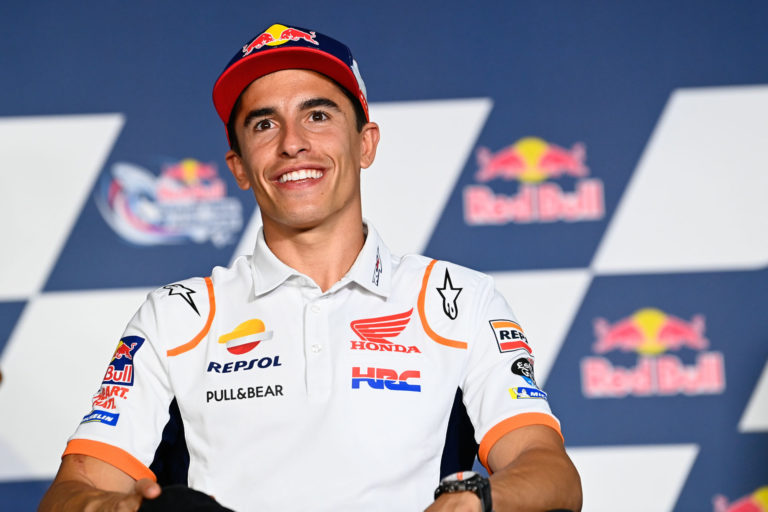
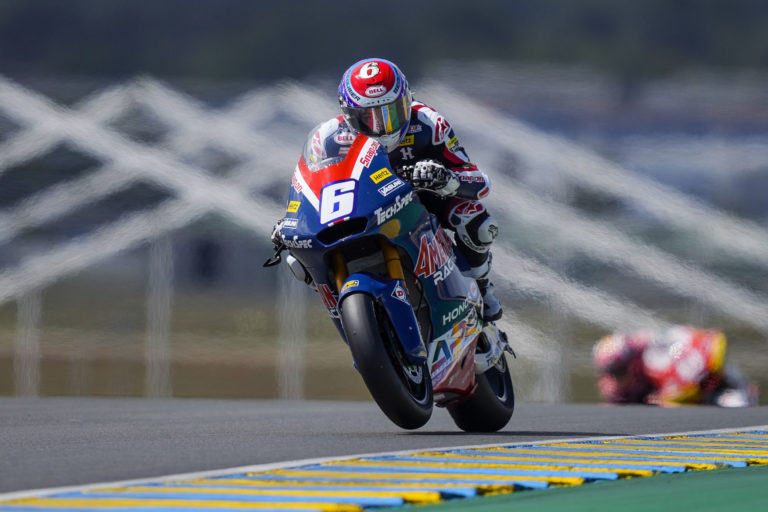
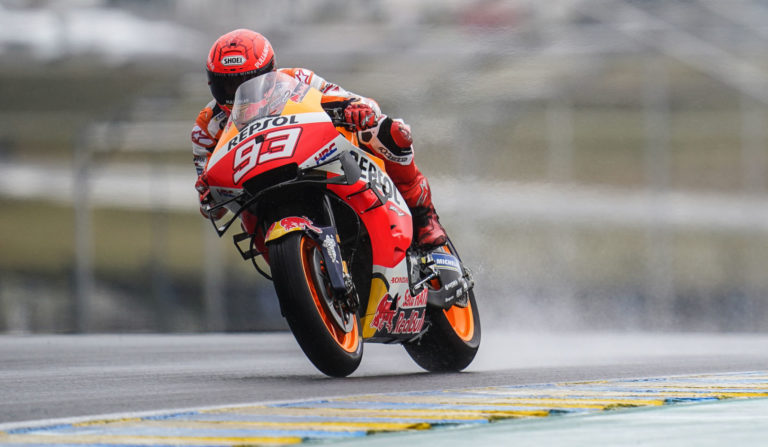
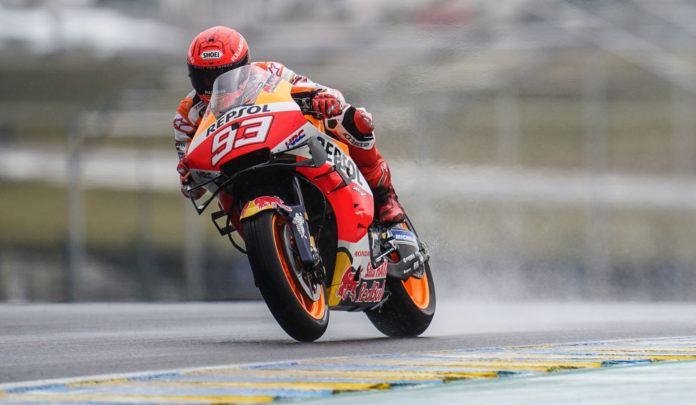
The riders of the MotoGP World Championship may have missed racing in the United States of America since 2019, but after riding in wet and dry Free Practice sessions Friday, the riders let it be known that they did not miss the bumps all around the 3.4-mile, 20-turn Circuit of The Americas (COTA) racetrack.
No one was more vocal about his displeasure with the state of COTA’s racing surface than current MotoGP World Championship point leader Fabio Quartararo.
“FP2 showed that the track is not suitable to race on,” Quartararo was quoted as saying in a press release issued by Monster Energy Yamaha. “It’s like a motocross track with asphalt. Of course, this is the same for everyone, but I think in terms of safety it’s really bad.”
“The condition of this circuit is probably the worst in the whole calendar,” Tech3 KTM Factory Racing rider Iker Lecuona was quoted as saying in a press release issued Friday afternoon. “There are so many bumps, it feels like a motocross track and very difficult to manage.”
“I really like this circuit but I found it a lot more demanding than in the past,” said Team Suzuki ECSTAR’s Alex Rins, who won the last MotoGP race held at COTA, in 2019. “It’s super bumpy and we’re all fighting with our bikes to stay on the right line and not get too out of shape.”
“The asphalt is in poor condition, much worse than I remembered, and the times show it,” said Aprilia rider Aleix Espargaro.
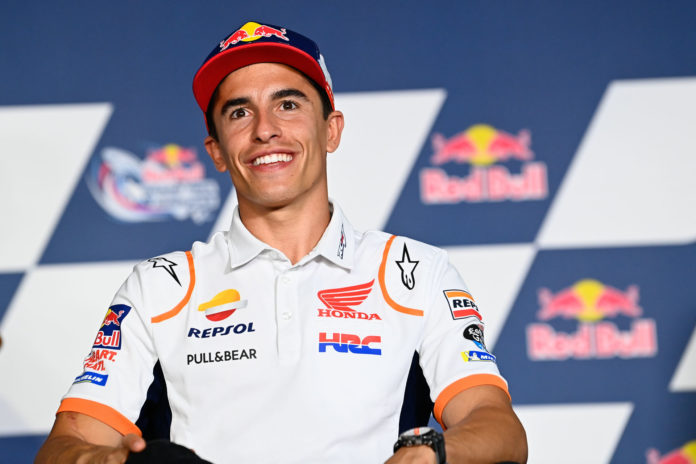
And even Marc Marquez, who has had an incredible run of success at COTA, said, “With all of the bumps it’s very hard to be consistent with your laps and to understand where you can push and where the limit is.”
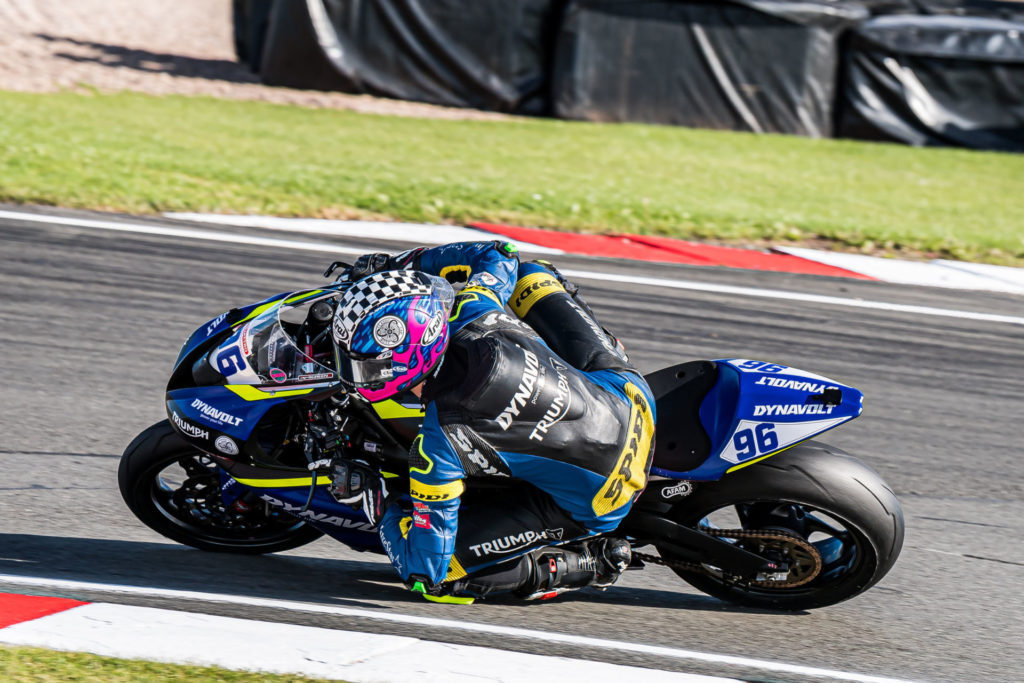
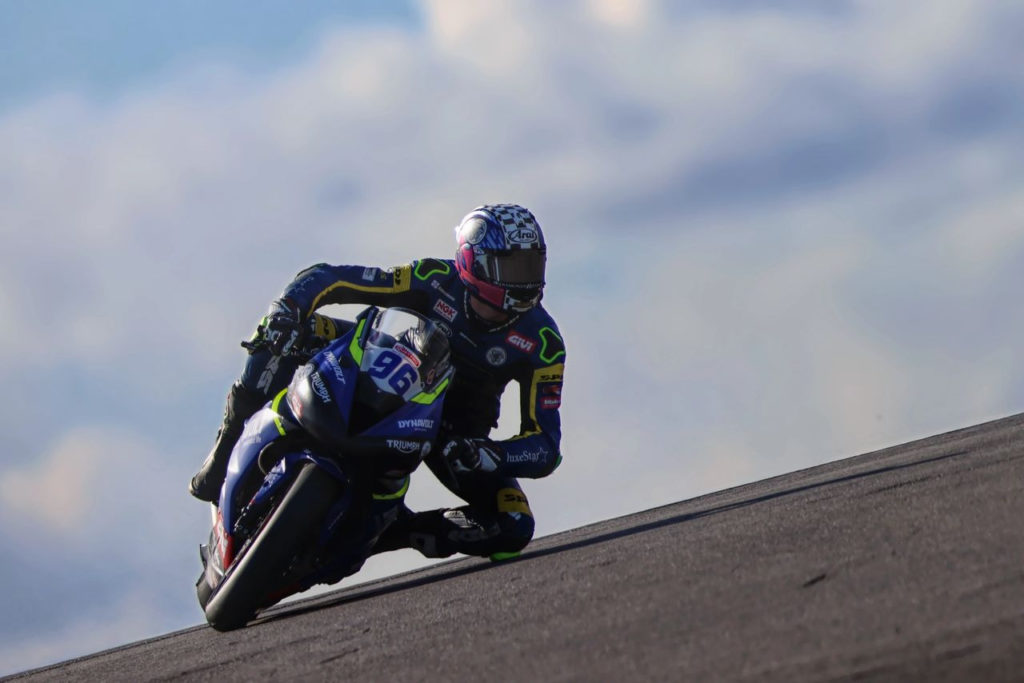
Editorial Notes: American Brandon Paasch, riding his Dynavolt Triumph Street Triple RS 765, was 12th fastest in combined British Supersport practice Friday at Donington Park. Paasch suffered a crash on Friday that set him back, but he escaped without injury.
Brandon Paasch (96). Photo by Barry Clay.
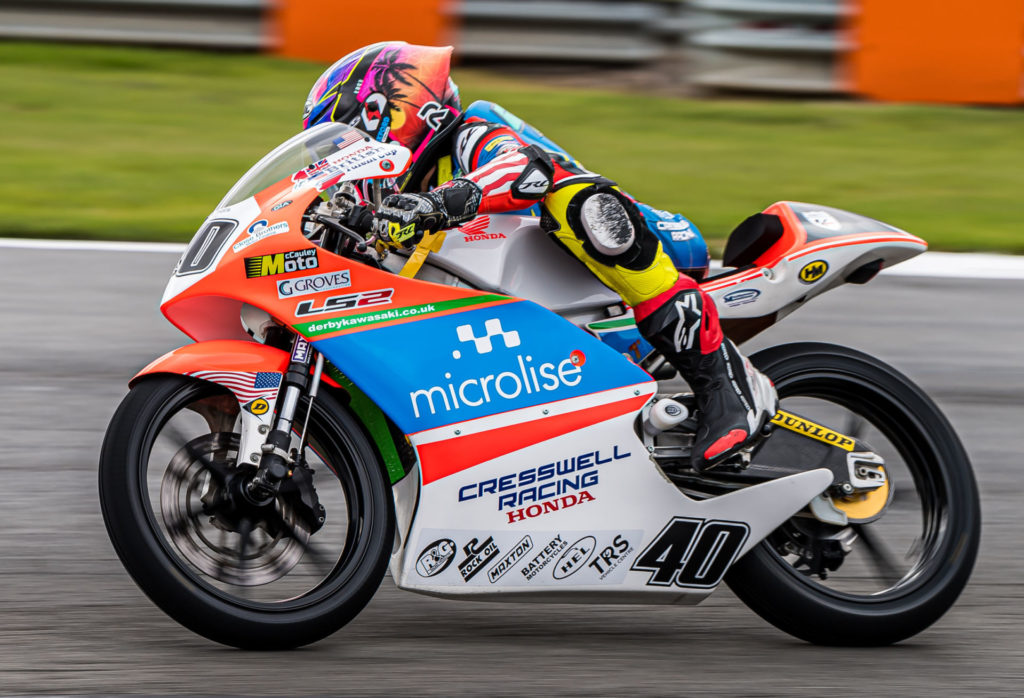
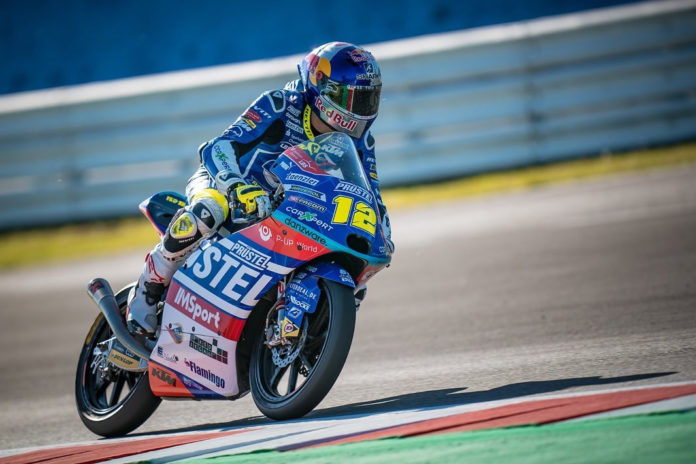
American Julien Correa, riding his Microlise Cresswell Racing Honda, was 25th in combined British Talent Cup practice times on Friday.
Julien Correa (40) in action at Donington Park. Photo by Barry Clay.
Mackenzie holds off title rivals to top SUPERPICKS Free Practice at Donington Park
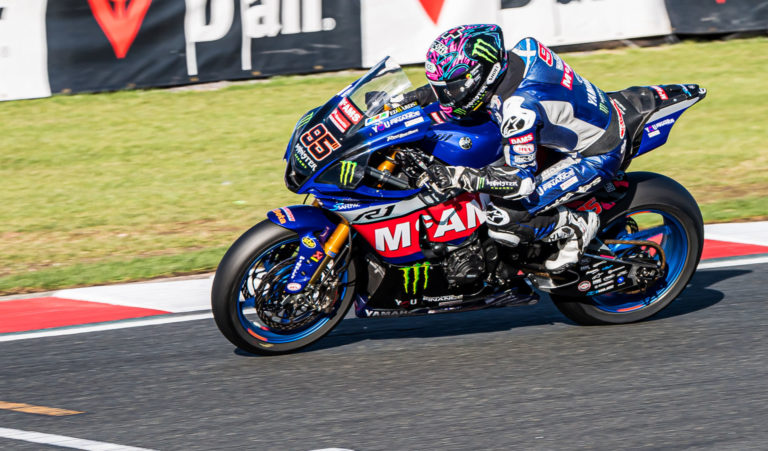
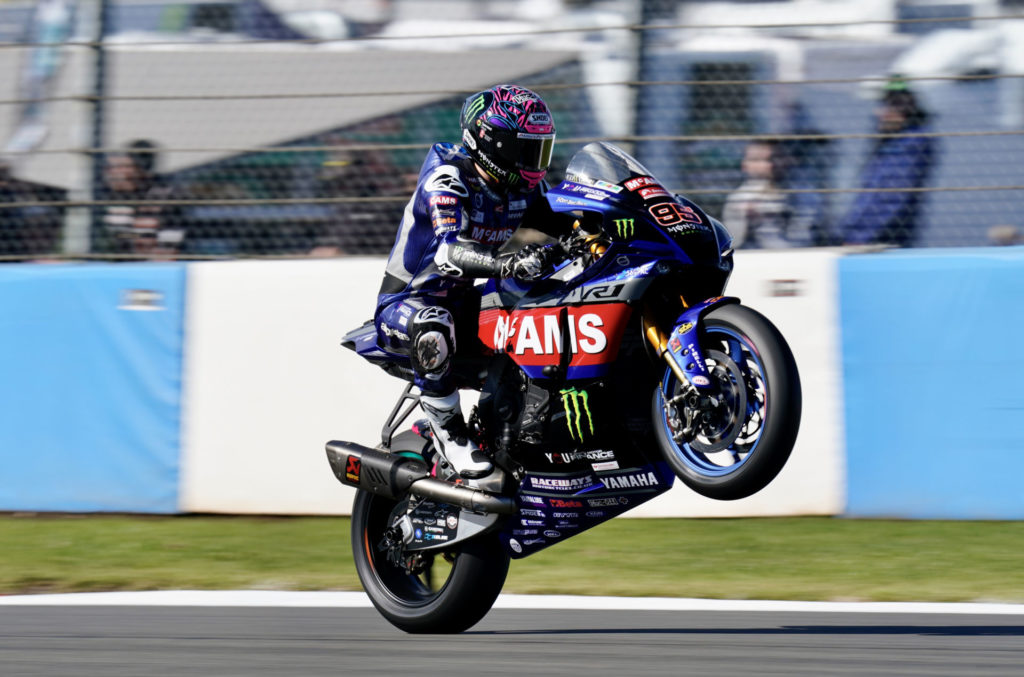
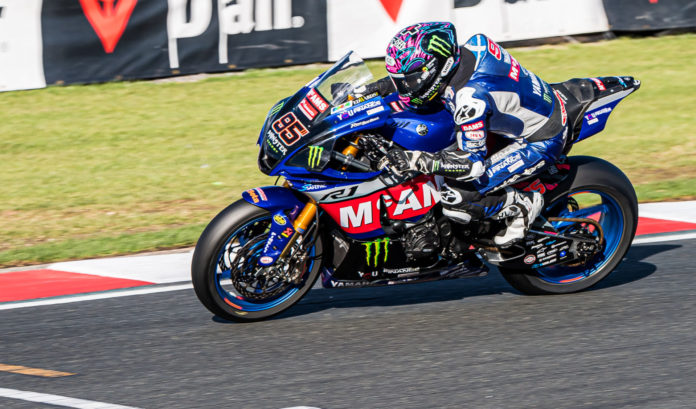
Tarran Mackenzie (95). Photo courtesy MSVR.
Tarran Mackenzie set the benchmark for his Bennetts British Superbike Championship title rivals after the opening SUPERPICKS Free Practice sessions at Donington Park, as the top three riders dipped under the existing lap record.
McAMS Yamaha’s Mackenzie secured the top position as the final ten minutes of the session counted down, surging ahead of Bradley Ray, who was setting the pace before the final flurry of fast laps at the end of the session.
Mackenzie heads into tomorrow’s action bidding to extend his two-point advantage at the top of the standings in the opening BikeSocial Race at his home round.
Christian Iddon held on to second position after the opening day on track; the VisionTrack Ducati rider moving just 0.121s adrift of Mackenzie on his penultimate lap of the day, after the session was briefly red flagged after separate crashes from Andrew Irwin and Gino Rea at Craner Curves.
Danny Buchan was third fastest after topping the earlier session for the SYNETIQ BMW team, just ahead of Jason O’Halloran, who is ready to fight back to overhaul his McAMS Yamaha teammate at the top of the standings.
Ray dropped to fifth place at the chequered flag, with the Rich Energy OMG Racing BMW rider and Lee Jackson splitting the Title Fighters on the times.
Peter Hickman overcame his small crash this morning to finish in seventh position for the FHO Racing BMW team, just ahead of reigning champion Josh Brookes on the second of the VisionTrack Ducatis.
Rory Skinner and Title Fighter Glenn Irwin completed the top ten, marginally ahead of Andrew Irwin and Tommy Bridewell, who complete the riders who will progress directly into tomorrow’s Q2 grid decider.
Bennetts British Superbike Championship, Donington Park, SUPERPICKS 12 Free Practice result:
Tarran Mackenzie (McAMS Yamaha) 1m:28.708s
Christian Iddon (VisionTrack Ducati) +0.121s
Danny Buchan (SYNETIQ BMW) +0.180s
Jason O’Halloran (McAMS Yamaha) +0.299s
Bradley Ray (Rich Energy OMG Racing BMW) +0.304s
Lee Jackson (FS-3 Racing Kawasaki) +0.380s
Peter Hickman (FHO Racing BMW) +0.403s
Josh Brookes (VisionTrack Ducati) +0.461s
Rory Skinner (FS-3 Racing Kawasaki) +0.475s
Glenn Irwin (Honda Racing) +0.596s
Andrew Irwin (SYNETIQ BMW) +0.770s
Tommy Bridewell (Oxford Products Racing Ducati) +0.967s
For more information on the Bennetts British Superbike Championship visit www.britishsuperbike.com
Tarran Mackenzie – McAMS Yamaha
Fastest in SUPERPICKS Free Practice
“I am usually a slow burner on a Friday and so I didn’t expect to top the sessions!
“I think it’s the first time I’ve probably ever topped a free practice on a Friday this year, so to be in the position we are coming into the weekend, and with how it has gone today is really good.
“The conditions can still change this weekend, but it is important to know that we can be fast in the dry as that could still be what happens, but I feel that we are ready for that and the McAMS Yamaha is feeling good.
“Free Practice doesn’t mean anything for the championship, but it certainly feels good to have ended the day fastest and we are feeling positive ahead of the race tomorrow.”
More, from a press release issued by Dynavolt Triumph:
Progress for Dynavolt Triumph at Donington Park
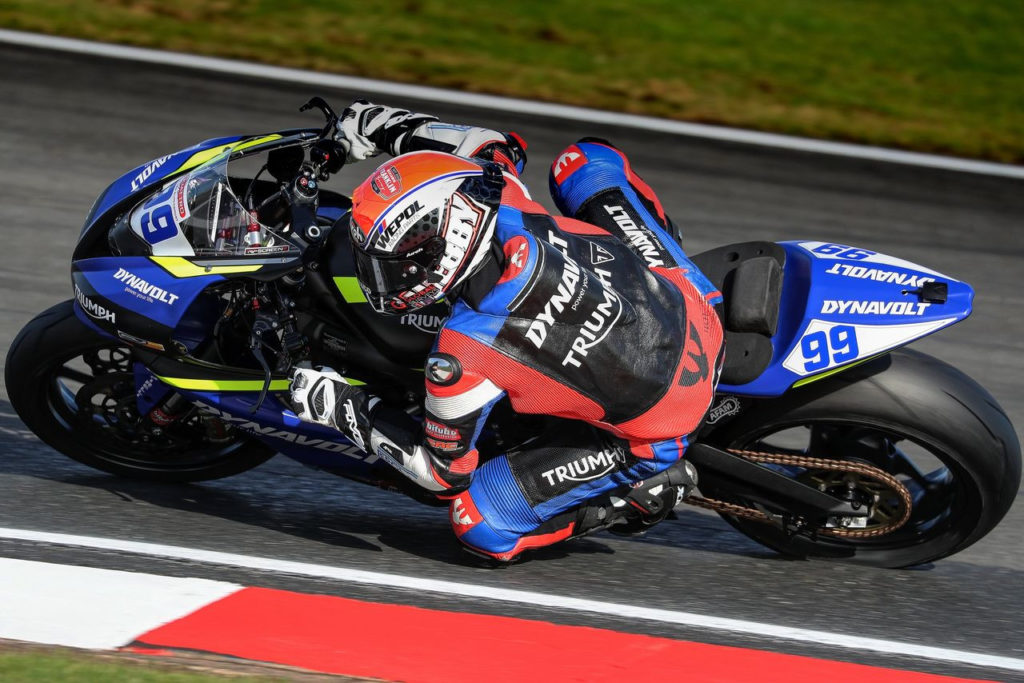
Danny Webb was seventh quickest for Dynavolt Triumph as round ten of the 2021 Quattro Group British Supersport Championship got underway today with Free Practice at Donington Park in Leicestershire.
Webb sat out the majority of the first half wet-half dry session, only venturing out for a handful of laps, but with the afternoon came full dry but cold conditions for the second thirty-minute session. The 30-year-old from Kent posted his fastest lap of 1’33.758 and ended the day seventh on the combined timesheets.
Danny Webb (99). Photo courtesy Dynavolt Triumph.
Danny Webb: “We had a good day today, we made some good progression with the bike in the dry session, the first session was damp so we just tried a few things out. It’s all moving in the right direction, hopefully it’s going to be dry tomorrow and Sunday but I’m getting more of an understanding of the bike and it’s good to be back here at Donington Park.”
Teammate Brandon Paasch also waited until mid-way through FP1 before he went out to assess the damp conditions, completing seven laps of the Donington Park GP circuit. In the afternoon, with just one lap under his belt, Paasch took a minor fall at Goddards, getting back out on track for the final few minutes to post his best lap of 1’34.761 placing him twelfth overall.
Brandon Paasch: “I had a little unfortunate event, I crashed in the last corner on the second lap. It was just an easy little low side. Got the bike back together and got some laps in at the end there. Looking forward to tomorrow, keep building.”
Dynavolt Triumph Team Manager Simon Buckmaster: “The first session was sort of wet but not really and drying. We didn’t gain much out of that so only one dry session. Danny is seventh in Supersport only 1.3s off the pole, you can say that’s not bad. There’s some optimism there, we can make more progress too to just improve the feel. Having spent all his time in Supersport on four-cylinder machines Danny’s adjusting to the riding style necessary for a three-cylinder which he does appreciate and he’s adapting now. Obviously we are looking at more changeable weather conditions with such a high chance of rain tomorrow but a pretty good job by Danny and the team.”
“Brandon slid off at Goddards and although he didn’t injure himself in the crash, he’s a bit tense and the confidence is not there. He likes to run the harder front tyre but I think with the track and weather temperature we are going to have to consider the softer front tyre for him. Tomorrow is another day.”
To pre-empt the potentially disruptive weather conditions tomorrow a revised schedule has been implemented with Supersport Qualifying now at 09:58-10-20, followed by the 12-lap Sprint Race at 14:45 (BST).
American Honda Congratulates Hayden Family on Nicky Hayden’s Motorsports Hall of Fame Induction
2006 MotoGP World Champion receives major mainstream motorsports award
October 1, 2021 — PONTIAC, Michigan
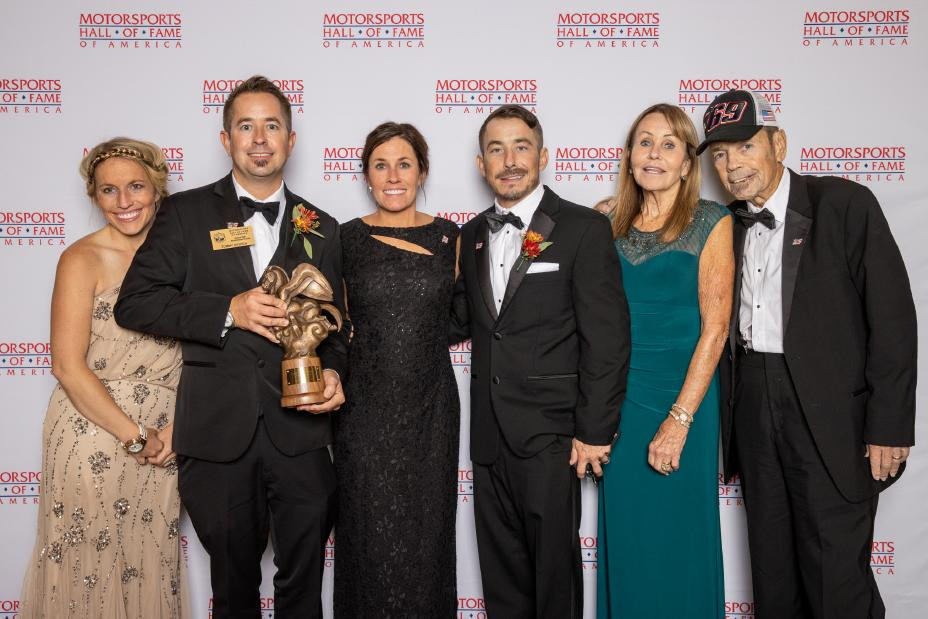
On the occasion of this week’s induction of Nicky Hayden to the Motorsports Hall of Fame of America, American Honda congratulates the family of the late road race and dirt track star. While the Hall of Fame is located at Daytona International Speedway, this year’s ceremony was held at the M1 Concourse in Pontiac, Michigan. The award was presented by former Honda team manager Gary Mathers, and received by Nicky’s younger brother Roger Hayden; Roger also kicked off the event by riding a lap of honor aboard a Repsol edition CBR1000RR while carrying the American flag, as Nicky often did following his major wins.
The late Nicky Hayden’s family (from left) Jennifer Hayden, Tommy Hayden, Kathleen Hayden, Roger Hayden, Rose Hayden, and Earl Hayden at the induction ceremony. Photo by Tom Miller, courtesy American Honda.
Nicky Hayden rode for American Honda-backed teams in AMA road racing classes between 1999 and 2002, earning the AMA 600 Supersport Championship and AMA Pro Athlete of the Year Award in 1999, and the AMA Superbike Championship and Daytona 200 win in 2002. During part of that tenure, he also rode Hondas in a scrappy AMA Flat Track side project, famously joining brothers Tommy and Roger to lead a Hayden-family podium sweep of the 2002 Springfield TT. Nicky then joined the factory Repsol Honda team in MotoGP from 2003 to 2008, earning the 2006 MotoGP World Championship. He rode for a private Honda MotoGP team in 2014 and 2015, before switching to Honda’s World Superbike team. In 2017, Hayden tragically lost his life in a bicycle accident during a training ride in Italy. In 2018, Hayden was posthumously inducted into the AMA Motorcycle Hall of Fame, one of the motorcycling world’s top recognitions.
This week’s honor is more mainstream, as the Motorsports Hall of Fame of America annually recognizes personalities from the entire world of motorsports – including many forms of auto racing, powerboats, aviation and motorcycles. Other members of Hayden’s class are stockcar driver Davey Allison, land-speed racer John Cobb, drag racer Larry Dixon Jr., Indy and NASCAR trailblazer Janet Guthrie, Indy journalist Robin Miller, powerboat team owner Fran Muncey, NASCAR champion Ray Nichels and famed sports-car racing scorer Judy Stropus. The class of 2020 – including motorcycle dirt track champion Chris Carr – was honored two nights earlier, after last year’s ceremony was postponed due to COVID-19.
“On behalf of the entire motorcycling community, congratulations to the Hayden family for this prestigious recognition of Nicky’s accomplishments on and off the track,” said Bill Savino, Senior Manager of Customer Engagement at American Honda. “The Kentucky Kid will always occupy a place in our hearts – as a racer, but especially as a person – and we’re pleased that the Hall of Fame also recognizes how exceptional he was.”
Interview: Red Bull KTM MotoGP Factory Rider Brad Binder:
“There Comes A Moment Where It Feels Completely Normal…”
by Michael Gougis
It’s hard to think of Brad Binder as still kind of a rookie. The 2016 Moto3 World Champion already has two MotoGP wins in a very short time in the premier class, and he seems to have been around the paddock for a long time. That is likely because of the attention he’s gotten, as he has spent much of his Grand Prix career near the front, with podiums every year since 2014 and wins in most of those seasons.
Yet the South African finds himself still facing new circuits and new challenges. His premier-class rookie season of 2020 was short and chaotic because of the global COVID-19 pandemic, and he’s just now getting into his second full season of wrestling the mechanical bull known as a MotoGP racebike.
“I’ve only had one and a bit proper seasons under my belt on a MotoGP bike. I still feel like – I’ve never been here on the MotoGP bike,” says Binder, 26, of Potchefstroom, South Africa, as he prepared for the Grand Prix of The Americas, in Austin, Texas.
“And there’s a lot of tracks coming next season – I’ll be going to Philip Island, Japan, Argentina – all of these places for the first time on the MotoGP bike, when I’ll be in my third season! It’s a little bit difficult, a little bit strange. But I think I’ve adapted well to the class, and I understand what I need to do to go fast and where to improve.”
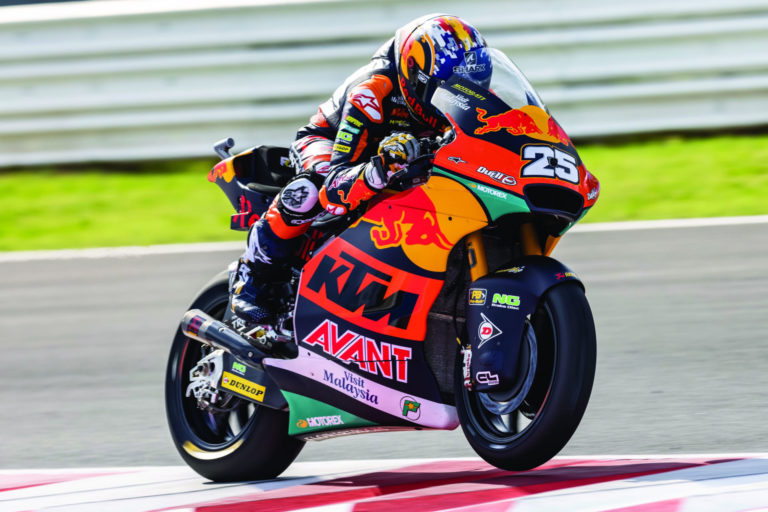
Brad Binder. Photo by Polarity Photo, courtesy KTM.
Binder is no stranger to COTA, although he still finds the track a unique challenge on the Championship circuit.
“There’s nothing quite like it,” Binder says of the 3.4-mile, 20-turn track. “I think it’s got the most corners of any track! It’s unique. The grip conditions are really low at the beginning, and it just gets better and better and better. It’s a long, big track, and it’s something I’m really looking forward to.”
This season, the factory Red Bull KTM MotoGP RC16 has proven to prefer hot, slick racetracks, Binder says.
“Sometimes we see that in super-hot conditions we’re more competitive than we are when it’s cooler. In MotoGP it comes down to what the tire allocation is for the weekend. Sometimes the harder rubber suits our KTM a little bit better. Some tracks you can use it, some tracks you can’t,” he says. “The hotter, the more slippery, the more sketchy the track conditions are, the better it is for us.”
With a new fuel coming on-stream in the middle of the 2021 season, the KTM has also added more straight-line speed – not that it was really lacking in that department – to its stout performance under braking. The two, combined, help Binder with his increasingly common Sunday afternoon charge from a starting spot toward the back of the grid to a finishing spot closer to the front than anyone expects.
“Our strongest point on the KTM is definitely our braking performance, which has always been the strongest point for our bike. We have the ability to stop the bike in a shorter space of time than the other guys. We’re able to really push it that little bit harder, which makes things a lot better to fight in the race and make overtakes. That’s one point of the bike that I’m really happy about,” he says. “The biggest difference as far as our top speed goes is the new fuel. It’s nice, it’s great to have that little extra margin. It’s time for free at the end of the day!”
The weak spots, he says, are the obvious one – qualifying – and one that’s harder to spot, simply because in MotoGP, the differences between winning and finishing mid-pack are increasingly small.
“The one point where we need to improve is corner exits, especially coming out of hairpins where you’re in first gear and you’re hooking through the first three-four gears is where we seem to be missing a little bit,” Binder says. “That’s what we’re working on. We’ve got to sort out some small issues, and we’ll be a lot stronger in the upcoming races.”
Qualifying is the next major issue that KTM – and he – have to focus on, he says.
“Normally, if I can do a lap time once, I can do it over and over again. But I struggle to do that one lap that’s much quicker than the rest. I’ve always got good race pace, which always seems to carry me through on the Sunday,” he says.
“As a rider, it’s not my strongest point. It’s something that we’re working on as a team, for sure. It’s not the strongest point for our bike at the moment. But on the other hand, our bike can be consistent over 20 laps. If I had to write one off (race or qualifying), I’d choose qualifying. But I hope for the future we’ll be in a position where we can fight for some pole positions as well.”
Although Binder says he knows there is room for improvement, the past year has seen the pucker factor of just riding a MotoGP machine drop to the point where he can focus on getting the last few percent of performance out of himself and the KTM. He’s come a long way from the wide-eyed rider who hopped off the winning Moto2 machine at Valencia in 2019 and two days later swung his leg over the RC16 at the post-season test.
“The first impression when you get on a MotoGP bike is overwhelming. You don’t know how you’re going to complete a race distance, because it’s so physical, it’s so physically demanding, it’s just so strong, the wheelie and everything is next level. It takes a while to get used to. But then there comes a moment where it feels completely normal. That becomes the norm. There’s no more insane power – of course it’s still there, but it becomes like walking – something you completely adapt to. It took a while, to be honest. But it seems like I’m used to it,” he says.
Editorial Note: This article first appeared in the March 2021 issue of Roadracing World & Motorcycle Technology magazine.
COPYRIGHT 2021, ROADRACING WORLD PUBLISHING, INC.
All Kids Bike: THE POINT OF DEPARTURE
By Michael Gougis
The demographics of motorcycling are a constant point of worry for the industry. Some figures are even worse. Very, very few people get into motorcycling without learning to ride a bicycle. And in the United States, this year, the majority of children will not ride a bicycle this year—not even once.
“The trends are getting scary,” says Ryan McFarland, founder and CEO of Strider Sports International, aka Strider, the producer of balance and beginning bikes. “Three-quarters of American kids aren’t going to ride a bicycle once this year. That’s the whole industry, the whole bike industry, the whole motorcycle industry. It’s all the same ladder, and kids aren’t even getting on the first rung of the ladder anymore.”
McFarland is doing something about it. He began All Kids Bike, a program to bring bicycle riding into the kindergarten curriculum at many public and non-profit private schools.
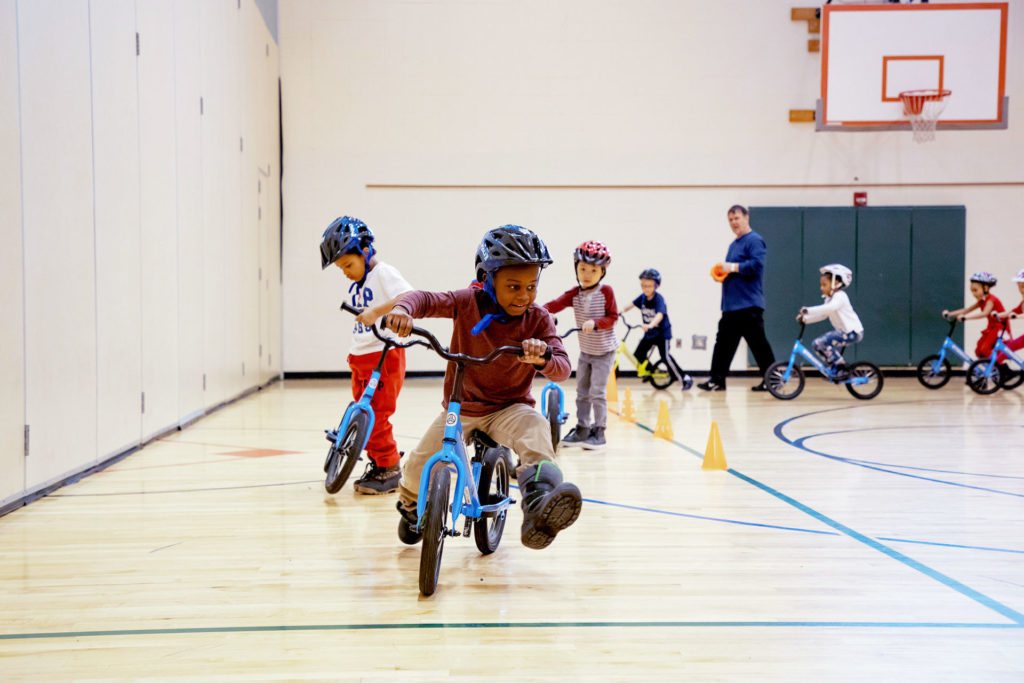
In little more than two years, the non-profit program has taught approximately 40,000 children how to ride. Starting with a simple Strider balance bike, in eight lessons the children progress to riding a pedal-propelled bicycle.
And perhaps more importantly, McFarland structured the program to focus on teaching teachers how to conduct the curriculum. Combined with special bicycles to minimize repairs and maintenance, it leverages the program’s efforts, allowing it to reach far more children than McFarland ever could on his own.
Strider’s foundations were personal: “I’m a lifelong motorcycle enthusiast and mountain bike enthusiast. My dad had a motorcycle dealership,” says McFarland, an entrepreneur and fabricator. “When I became a dad, I was super-excited to get my son riding. When he was two years old, I had all kinds of get-riding toys lined up. I had a whole fleet of things because I was so excited!
“Then I realized that these things weren’t helping him to learn to ride. I was watching him enthusiastically try to use these things, but realized they were too heavy, too big, too complex. My wife said give him a year or two, and I said, ‘No, can’t do that!’”
The Strider factory prototype in the hands of test rider Bode McFarland. Photo courtesy All Kids Bike.
The basic failures of the beginning machines were related to scale, McFarland says. They weighed as much as the two-year-old, with a seat at chest height and gearing that was too tall for toddler leg muscles. So he took a basic 12-inch-wheel bicycle and started chopping until the seat height was appropriate for a two-year-old. With the seat that low, however, it was impossible to operate the pedals.
Then McFarland had his flash of inspiration. “That’s when I really realized that the key to this whole thing was separating propulsion from riding. Riding is balancing two linear wheels while straddling it. You start thinking about propulsion separately. Why not striding and walking? That’s one way of getting something to move,” McFarland says. “What’s the easiest propulsion method for a two-year-old? Walking and running. Feet on the ground, Fred Flintstone-style. Totally safe, totally confident, just focusing on riding the bike.”
Strider CEO Ryan McFarland. Photo courtesy All Kids Bike.
McFarland painted it blue to match the Yamaha 450 dirtbike in his garage and slapped some Yamaha stickers on it. Quickly, his son and the homemade Strider bike were inseparable. It was evidence that the idea was sound—so sound that the company, founded in 2007, has now sold over three million units.
Still, McFarland was not unaware of the fundamental changes in childhood sweeping the world. Not even available a generation or two ago, video-based activities have literally created an alternative reality for those born in the last few years, a reality in which their physical bodies are sedentary. In a very real sense, most of the U.S. is coming to grips with a video-generated reality that is beyond the imagination of those who were studying the impact of television on society 60 years ago. The youngest are facing those changes as surely as anyone else.
“What really dialed us in was the urgency of the problem. This stuff is happening fast. How can we address this?” McFarland says he pondered.
His solution: Get as many kids as possible on bikes, as early as possible. That meant reaching kids where they gathered—school—at the youngest age they were going to be there—kindergarten. “Every kindergarten program has a P.E. program, and that’s where we wanted to be,” McFarland says.
The package delivered to the schools includes 24 bikes for students and one for the teacher. Features like solid rubber tires make the Strider bikes more childproof. Photo courtesy All Kids Bike.
Two things were needed. One was an online curriculum to teach teachers how to teach their kindergartners. The other was a somewhat mythical creature—a kid-proof bicycle. McFarland devised a version of Strider’s 14X bike with solid tires and easy-to-adjust handlebars. The bicycles come with a pedal kit that change a balance bike to a pedal bike in three minutes.
The non-profit Strider Education Foundation was incorporated in 2017 as the (pardon the pun) vehicle to collect donations and distribute the curriculum and machines to schools. Since 2018, more than 260 schools in 38 states have adopted the curriculum.
The foundation is looking for donors to support the program. For $5,000 the foundation can provide a fleet of 24 of the children’s bikes, one adult-size bike for the teacher, helmets, the pedal conversion kits, and a five-year support commitment.
It’s all part of McFarland’s plan to save the pastimes about which he is passionate, and to help America’s children lead healthier, happier lives. “Just giving kids a bike isn’t the answer. Teaching them how to ride bikes is the answer. It really does come down to the educational piece,” McFarland says. “Kids need this experience.”
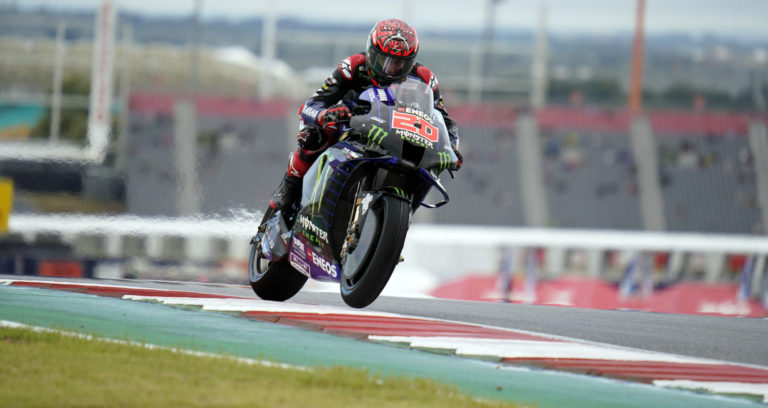
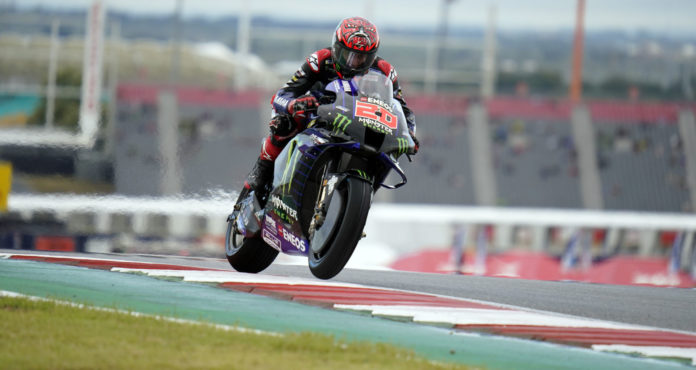
Fabio Quartararo (20) as seen during wet FP1 at COTA. Photo courtesy Monster Energy Yamaha.
The riders of the MotoGP World Championship may have missed racing in the United States of America since 2019, but after riding in wet and dry Free Practice sessions Friday, the riders let it be known that they did not miss the bumps all around the 3.4-mile, 20-turn Circuit of The Americas (COTA) racetrack.
No one was more vocal about his displeasure with the state of COTA’s racing surface than current MotoGP World Championship point leader Fabio Quartararo.
“FP2 showed that the track is not suitable to race on,” Quartararo was quoted as saying in a press release issued by Monster Energy Yamaha. “It’s like a motocross track with asphalt. Of course, this is the same for everyone, but I think in terms of safety it’s really bad.”
“The condition of this circuit is probably the worst in the whole calendar,” Tech3 KTM Factory Racing rider Iker Lecuona was quoted as saying in a press release issued Friday afternoon. “There are so many bumps, it feels like a motocross track and very difficult to manage.”
“I really like this circuit but I found it a lot more demanding than in the past,” said Team Suzuki ECSTAR’s Alex Rins, who won the last MotoGP race held at COTA, in 2019. “It’s super bumpy and we’re all fighting with our bikes to stay on the right line and not get too out of shape.”
“The asphalt is in poor condition, much worse than I remembered, and the times show it,” said Aprilia rider Aleix Espargaro.
And even Marc Marquez, who has had an incredible run of success at COTA, said, “With all of the bumps it’s very hard to be consistent with your laps and to understand where you can push and where the limit is.”
Tarran Mackenzie (95) was fastest in British Superbike practice Friday at Donington Park. Photo by Barry Clay.
Editorial Notes: American Brandon Paasch, riding his Dynavolt Triumph Street Triple RS 765, was 12th fastest in combined British Supersport practice Friday at Donington Park. Paasch suffered a crash on Friday that set him back, but he escaped without injury.
Brandon Paasch (96). Photo by Barry Clay.
American Julien Correa, riding his Microlise Cresswell Racing Honda, was 25th in combined British Talent Cup practice times on Friday.
Julien Correa (40) in action at Donington Park. Photo by Barry Clay.
Mackenzie holds off title rivals to top SUPERPICKS Free Practice at Donington Park
Tarran Mackenzie (95). Photo courtesy MSVR.
Tarran Mackenzie set the benchmark for his Bennetts British Superbike Championship title rivals after the opening SUPERPICKS Free Practice sessions at Donington Park, as the top three riders dipped under the existing lap record.
McAMS Yamaha’s Mackenzie secured the top position as the final ten minutes of the session counted down, surging ahead of Bradley Ray, who was setting the pace before the final flurry of fast laps at the end of the session.
Mackenzie heads into tomorrow’s action bidding to extend his two-point advantage at the top of the standings in the opening BikeSocial Race at his home round.
Christian Iddon held on to second position after the opening day on track; the VisionTrack Ducati rider moving just 0.121s adrift of Mackenzie on his penultimate lap of the day, after the session was briefly red flagged after separate crashes from Andrew Irwin and Gino Rea at Craner Curves.
Danny Buchan was third fastest after topping the earlier session for the SYNETIQ BMW team, just ahead of Jason O’Halloran, who is ready to fight back to overhaul his McAMS Yamaha teammate at the top of the standings.
Ray dropped to fifth place at the chequered flag, with the Rich Energy OMG Racing BMW rider and Lee Jackson splitting the Title Fighters on the times.
Peter Hickman overcame his small crash this morning to finish in seventh position for the FHO Racing BMW team, just ahead of reigning champion Josh Brookes on the second of the VisionTrack Ducatis.
Rory Skinner and Title Fighter Glenn Irwin completed the top ten, marginally ahead of Andrew Irwin and Tommy Bridewell, who complete the riders who will progress directly into tomorrow’s Q2 grid decider.
Bennetts British Superbike Championship, Donington Park, SUPERPICKS 12 Free Practice result:
Tarran Mackenzie (McAMS Yamaha) 1m:28.708s
Christian Iddon (VisionTrack Ducati) +0.121s
Danny Buchan (SYNETIQ BMW) +0.180s
Jason O’Halloran (McAMS Yamaha) +0.299s
Bradley Ray (Rich Energy OMG Racing BMW) +0.304s
Lee Jackson (FS-3 Racing Kawasaki) +0.380s
Peter Hickman (FHO Racing BMW) +0.403s
Josh Brookes (VisionTrack Ducati) +0.461s
Rory Skinner (FS-3 Racing Kawasaki) +0.475s
Glenn Irwin (Honda Racing) +0.596s
Andrew Irwin (SYNETIQ BMW) +0.770s
Tommy Bridewell (Oxford Products Racing Ducati) +0.967s
For more information on the Bennetts British Superbike Championship visit www.britishsuperbike.com
Tarran Mackenzie – McAMS Yamaha
Fastest in SUPERPICKS Free Practice
“I am usually a slow burner on a Friday and so I didn’t expect to top the sessions!
“I think it’s the first time I’ve probably ever topped a free practice on a Friday this year, so to be in the position we are coming into the weekend, and with how it has gone today is really good.
“The conditions can still change this weekend, but it is important to know that we can be fast in the dry as that could still be what happens, but I feel that we are ready for that and the McAMS Yamaha is feeling good.
“Free Practice doesn’t mean anything for the championship, but it certainly feels good to have ended the day fastest and we are feeling positive ahead of the race tomorrow.”
More, from a press release issued by Dynavolt Triumph:
Progress for Dynavolt Triumph at Donington Park
Danny Webb was seventh quickest for Dynavolt Triumph as round ten of the 2021 Quattro Group British Supersport Championship got underway today with Free Practice at Donington Park in Leicestershire.
Webb sat out the majority of the first half wet-half dry session, only venturing out for a handful of laps, but with the afternoon came full dry but cold conditions for the second thirty-minute session. The 30-year-old from Kent posted his fastest lap of 1’33.758 and ended the day seventh on the combined timesheets.
Danny Webb (99). Photo courtesy Dynavolt Triumph.
Danny Webb: “We had a good day today, we made some good progression with the bike in the dry session, the first session was damp so we just tried a few things out. It’s all moving in the right direction, hopefully it’s going to be dry tomorrow and Sunday but I’m getting more of an understanding of the bike and it’s good to be back here at Donington Park.”
Teammate Brandon Paasch also waited until mid-way through FP1 before he went out to assess the damp conditions, completing seven laps of the Donington Park GP circuit. In the afternoon, with just one lap under his belt, Paasch took a minor fall at Goddards, getting back out on track for the final few minutes to post his best lap of 1’34.761 placing him twelfth overall.
Brandon Paasch: “I had a little unfortunate event, I crashed in the last corner on the second lap. It was just an easy little low side. Got the bike back together and got some laps in at the end there. Looking forward to tomorrow, keep building.”
Dynavolt Triumph Team Manager Simon Buckmaster: “The first session was sort of wet but not really and drying. We didn’t gain much out of that so only one dry session. Danny is seventh in Supersport only 1.3s off the pole, you can say that’s not bad. There’s some optimism there, we can make more progress too to just improve the feel. Having spent all his time in Supersport on four-cylinder machines Danny’s adjusting to the riding style necessary for a three-cylinder which he does appreciate and he’s adapting now. Obviously we are looking at more changeable weather conditions with such a high chance of rain tomorrow but a pretty good job by Danny and the team.”
“Brandon slid off at Goddards and although he didn’t injure himself in the crash, he’s a bit tense and the confidence is not there. He likes to run the harder front tyre but I think with the track and weather temperature we are going to have to consider the softer front tyre for him. Tomorrow is another day.”
To pre-empt the potentially disruptive weather conditions tomorrow a revised schedule has been implemented with Supersport Qualifying now at 09:58-10-20, followed by the 12-lap Sprint Race at 14:45 (BST).
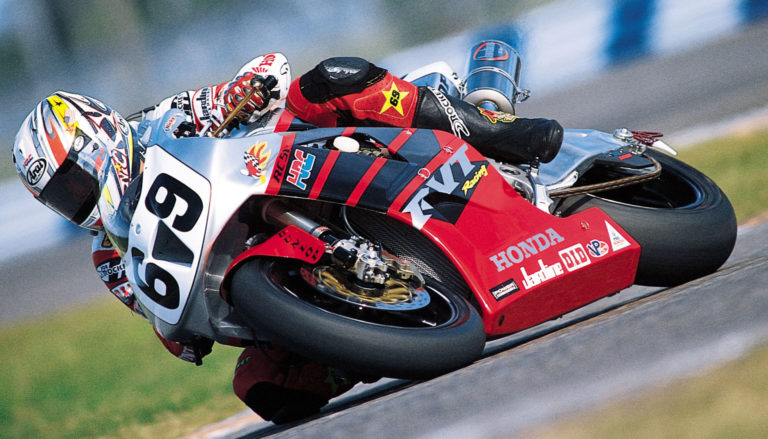
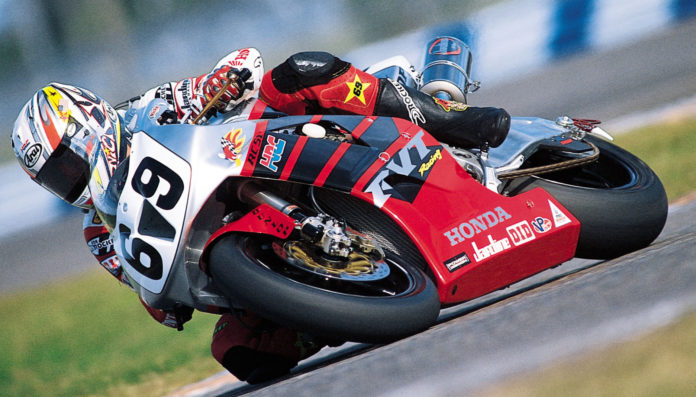
Nicky Hayden (69) on his American Honda RC51 AMA Superbike, circa 2002. Photo courtesy American Honda.
American Honda Congratulates Hayden Family on Nicky Hayden’s Motorsports Hall of Fame Induction
2006 MotoGP World Champion receives major mainstream motorsports award
October 1, 2021 — PONTIAC, Michigan
On the occasion of this week’s induction of Nicky Hayden to the Motorsports Hall of Fame of America, American Honda congratulates the family of the late road race and dirt track star. While the Hall of Fame is located at Daytona International Speedway, this year’s ceremony was held at the M1 Concourse in Pontiac, Michigan. The award was presented by former Honda team manager Gary Mathers, and received by Nicky’s younger brother Roger Hayden; Roger also kicked off the event by riding a lap of honor aboard a Repsol edition CBR1000RR while carrying the American flag, as Nicky often did following his major wins.
The late Nicky Hayden’s family (from left) Jennifer Hayden, Tommy Hayden, Kathleen Hayden, Roger Hayden, Rose Hayden, and Earl Hayden at the induction ceremony. Photo by Tom Miller, courtesy American Honda.
Nicky Hayden rode for American Honda-backed teams in AMA road racing classes between 1999 and 2002, earning the AMA 600 Supersport Championship and AMA Pro Athlete of the Year Award in 1999, and the AMA Superbike Championship and Daytona 200 win in 2002. During part of that tenure, he also rode Hondas in a scrappy AMA Flat Track side project, famously joining brothers Tommy and Roger to lead a Hayden-family podium sweep of the 2002 Springfield TT. Nicky then joined the factory Repsol Honda team in MotoGP from 2003 to 2008, earning the 2006 MotoGP World Championship. He rode for a private Honda MotoGP team in 2014 and 2015, before switching to Honda’s World Superbike team. In 2017, Hayden tragically lost his life in a bicycle accident during a training ride in Italy. In 2018, Hayden was posthumously inducted into the AMA Motorcycle Hall of Fame, one of the motorcycling world’s top recognitions.
This week’s honor is more mainstream, as the Motorsports Hall of Fame of America annually recognizes personalities from the entire world of motorsports – including many forms of auto racing, powerboats, aviation and motorcycles. Other members of Hayden’s class are stockcar driver Davey Allison, land-speed racer John Cobb, drag racer Larry Dixon Jr., Indy and NASCAR trailblazer Janet Guthrie, Indy journalist Robin Miller, powerboat team owner Fran Muncey, NASCAR champion Ray Nichels and famed sports-car racing scorer Judy Stropus. The class of 2020 – including motorcycle dirt track champion Chris Carr – was honored two nights earlier, after last year’s ceremony was postponed due to COVID-19.
“On behalf of the entire motorcycling community, congratulations to the Hayden family for this prestigious recognition of Nicky’s accomplishments on and off the track,” said Bill Savino, Senior Manager of Customer Engagement at American Honda. “The Kentucky Kid will always occupy a place in our hearts – as a racer, but especially as a person – and we’re pleased that the Hall of Fame also recognizes how exceptional he was.”
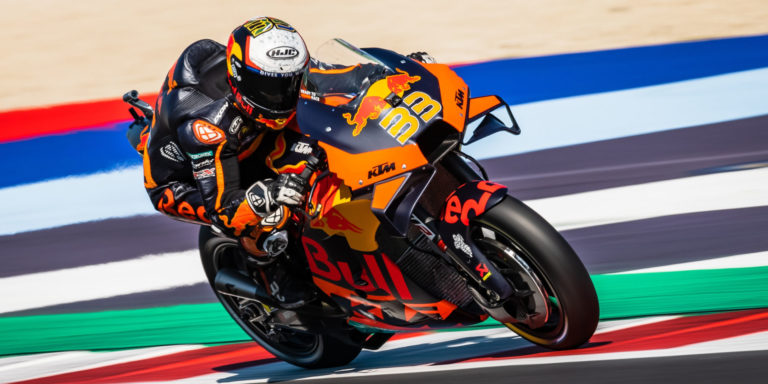
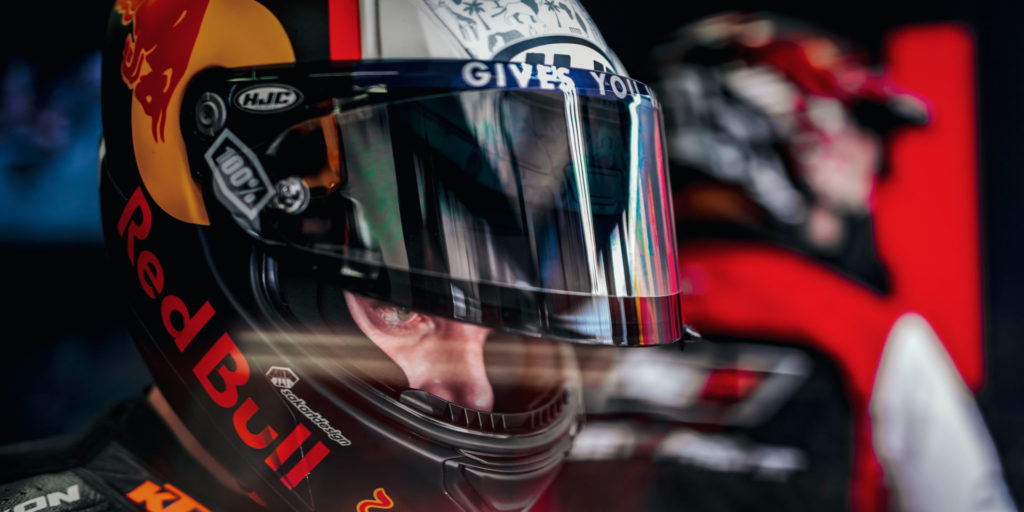
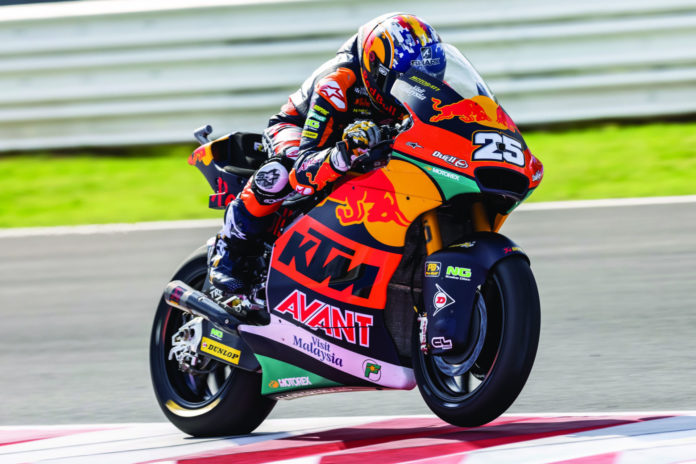
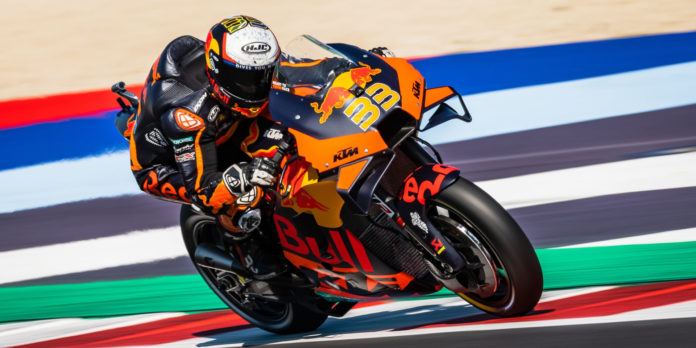
Brad Binder (33) at speed on his Red Bull KTM RC16 earlier this season at Misano. Photo by Polarity Photo, courtesy KTM.
COPYRIGHT 2021, ROADRACING WORLD PUBLISHING, INC.
Interview: Red Bull KTM MotoGP Factory Rider Brad Binder:
“There Comes A Moment Where It Feels Completely Normal…”
by Michael Gougis
It’s hard to think of Brad Binder as still kind of a rookie. The 2016 Moto3 World Champion already has two MotoGP wins in a very short time in the premier class, and he seems to have been around the paddock for a long time. That is likely because of the attention he’s gotten, as he has spent much of his Grand Prix career near the front, with podiums every year since 2014 and wins in most of those seasons.
Yet the South African finds himself still facing new circuits and new challenges. His premier-class rookie season of 2020 was short and chaotic because of the global COVID-19 pandemic, and he’s just now getting into his second full season of wrestling the mechanical bull known as a MotoGP racebike.
“I’ve only had one and a bit proper seasons under my belt on a MotoGP bike. I still feel like – I’ve never been here on the MotoGP bike,” says Binder, 26, of Potchefstroom, South Africa, as he prepared for the Grand Prix of The Americas, in Austin, Texas.
“And there’s a lot of tracks coming next season – I’ll be going to Philip Island, Japan, Argentina – all of these places for the first time on the MotoGP bike, when I’ll be in my third season! It’s a little bit difficult, a little bit strange. But I think I’ve adapted well to the class, and I understand what I need to do to go fast and where to improve.”
Brad Binder. Photo by Polarity Photo, courtesy KTM.
Binder is no stranger to COTA, although he still finds the track a unique challenge on the Championship circuit.
“There’s nothing quite like it,” Binder says of the 3.4-mile, 20-turn track. “I think it’s got the most corners of any track! It’s unique. The grip conditions are really low at the beginning, and it just gets better and better and better. It’s a long, big track, and it’s something I’m really looking forward to.”
This season, the factory Red Bull KTM MotoGP RC16 has proven to prefer hot, slick racetracks, Binder says.
“Sometimes we see that in super-hot conditions we’re more competitive than we are when it’s cooler. In MotoGP it comes down to what the tire allocation is for the weekend. Sometimes the harder rubber suits our KTM a little bit better. Some tracks you can use it, some tracks you can’t,” he says. “The hotter, the more slippery, the more sketchy the track conditions are, the better it is for us.”
With a new fuel coming on-stream in the middle of the 2021 season, the KTM has also added more straight-line speed – not that it was really lacking in that department – to its stout performance under braking. The two, combined, help Binder with his increasingly common Sunday afternoon charge from a starting spot toward the back of the grid to a finishing spot closer to the front than anyone expects.
“Our strongest point on the KTM is definitely our braking performance, which has always been the strongest point for our bike. We have the ability to stop the bike in a shorter space of time than the other guys. We’re able to really push it that little bit harder, which makes things a lot better to fight in the race and make overtakes. That’s one point of the bike that I’m really happy about,” he says. “The biggest difference as far as our top speed goes is the new fuel. It’s nice, it’s great to have that little extra margin. It’s time for free at the end of the day!”
The weak spots, he says, are the obvious one – qualifying – and one that’s harder to spot, simply because in MotoGP, the differences between winning and finishing mid-pack are increasingly small.
“The one point where we need to improve is corner exits, especially coming out of hairpins where you’re in first gear and you’re hooking through the first three-four gears is where we seem to be missing a little bit,” Binder says. “That’s what we’re working on. We’ve got to sort out some small issues, and we’ll be a lot stronger in the upcoming races.”
Qualifying is the next major issue that KTM – and he – have to focus on, he says.
“Normally, if I can do a lap time once, I can do it over and over again. But I struggle to do that one lap that’s much quicker than the rest. I’ve always got good race pace, which always seems to carry me through on the Sunday,” he says.
“As a rider, it’s not my strongest point. It’s something that we’re working on as a team, for sure. It’s not the strongest point for our bike at the moment. But on the other hand, our bike can be consistent over 20 laps. If I had to write one off (race or qualifying), I’d choose qualifying. But I hope for the future we’ll be in a position where we can fight for some pole positions as well.”
Although Binder says he knows there is room for improvement, the past year has seen the pucker factor of just riding a MotoGP machine drop to the point where he can focus on getting the last few percent of performance out of himself and the KTM. He’s come a long way from the wide-eyed rider who hopped off the winning Moto2 machine at Valencia in 2019 and two days later swung his leg over the RC16 at the post-season test.
“The first impression when you get on a MotoGP bike is overwhelming. You don’t know how you’re going to complete a race distance, because it’s so physical, it’s so physically demanding, it’s just so strong, the wheelie and everything is next level. It takes a while to get used to. But then there comes a moment where it feels completely normal. That becomes the norm. There’s no more insane power – of course it’s still there, but it becomes like walking – something you completely adapt to. It took a while, to be honest. But it seems like I’m used to it,” he says.
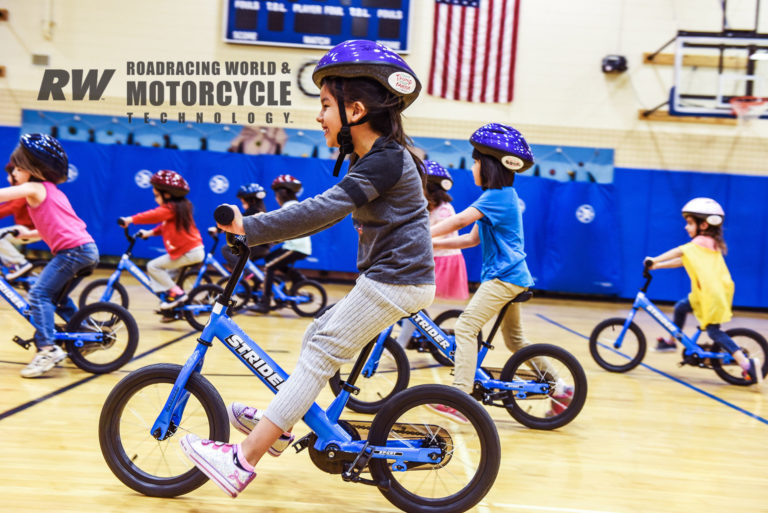
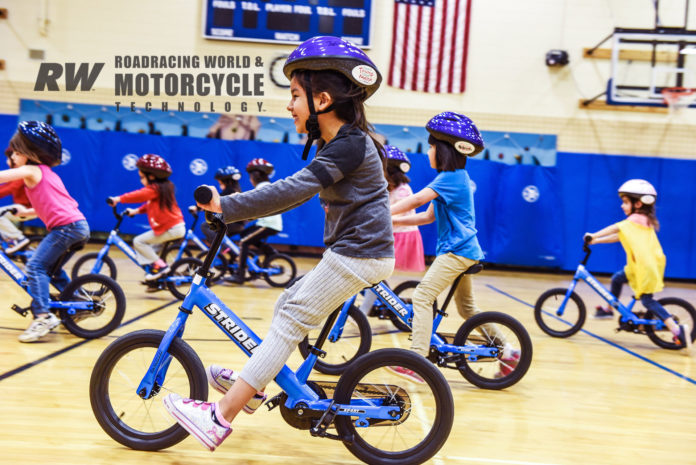
The idea was to reach as many kids as early as possible. Public and non-profit kindergarten turned out to be the point where All Kids Bike could have the greatest impact. Photo courtesy All Kids Bike.
Editorial Note: This article first appeared in the March 2021 issue of Roadracing World & Motorcycle Technology magazine.
COPYRIGHT 2021, ROADRACING WORLD PUBLISHING, INC.
All Kids Bike: THE POINT OF DEPARTURE
By Michael Gougis
The demographics of motorcycling are a constant point of worry for the industry. Some figures are even worse. Very, very few people get into motorcycling without learning to ride a bicycle. And in the United States, this year, the majority of children will not ride a bicycle this year—not even once.
“The trends are getting scary,” says Ryan McFarland, founder and CEO of Strider Sports International, aka Strider, the producer of balance and beginning bikes. “Three-quarters of American kids aren’t going to ride a bicycle once this year. That’s the whole industry, the whole bike industry, the whole motorcycle industry. It’s all the same ladder, and kids aren’t even getting on the first rung of the ladder anymore.”
McFarland is doing something about it. He began All Kids Bike, a program to bring bicycle riding into the kindergarten curriculum at many public and non-profit private schools.
In little more than two years, the non-profit program has taught approximately 40,000 children how to ride. Starting with a simple Strider balance bike, in eight lessons the children progress to riding a pedal-propelled bicycle.
And perhaps more importantly, McFarland structured the program to focus on teaching teachers how to conduct the curriculum. Combined with special bicycles to minimize repairs and maintenance, it leverages the program’s efforts, allowing it to reach far more children than McFarland ever could on his own.
Strider’s foundations were personal: “I’m a lifelong motorcycle enthusiast and mountain bike enthusiast. My dad had a motorcycle dealership,” says McFarland, an entrepreneur and fabricator. “When I became a dad, I was super-excited to get my son riding. When he was two years old, I had all kinds of get-riding toys lined up. I had a whole fleet of things because I was so excited!
“Then I realized that these things weren’t helping him to learn to ride. I was watching him enthusiastically try to use these things, but realized they were too heavy, too big, too complex. My wife said give him a year or two, and I said, ‘No, can’t do that!’”
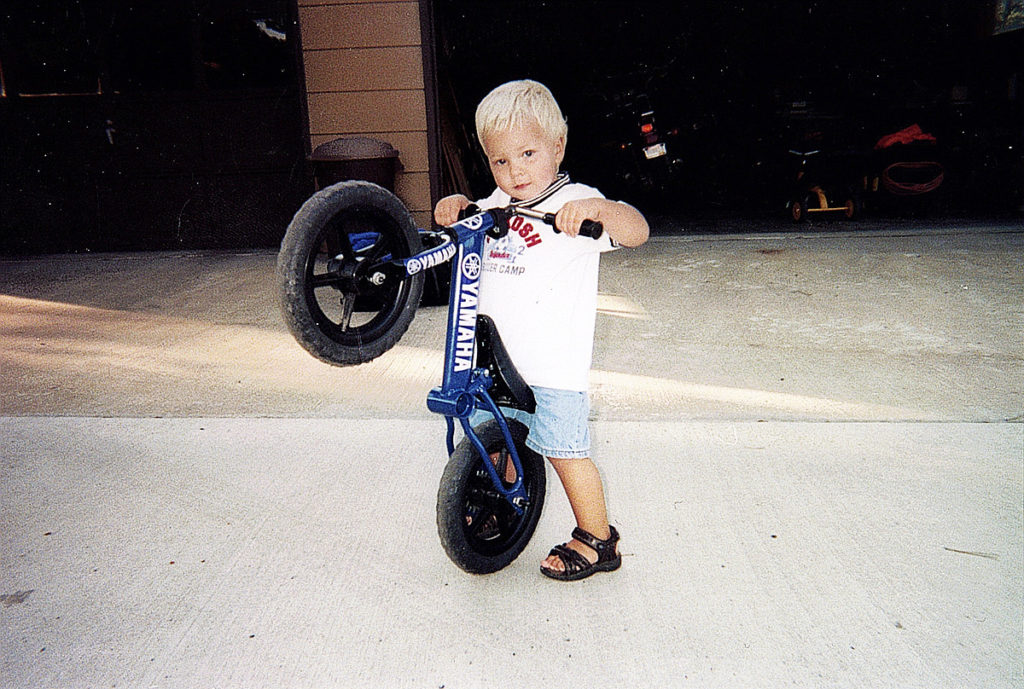
The Strider factory prototype in the hands of test rider Bode McFarland. Photo courtesy All Kids Bike.
The basic failures of the beginning machines were related to scale, McFarland says. They weighed as much as the two-year-old, with a seat at chest height and gearing that was too tall for toddler leg muscles. So he took a basic 12-inch-wheel bicycle and started chopping until the seat height was appropriate for a two-year-old. With the seat that low, however, it was impossible to operate the pedals.
Then McFarland had his flash of inspiration. “That’s when I really realized that the key to this whole thing was separating propulsion from riding. Riding is balancing two linear wheels while straddling it. You start thinking about propulsion separately. Why not striding and walking? That’s one way of getting something to move,” McFarland says. “What’s the easiest propulsion method for a two-year-old? Walking and running. Feet on the ground, Fred Flintstone-style. Totally safe, totally confident, just focusing on riding the bike.”
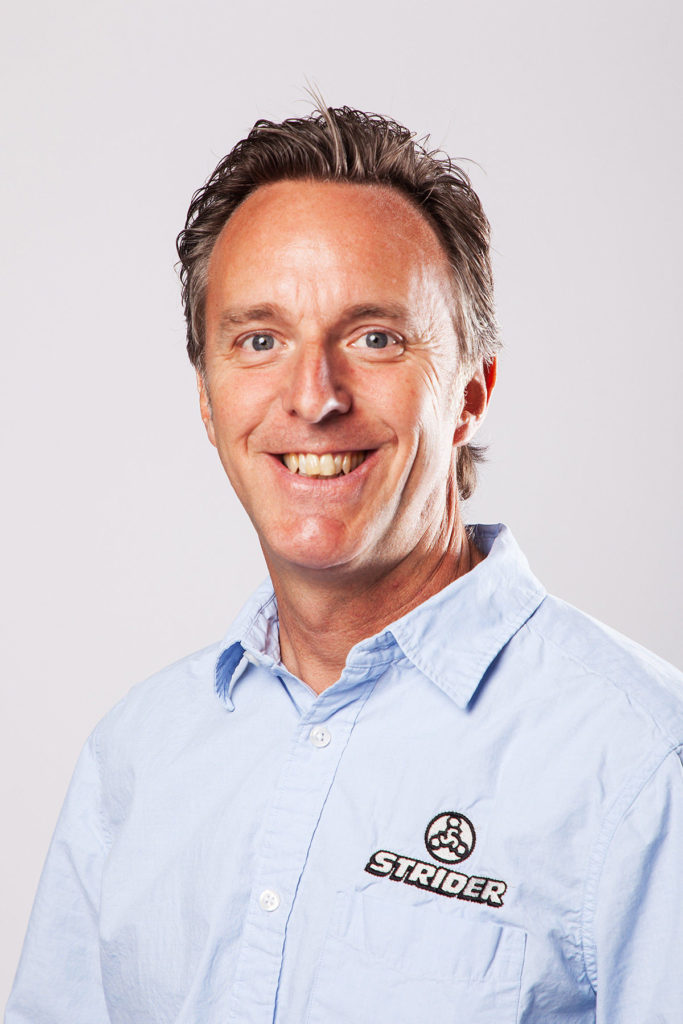
Strider CEO Ryan McFarland. Photo courtesy All Kids Bike.
McFarland painted it blue to match the Yamaha 450 dirtbike in his garage and slapped some Yamaha stickers on it. Quickly, his son and the homemade Strider bike were inseparable. It was evidence that the idea was sound—so sound that the company, founded in 2007, has now sold over three million units.
Still, McFarland was not unaware of the fundamental changes in childhood sweeping the world. Not even available a generation or two ago, video-based activities have literally created an alternative reality for those born in the last few years, a reality in which their physical bodies are sedentary. In a very real sense, most of the U.S. is coming to grips with a video-generated reality that is beyond the imagination of those who were studying the impact of television on society 60 years ago. The youngest are facing those changes as surely as anyone else.
“What really dialed us in was the urgency of the problem. This stuff is happening fast. How can we address this?” McFarland says he pondered.
His solution: Get as many kids as possible on bikes, as early as possible. That meant reaching kids where they gathered—school—at the youngest age they were going to be there—kindergarten. “Every kindergarten program has a P.E. program, and that’s where we wanted to be,” McFarland says.
The package delivered to the schools includes 24 bikes for students and one for the teacher. Features like solid rubber tires make the Strider bikes more childproof. Photo courtesy All Kids Bike.
Two things were needed. One was an online curriculum to teach teachers how to teach their kindergartners. The other was a somewhat mythical creature—a kid-proof bicycle. McFarland devised a version of Strider’s 14X bike with solid tires and easy-to-adjust handlebars. The bicycles come with a pedal kit that change a balance bike to a pedal bike in three minutes.
The non-profit Strider Education Foundation was incorporated in 2017 as the (pardon the pun) vehicle to collect donations and distribute the curriculum and machines to schools. Since 2018, more than 260 schools in 38 states have adopted the curriculum.
The foundation is looking for donors to support the program. For $5,000 the foundation can provide a fleet of 24 of the children’s bikes, one adult-size bike for the teacher, helmets, the pedal conversion kits, and a five-year support commitment.
It’s all part of McFarland’s plan to save the pastimes about which he is passionate, and to help America’s children lead healthier, happier lives. “Just giving kids a bike isn’t the answer. Teaching them how to ride bikes is the answer. It really does come down to the educational piece,” McFarland says. “Kids need this experience.”
A “press release” is promotional text issued by a rider, team, company or organization to inform
the public about an event, product, or service from the issuer’s own point of view, and if deemed
to have news value, may be placed on roadracingworld.com as a service to our readers.
A press release is not an article written by Roadracingworld.com staffers. When a post is labeled with the words “press release”, it means that Roadracingworld.com is not responsible for its content and that Roadracingworld.com makes no guarantee that it is accurate. Not all press releases are posted and Roadracingworld.com may reject press releases if the content is too heavy on commercial promotion with little or no news value or if the press release contains obvious errors.
Accessibility
Accessibility modes
Epilepsy Safe Mode
Dampens color and removes blinks
This mode enables people with epilepsy to use the website safely by eliminating the risk of seizures that result from flashing or blinking animations and risky color combinations.
Visually Impaired Mode
Improves website's visuals
This mode adjusts the website for the convenience of users with visual impairments such as Degrading Eyesight, Tunnel Vision, Cataract, Glaucoma, and others.
Cognitive Disability Mode
Helps to focus on specific content
This mode provides different assistive options to help users with cognitive impairments such as Dyslexia, Autism, CVA, and others, to focus on the essential elements of the website more easily.
ADHD Friendly Mode
Reduces distractions and improve focus
This mode helps users with ADHD and Neurodevelopmental disorders to read, browse, and focus on the main website elements more easily while significantly reducing distractions.
Blindness Mode
Allows using the site with your screen-reader
This mode configures the website to be compatible with screen-readers such as JAWS, NVDA, VoiceOver, and TalkBack. A screen-reader is software for blind users that is installed on a computer and smartphone, and websites must be compatible with it.
Online Dictionary
Readable Experience
Content Scaling
Default
Text Magnifier
Readable Font
Dyslexia Friendly
Highlight Titles
Highlight Links
Font Sizing
Default
Line Height
Default
Letter Spacing
Default
Left Aligned
Center Aligned
Right Aligned
Visually Pleasing Experience
Dark Contrast
Light Contrast
Monochrome
High Contrast
High Saturation
Low Saturation
Adjust Text Colors
Adjust Title Colors
Adjust Background Colors
Easy Orientation
Mute Sounds
Hide Images
Hide Emoji
Reading Guide
Stop Animations
Reading Mask
Highlight Hover
Highlight Focus
Big Dark Cursor
Big Light Cursor
Cognitive Reading
Virtual Keyboard
Navigation Keys
Voice Navigation
Accessibility Statement
www.roadracingworld.com
November 10, 2026
Compliance status
We firmly believe that the internet should be available and accessible to anyone, and are committed to providing a website that is accessible to the widest possible audience,
regardless of circumstance and ability.
To fulfill this, we aim to adhere as strictly as possible to the World Wide Web Consortium’s (W3C) Web Content Accessibility Guidelines 2.1 (WCAG 2.1) at the AA level.
These guidelines explain how to make web content accessible to people with a wide array of disabilities. Complying with those guidelines helps us ensure that the website is accessible
to all people: blind people, people with motor impairments, visual impairment, cognitive disabilities, and more.
This website utilizes various technologies that are meant to make it as accessible as possible at all times. We utilize an accessibility interface that allows persons with specific
disabilities to adjust the website’s UI (user interface) and design it to their personal needs.
Additionally, the website utilizes an AI-based application that runs in the background and optimizes its accessibility level constantly. This application remediates the website’s HTML,
adapts Its functionality and behavior for screen-readers used by the blind users, and for keyboard functions used by individuals with motor impairments.
If you’ve found a malfunction or have ideas for improvement, we’ll be happy to hear from you. You can reach out to the website’s operators by using the following email
Screen-reader and keyboard navigation
Our website implements the ARIA attributes (Accessible Rich Internet Applications) technique, alongside various different behavioral changes, to ensure blind users visiting with
screen-readers are able to read, comprehend, and enjoy the website’s functions. As soon as a user with a screen-reader enters your site, they immediately receive
a prompt to enter the Screen-Reader Profile so they can browse and operate your site effectively. Here’s how our website covers some of the most important screen-reader requirements,
alongside console screenshots of code examples:
Screen-reader optimization: we run a background process that learns the website’s components from top to bottom, to ensure ongoing compliance even when updating the website.
In this process, we provide screen-readers with meaningful data using the ARIA set of attributes. For example, we provide accurate form labels;
descriptions for actionable icons (social media icons, search icons, cart icons, etc.); validation guidance for form inputs; element roles such as buttons, menus, modal dialogues (popups),
and others. Additionally, the background process scans all the website’s images and provides an accurate and meaningful image-object-recognition-based description as an ALT (alternate text) tag
for images that are not described. It will also extract texts that are embedded within the image, using an OCR (optical character recognition) technology.
To turn on screen-reader adjustments at any time, users need only to press the Alt+1 keyboard combination. Screen-reader users also get automatic announcements to turn the Screen-reader mode on
as soon as they enter the website.
These adjustments are compatible with all popular screen readers, including JAWS and NVDA.
Keyboard navigation optimization: The background process also adjusts the website’s HTML, and adds various behaviors using JavaScript code to make the website operable by the keyboard. This includes the ability to navigate the website using the Tab and Shift+Tab keys, operate dropdowns with the arrow keys, close them with Esc, trigger buttons and links using the Enter key, navigate between radio and checkbox elements using the arrow keys, and fill them in with the Spacebar or Enter key.Additionally, keyboard users will find quick-navigation and content-skip menus, available at any time by clicking Alt+1, or as the first elements of the site while navigating with the keyboard. The background process also handles triggered popups by moving the keyboard focus towards them as soon as they appear, and not allow the focus drift outside it.
Users can also use shortcuts such as “M” (menus), “H” (headings), “F” (forms), “B” (buttons), and “G” (graphics) to jump to specific elements.
Disability profiles supported in our website
Epilepsy Safe Mode: this profile enables people with epilepsy to use the website safely by eliminating the risk of seizures that result from flashing or blinking animations and risky color combinations.
Visually Impaired Mode: this mode adjusts the website for the convenience of users with visual impairments such as Degrading Eyesight, Tunnel Vision, Cataract, Glaucoma, and others.
Cognitive Disability Mode: this mode provides different assistive options to help users with cognitive impairments such as Dyslexia, Autism, CVA, and others, to focus on the essential elements of the website more easily.
ADHD Friendly Mode: this mode helps users with ADHD and Neurodevelopmental disorders to read, browse, and focus on the main website elements more easily while significantly reducing distractions.
Blindness Mode: this mode configures the website to be compatible with screen-readers such as JAWS, NVDA, VoiceOver, and TalkBack. A screen-reader is software for blind users that is installed on a computer and smartphone, and websites must be compatible with it.
Keyboard Navigation Profile (Motor-Impaired): this profile enables motor-impaired persons to operate the website using the keyboard Tab, Shift+Tab, and the Enter keys. Users can also use shortcuts such as “M” (menus), “H” (headings), “F” (forms), “B” (buttons), and “G” (graphics) to jump to specific elements.
Additional UI, design, and readability adjustments
Font adjustments – users, can increase and decrease its size, change its family (type), adjust the spacing, alignment, line height, and more.
Color adjustments – users can select various color contrast profiles such as light, dark, inverted, and monochrome. Additionally, users can swap color schemes of titles, texts, and backgrounds, with over seven different coloring options.
Animations – person with epilepsy can stop all running animations with the click of a button. Animations controlled by the interface include videos, GIFs, and CSS flashing transitions.
Content highlighting – users can choose to emphasize important elements such as links and titles. They can also choose to highlight focused or hovered elements only.
Audio muting – users with hearing devices may experience headaches or other issues due to automatic audio playing. This option lets users mute the entire website instantly.
Cognitive disorders – we utilize a search engine that is linked to Wikipedia and Wiktionary, allowing people with cognitive disorders to decipher meanings of phrases, initials, slang, and others.
Additional functions – we provide users the option to change cursor color and size, use a printing mode, enable a virtual keyboard, and many other functions.
Browser and assistive technology compatibility
We aim to support the widest array of browsers and assistive technologies as possible, so our users can choose the best fitting tools for them, with as few limitations as possible. Therefore, we have worked very hard to be able to support all major systems that comprise over 95% of the user market share including Google Chrome, Mozilla Firefox, Apple Safari, Opera and Microsoft Edge, JAWS and NVDA (screen readers).
Notes, comments, and feedback
Despite our very best efforts to allow anybody to adjust the website to their needs. There may still be pages or sections that are not fully accessible, are in the process of becoming accessible, or are lacking an adequate technological solution to make them accessible. Still, we are continually improving our accessibility, adding, updating and improving its options and features, and developing and adopting new technologies. All this is meant to reach the optimal level of accessibility, following technological advancements. For any assistance, please reach out to