


By Ken Hill:
Hot on the heels of my most recent post about using artificial intelligence as a motorsports coach, I wanted to take a step back and look at how to lap faster using a tried-and-true tool: a simple GPS speed graph. Specifically, my own speed graph.
- Situation
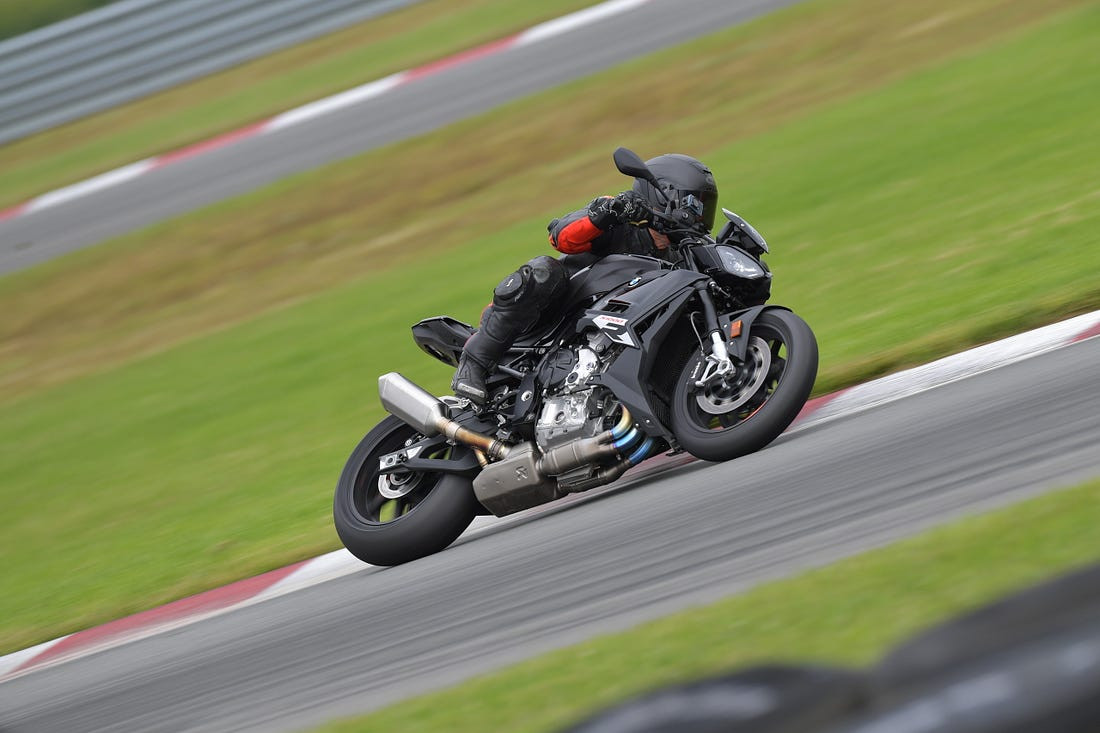
I recently picked up a 2026 BMW S 1000 R, the detuned, more upright sibling of the S 1000 RR. Given my affection for unfaired, higher-handlebar bikes and familiarity with the platform, I was excited to learn if the single-R model could earn a place among my favorites.
I shook down the S 1000 R during a few “Riders Club” days at New Jersey Motorsports Park, hopping on it for a few sessions whenever I could. At the end of the last day, I finally had time for a proper time attack.
Despite the fact that I was still getting familiar with the bike, I met my goal of a sub-1:30 lap: 1:29.63, slightly less than 10 seconds off the overall motorcycle track record. Promising, but I felt more was available. I needed to figure out where the next improvement would come from.
I downloaded the data collected by my AIM Solo DL and started going through it at home in preparation for riding again the following week. Let’s pause here, because this is where “I think I can go even quicker” needs to become more focused and specific.
- Evaluation
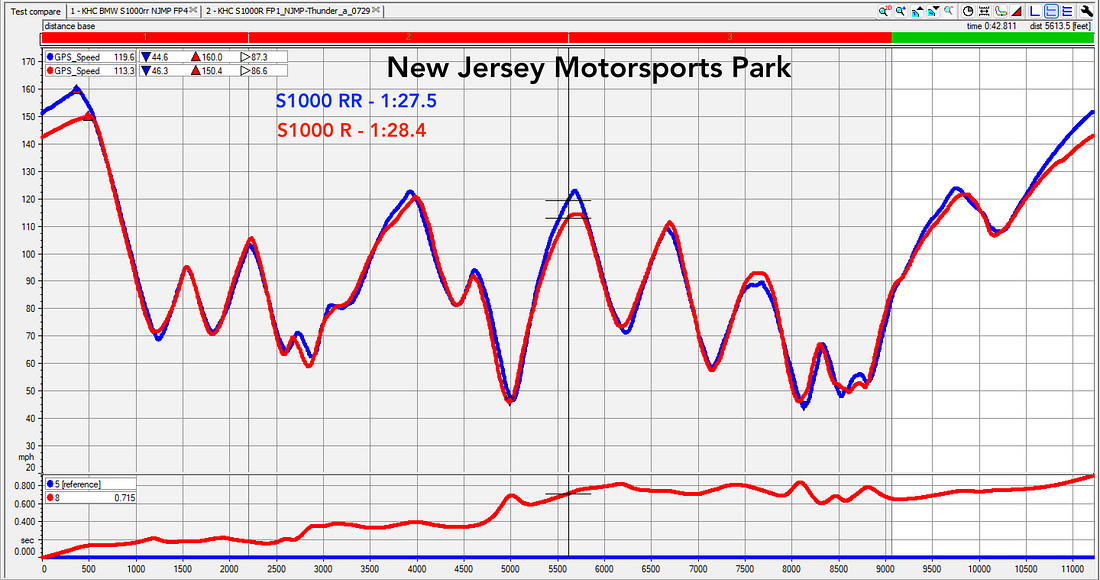
I compared my 1:29.63 on the S 1000 R with my best lap on the S 1000 RR, which had the same basic setup. That comparison helped identify three likely areas worthy of improvement. Here is the GPS speed graph comparing those laps:
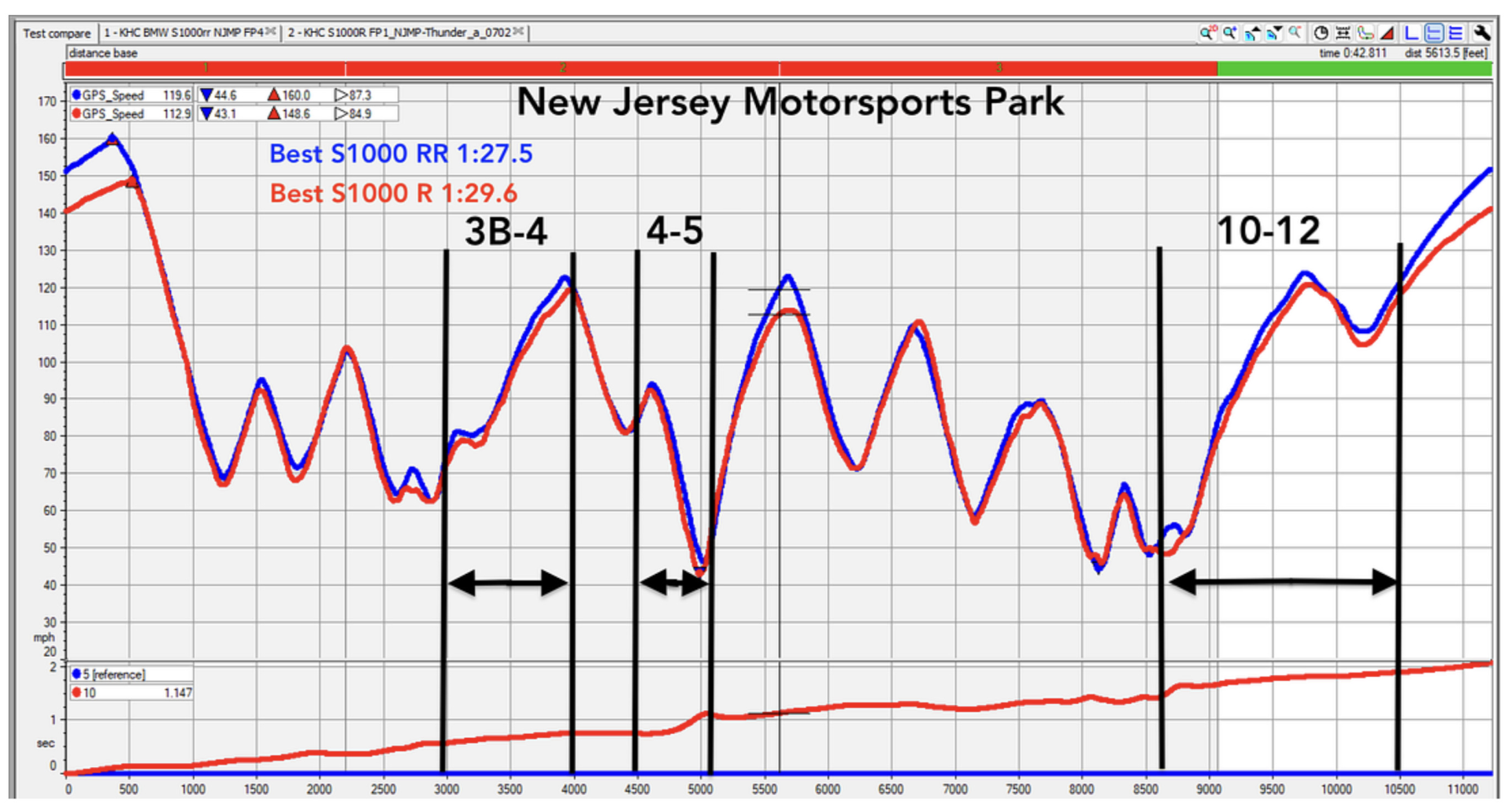
The time delta at the bottom of the graph shows where I gained or lost time on the S 1000 R relative to the S 1000 RR. For this evaluation, I focused on three sections where the gap in time increased significantly:
- Turns 3B-4
- Turns 4-5
- Turns 10-12
There were other differences at various places around the course, but these three sections accounted for the greatest combined loss of time.
Let’s get the obvious out of the way: the differences in top speeds. The R produces 45 fewer peak horsepower than the RR, so I couldn’t treat every difference in the graph as something to fix with my riding. The bikes are similar, but they highlight opportunities I could act on.
This is key: I didn’t need to go faster everywhere. I just needed to keep doing what I was doing where the loss was minimal and concentrate on the aforementioned three sections. Now, with the evaluation complete, I had to determine what to change.
- Methodology
So, why was I losing time in those areas? Cue the racer’s excuses. There were a few reasons, but the bottom line was that my exits were lacking in key acceleration areas. I wasn’t fully committed to using something the bike did well: leaping off a corner.
I needed that end of day time-attack session. It helped me shift from test rider to racer and push the bike hard enough to see if it was holding me back or if I was holding it back. And yes, I looked through the other available AIM channels.
Those channels reinforced what I needed to work on: me. I needed deliberate exit segments with no pauses in throttle application. That gave me an objective. But “get a better exit” is an outcome. I needed a method I could take back to the track—“how” to do it.
- Process
Looking over the individual laps, the graph highlighted inconsistencies in my slow-point location, especially segments where I was losing the most time. In some corners, I reached the slow point too early and overslowed. In others, I carried it too far and compromised my drive.
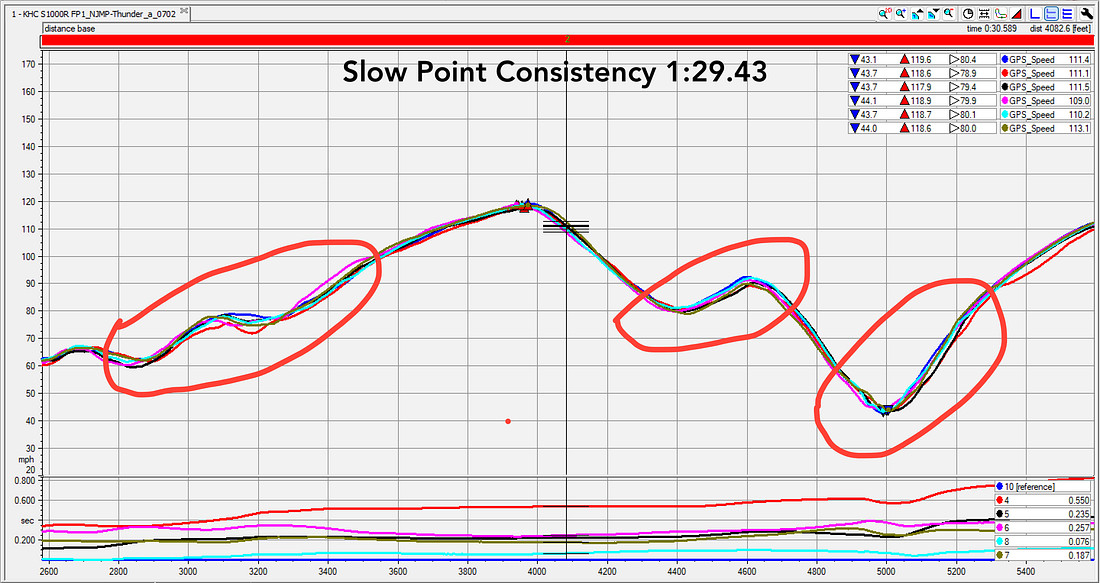
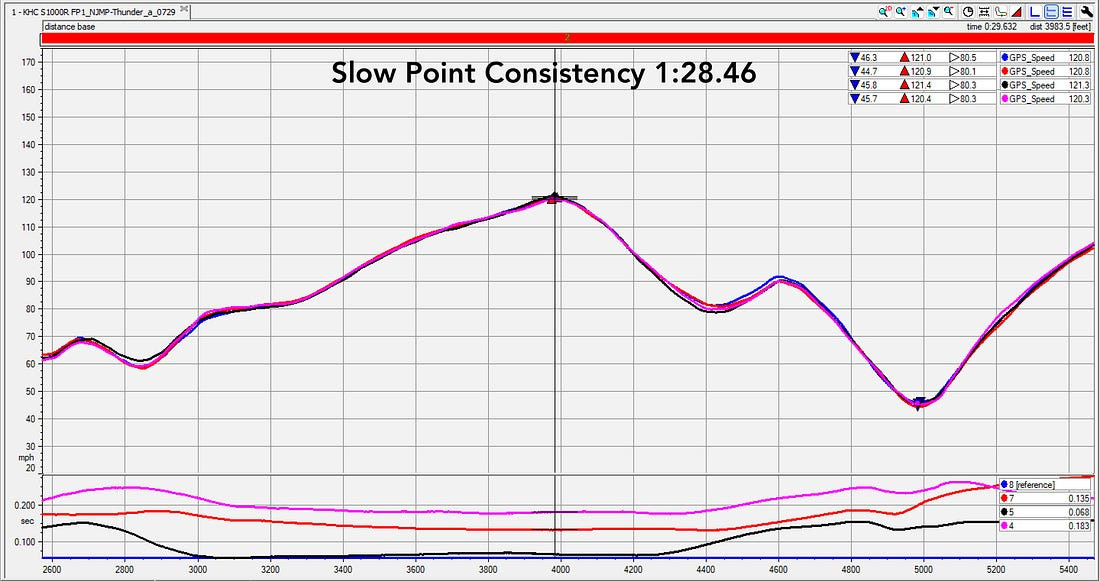
Fix: Commit to the proper slow-point locations, setting myself up for stronger overall exits without sacrificing time on entries. Report card: 1) quick but smooth initial throttle, with little or no transition to drive throttle; and 2) getting to wide-open throttle without having to roll out.
- Outcome
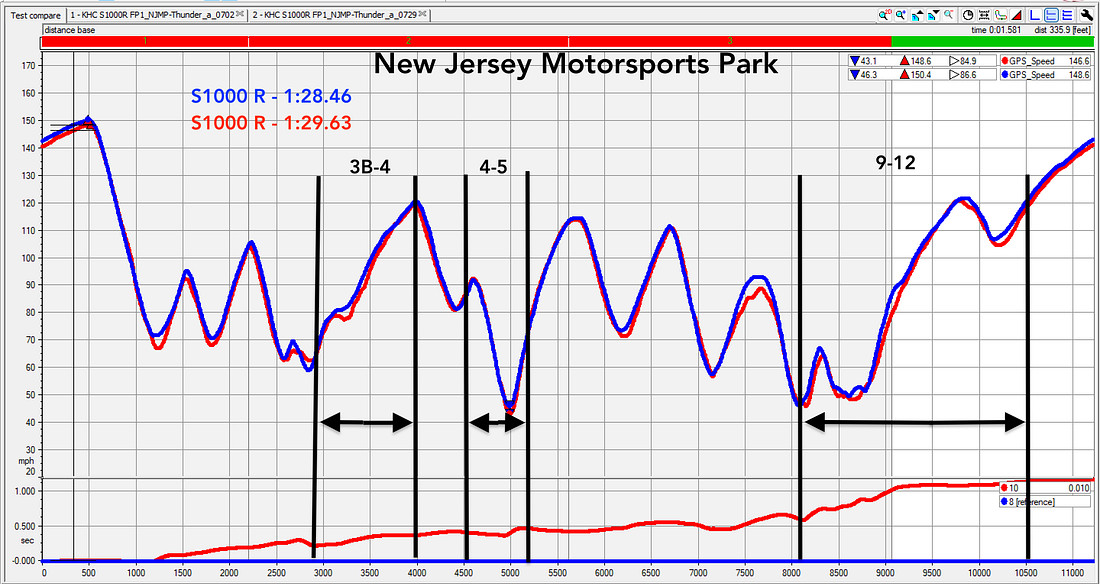
Facing the same situation as before, I expected to get one session at the end of the day to make it happen. No changes to the bike, only the rider; I even had the same fuel in the tank. So, how did it go? Pretty darn well: 1:28.46—a 1.2-second drop.
Focusing on those three segments paid off more than I expected. I probably overdid it in a few places, but the results speak for themselves. Plus, there was organic improvement in other sections of the track stemming from that focus.
- Conclusion
Fundamentals over incrementals. With my own data, I identified where I was losing the most time, made a plan, and used real-time report cards for my execution. It wasn’t complicated. It wasn’t hopeful. It was deliberate technique.
I had prior data from the S 1000 RR to compare with that of the S 1000 R, which most certainly shortened the process. But even without that data, I had other metrics that ultimately could have guided me to the same conclusions.
AI and other forms of detailed analysis can be useful. But before digging into the smallest details, ask yourself, how well am I executing the fundamentals? Keeping it simple can still lead to massive improvements.
About Ken Hill:
Ken Hill is considered the top motorcycle riding coach in the U.S. He bought his first motorcycle at age 30 and began road racing the very same year. Despite the late start, Ken went on to set track records and win class championships before making his professional debut in the AMA Superbike class, where he finished in the top 10 at age 41. Ken’s passion for learning and, ultimately, bettering the sport, led him to retire from racing in 2007 and devote himself full-time to coaching. Learn more at khcoaching.com.