

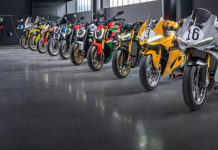
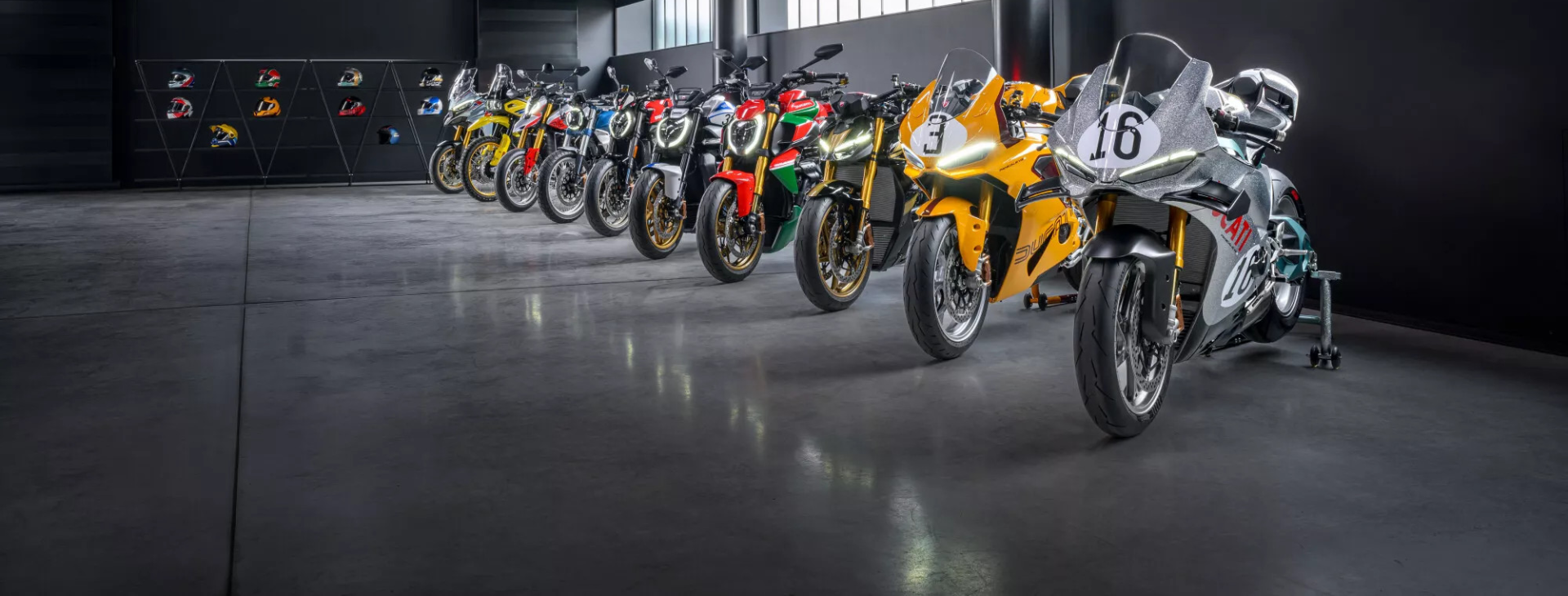
Ducati unveils Collezione 100: ten contemporary icons celebrate 100 years of Ducati history.
- Ten significant moments in Ducati’s history have inspired ten unique motorcycles, each produced in a numbered series limited to just one hundred units
- Technology, design, and art: each motorcycle features unique components that, together with its livery, make it a one-of-a-kind icon, accompanied by two works of art
- For the North American market, all Collezione 100 models include an exclusive dedicated helmet and leather jacket that complement the motorcycle’s livery.
- The two DesmosediciGP bikes of the Ducati Lenovo team will race with a special livery that combines the Collezione 100 liveries into a single design
Sunnyvale, Calif. – The Mugello circuit, where the Desmosedici MotoGP bikes have written numerous unforgettable pages in Ducati’s racing history, is the setting for the presentation of the Collezione 100. Ten liveries, ten numbered editions, each strictly limited to just 100 units. True contemporary icons created to mark the centenary of the Borgo Panigale-based manufacturer.
Each model is distinguished by unique specifications: a livery inspired by an iconic motorcycle from Ducati’s history, Alcantara or leather seats with an embroidered Ducati logo, and premium technical details such as Centenario Bronze brake calipers. This color is exclusive to this collection and is also used on the fuel cap crown and on the plate bearing the model number, which is riveted to the steering head or the billeted triple clamps. Various mechanical components on each bike feature an exclusive color scheme that complements the historic livery. The dry clutch, a first for V2 models*, completes the authenticity of this historic collection.
Each bike comes with a dedicated rear stand, finished in the same colors as the livery, a bike cover, and a certificate of authenticity. As with all Ducati collector’s bikes, the experience of getting on the bike is made even more special by the dashboard featuring a dedicated ignition ceremony. In North America, each owner of the Collezione 100 Collection will receive a limited-edition helmet and technical jacket, featuring a color scheme that complements the motorcycle.*
The Collezione 100 represents yet another link between Ducati and the art world. Ugo Nespolo, a leading figure in Italian art of the late 20th century and a passionate Ducati enthusiast, has enthusiastically joined this project. Each model in the 100 Collection will be accompanied by a pair of numbered art prints bearing the same serial number as the motorcycle and signed by Nespolo himself. He has interpreted every model in the 100 Collection and the historic motorcycle that inspired its livery in his own unmistakable, colorful, and dynamic style.
The result is a collection of true gems: unique, unmistakable, and full of character.
The presentation took place on the legendary straight of the Tuscan circuit where, for the first time in MotoGP history, Ducati staged a vernissage. A veritable art gallery trail, where Nespolo’s works welcomed guests, accompanying them on a journey culminating in the unveiling of the ten motorcycles of the 100 Collection.
During the event, Marc Marquez and Pecco Bagnaia unveiled the Lenovo team’s bikes, featuring a special race livery. The design combines historic Ducati logos with dynamic geometric patterns, bringing together the ten graphics from the 100 Collection bikes on the fairing. Details celebrating the centenary and the dates 1926–2026 feature glitter, evoking the historic 750 Imola Desmo, while the front fairing’s modern graphics contrast with an oval number plate and a vintage-style font.
Several Ducati partners have drawn inspiration to create products dedicated to the Borgo Panigale manufacturer’s centenary. The Collezione 100 has, in fact, inspired a series of four rucksacks created by Piquadro, unveiled during the event. Carrera, the official sponsor of the Ducati Lenovo team, has instead presented the Anniversary Edition sunglasses, produced in a numbered series limited to 1,000 pieces.
The next opportunity for the public to see the Collezione 100 in person will be at World Ducati Week, where it can be admired in a space reserved for all Ducatisti on July 3, 4, and 5.
Subsequently, the ten motorcycles will travel to the Goodwood Festival of Speed, a world-class event and a must-attend for car and motorcycle enthusiasts. Finally, the 100 Collection will return to Bologna, where it will be proudly displayed in various museums across the region.
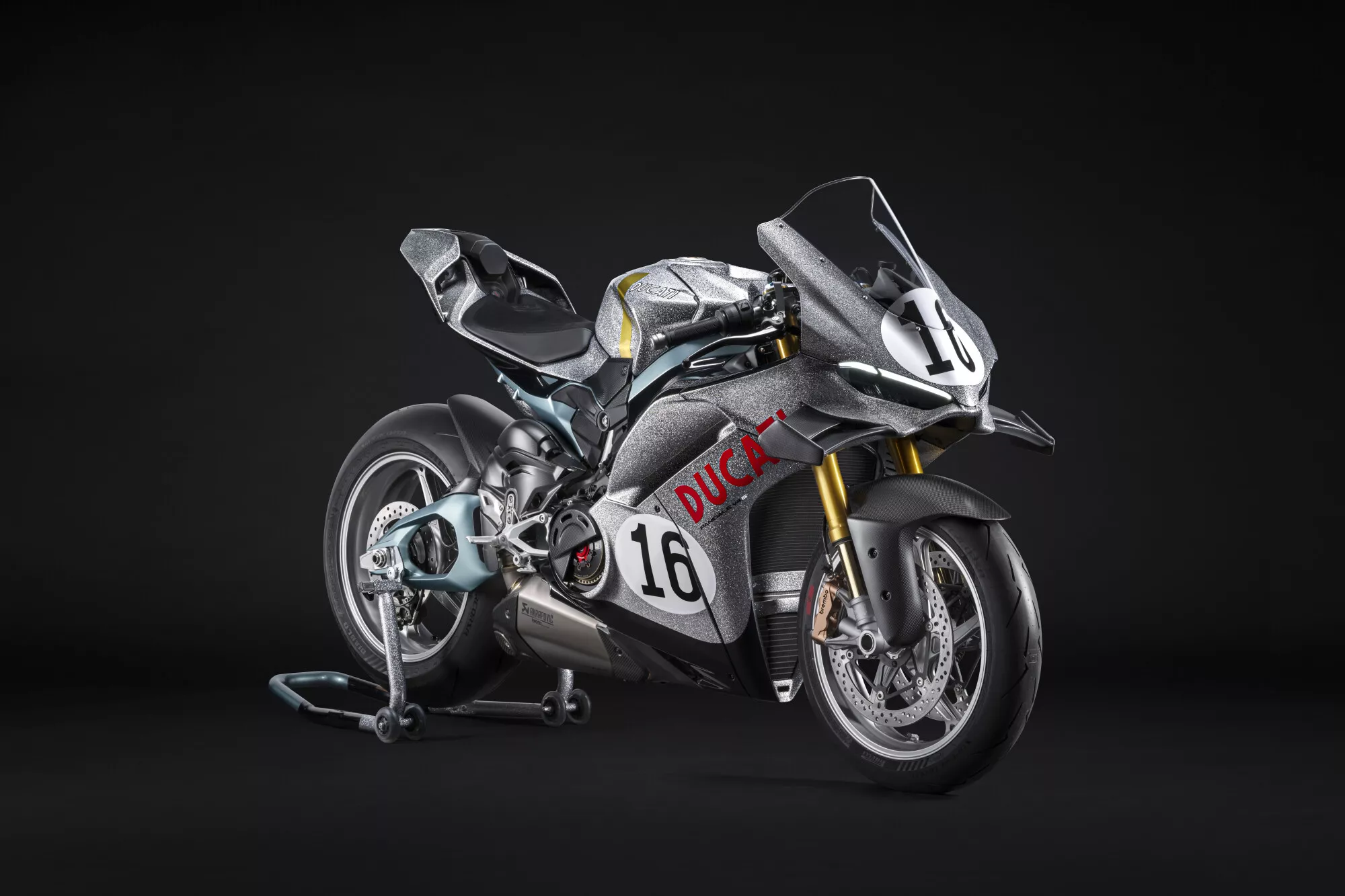
- Panigale V4 S 100 (750 Imola Desmo – 1972)
The livery of the Panigale V4 S 100 is inspired by the graphics of the bike that won the first edition of the Imola 200 Miles race in 1972, ridden by Paul Smart and Bruno Spaggiari.
The 750 Imola Desmo was developed from the 750 GT, Ducati’s first twin-cylinder road bike. Conceptually, it retained the 750 GT’s mechanical foundation but added the desmodromic distribution system, not featured on the GT, and adopted the bodywork of the 500 GP, designed for racing in the premier class. The characteristic “glittery” silver color, which harked back to the science-fiction aesthetic popular at the time, had already been used in production by Ducati on the 250 and 350 Desmo single-cylinder bikes, then applied to the 500 GP, and finally to the 750 Imola Desmo.
The victory at Imola was an unexpected and triumphant moment for the Borgo Panigale manufacturer, as it marked the first time it defeated Giacomo Agostini. The echo of the Imola triumph by riders Paul Smart and Bruno Spaggiari brought Ducati enormous popularity, so much so that, in response to popular demand, the following year, in 1973, the 750 Supersport Desmo was introduced, the first twin-cylinder desmodromic road bike by the Borgo Panigale manufacturer.
The Panigale V4 S 100 is enhanced with an Alcantara seat with an embroidered Ducati 100 logo, wings, mudguards, and engine and exhaust covers in premium carbon fiber, and features the name and serial number on a Centenary Bronze plate riveted to the billet aluminum triple clamp. The dry clutch, titanium, and carbon fiber Akrapovič exhaust also make the Panigale V4 S 100’s sound unique. The standard equipment includes a mirror and license plate removal kits, an open clutch cover, and a Centenary Bronze billet aluminum fuel tank cap, all designed for track use. The Panigale V4 S 100 is delivered in an exclusive, custom-made wooden crate.
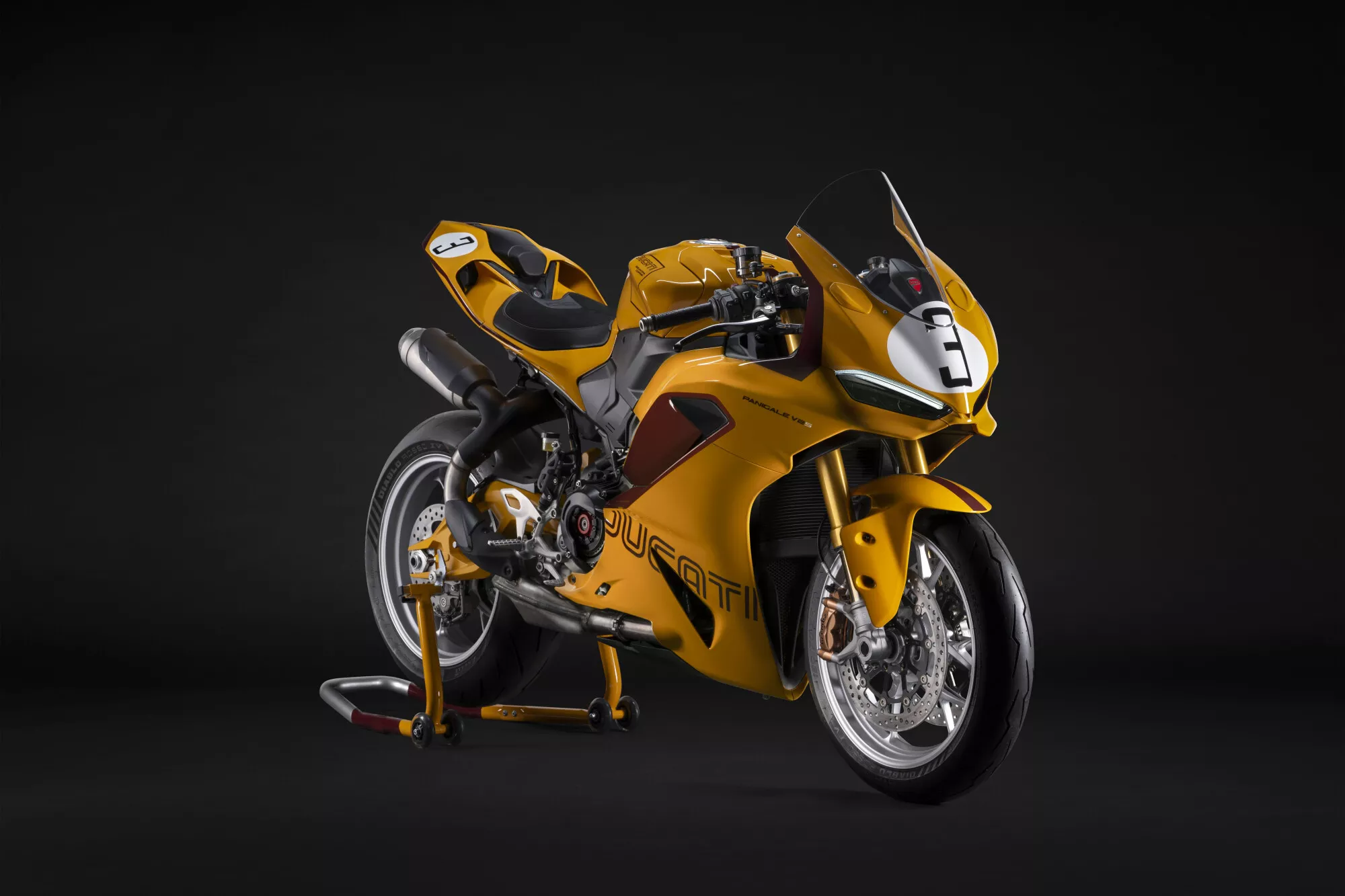
- Panigale V2 S 100 (750 Super Sport Desmo – 1975)
The livery of the Panigale V2 S 100 is inspired by the graphics of the 750 Super Sport Desmo ridden by Franco Uncini in the 1975 Italian Championship, which he won. The bike was managed by the team founded by Bruno Spaggiari.
At the end of 1973, Ducati decided to entrust team management to Bruno Spaggiari, a former racer and founder of his own team. Spaggiari was supported by the Bologna-based manufacturer to compete in the Italian Championship for production-based motorcycles with the powerful 750 Super Sport Desmo, a bike highly appreciated by the discerning riders.
The yellow livery recalled the road-going 750 Sport models and was paired with details in a distinctive brown/burgundy color used at the time on inboard marine engines assembled at the Borgo Panigale factory.
The Panigale V2 S 100 is enhanced with an Alcantara seat featuring an embroidered Ducati 100 logo, billet sport handlebars, a steering damper, and the name and serial number on a Centenary Bronze plate riveted to the billet triple clamp. Furthermore, this Panigale V2 is the first model in the new Ducati V2 family to feature a dry clutch, developed specifically for this model, which makes the engine particularly compact. Standard equipment also includes mirror and license plate removal kits, an open clutch cover, and a Centenary Bronze-colored billet aluminum fuel cap crown, all designed for track use.
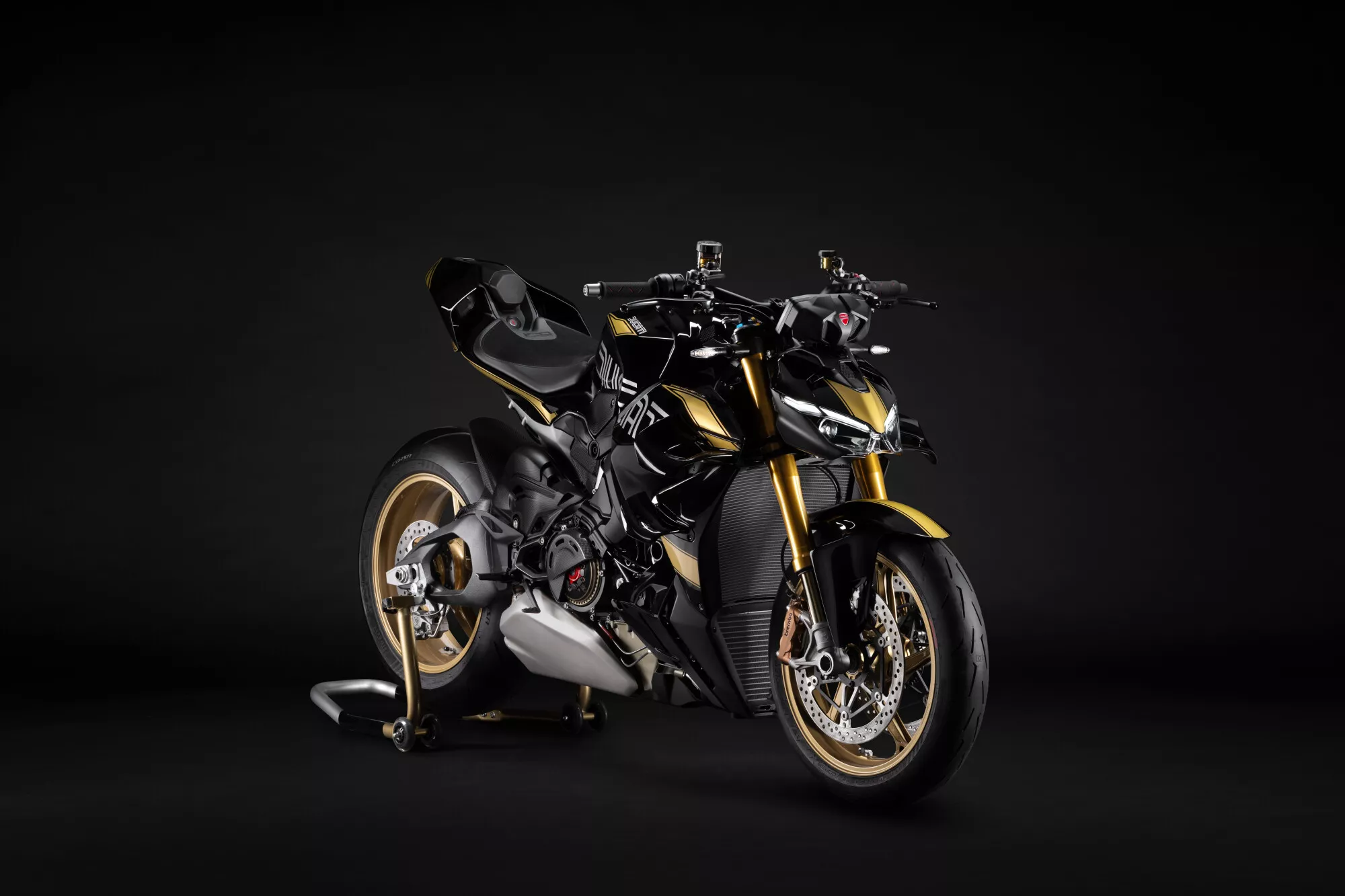
- Streetfighter V4 S 100 (Ducati 900 Sport Desmo Darmah – 1979)
The livery of the Streetfighter V4 S 100 is inspired by the graphics of the 1979 900 Sport Desmo Darmah.
In the 1970s and 1980s, black-and-gold graphics were extremely fashionable in motorsports, and Ducati was no exception. Specifically, it applied this color scheme to the 900 Sport Desmo Darmah, essentially a Streetfighter before its time.
In Italy, there was also a strong fascination with exotic countries, a fascination that, in Borgo Panigale, translated into purely fictional names like Darmah or details such as the distinctive tiger head depicted on the side panels of the 900 Sport Desmo Darmah. The head is a highly distinctive graphic element, also echoed in the undertail of the Streetfighter V4 Collezione 100 and in the matching helmet and jacket.
The Streetfighter V4 S 100 is enhanced with an Alcantara seat featuring an embroidered Ducati 100 logo, a rear mudguard, engine cover, and exhaust in premium carbon fiber, a dry clutch and the name and serial number on a distinctive Centenary Bronze plate on the billet aluminum triple clamp. The standard equipment includes a mirror and license plate removal kits, an open clutch cover, and a Centenary Bronze billet aluminum fuel cap crown, all designed for track use. The Streetfighter V4 S 100 is delivered in an exclusive, custom-made wooden crate.
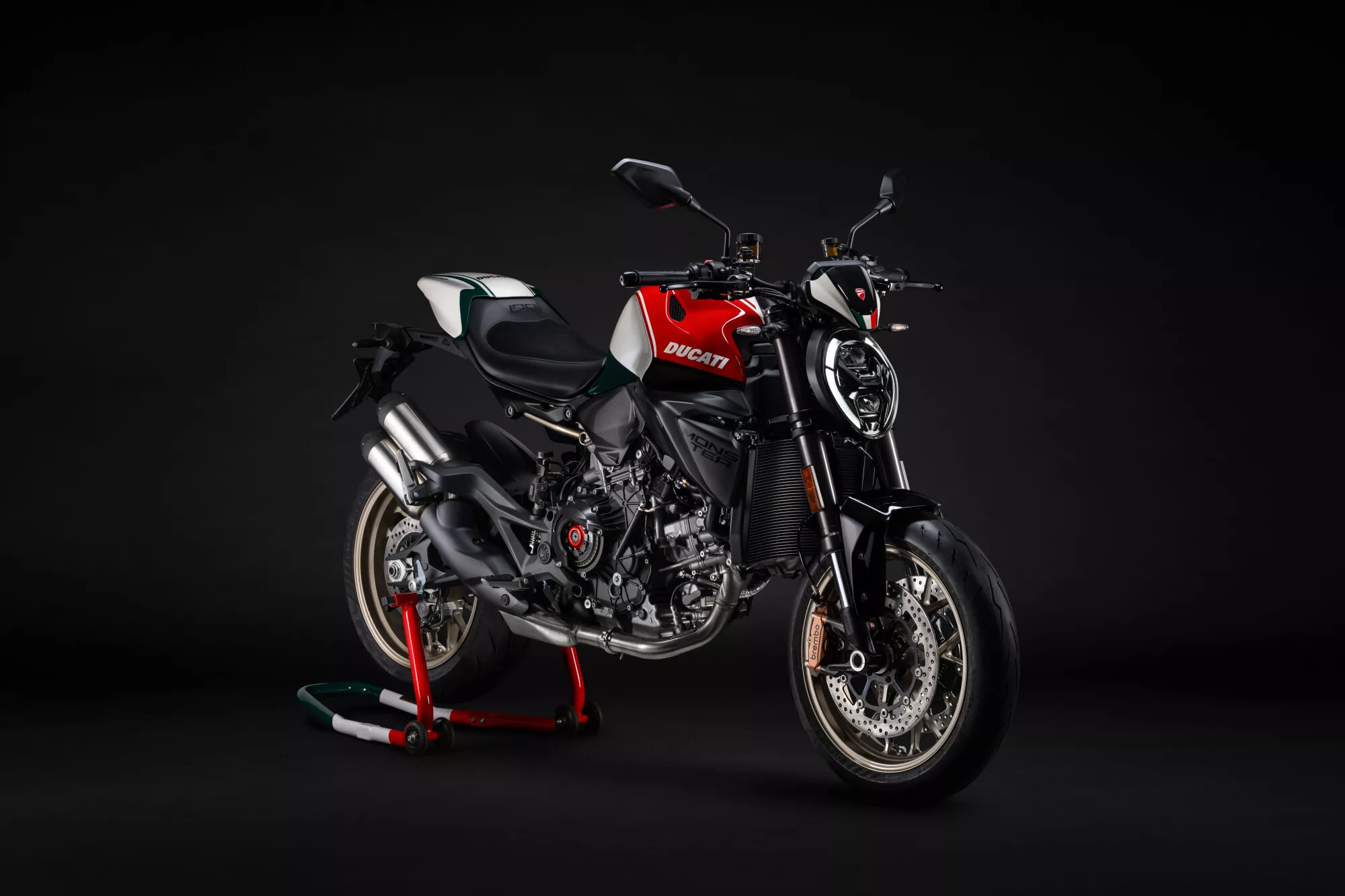
- Monster 100 (Monster S4Rs Tricolore – 2008)
The tricolore livery of the Monster 100 is inspired by the graphics of the 2008 Monster S4Rs Tricolore model.
The Monster S4Rs Tricolore effectively served as the final edition of the first-generation Monster, the model Ducati produced from March 5, 1993, until 2008, becoming one of the most recognizable and iconic models not only for the Borgo Panigale manufacturer but for the motorcycle world in general.
The Monster 100 is distinguished by its dry clutch, a carbon fiber cover included in the package, and an Alcantara seat with the embroidered Ducati 100 logo, windshield, and seat cover kit that give it a single-seater look. The Centenary Bronze plate bearing the model’s name and serial number is riveted to the billet steering clamps. The color is also used on the fuel tank cap ring and brake calipers, as with all the bikes in the 100 collection.
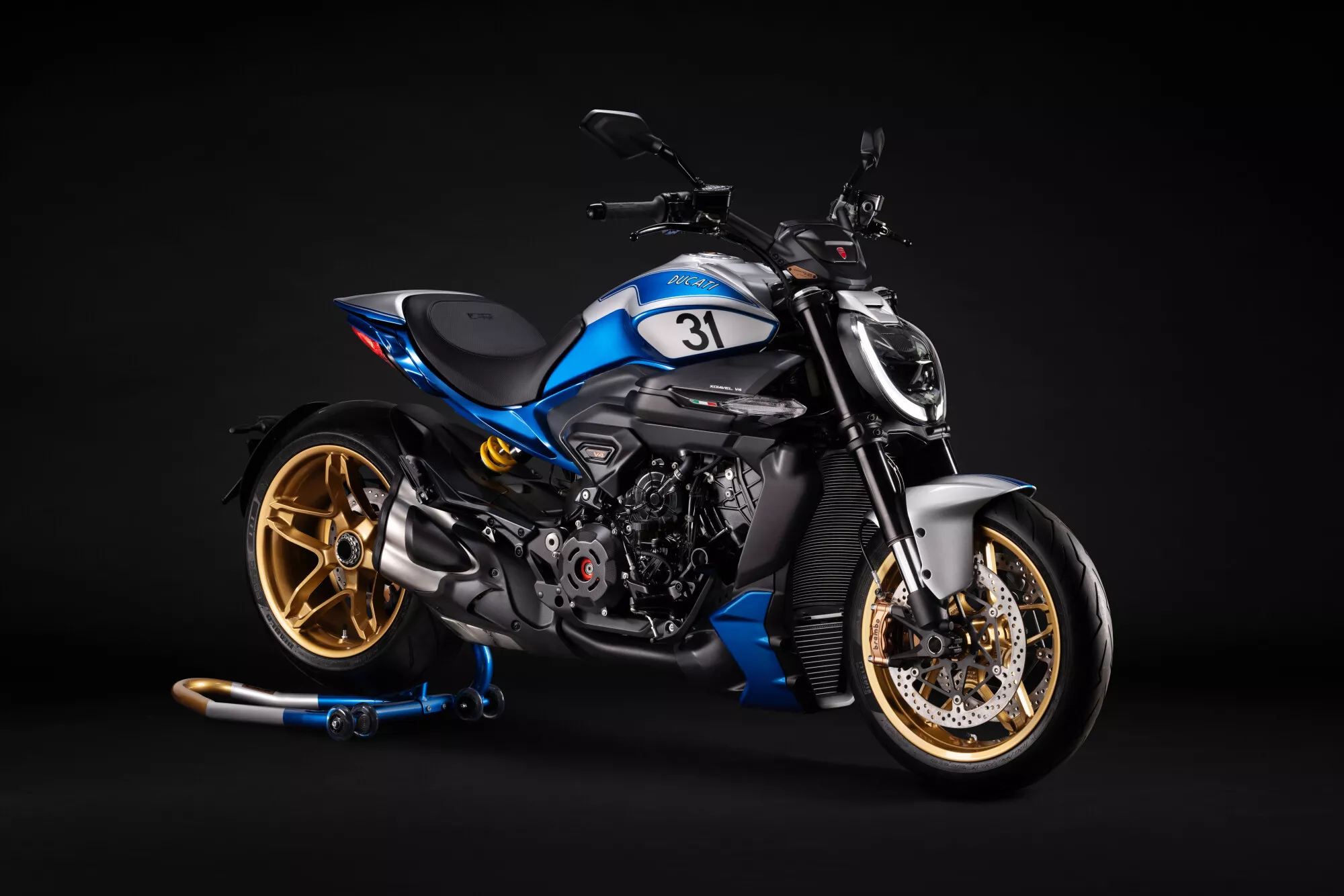
- XDiavel V4 100 (750 Super Sport “California Hot Rod” – 1977)
The livery of the XDiavel V4 100 is inspired by the graphics of the special 750 Super Sport called the “California Hot Rod,” the bike on which Cook Neilson made Ducati history by winning at Daytona in 1977. The event was significant because it was the first time an Italian motorcycle had won a production-derived race in the United States, which significantly increased Ducati’s popularity and overseas sales.
In the mid-1970s, Ducati’s visibility in the United States was essentially limited to just one model, the Scrambler, an on/off-road machine imported by the Berliner brothers, but things changed in 1977 thanks to Cook Neilson’s memorable triumph on the Daytona oval track.
The XDiavel V4 100 stands out even within the 100 collection, featuring a leather seat with an embroidered Ducati 100 logo and the central section of the handlebar machined from solid, with the name and serial number on a riveted plate in a Centenary Bronze finish—high-quality mechanical details. The dry clutch makes the riding experience even more personal. Standard equipment includes a leather passenger seat, Centenary Bronze fuel cap ring, and open clutch cover, the latter not approved for road use. The XDiavel V4 100 is delivered in an exclusive, custom-made wooden crate.
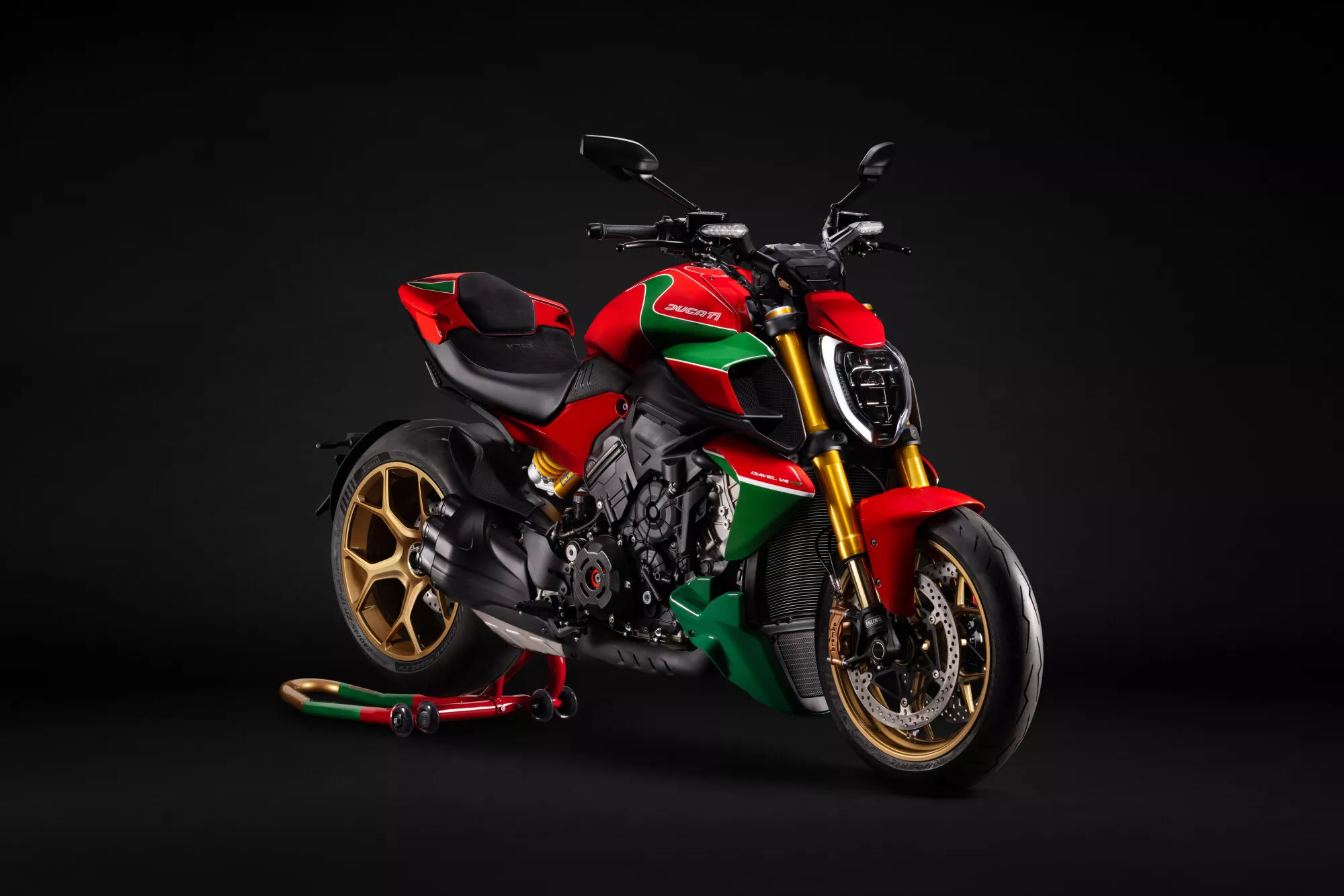
- Diavel V4 RS 100 (900 Replica – 1979)
The livery of the Diavel V4 RS 100 is inspired by the graphics of the 1979 road-going 900 Replica, one of the most iconic motorcycles in Ducati’s history.
Following Ducati’s incredible victory at the 1978 Tourist Trophy, the Borgo Panigale manufacturer began producing a series of motorcycles that evoked the livery of the 900 that won on the Isle of Man. Thus, the 900 Replica was born, the first road-going replica of a Ducati racing bike, which immediately became one of the most highly coveted items among Ducati enthusiasts.
The distinctive green and red livery with white stripes, which mirrored the color scheme of the victorious bike at the Tourist Trophy, also represents the very first example of an “almost” Italian-style livery, a color scheme that Ducati would later apply to some of its sportiest and most exclusive models in the years to come.
The 900 Replica was one of Ducati’s most successful models, produced for five years until its discontinuation at the end of 1984.
The Diavel V4 RS 100 is based on the Diavel V4 RS and is equipped with a Desmosedici Stradale engine. This model is enhanced by an Alcantara seat with an embroidered Ducati 100 logo, a machined-from-solid handlebar center with the name and serial number on a Centenary Bronze riveted plate, and a fuel cap rim in the same high-quality finish. Standard equipment includes an Alcantara passenger seat, a machined-from-solid fuel cap and an open clutch cover, the latter of which are not approved for road use. The Diavel V4 RS 100 is delivered in an exclusive, custom-made wooden crate.
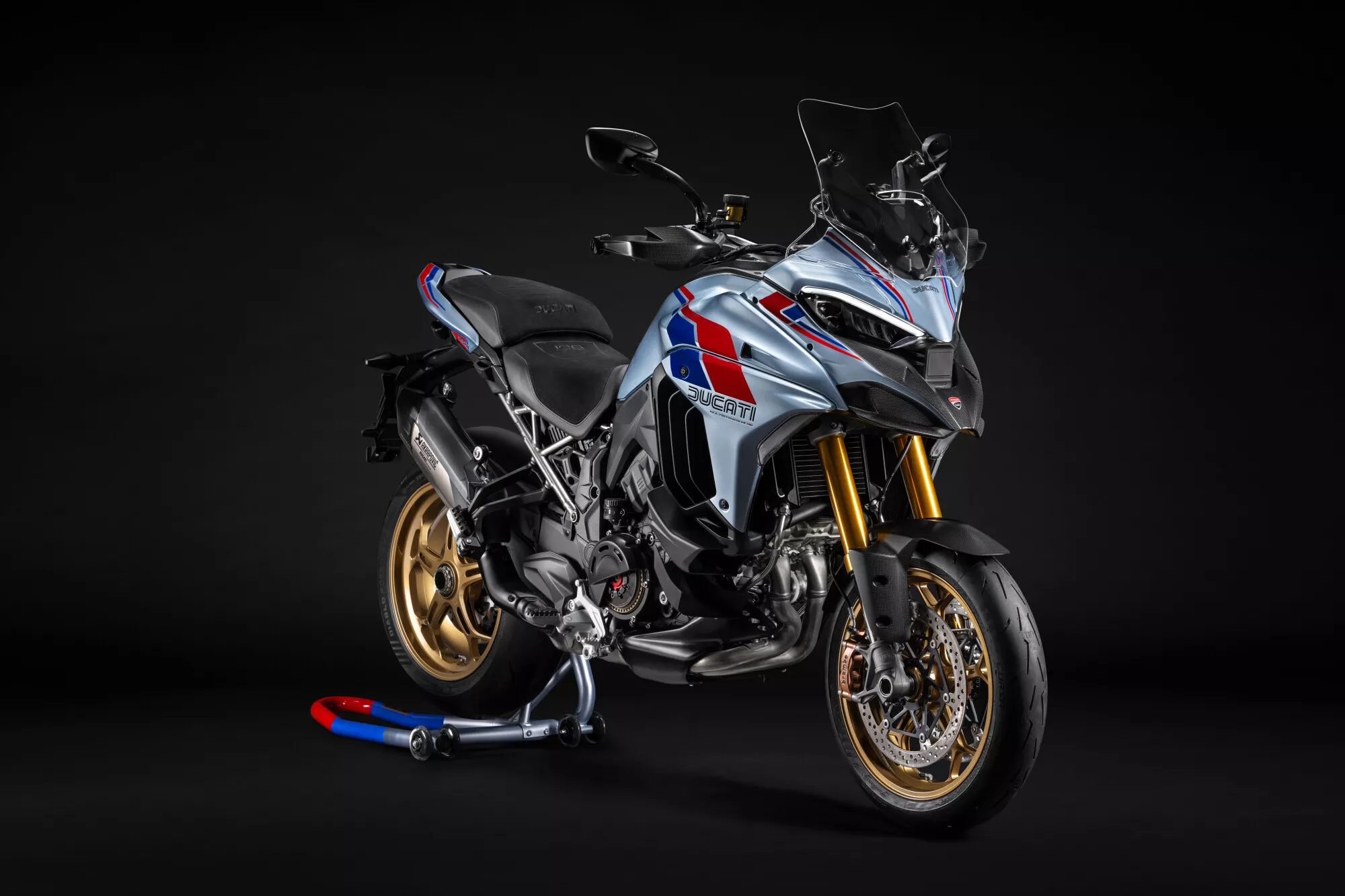
- Multistrada V4 RS 100 (500 SL Pantah – 1979)
The livery of the Multistrada V4 RS 100 is inspired by the graphics of the 1979 500 SL Pantah, a year marked by major technical innovations at Ducati aimed at modernizing and updating the motorcycles produced in Borgo Panigale.
One new model to arrive that year was the 500 SL Pantah, the first Ducati equipped with a trellis frame—albeit very different from the trellis that has distinguished the brand for almost fifty years—and the Pantah engine, which eliminated the bevel gears used since the Gran Sport Marianna (1955).
The bike, which boasts the typical boxy design of early 1980s motorcycles and a livery featuring the logo designed for Ducati by car designer Giorgetto Giugiaro, was appreciated for its ease of riding and light weight. Since the Multistrada V4 RS 100 was developed on the technical basis of the top-of-the-range Multistrada V4 RS, which features the Desmosedici Stradale engine, the livery also features the Desmo logo on the tail fairing.
The Multistrada V4 RS 100 features an Alcantara seat with an embroidered Ducati 100 logo, and the name and serial number etched on a Centenary Bronze plate attached to the handlebar clamps and the billet aluminum triple clamp. Standard equipment includes a Centenary Bronze fuel cap ring and a carbon fiber open clutch cover, neither of which is approved for road use. The Multistrada V4 RS 100 is delivered in an exclusive, custom-made wooden crate
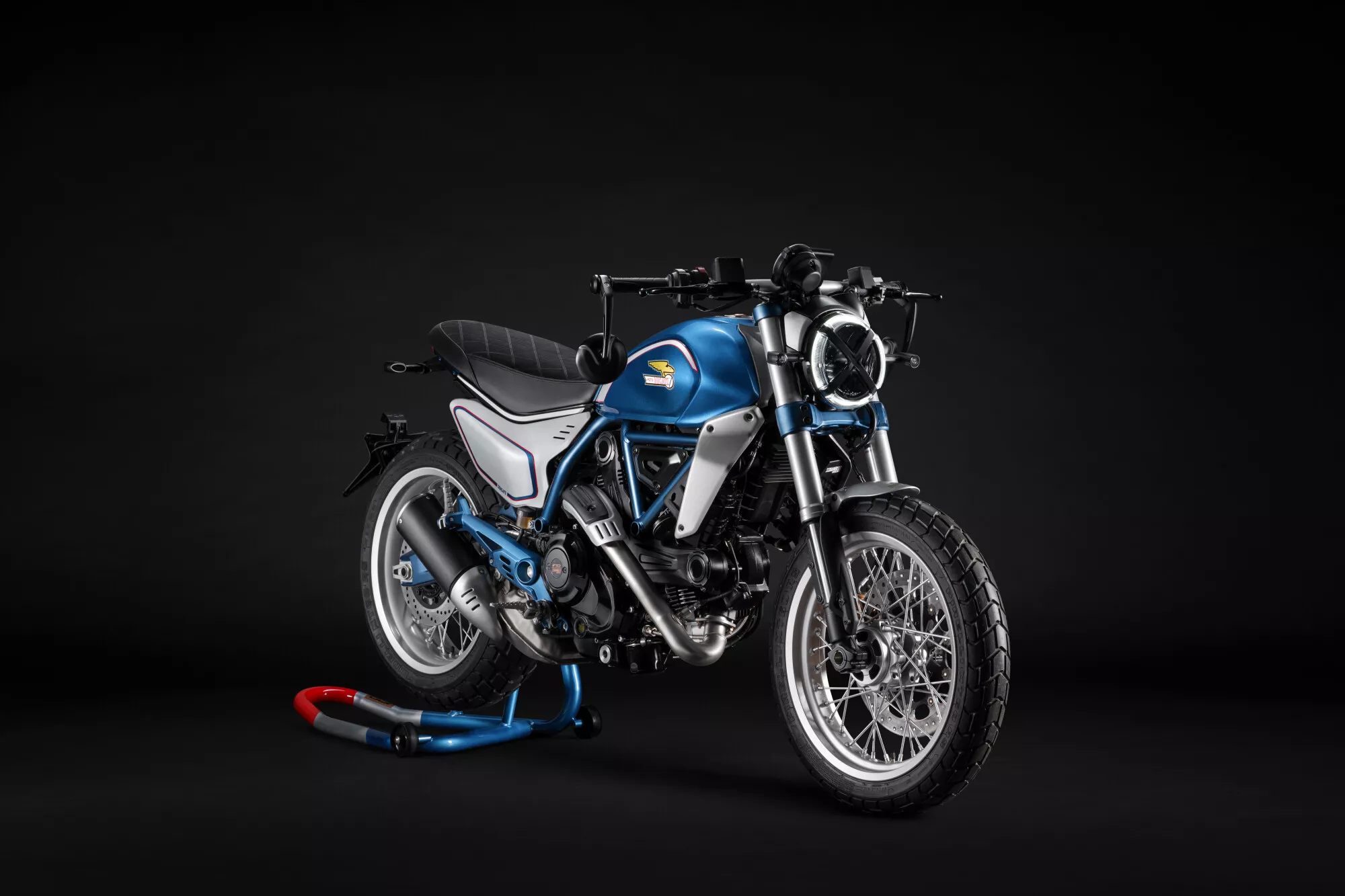
- Scrambler 100 (250 Scrambler – 1962)
The Scrambler 100’s livery is inspired by the graphics of the 1962 250 Scrambler, the first version of the Ducati Scrambler, produced exclusively for the US market.
The Scrambler’s origins are closely linked to the figure of its first American importer, Joe Berliner, who strongly wanted a new model to sell stateside. Ducati was enjoying the media success of Monetti and Tartarini’s 1957 round-the-world tour, and the hype surrounding that venture also reached America, raising the profile of the Bologna-based brand, which until then had been virtually unknown.
Berliner requested an off-road dirt bike from Ducati, a concept that hadn’t previously been envisaged in Borgo Panigale, but which came to life with the 250 Scrambler in 1962.
The Scrambler 100 shares the technical base of the Scrambler Nightshift, and features an Alcantara seat with an embroidered Ducati 100 logo and a Centenary Bronze finish plate bearing the model’s name and serial number, riveted to the billet steering clamps. The billet fuel cap, with a Centenary Bronze ring, is also included.
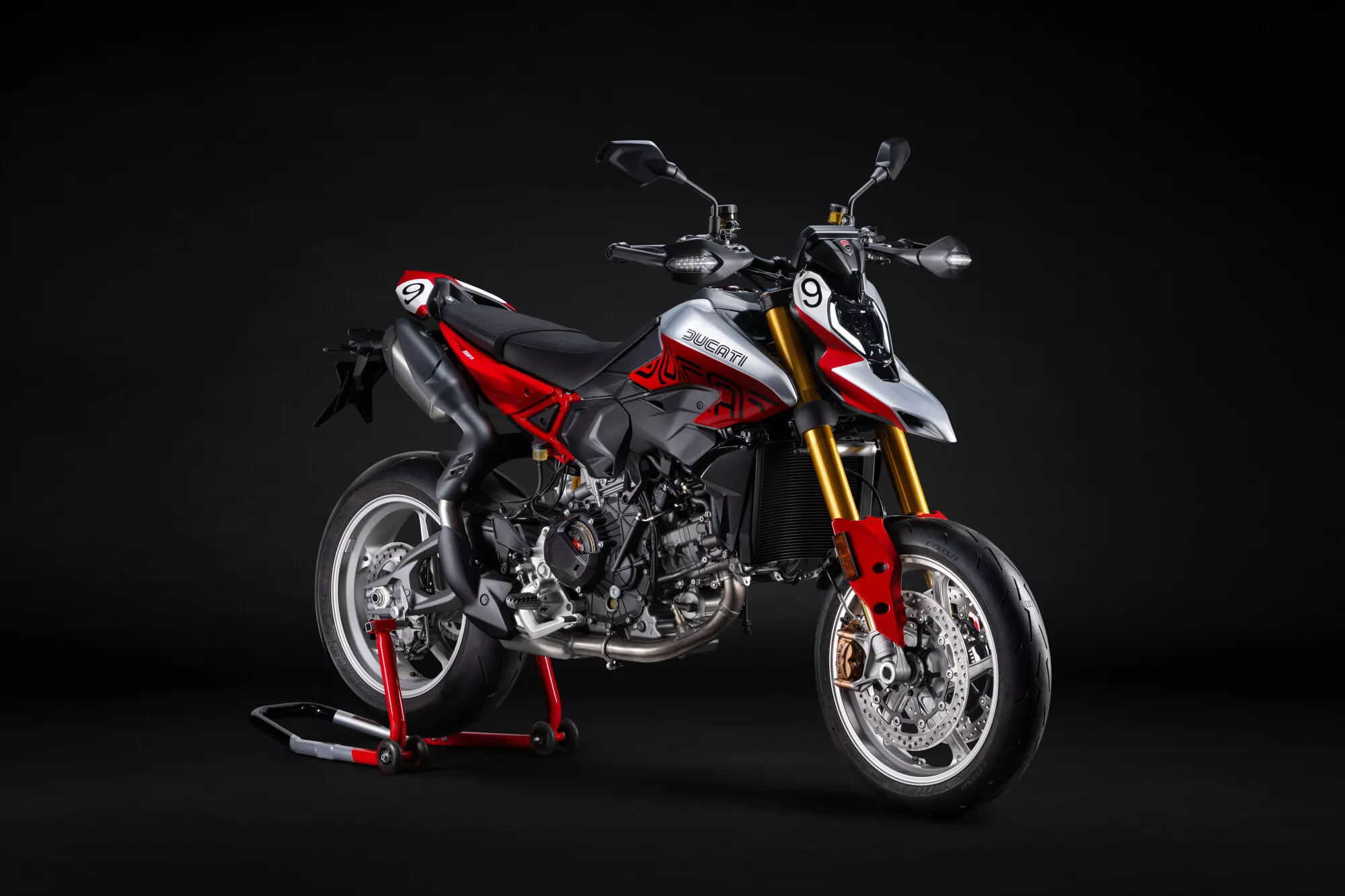
- Hypermotard V2 SP 100 (Ducati 860 “24 Horas de Montjuïc” – 1975)
The livery of the Hypermotard V2 SP 100 is inspired by the 860 “24 Horas de Montjuïc”.
After winning the 1972 Imola 200, Ducati management believed that the right path to restoring the brand’s popularity lay in production-derived racing bikes, particularly in endurance races.
To this end, Ducati needed to expand its twin-cylinder range with a larger-displacement engine than the classic 750, capable of withstanding the stresses of long endurance races such as the Bol d’Or and the 24 Horas de Montjuïc, a race that the Borgo Panigale manufacturer won on several occasions.
The Ducati 860 made its winning debut in 1973 with the prototype of the Ducati 860 Desmo, which would later become the road-going Ducati 900 Super Sport. In 1975, riders Salvador Canellas and Benjamin “Min” Grau, who had already won in 1973 on the Bologna-built twin-cylinder, repeated their success in the Catalan race, this time in the bright colors of Nepoti and Caracchi’s NCR team.
The Hypermotard V2 SP 100 is based on the SP version and features Öhlins suspension and forged wheels. It includes an Alcantara seat with an embroidered Ducati 100 logo, and the name and serial number on a plaque in high-quality Centenary Bronze, riveted to the handlebar clamps and the machined-from-solid aluminum triple clamp. The Hypermotard V2 from the 100 collection also features a dry clutch. Standard equipment includes a Centenary Bronze fuel tank cap and a carbon fiber open clutch cover, both of which are not approved for road use.
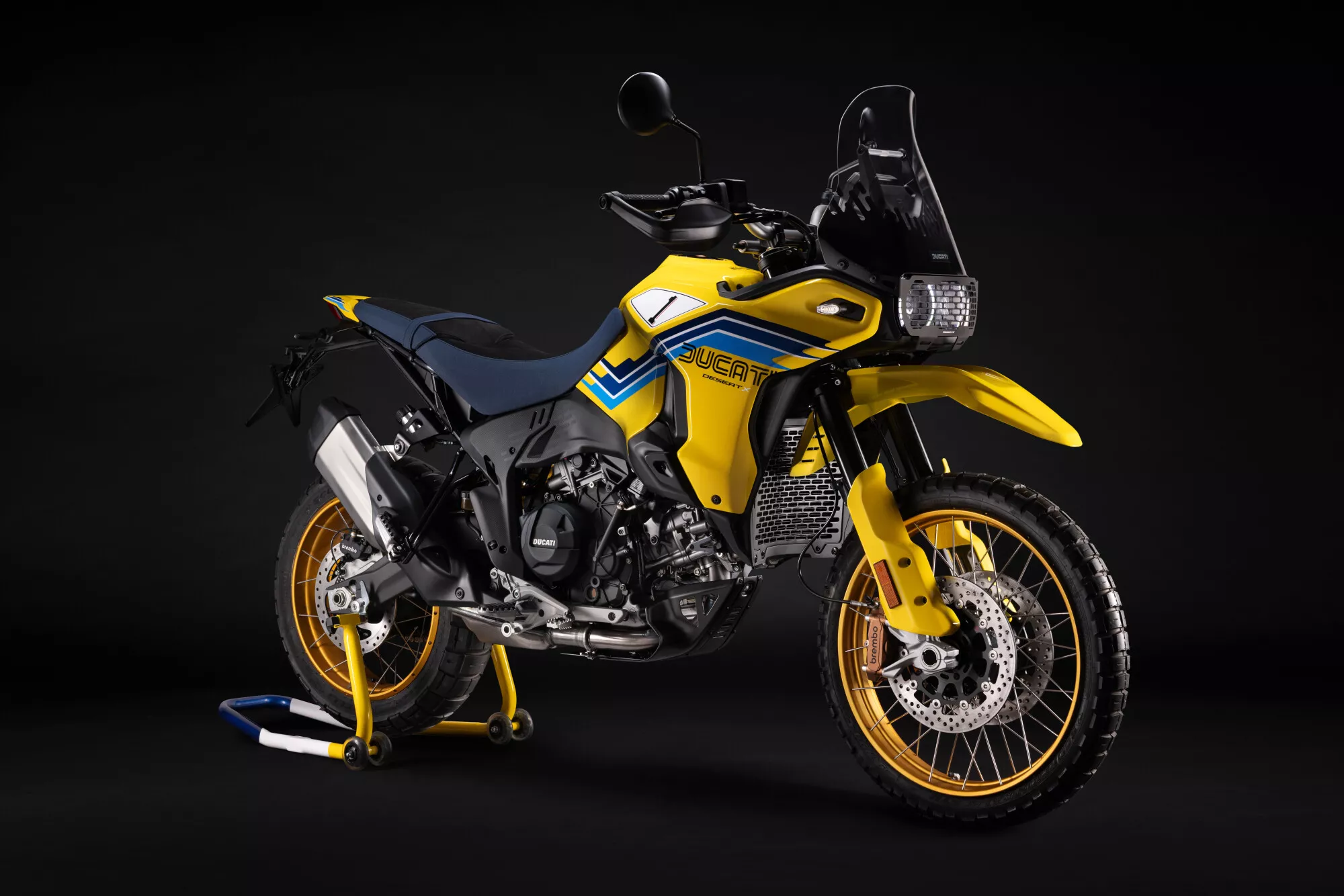
- DesertX 100 (Pantah “Ice” – 1981)
The DesertX 100’s livery is inspired by the graphics of the 1981 Pantah “Ice,” one of the most notable examples of product placement in Ducati’s history.
The Pantah “Ice” was nothing more than a modified Pantah 500, featuring unusual, studded tires and the removal of the braking system, enabling it to be used on ice tracks.
At the time, Ducati was managed by state-owned holdings that also controlled car manufacturers such as Alfa Romeo. In the early 1980s, EFIM, the body that controlled both Ducati and Alfa Romeo, organized a championship for Alfasud cars on the ice tracks of the Alps. The races were held in two heats; during the break between the first and second heats, the brightly colored Pantah “Ice” bikes put on a spectacular show for the crowd. The “Ice” bikes were produced in various liveries; the one chosen for the DesertX 100, yellow with blue stripes, is from a model that until a few years ago was part of the Ducati Museum collection.
The DesertX 100 features an Alcantara seat with an embroidered Ducati 100 logo. The name and serial number are etched on a Centenary Bronze plate mounted to the handlebar risers of the billet triple clamp. The high front mudguard and aluminum radiator grille enhance the model’s off-road credentials. Standard equipment includes a Centenary Bronze fuel cap and a headlight grille, both of which are not approved for road use.
* Not available on the DesertX 100 and Scrambler 100