

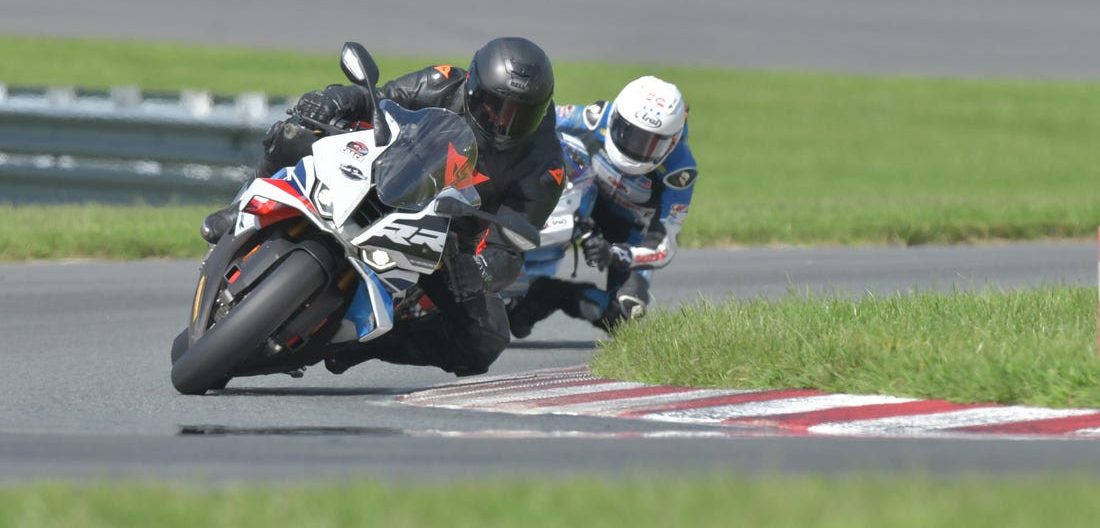
A MotoAmerica racer, a new track, and the fundamentals that unlocked her speed.
Professional racers are faster because they know more, right? In reality, many factors make up speed on track. I’ve always looked at racing success through the lens of becoming a complete athlete, with technique, physical fitness, and mental preparation being the three major tenets. All are important, and all constantly feed and loop into one another.
When it comes to technique, working with a professional driver or rider isn’t all that different from working with a rank novice. Speed and nuance are the only real differences. Fundamentals are still the focus, regardless of the on-track experience or race wins. Only the degree of application changes.
Proper fundamentals should scale, from novice to professional, regardless of skill level or speed. It’s why a professional can jump into or onto your vehicle and almost immediately produce a cleaner, quicker lap time. They aren’t using some secret set of techniques reserved for professionals. They’re simply better at executing the fundamentals.
Recently, I was asked to take a look at MotoAmerica Twins Cup competitor Sonya Lloyd. Sonya, 24, is a former amateur flat-tracker and came to road racing through the Royal Enfield Build. Train. Race. program, where she finished second overall. She has also contested the FIM Women’s Circuit Racing World Championship.
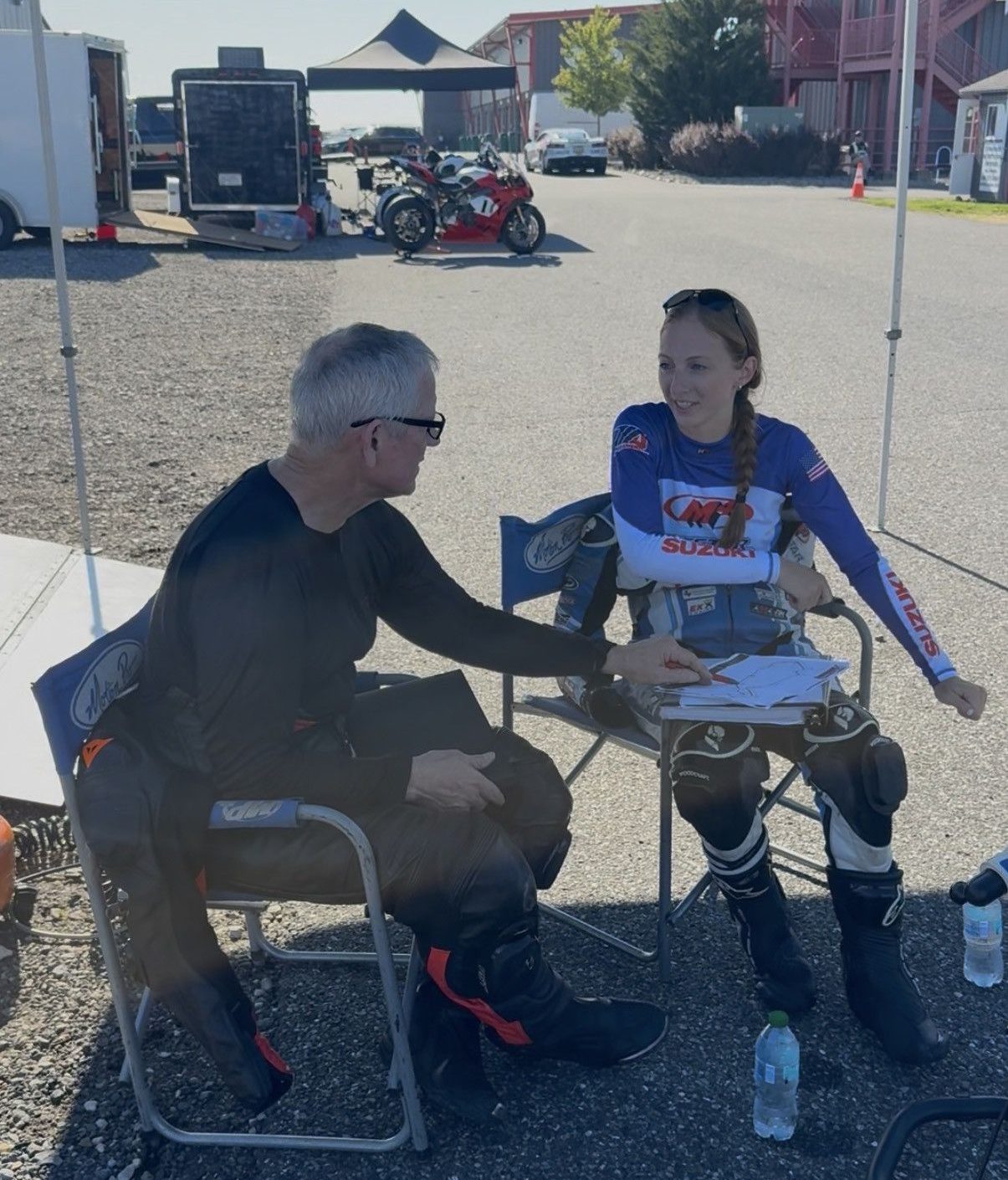
Sonya had listened to my podcasts and read my Substack column, but she’d never received any formal in-person training. Everything she knew about my approach to motorcycle riding came from what I had published. For the most part, then, she was winging it. And while she is qualifying for professional grids, she hasn’t reached her goals.
After working through a few scheduling conflicts, we agreed to meet at New Jersey Motorsports Park, a venue she had never even seen, for one day of coaching during a “Riders Club” weekend event. The timing was good because Sonya will be racing at NJMP in a few weeks at the MotoAmerica season finale.
The track day at the 12-turn, 2.25-mile Thunderbolt Raceway was a two-day event, but I could only attend the second day. Before the event, I sent Sonya a brief video outlining what I wanted her to focus on Saturday. After she watched my briefing, day one was entirely on her to establish a baseline.
First, some context. The MotoAmerica Twins Cup lap record at NJMP is 1 minute, 25.05 seconds. Sonya’s goal is to finish in the top 10 in the two races. Realistically, that’s going to require consistent lap times in the low 1:27s. So, how is she going to get there? More importantly, what’s the process?
Goal → Evaluation → Methodology
- Coaching day
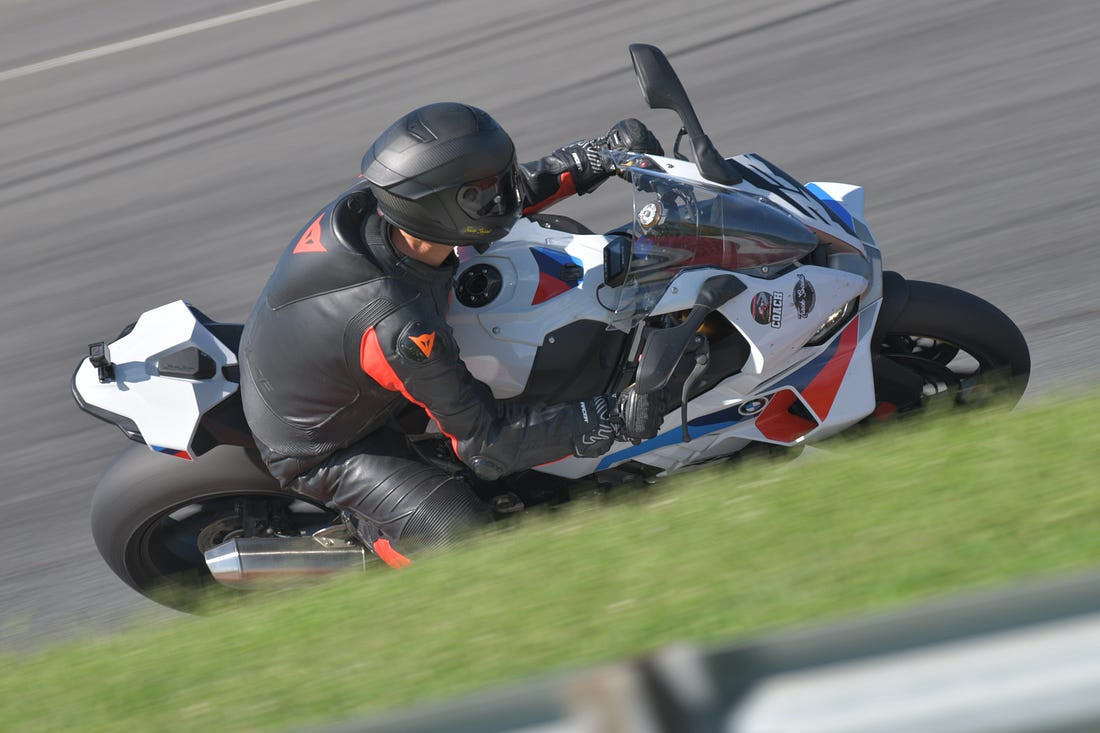
Sonya had ridden her Dunlop-tired M4 ECSTAR Suzuki on Saturday and ran a few 1:31s—solid for her first day at NJMP. Now, it was time for us to suit up and ride. I would be riding my 2025 BMW S 1000 RR. Before heading out on track, I installed an AIM Solo 2 lap timer on Sonya’s GSX-8R to capture the data as she circulated the track.
- Session one
I led the first session, recording laps with a rear-facing camera. Glancing at my mirrors at select points on the track, I could easily see how Sonya was managing corner entries, apexes, and exits. Following my methodology, we focused on getting up to speed quickly. We encountered little traffic, and she ended the session with a high 1:31.
Evaluation findings:
- Braking early, wide on apexes, no defined slow point; not a lot of brake force
- Running wide, swoopy lines; not finishing corners
- Too much weight on hands and arms, little lower-body engagement
- Difficulty getting the bike to the apex, excessive lean angle after the apex
Let’s linger here for a second, because this is important. When I’m communicating with a professional driver or rider, less is usually more. Even seasoned professionals can be overwhelmed by too much information. I’ve made that mistake myself. I may have been right about what needed to change, but I gave the student more than they could use at that moment.
At pace, there isn’t time for a lengthy checklist. Instead, I limit my focus to just two things. For example, one specific area of corner entry, such as the brake-application point, the turn-in point, or the brake-release point. Doing that one thing correctly should “umbrella” other elements of the turn:
- Goal for corner or section
- Drive past apex
- Straighter line to maintain wide-open throttle
- Reach exit apex sooner
Done correctly, the driver or rider has less on their mind while fixing multiple issues at once.
- Session two
After the first session, I could see two things holding Sonya back: vision and body position. She was giving up early on references, moving on to the next one before finishing the last one. She also had too much weight on her inside arm, which was locking the steering and preventing the bike from turning. Braking was an issue, too.
Vehicle placement, however, always comes first. In fact, getting the bike in the right place, at the right time, is paramount. This is where methodology matters. Evaluation identifies everything that’s wrong. Methodology determines what gets fixed first. The result was a slightly slower lap time but with much greater precision.
With two sessions under our belts, Sonya and I had data to download and review. The graphs revealed much-improved slow-point locations, but she was either overbraking or underbraking. She was also impatient, not entering corners with the precision needed to produce the best exits.
- Session three
We needed to work on braking, but we stuck with what we’d worked on in the second session, using the approach, “How do I know I did it right?” Focusing on that technique gave Sonya the ability to identify and correct problems in real time. We encountered a lot of traffic, as well as a red flag, but she still ran a 1:30 and did so in fewer laps.
- Session four
Building on the previous sessions, braking was now holding Sonya back. She was either not generating enough pressure or applying pressure at the wrong time. We focused on holding pressure at turn-in to initiate turning, then, as turning was realized, trailing off the brakes to maintain entry speed. It might feel slower, but it’s not.
Boom! Everything was clicking. By understanding where the bike should be placed, recognizing she had mastered a technique, and unweighting her inside arm, braking had a more significant effect, namely being quicker to and from the slow point of the corner and longer acceleration. Despite a lot of traffic and another red flag, precision and exits dramatically improved.
- Session five
From the fourth session, I clarified some nuances of brake timing, focusing on how Sonya knew she did it correctly. This was my last session of the day, and Sonya led every lap. Did her braking improve? Absolutely. While she wasn’t as precise as I would like to see, she maintained good bike placement and control timing.
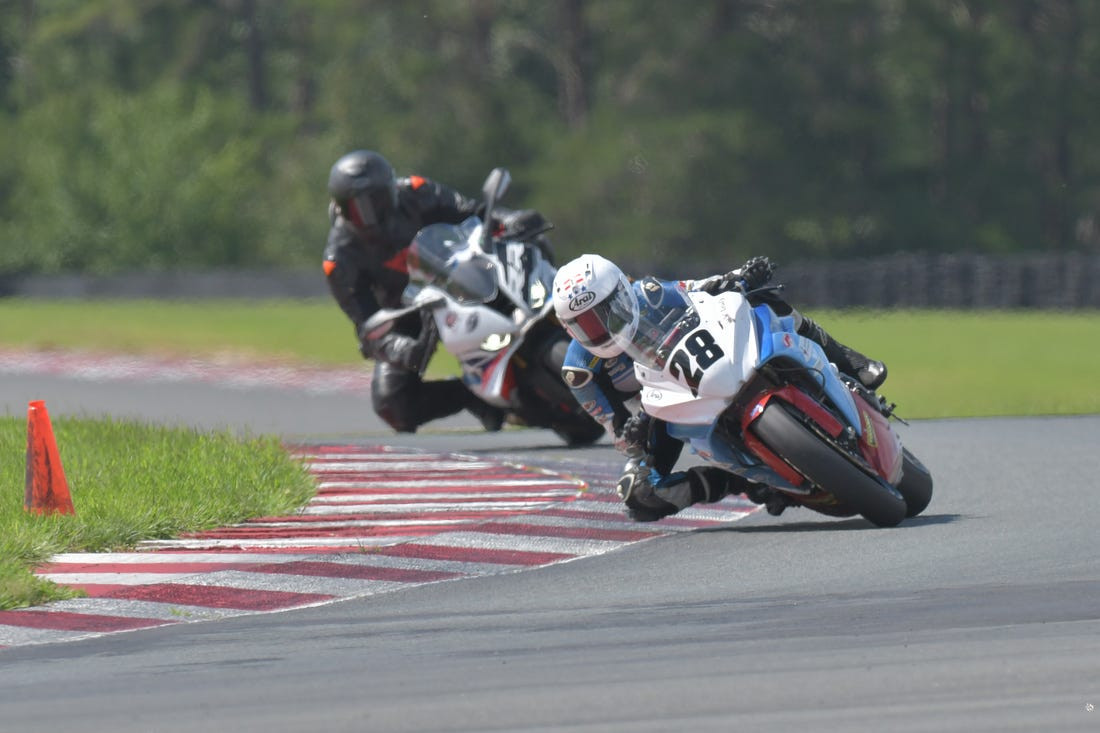
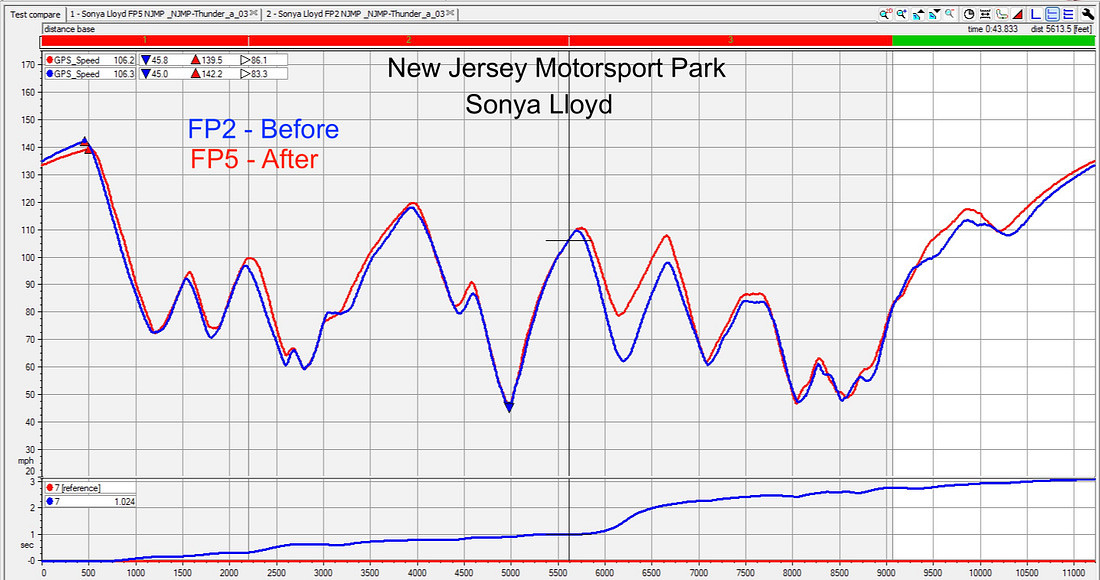
How good? I had to up my game because Sonya’s exits were so good. By the end of the session, she had run a 1:29.0, with a theoretical 1:28.8. The difference in how and when she used the brakes not only improved her lap time, but she felt less rushed. She also had more time to think about other areas. This is the foundation I wanted to see. We can build on this.
Before and after: Here is a data graph showing Sonya improvements.
- The takeaway
Having watched previous on-board videos of Sonya riding, I knew braking would be a problem, which was verified in the initial evaluation. It would have been easy for me to just start and end there: more brake pressure, better timing, later braking. But braking wasn’t the first thing that was holding Sonya back.
An evaluation identified the concerns. The methodology determined the order in which we addressed them. We didn’t ignore the braking problem. We prepared the fundamentals underneath it so that when we finally did address braking, the change actually worked and improvements came quickly.
Vehicle placement was first. Vision and body position supported that placement. We established how Sonya knew when she had done something correctly. Only then did braking become a priority. And when it did, the result wasn’t just more brake pressure or a faster entry. All aspects of the corner improved.
Sonya got to and from the slow point of the corner quicker, was better placed to accelerate for a longer period of time, and most importantly, felt less rushed while doing it. In fact, she admitted feeling less risk than when she was lapping three seconds slower the previous day. That’s why the “Order of the Sport” is so important.
Goal → Evaluation → Methodology
Know exactly what you want to accomplish. Identify what is actually holding you back. Then, use a methodology that addresses those limitations in the correct order. Professional riders don’t need different fundamentals. They need the right fundamentals, applied to the right degree, in the right order. That’s coaching.
About Ken Hill:
Ken Hill is an experienced motorcycle riding coach in the U.S. He bought his first motorcycle at age 30 and began road racing the very same year. Despite the late start, Ken went on to set track records and win class championships before making his professional debut in the AMA Superbike class, where he finished in the top 10 at age 41. Ken’s passion for learning and, ultimately, bettering the sport, led him to retire from racing in 2007 and devote himself full-time to coaching. Learn more at khcoaching.com.