


(Please scroll down for updates)
We are deeply saddened by the passing of George Barber.
He built more than an organization—he built a community.
We are grateful for his vision and leadership, and we will share additional information in the days ahead.
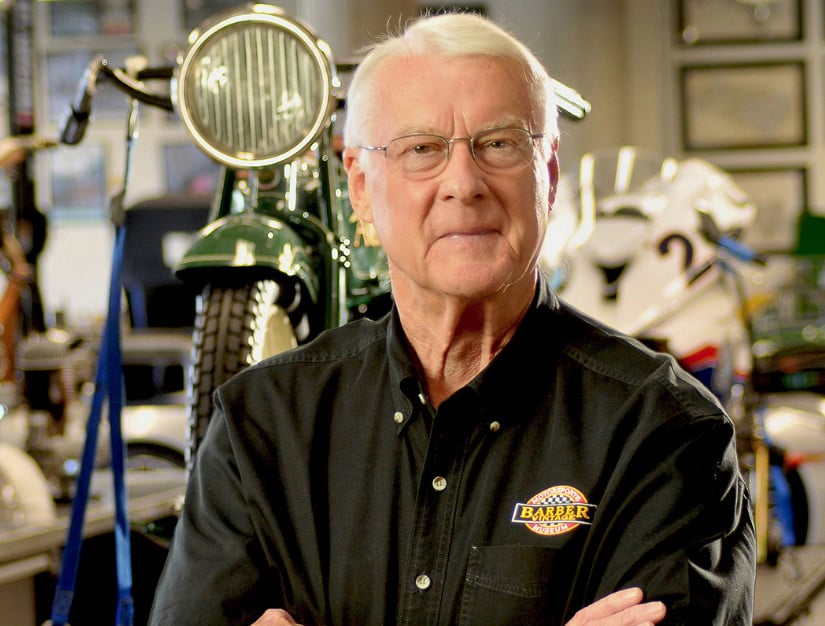
More, from a press release issued by AMA:
The American Motorcyclist Association is saddened to learn of the passing of AMA Motorcycle Hall of Famer George Barber, who passed away at 85 years old.
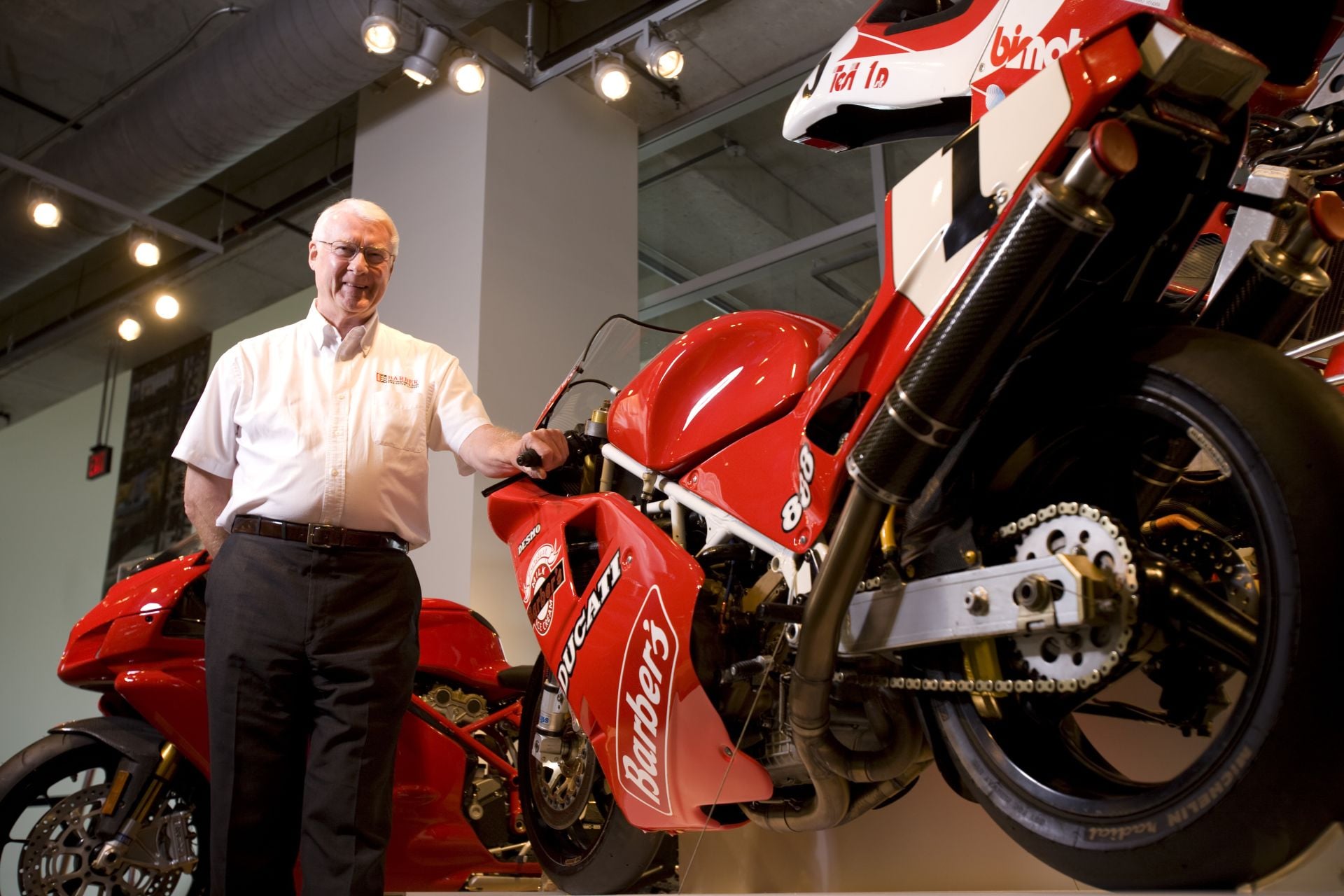
Founder of the prestigious Barber Vintage Motorsports Museum in Birmingham, Ala., home to the world’s largest collection of historic motorcycles, Barber had a unique impact on the motorcycling community.
Son of George H. Barber, founder of Barber Dairy and pioneer for dairy pasteurization in the United States, the younger Barber’s love for motor vehicles started early in his life. In the 1960s, Barber raced and wrenched on his own Porsche racers with great success, claiming a large collection of wins behind the wheel.
Barber’s interest in motorcycles began soon after, leading him to open his own museum and hire skilled workers to restore vintage motorcycles to help build his collection. At the same time, Barber operated a vintage motorcycle racing team, which raced across the United States and Europe.
In 1994, Barber’s museum gained 501(c)(3) nonprofit status and was officially named the Barber Vintage Motorsports Museum.
In 2002, Barber opted to close the original location of the Barber Vintage Motorsports Museum, moving his collection to its current location in September 2003, an 830-acre complex that also includes a 2.38-mile road circuit.
For his longtime preservation of motorcycle history, Barber was inducted into the AMA Motorcycle Hall of Fame in 2014.
More, from a press release issued by Barber Vintage Motorsports Museum:
BARBER VINTAGE MOTORSPORTS MUSEUM CELEBRATES THE LIFE AND LEGACY OF GEORGE BARBER
Birmingham, Alabama: George W. Barber, Jr., founder of the Barber Vintage Motorsports Museum and Barber Motorsports Park, died peacefully on Sunday, February 15, following a brief illness. He was 85 years old.
Following graduation from Auburn University, Barber enlisted in the Alabama Air National Guard, serving six years with the 117th Tactical Reconnaissance Wing. He took the helm of Barber Dairies at age 29, guiding it into a leading provider in the region.
His legendary competitive drive first manifested on the racetrack, where he dominated the Southeastern sports-car circuit. With 63 victories to his name, George was regarded as a leading talent of his era, trading paint with the likes of Dan Gurney and Peter Gregg.
Motorsports remained a driving force throughout his life. After the sale of Barber Dairies in 1998, Barber merged his various ventures to centralize the management of his diverse investments. In the 1980s, he envisioned a way to give back to Alabama through this lifelong interest.
Today, the Barber Vintage Motorsports Museum houses the world’s largest collection of motorcycles and Lotus race cars. When the collection reached 1,000 vehicles, Barber was asked if they should stop. “Heck, no,” he replied. “We’ll keep going.’”
Located in the southeast corner of the 880-acre campus—bigger than New York City’s Central Park—the museum is a 230,000-square-foot architectural marvel, a global hub for restoration, preservation, design, and education, inspiring more than 4,000 students annually.
Often described as the “Augusta National of Racing,” Barber Motorsports Park was born from Barber’s mandate to create “a botanical garden with a racetrack in it.” The museum and park are considered the largest single philanthropic project by an individual in Alabama history.
Barber’s impact on education and environmental conservation is profound. He funded more than 500 full-tuition college scholarships and built a culture of mutual care and loyalty, consistently stepping in to support his employees and friends during times of need.
“Everyone who visits the museum and park has their own relationship with Mr. Barber,” said Executive Director Brian Case. “What we now share is the impact he had on our lives and responsibility we carry to honor his vision, generosity, and belief in what this place could be.”
A celebration of life will be held at a later date. In lieu of flowers, donations may be made to the Barber Vintage Motorsports Museum.
About the Barber Vintage Motorsports Museum
The Barber Vintage Motorsports Museum is a 501(C)(3) tax-exempt, private operating foundation dedicated to the preservation, interpretation, exhibition, and history of motorcycles, vintage vehicles, and motorsports located at Barber Motorsports Park in Birmingham, Ala. For more than 30 years, the museum has focused on various aspects of motorsports, from displaying motorcycles and cars spanning more than 120 years of production to the Barber Advanced Design Center, a high-tech workspace for design exploration. The museum embraces the culture of motorsports enthusiasts by hosting programs, such as the Barber Design Camp, and events, including the annual Barber Vintage Festival. With five floors housing 1,800 motorcycles, 150-plus automobiles, 60 of which are Lotus race cars, and numerous vintage and iconic vehicles, the Barber Vintage Motorsports Museum is the ultimate family-friendly environment for education, exploration, and inspiration. Additional information is available at www.barbermuseum.org.
George Barber’s Official Obituary:
Full Speed Ahead: George W. Barber, Jr., 1940-2026
BIRMINGHAM – George W. Barber, Jr., of Birmingham, Alabama, passed away peacefully to be with his Savior on February 15, 2026. He was born September 11, 1940, to George W. Barber and Julia W. Barber. He was preceded in death by his parents, his sisters Lynn L. Woehle and Joan L. Hicks and brother Fritz Ludington. He is survived by his seven nieces and a nephew.
George attended Lakeview Elementary and Shades Valley High School, where he joined the
Alpha Sigma Delta fraternity. He went on to graduate from Auburn University as a member of Sigma Alpha Epsilon. Following his studies, George enlisted in the Alabama Air National Guard, serving six years with the 117th Tactical Reconnaissance Wing.
George’s business acumen was rooted in a century of family tradition. Born into the dairy
business his grandfather established in 1921, George quite literally learned the ropes from the driver’s seat of a milk truck at eight years old. This early immersion evolved into a comprehensive mastery of the industry; by the time he took the helm at 29, George had served in nearly every capacity of the organization, guiding its evolution from a local staple into an Alabama industry leader.
George drove its continued growth, expanding into new geographies and product lines and
establishing Barber Dairies as a leading provider in the Southeast. A lifelong entrepreneur, he simultaneously scaled a diverse portfolio of ventures. His career was marked by high-profile acquisitions, including the Dairy Queen franchisor for Alabama and the Florida panhandle and Birmingham Realty Company, the historic successor to the Elyton Land Company, which founded the City of Birmingham. His strategic expansions also spanned luxury automotive with a Porsche and BMW dealership, the construction of Century Plaza Mall, as well as the development of a commercial landscape supply company and a premier marina in South Alabama.
The portfolio continued to evolve alongside George’s shifting business focus. Following the sale of Barber Dairies in 1998, he spent several years consolidating and merging his various ventures. By the early 2000s, he formalized these efforts under Barber Companies, an umbrella organization designed to centralize the management of his diverse investments. Today, the firm serves as a robust operating platform, managing a premier portfolio of approximately 300 commercial properties across Alabama, as well as the world-class Barber Marina.
While George’s philanthropy often took place behind the scenes, his impact on healthcare,
education, and environmental conservation is profound. Guided by a quiet humility, his
philanthropic reach extended to more than 90 organizations across the state of Alabama. He contributed significantly to the University of Alabama at Birmingham, endowing numerous scholarships to honor others’ legacies – a testament to his desire to elevate others rather than himself. His commitment to regional development was further solidified through Barber Dairies, where he funded more than 500 college scholarships, reaching every community in which the company served across Alabama, Florida, and Mississippi. He was a key benefactor to the Boy Scouts of America and Discovery Place (now McWane Science Center). A dedicated conservationist, George founded the Birmingham chapter of the Coastal Conservation Association and earned the title of Alabama Conservationist of the Year. Free advertising on millions of Barber milk cartons helped pass Alabama’s Forever Wild Act. His long-standing service on the Forever Wild Land Trust board and generous support for organizations like the Nature Conservancy reflect a lifelong dedication to preserving the natural world, carried out with the same unassuming spirit that defined his life’s work.
George’s legendary competitive drive first manifested on the racetrack in his early years. While he was required to balance his passion with his professional duties – relying solely on vacation days to compete – he managed to dominate the Southeastern racing circuit. With 63 victories to his name, George was regarded as a leading talent of his era, trading paint with racing legends such as Dan Gurney and Peter Gregg.
While George transitioned from the driver’s seat to the executive suite following his father’s
passing in 1970, his passion for motorsports remained a driving force. In the 1980s, he envisioned a way to give back to Alabama through this lifelong interest. Following a strategic suggestion to focus on motorcycles – a niche then underserved by major collectors – George’s personal pursuit evolved into the Barber Vintage Motorsports Museum. Today, the nonprofit institution houses the world’s largest collection of motorcycles and Lotus race cars.
Spanning an 880-acre campus located in the City of Birmingham, the museum is a 230,000-square-foot architectural marvel that serves as a global hub for restoration, preservation, and education, inspiring over 4,000 students annually. Often described as the “Augusta National of Racing,” the adjacent Barber Motorsports Park was born from George’s mandate to create “a botanical garden with a race track in it.” Now home to marquee events like the Children’s of Alabama Indy Grand Prix, the park and museum represent an investment of more than $200 million, widely considered the largest single philanthropic project by an individual in Alabama history. For his efforts, he was inducted into the American Motorcycle Association Hall of Fame in 2014.
While George never married, his life was defined by a deep sense of kinship with those around him. To George, his employees were his family. This commitment was evidenced by his personal touch; he marked every employee’s birthday and work anniversary with a personal phone call and maintained a genuine interest in their lives and well-being. A true servant leader, George built a culture of mutual care and loyalty, consistently stepping in to support his team members and friends during times of need. This spirit of kinship extended far beyond the office; his legacy lives on through a wider family of the heart, including his closest confidantes and dearest friends.
A celebration of life will be held at a later date. In lieu of flowers, donations may be made to the Barber Vintage Motorsports Museum at https://everloved.com/life-of/george-w-barber/donate/?flow=201