



Every rider has watched a professional racer fly through a corner and wondered:
How do they carry so much speed, make it look effortless, and rarely fall down?
The answer isn’t bravery. It isn’t talent. It’s technique. Specifically, using the controls with intention, as the motorcycle was engineered, for maximum grip and safety.
Because the closer we ride like Tino, the better the motorcycle works—and the safer we are. Physics doesn’t care if you’re on the Moto2 grid or riding to work. The principles are the same.
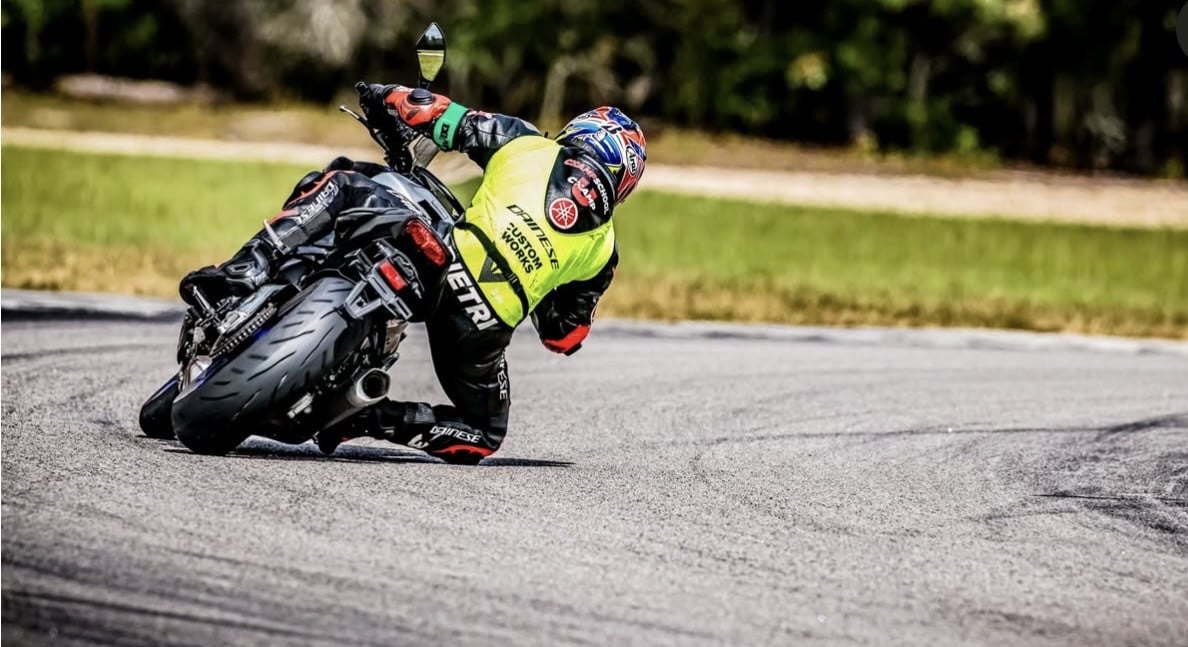
To understand how a true professional rides, we analyzed his data from a “spirited” lap on a Yamaha MT-10 with Bridgestone DOT street tires, through Turn 8 at Carolina Motorsports Park.
Turn 8 is a corner that starts downhill, compresses into a valley, rises into positive camber, then flattens out on exit to spit you onto a 140-mph straight. What happens in these few seconds explains why elite riders are consistently safer and faster than everyone else.
- The Entry: A Decision Made at 143 mph
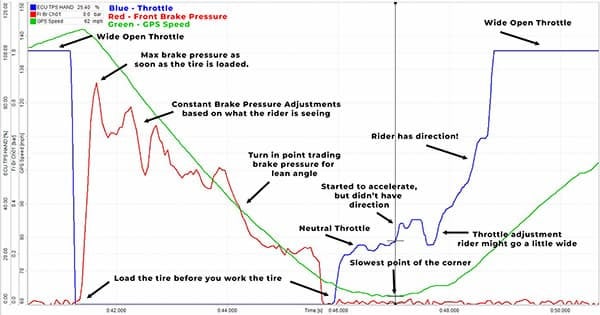
Approaching Turn 8, Tino is flat-out at roughly 143 mph. When his eyes and brain decide it’s time to slow, he gets nervous, but there is no hesitation, and there is no coasting. The throttle closes to the brake lever. Almost simultaneously.
- The First Touch: Load the tire before we work the tire.
A professional does not grab a handful of brake. Tino gives the lever a fraction of a second to allow the fork to collapse and the tire to load. This is the moment where grip is built so massive stopping force can be used safely.
Then the brake pressure ramps up sharply.
Why so much pressure early? Because we can use more brake pressure when the wheels are spinning fastest, and they possess the most gyroscopic energy. Slowing aggressively upfront buys everything a rider will need later: margin, time, and grip.
- Trail Braking: The Art That Separates the Good From the Great
Many riders imagine trail braking as a delicate fade: a perfect, smooth taper from heavy to light. But Tino’s data shows the truth—it’s alive. The brake trace wavers with dozens of micro-adjustments because the best riders are constantly updating their speed based on vision, feel, and available grip.
This is the essence of trail braking:
• The motorcycle needs weight on the front tire to steer
• The front brake is the most accurate tool to place weight forward.
• Brake pressure is infinitely adjustable.
• As lean angle increases and cornering forces rise, brake pressure is traded for centripetal load.
• Load or grip is allocated with purpose.
Trail braking is not simply “braking late.” It’s braking correctly, using the lever to create grip, geometry, steering response, and speed.
This process continues until one crucial moment: the slowest point of the corner.
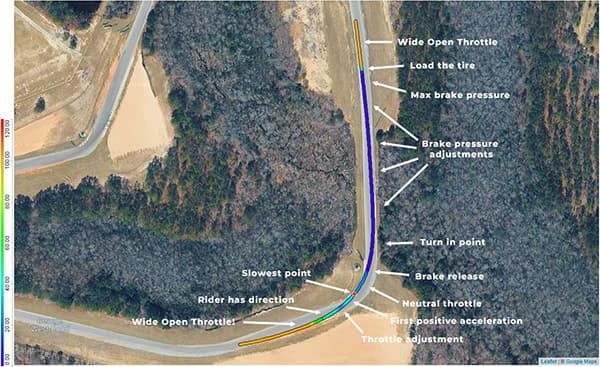
This is a data overlay from the AIM Solo2 DL GPS-based lap timer showing throttle position through turn 8 at Carolina Motorsports Park.
The Slowest Point: The Moment Everything Happens
Every corner has a slowest point. The key to the sport is to get to the slowest point as quickly as possible, respect it, and then get away from it as quickly as possible. We can exchange “quickly” with the most control. The slowest point is the hinge the entire corner rotates around. It is the moment when the bike is at:
• Neutral throttle
• Maximum lean
• Minimum speed
• Maximum direction change
• Zero brake pressure
• Zero acceleration
Tino’s goal is to use the brakes to get to the slowest point at the exact speed and lean angle he is comfortable with for the corners radius, lean angle, and level of grip. Tino does a pretty good job and the brake release happens at 67 mph, and the true slowest point arrives at 62 mph a heartbeat later.
This window is only about two seconds long in Turn 8, but it is everything.
This is where the motorcycle must be perfectly balanced. Just enough throttle to maintain the chosen radius, known as maintenance or neutral throttle.
Neutral throttle is not passive. It’s an active, deliberate state where the rider and bike agree on radius, trajectory, and grip allocation. It is the calm between two storms: deceleration and acceleration. Professionals do not rush this moment.
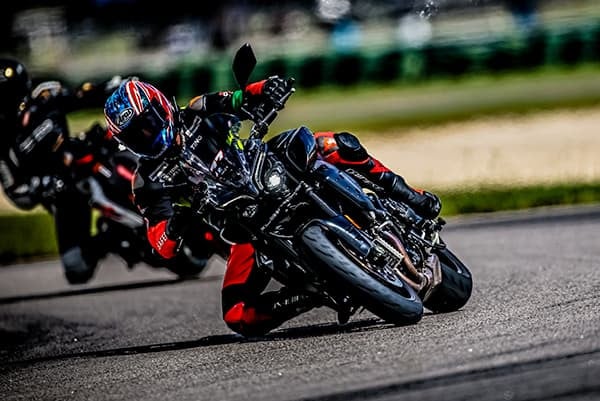
The Exit: The fun part.
If Tino could accelerate early he would. In fact, in the data, we can see that he starts to accelerate, but quickly sees that its too early and he will run wide and has to correct. Only when Tino can see his exit and can take away lean angle, can he truly accelerate. When this happens, he moves from neutrality to aggression. The throttle rises from 23% to 100% in under a second and he launches off the corner. If the tire spins in this moment, he is already applying the cure to the problem by taking away lean angle.
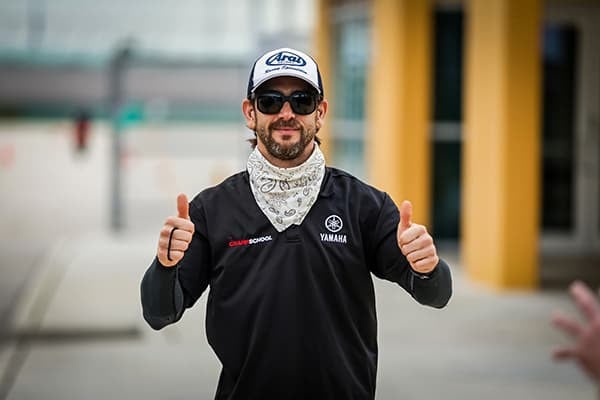
Robertino Pietri is one of the most talented riders on the planet, and an amazing human. We are proud to have him on our team.
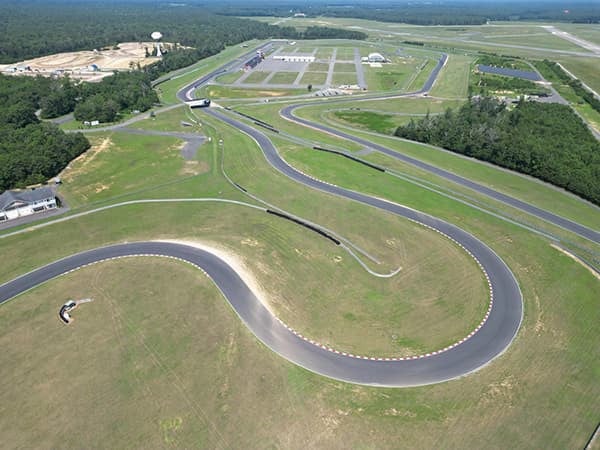
For years, students have asked us to bring a ChampGrad program to NJMP. With thousands of ChampSchool alumni in the region, demand has never been higher—and now it’s happening.
- 4:1 student-to-instructor ratio
- Expanded curriculum: traction, geometry, load management, direction control, and more
- Classroom + on-track format
- Ride your own bike or rent a Yamaha
- Video review, targeted drills, and deeper technical breakdowns
- Ideal for riders wanting to refine technique, improve consistency, and elevate pace safely
We will have a complete selection of Yamaha motorcycles and the world’s best safety gear from Dainese and Arai for a complete “arrive and ride” option.
We are excited to return to Nevada with a full 2-Day ChampSchool at Las Vegas Motor Speedway, one of the most rider-friendly facilities in the country.
- Full 2-Day ChampSchool curriculum
- 4:1 coaching ratio
- Yamaha motorcycle rentals available (R7, R3, MT-07, MT-09, etc.)
- Dainese gear rentals
- Video and data-based feedback
- Challenging, fun track layout with generous run-off and great sightlines