




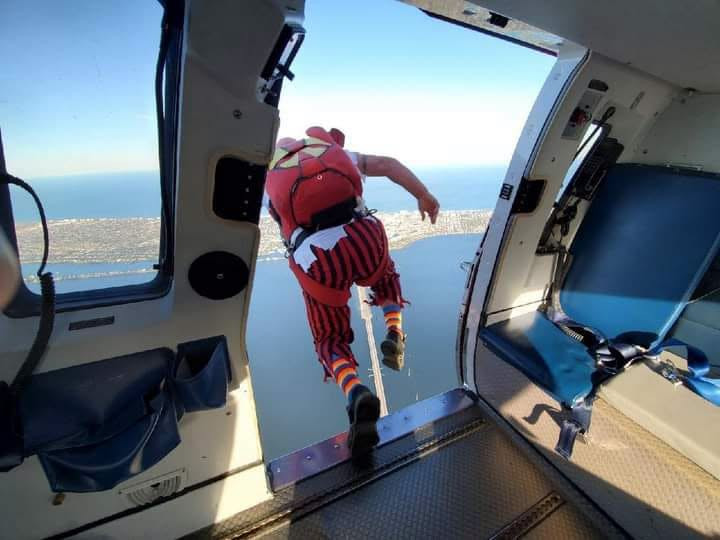
Opening ceremonies at this year’s ASRA Race of Champions at Daytona International Speedway will feature a demonstration unlike any previously staged at the World Center of Racing. Jumpers will exit the historic 1941 Douglas DC-3 “Mr. Douglas ” (N129H), operated by Friends of Mr. Douglas, before professional canopy swooper Tyler Hudson crosses the start/finish line at more than 90 mph, inches above the pavement, and drives to the checkered flag. The team will also present a large U.S. flag, the ASRA banner, and additional canopy displays as part of the program.
This is the world-famous Mr. Douglas skydiving aircraft, a 1941 DC-3A designed and built by the Douglas Corporation in Santa Monica, California.
The DC stands for Douglas Commercial. The 3 stands for the version of the aircraft. The A stands for airliner.
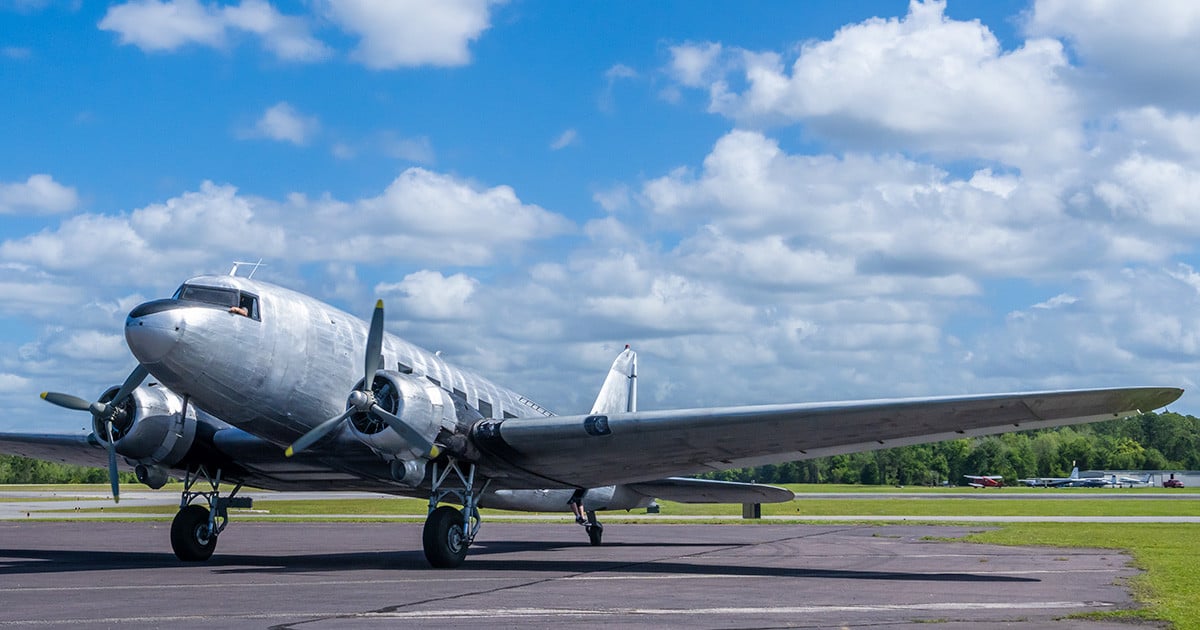
Mr. Douglas was commissioned by United Airlines in April 1941.
The DC3 was the first all-metal commercial airplane; prior aircraft were made of fabric and were much slower.
The DC3 was the first airliner to make the airlines profitable, so they no longer needed government subsidies to keep them flying.
The DC3 aircraft is powered by two Pratt & Whitney 1830–75 engines capable of producing 1350 horsepower. That’s like having 14 Harley-Davidson motorcycles on each wing, spinning large propellers.
After flying for the airlines for a number of years, the DC3 was replaced by the DC4, which was a four-engine pressurized aircraft that could fly above the clouds.
Aircraft that no longer have a viable use for commercial passengers end up flying as corporate aircraft or keep flying passengers or cargo in remote or third-world countries.
In 1952 the Hilton corporation purchased this DC3 and converted it to use as an executive aircraft with a new registration number N129H, and it still carries the same registration number today.
The Hiltons flew the airplane around the world buying hotels. Conrad Hilton and his family used the aircraft on many occasions, including flying passengers Elizabeth Taylor and Zaza Gabor. Baron Hilton used it to fly his friends from Los Angeles to his flying M Ranch for weekend outings. But all good things have to come to an end, and in 1963 the Hiltons sold the aircraft.
Donald Douglas purchased the aircraft in 1964 and used it for several years, flying with his executives to manufacturing facilities in Southern California. Donald Douglas and the Douglas corporation were the designers and manufacturers of the DC3. In 1964 they had just rolled out the DC9 which was a jet aircraft.
But instead of retiring old airplanes like this one, there’s still one use left: Flying skydivers. In 1972 a group of skydivers running a jump school bought the aircraft N129H and converted it into a jump plane based in Deland, Florida.
The jump school ripped out the fancy interior and installed paratrooper seats out of a C47 (the military version of the DC3) that had flown paratroopers during the D-Day invasion.
The DC3 became a very popular platform for competition jumping because it could carry many skydivers–people up to 40. All of the national Skydiving Championships from 1972 until 1987 used DC3 planes, so they were very much in demand.
In the case of this aircraft being owned by Donald Douglas himself, one of the pilots coined the name, “Mr. Douglas.”
Most airplanes are labeled as females, but not Mr. Douglas; Mr. Douglas is one of the only male aircraft.
People came from all over the world to jump out of the DC3 and to train prior to the national championships and the world championships. The current owners estimate that more than 250,000 people had jumped from Mr. Douglas from 1973 until 2001. And it was the only DC3 with the a stereo system so jumpers could listen to their favorite music all the way up to 12,500 feet.
When Mr. Douglas blew an engine in the spring of 2001, his commercial life was over. Turbine aircraft had became affordable, and were more reliable and less expensive to maintain. Then the DC3 was put out of business–until 2017, when some skydivers saw the plane parked on the tarmac in Tullahoma, Tennessee and decided to resurrect Mr. Douglas.
A 501(c)(3) not-for-profit charity was set up and began to raise money to restore Mr. Douglas. After more than seven years of hard work by volunteers, Mr. Douglas took back to the skies on April 4, 2026!
It’s next stop will Daytona International Speedway for the ASRA Race Of Champions. We’ll see you there!