


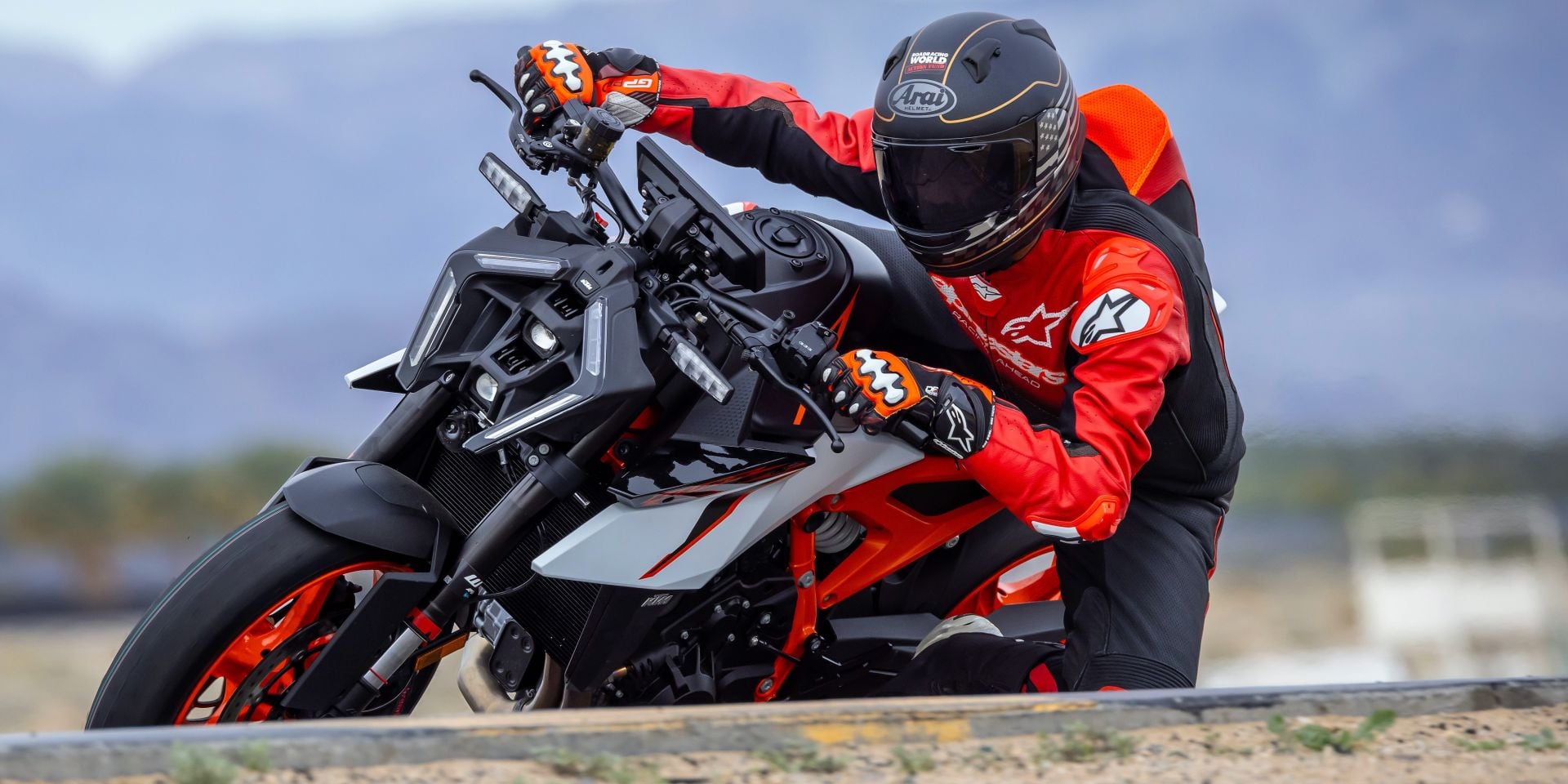
Delayed by KTM’s financial challenges, the 990 Duke R is finally here. Starting from the base of the 990 Duke, the R model is enhanced all the way through. Refinement in each and every key area of the machine adds up to a whole that is greater than the sum of its parts – it’s a different machine, and KTM reflects this by granting the Duke R a different nickname, “The Punisher.”
KTM invited motojournalists to the Palm Springs area for a two-day introduction of the Duke R. KTM’s Media Relations and R&D Manager Chris Fillmore, a former Supermoto National Champion, had a prototype similar to the Duke R and talked company management into letting him race it as a wild card in the Super Hooligan class at the 2024 MotoAmerica Mid-Ohio round. Fillmore wrestled and slid the beast around at the front of the field, and had such a good time that he wanted part of the 990 Duke R intro to take place on the track.
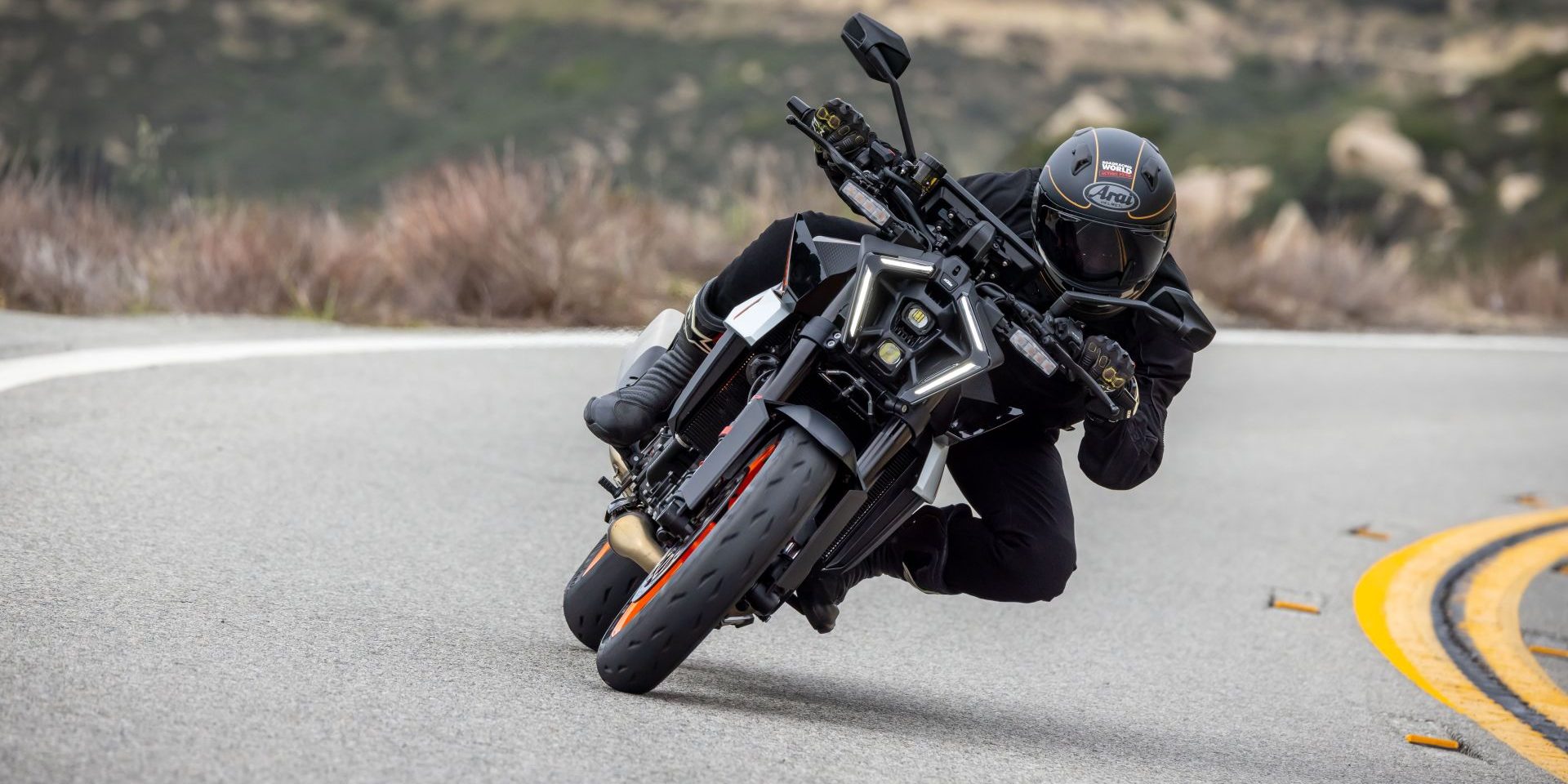
So the first day was riding the Duke R through the mountains up above Palm Springs, through the town of Idyllwild, and the second day took place at Chuckwalla Valley Raceway, sharing the circuit with Dale Keiffer’s Racer’s Edge track day.
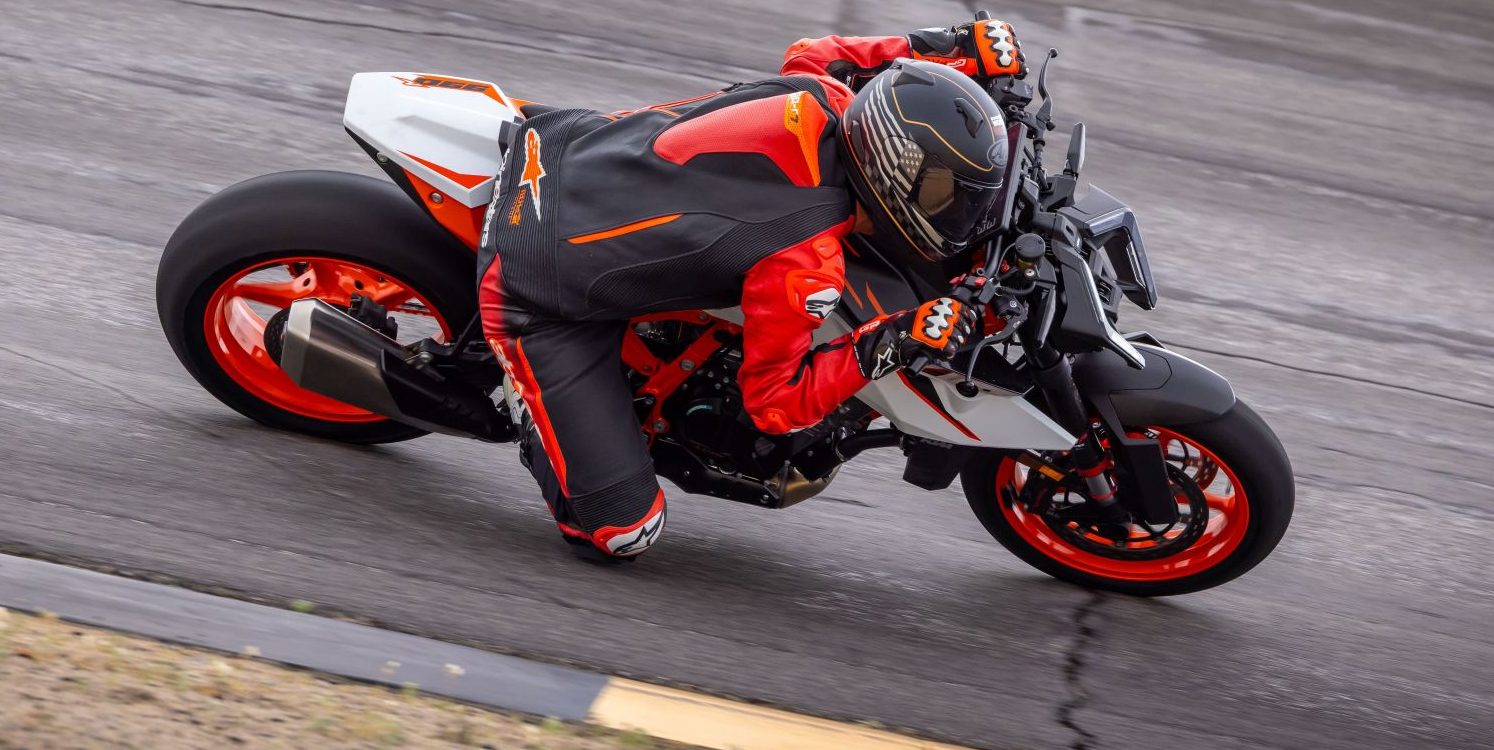
I’d ridden the 990 Duke on the track and on the street, so I was able to compare it and the Duke R. Short answer – it is definitely different, sharper in every way.
990 Duke R Technical Details
The Duke R shares its core with the Duke, starting with the 947cc four-stroke, DOHC Parallel-Twin LC8c engine with a bore and stroke of 92.5mm by 70.4mm. New mapping boosts power to a claimed 126.09 bhp and torque to 78.2 lbs.-ft. The engine is a stressed member of the chassis, and plays another important role in the behavior of the bike. It weighs 125.6 pounds, making it the most compact Twin in its class, KTM says.
Bolted to the tubular steel frame are upgraded suspension components front and rear. A new forged aluminum triple clamp holds a pair of 48mm WP Apex inverted open-cartridge forks, now adjustable for rebound, compression and preload. The change at the rear may be the most significant: The WP Apex monoshock offers high- and low-speed compression damping adjustment along with rebound and preload adjustment, and it operates through a linkage rather than being bolted directly to the swingarm. This allowed KTM engineers to get the progressive action they wanted mechanically.
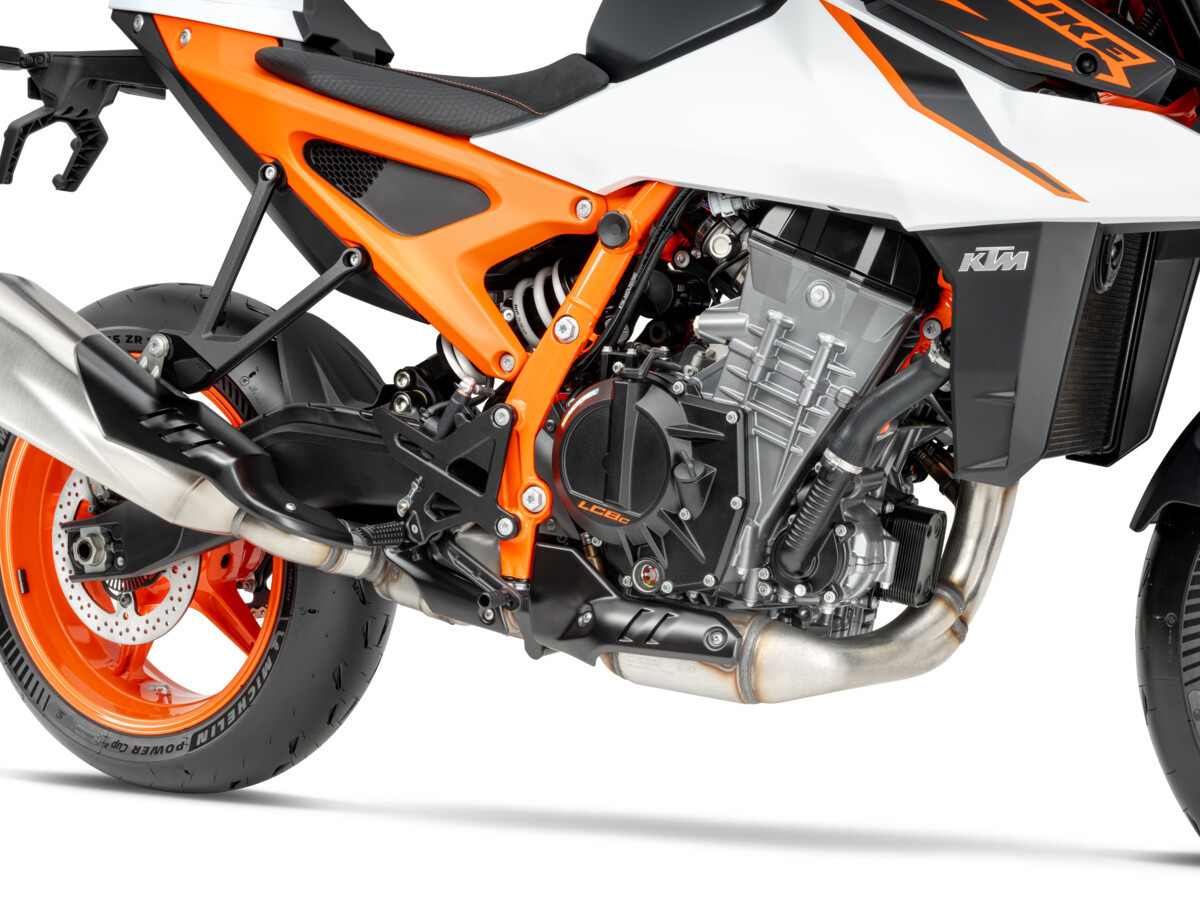
Brakes are upgraded as well, with four-piston Brembo Stylema radial-mounted calipers now operating on 12.6-inch discs in front and a single Brembo caliper mated to a 9.44-inch disc at the rear. A Brembo MCS master cylinder is adjustable for ratio, and the ABS system has four settings – Cornering, Sport, Supermoto and Supermoto+, which all offer different degrees of intervention front and rear.
Ergonomics are more aggressive, with a higher seat, higher and more rearward footpegs and a handlebar that is lower. And talk about aggressive – the Duke R doesn’t come stock with passenger pegs or a passenger seat!
The Duke R features a new 8.8-inch TFT dash that offers customizable split screen functionality and is actually touch-sensitive, even through gloves. Standard features include four ride modes, including a new Custom option, and include traction control and wheelie control. The optional Track Mode incorporates slip angle control, five-level anti-wheelie control, launch control, and a quickshifter is available as either an individual add-on or as part of the Tech Pack, which has all of the Track Mode features as well as engine braking and cruise control. The package is rounded out by Michelin Power Cup 2 track-oriented DOT tires, orange wheels from the 1390 Super Duke R EVO and a color scheme from the 2011 990 Super Duke R.
Riding The 990 Duke R
I definitely noticed the higher seat height when I swung a leg over the Duke R, but once aboard, the riding position felt roomy and comfortable. Dukes have a unique riding position, one that strikes a balance between sportiness and comfort, and it’s one that I like a lot. Pulling into Palm Springs morning traffic, I noticed that the quick-shifter was slick and precise, the seat comfortable, and there was little vibration.
Onto Highway 243, where the pavement shifted from recently paved and smooth to not-so-recently paved, the Duke was in its element. I used Track and Sport riding modes, settling on Sport mode as it allowed a bit more nuance in the application of throttle, which I find useful on twisty roads where mid-corner course corrections are part of the game. The increased fork stiffness was noticeable, but the big difference to me was the increased sophistication of the rear suspension action. Over frost heaves (and yes, it snows up there!) the rear did a much better job of absorbing sharp-edged bumps, and if I were riding the bike only on the street, the standard suspension settings would serve nicely as they are. There was no shortage of power for street riding, and more than enough brakes.
On the track, especially at Chuckwalla, there was still plenty of power – the bike never felt breathless on the relatively short straights, and there was plenty of punch coming out of corners. With Dunlop slicks installed, it was all about lean angle and mid-corner speed, and the Duke R was more than comfortable being ridden this way. I added preload to the rear to help minimize some of the weight transfer coming out of corners, and I spent most of the time in Track Mode for a sharper throttle response – I mean, isn’t that what a big Twin is about, torque and punch?
The other thing I noticed was the sheer flickability of the bike through transitions and into corners. The center of gravity is raised, there are no aero appendages to weigh down the steering inputs, and the bike transitions quickly and with very little effort. I put in lap after lap, session after session, and I thought toward the end of the event that this was a bike I really could take out for every session on a track day – and be ready to do it again the next day.
Suggested retail is $13,399.
Check out a video review of the 990 Duke R here: