



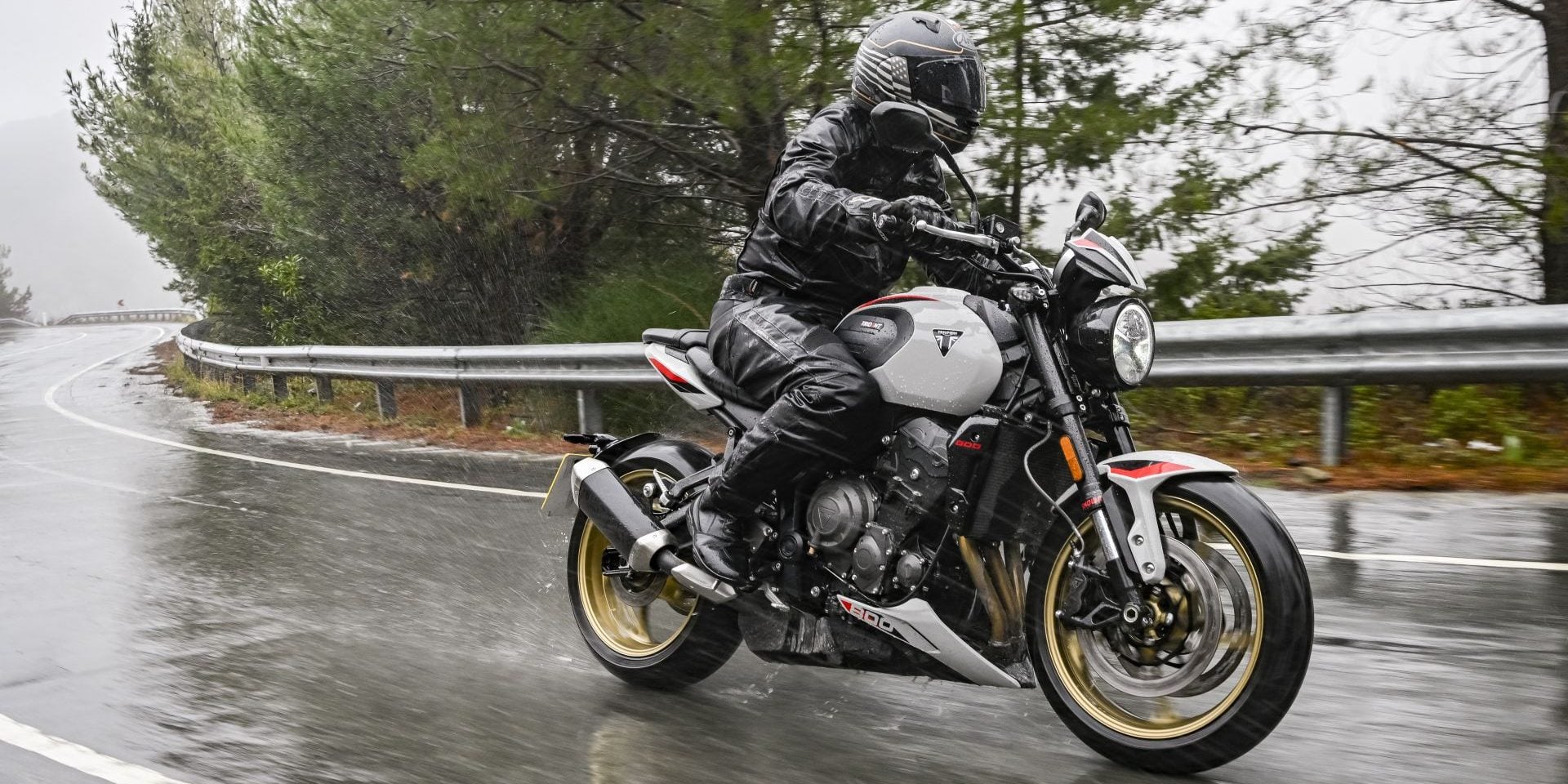
When I woke up in Cyprus for the intro of the 2026 Triumph Trident 800 and looked out the hotel window, the wind was frantically whipping palm tree fronds and pounding the surf into the rocks just off a nearby beach, all under a gloomy, dark, foreboding cover of fog and dew. The weather forecast for the nearby Troodos mountains where the intro ride was going to take place, was for rain, wind and cold. Once we got going, it was so cold that the photographers were retreating into tents with heaters while waiting for the assembled journalists to ride past.
The bike is the successor to the company’s 765 R naked roadster, and, given the nasty conditions, I was glad that it came standard with electronics including multiple power modes, ABS, traction control, and wheelie control. I wanted every one of them while riding through the rain, fog and on wet mountain lanes.
Almost all of the miles we covered were in rain or on rain-slicked roads, and that was mostly good for sampling how the bike handled less-than-optimal conditions. The last 10 miles or so, however, the roads were dry and traffic was light and I got to open the throttle for real, and the Trident 800 delivered what Triumph engineers promised it would. It felt quick, light, responsive and planted, and I ended the day wanting more of that!
Tech Overview
The naked roadster market segment is important to Triumph, so much so that it has three different models in the category. The Trident 660 underwent significant changes for 2026, and the more track-focused Street Triple 765 RS remains in the lineup. The Trident 800 is designed to fill the gap left behind by the departing Street Triple 765 R. The 765 R leaned more toward the 765 RS in terms of ergonomics, suspension and power delivery; Triumph wanted its replacement to be more Trident, less Street Triple.
Triumph engineers started with the Trident 660 base–the steel frame and the new triple-throttle-body induction setup that the 660 got in its most recent upgrade. To that, they added upgraded forks, a smaller rear brake, better brake calipers, a better shock and the all-new engine from the Tiger Sport 800. The liquid-cooled, DOHC, three-cylinder powerplant has a bore and stroke of 78.0mm x 55.7mm and delivers a claimed 113.4 bhp at 10,750 rpm, and 61.96 lbs.-ft. of torque at 8,500 rpm.
That’s down about five bhp from the 765 R, but up about three lbs.-ft. of torque, and the torque curve is much flatter than on the 765 R, the company says. That’s deliberate–the Trident 800 is aimed at everyday riding and enthusiastic twisty-road carving. In this context, a flat, fat torque curve is useful and exciting. The rest of the Trident 800 echoes this zeitgeist. Compared to the 765 R, the bars are wider and closer to the rider; the seat is incrementally lower; the footpegs are lower and further forward. The suspension is slightly less sophisticated. The swingarm is pressed steel instead of the aluminum alloy unit mated to the 765 R’s aluminum twin-spar frame.
The Trident 800’s tubular steel frame uses the engine as a fully stressed member; there are mounting points ahead of and behind the cylinder head. It has Showa 41mm Big Piston split-function front forks adjustable for rebound and compression, and a single Showa rear shock adjustable for spring preload and rebound damping. Twin 12.2-inch (310mm) discs in the front are paired with four-piston radial-mount calipers and steel braided lines; an 8.66-inch (220mm) disc is mated to a single-piston caliper in the rear. Cornering-sensitive ABS joins three ride modes–Sport, Road and Rain–each with its own traction control setting, and the TC can be switched off entirely. Given the conditions, the heated grips were very welcome, There’s also a single-button cruise control system; the rider just hits a button and the bike maintains that speed, making it easy. And for anybody who doesn’t like using a clutch, the Trident 800 has clutchless up-shifting and down-shifting.
Riding The Trident 800
The first few miles were on dry city streets, and the Sport setting demonstrated an engine that was responsive and powerful in the mid-range, just as Triumph promised, and still stout as the revs rose. Further explorations of the power delivery were cut short by the slick, narrow, wet roads in the mountains, which I dealt with by switching to Rain mode and max TC. The Michelin Road 6 tires performed well in the wet, but every mile contained a handful of little twitches through the bars that let me know that the bike had lost traction for a fraction of a second. The heated grips were awesome!
Even in this environment, I could tell that Triumph had hit several of its targets for the Trident 800 in the bull’s-eye. The riding position was sporty but comfortable, the seat supportive. Vibration was minimal, and the dash remarkably intuitive. While there weren’t a lot of electronic rider aid options, the ones that were there were easy to access, and I could quickly configure the dash the way I wanted it. And Triumph’s engineers played around a bit with the sound of the bike, giving the rider a throaty induction roar and a bit of pop and burble on off-throttle coasting. I like the way Triples sound; I like the way Triumph’s Triples sound a lot; and this was the best-sounding Triumph Triple yet.
When we finally got back on dry road, I put the Trident 800 in Sport mode and the the bike snapped into focus. At anything above 6,000 rpm, the bike punched forward. The chassis felt stiff and composed, easily able to handle the forces the Michelins were loading into it. The suspension felt rigid, and even though it wasn’t the most sophisticated, it did the job, striking a nice balance of control and comfort. A lot of bikes in this category have decent suspension, but they are right at the limit of their capabilities in rapid street riding. On the Trident 800, it felt like there was more margin before hitting the limit.
The Trident 800 is aimed at someone who likes the Triumph roadster aesthetic and concept, who isn’t headed for the track but who isn’t averse to a little hooliganism on the weekends or a long ride up a twisty road. It feels solid and muscular. And at a starting MSRP of $9,995, it feels like there’s real value here for a rider who wants what the Trident 800 delivers.
(See more in an upcoming print issue of Roadracing World.)